Artists: Justine Khamara, Lyndell Brown and Charles Green, Imants Tillers, Sam Shmith, Janet Laurence, Murray Fredericks and Huang Xu
Janet Laurence (Australian, b. 1947) Carbon Vein (installation view) 2008 Duraclear, oil pigment on acrylic 235 x 100cm Photo: Marcus Bunyan
This is an excellent group exhibition at Arc One Gallery, Melbourne. Together the works form a satisfying whole; individually there are some visually exciting works. There are two insightful paintings by Imants Tillers, Nature Speaks: BP (2009) and Blossoming 21 (2010), a digitally constructed landscape by Sam Shmith, Untitled (Passenger) (2010, below) that the online image doesn’t really do justice to, a large photographic landscape of a storm over Lake Eyre Salt 304 (2009, below) by Murray Fredericks and two layered transcapes by Janet Laurence (see image above) that just confirm the talent of this artist after the exciting installation of her work at the Melbourne Art Fair (I call them transcapes because they seem to inhabit a layered in-between space existing between dream and reality).
For me the three outstanding works were the large horizontal photograph Hair No.2 (2009, below) by Huang Xu, in which hair hangs like a delicate cloud on a dark background and his photograph Flower No. 1 (2008, below) in which the white petals of the chrysanthemum, symbol of death or lamentation and grief in some Western and Eastern countries in the world, seemingly turn to marble in the photographic print (you can see this online in the enlarged version of the image below). What a magnificent photograph this is – make sure that you don’t miss it because it is tucked away in the small gallery off the main gallery in the Arc One space. The third outstanding work is the sculpture you are a glorious, desolate prospect (2010) by Justine Khamara (see photographs below), a glorious magical mountain, twinkling in the light, all shards of reflectiveness, cool as ice. I would have loved to have seen this work without it’s protective case – in one sense the case works conceptually to trap the speaking of the mountain but in another it blocks access to the language of this work, the reflection of the light of the gallery, the light of the world bouncing off it’s surfaces.
This is not, of course, how nature speaks but how humans speak for nature – through image-ining and seeking to control and order the elemental forces that surround us. This construction of reality has a long tradition in the history of art, the mediation of the world through the hands, eyes and mind of the artist offering to the viewer, for however brief a moment, that sense of awakening to the possibilities of the world in which we all live.
Dr Marcus Bunyan
Many thankx to Angela and all at Arc One Gallery for allowing me to publish the photographs in the posting. Please click on the photographs for a larger version of the image.
Justine Khamara (Australian, b. 1971) you are a glorious, desolate prospect (installation view) 2010 Mirror, perspex, plinth 80 x 186cm Photo: Marcus Bunyan
Justine Khamara (Australian, b. 1971) you are a glorious, desolate prospect (installation view detail) 2010 Mirror, perspex, plinth 80 x 186cm Photo: Marcus Bunyan
Lyndell Brown (Australian, b. 1961) and Charles Green (Australian, b. 1961) Galatea Point 2005 Digital photograph on duraclear film edition of 5 112 x 112cm
Huang Xu (Chinese, b. 1968) Hair No.2 2009 Type C Photograph 120 x 245cm
Huang Xu (Chinese, b. 1968) Flower No.1 2008 Type C photograph 120 x 120cm
Huang Xu (Chinese, b. 1968) Flower No.2 2008 Type C Photograph 120 x 120cm
Murray Fredericks (Australian, b. 1970) Salt 304 2009 Pigment print on cotton rag 244 x 88cm
Sam Shmith (Australian, b. 1980) Untitled (Passenger) 2010 pigment print on archival rag 180 x 108cm
Arc One Gallery 45 Flinders Lane Melbourne, 3000 Phone: (03) 9650 0589
Ewen Ross (Australian, b. 1957) Plain of Mars 2010 from the Warrina Portraits series
There is little more to say about this exhibition of works by Ewen Ross than the erudite catalogue essay by Geraldine Barlow enunciates (see essay below), except to say that the ‘presence’ of these works is extremely moving. It is difficult when viewing photographs of the work to explain the physical impact of actually standing in front of these works, absorbing their energy, examining their surfaces, their depths.
The larger photograph of Thenar Eminence (2010, below) is the closest one can get in the virtual world to appreciating the elemental quality of the work – the fire, the fragmentation and the soil, the contour-like mapping of the earth – as the work resembles a memory of earth, of place, re(as)sembles a signification, a meaning wholly of its own in the mind of the viewer. In the spectator the act of looking may turn into contemplation and this work does seem to have that effect = the context of looking at the work invites a contemplation on place and connection to earth.
Barlow asks. “Is this matter, or its coded representation? Ross sets up a liquid movement between such possibilities.”
Ross does indeed set up a liquid movement between matter and representation. But here I would offer a counter argument to the idea that matter and coded representation are binary opposites. As noted by Judith Butler in the excellent quotation below, matter is already meaningful, already coded and materialised. It always has a history and narrativisation embedded within it. Butler suggests the body is never a valueless matter on which inscription takes place because this hides the inscription already there.
Continuing this idea, Ross brings matter back into the fold, into the peeled away surfaces of his work. His process of materialisation offers these liquid movements not through an oppositional relationship between matter and coded representation but because a) his works are no longer anchored in an unquestionable reality and b) they have moved beyond coded representation. Ross reconceptualises both space and matter in his objects of place and invites us, the viewer, to contemplate these (e)motional environments.
Dr Marcus Bunyan
Many thankx to Anita from Anita Traverso Gallery for allowing me to publish the photographs in the posting and to Geraldine Barlow for allowing me to publish the catalogue essay, all very much appreciated. Please click on the photographs for a larger version of the image.
Body and Text
“Judith Butler has done much to interrogate and upset the assumes inside / outside binary of culture and nature, and has shown that what is called matter, and therefore presumed to be extra-discursive, is already meaningful. In her book entitled Bodies That Matter (1993) she argues that matter is already materialized, that is, it always has a history, is always narrativized. Any reference to matter will always be a particular formation of materiality that has been discursively set. Matter, nature or the body is never an absolute outside but is rather a constitutive outside that generates the significance of an interiority, culture or law. It is an outside that gives the inside its meaning and is, therefore, already textualized and incorporated within the oppositional space in which signification takes place. For Butler, the suggestion that the body is the valueless matter on which inscription takes place hides the inscription already there … Bringing matter back into the fold of inscription increases the manoeuvrability of political activism as it is no longer anchored by an unquestionable reality, the fixity of which is only secured by continual iteration of the norms attributed to it. ‘I would propose’, Butler argues, ‘a return to the notion of matter as a process of materialization that stabilizes over time to produce effects of boundary, fixity, and surface we call matter’ (Butler 1993: 9).
A useful analogy for this lack of fixity might be the reconceptualization of both space and matter within the new sciences, especially quantum mechanics, where matter, even that which we perceive as rigid or solid, is shown to be permanently in motion, and where the space which gives form to seemingly individual and autonomous objects is now understood to be a less dense area of matter itself.”
Curtis, Neal. “The Body as Outlaw: Lyotard, Kafka, and the Visible Human Project,” in Featherstone, Mike (ed.,). Body Modification. London: Sage, 2000, p. 258.
Ewen Ross (Australian, b. 1957) Thenar Eminence 2010 from the Warrina Portraits series
Warrina Portraits
This body of work presents as a suite of portraits, and continues my ambition to track the truth through creative practice. Metaphorically the palm of my left hand symbolises the natural patterns and rhythms of line found in the landscape along the Glenelg River in the Southern Wimmera, with particular reference to the property where I lived (Warrina).
This work presents as part of a portrait series derived solely from my left hand. It continues the story of my search for the truth of my genesis in reference to the property (Warrina) where I was raised. The notion of touching the landscape with an open hand in order to investigate the relationship between landscape and portraiture underpins this image.
The concept of looking down and across this country continues to drive the format of my work as does the idea of using fire to peel back the surface of the plywood which often reveals new and mysterious information to work with. Fire is part of the natural ecosystem and a valuable means of cleansing and regenerating new life and truth into this landscape. This premise remains integral to my practice.
The linear information gleaned from the palmar in theory creates a conduit for bridging the concept of portraiture and landscape. The notion of inlaying the narrative of my palm into the surface to construct an image of landscape underpins this body of work.
The significance of the left hand is relevant to the principle. It is controlled by the right brain (pattern recognition, relationship understanding), reflects the inner person, the natural self, the anima, and the ability to think laterally. It could even be considered to be part of a person’s spiritual and personal development.
It is also said the left hand is the one we are born with, the one the gods give you; the right is what we do it with.
Ironically, of the four descriptors allied with hands, earth, air, fire, and water, my hands are relative to fire.
Ewen Ross July 2010
Ewen Ross (Australian, b. 1957) Palmar Quartet 2010 from the Warrina Portraits series
Catalogue essay by Geraldine Barlow
Our palms and fingers each bear unique imprints. The intricate and entwined lines and loops of each palmscape have been generated from within the very core of what makes us individual, our encoded DNA.
“DNA molecules themselves, as physical entities, are like dewdrops. Under the right conditions they come into existence at a great rate, but no one of them has existed for long, and all will be destroyed within a few months. They are not durable like rocks. But the patterns they bear in their sequences are as durable as the hardest rocks.”1.
How should we read the patterned lines of a palm? The art of palmistry promised to decode the connections between this intimate landscape and our life to come. Palmistry is now dismissed as a quaint pseudoscience, yet the palm holds a special resonance, a very special part of the body from which the future might be foretold. Via the fingerprint, and now DNA traces, contemporary technology has developed seeking absolute recognition of each individual. Through our palms and fingers we hold and grip the world, we wield tools and touch those we care for. These interior sensate surfaces of the hand are at the centre of our embodied being in the world.
In his latest body of work Warrina Portraits, Ewen Ross has taken his own palm print as the starting point for a highly personal exploration of the relation between self and place. The furrowed banks of lines and shadows etched into ply sheets do not relay the literal five-fingered imprint of a hand, more a topography of interlaced systems, networks of lines which are at once familiar and strange to us.
In bringing these works into being, Ross has evolved a deliberate and multilayered process of making. He relays a detail of his palm print onto plywood, then channels the resulting lines into the layered timber surface. The finished surface of the ply sheet is then removed, to reveal an entirely new layer, with it’s own character and markings. Filler is applied, dries and the surface is sanded back, many times over. Sometimes further layers of stain or fine in-painting are added. This process involves a constant relay between layers of information, impression and counter-impression. At each stage there is the potential for slippage, opportunities for translation, room for the materials and the process of making to assert themselves. When Ross removes the finished surface of the plywood he welcomes chance into the artistic process, allowing for the planned and entirely unexpected to collide.
In Palmar Trilogy 2010 the mapped tracery of white lines and dark hollows sprawls over a surface of many parts. Various separate pieces of timber have been joined on this layer of the sheet; we can still see the remnants of the glue where the pieces were taped. Two systems of information are in conversation here, jostling against each other. Sometimes the incongruities suggest meaning; at other times they raise a series of questions. Looking at this work, I am reminded of a contour map superimposed onto a satellite image, or a geological survey. I see the echo of a tree branch in the patterns on a sheet of timber, overlaid with something more like an x-ray or a brain scan.
Is this matter, or its coded representation? Ross sets up a liquid movement between such possibilities.
In these works, palm print and wood grain take us into an intimate landscape. For Ross this is a place of memory. Warrina is the name of the Wimmera property where he grew up, where he ploughed the fields as a young man. Like Ross’ previous bodies of work Such is Dry Land, Red Gum Country and The Green Pick, these works speak of an intimate and formative connection with the Wimmera landscape. The artist works into and over ground that is familiar in the measure of his own life, as well as in the lives of previous generations.
Ross is sensitive to the connections of the many past generations associated with this land, stretching back beyond his own family’s history in this country. He works with the surface, but also looks behind it, tearing back the first skin, so that what was embedded in the substrate is now called into dialogue with other marks and textures, highlights and shadows.
In these works the artist’s hand is the model for a series of shimmering, chimera-like patterned imprints, echoes, reflections, templates and coursing sequences of code – allowing us to measure one life against many generations, the transitory against the eternal, our intimate landscape against the widest horizons.”
Geraldine Barlow Senior Curator/Collection Manager Monash University Museum of Art / MUMAMelbourne, May 2010
1/ Richard Dawkins, The Blind Watchmaker, Penguin, London, 2006, p. 127
Ewen Ross (Australian, b. 1957) Palmar Trilogy 2010 from the Warrina Portraits series
Anita Traverso Gallery PO Box 7001, Hawthorn North 3122 Phone: 0408 534 034
Simryn Gill (Singapore, b. 1959) Pearls 1999 Private collection
This is a strong survey exhibition of the work of Simryn Gill at Heide Museum of Modern Art. Like most survey exhibitions it suffers from a slightly piecemeal approach, dipping in and out of various bodies of work to try to make up a holistic whole. Conceptually this is not a problem as the thematic development of Gill’s work, her narrative arc if you like, is evident throughout. Visually this causes some work to seem isolated and left me wanting more connection between pieces and rooms as you walk around.
Highlights included May 2006 (2006), Pearls (1999 – ongoing), Untitled (interiors) 2008 and Throwback (2007).
In May 2006 (2006) 817 silver gelatin photographs are mounted in columns of images, each column making up one of 30 rolls of film, one shot every day of a month photographing the artist’s immediate neighbourhood in Marrickville, Sydney, in the month in which the film expiration date occurred. Each column has a different number of images and are mounted along the one of the largest walls in the Heide galleries, producing an effect almost like a DNA sequence. Abstract scenes of pathways, fences, cars in streets, broken gutters, planes flying houses, trees, people walking, abandoned telephone directories, Hills hoists, coffee shops, windows, rooftops and factories inhabit the frame of reference – the environment seeming to be abandoned both literally and metaphorically. Empty chairs move from picture to picture. No Parking here!
There are some great angles in these photographs a la Robert Frank The Americans with excellent use of short depth of field shooting across tabletops for example. Above all there is a sense of abandonment, desolation and isolation in the intersection of spaces. Even in strong sunlight there is a strange, haunting melancholy present – an innate understanding of the subconsciously known archetype of space and place, that sense of belonging – and an absolute recognition in the viewer of that.
In Pearls (1999 – ongoing, see photograph above) friends provide Gill with a book of personal value, which she then transforms into beads of paper and then strings them together as necklaces which she then returns to the owner as a gift. The colours, length and heaviness of the necklace depends on the book chosen – the reconstructed text lying like pearls of wisdom against the skin of the giver / receiver, the meaning of the book transformed through the process. What a beautiful gift to receive.
Untitled (interiors) (2008), my second favourite work of the day, features bronze sculptures cast from the empty spaces created by dry cracks in the ground found near Nyngan and Lake George, New South Wales. The sculptures present the cracks inverted so they become like miniature mountain ranges, the cracks in the earth filled and metamorphosing until they thrust into the air, the empty spaces of the earth uplifted, negative / positive spaces interchangeable. This is a simple but beautifully resolved work. Unfortunately I do not have any photographs to show you of these sculptures.
Other work includes My own private Angkor (2007, see photograph above), photographs taken at a housing estate in Port Dickson that is becoming overgrown and returning to the surrounding landscape that Gill has made into her own Angkor Wat in reverse, featuring the detritus of a vanquished, constructed environment; four black and white photographs from Forest (1996) featuring text on leaves; a glass case of curiosities like the Victorian cabinet of curiosities that includes a jar of plastic cowboys and indians, a bowl of Mindanao pearls, found and made spherical objects, cast tin and mango seeds (Some of my best friends suck mangoes, 1998) and different noses of cast tin (Bouquet 1994); Untitled (1998 – ongoing), a glass case full of found and blunt objects arranged like a seismograph recording, small at the ends and big in the centre featuring scissors, clubs, spoons, knives, bottle top openers, tweezers, letter openers and salad servers!; and Paper boats (2008, see photographs below), table and floor covered by paper boats made from the torn out pages of Encyclopedia Britannica 1968 with the invitation to “Please make boats” with no explanation as to how, exactly, to make them – human knowledge as text, detritus, object, place, manufacture and commission.
The absolute star of the exhibition is the installation Throwback (2007, see photographs below). The installation features the interior parts of a Tata truck (the engine and axles) recast in termite mound soils, river clay, laterite, sea shells, fruit skins, coconut bark, resin, and fibre laid on a huge dissecting table (much like the body in Rembrandt’s painting The Anatomy Lesson of Dr Tulp (1632)) – the layout of the engine and axles evoking the spine and interior skeleton of the body. Unfortunately I do not have an overview photograph of the whole work but parts of the work can be seen in the photographs below. The Tata truck spent its working life plying the roads of the forests of Malaysia:
“With the rise of China and India, a voracious market for scrap metal has developed, hastening the disappearance of particular objects, Gill recovers the modern forms of the truck parts by casting them in natural materials found near her studio in Port Dickson.” (Wall text from the exhibition)
. This is an outstanding work that left me stunned with it’s beauty and insightfulness. It literally took my breath away and for that reason alone a visit to this exhibition at Heide is well worth the journey.
Dr Marcus Bunyan
Many thankx to Jade Enge and the Heide Museum of Modern Art for allowing me to publish the photographs in the posting. Please click on the photographs for a larger version of the image.
“The work of Simryn Gill considers questions of place and history, and how they might intersect with personal and collection experience … Using objects, language and photographs, her work conveys a deep interest in material culture, and in the ways that meaning can transform and translate in different contexts. Through the reinterpretation or alteration of existing objects, the photographing of specific locations, and the forming of collections, Gill contemplates how ideas and meanings are communicated between people, objects and sites.”
Wall text from the exhibition
Simryn Gill (Singapore, b. 1959) Untitled 1999 Gouache on National Geographic magazine pages (1970s) Courtesy of the artist, BREENSPACE, Sydney and Tracy Williams Ltd, New York
Simryn Gill (Singapore, b. 1959) Untitled 1999 Gouache on National Geographic magazine pages (1970s) Courtesy of the artist, BREENSPACE, Sydney and Tracy Williams Ltd, New York
Simryn Gill (Singapore, b. 1959) My own private Angkor 2007 Courtesy of the artist, BREENSPACE, Sydney and Tracy Williams Ltd, New York
Installation view of the exhibition Simryn Gill: Gathering at Heide Museum of Modern Art, Melbourne showing the work Throwback 2007
Simryn Gill (Singapore, b. 1959) Throwback (detail) 2007 Interior parts of Tata truck, termite mound soil, river clay, laterite, seashells, fruit skins, leaves, bark and fibre, flowers, glue, resin, milk Buxton Collection Melbourne Courtesy of the artist
Simryn Gill (Singapore, b. 1959) Throwback (detail) 2007 Interior parts of Tata truck, termite mound soil, river clay, laterite, seashells, fruit skins, leaves, bark and fibre, flowers, glue, resin, milk Buxton Collection Melbourne Courtesy of the artist
This exhibition (22 April – 18 July) presents the work of leading Sydney-based Malaysian artist, Simryn Gill. Featuring objects, books, collections, photographs and text pieces from the last six years of Gill’s practice, it explores the artist’s pursuit of meaning through materials, forms and ways of working, such as collecting, reading, archiving, arranging, casting and photographing.
Described in 2009 in the New Yorker as ‘quietly dazzling’, Gill’s work is internationally recognised. She has been honoured with solo exhibitions at the Tate Modern, London and the Smithsonian Institution, Washington DC, both in 2006. Born in Singapore in 1959, Gill lives and works in Sydney and Port Dickson, Malaysia, and has participated in significant exhibitions internationally, including documenta 12 in Kassel, Germany (2007), the Singapore Biennale (2006), the Biennale of Sydney (2002 and 2008), the São Paulo Biennial (2004) and the Venice Biennale (1999).
An MCA touring exhibition curated by Russell Storer, it has been expanded by Heide to include the Australian premiere of Gill’s major work Throwback, originally produced for the documenta 12 exhibition in Kassel, Germany, in 2007. Throwback reworks the inner machinery of a 1985 Tata truck that plied the roads of Malaysia. With the economic rise of China and India, a voracious market for scrap metal has developed, hastening the disappearance of particular objects. Gill recovers the modern forms of truck parts by casting them in natural materials – found near her studio in Malaysia – including river mud, coconut husks, reconstituted termite mounds and fruit skins.
Gill has also produced a new work, an artist’s book reflecting on the gardens at Heide.
Gill’s practice considers how we might experience place as an intersection of personal and collective histories and geographies. Through the reinterpretation or alteration of existing objects, the photographing of specific locations, and the forming of collections, Gill contemplates how ideas and meanings are communicated between people, objects, and sites.
Several works in the exhibition invite audience participation. Paper Boats invites visitors to add their own unique paper boat to the installation by tearing pages from a 1968 Encyclopaedia Britannica and using the sheet to make an origami boat. Another work, Garland (2006) encourages us to hold, touch and rearrange objects collected by Gill on the beaches of Port Dickson, Malaysia, and the islands off Singapore – fragments reshaped by sea and sand that take on almost organic form.
A selection of books, sketches, collections and experimental pieces from the early 1990s to the present, some produced for exhibitions and others never intended as artworks will also be presented as part of the exhibition. Together they offer an insight into Gill’s artistic processes and her interest in art-making as an active engagement with the world.”
Press release from the Heide Museum of Modern Art website [Online] Cited 01/10/2010 no longer available online
Simryn Gill (Singapore, b. 1959) Paper boats 2008 Encyclopaedia Britannica (1968 edition) Courtesy of the artist and BREENSPACE, Sydney
Simryn Gill (Singapore, b. 1959) Paper boats (detail) 2008 Encyclopaedia Britannica (1968 edition) Courtesy of the artist and BREENSPACE, Sydney
Addendum: A Pencil for Your Thoughts
Heide pencil, the confounding pencil
I love to visit Heide, the elegant buildings, the art, the cafe, a stroll in the gardens looking at the sculpture. What I don’t like is being accosted by gallery attendants on my last three visits, twice on the last visit alone to review the Simryn Gill exhibition – accost being not too harsh a word for some of the approaches. The request: to not write in the gallery with a pen but to use a pencil (rushed to the scene of the crime post haste!)
I don’t like writing with a pencil, they go blunt and I can’t read my notes. I like writing with a pen. This is a ridiculous state of affairs, the only gallery in Melbourne that I know of that has such a ‘nanny state’ rule.
Do they think that I am going to:
a) spear the pen into the gallery wall b) attack the attendant with the pen (after this last visit the thought did cross my mind!) or c) scribble all over the art work like a child …
The more we are treated like children the more child-like we become.
“Put the pen on the ground … Step away from the pen.”
Heide Museum of Modern Art 7, Templestowe Road Bulleen, Victoria 3105
Opening hours: (Heide II and Heide III) Tuesday – Sunday 10.00am – 5.00pm
Installation views of the exhibition A Shrine for Orpheus by Pip Stokes at fortyfivedownstairs, Melbourne Photos: Marcus Bunyan
Bees, books, bones… and biding (one’s) time, attaining the receptive state of being needed to contemplate this work.
This is a strong, beautiful installation by Pip Stokes at fortyfivedownstairs that rewards such a process.
What is memorable about the work is the physicality, the textures: the sound of the bees; the Beuy-esque yellowness and presence of the beeswax blocks; the liquidness of the honey in the bowl atop the beehives; the incinerated bones, books and personal photographs; the tain-less mirrors, the books dipped in beeswax; the votive offering of poems placed into the beehive re-inscribed by the bees themselves – and above all the luscious, warm smell of beeswax that fills the gallery (echoing Beuys concept of warmth, to extend beyond the material to encompass what he described as ‘spiritual warmth or the beginning of an evolution’).
This alchemical installation asks the viewer to free themselves from themselves – “the moment in which he frees himself of himself and… gives the sacred to itself, to the freedom of its essence…” as Maurice Blanchot put its – a process Carl Jung called individuation, a synthesis of the Self which consists of the union of the unconscious with the conscious. Jung saw alchemy as an early form of psychoanalysis in which the alchemist tried to turn lead into gold, a metaphor for the dissolving of the Self into the prima materia and the emergence of a new Self at the end of the process, changing the mind and spirit of the Alchemist. Here the process is the same. We are invited to let go the eidetic memory of shape and form in order to approach the sacred not through ritual but through the reformation of Self.
As Pip Stokes last few paragraphs of her artist statement succinctly observes,
“Maurice Blanchot, has interpreted this myth as the descent of the artist to the realm of death to gain the work of art. Out of the failure of the artist, a necessary failure, emerges the artwork, wounded and bearing the ash of its origins.
The work of mourning, the work of healing.
Reflection, apparition, illusion: what appears as image, disappears evaporatively. As we change our place the space is already gone: the mirror holds a trace. What is veiled, enigmatic, uncertain remains as shadow that casts a light.”
The space in which we stand falls away: the mirror may hold a trace but it is only ever a trace. Our visions elude the senses, slipping between dreaming and waking, between conscious and subconscious realms. As Orpheus turns back to look so Eurydice dissolves, “falling out of the skin into the soul.” We, the viewer, are changed.
So far so good.
Unfortunately what does not facilitate this engagement with change is the combined verbiage of both the artist’s statement and the catalogue essay by Lisa Jacobson. These texts, especially the latter one, with quotations by Blanchot, Rilke, Calasso, Beuys, Cocteau, Neruda, Cobb, Virgil, Rilke again, Cocteau again, Poe and Derrida and meditations on mythos, the sacred, resurrection, mourning et al are mostly unnecessary to support what is strong work – in fact they seem to put a physical, textual wall between the viewer and the work, between the installation and the proposed dissolution of Self into the sacred. The catalogue essay is confusing and needed a judicious edit with the understanding that sometimes less is more! The work needs to speak for itself, not to be didactically spoken for and knowing when to merely suggest an idea is one of the skills of good writing. Perhaps all that was needed was the quotation by Blanchot and the two paragraphs above by Pip Stokes – nothing more.
Approaching the sacred is, I believe, and act of letting go, of aware-less-ness. As we immerse ourselves in that enigma we find that it is our fluid shadow aspect that has cast the light, with all attendant expectations, beliefs, dreams, visions, weaknesses, shortcomings, and instincts. This exhibition asks us to reconcile the journey into darkness with the hope of redemption.
“The Greek myth says: one cannot create a work unless the enormous experience of the depths – an experience which the Greeks recognised as necessary to the work, an experience in which the work is put to the test by that enormousness – is not pursued for its own sake. The depth does not surrender itself face to face; it only reveals itself by concealing itself in the work. But the myth also shows that Orpheus’ destiny is not to submit to that law – and it is certainly true that by turning around to look at Eurydice, Orpheus ruins the work… and Eurydice returns to the shadows; under his gaze, the essence of the night reveals itself to be inessential. He thus betrays the work and Eurydice and the night. But if he did not turn around to look at Eurydice, he still would be betraying,… the boundless and imprudent force of his impulse, which does not demand Eurydice in her diurnal truth and her everyday charm, but in her nocturnal darkness, in her distance, her body closed, her face sealed, which wants to see her not when she is visible, but when she is invisible, and not as the intimacy of a familiar life, but as the strangeness of that which excludes all intimacy; it does not want to make her live, but to have the fullness of her death living in her.”
“The sacred night encloses Eurydice, encloses within the song something which went beyond the song. But it is also enclosed itself: it is bound, it is the attendant, it is the sacred mastered by the power of ritual – that word which means order, rectitude, law, the way of Tao and the axis of Dharma. Orpheus gaze unties it, destroys its limits, breaks the law which contains, which retains the essence. Thus Orpheus’ gaze is … the moment in which he frees himself of himself and…, gives the sacred to itself, to the freedom of its essence…”
Installation views of the exhibition A Shrine for Orpheus by Pip Stokes at fortyfivedownstairs, Melbourne Photos: Marcus Bunyan
A Shrine for Orpheus
Pip Stokes
The first temple was made by the bees with feathers, wax and honey.
~ Calasso
… it is Orpheus. His metamorphosis In this one and this. We should not trouble about other names. Once and for all It’s Orpheus when there’s singing.
~ Rilke. Sonnets to Orpheus
We are the bees of the invisible We frantically plunder the visible of its honey To accumulate it in the great golden hive Of the invisible
~ Rilke
In mythology, honey was regarded as a spiritual substance and the bees were godly… This belief was… influenced by the whole process of honey production as constituting a link between earthly and heavenly levels. The influx of a substance from the whole environment – plants, minerals, and sun – was the essence of the bee-cult… The whole builds a unity, … in a humane, warm way, through principles of cooperation and brotherhood.
~ Beuys
This installation, A Shrine for Orpheus, comprises four hundred hand cast beeswax blocks and a traditional beebox, in use by the bees until recently, accompanied by found objects such as old mirrors as well as ephemera collected from nature including feathers, bones and the salt mummified skeleton of a rabbit. Over the past year I have worked with the living beehive, placing votive offerings associated with poetry, death and renewal into the hive: objects such as books, cast wax pages, vessels, textiles and bones. Melbourne writer, Paul Carter has engraved wax tablets with aphoristic poems to the bees. These objects have been transformed through the bees’ processes of honeycomb- building.
The metaphors of the beehive in this connection to poetry, death and renewal are explored in the materials and structures of the installation. The warm sweet- smelling wax of the bees, cast into six sided blocks, provides the building material for the Shrine and two mausoleums, each with a void space, a space of underworld. The void of the larger mausoleum contains, ashy, burnt books, personal photos from family albums scorched by fire, evoking ‘shades’, the shadowy dead – and porcelain-like bones which have been materially transformed by cremation in a kiln. The second beeswax ‘grave’ has two voids, one of which contains a beeswax- bound and dipped facsimile of handwritten poems by Keats and, in the other opening, a book of insect morphology, also dipped and bound in beeswax.
The traditional beebox in the centre of the ruin of the Shrine is placed on a lake of mirrors. The mirrors have lost their tain and been translucently washed with plaster of Paris to further dim our view into the obscurely reflective world that lies beneath. The Shrine is accompanied by offerings of honey, honeycomb, beeswax bound books and pages cast from beeswax awaiting new poems, laid at its entrance.
Myths of death, dismemberment, transformation and resurrection have haunted the Western imagination from Isis to Dionysus, Orpheus and Christ. In his essay, The Gaze of Orpheus, the French literary theorist, Maurice Blanchot, has interpreted this myth as the descent of the artist to the realm of death to gain the work of art. Out of the failure of the artist, a necessary failure, emerges the artwork, wounded and bearing the ash of its origins.
The work of mourning, the work of healing.
Reflection, apparition, illusion: what appears as image, disappears evaporatively. As we change our place the space is already gone: the mirror holds a trace. What is veiled, enigmatic, uncertain remains as shadow that casts a light.
The temple re admits this invisible.
Pip Stokes. May. 2010 A Shrine for Orpheus
Beeswax, beehive box, mirror. Mixed media, dimensions variable. Original texts by Paul Carter, writer. Sound by Kasimir Burgess, filmmaker.
Installation views of the exhibition A Shrine for Orpheus by Pip Stokes at fortyfivedownstairs, Melbourne Photos: Marcus Bunyan
A Shrine for Orpheus
Lisa Jacobson
If Orpheus is guardian of the sacred arts, then it is possible that never before has there been a century so much in need of his song. This is because the world insists, on a daily basis, that we lose ourselves rather than commune with loss, to be drawn to darkness as logos rather than seek out its mythos. The myth of Orpheus has an integral role today in that it returns us and brings us back into communion with the sacred through poetry, dance, music and art.
Pip Stokes’ most recent exhibition, A Shrine for Orpheus, provides a mythic language for the story of Orpheus. It is a contemplation of myth that reflects back on itself in an endless refraction of associations and images; a visual representation of the myth itself which is never simple or linear but, rather, layered with metaphor and re-imaginings. Stokes’ installation reveals the ways in which myth enters us, but does not belong to us. Rather, we are the conduit through which myth runs and Orpheus, indeed, does run and has run through the dreams of humankind for as long as we have been able to dream.
This is in keeping with the Neo-Platonic notion, in which Orpheus plays no small part, that the figures of myth occupy not only the rooms of the psyche, but the rooms of other houses outside of us. It is not the artist who invents these figures of the psyche, of Orpheus and Eurydice, of Persephone and Hades, but they who reinvent themselves. The zeitgeist or midrash (as the Jewish mystics call the spirit of the times) summons up those gods it needs most. In Stokes’ work, it is Orpheus who answers this call.
Orpheus, playing quietly on his lyre in the middle of the forest, coaxes the animals out to listen, as Rainer Maria Rilke writes in his first sonnet to Orpheus:
“… And where there had been just a makeshift hut to receive the music, a shelter nailed up out of their darkest longing, with an entryway that shuddered in the wind- you built a temple deep inside their hearing.”
Summoning the animals translates, perhaps, into an ecological sensibility; to hear the call of Orpheus is to answer the ecological call, to re-sacralise nature. At a time when the world seems intent on hurtling towards its own demise, A Shrine for Orpheus inclines towards meditation and the transformation of nature, the stillness of catacombs, the quietness of wax, the purposeful industry of bees and silkworms, the potential for flight, the distillation of air, the reflective gaze, the emptying out of all colour until there are only shades of white: bleached bones, wax, ash, silk and paper, feathers in contemplation of flight as if, as the poet Pablo Neruda writes, “we lived falling out of the skin into the soul.” Like the bees which flew in through the open window of Stokes’ studio to busy themselves on the beeswax, even the very act of art-making has summoned and sung up, in its own way, the problematic aspects of creation. As Jean Cocteau observes in his film, Orphée, “Look for a lifetime in mirrors and you will see Death at work, like bees in a hive of glass.”
The music of Orpheus, as Noel Cobb has said, is “the activity of the theologos, the one who spoke with and about the Gods.” His sanctuary also encompasses poetry and art. Orpheus’ lyre has to do with both dismemberment and re-membering, god-like attributes, as Stokes alludes to in her depiction of Orpheus’ wax heart awaiting resurrection. Orpheus’ lyre was said to be strung with human sinews, and the music he plays as he sings nature and animals into being dips, inevitably, into the underworld, into death and decay, dismemberment, a scattering of the psyche into fields not yet dreamt of, in the act of its resounding. The wax which forms the foundation of Stokes’ Shrine for Orpheus, the books on which bees have fed in order to make their own inscriptions (texts by writers from Keats to the contemporary Paul Carter) also hint at resurrection and immortality. At the centre of this ‘temple’ is the beehive, symbol of transformation.
As Virgil notes in The Georgics in a section entitled “The Peculiarly Wonderful Features of Bees”, bee stock is immortal in that the hive itself is passed on from generation to generation, the structure keeps on singing, and never really dies despite the passing of the bees who composed it. In a similar fashion, Orpheus’ own lyre is carried forth, made from the shell of a tortoise whose death made possible the music itself. The heart of Orpheus, like his own severed head in the myth, does not cease its previous musicality, the song of its rhythmic beating. So too might the artist reach down into the darkness of herself, even if she risks being torn apart, knowing that the heart remains intact and can be resurrected.
Rilke again:
Only the man who has also raised his lyre among the darkling shades may be allowed a sense of infinite praise.
Inside the Orphic vision which Pip Stokes’ art immerses itself in, everything is panoramic and ornamented by mythic figures whom we cannot ever really know, but only glimpse via the language of metaphor: the hand that plunges through the earth while one is gathering flowers, the hem of a beekeeper’s shroud-like coat, the thin silken thread of a worm, the trace of words upon wax, or feathers, burnt books or ash. These are the images that translate the emotion of the myth but which remain, nevertheless, untranslatable because should they be hardened into the prosaic everyday language of the world, they would cease to be mythos.
Perhaps it is for this very reason that Eurydice cannot be brought back up to the shining world of which Rilke writes, in a different poem on Orpheus, and that Orpheus himself rises into at the very moment Hermes ushers Eurydice once again below. Eurydice is too far into death to be brought back to life. She has sunk into the “dream within the dream” in which, as Edgar Allan Poe writes, we are all participants. All Orpheus can take with him is the imprint of her, the illicit gaze, the melancholic pathology of the backward glance, that perhaps was not so much hastily stolen as executed too quickly. How long must the artist gaze into the underworld? Is it ever enough? Must she not continually turn back and gaze at what cannot be brought to the surface but that she must, even so, attempt to translate? Is it this that Rilke refers to when he writes in his sonnets, “it is in overstepping that [Orpheus] obeys?” Cocteau, speaking about his film, commented that “Poets, in order to live must often die, and shed not only the red blood of their hearts, but the white blood of their souls, that flows and leaves traces which can be followed.”
There is loss in this of course, great loss, that Stokes’ art both acknowledges and makes a place for. As Orpheus travels along “the path ascending steeply into life” towards “the shining exit-gates,” he cannot help but glance back. In the sonnets Rilke cautions, “Be ahead of all parting as though it already were / behind you.” This has echoes of Jacques Derrida’s The Work of Mourning, in which he argues that mourning begins the moment friendship begins; that we cannot enter into relationship without becoming conscious of the loss that will inevitably come with the other’s death. Indeed, the very idea of this loss precipitates the event itself, leaves us prematurely bereft and continually turning back towards the absent loved one in our grief. And if we are always turning back, is not the artist most required to do so, is not the artist most compelled to incline her head towards the darkness in order to write of what stirs beneath the shining surface of the world, of what calls to be heard? Is this not the invisible that Orpheus calls into being through poetry, music and art? Orpheus rises in Rilke’s poem, and in Pip Stokes’ work. In fact, if we dare to journey with him, he will rise in us all.
Installation views of the exhibition A Shrine for Orpheus by Pip Stokes at fortyfivedownstairs, Melbourne Photos: Marcus Bunyan
fortyfivedownstairs 45, Flinders Lane Melbourne 3000
John Young (Australian born Hong Kong, b. 1956) Flower Market (Nanjing 1936) #2 2010 Digital print and oil on Belgian linen 240 x 331cm image courtesy of the artist and Anna Schwartz Gallery
What can one say about work that is so confronting, poignant and beautiful – except to say that it is almost unbearable to look at this work without being emotionally charged, to wonder at the vicissitudes of human life, of events beyond one’s control.
Simply, this is the best exhibition that I have seen in Melbourne so far this year.
The exhibition tells the story of the massacre of 300,000 people in the city of Nanjing in Jiangsu, China by Japanese troops in December, 1937 in what was to become known as the Nanjing Massacre. It also tells the story of a group of foreigners led by German businessman John Rabe and American missionary Minnie Vautrin who set up a “safety zone” to protect the lives of at least 250,000 Chinese citizens. The work is conceptually and aesthetically well resolved, the layering within the work creating a holistic narrative that engulfs and enfolds the viewer – holding them in the shock of brutality, the poignancy of poetry and the (non)sublimation of the human spirit to the will of others.
On the left wall of the gallery are three large mixed-media paintings of screen printed photographs of the Nanjing Flower Market taken the year before the massacre (see three images directly below). The printing of the press photographs at such a scale (a la Marco Fusinato) emphasises the dot structure of the photograph, the intensity of a newspaper reality ‘blown up’ to a huge scale. Unfortunately, you cannot see this deconstruction of the image very well in the examples below (clicking on the lower two images to get a larger version will give you a better idea), but believe me it most effective in creating a spatio-temporal distance between the viewer and the image. The dissolution of the image into dots is surmounted by painted cherry blossoms, bleached corals and piles of logs that overlay the photographic text. The reason-ances are sublime. The mind tries to process the distance between the death of the people and the photograph, the knowledge of what is about to happen to them, and the sensuality of the buds and flowers: new life!
To my friend and I the coral in the last painting reminded us both of the emanations of psychic phenomena at a seance, a series of radiations originating in the godhead.
On the right wall of the gallery is a grid of three rows of twenty images that make up the work Safety Zone (2010, see bottom image). Made up of chalk drawings on black paper (a la Rudolf Steiner), writings by the Europeans including Vautrin and Rabe, statistics, gruesome photographs of the massacre and observations by the artist, this is in part both a confronting and benevolent work.
Archival photographs are printed digitally (the dot structure working to less affect here); some vertical photographs are shown horizontally. Text written in chalk is erased with a sweep of the hand. Thoughts of the Buddha, the infinity symbol linked to the Buddha’s Ray and the Buddha’s Heart are a physical presence. Two blue chalk lines intersect and cross over, so poignant and sublime amongst the destruction that surrounds. Golf clubs, beer bottles, bayonets.
‘THERE IS NOTHING LEFT’ 13.12.37 (Robert Wilson)
‘HOME SICKNESS’
‘Simulacrum > Heart’
A simply drawn coffin shape on black ground
‘I began to roam around the city preventing further atrocities myself’
‘They will not do so, if it is in my power to prevent it’ (Minnie Vautrin)
UNSPEAKABLE ACTS OF EVIL … BECOMING BANAL
At both ends of the gallery is the last element in this play of hope, mutability and madness. Two large oil-on-linen paintings, titled The Crippled Tree #1 & #2 (see images below) “provide another register to the memory of the event. According to Young, the battered and split logs, painted in the negative, resonate and recollect the violence done to the victims of the massacre.” Unfortunately the two small images below cannot really give you an idea of the metaphorical power of these paintings. Like twisted and broken bodies larger than life size they become the glue that holds the other elements of the exhibition together. Without them there would be no transition from one side of the gallery, one element of the work to another. In their solarisation they emote an energy that flows down the length of the gallery = is this possible? Yes it is!
You feel the cracking of their branches, the amputation of their limbs but their spirit, their efflorescence (which, most appropriately considering the use of the Flower Market photographs, means “to flower out” in French) shines on. Such is the nature of the human spirit. Take the time and see this work. It is well worth the journey.
Dr Marcus Bunyan
Many thankx to the artist, Serena Bentley and Anna Schwartz Gallery for allowing me to reproduce the images in the posting. Please click on the photographs for a larger version of the image.
John Young (Australian born Hong Kong, b. 1956) Flower Market (Nanjing 1936) #3 2010 Digital print and oil on Belgian linen 240 x 331cm image courtesy of the artist and Anna Schwartz Gallery
John Young (Australian born Hong Kong, b. 1956) Flower Market (Nanjing 1936) #1 2010 digital print and oil on Belgian linen 240 x 331cm image courtesy of the artist and Anna Schwartz Gallery
Safety Zone, John Young’s latest project presents a series of intricate paintings that reassemble historical reminiscences of human survival by linking experimental contemporary art with investigative visual reports, in historical photographs and documents.
This body of work draws attention to incidents across the city of Nanjing in Jiangsu, China, just moments before the onset of the Nanjing Massacre, which followed the capture of the city by Japanese Imperial Forces on 13 December 1937. In the six weeks following the invasion, a quarter of a million Chinese citizens were killed in what the American historian Iris Chang described as the ‘forgotten holocaust of World War II’.
Through Chang’s book, The Rape of Nanking, the world was introduced to the personal memoirs of foreigners living in Nanjing who had been working on creating a ‘safety zone’ that would protect 250,000 Chinese citizens from the invading Japanese troops. Two of the twenty-one foreigners who stayed in the city to help set up the Nanjing Safety Zone were the American missionary Minnie Vautrin and the German businessman John Rabe. Their experiences have been noted by Young, who travelled to Nanjing, Berlin and Heidelberg, conducting first hand interviews and research for this compelling multi-layered project which exemplifies the transformative function of art.
The installation Safety Zone consists of three series of works which reference acts of resistance by individuals to protect fellow human beings against these atrocities that were underpinned by autocratic regimes and nationalist ideologies.
In the Flower Market (Nanjing 1936) series, carefully painted spring flowers and bleached corals are superimposed over historical photographs taken in Nanjing a year prior to the massacre. The meticulously rendered impressions of logs in The Crippled Tree #1 & #2 provide another register to the memory of the event. According to Young, the battered and split logs, painted in the negative, resonate and recollect the violence done to the victims of the massacre.
The carefully assembled bank of 60 chalk drawings and digital prints that make up the centerpiece of Safety Zone provides an intricate understanding of the humanity that lies beneath this tragic event through the revelation of extraordinary acts of self-sacrifice.
Dr Thomas J. Berghuis Department of Art History and Film, The University of Sydney
John Young (Australian born Hong Kong, b. 1956) The Crippled Tree #1 2010 Oil on linen 274 x 183cm image courtesy of the artist and Anna Schwartz Gallery
John Young (Australian born Hong Kong, b. 1956) The Crippled Tree #2 2010 Oil on linen 274 x 183cm image courtesy of the artist and Anna Schwartz Gallery
John Young (Australian born Hong Kong, b. 1956) Safety Zone (installation view) 2010 60 works, digital prints on photographic paper and chalk on blackboard-painted archival cotton paper Image courtesy of the artist and Anna Schwartz Gallery
Anna Schwartz Gallery 185 Flinders Lane Melbourne, Victoria 3000
Kiko Gianocca (Swiss, b. 1974) Untitled (touch wood) multiples (installation view) 2009 Burnt wood, resin Photo: Marcus Bunyan
A beautiful exhibition of objects by Swiss/Italian artist Kiko Gianocca at Gallery Funaki, Melbourne, one full of delicate resonances and remembrances.
Obelisk pendants in blackened and silvered wood, Neolithic standing stones, totemic, silent; The hole through the object akin to ‘seeing’ through time. Exposed wood on base (touch wood) as grounding.
The standing stone installation an altar piece, a dark reliquary (see image above)
Glass vessels with internal funnels filled with the gold detritus of disassembled objects, found pendants: Horse, Anchor, Four leaf clover, Swan, Hammer & sickle (see images below)
The distance between the bail – the finding that attaches the pendant to the necklace – and the remainder/reminder of the vessel itself. What a distance!
As Sally Mann would articulate, ‘What remains’1 …
Lives previous to this incarnation; jewels embedded in dust. The captured potency of displaced objects. Personal and yet anonymous at one and the same time.
Brooches of gloss and matt black resin plates. A plastic black, almost Rembrandt-esque.
On the reverse images exposed like a photographic plate, found images solidified in resin.
The front: the depths of the universe, navigating the dazzling darkness The back: memories, forgotten, then remade, worn like a secret against the beating chest. Only the wearer knows!
Here is a territorialization, “a double movement, where something accumulates meanings (re-territorialization), but does so co-extensively with a de-territorialization where the same thing is disinvested of meanings.”2
As Kiki Gianocca asks, “I am not sure if I grasp the memories that sometimes come to mind. I start to think they hold me instead of me holding them.”
Time is the distance between objects. No objects. Space is the distance between events. No events.
Dr Marcus Bunyan
1/ “Mann’s fifth book, What Remains, published in 2003, is based on the show of the same name at the Corcoran Museum in Washington, DC and is in five parts. The first section contains photographs of the remains of Eva, her greyhound, after decomposition. The second part has the photographs of dead and decomposing bodies at a federal Forensic Anthropology Facility (known as the ‘body farm’). The third part details the site on her property where an armed escaped convict was killed. The fourth part is a study of the grounds of Antietam (the site of the bloodiest single day battle in American history during the Civil War. The last part is a study of close-ups of the faces of her children. Thus, this study of mortality, decay and death ends with hope and love.” Sally Mann. Wikipedia [Online] Cited 02/05/2010
2/ “For them (Deleuze and Guattari), assemblages are the processes by which various configurations of linked components function in an intersection with each other, a process that can be both productive and disruptive. Any such process involves a territorialization; there is a double movement where something accumulates meanings (re-territorialization), but does so co-extensively with a de-territorialization where the same thing is disinvested of meanings. The organization of a territory is characterized by such a double movement … An assemblage is an extension of this process, and can be thought of as constituted by an intensification of these processes around a particular site through a multiplicity of intersections of such territorializations.” Wood, Aylish. “Fresh Kill: Information technologies as sites of resistance ” in Munt, Sally (ed.,). Technospaces: Inside the New Media. London: Continuum, 2001, p. 166.
Featuring Museum Highlights: A Gallery Talk by Andrea Fraser (USA) as well as works from the collections of Hany Armanious, Liv Barrett, Polly Borland (UK), Steve Carr (NZ), Lane Cormick, Chantal Faust, Marco Fusinato, Tony Garifalakis, Matthew Griffin, Irene Hanenbergh, Christopher Hanrahan, Hotham Street Ladies, the Kingpins, Paul Knight, Andrew Liversidge, Rob McLeish, Callum Morton, Nat & Ali, Geoff Newton, Martin Parr (UK), Stuart Ringholt, David Rosetzky, Darren Sylvester, Christian Thompson, Lyndal Walker and Caroline Williams.
Curated by Mark Feary, this is a deliciously ironic exhibition that asks the audience to question the social and political construction of the blockbuster exhibitions regularly held by large museums around Australia; to question the role of the curator in assembling such exhibitions; and to question the cultural value of permanent collections of ‘Masterpieces’. Autumn Masterpieces displays work that is anything but permanent and undermines the process whereby museums construct frameworks for social understanding. The work, displayed in a roped off space on plinths of various heights, in cheap frames and at skew-whiff angles, seems ephemeral and transitory all the more to contradict both main tenants of the title of the exhibition: masterpiece and permanence.
Sitting on plinths that are adorned with plastic gold name plaques emblazoned with the condition of the possibility of the works existence, “From the collection of …” , the untitled works reinforce the conceptual thrust of the exhibition. In one sense the content of the specific images seemed almost irrelevant; in another the collective dialectical argument of the images deconstructs normative interpretations of the masterpiece. ‘Instructions for the Tourist’ and ‘Rules for How to use the playground’ sit next to photographs of dejected clowns; ‘Confusion & Reversals’ sit next to ambiguous photographs of events and actions: people doing ‘normal’ things displayed though Polaroids, newspaper clippings, snapshots, photographs from albums, black and white and colour, framed and in museological glass cases.
The highlight of the exhibition for me was the guffaw inducing DVD Museum Highlights: A Gallery Talk (1989) by American artist Andrea Fraser. Where Mark Feary found this post-cultural gem is beyond me but I am so glad he did! I stood transfixed as the narrator / curator takes us on a virtual tour of the Philadelphia Museum of Art, along the way pointing out the magnificence and subliminal beauty of the objects in the museum. She stresses the decorum of the institution, it’s tradition in measured, ordered, dignified arrangements that are fine and simple while addressing a water fountain. Oh the deliciousness! She continues with the exultation of the institution, that is to develop an appreciation of values – true / false, better / worse, right / wrong, what is good for you / what is good for society – standards that should be adopted by a discriminating public, while addressing a broom cupboard. The piece subverts an approach “in which visitors’ individual meanings are only validated by the extent to which they concord with the conclusions intended by exhibition-makers or to which they conform to some predetermined and fixed standard truth.”1 And so it goes in an ever so serious, side-splitting soliloquy, critiquing the functions of art, linking the aspirations of humanity with the highest privileges of wealth and leisure. Wonderful!
Dr Marcus Bunyan
1/ Hein, George E. Learning in the Museum. London: Routledge, 1998 quoted in Sandell, Richard. “Reframing conversations,” in Museums, Prejudice and the Reframing of Difference. London and New York: Routledge, p. 179.
Installation views of the exhibition Autumn Masterpieces: Highlights from the Permanent Collection at the Centre for Contemporary Photography, Melbourne Photos: Marcus Bunyan
Courtesy of the collection of Tony Garifalakis
Courtesy of the collection of Irene Hanenbergh
Courtesy of the collection of Hany Armanious
Andrea Fraser (American, b. 1965) Museum Highlights: A Gallery Talk 1989 DVD (colour video with sound. 29′) Courtesy of the artist and Friedrich Petzel Gallery, New York
Shane Hulbert (Australian) Broken Hill Speedway 2009
Two solid exhibitions by Shane Hulbert and Trish Morrissey at the Centre for Contemporary Photography, Fitzroy.
Shane Hulbert‘s series Expedition (2009) features nine large beautifully printed and framed pigment prints with prosaic titles such as Pit, Shooting Range, Spud’s Roadhouse and LED Sign to name a few. The work is at it’s most successful when it challenges the conventions of colonialism and undoes the mapping of ‘rightful’ possession of the land – usurping the space and place of occupation and memory – questioning how western cannot be seen as national. This goes against the stated aim of the project – to explore how the ‘Aussie adventurer’ lays claim to sites, locations and territories and how these constructed environments act as historical and contemporary markers for defining aspects of our national identity.
In photographs such as Broken Hill Speedway (2009, above) and Sculpture Garden (2009, below) the construction of the picture plane (with fences and gates acting as barriers, shielding our vision of the territory beyond) undermines our relationship with the land and emphasises our tenuous (western) hold upon it. In these photographs the images work to invert / disrupt / displace the historical and contemporary markers that Hulbert sees as defining aspects of our national identity. In these images ‘presence’ is contaminated, identity is contaminated. These are the strongest photographs.
In other more formalist images that have a spare aesthetic such as Shooting Range and Calder Park Raceway (2009, below) the marking of the land promotes a reterritorialization of (vacant) meaning within the constructed environment with a conversant deterritorialization or loss of original meaning. These images are not as powerful, as emotionally effective as the two previously mentioned photographs. The other five photographs in the exhibition seem less successful – perhaps too stilted in their lack of dynamic tension within the spatial landscape / formal construction within the picture frame to fundamentally address the notion of ‘expedition’ and our ongoing relationship with the land. Ultimately the series needs a more rigorous conceptual focus – on specific sites of contamination for example – for an expedition is a journey undertaken for a specific purpose. In the selection of these seemingly random photographs there seems to be no overarching narrative or pictorial holism; I believe that the thematic development that grounds the series, the ideas that drive discovery, need to be more clearly defined.
Trish Morrissey‘s body of work Seven Years (2001-2004, below) is the lesser of the two bodies of work in her exhibition at the CCP. Aiming to “deconstruct the trope of family photography by meticulously mimicking it … Morrissey functions as director, author and actor, staging herself and her sibling in tightly controlled, fictional mis en scene based on the conventions of family snapshots.” The seven years title relates to the age difference between the two siblings. Unfortunately, while the photographs are well shot with good framing and use of colour, the concept seems too contrived, the situations and clothes too laughable, the outcomes not challenging enough. The ridiculing by imitation leaves an odd taste in the mouth, the fictional simulacra neither a passable imitation of the family snapshot nor a pushing of the metaphor of self-efficacy, the belief that one is capable of performing in a certain manner to attain certain goals.
The most outstanding body of work in both exhibitions is Morrissey’s wonderfully vibrant series of large format photographs titled Front (2005-2007, below). Featuring photographs of families on beaches in the UK and Melbourne, Morrissey insinuates herself into the hierarchical family group (usually as the mother wearing the mother’s clothes) with unsettling results. The photographs are wonderful, the compositions implicitly believable in their conceptualisation, technically brilliant with beautiful control of light, colour and space. As Dan Rule insightfully noted in The Age newspaper, “What makes Morrissey’s work impressive and convincing is its multiplicity. She doesn’t just comment on family and femininity and photographic mode; she steps inside and embodies the formal and cultural archetypes.”
The rituals of family gathering and holidaying are neatly skewered by Morrissey’s performative acts – as Roy Boyne observes in his quotation, “When self-identity is no longer seen as, even minimally, a fixed essence, this does not mean that the forces of identity formation can therefore be easily resisted, but it does mean that the necessity for incessant repetition of identity formation by the forces of a disciplinary society creates major opportunities for subversion and appropriation.”1
These photographs subvert the idiom of the nuclear family, where conversational parties possess common cultural references. In Morrissey’s photographs the family photograph has become a site of resistance, a contested site, one that challenges the holistic whole of the family, the memory of the family photograph and the idea that without family nothing cohesive would exist at all. The singular ‘body’ of the family is neatly dissected and parodied with great fun, wit and elan. I loved the series.
Dr Marcus Bunyan
1/ Boyne, Roy. “Citation and Subjectivity: Towards a Return of the Embodied Will,” in Featherstone, Mike (ed.,). Body Modification. London: Sage, 2000, p. 212
. Many thankx to the CCP and Shane Hulbert for providing me the images below and allowing me to use them in the posting. Please click on the photographs for a larger version of the image.
Shane Hulbert (Australian) Calder Park Raceway 2009
Expedition considers the significance of our ongoing relationship with the land and the identity of our nation. The exhibition is an investigation into the formation of our cultural psyche resulting from the ‘Aussie adventurer’ determination to discover and lay claim to sites, locations and territories. It is not based on any singular historical expedition, nor is it a cartographic exercise, but rather a reflection on the internal and constructed environments within the country, and how these act as historical and contemporary markers for defining aspects of our national identity. Of particular interest are areas within Australia which emphasise aspects of our western heritage, our origin, and the way this relates to our relationship with the land.
Text from the Centre for Contemporary Photography website [Online] Cited 01/03/2010. No longer available online
Shane Hulbert (Australian) Sculpture Garden 2009
Shane Hulbert (Australian) Shooting Range 2009
Trish Morrissey (Irish, b. 1967) September 20th 1985 2004 From the series Seven Years
Seven Years (2001-2004) aims to deconstruct the trope of family photography by meticulously mimicking it. In the series, the title of which refers to the age gap between the artist and her elder sister, Morrissey functions as director, author and actor, staging herself and her sibling in tightly controlled, fictional mis en scene based on the conventions of family snapshots.
In order to construct images that appear to be authentic family photographs from the 1970s and 1980s, Morrissey uses period clothing and props, both her own and others, and the setting of her family’s house in Dublin. They assume different characters and roles in each image, utilising body language to reveal the subtext of psychological tensions inherent in all family relations. The resulting photographs isolate telling moments in which the unconscious leaks out from behind the façade of the face and into the minute gestures of the body.
Front (2005-2007) deals with the notion of borders, boundaries and the edge, using the family group and the beach setting as metaphors. For this work, the artist traveled to beaches in the UK and around Melbourne. She approached families and groups of friends who had made temporary encampments, or marked out territories and asked if she could be part of their family temporarily. Morrissey then took over the role or position of a woman within that group – usually the mother figure. She asked to take her place, and to borrow her clothes. The woman then took over the artist’s role and photographed her family using a 4 x 5 camera (which Morrissey had already carefully set up). While Morrissey, a stranger on the beach, nestled in with her loved ones. These highly performative photographs are shaped by chance encounters with strangers, and by what happens when physical and psychological boundaries are crossed. Ideas around the mythological creature the ‘shape shifter’ and the cuckoo are evoked. Each piece within the series is titled by the name of the woman who Morrissey replaced within the group.
Press release from the Centre for Contemporary Photography website [Online] Cited 01/03/2010. No longer available online
Trish Morrissey (Irish, b. 1967) Rachael Hobson, September 2nd, 2007 2007 From the series Front (2005-2007)
Trish Morrissey (Irish, b. 1967) Hayley Coles, June 17th 2006 2006 From the series Front (2005-2007)
“Curiosity is a vice that has been stigmatized in turn by Christianity, by philosophy and even by a certain conception of science. Curiosity, futility. I like the word however. To me it suggests something all together different: it evokes concern; it evokes the care one takes for what exists or could exist; an acute sense of the real which, however, never becomes fixed; a readiness to find our surroundings strange and singular; a certain restlessness in ridding ourselves of our familiarities and looking at things otherwise; a passion for seizing what is happening now and what is passing away; a lack of respect for traditional hierarchies of the important and the essential.”
Michel Foucault 1
“Swallow is at his best when he’s exploring ways to communicate through the innate qualities of materials … This is always going to be more affecting than glib post-modernism, but he just can’t help himself sometimes. So my deep dislike for portentous and ironic titles bristled up immediately here. ‘Salad Days’ and ‘Killing Time’ are only two of the jokey puns, the problem is that art that simply supports two meanings isn’t very smart or complex. There’s no room for subtext. Irony is not the complex and neutral form that ambiguity is. It doesn’t invite engagement or interpretation. Art ought to aspire to infinite meanings, or maybe even only one. Irony doesn’t make for good art, when irony is the defense mechanism against meaning, masking an anxiety about sincerity.”
John Matthews 2
Let’s cut through the hyperbole. This is not the best exhibition since sliced bread (“the NGV highlight of 1609, 2009 and possibly 2109 too” says Penny Modra in The Age) and while it contains a few strong individual pieces this is not even a particularly good exhibition by Ricky Swallow at NGV Australia.
Featuring bronzes, watercolours and sculptures made from 2004-2009 that are sparingly laid out in the gallery space this exhibition comes as close to the National Gallery of Victoria holding a commercial show as you will find. Using forms such as human skeletons, skulls, balloons encrusted with barnacles, dead animals and pseudo death masks that address issues of materials and memory, time and space, discontinuity and death, Swallow’s sculptures are finely made. The craftsmanship is superb, the attention to detail magnificent and there is a feeling of almost obsessional perfectionism to the pieces. This much is given – the time and care taken over the construction, the hand of the maker, the presentation of specimen as momento mori is undeniable.
After seeing the exhibition three times the standout pieces for me are a life size dead sparrow cast in bronze (with the ironic title Flying on the ground is wrong 2006) – belly up, prostrate, feet curled under – that is delicate and poignant; Caravan (2008), barnacle encrusted bronze balloons that play with the ephemerality of life and form – a sculpture that is generous of energy and spirit, quiet yet powerful; Bowman’s record (2008), found objects of paper archery targets cast in bronze, the readymade solidified, the marks on paper made ambiguous hieroglyph of non-decaying matter, paper / bronze pierced by truth = I shot this, I was here (sometime); and Fig.1 (2008), a baby’s skull encased in a paper bag made of carved wood – the delicacy of surfaces, folds, the wooden paper collapsing into the skull itself creating the wonderful haunting presence of this piece. In these sculptures the work transcends the material state to engage the viewer in a conversation with the eternal beyond.
Swallow seeks to evidence the creation of meaning through the humblest of objects where the object’s fundamental beauty relies on the passing of time for its very existence. In the above work he succeeds. In other work throughout the exhibition he fails.
There seems to be a spare, international aesthetic at work (much like the aesthetic of the Ron Mueck exhibition at NGV International on St. Kilda Road). The art is so kewl that you can’t touch it, a dude-ish ‘Californication’ having descended on Swallow’s work that puts an emotional distance between viewer and object. No chthonic nature here, no dirt under the fingernails, no blood on the hands – instead an Apollonian kewlness, all surface and show, that invites reflection on life as discontinuous condition through perfect forms that seem twee and kitsch.
In Tusk (2007) two bronze skeletal arms hold hands in an undying bond but the sculpture simply fails to engage (the theme was brilliantly addressed by Louise Bourgeois in the first and only Melbourne Arts Biennale in 1999 with her carving in granite of two clasped hands); in History of Holding (2007) the icon of the Woodstock festival designed in 1969 is carved into a log of wood placed horizontally on the floor while a hand holding a peeled lemon (symbolising the passing of time in the still life genre) is carved from another log of wood placed vertically. One appreciates the craftmanship of the carving but the sentiments are too saccharin, the surfaces too shallow – the allegorical layering that Swallow seeks stymied by the objects iconic form. A friend of mine insightfully observed about the exhibition: “Enough of the blond wood thing – it’s so Space Furniture!”
As John Matthews opines in the above quotation from his review of the exhibition there seems to be a lack of sincerity and authenticity of feeling in much of Swallow’s work. Irony as evidenced in the two major pieces titled Salad Days (2005) and Killing Time (2003-2004) leaves little room for the layering of meaning: “Irony is not the complex and neutral form that ambiguity is. It doesn’t invite engagement or interpretation.” Well said.
Killing Time in particular adds nothing to the vernacular of Vanitas paintings of the 17th century, adds nothing to the mother tongue of contemporary concerns about the rape of the seas, fails to update the allegories of the futility of pleasure and the inevitability of death – in fact the allegories in Swallow’s sculpture, the way he tries to twist our conception of the real, seem to have lost the power to remind us of our doom. The dead wooden fish just stare back at us with doleful, hollow eyes. The stilted iconography has no layering; it does not destroy hierarchies but builds them up.
In his early work Swallow was full of curiosity, challenging the norms of culture and creation. I always remember his wonderful series of dioramas at the Melbourne Biennale that featured old record players and animated scenes (see the photograph of Rooftop shoot out with chimpanzee (1999) below). Wow they were hot, they were fun, they made you think and challenge how you viewed the world! As Foucault notes in his excellent quotation at the top of the posting, curiosity promotes “an acute sense of the real which, however, never becomes fixed; a readiness to find our surroundings strange and singular; a certain restlessness in ridding ourselves of our familiarities and looking at things otherwise; a passion for seizing what is happening now and what is passing away; a lack of respect for traditional hierarchies of the important and the essential.”
While Swallow’s ‘diverse gestures of memorialisation’ still address the fundamental concerns of Foucault’s quotation his work seems to have become fixed in an Apollonian desire for perfection. He has forgotten how his early work challenged traditional hierarchies of existence; now, even as he twists and turns around a central axis, the conceptualisation of life, memory and death, his familiarity has become facsimile (a bricoleur is a master of nothing, a tinkerer fiddling at the edges). His lack of respect has become sublimated (“to divert the expression of (an instinctual desire or impulse) from its unacceptable form to one that is considered more socially or culturally acceptable”), his tongue in cheek has become firmly fixed, his sculptures just hanging around not looking at things otherwise.
Dr Marcus Bunyan
1/ Foucault, Michel. “The Masked Philosopher” in Politics, philosophy, culture: interviews and other writings, 1977-1984. London: Routledge, 1988, p. 328
Ricky Swallow (born Australia 1974, lived in England 2003-06, United States 2006- ) Rooftop shoot out with chimpanzee 1999 From the series Even the odd orbit Cardboard, wood, plastic model figures and portable record player 53.0 h x 33.0 w x 30.0 d cm Collection of the National Gallery of Australia Gift of Peter Fay 2001
Please note: This art work is not in the exhibition
Ricky Swallow (born Australia 1974, lived in England 2003-06, United States 2006- ) Tusk (detail) 2007 Patinated bronze, brass Edition of 3 plus 1 Artist’s Proof 50 x 105 x 6cm National Gallery of Australia, Canberra Gift of the Prescott Family Foundation, 2008
Ricky Swallow (born Australia 1974, lived in England 2003-06, United States 2006- ) The Man from Encinitas 2009 Plaster, onyx, steel
Ricky Swallow’s sculptures address fundamental issues that lie at the core of who we are. Things have lives. We are our things. We are things. When all is said and done it is our things – our material possessions – that outlive us. Anyone who has lost a family member or close friend knows this: what we have before us once that person is gone are the possessions that formed a life. Just as we are defined and represented by the things that we collect over time, we are ultimately objects ourselves. When we are dead and decomposed what remains are our bones, another type of object. And then there is social science. Archaeology, a subfield of anthropology, is entirely based on piecing together narratives of human relations based on material culture, that is, objects both whole and fragmentary. It may seem obvious but it is worth stressing here that our understanding of cultures from the distant past, those that originated before the advent of writing, is entirely based on the study of objects and skeletal remains. Swallow’s art addresses these basic yet enduring notions and reminds us of our deep symbiotic relationship to the stuff of daily life.
Like the bricoleur put into popular usage by anthropologist Claude Levi-Strauss in his seminal book The Savage Mind, Ricky Swallow creates works of art often based on objects from his immediate surroundings. His method, however, is more of a second order bricolage: his sculptures are not assemblages of found objects, but rather elegantly crafted things. Handcarved from wood or plaster or cast in bronze, these humble objects are transformed into memorials to both the quotidian and the passage of time.
Still life
The still life has been an important touchstone throughout Swallow’s recent practice as it is an inspired vehicle for the exploration of how meaning is generated by objects. Several sculptures in the exhibition reference the still-life tradition in which Swallow updates and personalises this time-honoured genre, in particular the vanitas paintings of 17th century Holland. Vanitas still lifes, through an assortment of objects that had recognisable symbolism to a 17th-century viewer, functioned as allegories on the futility of pleasure and the inevitably of death. Swallow’s embrace of still life convention, however, is non-didactic, secular and open-ended. Swallow is not obsessed by death. On the contrary, his focus on objects is about salvaging them from the dust bin of history and honouring their continued resonance in his life. Killing time, 2003-2004, and Salad days, 2005, depict animals that Swallow and his family either found or caught when he was young and best highlight how the artist reclaims the still life genre to explore personal narrative. Killing time, which depicts a bounty of fish and crustaceans spread across a table modelled after the Swallow family kitchen table of the artist’s youth, is rife with autobiographical association. It not only references an object from Swallow’s past, but also the profession of his father, a fisherman, and the fact that Swallow was raised by the sea. Salad days is another autobiographical work depicting a range of animals such as birds, a rabbit, mice and a fox skull. Like many boys growing up in rural environments, Swallow recalls shooting magpies, encountering nesting birds in his garage or discovering dead lizards or trapping live ones in an attempt to keep them as pets.
While not an overt still life, History of holding, 2007, suggests the genre in its fragmentary depiction of a musical instrument and the appearance of a lemon with falling rind. The hand holding / presenting a peeled lemon as the rind winds around the wrist in bracelet-like fashion is based on a cast of Swallow’s own hand, insinuating himself into this antiquated tradition. It is as if Swallow is announcing to us his deep interest in the temporality of objects through the presentation of the peeled lemon, which symbolises the passing of time and also appears in Killing time. The second component of History of holding is a sculptural interpretation of the Woodstock music festival icon designed by Arthur Skolnick in 1969, which still circulates today. History of holding, then, also references music, a leitmotif in Swallow’s art that appears both within the work itself, and also through Swallow’s use of titles.
Body fragments
Tusk, 2007 among several other works in the exhibition, explores the theme of body as fragment. Much has been discussed about Swallow’s use of the skeleton as a form rich in meaning within both the traditions of art history as well as popular culture (references range from the Medieval dance macabre and the memento mori of the still life tradition to the skeleton in rock music and skateboard art iconography). Tusk represents two skeletal arms with the hands clasped together in eternal union. A poignant work, Tusk is a meditation on permanence: the permanence of the human body even after death; the permanence of the union between two people, related in the fusion of the hands into that timeless symbol of love, the heart.
Swallow calls his watercolours “atmospheric presentations,” in contradistinction to his obviously more physical sculptures, and he sees them as respites from the intensity of labour and time invested in the sculptural work. They also permit experimentation in ways that sculpture simply does not allow. One nation underground, 2007, is a collection of images based on rock / folk musicians, several who had associations to 1960s Southern California, Swallow’s current home. Most of the subjects Swallow has illustrated in this work are now deceased; several experienced wide recognition only after their deaths. Like many of his sculptures, this group of watercolours tenderly painted with an air of nostalgia has the sensibility of a memorial – or as Swallow has called it “a modest monument”. The title of the work is based on a record album by another under-heralded rock band from the 1960s, Pearls Before Swine, and is a prime example of Swallow’s belief in the importance of titles to the viewing experience as clues or layers of meaning. In this case, the title hints at the quasi-cult status of the musicians and singers depicted. The featured musicians are Chris Bell (Big Star), Karen Dalton (a folk singer), Tim Buckley (legendary singer whose style spanned several genres and father to the late Jeff Buckley), Denny Doherty (The Mamas & the Papas ), Judee Sill (folk singer), Brian Jones (Rolling Stones), Arthur Lee (Love), John Phillips (The Mamas & the Papas ), Skip Spence (Jefferson Airplane and Moby Grape) and Phil Ochs (folk singer).
Killing time, 2003-2004, and Salad days, 2005, depict animals that Swallow and his family either found or caught when he was young and best highlight how the artist reclaims the still life genre to explore personal narrative. Killing time, which depicts a bounty of fish and crustaceans spread across a table modelled after the Swallow family kitchen table of the artist’s youth, is rife with autobiographical association. It not only references an object from Swallow’s past, but also the profession of his father, a fisherman, and the fact that Swallow was raised by the sea. Salad days is another autobiographical work depicting a range of animals such as birds, a rabbit, mice and a fox skull. Like many boys growing up in rural environments, Swallow recalls shooting magpies, encountering nesting birds in his garage or discovering dead lizards or trapping live ones in an attempt to keep them as pets.
“I’ve always been interested in how an object can be remembered and how that memory can be sustained and directed sculpturally, pulling things in and out of time, passing objects through the studio as a kind of filter returning them as new forms.”
Ricky Swallow in Goth: Reality of the Departed World. Yokohama: Yokohama Museum of Art, 2007
A new exhibition featuring the work of internationally renowned Australian artist Ricky Swallow will open at The Ian Potter Centre: NGV Australia on 16 October 2009.
Ricky Swallow: The Bricoleur is the artist’s first major exhibition in Australia since 2006. This exhibition will feature several of the artist’s well‐known intricately detailed, carved wooden sculptures as well as a range of new sculptural works in wood, bronze and plaster. The exhibition will also showcase two large groups of watercolours, an aspect of Swallow’s practice that is not as well known as his trademark works.
Salad days (2005) and Killing time (2003‐2004), which were featured in the 2005 Venice Biennale and are considered Swallow icons, will strike a familiar chord with Melbourne audiences.
Sculptures completed over the past year include bronze balloons on which bronze barnacles seamlessly cling (Caravan, 2008); a series of cast bronze archery targets (Bowman’s Record, 2008) that look like desecrated minimalist paintings; and carved wooden sculpture of a human skull inside what looks like a paper bag.
A highlight of the show will be Swallow’s watercolour, One Nation Underground (2007), recently acquired by the NGV. The work presents a collection of images based on 1960s musicians including Tim Buckley, Denny Doherty, Brian Jones and John Phillips.
Alex Baker, Senior Curator, Contemporary Art, NGV said the works in this exhibition explore the themes of life and death, time and its passing, mortality and immortality.
“Swallow’s art investigates how memory is distilled within the objects of daily life. His work addresses the fundamental issues that lie at the core of who we are, reminding us of our deep symbiotic relationship to the stuff of everyday life.”
“The exhibition’s title The Bricoleur refers to the kind of activities performed by a handyman or tinkerer, someone who makes creative use of whatever might be at hand. The Bricoleur is also the title of one of the sculptures in the exhibition, which depicts a forlorn houseplant with a sneaker wedged between its branches,” said Dr Baker.
Gerard Vaughan, Director, NGV, said this exhibition reinforces the NGV’s commitment to exhibiting and collecting world‐class contemporary art.
“The NGV has enjoyed a long and successful relationship with Ricky Swallow, exhibiting and acquiring a number of his works over the years. His detailed and exquisitely crafted replicas of commonplace objects never fail to inspire visitors to the Gallery.”
Ricky Swallow was born in Victoria in 1974 and currently lives and works in Los Angeles, California. His career has enjoyed a meteoric rise since winning the NGV’s prestigious Contempora5 art prize in 1999. Since then, Swallow has exhibited in the UK, Europe and the United States, and represented Australia at the 2005 Venice Biennale.
Ricky Swallow (born Australia 1974, lived in England 2003-2006, United States 2006- ) The Bricoleur (detail) 2006 Jelutong (Dyera costulata) 122 x 25 x 25cm Private collection
The Ian Potter Centre: NGV Australia Federation Square Corner of Russell and Flinders Streets, Melbourne
Here’s my pick of the twelve best exhibitions in Melbourne for 2009 that featured on Art Blart (in no particular order) – and a few honourable mentions that very nearly made the list!
1. The Water Hole by Gerda Steiner and Jorg Lenzlinger at ACCA (Australian Centre for Contemporary Art)
Gerda Steiner (Swiss, b. 1967) and Jorg Lenzlinger (Swiss, b. 1964) The Water Hole 2009
“The most effective bed has a small meteorite suspended in a net bag above it. The viewer slides underneath the ‘rock’ placing the meteorite about a foot or so above your face. The meteorite is brown, dark and heavy, swinging slightly above your ‘third eye’. You feel its weight pressing down on your energy, on your life force and you feel how old this object is, how far it has traveled, how fragile and mortal you are. It is a sobering and enlightening experience but what an experience it is!”
This was a magical and poignant exhibition that was a joy for children and adults alike. Children love it running around exploring the environments. Adults love it for it’s magical, witty and intelligent response to the problems facing our planet and our lives. A truly enjoyable interplanetary collision.
2. Ocean Without A Shore video installation by Bill Viola at The National Gallery of Victoria
Installation photograph of Ocean Without A Shore at the National Gallery of Victoria, Melbourne
The resurrected are pensive, some wringing the hands, some staring into the light. One offers their hands to the viewer in supplication before the tips of the fingers touch the wall of water – the ends turning bright white as they push through the penumbrae of the interface. As they move forward the hands take on a stricken anguish, stretched out in rigour. Slowly the resurrected turn and return to the other side. We watch them as we watch our own mortality, life slipping away one day after another. Here is not the distraction of a commodified society, here is the fact of every human life: that we all pass.
The effect on the viewer is both sad but paradoxically uplifting. I cried …
These series of encounters at the intersection of life and death are worthy of the best work of this brilliant artist. He continues to astound with his prescience, addressing what is undeniable in the human condition. Long may he continue.
Rosalie Gascoigne (Australian born New Zealand, 1917-1999) Sweet lovers 1990
This was a wonderful exhibition. Gascoigne rightly commands a place in the pantheon of Australian stars. She has left us with a legacy of music that evokes the rhythms, the air, the spaces and colours of our country. As she herself said,
“Look at what we have: Space, skies. You can never have too much of nothing.”
Dale Frank (Australian, b. 1959) Ryan Gosling 2008/2009
The artist offered the viewer the ability to generate their own resonances with the painting, to use the imagination of ‘equivalence’ to suggest what these paintings stand for – and also what else they stand for. States of being, of transformation, wonder and joy emerged in the playfulness of these works.
Ryan Gosling was a tour de force. With the poetic structure of an oil spill, the varnish forms intricate slick upon slick contours that are almost topographical in their mapping. The black oozes light, becomes ‘plastic’ black before your eyes, like the black of Rembrandt’s backgrounds, illusive, illuminative and hard to pin down – perpetually hanging there in two dripping rows, fixed but fluid at one and the same time (you can just see the suspensions in the photograph above).
This painting was one of the most overwhelming syntheses of art and nature, of universal forces that I have seen in recent contemporary art. This exhibition was an electric pulsating universe of life, landscape and transformation. Magnificent!
5. So It Goes by Laith McGregor at Helen Gory Galerie
Laith McGregor (Australian, b. 1977) The Last Bastion (detail) 2009
Simply spectacular!
I had never seen such art made using a biro before: truly inspiring. Inventive, funny, poignant and outrageous this was a must see show of 2009.
Domenico de Clario (Australian born Italy, b. 1947) o (la grande maison blanche – snow clouds massing) 2008/09
Painted in a limited colour palette of ochres, greys and blacks the works vibrate with energy. Cezanne like spatial representations are abstracted and the paint bleeds across the canvas forming a maze of buildings. Walls and hedges loom darkly over roadways, emanations of heads and figures float in the picture plane and the highlight white of snow hovers like a spectral figure above buildings. These are elemental paintings where the shadow has become light and the light is shadow, meanderings of the soul in space.
de Clario feels the fluid relationship between substance and appearance; he understands that Utrillo is embedded in the position of each building and stone, in the cadences and rhymes of the paintings of Montmarte. de Clario interprets this knowledge in a Zen like rendition of shadow substance in his paintings. Everything has it’s place without possession of here and there, dark and light.
For my part it was my soul responding to the canvases. I was absorbed into their fabric. As in the dark night of the soul my outer shell gave way to an inner spirituality stripped of the distance between viewer and painting. I felt communion with this man, Utrillo, with this art, de Clario, that brought a sense of revelation in the immersion, like a baptism in the waters of dark light. For art this is a fantastic achievement.
These heterogeneous paintings were a knockout with their wonderful, layered presence – they really command the viewer to look at them and celebrate the characters within them. Whimsical, ironic and full of humour these phantasmagorical images of creatures cast adrift with the night sky as background are fabulous assemblages of colour, form and storytelling.
My friend and I really enjoyed this exhibition. We were captivated by these songs, going back to the work again and again to tease out the details, to feel connection to the work. These are not lonely isolated figures but sublime emanations of inner states of being expertly rendered in glorious colour. And they made us laugh – what more could you ask for!
8. Tacita Dean at Australian Centre for Contemporary Art (ACCA)
Tacita Dean (English, b. 1965) Michael Hamburger [Still] 16mm colour anamorphic, optical sound 28 minutes 2007
“One can see echoes of Sebald’s work in that of Tacita Dean – the personal narratives accompanied by mythical and historical stories and pictures. The tactility of Hamburger’s voice and hands, his caressing of the apples with the summary justice of the tossing away of rotten apples to stop them ruining the rest of the crop is arresting and holds you transfixed. Old varieties and old hands mixed with the old technology of film make for a nostalgic combination … Dean implicitly understands how objects can be elegies for fleeting lives.”
Tacita Dean is a fantastic artist whose work examines the measure of things, the vibrations of spirit in the FLUX of experience. Her work has a trance-like quality that is heavy with nostalgia and memory and reflects the machine-ations of contemporary life. In her languorous and dense work Dean teases out the significance of insignificant actions/events and imparts meaning and life to them. This is no small achievement!
As an exhibition this was an intense and moving experience.
9. Ivy photographs by Jane Burton at Karen Woodbury Gallery
Jane Burton (Australian, b. 1966) Ivy #2 2009
I feel that in these photographs with their facelessness and the non-reflection of the mirror investigate notions of ‘Theoria’ – a Greek emphasis on the vision or contemplation of God where theoria is the lifting up of the individual out of time and space and created being and through contemplative prayer into the presence of God. In fact the whole series of photographs can be understood through this conceptualisation – not just remembrances of past time, not a blind contemplation on existence but a lifting up out of time and space into the an’other’ dark but enlightening presence.
The greatest wonder of this series is that the photographs magically reveal themselves again and again over time. Despite (or because of) the references to other artists, the beauty of Burton’s work is that she has made it her own. The photographs have her signature, her voice as an artist and it is an informed voice; this just makes the resonances, the vibrations of energy within the work all the more potent and absorbing. I loved them.
eX de Medici (Australia, b. 1959) Tooth and claw (detail) 2009
In other less skilled artist’s hands the subject matter could become cliched and trite but here de Medici balances the disparate elements in her compositions and brings the subject matter alive – sinuously jumping off the paper, entwining the viewer in their delicious ironies, all of us sweetly complicit in the terror war (send more meat, send more meat!), fighting tooth and nail to keep urban realities at arm’s length. The dark desires that these works contain possess an aesthetic beauty that swallows us up so that we, too, become ‘Barbarians All’.
The paintings were painted horizontally (like the painter Jackson Pollock who intuitively accessed the spiritual realm) and evidence a horizontal consciousness not a hierarchical one. Knowledge is not privileged over wisdom. There is a balance between knowledge and wisdom – the knowledge gained through a life well lived and the wisdom of ancient stories that represent the intimacy of living on this world. The patterns and diversities of life compliment each other, are in balance.
Wisdom comes from the Indo-European root verb weid, “to see,” the same root from which words like vision come. In this sense these are “Vedic” paintings in that they are ancient, sacred teachings, Veda meaning literally “I have seen.”
Patricia Piccinini (Australian, b. 1965) Doubting Thomas (detail) 2008
Patricia Piccinini (Australian, b. 1965) Doubting Thomas Silicone, fibreglass, human hair, clothing, chair 2008
The terrains the Piccinini interrogates (nature and artifice, biogenetics, cloning, stem cell research, consumer culture) are a rematerialisation of the actual world through morphological ‘mapping’ onto the genomes of the future. Morphogenetic fields seem to surround the work with an intense aura; surrounded by this aura the animals and children become more spiritual in their silence. Experiencing this new world promotes an evolution in the way in which we conceive the future possibilities of life on this earth, this brave but mutably surreal new world.
This was truly one of the best exhibitions of the year in Melbourne.
Honorable mentions
~ Climbing the Walls and Other Actions by Clare Rae at the Centre for Contemporary Photography In these photographs action is opposed with stillness, danger opposed with suspension; the boundaries of space, both of the body and the environment, the interior and the exterior, memory and dream, are changed.
~ Johannes Kuhnen: a survey of innovation at RMIT Gallery We stood transfixed before this work, peering closely at it and gasping in appreciation of the beauty, technical proficiency and pure poetry of the pieces.
~ Double Infinitives by Marco Fusinato at Anna Schwartz Gallery The images are literally ripped from the matrix of time and space and become the dot dot dot of the addendum. What Fusinato does so excellently is to make us pause and stare, to recognize the flatness of these figures and the quietness of violence that surrounds us.
~ all about … blooming by JUNKO GO at Gallery 101 Go’s musings on the existential nature of our being are both full and empty at one and the same time and help us contemplate the link to the breath of the sublime.
~ Mood Bomb by Louise Paramor at Nellie Castan Gallery They are dream states that allow the viewer to create their own narrative with the title of the works offering gentle guides along the way. These are wonderfully evocative paintings.
~ New 09 at Australian Centre for Contemporary Art (ACCA) Finally you sit on the aluminium benches and contemplate in silence all that has come before and wonder what just hit you in a tidal wave of feelings, immediacies and emotions. The Doing and Undoing of Things.
~ My Jesus Lets Me Rub His Belly by Martin Smith at Sophie Gannon Gallery At the end of days, when all is said and done, the funny diatribes with their ambiguous photographs are homily and heretic and together form a more inclusive body of bliss: ‘And also with you and you and you and you’.



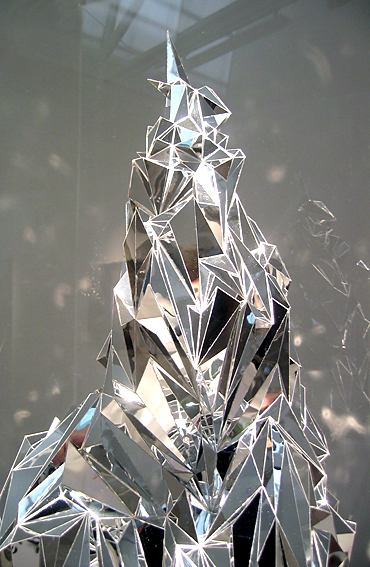

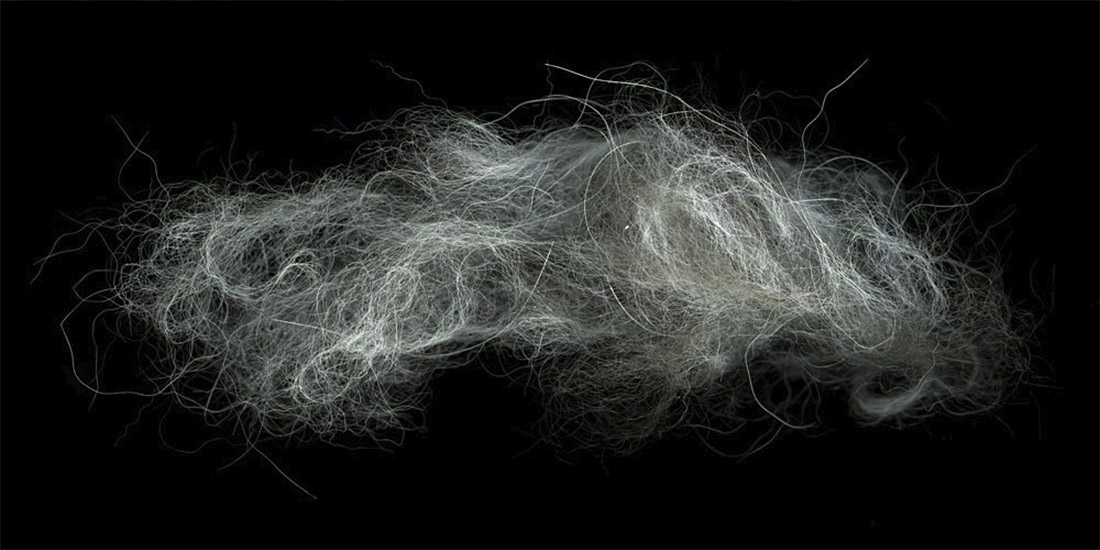

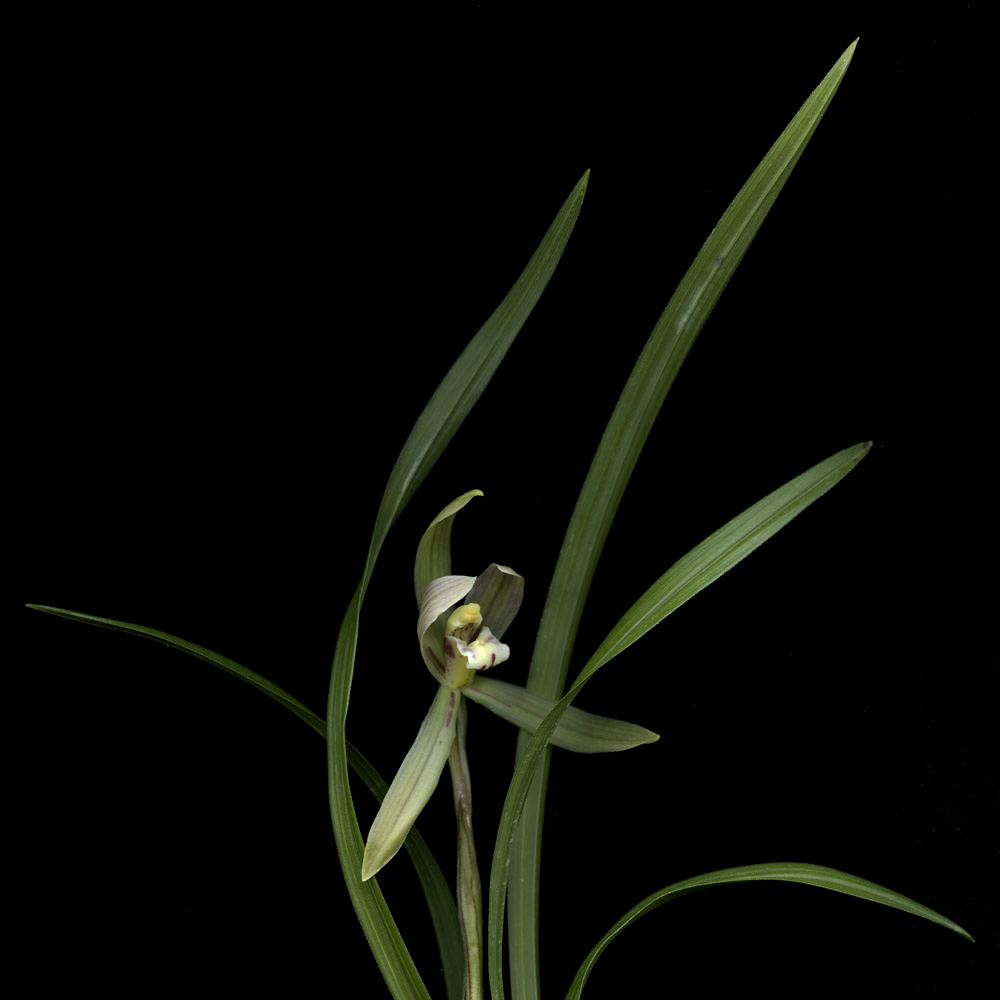
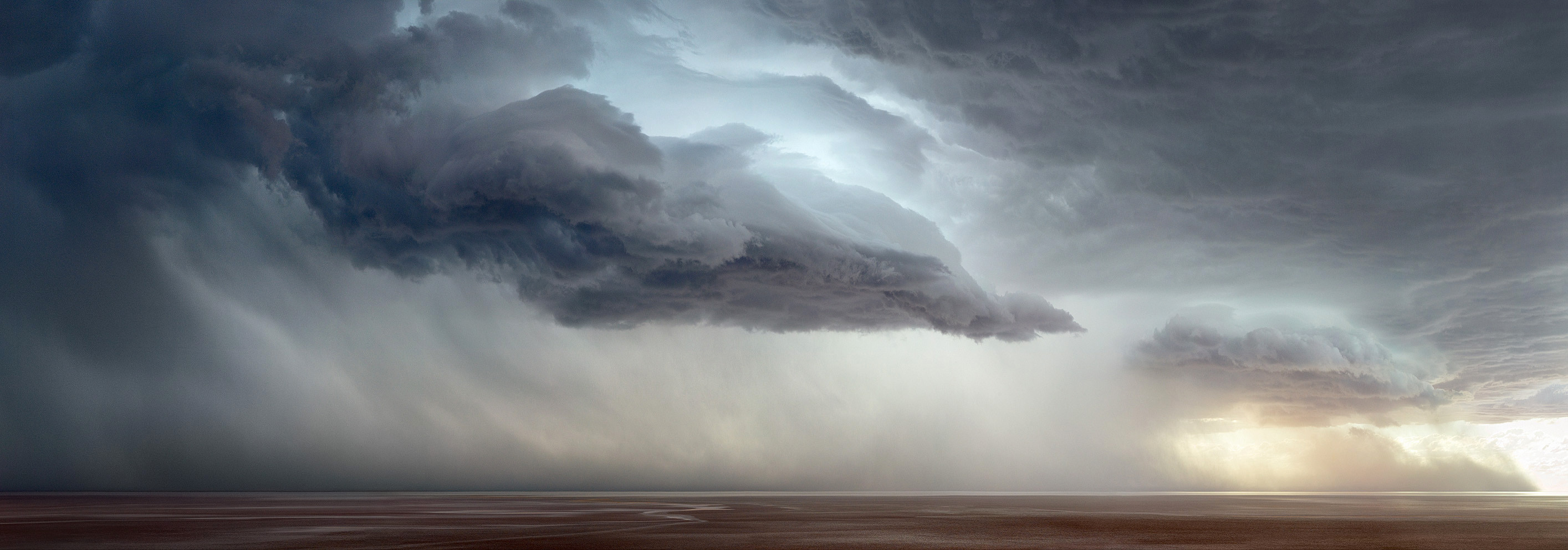
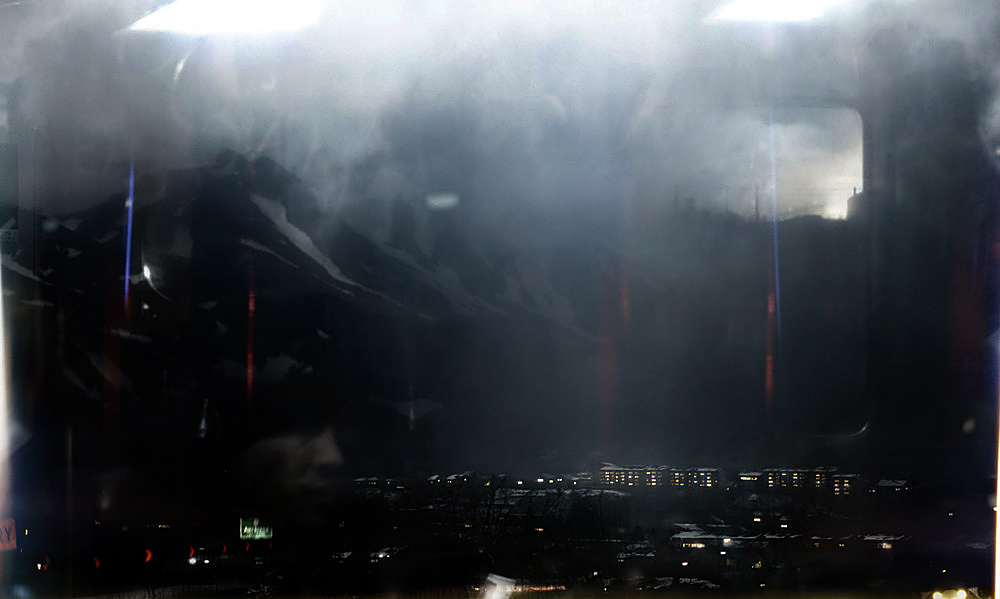


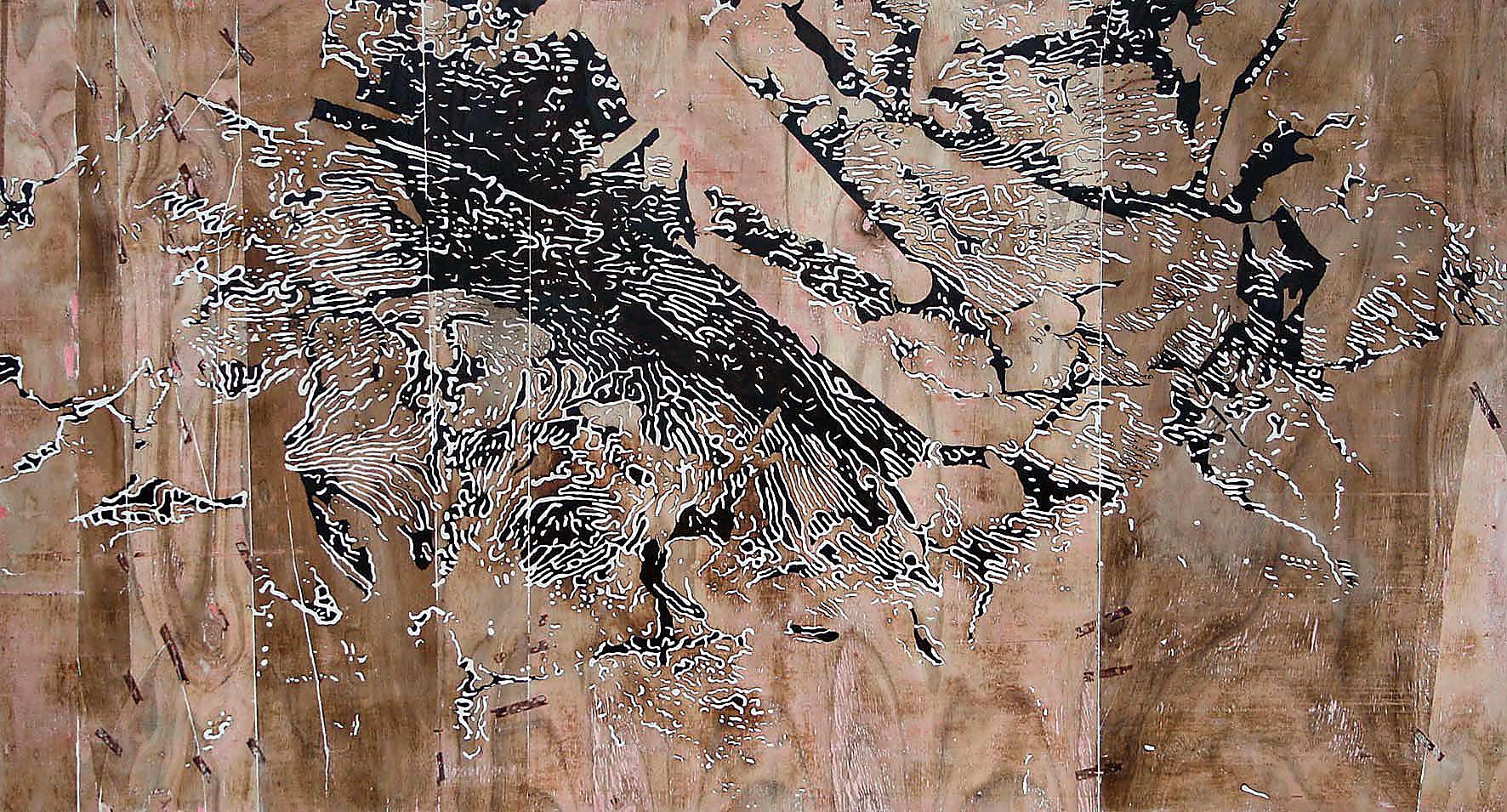


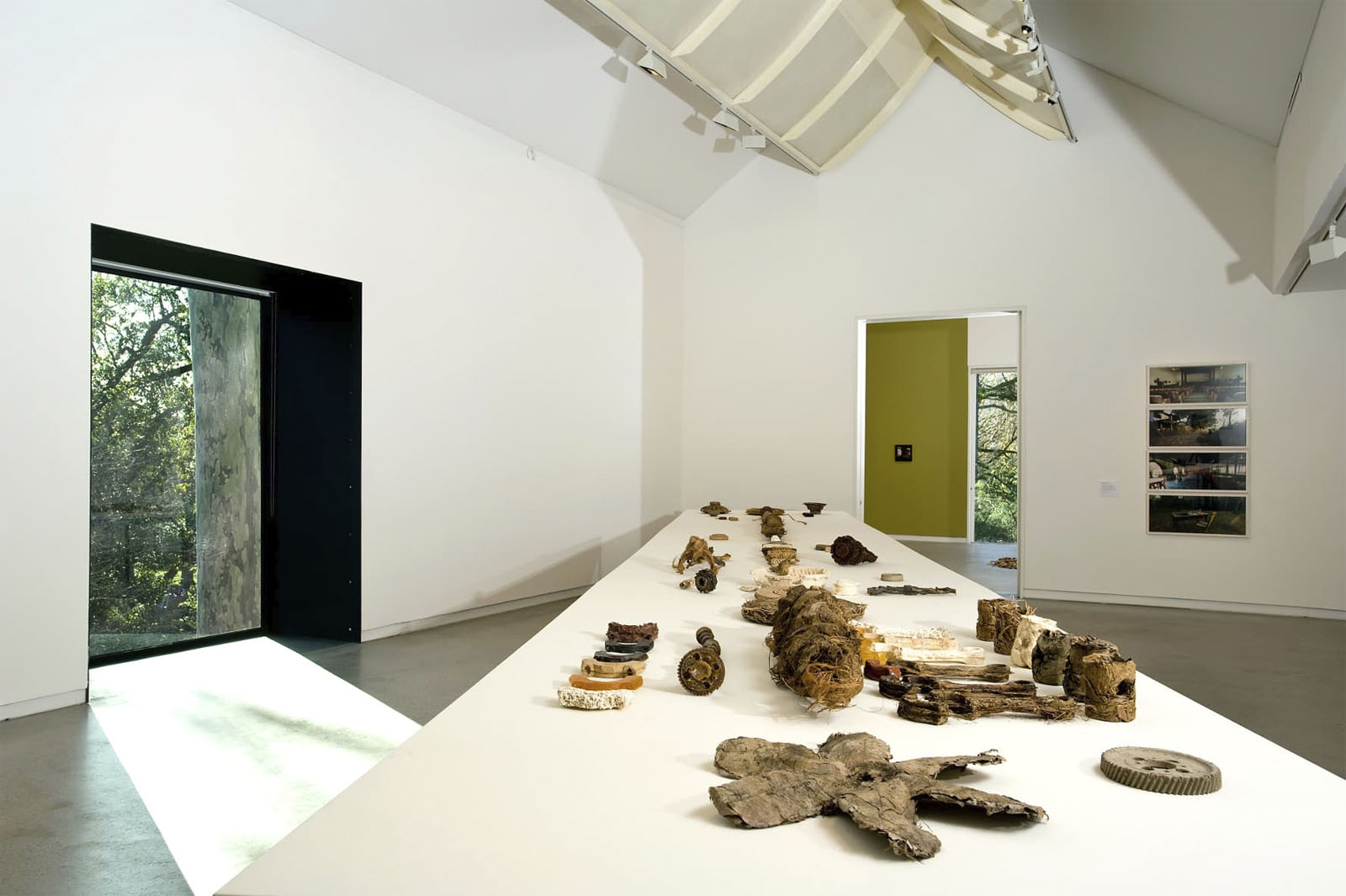


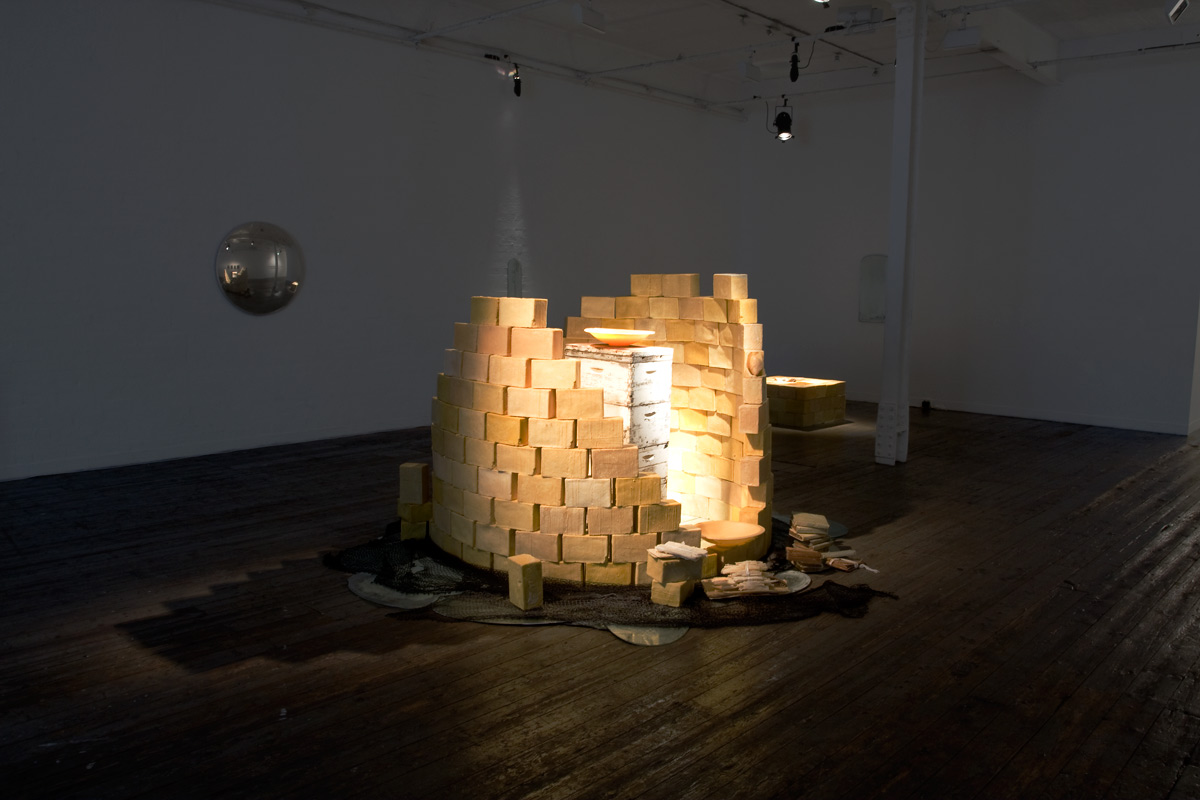
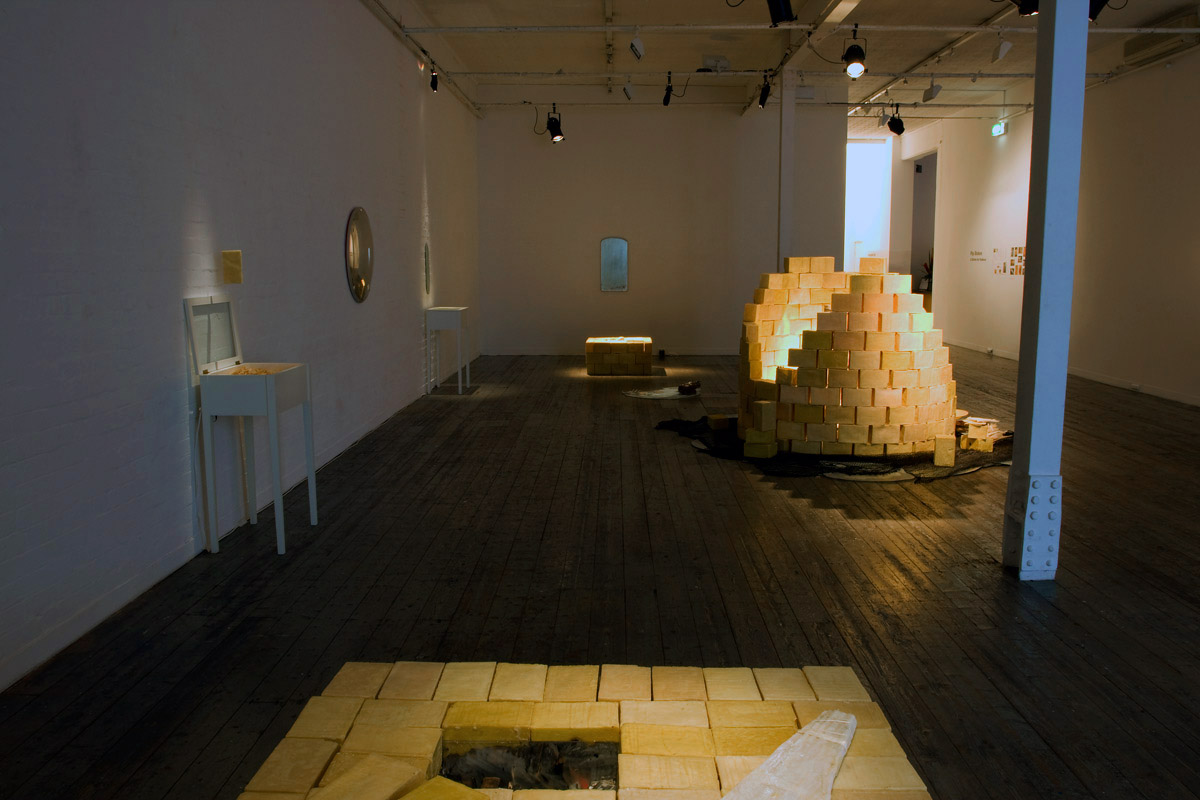
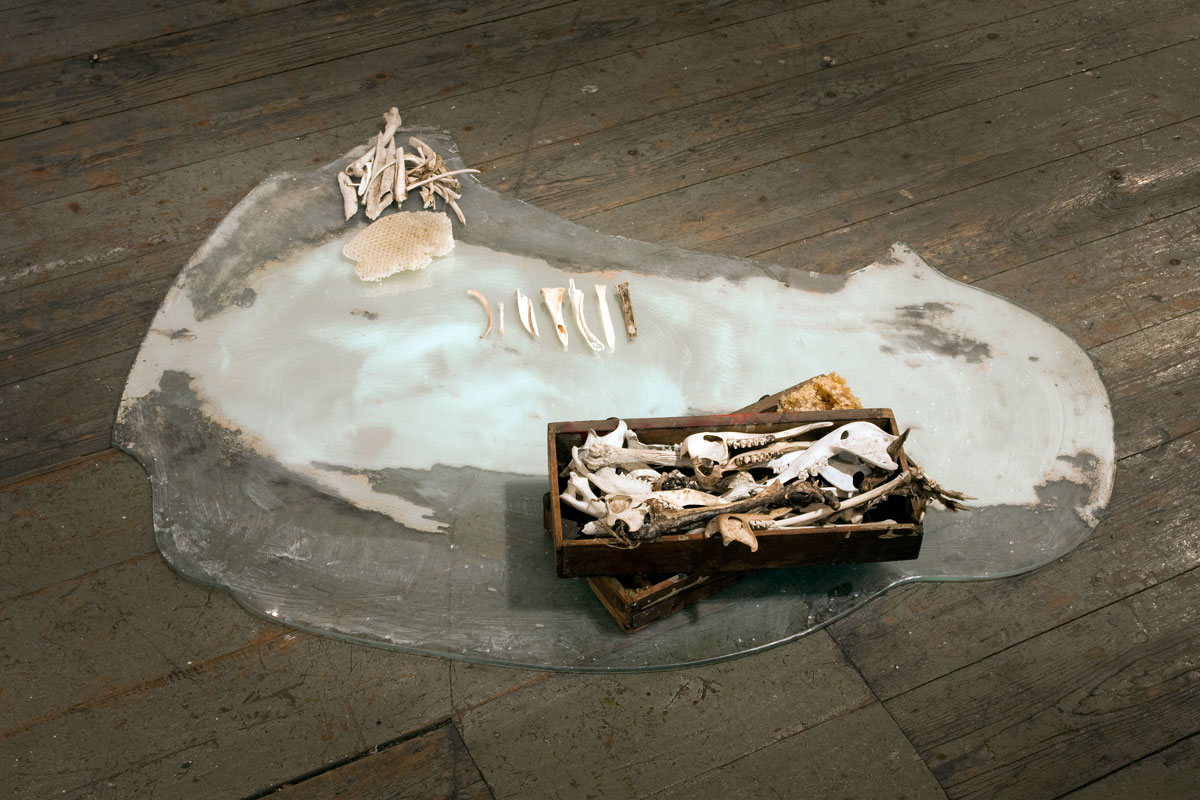
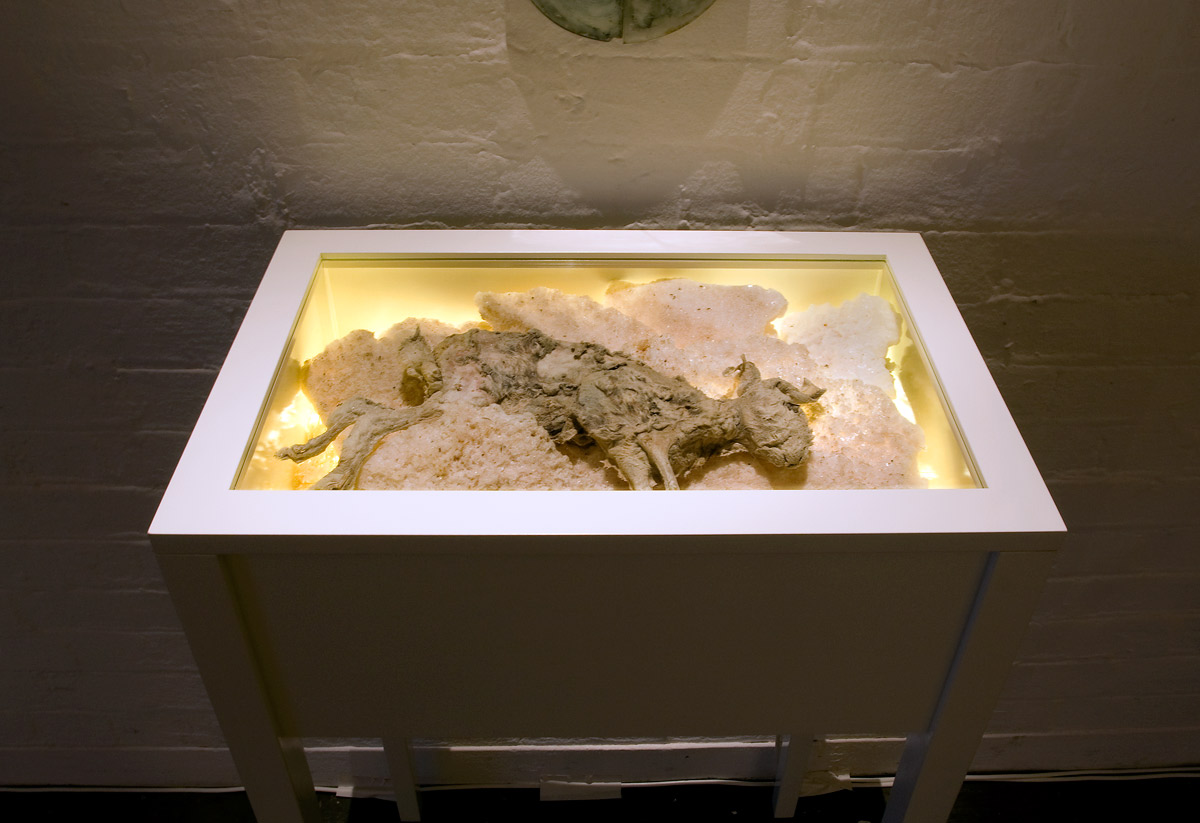
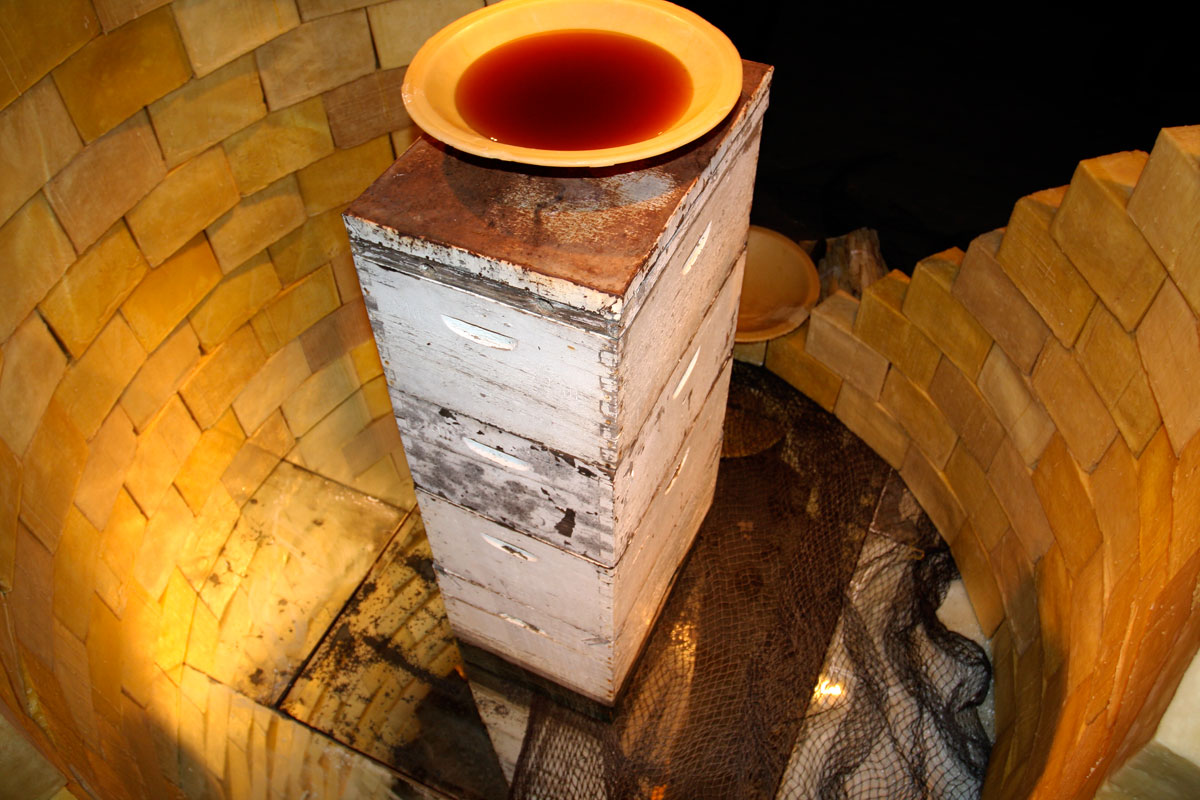
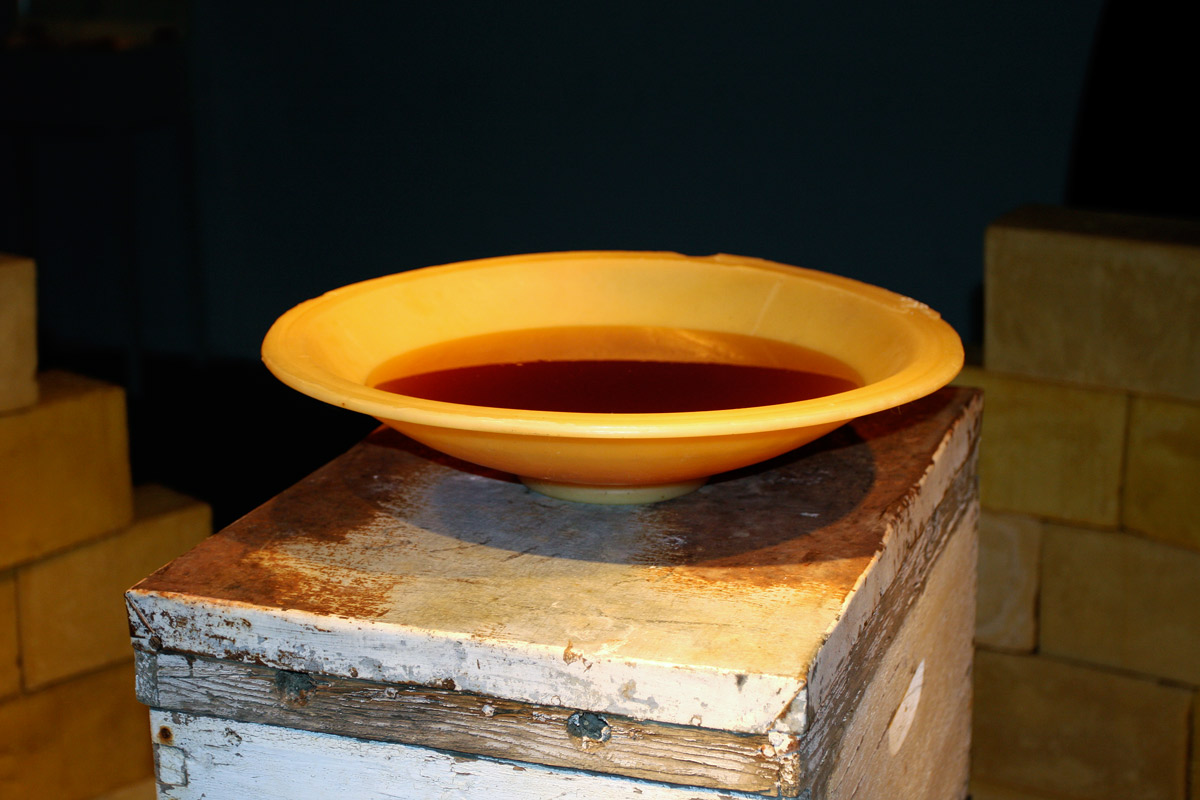
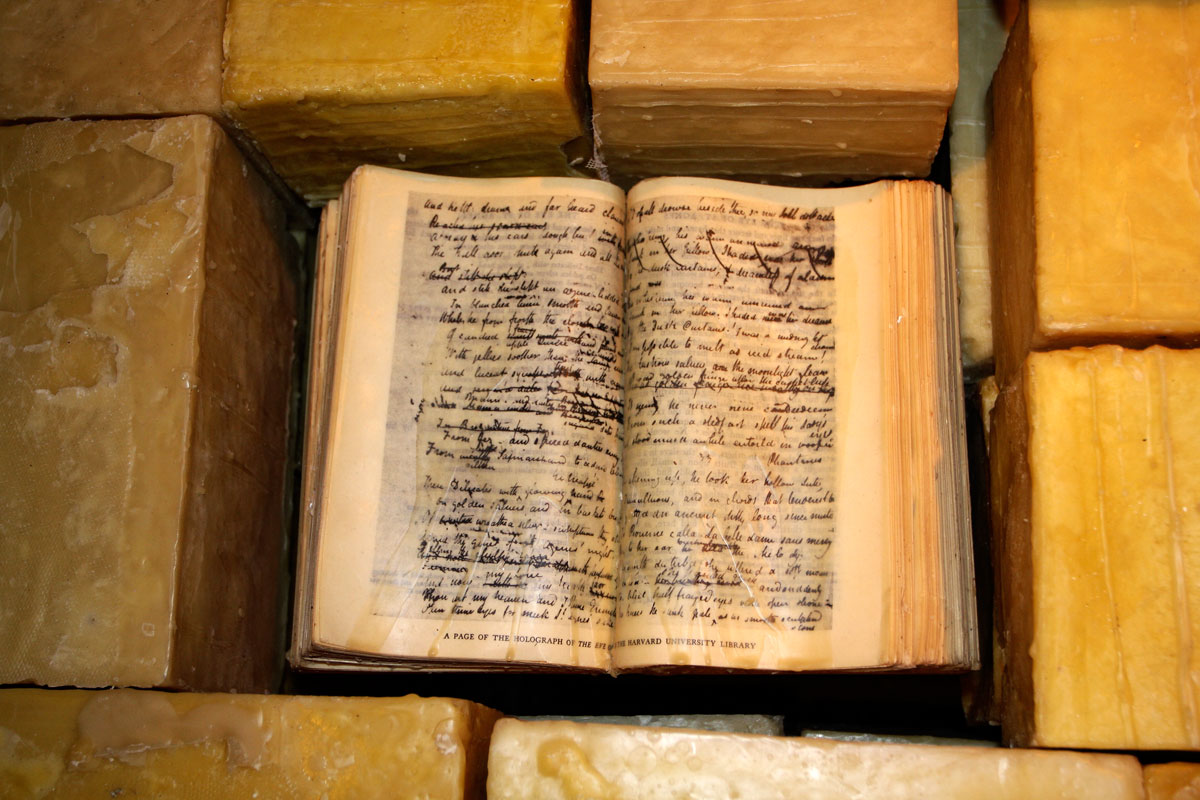
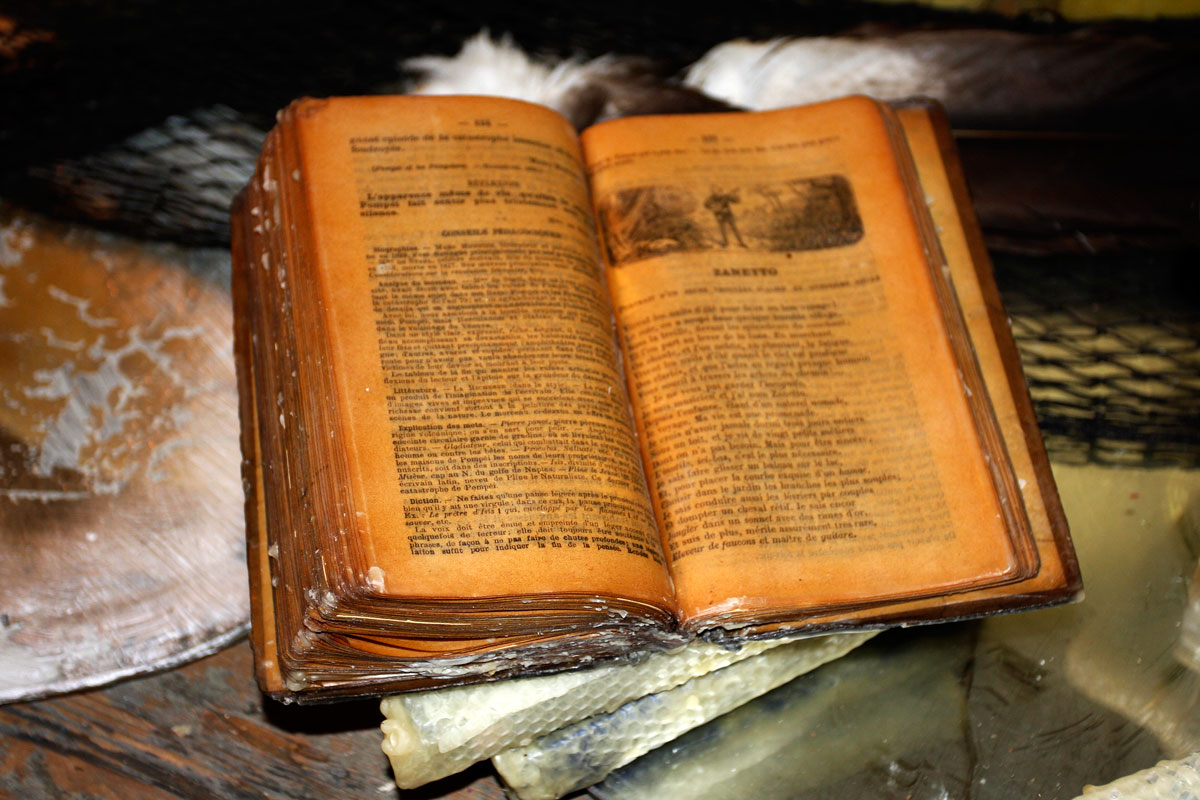
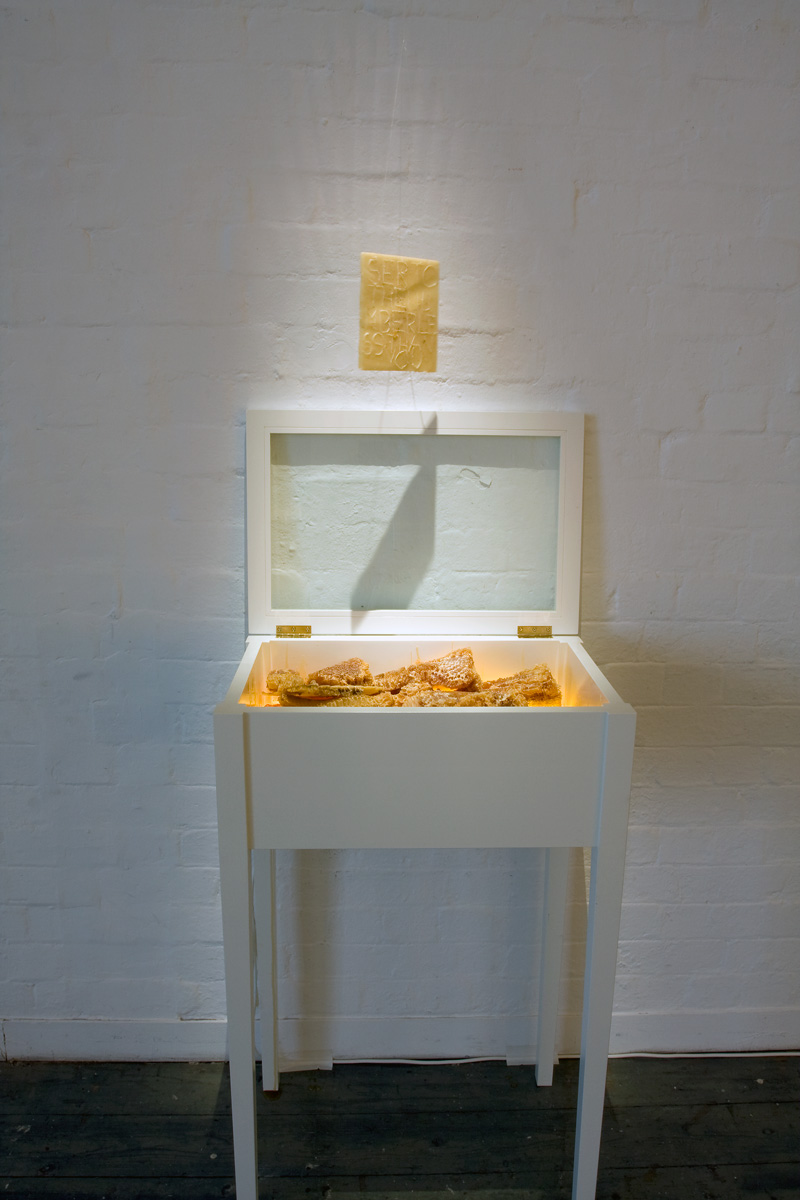
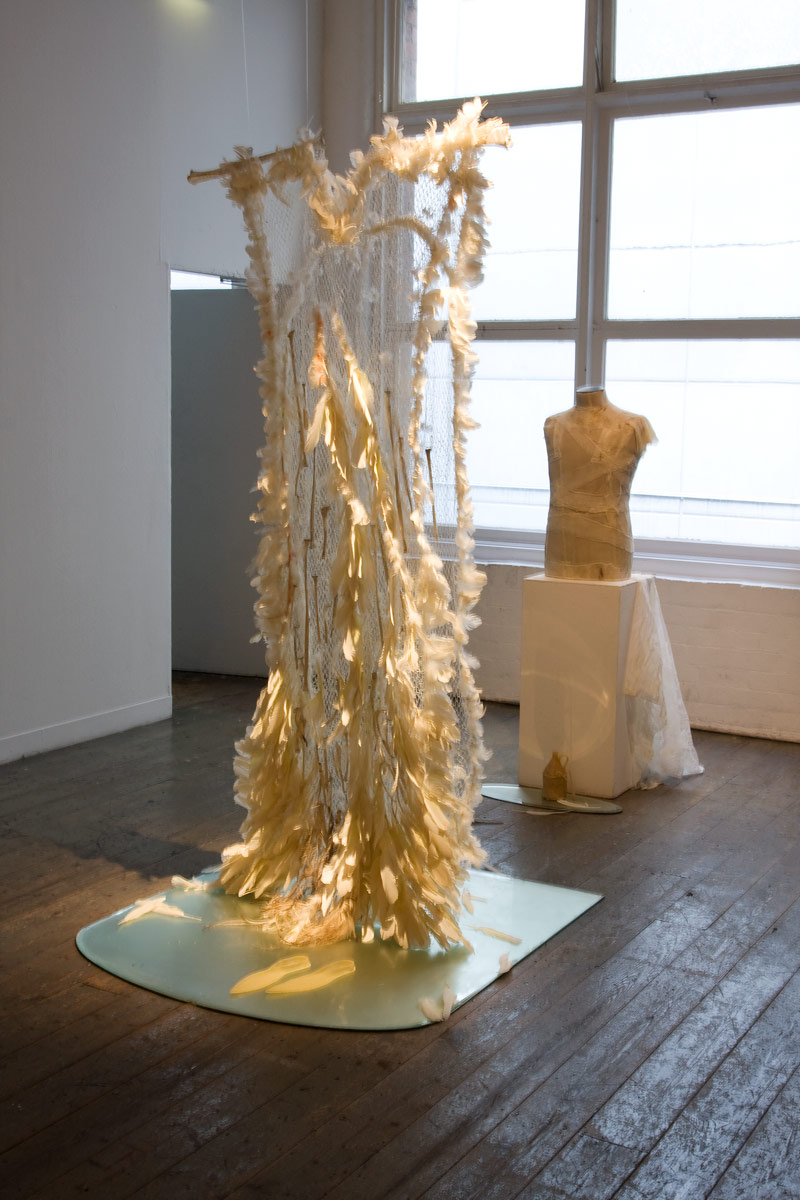
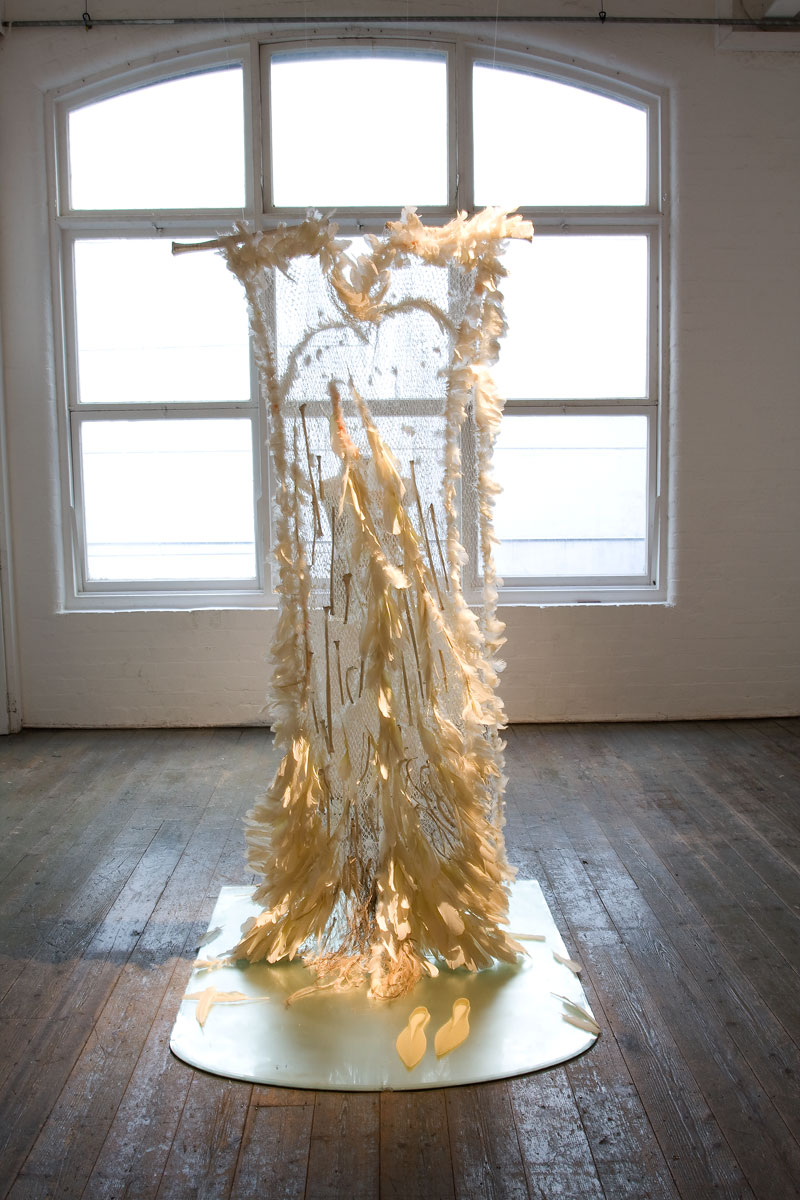
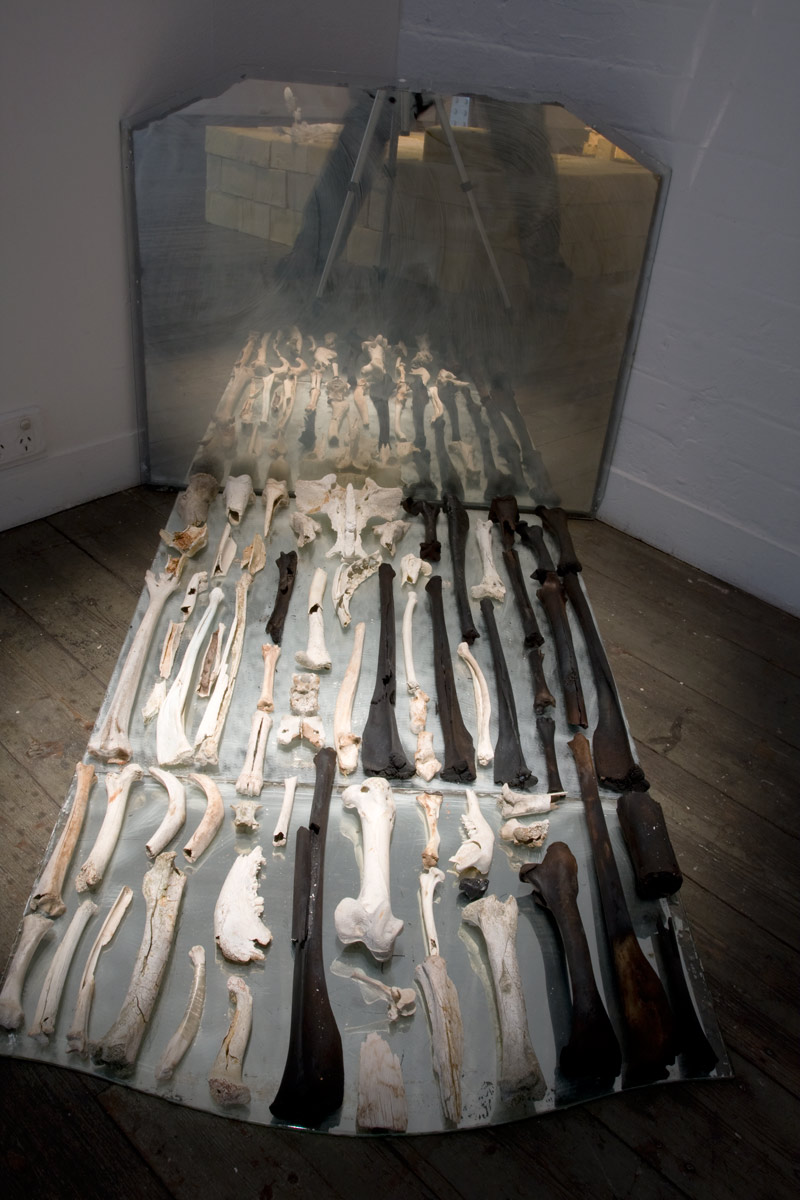

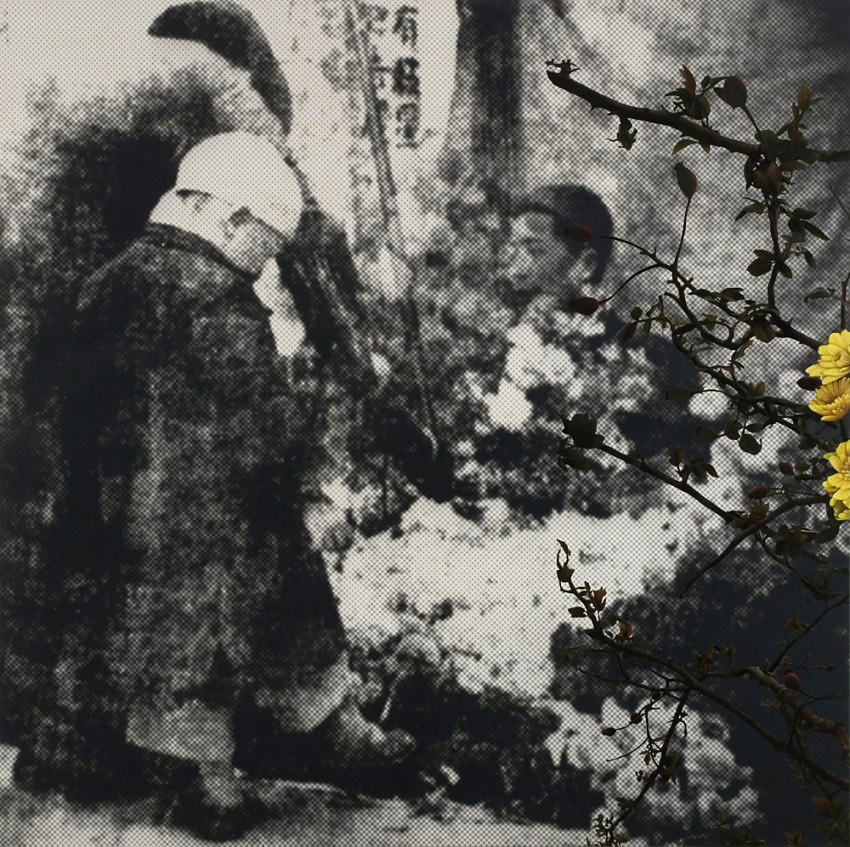
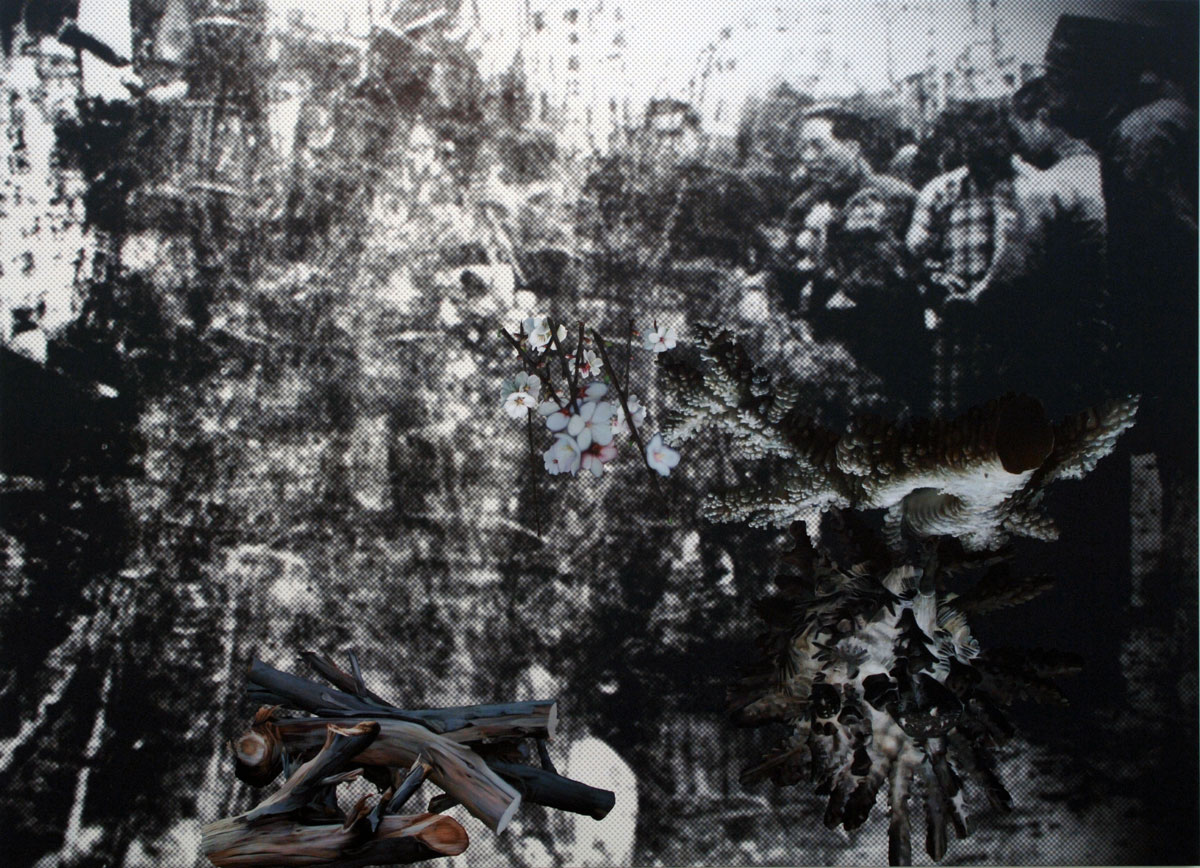
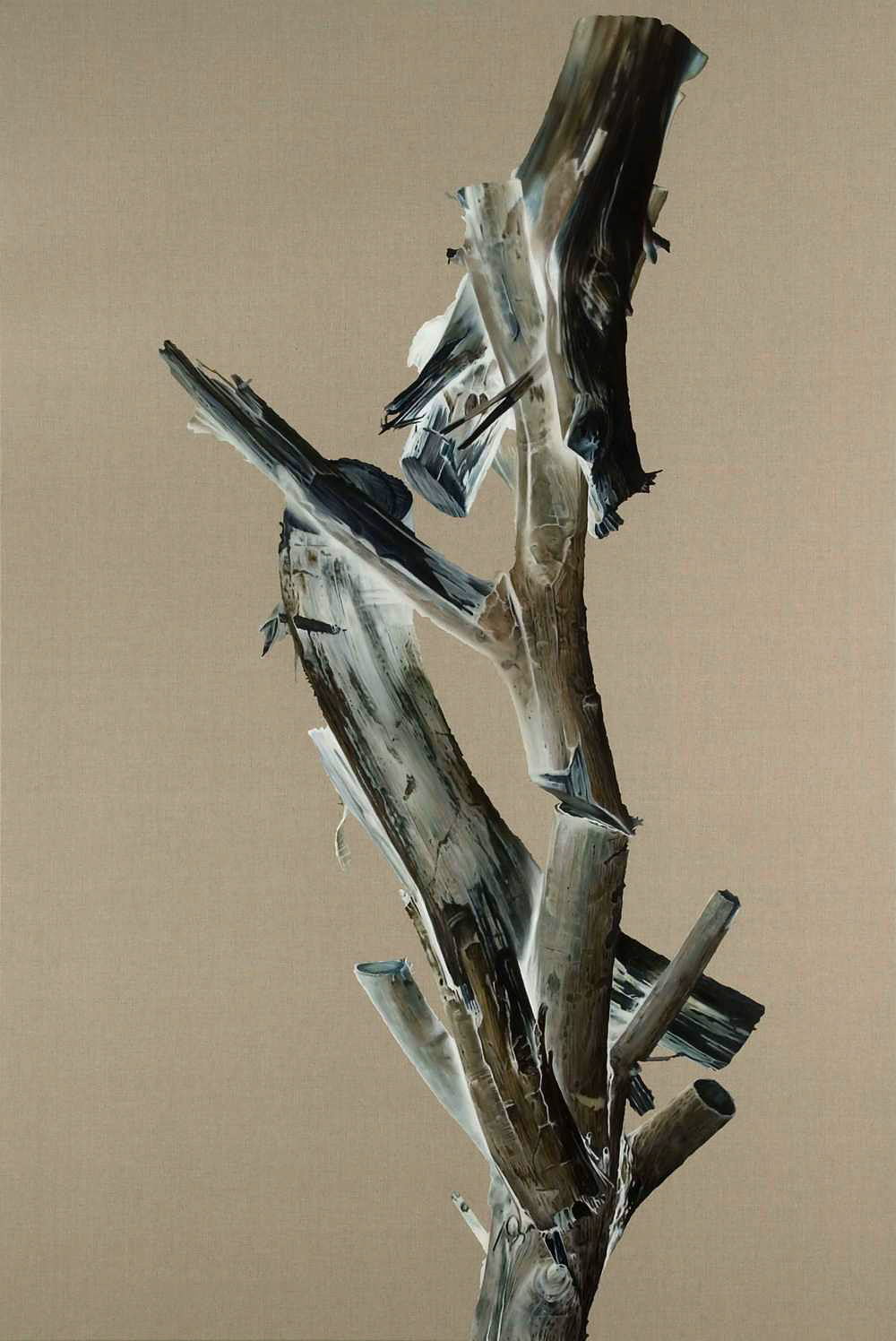

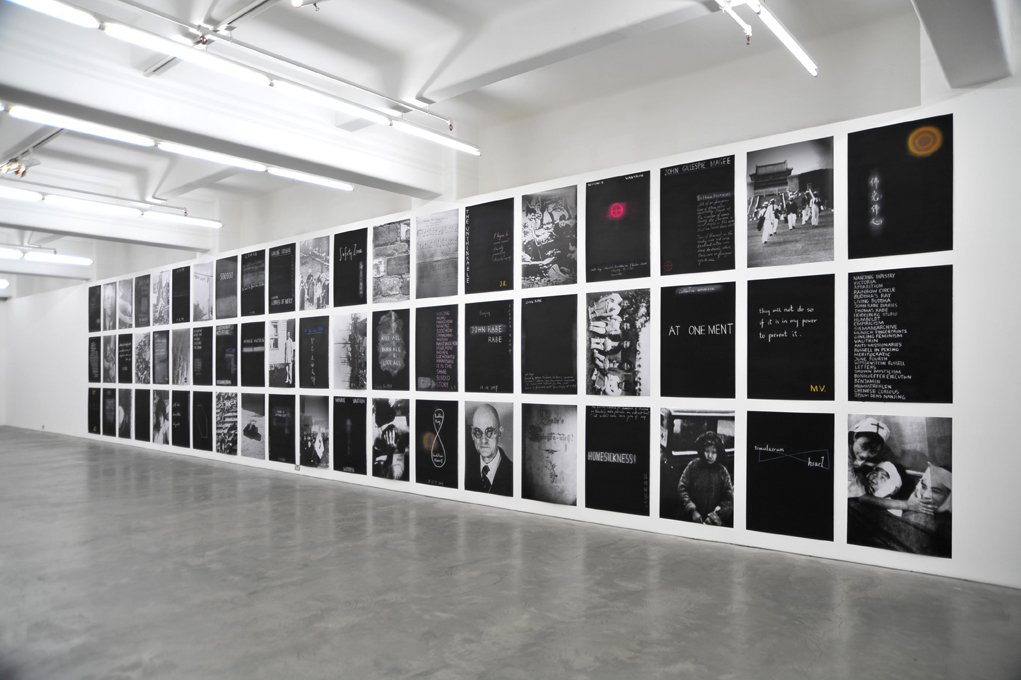

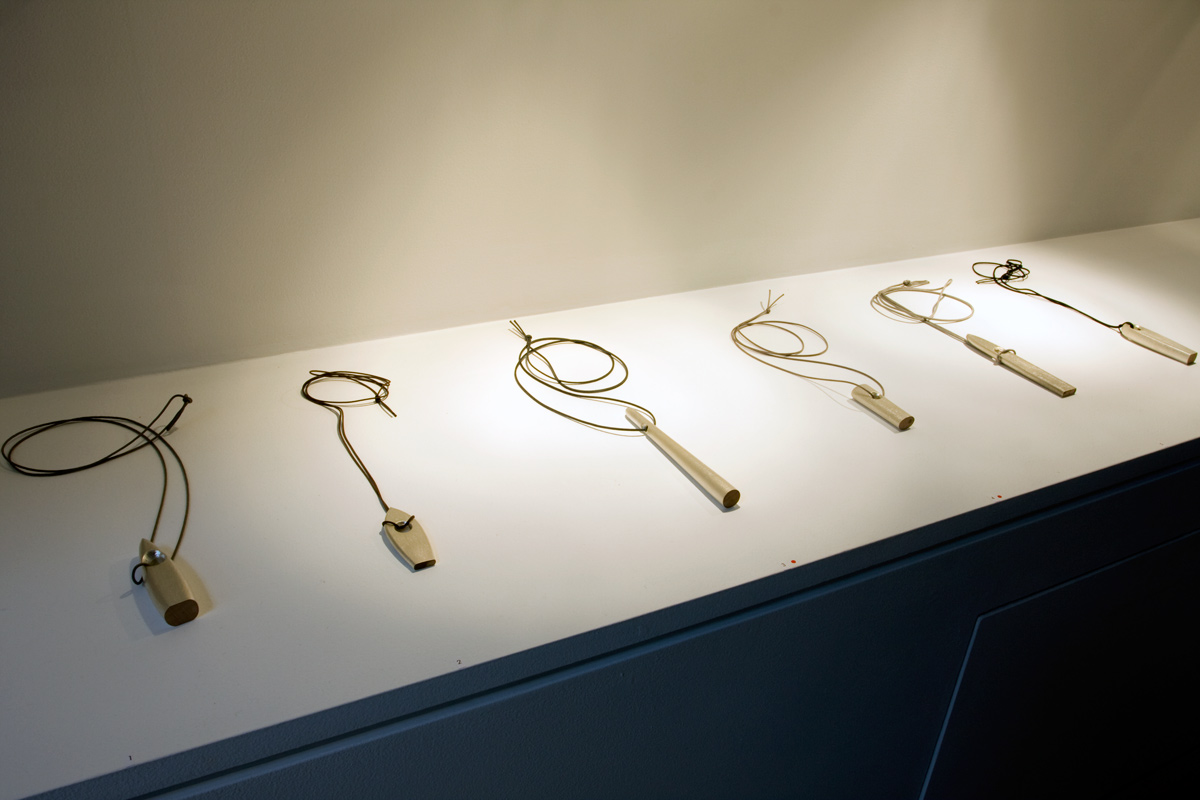
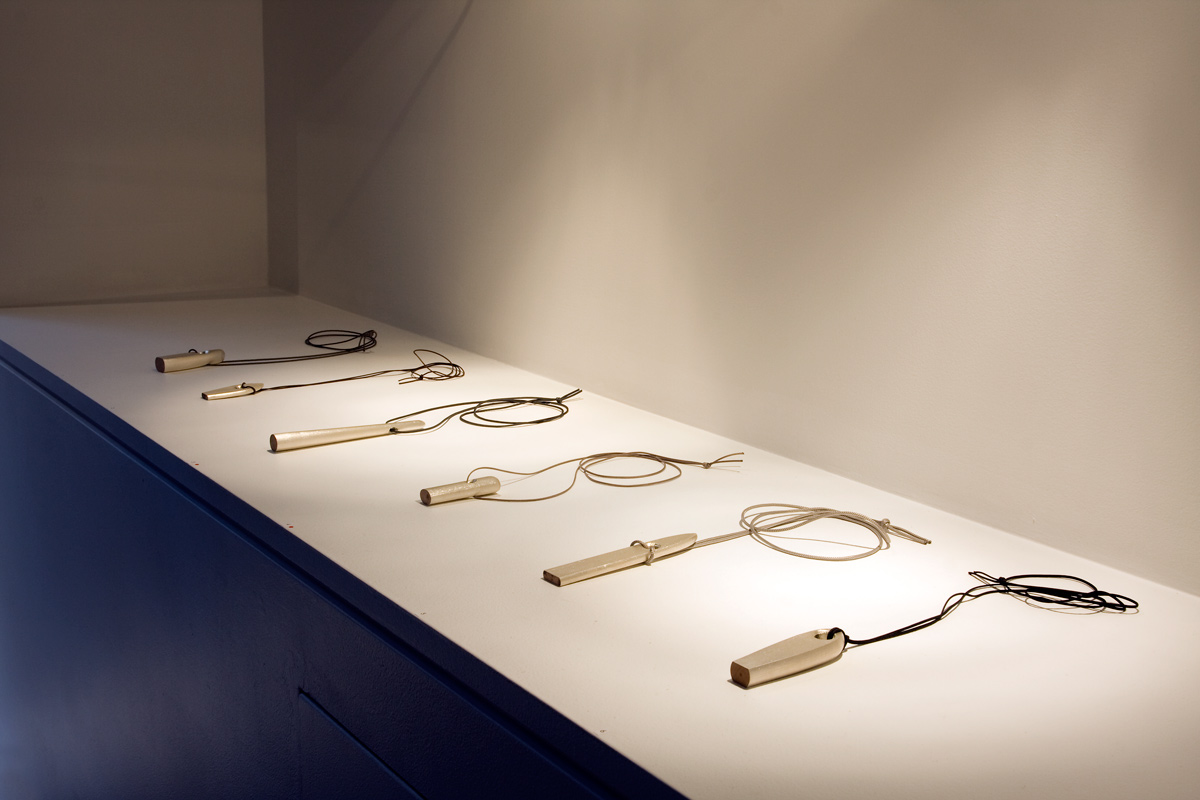

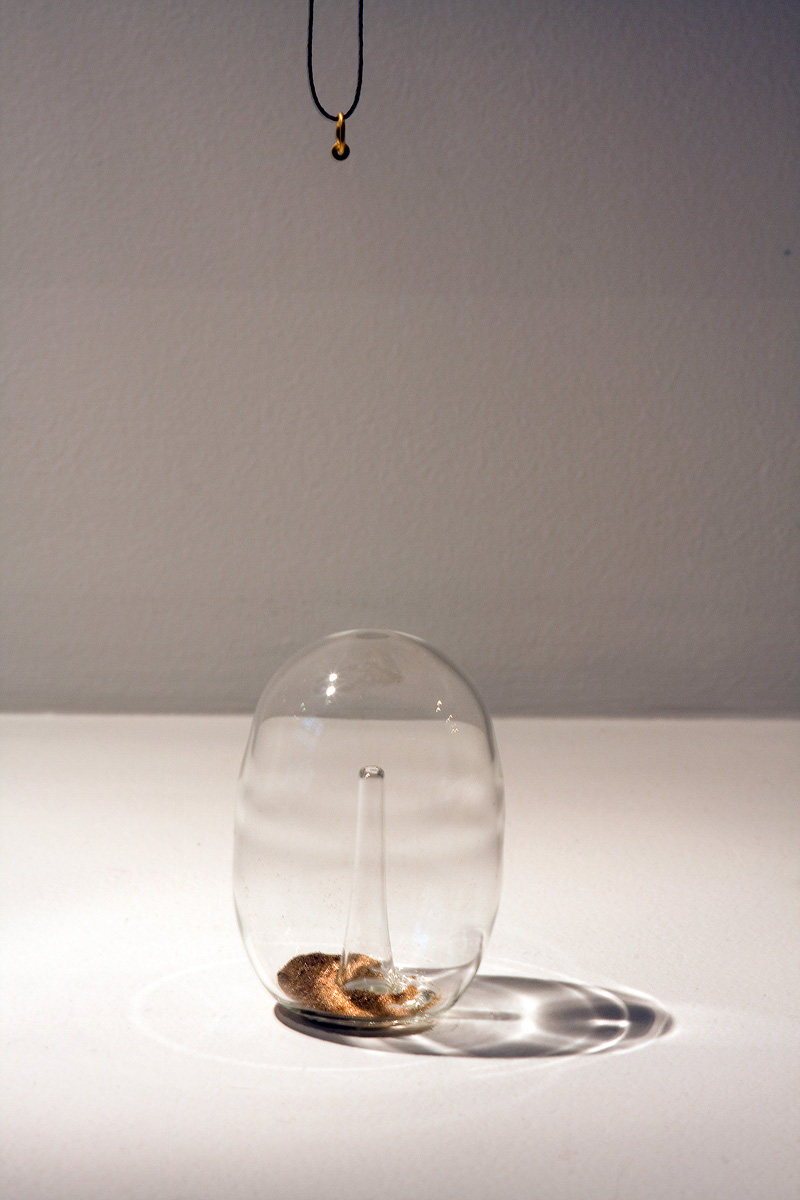
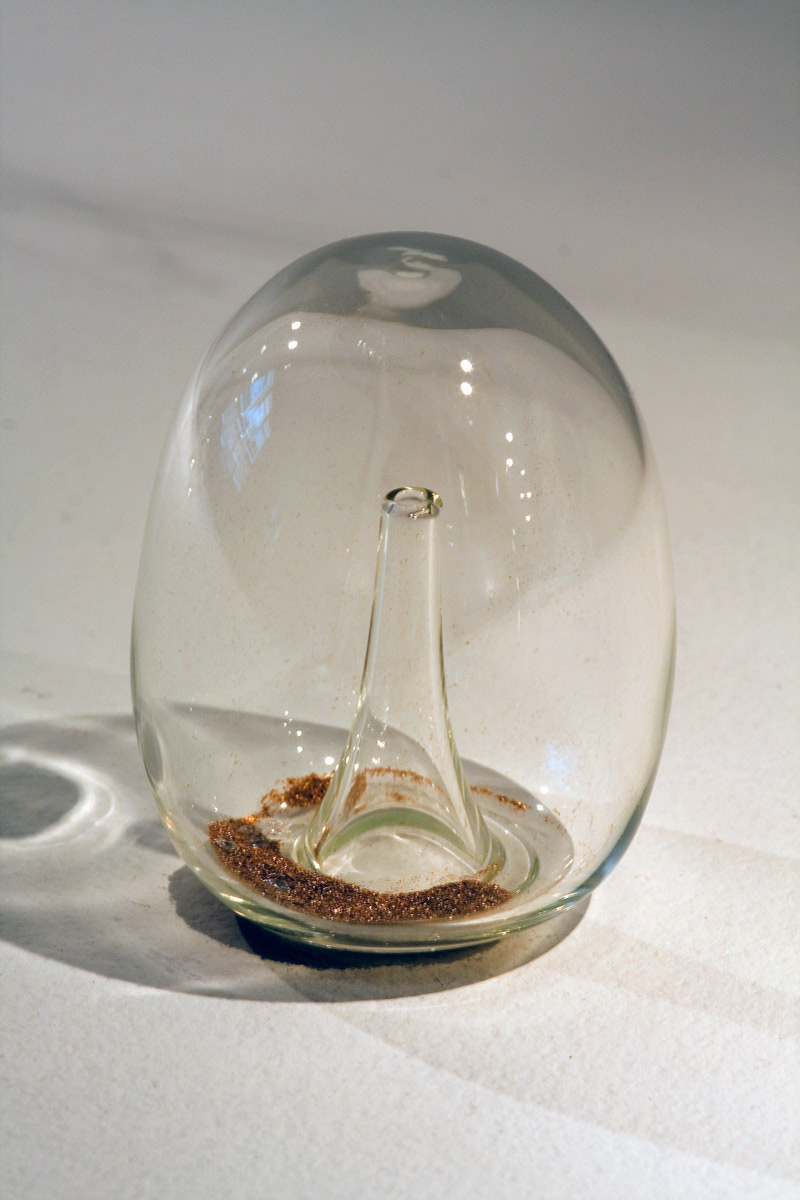


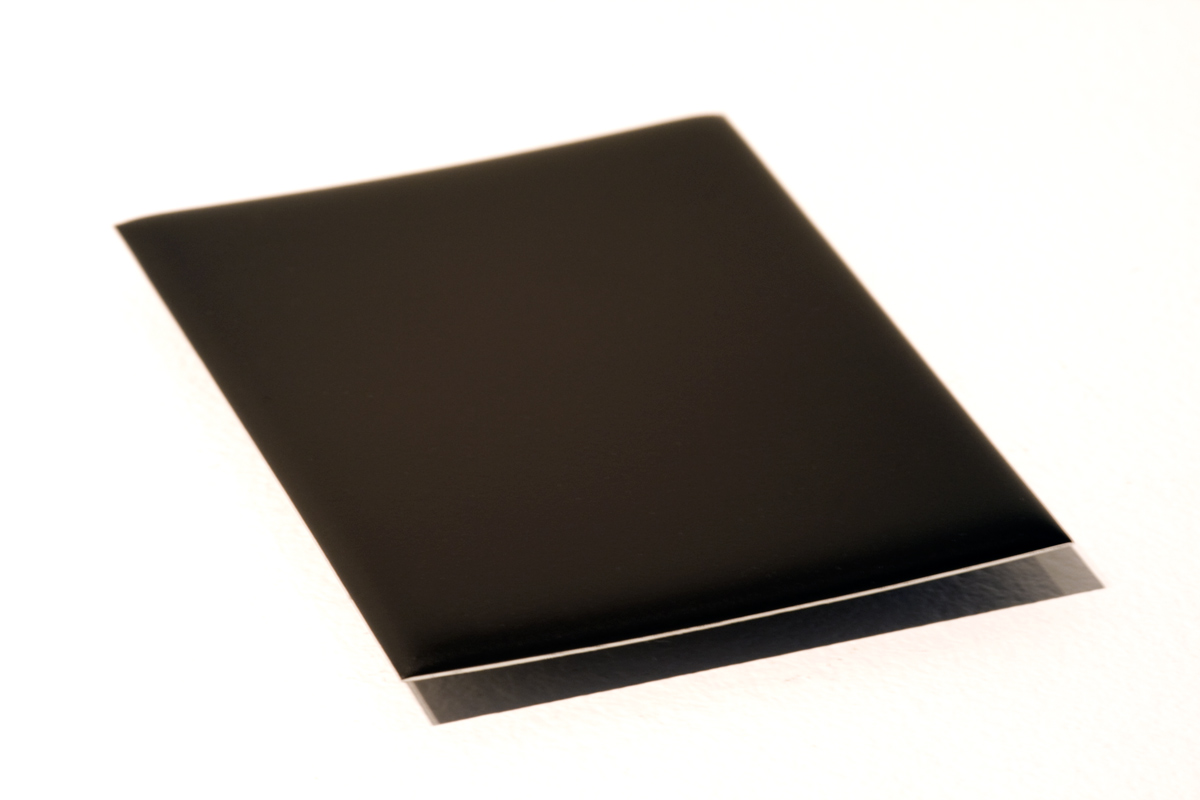


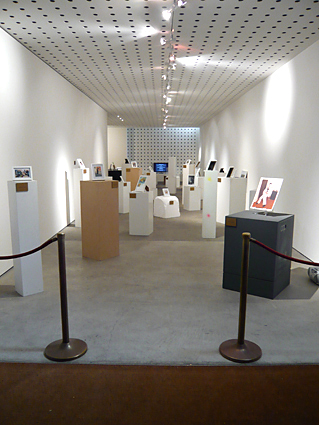
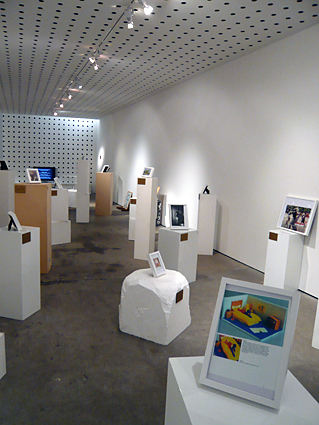
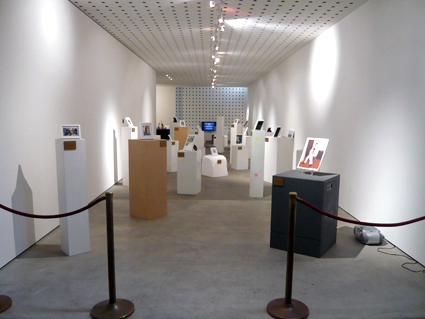
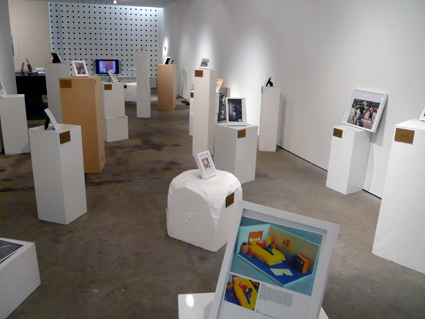

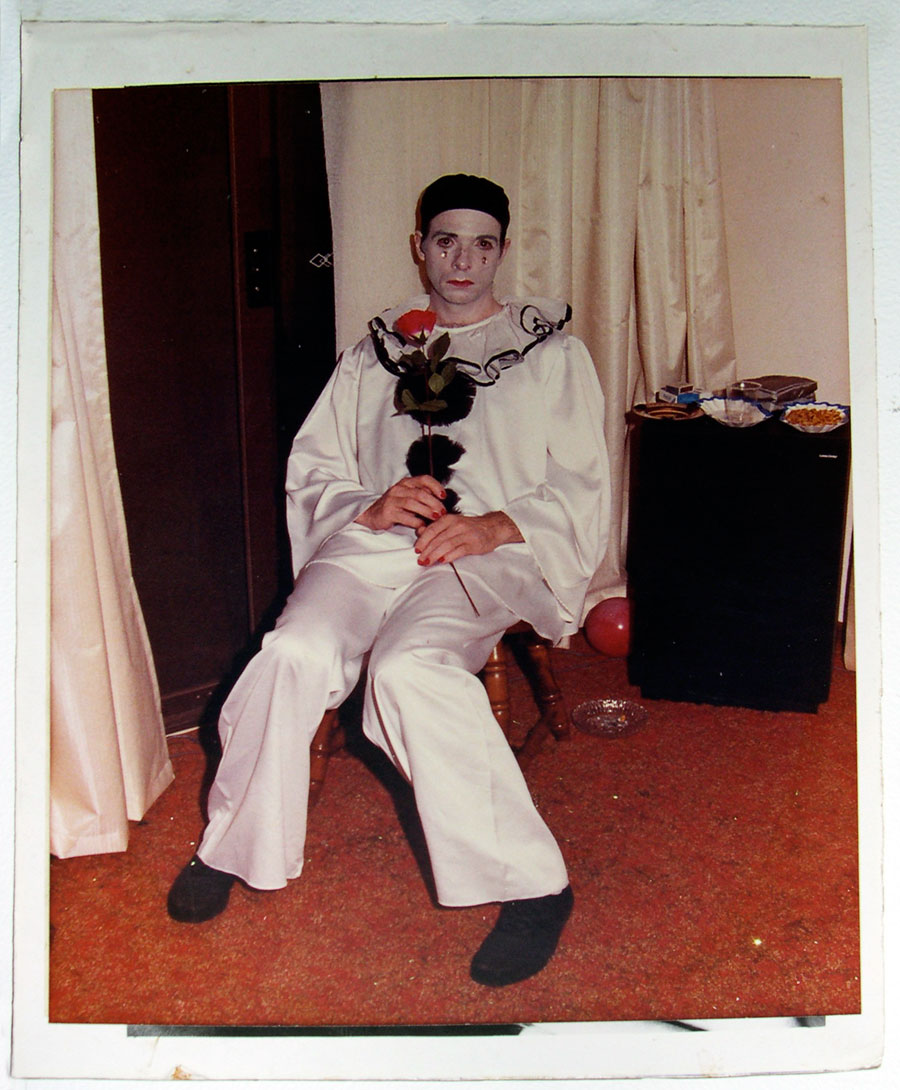


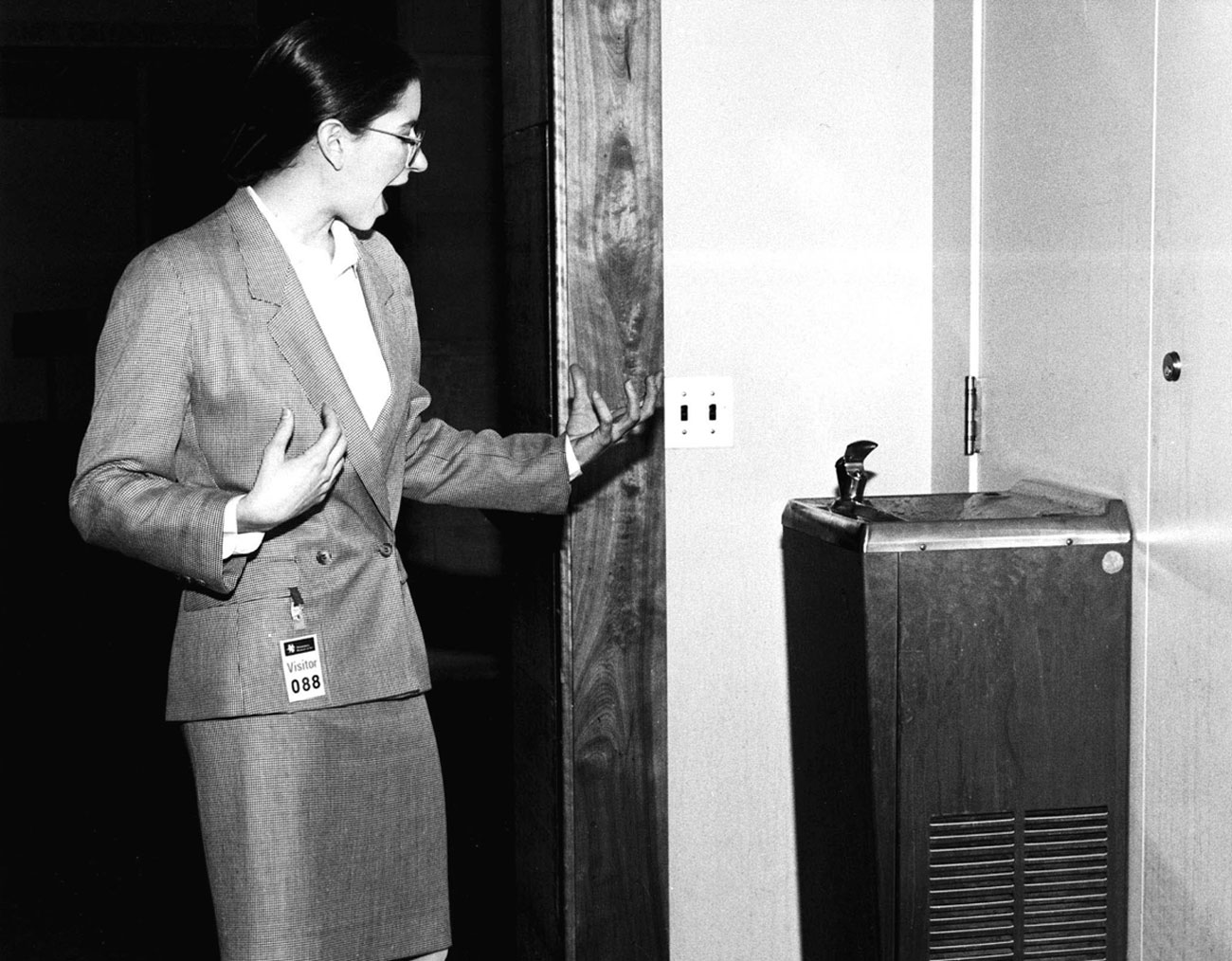


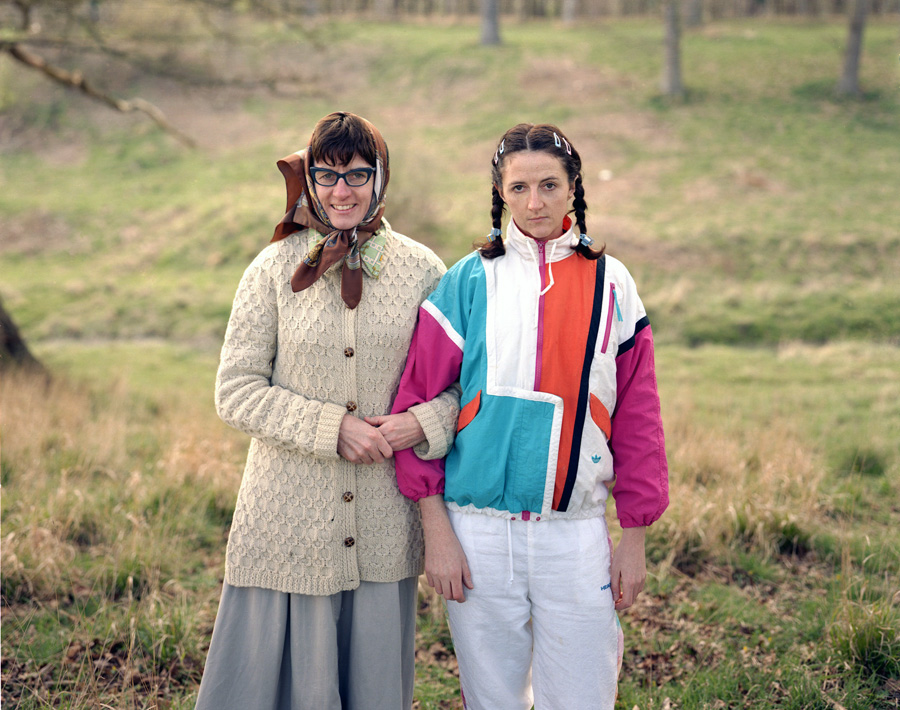

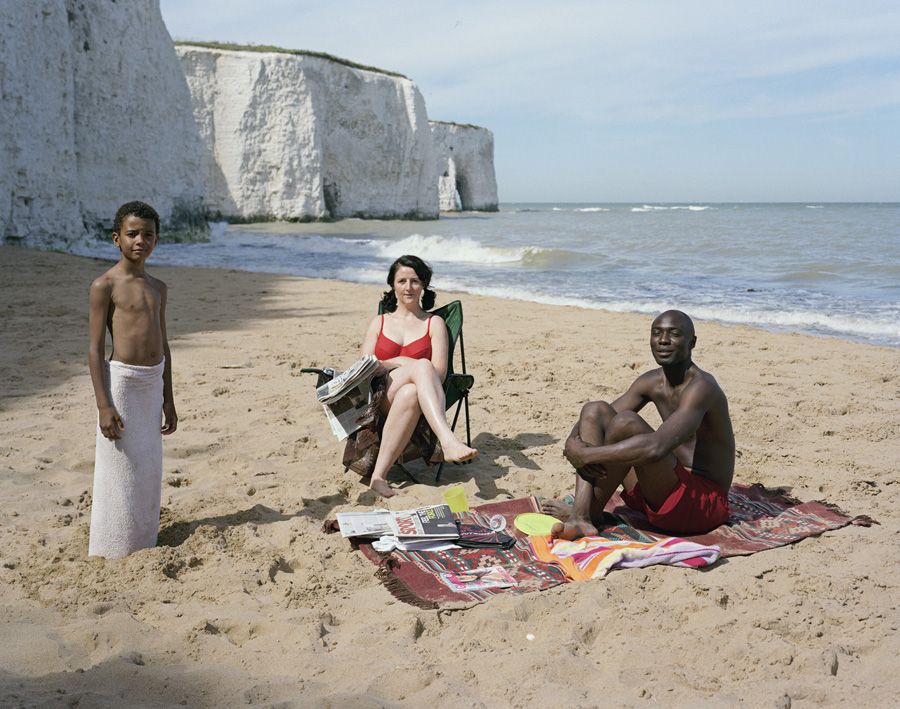
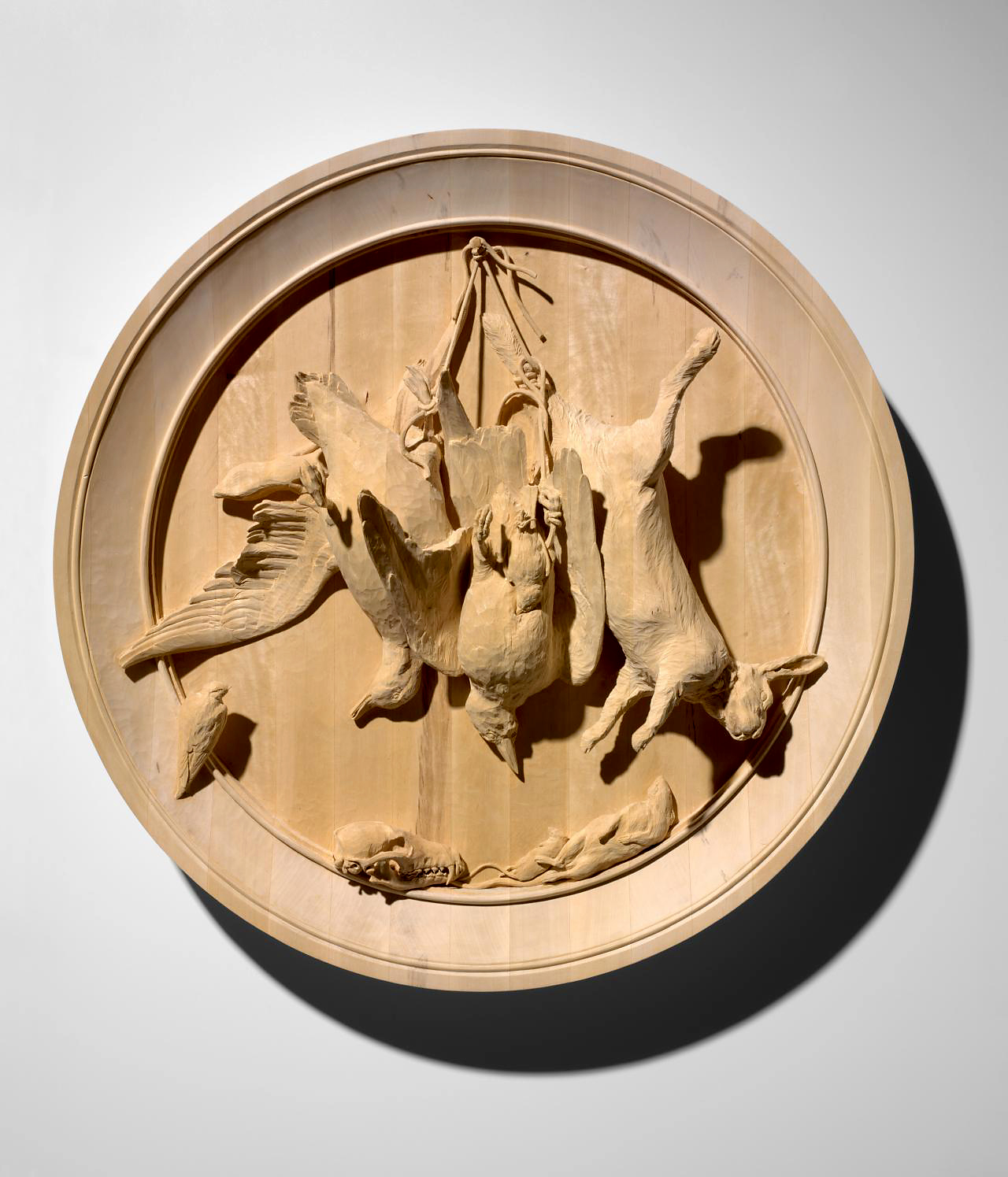

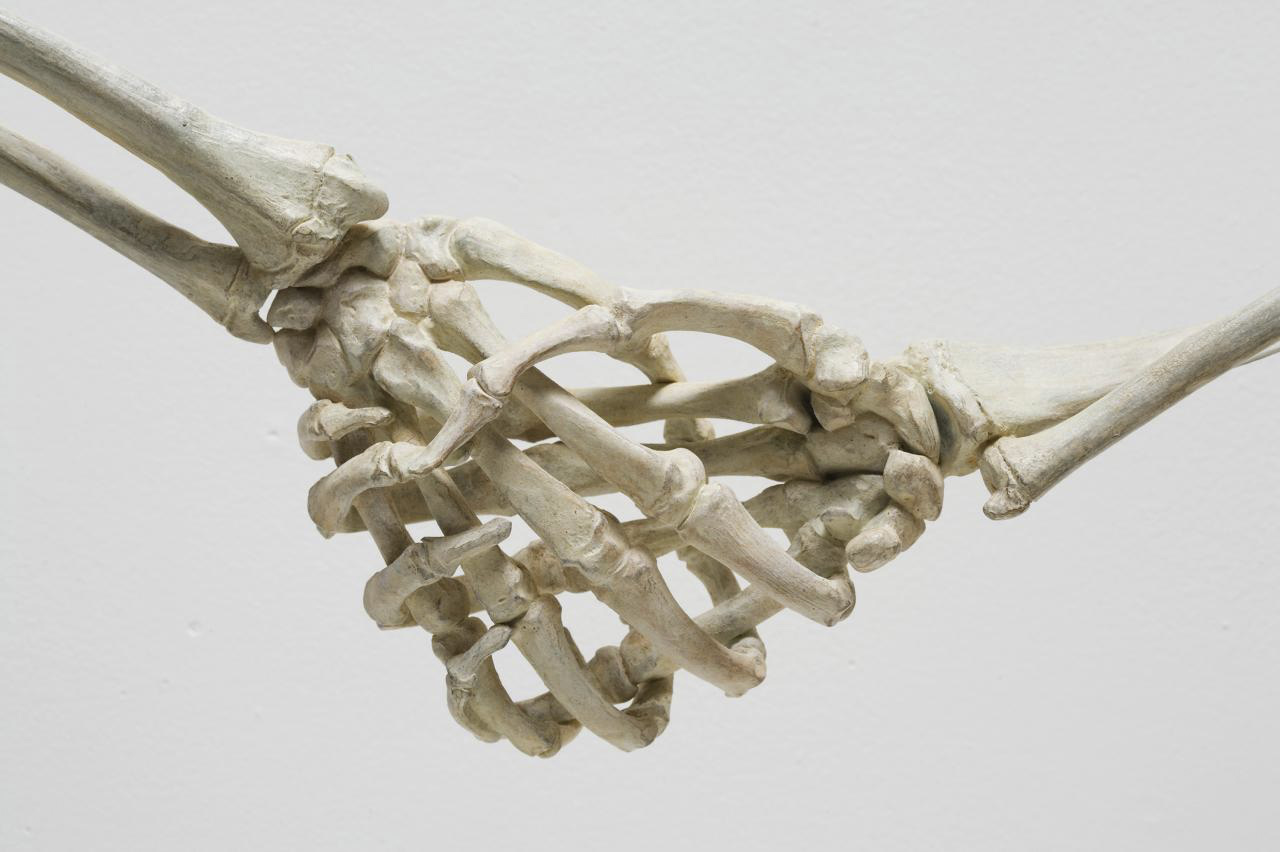


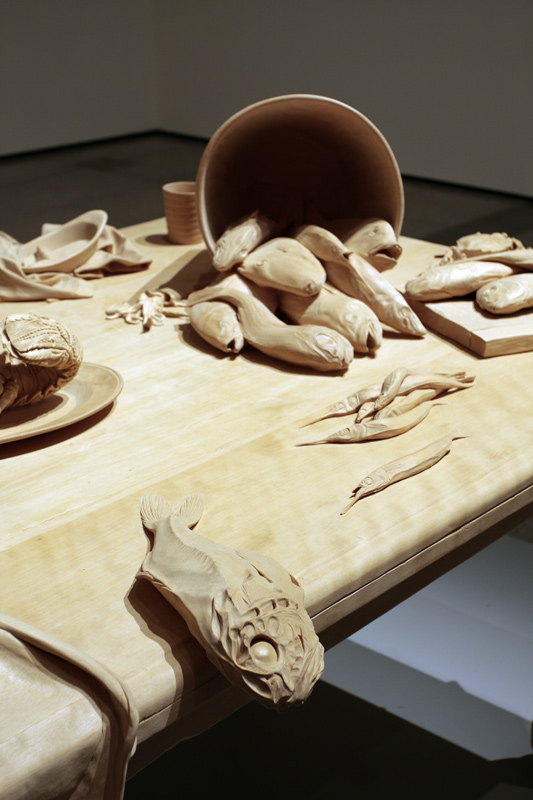

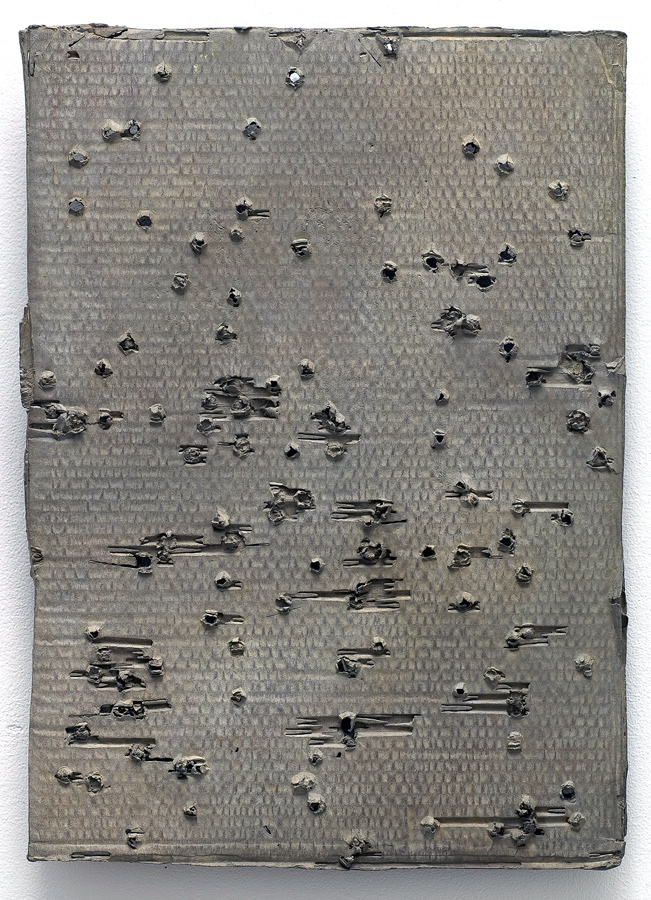
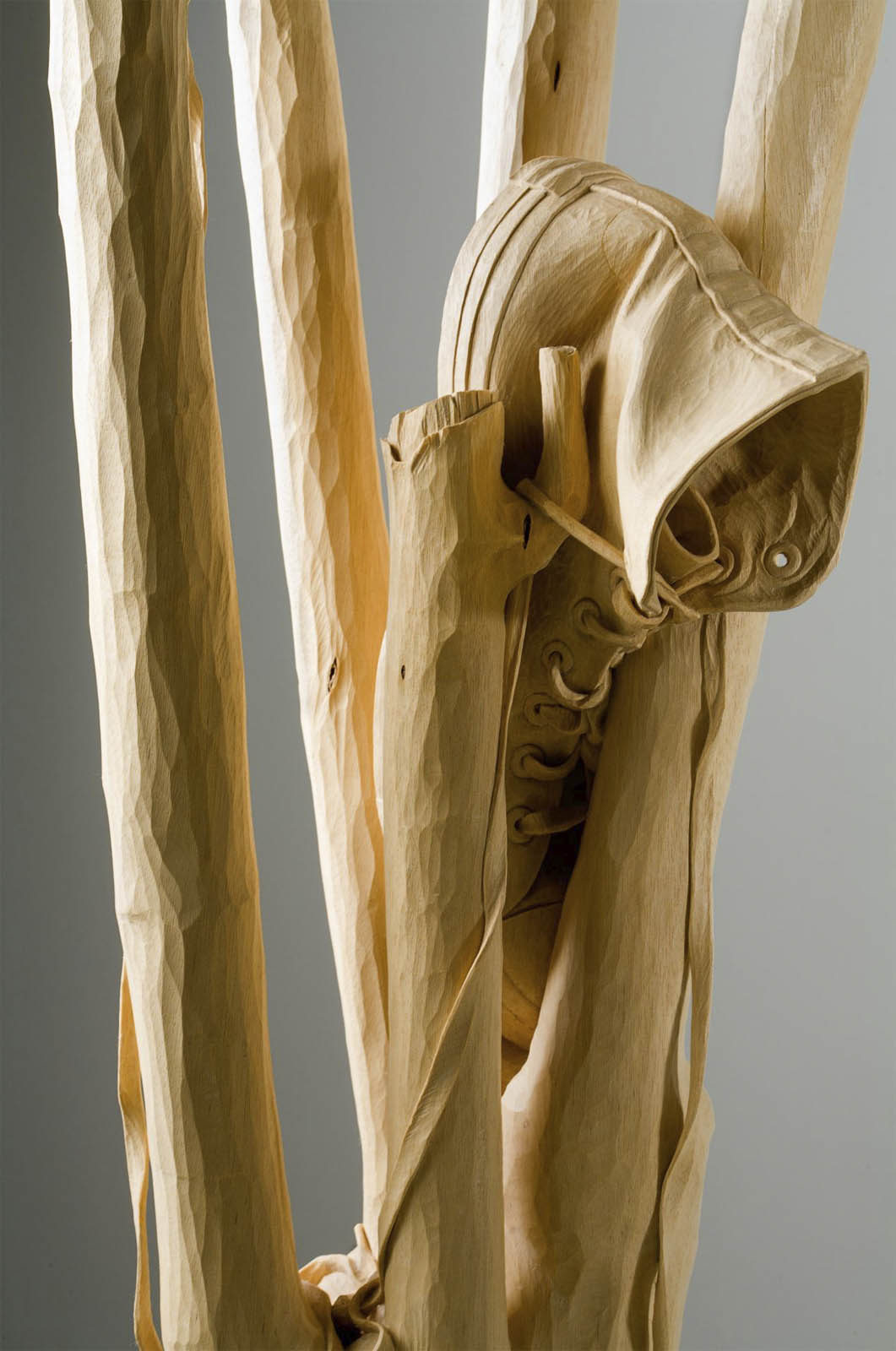


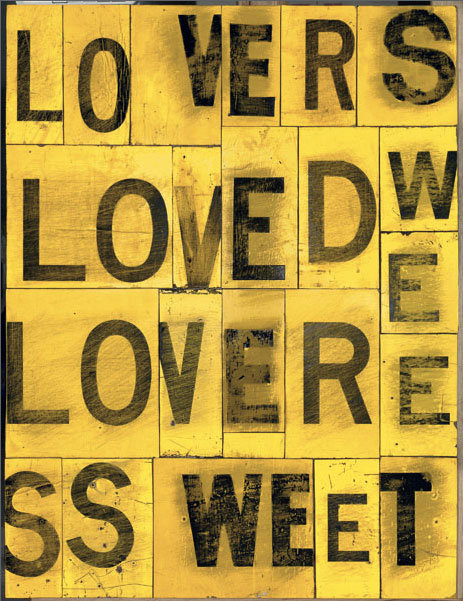


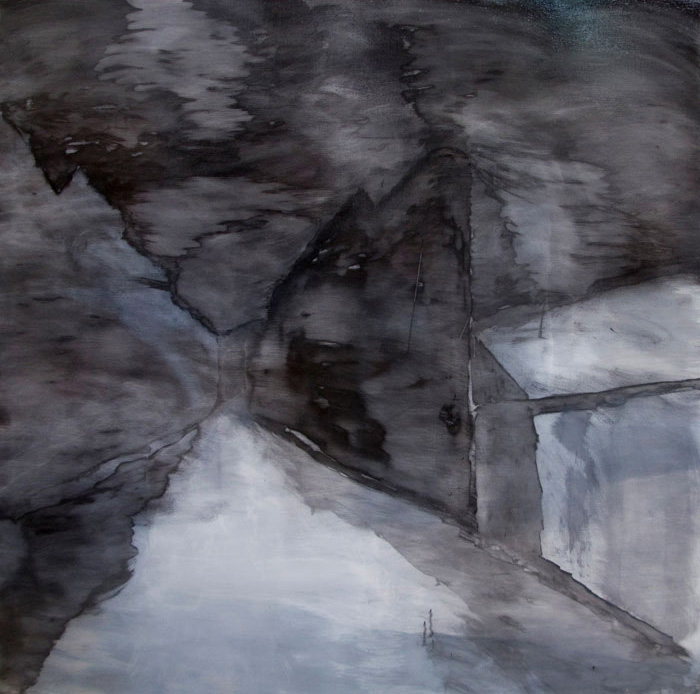


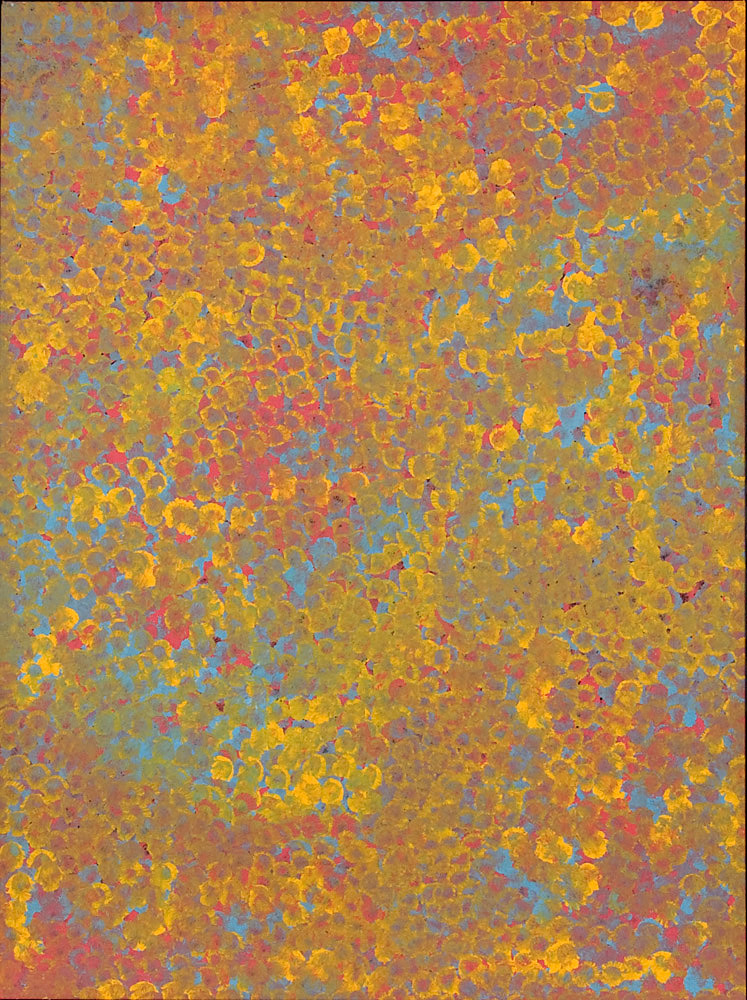
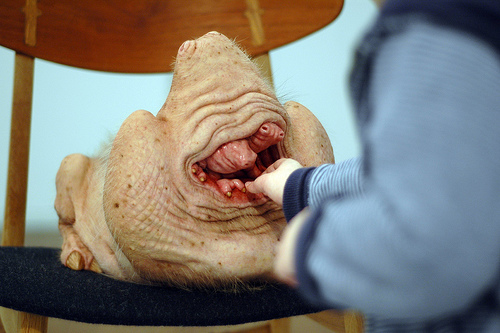
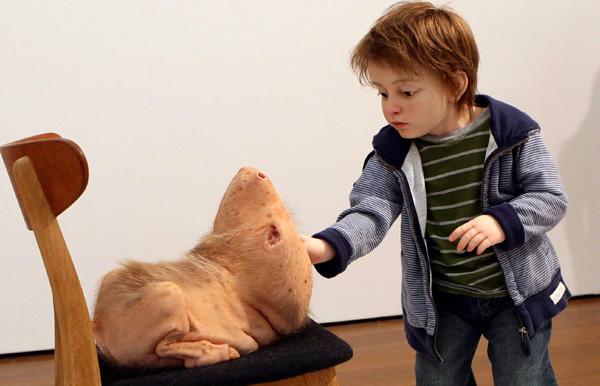
 Art Blart _ art and cultural memory archive
You must be logged in to post a comment.