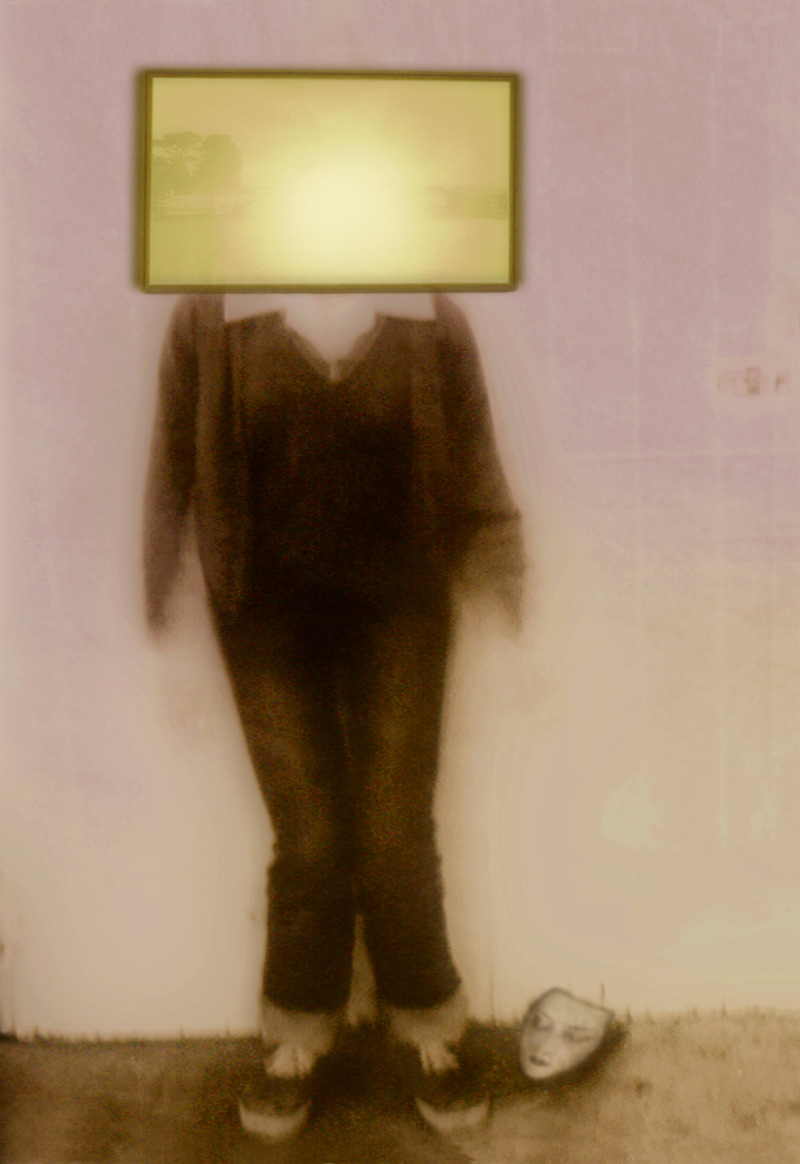
A body of work is slowly taking shape. I have over 150 images at the moment (!!) and after I finish making them all the images will be culled to form the new series Missing in Action (red kenosis) (2010). Images from the new series are below. Please click on the photographs to see a larger version of the image. Enjoy!
Dr Marcus Bunyan
Photographs are available from this series for purchase. As a guide, a digital colour 16″ x 20″ costs $1000 plus tracked and insured shipping. For more information please see my Store web page.
Exhibition dates: 24th August – 18th September 2010
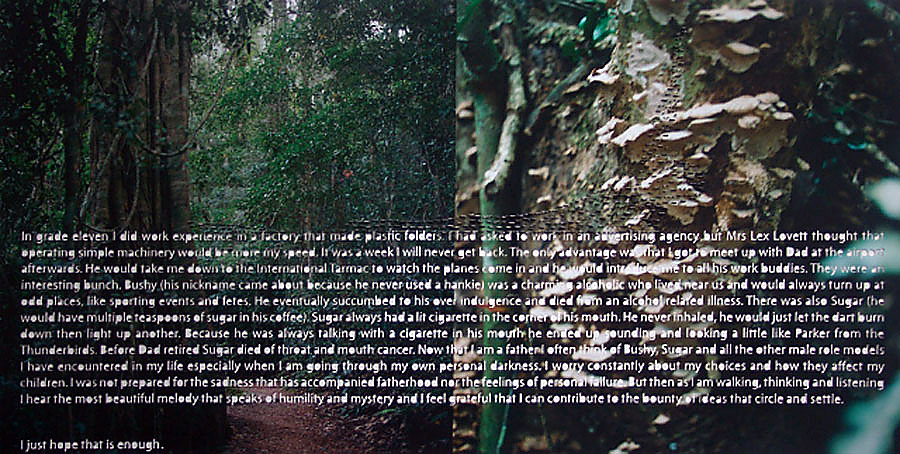
Martin Smith (Australian, b. 1971) Enough 2010
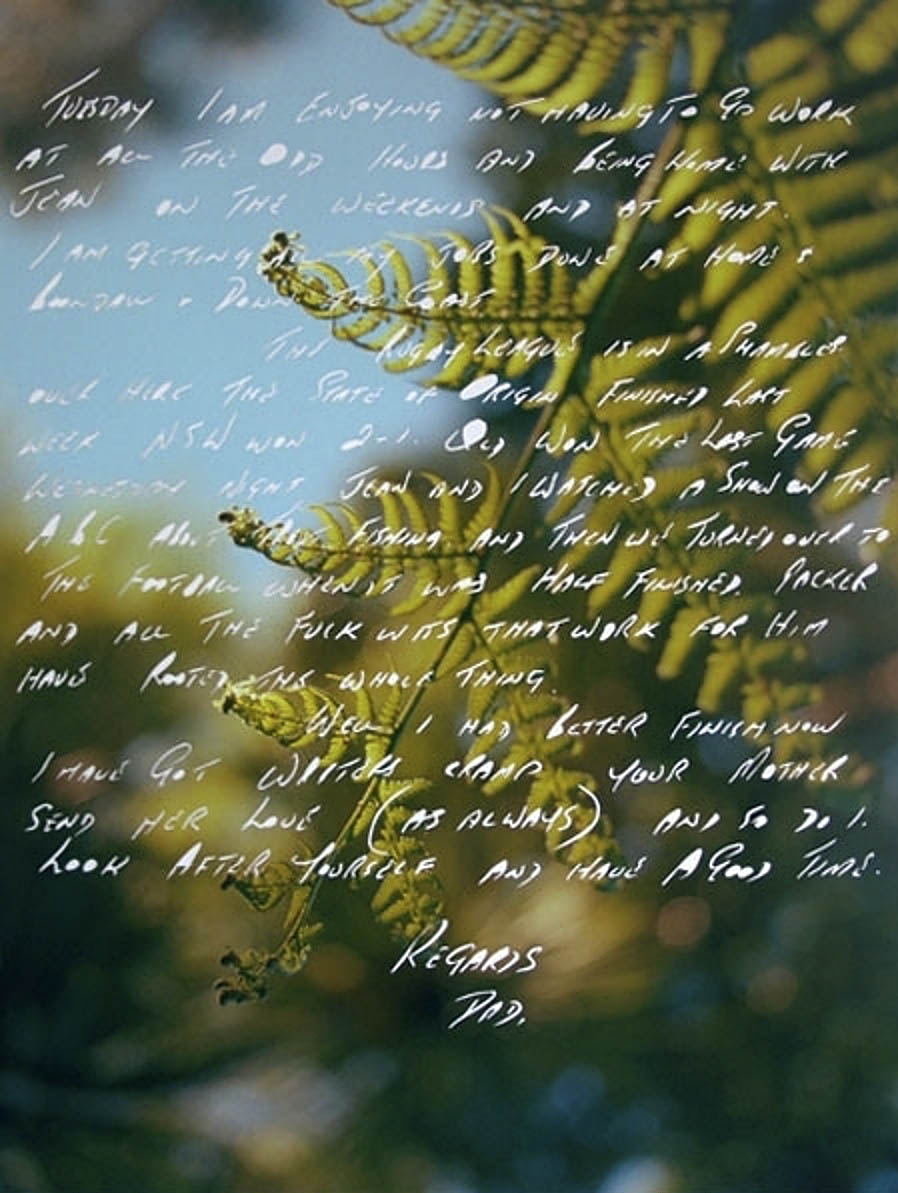
Following on from last year’s exhibition My Jesus Lets Me Rub His Belly that examined issues of place and faith when the artist was growing up, Martin Smith now presents a slice of poignant son father love at Sophie Gannon Gallery, Richmond. The combination of images and text create narratives on growing up, life, male bonding and mortality.
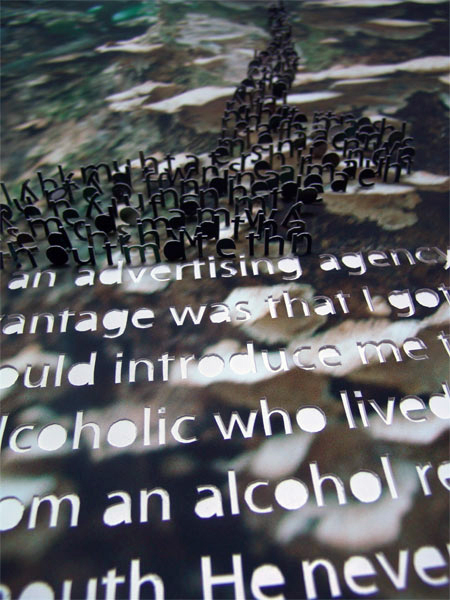
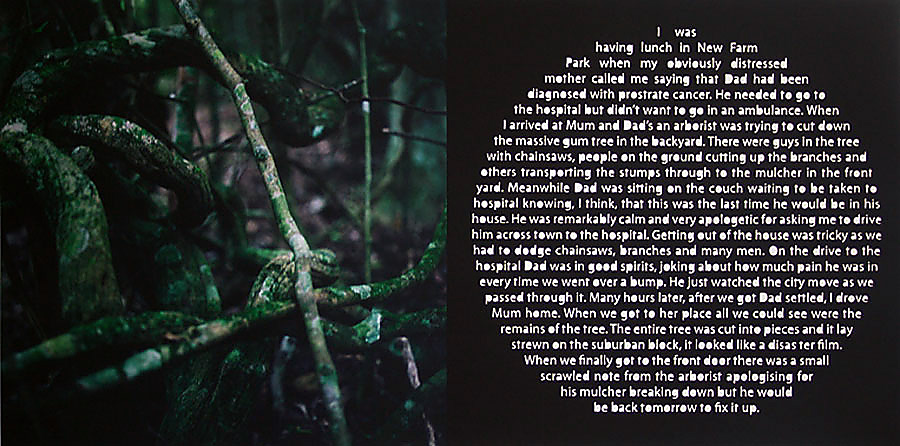
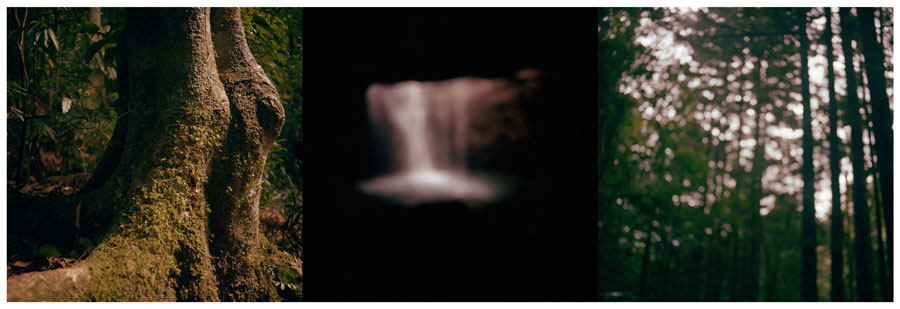
In Fix It Up (2010, below) the use of a circle of text on black (the circle of life) in this image paired with a dark photograph of moss covered twigs and branches is exemplary, the metaphor of the arborist chopping down a gum tree in the backyard as his father is waiting to be taken to hospital by ambulance with prostrate cancer, the last time he will be present in his house, incredibly moving. The use of blurred images, such as the central panel in the triptych Sydney (2010, below) adds emotional weight to the narratives, as though the stories told can only be fragmentary memories, as all memories are, of the events that have passed. The feeling of an excavation of the meaning of life and death is further enhanced by the incision of the letters into the photographs surface and the extrusion of the letters to form three-dimensional sculptural forms, as in the work Enough (2010, see photograph and detail below). The letters shape references the fungi on the tree behind, new life growing out of old, as though the words were being extruded out of the forest, archives of communal memory.
My favourite image in the exhibition didn’t have any words at all, not even piled as detritus at the bottom of the frame as many of Smith’s works do. It didn’t need them. The triptyph Untitled 1 (2010, below) is simple and eloquently beautiful and almost brought me to tears. When read in combination with the other works and their texts, the moss covered trees on the left become two wrinkled elbows, the image on the right the wandering mind and the image in the centre – for me, the feeling of life force as it flows in the darkness. As my yoga teacher says to me, “You must learn to navigate the dazzling darkness.”
This illumination of the mind, body, memory and spirit is what Smith’s work is all about. I adore it.
Exhibition dates: 24th August – 18th September 2010
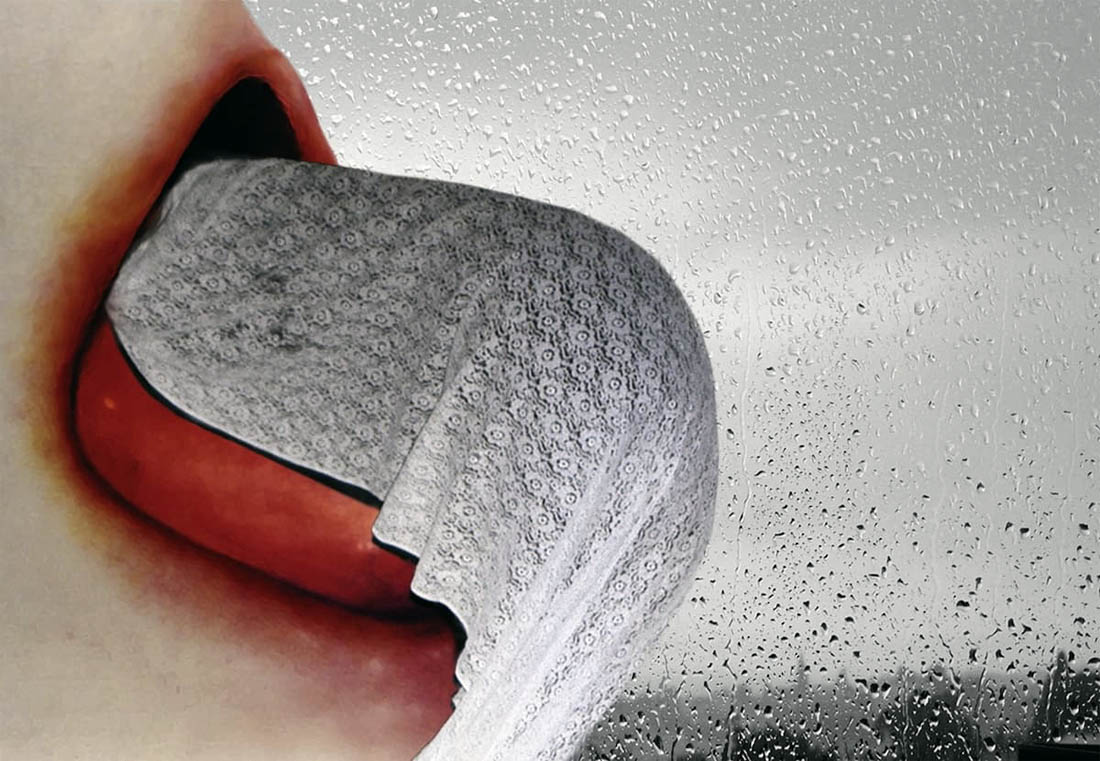
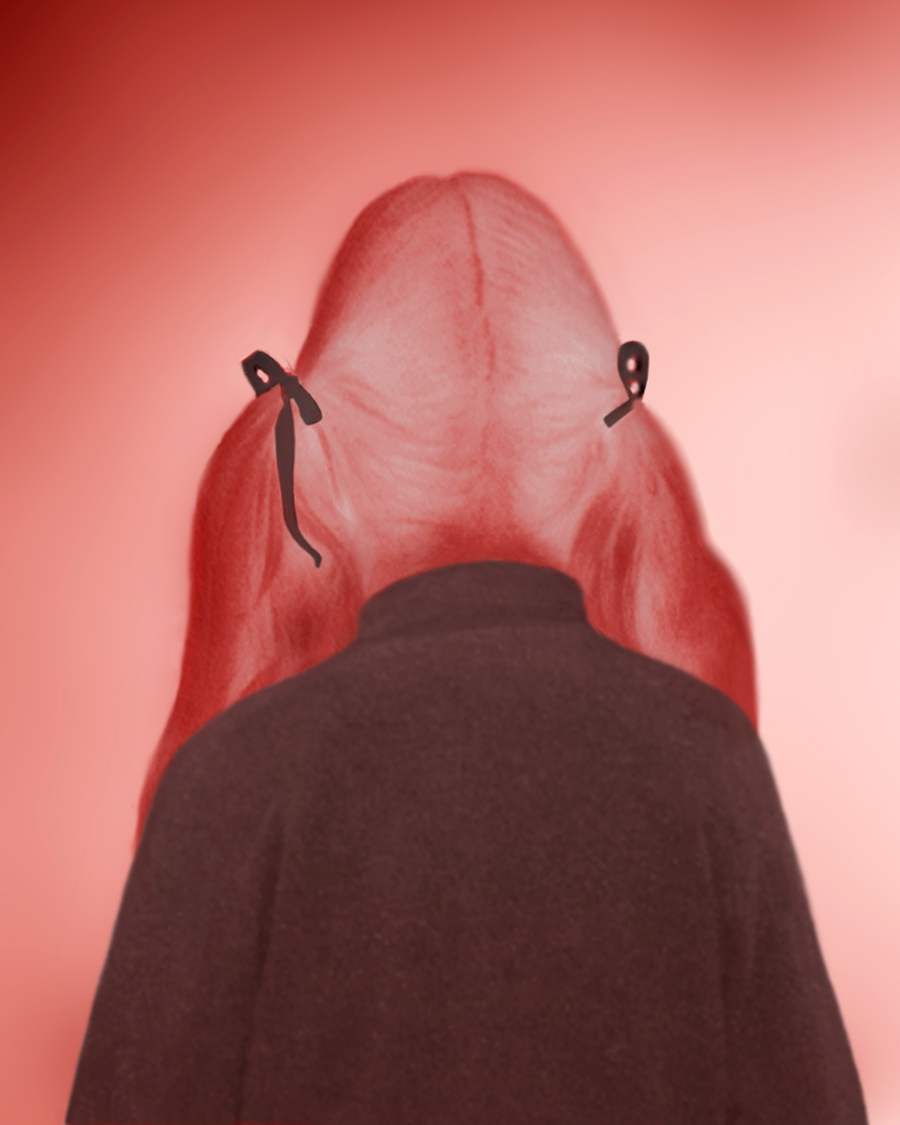
Pat Brassington (Australian, b. 1942) Camouflage 2010
I have a critically ambivalent attitude towards the work of artist Pat Brassington. While the exhibition at Arc One Gallery in Melbourne contains some wonderful ‘images’ her work never seems to move me in an emotional sense. What it does do admirably is constantly engage me in cerebral jousting and sensory debate. Intellectually and visually I find the images stimulating, emotionally I am left a little bit cold.
Brassington’s sometimes fetishistic collage-like digital photographs occupy ambiguous spaces – fascinating ‘other’ worlds, constructed worlds that disturb and delight, drawing the viewer into subjective judgements on what, exactly, they are seeing. Brassington doesn’t need to speak about her work, much like Bill Henson never speaks about his work, because the viewer does that for her and that is the point – Brassington lets the viewer construct the story, a story that is open to multiple viewpoints and interpretations.
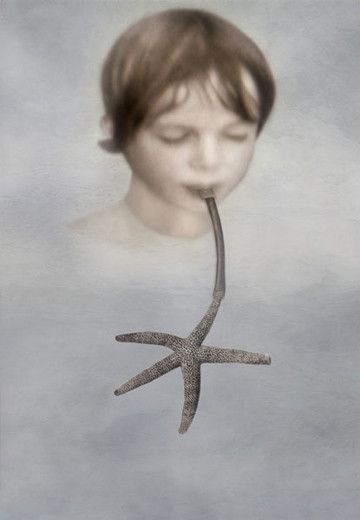
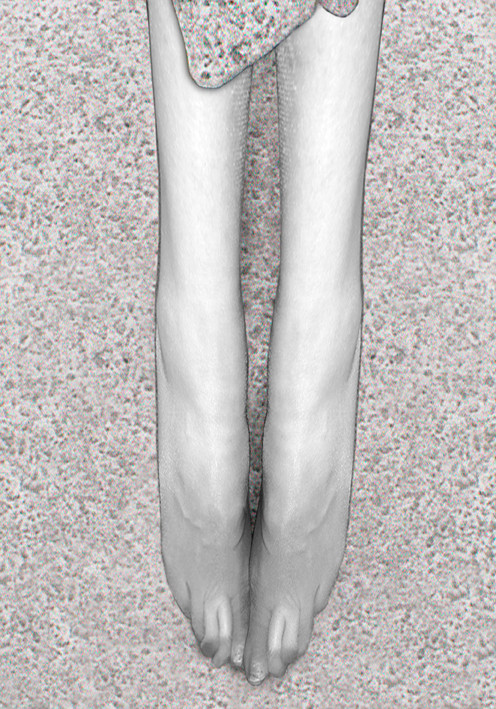
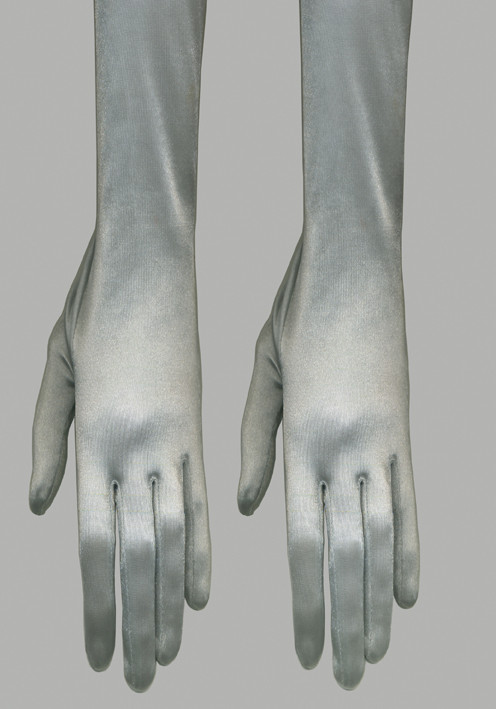
To see the work as just “surrealist” is to do it a disservice for it is much more than that. Of course the work uses various surrealist tropes but the power of these images is in setting up psychological encounters that are often bizarre, confronting and disturbing at a deeper level than just surface juxtapositions. These images seem to haunt you long after you have seen them. Using a limited colour palette of washed out purples, greys, yellows and pinks with a hit of red or blue where applicable (only once a green, never any solid, bright, strong colours) Brassington’s work keeps repeating objects and themes throughout the years – the dress, fish, gloves, hands, legs and the sensual mouth – to “evoke uneasy tensions between bizarre, sinister intimations of menace and weirdly beautiful, benign harmonies.” (Diane Foster).
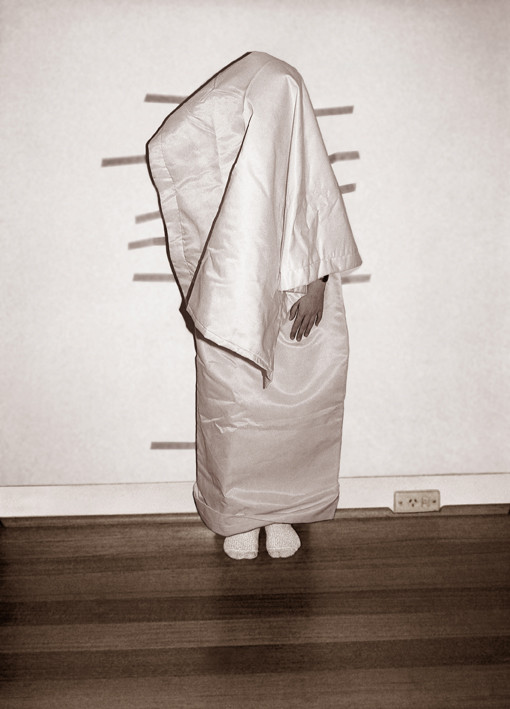
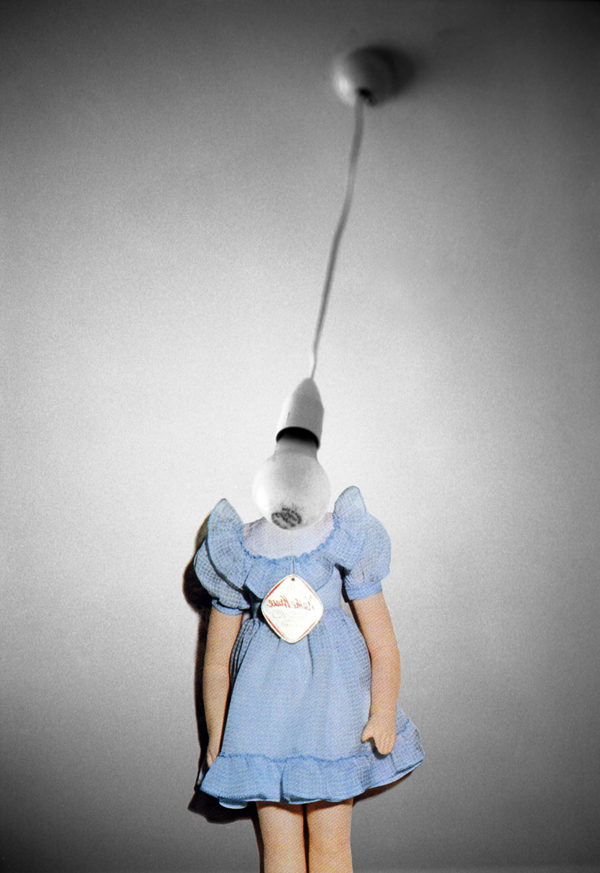
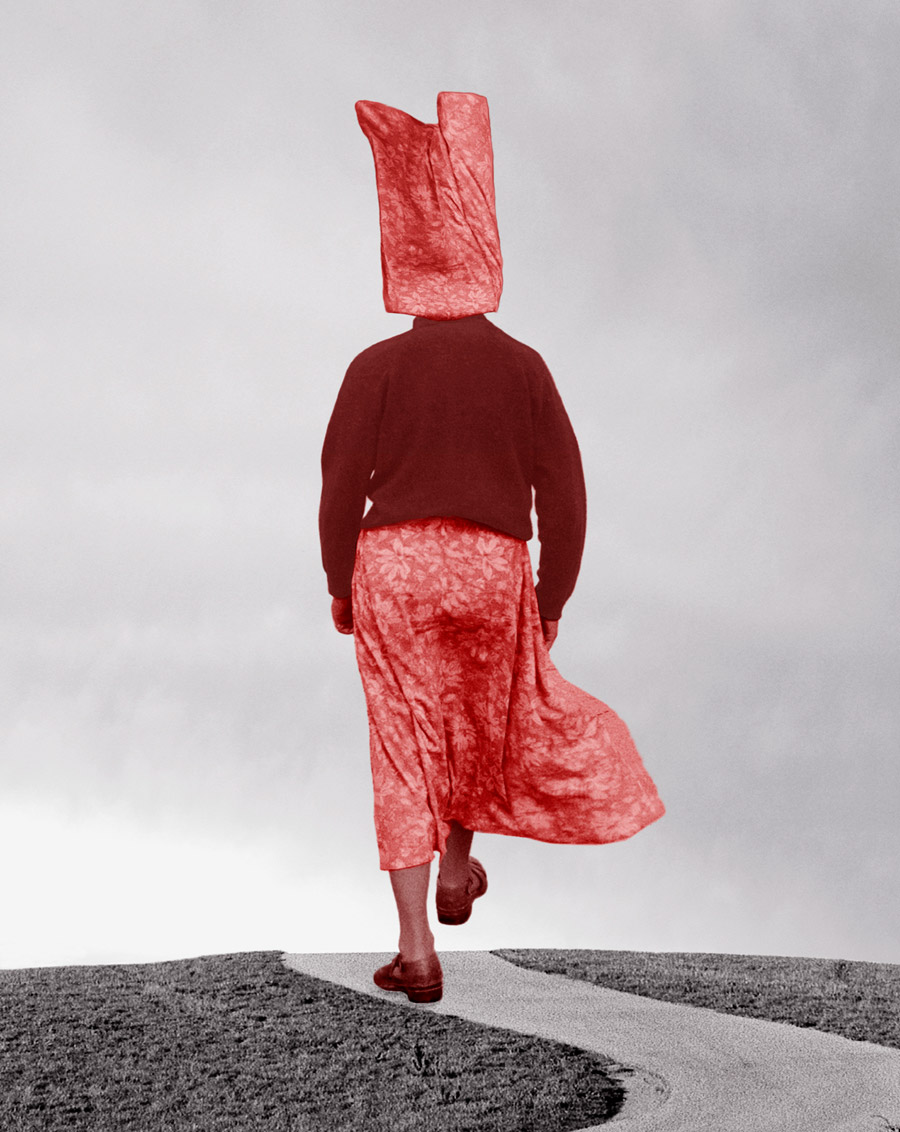
In these new images the lascivious tongue is camouflaged, a woman marches determinedly and blindly over a hill, a child is wrapped and taped, two sateen gloves emanate and a boy breathes life into the sea (or is it the other way around, or is the boy destroying the sea through his breath?). The paradoxes are beautifully enacted and always challenging and that is the strength of the work of Brassington – offering us, the viewer, no easy way out as we stare at the red ribbons in a girl’s hair.
Exhibition dates: 10th August – 4th September 2010
David Neale (Australian, b. 1977) Brooch Steel, paint, marble, lapis lazuli 2009-2010
A nice double act of an exhibition at Gallery Funaki that showcases the jewellery of David Neale and first time exhibitor Emma Price. Neale’s delicate folded and layered brooches of bud and leaf-life forms sparkle with crushed marble, turquoise and lapis lazuli forming a palette of pale blues, pinks, greens and vibrant hints of red, the shapes almost a form of metal collage. As pieces of art they work excellently but as jewellery they seem fragile perhaps due to the thinness of the metal used and what I perceived as a lack of structural integrity. As brooches I wonder how carefully one would have to wear them (very carefully I suspect) and how long the crushed sparkling rock would adhere to the surface of the metal (I have since been reliably informed by Simon that they are very sturdy but this was an initial reaction on picking up the brooches).
Of more significance are the articulated trapezoid necklaces by Emma Price. These are stunning architectural works (at very reasonable prices!) that are made of gold, silver, brass and copper. They exude a quietness and balance that is beautiful and a playfulness (because of the interlinked forms that actually move) that is delightful. In these geometric forms there seems to be a suspension in/of reality as if the world is hanging by a thread. A bright future awaits for this artist.
Dr Marcus Bunyan
Many thankx to Katie Scott and Gallery Funaki for allowing me to publish the photographs in the posting. Please click on the photographs for a larger version of the image.
David Neale (Australian, b. 1977) Brooch Steel, paint, marble, lapis lazuli 2009-2010
David Neale (Australian, b. 1977) Brooch Steel, paint, marble, lapis lazuli 2009-2010
Highly respected Melbourne jeweller David Neale presents new pieces alongside Emma Price, who will be showing her first significant group of work at Gallery Funaki in this exhibition.
David Neale’s intriguing folded forms, borne of his sensitive treatment of metal sheeting using texture and paint, have earned him a significant reputation both in Australia and overseas. His recent work shows a shift away from botanical influences, towards more abstract and expressive forms. There is a bold sense of the painterly in these works, as Neale’s powdery, textured colours become a dominant focus.
Emma Price completed her Masters of Gold and Silversmithing at RMIT in 2005 before spending a year at the Munich Academy of Fine Arts in 2008. Her finely balanced structures are constructed from painstakingly drawn down tubing in gold, brass, silver and copper. The shifting, architectonic forms of her neckpieces seem to dance against the body.
Text from the Gallery Funaki website [Online] Cited 26/08/2010 no longer available online
Emma Price (Australian, b. 1975) Necklace 2 silver, brass, gold 2010
Emma Price (Australian, b. 1975) Necklace 6 silver, brass, copper, gold 2010
Emma Price (Australian, b. 1975) Necklace 8 silver 2010
Gallery Funaki Sackville House Apartment 33 27 Flinders Lane Melbourne 3000 Australia
Opening hours: Wednesday – Friday 12 – 5pm Saturday on occasion (check our socials) or by appointment
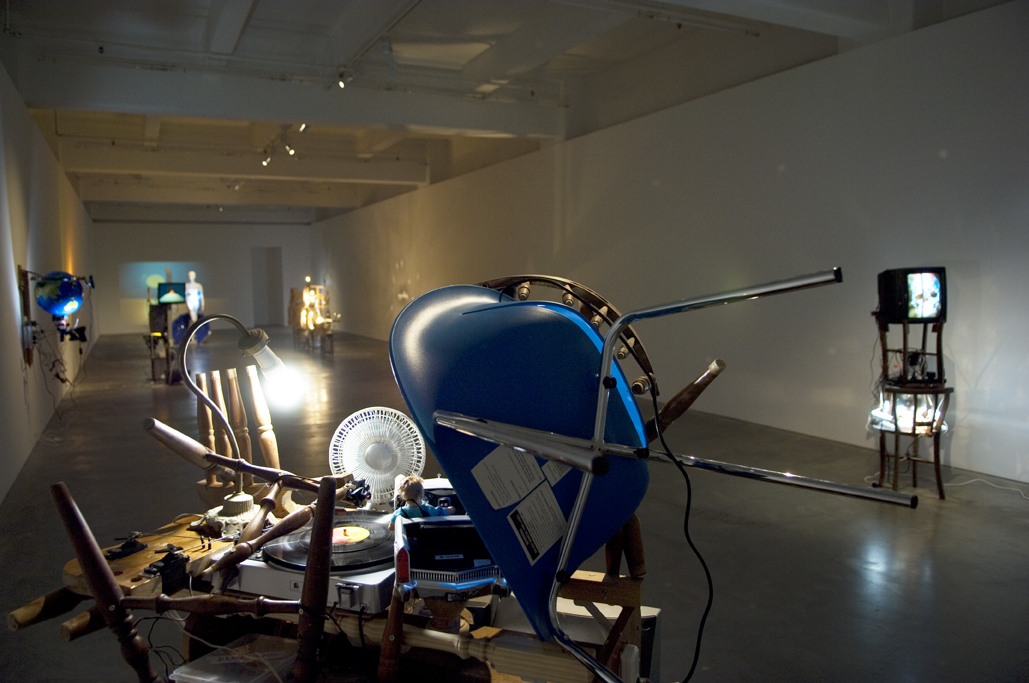
Ian Burns (Australian, b. 1964) AND THEN… 2010 Installation view at Anna Schwartz Gallery, Melbourne
Two words: JUST GO!
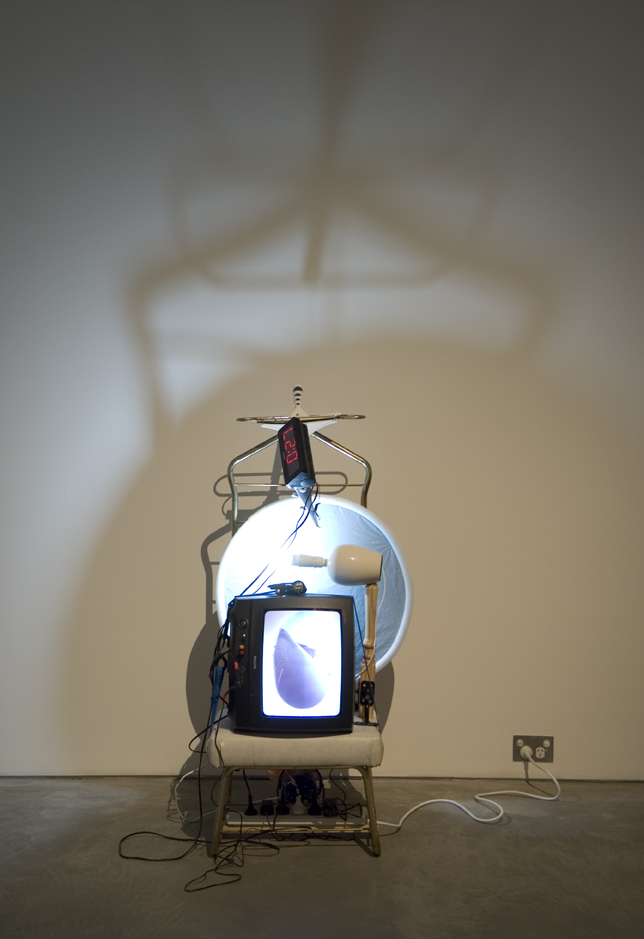
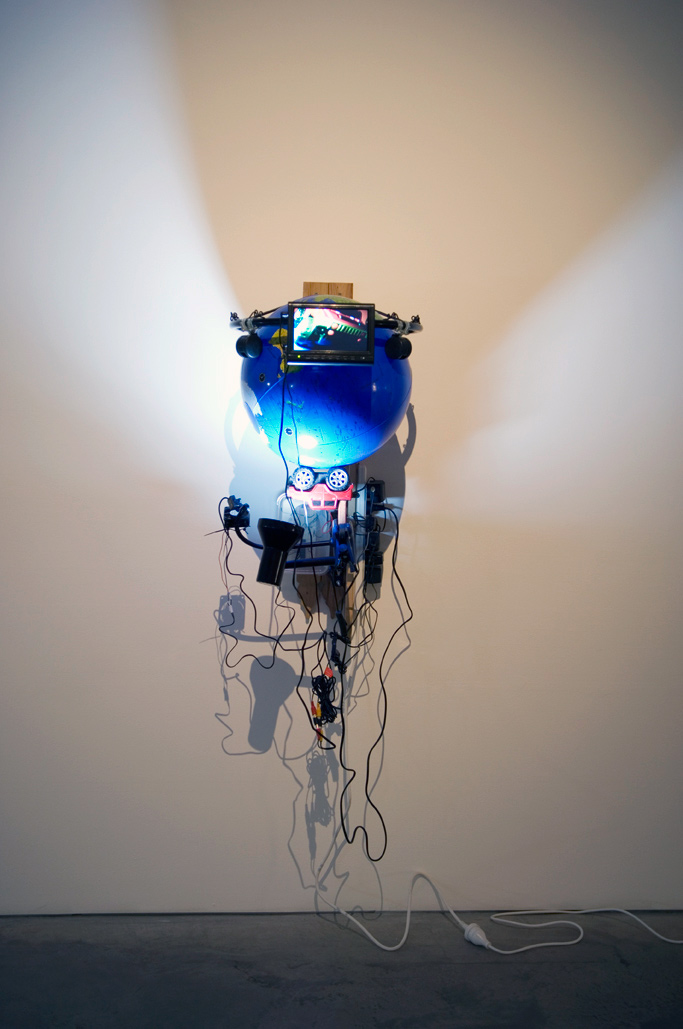
Yes the work can be analysed as in the text (below) from the Anna Schwartz Gallery website but this is not necessary to enjoy the work. These are such fun assemblages, the created mis en scenes so magical and hilarious, guffaw inducing even, that they are entirely playful.
I delighted in how they were constructed, almost thrown together from found objects that relate to the theme of each work; in the miniature cameras and environments – the Jumbo jet flying through the ‘sky’ of clouds created by a boiling water heater; in every particle of light as the words AND THEN… were created through aligned lens prisms (A Moment Implied 2010); and I was in wonder at the shimmering, setting sun in Venus (2010).
There is so much to like here – the inventiveness, the freshness of the work, the insight into the use of images in contemporary culture. Still photographs of this work do not do it justice. I came away from the gallery uplifted, smiling, happy – and that is a wonderful thing to happen.
As I said at the beginning: JUST GO!
Dr Marcus Bunyan
Many thankx to Ash Kilmartin and the Anna Schwartz Gallery for the photographs in the posting. Please click on the images for a larger version of the image. All images are courtesy the artist and Anna Schwartz Gallery.
Ian Burns (Australian, b. 1964) 15 hours v.4 2010 Found object kinetic sculpture, live video and audio Image courtesy the artist and Anna Schwartz Gallery
For his first solo exhibition in Melbourne, and his first exhibition at Anna Schwartz Gallery, Ian Burns presents a number of sculptures that continue to explore the manufactured screen image. Referring in title to the simplistic and little-nuanced plots of pulp fiction, AND THEN… provides a space in which we might become more conscious of the images we consume on a daily basis. Incorporating and sometimes generating sound and image, Burns’ ‘meta-cinematic’ monuments invoke popular moving imagery and by extension the culture which produces them. Burns builds these audio-visual-sculptural forms in order to reveal the clichés of contemporary screen culture. Without ignoring the context of his own production, Burns’ critique of mindless images also extends to those contemporary art practices that similarly play upon the objects familiar to daily life. Comprised of found objects, each sculpture contains within it a unique narrative. For example, the coincidence of discovering a clam-shaped, children’s swimming pool, along with some discarded mannequins, led the artist to Botticelli’s Birth of Venus. What ensues is a unique extension of the metaphor, as Venus – through Burns – gives birth to video. This brings us to the underlying essence of Burns’ work: while critically bringing to light complex theories about popular culture and the entertainment industry, these works contain a necessary dose of humour – making them utterly compelling.
Artists: Justine Khamara, Lyndell Brown and Charles Green, Imants Tillers, Sam Shmith, Janet Laurence, Murray Fredericks and Huang Xu
Janet Laurence (Australian, b. 1947) Carbon Vein (installation view) 2008 Duraclear, oil pigment on acrylic 235 x 100cm Photo: Marcus Bunyan
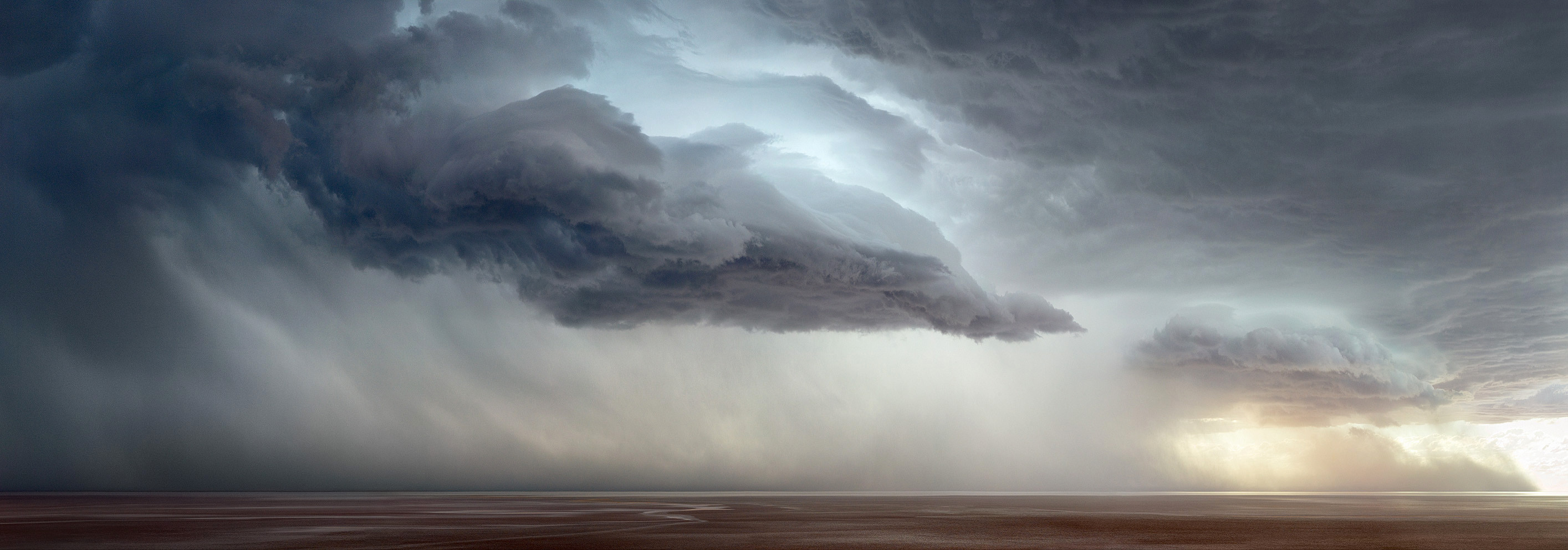
This is an excellent group exhibition at Arc One Gallery, Melbourne. Together the works form a satisfying whole; individually there are some visually exciting works. There are two insightful paintings by Imants Tillers, Nature Speaks: BP (2009) and Blossoming 21 (2010), a digitally constructed landscape by Sam Shmith, Untitled (Passenger) (2010, below) that the online image doesn’t really do justice to, a large photographic landscape of a storm over Lake Eyre Salt 304 (2009, below) by Murray Fredericks and two layered transcapes by Janet Laurence (see image above) that just confirm the talent of this artist after the exciting installation of her work at the Melbourne Art Fair (I call them transcapes because they seem to inhabit a layered in-between space existing between dream and reality).
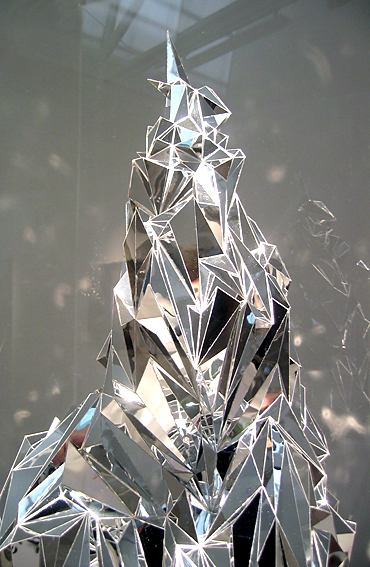
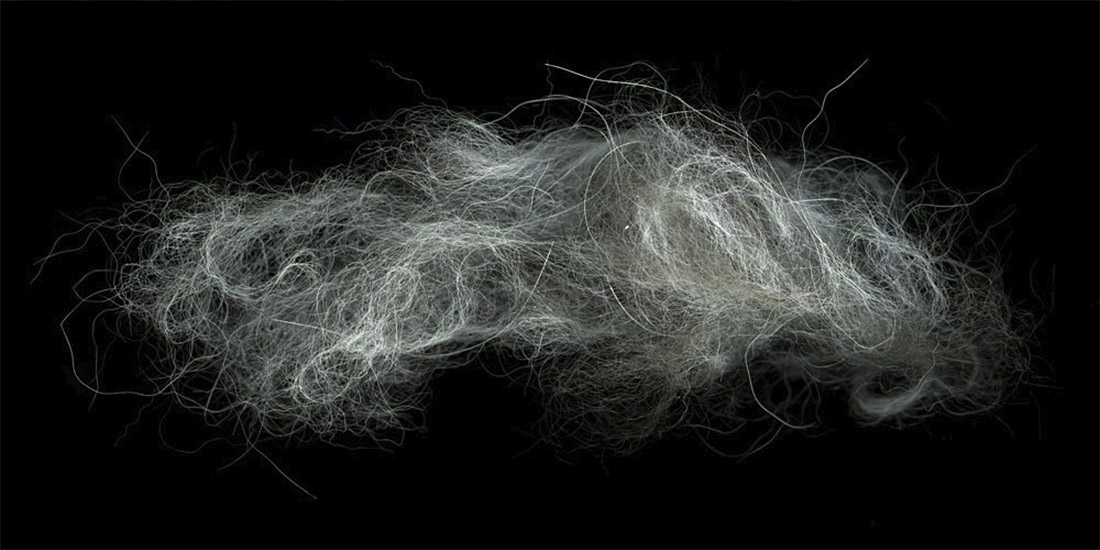
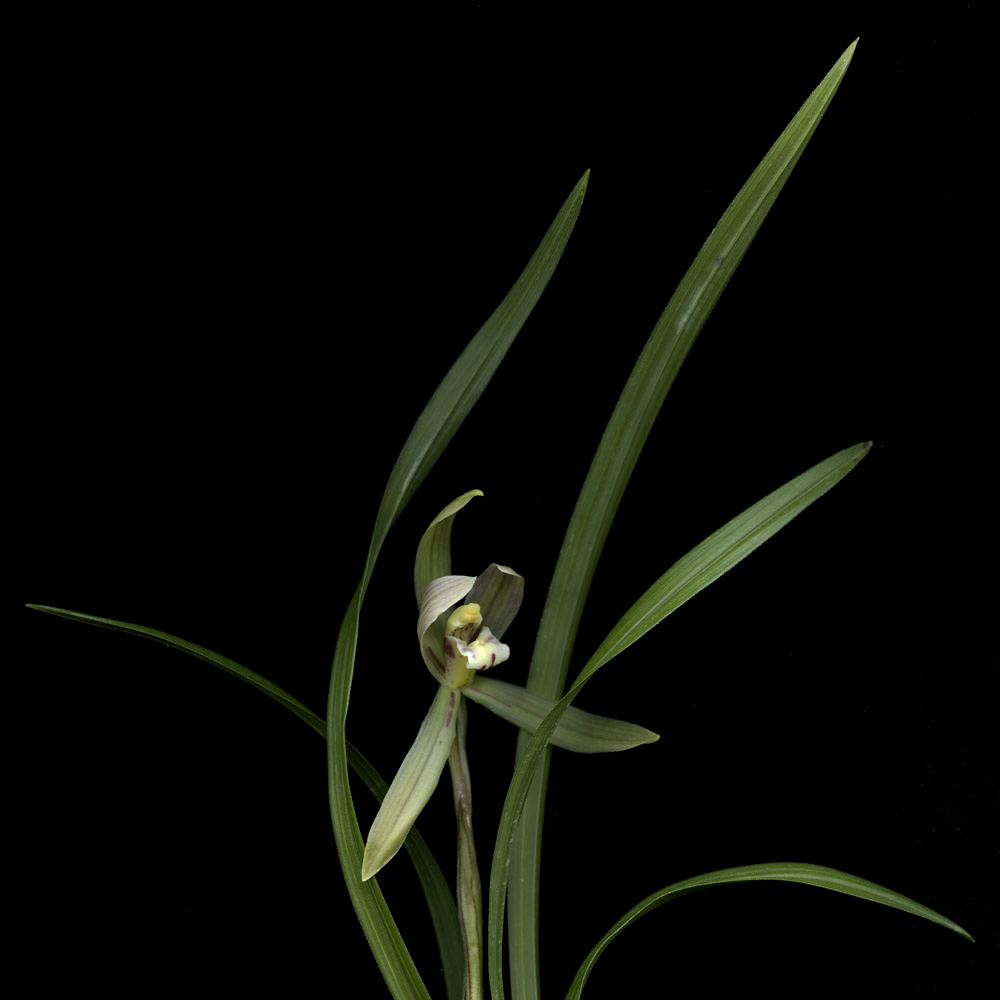
For me the three outstanding works were the large horizontal photograph Hair No.2 (2009, below) by Huang Xu, in which hair hangs like a delicate cloud on a dark background and his photograph Flower No. 1 (2008, below) in which the white petals of the chrysanthemum, symbol of death or lamentation and grief in some Western and Eastern countries in the world, seemingly turn to marble in the photographic print (you can see this online in the enlarged version of the image below). What a magnificent photograph this is – make sure that you don’t miss it because it is tucked away in the small gallery off the main gallery in the Arc One space. The third outstanding work is the sculpture you are a glorious, desolate prospect (2010) by Justine Khamara (see photographs below), a glorious magical mountain, twinkling in the light, all shards of reflectiveness, cool as ice. I would have loved to have seen this work without it’s protective case – in one sense the case works conceptually to trap the speaking of the mountain but in another it blocks access to the language of this work, the reflection of the light of the gallery, the light of the world bouncing off it’s surfaces.
This is not, of course, how nature speaks but how humans speak for nature – through image-ining and seeking to control and order the elemental forces that surround us. This construction of reality has a long tradition in the history of art, the mediation of the world through the hands, eyes and mind of the artist offering to the viewer, for however brief a moment, that sense of awakening to the possibilities of the world in which we all live.
Dr Marcus Bunyan
Many thankx to Angela and all at Arc One Gallery for allowing me to publish the photographs in the posting. Please click on the photographs for a larger version of the image.
Justine Khamara (Australian, b. 1971) you are a glorious, desolate prospect (installation view) 2010 Mirror, perspex, plinth 80 x 186cm Photo: Marcus Bunyan
Justine Khamara (Australian, b. 1971) you are a glorious, desolate prospect (installation view detail) 2010 Mirror, perspex, plinth 80 x 186cm Photo: Marcus Bunyan
Lyndell Brown (Australian, b. 1961) and Charles Green (Australian, b. 1961) Galatea Point 2005 Digital photograph on duraclear film edition of 5 112 x 112cm
Huang Xu (Chinese, b. 1968) Hair No.2 2009 Type C Photograph 120 x 245cm
Huang Xu (Chinese, b. 1968) Flower No.1 2008 Type C photograph 120 x 120cm
Huang Xu (Chinese, b. 1968) Flower No.2 2008 Type C Photograph 120 x 120cm
Murray Fredericks (Australian, b. 1970) Salt 304 2009 Pigment print on cotton rag 244 x 88cm
Sam Shmith (Australian, b. 1980) Untitled (Passenger) 2010 pigment print on archival rag 180 x 108cm
Arc One Gallery 45 Flinders Lane Melbourne, 3000 Phone: (03) 9650 0589
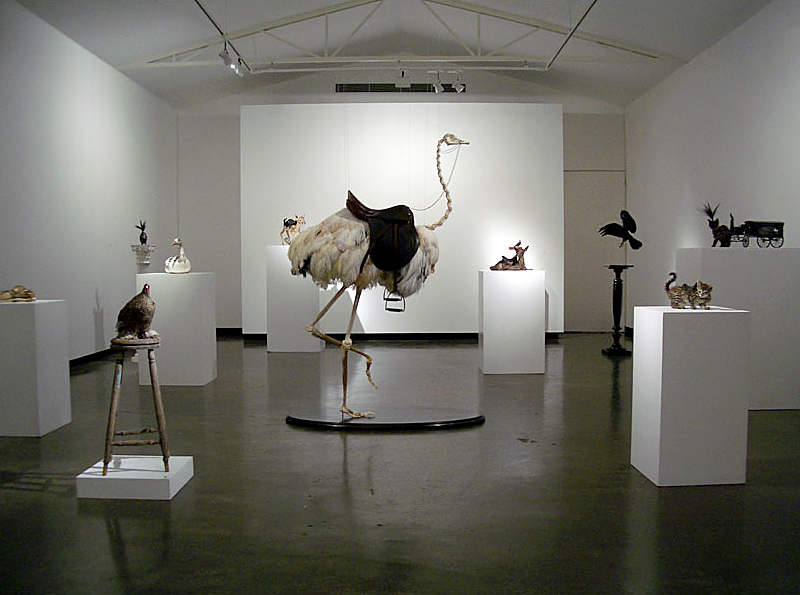
Installation view of Night’s Plutonian Shore by Julia deVille at Sophie Gannon Gallery, Richmond Photo: Marcus Bunyan
This is an excellent exhibition by Julia deVille at Sophie Gannon Gallery in Richmond. Compared to last year’s ‘shock and paw’ exhibition Cineraria reviewed on this blog, this exhibition shows a commendable sense of restraint, a beautiful rise and fall in the work as you walk around the gallery space with the exhibits displayed on different types and heights of stand and a greater thematic development of the conceptual ideas within the work. There are some exquisite pieces.
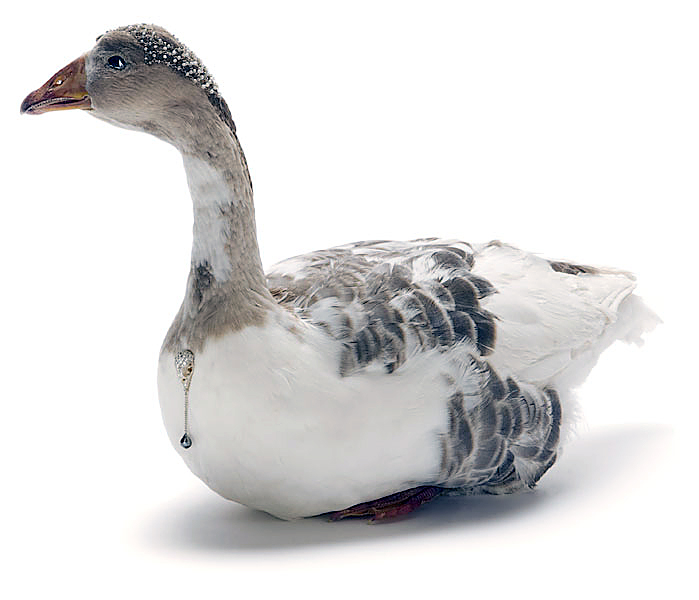
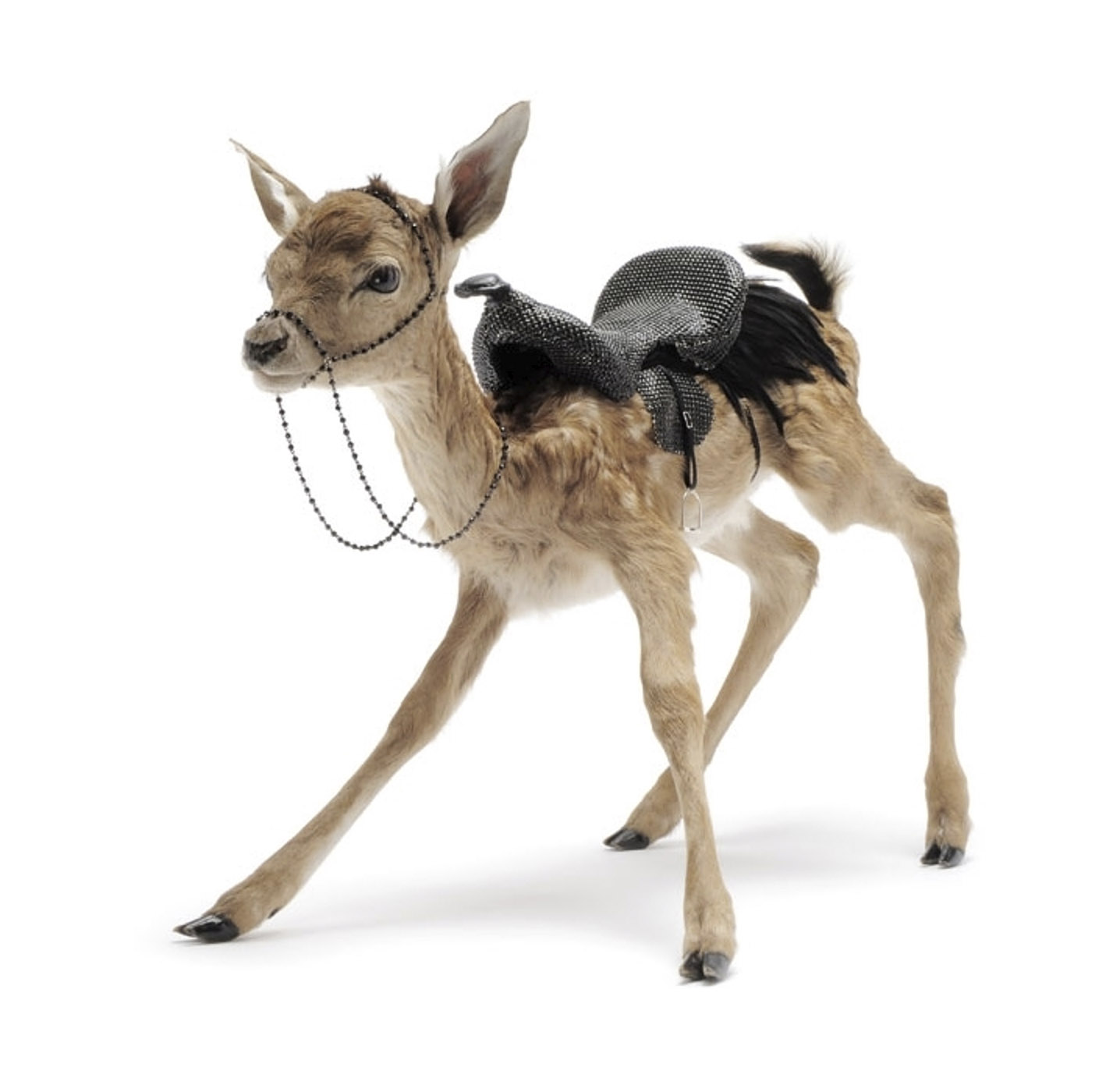
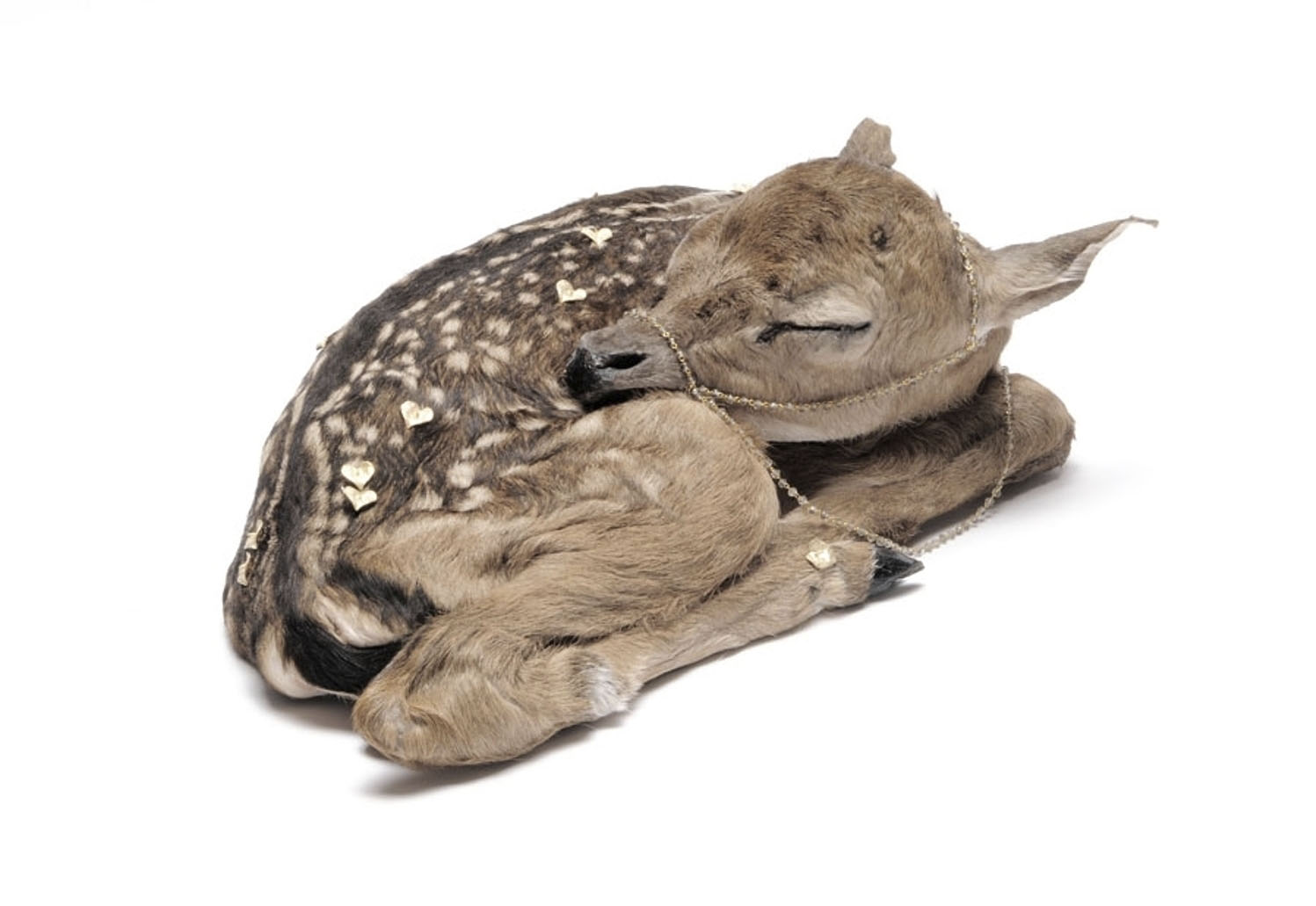
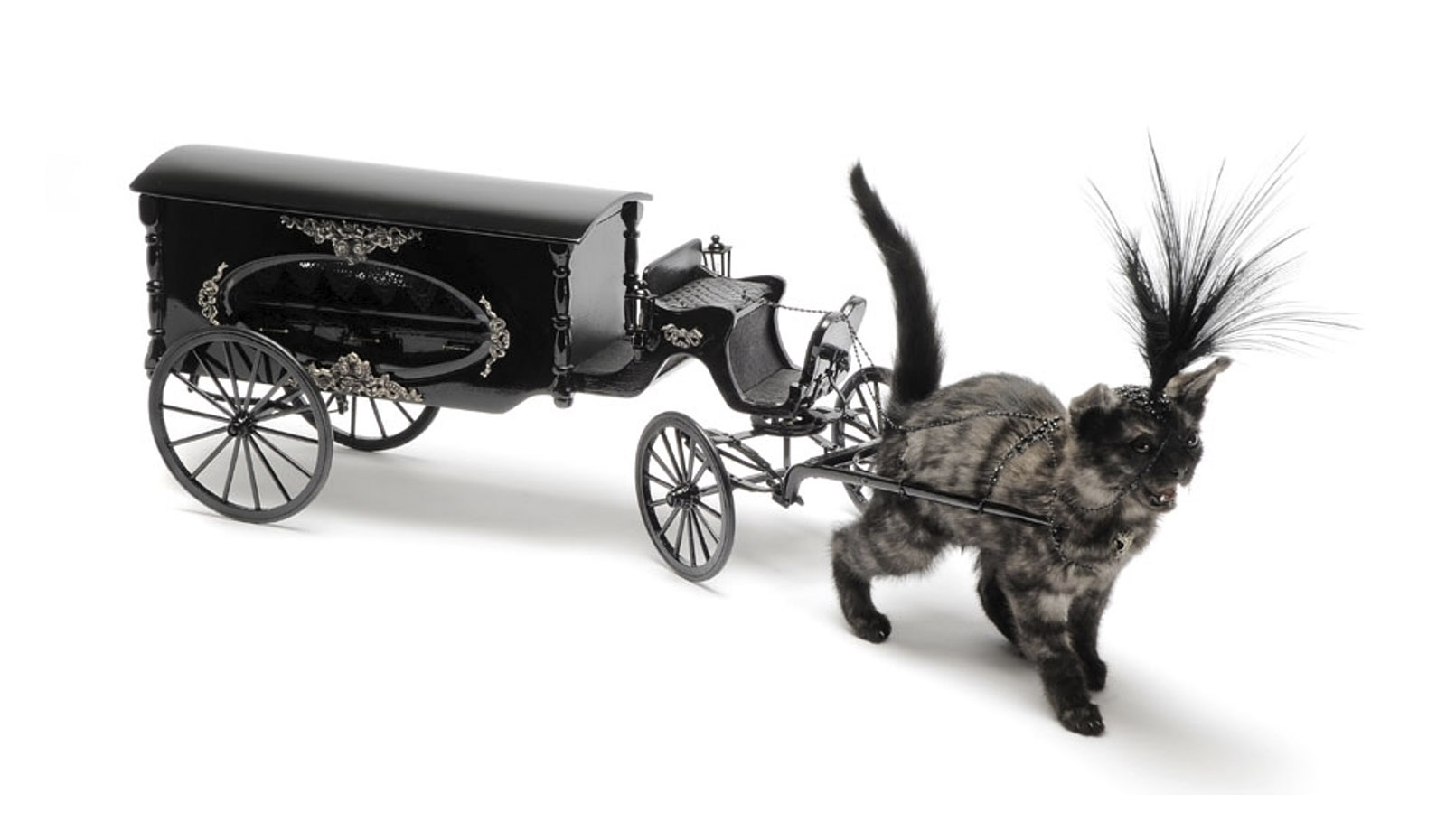
From the bejewelled Golden Gosling (2010), the goose that wears the gold not lays it to the cute stillborn fawn Lenore (2010), named after Edgar Allan Poe’s poem of the same name that discusses “the proper decorum in the wake of the death of a young woman, described as “the queenliest dead that ever died so young”,” (Wikipedia text) there is a delicacy to these sculptures that seemed absent in the last exhibition. The sleeping fawn wears a little golden bridle and is covered in golden hearts, the harness bringing in the element of control (of life, of death, of the body, of identity) into the pieces not seen in the earlier work. This sense of control is reinforced in other pieces in the exhibition including the three pieces Charon (2010), Nevermore (2010) and Kitten drawn hearse (2010, see photographs below).
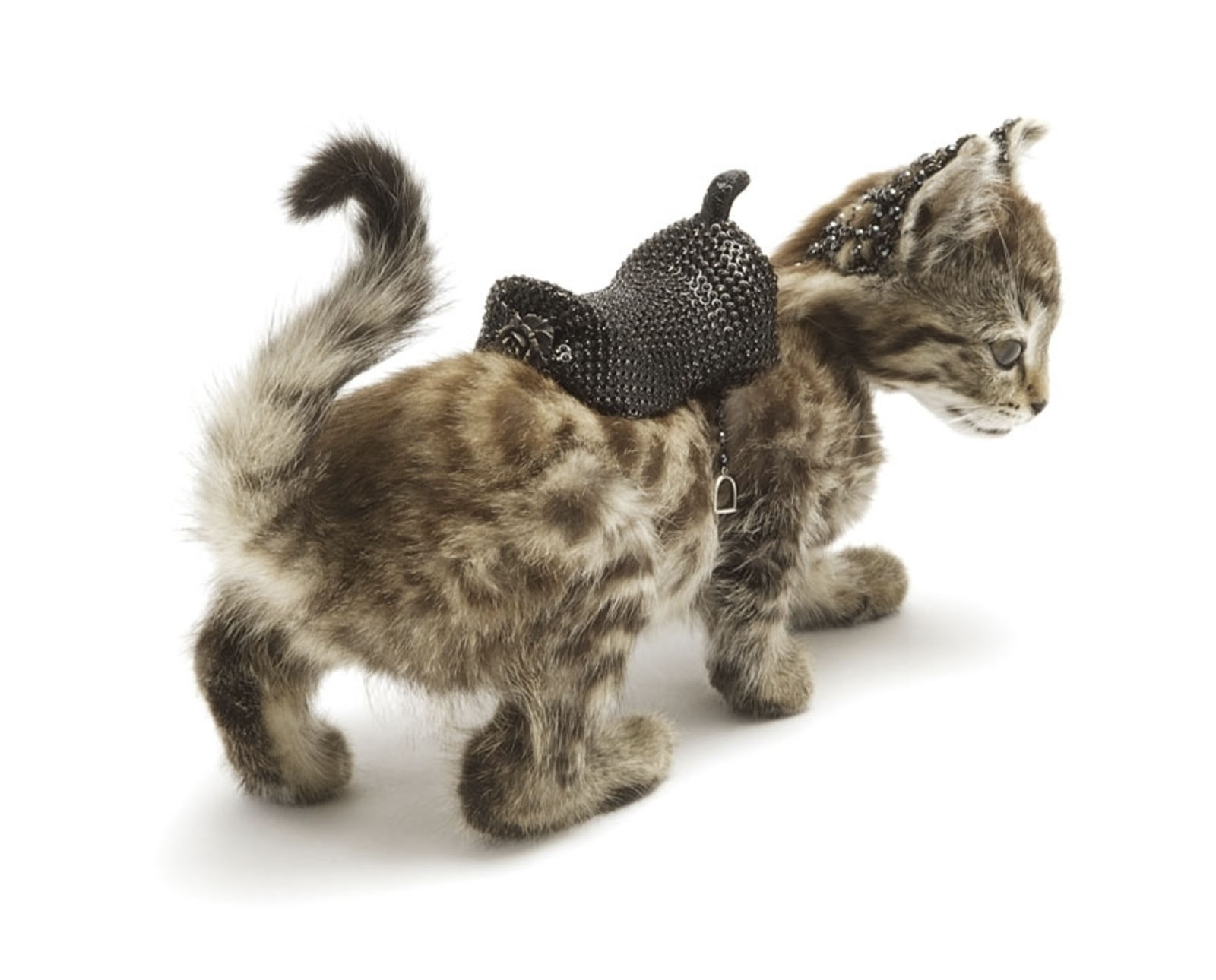
In Charon the kitten has an amazing beaded saddle and stirrups to allow the occupant to control the dead stead because in Greek mythology Charon is the ferryman who carries the souls of the newly deceased across the river Styx. Nevermore also features the saddle and bridle whilst the standout piece of the whole exhibition, Kitten drawn hearse just wows you with it’s delicacy and showmanship – the plume atop the harnessed kitten’s head faithfully replicating the dressage of a Victorian horse drawn funeral cortege.
In these pieces there is a simplification of the noise of the earlier works and in this simplification a conversant intensification of the layering of the conceptual ideas. Playful and witty the layers can be peeled back to reveal the poetry of de Sade, the stories of Greek mythology and the amplification of life force that is at the heart of these works.
Good stuff.
Dr Marcus Bunyan
Many thankx to Edwin and Sophie Gannon Gallery for allowing me publish the photographs in the posting. Please click on the photographs for a larger version of the image.
Another well considered response to the exhibition can be found on Karen Thompson’s Melbourne Jeweller blog.
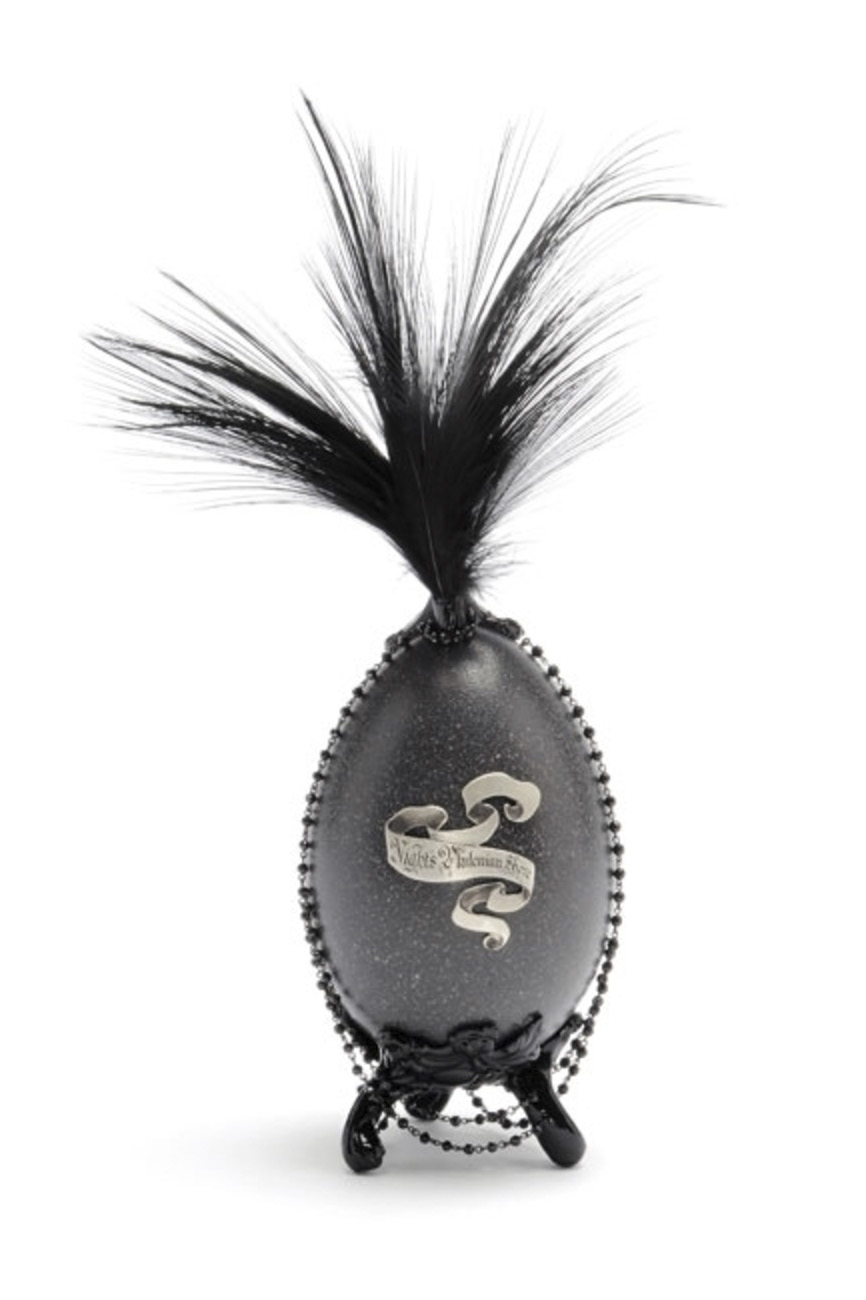
Julia deVille (Australian, b. 1982) Nameless here for evermore 2010 Emu egg, black garnet beads, sterling silver, bronze, enamel paint, egret feathers 31 x 16 x 16cm Courtesy Sophie Gannon Gallery
Julia deVille (Australian, b. 1982) Golden Gosling 2010
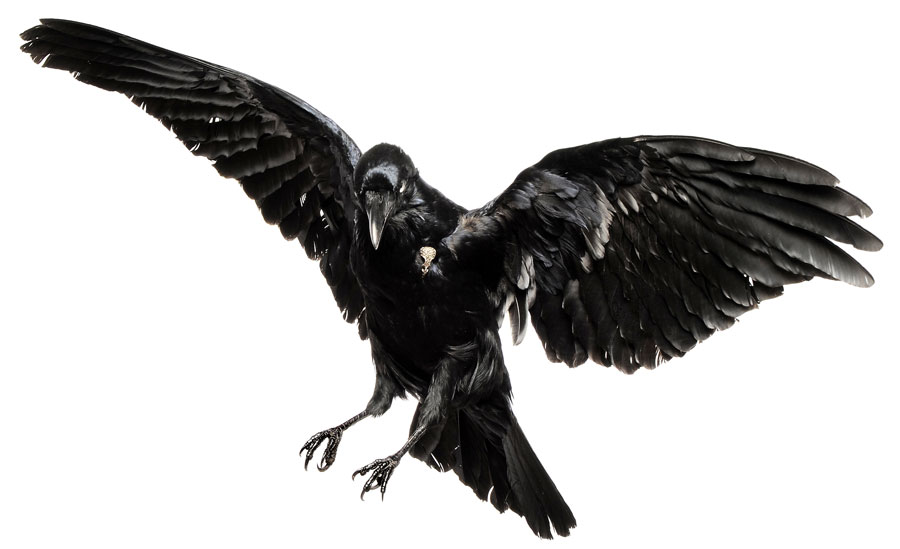
Julia deVille (Australian, b. 1982) Ghastly grim and ancient raven 2010
Julia deVille (Australian, b. 1982) Nevermore 2010 Still-born fawn, black garnet beads, sterling silver, coque feathers, chain mail, glass 27 x 41 x 59cm Courtesy Sophie Gannon Gallery
Julia deVille (Australian, b. 1982) Charon 2010 Kitten, hematite beads, mystic spinel beads, sterling silver, chain mail, glass 30 x 12 x 19cm Courtesy Sophie Gannon Gallery
Julia deVille (Australian, b. 1982) Lenore 2010 Stillborn fawn, black garnet beads, sterling silver, gold plate, glass 35 x 17 x 12cm Courtesy Sophie Gannon Gallery
Julia deVille (Australian, b. 1982) Kitten drawn hearse 2010 Kitten, black garnet beads, sterling silver, egret feathers, wood, glass 83 x 30 x 15cm Courtesy Sophie Gannon Gallery
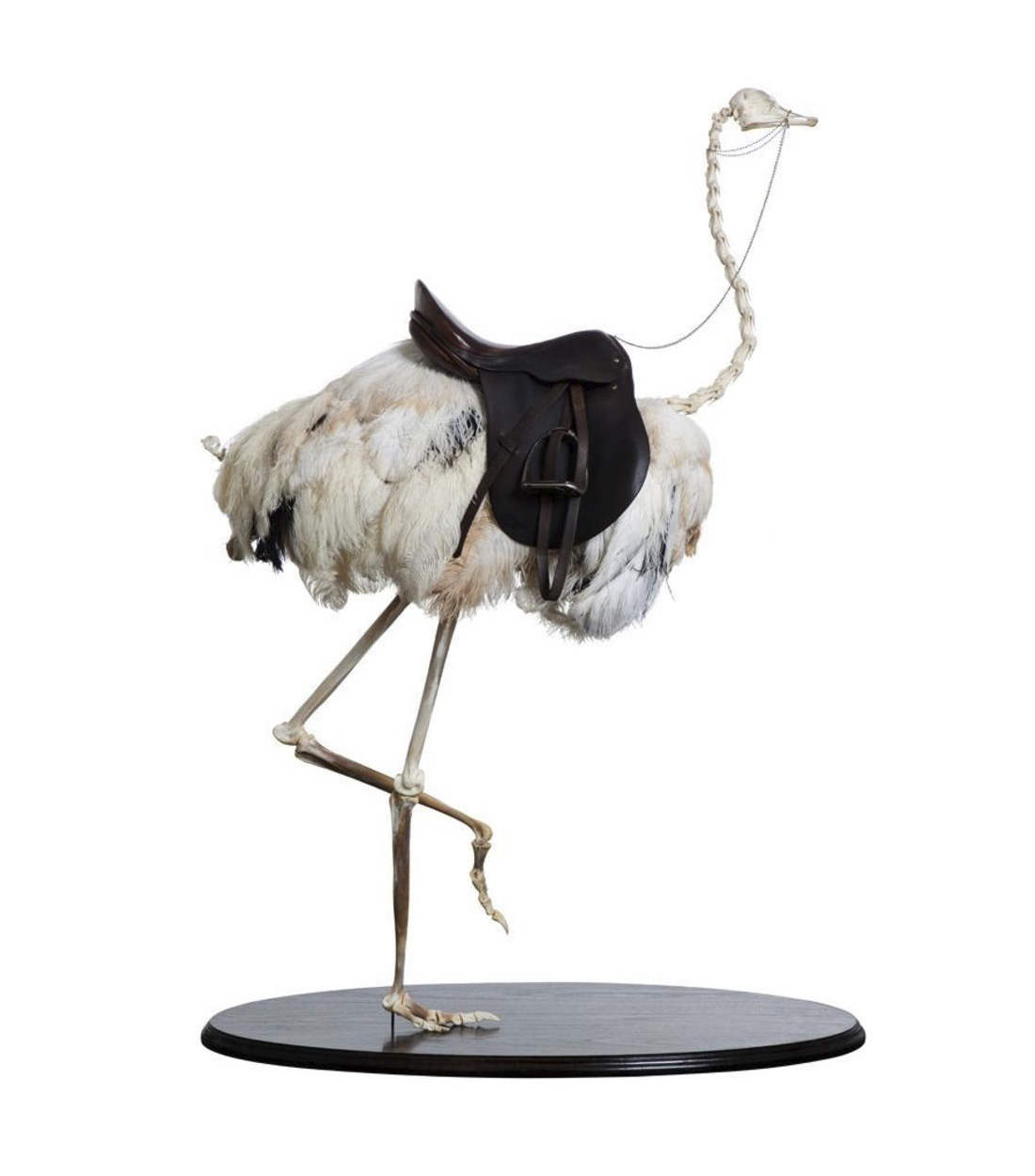
Julia deVille (Australian, b. 1982) Bird or beast 2010 Ostrich skeleton, ostrich feathers, smoky quartz, sterling silver, leather and wood Courtesy Sophie Gannon Gallery
Sophie Gannon Gallery 2, Albert Street, Richmond, Melbourne
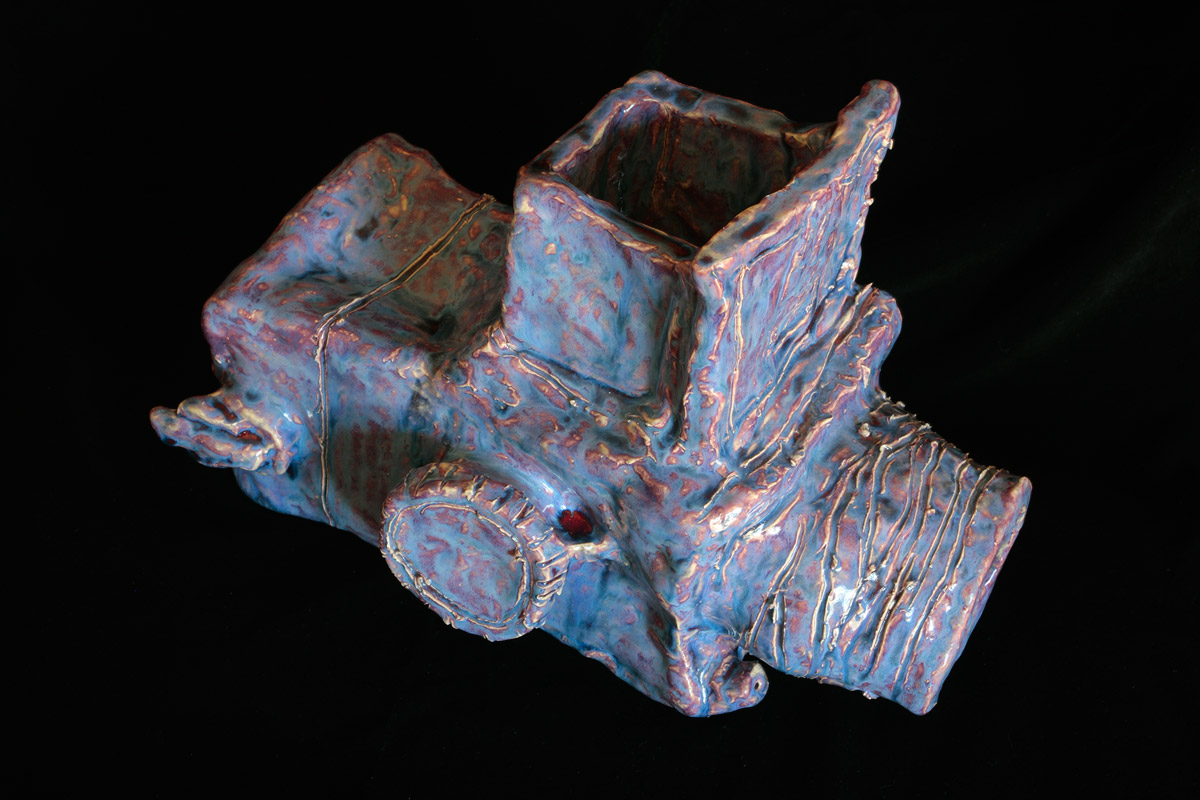
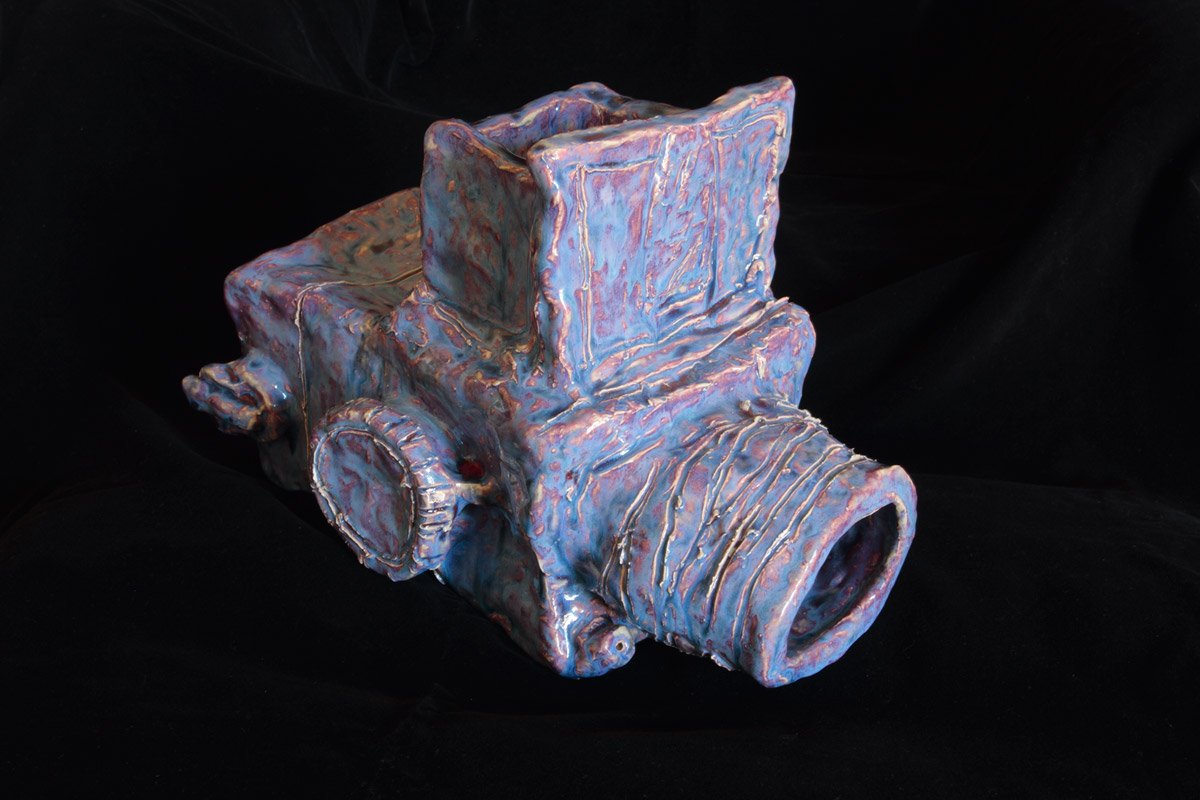
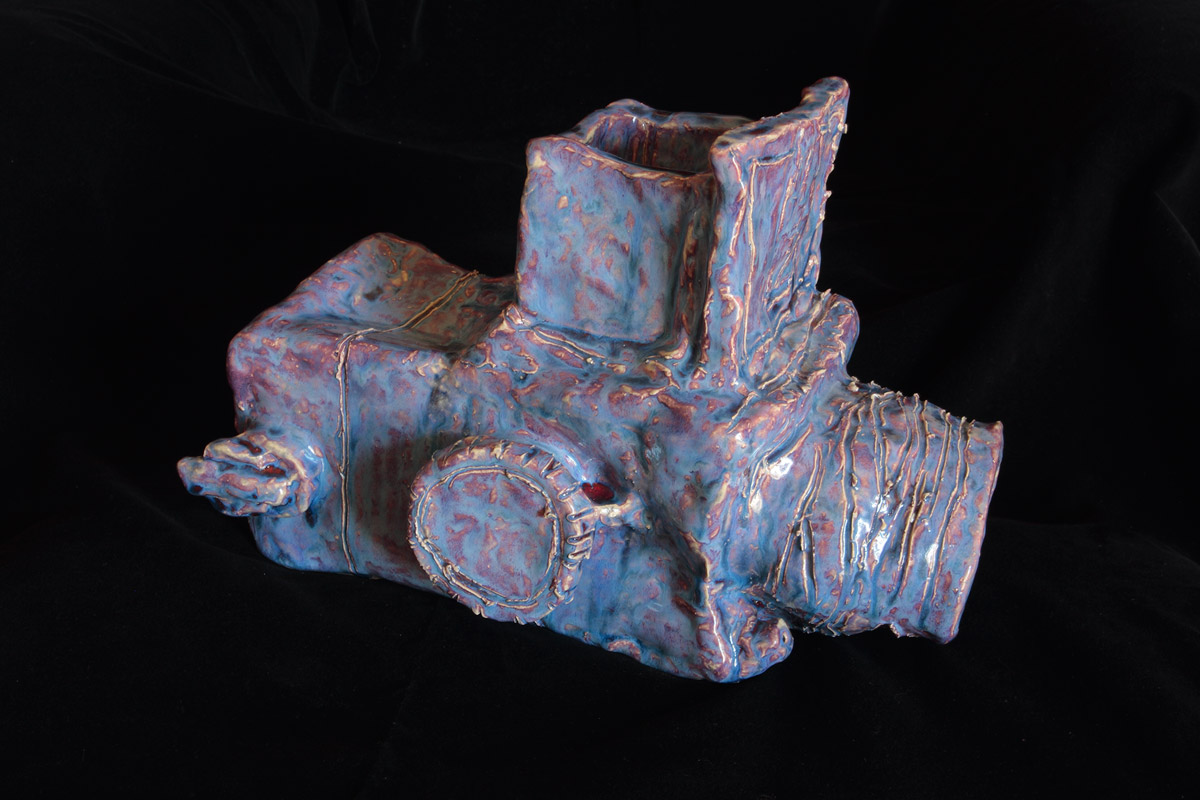
Alan Constable (Australian, b. 1956) Untitled (Hasselblad) 2008 Clay, glaze
I finally succumbed and bought myself a wonderful Alan Constable ceramic camera from the Arts Project Australia stand at the Melbourne Art Fair on Saturday (see photographs below – click on the photographs for a larger version of the image). I first saw Alan’s ceramic work at his solo exhibition called Clay Cameras at Helen Gorie Galerie in August 2009 (see photographs from the exhibition) and was instantly attracted to the tactility and beauty of the work. Months later I saw more of his cameras at Sophie Gannon Gallery in Richmond and now at the Art Fair. Third time lucky, I found a stunning medium format Hasselblad in a beautiful two tone glaze that really spoke to me in terms of it’s form and aesthetic appeal. Constable’s work has really impinged on my consciousness and the piece has a special resonance for me.
“Constable’s ceramic works reflect a life-long fascination with old cameras, which began with his making replicas from cardboard cereal boxes at the age of eight. The sculptures are lyrical interpretations of technical instruments, and the artist’s finger marks can be seen clearly on the clay surface like traces of humanity. In this way, Alan Constable cameras can be viewed as extensions of the body, as much as sculptural representations of an object.” (Arts Project Australia text)
Highlights of the Art Fair were the outstanding paintings of Juan Ford at Dianne Tanzer Gallery, the mesmeric video work of Daniel Crooks at Anna Schwartz Gallery (who I think is one of the best artists in the country – see more images of his work from his Intersection exhibition), the delicately layered and outrageously beautiful collage work of Peter Madden at Ryan Renshaw Gallery, the layered transcapes of Janet Lawrence at Arc One Gallery and the cosmological paintings of Lara Merrett at Karen Woodbury Gallery. Brickbats for the most overblown presentation must go to Danie Mellor at Michael Reid for a truly over the top performance that just left one speechless.
It was a real pleasure to meet so many gallery directors and managers face to face including Gina Lee at Niagara Galleries, James Makin at James Makin Gallery, Matt Glen at Martin Browne Fine Art, Sydney, Paul Greenway from Gagprojects, Berlin and Ken Fehily from Fehily Contemporary, Melbourne.
Finally, I visited the Notfair 2010 exhibition in Richmond, a disappointing group exhibition of 30 artists selected from over 300 artists suggested by curators from around the country. As with many group exhibitions that lack thematic development the work was all over the place, in every media imaginable. The absolute standout work were the two antique stereoscopic cabinet and LED light animations of Chris Henschke from the duo Topologies. While the idea for the exhibition is to be applauded (that of presenting an exhibition of unknown or little known artists that may or may not be represented by a gallery) perhaps the next exhibition should have fewer artists to give the work chance to speak for the artist instead of just being a token gesture.
Dr Marcus Bunyan
Alan Constable (Australian, b. 1956) Untitled (Hasselblad) 2008 Clay, glaze
Many thankx to David Edghill and the National Portrait Gallery for allowing me to publish the photographs in the posting. Please click on the photographs for a larger version of the image.
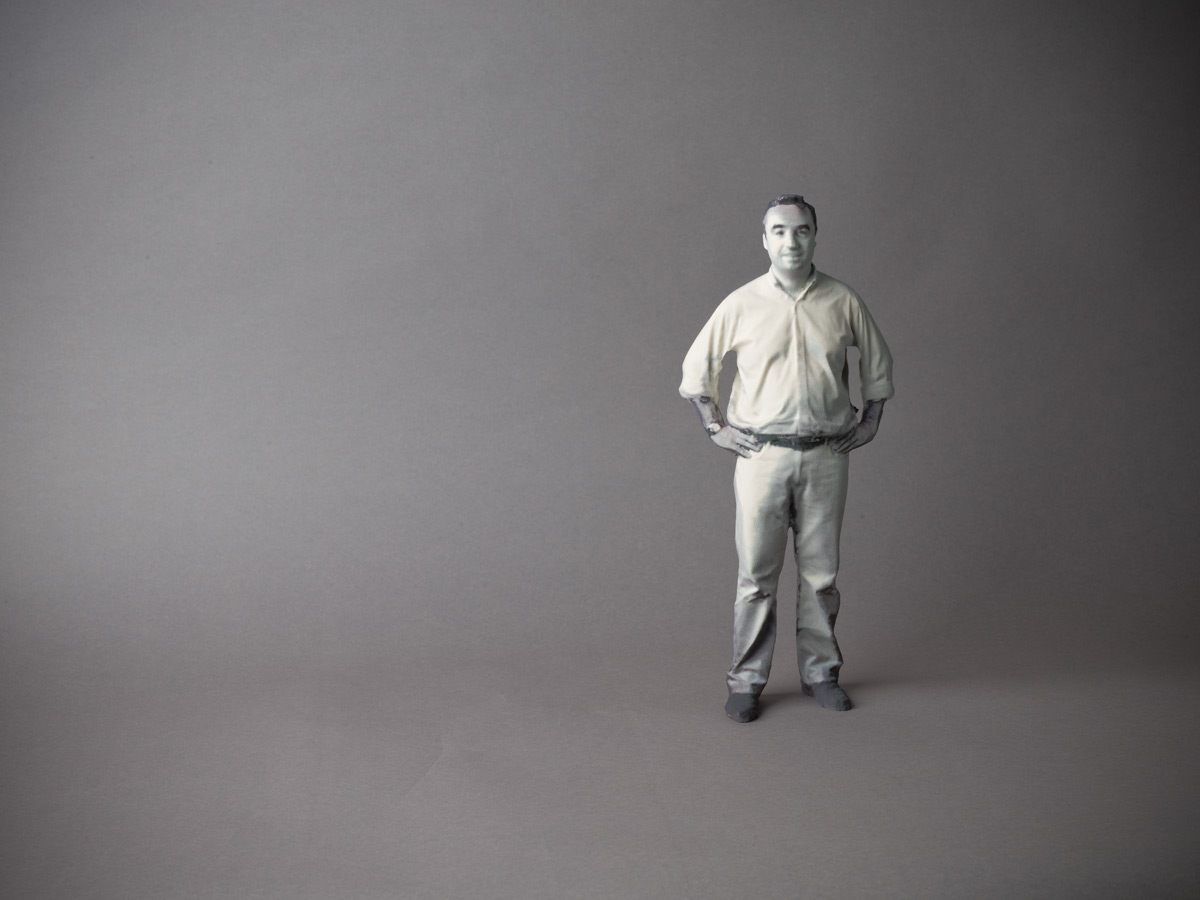
Karen Sander (German, b. 1957) Herve Blechy 1:5 2008 3D Bodyscans of the living person (3D coordinates and colour texture), MPT (Miniaturised Projection Technology), rapid prototyping, 3D Inkjet printer, plaster material, pigment Courtesy of the artist, Berlin, and Galerie Nachst St. Stephan, Vienna, and Galerie Helga de Alvear, Madrid
Karen Sander (German, b. 1957) Herve Blechy 1:5 2008 3D Bodyscans of the living person (3D coordinates and colour texture), MPT (Miniaturised Projection Technology), rapid prototyping, 3D Inkjet printer, plaster material, pigment Courtesy of the artist, Berlin, and Galerie Nachst St. Stephan, Vienna, and Galerie Helga de Alvear, Madrid.
A good way of looking at the show as a whole is that it is about the interaction of new technologies with the traditional methods of portraiture – painting, sculpture and photography – which already have their own pre-established ‘grammars’… This show foregrounds the fundamental image-making actions which have now become proper to contemporary portraiture. No longer just the snap the of camera’s shutter or the incremental description of the painter’s brush, but now also the trundling progress of the flatbed scanner and the circular pan of the 3D scanner…
In the end this is a humanist show, about ghosts more than shells. It argues that despite all of the cold digital technology in the world portraits are still about the promise of finding the warm interior of a person via their exterior. The show’s inclusion of some three-dimensional ultrasound images of foetuses in the womb could have easily been over-the-top and obvious in its point about our intimate adoption of new imaging technologies. Until we see one intrauterine image of twins in which one foetus is caught sticking its toe into the eye of its sibling. A rivalry which, we think to ourselves, will no doubt continue for the rest of their lives.
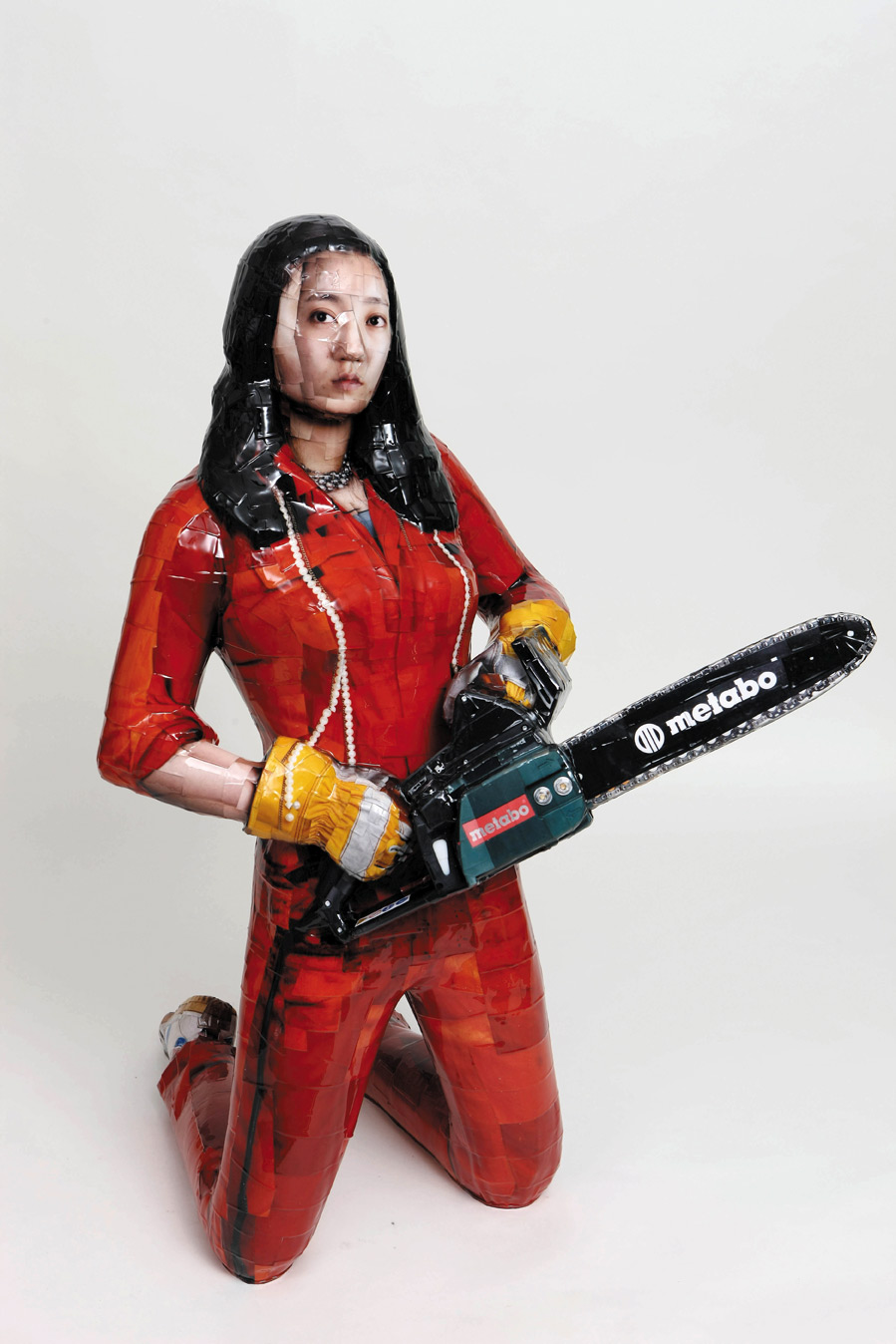
Osang Gwon (Korean, b. 1974) Metabo 2009 C-prints, mixed media 130.0 x 80.0 x 105.0cm Courtesy of the artist and Arario Gallery, Seoul
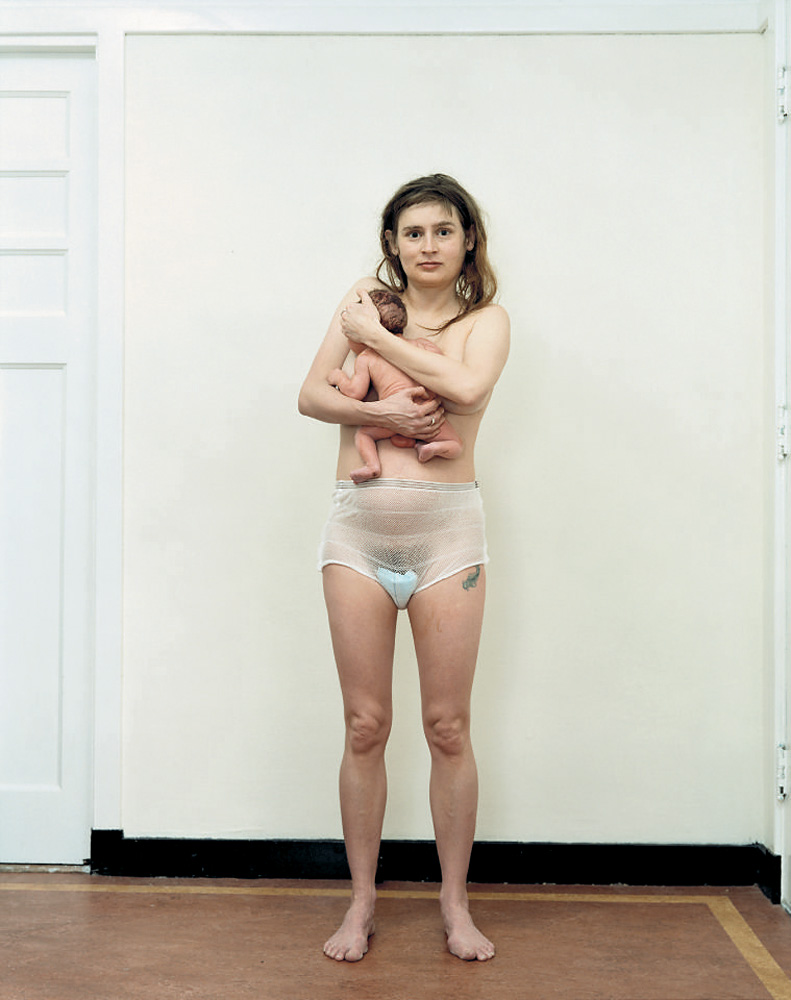
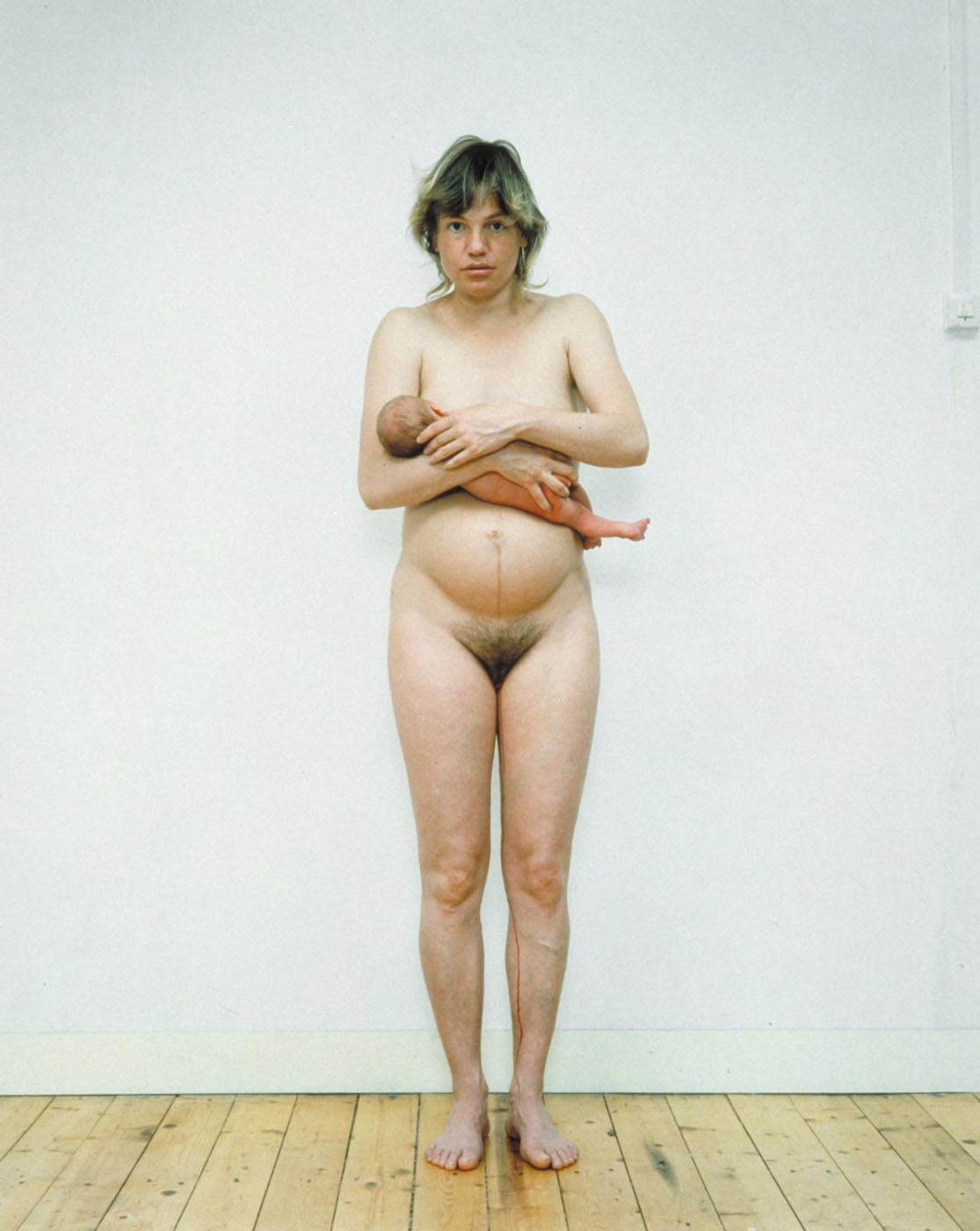
Rineke Dijkstra (Dutch, b. 1959) Julie, Den Hagg, The Netherlands, February 29, 1994 1994 Courtesy of Marian Goodman Gallery and the artist
The masterful Dutch photographer Rineke Dijkstra provides the emotional centre of gravity for the show. Her simple nude photographs of startled young mothers clutching their newborn babies like bags of shopping about to burst remind us again of the power of the straight photo. But her stunning two-gun video installation, The Buzzclub, LiverpoolUK / Mysteryworld, Zaandam NL, also from the mid-nineties, confirms the pre-eminence of the video portrait. Dijkstra has, presumably, momentarily pulled young off-their-faces clubbers straight from the dance floors of the two clubs and put them in front of her video camera in a bare white space off to the side. But the laser lightshows and the duff duff are obviously still going on inside their skulls. As they continue to work their jaws and jig robotically we get full voyeuristic access to them and, even though their interior individualities have temporarily gone AWOL, we nonetheless feel an extraordinary tenderness welling up for them.
Rineke Dijkstra (Dutch, b. 1959) Tecla, Amsterdam, Netherlands, May 16 1994 1994 C-print on paper, mounted on aluminium
Dijkstra decided to make these portraits after witnessing the birth of a friend’s baby. She photographed three women, one hour (Julie), one day (Tecla) and one week (Saskia) after giving birth. The raw immediacy of these images captures something of the contradictions inherent in this common and yet most singular of human experiences. The women appear at once vulnerable and invincible, traumatised and self-composed.
Tate Gallery label, May 2010
Tecla, Amsterdam, Netherlands, May 16, 1994 (1994, above) Julie, Den Haag, Netherlands, February 29 1994 (1994, above) and Saskia, Harderwijk, Netherlands, March 16 1994 (Tate P78099) are three portraits of women made shortly after they had given birth. All the women were known to the artist – one was a personal friend and the other two were friends of friends. Dijkstra photographed the women in their homes because in Holland it is more common for women to give birth at home than in a hospital. While bearing signs of their recent ordeal – the medical pants and sanitary towel which Julie wears, a trickle of blood down the inside of Tecla’s left leg, the caesarean scar on Saskia’s belly – the women appear proud and happy. They hold their new babies turned away from the camera, protectively pressed against their bodies. Dijkstra has developed a way of combining natural light with flash which results in particular quality of soft, clear light. Julie’s left hand covers her baby’s eyes to protect them from the flash.
Dijkstra was inspired to make these portraits after watching the birth of a friend’s baby. She is interested in photographing people at a time when they do not have everything under control. She uses the device of the formally posed, full-length portrait to try to reveal something of what people carry inside them – the emotional intensity concealed behind the mask of the face and the body’s pose. The photographic portrait, titled with the date and place, records a specific moment in time in which the subject was undergoing a particular experience. Dijkstra has commented:
As a photographer you enlarge or emphasise a certain moment, making it another reality. For instance the portraits I made of women after giving birth: the reality of this experience is about the whole atmosphere, which is very emotional. In the photograph, you can scrutinise all the details, which makes it a bit harsh: you can see things you normally would not pay so much attention to. (Quoted in Douglas, p. 79.)
In the same year that Dijkstra photographed the new mothers, she photographed matadors in Portugal, just after they had come out of the ring. Like the new mothers, the bull-fighters had been in emotionally charged, potentially life-threatening situations. Both mothers and matadors are captured in a state of physical and emotional catharsis which contributes to the intensity of their engagement with the camera. Dijikstra uses 4 x 5 inch film to make her portraits, demanding time and concentration on the part of both artist and subject. She is sensitive to the vulnerability which her subjects give her access to and is careful not to abuse their trust. She has explained of the new mothers:
‘It’s amazing how they trust me, and I think that afterwards they understand that these photos are about something universal and that it’s not particularly about them …the first show I had in Amsterdam with these photos a lot of women came to me and said, you know it’s really great that you make these photographs because it’s really the way it is but nobody ever shows it, and I can recognise myself in it. And the men were all like, you can’t show a woman like that.’ (Quoted in unpublished interview with Tate Modern Curator Jane Burton, on the occasion of the exhibition Cruel and Tender,in 2003.)
The portrait is an art of surface predicated on a paradox – that the rendering of someone’s features will somehow ultimately reveal more than just their outward appearance. It reminds me of the twist at the core of Tarkovsky’s film Solaris, (one of the greatest films about identity and representation) where the sceptical psychologist is finally forced to conclude, despite his rationalism, that ‘we need secrets to preserve simple human truths’. But how can the secretive preserve the truthful? It’s a question that Dijkstra, in her portraits, attempts to answer, albeit enigmatically and allusively. A withholding of information and obsession with surface makes her portraits feel recognisably human. They’re so riddled with secrets they practically breathe.
Perhaps it’s to do with the scale of the images, which are large and impossible to overlook, and her palette, which is almost as subtle and perfect as her 17th- and 18th-century precursors. If the Dutch and Flemish portrait painters looked at the world with eyes that anticipated photography, it could be said that Dijkstra continues the cycle by looking at photography through the lens of historical painting. …
Dijkstra’s portraits of three young mothers (Julia, Saskia and Tecla, all 1994) holding their new born babies to their chests with absolute, exhausted tenderness, exemplifies the restraint and deceptive simplicity of her approach towards representing people whose lives have been touched by commonplace but monumental change. Replace the sand with a floor and the sky with a hospital wall and the only thing that separates these images from the beach series is the nature of the transition that these people are experiencing. Our culture’s puritanical fear of the body, so beautifully reflected for hundreds of years in scores of paintings of bloodless, saintly motherhood, is countered in these truthful, unflinching images. One mother stands in her underwear, her sanitary pad bulgingly visible. The other two women stand naked, swollen, scarred and bloody. They all, as well they might, look faintly triumphant.
I can’t remember a show where the audience stood for so long in front of a series of images of ordinary people. The same can be said of Dijkstra’s video in which she isolated teenagers against a white background in two night-clubs (The Buzz Club in Liverpool, England and Mystery World in Zaandam, Netherlands) and videoed them dancing, mainly alone, to the camera. Each of them, of course, responded differently to the absence of those clubbing staples, dim lights and crowds – they danced self-consciously and smoked defiantly. Some flirted with the camera, others looked almost annoyed. Most of them, despite trying very hard not to be, looked very young, rather forlorn, sweet even. The audience watched, riveted. The film was long and repetitive, but mysteriously and compulsively viewable.
Video of Rineke Dijkstra “The Buzzclub, Liverpool, UK / Mysteryworld, Zaandam, NL”, 1996-1997. Presented in exhibition at Mücsarnok, Budapest, “Coolhunters. Youth cultures between media and the market”, 23 March 2006 – 28 May 2006.
The video was recorded pulling people out of the dance floor of a nightclub and inserting it in a white cube. The behaviour on the dance floor as part of the group, here so isolated as a rare person, an indigenous moved to the museum space.
Robert Lazzarini (American, b. 1965) Skull 2000 Resin, bone, pigment 35.0 x 8.0 x 20.0cm Courtesy of the artist and Deitch Projects
Present Tense: An Imagined Grammar of Portraiture in the New Media Age is the principal exhibition in the National Portrait Gallery’s 2010 exhibition calendar. It will be displayed from 22 May to 22 August 2010. We are entering an exceptional time for portraiture and visual culture in general as the art world embraces the digital age. Traditional portraiture is responding to the application of new technologies and this imaging process is reshaping our interpretation and reading of the face.
Present Tense considers the alliance between portraiture and technology, showing how different ways of imaging in this contemporary, digital world reflect the way an individual is perceived and the various mechanisms of imaging that are used to manipulate that perception. The exhibition is comprised of works by Australian and international artists’ and includes examples of the informal and immediate images made on mobile phones, images recorded with sonograms that reveal faces that cannot be seen by the unaided eye, 2D and 3D portraits generated exclusively from binary code, as well as the more expected streaming digital works and manipulated photographs.
‘Some of the images in Present Tense are confronting and some are positively endearing’, said exhibition Curator Michael Desmond. ‘The exhibition surveys the possibilities of portraiture today, with the premise that the inhabitants’ of our digital society are pictured in a technological mirror’.
The use of digital technologies by artists is increasing, providing affordable alternatives to traditional media and offering a new tool set and the possibility of a new aesthetic. This is not to suggest that older media has been abandoned, or is associated only with conservative practice, rather that artists’ have greater choice in the materials that they use and the style that they wish to engage with. Chuck Close is one of artists’ in the exhibition who ignores the rising tide of digital imaging processes to favour old technology, creating powerful images with the archaic daguerreotype technique. Other artists’ in Present Tense include: Loretta Lux, Patrick Pound, Stelarc, Jonathon Nichols, Petrina Hicks, Ghostpatrol, Patricia Piccinini and more.
‘At one time, oil on canvas or bronze was the medium for portraits. The medium now is technology. In an inversion of one of Modernism’s classic aphorisms, digital technology allows function to follow form; the function of the portrait – to illustrate an individual’s character and physiognomy – is established by the stamp of the technology that created it’, said Michael Desmond.
Chuck Close (American, 1940-2021) Self portrait daguerreotype 2000 16.5 x 21.6cm each Courtesy of Pace/MacGill Gallery, New York
Patricia Piccinini (Australian, b. 1965) Psychogeography 1996 From the series Psycho Type C colour photograph 120.0 x 247.0cm Courtesy of the Parliament House Art Collection, Department of Parliamentary Services, Canberra
Stelarc (Australian born Cyprus, b. 1946) Stretched skin 2009 type C photograph 120.0 x 180.0cm Courtesy of the artist and Scott Livesey Galleries
Jonathan Nichols (Australian, b. 1956) Lucy 2001 Courtesy of James and Jacqui Erskine, Sydney
Petrina Hicks (Australian, b. 1972) Ghost in the Shell 2008 From the series The Descendents Courtesy of the artist and Stills Gallery, Sydney
There can be no doubt that we are entering an exceptional time for portraiture as the art world embraces the digital age. Traditional portraiture is responding to the application of new technologies and this imaging process is reshaping our interpretation and reading of the face.
The use of the computer and the internet at the most basic level to source or digitalise images is pervasive. Artists are using digital technologies as alternatives to traditional media and offering the possibility of a new aesthetic. The ease of manipulating an image is a prime aspect of portraiture in the digital age and equally important is the ease of distribution. Artists seek out images on the internet and send out or ‘post’ their own, setting up their own virtual galleries using social media such as Flickr, Facebook, YouTube, Twitter and Tumblr.
The National Portrait Gallery exhibition Present Tense: An imagined grammar of portraiture in the digital age considers the alliance between portraiture and technology and investigates how different ways of imaging reflect how the individual is perceived as well as how the various mechanisms of imaging that are used to manipulate that perception.
Present Tense includes examples of the informal and immediate digital snapshots made with mobile phones; images recorded with sonograms that reveal faces that cannot be seen by the unaided eye; 2d and 3d portraits generated exclusively from binary code; and the more expected videos and manipulated photographs. A number of artists in the exhibition ignore the rising tide of digital imaging processes to favour old technology and create powerful images with the archaic daguerreotype technique or cruder still, old-fashioned stencil.
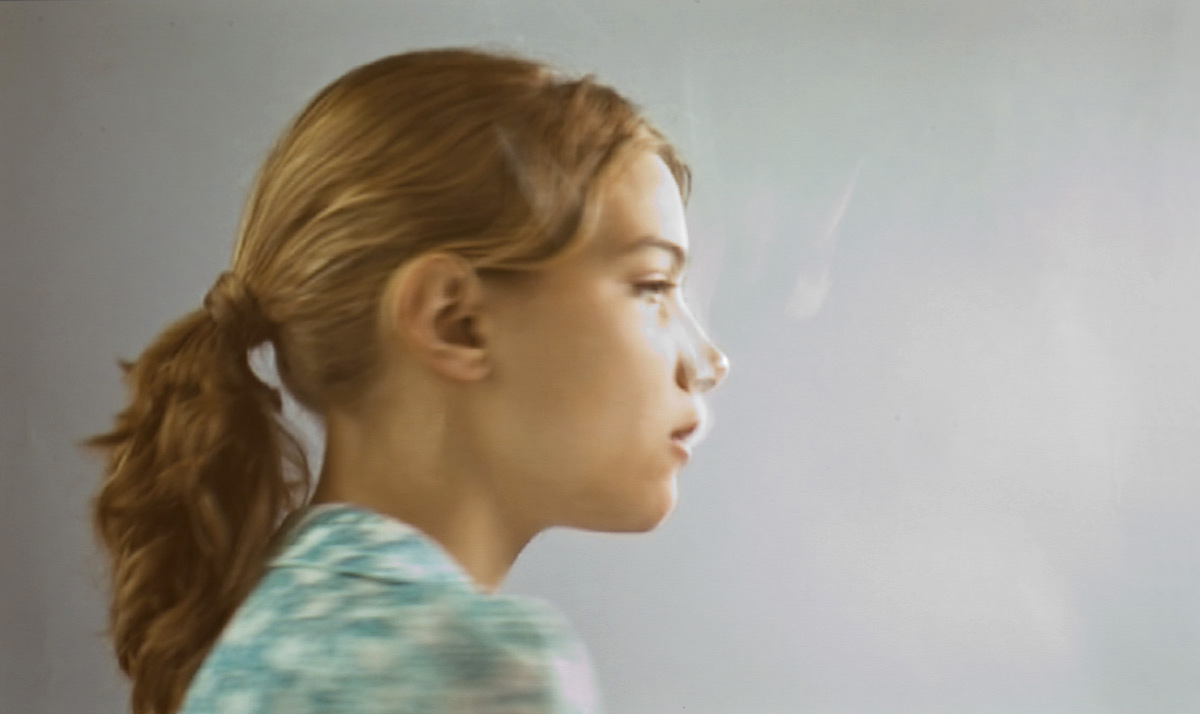
Video is still the dominant filmic medium. It is a difficult medium for portraiture as the narrative is the signifying factor of this temporal medium. Artist Petrina Hicks tackles this directly in her video portraits. In Ghost in the shell 2008 there are no props to convey identity in a conventional sense; the video is a slow pan of objectivity across the visage of a girl, unimpeded by good manners or fear. The camera records every detail, as her head pivots though 360 degrees and we are able to study and scrutinise the face and enjoy the sheer beauty of youth. The scanning view and the model’s perfect features conjure up the notion of a computer-aided design program that displays the object created by a 3d graphic application. Exhaled smoke emerges from the girl’s mouth in Art Nouveau curls and undulating arabesques. The combination of stilled, unemotional beauty makes the mobile, insubstantial smoke a metaphor for the soul. This is the ghost of the title but also a portrait of the inner self that inhabits all of us. Hicks makes a poetic contrast between the mapped surface and the unseen interior.
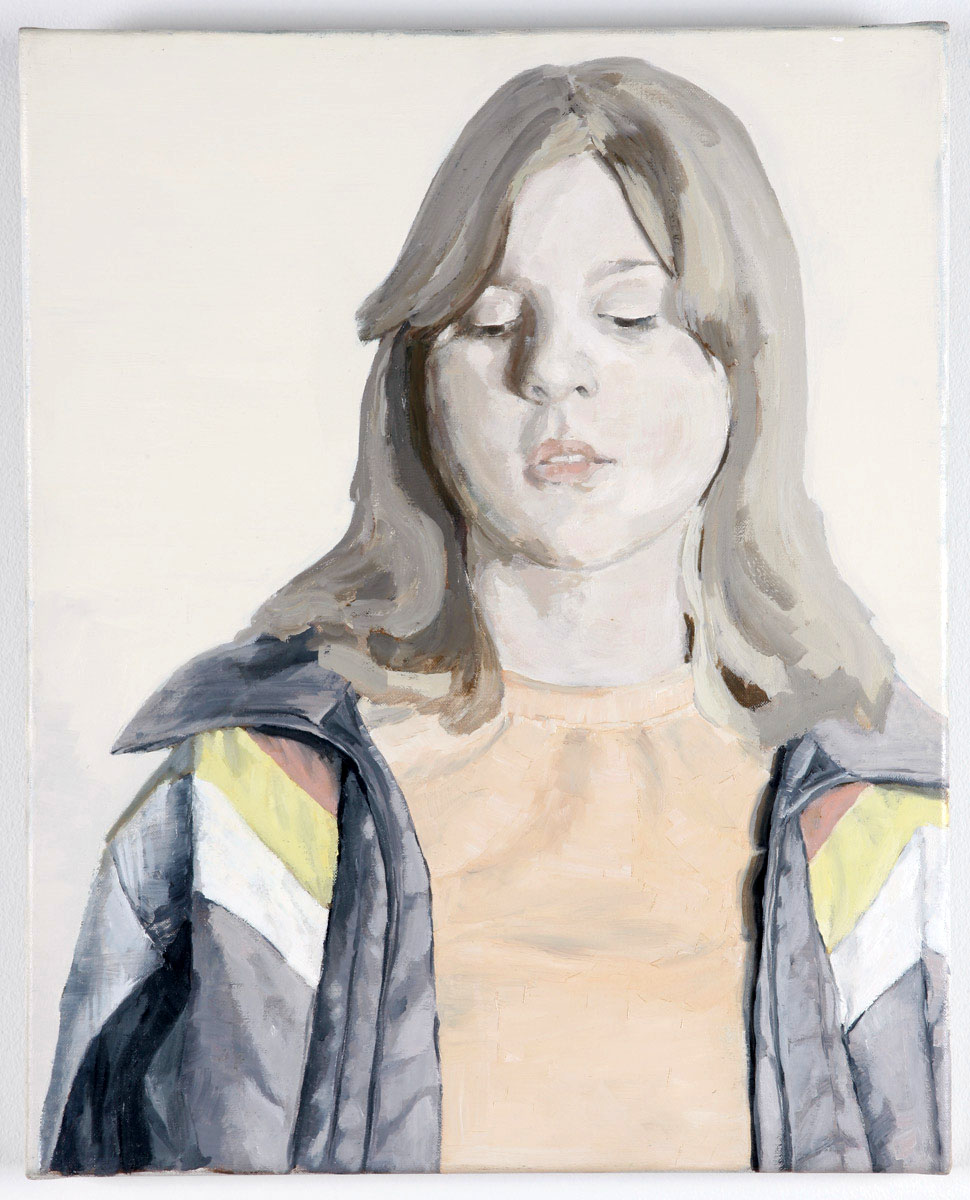
Zombies, vampires and plagues that decimate humankind to a few survivors haunt the movie and television screens of this decade. They represent the uncomfortable intimacy and connectedness of contemporary society – the six degrees of separation. While Jonathan Nichols’ portraits Lucy 2001, Nina 2002, and Smiling 2003 are hardly ghoulish the aura of uneasiness that surrounds them derives from the sense of being connected. Using social networks we can connect with fame and celebrity and we are also able to broadcast ourselves. The biggest and most varied galleries of portraits today are websites such as Facebook. These portrait galleries are more likely to display the girl next door rather than the glamorous magazine cover girls. Exhibitionism and voyeurism are implicit in posting portraits online. The aesthetic is bland and gives away little. They are image of self that are safe to broadcast. Nichols uses images taken from the internet to test the ‘look’ of such portraits. There is the hint of smiles to break the passport photo impassiveness, neutrality with a touch of erotic potential, enough personality to separate these anonymous faces from the crowd, and perhaps the comfort of looking at a face and knowing we all are connected.
Ghostpatrol & Miso are street artists who work together creating an extended portrait of a place, the inner Melbourne suburb of Fitzroy. Their portrait layers the views and experiences of inner city living as a sensual rather than documentary composite. Fitzroy 2010 is an homage to the streets of Fitzroy that Ghostpatrol & Miso have explored, stencilled, pasted and postered. Fitzroy is their platform for communication and the multiple images in this work are a response to the streets and the urban network of windows, houses and streets. Fitzroy is a self portrait, illustrating the artists’ perspective and their story in the city.
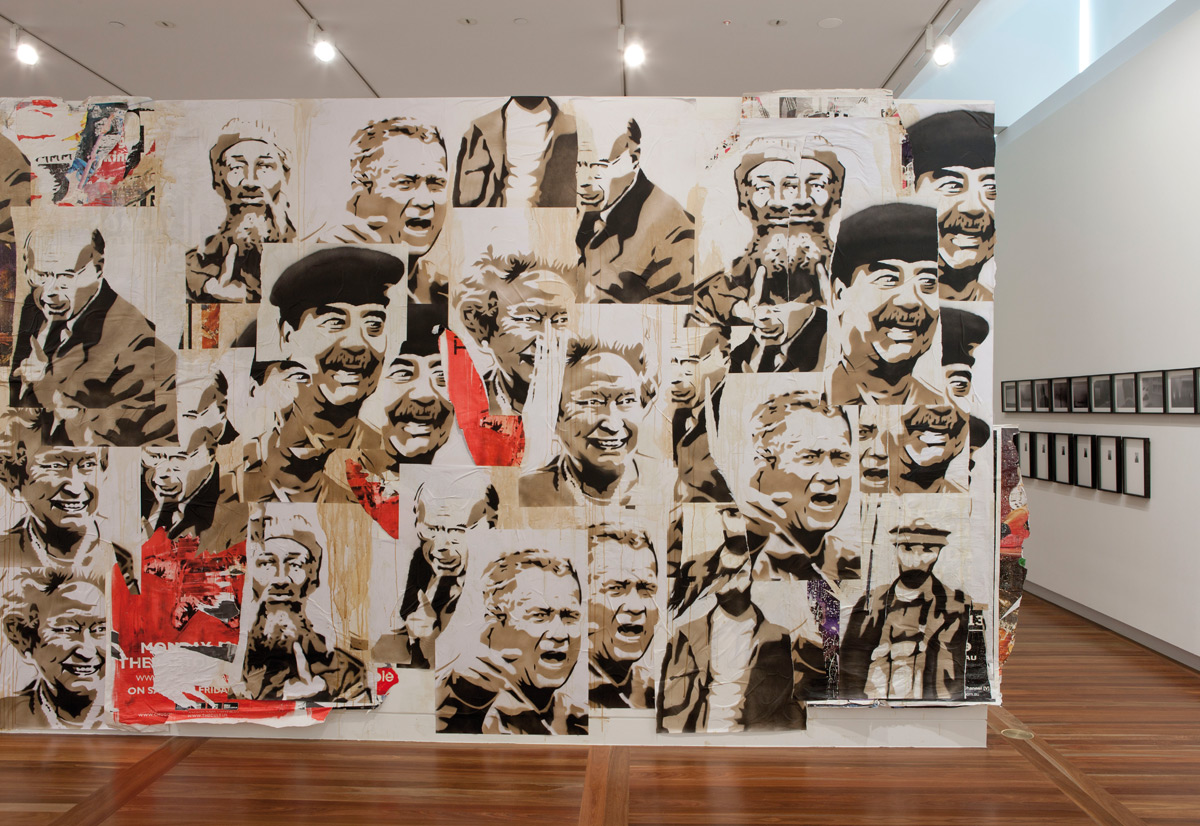
James Dodd, like Ghostpatrol & Miso, makes the streets his gallery. His posters from Occupied territory 2003 return to an established way of broadcasting and connecting, not by phone or internet, but by placing his portrait posters in the natural nodes and pathways where people travel and congregate. His faces in the streets – George W Bush, Saddam Hussein, Elizabeth II, Osama Bin Laden, John Howard – are powerful individuals who literally occupy the territory as they do the media. Advertisement, wanted poster or propaganda, Dodd employs the hand-made look of stencil to equalise differences between world leaders and as a means to counter the ubiquitous urbane and subjective portraits presented by mainstream new media with a fresh alternative.
The idea of creating accurate three dimensional portraits has always fascinated humanity. Here are portraits that are inseparable from the technology that created it. Robert Lazzarini sculpts forms with the computer. In making Skull 2000 he had little or no contact with traditional art materials. Lazzarini uses materials as close as possible to the original – in this case the skull is bone, though reconstituted with a resin binder. Anamorphic forms like this are measured against an ideal or archetype. The distorted form plays on our ability to recognise common forms such as a face or death’s head and reconstruct them in the mind.
So, having considered Lazzarini’s computer created sculpture, is it Karin Sander or the machine that created Hervé Blechy 1:5 2008? The artist herself didn’t touch any art materials or intervene in the process which involves the subject being photographed from all angles by multiple cameras; the images sent to a computer application that creates 3d models from photos and the resultant model is then sent to a rapid prototyping machine which generates the model in white plastic. This, in turn, is painted by an assistant. In 1967 Sol LeWitt declared that ‘The idea becomes a machine that makes the art.’ Sander’s mini-monuments, which she refers to as ‘assisted self portraits’ are classic examples of conceptual art, but with the neat twist that if an idea is as ephemeral as data, then here, data takes on materiality.
Portraiture with its strict focus on the recognisable image of the individual face is resistant to change despite the many movements and styles in the twentieth century and adoption of new digital technologies in the last decade. And although more choices of media available to the artist who is now able to make portraits using digital photography, digital video or installation the effect of the digital age is probably less on form and more on society. The use of digital media is near ubiquitous in part of the portrait process today. Photography, once considered an objective record of a sitter, as digital photography has gained the persuasive power of painting to subtly alter features and flatter beyond candid or objective description. There is greater spread and distribution with the increasing emphasis on the photographic but this may be only temporary as other forms and hybrids come online with 2d and 3d computer applications.
There is an increasing separation from old materials that slop, mess, spill in favour of keyboards and mice and the artist’s studio is starting to look like an executive’s work space. Research is done online and sketches are made on the camera rather than drawn from life and art is accordingly mediated from the start. Medium is less important than media, and in fact the term ‘medium’ is already starting to be an art historical term. Today, technology is not merely the means of transmission, it is the medium of so much contemporary art. While technology changes, the human face is a constant, mediated by fashion, politics and technological change. It is rewarding to look at portraits in terms of the technology that made it.
Michael Desmond. “Technical Terminology,” on the National Portrait Gallery website, 1 June 2010 [Online] Cited 10/07/2022
Present Tense: An imagined grammar of portraiture in the digital age
Senior Curator Michael Desmond talks about the exhibition Present Tense held at the National Portrait Gallery, Canberra from 22 May – 22 August 2010.
James Dodd (Australian, b. 1977) Posters from Occupied Territory (installation view) 2010 Courtesy of the artist, Adelaide
GhostPatrol & Miso (David Booth and Stanislava Pinchuck) (Australian) Fitzroy (installation view) 2010 Courtesy of the artists, Melbourne
Aaron Seeto Oblivion 2006 From the series Oblivion Daguerreotype
Aaron Seeto makes alternate historical positions and experiences visible through an exploration of archives, family photo albums and photographic records. In recent bodies of work Fortress and Oblivion, Seeto has utilised the daguerreotype, one of the earliest and most primitive photographic techniques, to highlight the malleability of narratives within archive records. Not only is the chemical process itself highly toxic and temperamental but the daguerreotype’s mirrored surface means the image appears as both positive and negative, depending on the angle of view. For Seeto, this mutability captures the essence of our experience of history and memory, reflecting how images degrade, how stories are formed and privileged, how knowledge and history are written. …
For his ongoing series Oblivion Seeto sourced details from images of the Cronulla riots – beachside riots around race and territory – of 2005 found on the internet. In reproducing these as daguerrotypes he seeks less to represent the incident than to look at how it was reported, understood and remembered. The instability of the virtual information found online is echoed in the photographic process.
Text from the Stills Gallery website [Online] Cited 14/02/2019
National Portrait Gallery King Edward Terrace Parkes, Canberra
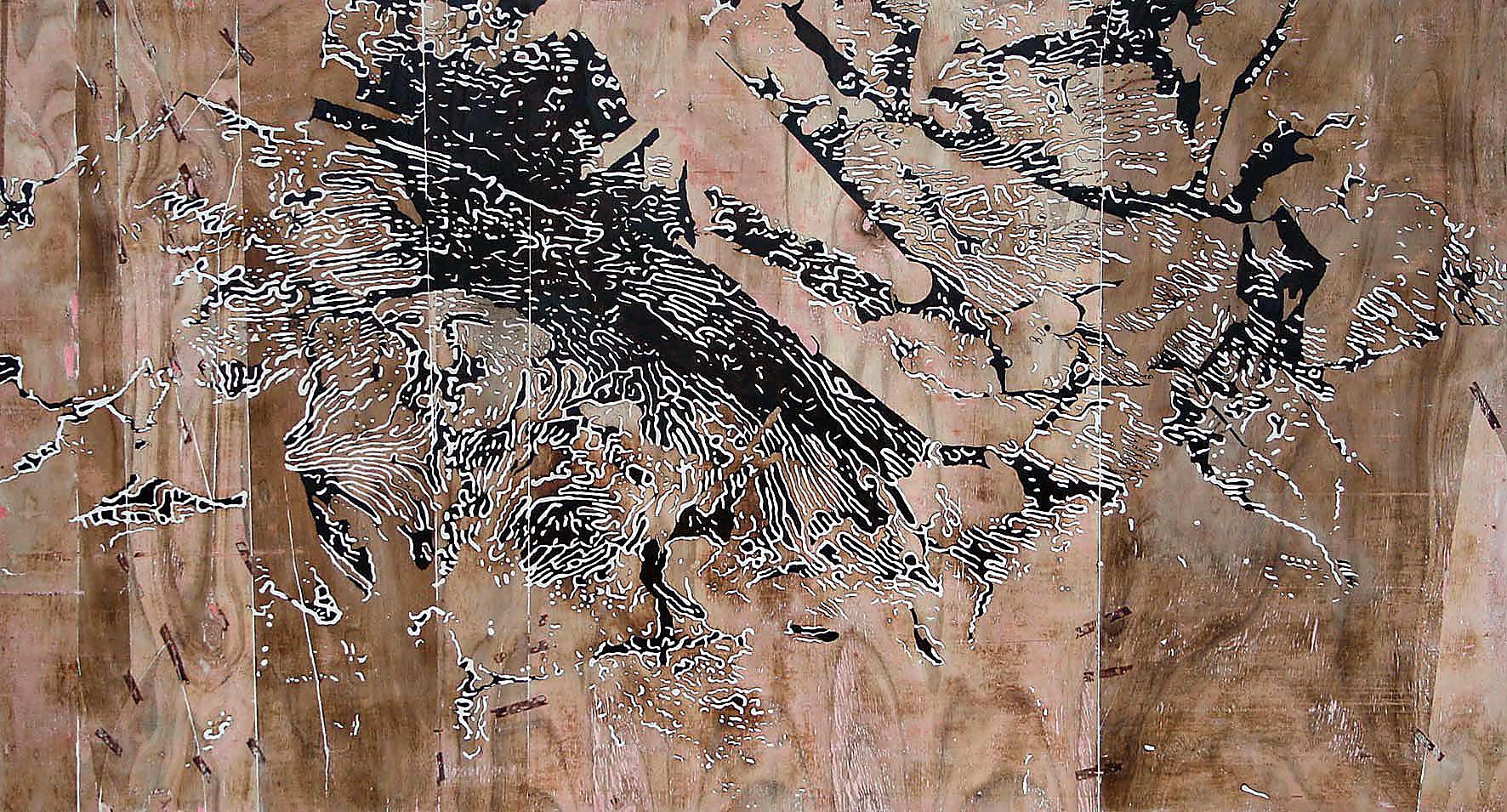
Ewen Ross (Australian, b. 1957) Plain of Mars 2010 from the Warrina Portraits series
There is little more to say about this exhibition of works by Ewen Ross than the erudite catalogue essay by Geraldine Barlow enunciates (see essay below), except to say that the ‘presence’ of these works is extremely moving. It is difficult when viewing photographs of the work to explain the physical impact of actually standing in front of these works, absorbing their energy, examining their surfaces, their depths.
The larger photograph of Thenar Eminence (2010, below) is the closest one can get in the virtual world to appreciating the elemental quality of the work – the fire, the fragmentation and the soil, the contour-like mapping of the earth – as the work resembles a memory of earth, of place, re(as)sembles a signification, a meaning wholly of its own in the mind of the viewer. In the spectator the act of looking may turn into contemplation and this work does seem to have that effect = the context of looking at the work invites a contemplation on place and connection to earth.
Barlow asks. “Is this matter, or its coded representation? Ross sets up a liquid movement between such possibilities.”
Ross does indeed set up a liquid movement between matter and representation. But here I would offer a counter argument to the idea that matter and coded representation are binary opposites. As noted by Judith Butler in the excellent quotation below, matter is already meaningful, already coded and materialised. It always has a history and narrativisation embedded within it. Butler suggests the body is never a valueless matter on which inscription takes place because this hides the inscription already there.
Continuing this idea, Ross brings matter back into the fold, into the peeled away surfaces of his work. His process of materialisation offers these liquid movements not through an oppositional relationship between matter and coded representation but because a) his works are no longer anchored in an unquestionable reality and b) they have moved beyond coded representation. Ross reconceptualises both space and matter in his objects of place and invites us, the viewer, to contemplate these (e)motional environments.
Dr Marcus Bunyan
Many thankx to Anita from Anita Traverso Gallery for allowing me to publish the photographs in the posting and to Geraldine Barlow for allowing me to publish the catalogue essay, all very much appreciated. Please click on the photographs for a larger version of the image.
Body and Text
“Judith Butler has done much to interrogate and upset the assumes inside / outside binary of culture and nature, and has shown that what is called matter, and therefore presumed to be extra-discursive, is already meaningful. In her book entitled Bodies That Matter (1993) she argues that matter is already materialized, that is, it always has a history, is always narrativized. Any reference to matter will always be a particular formation of materiality that has been discursively set. Matter, nature or the body is never an absolute outside but is rather a constitutive outside that generates the significance of an interiority, culture or law. It is an outside that gives the inside its meaning and is, therefore, already textualized and incorporated within the oppositional space in which signification takes place. For Butler, the suggestion that the body is the valueless matter on which inscription takes place hides the inscription already there … Bringing matter back into the fold of inscription increases the manoeuvrability of political activism as it is no longer anchored by an unquestionable reality, the fixity of which is only secured by continual iteration of the norms attributed to it. ‘I would propose’, Butler argues, ‘a return to the notion of matter as a process of materialization that stabilizes over time to produce effects of boundary, fixity, and surface we call matter’ (Butler 1993: 9).
A useful analogy for this lack of fixity might be the reconceptualization of both space and matter within the new sciences, especially quantum mechanics, where matter, even that which we perceive as rigid or solid, is shown to be permanently in motion, and where the space which gives form to seemingly individual and autonomous objects is now understood to be a less dense area of matter itself.”
Curtis, Neal. “The Body as Outlaw: Lyotard, Kafka, and the Visible Human Project,” in Featherstone, Mike (ed.,). Body Modification. London: Sage, 2000, p. 258.
Ewen Ross (Australian, b. 1957) Thenar Eminence 2010 from the Warrina Portraits series
Warrina Portraits
This body of work presents as a suite of portraits, and continues my ambition to track the truth through creative practice. Metaphorically the palm of my left hand symbolises the natural patterns and rhythms of line found in the landscape along the Glenelg River in the Southern Wimmera, with particular reference to the property where I lived (Warrina).
This work presents as part of a portrait series derived solely from my left hand. It continues the story of my search for the truth of my genesis in reference to the property (Warrina) where I was raised. The notion of touching the landscape with an open hand in order to investigate the relationship between landscape and portraiture underpins this image.
The concept of looking down and across this country continues to drive the format of my work as does the idea of using fire to peel back the surface of the plywood which often reveals new and mysterious information to work with. Fire is part of the natural ecosystem and a valuable means of cleansing and regenerating new life and truth into this landscape. This premise remains integral to my practice.
The linear information gleaned from the palmar in theory creates a conduit for bridging the concept of portraiture and landscape. The notion of inlaying the narrative of my palm into the surface to construct an image of landscape underpins this body of work.
The significance of the left hand is relevant to the principle. It is controlled by the right brain (pattern recognition, relationship understanding), reflects the inner person, the natural self, the anima, and the ability to think laterally. It could even be considered to be part of a person’s spiritual and personal development.
It is also said the left hand is the one we are born with, the one the gods give you; the right is what we do it with.
Ironically, of the four descriptors allied with hands, earth, air, fire, and water, my hands are relative to fire.
Ewen Ross July 2010
Ewen Ross (Australian, b. 1957) Palmar Quartet 2010 from the Warrina Portraits series
Catalogue essay by Geraldine Barlow
Our palms and fingers each bear unique imprints. The intricate and entwined lines and loops of each palmscape have been generated from within the very core of what makes us individual, our encoded DNA.
“DNA molecules themselves, as physical entities, are like dewdrops. Under the right conditions they come into existence at a great rate, but no one of them has existed for long, and all will be destroyed within a few months. They are not durable like rocks. But the patterns they bear in their sequences are as durable as the hardest rocks.”1.
How should we read the patterned lines of a palm? The art of palmistry promised to decode the connections between this intimate landscape and our life to come. Palmistry is now dismissed as a quaint pseudoscience, yet the palm holds a special resonance, a very special part of the body from which the future might be foretold. Via the fingerprint, and now DNA traces, contemporary technology has developed seeking absolute recognition of each individual. Through our palms and fingers we hold and grip the world, we wield tools and touch those we care for. These interior sensate surfaces of the hand are at the centre of our embodied being in the world.
In his latest body of work Warrina Portraits, Ewen Ross has taken his own palm print as the starting point for a highly personal exploration of the relation between self and place. The furrowed banks of lines and shadows etched into ply sheets do not relay the literal five-fingered imprint of a hand, more a topography of interlaced systems, networks of lines which are at once familiar and strange to us.
In bringing these works into being, Ross has evolved a deliberate and multilayered process of making. He relays a detail of his palm print onto plywood, then channels the resulting lines into the layered timber surface. The finished surface of the ply sheet is then removed, to reveal an entirely new layer, with it’s own character and markings. Filler is applied, dries and the surface is sanded back, many times over. Sometimes further layers of stain or fine in-painting are added. This process involves a constant relay between layers of information, impression and counter-impression. At each stage there is the potential for slippage, opportunities for translation, room for the materials and the process of making to assert themselves. When Ross removes the finished surface of the plywood he welcomes chance into the artistic process, allowing for the planned and entirely unexpected to collide.
In Palmar Trilogy 2010 the mapped tracery of white lines and dark hollows sprawls over a surface of many parts. Various separate pieces of timber have been joined on this layer of the sheet; we can still see the remnants of the glue where the pieces were taped. Two systems of information are in conversation here, jostling against each other. Sometimes the incongruities suggest meaning; at other times they raise a series of questions. Looking at this work, I am reminded of a contour map superimposed onto a satellite image, or a geological survey. I see the echo of a tree branch in the patterns on a sheet of timber, overlaid with something more like an x-ray or a brain scan.
Is this matter, or its coded representation? Ross sets up a liquid movement between such possibilities.
In these works, palm print and wood grain take us into an intimate landscape. For Ross this is a place of memory. Warrina is the name of the Wimmera property where he grew up, where he ploughed the fields as a young man. Like Ross’ previous bodies of work Such is Dry Land, Red Gum Country and The Green Pick, these works speak of an intimate and formative connection with the Wimmera landscape. The artist works into and over ground that is familiar in the measure of his own life, as well as in the lives of previous generations.
Ross is sensitive to the connections of the many past generations associated with this land, stretching back beyond his own family’s history in this country. He works with the surface, but also looks behind it, tearing back the first skin, so that what was embedded in the substrate is now called into dialogue with other marks and textures, highlights and shadows.
In these works the artist’s hand is the model for a series of shimmering, chimera-like patterned imprints, echoes, reflections, templates and coursing sequences of code – allowing us to measure one life against many generations, the transitory against the eternal, our intimate landscape against the widest horizons.”
Geraldine Barlow Senior Curator/Collection Manager Monash University Museum of Art / MUMAMelbourne, May 2010
1/ Richard Dawkins, The Blind Watchmaker, Penguin, London, 2006, p. 127
Ewen Ross (Australian, b. 1957) Palmar Trilogy 2010 from the Warrina Portraits series
Anita Traverso Gallery PO Box 7001, Hawthorn North 3122 Phone: 0408 534 034















 Art Blart _ art and cultural memory archive
You must be logged in to post a comment.