
17th January 2016
A single image posting, which is a rarity on Art Blart … just because the image is so fab. This is a brilliant image – the same year as Weston’s first Point Lobos images. Click on the image to enlarge it.
My friend and mentor Ian Lobb said of this image:
“I doubt that the film has been developed in a great tonal developer like pyrogallol or D-23. You would have to be the world’s finest technician to develop large format film as evenly as this in pyro – nor do the shadows show any compensation.
It is a standard developer – but a great film. There were films made by Adox (for example) that were rich in emulsion. I suspect a moderate filter to make the sky a little darker – (a yellow / green filter or an orange, probably the former guessing the colours beyond the bridge). The way the blue shadows under the bridge are so dark, it could be either of these filters. I don’t think a red, it would be too dramatic in the sky.
Anyhow it is all to do with the sharpness and the tonal separation in the middle greys. This is a very early example of pre-visualisation – and being able to execute that pre-visualisation. That is what I wanted to say!”
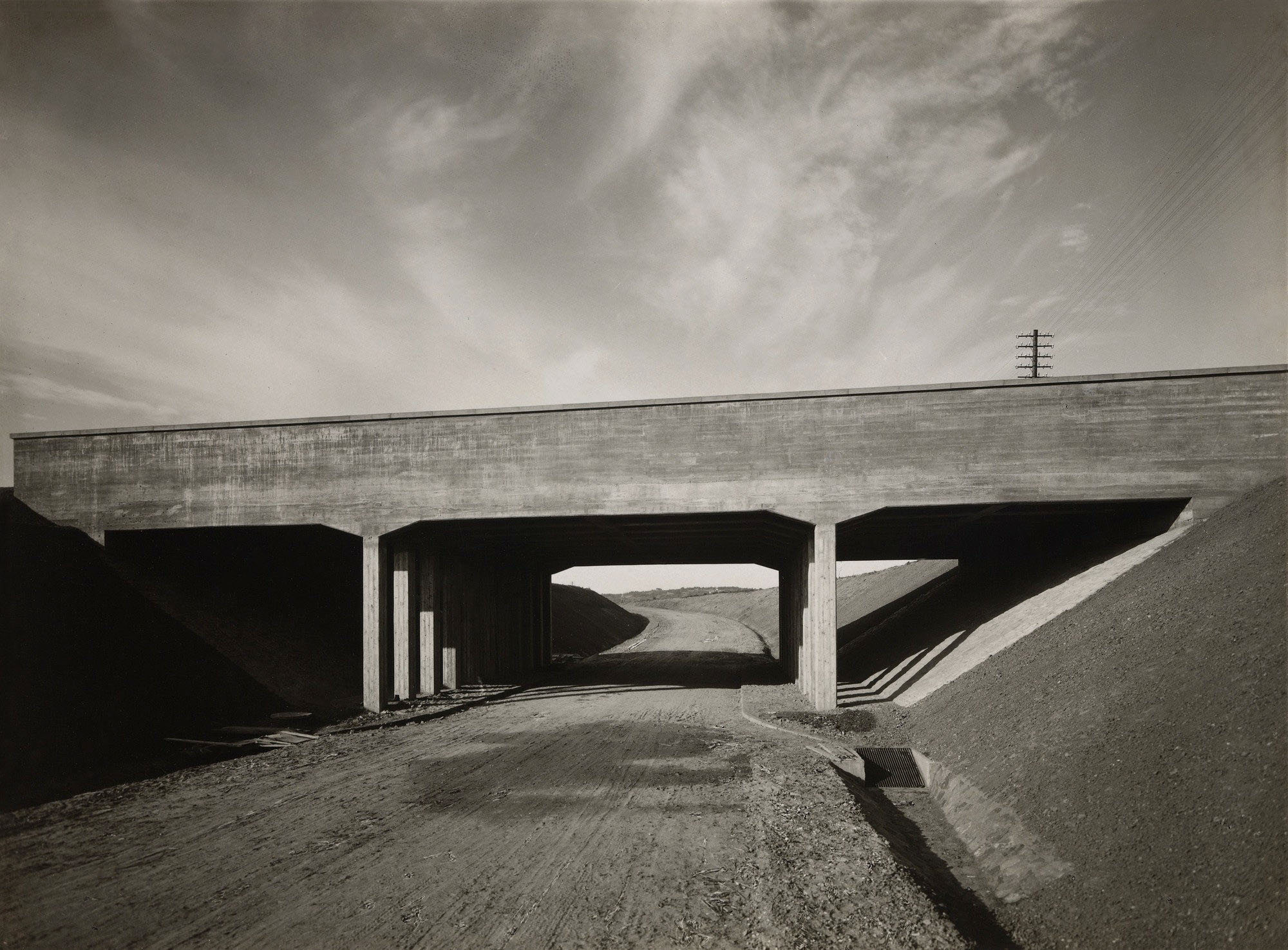
Werner Mantz (German, 1901-1983)
Bridge
1929
Silver gelatin print
Werner Mantz (German, 1901-1983) is known as one of the most prominent photographers of the Neues Bauen movement of modernist architecture in Cologne during the 1920s. Born and raised in Cologne, in 1921 he opened a photo studio, where he initially took portraits of famous intellectuals, artists, and politicians. In 1926 he began receiving commissions as an architectural photographer for Wilhelm Riphahn, Peter Franz Nöcker, Caspar Maria Grod, and other representatives of avant-garde architecture who implemented Konrad Adenauer’s housing policy for a modern Cologne. Architectural magazines such as Bauwelt, Die Form, and Bauwarte frequently published his works. Their objective, black-and-white austerity gives the deserted buildings and streets in Mantz’s pictures the appearance of monumental backdrops of the modern age. It was these pictures that made Cologne’s modernist architecture renowned beyond the boundaries of the city.
In 1932 Mantz opened a second studio in Maastricht, and he moved to the Netherlands in 1938. There he returned to portrait photography and specialized in portraits of children. He saw his portraits as equally important as his architectural photographs, but they have not yet been exhibited. The Museum Ludwig will now bring together these two aspects of his oeuvre and will allow visitors to experience it in its historical breadth and diversity for the first time ever.
Text from the Museum Ludwig website [Online] Cited 08/09/2021
 Art Blart _ art and cultural memory archive
You must be logged in to post a comment.