Exhibition: ‘Gerda Wegener’ at ARKEN Museum for Moderne Kunst, Ishøj, Denmark

Exhibition dates: 7th November 2015 – 8th January 2017

GERDA WEGENER: The unusual story of a love between painter and muse that transcends gender boundaries


Gerda Wegener (Danish, 1885-1940) 'Lili with a Feather Fan' 1920


Gerda Wegener (Danish, 1885-1940)
Lili with a Feather Fan
1920
Photo: Morten Pors


Just a small comment on this posting as I am still recovering from a root canal operation at the dentist.

A fascinating, historically significant, love affair. Beautiful, stylish art painted with panache and flare. The two intertwined as, “The depictions of Lili are quite central to Gerda Wegener’s oeuvre.”

Much admiration and love to both.

Marcus


Many thankx to ARKEN for allowing me to publish the art work and texts in the posting. Please click on the photographs for a larger version of the image. Read an extract from the catalogue on ISSU.


Gerda Wegener (1885-1940) is an outstanding figure in Danish art. As a woman artist she uniquely depicts the beauty of women with equal proportions of empathy and desire. Flirting girls, glamorous divas and sensual women are among Gerda Wegener’s favourite subjects. And to these we can add the pictures of her transgender spouse, Lili Elbe, who developed her female identity as a model in Gerda Wegener’s art. Gerda Wegener’s ambivalent sexuality and the story of her spouse were too difficult for people to relate to in her time. On the whole, she broke down the boundaries of gender and sexual identity.

Today the themes of her works are highly topical. Transgender people have loomed large in the mass media, and trans icons like Laverne Cox and Caitlyn Jenner give the transgendered a voice in popular culture. Hollywood has seized on the story of Lili and Gerda, and the film The Danish Girl will have its Danish premiere in February 2016. In the biggest exhibition so far of the work of this pioneering artist we meet an experimental zest for life from the colourful, abandoned 1920s which hits a nerve in our own time.


“Woman must unleash her womanly instincts and qualities, play on her feminine charm, and win the competition with man by virtue of her womanliness – never by trying to imitate him.”


Gerda Wegener, 1934


“Einar Wegener felt like a person who was forced to go around in a costume that stifled him and in which he felt ridiculous.”


Lili Elbe, 1931


“Once one has found Paris, one cannot imagine living anywhere else. Although I love Italy, when I return and smell Paris, then I am happy.”


Gerda Wegener, 1924


Gerda Wegener (Danish, 1885-1940) 'Lady in a large hat' 1909


Gerda Wegener (Danish, 1885-1940)
Lady in a large hat
1909


Painter and muse

In 1904 Gerda Wegener, born Gottlieb, married the landscape painter Einar Wegener (1882-1931), who is known today as the trans woman Lili Elbe. Lili was Gerda Wegener’s favourite model, and together they created a place of freedom in art where Lili could live out her female identity. In 1930 Gerda Wegener supported her spouse when Lili became one of the first in history to undergo a series of gender-modifying operations in order to become a woman both physically and legally. She died the next year as a result of complications after a last operation.

In her art Gerda Wegener is profoundly fascinated by people’s games with identity through dressing-up, masks and theatre. In the depictions of Lili, Lili poses as a woman in make-up, a succession of wigs, dresses, shoes and exotic fans. We come close to the couple’s friendship and love as each other’s painter and muse across the normal gender boundaries.


Gerda Wegener (Danish, 1885-1940) 'Portrait of Ellen von Kohl' 1906


Gerda Wegener (Danish, 1885-1940)
Portrait of Ellen von Kohl
1906


A controversial work rediscovered

“After many years in the wilderness a harbinger of spring has once more appeared in Danish art.”

The artist Gudmund Hentze on Gerda Wegener’s Portrait of Ellen von Kohl in Politiken in 1907.


One of the biggest disputes in the history of Danish art followed from the rejection of Gerda Wegener’s Portrait of Ellen von Kohl (above) by both the Charlottenborg Exhibition and Den Frie Udstilling in 1907. It led to a storm of contributions to the newspaper Politiken for and against the spiritualised, refined Symbolism that the picture was taken to represent. The opponents were given the name “the Peasant Painters”. Wegener herself remained outside the “Peasant Painter Feud” but organised her own exhibition of the picture at an art dealer’s. Afterwards the work has never been shown, but now it has been rediscovered and hangs at ARKEN so everyone can see it for themselves and think about how the portrait could divide opinion so much on the Danish art scene in 1907.

Ever since the work has been known from an old black-and-white photograph, but in 2015 it has been found for ARKEN’s exhibition and photographed in colour, and it is now being exhibited again for the first time since 1907. This provides a suitable occasion to note that there is nothing wrong with the technical execution. Ellen von Kohl sits like a Renaissance woman in a 16th-century portrait, viewed obliquely from the side with her face turned towards us. The dress, the background and the hair are in the darker colour, while the face, the skin in the neck opening of the dress and the beautiful hands are in lighter shades. The long, slender fingers are typical of Gerda Wegener’s visual idiom, elegant and mannered. To these we can add the strangest thing in the picture, the only thing that our eyes tell us may have seemed objectionable – the eyes and the woman’s gaze. The eyes are not clearly open. Ellen von Kohl both sees and does not see. She appears to be half in a trance, present not only in this world, but also in the one she sees with her mind’s eye. The model is not a worn-out old women “with mittens and a back bent by work”, but a well-dressed, highly cultivated and sensitive being, so sensitive that for better or worse she seems sensual and erotic to the viewers of the time…

The portrait has several resemblances to a number of other portraits by Gerda Wegener in these early years in Copenhagen, which typically show women who were themselves active in various arts such as literature, dance, or theatre. Many have a similar gaze, and they are all shown with the greatest possible beauty.

Andrea Rygg Karberg. “When a woman paints women,” in Gerda Wegener (exhibition catalogue). Arken, 2015, p. 17
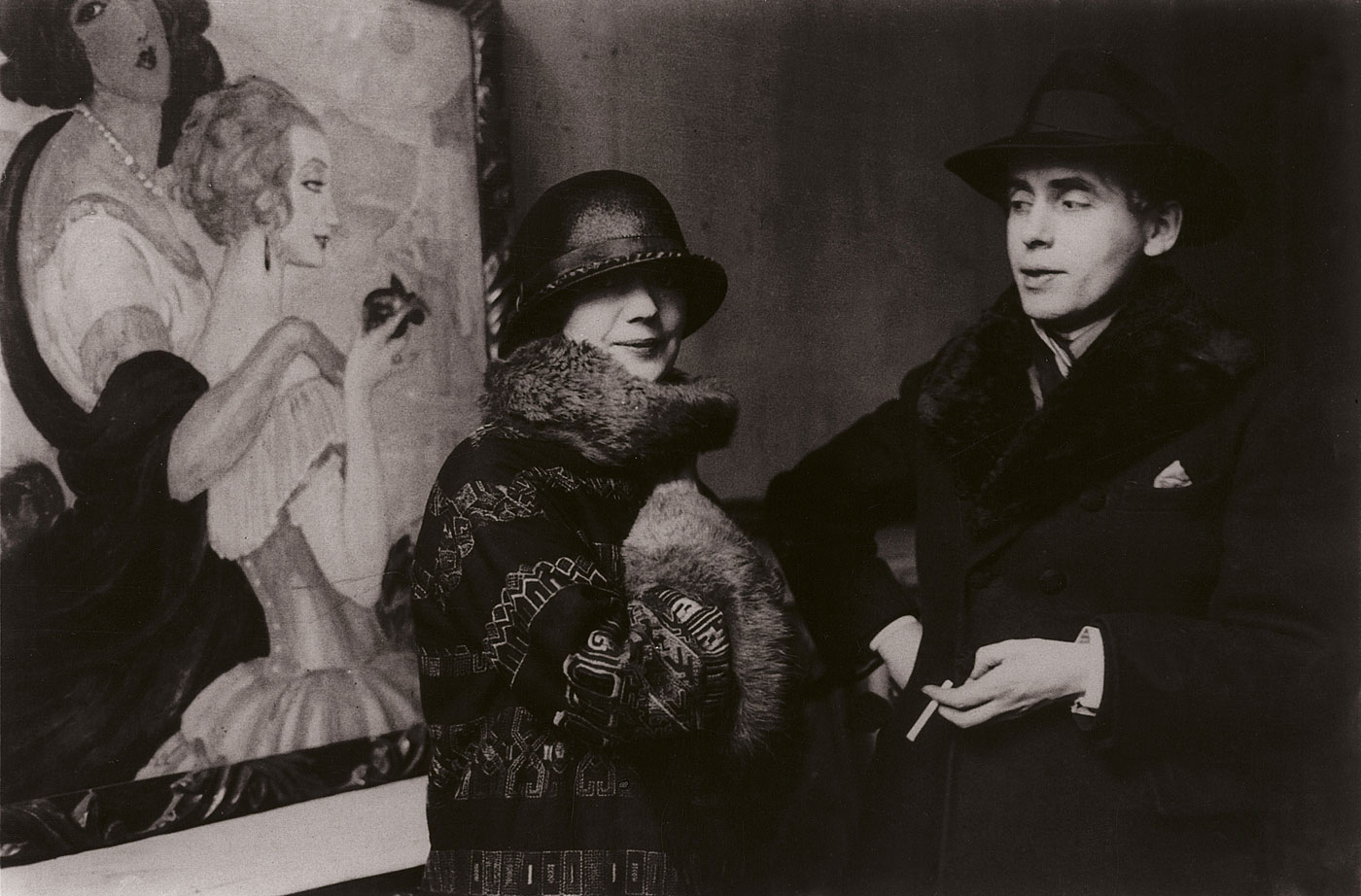
 

Gerda and Einar Wegener in front of Gerda’s painting Sur la route d'Anacapri during the exhibition in Ole Haslunds Hus,1924. Photo The Royal Library, Denmark


Gerda and Einar Wegener in front of Gerda’s painting Sur la route d’Anacapri during the exhibition in Ole Haslunds Hus, 1924
Photo: The Royal Library, Denmark
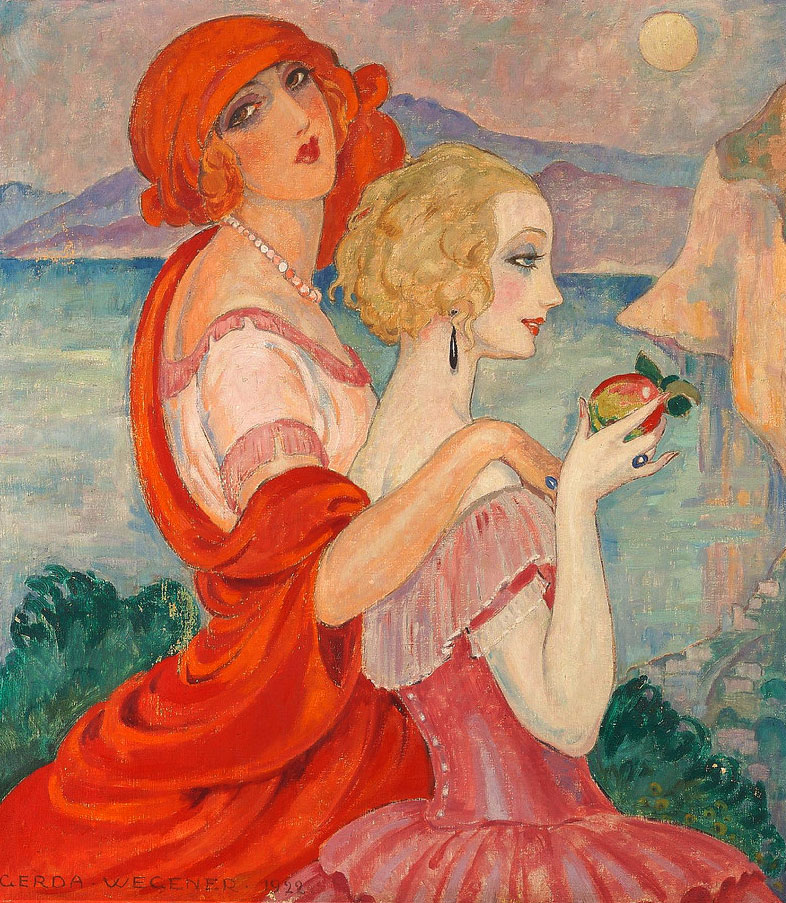
 

Gerda Wegener (Danish, 1885-1940) 'Sur la route d'Anacapri (On the Way to Anacapri)' 1922


Gerda Wegener (Danish, 1885-1940)
Sur la route d’Anacapri (On the Way to Anacapri)
1922


Gerda Wegener also drew and painted several pictures of Gerda and Lili together. In 1922 she painted one of the finest examples on one of the couple’s many journeys to Italy, including several to Capri – the double portrait On the Way to Anacapri (above). Gera and Lili are seen standing in profile in front of a magnificent view of a sea bay in moonlight surrounded by mountains and with the town below. Lili turns her head and looks directly at the viewer, holding her arm fondly and protectively around Gerda. Gerda looks forward dreamily with an apple in her hand. Both women wear make-up as well as jewellery and dresses in red shades. Lili is tallest and brownest; their rings are identical. The picture is painted in delicate colours and has an almost ethereal, dreamlike lightness as if the moment is timeless. Again there is a certain Renaissance atmosphere, especially in the strict profile of the self-portrait…

It is as if this particular borrowing of the formal language of of a bygone time elevates the scenario beyond time and space and gives it the character of the eternal. The works take on a special meaning, showing both Gerda’s and the couple’s love of Italy, art, beauty and each other.

Andrea Rygg Karberg. “When a woman paints women,” in Gerda Wegener (exhibition catalogue). Arken, 2015, p. 21


Gerda Wegener (Danish, 1885-1940) 'Two Cocottes with Hats' c. 1925


Gerda Wegener (Danish, 1885-1940)
Two Cocottes with Hats
c. 1925
Photo: Morten Pors


In Gerda Wegener’s Two Cocottes with Hats, 1920s, it is presumably Lili in the light-coloured wig with flowers and feathers in her hair, who looks at us with seductive bedroom eyes. In her hands she holds the symbol of the female sex, a rose whose scent permeates the atmosphere of the picture and probably helps to attract the other woman’s attention. The two stand close to each other and are further united by the compositions close cropping of the subject.

Andrea Rygg Karberg. “When a woman paints women,” in Gerda Wegener (exhibition catalogue). Arken, 2015, p. 26


Gerda Wegener (Danish, 1885-1940) 'On the banks of the Loire' (the artists' colony at Beaugency), Paris, 1926


Gerda Wegener (Danish, 1885-1940)
On the banks of the Loire (the artists’ colony at Beaugency)
Paris, 1926


The female gender role in transition

In Gerda Wegener’s On the banks of the Loire, 1926, we see innumerable Bohemians from the artists’ colony on a summer’s day in swimsuits far from the city of Paris…

For female artists just a generation before Gerda Wegener’s it was not possible at all for a woman to move around freely in the spaces of the city without being accosted and misunderstood. The definition of the Impressionists as ‘the painters of modern life’, for example, is therefor problematic in the case of an artist like Berthe Morisot. Gerda Wegener on the other hand romped freely through city life, whether this was well received or not. At any rate it became normal – not least during the First World War, when the french men were at the front, and the women had to take over many of the men’s former tasks. The women grew stronger… After World War One, Europe was traumatised, and the survivors lived wilder lives than before – quite simply so they could feel alive. The 1920 were thus typified by festivities and amusements and by gender roles in transition. Everything was permitted, much more so than before.

Andrea Rygg Karberg. “When a woman paints women,” in Gerda Wegener (exhibition catalogue). Arken, 2015, p. 28
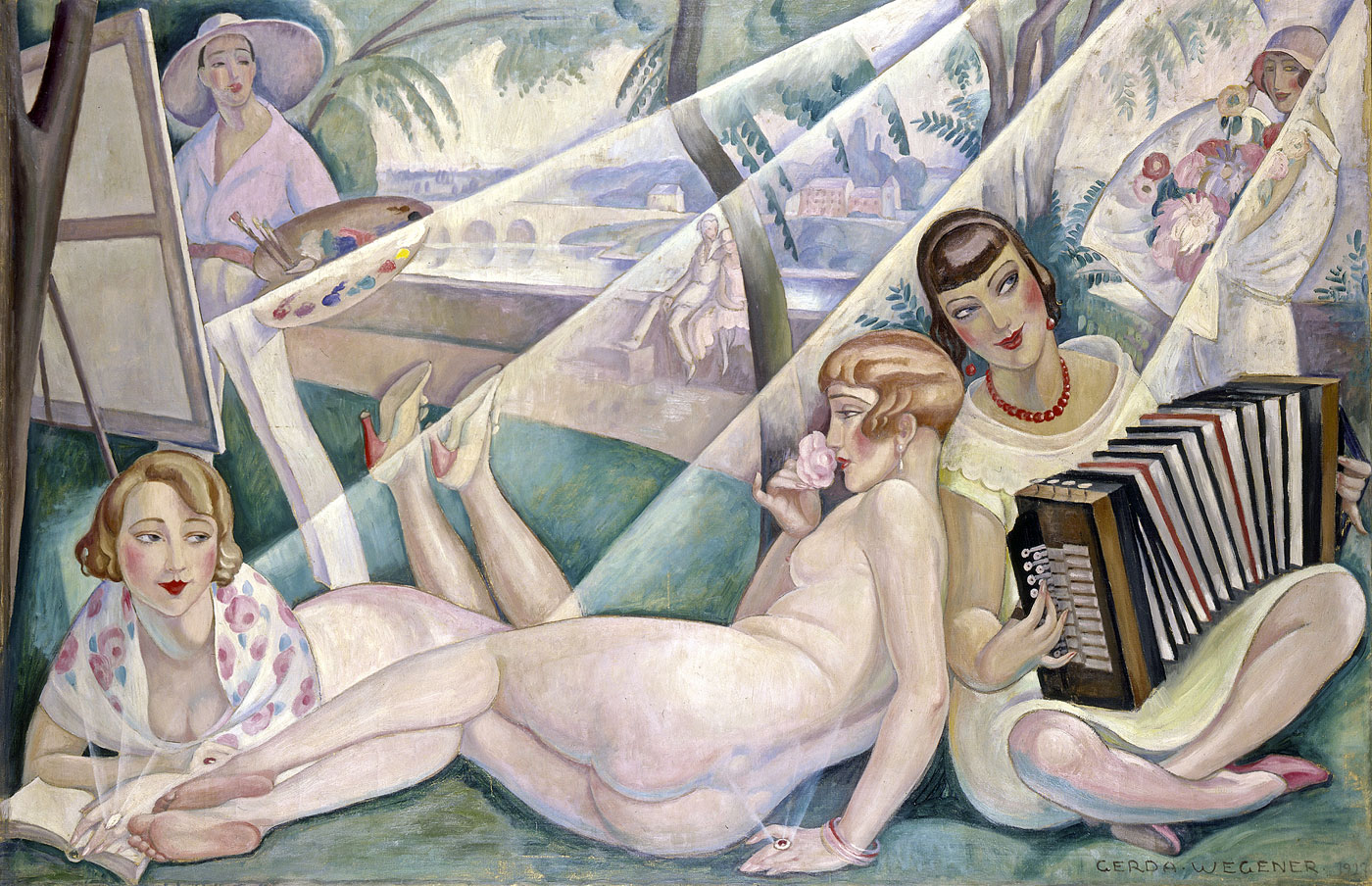
 

Gerda Wegener (Danish, 1885-1940) 'A Summer Day' (Einar Wegener behind the easel, Lili nude, Elna Tegner with accordion, publisher wife Mrs. Guyot with book) 1927


Gerda Wegener (Danish, 1885-1940)
A Summer Day (Einar Wegener behind the easel, Lili nude, Elna Tegner with accordion, publisher wife Mrs. Guyot with book)
1927
Photo: © Bruun Rasmussen Auctioneers


The painter and illustrator Gerda Wegener aroused a furore in Denmark, but was fêted in Paris because of her sophisticated line and her elegant portraits of women. In November ARKEN presents the biggest exhibition so far of works by the pioneering artist whose life and works strike a chord in our own time.

Gerda Wegener (1885-1940) was a woman ahead of her time. It was not in the cards that this minister’s daughter from eastern Jutland would become Denmark’s foremost exponent of Art Deco and one of the most colourful personalities of her time. In 1904, she married the landscape painter Einar Wegener (1882-1931) who today is better known as the trans woman Lili Elbe. Paris was to be the city where they unfolded their artistic careers. There the couple lived a fashionable life, enabled to a great extent by Gerda’s success as a portrait painter and an illustrator for the leading fashion magazines. Decadent, frivolous Paris also made it possible for them to live out their controversial love affair in which playing with gender and identity became the central focus.

A tale of metamorphosis

La Vie Parisienne, La Baïonnette and Le Rire – Gerda Wegener’s technically superb and sometimes daring drawings could be found in the leading French periodicals of the time, and often it was her spouse who posed for her. The depictions of Lili are quite central to Gerda Wegener’s oeuvre. Gerda Wegener idealised Lili’s tall, elegant figure, the gloved hands and the wistful face crowned by a succession of wigs. But outside the canvas too Einar dreamed of merging with his wife’s depictions of Lili. He was unhappy in his male body and Gerda supported her husband in having the operations done that were to effect the physical transformation from man to woman, but ended in Lili’s early death.

Renewed topicality

ARKEN’s exhibition is a tribute to a strong artist whose works and extraordinary life strike a chord in our own time. With 178 works the exhibition will be the biggest ever of her work – and one of the first at any art museum. While in Paris Gerda Wegener won great recognition and fame – among other things three of her works were incorporated in the Louvre’s collection and are today at the Centre Pompidou – she never achieved the same status here in Denmark, because she was a woman, because she also expressed herself in commercial mass culture, and because her ambivalent sexuality and the story of her marriage were too difficult to relate to.

Press release from ARKEN


Gerda Wegener (Danish, 1885-1940) advertisement for powder in the French magazine 'La Vie Parisienne', 5 June 1920


Gerda Wegener (Danish, 1885-1940)
Advertisement for powder in the French magazine La Vie Parisienne, 5 June 1920


Illustration by Gerda Wegener (Danish, 1885-1940) for the erotic book 'Les Délassements de l’Éros' 1925


Gerda Wegener (Danish, 1885-1940)
Illustration for the erotic book Les Délassements de l’Éros
1925
Photo: Morten Pors
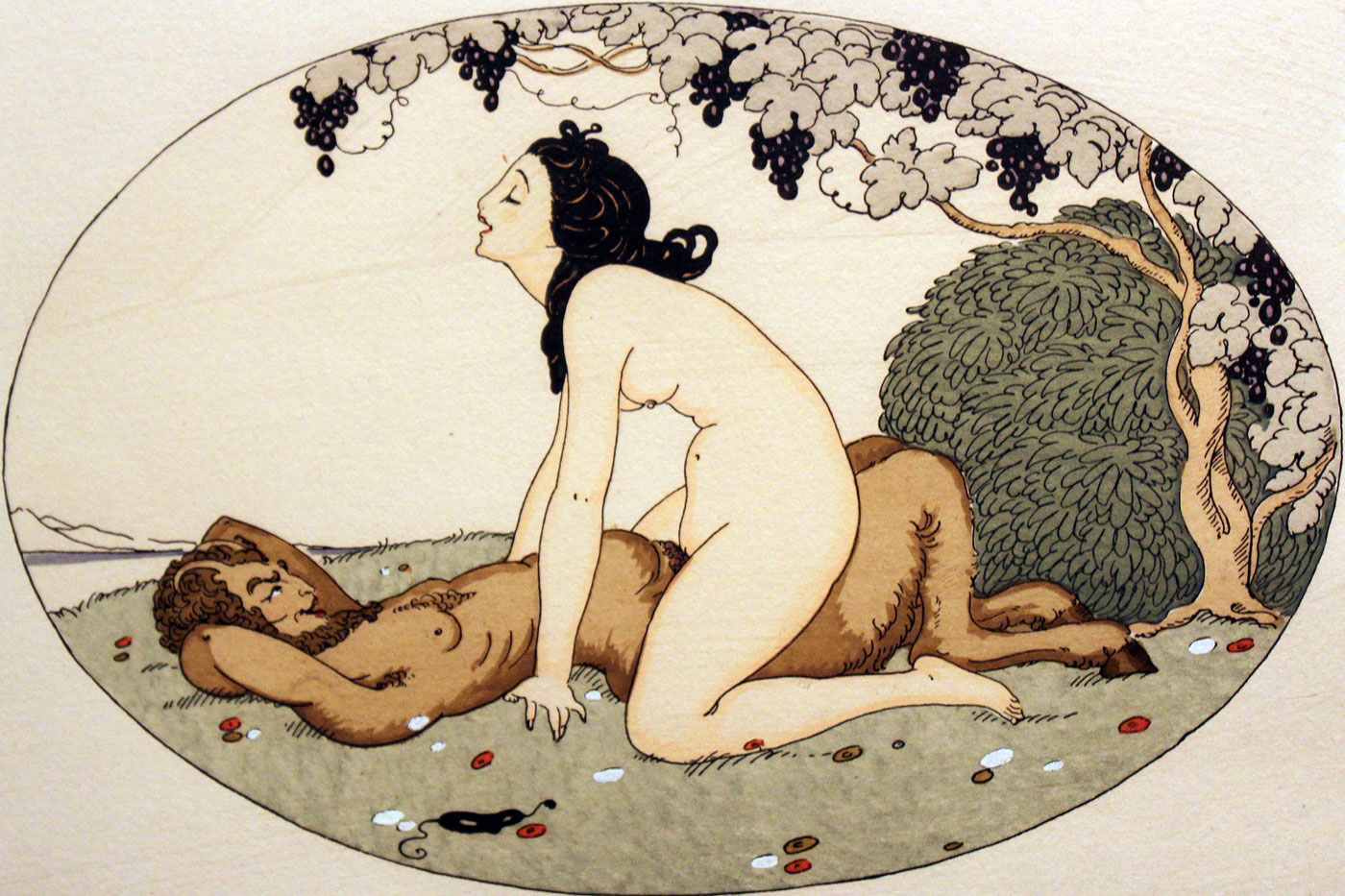
 

Illustration by Gerda Wegener (Danish, 1885-1940) for the erotic book 'Les Délassements de l’Éros' 1925


Gerda Wegener (Danish, 1885-1940)
Illustration for the erotic book Les Délassements de l’Éros
1925


Front page illustration by Gerda Wegener (Danish, 1885-1940) for the Danish magazine 'Vore Damer', 19 October, 1927


Gerda Wegener (Danish, 1885-1940)
Front page illustration for the Danish magazine Vore Damer, 19 October, 1927
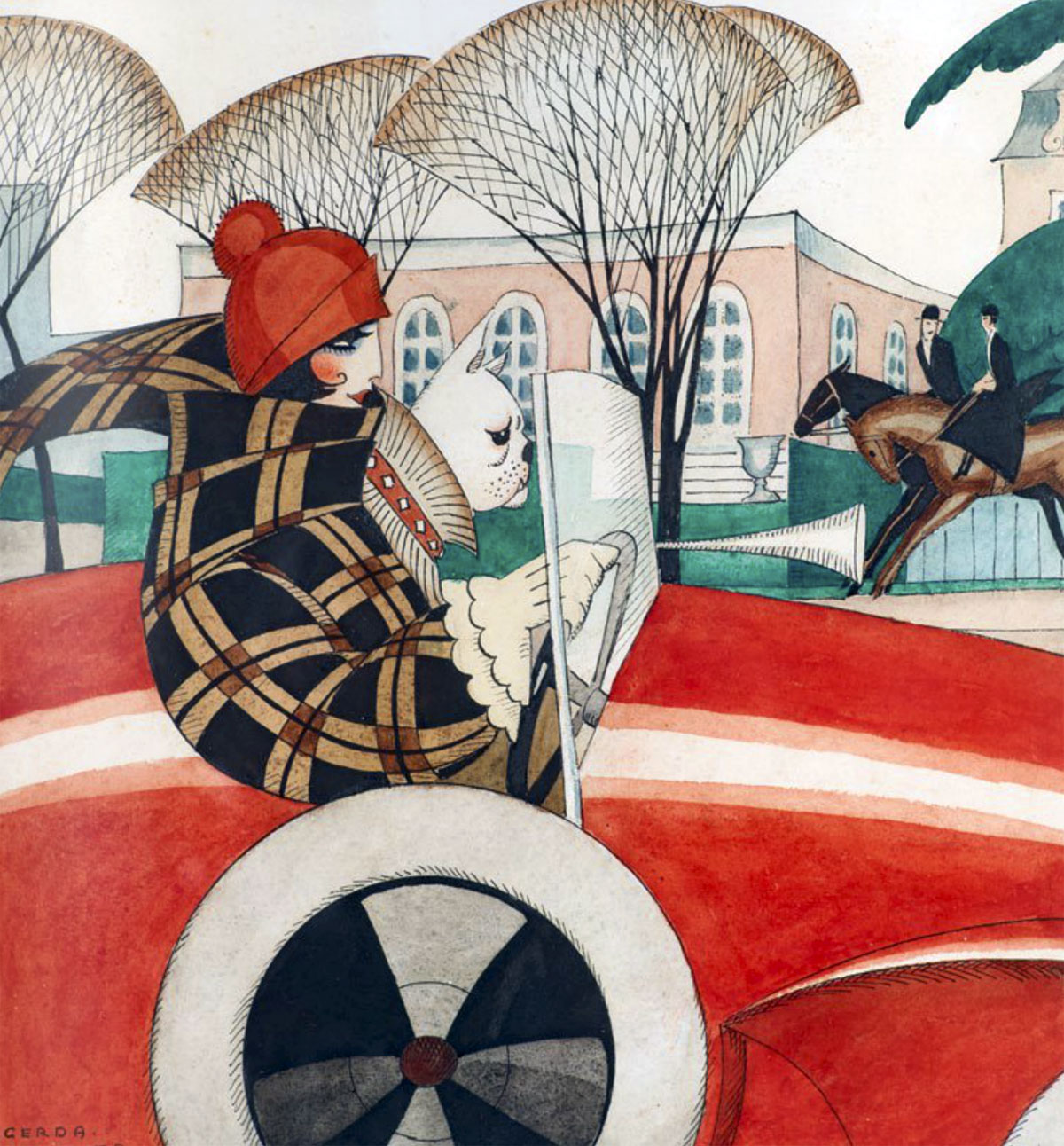
 

Gerda Wegener (Danish, 1885-1940) ' Girl and pug in an Automobile' (sketch for front page illustration in 'Vore Damer', 1927) c. 1927


Gerda Wegener (Danish, 1885-1940)
Girl and pug in an Automobile (sketch for front page illustration in Vore Damer, 1927)
c. 1927
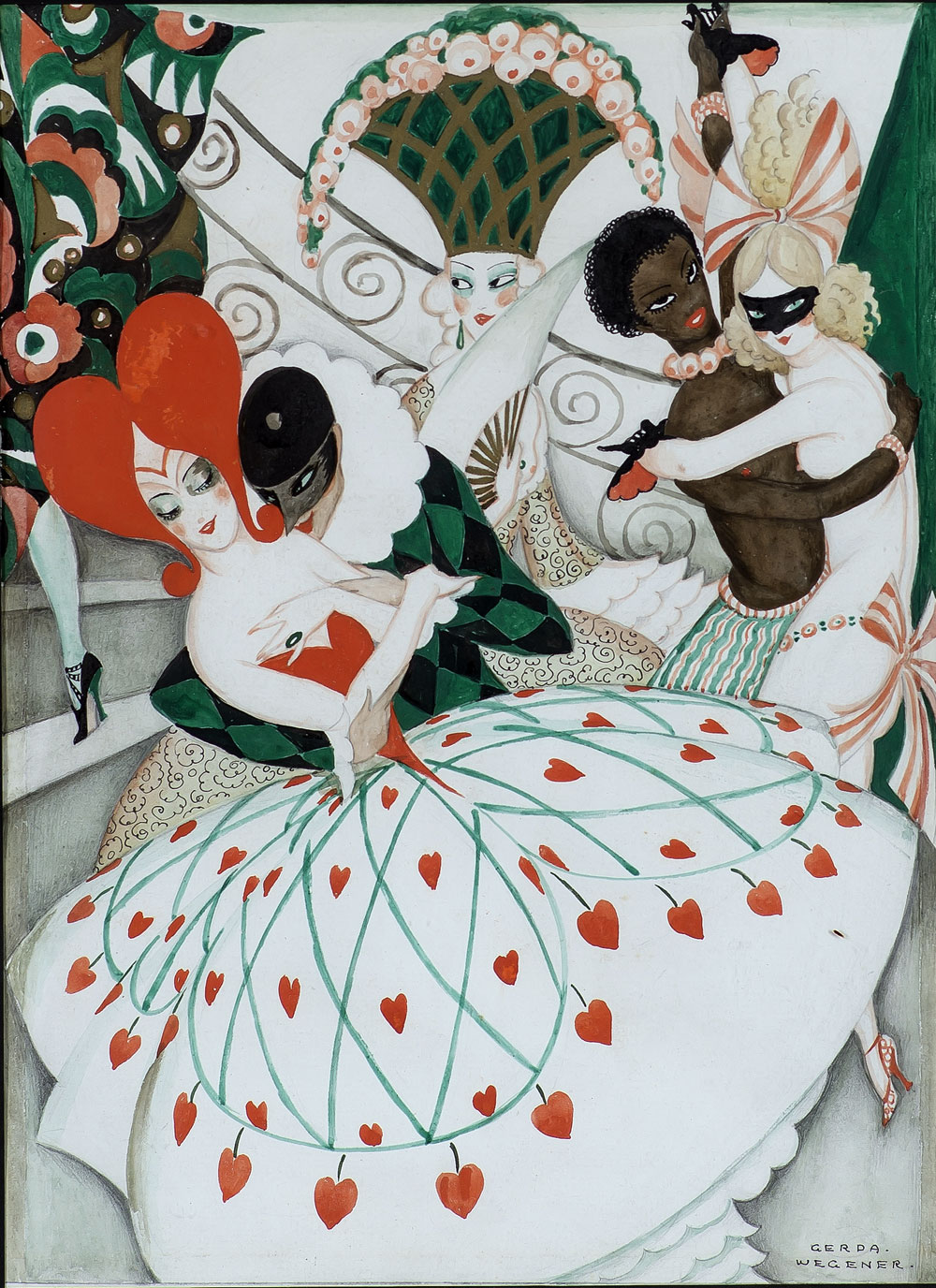
 

Gerda Wegener (Danish, 1885-1940) 'The Carnival' c. 1925


Gerda Wegener (Danish, 1885-1940)
The Carnival
c. 1925
Photo: Morten Pors


A Danish Parisienne

Gerda Wegener divided opinion in Copenhagen, but enjoyed great success in Paris, where she and Lili lived for two decades from 1912. They participated enthusiastically in the Parisian entertainment world, as is evident from Gerda Wegener’s many depictions of festivities and carnivals. Gerda quickly became a popular portrait painter and exhibited at the most important annual art exhibitions in Paris, and even in the French Pavilion at the World Exposition in 1925, where she won two gold medals. She provided illustrations, especially of erotic literature, and designed glass mosaics for Parisian shops and prosperous homes.

None of the major Danish art museums bought any of Gerda Wegener’s works, but the French State bought three. Today these are in the Centre Pompidou’s collection – and two of them can be seen at ARKEN’s major exhibition.

Artist, illustrator and cartoonist

Throughout her artistic life Gerda Wegener worked with both art in the traditional sense and popular mass culture. She alternated between participating in important art exhibitions, primarily in Paris, and supplying huge numbers of advertisements, newspaper and magazine drawings and book illustrations in the fields of fashion, satire, humour and the erotic.

Gerda Wegener had her breakthrough as an illustrator in 1908 when she won a drawing competition in Politiken with the set task of portraying ‘Copenhagen Woman’ and again in 1909 with ‘Figures of the Street’. After this she had a regular association with Politiken as an artist. At the same time Gerda Wegener supplied drawings to several other magazines such as Klods Hans, Tik-Tak and Vore Damer, and in France her drawings for leading French magazines were her primary source of income until the middle of the 1920s.


Gerda Wegener (Danish, 1885-1940) 'Lili Elbe' c. 1928


Gerda Wegener (Danish, 1885-1940)
Lili Elbe
c. 1928
Watercolour


Gerda Wegener (Danish, 1885-1940) 'Queen of Hearts (Lili)' 1928


Gerda Wegener (Danish, 1885-1940)
Queen of Hearts (Lili)
1928
Photo: Morten Pors


Gerda Wegener was a curious observer in this whole period as she participated in life in the metropolis of Paris. In her innumerable pictures of women she accordingly revealed very different female types, just as the pictures of Lili send out a wide variety of signals. Lili who is often sweet and innocent looks rather like a provocative sinner in Queen of Hearts from 1928. Here she is playing cards, which in the history of art has always been symbolic of a life of sin, and in the sixteenth century was regarded as ungodly. An ashtray, a bottle and a glass are on the table, and Lili has a cigarette in her mouth. She has her feet up on two different chairs and is wearing snakeskin shoes and a red dress that has slipped slightly down along her legs, revealing the petticoat. The room in which Lili sits is more well-defined than in most other Lili portraits and is full of realistic details. The picture is no longer detached from time and place or ethereal. The hands are not long and graceful. It is the real Lili of flesh and blood that we see here, an emancipated and erotically self-assured woman. And so it is naturally the Queen of Hearts that she holds in her hand.

Andrea Rygg Karberg. “When a woman paints women,” in Gerda Wegener (exhibition catalogue). Arken, 2015, p. 28
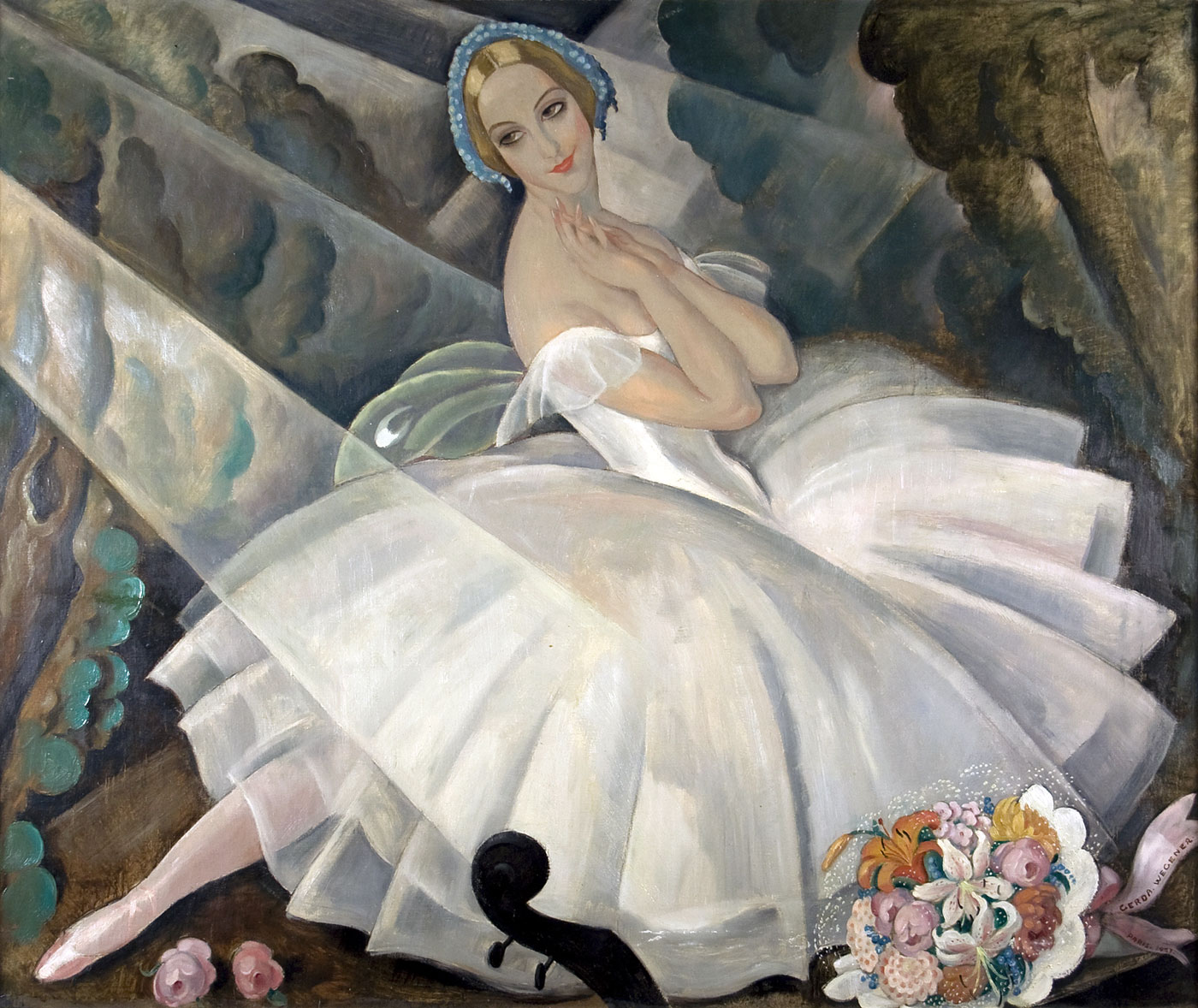
 

Gerda Wegener (Danish, 1885-1940) 'The Ballerina Ulla Poulsen in the Ballet Chopiniana' Paris, 1927


Gerda Wegener (Danish, 1885-1940)
The Ballerina Ulla Poulsen in the Ballet Chopiniana
Paris, 1927
Photo: The Theatre Museum at The Court Theatre


In Poulsen, Gerda Wegener cultivated the perfect classical ideal of beauty for a woman. Ulla Poulsen was well known for her pure, oval face and could have posed from the most beautiful Madonnas of the Italian Renaissance. She met the Wegeners during a tour of Paris in 1927 and ever afterwards appeared in many of Wegener’s works, both when she has posed and when Gerda depicted her from memory.

In the best known and most monumental portrait of Ulla Poulsen the ballerina takes her bow after a performance of the ballet Chopiniana. A typical Wegener bouquet lies on the edge of the stage, and in Toulouse-Lautrec fashion a little piece of a bass or cello projects from the orchestral pit. Again the light beams shine down over the main figure in a fan pattern, and the ballet skirt spreads around her in a circle. The ballerina is set up as the most beautiful imaginable object for the viewer’s gaze, as is the point of ballet and theatre, for the delectation of everyone. The awareness that someone is looking is so to speak a condition of all theatre, and for that matter of the existence of the phenomenon of fashion – another of Gerda Wegener’s favourite fields.

Andrea Rygg Karberg. “When a woman paints women,” in Gerda Wegener (exhibition catalogue). Arken, 2015, p. 32


Gerda Wegener (Danish, 1885-1940) 'Eva Heramb' 1934


Gerda Wegener (Danish, 1885-1940)
Eva Heramb
1934
Photo: Photo: The Theatre Museum at The Court Theatre


Eva Betty Koefoed Heramb (24th November 1899 in Aarhus – 9th January 1957 in Copenhagen ) was a Danish actress. She made her debut in 1921 at Odense Theatre, at which theatre she was employed the following six years. From 1927-1935 she was engaged to the People’s Theatre, where she received a variety of roles, including appearances in this period with several other Copenhagen theatres. She also recorded a few films.
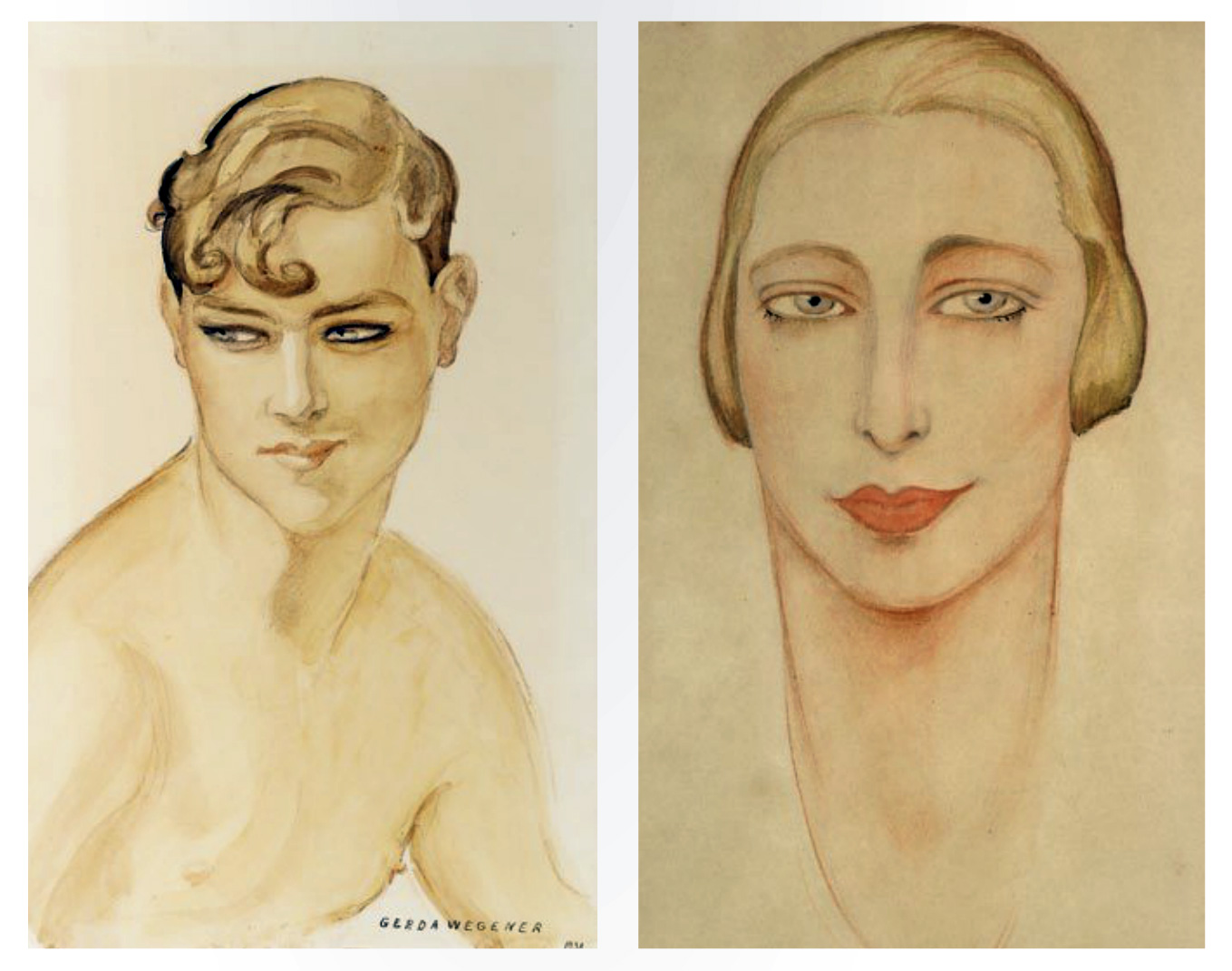
 

Gerda Wegener (Danish, 1885-1940) 'Young Man, Bare Chested' 1938 and 'Adrienne Sipska' Paris 1925


Gerda Wegener (Danish, 1885-1940)
Young Man, Bare Chested
1938

Gerda Wegener (Danish, 1885-1940)
Adrienne Sipska
Paris 1925


The mixture of sources of inspiration and materials is yet another characteristic of Art Deco – and in the portrait of the short-haired, long-necked Adrienne Sipska from 1925 Gerda Wegener has painted the hard with gold. The young man she paints with a bare chest in 1938, on the other hand, has soft locks on his brow and marked, almost feminine facial features. Men and women cross over imperceptibly in many of Gerda Wegener’s pictures as the boundaries between the normal gender roles are gradually erased more and more.

Andrea Rygg Karberg. “When a woman paints women,” in Gerda Wegener (exhibition catalogue). Arken, 2015, p. 30


Gerda Wegener (Danish, 1885-1940) 'Carnival, Lily' Paris, 1928


Gerda Wegener (Danish, 1885-1940)
Carnival, Lily
Paris, 1928


Gerda Wegener (Danish, 1885-1940) 'At the mirror' 1931-1936


Gerda Wegener (Danish, 1885-1940)
At the mirror
1931-1936


In Gerda Wegener’s At the mirror, 1931-1936 (above), the directions of the gazes are more complicated. A woman sits in front of the mirror and forms a beautiful S-shape with the low-cut back and neck of her dress and the turning of her head. She looks herself deep in the eyes. We see he both from the back in front of the mirror and her face from the front in the mirror. In the mirror we also see an elegantly dressed man, presumably standing more or less where we are conceived as standing, looking at the woman’s beautiful neck with a slightly worried expression. For she is not looking at him, although she is well aware that he is there. Nor is it certain that it is only for him that she is putting on make-up. He is like a perplexed voyeur who has been discovered. He seems a little superfluous as a moment of profound solidarity arises between the woman and her ‘sister’ in the mirror.

Gerda Wegener does not only depict empty decorative dolls, but also strong personalities who stage themselves as beautiful women and exercise much of the power at play in their relations with other people. ‘Girl Power’, quite simply.

As mentioned, a viewer is always latently present in Wegener’s works, as the figures are so aware of the signals they are sending out. The women display themselves with a clear exhibitionistic tendency which is taken to extremes in the pictures of theatre, masquerade and disguise. At the same time the very act of looking at themselves in the mirror is associated with narcissism. This beautiful woman in front of the mirror and in the mirror exhibits and enjoys herself at one and the same time. As always the work is charged with an intense eroticism. This woman is attracted by herself and is also ready to attract others. And these others could be of either sex depending on who is looking at the picture.

Andrea Rygg Karberg. “When a woman paints women,” in Gerda Wegener (exhibition catalogue). Arken, 2015, pp. 32-34


Arken Museum for Moderne Kunst
Skovvej 100, 2635 Ishøj, Denmark

Opening hours:
Wednesday – Sunday: 11 – 17
Thursday: 11 – 21
Monday – Tuesday: Closed
Arken Museum for Moderne Kunst website

LIKE ART BLART ON FACEBOOK

Back to top

Exhibition: ‘Dark Romanticism. From Goya to Max Ernst’ at the Städel Museum, Frankfurt

Exhibition dates: 26th September 2012 – 20th January, 2013


Many thankx to the Städel Museum for allowing me to publish the reproductions of the artwork in the posting. Please click on the photographs for a larger version of the image.


This slideshow requires JavaScript.


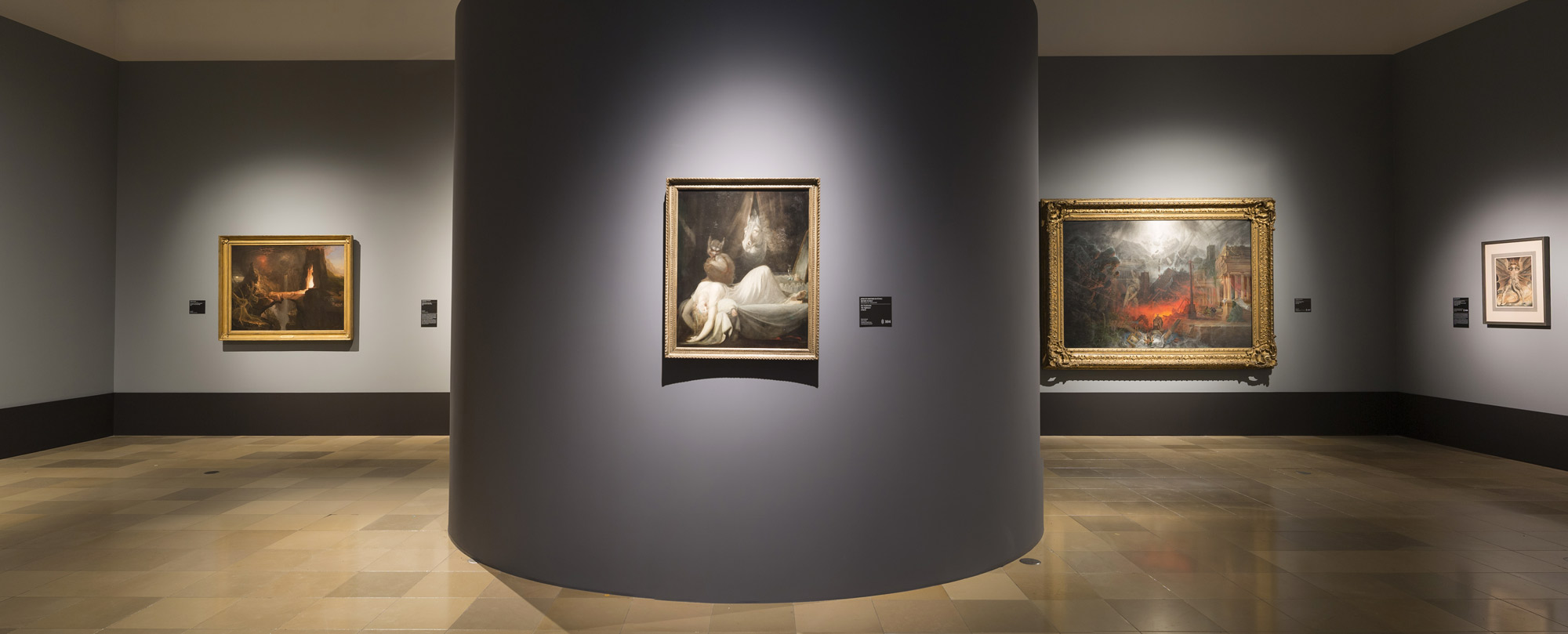
Installation photographs of the exhibition Dark Romanticism. From Goya to Max Ernst at the Städel Museum, Frankfurt
Photos: Norbert Miguletz


Installation view of the exhibition 'Dark Romanticism. From Goya to Max Ernst' at the Städel Museum, Frankfurt

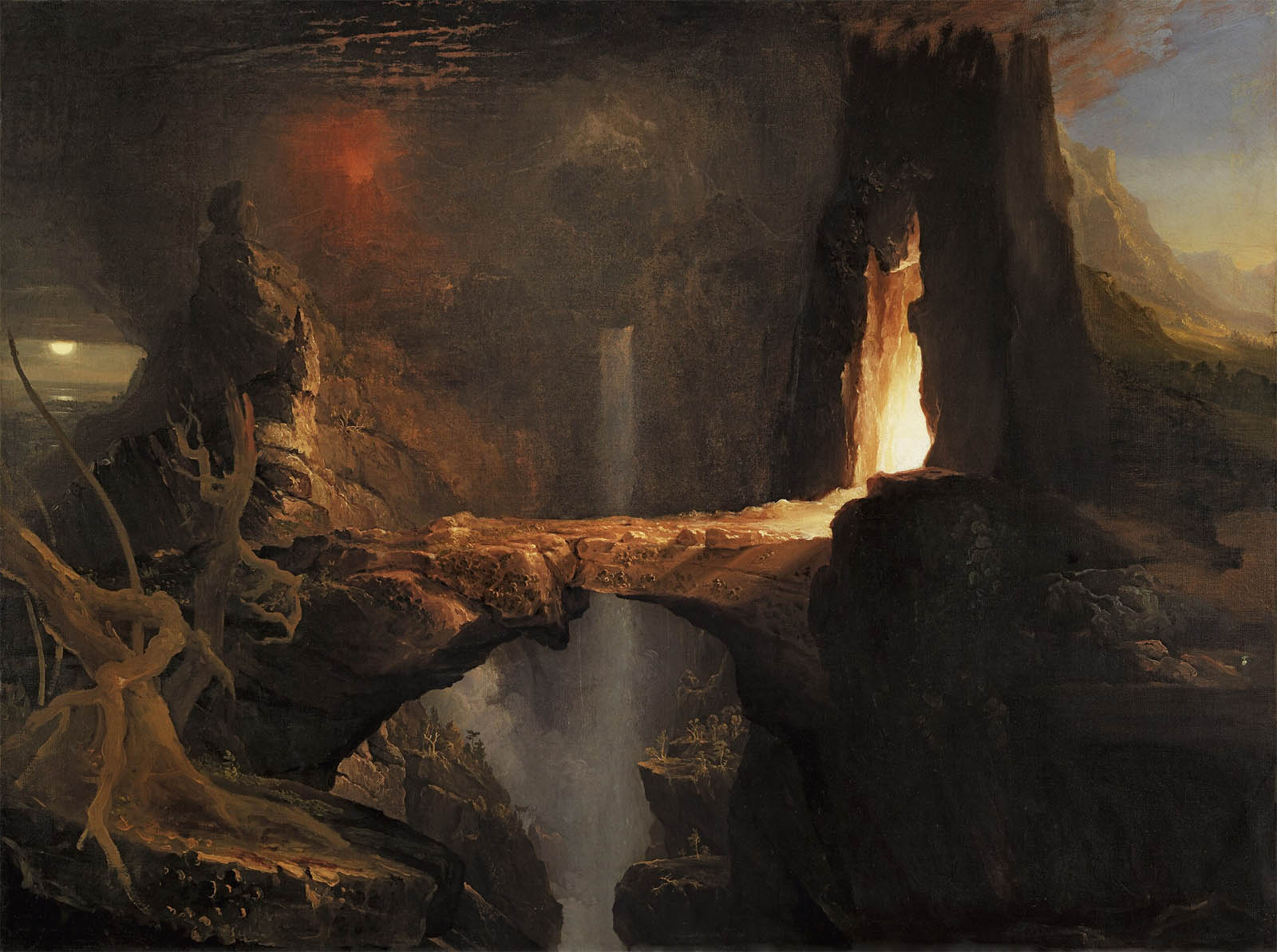
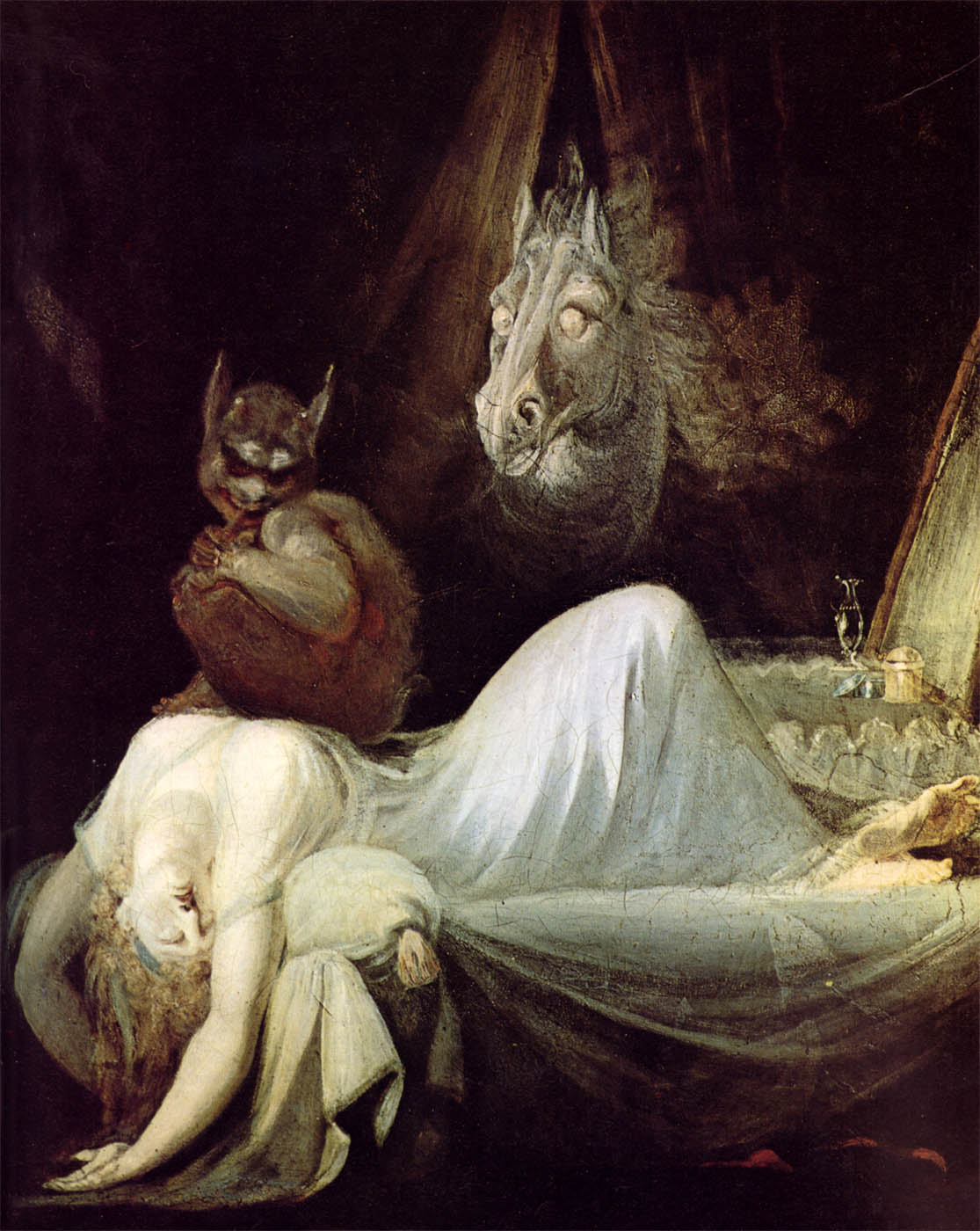
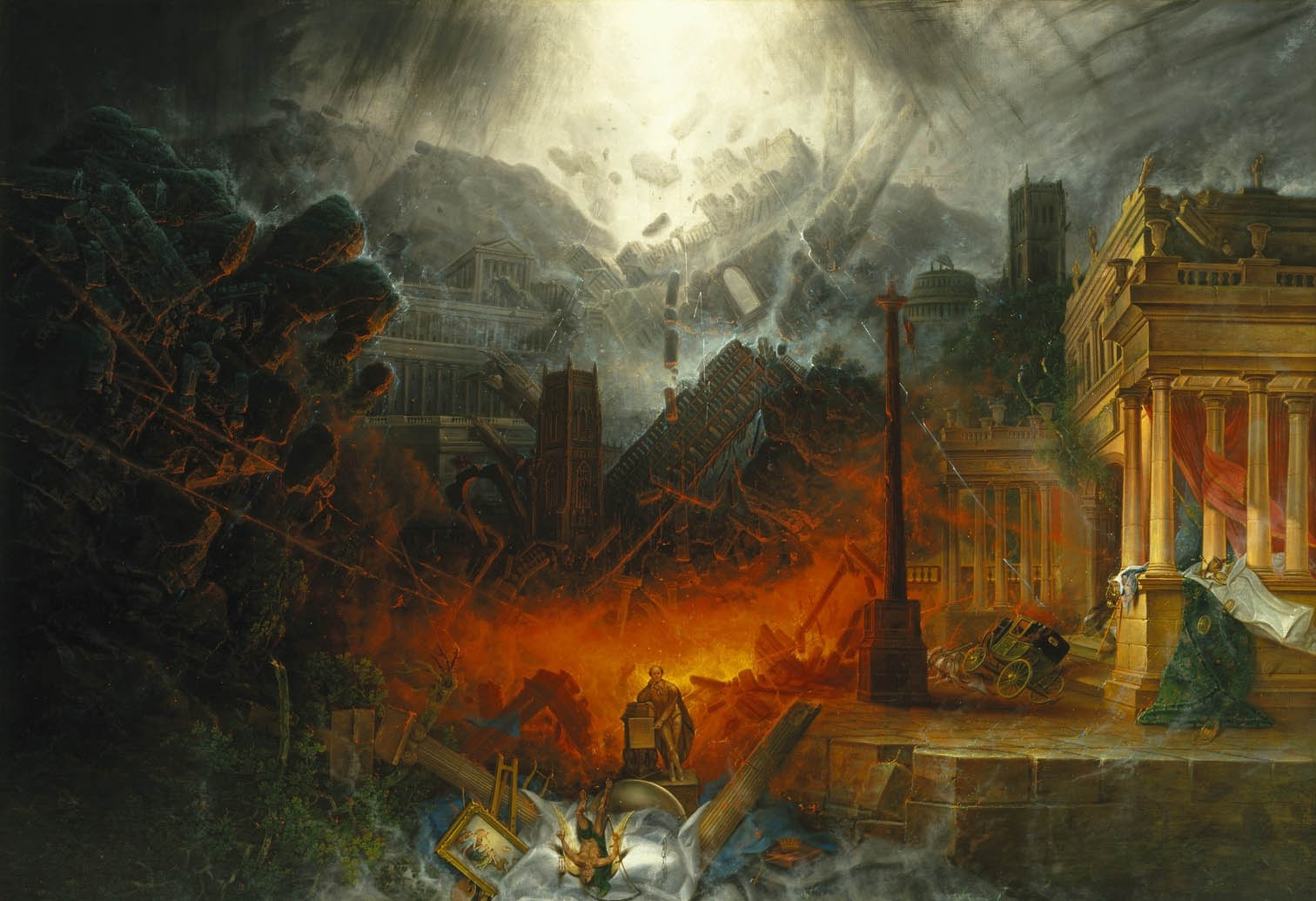
Installation view of the exhibition 'Dark Romanticism. From Goya to Max Ernst' at the Städel Museum, Frankfurt showing at left, Thomas Cole's 'Expulsion: Moon and Firelight '(c. 1828); at centre, Johann Henry Fuseli's 'The Nightmare (The Incubus)' (1781-1782); at second right, Samuel Colman's 'The Edge of Doom' (1836-1838); and at right, William Blake's 'The Great Red Dragon and the Woman Clothed with the Sun' (c. 1803-1805)


Installation views of the exhibition Dark Romanticism. From Goya to Max Ernst at the Städel Museum, Frankfurt showing at left in the bottom image, Thomas Cole’s Expulsion: Moon and Firelight (c. 1828, below); at centre, Johann Henry Fuseli’s The Nightmare (The Incubus) (1781-1782, below); at second right, Samuel Colman’s The Edge of Doom (1836-1838, below); and at right, William Blake’s The Great Red Dragon and the Woman Clothed with the Sun (c. 1803-1805, below)
Photos: Norbert Miguletz


Thomas Cole (American born England, 1801-1848) 'Expulsion: Moon and Firelight' c. 1828


Thomas Cole (American born England, 1801-1848)
Expulsion: Moon and Firelight
c. 1828
Oil on canvas
91.4 by 122cm (36.0 in × 48.0 in)
Thyssen-Bornemisza Museum, Madrid


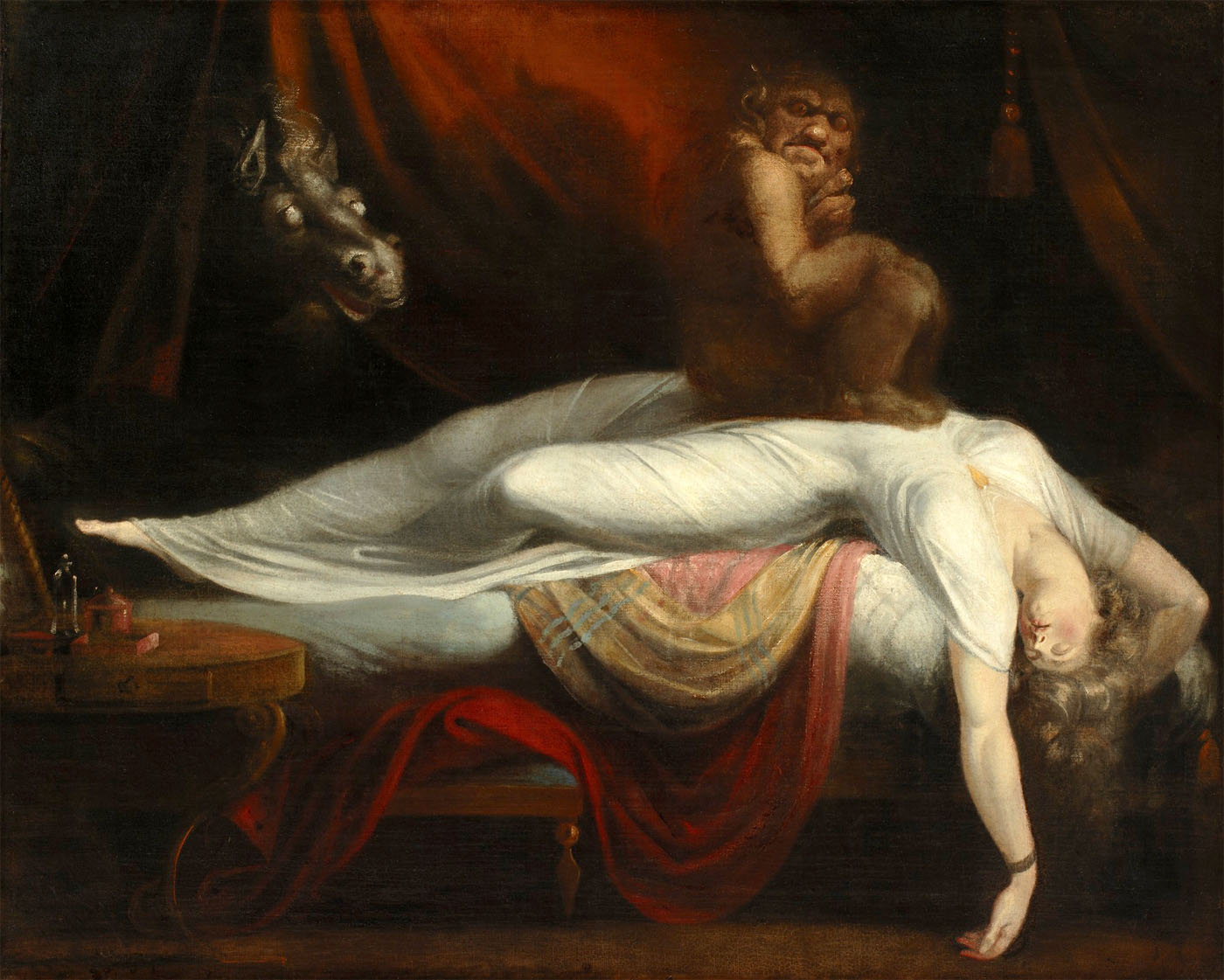
Johann Henry Fuseli (Swiss, 1741-1825) 'The Nightmare (The Incubus)' 1781-1782


Johann Henry Fuseli (Swiss, 1741-1825)
The Nightmare (The Incubus)
1781-1782
Oil on canvas
77cm (30.3 in) x 64cm (25.1 in)
Goethehaus (Frankfurt) collection


Samuel Colman (British, 1780-1845) 'The Edge of Doom' 1836-1838


Samuel Colman (British, 1780-1845)
The Edge of Doom
1836-1838
Oil on canvas
54 x 78 1/2 in. (137.2 x 199.4cm)
Brooklyn Museum


William Blake (British, 1757-1827) 'The Great Red Dragon and the Woman Clothed with the Sun' c.1803-1805


William Blake (British, 1757-1827)
The Great Red Dragon and the Woman Clothed with the Sun
c. 1803-1805
Watercolour, graphite and incised lines
43.7 x 34.8cm
Brooklyn Museum, Gift of William Augustus White


Johann Henry Fuseli (Swiss, 1741-1825) 'The Nightmare' 1781


Johann Henry Fuseli (Swiss, 1741-1825)
The Nightmare
1781
Oil on canvas
101.6 × 126.7cm
Detroit Institute of Arts, Founders Society
© Bridgeman Art Library


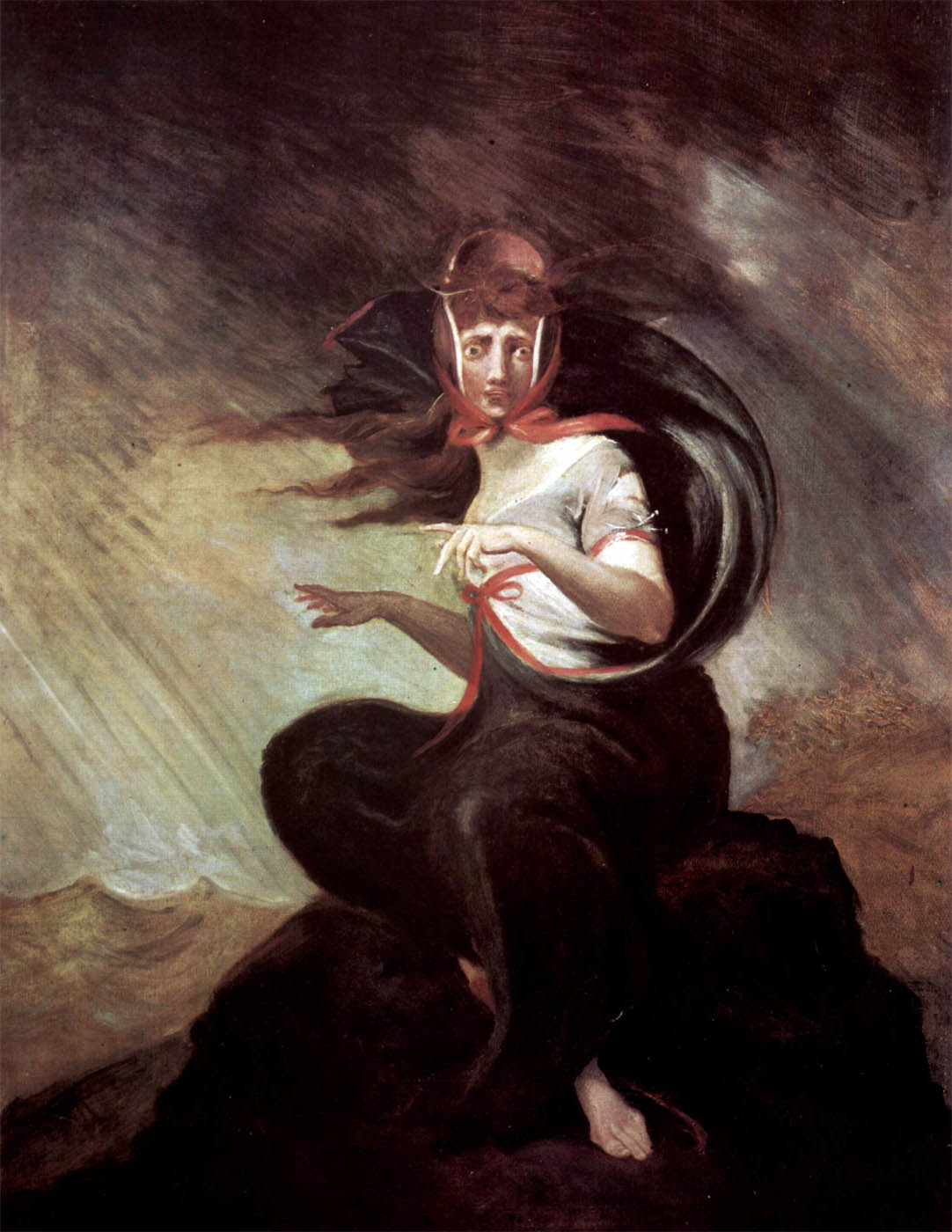
Johann Henry Fuseli (Swiss, 1741-1825) 'Die wahnsinnige Kate'(La folie de Kate) (Mad Kate) 1806-1807


Johann Henry Fuseli (Swiss, 1741-1825)
Die wahnsinnige Kate (La folie de Kate) (Mad Kate)
1806-1807
Oil on canvas
92cm (36.2 in) x 72.3cm (28.4 in)
Francfort-sur-le-Main, Frankfurter Goethe-Haus
Freies Deutsches Hochstift, inv.1955-007
© Ursula Edelmann/ARTOTHEK


Installation view of the exhibition 'Dark Romanticism. From Goya to Max Ernst' at the Städel Museum, Frankfurt showing Paul Delaroche's 'The Wife of the Artist, Louise Vernet, on her Death Bed' (1845)


Installation view of the exhibition Dark Romanticism. From Goya to Max Ernst at the Städel Museum, Frankfurt showing Paul Delaroche’s The Wife of the Artist, Louise Vernet, on her Death Bed (1845, below)
Photo: Norbert Miguletz


Paul Hippolyte Delaroche (French, 1797-1856) 'Louise Vernet, the artist's wife, on her Deathbed' 1845-46


Paul Hippolyte Delaroche (French, 1797-1856)
Louise Vernet, the artist’s wife, on her Deathbed
1845-1846
Oil on canvas
62 x 74.5cm
Musée des Beaux-Arts de Nantes
© Musée des Beaux-Arts de Nantes


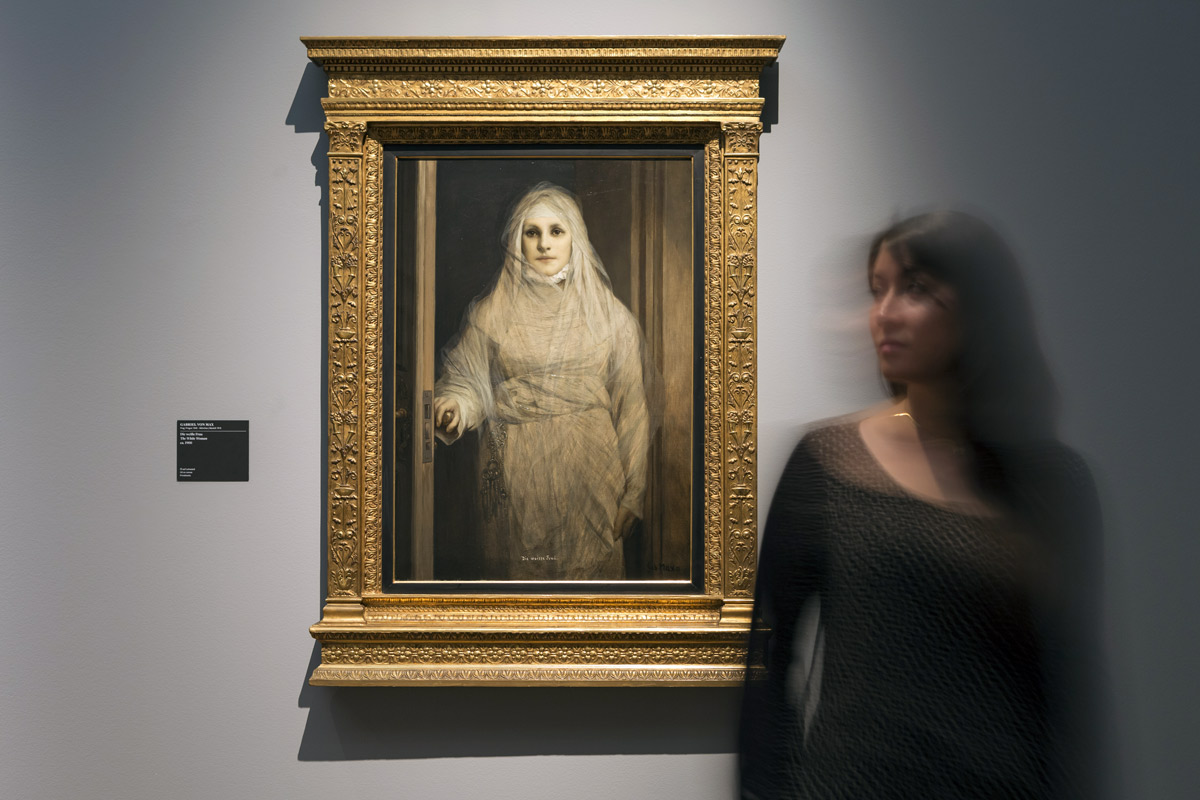
Installation view of the exhibition 'Dark Romanticism. From Goya to Max Ernst' at the Städel Museum, Frankfurt showing Gabriel von Max's 'The White Woman' (1900)


Installation view of the exhibition Dark Romanticism. From Goya to Max Ernst at the Städel Museum, Frankfurt showing Gabriel von Max’s The White Woman (1900, below)
Photo: Norbert Miguletz


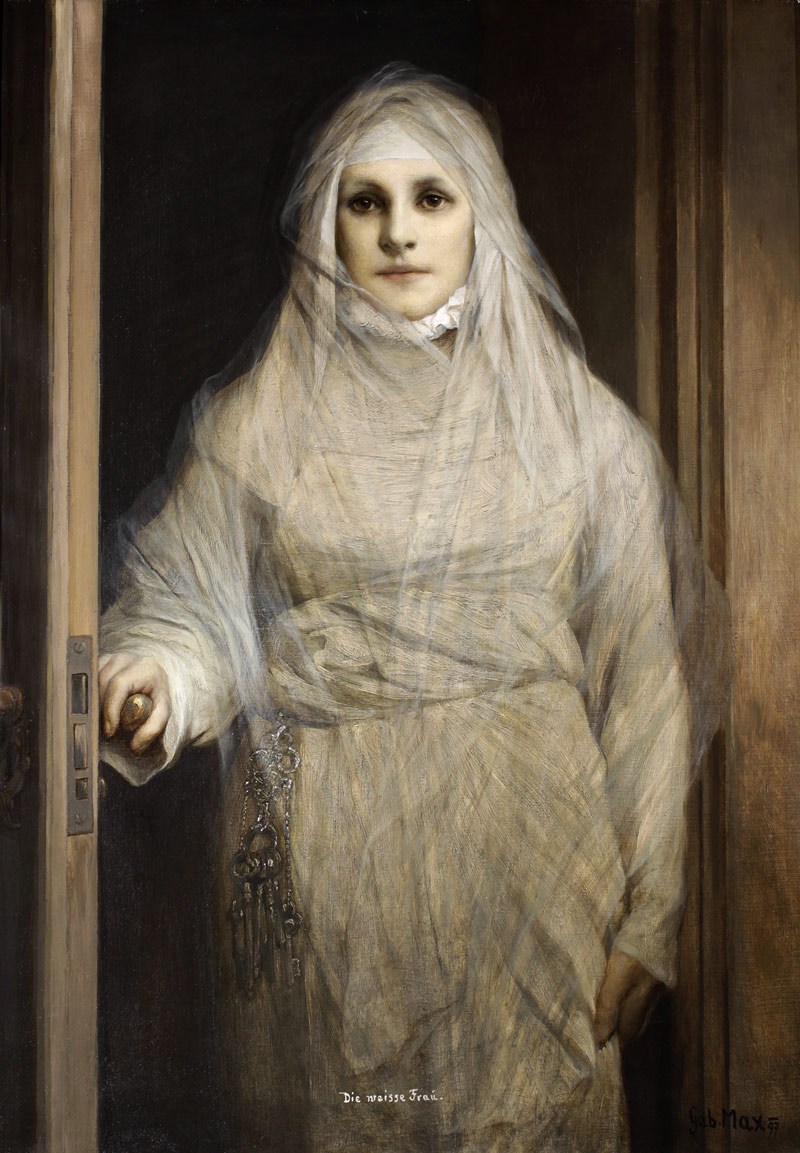
Gabriel von Max (Austrian, 1840-1915) 'The White Woman' 1900


Gabriel von Max (Austrian, 1840-1915)
The White Woman
1900
Oil on canvas
100 x 72cm
Private Collection


Johann Henry Fuseli (Swiss, 1741-1825) 'Sin Pursued by Death' 1794-1796


Johann Henry Fuseli (Swiss, 1741-1825)
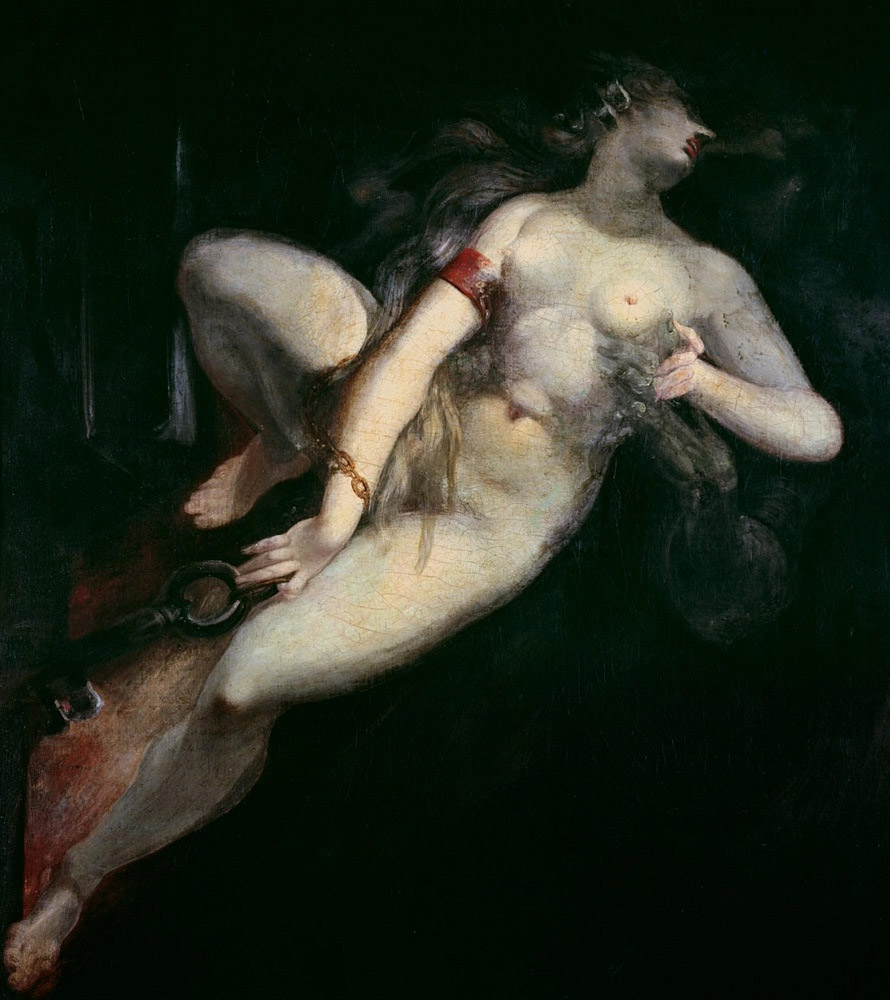
Sin Pursued by Death
1794-1796
Oil on canvas
Kunsthaus, Zürich


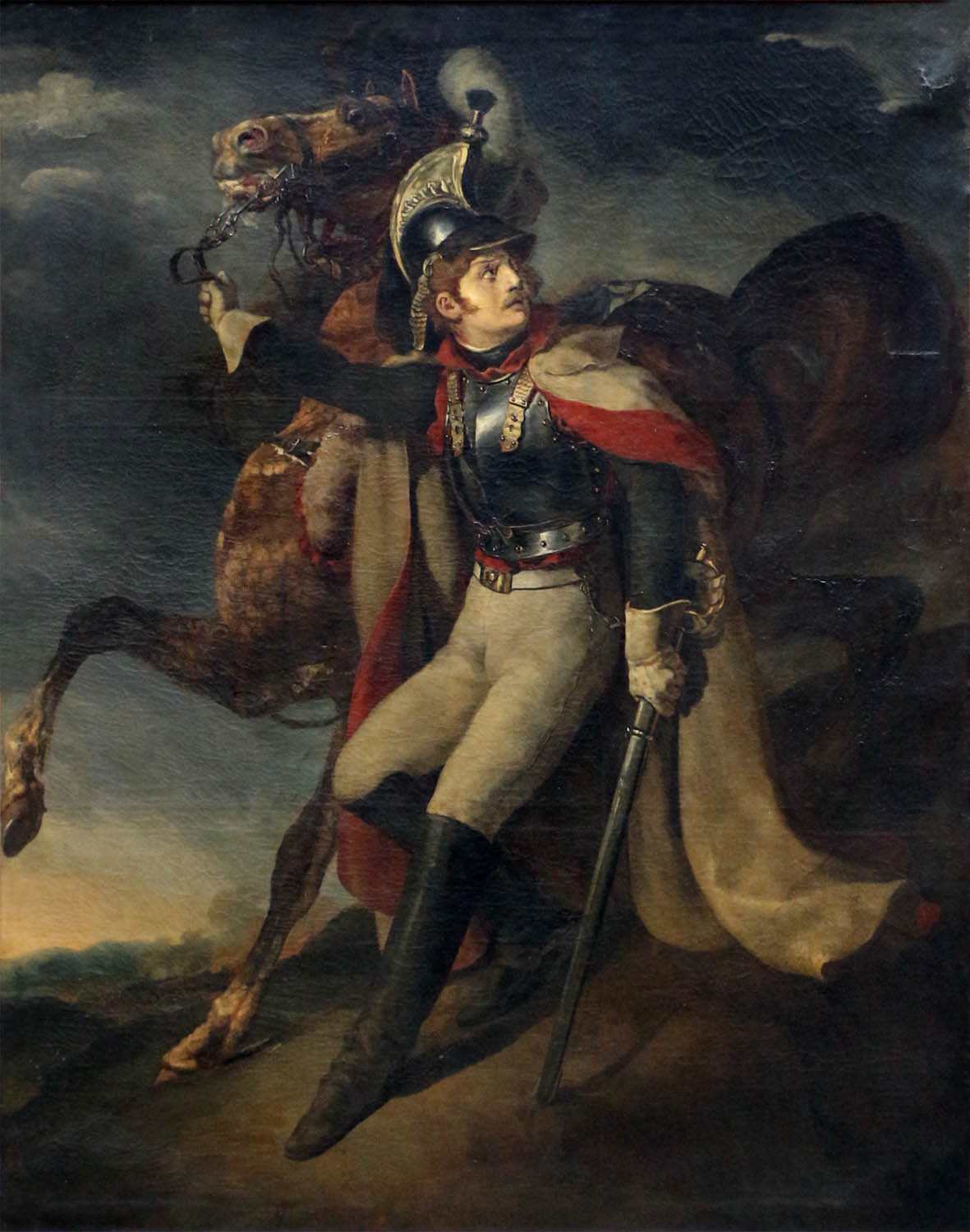
Théodore Géricault (French, 1791–1824) Cuirassier blessé quittant le feu / The Wounded Cuirassier 1814


Théodore Géricault (French, 1791–1824)
Cuirassier blessé quittant le feu / The Wounded Cuirassier
1814
Oil on canvas
358cm (11.7 ft) x 294cm (115.7 in)
Louvre Museum


The Wounded Cuirassier (French: Le Cuirassier blessé quittant le feu) is an oil painting of a single anonymous soldier descending a slope with his nervous horse by the French Romantic painter and lithographer Théodore Géricault (1791–1824). In this 1814 Salon entry, Géricault decided to turn away from scenes of heroism in favour of a subject that is on the losing side of the battle. On display in the aftermath of France’s disastrous military campaign in Russia, this life-size painting captured the feeling of a nation in defeat. There are no visible wounds on the figure, and the title has sometimes been interpreted to refer to soldier’s injured pride. The painting stood in stark contrast with Géricault’s Charging Chasseur, as it didn’t focus on glory or the spectacle of battle. Only his Signboard of a Hoofsmith, which is currently in a private collection, bears any resemblance in form or function to this painting.

The final salon version of The Wounded Cuirassier is at the Musée du Louvre and the smaller, study version, is located at the Brooklyn Museum.

Text from the Wikipedia website


Caspar David Friedrich (German, 1774-1840) 'Kügelgen's Tomb' 1821-1822


Caspar David Friedrich (German, 1774-1840)
Kügelgen’s Tomb
1821-1822
Oil on canvas
41.5 x 55.5cm
Die Lübecker Museen, Museum Behnhaus Drägerhaus, on loan from private collection


Ernst Ferdinand Oehme (German, 1797-1855) 'Procession in the Fog' 1828


Ernst Ferdinand Oehme (German, 1797-1855)
Procession in the Fog
1828
Oil on canvas
81.5 x 105.5cm
Galerie Neue Meister, Staatliche Kunstsammlungen Dresden


Caspar David Friedrich (German, 1774-1840) Rivage avec la lune cachée par des nuages (Clair de lune sur la mer) / Mond hinter Wolken über dem Meeresufer (Meeresküste bei Mondschein) / Moon behind clouds over the seashore (seashore by moonlight) 1836


Caspar David Friedrich (German, 1774-1840)
Rivage avec la lune cachée par des nuages (Clair de lune sur la mer) / Mond hinter Wolken über dem Meeresufer (Meeresküste bei Mondschein) / Moon behind clouds over the seashore (seashore by moonlight)
1836
Hambourg, Hamburger Kunsthalle
© BPK, Berlin, dist. RMN-Grand Palais / Elke Walford


Samuel Colman (American, 1780-1845) 'The Edge of Doom' 1836-1838


Samuel Colman (American, 1780-1845)
The Edge of Doom
1836-1838
Oil on canvas
137.2 x 199.4cm
Brooklyn Museum, Bequest of Laura L. Barnes


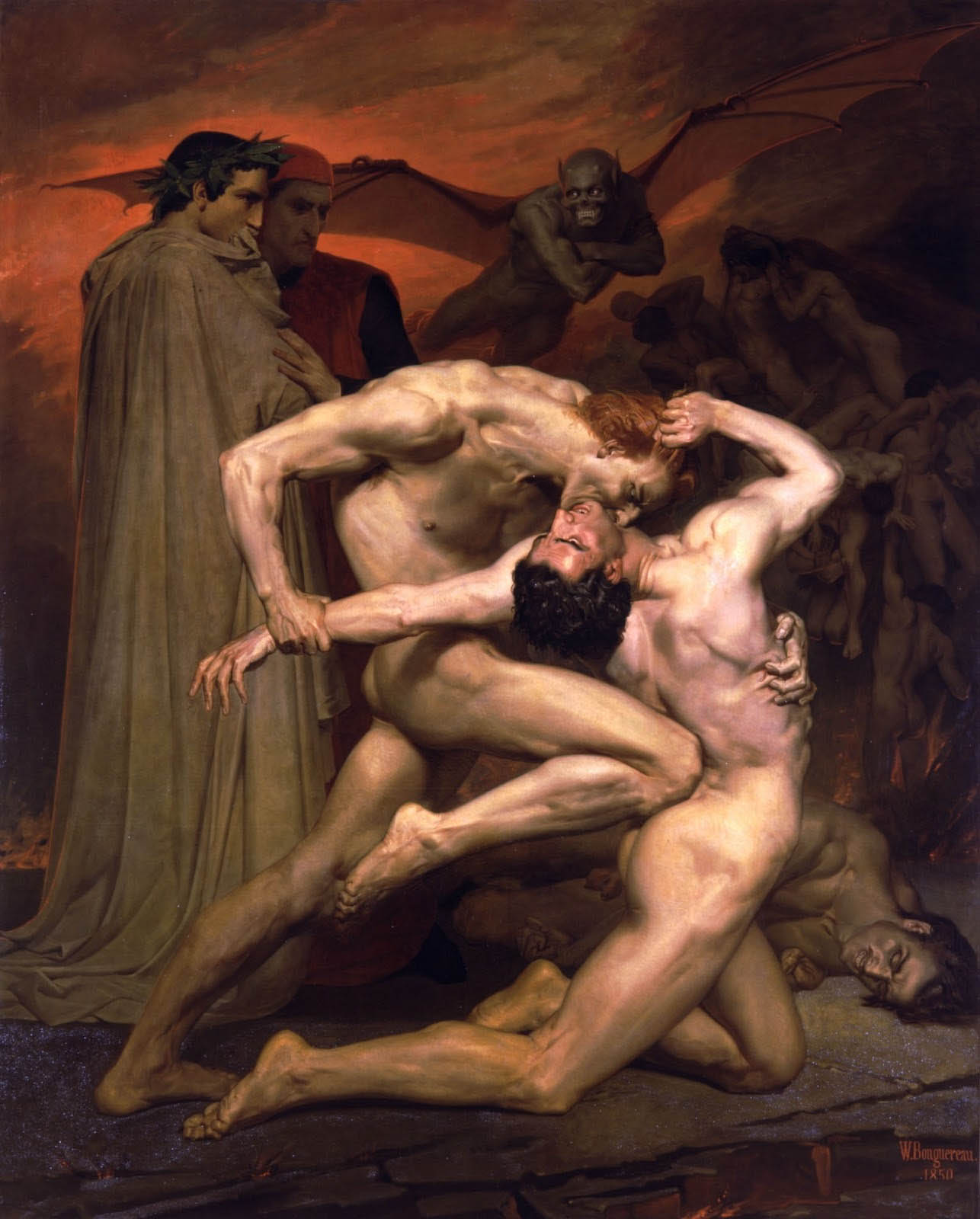
William-Adolphe Bouguereau (French, 1825-1905) 'Dante And Virgil In Hell' 1850


William-Adolphe Bouguereau (French, 1825-1905)
Dante And Virgil In Hell
1850
Oil on canvas
280.5cm (110.4 in) x 225.3cm (88.7 in)
Musée d’Orsay
© Musée d’Orsay, Dist. RMN-Grand Palais / Patrice Schmidt


Arnold Böcklin (Swiss, 1827-1901) 'Villa by the Sea' 1871-1874


Arnold Böcklin (Swiss, 1827-1901)
Villa by the Sea
1871-1874
Oil on canvas
108 x 154cm
Städel Museum, Frankfurt am Main


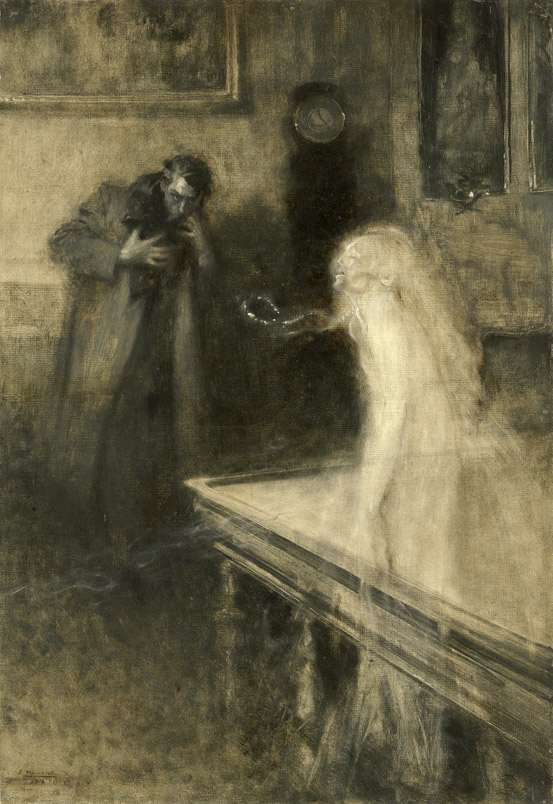
Serafino Macchiati (Italian, 1860-1916) 'Le Visionnaire' (The Visionary) 1904


Serafino Macchiati (Italian, 1860-1916)
Le Visionnaire (The Visionary)
1904
Oil on canvas
55.0 x 38.5cm
Don Serafino Macchiati, 1916
© Musée d’Orsay, Dist. RMN-Grand Palais / Patrice Schmidt


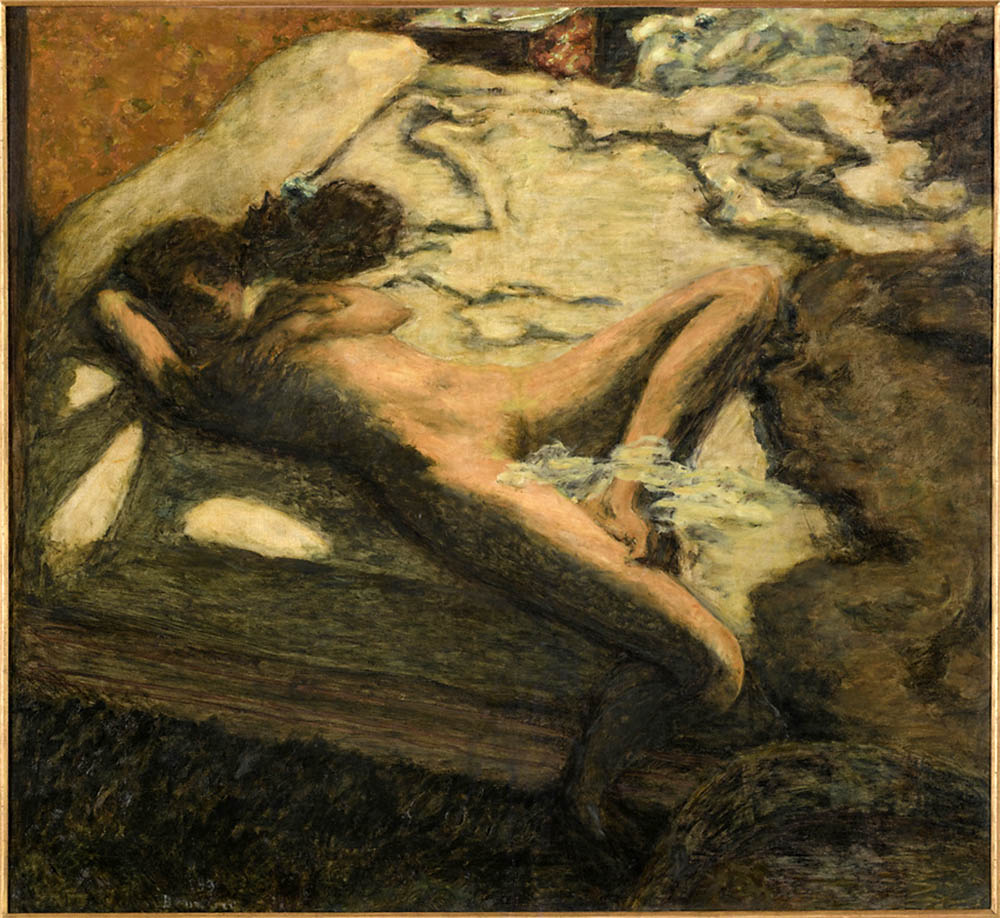
Pierre Bonnard (French, 1867-1945) 'Femme assoupie sur un lit' (Woman sleeping on a bed) 1899


Pierre Bonnard (French, 1867-1945)
Femme assoupie sur un lit (Woman sleeping on a bed)
1899
huile sur toile
96.4 x 105.2cm
Achat en vente publique, 1948
© Musée d’Orsay, Dist. RMN-Grand Palais / Patrice Schmidt


Pierre Bonnard (1867-1947)

A veritable hymn to voluptuousness, The Indolent Woman is a painting which relies on contrasts: the title already clashes with the young woman’s posture. Her body with its tense muscles – the left foot is literally hooked on to the right thigh – belies any idea of rest or laziness. Similarly, the modest gesture of the arm across the breasts is contradicted by the spread thighs. Sinuous lines run throughout the composition, materialised by the dark shadows on the sheets still bearing the undulating line of the bodies and the heavy jumble of the bedclothes. The electric blue “smoke” drifting across the woman’s thigh and ankle and the sumptuous dark hair spread across the bed accentuate the painting’s erotic charge.

This woman spread out for all to see after lovemaking is the epitome of unveiled intimacy, violent, passionate and sombre and, in the end, very “fin de siècle”. We are also struck by the modernity of the composition seen from above, with its monumental bed which seems to tip towards the viewer. The woman’s body, gnawed by shadows, has a tonic vibrant texture which gives it a strong timeless presence.

This is a crucial work in Bonnard’s career because it is one of the first nudes he painted, previously showing little interest in the theme. It can be compared with two other canvases from the same period: Blue Nude from the Kaganovitch collection and Man and Woman.

After seeing this painting, the famous art dealer and publisher Ambroise Vollard asked Bonnard to illustrate a collection of Paul Verlaine’s poetry, Parallèlement, which was published in 1900.

Text from the Musée d’Orsay website


Salvador Dalí (Spanish, 1904-1989) 'Dream caused by the Flight of a Bee around a Pomegranate a Second before Awakening' 1944


Salvador Dalí (Spanish, 1904-1989)
Dream caused by the Flight of a Bee around a Pomegranate a Second before Awakening
1944
Oil on wood
51 x 41cm
Museo Thyssen-Bornemisza, Madrid
© VG Bild-Kunst, Bonn 2012


The Städel Museum’s major special exhibition Dark Romanticism. From Goya to Max Ernst will be on view from September 26th, 2012 until January 20th, 2013. It is the first German exhibition to focus on the dark aspect of Romanticism and its legacy, mainly evident in Symbolism and Surrealism. In the museum’s exhibition house this important exhibition, comprising over 200 paintings, sculptures, graphic works, photographs and films, will present the fascination that many artists felt for the gloomy, the secretive and the evil. Using outstanding works in the museum’s collection on the subject by Francisco de Goya, Eugène Delacroix, Franz von Stuck or Max Ernst as a starting point, the exhibition is also presenting important loans from internationally renowned collections, such as the Musée d’Orsay, the Musée du Louvre, both in Paris, the Museo del Prado in Madrid and the Art Institute of Chicago. The works on display by Goya, Johann Heinrich Fuseli and William Blake, Théodore Géricault and Delacroix, as well as Caspar David Friedrich, convey a Romantic spirit which by the end of the 18th century had taken hold all over Europe. In the 20th century artists such as Salvador Dalí, René Magritte or Paul Klee and Max Ernst continued to think in this vein. The art works speak of loneliness and melancholy, passion and death, of the fascination with horror and the irrationality of dreams. After Frankfurt the exhibition, conceived by the Städel Museum, will travel to the Musée d’Orsay in Paris.

The exhibition’s take on the subject is geographically and chronologically comprehensive, thereby shedding light on the links between different centres of Romanticism, and thus retracing complex iconographic developments of the time. It is conceived to stimulate interest in the sombre aspects of Romanticism and to expand understanding of this movement. Many of the artistic developments and positions presented here emerge from a shattered trust in enlightened and progressive thought, which took hold soon after the French Revolution – initially celebrated as the dawn of a new age – at the end of the 18th century. Bloodstained terror and war brought suffering and eventually caused the social order in large parts of Europe to break down. The disillusionment was as great as the original enthusiasm when the dark aspects of the Enlightenment were revealed in all their harshness. Young literary figures and artists turned to the reverse side of Reason. The horrific, the miraculous and the grotesque challenged the supremacy of the beautiful and the immaculate. The appeal of legends and fairy tales and the fascination with the Middle Ages competed with the ideal of Antiquity. The local countryside became increasingly attractive and was a favoured subject for artists. The bright light of day encountered the fog and mysterious darkness of the night.

The exhibition is divided into seven chapters. It begins with a group of outstanding works by Johann Heinrich Fuseli. The artist had initially studied to be an evangelical preacher in Switzerland. With his painting The Nightmare (Frankfurt Goethe-Museum) he created an icon of dark Romanticism. This work opens the presentation, which extends over two levels of the temporary exhibition space. Fuseli’s contemporaries were deeply disturbed by the presence of the incubus (daemon) and the lecherous horse – elements of popular superstition – enriching a scene set in the present. In addition, the erotic-compulsive and daemonic content, as well as the depressed atmosphere, catered to the needs of the voyeur. The other six works by Fuseli – loans from the Kunsthaus Zürich, the Royal Academy London and the Staatsgalerie Stuttgart – represent the characteristics of his art: the competition between good and evil, suffering and lust, light and darkness. Fuseli’s innovative pictorial language influenced a number of artists – among them William Blake, whose famous water colour The Great Red Dragon from the Brooklyn Museum will be on view in Europe for the first time in ten years.

The second room of the exhibition is dedicated to the Spanish artist Francisco de Goya. The Städel will display six of his works – including masterpieces such as The Witches’ Flight from the Prado in Madrid and the representations of cannibals from Besançon. A large group of works on paper from the Städel’s own collection will be shown, too. The Spaniard blurs the distinction between the real and the imaginary. Perpetrator and victim repeatedly exchange roles. Good and evil, sense and nonsense – much remains enigmatic. Goya’s cryptic pictorial worlds influenced numerous artists in France and Belgium, including Delacroix, Géricault, Victor Hugo and Antoine Wiertz, whose works will be presented in the following room. Atmosphere and passion were more important to these artists than anatomical accuracy.

Among the German artists – who are the focus of the next section of the exhibition – it is Carl Blechen who is especially close to Goya and Delacroix. His paintings are a testimony to his lust for gloom. His soft spot for the controversial author E. T. A. Hoffmann – also known as “Ghost-Hoffmann” in Germany – led Blechen to paint works such as Pater Medardus (Alte Nationalgalerie, Berlin) – a portrait of the mad protagonist in The Devil’s Elixirs. The artist was not alone in Germany when it came to a penchant for dark and disturbing subjects. Caspar David Friedrich’s works, too, contain gruesome elements: cemeteries, open graves, abandoned ruins, ships steered by an invisible hand, lonely gorges and forests are pervasive in his oeuvre. One does not only need to look at the scenes of mourning in the sketchbook at the Kunsthalle Mannheim for the omnipresent theme of death. Friedrich is prominently represented in the exhibition with his paintings Moon Behind Clouds above the Seashore from the Hamburger Kunsthalle and Kügelgen’s Grave from the Lübecker Museums, as well as with one of his last privately owned works, Ship at Deep Sea with full Sails.

Friedrich’s paintings are steeped in oppressive silence. This uncompromising attitude anticipates the ideas of Symbolism, which will be considered in the next chapter of the exhibition. These ‘Neo-Romantics’ stylised speechlessness as the ideal mode of human communication, which would lead to fundamental and seminal insights. Odilon Redon’s masterpiece Closed Eyes, a loan from the Musée d’Orsay in Paris, impressively encapsulates this notion. Paintings by Arnold Böcklin, James Ensor, Fernand Khnopff or Edvard Munch also embody this idea. However, as with the Romantics, these restrained works are face to face with works where anxiety and repressed passions are brought unrestrainedly to the surface; works that are unsettling in their radicalism even today. While Gustave Moreau, Max Klinger, Franz von Stuck and Alfred Kubin belong to the art historical canon, here the exhibition presents artists who are still to be discovered in Germany: Jean-Joseph Carriès, Paul Dardé, Jean Delville, Julien-Adolphe Duvocelle, Léon Frédéric, Eugène Laermans and Lucien Lévy-Dhurmer.
The presentation concludes with the Surrealist movement, founded by André Breton. He inspired artists such as Ernst, Brassaϊ or Dalí, to create their wondrous pictorial realms from the reservoir of the subconscious and celebrated them as fantasy’s victory over the “factual world”. Max Ernst vehemently called for “the borders between the so-called inner and outer world” to be blurred. He demonstrated this most clearly in his forest paintings, four of which have been assembled for this exhibition, one of them the major work Vision Provoked by the Nocturnal Aspect of the Porte Saint-Denis (private collection). The art historian Carl Einstein considered the Surrealists to be the Romantics’ successors and coined the phrase ‘the Romantic generation’. In spite of this historical link the Surrealists were far from retrospective. On the contrary: no other movement was so open to new media; photography and film were seen as equal to traditional media. Alongside literature, film established itself as the main arena for dark Romanticism in the 20th century. This is where evil, the thrill of fear and the lust for horror and gloom found a new home. In cooperation with the Deutsches Filmmuseum the Städel will for the first time present extracts from classics such as Frankenstein (1931), Dracula (1931), Faust (1926), Vampyr (1931-32) and The Phantom Carriage (1921) within an exhibition.

The exhibition, which presents the Romantic as a mindset that prevailed throughout Europe and remained influential beyond the 19th century, is accompanied by a substantial catalogue. As is true for any designation of an epoch, Romanticism too is nothing more than an auxiliary construction, defined less by the exterior characteristics of an artwork than by the inner sentiment of the artist. The term “dark Romanticism” cannot be traced to its origins, but – as is also valid for Romanticism per se – comes from literary studies. The German term is closely linked to the professor of English Studies Mario Praz and his publication La carne, la morte e il diavolo nella letteratura romantica of 1930, which was published in German in 1963 as Liebe, Tod und Teufel. Die schwarze Romantik (literally: Love, Death and Devil. Dark Romanticism).

Press release from the Städel Museum website


Francisco de Goya (Spanish, 1746-1828) 'Witches in the Air' 1797-1798


Francisco de Goya (Spanish, 1746-1828)
Witches in the Air
1797-1798
Oil on canvas
43.5 × 30.5cm (17 1/8 in × 12 in)
Madrid, Museo Nacional del Prado
© Museo Nacional del Prado


Witches’ Flight (Spanish: Vuelo de Brujas, also known as Witches in Flight or Witches in the Air) is an oil-on-canvas painting completed in 1798 by the Spanish painter Francisco Goya. It was part of a series of six paintings related to witchcraft acquired by the Duke and Duchess of Osuna in 1798. It has been described as “the most beautiful and powerful of Goya’s Osuna witch paintings.” …

At center point are three semi-nude witches wearing penitential coroza bearing aloft a writhing nude figure, their mouths close to their victim, as if to devour him or suck his blood. Below, two figures in peasants’ garb recoil from the spectacle: one has thrown himself to the ground covering his ears, the other attempts to escape by covering himself with a blanket, making the fig hand gesture to ward off the evil eye. Finally, a donkey emerges on the right, seemingly oblivious to the rest of the scene.

The general scholarly consensus is that the painting represents a rationalist critique of superstition and ignorance, particularly in religious matters: the witches’ corozas are not only emblematic of the violence of the Spanish Inquisition (the upward flames indicate that they have been condemned as unrepentant heretics and will be burned at the stake), but are also reminiscent of episcopal mitres, bearing the characteristic double points. The accusations of religious tribunals are thus reflected back on themselves, whose actions are implicitly equated with superstition and ritualised sacrifice. The bystanders can then be understood either as appalled but unable to do anything or wilfully ignorant and unwilling to intervene.

The donkey, finally, is the traditional symbol of ignorance.

Text from the Wikipedia website


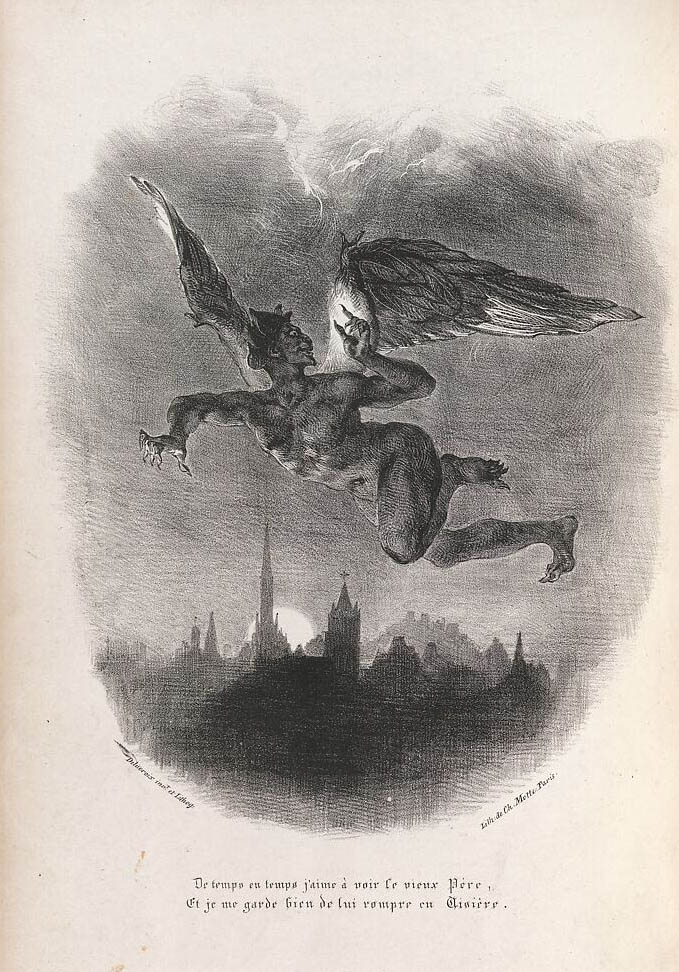
Eugène Delacroix (French, 1798-1863) 'Mephistopheles in the air, illustration from Goethe's Faust' 1828


Eugène Delacroix (French, 1798-1863)
Mephistopheles in the air, illustration for from Goethe’s Faust
1828
Lithograph
Frankfurt am Main, Städel Museum
© All rights reserved


Francisco de Goya (Spanish, 1746-1828) 'Flying Folly (Disparate Volante)' 1816-1819


Francisco de Goya (Spanish, 1746-1828)
Flying Folly (Disparate Volante)
from “The proverbs (Los proverbios)”, plate 5, 1816-1819, 1
Edition, 1864
Etching and aquatint
21.7 x 32.6cm
Städel Museum, Frankfurt am Main


“I am not afraid of witches, goblins, apparitions, boastful giants, evil spirits, leprechauns, etc., nor of any other kind of creatures except human beings.”


Francisco Goya


An enthusiastic champion of Enlightenment values, Goya was also on close terms with the progressive nobility, but his doubts and disillusionment increased as the French Revolution was succeeded by the Terror, and Europe was torn apart by warring armies.

The deceptively clear distinction between enlightenment and obscurantism was now supplanted by the vision of a new, grey, frightening and uncertain world, in which no sharp line could be drawn between good and evil, reality and fantasy, reason and absurdity, the beliefs of the past and the revolutionary fervour of the present.

But instead of living in the past or doing nothing, Goya swapped his court painter’s brush for the etcher’s unsparing needle. Black in all its shades was the keynote of the many series of engravings he now produced on freely chosen themes, with only the Inquisition’s censors to contend with.

The Caprices, a series produced at the end of the 18th century, reflects his amazement and exasperation at the imaginative wealth of Spanish popular culture, steeped in the superstition, fanaticism and ignorance promoted by the Jesuits.

Ten years later, the atrocities which marked the war against Napoleon inspired The Disasters of War – a cry of outrage and horror at the barbaric excesses of the “Grande Nation” and the terrifying emptiness of a world with no God or morality.

Anonymous. “The Angel of the Odd. Dark Romanticism from Goya to Max Ernst,” on the Musée D’Orsay website Nd [Online] Cited 12/08/2024


Louis Candide Boulanger (French, 1806-1867) 'Les Fantômes' 1829


Louis Candide Boulanger (French, 1806-1867)
Les Fantômes
1829
Oil on canvas
Maison de Victor Hugo


Carl Blechen (German, 1798-1840) 'Scaffold in Storm' 1834


Carl Blechen (German, 1798-1840)
Scaffold in Storm
1834
Oil on canvas and on board
29.5cm (11.6 in) x 46cm (18.1 in)
Galerie Neue Meister


Carl Eduard Ferdinand Blechen (29 July 1798 – 23 July 1840) was a German landscape painter and a professor at the Academy of Arts, Berlin. His distinctive style was characteristic of the Romantic ideals of natural beauty.


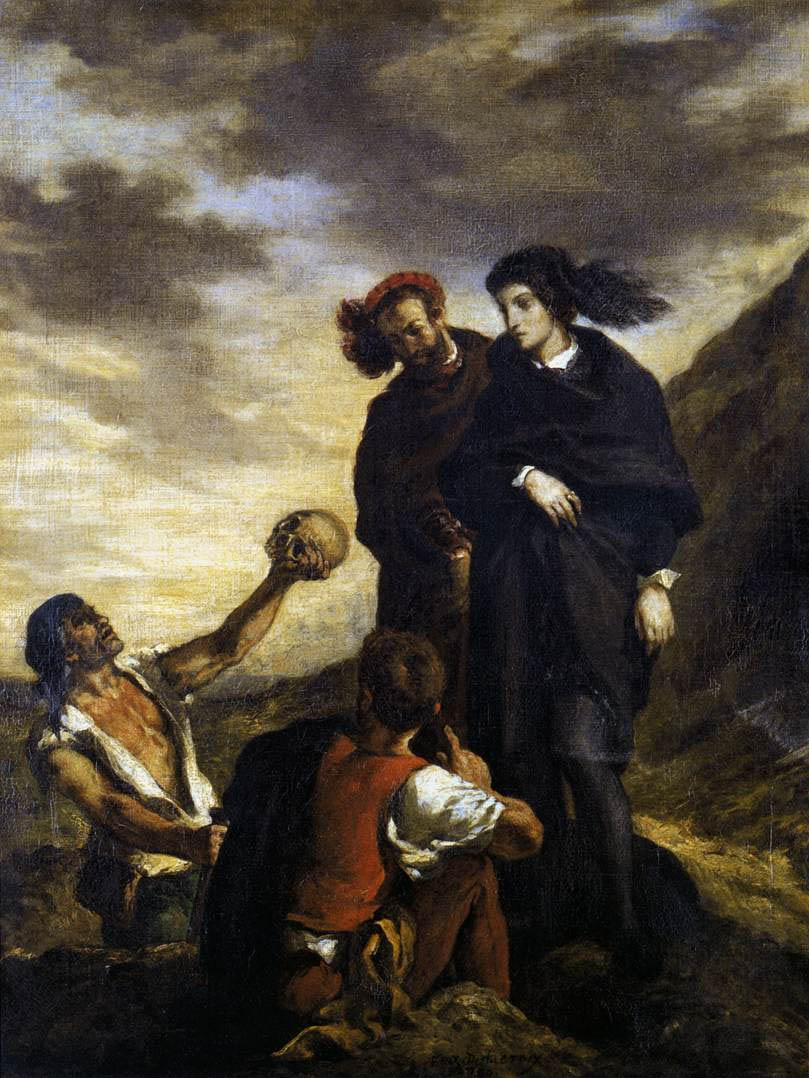
Eugène Delacroix (French, 1798-1863) 'Hamlet and Horatio in the Graveyard' 1839


Eugène Delacroix (French, 1798-1863)
Hamlet and Horatio in the Graveyard
1839
Oil on canvas
29.5cm (11.6 in) x 36cm (14.1 in)
Louvre Museum


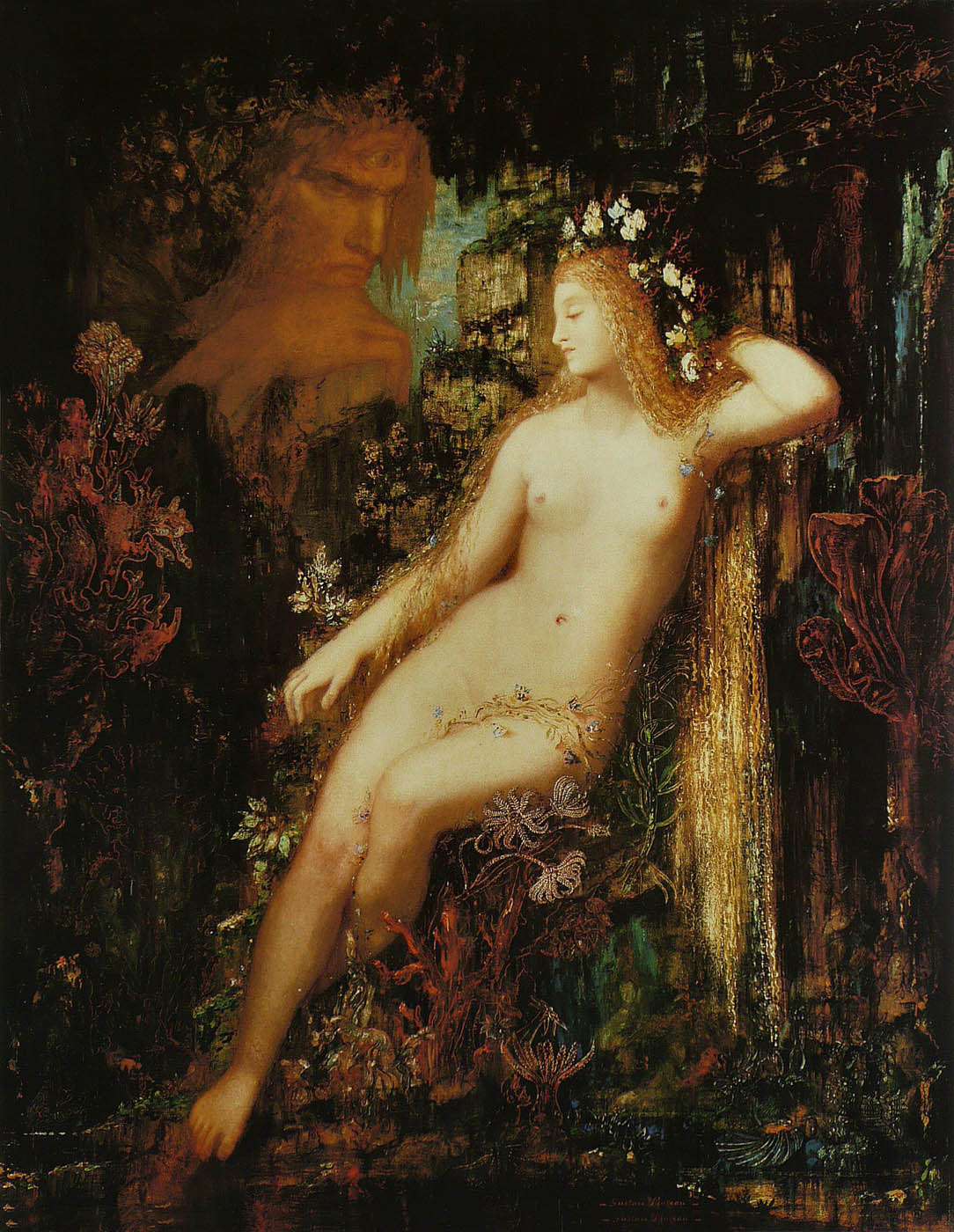
Gustave Moreau (French, 1826-1898) 'Galatea' c. 1880


Gustave Moreau (French, 1826-1898)
Galatea
c. 1880
Oil on panel
85.5cm (33.6 in) x 66cm (25.9 in)
Musée d’Orsay


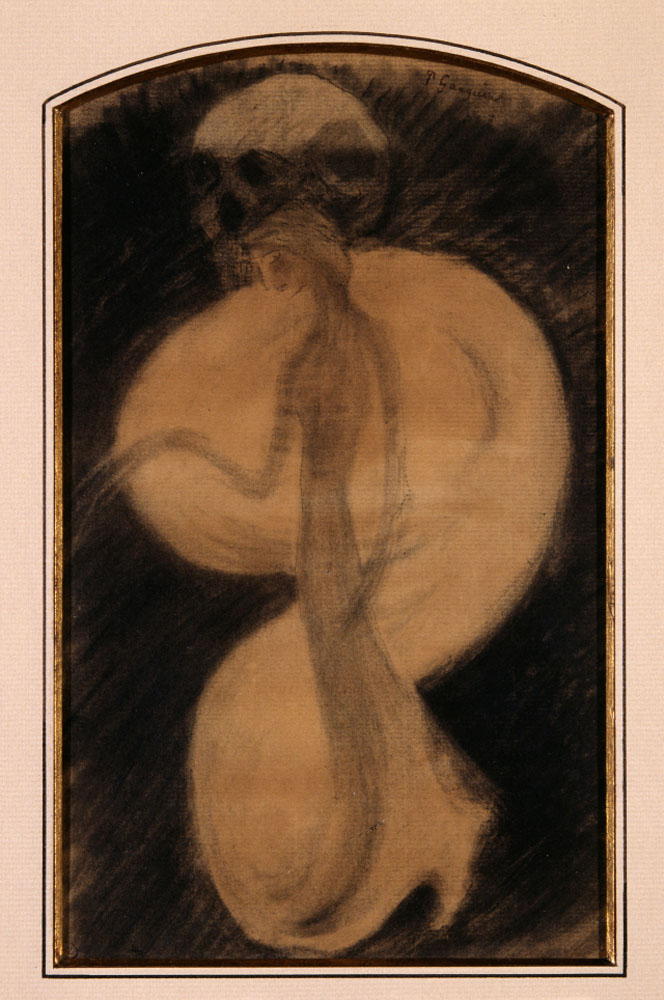
Paul Gauguin (French, 1848-1903) 'Madame la Mort' 1890-1891


Paul Gauguin (French, 1848-1903)
Madame la Mort
1890-1891
Charcoal on paper with wash highlights
33,5 x 23cm
Don de la société des Amis du musée d’Orsay, 1991
© RMN-Grand Palais (Musée d’Orsay) / Gérard Blot


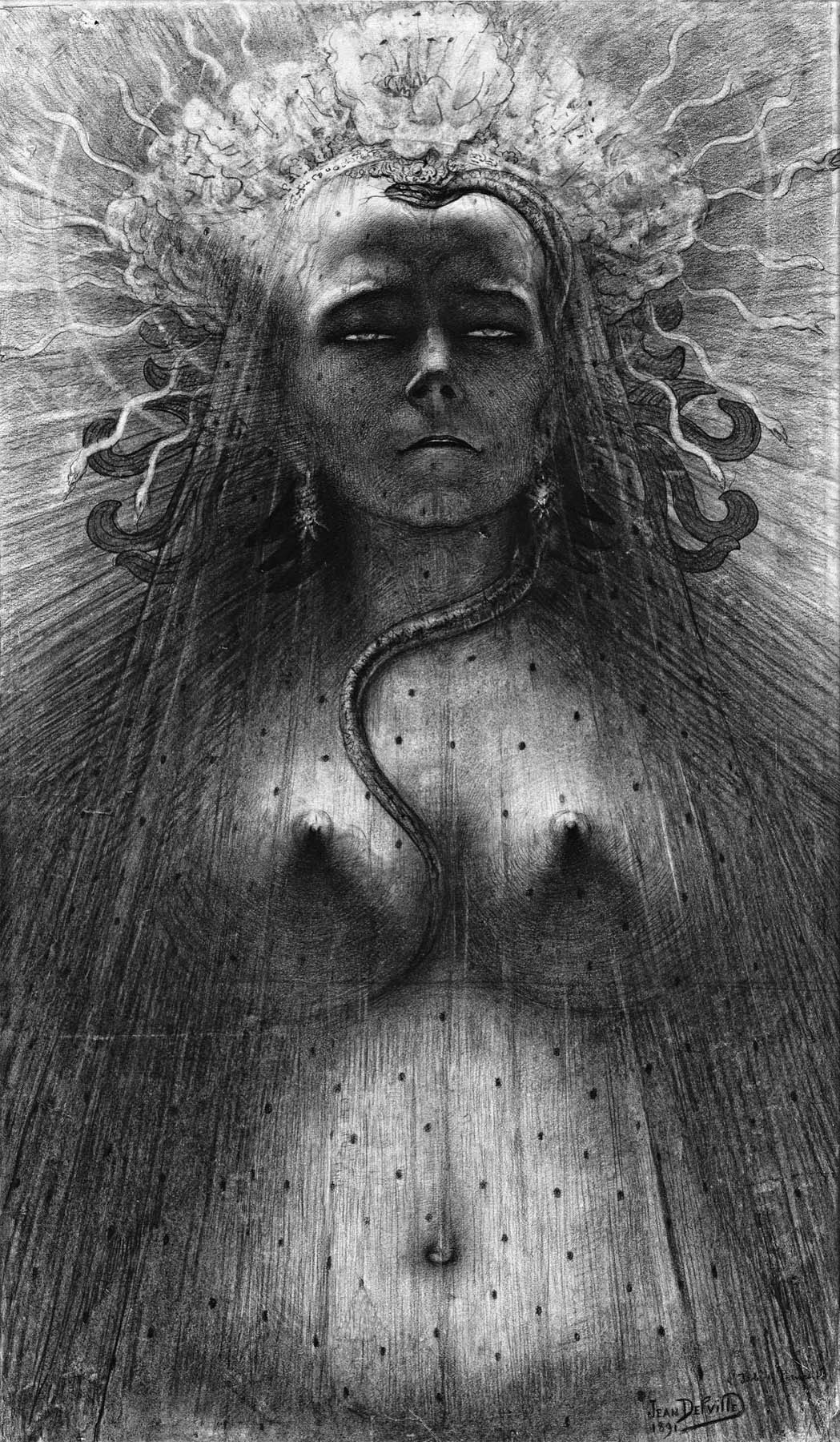
Jean Delville (Belgium, 1867-1953) 'L'Idole de la Perversité' (The Idol of Perversity) 1891


Jean Delville (Belgium, 1867-1953)
L’Idole de la Perversité (The Idol of Perversity)
1891
81.5 x 48.5cm
Museum Wiesbaden, Collection Ferdinand Wolfgang Neess


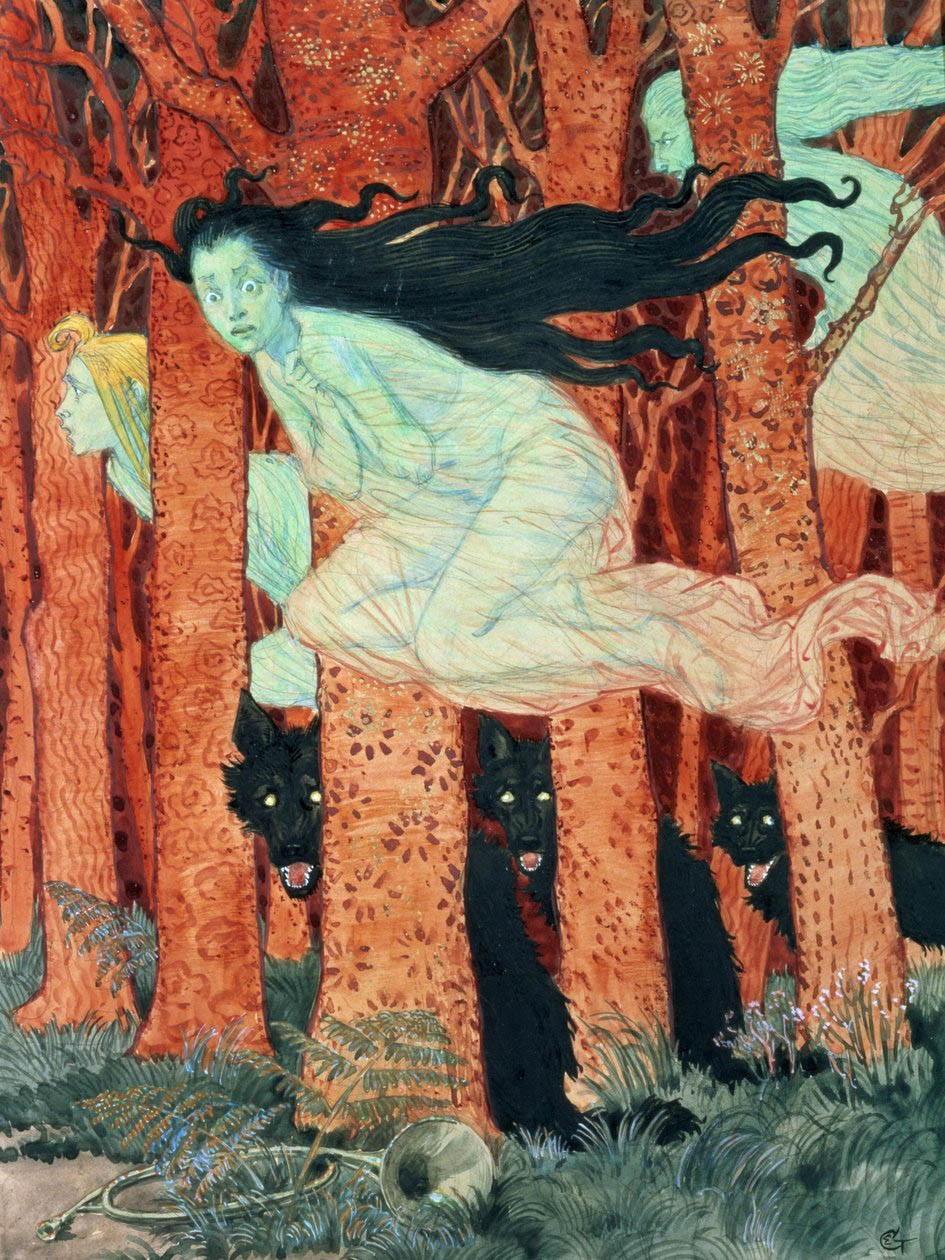
Eugène Grasset (French, 1845-1917) 'Trois Femmes et Trois Loups' 1892


Eugène Grasset (French, 1845-1917)
Trois Femmes et Trois Loups
1892
Pencil, watercolour, Indian ink and gold highlights on paper
35.3 x 27.3cm
Musée des Arts Décoratifs, Paris


Franz von Stuck (German, 1863-1928) 'Le Péché' (Die Sünde) (The Sin) 1893


Franz von Stuck (German, 1863-1928)
Le Péché (Die Sünde) (The Sin)
1893
Zurich, galerie Katharina Büttiker
© Galerie Katharina Büttiker, Zürich


Franz Stuck (German, 1863-1928) 'The Kiss of the Sphinx' (Le Baiser du Sphinx) (Der Kuss der Sphinx) 1895


Franz Stuck (German, 1863-1928)
The Kiss of the Sphinx (Le Baiser du Sphinx) (Der Kuss der Sphinx)
1895
Collection particulière
© Droits réservés


Franz Ritter von Stuck (February 23, 1863 – August 30, 1928), born Franz Stuck, was a German painter, sculptor, printmaker, and architect. Stuck was best known for his paintings of ancient mythology, receiving substantial critical acclaim with The Sin in 1892. In 1906, Stuck was awarded the Order of Merit of the Bavarian Crown and was henceforth known as Ritter von Stuck.


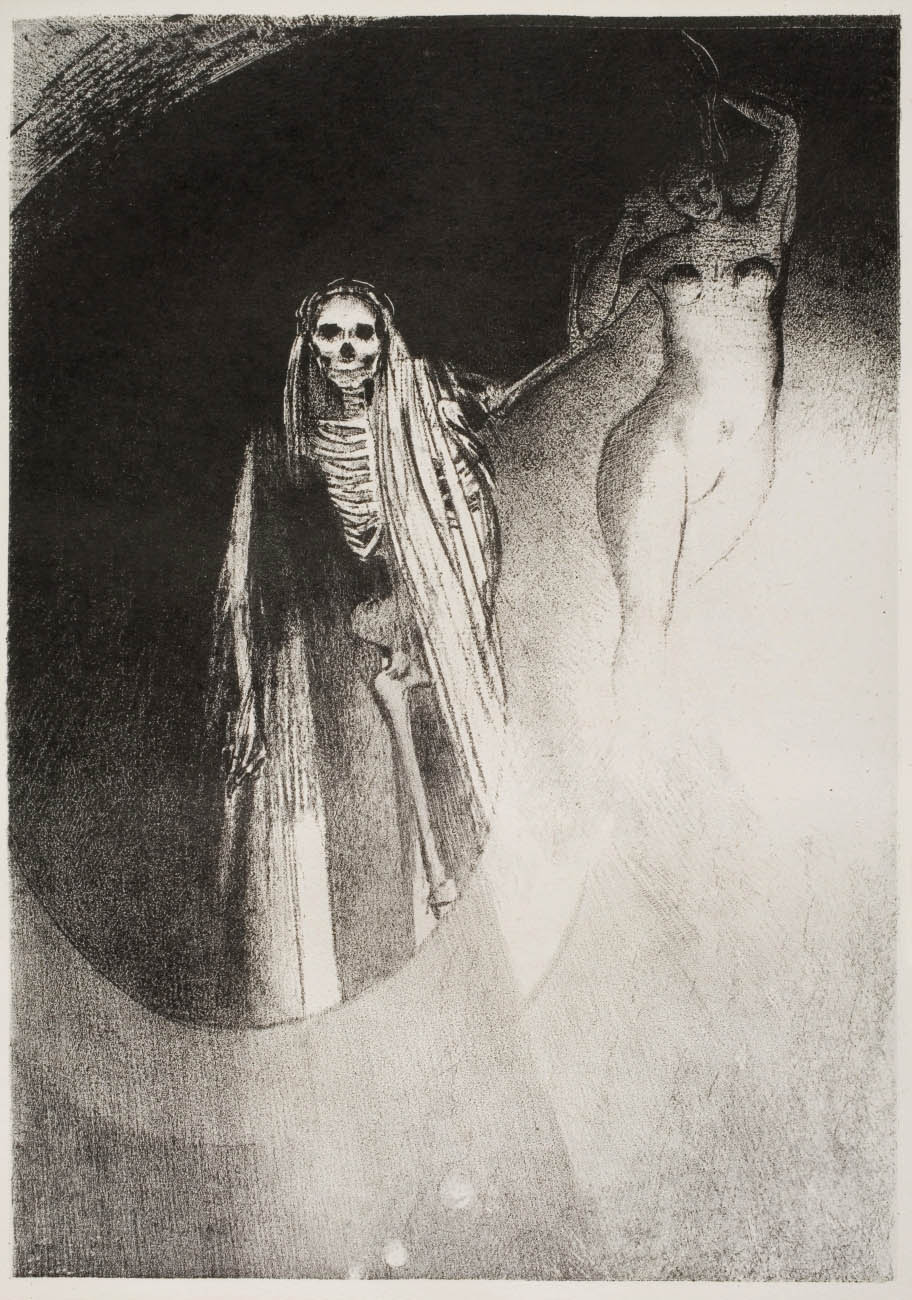
Odilon Redon (French, 1840-1916) 'La Mort: C'est moi qui te rends sérieuse: Enlaçons-nous' (Death: It is I who Makes You Serious; Let Us Embrace) 1896


Odilon Redon (French, 1840-1916)
La Mort: C’est moi qui te rends sérieuse: Enlaçons-nous (Death: It is I who Makes You Serious; Let Us Embrace)
1896
Plate 20 from the series “La Tentation de Saint-Antoine” (The Temptation of Saint Anthony)
Lithograph
Sheet: 17 1/8 in. x 13 in. (43.5 x 33cm)


La Mort: C’est moi qui te rends sérieuse: Enlaçons-nous is one of twenty-four prints by the French artist Odilon Redon (1840-1916) that illustrated Flaubert’s play Temptation of Saint Anthony, a lesser-known work of the literary giant but one that Flaubert laboured on painstakingly throughout his life. A contemporary to Flaubert, Redon had worked in lithography for about two decades when the final version of Temptation of Saint Anthony was published. Already working with a repertoire of dark and absurd subjects, Redon was drawn to the grotesque characters described by Flaubert and wrote fondly of the play, calling it “a literary marvel and a mine for me.”

La Mort depicts a scene in the play where Death and Lust, disguised respectively as an emaciated old woman and a fair young one, reveal their real likenesses after failed attempts to seduce Saint Anthony:

The winding-sheet flies open, and reveals the skeleton of Death. The robe bursts open, and presents to view the entire body of Lust, which has a slender figure, with an enormous development behind, and great, undulating masses of hair, disappearing towards the end.

Death tries to lead Saint Anthony to step into the abyss under the cliff and take his own life, thereby ending all pain. “It is I who make you serious, let us embrace each other,” she says, telling Saint Anthony that, by destroying himself, a work of God, he will become God’s equal.

Redon’s accomplished use of chiaroscuro, the sharp contrast between light and dark, underscores the dramatic nature of this moment. Death’s winding-sheet is enveloped by the dazzling rays of light radiating from the voluptuous body of Lust, and Lust’s hair vanishes into the darkness that seeps through Death;s skeletal body. Although the appearance of Lust differs greatly from that of Death, the overlap of their bodies suggests that they are but different phantoms created by the Devil.

Ningyi Xi. “Odilon Redon,” on the Davis Museum website 2017 [Online] Cited 11/08/2024


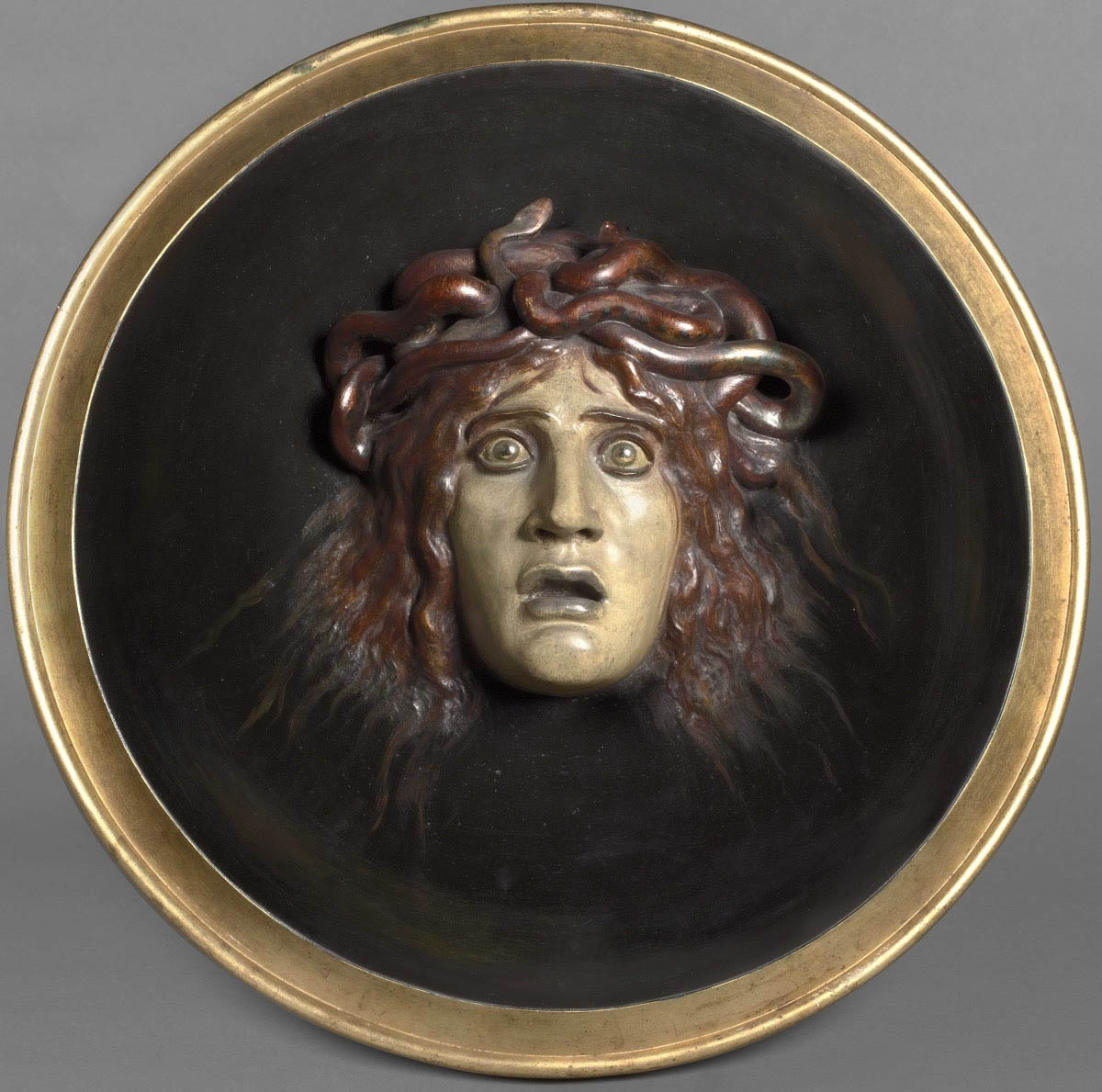
Arnold Böcklin (Swiss, 1827-1901) 'Shield with Gorgon's head' (Bouclier avec le visage de Méduse) 1897


Arnold Böcklin (Swiss, 1827-1901)
Shield with Gorgon’s head (Bouclier avec le visage de Méduse)
1897
Papier-mâché
610 x 610cm
© RMN (Musée d’Orsay) / Hervé Lewandowski


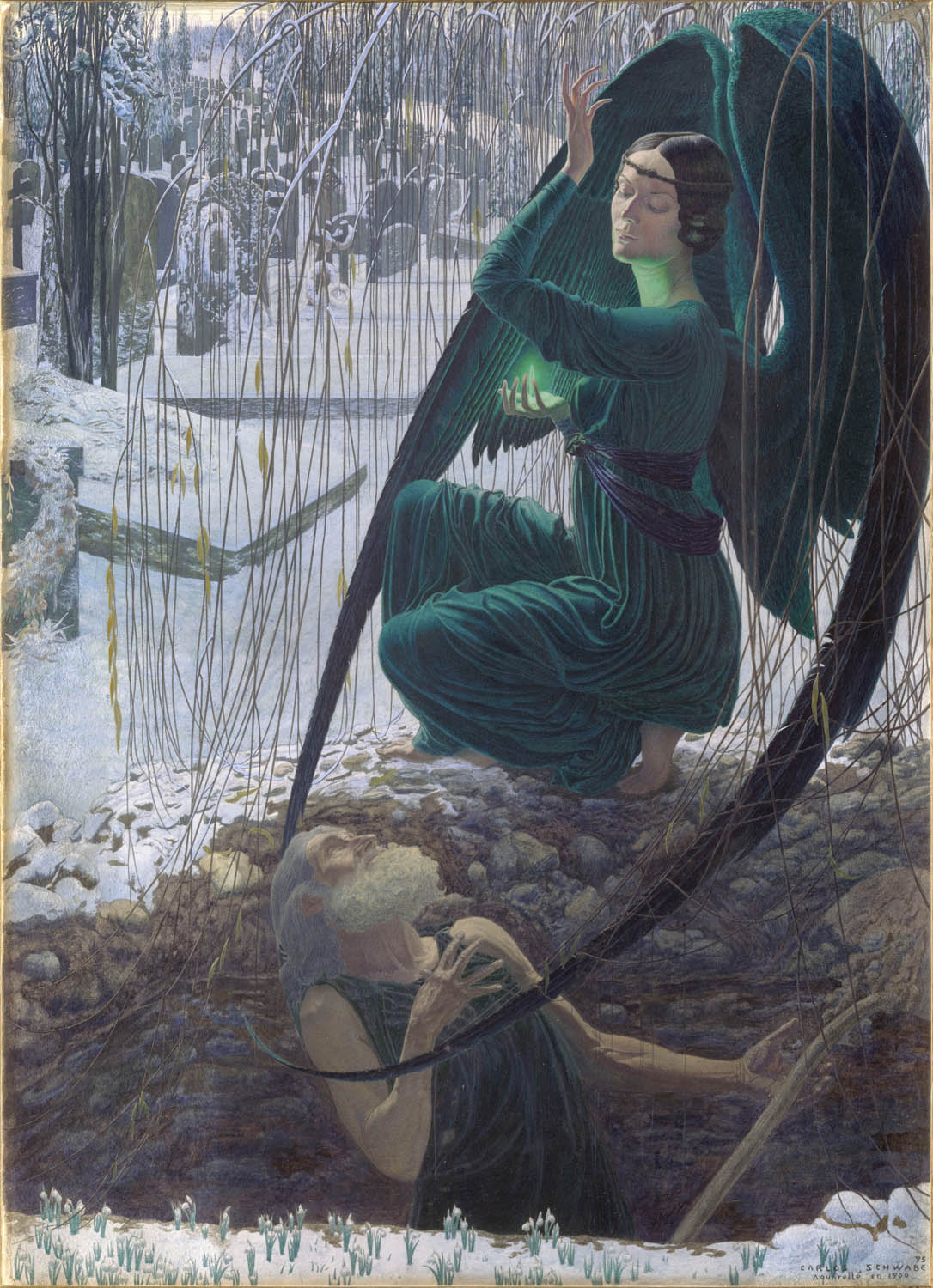
Carlos Schwabe (Swiss, 1866-1926) 'La Mort et le fossoyeur' (Death and the Gravedigger) 1900


Carlos Schwabe (Swiss, 1866-1926)
La Mort et le fossoyeur (Death and the Gravedigger)
1900
Paris, musée d’Orsay, conservé au département des Arts Graphiques du musée du Louvre
Legs Michonis, 1902
© RMN (Musée d’Orsay) / Jean-Gilles Berizzi / Patrice Schmidt


Julien Adolphe Duvocelle (French, 1873-1961) 'Crâne aux yeux exorbités et mains agrippées à un mur' (Skull with bulging eyes and hands gripping a wall) 1902


Julien Adolphe Duvocelle (French, 1873-1961)
Crâne aux yeux exorbités et mains agrippées à un mur (Skull with bulging eyes and hands gripping a wall)
1902
Pencil and charcoal mounted on a sheet blackened with charcoal
Paris, musée d’Orsay, conservé au département des Arts Graphiques du musée du Louvre
Don de Mme Fourier en souvenir de son fils, 1995
© DR – RMN-Grand Palais (Musée d’Orsay) / Jean-Gilles Berizzi


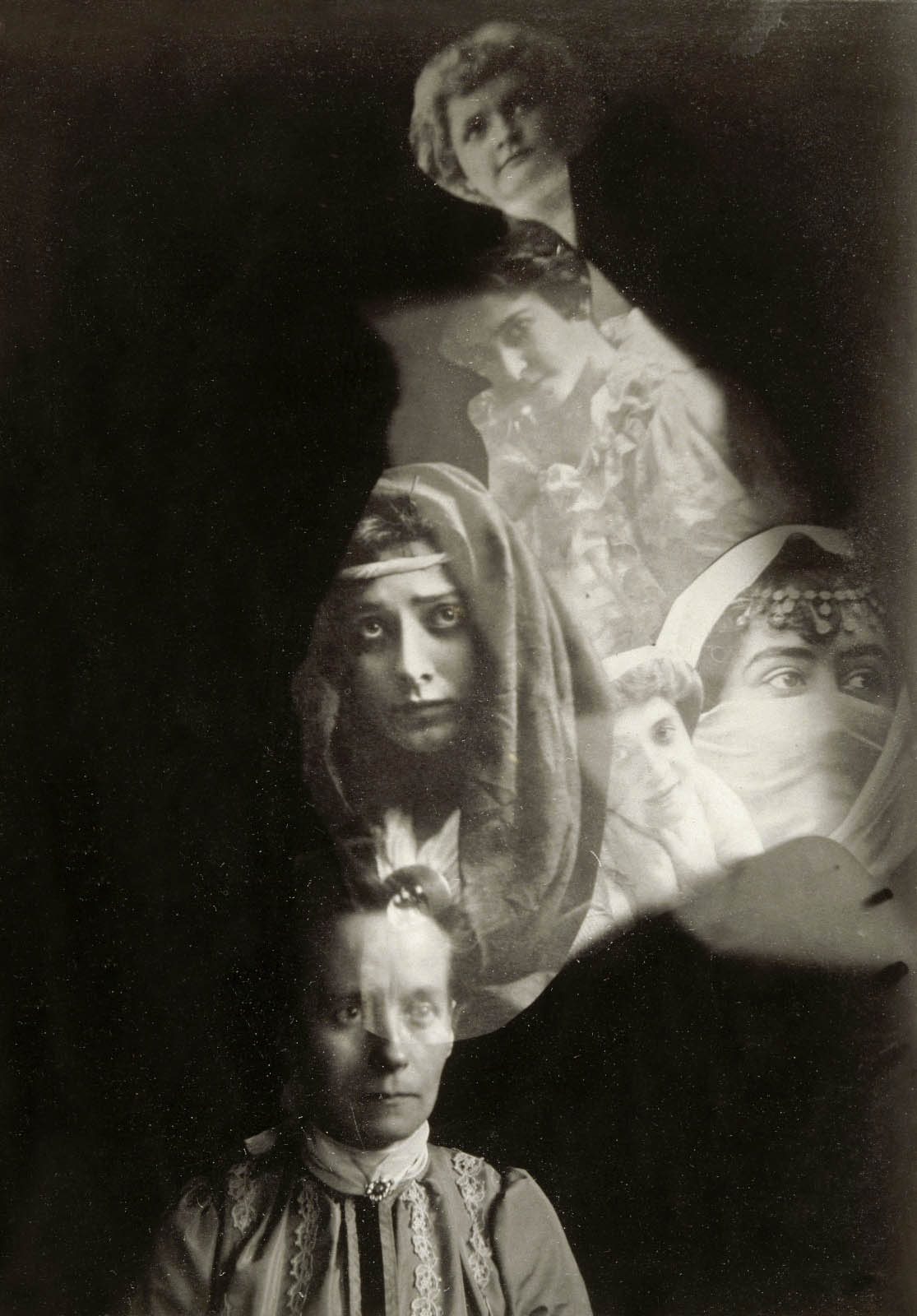
Anonymous photographer. 'Photographie spirite (médium et spectres)' / Spiritual photography (medium and ghosts) c. 1910


Anonymous photographer
Photographie spirite (médium et spectres) / Spiritual photography (medium and ghosts)
c. 1910
Musée d’Orsay
© RMN-Grand Palais (Musée d’Orsay) / Hervé Lewandowski / DR


Paul Dardé (French, 1888-1963) 'Eternelle douleur' (Eternal Pain)
1913


Paul Dardé (French, 1888-1963)
Eternelle douleur (Eternal Pain)
1913
Plaster, direct carving
50cm
Musée de Lodève


Paul Dardé created Eternal Pain at 25, even though he had only just finished his year of training. Having gone through the Paris National School of Beaux-Arts and Rodin’s workshop, it is probably his journey to Italy and his mythological reading which fixed the theme of the Medusa in the mind of the artist. Carved from a block of plaster gleaned on the heights of Lodève, the piece would be exhibited seven years later side by side with the great Faun, at the Salon of French artists in 1920.

Text from the Musée de Lodève website


Edvard Munch (Norwegian, 1863-1944) 'Vampire' 1916-1918


Edvard Munch (Norwegian, 1863-1944)
Vampire
1916-1918
Oil on canvas
85 x 110cm
Collection Würth
Photo: Archiv Würth
© VG Bild-Kunst, Bonn 2012


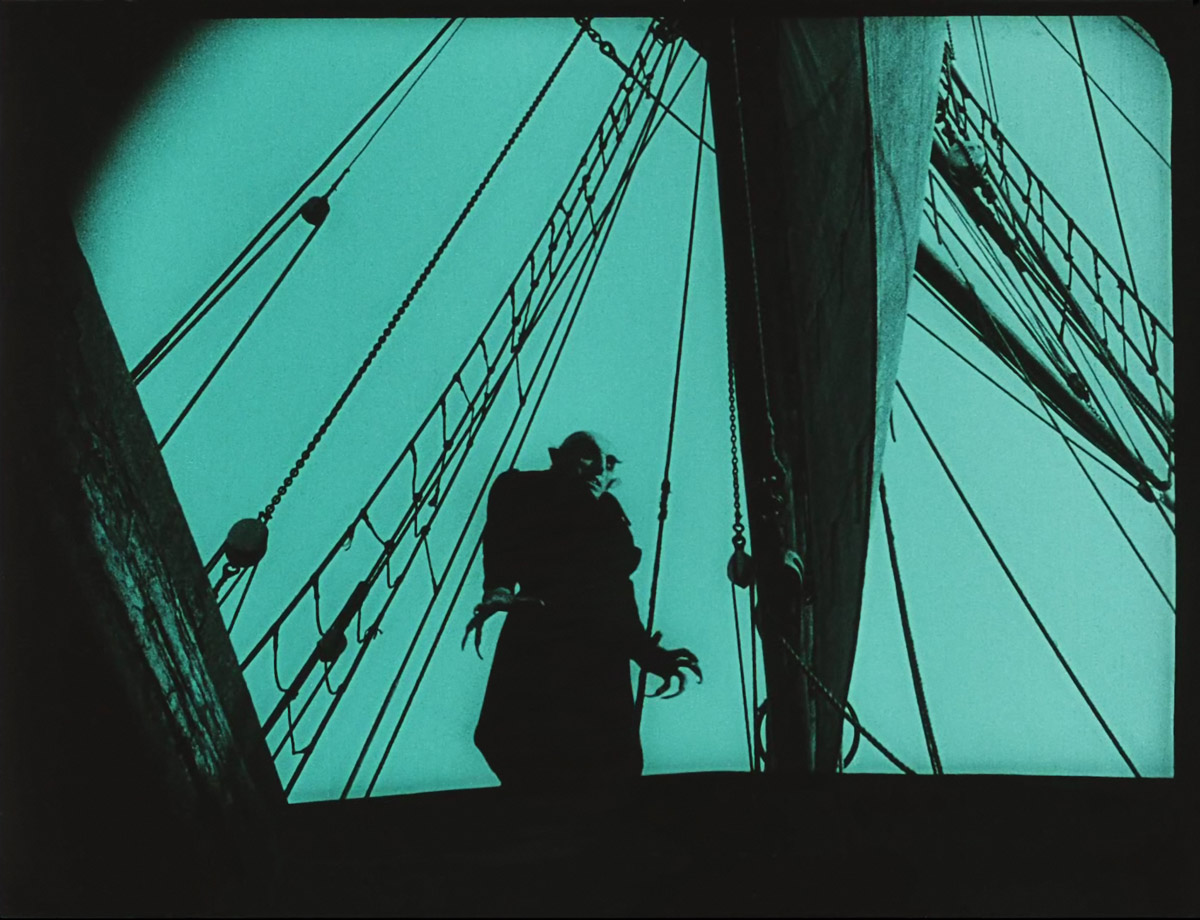
Friedrich Wilhelm Murnau (German, 1888-1931) 'Nosferatu – A Symphony of Horror' Germany 1922


Friedrich Wilhelm Murnau (German, 1888-1931)
Nosferatu – A Symphony of Horror
Germany 1922
Filmstill
Silent film
© Friedrich-Wilhelm-Murnau-Stiftung


Roger Parry (French, 1905-1977) 'Untitled' 1929


Roger Parry (French, 1905-1977)
Untitled
1929
Illustration from Léon-Paul Fargue’s “Banalité” (Paris 1930)
Gelatin silver print
21.8 x 16.5cm
Collection Dietmar Siegert
© VG Bild-Kunst, Bonn 2012


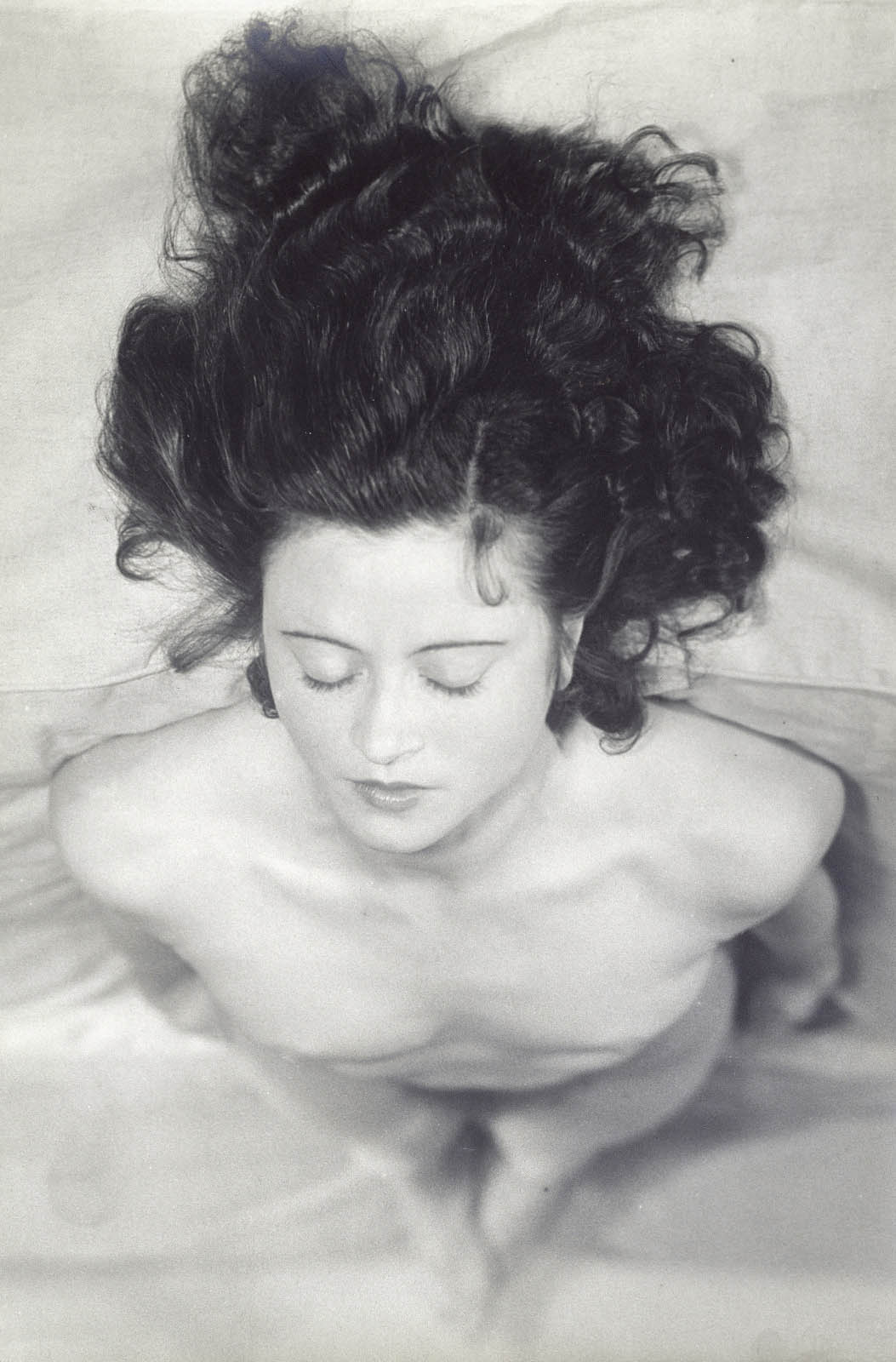
Jacques-André Boiffard (French, 1902-1961) 'Renée Jacobi' 1930


Jacques-André Boiffard (French, 1902-1961)
Renée Jacobi
1930
Paris, Centre Pompidou, musée national d’Art moderne, Centre de création industrielle
© Centre Pompidou, MNAM-CCI, dist. RMN-Grand Palais
Image: Centre Pompidou MNAM-CCI © Mme Denise Boiffard


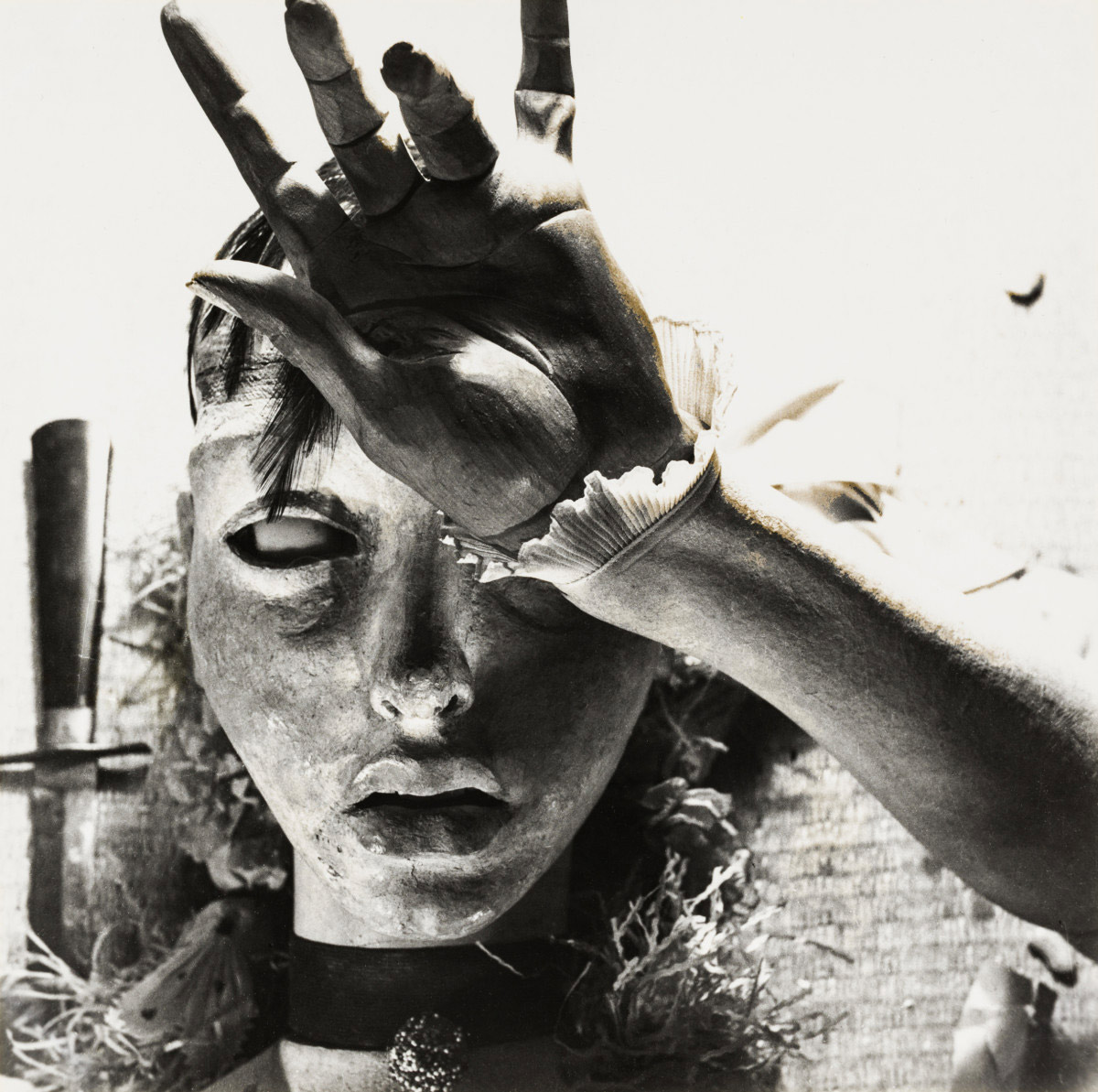
Hans Bellmer. 'La Poupée (tête et couteau)' / The Doll (head and knife) 1935


Hans Bellmer (German, 1902-1975)
La Poupée (tête et couteau) / The Doll (head and knife)
1935
Collection Dietmar Siegert
© ADAGP, Paris


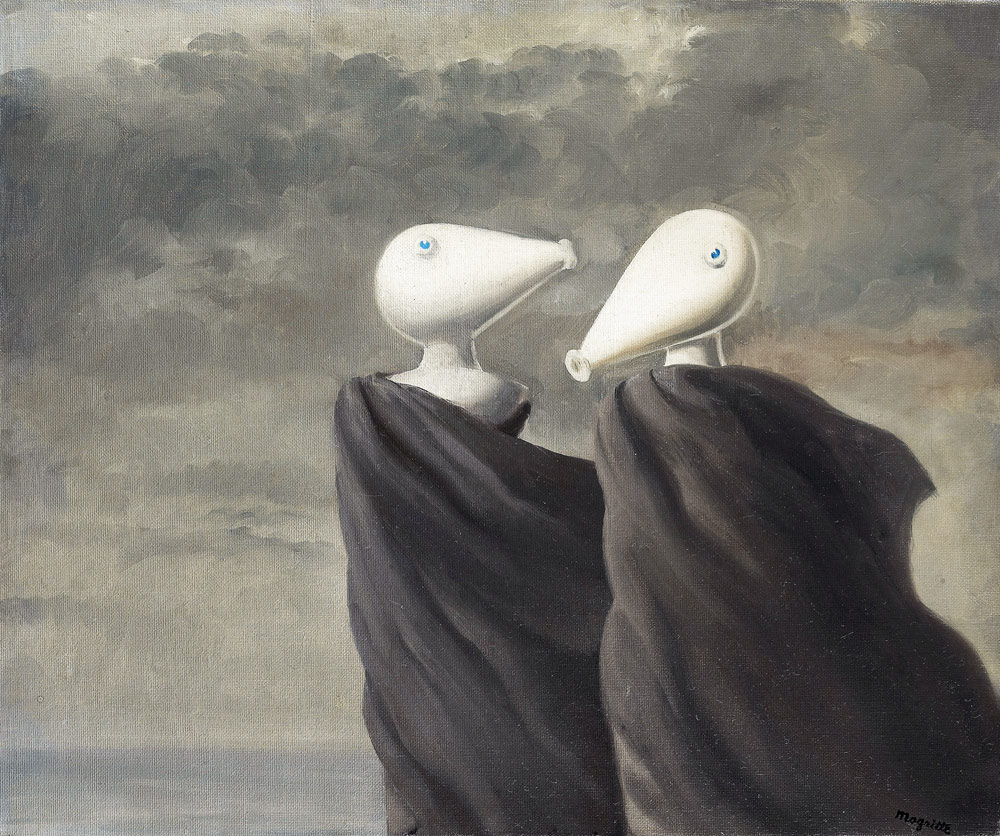
René Magritte (Belgian, 1898-1967) 'Sentimental Conversation' 1945


René Magritte (Belgian, 1898-1967)
Sentimental Conversation
1945
Oil on canvas
54 x 65cm
Private Collection
© VG Bild-Kunst, Bonn 2012


Städelsches Kunstinstitut und Städtische Galerie
Schaumainkai 63, 60596 Frankfurt
Phone: +49(0)69-605098-170

Opening hours:
Tuesday – Wednesday, Friday – Sunday 10 – 18 h
Thursday 10 – 21 h
Monday closed

Städel Museum website

LIKE ART BLART ON FACEBOOK

Back to top