
Review: ‘The Feast of Trimalchio’ by AES+F at Anna Schwartz Gallery, Melbourne

Exhibition dates: 7th October – 23rd October 2010
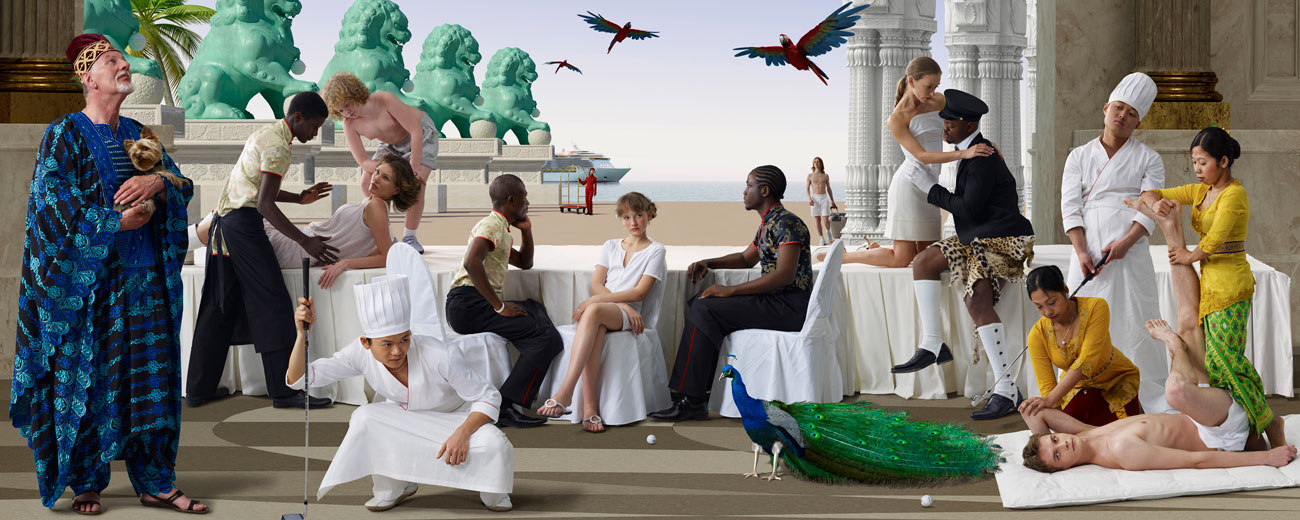
 

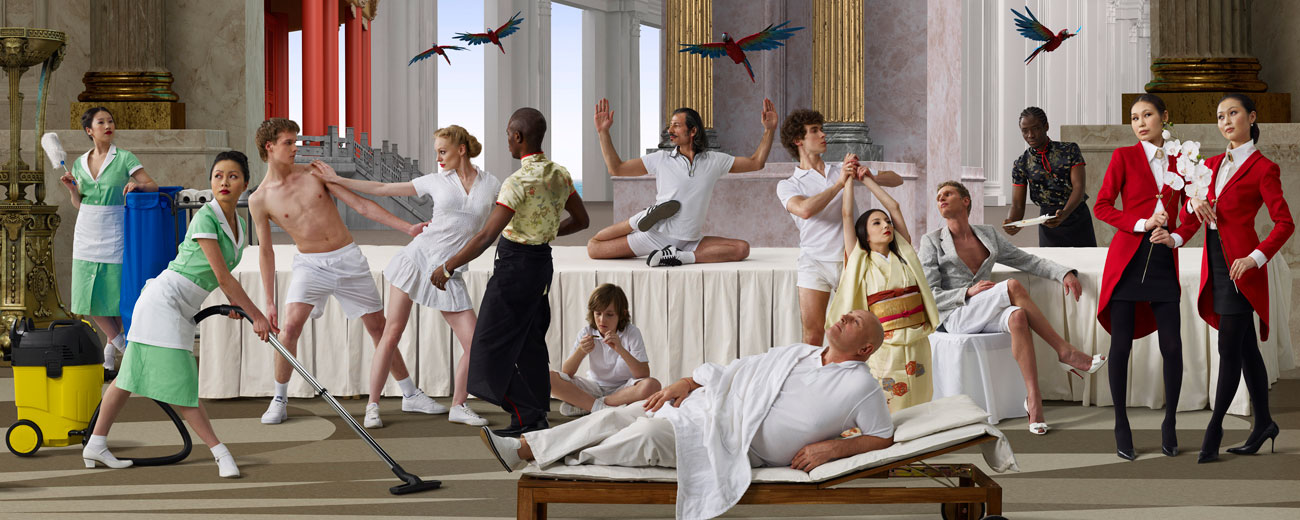
AES+F. 'The Feast of Trimalchio Panorama #1' 2009


AES+F
The Feast of Trimalchio Panorama #1
2009


Searching for identity like mould spore taking root

In one sense these large panoramic, digitally constructed mis en scene photographs by Russian collective AES+F at Anna Schwartz Gallery, (taken from the “celebrated” video of the same name which debuted at the Venice Biennale in 2009) are mere echoes of the lyrical, dance and fugue-like structures of the moving work.

In another sense they work well as still photographs. The balance inherent within the picture frame is exemplary, the use of colour and the feeling of rhythm and flow of the figures in pictorial space, wonderful. This rhythm can be called the physiognomy of the work, its style.1 In these photographs style is hard to miss and the photographs fulfil what Susan Sontag saw as one of the main prerequisites for good art: that of emotional distance from lived reality, that allows us to the look at the work dispassionately before bringing those observations back into the real world:

“All works of art are founded on a certain distance from the lived reality which is represented. This “distance” is, by definition, inhuman or impersonal to a certain degree; for in order to appear to us as art, the work must restrict sentimental intervention and emotional participation, which are functions of “closeness.” It is the degree and manipulating of this distance, the conventions of distance, which constitute the style of the work … But the notion of distance (and of dehumanisation, as well) is misleading, unless one adds that the movement is not just away from but toward the world.”2

.
In these photographs we have a pastiche of cultural attitudes and mores that allows us to reflect on the foibles, paradoxes, consumerism and stereotypes of identity formation of the contemporary world, mixed with a healthy serving of voyeurism. As Javier Panera notes, “AES+F’s work is nurtured from moral and cultural paradoxes: seduction and threat; hyperrealism and artificiality; classicism and contemporaneity; spirituality and sensuality; historicism and the end of history,”3 and they construct a new oligarchy within a dystopic, Arcadian world. Variously, we have masters and servants, oriental and neoclassical architecture, haute couture, lesbianism, adoration, a youth dressed in white falling out of a priests robes (or is a kimono?) onto an altar-like table, savages and beasts, homoerotic encounters and many more besides – all constructed in an imagined world of a temporary hotel performing rituals of leisure and pleasure, an orgiastic but chaste imagining in this world, looking back at lived reality.

And for me there is the problem. While the photographs offer this vision of temptation and delight in the end they just reinforce the basis of belief in the status quo, the power of cultural hegemony. Subversion as an act, a decorative performance imbued with titillation. As Marco Fusinato observed, using a quotation from an anarchist website in a work in his latest exhibition at Anna Schwartz Gallery (and the irony does not escape me, far from it!):

“The artist is also the mainstay of a whole social milieu – called a “scene” – which allows him to exist and which he keeps alive. A very special ecosystem: agents, press attachés, art directors, marketing agents, critics, collectors, patrons, art gallery managers, cultural mediators, consumers… birds of prey sponge off artists in the joyous horror of showbiz. A scene with its codes, norms, outcasts, favourites, ministry, exploiters and exploited, profiteers and admirers. A scene which has the monopoly on good taste, exerting aesthetic terrorism upon all that which is not profitable, or upon all that which doesn’t come from a very specific mentality within which subversion must only be superficial, of course at the risk of subverting.”4

.
The subversion of these images is superficial, a surface appearance of insurrection.

Despite protestations to the contrary (an appeal on the AES+F website to the idea of the Roman saturnalia, see text below) – where the masters serve the slaves at a dinner once a year, this reversal was only ever superficial at best: “the reversal of the social order was mostly superficial; the banquet, for example, would often be prepared by the slaves, and they would prepare their masters’ dinner as well. It was license within careful boundaries; it reversed the social order without subverting it.”5

It was a license within careful boundaries.
It reversed the social order without subverting


The same can be said of these wonderful, colourful, rhythmic, chaste, trite, in vogue, pale imitations of subversion. The images come from a very specific mentality within which subversion must only be superficial because they are, after all, images that are searching for an identity in order to access and survive in the Western art world.

ex nihilo nihil fit (Nothing comes of nothing) and please, don’t bite the hand that feeds you.

Dr Marcus Bunyan


1/ Sontag, Susan. “On Style,” in Against Interpretation and Other Essays. New York: Delta Book, 1966, pp. 30-31

2/ Ibid.,

3/ Panera, Panera. “AES+F’s The  Feast of Trimalchio,” on FlashArtonline.com [Online] Cited 17/10/2010. No longer available online

4/ Anon. “Escapism has its price The artist has his income,” on Non Fides website Wednesday 17 September 2008 [Online] Cited 28/12/2019. No longer available online

5/ Anon. “Saturnalia,” on Wikipedia website [Online] Cited 28/12/2019


    Many thankx to The Melbourne International Arts Festival and Anna Schwartz Gallery for allowing me to publish the photographs in the posting.

    Viewers: please click on the photographs for a larger version of the image as it is essential to see the freeze frame action, what is actually going on within the images. All images courtesy the artists and Anna Schwartz Gallery, Melbourne & Sydney.


    AES+F The Feast of Trimalchio – part 1, 2 and 3
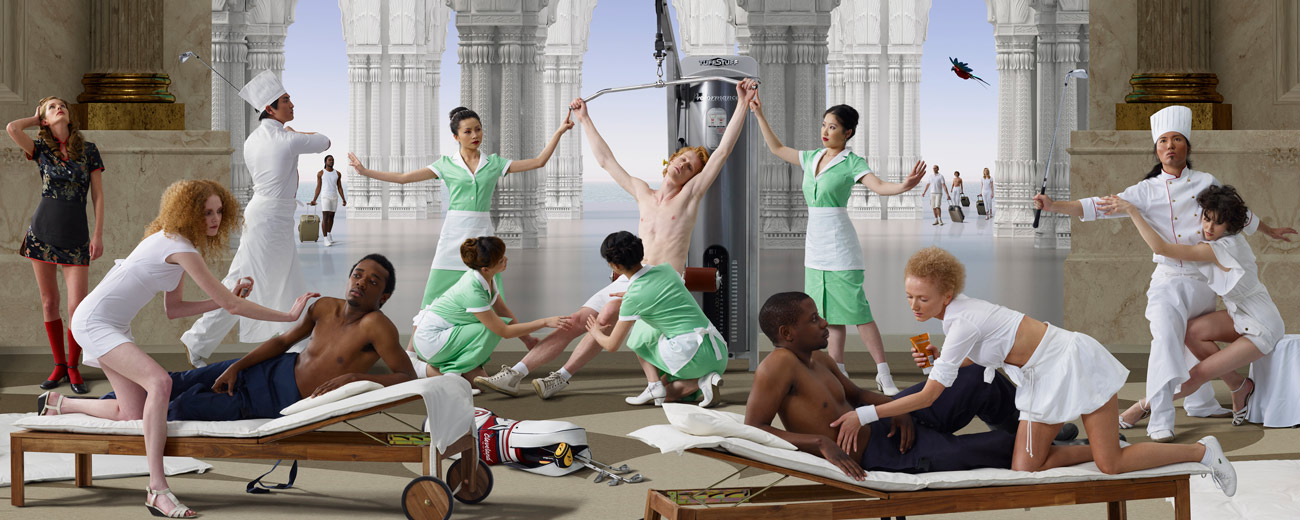
     

    AES+F. 'The Feast of Trimalchio Panorama #2' 2009


    AES+F
    The Feast of Trimalchio Panorama #2
    2009
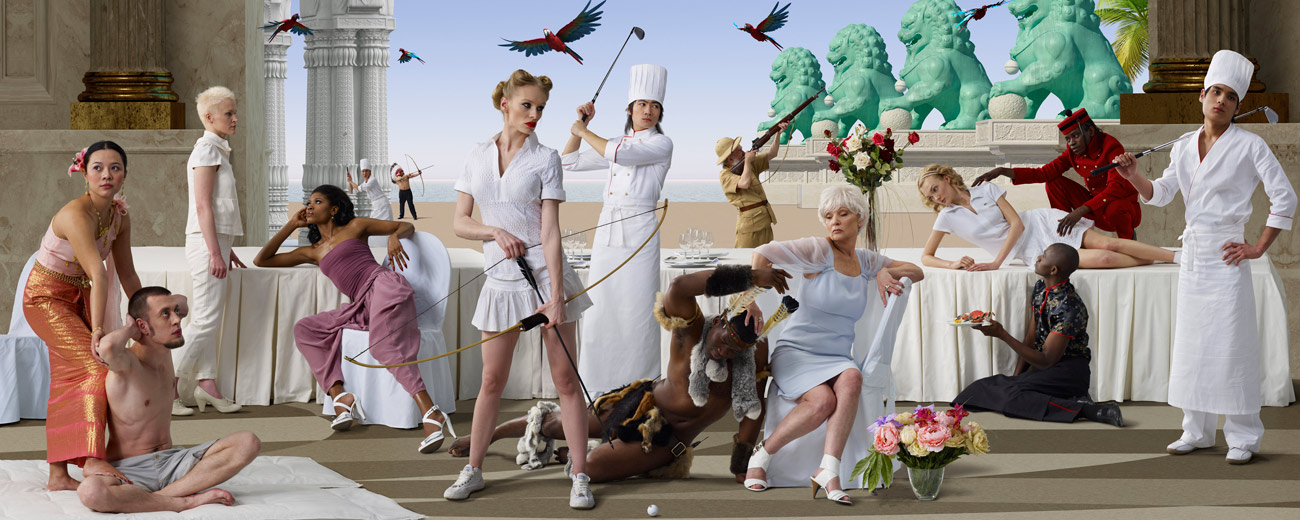
     

    AES+F. 'The Feast of Trimalchio Panorama #3' 2009


    AES+F
    The Feast of Trimalchio Panorama #3
    2009
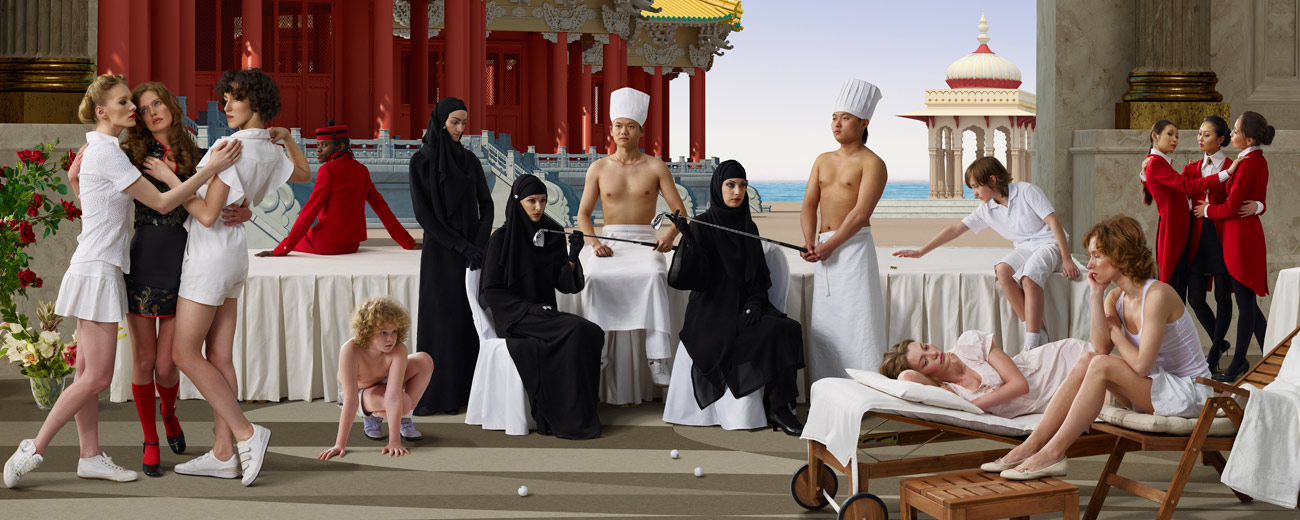
     

    AES+F. 'The Feast of Trimalchio Panorama #4' 2009


    AES+F
    The Feast of Trimalchio Panorama #4
    2009
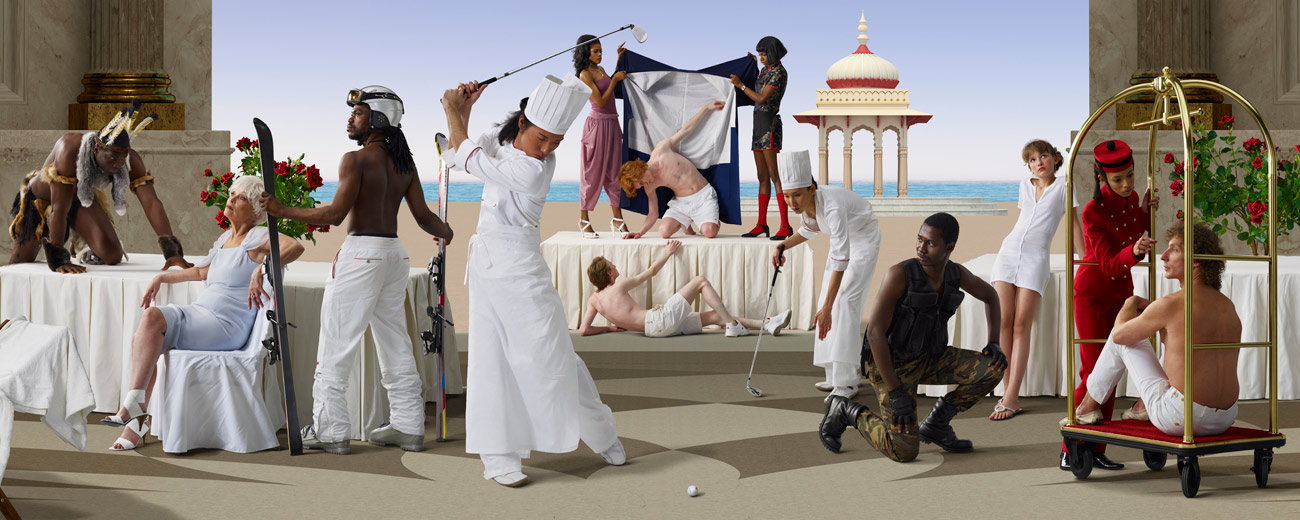
     

    AES+F. 'The Feast of Trimalchio Panorama #5' 2009


    AES+F
    The Feast of Trimalchio Panorama #5
    2009


    In the Satyricon, the work of the great wit and melancholic lyric poet of Nero’s reign, Gaius Petronius Arbiter, the best preserved part is The Feast of Trimalchio (Cena Trimalchionis). Thanks to Petronius’s fantasy, Trimalchio’s name became synonymous with wealth and luxury, with gluttony and with unbridled pleasure in contrast to the brevity of human existence.

    We searched for an analogue in the third millennium and Trimalchio, the former slave, the nouveau riche host of feasts lasting several days, appeared to us not so much as an individual as a collective image of a luxurious hotel, a temporary paradise which one has to pay to enter.

    The hotel guests, the ‘masters’, are from the land of the Golden Billion. They’re keen to spend their time, regardless of the season, as guests of the present-day Trimalchio, who has created the most exotic and luxurious hotel possible. The hotel miraculously combines a tropical coastline with a ski resort. The ‘masters’ wear white which calls to mind the uniform of the righteous in the Garden of Eden, or traditional colonial dress, or a summer fashion collection. The ‘masters’ possess all of the characteristics of the human race – they are all ages and types and from all social backgrounds. Here is the university professor, the broker, the society beauty, the intellectual. Trimalchio’s ‘servants’ are young, attractive representatives of all continents who work in the vast hospitality industry as housekeeping staff, waiters, chefs, gardeners, security guards and masseurs. They are dressed in traditional uniforms with an ethnic twist. The ‘servants’ resemble the brightly-coloured angels of a Garden of Eden to which the ‘masters’ are only temporarily admitted.

    On one hand the atmosphere of The Feast of Trimalchio can be seen as bringing together the hotel rituals of leisure and pleasure (massage and golf, the pool and surfing). On the other hand the ‘servants’ are more than attentive service-providers. They are participants in an orgy, bringing to life any fantasy of the ‘masters’, from gastronomic to erotic. At times the ‘masters’ unexpectedly end up in the role of ‘servants’. Both become participants in an orgiastic gala reception, a dinner in the style of Roman saturnalia when slaves, dressed as patricians, reclined at table and their masters, dressed in slaves’ tunics, served them.

    Every so often the delights of The Feast of Trimalchio are spoiled by catastrophes which encroach on the Global Paradise…

    AES+F, 2009
    Translated by Ruth Addison

    Text from the AES+F website [Online] Cited 28/12/2019
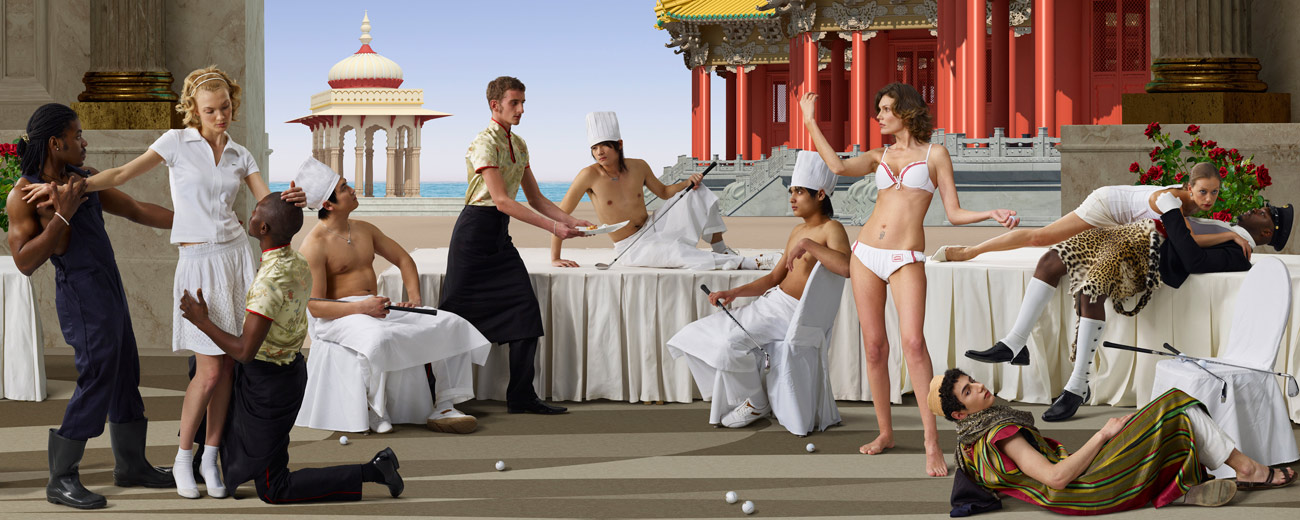
     

    AES+F. 'The Feast of Trimalchio Panorama #6' 2009


    AES+F
    The Feast of Trimalchio Panorama #6
    2009
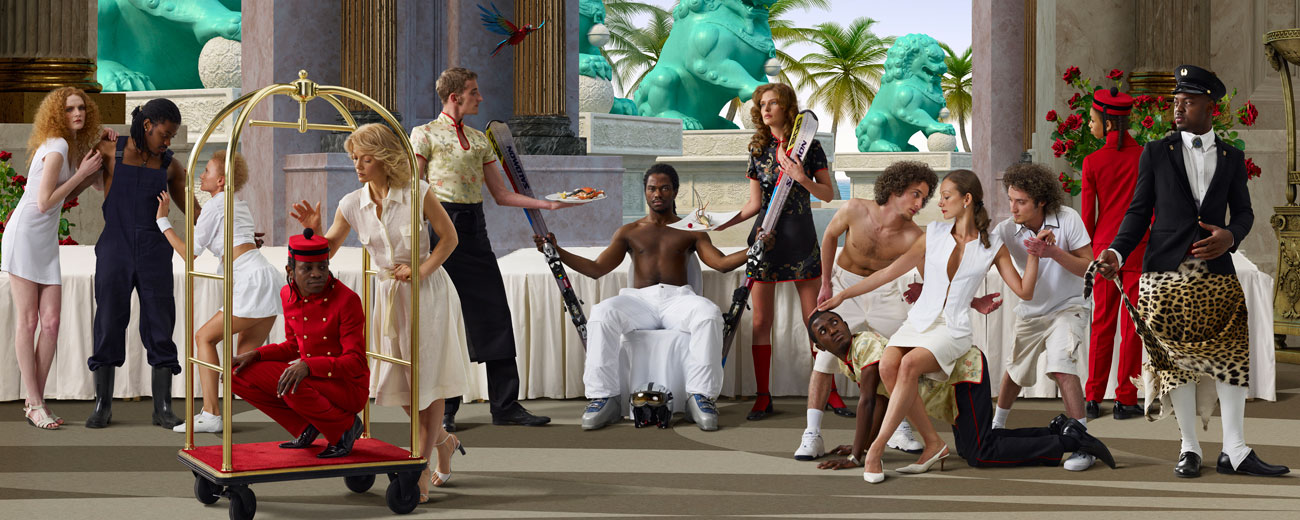
     

    AES+F. 'The Feast of Trimalchio Panorama #7' 2009


    AES+F
    The Feast of Trimalchio Panorama #7
    2009


    Russian collective AES+F work with photography, video, sculpture and mixed media. Since 1987, they have interwoven imagery relating to modern technology, Hollywood cinema, fashion photography, advertising, death, religion, the British Royal Family, mass media, popular culture and youth obsession throughout their work.

    The Feast of Trimalchio is an interpretation of the witty but melancholy fiction Satyricon by the Roman poet Petronius. In the ancient version Trimalchio’s feast was portrayed as the ideal celebration that Trimalchio imagined for his own funeral. In the AES+F 21st Century version, an orgy of consumerism reflects on the contemporary state of Russia and indeed the world. Created from over 75,000 photographs, the complete work is a nine-channel panoramic media that made its celebrated debut at the 2009 Venice Biennale. For the Festival, Anna Schwartz Gallery features a set of three expansive photographic tableaux. These captivating images of a temporary hotel paradise portray opulence and excess overshadowed by a dark uneasiness.

    Text from the Melbourne International Arts Festival website
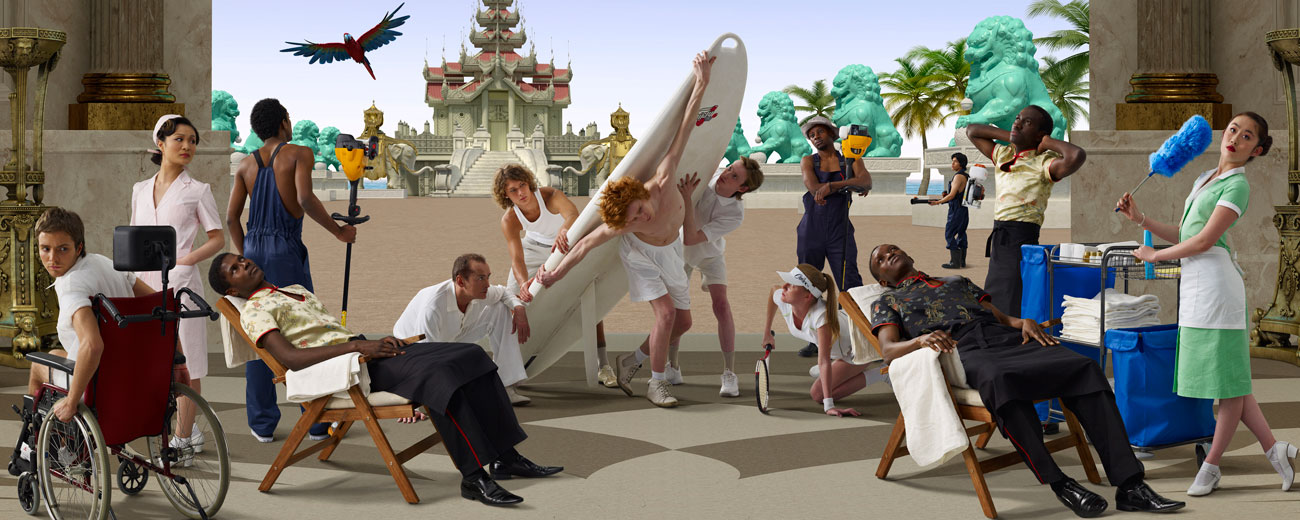
     

    AES+F. 'The Feast of Trimalchio Panorama #8' 2009


    AES+F
    The Feast of Trimalchio Panorama #8
    2009
     

    AES+F. 'The Feast of Trimalchio Panorama #9' 2009


    AES+F
    The Feast of Trimalchio Panorama #9
    2009


    Anna Schwartz Gallery
    185 Flinders Lane
    Melbourne, Victoria 3000

    Opening hours:
    Tuesday – Friday 12 – 5pm
    Saturday 1 – 5pm

    Anna Schwartz Gallery website

    LIKE ART BLART ON FACEBOOK

    Back to top

    Review: ‘Mari Funaki: Objects’ at the Ian Potter Centre: NGV Australia, Melbourne

    Exhibition dates: 6th August – 24th October 2010


    Mari Funaki (born Japan 1950, arrived Australia 1979, died 2010) 'Object' 2008 from the exhibition 'Mari Funaki: Objects' at the Ian Potter Centre: NGV Australia, Melbourne, Aug - Oct 2010


    Mari Funaki (born Japan 1950, arrived Australia 1979, died 2010)
    Object
    2008
    Heat-coloured mild steel
    20.0 x 28.0 x 5.0cm
    Collection of Raphy Star, Melbourne
    © The Estate of Mari Funaki


    Mari Funaki (born Japan 1950, arrived Australia 1979, died 2010) 'Container' 2008 from the exhibition 'Mari Funaki: Objects' at the Ian Potter Centre: NGV Australia, Melbourne, Aug - Oct 2010


    Mari Funaki (born Japan 1950, arrived Australia 1979, died 2010)
    Container
    2008
    heat-coloured mild steel
    (a–c) 21.3 x 40.5 x 8.5cm (overall)
    Private collection, Melbourne
    © The Estate of Mari Funaki


    Mari Funaki (born Japan 1950, arrived Australia 1979, died 2010) 'Container' 2008 from the exhibition 'Mari Funaki: Objects' at the Ian Potter Centre: NGV Australia, Melbourne, Aug - Oct 2010


    Mari Funaki (born Japan 1950, arrived Australia 1979, died 2010)
    Container
    2008
    heat-coloured mild steel
    4.8 x 16.0 x 15.5cm
    Private Collection, Melbourne
    © The Estate of Mari Funaki


    Mari Funaki (born Japan 1950, arrived Australia 1979, died 2010) 'Object' 2008 from the exhibition 'Mari Funaki: Objects' at the Ian Potter Centre: NGV Australia, Melbourne, Aug - Oct 2010


    Mari Funaki (born Japan 1950, arrived Australia 1979, died 2010)
    Object
    2008
    heat-coloured mild steel
    20.0 x 28.0 x 5.0cm
    Collection of Raphy Star, Melbourne
    © The Estate of Mari Funaki


    Let us drop away all interpretation and look at the thing in itself.
    The literal feeling of standing before these objects.


    Form

    Balance

    Colour

    Surface

    Precision

    Will

    Style

    Silence


    Quiet, precise works. Forms of insect-like legs and proboscises. They balance, seeming to almost teeter on the edge – but the objects are incredibly grounded at the same time. As you walk into the darkened gallery and observe these creatures you feel this pull – lightness and weight. Fantastic!

    The surfaces, sublime matt grey colour and precision of their manufacture add to this sense of the ineffable. These are not mere renderings of content, but expressions of things that cannot be said.

    Sontag observes, “Art is the objectifying of the will in a thing or performance, and the provoking or arousing of the will … Style is the principle of decision in a work of art, the signature of the artist’s will.”1

    Sontag insightfully notes, “The most potent elements in a work of art are, often, its silences.”2


    And so it came to pass in silence, for these works are still, quiet and have a quality of the presence of the inexpressible.

    Funaki achieves these incredible silences through being true to her self and her style through an expression of her endearing will.

    While Mari may no longer be amongst us as expressions of her will the silences of these objects will be forever with us.

    Dr Marcus Bunyan


    1/ Sontag, Susan. “On Style,” in Against Interpretation and Other Essays. New York: Delta Book, 1966, pp. 31-32.

    2/ Ibid., p. 36.


    Many thanxk to Alison Murray, Jemma Altmeier and The National Gallery of Victoria for allowing me to publish the photographs in the posting. Please click on the photographs for a larger version of the image. All individual photographs of work by Jeremy Dillon.


    'Mari Funaki: Objects' installation shot on opening night at NGV Australia

    'Mari Funaki: Objects' installation shot on opening night at NGV Australia

    'Mari Funaki: Objects' installation shot on opening night at NGV Australia


    Mari Funaki: Objects installation shots on opening night at NGV Australia
    Photos: © Marcus Bunyan


    Opening 6 August, the National Gallery of Victoria will present Mari Funaki: Objects, an exhibition showcasing a range of sculptural objects by the renowned contemporary jeweller and metalsmith, Mari Funaki (1950-2010).

    This exhibition will present a selection of Funaki’s distinctive objects, dating from the late 1990s to 2010 including four recent large scale sculptures. The artist was working on the exhibition right up until the time of her recent death.

    Jane Devery, Acting Curator, Contemporary Art, NGV said: “It was a great privilege to work with Mari Funaki on this exhibition. She possessed a clarity of vision and a capacity for ongoing invention that is rare among artists. Funaki produced some of the most captivating works in the field of contemporary jewellery and metalwork. Her unique geometric objects, meticulously constructed from blackened mild-steel, stemmed from a desire to express the world around her.”

    “Funaki was interested in the expressive and associative capacities of her objects, creating forms that might stir our imaginations or trigger something from our memories. It has been particularly thrilling to see her extend these concerns in large scale works,” said Ms Devery. In 1979 Funaki left her home in Japan for Melbourne where she pursued her creative ambitions, enrolling in Gold and Silversmithing at RMIT in the late 1980s. At RMIT she studied under the prominent jewellers Marian Hosking, Robert Baines and Carlier Makigawa.

    In 1995, Mari Funaki established Gallery Funaki in Melbourne’s CBD which remains Australia’s most important space dedicated to contemporary jewellery. Throughout her career she exhibited widely within Australia and overseas and won many awards, twice winning the prestigious Herbert Hoffman prize in Munich. In 2007 she was awarded an Australian Council Emeritus Award for her work as an artist and for her success in promoting Australian and international contemporary jewellery.

    Frances Lindsay, Deputy Director, NGV said: “The NGV is delighted to exhibit many never-before-seen works by such an innovative and celebrated Melbourne artist. The exquisite objects assembled in this exhibition allow us to appreciate Mari Funaki’s remarkable artistic achievements.”

    Mari Funaki: Objects will be on display at The Ian Potter Centre: NGV Australia, Federation Square from 6 August to 24 October, 2010. The exhibition will be open from 10am-5pm. Closed Mondays. Entry is free.

    Press release from the National Gallery of Victoria website


    Mari Funaki (born Japan 1950, arrived Australia 1979, died 2010) 'Object' 2008


    Mari Funaki (born Japan 1950, arrived Australia 1979, died 2010)
    Object
    2008
    Heat-coloured mild steel
    36.0 x 47.5 x 14.5cm
    Collection of Johannes Hartfuss & Fabian Jungbeck, Melbourne
    © The Estate of Mari Funaki


    Mari Funaki (born Japan 1950, arrived Australia 1979, died 2010) 'Container' 2006


    Mari Funaki (born Japan 1950, arrived Australia 1979, died 2010)
    Container
    2006
    Heat-coloured mild steel
    26.0 x 8.5 x 6.0cm
    Collection of Peter and Jennifer McMahon, Melbourne
    © The Estate of Mari Funaki


    Mari Funaki (born Japan 1950, arrived Australia 1979, died 2010) 'Object' 2010


    Mari Funaki (born Japan 1950, arrived Australia 1979, died 2010)
    Object
    2010
    Heat-coloured mild steel
    30.0 x 19.0 x 20.5cm
    Collection of the Estate of Mari Funaki, Melbourne
    © The Estate of Mari Funaki


    Mari Funaki (born Japan 1950, arrived Australia 1979, died 2010) 'Object' 2010


    Mari Funaki (born Japan 1950, arrived Australia 1979, died 2010)
    Object
    2010
    heat-coloured mild steel
    45.0 x 52.0 3.5cm
    Collection of the Estate of Mari Funaki, Melbourne
    © The Estate of Mari Funaki


    Mari Funaki (born Japan 1950, arrived Australia 1979, died 2010) 'Object' 2010


    Mari Funaki (born Japan 1950, arrived Australia 1979, died 2010)
    Object
    2010
    heat-coloured mild steel
    12.0 x 44.0 x 14.0cm
    Collection of the Estate of Mari Funaki, Melbourne
    © The Estate of Mari Funaki


    The Ian Potter Centre: NGV Australia
    Federation Square

    Corner of Russell and 
Flinders Streets, Melbourne

    Opening hours:
    Daily 10am – 5pm

    National Gallery of Victoria website

    LIKE ART BLART ON FACEBOOK

    Back to top

    Photograph: The Passing of Memory: resurrecting a photograph for the series ‘The Shape of Dreams’

    March 2009


    Marcus Bunyan (Australian born England, b. 1958) 'Oakland, 7-'51' from the series 'The Shape of Dreams' 2009


    Marcus Bunyan (Australian born England, b. 1958)
    Oakland, 7-’51 from the series The Shape of Dreams (restored)
    2009


    “Fragments of harmonic lines assemble and collapse as the meaning of each interval must be continually revised in light of the unfolding precession of further terms in an ultimately unsustainable syntax. The mind’s ear tries to remember the sum of passing intervals, but without the ability to incorporate them into larger identifiable units each note inevitably lapses back into silence, surrendered to the presence of the currently sounding tone, itself soon to give way to another newly isolated note in its turn.”


    Craig Dworkin1


    The Passing of Memory

    Thinking about this photograph

    I bought an album on Ebay that contained an anonymous aviator with snapshots of his life: photographs of him in Oakland, California, Cologne in Germany and flying out of Italy – photos of his buddies and the work they did, the places they visited, the fun they had.

    This one photograph has haunted me more than the rest.

    Who was he? What was his life like? Do he get married and have children? Is he still alive?

    When scanned the image was so dirty, so degraded, that I spent 7 weeks of my life cleaning and restoring the photograph working all hours of the day and night. I was obsessive almost to the point of obstinacy. Many times I nearly gave up as I thought the task impossible – thousands of dots and hairs inhabited the surface of the image and, surely, it was just another photograph one of millions that circle the world. Why expend so much energy just to resurrect this one particular image?

    Some things that can be said about this photograph

    It is small measuring only 9cm high by 7.5 cm wide

    It is printed on cheap glossy photographic paper which now has a slight yellow tinge to it.

    The image is creased at top left.

    The back is annotated ‘Oakland, 7-’51’

    The dark roundel with the wing on the side of the aircraft has faint text that spells out the words ‘AERO ACE’.

    There is no engine in the aircraft and it looks from the parts lying on the ground that the aircraft is being broken up or used for spares.

    The man is wearing work overalls with unidentifiable insignia on them, a worker on the aircraft being dismantled or just a fitter on the base.

    Someone standing on the ground has obviously called out the man’s name and he has turned around in response to the call and lent forward and put out his hand in greeting – a beautiful spontaneous response – and the photograph has been taken.

    Some other things that can be said about this photograph, in passing

    The sun splashes the man’s face. He smiles at the camera.

    His arm rests gently on the metal of the aircraft, shielded from the sun.

    Perhaps he wears a ring on his fifth finger.

    He is blind.

    This photograph is an individual, isolated note in the fabric of time. It could easily pass into silence as memory and image fade from view. Memories of the individual form the basis for remembering and photographs act as an aide-memoire both for individual memory and the collective memory that flows from individual memory. Memory is always and only partial and fragmentary – who is remembering, what are they remembering, when do they remember, what prompts them to remember and how these memories are incorporated into the collective memory, an always mediated phenomenon that manifests itself in the actions and statements of individuals, are important questions.

    Images are able to trigger memories and emotional responses to a particular time and place, but since this photograph has no personal significance what is going on here? Why did I cry when I was restoring it? What emotional association was happening inside me?

    “To remember is always to give a reading of the past, a reading which requires linguistic skills derived from the traditions of explanation and story-telling within a culture and which [presents] issues in a narrative that owes its meaning ultimately to the interpretative practices of a community of speakers. This is true even when what is remembered is one’s own past experience… [The] mental image of the past … becomes a phenomenon of consciousness only when clothed with words, and these owe their meaning to social practices of communication.”2


    His blindness stares at us while underneath his body walks away into his passing.

    I have become the speaker for this man, for this image.

    His brilliant face is our brilliant face.

    In this speaking, the phenomenon of making the image conscious, the gap between image and presence, between the photo and its shadow has collapsed. There is no past and present but a collective resonance that has presence in images.

    “Such reasoning questions the separation of past and present in a fundamental way. As a consequence it becomes fruitless to discuss whether or not a particular event or process remembered corresponds to the actual past: all that matters are the specific conditions under which such memory is constructed as well as the personal and social implications of memories held.”3

    ‘The personal and social implications of memories held’. Or not held, if images are lost in passing.

    It is such a joyous image, the uplifted hand almost in supplication. I feel strong connection to this man. I bring his presence into consciousness in my life, and by my thinking into the collective memory. Perhaps the emotional response is that as I get older photographs of youth remind me of the passing of time more strongly. Perhaps the image reminds me of the smiling father I never had. These are not projections of my own feelings but resonances held in the collective memory.

    As Susan Sontag has observed,

    “Remembering is an ethical act, has ethical value in and of itself. Memory is, achingly, the only relation we can have with the dead. So the belief that remembering is an ethical act is deep in our natures as humans, who know we are going to die, and who mourn those who in the normal course of things die before us – grandparents, parents, teachers and older friends.”4


    Remembering is an ethical act. It is also a voluntary act. We can choose not to remember. We can choose to forget. In this photograph I choose to remember, to not let pass into the dark night of the soul. My mind, eyes and heart are open.

    This is not a simulacra of an original image but an adaptation, an adaptation that tries to find resonances between past and present, between image and shadow. As such this photograph is no longer an isolated tone that inevitably lapses back into silence but part of a bracketing of time that is convulsingly beautiful in it’s illumination, it’s presence. The individual as collective, collected memory present for all to see.

    The form of formlessness, the shape of dreams.

    Dr Marcus Bunyan


    1/ Dworkin, Craig. “Grammar Degree Zero (Introduction to Re-Writing Freud)” (2005) [Online] Cited 23rd March, 2009 (no longer available online)

    2/ Holtorf, Cornelius. “Social Memory,” part of a doctoral thesis Monumental Past: The Life-histories of Megalithic Monuments in Mecklenburg-Vorpommern (Germany) submitted 1998 [Online] Cited 23/03/2009

    3/ Ibid.,

    4/ Sontag, Susan. Regarding the Pain of Others. London: Hamish Hamilton, 2003, p. 103


      Marcus Bunyan (Australian born England, b. 1958) 'Oakland, 7-'51' from the series 'The Shape of Dreams' 2009 (detail before cleaning)

      Before


      Marcus Bunyan (Australian born England, b. 1958) 'Oakland, 7-'51' from the series 'The Shape of Dreams' 2009 (detail after cleaning)

      After


      Marcus Bunyan (Australian born England, b. 1958) 'Oakland, 7-'51' from the series 'The Shape of Dreams' 2009 (detail before cleaning)

      Before


      Marcus Bunyan (Australian born England, b. 1958) 'Oakland, 7-'51' from the series 'The Shape of Dreams' 2009 (detail after cleaning)

      After


      Marcus Bunyan (Australian born England, b. 1958) 'Oakland, 7-'51' from the series 'The Shape of Dreams' 2009 (detail before cleaning)

      Before


      Marcus Bunyan (Australian born England, b. 1958) 'Oakland, 7-'51' from the series 'The Shape of Dreams' 2009 (detail after cleaning)

      After


      Marcus Bunyan (Australian born England, b. 1958) 'Oakland, 7-'51' from the series 'The Shape of Dreams' 2009 (detail before cleaning)

      Before


      Marcus Bunyan (Australian born England, b. 1958) 'Oakland, 7-'51' from the series 'The Shape of Dreams' 2009 (detail after cleaning)

      After


      Marcus Bunyan (Australian born England, b. 1958) 'Oakland, 7-'51' from the series 'The Shape of Dreams' 2009 (detail before cleaning)

      Before


      Marcus Bunyan. 'Oakland, 7-'51' from the series 'The Shape of Dreams' 2009

      After


      LIKE ART BLART ON FACEBOOK

      Back to top

      Quotation: Susan Sontag ‘Photography: A Little Summa’

      November 2008


      “5. In a modern society, images made by cameras are the principal access to realities of which we have no direct experience. And we are expected to receive and to register an unlimited number of images of what we don’t directly experience. The camera defines for us what we allow to be “real” – and it continually pushes forward the boundary of the real. Photographers are particularly admired if they reveal hidden truths about themselves or less than fully reported social conflicts in societies both near and far from where the viewer lives.”


      Sontag
      , Susan. “Photography: A Little Summa,” in Sontag, Susan. At the Same Time: Essays and Speeches. London: Hamish Hamilton, 2007, p. 125.


      LIKE ART BLART ON FACEBOOK

      Back to top