Exhibition: ‘Hold That Pose: Erotic Imagery in 19th Century Photography’ at the Kinsey Institute, Bloomington, Indiana Part 1

Exhibition dates: 23rd January – 4th September 2015

Kinsey Institute Gallery, Indiana University

*PLEASE NOTE THIS POSTING CONTAINS ART PHOTOGRAPHS OF HUMAN EROTIC ACTIVITY AND NUDITY – IF YOU DO NOT LIKE PLEASE DO NOT LOOK, FAIR WARNING HAS BEEN GIVEN*


Gallery wall of the exhibition 'Hold That Pose' at the Kinsey Institute


Gallery wall of the exhibition Hold That Pose at the Kinsey Institute


A first for Art Blart – photographs from the world famous Kinsey Institute for Research in Sex, Gender, and Reproduction!

After visiting the Kinsey Institute as part of my PhD in 2001 I was not allowed to publish any photographs from the collection for my research, which was a pity. Things have changed over the last decade and a half I am happy to say. As I observed in an email to Catherine Johnson-Roehr, Curator of Art, Artifacts, and Photographs recently, I understood that they had to be more sensitive than most institutions, especially with some of the material they hold in their collection. In reply, Catherine noted that while the Kinsey still had to be careful with the use of their materials especially when they are made public online, things had improved in the last 15 years. “Although we have collected artworks since the 1940s, we did not exhibit any of the materials until the 1990s and then on a very limited basis until 2002. When I arrived here in 2000, we had only a few tame images on our website, but now we have online galleries for some of our exhibitions (including all the juried art shows).”

Therefore, after some negotiation for online release, it is with great pleasure that I can feature 40 images in this two-part posting. Nobody should be offended by these glorious, historic photographs of the human body and a human action that everyone does, and it is fantastic to see the Kinsey opening up their collection to the world. We must oppose bigoted views such as that of Nazi Germany where they destroyed the library of the Institut für Sexualwissenschaft (Institute for Sexology) headed by Magnus Hirschfeld, in 1933… by making these images visible in the world, not hiding them away behind closed doors. These are joyous photographs of the male and female body, a body in which everyone of us lives, desires, and enjoys pleasure.

See Part 2 of the posting.

Dr Marcus Bunyan


Many thankx for the Kinsey Institute for allowing me to publish the photographs in the posting. Please click on the photographs for a larger version of the image.


The Kinsey Institute research collection contains thousands of examples of erotic imagery produced over centuries by artists around the world. When the new technology of photography was announced in France in 1839, it was not long before it became the most popular medium for depictions of the nude figure, as well as erotic imagery. The first photographic process to be widely used was the daguerreotype, which produced a unique image. With the invention of other processes that used negatives to make multiple prints, the mass production of erotic photographs became possible. Hold That Pose features daguerreotypes, tintypes, albumen and gelatin silver prints, stereocards, and other examples of photographic processes that were used by professional photographers in the 19th century to produce and distribute erotic material.


Photo process display case from the exhibition 'Hold That Pose' at the Kinsey Institute


Photo process display case from the exhibition Hold That Pose at the Kinsey Institute


Stanhopes on display from the exhibition 'Hold That Pose' at the Kinsey Institute


Stanhopes on display from the exhibition Hold That Pose at the Kinsey Institute


Unknown photographers 'Stanhope lenses and holders' 19th or early 20th century

Unknown photographers 'Stanhope lenses and holders' 19th or early 20th century


Unknown photographers
Stanhope lenses and holders
19th or early 20th century


Unknown photographer. 'Stanhope lens and holder' (detail) 19th or early 20th century


Unknown photographer
Stanhope lens and holder (detail)
19th or early 20th century


Stanhope lenses and holders, 19th or early 20th century


Stanhope lenses and holders
19th or early 20th century


Stanhopes derive their name from Lord Stanhope, who created the tiny rod-shaped lens before the invention of photography. In 1859, an entrepreneurial French inventor named René Prudent Patrice Dagron patented a process for making “cylindres photomicroscopiques”, and then created a successful business selling them as inexpensive novelty items. A photograph smaller than the head of a pin was mounted on a Stanhope lens, and then both were placed in a holder such as a pen knife, ring, or other small object. Stanhopes were popular souvenir items – many featured photographs of places or famous monuments such as the Eiffel Tower, but images of nude women or explicit sexual activity were also produced.


Gallery wall from the exhibition 'Hold That Pose' at the Kinsey Institute


Gallery wall from the exhibition Hold That Pose at the Kinsey Institute


Stereoscope display case from the exhibition 'Hold That Pose' at the Kinsey Institute


Stereoscope display case from the exhibition Hold That Pose at the Kinsey Institute


Stereoscope on display in the exhibition 'Hold That Pose' at the Kinsey Institute

Stereoscope on display in the exhibition 'Hold That Pose' at the Kinsey Institute


Stereoscope on display in the exhibition Hold That Pose at the Kinsey Institute


Stereo photography

The stereoscope, a device for viewing images in three dimensions, was invented in England in1838, just as the first photographic processes were being developed in France. The first stereo photographs were created using the daguerreotype process, which preserved an image on a highly polished silver plate. Initially a single camera was used to produce two nearly identical images that when viewed through a stereo device gave the illusion of seeing in 3-D, but soon a camera equipped with two lenses came into use for the production of stereo images. Stereoscopes became as popular as televisions are today, as a form of affordable home entertainment that could be enjoyed by children and adults.


Webster & Albee, Publishers, United States 'Woman standing on the back of a kneeling man' late 19th century


Webster & Albee (Publishers, United States)
Woman standing on the back of a kneeling man
Late 19th century
Hand-colored stereocard


See the installation photograph above and the card in the Stereoscope


Unknown photographer, France 'Two nude women in a room with a mirror' c. 1850-1855


Unknown photographer (France)
Two nude women in a room with a mirror
c. 1850-1855
Stereo daguerreotype under glass


Underwood & Underwood, United States 'Oh ! you naughty man' 1900


Underwood & Underwood (United States)
Oh ! you naughty man
1900
Stereocard


Unknown photographer. 'The Entanglement' Mid 19th century


Unknown photographer
The Entanglement
Mid 19th century
Hand-coloured stereocard


Unknown photographer, France 'Nude woman in a room with a mirror' c.1850-1855


Unknown photographer (France)
Nude woman in a room with a mirror
c. 1850-1855
Copy photograph of stereo daguerreotype


Unknown photographer. 'Photomontage of men and women engaged in sexual activity' 1895-1900


Unknown photographer
Photomontage of men and women engaged in sexual activity
1895-1900
Gelatin silver print


Unknown photographer. 'Photomontage of men and women engaged in sexual activity' 1895-1900 (detail)


Unknown photographer
Photomontage of men and women engaged in sexual activity (detail)
1895-1900
Gelatin silver print


Unknown photographer. 'Woman penetrating a woman with a dildo' 1880-1885


Unknown photographer
Woman penetrating a woman with a dildo
1880-1885
Gelatin silver copy print


Unknown photographer. 'Bathing in a Baetingplace' Japan, 1880-1890


Unknown photographer
Bathing in a Baetingplace
Japan, 1880-1890
Hand-coloured albumen print


___ and ___ – bathing, attended by their ____ (maid) who is putting charcoal into the fire under the tub


Unknown photographer (United States) 'Nude woman reclining on a fallen tree' c. 1880


Unknown photographer (United States)
Nude woman reclining on a fallen tree
c. 1880
Modern platinum print from glass plate negative
(printed in 2012 by Herbert Ascherman, Jr.)


Unknown photographer, Indiana, United States 'Erect penis' 19th century


Unknown photographer (Indiana, United States)
Erect penis
19th century
Modern gelatin silver print from glass plate negative


Baron Wilhelm von Gloeden (1856-1931), Germany 'Man seated beside a tree' Taormina, Sicily, 1899


Baron Wilhelm von Gloeden (German, 1856-1931)
Man seated beside a tree
Taormina, Sicily, 1899
Albumen print
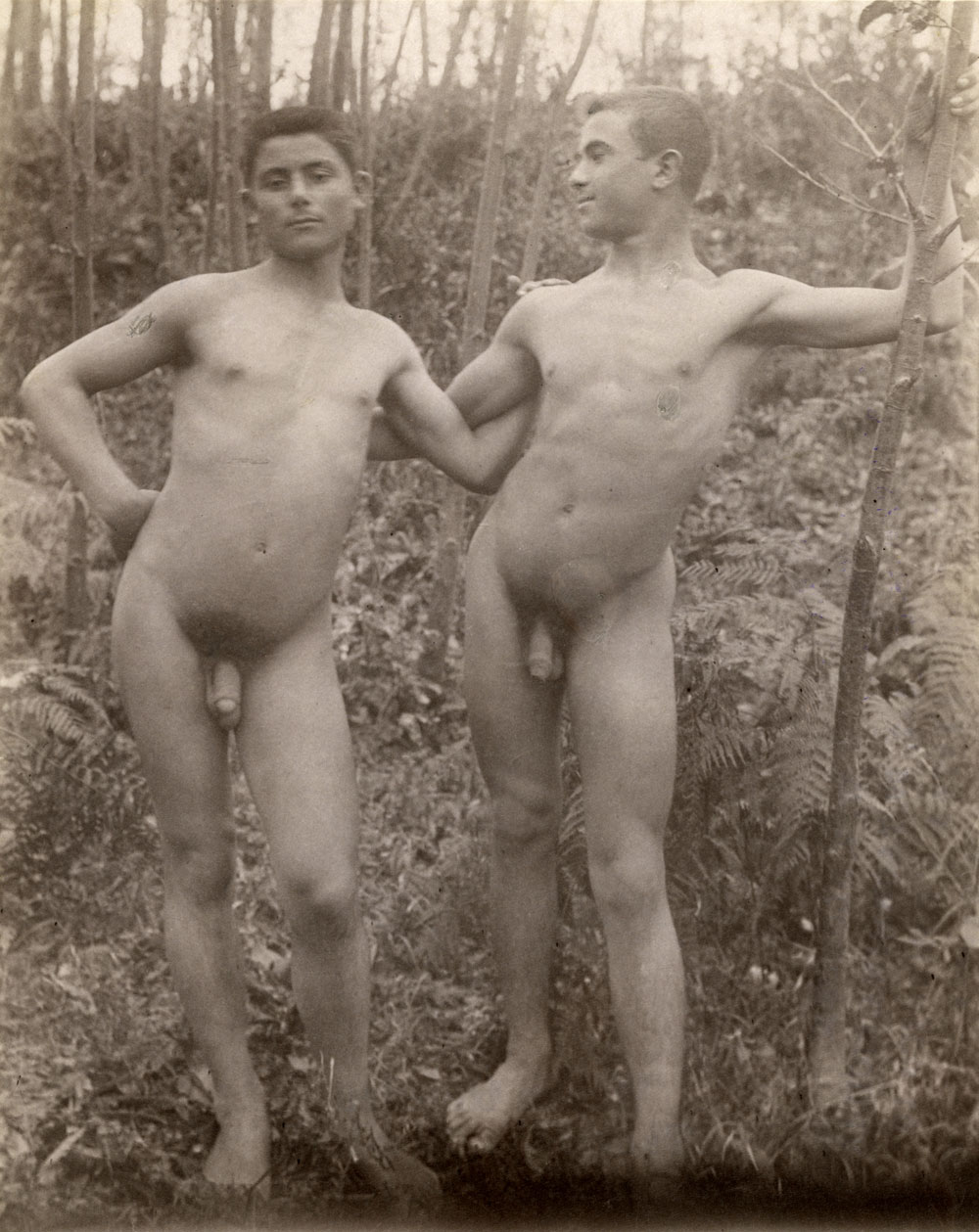
 

Baron Wilhelm von Gloeden (1856-1931), Germany 'Two nude men standing in a forest' Taormina, Sicily, 1899


Baron Wilhelm von Gloeden (German, 1856-1931)
Two nude men standing in a forest
Taormina, Sicily, 1899
Albumen print


The Kinsey Institute
Morrison Hall 313, Indiana University
Bloomington, Indiana, USA

Opening hours
Monday – Friday 1 – 5pm

The Kinsey Institute website

LIKE ART BLART ON FACEBOOK

Back to top

Research at the State Library of Victoria further update

Date: 22nd February 2014

research experience on the charles marville photographs at the state library of victoria further update


Dear readers

An interesting email arrived from the Collection Services Manager further questioning why I actually want to see the Marville prints in the State Library’s Collection.

In part the email says, and I precis: the prints are fragile and very rare; the Library has digitised all the prints and provided high resolution images available for free download from our website; the careful storage of the original prints and the provision of digital files is the Library’s standard approach to achieve that delicate balance between access and preservation. The email goes on to ask, “I would be interested to understand more about your research needs with this collection and why it is important for you to view the original prints out of their protective enclosures.”


They still don’t get it do they?

Vintage prints have to be seen in the flesh. Anyone who knows anything about photography understands this but not, apparently, the State Library of Victoria. Why do you even need to explain this to them? When looking at vintage photographs you actually have to see the physical print, the surface of the print, not some simulacra hidden behind plastic or a high res scan online!

As Bill Henson insightfully observes in an interview about his current selection of images at the Monash Gallery of Art in the exhibition Wildcards,

“One of those preoccupations is an interest in the photograph as an object, in the physical presence of the print or whatever kind of technology is being used to make it. Part of the reason for that is that photography, more than any other medium, suffers from a mistake or misunderstanding people have when they’ve seen a reproduction in a magazine or online: they think they’re seeing the original. A certain amount of photography is made with its ultimate intention being to be seen in a magazine or online, but most photography, historically, ended up in its final form as a print – a cyanotype, or a tin type or a daguerreotype or whatever it might be… [This] continues to interest me about photography: how these things inhabit the world as objects. And indeed we read them not just with our eyes but with how our whole bodies read and encounter and negotiate these objects, which happen to be photographs.”

Wildcards: Bill Henson shuffles the deck
Monash Gallery of Art
1 February – 30 March 2014.


“They’ve seen a reproduction in a magazine or online: they think they’re seeing the original… we read them not just with out eyes but with how our whole bodies read and encounter and negotiate these objects, which happen to be photographs.” Well said.

Perhaps the State Library needs to read Walter Benjamin’s 1936 essay The Work of Art in the Age of Mechanical Reproduction in which he discusses the aura of the original and “the concept of authenticity, particularly in application to reproduction. ‘Even the most perfect reproduction of a work of art is lacking in one element: its presence in time and space, its unique existence at the place where it happens to be.’ He argues that the “sphere of authenticity is outside the technical” so that the original artwork is independent of the copy, yet through the act of reproduction something is taken from the original by changing its context. He thus introduces the idea of the “aura” of a work and its absence in a reproduction.” (Walter Benjamin (1968). Hannah Arendt, ed. “The Work of Art in the Age of Mechanical Reproduction”, Illuminations. London: Fontana. pp. 214-218 quoted in “The Work of Art in the Age of Mechanical Reproduction” on the Wikipedia website)

In other words, there is nothing like standing in front of a jewel-like Vermeer and feeling the aura of the original, not one shielded behind glass (or plastic in this case). By making many reproductions, including online copies, you substitute a plurality of copies for a unique existence. This is why I was so looking forward to seeing the Marville’s, to FEEL THEIR PRESENCE…

Of course I am as guilty as anyone through this blog of disseminating reproductions around the world, and I freely admit that. The photographs I reproduce are not the originals and should never stand for them. Even in this age of infinitely reproducible digital images there is still that aura of standing in front of a print in a gallery and feeling its eternal value and mystery. As Walter Benjamin writes, “the authenticity of a thing is the essence of all that is transmissible from its beginning, ranging from its substantive duration to its testimony to the history which it has experienced.” And you need to see and feel that history.

Finally, I wonder how many people the State Library of Victoria have coming in to see these prints? When was the last time anyone actually physically saw them that wanted to? I would think very, very, few people indeed. The “delicate balance” between access and conservation is obviously well weighted towards the former.

It will be interesting to see how the State Library of Victoria responds and whether they can “Cry ‘Havoc!’, and let slip the photographs of Marville.” Even for an instant. To facilitate my research in this time, in this space where one can admire the beauty of an object without compromising the need to preserve – no, lets think of better words: retain, possess, guard, protect, shield – the prints. I will keep you informed.

Dr Marcus Bunyan

All Charles Marville photographs in the State Library of Victoria Pictures Collection


Charles Marville (French, 1813-1879) 'Parc Monceau' c. 1853 - c. 1870


Charles Marville (French, 1813-1879)
Parc Monceau
c. 1853 – c. 1870
In collection: Photographic views of Paris
Undated, dates assigned from time of Haussman’s renovation of Paris
Photographic print mounted on cardboard : albumen silver
32 x 26cm
Gift; Government of France; 1880
In the State Library of Victoria Pictures Collection


State Library of Victoria
328 Swanston St,
Melbourne VIC 3000
Phone: (03) 8664 7000

Opening hours:
Sunday 10.00am – 6.00pm
Monday 10.00am – 9.00pm
Tuesday 10.00am – 9.00pm
Wednesday 10.00am – 9.00pm
Thursday 10.00am – 9.00pm
Friday 10.00am – 6.00pm
Saturday 10.00am – 6.00pm

State Library of Victoria website

LIKE ART BLART ON FACEBOOK

Back to top

Exhibition: ‘Thomas Demand’ at the National Gallery of Victoria International, Melbourne

Exhibition dates: 30th November 2012 – 17th March 2013


Installation view of 'Thomas Demand' at NGVI showing, at right, 'Lichtung / Clearing' 2003


Installation view of Thomas Demand at NGVI showing, at right, Lichtung / Clearing 2003
Photo: Marcus Bunyan


You saw it here first on Art Blart!

Beautiful installation shots of the new Thomas Demand exhibition at NGVI. Jeff Wall installation photographs to follow in the next posting on Saturday. Reviews to follow in due course.

These are all cardboard models created in Thomas Demand’s studio and then photographed. The models are destroyed afterwards leaving the photographs as artefacts and remembrances, both a performance in their own right, but also a record of another performance, that of the creation of the models. Double self, double performativity, double ritual.

Many thankx to Jemma Altmeier and all the media team at NGV for all their wonderful help and congratulations to the curators, Susan van Wyk and Dr Isobel Crombie, for their restrained yet contemporary installations and for getting the exhibitions to Melbourne. They look magnificent. Well done!

Dr Marcus Bunyan


Many thankx to the NGV for allowing me to publish the photographs in the posting. Please click on the photographs for a larger version of the image. All photographs © Marcus Bunyan © National Gallery of Victoria. May not be reproduced without permission.


Thomas Demand is regarded as one of the world’s leading contemporary artists whose work in photography and, most recently stop-animation films, is at the forefront of contemporary art. Demand initially worked as a sculptor who used photography to document his ephemeral creations. From 1993 his creative practice changed and, from then on, he made sculptures for the sole purpose of photographing them. Demand begins with an image, often taken from media sources and frequently dealing with traumatic or politically important events, and creates a life-size replica of the image using paper and cardboard. The effect of these uncanny reconstructions is to destabilise our understanding of the sites which we ‘know’ so well through reproduction. This exhibition features a selection of photographs and 35mm films as chosen by the artist.


Jeff Wall & Thomas Demand: In Conversation, National Gallery of Victoria


Thomas Demand (German, b. 1964) 'Lichtung' / 'Clearing' 2003


Thomas Demand (German, b. 1964)
Lichtung / Clearing
2003
C-Print / Perspex
Courtesy Taka Ishii Gallery, Sprüth Magers Berlin London, Esther Schipper, Berlin, Matthew Marks Gallery
© Thomas Demand, VG Bild-Kunst, Bonn / VISCOPY, Sydney


Installation view of 'Thomas Demand' at NGVI showing, at left, 'Badezimmer / Bathroom' 1997 and, at right, 'Labor / Laboratory' 2000


Installation view of Thomas Demand at NGVI showing, at left, Badezimmer / Bathroom 1997 and, at right, Labor / Laboratory 2000
Photo: Marcus Bunyan


Thomas Demand (German, b. 1964) 'Laboratory (77-E-217)' 2000


Thomas Demand (German, b. 1964)
Labor / Laboratory
2000
C-Print / Perspex
180 × 268cm
Courtesy Taka Ishii Gallery, Sprüth Magers Berlin London, Esther Schipper, Berlin, Matthew Marks Gallery
© Thomas Demand, VG Bild-Kunst, Bonn / VISCOPY, Sydney


Installation view of 'Thomas Demand' at NGVI showing 'Badezimmer / Bathroom' 1997


Installation view of Thomas Demand. Badezimmer / Bathroom 1997 at NGVI
Photo: Marcus Bunyan


Thomas Demand (German, b. 1964) 'Badezimmer / Bathroom' 1997


Thomas Demand (German, b. 1964)
Badezimmer / Bathroom
1997
C-Print / Perspex
160.0 × 122.0cm
Courtesy Taka Ishii Gallery, Sprüth Magers Berlin London, Esther Schipper, Berlin, Matthew Marks Gallery
© Thomas Demand, VG Bild-Kunst, Bonn / VISCOPY, Sydney


Installation view of 'Thomas Demand' at NGVI showing 'Copyshop' 1999


Installation view of Thomas Demand at NGVI showing Copyshop 1999
Photo: Marcus Bunyan


Thomas Demand (German, b. 1964) 'Copyshop' 1999


Thomas Demand (German, b. 1964)
Copyshop
2009
C-Print / Perspex
Courtesy Taka Ishii Gallery, Sprüth Magers Berlin London, Esther Schipper, Berlin, Matthew Marks Gallery
© Thomas Demand, VG Bild-Kunst, Bonn / VISCOPY, Sydney


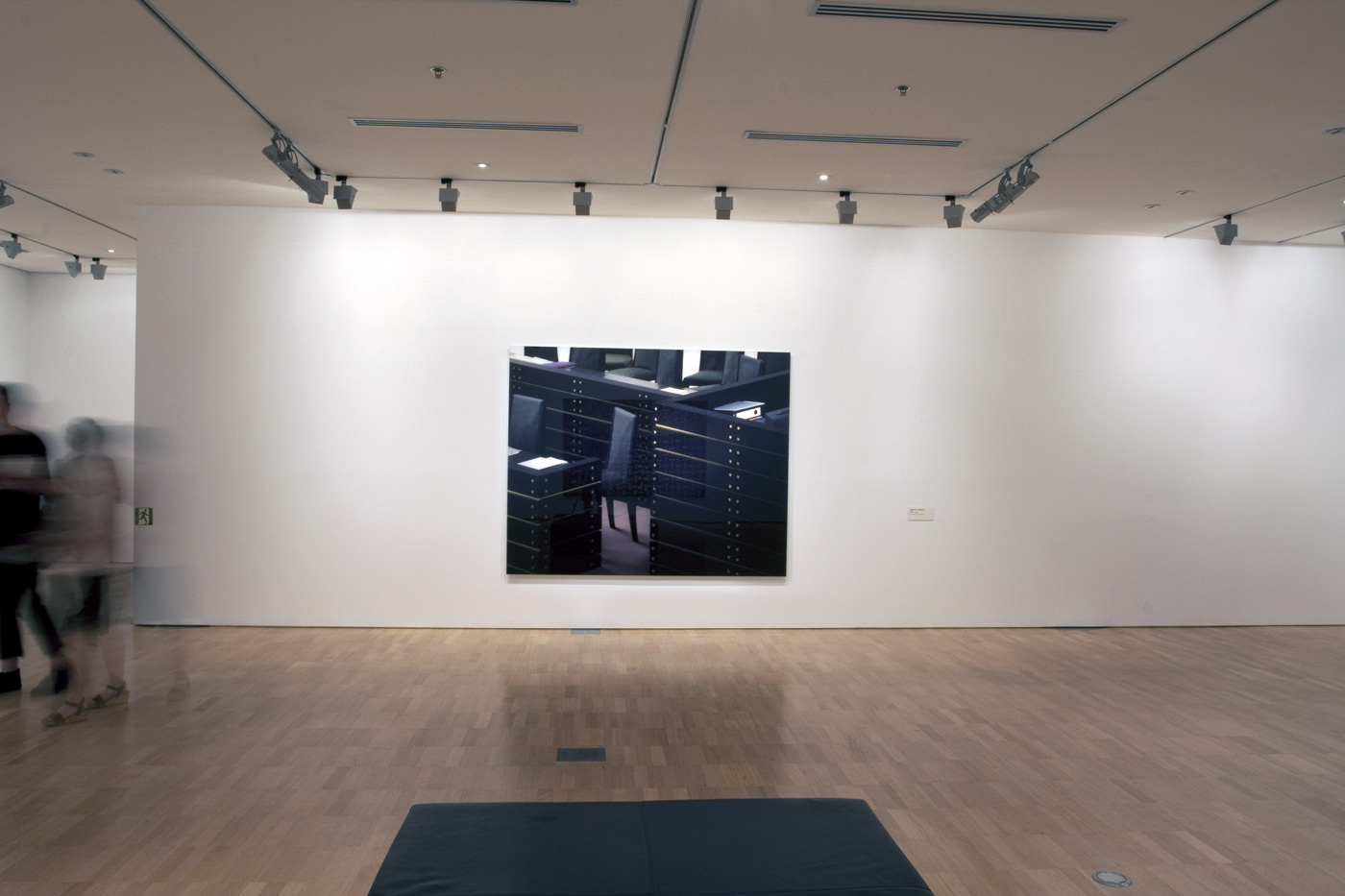
Installation view of 'Thomas Demand' at NGVI showing 'Parlament / Parliament' 2009


Installation view of Thomas Demand at NGVI showing Parlament / Parliament 2009
Photo: Marcus Bunyan


Thomas Demand (German, b. 1964) 'Parlament / Parliament' 2009


Thomas Demand (German, b. 1964)
Parlament / Parliament
2009
C-Print / Perspex
Courtesy Taka Ishii Gallery, Sprüth Magers Berlin London, Esther Schipper, Berlin, Matthew Marks Gallery
© Thomas Demand, VG Bild-Kunst, Bonn / VISCOPY, Sydney


When you step through the door into the Thomas Demand exhibition you enter a realm that was conceived, meticulously planned, and built to his exacting specifications. Demand designed every aspect of this exhibition. Having selected the photographs and films that he wanted to show in Melbourne, he then went on to design the exhibition space itself.

He was quite specific that the secondary walls had to be full height to create a sense of beautiful rooms rather than a space that has been partitioned. Once this was done he began work on the layout of the show. He carefully planned the sequence in which you would encounter each work, setting up an interesting play between the works. How we read these is an entirely individual experience. Recently someone said to me that they thought the placement of Lichtung / Clearing next to Paneel / Pegboard was an interesting comment on forest clearing and the devastating impact that pulp mills can have on the environment. Until then I had never seen those works in that way.

In conversation during the installation, Thomas explained that he was not interested in putting together an exhibition that then toured around the world. The usual practice of curating an exhibition and then ‘fitting’ it into different exhibition spaces in a number of venues holds little interest for him. So each time you see a Thomas Demand exhibition it has been curated, designed and installed for that particular space.

This is perhaps most obvious when you enter the rooms where the films are showing. From the brightly lit first room you can see through the door way into a darkened room lined with floor to ceiling curtains, but not really. What you see is a darkened room hung with wallpaper that the artist made to look like the kind of sweeping curtains that you might find in a cinema or theatre. It’s theatrical and spectacular but once you enter this space the real treat is Demands films.

Susan van Wyk, 6 February 2013 on the NGV website [Online] Cited 05/09/2020


Thomas Demand (German, b. 1964) 'Tribute' 2011


Thomas Demand (German, b. 1964)
Tribute
2011
C-Print / Perspex
166 x 125cm, edition of 6
Courtesy Taka Ishii Gallery, Sprüth Magers Berlin London, Esther Schipper, Berlin, Matthew Marks Gallery
© Thomas Demand, VG Bild-Kunst, Bonn / VISCOPY, Sydney


Installation view of 'Thomas Demand' at NGVI showing, at right, 'Space Simulator' 2003


Installation view of Thomas Demand at NGVI showing, at right, Space Simulator 2003
Photo: Marcus Bunyan


Installation view of 'Thomas Demand' at NGVI showing, at left, 'Grotte / Grotto' 2006 and, at right, 'Space Simulator' 2003


Installation view of Thomas Demand at NGVI showing, at left, Grotte / Grotto 2006 and, at right, Space Simulator 2003
Photo: Marcus Bunyan


Thomas Demand (German, b. 1964) 'Space Simulator' 2003


Thomas Demand (German, b. 1964)
Space Simulator
2003
C-Print / Perspex
300 × 429.4cm
Courtesy Taka Ishii Gallery, Sprüth Magers Berlin London, Esther Schipper, Berlin, Matthew Marks Gallery
© Thomas Demand, VG Bild-Kunst, Bonn / VISCOPY, Sydney


Installation view of 'Thomas Demand' at NGVI showing, at right, 'Grotte / Grotto' 2006


Installation view of Thomas Demand at NGVI showing, at right, Grotte / Grotto 2006
Photo: Marcus Bunyan


Thomas Demand (German, b. 1964) 'Grotte / Grotto' 2006 (detail)


Thomas Demand (German, b. 1964)
Grotte / Grotto (detail)
2006
C-Print / Perspex
Courtesy Taka Ishii Gallery, Sprüth Magers Berlin London, Esther Schipper, Berlin, Matthew Marks Gallery
© Thomas Demand, VG Bild-Kunst, Bonn / VISCOPY, Sydney


One of the world’s most influential contemporary artists, Thomas Demand, will be the subject of a new exhibition announced by the National Gallery of Victoria.

The exhibition will be the first major Australian survey of the artist’s work and will comprise large scale photographs and films never before shown in Australia.

NGV Director, Tony Ellwood said the addition of Thomas Demand to the NGV’s exhibition schedule is part of an exciting and ambitious summer program.

“When the opportunity came up to hold an exhibition of Thomas Demand’s work this summer, it was just too good to miss. Thomas Demand will be part of a great summer program at the NGV and has been timed to coincide with the Jeff Wall Photographs exhibition being held at NGV Australia.

“We are offering a two-for-one ticket for Thomas Demand and Jeff Wall Photographs, so visitors to the NGV can experience the work of two major artists of international contemporary photography for one ticket price,” said Mr Ellwood.

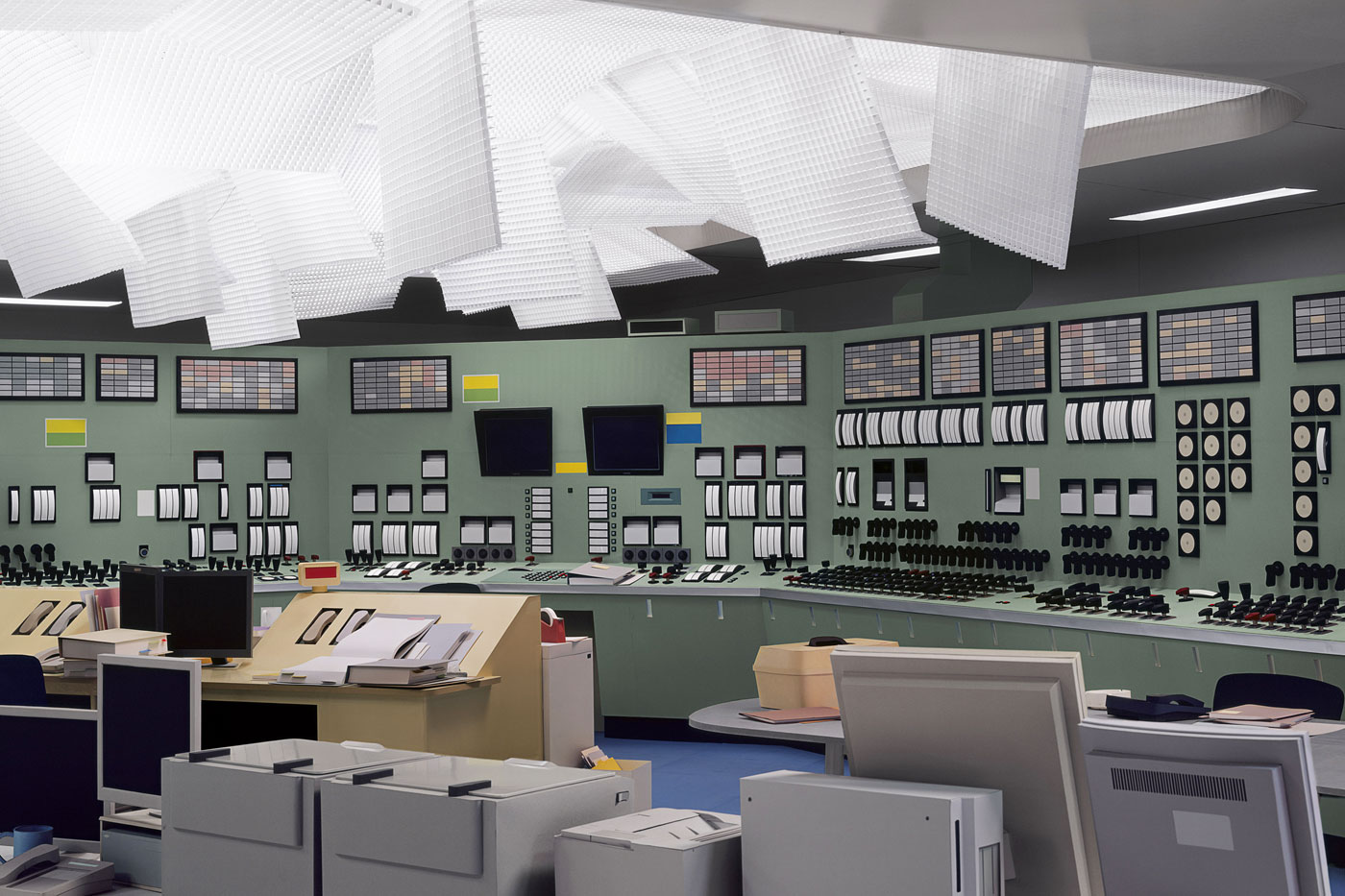
Works in the exhibition will span the artist’s career from 1997 to 2012. Recent works presented in the exhibition include Control Room (pictured below), which depicts the Fukushima Daiichi nuclear power plant and Tribute, a work based on images taken at the site of tragic mass panic at Europe’s biggest rave party.

Susan van Wyk, NGV Curator of Photography said Thomas Demand is widely regarded as one of the world’s leading contemporary artists.

“Thomas has a unique style in which he creates paper models of objects and scenes, often taken from media sources like flickr or newspaper reports. These intricate life size models are then photographed.

“The results are disquieting images that subvert our understanding of reality and fiction and draws attention to how we engage with the media and modern technologies,” said Ms Van Wyk.

Press release from the NGV website


Installation view of 'Thomas Demand' at NGVI showing, at left, 'Vault' 2012 and, at centre, 'Kontrollraum / Control Room' 2011


Installation view of Thomas Demand at NGVI showing, at left, Vault 2012 and, at centre, Kontrollraum / Control Room 2011
Photo: Marcus Bunyan


Thomas Demand (German, b. 1964) 'Kontrollraum / Control Room' 2011


Thomas Demand (German, b. 1964)
Kontrollraum / Control Room
2011
C-Print / Perspex
200 × 300cm
Courtesy Taka Ishii Gallery, Sprüth Magers Berlin London, Esther Schipper, Berlin, Matthew Marks Gallery
© Thomas Demand, VG Bild-Kunst, Bonn / VISCOPY, Sydney


Installation view of 'Thomas Demand' at NGVI showing 'Vault' 2012


Installation view of Thomas Demand at NGVI showing Vault 2012
Photo: Marcus Bunyan


Thomas Demand (German, b. 1964) 'Vault' 2012 (detail)


Thomas Demand (German, b. 1964)
Vault (detail)
2012
C-Print / Perspex
Courtesy Taka Ishii Gallery, Sprüth Magers Berlin London, Esther Schipper, Berlin, Matthew Marks Gallery
© Thomas Demand, VG Bild-Kunst, Bonn / VISCOPY, Sydney


NGV International
180 St Kilda Road

Opening hours:
Open daily 10am – 5pm

National Gallery of Victoria website

LIKE ART BLART ON FACEBOOK

Back to top