Exhibition: ‘Lifelike’ at The Blanton Museum of Art, Austin, Texas

Exhibition dates: 23rd June – 22nd September 2013


Daniel Douke (American, b. 1943) 'Ace' 1979


Daniel Douke (American, b. 1943)
Ace
1979
Acrylic on masonite
8 x 8 x 12 1/4 in.
Courtesy Minnesota Museum of American Art, Saint Paul


Life (like).


“For the French theorist Jean Baudrillard, this consciousness of construction finds its most powerful expression in the concept of hyperreality. To appreciate Baudrillard’s view, recall the treatment of literary deconstruction… Deconstruction theorists propose that words gain their meaning through their reference to other words; literary works gain their significance by the way they are related to other writings. Thus language does not derive its character from reality, but from other language. Now consider the media – newspapers, television, the movies, radio. For Baudrillard, media portrayals of the world are not driven by the way the world “is,” but by the steadily emerging histories of portrayal itself. As these histories unfold, each new lamination is influenced by the preceding, accounts are layered upon accounts, and reality is transformed into hyperreality. For example, Baudrillard asks, what is the reality of the “Holocaust”? One cannot deny that certain events took place, but as time goes on these events become subject to myriad re-presentations. Diaries become subject to redefinition by television and movies; biographies influence the writing of historical novels; narrated history is transformed into plays, and each “telling” lays the experiential groundwork for subsequent retellings. Realities accumulate, accentuate, interpenetrate, and ultimately create the world of hyperreality – itself in continuous evolution into the future. We feel we possess an intimate acquaintance of the events in themselves; they are sharply etched in our consciousness. For Baudrillard, however, this consciousness moves increasingly toward hyperreality.

And thus the culture opens to the possibility of selves as artifacts of hyperreality. As political events, health and illness, and world history slip from the realm of the concrete into the domain of representation, so a commitment to obdurate selves becomes increasingly difficult to maintain. What, after all, is the reality of our motives, intentions, thoughts, attitudes, and the like? …

As we find, the current texts of the self are built upon those of preceding eras, and they in turn upon more distant forms of discourse. In the end we have no way of “getting down to the self as it is.” And thus we edge toward the more unsettling question: On what grounds can we assume that beneath the layers of accumulated understandings there is, in fact, an obdurate “self” to be located? The object of understanding has been absorbed into the world of representations.”

Gergen, Kenneth. The Saturated Self: Dilemmas of Identity in Contemporary Life. New York: Harper Collins, 1991, pp. 121-122.


Many thankx to The Blanton Museum of Art for allowing me to publish the artwork in this posting. Please click on the photographs for a larger version of the art.


Evan Penny (South African, b. 1953) '(Old) No One – in Particular #6, Series 2' 2005


Evan Penny (South African, b. 1953)
(Old) No One – in Particular #6, Series 2
2005
Silicone, pigment, hair, aluminium
40 x 32 x 7 1/2 in.
© Evan Penny
Courtesy Sperone Westwater, New York


Vija Celmins (Latvian American, b. 1938) 'Eraser' 1967


Vija Celmins (Latvian American, b. 1938)
Eraser
1967
Acrylic on balsa wood
6 5/8 x 20 x 3 1/8 in.
Collection Orange County Museum of Art, Newport Beach, CA
Gift of Avco Financial Services, Newport Beach


Maurizio Cattelan (Italian, b. 1960) 'Untitled' 2001


Maurizio Cattelan (Italian, b. 1960)
Untitled
2001
Stainless steel, composition wood, electric motor, electric light, electric bell, computer
23 1/2 x 33 5/8 x 18 5/8 in.
Courtesy the artist and Marian Goodman Gallery, New York


Keith Edmier (American, b. 1967) 'Bremen Towne' 2008


Keith Edmier (American, b. 1967)
Bremen Towne
2008
Installation dimensions variable
Courtesy of the artist and Friedrich Petzel Gallery


Bremen Towne was an idea I’d been thinking about prior to [my 2008] show at Bard College. It had been floating in my head for a number of years based on the sales brochure of my parents’ home I had obtained around 1999 off of eBay. It was just one of these things I had around… I didn’t really have the idea of constructing this house back then… As it turned out, the interior dimensions of my parents’ home from the original blueprints fit directly into one of the galleries at the museum. At that point I started considering it more as an art object, or as a sculpture more than an installation… The main visual references were family photographs, mostly taken during critical events or holidays or birthday parties. My process involved going through the photo album – everything. They were all pictures of people posing, so I started looking at the spaces [in the background]… I ended up buying the whole decade of both Sears and JCPenney catalogues up until that time, the early ’70s. Through that I was able to identify some products based on visual descriptions or in the family photographs… I initially went to a place that has all kinds of wallpapers and floorings from other periods, used a lot for movies and things like that. I heard they had thousands of wallpapers. It turned out I couldn’t find the exact wallpaper that was in the house. I guess at that point I started thinking it was more interesting for me to remake it, and to remake it more or less new. I wanted to represent the time element, the moment before the day of the family moving into the new house. It wasn’t supposed to look lived in.

I think I was initially interested in doing that to have some kind of separation from taking a real object that was loaded with personal history or some sentimental thing. It was a way of moving from a subjective to an objective position… [I was interested] in just thinking about the whole interior of the house itself as a cast, or this negative space. I thought about how the house is essentially the space that shapes us, that shapes oneself… I think that my reason to make it, or to make almost anything, went beyond just the visual aspects of it, or the idea of re-creating an illusion of the thing. I’ve always been more interested in a certain level of representation or pictorial literalness… I like words or descriptions like “actual” or “actual scale.” I like the idea of “what is real?”

Keith Edmier

Siri Engberg. “Unconventionally Real: Nine Artists Discuss Their Work in Lifelike,” on the Walker Art Center website Mar 1, 2012 [Online] Cited 20/12/2020


The exhibition Lifelike, on view at the Blanton Museum of Art at The University of Texas at Austin June 23 to September 22, 2013, invites a close examination of artworks based on commonplace objects and situations, which are startlingly realistic, but often made of unusual materials in unexpected sizes.

Organized by the Walker Art Center in Minneapolis, this international, multigenerational group exhibition features 75 works from the 1960s to the present by leading figures in contemporary art, such as Andy Warhol, Gerhard Richter, James Casebere, Vija Celmins, Keith Edmier, Robert Gober, Ron Mueck, Mungo Thomson, and Ai Weiwei, and illuminates artists’ enduring fascination with realism.

Avoiding the flashiness embraced by 1960s Pop Artists and the slick urban scenes introduced at that time by the Photorealists, the contemporary artists in Lifelike investigate often overlooked items and moments as subject matter: a paper bag, an eraser, an apple core, a waiting roo, an afternoon nap. Favouring a handmade, labour intensive practice rather than technological enhancements, the works in the exhibition – including painting, sculpture, photography, drawing and video – transform the seemingly ordinary into something beguiling, loaded with narrative and metaphor.

The exhibition explores the many ways artists have pursued realism through a range of media. Some artists featured, such as Vija Celmins, Chuck Close, and Peter Rostovsky, paint from photographs, creating works that exhibit an astonishing degree of likeness and detail. Others work in sculpture often fashioning objects from materials that belie the pedestrian nature of the subject – Ai Weiwei’s jar of hundreds of sunflower seeds, hand painted on to cast porcelain, or Tom Friedman’s bee, made out of clay, plastic, and paint. In photography, artists including James Casebere and Isaac Layman play with the hyperreal, through fabricated scenes or clever layering of images. In video, artists including Thomas Demand and Jeon Joonho create moving images that at first seem familiar, but deceive us through sly use of animation.

Conspicuously absent in most of the works in Lifelike is a reliance on technological intervention. Instead, in seemingly inverse proportion to the ease of producing goods for the marketplace, many artists are slowing and complicating their own working methods, remaking banal things into objects of fixation and desire: Catherine Murphy’s details of textured fabric on the seat of a chair, or Ron Mueck’s strikingly “real” sculpture – down to the last hair and pore – of human subjects. Frequently these artists work from photographs, but just as often, their inspiration is the observed world, and the notion that a tangible, perhaps ephemeral object or moment can somehow be brought back to life æ reinterpreted through the artist’s hand as re-made readymades.

To address the nuances of this subject, the exhibition presents several key conceptual sections:

Common Objects gathers a group of late 1960s and early 1970s works that borrowed strategies from Pop, but rejected that movement’s brand-name emphasis in favour of conceptual, more process-oriented approaches to subject matter.

Another section presents the notion of  The Uncanny, which features work by a generation of artists in the 1980s and 1990s who inflected realism with a psychologically-laden, surreal sensibility, such as Robert Gober’s child-sized chair and flower-covered box of tissues, resting mysteriously atop a floor drain; or Charles Ray’s disarming photograph of himself as a mannequin.

A third section entitled Realism into Abstraction presents a range of works by artists such as Peter Rostovsky, Catherine Murphy and Tauba Auerbach, in which lushly painted surfaces such as velvet curtains, the seat of a chair, and other ordinary items are cropped in such a way that they resemble abstract paintings, their original sources difficult to discern.

Handmade Sleight of Hand, the fourth section, presents work by artists who make objects that are indistinguishable from their real-life counterparts, but made with the traditional techniques of painting, sculpture, or drawing. Highlights include Jud Nelson’s trash bag carved from Carrara marble and Susan Collis’s checkered plastic shopping bag painstakingly rendered in ballpoint pen on paper.

A fifth section, Special Effects: The Real as Spectacle, presents artists making work that engages an instant response – be it astonishment, fear, confusion, or delight – through their surprising size or unusual installation.

Press release from The Blanton Museum of Art website


Peter Rostovsky (Russian, b. 1970) 'Curtain' 2010


Peter Rostovsky (Russian, b. 1970)
Curtain
2010
Oil on linen
72 x 48 in.
Courtesy of the artist


What does it mean in Warholian fashion to “want to be a machine,” to long for a kind of inhumanity that has to be constantly performed and repeated? Is this not a radical disavowal of an all too human vulnerability? Can we not read in the mechanical appeals of photorealism a kind of excessive sentimentality, a naïve expressionism that uses the camera and the photograph as a shield against trauma?

And likewise in expressionism’s hyperbolic restatement of its humanity, is there not a silent concession to its opposite, a founding anxiety about inauthenticity, a mortal dread regarding the total triumph of simulation and technology?

However, it is important to stress that these are unfulfilled desires. No photorealist painting completely fools the viewer into the fact that it is machine-made; it entertains the fantasy, much like electronic music. And each autonomous artwork is only a temporary escape, a utopian space, “an orchid in the land of technology,” to borrow a phrase that Walter Benjamin applied to the illusion of reality in film.

What these two positions in fact represent are two negative theologies that stand as sentinels, forever pointing to and away from a traumatically unresolved subject position – a position of the never sufficiently technological, and the never completely human. They are both Romantic positions and should be read as such: as positions of longing and disavowal, not of identity.

Why would this be important to emphasise? Because it answers the familiar question asked to every painter painting photographs. It’s not about the ends, it’s about the means. It’s about the performance of painting that re-states the position, not the photo-like product that it yields. In other words, it’s about trying and failing to be a machine. Therein resides the futility and poetic nature of the practice. The failure marks the fragility and evanescence of the subject negatively, knowing that the alternative is to misname, to misrepresent, to conjure the opposite. This poetic is more latent, and seldom acknowledged in art that aspires toward indifference and inhumanity, but I hope that I have shown that every tin man has a heart, just like every photorealist hides an abstract painter.

Peter Rostovsky

Siri Engberg. “Unconventionally Real: Nine Artists Discuss Their Work in Lifelike,” on the Walker Art Center website Mar 1, 2012 [Online] Cited 20/12/2020


Matt Johnson (American, b. 1978) 'American Spirit' 2010


Matt Johnson (American, b. 1978)
American Spirit
2010
Paper, plastic, foam, paint, and magnets
1 x 3 1/2 x 2 1/4 in.
Edition of 3
Courtesy of the artist and Blum & Poe, Los Angeles
Photo credit: Joshua White
© Matt Johnson


Ron Mueck (Australian, b. 1958) 'Untitled (Seated Woman)' 1999


Ron Mueck (Australian, b. 1958)
Untitled (Seated Woman)
1999
Silicone, acrylic, polyurethane foam and fabric
25 1/4 x 17 x 16 1/2 in.
Collection of the Modern Art Museum of Fort Worth


Alex Hay (American, b. 1930) 'Paper Bag' 1968


Alex Hay (American, b. 1930)
Paper Bag
1968
Fiberglass, epoxy, paint, and paper
59 1/4 x 29 x 18 in.
Whitney Museum of American Art, New York
© Alex Hay
Courtesy of the artist and Peter Freeman, Inc., New York Photograph by Jerry L. Thompson


Jonathan Seliger (American, b. 1955) 'Heartland' 2010


Jonathan Seliger (American, b. 1955)
Heartland
2010
Enamel on bronze
103 x 29 x 29 in.
Courtesy of the artist and Jack Shainman Gallery, NY


Yoshihiro Suda (Japanese, b. 1969) 'Weeds' 2008


Yoshihiro Suda (Japanese, b. 1969)
Weeds
2008
Painted on wood
Size varied according to site
© Yoshihiro Suda
Courtesy of Gallery Koyanagi, Tokyo


The Blanton Museum of Art
200 E. Martin Luther King Jr. Blvd.
Austin, TX 78712

Opening hours:
Wednesday – Saturday 10am – 5pm
Sunday 1pm – 5pm
Closed Mondays and Tuesdays
The Blanton Museum of Art website

LIKE ART BLART ON FACEBOOK

Back to top

Exhibition: ‘After the Gold Rush: Contemporary Photographs from the Collection’ at The Metropolitan Museum of Art, New York

Exhibition dates: 22nd March, 2011 – 2nd January, 2012


Many thankx to The Metropolitan Museum of Art, New York for allowing me to publish the photographs in the posting. Please click on the photographs for a larger version of the image.


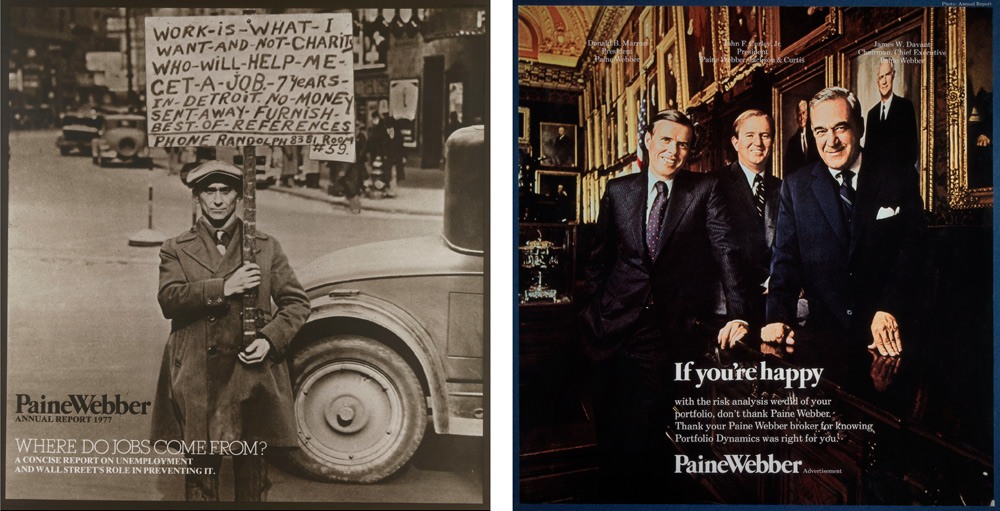
Hans Haacke (German, born 1936). 'Thank You, Paine Webber' 1979


Hans Haacke (German, b. 1936)
Thank You, Paine Webber
1979
Gelatin silver print and chromogenic print
The Metropolitan Museum of Art
Purchase, Vital Projects Fund Inc. Gift, through Joyce and Robert Menschel, 2010
© Hans Haacke


Since the early 1970s Haacke has taken on the intertwined political and corporate forces that use cultural patronage as a smokescreen to advance interests that are often antithetical to the vitality of free speech and expression in democracies. Haacke made this work just as the strategy of appropriation – lifting an image out of its original context and re-presenting it in critical fashion – began to make waves in the New York art world of the late 1970s. Like all effective appropriation, it exposes a prior instance of borrowing – in this case, how the investment firm Paine Webber used a documentary photograph to give its annual report the veneer of social concern. The artist then pointedly contrasted it with an image from the same annual report of a beaming trio of executives in a painting-lined gallery. As a counterpoint to the protestor’s signboard, Haacke dropped in text from a different Paine Webber ad campaign to show on whose backs the “risk management” is taking place – a biting indictment, the relevance of which has only increased since the recent economic downturn.

Wall text


Jeff Wall (Canadian, born 1946). 'The Storyteller' 1986


Jeff Wall (Canadian, b. 1946)
The Storyteller
1986
Silver dye bleach transparency in light box
The Metropolitan Museum of Art
Purchase, Charlene and David Howe, Henry Nias Foundation Inc., Jennifer and Robert Yaffa, Harriet Ames Charitable Trust, and Gary and Sarah Wolkowitz Gifts, 2006
Image courtesy of the artist
© Jeff Wall


Wall’s staged tableaux straddle the worlds of the museum and the street. His subjects are scenes of urban and suburban disarray that he witnessed firsthand – the kinds of things anyone might see while wandering around a city and its outskirts. Working like a movie director, he restages the scene using nonprofessionals as actors and presents his photographs as colour transparencies in light boxes such as those of large-scale public advertisements found at airports and bus stops. The scale and ambition of his pictures – scenes of everyday life shot through with larger intimations of political struggle – equally evoke the Salon paintings of nineteenth century French painters such as Gustave Courbet and Édouard Manet, which were themselves brazen combinations of canonical and contemporary subjects.

The Storyteller is set in a barren, leftover slice of land next to a highway overpass in Vancouver, where the artist lives. Various groupings of modern urban castaways – perhaps descendants of the Native Americans who occupied the land before the arrival of Europeans – are dispersed around the hillside, a mini-catalogue of art-historical reference. Like the upside-down, half-submerged figure of Icarus in the background of Brueghel’s Landscape with the Fall of Icarus, the woman speaking and gesticulating to the two men listening at the lower left becomes the key to unifying the fractured and alienating environment from which Wall’s picture is constructed.

Wall text


Laurie Simmons (American, b. 1949). 'Walking Gun' 1991


Laurie Simmons (American, b. 1949)
Walking Gun
1991
Gelatin silver print
The Metropolitan Museum of Art
Purchase, Anonymous Gift, 1998
© Laurie Simmons


The early 1990s marked the last moment when a wide swath of women artists responded to the sexism they saw as pervasive in the culture – from the rape trial of William Kennedy Smith to the Supreme Court nomination hearings for Clarence Thomas. A pioneer of set-up photography, Simmons dramatically expanded the scale of her constructed tableaux for a series of spotlighted puppet-like objects perched atop doll legs: revolvers, houses, cameras, and cakes. This armed and dangerous example refers to the old-movie cliché where a man carrying a gun is shown in shadow profile. Here, Simmons offers instead the death-dealing seductress – also familiar from film noir – in monumental miniature, a doll capable of turning on its master at a moment’s notice.

Wall text


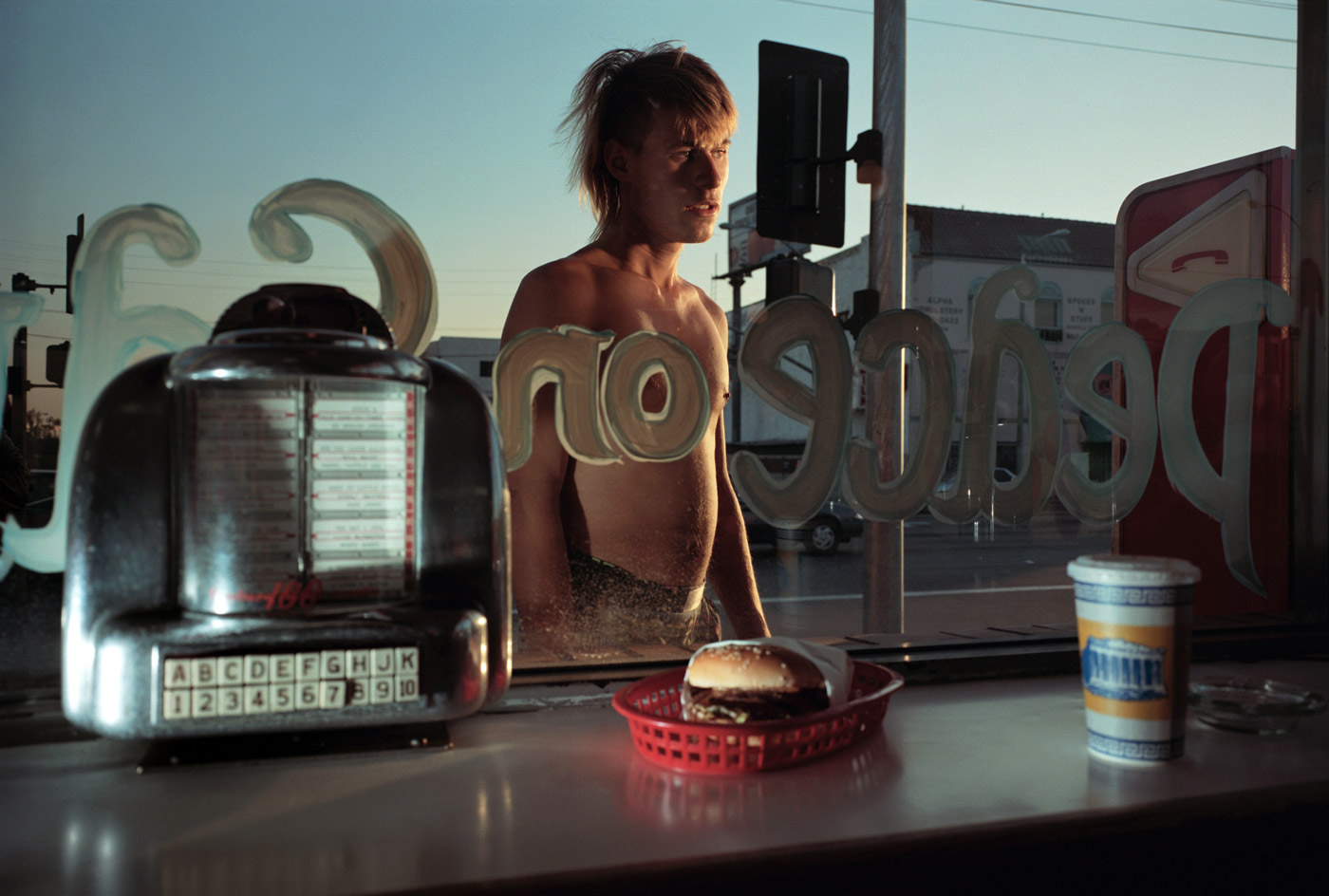
Philip-Lorca diCorcia (American, b. 1953). 'Todd M. Brooks, 22 Years Old, from Denver, Colorado, $40' 1991


Philip-Lorca diCorcia (American, b. 1953)
Todd M. Brooks, 22 Years Old, from Denver, Colorado, $40
1991
Chromogenic print
The Metropolitan Museum of Art
Purchase, The Horace W. Goldsmith Foundation Gift, through Joyce and Robert Menschel, 1991
Image courtesy the artist and David Zwirner, New York
© Philip-Lorca diCorcia


In the middle of the 1990’s, diCorcia gained international recognition for his large color photographs of street scenes and passersby. For an earlier series, he traveled to Los Angeles on a fellowship from the National Endowment for the Arts, and worked on a part of Santa Monica Boulevard frequented by male prostitutes and drug addicts. For each picture he made there, he carefully composed his setting, then asked young men to pose for him, giving them a small fee (from twenty to fifty dollars) that was negotiated each time.

At that time, NEA support of artists such as Robert Mapplethorpe was highly controversial, and diCorcia had to sign a document stating that he would not produce any “obscene” work while on his fellowship. He set up the whole negotiating procedure as a symbolic way of sharing his grant with people whose behavior would surely have been condemned by the censors. The titles always mention the name, the age and the origin of the model, as well as the amount paid. The staged situation interacts with the raw reality of the exchange of money, blurring the boundaries between documentary and fiction, yet preserving an authentic emotional charge.

Text from The Metropolitan Museum of Art website


Philip-Lorca diCorcia (American, b. 1953) 'Eddie Anderson, 21 Years Old, from Houston, Texas, $20' 1991


Philip-Lorca diCorcia (American, b. 1953)
Eddie Anderson, 21 Years Old, from Houston, Texas, $20
1991
Chromogenic print
Image: 39.2 x 57.8 cm (15 7/16 x 22 3/4 in.)
The Metropolitan Museum of Art
Purchase, The Horace W. Goldsmith Foundation Gift, through Joyce and Robert Menschel, 1991
Image courtesy the artist and David Zwirner, New York
© Philip-Lorca diCorcia


The Metropolitan Museum of Art will present After the Gold Rush: Contemporary Photographs from the Collection from March 22, 2011, through January 2, 2012, in the Joyce and Robert Menschel Hall for Modern Photography. Drawn entirely from the Museum’s permanent collection, the exhibition features 25 photographs dating from 1979 to the present by 15 contemporary artists.

The exhibition’s title, After the Gold Rush, is taken from a classic 1970 song by Neil Young, whose verses contrast a romanticised past with a present of squandered plenty and an uncertain future. Inspired by the recent political and economic upheavals in America and abroad, this selection juxtaposes new photographs that take the long view of the world’s current condition with prescient works from the 1980s and 1990s that remain startlingly relevant today.

This is the first occasion for the Museum to present recently acquired works by: Gretchen Bender, James Casebere, Moyra Davey, Katy Grannan, Hans Haacke, An-My Lê, Curtis Mann, Trevor Paglen, and Wolfgang Tillmans. Also featured are photographs by: Philip-Lorca diCorcia, Robert Gober, Adrian Piper, Laurie Simmons, Jeff Wall, and Christopher Williams.

After the Gold Rush begins with Hans Haacke’s Thank You, Paine Webber (1979) – the first work by this legendary provocateur of Conceptual art to enter the Metropolitan’s collection. Haacke’s biting photo-diptych is so pertinent to the recent economic downturn that it seems as if it could have been made yesterday. In this work, the artist appropriated images from the investment firm’s annual report to convey his viewpoint that big business provides a veneer of social concern to mask the brutal effects of the “risk management” they offer their clients.

Other works in After the Gold Rush use varying degrees of artifice and photographic realism to reflect on marginalised and repressed voices. Measuring over 14 feet long and presented as a backlit transparency in a light box, The Storyteller (1986) is Jeff Wall’s signature image and is typical of his method. Working from memory, the artist uses nonprofessional actors and real locations to meticulously restage a scene of urban blight that he witnessed in his native Vancouver. Wall plays this photographic verisimilitude against compositions and figural poses indebted to French painters such as Gustave Courbet, Edouard Manet, and Georges Seurat. A comparison of Wall’s Storyteller with Courbet’s Young Ladies of the Village (1852), on view in the Museum’s galleries for Nineteenth and Early Twentieth-Century European Paintings and Sculpture, reveals parallels: in both, a keenly observed moment of telling social interaction taking place on a sloping landscape. Each artist has combined a daringly modern subject with references to earlier art.

Philip-Lorca diCorcia is another key figure in the development of staged photography. In the early 1990s, the artist created a series of works in response to the political attacks on gays and federal funding of the arts in the U.S. DiCorcia hired male hustlers to pose for their portraits out on the streets – and paid them with grant money he received from the National Endowment for the Arts. At the same moment, a wide swath of women artists addressed issues of sexism and racism: examples of this politically pointed art are represented by Laurie Simmons’ Walking Gun (1991) – a spotlighted puppet of doll legs and a revolver that seems capable of turning on its master at a moment’s notice – and Adrian Piper’s 1992 work Decide Who You Are #24 (A Moving Target), which includes a childhood image of Anita Hill as part of a blistering meditation in word and image on racial politics. Such works are missives from a time not so long ago when artists regularly commented on present-day politics and culture through their art. (Because of light sensitivity, this work by Adrian Piper will be on view through Sunday, September 26.)

Although the recently made photographs in After the Gold Rush seem at first glance to be less overtly political than their predecessors, they nevertheless address vital issues about contemporary society. James Casebere’s epic vision of America, Landscape with Houses (Dutchess County, NY) #1, (2009), is based on a tabletop model that the artist spent 18 months building. The photograph shows a suburban subdivision of the kind recently ravaged by the foreclosure crisis, and its sunny sense of “Morning in America” comments ironically on the country’s future prospects. An-My Lê’s similarly sweeping five-part photographic piece Suez Canal Transit, USS Dwight Eisenhower, Egypt (2009) will also be featured. Lê is interested in the way in which U.S. armed forces come into contact with the rest of the world. This major new work – which seems at first to be a straightforward panorama of military might overseas – subtly undercuts the viewer’s expectations to question the current position of the U.S. on the global stage.

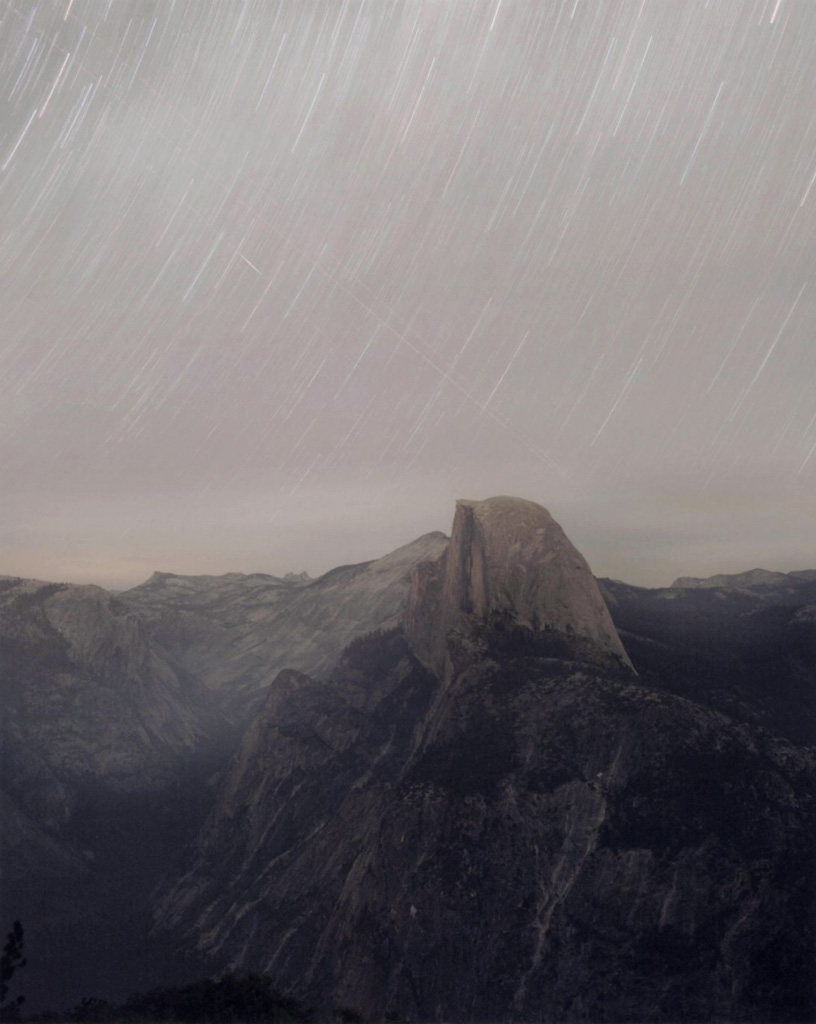
Trevor Paglen is a young artist whose works plot the “black world” of covert military operations, from telephoto images of predator drones taken from miles away, to software that follows planes used for the extraordinary rendition of suspected terrorists. Paglen’s 2008 photograph KEYHOLE IMPROVED CRYSTAL from Glacier Point (Optical Reconnaissance Satellite; USA 186) shows the ghostly white streak of an American reconnaissance satellite bisecting star trails above Yosemite’s Half Dome, a rock formation photographed in the 1860s by artists including Carleton Watkins. To make these and other photographs, Paglen collaborated with amateur astronomers who were originally trained by the U.S. government to look out for Soviet satellites during the Cold War, but turned their attention to American surveillance in recent years.

The final piece in After the Gold Rush is a suite of five recently acquired photographs from 2007-2009 by the celebrated photographer Wolfgang Tillmans. The grouping shifts focus from macro to micro: from expansive aerial views of Shanghai and Dubai to close ups that suggest the smallest increments of sustenance and regeneration. Taken together, they evoke the interconnectedness of all things and a grounding of the political in the personal as a way for an engaged yet expressive art.

Press release from The Metropolitan Museum of Art website


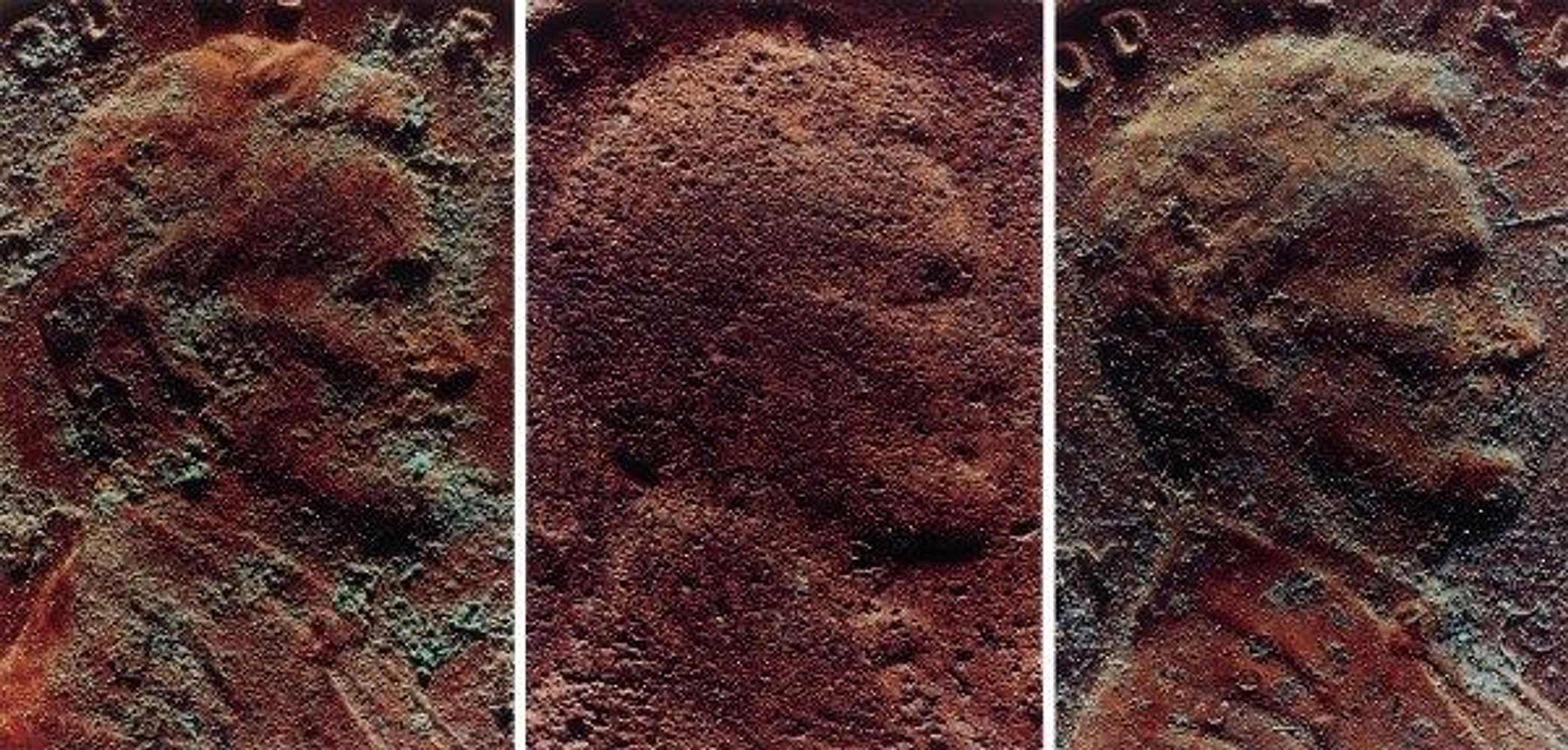
Moyra Davey (American born Canada, b. 1958) 'Copperhead Grid' 1990 (detail)


Moyra Davey (American born Canada, b. 1958)
Copperhead Grid (detail)
1990
Chromogenic prints
Image: 8 3/4 in. × 6 in. (22.3 × 15.3cm) each
Sheet: 10 × 8 in. (25.4 × 20.3cm) each
The Metropolitan Museum of Art
Purchase, Vital Projects Fund Inc. Gift, through Joyce and Robert Menschel, 2011
© Moyra Davey


It was in 1990 – at the height of a worldwide economic recession that also marked the end of the 1980s art bubble – that Davey began photographing the scratched, worn-away surfaces of pennies, the most devalued and lowest form of currency. Her accumulation of one hundred micro-photographic specimens is constructed around the readymade patterns of decay that countless anonymous owners have unconsciously wrought upon their surfaces; their base materiality is incisively contrasted with the most elevated of national symbols. As with all of Davey’s work, there is a melancholic sense of loss that connects subject and form: like pennies, photographs are objects of exchange imprinted by contact with the world around them.

Text from The Metropolitan Museum of Art website


Adrian Piper (American, born 1948). 'Decide Who You Are #24: A Moving Target' 1992


Adrian Piper (American, b. 1948)
Decide Who You Are #24: A Moving Target
1992
Photo-mechanical processes on three panels
The Metropolitan Museum of Art
Gift of Peter Norton Family Foundation, 1994
© Adrian Piper


Piper is an artist and a philosophy professor who works in a variety of media, including performance, video, sound pieces, photography, drawing, and writing. She often explores issues of autobiography, racism, and stereotyping. For her 1992 series Decide Who You Are, the artist used a triptych format in which a different appropriated photograph is flanked by an image of the “three wise monkeys” maxim advocating “See No Evil, Speak No Evil, Hear No Evil” at left, and at right a photograph of a young girl who, though not identified, is Anita Hill – who had recently been thrust into the spotlight for accusing then-nominee for Supreme Court Justice Clarence Thomas of sexual harassment. The verse in the left panel changes in each individual work in the series, while that on the right is unchanging – what the artist once described as “a comprehensive, textbook compendium of commonly invoked litanies of denial and intimidation, from the bland to the vaguely menacing” and “a must for novices and aspiring leaders in business, politics, and culture.”

Wall text


Christopher Williams (American, b. 1956). '3 White (DG's Mr. Postman) Fourth Race, Phoenix Greyhound Park, Phoenix, Arizona, August 22, 1994' 1994


Christopher Williams (American, b. 1956)
3 White (DG’s Mr. Postman) Fourth Race, Phoenix Greyhound Park, Phoenix, Arizona, August 22, 1994
1994
Gelatin silver print
The Metropolitan Museum of Art
Purchase, Charina Foundation Inc. and Jennifer and Joseph Duke Gifts, 2003
© Christopher Williams


Robert Gober (American, b. 1954) 'Page 12 / Untitled (Detail from 1978-2000)' 1978-2000


Robert Gober (American, b. 1954)
Page 12 / Untitled (Detail from 1978-2000)
1978-2000
Gelatin silver print
40.6 x 50.8cm (16 x 20 in.)
The Metropolitan Museum of Art
Purchase, Charina Foundation Inc. Gift, 2002
© Robert Gober


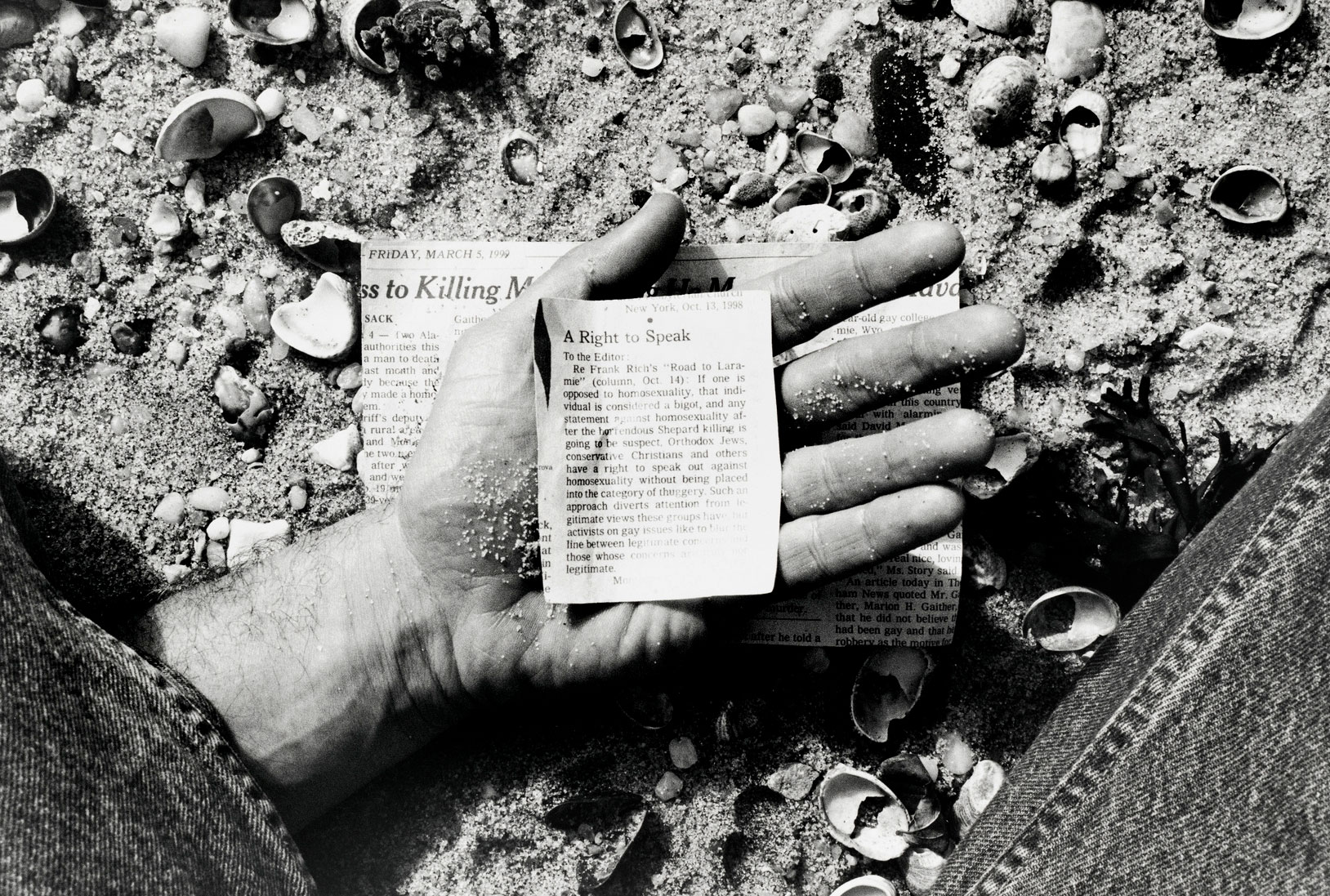
Robert Gober works primarily in sculpture, installations, and photography. He is perhaps best known for his delicate, ghostly hand crafted versions of domestic fixtures, such as drains, beds, doors, and sinks. Through these uncanny replicas, Gober invests mass produced objects with personal meaning – the private, unruly desires and memories of the individual. This image appeared in the book (his first in the genre) that Gober created to accompany his installation representing the United States at the 2000 Venice Biennale. In it, the artist interweaves his own journey to New York in 1978 as a young gay man with the toxic fallout of homophobic recrimination that accompanied the murder of the Wyoming college student Matthew Shepard twenty years later.

Text from The Metropolitan Museum of Art website


Robert Gober superimposes a man’s hand between two newspaper articles, clipped neatly and placed on a shell-strewn beach. Below his hand, the article refers to Matthew Shepard’s death. Above it, a letter to the editor argues that “Orthodox Jews, conservative Christians and others have a right to speak out against homosexuality without being placed in the category of thuggery.” While the piece obviously precedes Jonathan Rauch’s provocative and important piece in the December issue of the Advocate arguing that gay people should tolerate a certain amount of anti-gay sentiment as a sign that they’re legally and socially secure enough to practice tolerance, it’s a useful encapsulation of the dilemma behind that argument. It’s hard to cast off past threats if you’re not entirely sure they’re past.

Alyssa Rosenberg. “Gay Americans, Censorship, And ‘After The Gold Rush’ At The Metropolitan Museum Of Art,” on the Think Progress website November 28, 2011 [Online] Cited 11/12/2024


Robert Gober (American, b. 1954). 'Untitled (Detail from "1978-2000")' 2000


Robert Gober (American, b. 1954)
Untitled (Detail from “1978-2000”)
2000
Gelatin silver print
The Metropolitan Museum of Art
Purchase, Jennifer and Joseph Duke Gift, 2002
© Robert Gober


James Casebere (American, b. 1953). 'Landscape with Houses (Dutchess County, NY) #1' 2009


James Casebere (American, b. 1953)
Landscape with Houses (Dutchess County, NY) #1
2009
Chromogenic print
The Metropolitan Museum of Art
Purchase, Alfred Stieglitz Society Gifts, 2011
© James Casebere


Trevor Paglen (American, b. 1974) 'KEYHOLE IMPROVED CRYSTAL from Glacier Point (Optical Reconnaissance Satelltte; USA 186)' 2008


Trevor Paglen (American, b. 1974)
KEYHOLE IMPROVED CRYSTAL from Glacier Point (Optical Reconnaissance Satelltte; USA 186)
2008
Chromogenic print
Image: 95.3 x 76.2cm (37 1/2 x 30 in.)
Frame: 96.5 × 77.5cm (38 × 30 1/2 in.)
The Metropolitan Museum of Art
Purchase, Vital Projects Fund Inc. Gift, through Joyce and Robert Menschel, 2011
© Trevor Paglen


Trained as a geographer, Paglen is an artist who plots the topography of a new global and celestial space – the “black world” of covert military operations. Examples of his subjects include the supposed sites used for the extraordinary rendition of prisoners, which he shoots with specially designed cameras from up to forty miles away, and the network of private planes used to transport them under the radar. This image shows the ghostly white streak of an American reconnaissance satellite bisecting star trails above Yosemite’s Half Dome, a rock formation photographed in the 1860s by the photographer Carleton Watkins when the West was still being explored. In order to track such spacecraft, Paglen uses a database created by amateur astronomers who were trained by the U.S. government to search the skies for Soviet sputniks but continued their hobby after the end of the Cold War by tracking our own satellites. In this work, the artist brings into one composition two historically disparate moments in geographic and celestial colonisation.

Text from The Metropolitan Museum of Art website


Wolfgang Tillmans (German, b. 1968).' Oriental Pearl' 2009


Wolfgang Tillmans (German, b. 1968)
Oriental Pearl
2009
Inkjet print
The Metropolitan Museum of Art
Purchase, Vital Projects Fund Inc. Gift, through Joyce and Robert Menschel, 2010
Image courtesy the artist and Andrea Rosen Gallery, New York
© Wolfgang Tillmans


The Metropolitan Museum of Art
1000 Fifth Avenue at 82nd Street
New York, New York 10028-0198
Phone: 212-535-7710

Opening hours:
Sunday – Tuesday and Thursday: 10am – 5pm
Friday and Saturday: 10am – 9pm
Closed Wednesday

The Metropolitan Museum of Art website

LIKE ART BLART ON FACEBOOK

Back to top

Exhibition: ‘Picturing America: Photorealism in the 1970s’ at Deutsche Guggenheim, Berlin

Exhibition dates: 7th March – 10th May, 2009


Many thankx to the Deutsche Guggenheim for allowing me to publish the art work in the posting. Please click on the art work for a larger version of the image.


“My paintings are about light, about the way things look in their environment and especially about how things look painted. Form, colour and space are at the whim of reality, their discovery and organisation is the assignment of the realist painter.”

~ Ralph Goings


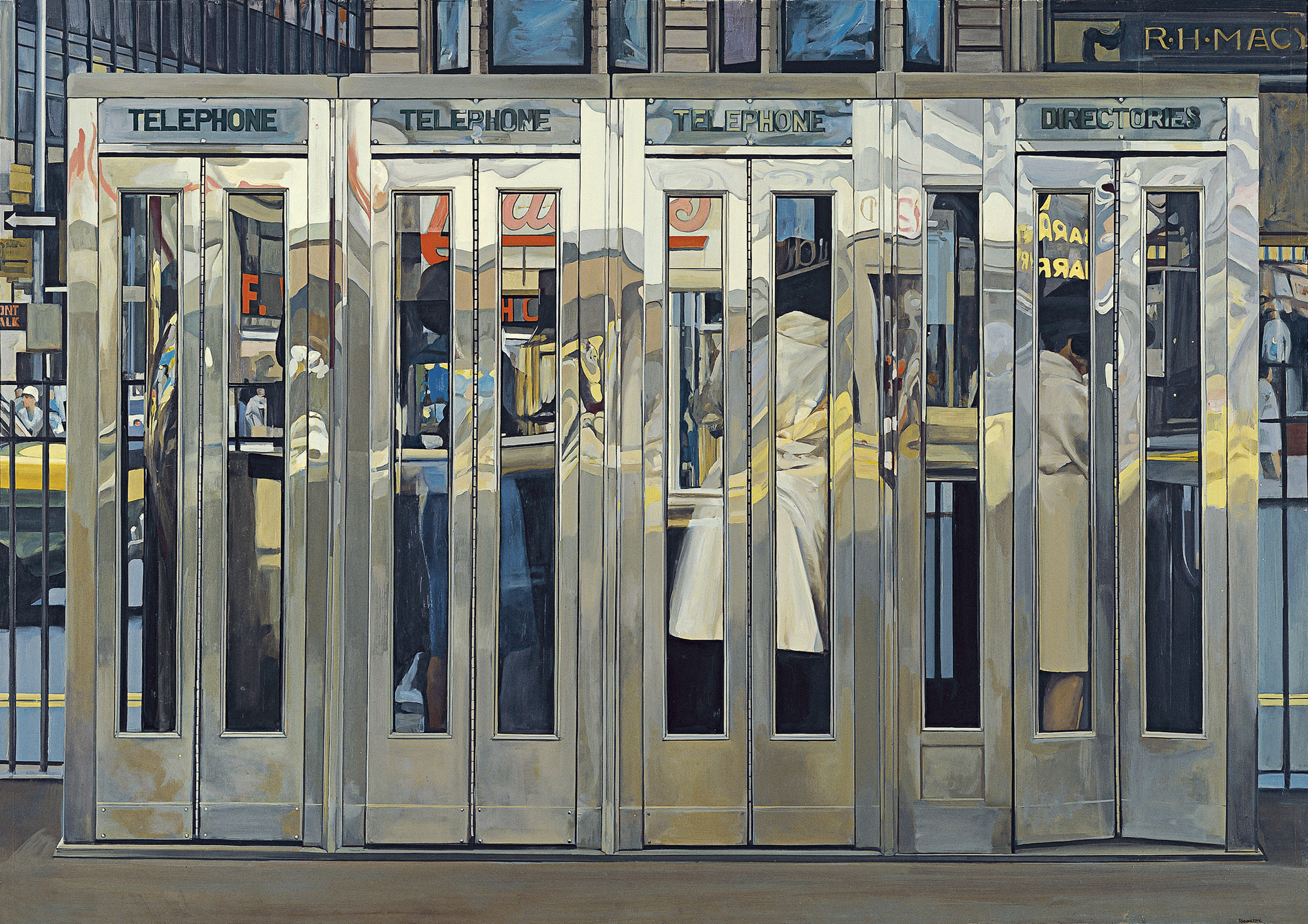
Richard Estes (American, b. 1932) 'Telephone Booths' 1967 from the exhibition 'Picturing America: Photorealism in the 1970s' at Deutsche Guggenheim, Berlin, March - May, 2009


Richard Estes (American, b. 1932)
Telephone Booths
1967


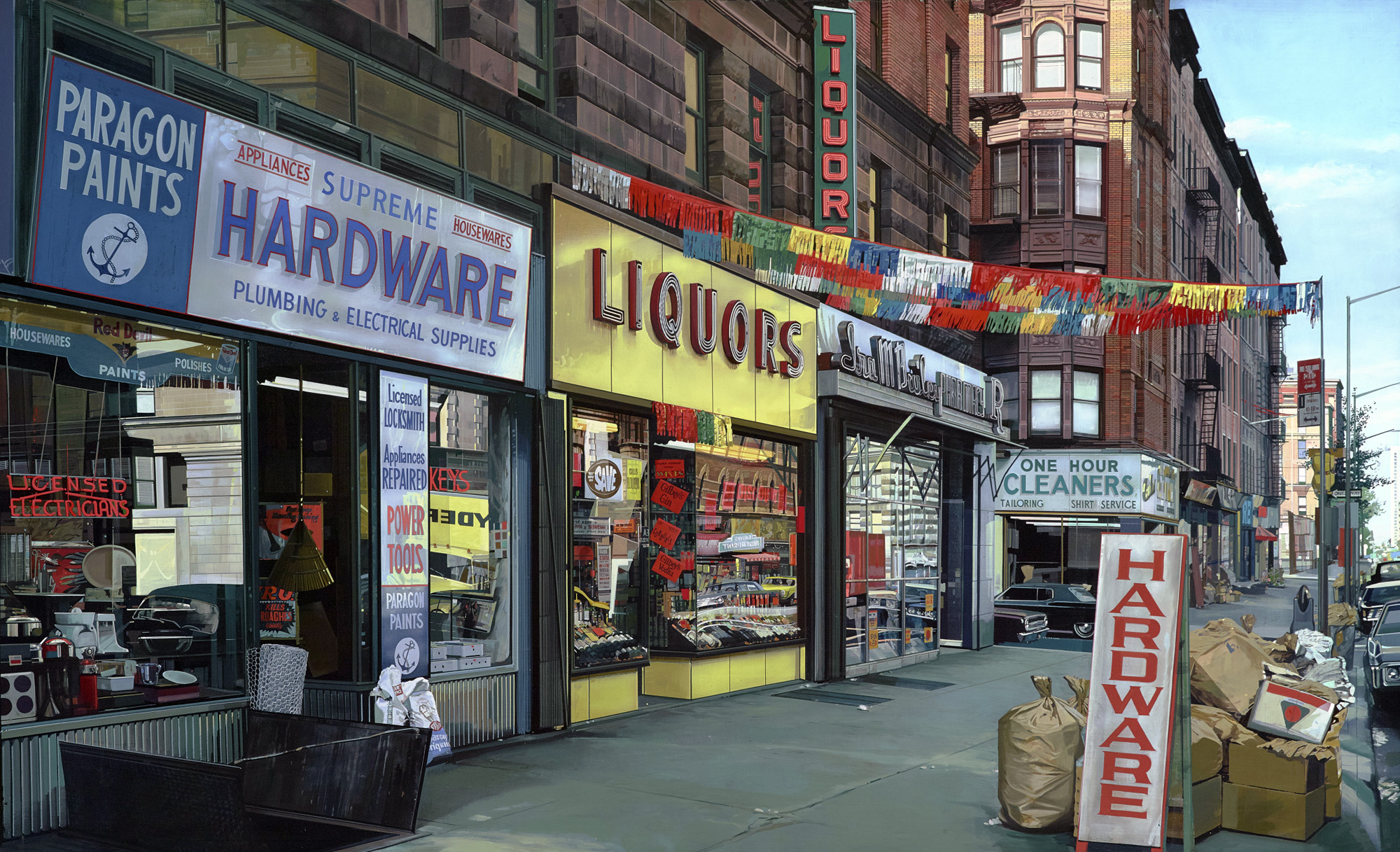
Richard Estes (American, b. 1932) 'Supreme Hardware' 1974 from the exhibition 'Picturing America: Photorealism in the 1970s' at Deutsche Guggenheim, Berlin, March - May, 2009


Richard Estes (American, b. 1932)
Supreme Hardware
1974


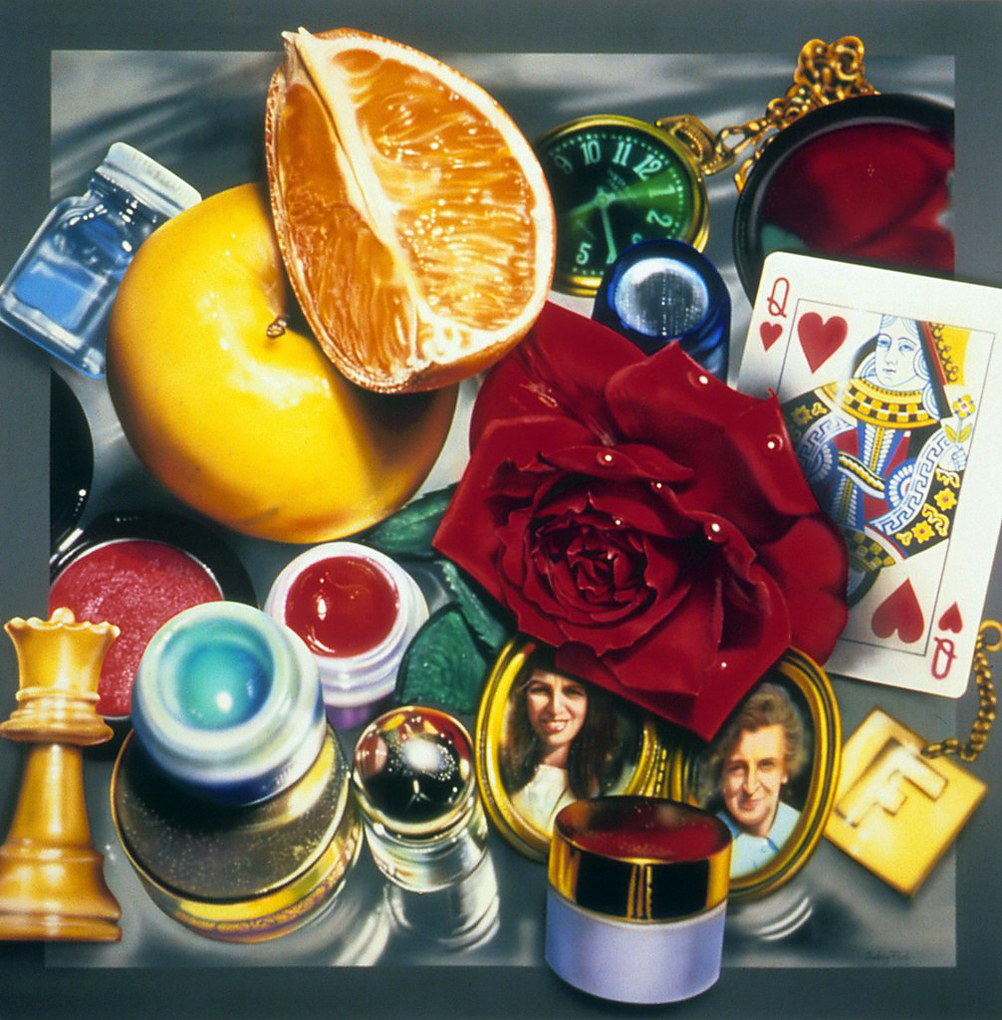
Audrey Flack (American, b. 1931) 'Queen' 1976


Audrey Flack (American, 1931-2024)
Queen
1976


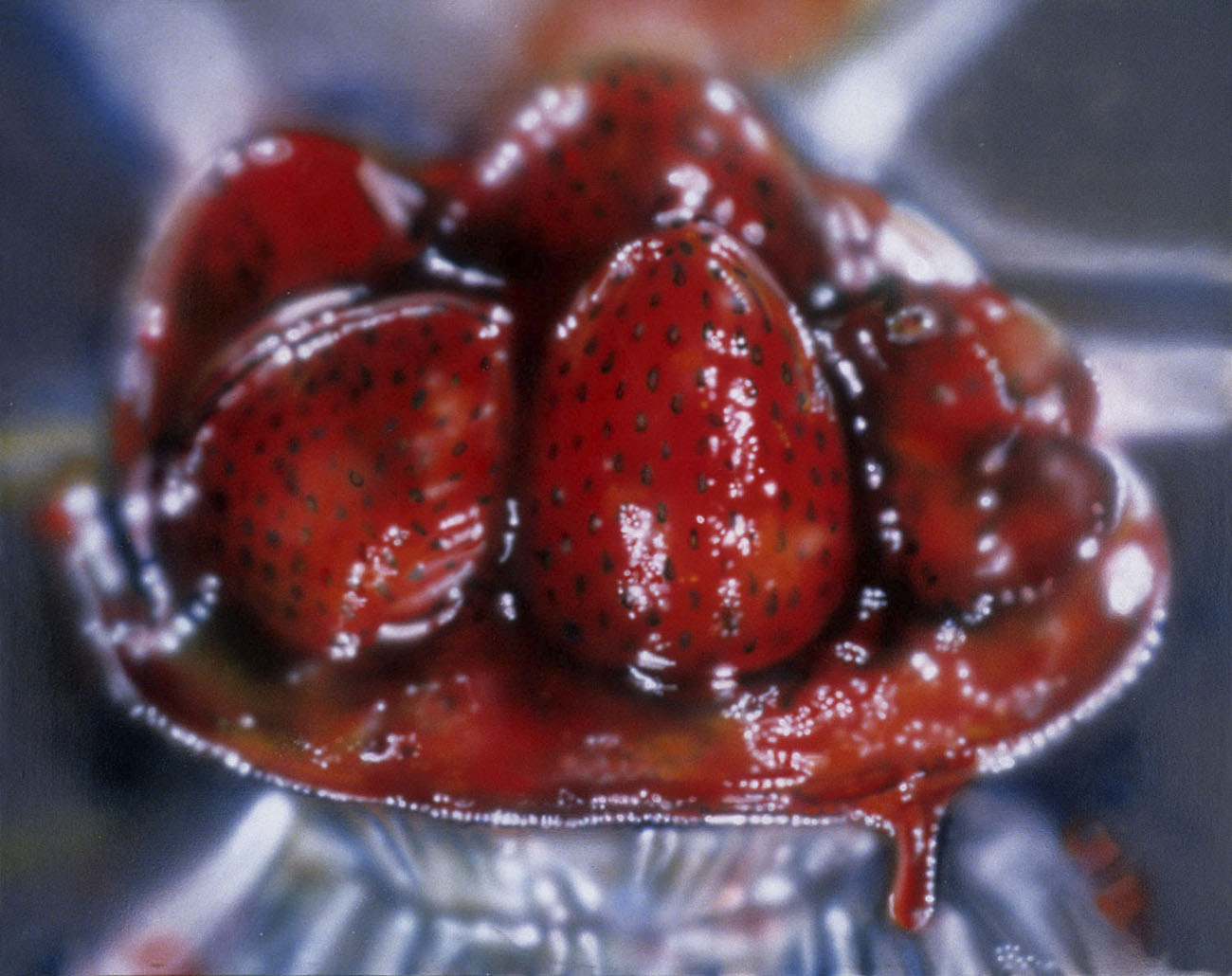
Audrey Flack (American, 1931-2024) 'Strawberry Tart' 1974


Audrey Flack (American, 1931-2024)
Strawberry Tart
1974
Oil on canvas
24 x 30 inches


Don Eddy (American, b. 1944) 'Untitled' 1971


Don Eddy (American, b. 1944)
Untitled
1971


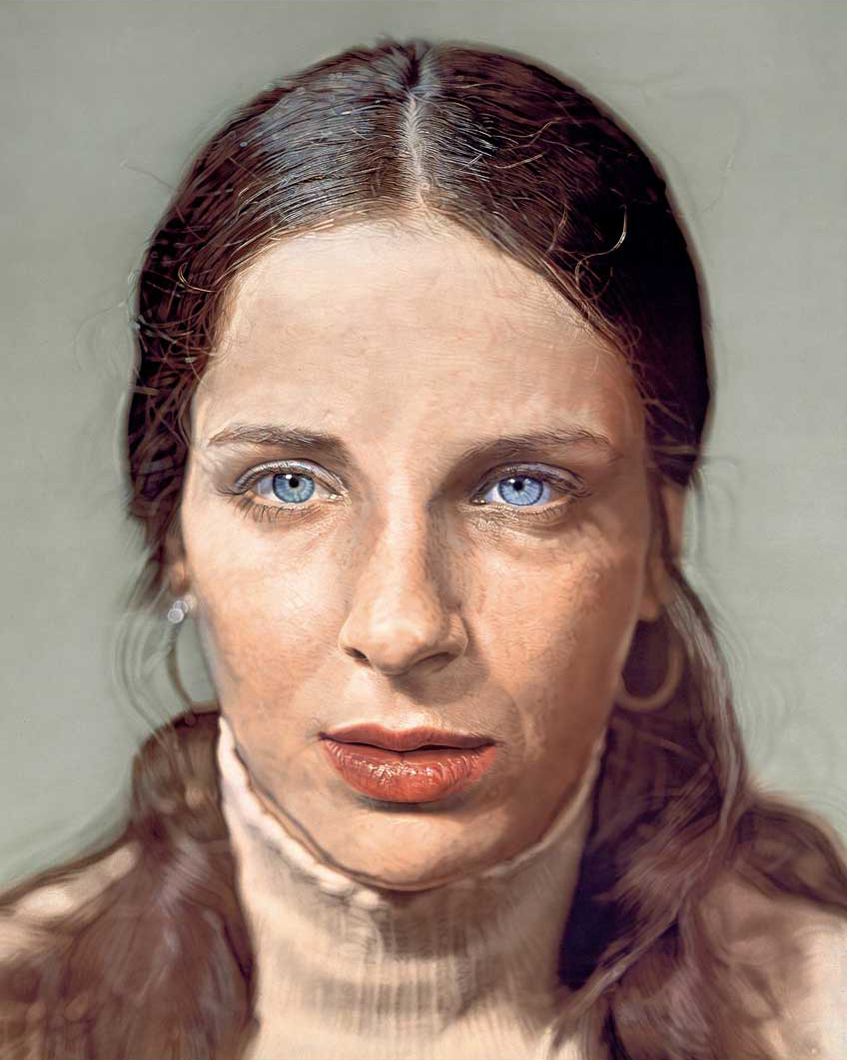
Chuck Close (American, 1940-2021) 'Leslie' 1973


Chuck Close (American, 1940-2021)
Leslie
1973


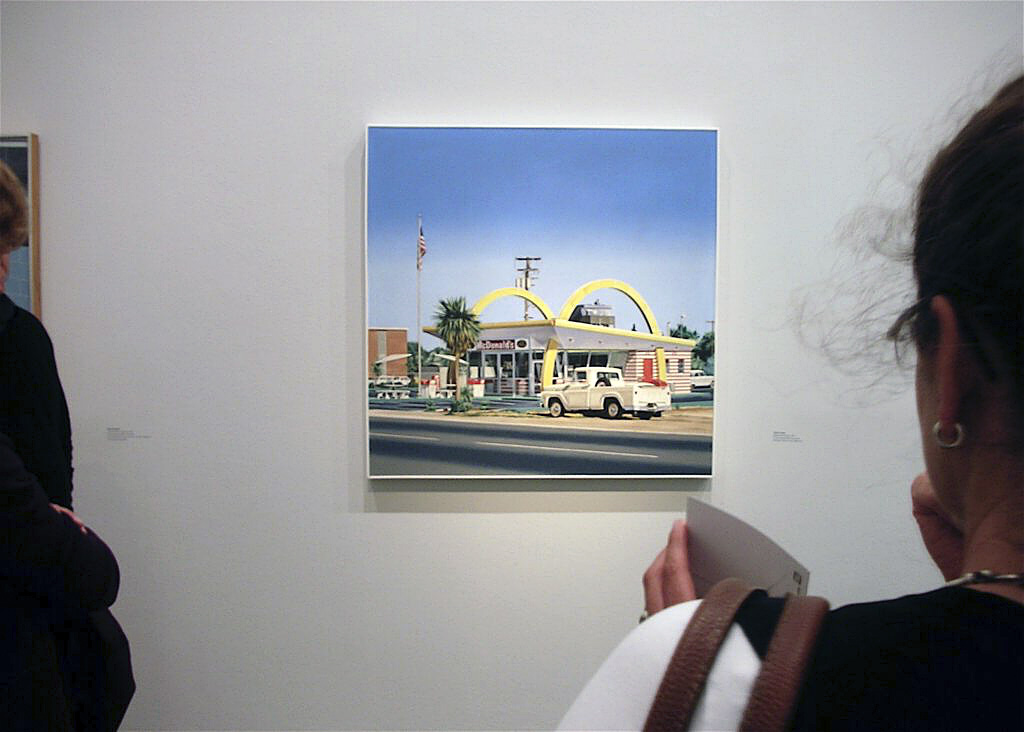
Ralph Goings (American, 1928-2016) 'McDonalds Pick Up' 1970 (installation view)


Ralph Goings (American, 1928-2016)
McDonalds Pick Up (installation view)
1970
41 x 41 inches
Oil on canvas
Collection of Marilyn and Ivan Karp


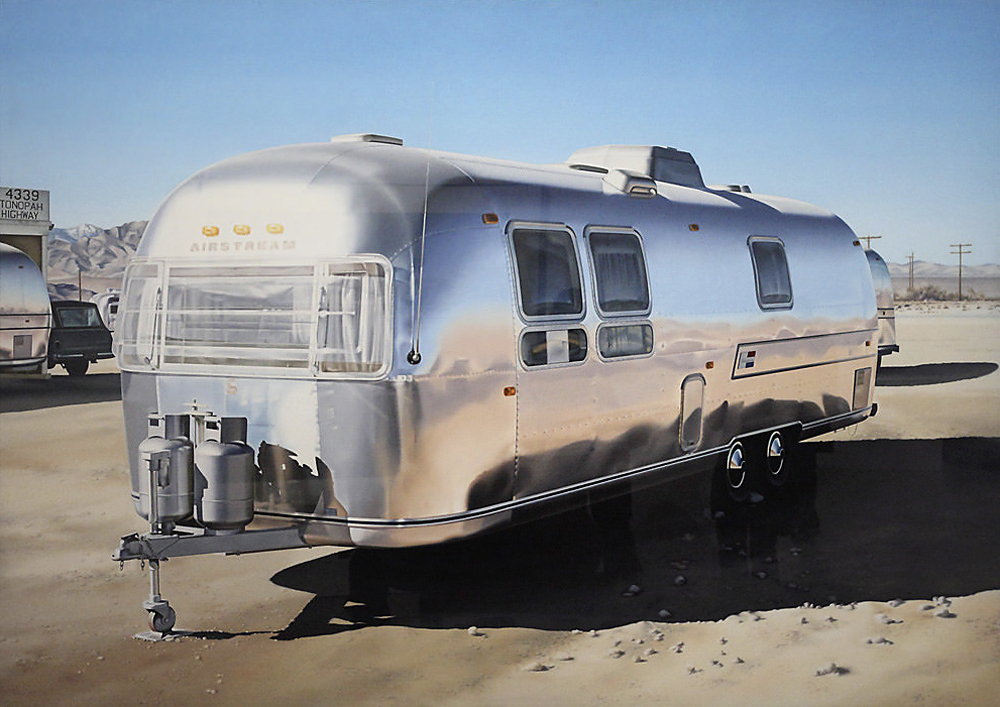
Ralph Goings (American, 1928-2016) 'Airstream' 1970


Ralph Goings (American, 1928-2016)
Airstream
1970


Ralph Goings (American, 1928-2016) 'Dicks Union General' 1971


Ralph Goings (American, 1928-2016)
Dicks Union General
1971
Oil on canvas


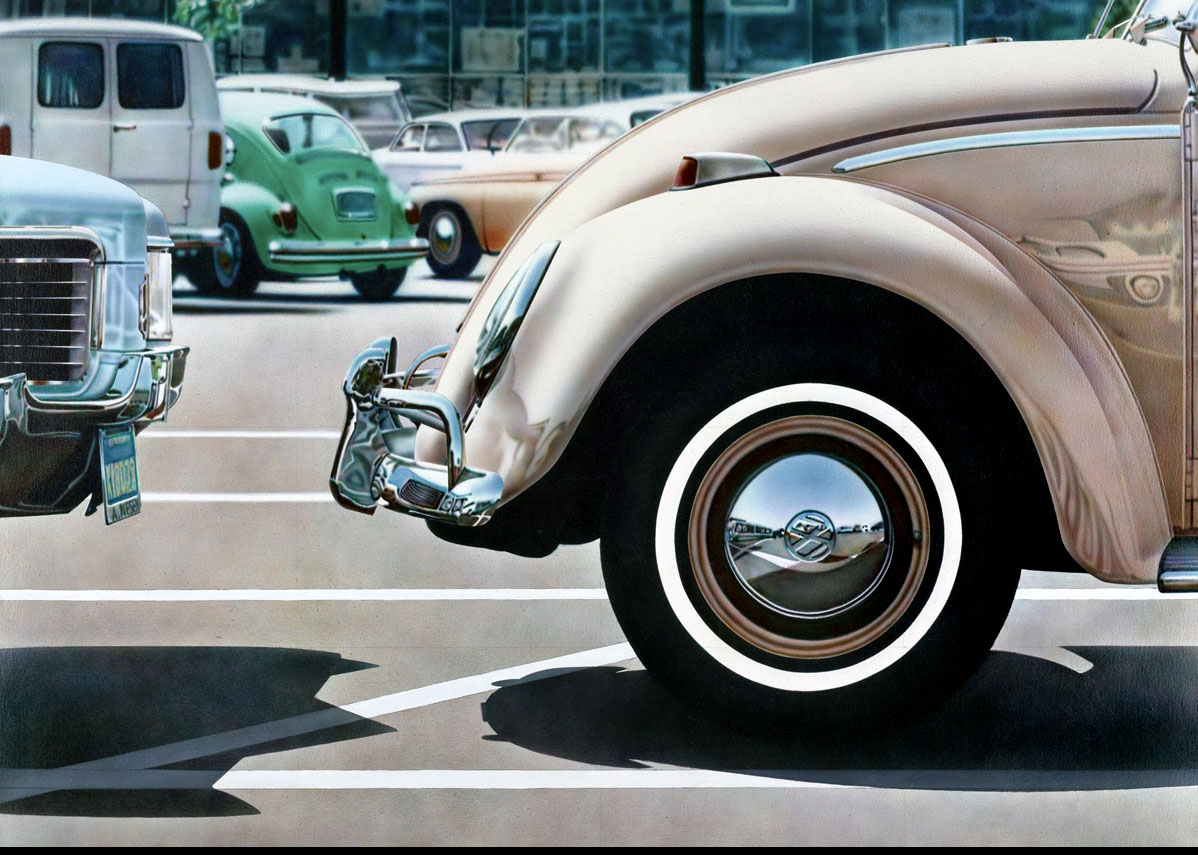
By the end of the 1960s, a number of young artists working in the United States had begun making large-scale realist paintings directly from photographs. With often meticulous detail, they portrayed the objects, places, and people that defined urban and suburban everyday life in America. In contrast to the Pop artists, they did not present their ubiquitous, often mundane, subject matter in a glamorised or ironic manner. They sought instead to achieve a great degree of objectivity and precision in the execution of their work in an effort to stay more or less faithful to the mechanically generated images that served as their source material. They developed various means of systematically translating photographic information onto canvas. In prioritising the way the camera sees over the way the eye sees, they underscored the complexity of the relationship between the reproduction and the reproduced as well as the impact of photography on the perception of both daily life and reality in general.

A number of terms were proposed in quick succession to describe this novel approach to painting, chief among them Super-Realism, Hyperrealism, and Photorealism. The artists identified as Photorealists neither formed a coherent group nor considered themselves to be part of a movement, and a number of them actively challenged their association with the label. Nevertheless, in the late 1960s and 1970s, the seventeen artists in Picturing America: Photorealism in the 1970s – Robert Bechtle, Charles Bell, Tom Blackwell, Chuck Close, Robert Cottingham, Don Eddy, Richard Estes, Audrey Flack, Franz Gertsch, Ralph Goings, Ron Kleemann, Richard McLean, Malcolm Morley, Stephen Posen, John Salt, Ben Schonzeit, and Paul Staiger – were exploring a related set of issues, methods, and subjects that led critics, curators, and art historians to both exhibit and write about their work as a coherent trend in contemporary art. Picturing America focuses on this formative, defining period in the history of Photorealism.

The exhibition includes thirty-one paintings, a number of them the most iconic and masterful works of 1967-1982, for example Richard Estes’s Telephone Booths (1967, above) and Chuck Close’s Leslie (1973, above). Picturing America is divided into four sections, three exploring key themes of Photorealist painting during the 1970s – Reflections on the City, Culture of Consumption, and American Life – and a fourth dedicated to a portfolio of ten lithographs made on the occasion of Documenta 5 in 1972, which featured the first major group showing of Photorealism.

Text from the Deutsche Guggenheim website


Picturing Americas – American Photorealism in the 70s

Vernissage video of “Picturing Americas”, an art exhibition about American Photorealism in the 1970s, presented in Berlin by Deutsche Guggenheim, a joint venture between Deutsche Bank and the Solomon R. Guggenheim Foundation in New York. The exhibition (March – May 2009) was the first major showing of American Photorealism in Germany since “documenta 5” in 1972.

The video includes interviews of Valerie Hillings, Assistant Curator, Solomon R. Guggenheim Museum, and interviews with the following artists: Ron Kleemann, Robert Bechtle, Tom Blackwell. You can also enjoy stills of selected pictures shown at the exhibition. Video courtesy of VernissageTV (VTV).

Text from the YouTube website


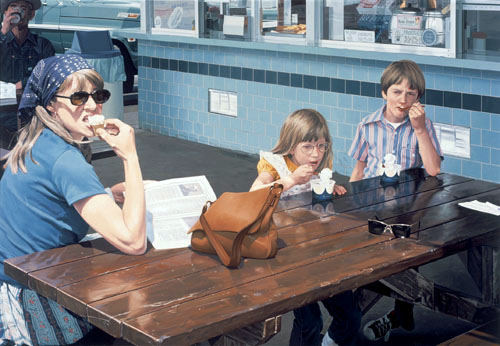
Robert Bechtle (American, 1932-2020) 'Foster's Freeze, Escalon' 1975


Robert Bechtle (American, 1932-2020)
Foster’s Freeze, Escalon
1975


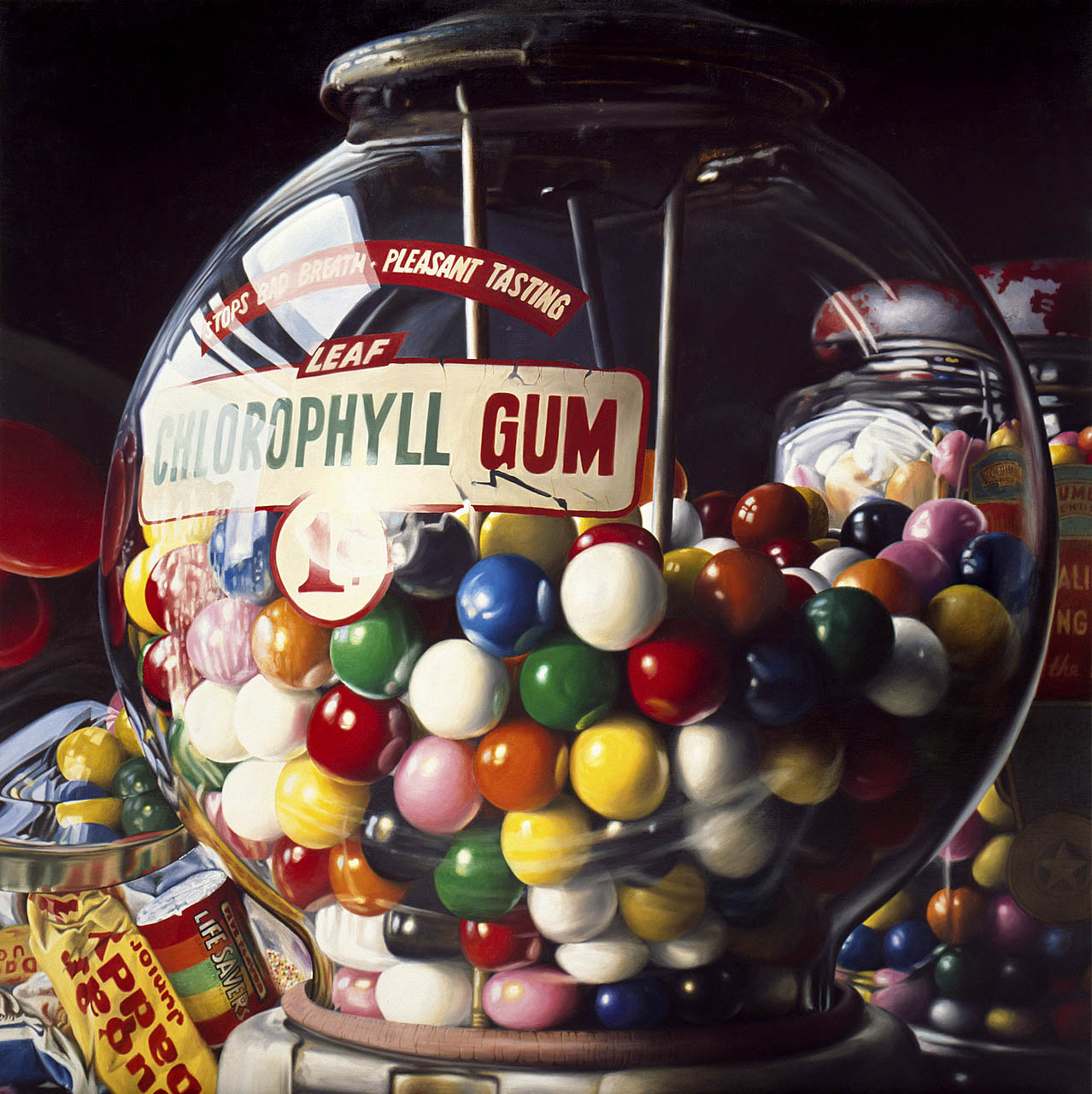
Charles Bell (American, 1935-1995) 'Gum Ball No. 10: "Sugar Daddy"'
1975


Charles Bell (American, 1935-1995)
Gum Ball No. 10: “Sugar Daddy”
1975
Oil on canvas
66 x 66 inches


Charles Bell was born in 1935 in Tulsa, Oklahoma. Although Bell became interested in art at a young age, he never received formal training. In 1957, he completed a BBA at the University of Oklahoma, Norman, and did not decide to pursue an artistic career until the early 1960s after touring in the U.S. Navy. At this point in time, he was working in the San Francisco Bay Area, where he was drawn to the vibrantly colored paintings of Richard Diebenkorn and Wayne Thiebaud. Other artistic influences Bell has cited range from Pop art to the realisms of Jan Vermeer and Salvador Dalí. It was through the painter Donald Timothy Flores, however, that Bell learned technique, most notably trompe l’oeil, while working in the former’s San Francisco studio. Under Flores, Bell painted mostly small-scale landscapes and still lifes, which earned him the Society of Western Artists Award in 1968.

In 1967 Bell relocated to New York, where he set up his first studio. Two years later he began showing at New York’s Meisel Gallery run by Louis K. Meisel, who popularized the term “Photorealism” and helped establish the style as a movement. Bell embraced a photo-based technique in his work not only for the way it renders imperceptible details visible, but also for how he saw the close-up photographic view as emblematic of contemporary visual experience steeped in a daily bombardment of media imagery. Bell carried out his Photorealist works by photographing his subjects in still-life compositions and painting from his image. 

Although Photorealism emerged as a national phenomenon, certain general qualities distinguish the coastal approaches to the movement. While the majority of the West Coast Photorealists preferred landscapes, particularly images of cars, trucks, and homes within an overall landscape, Bell, like many of the New York–based Photorealists, focused on still life. Bell transformed everyday subject matter by enlarging ordinary objects like Raggedy Ann dolls and gumball machines to an unusually grand scale. His subjects are typically familiar objects associated with childhood, consumer culture, and play, and thus capable of resonating with a broad audience. By focusing on larger-than-life subjects, Bell’s paintings also deny narrative readings of his work. He has described his approach to selecting subject matter as more of an emotional than intellectual process. The hyperrealistic precision of his technique, combined with an exaggerated scale, produces a sensation that oscillates between familiarity and unfamiliarity, thus engaging the viewer sensually and emotionally. The exploration of light remains a persistent theme throughout Bell’s oeuvre, from his earliest treatments of light on mostly opaque surfaces to his interest in reflected and refracted light on transparent materials, as seen in the gumball machine series (1971-77). These investigations gave way to his subsequent interest in objects illuminated from within, such as pinball machines, which he began in 1977.

Text from the Guggenheim website


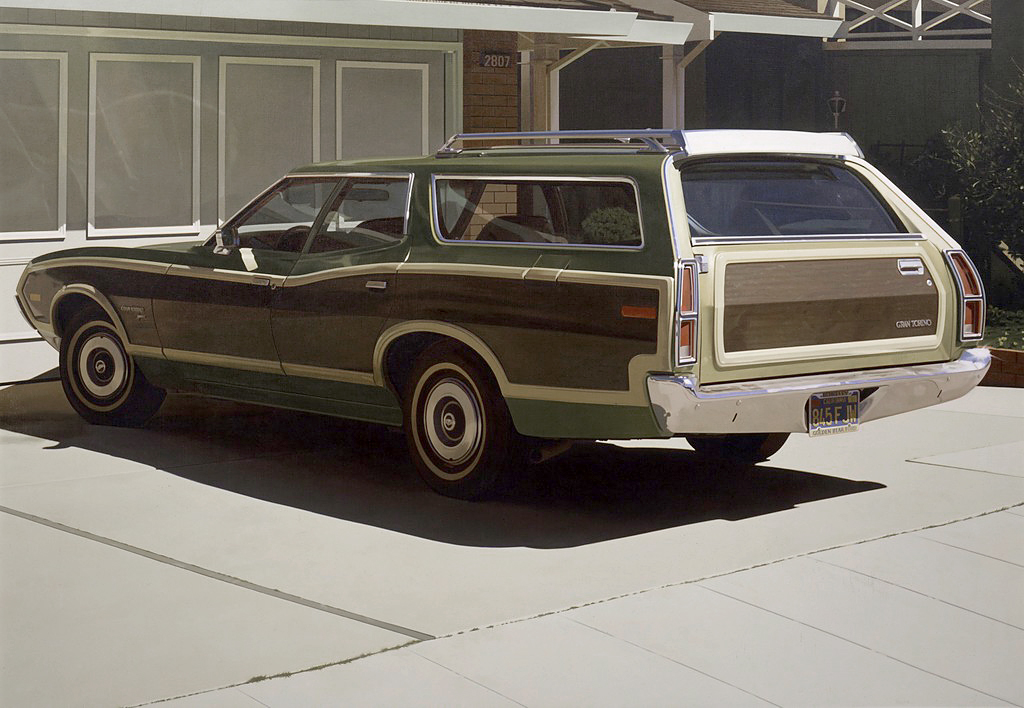
Robert Bechtle (American, 1932-2020) 'Alameda Gran Torino' 1974


Robert Bechtle (American, 1932-2020)
Alameda Gran Torino
1974


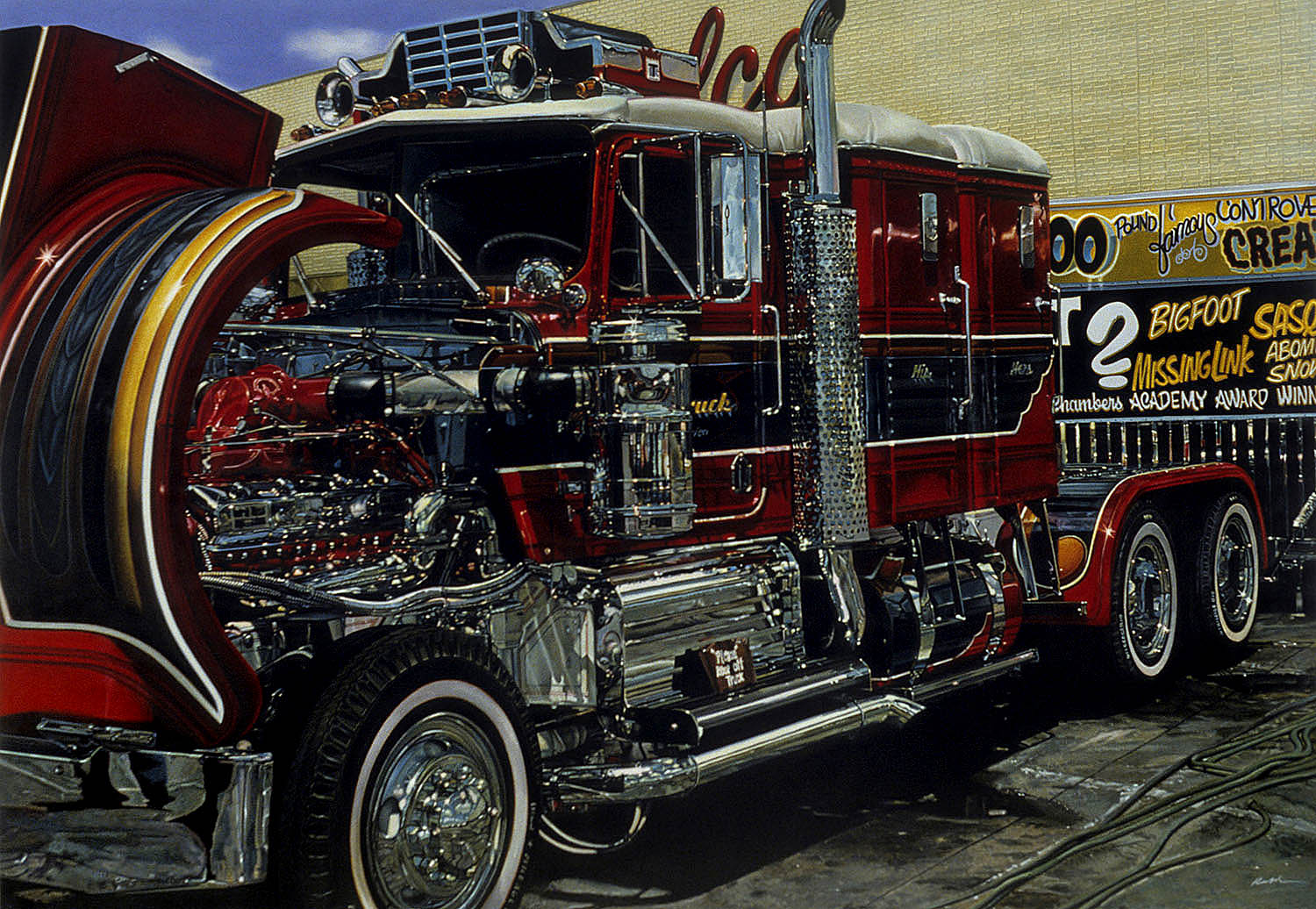
Ron Kleemann (American, 1937-2014) 'Big Foot Cross' 1977-1978


Ron Kleemann (American, 1937-2014)
Big Foot Cross
1977-1978
Acrylic on canvas
54 x 78 inches


Deutsche Guggenheim

This museum closed in 2013.

LIKE ART BLART ON FACEBOOK

Back to top