
July 2010
Unknown photographer
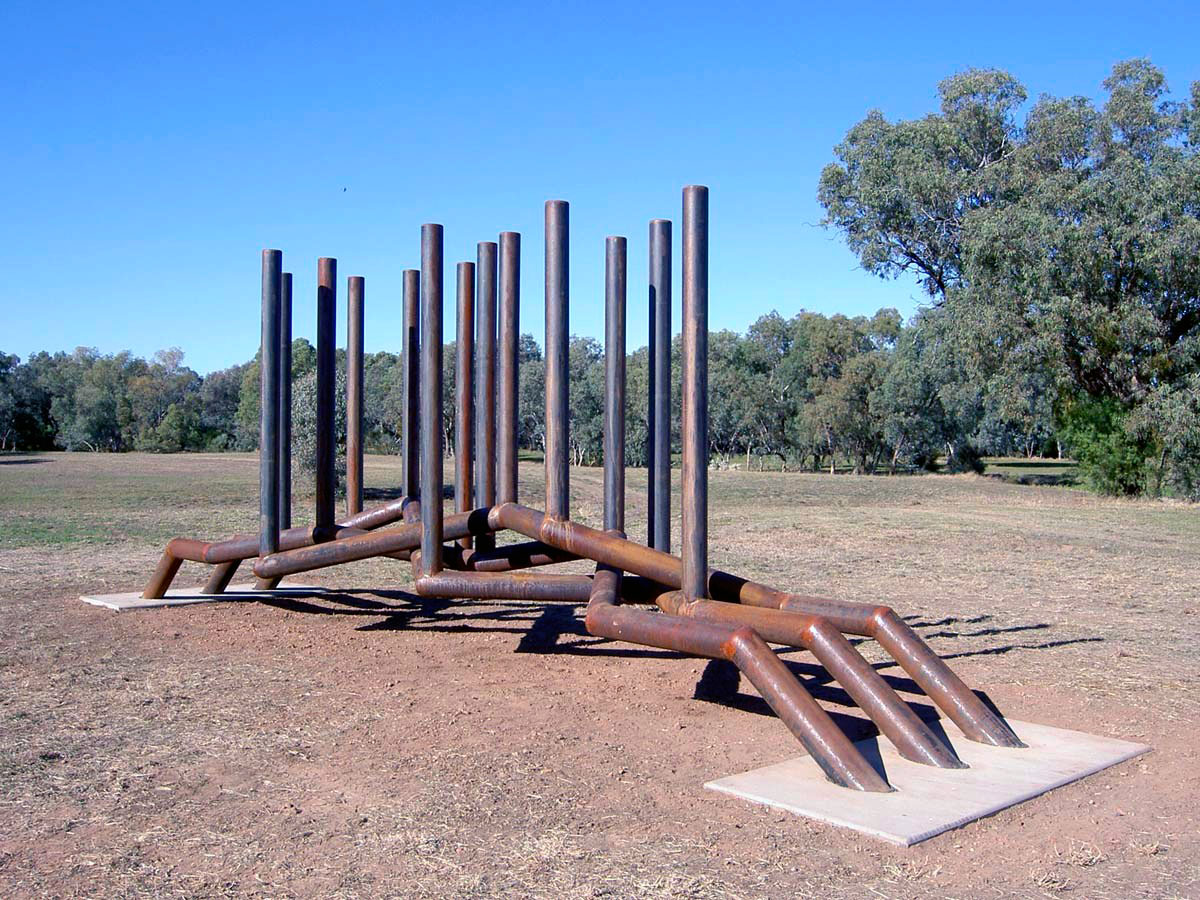
‘Lifespan’ by Frederick White
2010
“And do you know what “the world” is to me? Shall I show it to you in my mirror? This world: a monster of energy, without beginning, without end; a firm, iron magnitude of force that does not grow bigger or smaller, that does not expend itself but only transforms itself; as a whole, of unalterable size, a household without expenses or losses, but likewise without increase or income; enclosed by “nothingness” as by a boundary; not something blurry or wasted, not something endlessly extended, but set in a definite space as a definite force, and not a space that might be “empty” here or there, but rather a force throughout, as a play of forces and waves of forces, at the same time one and many, increasing here and at the same time decreasing there …”
Frederick Nietzsche, The Will to Power
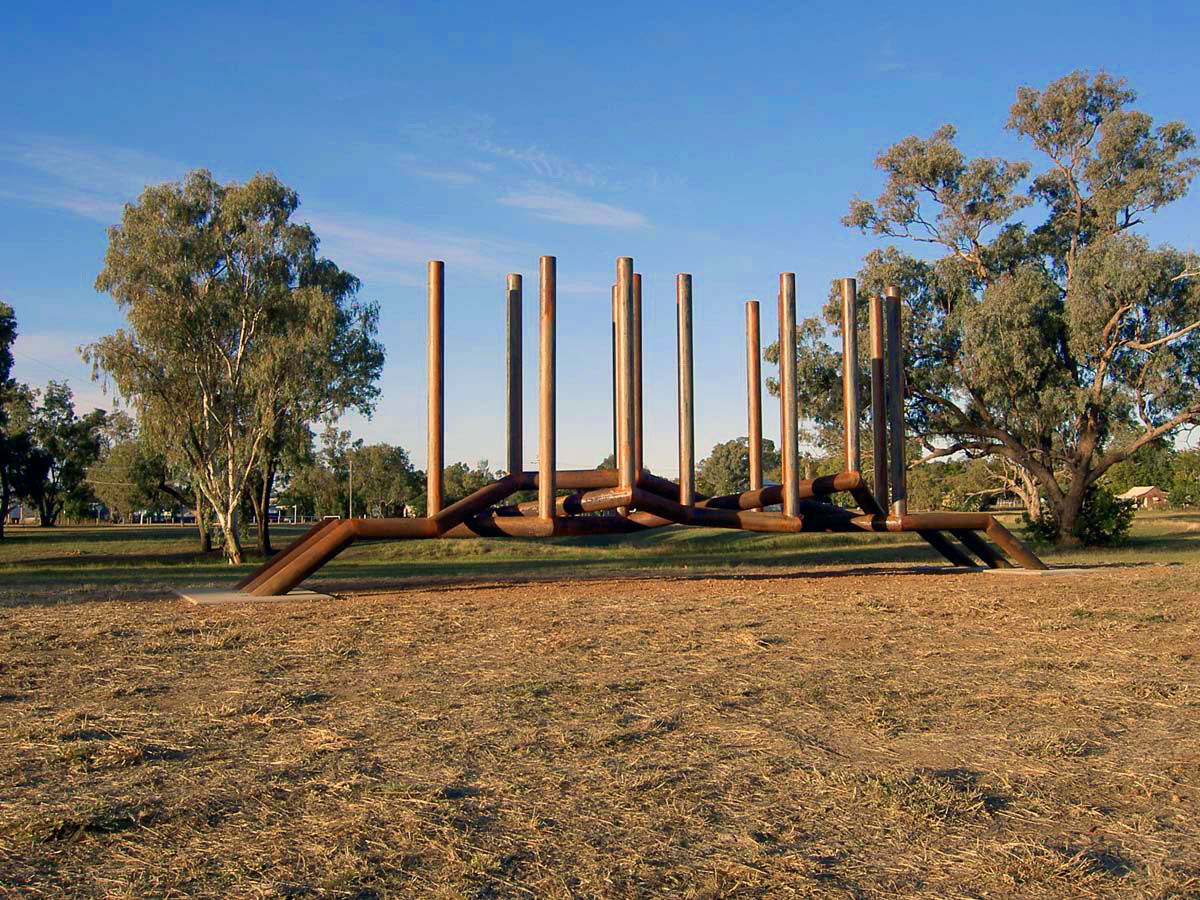
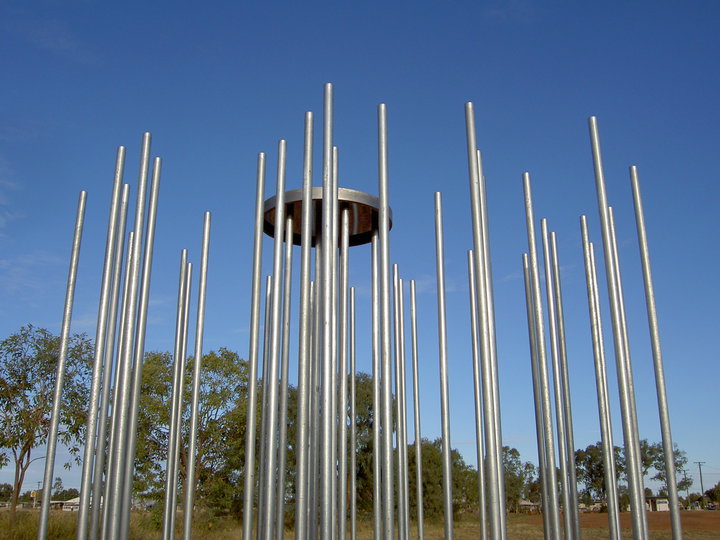
This is sculptor Fredrick White’s second public commission in Queensland. The sculpture Lifespan (2010) is located at Blackall in Western Queensland (see Google map). The work is 8 metres long. Blackall already contains public sculptures by William Eicholtz (Towners Call – Edgar Towner V.C. Memorial (2009)) and Robert Bridgewater (Wool, Water and Wood (2008)).
Fredrick White’s sculpture has always been about flows and extrusions – the movement of energy both visible and invisible, above and below ground, inside and outside the body – an exploration of some giant vascular system of which we are all part. Sculptures sprout from manhole covers (Manwhole 1999), welling up from the hidden system of pipes and passageways that run under the earth; coffin-like boxes hover in suspended animation over the ground, anchored by pipes that disappear into the earth (Universal Attachment 2000); ectoplasmic, ethereal substances emit in Time Being No’s 1, 2 and 3 (2002). In recent work From Life To Life (2007), Drawing Water (2010) and Lifespan (2010) these connections are even more intimately linked to the life cycle and the essential place of water in the scheme of things:
“I am interested in the stuff that holds us together, the dominant paradigms of human life, our reliance on the Earth and each other. There is no separation between anything – birth / death, above/below, past / future – all are part of the life cycle of living things. The life cycle is the main motif of my practice and is a manifestation of my Piscean nature.”
White’s hyper-textural work flows from one link to another, from one connection to another. His text is a body without organs, always moving between the visible and the invisible webs that connect us. As so a rhizome, so the work of White: there is no hierarchical trunk, no beginning and no end, for White’s work is multiple, lateral, circular.
Using the language of Deleuze and Guattari (A Thousand Plateaus, 1980), White’s assemblages (for that is what they are), “are the processes by which various configurations of linked components function in an intersection with each other …” In these assemblages the process of territorialization intensifies and the assemblages, “can be thought of as constituted by an intensification of these processes around a particular site through a multiplicity of intersections of such territorializations.”1
In White’s assemblages there is no language of itself. The rhizomic nature of their being produces an unconscious connection to all things: his work fosters connections, offers multiple entryways, detaches and modifies new cultural forms. Above all White’s work offers a new map for us to cultivate the soil of living, the site of his intersections extruding form in a vibrant intensification of energy.
Dr Marcus Bunyan
1/ Wood, Aylish. “Fresh Kill: Information technologies as sites of resistance,” in Munt, Sally (ed.,). Technospaces: Inside the New Media. London: Continuum, 2001, p. 166.
Please click on the photographs for a larger version of the image.
Unknown photographer
‘Lifespan’ by Frederick White
2010
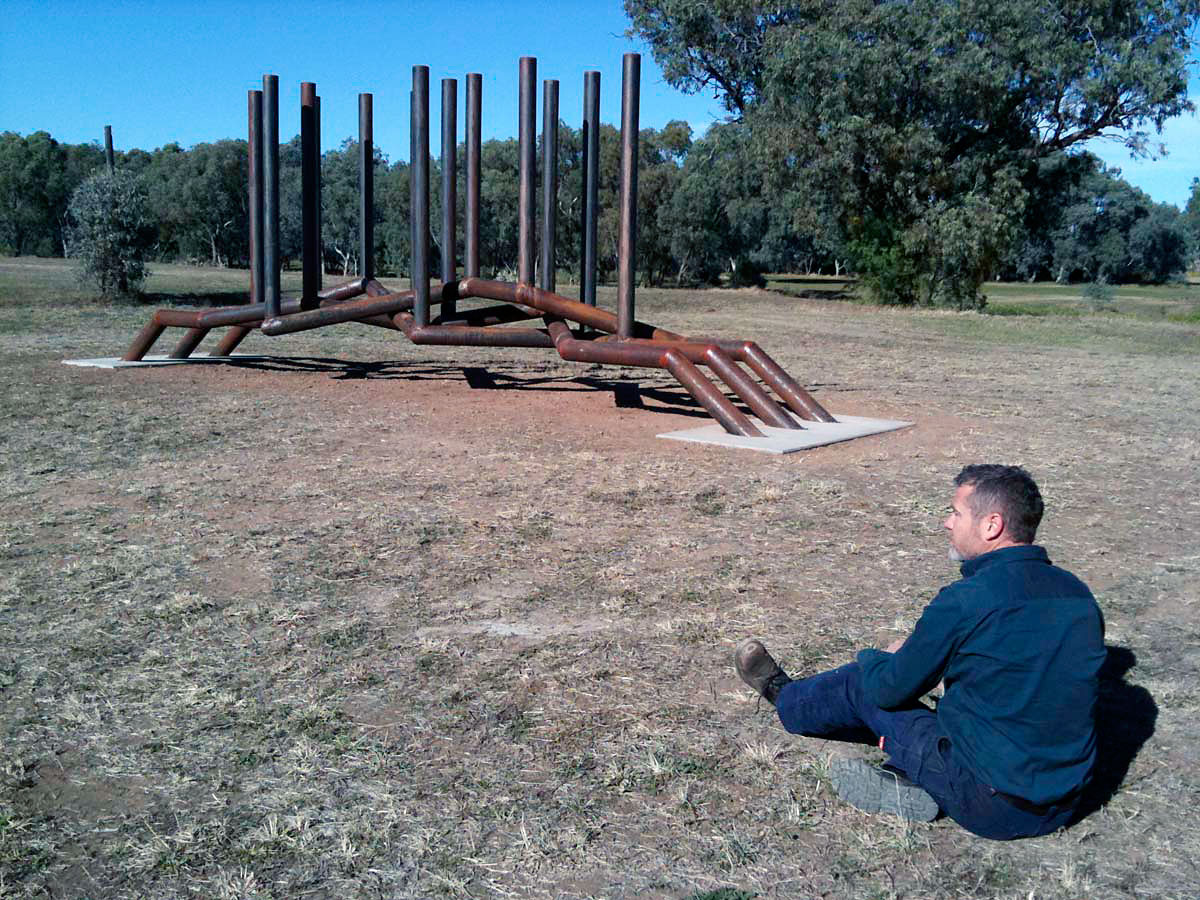
Sculptor Fredrick White sitting in front of his sculpture Lifespan (2010)
Unknown photographer
‘Lifespan’ by Frederick White
2010
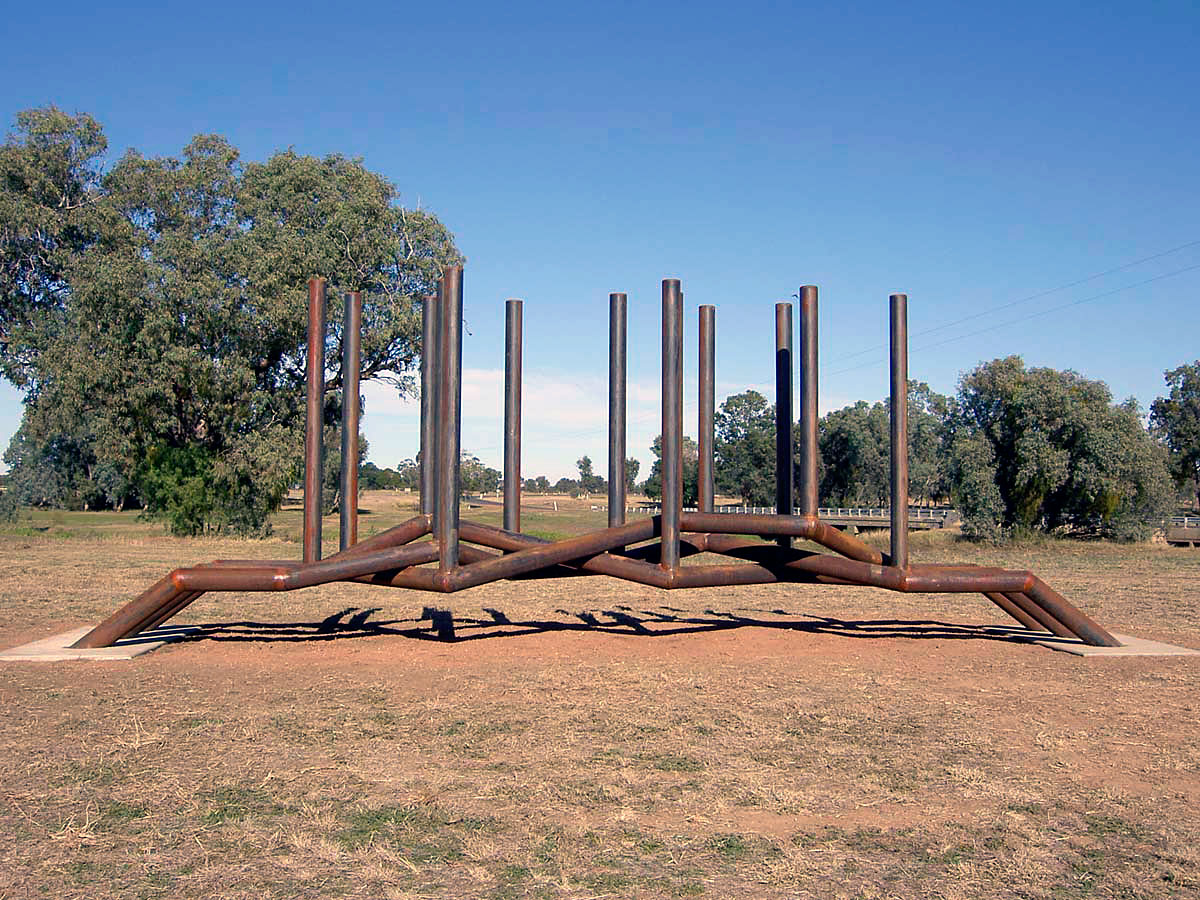
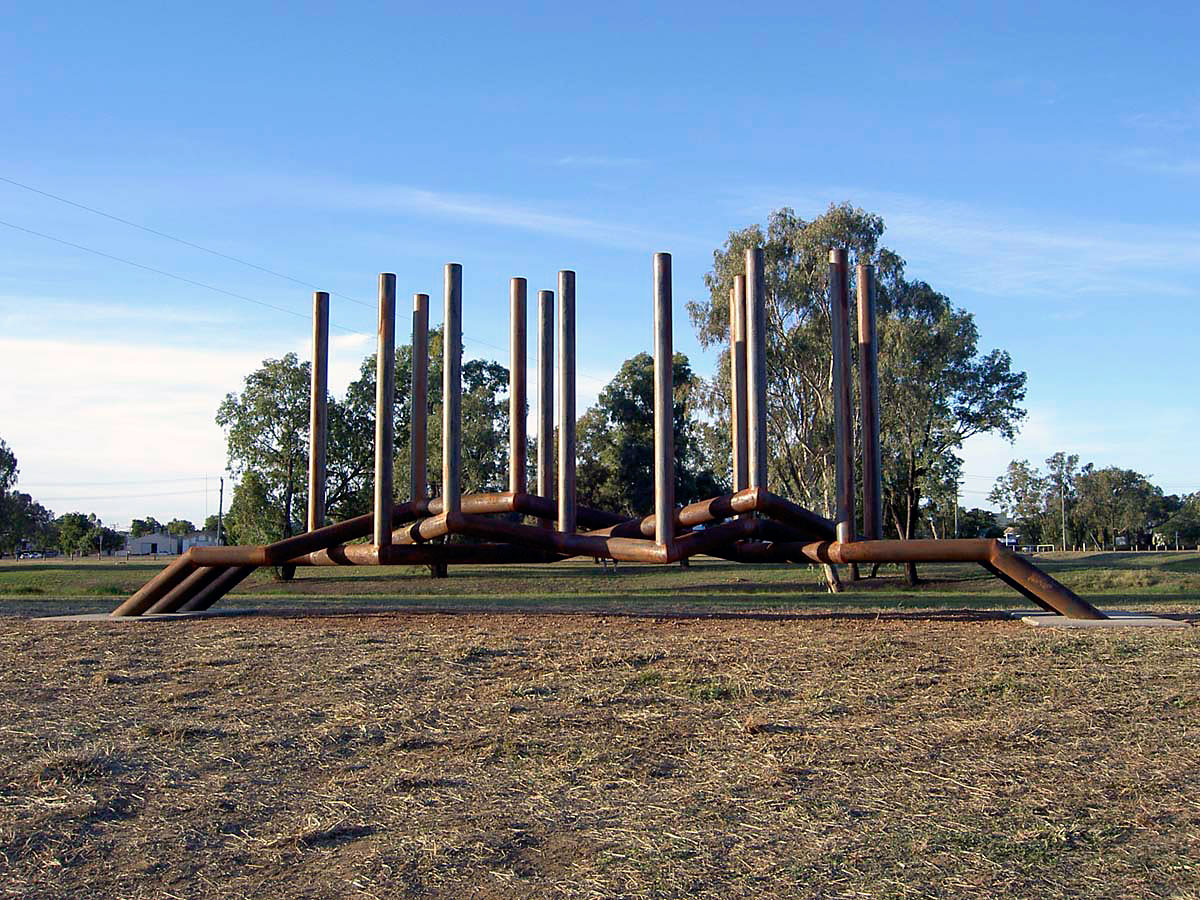
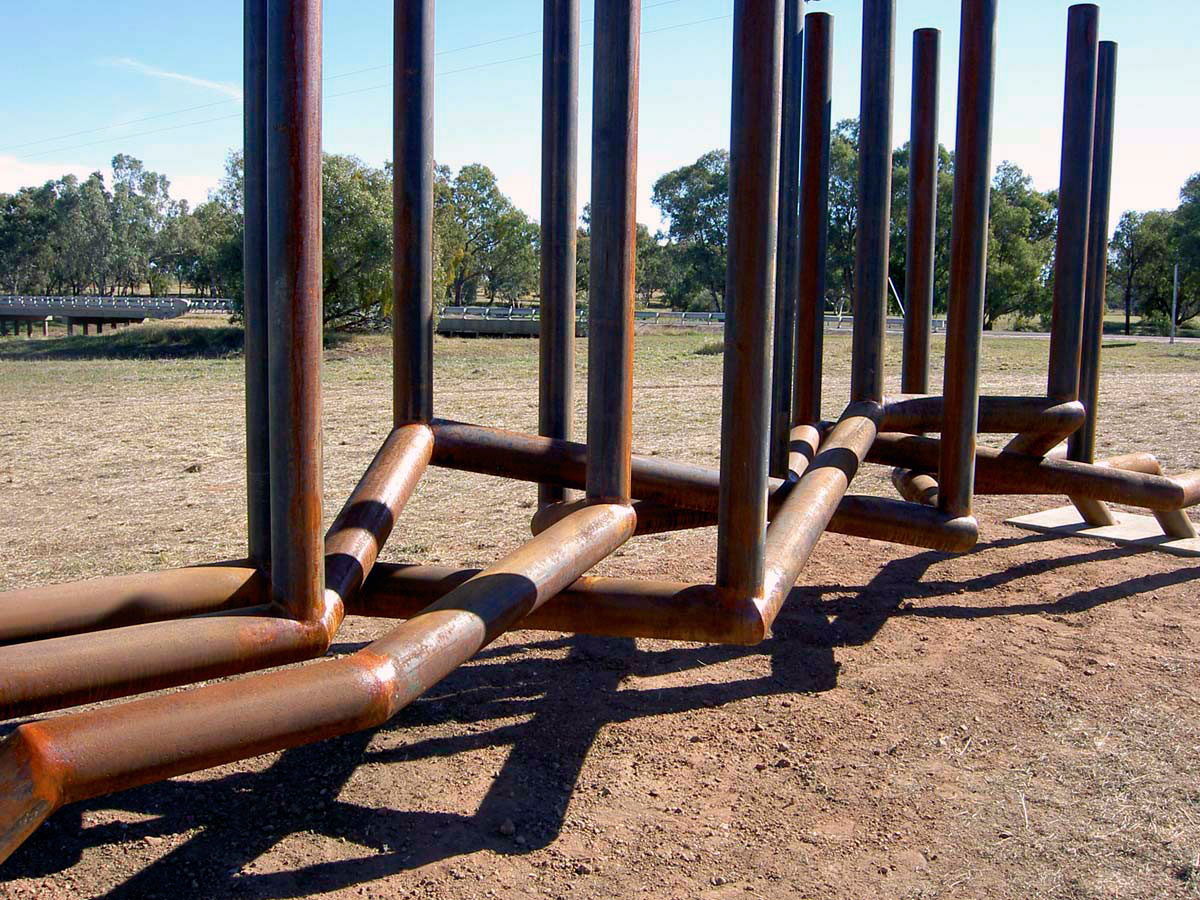
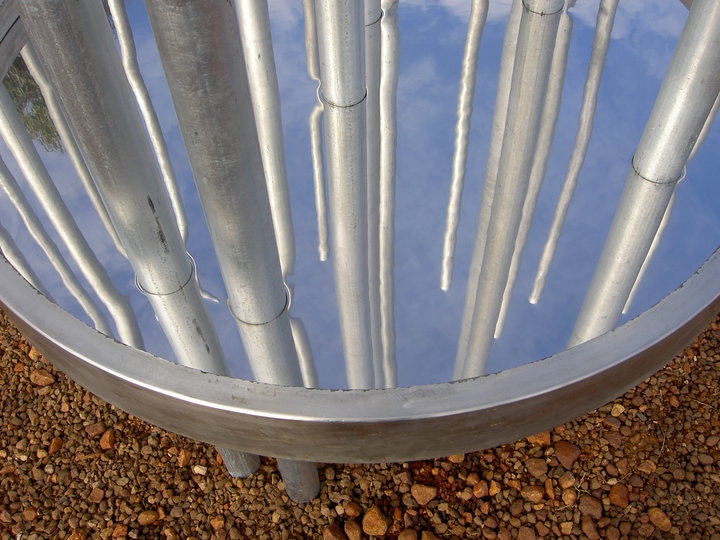
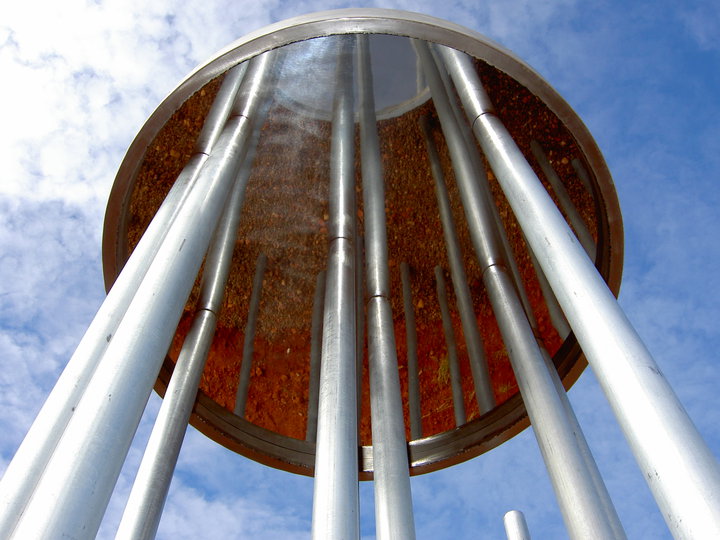
Lifespan is made predominantly from recycled bore casing, a material chosen to suggest the language of plumbing as a conduit for dialogue on the theme of water.
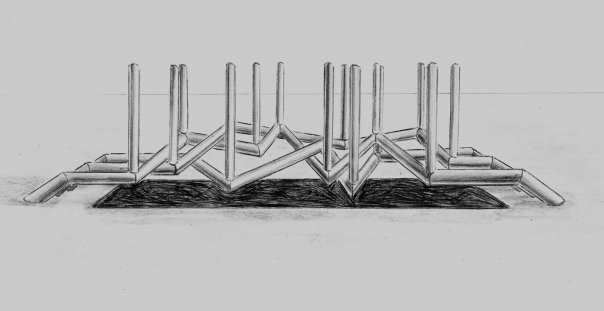
The end sections of the work, like a hydro-electric scheme, rise from the ground and start crossing over. This form whilst inspired by the braided channels of Western Queensland is also about life in general; paths that converge or momentarily cross over, then towards the end of life, like the beginning, level out to a new time for experiencing.
The vertical pipes reference the artesian bore system that provides the main reliable source of water here. In this scenario, the top of the pipes are the surface of the Earth and the pipes bore into the ground to tap into the aquifers deep below in the Great Artesian Basin.
We are here because of the Earth and water is the primal substance that is the source of all life, in fact the artesian water of Australia is in places as old as humanity itself; the perfect symbol of the past, present and future.
Fredrick White 2010
Unknown photographer
‘Lifespan’ by Frederick White
2010
Unknown photographer
‘Lifespan’ by Frederick White
2010
 Art Blart _ art and cultural memory archive
You must be logged in to post a comment.