Exhibition: ‘Under Cover: J.C. Leyendecker and American Masculinity’ at the New-York Historical Society

Exhibition dates: 5th May – 13th August, 2023

Curator: Donald Albrecht


J.C. Leyendecker (American, 1874-1951) 'Ivory Soap It Floats' 1900 from the exhibition 'Under Cover: J.C. Leyendecker and American Masculinity' at the New-York Historical Society, May - August 2023


J.C. Leyendecker (American, 1874-1951)
Ivory Soap It Floats
Painting for Ivory soap advertisement, 1900
Gouache on board
Private collection
Image courtesy of the National Museum of American Illustration, Newport, RI


Featured in mainstream national magazines, ads for Ivory soap often depicted scenes of conventional domesticity. Some, however, were erotic, like this one by Leyendecker featuring a man in a floor-length robe, whose crotch is suggestively rendered.


The Eye of the Beholder

“Leyendecker’s subjects exemplify an elite white masculinity that was hardly representative of the diversity of the United States in his time, or since” observes Sonya Abrego. The artist’s subjects are white, cultured, privileged, “upholding racial, social and nationalist hierarchies”.

But how representations were and are understood depends on the eye of the beholder. At the time that Lyendecker was painting and illustrating commercial magazines his flirtatious subliminal erotic messages would have been all too decipherable to a knowing gay male readership – even as these very illustrations “passed” the scrutiny of heterosexual normativity. For gay men “passing” allowed them to hide their real identity and to fit into society without discrimination and fear of loosing their job, their home and/or going to jail.1 Leyendecker’s works both hide and transgress the taboo when they pass inspection.

For the initiated, Leyendecker’s paintings and illustrations were at the very heart of the subversion of hegemonic masculinity – “a practice that legitimises men’s dominant position in society and justifies the subordination of the common male population and women, and other marginalised ways of being a man.”2 Witness the man holding the “stiff rod” of the golf club in Men with Golf Clubs (c. 1909, below); the knowing looks of the two men in Men and Woman, Arrow Shirts with Golf Clubs and Collie (1910, below); the camp hands on hip languid pose of the man on the Cover of Saturday Evening Post (June 29, 1907, below) and the butcher, hand of hip, frontal crotch shot with Janet Jackson garment malfunction / nipple exposure that is Cover of Collier’s (June 24, 1916, below). The fact that some of the paintings such as Record Time, Cool Summer Comfort (c. 1920, below) feature Leyendecker’s lover of 48 years Charles A. Beach, only adds to the surreptitious nature of the paintings societal relationship. Much as the gay movie star Rock Hudson had to keep his private and public lives separate in order to “pass”, so Leyendecker kept his gay relationship a secret from the public.

While the exhibition would like us to address Leyendecker’s work within a broader context (according to curator Donald Albrecht talking about the artist in “gender terms, racial terms, sexual terms,” treating him in an intersectional way) – that is, through “the interconnected nature of social categorisations such as race, class, and gender as they apply to a given individual or group, regarded as creating overlapping and interdependent systems of discrimination or disadvantage”3 – this is only, and can only ever be, a post-post-posterior inflection on the rump of his work, a point of view wholly constructed in the present (the word and concept becoming popular after 1989 when the term ‘intersectionality’, which has its roots in Black feminist activism, and was originally coined by American critical legal race scholar Kimberlé Williams Crenshaw). Attitudes may have changed over the years and in some parts of the world, but to believe that heterosexual Black, white or Asian men would have understood the intersectional relationships in Leyendecker’s work back in the day is contemporary fairy floss. While it would be nice to think of Leyendecker’s work in all it’s supposed intersectional glory this was not how the work was seen by the general public (and white men in particular) when it was produced and published.

Today the eye of the beholder can still be just as blinded and prejudiced… for the dominant stereotype of the body, that of the white male, constantly reinforces its value in a capitalist consumer society. Body processes are drawn into social relations through fashion, sport, body culture, etc and, “As soon as we are articulated as a male or female body, a raced, classed, or sexed body in the context of the larger culture, a subject position construed hierarchically is not far behind, due in part to that means of articulation, our language. We take up a position according to a dialectic of presence and lack in terms of our relative proximity (still generally connected to our biological bodies) to the monied white male as signifier.”4

What we can do in this case is to inform the ‘conditions of understanding’ of the beholder: in other words, by making the viewer informed of the processes of production we can undermine the “ability of dominant groupings to define their bodies and lifestyles as superior, worthy of reward, and as, metaphorically and literally, the embodiment of class.”5 While the self is a social construction it is still all to easy for the dominant hegemonic group within a culture or society to identify and impose a valuable body – for example, that of the muscular mesomorph or the body of the athlete (or super jock). What we must encourage are processes in society “which will make it extremely difficult for any one group to impose as hegemonic, as worthy of respect and deference across society, a single classificatory scheme of ‘valuable bodies’.”6

A difficult task but I believe a worthy one.

Dr Marcus Bunyan


Footnotes

1/ “Passing is the ability of a person to be regarded as a member of an identity group or category, such as racial identity, ethnicity, caste, social class, sexual orientation, gender, religion, age and/or disability status, that is often different from their own. Passing may be used to increase social acceptance in order to cope with stigma by removing stigma from the presented self and could result in other social benefits as well. Thus, passing may serve as a form of self-preservation or self-protection in instances where expressing one’s true or prior identity may be dangerous.”

Passing (sociology) on the Wikipedia website

2/ Hegemonic masculinity on the Wikipedia website

3/ Definition of intersectionality by Oxford Languages on the Google website

4/ Leslie Heywood. Dedication To Hunger: The Anorexic Aesthetic in Modern Culture. Los Angeles: University of California Press, 1996, p. 12.

5/ Chris Schilling. The Body and Social Theory. London: Sage Publications, 1993, p. 140.

6/ Ibid., p. 143.

Many thankx to the New-York Historical Society for allowing me to publish the photographs in the posting. Please click on the art work for a larger version of the image.


“An effeminate man … expresses his abdication of power. For a man to behave effeminately is an expression of the paradox. With each flap of the wrist he slides deeper into the underclass and, in so doing, betrays the birthright of men to mythic power. Such gestures are violations of masculinity, insults to the meaning of manhood. This is why they are met with such contempt by so many, including many gay men who long for the power of patriarchy.”


Brian Pronger. The Arena of Masculinity: Sports, Homosexuality, and the Meaning of Sex. New York: St. Martin’s Press, 1990, p. 221.


“The Arrow collar man – handsome, well-groomed, and always dapper in crisp shirts with starched white collars – was a pop culture icon. He was so dashing that women who weren’t quite familiar with the idea of a brand personification yet, wrote to Arrow’s parent company hoping they could meet him. He shares a lot in common with the Gibson Girl of the same era: an elegant, youthful ideal of American beauty. But unlike Charles Dana Gibson’s illustrated feminine creation, which he insisted was an amalgam of modern American women of his time, The Arrow Collar Man was originally modelled after a specific person, Charles Beach, who happened to also be Leyendecker’s partner. The two lived together for close to fifty years, and he helped manage the illustrator’s career, a relationship that would have likely disappointed the Arrow man’s female fans. …

Leyendecker’s subjects exemplify an elite white masculinity that was hardly representative of the diversity of the United States in his time, or since. It was working in line with nationalist standards of rugged masculinity espoused from the top by figures like Teddy Roosevelt that permeated the culture at large…


Sonya Abrego. “Going Undercover with Leyendecker at the New York Historical Society,” on the Observer website 06/14/23 [Online] Cited 20/07/2023
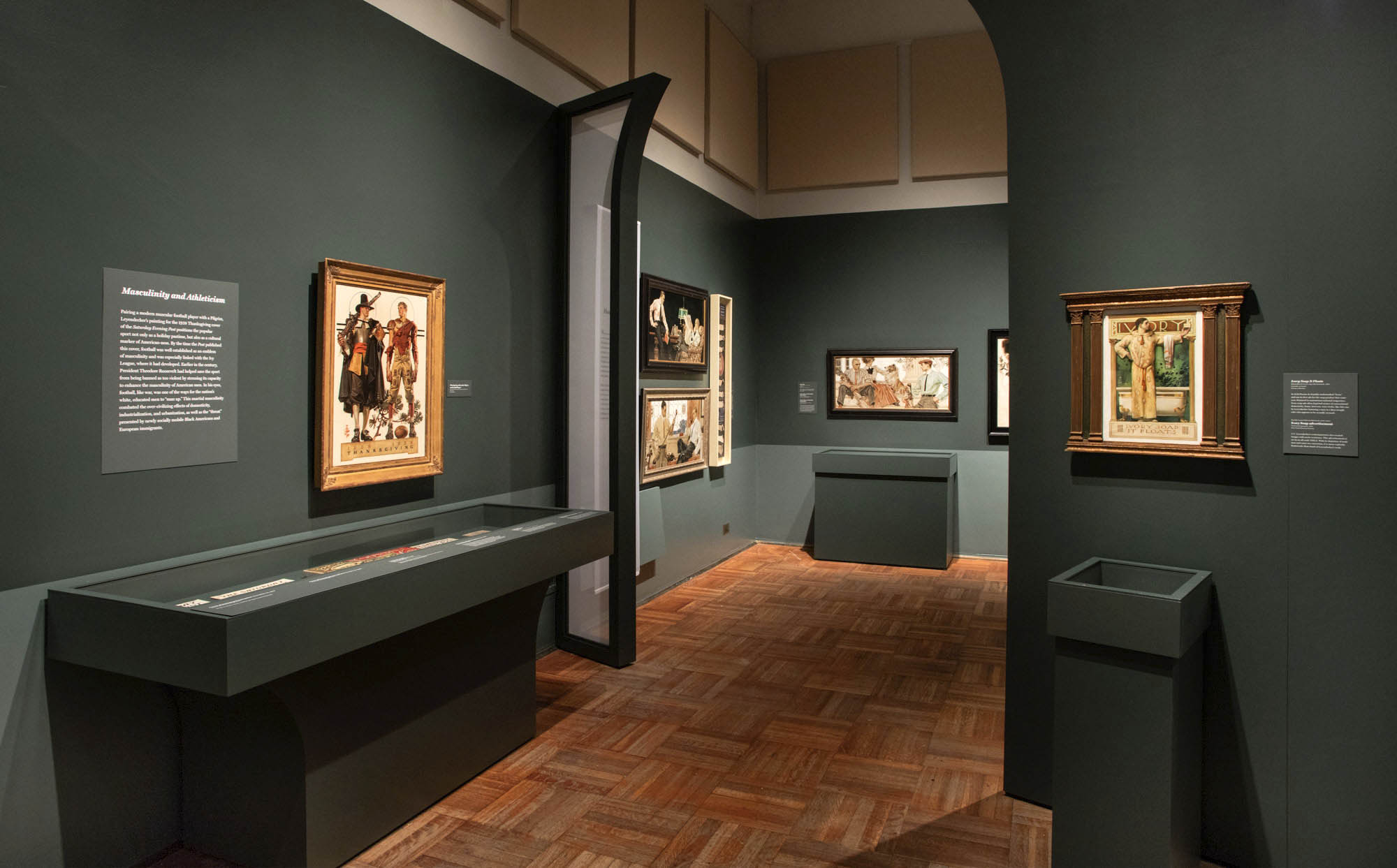


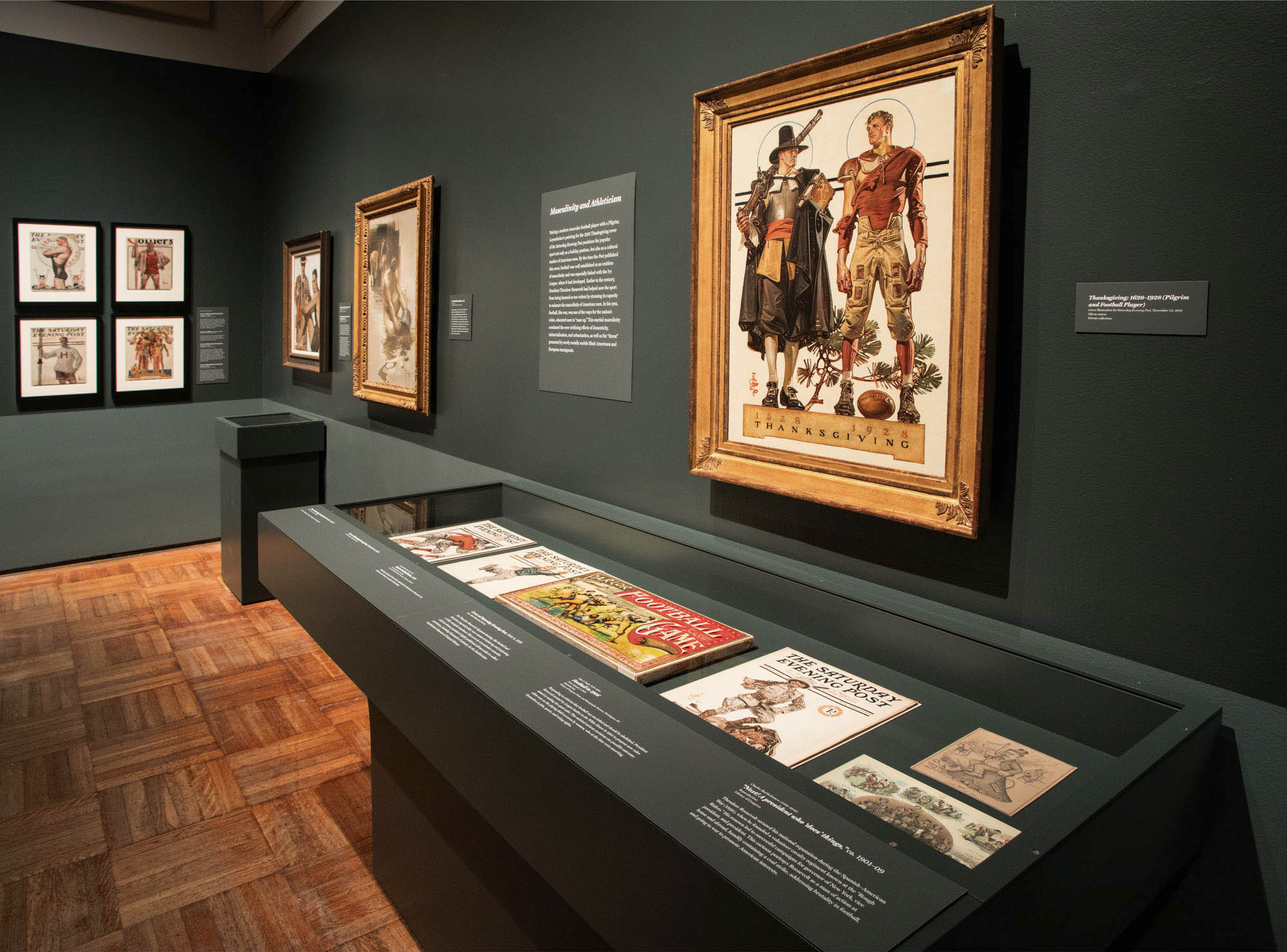
Installation view of the exhibition 'Under Cover: J.C. Leyendecker and American Masculinity' at the New-York Historical Society showing at left, 'Thanksgiving: 1628-1928 (Pilgrim and Football Player)' (1928); and at right, 'Ivory Soap It Floats' (1900)


Installation view of the exhibition Under Cover: J.C. Leyendecker and American Masculinity at the New-York Historical Society showing at left, Thanksgiving: 1628-1928 (Pilgrim and Football Player) (1928, below); and at right, Ivory Soap It Floats (1900, above)
Photo: Glenn Castellano, New-York Historical Society


A new exhibition at the New-York Historical Society examines the work and influence of J.C. Leyendecker (1874-1951), a preeminent illustrator and commercial artist who helped shape American visual culture in the first three decades of the 20th century through captivating advertisement campaigns including the legendary “Arrow Collar Man” and countless covers for the Saturday Evening Post. As a gay artist whose illustrations for a mainstream audience often had unspoken homoerotic undertones, his work is especially revealing for what it says about the cultural attitudes towards homosexuality of the period. Under Cover: J. C. Leyendecker and American Masculinity is organised by New-York Historical from the collection of the National Museum of American Illustration, Newport, RI.

Born in 1874 in Montabaur, Germany, Leyendecker immigrated to Chicago in 1882 with his parents and three siblings. Showing an early artistic talent, Leyendecker and his youngest brother, F. X., studied at the Art Institute of Chicago before moving to Paris where they developed their distinctive styles. Upon returning to the United States, the brothers entered a publishing renaissance and soon found themselves at its center, New York City. In 1914, they moved into a 14-room house in New Rochelle, New York, along with Charles Beach, for 48 years.
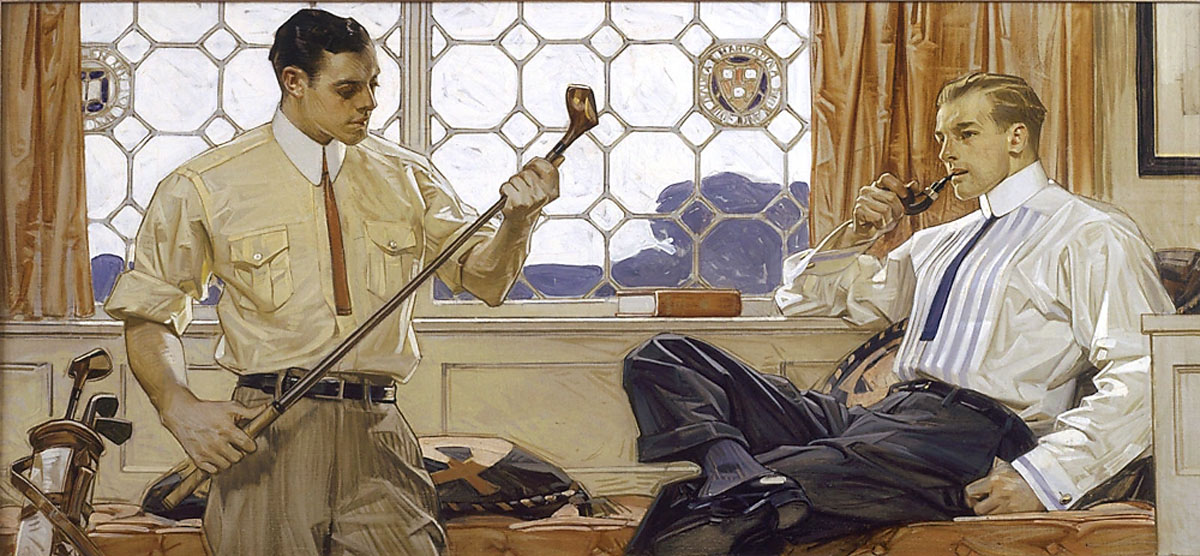
 

J.C. Leyendecker (American, 1874-1951) 'Men with Golf Clubs' 1909 from the exhibition 'Under Cover: J.C. Leyendecker and American Masculinity' at the New-York Historical Society, May - August 2023


J.C. Leyendecker (American, 1874-1951)
Men with Golf Clubs
Painting for Arrow Collar advertisement, c. 1909
Oil on canvas
National Museum of American Illustration, Newport, RI


In Leyendecker’s illustrations, interactions between men often took place in homosocial spaces such as all-male dormitories, clubs, haberdasheries, and gymnasiums. In this example, the men’s informal dress and posture plus the heraldic marks of Harvard and Yale in the window suggest an elite college clubhouse and seem to target the ad to college men.
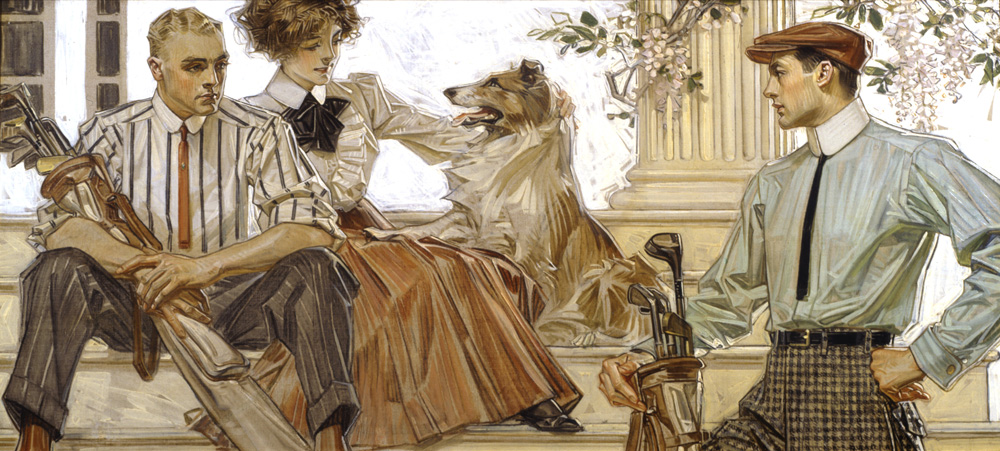
 

J.C. Leyendecker (American, 1874-1951) 'Men and Woman, Arrow Shirts with Golf Clubs and Collie' 1910 from the exhibition 'Under Cover: J.C. Leyendecker and American Masculinity' at the New-York Historical Society, May - August 2023


J.C. Leyendecker (American, 1874-1951)
Men and Woman, Arrow Shirts with Golf Clubs and Collie
Painting for Arrow Collar advertisement, 1910
Oil on board
National Museum of American Illustration, Newport, RI


Leyendecker developed campaigns for Arrow collars depicting handsome, idealised men wearing shirts and detachable collars manufactured by Cluett Peabody & Co. These ads often depicted fashionable men in stylish settings engaged in activities such as boating, golfing, or reading in men’s clubs. Even when women are present, the men depicted seem indifferent to them, often sharing sexually charged glances with each other instead.


J.C. Leyendecker (American, 1874-1951) 'Couple in Boat' 1912 from the exhibition 'Under Cover: J.C. Leyendecker and American Masculinity' at the New-York Historical Society, May - August 2023


J.C. Leyendecker (American, 1874-1951)
Couple in Boat
Painting for Arrow Collar advertisement, 1912
Oil on canvas
National Museum of American Illustration, Newport, RI


The exhibition locates Leyendecker’s work within the evolution of commercial illustration, when advertisers sought to sell products by emotion and feeling, not only by factual representation of a product’s utilitarian characteristics. These commercial trends can be seen in Leyendecker’s advertising illustrations for Arrow collars.


A new exhibition examines the work and influence of J.C. Leyendecker (1874-1951), a preeminent illustrator and commercial artist who helped shape American visual culture in the first three decades of the 20th century through captivating advertising campaigns including the legendary “Arrow Collar Man” and countless covers for the Saturday Evening Post. As a gay artist whose illustrations for a mainstream audience often had unspoken homoerotic undertones, his work is especially revealing for what it says about the cultural attitudes towards homosexuality of the period.

The exhibition showcases 19 of the artist’s original oil paintings and a wealth of related ephemera, and features both Leyendecker’s editorial work, such as magazine covers, as well as commercial illustrations that appeared in the pages of popular publications, on roadside billboards, in store windows, and on mass transit. Laying the groundwork of Leyendecker’s implied gay narratives, these ads starred fashionable men in stylish settings engaged in activities such as boating, golfing, or reading in men’s clubs.

Under Cover delves into the early politics of sexual identity and gender while simultaneously examining how Leyendecker helped establish a nationalistic ideal of elite and athletic white male beauty. To address this aspect of his work, the exhibition juxtaposes some of Leyendecker’s paintings with artefacts that offer counter-narratives to his works’ exclusionary nature, including depictions of fashionable African American men during the Harlem Renaissance, as well as a selection of contemporaneous advertisements with homoerotic connotations and a digital show of images depicting gay culture in New York during Leyendecker’s time.

Under Cover is organised by New-York Historical from the collection of the National Museum of American Illustration, Newport, RI. The show is guest-curated by Donald Albrecht, and coordinated at New-York Historical by Rebecca Klassen, curator of material culture.

Text from the New-York Historical Society website
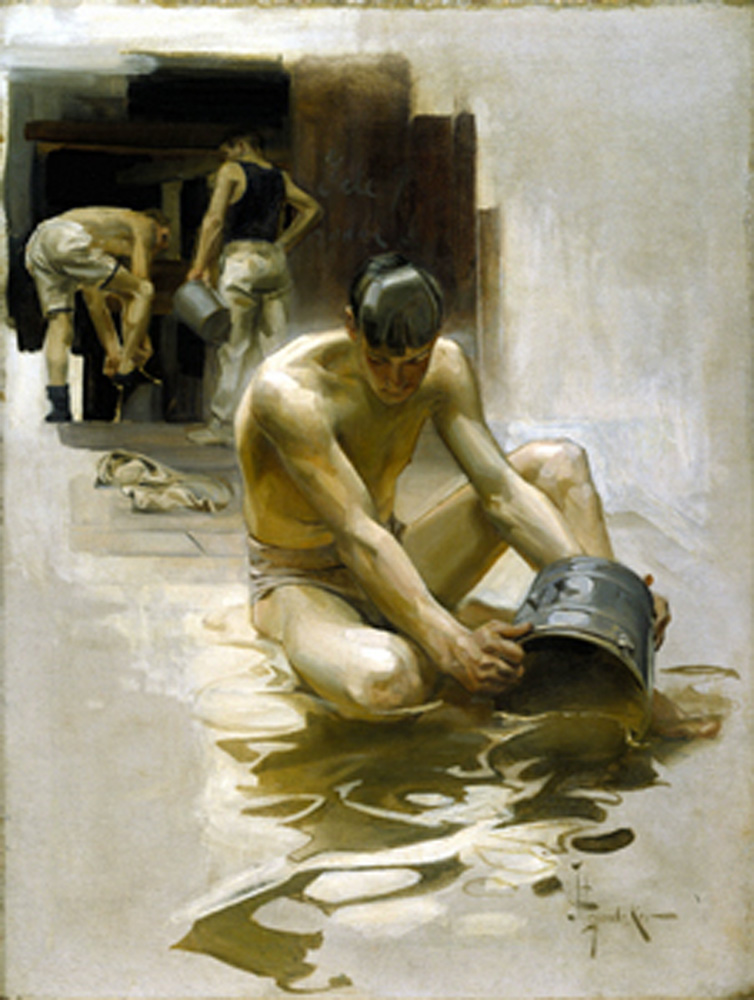
 

J.C. Leyendecker (American, 1874-1951) 'In the Yale Boathouse' 1905


J.C. Leyendecker (American, 1874-1951)
In the Yale Boathouse
1905
Oil on canvas
National Museum of American Illustration, Newport, RI


This painting was one of seven by Leyendecker that illustrated Ralph D. Paine’s “A Victory Unforeseen,” published in the July 1905 issue of Scribner’s Magazine. The short story centres on a Yale-Harvard boat race, and in this image, the hero cools himself off by pouring a pail of water over his sweating shoulders.
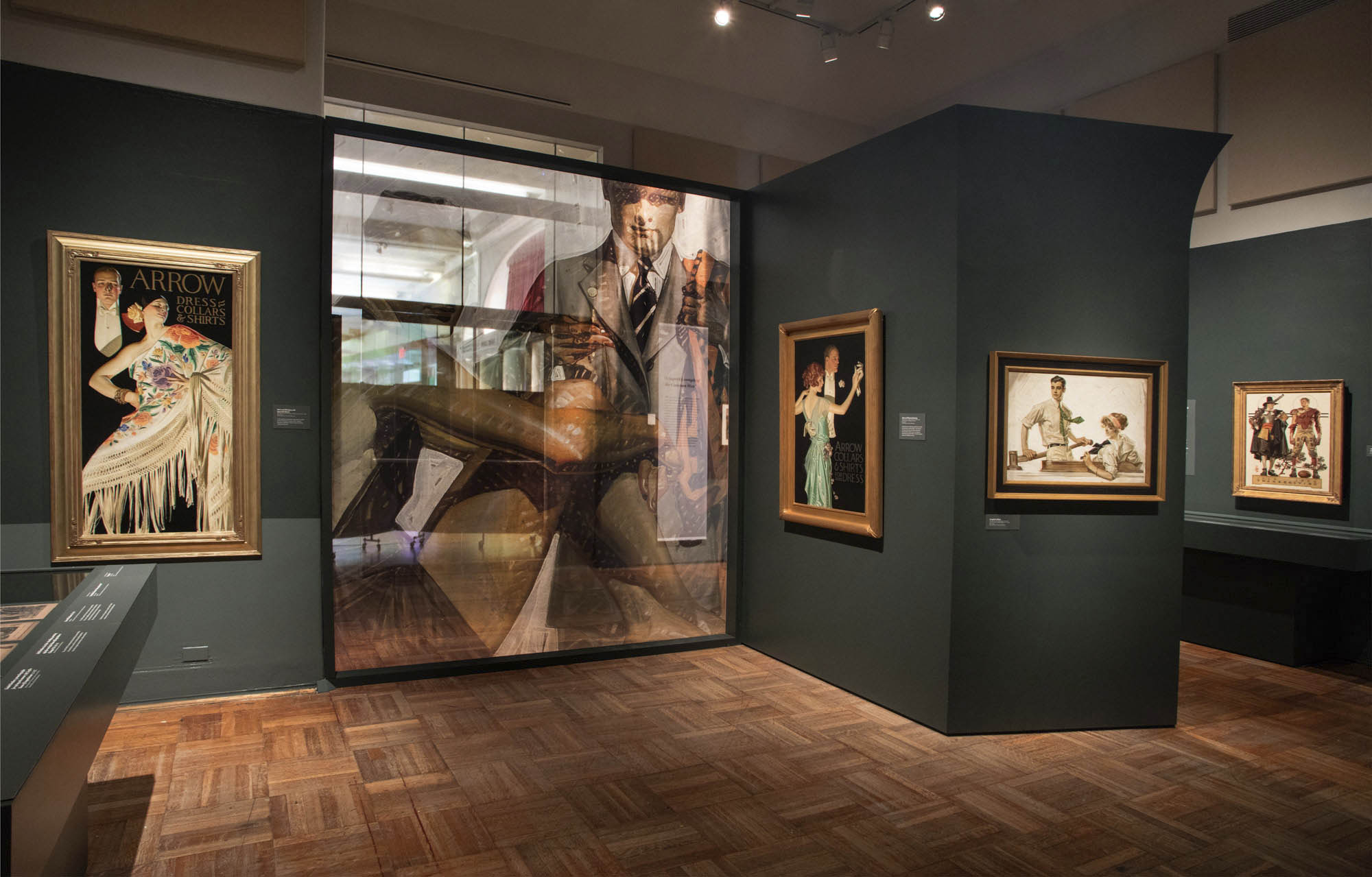
 

Installation view of the exhibition 'Under Cover: J.C. Leyendecker and American Masculinity' at the New-York Historical Society showing at third right, 'Man and Woman Dancing' (1923); at second right, 'Couple in Boat' (1912); and at right, 'Thanksgiving: 1628-1928 (Pilgrim and Football Player)' (1928)


Installation view of the exhibition Under Cover: J.C. Leyendecker and American Masculinity at the New-York Historical Society showing at third right, Man and Woman Dancing (1923, below); at second right, Couple in Boat (1912, above); and at right, Thanksgiving: 1628-1928 (Pilgrim and Football Player) (1928, below)
Photo: Glenn Castellano, New-York Historical Society
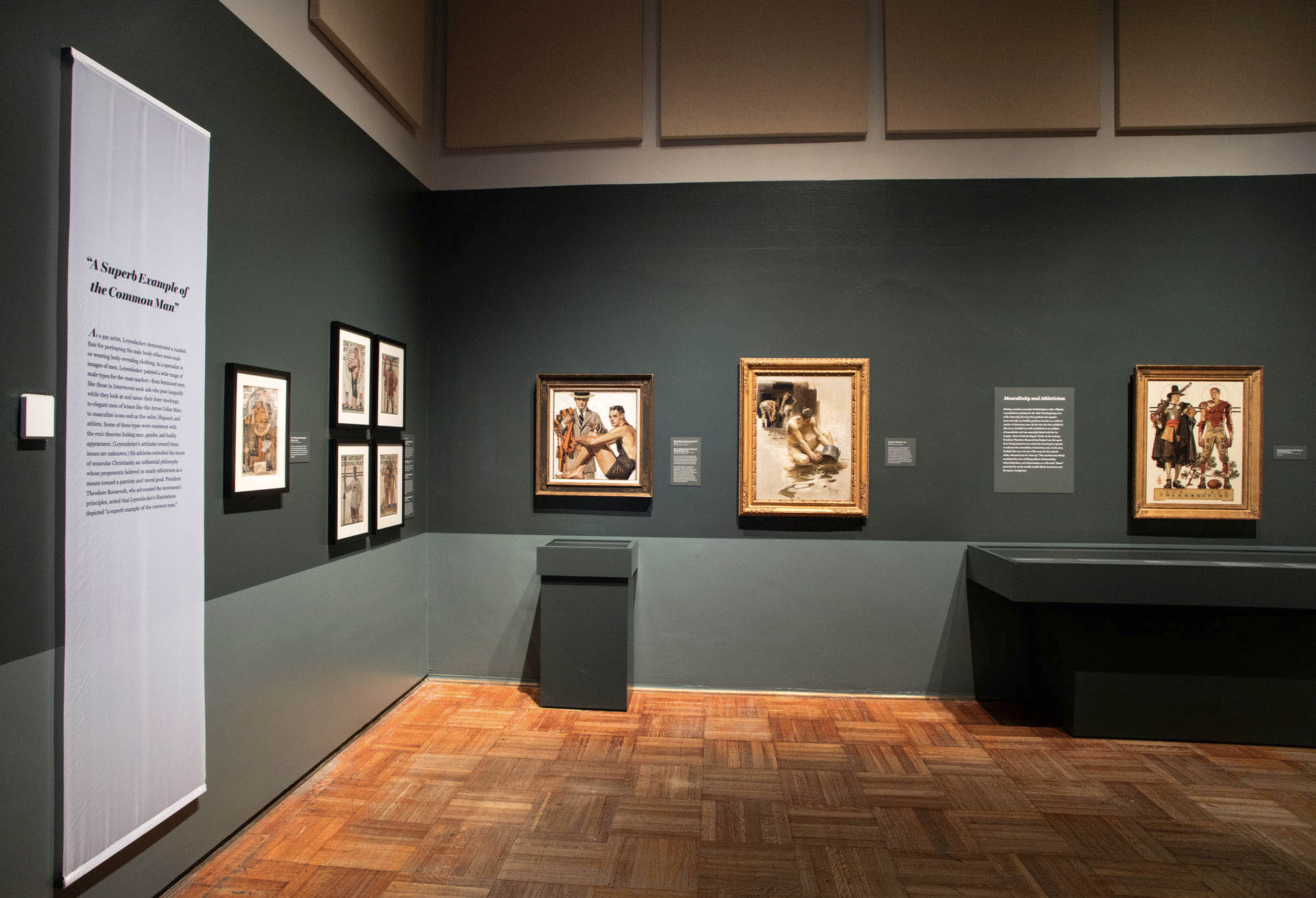
 

Installation view of the exhibition 'Under Cover: J.C. Leyendecker and American Masculinity' at the New-York Historical Society showing at left centre, 'Record Time, Cool Summer Comfort' (c. 1920); at centre, 'In the Yale Boathouse' (1905); and at right, 'Thanksgiving: 1628-1928 (Pilgrim and Football Player)' (1928)


Installation view of the exhibition Under Cover: J.C. Leyendecker and American Masculinity at the New-York Historical Society showing at left centre, Record Time, Cool Summer Comfort (c. 1920, below); at centre, In the Yale Boathouse (1905, above); and at right, Thanksgiving: 1628-1928 (Pilgrim and Football Player) (1928, below)
Photo: Glenn Castellano, New-York Historical Society


“A Superb Example of the Common Man”

As a gay artist, Leyedecker demonstrated a marked flare for portraying the male body either semi-nude or wearing body-revealing clothing. As a specialist in images of men, Leyedecker painted a whole range of male types from the mass market – from feminised men, like those in interwoven sock ads who pose languidly while they look at and caress their stockings; to elegant men of leisure like the Arrow Collar Man; to masculine icons such as the sailor, lifeguard, and athlete. Some of these types were consistent with the era’s theories linking race, gender, and bodily appearance. (Leyedecker’s attitudes toward these issues is unknown). His athletes embodied the tenets of muscular Christianity, and influential philosophy whose proponents believed in manly athleticism as a means toward a patriotic and moral good. President Theodore Roosevelt, who advocated the movement’s principles, noted that Leyendecker’s illustrations depicted “a superb example of the common man.”

Wall text from the exhibition
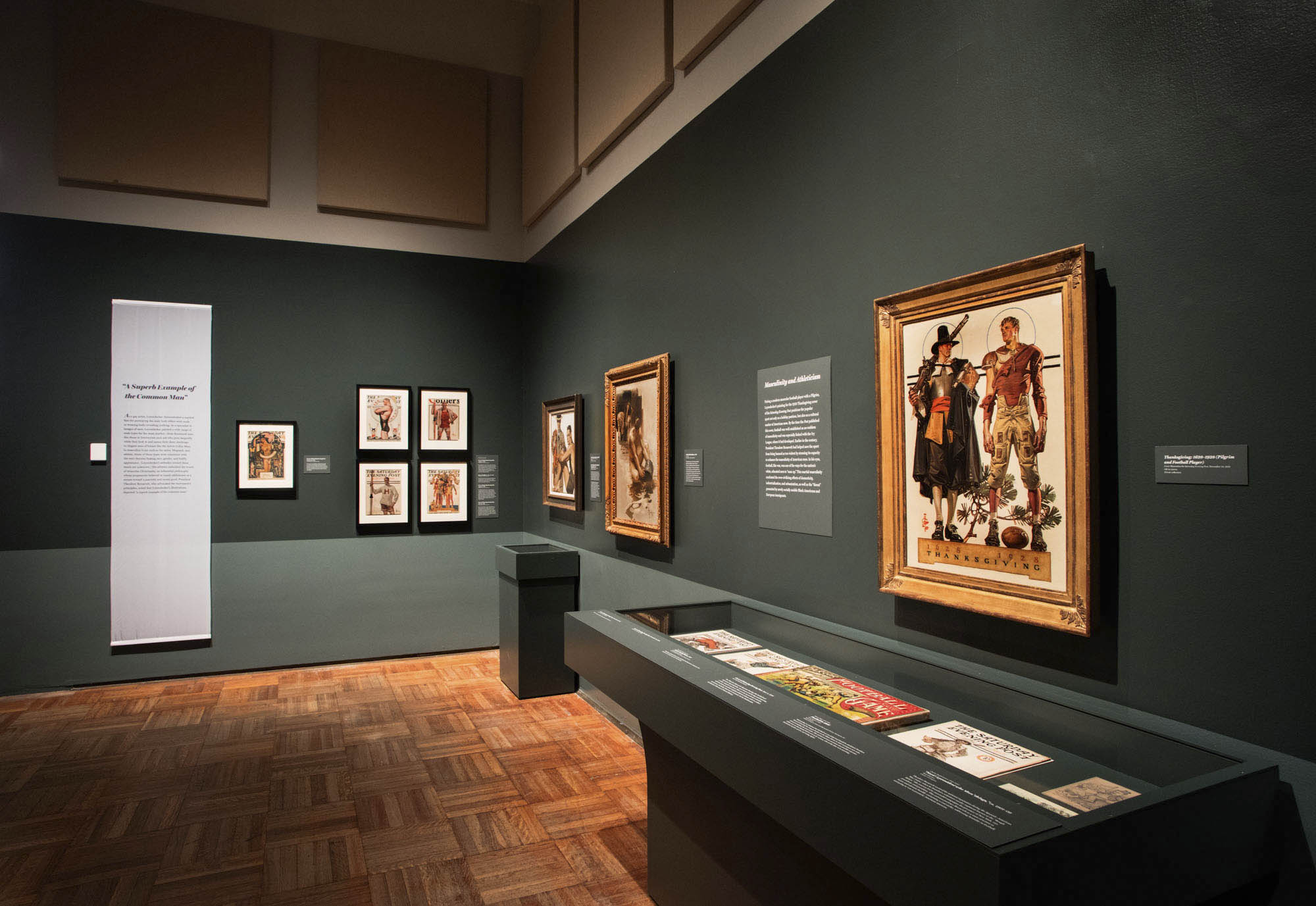
 

Installation view of the exhibition 'Under Cover: J.C. Leyendecker and American Masculinity' at the New-York Historical Society

Installation view of the exhibition 'Under Cover: J.C. Leyendecker and American Masculinity' at the New-York Historical Society showing at left in the bottom image, 'Cover of Saturday Evening Post' (June 29, 1907) and 'Cover of Collier's' (June 24, 1916); at second right, 'In the Yale Boathouse' (1905); and at right, 'Thanksgiving: 1628-1928 (Pilgrim and Football Player)' (1928)


Installation views of the exhibition Under Cover: J.C. Leyendecker and American Masculinity at the New-York Historical Society showing at left in the bottom image, Cover of Saturday Evening Post (June 29, 1907, below) and Cover of Collier’s (June 24, 1916, below); at second right, In the Yale Boathouse (1905, above); and at right, Thanksgiving: 1628-1928 (Pilgrim and Football Player) (1928, below)
Photo: Glenn Castellano, New-York Historical Society
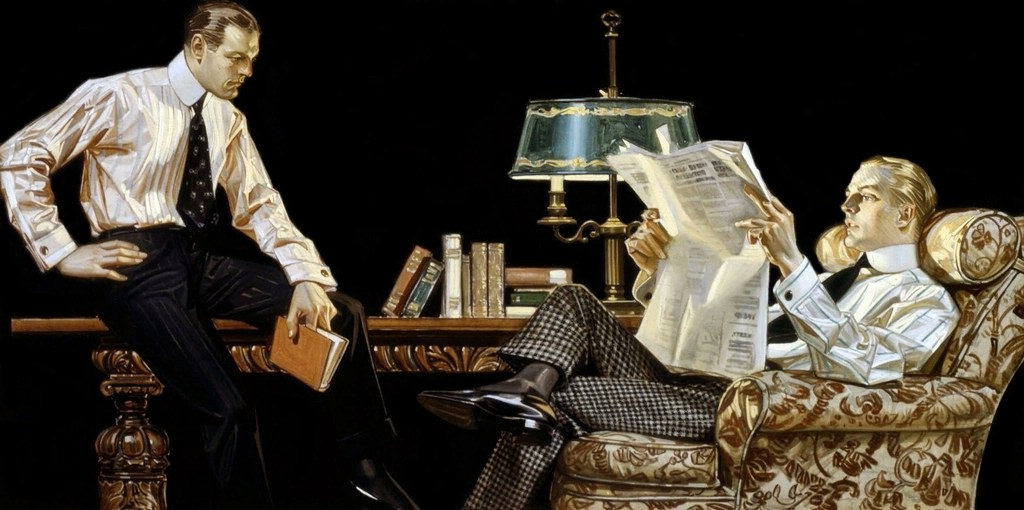
 

J.C. Leyendecker (American, 1874-1951) 'Men reading' 1914


J.C. Leyendecker (American, 1874-1951)
Men reading
Arrow Collar advertisement 1914
Oil on canvas
National Museum of American Illustration, Newport, RI
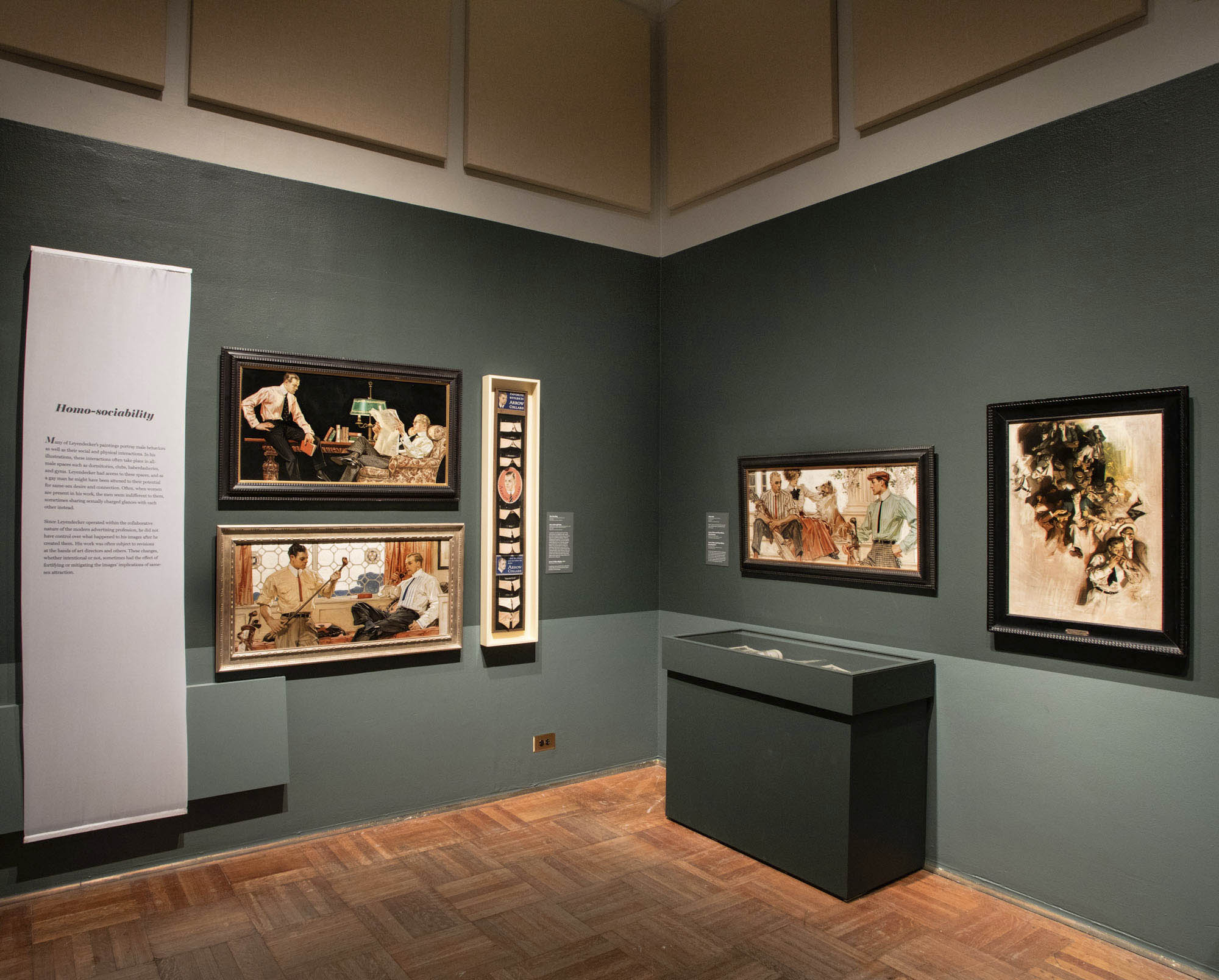
 

Installation view of the exhibition 'Under Cover: J.C. Leyendecker and American Masculinity' at the New-York Historical Society showing at left top, 'Men Reading' (1914) and at left bottom, 'Men with Golf Clubs' (c. 1909)


Installation view of the exhibition Under Cover: J.C. Leyendecker and American Masculinity at the New-York Historical Society showing at left top, Men Reading (1914, above) and at left bottom, Men with Golf Clubs (c. 1909, above)
Photo: Glenn Castellano, New-York Historical Society


Homo-sociability

Many of Leyendecker’s paintings portray male behaviour as well as their social and physical interactions. In his illustrations, there interactions often take place in all-male queer spaces such as dormitories, clubs, haberdasheries and gyms. Leyendecker had access to these spaces, and as a gay man he might have been attuned to their potential for same-sex desire and connection. Often, when women are present in his work, the men seem indifferent to them, sometimes sharing sexually charged glances with each other instead.

Since Leyendecker operated within the collaborative nature of the modern advertising profession, he did not have control over what happened to his images after the created them. His work was often subject to revisions at the hands of art directors and others. These changes, whether intentional or not, sometimes had the effect of fortifying or mitigating the images implications of same-sex attraction.

Wall text from the exhibition
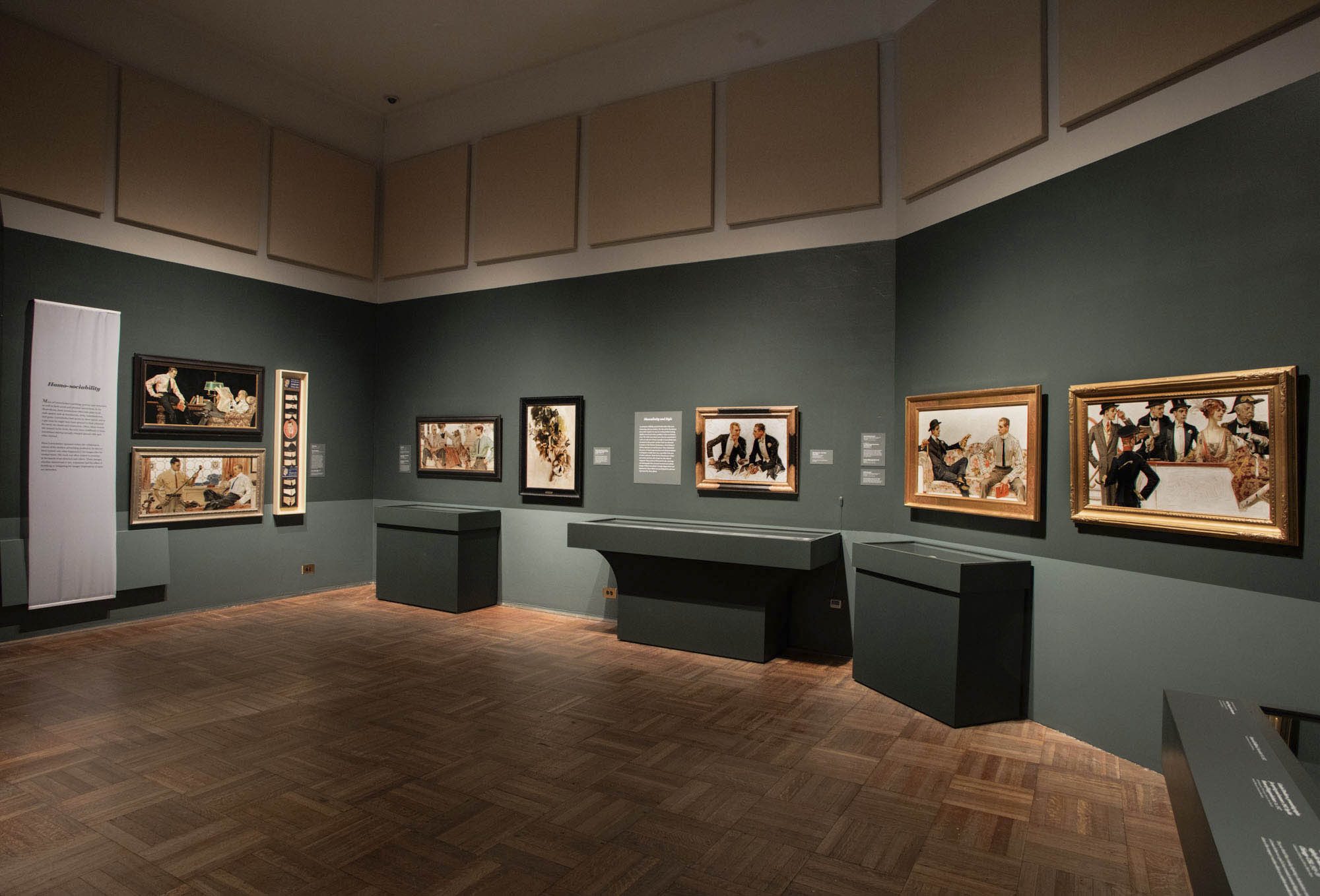
 

Installation view of the exhibition 'Under Cover: J.C. Leyendecker and American Masculinity' at the New-York Historical Society showing at left top, 'Men Reading' (1914) and at left bottom, 'Men with Golf Clubs' (c. 1909); at centre, 'The Donchester – the Cluett Dress Shirt' (1911); and at right, 'In the Stands 2' (1913)


Installation view of the exhibition Under Cover: J.C. Leyendecker and American Masculinity at the New-York Historical Society showing at left top, Men Reading (1914, above) and at left bottom, Men with Golf Clubs (c. 1909, above); at centre, The Donchester – the Cluett Dress Shirt (1911, below); and at right, In the Stands 2 (1913, below)
Photo: Glenn Castellano, New-York Historical Society
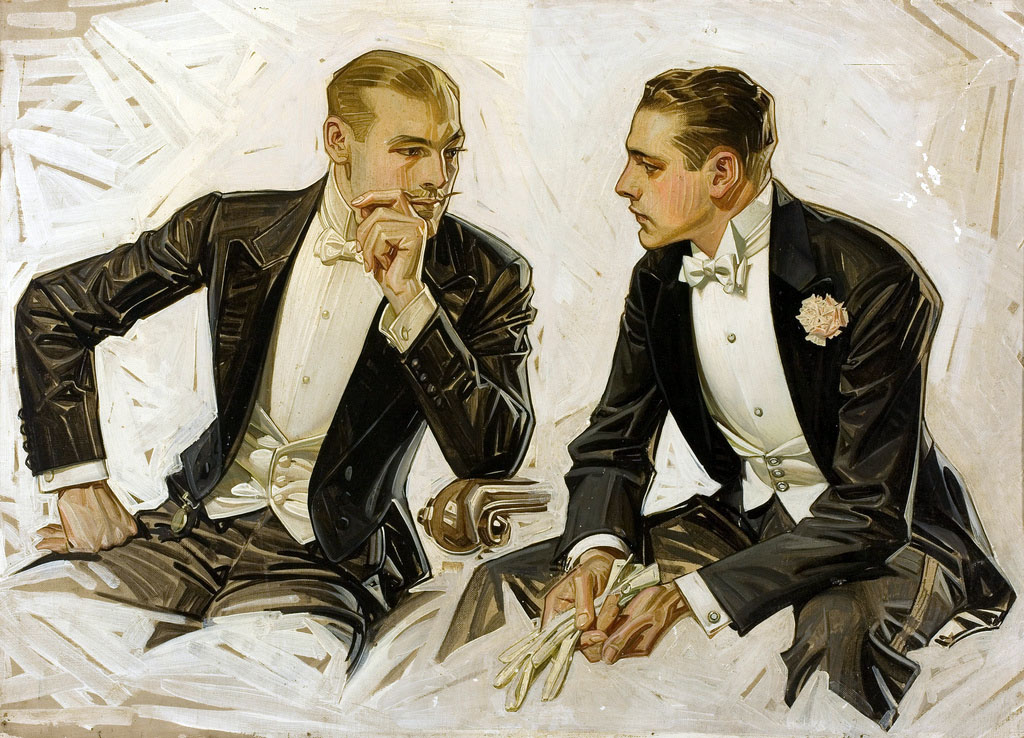
 

J.C. Leyendecker (American, 1874-1951) 'The Donchester – the Cluett Dress Shirt' 1912


J.C. Leyendecker (American, 1874-1951)
The Donchester – the Cluett Dress Shirt
Arrow shirt advertisement, 1911
Oil on canvas
National Museum of American Illustration, Newport, RI
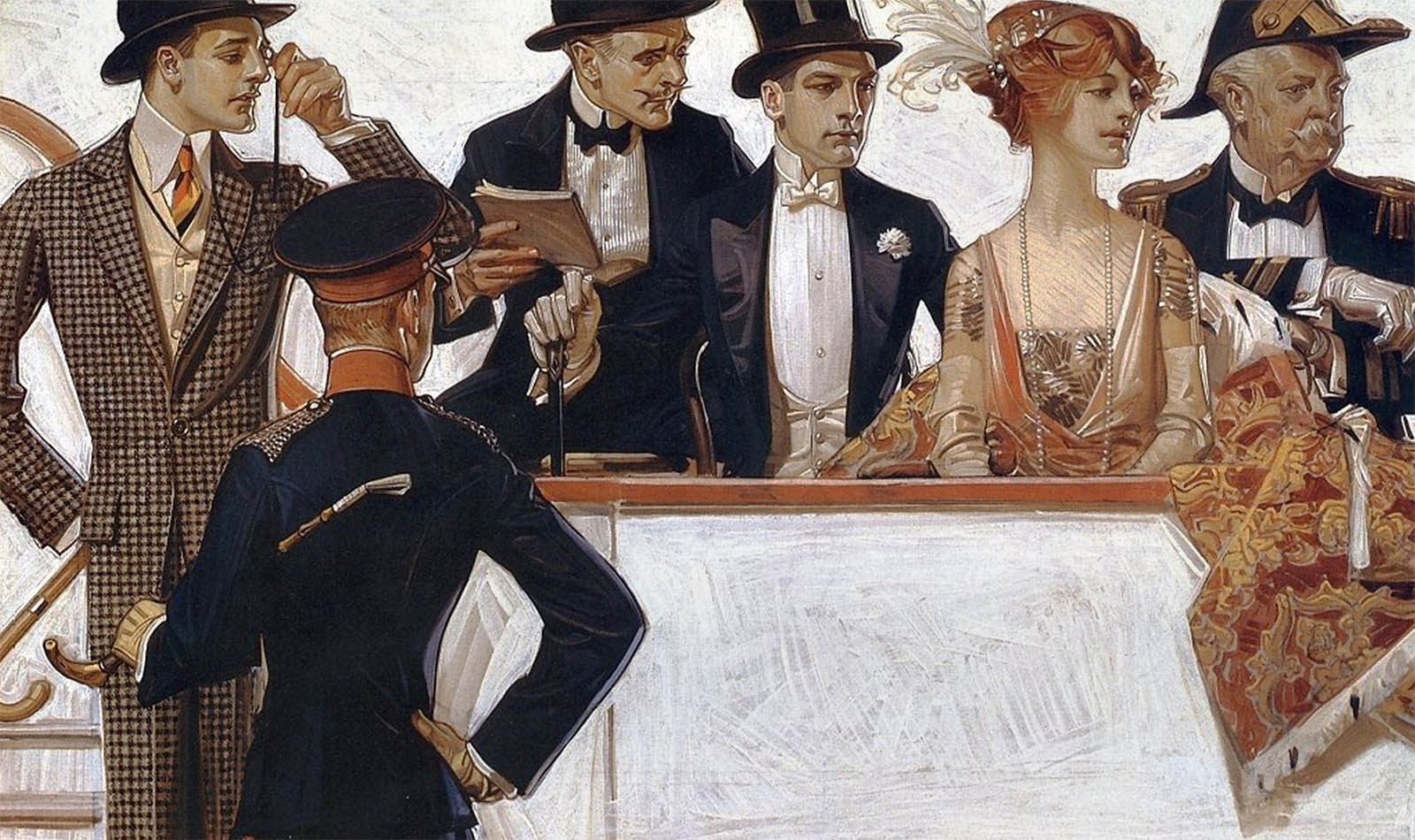
 

J.C. Leyendecker (American, 1874-1951) 'In the Stands' 2


J.C. Leyendecker (American, 1874-1951)
In the Stands 2
Arrow shirt advertisement, 1913
Oil on canvas
National Museum of American Illustration, Newport, RI
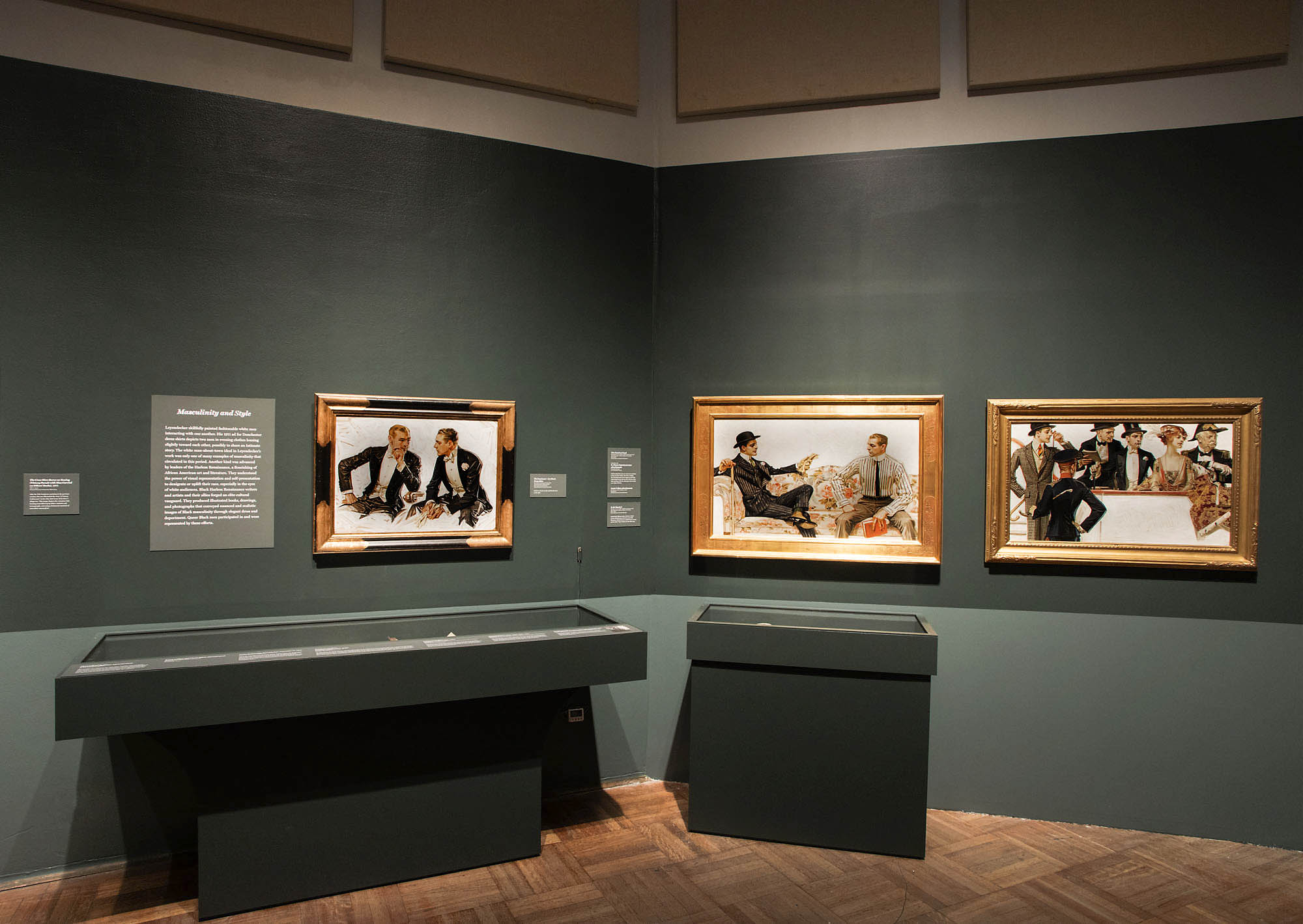
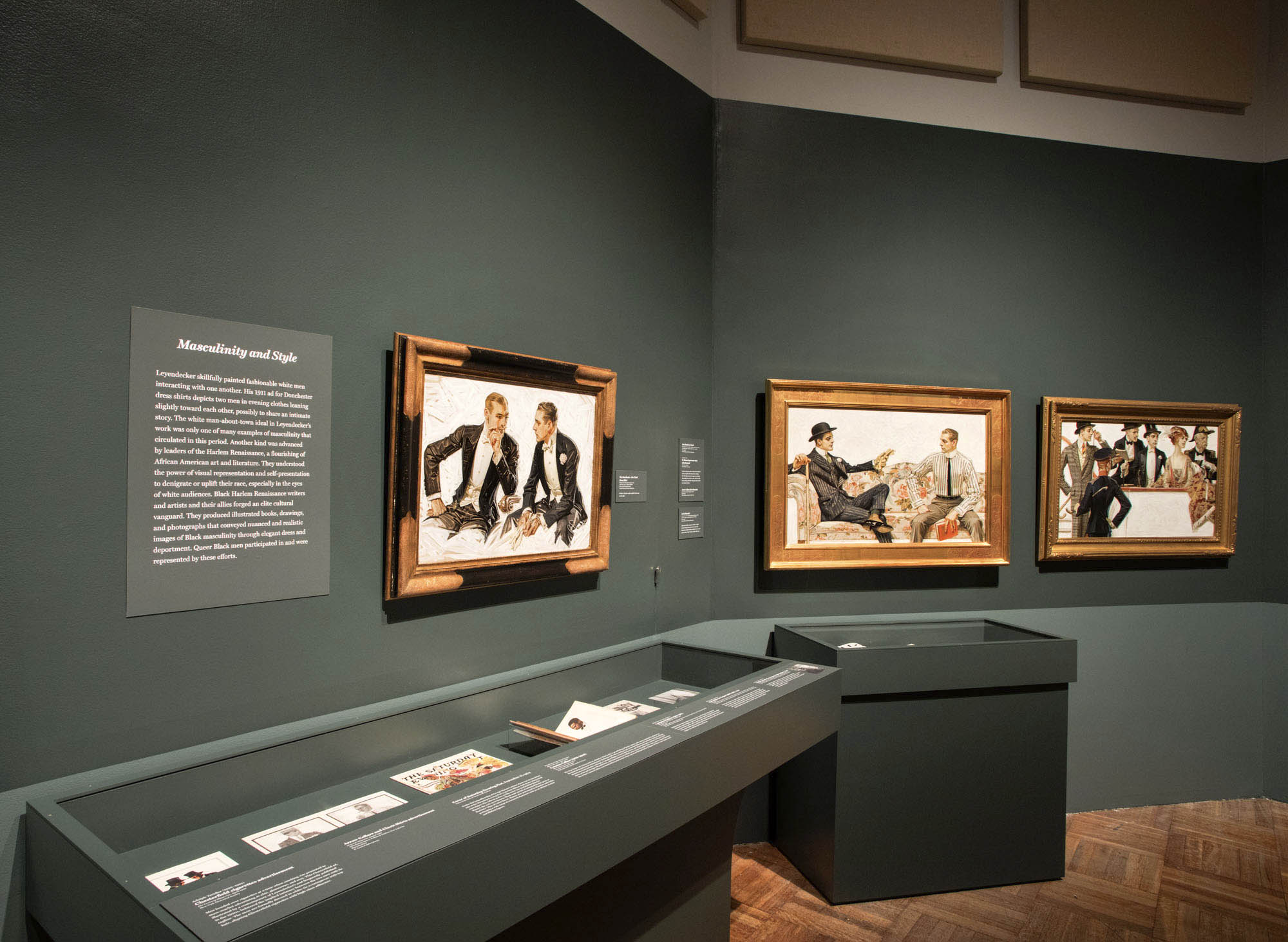
 

Installation view of the exhibition 'Under Cover: J.C. Leyendecker and American Masculinity' at the New-York Historical Society at left, 'The Donchester – the Cluett Dress Shirt' (1911); and at right, In the 'Stands 2' (1913)

Installation view of the exhibition 'Under Cover: J.C. Leyendecker and American Masculinity' at the New-York Historical Society at left, 'The Donchester – the Cluett Dress Shirt' (1911); and at right, In the 'Stands 2' (1913)


Installation views of the exhibition Under Cover: J.C. Leyendecker and American Masculinity at the New-York Historical Society at left, The Donchester – the Cluett Dress Shirt (1911, above); and at right, In the Stands 2 (1913, above)
Photo: Glenn Castellano, New-York Historical Society


Masculinity and Style

Leyendecker skilfully painted fashionable white men interaction with one another. His 1911 ad for Dorchester dress shirts depicts two men in evening clothes leaning slightly toward each other, possibly to share an intimate story. The whit man-about-town ideal in Leyendecker’s work was only one of many examples of masculinity that circulated in this period. Another kind was advanced by leaders of the Harlem Renaissance, a flourishing of African American art and literature. They understood the power of visual representation and self-presentation to denigrate or uplift their race, especially in the eyes of white audiences. Black Harlem Renaissance writers and artists and their allies forged an elite cultural vanguard. They produced illustrated books, drawings, and photographs that conveyed nuanced and realistic images of Black masculinity through elegant dress and deportment. Queer Black men participated in and were represented by these efforts.

Wall text from the exhibition
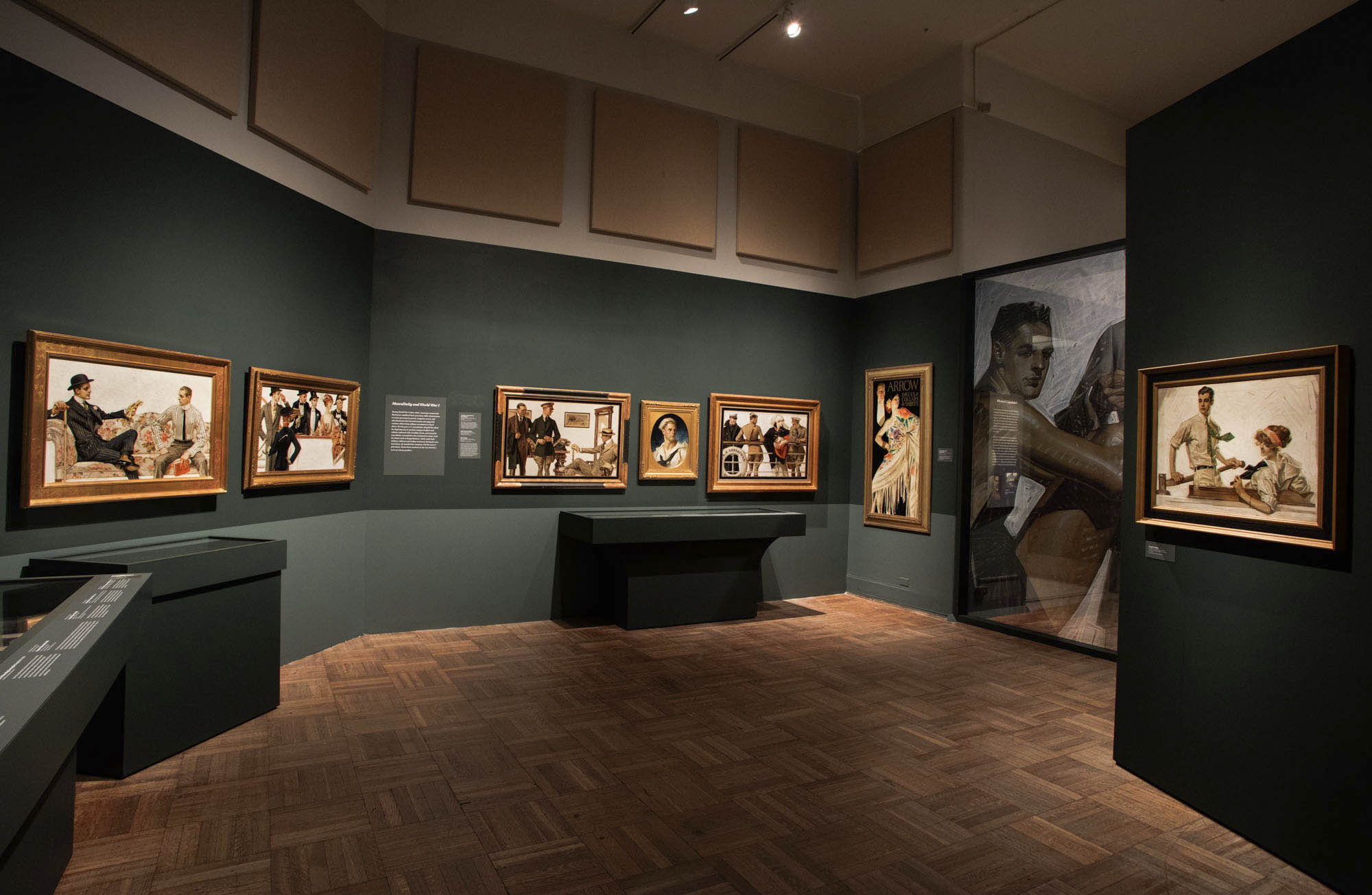
 

Installation view of the exhibition 'Under Cover: J.C. Leyendecker and American Masculinity' at the New-York Historical Society showing at second left, 'In the Stands 2' (1913); at centre, 'Portrait of an American Sailor, Charles Beach' (1918); at third right, 'Man and Woman with Spanish Shawl' (1926); and at right, 'Couple in Boat' (1912)


Installation view of the exhibition Under Cover: J.C. Leyendecker and American Masculinity at the New-York Historical Society showing at second left, In the Stands 2 (1913, above); at centre, Portrait of an American Sailor, Charles Beach (1918, below); at third right, Man and Woman with Spanish Shawl (1926); and at right, Couple in Boat (1912, above)
Photo: Glenn Castellano, New-York Historical Society
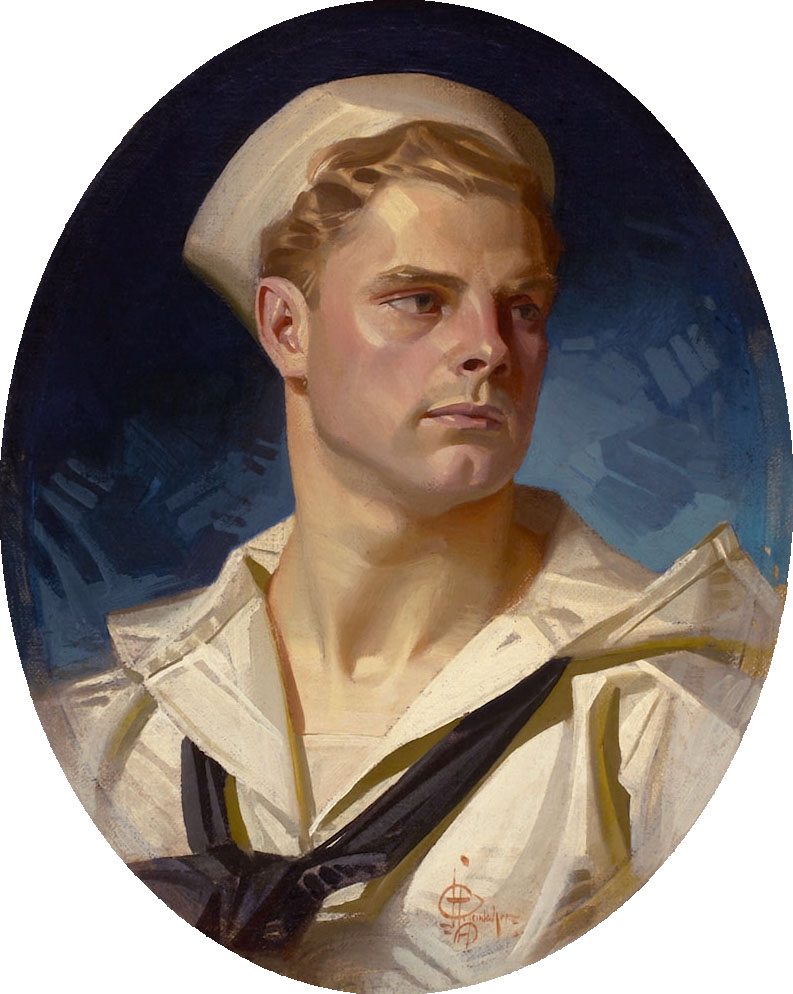
 

J.C. Leyendecker (American, 1874-1951) 'Portrait of an American Sailor, Charles Beach' 1918


J.C. Leyendecker (American, 1874-1951)
Portrait of an American Sailor, Charles Beach
1918
Oil on canvas
National Museum of American Illustration, Newport, RI
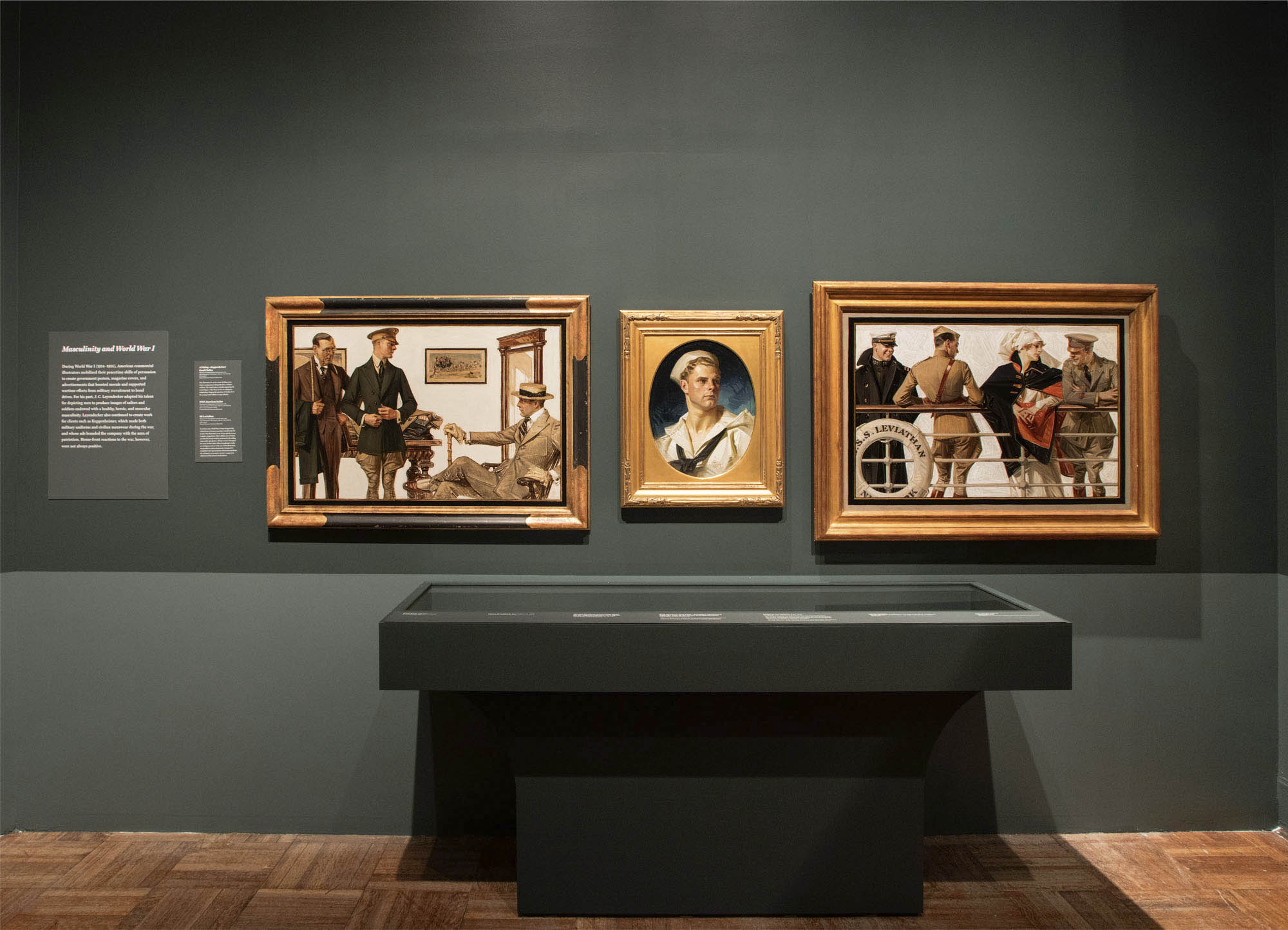
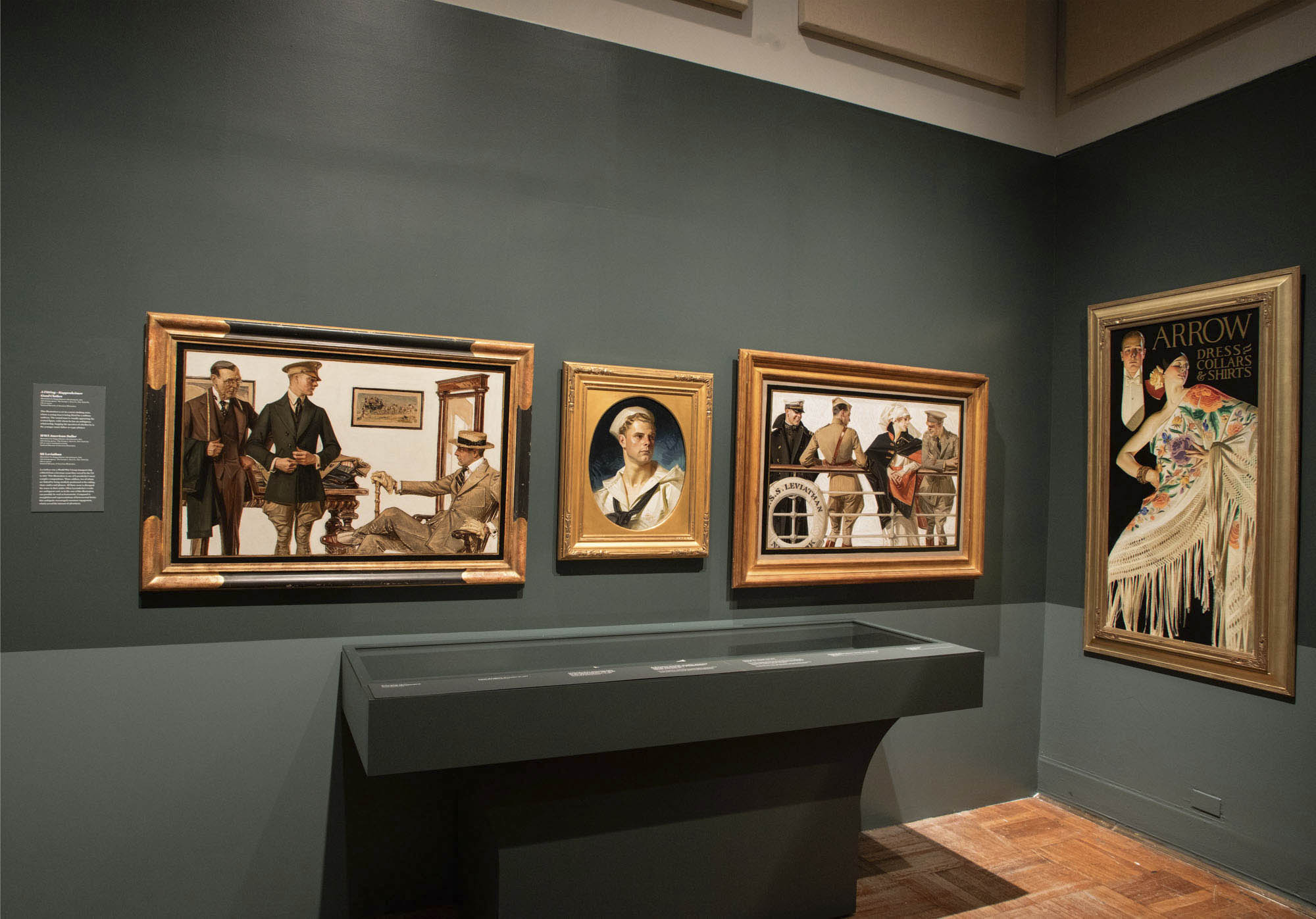
 

Installation view of the exhibition 'Under Cover: J.C. Leyendecker and American Masculinity' at the New-York Historical Society

Installation view of the exhibition 'Under Cover: J.C. Leyendecker and American Masculinity' at the New-York Historical Society showing at centre, 'Portrait of an American Sailor, Charles Beach' (1918); at second right, 'The S.S. Leviathan' (1918); and at right, 'Man and Woman with Spanish Shawl' (1926)


Installation view of the exhibition Under Cover: J.C. Leyendecker and American Masculinity at the New-York Historical Society showing at centre, Portrait of an American Sailor, Charles Beach (1918, below); at second right, The S.S. Leviathan (1918, below); and at right, Man and Woman with Spanish Shawl (1926)
Photo: Glenn Castellano, New-York Historical Society
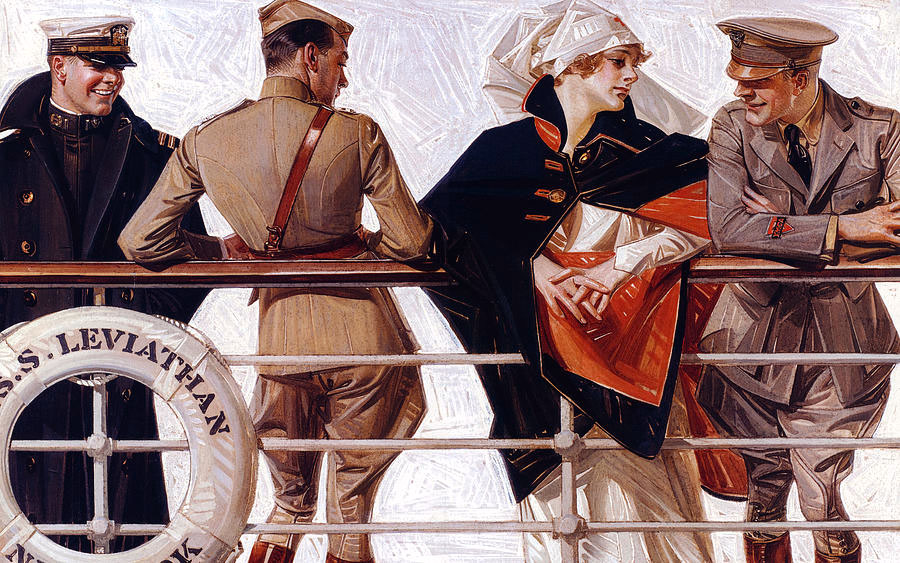
 

J.C. Leyendecker (American, 1874-1951) 'The S.S. Leviathan' 1918


J.C. Leyendecker (American, 1874-1951)
The S.S. Leviathan
House of Kuppenheimer advertisement, 1918
Oil on canvas
National Museum of American Illustration, Newport, RI


New-York Historical Society Exhibition Explores the Work of J.C. Leyendecker, a Pivotal Gay Artist and Illustrator Who Helped Shape American Visual Culture.

This spring, a new exhibition at the New-York Historical Society examines the work and influence of J.C. Leyendecker (1874-1951), a preeminent illustrator and commercial artist who helped shape American visual culture in the first three decades of the 20th century through captivating advertising campaigns including the legendary “Arrow Collar Man” and countless covers for the Saturday Evening Post. As a gay artist whose illustrations for a mainstream audience often had unspoken homoerotic undertones, his work is especially revealing for what it says about the cultural attitudes towards homosexuality of the period. Under Cover: J. C. Leyendecker and American Masculinity, on view May 5 – August 13, 2023, is organised by New-York Historical from the collection of the National Museum of American Illustration, Newport, RI.

Under Cover: J.C. Leyendecker and American Masculinity deepens our understanding of the struggle for full civil rights as Americans of the LGBTQ+ community,” said Dr. Louise Mirrer, president and CEO of New-York Historical. “The exhibition is part of New-York Historical’s ongoing commitment to tell stories of Americans whose lived experience, though important and consequential to our history, is so often absent from textbooks in schools and colleges. New-York Historical’s collaboration with the American LGBTQ+ Museum, which will be housed in our institution’s new wing, will further enable meaningful conversations about LGBTQ+ history and its rightful place within the American narrative.”

“J.C. Leyendecker was an amazingly talented artist whose illustrations have come to embody the look and feel of the first half of the century while simultaneously demonstrating how fluidity in gender expression and gay representation were actually quite common at the time, contrary to current assertions that they are unique to our own moment,” said Donald Albrecht, guest curator. “Not only did his work exemplify the zeitgeist, but it depicts a deeply nuanced view of sexuality and advertising that broadens our understanding of American culture.”

Under Cover: J.C. Leyendecker and American Masculinity showcases 19 of the artist’s original oil paintings and a wealth of related ephemera, and features both Leyendecker’s editorial work, such as magazine covers, as well as commercial illustrations that appeared in the pages of popular publications, on roadside billboards, in store windows, and on mass transit. His aesthetic influence extended to Norman Rockwell, his colleague and eventual successor as the Post’s premier illustrator. The exhibition is organised into two primary sections: one exploring Leyendecker’s depictions of the male body, either semi-nude or clad in body-revealing garments, and a second focusing on his images of male intimacies, often of men sharing sexually charged looks. The model for many of his illustrations was Charles Beach, his lover and eventual business manager.

Under Cover delves into the early politics of sexual identity and gender while simultaneously examining how Leyendecker helped establish a nationalistic ideal of elite and athletic white male beauty. To address this aspect of his work, the exhibition juxtaposes some of Leyendecker’s paintings with artefacts that offer counter-narratives to his works’ exclusionary nature, including depictions of fashionable African American men during the Harlem Renaissance. Also providing crucial context: a selection of contemporaneous advertisements with homoerotic connotations and a digital show of images depicting gay culture in New York during Leyendecker’s time, including plays about lesbians and men in drag that appeared on Broadway, effeminate male nightclub performers, and gay artists who wrote poems and created drawings about same-sex desire.

The exhibition locates Leyendecker’s work within the evolution of commercial illustration, when advertisers sought to sell products by emotion and feeling and not only by factual representation of a product’s utilitarian characteristics. These commercial trends can be seen in Leyendecker’s work creating advertising illustrations for companies such as Gillette razors, Ivory soap, House of Kuppenheimer menswear, and Interwoven socks. He also developed campaigns for Arrow collars depicting handsome, idealised men wearing shirts and detachable collars manufactured by Cluett, Peabody & Co. Laying the groundwork of Leyendecker’s implied gay narratives, these ads starred fashionable men in stylish settings engaged in activities such as boating, golfing, or reading in men’s clubs. In his work, Leyendecker created drawings depicting multiple kinds of masculinity for the mass market, from feminized men like the languidly posed males in Interwoven ads who look at and caress their sheer stockings to elegant men of leisure like the Arrow Collar Man to manly men like muscular sailors, lifeguards, and athletes.

Leyendecker’s suggestive images aligned with his era’s sexual mores. Starting in the latter decades of the 19th century, small but dense subcultures that defied sexual and gender conventions became increasingly visible in cities like New York. Members of these subcultures often identified themselves with specific styles of dress, mannerisms, and language. As a gay Manhattanite immersed in the city’s sophisticated visual culture industries, Leyendecker was most likely cognisant of these gay identity markers, sometimes depicting them in his illustrations.

Under Cover is organised by New-York Historical from the collection of the National Museum of American Illustration, Newport, RI. The show is guest-curated by Donald Albrecht, and coordinated at New-York Historical by Rebecca Klassen, curator of material culture. Drawing on three decades of scholarship, the exhibition is aided by a committee of advisors: Dr. Elspeth Brown, Professor of History at the University of Toronto; Dr. Monica L. Miller, Professor of English and Africana Studies, Barnard College; and Dr. Michael Murphy, Associate Professor of Gender and Sexuality Studies at the University of Illinois Springfield.

Press release from the New-York Historical Society
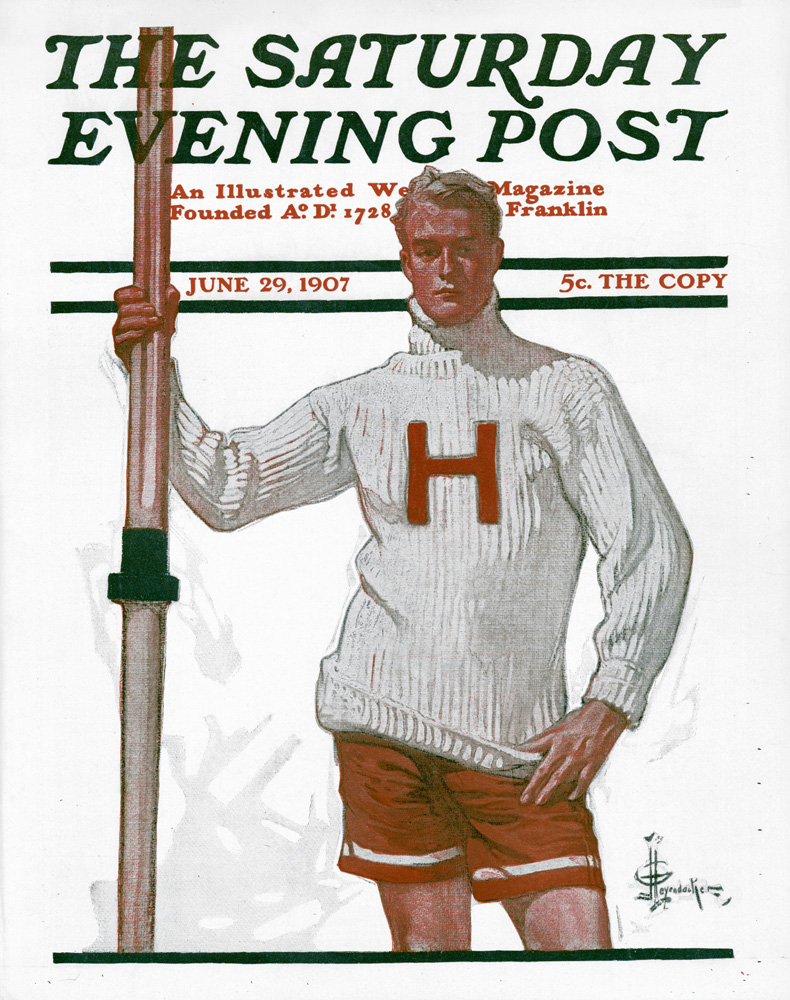
 

J.C. Leyendecker (American, 1874-1951) 'Cover of Saturday Evening Post' June 29, 1907


J.C. Leyendecker (American, 1874-1951)
Cover of Saturday Evening Post
June 29, 1907
National Museum of American Illustration, Newport, RI


Leyendecker’s Ivy League athletes embodied the ideals of muscular Christianity, a philosophy whose proponents believed in athleticism as a means toward a patriotic and moral good. President Theodore Roosevelt, who advocated the movement’s principles, noted that Leyendecker’s illustrations depicted “a superb example of the common man.”
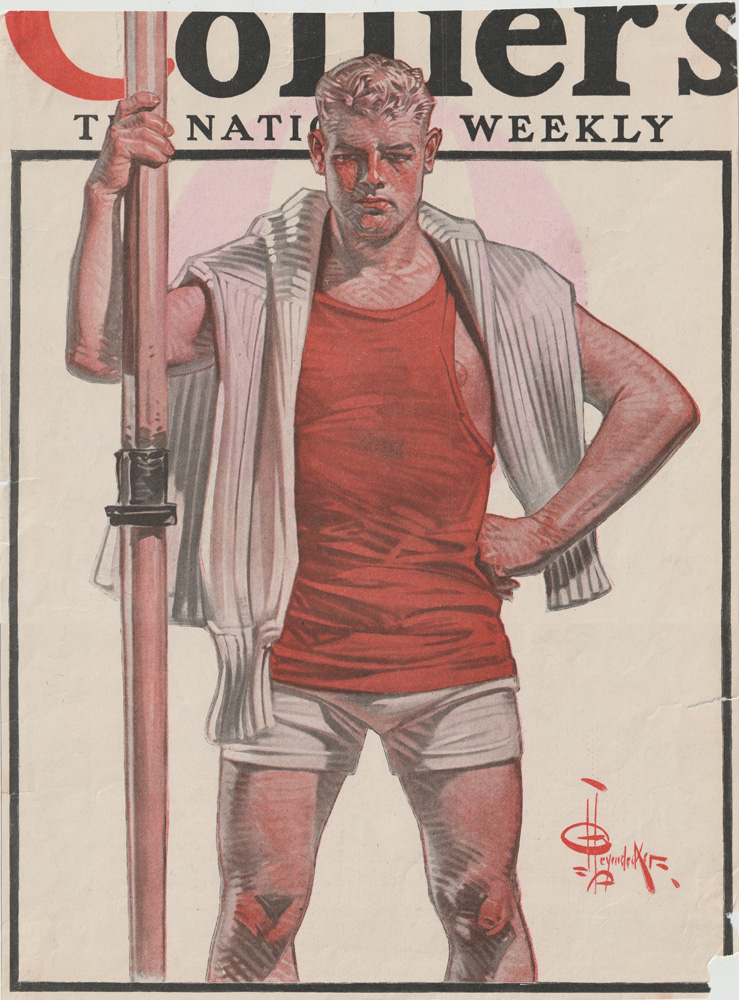
 

J.C. Leyendecker (American, 1874-1951) 'Cover of Collier's' June 24, 1916


J.C. Leyendecker (American, 1874-1951)
Cover of Collier’s
June 24, 1916
National Museum of American Illustration, Newport, RI


As a gay male artist, Leyendecker demonstrated a marked flair for depicting the male body either semi-nude or wearing body-revealing clothing. In this cover, Leyendecker partially exposes the athlete’s left nipple.
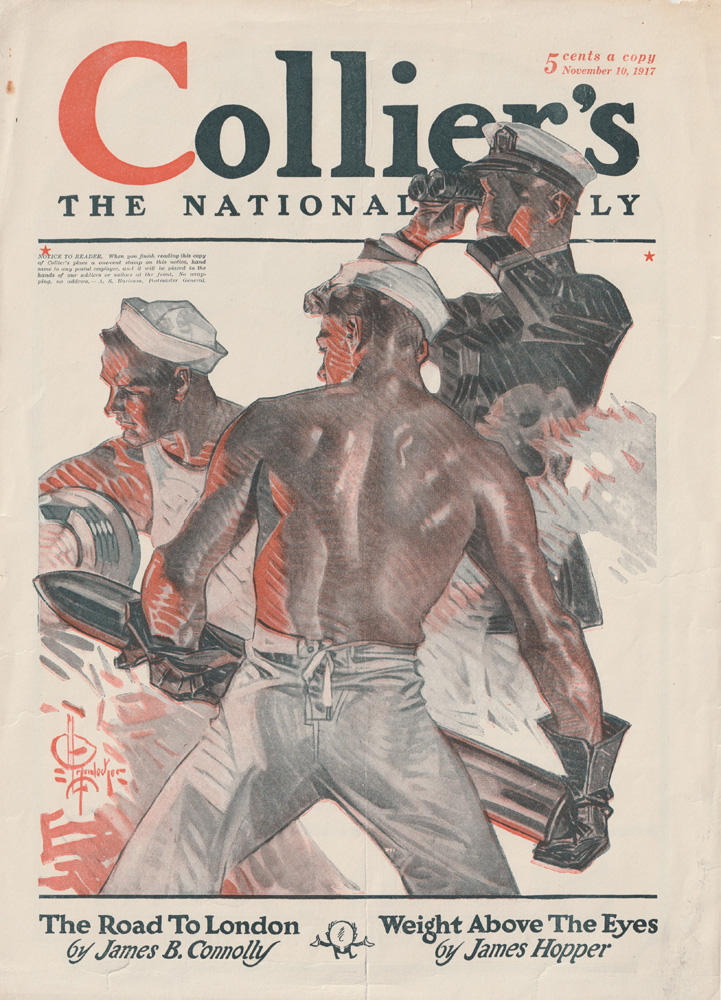
 

J.C. Leyendecker (American, 1874-1951) 'Cover of Collier's' November 10, 1917


J.C. Leyendecker (American, 1874-1951)
Cover of Collier’s
November 10, 1917
National Museum of American Illustration, Newport, RI


During World War I, Leyendecker adapted his flair for depicting men to produce images of sailors and soldiers endowed with a healthy, heroic, and muscular masculinity.
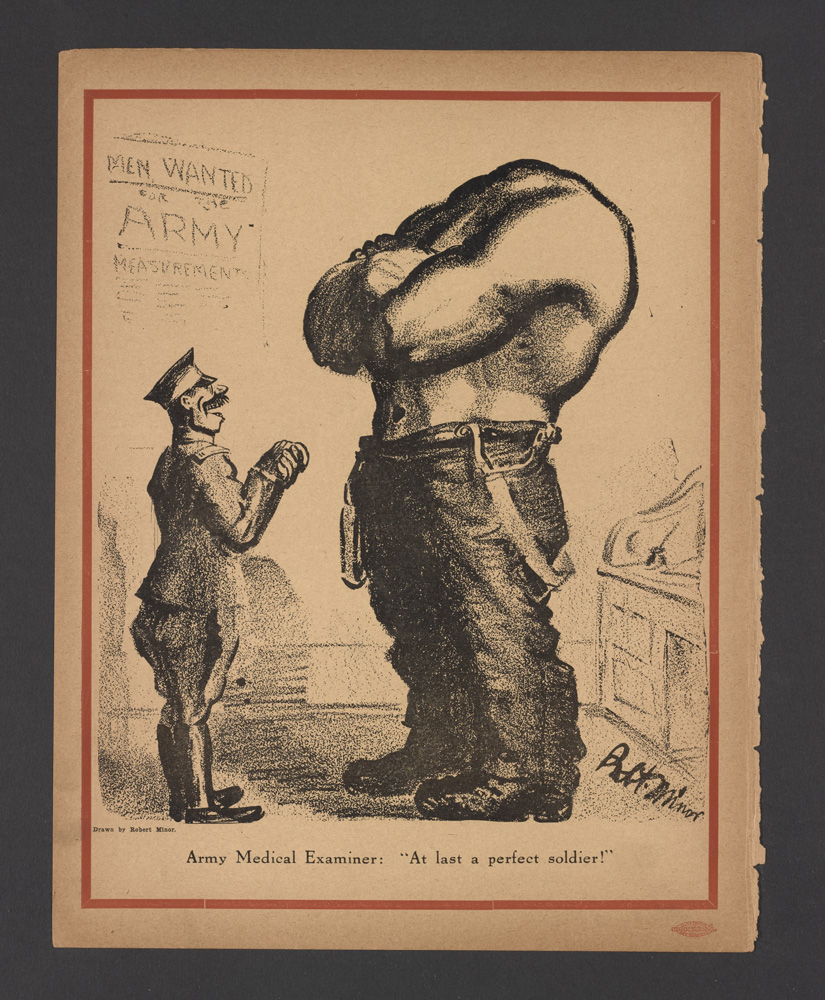
 

Robert Minor (American, 1884-1952) '"Army Medical Examiner: 'At last a perfect soldier!'"'


Robert Minor (American, 1884-1952)
“Army Medical Examiner: ‘At last a perfect soldier!'”
The Masses, July 1916
Reproduction
The Tamiment Library and Robert F. Wagner Labor Archives, New York University Libraries


Home-front depictions of World War I were not always as positive as those created by Leyendecker. Chronicling the war’s dehumanising and deathly toll, this illustration from the leftist magazine The Masses rendered the male body with biting satire.
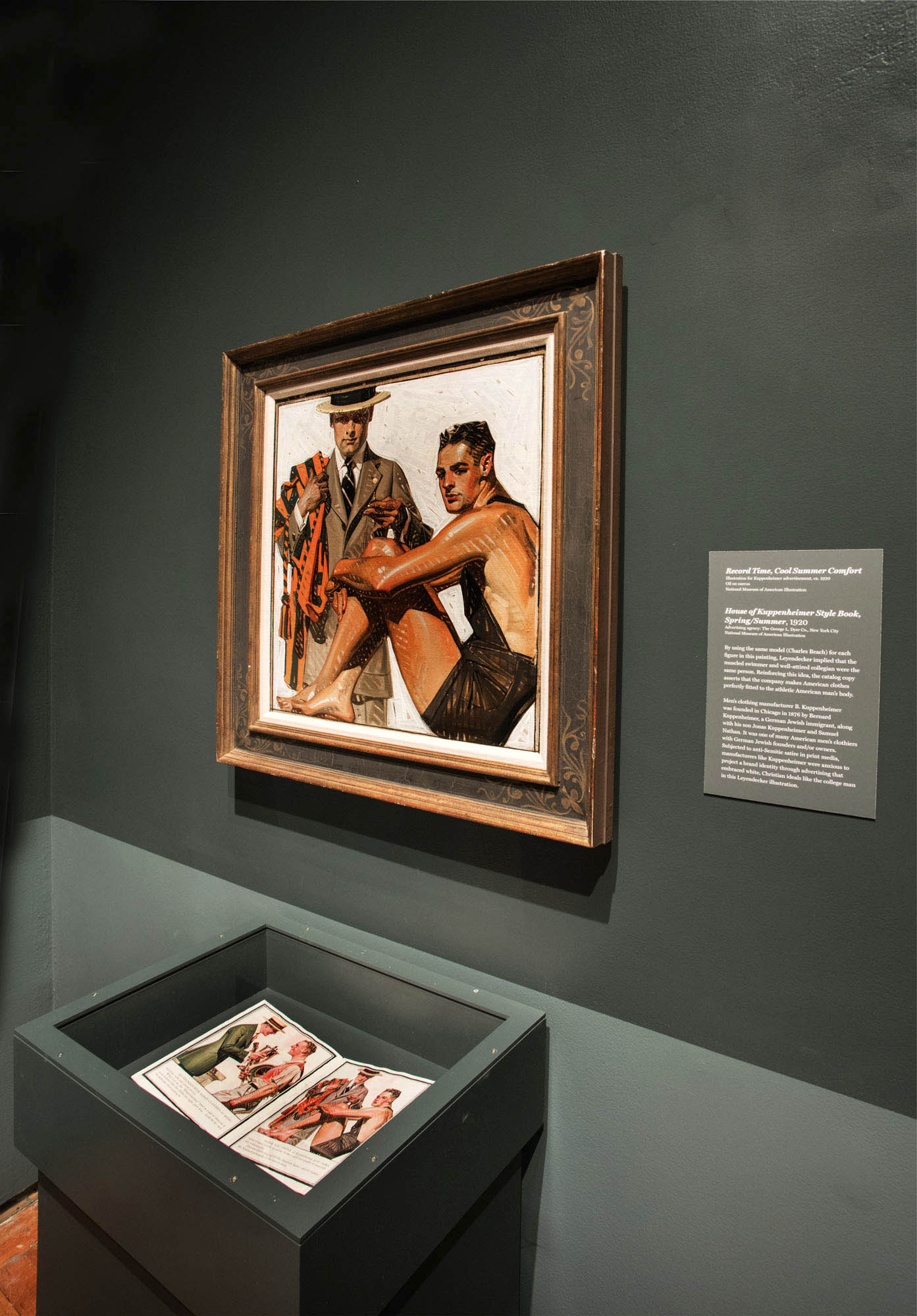
 

Installation view of the exhibition 'Under Cover: J.C. Leyendecker and American Masculinity' at the New-York Historical Society showing 'Record Time, Cool Summer Comfort' (c. 1920)


Installation view of the exhibition Under Cover: J.C. Leyendecker and American Masculinity at the New-York Historical Society showing Record Time, Cool Summer Comfort (c. 1920, below)
Photo: Glenn Castellano, New-York Historical Society


By using the same model (Charles Beach) for each figure in this painting, Leyendecker implied that the muscled swimmer and eel-attired collegian were the same person. Reinforcing this idea, the catalog copy assets that the company makes American clothes perfectly fitted to the athletic American man’s body.

Men’s clothing manufacturer B. Kuppenheimer was founded in Chicago in 1876 by Bernard Kuppenheimer, a German Jewish immigrant, along with his son Jonas Kuppenheimer and Samuel Nathan. It was one of many American men’s clothiers with German Jewish founders and/or owners. Subjected to anti-Semitic satire in print media, manufacturers like Kuppenheimer were anxious to project a brand identity though advertising that embraced white, Christian ideals like the college man in the Leyendecker illustration.

Wall text from the exhibition
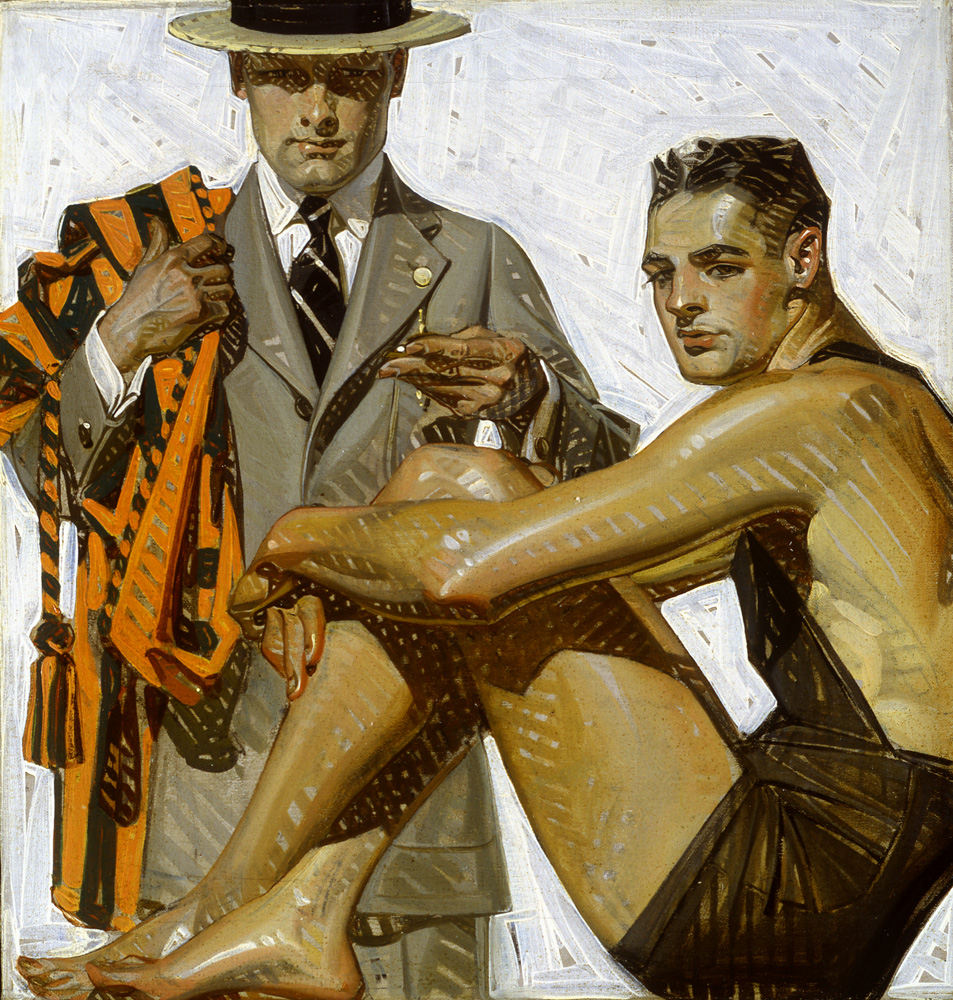
 

J.C. Leyendecker (American, 1874-1951) 'Record Time, Cool Summer Comfort' c. 1920


J.C. Leyendecker (American, 1874-1951)
Record Time, Cool Summer Comfort
Painting for Kuppenheimer advertisement, c. 1920
Oil on canvas
National Museum of American Illustration, Newport, RI


By pairing a muscled swimmer with a well-tailored collegian, both modelled by Charles A. Beach, this advertisement illustrated Kuppenheimer’s claim in the ad for “truly American clothes” designed “for the American figure” and expressing “the American personality.” Men’s clothing manufacturer B. Kuppenheimer was founded in Chicago in 1876 by Bernard Kuppenheimer, a German Jewish immigrant, along with his son Jonas and Samuel Nathan.
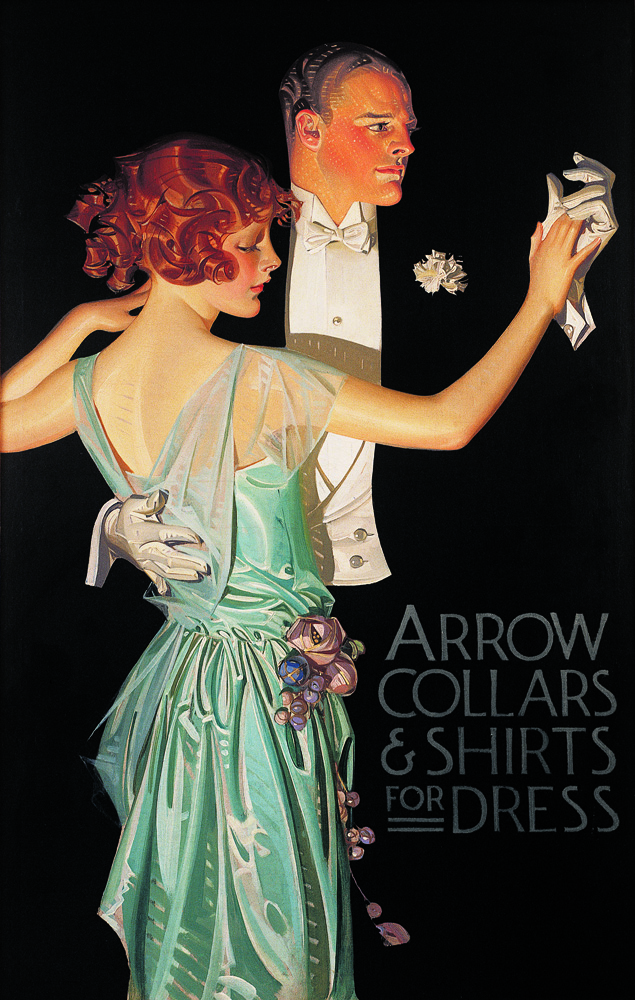
 

J.C. Leyendecker (American, 1874-1951) 'Man and Woman Dancing' 1923


J.C. Leyendecker (American, 1874-1951)
Man and Woman Dancing
Painting for Arrow Collar advertisement, 1923
Oil on canvas
National Museum of American Illustration, Newport, RI


This illustration features models Phyllis Frederic and Brian Donlevy, who launched his acting career in the early 1920s while posing for Leyendecker. Donlevy went on to perform in Broadway plays and silent films, eventually taking on major roles in Hollywood movies.
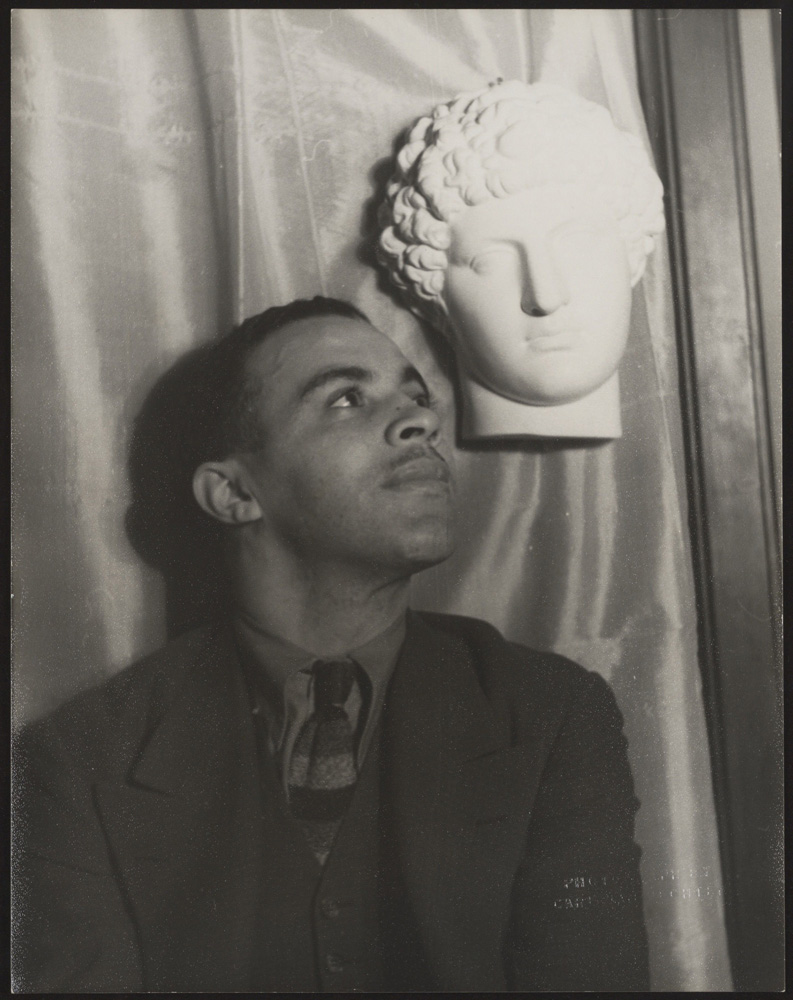
 

Carl Van Vechten (American, 1880-1964) 'Richard Bruce Nugent (1906-1987)' 1936


Carl Van Vechten (American, 1880-1964)
Richard Bruce Nugent (1906-1987)
1936
Reproduction
Carl Van Vechten Papers Relating to African American Arts and Letters, James Weldon Johnson Collection in the Yale Collection of American Literature, Beinecke Rare Book and Manuscript Library
© Van Vechten Trust


Paralleling Leyendecker’s idealised depictions of white men and often stereotypical images of Black ones, members of the Harlem Renaissance produced illustrated books, drawings, and photographs that conveyed positive images of Black masculinity through elegant dress and deportment. Taken by Carl Van Vechten, a gay white critic, novelist, and Renaissance promoter, this photograph of author and artist Richard Bruce Nugent signalled its subject’s gayness by including a bust of Antinous, the male lover of the Roman emperor Hadrian.
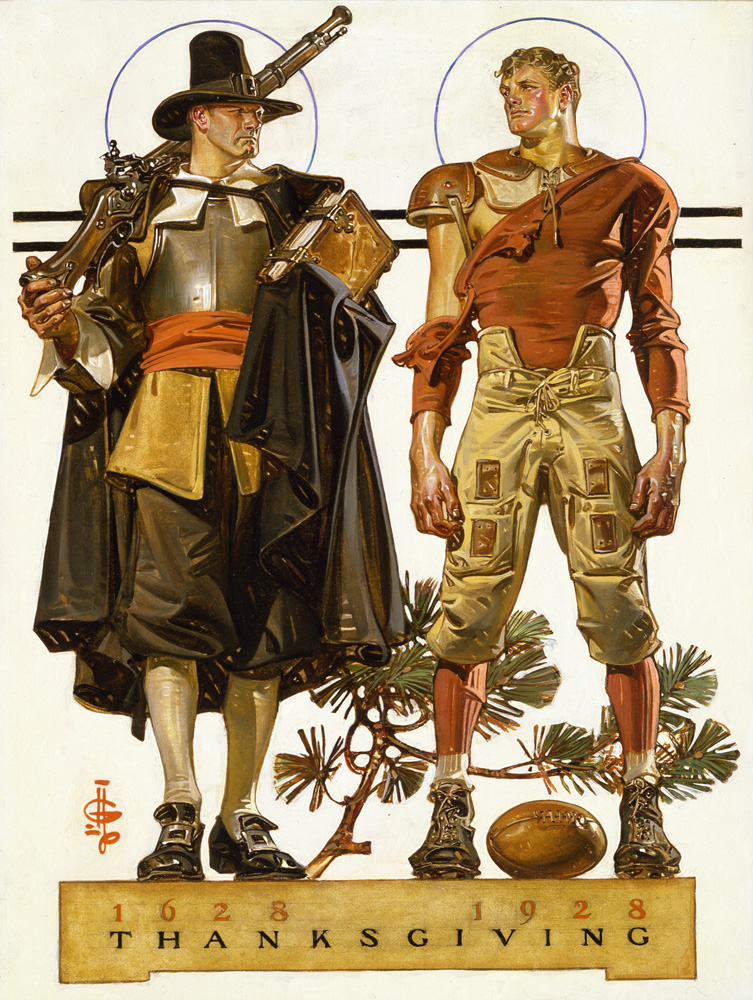
 

J.C. Leyendecker (American, 1874-1951) 'Thanksgiving: 1628-1928 (Pilgrim and Football Player)' 1928


J.C. Leyendecker (American, 1874-1951)
Thanksgiving: 1628-1928 (Pilgrim and Football Player)
Painting for cover of Saturday Evening Post, November 24, 1928
Oil on canvas
Private collection
Image courtesy of the National Museum of American Illustration, Newport, RI


Juxtaposing a modern muscular football player with a Pilgrim, Leyendecker’s painting for the 1928 Thanksgiving cover of the Saturday Evening Post positions the popular sport not only as a Thanksgiving pastime, but also as a cultural marker of American-ness. By the time the Post published this cover, football had been emerging for decades as an emblem of masculinity.
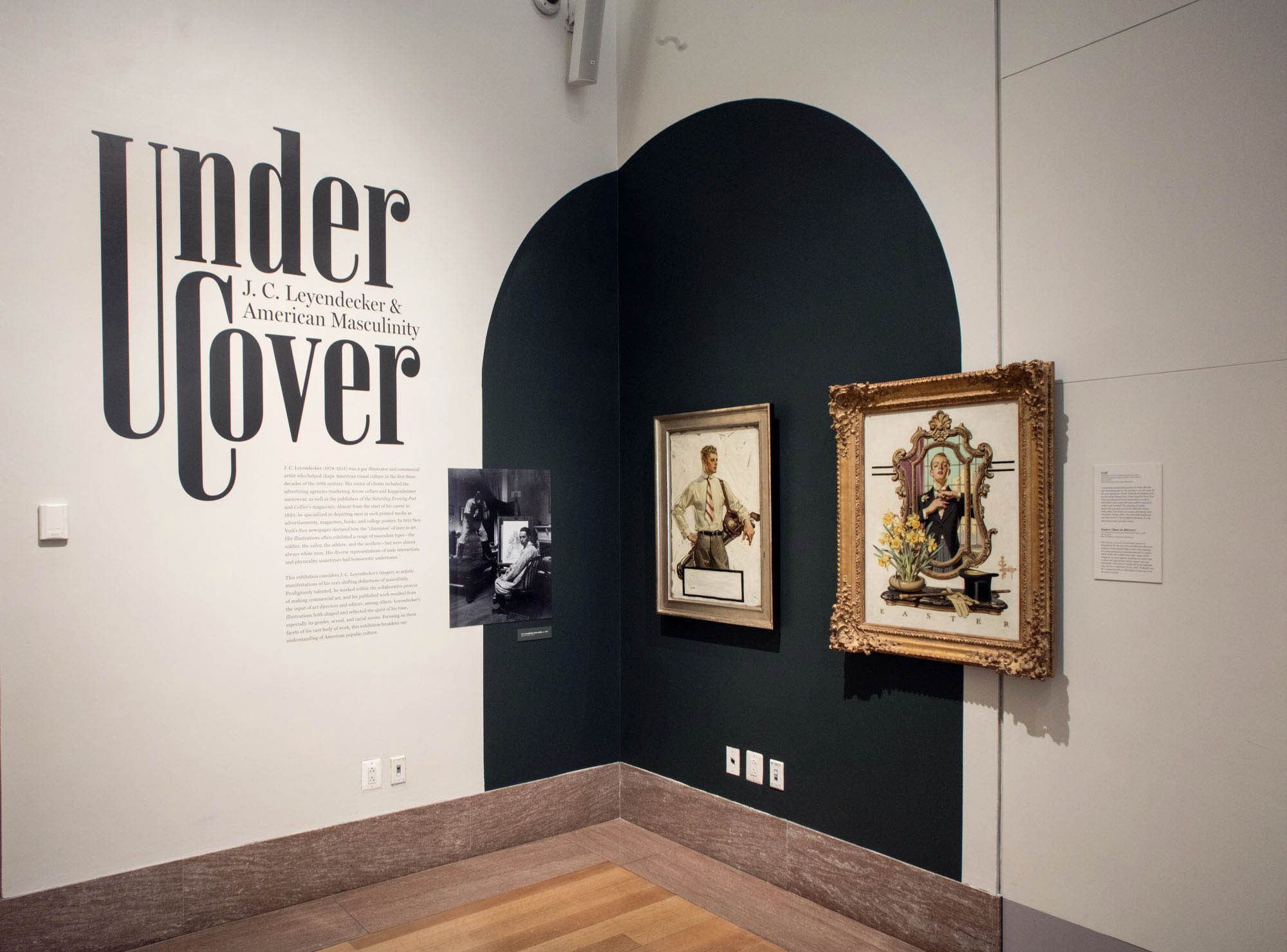
 

Installation view of the exhibition 'Under Cover: J.C. Leyendecker and American Masculinity' at the New-York Historical Society showing at right, Leyendecker's 'Easter – Man in the Mirror Painting' for cover of 'Saturday Evening Post', April 11, 1936 (below)


Installation view of the exhibition Under Cover: J.C. Leyendecker and American Masculinity at the New-York Historical Society showing at right, Leyendecker’s Easter – Man in the Mirror Painting for cover of Saturday Evening Post, April 11, 1936 (below)
Photo: Glenn Castellano, New-York Historical Society
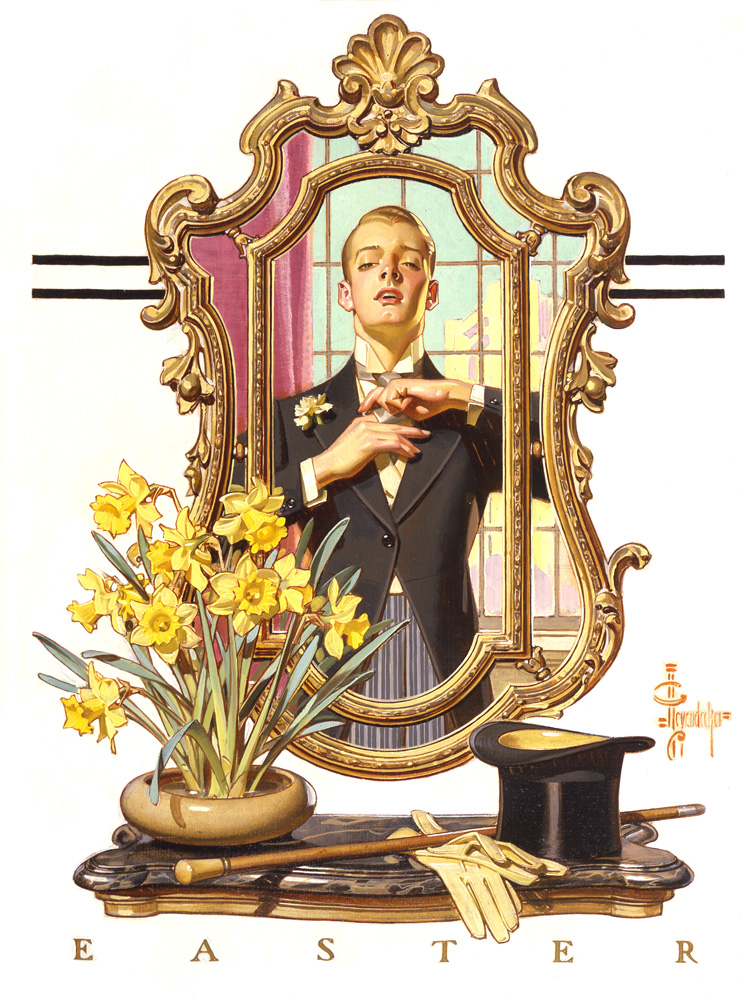
 

J.C. Leyendecker (American, 1874-1951) 'Easter – Man in the Mirror' 1936


J.C. Leyendecker (American, 1874-1951)
Easter – Man in the Mirror
Painting for cover of Saturday Evening Post, April 11, 1936
Oil on canvas
National Museum of American Illustration, Newport, RI


In his work, Leyendecker created drawings depicting multiple kinds of masculinity for the mass market, from preening, dandified men like this artwork’s subject to elegant men of leisure like the Arrow Collar Man to manly men like muscular sailors, lifeguards, and athletes. Timed to Easter, this cover illustration was also one of many instances of the artist creating Post illustrations themed to the seasons and holidays.


New-York Historical Society
170 Central Park West
at Richard Gilder Way (77th Street)
New York, NY 10024
Phone: (212) 873-3400

Opening hours:
Monday CLOSED
Tuesday – Thursday 11am – 5pm
Friday 11am – 8pm
Saturday – Sunday 11am – 5pm

New-York Historical Society website

LIKE ART BLART ON FACEBOOK

Back to top

Exhibition: ‘In the Beginning: Minor White’s Oregon Photographs’ at the Portland Art Museum Phase 1, Part 2

Exhibition dates: 9th December, 2017 – 6th May, 2018

Curated by Julia Dolan PhD, the Minor White Curator of Photography


Over two postings, Phase 1 of this exhibition which features one of the greatest collections of early photographs by Minor White!

View Part 1 of the posting


Minor White (American, 1908-1976) 'Untitled (Dock)' c. 1939 from the exhibition 'In the Beginning: Minor White's Oregon Photographs' at the Portland Art Museum Phase 1, Dec 2017 - May 2018


Minor White (American, 1908-1976)
Untitled (Dock)
c. 1939
Gelatin silver print
Courtesy of the Fine Arts Program, Public Buildings Service, U.S. General Services Administration
Commissioned through the New Deal art projects
Public domain


Catching fire

It is a memorable experience to be able to observe a great artist experimenting with his craft, which is exactly what MW is doing in the photographs in these two postings. Here is an artist at the start of the path, honing his skills as a “creative photographer”: for these are creative, public photographs not expressive, private ones.

The photographs are a strange mix… part modernism, part romanticism, with a large dose of Pictorialism (dare I mention the word!) thrown in for good measure. I can see influences of the night work of Brassaï; the architectural photographs of Charles Sheeler; the photographs of Albert Renger-Patzsch and the German New Objectivity; the urban and urbane photographs of Walker Evans (The Customer, c. 1939 and Joseph, Oregon (Joseph Cemetery) c. 1940 below); the spatiality, surrealism and detail of Eugene Atget’s Paris photographs; and the landscape work of Ansel Adams. Overlay these influences with feelings of spirituality, sexuality and the atmosphere of place and you have a heady mix. And yet these photographs are purely his own.

What a time MW was having when he made these photographs. There were no limits to where he could point his camera.

As I talk to my friend and mentor Ian Lobb about photography, we have brave conversations about artists, vision, looking, previsualisation, representation, the print, and more generally life, words, spirit. He observed of this group of photographs:

“There were things that looked like photographs that other people had made.
There were things that were naively interesting to him for what they were.
There were things that allowed him to experiment with ideas of metaphor.
There was a combination of subject matter and light that enabled him to touch upon a world of symbol and ritual without him ever really being confident in that world (at this time).

There were also affirmations of how he could organise the world through his camera. He knew he was really accomplished with organising the edges of his image (particularly the right hand edge) and how this segued into the centre of his images where he hoped he could also organise subject matter – but he was not as skilled with this. He was still learning his craft.

He also knew that he could escape reality by changing scale, changing the lightness of his subject matter, changing the mood of his images with print colour (cold events printed warm) and then affirming the mood of his images with print colour. He knew there must be more with how he printed – was he beginning to understand that there his knowledge of printing chemistry could also be applied to film chemistry? Maybe there was an inkling of this but he was never extremely skilful with this. And he was not trying to expose and change film development techniques according to the subject matter – but there were emerging confused questions about this that would be exceptionally refined later.

I don’t think he applied labels like modernist or romantic to himself – but he was burningly aware of his authorship – and it excited him to the bone. Sometimes he was aware that he was walking an edge between various worlds and this was starting to take a form where he was both teacher and student – he could sense it starting to appear in his images and this made him secretly full of delight.”

(Ian Lobb in conversation with Marcus Bunyan)


My friend has such a tremendous knowledge of the work of MW and of photography and life in general. I most appreciate the passing on of these observations to me. You really can feel that the artist is walking an edge between various worlds and that the photographs embody a critical shift in consciousness, from “truth in appearances” to a longing for transcendence. The work is full of symbolic and metaphorical allusions/illusions.

That MW’s photographs still offer these affirmations to the viewer nigh on 80 years later show’s the intensity of their visualisation. They are a gift from the cosmos to one human being and back to the cosmos (in the form of an ensō, or Zen circle), and should be accepted as such.

Dr Marcus Bunyan


Many thankx to the Portland Art Museum for allowing me to publish the photographs in the posting. Please click on the photographs for a larger version of the image.


Minor White (American, 1908-1976) 'Untitled (Propeller)' c. 1939 from the exhibition 'In the Beginning: Minor White's Oregon Photographs' at the Portland Art Museum Phase 1, Dec 2017 - May 2018


Minor White (American, 1908-1976)
Untitled (Propeller)
c. 1939
Gelatin silver print
Courtesy of the Fine Arts Program, Public Buildings Service, U.S. General Services Administration
Commissioned through the New Deal art projects
Public domain


“A banquet of frustration”: Minor White penned the phrase in 1939, after reading T. S. Eliot’s 1922 poem The Waste Land. “I perceived that if one could put out the energy to produce a banquet of frustration, then frustration had power,” White commented. “It was worth pursuing.”1

“The duplicity one senses in White’s career, in both his writing and his images, stems certainly from this frustration about sexuality (as Peter Bunnell has written, “White’s sexuality underlies the whole of the autobiographical statement contained in his work”), but it also mirrors a much larger counter tradition found within modernism itself, a romantic tradition that draws from Romanticism, Symbolism, Dada, and Surrealism. More specifically, White’s frustration coincides with the collapse of modernist ideals during the postwar era. This passage in the history of photography, if examined at all, is normally pinned to the arid vision of Robert Frank. Aesthetically, White’s vision was less dark than Frank’s, and in no sense nihilistic. Yet White’s work embodies a critical shift in consciousness, from the heroic modernist notion of “truth in appearances” toward the acknowledgment – and even the cultivation – of illusion, deception, and buried meanings. White’s banquet of frustration would look like a tea setting compared to the theoretical abattoirs of generations of later artists; nevertheless, the historical narrative of photographic modernism’s dissolution owes an early chapter to White and his longing for transcendence, which he seems not to have attained.”

Extracts from Kevin Moore. “Cruising and Transcendence in the Photographs of Minor White,” on the Aperture website [Online] Cited 27/04/2018

1/ Minor White. “Memorable Fancies,” 1932-1937 quoted in Peter C. Bunnell. Minor White: The Eye That Shapes. Princeton and Boston: The Art Museum, Princeton University; Bulfinch/Little Brown, 1989, p. 19.


Minor White (American, 1908-1976) 'Freight Depot' c. 1939


Minor White (American, 1908-1976)
Freight Depot
c. 1939
Gelatin silver print
Courtesy of the Fine Arts Program, Public Buildings Service, U.S. General Services Administration
Commissioned through the New Deal art projects
Public domain


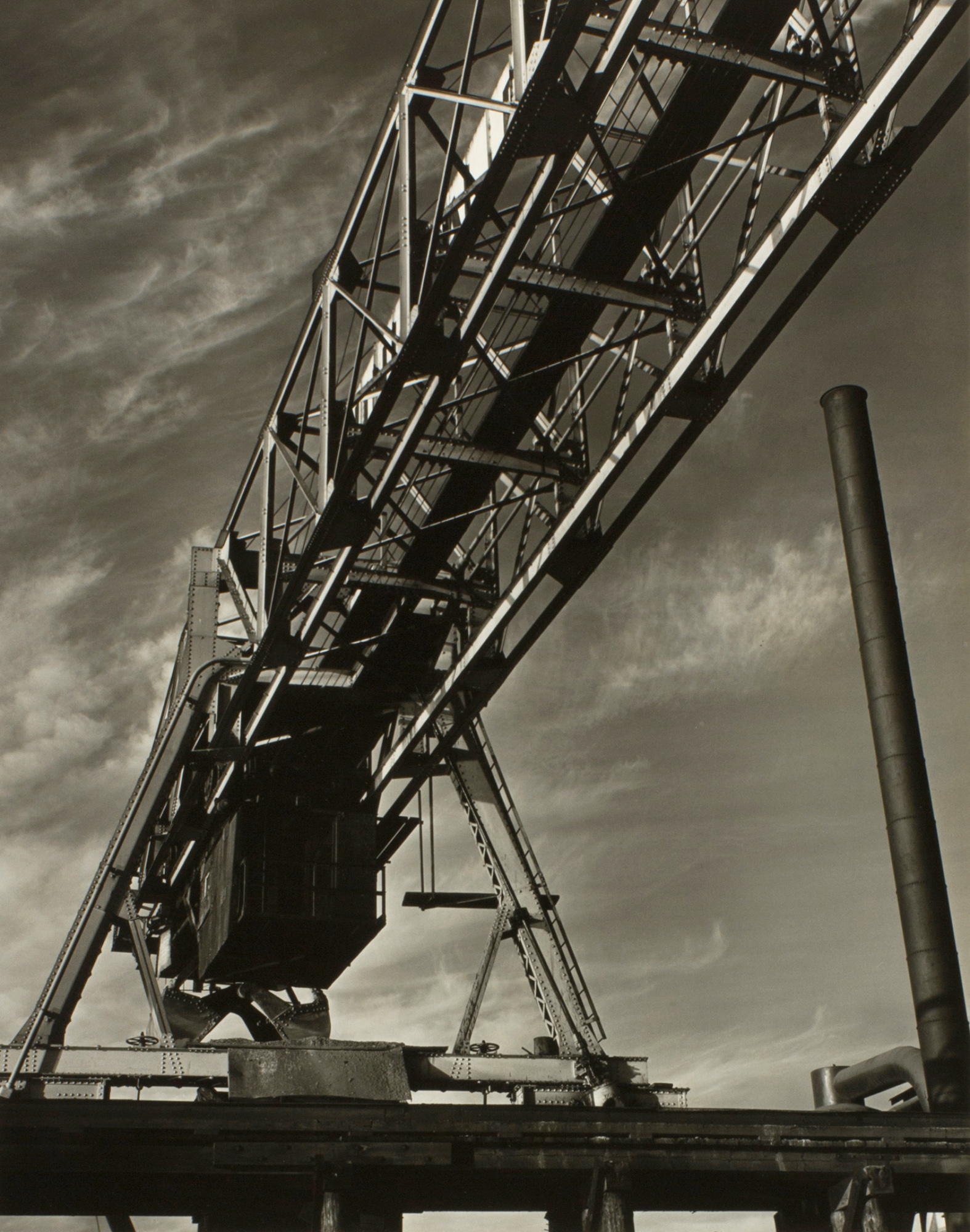
Minor White (American, 1908-1976) 'Untitled (Girder)' c. 1939


Minor White (American, 1908-1976)
Untitled (Girder)
c. 1939
Gelatin silver print
Courtesy of the Fine Arts Program, Public Buildings Service, U.S. General Services Administration
Commissioned through the New Deal art projects
Public domain


Minor White (American, 1908-1976) 'Untitled (Portland Lumber Mills)' c. 1939


Minor White (American, 1908-1976)
Untitled (Portland Lumber Mills)
c. 1939
Gelatin silver print
Courtesy of the Fine Arts Program, Public Buildings Service, U.S. General Services Administration
Commissioned through the New Deal art projects
Public domain


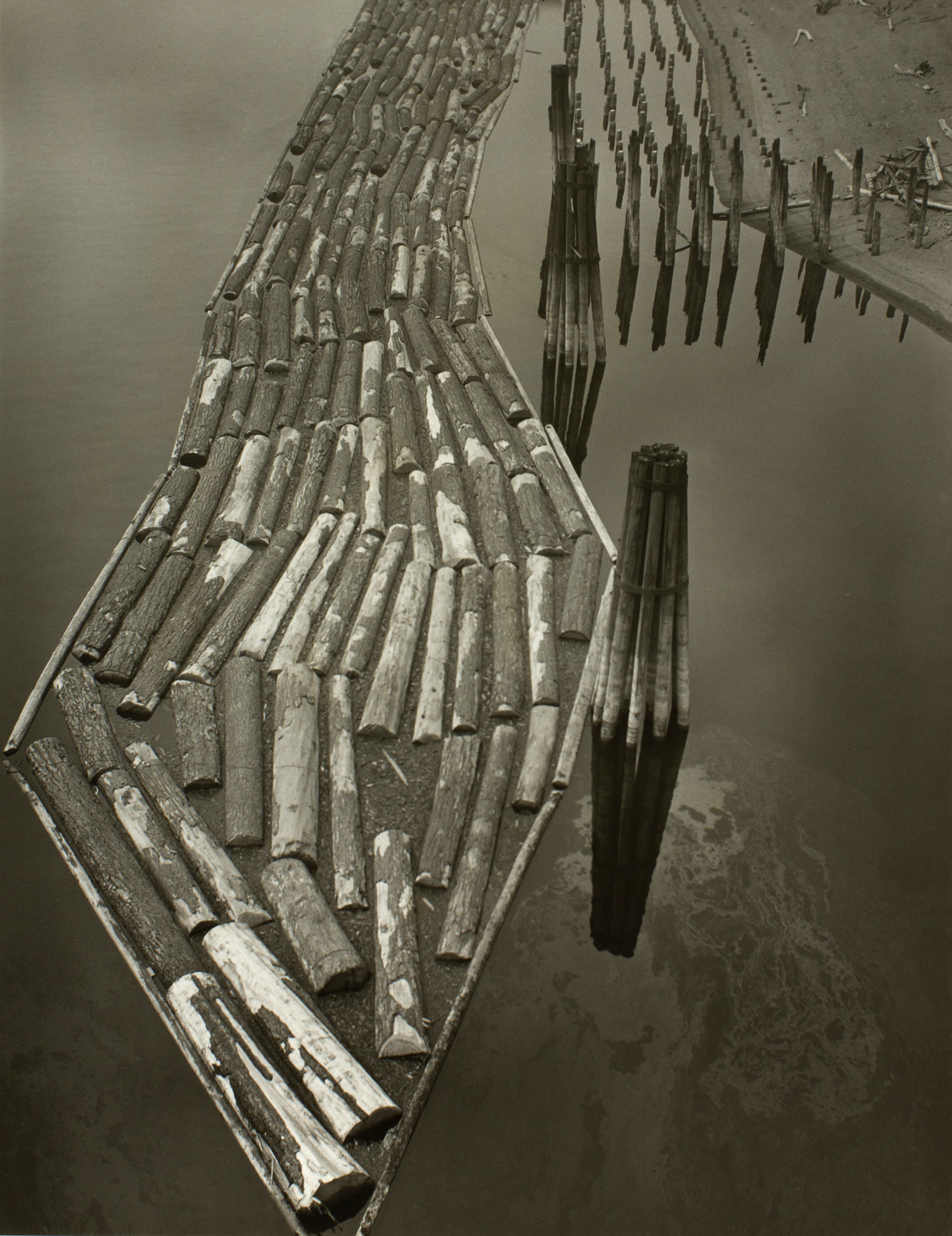
Minor White (American, 1908-1976) 'Log Boom' c. 1940


Minor White (American, 1908-1976)
Log Boom
c. 1940
Gelatin silver print
Courtesy of the Fine Arts Program, Public Buildings Service, U.S. General Services Administration
Commissioned through the New Deal art projects
Public domain


Minor White (American, 1908-1976) 'Boats at Dock' c. 1939


Minor White (American, 1908-1976)
Boats at Dock
c. 1939
Gelatin silver print
Courtesy of the Fine Arts Program, Public Buildings Service, U.S. General Services Administration
Commissioned through the New Deal art projects
Public domain


Minor White (American, 1908-1976) 'East Side of Willamette' c. 1939


Minor White (American, 1908-1976)
East Side of Willamette
c. 1939
Gelatin silver print
Courtesy of the Fine Arts Program, Public Buildings Service, U.S. General Services Administration
Commissioned through the New Deal art projects
Public domain


Minor White (American, 1908-1976) 'Boards' c. 1939


Minor White (American, 1908-1976)
Boards
c. 1939
Gelatin silver print
Courtesy of the Fine Arts Program, Public Buildings Service, U.S. General Services Administration
Commissioned through the New Deal art projects
Public domain


Minor White (American, 1908-1976) 'Lily Pads and Pike' c. 1939


Minor White (American, 1908-1976)
Lily Pads and Pike
c. 1939
Gelatin silver print
Courtesy of the Fine Arts Program, Public Buildings Service, U.S. General Services Administration
Commissioned through the New Deal art projects
Public domain


Minor White (American, 1908-1976) 'The Patch' c. 1939


Minor White (American, 1908-1976)
The Patch
c. 1939
Gelatin silver print
Courtesy of the Fine Arts Program, Public Buildings Service, U.S. General Services Administration
Commissioned through the New Deal art projects
Public domain


Minor White (American, 1908-1976) 'Horsetail and Skunk Cabbage' 1940


Minor White (American, 1908-1976)
Horsetail and Skunk Cabbage
1940
Gelatin silver print
Courtesy of the Fine Arts Program, Public Buildings Service, U.S. General Services Administration
Commissioned through the New Deal art projects
Public domain


Minor White (American, 1908-1976) 'Tree Root' c. 1939


Minor White (American, 1908-1976)
Tree Root
c. 1939
Gelatin silver print
Courtesy of the Fine Arts Program, Public Buildings Service, U.S. General Services Administration
Commissioned through the New Deal art projects
Public domain


Minor White (American, 1908-1976) 'Detail (California Foundry)' c. 1939


Minor White (American, 1908-1976)
Detail (California Foundry)
c. 1939
Gelatin silver print
Courtesy of the Fine Arts Program, Public Buildings Service, U.S. General Services Administration
Commissioned through the New Deal art projects
Public domain


Minor White (American, 1908-1976) 'Detail (227 Southeast Front Street)' 1938


Minor White (American, 1908-1976)
Detail (227 Southeast Front Street)
1938
Gelatin silver print
Courtesy of the Fine Arts Program, Public Buildings Service, U.S. General Services Administration
Commissioned through the New Deal art projects
Public domain


Minor White (American, 1908-1976) 'Front and Burnside' c. 1939


Minor White (American, 1908-1976)
Front and Burnside
c. 1939
Gelatin silver print
Courtesy of the Fine Arts Program, Public Buildings Service, U.S. General Services Administration
Commissioned through the New Deal art projects
Public domain


Minor White (American, 1908-1976) 'Ladd and Tilton Bank (1868 Southwest First and Stark Streets)' c. 1939


Minor White (American, 1908-1976)
Ladd and Tilton Bank (1868 Southwest First and Stark Streets)
c. 1939
Gelatin silver print
Courtesy of the Fine Arts Program, Public Buildings Service, U.S. General Services Administration
Commissioned through the New Deal art projects
Public domain


Minor White (American, 1908-1976) 'Pioneer Post Office and Portland Hotel Gate' c. 1939


Minor White (American, 1908-1976)
Pioneer Post Office and Portland Hotel Gate
c. 1939
Gelatin silver print
Courtesy of the Fine Arts Program, Public Buildings Service, U.S. General Services Administration
Commissioned through the New Deal art projects
Public domain


Minor White (American, 1908-1976) 'Southwest Fourth and Salmon Streets, Courthouse' c. 1939


Minor White (American, 1908-1976)
Southwest Fourth and Salmon Streets, Courthouse
c. 1939
Gelatin silver print
Courtesy of the Fine Arts Program, Public Buildings Service, U.S. General Services Administration
Commissioned through the New Deal art projects
Public domain


Minor White (American, 1908-1976) 'Kamm Building (Southwest Pine near First Avenue)' c. 1939


Minor White (American, 1908-1976)
Kamm Building (Southwest Pine near First Avenue)
c. 1939
Gelatin silver print
Courtesy of the Fine Arts Program, Public Buildings Service, U.S. General Services Administration
Commissioned through the New Deal art projects
Public domain


Minor White (American, 1908-1976) 'Fifth at Yamhill (Public Service Building)' c. 1939


Minor White (American, 1908-1976)
Fifth at Yamhill (Public Service Building)
c. 1939
Gelatin silver print
Courtesy of the Fine Arts Program, Public Buildings Service, U.S. General Services Administration
Commissioned through the New Deal art projects
Public domain


Minor White (American, 1908-1976) 'New on Old (Southeast Corner, First and Burnside)' c. 1939


Minor White (American, 1908-1976)
New on Old (Southeast Corner, First and Burnside)
c. 1939
Gelatin silver print
Courtesy of the Fine Arts Program, Public Buildings Service, U.S. General Services Administration
Commissioned through the New Deal art projects
Public domain


Minor White (American, 1908-1976) 'The Iron Fronts' c. 1939


Minor White (American, 1908-1976)
The Iron Fronts
c. 1939
Gelatin silver print
Courtesy of the Fine Arts Program, Public Buildings Service, U.S. General Services Administration
Commissioned through the New Deal art projects
Public domain


Minor White (American, 1908-1976) 'Front Street' 1939


Minor White (American, 1908-1976)
Front Street
1939
Gelatin silver print
Courtesy of the Fine Arts Program, Public Buildings Service, U.S. General Services Administration
Commissioned through the New Deal art projects
Public domain


Minor White (American, 1908-1976) 'Arches of the Dodd Building (Southwest Front Avenue and Ankeny Street)' 1938


Minor White (American, 1908-1976)
Arches of the Dodd Building (Southwest Front Avenue and Ankeny Street)
1938
Gelatin silver print
Courtesy of the Fine Arts Program, Public Buildings Service, U.S. General Services Administration
Commissioned through the New Deal art projects
No known copyright restrictions


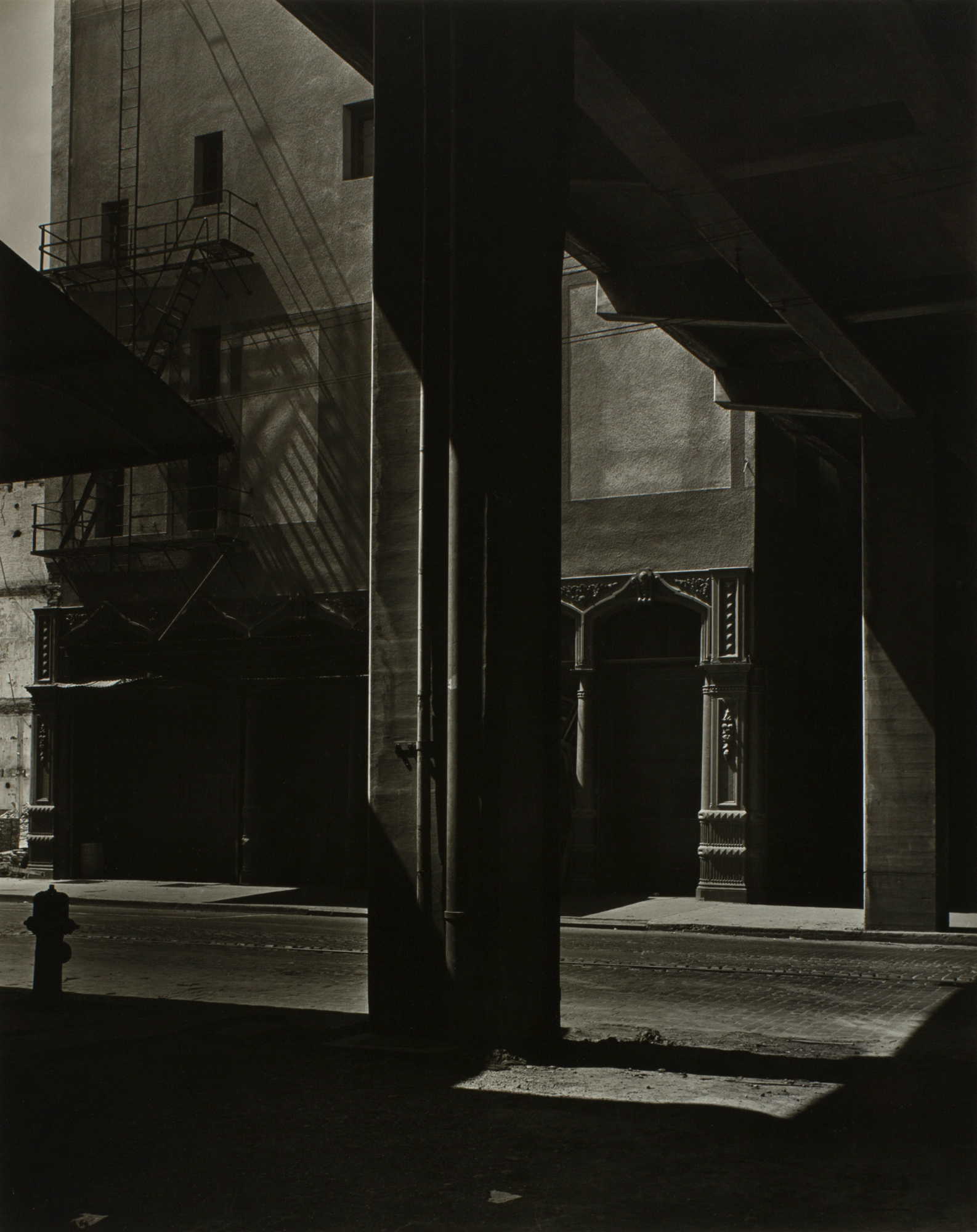
In 1939 White was living at the Portland YMCA, where he had organised a camera club and had built a darkroom and modest gallery for exhibiting pictures. White’s photographs from this period concentrate on the environs of Portland, particularly the area of the commercial waterfront, which was undergoing demolition for redevelopment. Hired by the Oregon Art Project, an arm of the Works Progress Administration (WPA), White trawled the city’s Front Avenue neighbourhood, documenting the nineteenth-century buildings with cast-iron façades that were about to be torn down. White’s photographs are anything but clinical. His street views, many taken at night, have a ghostlike quality, with the occasional lone figure haunting the wet pavement; boarded-up doorways are cast in deep shadow; and mercantile objects, heaped onto the sidewalk before emptied warehouses, take on a forlorn anthropological character.

Among these pictures is a group of five depicting a handsome young man leaning in a doorway on Front Avenue. He is dressed like a labourer in jeans, work shirt, and boots, but there is something of the dandy in the raffish positioning of the man’s newsie cap, the tight cut of his trousers, pulled high and cinched at the waist, and the studied nonchalance of his pose. In one image, his hand is shoved into a pocket, leaving the index finger exposed and pointing downward toward a prominent bulge. Most importantly, he gazes – not at the photographer but down the street – intently and expectantly, as if anticipating something that has not yet come into view. A second photograph shows the man from behind, revealing the nape of his neck, a pair of rounded buttocks, and white stains splashed down the right thigh of his trousers. The pose suggests that he is urinating in this abject doorway with its peeling paint and debris underfoot; he could be taken for a plasterer relieving himself during a break. Another image, taken in a different boarded-up doorway, shows the man leaning with one arm raised and smiling coyly (again, not at the photographer), with his thumbs slipped under his belt and his fingers cupped, calling attention once again to his bulge. An “Air Circus” poster behind him advertises “Tex Rankin and other famous flyers” as well as “stunts” and “thrills.”

The scene is both explicit and coded, even to contemporary eyes. This handsome loitering man might have been taken by certain passersby for an ordinary labourer, on break or looking for work. Others might have recognised him as a man looking for sex (or for another kind of work) with other men. White’s sexual interest in men and his approach to looking at things “for what else they are” stratify the two narratives, establishing layers of meaning on parallel planes. This man is both a labourer and a cruising homosexual. He is, then, just what the photographic image in general would come to signify for White: a common trace from the visible world, transformed into another set of charged meanings.

Extract from Kevin Moore. “Cruising and Transcendence in the Photographs of Minor White,” on the Aperture website [Online] Cited 27/04/2018


Minor White (American, 1908-1976) 'Doorway, Dodd Building' c. 1939


Minor White (American, 1908-1976)
Doorway, Dodd Building
c. 1939
Gelatin silver print
Courtesy of the Fine Arts Program, Public Buildings Service, U.S. General Services Administration
Commissioned through the New Deal art projects
Public domain


White’s earlier Portland series, by contrast, is the darker product of a romantic turn of mind and conveys not the affirmative, civic-minded Whitman of poems such as “A Broadway Pageant” but the melancholy, searching Whitman of the “Calamus” poems. In Portland, we see White engaging Front Avenue for its sense of mystery and possibility, an investigation among darkened doorways and in the silhouettes of passing strangers for moments of revelation. More than simply a celebration of the manifold aspects of the city, the desired charge might be specified as the possibility of an erotic connection, however ephemeral, as proposed by Whitman in “City of Orgies”:

City of orgies, walks and joys,
City whom that I have lived and sung in your midst will one
   day make you illustrious,
Not the pageants of you, not your shifting tableaus, your
   spectacles, repay me,
Not the interminable rows of your houses, nor the ships
   at the wharves,
Nor the processions in the streets, nor the bright windows
   with goods in them,
Nor to converse with learn’d persons, or bear my share in
   the soiree or feast;
Not those, but as I pass O Manhattan, your frequent and
   swift flash of eyes offering me love,
Offering response to my own – these repay me, 
Lovers, continual lovers, only repay me.

Extract from Kevin Moore. “Cruising and Transcendence in the Photographs of Minor White,” on the Aperture website [Online] Cited 27/04/2018


Minor White (American, 1908-1976) 'Pilaster and Hood Molding, Dodd Building (Southwest Front and Ankeny)' c. 1939


Minor White (American, 1908-1976)
Pilaster and Hood Molding, Dodd Building (Southwest Front and Ankeny)
c. 1939
Gelatin silver print
Courtesy of the Fine Arts Program, Public Buildings Service, U.S. General Services Administration
Commissioned through the New Deal art projects
Public domain


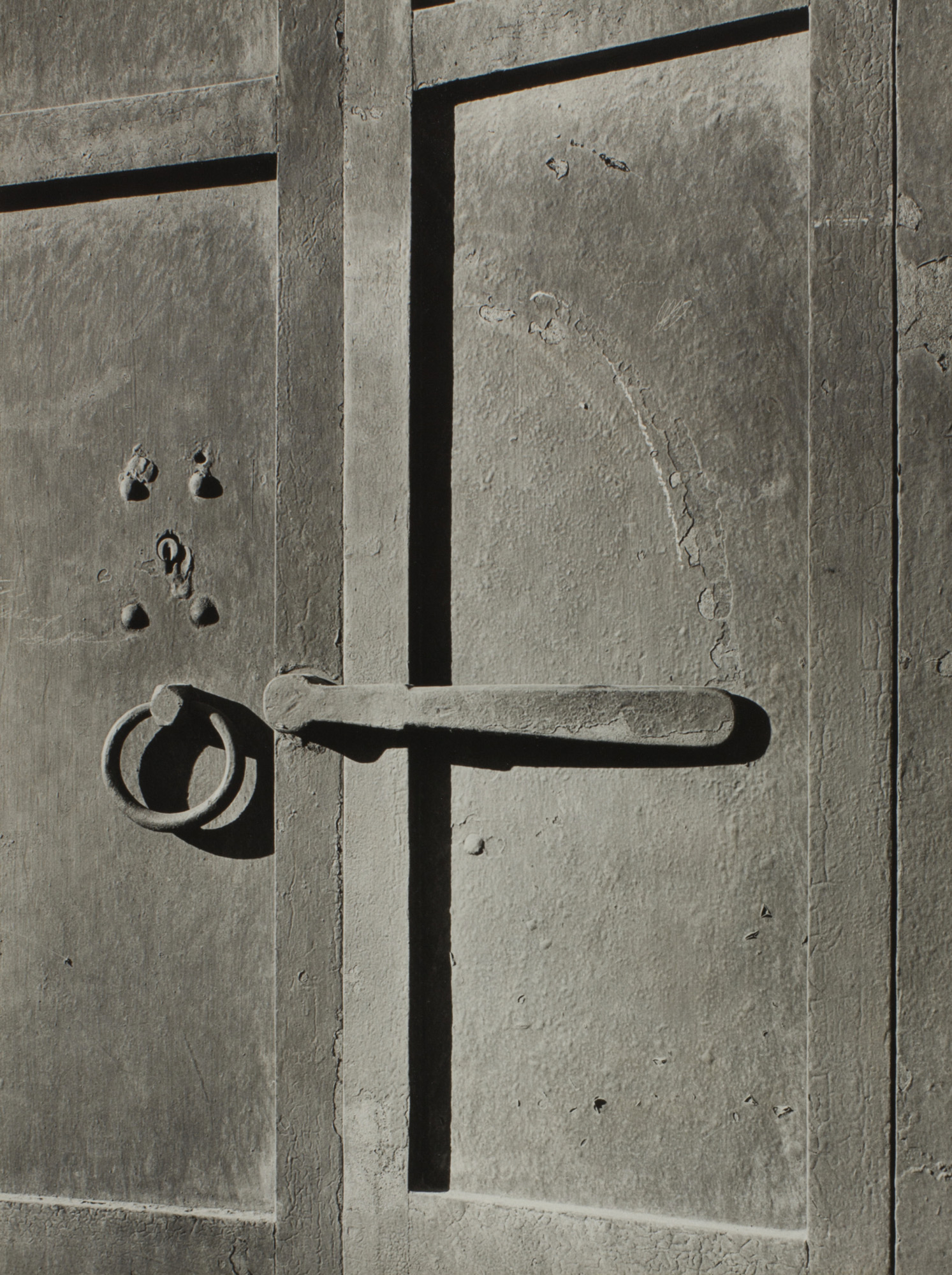
Minor White (American, 1908-1976) 'Door of Iron – First Brick Building in Portland, 1852 (Ladd and Tilton Building)' 1939


Minor White (American, 1908-1976)
Door of Iron – First Brick Building in Portland, 1852 (Ladd and Tilton Building)
1939
Gelatin silver print
Courtesy of the Fine Arts Program, Public Buildings Service, U.S. General Services Administration
Commissioned through the New Deal art projects
Public domain


Minor White (American, 1908-1976) 'China Town' c. 1939


Minor White (American, 1908-1976)
China Town
c. 1939
Gelatin silver print
Courtesy of the Fine Arts Program, Public Buildings Service, U.S. General Services Administration
Commissioned through the New Deal art projects
Public domain


Minor White (American, 1908-1976) 'Morrison Bridge – Winter' 1938


Minor White (American, 1908-1976)
Morrison Bridge – Winter
1938
Gelatin silver print
Courtesy of the Fine Arts Program, Public Buildings Service, U.S. General Services Administration
Commissioned through the New Deal art projects
Public domain


Minor White (American, 1908-1976) 'St. Johns Bridge' c. 1939


Minor White (American, 1908-1976)
St. Johns Bridge
c. 1939
Gelatin silver print
Courtesy of the Fine Arts Program, Public Buildings Service, U.S. General Services Administration
Commissioned through the New Deal art projects
Public domain


Minor White (American, 1908-1976) 'Catherine Creek' c. 1941


Minor White (American, 1908-1976)
Catherine Creek
c. 1941
Gelatin silver print
Courtesy of the Fine Arts Program, Public Buildings Service, U.S. General Services Administration
Commissioned through the New Deal art projects
Public domain


Minor White (American, 1908-1976) 'Joseph, Oregon (Joseph Cemetery)' c. 1940


Minor White (American, 1908-1976)
Joseph, Oregon (Joseph Cemetery)
c. 1940
Gelatin silver print
Courtesy of the Fine Arts Program, Public Buildings Service, U.S. General Services Administration
Commissioned through the New Deal art projects
Public domain


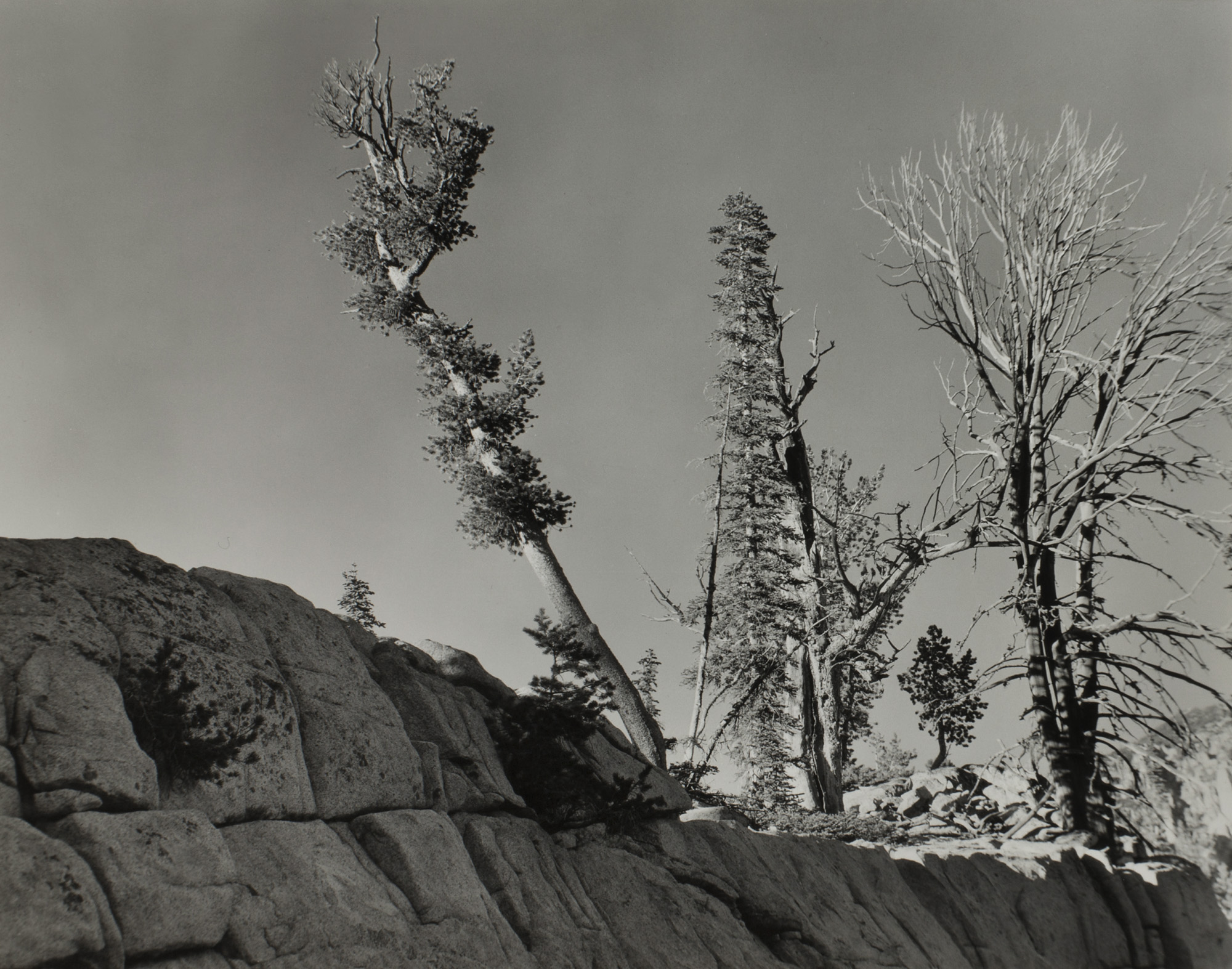
Minor White (American, 1908-1976) 'Hurricane Creek (Trees and Rock)' 1941


Minor White (American, 1908-1976)
Hurricane Creek (Trees and Rock)
1941
Gelatin silver print
Courtesy of the Fine Arts Program, Public Buildings Service, U.S. General Services Administration
Commissioned through the New Deal art projects
Public domain


Minor White (American, 1908-1976) 'Ice Lake' 1940


Minor White (American, 1908-1976)
Ice Lake
1940
Gelatin silver print
Courtesy of the Fine Arts Program, Public Buildings Service, U.S. General Services Administration
Commissioned through the New Deal art projects
Public domain


Minor White (American, 1908-1976) 'The Customer' c. 1939


Minor White (American, 1908-1976)
The Customer
c. 1939
Gelatin silver print
Courtesy of the Fine Arts Program, Public Buildings Service, U.S. General Services Administration
Commissioned through the New Deal art projects
Public domain


Minor White (American, 1908-1976) '1323-29 Southwest First Avenue' 1939


Minor White (American, 1908-1976)
1323-29 Southwest First Avenue
1939
Gelatin silver print
Courtesy of the Fine Arts Program, Public Buildings Service, U.S. General Services Administration
Commissioned through the New Deal art projects
Public domain


Minor White (American, 1908-1976) 'Untitled (Young Man)' c. 1939


Minor White (American, 1908-1976)
Untitled (Young Man)
c. 1939
Gelatin silver print
Courtesy of the Fine Arts Program, Public Buildings Service, U.S. General Services Administration
Commissioned through the New Deal art projects
Public domain


Minor White (American, 1908-1976) 'Shipmates Visit the Photographer' c. 1939


Minor White (American, 1908-1976)
Shipmates Visit the Photographer
c. 1939
Gelatin silver print
Courtesy of the Fine Arts Program, Public Buildings Service, U.S. General Services Administration
Commissioned through the New Deal art projects
Public domain


Minor White (American, 1908-1976) 'Untitled (Woman Sitting)' c. 1939


Minor White (American, 1908-1976)
Untitled (Woman Sitting)
c. 1939
Gelatin silver print
Courtesy of the Fine Arts Program, Public Buildings Service, U.S. General Services Administration
Commissioned through the New Deal art projects
Public domain


Minor White (American, 1908-1976) 'Untitled (Man Praying)' c. 1939


Minor White (American, 1908-1976)
Untitled (Man Praying)
c. 1939
Gelatin silver print
Courtesy of the Fine Arts Program, Public Buildings Service, U.S. General Services Administration
Commissioned through the New Deal art projects
Public domain


Portland Art Museum
1219 SW Park Avenue
Portland, OR 97205

Opening hours:
Thursday – Sun 10am – 6pm
Closed Monday, Tuesday and Wednesday

Portland Art Museum website

LIKE ART BLART ON FACEBOOK

Back to top

Exhibition: ‘Mark Morrisroe’ at Fotomuseum Winterthur, Zurich

Exhibition dates: 27th November 2010 – 13th February, 2011


Mark Morrisroe (American, 1959-1989) 'Untitled [Self-Portrait]' 1979 from the exhibition 'Mark Morrisroe' at Fotomuseum Winterthur


Mark Morrisroe (American, 1959-1989)
Untitled [Self-Portrait]
1979
T-108 Polaroid
8.5 x 10.7cm
Sammlung Matthew Marks
© Nachlass Mark Morrisroe (Sammlung Ringier) im Fotomuseum Winterthur


This is an emotional posting for me. I came out as a gay man in 1975, six short years after the Stonewall Riots in New York City that were the touchstone of the gay liberation movement. I partied hard in my youth in London and didn’t have my first HIV test until 1982/1983. We just didn’t know about the disease at all. Those two weeks waiting for the result of that first test, for that is how long it took to get the test results back in those days, seemed terribly long. Even worse was the time spent sitting outside the doctor’s office waiting to be called in to get the test results – literally life and death as there was no treatment, no drugs to help, no hope.

I lost many friends over the years to this terrible disease that continues to decimate human beings all around the world. It was only by pure luck that I survived. This posting shows the work of one artist who didn’t survive. He as experimenting with his sexuality (and documenting it) in Boston at much the same time that I was in London and so I feel an affinity with this beautiful and gifted man. What great images he made! How much poorer is the world without his presence and indeed the presence of all human beings who have succumbed to the disease.

Dr Marcus Bunyan


Many thankx to the Fotomuseum Winterthur, Zurich for allowing me to publish the photographs in the posting. Please click on the photographs for a larger version of the image.


“You know, I’m going to be really famous, so you’re lucky to be meeting me.”


Mark Morrisroe, as quoted by Jack Pierson


Mark Morrisroe (American, 1959-1989) '
After the Laone (In the Home of a London Rubber Fetishist, Dec 82)' 1982 from the exhibition 'Mark Morrisroe' at Fotomuseum Winterthur


Mark Morrisroe (American, 1959-1989)
After the Laone (In the Home of a London Rubber Fetishist, Dec 82)
1982
C-Print von Sandwich-Negativ, bearbeitet mit Retuschefarben und Marker
39.5 x 50.6cm
© Nachlass Mark Morrisroe (Sammlung Ringier) im Fotomuseum Winterthur


Mark Morrisroe (American, 1959-1989) '
La Môme Piaf [Pat and Thierry]' 1982 from the exhibition 'Mark Morrisroe' at Fotomuseum Winterthur


Mark Morrisroe (American, 1959-1989)
La Môme Piaf [Pat and Thierry]
1982
C-Print von Sandwich-Negativ, bearbeitet mit Retuschefarben und Marker
50.7 x 40.5cm
© Nachlass Mark Morrisroe (Sammlung Ringier) im Fotomuseum Winterthur


Mark Morrisroe (American, 1959-1989) 'Pat as Kiki, fall 81 Paris' 1985 from the exhibition 'Mark Morrisroe' at Fotomuseum Winterthur


Mark Morrisroe (American, 1959-1989)
Pat as Kiki, fall 81 Paris
1985
Silbergelatine-Abzug von T-665 Polaroid Negativ, bearbeitet mit Retuschefarbe
25.2 x 20.2cm
© Nachlass Mark Morrisroe (Sammlung Ringier) im Fotomuseum Winterthur


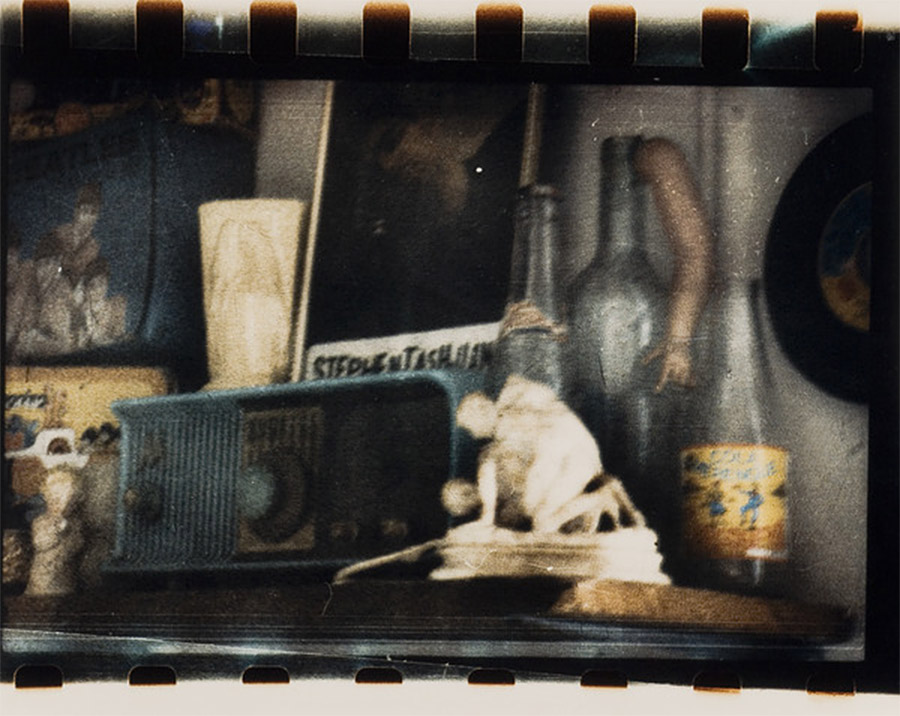
Mark Morrisroe (American, 1959-1989) 'Still Life with Marble Figures (in the Home of Stephen Tashjian NYC)' 1985 from the exhibition 'Mark Morrisroe' at Fotomuseum Winterthur


Mark Morrisroe (American, 1959-1989)
Still Life with Marble Figures (in the Home of Stephen Tashjian NYC)
1985
Negative sandwich
40 x 50cm
© Nachlass Mark Morrisroe (Sammlung Ringier) im Fotomuseum Winterthur


Mark Morrisroe (American, 1959-1989) '
Blow Both of Us, Gail Thacker and Me, Summer 1978' 1986 from the exhibition 'Mark Morrisroe' at Fotomuseum Winterthur


Mark Morrisroe (American, 1959-1989)
Blow Both of Us, Gail Thacker and Me, Summer 1978
1986
C-Print, bearbeitet mit Marker
40.5 x 40.5cm
© Nachlass Mark Morrisroe (Sammlung Ringier) im Fotomuseum Winterthur


More than twenty years after Mark Morrisroe’s early death, Fotomuseum Winterthur is presenting the first comprehensive survey exhibition on his work – an extraordinarily diverse body of works that has usually been shown in group shows, mostly in connection with his famous Boston colleagues Nan Goldin and David Armstrong. The exhibition, curated by Beatrix Ruf and Thomas Seelig, is a collaboration between Fotomuseum Winterthur and the Estate of Mark Morrisroe (Ringier Collection).

In the Boston of the early 1980s, Mark Morrisroe was a well-known, charismatic figure, who often appeared in drag together with the artist friends he had met while studying and who performed in bars and clubs with Stephen Tashjian (alias Tabboo!) as the “Clam Twins.” As an artist and photographer he was also at the center of the lively Boston punk scene, whose most important protagonists were known well beyond the city. Like Nan Goldin and David Armstrong before him, Mark Morrisroe moved to New York in the mid-1980s to try his luck there. He died – far too early – in July 1989, at the age of just 30, from the consequences of AIDS.

References to Morrisroe’s origins and past are surrounded by a dense mist that makes it impossible to differentiate between truth and fantasy. By continually inventing and varying scenarios about himself, the settings for which extended from the past to the future, Morrisroe always understood how to collaborate actively in shaping his own myth, feeding it with fanciful layers of lies, or indeed letting it float into the void. His public presence could be engaging, and sometimes loud and disturbing, too, but silence fell after his death – both around the artist and his photography.

In retrospect, Morrisroe’s art studies in Boston and his years in the punk and art world of that city can in fact be seen as his most content and productive period. There he discovered a positive approach to his sexuality, and in the person of Jonathan “Jack” Pierson, who appears in many of his photographs and Polaroids, found his first great love. The first intimate portraits of close friends such as Lynelle White (with whom he published five editions of the collaged, photocopied and coloured-in Dirt fanzine in 1975-1976) were produced there, as were many of his first narcissistic self-scenarios in front of the camera. There Morrisroe shot the low-budget trash film Nymph-O-Maniac in the style of his idol John Waters, with Pia Howard as the main performer.

Mark Morrisroe’s short creative period, of barely ten years, was characterized by an amazing output of photographic experiments, and stands out for its constantly searching, inquisitive, and always individual aesthetic, as a glance at the photographer’s extensive estate reveals. The estate was acquired by the Ringier Collection in 2004 and was placed in the care of the Fotomuseum Winterthur in 2006. The estate comprises around 600 colour prints – a few of them duplicates – approximately as many gelatin silver prints, about 800 of the 2,000 known Polaroid shots by Morrisroe, all the negatives, contact prints, and some of his personal papers, giving some idea of the unbridled enjoyment and energy with which Mark Morrisroe threw himself into his life and work.

The exhibition will feature early colour and black-and-white prints, Polaroids, and Polaroid negatives from which it was possible to make enlargements, as well as the early and late photograms he processed by hand. During his art studies at the School of the Museum of Fine Arts Boston (1978-1982) Morrisroe was already experimenting with various interpretations of reprography, trying to understand the possibilities of the medium and its inherent limitations, and using different ingenious printing processes for his photographic prints. Within his close circle of friends he soon laid claim to the “invention” of what are called “sandwich” prints – enlargements of double negatives of the same subject mounted on top of one another – which yielded an elaborate pictorial quality, producing a very iconic impression in the final result, which over time Morrisroe learned to use in an increasingly controlled way. Early on, the artist recognised the intrinsic value of prints – irrespective of the medium used to produce them – as pictorial objects that he could manipulate, colour, paint, and write on at will.

By all accounts, Mark Morrisroe was a man driven to achieve fame and recognition. Restless and demanding – of himself as well as of others – he always wanted more, and from this inner restlessness he derived enormous resources of artistic energy. Right to the very end, his life and work, down to the photograms feverishly produced in the makeshift darkroom in his hospital, which have hardly ever been publicly shown until today, attest to an unlimited and ecstatic search for a sensual, aesthetic, and always ambivalently charged pictorial world.

The Estate of Mark Morrisroe (Collection Ringier) at the Fotomuseum Winterthur


Following Pat Hearn’s untimely death in 2000, there was a break in exhibition activities focusing on Mark Morrisroe. From 1998 the Ringier Collection had been continuously in contact with Pat Hearn about Mark Morrisroe’s work and they continued the discussion with Pat Hearn’s husband, Colin de Land of American Fine Arts, who had inherited the Mark Morrisroe estate. In 2002 Colin de Land approached Michael Ringier and Beatrix Ruf to discuss options for the future of the Morrisroe estate because he had also fallen ill and was very aware that he was going to die soon himself. In their conversations, the main concern was how responsibility for this important artist could be taken on by keeping the oeuvre together as a comprehensive group of works and making it accessible to a broad audience internationally as well. The Ringier Collection proposed to Colin de Land that they secure the estate by acquiring it and placing it in the Fotomuseum Winterthur. Furthermore, the decision was made to form a foundation for the Morrisroe estate, which would be the home to a comprehensive group of works and would keep the estate together, provide conversational and curatorial continuity, and act as the leading force in communicating and distributing the work through exhibitions and publications.”

Press release from Fotomuseum Winterthur website


Mark Morrisroe (American, 1959-1989) 'Untitled [Self-Portrait with Jonathan]' c. 1978 from the exhibition 'Mark Morrisroe' at Fotomuseum Winterthur


Mark Morrisroe (American, 1959-1989)
Untitled [Self-Portrait with Jonathan]
c. 1978
T-665 Polaroid
10.7 x 8.5cm
© Nachlass Mark Morrisroe (Sammlung Ringier) im Fotomuseum Winterthur


Mark Morrisroe (American, 1959-1989) '
Self-Portrait (to Brent)' 1982
 from the exhibition 'Mark Morrisroe' at Fotomuseum Winterthur


Mark Morrisroe (American, 1959-1989)
Self-Portrait (to Brent)
1982
C-Print von Sandwich-Negativ, bearbeitet mit Retuschefarben und Marker
50.5 x 40.5cm
Privatsammlung Brent Sikkema
© Nachlass Mark Morrisroe (Sammlung Ringier) im Fotomuseum Winterthur


Mark Morrisroe (American, 1959-1989) 'Untitled (Lynelle)' c. 1985 from the exhibition 'Mark Morrisroe' at Fotomuseum Winterthur


Mark Morrisroe (American, 1959-1989)
Untitled [Lynelle]
c. 1985
T-665 Polaroid
10.7 x 8.5cm
© Nachlass Mark Morrisroe (Sammlung Ringier) im Fotomuseum Winterthur


Mark Morrisroe (American, 1959-1989) 'Baby Steffenelli [John S.]' 1985 from the exhibition 'Mark Morrisroe' at Fotomuseum Winterthur


Mark Morrisroe (American, 1959-1989)
Baby Steffenelli [John S.]
1985
Negative sandwich, retouched with ink and inscribed with marker
31 x 44cm
© Nachlass Mark Morrisroe (Sammlung Ringier) im Fotomuseum Winterthur


The portrait of Baby Steffenelli, captured by the provocative photographer Mark Morrisroe, offers a glimpse into the bold, rebellious spirit of the 1980s underground art scene. Morrisroe, known for his raw and unflinching style, frequently blurred the lines between art and performance, creating images that were both intimate and confrontational. This photograph of Steffenelli, a figure often associated with the New York City art world of the time, reflects the vibrant energy of a subculture that thrived on pushing societal boundaries. Steffenelli, much like Morrisroe, embraced unconventional identities, and their collaboration in this photo serves as a visual statement of individuality and defiance, characteristic of the era’s exploration of gender, sexuality, and self-expression.

The 1980s were a transformative time for the art world, particularly in New York, where artists like Morrisroe, Robert Mapplethorpe, and David Wojnarowicz were redefining the possibilities of photography, painting, and performance. Morrisroe, who was also a member of the artistic collective called “The Factory” and part of the East Village art scene, used his camera as a tool to document the subversive lifestyles of his peers. His work, often marked by a sense of urgency and intimacy, captured the raw emotions and complexities of those living on the fringes of society. This photo of Steffenelli, taken in 1985, is a prime example of how Morrisroe’s photographs served as a historical document, reflecting the ongoing dialogues surrounding identity and the body in the context of the post-punk, pre-AIDS crisis era.

For Steffenelli, this image became an emblem of the intersection between personal expression and the broader cultural shifts taking place in the 1980s. The vibrant, sometimes jarring energy of Morrisroe’s photography mirrored the boldness with which people like Steffenelli navigated their place in an increasingly complex world. The photo not only immortalises Steffenelli’s individuality but also serves as a testament to the powerful and often controversial art scene that defined this period. In this single frame, Morrisroe captures not only a person but the essence of a moment in time – a snapshot of defiance, liberation, and transformation in the face of societal norms.

Text from the Old Historical Facebook page


Mark Morrisroe (American, 1959-1989) 'Untitled [Self-Portrait]' 1986
 from the exhibition 'Mark Morrisroe' at Fotomuseum Winterthur


Mark Morrisroe (American, 1959-1989)
Untitled [Self-Portrait]
1986
Silbergelatine-Abzug
42.5 x 29.8cm
© Nachlass Mark Morrisroe (Sammlung Ringier) im Fotomuseum Winterthur


Mark Morrisroe (American, 1959-1989) '
Untitled' 1987 from the exhibition 'Mark Morrisroe' at Fotomuseum Winterthur


Mark Morrisroe (American, 1959-1989)
Untitled
1987
Silbergelatine-Abzug, Fotogramm von Drucksache
50.4 x 40.3cm
© Nachlass Mark Morrisroe (Sammlung Ringier) im Fotomuseum Winterthur


Mark Morrisroe (American, 1959-1989) '
Untitled' c. 1988 from the exhibition 'Mark Morrisroe' at Fotomuseum Winterthur


Mark Morrisroe (American, 1959-1989)
Untitled
c. 1988
C-Print von Sandwich-Negativ
50.7 x 40.5cm
© Nachlass Mark Morrisroe (Sammlung Ringier) im Fotomuseum Winterthur


Fotomuseum Winterthur
Grüzenstrasse 44 + 45
CH-8400 Winterthur (Zurich)

Opening hours:
Tuesday to Sunday 11am – 6pm
Wednesday 11am to 8pm
Closed on Mondays

Fotomuseum Winterthur website

LIKE ART BLART ON FACEBOOK

Back to top