
Exhibition dates: 23rd February – 12th May 2013
![American & Australasian Photographic Company. '[Merlin's photographic cart ?] and Mitchell's London Hotel, Railway Place, Sandridge [Port Melbourne]' 1870-1875](https://artblart.com/wp-content/uploads/2013/04/american-australasian-photographic-company-merlins-photographic-cart-and-mitchells-london-hotel-railway-place-sandridge-port-melbourne-1870-1875-web.jpg "American & Australasian Photographic Company. '[Merlin's photographic cart ?] and Mitchell's London Hotel, Railway Place, Sandridge [Port Melbourne]' 1870-1875")
American & Australasian Photographic Company
[Merlin’s photographic cart?] and Mitchell’s London Hotel, Railway Place, Sandridge [Port Melbourne]
1870-1875
Another fascinating posting, this time featuring Australian colonial photography. In 1951, a hoard of 3,500 glass plate negatives from the nineteenth century was discovered in a garden shed in Chatswood. In time, the find proved to be the most important photographic documentation of goldfields life in Australia. All negatives have now been scanned at high resolution and for the first time in 140 years, it is possible to see what Merlin and Bayliss (from the American & Australasian Photographic Company) photographed, with astonishing clarity and fidelity. “Many of the images in the Holtermann collection were created for an ambitious 1870s publicity campaign to sell the wonders of the Australian colonies to the world.”
What I find particularly interesting is the familiarity of all photographs of goldfields from around the world, whether it be Californian or Victorian – the working class men, the pictures of diggings, etc… but also the particular Australian vernacular that these photographs possess. The photographs could be taken no where else but Australia. Observe the abject poverty of some of the shopkeepers – draper, blacksmith, bootmaker and undertaker (who also acted as carpenter, joiner, builder and cabinet maker) – the timber clad facade of their buildings failing to conceal the bark structure behind (see Holmes, bootmaker, and Spiro Bennett’s store, Gulgong, 1872 below). And yet in their poverty they still thought it important to spend money on advertising with wonderful examples of distinctive typography that I have highlighted in detail – on the photographers, bakers and tent makers shops, on the undertakers facade replete with horses and funeral carriage, and on the painters and sign writers bark clad establishment. Contemporary typographers could have a field day studying these photographs for new typefaces!
Notice in the detail wonderful things:
~ The roughness of a man’s hand as they stand in front of their loot, the gold specimens;
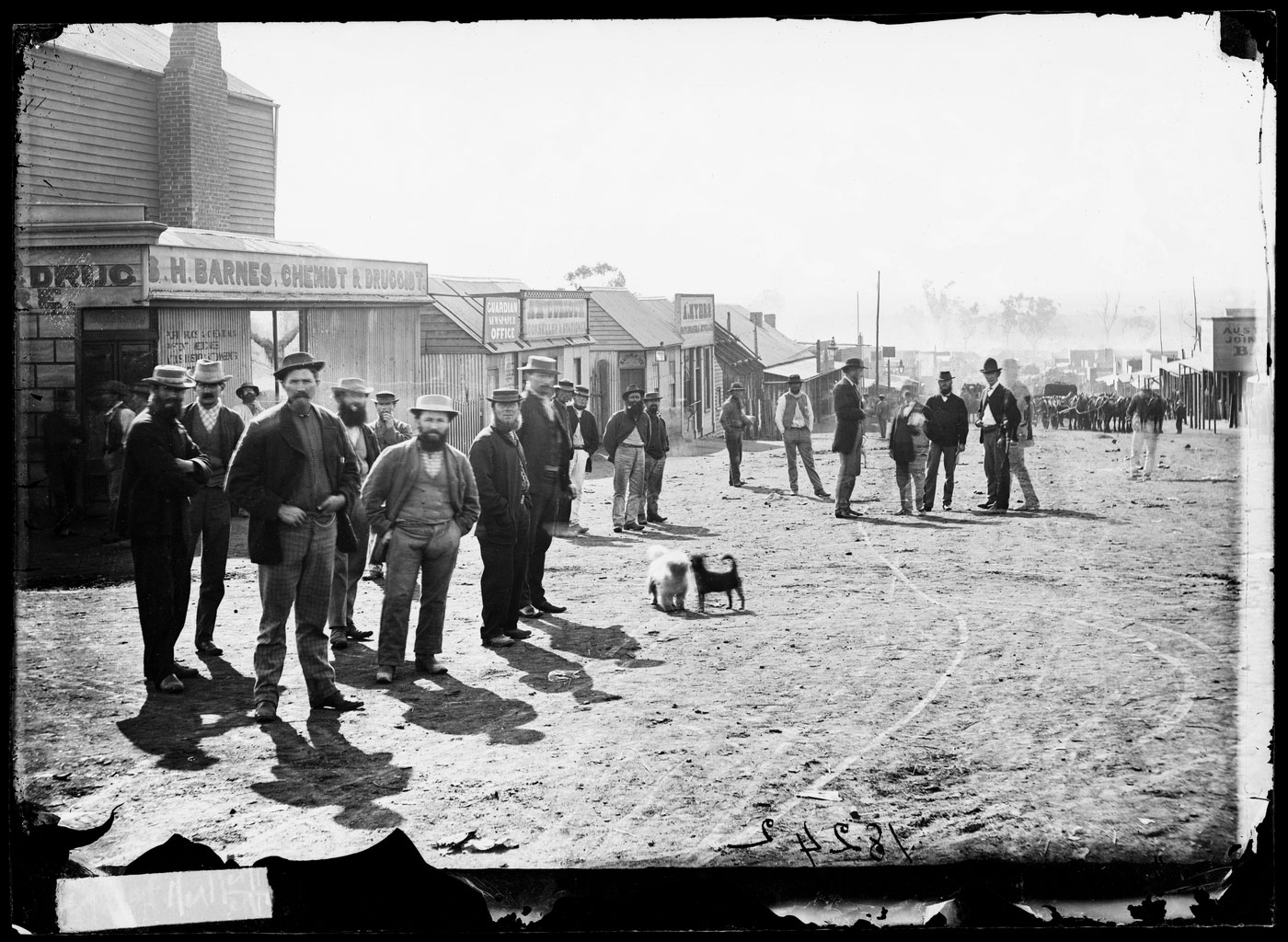
~ The incongruous sight of toy dogs among the rough-and-ready types that inhabited a frontier gold town;
~ The riding crop tucked under the arm of one of the detectives;
~ The flour that covers the bakers shoes;
~ The decorative wallpaper hanging outside the painter and signwriters shack, the word ‘Sacred’ on top of the mirror, and his name ‘J.H. Osborne Painter No.2′ emblazoned on the side of his ladder.
Of particular poignancy is the way the undertaker William Lewis leans in the entrance of his establishment. Propped up against the door (to stop himself from moving during the exposure), his hands stiffly by his side, his eyes stare straight ahead as though he is in a trance. In the photograph he has almost become the corpse that it is his business to bury. We must also acknowledge the temporary nature of these gold field towns, their unsubstantial character and the transitory life of the people that lived and died in them. Bootmaker William Holmes’ wife passed away a few months after the photograph of her family was taken. It was a tough life living on a frontier town. We can also note how desolate the major cities seem, as can be seen in photographs of Sandridge [Port Melbourne] and Pall Mall, Bendigo, with the odd carriage on the street and a single man standing on a street corner.
This is such a rich photographic collection and to have all the negatives digitised and available online is such a pleasure, such a treasure for Australian photographers, historians, researchers and the general public who, with an inquiring mind, can begin to understand the colonisation and conquest of this never empty country.
Dr Marcus Bunyan
Many thankx to the State Library of New South Wales for allowing me to publish the photographs in the posting. Please click on the photographs for a larger version of the image.
The State Library of NSW’s world-renowned photographic archive, the Holtermann collection, will be officially included on the UNESCO Australian Memory of the World register at a ceremony in May 2013… The Australian UNESCO Memory of the World program is part of an international initiative, which aims to safeguard the documentary heritage of humanity and recognise the significance of all heritage materials… Many of the images in the Holtermann collection were created for an ambitious 1870s publicity campaign to sell the wonders of the Australian colonies to the world. The campaign was funded by German-born entrepreneur, Bernhardt Otto Holtermann, who made his fortune from mining in Hill End. For the first time 100 amazing large format prints from the Holtermann collection are on show [until 12 May] in the State Library’s free exhibition, The Greatest Wonder of the World.
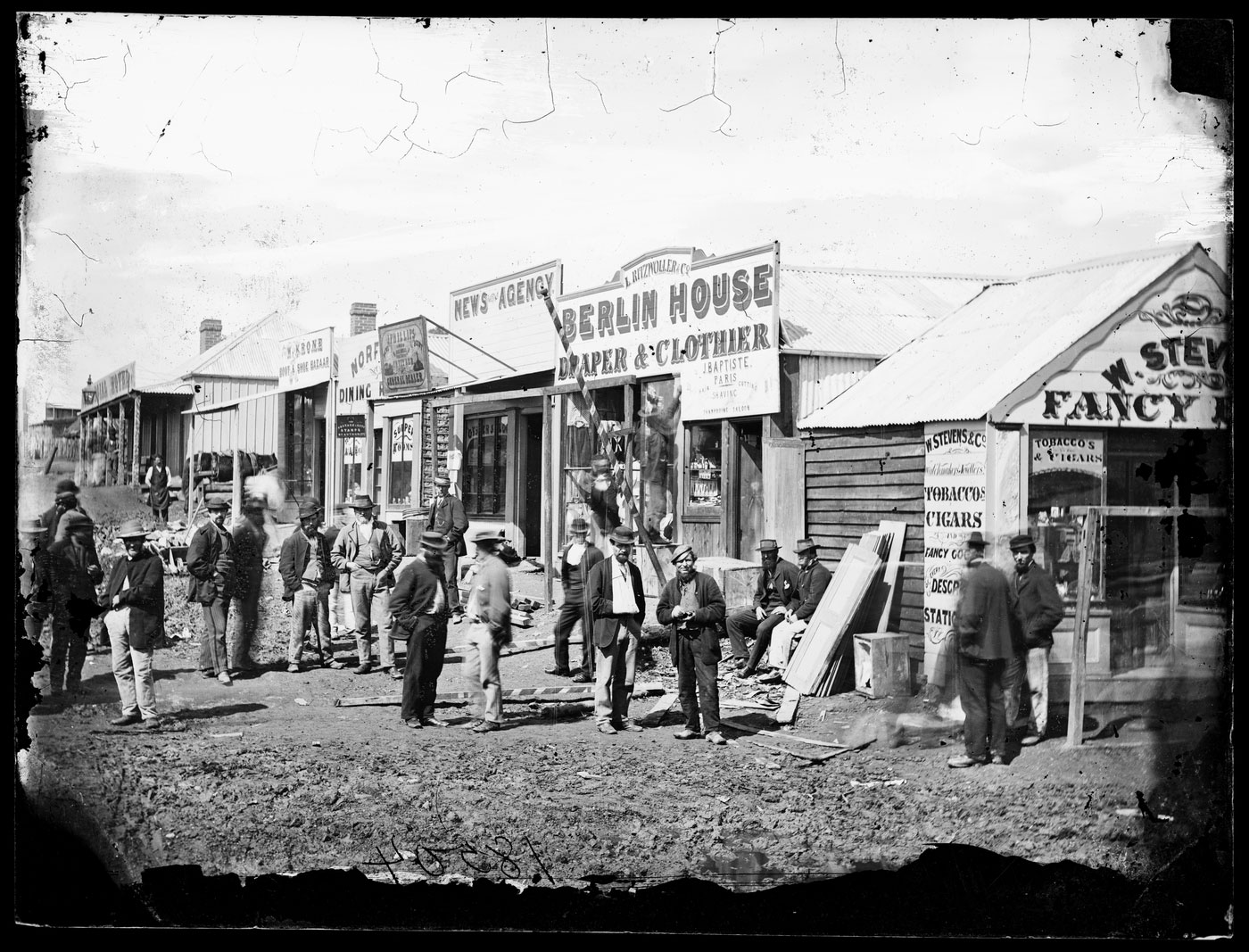
Beaufoy Merlin (Australian, 1830-1873)
Short Street, Hill End
1872
Wet plate glass negative, on 4/Box 5/No. 18504
Hill End in 1872 was a gold town at its peak. According to the Empire 7 June 1872, “The streets were thronged by a motley crowd; the stores and places of business crowded with customers; the little theatre so densely packed by an admiring audience, that there was not what is facetiously called ‘standing room,’ and even the public-houses, whose name is legion, were crammed. Yet I saw less, far less, drunkenness than can be met with in any street in the metropolis after 10 o’clock at night. There were very few inebriates, no filthy dishevelled women, no crouching loafers, no abject vice. The general aspect of the crowds of decently dressed folk who thronged ‘The Hill’ was that of respectability – rough indeed in many respects, and loud and noisy too, in some instances, but not disreputable, and altogether good-humoured.”

American & Australasian Photographic Company
Hawkins Hill ‘Golden Quarter Mile’
1872
Wet plate glass negative, on 4/Box 71/No. C
This panorama of Hawkins Hill was taken by Beaufoy Merlin, who erected his camera in a tree more than a kilometre away across a gully nearly 300 metres deep. In the centre of the image is Krohmann’s mine, with the twin buildings and two storied structure of Beyers and Holtermann’s immediately to the left of it. These two mines contributed to the 12.4 tonnes of gold extracted from Hawkins Hill, but such are the vagaries of goldmining, that Rapp’s, on the extreme right, returned little to its investors, despite digging to a depth of over 380 feet [115 metres]. An almost identical view of the Hawkins Hill ‘Golden Quarter Mile’ taken by Merlin appeared as an engraving in the Australian Town and Country Journal 18 May 1872.
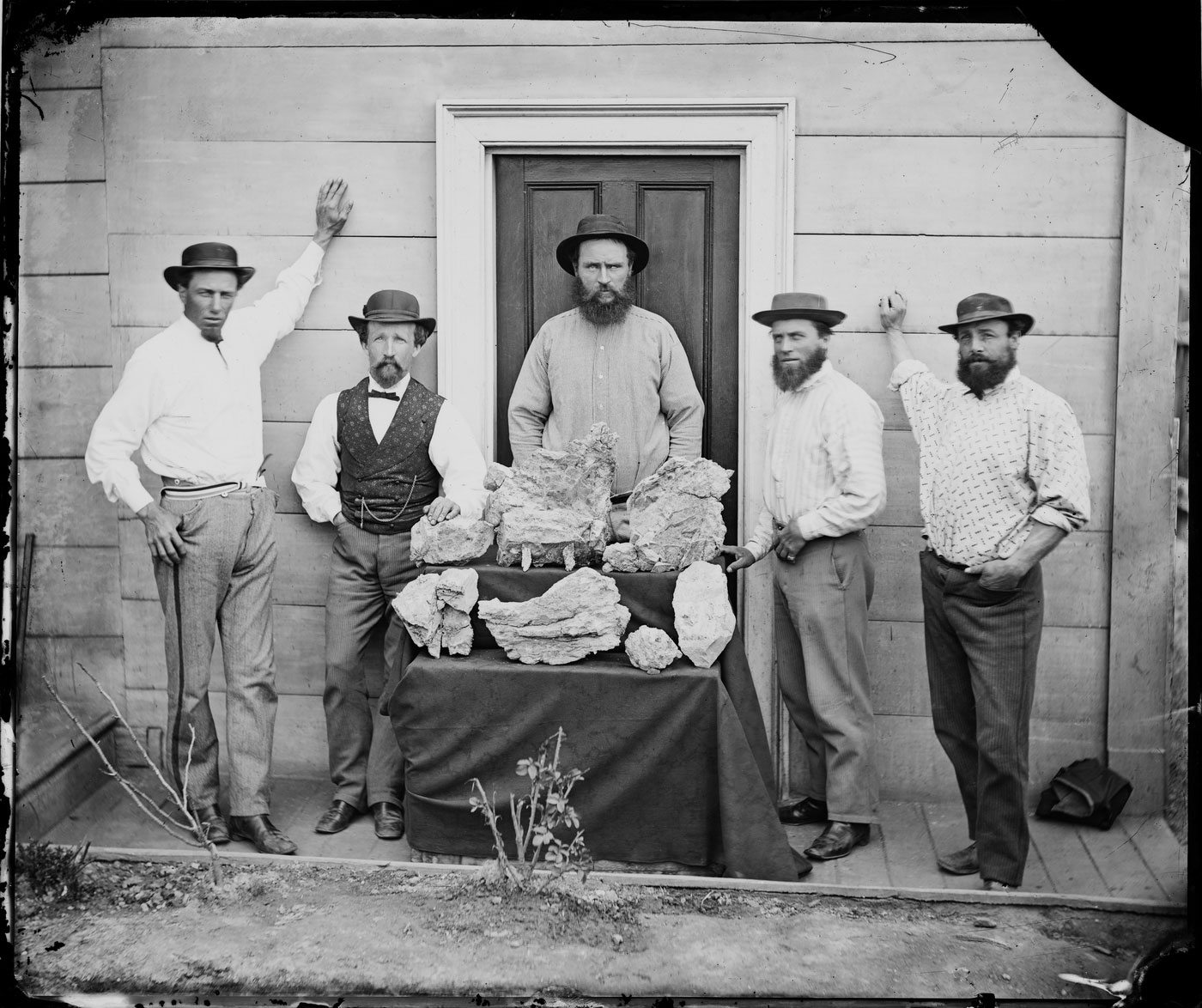
American & Australasian Photographic Company
Gold Specimens from the Star of Hope mine
1872
Wet plate glass negative, on 4/Box 71/No. T
A month before discovery of the 286 kg Holtermann “nugget” [estimated to hold around 93kg of gold], Bernhardt Holtermann (second from left) Richard Ormsby Kerr (centre) and Louis Beyers (fourth from left) posed with 3,663 ozs [114 kg] of gold specimens from their claim. The specimens were described in The Sydney Morning Herald 28 September 1872 ; “To say they were good would be to say but little – they were almost without rival – magnificent – the talk of this town, where specimens are not unknown.” Holtermann took the best to the Sydney Mint for smelting, “as being clotted with gold it would be almost impossible to crush it in the ordinary way.” The item of clothing on the floor to the right is Beyer’s waistcoat.
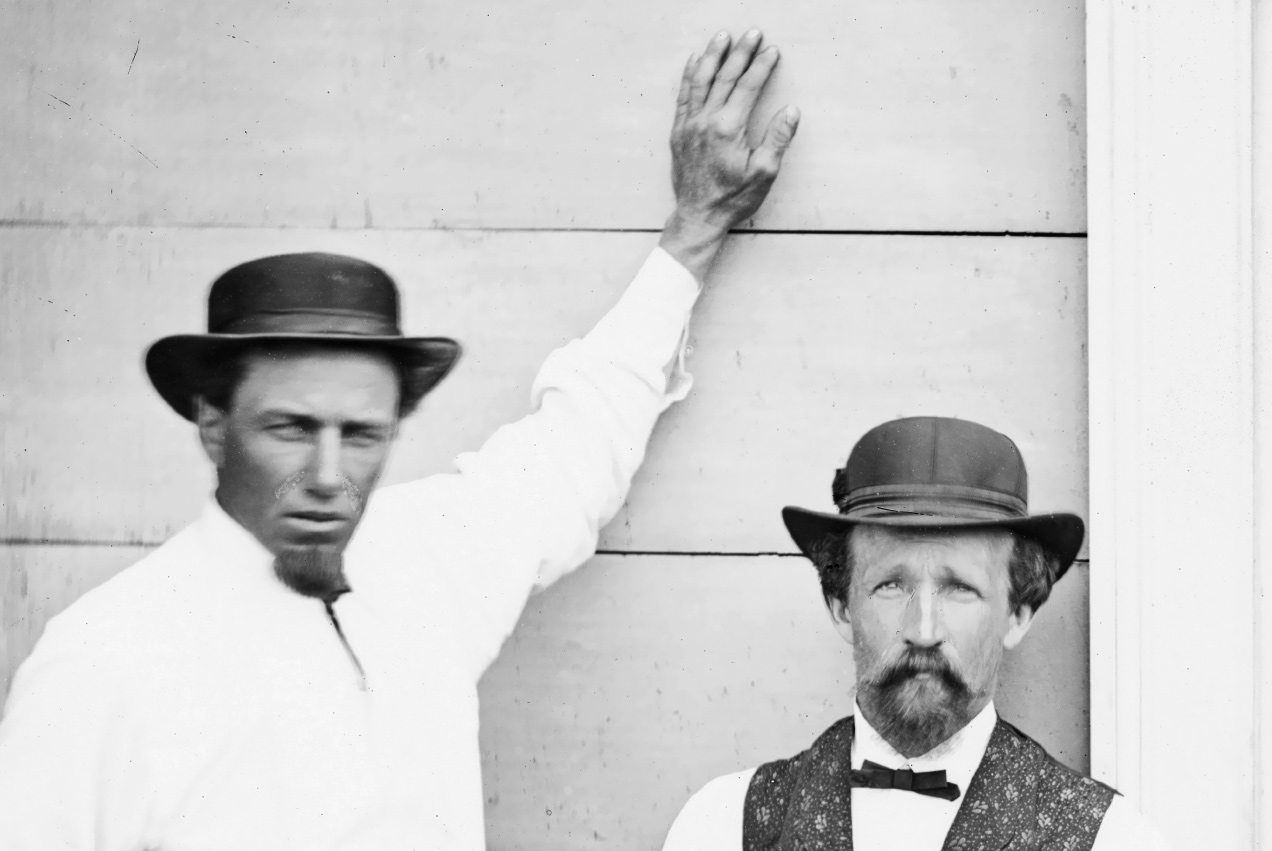
American & Australasian Photographic Company
Gold Specimens from the Star of Hope mine (detail)
1872
Wet plate glass negative, on 4/Box 71/No. T
![American & Australasian Photographic Company. 'A domestic miner [Hill End]' 1872](https://artblart.com/wp-content/uploads/2013/04/american-australasian-photographic-company-couple-and-child-in-the-front-formal-garden-of-their-slab-hut-cottage-hill-end-1870-1875-web.jpg "American & Australasian Photographic Company. 'A domestic miner [Hill End]' 1872")
American & Australasian Photographic Company
A domestic miner [Hill End]
1872
Wet plate glass negative, on 4/Box 10/No. 70154
Thomas Browne (better known as Rolf Boldrewood) was Gold Commissioner in Gulgong, during the period of Merlin and Bayliss’s photographs. Although this photograph was taken in Hill End, Boldrewood’s description of the domestic miner in his novel The Miners Right seems universal. “The thrifty miner who possesses the treasure, not less common on Australian goldfields than in other places, of a cleanly managing wife, is enabled to surround himself with rural privileges. A plot of garden ground, well fenced, grows not only vegetables but flowers, which a generation since were only to be found in conservatories… the domestic miner is often seen surrounded by his children, hoeing up his potatoes or cauliflowers, or training the climbing rose which beautifies his rude but by no means despicable dwelling.”

American & Australasian Photographic Company
Studio and staff of American & Australasian Photographic Co., Hill End
1872
Wet plate glass negative, on 4/Box 9/No. 18850
The American and Australasian Photographic Company established a studio in Tambaroora Street, Hill End in 1872. Beaufoy Merlin’s assistant Charles Bayliss stands, hands in pockets, in the doorway, with studio operator James Clinton behind him. Beside the door is a frame containing large photographic views of Sydney, including the General Post Office and harbour.
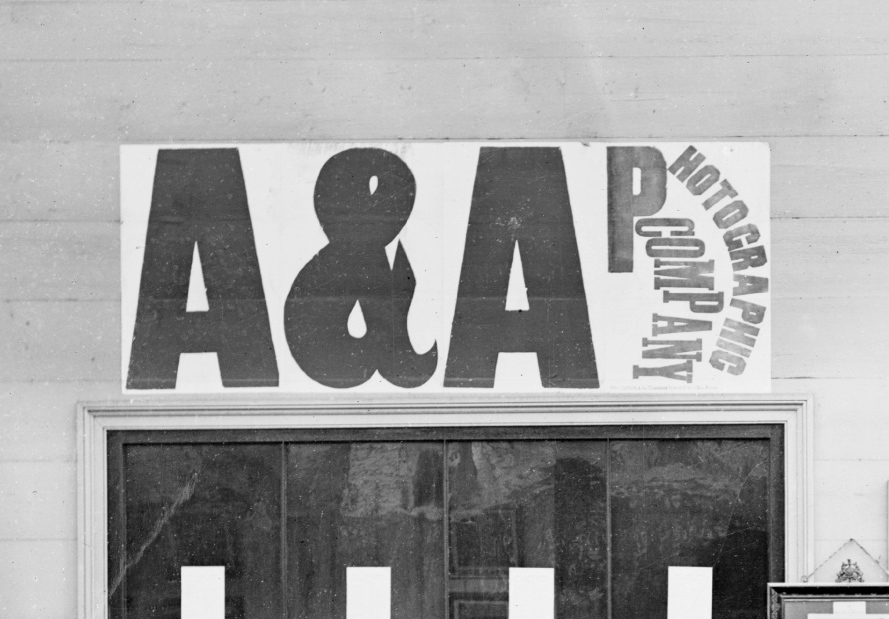
American & Australasian Photographic Company
Studio and staff of American & Australasian Photographic Co., Hill End (detail)
1872
Wet plate glass negative, on 4/Box 9/No. 18850
American & Australasian Photographic Company
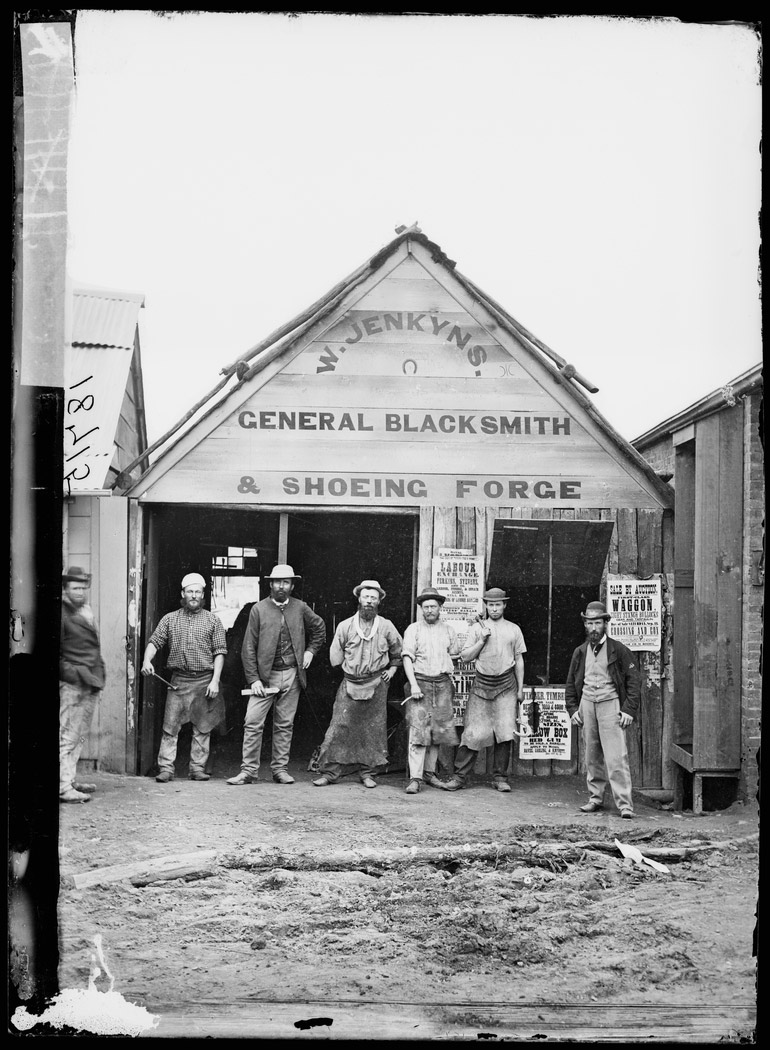
Blacksmith William Jenkyns
1872
Wet plate glass negative, on 4/Box 7/No. 18715
William Jenkyns’ blacksmith and shoeing forge was situated in Clarke Street, Hill End. The condition of roads around Hill End ensured Jenkyns was busy. A correspondent to The Sydney Morning Herald 23 May 1872 wrote of the road between Bathurst and Hill End, “For miles at a stretch there is nothing to indicate that any money has been spent upon the road for years, and it is doubtful whether any portion of it has ever been properly made.” On 3 December 1872 another wrote, “I think I have travelled the worst of roads; for the sake of humanity, I hope there are none worse than those I have travelled.” Despite a superficial resemblance, the man on the right is not B.O. Holtermann.
![Gibbs, Shallard & Co., Colour Printers [188-?] 'Holtermann's Life Preserving Drops' 1872](https://artblart.com/wp-content/uploads/2013/04/holtermans-life-preserving-drops-1872-web.jpg "Gibbs, Shallard & Co., Colour Printers [188-?] 'Holtermann's Life Preserving Drops' 1872")
Gibbs, Shallard & Co., Colour Printers [188-?]
Holtermann’s Life Preserving Drops
1872
Poster
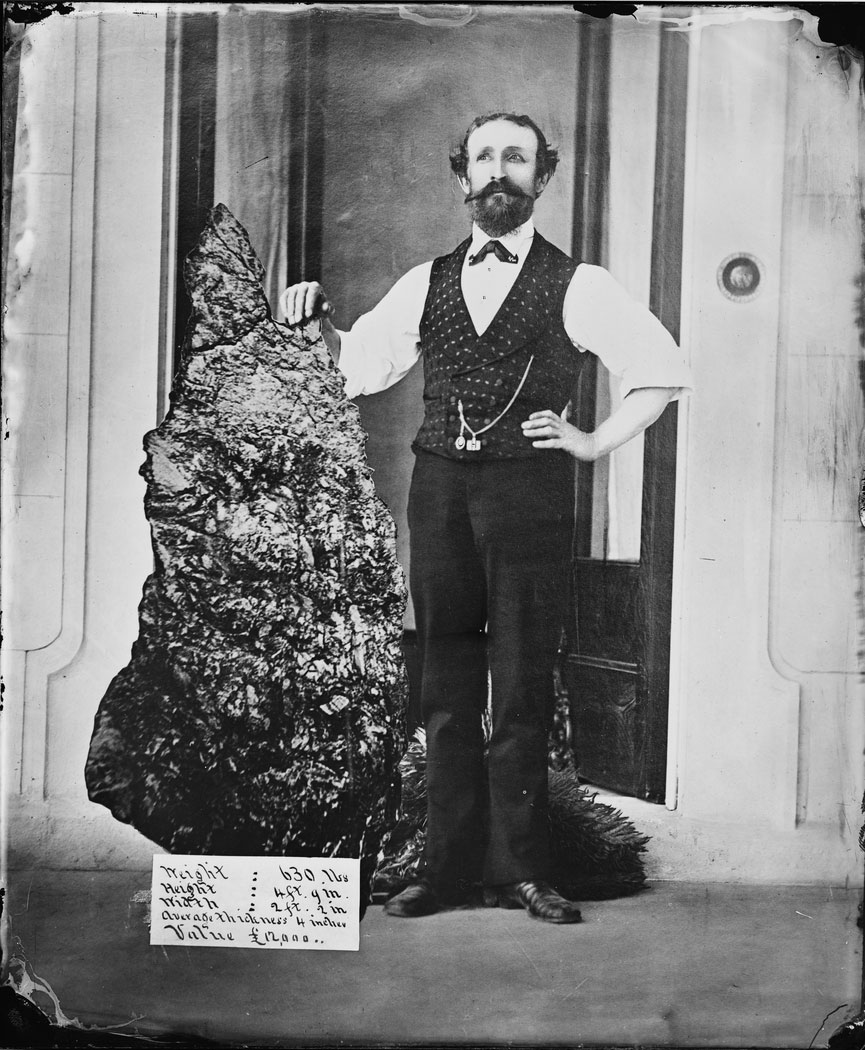
There is no doubt that Bernhardt Otto Holtermann understood the importance and value of maintaining his association with the world’s largest specimen of reef gold. Unable to purchase the monster quartz and gold specimen when it was extracted from the Star of Hope mine in Tambaroora in 1872, he commissioned the American and Australasian Photographic Company to produce a photographic montage of him standing beside it. Photographers Beaufoy Merlin and Charles Bayliss seem to have carried out this assignment on more than one occasion, as Holtermann wears different clothing in the several known examples of the image.
Obviously pleased with the result, Holtermann used the montage on his business card and on the label to a patent medicine bearing his name. As an advertising ploy, the image of Holtermann resting his hand on the world’s largest hunk of gold can only have been interpreted as a symbol of success and a guarantee of the worth of his product.
(Alan Davies author)
American & Australasian Photographic Company
B.O. Holtermann with the Holtermann Nugget, North Sydney
1874-1876?
During the 1870’s goldrush in central New South Wales, Bernard Holtermann, his partners and miners brought the largest agglomeration of gold to the surface. It was not a nugget of pure gold but he was instantly rich! An even larger gold find was broken up when it came to the surface in late January-early February 1873 but it was not photographed. With his wealth Holtermann financed the photography of the goldfields, a collection of international significance showing the ordinary people from all over the world with their houses and businesses on the goldfields. This composite photograph was put together later to give the appearance of Holtermann with the gold on the veranda of his new mansion at North Sydney, now the site of Shore Grammar School.
Three photographs were used to create this image of Holtermann, (supposedly holding the worlds’ largest accumulation of rock and gold ever brought to the surface in one piece). He was posed in the studio with his hand on a headclamp, the nugget was inserted and both placed on a photograph of the verandah of his mansion, built from the proceeds of his goldmine. The “nugget” was found in Hill End, New South Wales on 19th October 1872. More than half of the 630 lbs weight was pure gold, value 12,000 pounds ($24,000). With gold worth say $1400 per ounce, the value today would be over $A7,000,000. Amazingly Holtermann’s mine had already made him rich before the discovery of this boulder and there was reputed to be an even larger aggregate in the mine!
In 1872, the newly rich Bernhardt Otto Holtermann used some of his wealth to employ Henry Beaufoy Merlin and Charles Bayliss, of the American and Australasian (A&A) Photographic Company, to photograph gold producing areas and cities in NSW and Victoria for exhibition overseas. These images provide the most comprehensive and detailed record of nineteenth century goldfields life and, with the commissioned photographs, now form the Library’s Holtermann archive of 3500 wet plate negatives. The Greatest Wonder of the World features this extraordinary collection of nineteenth century documentary images. Through enlargements, digital images and a selection of vintage prints and wet plate negatives, the exhibition tells the remarkable story of the A&A Photographic Company and the philanthropy and vision of Bernhardt Holtermann.
In 1951, a hoard of 3,500 glass plate negatives from the nineteenth century was discovered in a garden shed in Chatswood. In time, the find proved to be the most important photographic documentation of goldfields life in Australia. The photographers responsible for the images were Beaufoy Merlin and Charles Bayliss of the American and Australasian Photographic Company, who had travelled to the town of Hill End in 1872 to record the rush. From there, they also recorded the burgeoning Gulgong and Mudgee goldfields.
In October 1872, the world’s largest specimen of reef gold, known as the Holtermann nugget, was unearthed at nearby Hawkins Hill and Merlin and Bayliss were there to record it. In an extraordinary act of patronage, the newly rich Bernhardt Otto Holtermann used some of his wealth to employ Merlin and Bayliss to photograph other gold producing areas and cities in NSW and Victoria for exhibition overseas. Proud of his own success, he believed that his travelling exposition would encourage immigration to Australia. Merlin and Bayliss’s documentation was slow, with long exposures and the difficulty of processing one photograph at a time. Their wet plate negatives captured exceptional detail, but copies made in the twentieth century failed to reveal the wealth of information hidden within.
In 2008, plans were made to digitally scan the Holtermann Collection at very high resolution and this became reality through the generous assistance of the Graham and Charlene Bradley Foundation; Simon and Catriona Mordant; Geoffrey and Rachel O’Conor; Morningstar and numerous other benefactors. For the first time in 140 years, it is possible to see what Merlin and Bayliss photographed, with astonishing clarity and fidelity.
Press release from the State Library of New South Wales website
![American & Australasian Photographic Company. '[French warship 'Atalante', Fitzroy Dock, Sydney, 1873]' Aug 1873](https://artblart.com/wp-content/uploads/2013/04/american-australasian-photographic-company-french-warship-atalante-fitzroy-dock-sydney-1873-1873-web.jpg "American & Australasian Photographic Company. '[French warship 'Atalante', Fitzroy Dock, Sydney, 1873]' Aug 1873")
American & Australasian Photographic Company
[French warship ‘Atalante’, Fitzroy Dock, Sydney, 1873]
Aug 1873
This photograph of the French warship Atalante in Fitzroy Dock on Cockatoo Island, with Balmain in the background, was taken in August 1873. Built in 1865, the iron clad Atalante had a protruding brass bow for ramming lesser vessels. It had taken part in the Franco Prussian War in 1870 and at the time of this photograph was the flagship of the Pacific Squadron, under the command of Rear Admiral Baron Roussin. Beaufoy Merlin was particularly pleased with his photographs of the Atalante and wrote about them in the Town and Country Journal.
![American & Australasian Photographic Company. '[French warship 'Atalante' at Fitzroy Dock, Sydney, 1873 / attributed to the American & Australasian Photographic Company]' 1873](https://artblart.com/wp-content/uploads/2013/04/french-warship-atalante-at-fitzroy-dock-web.jpg "American & Australasian Photographic Company. '[French warship 'Atalante' at Fitzroy Dock, Sydney, 1873 / attributed to the American & Australasian Photographic Company]' 1873")
American & Australasian Photographic Company
[French warship ‘Atalante’ at Fitzroy Dock, Sydney, 1873 / attributed to the American & Australasian Photographic Company]
1873
“… One of the solar pictures which I took on the occasion of my last visit to the Atalante, of which an engraving accompanies the present pen-and-ink sketch, is taken from the rocks to the north-west, and shows her “ram,” with its massive projecting extremity of solid brass, her swelling sides, portholes, section of the dock, and men at work. The steps to the bottom of the basin as well as [its depth], are fairly indicated. Probably there is no one more difficult to please in procuring a picture of this kind than the landscape photographer himself. I may therefore be permitted to say in behalf of the one referred to, that it gave me satisfaction.”
Sadly, these images of Atalante were among the last photographs taken by Merlin. He contracted pneumonia and died, age 43, in September 1873.
American & Australasian Photographic Company
Herbert Street, west side looking north from Mayne Street and showing Barnes’ Chemist Shop, Gulgong
1872
Wet plate glass negative, on 4/Box 2/No. 18242
The incongruous sight of toy dogs among the rough-and-ready types that inhabited a frontier gold town has been captured in this view of Herbert Street, Gulgong. According to the Empire 28 May 1872, “The streets – so to call the dusty avenues between the rows of shops and Inns – are thronged in the daytime, by much about the same number, though not, apparently by the same sort of persons, as the streets in Sydney. There is not the same bustling activity about them… There are also fewer women amongst them, and fewer well dressed men. The yellow, clay-stained fustian trousers which have never made and never will make acquaintance with the wash-tub, invest the lower extremities of every two men out of three…”
American & Australasian Photographic Company
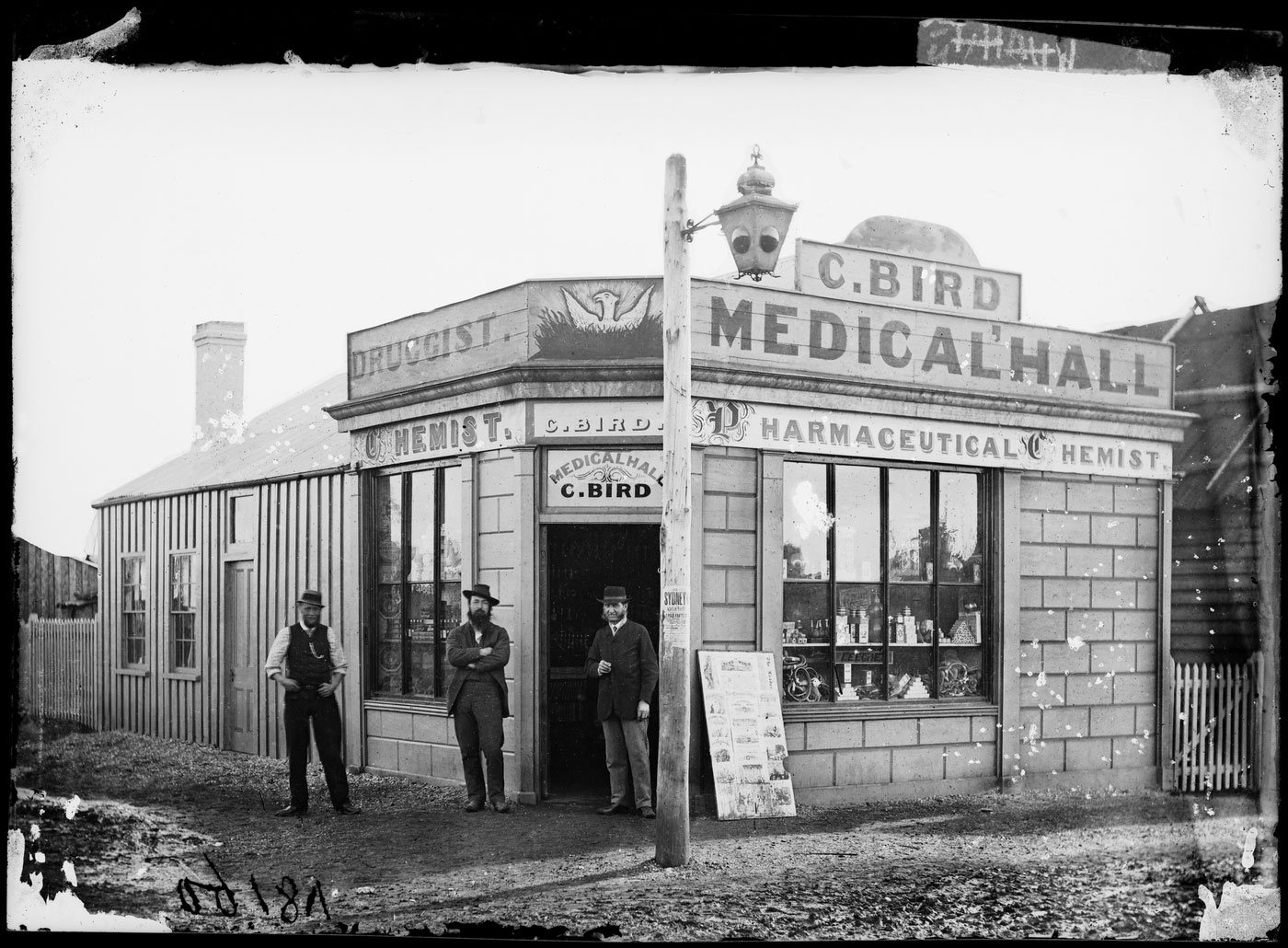
Charles Bird, Medical Hall, Gulgong
1872
Wet plate glass negative, on 4/Box 2/No. 18160
The Medical Hall of Charles Bird Jnr was situated at the corner of Belmore and Herbert Streets, Gulgong. Charles Bird Snr. conducted another shop at the corner of Mayne and Herbert Streets, until the Medical Hall was sold and converted into a hotel in 1879. The Gulgong Guardian 20 November 1872 noted that Charles Bird had received a new disinfectant “which will be invaluable during the summer months to all who are unfortunate enough to live in those parts of town where stenches are pungent and plentiful.”
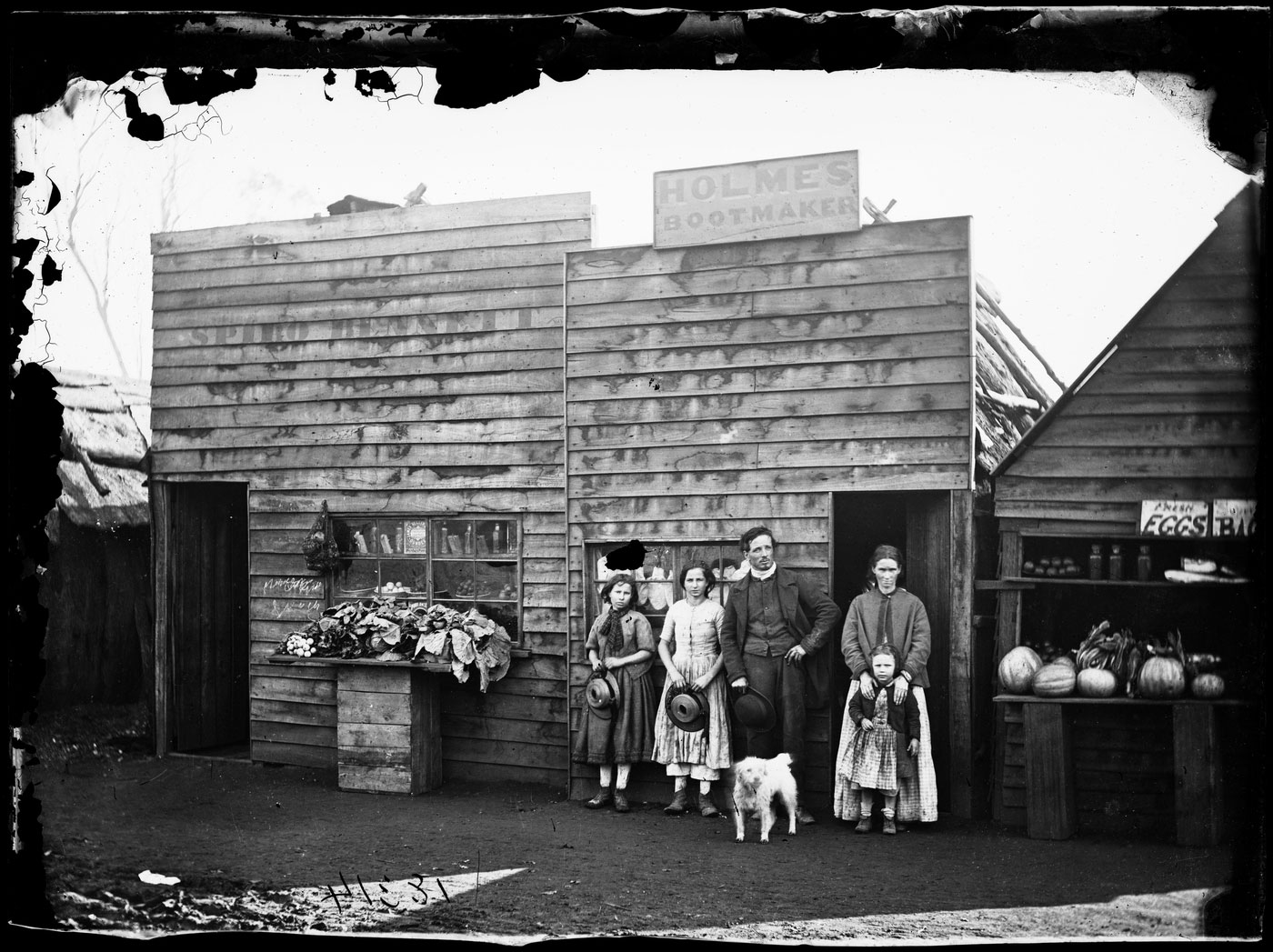
American & Australasian Photographic Company
Holmes, bootmaker, and Spiro Bennett’s store, Gulgong
1872
Wet plate glass negative, on 4/Box 3/No. 18314
This timber clad facade fails to conceal the bark structure behind and the poverty of its inhabitants. This is Gulgong bootmaker William Holmes and his family outside their shop in Mayne Street west. His wife Emily, in the doorway, died a few months after the photograph was taken. The town’s short-term architecture was described in The Sydney Morning Herald 30 September 1872. “Gulgong is not singular in its buildings. The followers of alluvial rushes have ere this found that business is fleeting. As leads work out so does business tide away. Hence have we buildings of a temporary nature; and, although the town of Gulgong may be reckoned three years old, yet not a single brick building stands on its site…”
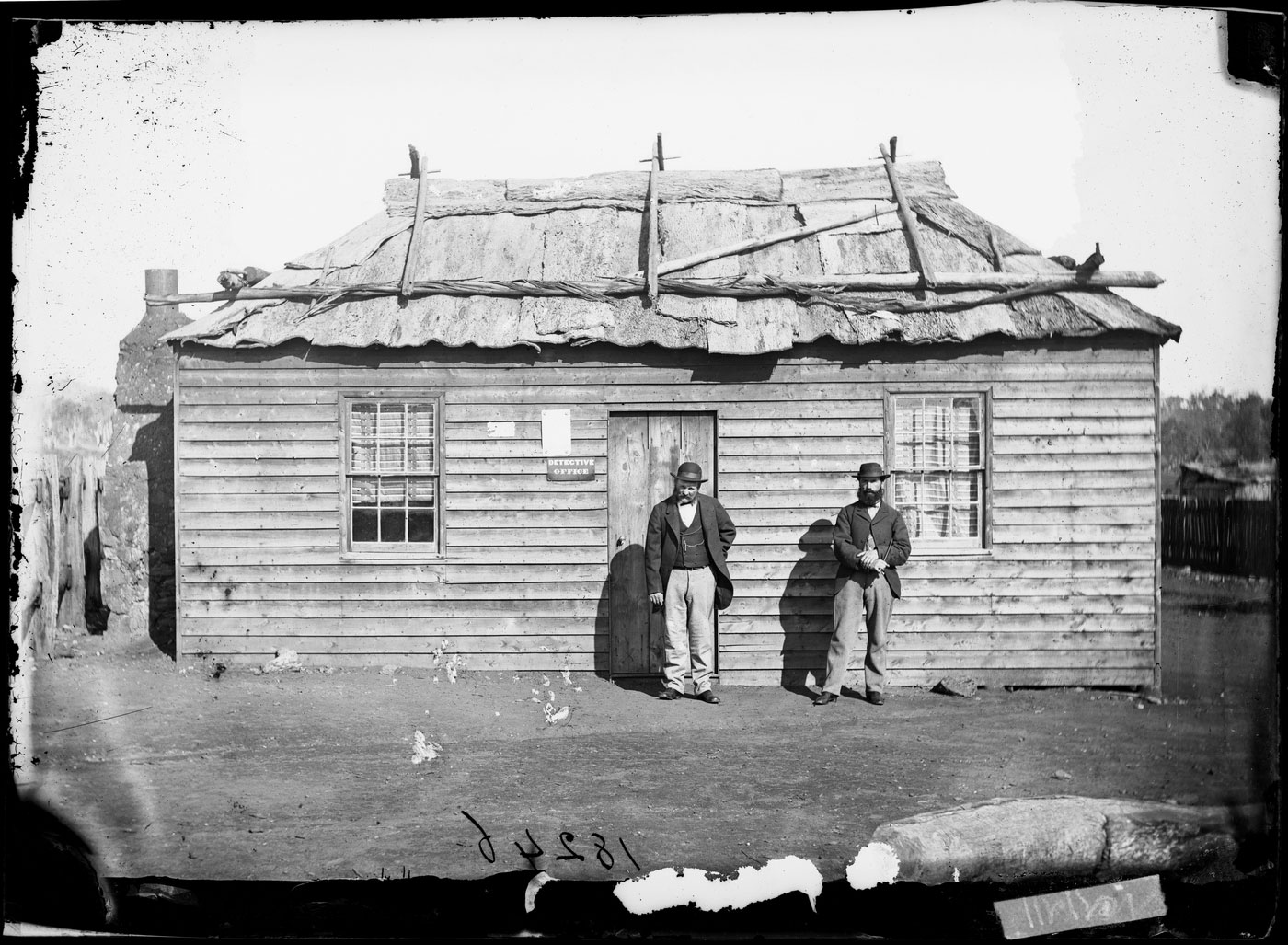
American & Australasian Photographic Company
The detectives
1872
Wet plate glass negative, on 4/Box 2/No. 18246
These are detectives Charles Powell and Robert Hannan, outside their Gulgong office. They had plenty to do. In a letter to the editor of the Maitland Mercury 16 May 1872, William Collins stated “The people (except the bankers and storekeepers), are in general a rough and ready set, occasionally a fight is to be seen, but the very diligent police speedily settle such hostile engagements, by marching the pugilists to a place called the town cage, from which place they are brought in the morning before the magistrate, who has often heard of mercy, but does not know what it means…” Powell and Hannan arrested 14 Chinese for gambling in January 1872 and the Empire 20 January 1872 noted, “In all these cases the lawyers reap a rich harvest, and it was somewhat amusing to witness their actively and interest within ten minutes of the time of arrest.”
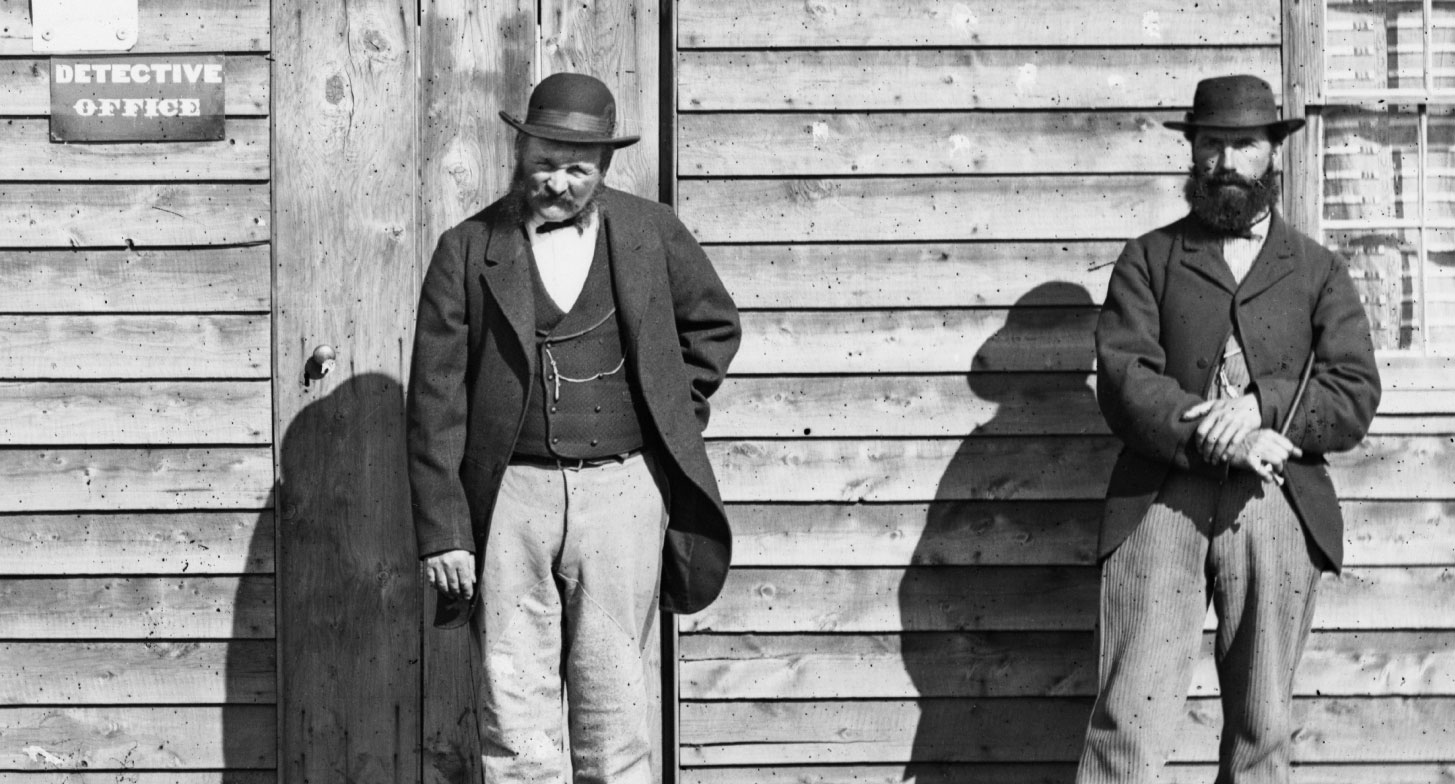
American & Australasian Photographic Company
The detectives (detail)
1872
Wet plate glass negative, on 4/Box 2/No. 18246

American & Australasian Photographic Company
William Lewis, undertaker
1872
Wet plate glass negative, on 4/Box 2/No. 18168
The establishment of William Thomas Lewis, Undertaker and Carpenter at the corner of Belmore and Herbert Streets was primitive, but his funerals were said to be carried out ‘with his usual taste and completeness’. In 1871, Gulgong lacked a suitable place for burials and the Gulgong Guardian commented several times on the growing outcry for a cemetery. The locals had a valid complaint, particularly because of the considerable mortality rate among the young. In April 1871 alone, nine children died in a fortnight. Even Thomas De Courcy Brown, editor of the Guardian, lost his daughter Rose, age 7 months, in December that year. In January 1872, there were 37 deaths in Gulgong, (including 21 children under 5 years) and 17 births. The newspaper complained that the new cemetery was still unfenced.

American & Australasian Photographic Company
William Lewis, undertaker (detail)
1872
Wet plate glass negative, on 4/Box 2/No. 18168

American & Australasian Photographic Company
John Osborne, painter and signwriter
1872
Wet plate glass negative, on 4/Box 4/No. 18372
J.H. Osborne, painter & signwriter of Gulgong also supplied decorative wallpaper. It seems he painted faux marble headstones as well. Osborne’s bark clad establishment was located at 2 Medley Street, at the sparsely populated northern end of town, which explains the prominent display of his sign writing skill. The Empire 28 May 1872 commented on the temporary nature of buildings in Gulgong. “The shops and public-houses are, for the most part, of a very temporary and unsubstantial character, considered as buildings. A large proportion of them are capable of being removed, piecemeal, and set up again on a new diggings in the event of Gulgong declining in prosperity, and a rush taking place to another field within a day or two’s journey.”
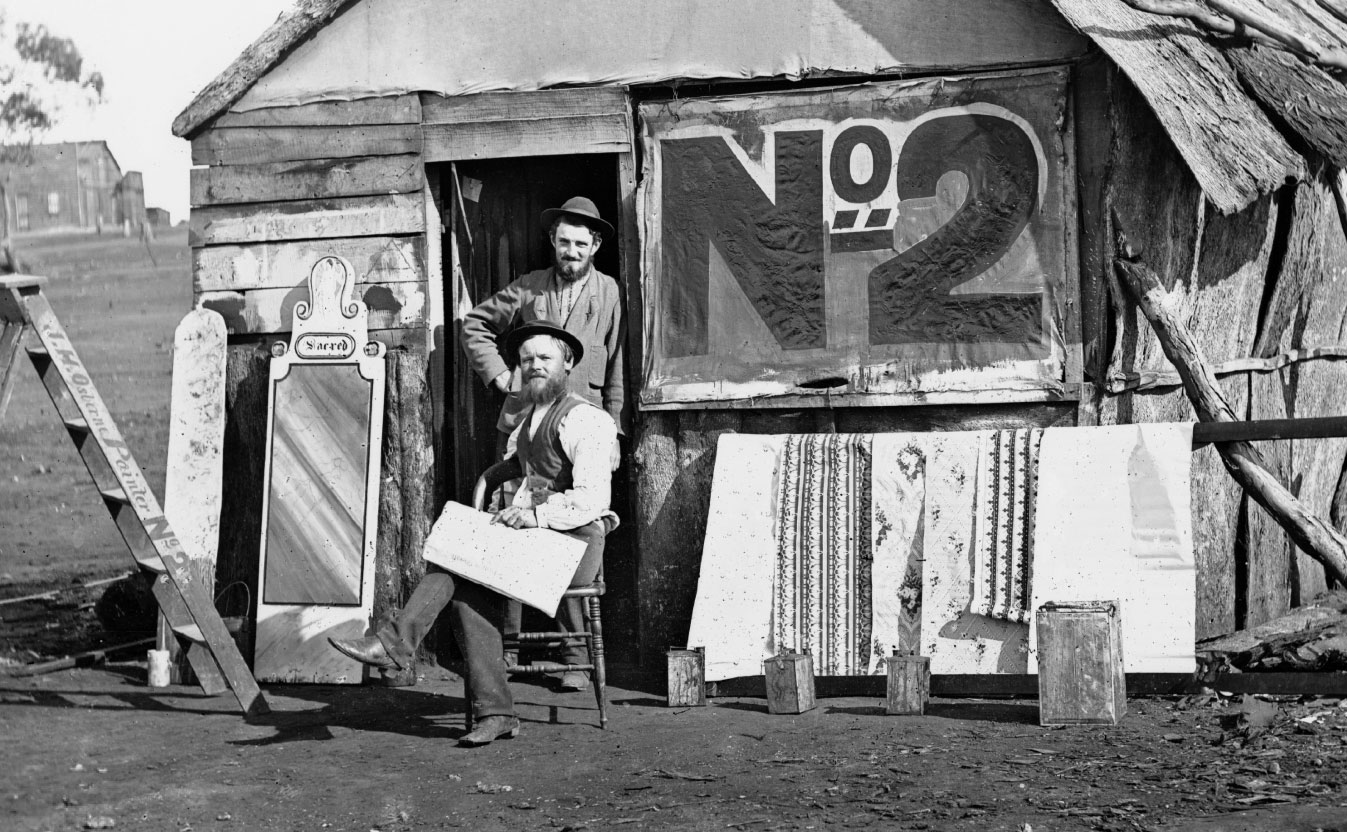
American & Australasian Photographic Company
John Osborne, painter and signwriter (detail)
1872
Wet plate glass negative, on 4/Box 4/No. 18372
A meeting between gold miner Bernard Otto Holtermann and photographer Beaufoy Merlin in Hill End in 1872 resulted in one of the most astonishing photographic documentations ever undertaken. Holtermann had been associated with the recent discovery of the world’s largest specimen of reef gold, weighing 145 kilograms, extracted from the Star of Hope mine at nearby Tambaroora. Merlin, an itinerant photographer, had just opened a temporary studio in Hill End. In January 1873, the two announced their plans for Holtermann’s great International Travelling Exposition, which would publicise the potential of their adopted country to the world through photography. Merlin and his assistant Charles Bayliss had already photographed some of the gold producing towns of the colony and Holtermann’s patronage enabled them to continue the undertaking, using a larger camera.
Merlin had begun his photographic career in Victoria in 1866 and within a few years had developed a unique style of outdoor photography. Charles Bayliss joined American & Australasian Photographic Company in Melbourne and the pair headed north into New South Wales, photographing towns along the way. When Beaufoy Merlin and Charles Bayliss arrived in Sydney in September 1870, they had already completed an extraordinary documentation of “almost every house in Melbourne, and the other towns in Victoria.” They were aware that their venture was unusual and contemporary advertising by the American & Australasian Photographic Company reflects a considered understanding of the photographic medium and an intellectual approach to their work.
“The chief characteristic and distinguishing feature of the Company’s style of work, is the introduction of figures into the photograph – the most complete and life-like portraits of individuals who happen, or may choose to stand outside, being incorporated in the picture. The A&A Photographic Company desire further to remind the public that these negatives are not taken for the mere immediate object of sale, but that being registered, copies can at all times be had by or of those parties residing in any part of the colonies wherever the Company’s operations have extended, thus forming a novel means of social and commercial intercourse.”
Nevertheless, it is not surprising that Merlin and Bayliss headed west in 1872 with the new gold rushes. The cry “Rush-O!” meant money for businesses, including photographers. A studio for the A&A Photographic Company was built on land owned by Holtermann in Hill End and excursions were made to surrounding areas by horse drawn caravan. The photographic process of the day required the photographer coat each plate just before use and develop it immediately before it lost sensitivity. For the itinerant photographer, this meant taking a portable darkroom wherever he went. Despite the difficulty of the wet plate process, the comprehensive goldfields photography of Merlin and Bayliss has provided a unique documentation of frontier life.
Merlin fell ill and died from pneumonia in 1873, leaving his assistant the task of documenting towns for Holtermann’s Exposition. Consequently, Bayliss toured Victoria the following year, but returned to Sydney in 1875 and began making giant panoramas of the city from Holtermann’s house in North Sydney. The venture was to cost Holtermann over ₤4000, but resulted in the production of the world’s largest wet-plate negatives and several panoramas. One, measuring 10 metres long, astonished audiences overseas and received the Bronze award at the Philadelphia Centennial Exhibition of 1876 and a Silver Medal at the Paris Exposition Universelle Internationale in 1878. Only a small percentage of the A&A Photographic Company’s output has survived, but 3,500 small format wet plates negatives (including extensive coverage of the towns of Hill End and Gulgong) and the world’s largest wet plate negatives, measuring a massive 1 x 1.5 metres, are held by the Library.
Text from The Holtermann Collection website

Charles Bayliss (Australian, 1850-1897)
The beginning of Home Rule
1872
Wet plate glass negative, on 4/Box 3/No. 18278
Home Rule, 11 km south-east of Gulgong, was only two months old when Charles Bayliss took this photograph. A reporter from the Gulgong Guardian was also in town and wrote on 13 July 1872, “During the past fortnight there has been a great improvement for the better in the appearance of the township at the Home Rule. Large and costly buildings are springing up in every direction and being fitted up for almost every trade. In hotels there is a great change for the better, as in several of them notably Messrs Wright, Moss, and Oliver, the accommodation is almost equal to any on Gulgong; so visitors need not fear that they will suffer hunger or thirst.”
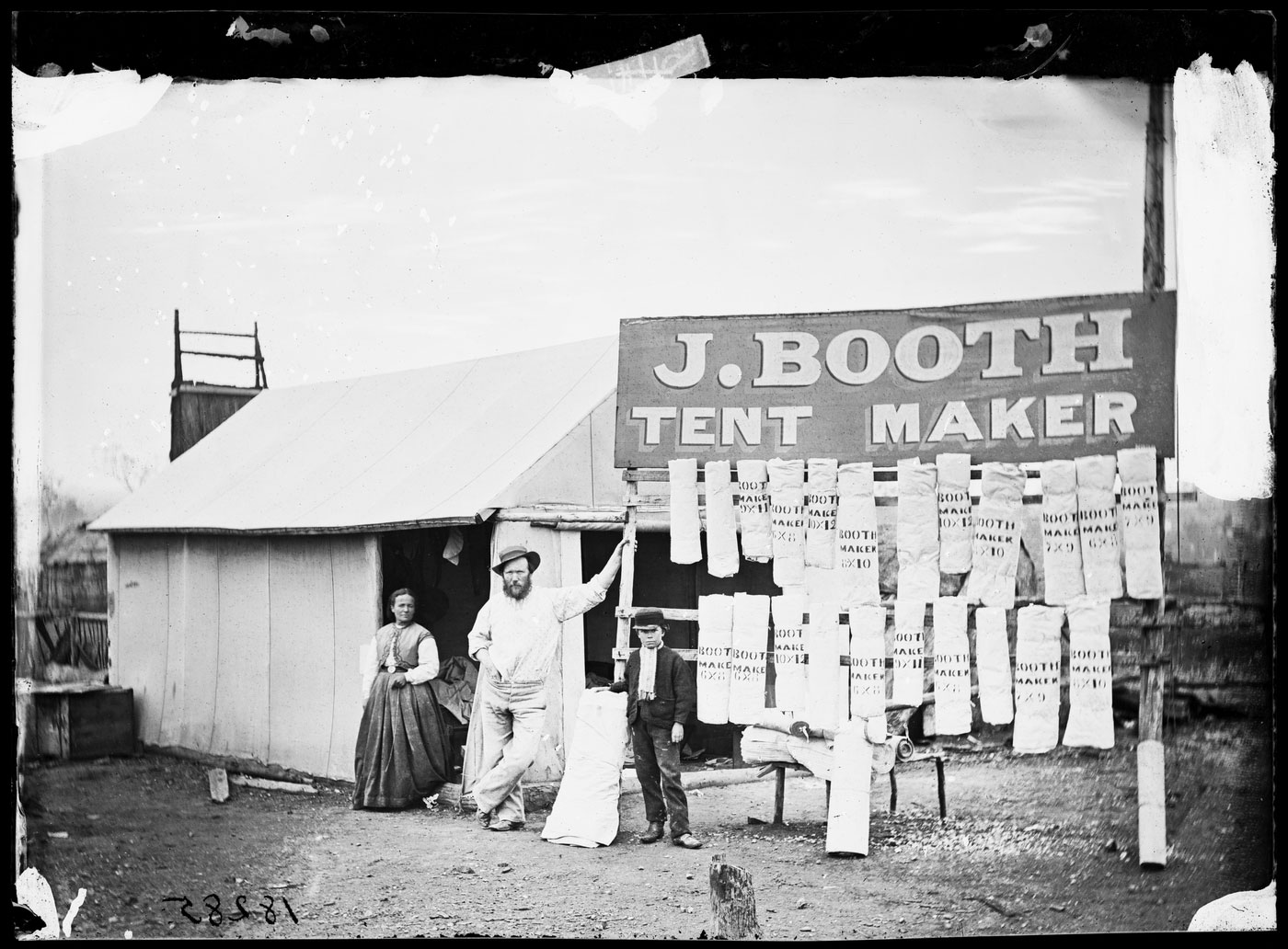
Charles Bayliss (Australian, 1850-1897)
Tent city, Home Rule
1872
Wet plate glass negative, on 4/Box 3/No. 18285
In the early days of gold rushes, miners usually lived in tents. Here tentmaker J. Booth has confidently set up his canvas shop in Home Rule. The burgeoning new field was described in the Sydney Morning Herald 22 May 1872, “On Friday last there must have been fully fifteen hundred persons upon the ground, and tents and habitations of every description were springing, apparently Iike mushrooms, from the ground, and such is the rapidity with which a gold-fields town is formed, I shall not be surprised to see the place well supplied with stores, and, of course, hotels, when I again visit the place about a fortnight hence.”
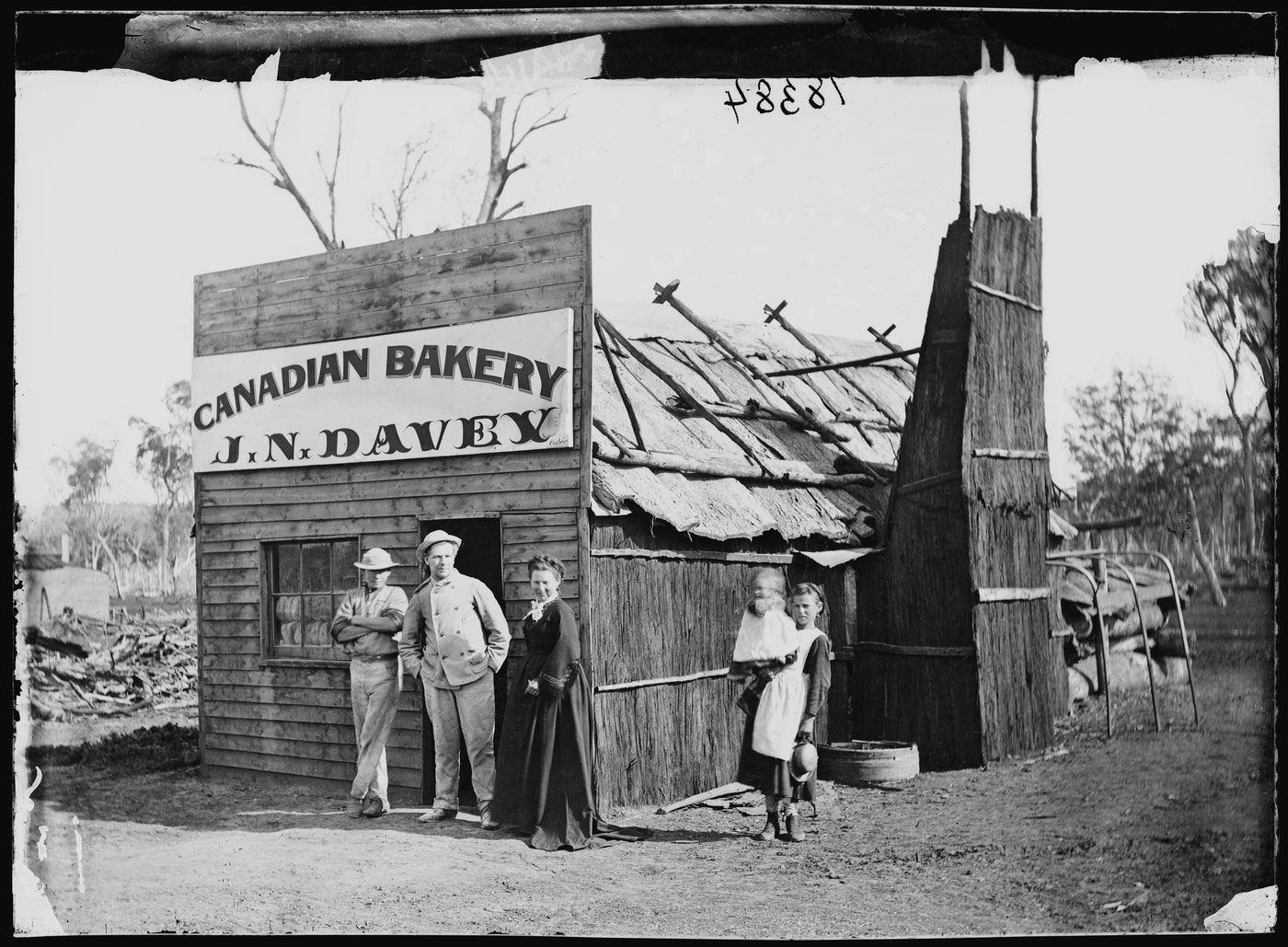
Charles Bayliss (Australian, 1850-1897)
John Davey, baker
1872
Wet plate glass negative, on 4/Box 3/No. 18384
With his shoes covered in flour, John Davey steps outside his bakery in the main street of Canadian Lead. Bread cost 6d a 2lb [5 cents per 900g] loaf. The woman and children to the right also appear outside Ruth Beck’s North Star Hotel, three doors away. The rush to Canadian Lead began in early 1872 and the Maitland Mercury 6 April 1872 was able to state “the Canadian Lead, where a month ago some four hundred people were, can now boast of a couple of thousands…” Not everyone was law-abiding. The Maitland Mercury 24 August 1872 related the story of Mrs Beck dropping a purse containing £21 [$42, worth about $2000 today], which was picked up by her little boy, but taken from him by two men claiming that it was theirs. The miscreants were arrested in Mudgee two days later, drinking the profits.
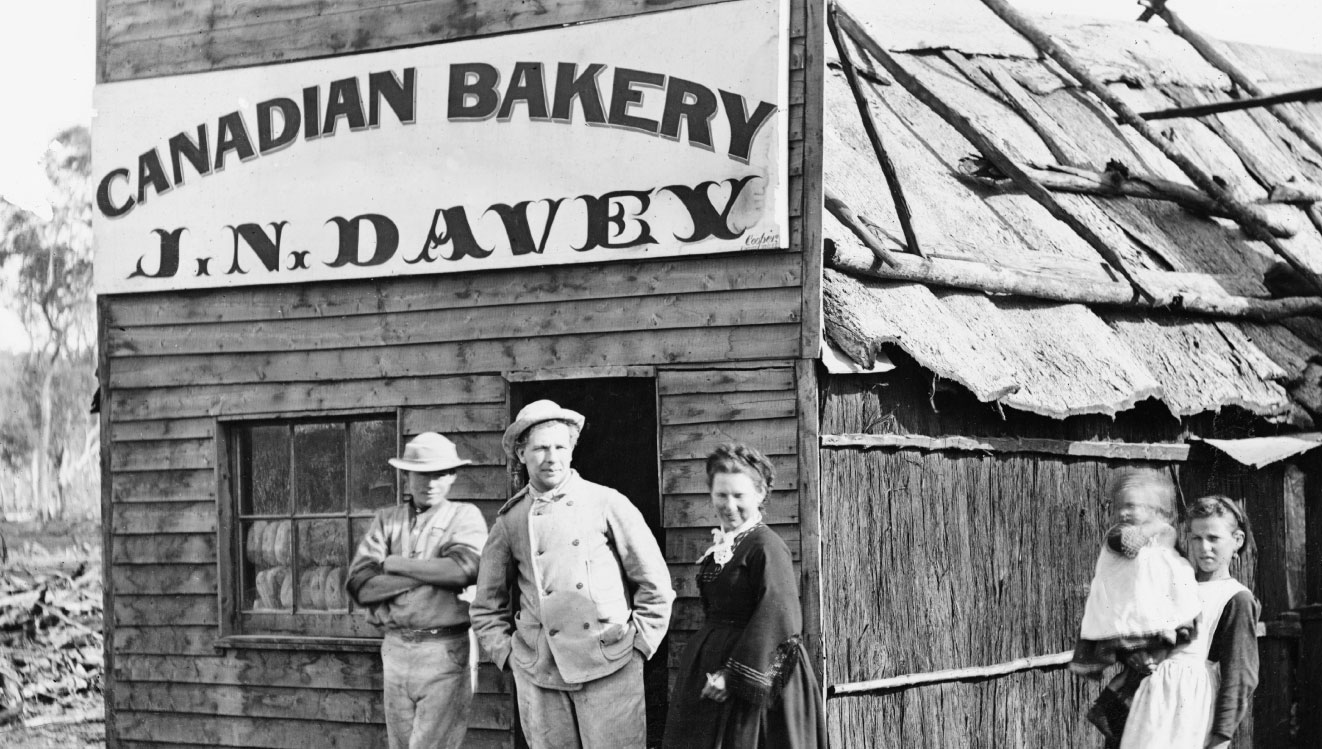
Charles Bayliss (Australian, 1850-1897)
John Davey, baker (detail)
1872
Wet plate glass negative, on 4/Box 3/No. 18384
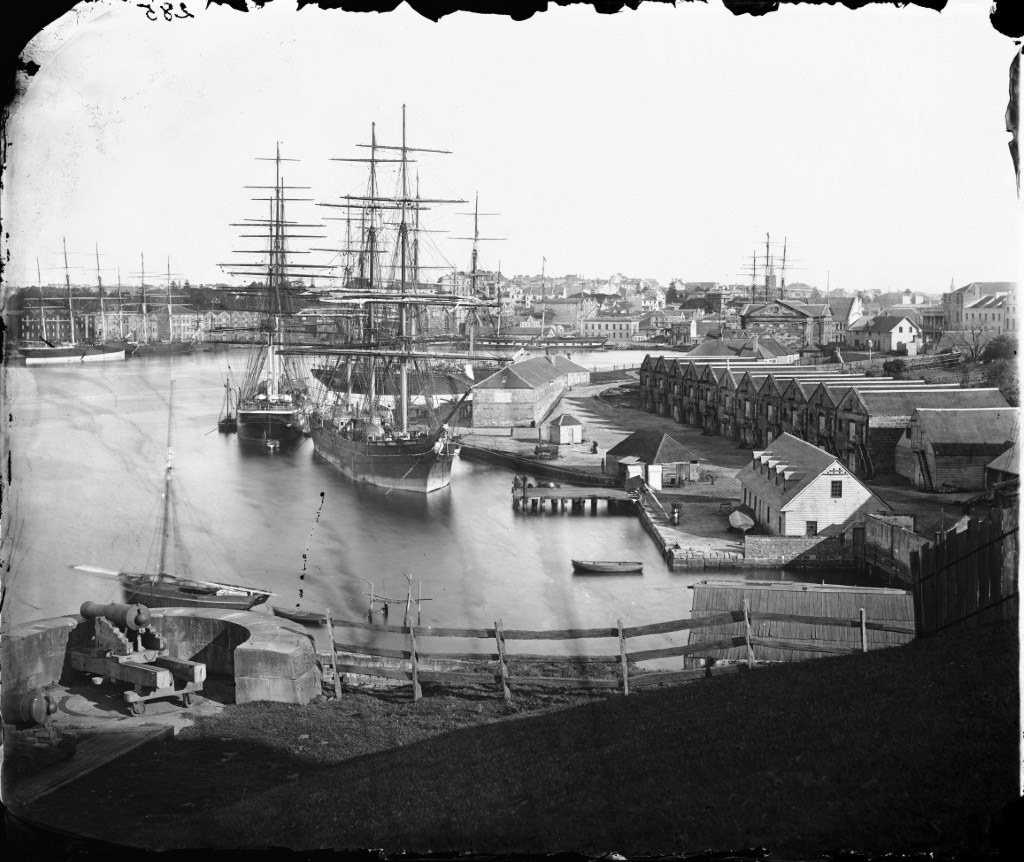
Beaufoy Merlin (Australian, 1830-1873)
Circular Quay from Dawes Battery
1873
Wet plate glass negative, on 4/Box 58/No. 285
In mid 1873, Beaufoy Merlin returned to Sydney to continue photographing the city for Holtermann. The Sydney Morning Herald 2 August 1873 noted, “Mr. Beaufoy Merlin has taken a considerable number of photographic views of Sydney for the first section of ‘Holtermann’s Intercolonial Exposition’.” This image from Dawes Battery, past Campbell’s Wharf to Circular Quay can be dated to early September 1873, as the Haddon Hall (r) from London, is loading for San Francisco at Campbell’s wharf. Behind it is Aviemore and the ship in background in front of Customs House is La Hogue. Both Aviemore and La Hogue left for London on 13 September 1873.

Charles Bayliss (Australian, 1850-1897) (American & Australasian Photographic Company)
Pall Mall, Bendigo
1874
Wet plate glass negative, on 4/Box 78/No. 2
After the death of Beaufoy Merlin in 1873, Bernhardt Holtermann engaged Merlin’s assistant, 24 year-old Charles Bayliss, to continue taking photographs for his planned Exposition. This view of Pall Mall from Hadley’s City Family Hotel, Sandhurst [Bendigo, Victoria] was taken in April 1874. Bayliss photographed the town using the Exposition’s standard 10 x 12 inch (25 x 30cm) glass negatives, but for this image used a mammoth camera specially imported by Holtermann which took glass plates measuring 18 x 22 inches (46 x 56cm). Bayliss also photographed Ballarat in June 1874, using the mammoth camera to produce a panorama from the town hall clock tower.
State Library of New South Wales
Macquarie Street, Sydney
NSW 2000 Australia
Phone: +61 2 9273 1414
Opening hours:
Daily 10am – 5pm
![Camille Silvy (French, 1834-1910) '[River Scene, France]' Negative 1858; print 1860s from the exhibition 'Camille Silvy, Photographer of Modern Life, 1834-1910' at the National Portrait Gallery, London, July - Oct 2010](https://artblart.com/wp-content/uploads/2010/10/silvy-river-scene-web.jpg "Camille Silvy (French, 1834-1910) '[River Scene, France]' Negative 1858; print 1860s from the exhibition 'Camille Silvy, Photographer of Modern Life, 1834-1910' at the National Portrait Gallery, London, July - Oct 2010")



 Art Blart _ art and cultural memory archive
You must be logged in to post a comment.