Exhibition: ‘Carelton Watkins: The Stanford Albums’ at the Cantor Arts Center at Stanford University

Who are the interesting photographers anywhere who are alive now?

And my answer would be: there are very few who are alive now that are interesting.

Exhibition dates: 23rd April – 17th August 2014


Carleton Watkins (American, 1829-1916) 'Sugar Loaf Islands and Seal Rocks, Farallons' 1868-1869


Carleton Watkins (American, 1829-1916)
Sugar Loaf Islands and Seal Rocks, Farallons
1868-1869
From the album Photographs of the Pacific Coast
Albumen print
Lent by Department of Special Collections, Stanford University Libraries.


Who would you put in your top eleven photographers of all time?

(in no particular order)

  • Minor White
  • Eugene Atget
  • Frederick Sommer
  • Carelton Watkins
  • Julia Margaret Cameron
  • Walker Evans
  • Edward Weston
  • Lee Friedlander
  • Manuel Alvarez Bravo
  • Diane Arbus
  • Paul Strand

and then it gets a bit more difficult…

Is it a Josef Sudek, Robert Adams, Aaron Siskind, Man Ray, Berenice Abbott, Helen Levitt, Emmet Gowin, William Clift, Ernest Cole, William Eggleston, Lee Friedlander, Cindy Sherman, Charles Marville, Vivian Maier, Saul Leiter and suggestions from others – André Kertész, Josef Koudelka, Dorothea Lange, Henri Cartier-Bresson, Edouard Boubat, Paul Caponigro, etc …


What is more interesting is to ask:

Who are the interesting photographers anywhere who are alive now?

And my answer would be: there are very few who are alive now that are interesting.

That is – by looking at the ideas that are present in poetry, music, philosophy or even politics – who is there that is truly taking these ideas forward (or ideas that are as interesting).

Or who is arranging images with the elegance of a Sommer or an Atget or the dynamics of Arbus

= few if any.

In other words whose acts am I hanging upon, so that I am waiting with great anticipation to see what they are going to do next.

Only a few is my answer.

Which living photographers would I walk a mile to see their work?

= some (eg Lee Friedlander, Wolfgang Tillmans)


Which living Australian photographers would I walk an hour in the hot January sun to see?

= possibly two (Bill Henson, Rosemary Laing)

Dr Marcus Bunyan


PS. Just look at Cape Horn, near Celilo (1867, below). You are not likely to see a more magnificent landscape photograph than this.

Many thankx to the Cantor Arts Center for allowing me to publish the photographs in the posting. Please click on the photographs for a larger version of the image.
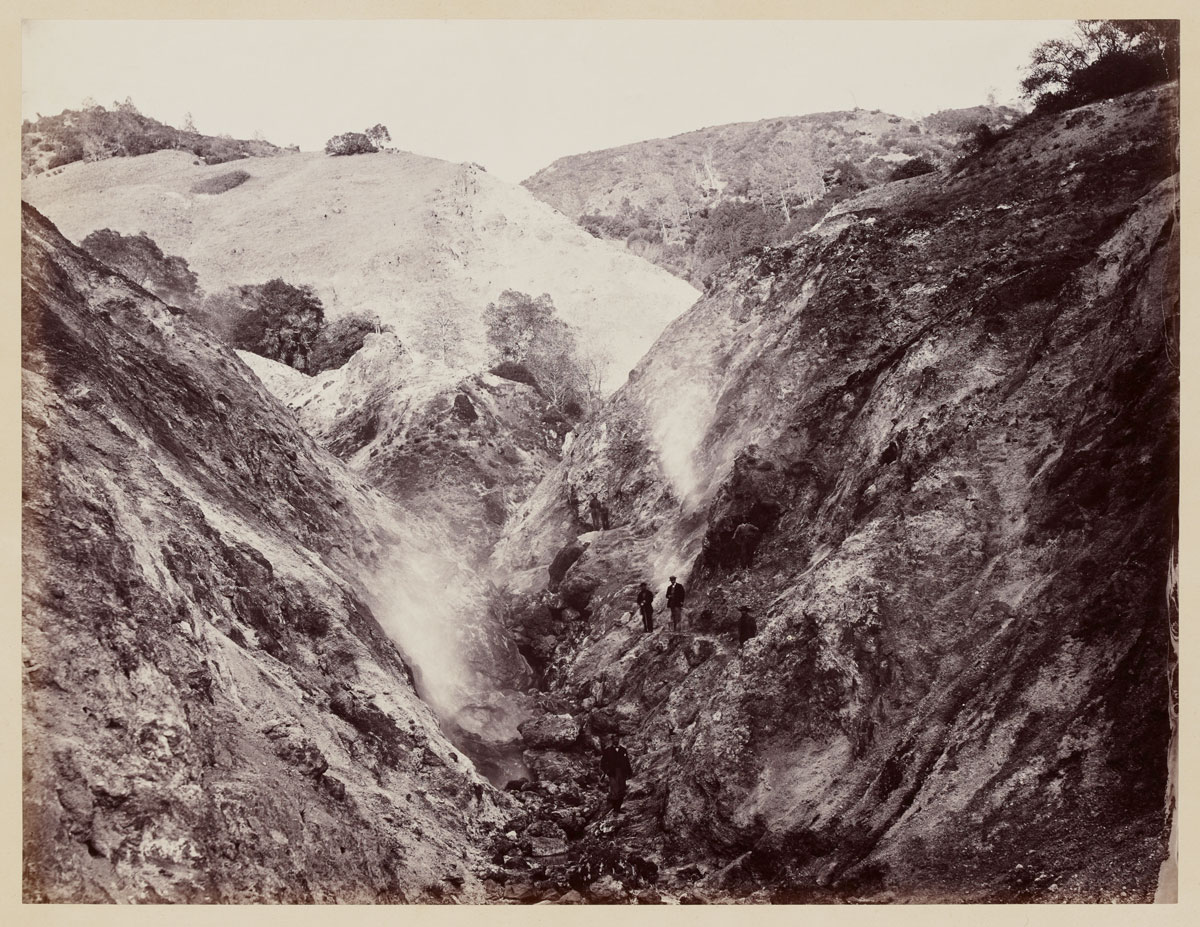


Carleton Watkins (American, 1829-1916) 'Devils' Cañon Geysers, Looking Up' c. 1867


Carleton Watkins (American, 1829-1916)
Devils’ Cañon Geysers, Looking Up
c. 1867
From the album Photographs of the Pacific Coast
Albumen print
Lent by Department of Special Collections, Stanford University Libraries
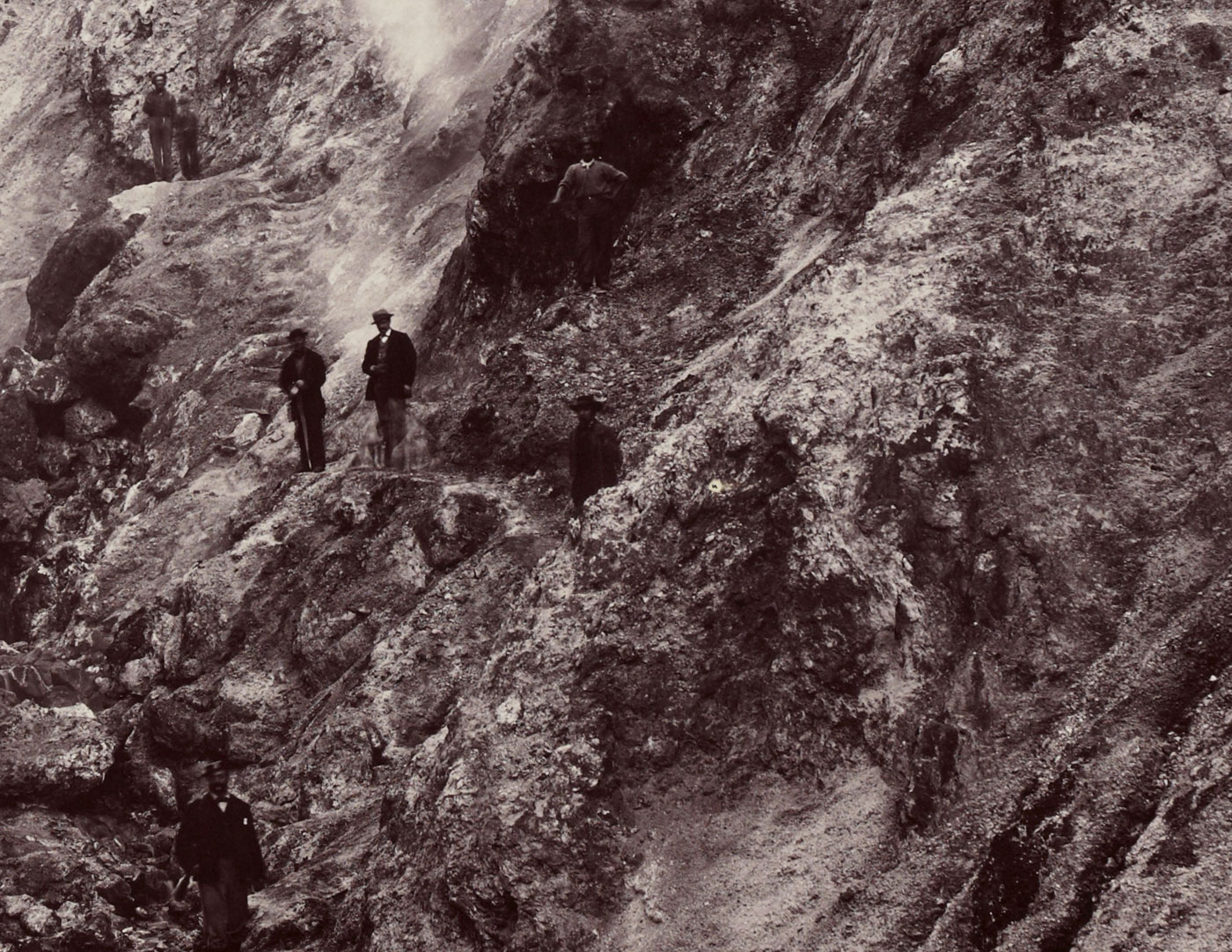
 

Carleton Watkins (American, 1829-1916) 'Devils' Cañon Geysers, Looking Up' (detail) c. 1867


Carleton Watkins (American, 1829-1916)
Devils’ Cañon Geysers, Looking Up (detail)
c. 1867
From the album Photographs of the Pacific Coast
Albumen print
Lent by Department of Special Collections, Stanford University Libraries


Carleton Watkins (American, 1829-1916) 'Alcatraz from North Point' 1862-1863


Carleton Watkins (American, 1829-1916)
Alcatraz from North Point
1862–1863
From the album Photographs of the Pacific Coast
Albumen print
Lent by Department of Special Collections, Stanford University Libraries
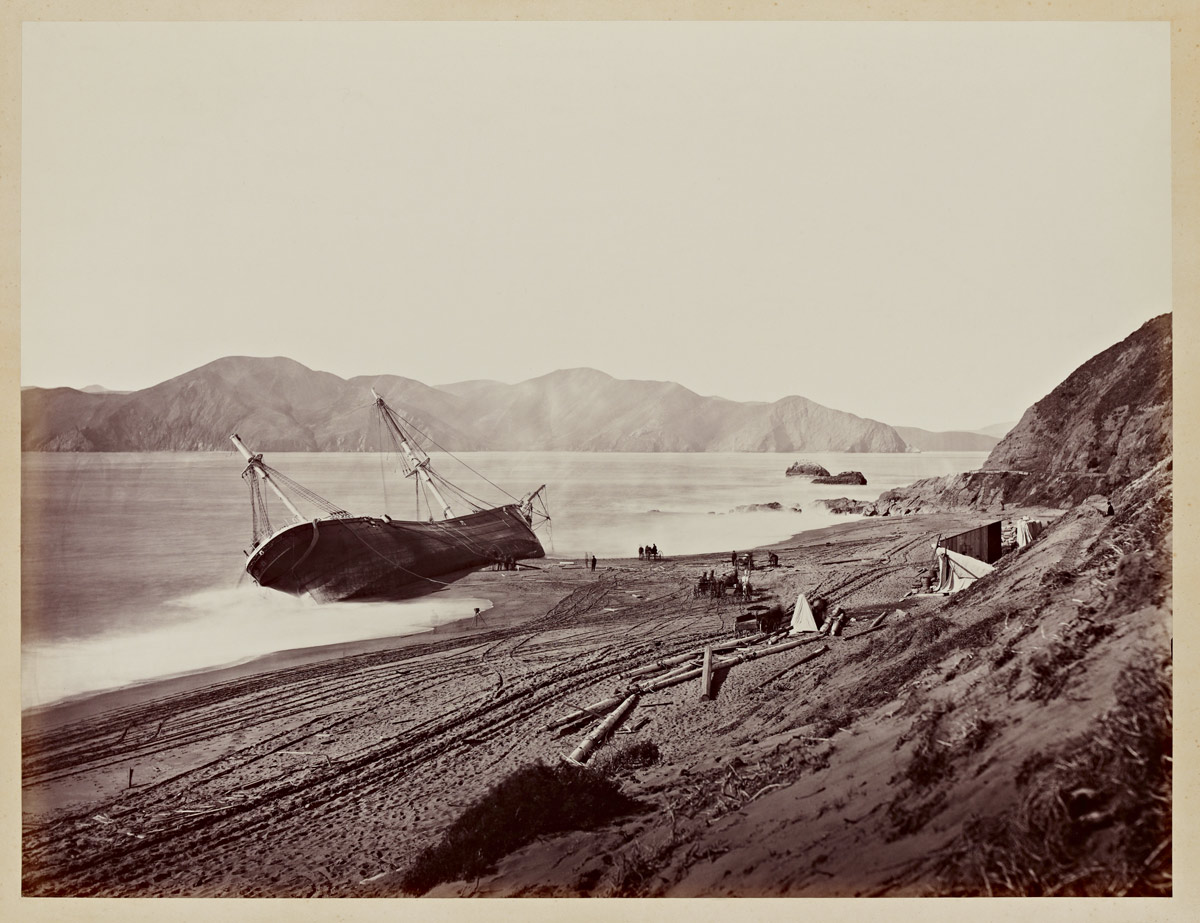
 

Carleton Watkins (American, 1829-1916) 'The Wreck of the Viscata' March 1868


Carleton Watkins (American, 1829-1916)
The Wreck of the Viscata
March 1868
From the album Photographs of the Pacific Coast
Albumen print
Lent by Department of Special Collections, Stanford University Libraries
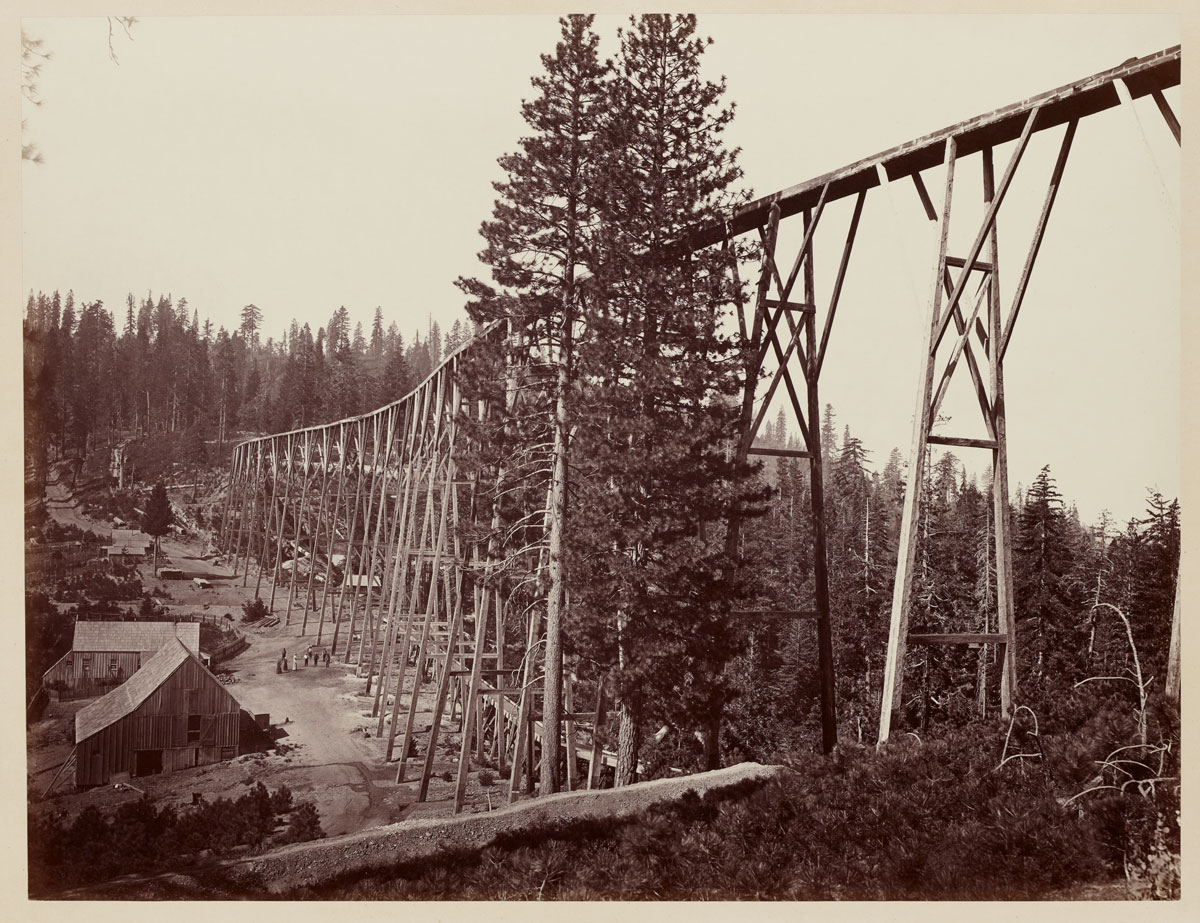
 

Carleton Watkins (American, 1829-1916) 'Magenta Flume Nevada Co. Cal.' c. 1871


Carleton Watkins (American, 1829-1916)
Magenta Flume Nevada Co. Cal.
c. 1871
From the album Photographs of the Pacific Coast
Albumen print
Lent by Department of Special Collections, Stanford University Libraries
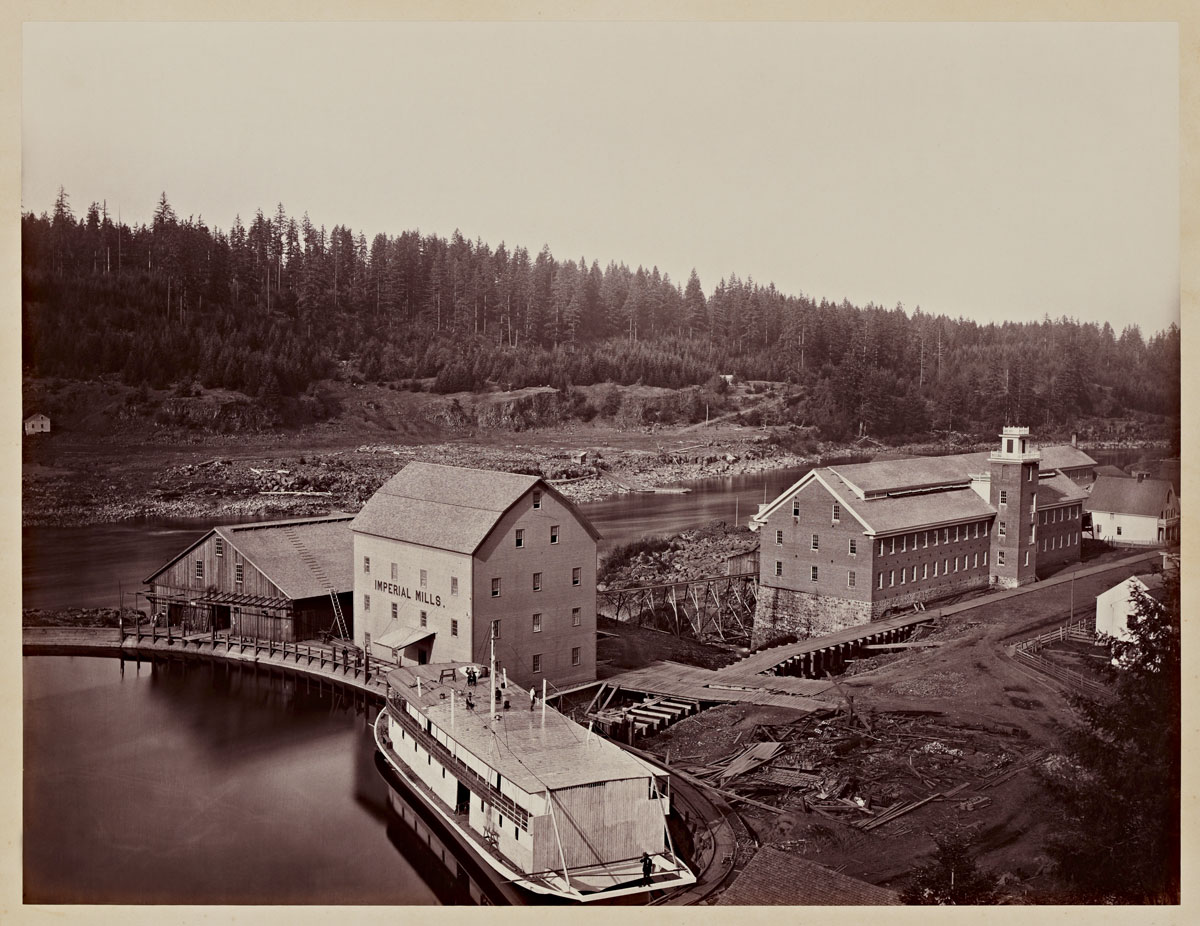
 

Carleton Watkins (American, 1829-1916) 'Flour and Woolen Mills, Oregon City' 1867


Carleton Watkins (American, 1829-1916)
Flour and Woolen Mills, Oregon City
1867
From the album Photographs of the Columbia River and Oregon
Albumen print. Lent by Department of Special Collections, Stanford University Libraries


Carleton Watkins (American, 1829-1916) 'Cape Horn, Columbia River' 1867


Carleton Watkins (American, 1829-1916)
Cape Horn, Columbia River
1867
From the album Photographs of the Columbia River and Oregon
Albumen print
Lent by Department of Special Collections, Stanford University Libraries
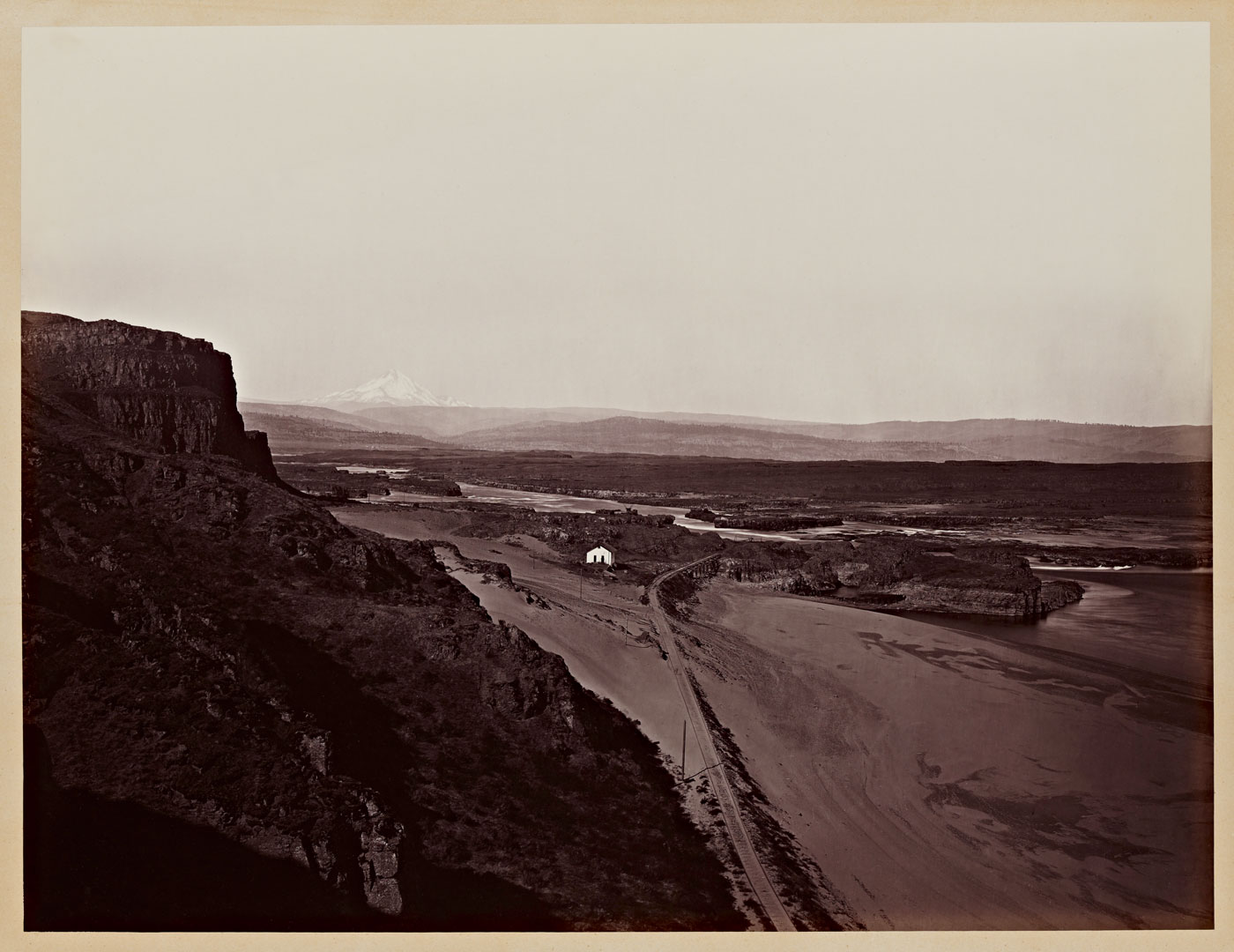
 

Carleton Watkins (American, 1829-1916) 'Mt. Hood and the Dalles, Columbia River' 1867


Carleton Watkins (American, 1829-1916)
Mt. Hood and the Dalles, Columbia River
1867
From the album Photographs of the Columbia River and Oregon
Albumen print
Lent by Department of Special Collections, Stanford University Libraries
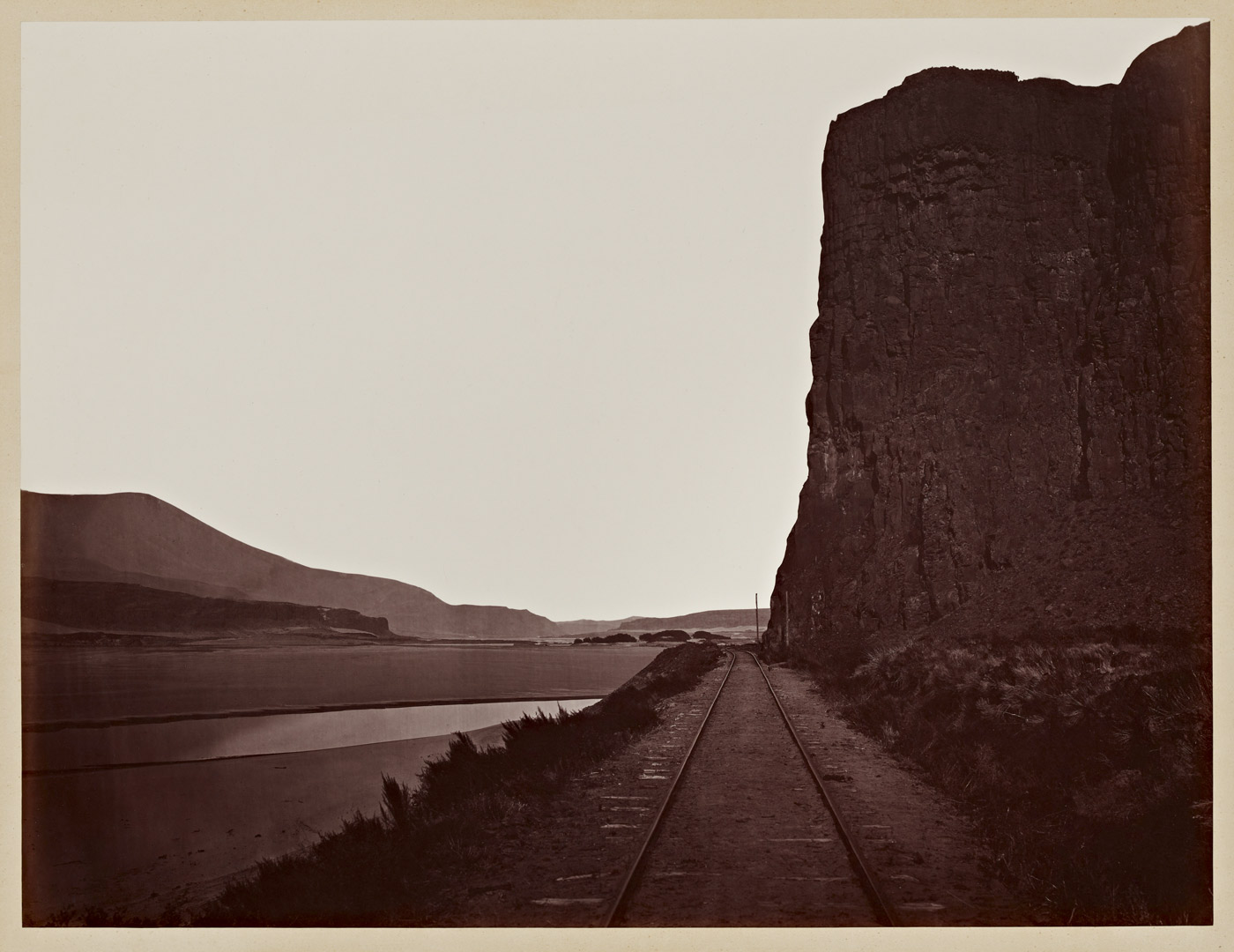
 

Carleton Watkins (American, 1829-1916) 'Cape Horn, near Celilo' 1867


Carleton Watkins (American, 1829-1916)
Cape Horn, near Celilo
1867
From the album Photographs of the Columbia River and Oregon
Albumen print
Lent by Department of Special Collections, Stanford University Libraries


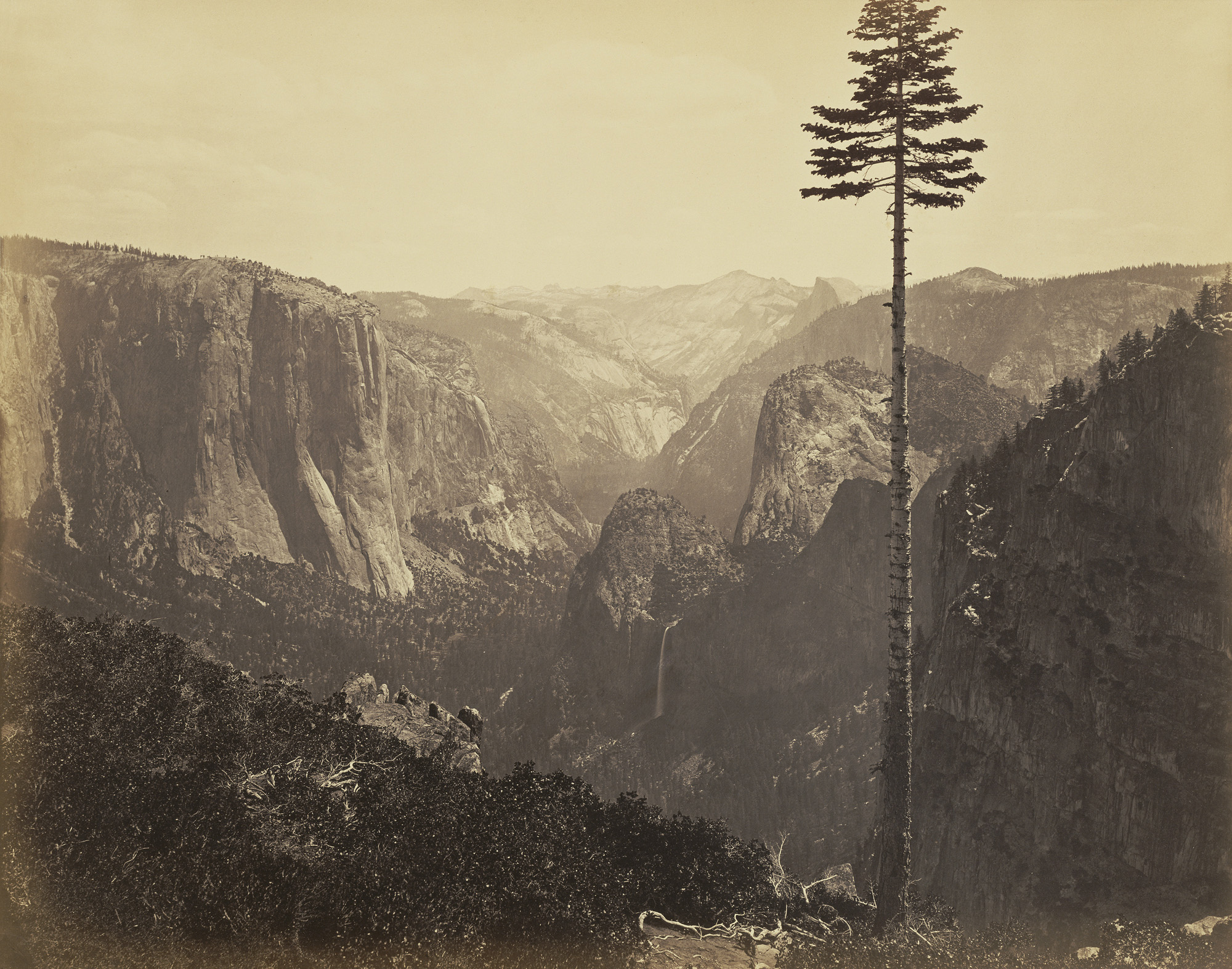
Carleton Watkins (American, 1829-1916) 'The Yosemite Valley from the "Best General View"' 1866


Carleton Watkins (American, 1829-1916)
The Yosemite Valley from the “Best General View”
1866
From the album Photographs of the Yosemite Valley
Albumen print
Lent by Department of Special Collections, Stanford University Libraries
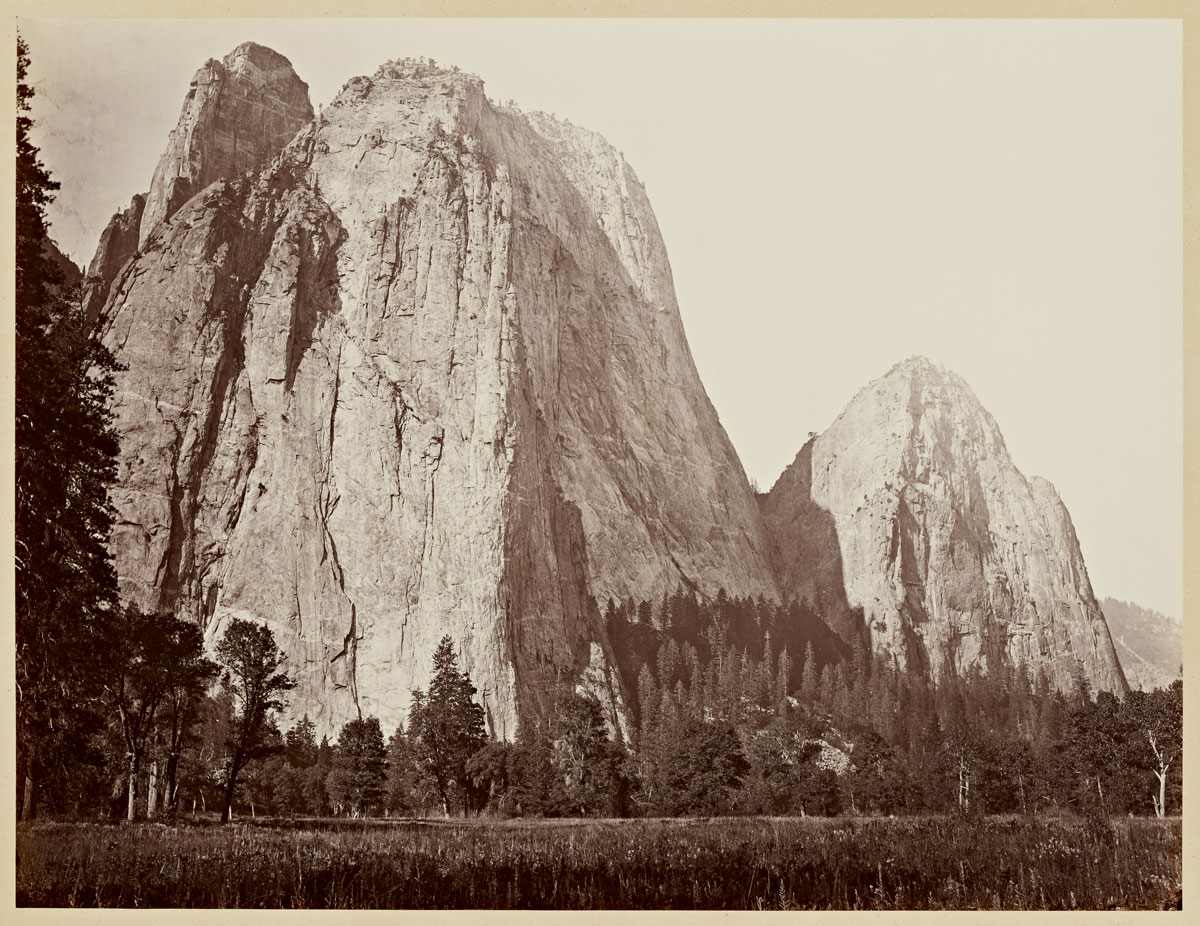
 

Carleton Watkins (American, 1829-1916) 'Cathedral Rocks, 2630 ft., Yosemite' 1865-1866


Carleton Watkins (American, 1829-1916)
Cathedral Rocks, 2630 ft., Yosemite
1865-1866
From the album Photographs of the Yosemite Valley
Albumen print
Lent by Department of Special Collections, Stanford University Libraries
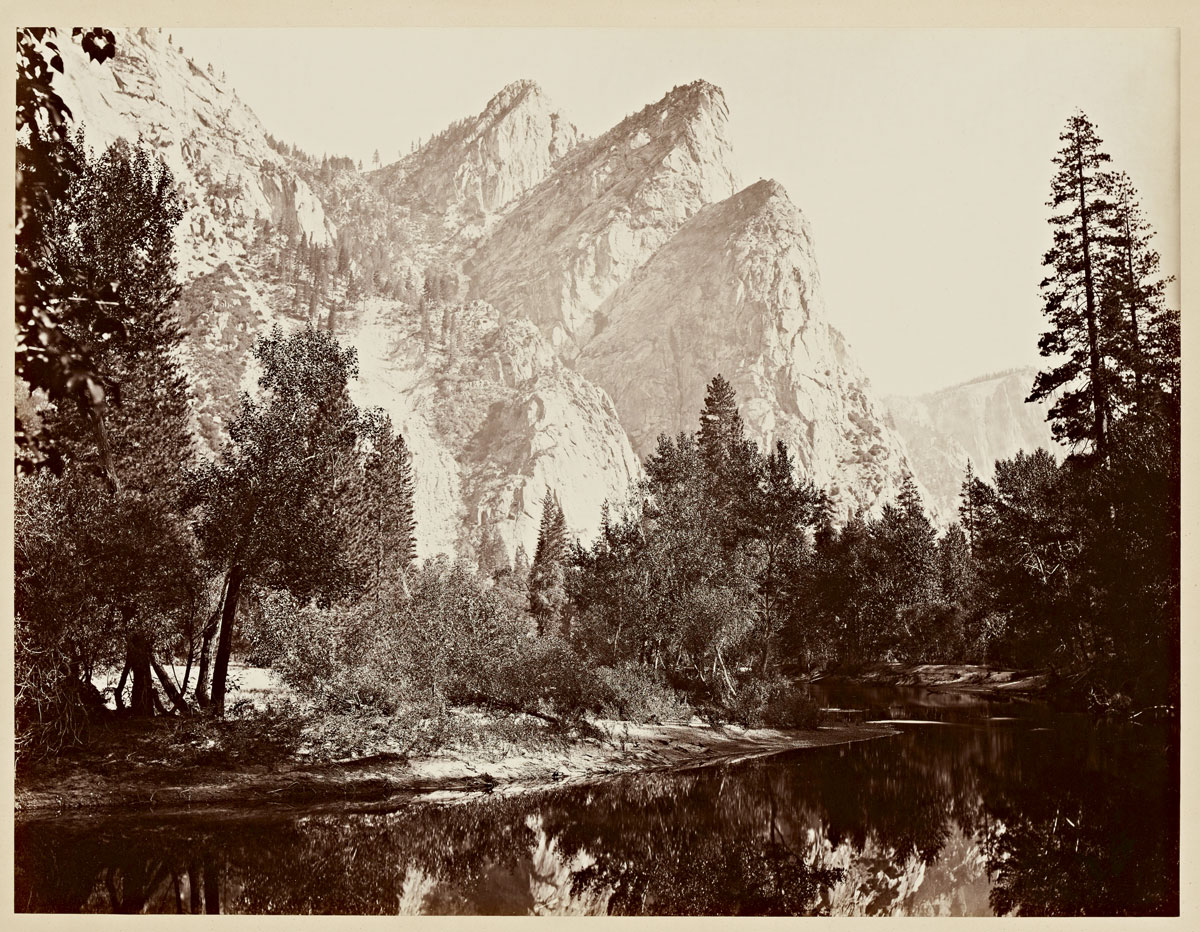
 

Carleton Watkins (American, 1829-1916) 'Pompompasos, the Three Brothers, Yosemite 4480 ft.' 1865-1866


Carleton Watkins (American, 1829-1916)
Pompompasos, the Three Brothers, Yosemite 4480 ft.
1865-1866
From the album Photographs of the Yosemite Valley
Albumen print
Lent by Department of Special Collections, Stanford University Libraries


Carleton Watkins (American, 1829-1916) 'Mirror View of the North Dome, Yosemite' 1865-1866


Carleton Watkins (American, 1829-1916)
Mirror View of the North Dome, Yosemite
1865-1866
From the album Photographs of the Yosemite Valley
Albumen print
Lent by Department of Special Collections, Stanford University Libraries


Born in upstate New York, Carleton Watkins (1829-1916) ventured west in 1849 to strike it rich. But instead of prospecting for gold, Watkins developed a talent for photography – a medium invented only 22 years before. He documented the remote Pacific Coast in the 1860s and 1870s, capturing its vast scale and spirit with a custom-built camera that created “mammoth” 18 x 22-inch glass-plate negatives. In June 1864, his stunning photographs of Yosemite’s valley, waterfalls and peaks proved instrumental in convincing President Abraham Lincoln and the 38th U.S. Congress to pass the Yosemite Valley Grant Act, legislation that preserved the land for public use and set a precedent for America’s National Park System.

As the nation celebrates the 150th Anniversary of the Yosemite Grant, the Cantor Arts Center at Stanford University presents Carleton Watkins: The Stanford Albums, an exhibition featuring more than 80 original mammoth prints from three unique albums of Watkins’s work: Photographs of the Yosemite Valley (1861 and 1865-66), Photographs of the Pacific Coast (1862-76), and Photographs of the Columbia River and Oregon (1867 and 1870). The exhibition will be on view April 23 through August 17, 2014. Also featured will be cartographic visualisations developed in collaboration with Stanford’s Center for Spatial and Textual Analysis and the Bill Lane Center for the American West, which provide dynamic context for the geography and natural history of Watkins’s photographs. A fully illustrated publication will accompany the exhibition.

“The Cantor is thrilled to be leading such an innovative, interdisciplinary effort to look at Watkins’s work anew,” says Connie Wolf, the Cantor’s John & Jill Freidenrich Director. “These extraordinary albums from Stanford University Libraries’ singular collection provide us with an unparalleled opportunity to examine Watkins’s place in the history of photography, and to more fully understand the critical role photography played in the preservation, promotion, and development of the West. It is fascinating to note that Watkins and Leland Stanford were contemporaries. Watkins even photographed Stanford’s family, making this university a proud and apt home for these albums.”

The Albums

Photographs of the Yosemite Valley (1861 and 1865-1866)

In 1861, Watkins loaded up a team of mules with nearly a ton of photographic equipment including a mobile darkroom tent, a dangerous assortment of flammable chemicals, and an enormous custom-built camera that produced “mammoth” 18 x 22-inch glass-plate negatives. He headed 75 miles into the rugged and remote Yosemite Valley on a sometimes perilous journey to capture the natural wonders of the Sierra Nevada. The technical challenges of creating wet-plate negatives in the field were immense. Dust and grit could easily ruin the work as the plates were coated, exposed for up to an hour, and developed. Water had to be carried great distances. The sun warped and shrank camera parts. But the resulting suite of photographs became an international sensation – not only because they provided virtual access to one of America’s grandest wilderness areas but also for their extraordinary beauty. The New York Times declared in 1862 that “as specimens of the photographic art they are unequaled.”

Watkins’s album Photographs of the Yosemite Valley is sequenced to replicate the experience of entering the Mariposa Grove trail and traveling into the valley. From Cathedral Rocks to Half Dome, Watkins captures the quiet majesty of Yosemite’s natural monuments. The album contains images from both his initial expedition in 1861 and a subsequent visit as an ad hoc member of the California State Geological Survey team in 1865-66. Throughout his career, Watkins maintained close relationships with geologists as well as botanists who were deeply interested in his documentation of native tree species.

In Yosemite, Watkins found a spectacular natural laboratory for testing and refining his approach to landscape photography. His compositional choices were unique. In The Yosemite Valley from the “Best General View” (1866), for instance, Watkins cropped off the top of the lone tree in the foreground instead of framing it, lending a painterly quality to the image. By manipulating focus and perspective, Watkins also achieved an unusual balance of crispness against softer tonalities.

Watkins’s technical achievements under adverse conditions were unmatched and astonished his peers. The resolution of his photographs still rivals that of the high-end digital cameras of today. After 1861, capitalising on the success of his Yosemite pictures and his reputation as a landscape photographer, Watkins renamed his studio at 425 Montgomery Street in San Francisco the “Yo-Semite Gallery.” The exhibition features more than 30 photographs from the album Photographs of the Yosemite Valley including various views of Yosemite Valley; mountains and rock formations such as Cathedral Rocks, Half Dome, and El Capitan; waterfalls and water views such as Mirror Lake and Yosemite Falls; and photographs of Yosemite’s majestic trees.

Photographs of the Pacific Coast (1862-1876)

Watkins made his living mostly as a field photographer for hire, accepting commissions from logging companies and mining operations up and down the coast. Early in his career, Watkins’s photographs were often used to attract investors or as documentation in court evidence for land disputes. In the fast-developing West, photography was a means of establishing ‘truth claims’ to property and resource rights. And in a region where vast swaths of territory were rarely traveled by city dwellers, photography filled in the gaps.

Watkins added images from these underwritten trips to an album he called Photographs of the Pacific Coast. Along with his commercial photographs of smelting works at the New Almaden Mine in Santa Clara County and the hydraulic North Bloomfield mine in Nevada County, the album contains remarkable vistas of San Francisco including a dramatic photograph of the shipwreck Viscata on Ocean Beach, also images of the Devil’s Canyon geysers in Sonoma County and the Farallon Islands.

The album also includes images commissioned by California’s sixth governor, Milton Slocum Latham, of Latham’s mansion on San Francisco’s Rincon Hill. It was, in fact, Latham’s wife, Mollie, who commissioned the three albums now at Stanford. One of the original bindings is on display so visitors can appreciate its massive size and ornate details. With the Civil War raging in the eastern part of the country until 1865, Watkins’s images of the pristine Pacific Coast must have provided Americans a welcome alternative to the images of carnage issuing from the battlefield.

In the exhibition, there are more than 20 California photographs from the album Photographs of the Pacific Coast including scenes of San Francisco neighbourhoods, homes, and natural sites including the Farallon Islands; commissioned images of mining operations; and views of Mt. Shasta, Mendocino County, and Sonoma County.

Photographs of the Columbia River and Oregon (1867 and 1870)

While Watkins’s name is most closely associated with Yosemite, photographers often cite Watkins’s album Photographs of the Columbia River and Oregon as his crowning artistic achievement. No longer a novice, Watkins demonstrates mastery of his craft and a keen eye for composition in these images. A friend at the Oregon Steam Navigation Company arranged for Watkins to travel by rail up and down the Columbia River to photograph the company’s rail portages and scenic beauty to document the company’s progress. Watkins was the first to photograph this area and traveled for four months to do so.

In the resulting views of Portland, Oregon City, rail portages, river industry, and scenery, Watkins made art of the river landscapes and the railroad laid alongside it. Cape Horn, Near Celilo (1867), taken at the final point of his journey where the tracks ended, shows a stark horizon, suggesting both the far edge of the world and the determination of early industrial pioneers. In Mt. Hood and the Dalles, Columbia River (1867), a spectacular view of Mt. Hood and of the meandering river at the base of basalt cliffs is disrupted by the object of greatest focus – a tiny white outbuilding for the railroad.

The exhibition features more than 15 photographs from the album Photographs of the Columbia River and Oregon including views along the Columbia River of Cape Horn, Castle Rock and Mt. Hood; and images of Portland, Oregon City, and smaller towns and industries along the railroad.

Exploring Watkins’s Photographs with Digital Technology

Stanford’s Center for Spatial and Textual Analysis, the Bill Lane Center for the American West, the Branner Earth Sciences Library, and the Cantor worked together to create an innovative cartographic digital accompaniment for each album.

For Photographs of Yosemite Valley, the team – including select students – generated “viewsheds” of several of Watkins’s photographs that enable visitors to see where each was likely taken and what topographical elements are either illuminated or obscured in them. With Photographs of the Pacific Coast, fascinating before-and-after visualisations illustrate the incredible changes in the landscape of San Francisco over the last century and a half. Lastly, a cartographic accompaniment to Photographs of the Columbia River and Oregon details the early railroad routes Watkins traveled to take his photographs.

Carleton Eugene Watkins (1829-1916)

Born in upstate New York in 1829, Watkins ventured west to look for opportunities and settled in the Bay Area in 1852. While working for a photography studio, he was asked to step in for a photographer who had unexpectedly quit. Watkins quickly learned the daguerreotype process and within two years he was making ambrotypes and wet-plate collodion photographs.

Throughout his career, Watkins documented the remote American West, generating more than 7,000 photographs of its most majestic wilderness sites as well as the dramatic transformation of isolated territories caused by logging and mining industries. His photographs won awards throughout the United States and abroad. With his early success, he established a gallery in San Francisco on prestigious Montgomery Street in 1861.

But Watkins’s fortunes took a turn with the 1874 failure of the Bank of California and the resulting economic panic. Heavily in debt at the time, Watkins had to declare bankruptcy and lost both the gallery and the majority of his negatives to a competitor. Watkins rebuilt his inventory, continuing to travel and work into the 1890s, but never recovered financially. At one point he and his family lived in a rail car in Oakland. Watkins’s health also declined, and by 1903 he was nearly blind. Watkins died tragically. The 1906 earthquake and fire destroyed his studio and his life’s work, and he never got over the shock. His family eventually had him committed to Napa State Hospital. He died there in 1916.

Press release from the Cantor Arts Center website
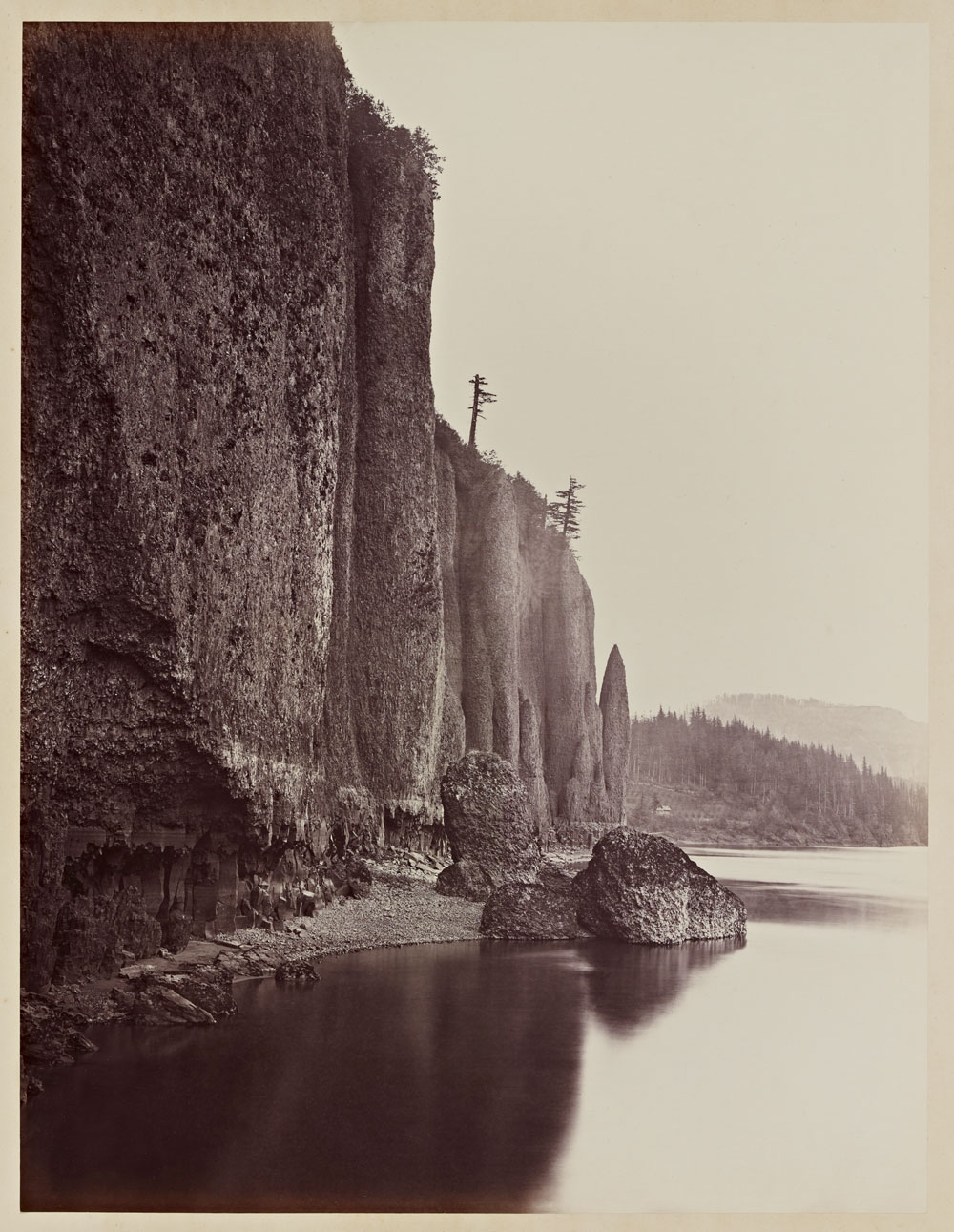
 

Carleton Watkins (American, 1829-1916) 'Cape Horn, Columbia River' 1867


Carleton Watkins (American, 1829-1916)
Cape Horn, Columbia River
1867
From the album Photographs of the Columbia River and Oregon
Albumen print
Lent by Department of Special Collections, Stanford University Libraries
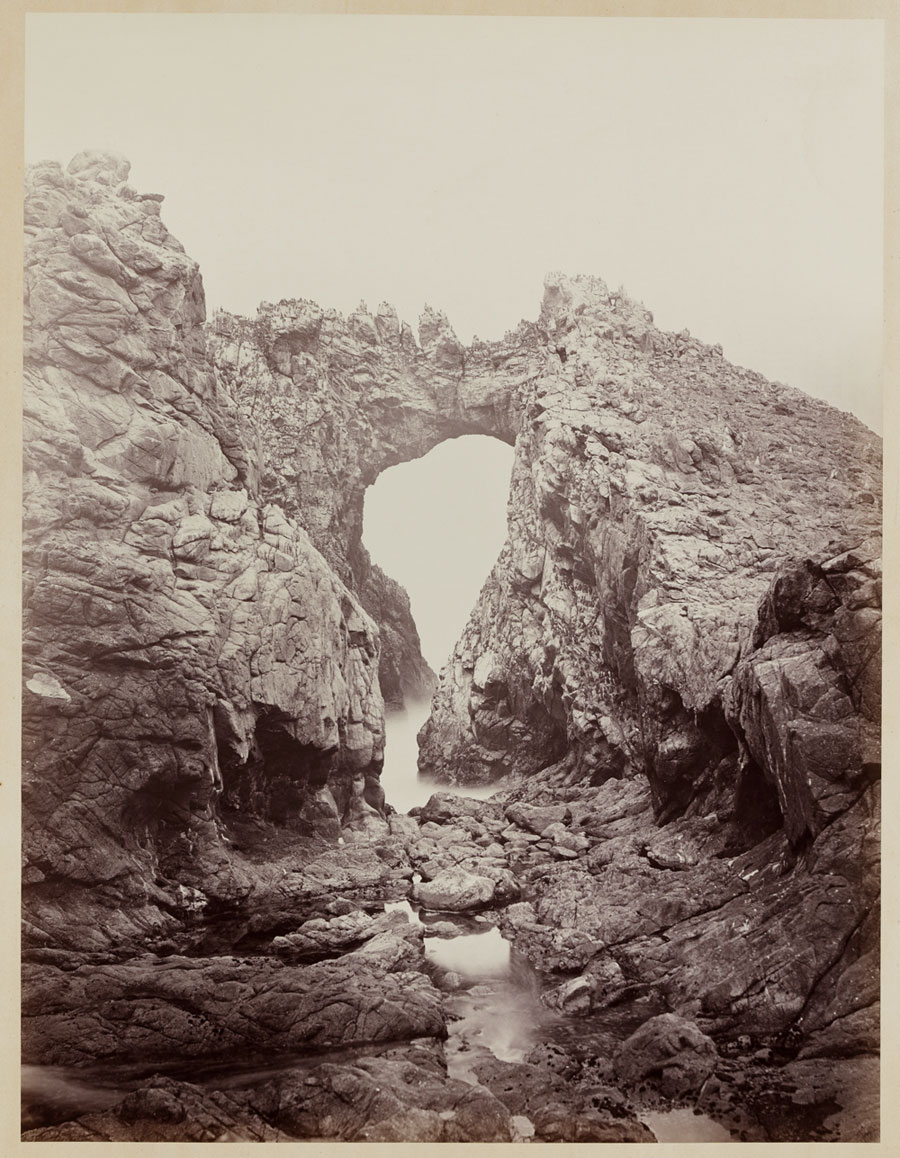
 

Carleton Watkins (American, 1829-1916) 'Arch at the West End, Farallones' 1868-1869


Carleton Watkins (American, 1829-1916)
Arch at the West End, Farallones
1868-1869
From the album Photographs of the Pacific Coast
Albumen print
Lent by Department of Special Collections, Stanford University Libraries
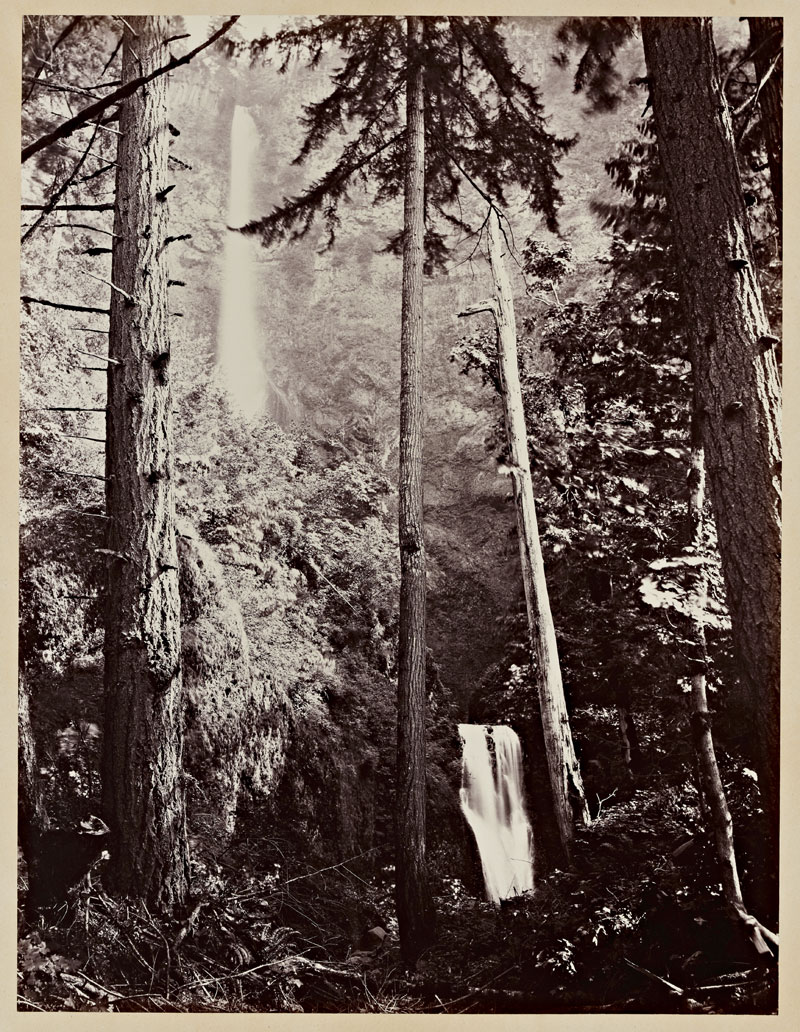
 

Carleton Watkins (American, 1829-1916) 'Multnomah Falls, Columbia River, Oregon' 1867


Carleton Watkins (American, 1829-1916)
Multnomah Falls, Columbia River, Oregon
1867
From the album Photographs of the Columbia River and Oregon
Albumen print
Lent by Department of Special Collections, Stanford University Libraries
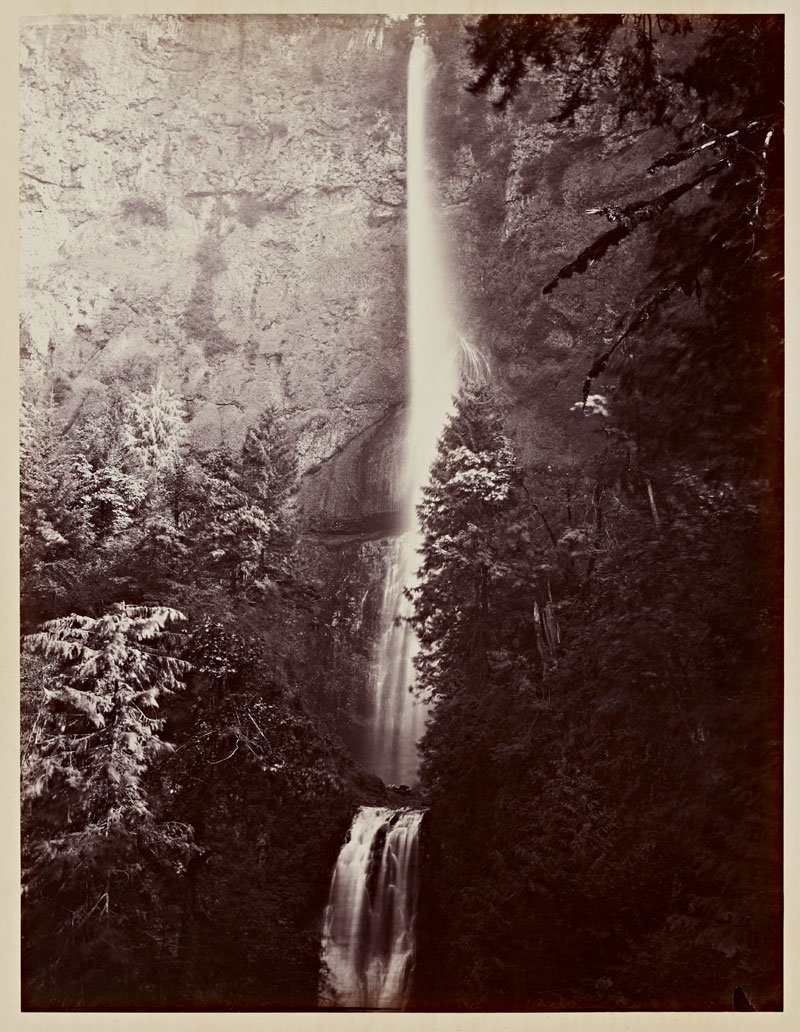
 

Carleton Watkins (American, 1829-1916) 'Multnomah Falls, Cascades, Columbia River' 1867


Carleton Watkins (American, 1829-1916)
Multnomah Falls, Cascades, Columbia River
1867
From the album Photographs of the Columbia River and Oregon
Albumen print
Lent by Department of Special Collections, Stanford University Libraries
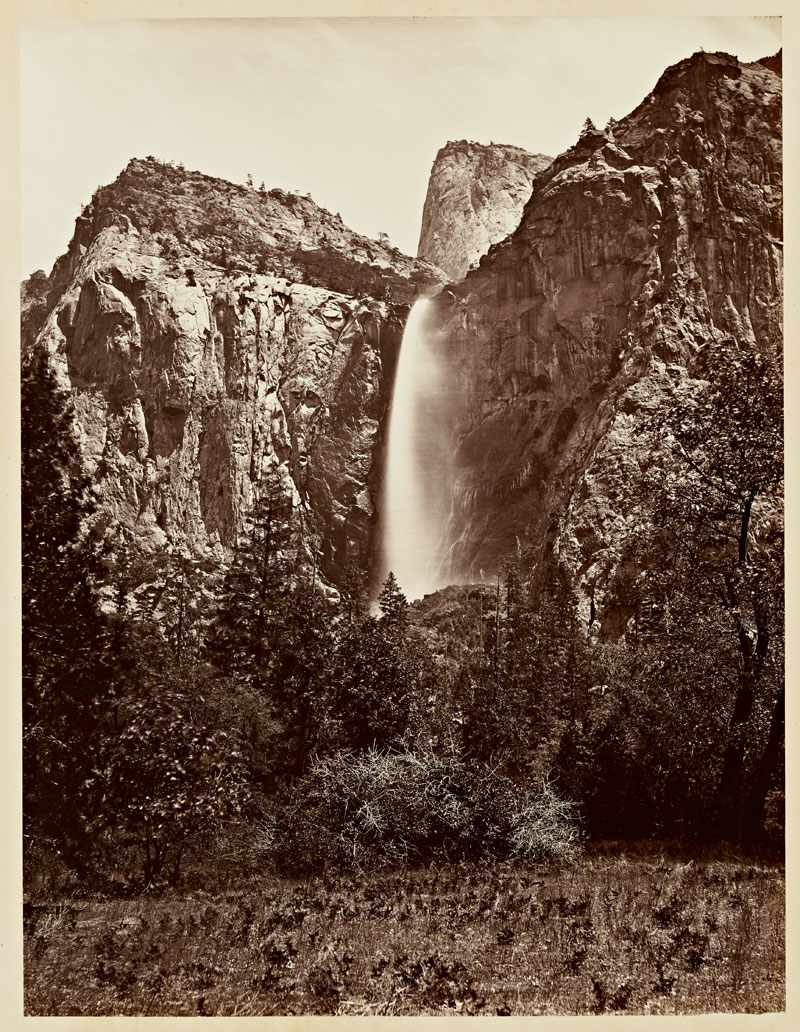
 

Carleton Watkins (American, 1829-1916) 'Pohono, the Bridal Veil, Yosemite 900 ft.' 1865-1866


Carleton Watkins (American, 1829-1916)
Pohono, the Bridal Veil, Yosemite 900 ft.
1865-1866
From the album Photographs of the Yosemite Valley
Albumen print
Lent by Department of Special Collections, Stanford University Libraries


Carleton Watkins (American, 1829-1916) 'The Lower Yosemite Fall, Yosemite' 1865-1866


Carleton Watkins (American, 1829-1916)
The Lower Yosemite Fall, Yosemite
1865-1866
From the album Photographs of the Yosemite Valley
Albumen print
Lent by Department of Special Collections, Stanford University Libraries


Carleton Watkins (American, 1829-1916) 'The Yosemite Falls, 2634 ft.' 1865-1866


Carleton Watkins (American, 1829-1916)
The Yosemite Falls, 2634 ft.
1865-1866
From the album Photographs of the Yosemite Valley
Albumen print. Lent by Department of Special Collections, Stanford University Libraries


Carleton Watkins (American, 1829-1916) 'Mirror View of El Capitan, Yosemite' 1865-1866


Carleton Watkins (American, 1829-1916)
Mirror View of El Capitan, Yosemite
1865-1866
From the album Photographs of the Yosemite Valley
Albumen print
Lent by Department of Special Collections, Stanford University Libraries
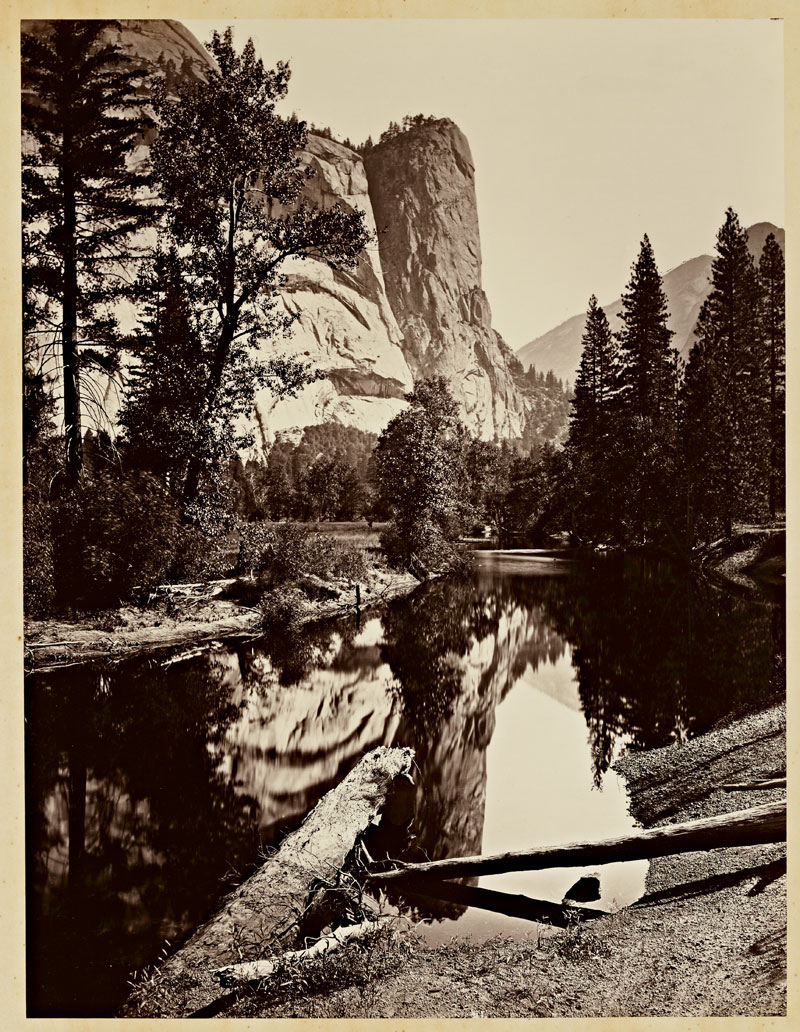
 

Carleton Watkins (American, 1829-1916) 'Washington Column, 2082 ft., Yosemite' 1865-1866


Carleton Watkins (American, 1829-1916)
Washington Column, 2082 ft., Yosemite
1865-1866
From the album Photographs of the Yosemite Valley
Albumen print
Lent by Department of Special Collections, Stanford University Libraries


Carleton Watkins (American, 1829-1916) 'The Ponderosa, Yosemite' 1866


Carleton Watkins (American, 1829-1916)
The Ponderosa, Yosemite
1866
From the album Photographs of the Yosemite Valley
Albumen print
Lent by Department of Special Collections, Stanford University Libraries
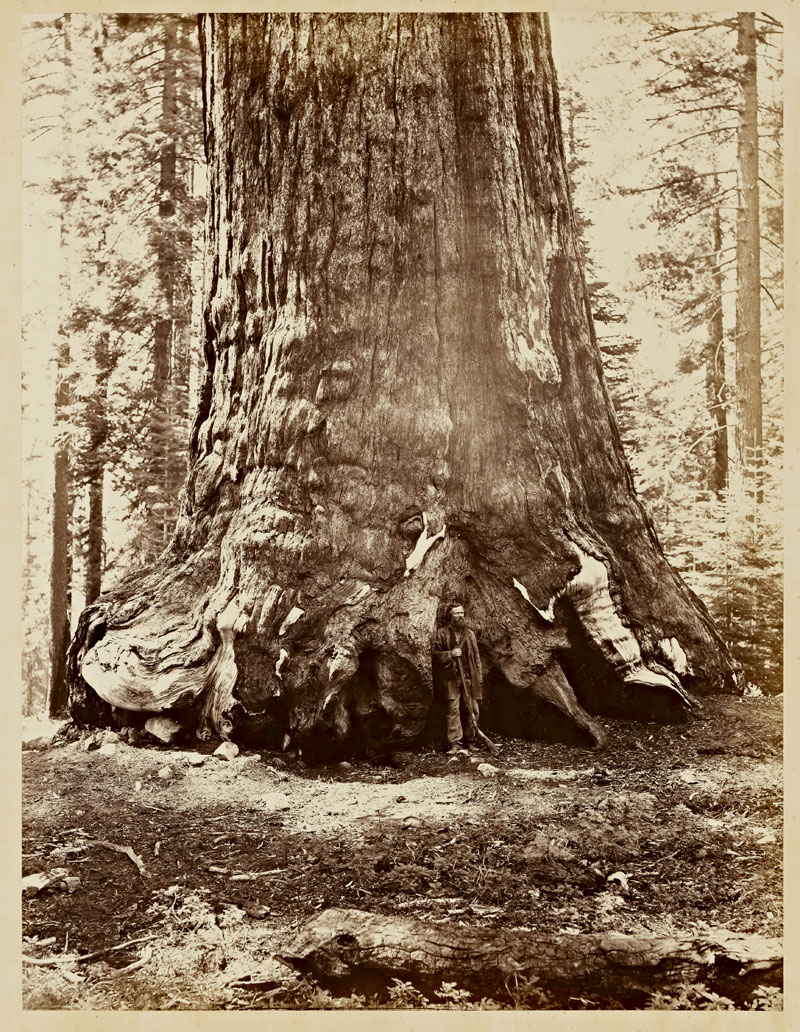
 

Carleton Watkins (American, 1829-1916) 'Section of the Grizzly Giant, 33 ft. diameter' 1865-1866


Carleton Watkins (American, 1829-1916)
Section of the Grizzly Giant, 33 ft. diameter
1865-1866
From the album Photographs of the Yosemite Valley
Albumen print. Lent by Department of Special Collections, Stanford University Libraries


Cantor Arts Center at Stanford University
328 Lomita Drive at Museum Way
Stanford, CA 94305-5060
Phone: 650-723-4177

Opening hours:
Wednesday – Sunday 11am – 5pm
Closed Monday and Tuesday

Cantor Arts Center at Stanford University website

LIKE ART BLART ON FACEBOOK

Back to top

Exhibition: ‘Dialogue among Giants: Carleton Watkins and the Rise of Photography in California’ at the J. Paul Getty Museum, Los Angeles

Exhibition dates: 14th October, 2008 – 1st March, 2009


Unknown maker, American, Attributed to Carleton Watkins (American, 1829-1916) 'The Plaza, Lima, Peru' About 1852 from the exhibition 'Dialogue among Giants: Carleton Watkins and the Rise of Photography in California' at the J. Paul Getty Museum, Los Angeles, Oct 2008 - March 2009


Unknown maker, American, Attributed to Carleton Watkins (American, 1829-1916)
The Plaza, Lima, Peru
About 1852
Daguerreotype
Plate: 10.8 × 14cm (4 1/4 × 5 1/2 in.)
J. Paul Getty Museum Collection


Watkins could have made this study of the Lima Cathedral on his return to California from New York via South America in 1852.


Carleton Watkins was a master photographer, craftsman, technician and, above all, a refined artist. The structural cadences of his compositions, like the best music, are superb. Within his photographs he creates a visual dialogue that sustains pertinent inquiry by the viewer – the look! see! – that has lasted centuries, as all great art does. Today his photographs are as clearly seen, as incisive of mind, as when they were first produced. They delight.

From the documentary photographs of mining settlements to the images of Yosemite; from the stereographs of cities to the gardens of the rich and famous; from the photographs of untouched interior America to the images of the Monterey Peninsula Watkins photographs are sharply observed renditions of a reality placed before the lens of his giant plate camera.

Like all great artists his eye is unique. His use angle, height and placement of the camera is reinforced by his understanding of the balance of light and shade, the construction of planes within the image and the spatial relationships that could be achieved within the frame (at the same time we note that the artist Cezanne was also investigating the deconstruction of traditional landscape perspectives within the image frame). His work reminds me of the photographs of the great French photographer Eugene Atget: both men understood how best to place the camera to achieve the outcome they wanted so that the photographs became imprinted with their signature, images that nobody else could have taken. Today we recognise both men as masters of photography for this very fact. The images they took raise them above the rank and file photographer because of the care and understanding they took in the decisions they made in the exposure of the negative.

As a precursor to modernism in photography Watkins does not have peer at this time. His photographs preempt the 20th century modernist work of Paul Strand and Alfred Stieglitz, his Monterey and Yosemite photographs the work of Edward Weston and Ansel Adams, and in his Japanese influences the work of Minor White. Even today at the exhibition by Andreas Gursky at the National Gallery of Victoria, Melbourne there is a colour work of a body of water (see below: Rhein 1996) that closely reflects the structure of Watkins View on the Calloway Canal, near Poso Creek, Kern County 1887, even though the subject matter of Gursky’s image is a simulacra of an implied reality, whereas Watkins work “served as evidence in a water rights lawsuit that eventually resulted in a decisive court ruling that prevented newcomers from diverting water from existing landowners.”1

Watkins cadence as a sentient being will endure in the choices he made in the photographs he exposed. His tempo, his innate ability to place the camera, his understanding of the light and shade, texture, environment, depth of field and feeling make this artist one that all aspiring artists – no, all human beings – should study.

Dr Marcus Bunyan


1/ For more information about this image please see the J. Paul Getty Museum web page.


    Many thankx to the J. Paul Getty Museum for allowing me to publish the photographs in the posting. Please click on the photographs for a larger version of the image.


    Carleton Watkins (American, 1829-1916) (attributed) 'Placer Mining Scene' c. 1852-1855 from the exhibition 'Dialogue among Giants: Carleton Watkins and the Rise of Photography in California' at the J. Paul Getty Museum, Los Angeles, Oct 2008 - March 2009


    Carleton Watkins (American, 1829-1916) (attributed)
    Placer Mining Scene
    c. 1852-1855
    Half-plate daguerreotype
    4 x 5 in. (10.2 x 12.7cm)
    J. Paul Getty Museum Collection


    Watkins was persistently interested in the technical details of mining operations. Here a primitive Spanish ore mill is used to pulverise gold-bearing rock. Throughout his career Watkins earned income producing photographs that were used as sources for engraved illustrations, as this one was.

    Text from the J. Paul Getty Museum website


    Unknown maker, American, Attributed to Carleton Watkins (American, 1829-1916) 'Engineering Camp, Copiapo, Chile' about 1852-1855


    Unknown maker, American, Attributed to Carleton Watkins (American, 1829-1916)
    Engineering Camp, Copiapo, Chile
    About 1852-1855
    Daguerreotype
    Plate: 10.8 × 14cm (4 1/4 × 5 1/2 in.)
    J. Paul Getty Museum Collection


    In 1852 Watkins went to New York, then returned to California the following spring aboard the SS Michael Angelo, which was loaded with tons of supplies destined for mining camps on the Pacific Coast of the Americas. The vessel proceeded to the port of Caldera, Chile, where goods destined for the mines at Copiapó were unloaded. Miners and their various forms of shelter, such as the tent shown here in the landscape, were among Watkins’s favourite subjects.

    Text from the J. Paul Getty Museum website


    Carleton Watkins (American, 1829-1916), Robert H. Vance (American, 1825-1876) 'Street Scene in La Rancheria, California' 1853-1855


    Carleton Watkins (American, 1829-1916), Robert H. Vance (American, 1825-1876)
    Street Scene in La Rancheria, California
    1853-1855
    Daguerreotype, hand-coloured
    8.3 × 11.4cm (3 1/4 × 4 1/2 in.)
    J. Paul Getty Museum Collection


    The mining camp of La Rancherie was located near the fabled Sutter’s Mill in California, where gold was discovered in 1849. In the volatile gold-rush environment of prospectors, get-rich-quick dreams, and fly-by-night towns, an assembly of men in the foreground stood for the camera to immortalise their roles in the historical moment. La Rancherie stood out for its stability: it could boast a few buildings made of clapboard and some that were even painted. The illustrated hotel sign at upper left indicates a clientele that was not entirely literate and might rely on pictures to identify potential lodgings.

    Text from the J. Paul Getty Museum website


    Carleton Watkins (American, 1829-1916) '[Section Grizzly Giant, Mariposa Grove]' 1861


    Carleton Watkins (American, 1829-1916)
    [Section Grizzly Giant, Mariposa Grove]
    1861
    Albumen silver print
    43.2 × 52.1cm (17 × 20 1/2 in.)
    J. Paul Getty Museum Collection


    Galen Clark, the figure in this photograph, was designated as the guardian of the Mariposa Grove of giant sequoia about the time Abraham Lincoln ceded it to California in 1864. When this picture was made, Clark lived in a cabin (not pictured) nearby and maintained a rustic way station for visitors traveling to Yosemite Valley via the Mariposa Trail, which was developed in 1859.

    Text from the J. Paul Getty Museum website


    Carleton Watkins (American, 1829-1916) 'Yosemite Valley from the Best General View No.2.' 1866


    Carleton Watkins (American, 1829-1916)
    Yosemite Valley from the Best General View No.2
    1866
    Albumen silver print
    41 x 52.2cm (16 1/8 x 20 9/16 in.)
    J. Paul Getty Museum Collection


    Carleton Watkins had the ability to photograph a subject from the viewpoint that allowed the most information to be revealed about its contents. In this image, he captured what he considered the best features of Yosemite Valley: Bridalveil Falls, Cathedral Rock, Half Dome, and El Capitan. By positioning the camera so that the base of the slender tree appears to grow from the bottom edge of the picture, Watkins composed the photograph so that the canyon rim and the open space beyond it seem to intersect. Although he sacrificed the top of the tree, he was able to place the miniaturised Yosemite Falls at the visual centre of the picture. To alleviate the monotony of an empty sky, he added the clouds from a second negative. This image was taken while Watkins was working for the California Geological Survey. His two thousand pounds of equipment for the expedition, which included enough glass for over a hundred negatives, required a train of six mules.

    Text from the J. Paul Getty Museum website


    Carleton Watkins (American, 1829-1916) 'Further Up the Valley. The Three Brothers, the highest, 3,830 ft.' 1866


    Carleton Watkins (American, 1829-1916)
    Further Up the Valley. The Three Brothers, the highest, 3,830 ft.
    1866
    Albumen silver print
    39.2 × 53.5cm (15 7/16 × 21 1/16 in.)
    J. Paul Getty Museum Collection


    In 1850, at the age of 20, Carleton Watkins is believed to have arrived in California from New York via South America. He embarked on a life in photography that began auspiciously during the gold rush (which started in 1849) and ended abruptly with the 1906 San Francisco earthquake and fire that destroyed his negatives. In between those historic moments, Watkins witnessed an era in which a recurring theme was the enormity of all things in the West. He photographed the expansive western landscape with its miles of coastline, vast natural resources, colossal trees, and the monoliths of the Yosemite Valley using an oversize mammoth-plate camera.

    In the 1860s Watkins’s Yosemite photographs brought him fame from as far away as Paris, but a decade later he experienced a painful financial reversal. In the end, he died a pauper in 1916 after a life that brought him into dialogue with the many “giants” of his era. The photographs he left behind provide a unique personal vision of the birth and growth of California.

    Mining Scenes and Daguerreotypes

    After arriving in Sacramento in 1850, Watkins worked delivering supplies to the mines during the gold rush. As he traveled throughout the region, he applied his new photography skills by making daguerreotypes (an early photographic technique using silver-coated, polished copper plates). In 1852, he is believed to have taken up photography full time, making daguerreotypes as a freelance “outdoor man” for established studios in Sacramento, Marysville, and San Francisco.

    Among the most important photographs created in California before about 1855 are more than 100 daguerreotypes of buildings and landscapes, the majority of which have not been attributed. Many represent the San Francisco Bay Area and the mother lode regions northeast of Sacramento, where Watkins lived from 1850 to 1853 – a fact that geographically positions him in the right place at the right time to have been their maker. This exhibition compares select daguerreotypes by unknown makers with securely identified photographs by Watkins. On the basis of style and other circumstantial evidence, it is possible that Watkins may have made many of the daguerreotypes.

    Yosemite

    Watkins first visited Yosemite Valley in the late 1850s and then returned to Yosemite several times in the 1860s and 1870s with a new mammoth-plate camera designed to expose collodion-on-glass negatives that were 18-by-22 inches in size. With this equipment, he created the pictures that soon brought him international fame.

    Watkins was not the only photographer who made images of Yosemite. Charles L. Weed and Eadweard Muybridge both followed Watkins into Yosemite, and the photographers often re-created one another’s views. This exhibition explores the visual dialogue in Yosemite between Watkins, Weed, Muybridge, and the unidentified camera operator for Thomas Houseworth and Company, who may have actually been Watkins.

    Pacific Coast

    Watkins was best known for his photographs of Yosemite, but he also took his camera to the silver mines of Nevada and Arizona, and up and down the Pacific coast. Throughout his career he applied his understanding of the elements of landscape as art. His early work with mining subjects proved to be excellent training for his eventual vision of landscape as a powerful counterbalance to the fragility of human existence. He harnessed the elements of visual form – line, shape, mass, outline, perspective, viewpoint, and light – to enliven often static motifs in nature.

    Watkins photographed the Monterey Peninsula in the 1880s, recording the scenery in a continuously unfolding progression along Seventeen-Mile Drive, which began and ended at the Hotel Del Monte. Near the hotel, Watkins created this image of a native cypress – windblown and with its roots exposed – clinging to the side of a rocky cliff. Many distinguished photographers, among them Edward Weston and Ansel Adams, followed Watkins over the years along this same stretch of coast, photographing similar subjects.

    Anonymous. “Dialogue among Giants: Carleton Watkins and the Rise of Photography in California,” on the J. Paul Getty Museum website 2008 [Online] Cited 09/06/2022


    Carleton Watkins (American, 1829-1916) 'Cape Horn, Columbia River, Oregon' Negative 1867; print about 1881-1883


    Carleton Watkins (American, 1829-1916)
    Cape Horn, Columbia River, Oregon
    Negative 1867; print about 1881-1883
    Albumen silver print
    40.5 × 52.3cm (15 15/16 × 20 9/16 in.)
    J. Paul Getty Museum Collection


    In 1867 Carleton Watkins made an expedition to Oregon to obtain photographs of its geology, including the chain of extinct volcanic mountains that cap the coastal range. This view was made from the Washington side of the Columbia River. Even the evidence of a solitary boatman and his cargo does not disturb the landscape’s profound serenity, nor does his presence reveal the fact that cultivated farmland and an apple orchard existed nearby. Watkins’s image nonetheless portrays a man facing nature at its most grand and overwhelming. The man’s boat appears ready to launch into the still, glassy river, an act that will make an indelible imprint on the water’s pristine, boundless surface.

    Text from the J. Paul Getty Museum website


    Carleton Watkins (American, 1829-1916) '[Sugarloaf Islands at Fisherman's Bay, Farallon Islands]' About 1869


    Carleton Watkins (American, 1829-1916)
    [Sugarloaf Islands at Fisherman’s Bay, Farallon Islands]
    About 1869
    Albumen silver print
    41 × 54.3cm (16 1/8 × 21 3/8 in.)
    J. Paul Getty Museum Collection


    Craggy rocks rise from a swirling, misty sea. Two seagulls punctuate the foreground, giving the scene a sense of scale. The uninhabited Sugarloaf Islands, part of the Farallon Island group, are located just north of San Francisco in the Pacific Ocean; in this photograph, they loom in the surf offshore like mysterious, petrified sea creatures. The length of the exposure softened the waves’ swirl into mist, adding to the impression of ancient, craggy mountaintops breaking through vaporous clouds.

    Carleton Watkins frequently photographed the Farallon Islands. This particular area, the Gulf of the Farallones National Marine Sanctuary, includes 1,235 square miles of nearshore and offshore waters ranging from wetlands to deep-sea communities.

    Text from the J. Paul Getty Museum website


    Carleton Watkins (American, 1829-1916) 'View on Lake Tahoe' 1877


    Carleton Watkins (American, 1829-1916)
    View on Lake Tahoe
    1877
    Albumen silver print
    40.3 × 52.7cm (15 7/8 × 20 3/4 in.)
    J. Paul Getty Museum Collection


    Standing between two sets of rails, Carleton Watkins photographed a busy pair of tracks above Carson Valley, Nevada. His shadow and that of his mammoth-plate camera indicate his precarious position on the steep grade in the foreground. A single engineer stands near the empty track curving around a mountain on the left, having already observed the train that heads away from the trestle on the right. Beneath these tracks, another steam engine pulling lumber on multiple flatbed cars makes its way around a sharp curve. The wood carried by these trains was an essential material for building the railroad and for operating steam engines. Lumber served as ties beneath the iron rails, telegraph poles lining the route, and fuel for wood-burning steam engines.

    Text from the J. Paul Getty Museum website


    Carleton Watkins (American, 1829-1916) 'Agassiz Rock and the Yosemite Falls, from Union Point' about 1878


    Carleton Watkins (American, 1829-1916)
    Agassiz Rock and the Yosemite Falls, from Union Point
    about 1878
    Albumen silver print
    54.4 × 39.2cm (21 7/16 × 15 7/16 in.)
    J. Paul Getty Museum Collection


    Carleton Watkins (American, 1829-1916) '[Thompson's Seedless Grapes]' 1880


    Carleton Watkins (American, 1829-1916)
    [Thompson’s Seedless Grapes]
    1880
    Albumen silver print
    37.6 × 55.7cm (14 13/16 × 21 15/16 in.)
    J. Paul Getty Museum Collection


    In this image celebrating Kern County’s agricultural bounty, Carleton Watkins clearly defined each fresh grape, tooth-edged leaf, and woody twig. Real estate developers successfully used photographs of lush fields, ripe produce, and plentiful harvests as a means of advertising to boost Southern California’s economy. The grape bunches hanging from the tendrils of this vine represent the earliest cultivation of seedless grapes.

    Text from the J. Paul Getty Museum website


    Carleton Watkins (American, 1829-1916) "The Dalles, Extremes of High & Low Water, 92 ft" 1883


    Carleton Watkins (American, 1829-1916)
    The Dalles, Extremes of High & Low Water, 92 ft
    1883
    Albumen silver print
    J. Paul Getty Museum Collection


    At twenty, Carleton Watkins headed out to California to make his fortune. After working as a daguerreotype operator in San Jose, he established his own practice and soon made his first visit to the Yosemite Valley. There he made thirty mammoth plate and one hundred stereograph views that were among the first photographs of Yosemite seen in the East. Partly on the strength of Watkins’s photographs, President Abraham Lincoln signed the 1864 bill that declared the valley inviolable, thus paving the way for the National Parks system.

    In 1865 Watkins became official photographer for the California State Geological Survey. He opened his own Yosemite Art Gallery in San Francisco two years later. The walls were lined with 18 x 22-inch prints in black walnut frames with gilt-edged mats. Such elegant presentation did not come cheap, and Watkins was accused of charging exorbitant prices. A poor businessman, he declared bankruptcy in 1874 and his negatives and gallery were sold to photographer Isaiah Taber, who began to publish Watkins’s images under his own name. Watkins, however, continued to photograph, and seven years later became manager of the Yosemite Art Gallery, then under different ownership. The San Francisco earthquake and fire of 1906 destroyed the contents of his studio, which he had intended to preserve at Stanford University.

    Text from the J. Paul Getty Museum website


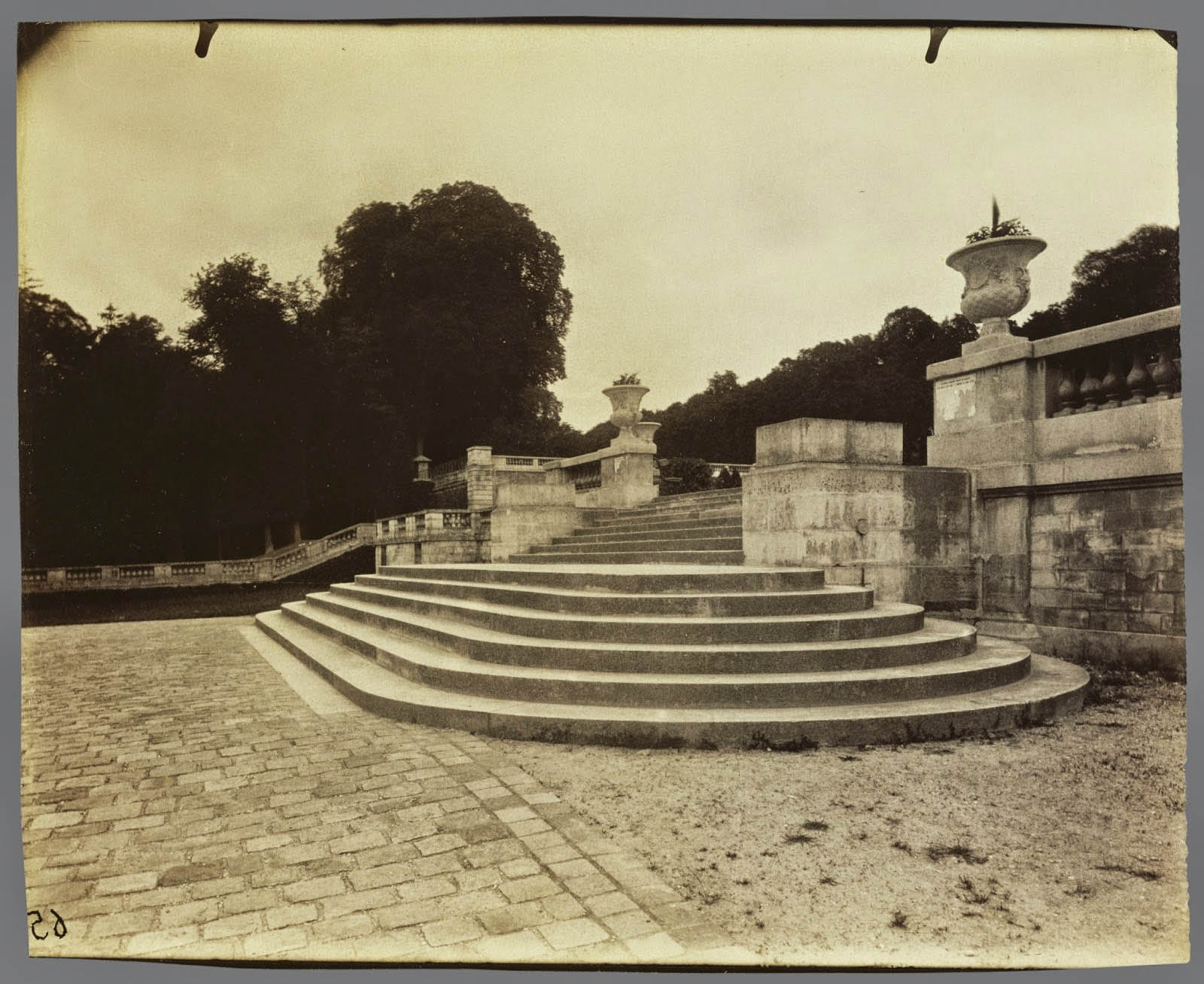
    Eugène Atget (French, 1857-1927) 'Saint Cloud' 1904


    Eugène Atget (French, 1857-1927)
    Saint Cloud
    1904
    Albumen silver print


    Carleton Watkins (American, 1829-1916) 'Cypress Tree at Point Lobos, Monterey County' 1883-1885


    Carleton Watkins (American, 1829-1916)
    Cypress Tree at Point Lobos, Monterey County
    1883-1885
    Albumen silver print
    J. Paul Getty Museum Collection


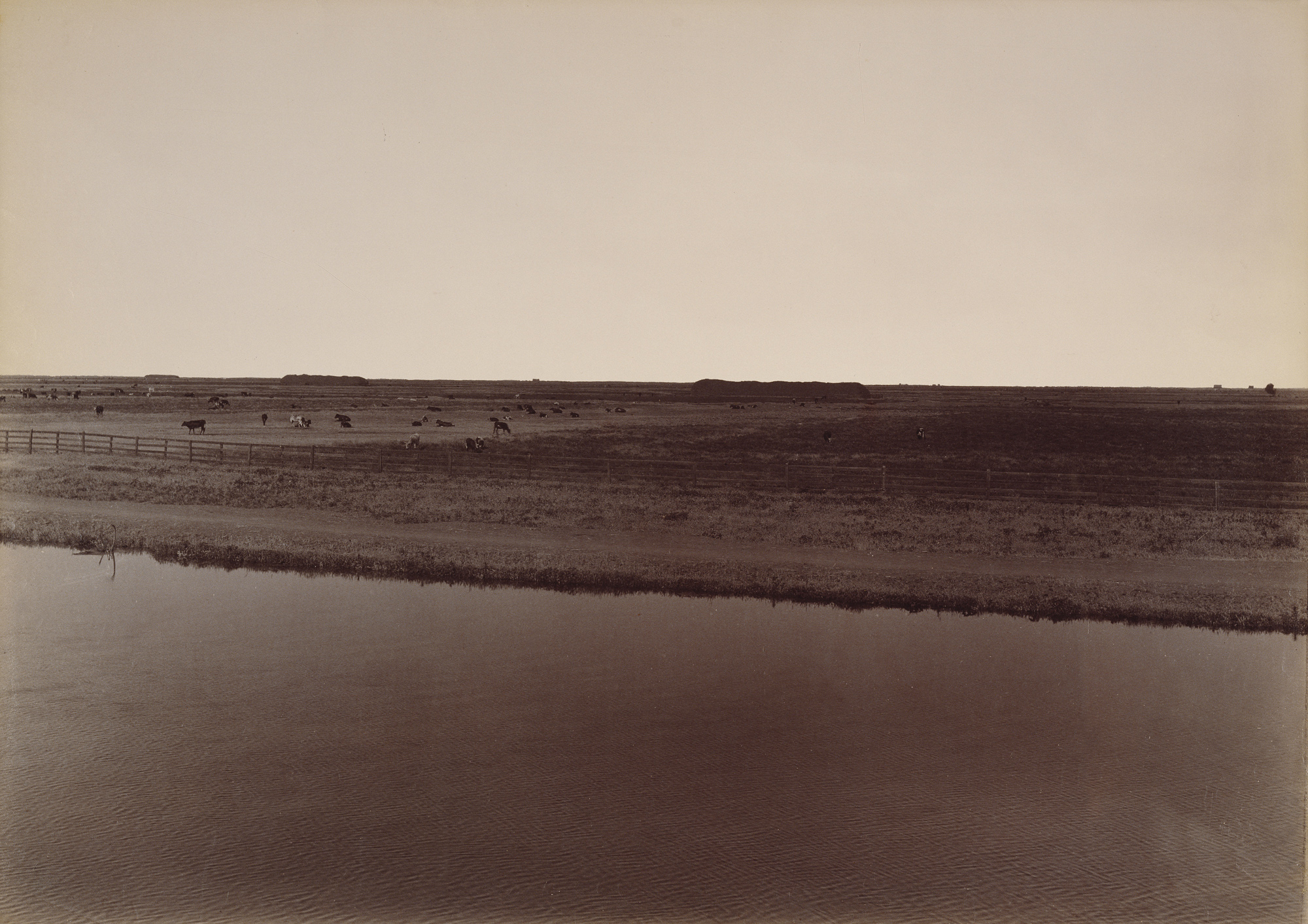
    Carleton Watkins (American, 1829-1916) 'View on the Calloway Canal, near Poso Creek, Kern County' 1887


    Carleton Watkins (American, 1829-1916)
    View on the Calloway Canal, near Poso Creek, Kern County
    1887
    Albumen silver print
    37.5 x 53cm (14 3/4 x 20 7/8 in.)
    J. Paul Getty Museum Collection


    The first photographs Watkins made along the Kern River served as evidence in a water rights lawsuit that eventually resulted in a decisive court ruling that prevented newcomers from diverting water from existing landowners. James Ben Ali Haggin, the defendant and Watkins’s client, had a series of irrigation canals that raised the price of land in Kern County. In this spare composition, made where present-day Poso Road crosses the Calloway Canal, Watkins devoted almost equal proportions to sky, land, and water.

    Text from the J. Paul Getty Museum website


    Andreas Gursky (German, b. 1955)
'Rhein II' 1996


    Andreas Gursky (German, b. 1955)
    Rhein II
    1996


    The J. Paul Getty Museum
    1200 Getty Center Drive
    Los Angeles, California 90049

    Opening hours:
    Daily 10am – 5.30pm
    Monday closed

    The J. Paul Getty Museum website

    LIKE ART BLART ON FACEBOOK

    Back to top