Exhibition: ‘ “My verses are like dynamite”: Curt Bloch’s ‘Het Onderwater Cabaret” at the Jewish Museum Berlin

Exhibition dates: 9th February to 26th May 2024


Curt Bloch (German Jewish, 1908-1975) 'Het Onderwater Cabaret', Magazine cover from 30.08.1943


Curt Bloch (German Jewish, 1908-1975)
Het Onderwater Cabaret, Magazine cover 1st volume, no. 2 from 30.08.1943
Jewish Museum Berlin, Convolute/816, Curt Bloch collection, loaned by the Charities Aid Foundation America thanks to the generous support of Curt Bloch’s family


Unquenchable flame

Between August 1943 and April 1945, German Jew Curt Bloch created his own weekly, satirical poetry magazine, a unique work of creative resistance titled Het Onderwater Cabaret (The Underwater Cabaret) while holed up in an attic with two other adults on the Dutch German border.

Bloch conceived, wrote, designed, and produced 96 individual copies of “OWC” (Het Onderwater Cabaret‘s abbreviation after issue 33) with a total of 492 poems spanning over 1,700 pages. “The title alluded to a modern form of cabaret that had enthralled a large audience during the Weimar Republic (1918-1933). Cabaret performances typically consisted of a series of creatively crafted texts, songs, and scenes in which artists criticised societal injustices, mocked celebrities, and confronted the people with their perceived ignorance.”1

“… the Underwater Cabaret, which took its title from a unique term in Dutch for the act of going into hiding: “onderduiken.” Its literal translation is “to dive under,” but a common translation is “to slip out of public view.” A person in hiding was an “onderduiker,” who had gone “under water,” or was submerged.”2

Although he had no formal design training (he trained as a lawyer), Bloch had an innate understanding of modern design at that time: Bauhaus, Russian Constructivism, advertising, typography, collage, contemporary magazines such as the socialist Arbeiter-Illustrierte Zeitung and the satirical and politically provocative collages of the artist John Heartfield. This knowledge of contemporary art practice undoubtedly shows in the inventive photomontages of the OWC front covers.

“He cut out letters, images, and shapes from various print media and glued them onto the cover paper… [using the] artistic technique of collage, which was also used in contemporary mass media… small artworks with the simplest materials and means, using creativity, improvisational talent, and subtle humour.”3

Each edition of Bloch’s magazine consisted of just a single copy which was passed around to a small number of people external to the attic. The small “OWC” booklets could be discreetly delivered from house to house in a jacket or pants pocket. All copies were returned to him.

“Bloch mocked and ridiculed all of the major fascist leaders, from Hitler, Goebbels and Göring, to Mussolini and Seyß-Inquart, Reich commissioner of the Netherlands, alongside a host of their subordinates and henchmen, while always remaining acutely conscious of the enormity of their atrocities.”4

And here’s the rub. Despite the threat to his life, the possibility of death if their hiding place or a copy of the magazine where discovered, this man – through his spirit, creativity and humour – stared down with unquenchable spirit the unconscionable behaviour of the Nazis.

In the last edition there appears one poem, the only one he wrote in English, which reads:

At Berlin with our Russian friends,
The German Nightingale,
Herr Hitler, doesn’t sing today
He’s feeling, after some delay
A tie around his neck.


The ogre had met his maker.

While Bloch survived his mother and his sisters and most of the rest of his family in Germany died in the war. He survived and so did his magazines, now to be appreciated as a unique work of creative resistance published during the Second World War. Respect.

Human nature will always resist oppression, something that should be remembered in these troubled times.

Dr Marcus Bunyan


1/ Anonymous text from the Curt Bloch Het Onderwater Cabaret website Nd [Online] 23/04/2024
2/ Nina Siegal. “He Made a Magazine, 95 Issues, While Hiding From the Nazis in an Attic,” on The New York Times website Dec. 18, 2023 [Online] Cited 20/12/2023
3/ Anonymous text from the Curt Bloch Het Onderwater Cabaret website Nd [Online] 23/04/2024
4/ Text from the Jewish Museum Berlin website


Many thankx to the Jewish Museum Berlin for allowing me to publish the photographs in the posting. Please click on the photographs for a larger version of the image. For more information about Curt Bloch and the Het Onderwater Cabaret please see the Curt Bloch Het Onderwater Cabaret website.

Read more about Curt Bloch and his little magazine below.


Vielleicht kommen euch die Gedichte,
Die ich in eurer Sprache schrieb
In spätren Zeiten zu Gesichte
Und täten sie’s, wär mir’s recht lieb.

Perhaps at some point in the future,
the poems in your tongue I composed,
will be brought to your notice,
and if so, to delight will I then be disposed.


(Transl. by Aubrey Pomerance)


“Bloch’s experience was different because, in addition to sustenance and care, his helpers brought him pens, glue, newspapers and other printed materials that he used to produce a startling publication: his own weekly, satirical poetry magazine.”


The New York Times


Over a period of more than 19 months between August 1943 and April 1945, the hitherto unknown German Jewish author Curt Bloch produced a unique work of creative resistance while in hiding in the Netherlands: Het Onderwater Cabaret.

Week for week, Bloch put together a small format booklet comprising of handwritten poems in both Dutch and German which confronted Nazi propaganda and addressed a wide variety of themes: the course of the war, the lies and crimes of the National Socialists and their collaborators, his situation in hiding and the fate of his family, the approaching downfall and defeat of the Axis forces, and the fate of the German people. Through caustic satire and sardonic wit, Bloch mocked and ridiculed all of the major fascist leaders, from Hitler, Goebbels and Göring, to Mussolini and Seyß-Inquart, Reich commissioner of the Netherlands, alongside a host of their subordinates and henchmen, while always remaining acutely conscious of the enormity of their atrocities.

Some eight decades since the creation of the work and nearly fifty years after his death, Curt Bloch’s hope is now finally being fulfilled: The exhibition presents all 95 original issues of the Het Onderwater Cabaret, accompanied by insight into the production of their covers, which Bloch adorned with photomontages put together using materials from newspapers and magazines at his disposal. Audio readings of selected poems and a video performance staged by the actors Marina Frenk, Richard Gonlag and Mathias Schäfer bring Bloch’s verses to life.

Alongside the display of additional works written by Bloch while “under water”, his helpers and those who were with him in hiding are introduced, accompanied by eyewitness interviews. The entire Het Onderwater Cabaret is accessible in digital form, accompanied by transcriptions.

Bloch’s works, known to only a handful of people at the time of their composition, will now find the recognition and appreciation they so greatly deserve. In today’s world, in which war, disinformation, discrimination, exclusion and persecution are widespread, they remain highly pertinent.

Text from the Jewish Museum Berlin website


Curt Bloch (German Jewish, 1908-1975)

Curt Bloch (German Jewish, 1908-1975)

Curt Bloch (German Jewish, 1908-1975)


Curt Bloch (German Jewish, 1908-1975)
Het Onderwater Cabaret, Magazine covers No.’s 1-95


Curt Bloch (German Jewish, 1908-1975) 'Het Onderwater Cabaret', Magazine cover from 25.09.1943


Curt Bloch (German Jewish, 1908-1975)
Het Onderwater Cabaret, Magazine cover 1st volume, no. 6 from 25.09.1943
Jewish Museum Berlin, Convolute/816, Curt Bloch collection, loaned by the Charities Aid Foundation America thanks to the generous support of Curt Bloch’s family


One of the earliest issues of “The Underwater Cabaret,” a weekly magazine made by a Jewish man hiding from the Nazis in Holland during World War II.


Curt Bloch (German Jewish, 1908-1975) 'Het Onderwater Cabaret', Magazine cover from 16.10.1943


Curt Bloch (German Jewish, 1908-1975)
Het Onderwater Cabaret, Magazine cover 1st volume, no. 9 from 16.10.1943
Jewish Museum Berlin, Convolute/816, Curt Bloch collection, loaned by the Charities Aid Foundation America thanks to the generous support of Curt Bloch’s family


Bloch’s magazine was satirical. Here he depicts British Prime Minister Neville Chamberlain, whose policy of appeasing Hitler drew criticism.


Curt Bloch (German Jewish, 1908-1975) 'Het Onderwater Cabaret', Magazine cover 1st volume, no. 18 from 18.12.1943


Curt Bloch (German Jewish, 1908-1975)
Het Onderwater Cabaret, Magazine cover 1st volume, no. 18 from 18.12.1943
Jewish Museum Berlin, Convolute/816, Curt Bloch collection, loaned by the Charities Aid Foundation America thanks to the generous support of Curt Bloch’s family


During the German occupation of the Netherlands, Curt Bloch lived in hiding, to avoid deportation to a labor or extermination camp. Under extremely challenging circumstances, Bloch developed a very personal form of resistance against the Nazi regime: “During the time I had to hide, I published a booklet of satirical poems in German and Dutch every week and circulated it among a small group.”

In reference to his fugitive situation, Bloch named his publication “Het Onderwater-Cabaret” (The Underwater Cabaret). The title alluded to a modern form of cabaret that had enthralled a large audience during the Weimar Republic (1918-1933). Cabaret performances typically consisted of a series of creatively crafted texts, songs, and scenes in which artists criticised societal injustices, mocked celebrities, and confronted the people with their perceived ignorance. Under Nazi rule, political cabarets were censored, closed, or forced to conform. The Dutch radio program “Cabaret op zondagmiddag” (Sunday Afternoon Cabaret) may have inspired Bloch to counter this fascist and anti-Semitic propaganda with his own subversive cabaret.

From 22 August, 1943, to 3 April, 1945, Curt Bloch conceived, wrote, designed, and produced 96 individual copies of “OWC” with a total of 492 poems spanning over 1,700 pages.

In 1943, he published 19 issues of his magazine. The following year: 61, including a special edition in July 1944 with no specific date assigned. The year 1945 included 15 magazines.

The magazines were typically published on Saturdays, but there were particularly productive periods, especially in August and September 1944, when he produced two issues per week.

Curt Bloch’s handmade booklets were slightly smaller than a standard postcard, measuring approximately 10 cm × 13.5 cm, and usually contained 16 or 20 pages.

All editions are fully preserved in numbered order. Only one poem, Farewell to ‘De Gouden Bommen’, had parts of the pages torn out, presumably intentionally, to remove any hints of a hiding place.

Content

In the first year of the OWC, Curt Bloch published 111 poems; in the second year, 302 poems (plus nine in the special edition); and in the third year, 70 poems. Most verses were written in rhymed quatrains, some as couplets or tail-rhymes. …

The Underwater Cabaret primarily dealt with current events of the time. Many contributions satirised well-known representatives of the Nazi regime, and some even dedicated entire poems to them. Besides Adolf Hitler and Joseph Goebbels, who appeared most frequently in the verses, other figures such as Heinrich Himmler (Reich Interior Minister), Joachim von Ribbentrop (Reich Foreign Minister), Gerd von Rundstedt (Commander-in-Chief West), as well as foreign dictators Benito Mussolini (Italy) and Francisco Franco (Spain) were also targets for ridicule. Prominent Dutch fascists like Arthur Seyß-Inquart (Reichskommissar of the Netherlands), Anton Mussert (founder and leader of the Nationaal-Socialistische Beweging, NSB), and Maarten van Nierop (NSB member and editor of the Nazi-controlled Twentsch Nieuwsblad) were also targets of his ridicule and mockery.

Another major theme of the OWC was the everyday experience of the occupation, including hunger, strikes, and raids. Bloch’s lyrical self also provided deep insights into his emotional world: concern for his family, especially his beloved sister Helene; despair and impatience in hiding; frustration over his isolated situation; gratitude for any form of support; joy at the victories of the Allies; and, repeatedly, hope for a swift return to freedom. Bloch’s rhymes display a wide range of emotions and changing moods depending on the course of the war.

Design

While the first covers of the OWC magazine were in black and white, Curt Bloch designed the covers of his magazine in colour from the 17th issue in 1943. He cut out letters, images, and shapes from various print media and glued them onto the cover paper.

In July 1944, Bloch decided to abbreviate the name of his magazine on the cover. Until issue 32 of the second year, he used the title “Het Onderwater-Cabaret.” From issue 33 onward, he used the abbreviation “OWC.” He retained this acronym on the cover until the final magazine.

Just as with the name of his magazine, Bloch’s cover design also refers to the characteristic popular culture of the Weimar Republic. His designs reference the artistic technique of collage, which was also used in contemporary mass media. Satirical and politically provocative collages by artist John Heartfield for the socialist Arbeiter-Illustrierte Zeitung were particularly well-known.

Cabaret artists, collage artists, and Curt Bloch – who, as a trained lawyer, did not have formal design training – share the fact that they created unique small artworks with the simplest materials and means, using creativity, improvisational talent, and subtle humour.

Readership and Circulation

The weekly reading circle of the “Onderwater-Cabaret” began in Curt Bloch’s immediate environment, with the people who provided him with shelter, fellow fugitives like Karola Wolf and Bruno Löwenberg, and members of the resistance movement in Enschede. Once the window shutters were closed at night, Bloch could leave his hiding place. He often sat with his hosts and their visitors in the living room, where he could personally perform the cabaret pieces. However, his audience also included other fugitives and their supporters in different homes. Based on his research, Gerard Groeneveld, a Dutch historian and author (Het Onderwater Cabaret) estimates that the booklets reached up to thirty people. However, the exact number of readers and their names had to remain unknown due to the clandestine nature of the operation. …

The small “OWC” booklets could be discreetly delivered from house to house in a jacket or pants pocket. Getting caught with a magazine that satirised Adolf Hitler and other Nazi leaders would have been life-threatening for the couriers. In Germany, in 1943, four people who had disseminated one single satirical poem were sentenced to death for “undermining military morale.” Bloch wondered in A Goal: “What would happen to me, I have almost four hundred?”

Despite the extensive secret handovers required for circulation, Curt Bloch’s resistance operation remained undiscovered. All 96 editions were returned to him in good condition. After the war, he emigrated to the USA, where he had the booklets bound into four collected volumes.

Anonymous text from the Curt Bloch Het Onderwater Cabaret website Nd [Online] 23/04/2024


Curt Bloch (German Jewish, 1908-1975) 'Het Onderwater Cabaret', Magazine cover 2nd volume, no. 3 from 15.01.1944


Curt Bloch (German Jewish, 1908-1975)
Het Onderwater Cabaret, Magazine cover 2nd volume, no. 3 from 15.01.1944
Jewish Museum Berlin, Convolute/816, Curt Bloch collection, loaned by the Charities Aid Foundation America thanks to the generous support of Curt Bloch’s family


Doktor Göbbels Mummenschanz
Doctor Goebbels mask

The name “Mummenschanz” is a combination of “Mummen”, meaning to conceal or to mask (similar to the English “mummer”), and “Schanz”, a play on “chance”.


Curt Bloch (German Jewish, 1908-1975) 'Het Onderwater Cabaret' 2nd volume, no. 20 from 13.05.1944


Curt Bloch (German Jewish, 1908-1975)
Het Onderwater Cabaret 2nd volume, no. 20 from 13.05.1944
Jewish Museum Berlin, Convolute/816, Curt Bloch collection, loaned by the Charities Aid Foundation America thanks to the generous support of Curt Bloch’s family


Curt Bloch (German Jewish, 1908-1975) 'Het Onderwater Cabaret', Magazine cover 2nd volume, no. 21 from 20.05.1944


Curt Bloch (German Jewish, 1908-1975)
Het Onderwater Cabaret, Magazine cover 2nd volume, no. 21 from 20.05.1944
Jewish Museum Berlin, Convolute/816, Curt Bloch collection, loaned by the Charities Aid Foundation America thanks to the generous support of Curt Bloch’s family


Pioneers of Labor

They, who always reduced your wages
And increased your working hours
Plunged you comrades and metal proletarians
Into ever deeper poverty,

Those who only kept you in check
By delivering you to fascism,
Do you still remember the old
Representatives of capitalism?

Indeed, you will still recognise them,
The gentlemen and their crimes,
When you hear the name Röchling mentioned,
Then you think of the mines of the Stumm brothers

In the Saar region and the sufferings
The miner must endure there,
Mr. Röchling called you ungrateful
You were not hungry without complaints.

And Vögler, the head of the steel barons
In the Ruhr region, also let you starve
And ultimately left you to loiter
Without income in the streets.

And with their
Socio-political “merits”
Today the Führer makes these men “Pioneers
Of German labor,” well-regarded.

They are exploiters and oppressors
In Adolf’s beautiful miracle state,
They are even honoured as bringers of people’s happiness
And their praises are sung loudly.

These are the new “socialists”
Who vouch for your future,
The masterminds of the fascists,
Who strangle welfare, freedom, life.

They are the pioneers of misfortune,
Who cause unhappiness, hardship, and death,
How long will Germany endure their
Criminal tyranny?

Curt Bloch

Post-Editing: Sylvia Stawski, Ernst Sittig


Curt Bloch (German Jewish, 1908-1975) 'Het Onderwater Cabaret', Magazine cover 2nd volume, no. 46 from 16.09.1944


Curt Bloch (German Jewish, 1908-1975)
Het Onderwater Cabaret, Magazine cover 2nd volume, no. 46 from 16.09.1944
Jewish Museum Berlin, Convolute/816, Curt Bloch collection, loaned by the Charities Aid Foundation America thanks to the generous support of Curt Bloch’s family


This OWC edition was published on September 16 – four days earlier, the south of the Netherlands was liberated by the Allies as part of Operation “Market Garden.” Curt Bloch is pleased with the positive developments – and also with the fact that members of the Dutch Nazi movement are now filled with fear. He observes: The NSB members tremble. Their leader, Anton Mussert, calls for the evacuation of the families of his followers to the northeast of the Netherlands. In his verses, Bloch suspects that it will only be weeks before all of the Netherlands is liberated. However, he will have to wait more than half a year before he can leave his hiding place.

Text from the Curt Bloch Het Onderwater Cabaret website


Curt Bloch (German Jewish, 1908-1975) 'Het Onderwater Cabaret', Magazine cover 2nd volume, no. 50 from 07.10.1944


Curt Bloch (German Jewish, 1908-1975)
Het Onderwater Cabaret, Magazine cover 2nd volume, no. 50 from 07.10.1944
Jewish Museum Berlin, Convolute/816, Curt Bloch collection, loaned by the Charities Aid Foundation America thanks to the generous support of Curt Bloch’s family


“Die Man Rief, Die Geister…”
“The Spirits That I’ve Cited …”

Bloch depicted the brutish character of Nazism in some of his covers.


For more than two years, home for Curt Bloch was a tiny crawl space below the rafters of a modest brick home in Enschede, a Dutch city near the German border. The attic had a single small window. He shared it with two other adults.

During that time, Bloch, a German Jew, survived in the Nazi-occupied Netherlands by relying on a network of people who gave him food and kept his secrets.

In that respect, he was like at least 10,000 Jews who hid in Holland and managed to live by pretending not to exist. At least 104,000 others – many of whom also sought refuge, but were found – ended up being sent to their deaths.

But Bloch’s experience was different because, in addition to sustenance and care, his helpers brought him pens, glue, newspapers and other printed materials that he used to produce a startling publication: his own weekly, satirical poetry magazine.

From August 1943 until he was liberated in April 1945, Bloch produced 95 issues of Het Onderwater Cabaret, or The Underwater Cabaret.

Each issue included original art, poetry and songs that often took aim at the Nazis and their Dutch collaborators. Bloch, writing in both German and Dutch, mocked Nazi propaganda, responded to war news and offered personal perspectives on wartime deprivations.

In one poem, he sardonically suggested how recent events had reordered what it meant to be a beast in the animal kingdom:

Hyenas and jackals
Look on with jealousy
For they now seem as choirboys
Compared to humanity.

Bloch shared his handwritten magazine with the people he lived with, the family who sheltered him and, possibly, outside helpers and other Jews in hiding. After the war, which Bloch survived, he collected his magazines and brought them home and ultimately to New York, where he emigrated. There they sat on some bookshelves, the unknown creations of a man who was trained not as a poet, or an artist, but as a lawyer.

Bloch’s daughter, Simone Bloch, now 64, remembers seeing the magazines in the family home growing up. She didn’t fully grasp their significance, or particularly care to. A rebellious teenager by her own account, Simone said she never connected particularly well with her father, who died suddenly from a liver ailment when she was 15.

“A couple of times he read from them at dinner parties,” she said in an interview, “but I didn’t understand German then.”

Many years later, though, Simone’s daughter, Lucy, took an interest in the magazines, not just as family mementos but as markers of history. She got a research grant to travel to Germany, where she was able to study more about her grandfather’s history. Simone then spent years searching for a way to expand public awareness of the magazines, one of the few previously undiscovered literary efforts that document the Holocaust in Europe.

This led to the production of a book, The Underwater Cabaret: The Satirical Resistance of Curt Bloch, by Gerard Groeneveld, which was published in the Netherlands earlier this year. Soon there will also be a museum exhibition, “‘My Verses Are Like Dynamite.’ Curt Bloch’s Het Onderwater Cabaret,” which is scheduled to open in February at the Jüdisches Museum Berlin.

“Any time that an almost completely unknown work of this caliber comes to the fore, it’s very significant,” said Aubrey Pomerance, a curator of the Berlin museum exhibition. “The overwhelming majority of writings that were created in hiding were destroyed. If they weren’t, they’ve come to the public attention before now. So, it’s tremendously exciting.”

Research by Pomerance and Groeneveld for the exhibition and the book has helped to illuminate many aspects of Bloch’s life, which had not previously drawn much attention. Born in Dortmund, an industrial city in western Germany, Bloch was 22 and working at his first job as a legal secretary when Adolf Hitler became the chancellor of Germany in 1933. Antisemitic violence in Bloch’s hometown escalated even before official anti-Jewish measures were instituted.

After a colleague threatened his life that same year, Bloch fled to Amsterdam, where he took a job with a Persian rug importer and dealer. He hoped to find refuge there before escaping farther west, but his plans were dashed when the Germans invaded in 1940, the borders closed, and the nightmare expanded to Jews there as well.

Bloch’s firm transferred him to The Hague, but when non-Dutch Jews were forced out of the western Dutch provinces by the occupier’s decree, he was sent to work in a subsidiary in Enschede.

There, he got a job with the local Jewish Council, an organisation installed by the German overseers to implement Nazi antisemitic edicts. Jews who worked for the council were assured that they were safe from deportation.

Technically, Bloch was an adviser for “immigrant affairs,” although no opportunities for immigration existed – only transport to a concentration camp. The Enschede council understood the dangers and warned its members to go into hiding.

It was aided by an influential Dutch Reformed Church pastor, Leendert Overduin, who secretly ran a resistance organisation that helped some 1,000 Jews find places to hide. Known as Group Overduin, it consisted of about 50 people, including Overduin’s two sisters. Overduin was arrested three times and was imprisoned for this work; he has been recognised since as Righteous Among Nations by Yad Vashem, the Holocaust remembrance center in Jerusalem.

Group Overduin found Bloch a hiding place in the home of Bertus Menneken, an undertaker, and his wife, Aleida Menneken, a housekeeper. Their two-story brick house on Plataanstraat 15 was in a middle-class district of western Enschede.

There, Bloch shared the crawl space with a 44-year-old German-Jewish refugee, Bruno Löwenberg, and Löwenberg’s 22-year-old girlfriend, Karola Wolf, whom they called Ola. During their time in hiding, Bloch fell in love with Ola and wrote many verses just for her.

“He had a lot of courage, but he also had a reckless streak,” Groeneveld said.

Each edition of Bloch’s magazine consisted of just a single copy. But it may have been read by as many as 20 to 30 people, Groeneveld estimated.

There was a “huge organisation behind him, which included couriers, who brought food, but who could also bring the magazine out, to share with other people in the group who could be trusted,” Groeneveld said. “The magazines are very small, you can easily put one in your pocket or hide it in a book. He got them all back. They must have also returned them in some way.”

Bloch named his magazine in response to a German-language radio program that played on Dutch airwaves during the occupation, the Sunday Afternoon Cabaret. But this, Groeneveld explained, was the Underwater Cabaret, which took its title from a unique term in Dutch for the act of going into hiding: “onderduiken.” Its literal translation is “to dive under,” but a common translation is “to slip out of public view.” A person in hiding was an “onderduiker,” who had gone “under water,” or was submerged.

Groeneveld said Bloch’s covers, which were stylised photomontages, drew inspiration from anti-fascist satirical magazines of the prewar era, like the French “Marianne,” known for its anti-Nazi illustrations, and the German workers’ magazine Arbeiter-Illustrierte-Zeitung.

“His main target was Joseph Goebbels, the Nazi propaganda minister,” Pomerance said. “He often refers to articles that talk about a ‘final victory for the Nazis,’ and he mocks that notion, calling them murderers and liars. He was always sure that Germany would not win the war.”

In his poem, “The Way to Truth,” for example, he advised an imagined German reader how to approach Goebbels’ falsehoods:

If he writes straight, read it crooked.
If he writes crooked, read it straight.
Yes, just turn his writings around.
In all his useful words, harm is found.

Bloch’s writing wasn’t necessarily intended to live only on the page. During his time in hiding, he may have recited his poetry or performed the songs, Pomerance said.

“Quite a number of his poems were identified as being songs,” he said. “But unfortunately he didn’t provide any melodies that they should be sung to,” except for one, titled “Resistance Song.” The cover of the final issue, dated April 1945, after his liberation, is a photomontage of two people climbing out of a hatch. The title of that issue declares they are finally “above water.”

One poem in the edition, the only one he wrote in English, reads:

At Berlin with our Russian friends,
The German Nightingale,
Herr Hitler, doesn’t sing today
He’s feeling, after some delay
A tie around his neck.

Though Bloch survived, his mother and his sisters and most of the rest of his family in Germany died in the war. After the liberation of the Netherlands, he met Ruth Kan, who had survived a number of concentration camps, including Auschwitz. They married in 1946, had a son, Stephen, and moved to New York in 1948, where they later opened a business that sold European antiques and had Simone in 1959.

Beyond the new book and museum exhibition, Simone is developing a website that will feature her father’s art and poetry in three languages: German, Dutch and English.

That process has had a profound impact on her, she said.

“It provides not just insight, but access to my father in a way that I wish I’d had when I was young,” she said.

Nina Siegal. “He Made a Magazine, 95 Issues, While Hiding From the Nazis in an Attic,” on The New York Times website Dec. 18, 2023 [Online] Cited 20/12/2023


Curt Bloch (German Jewish, 1908-1975) 'Het Onderwater Cabaret', Magazine cover 2nd volume, no. 53 from 04.11.1944


Curt Bloch (German Jewish, 1908-1975)
Het Onderwater Cabaret Magazine cover 2nd volume, no. 53 from 04.11.1944
Jewish Museum Berlin, Convolute/816, Curt Bloch collection, loaned by the Charities Aid Foundation America thanks to the generous support of Curt Bloch’s family


“Ich schieb wache” I keep watch

Bloch was dedicated to publishing his magazine each week and numbered them.


Curt Bloch (German Jewish, 1908-1975) 'Het Onderwater Cabaret', Magazine cover 2nd volume, no. 57 from 05.12.1944


Curt Bloch (German Jewish, 1908-1975)
Het Onderwater Cabaret Magazine cover 2nd volume, no. 57 from 05.12.1944
Jewish Museum Berlin, Convolute/816, Curt Bloch collection, loaned by the Charities Aid Foundation America thanks to the generous support of Curt Bloch’s family


St. Nicholas in Wartime


Curt Bloch (German Jewish, 1908-1975) 'Het Onderwater Cabaret', Magazine cover 3rd volume, no. 5 from 03.02.1945


Curt Bloch (German Jewish, 1908-1975)
Het Onderwater Cabaret, Magazine cover 3rd volume, no. 5 from 03.02.1945
Jewish Museum Berlin, Convolute/816, Curt Bloch collection, loaned by the Charities Aid Foundation America thanks to the generous support of Curt Bloch’s family


Curt Bloch (German Jewish, 1908-1975) 'Het Onderwater Cabaret', Magazine cover 3rd volume, no. 12 from 24.03.1945


Curt Bloch (German Jewish, 1908-1975)
Het Onderwater Cabaret, Magazine cover 3rd volume, no. 12 from 24.03.1945
Jewish Museum Berlin, Convolute/816, Curt Bloch collection, loaned by the Charities Aid Foundation America thanks to the generous support of Curt Bloch’s family


Bloch’s title: “The Fuhrer’s Mother”


Curt Bloch (German Jewish, 1908-1975) 'Het Onderwater Cabaret', Magazine cover 3rd volume, no. 15 from 03.04.1945


Curt Bloch (German Jewish, 1908-1975)
Het Onderwater Cabaret, Magazine cover 3rd volume, no. 15 from 03.04.1945
Jewish Museum Berlin, Convolute/816, Curt Bloch collection, loaned by the Charities Aid Foundation America thanks to the generous support of Curt Bloch’s family


The final issue: liberated and “above water”

Immediately after the liberation of Enschede by British troops, Curt Bloch publishes his final magazine from underground. The headline on the front page reads “Bovenwater Finale van het O.W.C.” (Above Water Finale of the O.W.C.), accompanied by an image of a hidden person opening a cellar hatch. …

With the poem “Bovenwaterfinale van het O.W.C.” (Above Water Finale of the O.W.C.), Curt Bloch bids farewell as an underground publisher. He announces the end of The Underwater Cabaret and expresses gratitude for the attention. Now, one can return to the daylight, and his dream of freedom has come true. Bloch hopes that those who were taken from him will return (referring to his mother and two sisters, who were already murdered in concentration camps at this time, though Bloch will learn this not until later). Closing the chapter of his extensive publishing work in hiding, Bloch ends with the old-fashioned greeting “Tabé!” – a farewell phrase derived from Asian language usage.

Text from the Curt Bloch Het Onderwater Cabaret website


Above-Water Finale of the O.W.C.

We brought to you the final sounds
of the Underwater Cabaret,
And will thank you for your attention,
Since with this it will be ending.

Yes, it finally will close,
We now resurface
And no longer feel like outcasts
And not as pressurised as Hiob

Today, we crawl toward the daylight,
Our hiding time is in the past, thank God
And we are happy and are contented,
Because we finally are free –

This is the O.W.C. Finale
We long expected this,
That sometime we would be brought to daylight
After these years’ fearful night.

We were quiet partisans
And empathised with the fight for justice
And today the banners are waving.
And this fight has – almost – ended.

They did not cut us down to size
Although they wanted to,
You see: Injustice does not bring a blessing,
Our dream of freedom did come true.

Today we breathe in freedom’s air
Delightedly and greedily,
We, recently still sighing,
find the present to our liking.

And hope, that those who were sadly
torn away from us, will return,
Whether this will happen? Time will tell.
Sometimes we’re hopeful, sometimes sad.

After this time of cruel murders
Now comes a new melody,
Peaceful chords are coming,
There come prosperity and harmony

Now we will be building peace
And building a new era
Of charity and trust,
Of freedom and of justice.

Gone is the time of war and bombs,
Gone the wartime woe.
The OWC closes its columns
And says today forever:
Tabé!

Curt Bloch

Post-Editing: Hanny Veenendaal


Curt Bloch, undated


Curt Bloch, undated; Jewish Museum Berlin, accession 2023/90/5, gift of Lide Schattenkerk


Jewish Museum Berlin
Libeskind Building, ground level, Eric F. Ross Gallery
Lindenstraße 9-14, 10969 Berlin

Opening hours: 10am – 6pm
Jewish Museum Berlin website

Curt Bloch Het Onderwater Cabaret website

LIKE ART BLART ON FACEBOOK

Back to top

Photographs: Still life colour separation images by Bernard F. Eilers

June 2019


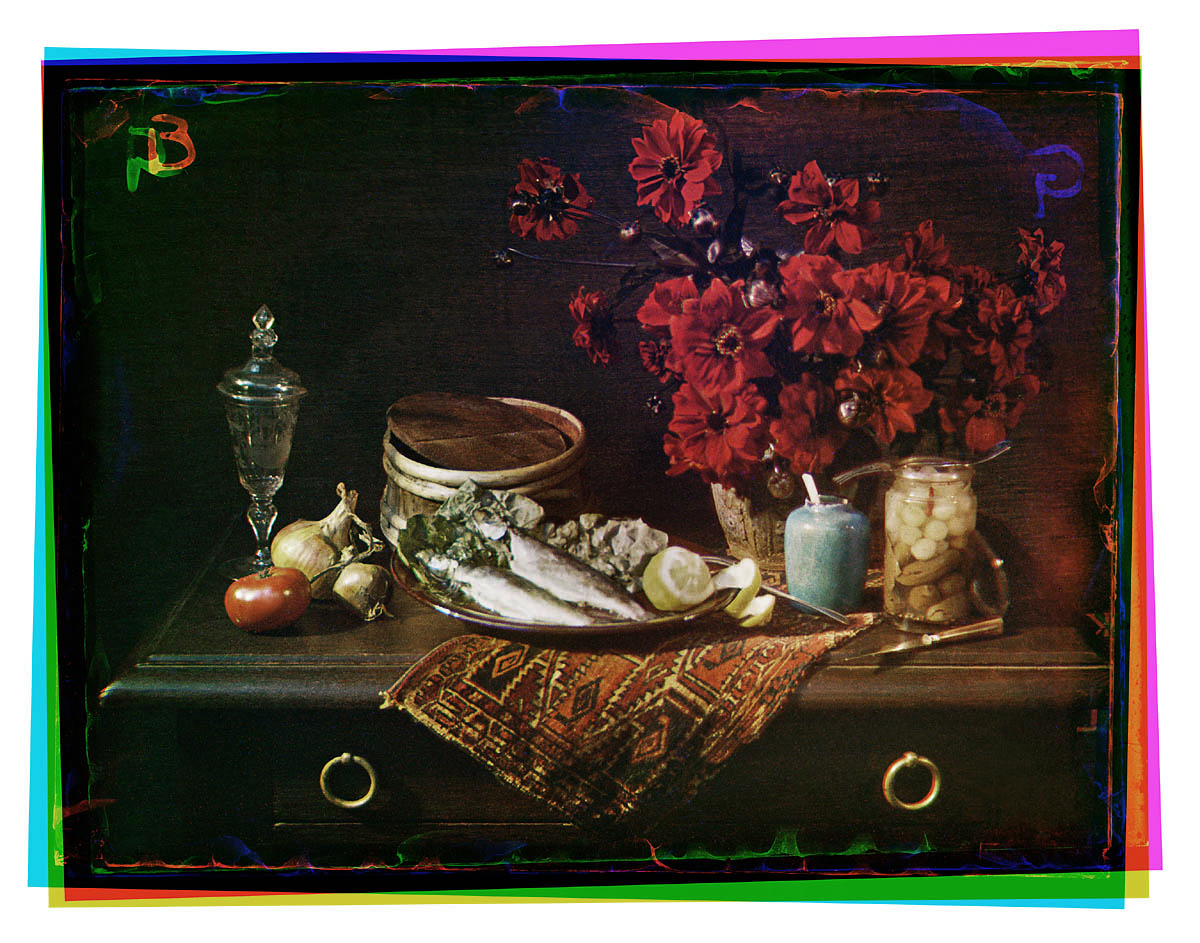
Bernard F. Eilers (Dutch, 1878-1951) 'Stilleven met haringen en rode dahlia's' (Still life with herring and red dahlias) c. 1935


Bernard F. Eilers (Dutch, 1878-1951)
Stilleven met haringen en rode dahlia’s (Still life with herring and red dahlias)
c. 1935
Colour separation
4.5 x 6 mm
Stadsarchief Amsterdam


I came across these early colour photographs by chance while rummaging around the web – the process (foto-chroma Eilers), the man (Bernard F. Eilers) and his photographs now largely forgotten outside his native Holland.

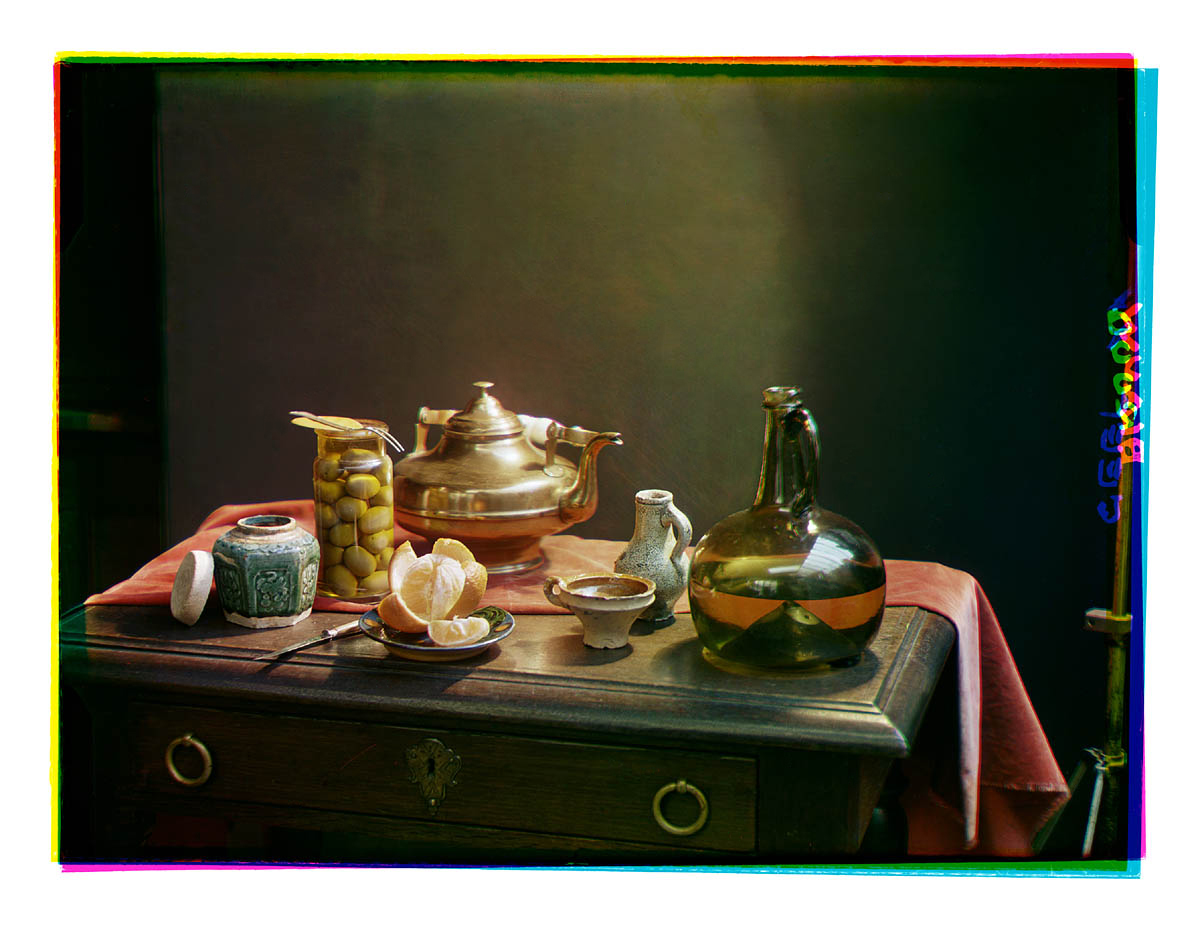
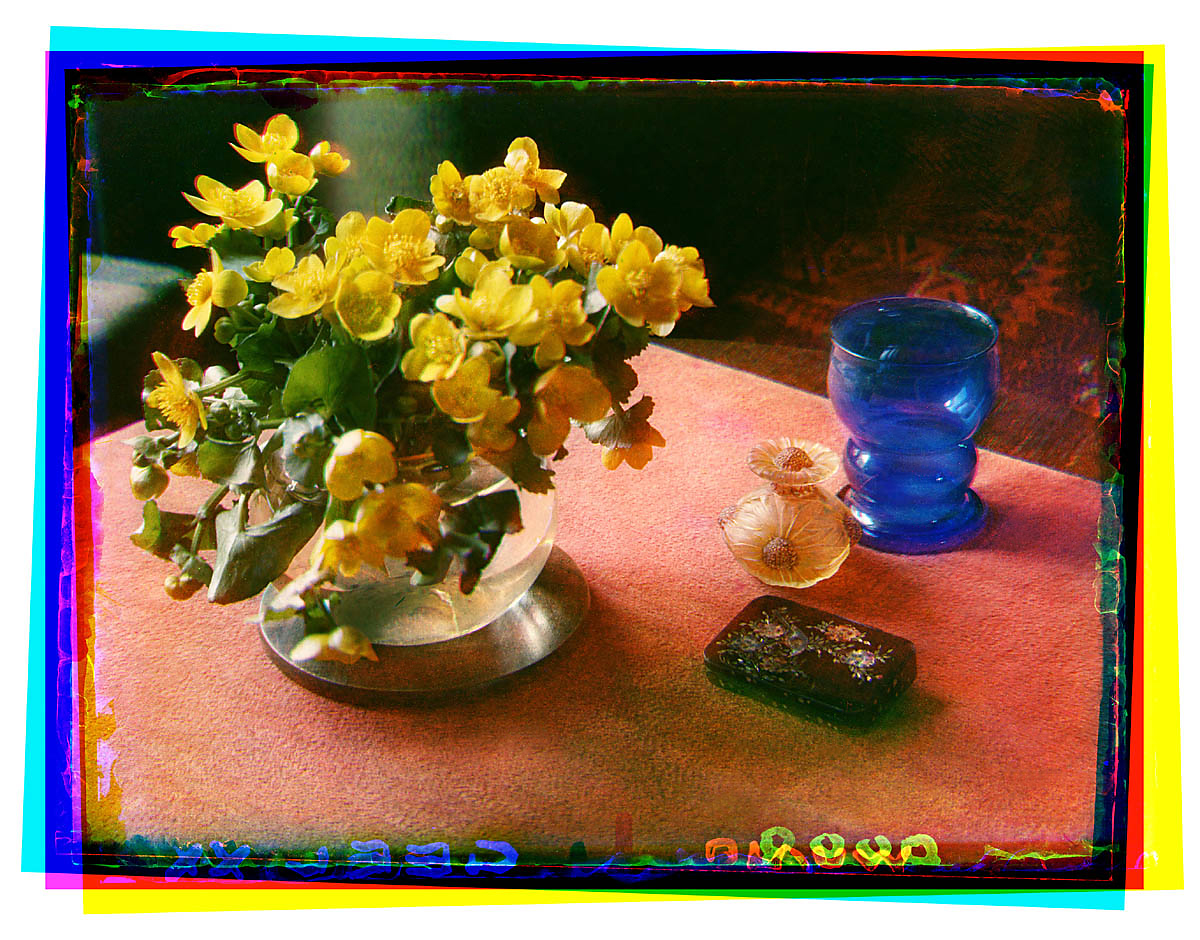
In this posting I have focused on the still life because I feel these photographs, which are the strongest body of Eilers work. Reminiscent of 17th Dutch still life painting, the photographs possess an inimitable feeling of space and project an indomitable presence that radiates almost magically from the surface of the image. The use of low depth of field and a stunning colour process (where the separated colours are hushed and muted but forward and present) make it possible to imagine picking up the tomatoes from the tin dish.

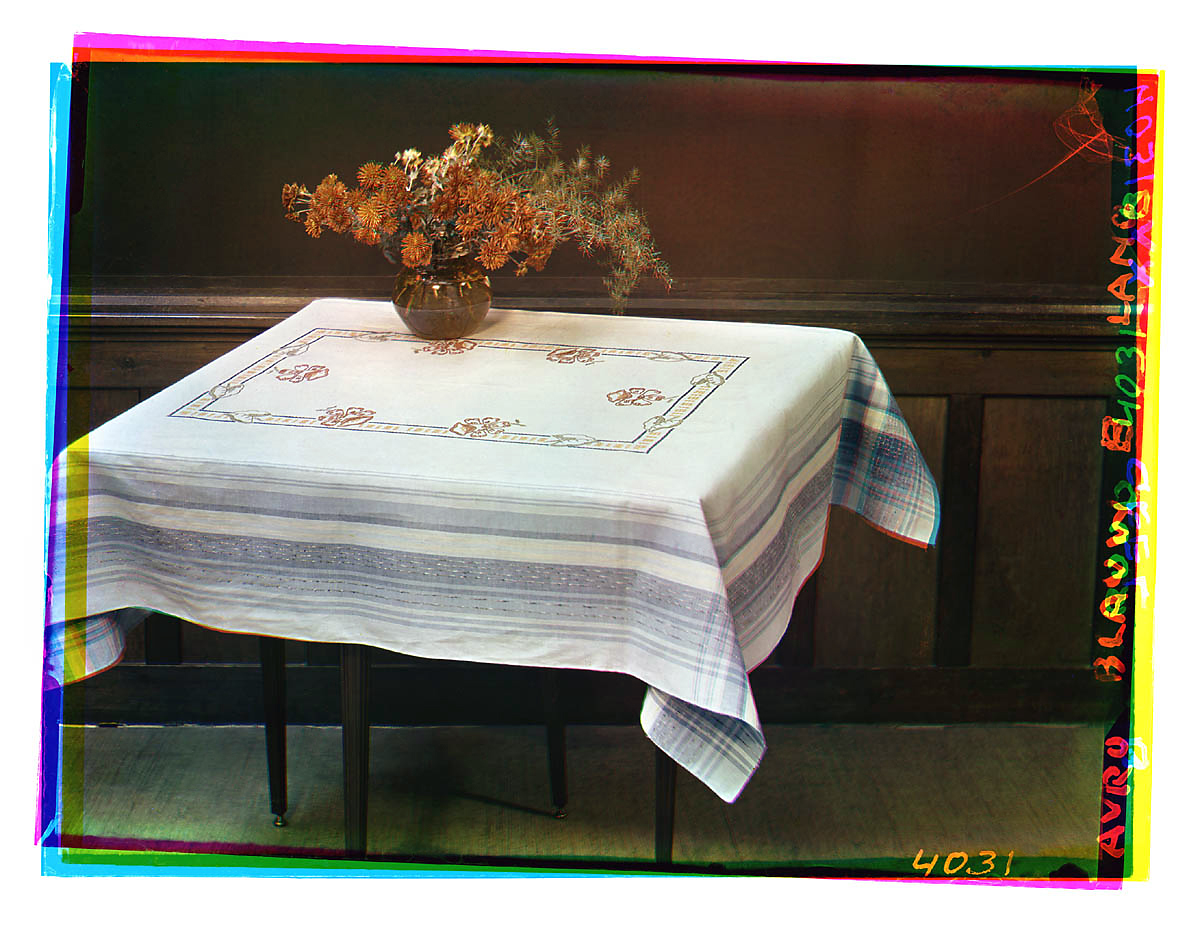
While the images are tightly framed, apparently simple constructions of light, colour and form… to make them so beautiful, so resonant of life itself, is due to the incredible technical and sensual skill of the artist. The precision of construction, of lighting, of feeling is impeccable. Notice the placement of the bowl of flowers in Table with tablecloth and a vase of red chrysanthemums (c. 1935, below) and its relationship to the pattern and that precise drop of the folded corner of the tablecloth. Or the spiral of the peeled lemon not quite touching the table, while red lanterns ascend like musical notes from the painted vessel in Still life with fruit (1934, below).

These informed, atmospheric and meditative images require the viewer to slow down and apply themselves to the act of looking, the act of imbibing the spirit of the artist, the object and the world. Beautiful, beautiful images, they make my heart sing.

Dr Marcus Bunyan


Bernard F. Eilers photographs from “Memory of the Netherlands,” on the National Library of the Netherlands website. A collection of the Stadsarchief Amsterdam. Please click on the photographs for a larger version of the image.


Bernard F. Eilers (1878-1951) was one of the leading Dutch photographers in the first quarter of the twentieth century. Along with Henri Berssenbrugge and Berend Zweers, Eilers was part of the second generation of Dutch pictorialists and his fine art prints were widely exhibited in the Netherlands during his lifetime. In 1911 he launched his business as a portrait and reproduction photographer. He was one of the Netherlands’ first commercial photographers, undertaking commissions for numerous clients including the Philips Company and Amsterdam-based architects and furniture makers. Around 1935, he created the photographic colour separation technique Foto-chroma Eilers, successfully producing prints of great intensity and depth of colour.

The following photographs were created by digitising 927 glass negatives from the Amsterdam Municipal Archives in 2004.


To achieve first-class picture quality, sets of three practically matching black-and-white negatives had to be selected from a far more sizeable total collection. Assembling these sets was an arduous task: they had not always been filed neatly together and could be found among several glass negative formats, particularly among the 4.5 x 6 cm size. In the end, it appeared that the selection of some sets did not lead to a satisfactory result, but the whole operation nevertheless yielded 309 beautiful prints.


Bernard F. Eilers (Dutch, 1878-1951) 'Stilleven met Oosterse poppetjes' (Still life with Eastern figures) 1934-04/1939-09


Bernard F. Eilers (Dutch, 1878-1951)
Stilleven met Oosterse poppetjes (Still life with Eastern figures)
1934-04/1939-09
Colour separation
4.5 x 6 mm
Stadsarchief Amsterdam


Bernard F. Eilers (Dutch, 1878-1951) 'Stilleven met tinnen en steengoed kannen' (Still life with pewter and stoneware jugs) 1934-04/1939-10


Bernard F. Eilers (Dutch, 1878-1951)
Stilleven met tinnen en steengoed kannen (Still life with pewter and stoneware jugs)
1934-04/1939-10
Colour separation
4.5 x 6 mm
Stadsarchief Amsterdam


Bernard F. Eilers (Dutch, 1878-1951) 'Stilleven met fruitschaal en drie kruiken op een kastje' (Still life with a fruit bowl and three jugs on a cupboard) 1934-04/1936


Bernard F. Eilers (Dutch, 1878-1951)
Stilleven met fruitschaal en drie kruiken op een kastje (Still life with a fruit bowl and three jugs on a cupboard)
1934-04/1936
Colour separation
4.5 x 6 mm
Stadsarchief Amsterdam


Bernard F. Eilers (Dutch, 1878-1951) 'Stilleven met een bloeiende primula, een majolica bord, steengoed kannetje en ander voorwerpen' (Still life with a flowering primula, a majolica plate, stoneware jug and other objects) 1934-04/1939-10


Bernard F. Eilers (Dutch, 1878-1951)
Stilleven met een bloeiende primula, een majolica bord, steengoed kannetje en ander voorwerpen (Still life with a flowering primula, a majolica plate, stoneware jug and other objects)
1934-04/1939-10
Colour separation
4.5 x 6 mm
Stadsarchief Amsterdam


Bernard F. Eilers (Dutch, 1878-1951) 'Stilleven met een glazen fles en een koperen pot' (Still life with a glass bottle and a copper pot) 1934-04/1939-10


Bernard F. Eilers (Dutch, 1878-1951)
Stilleven met een glazen fles en een koperen pot (Still life with a glass bottle and a copper pot)
1934-04/1939-10
Colour separation
4.5 x 6 mm
Stadsarchief Amsterdam


Bernard F. Eilers (Dutch, 1878-1951) 'Stilleven met koperen pot en glazen fles' (Still life with copper pot and glass bottle) 1920/1939


Bernard F. Eilers (Dutch, 1878-1951)
Stilleven met koperen pot en glazen fles (Still life with copper pot and glass bottle)
1920/1939
Colour separation
4.5 x 6 mm
Stadsarchief Amsterdam


Bernard F. Eilers (Dutch, 1878-1951) 'Stilleven met schilderspalet' (Still life with painter's palette) 1934-05/1939-10


Bernard F. Eilers (Dutch, 1878-1951)
Stilleven met schilderspalet (Still life with painter’s palette)
1934-05/1939-10
Colour separation
4.5 x 6 mm
Stadsarchief Amsterdam


Bernard F. Eilers (Dutch, 1878-1951) 'Stilleven met groenten waaronder prei, boerenkool en uien' (Still life with vegetables including leek, kale and onions) 1934-04/1935-10


Bernard F. Eilers (Dutch, 1878-1951)
Stilleven met groenten waaronder prei, boerenkool en uien (Still life with vegetables including leek, kale and onions)
1934-04/1935-10
Colour separation
4.5 x 6 mm
Stadsarchief Amsterdam


Bernard F. Eilers (Dutch, 1878-1951) 'Stilleven met glazen fles en een tinnen schaal met tomaten' (Still life with glass bottle and a tin dish with tomatoes) 1920/1939


Bernard F. Eilers (Dutch, 1878-1951)
Stilleven met glazen fles en een tinnen schaal met tomaten (Still life with glass bottle and a tin dish with tomatoes)
1920/1939
Colour separation
4.5 x 6 mm
Stadsarchief Amsterdam


Bernard F. Eilers (Dutch, 1878-1951) 'Stilleven met steengoed kannen, fruit, tingoed en gedroogde bloemen van een lampionplant in een fles' (Still life with stoneware jugs, fruit, tin goods and dried flowers of a lantern plant in a bottle) 1934-04/1934-12


Bernard F. Eilers (Dutch, 1878-1951)
Stilleven met steengoed kannen, fruit, tingoed en gedroogde bloemen van een lampionplant in een fles (Still life with stoneware jugs, fruit, tin goods and dried flowers of a lantern plant in a bottle)
1934-04/1934-12
Colour separation
4.5 x 6 mm
Stadsarchief Amsterdam


Bernard F. Eilers (Dutch, 1878-1951) 'Stilleven met fruit' (Still life with fruit) 1934-04/1934-12


Bernard F. Eilers (Dutch, 1878-1951)
Stilleven met fruit (Still life with fruit)
1934-04/1934-12
Colour separation
4.5 x 6 mm
Stadsarchief Amsterdam


Bernard F. Eilers was a colour magician. Around 1935, he created the photographic colour separation technique foto-chroma Eilers, which would make him world famous. In a time when experiments with colour photography were abundant, he succeeded in producing colour prints that far surpassed those of other fellow pioneers in terms of colour intensity and depth.

The Great Depression of the 1930s was not a good time for Eilers; few people could afford to enlist the services of a photographer. In these years, he decided to devote his leisure time to perfecting three-colour photography. His aim was to expose and print three shots on paper in a single turn. For more than a year and a half, he worked at improving the camera, the filters and the printing foils. Finally, Eilers succeeded in producing perfect colour prints. He named his technique: foto-chroma eilers. The difficult feat he had accomplished brought Eilers praise and honour, but the big photographic industries of the day soon caught up with him; around the same time, Kodak and Agfa introduced the first modern colour films.

For this site, Eilers’s old analogue technique was simulated digitally. The result is a collection of spectacular colour prints originating from a period that is mostly associated with black-and-white photography.

Text from the Memory of the Netherlands website [Online] Cited 02/04/2019


Bernard F. Eilers (Dutch, 1878-1951) 'Stilleven met dotterbloemen in een glazen vaas en enkele glazen voorwerpen' (Still life with dotter flowers in a glass vase and some glass objects) 1934-04/1939-09


Bernard F. Eilers (Dutch, 1878-1951)
Stilleven met dotterbloemen in een glazen vaas en enkele glazen voorwerpen (Still life with dotter flowers in a glass vase and some glass objects)
1934-04/1939-09
Colour separation
4.5 x 6 mm
Stadsarchief Amsterdam


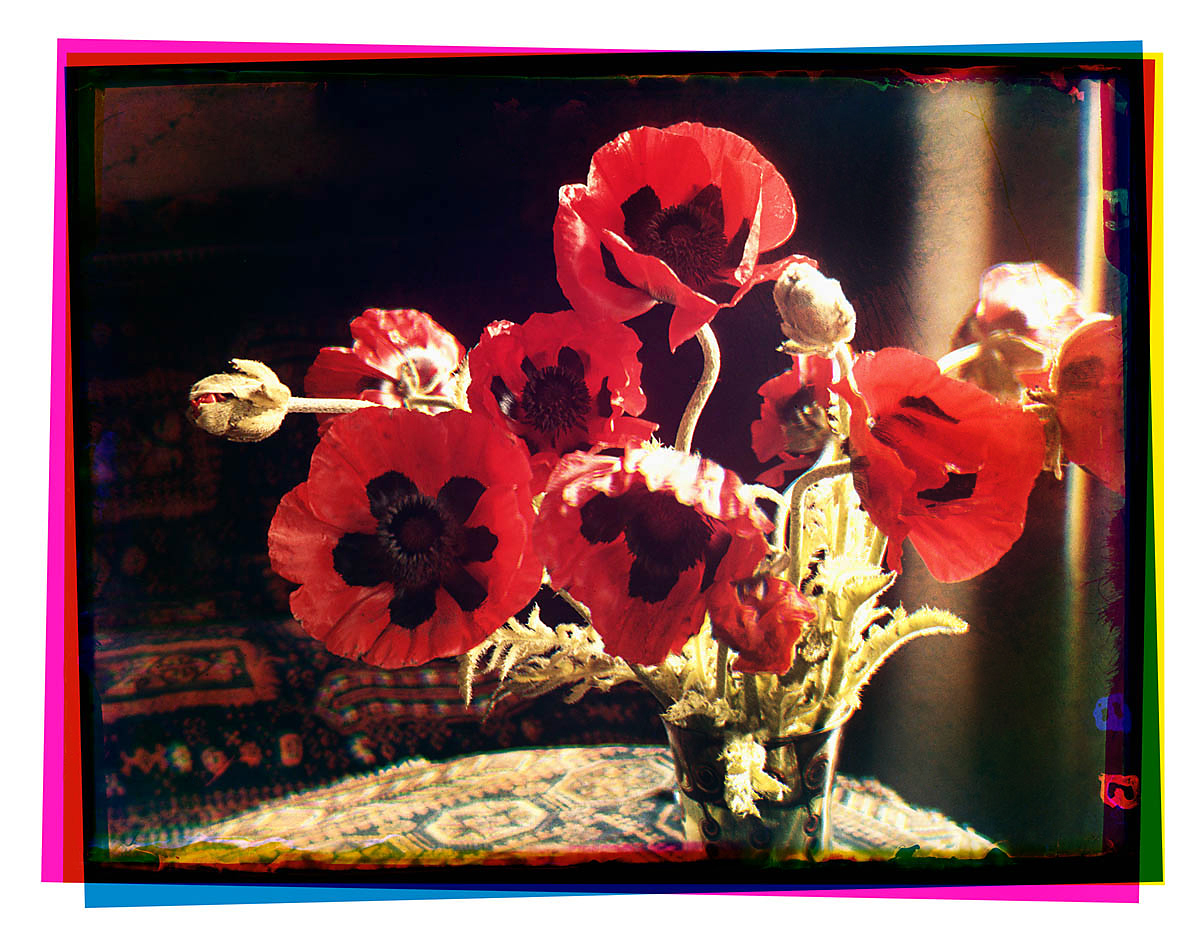
Bernard F. Eilers (Dutch, 1878-1951) 'Stilleven met bloemen van de papaver in een vaas' (Still life with poppy flowers in a vase) 1934-07/1939-08


Bernard F. Eilers (Dutch, 1878-1951)
Stilleven met bloemen van de papaver in een vaas (Still life with poppy flowers in a vase)
1934-07/1939-08
Colour separation
4.5 x 6 mm
Stadsarchief Amsterdam


Stilleven met bloemen van de papaver in een vaas. Opname in de huiskamer van de familie Eilers, Jacob Marisstraat 88, Amsterdam

Still life with flowers of the poppy in a vase. Recording in the living room of the Eilers family, Jacob Marisstraat 88, Amsterdam


Bernard F. Eilers (Dutch, 1878-1951) 'Gedekte tafel met een ontbijtservies' (Set table with a breakfast set) c. 1935


Bernard F. Eilers (Dutch, 1878-1951)
Gedekte tafel met een ontbijtservies (Set table with a breakfast set)
c. 1935
Colour separation
4.5 x 6 mm
Stadsarchief Amsterdam


Bernard F. Eilers (Dutch, 1878-1951) 'Tafel met tafelkleed en een vaas rode chrysanten' (Table with tablecloth and a vase of red chrysanthemums) c. 1935


Bernard F. Eilers (Dutch, 1878-1951)
Tafel met tafelkleed en een vaas rode chrysanten (Table with tablecloth and a vase of red chrysanthemums)
c. 1935
Colour separation
4.5 x 6 mm
Stadsarchief Amsterdam


Bernard F. Eilers (Dutch, 1878-1951) 'Stilleven met lamp, Japanse poppen en wajangpoppen' (Still life with lamp, Japanese dolls and Wajang dolls) 1920/1939


Bernard F. Eilers (Dutch, 1878-1951)
Stilleven met lamp, Japanse poppen en wajangpoppen (Still life with lamp, Japanese dolls and Wajang dolls)
1920/1939
Colour separation
4.5 x 6 mm
Stadsarchief Amsterdam


Bernard F. Eilers (1878-1951) was active in many photographic fields. Besides practicing the traditional genres such as townscapes, portraits and still life he also applied himself to architecture, art reproduction and ad photography.

In his lifetime, Eilers was held in high regard as an art photographer both in and outside the Netherlands. He owed his greatest successes to his photographs of Amsterdam, that exude much atmosphere and make one think of a painting by Breitner or Witsen. His free work is pictorial and seems to belong in the nineteenth rather than the twentieth century. In his photographs, Eilers achieved exceptionally high quality by his practically unequalled mastery of the means offered by modern photographic techniques. His photographs paint a nostalgic picture of the Netherlands in years gone by.

As a professional photographer, Eilers had many customers, including companies like Philips, Verkade and the Dutch car manufacturer Spijker, as well as architects such as Van der Mey, Kramer and De Klerk. His Golden Age as a photographer of architectural subjects coincided with that of the so-called Amsterdam School and its monthly publication Wendingen. Aside from what he described as his sixth sense, “the feeling in space”, Eilers considered a feeling for tone to be of the utmost importance when photographing a building in order to properly reproduce its size and proportions.

Eilers was a gifted technician. This emerges most of all from his pioneering work in the field of colour photography. He excelled in the application of new techniques such as the Lumière sheet and the multi-colour bromine colour printing. Eilers even developed a colour technique of his own: the foto-chroma eilers.

Text from the Memory of the Netherlands website [Online] Cited 02/04/2019


Bernard F. Eilers (Dutch, 1878-1951) 'Stilleven met sierfruit op een tinnen bord' (Still life with ornamental fruit on a tin plate) 1920/1935


Bernard F. Eilers (Dutch, 1878-1951)
Stilleven met sierfruit op een tinnen bord (Still life with ornamental fruit on a tin plate)
1920/1935
Colour separation
4.5 x 6 mm
Stadsarchief Amsterdam


Bernard F. Eilers (Dutch, 1878-1951) 'Metalen beker met twee oren' (Metal cup with two ears) 1920/1939


Bernard F. Eilers (Dutch, 1878-1951)
Metalen beker met twee oren (Metal cup with two ears)
1920/1939
Colour separation
4.5 x 6 mm
Stadsarchief Amsterdam


Bernard F. Eilers (Dutch, 1878-1951) 'Kleurenspectrum gefotografeerd bij daglicht' (Color spectrum photographed in daylight) 1934-04/1936


Bernard F. Eilers (Dutch, 1878-1951)
Kleurenspectrum gefotografeerd bij daglicht (Color spectrum photographed in daylight)
1934-04/1936
Colour separation
4.5 x 6 mm
Stadsarchief Amsterdam


Bernard F. Eilers (Dutch, 1878-1951) 'Zelfportret met drie kleurfilters (violetblauw, groen en oranje)' (Self-portrait with three colour filters (violet blue, green and orange)) 1934-04/1936-01


Bernard F. Eilers (Dutch, 1878-1951)
Zelfportret met drie kleurfilters (violetblauw, groen en oranje) (Self-portrait with three colour filters (violet blue, green and orange))
1934-04/1936-01
Colour separation
4.5 x 6 mm
Stadsarchief Amsterdam


LIKE ART BLART ON FACEBOOK

Back to top

Exhibitions: ‘Now, the new form of the past’ and ‘Senses’ at Kunstwerk! Liemers Museum, Netherlands

Exhibition dates: 16th June – 9th September 2018

Artists: Drager Meurtant (assemblages, NL) and Petra Senn (photography, D); Jeanine Keuchenius (paintings, NL) Kelly Elmendorp, Stijn Geutjes, Robert van der Kroft, Drager Meurtant, Winny de Meij, Petra Senn.


Drager Meurtant (Dutch, b. 1951) 'Green bird day' 2017


Drager Meurtant (Dutch, b. 1951)
Green bird day
2017

When the green bird / came to live / we agreed to call / it a day


Accumulating, life

I first had contact with Gerard Rutteman (artist alias Drager Meurtant) when he emailed me about a posting I had done on Art Blart about the Japanese photographer Shomei Tomatsu in 2015. Since then we have become firm friends. In 2017 on a trip to Europe, I caught a high speed train from Paris to the French city of Reims to meet him and his vivacious wife Jeanine. We spent a glorious day wandering the city, taking photographs, talking art, and eating a hearty lunch at a local brasserie. This pair of self-taught artists, creative human beings, are so talented.

While I greatly admire Jeanine’s paintings with their powerful and poetic muscularity (in my mind, I note the influence of artists such as Pierre Soulages, Cy Twombly and Anselm Kiefer) and their use of colour which can be seen in other paintings on her website – and observe the photographs of Petra Senn (I would need to see more to make constructive comment) – it is the work of Drager Meurtant to which I am going to focus my attention in this text.

The path of Drager Meurtant reminds me of that of Australian artist Rosalie Gascoigne.

“Gascoigne worked as a teacher before moving to Australia in 1943 following her marriage to astronomer Ben Gascoigne. She discovered a natural talent for creating assemblages through the ensuing seventeen years spent in relative isolation on the stony terrain of Mount Stromlo, home to Stromlo Observatory, and the wheat belt of Monaro near Canberra, a landscape she designated as the crucible from which her art emerged… Gascoigne’s lifelong passion for collecting and arranging developed initially from the Sogetsu school of ikebana, with its emphasis on form and line rather than colour. Its general principles of valuing immediate response, the experience of materials, process and experiment with variations can be seen as underpinning all of her later work. The collection of discarded materials, such as farm machinery parts, for use as suitable vessels for her arrangements, led her to also make sculptural assemblages… Gascoigne had no formal art training, often asserting that her fifty-year apprenticeship was in looking. She began exhibiting in 1974 at the age of 57.”1

Gascoigne went on to become one of Australia’s most loved and respected artists.

Drager Meurtant spent most of his life as a veterinarian-biomedical researcher. He is an autodidact and, like Gascoigne, his apprenticeship as an artist was one of looking and writing poetry. Only in the last five years has he really been able to fully concentrate on his art practice. To my mind, he has the potential to become a much beloved artist of his country, and an international artist of high repute. I am palpably excited by his art and its development. There is a frisson of expectation every time I see new work; that frisson enhanced by the amplitude of the music he creates and the temperature of the environment that surrounds his work.

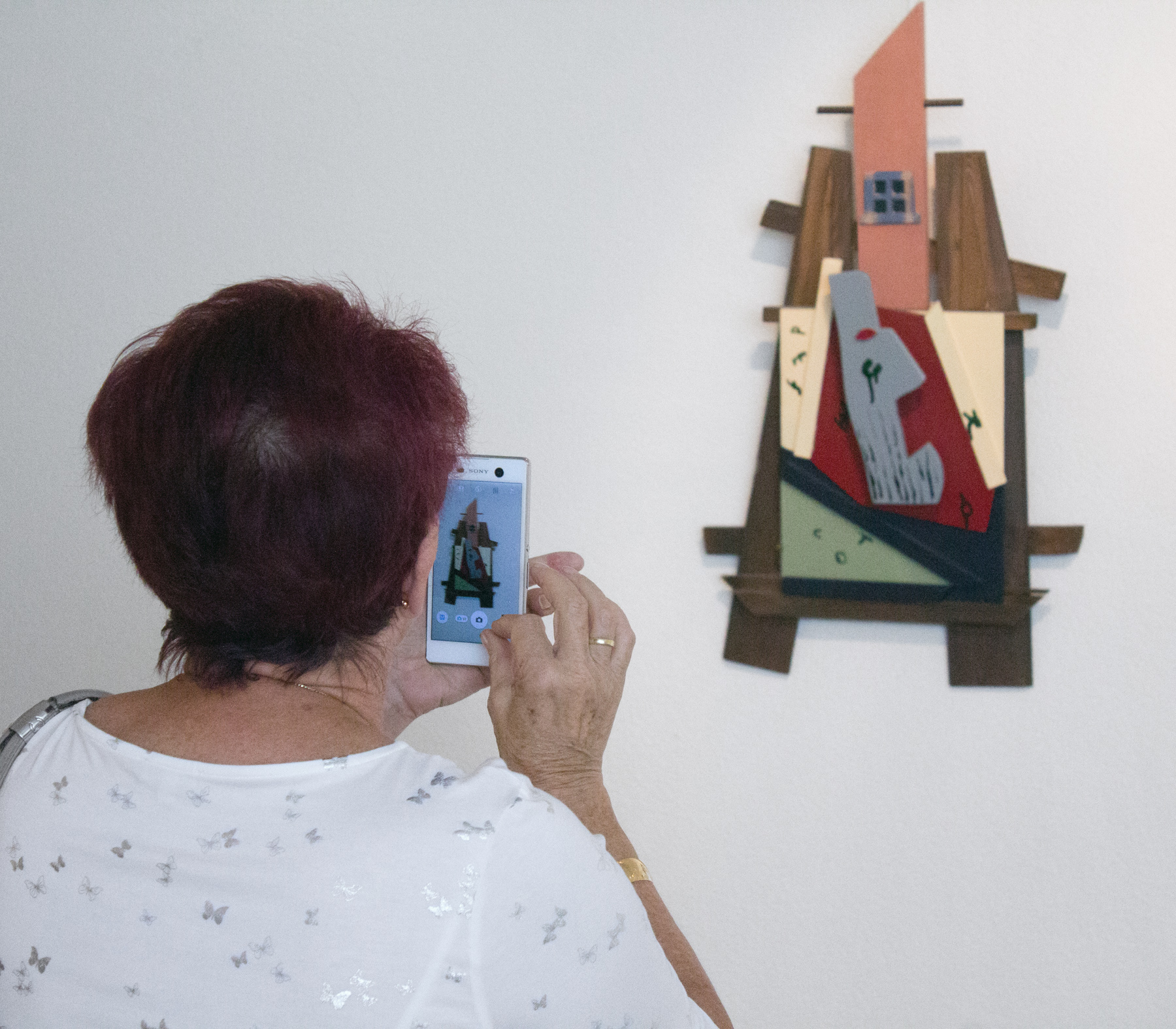
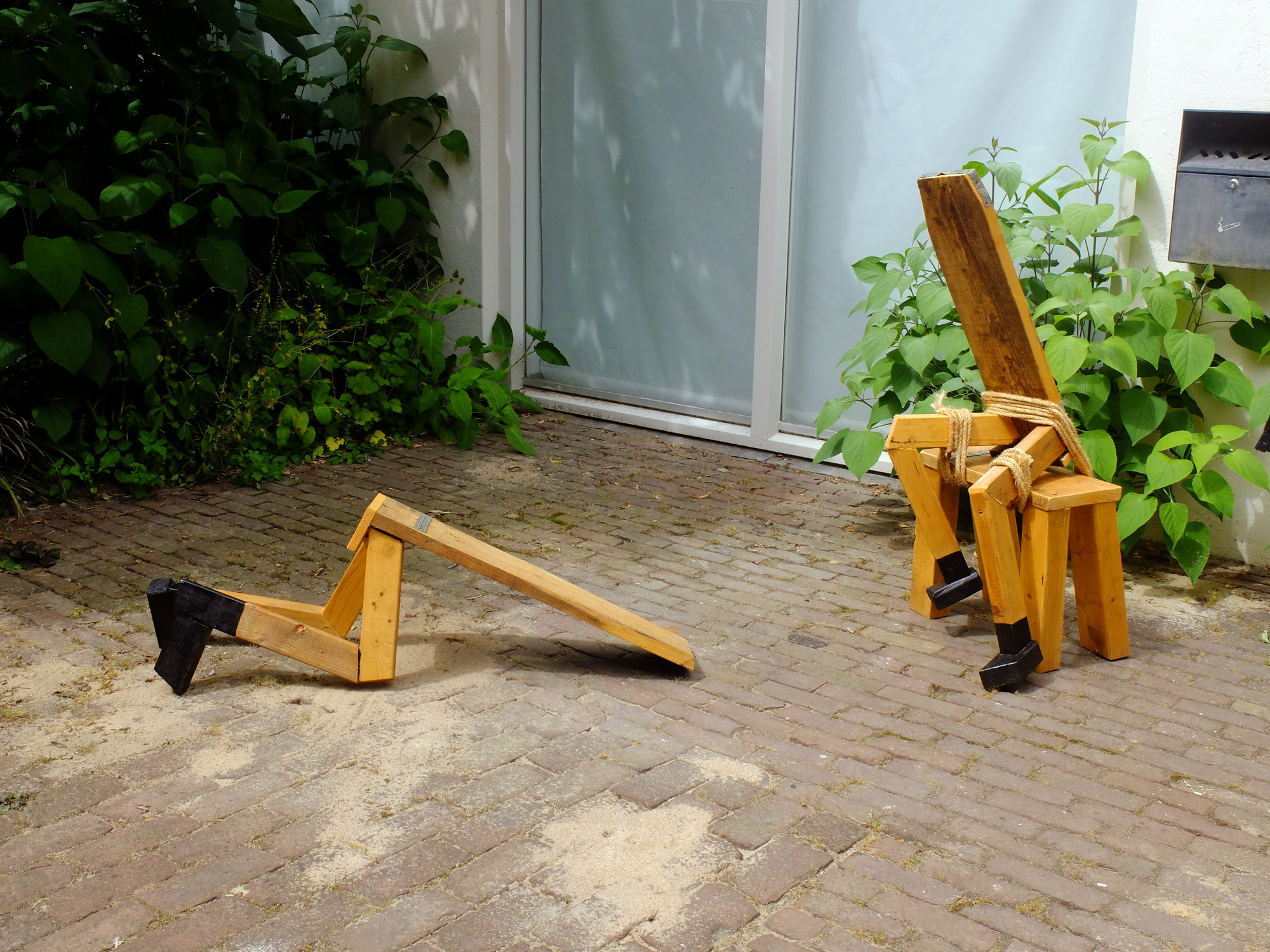
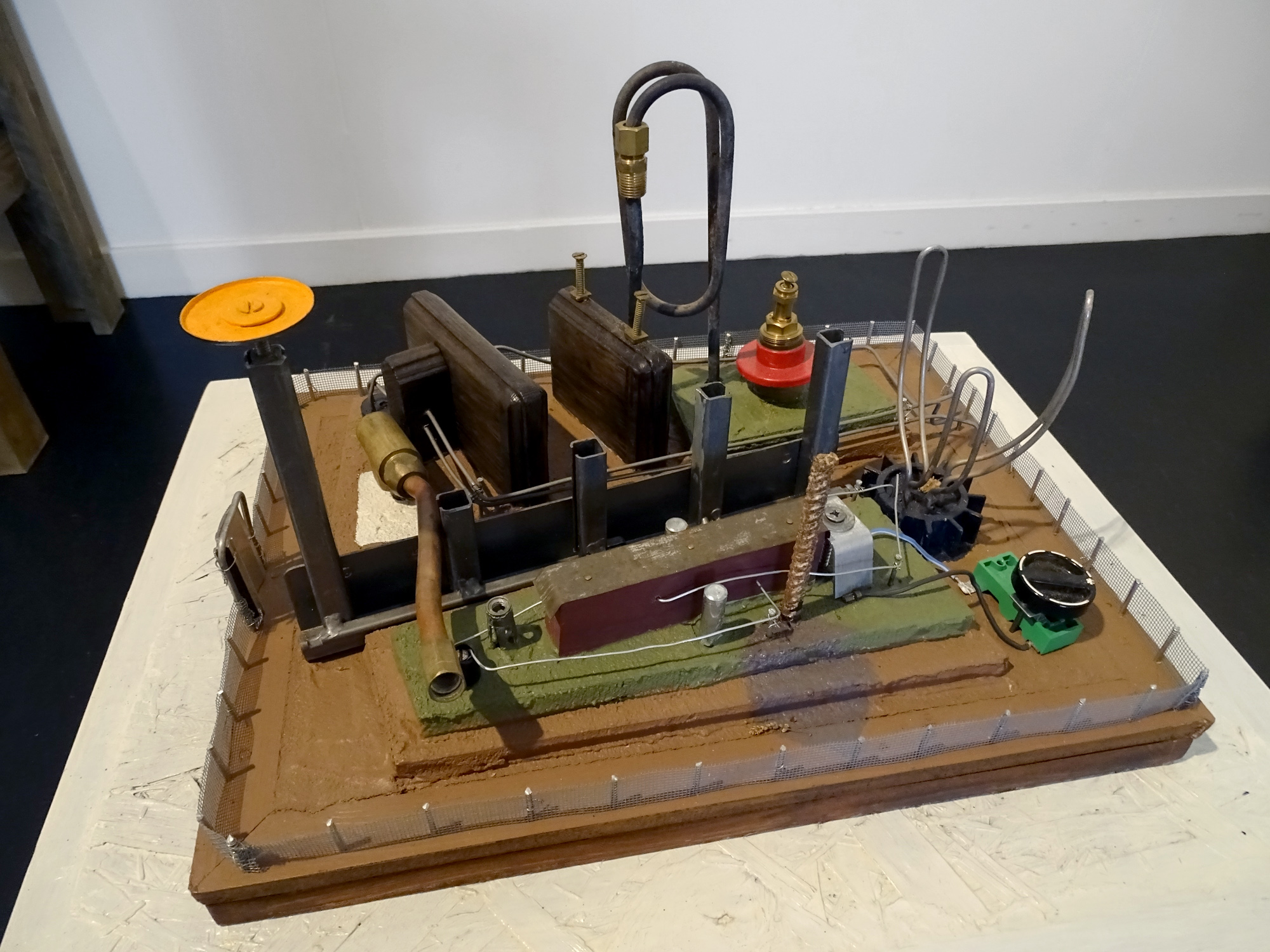
In this latest exhibition, there is a wonderful, tensional balance between elements and energy in his constructions. Much of the basic elements are from demolition- / remnant materials (“recycling art”), sometimes called objets trouvés: things coil around, are contained, wire, wood, recycled materials, energy, intimacy. His un/civilised forms of expression create an interplay between the conscious and the unconscious minds.

Drager is true to the integrity of his materials, the inherent qualities of natural and man made materials, and his vision. He incorporates primitive, mythical, spiritual and folkloric elements into his art. And his pleasure is in the layering and painting, in the materials, forms and, finally, in the art itself. Here is humour (The snake kept its mouth shut, 2018 below; the moustache of The Orator, 2016 below), ecology and spirit. A sense of mystery and purpose at one and the same time.

Riffing on Guy Debord’s concept of dérive (“drift” in English) which Debord defines as “a mode of experimental behaviour linked to the conditions of urban society: a technique of rapid passage through varied ambiances”2, I can relate Drager’s art to an unplanned journey through the urban landscape in which he drops his everyday relations and lets himself be drawn by the attractions of the terrain and the encounters he finds there. Drager’s attractions are the refuse of the human race. His encounters lead to the construction of contexts and situations, an artistic practice of “the happening”, which is a structured but unencumbered, expressive approach that encourages us to question our finite place in the world. Who else would paint a mountain on a radiator!

While I believe that some of the most important qualities in this world have their meanings proscribed by their opposite, some of these qualities have to be understood by reference only to themselves – which is very difficult – but must be attempted. A lot of things have been made too simple (taught in art schools?) by constructing fraught dichotomies. In other words, as an artist and as a human being, do not rely on binaries but just “on the thing itself”. Let it reveal itself to you – whether that is through Dada, an enigmatic self, of movement and form – or through some other mechanism. Drager has enough intellect and talent not to fall into the too simple, too easy, trap.

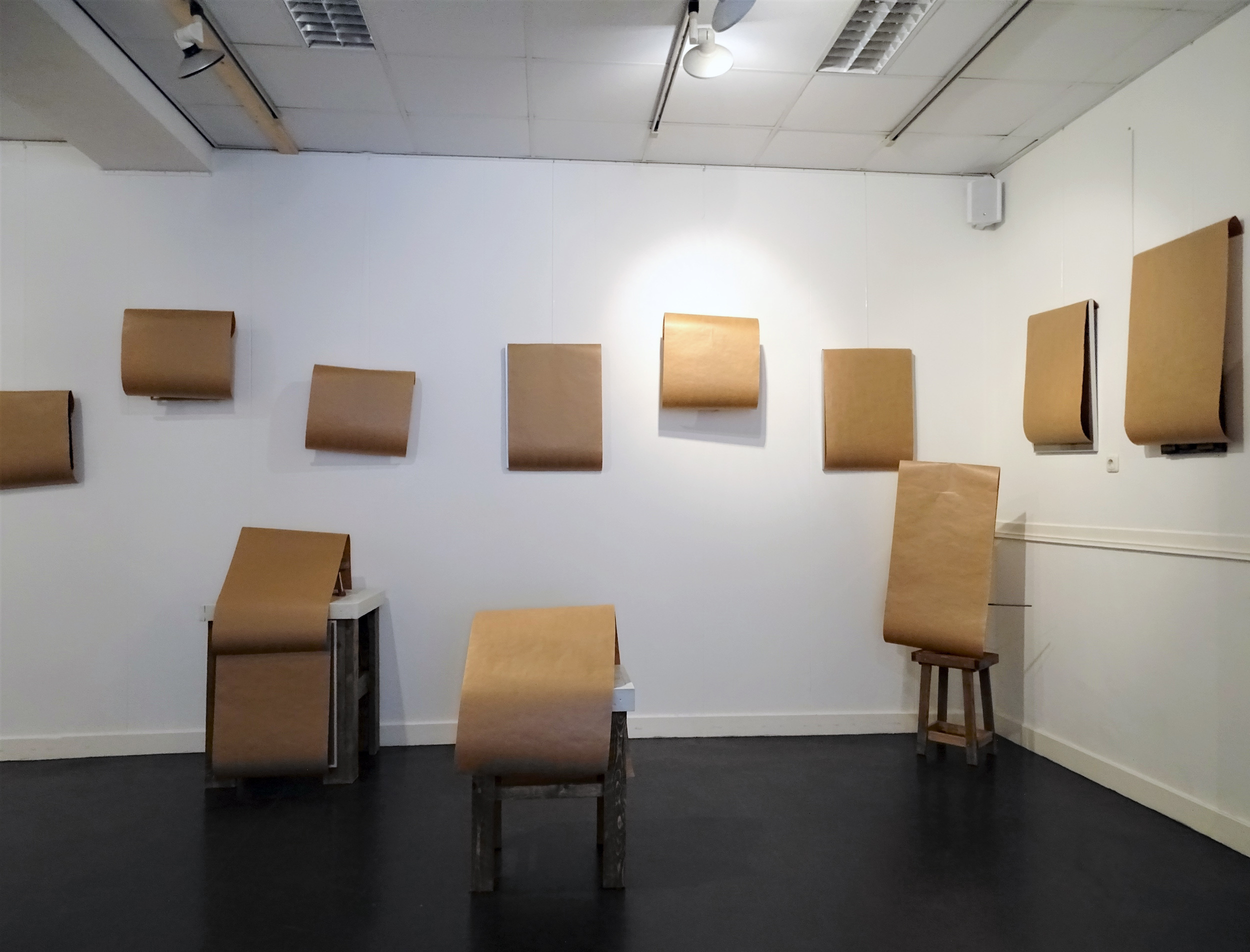
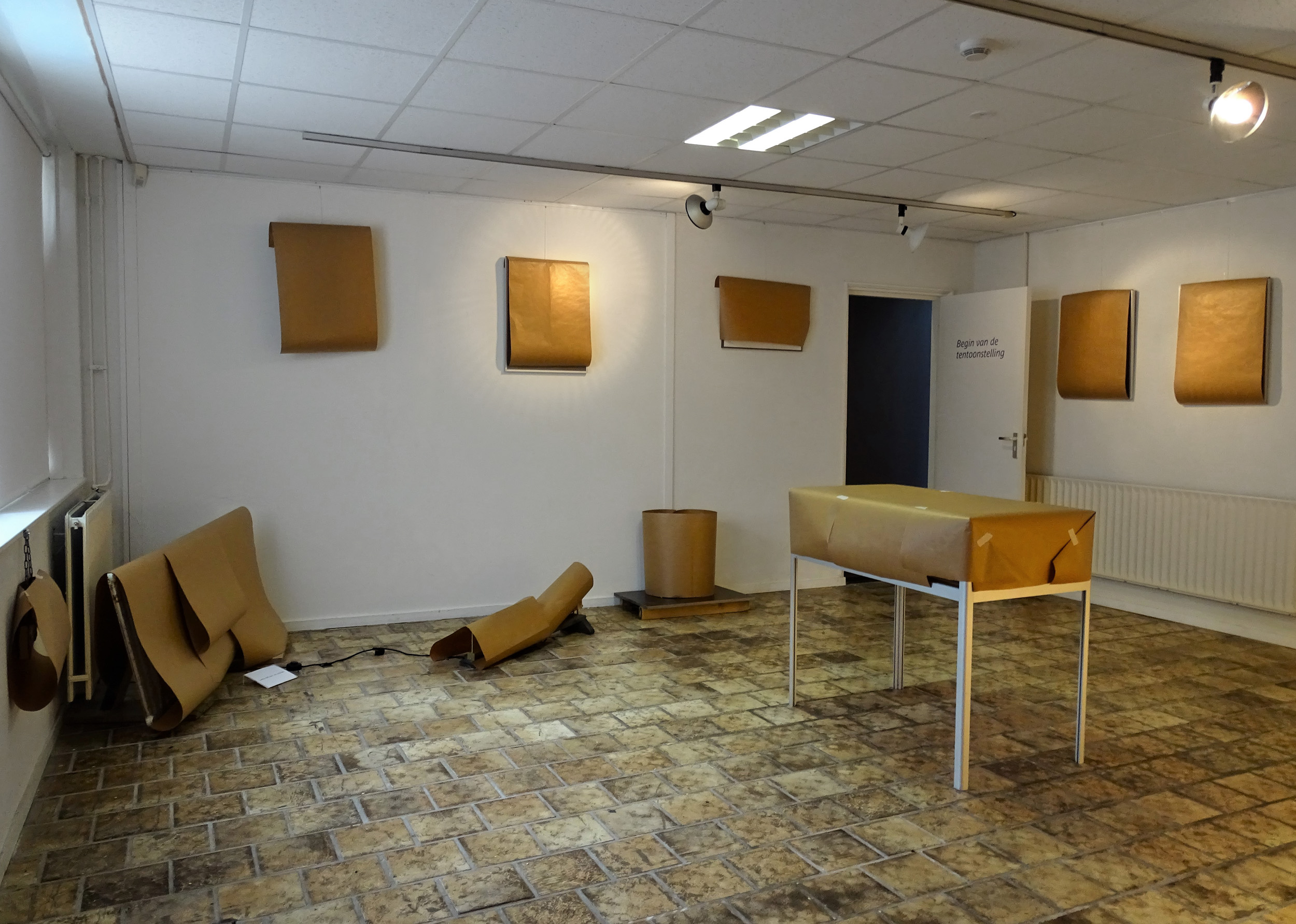
In this small regional gallery in the Netherlands, this visionary of the romantic, otherworldy (definition: devoted to intellectual or imaginative pursuits), utopian / dystopian unification of art and life constructs his paradoxes. I love the poetry that accompanies and informs his work; I love the brown butchers paper that covered “the happenings” before the unveiling; and I love the energy, the concern for the environment, and the construction and conceptualisation of his assemblages. I am challenged, in a good way, by his art.

The next step on the path for my friend is to keep the faith, is to keep making the art for himself and no one else. To keep them free and not contained by unwanted concerns. For, as he said to me, “in the end the path followed will be more interesting than the stakes raised in passing.” But curators please take note… here is a star of the future!

Dr Marcus Bunyan


1/ Anonymous. “Rosalie Gascoigne,” on the Art Gallery of New South Wales website 08/08/2018. No longer available online

2/ Guy Debord (1958) Definitions. Internationale Situationniste #1 (Paris, June 1958). Translated by Ken Knabb.


Many thankx to the artists and Kunstwerk! Liemers Museum for allowing me to publish the art work in the posting. Please click on the photographs for a larger version of the image.


“The creation of art, to me, is not work. The end-result is not seen as a piece, but as a whole. Since it brings me comfort and relieves stress, I call my assemblages ‘art-peaces’.”

“The essence of working with found objects (or scrap material) is that their different natures will enrich the composition as they are expressed in its different layers. This effect is based upon the divergent origins, structures and functions of these elements: wood, metal, glass, stone, cloth, plastic, etc. As a consequence, each bears a different weight and ease for ‘penetrance’ (transparency), that will influence the final form of the composition.”


Drager Meurtant


“Nearly every work of assemblage, in its relational structure, approaches abstract art” [but] “the practice of assemblage raises materials from the level of formal relations to that of associational poetry.”


Seitz, W. C. The Art of Assemblage. New York: Museum of Modern Art, 1961, p. 25, 84.


“It’s not where you take things from, it’s where you take them to.”


Jean-Luc Godard


Before the exhibition Now, the new form of the past opening


Before the opening of the exhibition 'Now, the new form of the past' at Kunstwerk! Liemers Museum, Netherlands

Before the opening of the exhibition 'Now, the new form of the past' at Kunstwerk! Liemers Museum, Netherlands

Before the opening of the exhibition 'Now, the new form of the past' at Kunstwerk! Liemers Museum, Netherlands

Before the opening of the exhibition 'Now, the new form of the past' at Kunstwerk! Liemers Museum, Netherlands

Before the opening of the exhibition 'Now, the new form of the past' at Kunstwerk! Liemers Museum, Netherlands


Before the opening of the exhibition Now, the new form of the past at Kunstwerk! Liemers Museum, Netherlands


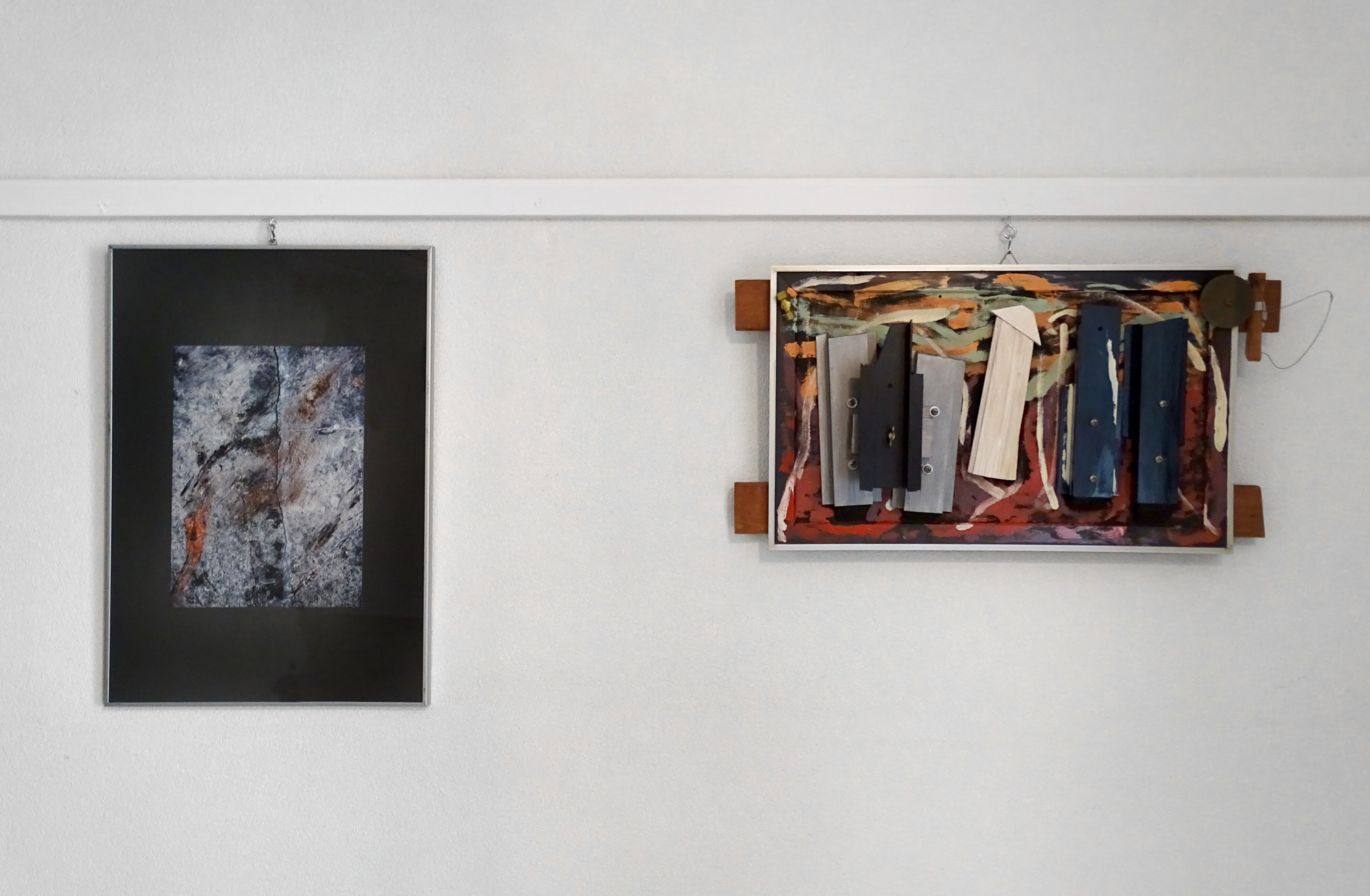
Now, the new form of the past is an exhibition based on international collaboration between Drager Meurtant (assemblages, NL) and Petra Senn (photography, D) with the theme Recycling Art . Both artists place most of the energy in their art and demand attention for its creativity, in the reuse of materials and objects.

Drager uses demolition material and remnants from construction, plus objets trouvés, to make assemblages; while Petra uses weathered matter and the perishableness (transitoriness) of materials in her photographs. Every artwork thus carries echoes from the past within itself. Senses is a parallel exhibition of abstract paintings by Jeanine Keuchenius.

Text from the Kunstwerk! Liemers Museum website


The artists Drager Meurtant and Petra Senn first met on ‘pictify’, a social medium for artists (at present no longer accepting new art submissions.) After an exchange of some ‘faves’ and views, the retrospective The Trauma of Painting by Alberto Burro in the museum K21 in Düsseldorf, Germany, became the place where at the end of June 2016 the three, Petra Senn, Drager Meurtant and his artist-partner Jeanine Keuchenius, met in person. With the overwhelming artistic environment, the basis of a human and artistic interest became established. Thus, when Stijn Geutjes, the curator of Kunstwerk! Liemers Museum asked Drager about willingness to exhibit his art in the museum, the answer came with the suggestion of the theme “Now, the new form of the past”, and introduction of colleague Petra Senn as associate, and Jeanine to come with an addition of the theme “Senses”. After some discussion, and rising interest of Stijn Geutjes in the abstract photographies of Petra Senn, the decision came to exhibit in a collaborative effort, that included partaking in the selection process of works of the curator and the three artists.

Text by Drager Meurtant


Objets trouvés

An objets trouvé is a found object; a natural or discarded object found by chance and held to have aesthetic value; an ordinary object, as a piece of driftwood, a shell, or a manufactured article, that is treated as an object of art by one who finds it aesthetically pleasing.

The term relates directly to Marcel Duchamp’s readymades, Dada and Fluxus art. Art critics have coined the terms arte povera (Italian) and junk art (Anglo-American) to signify art which incorporates said objects.

Arte Povera is basically the legitimate justification for creating art of junk and found objects. Arte Povera was a term coined by the Italian art critic Germano Celant. He used the word to sum up a type of art which combined elements of conceptual art, minimal art and performance art. He conceived the idea of the art movement in reaction to the ever increasing commercialism within the art world. The artists embrace the ideas of using valueless materials such as earth, gravel, rocks or litter in order to create works of art.

Junk art is the flattering name is given to 20th and 21st-century art in which the artist uses refuse, scrap metal, urban waste or just anything viewed as useless or cast of from modern society. Junk art is very much synonymous with American artist Robert Rauschenberg. It is also very much part of the 1960s Italian movement Arte Povera. The movement was the product of Antoni Tàpies, Alberto Burri, Michelangelo Pistoletto, Piero Manzoni, and Lucio Fontana.

Anonymous text. “Objet trouvé art,” on the Xamou website [Online] Cited 17/02/2022. No longer available online

Found object

Found object originates from the French objet trouvé, describing art created from undisguised, but often modified, objects or products that are not normally considered materials from which art is made, often because they already have a non-art function. …

Found objects derive their identity as art from the designation placed upon them by the artist and from the social history that comes with the object. This may be indicated by either its anonymous wear and tear (as in collages of Kurt Schwitters) or by its recognisability as a consumer icon (as in the sculptures of Haim Steinbach). The context into which it is placed is also a highly relevant factor. The idea of dignifying commonplace objects in this way was originally a shocking challenge to the accepted distinction between what was considered art as opposed to not art. …

As an art form, found objects tend to include the artist’s output – at the very least an idea about it, i.e. the artist’s designation of the object as art – which is nearly always reinforced with a title. There is usually some degree of modification of the found object, although not always to the extent that it cannot be recognised, as is the case with ready-mades. Recent critical theory, however, would argue that the mere designation and relocation of any object, ready-mades included, constitutes a modification of the object because it changes our perception of its utility, its lifespan, or its status.

Text from the Wikipedia website


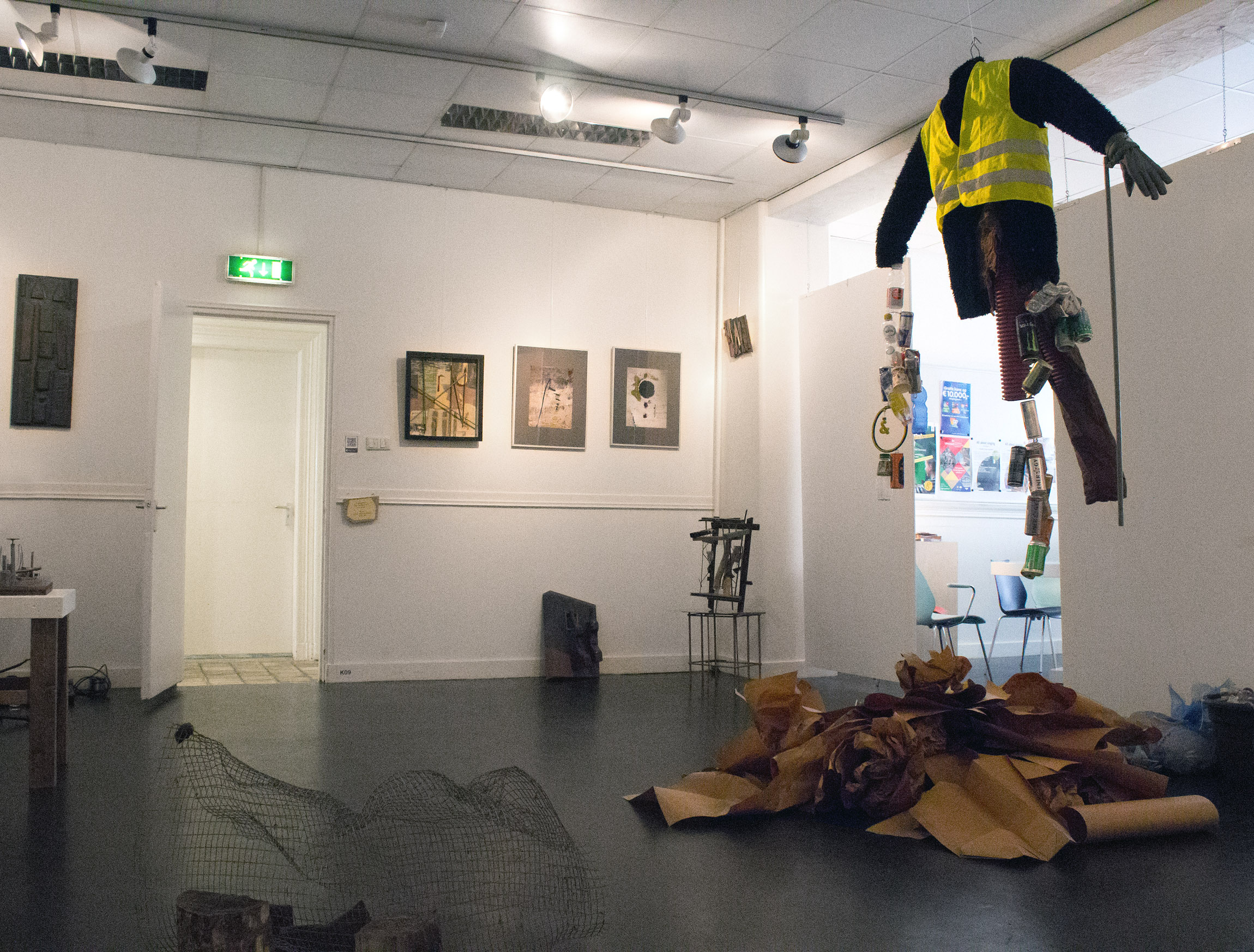
Installation views of the exhibition Now, the new form of the past


Installation view of the exhibition 'Now, the new form of the past' at Kunstwerk! Liemers Museum, Netherlands

Installation view of the exhibition 'Now, the new form of the past' at Kunstwerk! Liemers Museum, Netherlands

Installation view of the exhibition 'Now, the new form of the past' at Kunstwerk! Liemers Museum, Netherlands

Installation view of the exhibition 'Now, the new form of the past' at Kunstwerk! Liemers Museum, Netherlands

Installation view of the exhibition 'Now, the new form of the past' at Kunstwerk! Liemers Museum, Netherlands

Installation view of the exhibition 'Now, the new form of the past' at Kunstwerk! Liemers Museum, Netherlands


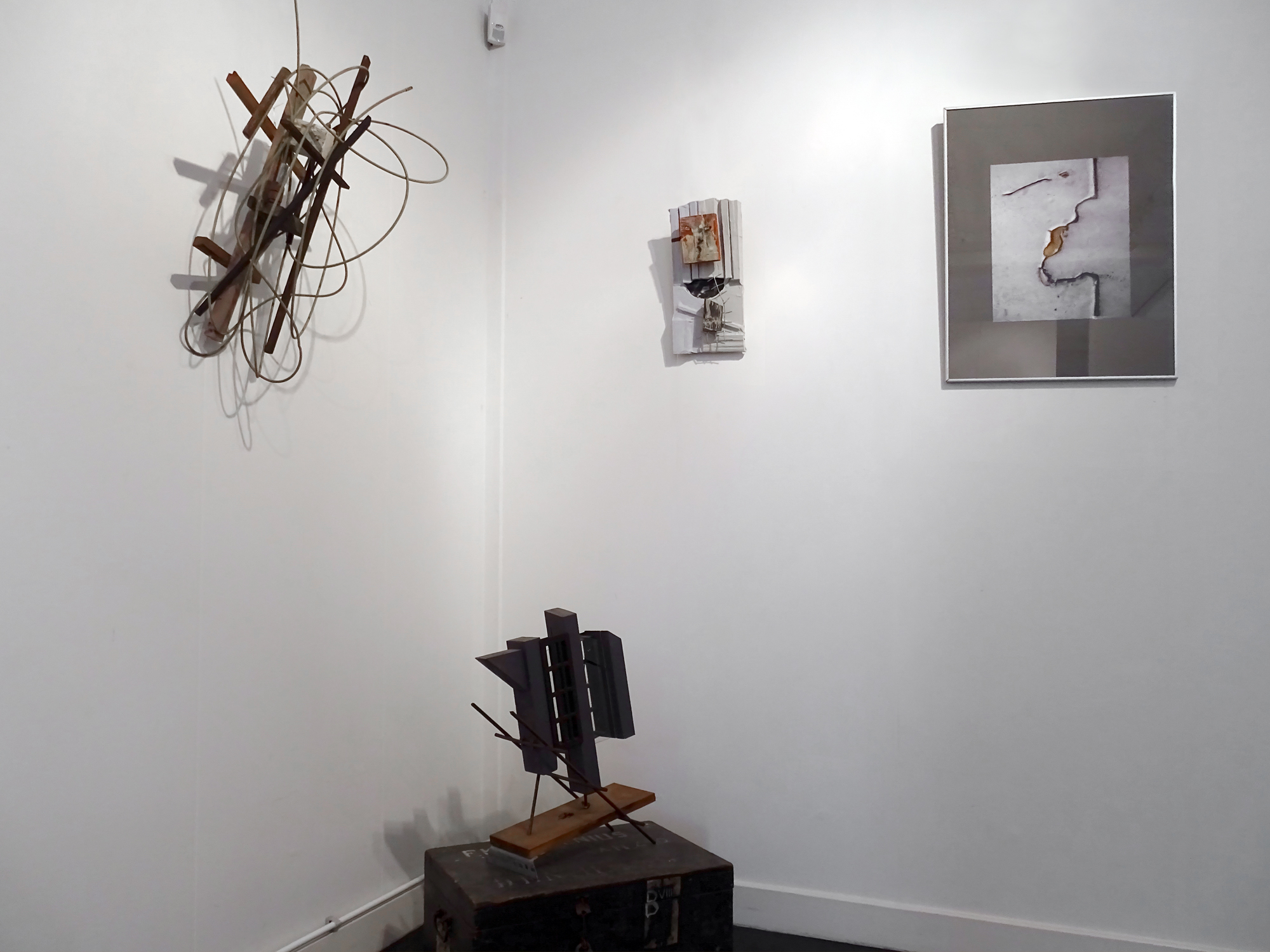
Installation views of the exhibition Now, the new form of the past at Kunstwerk! Liemers Museum, Netherlands showing the work of Drager Meurtant and Petra Senn


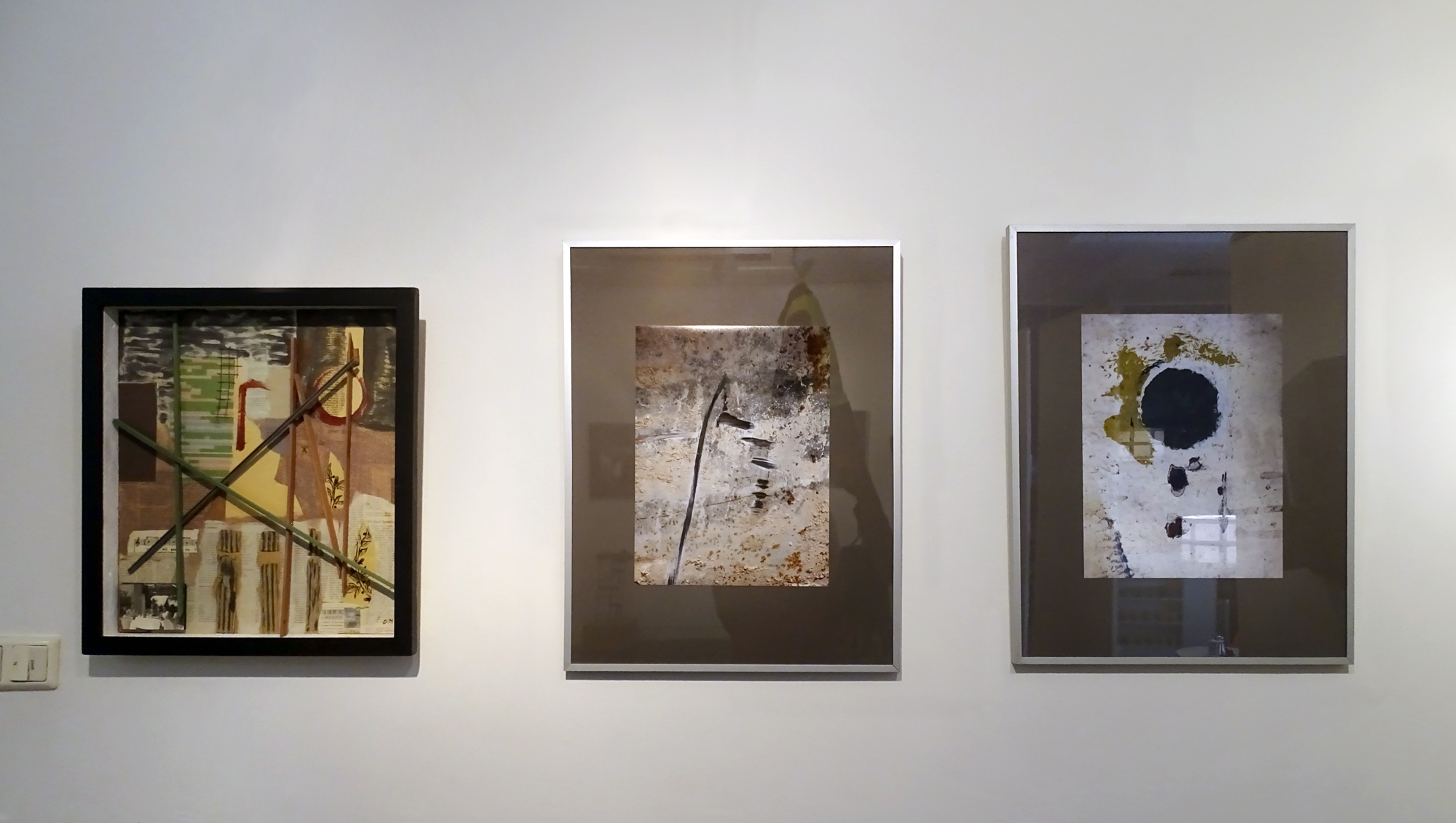
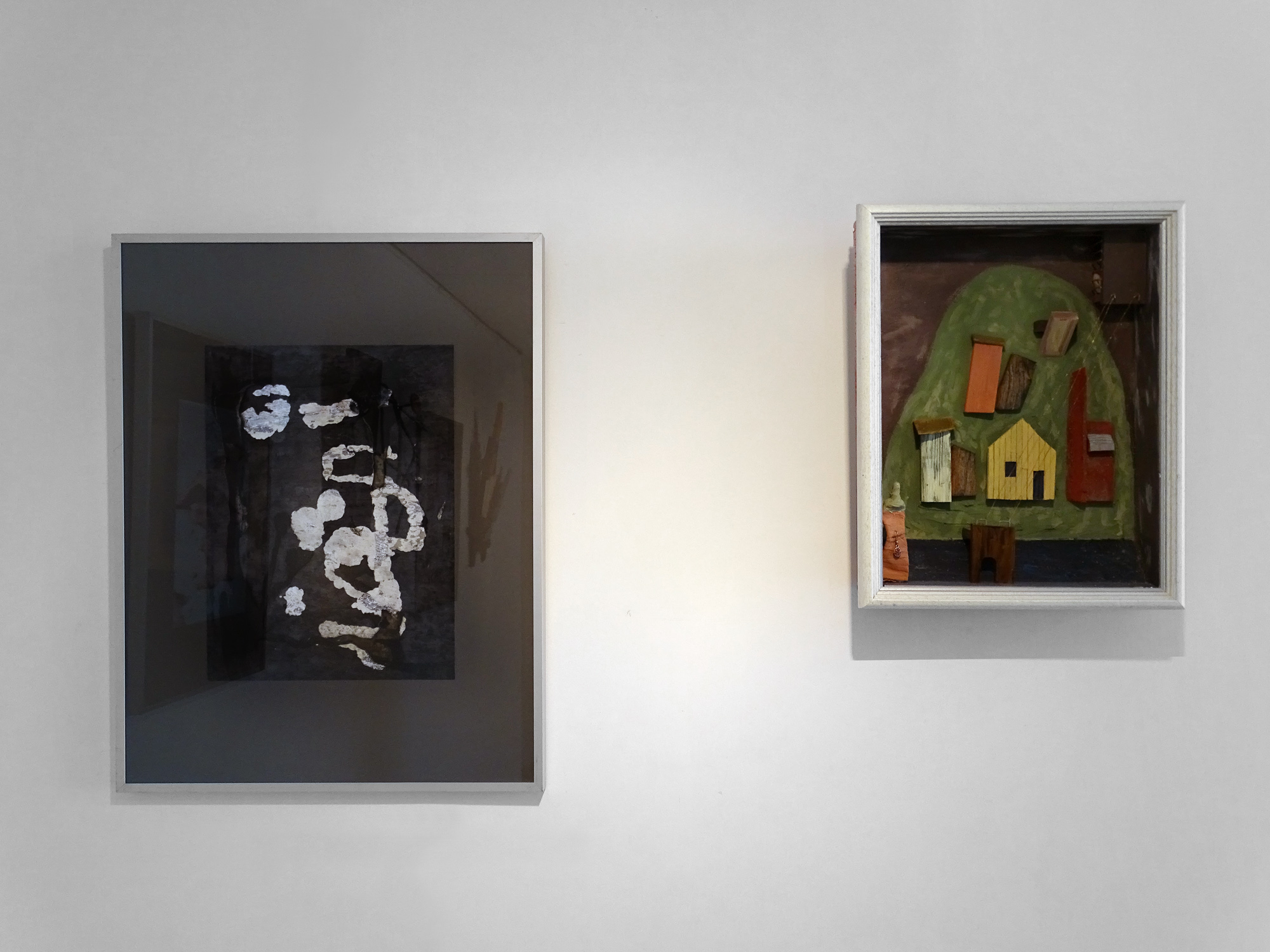
Installation view of the exhibition 'Now, the new form of the past' at Kunstwerk! Liemers Museum, Netherlands showing Drager Meurtant's work 'connection not wireless' (2014) top left, and Petra Senn's 'Persuasiveness' (2012) top right


Installation view of the exhibition Now, the new form of the past at Kunstwerk! Liemers Museum, Netherlands showing Drager Meurtant’s work connection not wireless (2014) top left, and Petra Senn’s Persuasiveness (2012) top right


Installation view of the exhibition 'Now, the new form of the past' at Kunstwerk! Liemers Museum, Netherlands showing Drager Meurtant's 'Under way' Nd


Installation view of the exhibition Now, the new form of the past at Kunstwerk! Liemers Museum, Netherlands showing Drager Meurtant’s Under way Nd


Installation view of the exhibition 'Now, the new form of the past' at Kunstwerk! Liemers Museum, Netherlands showing Drager Meurtant's work 'Swan in essence' (2014) at centre, with Petra Senn's 'Insubordination' (2017) top left and 'someone from the past I' (Nd) top right


Installation view of the exhibition Now, the new form of the past at Kunstwerk! Liemers Museum, Netherlands showing Drager Meurtant’s work Swan in essence (2014) at centre, with Petra Senn’s Insubordination (2017) top left and someone from the past I (Nd) top right


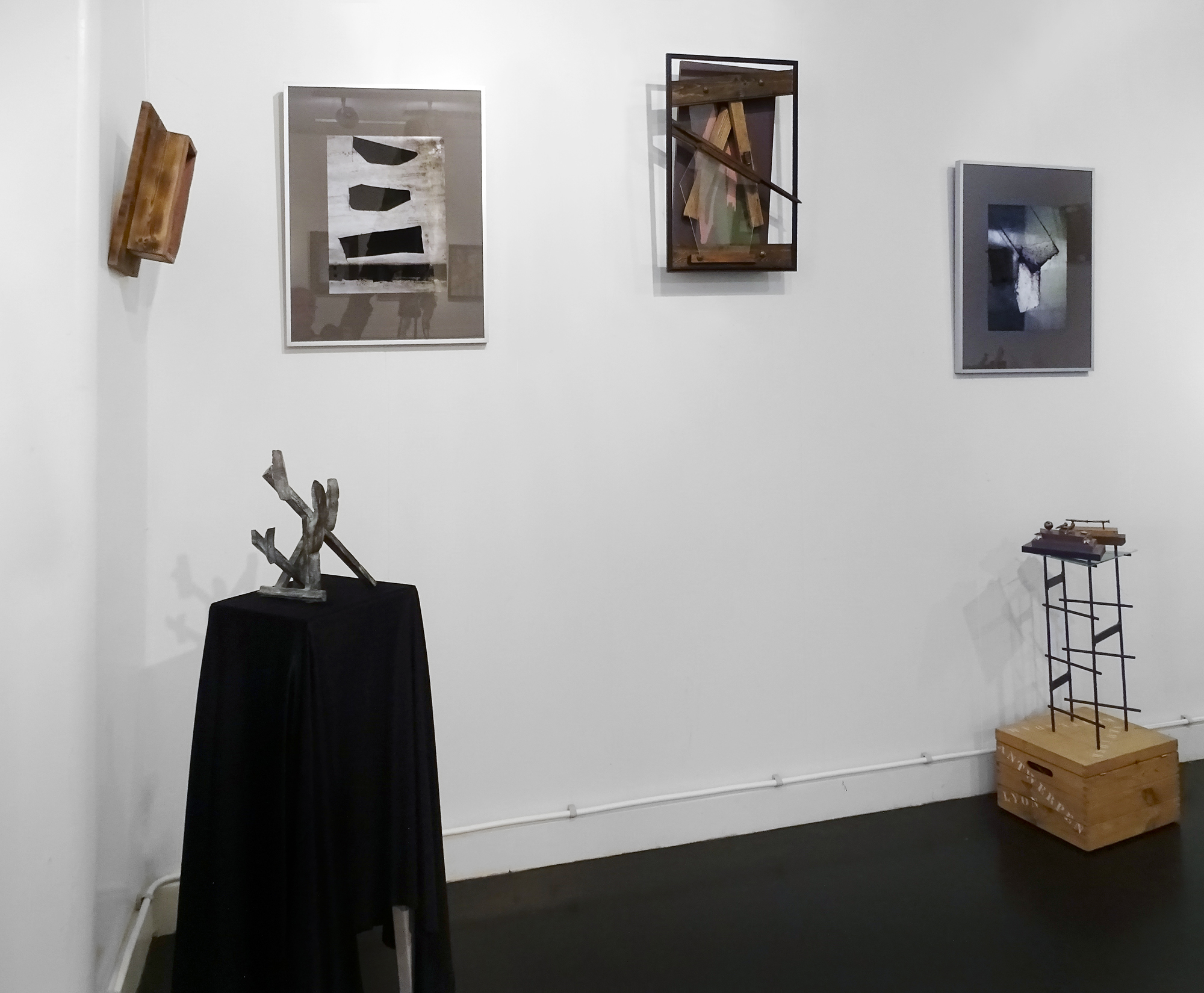
Installation view of the exhibition 'Now, the new form of the past' at Kunstwerk! Liemers Museum, Netherlands showing the work of Drager Meurtant and Petra Senn with DM's 'The promised land' (2016) at right


Installation view of the exhibition Now, the new form of the past at Kunstwerk! Liemers Museum, Netherlands showing the work of Drager Meurtant and Petra Senn with DM’s The promised land (2016) at right


About Drager Meurtant

In almost four decades since his training as as veterinarian-biomedical researcher, Drager Meurtant (artist alias of Gerard Rutteman) has channeled much creativity towards scientific publications and – in his free time – poetry. In more recent years, through a rapid learning curve, his creations have taken form as sculptures (in particular assemblages), collages, paintings and graphical works.

As autodidact and experienced carpenter, the circle saw, jig-saw, chisel, gouge, hammer are used to handle natural materials (wood, stone) in addition to manufactured (paper, cloth) and construction material (metal, glass, etcetera). Much of the basic elements are from demolition- / remnant materials (“recycling art”), sometimes objets trouvés. The assembly of contrasting elements creates tension, sometimes suspension.

The sculptures made by David Smith and (box) assemblages by Joseph Cornell, but also installations by Dieter Roth inspire Drager, as does the art by Joan Miró and members of CoBrA. The making of photographs is considered complementary to the assemblages, in an attempt to capture the fleeting world in which we live.


Drager Meurtant (Dutch, b. 1951) 'Movement from within' 2016


Drager Meurtant (Dutch, b. 1951)
Movement from within
2016
Three-dimensional sculpture, mixed media
Assemblage (relief), wood, paper, paint, sand, image
40 x 50 x 7cm

“When the pieces were seen fit / and fixed in their proper position / the movement was undeniable / as it arose from within”


Drager Meurtant (Dutch, b. 1951) 'Crawling, again' 2018


Drager Meurtant (Dutch, b. 1951)
Crawling, again
2018
Three-dimensional sculpture, mixed media
47 x 34 x 20cm

“How to make connections / of elements and the outside world? The answer to my question / came crawling, again”


Drager Meurtant (Dutch, b. 1951) 'Crawling, again' 2018 (installation view)


Drager Meurtant (Dutch, b. 1951)
Crawling, again (installation view)
2018
Three-dimensional sculpture, mixed media
47 x 34 x 20cm


Drager Meurtant (Dutch, b. 1951) 'Number 53' 2016 (installation view)


Drager Meurtant (Dutch, b. 1951)
Number 53 (installation view)
2016
Mixed media sculpture
Assemblage, wood, paper, metal, plaster, paint
31 x 36 x 9cm

“In former times / you could buy / petroleum, paraffin and coal / at number 53”


Drager Meurtant (Dutch, b. 1951) 'The Orator' 2016


Drager Meurtant (Dutch, b. 1951)
The Orator (installation view)
2016
Sculpture, wood, paint


Drager Meurtant (Dutch, b. 1951) 'Tegut' 2018


Drager Meurtant (Dutch, b. 1951)
Tegut
2018
Collage, paper
11 x 15cm

“The next generation / has more generations / to lean upon”


Drager Meurtant (Dutch, b. 1951) 'Three of a kind' 2018 (installation view)


Drager Meurtant (Dutch, b. 1951)
Three of a kind (installation view)
2018
Mixed media
24 x 32 x 1cm

“When presented three figures / of different size / and writing / and colour”


Drager Meurtant (Dutch, b. 1951) 'Three of a kind' 2018


Drager Meurtant (Dutch, b. 1951)
Three of a kind
2018
Mixed media
24 x 32 x 1cm


Drager Meurtant (Dutch, b. 1951) 'Mon Combat' 2018


Drager Meurtant (Dutch, b. 1951)
Mon Combat
2018
Installation of book, metal
60 x 30 x 5cm

Mon Combat by A. Tempspassé: there is always someone who sees argument to start a battle


Installation view of the exhibition 'Now, the new form of the past' at Kunstwerk! Liemers Museum, Netherlands showing Drager Meurtant's works 'the listener (needs protection)' (2018) at left, and 'The Mechanic' (2018) at right


Installation view of the exhibition Now, the new form of the past at Kunstwerk! Liemers Museum, Netherlands showing Drager Meurtant’s works the listener (needs protection) (2018) at left, and The Mechanic (2018) at right


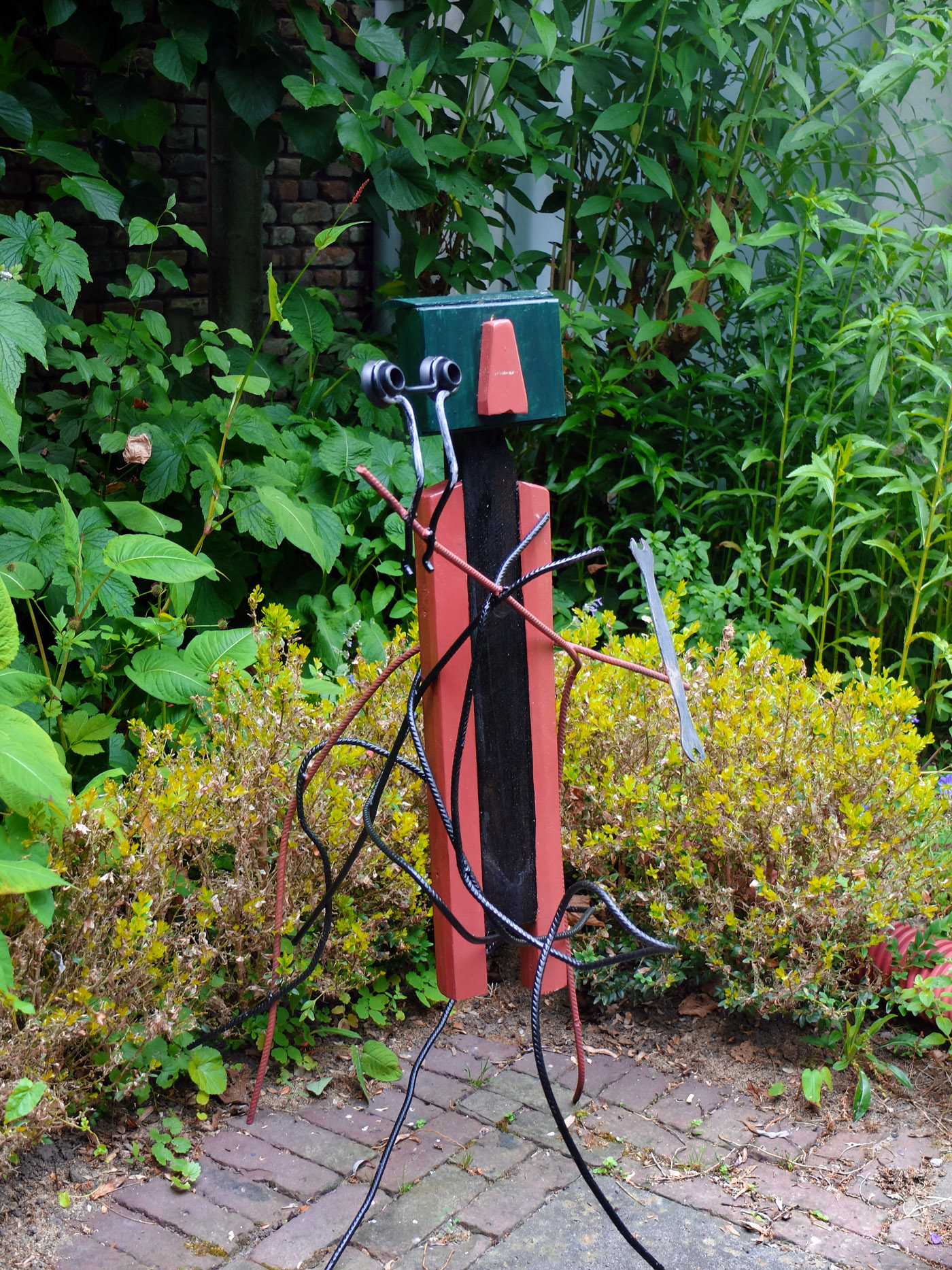
Drager Meurtant (Dutch, b. 1951) 'The Mechanic' 2018


Drager Meurtant (Dutch, b. 1951)
The Mechanic
2018
Mixed media (wood, iron, paint)
105 x 65 x 65cm

“With good tools / you get everything moving”


Drager Meurtant (Dutch, b. 1951) 'The snake kept its mouth shut' 2018


Drager Meurtant (Dutch, b. 1951)
The snake kept its mouth shut
2018
Mixed media, trash
35 x 25 x 500cm

“Curling, the snake kept its mouth shut”


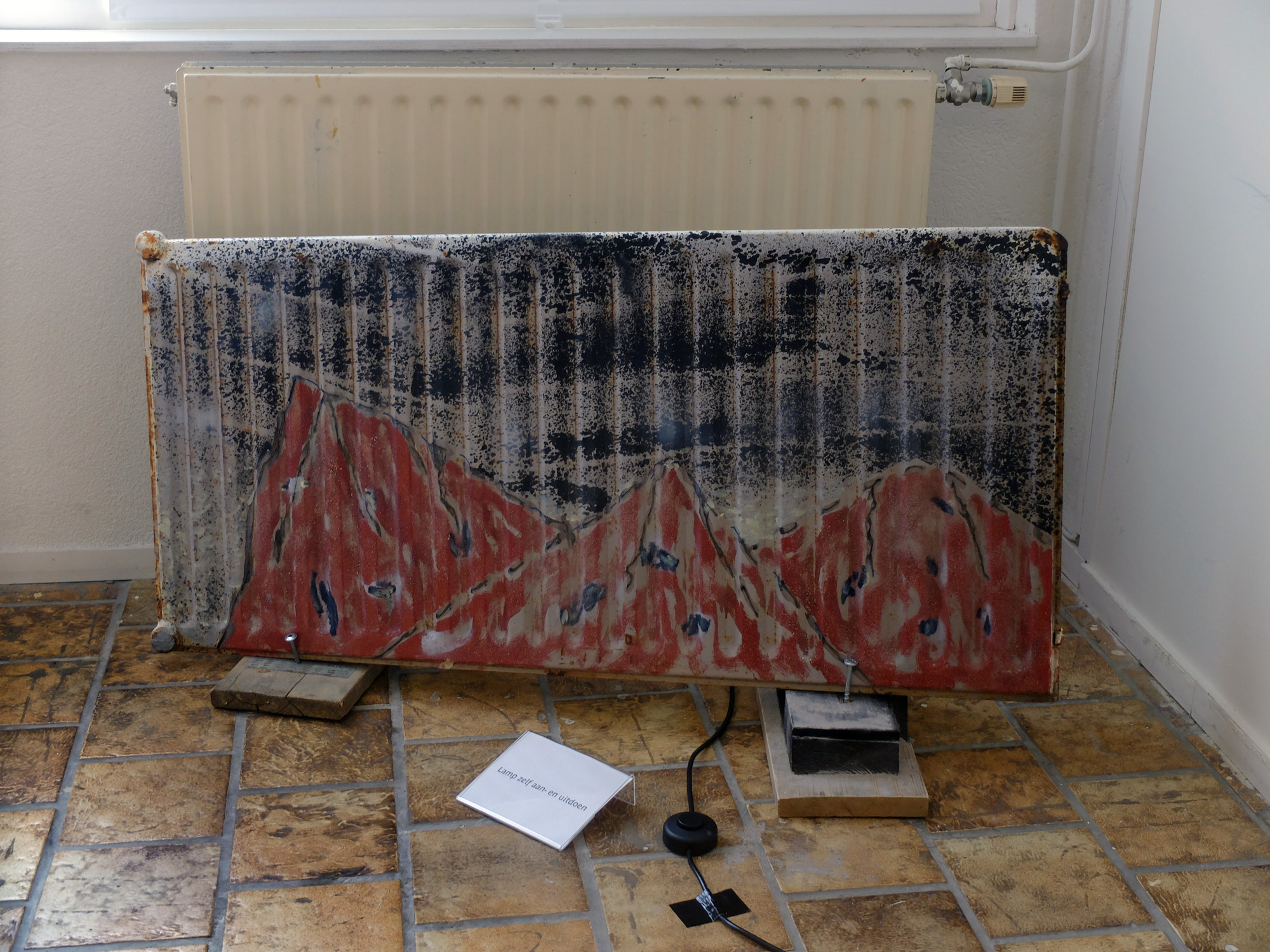
Drager Meurtant (Dutch, b. 1951) 'Destiny' 2018 (installation view)


Drager Meurtant (Dutch, b. 1951)
Destiny (installation view)
2018
Painting on discarded radiator with support
60 x 130cm


Drager Meurtant (Dutch, b. 1951) 'All humans are equal' 2018 (installation view)


Drager Meurtant (Dutch, b. 1951)
All humans are equal (installation view)
2018
Mixed media
100 x 50 x 200cm

All humans are equal. // To test this assumption / take two / and tilt the angle / and position towards, one another.


Drager Meurtant (Dutch, b. 1951) 'Rudimentary' 2016 (installation view)


Drager Meurtant (Dutch, b. 1951)
Rudimentary (installation view)
2016
Mixed media
23 x 13 x 16cm

“Mental metal / rudimentary face / mind you!”


Drager Meurtant (Dutch, b. 1951) 'The promised land' 2016


Drager Meurtant (Dutch, b. 1951)
The promised land
2016
Box assemblage
Mixed media, wood, board, metal, paint
34 x 44 x 10cm

“The promised land / cannot be for outsiders. // They may look / how it is, yonder.”


Drager Meurtant (Dutch, b. 1951) 'Steep-2' 2014 (installation view)


Drager Meurtant (Dutch, b. 1951)
Steep-2 (installation view)
2014
Mixed media, wood partly rotten, metal, paint and glass
35 x 23 x 10cm

Steep-2: The Monte Rotondo / is left behind / it weighs too much / for me. // The climbing rock of Feyr / I leave / to the climbers. // But / this wooden rock / serves as model / of a viewpoint on imagination.


Drager Meurtant (Dutch, b. 1951) 'The avail of propaganda' 2016


Drager Meurtant (Dutch, b. 1951)
The avail of propaganda
2016
Mixed media
Assemblage, wood, cloth, metal, paper, paint
43 x 21 x 8cm

“The avail of propaganda / is that you and I / do what / we detest.”


Drager Meurtant (Dutch, b. 1951) 'Twosome' Nd (installation view)


Drager Meurtant (Dutch, b. 1951)
Twosome (installation view)
Nd
Mixed media


Drager Meurtant (Dutch, b. 1951) 'fact-ohry' 2013 (installation view)


Drager Meurtant (Dutch, b. 1951)
fact-ohry (installation view)
2013
Mixed media
24 x 32 x 42cm

I said / now I will build a fact-ohry / and that / became factual. // With grabbing and placing / elements that together / took progressively the shape / of a fact-ohry / I became part of it. // Could shape the further design / and steer it at minor extent / but the end-result / was determined / by the starting point. // Voila.

(Note: This Fact-ohry is the only one with guarantee that risks during drilling for shale gas are secured.)


Drager Meurtant (Dutch, b. 1951) 'Progress (halted)' 2016 (installation view)


Drager Meurtant (Dutch, b. 1951)
Progress (halted) (installation view)
2016
Bronze
26 x 18 x 21cm

“When going forth / from wood to bronze / and grasping the result / I realised progress had halted. // A result stands in the way / of the learning process.”


Drager Meurtant (Dutch, b. 1951) 'Progress (halted)' 2016


Drager Meurtant (Dutch, b. 1951)
Progress (halted)
2016
Bronze
26 x 18 x 21cm


About Petra Senn

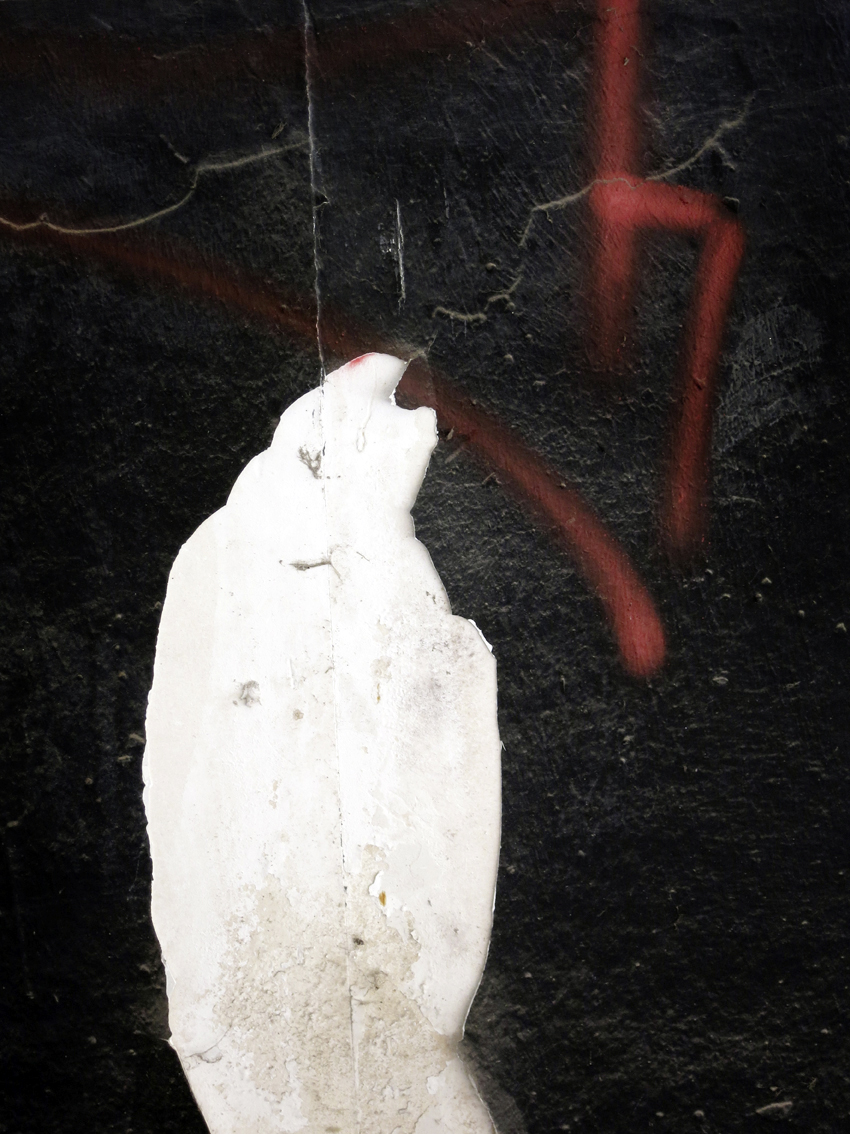
Petra’s work has mostly to do with memories and emotions. Her photos directly respond to the surrounding environment and use everyday experiences from the artist as a starting point. These experiences are often framed instances that would go unnoticed in their original context.

By contesting the division between the realm of memory and the realm of experience, she wants to amplify the astonishment of the spectator by creating compositions or settings that generate tranquil poetic images that leave traces and balances on the edge of recognition and alienation.

Her works appear as dreamlike images in which fiction and reality meet, well-known tropes merge, meanings shift, past and present fuse. Time and memory always play a key role. By applying abstraction, she absorbs the tradition of remembrance art into daily practice. She has a deep inner desire to protect the past from vanishing, both physically and, inevitably, mentally.

In her work Petra takes great care neither to simply reflect reality nor to just make visual statements. There is always left space for the spectators own emotions and opinions. She considers her work as visual stimulus, an invitation to enter ones inner world, knowing well that this process only works if she perceives deeper emotions while taking the pictures herself. Her search is for poetry in almost every item and condition.

Artist statement


Petra Senn. 'Her Lips' 2015


Petra Senn
Her Lips
2015


Petra Senn. 'Insubordination' 2017


Petra Senn
Insubordination
2017


Petra Senn. 'Persuasiveness' 2012


Petra Senn
Persuasiveness
2012


About Jeanine Keuchenius

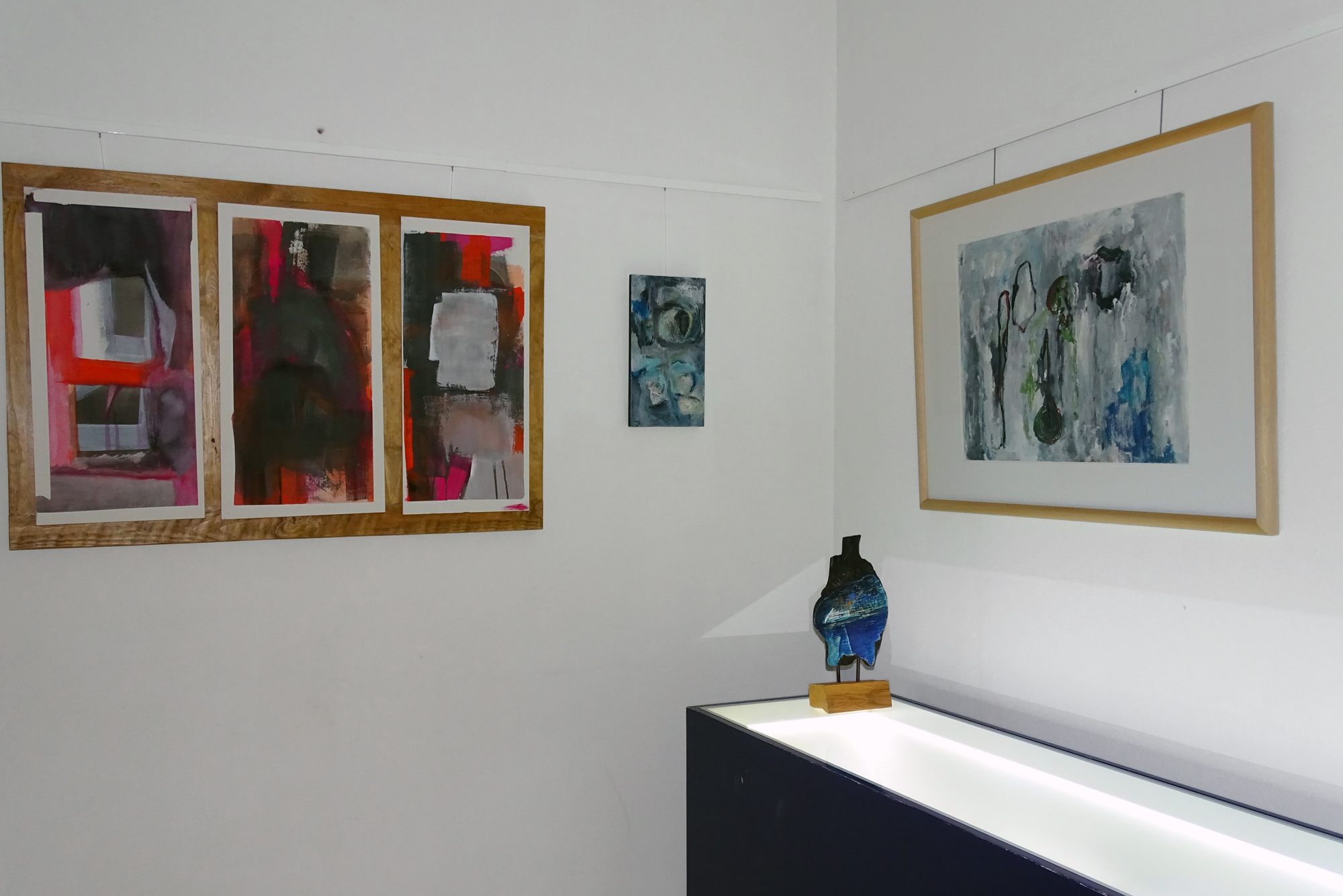
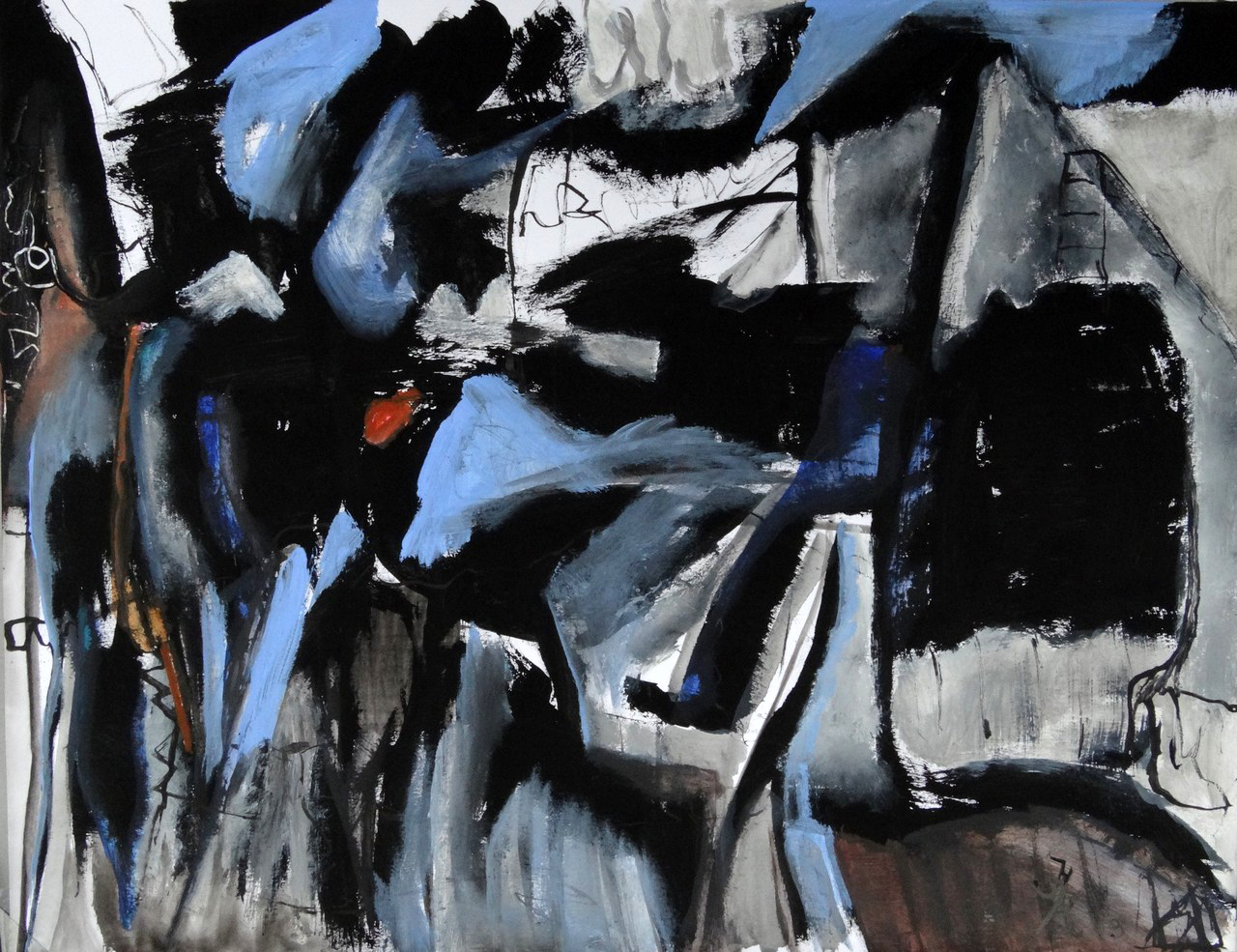
Jeanine Keuchenius (1953, Indonesia) is a creative artist, dancer, and performer. Her background is as an art therapist (independent and within psychiatry) and social worker / pastoral worker. In the visual art she is an autodidact (a self-taught person), acquiring some skills at high school (teacher in visual art), she then followed several courses / workshops given by professional artists.

Jeanine’s painting uses paper, linen or panel, with palette filled with gouache, acrylic, oil, ink, with at times addition of tar, sand, and glue. Artists that inspire her are Henri Toulouse-Lautrec, Edvard Munch, Antoni Tapies and Emil Schumacher, but also the medium of modern dance moves her in her work, which is mostly abstract, but at times features more figurative elements. Sometimes echoes from mountain landscapes and abandoned hamlets (e.g. on the island of Corsica) are visualised. Her motto is: “In duet with myself.”


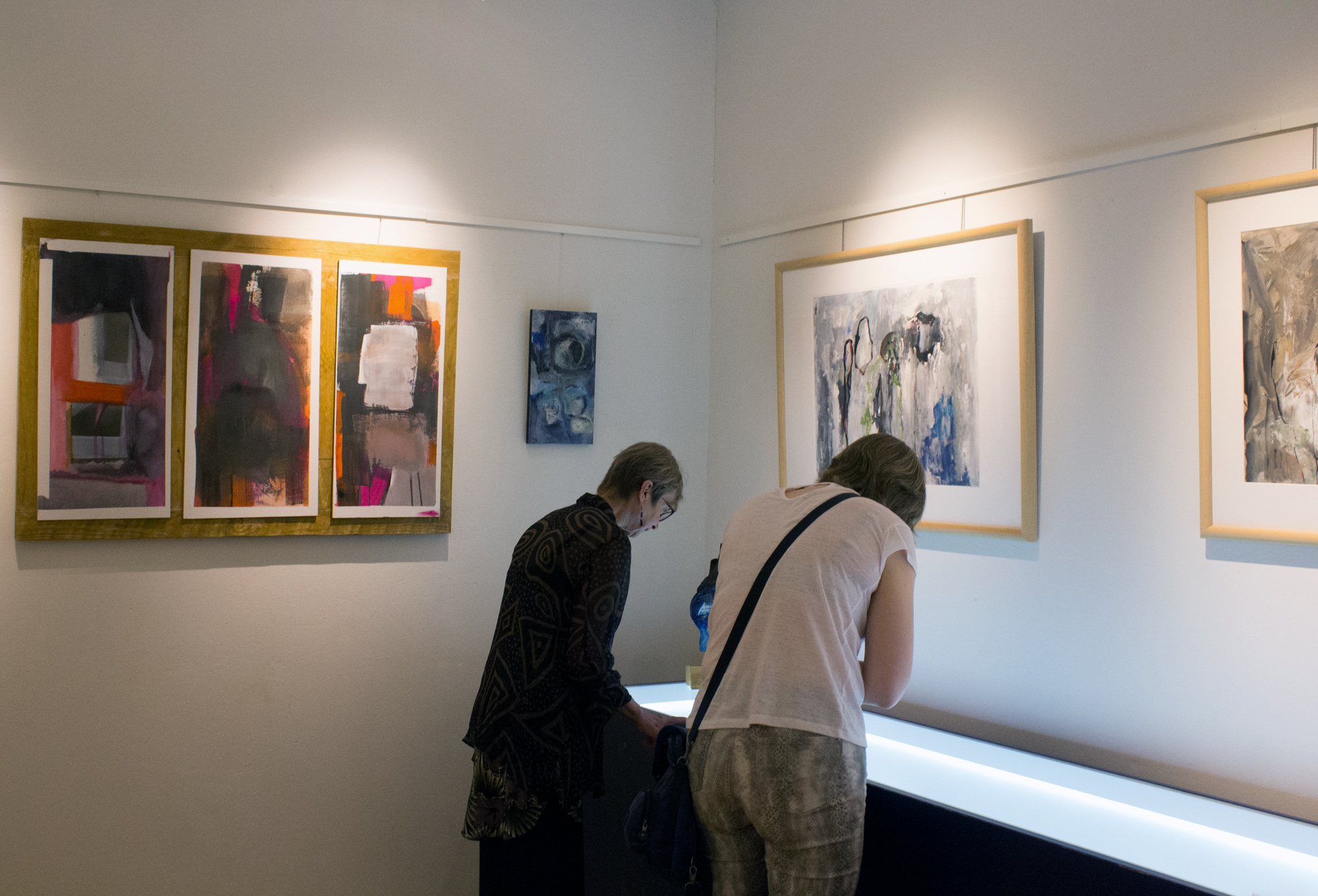
Installation views of the exhibition Senses


Installation view of the exhibition 'Senses' at Kunstwerk! Liemers Museum, Netherlands

Installation view of the exhibition 'Senses' at Kunstwerk! Liemers Museum, Netherlands


Installation views of the exhibition Senses at Kunstwerk! Liemers Museum, Netherlands


Jeanine Keuchenius (Dutch born Indonesia, b. 1953) 'Amulet' 2011 (installation view)


Jeanine Keuchenius (Dutch born Indonesia, b. 1953)
Amulet (installation view)
2011
Gouache on paper
50 x 65cm


Jeanine Keuchenius (Dutch born Indonesia, b. 1953) 'Amulet' 2011


Jeanine Keuchenius (Dutch born Indonesia, b. 1953)
Amulet
2011
Gouache on paper
50 x 65cm


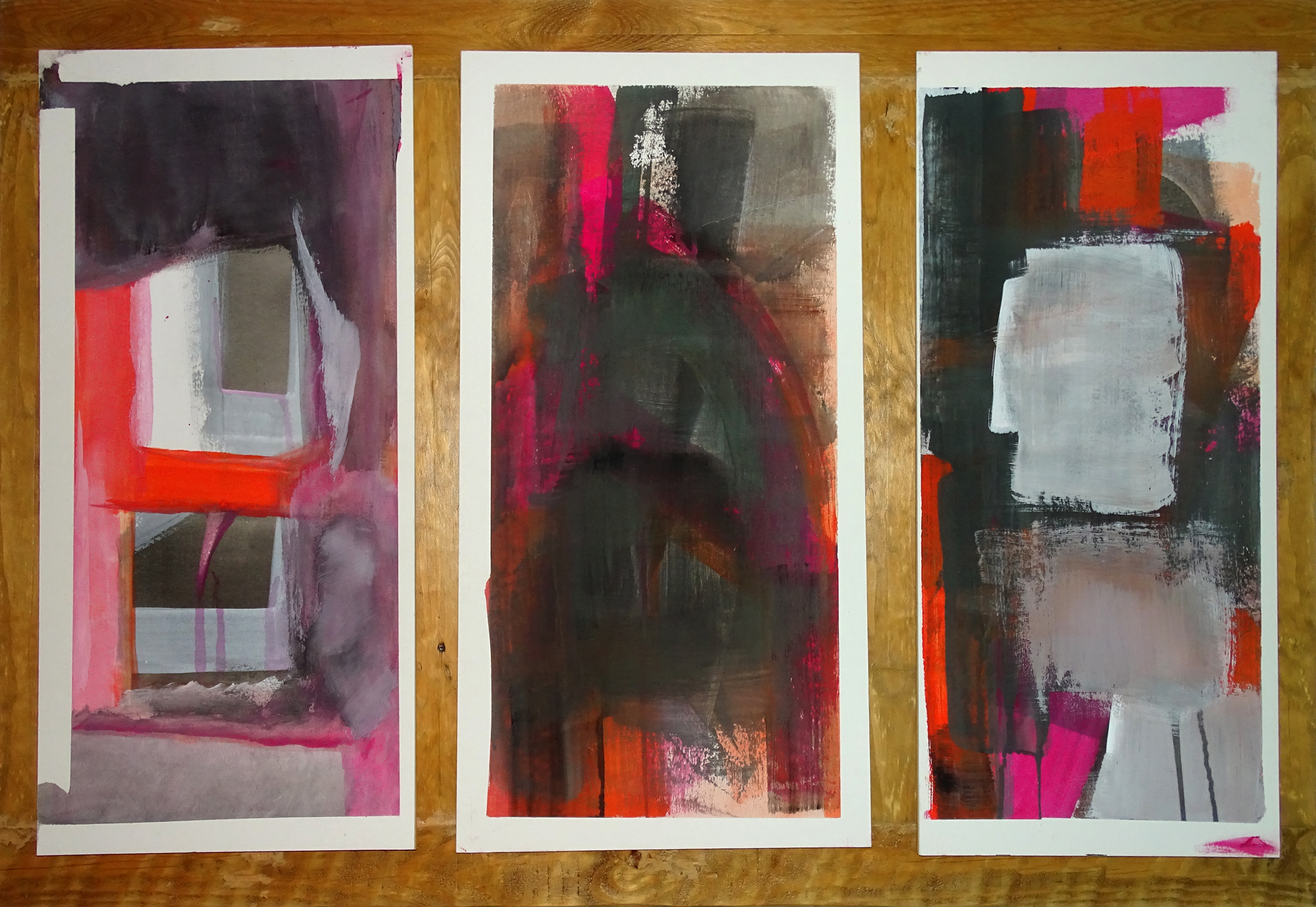
Jeanine Keuchenius (Dutch born Indonesia, b. 1953) 'Pink and grey' 2012


Jeanine Keuchenius (Dutch born Indonesia, b. 1953)
Pink and grey (installation view)
2012
Gouache on paper
50 x 65cm

Each painting is the reflection of memory or dream.


Jeanine Keuchenius (Dutch born Indonesia, b. 1953) 'Pink and grey' 2012


Jeanine Keuchenius (Dutch born Indonesia, b. 1953)
Pink and grey
2012
Gouache on paper
50 x 65cm


Jeanine Keuchenius (Dutch born Indonesia, b. 1953) 'Lying figure 2' 2017


Jeanine Keuchenius (Dutch born Indonesia, b. 1953)
Lying figure 2 (installation view)
2017
Two-dimensional plaster cut, printed on newspaper
22 x 26cm


Jeanine Keuchenius (Dutch born Indonesia, b. 1953) 'Beautiful stay' 2014


Jeanine Keuchenius (Dutch born Indonesia, b. 1953)
Beautiful stay (installation view)
2014
Gouache on paper


Jeanine Keuchenius (Dutch born Indonesia, b. 1953) 'Unchained' 2016 (installation view)


Jeanine Keuchenius (Dutch born Indonesia, b. 1953)
Unchained (installation view)
2016
Mixed media on panel (bitumen, acrylic, sand on panel)
45 x 57cm


Jeanine Keuchenius (Dutch born Indonesia, b. 1953) 'Memory 1' 2018 (installation view)


Jeanine Keuchenius (Dutch born Indonesia, b. 1953)
Memory 1 (installation view)
2018
Mixed media on panel (acrylic, sand, plaster, oil on panel)
60 x 70cm


Jeanine Keuchenius (Dutch born Indonesia, b. 1953) 'Gribusella' 2014


Jeanine Keuchenius (Dutch born Indonesia, b. 1953)
Gribusella
2014
Acrylic on paper
50 x 65cm

Form and colour accompany depth and emotion


Jeanine Keuchenius (Dutch born Indonesia, b. 1953) 'Senses' 2012


Jeanine Keuchenius (Dutch born Indonesia, b. 1953)
Senses
2012
Acrylic on paper
50 x 65cm


Jeanine Keuchenius (Dutch born Indonesia, b. 1953) 'Bwual ènzo' 2014


Jeanine Keuchenius (Dutch born Indonesia, b. 1953)
Bwual ènzo
2014
Gouache on paper
50 x 65cm

Both when handling and avoiding themes, you sometimes walk in a circle.


Poster for the exhibitions 'Now, the new form of the past' and 'Senses'


Poster for the exhibitions Now, the new form of the past and Senses


Kunstwerk! Liemers Museum
Kerkstraat 16, 6901
AB Zevenaar, Nederland
Phone: +31 85 040 9971

Opening hours :
Tuesday to Sunday from 2pm – 5pm

Jeanine Keuchenius website

Drager Meurtant website

Petra Senn website

Kunstwerk! Liemers Museum website

LIKE ART BLART ON FACEBOOK

Back to top

Exhibition: ‘Masterpieces from the Hermitage: The Legacy of Catherine the Great’ at NGV International, Melbourne

Exhibition dates: 31st July – 8th November, 2015

Curators: Dr Mikhail Dedinkin, Deputy Head of the Western European Art Department at the Hermitage, working Dr Ted Gott, Senior Curator of International Art at the National Gallery of Victoria


Installation view of room 1 of the exhibition 'Masterpieces from the Hermitage: The Legacy of Catherine the Great' featuring Alexander Roslin (Swedish 1718-1793) 'Portrait of Catherine II' 1776-1777


Installation view of room 1 of the exhibition Masterpieces from the Hermitage: The Legacy of Catherine the Great at NGV International, Melbourne featuring Alexander Roslin (Swedish 1718-93) Portrait of Catherine II 1776-77
Photo: Marcus Bunyan


A scintillating exhibition at NGV International which showcases one of the world’s greatest art collections. Exhibition design is outstanding (particularly the floor tiling), as are the Da Vinci, Titian, Rembrandt, van Dyck, Rubens and Flemish still life. Among my favourites is a small Watteau Savoyard with a Marmot (1716) which is absolutely still, delicate and exquisite: I thought of the photographs of Atget, his street sellers, when I saw this painting; and Frans Snyders’ tour-de-force Concert of birds (1630-40) which has such presence.

Well done to the curators, the Hermitage Museum and the NGV for staging such a magnificent exhibition.

Marcus


Many thankx to the National Gallery of Victoria for allowing me to publish the photographs in the posting. Please click on the photographs for a larger version of the image. All photographs Â© Dr Marcus Bunyan and the National Gallery of Victoria.


Masterpieces from the Hermitage: The Legacy of Catherine the Great showcases one of the world’s greatest art collections. Featuring works by artists including Rembrandt, Rubens, Velázquez and Van Dyck, the exhibition offers a dazzling array of works including the finest group of Dutch and Flemish art to come to Australia.

This exclusive Melbourne exhibition will also highlight the innovation and vision of Catherine the Great, whose inexhaustible passion for education, the arts and culture heralded a period of enlightenment in the region. The extraordinary works sourced and commissioned by Catherine during her thirty-four year reign, created the foundations for the Hermitage today – considered to be one of the world’s greatest treasure houses of art and decorative arts. The exhibition will offer audiences an immersive experience, recreating the rich atmosphere of the Hermitage to showcase these exquisite works.

German-born Catherine the Great (Catherine II) came to power in 1762, aged thirty-three, and ruled Russia for the next thirty-four years, until her death in 1796. She saw herself as a Philosopher Queen, a new kind of ruler in the Age of Enlightenment. Guided by Europe’s leading intellectuals, she modernised Russia’s economy, industry and government, drawing inspiration both from Antiquity and contemporary cultural and political developments in Western Europe. A fluent speaker of Russian, French and German, Catherine was largely self-educated, independent, idealistic and visionary.

While her reign was not always peaceful, Catherine sought to bring order, stability and prosperity to the vast Russian Empire. Her ideals of abolishing serfdom and ensuring the equality of all citizens under the law were ahead of her time, and strongly resisted by the nobility of the day; however, she achieved numerous other reforms, including the introduction of paper money and modernisation of Russia’s education system. French philosopher Denis Diderot, who visited St Petersburg in 1773, described an audience with Catherine as being ‘more like study than anything else: she is a stranger to no subject; there is no man in the Empire who knows her nation as well as she’.

Room 1 Catherine the collector

Between 1762 and 1796, the years of her reign, Catherine the Great oversaw a period of cultural renaissance in Russia. The world of ideas in which she was deeply involved from an early age found tangible expression in the material world the Empress later created around herself. The great complexes of imperial buildings Catherine constructed reflected her informed interest in both Classical and Chinese culture.

Catherine not only assembled a collection of Old Master paintings equal in scale and quality to leading European collections, but also paid considerable attention to the acquisition of contemporary art. While the richness and technical perfection of her diverse collections of decorative arts aimed to dazzle and please, they also had the more practical purpose of raising standards of artistic production in Russia. The fact that more than 400 exemplary works of art from her personal collection, including paintings, sculptures, drawings, porcelain, silver and precious gems, are seen here for the first time in Australia is cause for celebration.


Installation view of room 1 of the exhibition 'Masterpieces from the Hermitage: The Legacy of Catherine the Great' featuring Alexander Roslin (Swedish 1718-1793) 'Portrait of Catherine II' 1776-1777

Installation view of room 1 of the exhibition 'Masterpieces from the Hermitage: The Legacy of Catherine the Great' featuring Alexander Roslin (Swedish 1718-1793) 'Portrait of Catherine II' 1776-1777


Installation views of room 1 of the exhibition Masterpieces from the Hermitage: The Legacy of Catherine the Great at NGV International, Melbourne featuring Alexander Roslin (Swedish 1718-1793) Portrait of Catherine II 1776-1777
Photos: Marcus Bunyan


Installation view of room 1 of the exhibition 'Masterpieces from the Hermitage: The Legacy of Catherine the Great' at NGV International, Melbourne

Installation view of room 1 of the exhibition 'Masterpieces from the Hermitage: The Legacy of Catherine the Great' at NGV International, Melbourne

Installation view of room 1 of the exhibition 'Masterpieces from the Hermitage: The Legacy of Catherine the Great' at NGV International, Melbourne

Installation view of room 1 of the exhibition 'Masterpieces from the Hermitage: The Legacy of Catherine the Great' at NGV International, Melbourne featuring the Sèvres Cameo Service. Cameo Service 1778-1779. Sevres Porcelain Factory (manufacturer) France, est. 1756. The State Hermitage Museum, St. Petersburg


Installation views of room 1 of the exhibition Masterpieces from the Hermitage: The Legacy of Catherine the Great at NGV International, Melbourne featuring in the last three photographs, the Sèvres Cameo Service. Cameo Service 1778-1779. Sevres Porcelain Factory (manufacturer) France, est. 1756. The State Hermitage Museum, St. Petersburg.
Photos: Marcus Bunyan


Sèvres Cameo Service

The Sèvres Cameo Service (1778-1779) relates to Catherine’s great passion for collecting engraved gemstones. Comprising 797 individual pieces designed to serve dinner, dessert and coffee to sixty people, the Cameo Service was commissioned from the celebrated Sèvres porcelain manufactory outside Paris as a present for Catherine’s court ‘favourite’, Prince Grigory Potemkin. The Empress’s monogram, ‘E II’ (the Russian version of her name being Ekaterina), woven from garlands of flowers and surmounted by a crown, adorned almost every object in the service.

Production of the service was both time consuming and labour-intensive. The exquisite blue element alone – made from separate layers of copper enamel that gradually seeped into the porcelain and set the pure colour – required five firings. In addition to the hundreds of porcelain objects decorated with painted and sculpted cameos and related silverware, the service also included grand central table decorations fashioned from biscuit, or unglazed cream-coloured porcelain, by the sculptor Louis-Simon Boizot. These decorations illustrated tales from Greek mythology, and were presided over by a grand biscuit statue of Catherine the Great as Minerva, the Roman goddess of wisdom and the arts.


Installation view of room 1 of the exhibition 'Masterpieces from the Hermitage: The Legacy of Catherine the Great' at NGV International, Melbourne

Installation view of room 1 of the exhibition 'Masterpieces from the Hermitage: The Legacy of Catherine the Great' at NGV International, Melbourne


Installation views of room 1 of the exhibition Masterpieces from the Hermitage: The Legacy of Catherine the Great at NGV International, Melbourne
Photos: Marcus Bunyan


Exhibition passageway


Installation view of passageway video of the exhibition 'Masterpieces from the Hermitage: The Legacy of Catherine the Great' at NGV International, Melbourne


Installation view of passageway video of the exhibition Masterpieces from the Hermitage: The Legacy of Catherine the Great at NGV International, Melbourne
Photo: Marcus Bunyan


Room 2 Italian art

When Catherine the Great began collecting European art, opportunities to acquire fine Italian Old Master paintings were already severely limited. Demand from wealthy collectors was high and the marketplace was saturated with misattributed works, some of which inevitably made their way to the Hermitage and other great collections.

Despite this, Catherine achieved great success collecting sixteenth and seventeenth century paintings, particularly from Venice, including great paintings by Titian, Paris Bordone and the enigmatic Lorenzo Lotto. These are complemented by fine examples of Roman and Florentine paintings, such as the famous Female nude (Donna nuda), by an artist very close to Leonardo da Vinci. This select group of paintings beautifully illustrate developments in figurative art, portraiture and religious art in Italy from the sixteenth to the eighteenth century.

In the early years of her reign, Catherine the Great acquired en masse several large collections of drawings representing all the main European schools. This set the foundations for the current Hermitage Museum’s outstanding Cabinet of Drawings. In terms of quality, Catherine’s acquisitions of Italian drawings were of the highest standard. The majority of these date from the mid sixteenth to late eighteenth centuries and include many rare and precious works.


Installation view of room 2 of the exhibition 'Masterpieces from the Hermitage: The Legacy of Catherine the Great' at NGV International, Melbourne showing at centre, Domenico Fetti (Italian 1589-1623) 'Portrait of an actor' 1620s


Installation view of room 2 of the exhibition Masterpieces from the Hermitage: The Legacy of Catherine the Great at NGV International, Melbourne showing at centre, Domenico Fetti (Italian 1589-1623) Portrait of an actor 1620s
Photo: Marcus Bunyan


Domenico Fetti (Italian, 1589-1623) 'Portrait of an actor' 1620s (installation view)


Domenico Fetti (Italian, 1589-1623)
Portrait of an actor (installation view)
1620s
Oil on canvas
The State Hermitage Museum, St. Petersburg
Photo: Marcus Bunyan


Domenico Fetti was court painter to Gerdinand II Gonzaga, Duke of Mantua, when he made this striking portrait of an actor. It is though to be Tristano Martinelli who made his fame working in the commedia dell’arte tradition. It is believe that Marinelli created and popularised the standard roll of the Harlequin in theatre. Fetti himself was involved with the theatre in both Mantua and Venice.


Installation view of room 2 of the exhibition 'Masterpieces from the Hermitage: The Legacy of Catherine the Great' at NGV International, Melbourne featuring at centre, Paris Bordone (Italian 1500-71) 'Portrait of a lady with a boy' Mid 1530s


Installation view of room 2 of the exhibition Masterpieces from the Hermitage: The Legacy of Catherine the Great at NGV International, Melbourne featuring at centre, Paris Bordone (Italian 1500-1571) Portrait of a lady with a boy Mid 1530s
Photo: Marcus Bunyan


Paris Bordone (Italian, 1500-1571) 'Portrait of a lady with a boy' Mid 1530s (installation view)


Paris Bordone (Italian, 1500-1571)
Portrait of a lady with a boy (installation view)
Mid 1530s
Oil on canvas
97cm (38.1 in) x 77cm (30.3 in)
The State Hermitage Museum, St. Petersburg
Photo: Marcus Bunyan


This work by Venetian artist Paris Bordone is a typical example of formal Renaissance portraiture. Bordone’s main aim was to show the high social standing of the sitters, so he painted their luxurious costumes in great detail. He draws our attention to the sumptuous sleeves of this woman’s dress, the headgear resembling a turban, as well as her opulent jewellery. Bordone was one of Titian’s most talented pupils whose work is characterised by a level of precision not often present in his master’s work. This painting entered the Hermitage as a work by Giorgione.


Paris Bordone (Italian, 1500-1571) 'Portrait of a lady with a boy' Mid 1530s from the exhibition 'Masterpieces from the Hermitage: The Legacy of Catherine the Great' at NGV International, Melbourne, July - November, 2015


Paris Bordone (Italian 1500-1571)
Portrait of a lady with a boy
Mid 1530s
Oil on canvas
97cm (38.1 in) x 77cm (30.3 in)
The State Hermitage Museum, St. Petersburg
Public domain


Installation view of room 2 of the exhibition 'Masterpieces from the Hermitage: The Legacy of Catherine the Great' at NGV International, Melbourne

Installation view of room 2 of the exhibition 'Masterpieces from the Hermitage: The Legacy of Catherine the Great' at NGV International, Melbourne showing at left, Domenico Capriolo (Italian c. 1494-1528) 'Portrait of a young man' 1512 and to the right, Lorenzo Lotto (Italian c. 1480-1556) 'The Rest on the Flight into Egypt with Saint Justine' 1529-1530


Installation view of room 2 of the exhibition Masterpieces from the Hermitage: The Legacy of Catherine the Great at NGV International, Melbourne showing at left in the bottom image, Domenico Capriolo (Italian c. 1494-1528) Portrait of a young man 1512 and to the right, Lorenzo Lotto (Italian c. 1480-1556) The Rest on the Flight into Egypt with Saint Justine 1529-1530
Photos: Marcus Bunyan


Portrait of a young man by the Venetian master Domenico Capriolo captures the intellectual values of Renaissance art. Everything that surrounds this youth speaks of his interests, such as the church that indicates his piety; the statue of Venus that reveals his passion for Antiquity; and the folder (containing verses or drawings) that illustrates the richness of his inner world. The painting is dated 1512 and the artist’s name symbolised by a medallion containing a Capreolus, or deer, which is a play on his name. Such allusions were common in Renaissance art and would have been readily understood by his contemporaries.


Lorenzo Lotto (Italian c. 1480-1556) 'The Rest on the Flight into Egypt with Saint Justine' 1529-1530 (installation view)

Lorenzo Lotto (Italian c. 1480-1556) 'The Rest on the Flight into Egypt with Saint Justine' 1529-1530 (installation view)


Lorenzo Lotto (Italian c. 1480-1556)
The Rest on the Flight into Egypt with Saint Justine (installation views)
1529-1530
Oil on canvas
82cm (32.2 in) x 133cm (52.3 in)
The State Hermitage Museum, St. Petersburg
Photos: Marcus Bunyan


Lorenzo Lotto is a much admired sixteenth-century Venetian artist. The Rest on the Flight into Egypt with Saint Justine has the typical dynamism of Lotto’s work, achieved not only through the poses, gestures and movement of the foliage, but also through his intense colour palette and the juxtaposition of resonant blues with red and yellow tones. Here, the Holy Family has been joined by Saint Justine of Padua, martyred in 304 AD, identifiable through her attribute of a sword piercing her breast. Justine was a very popular subject for artists of Northern Italy.


Lorenzo Lotto (Italian c. 1480-1556) 'The Rest on the Flight into Egypt with Saint Justine' 1529-1530


Lorenzo Lotto (Italian c. 1480-1556)
The Rest on the Flight into Egypt with Saint Justine
1529-1530
Oil on canvas
82cm (32.2 in) x 133cm (52.3 in)
The State Hermitage Museum, St. Petersburg
Public domain


Installation view of room 2 of the exhibition 'Masterpieces from the Hermitage: The Legacy of Catherine the Great' at NGV International, Melbourne showing Leonardo da Vinci (school of) 'Female nude (Donna Nuda)' Early 16th century


Installation view of room 2 of the exhibition Masterpieces from the Hermitage: The Legacy of Catherine the Great at NGV International, Melbourne showing Leonardo da Vinci (school of) Female nude (Donna Nuda) Early 16th century
Photo: Marcus Bunyan


Leonardo da Vinci (school of) 'Female nude (Donna Nuda)' Early 16th century (installation view)


Leonardo da Vinci (school of)
Female nude (Donna Nuda) (installation view)
Early 16th century
Oil on canvas
86.5cm (34 in) x 66.5cm (26.1 in)
The State Hermitage Museum, St. Petersburg
Photo: Marcus Bunyan


This painting entered the Hermitage collection as a work by Leonardo da Vinci, but is now widely accepted to be by one of his close followers, possibly his pupil Salai. Perhaps more important is that it may be a close copy of a lost painting by Leonardo. Female nude (Donna Nuda) also shares some of the qualities of the famous Mona Lisa c. 1503-1519, in the Louvre Museum, Paris; namely the repetition of the pose, the position of the hands and the landscape setting seen behind a stone ledge in front of which the figure is set. This is the most refined of numerous variants of this composition in existence.


Leonardo da Vinci (school of) 'Female nude (Donna Nuda)' Early 16th century


Leonardo da Vinci (school of)
Female nude (Donna Nuda)
Early 16th century
Oil on canvas
86.5cm (34 in) x 66.5cm (26.1 in)
The State Hermitage Museum, St. Petersburg
Public domain


Room 3 Flemish art

In the seventeenth century, Flanders comprised the Catholic-dominated Southern Netherlands or ‘Spanish’ Austrian Netherlands, an area larger than modern Belgium. Thanks in large part to the talents of artist Peter Paul Rubens, the Flanders or ‘Flemish’ school in this era became very prestigious. While chiefly a painter, Rubens had far-reaching stylistic influence on many visual art forms, from prints to silverware and architecture. Every leading artist of seventeenth-century Flanders studied in, passed through or was connected with Rubens’s studio.

A diplomat and court insider, Rubens operated on an international stage. His art was correspondingly monumental; characterised by large forms modelled with loose brushstrokes in glowing, brilliant colours. Rubens’s pupil Anthony van Dyck and collaborator Cornelis de Vos led the way in bringing new naturalism to portraiture. While they catered to different markets (van Dyck to the nobility and de Vos to a rich merchant class) their mutual influence is apparent.

Flanders was a nation built on trade, and Flemish artists travelled widely, especially to Italy. From Italy they brought back new pictorial trends, such as the theatrical naturalism of Caravaggio. Flemish artists excelled in naturalistic effects, which they applied even to traditionally humble subjects, such as still lifes and animal pictures, seen to brilliant effect in the art of Frans Snyders and David Teniers II.


Installation view of room 3 of the exhibition 'Masterpieces from the Hermitage: The Legacy of Catherine the Great' at NGV International, Melbourne

Installation view of room 3 of the exhibition 'Masterpieces from the Hermitage: The Legacy of Catherine the Great' at NGV International, Melbourne

Installation view of room 3 of the exhibition 'Masterpieces from the Hermitage: The Legacy of Catherine the Great' at NGV International, Melbourne

Installation view of room 3 of the exhibition 'Masterpieces from the Hermitage: The Legacy of Catherine the Great' at NGV International, Melbourne

Installation view of room 3 of the exhibition 'Masterpieces from the Hermitage: The Legacy of Catherine the Great' at NGV International, Melbourne showing at centre, Peter Paul Rubens and workshop (Flemish 1577-1640) 'The Adoration of the Magi' c. 1620


Installation views of room 3 of the exhibition Masterpieces from the Hermitage: The Legacy of Catherine the Great at NGV International, Melbourne showing in the centre in the bottom photograph, Peter Paul Rubens and workshop (Flemish 1577-1640) The Adoration of the Magi, c. 1620 at centre
Photos: Marcus Bunyan


Rubens painted the subject of the Adoration of the Magi (Matthew 2:1) more often than any other episode from Christ’s life. Rendered at life-sized scale, this painting combines the humility of Christ’s birth with splendid, worldly pageantry. Three Kings from the East are shown crowding into Christ’s stable (portrayed as a cave, in an allusion to Christ’s later interment) wearing gold- embroidered silks and satins, and offering gifts. The eldest king, Caspar, kneels before Christ with gold; behind him is Melchior, with frankincense; and Balthazar with myrrh, used for embalming. With the help of his studio, Rubens produced more than sixty altarpieces during his career.


Installation view of room 3 of the exhibition 'Masterpieces from the Hermitage: The Legacy of Catherine the Great' at NGV International, Melbourne

Installation view of room 3 of the exhibition 'Masterpieces from the Hermitage: The Legacy of Catherine the Great' at NGV International, Melbourne


Installation views of room 3 of the exhibition Masterpieces from the Hermitage: The Legacy of Catherine the Great at NGV International, Melbourne
Photos: Marcus Bunyan


Peter Paul Rubens (Flemish 1577–1640) 'Roman Charity (Cimon and Pero)' c. 1612 (installation view)


Peter Paul Rubens (Flemish 1577-1640)
Roman Charity (Cimon and Pero) (installation view)
c. 1612
Oil on canvas
141cm (55.5 in) x 180cm (70.8 in)
The State Hermitage Museum, St Petersburg
Acquired from the collection of Count Cobenzl, Brussels, 1768
Photo: Marcus Bunyan


Roman Charity (Cimon and Pero) depicts a story told by the Roman historian Valerius Maximus in his Factorum ac dictorum memorabilium libri IX (Nine Books of Memorable Deeds and Sayings), written around 30 AD. The story involves Cimon, an old man awaiting execution in prison who was not given food. Cimon’s daughter Pero visited him, and suckled him at her breast like a child. Pero’s nourishing of Cimon was considered an outstanding example of paying honour to one’s parents.


Peter Paul Rubens (Flemish 1577-1640) 'Roman Charity (Cimon and Pero)' c. 1612 from the exhibition 'Masterpieces from the Hermitage: The Legacy of Catherine the Great' at NGV International, Melbourne, July - November, 2015


Peter Paul Rubens (Flemish 1577-1640)
Roman Charity (Cimon and Pero)
c. 1612
Oil on canvas
141cm (55.5 in) x 180cm (70.8 in)
The State Hermitage Museum, St Petersburg
Acquired from the collection of Count Cobenzl, Brussels, 1768
Public domain


Room 4 Dutch art

The Hermitage holds the finest collection of Dutch art outside the Netherlands. While Peter the Great (1672-1725) had a passion for Dutch art and acquired some notable masterpieces, Catherine the Great established the depth and breadth of this extraordinary collection, beginning in 1764 with her first acquisitions. In that year Catherine purchased 317 paintings that had been assembled for Frederick II of Prussia by the German merchant Johann Ernst Gotzkowsky. Among this substantial group were more than 100 Dutch paintings by the most notable masters.

In 1769 Catherine purchased the collection of Count Heinrich von Brühl, which included spectacular landscapes by Jacob van Ruisdael, Isaack Jansz. van Ostade and Aert van der Neer, as well as four Rembrandt portraits, including the wonderful Portrait of a scholar, 1631. For the rest of her life Catherine continued to add outstanding Dutch works to her rich collection.Although the paintings and drawings from the Dutch school included here are only a fragment of the extensive and diverse collection assembled by Catherine the Great, they reveal her artistic preferences and taste.


Installation view of room 4 of the exhibition 'Masterpieces from the Hermitage: The Legacy of Catherine the Great' at NGV International, Melbourne

Installation view of room 4 of the exhibition 'Masterpieces from the Hermitage: The Legacy of Catherine the Great' at NGV International, Melbourne


Installation views of room 4 of the exhibition Masterpieces from the Hermitage: The Legacy of Catherine the Great at NGV International, Melbourne with Rembrandt Harmensz van Rijn (Dutch 1606-1669) Portrait of a scholar 1631 at centre
Photos: Marcus Bunyan


Rembrandt painted Portrait of a scholar shortly after moving from his native Leiden to Amsterdam in 1630. He had already established a growing reputation in Leiden and was enticed to the capital by the art dealer Hendrick van Uylenburgh, father of his future wife Saskia. Once completing the move, Rembrandt rapidly became the city’s leading artist, mainly on account of dazzling portraits such as this early masterpiece. He then secured the most prestigious commissions from wealthy and powerful citizens of Amsterdam.


Room 5 French taste

The Russian aristocracy spoke French and modelled their manners and style on those of the French Court. Catherine followed the vast intellectual strides of the French philosophes with passionate interest. She also embraced the arts, luring French artists, architects and craftsmen to St Petersburg.

Catherine relied on agents and advisors in France and Germany to identify and acquire works of art on her behalf. In this way she acquired the collection of Paris banker Louis Antoine Crozat, Baron de Thiers and other important bodies of work in France. Her holdings of French art came to encompass works by Renaissance masters as well as seventeenth-century landscapes and history paintings.

Catherine also acquired examples of work of her own century by Rococo artists such as Antoine Watteau. The playful, erotic and at times wistful art of Watteau’s generation gave rise to the intimate and worldly art of François Boucher, whose pictures Catherine also purchased. The Empress collected modern masterpieces created in reaction to French courtly and decadent styles. Her paintings by Jean-Baptiste Siméon Chardin are premier examples of a new, moralising directness in ambitious French art.

Catherine’s buying in France was not limited to French art. Also in this room are paintings by great German, Spanish and Italian masters that were acquired in Paris from prestigious collections under the direction of Catherine’s French advisors.


Installation view of room 5 of the exhibition 'Masterpieces from the Hermitage: The Legacy of Catherine the Great' at NGV International, Melbourne

Installation view of room 5 of the exhibition 'Masterpieces from the Hermitage: The Legacy of Catherine the Great' at NGV International, Melbourne


Installation views of room 5 of the exhibition Masterpieces from the Hermitage: The Legacy of Catherine the Great at NGV International, Melbourne
Photos: Marcus Bunyan


Room 6 Catherine and the world

For Catherine the Great, collecting art was part of a wider economic and diplomatic program designed to stimulate economic and cultural activity at home and abroad. At a meeting in December 1762 with the Moscow Senate, Catherine suggested that consuls be stationed in Spain, Holland and England not only to promote maritime trade but also to source luxury goods and works of art as examples for Russian artists and manufacturers to aspire to.

Through Catherine’s consuls and agents, such items began to flow into St Petersburg, steadily elevating that city into a vibrant centre of European culture. While her cultural sympathies were French, Catherine was also very curious about Britain – the economic success story of the age. She informed herself about Britain’s trade, commerce, manufacturing, philosophy and political system, and purchased works by modern British neoclassical masters, such as Joseph Wright of Derby and Joshua Reynolds. Examples of Spanish, Italian and German art were often not sourced in their own countries of origin but acquired as a part of larger collections.


Installation view of room 6 of the exhibition 'Masterpieces from the Hermitage: The Legacy of Catherine the Great' at NGV International, Melbourne

Installation view of room 6 of the exhibition 'Masterpieces from the Hermitage: The Legacy of Catherine the Great' at NGV International, Melbourne

Installation view of room 6 of the exhibition 'Masterpieces from the Hermitage: The Legacy of Catherine the Great' at NGV International, Melbourne

Installation view of room 6 of the exhibition 'Masterpieces from the Hermitage: The Legacy of Catherine the Great' at NGV International, Melbourne

Installation view of room 6 of the exhibition 'Masterpieces from the Hermitage: The Legacy of Catherine the Great' at NGV International, Melbourne

Installation view of room 6 of the exhibition 'Masterpieces from the Hermitage: The Legacy of Catherine the Great' at NGV International, Melbourne with the 1773 sculpture 'Catherine II' by Jean-Antoine Houdon (French 1741-1826) at left


Installation views of room 6 of the exhibition Masterpieces from the Hermitage: The Legacy of Catherine the Great at NGV International, Melbourne with the 1773 sculpture Catherine II by Jean-Antoine Houdon (French 1741-1826) at centre
Photos: Marcus Bunyan


Room 7 The Walpole collection

In 1779 Catherine the Great acquired 198 paintings from a celebrated collection formed by Sir Robert Walpole, 1st Earl of Orford, Britain’s first prime minister. They were bought from the family estate, Houghton Hall, and sold by Walpole’s grandson, George Walpole, 3rd Earl of Orford, who approached the Russian ambassador to Britain directly about the sale. At more than £40,000, the price was high, but the transaction was concluded in only two months. Attempts were made to keep this famous collection in Britain, to no avail.

The Walpole collection was outstanding in quality, and significantly enhanced the Hermitage’s range of Flemish and Italian works. The Russian ambassador to Great Britain, Alexey Musin-Pushkin, who organised the valuable purchase, wrote to Catherine the Great: ‘The greater part of the nobility here are displaying general dissatisfaction and regret that these paintings are being allowed out of this country, and are setting in train various projects to keep them here … No little assistance comes from Lord Orford’s zealous desire to unite [the collection for] the gallery of Your Imperial Majesty, rather than to sell it to parliament itself or, least of all, to divide it through sale to different individuals’.


Installation view of room 7 of the exhibition 'Masterpieces from the Hermitage: The Legacy of Catherine the Great' at NGV International, Melbourne

Installation view of room 7 of the exhibition 'Masterpieces from the Hermitage: The Legacy of Catherine the Great' at NGV International, Melbourne showing Frans Snyders (Flemish 1579-1657) Concert of birds, 1630-1640 at right and Frans Snyders (Flemish 1579-1657) Cook at a kitchen table with dead game, c. 1636-1637 at second left


Installation views of room 7 of the exhibition Masterpieces from the Hermitage: The Legacy of Catherine the Great at NGV International, Melbourne showing in the bottom image, Frans Snyders (Flemish 1579-1657) Concert of birds, 1630-1640 at right and Frans Snyders (Flemish 1579-1657) Cook at a kitchen table with dead game, c. 1636-1637 at second left
Photos: Marcus Bunyan


Frans Snyders (Flemish 1579-1657) 'Concert of birds' 1630-1640 (installation view)


Frans Snyders (Flemish 1579-1657)
Concert of birds (installation view)
1630-1640
Oil on canvas
137cm (53.9 in) x 240cm (94.4 in)
The State Hermitage Museum, St Petersburg
Acquired from the collection of Sir Robert Walpole, Houghton Hall, 1779
Photo: Marcus Bunyan


An important place in Flemish seventeenth-century painting is occupied by two specific genres: animal painting and the still life. One of the most important animal and still-life painters was Frans Snyders, a very close collaborator of Peter Paul Rubens who often painted still-life details and animals on the master’s canvases. Snyders’s superb skill as a painter of animals is revealed by Concert of birds, based on a subject from Aesop’s Fables. It shows a gathering of feathered creatures screeching and singing under the direction of an owl seated on a dried branch in front of an open music score.


Frans Snyders (Flemish 1579-1657) 'Concert of birds' 1630-1640


Frans Snyders (Flemish 1579-1657)
Concert of birds
1630-1640
Oil on canvas
137cm (53.9 in) x 240cm (94.4 in)
The State Hermitage Museum, St Petersburg
Acquired from the collection of Sir Robert Walpole, Houghton Hall, 1779
Public domain


Frans Snyders (Flemish 1579-1657) 'Concert of birds' 1630-1640 (installation view detail)


Frans Snyders (Flemish 1579-1657)
Concert of birds (installation view detail)
1630-1640
Oil on canvas
137cm (53.9 in) x 240cm (94.4 in)
The State Hermitage Museum, St Petersburg
Acquired from the collection of Sir Robert Walpole, Houghton Hall, 1779
Photo: Marcus Bunyan


Frans Snyders (Flemish 1579-1657) 'Cook at a kitchen table with dead game' c. 1636-1637 (installation view detail)


Frans Snyders (Flemish 1579-1657)
Cook at a kitchen table with dead game (installation view detail)
c. 1636-1637
Oil on canvas
The State Hermitage Museum, St. Petersburg
Photo: Marcus Bunyan


Frans Snyders was the son of the owner of one of Antwerp’s largest wine and eating houses. His dramatically realistic still lifes celebrate the exotic variety of rare fowls available at Antwerp’s markets. Images of dead animals being prepared for a banquet were understood in Snyder’s time as lessons in Christian morality. Many Dutch and Flemish still lifes featuring the sacrifice of an animal for the table functioned as allusions to Christ’s Passion and the transience of the flesh.


Frans Snyders (Flemish 1579-1657) 'Cook at a kitchen table with dead game' c. 1636-1637


Frans Snyders (Flemish 1579-1657)
Cook at a kitchen table with dead game
c. 1636-1637
Oil on canvas
171cm (67.3 in) x 173cm (68.1 in)
The State Hermitage Museum, St. Petersburg
Public domain


Installation view of room 7 of the exhibition 'Masterpieces from the Hermitage: The Legacy of Catherine the Great' at NGV International, Melbourne

Installation view of room 7 of the exhibition 'Masterpieces from the Hermitage: The Legacy of Catherine the Great' at NGV International, Melbourne showing at left, Anthony van Dyck (Flemish 1599-1641) 'Portrait of Philadelphia and Elizabeth Wharton' 1640


Installation views of room 7 of the exhibition Masterpieces from the Hermitage: The Legacy of Catherine the Great at NGV International, Melbourne showing at left in the bottom image, Anthony van Dyck (Flemish 1599-1641) Portrait of Philadelphia and Elizabeth Wharton, 1640
Photos: Marcus Bunyan


This is one of the most charming portraits of children paint by van Dyck, who had particular talent for such works. It is one of a group of family portraits commissioned from can Dyck by Philip, Lord Wharton in the late 1630s. Van Dyck worked in England for approximately ten ears and brought a new standard of elegance and style to English portraiture. He largely conveyed this through his flair for painting lavish costumes and sumptuous fabrics, a sensibility he carried through to his portraits of children.


Anthony van Dyck (Flemish 1599-1641) 'Portrait of Philadelphia and Elizabeth Wharton' 1640


Anthony van Dyck (Flemish 1599-1641)
Portrait of Philadelphia and Elizabeth Wharton
1640
Oil on canvas
162cm (63.7 in) x 130cm (51.1 in)
Hermitage Museum
Public domain


Room 8 China

Eighteenth-century Enlightenment fascination with the East, particularly China, is reflected by Catherine the Great’s architectural and landscaping works completed in St Petersburg and at her summer and winter palaces, as well as by her collecting of Oriental curiosities and philosophical texts. Russian interest in China can be traced to the reign of the Romanov tsars in the seventeenth century, when several missions brought back Chinese treasures and goods to the Russian Court. Importantly, in 1689 the first treaty between Russia and China was signed at Nerchinsk, outlining the border between the countries and rules about caravan trade.

Like many educated people of her time, Catherine was fascinated by the concept of the enlightened ruler thought to be found in China, such as the Kangxi Emperor (reigned 1662-1722), Yongzhèng Emperor (reigned 1723-35), and Qianlong Emperor (reigned 1736-95). One of her regular and most influential correspondents was French philosopher Voltaire, who praised the Celestial Kingdom, its monarchs and men of wisdom; only in China, he thought, was a man’s life, honour and property truly protected by law. Such a clear link between Catherine’s desire for justice and order in Russia and general perceptions of good Chinese government, combined with the Enlightenment fashion for curiosities of all kinds, led to great Russian interest in China in the second half of the eighteenth century.


Installation view of room 8 of the exhibition 'Masterpieces from the Hermitage: The Legacy of Catherine the Great' at NGV International, Melbourne

Installation view of room 8 of the exhibition 'Masterpieces from the Hermitage: The Legacy of Catherine the Great' at NGV International, Melbourne

Installation view of room 8 of the exhibition 'Masterpieces from the Hermitage: The Legacy of Catherine the Great' at NGV International, Melbourne

Installation view of room 8 of the exhibition 'Masterpieces from the Hermitage: The Legacy of Catherine the Great' at NGV International, Melbourne

Installation view of room 8 of the exhibition 'Masterpieces from the Hermitage: The Legacy of Catherine the Great' at NGV International, Melbourne

Installation view of room 8 of the exhibition 'Masterpieces from the Hermitage: The Legacy of Catherine the Great' at NGV International, Melbourne

Installation view of room 8 of the exhibition 'Masterpieces from the Hermitage: The Legacy of Catherine the Great' at NGV International, Melbourne


Installation views of room 8 of the exhibition Masterpieces from the Hermitage: The Legacy of Catherine the Great at NGV International, Melbourne
Photos: Marcus Bunyan


NGV International
180 St Kilda Road

Opening hours for exhibition
10am – 5pm daily

National Gallery of Victoria website

LIKE ART BLART ON FACEBOOK

Back to top