Exhibition: ‘Fracture: Daido Moriyama’ at the Los Angeles County Museum of Art (LACMA)

Exhibition dates: 7th April – 31st July 2012
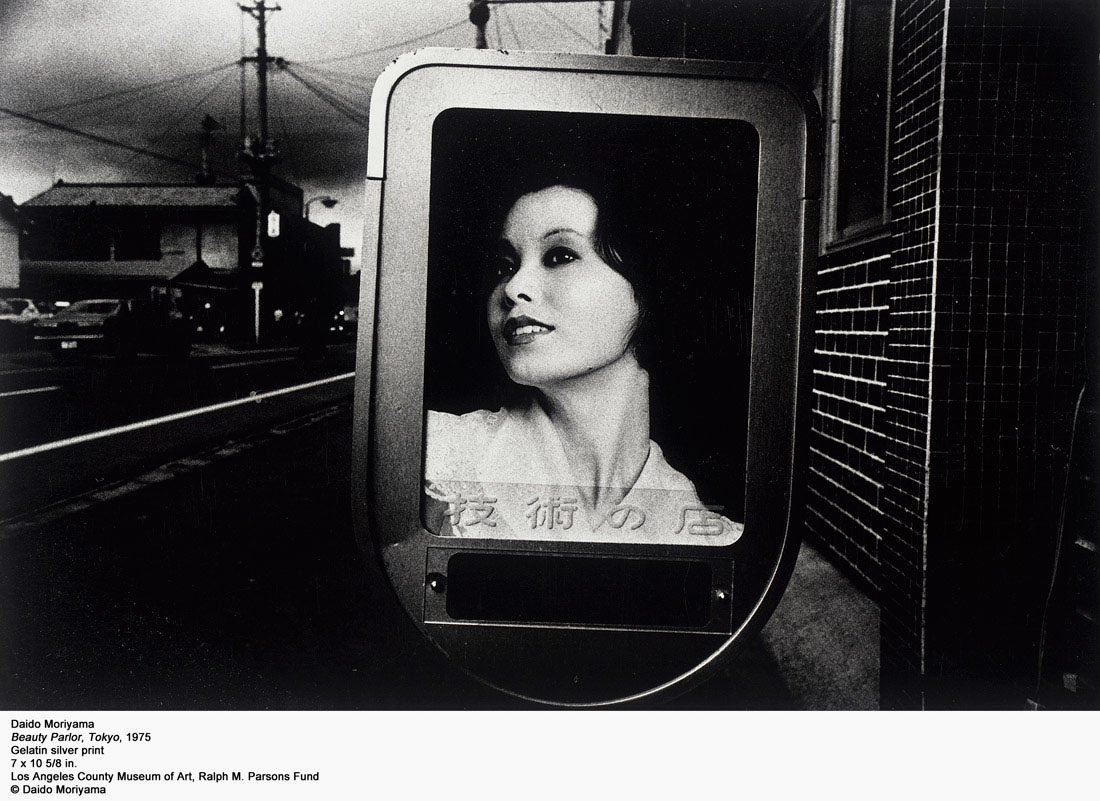
 

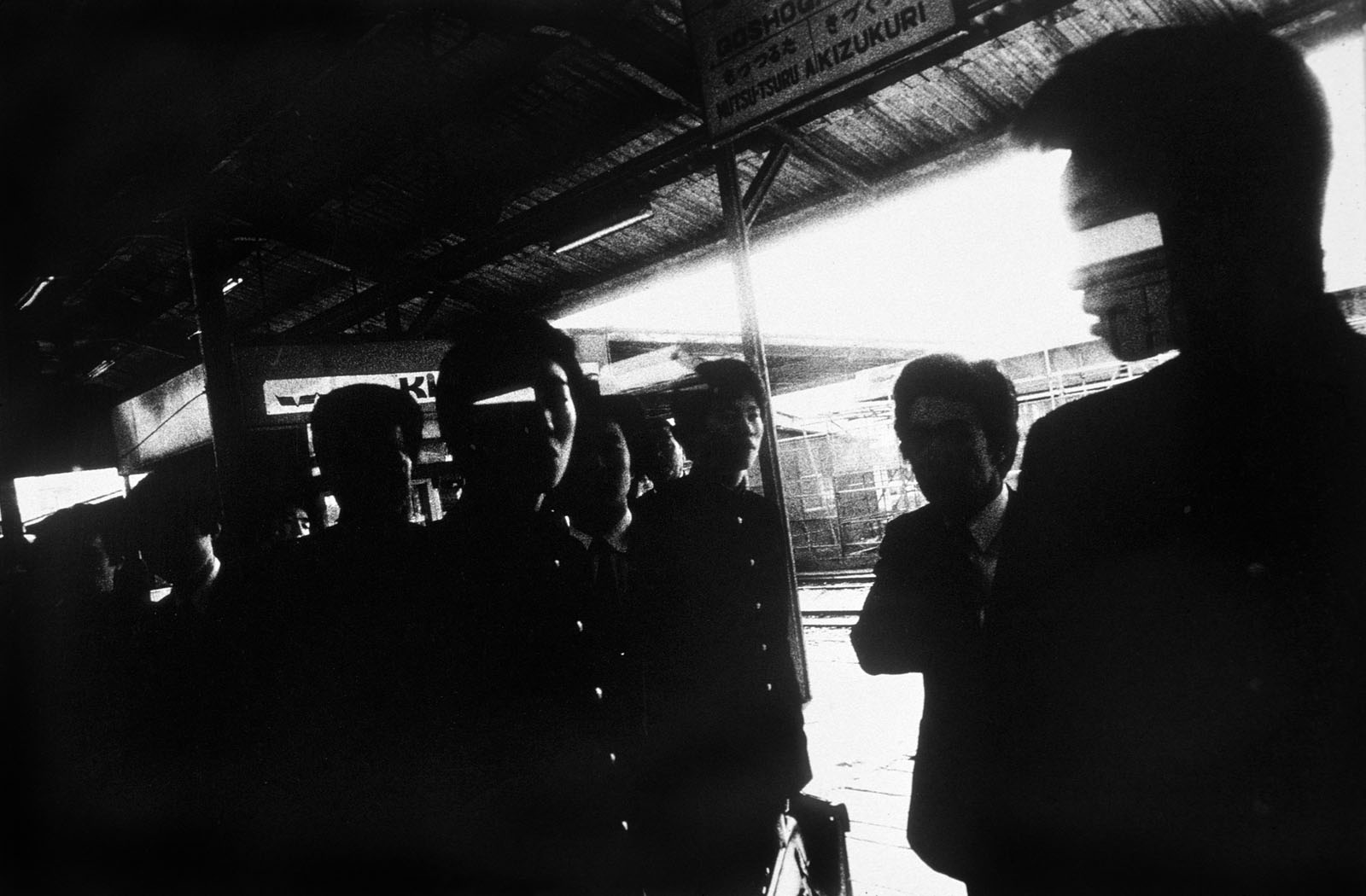
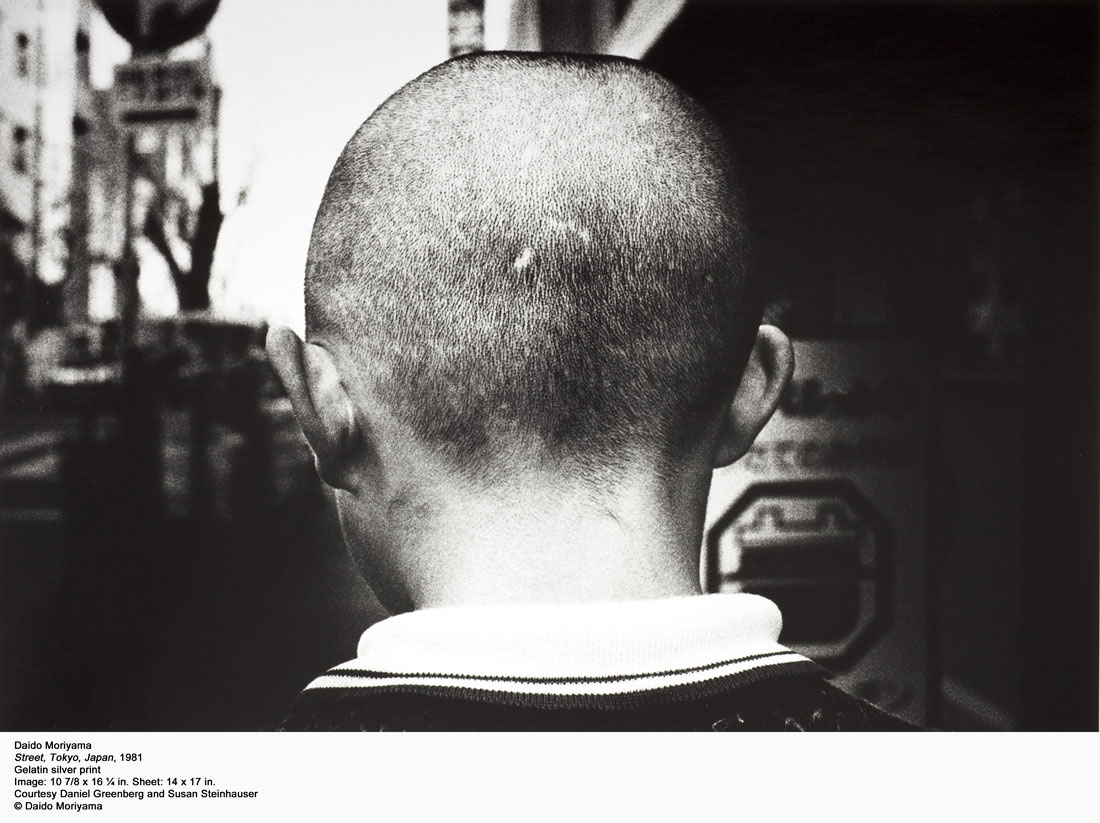
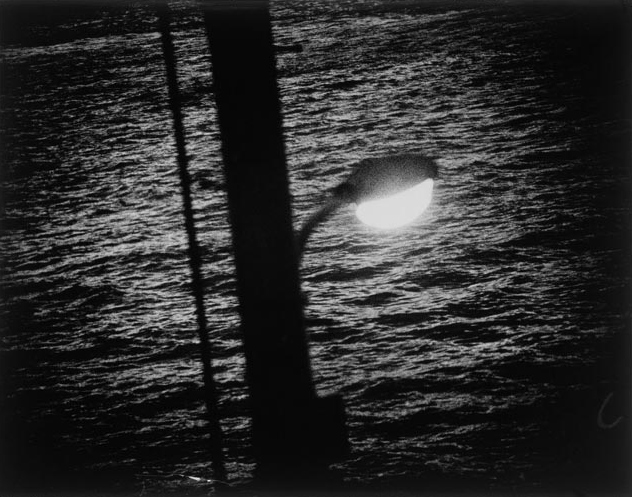
Daido Moriyama (Japanese, b. 1938) 'Street, Tokyo, Japan' 1981


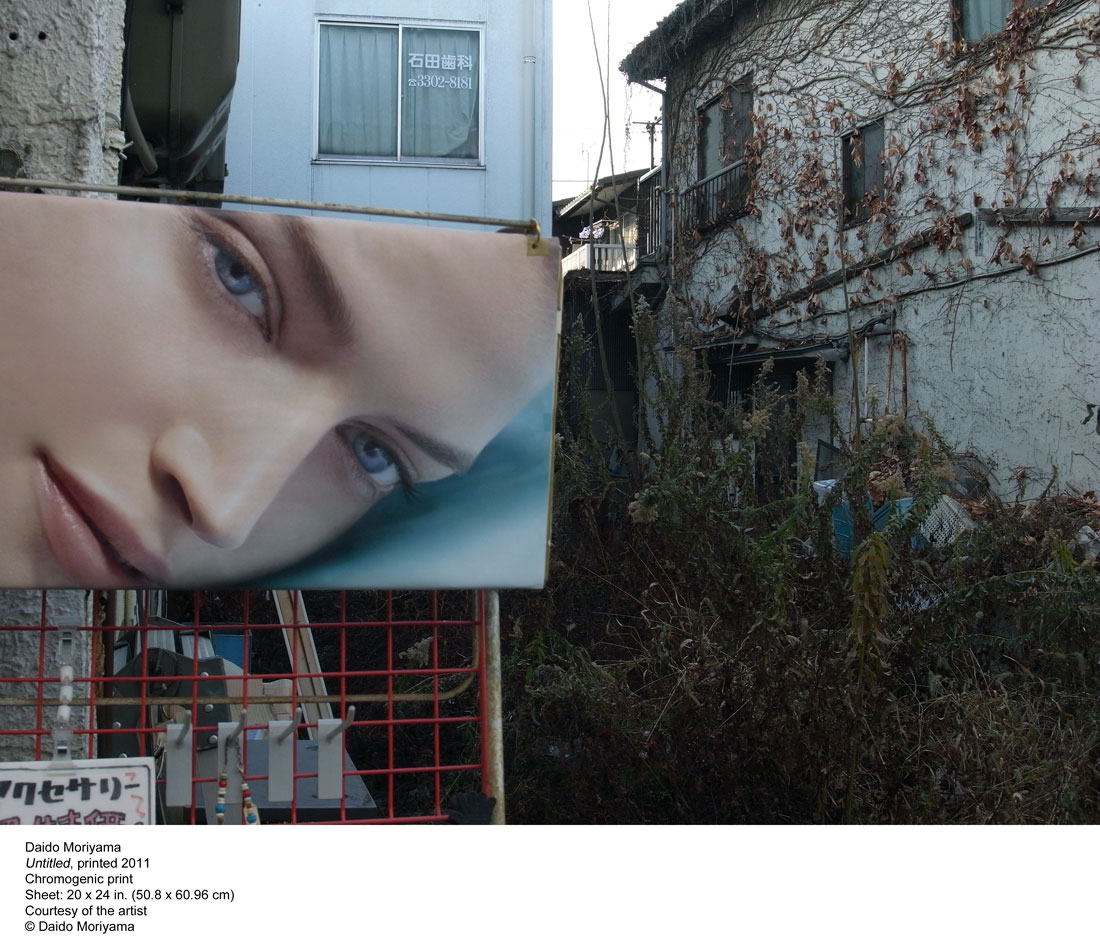
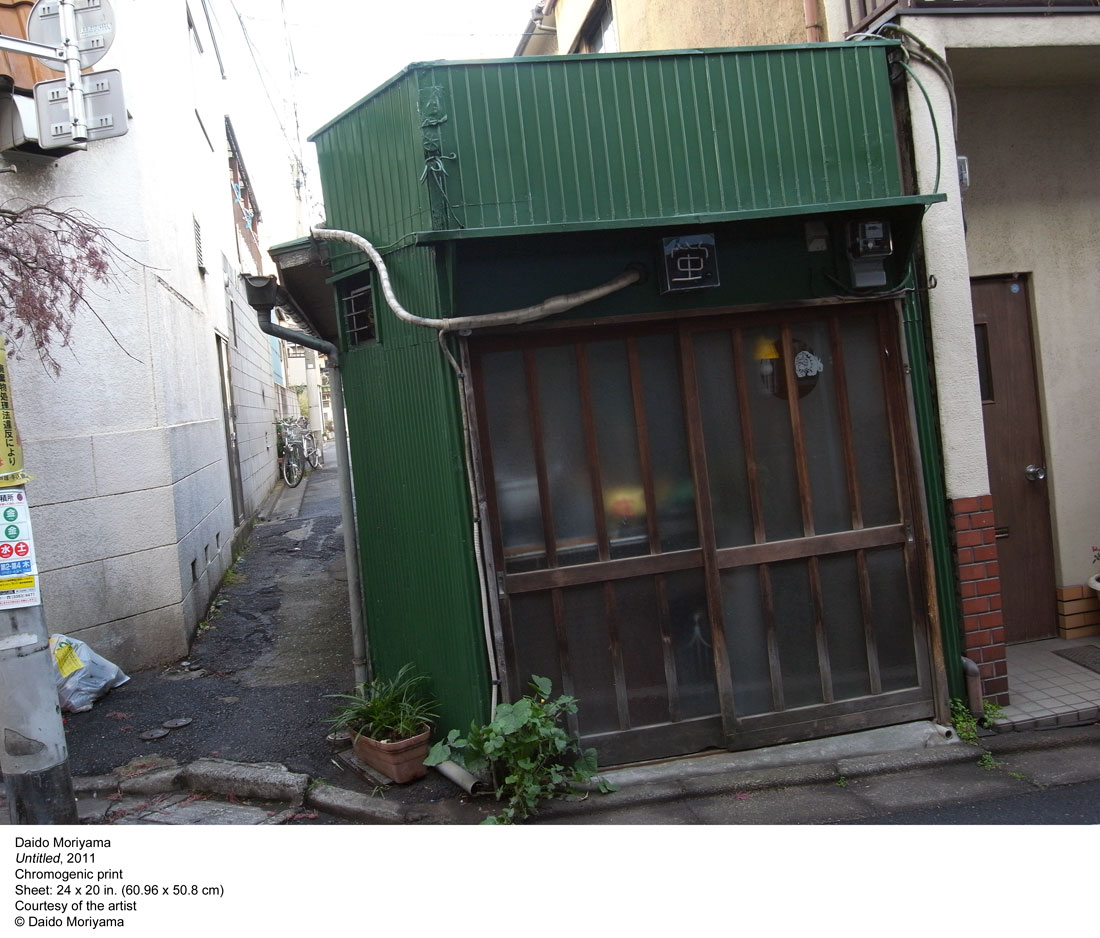
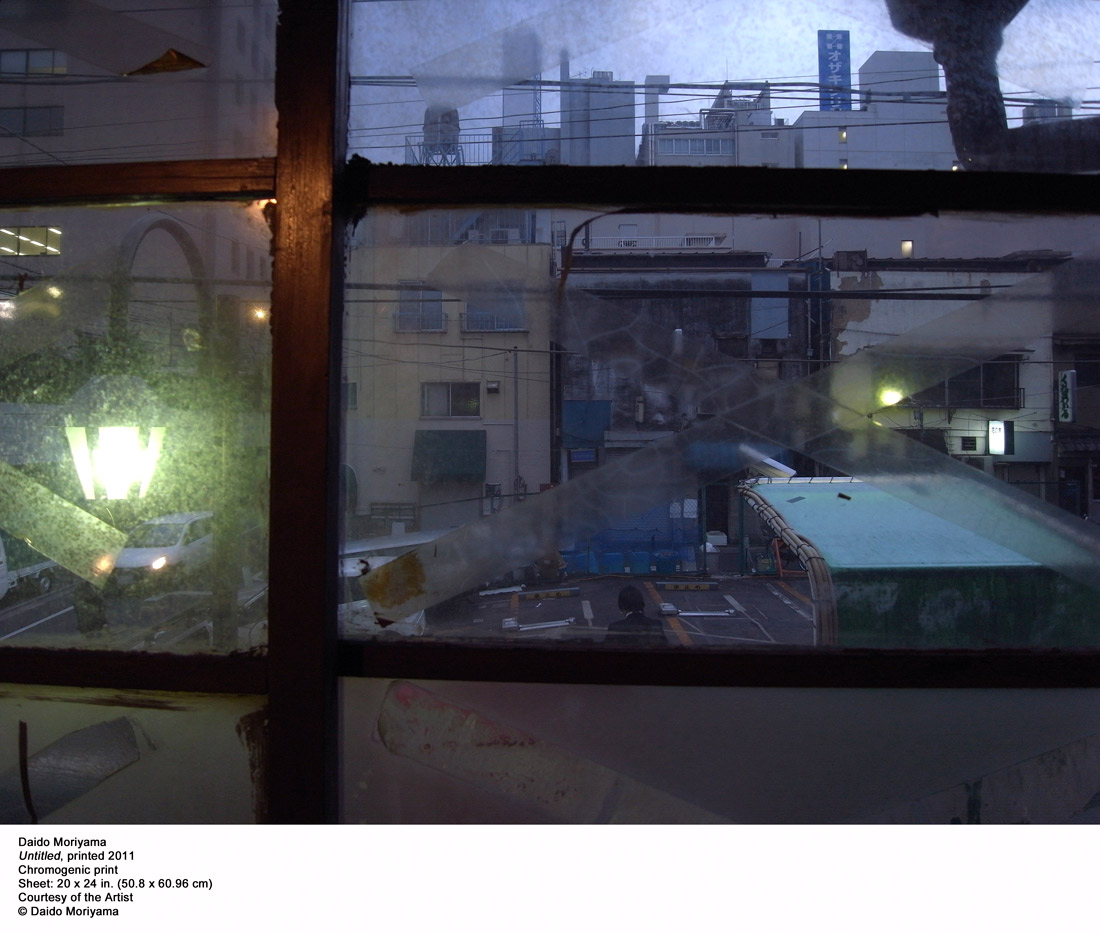
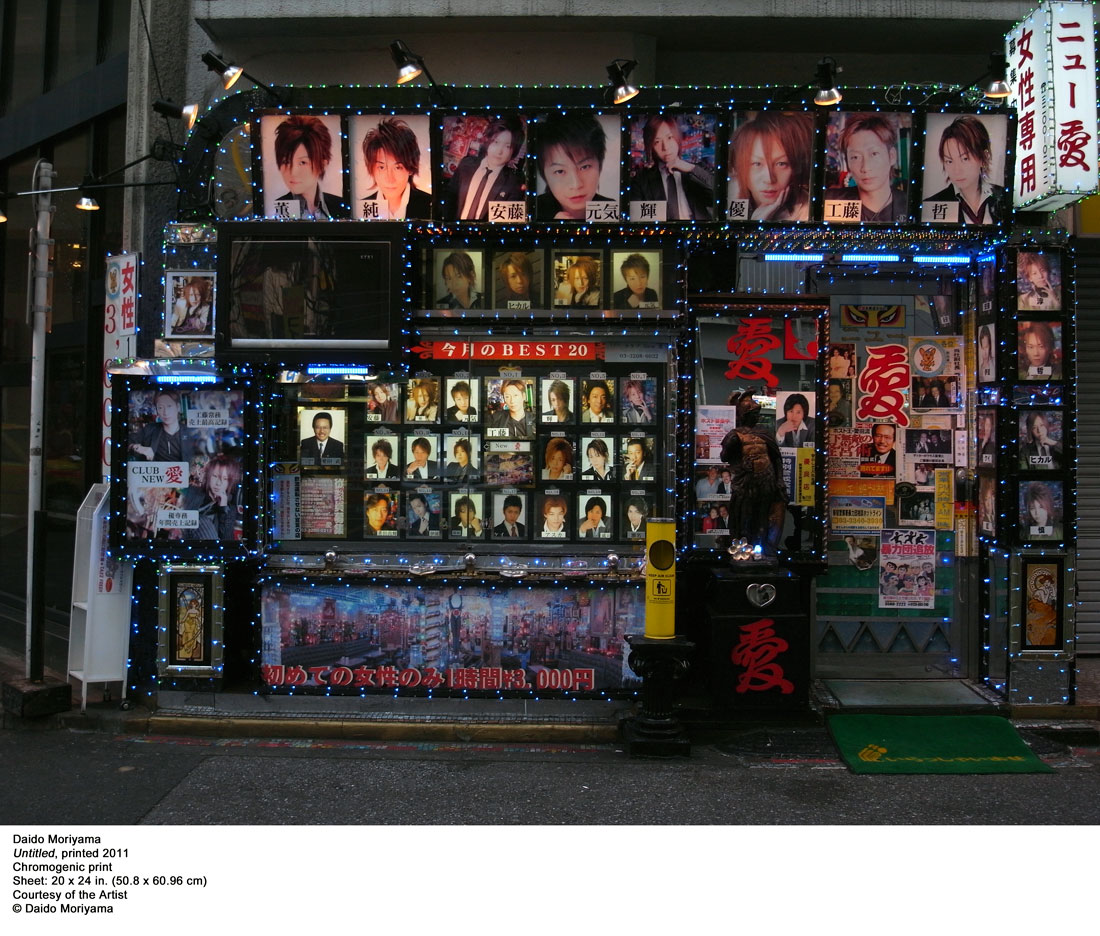
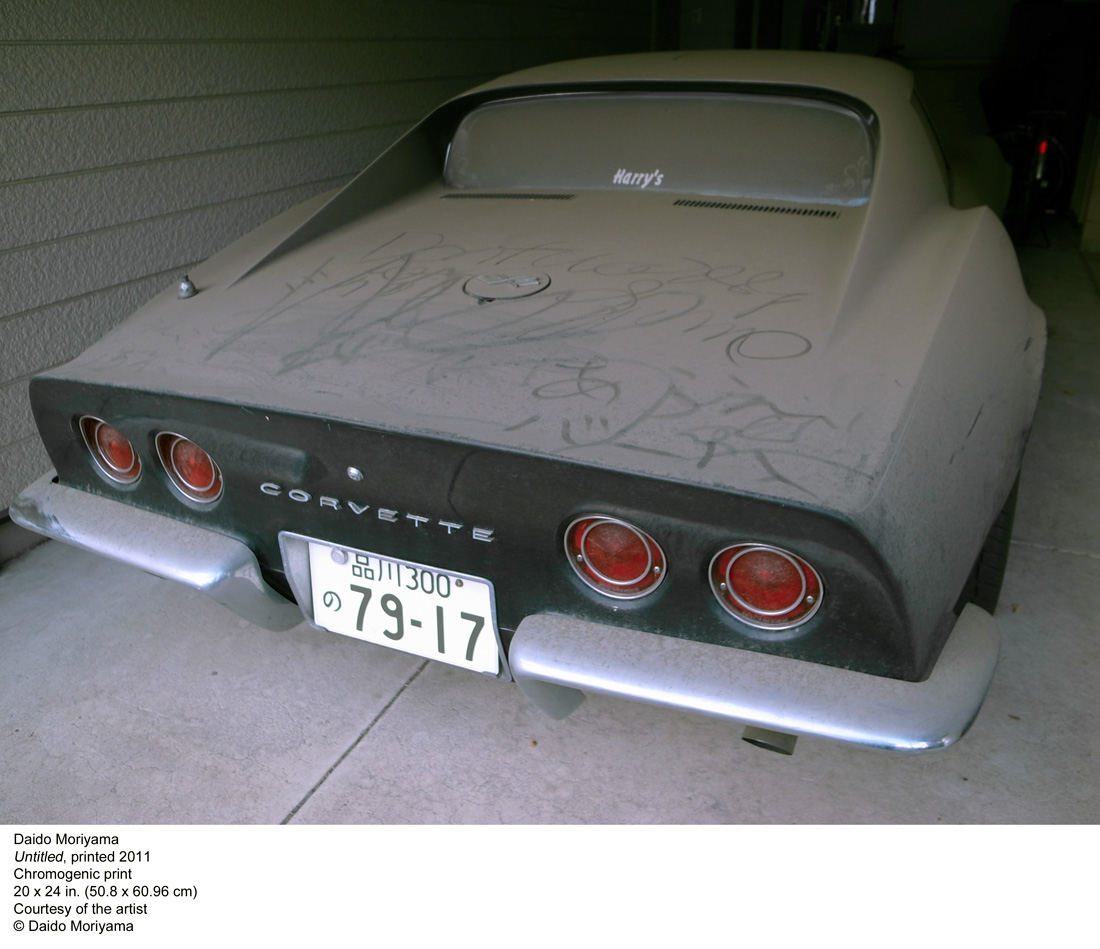
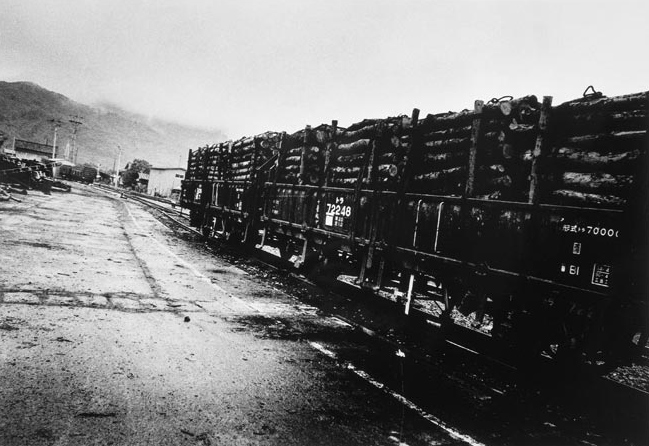
How can we put this. The early black and white photographs are magnificent; the later colour photographs pedestrian and mundane. It is quite amazing how an artist with such skill and panache in the 1960s-1980s can run out of ideas and make such stock standard work 30 years later. Does the artist loose the talent, the energy or just the persistence of vision that made their earlier work so vibrant and alive, or did the work just emerge from the time / space / energy of the artist in that particular period, never to appear again?

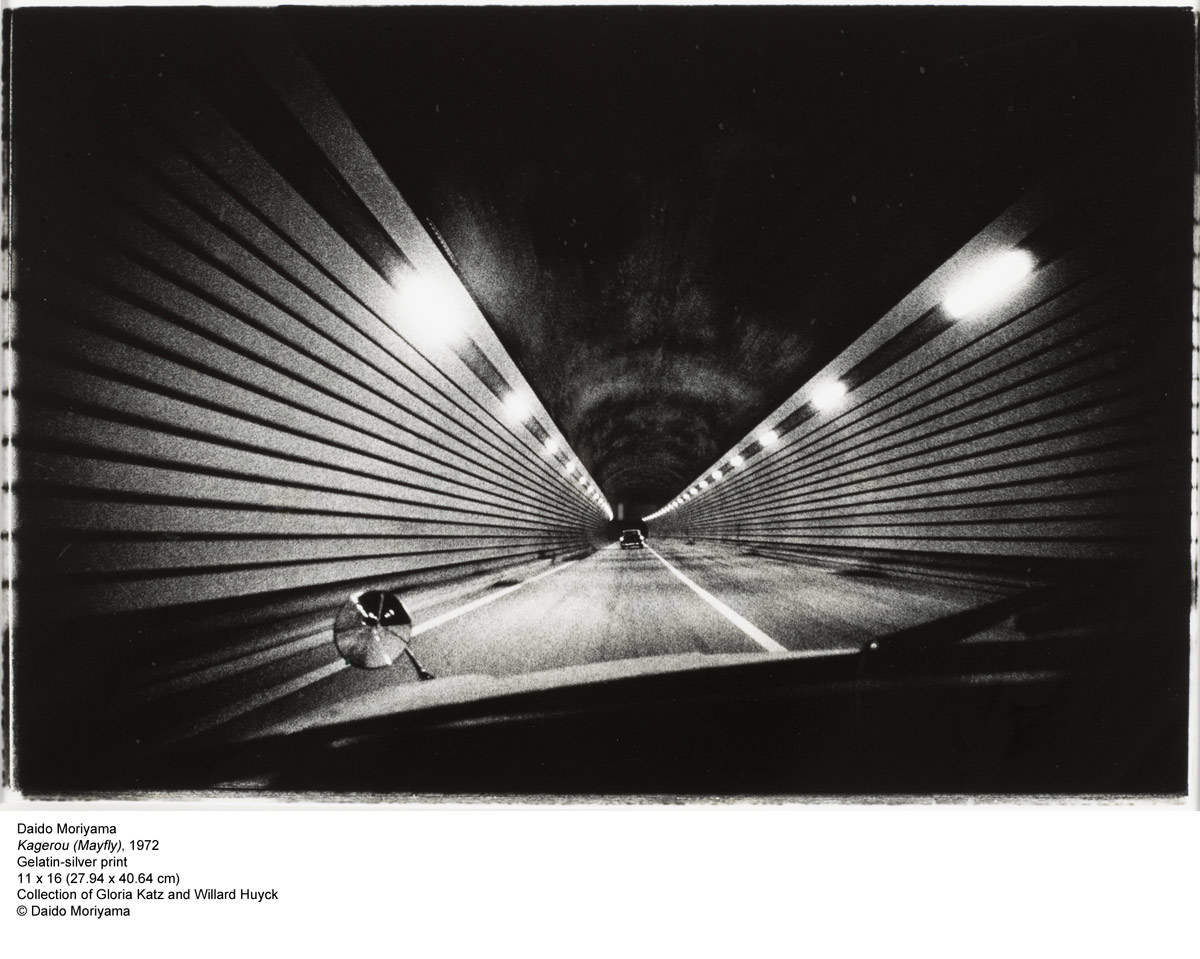
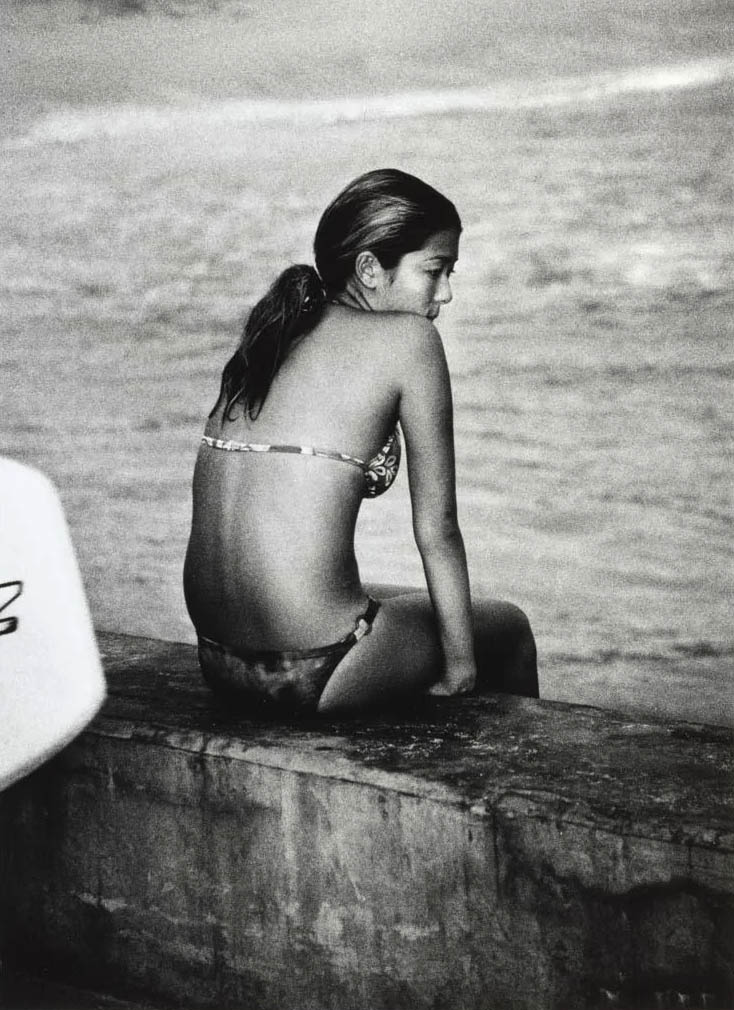
Moriyama’s black and white photographs provide “a raw, restless vision of city life and the chaos of everyday existence, strange worlds, and unusual characters.” More than that, they plunge us into a mesmerising, hypnotic world where the viewer is immersed in a fractured dream / scape / space. Kagerou (Mayfly) (1972, below) is just such an example of this holographic, bugs caught in amber view of our world; the dirty footed, fleeing creature in Untitled (woman in white dress running) (1971, below) confirms this ambiguity, the trapped animal caught by the flash of the camera. Strange, haunting and evocative, Moriyama’s black and white photographs project the derangement of the world onto the psyche of the viewer, producing an abnormal condition of the mind that promotes a loss of contact with reality. The colour photographs never stand a chance against such life changing affirmations.

Dr Marcus Bunyan


Many thankx to the Los Angeles County Museum of Art for allowing me to publish the photographs in the posting. Please click on the photographs for a larger version of the image.
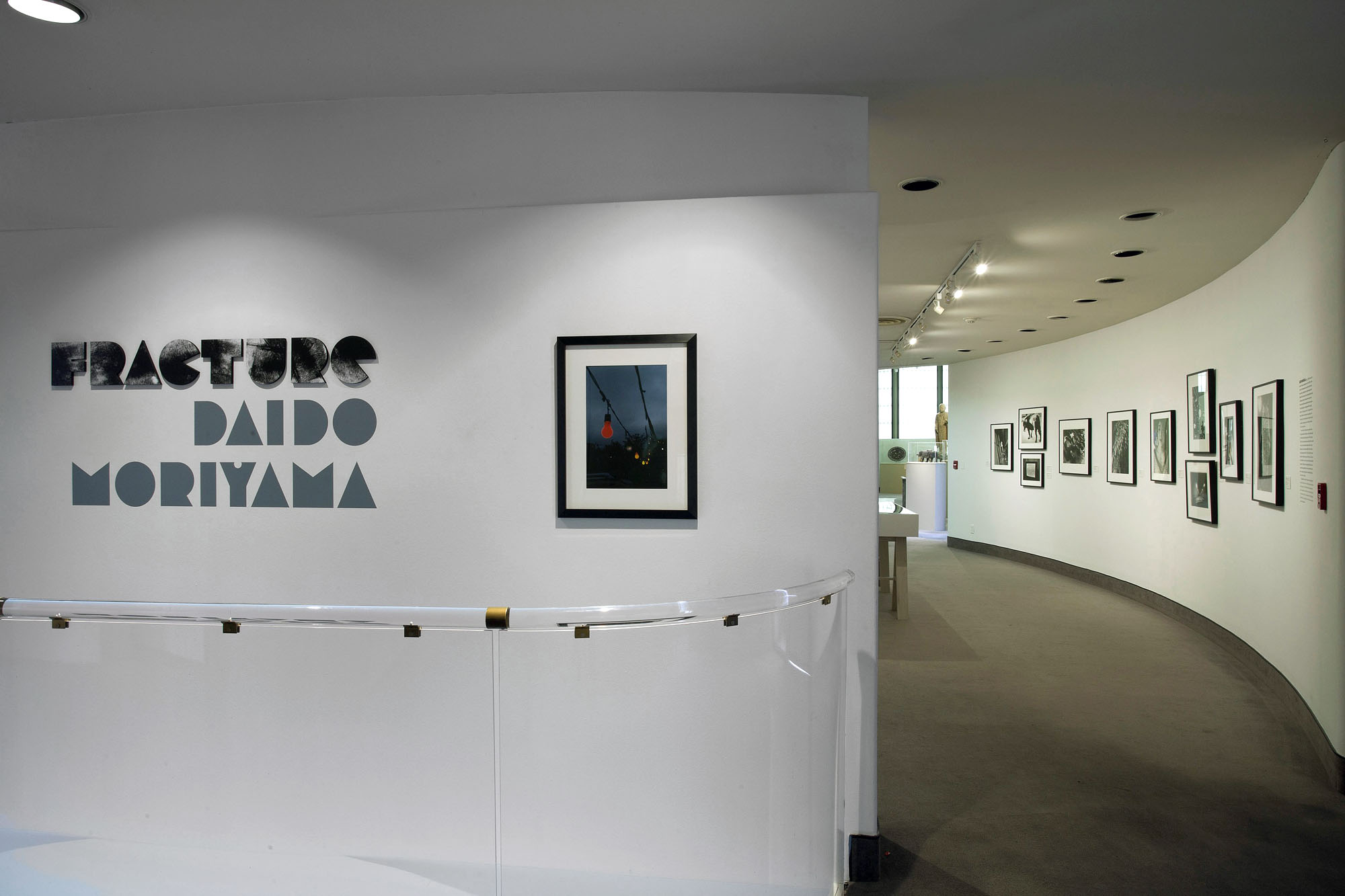
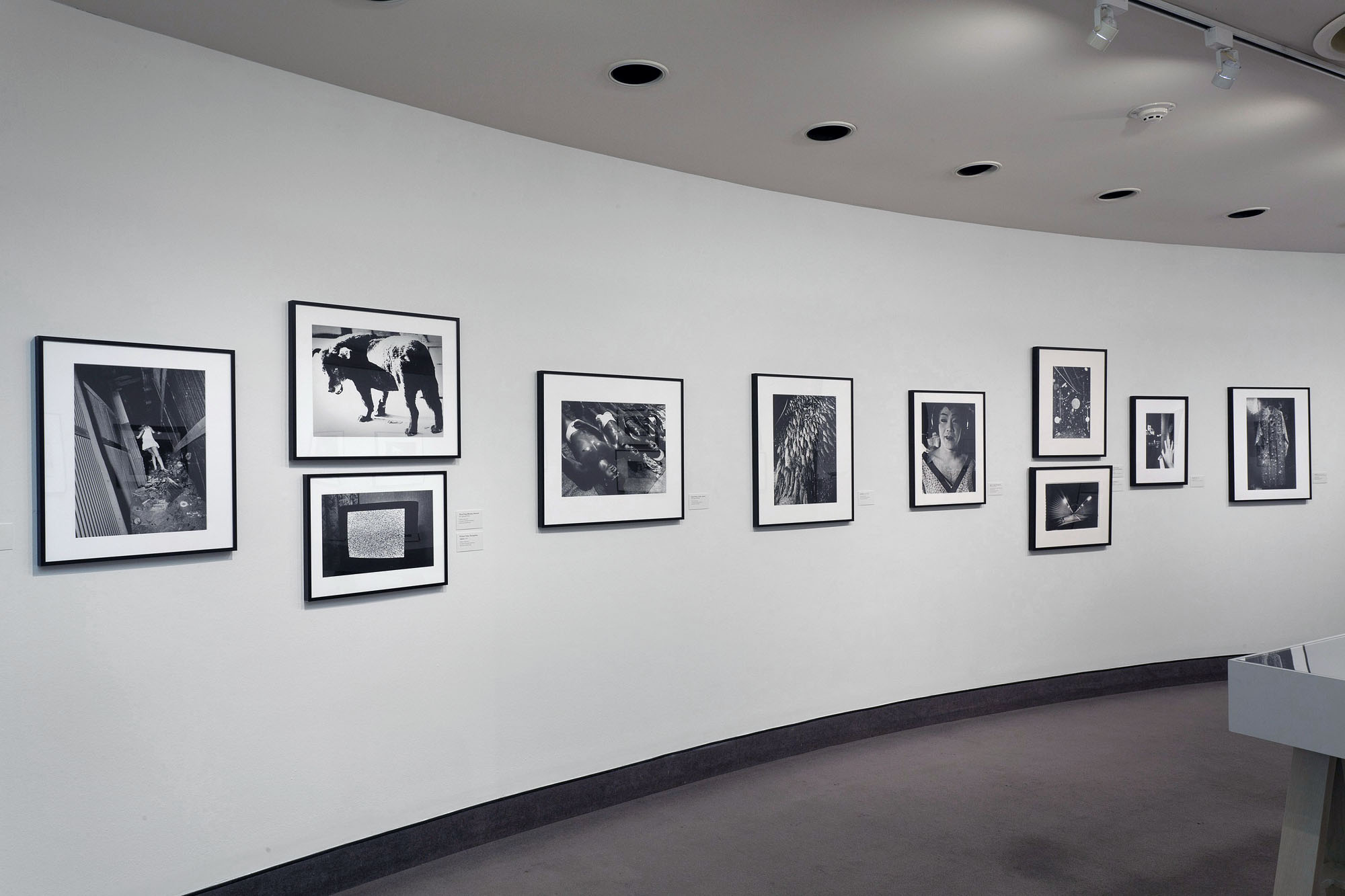


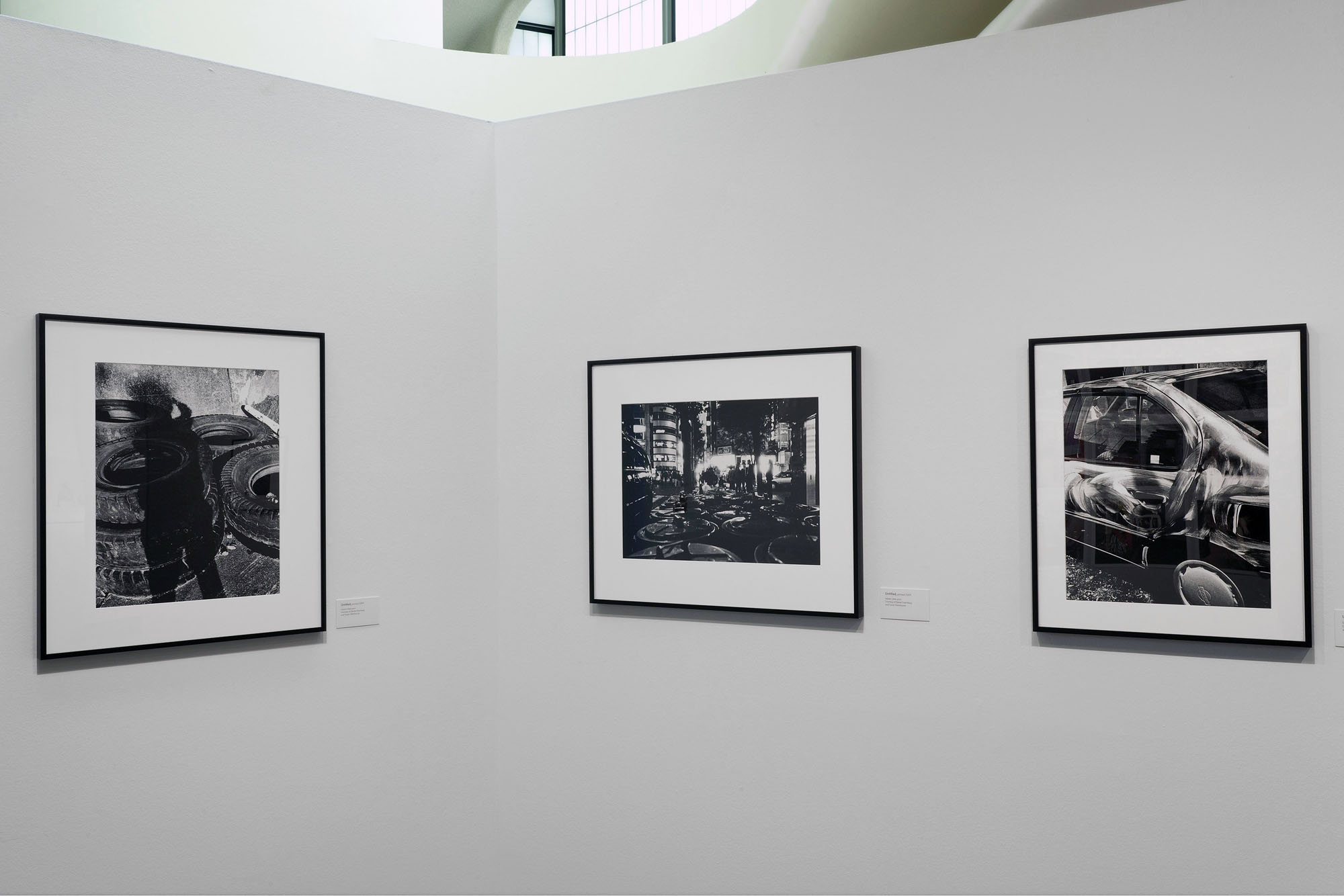
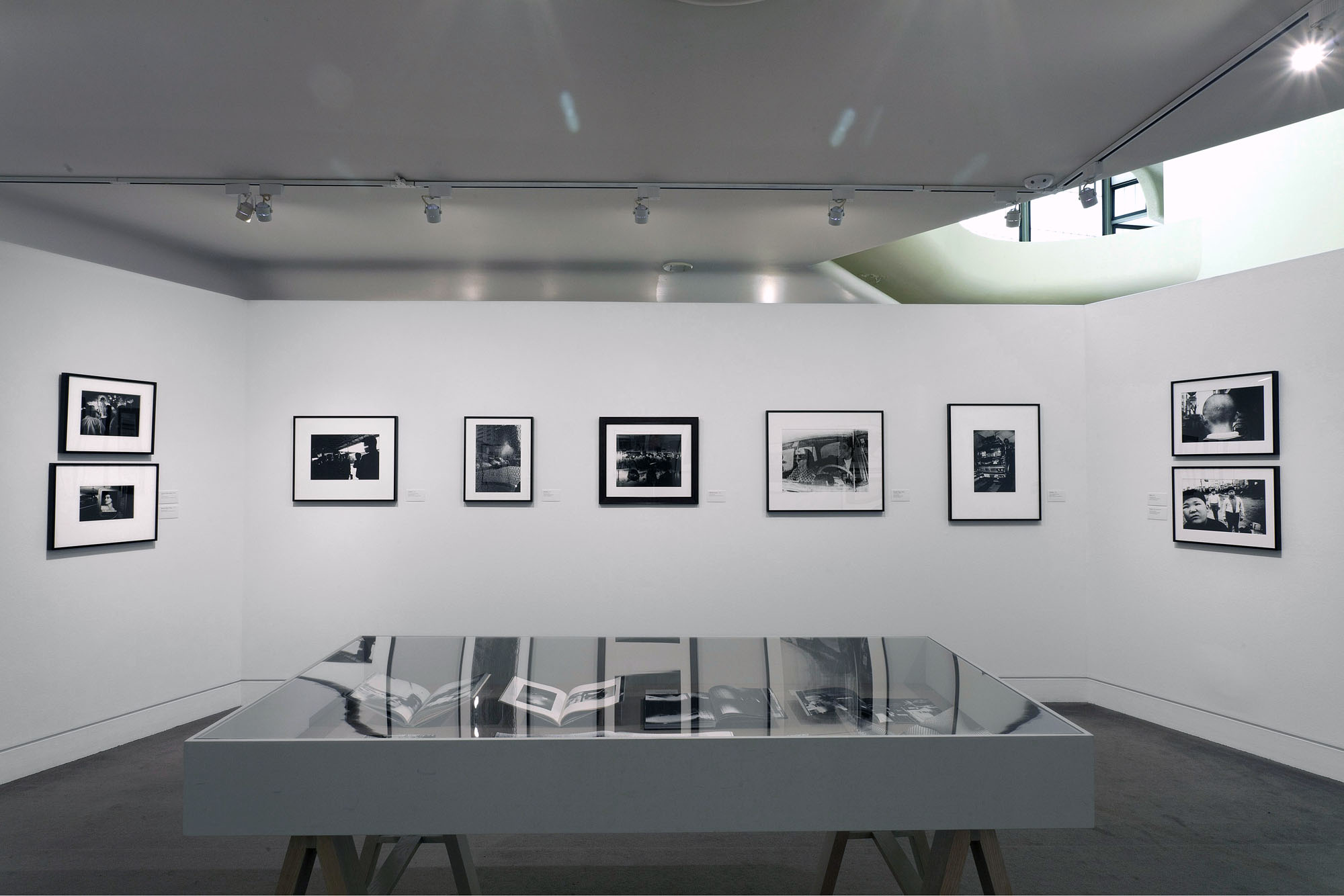
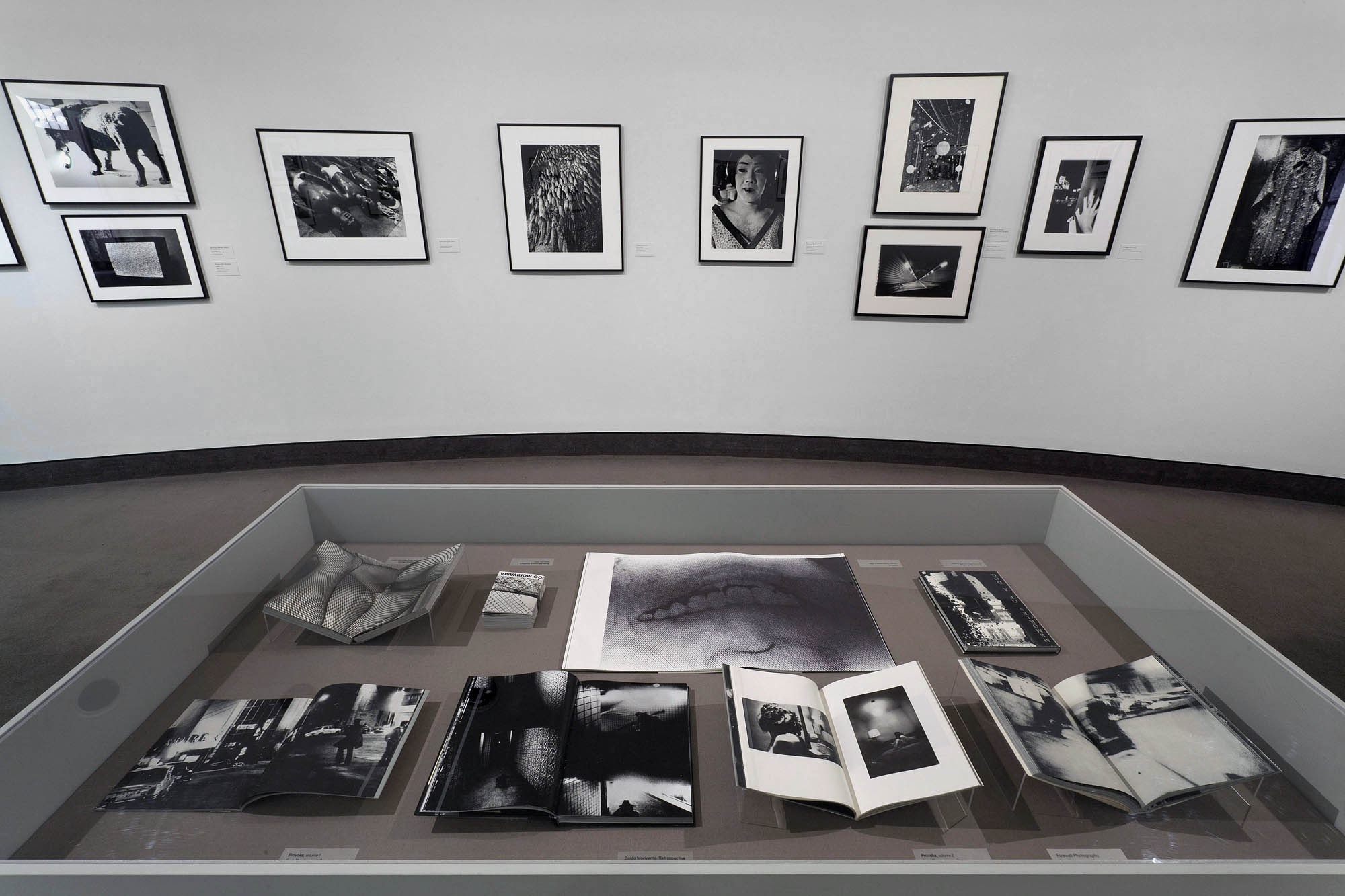
Installation view of the exhibition 'Fracture: Daido Moriyama' at the Los Angeles County Museum of Art (LACMA) 

Installation view of the exhibition 'Fracture: Daido Moriyama' at the Los Angeles County Museum of Art (LACMA) 

Installation view of the exhibition 'Fracture: Daido Moriyama' at the Los Angeles County Museum of Art (LACMA) 

Installation view of the exhibition 'Fracture: Daido Moriyama' at the Los Angeles County Museum of Art (LACMA) 

Installation view of the exhibition 'Fracture: Daido Moriyama' at the Los Angeles County Museum of Art (LACMA) 

Installation view of the exhibition 'Fracture: Daido Moriyama' at the Los Angeles County Museum of Art (LACMA) 


Installation views of the exhibition Fracture: Daido Moriyama at the Los Angeles County Museum of Art (LACMA)
Courtesy of Daido Moriyama and Los Angeles County Museum of Art, Los Angeles


Daido Moriyama (Japanese, b. 1938) 'Untitled' c. 1975


Daido Moriyama (Japanese, b. 1938)
Untitled
c. 1975
Gelatin silver print
© Daido Moriyama


Daido Moriyama (Japanese, b. 1938) 'Street, Tokyo, Japan' 1981


Daido Moriyama (Japanese, b. 1938) 'Untitled' 2011


Daido Moriyama (Japanese, b. 1938) 'Untitled' 2011


Daido Moriyama (Japanese, b. 1938) 'Untitled' 2011


Daido Moriyama (Japanese, b. 1938) 'Kagerou (Mayfly)' 1972


Daido Moriyama (Japanese, b. 1938) 'Untitled' 2011


Daido Moriyama (Japanese, b. 1938) 'Untitled' 2011


The Los Angeles County Museum of Art (LACMA) presents Fracture: Daido Moriyama, the first solo museum exhibition of photographer Daido Moriyama (b. 1938) to be shown in Los Angeles. Moriyama first came to prominence in the mid-1960s with his gritty depictions of Japanese urban life. His highly innovative and intensely personal photographic approach often incorporates high contrast, graininess, and tilted vantages to convey the fragmentary nature of modern realities.

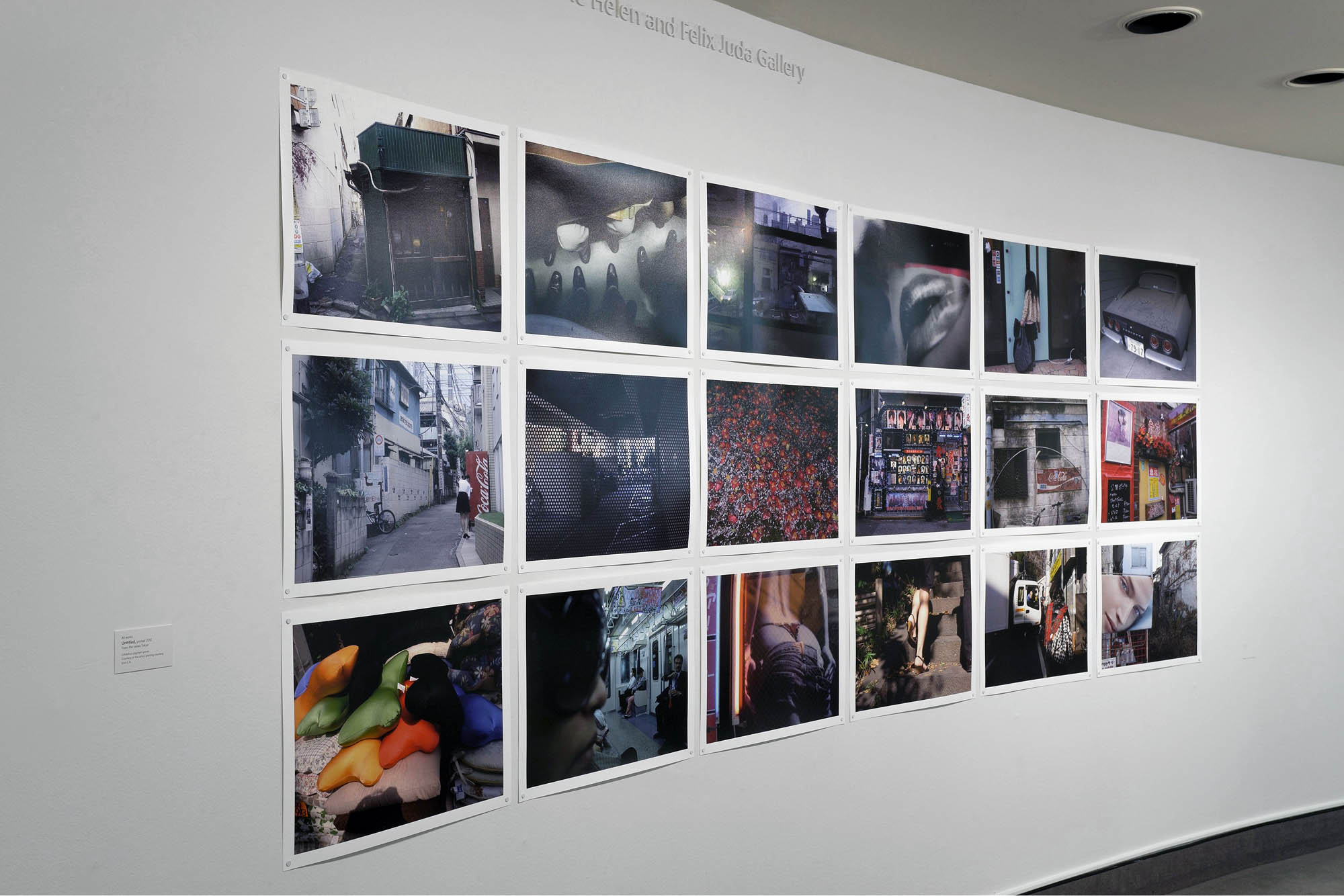
Spanning his early years to present day, the show features nearly fifty works, including a range of Moriyama’s renowned black-and-white photographs, his many important photo books, and the debut of recent colour work taken in Tokyo.

“Daido Moriyama’s immensely inventive and prolific achievements make him one of the leading photographers of our era. Inspiring viewers and artists world-wide, Moriyama continues to demonstrate a raw and restless exploration of the fractured realities of modern times, including his most recent colour work, appearing for the first time,” observes Edward Robinson, associate curator of LACMA’s Wallis Annenberg Photography Department and curator of the exhibition.

Exhibition overview

Responding to the rapid changes that transformed post-World War II Japan, Daido Moriyama’s black-and-white works express a fascination with the cultural contradictions of age-old traditions persisting within modern society, along with the effects of westernisation and consumerism.

Providing a raw, restless vision of city life and the chaos of everyday existence, strange worlds, and unusual characters, Moriyama frequently photographs while on walks through Tokyo – particularly the dark, labyrinthine streets of the Shinjuku district – as well as when traveling on Japan’s postwar highways and during strolls through other urban centers in Japan and abroad. His work suggests the bold intuition informing the artist’s ongoing exploration of urban mystery, memory, and photographic invention.

Fracture: Daido Moriyama will display the artist’s iconic black-and-white photographs, exemplifying the are, bure, boke (grainy, blurry, out-offocus) style, in addition to a new installation of recent colour work. An accompanying video will feature documentary footage of the photographer at work, exploring by foot and responding to the vibrant cityscape of Tokyo. Also on view will be a selection of books – Moriyama has published more than forty to date – which highlights the artist’s highly influential experimentation with reproduction media and the transformative possibilities of the printed page.

About Daido Moriyama

Born in Ikeda, Osaka, Moriyama trained in graphic design, then took up photography with Takeji Iwaniya, a professional photographer of architecture and crafts. Moving to Tokyo in 1961, he assisted photographer Eikoh Hosoe for three years and became familiar with the trenchant societal critiques produced by photographer Shomei Tomatsu. Moriyama also drew inspiration from William Klein’s confrontational photographs of New York, Andy Warhol’s silkscreened multiples of newspaper images, and the writings of Jack Kerouac and Yukio Mishima.

His work has been collected by numerous public and private collections internationally, including LACMA, the Museum of Modern Art, New York, the San Francisco Museum of Modern Art, the Metropolitan Museum of Art, New York, the Getty Museum, Los Angeles, the Museum of Fine Arts, Boston, and the Centre Pompidou, Paris. Moriyama has had recent major solo shows at The Fondation Cartier pour l’Art Contemporain, Paris, The Fotomuseum, Winterthur, Switzerland, the Metropolitan Museum of Photography in Tokyo, and will be exhibited with William Klein at the Tate Modern this fall.

Press release from the LACMA website


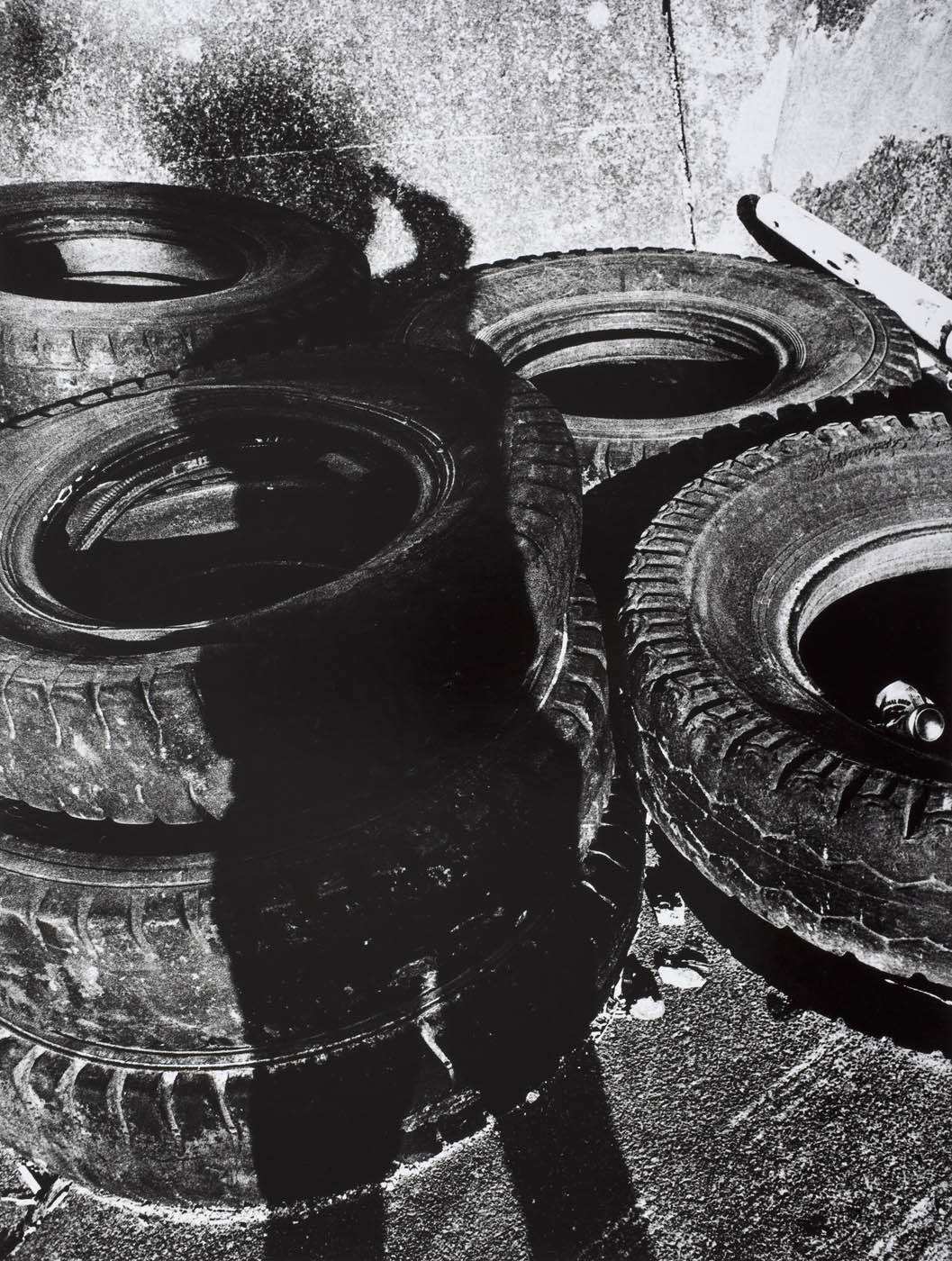
Daido Moriyama (Japanese, b. 1938) 'Untitled (shadows with tires)' Nd, printed 2009


Daido Moriyama (Japanese, b. 1938)
Untitled (shadows with tires)
Nd, printed 2009
Gelatin silver print
Courtesy of Courtesy Daniel Greenberg and Susan Steinhauser
© Daido Moriyama


Daido Moriyama (Japanese, b. 1938) 'Male actor playing a woman' Tokyo 1966


Daido Moriyama (Japanese, b. 1938)
Male actor playing a woman
Tokyo 1966
Gelatin silver print
© Daido Moriyama


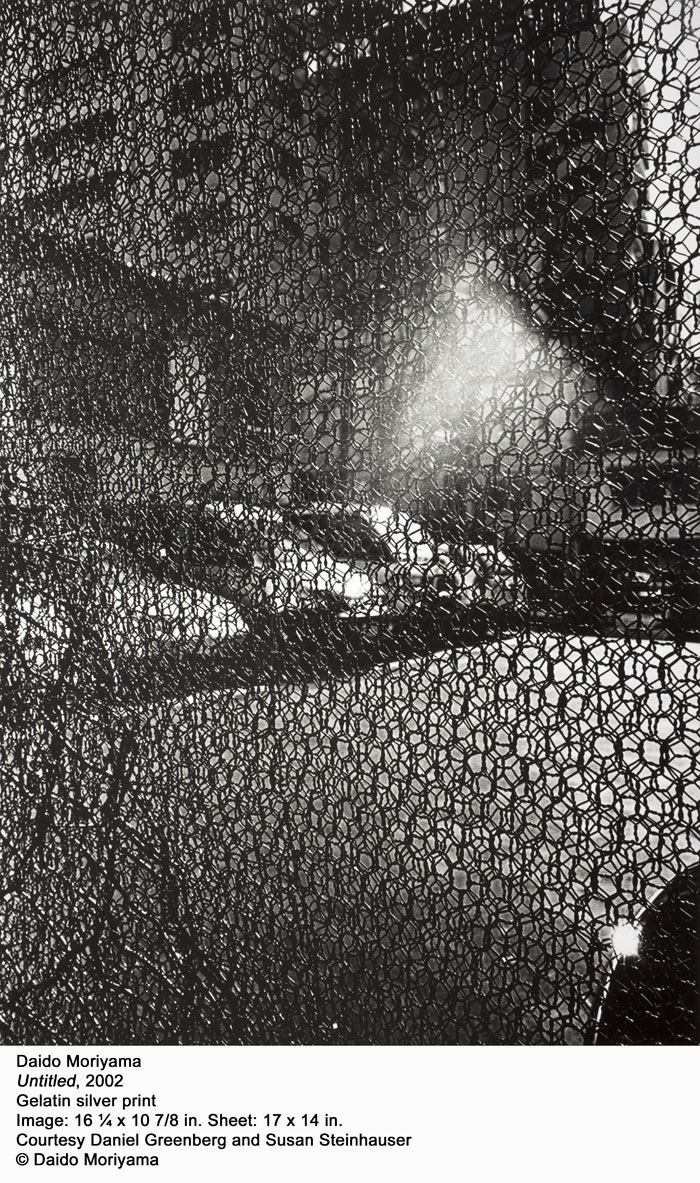
Daido Moriyama (Japanese, b. 1938) 'Untitled' 2002


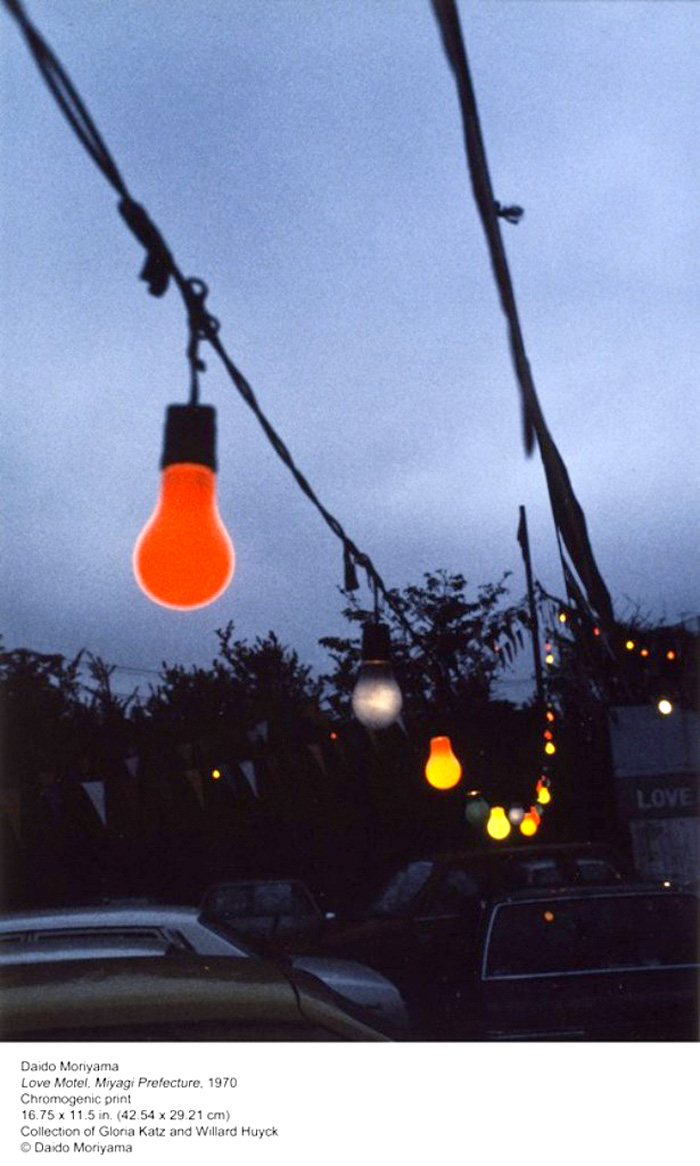
Daido Moriyama (Japanese, b. 1938) 'Love Motel, Miyagi Prefecture' 1970


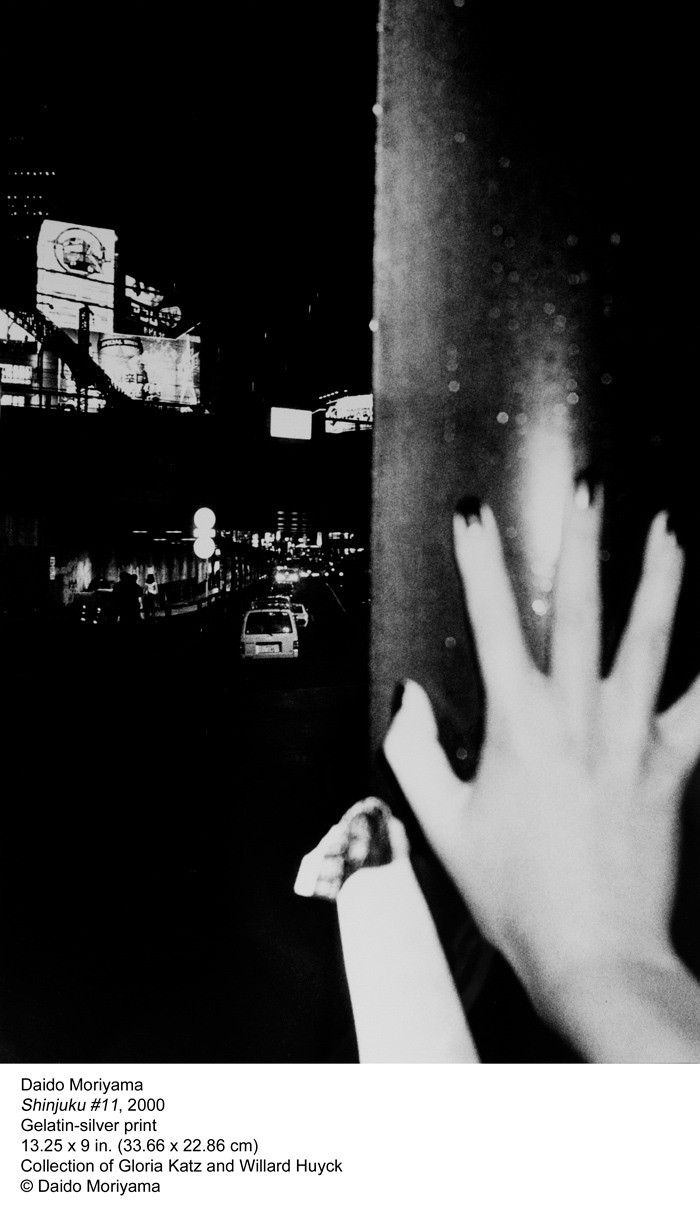
Daido Moriyama (Japanese, b. 1938) 'Shinjuku #11' 2000


Daido Moriyama (Japanese, b. 1938) 'Untitled (woman in white dress running)' 1971


Los Angeles County Museum of Art (LACMA)
5905 Wilshire Boulevard (at Fairfax Avenue)
Los Angeles, CA, 90036
Phone: 323 857-6000

Opening hours:
Monday, Tuesday, Thursday: 11am – 5pm
Friday: 11am – 8pm
Saturday, Sunday: 10am – 7pm
Closed Wednesday

LACMA website

LIKE ART BLART ON FACEBOOK

Back to top

Exhibition: ‘Hawaii’ by Daido Moriyama at Luhring Augustine, New York

Exhibition dates: 13th February – 13th March, 2010


Daido Moriyama (Japanese, b. 1938) 'Nikko Toshogu' 1977 from the exhibition Exhibition: 'Hawaii' by Daido Moriyama at Luhring Augustine, New York, February - March, 2010


Daido Moriyama (Japanese, b. 1938)
Nikko Toshogu
1977
Gelatin silver print


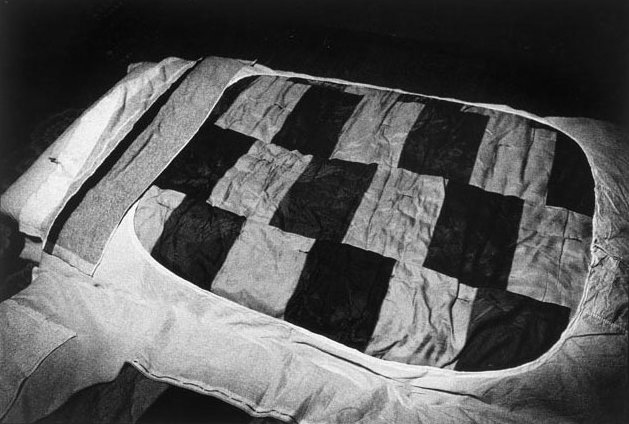
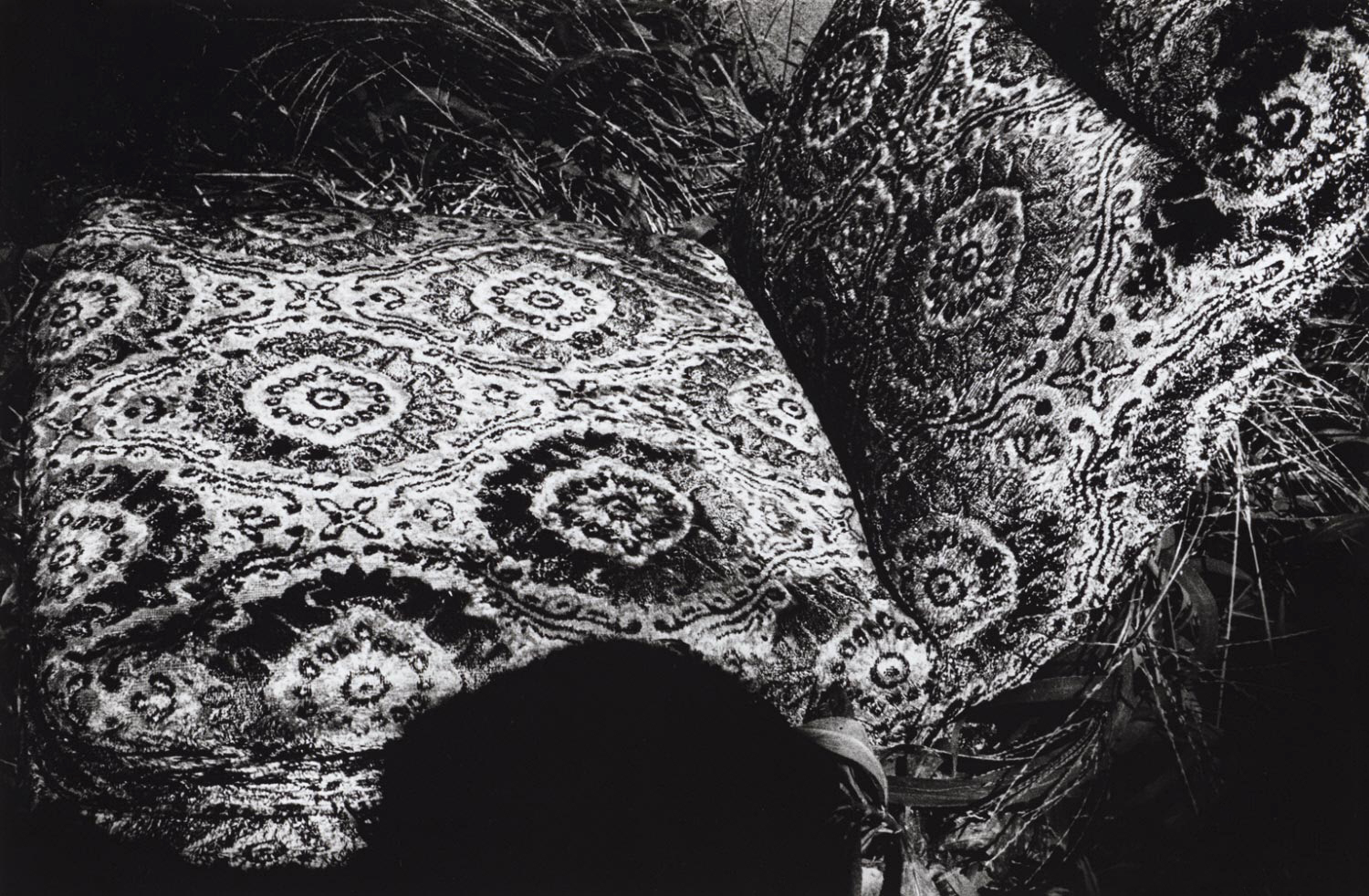
Daido Moriyama (Japanese, b. 1938) 'Quilt' 1977 from the exhibition Exhibition: 'Hawaii' by Daido Moriyama at Luhring Augustine, New York, February - March, 2010


Daido Moriyama (Japanese, b. 1938)
Quilt
1977
Gelatin silver print


Daido Moriyama (Japanese, b. 1938) 'Hokkaido' 1978 from the exhibition Exhibition: 'Hawaii' by Daido Moriyama at Luhring Augustine, New York, February - March, 2010


Daido Moriyama (Japanese, b. 1938)
Hokkaido
1978
Gelatin silver print


Daido Moriyama (Japanese, b. 1938) 'Tono' 1974


Daido Moriyama (Japanese, b. 1938)
Tono
1974
Gelatin silver print


Luhring Augustine is pleased to present its first exhibition featuring the work of Daido Moriyama, one of Japan’s leading figures in photography. Witness to the spectacular changes that transformed postwar Japan, his photographs express a fascination with the cultural contradictions of age-old traditions that persist within modern society. Providing a harsh, crude vision of city life and the chaos of everyday existence, strange worlds, and unusual characters, his work occupies the space between the objective and the subjective, the illusory and the real.

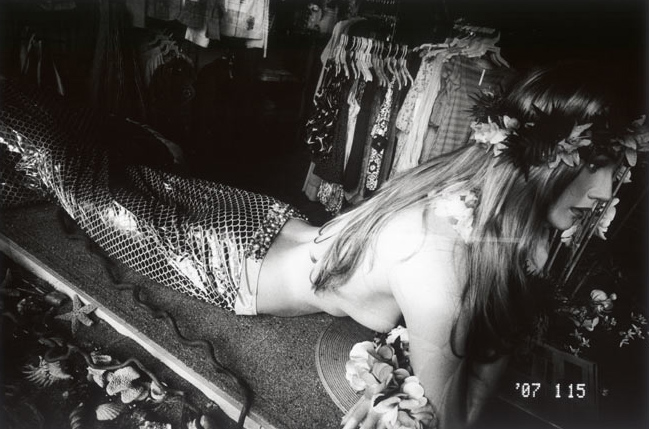
Moriyama takes pictures with a small hand-held camera that enables him to shoot freely while walking or running or through the windows of moving cars. Taken from vertiginous angles or overwhelmed by closeups, his blurred images are charged with a palpable and frenetic energy that reveal a unique proximity to his subject matter. Snapshots of stray dogs, posters, mannequins in shop windows, and shadows cast into alleys present the beauty and sometimes-terrifying reality of a marginalised landscape. His anonymous and detached approach enables him to capture the “visible present” made up of accidental and uncanny discoveries as he experiences them.

Moriyama emerged as a photographer in the 1960’s at the tail end of the VIVO collective, a revolutionary and highly influential group of Japanese artists who reexamined the conventions of photography during the tumultuous postwar period. William Klein’s loose, Beat style images of New York City in the 1960s also served as a major turning point for Moriyama, who found inspiration in Klein’s free-form photographic style. Taken by these innovative approaches at home and abroad, Moriyama ultimately went on to forge his own radical style.

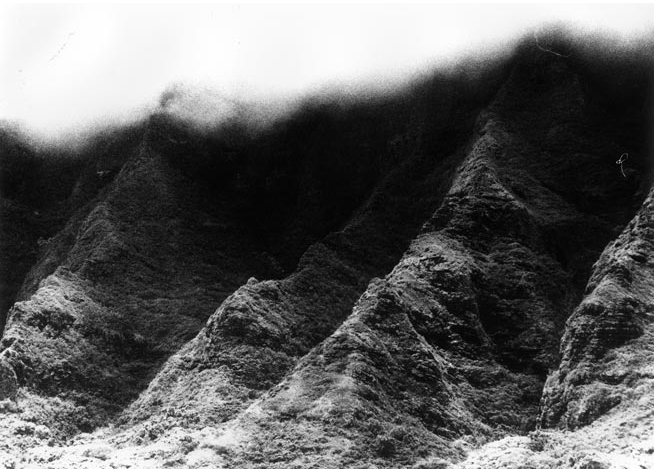
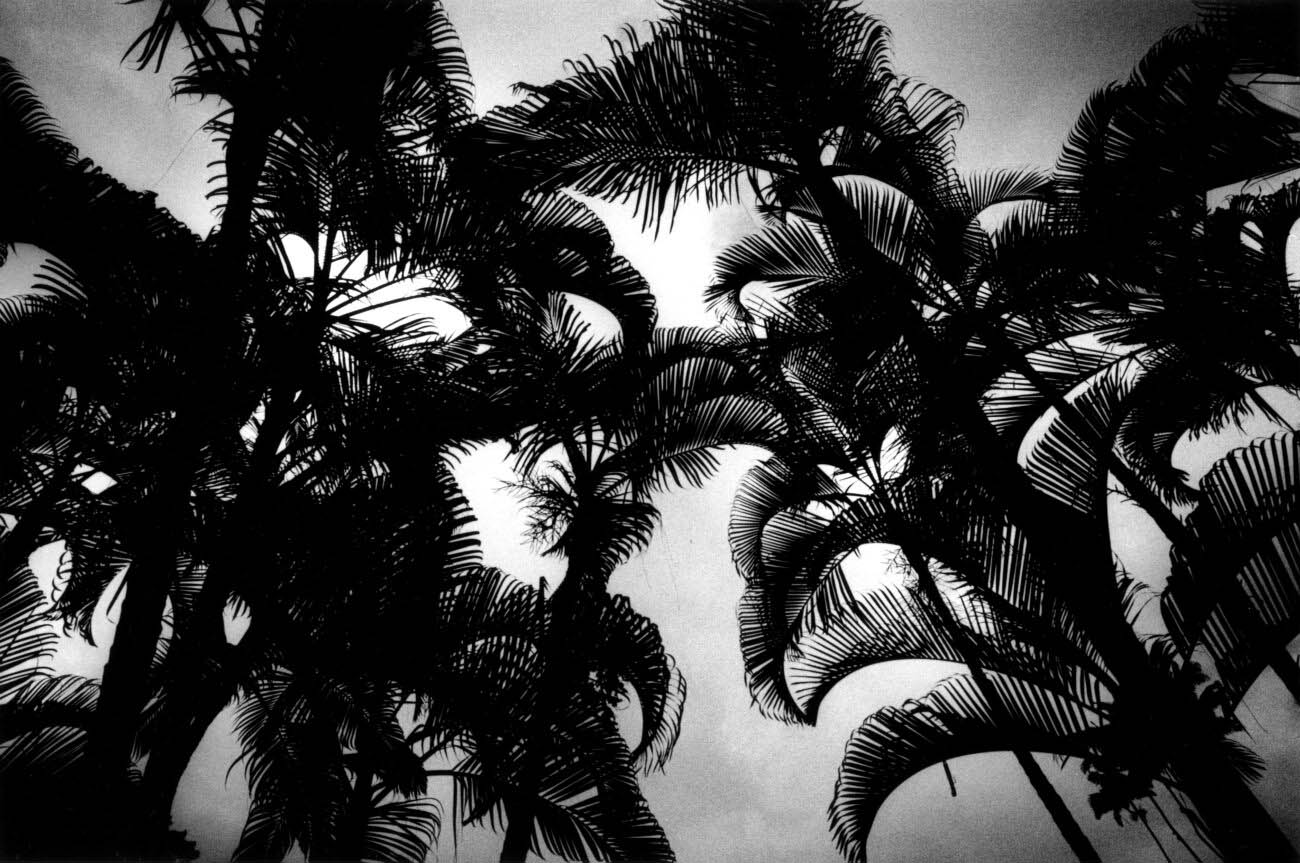
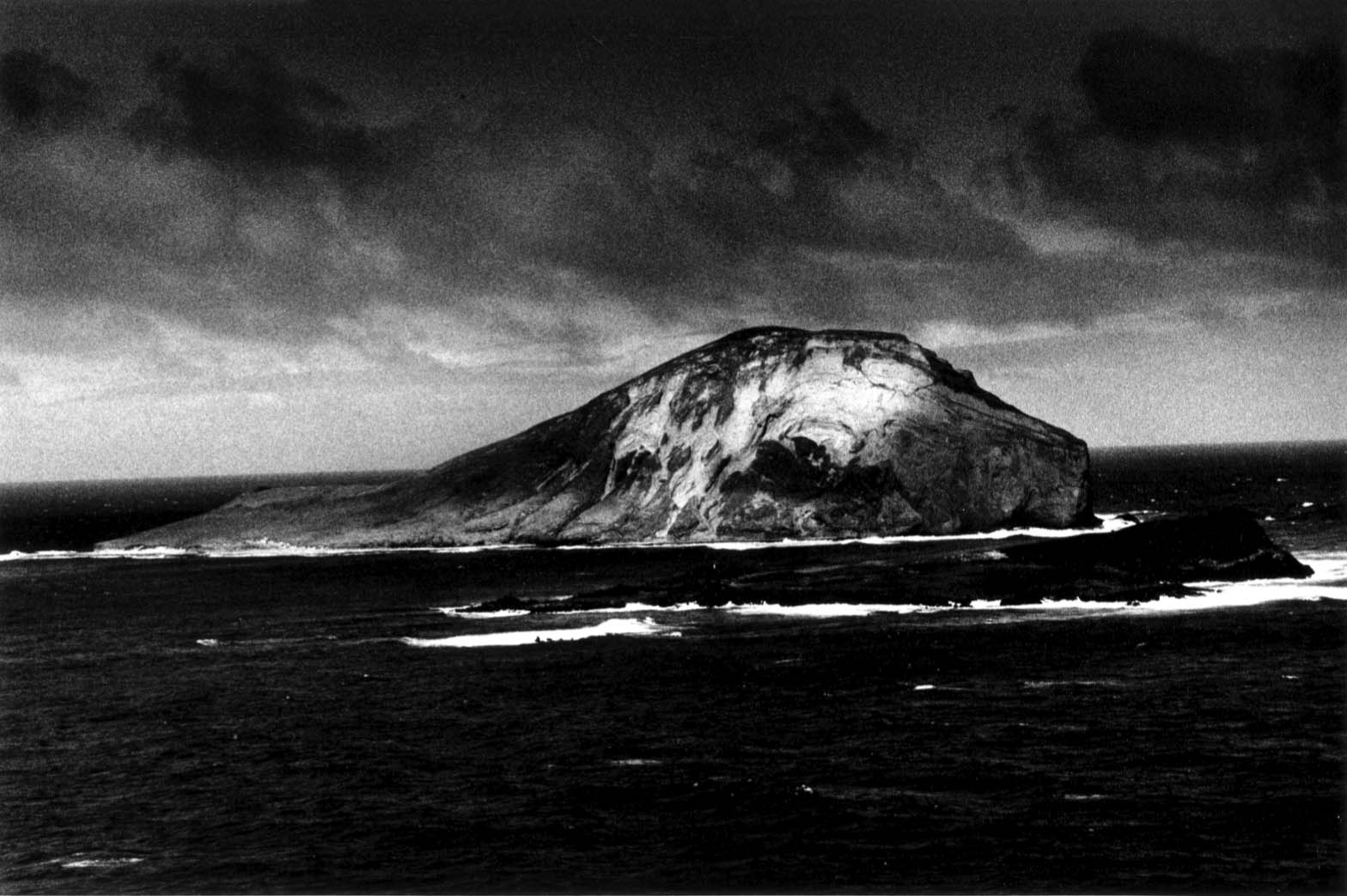
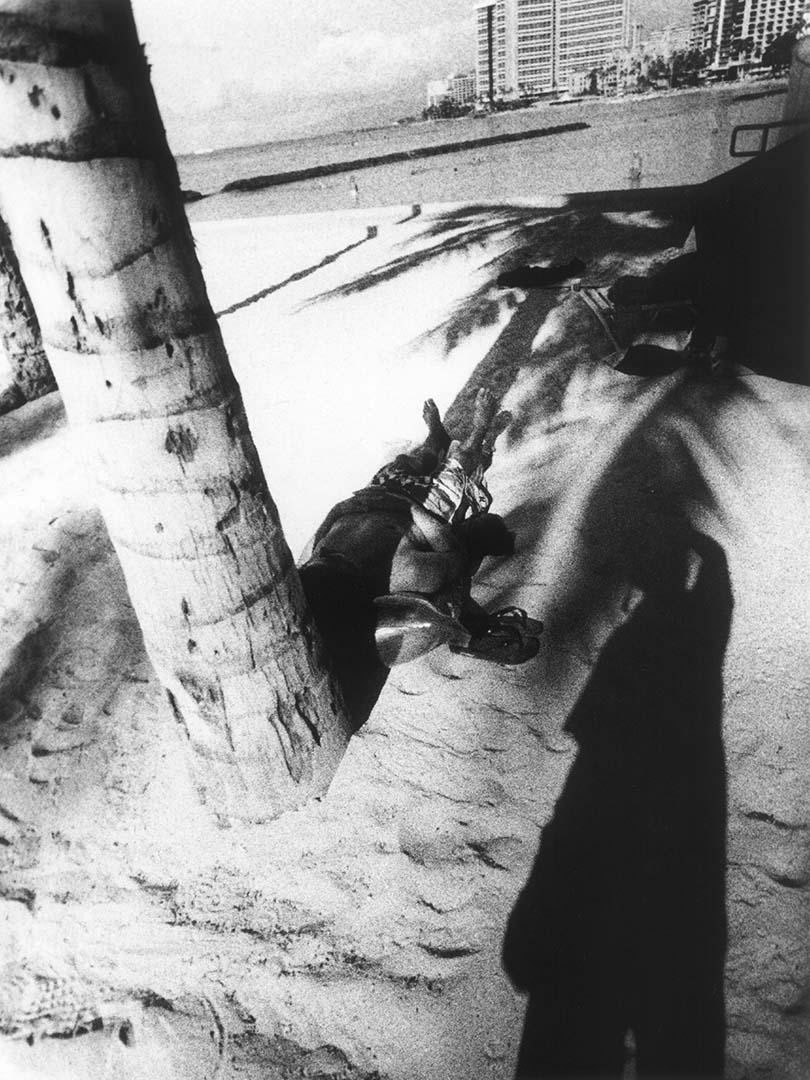
Hawaii, Moriyama’s most recent body of work, was produced over a period of three years and presents his distinct perspective on the daily lives of the people living on the islands of Hawaii and Oahu. Returning to the island five times before feeling prepared to shoot these surroundings, Moriyama’s overall approach is purposeful and considered despite his loose and informal style. The series was recently exhibited at the Tokyo Metropolitan Museum of Photography and published in a volume by the institution.

Daido Moriyama was born in Osaka in 1938. He has had museum shows around the world including the San Francisco Museum of Modern Art, the Fotomuseum Winterthur, Switzerland, the Fondation Cartier pour l’Art Contemporain, Paris and the Tokyo Metropolitan Museum of Photography. His work is part of many major public collections such as the Museum of Modern Art, New York, the Centre Pompidou, Paris, the Metropolitan Museum of Art, New York, the Los Angeles County Museum, the San Francisco Museum of Modern Art, the Museum of Fine Arts, Boston and the Getty in Los Angeles.

Press release from the Luhring Augustine website [Online] Cited 24/02/2010 no longer available online


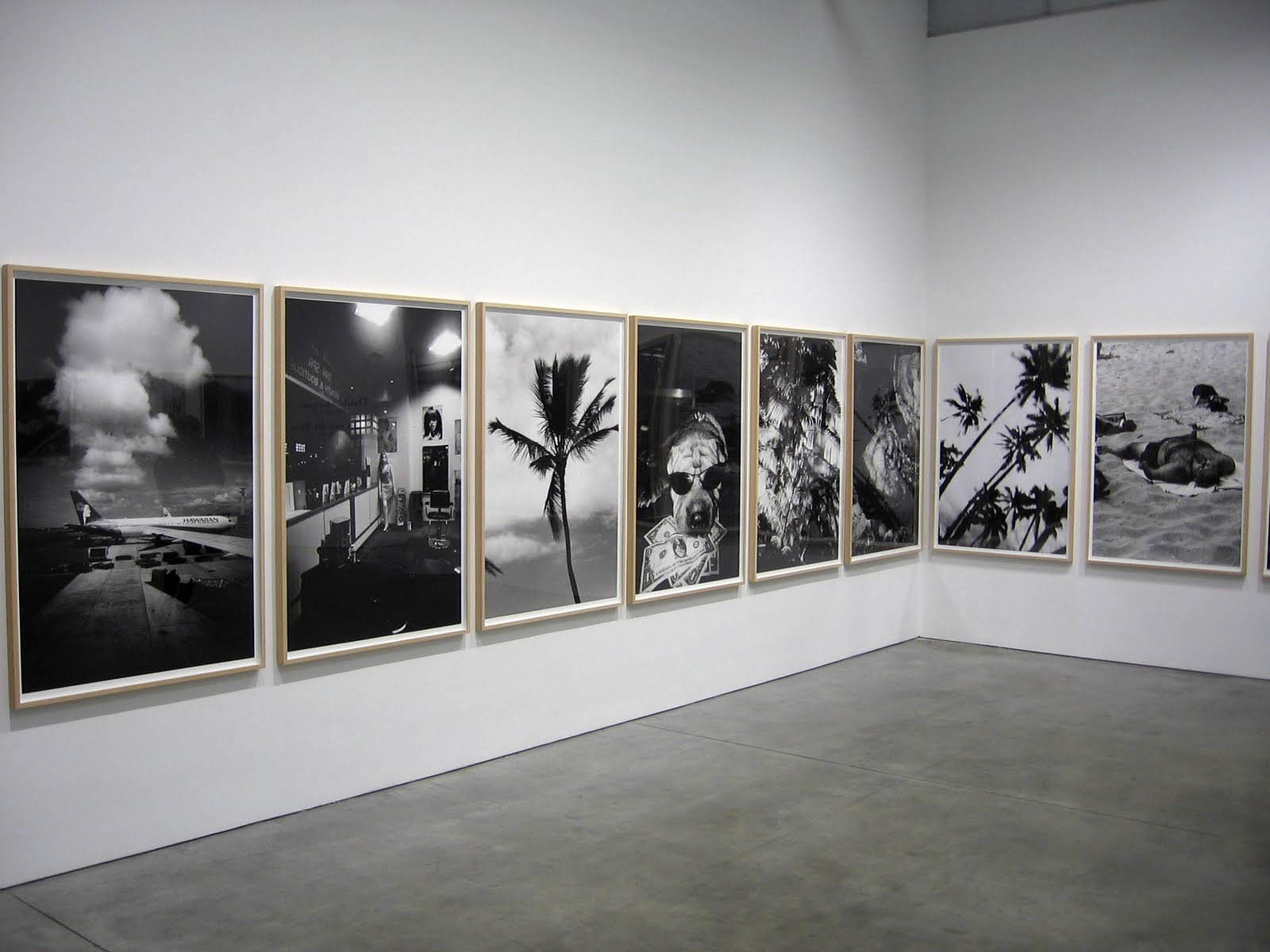
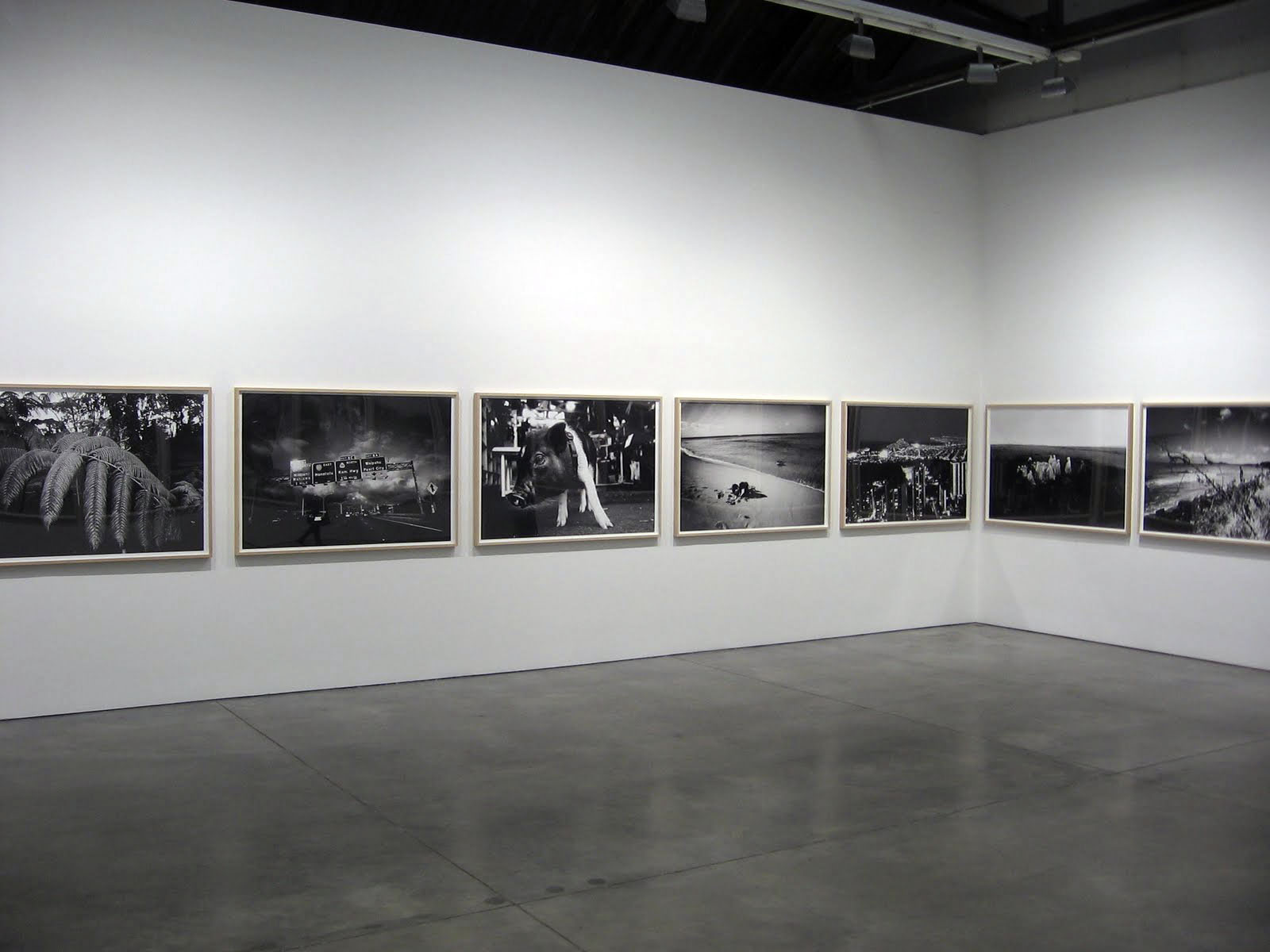
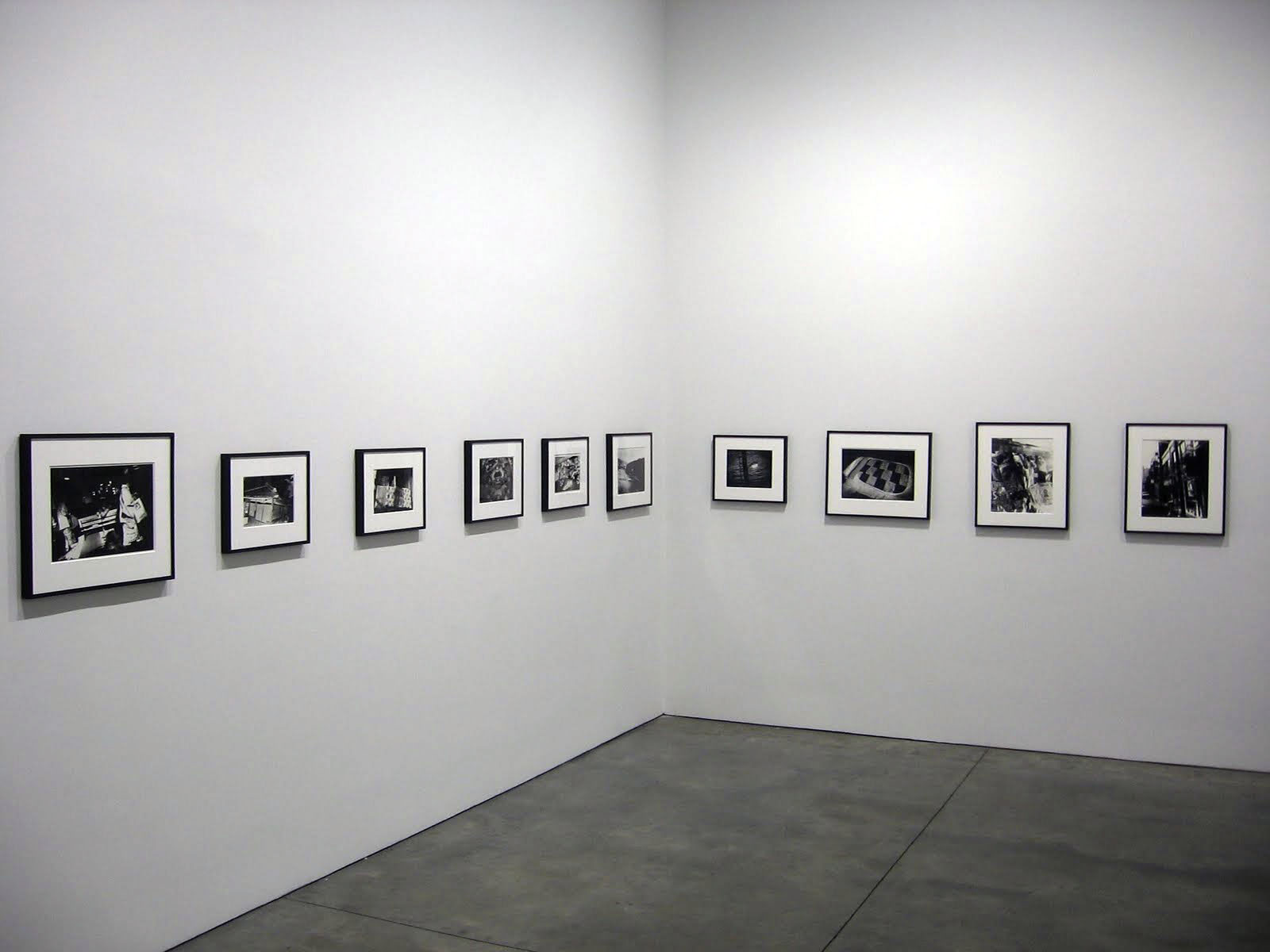
Installation view of the exhibition 'Hawaii' by Daido Moriyama at Luhring Augustine, New York, February - March, 2010


Installation views of the exhibition Hawaii by Daido Moriyama at Luhring Augustine, New York, February – March, 2010


A total of 52 black and white photographs, hung in the entry, main gallery, and one of the back rooms. 29 of the images are from the recent Hawaii series, taken / printed between 2007 and 2010…

What if Sander had taken portraits in India or China? (Another recent example of this phenomenon would be Eggleston’s images of Paris, here.) The effect is somewhat like musicians making covers, taking someone else’s songs and making them their own; sometimes the mashup creates something wholly original and unexpected, and sometimes the combination doesn’t quite work.

This exhibit extends this line of thinking, with the Japanese photographer Daido Moriyama making pictures of Hawaii, using a group of the artist’s vintage images of Japan as a counterweight for comparison. The older works provide a reminder of Moriyama’s powerful visual vocabulary: dark shadowy images, with skewed off-kilter angles, harsh contrasts, and a rawness that often mixes the gloomy and the menacing. His best images uncover the dark underbelly of the streets, capturing the cultural nuances of Japan in gritty, grainy blackness. 

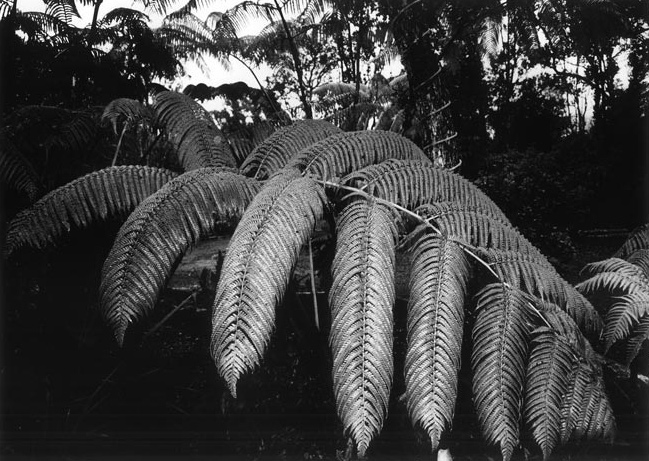
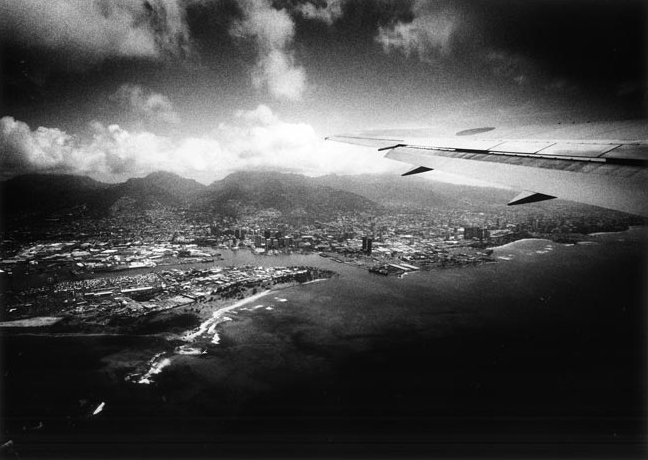
The island life of Hawaii, with its shakas and mellow aloha spirit, presents a surprising challenge for Moriyama: where can a visitor find the brooding or sinister in this paradise? Moriyama does his best to apply his trademark darkness to palm trees and ferns, beaches and hotels, jungles and clouded hills, tourist shops and conch shells, but the overall effect lacks the malignant edginess that haunts his images of Tokyo; he has found some unexpected surface oddities, but the subjects feel a bit too obvious and superficial. Visually, the big prints (roughly 3 by 5 feet) and their shadowy palette make for a jarring view of the easy going, sunny destination, but the subject matter just doesn’t lend itself all that well to deep psychological probing. The real culture of Hawaii is hidden somewhere else, far from the welcoming hula girls, tiki fabrics, and flowers offered to visitors.

Loring Knoblauch. “Daido Moriyama, Hawaii @Luhring Augustine,” on the Collector Daily website, March 4, 2010 [Online] Cited 28/04/2025


Daido Moriyama (Japanese, b. 1938) 'Hawaii' 2007


Daido Moriyama (Japanese, b. 1938)
Hawaii
2007
Gelatin silver print


Daido Moriyama (Japanese, b. 1938) 'Hawaii' 2007-2010


Daido Moriyama (Japanese, b. 1938)
Hawaii
2007-2010
Gelatin silver print


Daido Moriyama (Japanese, b. 1938) 'Hawaii' 2007-2010


Daido Moriyama (Japanese, b. 1938)
Hawaii
2007-2010
Gelatin silver print


Daido Moriyama (Japanese, b. 1938) 'Hawaii' 2007


Daido Moriyama (Japanese, b. 1938)
Hawaii
2007
Gelatin silver print


Daido Moriyama (Japanese, b. 1938) 'Hawaii' 2007-2010


Daido Moriyama (Japanese, b. 1938)
Hawaii
2007-2010
Gelatin silver print


Daido Moriyama (Japanese, b. 1938) 'Hawaii' 2007-2010


Daido Moriyama (Japanese, b. 1938)
Hawaii
2007-2010
Gelatin silver print


Daido Moriyama (Japanese, b. 1938) 'Hawaii' 2007


Daido Moriyama (Japanese, b. 1938)
Hawaii
2007
Gelatin silver print


Daido Moriyama (Japanese, b. 1938) 'Hawaii' 2007-2010


Daido Moriyama (Japanese, b. 1938)
Hawaii
2007
Gelatin silver print


Daido Moriyama (Japanese, b. 1938) 'Hawaii' 2007-2010


Daido Moriyama (Japanese, b. 1938)
Hawaii
2007
Gelatin silver print


Luhring Augustine Gallery
531 West 24th Street, New York
Phone: 1-212-206-9100

Opening hours:
Summer hours (June 20 – September 2):
Monday – Friday, 10am – 5.30pm
Winter hours
Tuesday – Saturday, 10am – 6pm

Luhring Augustine Gallery website

LIKE ART BLART ON FACEBOOK

Back to top

Exhibition: ‘Daidō Moriyama: Tokyo Photographs’ at Philadelphia Museum of Art

Exhibition dates: 28th February – 31st July, 2009

Curator: Peter Barberie, Curator of Photographs


Many thankx to Philadelphia Museum of Art for allowing me to publish the photographs in the posting. Please click on the photographs for a larger version of the image.
 

Daido Moriyama (Japanese, b. 1938) 'Untitled' from the series 'Memory of Dog' 1982 from the exhibition 'Daidō Moriyama: Tokyo Photographs' at Philadelphia Museum of Art, Feb - July, 2009


Daidō Moriyama (Japanese, b. 1938)
Untitled from the series Memory of Dog
1982
Gelatin silver print
Image: 8 1/16 × 11 13/16 inches (20.5 × 30cm)
Purchased with funds contributed by the E. Rhodes and Leona B. Carpenter Foundation, 1990
Philadelphia Museum of Art
© Daidō Moriyama


Daidō Moriyama often calls himself a “stray dog,” a reference to one of his iconic early pictures of a roaming mongrel, but also to his preferred incidental vantage points in relation to his subjects and his beguiled yet wary stance toward modernising Japanese society. In the series Memory of Dog, he revisited photographic scenarios and motifs from his previous two decades of work, overlaying his peripheral approach with another quality that he finds crucial to photography: its relationship to memory.


Daidō Moriyama (Japanese, born 1938) 'Untitled (Rose)' 1984 from the exhibition 'Daidō Moriyama: Tokyo Photographs' at Philadelphia Museum of Art, Feb - July, 2009


Daidō Moriyama (Japanese, b. 1938)
Untitled (Rose)
1984
Gelatin silver print
© Daidō Moriyama


Daidō Moriyama (Japanese, born 1938) 'Viaduct 1, Bunkyo-ku, Tokyo' 1981


Daidō Moriyama (Japanese, b. 1938)
Viaduct 1, Bunkyo-ku, Tokyo
1981
Gelatin silver print
© Daidō Moriyama


Daidō Moriyama (Japanese, born 1938) 'Untitled (Bottle)' from the series 'Light and Shadow' 1982


Daidō Moriyama (Japanese, b. 1938)
Untitled (Bottle) from the series Light and Shadow
1982
Gelatin silver print
Image: 7 13/16 x 11 13/16 inches (19.8 x 30cm)
Purchased with funds contributed by the E. Rhodes and Leona B. Carpenter Foundation, 1990
© Daidō Moriyama


Daidō Moriyama is one of the most important and exciting Japanese photographers of our time, having made prolific, often experimental pictures of modern urban life since the 1960s. This exhibition showcases a group of approximately 45 photographs made in and around Tokyo in the 1980s, when Moriyama focused his mature aesthetic on the city with renewed intensity.

Moriyama approaches the world with an equalising eye, capturing disparate peripheral details that in themselves account for little, but together add up to a powerful diagnosis of modern experience. In 1980s Japan such details encompassed the disorienting and sometimes brutal juxtaposition of traditional culture and modernisation, most visible in the glut of consumer goods and images. But in Moriyama’s photographs these subjects appear alongside the banal elements of any streetscape: a derelict patch of pavement and wall, a car with an aggressive key scratch running its full length, even a single rose blossom.

Moriyama’s urban imagery shares some of its qualities with other great street photography of the 20th century, and he has cited the photographs of William Klein as a major influence. But his work involves strong responses to a wide range of modern art and literature, including photographs and graphic designs by many of his Japanese contemporaries, Andy Warhol’s silkscreens, and the novels of Jack Kerouac and James Baldwin. Moriyama’s mix of international and Japanese trends to represent modern Tokyo is one source of his photography’s power, and the exhibition will include a small number of works by other artists to demonstrate his visual sensibility, including prints and photographs by Warhol, Klein, Shomei Tomatsu, and Tadanori Yokoo.

Text from the Philadelphia Museum of Art website [Online] Cited 23/03/2009


Daidō Moriyama (Japanese, born 1938) 'Memory of Dog 2' 1981


Daidō Moriyama (Japanese, b. 1938)
Memory of Dog 2
1981
Gelatin silver print
© Daidō Moriyama


Daidō Moriyama (Japanese, born 1938) 'Untitled' c. 1981-1985


Daidō Moriyama (Japanese, b. 1938)
Untitled
c. 1981-1985
Gelatin silver print
Image: 8 1/4 x 11 7/8 inches (21 x 30.2cm)
Purchased with funds contributed by the E. Rhodes and Leona B. Carpenter Foundation, 1990
© Daidō Moriyama


Daidō Moriyama (Japanese, born 1938) 'Untitled' from the series 'Light and Shadow' 1982


Daidō Moriyama (Japanese, b. 1938)
Untitled from the series Light and Shadow
1982
Gelatin silver print
Image: 7 3/4 x 11 13/16 inches (19.7 x 30cm)
Purchased with funds contributed by the E. Rhodes and Leona B. Carpenter Foundation, 1990
© Daidō Moriyama


Daidō Moriyama (Japanese, b. 1938) 'Untitled (Twin Chairs)' 1986


Daidō Moriyama (Japanese, b. 1938)
Untitled (Twin Chairs)
1986
Gelatin silver print
© Daidō Moriyama


Daidō Moriyama (Japanese, born 1938) 'On the Road (Chair)' from the series 'Light and Shadow' 1981


Daidō Moriyama (Japanese, b. 1938)
On the Road (Chair) from the series Light and Shadow
1981
Gelatin silver print
Image: 7 3/4 x 11 13/16 inches (19.7 x 30cm)
Purchased with funds contributed by the E. Rhodes and Leona B. Carpenter Foundation, 1990
© Daidō Moriyama


Since the 1960s Japanese photographer Daidō Moriyama (born 1938) has been making dynamic, often experimental images of modern urban life, establishing a reputation as one of the most important and exciting photographers of our time. The Philadelphia Museum of Art will present an exhibition of approximately 45 photographs by Moriyama, made in and around Tokyo in the 1980s, when the artist focused his mature aesthetic on the city with renewed intensity. The exhibition will be on view from February 28-June 30, 2009 in the Julien Levy Gallery at the Ruth and Raymond G. Perelman Building.

Born in 1938 in Ikeda-cho (now Ikeda-shi), Osaka, Moriyama witnessed the dramatic changes that swept over Japan in the decades following World War II. After his father’s death in a train accident, he began working as a freelance graphic designer at age 20. He was intrigued by the graphic possibilities of screenprinting, the cheapest and most prolific form for printed imagery, and by international trends in contemporary art. These interests, along with attention to the various forms of visual stimuli that populate the urban landscape have been a hallmark of Moriyama’s career.

In 1960 Moriyama took up the study of photography under Takeji Iwamiya and one year later moved to Tokyo hoping to join the eminent photographers’ group VIVO, a short-lived cooperative whose members were exploring and confronting the revolution in modern Japanese society in their work. Although VIVO disbanded a week after Moriyama’s arrival in the capital, the visual and existential turmoil they explored would become one of the core subjects in Moriyama’s photographs. His gritty, black and white images of streets and highways express the conflicting realities of contemporary Japan, the disorienting and sometimes brutal juxtaposition of traditional culture and modernisation. 

“It is a pleasure to present this group of photographs from the Museum’s collection reflecting the distinctive vision of Daidō Moriyama, who is undoubtedly among the great urban photographers of the 20th century,” Curator of Photographs Peter Barberie said. These particular images focus on the visual experience of modern-day Tokyo, but through them Moriyama is documenting broader global trends of modernisation, and at the same time exploring the unique aesthetic qualities of his medium.”

His early images from the 1960s and 70s tested the notion of photographic artistry in an extreme fashion. He chose seemingly arbitrary subjects, and experimented with motion and overexposure to create blurred or nearly blank images, adopting an anti-aesthetic position. Other Japanese photographers were also working in this vein, but Moriyama’s 1972 book Bye Bye Photography became the defining statement of this particular style. The later photographs presented in this exhibition are generally sharper in focus but maintain the peripheral vantage point that Moriyama so often employed, as well as the seemingly random content. His images capture with an equalising eye the kinds of disparate peripheral details that litter the modern urban experience: shadows, cars, and abandoned corners, as well as the glut of consumer goods and commodities. 

Profoundly influenced by Japanese photographers Eikoh Hosoe and Shomei Tomatsu, Moriyama’s vision was also enriched by his acquaintance with the work of American photographers William Klein and Robert Frank. Like them he practiced a new, more action-oriented street photography. His images are often out of focus, vertiginously tilted, or invasively cropped. 

His work also involves strong responses to a wide range of modern art and literature, including photographs and graphic designs by many of his Japanese contemporaries, Andy Warhol’s silkscreens, and the novels of Jack Kerouac and James Baldwin. The exhibition will include a small number of works by other artists to demonstrate his visual sensibility, including prints and photographs by Warhol, Klein, Shomei Tomatsu, and Tadanori Yokoo.

Press release from the Philadelphia Museum of Art


Daidō Moriyama (Japanese, born 1938) 'Tunnel' 1982


Daidō Moriyama (Japanese, b. 1938)
Tunnel
1982
Gelatin silver print
Image: 7 15/16 x 11 7/8 inches (20.2 x 30.2cm)
Purchased with funds contributed by the E. Rhodes and Leona B. Carpenter Foundation, 1990
© Daidō Moriyama


Daidō Moriyama (Japanese, born 1938) 'Untitled' from the series 'Light and Shadow' 1982


Daidō Moriyama (Japanese, b. 1938)
Untitled from the series Light and Shadow
1982
Gelatin silver print
Image: 7 3/4 × 11 3/4 inches (19.7 × 29.8cm)
Purchased with funds contributed by the E. Rhodes and Leona B. Carpenter Foundation, 1990
© Daidō Moriyama


Daidō Moriyama (Japanese, b. 1938) 'Untitled' c. 1981-1985


Daidō Moriyama (Japanese, b. 1938)
Untitled
c. 1981-1985
Gelatin silver print
Image: 8 3/8 × 11 5/8 inches (21.2 × 29.6cm)
Sheet: 10 × 11 15/16 inches (25.4 × 30.4cm)
Purchased with funds contributed by the E. Rhodes and Leona B. Carpenter Foundation, 1990
© Daidō Moriyama


Daidō Moriyama (Japanese, b. 1938) 'Untitled', from the series 'Light and Shadow' 1982


Daidō Moriyama (Japanese, b. 1938)
Untitled, from the series Light and Shadow
1982
Gelatin silver print
Image: 7 3/4 x 11 13/16 inches (19.7 x 30cm)
Sheet: 10 x 12 1/8 inches (25.4 x 30.8cm)
Purchased with funds contributed by the E. Rhodes and Leona B. Carpenter Foundation, 1990
© Daidō Moriyama


Daidō Moriyama (Japanese, b. 1938) 'Setagaya-ku, Tokyo, Midnight' 1986


Daidō Moriyama (Japanese, b. 1938)
Setagaya-ku, Tokyo, Midnight
1986
Gelatin silver print
© Daidō Moriyama


Philadelphia Museum of Art
26th Street and the Benjamin Franklin Parkway
Philadelphia, PA 19130

Opening hours:
Thursday – Monday, 10.00am – 5.00pm
Closed Tuesday and Wednesday

Daido Moriyama website

Philadelphia Museum of Art website

LIKE ART BLART ON FACEBOOK

Back to top