
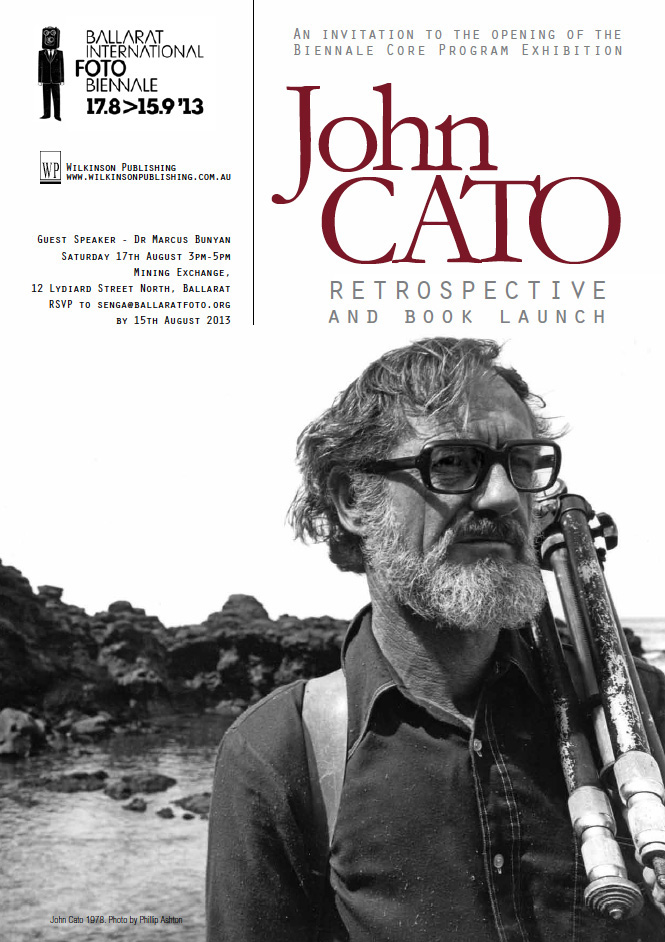
Exhibition dates: 17th August – 15th September 2013
Opening: 17th August 2013

Installation photograph of the exhibition John Cato Retrospective at the Mining Exchange, Ballarat
Photograph by Marcus Bunyan
© Marcus Bunyan, John Cato family and Ballarat International Foto Biennale
It was an emotional time on Saturday afternoon as I opened the John Cato Retrospective. I hope I did John and Dawn, their family and everyone proud. I burst into tears after the speech… I got a lovely email from Senga Peckham today which was very much appreciated:
“Dear Marcus
Thank you so much for your excellent speech on Saturday. It was strong, heartfelt and beautiful.
Up there with the microphone you were probably not aware of the sentiment in the space. Many tears were shed. The grand daughters were so happy to be there. They were near me during your talk and extremely emotional. Many others were too. It was more of a wake really than an exhibition opening and book launch. Some people had travelled a long way and everyone wanted to be there. The warmth and tenderness was palpable and will be remembered for a long time.
Thank you for being such a major part of it and for putting your heart into each word.
Senga Peckham”
Many thankx to BIFB for asking me to officially open the John Cato Retrospective and to launch the new book.
Photographers David Callow and Andrew Chapman’s video tribute to John Cato (18 mins 39 secs) can be viewed on Vimeo (Password is Cato).
Read my chapter in the John Cato Retrospective book.
John Cato Retrospective opening speech
It is a great pleasure to be here today to officially open the John Cato Retrospective and to launch a book that will have a major contribution to a continuing assessment of John’s work and is also an honouring, a mark of respect and admiration. These brief words are not about the many sides of John and all his aspects and careers – for that you will have to look elsewhere – but they are a short introduction to the personal and wider cultural need for John’s work.
My friendship with John and Dawn goes back to when I was studying photography at RMIT University in the early 1990s. John became a mentor when I held my first three solo photography exhibitions at the Photographers’ Gallery in Punt Road between 1991 and 1994. After I had finished my Phd in 2001, I co-curated a retrospective of his work at the very same gallery.
Many a weekend my partner and I travelled down to Carrum to see John and Dawn for lunch and afternoon tea, to talk about the things that matter in life – music, literature, art, love, loss – and to talk about my latest prints. They were the most glorious couple with such wonderful energy and they were so generous with their friendship and advice. John could smell bullshit a mile away and he would tell you, but he would also encourage you to look deeper into yourself and the world for the answers you were seeking. As James McArdle said to me recently, “He was a teacher determined to seek out the aptitudes and endowments of each student who came before him; his teaching and mentorship involved a deep empathy with each student’s approach. He was almost clairvoyant in being able to very quickly identify one’s strengths and it was on those he would concentrate, unafraid to express criticism; but only in terms of how a certain fault might detract from a certain strength.”1
And I will add, all of this with a warmth and affection that opened up a pathway to his insights.
John had strength of character in spades, always backed up by the vivacious Dawn. Imagine having a successful commercial career in Melbourne in the 1960s and giving it all away – to become an artist, a photographic artist at that! Imagine the courage it would have taken, in that time and place, to abandon all that had been successful in your life and follow another path, a path full of doubt and self-discovery, a journey that ultimately enabled him to help others through his teaching. As another friend of mine said to me recently, “In 1970 where did you go to see a fine art photograph on exhibition in a non-institutional gallery in Melbourne? The only place was the doorway to the John Cato / Athol Shmith / Paul Barr studio in Collins Street. You would never know which of the three photographers would have a print placed in that doorway.”
According to Helen Ennis there has always been a distaste for self-reflective and contemplative modes of thinking in Australia, and photography has overwhelmingly been about ‘things’, “including actions and events, which have a concrete reality and a verifiable, independent existence… For most of the twentieth century inward-looking approaches, whether symbolist, surrealist or abstract, never really took hold.”2
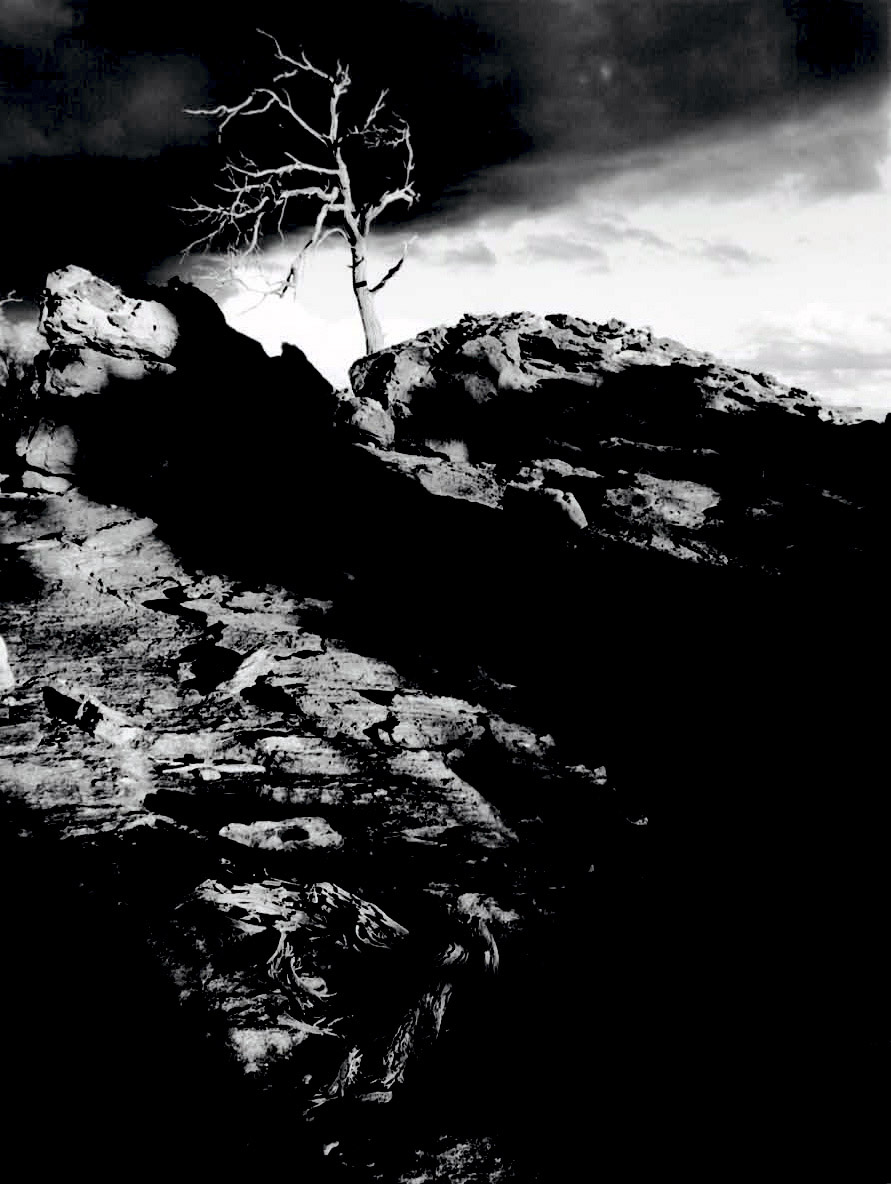
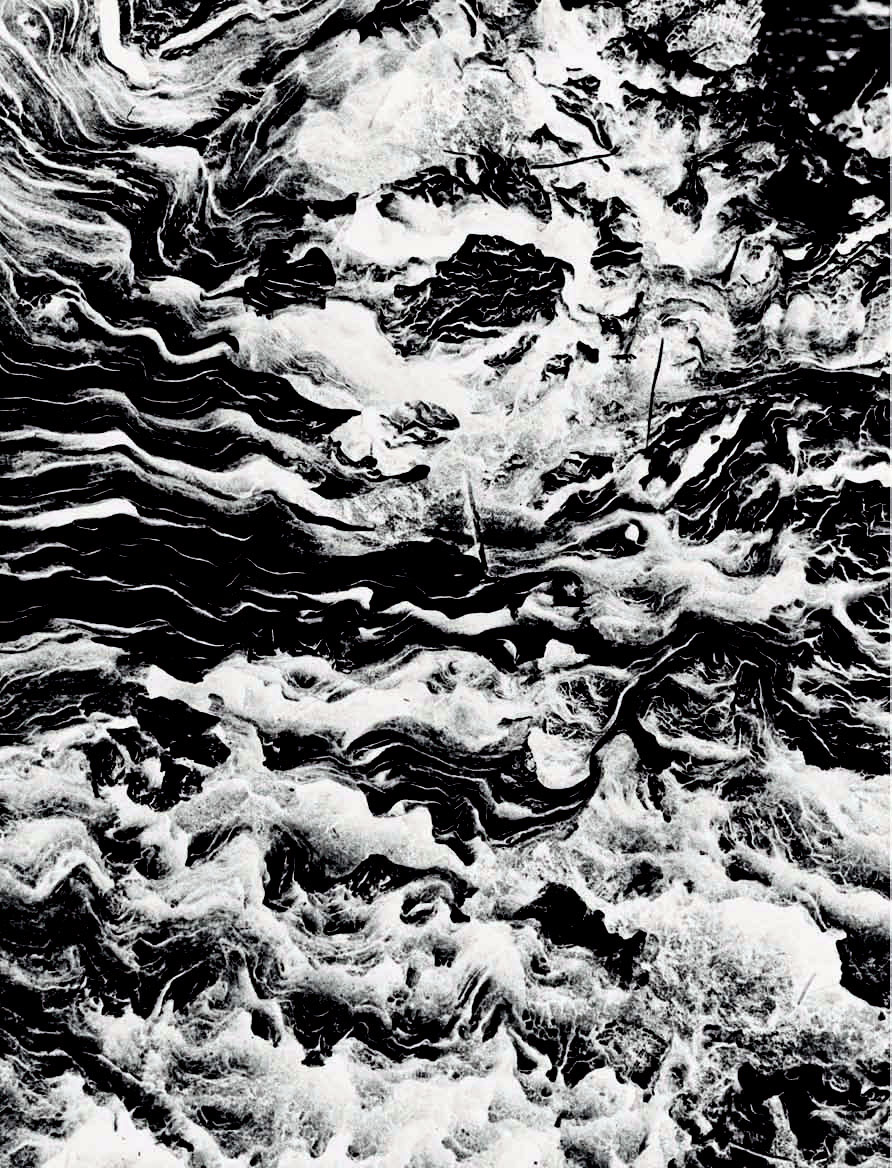
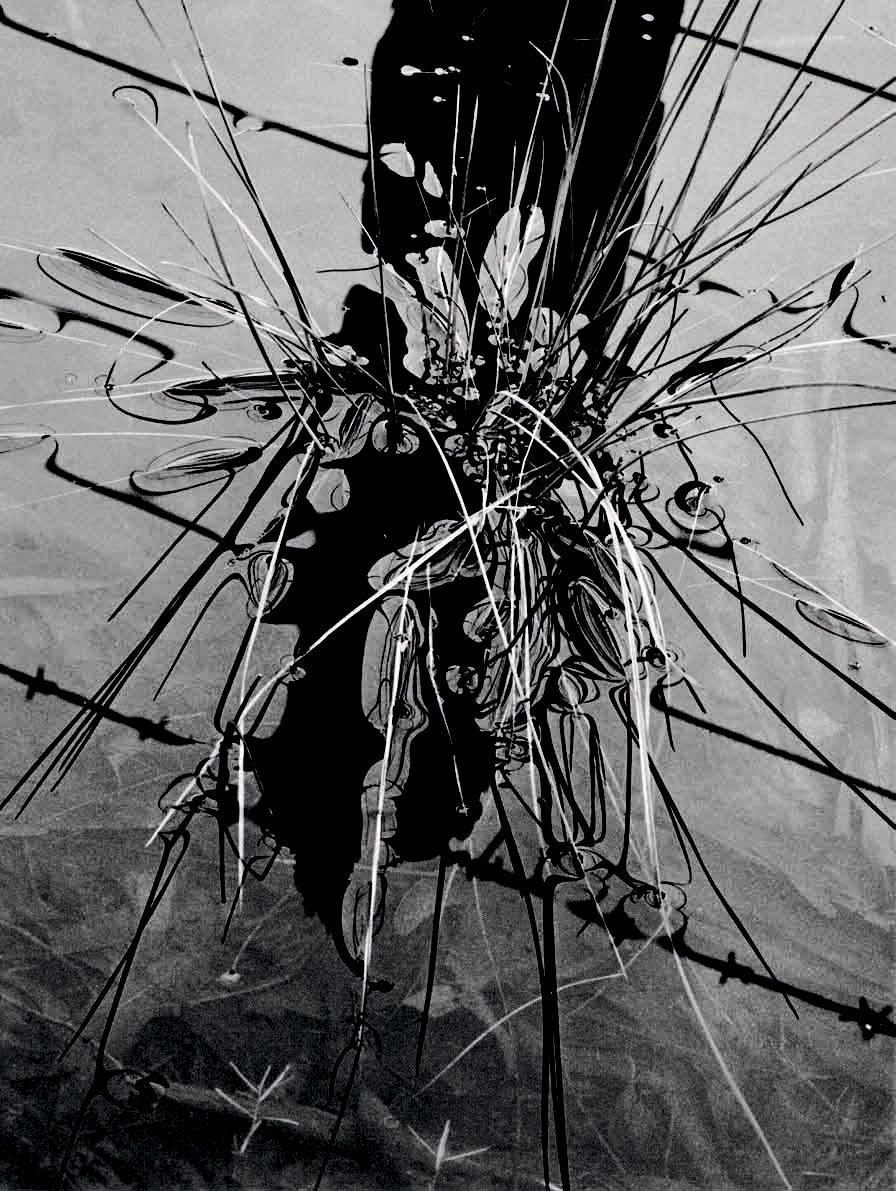
John’s work is different. He was a groundbreaking artist. He was one of the first Australian photographers to create musical tone-poems – not traditional photo-essays as for magazines, but spiritual expositions about Self. In his internal meditation upon subject matter his concern was for the ‘felt’ landscape. He sought to express his relationship with the earth, air and water, aware of the contradictions in contemporary settler relations with the land. His photographs are not about the ‘when’ or ‘where’ but about a feeling in relation to the land, the spirit and the universe.
In this sense (that the photograph is always written by the photographer), these are photographs of the mind as much as they are of the landscape. John exposes himself as much as the landscape he is photographing. This is his spirit in relation to the land, to the cosmos, even. Like Monet’s paintings of water lilies these photographs are a “small dreaming” of his spirit with a section of the land and not necessarily, as in Aboriginal art, a dreaming and connection to the whole land. His photographs are photographs of the imagination as much as they are of place, rid of ego and become just the world. He created visions that placed the individual in harmony with the earth and in the process became not just a citizen of Australia but also a citizen of the world.
In this transformative act the artist not only awakens the reasoning mind but more importantly the soul. This is what John’s work does; it awakens the soul. His Alcheringa, his dreaming (for that is what Alcheringa means), was to pursue poetic truth in the world and it is his “gift” to us, to those that remain looking at his work. John commented that he would rather have questions than answers – I’m sure he would want to say that, and he would want to believe it – but it is my feeling that very deep down he was searching for the more beautiful answer – rather than just the beautiful question.
A very good friend of mine asked me recently whether I thought that John Cato was a great photographer. I have been thinking about that question ever since and my answer is this: he was a great photographer, one of Australia’s greatest, a great teacher and together with the sparkly-eyed Dawn, a wonderful human being. One measure of a photographer’s greatness is the amount of time he is prepared to spend helping others, and John spent a lot of time imparting his hard-earned wisdom.
As an artist, John has for too long been ignored by notable institutions that cannot accept the wonder in his work. There is an inexplicable coolness toward John and guardedness when talking about his work, as though people are afraid of saying anything about it at all. Well, let me say it for them: John’s work is magnificent. It is to the great credit of the people who have organised this exhibition and the publication of this book that finally, John might start to get the recognition he so strongly deserves.
John Cato unquestionably deserves a place in the pantheon of significant and influential Australian photographers for he is right up there with the very best of them. May the cosmos bless him.
© Dr Marcus Bunyan
August 2013
Footnotes
1/ James McArdle email to the author 28th July 2013
2/ Ennis, Helen. “Introduction,” in Ennis, Helen. Photography and Australia. London: Reaktion Books, 2007, p. 9.


Installation photographs of John Cato Retrospective at the Mining Exchange, Ballarat
Photographs by Marcus Bunyan
© Marcus Bunyan, John Cato family and Ballarat International Foto Biennale
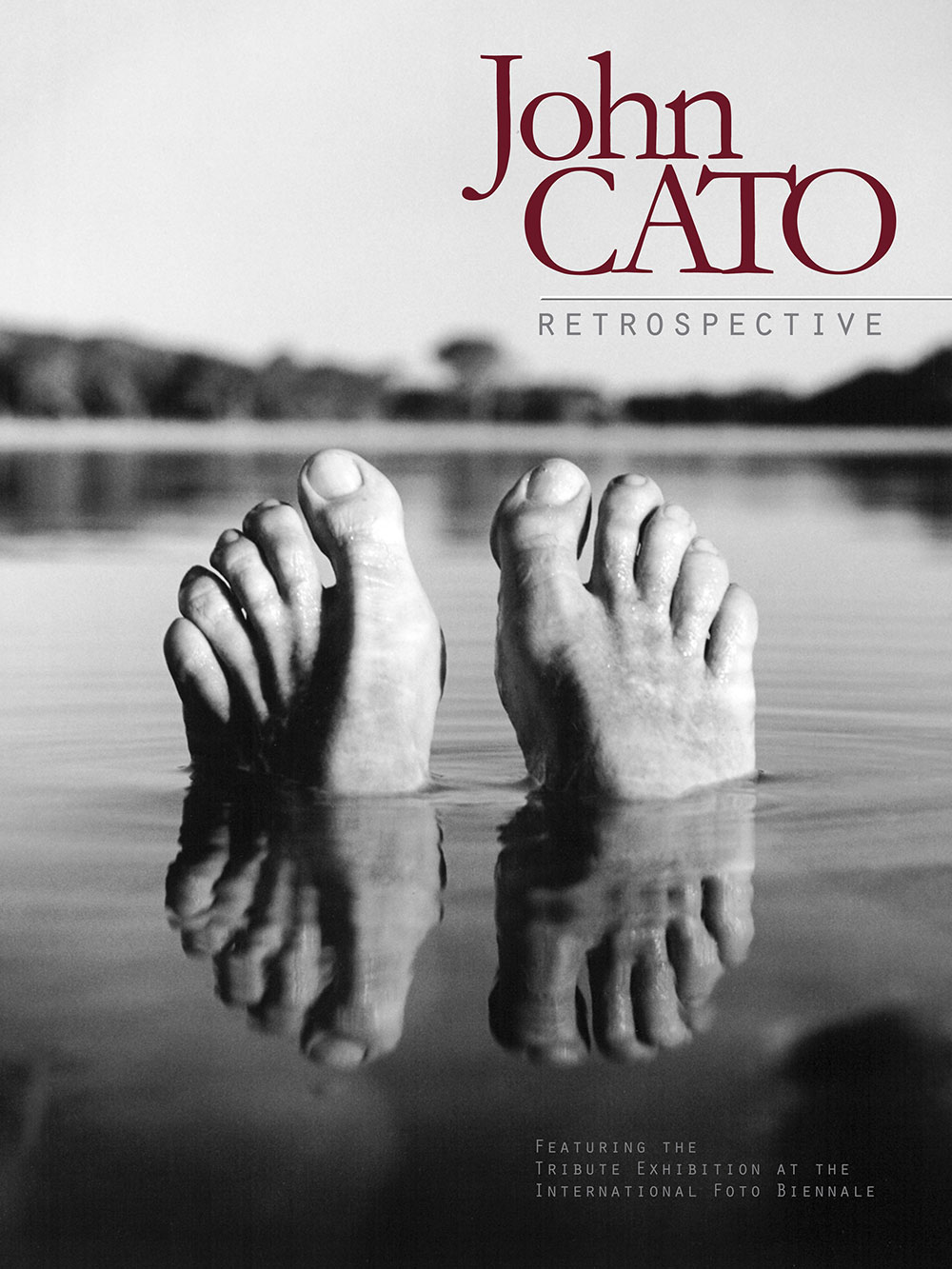
John Cato Retrospective book cover
Please click on the photographs for a larger version of the image.
Ballarat International Foto Biennale
12 Lydiard St North, Ballarat 3350
![Installation photograph of Erika Diettes 'Sudarios' (Shrouds) at Iglesia de Chinquinquirá (La Chinca). Santa Fe de Antioquia [COL] December 5-9, 2012](https://artblart.com/wp-content/uploads/2013/07/04.jpg "Installation photograph of Erika Diettes 'Sudarios' (Shrouds) at Iglesia de Chinquinquirá (La Chinca). Santa Fe de Antioquia [COL] December 5-9, 2012")
![Installation photograph of Erika Diettes 'Sudarios' (Shrouds) at Iglesia de Chinquinquirá (La Chinca). Santa Fe de Antioquia [COL] December 5-9, 2012](https://artblart.com/wp-content/uploads/2013/07/06.jpg "Installation photograph of Erika Diettes 'Sudarios' (Shrouds) at Iglesia de Chinquinquirá (La Chinca). Santa Fe de Antioquia [COL] December 5-9, 2012")
![Installation photograph of Erika Diettes 'Sudarios' (Shrouds) at Ex Teresa Arte Actual. México D.F. [MEX] May-Jun, 2012](https://artblart.com/wp-content/uploads/2013/07/sudarios_mex_02.jpg "Installation photograph of Erika Diettes 'Sudarios' (Shrouds) at Ex Teresa Arte Actual. México D.F. [MEX] May-Jun, 2012")
![Installation photograph of Erika Diettes 'Sudarios' (Shrouds) at Trinity Episcopal Church. Houston TX [USA] Feb-Apr 2012](https://artblart.com/wp-content/uploads/2013/07/006-houston.jpg "Installation photograph of Erika Diettes 'Sudarios' (Shrouds) at Trinity Episcopal Church. Houston TX [USA] Feb-Apr 2012")
 Art Blart _ art and cultural memory archive
You must be logged in to post a comment.