Review: ‘Dale Cox: Inner Logic’ at Australian Galleries, Melbourne

Exhibition dates: 24th July – 12th August, 2018


Dale Cox (Australian, b. 1969) 'Usurper Ruminant' 2016 from the exhibition 'Dale Cox: Inner Logic' at Australian Galleries, Melbourne, July - August, 2018


Dale Cox (Australian, b. 1969)
Usurper Ruminant
2016
Acrylic on gold enamel on board
120cm x 90cm


Clarion call

The sky is blue, the sun is shining and yet, in this era of the Anthropocene, the Earth is in deep shit. Through the activities of a virus, a contagion that infests the planet… that is – the ego, the selfishness of the individual human and, collectively, of the human race – “we are perhaps amongst the first to contemplate not just our own finite existence, but the doomed fate of the Earth itself.”

My friend Dale Cox’s exhibition Inner Logic at Australian Galleries dissects this situation in a most intelligent and imaginative manner. Instead of didactic protest, Cox uses the language of Australian pastoral landscape, iconic edifice and stratigraphic cross section to make ironic comment on popular culture, history and religion. As you dissect the various influences and concepts within the work you chuckle to yourself at the artist’s inventiveness and humour.

Mixing the tight style and formal, classical beauty of Australian colonial painting (with reference in particular to the work of John Glover) with the uncanny sense of reality and precision found in the paintings of Jeffrey Smart, Cox twists his realities and points of view. Shopping trolleys have a strange perspective when filled with Australian colonial landscapes; aircraft stairs seem strangely twisted as they lead to a geological cross-section topped with verdant greenery (a journey through time); clouds in the burning landscape look like that of an atomic bomb; an Uluru-like profile of Elvis in the Australian bush is dotted with tents and encampments; and Australian ute’s of unlikely shape sit at the base of a constructed Elvis edifice, the most prominent thing to my mind in the painting being the four air conditioning units at the base of the construction cabin, sitting in an absolutely barren landscape. The perspicacity of Cox’s (re)marks is exemplary.

My favourite works in the exhibition are the Usurper paintings. Here Cox condenses the customs, traditions and rituals of the human race (colonisation, farming, habitation – power, possession, destruction and modification of the environment and its animals) onto the body of the (b)ovine family, the livestock “genetically modified over time through the artificial selection of desirable traits by humans, with a view to increasing the docility of the animals, their size and productivity, their quality as agricultural products, and other culturally desired features,”1 to serve humans who are substantially dependent on their livestock for sustenance and other purposes. These artificial bodies, these illegitimate usurpers, float on a sea of gold enamel and wood grain form.

Cox’s declamations, his inner logic if you like, document in the most inventive way the liturgy of errors of the human race. His work is a clarion call for humans to be better custodians (for that is what we are) of the Earth. Through his subversive paintings, the artist “challenges the myopic tendency for us humans to fixate on ourselves in a way that bodes poorly for our ability to see the bigger picture and act as stewards for the entire planet rather than as self serving, selfish species.” (Email to the author, 28 July 2018). His humors (basic substances which are in balance when a person, or in this case the Earth, is healthy) add to the raised voices against the naysayers of global warming, the backward looking fossil fuel industry, the power of nations and corporations, and the vested interests of the rich and powerful, mainly men. It’s time for the dreamers, the artists, and the spiritual to confront these dinosaurs of the past, so that they may shape the future. So that the human race can cast aside their shadow and learn to walk on the Earth without leaving tracks.

Dr Marcus Bunyan


Many thankx to Dale Cox for allowing me to publish the text and the photographs in the posting. Please click on the photographs for a larger version of the image.


Shaman

“There are two kinds of people in this world.

There are those who are dreamers and those who are being dreamed.

There comes a time in every mans life when he must encounter his past.

For those that are dreamed, who have no more than a passing acquaintance with power, this moment is usually played out on their death beds as they try to bargain with fate for a few more moments of life time.

But for the dreamer, the person of power, this moment takes place alone, before a fire, when he calls upon the spectres of his personal past to stand before him like witnesses before the court…

I am not speaking of remembering the past. Anyone can remember the past, and in remembering we frame it to serve and justify the present. Remembering is a conscious act and therefore subject to embellishment. Remembering is easy.

The person of power sits alone before the fire and confronts his past. He hears the testimony of these spectres and he dismisses them one by one. He acquits himself of his past. If you comprehend this, the man of power has no past. No history that can claim him. He has cast aside his shadow and learnt to walk in the snow without leaving tracks.”


Dr Alberto Villoldo


Dale Cox (Australian, b. 1969) 'Usurper Transplant' 2016 from the exhibition 'Dale Cox: Inner Logic' at Australian Galleries, Melbourne, July - August, 2018


Dale Cox (Australian, b. 1969)
Usurper Transplant
2016
Acrylic on gold enamel on board
120cm x 90cm
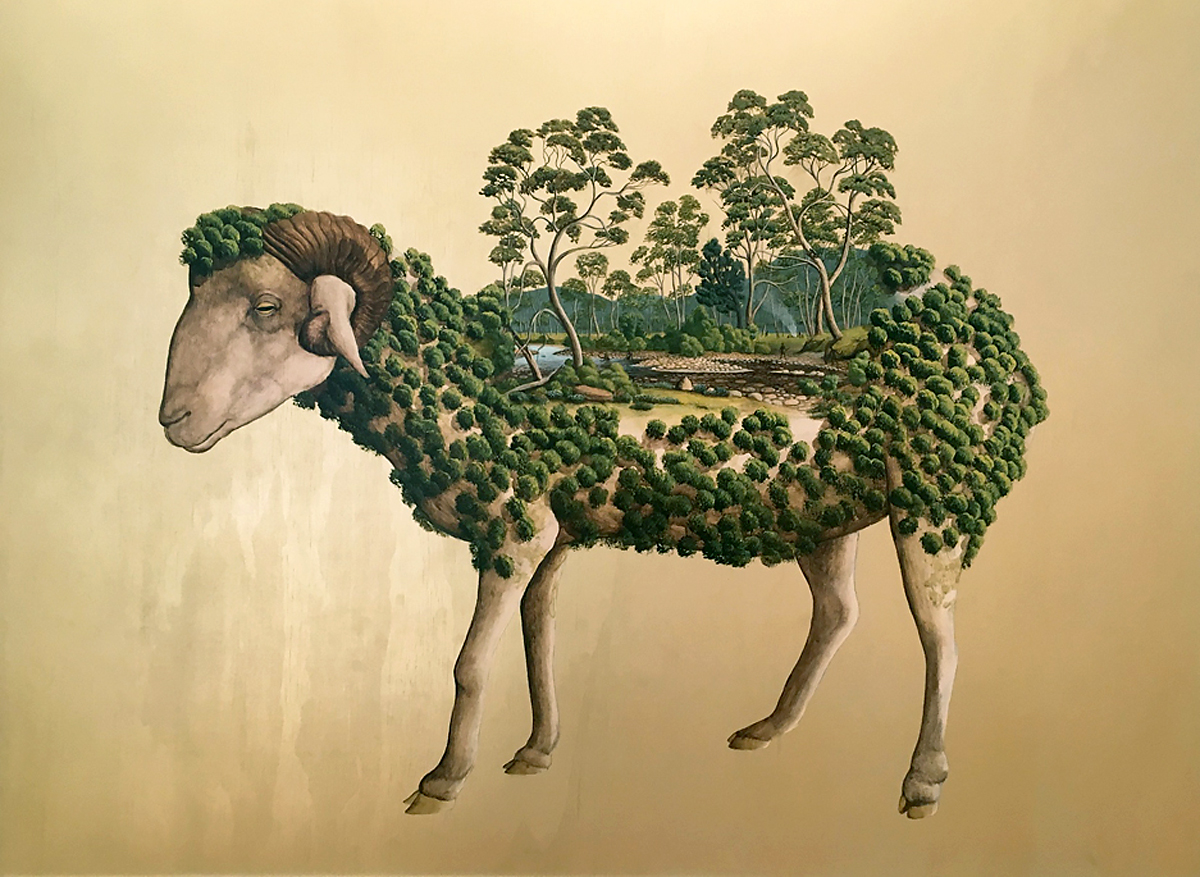
 

Dale Cox (Australian, b. 1969) 'Usurper Glover' 2016


Dale Cox (Australian, b. 1969)
Usurper Glover
2016
Acrylic on gold enamel on board
120cm x 90cm
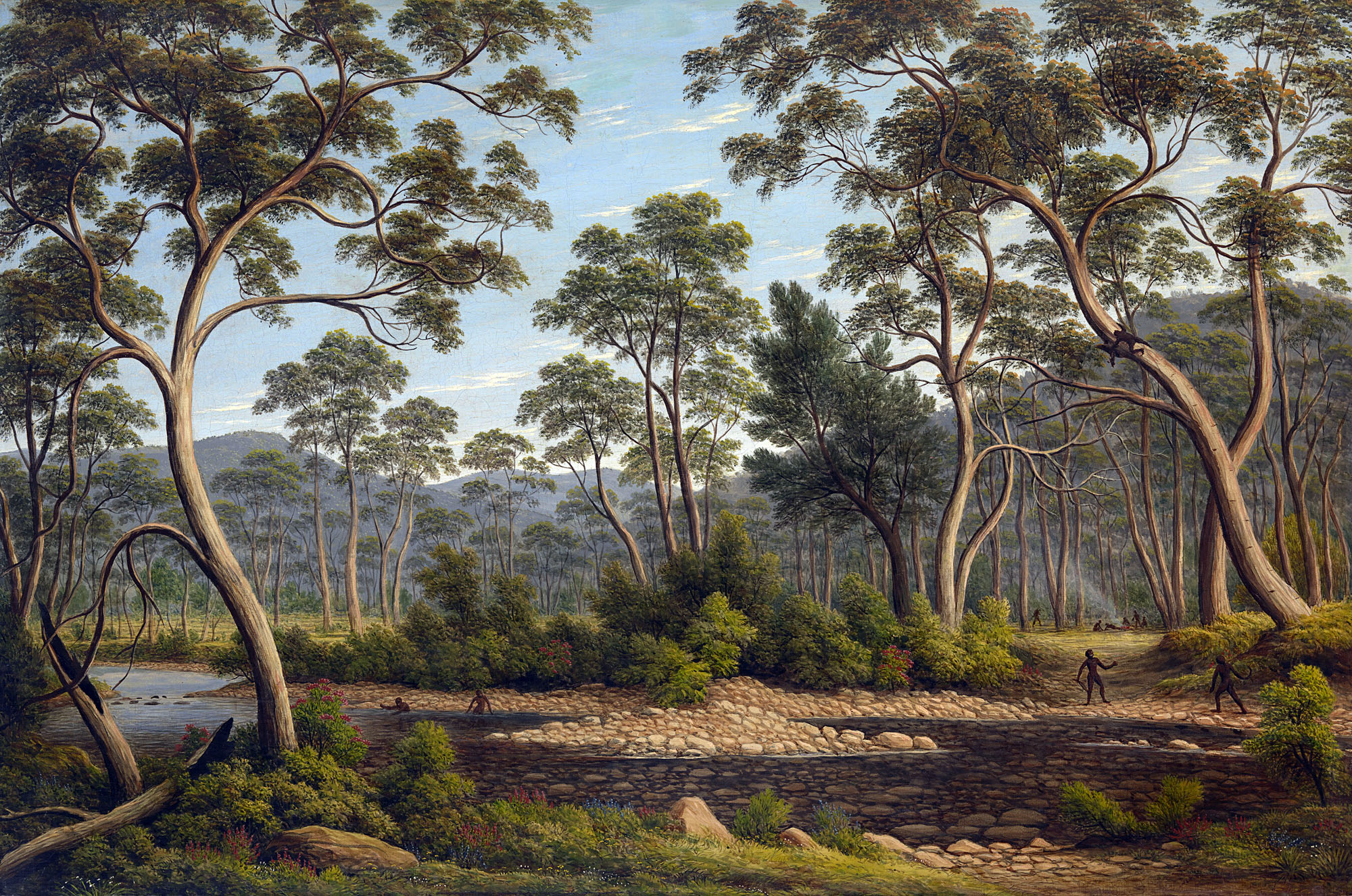
 

John Glover (England 1767 - Australia 1849, Australia from 1831) 'The River Nile, Van Diemen's Land, from Mr Glover's farm' 1837


John Glover (England 1767 – Australia 1849, Australia from 1831)
The River Nile, Van Diemen’s Land, from Mr Glover’s farm
1837
Oil on canvas
76.4 x 114.6cm
National Gallery of Victoria, Melbourne
Felton Bequest, 1956


John Glover’s colonial landscapes can be divided into two groups: pastoral scenes of the land surrounding his own property, and pre-contact Aboriginal Arcadias. Although the Aboriginal figures are at times generic, they are shown as active participants in the landscape. Such scenes were, however, entirely imagined, as Glover encountered very few Tasmanian Aboriginal people while in the colony. Glover had not experienced the conflict or witnessed the violence between Tasmanian Aboriginal resistance fighters and white settlers during the 1820s. By the time of his arrival in 1831, the Tasmanian Aboriginal survivors had been forced to leave Country and relocate to Flinders Island.
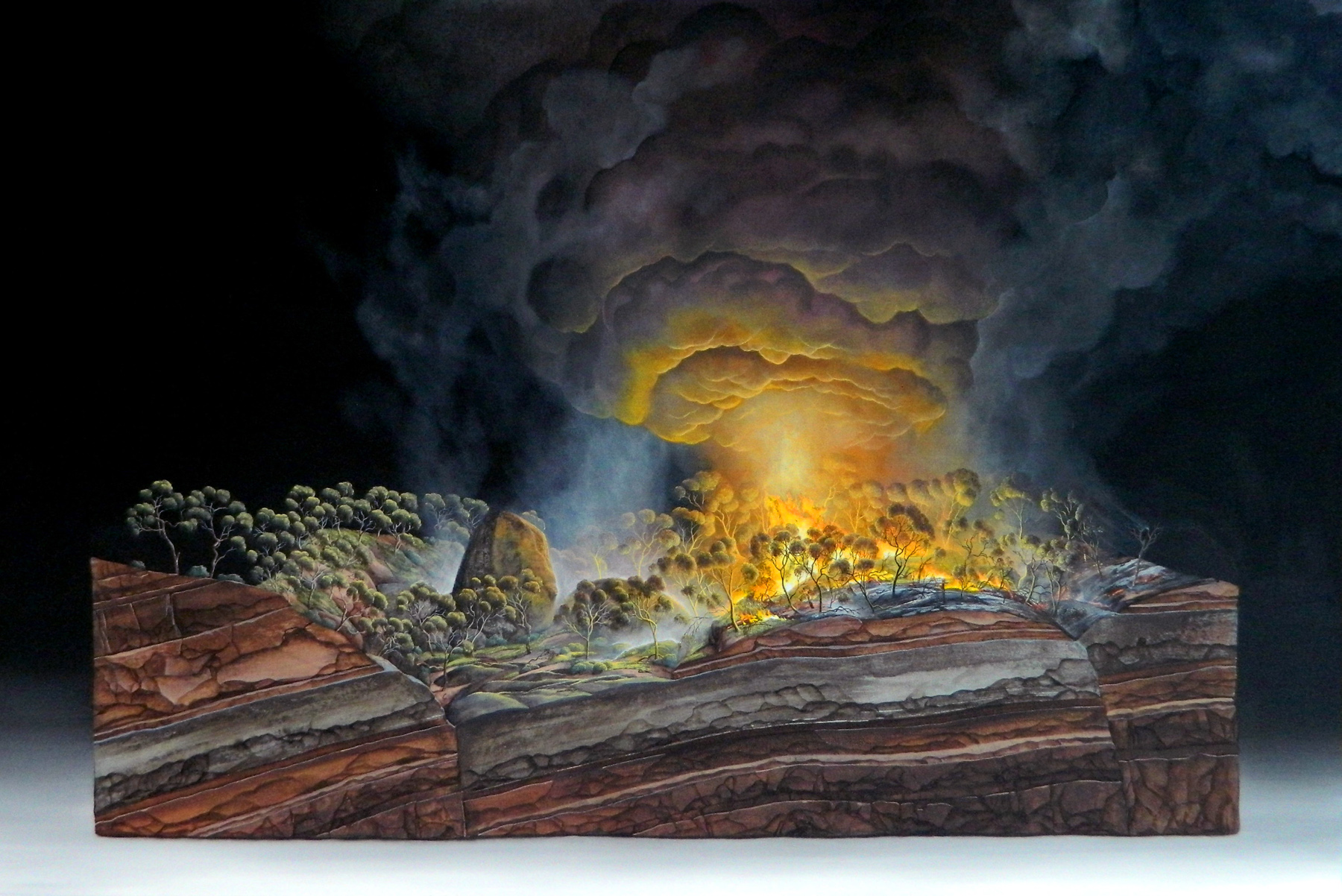
 

Dale Cox (Australian, b. 1969) 'Tract 38 (Burning landscape)' 2012


Dale Cox (Australian, b. 1969)
Tract 38 (Burning landscape)
2012
Acrylic on canvas
102 x 152cm


Dale Cox (Australian, b. 1969) 'Tract 38 (Burning landscape)' 2012 (detail)


Dale Cox (Australian, b. 1969)
Tract 38 (Burning landscape) (detail)
2012
Acrylic on canvas
102 x 152cm
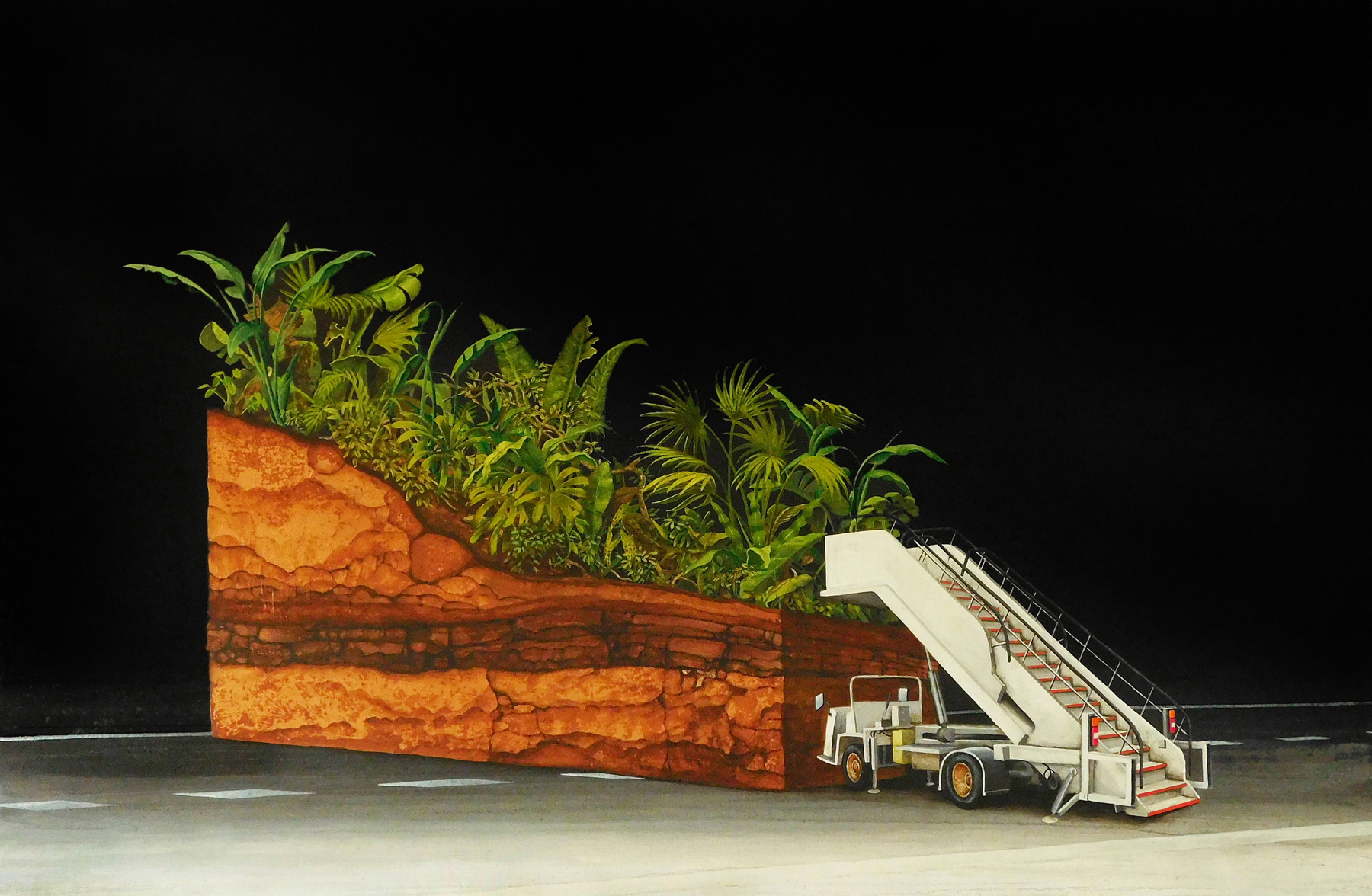
 

Dale Cox (Australian, b. 1969) 'Flight SQ2118 to Thailand' 2018


Dale Cox (Australian, b. 1969)
Flight SQ2118 to Thailand
2018
Acrylic on board
81 x 122cm


Dale Cox (Australian, b. 1969) 'Rewilding II' 2018


Dale Cox (Australian, b. 1969)
Rewilding II
2018
Acrylic on board
81 x 122cm
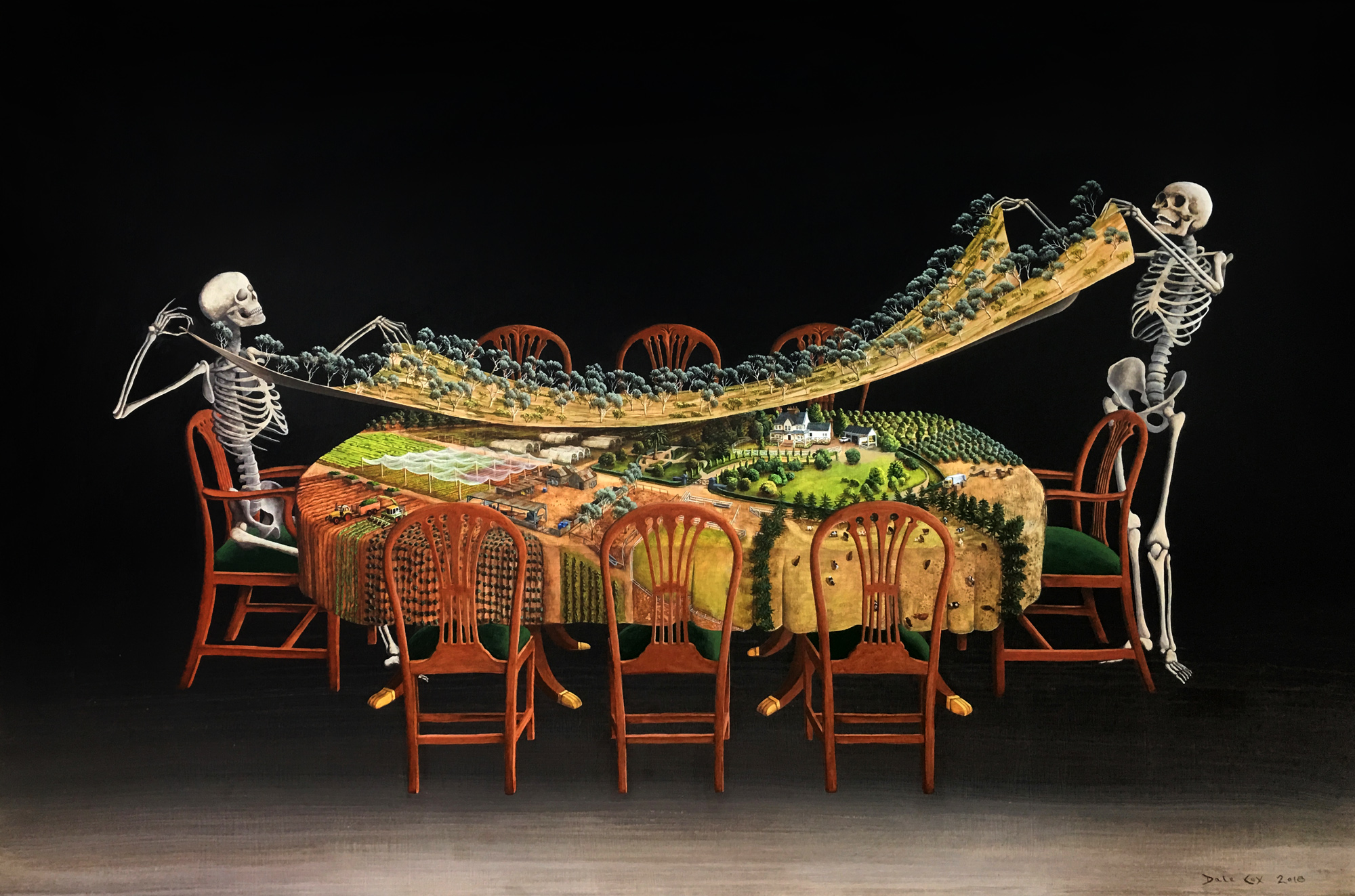
 

Dale Cox (Australian, b. 1969) 'Anticolonial' 2018


Dale Cox (Australian, b. 1969)
Anticolonial
2018
Acrylic on board
81 x 122cm


Inner Logic 2018

The motifs and elements in this exhibition are all related to our human predicament; to this era of the Anthropocene and our unique capacity amongst living things to contemplate our own mortality. While we have grappled with our impermanence for thousands of years, we are perhaps amongst the first to contemplate not just our own finite existence, but the doomed fate of the Earth itself. A kind of double death.

It’s a lot to take on board.

Perhaps, unsurprisingly, we are well practiced at diversion, denial and a kind of wishful thinking when it comes to our fate. Religion has served us rather well as a kind of ‘soft landing’ into the unknown; furnishing us cradle to grave with a reassuring framework towards a life after death.

It is an intoxicating idea that when we die we go elsewhere. Anything but death seems like a plan. Indeed, many opine that a belief in an afterlife is essential to the very fabric of humanity, that our lives would be meaningless if it simply ended. Perhaps there is an inner logic to this: Is there a point to a life that simply ends?

Our aversion to annihilation runs deep, and in light of some fairly compelling arguments that it is so, humanity is slow to accept the deal. And now that we are facing mounting evidence that we are hurtling towards an environmental collapse of our own making, it seems the all too human ability to simply avert our gaze is once again at play. Desperate times call for desperate measures in collective denial, and so it seems we enter the post-truth era.

There are myriad ways in which we pull off this practised art of self-delusion. Central to it is our unerring fascination with ourselves, our own species. ‘Anthropocentricity’ has served us for millennia as an essential tool of survival by strengthening our ties as family units, tribes, villages and, by extension, nations. The gods we created invariably took a patriarchal form, and we still cling to these heroic manifestations of our own image.

Even our innate altruism appears limited to all things ‘us’. We seem ill-equipped as stewards of the planet of being capable of seeing the bigger picture, of accommodating the survival of all species. All animals are necessarily hardwired to fixate on their own collective survival at the expense of other species, but it is humans alone who can progress that exclusivity to global obliteration.

I generalise, of course. Many manage to stare reality squarely in the face, and many more understand the importance of the broader environment. And it will get harder to remain wilfully ignorant, as the ecological collapse is well underway, overtaking even the gloomiest of predictive models. It is in plain sight and will only become harder to ignore.

The environmental problems we face appear too colossal for individuals to consider; it all seems too overwhelming, too daunting. These are not ‘human-sized’ problems after all. But if we can apply the same collective fervour and inventiveness we applied to bettering our human lot, if we can find a global will to turn our remarkable capacity for enterprise in science, technology and innovation to repairing the planet as a whole, we may have just cause for hope.

Dale Cox
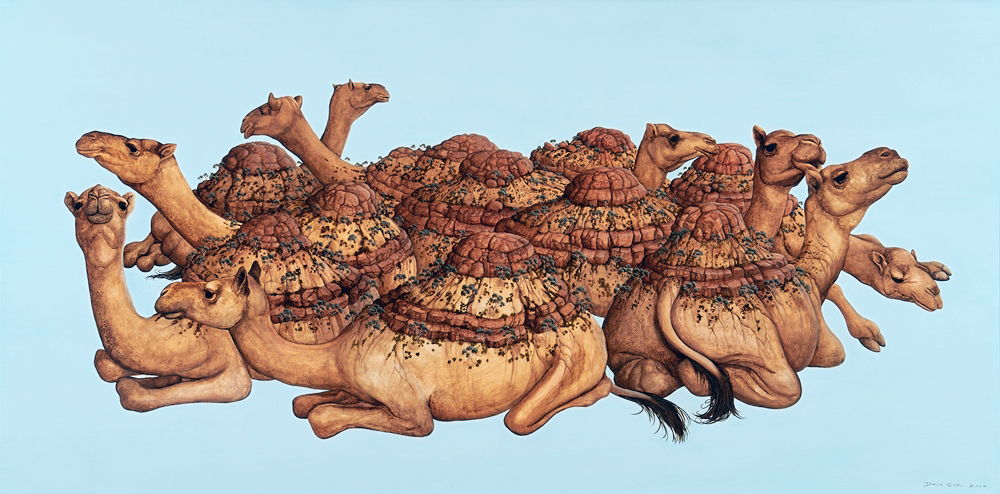
 

Dale Cox (Australian, b. 1969) 'The Bungle Bungles' 2018


Dale Cox (Australian, b. 1969)
The Bungle Bungles
2018
Acrylic on board
122 x 244cm
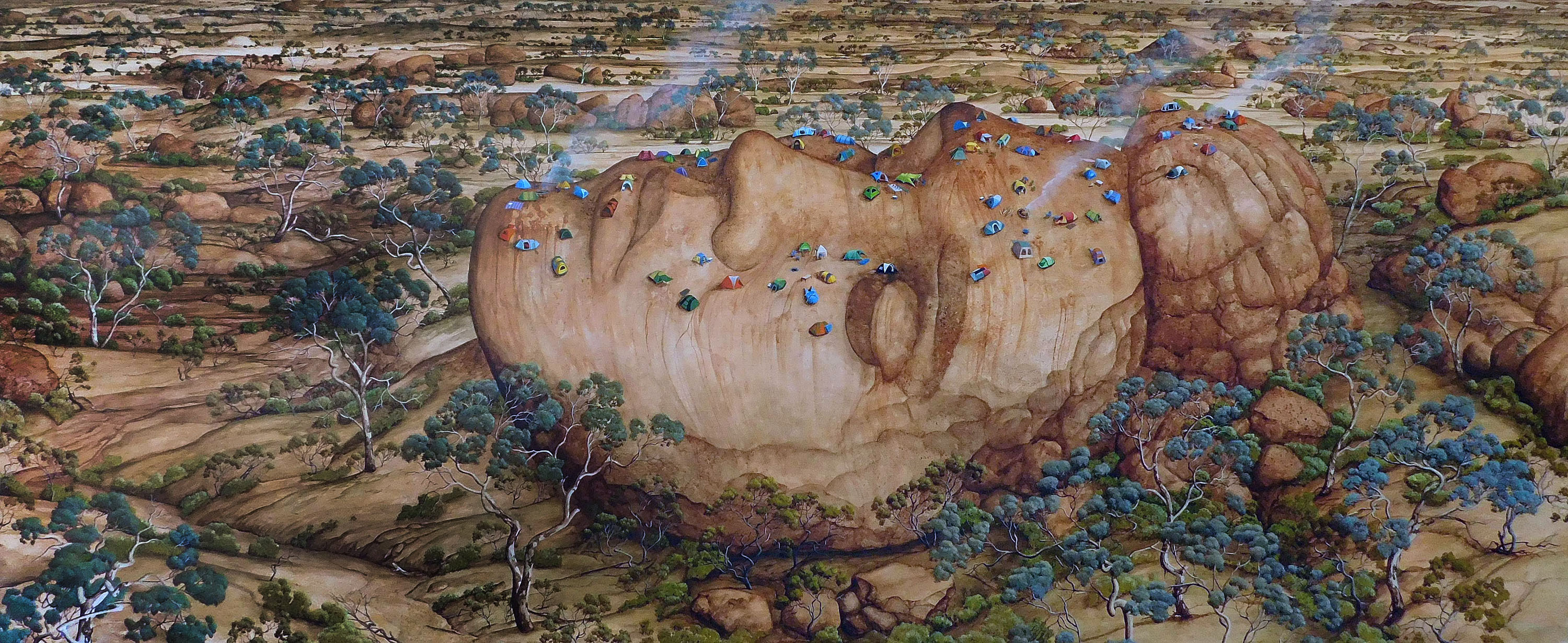
 

Dale Cox (Australian, b. 1969) 'Always on my mind' 2018


Dale Cox (Australian, b. 1969)
Always on my mind
2018
Acrylic on board
101 x 244cm


Anthropocene definition

Relating to or denoting the current geological age, viewed as the period during which human activity has been the dominant influence on climate and the environment.

Evolutionary psychology definition

Evolutionary psychology is a theoretical approach to psychology that attempts to explain useful mental and psychological traits – such as memory, perception, or language – as adaptations, i.e., as the functional products of natural selection.

The purpose of this approach is to bring the functional way of thinking about biological mechanisms such as the immune system into the field of psychology, and to approach psychological mechanisms in a similar way.

In short, evolutionary psychology is focused on how evolution has shaped the mind and behaviour. Though applicable to any organism with a nervous system, most research in evolutionary psychology focuses on humans.

Text from the Science Daily website


Evolutionary psychologists argue that much of human behaviour is the output of psychological adaptations that evolved to solve recurrent problems in human ancestral environments…

Evolutionary psychologists hold that behaviours or traits that occur universally in all cultures are good candidates for evolutionary adaptations including the abilities to infer others’ emotions, discern kin from non-kin, identify and prefer healthier mates, and cooperate with others.

Text from the Wikipedia website


Tract definition

A short piece of writing, especially on a religious or political subject, that is intended to influence other people’s opinions; a large area of land; a major passage in the body, large bundle of nerve fibres, or other continuous elongated anatomical structure or region.

Usurper definition

A usurper is an illegitimate or controversial claimant to power, often but not always in a monarchy. In other words, a person who takes the power of a country, city, or established region for themselves without any formal or legal right to claim it as their own. Usurpers are both those who overtake a region by often unexpected physical force, as well as individuals or organisations who overtake a region through political influence and subterfuge – though the word “usurper” denotes a single person; either an individual who acted alone, or the leader of a group which supported their controversial claim.
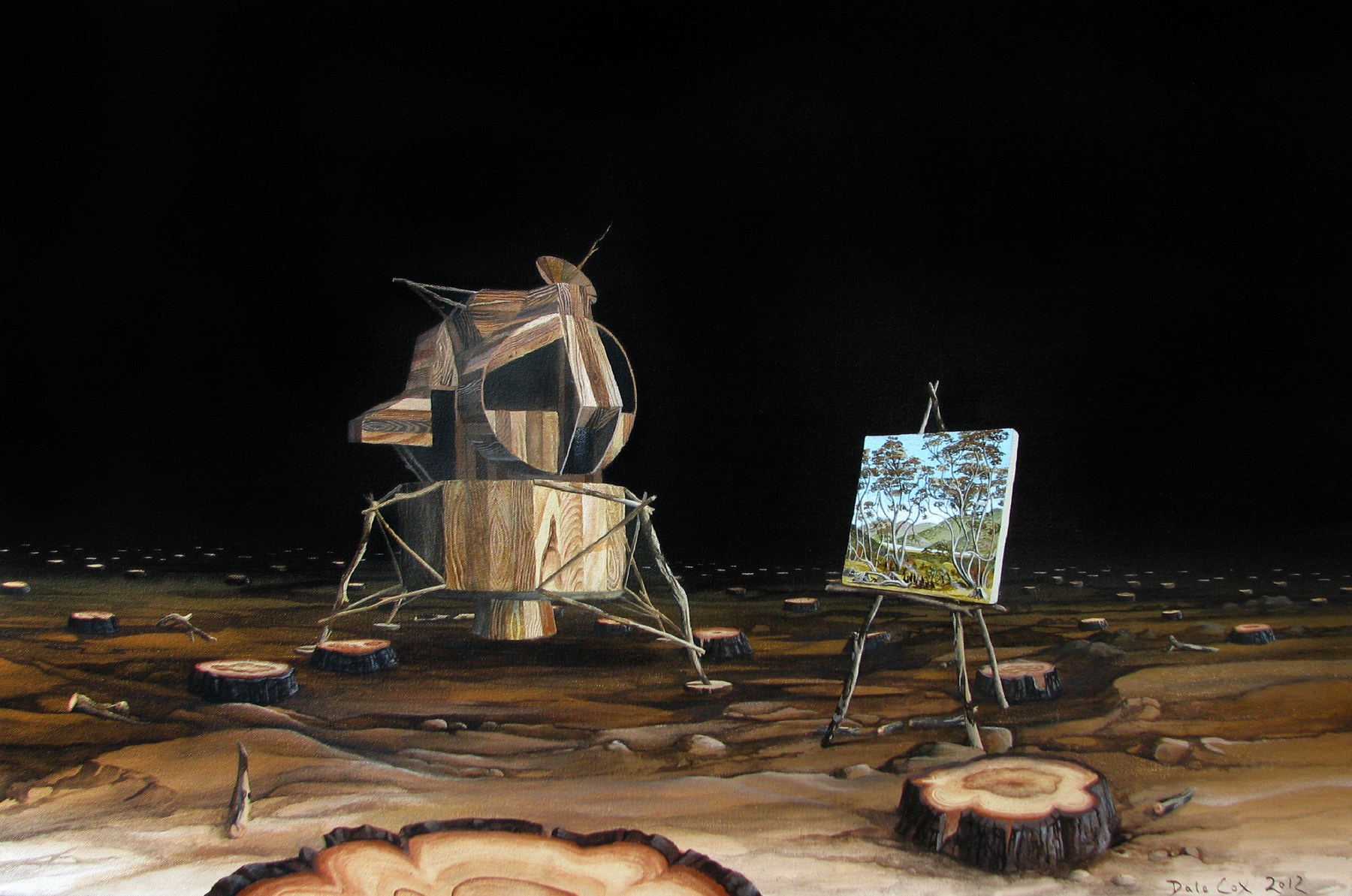
 

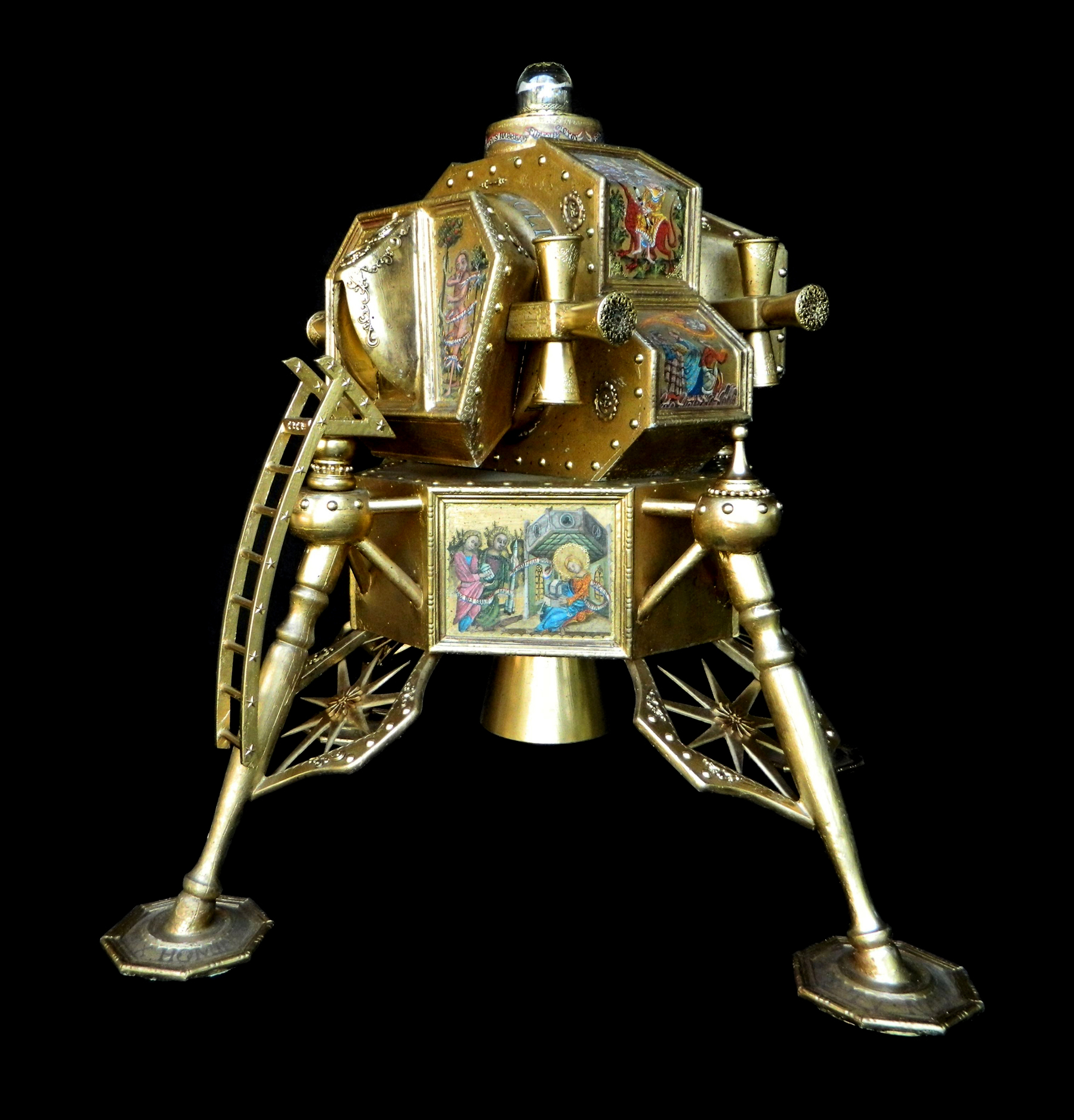
Dale Cox (Australian, b. 1969) 'Untitled (Lunar lander of wood)' 2012


Dale Cox (Australian, b. 1969)
Untitled (Lunar lander of wood)
2012
Acrylic on board
51 x 77cm
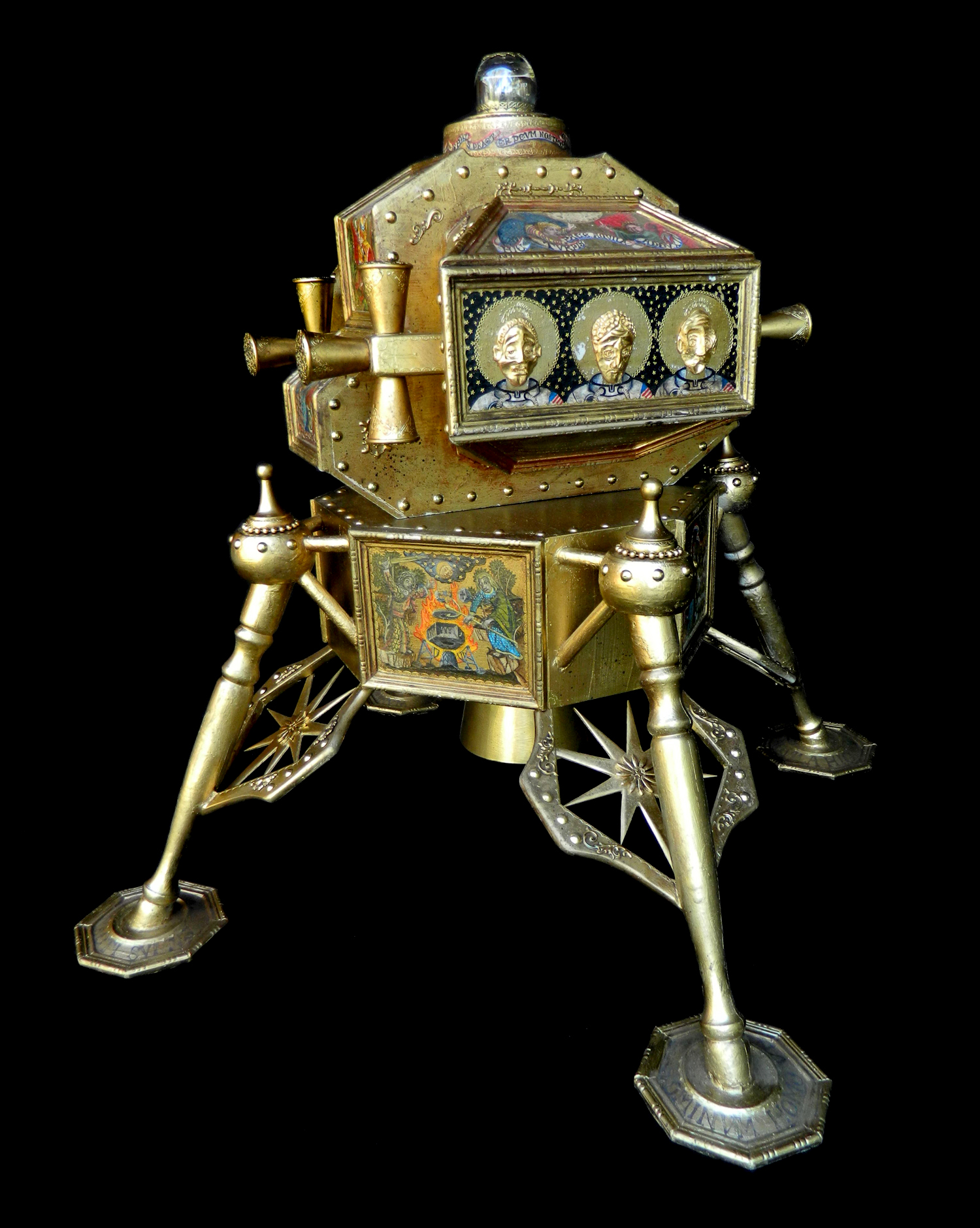
 

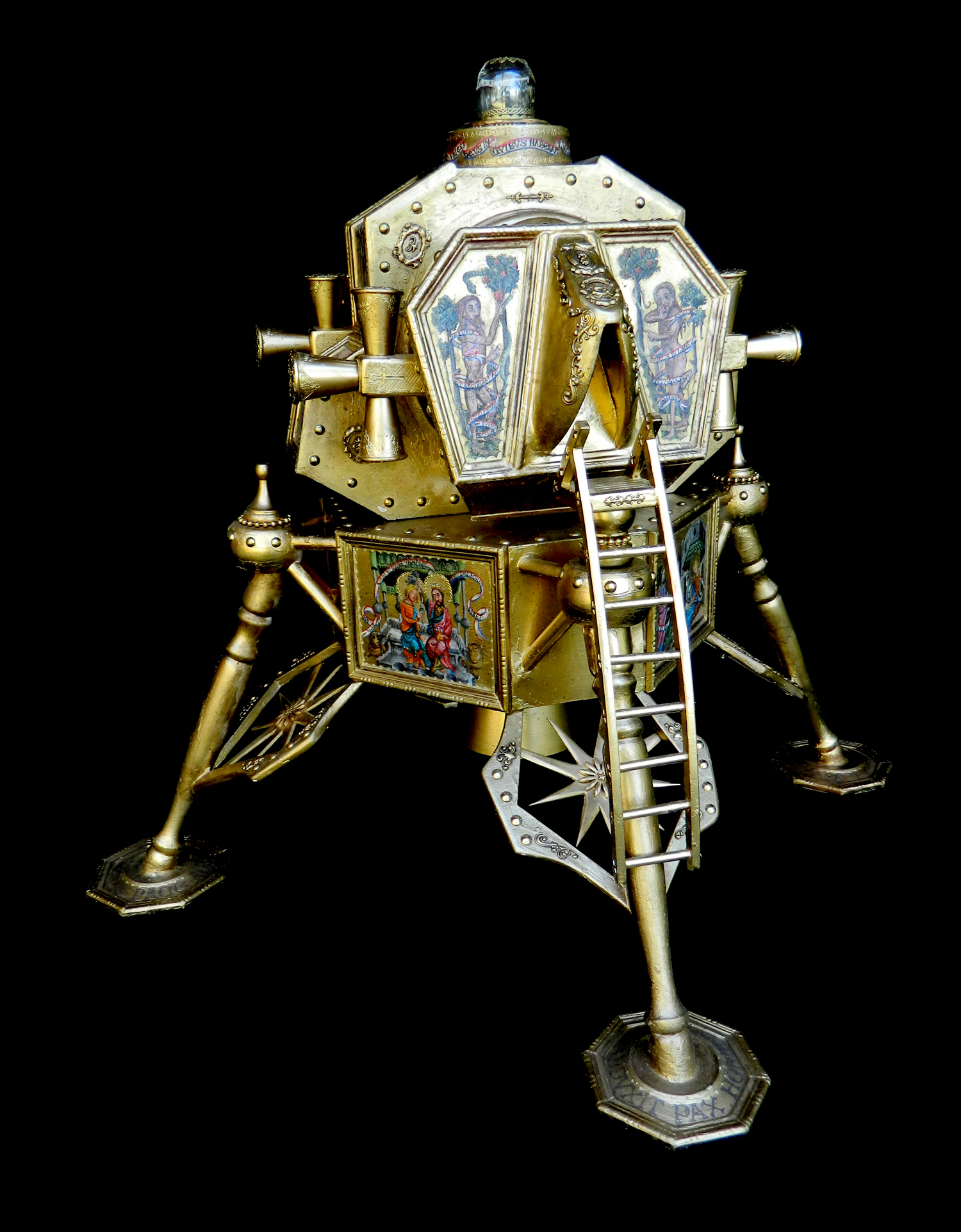
Dale Cox (Australian, b. 1969) 'Cold War Reliquary' 2014

Dale Cox (Australian, b. 1969) 'Cold War Reliquary' 2014

Dale Cox (Australian, b. 1969) 'Cold War Reliquary' 2014

Dale Cox (Australian, b. 1969) 'Cold War Reliquary' 2014 (detail)


Dale Cox (Australian, b. 1969)
Cold War Reliquary
2014
Mixed media Wood acrylics gold enamel metal rock glass
Dimensions variable
Created for the Blake Prize


Cold War Reliquary 2015-2016

A reliquary (also referred to as a shrine or by the French term châsse) is a container for relics. These may be the purported physical remains of saints, such as bones, pieces of clothing, or some object associated with saints or other religious figures. (Wikipedia definition)

.
My sculpture is a vessel – a craft, a portal, a reliquary. Like many Religious objects its serves as a nexus, a transport between Earth and Heaven. The Apollo Lunar Module carried the first Human to the Moon landing on July 20 1969. I was 3 months old. Russia had landed an unmanned craft safely on the moon ten years earlier. The ‘Space Race’ was chiefly an assertion of Ideological superiority between Communism and Capitalism, and the most symbolic battlefield of the ‘Cold War’.

I have long thought of mans tentative forays into space as a kind of membrane piercing journey into the Spiritual – the body released of its Earthly mass and transcended into the Heavens. The reference to a Religious Relic and object of Art – a reliquary for the precious moon rock it houses within the glass dome, elevates a Mechanical Machine to the status of a Religious Relic and is intended to supplant and parody the Christian Canon that asserts our ascension to Heaven (or Hell) upon death.

The essential role of Science as the facilitator of Space Exploration is significant, and as such the Spacecraft itself is venerated here as a Religious object.

The use of Quasi Religious painted panels directly references early Christian Art, whilst most of the Latin Inscriptions are direct translations of NASA Radio Transcripts between (Earth) Base Command and the Astronauts during the critical stages of the Moon landing, and the first historic moments upon landing. Buzz Aldrins remark as he first set foot on the moon was “Beautiful, beautiful. Magnificent desolation.” In Latin Magnificus in desertum.

Dale Cox


Cold War Reliquary

The Cold War Reliquary is a vessel – a spacecraft, and a Holy Relic. Like many Religious objects, it serves as a nexus, a transport between Earth and Heaven.
I have long thought of man’s forays into space as a kind of membrane piercing journey into the Spiritual – the body released of its Earthly mass and transcended into the Heavens. This reliquary for the precious moon rock it houses within a glass dome, elevates a Mechanical Machine to the status of a Religious Relic and playfully parodies the Space Race as the era in which Science finally transcended Religion.

Inner Logic continues Dale Cox’s insightful and evocative explorations into environmental, spiritual and anthropological themes; investigating the impact of humankind on this planet and our collective search for meaning.

“The motifs and elements within the current exhibition of my paintings all are in some way or another related to our human predicament and this era of the anthropocene and our unique capacity amongst living things to contemplate our own mortality,” says Cox, “We humans have been grappling with our own mortality for thousands of years. Are we today, however amongst the first generations to contemplate not just our own finite existence, but also the doomed fate of the Earth itself? A kind of double death…”

Inner Logic presents a dynamic series of recent paintings in Dale Cox’s highly distinctive visual language, in which elements from the natural world and icons from popular, religious, industrial and historical culture are assembled in precarious, yet harmonious balance upon a backdrop of the vast unknown. Meticulously executed in acrylic paint, these works are visually intricate and conceptually dense, yet the clarity and significance of their message resonates with immediacy and power.

Dale Cox is equally proficient in sculpture as he is in painting and works across a wide range of media. This exhibition presents the artist’s compelling Cold War Reliquary (Finalist in the 64th Blake Prize); a magnificent recreation of the Lunar Lander spacecraft realised as a gilded religious receptacle, “My sculpture is a vessel – a spacecraft, a portal, a reliquary. Like many religious objects its serves as a nexus, a transport between Earth and Heaven. I have long thought of man’s forays into space as a kind of membrane piercing journey into the spiritual – the body released of its Earthly mass and transcended into the Heavens. This reliquary for the precious moon rock it houses within a glass dome, elevates a Mechanical Machine to the status of a Religious Relic and playfully parodies and challenges the Christian Church.” Dale Cox, 2018

Press release from Australian Galleries
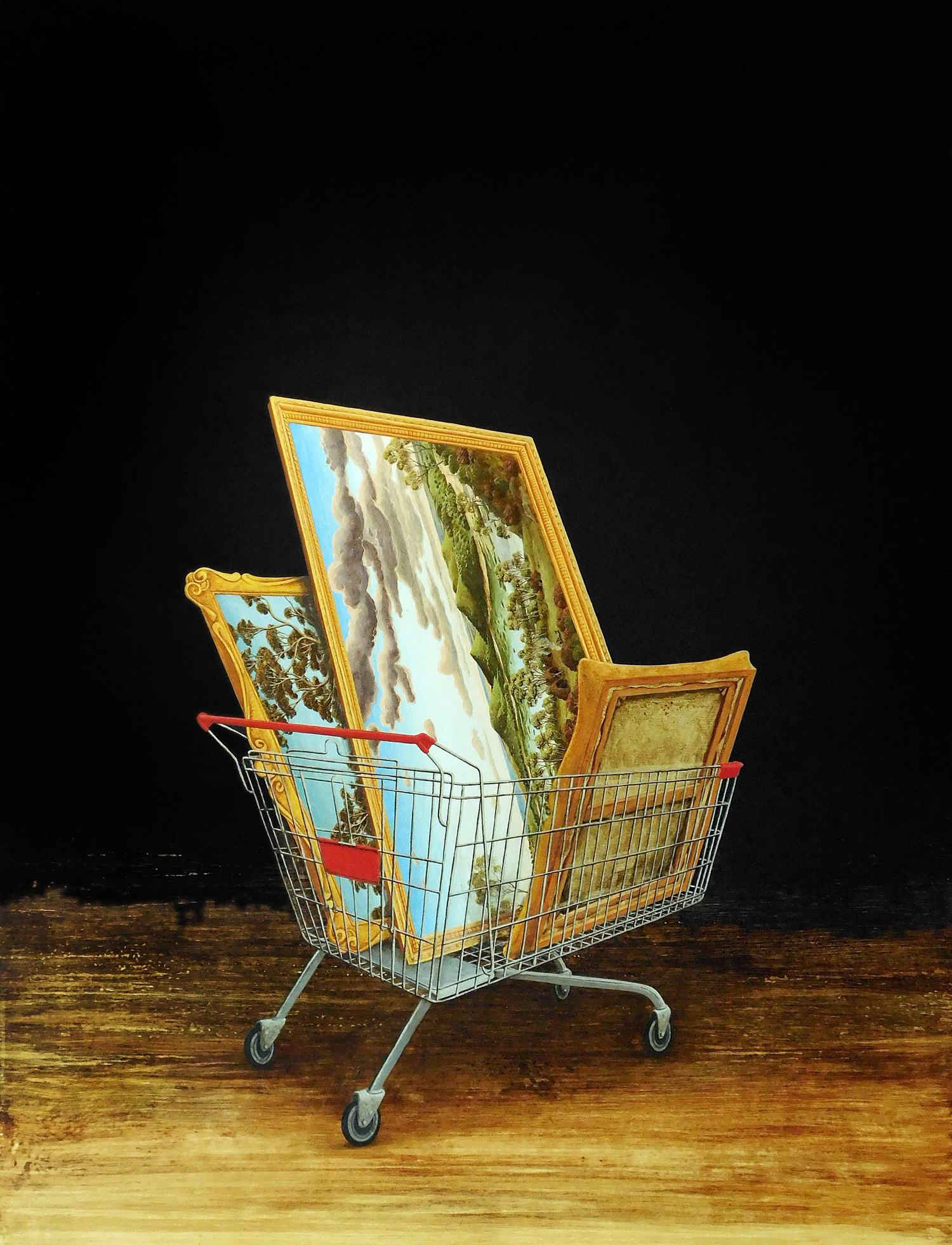
 

Dale Cox (Australian, b. 1969) 'Art Mart' 2018


Dale Cox (Australian, b. 1969)
Art Mart
2018
Acrylic on board
120 x 89cm


Dale Cox (Australian, b. 1969) 'Albert' 2018


Dale Cox (Australian, b. 1969)
Albert
2018
Acrylic on board
160 x 122cm
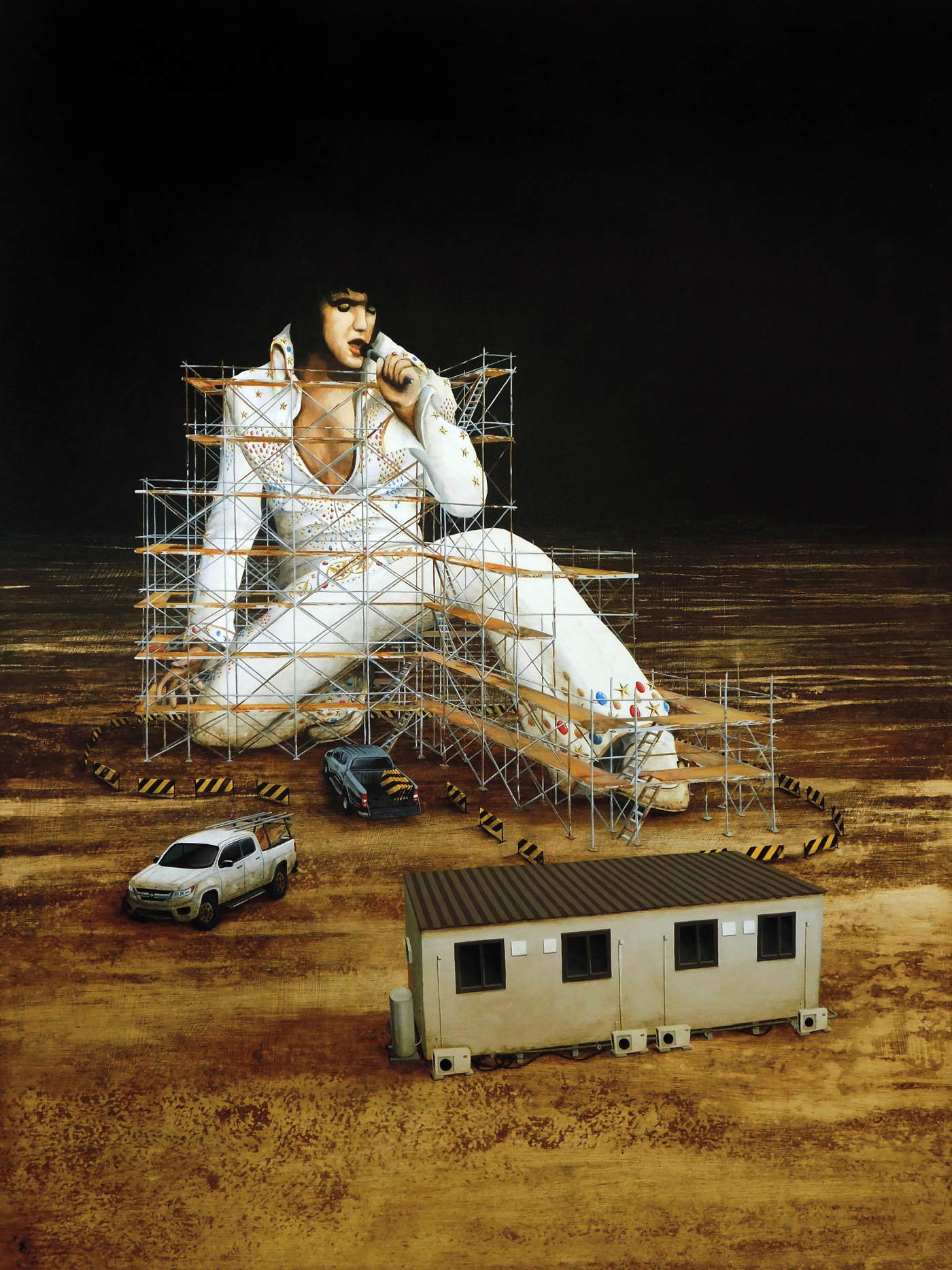
 

Dale Cox (Australian, b. 1969) 'The wonder of you' 2018


Dale Cox (Australian, b. 1969)
The wonder of you
2018
Acrylic on board
120 x 90cm
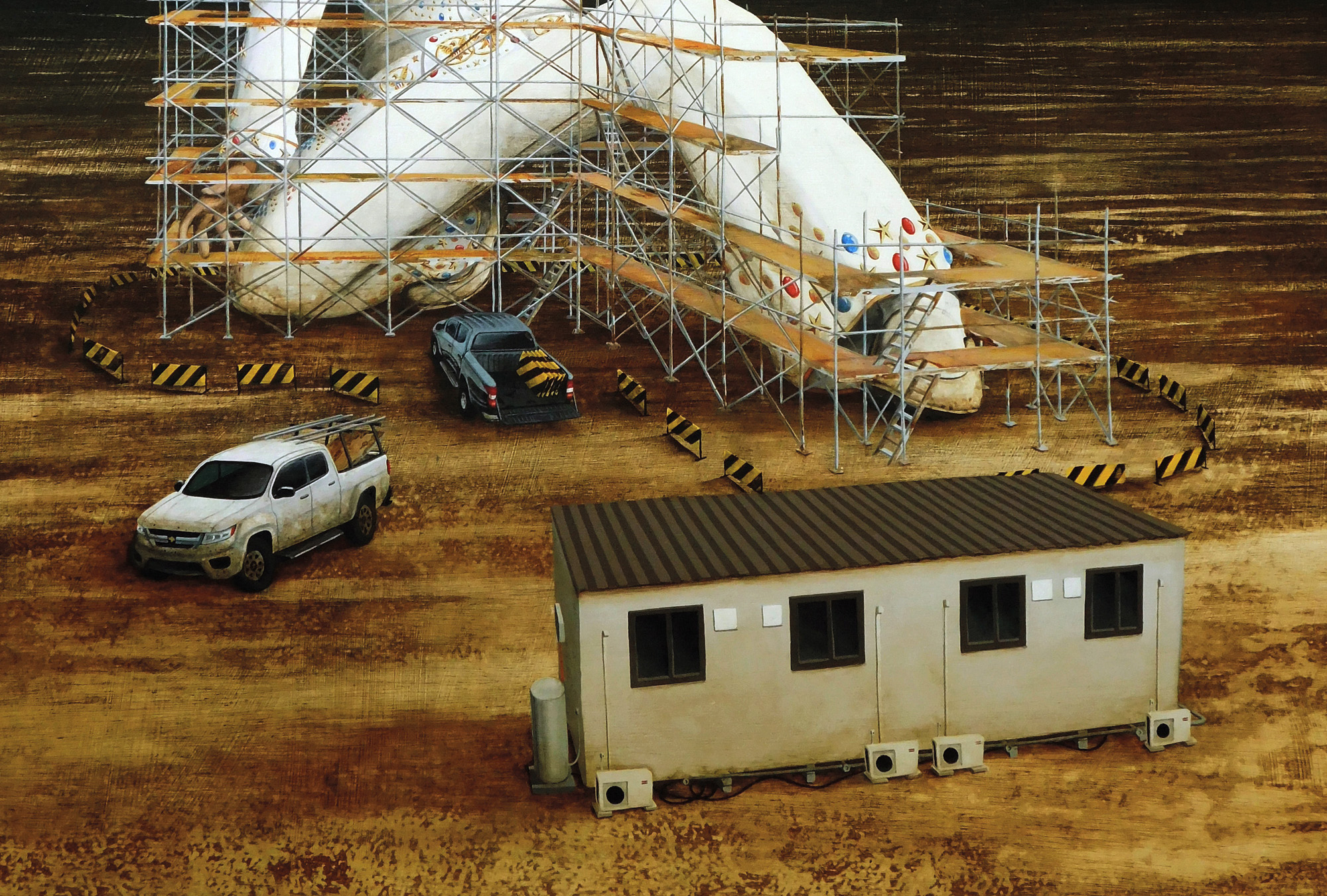
 

Dale Cox (Australian, b. 1969) 'The wonder of you' 2018 (detail)


Dale Cox (Australian, b. 1969)
The wonder of you (detail)
2018
Acrylic on board
120 x 90cm


Australian Galleries
35 Derby Street,
Collingwood 3066
Phone: +61 3 9417 4303

Opening hours:
Open 7 days 10am – 6pm

Australian Galleries website

LIKE ART BLART ON FACEBOOK

Back to top

Exhibition: ‘Light Years: Photography and Space’ at the National Gallery of Victoria International, Melbourne

Exhibition dates: 8th May – 27th September, 2009


NASA, Washington, D.C. (manufacturer) 'Three Skylab 2 crewmen demonstrate effects of weightlessness' 1973 from the exhibition 'Light Years: Photography and Space' at the National Gallery of Victoria International, Melbourne, May - Sept, 2009


NASA, Washington, D.C. (United States est. 1958, manufacturer)
Skylab (photographer)
Three Skylab 2 crewmen demonstrate effects of weightlessness
1973
Type C photograph
40.5 x 49.9cm (image and sheet)
National Gallery of Victoria, Melbourne
Purchased, 1980


A small but fun show at NGV International, Melbourne that is drawing in the crowds. A selection of beautiful, breathtaking images from NASA really takes you into space. I had a great time researching and finding some of the images from the exhibition on the NASA Image and Video Library website!

Dr Marcus Bunyan

.
Many thankx to the National Gallery of Victoria for allowing me to publish the photographs in the posting. Please click on the photographs for a larger version of the image.


“Once a photograph of the Earth, taken from outside, is available, we shall, in an emotional sense, acquire an additional dimension … and a new idea as powerful as any in history will be let loose.”


Sir Fred Hoyle, 1948


“Every great advance in science has issued from a new audacity of the imagination.”


John Dewey, 1859-1952, American philosopher, psychologist and educational reformer


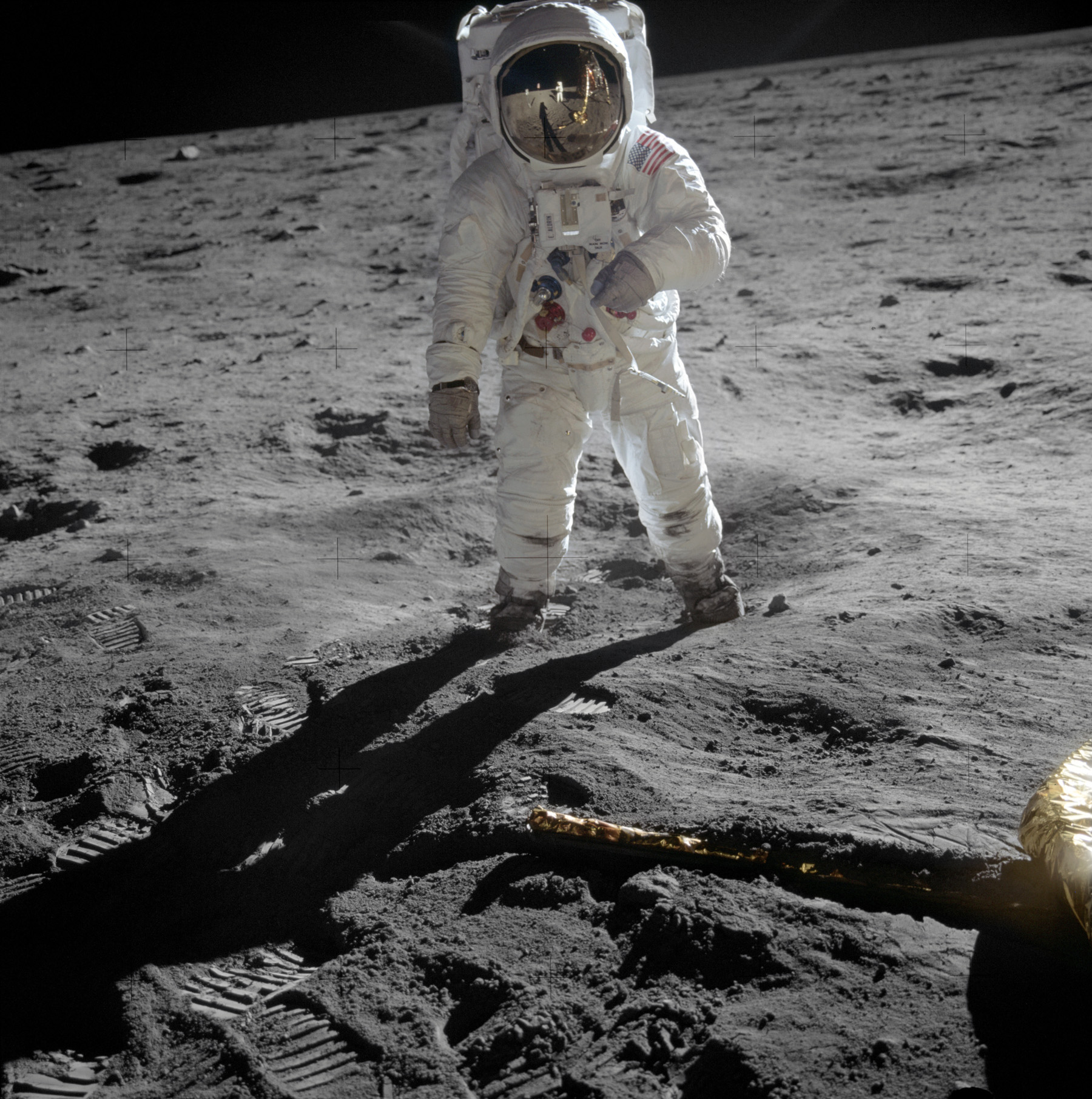
NASA, Washington, D.C. (United States est. 1958, manufacturer) / Neil Armstrong (American 1930-2012, photographer) 'Astronaut Buzz Aldrin, lunar module pilot, walks on the surface of the Moon near the leg of the Lunar Module (LM)' 1969 from the exhibition 'Light Years: Photography and Space' at the National Gallery of Victoria International, Melbourne, May - Sept, 2009


NASA, Washington, D.C. (United States est. 1958, manufacturer)
Neil Armstrong (American 1930-2012, photographer)
Astronaut Buzz Aldrin, lunar module pilot, walks on the surface of the Moon near the leg of the Lunar Module (LM)
1969

Note the reflection of the shadow of the astronaut, the photographer and the leg of the LM in the visor of Buzz Aldrin.


Astronaut Edwin E. Aldrin Jr., Lunar Module LM pilot, walks near the module as a picture is taken of him. Discolouration is visible on his boots and suit from the lunar soil adhering to them. Reflection of the LM and Astronaut Neil A. Armstrong is visible in Aldrin’s helmet visor. Image taken at Tranquility Base during the Apollo 11 Mission. Original film magazine was labeled S. Film Type: Ektachrome EF SO168 colour film on a 2.7-mil Estar polyester base taken with a 60mm lens. Sun angle is Medium. Tilt direction is Northeast NE.

Text from the NASA archives website


Astronaut Buzz Aldrin, lunar module pilot, stands on the surface of the moon near the leg of the lunar module, Eagle, during the Apollo 11 moonwalk. Astronaut Neil Armstrong, mission commander, took this photograph with a 70mm lunar surface camera. While Armstrong and Aldrin descended in the lunar module to explore the Sea of Tranquility, astronaut Michael Collins, command module pilot, remained in lunar orbit with the Command and Service Module, Columbia. This is the actual photograph [above] as exposed on the moon by Armstrong. He held the camera slightly rotated so that the camera frame did not include the top of Aldrin’s portable life support system (“backpack”). A communications antenna mounted on top of the backpack is also cut off in this picture. When the image was released to the public, it was rotated clockwise to restore the astronaut to vertical for a more harmonious composition, and a black area was added above his head to recreate the missing black lunar “sky”. The edited version [below] is the one most commonly reproduced and known to the public, but the original version, above, is the authentic exposure. A full explanation with illustrations can be seen at the Apollo Lunar Surface Journal.

Text from the Wikipedia website. Image from the NASA website.


NASA, Washington, D.C. (United States est. 1958, manufacturer) / Neil Armstrong (American, 1930-2012 photographer) 'Astronaut Buzz Aldrin, lunar module pilot, walks on the surface of the Moon near the leg of the Lunar Module (LM)' 1969


NASA, Washington, D.C. (United States est. 1958, manufacturer)
Neil Armstrong (American, 1930-2012 photographer)
Astronaut Buzz Aldrin, lunar module pilot, walks on the surface of the Moon near the leg of the Lunar Module (LM)
1969
Colour transparency
50.8 × 40.6cm (image and sheet)
National Gallery of Victoria, Melbourne
Purchased, 1980


In 1948, the British astronomer Sir Fred Hoyle speculated that “Once a photograph of the Earth, taken from outside, is available, we shall, in an emotional sense, acquire an additional dimension … and a new idea as powerful as any in history will be let loose.” Hoyle encapsulated the immense anticipation that was felt in the mid-twentieth century, when the idea of leaving Earth and viewing it from afar was on the verge of becoming reality.

When astronauts and spacecraft began exploring our solar system, it was the photographs from these voyages which visualised the reality of the epic feats of science, engineering and human imagination. These photographs transcended a strictly scientific purpose and depicted scenes of unexpected and sublime beauty.

This exhibition brings together works from the permanent collection of the National Gallery of Victoria that depict space travel, seen in archival images from NASA, space allegories, and altered perceptions of reality inspired by ideas of science and space. These photographs also show a fascination with light, as both the means and the subject of the image.

The exhibition focuses largely on the 1960s and 1970s – an exciting time for the artistic and scientific exploration of worlds beyond our own. These were ‘light years’, in which people looked up to the skies and beyond, in a real and an imagined sense, and through photography discovered additional dimensions.

Text from the NGV International website


Ronnie Van Hout (New Zealander, 1962-, worked in Australia 1998-) 'Visitation' 1992


Ronnie Van Hout (New Zealander, b. 1962, worked in Australia 1998-)
Visitation
1992
from the Untitled series 1992
Gelatin silver photograph
31.8 × 47.3cm
National Gallery of Victoria, Melbourne
Purchased, 1996
© Ronnie van Hout


The work is from van Hout’s Untitled 1992 series. It comprises images made by photographing still life constructed from small scale models. The series is based upon B-grade 1950s and 1960s science fiction films. The photographs in the series show a single word, encapsulating an essential element of the story and constructed in 3-D text, placed within a barren / lunar model landscape.

Text from the National Gallery of Victoria website


In his Untitled series, 1992, Ronnie van Hout created models based on the mountains in New Zealand, shown as the sun was setting and they fell into silhouette, and placed a single word (‘rejoice’ or ‘visitation’) in the foreground. The influence of 1960s sci-fi aesthetics is clearly evident in the glowing lights, the desolate ground, and the potential for an otherworldly experience. As with much science fiction, van Hout’s photographs create ambiguous narratives that allude to alien visitation set in a mystical landscape.

Text from the NGV Education kit


Raymond De Berquelle (Australian, b. 1933) 'Where do you come from? Planet Earth (Self-portrait with radio telescope)' 1968


Raymond De Berquelle (Australian, b. 1933)
Where do you come from? Planet Earth (Self-portrait with radio telescope)
1968
Gelatin silver photograph
24.1 × 19.1cm
National Gallery of Victoria, Melbourne
Purchased, Victorian Foundation for Living Australian Artists, 2008
© Raymond de Berquelle


Raymond De Berquelle (Australian, 1933- ) 'Space man' 1963


Raymond De Berquelle (Australian, b. 1933)
Space man
1963
Gelatin silver photograph
49.8 × 41.0cm
National Gallery of Victoria, Melbourne
Purchased, 1971
© Raymond de Berquelle


The photographs of Raymond de Berquelle reflect excitement about the possibilities of astronomy and a fascination for science fiction. The radio telescope was a particularly significant emblem of the exploration of the universe. The primary tool of astronomy, it allowed astronomers to see beyond visible light into the expansive electromagnetic spectrum. De Berquelle frequently visited observatories and radio telescopes, including the one at Parkes, outside Canberra, that was one of a network of radio antennas around the world used to receive images from the Apollo 11 Moon landing in July 1969.

To create the fantastical photograph, Space man, Raymond de Berquelle combined different negatives to construct an image that expressed both his expectations of astronomy and his vision of a man in space. De Berquelle describes the process as beginning with an unexpected vision:

[one day] a radio telescope appeared on the horizon with a human being clinging to it as if caught in its net. It was a technician [working on] the huge instrument. In the darkroom later on the negative appeared stronger than the positive image … and an earthy radio telescope technician became a space man.

Raymond de Berquelle in correspondence with Maggie Finch, 12 November 2008, quoted in Maggie Finch, Light Years: Photography and space (exh. cat.), National Gallery of Victoria, Melbourne, 2009, p. 18.

Text from the NGV Education kit


John Wilkins (Australian, 1946-2017) 'Alien Icicle' c. 1970


John Wilkins (Australian, 1946-2017)
Alien Icicle
c. 1970
Gelatin silver photograph on composition board
57.6 × 46.5cm
National Gallery of Victoria, Melbourne
Purchased, 1971
© John Wilkins


The photograms of John Wilkins reveal methods of abstraction and distortion (the hallmarks of psychedelia) to produce lush, exploding, organic forms. Wilkins uses the photogram technique to record the object (in this case, liquid) directly onto film, which was later enlarged and printed. Wilkins’s photographs resemble cosmic worlds, and he has described how the chemical patterns were directly influenced by the psychedelic patterns meant to simulate LSD trips that were projected onto the walls of nightclubs in the 1960s and 1970s. They possess a mysterious quality that transcends a distinction between art and science.

Text from the NGV Education kit


Sir George F. Pollock (English born France, 1928-2016) 'Energy bubble' 1966


Sir George F. Pollock (English born France, 1928-2016)
Energy bubble
1966
Cibachrome photograph
24.0 × 34.6cm irreg. (image and sheet)
National Gallery of Victoria, Melbourne
Presented by the National Gallery Society of Victoria, 1972
© George F. Pollock


“Light is the energy that maintains life on earth, through the plants’ marvellous process of photosynthesis: no light, no plants; no plants, no animals, and no us. This is the secret of life, and I want to celebrate this life-giving energy in images of, about, and made by light, in other words in photographs.”


Sir George Pollock, 2009


Space exploration opened up new ways of seeing and imagining the world and created new perceptions of our place in the universe.

Parallel to the exploration of outer space taking place under the auspices of science, explorations of space in other realms were contributing to new and altered perceptions of the world, and inspiring new forms of art and artmaking.

During the second half of the twentieth century, many artists rejected the illusionistic representation of three-dimensional space and form which had dominated western art for centuries and opted for a flattened pictorial space. In contrast to the closed compositions traditionally found in western art, artists such as Jackson Pollock (American, 1912-1956) worked with ‘open compositions’ which created the idea that the visual elements in an image extended beyond the confines of the picture space.

The mysterious world of ‘inner space’, including the subconscious, and the senses, was also important territory for exploration, especially within the ‘hippie’ subculture that emerged in the US in the mid-1960s. Psychedelic patterns, inspired by the hallucinations and mind-altering experiences produced by drugs such as LSD, and characterised by wild patterning and colours and dazzling light effects, had a significant effect on the art and popular culture of the period.

In 1962, English artist George Pollock commenced a conceptual photographic project comprising a series of abstract photographs that he called ‘vitrographs’. This term referred to the process of creating images by photographing pieces of glass that have been lit by a number of coloured lights. Pollock used pieces of cullet, the thick lumps of glass left in a kiln at the end of a melt.

By lighting the cullet from different angles and photographing the pieces at close range, Pollock was able to produce patterned, abstract images with an ethereal quality reminiscent of solar eruptions and the nebulae of outer space.

Pollock was influenced by scientific studies, particularly in the field of biology, as well as the literature of science fiction and the abstraction found in the art of surrealism and abstract expressionism. He was interested in using photography to reveal things that otherwise may have been overlooked.

Text from the NGV Education kit


Sir George F. Pollock (born France, English 1928-2016) 'Galactic event' 1966


Sir George F. Pollock (English born France, 1928-2016)
Galactic event
1966
Cibachrome photograph
34.3 × 24.0cm (image and sheet)
National Gallery of Victoria, Melbourne
Presented by the National Gallery Society of Victoria, 1972
© George F. Pollock


A significant number of the works in Light Years: Photography and space have been acquired by the NGV from NASA (National Aeronautics and Space Administration). The United States government established NASA on 29 July 1958 as the agency responsible for the development of the nation’s new space program.

The 1950s and 1960s were a period of intense activity in space exploration, led by the US and the Union of Soviet Socialist Republics (USSR). The US and the Soviet Union emerged as the two most powerful forces in the world after the Second World War. During the Cold War that followed, these two superpowers competed for political, military and scientific dominance, fuelling a ‘space race’. The space race effectively began when the Soviet Union launched the first artificial satellite to orbit Earth, Sputnik 1, on 4 October 1957, and reached a milestone when NASA succeeded in landing humans on the moon on 20 July 1969 (in Australia, 21 July 1969).

The Apollo missions, in particular the Apollo 11 mission of 1969 that saw Neil Armstrong become the first man to step foot on the moon, have assumed enormous importance in the popular imagination in relation to space travel.

However, since the late 1950s NASA has been involved in many different projects, involving numerous manned and unmanned missions. These projects have ranged from exploring Earth’s orbit and mapping the lunar surface to penetrating greater and greater distances into space and exploring other planets in our solar system, including Mars, Mercury, Venus and Jupiter. These missions played a critical role in extending our knowledge of the solar system.

While information and photographs of the Russian space program were closely guarded and rarely released to the public, NASA strategically managed the publication of images drawn from its vast photographic archive, and this had a very positive impact on the public reception of the space program.

Interestingly, it was not a priority in the early days of NASA to take photographs during missions. However, the importance of photography was soon recognised and, along with rigorous flight training, astronauts who piloted the various space missions were given extensive photographic training. Unmanned probes were equipped with remotely operated cameras, allowing those back on Earth to see details of these voyages. Increasingly sophisticated technology, including advanced imaging techniques such as X-ray, ultraviolet and infrared photography, has also been employed to capture different phenomena.

The photographs in this exhibition include images taken on manned and unmanned space voyages, from the Gemini space walks of 1965 to the Pioneer missions of 1979.

While these space photographs clearly serve a documentary purpose and are a tool of scientific research, they have a unique beauty and evoke something of the mystery and wonder of space.

The NGV acquired the NASA space photographs in two groups, the first in 1971 and the second in 1980. The acquisition submission of 1980, prepared by the former Curator of Photography, Jennie Boddington, noted:

“Apart from the considerations of technology one cannot help but speculate on the philosophical and metaphysical questions which spring to mind when one sees so beautifully presented the form of nebulae which may be light years away from our small earth, or when we see spacemen performing strange exercises in a Skylab.”

Text from the NGV Education kit


NASA, Washington, D.C. (United States est. 1958, manufacturer) / James McDivitt (American, 1929-2022, photographer) 'Astronaut Edward H. White, Gemini 4, June 1965' 1965


NASA, Washington, D.C. (United States est. 1958, manufacturer)
James McDivitt (American, 1929-2022, photographer)
Astronaut Edward H. White, Gemini 4, June 1965
1965
Type C photograph laminated on aluminium
39.0 × 49.1cm (image and sheet)
National Gallery of Victoria, Melbourne
Presented by Photimport, 1971


This photograph by astronaut James McDivitt is taken from inside the spacecraft on the Gemini 4 mission as it orbited Earth. It shows astronaut Edward White in his spacesuit and golden visor, ‘floating’ high above the Pacific Ocean. White is attached to the spacecraft by a twisting eight-metre tether and holds a manoeuvring unit. Below him is the extraordinary vision of the vivid blue curvature of Earth and, beyond, the black abyss of deep space.

Text from the NGV Education kit


NASA, Washington, D.C. (United States est. 1958, manufacturer) / Apollo 12 (photographer) 'View of two U.S. spacecraft on the surface of the moon, taken during the second Apollo 12 extravehicular activity (EVA-2)' 1969


NASA, Washington, D.C. (United States est. 1958, manufacturer)
Apollo 12 (photographer)
View of two U.S. spacecraft on the surface of the moon, taken during the second Apollo 12 extravehicular activity (EVA-2)
[Astronaut inspecting Surveyor 3, Unmanned craft resting on moon since April 1967]
1969
Gelatin silver photograph
49.0 × 39.0cm (image and sheet)
National Gallery of Victoria, Melbourne
Presented by Photimport, 1971


This unusual photograph, taken during the second Apollo 12 extravehicular activity (EVA), shows two U.S. spacecraft on the surface of the moon. The Apollo 12 Lunar Module (LM) is in the background. The unmanned Surveyor 3 spacecraft is in the foreground. The Apollo 12 LM, with astronauts Charles Conrad Jr. and Alan L. Bean aboard, landed about 600 feet from Surveyor 3 in the Ocean of Storms. The television camera and several other pieces were taken from Surveyor 3 and brought back to Earth for scientific examination. Here, Conrad examines the Surveyor’s TV camera prior to detaching it. Astronaut Richard F. Gordon Jr. remained with the Apollo 12 Command and Service Modules (CSM) in lunar orbit while Conrad and Bean descended in the LM to explore the moon. Surveyor 3 soft-landed on the moon on April 19, 1967.

Text from the NASA Image and Video Library website


NASA, Washington, D.C. (United States est. 1958, manufacturer) / Charles Conrad (American, 1930-1999 photographer) 'Astronaut Bean, Apollo XII, November 1969, on moon' 1969


NASA, Washington, D.C. (United States est. 1958, manufacturer)
Charles Conrad (American, 1930-1999 photographer)
Astronaut Bean, Apollo XII, November 1969, on moon
1969
Gelatin silver photograph
49.0 x 39.0cm (image and sheet)
National Gallery of Victoria, Melbourne
Presented by Photimport, 1971


NASA, Washington, D.C. (United States est. 1958, manufacturer) / Apollo 8 crew (photographer) 'The Earth showing Southern Hemisphere' 1969


NASA, Washington, D.C. (United States est. 1958, manufacturer)
Apollo 8 crew (photographer)
The Earth showing Southern Hemisphere
1969
Type C photograph
48.9 × 38.9cm
National Gallery of Victoria, Melbourne
Presented by Photimport, 1971


Project Apollo (1968-1972) sent astronauts greater distances from Earth in the quest to land humans on the Moon. The further they travelled also, crucially, allowed for more complete photographic views of Earth. In this photograph, Earth is shown as a delicate, blue, cloud-covered dot hanging in infinite space.

The spectacle of Earth suspended in a black void had a profound effect on humanity. Earth was no longer seen to be our complete ‘world’ but was recognised as a small planet spinning in the solar system. As awareness of the vulnerability and limits of the planet grew, photographs such as this one formed a strong catalyst for environmental movements.

Photographs from the Apollo missions were also used to promote the inaugural Earth Day on 22 April 1970.

Text from the NGV Education kit


NASA, Washington, D.C. (United States est. 1958, manufacturer) / Voyager 1 (photographer) 'Photo collage of Jupiter and its four largest moons; from early March Voyager I photos' 1979


NASA, Washington, D.C. (United States est. 1958, manufacturer)
Voyager 1 (photographer)
Photo collage of Jupiter and its four largest moons; from early March Voyager I photos
1979
Type C photograph
51.0 x 40.5cm (image and sheet)
National Gallery of Victoria, Melbourne
Purchased, 1980


While Jupiter had been studied through telescopes for centuries, the Voyager robotic probes that were launched into space in 1977 revealed new information about the planet and its moon system. In March 1979, the Voyager 1 mission took images of the four largest moons of Jupiter. These images were made into a photographic collage, so that the moons are seen in their relative positions (although not to scale). NASA’s arrangement of images in this montage (and others) essentially created an aesthetic rendering of scientific reality.

Text from the NGV Education kit


NASA, Washington, D.C. (United States est. 1958, manufacturer) / Pioneer 11 (photographer) 'Image of Saturn and it's Moon Titan' 1979


NASA, Washington, D.C. (United States est. 1958, manufacturer)
Pioneer 11
 (photographer)
Image of Saturn and it’s moon Titan

1979
Type C photograph
National Gallery of Victoria, Melbourne
Purchased, 1980


Light Years: Photography and Space will feature around 50 works drawn entirely from the NGV Collection. Focusing largely on the 1960s and ’70s, the exhibition will include photographs taken during early NASA missions. The exhibition celebrates the International Year of Astronomy and the 40th anniversary of the first Moon walk.

Maggie Finch, Assistant Curator, Photography, NGV said that cameras were used to give form to both the fantasies and realities of space travel, revealing extra dimensions and animating space.

“The 1960s and ’70s were an exciting time for the artistic and scientific exploration of worlds beyond our own. They were ‘light years’ in which people looked up to the skies and beyond, in a real and an imagined sense, and through photography discovered additional dimensions. The photographs in ‘Light Years’ represent a giant leap forward in the collective journey into space. They retain the extraordinary sense of awe and wonderment that encapsulates our first encounters with a larger universe,” said Ms Finch.

A highlight of the exhibition is a collection of more than 30 NASA photographs, on display for the first time in over twenty years. Among the NASA selection are many celebrated space photographs, including the iconic image of Edwin E. (Buzz) Aldrin, Jr standing on the lunar surface, taken in 1969 by Neil Armstrong, the first man to step foot on the Moon.

These remarkable photographs will be on display alongside works by Sir George Pollock, John Wilkins Raymond de Berquelle, Dacre Stubbs, Val Foreman, Susan Fereday, Olive Cotton and Ronnie van Hout – artists who have been inspired by, and have responded to, the mysteries of space and science.

Frances Lindsay, Deputy Director, NGV said: “The photography from the NASA missions of the 1960s and ’70s has a fascinating yet nostalgic quality, particularly when one considers the advances in both science and photographic technology since that time. These early photographs of space changed our awareness and offered a new understanding of the Earth, the universe and our shared existence within it. Coinciding with the International Year of Astronomy and the 40th anniversary of the first Moon walk, this exhibition will delight viewers, providing a glimpse into another dimension,” said Ms Lindsay.

Press release from the National Gallery of Victoria


NASA, Washington, D.C. (United States est. 1958, manufacturer) / Skylab (photographer) 'Solar Flare recorded by NASA Skylab, December 1973' 1973


NASA, Washington, D.C. (United States est. 1958, manufacturer)
Skylab (photographer)
Solar Flare recorded by NASA Skylab, December 1973
1973
Colour transparency
50.8 × 40.6cm (image and sheet)
National Gallery of Victoria, Melbourne
Purchased, 1980


This photograph of the sun, taken on Dec. 19, 1973, during the third and final manned Skylab mission (Skylab 4), shows one of the most spectacular solar flares ever recorded, spanning more than 588,000 kilometres (365,000 miles) across the solar surface. The last picture, taken some 17 hours earlier, showed this feature as a large quiescent prominence on the eastern side of the sun. The flare gives the distinct impression of a twisted sheet of gas in the process of unwinding itself. Skylab photographs such quiescent features erupt from the sun. In this photograph the solar poles are distinguished by a relative absence of supergranulation network, and a much darker tone than the central portions of the disk. Several active regions are seen on the eastern side of the disk. The photograph was taken in the light of ionised helium by the extreme ultraviolet spectroheliograph instrument of the United States Naval Research Laboratory.

Text from the NASA Image and Video Library website


National Gallery of Victoria International
180, St. Kilda Road, Melbourne

Opening hours:
Daily 10am – 5pm

NGV International website

All NASA images are from the NASA Image and Video Library website

LIKE ART BLART ON FACEBOOK

Back to top