Exhibition dates: 11th August – 3rd September, 2011
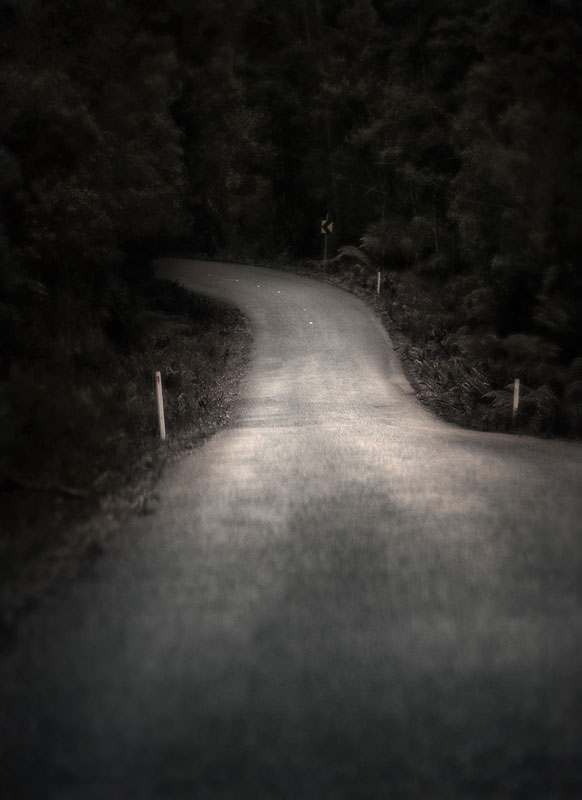
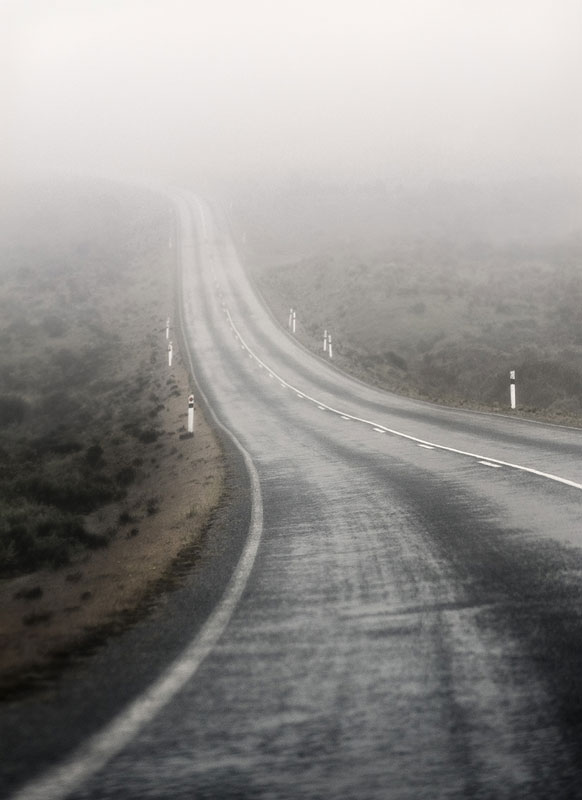
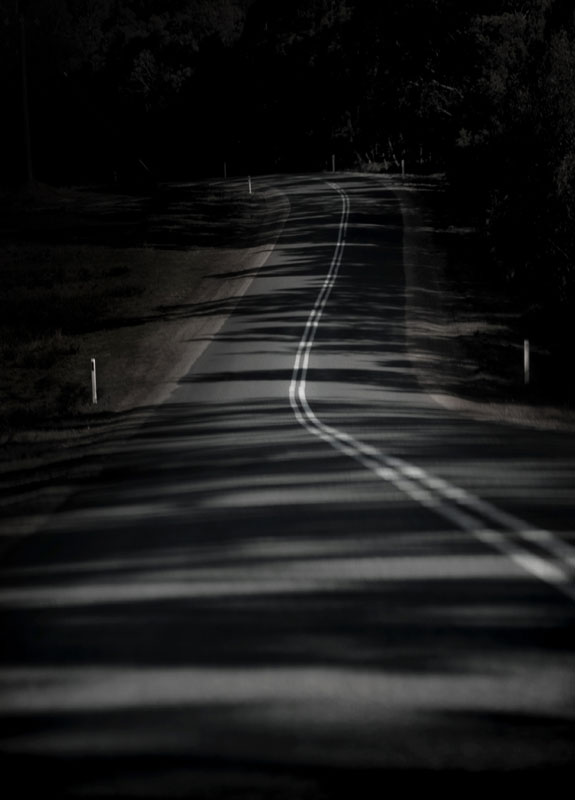
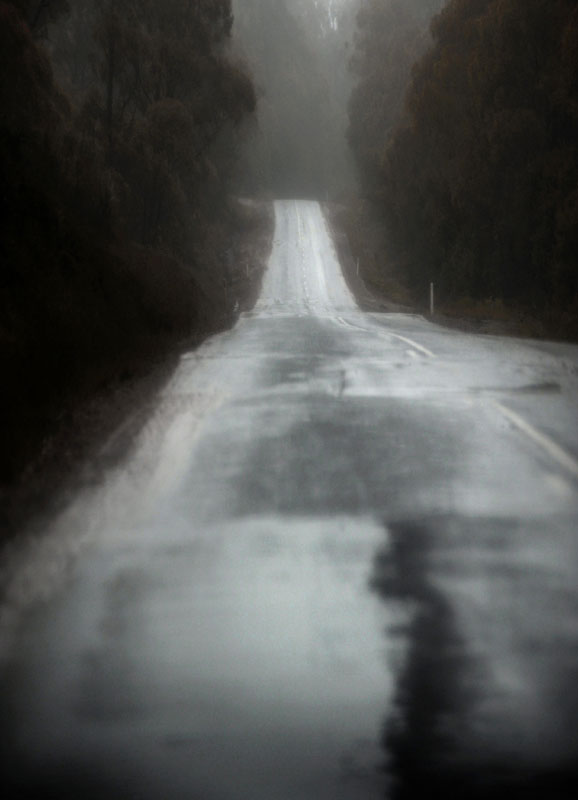
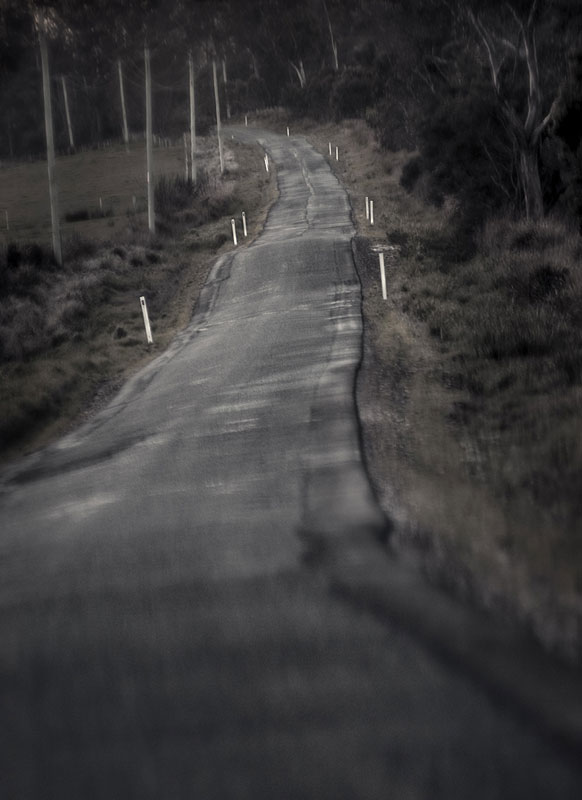
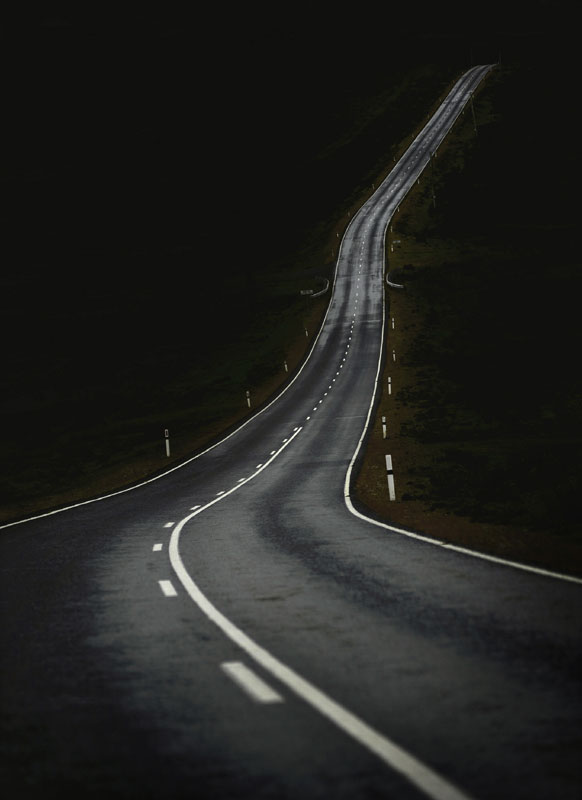
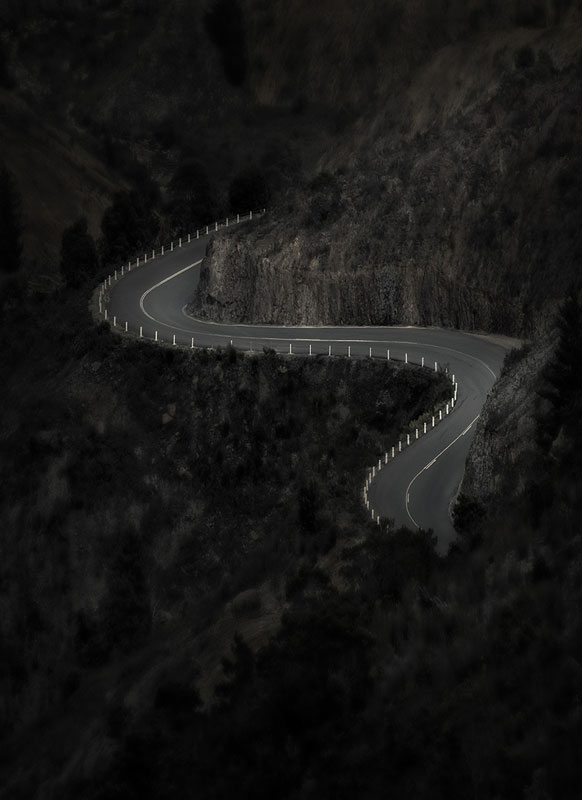
John Bodin (Australian) I Was Far Away From Home
2009
Type C print on metallic paper
80 x 110cm
Reprinted below is the speech I gave at the opening. Beautiful work (shot mostly in Tasmania from the passenger seat of a moving car). Many thanx to Anita and John for asking me to speak at the opening – it was fun!
Opening night speech
I want to preface what I am about to say by noting that I am interested in how these photographs, as physical objects, might speak to what is not physical, what is intangible and ineffable about the spaces they display.
I saw a fantastic documentary about the pianist Artur Rubenstein recently on SBS. When he was playing in concert he believed that he recognised in the audience a person that was more attuned to the nuances of his phrasing and performance than others and he played for them – he wanted to show them something new, insightful and challenging. This made him play better, taking more risks for greater reward, for himself and for the audience. These moments have the possibility of becoming moments in eternity (or to introduce the analogy of the road, milestones). For us it is the recognition of these moments in eternity (or to keep the analogy going, a journey), the unenclosed and apparently insignificant. The material world’s strange mixture of familiarity and otherness, ‘humanness’ and non-humanness.
Where these ideas share a quality with the photographs by John is a recognition of the fluid energy flowing through these spaces, like infinite ribbons of consciousness. For me this is not an escapement nor contentment but a point of stillness within self – an awareness and balance at that moment, at that point in time, in that line of sight when the photograph was taken. A stillness within self that acknowledges the journey taken and the journey to be taken – something that is beyond language and goes to the most intimate place of our being.
The photographs become the surface of the body, stitched together with lines, markers pointing the way – they are encounters with the things that we see before us but also the things that we carry inside of us. It is the interchange between these two things, how one modulates and informs the other. It is this engagement that holds our attention: the dappled light, ambiguity, unevenness, the winding path that floats and bobs before our eyes looking back at us, as we observe and are observed by the body of these landscapes.
One of the fundamental qualities of the photographs is that they escape our attempts to rationalise them and make them part of our understanding of the world, to quantify our existence in terms of materiality. I have an intimate feeling with regard to these sites of engagement. They are both once familiar and unfamiliar to us; they possess a sense of nowhereness. A sense of groundlessness and groundedness. A collapsing of near and far, looking down, looking along, a collapsing of the constructed world.
Why here? Why this particular angle? This section of the visible, this turn in the road. Not quite knowing where we are, we are neither here nor there, within nor without. It is an experience of being between the two – a potential space, a “between” that is formed only in the simultaneous presence of the two. As Donald Winnicott has observed in the book In/different Spaces by Victor Burgin, it is “the potential space between the subjective object and the object objectively perceived” that becomes the location of cultural experience.
“Those things of which I can perceive the beginnings and the end are not my self.” Grimm says. Like the road in these photographs there is no self just an infinite time that has no beginning and no end. The time before my birth, the time after my death. We are just in the world, just being somewhere. Life is just a temporary structure on the road from order to disorder. “The road is life,” writes Jack Kerouac in On the Road.
John’s skill as a photographer is to make visible the not really seen, potential spaces that we could have not have imagined otherwise. And for that, John, I am grateful.
Dr Marcus Bunyan
John Bodin (Australian) Into the Mystic
2009
Type C print on metallic paper
80 x 110cm
John Bodin (Australian) Into Timeless Shadows
2009
Type C print on metallic paper
80 x 110 cm
John Bodin (Australian) Remembrance of Some Lost Bliss
2009
Type C print on metallic paper
80 x 110 cm
John Bodin So Ghostly Easy
2009
Type C print on metallic paper
80 x 110 cm
John Bodin (Australian) Somewhere Along the Line the Pearl would be Handed to Me
2009
Type C print on metallic paper
80 x 110 cm
John Bodin (Australian) The One Distinct Moment of My Life
2009
Type C print on metallic paper
80 x 110 cm
Anita Traverso Gallery
PO Box 7001, Hawthorn North 3122 Phone: 0408 534 034
Ewen Ross (Australian, b. 1957) Plain of Mars 2010 from the Warrina Portraits series
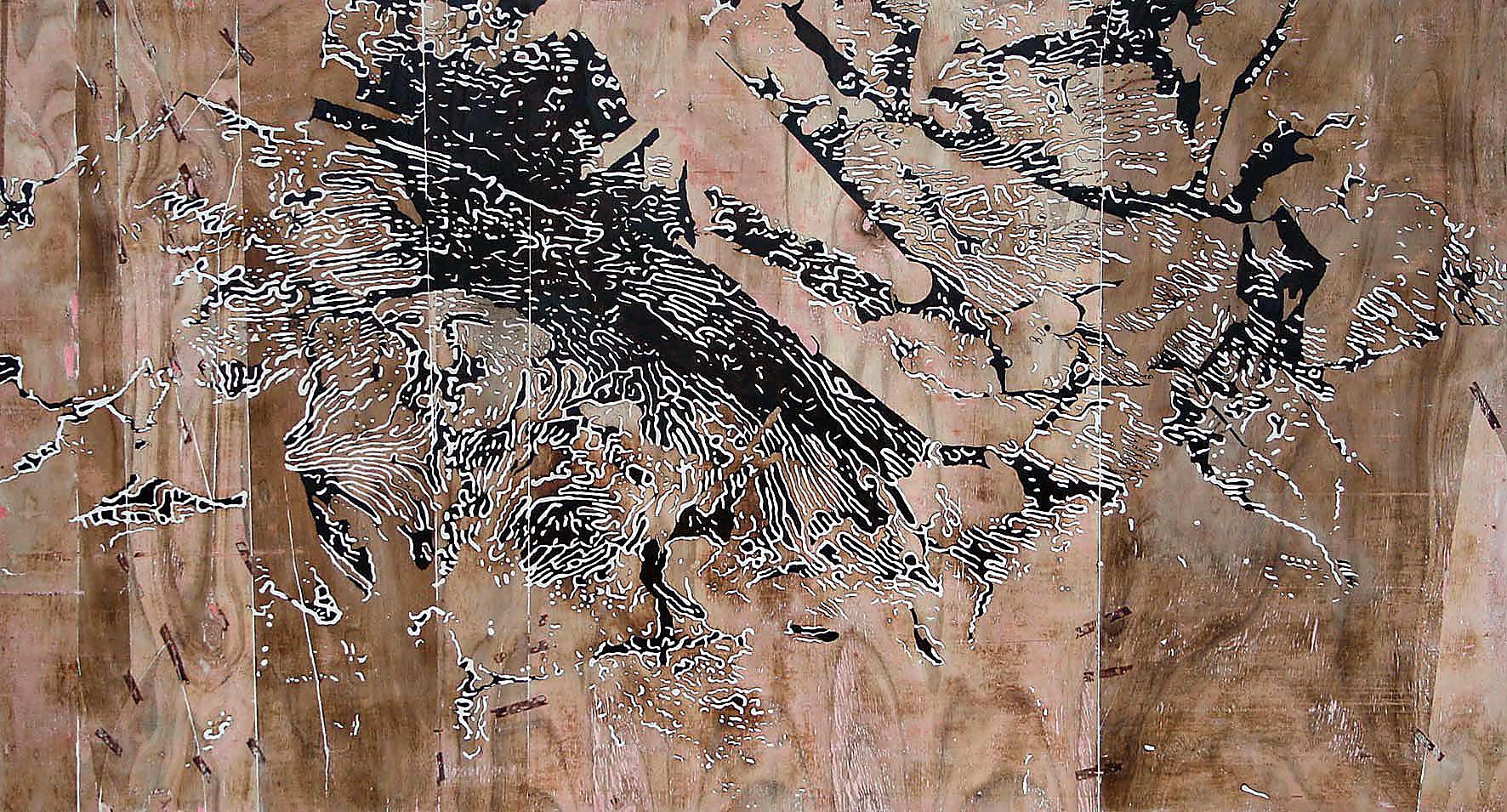
There is little more to say about this exhibition of works by Ewen Ross than the erudite catalogue essay by Geraldine Barlow enunciates (see essay below), except to say that the ‘presence’ of these works is extremely moving. It is difficult when viewing photographs of the work to explain the physical impact of actually standing in front of these works, absorbing their energy, examining their surfaces, their depths.
The larger photograph of Thenar Eminence (2010, below) is the closest one can get in the virtual world to appreciating the elemental quality of the work – the fire, the fragmentation and the soil, the contour-like mapping of the earth – as the work resembles a memory of earth, of place, re(as)sembles a signification, a meaning wholly of its own in the mind of the viewer. In the spectator the act of looking may turn into contemplation and this work does seem to have that effect = the context of looking at the work invites a contemplation on place and connection to earth.
Barlow asks. “Is this matter, or its coded representation? Ross sets up a liquid movement between such possibilities.”
Ross does indeed set up a liquid movement between matter and representation. But here I would offer a counter argument to the idea that matter and coded representation are binary opposites. As noted by Judith Butler in the excellent quotation below, matter is already meaningful, already coded and materialised. It always has a history and narrativisation embedded within it. Butler suggests the body is never a valueless matter on which inscription takes place because this hides the inscription already there.
Continuing this idea, Ross brings matter back into the fold, into the peeled away surfaces of his work. His process of materialisation offers these liquid movements not through an oppositional relationship between matter and coded representation but because a) his works are no longer anchored in an unquestionable reality and b) they have moved beyond coded representation. Ross reconceptualises both space and matter in his objects of place and invites us, the viewer, to contemplate these (e)motional environments.
Dr Marcus Bunyan
Many thankx to Anita from Anita Traverso Gallery for allowing me to publish the photographs in the posting and to Geraldine Barlow for allowing me to publish the catalogue essay, all very much appreciated. Please click on the photographs for a larger version of the image.
Body and Text
“Judith Butler has done much to interrogate and upset the assumes inside / outside binary of culture and nature, and has shown that what is called matter, and therefore presumed to be extra-discursive, is already meaningful. In her book entitled Bodies That Matter (1993) she argues that matter is already materialized, that is, it always has a history, is always narrativized. Any reference to matter will always be a particular formation of materiality that has been discursively set. Matter, nature or the body is never an absolute outside but is rather a constitutive outside that generates the significance of an interiority, culture or law. It is an outside that gives the inside its meaning and is, therefore, already textualized and incorporated within the oppositional space in which signification takes place. For Butler, the suggestion that the body is the valueless matter on which inscription takes place hides the inscription already there … Bringing matter back into the fold of inscription increases the manoeuvrability of political activism as it is no longer anchored by an unquestionable reality, the fixity of which is only secured by continual iteration of the norms attributed to it. ‘I would propose’, Butler argues, ‘a return to the notion of matter as a process of materialization that stabilizes over time to produce effects of boundary, fixity, and surface we call matter’ (Butler 1993: 9).
A useful analogy for this lack of fixity might be the reconceptualization of both space and matter within the new sciences, especially quantum mechanics, where matter, even that which we perceive as rigid or solid, is shown to be permanently in motion, and where the space which gives form to seemingly individual and autonomous objects is now understood to be a less dense area of matter itself.”
Curtis, Neal. “The Body as Outlaw: Lyotard, Kafka, and the Visible Human Project,” in Featherstone, Mike (ed.,). Body Modification. London: Sage, 2000, p. 258.
Ewen Ross (Australian, b. 1957) Thenar Eminence 2010 from the Warrina Portraits series
Warrina Portraits
This body of work presents as a suite of portraits, and continues my ambition to track the truth through creative practice. Metaphorically the palm of my left hand symbolises the natural patterns and rhythms of line found in the landscape along the Glenelg River in the Southern Wimmera, with particular reference to the property where I lived (Warrina).
This work presents as part of a portrait series derived solely from my left hand. It continues the story of my search for the truth of my genesis in reference to the property (Warrina) where I was raised. The notion of touching the landscape with an open hand in order to investigate the relationship between landscape and portraiture underpins this image.
The concept of looking down and across this country continues to drive the format of my work as does the idea of using fire to peel back the surface of the plywood which often reveals new and mysterious information to work with. Fire is part of the natural ecosystem and a valuable means of cleansing and regenerating new life and truth into this landscape. This premise remains integral to my practice.
The linear information gleaned from the palmar in theory creates a conduit for bridging the concept of portraiture and landscape. The notion of inlaying the narrative of my palm into the surface to construct an image of landscape underpins this body of work.
The significance of the left hand is relevant to the principle. It is controlled by the right brain (pattern recognition, relationship understanding), reflects the inner person, the natural self, the anima, and the ability to think laterally. It could even be considered to be part of a person’s spiritual and personal development.
It is also said the left hand is the one we are born with, the one the gods give you; the right is what we do it with.
Ironically, of the four descriptors allied with hands, earth, air, fire, and water, my hands are relative to fire.
Ewen Ross July 2010
Ewen Ross (Australian, b. 1957) Palmar Quartet 2010 from the Warrina Portraits series
Catalogue essay by Geraldine Barlow
Our palms and fingers each bear unique imprints. The intricate and entwined lines and loops of each palmscape have been generated from within the very core of what makes us individual, our encoded DNA.
“DNA molecules themselves, as physical entities, are like dewdrops. Under the right conditions they come into existence at a great rate, but no one of them has existed for long, and all will be destroyed within a few months. They are not durable like rocks. But the patterns they bear in their sequences are as durable as the hardest rocks.”1.
How should we read the patterned lines of a palm? The art of palmistry promised to decode the connections between this intimate landscape and our life to come. Palmistry is now dismissed as a quaint pseudoscience, yet the palm holds a special resonance, a very special part of the body from which the future might be foretold. Via the fingerprint, and now DNA traces, contemporary technology has developed seeking absolute recognition of each individual. Through our palms and fingers we hold and grip the world, we wield tools and touch those we care for. These interior sensate surfaces of the hand are at the centre of our embodied being in the world.
In his latest body of work Warrina Portraits, Ewen Ross has taken his own palm print as the starting point for a highly personal exploration of the relation between self and place. The furrowed banks of lines and shadows etched into ply sheets do not relay the literal five-fingered imprint of a hand, more a topography of interlaced systems, networks of lines which are at once familiar and strange to us.
In bringing these works into being, Ross has evolved a deliberate and multilayered process of making. He relays a detail of his palm print onto plywood, then channels the resulting lines into the layered timber surface. The finished surface of the ply sheet is then removed, to reveal an entirely new layer, with it’s own character and markings. Filler is applied, dries and the surface is sanded back, many times over. Sometimes further layers of stain or fine in-painting are added. This process involves a constant relay between layers of information, impression and counter-impression. At each stage there is the potential for slippage, opportunities for translation, room for the materials and the process of making to assert themselves. When Ross removes the finished surface of the plywood he welcomes chance into the artistic process, allowing for the planned and entirely unexpected to collide.
In Palmar Trilogy 2010 the mapped tracery of white lines and dark hollows sprawls over a surface of many parts. Various separate pieces of timber have been joined on this layer of the sheet; we can still see the remnants of the glue where the pieces were taped. Two systems of information are in conversation here, jostling against each other. Sometimes the incongruities suggest meaning; at other times they raise a series of questions. Looking at this work, I am reminded of a contour map superimposed onto a satellite image, or a geological survey. I see the echo of a tree branch in the patterns on a sheet of timber, overlaid with something more like an x-ray or a brain scan.
Is this matter, or its coded representation? Ross sets up a liquid movement between such possibilities.
In these works, palm print and wood grain take us into an intimate landscape. For Ross this is a place of memory. Warrina is the name of the Wimmera property where he grew up, where he ploughed the fields as a young man. Like Ross’ previous bodies of work Such is Dry Land, Red Gum Country and The Green Pick, these works speak of an intimate and formative connection with the Wimmera landscape. The artist works into and over ground that is familiar in the measure of his own life, as well as in the lives of previous generations.
Ross is sensitive to the connections of the many past generations associated with this land, stretching back beyond his own family’s history in this country. He works with the surface, but also looks behind it, tearing back the first skin, so that what was embedded in the substrate is now called into dialogue with other marks and textures, highlights and shadows.
In these works the artist’s hand is the model for a series of shimmering, chimera-like patterned imprints, echoes, reflections, templates and coursing sequences of code – allowing us to measure one life against many generations, the transitory against the eternal, our intimate landscape against the widest horizons.”
Geraldine Barlow Senior Curator/Collection Manager Monash University Museum of Art / MUMAMelbourne, May 2010
1/ Richard Dawkins, The Blind Watchmaker, Penguin, London, 2006, p. 127
Ewen Ross (Australian, b. 1957) Palmar Trilogy 2010 from the Warrina Portraits series
Anita Traverso Gallery PO Box 7001, Hawthorn North 3122 Phone: 0408 534 034
Exhibition dates: 3rd September – 3rd October, 2009
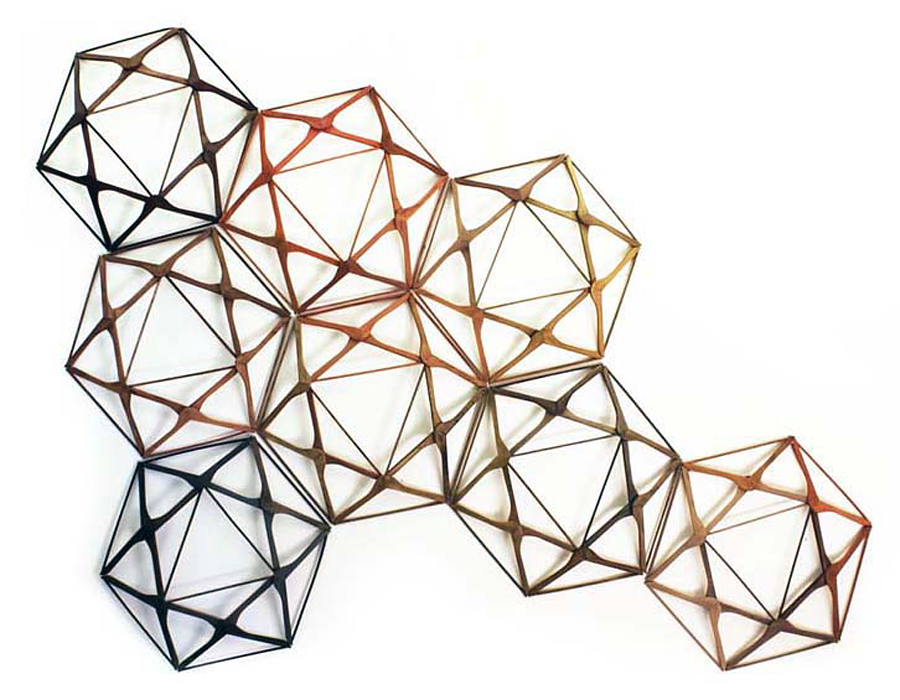
Lyndal Hargrave (Australia, b. 1959) Sacred Geometry 2009 Acrylic painted timber coat hangers, screws, staples 180 x 170cm Photo: Marcus Bunyan
This is a mixed bag of an exhibition by Lyndal Hargrave at Anita Traverso Gallery in Richmond, Melbourne.
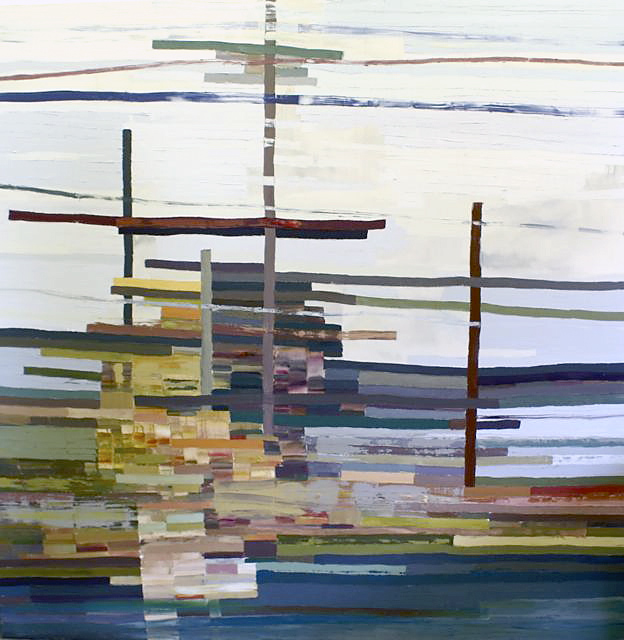
Despite one outstanding painting Breathing Space (2009, see below), the view from the back of the artist’s house onto a jetty with attendant wooden posts and sky, the other paintings are the weakest elements of the exhibition, lacking the strength and resonance of the sculptural work.
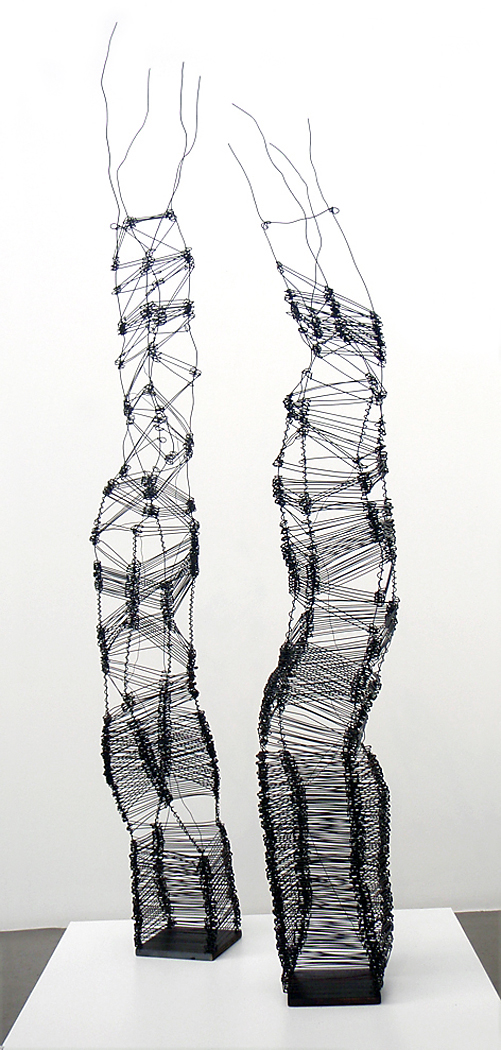
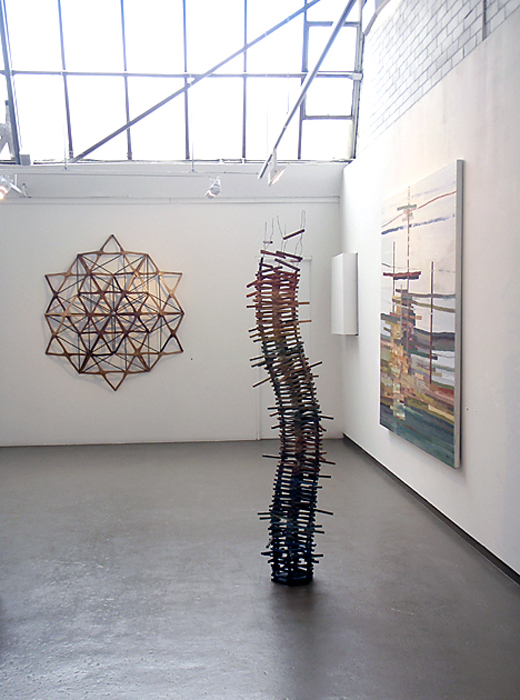
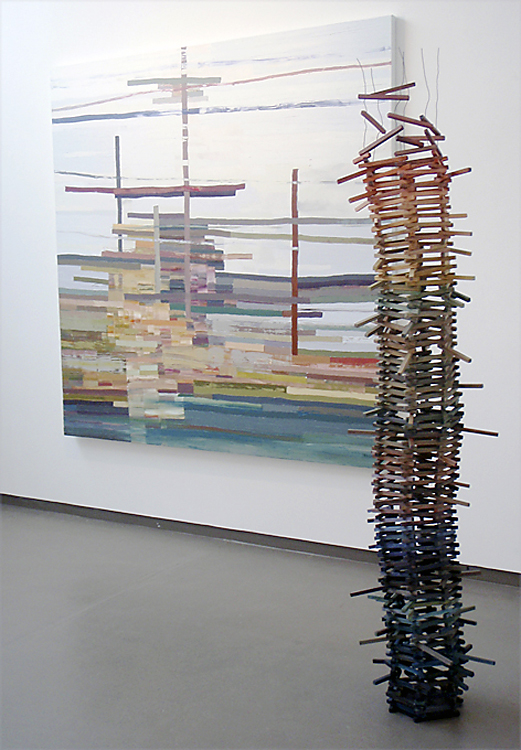
The two standing towers, Hairpin Dragons I & II and Jacob’s Ladder (both 2009, see below) are stronger work, Jacobs Ladder imitating the form of the painting Breathing Space in three-dimensional Cuisenaire-type coloured rods (see the installation photograph of the two pieces below).
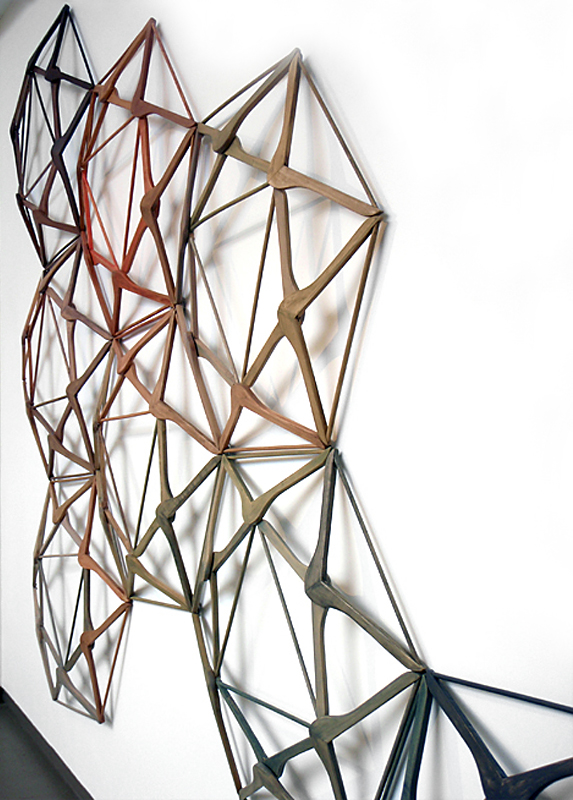
The best pieces in the exhibition are the wall mounted geometric, mandala-like sculptures made of wooden coat hangers. Delicately shifting patterns take the micro cellular form and make it macro, their patterns of construction offering a pleasing visual balance that is both complex, layered and innovative at one and the same time. As explorations of the notion of the universal structure, the golden ratio, they reward repeated viewing.
As the exhibition stands there are too many little pieces to make a holistic whole. Perhaps an exhibition solely of the towers or geometric pieces would have been stronger. I look forward to seeing how the geometric pieces (d)evolve in future work. Will the structures break down and reassemble in other marvellous incantations? I hope so!
Dr Marcus Bunyan
Many thankx to Anita Traverso Gallery for allowing me to publish the art work in the posting. Please click on some of the photographs for a larger version of the image.
Lyndal Hargrave (Australia, b. 1959) Arabesque 2009 Acrylic painted timber coat hangers, screws, staples 200 x 360cm Photo: Marcus Bunyan
Lyndal Hargrave (Australia, b. 1959) Arabesque (detail) 2009 Acrylic painted timber coat hangers, screws, staples 200 x 360cm Photo: Marcus Bunyan
Lyndal Hargrave (Australia, b. 1959) Hairpin Dragons I & II 2009 Wire, formply 170 x 15cm (varying) Photo: Marcus Bunyan
“It is a constant idea of mine that behind the cotton wool (of daily reality) is hidden a pattern, that we – I mean all human beings – are connected with this: that the whole world is a work of art; that we are parts of the work of art.”
~ Virginia Woolf
For as long as I can remember, my art practice has served as a filter between the outside world and my inside world. I realise now that the act of making the artwork informs my ideas rather than the other way round. Working intuitively results in a continuous stream of surprises that in retrospect mirror the pressing issues surrounding me at that time.
In All the Little Pieces my fascination with patterns of construction from micro to macro and natural to man-made continues. My work explores the gap between order and chaos and helps me to understand the meaning of balance.
Using mundane found objects, my sculptures probe the possibility of re-invention through the way the componentry of human habitation can be re-configured to offer us a new way of seeing and experiencing our world.
It is this process of metamorphosis that is at the centre of my investigation: how life forms make the transition from one state to another – tree to timber to tower or talisman; why some systems remain strong and others crumble.
Overarching my work is the notion of universal structure and the geometry that has informed our evolution from molecule to macro-system.”
Lyndal Hargrave 2009
Text from the Anita Traverso Gallery website
Lyndal Hargrave (Australia, b. 1959) Whirlpool Galaxy and The Samarian Star 2009 Acrylic painted timber coat hangers, screws, staples Photo: Marcus Bunyan
Installation view of the Lyndal Hargrave exhibition at Anita Traverso Gallery Photo: Marcus Bunyan
Photograph showing the relationship of form and colour between the work Jacob’s Ladder (2009) and the painting Breathing Space (2009) Photo: Marcus Bunyan
Lyndal Hargrave (Australia, b. 1959) Breathing Space 2009 Oil on canvas 200 x 200cm
Anita Traverso Gallery
The physical gallery has now closed.
PO Box 7001, Hawthorn North 3122 Phone: 0408 534 034 Email: art@anitatraversogallery.com.au
Opening and installation views of John Bodin’s exhibition Urban Edge at Anita Traverso Gallery, Melbourne
“Each one of us, then, should speak of his roads, his crossroads, his roadside benches; each one of us should make a surveyor’s map of his lost fields and meadows … Thus we cover the universe with drawings we have lived …
Space calls for action, and before action, the imagination is at work. It mows and ploughs. We should speak of the benefits of all these imaginary actions.”
Gaston Bachelard The Poetics of Space
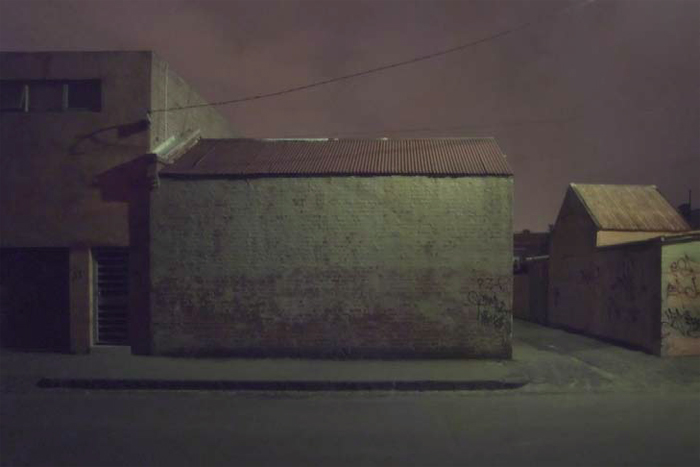
More interesting are the eerie contemplative photographs of John Bodin presented at Anita Traverso Gallery, Melbourne, our second opening of the night. In a well presented show Bodin’s hyper-real photographs employ a limited colour palette to portray the constructed landscape of the urban fringe. The images work well because the artist leaves room for doubt in the mind of the viewer – what am I looking at, where is it, do I subconsciously remember these places? How do the photographs make me feel about the edges of the world, this strangeness that we inhabit? They engage the viewer in a fluid architecture of space and place.
Light and colour are important tools for Bodin and he plays with their form, darkening pavements, shooting at night, making subtle negative interpretations of roads and underground car-parks while desaturating buildings, landscapes and skies of ‘natural’ colour. Walls bleed in Witchhunt (2007) and then you work out the photograph is taken under a bridge with a pavement, graffiti providing the title of the work. Blue light emotes from behind the cloaked window of a house in Shrouded (2005) and you are left wondering by the crazed cellular like constructions of As if by Nature (2007).
Haunting and elegiac these compositions are worthy of your attention.
Lovely to meet Catherine Fogarty and John Bodin. Thank you for your help!
Dr Marcus Bunyan
John Bodin (Australian) Witchhunt 2007
John Bodin (Australian) Shrouded 2005
John Bodin (Australian) As If By Nature 2007
“Urban Edge continues on from the 2006 ‘Urban Abstraction’ exhibition at Anita Traverso Gallery by introducing contrasting elements and structure from the natural world alongside stark semi-abstracted urban scapes. Whilst we may at first perceive these as opposing forces, I contend that the integration is more harmonious than we think.”
John Bodin
When John Bodin takes a risk – which indeed he seems to do aplenty – he does so with a self-assurance that would make many photographers – and artists in general – weep.
All the clichés are there in his work – the towering skyscraper, the car traversing the road at dusk, the pitted track through the woods. But when Bodin frames his image something quite magical occurs. Rather than raise an eyebrow and say – ‘seen it all before’ – instead we are seduced into the deep chiaroscuro, the inarguably romantic, shadowy mis en scene.
Bodin has said that his photographs “comment on the conditioning process of familiarisation.” Indeed, the strange moment of familiarity is immediately cushioned by the sensual softness of tone he employs. If anything, it is the shock of the old.
Bodin has said that his study in philosophy and meditation serve as a visual source of reflection and are integral to his image making.
Whether it is a distinctly phallic office tower or the moments of surrealism in a found structure in the rural countryside, Bodin’s work exudes a strange peacefulness, a distinctly contemplative air. Everything he grabs from reality is given Bodin’s own air of tranquility. He doesn’t eschew colour exactly, but he tones it down, blanketing his subjects in a kind of downy, nostalgic but not quite melancholic fashion that links his entire oeuvre.
A work such as Lover’s Lane – a sandy track somewhere by the coast – links his sensual eye with a not altogether comforting sense of intimacy. The shadows of the trees encroach in an almost threatening tangle of dark shapes – the ideal place to reassure a trembling lass as they wander into the dark.
In 2006, the renowned fellow-photographer Les Horvat said in an opening speech that Bodin’s “stated interests in philosophy and meditation serve as a fertile source of reflection, integral to his image making. His images cleverly explore the contrast between the form and the aesthetic of the landscape. They do this by examining the utility of urban structure, and juxtaposing it against an aesthetic emotional sensibility that is evocatively expressed through his images.
“The paradox he lays before us is that on one hand, they ingeniously remind us of our human incursions in the natural world; on the other, they suggest that the significance of the landscape is actually assigned by these incursions,” stated Horvat.
Bodin has travelled extensively and in 2003 he served a short residency in New Delhi, India. Closer to home he held a solo show in May 2006 and participated in 11 group exhibitions over the last six years. He was a finalist in the 2005 New Social Commentaries Acquisitive Prize and the acclaimed Prometheus Visual Art Award in 2007. The respect Bodin holds amongst his peers is renowned and, as this show attests, will only grow with time.
Ashley Crawford. “John Bodin,” in Photofile 86 2009, p. 14
Artist John Bodin in front of his work Lover’s Lane (2007, left) and Object of Speculation (2008, right) at the opening of his exhibition Urban Edge at Anita Traverso Gallery, Melbourne
John Bodin (Australian) Midnight Solitude 2005
John Bodin (Australian) Stumbling into Grace 2008 Type c print 120 x 80 cm
John Bodin (Australian) Mondrian in Berlin 2005 Type C-print 60 x 80cm
John Bodin (Australian) Adrenalin Addiction 2006 Type-C photograph 108 x 183cm
Anita Traverso Gallery PO Box 7001, Hawthorn North 3122









 Art Blart _ art and cultural memory archive
You must be logged in to post a comment.