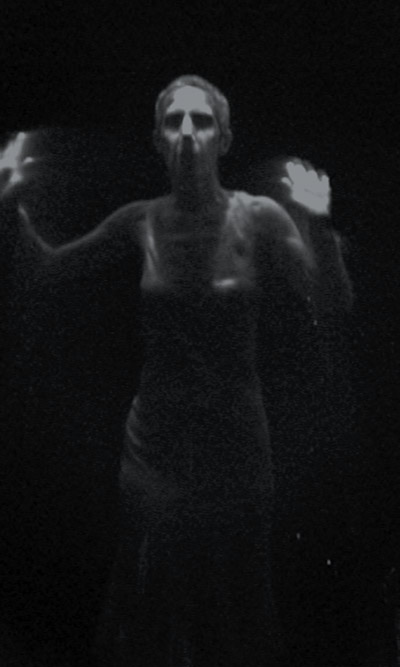
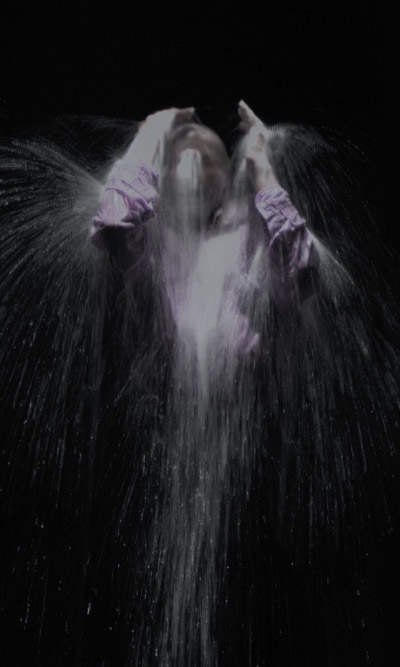
Exhibition: ‘Bill Viola/Michelangelo: Life, Death, Rebirth’ at the Royal Academy of Arts, London

Exhibition dates: 26th January – 31st March, 2019
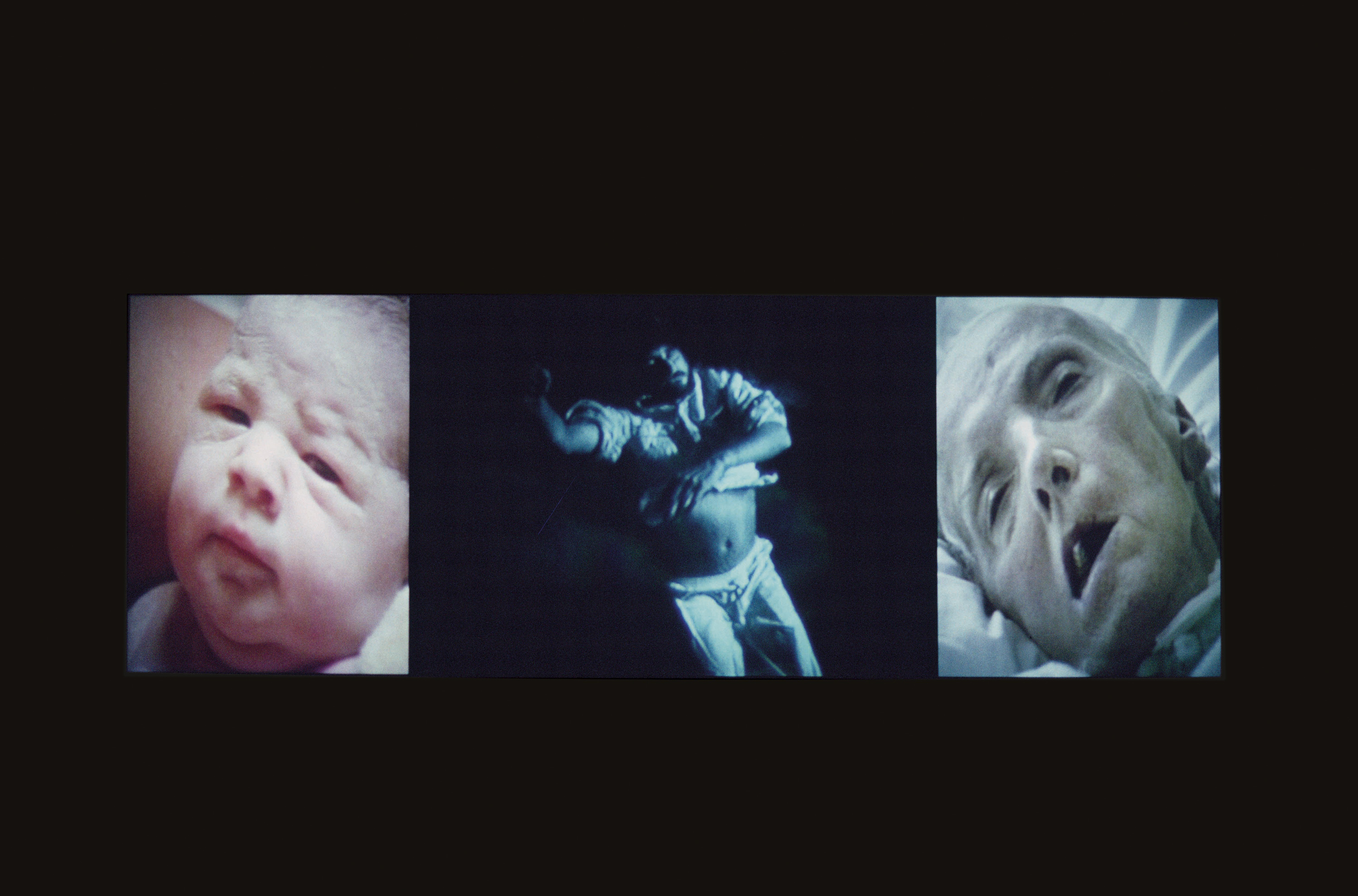


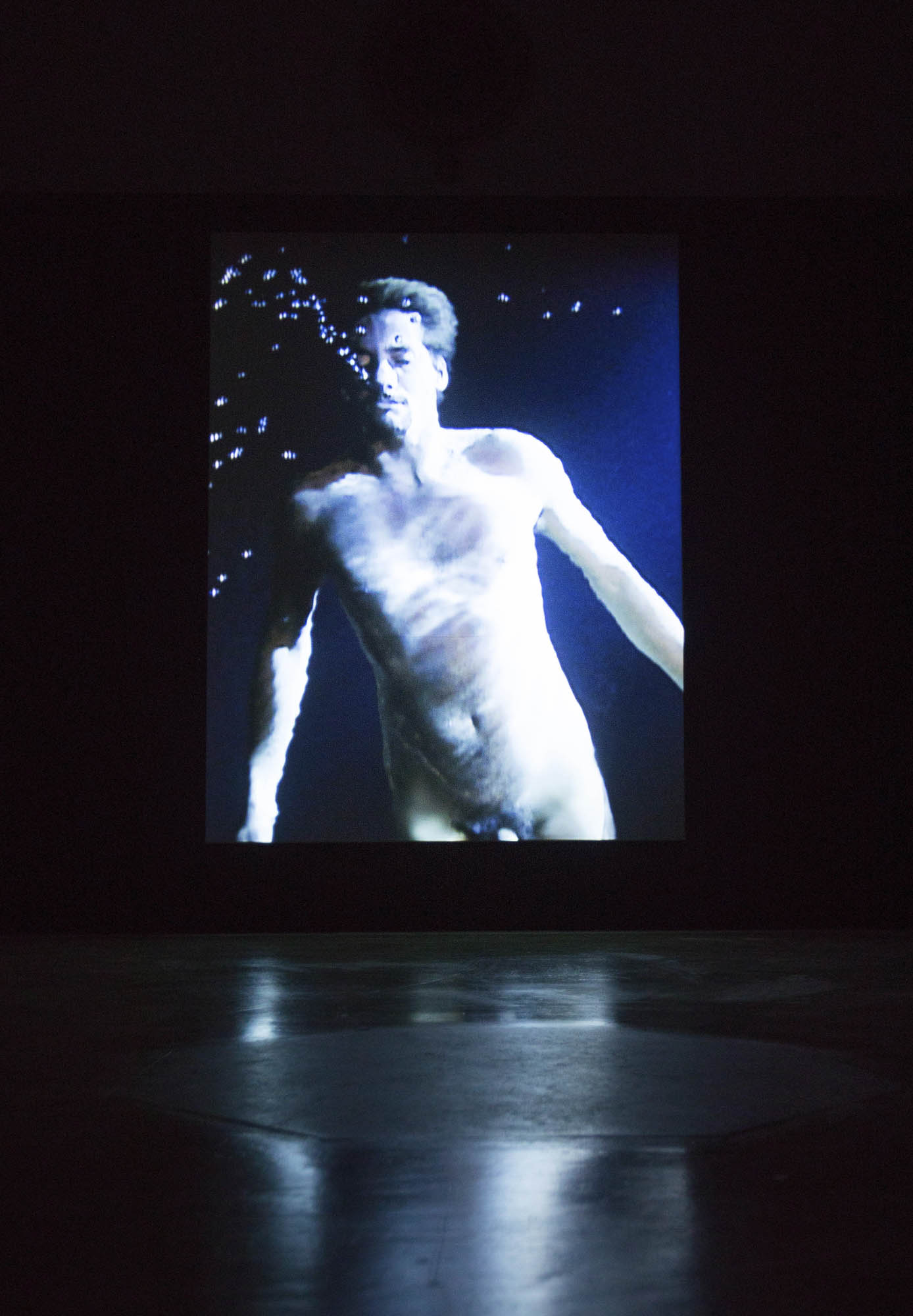
Bill Viola (American, 1951-2024) 'Nantes Triptych' 1992 (still) from the exhibition 'Bill Viola / Michelangelo: Life, Death, Rebirth' at the Royal Academy of Arts, London, Jan - March, 2019


Bill Viola (American, 1951-2024)
Nantes Triptych (still)
1992
Video/sound installation
Courtesy Bill Viola Studio
Photo: Kira Perov


Bill Viola (American, 1951-2024)
Nantes Triptych (extract)
1992
Video/sound installation
Courtesy Bill Viola Studio


Far from heaven

On the surface (and there’s a key word), this exhibition pairs these two artists together as a form of immaculate concept(ion).

“Though working five centuries apart and in radically different media, these artists share a deep preoccupation with the nature of human experience and existence. Bill Viola / Michelangelo creates an artistic exchange between these two artists… It [the exhibition] proposes a dialogue between the two artists, considering Viola as an heir to a long tradition of spiritual and affective art, which makes use of emotion as a means of connecting viewers with its subject matter.” (Press release)

At the heart of both artists work is an exploration of the body as a vessel for the eternal soul, where the use of the body gives shape (through fundamental human experiences and emotions) to spirituality, and where both artists consider metaphysical questions about the nature of existence and reality.

One of the successes of the exhibition (when seen from afar) is the undoubted connection across time, space and culture between two human beings investigating what it is to be human: as Viola puts it, an understanding and awareness of “a deeper tradition, an undercurrent stretching across time and cultures… the ancient spiritual tradition that is concerned with self-knowledge.” In Viola’s work it is an essence of self reflection, the self reflection in water of the first humans, that recognition of self – that idea of self knowledge that is built into water – and his use of water (and other elements such as fire) as an immersive, nurturing, entombing, womb death environment in many of his video installations, that provides the impetus for his investigation.

But I have a nagging doubt about this pairing.

Viola’s work seems to be of a different order (of being) than that of Michelangelo. Even though Viola’s work connects the viewer to its subject matter through feeling and emotion, these feelings and emotions are viewed from the outside (Man Searching for Immortality / Woman Searching for Eternity). The camera objectifies this theatre of creation for our viewing pleasure. The video installations are performances which seem to be of a different kingdom to me (performance, theatre, spectacle) – whereas Michelangelo’s drawings seem to emanate from within. Not chemical, not organic, but something else which is so deeply embodied that they seem to come close to enlightenment.

How Viola fits into the great catalogue – we can only take in by what he tells us. And in time.

Because this spiritual investigation is mostly seen “through a glass darkly”, sometimes it has a, scent of being, not genuine – sometimes because we are all imperfect artists – but sometimes, through someone like Hilma af Klint, or Hokusai or, in this case, Michelangelo (“Michael angel”) it is much much more transparent… and closer to the surface. Am I making sense?

Sometimes they are about something I may somewhat understand in this lifetime (Viola) and sometimes they are about something that I don’t believe has been “released” to humanity fully. Perhaps a form of internal esoteric knowledge that may eventually be revealed to humanity. A mystery (derived from ‘mystic’ or ‘mysticism’ from the Greek μυω, meaning “to conceal”) which may reveal truths that surpass the powers of natural reason, a truth that transcends the created intellect.

Dr Marcus Bunyan


PS. The poem below has the terror of the sublime. A perfect picture of detachment and very nearly a complete picture of enlightenment. Is the human condition different from all other conditions? – that is the $64,000 question – if you say “no”, then this is a true poem. And of course, from the depths of the soul, who is having this conversation?


Many thankx to the Royal Academy of Arts for allowing me to publish the art work in the posting. Please click on the photographs for a larger version of the image.


Is it far to go?

Is it far to go?
A step – no further.
Is it hard to go?
Ask the melting snow,
The eddying feather.

What can I take there?
Not a hank, not a hair.
What shall I leave behind?
Ask the hastening wind,
The fainting star.

Shall I be gone long?
For ever and a day.
To whom there belong?
Ask the stone to say,
Ask my song.

Who will say farewell?
The beating bell.
Will anyone miss me?
That I dare not tell –
Quick, Rose, and kiss me.

Cecil Day-Lewis

Cecil Day-Lewis (1904-1972) was appointed poet laureate by Queen Elizabeth II. He was an Irish poet and essayist, and a writer of mystery novels under the pen name of Nicholas Blake. He is the father of the actor Daniel Day-Lewis. The third stanza of this poem serves as the epitaph on his gravestone. “Rose” refers to Rosamond Lehmann, the British novelist who was his lover when he wrote this verse in the 1940’s.



Installation view of the exhibition 'Bill Viola/Michelangelo: Life, Death, Rebirth' at the Royal Academy of Arts, London

Installation view of the exhibition 'Bill Viola/Michelangelo: Life, Death, Rebirth' at the Royal Academy of Arts, London


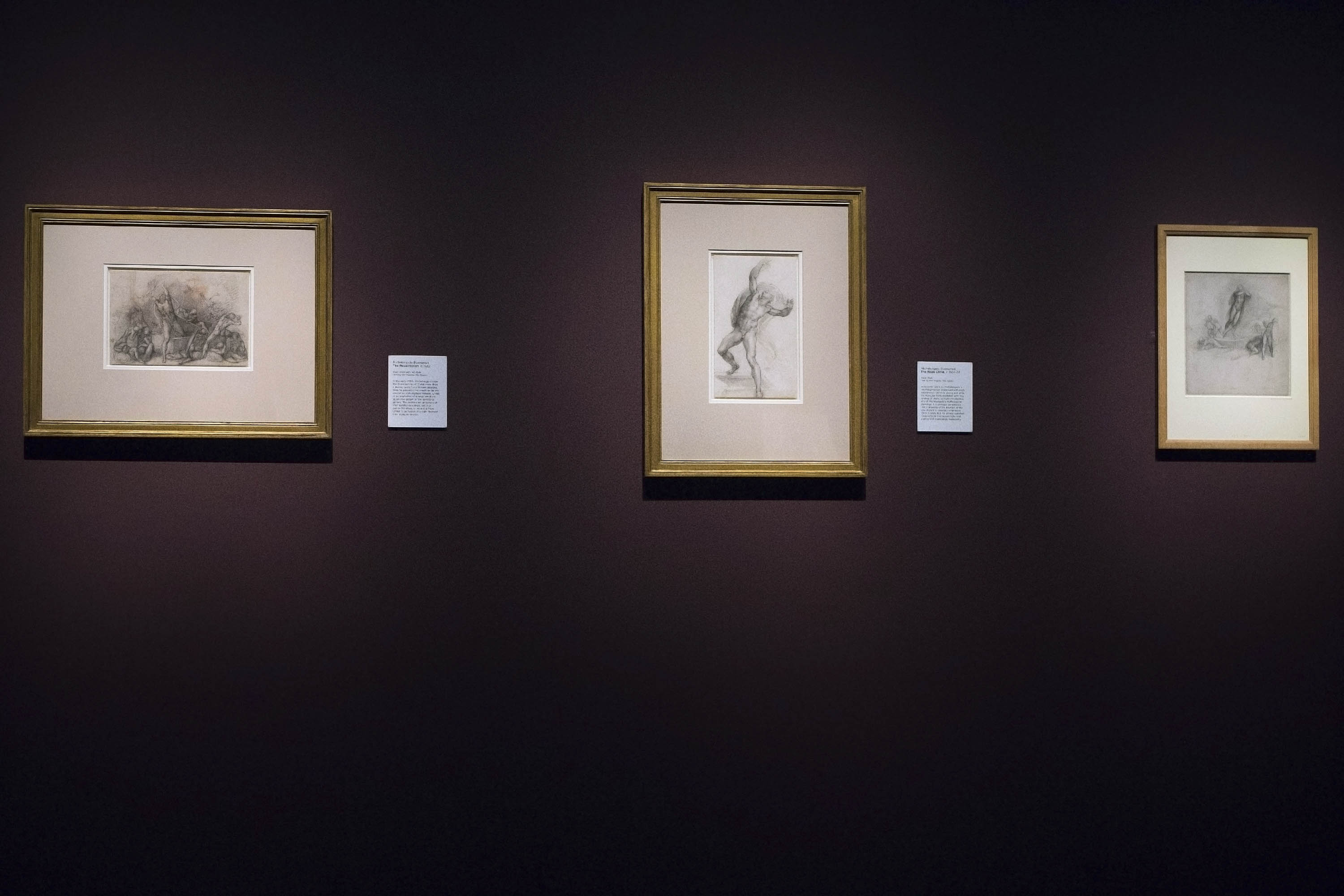
Installation views of the exhibition Bill Viola/Michelangelo: Life, Death, Rebirth at the Royal Academy of Arts, London showing:

Michelangelo Buonarroti (Italian, 1475-1564) LEFT
The Resurrection
c. 1532
Black chalk
Lent by Her Majesty the Queen

Michelangelo Buonarroti (Italian, 1475-1564) CENTRE
The Risen Christ
c. 1532-1533
Black chalk on paper
37.2 x 22.1cm
Royal Collection Trust / © Her Majesty Queen Elizabeth II 2019

Michelangelo Buonarroti (Italian, 1475-1564) RIGHT
The Resurrection
c. 1532-1533
Black chalk

Exhibition organised by the Royal Academy of Arts, London in partnership with Royal Collection Trust and with the collaboration of Bill Viola Studio. David Parry / © Royal Academy of Arts


This exhibition pairs Bill Viola’s powerful installations with rarely-seen drawings by Michelangelo. Journey through the cycle of life in our immersive and unparalleled show.

Michelangelo is best known for the Sistine Chapel and for his large sculptures. Yet his smaller, more intimate drawings take us closer to the spiritual and emotional power of his work. They were created for his private use, or as gifts of love, and would soon become known as “drawings the likes of which was never seen”.

In 2006, the pioneering video artist Bill Viola saw a collection of these works at Windsor Castle. He was moved by their ability to convey fundamental human experiences and emotions, and by Michelangelo’s use of the body to give shape to spirituality.

Viola’s large-scale video installations are likewise works of profound emotional impact. They combine sound and moving image to create absorbing works which slow us down and invite us to experience and reflect. These works are shown alongside Michelangelo drawings, which are on display in the UK for the first time in almost a decade.

This exhibition – created in close collaboration with Bill Viola Studio – is a unique opportunity to experience two artists, born centuries apart, in a new light.

Text from the RA website
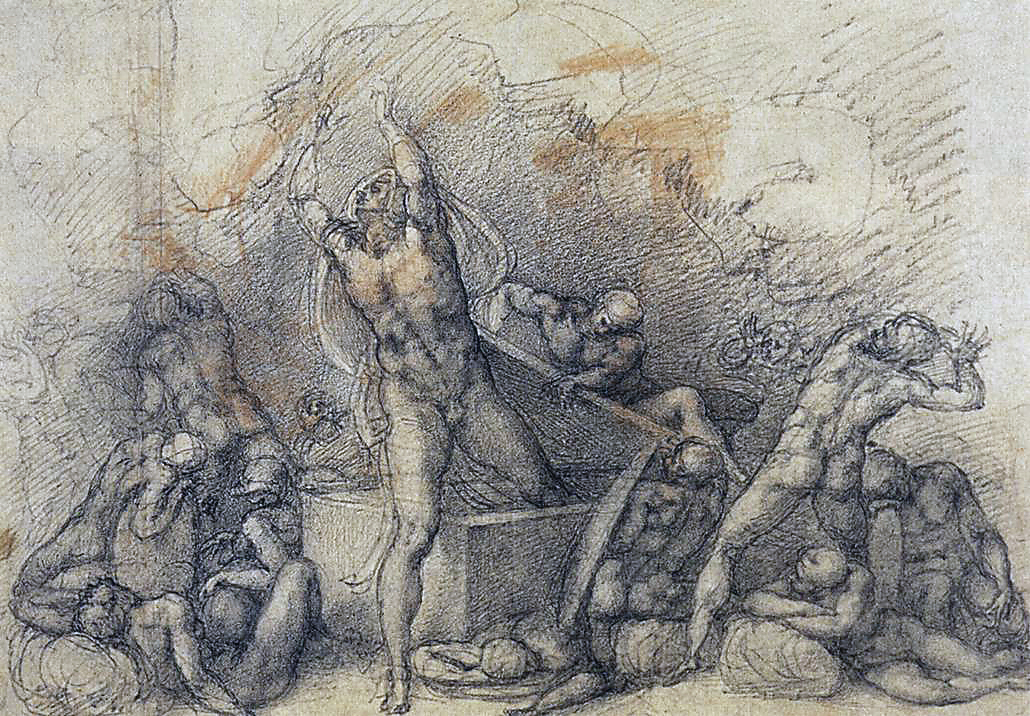
 

Michelangelo Buonarroti (Italian, 1475-1564) 'The Resurrection' c. 1532 from the exhibition 'Bill Viola / Michelangelo: Life, Death, Rebirth' at the Royal Academy of Arts, London, Jan - March, 2019


Michelangelo Buonarroti (Italian, 1475-1564) LEFT
The Resurrection
c. 1532
Black chalk
Lent by Her Majesty the Queen


In the early 1530s Michelangelo drew the Resurrection of Christ more than a dozen times, for unknown reasons. Here he presents the transition to the eternal as a triumphant release, Christ as an explosion of energy amid the sepulchral gloom of the terrestrial sphere. The soldiers are prisoners of their earthly existence, lost in a death-like sleep, or recoiling from Christ in confusion at a sight beyond their comprehension.

Wall text from the exhibition


Michelangelo Buonarroti. 'The Risen Christ' c. 1532-1533


Michelangelo Buonarroti (Italian, 1475-1564) CENTRE
The Risen Christ
c. 1532-1533
Black chalk on paper
37.2 x 22.1cm
Royal Collection Trust / © Her Majesty Queen Elizabeth II 2019


In no other work by Michelangelo is the Resurrection expressed with such exuberance. Christ is long and virile, his muscular form modelled with tiny stokes of chalk, as highly finished as any of Michelangelo’s mythological drawings. It is perhaps paradoxical that a drawing of the triumph of the soul should so strongly emphasise Christ’s body, but his almost polished torso reflects the radiant light with a glory that transcends reality.

Wall text from the exhibition


Michelangelo Buonarroti (Italian, 1475-1564) 'The Resurrection' c. 1532


Michelangelo Buonarroti (Italian, 1475-1564) RIGHT
The Risen Christ
c. 1532-1533
Black chalk on paper
37.2 x 22.1cm
Royal Collection Trust / © Her Majesty Queen Elizabeth II 2019

 

Installation views of the exhibition Bill Viola/Michelangelo: Life, Death, Rebirth at the Royal Academy of Arts, London

Installation view of the exhibition 'Bill Viola/Michelangelo: Life, Death, Rebirth' at the Royal Academy of Arts, London


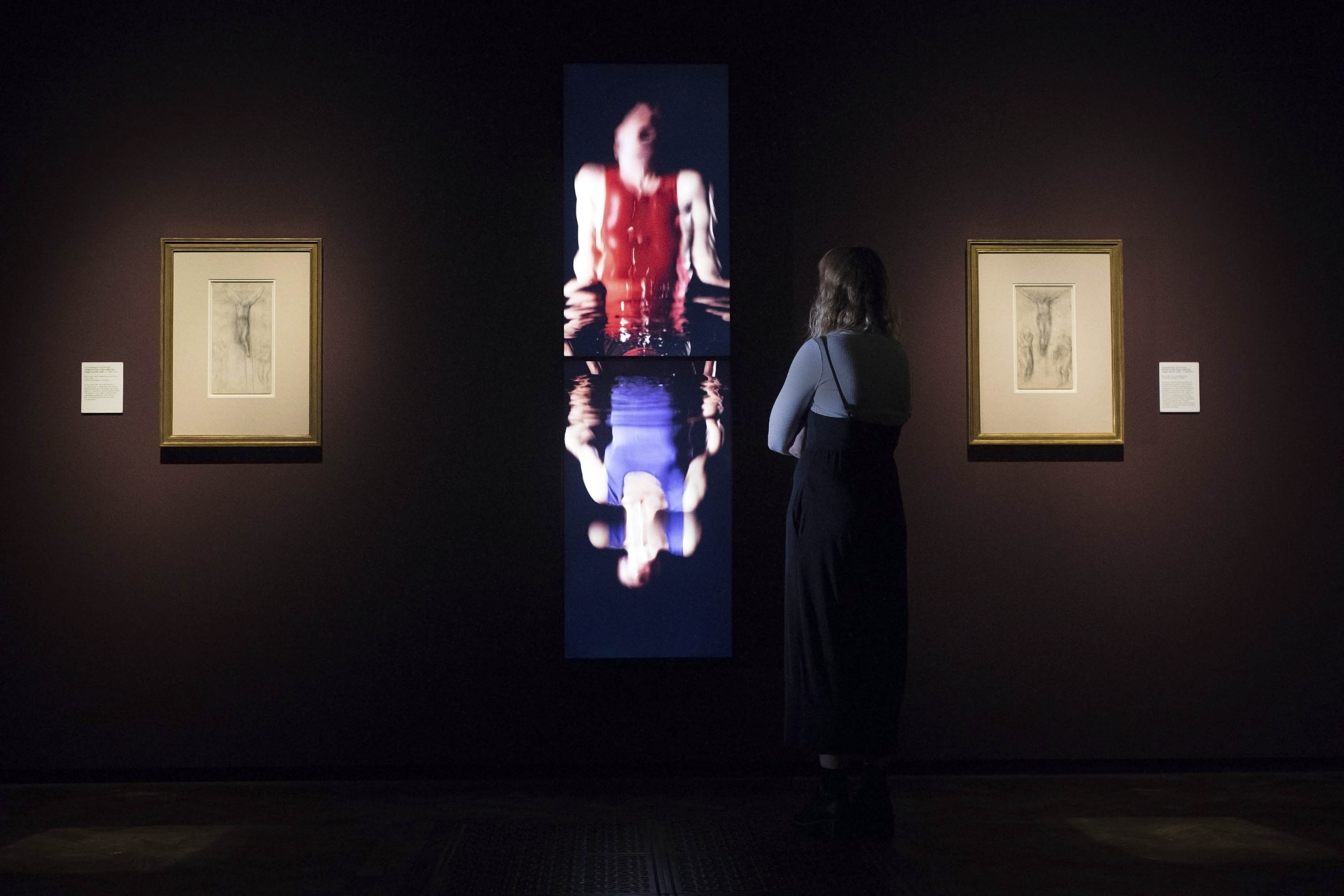
Installation views of the exhibition Bill Viola/Michelangelo: Life, Death, Rebirth at the Royal Academy of Arts, London showing:

Michelangelo Buonarroti (Italian, 1475-1564) LEFT
Christ on the Cross with the Virgin and St John
c. 1560-1564
Black chalk, white heightening and a touch of red chalk
Lent by Her Majesty the Queen

Michelangelo Buonarroti (Italian, 1475-1564) RIGHT
Christ on the Cross with the Virgin and St John
c. 1560-1564
Black chalk with white heightening
Lent by Her Majesty the Queen

Exhibition organised by the Royal Academy of Arts, London in partnership with Royal Collection Trust and with the collaboration of Bill Viola Studio. David Parry / © Royal Academy of Arts
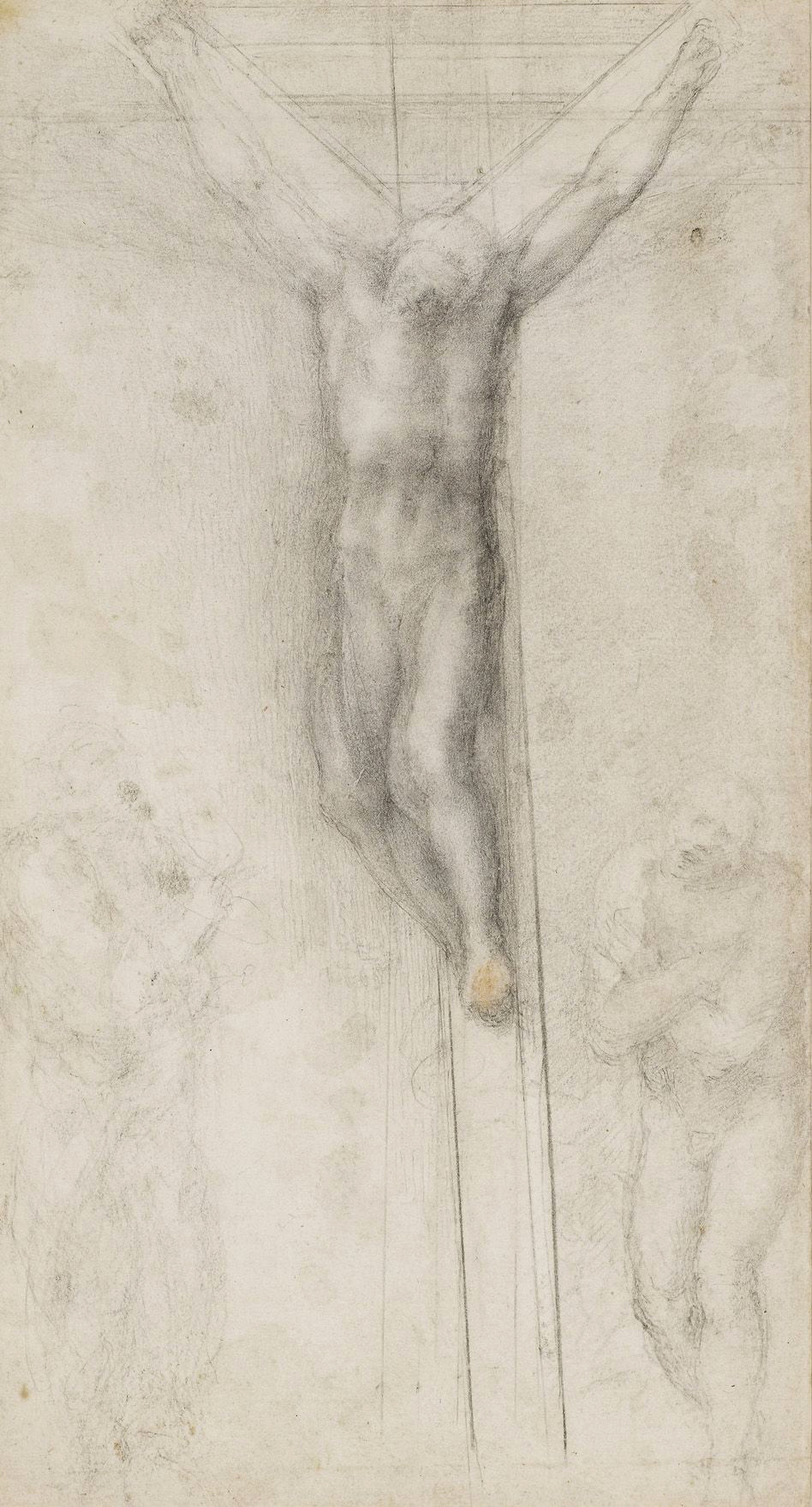
 

Michelangelo Buonarroti (Italian, 1475-1564) 'Christ on the Cross with the Virgin and St John' c. 1560-1564


Michelangelo Buonarroti (Italian, 1475-1564) LEFT
Christ on the Cross with the Virgin and St John
c. 1560-1564
Black chalk, white heightening and a touch of red chalk
Lent by Her Majesty the Queen


To the right, the hunched figure of St John is list in desolation, his arms tightly folded as if shivering, his mouth open in a pain both physical and mental. The patch of red chalk at Christ’s feet is probably deliberate, symbolic of the sacrificial blood that was shed on the Cross.


Michelangelo Buonarroti (Italian, 1475-1564) 'Christ on the Cross with the Virgin and St John' c. 1560-1564


Michelangelo Buonarroti (Italian, 1475-1564) RIGHT
Christ on the Cross with the Virgin and St John
c. 1560-1564
Black chalk with white heightening
Lent by Her Majesty the Queen
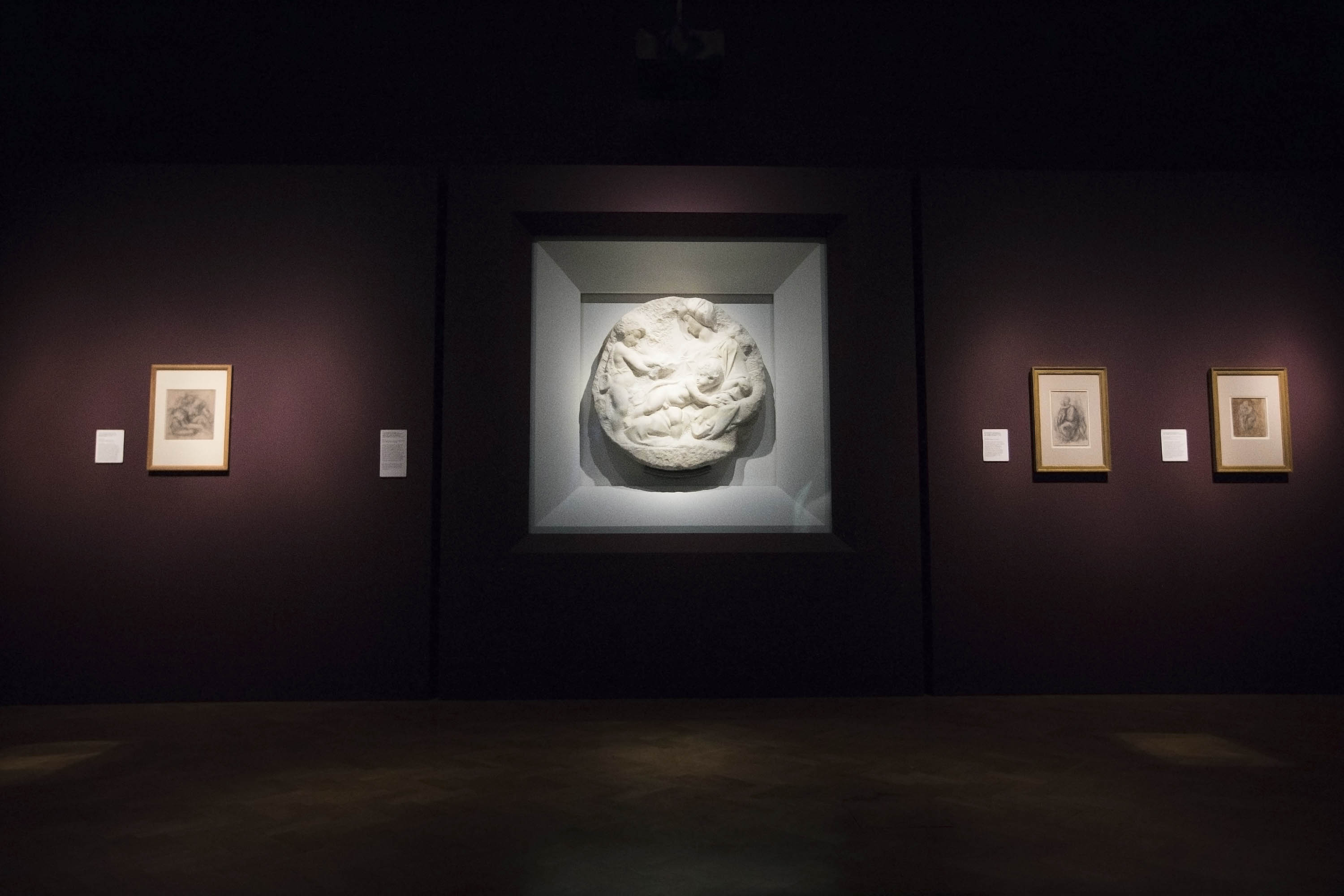
 

Installation view of the exhibition 'Bill Viola/Michelangelo: Life, Death, Rebirth' at the Royal Academy of Arts, London showing at centre Michelangelo Buonarroti, 'The Virgin and Child with the Infant St John', c. 1504-1505


Installation view of the exhibition Bill Viola/Michelangelo: Life, Death, Rebirth at the Royal Academy of Arts, London showing at centre Michelangelo Buonarroti, The Virgin and Child with the Infant St John, c. 1504-1505. Exhibition organised by the Royal Academy of Arts, London in partnership with Royal Collection Trust and with the collaboration of Bill Viola Studio. David Parry / © Royal Academy of Arts
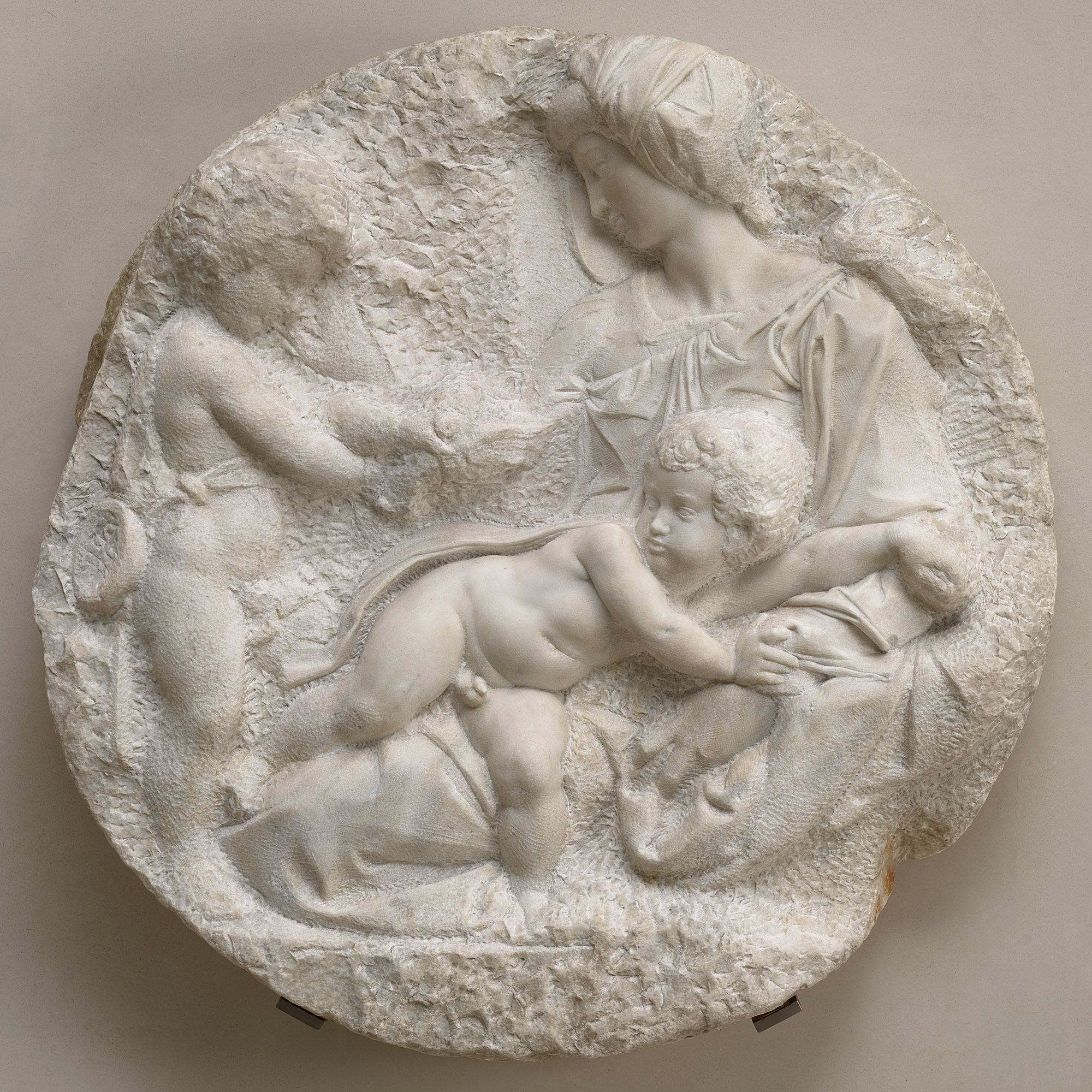
 

Michelangelo Buonarroti. 'The Virgin and Child with the Infant St John' c.1504-1505


Michelangelo Buonarroti (Italian, 1475-1564)
The Virgin and Child with the Infant St John (Taddei Tondo)
c. 1504-1505
Marble relief
107 x 107 x 22cm
Royal Academy of Arts, London. Bequeathed by Sir George Beaumont, 1830
© Royal Academy of Arts, London
Photo: Prudence Cuming Associates Limited
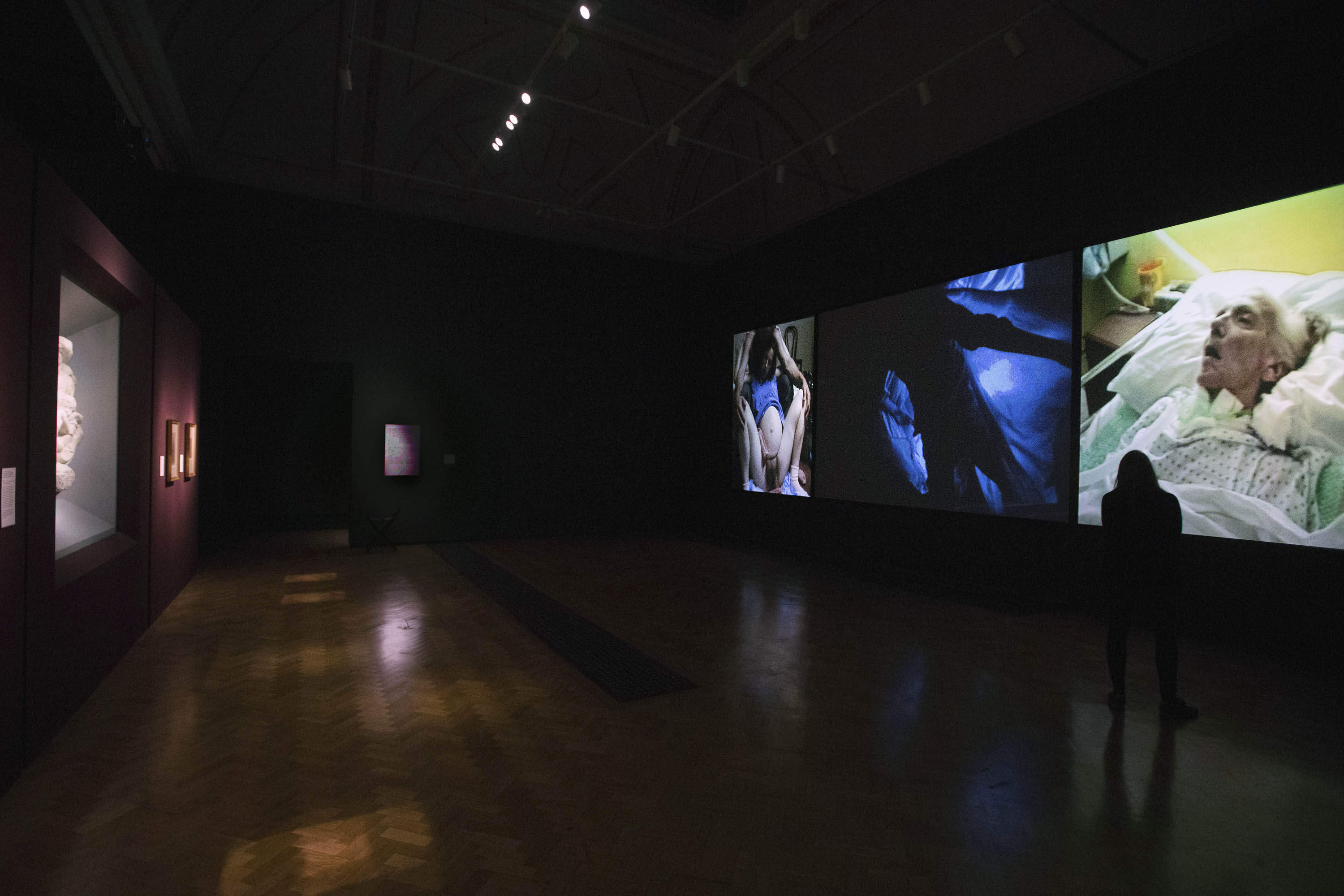
 

Installation view of the exhibition 'Bill Viola/Michelangelo: Life, Death, Rebirth' at the Royal Academy of Arts, London with at left Michelangelo's 'The Virgin and Child with the Infant St John (Taddei Tondo)' c. 1504-1505; and at right, Bill Viola's 'Nantes Triptych', 1992


Installation view of the exhibition Bill Viola/Michelangelo: Life, Death, Rebirth at the Royal Academy of Arts, London with at left Michelangelo’s The Virgin and Child with the Infant St John (Taddei Tondo) c. 1504-1505; and at right, Bill Viola’s Nantes Triptych, 1992. Exhibition organised by the Royal Academy of Arts, London in partnership with Royal Collection Trust and with the collaboration of Bill Viola Studio. David Parry / © Royal Academy of Arts
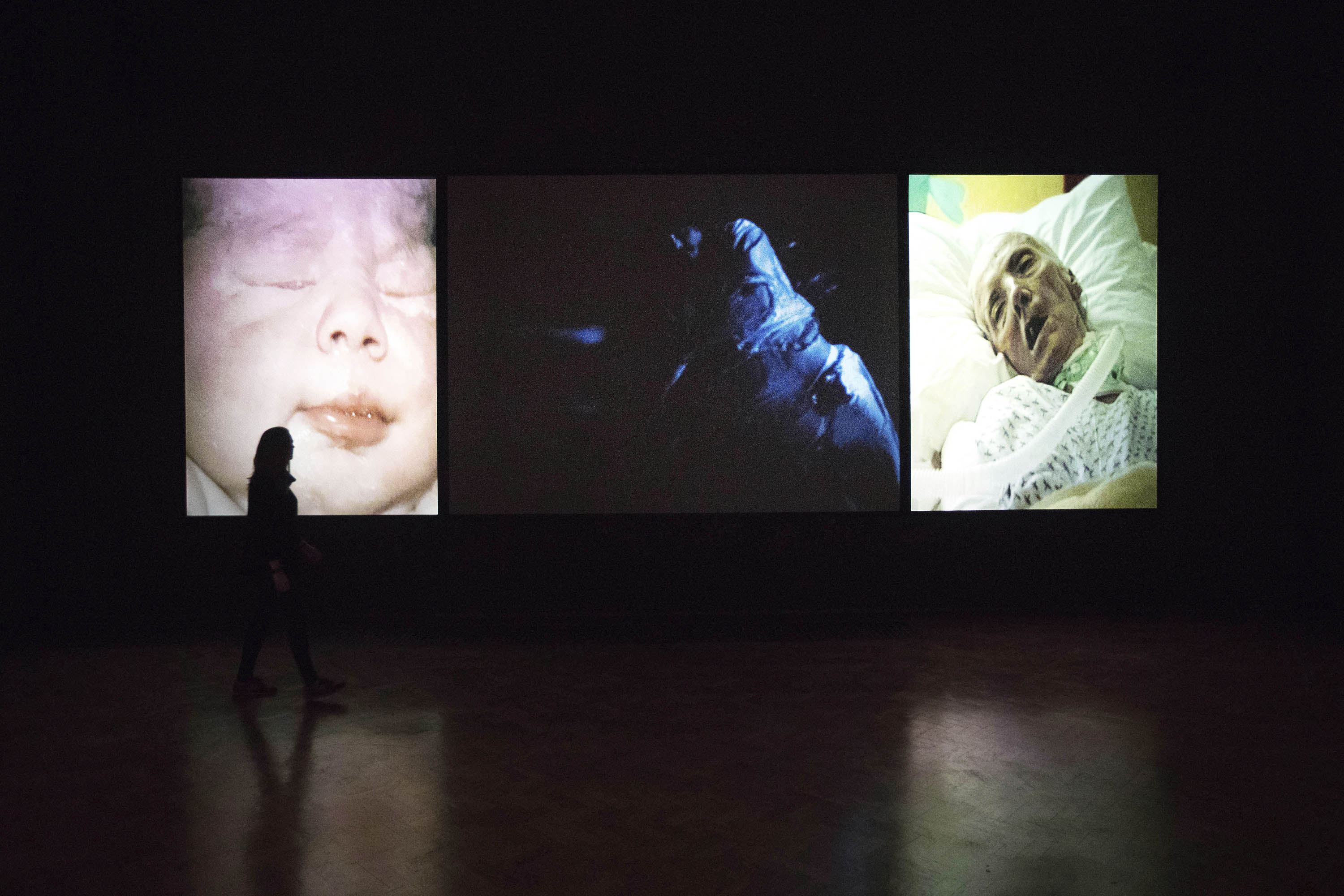
 

Installation view of the exhibition 'Bill Viola/Michelangelo: Life, Death, Rebirth' at the Royal Academy of Arts, London showing Bill Viola, 'Nantes Triptych', 1992


Installation view of the exhibition Bill Viola/Michelangelo: Life, Death, Rebirth at the Royal Academy of Arts, London showing Bill Viola, Nantes Triptych, 1992. Exhibition organised by the Royal Academy of Arts, London in partnership with Royal Collection Trust and with the collaboration of Bill Viola Studio. David Parry / © Royal Academy of Arts
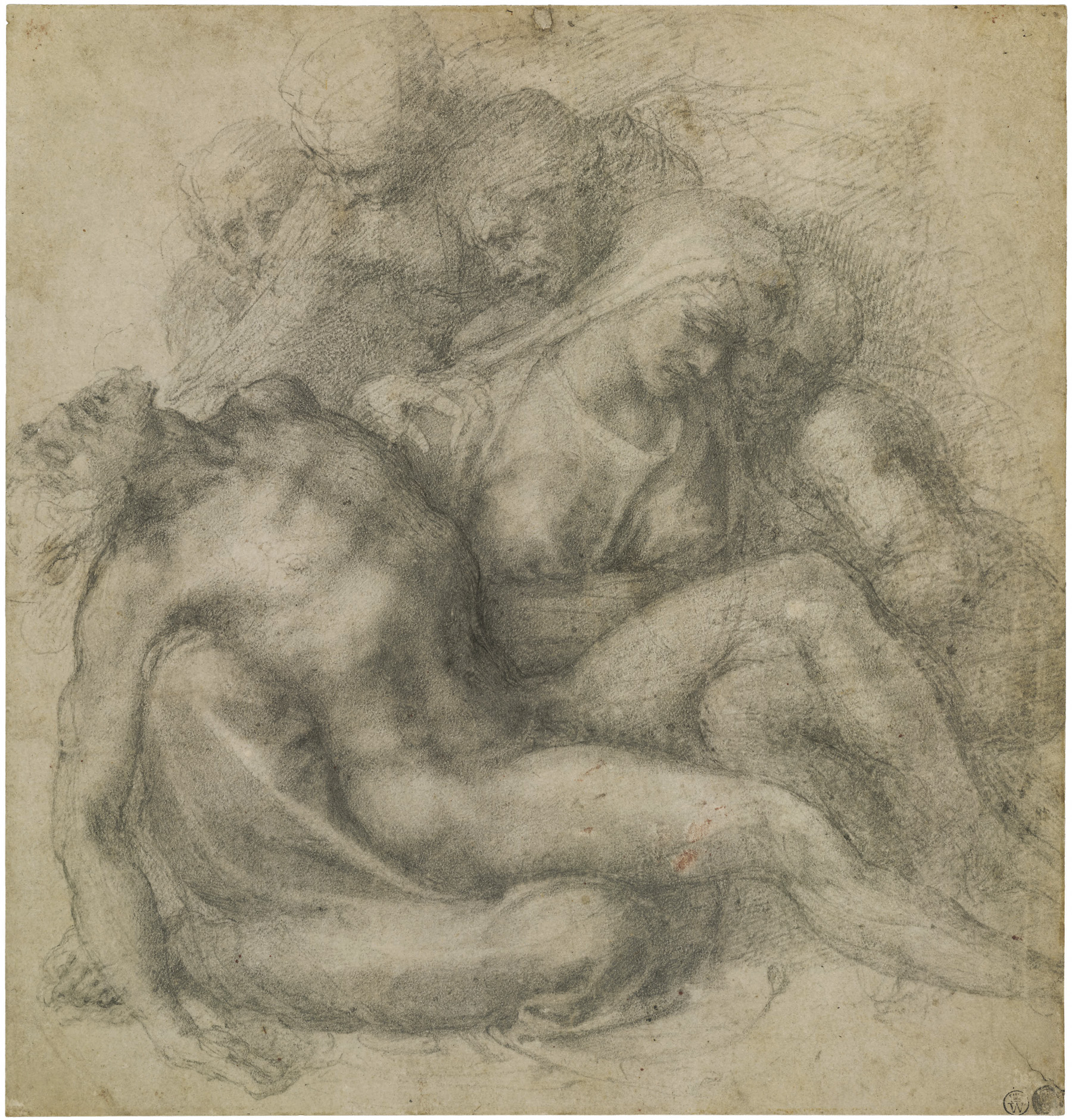
 

Michelangelo Buonarroti. 'The Lamentation over the Dead Christ' c. 1540


Michelangelo Buonarroti (Italian, 1475-1564)
The Lamentation over the Dead Christ
c. 1540
Black chalk
28.1 x 26.8cm
The British Museum, London. Exchanged with Colnaghi, 1896, 1896,0710.1
© The Trustees of the British Museum


Installation view of the exhibition 'Bill Viola/Michelangelo: Life, Death, Rebirth' at the Royal Academy of Arts, London

Installation view of the exhibition 'Bill Viola/Michelangelo: Life, Death, Rebirth' at the Royal Academy of Arts, London

Installation view of the exhibition 'Bill Viola/Michelangelo: Life, Death, Rebirth' at the Royal Academy of Arts, London

Installation view of the exhibition 'Bill Viola/Michelangelo: Life, Death, Rebirth' at the Royal Academy of Arts, London


Installation views of the exhibition Bill Viola/Michelangelo: Life, Death, Rebirth at the Royal Academy of Arts, London. Royal Collection Trust / © Her Majesty Queen Elizabeth II 2019. Exhibition organised by the Royal Academy of Arts, London in partnership with Royal Collection Trust and with the collaboration of Bill Viola Studio. David Parry / © Royal Academy of Arts


In January 2019, the Royal Academy of Arts brings together the work of the pioneering video artist, Honorary Royal Academician Bill Viola (1951-2024), with drawings by Michelangelo (1475-1564). Though working five centuries apart and in radically different media, these artists share a deep preoccupation with the nature of human experience and existence. Bill Viola / Michelangelo creates an artistic exchange between these two artists and is a unique opportunity to see major works from Viola’s long career and some of the greatest drawings by Michelangelo, together for the first time. It is the first exhibition at the Royal Academy largely devoted to video art and has been organised in partnership with Royal Collection Trust.

The exhibition comprises 12 major video installations by Viola, from 1977 to 2013, being shown alongside 15 works by Michelangelo. They include 14 highly finished drawings, considered to be the high point of Renaissance drawing, as well as the Royal Academy’s Taddei Tondo. It proposes a dialogue between the two artists, considering Viola as an heir to a long tradition of spiritual and affective art, which makes use of emotion as a means of connecting viewers with its subject matter. It also aims to recapture the spiritual and emotional core of Michelangelo, beyond the awesome grandeur of his works.

Viola first encountered the works of the Italian Renaissance in Florence in the 1970s where he spent some of his formative years. A residency at the J Paul Getty Museum, Los Angeles, in 1998 renewed his interest in Renaissance art and in the shared affinities with his own practice. In 2006, Viola visited the Print Room at Windsor Castle to see Michelangelo’s exquisite drawings, which he had known in reproduction since his youth. The meeting proved a catalyst for the exhibition, which evolved as a conversation between Viola and Martin Clayton, Head of Prints and Drawings at Royal Collection Trust. Rather than setting up direct comparisons between the artists or suggesting that Michelangelo has been an instrumental influence on Viola’s work, the exhibition examines the affinities between them, bringing together specific works to explore resonances in their treatment of the fundamental questions: the nature of being, the transience of life, and the search for a greater meaning beyond mortality.

Viola stated, “Through my travels and experiences first in Florence, then primarily in non-Western cultures, and in combination with my readings in ancient philosophy and religion, I began to be aware of a deeper tradition, an undercurrent stretching across time and cultures… the ancient spiritual tradition that is concerned with self-knowledge.” Throughout his career, Viola has experimented with large-scale video installations; he is one of the first artists to have conceived video on an immersive architectural scale. He has increasingly utilised his medium’s fundamental elements – light, sound and time – to create visceral works that consider metaphysical questions about the nature of existence and reality. Unusually for video, they give shape to inner states of being rather than mirroring the world around us.

The exhibition presents Michelangelo’s works as more than examples of genius and virtuosity, revealing a personality that was frequently vulnerable. The drawings included were executed in the last 35 years of his life, some as gifts and expressions of love for close friends, others as private meditations on his own mortality. Religious imagery of the Virgin and Child, the Crucifixion and the Resurrection reflect on the presence of death and the eternal. In others, references to Classical mythology act as metaphors for the human condition. At their heart, as with Viola’s work, is an exploration of the body as a vessel for the eternal soul.

The exhibition is conceived as an immersive journey through the cycles of life, exploring the transience and tumult of existence and the possibility of rebirth. It begins and ends with a pairing of works that reflect on a central paradox: the presence of death in life. Michelangelo’s The Virgin and Child with the Infant St John the Baptist, c. 1504-1505, known as the Taddei Tondo, depicts the Baptist holding a fluttering bird from which the infant Christ recoils, the scene heralding his eventual sacrifice on the Cross. It is being displayed alongside Viola’s The Messenger, 1996 (Bill Viola Studio), which uses the metaphor of water to depict the eternal cycle of birth, life and death. The theme is being further explored in drawings relating to the Virgin and Child, as well as the Lamentation, c. 1540 (British Museum, London), which is being shown facing Viola’s Nantes Triptych, 1992 (Bill Viola Studio), three screens that individually portray a woman giving birth, a figure floating in a mysterious half-light, and Viola’s own mother on her deathbed. Viola stated, “It is the awareness of our own mortality that defines the nature of human beings”.

The exhibition continues with a series of installations by Viola that reflect on the nature of human experience, as one set by moral and ethical choices, besieged by fears and ultimately experienced in solitude. At the centre of the exhibition is Michelangelo’s extraordinary Presentation Drawings of the 1530s (loaned by Her Majesty The Queen, Royal Collection, London), which he produced as gifts for Tommaso de’ Cavalieri, a young Roman nobleman for whom he developed a deep love. Demonstration pieces relating to the craft of drawing with chalk, they also explore complex myths and Neoplatonic concepts, and were created as expressions of devotion towards their recipient. They include the Tityus, 1532, which acts as an allegory for the opposed forms of love in Neoplatonic philosophy: the punishment of base lust devoid of spiritual love. Further drawings by Michelangelo explore similar allegorical struggles in life, from the labours of Hercules to the fall of Phaeton. These are being shown in opposition to the quiet stillness of Viola’s Man Searching for Immortality/Woman Searching for Eternity, 2013 (Bill Viola Studio). Life-size images of an ageing man and woman are projected onto two black granite slabs, showing them slowly examining every inch of their naked bodies by torchlight, unable to hide from their earthly state.

The final galleries include a series of works that more directly consider mortality and the possibility of rebirth. Among them are Michelangelo’s most poignant drawings, two Crucifixions from the final years of his life. The exhibition concludes two of Viola’s most majestic works; the monumental projections, Fire Woman, 2005, (Bill Viola Studio), and Tristan’s Ascension (The Sound of a Waterfall Under a Mountain), 2005 (Bill Viola Studio). They depict bodies falling and rising out of view, in different ways conjuring the body’s final journey and the passage of the spirit, in obscurity or in glory.

Press release from the RA Cited 23/02/2019


Bill Viola (American, 1951-2024)
Tristan’s Ascension (The Sound of a Mountain Under a Waterfall) (extract)
2005
Video/sound installation
Performer: John Hay
Courtesy Bill Viola Studio
Photo: Kira Perov
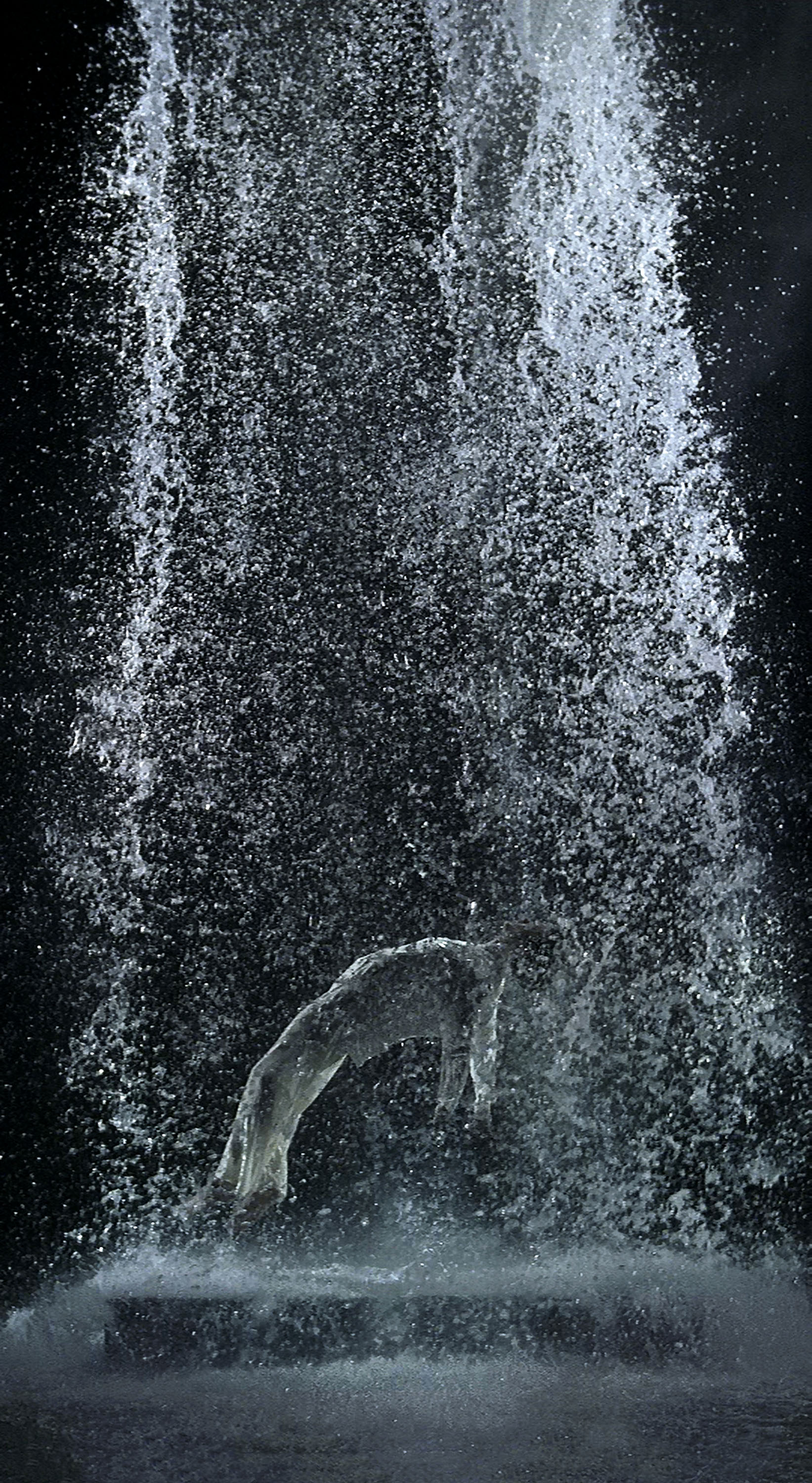
 

Installation view of the exhibition 'Bill Viola/Michelangelo: Life, Death, Rebirth' at the Royal Academy of Arts, London showing Bill Viola's 'Tristan's Ascension (The Sound of a Mountain Under a Waterfall)' 2005 (still)


Bill Viola (American, 1951-2024)
Tristan’s Ascension (The Sound of a Mountain Under a Waterfall) (still)
2005
Video/sound installation
Performer: John Hay
Courtesy Bill Viola Studio
Photo: Kira Perov


Installation view of the exhibition 'Bill Viola/Michelangelo: Life, Death, Rebirth' at the Royal Academy of Arts, London showing Bill Viola's 'Tristan's Ascension (The Sound of a Mountain Under a Waterfall)' 2005 (still)


Installation view of the exhibition Bill Viola/Michelangelo: Life, Death, Rebirth at the Royal Academy of Arts, London showing Bill Viola’s Tristan’s Ascension (The Sound of a Mountain Under a Waterfall) 2005 (still). Exhibition organised by the Royal Academy of Arts, London in partnership with Royal Collection Trust and with the collaboration of Bill Viola Studio. David Parry / © Royal Academy of Arts


Bill Viola, Fire Woman and Tristan’s Ascension (The Sound of a Mountain Under a Waterfall), St Carthage’s Church, Parkville, Melbourne


Bill Viola (American, 1951-2024) 'Fire Woman' 2005 (still) from the exhibition 'Bill Viola / Michelangelo: Life, Death, Rebirth' at the Royal Academy of Arts, London, Jan - March, 2019


Bill Viola (American, 1951-2024)
Fire Woman (still)
2005
Video/sound installation
Performer: Robin Bonaccorsi
Courtesy Bill Viola Studio
Photo: Kira Perov
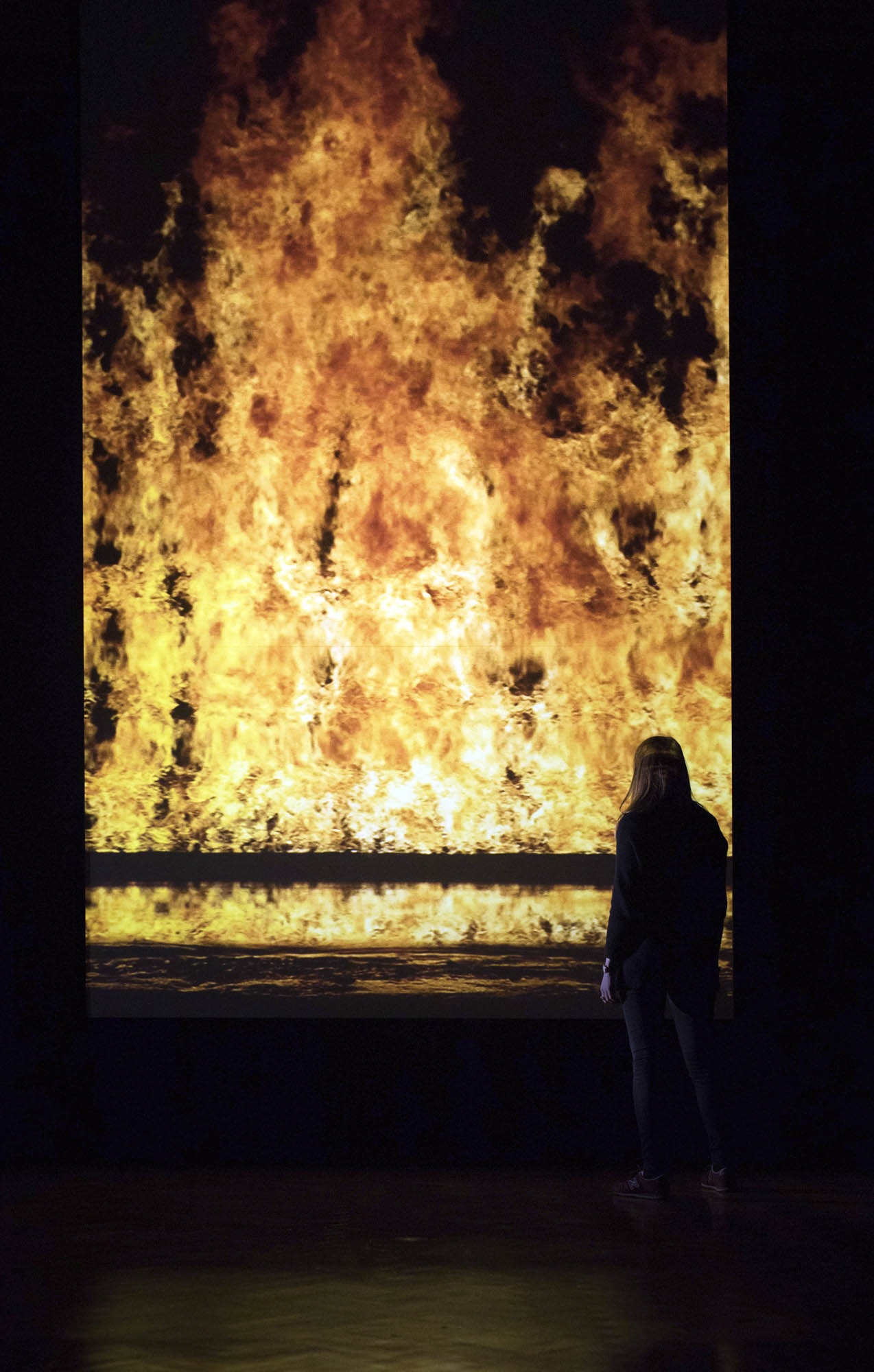
 

Installation view of the exhibition 'Bill Viola/Michelangelo: Life, Death, Rebirth' at the Royal Academy of Arts, London showing Bill Viola's 'Fire Woman' 2005 (still)


Installation view of the exhibition Bill Viola/Michelangelo: Life, Death, Rebirth at the Royal Academy of Arts, London showing Bill Viola’s Fire Woman 2005 (still). Exhibition organised by the Royal Academy of Arts, London in partnership with Royal Collection Trust and with the collaboration of Bill Viola Studio. David Parry / © Royal Academy of Arts


Installation view of the exhibition 'Bill Viola/Michelangelo: Life, Death, Rebirth' at the Royal Academy of Arts, London showing Bill Viola's 'The Veiling', 1995


Installation view of the exhibition Bill Viola/Michelangelo: Life, Death, Rebirth at the Royal Academy of Arts, London showing Bill Viola’s The Veiling, 1995. Exhibition organised by the Royal Academy of Arts, London in partnership with Royal Collection Trust and with the collaboration of Bill Viola Studio. David Parry / © Royal Academy of Arts


Installation view of the exhibition 'Bill Viola/Michelangelo: Life, Death, Rebirth' at the Royal Academy of Arts, London showing Bill Viola's 'Five Angels for the Millenium', 2001


Installation view of the exhibition Bill Viola/Michelangelo: Life, Death, Rebirth at the Royal Academy of Arts, London showing Bill Viola’s Five Angels for the Millenium, 2001. Exhibition organised by the Royal Academy of Arts, London in partnership with Royal Collection Trust and with the collaboration of Bill Viola Studio. David Parry / © Royal Academy of Arts


Bill Viola (American, 1951-2024) “Departing Angel”, from Five Angels for the Millennium 2001 (excerpt)
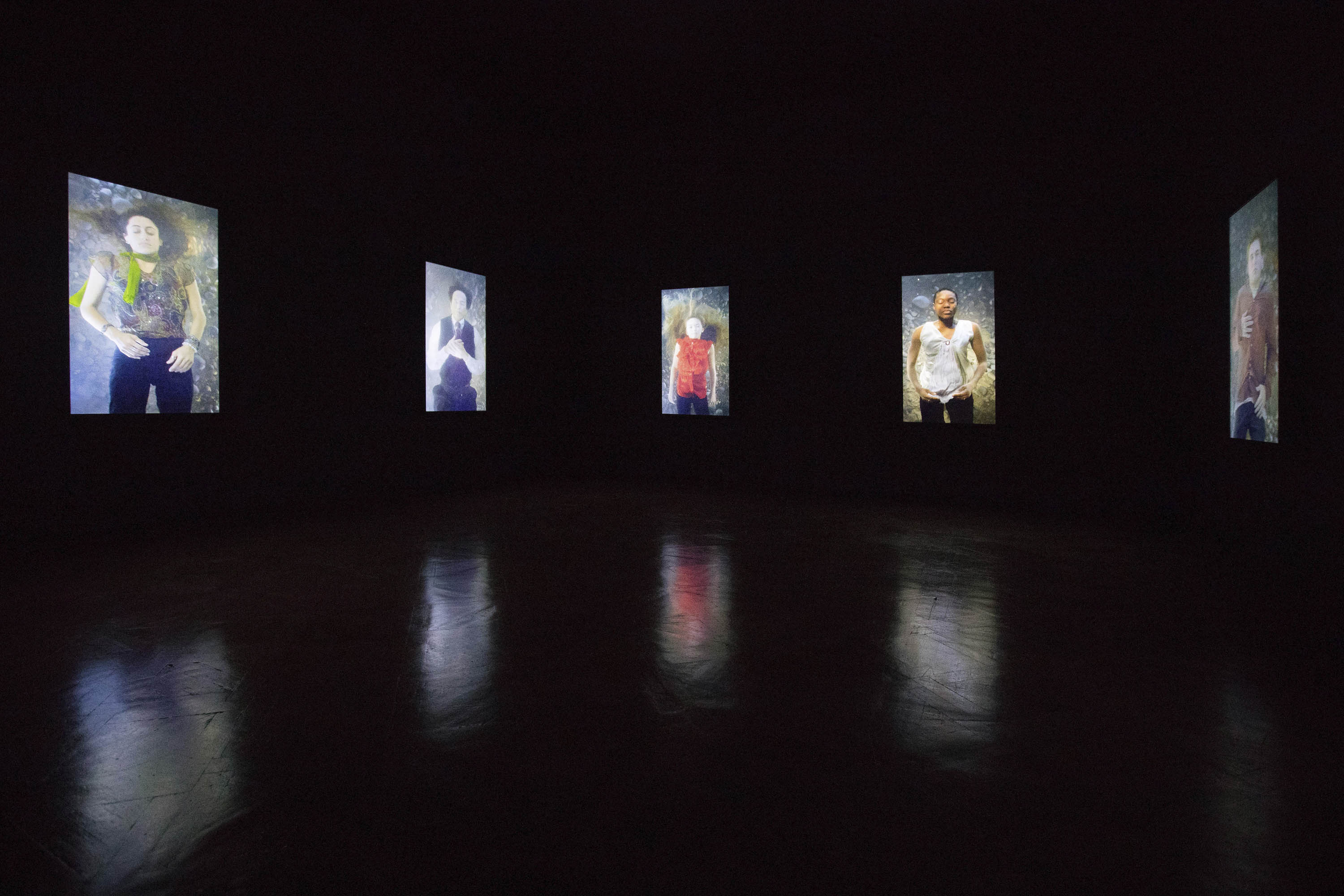
 

Installation view of the exhibition 'Bill Viola/Michelangelo: Life, Death, Rebirth' at the Royal Academy of Arts, London showing Bill Viola's 'The Dreamers', 2013

Installation view of the exhibition 'Bill Viola/Michelangelo: Life, Death, Rebirth' at the Royal Academy of Arts, London showing Bill Viola's 'The Dreamers', 2013


Installation views of the exhibition Bill Viola/Michelangelo: Life, Death, Rebirth at the Royal Academy of Arts, London showing Bill Viola’s The Dreamers, 2013. Exhibition organised by the Royal Academy of Arts, London in partnership with Royal Collection Trust and with the collaboration of Bill Viola Studio. David Parry / © Royal Academy of Arts


Bill Viola (American, 1951-2024) The Dreamers (2013) consists of seven individual screens, which depict underwater portraits of people who appear to be sleeping. Accompanied by the gentle sounds of water, the viewer is led to feel as if they themselves are submerged with these figures. In this spiritual, immersive subterranean environment, ultimate interpretation is left for the viewer to define, through the lens of their own experiences. (excerpt)


Bill Viola (American, 1951-2024) The Dreamers (excerpt)


Installation view of the exhibition 'Bill Viola/Michelangelo: Life, Death, Rebirth' at the Royal Academy of Arts, London showing Bill Viola's 'Man Searching for Immortality/Woman Searching for Eternity', 2013


Installation view of the exhibition Bill Viola/Michelangelo: Life, Death, Rebirth at the Royal Academy of Arts, London showing Bill Viola’s Man Searching for Immortality/Woman Searching for Eternity, 2013. Exhibition organised by the Royal Academy of Arts, London in partnership with Royal Collection Trust and with the collaboration of Bill Viola Studio. David Parry / © Royal Academy of Arts


Bill Viola (American, 1951-2024) Man Searching for Immortality/Woman Searching for Eternity, 2013 (excerpt)


Installation view of the exhibition 'Bill Viola/Michelangelo: Life, Death, Rebirth' at the Royal Academy of Arts, London showing Bill Viola's 'The Sleep of Reason', 1988


Installation view of the exhibition Bill Viola/Michelangelo: Life, Death, Rebirth at the Royal Academy of Arts, London showing Bill Viola’s The Sleep of Reason, 1988. Exhibition organised by the Royal Academy of Arts, London in partnership with Royal Collection Trust and with the collaboration of Bill Viola Studio. David Parry / © Royal Academy of Arts
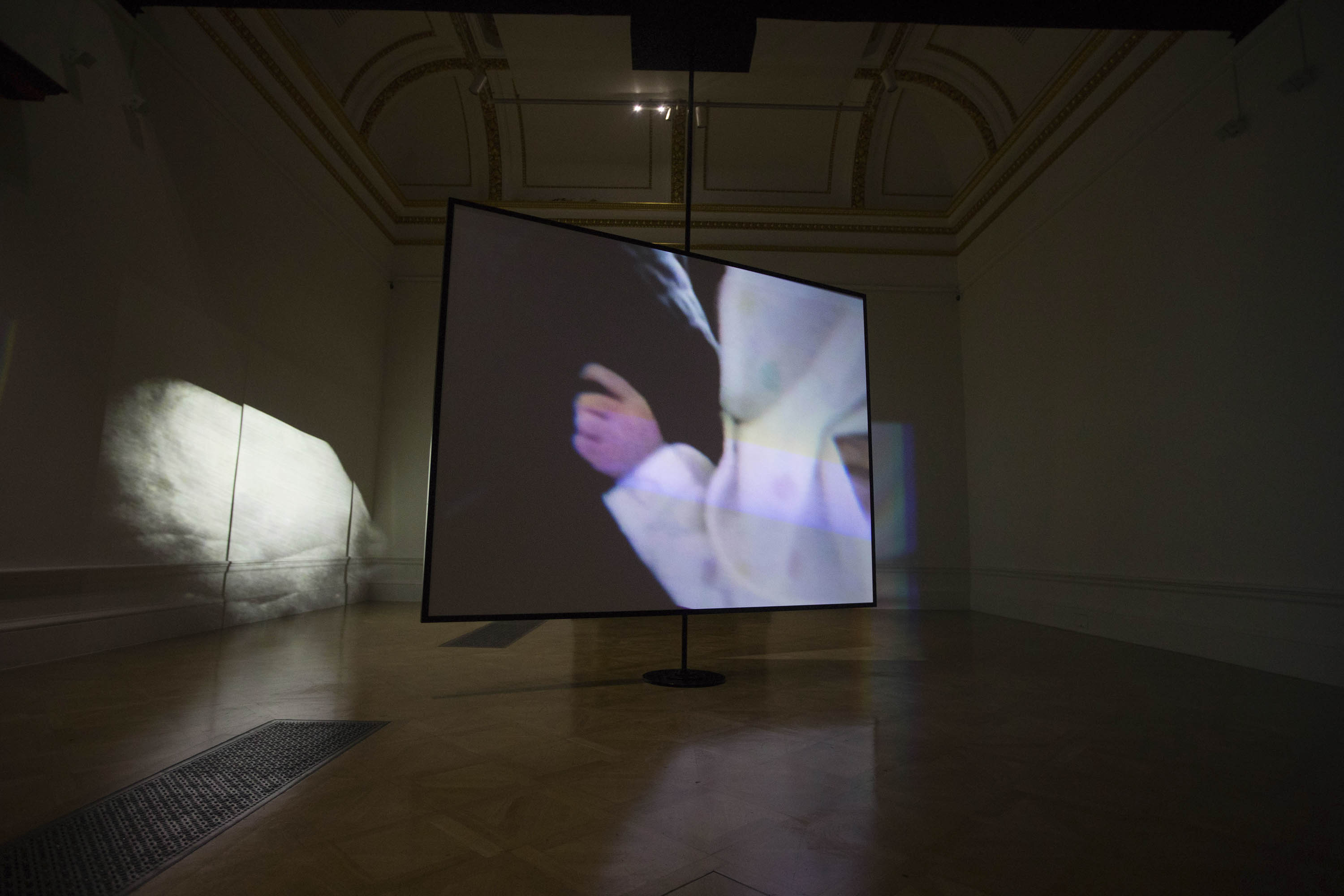
 

Installation view of the exhibition 'Bill Viola/Michelangelo: Life, Death, Rebirth' at the Royal Academy of Arts, London showing Bill Viola's 'Slowly Turning Narrative', 1992


Installation view of the exhibition Bill Viola/Michelangelo: Life, Death, Rebirth at the Royal Academy of Arts, London showing Bill Viola’s Slowly Turning Narrative, 1992. Exhibition organised by the Royal Academy of Arts, London in partnership with Royal Collection Trust and with the collaboration of Bill Viola Studio. David Parry / © Royal Academy of Arts


Bill Viola (American, 1951-2024) The Messenger 1996 (excerpt)


Installation view of the exhibition 'Bill Viola/Michelangelo: Life, Death, Rebirth' at the Royal Academy of Arts, London showing Bill Viola's 'The Messenger', 1996

Installation view of the exhibition 'Bill Viola/Michelangelo: Life, Death, Rebirth' at the Royal Academy of Arts, London showing Bill Viola's 'The Messenger', 1996


Installation views of the exhibition Bill Viola/Michelangelo: Life, Death, Rebirth at the Royal Academy of Arts, London showing Bill Viola’s The Messenger, 1996. Exhibition organised by the Royal Academy of Arts, London in partnership with Royal Collection Trust and with the collaboration of Bill Viola Studio. David Parry / © Royal Academy of Arts


Royal Academy of Arts
Burlington House, Piccadilly,
London, W1J 0BD

Opening hours:
Daily 10am – 6pm
Friday 10am – 10pm
Royal Academy of Arts website

LIKE ART BLART ON FACEBOOK

Back to top

Exhibition: ‘Photo-Poetics: An Anthology’ at the Solomon R. Guggenheim Museum, New York

Exhibition dates: 20th November 2015 – 23rd March 2016


Photo-Poetics image


My apologies, I am feeling very poorly at the moment, so just a small comment on this exhibition.

After the trilogy of 19th century photography, now for something completely different… two consecutive postings on contemporary photography.

In this art, the photograph becomes a conceptual “speech” act, where the artists speak with photographs, working with the context of the image – the image as concept, as talk.

It’s not just that the artists make photographic objects, they push what the medium can do. As the press release observes, “Theirs is a sort of “photo poetics,” an art that self-consciously investigates the laws of photography and the nature of photographic representation, reproduction, and the photographic object.” It is art that requires contemplation and meditation on source by Self. I have included several videos and extra text to illuminate aspects of the work in the posting.

I like the intertextuality that the artists employ when pushing the boundaries of photographic practice and representation, particularly Claudia Angelmaier’s series Works on Paper (2008-) and Lisa Oppenheim’s series The Sun is Always Setting Somewhere Else (2006).

Dr Marcus Bunyan


Many thankx to the Solomon R. Guggenheim Museum for allowing me to publish the photographs in the posting. Please click on the photographs for a larger version of the image.


99 SECONDS OF: PHOTO-POETICS: An Anthology / Guggenheim New York


The exhibition and its accompanying catalogue examine an important new development in contemporary photography, offering an opportunity to define the concerns of a younger generation of artists and contextualise their work within the history of art and visual culture. Drawing on the legacies of Conceptualism, these artists pursue a largely studio-based approach to still-life photography that centres on the representation of objects, often printed matter such as books, magazines, and record covers. The result is an image imbued with poetic and evocative personal significance – a sort of displaced self-portraiture – that resonates with larger cultural and historical meanings. Driven by a profound engagement with the medium of photography, these artists investigate the nature, traditions, and magic of photography at a moment characterised by rapid digital transformation. They attempt to rematerialise the photograph through meticulous printing, using film and other disappearing photo technologies, and creating artist’s books, installations, and photo-sculptures. While they are invested in exploring the processes, supports, and techniques of photography, they are also deeply interested in how photographic images circulate. Theirs is a sort of “photo poetics,” an art that self-consciously investigates the laws of photography and the nature of photographic representation, reproduction, and the photographic object.

Text from the exhibition web page.


Anne Collier (American, b. 1970) 'Crying' 2005


Anne Collier (American, b. 1970)
Crying
2005
Chromogenic print
99.1 x 134cm
Solomon R. Guggenheim Museum, New York
Purchased with funds contributed by Mr. and Mrs. Aaron M. Tighe
© Anne Collier


Collier’s photographs offer a straightforward presentation of found images and printed ephemera, and explore themes of appropriation, iconography, and surrogacy… Though implicitly layered with feminist critiques of mass media, Collier’s images of famous women – especially those of other artists, like Cindy Sherman, for example – can also be interpreted as oblique self-portraits.

Text from the Guggenheim artist’s web page


“Ephemera and mediation are at the quiet center of Collier’s Crying, one of her works in the exhibition. Seen from across the room, “Crying” looks like a photograph overlaid upon a painted surface, or perhaps a portrait integrated within a two-dimensional space. The image, indeed a photo, is divided horizontally; the upper two-thirds are white, the bottom third is black, and on the left-hand side there is a small square close-up of a distraught woman crying. The woman is Ingrid Bergman, and this is the cover of the LP that accompanied her 1943 film For Whom the Bell Tolls. The LP is upright, facing the viewer dead-on, and up close we can see that there are a number of records behind it and that the flat spaces above and below are actually a white wall and black floor. The work is in no way overwhelming; there is nothing bombastic about it. Rather, the thrill of it comes from the reading it requires. Collier deploys her references strategically – this brings to mind abstract painting, Bas Jan Ader’s I’m Too Sad to Tell You, Bergman’s films and unconventional life, and the joy of the collector in the record store. Should that not be enough, it also awakens the empathy centers that begin firing when we see someone cry. Crying is part of a series involving records – others are of The Smiths and Sylvia Plath – but it contains the tensions within all of her work: advertising and fine art, nostalgia and distance, the camera and the eye. Collier has said she is interested in photographing objects that have “had previous lives… been handed and used,” and these rely on a kind of slow intertextuality; the gradual unfolding of meaning and feeling working towards a dizzying remove. It’s disorienting and evocative, a poetics in which the camera is not just the set-up but the punchline, and all the previous lives can be felt lurking beneath the surface.”

Anonymous text from “Woman with Camera: Anne Collier’s Feminist Image Critique,” on the Deutsche Bank ArtMag 88 website Nd [Online] Cited 13/03/2016. No longer available online


Moyra Davey (American, b. 1958) 'Les Goddesses' 2011


Moyra Davey (American, b. 1958)
Les Goddesses (still)
2011
HD colour video, with sound, 61 min.
Courtesy the artist and Murray Guy, New York
© Moyra Davey


In the mid-2000s, the moving image took on a renewed prominence in Davey’s work. Inspired by her deep interest in the process of reading and writing, the artist’s essayistic video practice layers personal narrative with detailed explorations of the texts and lives of authors and thinkers she admires, such as Walter Benjamin, Jean Genet, and Mary Wollstonecraft. Davey’s own writing is central to her videos. The transcript of Fifty Minutes (2006), in which the artist reflects on her years in psychoanalysis, was published as a personal essay in the artist book Long Life Cool White: Photographs and Essays by Moyra Davey (2008), and her text “The Wet and the Dry” formed the basis of the narration of Les Goddesses (2011).

Text from the Guggenheim artist’s web page


Erin Shirreff (Canadian, b. 1975) 'UN 2010' 2010


Erin Shirreff (Canadian, b. 1975)
UN 2010 (still)
2010
HD color video, silent, 17 min.
Solomon R. Guggenheim Museum, New York
Purchased with funds contributed by Erica Gervais
© Erin Shirreff


Erin Shirreff (Canadian, b. 1975)
UN 2010 (excerpt)
2010
HD color video, silent, 17 min.
Solomon R. Guggenheim Museum, New York
Purchased with funds contributed by Erica Gervais
© Erin Shirreff


Shirreff’s work in photography, video, and sculpture reflects on the distance between an object and its representation, exploring the capacities of photography in conveying a sculptural experience.

Since scale and presence were central concerns of much mid-century abstract sculpture, Shirreff often draws on images of such works as she explores the disjunction between photographs and their subjects. Sculpture Park (Tony Smith) (2006), Shirreff’s first video work, features small cardboard maquettes the artist made of five Tony Smith sculptures. Filmed against a black background, their dark forms become discernible only as “snow” (Styrofoam) slowly accumulates on their surfaces. For subsequent video works, including Ansel Adams, RCA Building, circa 1940 (2009), Roden Crater (2009), and UN 2010 (2010), Shirreff photographed printed pictures of her subjects – often landscapes or iconic modernist buildings – under varying lighting conditions in the studio, inputting the resultant images into video editing software. These videos appear at first to be long, static shots of the subjects pictured, but eventually belie their own artifice as the viewer becomes gradually aware of the texture of the image surface.

Text from the Guggenheim artist’s web page


Lisa Oppenheim (American, b. 1975) 'The Sun is Always Setting Somewhere Else' 2006 (detail)


Lisa Oppenheim (American, b. 1975)
The Sun is Always Setting Somewhere Else (detail)
2006
Slide projection of fifteen 35 mm slides, continuous loop, dimensions variable
Solomon R. Guggenheim Museum, New York
Purchased with funds contributed by the Photography Committee


Oppenheim’s work explores the interactions between an image, its source, and the context in which it is encountered. The Sun is Always Setting Somewhere Else (2006) originates from photographs of the setting sun taken by U.S. soldiers in Iraq, which Oppenheim found on the image-sharing website Flickr. Holding each photograph at arm’s length in such a way that it aligns with the horizon of the setting sun in the artist’s native New York, the artist reshot the images as the sun set within the frame. Presented as a 35 mm slide show, the significance of seemingly quotidian sunsets shifts with the knowledge of who captured them and where.

Text from the Guggenheim artist’s web page


Guggenheim Examines New Developments in Contemporary Photography with Photo-Poetics: An Anthology

The Solomon R. Guggenheim Museum presents Photo-Poetics: An Anthology, an exhibition documenting recent developments in contemporary photography and consisting of photographs, videos, and slide installations by ten international artists. With more than 70 works by Claudia Angelmaier, Erica Baum, Anne Collier, Moyra Davey, Leslie Hewitt, Elad Lassry, Lisa Oppenheim, Erin Shirreff, Kathrin Sonntag, and Sara VanDerBeek, the exhibition runs from November 20, 2015 – March 23, 2016, and presents a focused study into the nature, traditions, and magic of photography in the context of the rapid digital transformation of the medium.

Organised by Jennifer Blessing, Senior Curator, Photography, with Susan Thompson, Assistant Curator, Solomon R. Guggenheim Museum, Photo-Poetics: An Anthology offers an opportunity to define the concerns of a new generation of photographic artists and contextualise their work within the history of art and visual culture. These artists mainly pursue a studio-based approach to still-life photography that centres on the representation of objects, often printed matter such as books, magazines, and record covers. The result is often an image imbued with poetic and evocative personal significance that resonates with larger cultural and historical meanings.

The artists in the exhibition attempt to rematerialise the photograph through meticulous printing, using film and other disappearing photo technologies. Drawing on the legacies of Conceptualism and invested in exploring the processes and techniques of photography, they are also deeply interested in how photographic images circulate. Theirs is a sort of “photo poetics,” an art that self-consciously investigates the laws of photography and the nature of photographic representation, reproduction, and the photographic object. The works in the exhibition, rich with detail, reward close and prolonged regard; they ask for a mode of looking that is closer to reading than the cursory scanning fostered by the clicking and swiping functionalities of smartphones and social media. Both the exhibition and its accompanying catalogue are conceived as anthologies, as independent vehicles to introduce each artist’s important and unique practice. #photopoetics

Press release from the Solomon R. Guggenheim Museum


Sara VanDerBeek (American, b. 1976) 'From the Means of Reproduction' 2007


Sara VanDerBeek (American, b. 1976)
From the Means of Reproduction
2007
Chromogenic print
101.6 x 76.2cm
Solomon R. Guggenheim Museum, New York
Purchased with funds contributed by the Photography Committee
© Sara VanDerBeek


VanDerBeek’s photographs utilise a variety of formal strategies and references yet remain consistently engaged with issues of memory and the experience of time and space.

VanDerBeek first became known in the mid-2000s for photographs featuring her own makeshift sculptural configurations in which appropriated photos were combined into collages that resounded with personal and political meaning. Constructed in the studio out of found images and pieces of wood, metal, and string, these works, such as From the Means of Reproduction (2007) and Calder and Julia (2006), were created solely for the camera and were disassembled after being photographed.

Text from the Guggenheim artist’s web page


Kathrin Sonntag (German, b. 1981) 'Mittnacht' 2008 (detail)


Kathrin Sonntag (German, b. 1981)
Mittnacht (detail)
2008
Slide projection of eighty one 35 mm slides, continuous loop, dimensions variable
Solomon R. Guggenheim Museum, New York
Purchased with funds contributed by the Photography Committee and Manuel de Santaren
© Kathrin Sonntag


Kathrin Sonntag (German, b. 1981) 'Mittnacht' 2008 (detail)


Kathrin Sonntag (German, b. 1981)
Mittnacht (detail)
2008
Slide projection of eighty one 35 mm slides, continuous loop, dimensions variable
Solomon R. Guggenheim Museum, New York
Purchased with funds contributed by the Photography Committee and Manuel de Santaren
© Kathrin Sonntag


Encompassing sculpture, photography, film, and drawing, Sonntag’s work offers a complex analysis of the nature of objects and the division between fiction and reality. Using stools, tripods, tables, and mirrors to create unusual perspectives, her installations strip meaning from readily identifiable objects via photographic experiments within the confines of her studio. Mittnacht (2008) comprises eighty-one slides of found images of paranormal phenomena photographed among the artist’s studio tools and furniture. The supernatural elements are enhanced by their disorienting placement within the studio, which both creates illusions and allows errors and smudges in processing to cast an eerie shadow on certain images in the series.

Text from the Guggenheim artist’s web page


Claudia Angelmaier (German, b. 1972) 'Betty' 2008


Claudia Angelmaier (German, b. 1972)
Betty
2008
Chromogenic print, face-mounted to acrylic
130 x 100cm
Solomon R. Guggenheim Museum, New York
Purchased with funds contributed by the Photography Committee with additional funds contributed by Mr. and Mrs. Aaron M. Tighe, and Rona and Jeffrey Citrin
© Claudia Angelmaier


Taking art historical masterpieces – and, by extension, art history itself – as her referents, Angelmaier traces the photographic representation of artworks across the pages of textbooks, classroom slides, coffee table monographs, and postcards. Cognisant that major artworks are most often encountered via reproduction rather than in person, she highlights the analogue media that have facilitated the circulation of such images for many decades…

The larger scope of Angelmaier’s concerns is particularly evident in the series Works on Paper (2008- ). Here, the artist photographs the backlit versos of postcards from museum gift shops. The artwork pictured on a card’s front appears muted yet faintly discernible, while the caption information and museum insignia on the back remain fully legible. By foregrounding the text, logos, and barcodes, Angelmaier not only examines the material realities of the postcard, but the social and economic systems both the souvenir and the work it depicts inhabit.

Text from the Guggenheim artist’s web page


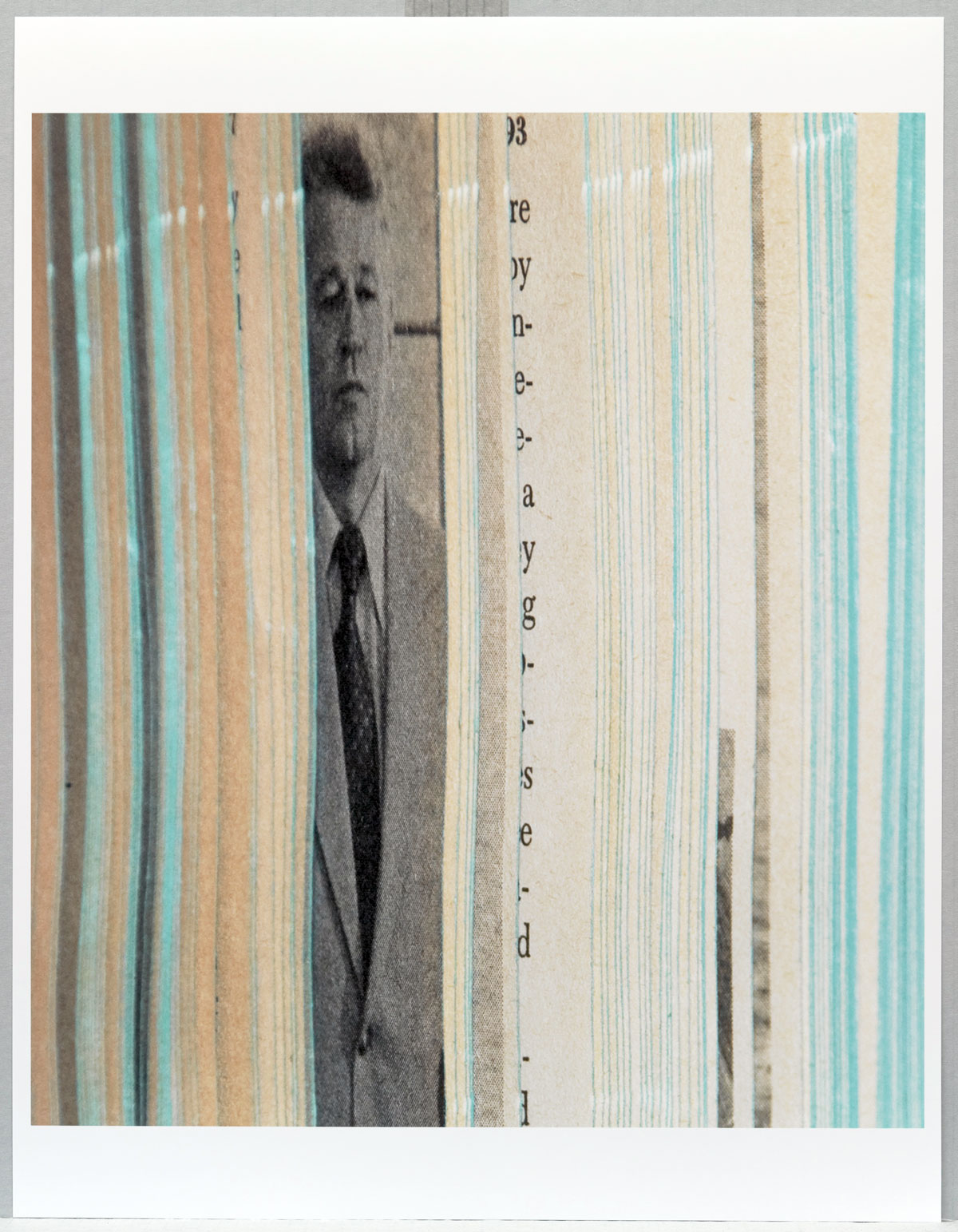
Erica Baum (American, b. 1961) 'Jaws' (from the series 'Naked Eye'), 2008


Erica Baum (American, b. 1961)
Jaws (from the series Naked Eye)
2008
Inkjet print
47 x 41.6cm
Solomon R. Guggenheim Museum, New York
Purchased with funds contributed by Mr. and Mrs. Aaron M. Tighe
© Erica Baum


Baum takes the printed page as her primary subject, photographing fragments of found language at close range. Commingling image and text, her works often operate simultaneously as both photograph and poem… For the Naked Eye series (2008- ), Baum directs her camera into the partially opened pages of stipple-edged paperbacks from the 1960s and ’70s, capturing slivers of image and text separated by the vertical striations of adjacent pages’ brightly dyed edges. Although the compositions are each the result of a single, unaltered photograph, they operate visually as collages and veer toward abstraction.

Text from the Guggenheim artist’s web page


Elad Lassry (Israeli-American, b. 1977) 'Bengal' 2011


Elad Lassry (Israeli-American, b. 1977)
Bengal
2011
Chromogenic print in painted frame
36.8 x 29.2 x 3.8cm
A.P. 1/2, edition of 5
Solomon R. Guggenheim Museum, New York, Purchased with funds contributed by the Photography Committee
© Elad Lassry. Photo: Kristopher McKay © Solomon R. Guggenheim Foundation


Elad Lassry (Israeli-American, b. 1977) 'Untitled (Woman, Blond)' 2013


Elad Lassry (Israeli-American, b. 1977)
Untitled (Woman, Blond)
2013
Chromogenic print in walnut frame with four-ply silk
36.8 x 29.2 x 3.8cm
Solomon R. Guggenheim Museum, New York
Purchased with funds contributed by the Photography Committee
© Elad Lassry


Lassry positions his photographic works as “pictures,” entities that operate simultaneously as both objects and images. In doing so, he shifts their relationship to the viewer, inviting a broader examination of how photographs are seen and understood.

Lassry regularly presents his photographs in lacquered frames that match the colours of his bright, saturated images, or in warm walnut frames in the case of his work in black and white. The artist used this approach as early as 2008, in works such as Wolf (Blue) (2008). The continuity between frame and photo, heightened by the absence of matting, highlights the physicality of the picture without disrupting the illusion of depth in the photographic image. Lassry’s pictures derive from his own studio-based photographs as well as appropriated imagery. In both cases, the images reference the language of advertising and stock photography – and the attendant notions of desire therein. However, the would-be product is either obscured or excluded, removing the sense of purpose that drives such imagery. The artist sometimes employs techniques such as double exposure, blurring, superimposition, or collage that create an unsettling instability within his pictures. In more recent works, Lassry has incorporated sculptural elements, most often silk valances that cover significant sections of the image, as in Untitled (Woman, Blond) (2013), or looping coloured wires that penetrate it, as in Untitled (Dolphins, Two) (2014).

Text from the Guggenheim artist’s web page


Leslie Hewitt (American, b. 1977) 'Riffs on Real Time (3 of 10)', 2006-2009


Leslie Hewitt (American, b. 1977)
Riffs on Real Time (3 of 10)
2006-09
Chromogenic print
76.2 x 61cm
Solomon R. Guggenheim Museum, New York
Purchased with funds contributed by the Photography Committee


Commingling photography and sculpture, Hewitt’s works often present arrangements of personally and politically charged materials – including historically significant books and magazines from the 1960s and ’70s as well as family photos (not necessarily her own) – that conjure associative meaning through juxtaposition.

In Hewitt’s series Riffs on Real Time (2006-2009), snapshots lay atop appropriated printed matter shot against a wood floor or carpet so that the contrasting textures of these layered materials build up and outward toward the viewer. In Hewitt’s various photo-sculptural series, the photographs begin to pointedly inhabit the space of the viewer. Positioned on the floor, their frames lean against the gallery walls, asserting their own materiality and calling attention to the space of the gallery.

Text from the Guggenheim artist’s web page


Solomon R. Guggenheim Museum
1071 5th Avenue (at 89th Street)
New York

Opening hours:
Sunday – Friday 11am – 6pm
Saturday 11am – 8pm

Solomon R. Guggenheim Museum website

LIKE ART BLART ON FACEBOOK

Back to top

Exhibition: ‘Lorna Simpson’ at Jeu de Paume, Paris

Exhibition dates: 28th May – 1st September 2013


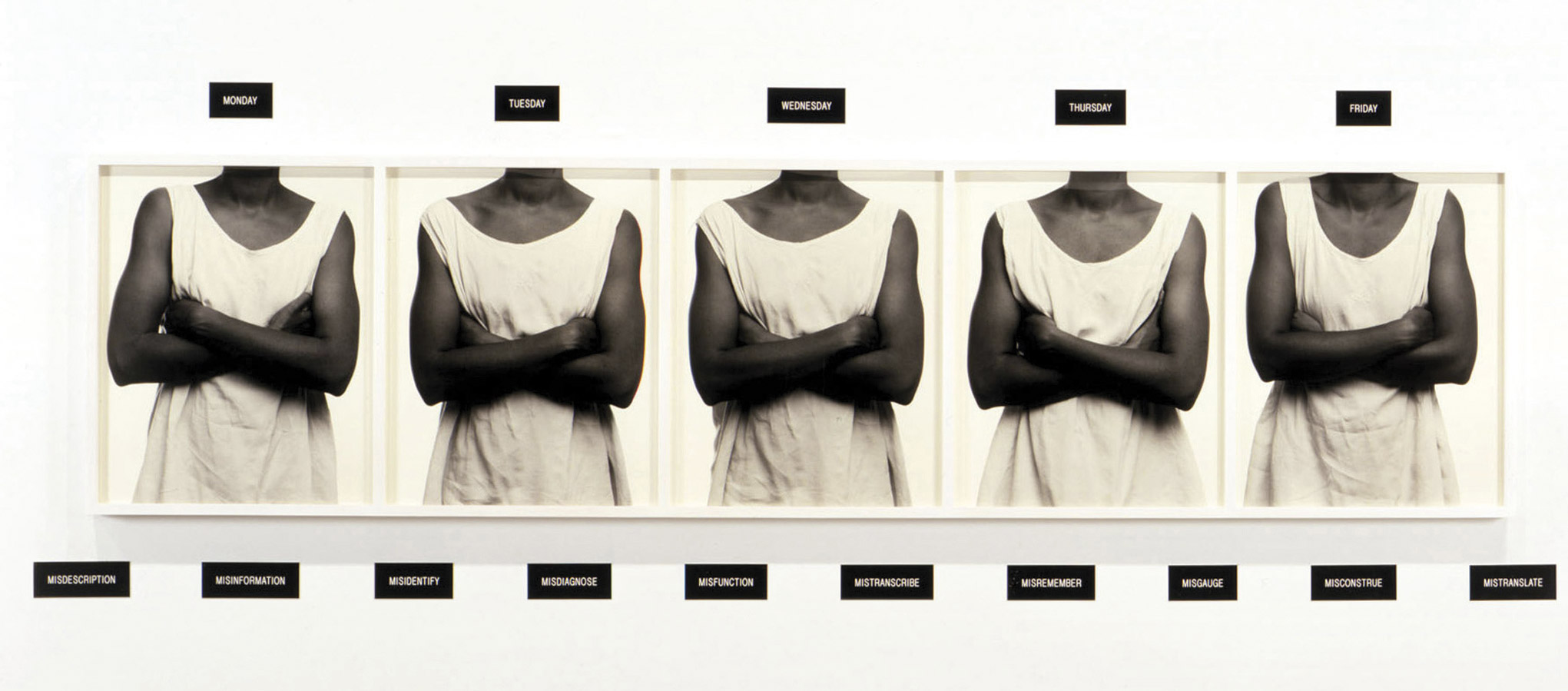
Lorna Simpson (American, b. 1960) 'Five Day Forecast (Prévisions à cinq jours)' 1988


Lorna Simpson (American, b. 1960)
Five Day Forecast (Prévisions à cinq jours)
1988
5 gelatin silver prints in a frame, 15 plates engraved plastic
24 1/2 x 97 in (62.2 x 246.4cm) overall
Lillian and Billy Mauer Collection
© Lorna Simpson


A fascinating practice!

Identity, memory, gender, representation, the body, the subject, felt, text, images, video, gesture, reenactment, concept and performance, all woven together seamlessly like a good wig made of human hair…

Dr Marcus Bunyan


Many thankx to Jeu de Paume for allowing me to publish the photographs in the posting. Please click on the photographs for a larger version of the image.


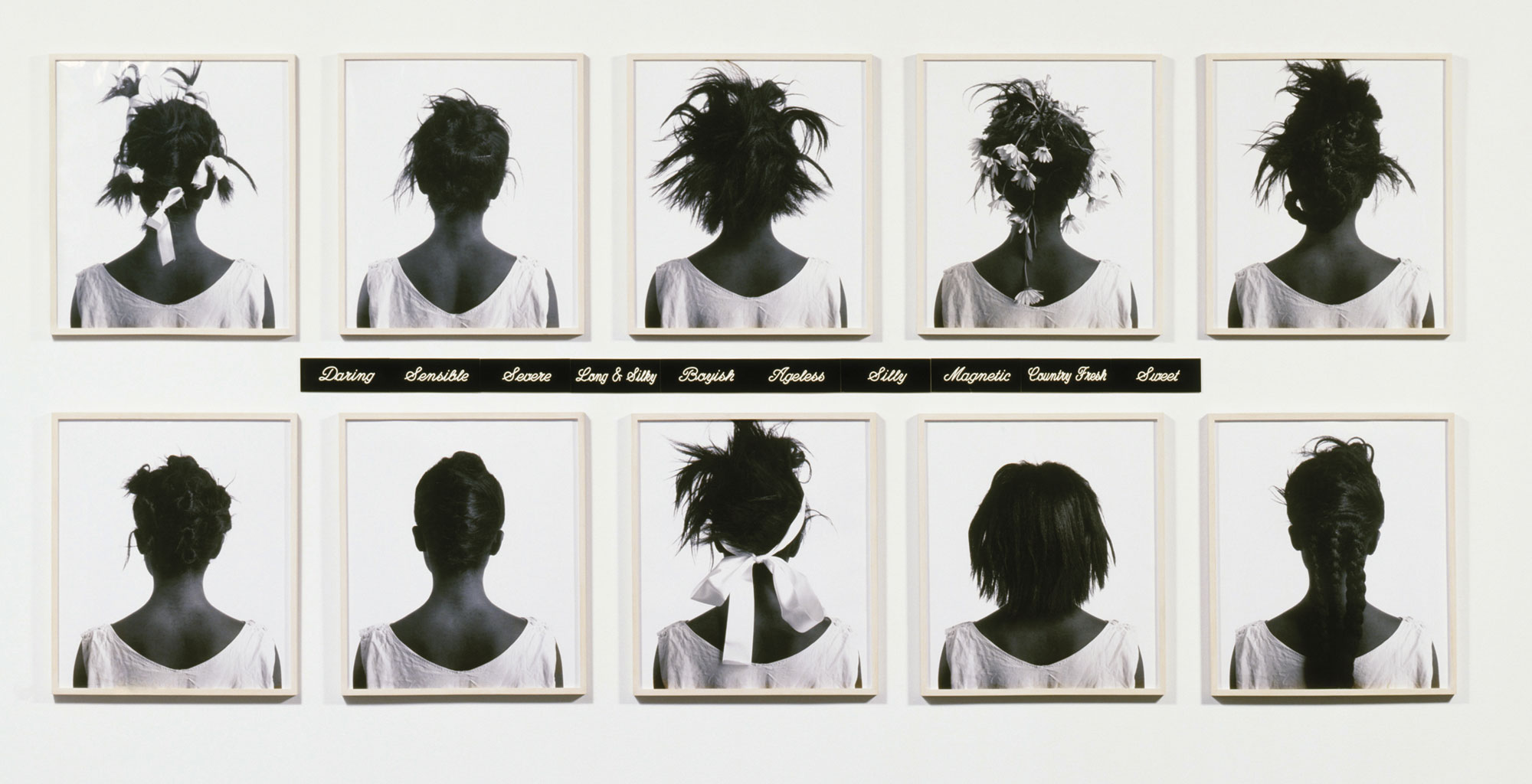
Lorna Simpson (American, b. 1960) 'Stereo Styles (Styles stéréo)' 1988


Lorna Simpson (American, b. 1960)
Stereo Styles (Styles stéréo)
1988
10 dye-diffusion black-and-white Polaroid prints, 10 engraved plastic plaques
57 3/4 x 125 1/4 x 1 3/8 in (146.7 x 318.1 x 3.5cm) overall
Collection of Melva Bucksbaum and Raymond Learsy
© Lorna Simpson


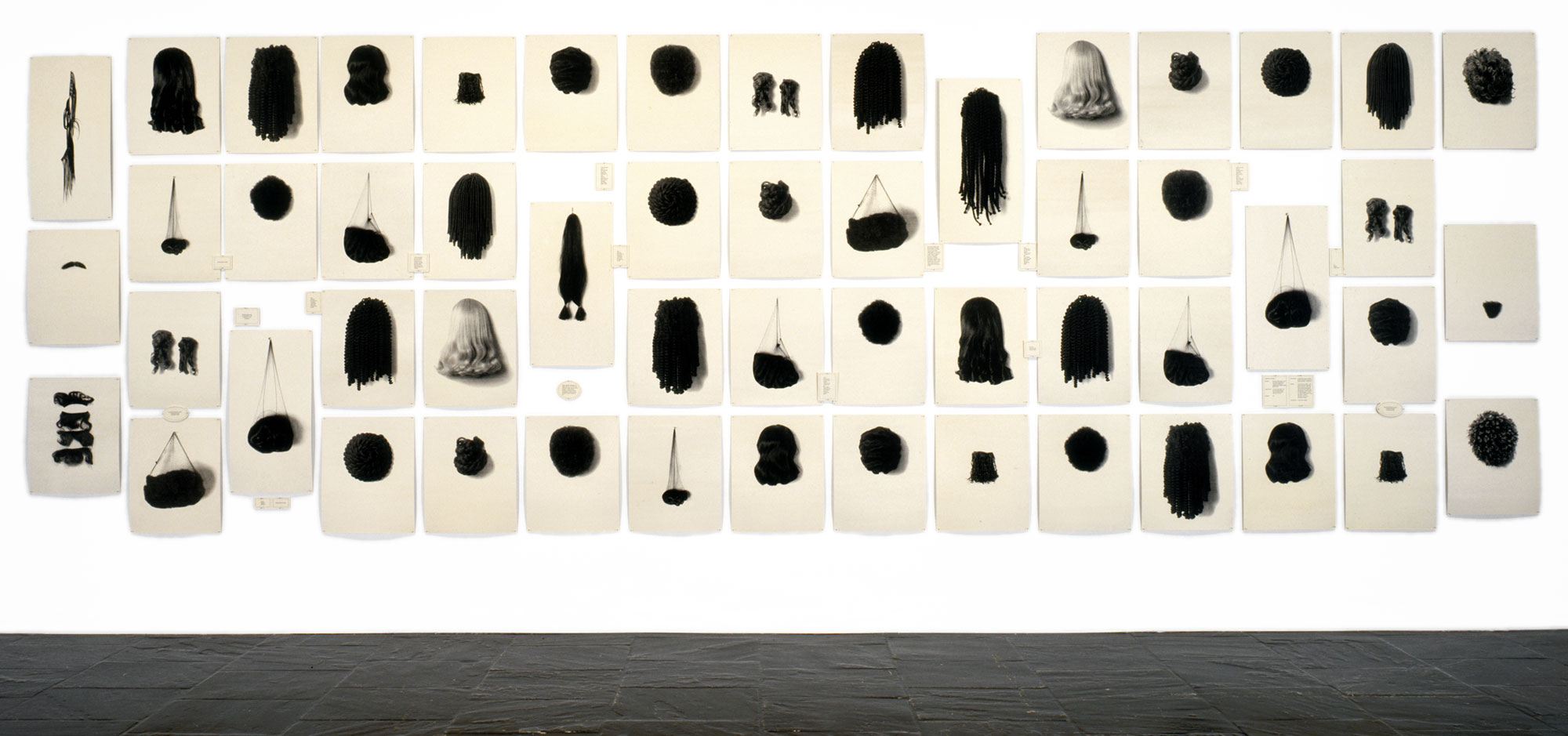
Lorna Simpson (American, b. 1960) 'Wigs II' 1994-2006


Lorna Simpson (American, b. 1960)
Wigs II
1994-2006
Serigraph on 71 felt panels (images and text)
98 x 265 in (248.9 x 673.1cm) overall
Courtesy the artist; Salon 94, New York; and Galerie Nathalie Obadia, Paris/Brussels
© Lorna Simpson


Lorna Simpson surprised her audiences in 1994 when she began to print her photographs on felt, inspired by its materiality after seeing an exhibition of the sculpture of Joseph Beuys in Paris “where the piano and walls were covered for a beautiful installation.” Simpson questioned whether the medium might be appropriate in a far different way for her work given the perspective afforded her by the passage of time. With the felt pieces, Simpson turned away from photography’s traditional paper support, magnified the already larger-than-life-size of the images within her large photo-text pieces to extremely large-scale multi-part works, and, most critically, absented the figure, in particular, the black woman in a white shift facing away from the camera for which she had received critical acclaim.

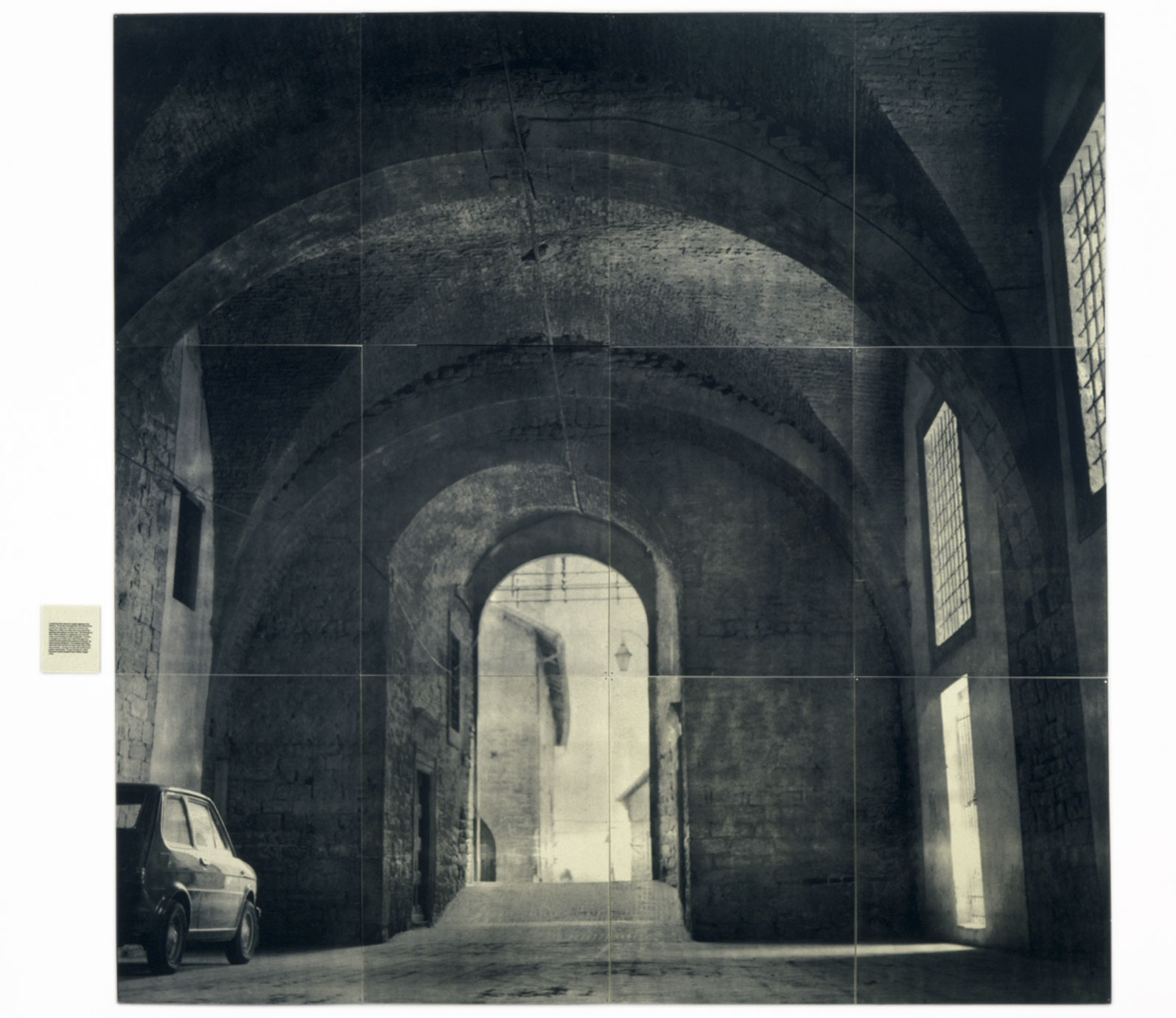
Ever-present, nevertheless, were her thematic concerns. The first felts offered surrogates for the body in a taxonomy of her own photographs of Wigs, with voicings “in and around gender,” and expanded upon the investigation of the role of coiffure in the construction of identity in Simpson’s photo-texts (such as Stereo Styles, Gallery 1). In the mid-1990s, such felts were succeeded by a series of photographs of interior and exterior scenes that were accompanied by long text passages printed on separate small felts. In these works the figure was replaced, as Okwui Enwezor wrote, “by the rumour of the body.”


Lorna Simpson (American, b. 1960) 'Please remind me of who I am' 2009 (detail)


Lorna Simpson (American, b. 1960)
Please remind me of who I am (detail)
2009
50 found photo booth portraits, 50 ink drawings on paper, 100 bronze elements
Overall installation dimensions variable
Collection of Isabelle and Charles Berkovic
© Lorna Simpson


For each multi-part photo-booth piece, Simpson sets in bronze frames these small inexpensive shots as well as her drawings of selected details of the photographs. Self-styled and performed, these photographs were used for a variety of purposes by their now anonymous sitters, ranging from sober, formal ID photos to glamorous, often theatrically playful mementos. Encompassing photo booth shots of different sizes from the 1920s to the 1970s (a few in colour), Simpson’s constellations of many images for each work offer a collective portrait of self-portraiture (Gather, 2009) and continue her ongoing explorations of identity and memory, explicitly phrased in the title of one of them: Please remind me of who I am (2009).


Lorna Simpson (American, b. 1960) 'Waterbearer [Porteuse d'eau]' 1986


Lorna Simpson (American, b. 1960)
Waterbearer (Porteuse d’eau)
1986
Gelatin silver print, vinyl letters
59 x 80 x 2 1/2 in (149.9 x 203.2 x 5.7cm) overall
Courtesy the artist; Salon 94, New York; and Galerie Nathalie Obadia, Paris / Brussels
© Lorna Simpson


Waterbearer shows a woman from the back, pouring water from an elegant silvery metallic pitcher in one hand and from an inexpensive plastic jug in the other, echoing art historical renderings of women at wells or in the domestic settings of Dutch still-life paintings. As if balancing the scales of justice, this figure also symbolically offers disjunctions of means and class. In the accompanying text, Simpson explicitly addresses memory and the agency of speakers: “She saw him disappear by the river, they asked her to tell what happened, only to discount her memory.”


For her first European retrospective, the Jeu de Paume presents thirty years of Lorna Simpson’s work. For this Afro-American artist, born in Brooklyn, New York, in 1960, the synthesis between image and text is profound and intimate. If one were to consider Lorna Simpson as a writer, the textual element of her works could have an autonomous life as prose poems, very short stories or fragments of scripts. And yet, her texts are inseparable from her images; there is a dynamic between the two that is both fragile and energising, which links them unfailingly. Lorna Simpson became known in the 1980s and 90s for her photographs and films that shook up the conventions of gender, identity, culture and memory.

Throughout her work, the artist tackles the complicated representation of the black body, using different media, while her texts add a significance that always remains open to the spectator’s imagination. In her recent work, Lorna Simpson has integrated archive images, which she reinvents by positioning herself in them as subject. As the artist underlines: “The theme I turn to most often is memory. But beyond this subject, the underlying thread is my relationship to text and ideas about representation.” (Lorna Simpson)

This retrospective reveals the continuity in her conceptual and performative research. In her works linking photography and text, as well as in her video installations, she integrates – while continually shaking them up – the genres of fixed and moving images, using them to ask questions about identity, history, reality and fiction. She introduces complexity through her use of photography and film, in her exploitation of found objects, in the processes she develops to take on the challenges she sets herself and to spectators.

The exhibition gathers her large format photo-texts of the mid 1980s, which brought her to the attention of the critics (Gestures / Reenactments, Waterbearer, Stereo Styles), her work in screenprints on felt panels since the 1990s (Wigs, The Car, The Staircase, Day Time, Day Time (gold), Chandelier), a group of drawings (Gold Headed, 2013), and also her “Photo Booths,” ensembles of found photos and drawings (Gather, Please remind me of who I am…). The exhibition is also an opportunity to discover her video installations: multivalent narratives that question the way in which experience is created and perceived more or less falsely (Cloudscape, 2004, Momentum, 2010), among them, Playing Chess, a new video installation made especially for the occasion.


About the exhibition

Joan Simon

In her critically acclaimed body of work spanning more than thirty years, Lorna Simpson questions identity and memory, gender and history, fact and fiction, playing eye and ear in tandem if not in synchrony to prompt consideration of how meaning is constructed. That she has often described herself as an observer and a listener informs an understanding of both her approach and her subjects. In her earliest black-and-white documentary street photographs (1978-1980), Simpson isolated gestures that bespoke an intimacy between those framed in her viewfinder, recording what was less a decisive moment than one of coming into relation. Some of these photographs seem to capture crossed glances, pauses in an ongoing conversation. Others are glimpses of occasions, transitional events identifiable by a white confirmation or wedding dress, which convey a sense of palpable silence in exchanges between people just out of earshot.

When Simpson began to stage her own photographs in 1985 and to write accompanying texts, she came in closer. She allowed us to see a carefully framed black body, abstracted in gesture and in white clothing, yet also permitted us to read seemingly overheard comments that redirected and recomplicated the view. While her images captured gestures, her narratives imbued these images frozen in a never-changing present with memory, a past. The title of her first photo-text work, made in 1985, and of the exhibition of that year in which it was first exhibited was Gestures / Reenactments, and one can argue that all Simpson’s work is built on the juxtaposition of gestures and reenactments, creating meaning in the resonant gap between the two. It is a gap that invites the viewer / reader to enter, all the while requiring an active reckoning with some inalienable truths: seeing is not necessarily believing, and what we might see is altered not only by our individual experiences and assumptions but also, critically, by what we might hear.

The exhibition

Whether for still or moving picture productions, Lorna Simpson (b. 1960) uses her camera as catalyst to question identity and gender, genres and history, race and class, fact and fiction, memory and meanings. Assumptions of photographic “truth” are challenged and qualified – indeed redirected – by the images she creates that are inseparable from the texts she writes to accompany them, by the soundings she chooses  for videos, or by her pairings of vintage photographs with newly made renderings. The Jeu de Paume presents lorna Simpson’s first large-scale exhibition in Europe beginning with her earliest photo-text pieces of the 1980s through her newest video installation, Chess, 2013, which makes its debut in Paris.

Works in the exhibition show the artist drawing on traditional photo techniques such as gelatin silver prints in an intimate synthesis with speakerly texts (Gallery 1). They also show Simpson’s creation of new combines, among them serigraphs on felt with writings and images invoking film noir (Gallery 2), a video installation of three projections based on historic photographs and her own prior still photos (Gallery 3), constellations of recuperated photo-booth photos with her drawings isolating details from them as well as vintage photographs together with those re-staged by the artist (Gallery 4), and a video focusing on performance as well as time itself and its reversal (Gallery 5).

The exhibition’s parcours [route] reveals turning points in Simpson’s oeuvre as well as thematic continuities. The earliest pieces in the show are Simpson’s performative proto-cinematic photo-texts, beginning with the 1985 Gestures/ Reeactments, a title literally evocative of the work’s visual / verbal aspect while also paradigmatically descriptive of what would be her conceptual practice for the next three decades. Simpson herself makes a rare appearance in her work in two related pieces in the show: the 2009 epic still photo work 1957-2009 (Gallery 4), for which the artist re-enacted scenes from vintage photos, and Chess, 2013, (Gallery 3), which features re-enactments of some of the same photos.

.
Gallery 1 introduces the artist’s signature, indeed iconic early images of the 1980s – a black figure in white clothing, face turned away from the camera or cropped out of the frame – accompanied by precisely crafted, allusive texts that recomplicate what is seen by what is heard in these voicings. The intention to deny a view of a face, as Simpson says, “was related to the idea that the one thing that people gravitate to in photography is the face and reading the expression and what that says about the person pictured, an emotional state, who they are, what they look like, deciphering and measuring. Who is being pictured, what is actually the subject? Photographing from the back was a way to get viewers’ attention as well as to consciously withdraw what they might expect to see.”

The performative photo-text works in Gallery 1 are Gestures / Reenactments, 1985 (created as part of her thesis project for her MFA at the University of California, San Diego), Waterbearer and Twenty Questions (A Sampler) (the first works that Simpson made when she moved to New York in 1986), as well as Five Day Forecast, 1988, and Stereo Styles, 1988. Beginning with Waterbearer, all of these except Gestures / Reenactments (which features a black male) show a black female in a white shift played by artist Alva Rogers, who was often mistaken for Simpson herself.

Gallery 2 marks important changes the artist made during the ’90s, most notably Simpson’s surprising shift to printing her photographs on felt and absenting the human figure. At first she used surrogates for the body, seen in the many and various wigs she photographed and which she accompanied with texts that continued to address ideas of identity and gender (Wigs, 1994-2006). She used photographs taken during her travels for the next series of felt works, which were interior and exterior scenes (The Car, 1995, The Rock, 1995, The Staircase, 1998) that in both imagery and texts invoked film noir. These works led almost inevitably to the start of Simpson’s film and video work in 1997. (Her earliest photo-texts will be recognised by the viewer as proto-cinematic with their multiple frames and conversational voices.)

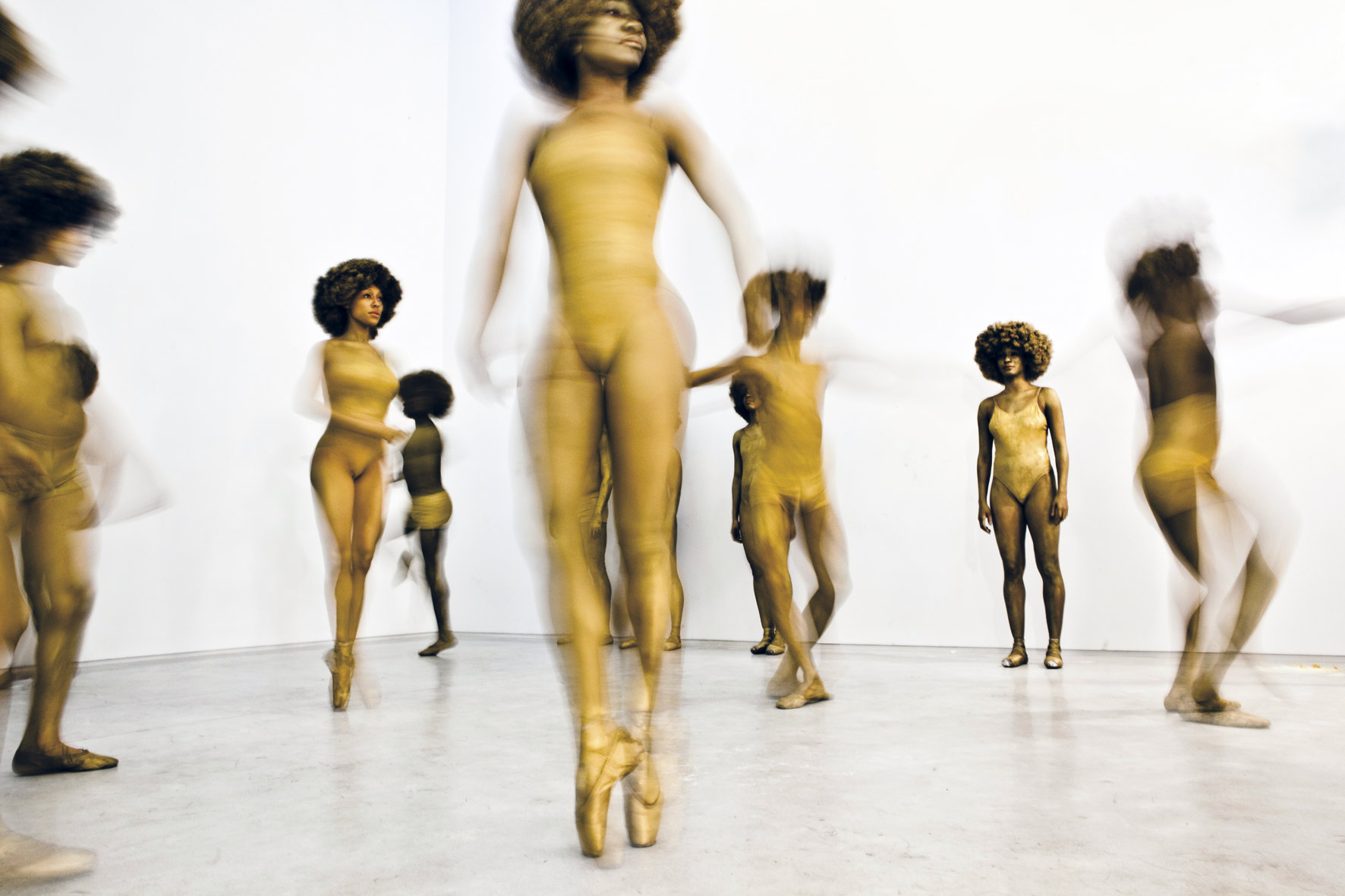
This gallery also reveals how Simpson continues to use her felt medium and returns to her own archive of images   as well as found objects. Three related works, though no longer using text, nevertheless “comment” on each other:  a video of a performance (Momentum, 2010) inspired by an early 1970s performance at Lincoln Center generated felt works based on vintage photographs of this famous New York theatre – Chandelier, 2011, Daytime, 2011, and Daytime (gold), 2011 – as well as the Gold Headed (2013) drawings, based on the dancers costumed head to foot in gold. Drawings are perhaps the least known medium in Simpson’s practice, and while they reveal the fluid gestures of her hand, visitors will recognise in these gold heads turned from the viewer an echo of the position of the figures  in Gallery 1.

Gallery 3 is devoted to Simpson’s newest video, Chess, 2013, which is based on historic photos as well as her own earlier photographic piece, 1957-2009 (Gallery 4), in which she restaged found vintage photographs. Chess and 1957-2009 mark the rare instances in which Simpson has herself appeared in her work.

Gallery 4 presents reenactments that use quotidian photographic genres to explore constructions of identity and that offer a collective portrait of photographic portraiture over time. All of the works in this gallery are based on found photographs Simpson purchased on eBay and each depicts anonymous subjects performing for the camera. 1957-2009 is based on photographs in a vintage album; Gather and Please remind me of who I am are constellations of bronze-framed found photo-booth images (from the 1920s to the 1970s) accompanied by Simpson’s similarly framed drawings of details from the photographs.

Gallery 5 offers Simpson’s video installation Cloudscape, 2004, which focuses on performance itself and the soundings of a body, that of artist Terry Adkins whistling a hymn. Embodying memory (and the distortions of it) as she did in her earliest photo-works but playing also with the particularities of video, Simpson loops the video to play forward and backward. In this process a new melody is created even as the stationary figure appears same but different.


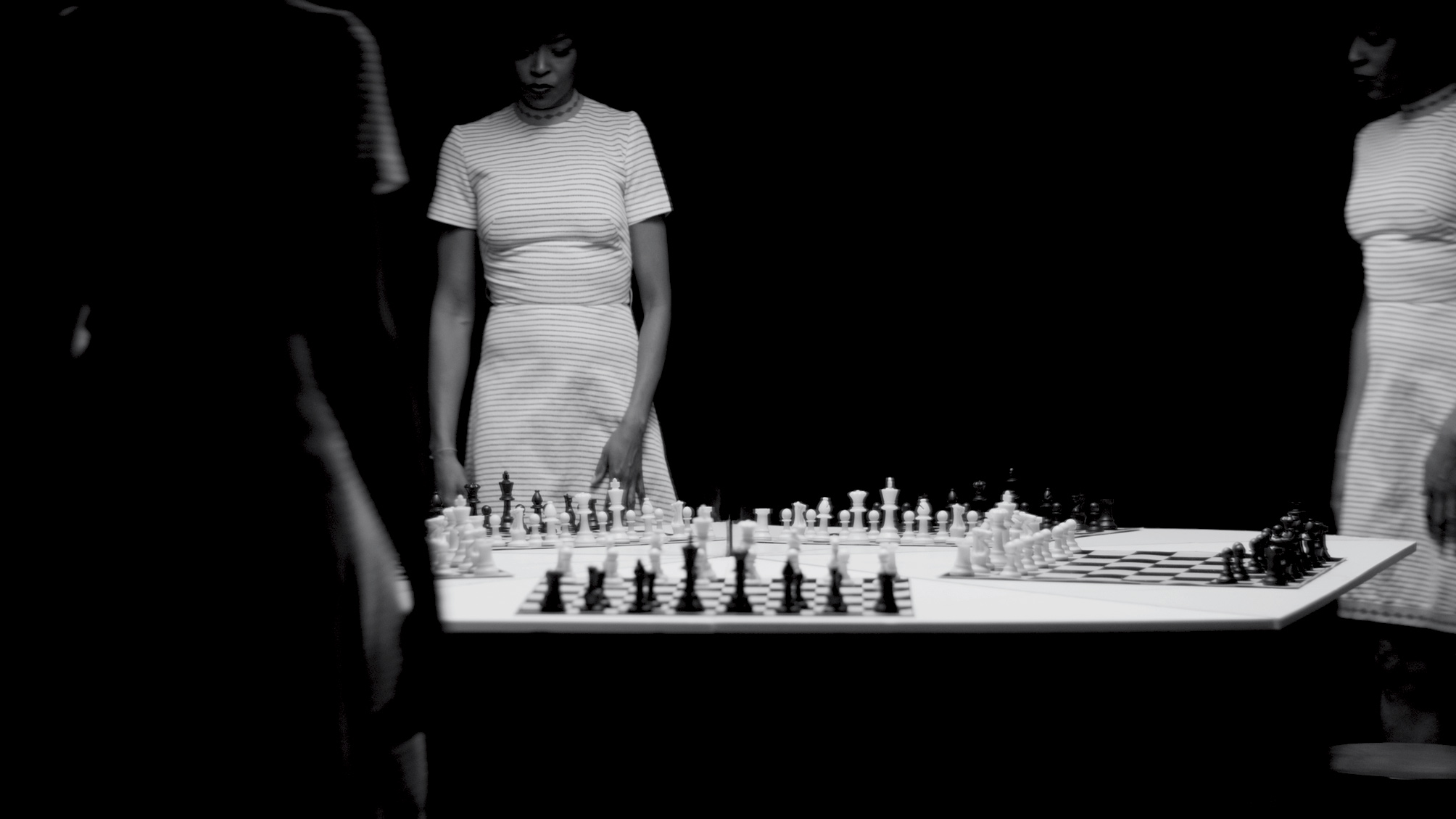
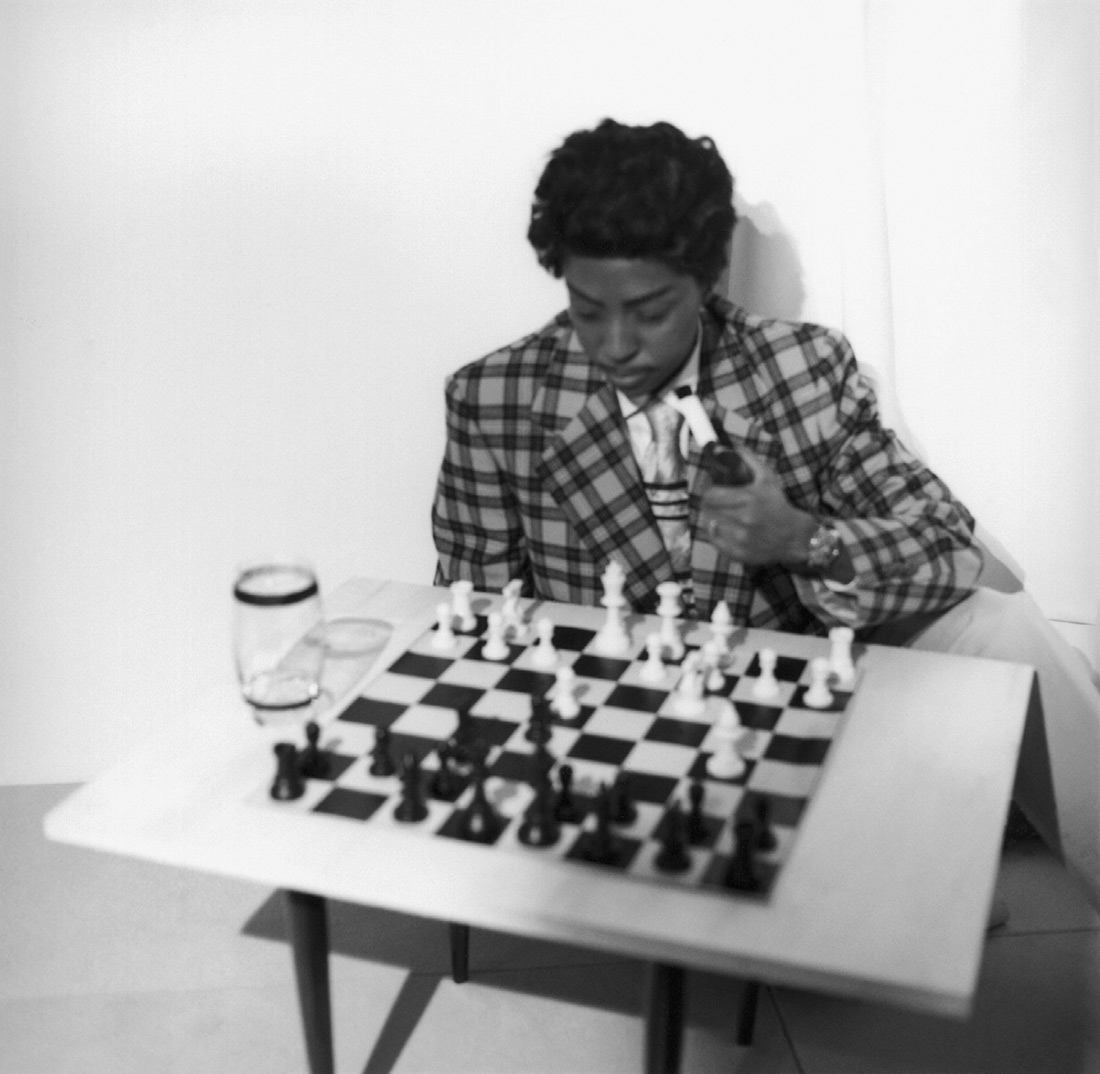
Lorna Simpson (American, b. 1960) 'Chess (Échecs)' 2013


Lorna Simpson (American, b. 1960)
Chess (Échecs)
2013
HD video installation with three projections, black & white, sound
10:25 minutes (loop)
Score and performance by Jason Moran
Courtesy the artist; Salon 94, New York; and Galerie Nathalie Obadia, Paris/Brussels
© Lorna Simpson


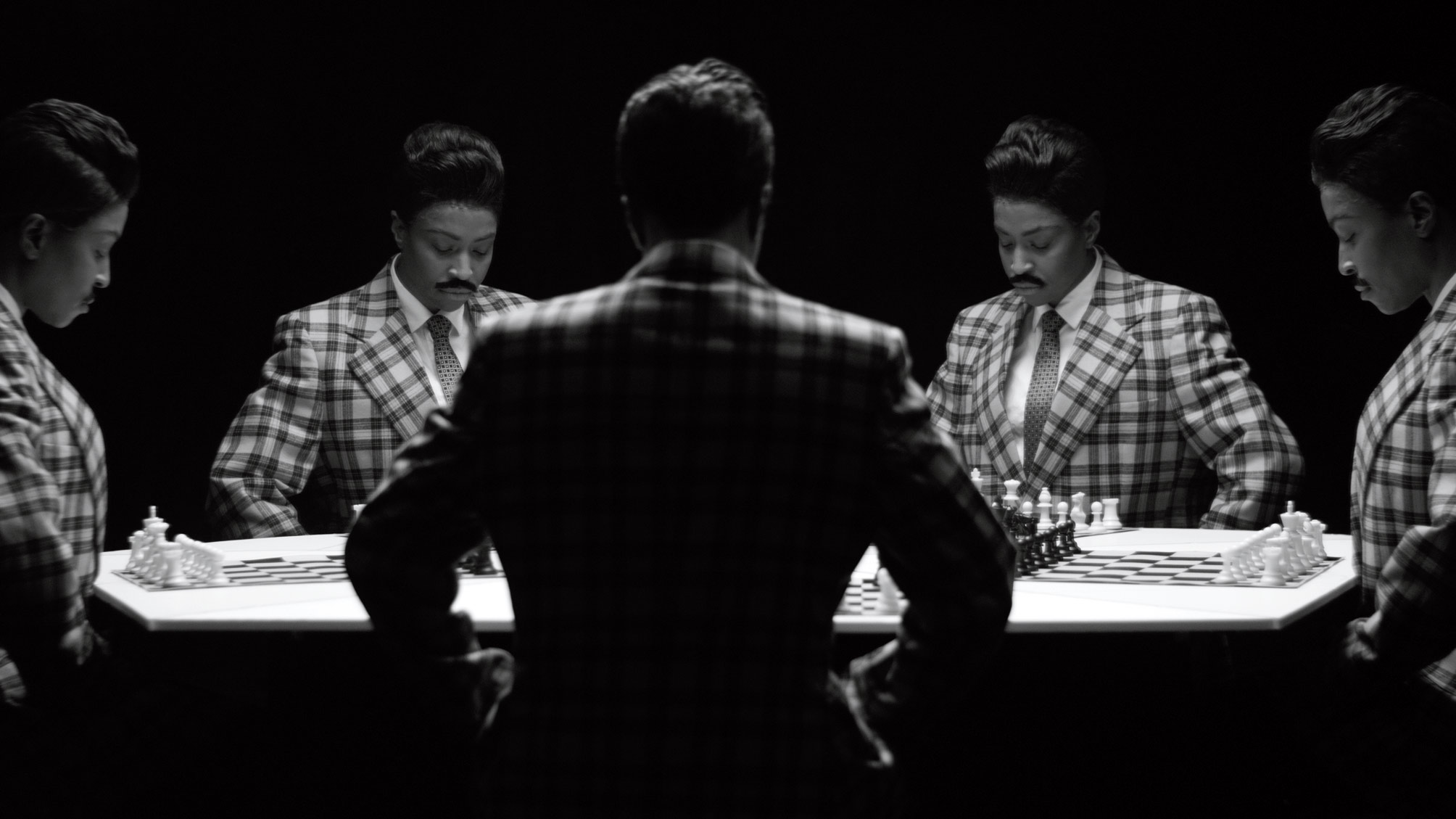
Lorna Simpson (American, b. 1960) 'Chess (Échecs)' 2013


Lorna Simpson (American, b. 1960)
Chess (Échecs)
2013
HD video installation with three projections, black & white, sound
10:25 minutes (loop)
Score and performance by Jason Moran
Courtesy the artist; Salon 94, New York; and Galerie Nathalie Obadia, Paris/Brussels
© Lorna Simpson


“Gestures” and “reenactments” could both be described as the underlying methods of Simpson’s practice for the decades to follow. Whether working with photographs she herself staged, found photographs, or archival film footage, her images captured gestures (as in her earliest documentary photographs of 1978-1980) while her series of multiple images, accompanied by texts, proposed simultaneous (if not synchronous) reenactments. This method also applied to works in which she replicated found images, whether turning images from her films into drawings, or using herself to re-play roles depicted by anonymous figures she had discovered in vintage photographs, either for staged still photographs (as in 1957-2009, 2009), or for moving pictures (as in the video Chess, 2013).

Chess, 2013, Simpson’s video installation made expressly for this exhibition, draws on images from 1957-2009, her still photograph ensemble of 2009 (on view in Gallery 4). For both, in a departure from her earlier videos and prior staged photographs, Simpson herself performs. In 1957-2009, by reenacting scenes from found vintage prints with which they are shown, Simpson is “mirroring both the male and  the female character, in dress, pose, expression, and setting. When I would mention the idea of working with mirrors [for the Chess video] people would often mention the famous portraits of Picasso and Picabia taken at a photo studio in New York by an anonymous photographer who placed the subject at a table in front of two mirrored panels at seventy-degree angles. The result is a five-way portrait that includes views that are not symmetrical and that offer slightly different angles: a surrealist trope of trick photography.”

Though the artist first rejected the idea of working with the mirror device used in these historic portraits, which she had seen many times, she decided to take it on fully and reconstruct it in her studio for this new video project after  art historian and sociologist Sarah Thornton sent her “a beautiful image of an unknown man of African descent in a white straw hat, which had been in an exhibition at MoMA [catalogue page 61]. It was a five-way portrait probably taken by the same photographer who had taken the portraits of Picasso and Picabia. I could no longer resist or dismiss this idea. I felt that it was demanding my attention.”

Shot in Simpson’s studio over the weekend of December 8, 2012, Chess is comprised of three video projections. For two of them Simpson again plays both female and male chess-players, and with the help of makeup and hair assistants, she now allows her characters to age. The third projection shows pianist Jason Moran performing his improvised score for this project, which was inspired by discussions between artist and composer about “mirroring in music,” especially “in the work of musician Cecil Taylor, who employs mirroring in his compositions.”


Lorna Simpson (American, b. 1960) 'The Car' 1995


Lorna Simpson (American, b. 1960)
The Car
1995
Serigraph on 12 felt panels with felt text panel
102 x 104 in (259.1 x 264.2cm)
Courtesy the artist; Salon 94, New York; and Galerie Nathalie Obadia, Paris/Brussels
© Lorna Simpson


Lorna Simpson (American, b. 1960) 'The Car' 1995 (detail)


Lorna Simpson (American, b. 1960)
The Car (detail)
1995
Serigraph on 12 felt panels with felt text panel
102 x 104 in (259.1 x 264.2cm)
Courtesy the artist; Salon 94, New York; and Galerie Nathalie Obadia, Paris/Brussels
© Lorna Simpson


Lorna Simpson (American, b. 1960) '1957-2009' 2009 (detail)


Lorna Simpson
1957-2009 (detail)
2009
299 gelatin silver prints, framed
5 x 5 in. (12.7 x 12.7cm) each (image size)
Rennie Collection, Vancouver
© Lorna Simpson


While collecting photo booth images on eBay, Simpson found the first of the vintage photographs – a woman in a tight sweater-dress leaning on a car – that would generate 19572009 (2009). The artist subsequently bought the entire album and in 2009 restaged these photographs of an anonymous black woman and sometimes a man performing for their camera between June and August 1957 in Los Angeles, which they may have done in the hope of gaining movie work in Hollywood or as an independent project of self-invention. For 1957-2009, Simpson reenacted both female and male roles, and the 299 images are comprised of both the 1957 originals and Simpson’s 2009 remakes. Simpson again reenacted a selection of these vignettes for her video installation Chess, 2013.


Lorna Simpson (American, b. 1960) 'Cloudscape (Paysage nuageux)' 2004


Lorna Simpson (American, b. 1960)
Cloudscape (Paysage nuageux)
2004
Video projection, black & white, sound
3:00 minutes (loop)
Centre national des arts plastiques, purchase in 2005
Photo courtesy the artist; Salon 94, New York; and Galerie Nathalie Obadia, Paris/Brussels
© Lorna Simpson/Centre national des arts plastiques


Lorna Simpson’s video installation Cloudscape (2004) isolates one man, Simpson’s friend, the artist and musician Terry Adkins, in a dark room, spotlighted as he whistles a hymn and is enveloped in fog. Focusing on the ephemerality of performance, the artist employs a technique afforded by her medium to play with time as well. Simpson runs the video forward and then also backward in a continuous loop, creating new visual and oral / aural permutations of gesture and reenactment. In the reversal of the time sequence, the image remains somewhat familiar while the tune turns into something else, a different melody.


Lorna Simpson (American, b. 1960) 'Momentum' 2010


Lorna Simpson (American, b. 1960)
Momentum
2010
HD video, color, sound
6:56 minutes
Courtesy the artist; Salon 94, New York; and Galerie Nathalie Obadia, Paris/Brussels
© Lorna Simpson


As Simpson explored new mediums, such as film and video starting in 1997 or found photographs in  the late 1990s, she continued to work in parallel with her felt serigraphs. In this gallery are three related sets of works that, unlike her earlier photo-text pieces, are all based on a personal memory: performing as a youngster, age 12, in gold costume, wig, and body paint in a ballet recital at New York’s Lincoln Center. Simpson re-staged such a performance for her video Momentum (2010).


Jeu de Paume
1, Place de la Concorde
75008 Paris
métro Concorde
Phone: 01 47 03 12 50

Opening hours:
Tuesday – Friday: 12am – 8pm
Saturday and Sunday: 11am – 7pm
Closed Monday

Jeu de Paume website

Lorna Simpson website

LIKE ART BLART ON FACEBOOK

Back to top

Exhibition: ‘Doug Aitken’ at Regen Projects, Los Angeles

Exhibition dates: 12th September – 17th October, 2009


Many thankx to Regen Projects for allowing me to publish the art work in the posting. Please click on the photographs for a larger version of the image.


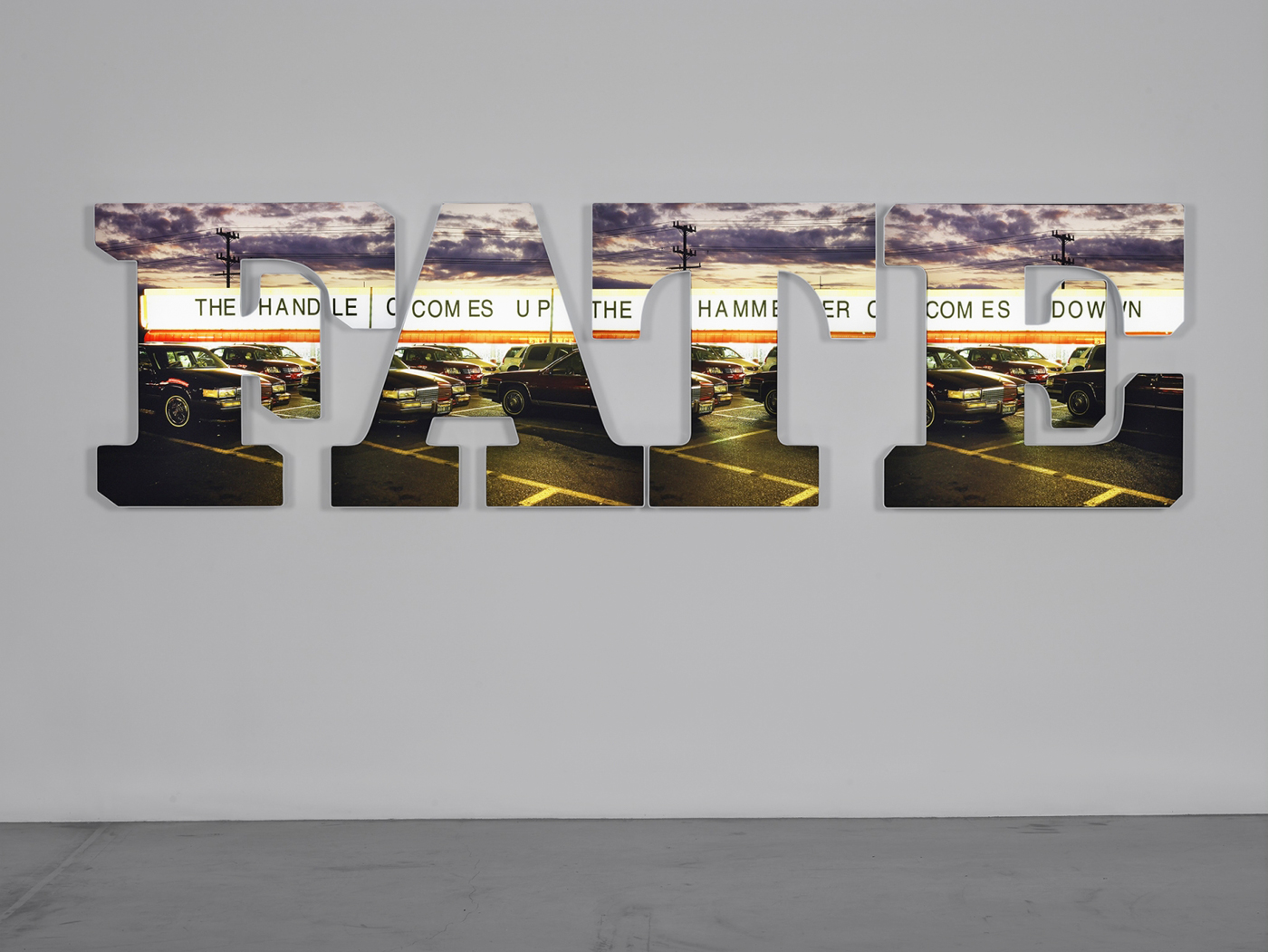
Doug Aitken (American, b. 1968) 'The handle comes up, the hammer comes down' 2009 from the exhibition 'Doug Aitken' at Regen Projects, Los Angeles, Sept - Oct, 2009


Doug Aitken (American, b. 1968)
The handle comes up, the hammer comes down
2009
LED lit lightbox


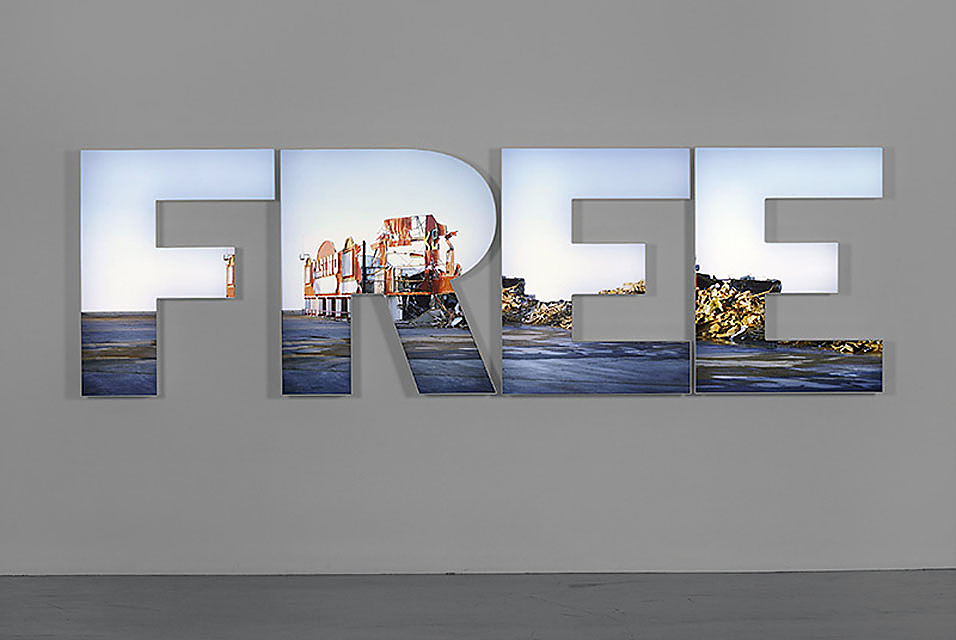
Doug Aitken (American, b. 1968) 'Free' 2009 from the exhibition 'Doug Aitken' at Regen Projects, Los Angeles, Sept - Oct, 2009


Doug Aitken (American, b. 1968)
Free
2009
LED lit lightbox


Doug Aitken (American, b. 1968) 'Start Swimming' 2006 from the exhibition 'Doug Aitken' at Regen Projects, Los Angeles, Sept - Oct, 2009


Doug Aitken (American, b. 1968)
Start Swimming
LED lit lightbox
2006


Doug Aitken (American, b. 1968) 'Start Swimming' 2006


Doug Aitken (American, b. 1968)
Start Swimming
LED lit lightbox
2006


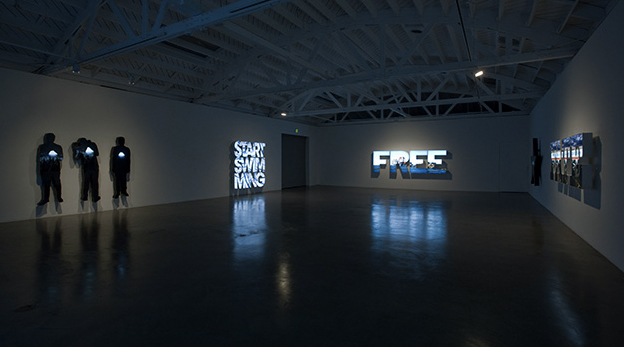
Installation view of ;Doug Aitken; at Regen Projects, Los Angeles


Installation view of Doug Aitken at Regen Projects, Los Angeles


Regen Projects is pleased to announce an exhibition of new works by Los Angeles artist Doug Aitken. This exhibition will present a series of new text-based light boxes and will feature the west coast debut of the film migration. Aitken explores the themes of temporality, space, memory, movement, and landscape in his work. History and themes of both the past and present are interwoven and reconfigured. His work deconstructs the connection between idea and iconography allowing each to reinvent itself.

Doug Aitken’s new light boxes combine image and text in a collision that creates a rupture in which alternate connections are presented. The work frontier depicts a destroyed property on the water’s edge, redefining expectations of what a frontier may hold. The images within some of the light boxes are a photographic collage that references Aitken’s photographic oeuvre and aesthetic. Experimenting with font, borrowed images, and his own photographs, the light boxes will be presented in the darkened gallery, glowing and playing off of one another. The disjunction of word, image, and light in these works also moves toward a cinematic whole, creating panoramic landscapes through text.

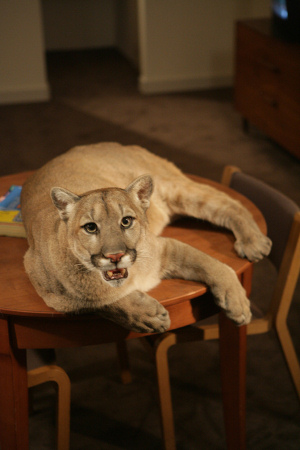
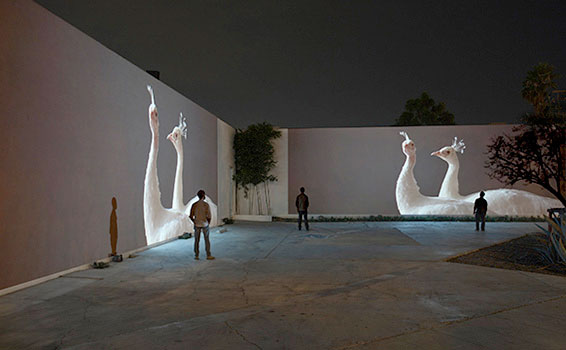
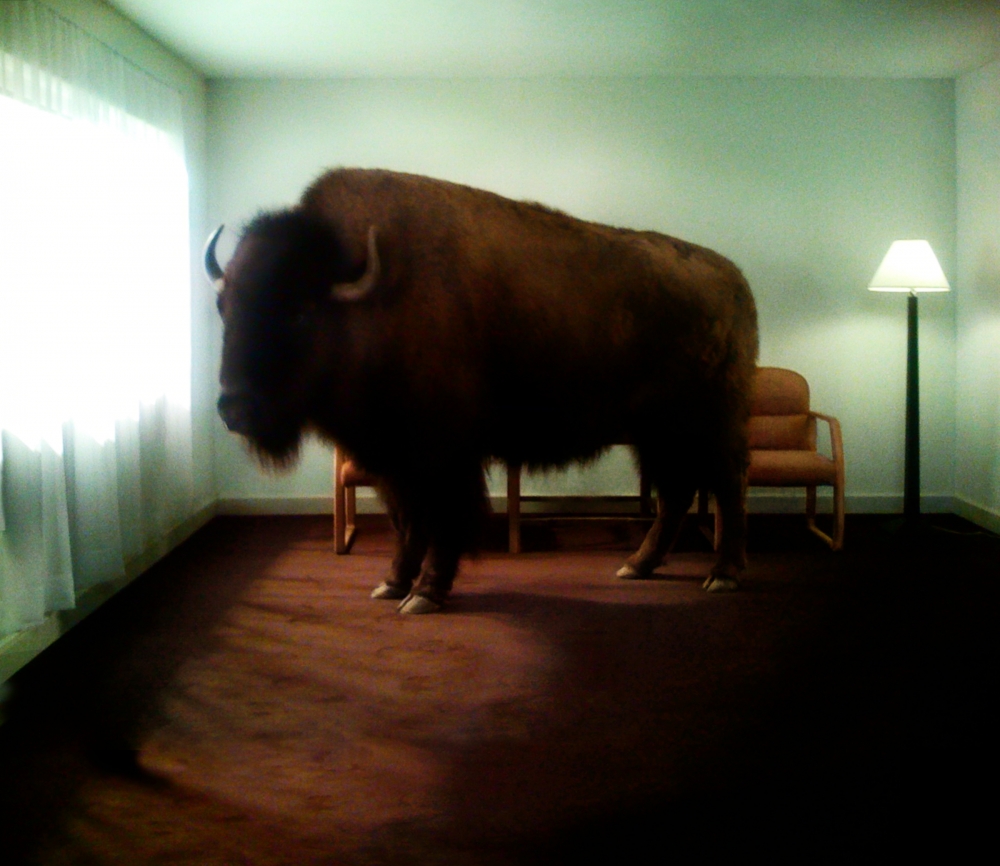
Presented alongside the light boxes will be Aitken’s first large scale public installation in Los Angeles, migration. The film, the first instalment in a three-part trilogy entitled empire, debuted at the 2008 Carnegie International. This hallucinatory epic depicts the movements of migratory animals as they pass through vacant and deserted hotel and motel rooms, delineating a nomadic passage across America from east to west. Fittingly making its first appearance on the west coast, this large-scale cinematic installation will be presented to the public on Santa Monica Boulevard projected onto the courtyard of Regen Projects II; visible only at night from sunset to sunrise. In addition to the nighttime public presentation, migration will also be exhibited at the 633 North Almont Drive space on an indoor billboard accompanied by its original score.

Settlers who met the untamed wilderness to forge new ways of life defined westward expansion. Aitken’s migratory landscape in migration is the opposite; it is a landscape completely devoid of human presence. His non-linear narrative presents a series of different sequences in which the animals and their actions are unique while the rooms and their components are indistinguishable. Hotels such as these offer a sense of both security and isolation and while some animals adapt to these surroundings, others seem conspicuously strange. Rarely do we get to examine these creatures so closely. Their movements and presence make the viewer acutely aware of scale, calling into question various relationships; the most apparent of which is the relationship of the natural and the man-made. In this encounter between the urban and the indigenous the viewer gets a sense of both displacement and habituation. As one critic describes:

“One by one, at different hotels, the animals behave as they behave, sniffing the air, twitching their noses to orient themselves in the desolate human habitat. Imbued with Aitken’s usual intimations of planetary solitude, his sense of spatial dislocation, and gorgeous formalised perception, these images … have the quality not so much of a nonlinear narrative as of a mirage.” (Kim Levin, Artnews, January 2009, p. 110.)


Aitken’s work has been exhibited extensively at museums and galleries worldwide, including his 2007 exhibition “sleepwalkers,” a large-scale outdoor installation at the Museum of Modern Art, New York. He has had numerous solo exhibitions including shows at the Serpentine Gallery, the Kunstmuseum Wolfsberg, the Kunsthaus Bregenz and the Kunsthalle Zurich. Aitken was awarded the international prize at the Venice Biennale in 1999 and was included in the 2000 Whitney Biennial.

Text from the Regen Projects website [Online] Cited 01/11/2009. No longer available online


Doug Aitken (American, b. 1968) Still from 'Migration' 2008

Doug Aitken (American, b. 1968) Still from 'Migration' 2008

Doug Aitken (American, b. 1968) Still from 'Migration' 2008

Doug Aitken (American, b. 1968) Still from 'Migration' 2008

Doug Aitken (American, b. 1968) Still from 'Migration' 2008

Doug Aitken (American, b. 1968) Still from 'Migration' 2008


Doug Aitken (American, b. 1968)
Stills from Migration
2008
Single video projection with billboard (steel and PVC projection screen)


In Migration, peacocks, deer, and beaver are filmed occupying motel rooms in vignettes that strike a poignant, provocative chord: talk about unexpected guests. Nevertheless, the work isn’t funny; it’s too frank in its beauty, too finely and respectfully wrought to be a joke.

Aitken’s animals are frequently shot in close perspective, which enhances their beauty in a way that is mesmerising. We’re not looking through them as much as we’re looking alongside them, ingesting the utter foreignness of their environs. As evening falls, we see an owl, an already otherworldly creature whose glowing eyes appear extraterrestrial, blinking at us from its perch on a king-size bed. Against the singsong of chirping birds, the camera pans away from the stationary owl as the room fills with thousands of downy feathers. Light is a powerful character in the film, whether gently filtered through sheer curtains or spilling onto carpeted hallways. Rather than highlighting imperfections or ugliness, the light is salvic, evincing a limbo that’s illuminating and warming. In one way or another, all of Aitken’s animals are drawn to light, whether toward a blinking lamp, the refracted surface of a swimming pool, or even the glow of an opened refrigerator door.

Extract from


Regen Projects
6750 Santa Monica Boulevard
Los Angeles, CA 90038
Phone: (310) 276 5424

Gallery hours:
Tuesday – Saturday 10am – 5pm

Regen Projects website

LIKE ART BLART ON FACEBOOK

Back to thttps://artblart.com/2009/10/04/exhibition-doug-aitken-at-regen-projects-los-angeles/op

Review: ‘Ocean Without A Shore’ video installation by Bill Viola at The National Gallery of Victoria, Melbourne

February 2009


Bill Viola – Ocean Without a Shore | TateShots

Bill Viola’s video installation, Ocean Without a Shore, is presented in the atmospheric setting of the church of San Gallo, Venice. Monitors positioned on three stone altars in the church show a succession of individuals slowly approaching out of darkness and moving into the light, as if encountered at the intersection between death and life. Viola talks about his artistic intentions and the technical challenges of the piece.


Originally installed inside the intimate 15th century Venetian church of San Gallo as part of the 2007 Venice Biennale (see above) incorporating its internal architecture into the piece using the three existing stone altars as support for the video screens, the installation has been recreated in a small darkened room at The National Gallery of Victoria in Melbourne. What an installation it is.

Deprived of the ornate surroundings of the altars of the Venetian chapel – altars of which Viola has said that, “… as per the original development of the origins of Christianity these alters actually are a place where the dead kind of reside and connect with those of us, the living, who are here on earth. And they really are a connection between a cross, between a tomb and an alter – a place to pray,”1 – the viewer is forced to concentrate on the images themselves. This is no bad thing, stripping away as it does a formalised, religious response to mortality.

In the work Viola combines the use of a primitive twenty five year old security black and white analogue video surveillance camera with a high definition colour video camera through the use of a special mirror prism system. This technology allows for the seamless combination of both inputs: the dead appear far off in a dark obscure place as grey ghosts in a sea of pulsating ‘noise’ and gradually walk towards you, crossing the invisible threshold of a transparent water wall that separates the dead from the living, to appear in the space transformed into a detailed colour image. As they do so the sound that accompanies the transformation grows in intensity reminding me of a jet aircraft. You, the viewer, are transfixed watching every detail as the ghosts cross-over into the light, through a water curtain.

The performances of the actors (for that is what they are) are slow and poignant. As Viola has observed, “I spent time with each person individually talking with them and you know when you speak with people, you realise then that everybody has experienced some kind of loss in their life, great and small. So you speak with them, you work with them, you spend time and that comes to the surface while we were working on this project together, you know? I didn’t want to over-direct them because I knew that the water would have this kind of visual effect and so they were able to, I think, use this piece on their own and a lot of them had their own stories of coming back and visiting a relative perhaps, who had died.”1

The resurrected are pensive, some wringing the hands, some staring into the light. One offers their hands to the viewer in supplication before the tips of the fingers touch the wall of water – the ends turning bright white as they push through the penumbrae of the interface. As they move forward the hands take on a stricken anguish, stretched out in rigour. Slowly the resurrected turn and return to the other side. We watch them as we watch our own mortality, life slipping away one day after another. Here is not the distraction of a commodified society, here is the fact of every human life: that we all pass.

The effect on the viewer is both sad but paradoxically uplifting. I cried.

A friend who I went with said that the images reminded her not of the dead temporarily coming back to life, but the birth of a new life – the breaking of water at the birth of a child. The performers seemed to her to behave like children brought anew into the world. One of my favourite moments was when the three screens were filled with just noise and a figure then appears out of the beyond, a dim and distant outline creating a transcendental moment. Unfortunately there are no images of these grainy figures. As noted below Viola uses a variety of different ethnic groups and cultures for his performers but the one very small criticism I have is they have no real individuality as people – there are no bikers with tattoos, no cross dressers, no punks because these do not serve his purpose. There is the black woman, the old woman, the middle aged man, the younger 30s man in black t-shirt: these are generic archetypes of humanity moulded to Viola’s artistic vision.

Viola has commented, “I think I have designed a piece that’s open ended enough, where the people and the range of people, the kind of people we chose are from various ethnic groups and cultures. And I think that the feeling of more this is a piece about humanity and it’s about the fragility of life, like the borderline between life and death is actually not a hard wall, it’s not to be opened with a lock and key, its actually very fragile, very tenuous.

You can cross it like that in an instant and I think religions, you know institutions aside, I think just the nature of our awareness of death is one of the things that in any culture makes human beings have that profound feeling of what we call the human condition and that’s really something I am really interested in. I think this piece really has a lot to do with, you know, our own mortality and all that that means.”1

These series of encounters at the intersection of life and death are worthy of the best work of this brilliant artist. He continues to astound with his prescience, addressing what is undeniable in the human condition.

Long may he continue.

Dr Marcus Bunyan


1/ TateShots. Venice Biennale: Bill Viola. 30 June 2007 [Online] Cited 23/09/2009. No longer available online


“The unfolding of consciousness, the revelation of beauty, present even after death, the moment of awe, the space without words, the emptiness that builds mountains, the joy of loving, the sorrow of loss, the gift of leaving something behind for the next traveler.”


Bill Viola


Bill Viola (American, 1951-2024)
Ocean Without A Shore (excerpt)
2007
Installation in the church of San Gallo, Venice


Bill Viola (American, 1951-2024)
Ocean Without A Shore (excerpt)
2007


Ocean Without a Shore is about the presence of the dead in our lives. The three stone altars in the church of San Gallo become portals for the passage of the dead to and from our world. Presented as a series of encounters at the intersection between life and death, the video sequence documents a succession of individuals slowly approaching out of darkness and moving into the light. Each person must then break through an invisible threshold of water and light in order to pass into the physical world. Once incarnate however, all beings realise that their presence is finite and so they must eventually turn away from material existence to return from where they came. The cycle repeats without end.”

Bill Viola
25 May 2007
Text © Bill Viola 2007


The work was inspired by a poem by the twentieth century Senegalese poet and storyteller Birago Diop:

Hearing things more than beings,
listening to the voice of fire,
the voice of water.
Hearing in wind the weeping bushes,
sighs of our forefathers.

The dead are never gone:
they are in the shadows.
The dead are not in earth:
they’re in the rustling tree,
the groaning wood,
water that runs,
water that sleeps;
they’re in the hut, in the crowd,
the dead are not dead.

The dead are never gone,
they’re in the breast of a woman,
they’re in the crying of a child,
in the flaming torch.

The dead are not in the earth:
they’re in the dying fire,
the weeping grasses,
whimpering rocks,
they’re in the forest, they’re in the house,
the dead are not dead.


Text from the Ocean Without A Shore website [Online] Cited 23/09/2009. No longer available online


Bill Viola (American, 1951-2024) 'Ocean Without A Shore' 2007 video still

Bill Viola (American, 1951-2024) 'Ocean Without A Shore' 2007 video still

Bill Viola (American, 1951-2024) 'Ocean Without A Shore' 2007 video insatllation

Bill Viola (American, 1951-2024) 'Ocean Without A Shore' 2007 video insatllation


Installation photographs of Ocean Without A Shore at the National Gallery of Victoria, Melbourne
Photos: Marcus Bunyan


Bill Viola (American, 1951-2024) 'Ocean Without A Shore' 2007 original video installation at church of San Gallo (still)


Bill Viola (American, 1951-2024)
Ocean Without A Shore (still)
2007
Original installation at church of San Gallo


NGV International
180 St Kilda Road, Melbourne

Open daily 10am-5pm

National Gallery of Victoria International website

Bill Viola website

LIKE ART BLART ON FACEBOOK

Back to top