Exhibition: ‘Reading the modern photography book: changing perceptions’ at the National Gallery of Art, Washington

Exhibition dates: 18th January – 26th April, 2009


Looks a great exhibition for fans of photography books!

Many thankx to the National Gallery of Art, Washington for allowing me to publish the photographs in the posting. Please click on the photographs for a larger version of the image.
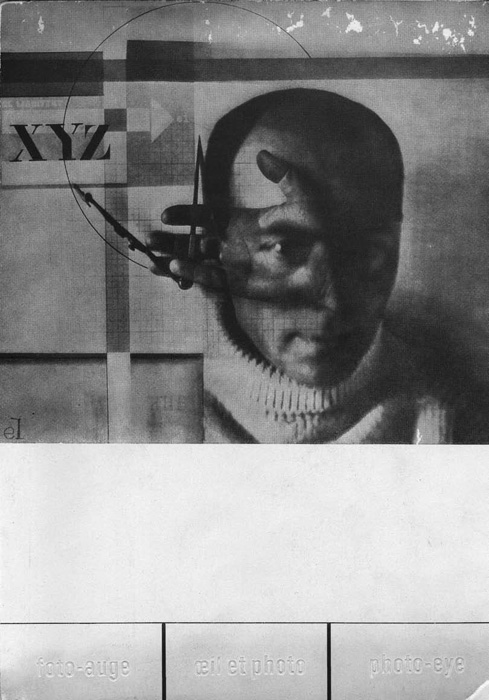
 

foto-auge (photo-eye), edited and with an introduction by Franz Roh, cover design by Jan Tschichold (Stuttgart: Akademischer Verlag, Dr. Fritz Wedekind & Co., 1929) from the exhibition 'Reading the modern photography book: changing perceptions' at the National Gallery of Art, Washington, Jan - April, 2009


foto-auge (photo-eye)
Edited and with an introduction by Franz Roh, cover design by Jan Tschichold
(Stuttgart: Akademischer Verlag, Dr. Fritz Wedekind & Co., 1929)


“Also produced in conjunction with Film und Foto, this book showcases a wide variety of photographic practices as a way of examining the social importance of the medium’s ability to construct visual knowledge.”


Held in conjunction with Looking In: Robert Frank’s “The Americans,” this exhibition examines a variety of artistic and thematic approaches to the modern photography book, displaying examples that span the period from the late 1920s to the early 1970s. The photography book, more than simply a book containing photographs, is a publication composed by the careful sequencing and editing of photographic material. Often produced by a photographer, they present visual narratives through creative page design that frequently integrates photographs with text and graphic elements.

This focus exhibition organises 21 books from the Gallery’s library into four themes: “New Visions,” “Documented Realities,” “Postwar Scenes,” and “Conceptual Practices.” It highlights diverse projects from individual photographers such as László Moholy-Nagy, Henri Cartier-Bresson, and Yasuhiro Ishimoto as well as collaborative projects from the Hungarian Work Circle (Munka Kör) and Andy Warhol’s Factory, revealing that the photography book is both a significant conveyer of contemporary experience and a witness to historical events.

The modern photography book, more than simply a book containing photographs, is a publication composed by the careful sequencing and editing of photographic material. Often produced by a photographer, these books present visual narratives through creative page design that frequently integrates photographs with text and graphic elements. Popular across the political spectrum, photography books have been published both as art objects and as documentary records. Through their organisation they foster a critical examination of the visual world, and as works of historical witness they have helped to construct cultural memories. Photography books have been a primary format for the arrangement and display of photographs, making them a vital but commonly overlooked component of the history of photography. Today they continue to provide an important forum for photographers to convey their work to a wide public audience.

Photographs have appeared in book format since their inception. For example, William Henry Fox Talbot’s commercially published The Pencil of Nature (1844) was one of the earliest explorations of photography’s narrative capabilities. Like all early photography books, Talbot’s photographs were printed separately from the letterpress text. It was not until the 1880s, with the development of the halftone plate and printing process, that mass-produced newspapers, magazines, and books regularly featured photographs. This invention, which allowed type and photographic images to be mechanically reproduced on the same press, dramatically changed the means by which the general public viewed and had access to photographs. By the 1920s the number of photographically illustrated publications had increased exponentially, and photographs regularly recounted events without explanatory text. As people began to see more and more photographs on a daily basis, they became far more visually literate. Set within this context, the modern mass-produced photography book challenged not only traditional narrative structures but also popular habits of reading and seeing.

Text from the National Gallery of Art website [Online] Cited 06/03/2009. No longer available online
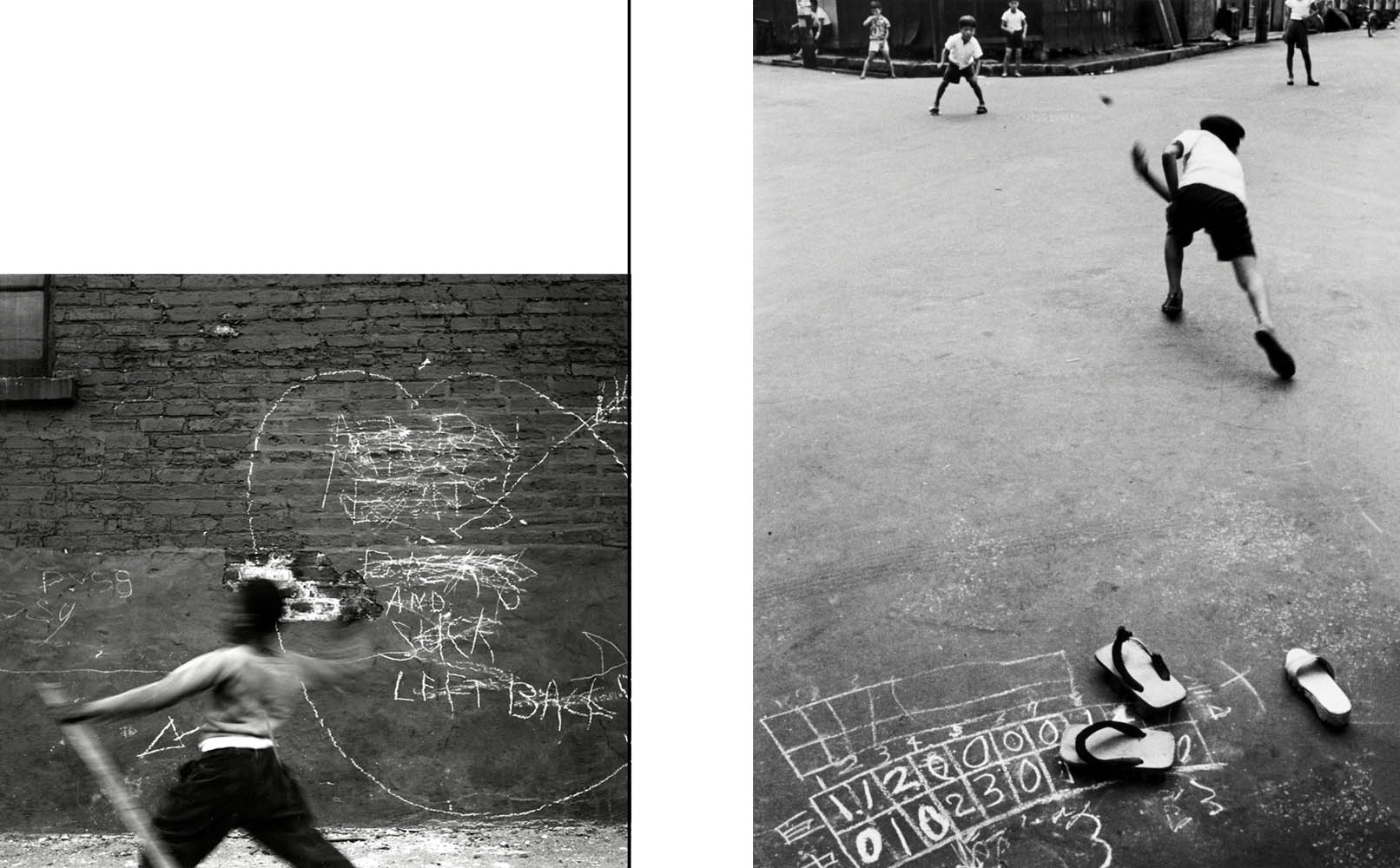
 

Yasuhiro Ishimoto (Japanese-American, 1921-2012) 'Aruhi Arutokoro (Someday, Somewhere)' preface by Tsutomu Watanabe, design by Ryuuichi Yamashiro (Tokyo: Geibi Shuppan, 1958) from the exhibition 'Reading the modern photography book: changing perceptions' at the National Gallery of Art, Washington, Jan - April, 2009


Yasuhiro Ishimoto (Japanese-American, 1921-2012)
Aruhi Arutokoro (Someday, Somewhere)
Preface by Tsutomu Watanabe, design by Ryuuichi Yamashiro (Tokyo: Geibi Shuppan, 1958)


“This engaging publication juxtaposes photographs taken by Ishimoto in Chicago and Tokyo. Born in the United States, Ishimoto spent his childhood in Japan and later returned to the U.S. to attend school at the Institute of Design in Chicago. Finally settling in Tokyo, he influenced a new generation of postwar Japanese photographers interested in producing books.”


Henri Cartier-Bresson (French, 1908-2004) 'The Decisive Moment' (New York: Simon & Schuster, in collaboration with Éditions Verve, Paris, 1952)


Henri Cartier-Bresson (French, 1908-2004)
The Decisive Moment
(New York: Simon & Schuster, in collaboration with Éditions Verve, Paris, 1952)


“An important presentation of Cartier-Bresson’s photographs from the 1930s and 1940s, this large-format book helped to popularise his work, in which a distinctive documentary approach transforms ordinary moments into remarkable photographic visions.”


National Gallery of Art
National Mall between 3rd and 7th Streets
Constitution Avenue NW, Washington

Opening hours:
Daily 10.00am – 5.00pm
National Gallery of Art website

LIKE ART BLART ON FACEBOOK

Back to top

Book: Daniel Dorling, Mark Newman and Anna Barford ‘The Atlas of the Real World: Mapping the Way We Live’

December 2008


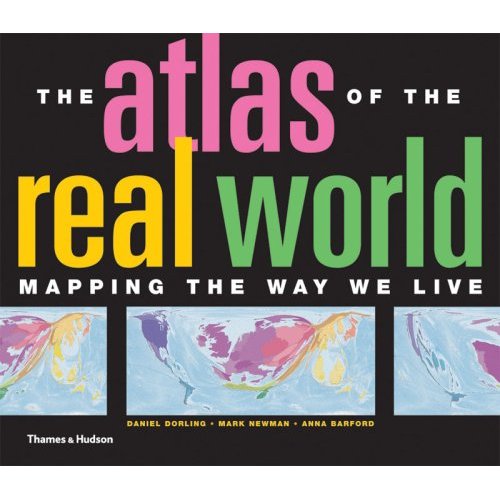
Daniel Dorling, Mark Newman and Anna Barford 'The Atlas of the Real World: Mapping the Way We Live'


In Atlas of the Real World, global inequities in the third millennium are made strikingly visible. The book uses a clever mapping formula, massive amounts of data and a whole lot of computer power to produce 366 maps that stretch, twist and shrink the boundaries of nations according to how much they have of whatever is being mapped: money, disease, doctors, televisions, endangered animals …

The atlas (which builds on the free maps available at the website worldmapper.org) uses the simplest means to get across the most profound facts. Each country is brightly colour-coded and the maps are overlaid on a natural-looking ocean bed. The effect is a little like looking into a funfair mirror – you know what you’re seeing, but it takes a moment to work out what’s happened to it …

In the most extreme cases, the map no longer looks like the planet Earth: the map of people killed by volcanoes (302) shows two large round islands – Colombia and North Africa – and a small atoll of shrunken Asian nations …

They’re not really maps in the old-fashioned sense, but visual renderings of complex and sometimes frightening realities, perfectly suited to our supposedly post-literate age … As a wake up call, it’s not quite on the level of the first photograph of the Earth from space – the “blue marble” that inspired a generation of environmentalists. But it’s a reminder that everything we do, from fighting wars (map 318) to selling toys (129, 130), we do on the planet.

In visual form, statistics that seem like abstract numbers are transformed into a reality that can be as ugly as an Africa swollen with HIV cases (269), as hopeful as strong worldwide growth in education (226), or as simple as the fact America, and the rest of the West, could stand to go on a diet.

Jenny Sinclair1


1/ Sinclair, Jenny. “Inequality unfolds in warped world,” in A2, The Age newspaper, Melbourne. Saturday November 29th 2008.


Daniel Dorling, Mark Newman and Anna Barford
The Atlas of the Real World: Mapping the Way We Live
416 pages
Thames and Hudson 2008


LIKE ART BLART ON FACEBOOK

Back to top

Europeana: connecting cultural heritage – digital paintings, books, films and archives

November 2008


Europeana – the European digital library, museum and archive


Europeana – the European digital library, museum and archive – is a project that began in July 2007. The website gives users direct access to some 2 million digital objects, including film material, photos, paintings, sounds, maps, manuscripts, books, newspapers and archival papers.

The digital content will be selected from that which is already digitised and available in Europe’s museums, libraries, archives and audio-visual collections. The website aims to have representative content from all four of these cultural heritage domains, and also to have a broad range of content from across Europe. The interface will be multilingual. Initially, this may mean that it is available in French, English and German, but the intention is to develop the number of languages available following the launch.”


Europeana collections website

LIKE ART BLART ON FACEBOOK

Back to top

Book: William Clift. ‘Certain Places’ 1987

November 2008


William Clift (American, b. 1944) 'Somebody's House, Baltimore, Maryland, 1964'


William Clift (American, b. 1944)
Somebody’s House, Baltimore, Maryland, 1964
1964

from the book

Certain Places
Photographs and Introduction by William Clift.
William Clift Editions, Santa Fe, 1987. 44 pp., twenty-two tritone illustrations.


One of the most ravishing photographic books ever produced. Sensitive photography, luminous images, wonderful reproductions on quality stock. Nothing more need be said. My favourite of so many great images is above.

Dr Marcus Bunyan


All photographs are used under fair use conditions for the purpose of education and research. Please click on the photographs for a larger version of the image.


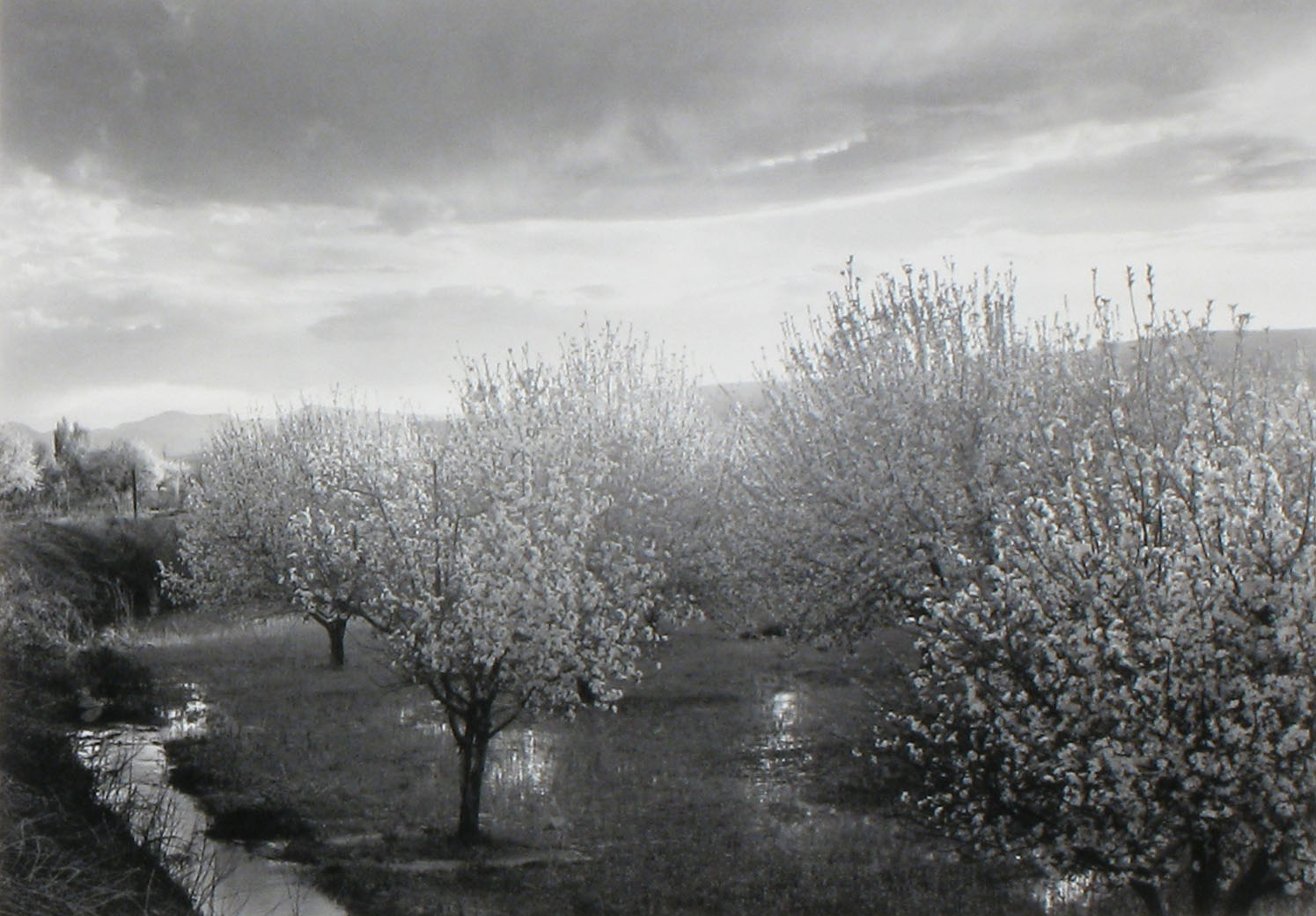
William Clift (American, b. 1944) 'Apple Blossoms, Velarde, New Mexico, 1973'


William Clift (American, b. 1944)
Apple Blossoms, Velarde, New Mexico, 1973
1973


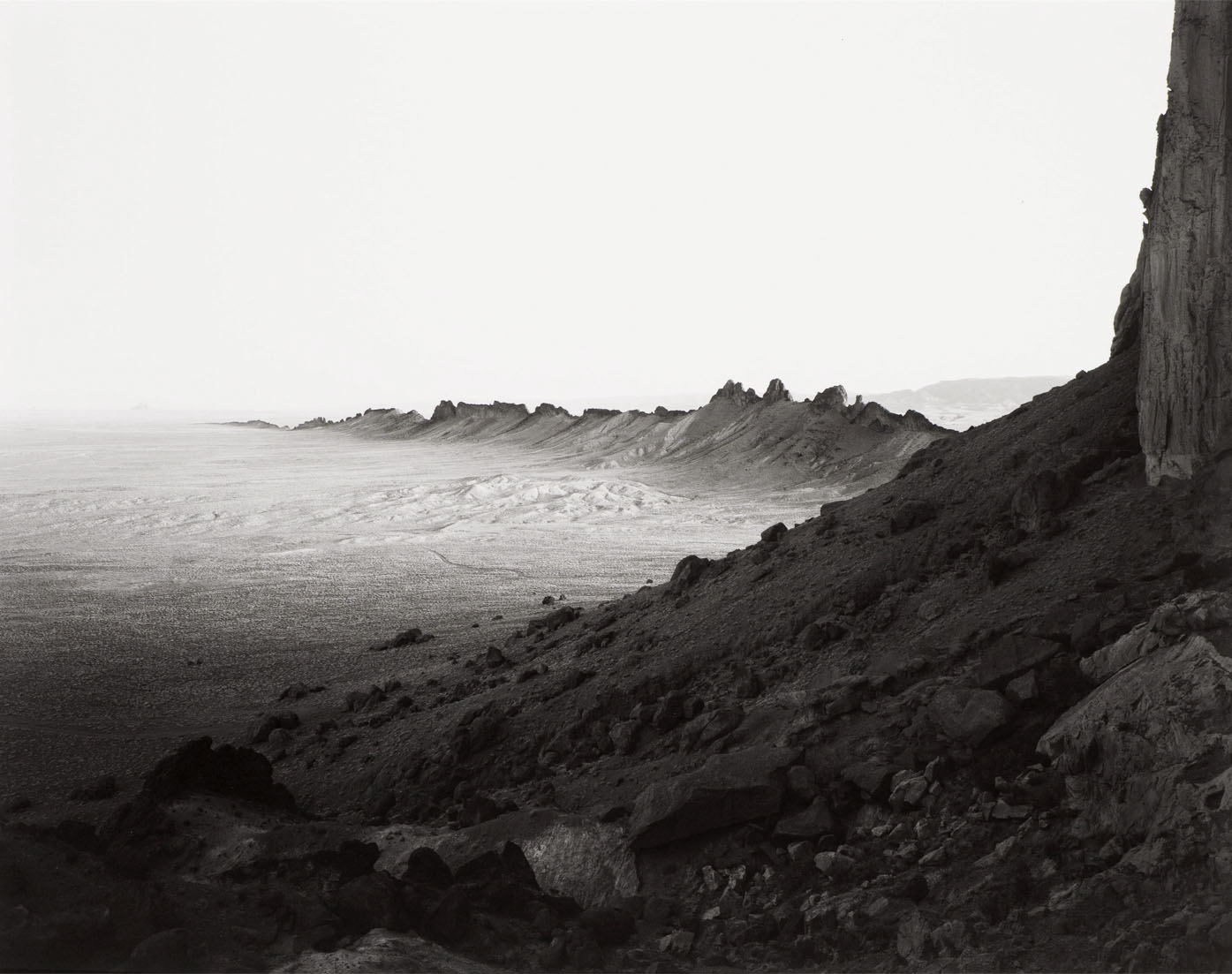
William Clift (American, b. 1944) 'Desert Form No. 1, New Mexico, 1984'


William Clift (American, b. 1944)
Desert Form No. 1, New Mexico, 1984
1984


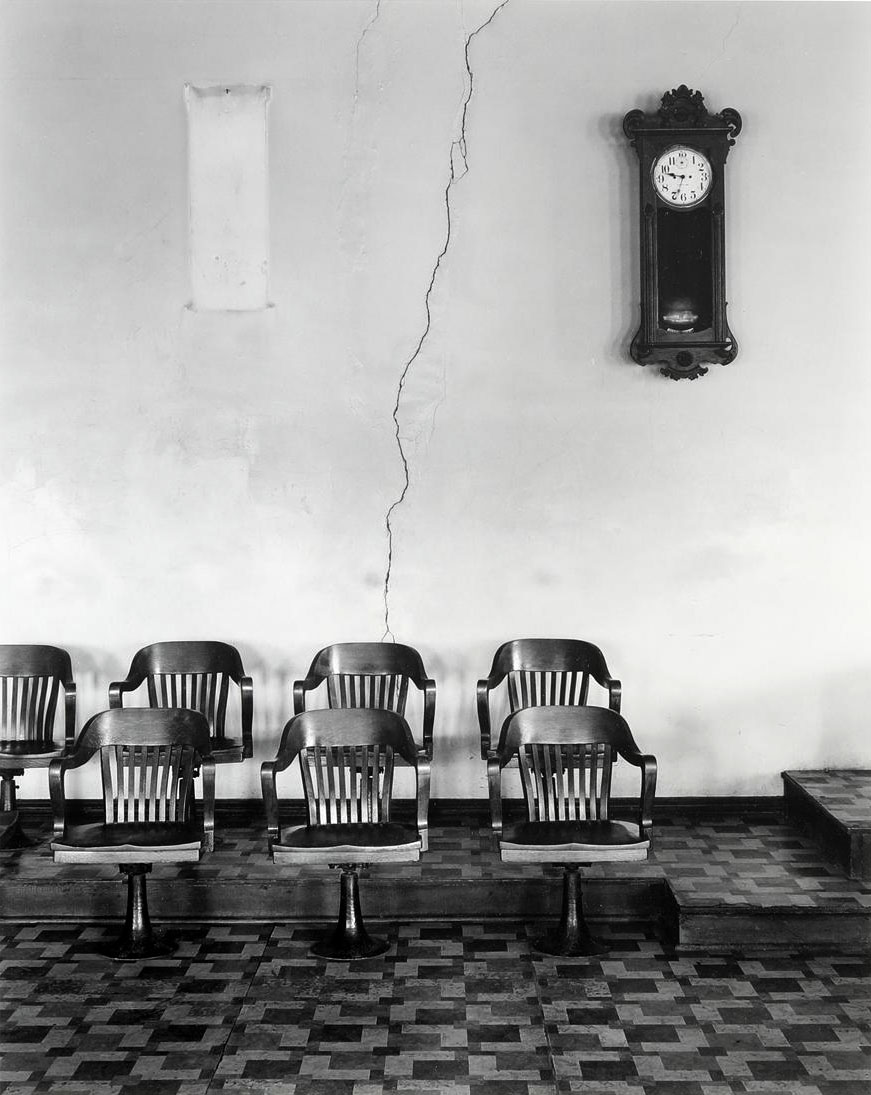
William Clift (American, b. 1944)
'Untitled' 1976 From the 'County Courthouse' series


William Clift (American, b. 1944)
Untitled
1976
From the County Courthouse series
Gelatin silver print
16.5 h x 13 w inches


LIKE ART BLART ON FACEBOOK

Back to top

Book: Edward S. Curtis: Visions of the First Americans (with Eugene Atget and Diane Arbus)

November 2008


Edward S Curtis (American, 1868-1952) 'Nuhlihahla-Qagyuhl' Nd


Edward S Curtis (American, 1868-1952)
Nuhlihahla-Qagyuhl
Nd


Following my thoughts on the series The First Australians on SBS we have this wonderful coffee table book of photographs: Edward S. Curtis: Visions of the First Americans with images taken from his seminal 20 volume work The North American Indian.

Curtis worked on the project from 1906 to 1927 hauling his large format glass plate camera across the United States much as Eugene Atget did at roughly the same time in Paris, taking photographs of the old city and its hotels, shops, parks and gardens. Atget died in 1927 with his art recognised by few whilst Curtis lived on into the 1950’s, dying in obscurity and poverty after the fame of his ground breaking work had disappeared. Both photographed a vanishing world capturing it for prosperity on fragile glass plates. Both brought to their projects a unique vision and a belief in what they were doing.

Atget’s photographs of people half seen through shop doors and windows, like shadows of the night. Curtis’s photographs of masked Yeibichei dancers wearing elaborate attire. Curtis thought he was photographing the dying races of the American Indians. Atget knew he was photographing the collapsing spaces of old Paris. Both use the space of the photograph to signify their intentions: an understanding of their subject matter, an empathy with a disappearing way of life, a need to record their vision of this world – and an intensity of insight into that condition.

No other photograph has the space and timelessness of an Atget. No other image the presence of the plains that Curtis summoned.

His masked dancers remind me of the last photographs of the great American photographer Diane Arbus in their candour and beauty, posthumously called Untitled. Finally Arbus has found a subject matter that she could return to over and over again. As did Atget and Curtis.

As Doon Arbus has commented,

“These images – created out of the courage to see things as they are, the grace to permit them simply to be, and a deceptive simplicity that permits itself neither fancy nor artifice … The photographs appear to be documents of a world we’ve never seen or imagined before – one with its own rituals and icons, its own games and fashions and codes of conduct – which, for all its strangeness, is at the same time hauntingly familiar and, in the end, no more or less unfathomable than our own.”1

Dr Marcus Bunyan


1/ Arbus, Doon. “Afterword,” in Diane Arbus: Untitled. London: Thames and Hudson, 1995.

~ Diane Arbus: Untitled
~ Edward S. Curtis: Visions of the First Americans
~ Some late Diane Arbus photographs from Google Images
~ Eugène Atget Wikipedia entry
~ Eugène Atget Google images


LIKE ART BLART ON FACEBOOK

Back to top