Exhibition: ‘A Different Light – First Photographs of Aotearoa’ at the Auckland War Memorial Museum, New Zealand

Exhibition dates: 11th April – 1st September 2024

This exhibition is a collaboration between Tāmaki Paenga Hira Auckland War Memorial Museum, Alexander Turnbull Library, and Hocken Collections Uare Taoka o Hākena
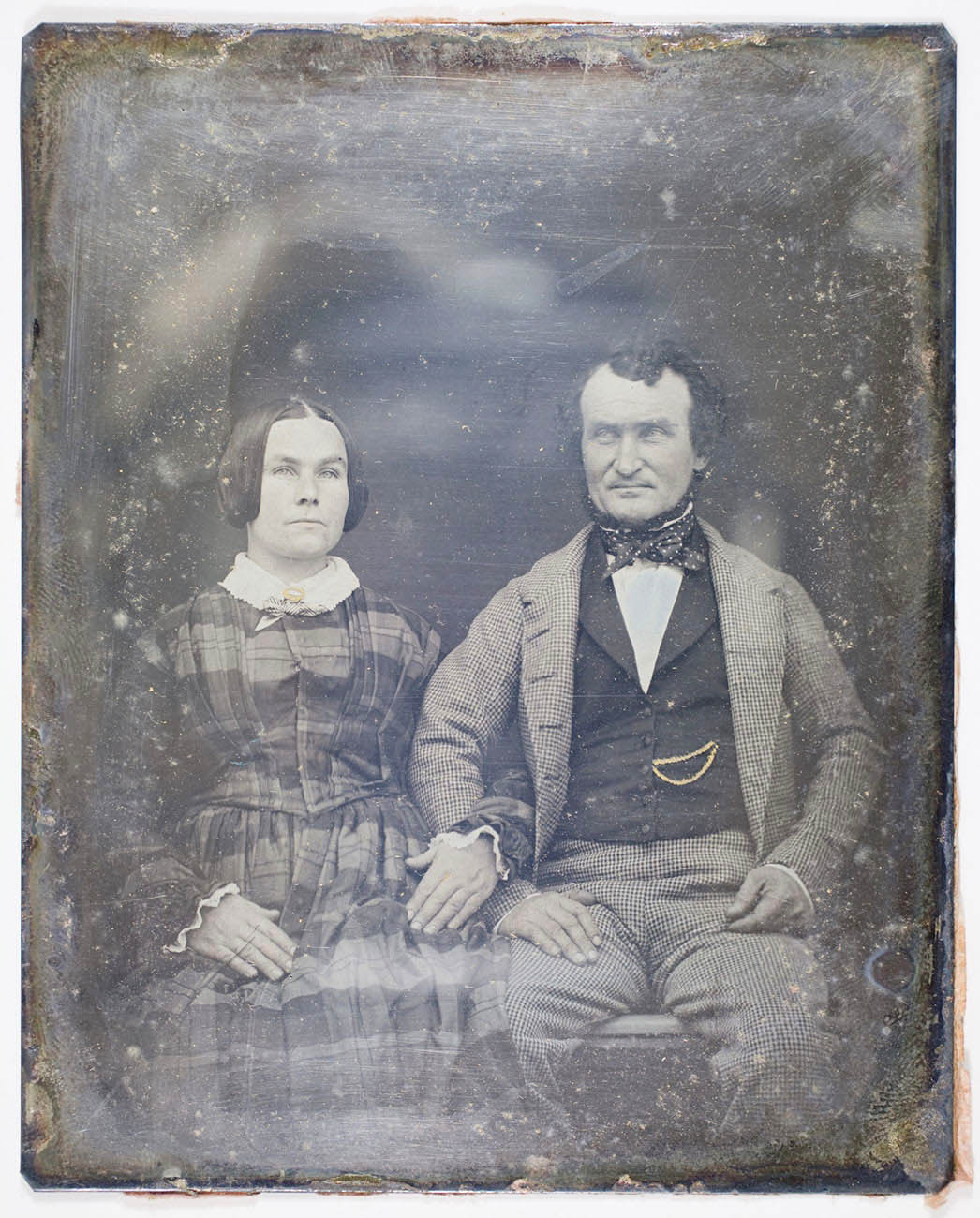
 

Hartley Webster (New Zealand, 1818-1906) (Attributed to) 'Jane and Alexander Alison' 30 June 1852


Hartley Webster (New Zealand, 1818-1906) (Attributed to)
Jane and Alexander Alison
30 June 1852
Half-plate daguerreotype, passe-partout mount
130 mm. x 100 mm. (plate)
Auckland Museum Collection


Hartley Webster was Auckland’s first resident professional photographer, but despite his longevity and his unique role in the growth of photography in 19th century New Zealand his death in 1906 passed without an obituary.

~ Keith Giles


Then and now

I went to the annual Melbourne Rare Book Fair at the University of Melbourne recently. There, albums of early photographs of Aotearoa were available to purchase for nearly AUD$7,000. These days, colonial photographs from both Australia and New Zealand are only for those that can afford them – to on sell, to secrete away in collections, to act as memento mori.

The colonial settler lens focused on landscape photography and portrait photographs of white settlers and Indigenous people, Māori “captured” by the camera. Professor Angela Wanhalla observes that, “Photographs are complicit in colonialism because they were used to document the impacts of migration, settlement and land transformation.”1

Through the use of material culture studies – an interdisciplinary field that examines the relationship between people and their things, the making, history, preservation, and interpretation of objects – we can study colonial photographs and the albums that hold them in order to understand how photographs are complicit in colonialism, and how colonial photographs can become a “rich sources for historians trying to uncover and understand late-nineteenth-century life.”2

Historian Jules Prown outlined material culture and a suggested approach. He wrote:

“Material culture as a study is based upon the obvious fact that the existence of a man-made object is concrete evidence of the presence of a human intelligence operating at a time of fabrication. The underlying premise is that objects made or modified by man reflect, consciously or unconsciously, directly or indirectly, the beliefs of individuals who made, commissioned, purchased, or used them, and by extension the beliefs of the larger society to which they belonged.”3


Colonial photographers and their photographs then, reflect the dominant hegemonic, patriarchal society to which they belong. According to Jarrod Hore they were engaged in “settler colonial work” because they “mobilised and visually reorganised local environments in the service of broader settler colonial imperatives.”4

Evidence of this reorganisation and the loss of individual and cultural identity can be found in the photographs Māori people. While the names of the Pākehā commercial photographic studios that took photographs of Māori might be known, the identity of the Māori subjects were often not recorded. Sapeer Mayron observes that, “Māori in particular were often photographed and their names and identities not preserved, called instead “Māori celebrities” and dressed with props in the artists’ studios” while in the same article Shaun Higgins, Auckland Museum pictures curator and curator of this exhibition observes, “When you’re documenting, you’re not this invisible entity that’s just documenting everything, you are making choices. You are, in effect, not documenting neutrally, but with your own agenda.”5 Again, photographers using material culture to record what was around them, reflecting, “consciously or unconsciously, directly or indirectly, the beliefs of individuals who made, commissioned, purchased, or used them, and by extension the beliefs of the larger society to which they belonged.”

But while Pākehā commercial photography captured Māori as ethnographic photographic subjects, conversely the Māori themselves were not always passive subjects in their own representation, posing for the camera as they wanted to be seen, or using the camera themselves to document family and culture. Indeed (and applicable to early New Zealand photographs as well as early Australian ones), academics such as the Australian Jane Lydon in her important books Eye Contact: Photographing Indigenous Australians (2005) and Photography, Humanitarianism, Empire (2016) note that these photographs were not solely a tool of colonial exploitation. Lydon articulates an understanding in Eye Contact that the residents of Coranderrk, an Aboriginal settlement near Healsville, Melbourne, “had a sophisticated understanding of how they were portrayed, and they became adept at manipulating their representations.”

Professor Angela Wanhalla also enunciates that the relationship between the camera and the Māori whānau (extended family group) is multilayered and complicated:

“At different times, and depending on the context, Māori embraced or rejected photography. Because of its colonial implications, Māori whānau and communities have a complicated relationship with the camera. But, as scholars Ngarino Ellis and Natalie Robertson argue, there is evidence it was regarded as friend as much as foe. …

Colonial photographs are culturally dynamic. Their integration into Māori life means they do not just depict relationships but are imbued with them. As such, photographs are taonga (treasures) and connect people across time and space.”6


Then and now, through the photographs ‘materiality’ and their role as sensory things that are held and used as well as viewed – the photographs imbued with the spirit of people long past – images of Indigenous ancestors taken by Māori and Pākehā act as talisman against the vicissitudes of colonial oppression.

They picture a land and culture which has irrevocably changed but the photographs can can still bring past stories into present life, which then regenerate the spirit of the ancestors into the presence of contemporary Māori families. With the recent acts of regression against the Māori people by the current New Zealand government, any object, any taonga (treasures) which connect people across time and space and make them stronger, is to be valued, especially if the photographs upend the tropes of colonial power and control.

As Joyce Campbell observes of these photographs, “The living connection to the sitter was the same as to a carved ancestor, or any other manifestation… It is easy to see that how they lived intersects with how we live now, and also to recognize the ways in which it does not. If these photographs are technically rough, or worn, we easily look past all that to engage with an image of another person or place. The images defy the notion that we need hyper-reality, immersion, massive scale, vivid colour or idealised beauty in order to achieve psychic proximity.”

In psychic proximity and unity, across time.

Strength people, strength. Hope, spirit, respect, strength.

Dr Marcus Bunyan


1/ Extract from Professor Angela Wanhalla. “The past in a different light: how Māori embraced – and rejected – the colonial camera lens,” on The Conversation website April 11, 2024 [Online] Cited 10/08/2024

2/ Jill Haley. “Otago’s Albums: Photographs, Community and Identity,” in New Zealand Journal of History, 52, 1, 2018, p. 24 on the Academia website 2018 [Online] Cited 28/08/2024

3/ Jules Prown, ‘Mind in Matter: An Introduction to Material Culture Theory and Method’, Winterthur Portfolio, 17, 1 (1982), pp. 1-2 quoted in Haley, Op. cit., p. 24.

4/ Jarrod Hore. “Capturing Terra Incognita: Alfred Burton, ‘Maoridom’ and Wilderness in the King Country,” in Australian Historical Studies Volume 50, Issue 2, 2019, pp. 188-211 quoted in Professor Angela Wanhalla Op. cit.,

5/ Shaun Higgins, Auckland Museum pictures curator quoted in Sapeer Mayron. “A Different Light: A chance to see 19th-century Aotearoa as our first photographers saw it,” on The Post website April 7, 2024 [Online] Cited 28/06/2024.

6/ Professor Angela Wanhalla, Op. cit.,

7/ Joyce Campbell. “A Different Light: First Photographs of Aotearoa,” on the New Zealand Review of Books website May 14, 2024 [Online] Cited 23/06/2024


Many thankx to the Auckland War Memorial Museum for allowing me to publish the photographs in the posting. Please click on the photographs for a larger version of the image.


“For Māori there was another dimension. The living connection to the sitter was the same as to a carved ancestor, or any other manifestation. Wharenui would eventually feature photographs of ancestors located where at one time they would have been depicted in other forms. But their presence has the same significance.” …

In Natalie Marshall’s essay ‘Camera Fiends and Snapshooters: Early Amateur Photography in Aotearoa’, it is the immediacy of photographs by James Coutts Crawford, Henry Wright and Robina Nicol that ‘pricks’ me, as Roland Barthes would have it. These photographers working far from the global centre of their craft are freed to explore domesticity and love. Their photographs are suffused with intimacy, warmth, pregnancy, yawning and easy comradery. It is easy to see that how they lived intersects with how we live now, and also to recognize the ways in which it does not. If these photographs are technically rough, or worn, we easily look past all that to engage with an image of another person or place. The images defy the notion that we need hyper-reality, immersion, massive scale, vivid colour or idealised beauty in order to achieve psychic proximity.

Joyce Campbell. “A Different Light: First Photographs of Aotearoa,” on the New Zealand Review of Books website May 14, 2024 [Online] Cited 23/06/2024


A Different Light: First Photographs of Aotearoa – from the curators

Hear from the curators of A Different Light: First Photographs of Aotearoa, from from Auckland Museum, Hocken Collections, and Alexander Turnbull Library, as they speak to some of their favourite objects from this new exhibition that explores the captivating evolution of photography in 19th-century New Zealand.


Witness the dawn of photography in Aotearoa New Zealand. Through precious, original photographs, explore its beginnings as an expensive luxury, through to becoming a part of everyday life.

Step into A Different Light: First Photographs of Aotearoa and explore the captivating evolution of photography in 19th-century New Zealand. Delve into the advances that took photography from its beginnings for an exclusive few in the mid-1800s, to being a part of daily life by the turn of the century.

Experience the 19th-century studio as you pose for your own digital Victorian portrait, and explore the wonder of this new technology that changed the way we see ourselves forever.

Featuring precious, original photographs from Auckland Museum, Hocken Collections, and Alexander Turnbull Library, this exhibition offers a unique glimpse into our visual heritage.

Text from the Auckland War Memorial Museum website
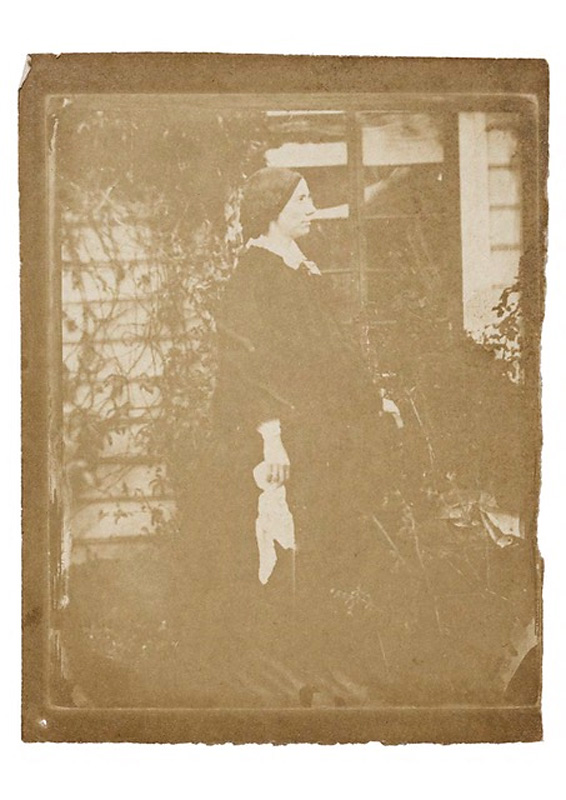
 

James Coutts Crawford (New Zealand born Scotland, 1817-1889) 'Jessie Crawford, probably outside the Crawfords' home in Thorndon, Wellington' c.  1859


James Coutts Crawford (New Zealand born Scotland, 1817-1889)
Jessie Crawford, probably outside the Crawfords’ home in Thorndon, Wellington
c.  1859
Salted paper print
143 × 110 mm
Alexander Turnbull Library


A rare image of a heavily pregnant Victorian woman, shot outdoors in a domestic garden.


James Coutts Crawford (New Zealand born Scotland, 1817-1889) 'Nurse Edgar [left] and Jessie Crawford' c. 1860


James Coutts Crawford (New Zealand born Scotland, 1817-1889)
Nurse Edgar [left] and Jessie Crawford
c. 1860
Salted paper print
Alexander Turnbull Library Collection
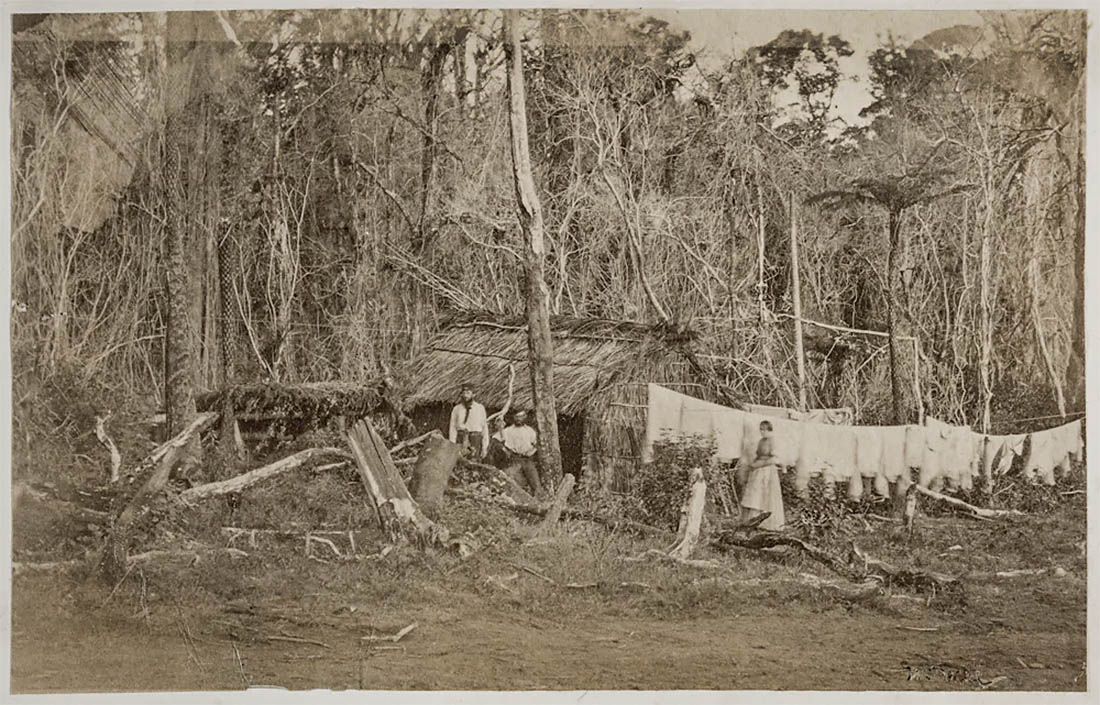
 

William Temple (New Zealand born Ireland, 1833-1919) 'The Bush at Razorback, Great North Road New Zealand' 1862-1863


William Temple (New Zealand born Ireland, 1833-1919)
The Bush at Razorback, Great North Road New Zealand
1862-1863
Tāmaki Paenga Hira Auckland War Memorial Museum


Medical officer with Imperial forces during New Zealand Wars; photographer. Born Co Monaghan, Ireland, son of William Temple MD and Anne Temple. Entered army service 1858, and served as Assistant Surgeon with the Royal Artillery in the Taranaki (1860-1861) and Waikato (1863-1865) campaigns. He was awarded the Victoria Cross for gallantry at Rangiriri. Died in London.

Text from the National Library of New Zealand website


“… every single photograph is taken with purpose. The photographer chooses what’s in the frame. There is always a bit of an edit in that regard.

“When you’re documenting, you’re not this invisible entity that’s just documenting everything, you are making choices. You are, in effect, not documenting neutrally, but with your own agenda.”

While many of the pictures have full captions detailing not only who took the photo but who is featured in it, some people’s names were lost – or possibly were never recorded at all, Higgins says.

Māori in particular were often photographed and their names and identities not preserved, called instead “Māori celebrities” and dressed with props in the artists’ studios.

“Sadly we sometimes know the studio, but we don’t know who they are, we don’t know answers to questions why they were taken. Did you walk away with your own picture, but did you know that that would then be sold to collectors for their albums?

“You might see someone and say, ‘Oh, they’re sitting with their taonga’. Well, not necessarily, they might be sitting with the studio’s prop and dressed up for a certain image.

“Photos like these are why throughout the exhibition you might see the question: Do you know who is in this picture? Higgins hopes with a bit of luck, some of the “orphan pictures” with no names might be identified.

“Our own institution and others play a part. We collect from collectors and photos end up in an institution with no name,” Higgins says.

“The best thing we can do is put them out and say, ‘Do you know who these people are?’ and hopefully we find out more about these orphan photographs that have made their journey through time in albums collected by largely white men.

“We don’t have answers, but we can pose the questions. I hope people walk away from an exhibition like this questioning some of the things they’ve seen and maybe looking at things in a different light.”

Shaun Higgins, Auckland Museum pictures curator quoted in Sapeer Mayron. “A Different Light: A chance to see 19th-century Aotearoa as our first photographers saw it,” on The Post website April 7, 2024 [Online] Cited 28/06/2024.
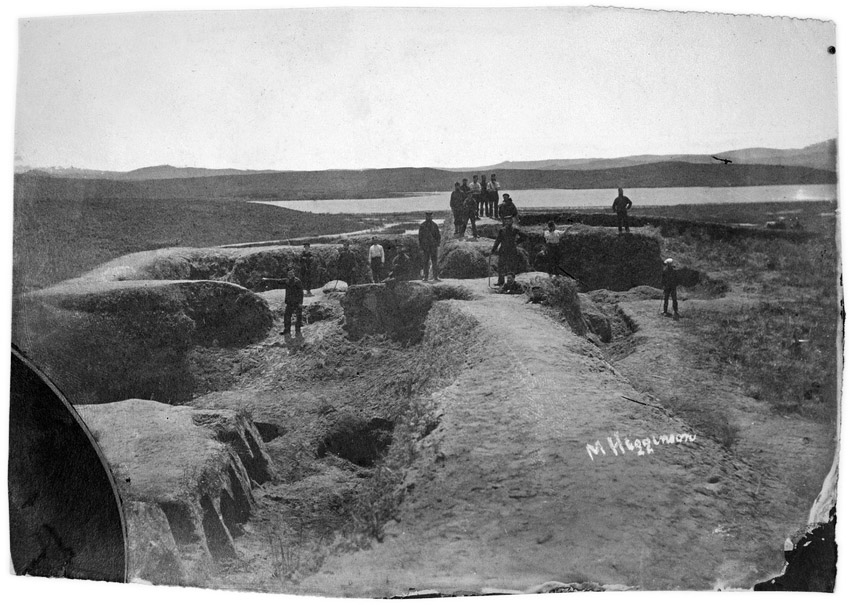
 

Montagu Higginson (English, 1840-1910) 'The Native Earthworks at Rangiriri partially destroyed' November 1863


Montagu Higginson (English, 1840-1910)
The Native Earthworks at Rangiriri partially destroyed
November 1863
Auckland Museum


In 2006 Auckland Museum acquired the album Photographs of the South Sea Islands; a photograph album featuring the work of a hitherto unknown photographer, one George Montagu John Higginson (Auckland War Memorial Museum 2006:28). Known commonly as Montagu Higginson (Illustrated London News vol. 045 XLV:91), this amateur photographer produced many images of  the Waikato campaign that are either new, or at the very least previously of unknown authorship.  There are also many images which cross over to other albums compiled by other photographers indicating the strong possibility of trading. This notion has been considered by Main and Turner (1993:10) with regard to other photographers such as Daniel Manders Beere.

Shaun Higgins. “Brothers in Glass: Montage Higginson and the Photographers of the Waikato War,” Auckland Museum Records, 2012
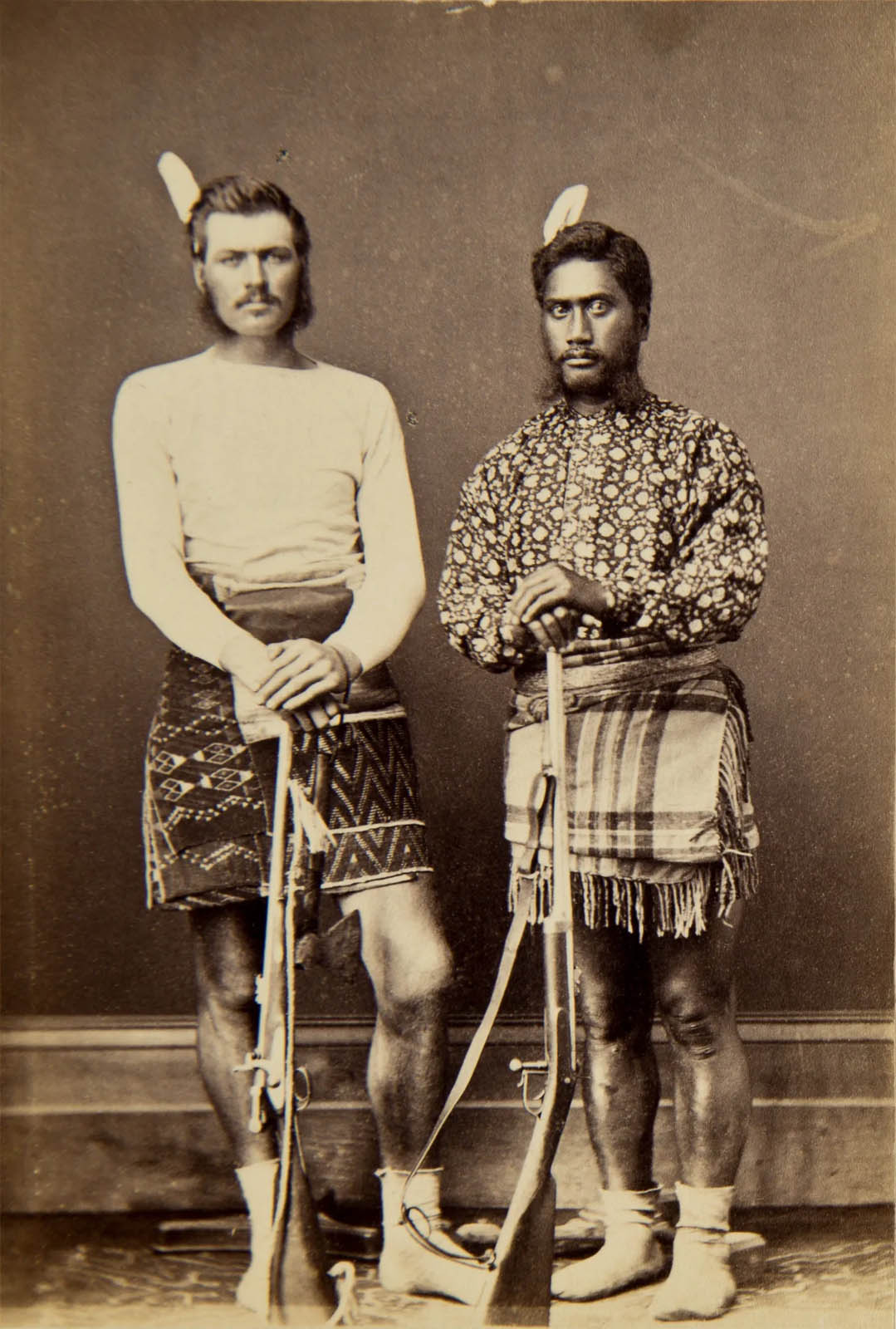
 

Batt & Richards (firm) (finished January 1874) 'Tom Adamson and Wiremu Mutumutu, Wanganui' c. 1867-1874


Batt & Richards (firm) (finished January 1874)
Tom Adamson and Wiremu Mutumutu, Wanganui
c. 1867-1874
Hocken


This studio carte de visite provides striking evidence of cultural exchange in the way of Māori and European fabrics and designs, with Tom Adamson on the left wearing a woven flax kaitaka with a geometric tāniko border, and Wiremu Mutumutu on the right wearing a fringed tartan rug, both in the manner of kilts. Adamson worked alongside Māori as a military scout and guide, hunting down dissidents in the dense native bush for pro-government forces during the New Zealand Wars. This service earned him a New Zealand Cross in 1876.
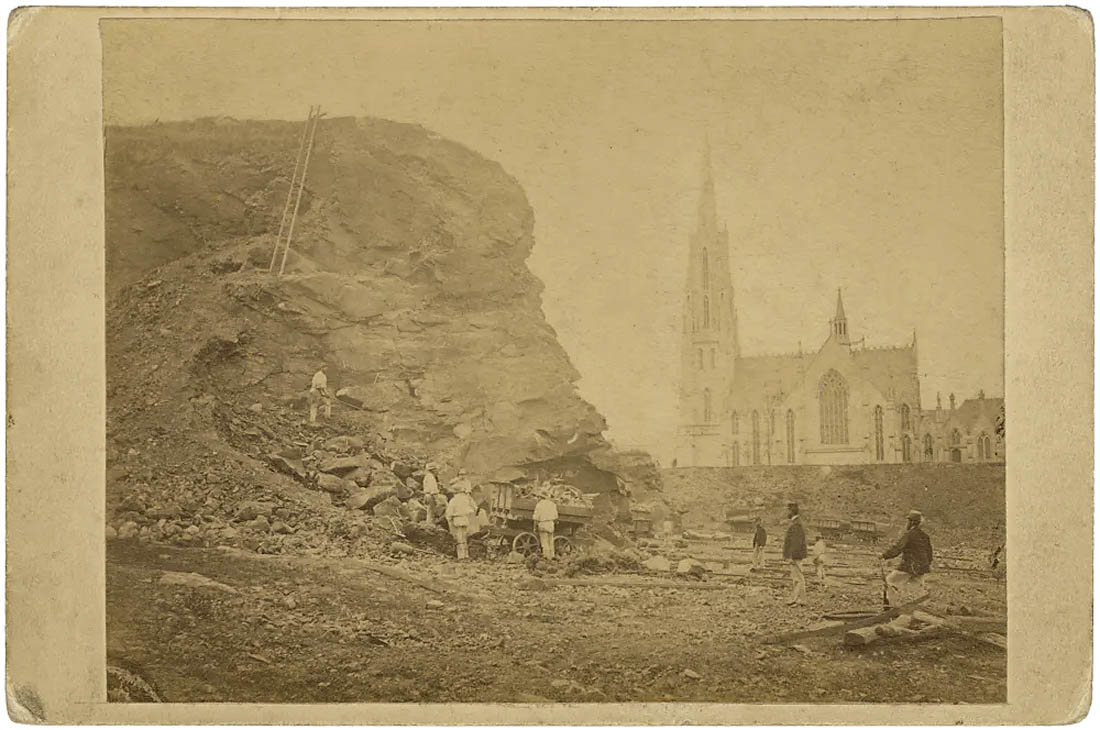
 

John McGregor (New Zealand born Scotland, 1831-1894) 'Bell Hill' c. 1875


John McGregor (New Zealand born Scotland, 1831-1894)
Bell Hill
c. 1875
Hocken Collections Uare Taoka o Hākena


Photographer, Stuart St, Dunedin, fl 1863-1884. Awarded first class certificate at The New Zealand Exhibition 1865 (Source: Photography in New Zealand / Hardwicke Knight and back of photograph). Died 12 Oct 1894, aged 63 years. 32 years in New Zealand, formerly of Glasgow, Scotland. Buried at Southern Cemetery, Dunedin (Source: Dunedin online cemetery database).


In 1848, two decades after a French inventor mixed daylight with a cocktail of chemicals to fix the view outside his window onto a metal plate, photography arrived in Aotearoa. How did these ‘portraits in a machine’ reveal Māori and Pākehā to themselves and to each other? Were the first photographs ‘a good likeness’ or were they tricksters? What stories do they capture of the changing landscape of Aotearoa?

From horses laden with mammoth photographic plates in the 1870s to the arrival of the Kodak in the late 1880s, New Zealand’s first photographs reveal Kīngi and governors, geysers and slums, battles and parties. They freeze faces in formal studio portraits and stumble into the intimacy of backyards, gardens and homes.

A Different Light brings together the extraordinary and extensive photographic collections of three major research libraries – Tāmaki Paenga Hira Auckland War Memorial Museum, Alexander Turnbull Library and Hocken Collections Uare Taoka o Hākena – to coincide with a touring exhibition of some of the earliest known photographs of Aotearoa.

Text from the Auckland War Memorial Museum website
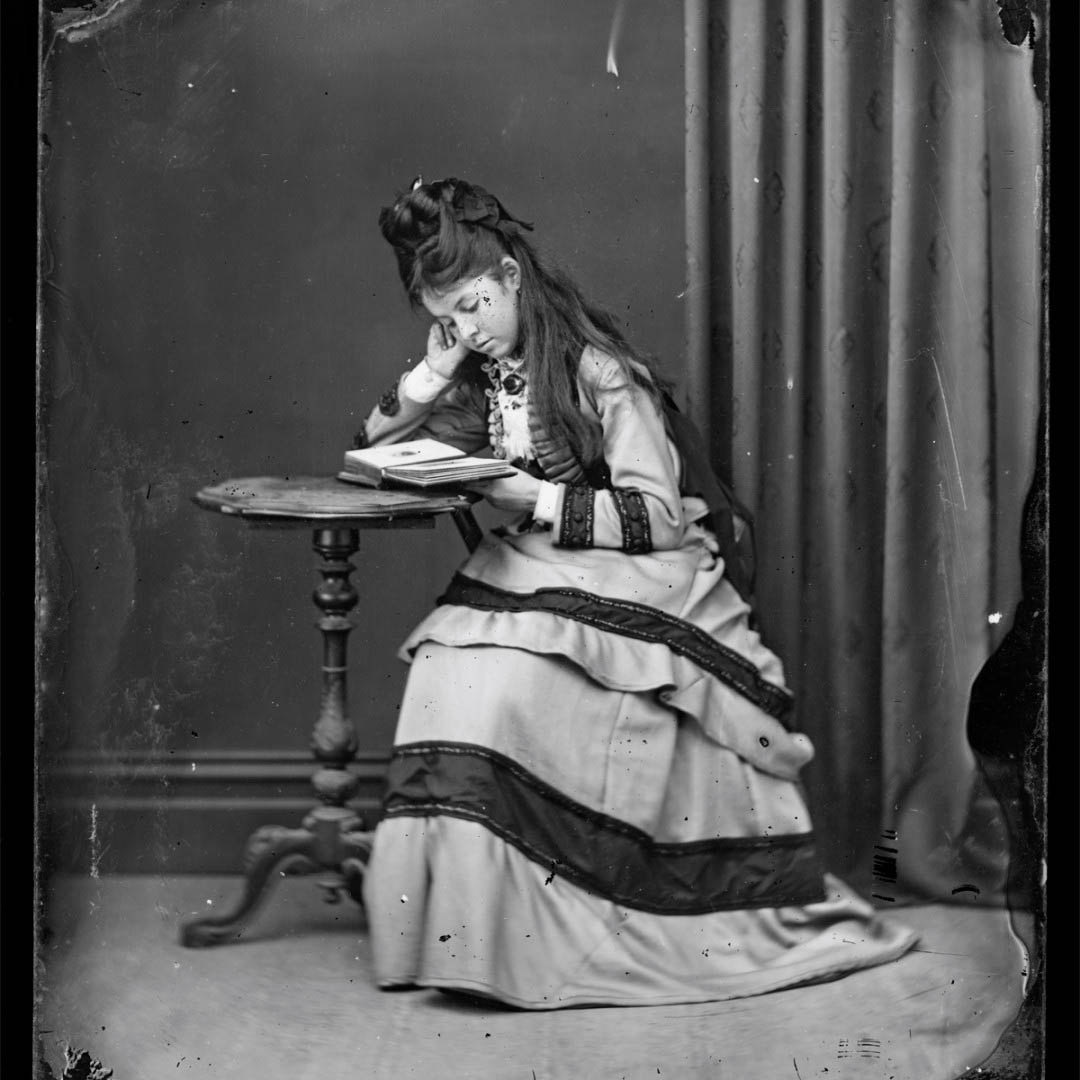
 

William James Harding (New Zealand born England, 1826-1899) 'Young woman looking at photograph album' c. 1870s


William James Harding (New Zealand born England, 1826-1899)
Young woman looking at photograph album
c. 1870s
Quarter-plate collodion silver glass negative
Alexander Turnbull Library Collection


William and Annie Harding arrived in New Zealand in 1855. Two brothers had already emigrated – John in 1842 and Thomas in 1848. The three brothers, and Annie, were followers of Emanuel Swedenborg, and strong supporters of the Total Abstinence Society. William and Annie settled in Wanganui, where William set up briefly as a cabinet-maker but in 1856 established a photographic studio. By the 1860s his studio was installed in a two-storeyed, corrugated-iron building on Ridgway Street.

Text from the Wikipedia website


William James Harding founded his studio in Wanganui in 1856. In 1889 he sold it to Alfred Martin, who had previously practiced in Christchurch. During his tenure, Harding occasionally hired out his studio to other photographers, and there are images in the 1/4 plate sequence which the Library also holds as cartes-de-visite by the photographers D Thomson and T Tuffin. Alfred Martin sold the business to Frank Denton in 1899. Denton in turn sold out to Mark Lampe around 1930, but retained Harding’s negatives, and Martin’s 10 x 8 and 10 x 12 negatives, himself.

Text from the National Library of New Zealand website
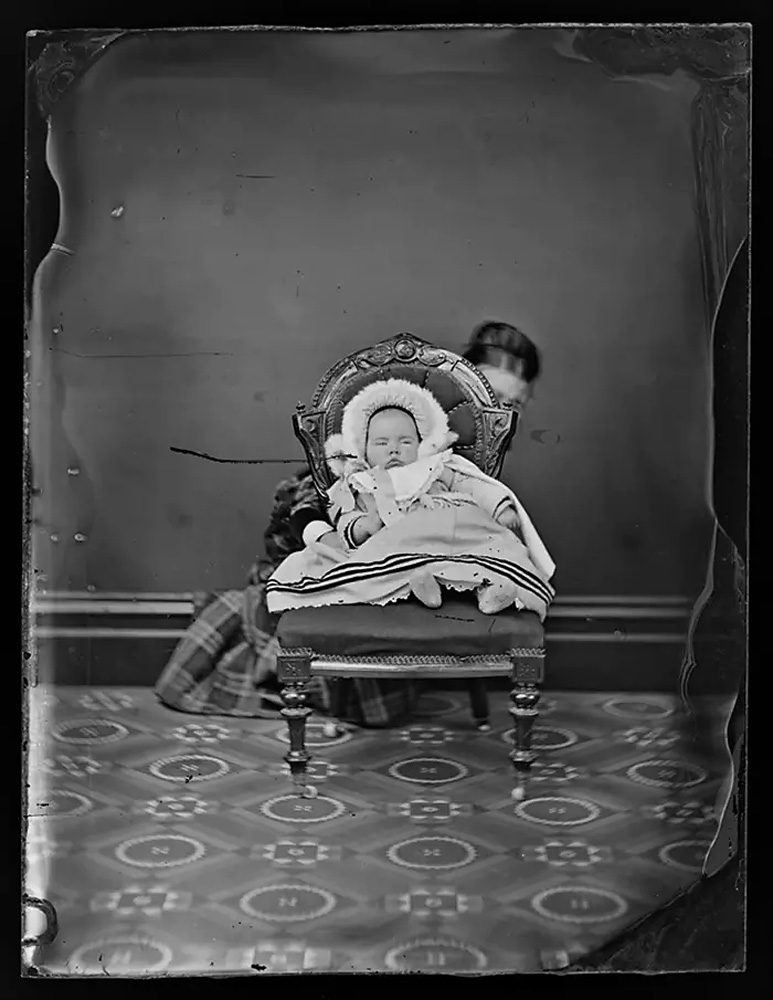
 

William James Harding (New Zealand born England, 1826-1899) 'Studio portrait of a woman and child' 1870s


William James Harding (New Zealand born England, 1826-1899)
Studio portrait of a woman and child
1870s
Reproduction from quarter-plate collodion silver glass negative
Alexander Turnbull Library Collection
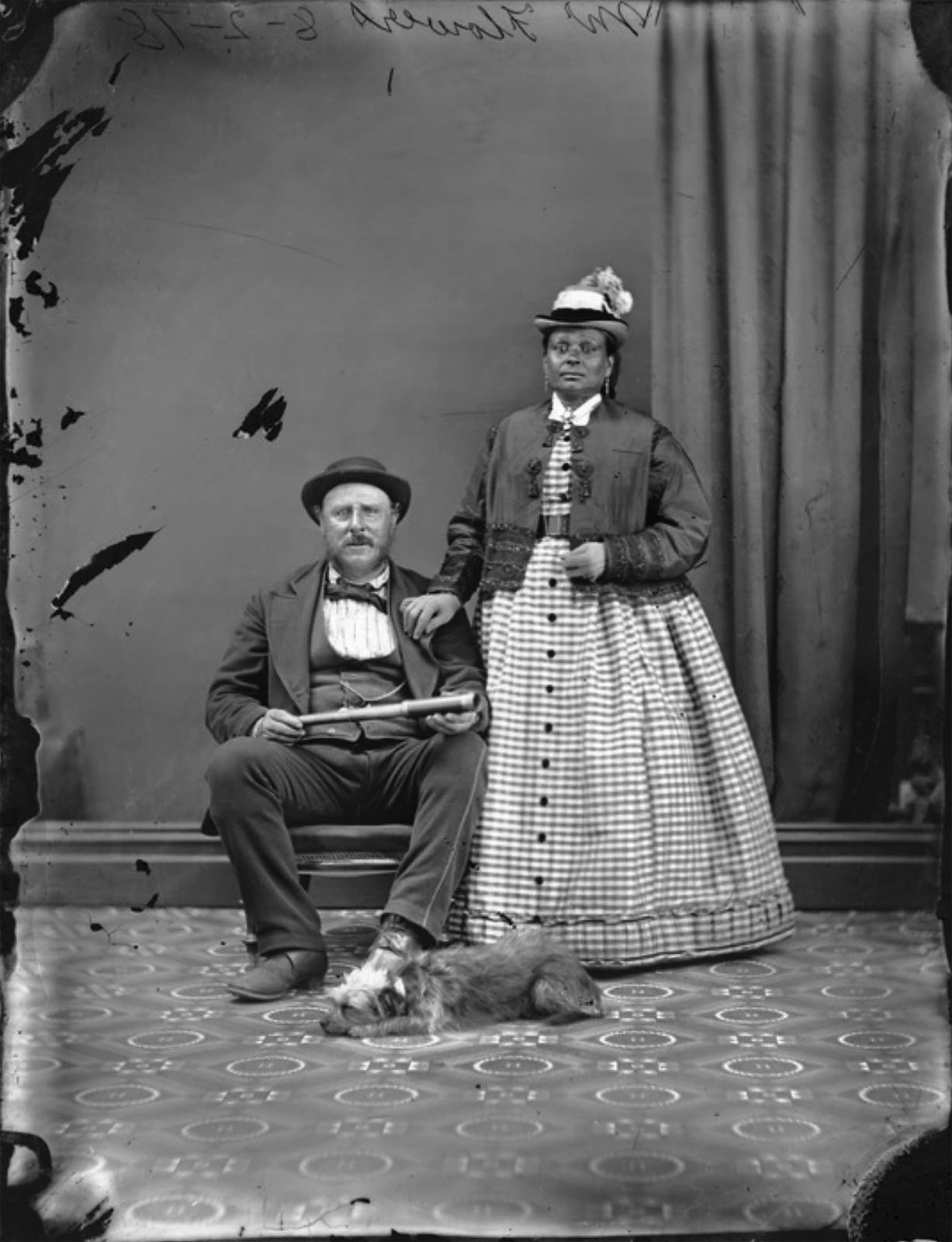
 

William James Harding (New Zealand, 1826-1899) 'Captain Nathaniel Flowers and wife Margaret, with a dog' 1878


William James Harding (New Zealand born England, 1826-1899)
Captain Nathaniel Flowers and wife Margaret, with a dog
February 1878
Glass negative
4.25 x 3.25 inches
Negatives of Wanganui district
Alexander Turnbull Library, Wellington, New Zealand


When Nathaniel and Margaret Flowers visited the Whanganui photographic studio of W.J. Harding (1826-99) in February 1878, they engaged with a technology that was only a few decades old but one that had been rapidly embraced by ordinary people such as themselves. By the 1870s, people – as individuals, couples and families – could have their likenesses made for a small fee. Harding photographed people from an array of backgrounds, from social elites to imperial and colonial soldiers, as we as interracial couples such as Nathaniel and Margaret. As soon as photography was invented, it was used by individuals, families and communities to fashion their social identities around age, class, ethnicity and gender. It was quickly integrated into society through social and cultural practices such as the making and keeping of photograph albums.

Text from the Introduction to the book A Different Light – First Photographs of Aotearoa


Elizabeth Pulman (New Zealand born England, 1836-1900) 'King Tāwhiao' 1882


Elizabeth Pulman (New Zealand born England, 1836-1900)
King Tāwhiao
1882
Carte de visite
Tāmaki Paenga Hira Auckland War Memorial Museum


Blackman, Elizabeth, 1836-1900, Chadd, Elizabeth, 1836-1900 Auckland photographer. Married George Pulman (d. 1871). Worked with him in his photographic studio in Shortland Street, specialising in scenic photographs and portraits. Elizabeth continued Pulman’s Photographic Studio for almost 30 years until the business was sold shortly before her death in 1900. After George Pulman’s death she married John Blackman (d 1893). She continued to be known professionally as Elizabeth Pulman.

Text from the National Library of New Zealand website


In the early years of photography it was relatively uncommon for women to take photographs, let alone work as professional photographers. Elizabeth Pulman was quite possibly New Zealand’s first female professional photographer.

Born in Lymm, Cheshire, England in 1836, she married George Pulman in 1859, and emigrated to New Zealand in 1861. Although a joiner and draughtsman by training, in 1867 George Pulman opened a photographic studio in Auckland, specialising in scenic photographs and portraits. Elizabeth assisted George with the business and after he died in 1871 she continued the work of the studio.

She married John Blackman in 1875, and was once more widowed in 1893. But for almost 30 years, until the business was sold to the Government Tourist Bureau shortly before her death, she carried on Pulman’s Photographic Studio, almost single-handedly managing the upbringing of nine children, running a successful business, and the problems of a period of rapidly changing technology in photography.

Pulman’s Photographic Studio left a legacy of many prints of historical interest, in both portrait and scenic subjects. Among the portraits are photographs of many important Maori chiefs of the North Island, including Tawhiao, the second Maori King, taken in Auckland shortly after he left his King Country stronghold.

Adapted by Andy Palmer from the DNZB biography by Phillip D. Jackson published as “Elizabeth Pulman,” on the New Zealand History website updated 
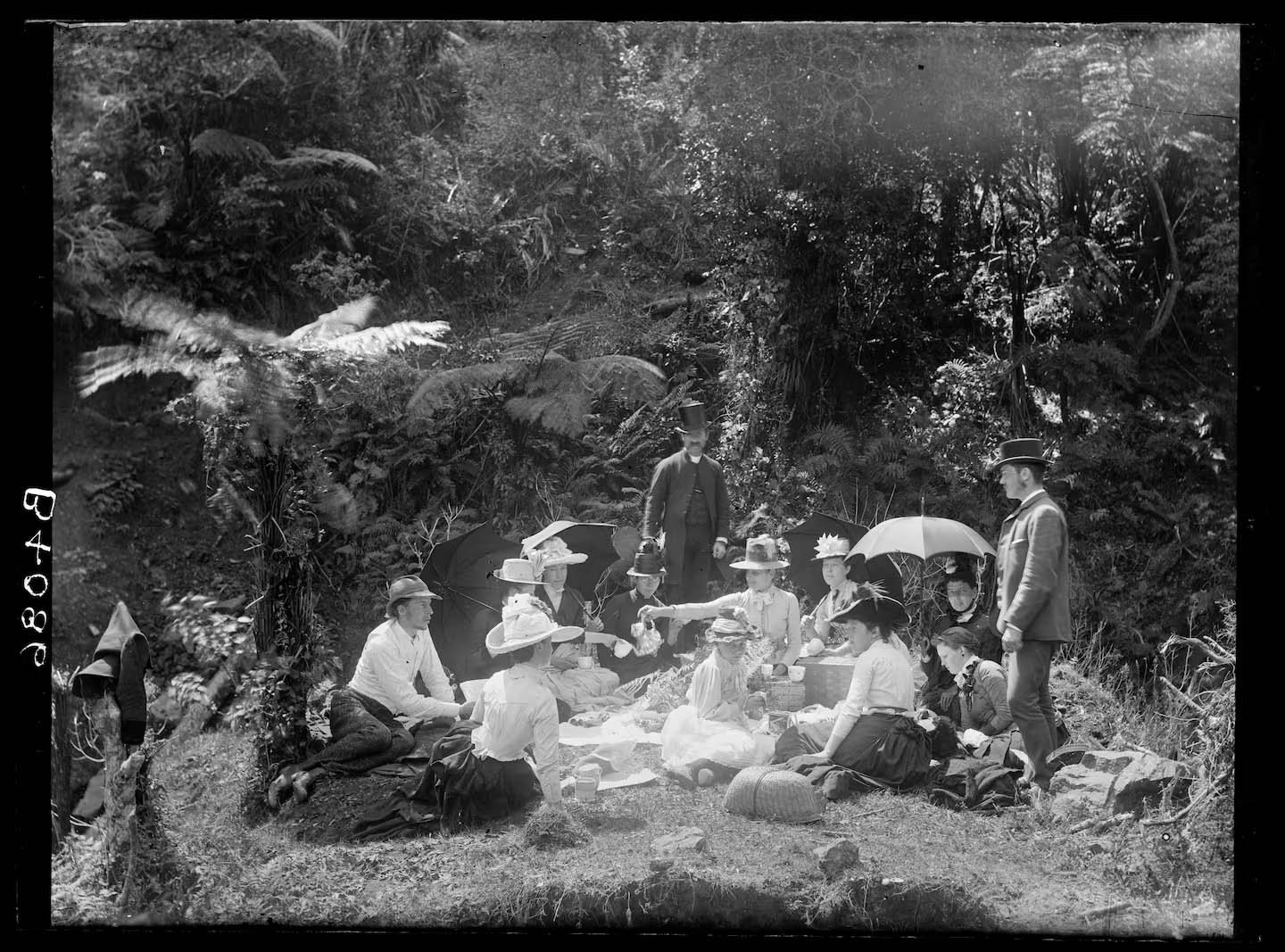
 

John Martin Hawkins Lush (New Zealand, 1854-1893) 'Picnic party at Thames' c. 1884


John Martin Hawkins Lush (New Zealand, 1854-1893)
Picnic party at Thames
c. 1884
Half-plate gelatin silver glass negative
Auckland Museum Collection


Unknown photographer. 'Three men in hats' c. 1880s


Unknown photographer
Three men in hats
c. 1880s
Ferrotype
Hocken Collections


Charles Spencer (New Zealand born England, 1854-1933) 'Cold Water Baths White Terrace' c. 1880s


Charles Spencer (New Zealand born England, 1854-1933)
Cold Water Baths White Terrace
c. 1880s
Cyanotype
Auckland Museum Collection


New Zealand photographer operating in Tauranga from 1879. Active in Auckland from the 1880s to 1917. Was one of Stephenson Percy Smith’s survey party at Mount Tarawera after the 1886 eruption. Took a series of photographs on White Island in late 1890s.

For more information on the photographer see Charles Spencer, Photographer (Part I) May 2019 and Charles Spencer, Photographer (Part II) July 2019 on the Tauranga Historical Society website
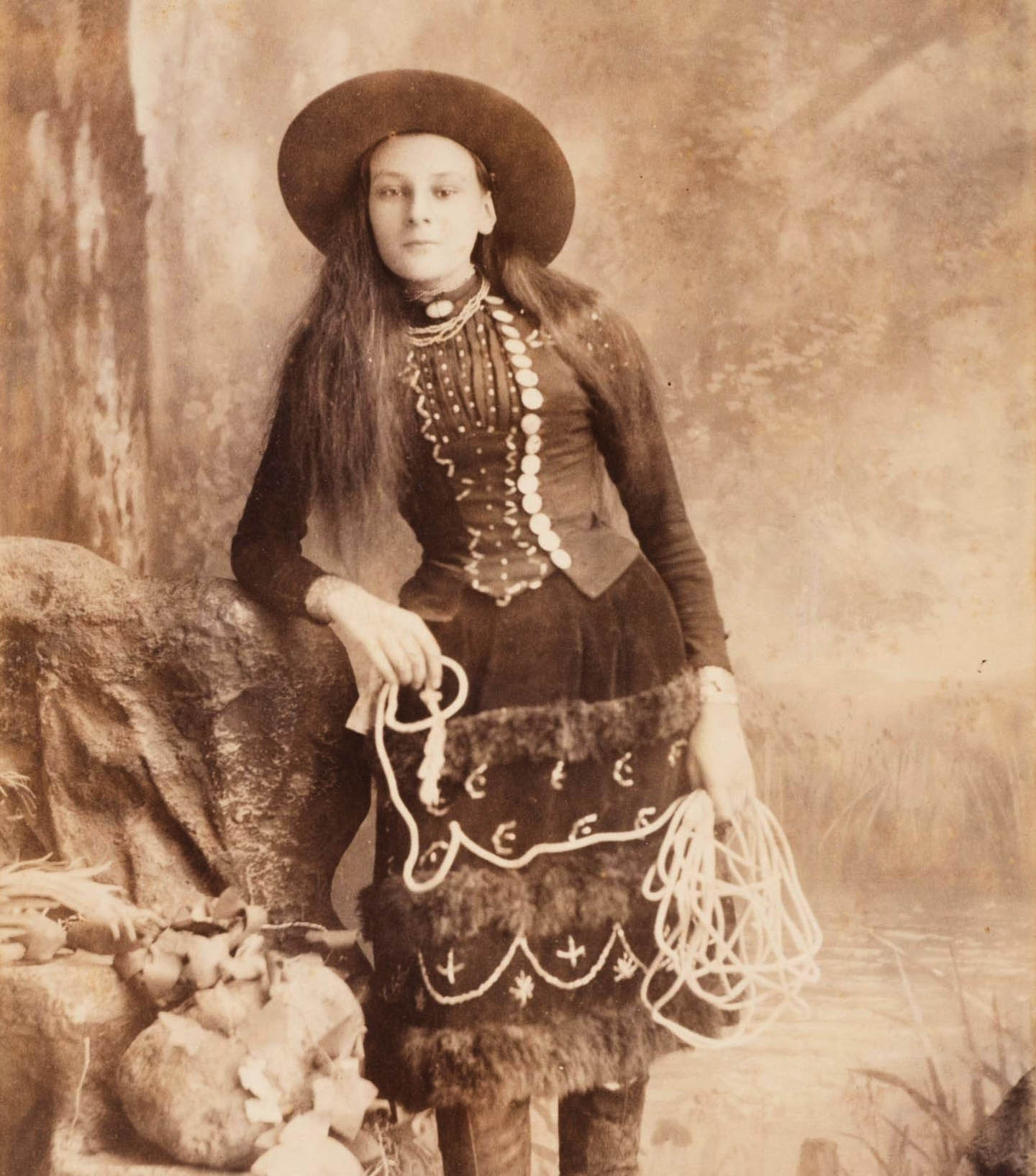
 

Josiah Martin (New Zealand born England, 1843-1916) 'Portrait of an unidentified sitter from the Teutenberg family album' c. 1880s


Josiah Martin (New Zealand born England, 1843-1916)
Portrait of an unidentified sitter from the Teutenberg family album
c. 1880s
Albumen silver print, cabinet card
Auckland Museum Collection


Josiah Martin was born in London, England, on 1 August 1843 and, in 1864, married Caroline Mary Wakefield. They emigrated to New Zealand a few years later with an infant daughter and eventually settled in Auckland. Martin founded a private academy, where he was headmaster until 1874 and proved to be a gifted teacher but retired from the profession in 1879 due to failing health.

He then concentrated on photography. During 1879 he returned to Europe, and while in London studied the latest innovations in photographic techniques and processes. On his return to Auckland he opened a photographic business with a studio on the corner of Queen and Grey streets in partnership with W.H.T. Partington. After the partnership was dissolved he opened another studio in Queen Street, later selling the portrait business and transferring premises to Victoria Arcade. Martin visited the area of Tarawera and Rotomahana many times and was there on the eve of the eruption of Mt Tarawera in 1886; some of the photographs he took after the eruption were reproduced in the Auckland Evening Star. He also appears to have visited several Pacific Islands, including Fiji and Samoa, in 1898, and in 1901 travelled there with S. Percy Smith. He published an account of this trip in Sharland’s New Zealand Photographer and also contributed articles and photographs to the Auckland Weekly News and the New Zealand Illustrated Magazine.

Martin gained an international reputation for his ethnological and topographical photographs. His work was exhibited in London at the Colonial and Indian Exhibition of 1886 and he won a gold medal at the Exposition coloniale in Paris in 1889. He was also editor of Sharland’s New Zealand Photographer for several years and lectured frequently, not only on photography but also on scientific subjects.

Josiah Martin died on 29 September 1916 at his home in Northcote, Auckland, aged 73. His photographs provide a record of changed landscapes and societies. Martin was one of the first photographers to realise the commercial potential of photography to encourage tourism, but he was also aware of the need for conservation of the landscape and of the role of photography in providing a documentary record (Orange 1993, pp.313-314).

Orange, Claudia ed. (1993), The dictionary of New Zealand biography, volume 2, 1870-1900, Wellington: Bridget Williams Books Limited and the Department of Internal Affairs.
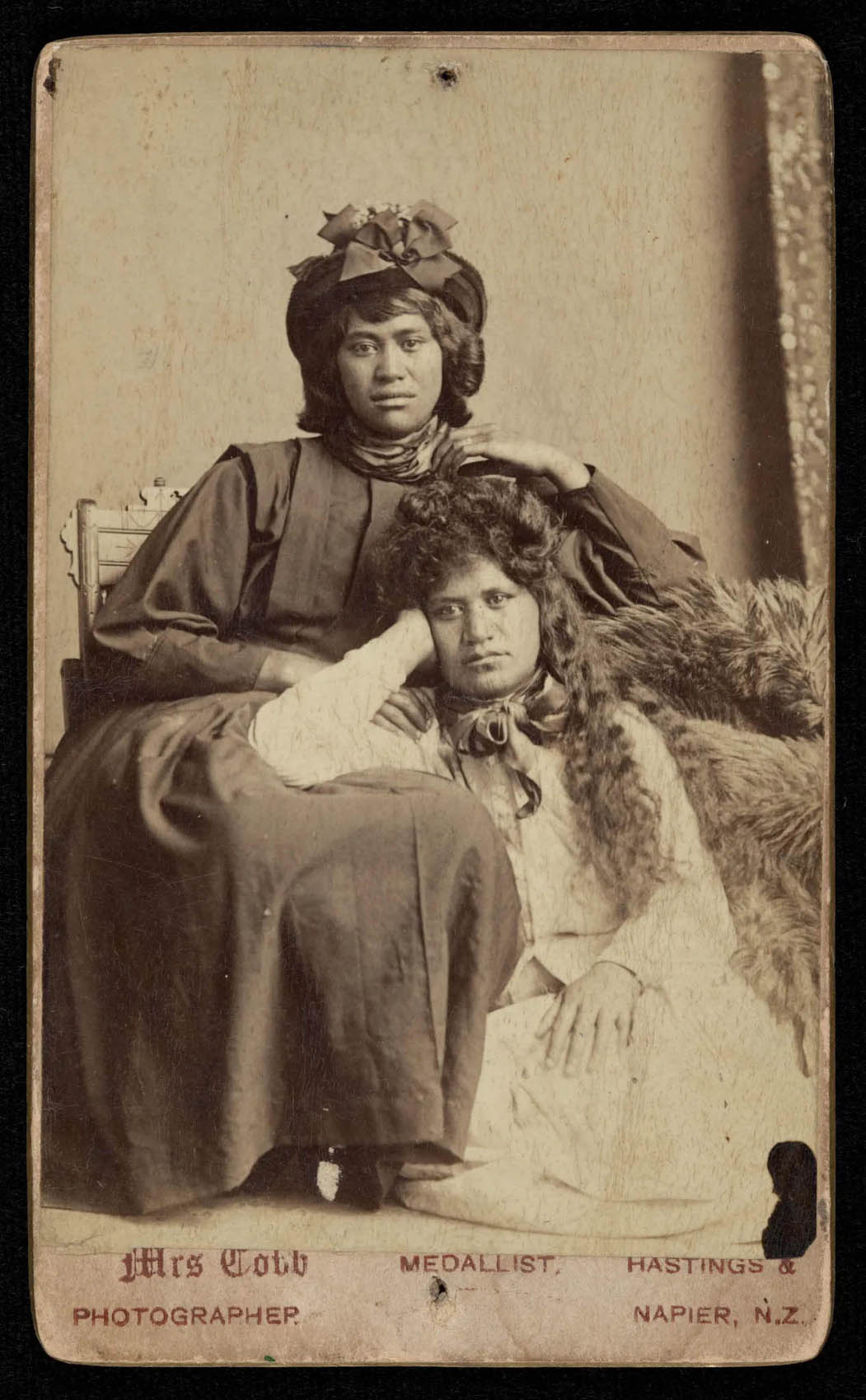
 

Harriet Cobb (New Zealand born England, 1846-1929) 'Two wāhine' c. 1887-1890


Harriet Cobb (New Zealand born England, 1846-1929)
Two wāhine
c. 1887-1890
Albumen silver print, carte de visite
Alexander Turnbull Library Collection


The word “wahine” came into English in the late 18th century from Maori, the language of a Polynesian people native to New Zealand; it was originally used for a Maori woman, especially a wife. The word is also used for a woman in Hawaiian and Tahitian, though spelled “vahine” in the latter.


Harriet Sophia Cobb (née Day, 10 February 1846 – 18 December 1929) was a New Zealand photographer. Her works are held in the collection of the Museum of New Zealand Te Papa Tongarewa. Cobb operated two successful photography studios in the late 1800s and into the 20th century.

In 1866 she married Joseph Edward Cobb, and they went on to have 15 children… In 1884 Cobb and her husband emigrated from the United Kingdom to New Zealand with their nine children and set up a photographic studio in the Hawke’s Bay. They arrived in Wellington on the Lady Jocelyn.

The couple operated two studios known as JE & H Cobb in Napier (from 1884) and Hastings (from 1885), but in 1887 after Joseph’s bankruptcy, Cobb won a plea to operate the businesses in her name until she retired in 1911… Cobb died on 18 December 1929 in Ōtāhuhu, Auckland.

Text from the Wikipedia website


Ambitious and creative

Harriet was a busy and ambitious woman – having a sensibility for the photographic trade learnt from her father that was out of step in the sleepy colony of New Zealand. Her work in the 1885 Industrial Exhibition in Wellington caught the attention of Julius von Haast who selected it for inclusion in the New Zealand court at the 1886 Colonial and Indian Exhibition in London.

Cobb’s work was described by a reviewer as being portraiture of mostly female subjects. By being included in the exhibition, Cobb’s work inserted the visual existence of family life and women’s lives in the colony into the multitude of industrial and scenic exhibits that dominated the New Zealand court at the London exhibition.

An art photographer

Cobb advertised herself as an ‘art photographer’, which was a way of claiming that her work was of higher quality than other photographers. In one of Cobb’s advertisements she claimed that the basics of photography could be learnt by any school boy in a week but not the skills, experience, and eye for creating quality photographs that she had.

Cobb’s marketing targeted a broad clientele and emphasised quality service in a quality establishment run by herself. She wanted it understood that her studios were respectable places for women to go unaccompanied by men.

Extract from Lissa Mitchell. “Inspiring stories about NZ women photographers – Harriet Cobb (1846-1929),” on the Museum of New Zealand / Te Papa Tongarewa website 16 Oct 2018 [Online] Cited 10/08/2024
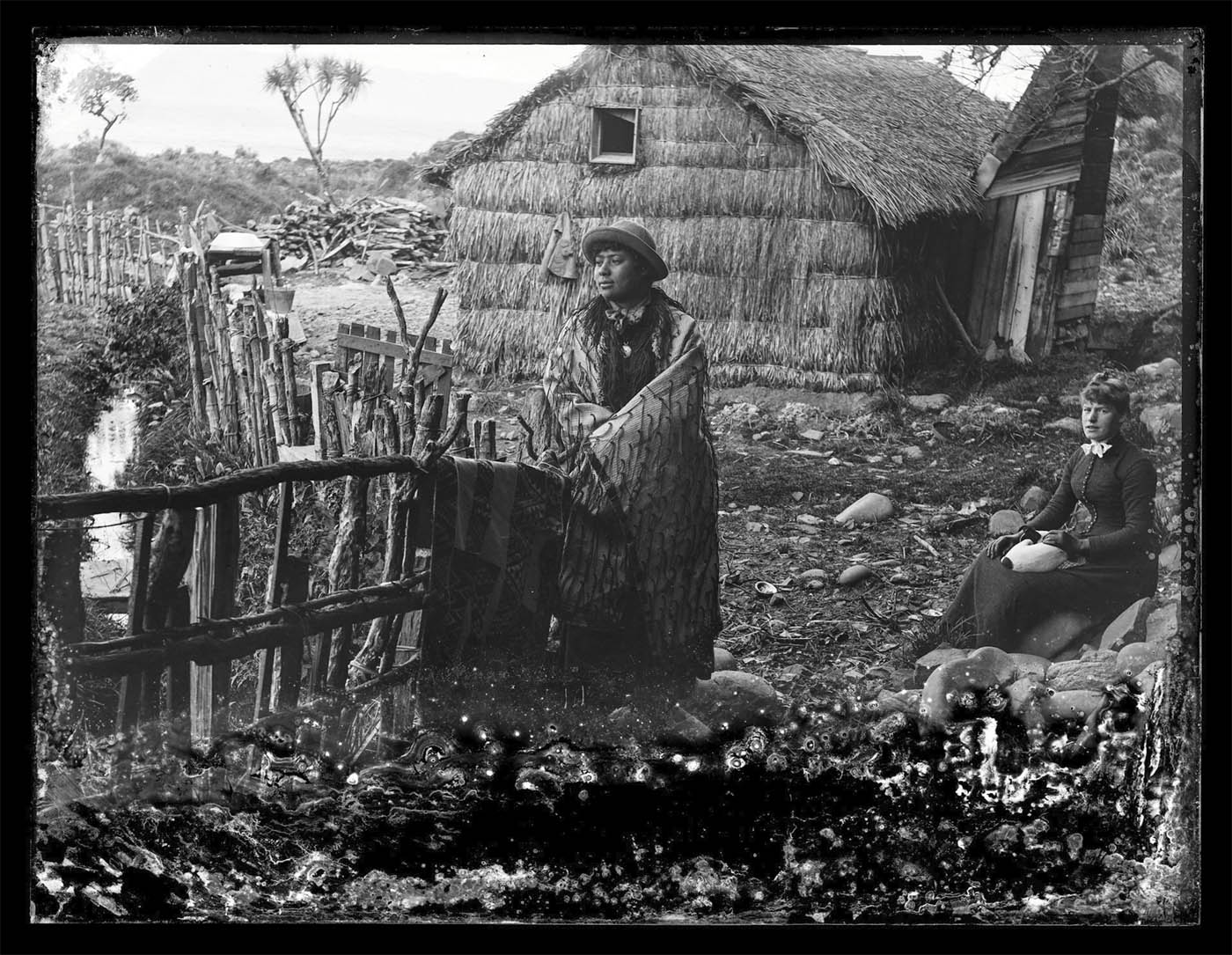
 

Henry Wright (New Zealand, 1844-1936) 'Māori woman in a tag cloak (possibly Rīpeka Te Puni) and Amy Elizabeth Wright, Wellington' c. 1885


Henry Wright (New Zealand, 1844-1936)
Māori woman in a tag cloak (possibly Rīpeka Te Puni) and Amy Elizabeth Wright, Wellington
c. 1885
Alexander Turnbull Library


John Kinder (New Zealand born England, 1819-1903) 'Mount Tarawera' 1886


John Kinder (New Zealand born England, 1819-1903)
Mount Tarawera
1886
Albumen silver print mounted on album page
151 × 200 mm
Tāmaki Paenga Hira Auckland War Memorial Museum


While he [Kinder] was at Ayr Street Kinder also practised as an amateur photographer. There is no indication that he had taken an active interest in photography in England. Rather, it seems likely that he learned the wet-plate photographic process in Auckland about 1860-61. He was friendly with Hartley Webster, a prominent professional, who was the Kinder family photographer in the 1860s. He also collected prints of the work of Daniel Manders Beere, a photographer working in Auckland at the same time, whose photography has some affinities with his own.

Kinder was primarily a landscape and architectural photographer, although he did take a few portraits of family and friends, including Celia Kinder and the Reverend Vicesimus Lush, vicar of Howick. One of his best-known photographs is the portrait of Wiremu Tāmihana, which was used as the frontispiece for John Gorst’s The Māori King (1864). There are also a few fine photographs of Māori artefacts, including canoes and canoe prows. He took photographs of Parnell in the 1860s, especially of Anglican buildings such as the first St Mary’s Church, St Stephen’s Chapel and Bishopscourt (Selwyn Court). These provide a good historical record as well as having high artistic merit. Kinder also travelled extensively and his paintings and photographs are not confined to Auckland. After his sisters Mary and Sarah settled in Dunedin in 1878 he made several trips to the South Island.

In his photographs and paintings Kinder imposed a sense of order on his views, as if regulating them to current conventions of composition where clarity and intelligibility were paramount. This tidiness, combined with the serene calmness of the depicted weather conditions, can give a Utopian or idealised dimension to his colonial scenes. While there is a high degree of objectivity in his works, this does not exclude an element of interpretation – an adaptation of landforms and buildings to an ideal. His art expresses a positive view of the colonising process. It is worth noting that many of his finished paintings were made late in life, during his retirement, when he was looking back through rose-tinted glasses to a time of great achievement and rapid progress. In an unpublished autobiography, written in his later years, he recalled with pride how the city of Auckland had grown from the humble beginnings he encountered in 1855, when there were only one or two decent buildings to be seen.

Extract from Michael Dunn. “Kinder, John,” first published in the Dictionary of New Zealand Biography in 1993 digitally published on the Te Ara – the Encyclopedia of New Zealand website [Online] Cite 11/08/2024
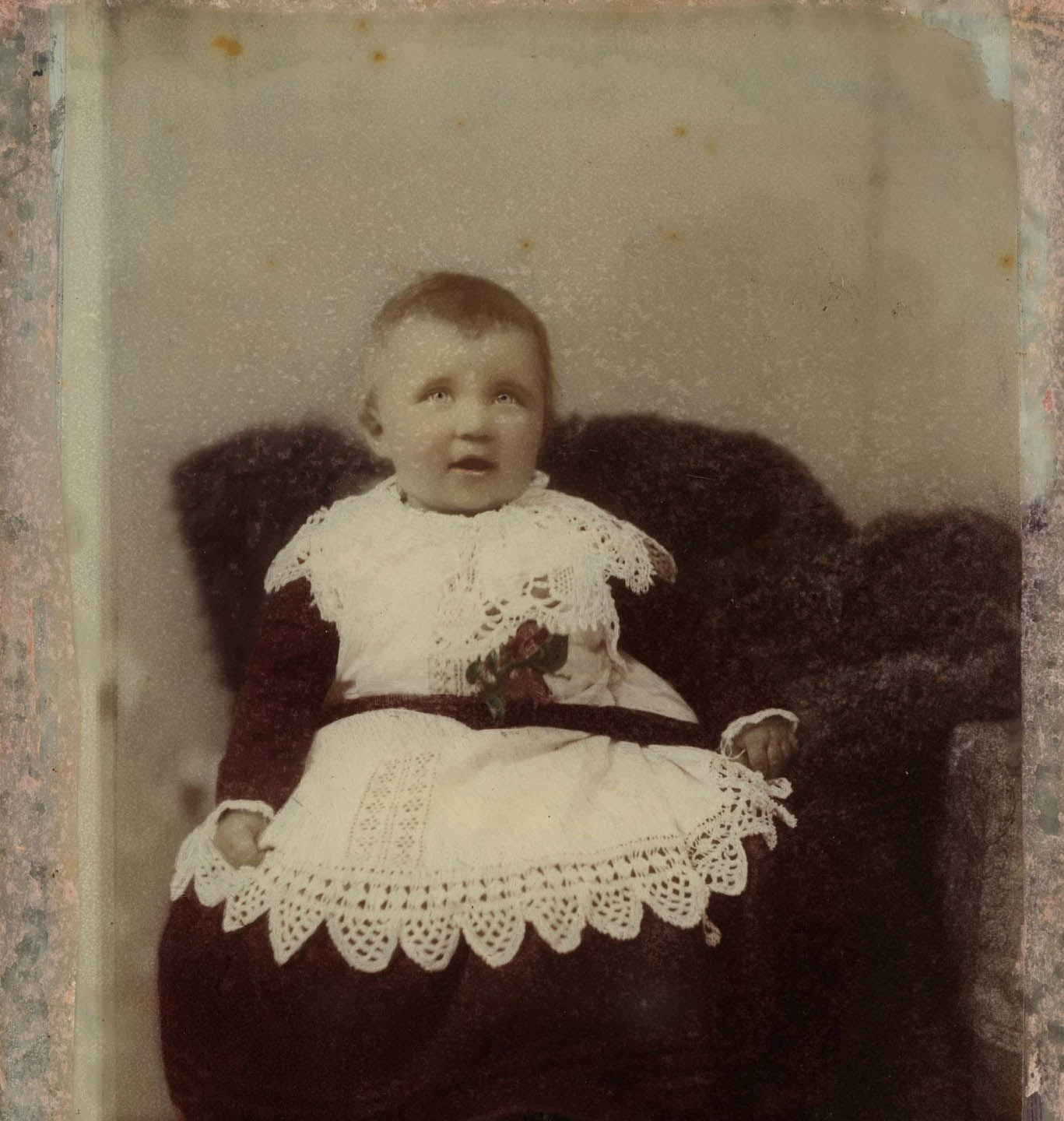
 

Unknown photographer. 'Portrait of an unidentified child' c. 1890


Unknown photographer
Portrait of an unidentified child
c. 1890
Crystoleum
Auckland Museum Collection


Elite Photographers. 'Portrait of the Thompson family, with drawn-on eyes and eyebrows' 1893


Elite Photographers
Portrait of the Thompson family, with drawn-on eyes and eyebrows
1893
Opalotype
Auckland Museum Collection


The settler lens

Photographs are complicit in colonialism because they were used to document the impacts of migration, settlement and land transformation. For example, they illustrate the advance of settlement and the subjugation of Māori after the Waikato War (1863-1864).

Imperial officers such as William Temple, who was active in military campaigns to advance European settlement, photographed two icons of colonisation: roads and military camps.

An Irish-born soldier, Temple followed the Great South Road on foot and with his camera as the route advanced towards the border of Kiingitanga territory. One of his photographs (The Bush at Razorback, Great North Road New Zealand, 1862-1863) demonstrates the impacts of the Great South Road on the local environment.

Photography’s commercial interests also aligned with colonial propaganda, especially as landscape photography grew in popularity from the 1870s. Historian Jarrod Hore has demonstrated how landscape photographers helped shape settler attitudes to the environment, but also documented colonial progress.

Photographs were used to illustrate engineering successes and the advancing tide of settlement. For instance, John McGregor’s 1875 photograph (Bell Hill, c. 1875) depicts the clearing of Bell Hill in Dunedin. In the background, the church embodies the possibilities of colonial advancement enabled by environmental transformation.

Our early photographers were, in Hore’s words, engaged in “settler colonial work” because they “mobilised and visually reorganised local environments in the service of broader settler colonial imperatives.”

The photograph as taonga

Indigenous peoples were a particular focus of early photography in other settler colonial societies. New Zealand followed this pattern and Māori feature prominently in our colonial photographic record.

As soon as photography arrived in the colony, Māori were captured by the camera. Itinerant daguerreotype photographers travelled the new colony in the 1840s and 1850s to exploit the commercial opportunities available in new colonies such as New Zealand.

Reproduction of colonial tropes became common in commercial photography, reflecting the collectability of Māori as photographic subjects. The carte-de-visite, popular from the 1860s and of a size that could easily be posted, meant images of Māori found their way into albums all around the world.

Such images became an important part of the business for studio photographers in the colonial period.

At different times, and depending on the context, Māori embraced or rejected photography. Because of its colonial implications, Māori whānau and communities have a complicated relationship with the camera. But, as scholars Ngarino Ellis and Natalie Robertson argue, there is evidence it was regarded as friend as much as foe.

Māori have long integrated visual likenesses into customary practices, such as tangihanga (funerals), while portraits adorn the walls of wharenui [meeting house, large house] across the country.

Colonial photographs are culturally dynamic. Their integration into Māori life means they do not just depict relationships but are imbued with them. As such, photographs are taonga (treasures) and connect people across time and space.

Te Whiti and the camera

Māori also took up the camera. Canon Hākaraia Pāhewa, for instance, was a skilled photographer who took his camera on his pastoral rounds, during which he recorded scenes of daily life.

He depicted people at work and documented transformations of landscapes, important cultural events, religious service and domestic routines. These photographs bring to light the diversity and richness of Māori life in the early 20th century.

Māori whānau [basic extended family group] already valued and used photographs in a variety of ways in the 19th century. Photographs were memory containers, mementos of family, markers of personal transformation, and generators of social connection.

Designed to be shared and displayed, photographs were prompts for discussion and storytelling. They are visual records of whakapapa [Whakapapa is a fundamental principle in Māori culture. Reciting one’s whakapapa proclaims one’s Māori identity, places oneself in a wider context, and links oneself to land and tribal groupings and their mana], identity and notions of belonging. They also mark Indigenous presence and survival in the face of settler colonialism.

At the same time, though, photography’s role in advancing colonialism meant Māori were cautious about the reproduction of images. There was an awareness of what could happen to photographs once they were out of the subject’s control.

Extract from Professor Angela Wanhalla. “The past in a different light: how Māori embraced – and rejected – the colonial camera lens,” on The Conversation website April 11, 2024 [Online] Cited 10/08/2024

This article is republished from The Conversation under a Creative Commons license. Read the original article.


Henry Wright (New Zealand, 1844-1936) 'Rahui Te Kiri Tenetahi [right] and her daughter Ngāpeka Te Roa of Ngāti Manuhiri' 1893


Henry Wright (New Zealand, 1844-1936)
Rahui Te Kiri Tenetahi [right] and her daughter Ngāpeka Te Roa of
Ngāti Manuhiri
1893
Full-plate gelatin silver glass negative
216 × 165 mm
Alexander Turnbull Library


Rahui Te Kiri Tenetahi (right) and her daughter Ngapeka Te Roa, of Ngati Manuhiri, alongside a building made of ponga logs, Little Barrier Island, 1893. They hold dahlia flowers.

Henry Wright was a prominent Wellington businessman. He was also a keen amateur photographer. Negatives found in two wooden boxes under house at 117 Mein Street, originally the home of Henry Wright, who had lived there from 1896 until his death in 1936.


Henry Wright spent nearly three months living on the island and produced a report for the government on its value as a bird reserve. After the government purchased the island from iwi and it was declared a forest reserve and bird sanctuary, Wright was appointed its first ranger. Wright’s series of photographs capture the vegetation, coastline and the last of the mana whenua [the right of a Maori tribe to manage a particular area of land], Ngāti Manuhiri, to live and sustain themselves on the island, including Rāhui Te Kiri Tenetahi, her daughter Ngāpeka Te Roa, and her second husband Wiremu Tenetahi, who were forcibly evicted just three years after Wright had visited the island.

Text from the book A Different Light: First Photographs of Aotearoa
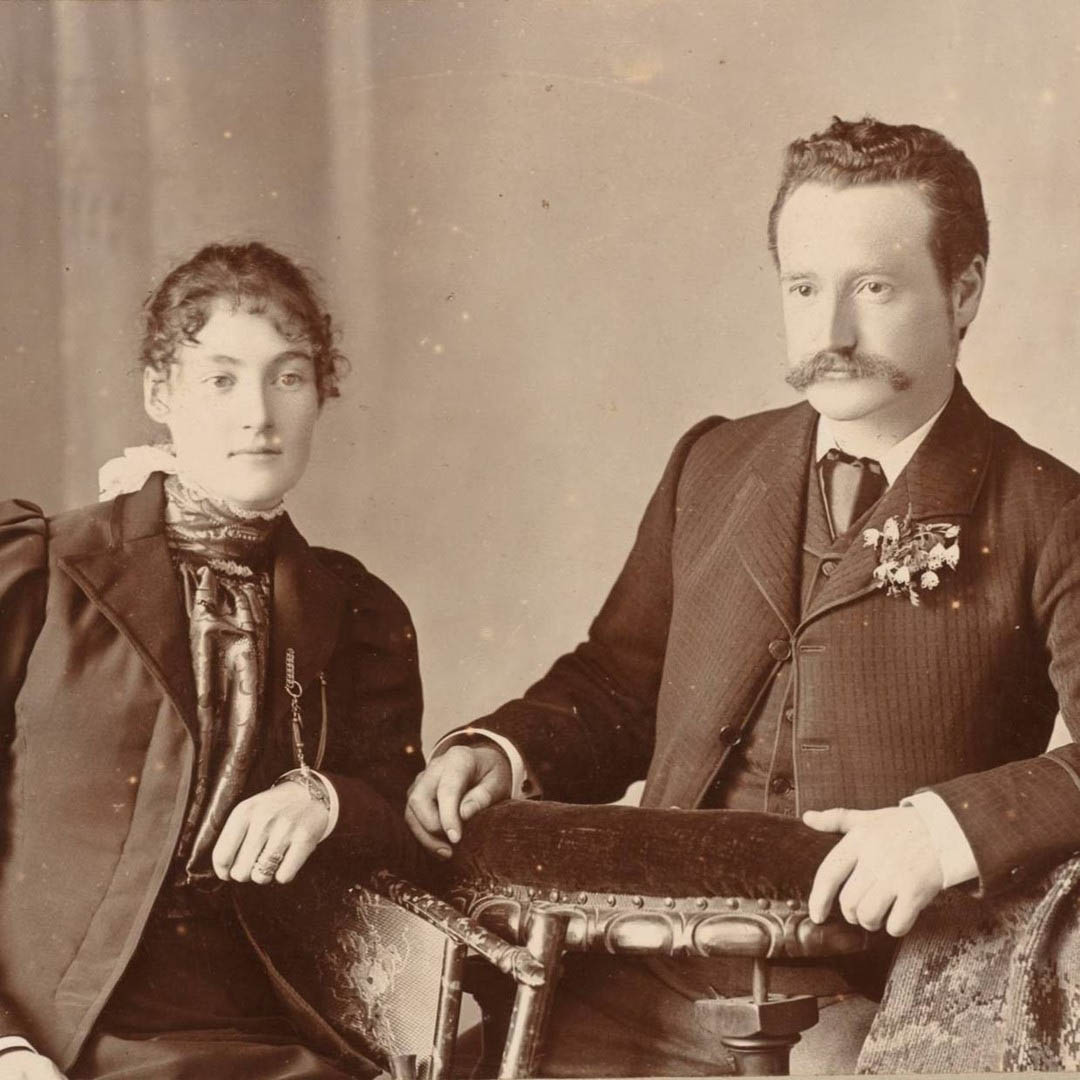
 

John Robert Hanna (New Zealand born Ireland, 1850-1915) 'Portrait of unidentified sitters' c. 1895


John Robert Hanna (New Zealand born Ireland, 1850-1915)
Portrait of unidentified sitters
c. 1895
Gelatin silver print, cabinet card
Auckland Museum Collection


Photographer of Auckland. Born Ireland in 1850, eldest son of Eliza Crawford and Robert Hanna of Drum, County Monaghan, Ireland; arrived in Auckland per ‘Ganges’ in 1865; began his photographic career in Auckland with R H Bartlett whose business he managed for some time. Then managed the firm of Hemus & Hanna for 10 years before business dissolved in 1885. Bought the business of J Crombie (which had been established in 1855) in Queen Street. Died in 1915.

Text from the National Library of New Zealand website
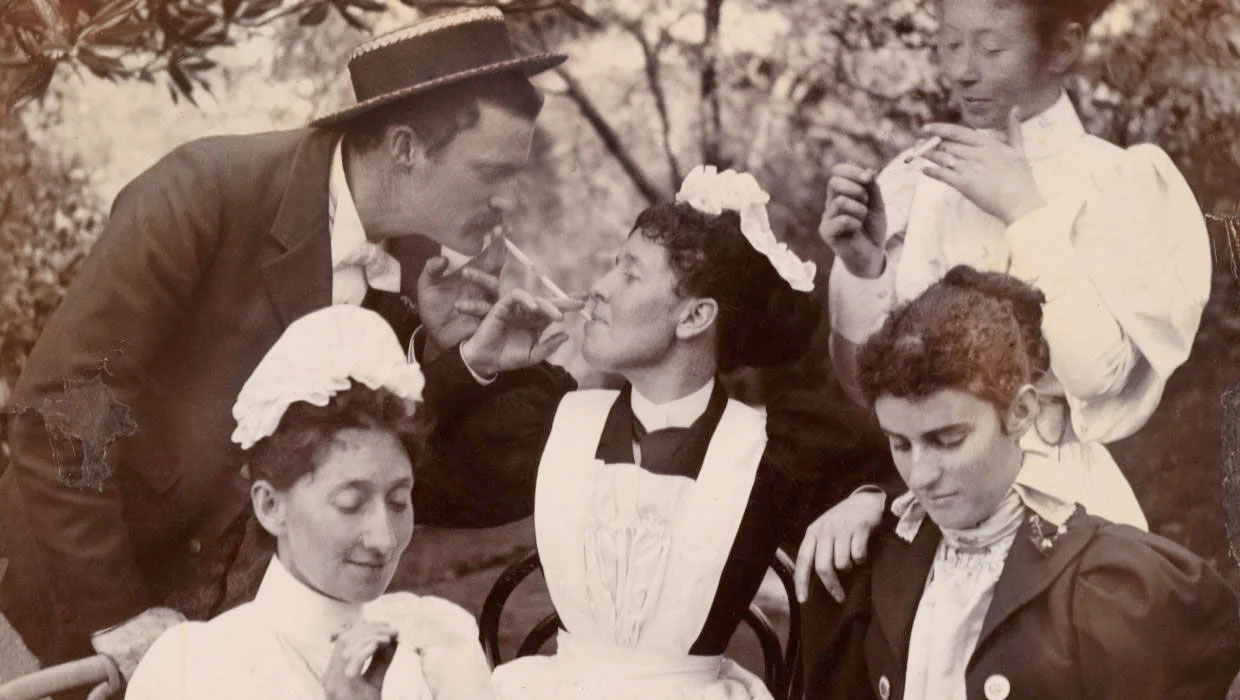
 

Margaret Matilda White (New Zealand born Northern Ireland, 1868-1910) 'Nurse Pierce and Bessie McKay smoking with Mr Hodson and other nurses at Huia Private Hospital' 1895


Margaret Matilda White (New Zealand born Northern Ireland, 1868-1910)
Nurse Pierce and Bessie McKay smoking with Mr Hodson and other nurses at Huia Private Hospital
1895
Gelatin silver print
Auckland Museum Collection


Margaret Matilda White

Margaret Matilda White came to New Zealand in the 1880s to join her family when she was 18 years old. She was acquainted with the photographer Hanna, possibly working in his studio. She established her own photographic business, which was not a success, but continued to photograph on an amateur or semi-professional basis until her early death in 1910.

Margaret Matilda White is best known for her photographs of the Auckland Mental Hospital, known at times as the Whau Lunatic Asylum, Oakley Mental Hospital or Carrington Mental Hospital.  She photographed the buildings and the staff, making pictures of nurses and attendants with her characteristic structured group poses.

The Museum has a large collection of her glass plates, donated by her son Albert Sherlock Reed, in 1965.

Text from the Auckland Museum website
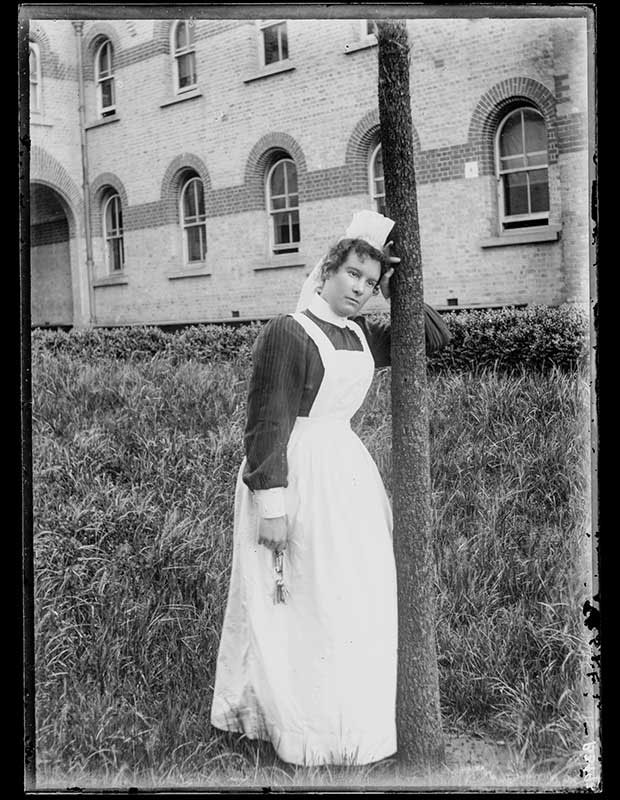
 

Margaret Matilda White (New Zealand born Northern Ireland, 1868-1910) 'Self Portrait' c.  1897


Margaret Matilda White (New Zealand born Northern Ireland, 1868-1910)
Self Portrait
c.  1897
Half-plate gelatin silver glass negative
164 × 120 mm
Tāmaki Paenga Hira Auckland War Memorial Museum


A series of photographs taken around 1897 by Margaret Matilda White (1868-1910) at the Whau Lunatic Asylum, also known as the Avondale Asylum, show a rare example of what appear as deliberately staged images of staff in the grounds. Starting as an apprentice to Hanna in 1890, White briefly operated a studio in Queen Street. She spent some time working as an attendant at the asylum, photographing the staff on location using a dry-plate camera. The playful approach White takes shows an unexpected side to her sitters, despite their formal uniforms. Arranged in the grounds, sitting together for a portrait, the men and women who worked at the asylum appear to have shed the formality of the studio. Even when they appear lined up in rows, they all look in different directions as a man peers through the window behind them. One image, thought to be a self-portrait, shows White in her uniform holding a set of keys. An informal portrait taken at Huia Private Hospital shows staff smoking together on a break: a far cry from the wooden poses of early likenesses.

Text from the book A Different Light: First Photographs of Aotearoa
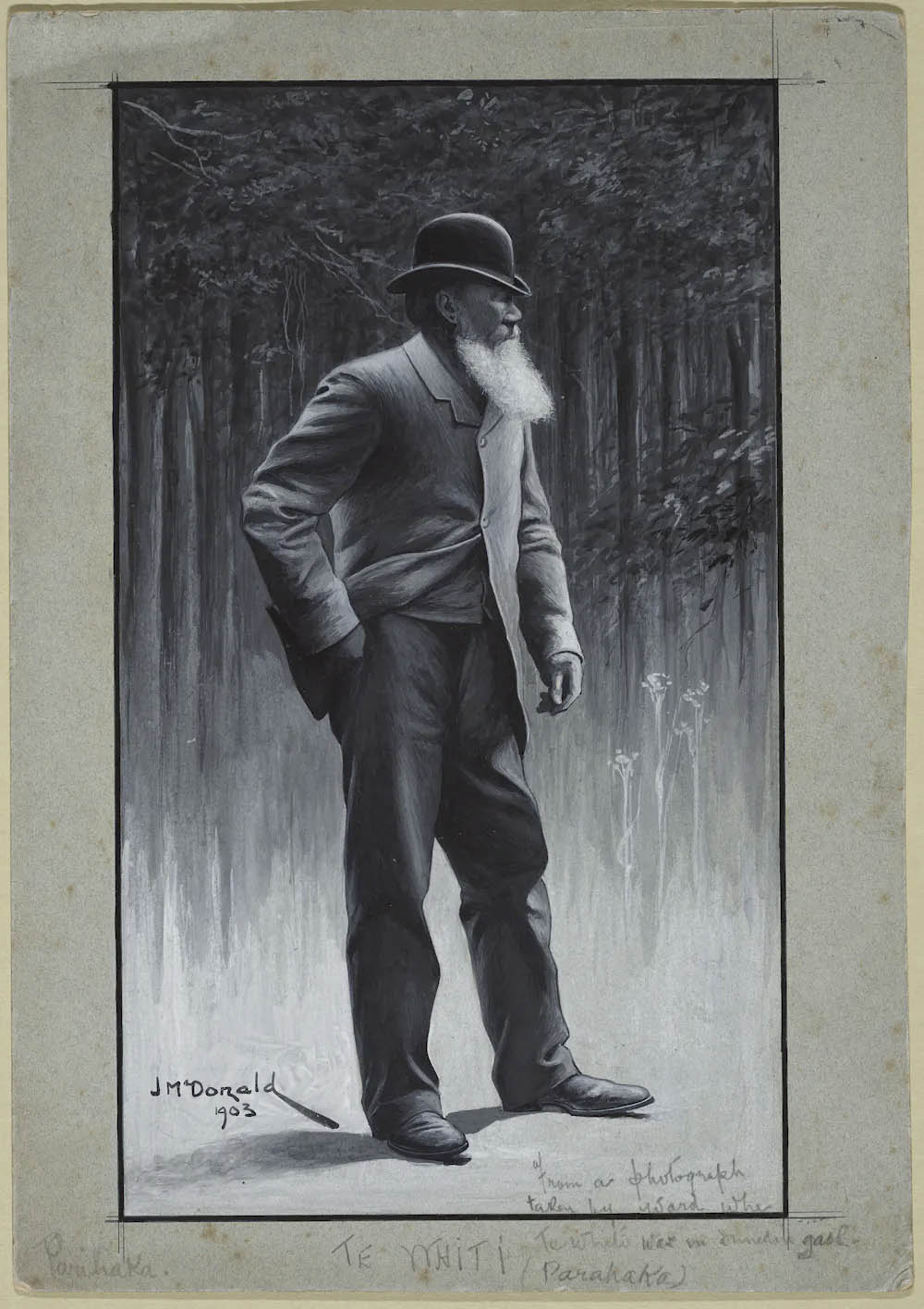
 

James Ingram McDonald (New Zealand 1865-1935) 'Te Whiti' c. 1903


James Ingram McDonald (New Zealand 1865-1935)
Te Whiti
c. 1903
Alexander Turnbull Library


James Ingram McDonald (11 June 1865 – 13 April 1935) was a New Zealand painter, photographer, film-maker, museum director, cultural ambassador film censor, and promoter of Maori arts and crafts.

James McDonald was born in Tokomairiro, South Otago, New Zealand on 11 June 1865. He began painting early in his life and took art lessons as a young man in Dunedin with James Nairn, Nugent Welch and Girolamo Nerli. He continued his art studies in Melbourne, Australia, but returned to New Zealand in 1901, where he worked as a photographer. From 1905 he was a museum assistant and draughtsman in the Colonial Museum, later to become the Dominion Museum and even later the Museum of New Zealand Te Papa Tongarewa). He began making films about various scenic sights. At the museum he was responsible for the maintenance of the photographic collection and the production of paintings, drawings and photographs for the Dominion Museum bulletins.

He began to gather information about Māori tribal traditions. His films show poi dances and whai string games. He was probably the earliest known ethnographic filmmaker in New Zealand. In 1920 he filmed the gathering of the Māori tribes in Rotorua, when they welcomed the Prince of Wales, and other aspects of the royal journey. He filmed traditional skills and activities, including the make of fishing nets and traps, weaving, digging kumara camps and cooking food in a hangi. Most of his often unedited and fragmentary negatives became only known in 1986 after restoration by the New Zealand film archive. …

He died in Tokaanu on 13 April 1935 and was buried at Taupo cemetery. The School of Applied Arts, which he had founded, doesn’t exist anymore, but many examples of McDonald’s work have been preserved. Many hundreds of his photographic negatives are kept by the Museum of New Zealand Te Papa Tongarewa. There are prints of his works in the collections of the Alexander Turnbull Library and the Bernice P. Bishop Museum in Hawaii. The four ethnographic films he has made are preserved in the collection of the New Zealand Film Archive Nga Kaitiaki or Nga Taonga Whitiahua.

Text from the Wikipedia website


Te Whiti o Rongomai III (c.  1830 – 18 November 1907) was a Māori spiritual leader and founder of the village of Parihaka, in New Zealand’s Taranaki region.

Te Whiti established Parihaka community as a place of sanctuary and peace for Māori many of whom seeking refuge as their land was confiscated in the early 1860s. Parihaka became a place of peaceful resistance to the encroaching confiscations. On 5 November 1881, the village was invaded by 1500 Armed Constabulary with its leaders arrested and put on trial. Te Whiti was sent to Christchurch at the Crown’s insistence after it was clear the crown was losing its case in New Plymouth. The trial, however, was never reconvened and Te Whiti, along with Tohu were held for two years. Te Whiti and Tohu returned to Parihaka in 1883, seeking to rebuild Parihaka as a place of learning and cultural development though land protests continued. Te Whiti was imprisoned on two further occasions after 1885 before his death in 1907.

Text from the Wikipedia website
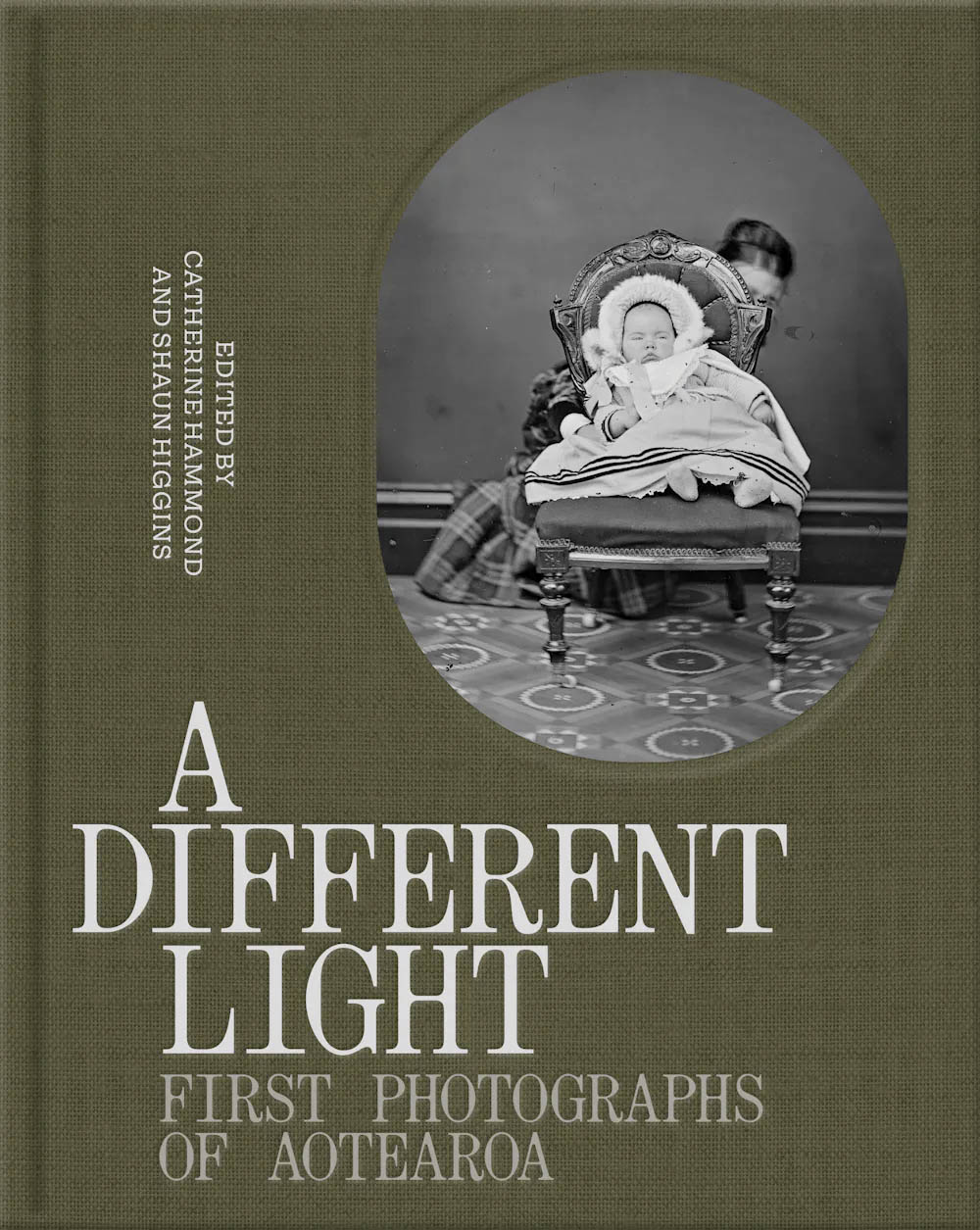
 

'A Different Light – First Photographs of Aotearoa' book cover


A Different Light – First Photographs of Aotearoa book cover


The mīhini mīharo reveals nineteenth-century Aotearoa as never before.

In 1848, two decades after a French inventor mixed daylight with a cocktail of chemicals to fix the view outside his window onto a metal plate, photography arrived in Aotearoa. How did these ‘portraits in a machine’ reveal Māori and Pākehā to themselves and to each other? Were the first photographs ‘a good likeness’ or were they tricksters? What stories do they capture of the changing landscape of Aotearoa?

From horses laden with mammoth photographic plates in the 1870s to the arrival of the Kodak in the late 1880s, New Zealand’s first photographs reveal Kīngi and governors, geysers and slums, battles and parties. They freeze faces in formal studio portraits and stumble into the intimacy of backyards, gardens and homes.

A Different Light brings together the extraordinary and extensive photographic collections of three major research libraries – Tāmaki Paenga Hira Auckland War Memorial Museum, Alexander Turnbull Library and Hocken Collections Uare Taoka o Hākena – to coincide with a touring exhibition of some of the earliest known photographs of Aotearoa.

Editors

Catherine Hammond is the director of collections and research at Tāmaki Paenga Hira Auckland War Memorial Museum. She was formerly Hocken Librarian at the University of Otago Te Whare Wānanga o Ōtākou, and before that head of documentary heritage at Tāmaki Paenga Hira Auckland War Memorial Museum and research library manager at Auckland Art Gallery Toi o Tāmaki.

Shaun Higgins is curator pictorial at Tāmaki Paenga Hira Auckland War Memorial Museum. He has worked on exhibitions for two decades, most recently Robin Morrison: Road Trip (2023). He has an MA, BA and PGDip from the University of Auckland in anthropology, art history and museum studies, and further qualifications in photography and care and identification of photographs.

Alongside the editors, A Different Light includes essays by Angela Wanhalla (Kāi Tahu), professor of History at the University of Otago; Paul Diamond (Ngāti Hauā, Te Rarawa, Ngāpuhi), curator, Māori at the Alexander Turnbull Library; Anna Petersen, curator, Photographs at Hocken Collections Uare Taoka o Hākena; and Natalie Marshall, formerly curator, Photographs at Alexander Turnbull Library.

Text from the Auckland University Press website


'A Different Light – First Photographs of Aotearoa' Introduction to book


A Different Light – First Photographs of Aotearoa Introduction to book


'A Different Light – First Photographs of Aotearoa' book pages

'A Different Light – First Photographs of Aotearoa' book pages


A Different Light – First Photographs of Aotearoa book pages


Auckland War Memorial Museum
The Auckland Domain Parnell,
Auckland New Zealand
+6493090443

Opening hours:
Open weekdays from 10am – 5pm.
Open Saturdays, Sundays, and public holidays from 9am – 5pm.
Open late every Tuesday evening until 8.30pm
Auckland War Memorial Museum website

LIKE ART BLART ON FACEBOOK

Back to top

Exhibition: ‘Gregory Crewdson. Retrospective’ at the Albertina Museum, Vienna

Exhibition dates: 29th May – 8th September 2024

Curators: Walter Moser and Astrid Mahler


Gregory Crewdson (American, b. 1962) 'Untitled' From the series 'Early Work' 1986-1988 from the exhibition 'Gregory Crewdson. Retrospective' at the Albertina Museum, Vienna, May - Sept 2024


Gregory Crewdson (American, b. 1962)
Untitled
From the series Early Work, 1986-1988
Digital pigment print
39 x 58cm
The Albertina Museum, Vienna
Permanent loan, Private Collection
© Gregory Crewdson


I have so many exhibitions to post within the next few weeks that you get two postings this weekend and next weekend!

It’s always a pleasure to see the work of Gregory Crewdson – stylish, stylised, hyperreal, dead pan, cinematic, panoramic large-scale transcendent photographs.

For an analysis of Crewdson’s work please see my text Downfall of a dream: (n)framing the enigma in Gregory Crewdson’s Beneath the Roses (2012)

Dr Marcus Bunyan


Many thankx to the Albertina Museum for allowing me to publish the photographs for the posting. Please click on the photographs for a larger version of the image.


Gregory Crewdson. Retrospective

Gregory Crewdson (American, b. 1962) is one of the world’s most renowned photographers. Since the mid-1980s, Crewdson has been using the backdrop of small American towns and film sets to create, like a director, technically brilliant and colourfully seductive photographs that focus on human isolation and the abysses of society. The enigmatic scenes self-reflexively raise questions about the boundary between fact and fiction but can also be related to socio-political developments.

Watch this emotional video of the artist in the middle of his exhibition at the Albertina Museum.


Gregory Crewdson. Retrospektive | Mit Kurator Walter Moser

Curator Walter Moser on Cregory Grewdson’s unique work


Gregory Crewdson | Mit Co-Kuratorin Astrid Mahler

“Gregory Crewdson’s latest series is set in the fictional small town of ‘Eveningside’. It is the last part of a trilogy in which Crewdson addresses the socio-political conditions of his country and the failure of the American Dream,” says co-curator Astrid Mahler about the last part of our major retrospective of the world-famous photographer Gregory Crewdson.


What I am interested in is that moment of transcendence, where one is transported into another place, into a perfect, still world.


Gregory Crewdson


Gregory Crewdson (American, b. 1962) is one of the world’s most renowned photographers. Since the mid-1980s, Crewdson has been using the backdrop of small American towns and film sets to create, like a director, technically brilliant and colourfully seductive photographs that focus on human isolation and the abysses of society. The enigmatic scenes self-reflexively raise questions about the boundary between fact and fiction but can also be related to socio-political developments.

The retrospective at the Albertina comprises a total of nine groups of works, created over the last three and a half decades and conceived serially. Starting with his Early Work (1986-1988), the exhibition includes Crewdson’s best-known series such as Twilight (1998-2002), which depicts scenes shaped by cinematic language, with people being confronted by unexplainable phenomena in their everyday lives. The impressive, mysterious large-scale scenes from the Beneath the Roses series (2003‒2008) deal with people’s isolation and alienation from their environment. The most recently completed group of works Eveningside (2021-2022) portrays an unheroic image of a fictional small town of the same name in atmospheric black and white. Following Cathedral of the Pines (2013-2014) and An Eclipse of Moths (2018-2019), Eveningside represents the final part of a trilogy through which the artist examines the social decline of society far removed from the American dream.

Crewdson’s large-scale pictures are preceded by months of planning; they are created with the participation of hundreds of people from casting, wardrobe and art departments, plus technical specialists. Production photographs taken in parallel illustrate the highly elaborate process of design, culminating in an extensive post-production process in which the final photographs are assembled from multiple shots.

As a generous gesture, the exhibition is accompanied by a significant donation to the Albertina’s photo collection. This extensive assimilation of works strengthens the focus of the collection on contemporary photography.

Text from the Albertina Museum website


Gregory Crewdson (American, b. 1962) 'Untitled' From the series 'Natural Wonder' 1991-1997 from the exhibition 'Gregory Crewdson. Retrospective' at the Albertina Museum, Vienna, May - Sept 2024


Gregory Crewdson (American, b. 1962)
Untitled
From the series Natural Wonder, 1991-1997
Digital pigment print
30 x 39 7/8 in.
The Albertina Museum, Vienna
Permanent loan, Private Collection

© Gregory Crewdson


Gregory Crewdson (American, b. 1962) 'Untitled' From the series 'Hover' 1996-1997 from the exhibition 'Gregory Crewdson. Retrospective' at the Albertina Museum, Vienna, May - Sept 2024


Gregory Crewdson (American, b. 1962)
Untitled
From the series Hover, 1996-1997
Digital pigment print
51 x 61cm
The Albertina Museum, Vienna
Permanent loan, Private Collection
© Gregory Crewdson


Gregory Crewdson (American, b. 1962) 'Untitled' From the series 'Twilight' 1998-2002


Gregory Crewdson (American, b. 1962)
Untitled
From the series Twilight, 1998-2002
Digital pigment print
122 x 152cm
The Albertina Museum, Vienna
Permanent loan, Private Collection
© Gregory Crewdson


Gregory Crewdson (American, b. 1962) 'Untitled' From the series 'Twilight' 1998-2002


Gregory Crewdson (American, b. 1962)
Untitled
From the series Twilight, 1998-2002
Digital pigment print
The Albertina Museum, Vienna
Permanent loan, Private Collection
© Gregory Crewdson


Gregory Crewdson (American, b. 1962)'Untitled' From the series 'Beneath the Roses' 2003-2008


Gregory Crewdson (American, b. 1962)
Untitled
From the series Beneath the Roses, 2003-2008
Digital pigment print
144 x 223cm
The Albertina Museum, Vienna
Permanent loan, Private Collection
© Gregory Crewdson


Gregory Crewdson (American, b. 1962) 'Untitled' From the series 'Beneath the Roses' 2003-2008


Gregory Crewdson (American, b. 1962)
Untitled
From the series Beneath the Roses, 2003-2008
Digital pigment print
144 x 123cm
The Albertina Museum, Vienna
Permanent loan, Private Collection
© Gregory Crewdson


Gregory Crewdson (American, b. 1962) 'Untitled' From the series 'Beneath the Roses' 2003-2008


Gregory Crewdson (American, b. 1962)
Untitled
From the series Beneath the Roses, 2003-2008
Digital pigment print
144 x 123cm
The Albertina Museum, Vienna
Permanent loan, Private Collection
© Gregory Crewdson


Gregory Crewdson (American, b. 1962) 'Untitled' From the series 'Beneath the Roses' 2003-2008


Gregory Crewdson (American, b. 1962)
Untitled
From the series Beneath the Roses, 2003-2008
Digital pigment print
144 x 223cm
The Albertina Museum, Vienna
Permanent loan, Private Collection
© Gregory Crewdson


Exhibition Texts

Early Work, 1986-1988

Early Work was created as Crewdson’s final project at Yale University’s School of Art. Among other places, Gregory Crewdson photographed the series in the US state of Massachusetts, mostly in the small town of Lee, which is very close to the family’s summer home. Due to his personal connection to this region, the artist still realises almost all of his photographic projects in the Massachusetts area. In the photographs, Crewdson arranged the town’s residents in the context of their domestic settings. Using relatively modest technical devices at the time, he transformed the real places into mysterious, uncanny scenes with the help of artificial lighting. Introverted protagonists rendered in tightly cropped views present typically American suburbs as places of human isolation and oppression. David Lynch’s surreal masterpiece Blue Velvet, in which the main character encounters human abysses behind the idyllic façade of a small town, served as a major model. The film, which came out in 1986, turned out to be stylistic inspiration for Crewdson and also became an important source of reference for his subsequent series. Crewdson also dealt with more documentary positions, such as those of Stephen Shore and William Eggleston. On their journeys across the United States, they enhanced everyday motifs with symbolic meaning through close-up views and vibrant colours. Especially Eggleston employed these means to allude to disconcerting aspects in society.

Natural Wonder, 1991-1997

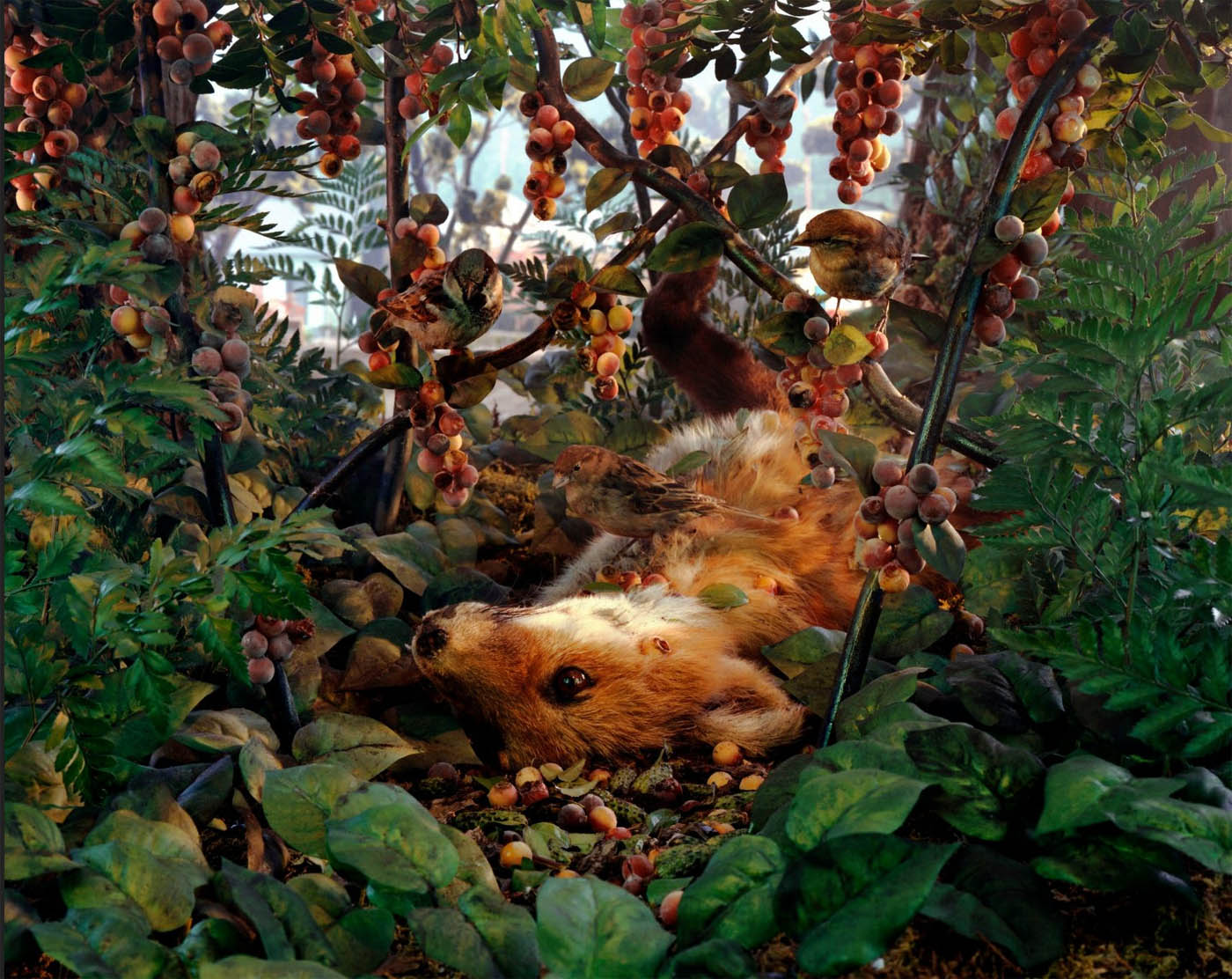
Inspired by the dioramas in natural history museums, for Natural Wonder Gregory Crewdson built three-dimensional models in his studio, which he then photographed. The pictures show enigmatic rituals and cruel incidents happening in nature, which take place against the backdrop of the suburbs without people realising. For example, birds sit around a mysterious circle of eggs, or nature takes possession of a decaying animal carcass. As a metaphor for suppressed anxieties and traumas, the depicted landscape functions as a mirror of the unconscious and the human psyche. In Crewdson’s series, autobiographic elements – his father was a psychoanalyst – and overriding social themes characteristically coincide. The symbolism of Natural Wonder has essentially been inspired by cinematography: in Alfred Hitchcock’s film The Birds (1963), the eponymous animals, suddenly infesting an idyllic world, symbolise dysfunctional relationships and human fears. In Blue Velvet (1986), David Lynch eliminates the line between reality and illusion, between the familiar and the eerie, between idyll and violence through the motif of a prepared robin or of a severed human ear covered with ants, which is found in a meadow.

Hover, 1996/1997

In Hover, his third series, Gregory Crewdson abandons the aesthetic achievements of earlier works: he takes pictures in black and white from a bird’s-eye view with the help of a crane. The strategy characteristic of Crewdson’s work to merely adumbrate a narrative while abstaining from resolving it and keeping it in mysterious suspense reaches an early climax in Hover. With a distanced, objectifying gaze he shows familiar occurrences in a small town as they tip over into the unusual. The recurring motif of the circle refers not only to popular science fiction movies and works of land art, but also quotes Alfred Hitchcock’s film Vertigo (1958), in which the circle is considered a metaphor for romantic obsession.

Gregory Crewdson now began to plan his sessions in advance and in great detail. As were other series, Hover was shot in the real place of Lee with the aid of residents performing as protagonists. Occasionally, Crewdson still resorted to improvisation; for example, he called the police for the purpose of integrating the police car into the photograph.

Twilight, 1998-2002

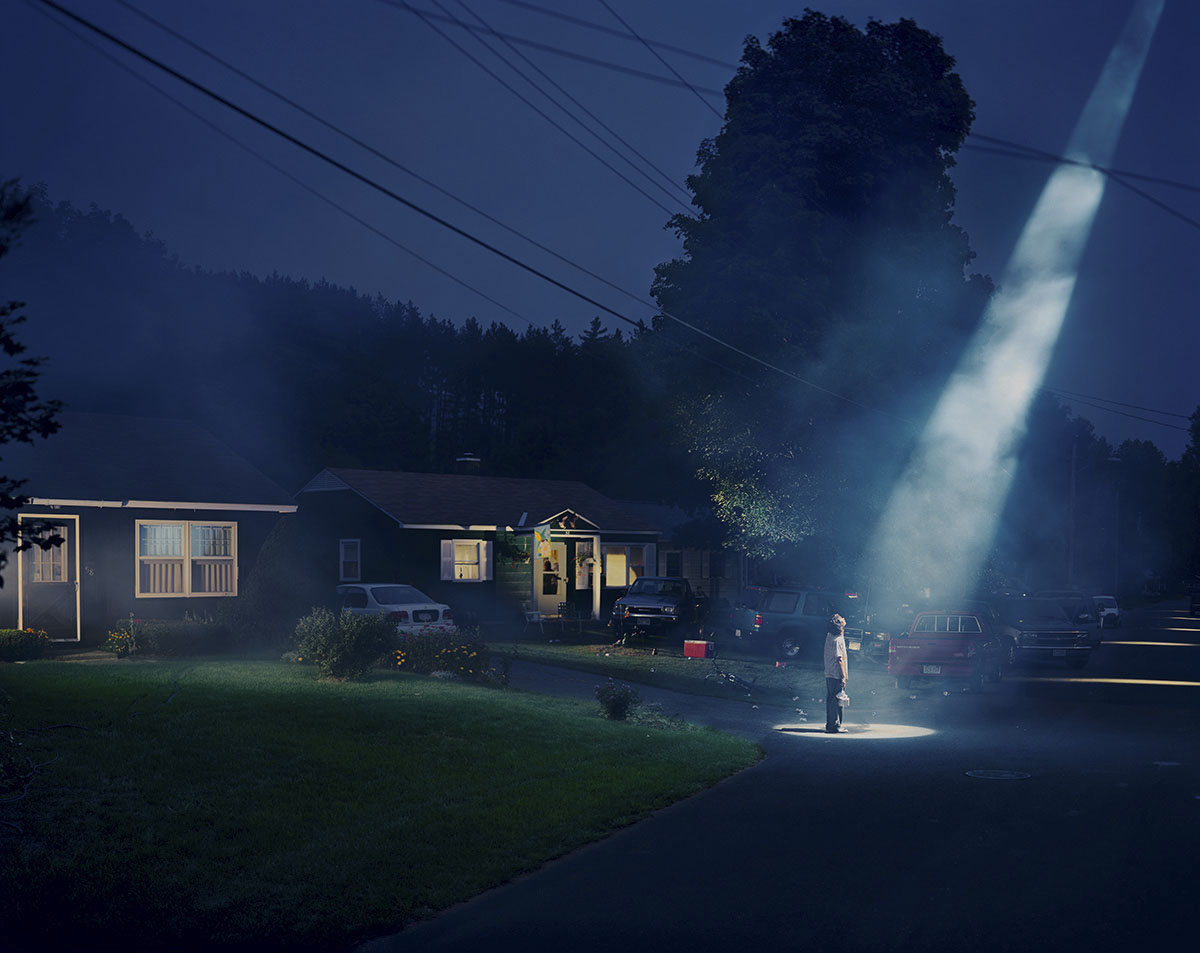
Twilight is one of Gregory Crewdson’s most well-known works. It is informed by cinema even more than earlier series. In its scenes, which are mostly set at dusk, Crewdson resorts to the fantastic as the principal theme. Inexplicable phenomena intrude into everyday life. Familiar objects are repurposed, and people give the impression of being exposed and unprotected because of their nudity.

Similar to a film production, a crew of about sixty took part in Twilight. In this series, Crewdson arrived at his characteristic repertoire of motifs, such as open cars, windows, and mirrors, which he varied and put together like vocabulary and would also use for subsequent works. Crewdson began to fully concentrate on the mise-en-scène, leaving the technical implementation of the shots to Richard Sands for the first time – a practice continued to this day. This high-profile director of photography from the world of cinema has worked with Steven Spielberg and Francis Ford Coppola, among others.

The photographs, which Crewdson refers to as “single-frame movies,” contain multiple references to classical painting and popular culture, a telling example of the latter being Steven Spielberg’s science fiction film Close Encounters of the Third Kind (1977). Gregory Crewdson’s postmodern approach becomes manifest in these images: starting out from the idea that reality is no longer “authentic” but merely experienced through the media, the recognisable references reveal the staging they are based on.

Beneath the Roses, 2003-2008

In Beneath the Roses, the surreal, uncanny atmosphere of earlier series gives way to an essentially melancholic and psychologising key tone. The protagonists, captured in desolate surroundings, are shown frozen and motionless. Lonely, isolated, and without interacting, they appear totally alienated. Especially for his interior shots, Gregory Crewdson borrows from Edward Hopper’s painting. Situations of human introspection in anonymous, everyday architectural settings that both suggest intimacy and accommodate a voyeuristic gaze are unmistakable parallels.

Beneath the Roses is the most elaborate series in Gregory Crewdson’s oeuvre, which he originally developed as an idea for a film and to which more than one hundred specialists from casting, costume design, technical, and art departments contributed over the extensive period during which the series was realised. As in Twilight, he staged the interior shots in studios, whereas outdoor shots were taken in real places he had profoundly transformed according to his ideas. The artist meticulously prepared the shoot with architectural models, storyboards, scene scripts, and location shots. The focus was particularly on the choice of props, which appear both quintessentially American and timeless. Using different aperture settings, Crewdson took multiple photographs of each scene. In postproduction, which lasted over several months, he combined forty to fifty negatives, so that the constant depth of field in the final picture gives a hyperrealist impression.

Sanctuary, 2009

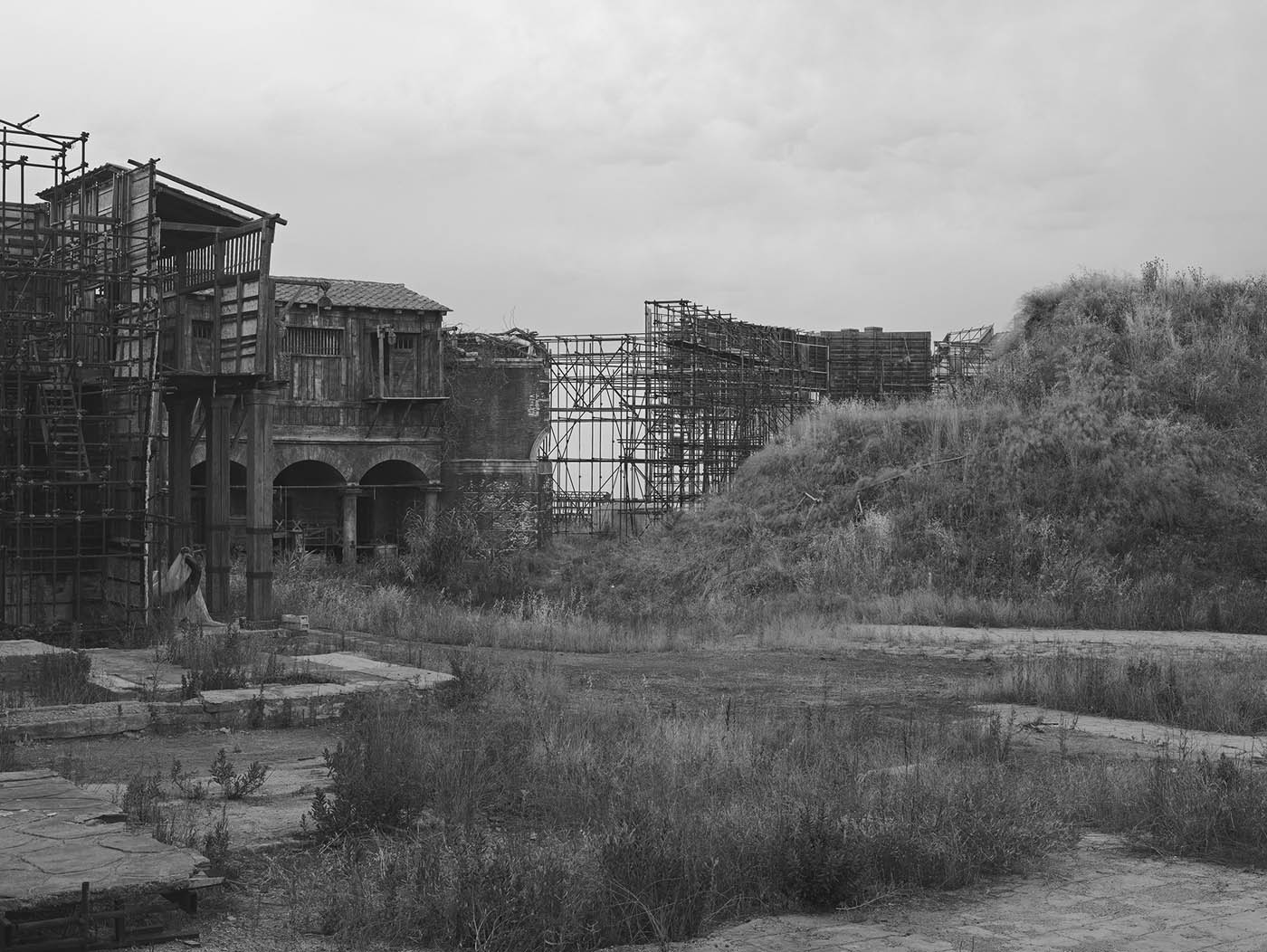
Sanctuary was created after the monumental large-scale project Beneath the Roses (2003-2008). The series marks a period of transition during which Gregory Crewdson put new artistic approaches to the test. When staying in Rome in 2009, he visited the Italian city of cinematography Cinecittà, where, in its film sets, his first group of works was realised outside the United States. He completed the project within two months with a small team and little technical and financial input. In Sanctuary, Crewdson heightened the tension between reality and fiction known from earlier series by making the sets as such the actual subject. The black-and-white photography accentuates the morbid appeal of the sets as ruins. In contrast to Crewdson’s usual practice of conveying loneliness and isolation with the aid of performers, in Sanctuary he creates an essentially melancholic atmosphere through the complete absence of people. In particular, the artist makes palpable the discrepancy between the hustle and bustle of past film shoots and the now ghostly desolation.

Cathedral of the Pines, 2013/2014

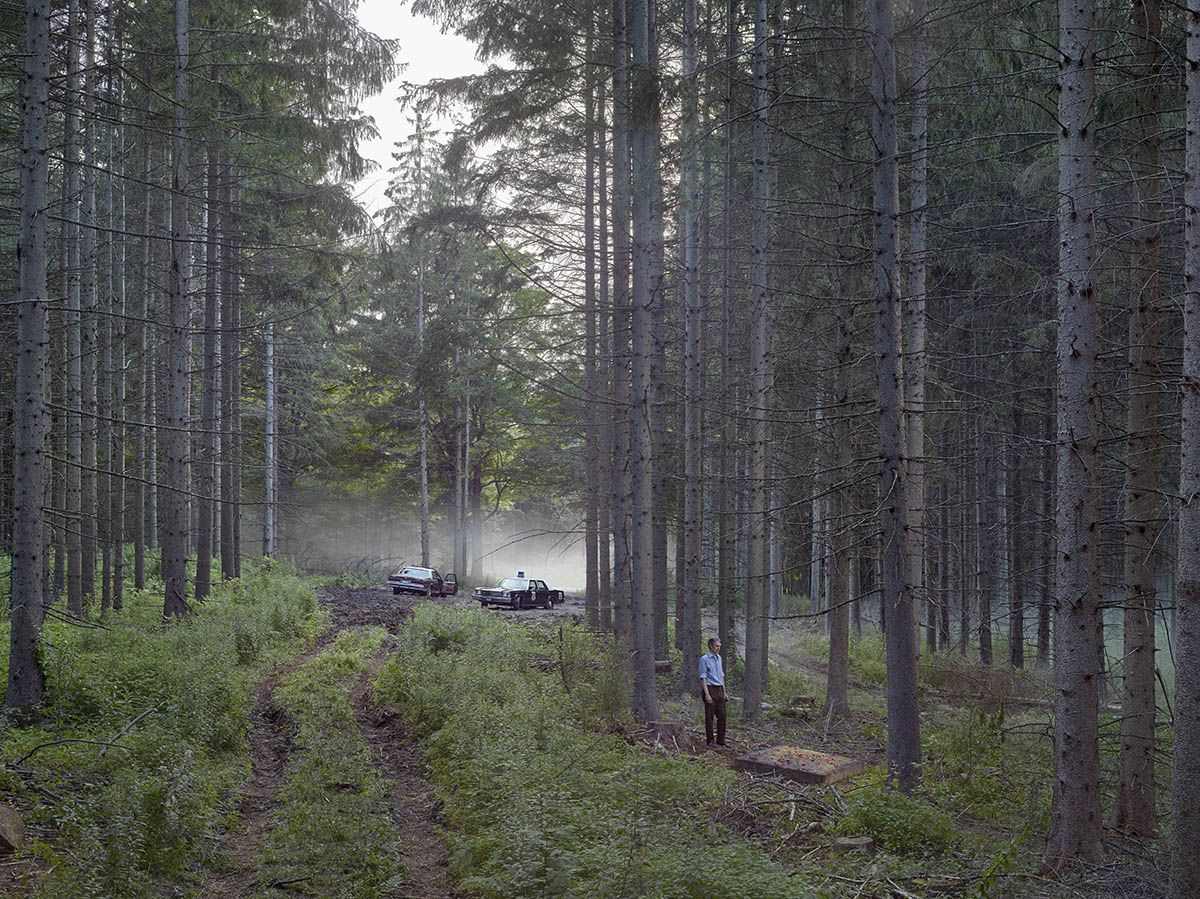
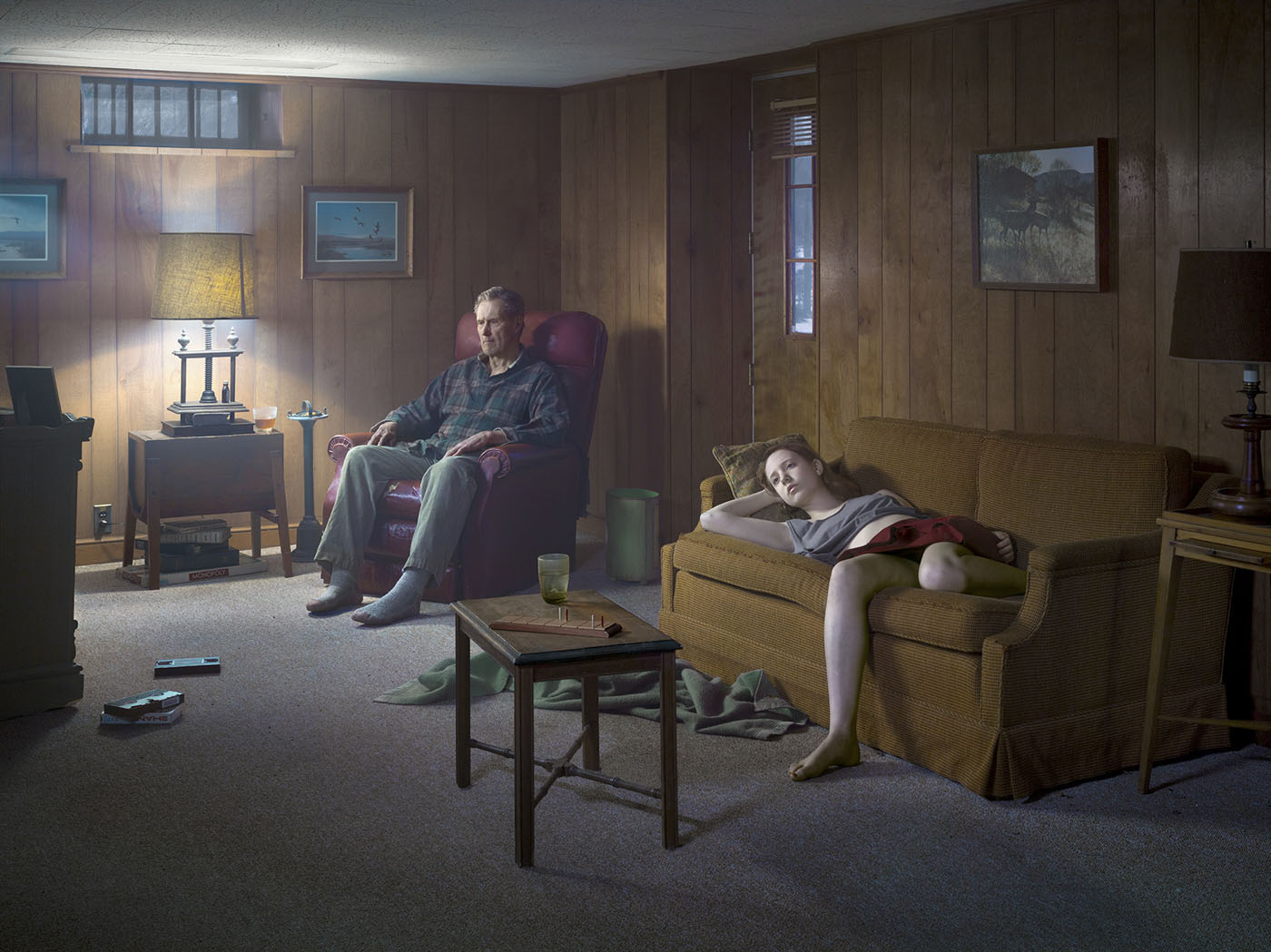
Cathedral of the Pines was created after a period of personal and artistic crisis. In the midst of the mighty pine forests near the city of Becket in Massachusetts, where Gregory Crewdson has lived since 2010, he discovered the eponymous path that became the starting point for this series. Cathedral of the Pines is one of the artist’s most personal groups of work. For the first time, he engaged persons from his family and circle of friends as performers. Moreover, he staged his interiors in real houses, working with a comparatively small team and a minimum of artificial light.

Cathedral of the Pines examines the subject of the human condition through the relationship between human beings and landscape. The nocturnal atmosphere of earlier series gives way to cool daylight and cold colours: completely in the nude or only partially covered and staring absent-mindedly, his performers seem frozen and withdrawn into their own emotional worlds. By placing windows prominently, Crewdson contrasts the relationship between interior and exterior space, as well as interior and exterior light. With its references to the Romanticism of the early nineteenth century – such as compositions by Caspar David Friedrich – or seventeenth-century Dutch painting – such as the art of Jan Vermeer – the motif of the window is also in the tradition of a symbol of contemplation and unfulfilled yearning.

An Eclipse of Moths, 2018/2019

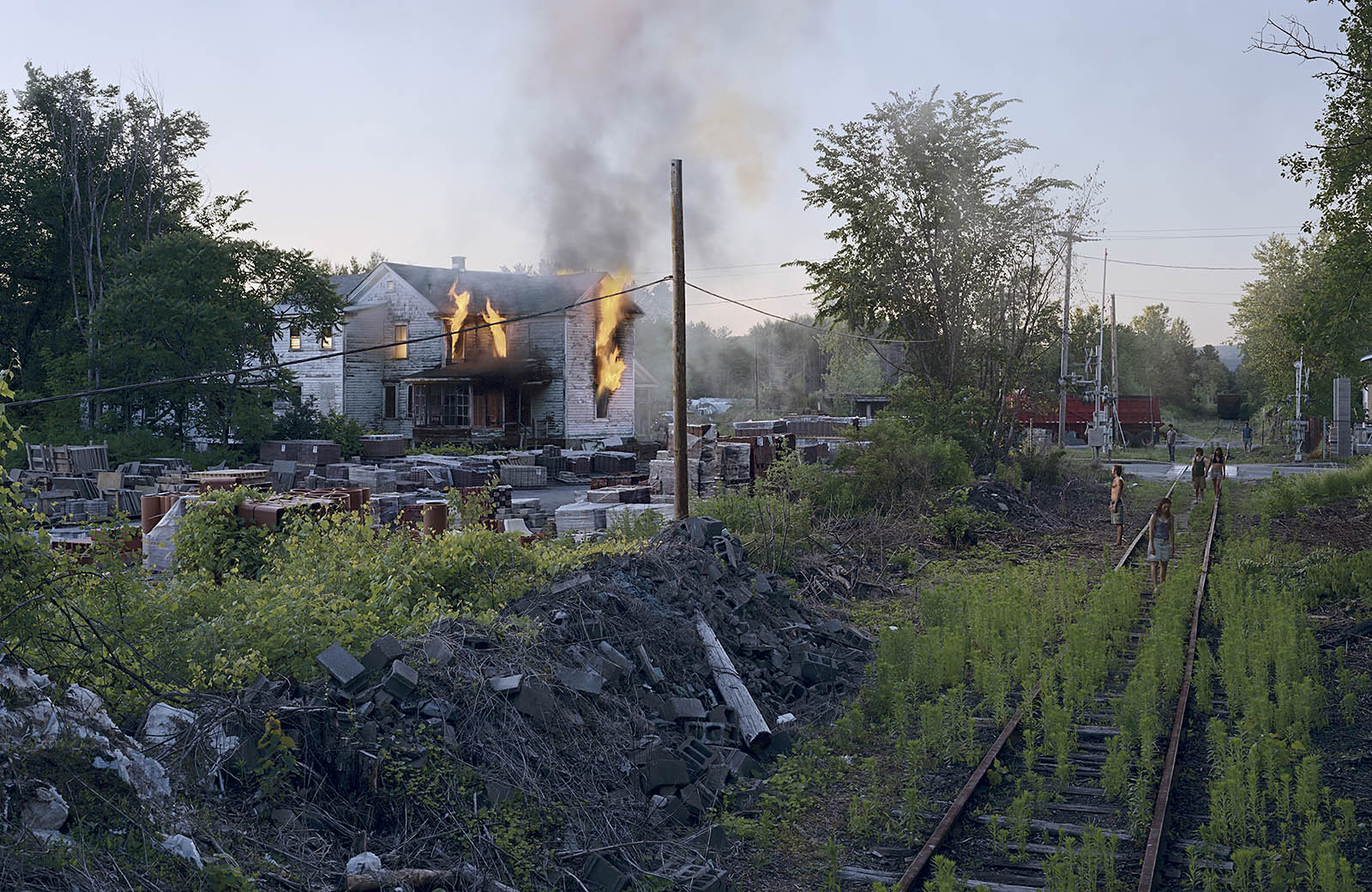
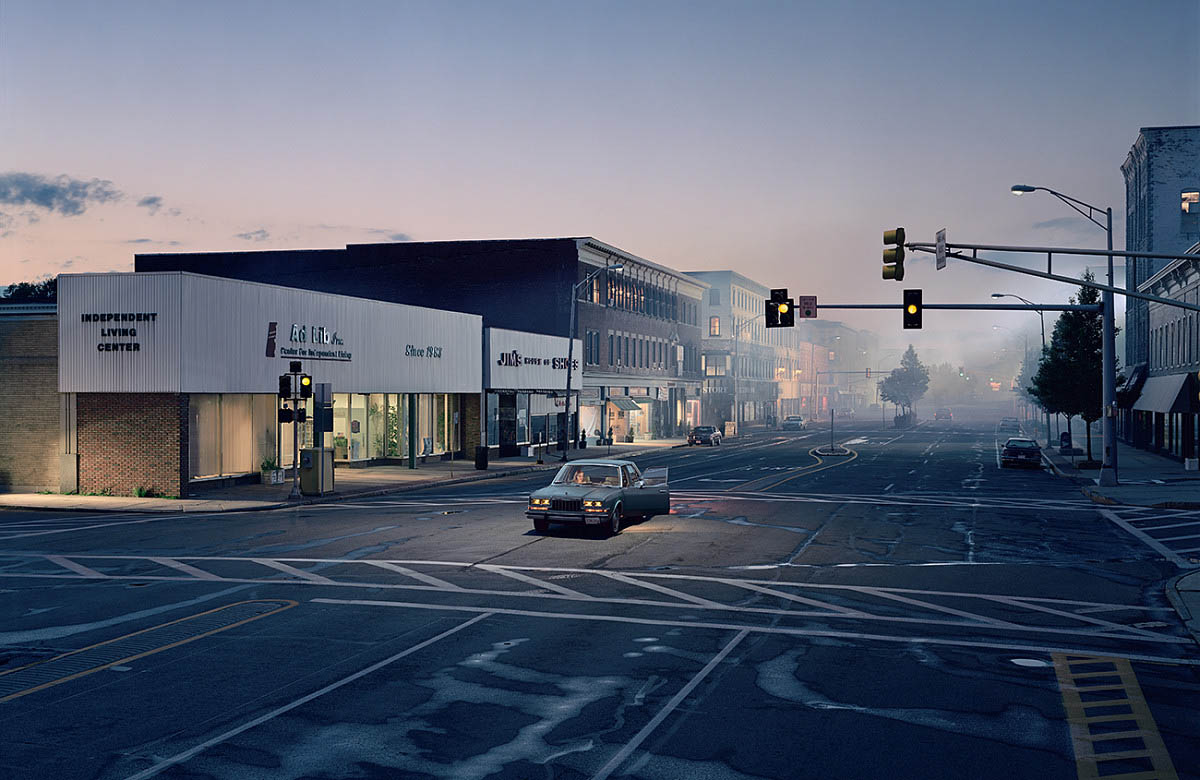
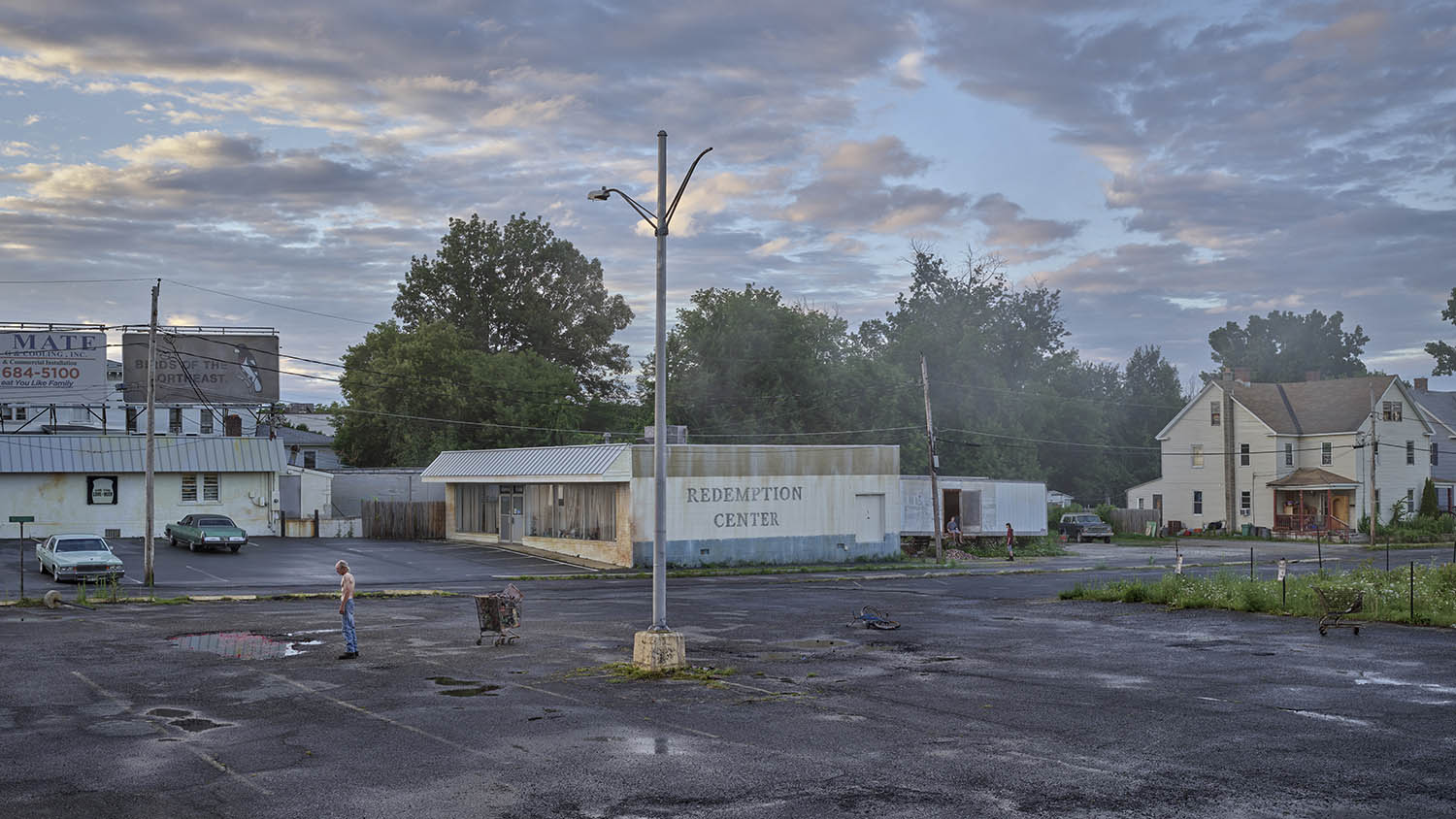
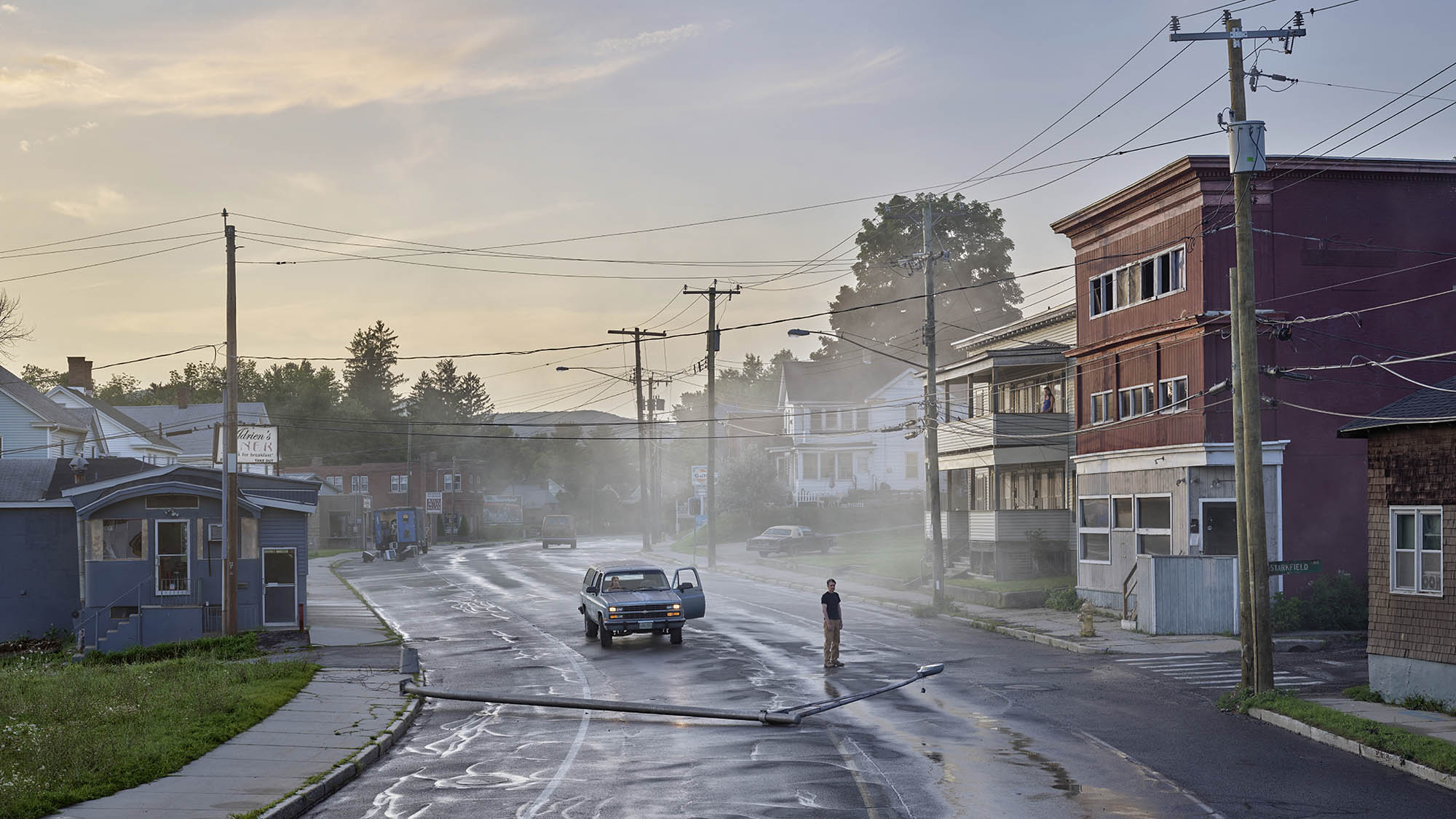
Gregory Crewdson photographed An Eclipse of Moths during Donald Trump’s presidency, thus formulating his analysis of society as sociopolitical criticism. In the city where the series was shot, Pittsfield in Massachusetts, the majority of the population had worked for the local General Electric plant and many lost their jobs after the firm had closed down. In addition to high unemployment, the company left behind a devastated environment. Crewdson describes the situation of neglected postindustrial places through the contrast between light atmospheres rendered in vibrant colours and desolate motifs of everyday life. Potholed streets or dilapidated houses symbolise the fragility and frailty of a society that has lost its footing.

Different from Cathedral of the Pines (2013/2014), his previous series, in An Eclipse of Moths Crewdson returned to the cinematographic widescreen format. The artist depicted his protagonists as small figures in proportion to their surroundings and at a distance from one another. He frequently arranged his seemingly disoriented protagonists around street lamps, comparable to the eponymous moths circling around the light in the darkness. Apart from a multitude of props, he also used smoke and artificially sprinkled streets for this series so as to masterfully stage his light effects.

Eveningside, 2021/2022

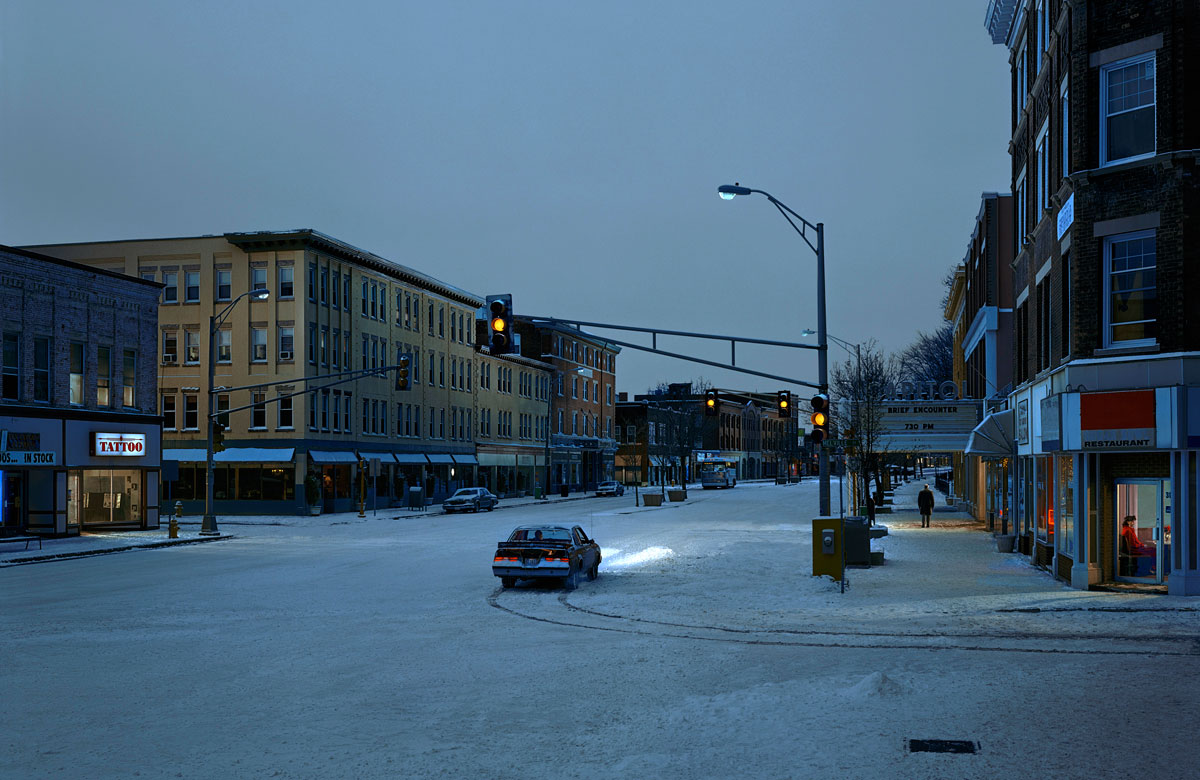
Gregory Crewdson’s most recent series is set in a fictitious small town called Eveningside. Its imaginary geography is made up of various places in western Massachusetts the artist had used as scenes for earlier works. After Cathedral of the Pines (2013/2014) and An Eclipse of Moths (2018/2019), this atmospheric work in black and white constitutes the final part of Crewdson’s trilogy, which deals with the sociopolitical dark sides of a society removed from the American dream. In Eveningside, the artist often depicts people going about their work. Frozen in absolute standstill, they seem caught in their respective social contexts.

Crewdson’s arrangements ingeniously position the protagonists in space through lighting influenced by film noir and motifs like shopwindow and mirror. The artist shows their faces in reflections from irritating and slightly shifted perspectives with the aid of montage. Windows frame the protagonists as pictures within the picture und underscore the act of image-making as a self-reflexive practice.

Text from The Albertina Museum press release


Gregory Crewdson (American, b. 1962) 'Untitled' From the series 'Sanctuary' 2009


Gregory Crewdson (American, b. 1962)
Untitled
From the series Sanctuary, 2009
Digital pigment print
72 x 90cm
The Albertina Museum, Vienna
Permanent loan, Private Collection
© Gregory Crewdson


Gregory Crewdson (American, b. 1962) 'The Mattress' From the series 'Cathedral of the Pines' 2013-2014


Gregory Crewdson (American, b. 1962)
The Mattress
From the series Cathedral of the Pines, 2013-2014
Digital pigment print
94 x 127cm
The Albertina Museum, Vienna
Permanent loan, Private Collection
© Gregory Crewdson


Gregory Crewdson (American, b. 1962) 'The Basement' From the series 'Cathedral of the Pines' 2013-2014


Gregory Crewdson (American, b. 1962)
The Basement
From the series Cathedral of the Pines, 2013-2014
Digital pigment print
94 x 127cm
The Albertina Museum, Vienna
Permanent loan, Private Collection
© Gregory Crewdson


Gregory Crewdson (American, b. 1962) 'Redemption Center' From the series 'An Eclipse of Moths' 2018-2019


Gregory Crewdson (American, b. 1962)
Redemption Center
From the series An Eclipse of Moths, 2018-2019
Digital pigment print
127 x 225cm
The Albertina Museum, Vienna
Permanent loan, Private Collection
© Gregory Crewdson


Gregory Crewdson (American, b. 1962) 'Starkfield Lane' From the series 'An Eclipse of Moths' 2018-2019


Gregory Crewdson (American, b. 1962)
Starkfield Lane
From the series An Eclipse of Moths, 2018-2019
Digital pigment print
127 x 225cm
The Albertina Museum, Vienna
Permanent loan, Private Collection
© Gregory Crewdson


Gregory Crewdson (American, b. 1962) 'Madeline's Beauty Salon' From the series 'Eveningside' 2021-2022


Gregory Crewdson (American, b. 1962)
Madeline’s Beauty Salon
From the series Eveningside, 2021-2022
Digital pigment print
88 x 117cm
The Albertina Museum, Vienna
Permanent loan, Private Collection
© Gregory Crewdson


The Albertina Museum
Albertinaplatz 1
1010 Vienna
Phone: +43 (0)1 534 83 0

Daily 10am – 6pm
Except Wednesday and Friday 10am – 9pm
The Albertina Museum website

LIKE ART BLART ON FACEBOOK

Back to top

Exhibition: ‘On Her Own. The photographer Elfriede Mejchar’ at Wien Museum MUSA, Vienna

Exhibition dates: 18th April – 1st September, 2024

Curators: Anton Holzer, Frauke Kreutler


Elfriede Mejchar (Austrian, 1924-2020) 'Light and Shade' 1958 from the exhibition 'On Her Own. The photographer Elfriede Mejchar' at Wien Museum MUSA, Vienna, April - Sept 2024


Elfriede Mejchar (Austrian, 1924-2020)
Light and Shade
1958
Wien Museum
© Bildrecht, Vienna 2023


Comment on this magnificent Austrian photographer unknown to me until now will be forthcoming in the future posting on the simultaneous exhibition The Poetry of the Everyday. Photographs by Elfriede Mejchar at Museum der Moderne Salzburg.

Marcus


Many thankx to the Wien Museum for allowing me to publish the photographs in the posting. Please click on the photographs for a larger version of the image.


“I am not an artist, I am a photographer.”


Elfriede Mejchar


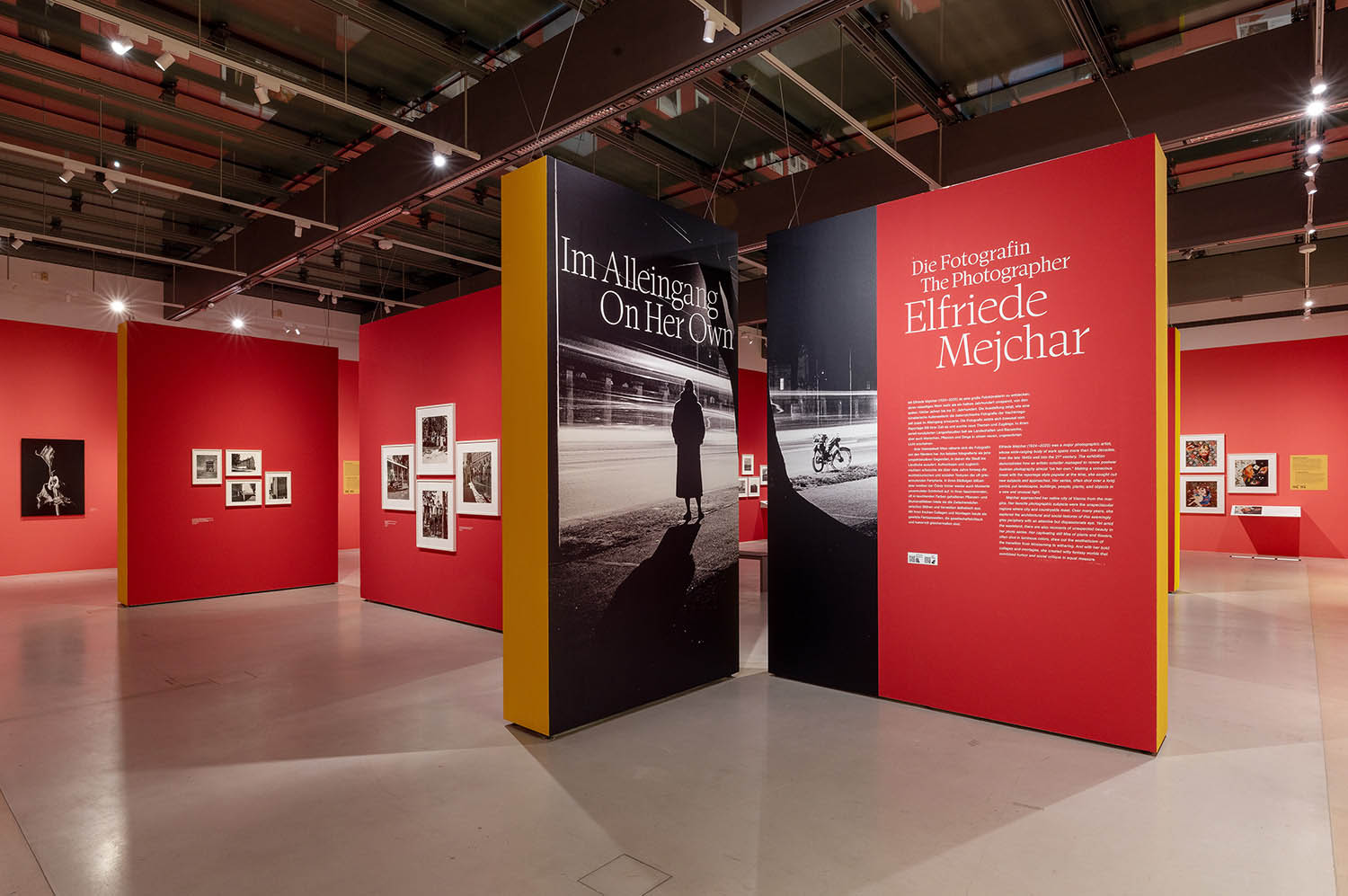
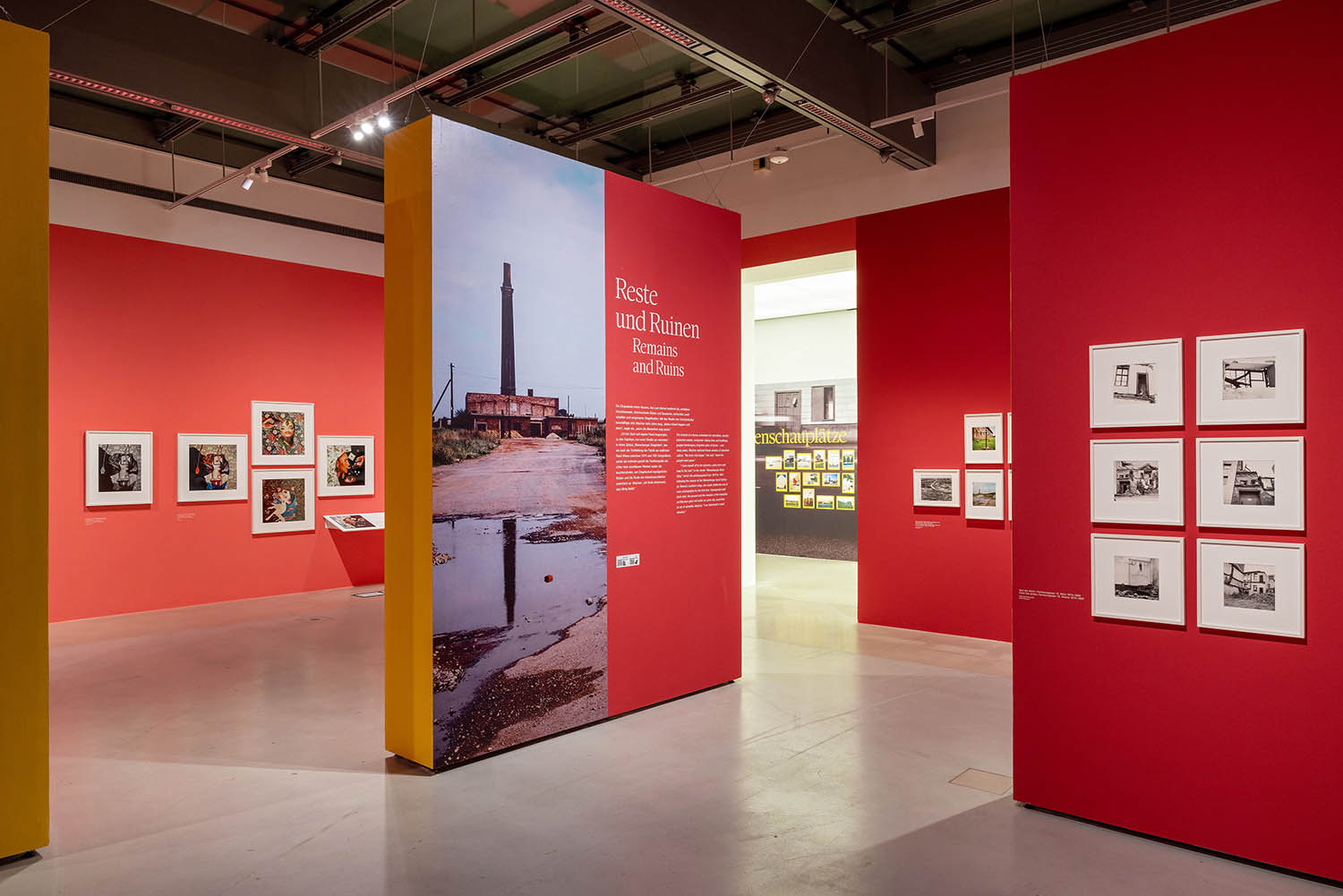
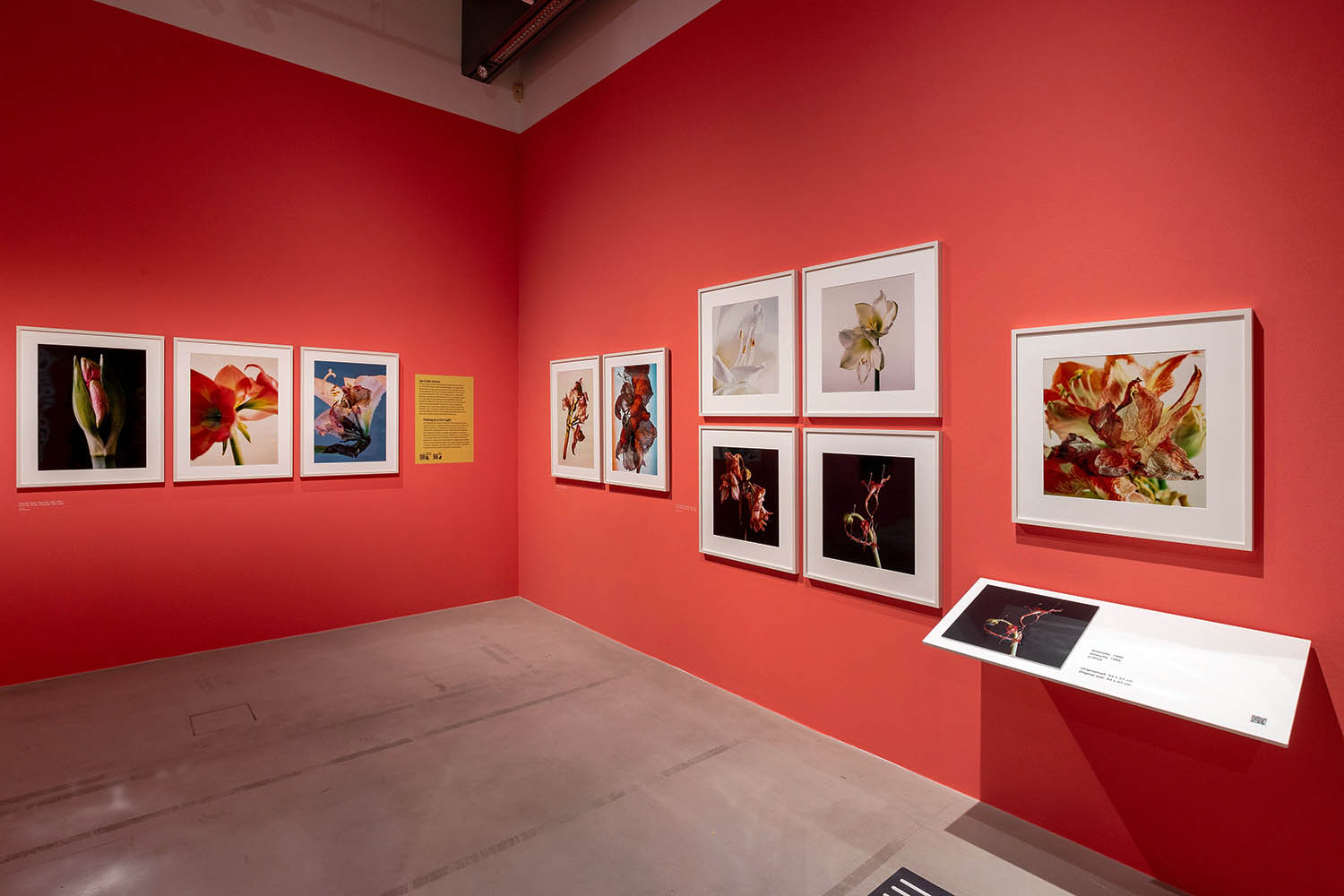
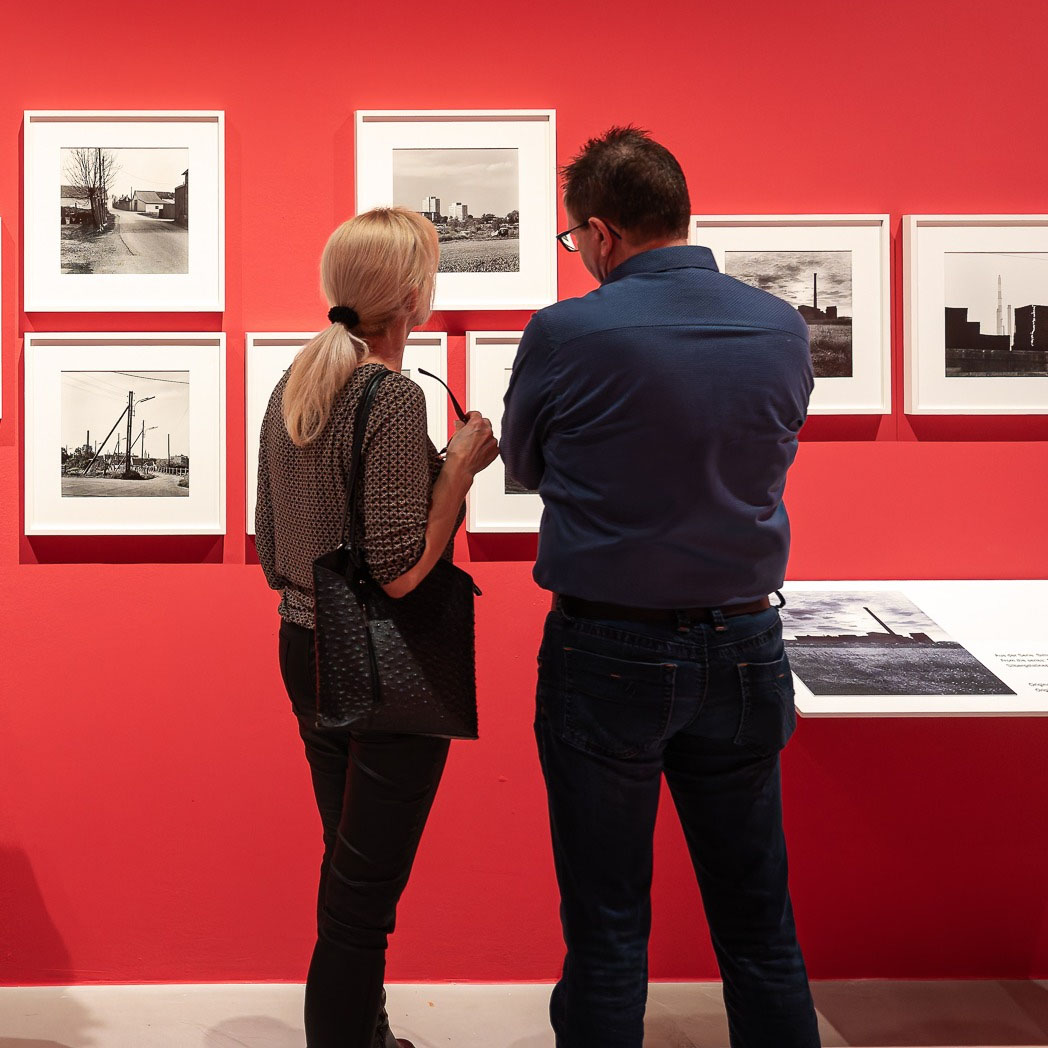
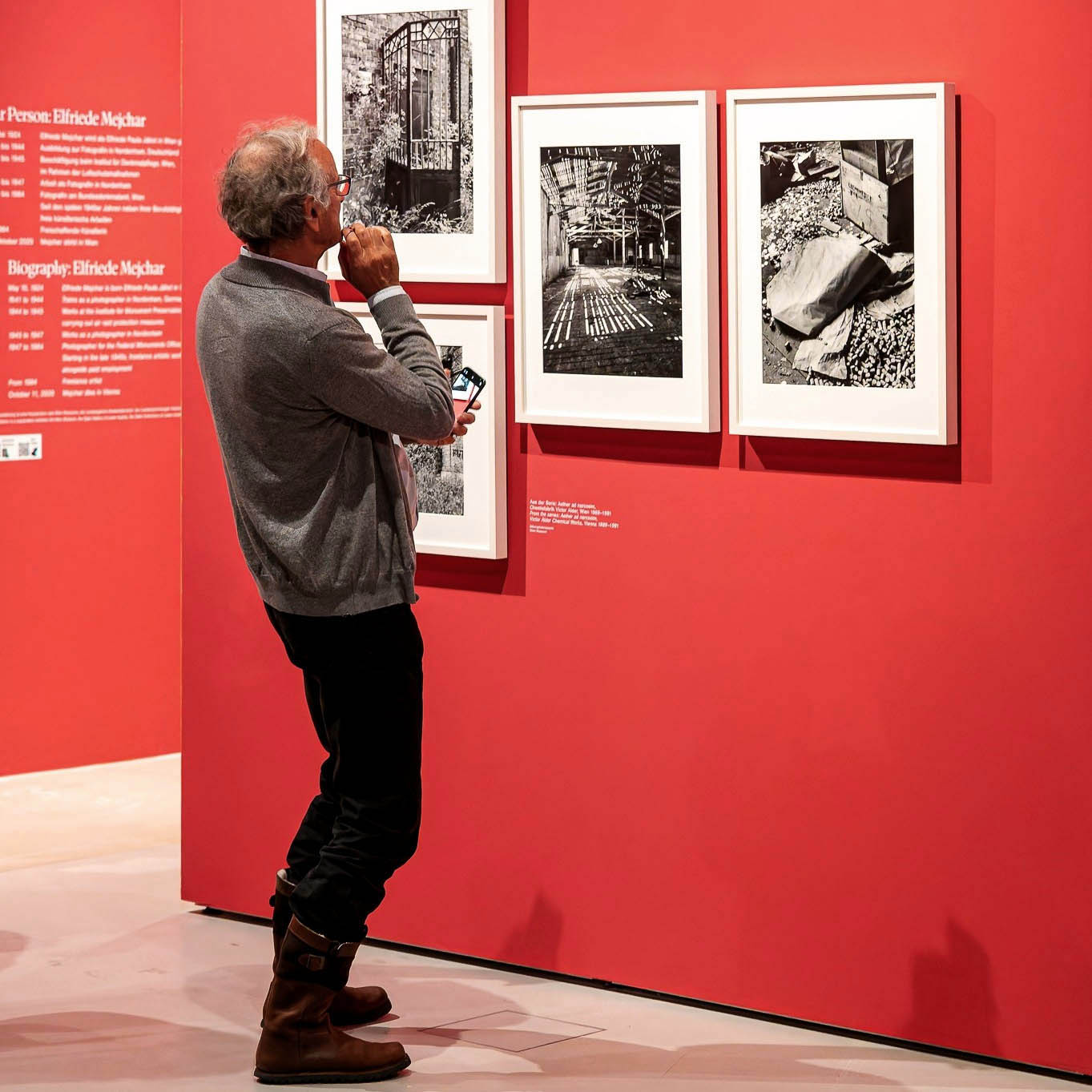
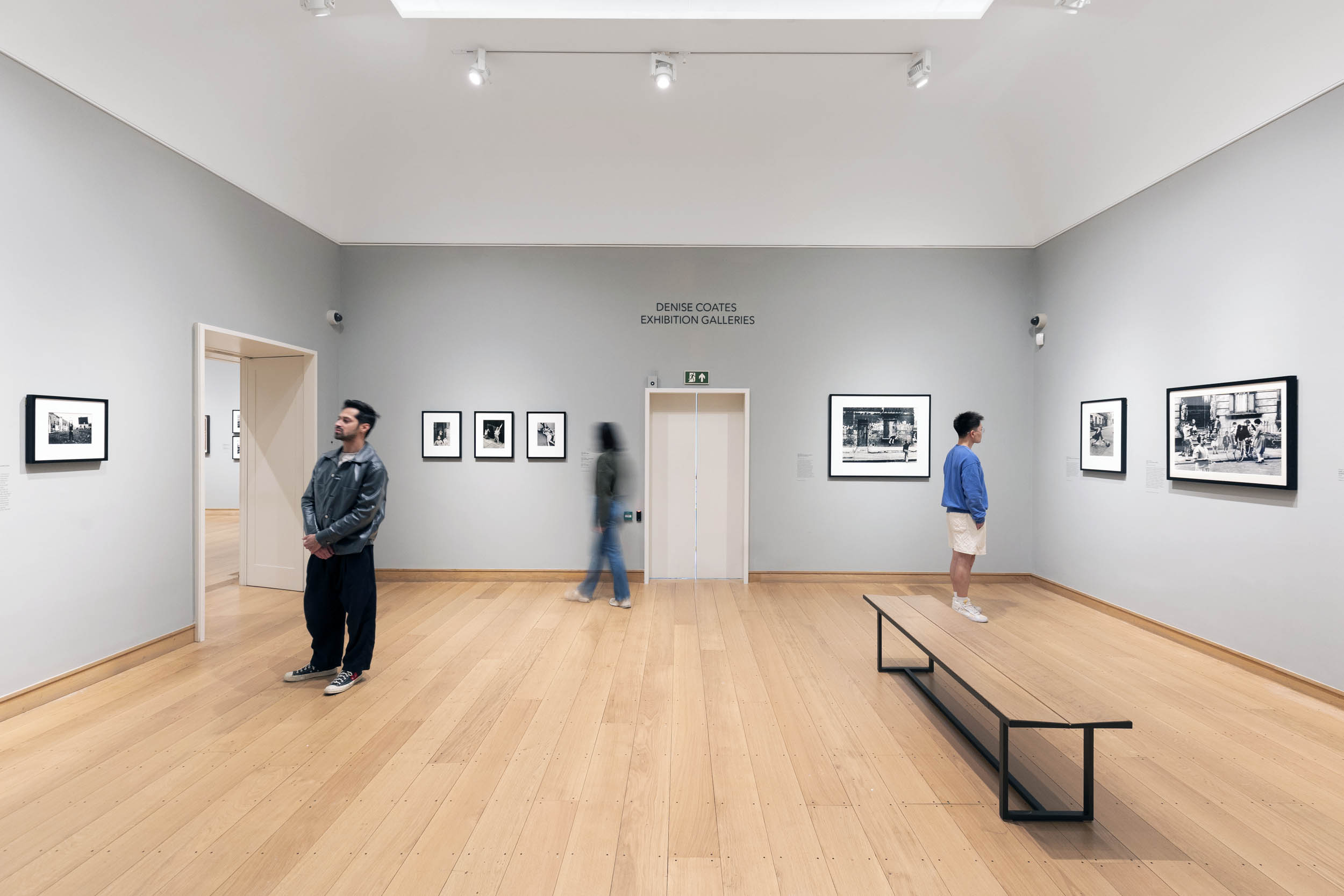
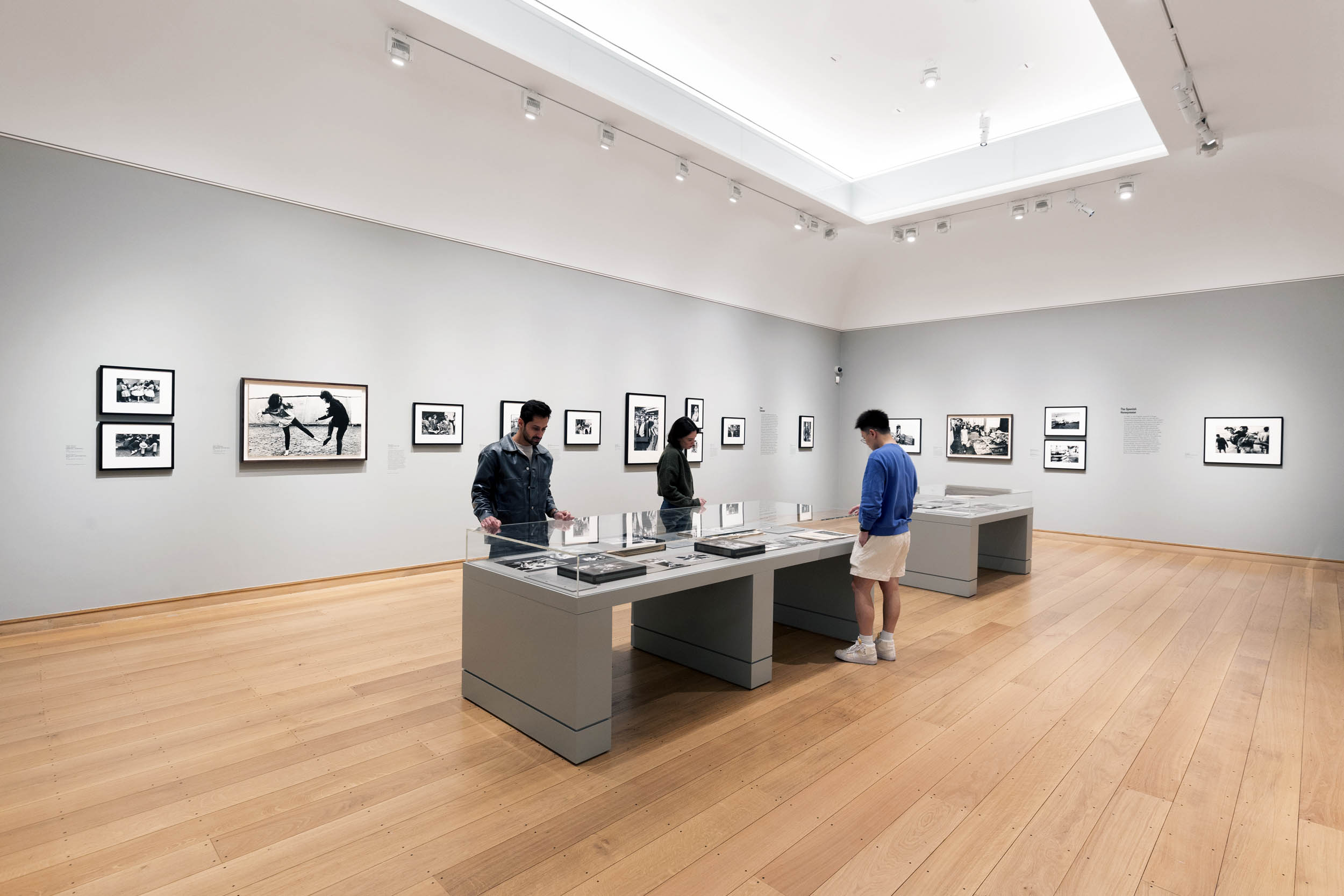
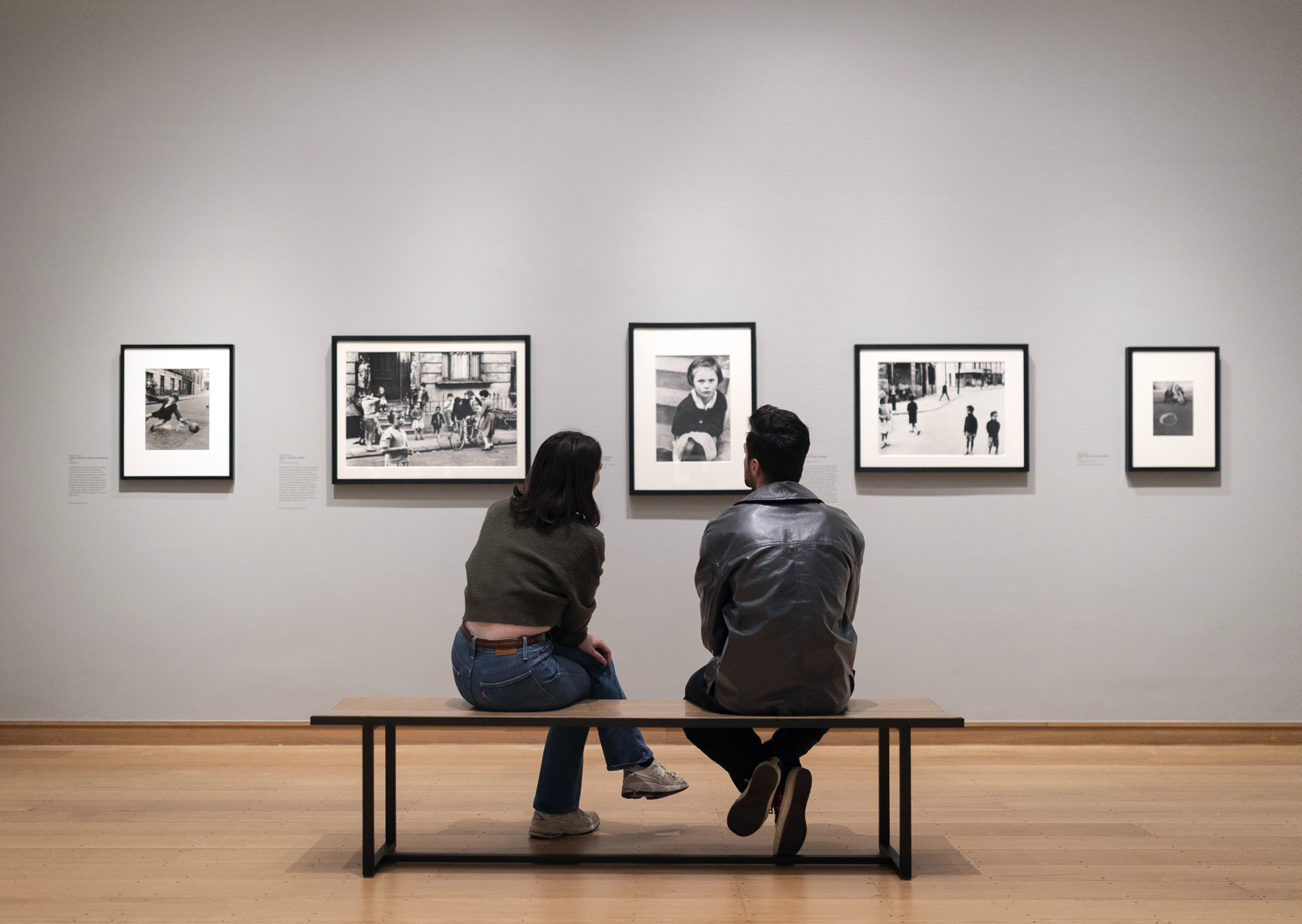
Installation view of the exhibition 'On Her Own. The photographer Elfriede Mejchar' at Wien Museum musa, Vienna

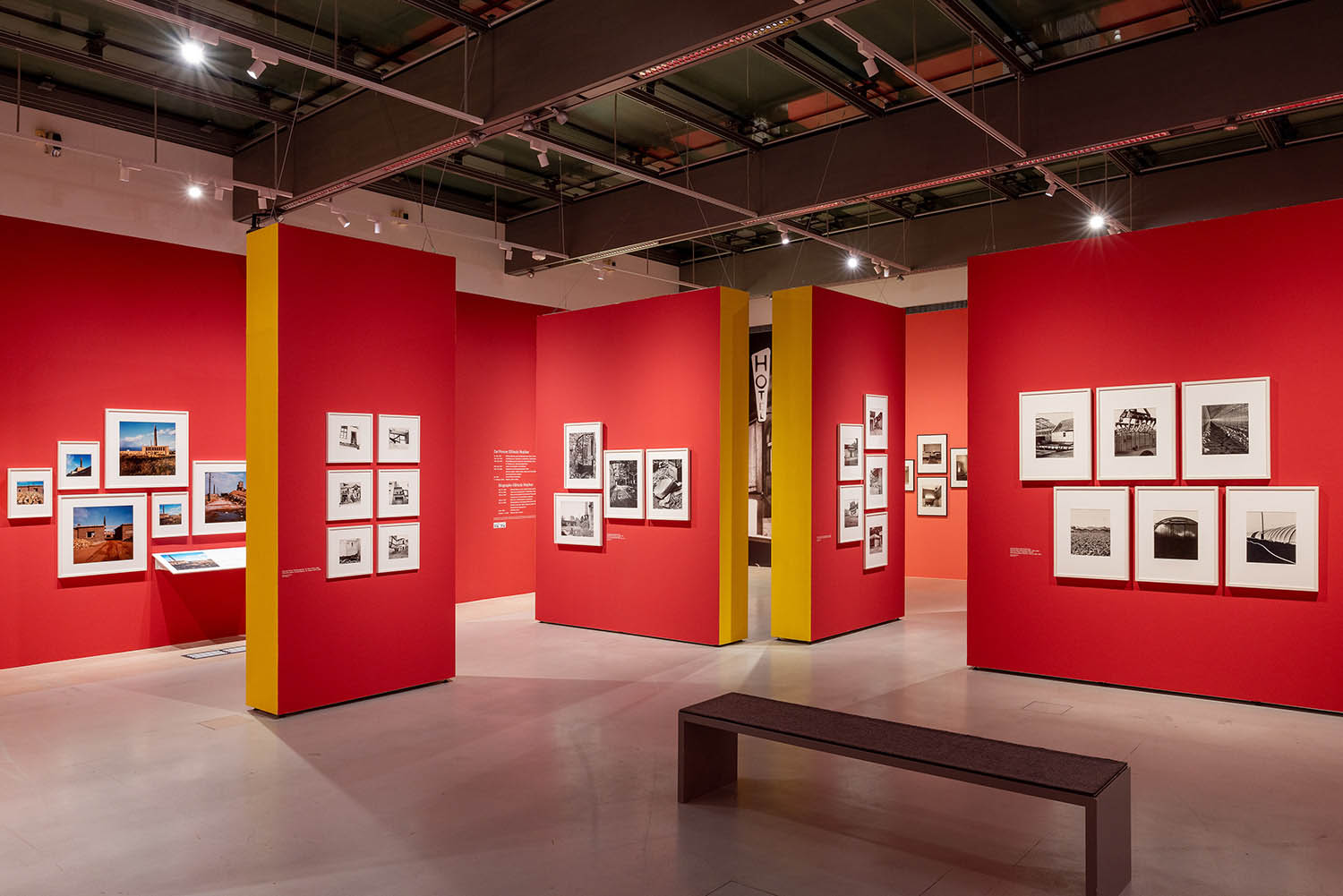
Installation view of the exhibition 'On Her Own. The photographer Elfriede Mejchar' at Wien Museum musa, Vienna

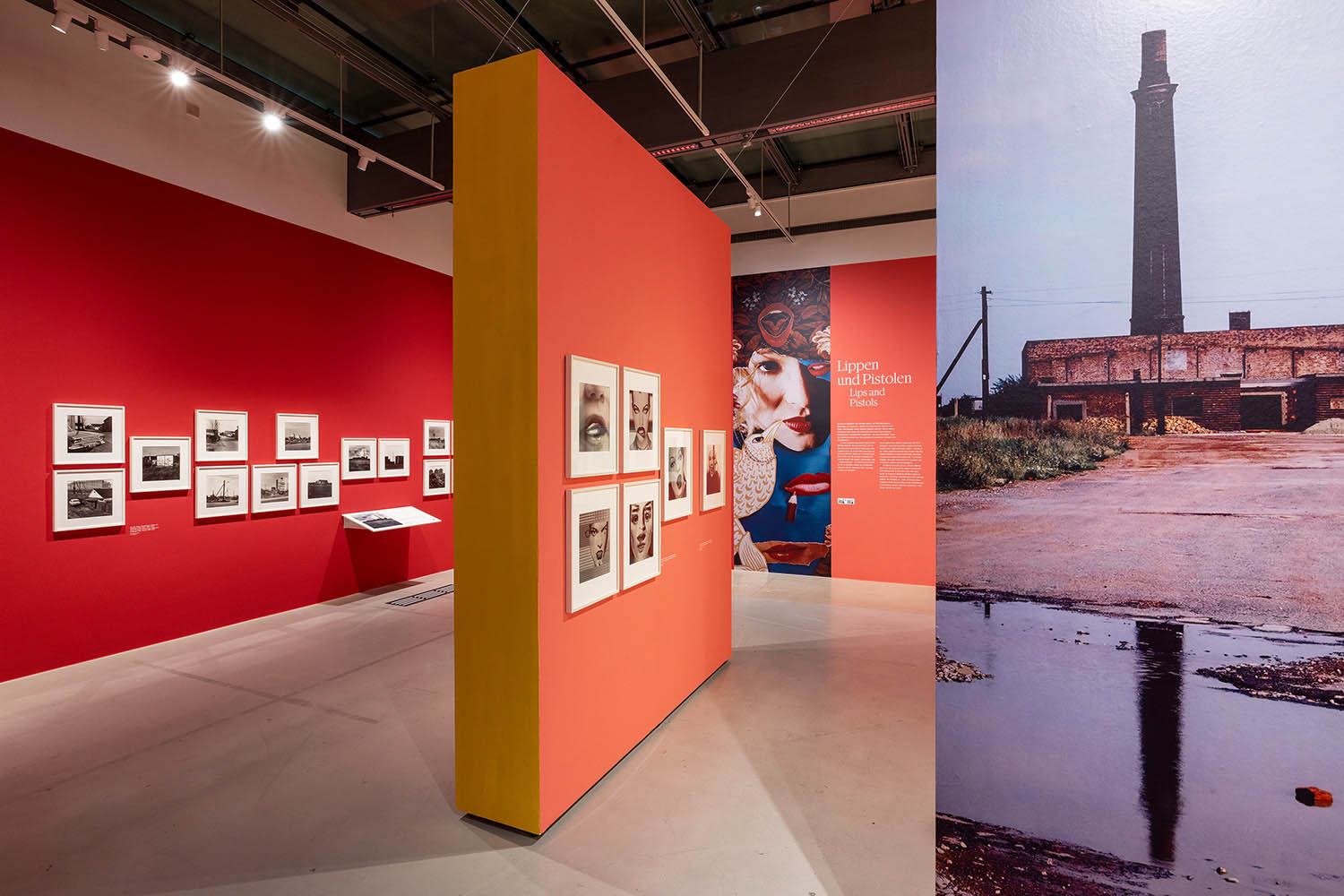
Installation view of the exhibition 'On Her Own. The photographer Elfriede Mejchar' at Wien Museum musa, Vienna

Installation view of the exhibition 'On Her Own. The photographer Elfriede Mejchar' at Wien Museum musa, Vienna

Installation view of the exhibition 'On Her Own. The photographer Elfriede Mejchar' at Wien Museum musa, Vienna

Installation view of the exhibition 'On Her Own. The photographer Elfriede Mejchar' at Wien Museum musa, Vienna

Installation view of the exhibition 'On Her Own. The photographer Elfriede Mejchar' at Wien Museum musa, Vienna


Installation views of the exhibition On Her Own. The photographer Elfriede Mejchar at Wien Museum musa, Vienna


Elfriede Mejchar (1924-2020) was a major photographic artist, whose richly-varied oeuvre spans more than five decades, from the late 1940s well into the 21st century. The Viennese photographer, who only achieved recognition as an artist towards the end of her career, is now regarded as one of the most important representatives of the Austrian and the international photography scenes. May 10, 2024 marks the hundredth anniversary of her birth.

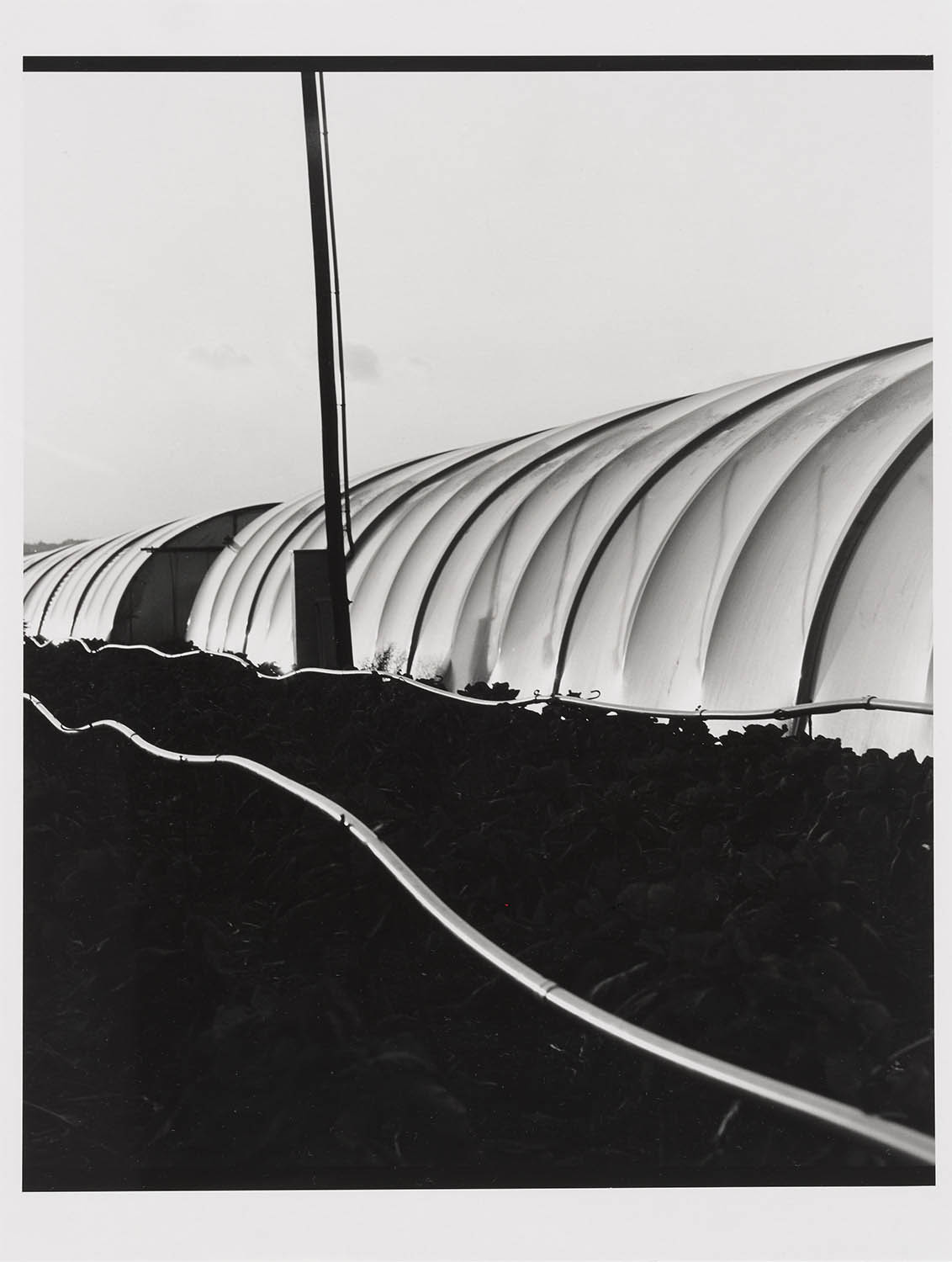
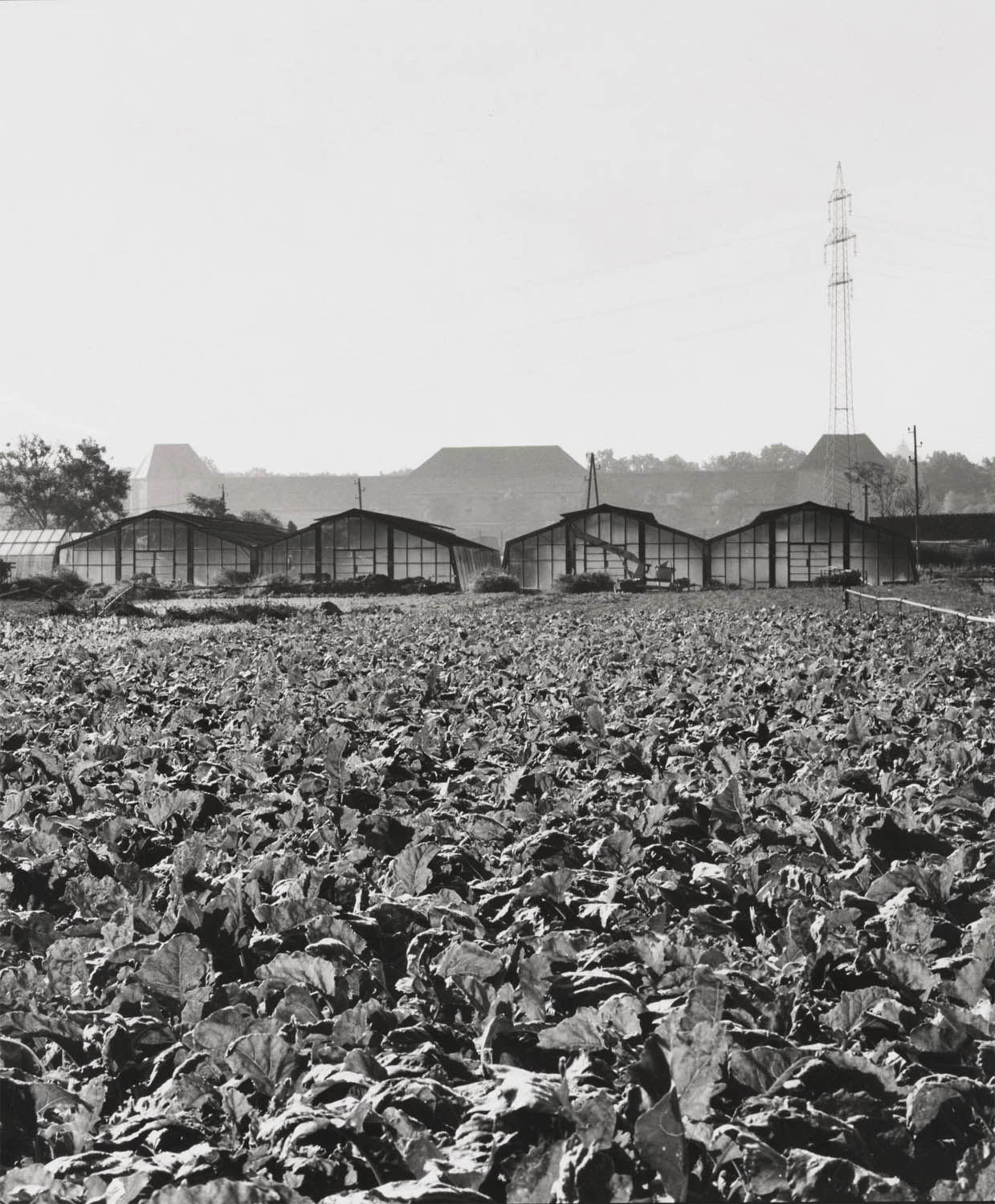
The exhibition at the Wien Museum presents a broad cross-section of the work of this artistic outsider, and demonstrates how the renewal of postwar Austrian photography was almost “all her own work.” Elfriede Mejchar consciously broke away from the photographic mainstream and the reportage style that was popular at the time. Rather than searching for the so-called “decisive moment,” she approached her subjects in a strongly conceptual and serial manner. She focused not on the extraordinary but on the unspectacular and the commonplace, the everyday and the banal, repeatedly addressing these in new ways in her photographic series.

In an Austria-wide cooperation between the Wien Museum, the State Gallery of Lower Austria, and the Museum der Moderne Salzburg, Elfriede Mejchar’s extensive oeuvre is being presented in 2024 for the first time, simultaneously, in three locations across the country. The exhibitions in Vienna, Krems, and Salzburg approach the work of Mejchar from different perspectives. And the three presentations are accompanied by a jointly conceived catalog published by Hirmer Verlag.

A cooperation between the State Gallery of Lower Austria, the Wien Museum and the Museum der Moderne Salzburg.

Text from the Wien Museum website


Elfriede Mejchar (Austrian, 1924-2020) 'Light and Shade' 1958 from the exhibition 'On Her Own. The photographer Elfriede Mejchar' at Wien Museum MUSA, Vienna, April - Sept 2024


Elfriede Mejchar (Austrian, 1924-2020)
Light and Shade
1958
Wien Museum
© Bildrecht, Vienna 2023


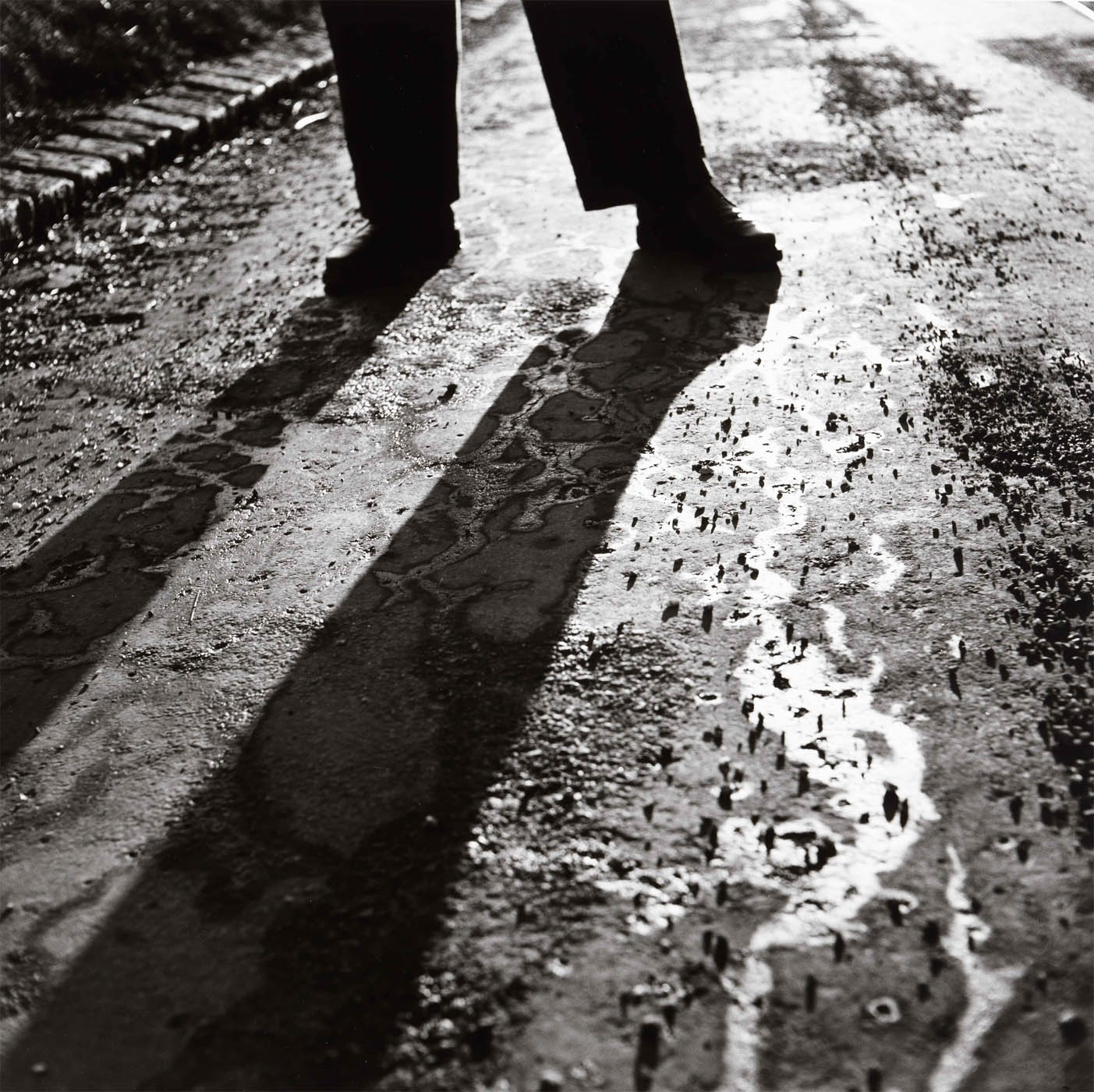
Elfriede Mejchar (Austrian, 1924-2020) 'Untitled' 1950-1960  From the series 'Light and Shade' from the exhibition 'On Her Own. The photographer Elfriede Mejchar' at Wien Museum MUSA, Vienna, April - Sept 2024


Elfriede Mejchar (Austrian, 1924-2020)
Untitled
1950-1960
From the series Light and Shade
Wien Museum
© Bildrecht, Vienna 2023


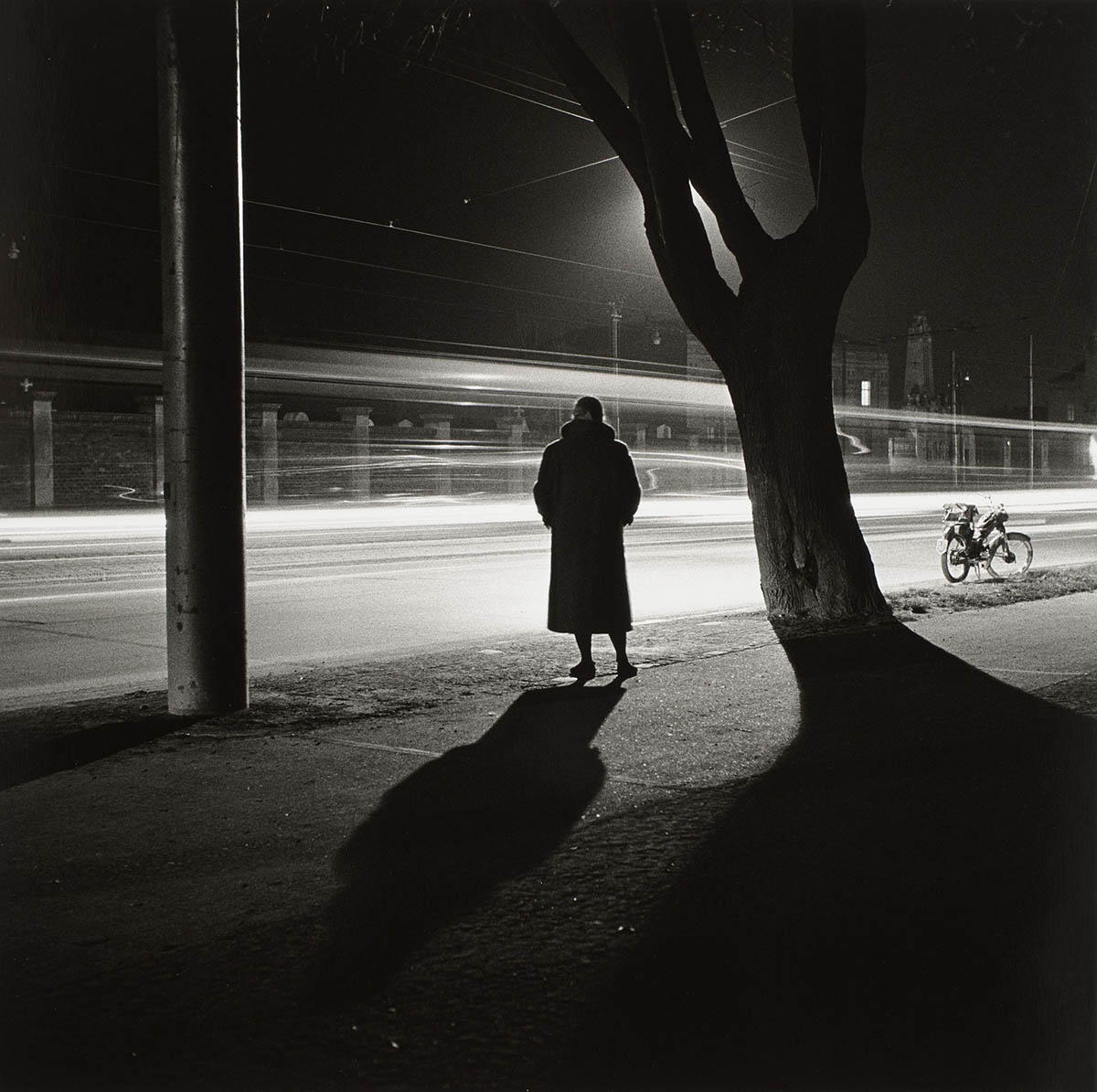
Elfriede Mejchar (Austrian, 1924-2020) 'Untitled (Waiting for the Tram)' 1950-1960


Elfriede Mejchar (Austrian, 1924-2020)
Untitled (Waiting for the Tram)
1950-1960
From the series Light and Shade
Wien Museum
© Bildrecht, Vienna 2023


Elfriede Mejchar (Austrian, 1924-2020) 'Vienna 10, Hasengasse 53' 1950-1960


Elfriede Mejchar (Austrian, 1924-2020)
Vienna 10, Hasengasse 53
1950-1960
Wien Museum
© Bildrecht, Vienna 2023


Installation view of the exhibition 'On Her Own. The photographer Elfriede Mejchar' at Wien Museum musa, Vienna Installation view of the exhibition On Her Own. The photographer Elfriede Mejchar at Wien Museum musa, Vienna showing photographs from Mejchar's series 'Simmering Heide and Erdberg Mais' (1967-1976)


Installation view of the exhibition On Her Own. The photographer Elfriede Mejchar at Wien Museum musa, Vienna showing photographs from Mejchar’s series Simmering Heide and Erdberg Mais (1967-1976, below)


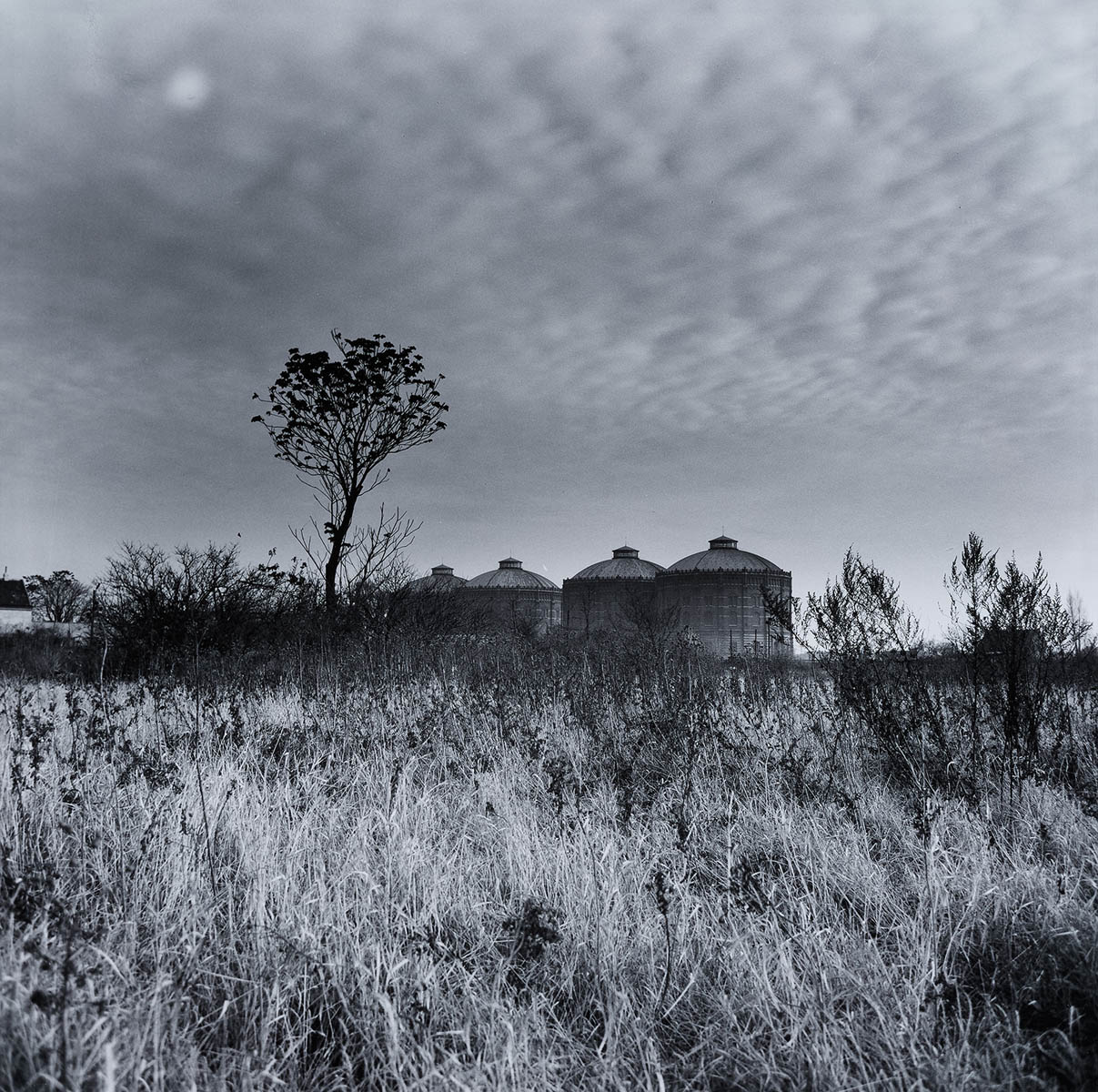
Elfriede Mejchar (Austrian, 1924-2020) 'Simmering Heide and Erdberg Mais' 1967-1976


Elfriede Mejchar (Austrian, 1924-2020)
Simmering Heide and Erdberg Mais
1967-1976
Wien Museum
© Bildrecht, Vienna 2023


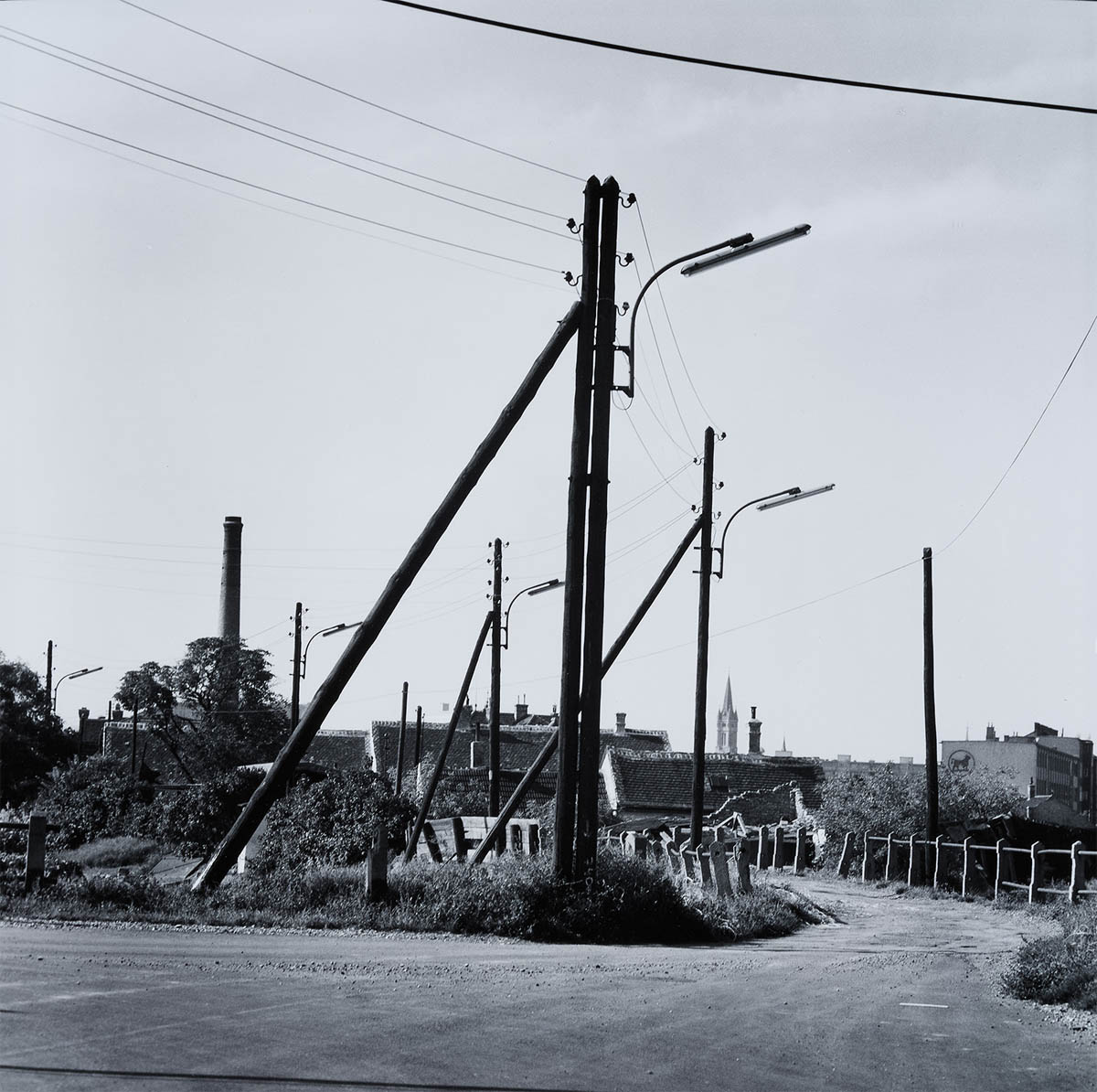
Elfriede Mejchar (Austrian, 1924-2020) 'Simmering Heide and Erdberg Mais' 1967-1976


Elfriede Mejchar (Austrian, 1924-2020)
Simmeringer Heide and Erdberger Mais
1967-1976
Wien Museum
© Bildrecht, Vienna 2023


Elfriede Mejchar (Austrian, 1924-2020) 'At the Hotel' Around 1980


Elfriede Mejchar (Austrian, 1924-2020)
At the Hotel
Around 1980
Wien Museum
© Bildrecht, Vienna 2023


Elfriede Mejchar (Austrian, 1924-2020) 'Triester Strasse' 1982-1983


Elfriede Mejchar (Austrian, 1924-2020)
Triester Strasse
1982-1983
Wien Museum
© Bildrecht, Vienna 2023


Elfriede Mejchar (1924-2020) was a major photographic artist, whose richly-varied oeuvre spans more than five decades, from the late 1940s well into the 21st century. The Viennese photographer, who only achieved recognition as an artist towards the end of her career, is now regarded as one of the most important representatives of the Austrian and the international photography scenes. May 10, 2024 marks the hundredth anniversary of her birth.

The exhibition in musa presents a broad cross-section of the work of this artistic outsider, and demonstrates how the renewal of postwar Austrian photography was almost “all her own work.” Elfriede Mejchar consciously broke away from the photographic mainstream and the reportage style that was popular at the time. Rather than searching for the so-called “decisive moment,” she approached her subjects in a strongly conceptual and serial manner. She focused not on the extraordinary but on the unspectacular and the commonplace, the everyday and the banal, repeatedly addressing these in new ways in her photographic series.

Elfriede Mejchar revealed her hometown Vienna from the periphery and had little interest in its iconic center, which was already the subject of countless thousands of photographs. As a photographer, she was at home where the city became rural, at the meeting point between urban development zones, derelict sites, green spaces, and post-industrial decay. In her long-term studies she documented the architectural and social textures of Vienna’s suburbs in a way that was both attentive and sober: new buildings advancing ever further onto green land, the monotony of endless arterial roads, derelict industrial complexes, market gardens and ageing gasometers, run-down housing and forgotten areas of landfill and decay. For Mejchar, however, the image of the urban periphery is not grey and the wasteland and its dereliction are repeatedly brightened by moments of unsuspected beauty.

Even if the urban and architectural photography of Vienna plays a major role in Elfriede Mejchar’s oeuvre, the range of subjects addressed in her work is far broader. Just as the photographer sheds a new photographic light on forgotten landscapes and buildings, she also approaches people and plants, places and things, in unexpected and surprising ways. In her incomparable series “Hotels,” she studies the interiors and typologies of Austrian accommodation in great detail, producing fascinating and often brightly coloured still lifes of plants and flowers as a means of aesthetically investigating the intermediate stages between blooming and withering. And in her bold collages and montages, a complex of work that continued to occupy her into her latter years, she created clever fantasy worlds, whose social criticism is only matched by their humour.

In an Austria-wide cooperation between the Wien Museum, the State Gallery of Lower Austria, and the Museum der Moderne Salzburg, Elfriede Mejchar’s extensive oeuvre is being presented in 2024 for the first time, simultaneously, in three locations across the country. The exhibitions in Vienna, Krems, and Salzburg approach the work of Mejchar from different perspectives:

Landesgalerie Niederösterreich. Elfriede Mejchar. Pushing the Boundaries of Photography April 13, 2024 to February 16, 2025 Tuesday – Sunday, 10am-6pm

musa. On her own. The photographer Elfriede Mejchar April 18 to September 1, 2024 Tuesday – Sunday, 10am-6pm

Museum der Moderne Salzburg. The Poetry of Everyday. Photographs by Elfriede Mejchar April 26 to September 15, 2024 Tuesday – Sunday, 10am-6pm

Biography of Elfriede Mejchar

Elfriede Mejchar (1924-2020) is undisputedly one of the most important personalities in Austrian photography. It was only at an advanced age that she received the public recognition she deserved, and in 2002 she was awarded the Federal Chancellery Prize for Artistic Photography and in 2004 the Lower Austrian Prize for Artistic Photography and the City of Vienna Prize for Fine Arts. In 2013, Elfriede Mejchar donated her entire oeuvre to the Province of Lower Austria. The Provincial Collections of Lower Austria have taken on the task of safeguarding this unique oeuvre for future generations and gradually making it accessible to the public. Her work is also prominently represented in the art collection of the Wien Museum, in the Federal Photography Collection and in the SpallArt Collection.

Press release from Wien Museum, Vienna


Elfriede Mejchar (Austrian, 1924-2020) 'Wienerberger Brick Kilns and Housing Estates' 1979-1981


Elfriede Mejchar (Austrian, 1924-2020)
Wienerberger Brick Kilns and Housing Estates
1979-1981
Wien Museum
© Bildrecht, Vienna 2023


Elfriede Mejchar (Austrian, 1924-2020) 'Wienerberger Brick Kilns and Housing Estates' 1979-1981


Elfriede Mejchar (Austrian, 1924-2020)
Wienerberger Brick Kilns and Housing Estates
1979-1981
Wien Museum
© Bildrecht, Vienna 2023


Installation view of the exhibition 'On Her Own. The photographer Elfriede Mejchar' at Wien Museum musa, Vienna showing text and photographs from the section 'Allure of the Everyday'


Installation view of the exhibition On Her Own. The photographer Elfriede Mejchar at Wien Museum musa, Vienna showing text and photographs from the section ‘Allure of the Everyday’


Exhibition texts

“I always marvelled at the wallpaper” (Prologue)

Elfriede Mejchar had two faces as a photographer: one in her day job, and one as an artist. Working for the Federal Monuments Office, she spent many years touring Austria, extensively documenting buildings and artworks in the provinces. On the side, she was a freelance photographic artist. When “at work,” she was bound by the strict criteria of art documentation. As an artist, she forged her own, very different paths.

While in her day job she photographed “great art,” in her free time she focused on the banality of everyday life, for example by taking interior shots of her accommodation over the years. The expenses covered by “the office,” she explained, “were not very generous, and I was always looking for lower-end lodgings. They could be very odd, anything was possible. In particular, I always marvelled at the wallpaper.”

1. Allure of the Everyday

A backlit trash can or advertising column, people waiting on the street, youths in the Bohemian Prater, the geometry of washing lines – even in her early series dating from the 1950s and 1960s, Mejchar’s fascination with scenes from everyday life is clear. She used her camera to record what she saw in the city in a matter-of-fact style, without judgment: the buildings and streets, cars and advertisements, traffic lights and posters. Only occasionally do people feature in her images. Often they seem a little lost. In contrast to many other photographers of her era, Mejchar was not looking for a quick snapshot or the “decisive moment.” “Speed doesn’t suit me,” she once said. Frequently she worked in series, often created over several years. Her focus was not on the extraordinary but on the unspectacular and the commonplace.

Working in Series

“I don’t like single photos very much,” said Elfriede Mejchar, thus describing one of the fundamental features of her photography. For almost 30 years, she explored Vienna’s peripheral zones on the southeast edge of the city. Again and again she returned to these uninviting places on the outskirts, where few people spent much time. In the main she photographed the landscapes, roads, and neighbourhoods in series, usually in parallel, but sometimes as a chronological sequence. For Mejchar as a photographer, the single image could not capture the complexity of this desolate and yet, in her eyes, beautiful landscape. It was the series that allowed her to show the different facets of a subject from ever new perspectives. Through her artistic and conceptual practice, Mejchar forged a completely new path in Austrian photography.

2. Evil Blooms

Throughout her working life, Mejchar photographed art, in other words, things created to last. Her images of flowers were a late counter-project. In these plant studies, some shot in luminous colour, the photographer brought transience and decay into focus, drawing out the fascinating transitions between blooming and withering. “I am not afraid of pathos, nor of kitsch,” Mejchar once said.

Elfriede Mejchar paid no heed to photographic conventions in her freelance work. Unabashed, she took delight in arranging and staging the plants and objects for her photographs in ways that opened up a range of associations. Some of her objects seem almost to come to life under her lens, while others wither away. Yet others invoke images of sexuality and desire.

Putting in a New Light

As a photographic subject, flowers are often dismissed as being romantic, kitsch, or unserious. Mejchar was not afraid of kitsch, but neither was she ever interested in the sweetness of the tulips or amaryllis she photographed. For her, flowers were like sculptures that needed to be shown in a proper light. Mejchar’s “merciless” gaze extended beneath the surface. It drilled into the very substance of the petals, laying bare the skeleton that emerged as the flower withered and capturing the bizarre forms of the dying plant. Yet the artist could not break free entirely of the strong metaphorical imagery of flowers. Sometimes, her shots of them in full bloom or with their inner parts exposed carried a sensual or sexual charge.

3. Measuring the Periphery

New builds encroaching ever further on the countryside, abandoned factories, fields of vegetables, ageing gasometers, the monotony of interminable highways, makeshift housing, wastelands – as a photographer, Elfriede Mejchar was especially keen on these forgotten landscapes on the margins of the Viennese metropolis. “It was the changes that I was concerned with.”

Starting in the 1960s, Mejchar roamed the city’s peripheral zones with her camera. “These were the sites that interested me the most. Where countryside and city collide.” Her long-term series “Simmeringer Heide and Erdberger Mais,” begun in the 1960s and first shown in 1976 in a solo exhibition at the Museum of the 20th Century, established Mejchar’s reputation as leading photo artist.

Constructing Space

Row upon row of plants, damp soil blanketed by the early morning mist, distant greenhouses, lettuces covering the ground, interspaced with sprinklers – Elfriede Mejchar documented every facet of Vienna’s market gardens at the edge of the city, from detached general views to shots that capture the smallest detail. Her images use a deep depth of field, making it seem almost as if the viewer could reach out and touch the clumps of soil or individual leaves in the foreground. But she also regularly translated landscapes, buildings, and spaces into abstract forms by setting up contrasting oppositions between individual motifs, or by reducing an image to monochrome surfaces.

4. Lips and Pistols

Faces ripped from fashion magazines and floral wallpaper, cogs and cigarettes, spools and dressmaking pins, small chains and cables – starting in the 1980s, Mejchar jumbled these found, everyday objects together to create small-scale, theatrical arrangements laced with acerbic wit. “I construct images,” the artist once said of her sarcastic and subversive collages and assemblages. In these composite scenes, Elfriede Mejchar gave free rein to an anarchic desire to assemble and disassemble. At the same time, she used humour and irony to lampoon society’s ideals of perfection, “adorning” beautiful faces with everyday objects, for example, or – with a knowing wink – targeting James Bond’s pistol on the eroticised lips of the beauty industry. Mejchar’s summary: “I like things colourful and crazy.”

Arranging Objects

After retiring from paid employment, Mejchar increasingly concentrated on her work in the studio, which now became a stage for herself and her camera. Here she created ironic, acerbic, and frequently bizarre object combinations, often as an exploration of gender stereotypes. In her collages, she dismantled and critiqued the fashion industry’s preformed ideals of beauty with zest and humour. She took pleasure in experimenting with a whole range of props, rearranging them into new scenes again and again. Fragmented faces from fashion magazines were combined with torn and cut wallpaper, then garnished with cogs, feathers, and cables. She literally nailed the beauty industry to the wall.

5. Remains and Ruins

The innards of a house scheduled for demolition, derelict industrial estates, overgrown railway lines and buildings, gouged landscapes, forgotten piles of bricks – over many years, Mejchar explored these remains of industrial culture. “My work only began,” she said, “when the people were gone.”

“I took myself off to the factories, going from one road to the next.” In her series “Wienerberger Brick Kilns,” which she photographed from 1979 to 1981 following the closure of the Wienerberger brick factory on Vienna’s southern edge, she made deliberate use of colour photography for the first time. Impregnated with brick dust, the ground and the remains of the industrial architecture glow red under an azure sky, assuming an air of unreality. Mejchar: “I am interested in what remains.”

Seeing in Color

During the first decades of her career as a photographer, Elfriede Mejchar worked in black and white because colour photography was too expensive. All the more astonishing, therefore, is the confidence and precision with which she employed colour as an aesthetic element in the photo series “Wienerberger Brick Kilns” in the late 1970s and early 1980s. Similar to the New Color Photography movement in the USA, Mejchar’s photographic explorations focused primarily on the borders between urban and rural spaces. Her main interest was in landscapes subjected to human interventions. She documented these run-down locations using vivid lighting and brilliant colours, producing unsentimental photographs of high aesthetic quality. In doing so, she opened up an entirely new approach to documentary photography in Austria.


Installation view of the exhibition 'On Her Own. The photographer Elfriede Mejchar' at Wien Museum musa, Vienna showing at second right, Mejchar's 'Aether and narcosim' (1989-1991)


Installation view of the exhibition On Her Own. The photographer Elfriede Mejchar at Wien Museum musa, Vienna showing at second right, Mejchar’s Aether and narcosim (1989-1991, below)


Elfriede Mejchar (Austrian, 1924-2020) 'Aether and narcosim' 1989-1991


Elfriede Mejchar (Austrian, 1924-2020)
Aether and narcosim
1989-1991
Wien Museum
© Bildrecht, Vienna 2023


Elfriede Mejchar (Austrian, 1924-2020) 'Vegetable Tunnels. Simmering Market Gardens' 1990-1994


Elfriede Mejchar (Austrian, 1924-2020)
Vegetable Tunnels. Simmering Market Gardens
1990-1994
Wien Museum
© Bildrecht, Vienna 2023


Elfriede Mejchar (Austrian, 1924-2020) 'Vegetable Tunnels. Simmering Market Gardens' 1990-1994


Elfriede Mejchar (Austrian, 1924-2020)
Vegetable Tunnels. Simmering Market Gardens
1990-1994
Wien Museum
© Bildrecht, Vienna 2023


Elfriede Mejchar (Austrian, 1924-2020) 'A Costume of Borrowed Identity' 1990-1991


Elfriede Mejchar (Austrian, 1924-2020)
A Costume of Borrowed Identity
1990-1991
Wien Museum
© Bildrecht, Vienna 2023


Elfriede Mejchar (Austrian, 1924-2020) 'A Costume of Borrowed Identity' 1990-1991


Elfriede Mejchar (Austrian, 1924-2020)
A Costume of Borrowed Identity
1990-1991
Wien Museum
© Bildrecht, Vienna 2023


Elfriede Mejchar (Austrian, 1924-2020) 'Amaryllis' 1996


Elfriede Mejchar (Austrian, 1924-2020)
Amaryllis
1996
Wien Museum
© Bildrecht, Vienna 2023


Elfriede Mejchar (Austrian, 1924-2020) 'Amaryllis' 2001


Elfriede Mejchar (Austrian, 1924-2020)
Amaryllis
2001
Wien Museum
© Bildrecht, Vienna 2023


Elfriede Mejchar (Austrian, 1924-2020) 'Hands in Lap' 2002


Elfriede Mejchar (Austrian, 1924-2020)
Hands in Lap
2002
Wien Museum
© Bildrecht, Vienna 2023


Elfriede Mejchar (Austrian, 1924-2020) From the series 'Nobody is Perfect' 1989-2007


Elfriede Mejchar (Austrian, 1924-2020)
From the series Nobody is Perfect
1989-2007
© Bildrecht, Vienna 2024


Elfriede Mejchar (Austrian, 1924-2020) From the series 'Nobody is Perfect' 1989-2007


Elfriede Mejchar (Austrian, 1924-2020)
From the series Nobody is Perfect
1989-2007
© Bildrecht, Vienna 2024


Unknown photographer. 'Elfriede Mejchar with Linhof camera and tripod in the Federal Monuments Office' Late 1970s


Unknown photographer
Elfriede Mejchar with Linhof camera and tripod in the Federal Monuments Office
Late 1970s
State Collections of Lower Austria


Poster for the exhibition 'On Her Own. The Photographer Elfriede Mejchar'


Poster for the exhibition On Her Own. The Photographer Elfriede Mejchar
Graphic: Studio Kehrer


Wien Museum MUSA
1010 Vienna, Felderstraße 6-8

Opening hours:
Tuesday to Sunday 10am – 6pm

Wien Museum website

LIKE ART BLART ON FACEBOOK

Back to top

Exhibition: ‘Roger Mayne: Youth’ at the Courtauld Gallery, London

Exhibition dates: 14th June – 1st September, 2024

Denise Coates Exhibition Galleries


Roger Mayne (British, 1929-2014) 'Southam Street Group, North Kensington, London' 1956


Roger Mayne (British, 1929-2014)
Southam Street Group, North Kensington, London
1956
Vintage gelatin silver print
55.5 x 80.4cm
Courtesy Victoria & Albert Museum


In vivid and completely natural un/reality

As readers of Art Blart over the years will know, I love a committed social documentary photographer, an artist with a heart and an informed social consciousness, one who is aware of the right or wrong actions (conscience).

Roger Mayne is one such photographer. Others in the pantheon include Helen Levitt, Chris Killip, Don McCullin, Edith Tudor-Hart, Bill Brandt, Tony Ray-Jones, Syd Shelton, Neil Kenlock, Lewis Hine, Jacob Riis, Daniel Meadows, Gordon Parks, Milton Rogovin, Teenie Harris, and Dave Heath to name just a few.

Mayne’s portrait of the working class areas of London life, his gritty black and white images of a “crumbling post-war Britain” and the “modernisation of working class neighbourhoods after the war” picture  – as Colin MacInnes author of the “cult 1959 novel Absolute Beginners, a lively account of the emergence of teen culture and attitude in the late 1950s” (wall text) states – “a rotting slum of a sharp, horrible vivacity.”1

What a turn of phrase!

But what MacInnes forgets is that there was community in those very slums, that there was a culture of supporting each other through the tough times, especially after the deprivations of the Second World War and the ongoing rationing which lasted until mid-1954 in the United Kingdom. I vividly remember as a child visiting my grandmother in a small town in suburban Hertfordshire in the 1960s and recall the drabness of the identical houses cheek by jowl, the washing hung in the backyard and the outdoor loo, and the dampness, darkness of the house. And the cold and the rain. But then there were the children playing in the streets, the smiles and the joy of freedom despite the poverty.

Mayne’s photographs push further than mere documentary reportage on these communities. As he himself says, photography becomes art through a “particular mixture of reality and unreality” and the photographers power to select what they are photographing. They become art through the photographers consciousness.

Here I believe that the mixture of reality and unreality and previsualisation (selection of what to photograph and how to frame the image) in Mayne’s photographs can be seen as a form of “magic realism” which is “a style or genre of fiction and art that presents a realistic view of the world while incorporating magical elements, often blurring the lines between fantasy and reality.”2 Matthew Strecher (1999) defines it as “what happens when a highly detailed, realistic setting is invaded by something too strange to believe.”3

Indeed, if we look at Mayne’s photograph Southam Street Group, North Kensington, London (1956, above) there is something so magical and strange about the atmosphere of this image – the out of focus girl in the foreground, boy with his hand to his neck, self absorbed girl on the steps looking out, peeling paint of the building, young children watching the man holding the bicycle and a second, orphaned larger wheel (what is it doing there?), the small child being propped on the too large bicycle, bulky pram lurking, hunkering at the side of the image – it is as though the image was part of a fable, a story about mythical characters and streetscapes that can never happen again.

This magic realism is repeated again and again in Mayne’s images: that sense of the extra/ordinary, of the super/natural – the spacing of the figures in Southam Street Corner, North Kensington, London (1957, below); the zoomorphic characteristics of the figures in Girls doing a Handstand, Southam Street (1956, below); the contrast between the stiff-legged boy and arms folded screaming girl in Screaming Child, Southam St. (North Kensington) (1956, below); and the lean of the whole photograph … the women, reaching out to touch the man child in Nottingham, St Ann’s (1969, below). And on we could go, each image taking us out of ourselves into strange new (old) worlds.

Roger Mayne was truly a magnificent, poetic artist. His subjects, though never appearing “posed,” confront the spectator in vivid and completely natural un/reality.4 Spirits who still inhabit London’s deliquescent urban spaces.

Dr Marcus Bunyan


1/ Colin MacInnes (British, 1914-1976) Poverty and poetry in W.10 c. 1961

2/“Magic realism,” on the Wikipedia website

3/ Strecher, Matthew C. 1999. “Magical Realism and the Search for Identity in the Fiction of Murakami Haruki.” Journal of Japanese Studies 25(2): 263–98. p. 267 quoted in “Magic realism,” on the Wikipedia website

4/ Adapted from Colin MacInnes Op. cit.,


Many thankx to the Courtauld Gallery for allowing me to publish the photographs in the posting. Please click on the photographs for a larger version of the image.


Colin MacInnes 'Poverty and poetry in W.10' c. 1961


Colin MacInnes (British, 1914-1976)
Poverty and poetry in W.10
c. 1961

Used under fair use for the purposes of education and research


“Photography involves two main distortions – the simplification into black and white and the seizing of an instant in time. It is this mixture of reality and unreality, and the photographer’s power to select, that makes it possible for photography to be an art.”


Roger Mayne


“[Mayne] understood how to compose images in the camera to create what he described to Peace News in 1960 as a “particular mixture of reality and unreality.”

“The photographer’s power to select…makes it possible for photography to be an art,” Mayne continued. “Whether it is good art depends on the power and truth of the artist’s statement.””


Miss Rosen. “Joyful photos of London youth culture in the 50s and 60s,” on the Huck Magazine website Monday 13 February, 2023 [Online] Cited 23/07/2024


Installation view of the exhibition 'Roger Mayne: Youth' at the Courtauld Gallery, London 

Installation view of the exhibition 'Roger Mayne: Youth' at the Courtauld Gallery, London 


Installation views of the exhibition Roger Mayne: Youth at the Courtauld Gallery, London


Acclaimed British photographer Roger Mayne (1929-2014) was famous for his evocative documentary images of young people growing-up in Britain in the mid-1950s and ’60s.

This exhibition, of around 60 almost exclusively vintage photographs, includes many of his iconic street images of children and teenagers, alongside an almost entirely unknown selection of intimate and moving later images of his own family at home in Dorset, as well as those taken on his honeymoon in Spain in 1962.

Self-taught and influential in the acceptance of photography as an art form, Mayne was passionate about photographing human life as he found it. This is the first exhibition of his work since 2017.

Text from the Courtauld website


Playing in the Street


Installation view of the exhibition 'Roger Mayne: Youth' at the Courtauld Gallery, London showing at left, Mayne's 'Goalie, Brindley Road, Paddington, London' (1956); at second left, 'Southam Street Group, North Kensington, London' (1956); at centre, 'Girl on the steps, St. Stephen's Gardens' (1957); and at second from right, 'Southam Street Corner, North Kensington, London' (1957)


Installation view of the exhibition Roger Mayne: Youth at the Courtauld Gallery, London showing at left, Mayne’s Goalie, Brindley Road, Paddington, London (1956, below); at second left, Southam Street Group, North Kensington, London (1956, above); at centre, Girl on the steps, St. Stephen’s Gardens (1957, below); and at second from right, Southam Street Corner, North Kensington, London (1957, below)


Roger Mayne (British, 1929-2014) 'Southam Street Corner, North Kensington, London' 1957


Roger Mayne (British, 1929-2014)
Southam Street Corner, North Kensington, London
1957
Vintage gelatin silver print mounted on board
43 x 58cm
Courtesy Victoria & Albert Museum


Roger Mayne (British, 1929-2014) 'Children in a Bombed Building, Bermondsey, London' 1954


Roger Mayne (British, 1929-2014)
Children in a Bombed Building, Bermondsey, London
1954
Vintage gelatin silver print
28 x 19.5cm
Courtesy the Roger Mayne Archive


Don McCullin (British, b. 1935) 'The Guv'nors, Finsbury Park, London' 1958


Don McCullin (British, b. 1935)
The Guv’nors, Finsbury Park, London
1958
Gelatin silver print
Used under fair use for the purposes of education and research

This photograph is not in the exhibition


Roger Mayne (British, 1929-2014) 'Girls doing a Handstand, Southam Street' 1956


Roger Mayne (British, 1929-2014)
Girls doing a Handstand, Southam Street
1956
Modern print (printed in 1987)
30 x 23cm
Courtesy the Roger Mayne Archive


Roger Mayne (British, 1929-2014) 'Goalie, Brindley Road, Paddington, London' 1956


Roger Mayne (British, 1929-2014)
Goalie, Brindley Road, Paddington, London
1956
Modern print (printed in 2002)
38 x 30cm
Courtesy the Roger Mayne Archive


Roger Mayne (British, 1929-2014) 'Girl on the steps, St. Stephen's Gardens' 1957


Roger Mayne (British, 1929-2014)
Girl on the steps, St. Stephen’s Gardens
1957
Vintage gelatin silver print mounted on board
49.3 x 34.5cm
Courtesy Victoria & Albert Museum


In the case:


Roger Mayne (British, 1929-2014) 'Screaming Child, Southam St. (North Kensington)' 1956


Roger Mayne (British, 1929-2014)
Screaming Child, Southam St. (North Kensington)
1956
From the ‘Southam Street’ Album 1956-1961, 5 May 1956
Vintage gelatin silver print mounted in an album
36.4 x 54.8cm
Courtesy Victoria & Albert Museum


Dave Heath, (Canadian born United States, 1931-2016) 'Vengeful Sister, Chicago' 1956


Dave Heath (Canadian born United States, 1931-2016)
Vengeful Sister, Chicago
1956
Gelatin silver print
7 3/16 x 8 7/8 inches
The Nelson-Atkins Museum of Art, Kansas City, Missouri
Gift of the Hall Family Foundation
Used under fair use for the purposes of education and research

This photograph is not in the exhibition


The summer season at The Courtauld Gallery in London has opened with a major exhibition of photographs by the acclaimed post-war photographer, Roger Mayne.

The first-ever photography exhibition at The Courtauld, Roger Mayne: Youth (14 June – 1 September 2024) reassesses the importance of Roger Mayne (1929-2014), through the lens of his evocative black and white images of young people. The exhibition brings together the works of the 1950s and early 1960s for which he is famous, alongside lesser-known images of his own children. The exhibition and accompanying catalogue positions Mayne as crucially important in the emergence of documentary photography as an art form in Britain in the years after the war.

A self-taught photographer, having discovered the medium while studying chemistry at Balliol College, Oxford, Mayne moved to London in 1953. Inspired by the work of the artist Nigel Henderson, among others, he became passionate about photographing human life as he found it. He quickly achieved widespread recognition for his powerful images of communities struggling with poverty against a backdrop of dereliction in London and across the UK. Renowned for his sustained portrayal of Southam Street, now long gone but then located on the northern fringes of Notting Hill, Mayne’s dedication to photographing this one locale over a six-year period – from 1956 to 1961 – was, and still is, extraordinary in the history of photography.

Mayne’s photography in the 1950s and early ’60s captured an exuberance and an uneasiness that embodied both the scars and hopes of post-war Britain. In documenting the lives of young people growing up in Britain, his images highlight the significance of children’s play and the identity formation of the teenager in the post-war years, revealing the tectonic shifts in society at that time. Highlights include Children in a Bombed Building, Bermondsey, London (1954) and one of his most famous images, A Girl Jiving in Southam Street (Eileen Sheekey), London (1957).

In 1962 a new chapter opened in Roger Mayne’s personal life, when he married Ann Jellicoe, a pioneering and well-established playwright. Their honeymoon in Spain left Mayne feeling creatively nourished by the vitality of the people he encountered there. With children and young people still at the forefront of this fresh strand of image-making, he judged the photographs from this trip to be ‘the best series of photographs I have yet done.’ Following the birth of his own children and a move to the Dorset countryside in the mid-1960s, family life and the local bucolic landscape became a new backdrop for Mayne’s lens. The imagery of the street was replaced by that of a growing and adored family.

This exhibition, curated by Jane Alison in close collaboration with Mayne’s daughter, Katkin Tremayne, features over 60 vintage photographs, some never exhibited before. While the two bodies of work, street and family, have a different tenor, they are united by Mayne’s radical empathy with his youthful subjects and his desire to create photographic images that enjoy a lasting impact, produced with great sensitivity and artistic integrity. With Mayne’s post-war subjects now in their more senior years, and today’s younger generation facing a myriad crises, Mayne’s deliberations on growing up, childhood, adolescence and family feel especially poignant and timely.

Press release from the Courtauld


Society at Large


Roger Mayne (British, 1929-2014) 'Nottingham, St Ann's' 1969


Roger Mayne (British, 1929-2014)
Nottingham, St Ann’s
1969
Modern print
16 x 23cm
Courtesy the Roger Mayne Archive


In the case

Nine Pelican and Penguin paperback books including:


'Adolescent Boys of East London', by Peter Willmott, Pelican, 1969


Adolescent Boys of East London, by Peter Willmott, Pelican, 1969 with Roger Mayne’s Street football, Southam St., North Kensington, 1958 (detail) on the cover


'Relative Deprivation and Social Justice: A study of attitudes to social inequality in twentieth-century England', W. G. Runciman, Pelican, 1972 book cover


Relative Deprivation and Social Justice: A study of attitudes to social inequality in twentieth-century England, W. G. Runciman, Pelican, 1972 book cover


'Poverty: The Forgotten Englishman', Ken Coates and Richard Silburn, Pelican, 1970


Poverty: The Forgotten Englishman, Ken Coates and Richard Silburn, Pelican, 1970 book cover


The Spanish Honeymoon


Installation view of the exhibition 'Roger Mayne: Youth' at the Courtauld Gallery, London showing at left, Mayne's 'Costa del Sol' (1962); at centre, 'Girl in a Market, Almunecar, Costa del Sol' (1962, below); at top right, 'Footballer Jumping, Almuneca, Costa del Sol' (1962); and at bottom right, 'Girls by a Fountain, Almunecar, Costa del Sol' (1962)


Installation view of the exhibition Roger Mayne: Youth at the Courtauld Gallery, London showing at left, Mayne’s Costa del Sol (1962); at centre, Girl in a Market, Almunecar, Costa del Sol (1962, below); at top right, Footballer Jumping, Almuneca, Costa del Sol (1962); and at bottom right, Girls by a Fountain, Almunecar, Costa del Sol (1962)


Roger Mayne (British, 1929-2014) 'Girl in a Market, Almunecar, Costa del Sol' 1962


Roger Mayne (British, 1929-2014)
Girl in a Market, Almunecar, Costa del Sol
1962
Vintage gelatin silver print mounted on board
59.5 x 91.5cm
Gelatin silver print


Teenage Takeover


Installation view of the exhibition 'Roger Mayne: Youth' at the Courtauld Gallery, London showing at left, Mayne's 'Teenagers, Soho Fair, London' (17 July 1958); at centre, 'Teenage Couple, Absolute Beginners photo-shoot' (26 April 1959); and at right, 'Men and boys, Southam Street, London' (1959)


Installation view of the exhibition Roger Mayne: Youth at the Courtauld Gallery, London showing at left, Mayne’s Teenagers, Soho Fair, London (17 July 1958, below); at centre, Teenage Couple, Absolute Beginners photo-shoot (26 April 1959, below); and at right, Men and boys, Southam Street, London (1959, below)


Installation view of the exhibition 'Roger Mayne: Youth' at the Courtauld Gallery, London showing at left, Mayne's 'Teenage Couple, Absolute Beginners photo-shoot' (26 April 1959); at centre, 'Men and boys, Southam Street, London' (1959); and at right, 'Teddy Girls, Battersea Funfair' (1956)


Installation view of the exhibition Roger Mayne: Youth at the Courtauld Gallery, London showing at left, Mayne’s Teenage Couple, Absolute Beginners photo-shoot (26 April 1959, below); at centre, Men and boys, Southam Street, London (1959, below); and at right, Teddy Girls, Battersea Funfair (1956, below)


Roger Mayne (British, 1929-2014) 'Teenagers, Soho Fair, London' 17 July 1958


Roger Mayne (British, 1929-2014)
Teenagers, Soho Fair, London
17 July 1958
Vintage gelatin silver print
24 x 36cm
Courtesy Wilson Centre for Photography


Roger Mayne (British, 1929-2014) 'Men and boys, Southam Street, London' 1959


Roger Mayne (British, 1929-2014)
Men and boys, Southam Street, London
1959
Vintage gelatin silver print
18.5 x 27cm
Courtesy the Roger Mayne Archive


Roger Mayne (British, 1929-2014) 'Beaulieu Jazz Festival' 1961


Roger Mayne (British, 1929-2014)
Beaulieu Jazz Festival
1961
Vintage gelatin silver print
18 x 27cm
Courtesy the Roger Mayne Archive


Roger Mayne (British, 1929-2014) 'A Girl Jiving in Southam Street (Eileen Sheekey)' London, 1957


Roger Mayne (British, 1929-2014)
A Girl Jiving in Southam Street (Eileen Sheekey)
London, 1957
Vintage gelatin silver print
36.5 x 25.2cm
Courtesy Victoria & Albert Museum


The moving girl may have been living her best life, but this wasn’t peak prosperity for her. The street she lived on was the most densely populated street in London (according to a 1961 survey), a place where children played in the streets because there were no green spaces available….

Roger Mayne didn’t foreground this poverty. He photographed Southam Street in a way that was in some ways nostalgic. He wrote, “Empty, the streets have their own kind of beauty, a kind of decaying always great atmosphere… My reason for photographing the love on them, and the life on them. … [I]t may be warm and friendly on a sunny spring weekend when the street is swarming with children playing.”

At the same time, he doesn’t avoid the signs of poverty, the indicators of decay, and not does he romanticism them. When brickwork crumbles, you know it is a sing of neglect and not some kind of shabby working-class chic. His pictures also show the changes these communities are going through. Stephen Brooke wrote that the immediacy of Mayne’s images helped him “capture the dynamism of working-class life and chronicle new actors on the urban stage such as teenagers and African and West Indian immigrants.” …

It’s a world that is nostalgic in some ways, but is also a reminder of what we have lost. The public sites Mayne photographed, the spaces of the street, have been taken over by cars or commodified and securitized. And when we wonder at the nostalgia of it all, it might be a nostalgia tinged with mourning, not at what we have lost in our striving for affluence but at what has been taken from us.”

Colin Pantall. “West London’s Working-Class,” on the Blind Magazine website February 27, 2023 [Online] Cited 23/07/2024


Roger Mayne (British, 1929-2014) 'Teddy Girls, Battersea Funfair' 1956


Roger Mayne (British, 1929-2014)
Teddy Girls, Battersea Funfair
1956
Vintage gelatin silver print
58.3 x 43.8cm
Courtesy Victoria & Albert Museum


Roger Mayne (British, 1929-2014) 'Teenage Couple, Absolute Beginners photo-shoot' 26 April 1959


Roger Mayne (British, 1929-2014)
Teenage Couple, Absolute Beginners photo-shoot
26 April 1959
Vintage gelatin silver print
25.6 x 18.2cm
Courtesy Victoria & Albert Museum


Absolute beginners

26 April 1959

Mayne was commissioned to photograph the cover image for Colin MacInnes cult 1959 novel Absolute Beginners, a lively account of the emergence of teen culture and attitude in the late 1950s. The young Mod couple that Mayne photographed for the book cover effectively announced the birth of “cool” in the UK. One of over 80 images that Mayne took on the day of the shoot, we know that this image was preferred by Mayne to the one on the cover, most likely due to the fact that he thought it looked less staged, which was something that he vehemently disliked.

Victoria and Albert Museum, London

Wall text from the exhibition


In the case


Colin MacInnes's 'Absolute Beginners' 1959 book cover


Colin MacInnes’s Absolute Beginners 1959 book cover


Soho, Notting Hill… a world of smoky jazz clubs, coffee bars and hip hang-outs in the center of London’s emerging youth culture. The young and restless – the Absolute Beginners – were creating a world as different as they dared from the traditional image of England’s green and pleasant land. Follow our young photographer as he records the moments of a young teenager’s life in the capital – sex, drugs and rock ‘n’ roll, the era of the first race riots and the lead-up to the swinging sixties.

A twentieth-century cult classic, Absolute Beginners remains the style bible for anyone interested in Mod culture and paints a vivid picture of a changing society with insight and sensitivity.

Text from the Goodreads website


Introduction

The novel is written from the first-person perspective of a teenage freelance photographer, who lives in a rundown yet vibrant part of West London he calls Napoli. The area is home to a large number of Caribbean immigrants, as well as English people on the margins of society, such as homosexuals and drug addicts.

The themes of the novel are the narrator’s opinions on the newly formed youth culture and its fixation on clothes and jazz music, his love for his ex-girlfriend Crêpe Suzette, the illness of his father, and simmering racial tensions in the summer of the Notting Hill race riots.

Plot summary

The novel is divided into four sections. Each details a particular day in the four months that spanned the summer of 1958.

In June takes up half of the book and shows the narrator meeting up with various teenaged friends and some adults in various parts of London and discussing his outlook on life and the new concept of being a teenager. He also learns that his ex-girlfriend, Suzette, is to enter a marriage of convenience with her boss, a middle-aged gay fashion designer called Henley.

In July has the narrator taking photographs by the river Thames, seeing the musical operetta H.M.S. Pinafore with his father, has a violent encounter with Ed the Ted and watches Hoplite’s appearance on Call-Me-Cobber’s TV show.

In August has the narrator and his father take a cruise along the Thames towards Windsor Castle. His father is taken ill on the trip and has to be taken to a doctor. The narrator also finds Suzette at her husband’s cottage in Cookham.

In September is set on the narrator’s 19th birthday. He sees this, symbolically, as the beginning of his last year as a teenager. He witnesses several incidents of racial violence, which disgust him. His father also dies, leaving him four envelopes stuffed with money. Suzette has separated from Henley, but still seems uncertain as to whether she should resume her relationship with the narrator. The narrator decides to leave the country and find a place where racism doesn’t exist. At the airport, he sees Africans arriving and gives them a warm welcome.

Text from the Wikipedia website


Roger Mayne (British, 1929-2014) 'Girls Dancing at Richmond Jazz Festival' 1962


Roger Mayne (British, 1929-2014)
Girls Dancing at Richmond Jazz Festival
1962
Vintage gelatin silver print mounted on board
61 x 91.5cm


Installation view of the exhibition 'Roger Mayne: Youth' at the Courtauld Gallery, London


Installation view of the exhibition Roger Mayne: Youth at the Courtauld Gallery, London showing in the background at left, Girls Dancing at Richmond Jazz Festival (1962, above); and in the case the texts below


The Family Albums

The arrival of Roger Mayne’s own children, Katkin and Tom, prompted an ambitious documentary project entitled ‘Daughter and Son’, 1966-1974, for which he planned a comprehensive book of images accompanied by detailed behavioural observations. An earlier devotion to the youth of Southam Street was here replaced by an adoration of his own family. The images that Mayne took, along with later ones of his grandchildren, are collected in more than a dozen albums, four of which are featured here. A further album, made as a keepsake for the children’s great uncle, juxtaposed photographs with drawings by both children. These are prefigured by a much earlier album, which includes images of families.

Mayne sought to bring an unwavering gaze to the nature of human’s experiences. The act of giving birth and the emergence of new life presented itself to Mayne as an opportunity to bring sensitivity and authenticity as well as compositional flair and originality to these unique moments. As such, the group of images that Mayne took of his wife Ann giving birth to Katkin are unlike other childbirth photographs, which are typically taken from behind the mother’s head and without such a direct view of the emerging baby.

Cabinet display text from the exhibition

Early Work Album Vol II

This album of the photographer’s most important early images was brought together by Mayne and presented tot he Victoria and Albert Museum. The left-hand image of a family friend is marked by a wry humour that came to characterise much of Mayne’s mature work, whereas the image on the right-hand side, with the riot of closely, cropped and tangled bodies, foreshadows some of his best photographs of children in unruly abandon in London’s Southam Street. The right-hand image was taken on a trip to Victoria Park Lido with the artist Nigel Henderson’s family and friends.

Cabinet display text from the exhibition


Roger Mayne (British, 1929-2014) 'Three children at Nigel Henderson's: Drusilla (Jo) and Justin Henderson, with a friend, Bethnal Green' 1953


Roger Mayne (British, 1929-2014)
Three children at Nigel Henderson’s: Drusilla (Jo) and Justin Henderson, with a friend, Bethnal Green
1953
Vintage gelatin silver print
21 x 20cm
Courtesy the Roger Mayne Archive


Roger Mayne (British, 1929-2014) 'Tom, Trafalgar Square' 1970


Roger Mayne (British, 1929-2014)
Tom, Trafalgar Square
1970
Vintage gelatin silver print
27 x 17cm
Courtesy the Roger Mayne Archive


The Courtauld Gallery
Somerset House, Strand,
London WC2R 0RN

Opening hours:
Monday to Sunday 10.00 – 18.00

The Courtauld Gallery website

LIKE ART BLART ON FACEBOOK

Back to top

Exhibition: ‘David Goldblatt: No Ulterior Motive’ at Fundación MAPFRE, Madrid

Exhibition dates: 30th May – 25th August 2024

Curators: Judy Ditner, Leslie M. Wilson and Matthew S. Witkovsky


David Goldblatt (South African, 1930-2018) 'Yaksha Modi, the daughter of Chagan Modi, in her father's shop before its destruction under the Group Areas Act, 17th Street, Fietas, Johannesburg' 1976


David Goldblatt (South African, 1930-2018)
Yaksha Modi, the daughter of Chagan Modi, in her father’s shop before its destruction under the Group Areas Act, 17th Street, Fietas, Johannesburg
1976
From the series Fietas
Gelatin silver print
The Art Institute of Chicago, promised donation of Cecily Cameron and Derek Schrier
© The David Goldblatt Legacy Trust


David Goldblatt writing history

To keep this archive relevant I am constantly refreshing the postings to make sure all the links work, all the videos are still available, and all the bibliographic information about the photographers is up to date.

With the switch to the new template I am having to refresh every page that I have published since 2008 which is a mammoth task. Every time I search the Internet for an artist and their dates I say a little “thank you” when I find an artist is still living… for their creativity and energy is still present in the world. Unfortunately what I have found is that so many photographers have passed away since I started Art Blart in 2008, many within the last 8-10 years.

This is not surprising, people die! But we seem to be loosing that generation of photographers who were born in the 1920s-1940s who actually made a difference to the world and how we live in it. How they viewed the world in their own unique way and used photography to advocate for a fairer world free from war, discrimination and injustice. Photographs making a difference. As Lewis Hine observed, “Photography can light up darkness and expose ignorance.”

I find it very sad that every time a creative person dies you can no longer have a conservation with that person about their passion, their vision, their understanding of the world around them and how they photographed it. All we have left are their photographs, their lived consciousness if you like, as to what was important for them to photograph during their lifetime: family, friends, people, environment, spirit, protest, war, whatever … and what values they held fast to in order to picture the “improvised realities of everyday life.”

We are loosing a generation of photographers.

We are loosing a generation of photographers that captured an image of human existence as a reflection of reality, a truth lived in the world (rather than postmodern fragmentation, posthuman or AI).

At a time when the last fighter pilot who fought in the Battle of Britain in 1940 just turned 105 in July 2024 (Group Captain John Allman Hemingway, DFC, AE – one of the few that saved Britain), a large proportion of the artists listed below were born before or in the shadow of the cultural and ideological conflict that was the global conflagration of the Second World War. The grew up suffering the vicissitudes of war, bombing, death, rationing, deprivations, genocide and mass migration. They grew up knowing of the threat to their freedom and survival. They grew up with a heightened sense of the value of human life and the need to record that humanity. As my friend and photographer Joyce Evans (Australian, 1929-2019) eloquently said:

“We believed we had an obligation, neither social nor political, to make a difference. We were brought up as children to believe that we had an obligation to make that difference.

If we can find out what we are… that is the artist. This goes to the core element of your being, and the core element of your enquiry remains the same.

If the core part of your life is the search for the truth then that becomes a core part of your identity for the rest of your life. It becomes embedded in your soul.”1


I suggest that David Goldblatt was one such artist who was brought up to believe that he had a obligation to make a difference. And it was through the truth of his photographs that he made that difference.

Goldblatt was “the grandson of Lithuanian-Jewish migrants, who left Europe for South Africa in the 1890s to escape religious persecution. Goldblatt was born in the small gold-mining town of Randfontein in 1930 and later lived and worked in Johannesburg.”2

“In 1910 Chinese indentured labourers were repatriated and replaced by migrant black labour, many recruited from neighbouring territories. In 1921-1922 The Rand Rebellion/ Revolt saw white mine workers protest the industry’s attempt to replace semi-skilled white men with cheap black labour leaving about 200 people dead, more than 1,000 injured, 15,000 men out of work and a slump in gold production. The government came under pressure to protect skilled white workers in mining and three Acts were passed that gave employment opportunities to whites and introduced a plan for African segregation. In 1948 apartheid was legislated.”3

During the Second World War, “South Africa made significant contributions to the Allied war effort. Some 135,000 white South Africans fought in the East and North African and Italian campaigns, and 70,000 Blacks and Coloureds served as labourers and transport drivers… The war proved to be an economic stimulant for South Africa, although wartime inflation and lagging wages contributed to social protests and strikes after the end of the war. Driven by reduced imports, the manufacturing and service industries expanded rapidly, and the flow of Blacks to the towns became a flood. By the war’s end, more Blacks than whites lived in the towns. They set up vast squatter camps on the outskirts of the cities and improvised shelters from whatever materials they could find. They also began to flex their political muscles. Blacks boycotted a Witwatersrand bus company that tried to raise fares, they formed trade unions, and in 1946 more than 60,000 Black gold miners went on strike for higher wages and improved living conditions.”4

Goldblatt was a first generation migrant who grew up surrounded by the oppression of blacks in a small gold-mining town. He lived through the Second World War and as a human being and a Jew would know of the atrocities of the concentration camps. He started taking photographs when he was a teenager in the late 1940s after the war ended and just after the beginning of apartheid. All of these events – black oppression, Jewish genocide, and apartheid – would have affected his outlook on life and his values. He is quoted as saying, “Apartheid became very much the central area of my work, but my real preoccupation was with our values … how did we get to be the way we are?”5

How does any human being believe that their values are “right” and more valuable than those of another culture? that then leads them into conflict with other people who have different values? or to a belief that they are superior to another race? Such is the case with white supremacy and apartheid, a word used to describe a racist program of tightened segregation and discrimination.

Early in his career, to get subjects for his photographs, David Goldblatt posted “classified advertisements in local newspapers requesting sitters for his portraits. Goldblatt’s ads for his personal work often included a note of reassurance, one of which gave [this] exhibition its title: “I would like to photograph people in their homes in Johannesburg, Randburg and Sandton. There will be no charge and one free print will be supplied. Further copies at cost price. There is no catch and no ulterior motive.””6

The phrase “no ulterior motive” is part misnomer.

Leslie Wilson and Yechen Zhao have observed that while “Goldblatt’s use of “no ulterior motive” was supposed to allay concerns that he was trying to take advantage of his sitters,” Goldblatt was also fully aware of the use he wanted to put his photographs. “Even as he positioned himself as a photographer without an ulterior motive, Goldblatt certainly had an intention for the resulting photographs: to use them in service of understanding and representing South African social relations.”7

Goldblatt was fully aware, fully attentive and informed about the history his country – “the history of South Africa’s mining industry, white middle class, forced segregation of black and Asian communities into townships under the Group Areas Act” – and he used his photographs to objectively document social conditions in South Africa, photographs which were then published in magazines and books for wider distribution.

Unlike the more overtly activist photographs of the legendary Ernest Cole (which led to Cole fleeing South Africa after the publication of his book House of Bondage in 1967), Goldblatt’s photographs are quieter and more insidious in their criticism of the structures of the apartheid system. Through the quietness of everyday photographs, through the dignity of his subjects and through the elision of violence, Goldblatt subtly chisels away at the foundations of oppression and injustice in South African society. As Susan Aurinko observes, “One might argue that in his own silent way, he was an activist, using his camera to expose things that should never have been allowed to happen.”8

With the waning of a generation of social documentary photographers around the world who wrote history through their photographs, we leave ourselves open and vulnerable to the duplicity and misinformation of current media trends (including the viral promulgation of images).9 Photographs of truth and substance can still make a difference. I repeat the quote from Lewis Hine earlier in this text: “Photography can light up darkness and expose ignorance.”

With the rise of the far right around the contemporary world, the forces of darkness must be opposed; truth and justice must, can and will be upheld. Ignorance is not strength.

Dr Marcus Bunyan


Here are some of the artists that I have had to update their details:

Abbas (Iranian, 1944-2018)
John Baldessari (American, 1931-2020)
Hilla Becher (German, 1934-2015)
Richard Benson (American, 1943-2017)
James Bidgood (American, 1933-2022)
Geta Brâtescu (Romanian, 1926-2018)
Anna Blume (German, 1937-2020)
Jimmy Caruso (Canadian, 1926-2021)
Christo
 (Bulgaria, 1935-2020)
John Cohen (American, 1932-2019)
Joan Colom (Spanish, 1921-2017)
Marie Cosindas (American, 1923-2017)
Barbara Crane (American, 1928-2019)
Bill Cunningham (American, 1929-2016)
Destiny Deacon (Australian, Kuku/Erub/Mer, 1957-2024)
Maggie Diaz (American Australian, 1925-2016)
Elliott Erwitt (American, 1928-2023)
Joyce Evans (Australian, 1929-2019)
Larry Fink (American, 1941-2023)
Robert Frank 
(Swiss, 1924-2019)
Vittorio Garatti (Italian, 1927-2023)
David Goldblatt (South African, 1930-2018)
Arlene Gottfried (American, 1950-2017)
F. C. Gundlach (German, 1926-2021)
Károly Halász (Hungarian, 1946-2016)
Dave Heath (American, 1931-2016)
Fred Herzog (Canadian born Germany, 1930-2019)
Ken Heyman (American, 1930-2019)
Thomas Hoepker (German, 1936-2024)
Frank Horvat (Italian, 1928-2020)
Hillert Ibbeken (German, 1935-2021)
Vo Anh Khanh (Vietnamese, 1936-2023)
Jean Mohr (Swiss, 1925-2018)
Sigrid Neubert (German, 1927-2018)
Floris Neusüss (German, 1937-2020)
Ranjith Kally (South African, 1925-2017)
Sy Kattelson (American, 1923-2018)
Chris Killip (British, 1946-2020)
William Klein (French born America, 1926-2022)
Karl Lagerfeld (German, 1933-2019)
Rosemary Laing (Australian, 1959-2024)
Ian Lobb (Australian, 1948-2023)
Ulrich Mack (German, 1934-2024)
Mary Ellen Mark (American, 1940-2015)
Elfriede Mejchar (Austrian, 1924-2020)
Sonia Handelman Meyer (American, 1920-2022)
Santu Mofokeng (South African, 1956-2020)
Floris Neusüss (German, 1937-2020)
Marvin E. Newman (American, 1927-2023)
Terry O’Neill (British, 1938-2019)
Polixeni Papapetrou (Australian, 1960-2018)
Marlo Pascual (American, 1972-2020)
Peter Peryer (New Zealand, 1941-2018)
Marc Riboud (French, 1923-2016)
Robert Rooney (Australian, 1937-2017)
Lucas Samaras (American born Greece, 1936-2024)
Jurgen Schadeberg (South African born Germany, 1931-2020)
Michael Schmidt (German, 1945-2014)
Malick Sidibé (Malian, 1935-2016)
Michael Snow (Canadian, 1928-2023)
Frank Stella (American, 1936-2024)
Louis Stettner (American, 1922-2016)
Charles H. “Chuck” Stewart (American, 1927-2017)
Jerry N. Uelsmann (American, 1934-2022)
Bill Viola (American, 1951-2024)
John F Williams (Australian, 1933-2016)
Michael Wolf (German, 1954-2019)
Ida Wyman (American, 1926-2019)
George S. Zimbel (American-Canadian, 1929-2023)

Footnotes

1/ Joyce Evans in conversation with Marcus Bunyan 2019

2/ Anonymous. “David Goldblatt,” on the MCA website October 2018 [Online] Cited 06/08/2024

3/ Anonymous. “Brief History of Gold Mining in South Africa,” on the Mining for Schools website 2022 [Online] Cited 06/08/2024

4/ Alan S. Mabin and Julian R.D. Cobbing. “World War II in South Africa,” on the Britannica website last updated Aug 5, 2024 [Online] Cited 06/08/2024

5/ David Goldblatt quoted in Anonymous. “David Goldblatt,” on the MCA website October 2018 [Online] Cited 06/08/2024

6/ Leslie Wilson and Yechen Zhao. “In the Room with David Goldblatt,” on the Art Institute of Chicago website December 19, 2023 [Online] Cited 11/07/2024

7/ Ibid.,

8/ Susan Aurinko. “Painful Truths: A Review of David Goldblatt at the Art Institute of Chicago,” on the New City Art website December 22, 2023 [Online] Cited 07/07/2024

9/ “… the French philosopher and critic, Paul Virilio, speaking of contemporary images, described them as ‘viral’. He suggests that they communicate by contamination, by infection. In our ‘media’ or ‘information’ society we now have a ‘pure seeing’; a seeing without knowing.”

Paul Virilio. “The Work of Art in the Electronic Age,” in Block No. 14, Autumn, 1988, pp. 4-7 quoted in Roberta McGrath. “Medical Police”,  in Ten.8 No. 14, 1984 quoted in Simon Watney and Sunil Gupta. “The Rhetoric of AIDS,” in Tessa Boffin and Sunil Gupta (eds.,). Ecstatic Antibodies: Resisting the AIDS Mythology. London: Rivers Osram Press, 1990, p. 143.


Many thankx to Fundación MAPFRE for allowing me to publish the photographs in the posting. Please click on the photographs for a larger version of the image.


“… the kind of photography that I am interested in is much closer to writing than to painting. Because making a photograph is rather like writing a paragraph or a short piece, and putting together a whole string of photographs is like producing a piece of writing in many ways. There is the possibility of making coherent statements in an interesting, subtle, complex way.”


David Goldblatt


“Apartheid became very much the central area of my work, but my real preoccupation was with our values … how did we get to be the way we are?”


David Goldblatt


“While Goldblatt’s style and method vary from one series to the next, the constant impartiality and benevolence of his gaze are perhaps what best describe his unique approach to social documentary photography at the crossroads with fine art. He never judges his subjects, but seeks to expose the most insidious dynamics of discrimination in the everyday – that is, in the simple ways people and their surroundings present themselves before his eyes. His work is all the more subtle in that it doesn’t always engage head-on with politics, or at least at first glance.”


Violaine Boutet de Monvel. “David Goldblatt and the Legacy of Apartheid,” on the Aperture website March 2018 [Online] Cited 30/04/2024


One of Goldblatt’s early methods for accessing such intimate spaces, in addition to word of mouth and fortuitous encounters, was to post classified advertisements in local newspapers requesting sitters for his portraits. Goldblatt’s ads for his personal work often included a note of reassurance, one of which gave our exhibition its title: “I would like to photograph people in their homes in Johannesburg, Randburg and Sandton. There will be no charge and one free print will be supplied. Further copies at cost price. There is no catch and no ulterior motive.”

In the most practical sense, Goldblatt’s use of “no ulterior motive” was supposed to allay concerns that he was trying to take advantage of his sitters. But this message also conveys the promise of a transparent and straightforward photographic encounter, a working method that cuts across his body of work. …

Even as he positioned himself as a photographer without an ulterior motive, Goldblatt certainly had an intention for the resulting photographs: to use them in service of understanding and representing South African social relations. He applied his analysis, captions, and sequencing to the pictures and presented them to a broad public audience. At first, much of Goldblatt’s work appeared in magazines and journals, but he labored to publish his photographs in books, finding them the ideal format to crystallize his perspective on South African people, history, and land.


Leslie Wilson and Yechen Zhao. “In the Room with David Goldblatt,” on the Art Institute of Chicago website December 19, 2023 [Online] Cited 11/07/2024


The renowned South African photographer David Goldblatt (Randfontein, Union of South Africa, British Empire 1930 – Johannesburg, 2018, South Africa) dedicated his life to documenting his country and its people. His photography focused on capturing issues related to South African society and politics, subjects that are essential today for a visual understanding of one of history’s most painful processes: apartheid.

David Goldblatt: No Ulterior Motive, organised in collaboration with the Art Institute of Chicago and the Yale University Art Gallery, is the first exhibition to delve into the connections and dialogues Goldblatt established with other photographers from different geographical and generational backgrounds who, like him, focused on representing the social and environmental changes taking place in their respective countries. Moreover, this ambitious project abounds in rare, old or unpublished material, and is exceptional in that it presents some series in their entirety. For all these reasons, the exhibition is intended as a fitting tribute to David Goldblatt, as well as the beginning of a new chapter in the study of his work.

Exhibition co-organised by The Art Institute of Chicago and the Yale University Art Gallery, New Haven, in collaboration with Fundación MAPFRE, Madrid.

Text from the Fundación MAPFRE


Installation view of the exhibition 'David Goldblatt: No Ulterior Motive' at Fundación MAPFRE, Madrid 

Installation view of the exhibition 'David Goldblatt: No Ulterior Motive' at Fundación MAPFRE, Madrid 


Installation views of the exhibition David Goldblatt: No Ulterior Motive at Fundación MAPFRE, Madrid


David Goldblatt (South African, 1930-2018) 'Children on the border between Fietas and Mayfair, Johannesburg' 1949, printed later


David Goldblatt (South African, 1930-2018)
Children on the border between Fietas and Mayfair, Johannesburg
1949, printed later
Gelatin silver print
Yale University Art Gallery, New haven, Connecticut, purchased with a gift from Jane P. Watkins, M.P.H. 1979; with the Leonard C. Hanna, Jr., Class of 1913, Fund; and with support from the Reinecke Rare Book and Manuscript Library
© The David Goldblatt Legacy Trust


Goldblatt caught this raucous scene during his initial foray into photography just after high school. The spontaneous interaction of children of different races on a city street clashed with the country’s emerging politics at mid-century. The year before Goldblatt made this image, a white nationalist movement fomented by Afrikaners – an ethnic group descended predominantly from Dutch settlers – had come to political power as the National Party. In 1949 the government passed legislation to authorise new racial classifications and urban racial segregation. They subsequently allocated the neighbourhoods of Fietas (known officially as Pageview) and Mayfair as areas for white residents only, enforcing segregation by fines and compulsory resettlement.

Wall text from the exhibition


David Goldblatt (South African, 1930-2018) 'A plot-holder, his wife, and their eldest son at lunch, Wheatlands, Randfontein' 1962, printed later


David Goldblatt (South African, 1930-2018)
A plot-holder, his wife, and their eldest son at lunch, Wheatlands, Randfontein
1962, printed later
Gelatin silver print
Yale University Art Gallery, New haven, Connecticut, purchased with a gift from Jane P. Watkins, M.P.H. 1979; with the Leonard C. Hanna, Jr., Class of 1913, Fund; and with support from the Reinecke Rare Book and Manuscript Library
© The David Goldblatt Legacy Trust


The artistic career of South African artist David Goldblatt (1930, Randfontein – 2018, Johannesburg) embraced both a wide geographical spread of his country and a wide variety of human situations portraying the day-to-day life of his fellow citizens during and after apartheid. From his beginnings in 1950, his work – which he has progressively reflected in numerous books – has gone hand in hand with the historical, political, social and economic evolution of South Africa. From 1999 onwards, Goldblatt adopted colour for his work, which focused on the harsh living conditions of the post-apartheid period.

Goldblatt photographed with great objectivity the “watchmen”, dissidents, settlers and victims of that regime, the cities they lived in, their buildings, the inside of their homes… His images provide an extensive and touching visual record of the racist apartheid regime, a record that never explicitly shows its violence but clearly reveals all that it represented, as he himself pointed out: […] I avoid violence. And I wouldn’t know how to handle it as a photographer if I found myself caught up in a violent scene […] But then I’ve long since realised – it took me a few years to realise – that events in themselves are not so interesting to me as the conditions that led to the events. These conditions are often quite commonplace, and yet full of what is imminent. Immanent and imminent.

David Goldblatt. No ulterior motive gathers together nearly 150 works that show the continuity and strength of his work and also offers, for the first time, connections to other South African photographers from one to three generations later who acknowledge their debt to Goldblatt as a mentor who believed deeply in the value of exchange and debate, as well as in the importance of expressing one’s own opinions.

Text from the Fundación MAPFRE website


David Goldblatt (South African, 1930-2018) 'A plot holder with the daughter of his servant, Wheatlands, Randfontein' 1962


David Goldblatt (South African, 1930-2018)
A plot holder with the daughter of his servant, Wheatlands, Randfontein
1962
Gelatin silver print
The Art Institute of Chicago, promised donation of Cecily Cameron and Derek Schrier
© The David Goldblatt Legacy Trust


David Goldblatt (South African, 1930-2018) 'The son of an ostrich farmer waits with a labourer for the day's work to begin, near Oudtshoorn, Cape Province (Western Cape)' [El hijo de un criador de avestruces espera junto a un jornalero a que comience la jornada de trabajo, cerca de Oudtshoorn, Provincia del Cabo Occidental] 1966


David Goldblatt (South African, 1930-2018)
The son of an ostrich farmer waits with a labourer for the day’s work to begin, near Oudtshoorn, Cape Province (Western Cape) [El hijo de un criador de avestruces espera junto a un jornalero a que comience la jornada de trabajo, cerca de Oudtshoorn, Provincia del Cabo Occidental]
1966
Gelatin silver print
The Art Institute of Chicago, promised donation of Cecily Cameron and Derek Schrier
© The David Goldblatt Legacy Trust


David Goldblatt (South African, 1930-2018) 'Joe Maloney, boiler-hose attendant, City Deep Gold Mine' 1966


David Goldblatt (South African, 1930-2018)
Joe Maloney, boiler-hose attendant, City Deep Gold Mine
1966
Gelatin silver print
The Art Institute of Chicago, promised donation of Cecily Cameron and Derek Schrier
© The David Goldblatt Legacy Trust


David Goldblatt (South African, 1930-2018) '"Boss Boy" detail, Battery Reef, Randfontein Estates Gold Mine' 1966, printed later


David Goldblatt (South African, 1930-2018)
“Boss Boy” detail, Battery Reef, Randfontein Estates Gold Mine
1966, printed later
Platinum print
Yale University Art Gallery, New haven, Connecticut, purchased with a gift from Jane P. Watkins, M.P.H. 1979; with the Leonard C. Hanna, Jr., Class of 1913, Fund; and with support from the Reinecke Rare Book and Manuscript Library
© The David Goldblatt Legacy Trust


European settlement began at the Cape in 1652. The oldest modern structure still in existence is, appropriately, the Castle in Cape Town erected between 1666 and 1679 as a fortress to consolidate that settlement against growing opposition by indigenous people. The core of the history of this land in the 333 years since 1666 is its domination by white people, the subjection to them by force and institutionalised economic dependence of black people, and of sporadic and latterly of massively growing opposition by blacks and disaffected whites to the system of domination.

White hegemony approached its ultimate expression in the past thirty-nine years with the emergence of Afrikaner nationalism as the overwhelmingly ascendant social force in this society. The apotheosis of that force is the ideology of apartheid. There is hardly any part of life in this country that has not been profoundly affected by the quest for power, the determination to hold onto it, and the expression of that power through apartheid of the Afrikaner Nationalists and of their supporters and fellow travellers of other origins.

Innumerable structures of every imaginable kind and not a few ruins bear witness to the huge thrust of these movements across our land.

Now, Afrikaner nationalism, though by no means spent, is in decline. Change, probably convulsive, to something as yet unclear has begun. The first structures based in countervailing forces and ideology have made their tentative appearance.

David Goldblatt from the book “Structures,” 1987, p. 42


The fabric of this society permeates everything I do. I don’t know if this is the case with other photographers. I would dearly love to be a lyrical photographer. Every so often I try to branch out and rid myself of these concerns, but it rarely happens. You take your first breath of fresh air and you have compromised.

Recently I became very aware of the people thrown into detention. There is the elementary fact that is lost sight of in this country, that they are put in detention without trial, without recourse to the courts. Has become necessary here to remind ourselves of this fact. I have catalogued the faces fo some fo the people who have been in detention with something of their life and what happened to them in detention. I have also me with some who have been abused in detention. The photographs might in some small way, through their publication, act as a deterrent to further abuse or even to detention without trial itself. As the struggle for the survival of the apartheid system becomes more acute, so the system becomes more restrictive, especially with regard to the flow of information. We are going into a period of long darkness when the restrictions with become more severe. I am aware of photographing things that are disappearing and need to be documented, but in another sense I have a private mission to document what is happening in this country to form a record. There are many other photographers engaged in this. I regard this aspect of our work as very important, so that in the future, when the time comes, people will know what happened here, what transpired.

David Goldblatt from the book “Structures,” 1987, p. 68


David Goldblatt (South African, 1930-2018) 'Gang on surface work, Rustenberg Platinum Mine, Rustenburg, North-West Province' [Cuadrilla en trabajos de superficie, mina de platino de Rustenberg, Provincia del Noroeste] 1971


David Goldblatt (South African, 1930-2018)
Gang on surface work, Rustenberg Platinum Mine, Rustenburg, North-West Province [Cuadrilla en trabajos de superficie, mina de platino de Rustenberg, Provincia del Noroeste]
1971
Carbon ink print
Yale University Art Gallery, New haven, Connecticut, purchased with a gift from Jane P. Watkins, M.P.H. 1979; with the Leonard C. Hanna, Jr., Class of 1913, Fund; and with support from the Reinecke Rare Book and Manuscript Library
© The David Goldblatt Legacy Trust


David Goldblatt (South African, 1930-2018) 'Young men with dompas (an identity document that every African had to carry), White City, Jabavu, Soweto' 1972


David Goldblatt (South African, 1930-2018)
Young men with dompas (an identity document that every African had to carry), White City, Jabavu, Soweto
1972
Gelatin silver print
Yale University Art Gallery, New haven, Connecticut, purchased with a gift from Jane P. Watkins, M.P.H. 1979; with the Leonard C. Hanna, Jr., Class of 1913, Fund; and with support from the Reinecke Rare Book and Manuscript Library
© The David Goldblatt Legacy Trust


Two men lean against one another tenderly as one holds up an identification document called a passbook. under the Pass Laws Act of 1952, all Black South Africans over the age of 16 were required to carry such identification at all times. Passbooks were also known as dompas, a term deriving from the phrase “dumb pass,” used to openly mock this hated tool for enforcing apartheid. Anyone stopped by police without a passbook or official permission to be in a given area could be penalised with arrest or fines. Policies that restricted the movement of Black people throughout the country have a long history in South Africa and were a key target of resistance movements.

Wall text from the exhibition


David Goldblatt (South African, 1930-2018) 'In the office of the funeral parlour, Orlando West, Soweto' [En la oficina de la funeraria, Orlando West, Soweto] 1972


David Goldblatt (South African, 1930-2018)
In the office of the funeral parlour, Orlando West, Soweto [En la oficina de la funeraria, Orlando West, Soweto]
1972
Gelatin silver print
The Art Institute of Chicago, promised donation of Cecily Cameron and Derek Schrier
© The David Goldblatt Legacy Trust


In his photographs of office and office workers, Goldblatt often teased out the continuities between professional and private identities. The two women in this photograph are dressed for winter on Earth, but the art on the walls hearkens to a journey to outer space. At this moment in 1972, apartheid was so firmly in place that, for many, change was almost unthinkable – perhaps akin to landing on the moon. The artwork brings the prospect of liberty and the sheer thrill of adventure into an otherwise ordinary setting. Of course, the art might not have been their choice at all, but the photograph holds open the possibility that these women have a stake in missions long thought impossible.

Wall text from the exhibition


David Goldblatt (South African, 1930-2018) 'Lulu Gebashe and Solomon Mlutshana, who both worked in a record shop in the city, Mofolo Park' [Lulu Gebashe y Solomon Mlutshana, que trabajaban en una tienda de discos de la ciudad, Mofolo Park] 1972


David Goldblatt (South African, 1930-2018)
Lulu Gebashe and Solomon Mlutshana, who both worked in a record shop in the city, Mofolo Park [Lulu Gebashe y Solomon Mlutshana, que trabajaban en una tienda de discos de la ciudad, Mofolo Park]
1972
Carbon ink print
Yale University Art Gallery, New haven, Connecticut, purchased with a gift from Jane P. Watkins, M.P.H. 1979; with the Leonard C. Hanna, Jr., Class of 1913, Fund; and with support from the Reinecke Rare Book and Manuscript Library
© The David Goldblatt Legacy Trust


David Goldblatt (South African, 1930-2018) 'Miriam Diale, 5357 Orlando East, Soweto, 18 October 1972' [Miriam Diale, Orlando East n.º 5357, Soweto, 18 de octubre de 1972] 1972


David Goldblatt (South African, 1930-2018)
Miriam Diale, 5357 Orlando East, Soweto, 18 October 1972 [Miriam Diale, Orlando East n.º 5357, Soweto, 18 de octubre de 1972]
1972
Carbon ink print
Yale University Art Gallery, New haven, Connecticut, purchased with a gift from Jane P. Watkins, M.P.H. 1979; with the Leonard C. Hanna, Jr., Class of 1913, Fund; and with support from the Reinecke Rare Book and Manuscript Library
© The David Goldblatt Legacy Trust


David Goldblatt (South African, 1930-2018) 'Wedding photography at the Oppenheimer Memorial, Jabavu, Soweto' 1972, printed later


David Goldblatt (South African, 1930-2018)
Wedding photography at the Oppenheimer Memorial, Jabavu, Soweto
1972, printed later
Carbon ink print
Yale University Art Gallery, New haven, Connecticut, purchased with a gift from Jane P. Watkins, M.P.H. 1979; with the Leonard C. Hanna, Jr., Class of 1913, Fund; and with support from the Reinecke Rare Book and Manuscript Library
© The David Goldblatt Legacy Trust


The grandson of Lithuanian refugees, David Goldblatt was born in Randfontein in 1930 and spent most of his life in Johannesburg. From a very young age he showed an interest in photography and took his first images when he was only eighteen. After the death of his father, in 1963 he decided to become a professional photographer.

David Goldblatt scrupulously examined the history and politics of South Africa, where he witnessed the rise of apartheid, its brutal segregationist policies and its eventual disappearance. His sensitive photographs offer a vision of daily life under this regime and in the complex period that followed, when he moved from black and white to colour in his work.

Employing great objectivity, Goldblatt photographed dissidents, settlers and victims of apartheid, the cities where they lived, their buildings, the interior of their homes, etc. His images configure a wide-ranging and moving visual record of this racist regime, a record which, while never explicitly showing its violence, clearly reveals everything it represented, as the artist himself pointed out: “I avoid violence. And I wouldn’t know how to handle it as a photographer if I found myself caught up in a violent scene […] But then I’ve long since realised – it took me a few years to realise – that events in themselves are not so interesting to me as the conditions that led to the events. These conditions are often quite commonplace, and yet full of what is imminent. Immanent and imminent.

In 1998 David Goldblatt was the first South African to be the subject of a solo exhibition at the Museum of Modern Art (MoMA) in New York. His work has been recognised with the Hasselblad (2006) and Henri Cartier-Bresson (2009) prizes and the International Center of Photography award (2013). In 2016 he was made a knight of the Order of Arts and Letters by the French government. He died in Johannesburg in 2018 at the age of eighty-eight.

David Goldblatt: No Ulterior Motive brings together around 150 works from several of the artist’s series with the aim of revealing the continuity of his work while also and for the first time establishing a dialogue with the work of other South African photographers of between one and three generations subsequent to Goldblatt, such as Lebohang Kganye, Ruth Seopedi Motau and Jo Ractliffe. Also on display are three mock-ups of books by Goldblatt, an aspect of his work to which he gave great importance.

The works on display are from the collections of The Art Institute of Chicago and Yale University Art Gallery and include important recent acquisitions of photographs by Goldblatt. Having been shown at The Art Institute of Chicago between December 2023 and March 2024, Fundación MAPFRE is now presenting the exhibition at its venue on Paseo de Recoletos, Madrid, until August this year. It will then be seen next year at Yale University Art Gallery, New Haven (Connecticut).

David Goldblatt: No Ulterior Motive is curated by Judy Ditner (Yale University Art Gallery, New Haven), Leslie M. Wilson and Matthew S. Witkovsky (The Art Institute of Chicago).


Key themes in the exhibition

Apparent tranquility

Throughout his career Goldblatt avoided the most difficult and shocking incidents that were a daily reality under apartheid. Rather, he considered that depicting everyday life, “the quiet and commonplace where nothing ‘happened'”, allowed the viewer to draw their own conclusions. The content was implicit in the apparent tranquility and in the very precise captions that accompany these images, which show ongoing, daily expressions of racism and the economic, social and political exploitation of the Black population under white rule.

Goldblatt, No Ulterior Motive

Goldblatt’s status as a white man allowed him greater freedom of movement and he took advantage of that privilege to document life in South Africa in the most honest and direct way possible. In the early 1970s he published a classified ad which read: “I would like to photograph people in their homes […]. No ulterior motive.” Nonetheless, this impartiality concealed a critical perspective towards his country’s people, history and geography.

Apartheid

In 1948 the National Party, one of the most visible entities representing Afrikaners (a European, colonising ethnic group mainly comprising descendants of the Dutch, North Germans and French), came to power in South Africa. This minority of European origin then proceeded to institute apartheid as a State policy while promoting the ideology that people of different racial origins could not live together in equality and harmony. Successive governments reinforced the legacy of racist oppression against non-white peoples (indigenous Africans, people of Asian origin and those of mixed race), who made up more than 80% of the population. In 1990 segregation laws began to be eliminated, the activity of the African National Congress was legalised and its most important leader, Nelson Mandela, who was elected president of South Africa in 1993, was released from prison.

Press release from Fundación MAPFRE


David Goldblatt (South African, 1930-2018) ;Sylvia Gibbert in her apartment, Melrose, Johannesburg; [Sylvia Gibbert en su apartamento, Melrose, Johannesburgo] 1974


David Goldblatt (South African, 1930-2018)
Sylvia Gibbert in her apartment, Melrose, Johannesburg [Sylvia Gibbert en su apartamento, Melrose, Johannesburgo]
1974
Gelatin silver print
The Art Institute of Chicago, promised donation of Cecily Cameron and Derek Schrier
© The David Goldblatt Legacy Trust


David Goldblatt (South African, 1930-2018) 'Ozzie Docrat with his daughter Nassima in his shop before its destruction under the Group Areas Act, Fietas, Johannesburg' [Ozzie Docrat con su hija Nassima en su tienda antes de ser destruida en virtud de la Ley de Agrupación por Áreas, Fietas, Johannesburgo] 1977


David Goldblatt (South African, 1930-2018)
Ozzie Docrat with his daughter Nassima in his shop before its destruction under the Group Areas Act, Fietas, Johannesburg [Ozzie Docrat con su hija Nassima en su tienda antes de ser destruida en virtud de la Ley de Agrupación por Áreas, Fietas, Johannesburgo]
1977
From the series Fietas
Carbon ink print
Yale University Art Gallery, New haven, Connecticut, purchased with a gift from Jane P. Watkins, M.P.H. 1979; with the Leonard C. Hanna, Jr., Class of 1913, Fund; and with support from the Reinecke Rare Book and Manuscript Library
© The David Goldblatt Legacy Trust


“I feel as though my teeth are being pulled out one by one. I run by tongue over the spaces and I try to remember the shape of what was there.” These words, spoken to Goldblatt by shop owner Ozzie Docrat, express what many residents must have experienced during their forced removal from the Johannesburg suburb of Fietas in the 1970s. Throughout the mid-20th century, Fietas was exceptional for the endurance of it multiracial, interfaith community of working- and middle-class people in the face of encroaching segregationist housing policies. In 1977, however, the government forced out Indian families like the Docrats, along with other people of color, to make this area exclusive to whites.

Wall text from the exhibition


David Goldblatt (South African, 1930-2018) 'Sunday morning: A not-White family living illegally in the "White" group area of Hillbrow, Johannesburg' [Domingo por la mañana: una familia no blanca viviendo ilegalmente en la zona "blanca" de Hillbrow, Johannesburgo] 1978


David Goldblatt (South African, 1930-2018)
Sunday morning: A not-White family living illegally in the “White” group area of Hillbrow, Johannesburg [Domingo por la mañana: una familia no blanca viviendo ilegalmente en la zona “blanca” de Hillbrow, Johannesburgo]
1978
Pigmented inkjet print
Yale University Art Gallery, New haven, Connecticut, purchased with a gift from Jane P. Watkins, M.P.H. 1979; with the Leonard C. Hanna, Jr., Class of 1913, Fund; and with support from the Reinecke Rare Book and Manuscript Library
© The David Goldblatt Legacy Trust


“Over the course of a career that spanned more than six decades, Goldblatt went looking for scenes like this one – quiet and tender, while also deeply revealing of the structures and values that constituted South African society. Though the family appears to be right at home, Goldblatt’s title shares that they were living illegally in the Johannesburg neighborhood of Hillbrow, violating laws that, under the system of segregation known as apartheid, dictated where different racial groups were permitted to reside. The cozy scene is therefore profoundly fragile because the family faced the persistent threat of removal.

This image powerfully presents the tensions that were central to what Goldblatt pursued through photography: soft furnishings and brutal laws, proximity and distance, access and exclusion, and informality and formality.”

Leslie Wilson and Yechen Zhao. “In the Room with David Goldblatt,” on the Art Institute of Chicago website December 19, 2023 [Online] Cited 11/07/2024


David Goldblatt (South African, 1930-2018) 'Methodists meet to find ways of reducing the racial, cultural, and class barriers that divide them, 3 July 1980' 1980, printed later


David Goldblatt (South African, 1930-2018)
Methodists meet to find ways of reducing the racial, cultural, and class barriers that divide them, 3 July 1980
1980, printed later
Gelatin silver print
Yale University Art Gallery, New haven, Connecticut, purchased with a gift from Jane P. Watkins, M.P.H. 1979; with the Leonard C. Hanna, Jr., Class of 1913, Fund; and with support from the Reinecke Rare Book and Manuscript Library
© The David Goldblatt Legacy Trust


Throughout South Africa and even across the continent, religion bears a complicated history embroiled in legacies of colonisation, oppression, and apartheid. Religion holds power. It was through the cross and the bullet that the continent was dissected by European powers. It was through the pages of the Bible that apartheid was theologically justified, and it was through the Dutch Reformed Church of white Afrikaners that “the races” were declared separate as mandated by God. Yet, it was also through the World Alliance of Reformed Churches that apartheid was acknowledged as heresy. It was through the Christian ethos and through ubuntu that Archbishop Desmond Tutu guided the post-apartheid Truth and Reconciliation Commission through ways of healing in a society bifurcated into “European” and “Non-White;” “have” and “have-not;” “believer” and “unbeliever.” Religion has the power to both destroy and heal a nation.

In a discussion about life under apartheid, my South African friend designated as “Coloured” – a category in between “White” and “Black African” – revealed that his parents were once denied communion on Sunday morning due to their sin of attending a “white church” while being of color. Whiteness meant purity and closeness with God; anything less than was deemed as “separate,” “other,” “unworthy” – “impure.” The sharing of bread and wine in the Christian tradition is meant to signify connection between people and between the divine. The denial of such connection, of saying that one was unworthy to drink from the same chalice because of one’s race or ethnicity, is an ultimate denial of humanity. It is an affront to the very word “communion” and an insult to fellowship. Religion was co-opted to subjugate and enforce a system of racial hierarchy. Sunday morning saw no race-mixing amongst God’s children.

Trevor O’Connor. “Religion in South Africa: The Power to Destroy and Heal a Nation,” on the Berkley Center for Religion, Peace & World Affairs website November 16, 2018 [Online] Cited 11/07/2024


David Goldblatt (South African, 1930-2018) 'Saturday morning at the hypermarket: Semifinal of the Miss Lovely Legs Competition, 28 June 1980' [Sábado por la mañana en el hipermercado: semifinal del concurso Miss Piernas Bonitas, 28 de junio de 1980] 1980


David Goldblatt (South African, 1930-2018)
Saturday morning at the hypermarket: Semifinal of the Miss Lovely Legs Competition, 28 June 1980 [Sábado por la mañana en el hipermercado: semifinal del concurso Miss Piernas Bonitas, 28 de junio de 1980]
1980
Carbon ink print
Yale University Art Gallery, New haven, Connecticut, purchased with a gift from Jane P. Watkins, M.P.H. 1979; with the Leonard C. Hanna, Jr., Class of 1913, Fund; and with support from the Reinecke Rare Book and Manuscript Library
© The David Goldblatt Legacy Trust


David Goldblatt (South African, 1930-2018) 'Apostolic Faith Mission (AGS), Birchleigh, Kempton Park, 28 December 1983' [Misión de la Fe Apostólica (AGS, en afrikáans), Birchleigh, Kempton Park, 28 de diciembre de 1983] 1983


David Goldblatt (South African, 1930-2018)
Apostolic Faith Mission (AGS), Birchleigh, Kempton Park, 28 December 1983 [Misión de la Fe Apostólica (AGS, en afrikáans), Birchleigh, Kempton Park, 28 de diciembre de 1983]
1983
Gelatin silver print
The Art Institute of Chicago, promised donation of Cecily Cameron and Derek Schrier
© The David Goldblatt Legacy Trust


Goldblatt’s photographs of churches were so beautiful. They were wonderful architectural images, but they were deep with meaning capturing the issues of a missionary religion in a nonnative land. They symbolise the conflicts within the country which mirrored issues throughout other parts of the world. When I thought about South Africa it was about apartheid and relationships between blacks and whites, I had not considered the impact of western religion on the indigenous population (I should have because it is an issue still in our country today), nor did I know about the issues with the Muslim population in the country. In researching the issue of religion further, it appears the conflicts and violence in South Africa related to it appear to be ongoing to this day.

William Carl Valentine. “David Goldblatt: No Ulterior Motive,” on the William Carl Valentine website June 15, 2024 [Online] Cited 06/07/2024


David Goldblatt (South African, 1930-2018) 'Thirteen kilometres of this coastline were a White Group Area, Bloubergstrand, Cape Town, 9 January 1986' [Trece kilómetros de esta costa eran una zona reservada para blancos, Bloubergstrand, Ciudad del Cabo, 9 de enero de 1986] 1986


David Goldblatt (South African, 1930-2018)
Thirteen kilometres of this coastline were a White Group Area, Bloubergstrand, Cape Town, 9 January 1986 [Trece kilómetros de esta costa eran una zona reservada para blancos, Bloubergstrand, Ciudad del Cabo, 9 de enero de 1986]
1986
Carbon ink print
Yale University Art Gallery, New haven, Connecticut, purchased with a gift from Jane P. Watkins, M.P.H. 1979; with the Leonard C. Hanna, Jr., Class of 1913, Fund; and with support from the Reinecke Rare Book and Manuscript Library
© The David Goldblatt Legacy Trust


David Goldblatt (South African, 1930-2018) 'Assegais, shield, and 23-metre-high cross of the Nederduitse Gereformeerde Kerk in Afrika, (Dutch Reformed Mission Church to Africans), which stands above Dingane's destroyed capital, uMgungundlovu. The church was burnt down in 1985; Dinganestad, Natal' 1989, printed later


David Goldblatt (South African, 1930-2018)
Assegais, shield, and 23-metre-high cross of the Nederduitse Gereformeerde Kerk in Afrika, (Dutch Reformed Mission Church to Africans), which stands above Dingane’s destroyed capital, uMgungundlovu. The church was burnt down in 1985; Dinganestad, Natal
1989, printed later
Carbon ink print
Yale University Art Gallery, New haven, Connecticut, purchased with a gift from Jane P. Watkins, M.P.H. 1979; with the Leonard C. Hanna, Jr., Class of 1913, Fund; and with support from the Reinecke Rare Book and Manuscript Library
© The David Goldblatt Legacy Trust


David Goldblatt (1930-2018) scrupulously examined the history and politics of South Africa, where he witnessed the rise of apartheid, its divisive and brutal policies, and its eventual demise. His sensitive photographs offer a view of daily life under the apartheid system and its complex aftermath. Goldblatt was drawn, in his own words, “to the quiet and commonplace where nothing ‘happened’ and yet all was contained and immanent.” Accompanied by precise captions, his images expose everyday manifestations of racism and point to Black dispossession – economic, social, and political – under white rule.

The grandson of Lithuanian Jews who had fled Europe in the 1890s, Goldblatt spent most of his life in Johannesburg. Although not part of the ascendant Dutch Protestant community, his position as a white man allowed him greater freedom of movement and he leveraged this privilege to document life in South Africa as honestly and straightforwardly as possible. In the early 1970s, he placed a classified ad: “I would like to photograph people in their homes […]. No ulterior motive.” Yet this professed impartiality masked a critical perspective toward South Africa’s people, history, and geography.

Goldblatt first took up the camera in 1948, the year the apartheid system was introduced, and over the next seven decades he assiduously photographed South Africa’s people, landscape, and built environment. Recognising the layered connections in his oeuvre, this exhibition proceeds thematically rather than chronologically: here, black-and-white photographs taken during the period of institutionalised segregation are interwoven with his work in colour from the 1990s on. Six thematic sections explore Goldblatt’s engagement with apartheid, its contradictions, and its multifaceted legacy.


Installation view of the exhibition 'David Goldblatt: No Ulterior Motive' at Fundación MAPFRE, Madrid showing at left, wall text from the section 'Informality'


Installation view of the exhibition David Goldblatt: No Ulterior Motive at Fundación MAPFRE, Madrid showing at left, wall text from the section ‘Informality’ (see below)


1/ Informality

Goldblatt’s photographs, especially his portraits, ask us to consider the informal and often idiosyncratic ways people resist oppression. Attuned to how his status and relative freedom as a white man influenced all social encounters, Goldblatt gained access to intimate moments of South Africans’ everyday lives by thoughtfully avoiding behaviour that might suggest an exercise of authority. Instead, he observed how frequently people segregated by law engaged in unsanctioned social and economic exchanges. Whether photographing descendants of Dutch colonists farming in the rural Cape in the early 1960s for the series Some Afrikaners Photographed, or a young Black couple in Johannesburg, Goldblatt emphasised the improvised realities of everyday life. This interest shifted in later years to the housing and mercantile arrangements dubbed South Africa’s “informal economy,” as well as to unofficial monuments to historical figures and events.

2/ Working people

Even as the architects of apartheid sought to separate South Africans, the system functioned through an economic structure that placed people into tense proximity on a daily basis. White families hired Black workers to raise their children and clean their homes; mines owned and managed by whites depended on people of color to perform the most dangerous labor. Government-dictated racial categories profoundly shaped the jobs that people could hold, creating strict hierarchies in workplaces. Goldblatt highlighted these inequalities with pictures like one of a domestic worker rushing to meet her employer. At the same time, he attended to how people retained a sense of self and dignity in their labor, as in his portraits of mineworkers who chose to pose for his camera in their traditional clothing.

3/ Extraction

Born in the mining town of Randfontein, Goldblatt began his career by looking at the extractive economy built by colonial ventures to exploit its natural resources. Goldblatt created his earliest series, On the Mines (1964–73), while working as a photographer for the country’s biggest mining corporations. The series showed how a predominantly Black migrant labor force performed the most dangerous work in gold and platinum mines, work that primarily enriched their white bosses. Decades later, the photographer found similar manifestations of inequality while recording the toxic legacy of asbestos mining and its disproportionate impact on Black communities.

4/ Near/Far

The white supremacist National Party, led by Afrikaners (descendants of predominantly Dutch settlers) and English-speaking whites, attempted to impose distance between people of different racial categories in South Africa. Goldblatt looked at how the National Party government pulled people from their homes to realise its vision of racial segregation, dispossessing and dispersing Black and Indian residents to make room for new white neighbourhoods.

However, the exclusive urban centres the party sought to create could not function without a daily influx of labourers and domestic workers from the country’s diverse population. Goldblatt was interested in the ways closeness continued to manifest even when distance was dictated by law, a status quo that also affected his relationship with the people he photographed. These images wryly register the constant collision of segregated groups in public and private spaces throughout the country.

5/ Disbelief

The illogic of apartheid led to widespread skepticism and practices of self-delusion among those who actively perpetuated the system. The photographs in this section capture the sense of disbelief with the labyrinthine, endlessly rewritten laws intended to legitimise a morally bankrupt system of abuse and oppression. Goldblatt rendered this state of affairs in brilliant deadpan, giving visual form to the incredulity that all but the most cynical and opportunistic beneficiaries of apartheid must have felt. Fortress-like churches of the Dutch Reformed Protestant faith mix with absurd scenes of suburban leisure in whites-only areas, while stony or stoic gazes meet moments of sudden demolition. Even after the official end of apartheid, Goldblatt continued to photograph sites that inspired feelings of disbelief as seen in his photographs of incomplete housing developments.

6/ Assembly

How do people come together in a country divided by segregation? In everything, from the bench they could sit on to where they could live, South Africans were physically separated by race. In the 1950s, protests against these new policies were common, but in the decades that followed, the government introduced increasingly brutal tactics to repress dissent and severely curtailed the right to assemble.

Goldblatt avoided straightforward depictions of open rebellion, seeing his country’s political struggles as clearly in the routine occasions that brought people together by choice or necessity. In later decades, he engaged more with overtly political subjects, turning his camera to newly elected lawmakers and young South Africans openly protesting colonial legacies in their post-apartheid society.

7/ Connections

Beyond his own work, Goldblatt was committed to aiding future generations of South African photographers. He helped found the Market Photo Workshop in 1989 to offer instruction and support to emerging, socially engaged photographers, hoping the school would be “a small counter to the ethnic surgery that had so successfully separated South Africans under apartheid.” Today, it remains a centre of education and community for photography in Johannesburg. Lebohang Kganye, Sabelo Mlangeni, Ruth Seopedi Motau, and Zanele Muholi are alumni with close ties to Goldblatt, who was a friend and mentor. All have explored themes of belonging, loss, memory, migration, and representation while uncovering original, often deeply personal ways to examine South Africa’s people, places, and policies.

Like Goldblatt, the artists in this gallery – Ernest Cole, Santu Mofokeng, and Jo Ractliffe – use the camera to reflect critically on their country’s society and politics. Cole used his camera to confront sweeping social, political, and environmental change from the 1950s to the 1980s. Mofokeng was a member of the Afrapix collective of South African documentary photographers throughout the 1980s. A former student of Goldblatt, he received his first long-term position in photography in part through Goldblatt’s recommendation. Ractliffe’s landscape photographs address issues of displacement and conflict, capturing the traces of often violent histories. She knew Goldblatt as a friend and colleague and has taught at the Market Photo Workshop, a vitally important school for photography in Johannesburg whose alumni are featured in gallery 3.

Text from the exhibition


David Goldblatt (South African, 1930-2018) 'Victoria Cobokana, housekeeper, in her employer's dining room with her son Sifiso and daughter Onica, Johannesburg, June 1999. Victoria died of AIDS on 13 December 1999, Sifiso dies of AIDS on 12 January 2000, Onica died of AIDS in May 2000, June 1999' 1999


David Goldblatt (South African, 1930-2018)
Victoria Cobokana, housekeeper, in her employer’s dining room with her son Sifiso and daughter Onica, Johannesburg, June 1999. Victoria died of AIDS on 13 December 1999, Sifiso dies of AIDS on 12 January 2000, Onica died of AIDS in May 2000, June 1999
1999
Pigmented inkjet print
The Art Institute of Chicago, Promised gift of Cecily Cameron and Derek Schrier
© The David Goldblatt Legacy Trust


One might argue that in his own silent way, he was an activist, using his camera to expose things that should never have been allowed to happen. A single color image seems to define the show – in it, a housekeeper sits in her employer’s dining room with her two children on her lap. Behind her a round window forms a halo around her wrapped head, Madonna-like. The didactic tells us that all three of them died of AIDS within months. Such is the inequity of South Africa, quietly portrayed by David Goldblatt over seven decades.

Susan Aurinko. “Painful Truths: A Review of David Goldblatt at the Art Institute of Chicago,” on the New City Art website December 22, 2023 [Online] Cited 07/07/2024


David Goldblatt (South African, 1930-2018) 'Swerwers, nomadic sheep shearers and farmworkers descended from the San hunter-gatherers and Khoi pastoralists. Without work for four months they lived in the gang, the corridor between farms, fences and roads, hunting, fishing when they could, and eating roadkill, near Nuwe Rooiberg, Northern Cape, 18 September 2002' [Swerwers, esquiladores de ovejas y trabajadores agrícolas nómadas, descendientes de los cazadores-recolectores san y de los pastores khoi. Sin trabajo durante cuatro meses, vivían en el paso, el corredor que hay entre las vallas de las granjas y las carreteras, cazando, pescando cuando podían y comiendo animales atropellados, cerca de Nuwe Rooiberg, Cabo Septentrional, 18 de septiembre de 2002] 2002, printed 2005


David Goldblatt (South African, 1930-2018)
Swerwers, nomadic sheep shearers and farmworkers descended from the San hunter-gatherers and Khoi pastoralists. Without work for four months they lived in the gang, the corridor between farms, fences and roads, hunting, fishing when they could, and eating roadkill, near Nuwe Rooiberg, Northern Cape, 18 September 2002 [Swerwers, esquiladores de ovejas y trabajadores agrícolas nómadas, descendientes de los cazadores-recolectores san y de los pastores khoi. Sin trabajo durante cuatro meses, vivían en el paso, el corredor que hay entre las vallas de las granjas y las carreteras, cazando, pescando cuando podían y comiendo animales atropellados, cerca de Nuwe Rooiberg, Cabo Septentrional, 18 de septiembre de 2002]
2002, printed 2005
Pigmented inkjet print
The Art Institute of Chicago, Promised gift of Cecily Cameron and Derek Schrier
© The David Goldblatt Legacy Trust


David Goldblatt (South African, 1930-2018) 'Highly carcinogenic blue asbestos waste on the Owendale Asbestos Mine tailings dump, near Postmasburg, Northern Cape. The prevailing wind was in the direction of the mine officials' houses at right. 21 December, 2002' 2002, printed 2005


David Goldblatt (South African, 1930-2018)
Highly carcinogenic blue asbestos waste on the Owendale Asbestos Mine tailings dump, near Postmasburg, Northern Cape. The prevailing wind was in the direction of the mine officials’ houses at right. 21 December, 2002
2002, printed 2005
Pigmented inkjet print
© The David Goldblatt Legacy Trust


Installation view of the exhibition David Goldblatt: No Ulterior Motive at Fundación MAPFRE, Madrid showing at right, Goldblatt's 'Near Brak Pannen on the Beaufort West-Fraserburg road, Nuweveld, Karoo, 30 May 2004'


Installation view of the exhibition David Goldblatt: No Ulterior Motive at Fundación MAPFRE, Madrid showing at right, Goldblatt’s Near Brak Pannen on the Beaufort West-Fraserburg road, Nuweveld, Karoo, 30 May 2004 (2004, below)


David Goldblatt (South African, 1930-2018) 'Near Brak Pannen on the Beaufort West-Fraserburg road, Nuweveld, Karoo, 30 May 2004' 2004


David Goldblatt (South African, 1930-2018)
Near Brak Pannen on the Beaufort West-Fraserburg road, Nuweveld, Karoo, 30 May 2004
2004
Pigmented inkjet print
The Art Institute of Chicago, promised gift of Cecily Cameron and Derek Schrier


Next to a road that shoots arrow-straight to the horizon, a pool of water evaporates from the intense sunlight of the Karoo, the semi-arid region that separates Cape Town from South Africa’s interior. The scarcity of water and the harsh climate in this enormous area impeded white settlers from centuries, an the lack of grand natural or manmade features confounded their desire to assimilate it into their idea of a beautiful landscape. From the 2000s onward Goldblatt made much of his new work by driving great distances through the Karoo. He appreciated the way it resisted easy aestheticisation, calling it the “fuck-all landscape.”

Wall text from the exhibition


David Goldblatt (South African, 1930-2018) 'Incomplete houses, part of a stalled municipal development of 1,000 houses. The funding allocation was made in 1998, building started in 2003. Officials and a politician gave various reasons for the stalling of the scheme: Shortage of water, theft of materials, problems with sewage disposal, problems caused by the high clay content of the soil, and shortage of funds. By August 2006, 420 houses had been completed, Lady Grey, Eastern Cape, 5 August 2006' [Casas sin terminar, parte de una promoción municipal de 1.000 viviendas paralizada. La financiación se consignó en 1998 y la construcción empezó en 2003. Los funcionarios y un político dieron varias razones para la paralización del proyecto: escasez de agua, robo de materiales, problemas con la evacuación de aguas residuales, problemas causados por el alto contenido de arcilla del suelo y escasez de fondos. En agosto de 2006 se habían terminado 420 viviendas, Lady Grey, Cabo Oriental, 5 de agosto de 2006] 2006


David Goldblatt (South African, 1930-2018)
Incomplete houses, part of a stalled municipal development of 1,000 houses. The funding allocation was made in 1998, building started in 2003. Officials and a politician gave various reasons for the stalling of the scheme: Shortage of water, theft of materials, problems with sewage disposal, problems caused by the high clay content of the soil, and shortage of funds. By August 2006, 420 houses had been completed, Lady Grey, Eastern Cape, 5 August 2006 [Casas sin terminar, parte de una promoción municipal de 1.000 viviendas paralizada. La financiación se consignó en 1998 y la construcción empezó en 2003. Los funcionarios y un político dieron varias razones para la paralización del proyecto: escasez de agua, robo de materiales, problemas con la evacuación de aguas residuales, problemas causados por el alto contenido de arcilla del suelo y escasez de fondos. En agosto de 2006 se habían terminado 420 viviendas, Lady Grey, Cabo Oriental, 5 de agosto de 2006]
2006
Pigmented inkjet print
Yale University Art Gallery, New haven, Connecticut, purchased with a gift from Jane P. Watkins, M.P.H. 1979; with the Leonard C. Hanna, Jr., Class of 1913, Fund; and with support from the Reinecke Rare Book and Manuscript Library
© The David Goldblatt Legacy Trust


David Goldblatt (South African, 1930-2018) 'At Kewin Kwaneles Takwaito Barber, Landsdowne Road, Cape Town in the time of AIDS, 16 May 2007' 2007


David Goldblatt (South African, 1930-2018)
At Kewin Kwaneles Takwaito Barber, Landsdowne Road, Cape Town in the time of AIDS, 16 May 2007
2007
Pigmented inkjet print
The Art Institute of Chicago, promised gift of Cecily Cameron and Derek Schrier


David Goldblatt (South African, 1930-2018) 'The dethroning of Cecil John Rhodes, after the throwing of human feces on the statue and the agreement of the university to the demands of students for its removal, the University of Cape Town, 9 April 2015' [El derrocamiento de Cecil John Rhodes después de arrojar heces humanas contra la estatua y de que la universidad accediera a las demandas de los estudiantes para su retirada, Universidad de Ciudad del Cabo, 9 de abril de 2015] 2015


David Goldblatt (South African, 1930-2018)
The dethroning of Cecil John Rhodes, after the throwing of human feces on the statue and the agreement of the university to the demands of students for its removal, the University of Cape Town, 9 April 2015 [El derrocamiento de Cecil John Rhodes después de arrojar heces humanas contra la estatua y de que la universidad accediera a las demandas de los estudiantes para su retirada, Universidad de Ciudad del Cabo, 9 de abril de 2015]
2015
Carbon ink print
Yale University Art Gallery, New haven, Connecticut, purchased with a gift from Jane P. Watkins, M.P.H. 1979; with the Leonard C. Hanna, Jr., Class of 1913, Fund; and with support from the Reinecke Rare Book and Manuscript Library
© The David Goldblatt Legacy Trust


Here, Goldblatt joined a mass of onlookers recording the removal of the statue of 19th-century British mining magnate Cecil John Rhodes at the University of Cape Town (UCT). Rhodes vastly expanded European colonial rule on the African continent and exploited local labour to amass immense wealth. Disgusted by what they viewed as a symbol of white supremacy, student activists successfully campaigned to take down the statue honouring Rhodes.

UCT responded to this and related student protests by forming a committee to evaluate art on campus, intending to remove or hide problematic works from view. While Goldblatt had promised his archive to the university, he became concerned that this committee might censor art ad free speech. He ultimately withdrew his offer in 2017, bequeathing his archive to Yale University instead. In response to this decision, scholar Njabulo S. Ndebele has asked. “Was Goldblatt worried that the photographs would not survive the tests of freedom, even after they had survived those of oppression?”

Wall text from the exhibition


Fundación MAPFRE
Recoletos Exhibition Hall
Paseo Recoletos 23, 28004 Madrid

Opening hours:
Mondays (except holidays): 2pm – 8pm
Tuesday to Saturday: 11am – 8pm
Sunday and holidays: 11am – 7pm

Fundación MAPFRE website

LIKE ART BLART ON FACEBOOK

Back to top

Exhibition: ‘The Staged Photograph’ at the Chau Chak Wing Museum at The University of Sydney

Exhibition dates: 22nd April 2023 – 4th August 2024


James Elliott (British) 'A Week after the Derby' c. 1855-1860


James Elliott (British)
‘A Week after the Derby’
c. 1855-1860
Hand-coloured stereograph (single image)
Chau Chak Wing Museum, The University of Sydney
Donated by Sandra Savides, 2014


A short text this week as I’m not well.

What a delightful exhibition – a clean installation showcasing some beautiful, contemplative, witty and humorous images on an interesting subject.

The pathos of A Week after the Derby (c. 1855-1860, above); the gruesome humour of A Pair of Drawers (c. 1895, below); the Australian humour of The Great Australian Bite (Bight) (c. 1895, below). Staged for the camera, posed for the viewer, possessed of innocence, national pride and the delightful joy of living.

To flesh out the posting I have added bibliographic information for the artists and publishers where possible.

Dr Marcus Bunyan


Many thankx to the Chau Chak Wing Museum for allowing me to publish the photographs in the posting. Please click on the photographs for a larger version of the image.


From costume portraits to comic and sentimental stereographs

This exhibition presents staged photographs taken between the mid-19th and early 20th centuries, illuminating the popular culture of the time.
These photographs were created in the photographic studio, with its painted backgrounds and props, where people came to have fancy dress or special outfits captured. Studio photographers also created tableaux, using posed models to stage scenes to tell stories, sentimental or comic. The most popular format was the stereograph. Even the home backyard became a stage for family portraits, posed in the manner of the studio.

Featuring enlarged reproductions, and original examples of glass negatives and stereographs from the historic photograph collection, The Staged Photograph is a fascinating delve into an unfamiliar photographic history.

Text from the Chau Chak Wing Museum website


Installation view of the exhibition 'The Staged Photograph' at the Chau Chak Wing Museum at The University of Sydney

Installation view of the exhibition 'The Staged Photograph' at the Chau Chak Wing Museum at The University of Sydney

Installation view of the exhibition 'The Staged Photograph' at the Chau Chak Wing Museum at The University of Sydney

Installation view of the exhibition 'The Staged Photograph' at the Chau Chak Wing Museum at The University of Sydney

Installation view of the exhibition 'The Staged Photograph' at the Chau Chak Wing Museum at The University of Sydney

Installation view of the exhibition 'The Staged Photograph' at the Chau Chak Wing Museum at The University of Sydney

Installation view of the exhibition 'The Staged Photograph' at the Chau Chak Wing Museum at The University of Sydney

Installation view of the exhibition 'The Staged Photograph' at the Chau Chak Wing Museum at The University of Sydney


Installation views of the exhibition The Staged Photograph at the Chau Chak Wing Museum at The University of Sydney with the exhibition texts in the bottom photograph to be seen below…


The Staged Photograph

Created in the theatrical space of the 19th century photographic studio, a staged photograph used the artifice of painted backgrounds and props against which to pose costumed sitters or models arranged in a tableau.

Sitters often used this studio stage to capture a special fancy dress or other costume worn to be photographed either on the way to, or sometimes after, the ball. From the time of the popular cartes-de-visite of the 1860s into the early 20th century, these private memories, storied in albums or framed on walls, give us rare visuals of the costumes worn.

The studio photographer also found a business line in selling staged fictional scenes, which told a story or posed a humorous moment. The most popular were the genre or narrative stereographs, featuring scenes of everyday life, sentimental or comic. Beginning in the late 1850s, this market changed from a middle-class parlour entertainment to a broader popular entertainment, and the views depicted reflect this change as a new century began.

With the advent of easier amateur photography through the Kodak revolution, rather than visiting the studio, the home photographer found a stage in the backyard. Family members were posed in the manner of the studio, with a suspended curtain on the washing line or a pot plant on a stand, often still capturing a special fancy dress costume.

This exhibition explores a range of these staged photographs, a window into popular culture of the time, revealing cultural and social values.

Costume Portraits

Photographers’ studios were theatrical spaces, with props and backgrounds that could give context to a fancy dress or other costume. In Sydney in 1879, photographer E. Riisfeldt advertised that he had ‘specially painted 12 SCENES by one of the finest scenic artists, suitable for any fancy costume’. (Sydney Morning Herald, 24 February 1879)

Costume balls were a popular feature of Sydney life from the 1830s. Balls were held to raise money for charities, including children’s fancy dress balls and poster balls, popular from 1900 in Australia where costumes featured in advertisements.

While there are long accounts in newspapers of the attendees, with lists of names and costumes worn, photography offered the possibility of capturing what an outfit looked like.

Wall text from the exhibition


James Elliott (British) 'Broken Vows' c. 1857


James Elliott (British)
‘Broken Vows’
c. 1857
Hand-coloured stereograph (single image)
Chau Chak Wing Museum, The University of Sydney
Donated by Sandra Savides, 2014


James Elliott operated in London from approximately 1856 to 1861 and produced stereocards. According to Michael Pritchard’s Directory of London Photographers 1841-1908 he operated from two London addresses simultaneously: 9, Albany Court Yard and 48, Piccadilly.

Most famous for several hundred outstanding genre, usually beautifully tinted, on SCMs; most were elaborate studio sets, with large casts and complex accessories; several were in sets, such as “The Eve of Waterloo”; “The Wedding”, etc.; made views of England, esp. London on SCMs, which are much rarer and fairly ordinary. Often but not always used label with his name, or blind-stamp; views were extensively pirated both in England and US; he also pub. photos by W.M. Grundy.

Credit: National Stereoscopic Association with corrections and additions by Alan Griffiths and others.

Text from the Luminous-Lint website


Mark Anthony (Marc Antoine Gaudin) (French, 1804-1880)(attributed) '[Staged scene featuring five women, their fingers pointing upwards]' England c. 1855-1865


Mark Anthony (Marc Antoine Gaudin) (French, 1804-1880)(attributed)
[Staged scene featuring five women, their fingers pointing upwards]
England c. 1855-1865
Half stereograph (single image)
Macleay Collections, Chau Chak Wing Museum
Donated by Alison Skeels, 1982


Freeman Brothers, Sydney (Australian) '[Portrait of two girls in fancy dress]' c. 1855-1865


Freeman Brothers, Sydney (Australian)
[Portrait of two girls in fancy dress]
c. 1855-1865
Carte-de-visite
Chau Chak Wing Museum, The University of Sydney


One of the largest and most celebrated Sydney photographic studios was run by the Freeman Brothers, whose skilful portraits were much admired. This pair of entrepreneurial photographers used the latest processes, building a large, well-appointed studio and actively promoting their work through display in international exhibitions. James Freeman was also extremely well versed in the potential uses of the medium, delivering a comprehensive lecture on the topic to a Sydney society in 1858.

Text from the exhibition Colony: Australia 1770-1861 at NGV Australia 2018


Freeman and Co was established by the professional photographers William and James who arrived in Sydney from London in 1853 and 1854 respectively. Trading as Freeman Brothers, the pair opened Freeman’s Sydney Gallery of Photographic Art in 1855, specialising initially in daguerreotype portraits. James Freeman is credited with introducing the ambrotype process to the colony in 1856, and the company adopted this medium after this date. By the 1860s, the studio was busy producing carte de visite portraits, amassing nearly 30,000 negatives by 1870. In 1866 the brothers collaborated with the renowned English photographer Victor Prout, capitalising on his fine reputation in the colony and advertising themselves as ‘photographers to their Royal Highnesses the Prince and Princess of Wales and His Excellency the Governor.’ After William Freeman retired around 1890, the company passed into the hands of employee William Rufus George. Under George’s management in the 1890s the firm targeted a wealthy clientele, producing expensive platinum prints. The company still operates in Sydney, specialising in corporate, wedding, architectural and portrait photography.

Text from the Art Gallery of New South Wales website


G.H. Nicholas, Sydney (Australian) '[Portrait of a child holding a stereoscope]' c. 1870


G.H. Nicholas, Sydney (Australian)
[Portrait of a child holding a stereoscope]
c. 1870
Carte-de-visite
Chau Chak Wing Museum, The University of Sydney
Donated by Judith Mackinolty, 1982


These unique photos offer an intriguing insight into pop culture history

The Chau Chak Wing Museum presents The Staged Photograph, an exhibition exploring images from the mid-19th and early 20th centuries from Australia, Britain and the United States.

Australians embraced photography long before smartphone cameras enabled us to capture and curate every moment of our lives.

A new exhibition of rarely seen images at the Chau Chak Wing Museum transports us to a time when costumes had to be captured in a studio, and when fictional photographs, posing models in a story or comic scene, were sold and bought for home entertainment.

The Staged Photograph presents images taken between the mid-19th and early 20th centuries, by professional and amateur photographers, from Australia, Britain and the United States.

Exhibition curator Jan Brazier said: “The Staged Photograph is a fascinating dive into an unfamiliar photographic history. Its images are a diverse and intriguing insight into the role staged photographs played in our lives and the popular culture of the time.”

Studio: from the ballroom to bath soap

Costume balls were immensely popular from the 1830s. From the 1860s, families in their fancy dress costumes or special outfits could be professionally photographed in a studio complete with props and a painted background.

“These photos were private memories kept in frames or the family album, where undoubtedly many are still to be found,” said Jan Brazier.

Communities held balls to raise money for good causes and from 1900 they included the ‘poster ball’ when businesses would pay fundraisers to have someone wear a costume festooned with advertisements for their products. These balls were as popular in high society as in country towns and suburbs. Costumes for Sunlight Soap, Silver Starch laundry powder, Jelline jelly crystals and Silver Drop self-raising flour can be seen in the exhibition.

Stereograph, mass home entertainment

The ‘online’ experience of the 19th century, the stereograph used two nearly identical photographs to create a 3D image when seen through a viewer called a stereoscope. Originally a middle-class activity, with the family gathering in the parlour to enjoy the images, it became more affordable by the 1890s and the mass home entertainment of its time. Its transformation saw millions of stereographs in use worldwide.

Views of exotic locations were by far the most popular stereographs for ‘armchair travelling’, but commercial photographers also created fictional s­­­­­­­­cenes using actors and props to tell highly theatrical stories. Sentimental and comical scenes were big sellers.

Some of the most popular themes are still familiar – love, courtship, marriage, children and drunkenness – but others are of their time, taken from vaudeville jokes or the prejudices of the age. Both Irish servant women and African American plantation workers were held up to racist ridicule. One popular genre was college girls taking part in dormitory ‘larks and pranks’. Another was financial ruin from horse racing.

“The visual humour revealed in these stereographs provides a way for us to understand and interrogate a previous era’s cultural and social values,” said Jan Brazier.

The Home Studio

Home photography took off when smaller, more portable cameras became available, and the Kodak revolution arrived in the early 20th century. Amateur photographers captured special family moments using the backyard as a set. Family members posed as if in a studio, with a suspended curtain on the washing line or a pot plant on a stand, often still capturing a special costume. There was also a practical reason to work outdoors: better light.

Our photographic collection

All photographs are drawn from the Macleay Collections of the Chau Chak Wing Museum. These photographs are some of the more than 60,000 in the University’s social history photograph collection. The majority were donated and cover the mid-19th to 20th century.

“It doesn’t surprise me the Museum’s historical photographic exhibitions are so popular as people make a direct connection with our past ways of seeing ourselves. Anyone interested in Australia’s photography, history and early pop culture will enjoy this current exhibition,” Jan Brazier said.

Text from the Chau Chak Wing Museum website


Rose Stereograph Company, Melbourne (Australian)(publisher) 'A Pair of Drawers' c. 1895


Rose Stereograph Company, Melbourne (Australian)(publisher)
‘A Pair of Drawers’
c. 1895
Stereograph (single image)
Chau Chak Wing Museum, The University of Sydney
Donated by Sandra Savides, 2014


Rose Stereograph Company, Melbourne (Australian)(publisher) 'You Hussy, let my Husband alone' c. 1895


Rose Stereograph Company, Melbourne (Australian)(publisher)
‘You Hussy, let my Husband alone’
c. 1895
Stereograph (single image)
Macleay Collections, Chau Chak Wing Museum
donated by Sandra Savides, 2014


The Rose Stereograph Company

The publishing output of this long-lived firm (which operated from about 1880 until it went into liquidation in 2017) was phenomenal, and when the remains of what must have been a vast photographic archive went on sale in June 2021 with Lloyds Auctions…

According to a brief history by postcard collector Leo Fitzgerald, the Rose story began when Cornish sea captain William Rose came to the Victorian Ballarat gold fields from California and married Grace Ash at Ballarat in 1861. The couple’s son, George, was born in 1862 at the town of Clunes. He worked in his father’s shoe shop in Chapel Street, Prahran, between 1877 and 1880 (apparently producing his earliest photos from those premises) and began spending his Sundays selling photos to picnic parties in the Dandenong hills. Finding his niche in photography, he moved to a new address at Armadale and founded his own firm publishing stereographic views. Over the years he travelled to many countries and recorded numerous important historic events with his stereographic camera equipment, opening offices in Sydney, Wellington and London. His images from Korea have become especially celebrated in Korea, where they represent an extremely rare glimpse of the nation in 1904, before the onset of the destruction wrought by the wars of the 20th century. …

Collector and researcher Ron Blum, whose excellent books built on Leo Fitzgerald’s work, wrote that George’s son Walter took over the business sometime before 1931, selling it in that year to long-time employees Edward Gilbert and Herbert Cutts… George’s wife, Elizabeth, died in 1929, and both George’s sons died before him. With no longer any legal interest in the company he had founded, George kept on taking photographs for the old firm, travelling around Australia in a mobile darkroom and camping along the way. He worked almost until his death in 1942, aged 80… The Rose Stereographic Company continued under the stewardship of Herbert “Bert” Cutts, who brought his son Neil into the business in the 1950s.

Greg Ray. “The Rose Stereograph Company: a snapshot,” on the Photo Time Tunnel website July 16, 2021 [Online] Cited 23/09/2023


Rose Stereograph Company, Melbourne (Australian)(publisher) 'The Great Australian Bite (Bight)' c. 1895


Rose Stereograph Company, Melbourne (Australian)(publisher)
‘The Great Australian Bite (Bight)’
c. 1895
Stereograph (single image)
Chau Chak Wing Museum, The University of Sydney
Donated by Sandra Savides, 2014


George Rose was born in Clunes, Victoria, in 1861. He did not follow his father into boot-making, but was interested in astronomy and natural history. He was unconventional, of rather eccentric and Bohemian character. After moving to Melbourne in 1876, George developed his skills as a photographer, especially in the stereoscopic field – what is known as 3D photography today. He founded the Rose Stereographic Company in 1880. In 1901 George recorded the celebrations for the visit of the Duke and Duchess of York, and in the following years travelled across Australia and over 35 countries taking three-dimensional photos. By 1907 his business employed six people – two males and four females; at its peak, staff numbered around 20. In 1913 the Rose Stereographic Company began manufacturing “real photo” postcards. George’s son Walter managed the company, allowing his father to concentrate on taking the photographs. In 1931 the business was sold to two long-time employees, Edward Gilbert and Herbert (Bert) Cutts. George Rose died of cancer in 1942, having outlived both his sons, but the business remained in the Cutts family for many years before it finally closed down in March 2017.

Information from the book George Rose – The Postcard Era by Ron Blum.


C.H. Graves, Universal Photo Art Co (American) 'How Bridget served the POTATOES UNDRESSED. 'I'll not take off another STITCH if I lose me JOB'' c. 1897


C.H. Graves, Universal Photo Art Co (American)
‘How Bridget served the POTATOES UNDRESSED. ‘I’ll not take off another STITCH if I lose me JOB’ ‘
c. 1897
Stereograph (single image)
Chau Chak Wing Museum, The University of Sydney
Donated by Sandra Savides, 2014


The Universal Photo Art Company was one of several business titles under which photographer Carlton Harlow Graves sold his photographs late in his career. He was the son of Jesse Albert Graves, an important early worker who was based in the Delaware Water Gap area of Pennsylvania in the 1860-1880 time frame and produced some 500 generally fine scenic views of the western part of the state. Carlton learned the photographic art from his father and moved to Philadelphia to began producing on his own in about 1880. In his early years, he seems to have taken all the views which he published, but he soon began to buy or pirate images from others. Stereoviews issued under his own name are extremely rare.

At its peak, The Universal Photo Art Company seems to have been a rather substantial outfit. In addition to the headquarters offices and production facilities in Philadelphia, there was a western branch in Naperville, Ill., under F. A. Messerschmidt as general manager. There are numbers listed to almost to 5,000, although the number of individual photos actually used is only about 1,300. By the late 1890’s, C. H. Graves company became a major publisher offering “Art Nouveau Stereographs” on light gray curved mounts. His trade list offered excellent views of hunting scenes, Jamaica, Japan, Java, New York City, Palestine and others. To compete with low priced lithographs and copies, Graves offered his “Universal Series” or “Universal Views” on black mounts with no credit to himself. These have the number and the title in the negative and were sold at a reduced price from the regular “Art Nouveau” issues. Graves also offered boxed sets but they were not sold in the quantities of Underwood and Underwood, the Keystone View Company and H. C. White. The company seems to have been active until about 1910 when its stock of negatives were sold to Underwood & Underwood and presumably went from there to the Keystone View Company with the rest of the Underwood photos.

Paul Rubinstein. “Universal Photo Art Company,” on the Yellowstone stereoviews website Nd [Online] Cited 07/07/2024


C.H. Graves, Universal Photo Art Co (American) 'Rocky Mountain telephone line' 1895-1905


C.H. Graves, Universal Photo Art Co (American)
‘Rocky Mountain telephone line’
1895-1905
Stereograph (single image)
Chau Chak Wing Museum, The University of Sydney
Donated by Sandra Savides, 2014


Keystone View Company (American) 'Bliss disturbed' c. 1903


Keystone View Company (American)
‘Bliss disturbed’
c. 1903
Stereograph
Chau Chak Wing Museum, The University of Sydney
Donated by Sandra Savides, 2014


The Keystone View Company was founded in 1892 in Meadville, Pennsylvania, U.S.A. by amateur photographer B. L. Singley (Benneville Lloyd Singley). The trade list at the end of 1892 consisted of only a hundred titles but by 1940 they had commercially produced more than 40,000 titles. …

The views sold by the company in the U.K. from 1898 to 1906 were distributed under the name ‘The Fine-Art Photographers’ Publishing Co.’ and included instructions on how to view them with a ‘Realistiscope’; the company were manufacturing and selling stereoscopes from 1898 onwards.

There was an increased popularity of stereographs between 1898 and 1906, during which Keystone (like Underwood & Underwood) entered the box-set market. Along with topographical, nature, events and genre-view scenes, Keystone also began an Educational department in 1898 which issued sets illustrating geography, commerce, technology, history and natural studies.

After 1920 the Keystone View Company was the major global publisher of stereoviews, between 1915 and 1921 they had bought the negatives of nearly all of their competitors. With offices all over the world at this time the company was successful, especially from the sales of World War I stereoview sets.

The Keystone View Company maintained regular production right up until 1939 but continued to manufacture views for optometric purposes, with individual orders for stereoviews being filled up until the early 1970s.

Rebecca. “Keystone View Company,” on The Stereoscopy Blog 3rd January 2021 [Online] Cited 07/07/2024


Lorna Studios, Glebe (Australian) '[Sunlight Soap Girl]' 1905-1915


Lorna Studios, Glebe (Australian)
[Sunlight Soap Girl]
1905-1915
Cabinet card
Chau Chak Wing Museum, The University of Sydney
Donated from Lydia Bushell, 1983


George Henry Hawkins, Sydney (Australian) '[Four children in fancy dress featuring the products, Jelline and Silver Drop Flour]' 1910-1930


George Henry Hawkins, Sydney (Australian)
[Four children in fancy dress featuring the products, Jelline and Silver Drop Flour]
1910-1930
Glass negative, half-plate
Chau Chak Wing Museum, The University of Sydney
Donated by R. Hawkins, 1988


George Henry Hawkins, Sydney (Australian) '[Lily dressed in costume as 'Victoria']' 1910-1930


George Henry Hawkins, Sydney (Australian)
[Lily dressed in costume as ‘Victoria’]
1910-1930
Glass negative, quarter-plate
Chau Chak Wing Museum, The University of Sydney
Donated by R. Hawkins, 1988


J.G. Park, Leichhardt (Australian) '[Portrait of a young Jean Cunningham and Master Hurlstone in English court costumes]' c. 1914-1920s


J.G. Park, Leichhardt (Australian)
[Portrait of a young Jean Cunningham and Master Hurlstone in English court costumes]
c. 1914-1920s
Glass negative
Chau Chak Wing Museum, The University of Sydney
Donated by J. Park, 1981


Scottish-born John Gartly Park (1878-1945) established his photographic studio at his home in Francis Street, Leichhardt around 1914. He was active in the local community, a member of the Loyal Orange Lodge, and a choir and orchestra conductor for the lodge and church.

His collection of glass negative portraits includes a small number of sitters in costume. Posed against Park/s decorative studio background during and after the First World War years, we are reminded of the popularity of fancy dress events, of which these images are rare photographic evidence. Surnames of his sitters are scratched into the edge of the negatives providing clues as to the identities.

The Park Collection was donated by his son, John Park in 1981.

Wall text from the exhibition


J.G. Park, Leichhardt (Australian) '[Portrait of Miss Orr in fancy dress as Britannia]' c. 1914-1920s


J.G. Park, Leichhardt (Australian)
[Portrait of Miss Orr in fancy dress as Britannia]
c. 1914-1920s
Glass negative
Chau Chak Wing Museum, The University of Sydney
Donated by J Park, 1981


J.G. Park, Leichhardt (Australian) '[Portrait of Miss Larsen wearing a Silver Star Starch costume]' c. 1914-1920s


J.G. Park, Leichhardt (Australian)
[Portrait of Miss Larsen wearing a Silver Star Starch costume]
c. 1914-1920s
Glass negative Chau Chak Wing Museum, The University of Sydney
Donated by J. Park, 1981


Oliver Emery, Sydney (Australian) '[Three boys posed outside against a makeshift backdrop]' c. 1914-1930


Oliver Emery, Sydney (Australian)
[Three boys posed outside against a makeshift backdrop]
c. 1914-1930
Glass negative, half-plate
Chau Chak Wing Museum, The University of Sydney
Donated by O. Emery, 1983


Chau Chak Wing Museum – The University of Sydney
Level 1, University Place, Camperdown, NSW 2006
Phone: 02 9351 2812

Opening hours:
Monday to Friday (until 9pm Thursdays) 9am – 5pm
Saturday and Sunday 12 – 4pm
Closed public holidays

Chau Chak Wing Museum website

LIKE ART BLART ON FACEBOOK

Back to top