Review: ‘Jeff Wall Photographs’ at The Ian Potter Centre: NGVA, National Gallery of Victoria, Melbourne

Exhibition dates: 30th November 2012 – 17th March 2013


Jeff Wall. 'A view from an apartment' 2004-2005


Jeff Wall (Canadian, b. 1946)
A view from an apartment
2004-2005
Transparency in light box 1/2
167 x 244cm
Tate, London Purchased with assistance from the American Fund for the Tate Gallery and Tate Members, 2006
© Jeff Wall


“My work is a reconstruction and reconstruction is a philosophical activity. If I can create a drama that has philosophical meaning, that’s fine, or sometimes, it is not from meaning but a reconstruction of a feeling. It is best to capture in a photograph a feeling, an emotion, a look, a memory, a perception or a relationship.”


Jeff Wall


Stressed at the seams

The excruciating “conversation” between Jeff Wall and Thomas Demand in The Great Hall at the National Gallery of Victoria on November 28th 2012 seemed to run on interminably, yielding a couple of tiny gems but also a lot of leaden debate. I had higher hopes of the solo exhibition by Jeff Wall at NGV Australia. In some ways I was not disappointed, in other ways Wall’s calculating fields of existence certainly didn’t move my soul with any great conviction.

Initially, I was impressed perhaps even a little overwhelmed by the spacious hang, the placement of the mainly large, light box illuminated photographs and non light box photographs dotted amongst the galleries emphasising the inter-relationship between the images. The work in the exhibition includes large set-piece constructions, outdoor photographs of found environments, small, intimate conceptual works full of angles and colour and more recent ink jet print work. These “installations that happen to have photos in them” (Wall’s description) reflect the gigantism prevalent in much contemporary photography. In these large mise-en-scène you cannot fail to be impressed by the control the artist displays in the formal nature of their construction, the still-life tableaux representing the artist’s intention in a rather cold and remote way. As can be seen from the structural analysis of Polishing (1988) by Dr James McArdle and J.S.B. below, Wall is very clever in how he structures his shape-shifting photographs, how he seduces the eye into believing that everything is plausible within the formalist pictorial plane. But as McArdle observes,

“[His] formalism remains empty of connection to the subject, Wall denying any narrative representation… His distancing of the subject, his leaning on typecast (such as in the chicken plucking image) can be summed up in his method: staging, directing, controlling that sucks the real life out of the imagery and re-inflates it with bombast.”1

From his early, prissy double self-portrait to his laughing at, not with, the menial labourers in Dressing poultry (2007, below), the set-piece work does seem full of bombast (possessing a pompous and grandiloquent language; an obsolete material used for padding), but perhaps bombast is related to that standard postmodern language, irony. It certainly is a language where Wall denies any inherent narrative, where there is a “dis-identification of the figures in the pictures which becomes part of the aesthetic of the picture.”2 Wall says he is just depicting the figures, that they just become an effect of depiction (or representation, in other words). In this way Wall conditions our awareness of [this particular] space due only in part to their scale (McArdle). This grandiloquence, coupled with the luminance of the light box which creates the luminescence of the image, dazzles the eye but on closer inspection is a perhaps a psychological hall of mirrors. The shattering of this constructed illusion can be seen in the “seaminess” of the photographs. The media image of A view from an apartment (2004-2005, below) gives it away: all trace of the join that is present in most of Wall’s large transparencies has been removed, when compared to my detail photograph of the image in the actual exhibition. The join gives lie, line, to the truth that here are photographs that we can believe in. The illusion becomes stressed at the seams but again, perhaps this join is just a trope that Wall has developed to compliment his visual language. Certainly, there is no reason why such large transparencies could not be printed in one piece and at a million dollars a pop he could surely talk to the manufacturer.

Scholars have noted that the phrase ‘Emperor’s new clothes’ has become a standard metaphor for anything that smacks of pretentiousness, pomposity, social hypocrisy, or hollow ostentatiousness and this is the case here. These photographs are like the Emperor’s new clothes, so caught up are we in the brilliance of their display we fail to notice that there is not much going on in terms of the actual “life” of the image (other than subsuming the life of up to 70 digital images to make one still, cold image). Wall’s photographs as performance, his theatre of disruption where the artist seeks to upset the veneer of the ordinary to blur the boundaries between what is probable or improbable, are undone by their existential isolation. I felt little empathy for any of the people in Wall’s tableaux vivants or for their imagined, non-narrative realities as Wall would have it. Perhaps I wasn’t meant to or, to be kinder, perhaps this is the strategy.

There was one exception: Untangling (1994, below) which is a cracker of an image. All the psychological and existential meaning comes pouring out here: an underground cave (Jung’s cave archetype, symbol of the unconscious), the male sitters profound mood of introspection, the skein of tangled rope which may represent the source of the Gordian Knot, used as a metaphor for an intractable problem (disentangling an “impossible” knot) – although I prefer the analogy of the Ouroboros, the snake devouring its own tail which often represents self-reflexivity or cyclicality, especially in the sense of something constantly re-creating itself, the eternal return, which emphasises the relationship between a person’s mind and their experience of reality, how the psyche shapes the environment in which they act, and the untangling of consciousness.


While his work was cutting edge in the late 1980s-1990s, containing something in the work that brought him to notice, today it evidences a cultural and visual aesthetic that already seems completely outdated (the Pet Shop Boys on a bad hair day). Through staring at a constructed atemporal reality – like a man dreaming, caught in a no-time – Wall has created a form of look but don’t touch voyeurism, a slightly bombastic narcissism based on the photographers’ own power. But perhaps this is the point. Perhaps the qualities that I have criticised in the artist’s work are the very qualities the he is pursuing. Wall might want a don’t touch voyeurism for example – possibly deny it even exists or give it another name – so that the work interrogates some aspect of alienation without ever naming it. This can be seen in his construction of the photograph Polishing where he represents a mundane act in a cheap hotel room, raising the performance up to the altar of high art while hiding its anomalous philosophical and physical distortions.

I think Wall is a clever person wanting to be contradictory and clever.

To some people the qualities evidenced in Wall’s photographs can be seen to be quite admirable: today we shouldn’t (always) have to seek resolution or meaning. But when Wall says in the quote at the top of this posting that his work is a “reconstruction of a feeling” then I wonder where this feeling has gone, or whether it existed in the first place, for reconstruction is a very strange word to use with regard to feelings.

While the artist can control the uniqueness of a particular image seen from the point of view of production, intention and encounter3 what he cannot control is the interpretation of his images by the viewer. With this in mind (very apt) this is what I don’t get from these images: they lack for me is the quality of being lyrical, an artist’s expression of emotion in an imaginative and beautiful way. The stress seams present in his photographs, be they physical (the actual print) or psychological (photographs like Doorpusher or A view from an apartment) don’t allow me emotional access to the work. Aiming for an investigation into the existential nature of being and the philosophical reconstruction of a feeling, Wall ends up stressed at the seams (even un/seamed, un/scene, un/seen) and leaves me spatially and emotionally unmoved.

Dr Marcus Bunyan

See my installation photographs of the exhibition


1/ McArdle, James. Email to the author 22/01/2013

2/ Wall, Jeff and Crombie, Isobel. “Jeff Wall Photographs: Knife Throw,” video on the NGV website Cited 03/03/2013. No longer available online

3/ Howarth, Sophie. “Introduction,” in Singular Images: essays on Remarkable Photographs. New York: Aperture, 2006, p. 7


Many thankx to the National Gallery of Victoria for allowing me to publish the photographs in the posting. Please click on the photographs for a larger version of the image.


Jeff Wall (Canadian, b. 1946) 'A view from an apartment' 2004-2005 (detail)


Jeff Wall (Canadian, b. 1946)
A view from an apartment (detail)
2004-2005
Photo: Marcus Bunyan


Jeff Wall (Canadian, b. 1946) 'Polishing' 1998


Jeff Wall (Canadian, b. 1946)
Polishing
1998
Transparency in light box, 1/2
162 x 207cm
State Art Collection, Art Gallery of Western Australia Purchased with assistance from the Art Gallery of Western Australia Foundation, 1999
© Jeff Wall
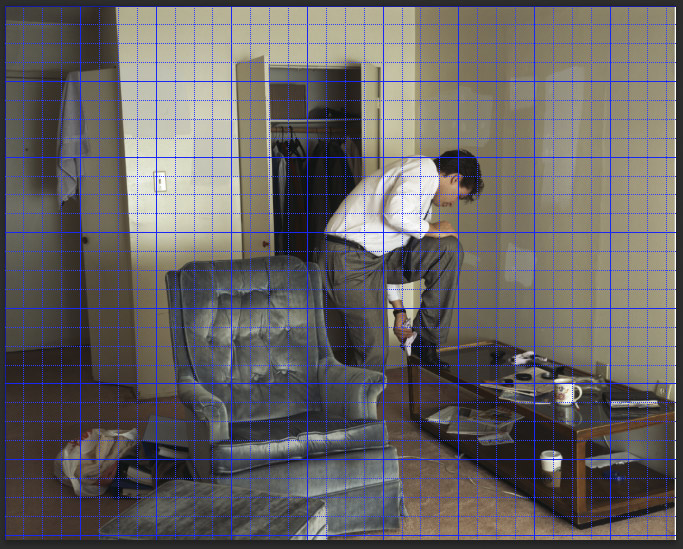
 

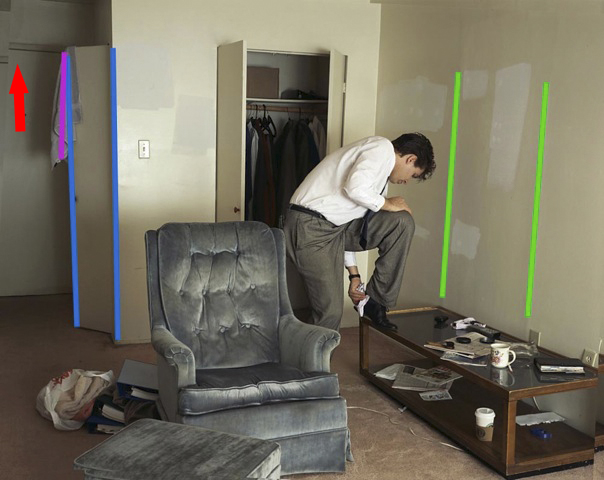
Jeff Wall 'Polishing' skewing

Image Dr James McArdle


Jeff Wall 'Polishing' skewing

Image Ian Lobb


Many thankx to Dr James McArdle for the initial gridded image from the posting “Perspective blow up,” on his Camera/Eye blog (January 21st, 2013) where he argues that the skewing is all done with tilting and shifting of an 8 x 10 image view camera and the analysis by Ian Lobb in which he argues that the skewing is partially done through the architecture (the set), the camera and some Photoshop tweeking.


Structural analysis of Jeff Wall’s Polishing (1998)

“There is a perceptual discomfort in viewing this image on the wall that is not apparent in the desk-top experience of it. I’m referring to a weird skewing of the perspective of the room. Wall has tilted the monorail of his 8×10 camera down toward the corner of the room, making the left hand wall of the bathroom lean uncomfortably, more than does the patched join of the wall panels to the right. He has then shifted the lens left, thus positioning the one vertical (right behind the figure) to the right of centre. The bathroom door, draped with a towel, looks as if it is hanging off its hinges, at variance with the top of the entrance door which remains horizontal. Conventionally, an architectural photographer would square everything and Wall does that in Doorpusher which though shot from an extremely oblique angle employs a radical drop-front to correct the verticals.”

Dr James McArdle


“”Firstly, the floor is not straight in the image. You can see how in my edit, I have rotated the image a little to make the floor straight: (you can see how much by the break in the picture rail see red arrow). JW being tricky and skilled. Now the amount of lean in wall could almost be achieved just by a camera pointing down. No weird camera movements – this is almost familiar. But the door leans more than the wall! Next, note the degree of convergence in blue lines compared to green lines. Therefore the blue angle is emphasised – somehow. Note different hang of towel in magenta compared to blue – therefore edited ~ somehow!

The grid is good because as an initial observation it shows how much distortion we are viewing. But it makes it difficult to see that the floor is not level. When the floor is straightened the lean on the left wall is not as much as it seemed. Wait! Things do splay out when the camera is pointed down – so maybe there is no Photoshop in this at all? But there is – the angles have been emphasised a bit (I believe digitally) and there are puns in the angle of the towel (sloping at a different angle) and the buttons on the couch (not sloping out at all).

Lets play with this a bit more. So just tilt the camera to slope the floor and emphasise the lean by using the tilt to straighten the verticals on one side – and now make this a bit stronger in Photoshop. And by judicious use of the furniture placement the slope of the floor can be partly hidden. I can imagine Jeff Wall saying to a crowd that there is no Photoshop in this – it’s just camera placement (including a tilt in the whole camera) and without duplicating the scene I can’t be sure – but I think he has stressed in Photoshop some things that are already there. Digital enhancement.

Finally we can say that the formal qualities of this image are a play upon what has been initially offered by the camera. Initially: The walls are sloping! So is it just optics, or camera angle or Photoshop? It’s all three but not as much Photoshop as initially thought. The floor is not straight, the camera angle has been changed and there has been some digital emphasis.”

Ian Lobb (author of The Well Tempered View Camera)


Jeff Wall (Canadian, b. 1946) 'Double Self-Portrait' 1979


Jeff Wall (Canadian, b. 1946)
Double Self-Portrait
1979
Transparency in light box AP
172 x 229cm
Collection of the artist
© Jeff Wall


Jeff Wall (Canadian, b. 1946) 'Untangling' 1994, printed 2006


Jeff Wall (Canadian, b. 1946)
Untangling
1994, printed 2006
Transparency in light box, AP
189 x 223.5cm
National Gallery of Victoria, Melbourne Purchased NGV Foundation and with the assistance of NGV Contemporary, 2006
© Jeff Wall


Jeff Wall (Canadian, b. 1946) 'Dressing poultry' 2007


Jeff Wall (Canadian, b. 1946)
Dressing poultry
2007
Transparency in light box, 1/2
201.5 x 252cm
Cranford Collection, London
© Jeff Wall


Jeff Wall (Canadian, b. 1946) 'Adrian Walker, artist, drawing from a specimen in a laboratory in the Dept. of Anatomy at the University of British Columbia, Vancouver' 1992


Jeff Wall (Canadian, b. 1946)
Adrian Walker, artist, drawing from a specimen in a laboratory in the Dept. of Anatomy at the University of British Columbia, Vancouver
1992
Transparency in light box, AP
119 x 164cm
Collection of the artist
© Jeff Wall


Jeff Wall (Canadian, b. 1946) 'A sudden gust of wind (after Hokusai)' 1993


Jeff Wall (Canadian, b. 1946)
A sudden gust of wind (after Hokusai)
1993
Transparency in light box, unique state
229 x 377cm
Tate, London Purchased with the assistance from the Patrons of New Art through the Tate Gallery Foundation and from the National Art Collections Fund, 1995
© Jeff Wall


Jeff Wall (Canadian, b. 1946) 'After 'Invisible Man' by Ralph Ellison, the Prologue' 1999-2000


Jeff Wall (Canadian, b. 1946)
After ‘Invisible Man’ by Ralph Ellison, the Prologue
1999-2000
Transparency in light box, AP
174 x 250.5cm
Collection of the artist
© Jeff Wall
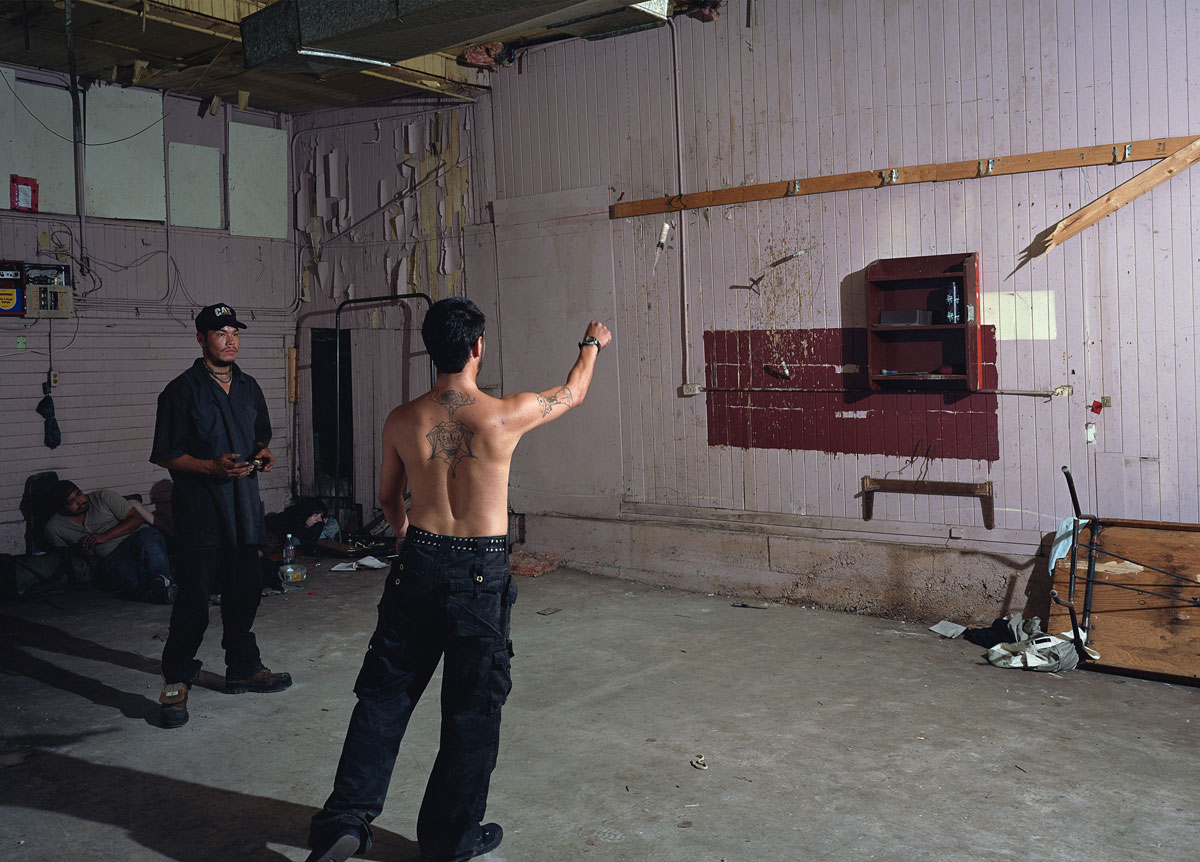
 

Jeff Wall (Canadian, b. 1946) 'Knife throw' 2008


Jeff Wall (Canadian, b. 1946)
Knife throw
2008
Colour photograph, AP
184 x 256cm
Collection of the artist
© Jeff Wall


Jeff Wall (Canadian, b. 1946) 'The Destroyed Room' 1978


Jeff Wall (Canadian, b. 1946)
The Destroyed Room
1978
Transparency in light box, AP
159 x 234cm
Collection of the artist
© Jeff Wall


Jeff Wall (Canadian, b. 1946) 'Clipped branches, East Cordova St., Vancouver' 1999


Jeff Wall (Canadian, b. 1946)
Clipped branches, East Cordova St., Vancouver
1999
Transparency in light box, AP
72 x 89cm
Collection of the artist
© Jeff Wall
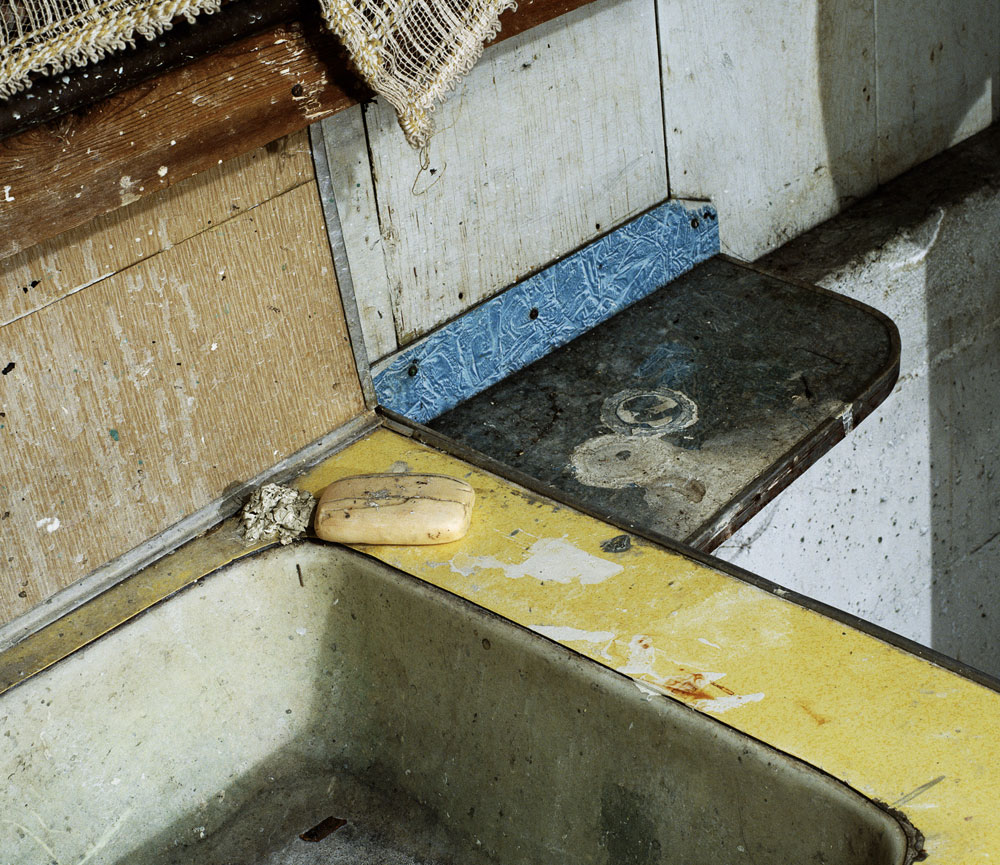
 

Jeff Wall (Canadian, b. 1946) 'Diagonal Composition' 1993


Jeff Wall (Canadian, b. 1946)
Diagonal Composition
1993
Transparency in light box, AP
40 x 46cm
Collection of the artist
© Jeff Wall
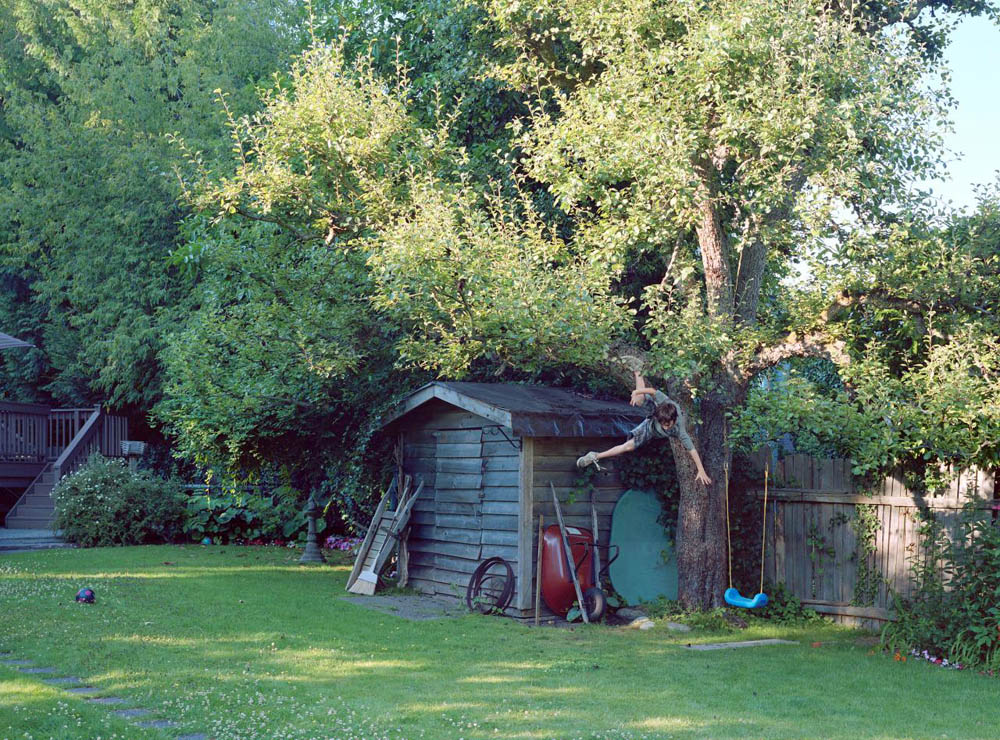
 

Jeff Wall (Canadian, b. 1946) 'Boy falls from tree' 2010


Jeff Wall (Canadian, b. 1946)
Boy falls from tree
2010
Colour photograph, AP
226 x 305.3cm
Collection of the artist
© Jeff Wall


The Ian Potter Centre: NGV Australia
Federation Square
Corner of Russell and 
Flinders Streets, Melbourne

Opening hours:
Daily 10am – 5pm
National Gallery of Victoria website

LIKE ART BLART ON FACEBOOK

Back to top

Review: ‘Andrew Curtis: Moonlight Mile’ at Blockprojects, Melbourne

Exhibition dates: 6th February – 3rd March 2013


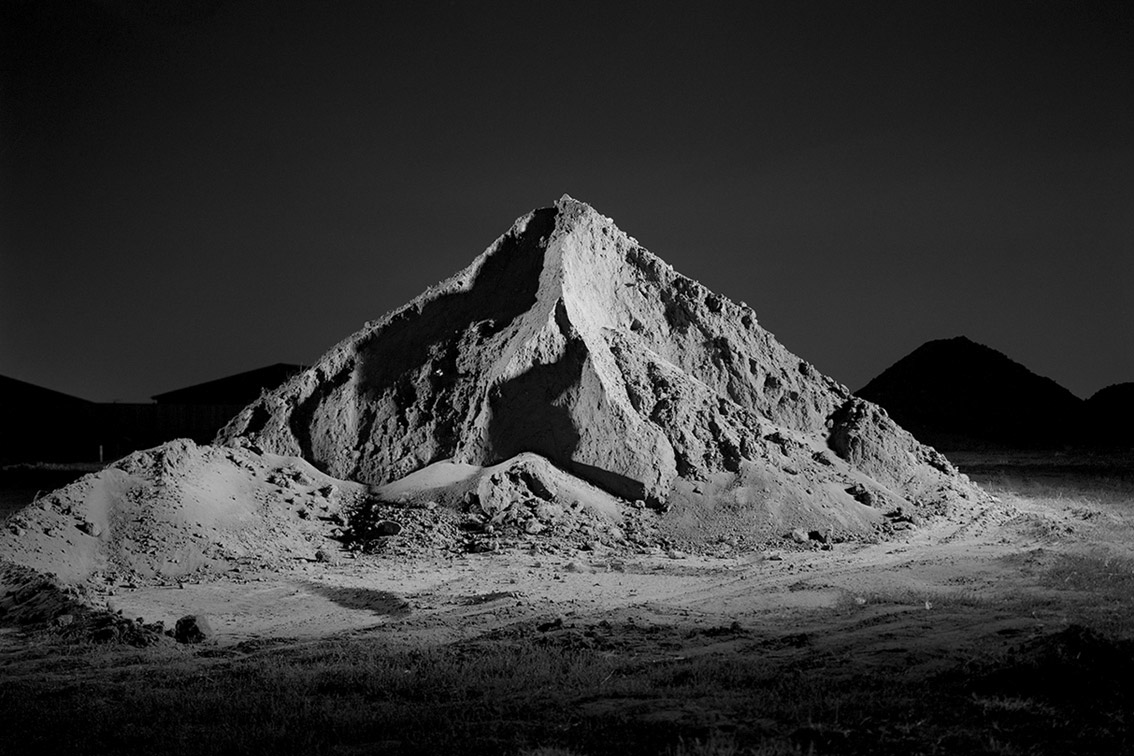
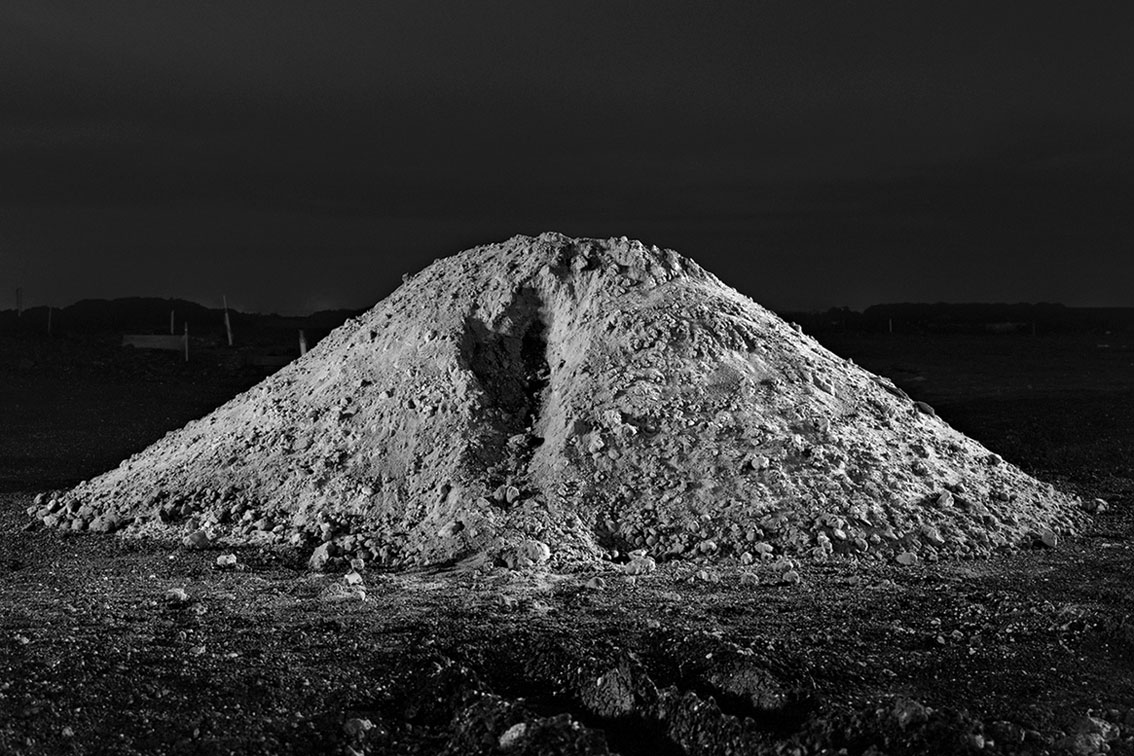
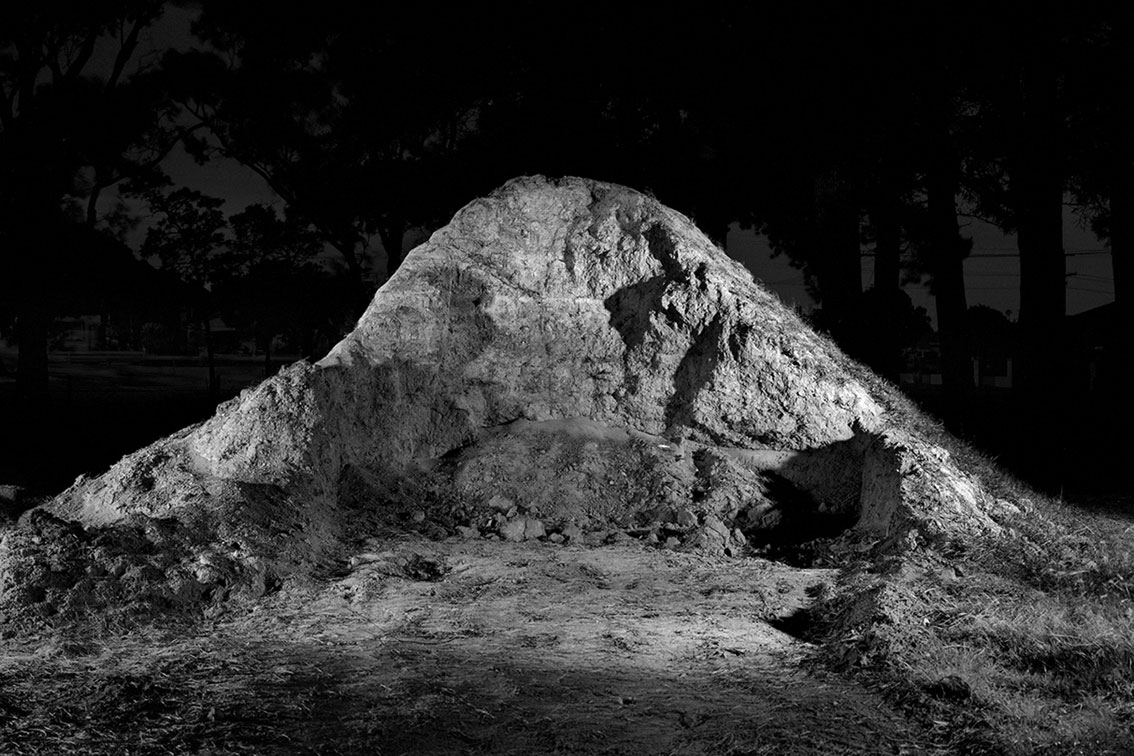
Andrew Curtis (Australian, b. 1966) 'Wonthaggi' 2012


Andrew Curtis (Australian, b. 1966)
Wonthaggi
2012
Archival pigment print on cotton rag
120 x 180cm


This is a strong exhibition of large scale hybrid black and white photographs by Andrew Curtis at Blockprojects, Cremone. The photographs look grand in the simple, beautiful exhibition space, perhaps too grand, too sympatico with the theme of the work: mountains made out of piles of earth dumped at building sites in the outer suburbs of Melbourne. There is humour and absurdity here as Dan Rule notes, but also more than a hint of the sublime. By playing with scale (narratives of the miniature, the gigantic) and light (these images have been studiously lit from different angles during a long time exposure), Curtis tricks the eye of the viewer, just for a split second (the punctum?), elucidating “the strength of the almost blinding role that expectation plays in our reading of an image.” (Dan Rule)

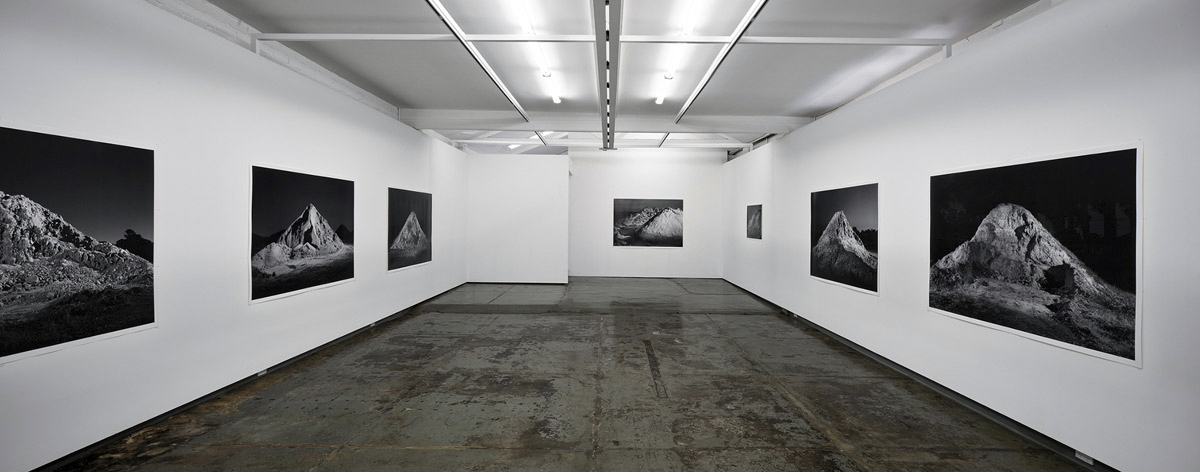
What do I mean by hybrid monochrome images – the work was shot on a 4 x 5 large format film camera and then printed digitally as an archival pigment print on cotton rag. Personally, if I went to all the trouble to shoot on film, then why wouldn’t I go the distance and get them printed the traditional way to preserve the optical veracity that large format brings? With this in mind I asked myself why the images had to be so big (the gigantism of most contemporary photography) for the smaller image, Point Cook 2 (2012, below) seemed at least as valid, perhaps more so as an image, than the larger photographs. It was almost as if the smaller size gave the subject more validity in terms of its abstractness (see installation photograph below). Perhaps a size in between the two presented in the exhibition and printed the analogue way would have been more appropriate to the spirit of the work.

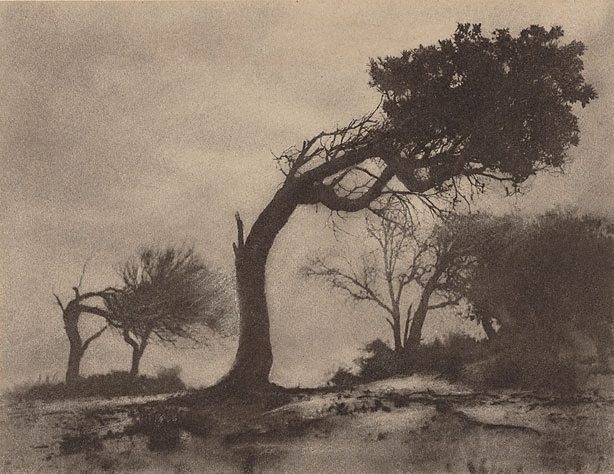
The other thing that I found puzzling was the lack of depth of field from front to back of most of the images. The foregrounds were invariably out of focus (when you could actually see them) which is a strange choice when using a large format camera, where everything can be in focus front to back (a la F64). Curtis’ aesthetic choice is directly from the Pictorialist handbook, as is his decision to darken the out of focus foreground with an aura of black so that nothing is visible (see Hoppers Crossing 1, 2 and 3 below). This makes for a strange reading of the photographs where the mountain becomes isolated yet is the sole grounding of the image (save for a shadowy horizon line behind), a trope that didn’t really work for me.

My favourite images where the more intimate images such as Point Cook 2 and Wonthaggi (both 2012). In both, the foreground is agreeably present to lead the eye into the image. In Point Cook 2 the eye is also led in from the right hand side by the spine of the mountain range, the light on the earth matching the ethereal light in the sky. A good image. Even better is Wonthaggi where the stand alone isolation of the monolithic mountains in most of the other images is broken by the “shoulders” of the mountain disappearing out of frame. This, combined with more subtle lighting and the presence of massed shadows of trees in the background, adds a valuable context to the image while at the same time referencing the history of Australian photography through the images of people such as Harold Cazneaux.

Dr Marcus Bunyan


PS. Just as a general point of interest. It is so difficult to make the right choice when displaying large, dark photographs in a gallery setting. If you pin them to the wall, as here, there tend to be waves in the photographs and a client who wants to purchase the print has to factor in where to get the print framed and how much this is going to cost: a lot of hassle for a potential client. If you do get the work framed there is the initial upfront cost plus the dark image is more than obscured by the glass in front of the image, lessening the photographs presence in front of the viewer. Finally there is the choice to have the photograph mounted on aluminium (dibond mounting) or facemounting a print onto acrylic. This gets rid of the need for framing and keeps the print flat but a serious collector of photography will not touch them because they have been stuck down with glue to these materials. A perplexing problem indeed.


Many thankx to Blockprojects for allowing me to publish the photographs in the posting. Please click on the photographs for a larger version of the image.


Harold Cazneaux (Australian, 1878-1953) 'The bent tree, Narrabeen' 1914


Harold Cazneaux (Australian, 1878-1953)
The bent tree, Narrabeen
1914
Bromoil photograph
14.6 x 18.9cm


Andrew Curtis (Australian, b. 1966) 'Point Cook 2' 2012


Andrew Curtis (Australian, b. 1966)
Point Cook 2
2012
Archival pigment print on cotton rag
66 x 100cm


Installation view of 'Andrew Curtis: Moonlight Mile' at Blockprojects, Melbourne


Installation view of Andrew Curtis: Moonlight Mile exhibition at Blockprojects, Melbourne


Andrew Curtis (Australian, b. 1966) 'Hoppers Crossing 1' 2012


Andrew Curtis (Australian, b. 1966)
Hoppers Crossing 1
2012
Archival pigment print on cotton rag
120 x 180cm


Andrew Curtis (Australian, b. 1966) 'Hoppers Crossing 2' 2012


Andrew Curtis (Australian, b. 1966)
Hoppers Crossing 2
2012
Archival pigment print on cotton rag
120 x 180cm


Andrew Curtis (Australian, b. 1966) 'Hoppers Crossing 3' 2012


Andrew Curtis (Australian, b. 1966)
Hoppers Crossing 3
2012
Archival pigment print on cotton rag
120 x 180cm


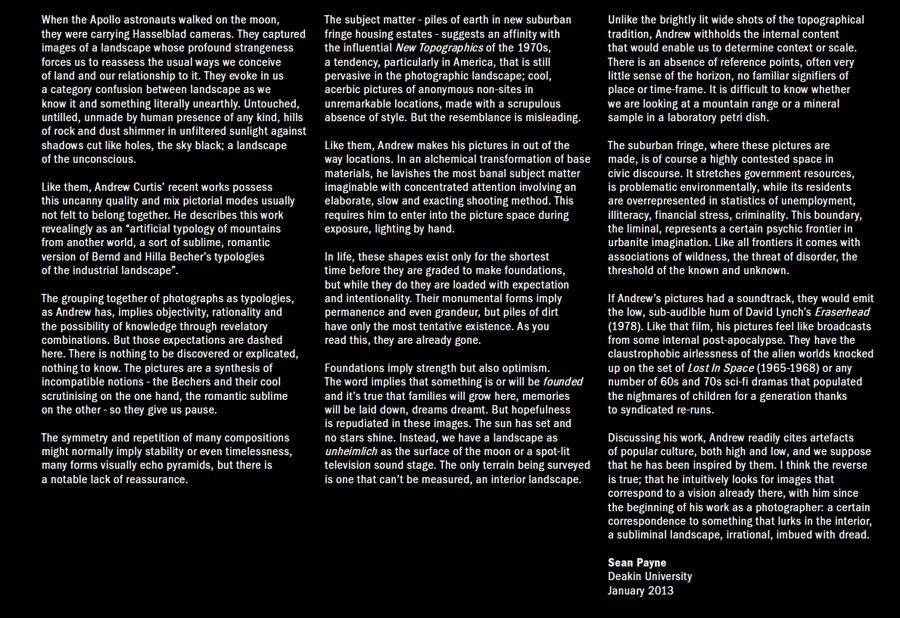
Catalogue essay by Sean Payne, Deakin University


Catalogue essay by Sean Payne, Deakin University (please enlarge to read)


Andrew Curtis (Australian, b. 1966) 'Point Cook 1' 2012


Andrew Curtis (Australian, b. 1966)
Point Cook 1
2012
Archival pigment print on cotton rag
120 x 180cm


Andrew Curtis (Australian, b. 1966) 'Almurta' 2011


Andrew Curtis (Australian, b. 1966)
Almurta
2011
Archival pigment print on cotton rag
120 x 180cm


Blockprojects
Level 1 / 252 Church Street
Richmond, VIC 3121
Phone: +61 3 8395 1028

Opening hours:
Wednesday to Saturday: 12am – 5pm

Blockprojects website

LIKE ART BLART ON FACBEOOK

Back to top

Review: ‘Louise Bourgeois: Late Works’ at Heide Museum of Modern Art, Melbourne

Exhibition dates: 24th November 2012 – 11th March 2013

Louise Bourgeois & Australian Artists
13 October 2012 – 14 April 2013


'Louise Bourgeois: Late Works' installation view Heide Museum of Modern Art, Melbourne Photograph: John Gollings 2012


Louise Bourgeois: Late Works installation view
Heide Museum of Modern Art, Melbourne
Photograph: John Gollings 2012


Tough Love

This is a tough, stimulating exhibition of late works by Louise Bourgeois at Heide Museum of Modern Art, Melbourne. All the main themes of the artist’s work explored over many years are represented in these late works: memory, emotion, anxiety, family, relationships, childhood, pain, desire and eroticism are all present as are female subjectivity and sexuality, expressed through the body. As the quotation above by Bourgeois states, her body became her sculpture.

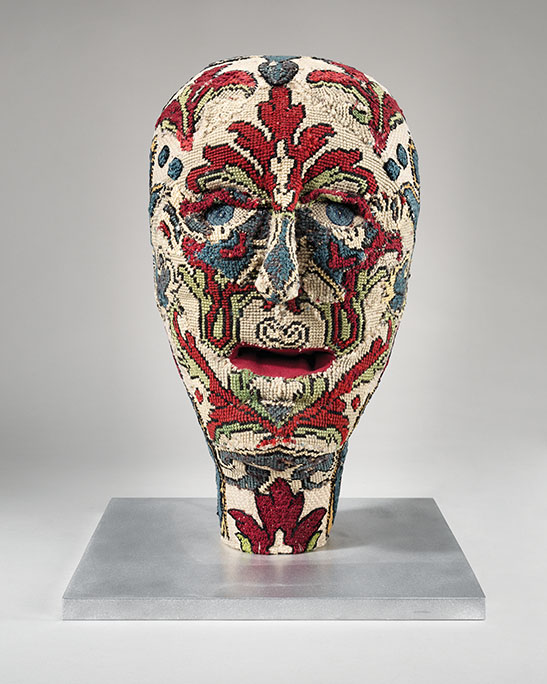
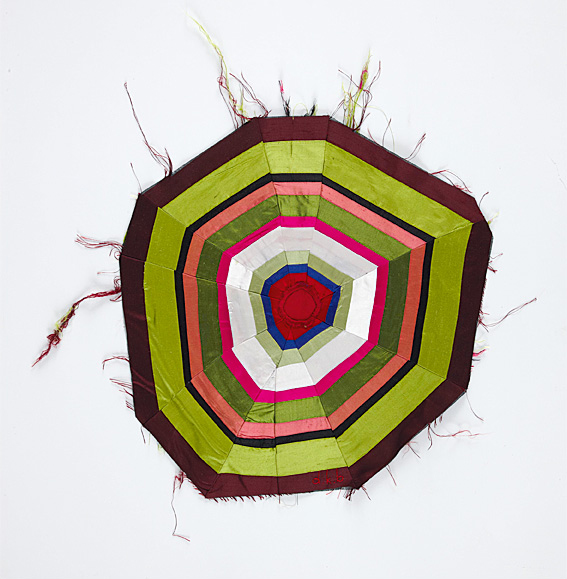
I am no expert on the work of the artist. But what I will try and enunciate are my feelings when viewing the exhibition. Firstly, I thought the drawings by Louise Bourgeois in Heide II were the most magical thing that I saw all day; they seemed to be the well spring of her creativity, the initial thought sketched quickly and imperiously. Secondly, series such as Dawn (2007, below) and The Waiting Hours (2007), assemblages of cut fragments of her dresses and other textiles used to create spiral three-dimensional realities, were the most beautiful, peaceful Zen based works in the exhibition possessing as they did a calm, resolved, mandala-like presence. Lastly, the main group of sculptures were, for me, hard to look at. A series of severed heads, dismembered bodies, tapestry fragments, spiders, bones, an orrery-like planetarium, pendulous objects stuck with needles, kitchen implements and the house brought back memories of my own childhood.

I was born in the late 1950’s to a mother who didn’t really want to have children, to a mother who was already being beaten up by an abusive husband before she was even married, who lived on a remote, isolated farm in the middle of nowhere. I can’t imagine what my mother went through in those early years raising two children – with no hope of help or escape, with no women’s refuge to flee to, stuck there doing her best to protect her children and herself from a violent, mentally ill man. You cannot imagine the torment I went through for the first 18 years of my life, trying to protect my mother when I was old enough, creating my own worlds to escape the reality of the present (which is why I probably became an artist, to still create my own worlds). There were good times at Christmas and bonfire night, but the best part was growing up on the land, learning the rhythms of nature, learning to drive on a tractor and combine harvester, but always in the back of your mind was the instant of abuse lurking around the corner, the inherent violence of life. It is only now, as I have grown older, that I can truly appreciate the dire predicament that my mother was in and acknowledge a profound sense of gratitude towards her protection of me as a baby and child.

That is why this exhibition is, for me, tough love. The emotions of Bourgeois’ sculptures are close to the bone. As Jason Smith observes, “Bourgeois saw her mother as rational, patient and stoic in her nurturing, in contrast to the temperament of her father whom she regarded as irrationally emotional, unreasonable and capable of psychological cruelty. Bourgeois became aware at an early age that she was living in a time and social environment in which women and their identities were subordinate to men.”As Bourgeois says of the spider (her mother), “she was deliberate, clever, patient, soothing, reasonable, dainty, subtle, indispensable, neat and as useful as a spider. She could also defend herself, and me.” This is what my mother did as well, at great cost to herself.

Bourgeois’ work gives me an overall feeling of immersion in a world view, one that transcends the pain and speaks truth to power. Bourgeois confronted the emotion, memory or barrier to communication that generated her mood and the work. She observed, “My art is an exorcism. My sculpture allows me to re-experience fear, to give it a physicality, so that I am able to hack away at it.” By weaving, stitching and sewing Bourgeois threaded the past through the present and enacted, through artistic performance, a process of repair and reconstruction, giving meaning and shape to frustration and suffering. I have not been so lucky. My mother refuses to discuss the past, will not even come close to the subject for the pain is so great for her. I am left with a heaviness of heart, dealing with the demons of the past that constantly lurk in the memory of childhood, that insistently impinge on the man I am today. Louise Bourgeois’ sculptures brought it all flooding back as the work of only a great artist can, forcing me to become an ethical witness to her past, my past. A must see exhibition this summer in Melbourne.

Dr Marcus Bunyan


Many thankx to curator and Director Jason Smith and Heide Museum of Modern Art for allowing me to publish the photographs in the posting. Please click on some of the photographs for a larger version of the image.


“What counts, our whole purpose, is to try to understand what we are about, to scrutinise ourselves… Every day you have to abandon your past or accept it, and then, if you cannot accept it, you become a sculptor.”

“The fears of the past were connected with the functions of the body, they reappear through the body. For me, sculpture is the body. My body is my sculpture.”


Louise Bourgeois


“What images can art find for depicting femaleness from within, as distinct from the familiar male conventions of looking at it from the outside, from the eye-line of another gender?” Hughes questioned in a commentary that implied no precedents. “… [Her] influence on young artists has been enormous.”


Robert Hughes quoted by Annemarie Kiely on the Vogue Living Blog [Online] Cited 28/02/2013 no longer available online


“Yes, there are the oft-told stories of the father and the mistress, but it is Bourgeois’s intense love of her mother and her [mother’s] death that completely transformed her life… The art ultimately became about her never-ending grief… and her continuing desire  as a woman. It’s still so potent; not just as a memory, but as a constant.”


Jason Smith, Curator, Director and CEO of Heide quoted by Annemarie Kiely on the Vogue Living Blog [Online] Cited 28/02/2013 no longer available online


'Louise Bourgeois: Late Works' installation view Heide Museum of Modern Art, Melbourne Photograph: John Gollings 2012


Louise Bourgeois: Late Works installation view
Heide Museum of Modern Art, Melbourne
Photograph: John Gollings 2012


“The friend (the spider – why the spider?) because my best friend was my mother and she was deliberate, clever, patient, soothing, reasonable, dainty, subtle, indispensable, neat and as useful as a spider. She could also defend herself, and me.”


Louise Bourgeois, from Ode to my Mother, 1995


Louise Bourgeois (French-American, 1911-2010) 'Spider' 1997 (detail)


Louise Bourgeois (French-American, 1911-2010)
Spider (detail)
1997
Steel, tapestry, wood, glass, fabric, rubber, silver, gold, bone
449.6 × 665.5 × 518.2cm
The Easton Foundation, New York, NY
Photograph: John Gollings 2012


Louise Bourgeois (French-American, 1911-2010) 'Dawn' 2007 (detail)


Louise Bourgeois (French-American, 1911-2010)
Dawn (detail)
2007
Fabric book, 12 pages
12 1/4 x 9 3/4 inches each


Around 1996, aged 85, Bourgeois began to mine her closets for the garments and textiles that she had worn, collected and stored over a lifetime, and use them to make sculpture and ‘fabric drawings’, continuing her lifelong recall and articulations of familial dysfunction, desire and fear, anger and remorse, isolation and connectedness. In the recycling and reconstruction of her clothing and collected textiles Bourgeois intensified her work’s expression of the human body and of life’s episodes (those as daughter, wife, mother, woman, artist). The materiality of these works testifies to the impression of Bourgeois’ past on her psyche and on reparative acts of making through which her past was reconciled in her present. The beauty of the past for Bourgeois resided in the nurturing, repairing, fortifying and protective tendencies of her mother, which she aligned with the processes of stitching and assembling.

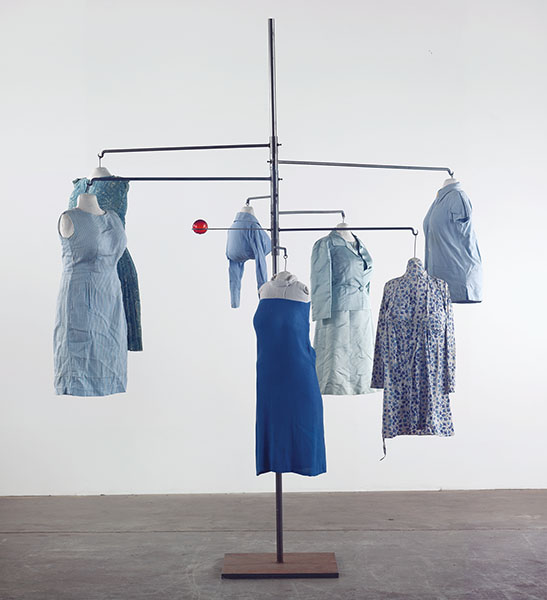
Blue Days (1996) is one of a number of works in which Bourgeois suspended, stuffed and shaped her dresses and shirts, sometimes adding abstract sculptural elements like the red glass sphere that operates here like a nucleus around which the new sculptural bodies circulate. With its intimate relation to the skin and contours of the body, to time and seasons, clothing was used for its power to summon memory: ‘You can retell your life … by the shape, weight, colour and smell of those clothes in your closet. They are like the weather, the ocean, changing all the time.’

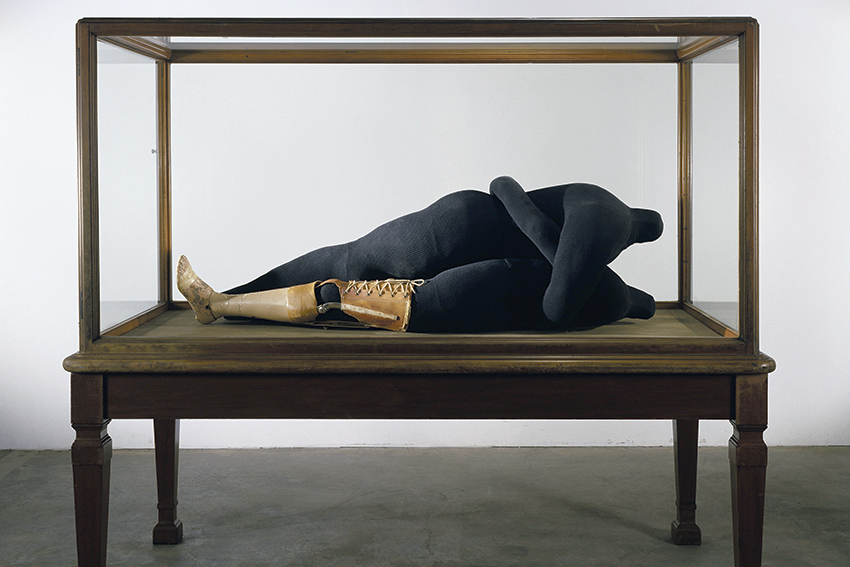
In other works Bourgeois’ fragmented figures and anatomical parts give physical form to anxieties rising from unfulfilled desire, acts of betrayal, losses or thwarted communication. Couple IV embodies the dark confusion of the child happening upon the sexual embrace of the adults. The copulating, decapitated lovers appear as an encased ‘archaeological specimen’ and signal Bourgeois’ fraught obsession not only with the infidelities of her father, but also with sex itself. For Bourgeois there is ‘a fatal attraction not towards one or the other, but to the phenomena of copulation … I am exasperated by the vision of the copulating couple, and it makes me so furious … that I chop their heads [off]. This is it … I turn violent. The sewing is a defence. I am so afraid of the things I might do. The defence is to do the opposite of what you want to do.’

Louise Bourgeois’ practice was an elaborate articulation of an existence in which the sculpting world and the living world were one. Her late works summoned the past and confronted the present, and the passage of time, by using the very garments in which the experiences of her life, loves and longings resided.

Jason Smith, Curator, Director and CEO, Heide Museum of Modern Art. “Louise Bourgeois,” on The Melbourne Review website, November 2012 [Online] Cited 26/02/2013 no longer available online


Louise Bourgeois (French-American, 1911-2010) 'Blue Days' 1996


Louise Bourgeois (French-American, 1911-2010)
Blue Days
1996
cloth, steel, glass
292.1 × 205.7 × 241.3cm
Courtesy Cheim & Read and Hauser & Wirth
© Louise Bourgeois Trust / Licensed by VAGA, New York / Viscopy, Sydney


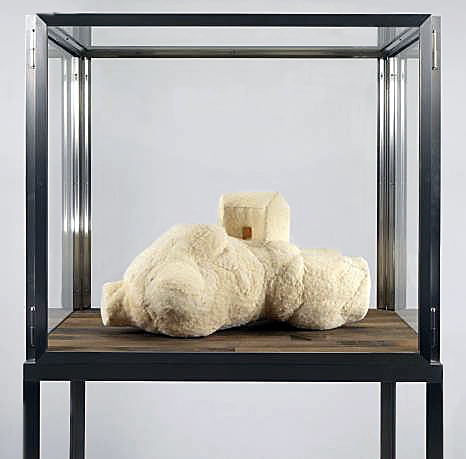
Louise Bourgeois (French-American, 1911-2010) 'Femme Maison' 2001


Louise Bourgeois (French-American, 1911-2010)
Femme Maison
2001
fabric, steel
35.6 × 38.1 × 66cm
Courtesy Cheim & Read and Hauser & Wirth
© Louise Bourgeois Trust / Licensed by VAGA, New York / Viscopy, Sydney


Louise Bourgeois (French-American, 1911-2010) 'Femme Maison' 2001


Louise Bourgeois (French-American, 1911-2010)
Femme Maison (detail)
2001
fabric, steel
35.6 × 38.1 × 66cm
Courtesy Cheim & Read and Hauser & Wirth
© Louise Bourgeois Trust / Licensed by VAGA, New York / Viscopy, Sydney


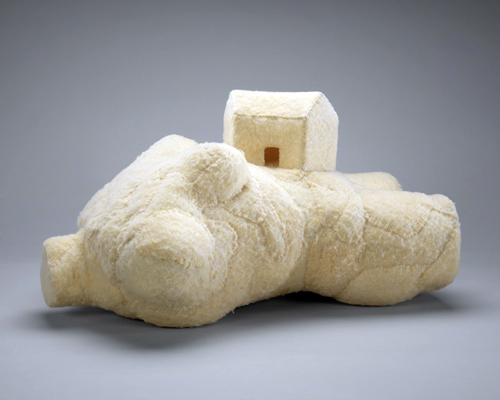
Note that Femme Maison and other artworks are encased in ‘cells’. In one sense, the cell encases and protects the artwork; however, Louise Bourgeois’ intention was to use the cell also as a way of containing the memory held within the work.

The hybrid form of Femme Maison – with its dual translations to ‘woman house’ or housewife – appeared in drawings, paintings and sculpture, and in degrees of abstraction and figuration, from the mid 1940s onwards. In this key late work the textured fabric affirms the central relationship of woman with the domestic space. Stories of the house and the home defined Bourgeois’ identity. The architectural house and its contents – especially the table, bed and chair – and the familial home and its occupants, were the structures that shaped Bourgeois’ unstable sense of self, and her relationships with others. This work plays on the house literally growing out of the woman’s body (the nurturing mother) or, conversely, pinning her dismembered body to the ground, registering the paralysing power of fear, and recalling a painful childhood.


Louise Bourgeois (French-American, 1911-2010) 'Knife Figure' 2002


Louise Bourgeois (French-American, 1911-2010)
Knife Figure
2002
fabric, steel, wood
22.2 × 76.2 × 19.1cm
Courtesy Cheim & Read and Hauser & Wirth
© Louise Bourgeois Trust / Licensed by VAGA, New York / Viscopy, Sydney


Louise Bourgeois (French-American, 1911-2010) 'Untitled' 2002


Louise Bourgeois (French-American, 1911-2010)
Untitled
2002
Tapestry and aluminium
43.2 x 30.5 x 30.5cm
Courtesy Cheim & Read and Hauser & Wirth
© Louise Bourgeois Trust
Photo: Christopher Burke


Louise Bourgeois (French-American, 1911-2010) 'Couple IV' 1997


Louise Bourgeois (French-American, 1911-2010)
Couple IV
1997
fabric, leather, stainless steel, plastic
50.8 × 165.1 × 77.5cm
Courtesy Cheim & Read and Hauser & Wirth
© Louise Bourgeois Trust / Licensed by VAGA, New York / Viscopy, Sydney


Louise Bourgeois (French-American, 1911-2010) 'Untitled' 2002


Louise Bourgeois (French-American, 1911-2010)
Untitled
2002
Tapestry, aluminium
43.2 x 30.5 x 30.5cm
The Easton Foundation, New York, NY.


Louise Bourgeois (French-American, 1911-2010) 'Cinq' 2007


Louise Bourgeois (French-American, 1911-2010)
Cinq
2007
fabric, stainless steel
61 × 35.6 × 35.6cm
Courtesy Cheim & Read and Hauser & Wirth
© Louise Bourgeois Trust / Licensed by VAGA, New York / Viscopy, Sydney


Heide Museum of Modern Art is proud to present two major exhibitions featuring the work of Louise Bourgeois. The first, Louise Bourgeois: Late Works includes over twenty, key works direct from the late artist’s studio in New York. The second exhibition, Louise Bourgeois and Australian Artists presents a selection of works by contemporary Australian artists who have been inspired by Bourgeois alongside prints and drawings from her vast graphic oeuvre. Louise Bourgeois (1911-2010) was one of the most inventive, provocative and influential artists of the twentieth century. Although her work has been exhibited extensively overseas, it has rarely been seen in Australia, and only once in significant depth, at the National Gallery of Victoria (NGV) in 1995 in an exhibition curated by then NGV curator Jason Smith. Louise Bourgeois: Late Works focuses on Bourgeois’s use of fabric in sculpture and what she termed ‘fabric drawings’. A preoccupation with memory and time, human relationships, fear and its annihilation, sexuality and the erotic body, are all emphases of Bourgeois’ final works.

Louise Bourgeois: Late Works is the first exhibition in Australia to survey the work of this profoundly important artist since her death in 2010 and has been curated by Jason Smith, now Heide Director & CEO – in close collaboration with the Bourgeois studio, New York – as a follow up to the 1995 exhibition at the NGV. Focusing on the final fifteen years of Bourgeois’ career, the exhibition examines the use of fabric in her works, and includes 18 sculptures, two suites of ‘fabric drawings’, watercolours, embroidered texts and lithographs never before seen in Australia. In the fabric works the processes of deconstructing and reconstructing, are applied to the contents of Bourgeois’ closets. The recycling of her garments, collected textiles and tapestry fragments intensifies her work’s expression of self-portraiture, and the profound personal experiences that defined her life and art.

Fabric was important to Louise Bourgeois, who grew up in her parents’ tapestry making business. In 1996, in her mid-eighties, Bourgeois began to transform the garments and textiles that she had worn, collected and stored over a lifetime into sculptures and ‘fabric drawings’. For her, sewing was an act of healing or reparation, linked to memories of her mother who ‘would sit out in the sun and repair a tapestry or a petit point’, an image of calm amid more distressing family dynamics.

Central to the exhibition is Spider, 1997 one of the Bourgeois’ Cells sculptures which is dominated, enclosed and protected by a gargantuan spider – a recurring and powerful motif in the artist’s work. Bourgeois created her spider sculptures partly in tribute to her mother, saying: ‘Like a spider, my mother was a weaver. Spiders are helpful and protective, just like my mother’. The female body and female subjectivity are concentrations in the exhibition.

The familial, biographical stories that provided life-long fuel for Bourgeois’ art are well known: her parents’ tapestry workshop in which she learnt the value of art as a form of reparation; her father’s public infidelity; her mother’s betrayal and early death; her complex sense of abandonment; her constant analysis of self; her belief in art a form of exorcism and as a potential reconciliation with the past.

Another highlight of the exhibition is the haunting Couple IV 1997, depicting a pair of copulating, and decapitated, lovers. The embracing figures are cast in the black of mourning, and appear as an encased ‘archaeological specimen’ in the vitrine. The work signals Bourgeois’ fraught obsession with the past, the infidelities of her father, and with sex itself.

Surrealism and pathos combine in Bourgeois’ smaller, intimate works like Knife figure 2002 and Untitled 2002. Here we see a dark side of the domestic with the knife and the whisk looming threateningly large in relation to the prone, dismembered bodies. In their colouration and homely material qualities they inspire tenderness and protection, yet as with so many of Bourgeois’ bodies, each remains cut off from the world and isolated to deal with its fate.”

Press release from the Heide Museum of Modern Art website


Louise Bourgeois & Australian Artists

This exhibition looks at relationships, both real and imagined, between the art of Louise Bourgeois (1911-2010) and that of ten Australian artists, in the rare context of a solo Bourgeois exhibition at Heide. Some pay direct homage to Bourgeois’ work or consider similar themes, while the connection of others registers more instinctually, on the level of a shared psychological intensity. Many of the works are rooted in memory and emotion, with a core that remains indecipherable – they do not illustrate or explain.

Forged regardless of fashion or fortune, Bourgeois’ oeuvre gave several artists in this exhibition the impetus to use personal subject matter as a creative source in the late 1980s and 1990s, an era when a cool, detached conceptualism dominated. Many share Bourgeois’ subjective focus and use the human body as a vehicle for self-expression, while for others her work’s formal precision and constant reinvention inspire. All respond to the exemplary fusion in Bourgeois’ art between inner compulsion and formal discipline, instinct and intelligence.

The Australian artists are Del Kathryn Barton, Pat Brassington, Janet Burchill, Carolyn Eskdale, Brent Harris, Joy Hester, Kate Just, Patricia Piccinini, Heather B. Swann.

Statement from the from the Heide Museum of Modern Art website


Janet Burchill (Australian, b. 1955) 'Following the Blind Leading the Blind' 1997


Janet Burchill (Australian, b. 1955)
Following the Blind Leading the Blind
1997
Synthetic polymer and enamel paint on wood
144.6 × 142.6 × 29.8cm
National Gallery of Victoria, Melbourne Purchased 1999


“The grid is a very peaceful thing, because nothing can go wrong … everything is complete. There is no room for anxiety … everything has a place. Everything is welcome.”


Louise Bourgeois


I had a weak-at-the-knees, tingle-all-over moment when I saw Louise Bourgeois’ work for the first time about fifteen years ago in Los Angeles. Yes I am a CRAZY fan. And, yes, it’s true I lay under her big spider in Tokyo and cried…

These are the releases I hope for in our vast world of art. Encounters when the artwork is somehow so inexplicably intimate, so beyond, so seemingly effortless that there can be no defence. In these moments there is an opening-up within the body, the mind, within all the senses … an experience of recognition, relief and awe that informs one’s deeper creative makeup.


Del Kathryn Barton


Del Kathryn Barton (Australian, b. 1972) 'no other side' 2012


Del Kathryn Barton (Australian, b. 1972)
no other side
2012
(one part of nine)
Dupion silk and embroidery cotton
9 parts, each 42 × 45cm
In collaboration with Karen Barton
Courtesy of the artist and Roslyn Oxley9 Gallery, Sydney


“I guess every artist has other practices that they aspire to. Louise Bourgeois’ practice – by which I mean the combination of the works, the way that they were made, the artist and the way that she conducted herself – is such a practice for me. The way that she worked for so long, and continued to develop her work in good times and bad, as well as the way that her works are so much of their times but at the same time not quite in sync with them inspires me. The fact that I hardly know the work she made prior to her fifties demonstrates the truth of the idea that art is a lifetime project that can continue to evolve as an artist matures. And then, of course, there is the work itself.”


Patricia Piccinini


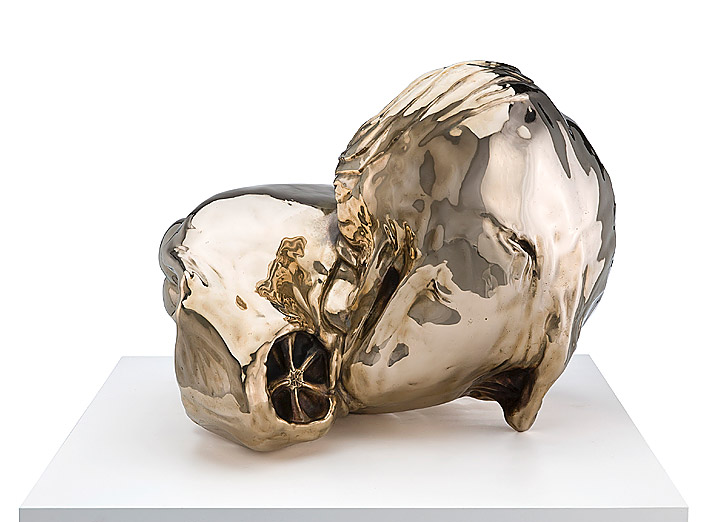
Patricia Piccinini (Australian, b. 1965) 'The Uprising' 2008 bronze


Patricia Piccinini (Australian, b. 1965)
The Uprising
2008
Bronze


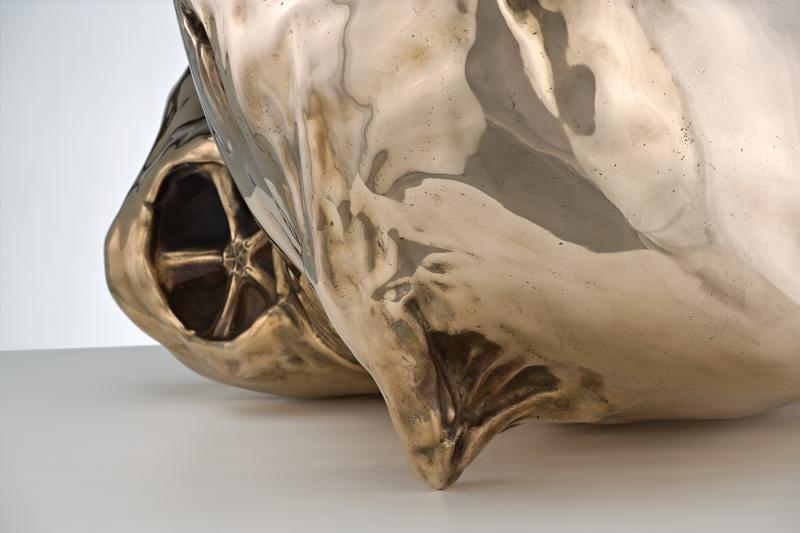
Patricia Piccinini (Australian, b. 1965) 'The Uprising' 2008 bronze (detail)


Patricia Piccinini (Australian, b. 1965)
The Uprising (detail)
2008
Bronze


“The massive aorta-like The Uprising, with its labyrinthine musculature, is a much stranger work. It establishes a bridge between the Vespa stags and the transgenic creatures, while being simultaneously amorphous and representational. Corporeal and mechanical, it suggests the plastic, porous, and uncertain world of the new nature that is at the core of the figurative works. For this reason it is physically sited at the boundary between natural history and art history…”


Juliana Engberg


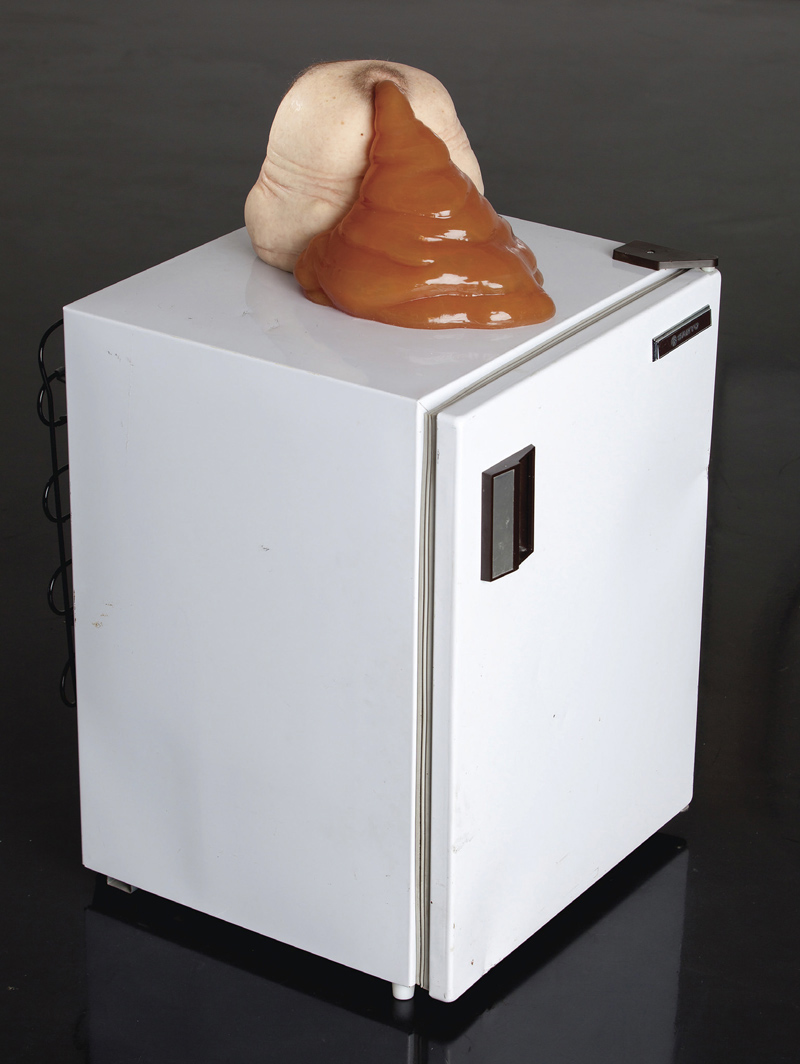
Patricia Piccinini (Australian, b. 1965) 'Nectar' 2012


Patricia Piccinini (Australian, b. 1965)
Nectar
2012
Silicone, fibreglass, human hair, refrigerator edition 1/6
83 × 48 × 51cm
Courtesy of the artist, Tolarno Galleries, Melbourne, and Haunch of Venison, London and New York


“Taking her cue from the vague boundaries of the biotech world, ‘where it is difficult to figure exactly where the good becomes tainted and the bad becomes justifiable’, Piccinini considers her own hybrid creations, however abject or grotesque, as lovable, associated with fecundity, growth and optimism. Like Bourgeois, she presents strange couplings of the animal and the human, that despite their de-formations always convey intimacy and warmth. Here the title Nectar suggests that there may be something nourishing in what might otherwise appear as a failed experiment.”

Text from educational pdf


Pat Brassington (Australian, b. 1942) 'House guest #2' 2007


Pat Brassington (Australian, b. 1942)
House guest #2
2007


Pat Brassington (Australian, b. 1942) 'The Guardian' 2009


Pat Brassington (Australian, b. 1942)
The Guardian
2009
Pigment print on paper edition 6/8
112 × 87.5cm
Heide Museum of Modern Art, Melbourne
Purchased with funds from the Robert Salzer Foundation 2009


Louise Bourgeois at Heide Museum

A behind-the-scenes look at how the works of Louise Bourgeois, including her famous Spider were installed at Heide Museum.


Heide Museum of Modern Art
7, Templestowe Road
Bulleen, Victoria 3105

Opening hours:
(Heide II and Heide III)
Tuesday, Wednesday, Sunday, 10am – 5pm
Thursday – Saturday, 10am – 8pm

Heide Museum of Modern Art website

LIKE ART BLART ON FACEBOOK

Back to top