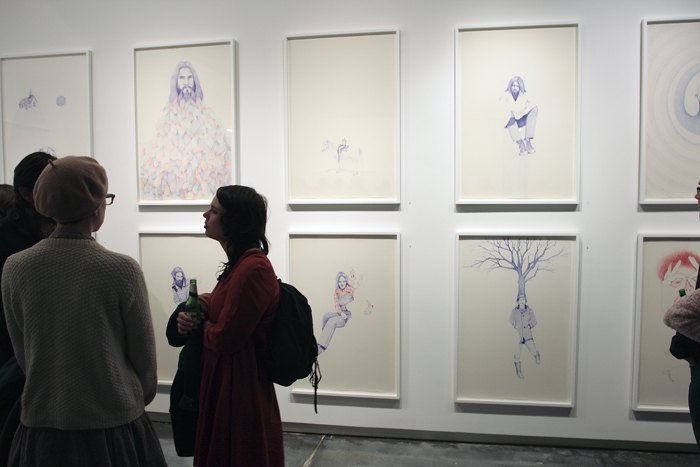
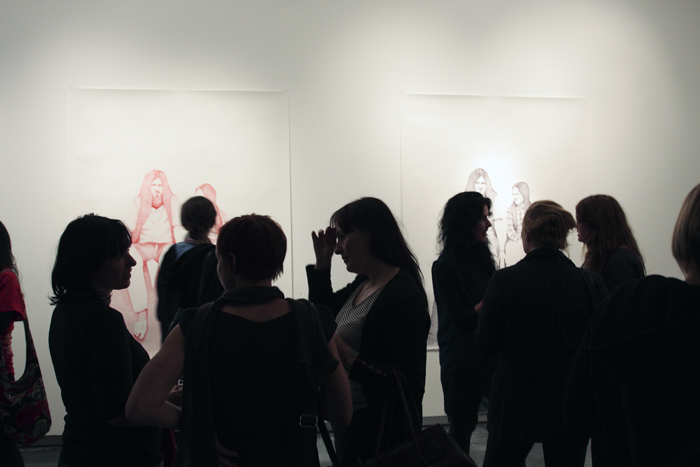
Opening night crowd at So It Goes by Laith McGregor at Helen Gory Galerie, Melbourne with the works My kinda of Blue (red) and My kind of blue (black) behind
The opening of the night – simply spectacular!
Great crowd, great atmosphere, great work.
Winner of the Robert Jacks Drawing Prize in 2008, the artist’s work in biro and oil is outstanding. I have never seen such art made using a biro before: truly inspiring. Inventive, funny, poignant and outrageous this is a must see show. Don’t miss it!
Dr Marcus Bunyan
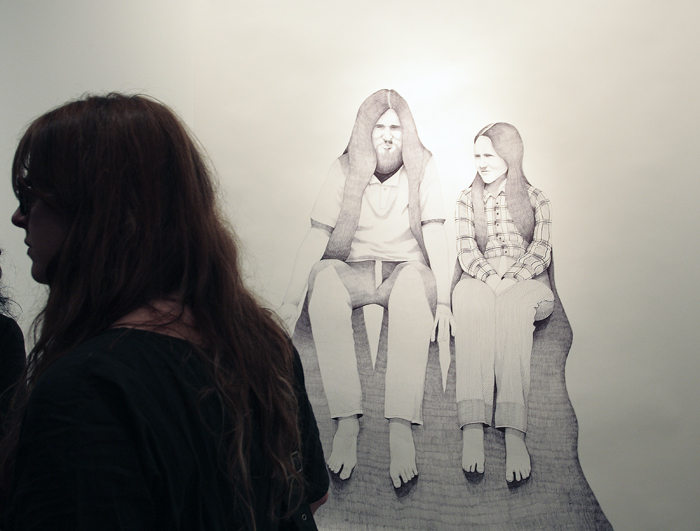
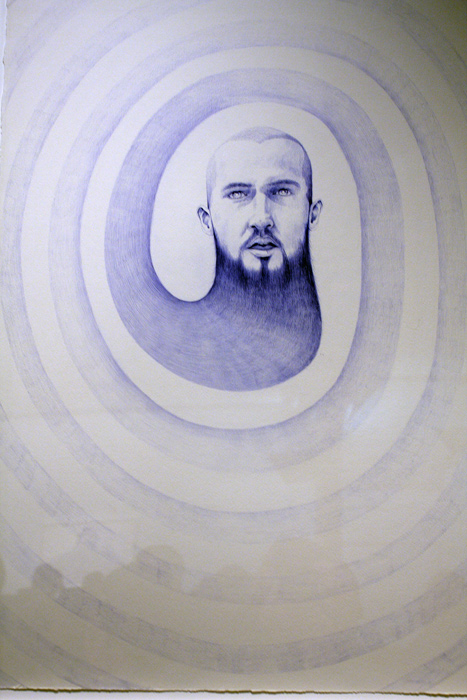
Laith McGregor (Australian, b. 1977) My kind of blue (black) 2009 Ballpoint pen on paper
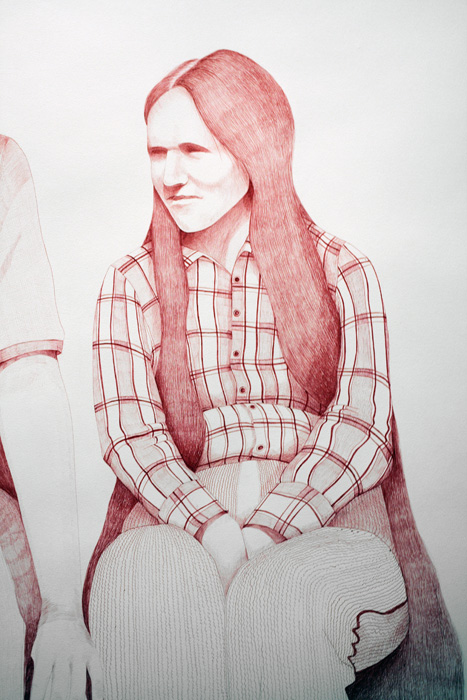
Laith McGregor (Australian, b. 1977) My kinda of Blue (red) (detail) 2009 Red and blue ballpoint on paper
Laith McGregor (Australian, b. 1977) Wiking 2009 Biro on paper 100.5 x 66.5 cm
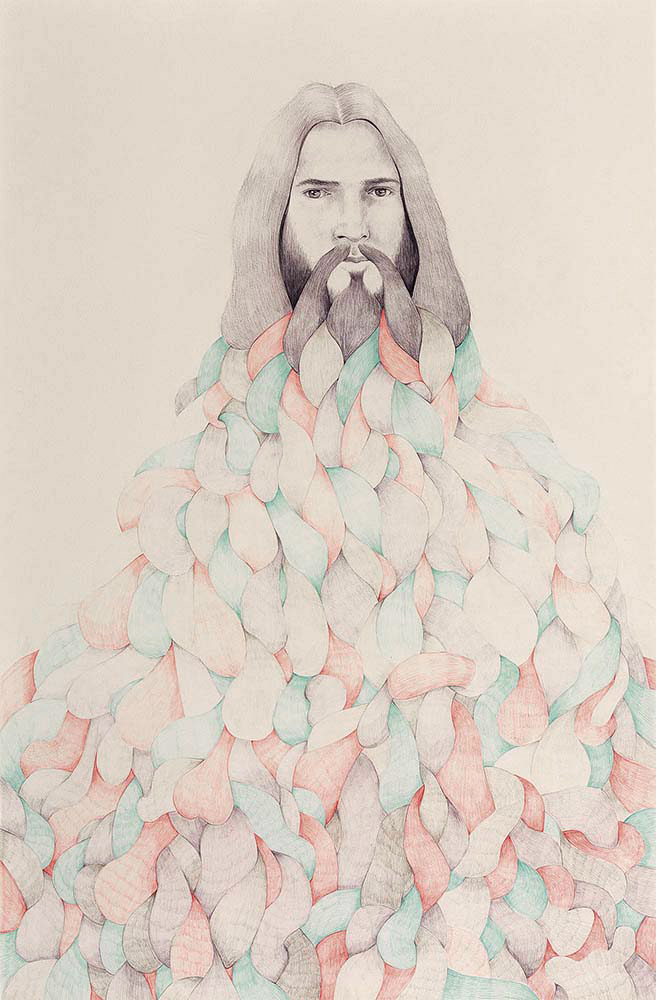
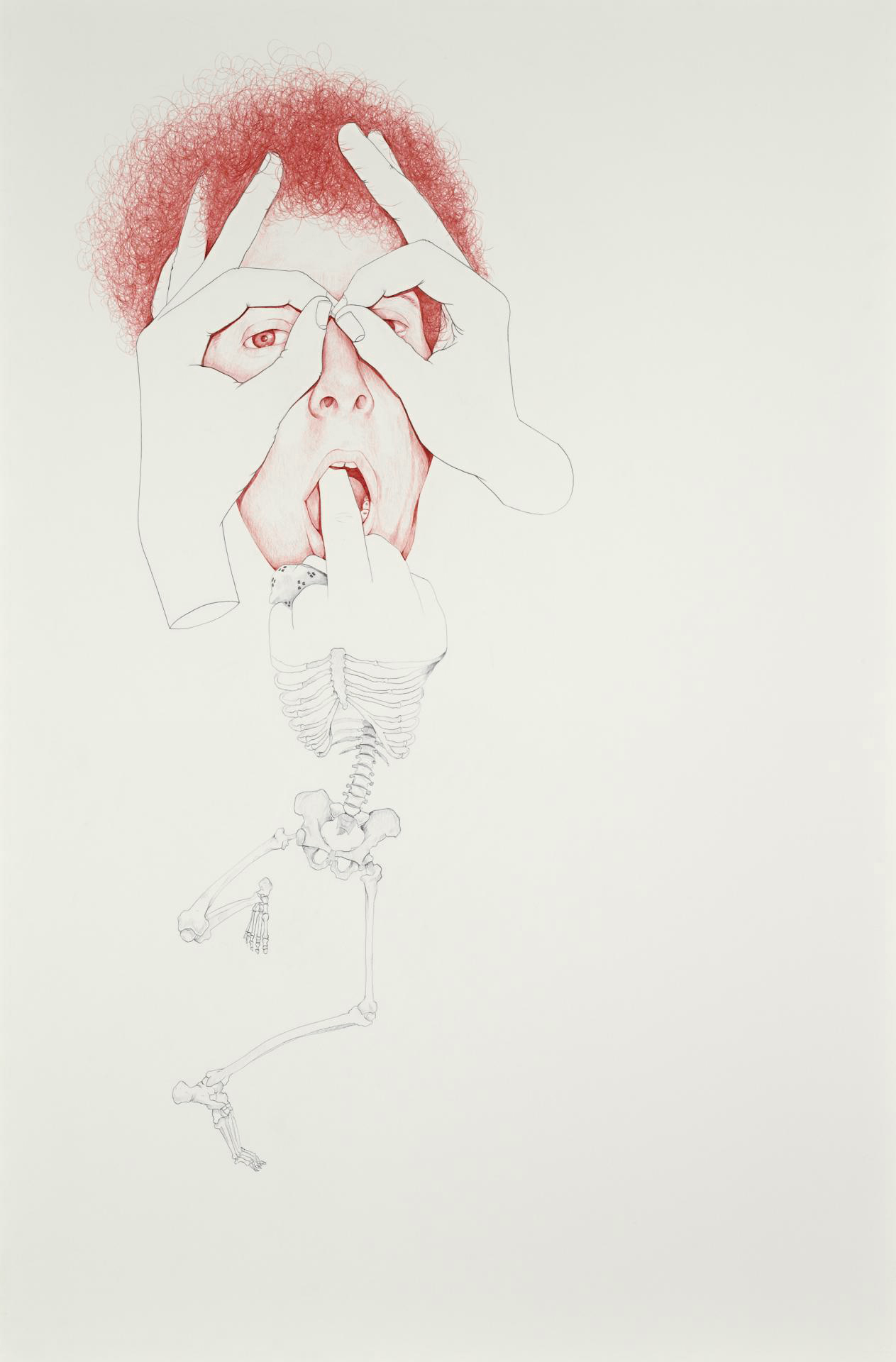
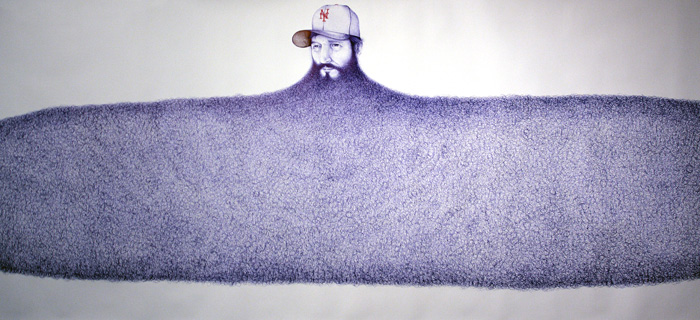
“McGregor’s work blurs the boundaries between portraiture, memory and imagination. Into each picture, drawn from and nourished by his past, notions of the unconscious mind are introduced and investigated and the certainty of memory and markers are challenged and slowly unravelled. Figurative forms metamorphose into uncanny, exaggerated, and often incongruous images and arrangements. Beards are grossly elongated, hair extends seamlessly to form a tree or a cocoon that envelopes a face and a neck transforms into a weighted mound in ‘portraits’ that are at once warm, playful and pensive. “It’s important for me to see the imagery appear otherworldly, whimsical and strange. I want it to be amusing and serious simultaneously, for the work to push and pull between its contrasting qualities.”
In So It Goes it is his mother and father, who according to Laith ‘kinda looks like Jesus’, that are the subject of his gaze.”
Text from the Helen Gory Galerie website [Online] Cited 07/05/2009. No longer available online
Laith McGregor (Australian, b. 1977) Vertigo 2009 Blue and black ballpoint on paper
Laith McGregor (Australian, b. 1977) The Last Bastion (detail) 2009 Ballpoint on paper
Laith McGregor (Australian, b. 1977) The Last Bastion (detail) 2009 Ballpoint on paper
Opening and installation views of John Bodin’s exhibition Urban Edge at Anita Traverso Gallery, Melbourne
“Each one of us, then, should speak of his roads, his crossroads, his roadside benches; each one of us should make a surveyor’s map of his lost fields and meadows … Thus we cover the universe with drawings we have lived …
Space calls for action, and before action, the imagination is at work. It mows and ploughs. We should speak of the benefits of all these imaginary actions.”
Gaston Bachelard The Poetics of Space
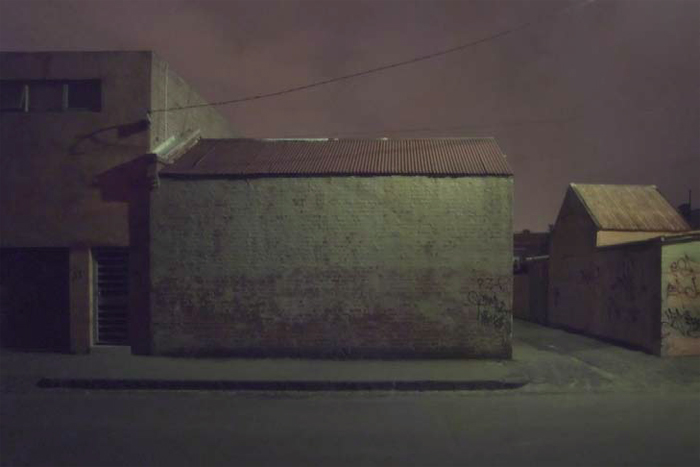
More interesting are the eerie contemplative photographs of John Bodin presented at Anita Traverso Gallery, Melbourne, our second opening of the night. In a well presented show Bodin’s hyper-real photographs employ a limited colour palette to portray the constructed landscape of the urban fringe. The images work well because the artist leaves room for doubt in the mind of the viewer – what am I looking at, where is it, do I subconsciously remember these places? How do the photographs make me feel about the edges of the world, this strangeness that we inhabit? They engage the viewer in a fluid architecture of space and place.
Light and colour are important tools for Bodin and he plays with their form, darkening pavements, shooting at night, making subtle negative interpretations of roads and underground car-parks while desaturating buildings, landscapes and skies of ‘natural’ colour. Walls bleed in Witchhunt (2007) and then you work out the photograph is taken under a bridge with a pavement, graffiti providing the title of the work. Blue light emotes from behind the cloaked window of a house in Shrouded (2005) and you are left wondering by the crazed cellular like constructions of As if by Nature (2007).
Haunting and elegiac these compositions are worthy of your attention.
Lovely to meet Catherine Fogarty and John Bodin. Thank you for your help!
Dr Marcus Bunyan
John Bodin (Australian) Witchhunt 2007
John Bodin (Australian) Shrouded 2005
John Bodin (Australian) As If By Nature 2007
“Urban Edge continues on from the 2006 ‘Urban Abstraction’ exhibition at Anita Traverso Gallery by introducing contrasting elements and structure from the natural world alongside stark semi-abstracted urban scapes. Whilst we may at first perceive these as opposing forces, I contend that the integration is more harmonious than we think.”
John Bodin
When John Bodin takes a risk – which indeed he seems to do aplenty – he does so with a self-assurance that would make many photographers – and artists in general – weep.
All the clichés are there in his work – the towering skyscraper, the car traversing the road at dusk, the pitted track through the woods. But when Bodin frames his image something quite magical occurs. Rather than raise an eyebrow and say – ‘seen it all before’ – instead we are seduced into the deep chiaroscuro, the inarguably romantic, shadowy mis en scene.
Bodin has said that his photographs “comment on the conditioning process of familiarisation.” Indeed, the strange moment of familiarity is immediately cushioned by the sensual softness of tone he employs. If anything, it is the shock of the old.
Bodin has said that his study in philosophy and meditation serve as a visual source of reflection and are integral to his image making.
Whether it is a distinctly phallic office tower or the moments of surrealism in a found structure in the rural countryside, Bodin’s work exudes a strange peacefulness, a distinctly contemplative air. Everything he grabs from reality is given Bodin’s own air of tranquility. He doesn’t eschew colour exactly, but he tones it down, blanketing his subjects in a kind of downy, nostalgic but not quite melancholic fashion that links his entire oeuvre.
A work such as Lover’s Lane – a sandy track somewhere by the coast – links his sensual eye with a not altogether comforting sense of intimacy. The shadows of the trees encroach in an almost threatening tangle of dark shapes – the ideal place to reassure a trembling lass as they wander into the dark.
In 2006, the renowned fellow-photographer Les Horvat said in an opening speech that Bodin’s “stated interests in philosophy and meditation serve as a fertile source of reflection, integral to his image making. His images cleverly explore the contrast between the form and the aesthetic of the landscape. They do this by examining the utility of urban structure, and juxtaposing it against an aesthetic emotional sensibility that is evocatively expressed through his images.
“The paradox he lays before us is that on one hand, they ingeniously remind us of our human incursions in the natural world; on the other, they suggest that the significance of the landscape is actually assigned by these incursions,” stated Horvat.
Bodin has travelled extensively and in 2003 he served a short residency in New Delhi, India. Closer to home he held a solo show in May 2006 and participated in 11 group exhibitions over the last six years. He was a finalist in the 2005 New Social Commentaries Acquisitive Prize and the acclaimed Prometheus Visual Art Award in 2007. The respect Bodin holds amongst his peers is renowned and, as this show attests, will only grow with time.
Ashley Crawford. “John Bodin,” in Photofile 86 2009, p. 14
Artist John Bodin in front of his work Lover’s Lane (2007, left) and Object of Speculation (2008, right) at the opening of his exhibition Urban Edge at Anita Traverso Gallery, Melbourne
John Bodin (Australian) Midnight Solitude 2005
John Bodin (Australian) Stumbling into Grace 2008 Type c print 120 x 80 cm
John Bodin (Australian) Mondrian in Berlin 2005 Type C-print 60 x 80cm
John Bodin (Australian) Adrenalin Addiction 2006 Type-C photograph 108 x 183cm
Anita Traverso Gallery PO Box 7001, Hawthorn North 3122
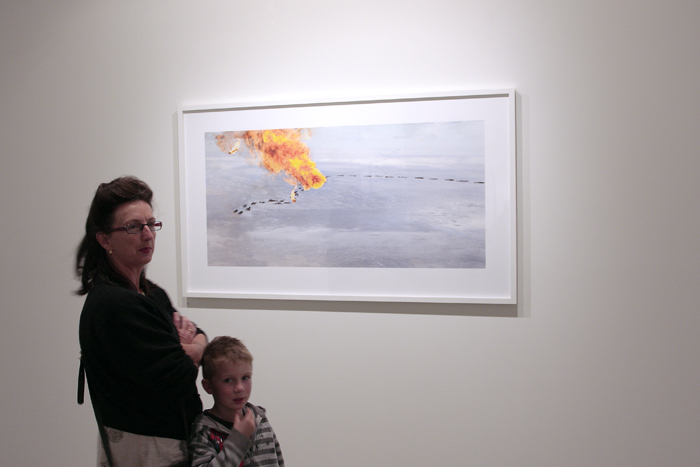
Installation view of Jill Orr exhibition Faith in a Faithless Land at Jenny Port Gallery, Melbourne
First cab off the rank on a busy night of openings in Melbourne were the self-conscious photographs of Jill Orr presented at Jenny Port Gallery in Richmond, Melbourne (the gallery now in Collingwood). Beautifully hung in the gallery space in white frames the photographs were the least engaging artworks on the night. Their message seemed over determined, the use of reflection to add layering to the human-landscape mis en scene trite. Perhaps the performance itself would have evinced a more authentic, nuanced connection with the viewer vis a vis a response to the overwhelming expanse of nature and the place humans occupy on the thin crust of the earth. These photographs did not make that telluric connection and left me emotionally uninvolved in their pictorial representation.
Unfortunately I cannot show you any of the photographs because of copyright reasons but thank you to Jenny for allowing me to photograph the installation itself.
Dr Marcus Bunyan
Installation views of Jill Orr exhibition Faith in a Faithless Land at Jenny Port Gallery, Melbourne







 Art Blart _ art and cultural memory archive
You must be logged in to post a comment.