
Exhibition dates: 22nd June, 2019 – 27th January, 2020

Installation view of the exhibition Turning Points: Contemporary Photography from China at the National Gallery of Victoria, Melbourne
Photo: Marcus Bunyan
Writing the body politic / broken
Ho hum, ho hum.
The exhibition Turning Points: Contemporary Photography from China at the National Gallery of Victoria is an extension of the 2008 exhibition Body Language: Contemporary Chinese Photography with many of the same photographs being shown again, with new additions to the collection.
Nothing much seems to have changed in the last 12 years. Contemporary Chinese photography still concentrates on limited narratives based around the performing body, the body positioned in time and space in relation to history, memory, tradition, culture and consumerism. What the “turning points” are in the title of this exhibition remains unclear. Turning points for who? The art, the artists, the stories they tell, or the restrictive nature of contemporary Chinese culture.
Certain things remain constant: an emphasis on the performing body, (its) theatrical style, (in) elaborate tableaux, contemporary consumer society, urban reconstruction, and tradition and change. The body is usually isolated against contextless backgrounds, free floating, paired with a rather stilted iconography derived from Chinese culture – coins, calligraphy, statues, spirits, tattoos as traditional historical painting, calligraphy, buildings, revolution – focusing on “the dismantling of tradition during a period of rampant consumerism and modernisation.”
Even while these artists apparently possess, “an urgent desire to explore individual and social identity in a time of unprecedented change … that reflect the tensions in Chinese society as the processes of social change meet traditional culture and expectations head-on”, no/body mentions the elephant in the room – the repressive and aggressive nature of the Chinese government, it’s suppression of dissent both internally and externally, its appalling human rights record and its expansionist policy in the South China Sea. The paradox is that while, “Hai Bo’s paired portraits illustrate the cultural shifts that have occurred over forty years as people in China have become increasingly able to show their individuality”, that individuality is closely controlled by the State. Step out of line, as many artists have found to their peril, and you are soon done for.
No mention here of the 1989 Tiananmen Square protests, the current democracy protests in Hong Kong, or the recently released report by Human Rights Watch (HRW) which contains a damning essay on China’s “global threat” to human rights. No other government “flexes its political muscles with such vigour and determination to undermine the international human rights standards and institutions that could hold it to account.” The HRW report cites a slew of violations ranging from the mass detention of Uyghur Muslims in the far-western autonomous region of Xinjiang, to increased censorship, to the use of technologies for mass surveillance and social control. Nothing to see here!
The work of most of the artists in this exhibition seems insular, inward looking – chained to the country’s past and present, memory and history, culture and its re/constitution. Addressing its constitution through supplication. Addressing the representation of institutional power in socialist regimes through images with heroic overtones. It’s almost as if these artists are painting symbols, painting a monosyllabic mythology of how their country was and is now with no turning point in sight. Parsing on ancient and modern to no great effect.
The only two artists who really lay it on the line, who confront the dragon, are Rong Rong’s photographs of a performance by artist Zhang Huan titled 12 square metres (1994, below) in which the artist sat naked, smeared in honey and fish oil in a local public toilet for an hour before cleansing himself in a polluted pond; and Sheng Qi’s Memories (Mother), Memories (Me) and Memories (Mao) (2000, below) in which the artist was deeply affected by the changed political climate following the Tiananmen Square protests of 1989 and uses his disfigurement “as the backdrop for a series of self-portraits that juxtapose his past and present.”
These are the photographs that I will remember. The others, stolid, prosaic, are lost.
Dr Marcus Bunyan
Many thankx to the National Gallery of Victoria for allowing me to publish the images in the posting. All installation images are © Dr Marcus Bunyan and the National Gallery of Victoria and proceed in a clockwise direction around the exhibition. Please click on the photographs for a larger version of the image.

Installation view of the exhibition Turning Points: Contemporary Photography from China at the National Gallery of Victoria, Melbourne showing Cang Xin (Chinese, b. 1967) Six photographs from the Communication series (1996-2006)
Photo: Marcus Bunyan

Cang Xin (Chinese, b. 1967)
Communication
1996-2006
Type C photograph ed. 10/10
Gift of Larry Warsh, 2016
National Gallery of Victoria, Melbourne
© Courtesy of the artist

Cang Xin (Chinese, b. 1967)
Communication
1996-2006
Type C photograph ed. 10/10
Gift of Larry Warsh, 2016
National Gallery of Victoria, Melbourne
© Courtesy of the artist
Cang Xin is a celebrated performance artist who uses photography as an adjunct to his practice. In these photographs he is documenting a ritualistic performance in which he licks various objects that have a symbolic resonance for him. Each object has a link to China and its history, although those meanings remain intentionally obscured and subjective. The artist literally experiences the objects through a sense of taste and a physical action; the intimate act of licking becomes a gesture of communication or communion with the past.
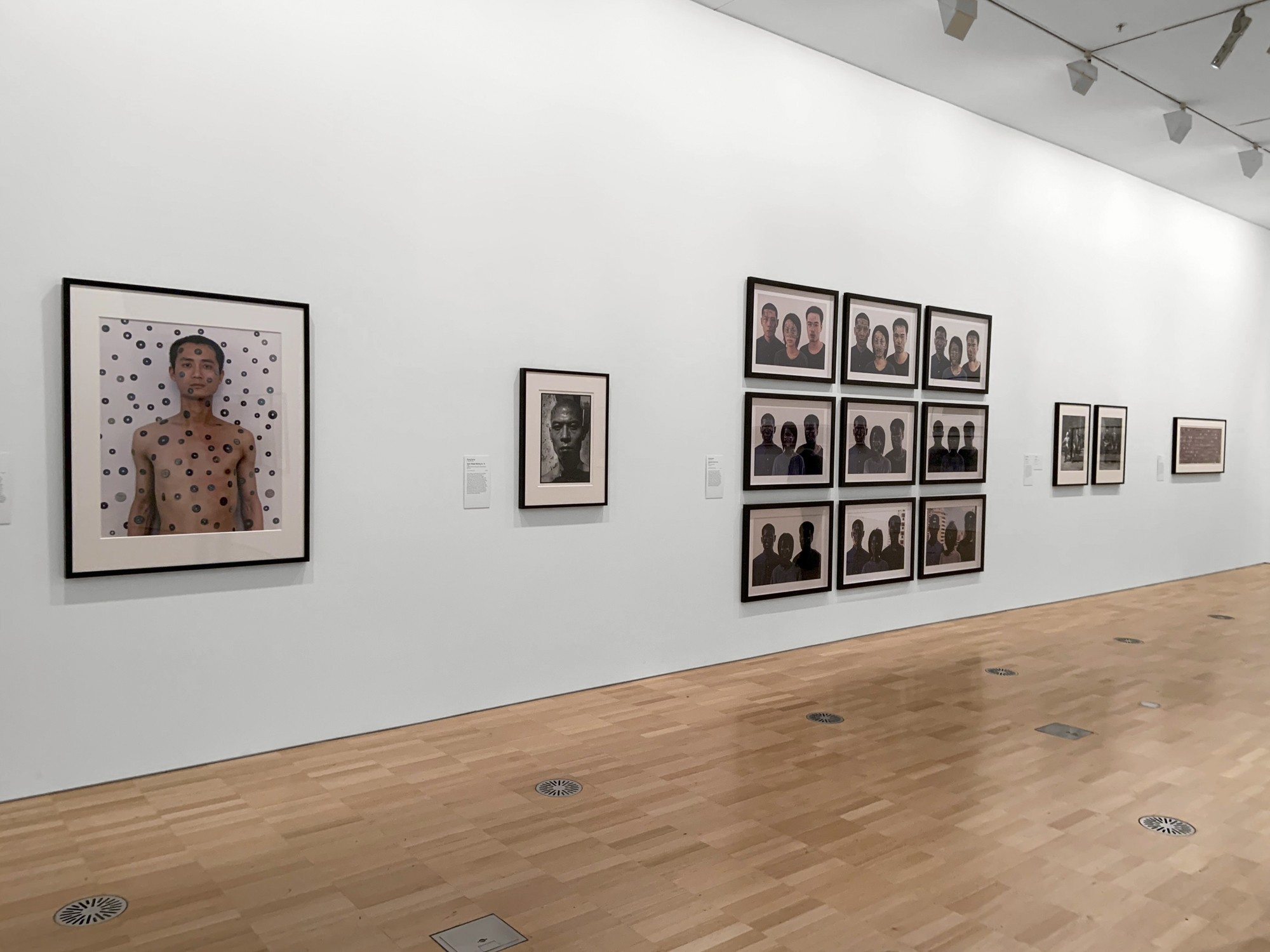
Installation view of the exhibition Turning Points: Contemporary Photography from China at the National Gallery of Victoria, Melbourne showing at left, Qiu Zhijie (Chinese, b. 1969) Tattoo no. 7 (1994); at second left, Rong Rong (Chinese, b. 1968) East Village Beijing no. 15 (1994); and at middle right, Zhang Huan (Chinese, b. 1965) Shanghai family tree (2001)
Photo: Marcus Bunyan

Qiu Zhijie (Chinese, b. 1969)
Tattoo no. 7
1994
From the Tattoo series 1994
Type C photograph, ed. 8/10
101.6 x 76.2cm
National Gallery of Victoria, Melbourne
Gift of Larry Warsh, 2016
© Courtesy of the artist
In his Tattoo series, Qui Zhijie overlays self-portraits with drawings, images and objects, such as the coins shown here. Discussing this series, he writes, ‘The Tattoo series focuses on the problematic relationship between an image and its background … In this series the two find common ground. The substance of the subject, the weight of the person, and the physicality of the figure all dissolve … This series is a response to the futility and drowning of the individual brought about by the onslaught of the Chinese media culture which began to develop during the 1990s’.

Rong Rong (Chinese, b. 1968)
East Village Beijing no. 15
1994
Gelatin silver photograph, coloured dyes
National Gallery of Victoria, Melbourne
Gift of Larry Warsh, 2016
Rong Rong is well known for his images that show the lives and activities of the avant-garde Beijing East Village artistic community during the 1990s. This photograph is one of a series created to document a famous performance by fellow artist Zhang Huan, during which Zhang covered his naked body with honey and fish oil and sat on a stool in a public toilet, allowing flies to swarm over his body. Rong Rong’s photographs, made throughout the performance, form a crucial record of this performative action that was intended to comment on the squalid conditions in which the artists were living.


Installation views of the exhibition Turning Points: Contemporary Photography from China at the National Gallery of Victoria, Melbourne showing Zhang Huan (Chinese, b. 1965) Shanghai family tree (2001)
Photos: Marcus Bunyan
Zhang Huan (Chinese, b. 1965)
Shanghai family tree
2001
Type C photographs ed. 25/25
National Gallery of Victoria, Melbourne
Purchased with funds donated by Jason Yeap and Min Lee Wong, 2008
© Zhang Huan Studio
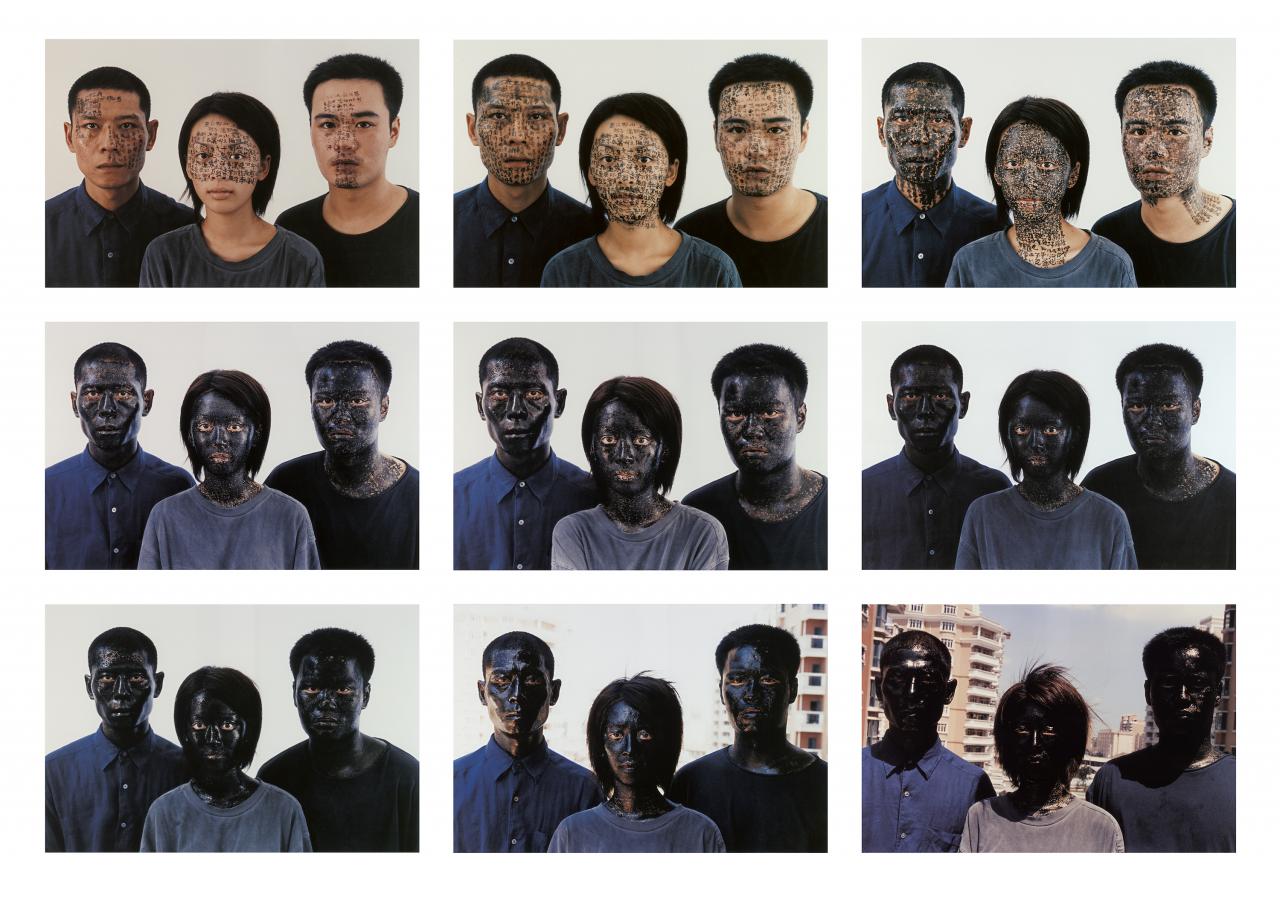
The faces of the two young men and the young woman in Zhang Huan’s suite of nine photographs are used like the blank pages in a book carrying an increasingly oppressive weight of words. The Chinese characters inscribed on their faces gradually obliterate their features and identities. In the final photograph, the trio are shown in front of a new housing development in Shanghai. Their features are totally obscured, suggesting a parallel between the loss of personal identity and the rapid pace of development that is rendering the city unrecognisable.
In 1999 the internationally renowned Chinese performance and video artist, sculptor and photographer Zhang Huan wrote of his distinctive approach to his practice: ‘The body is the only direct way through which I come to know society and society comes to know me. The body is proof of identity. The body is language’. The complex tangle of history and tradition that can override the individual appears as a theme in much of Zhang Huan’s avant-garde performances and photographs and, as seen in this work, is frequently expressed through the use of language. In Shanghai family tree Zhang Huan (to the left) poses with a man and woman, their faces becoming increasingly obscured by Chinese characters. This work seems to suggest the importance of language which, while it can overwhelm the individual, undoubtedly also helps define a person’s relationship to society.

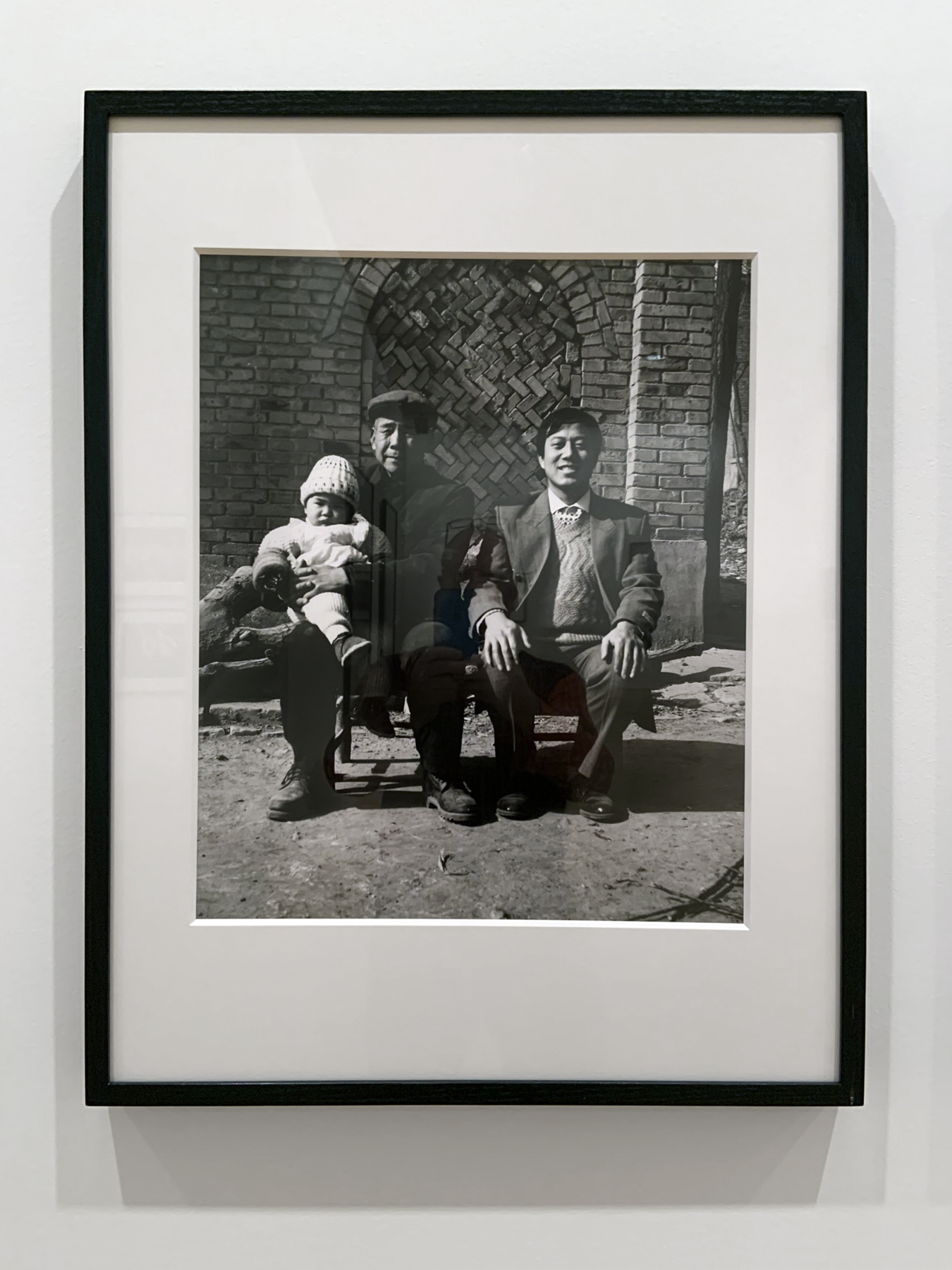
Installation views of the exhibition Turning Points: Contemporary Photography from China at the National Gallery of Victoria, Melbourne showing two photographs from Zhuang Hui’s One and Thirty series (1996)
Photos: Marcus Bunyan

Zhuang Hui (Chinese, b. 1963)
Untitled
1996
From the One and Thirty
Type C photograph, ed. 3/3
61.0 x 51.0cm
National Gallery of Victoria, Melbourne
Gift of Larry Warsh in honour of Tony Ellwood, Director NGV, 2018
© Courtesy of the artist
The series title of these photographs, One and Thirty, is didactic. There are ‘thirty’ portraits in the sequence and ‘one’ figure who appears in each image, the ever-smiling figure of the artist. Each photograph shows Zhuang Hui posed with an individual he has selected as the representative of a particular vocational or social group. In one of the works shown here Zhuang is photographed seated beside an older man holding a baby on his knee, a classic doting grandfather; in the other image he is photographed with a smartly dressed, young professional woman.

Wang Qingsong (Chinese, b. 1966)
Standard family
1996
Type C photograph, ed. 8/30
48.2 x 124.4cm
National Gallery of Victoria, Melbourne
Gift of Larry Warsh, 2017
© Courtesy of the artist
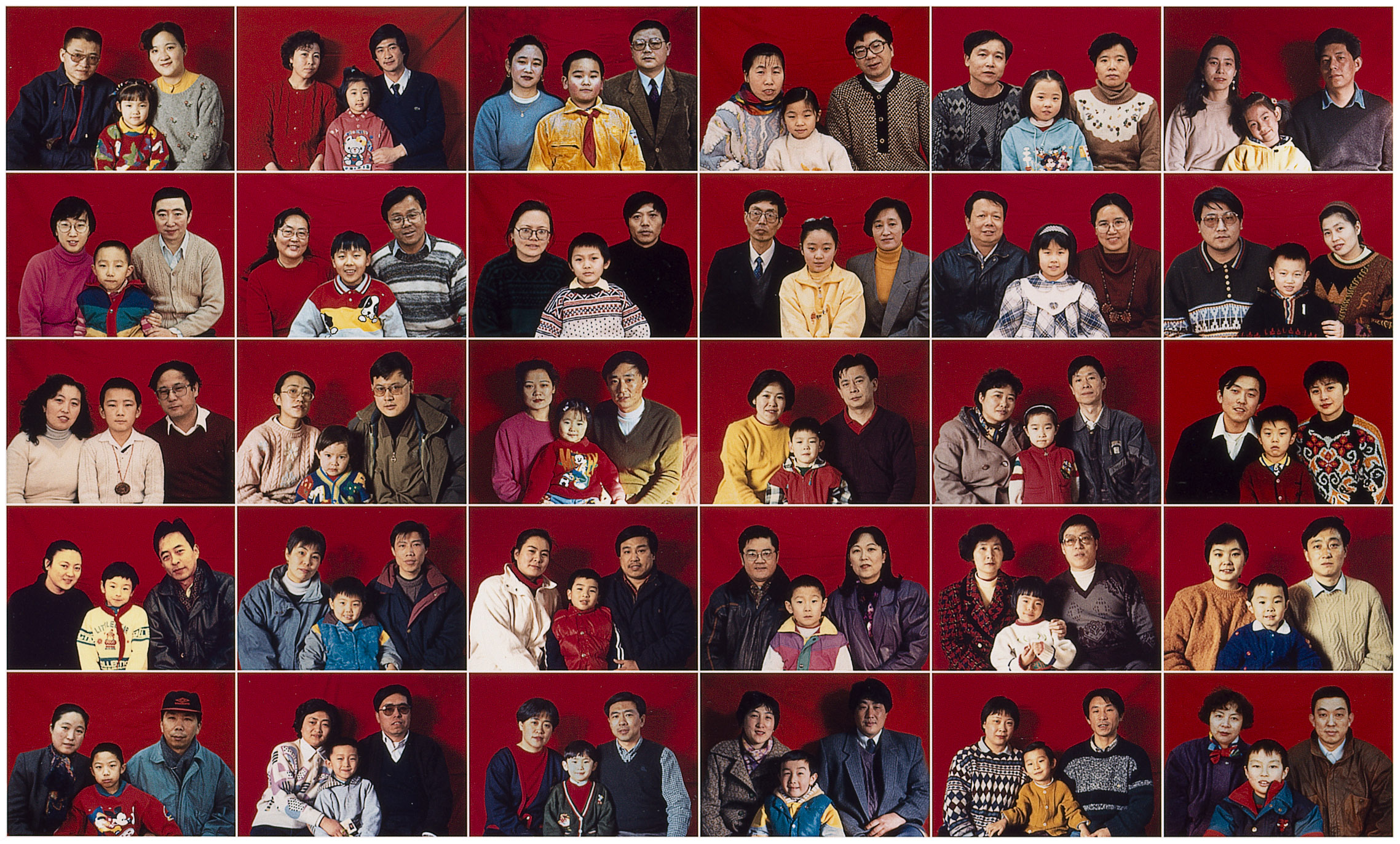
Wang Jinsong’s Standard family project investigates contemporary Chinese culture and the effects of the one-child policy, which was introduced in China in the 1970s as a means of curbing population growth. Without any clear agenda or critical stance, Wang invited families to participate in photo shoots where the parents invariably elected to pose flanking their lone child. When the images are repeated and presented in a grid, the ‘standard’ nature of the family unit becomes evident, allowing for a reading of generic poses and expressions across the various families, and inviting speculation and commentary on the effects of collectivism when imposed on social structures.
Wang Qingsong (Chinese, b. 1966)
Standard family (detail)
1996
Type C photograph, ed. 8/30
48.2 x 124.4cm
National Gallery of Victoria, Melbourne
Gift of Larry Warsh, 2017
© Courtesy of the artist


Installation views of the exhibition Turning Points: Contemporary Photography from China at the National Gallery of Victoria, Melbourne showing Qiu Zhijie’s Standard Pose series (1996-1998)
Photos: Marcus Bunyan

Qiu Zhijie (Chinese b. 1969)
Fine series A
1996-1998
From the Standard Pose series 1996-1998
Type C photograph, ed. 9/10
58 x 61cm
National Gallery of Victoria, Melbourne Gift of Larry Warsh, 2016
© Courtesy of the artist
In common with many photographers working in China in the 1990s, Qiu Zhijie uses the performing body in his images. Throughout his career he has combined performance, video and photography to create works that explore ideas of history, individuality and identity in contemporary China. The four photographs from the Standard Pose series reference propaganda images produced during the Cultural Revolution and consider the failure of the future that they promised. Photographed in a simple studio setting and wearing contemporary clothes, the models, with their overly dramatic poses and facial expressions, appear comical rather than heroic.

Qiu Zhijie (Chinese b. 1969)
Fine series C
1996-1998
From the Standard Pose series 1996-1998
Type C photograph, ed. 9/10
58 x 61cm
National Gallery of Victoria, Melbourne Gift of Larry Warsh, 2016
© Courtesy of the artist
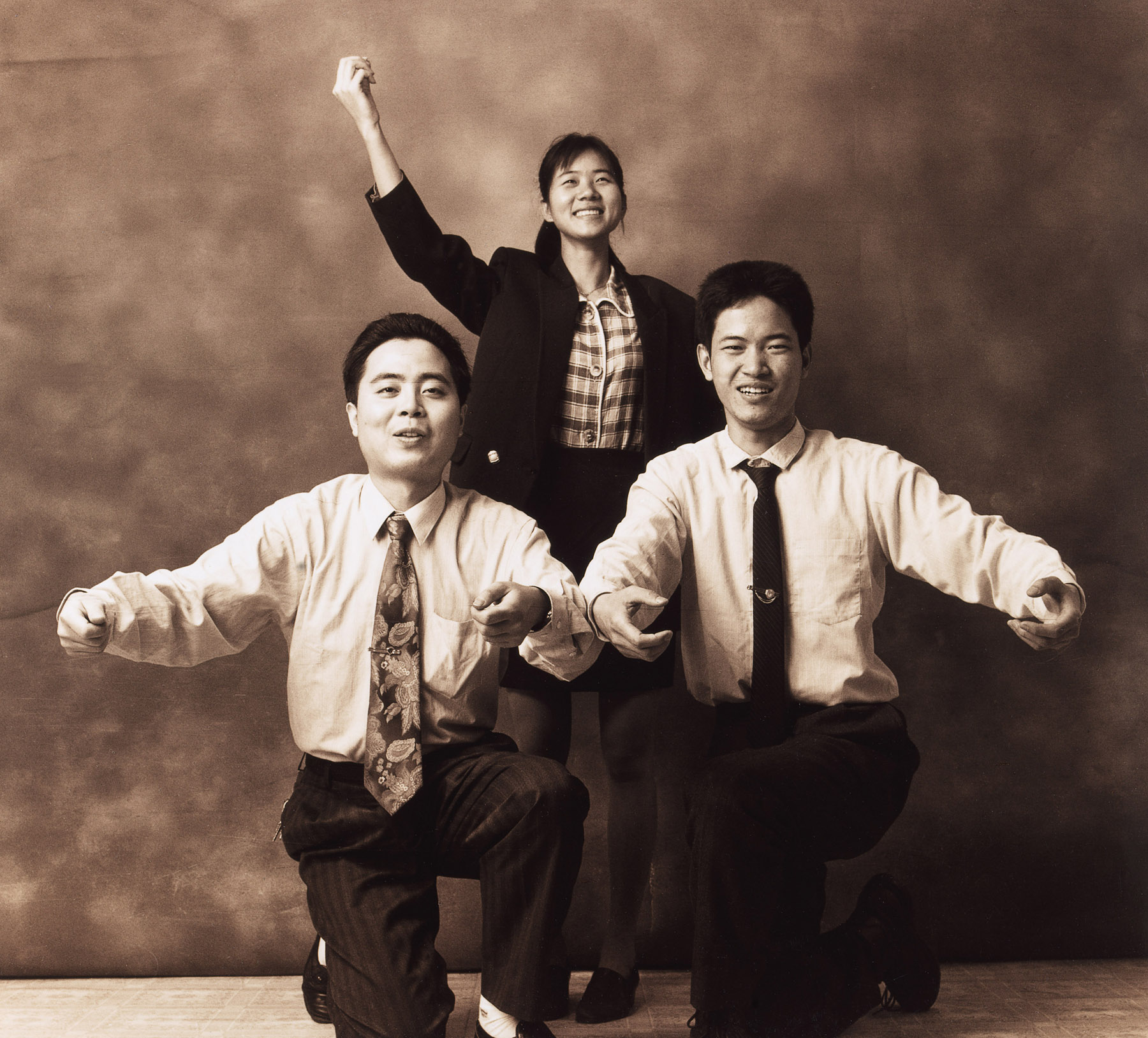
Qiu Zhijie (Chinese b. 1969)
Fine series D
1996-1998
From the Standard Pose series 1996-1998
Type C photograph, ed. 9/10
58 x 61cm
National Gallery of Victoria, Melbourne Gift of Larry Warsh, 2016
© Courtesy of the artist
Turning Points: Contemporary Photography from China explores the work of established and emerging photo-artists working in a time of rapid social and economic change.
In the 1990s, Chinese photography became one of the most dynamic and exciting areas in contemporary international art. Artists in China increasingly began to use photography to not only to document their lives but to question and challenge the status quo. The ‘first generation’ of contemporary Chinese artists included here – those born in the 1960s – examined the societal impact of the Cultural Revolution, and reflected on their own and their families’ personal experiences. The next generation of photographers, born in the 1980s and later, bring not only different life experience, having come of age in the twenty-first century, but are actively engaged with the global community in ways that were not possible in previous decades.
The works included in this exhibition offer commentaries on individuality and identity, cultural change, the transformation of Chinese cities, and the impact of consumerism and globalisation on contemporary society.
The National Gallery of Victoria began to collect contemporary Chinese photography in 2004, and in 2008 presented the exhibition Body Language: Contemporary Chinese Photography. Since that time the Gallery has continued to build this aspect of the collection.
More recently, in 2016 and 2017, the NGV photography collection was transformed through the generosity of Larry Warsh. An American collector, publisher and founder of AW Asia, a private organisation and exhibition space in New York, Warsh presented a suite of twenty-nine contemporary Chinese photographs as a gift to the Gallery. His donation comprises works by some of the most important Chinese photographic artists working in the 1990s and early 2000s, including Hong Lei, Rong Rong and Wang Qingsong. Warsh’s presentation effectively doubled the NGV’s holdings of contemporary Chinese photography, and this exhibition, which includes a number of works from this important gift, was made possible because of his generosity.
Text from the National Gallery of Victoria website [Online] Cited 23/12/2019

Installation view of the exhibition Turning Points: Contemporary Photography from China at the National Gallery of Victoria, Melbourne showing at left, Wang Qingsong’s City walls (2002); at second left bottom Zhang Dali’s 2001 42A (2001) from the Demolition and Dialogue series; at centre, Chi Peng’s Apollo in transit (2005); at centre right, Yang Yongliang’s Eclipse (2008); and at right Huang Yan’s Chinese landscape – Tattoo (1999)
Photo: Marcus Bunyan

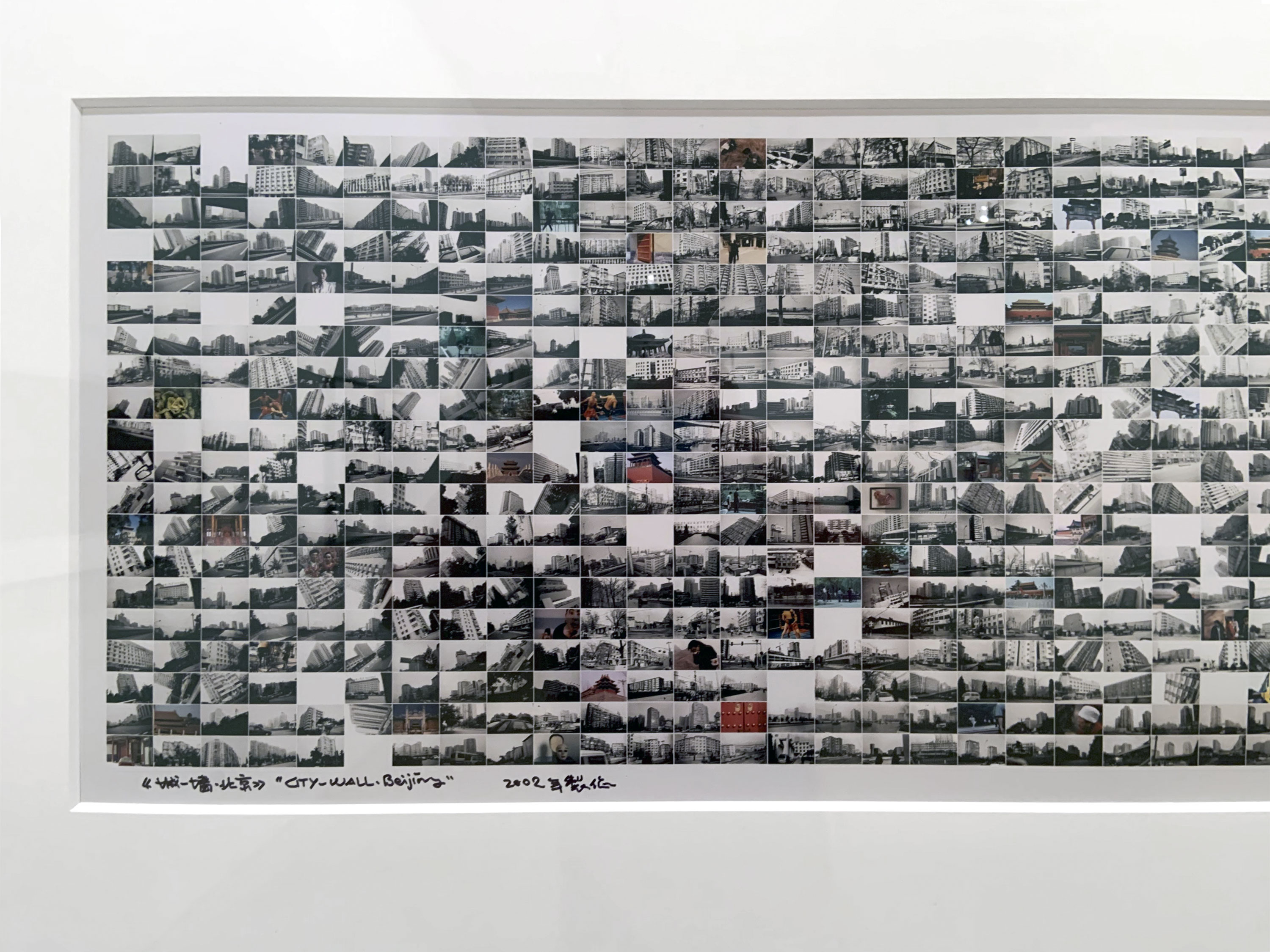
Installation views of the exhibition Turning Points: Contemporary Photography from China at the National Gallery of Victoria, Melbourne showing Wang Qingsong’s City walls (2002)
Photos: Marcus Bunyan
Wang Jinsong’s photograph shows aspects of the architecture and history of Beijing, drawing attention to the abandonment of time-honoured buildings, homes and ways of living. City walls comprises a grid of 360 images of buildings in Beijing. The great majority of the photographs are of generic concrete constructions, printed in a grey monotone. Interspersed among these are richly coloured images showing traditional architecture. The placement of the photographs in a grid creates an immediate visual link to the idiosyncratic brick construction of the older buildings, which are rapidly being replaced by new, uniform reinforced concrete structures.


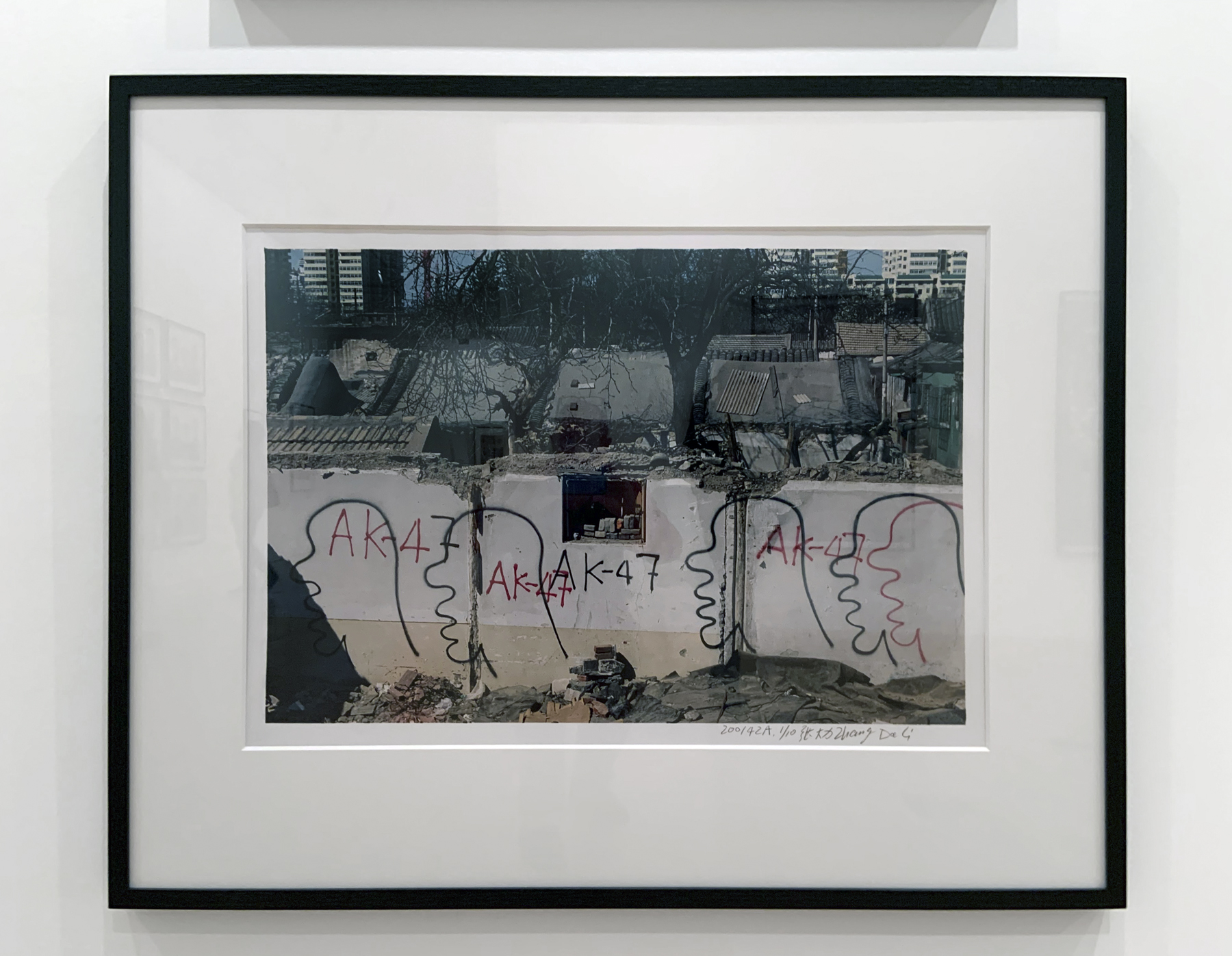
Installation views of the exhibition Turning Points: Contemporary Photography from China at the National Gallery of Victoria, Melbourne showing at top, Weng Fen’s On the wall: Guangzhou (4) (2002) and at bottom, Zhang Dali’s 2001 42A (2001)
Photos: Marcus Bunyan
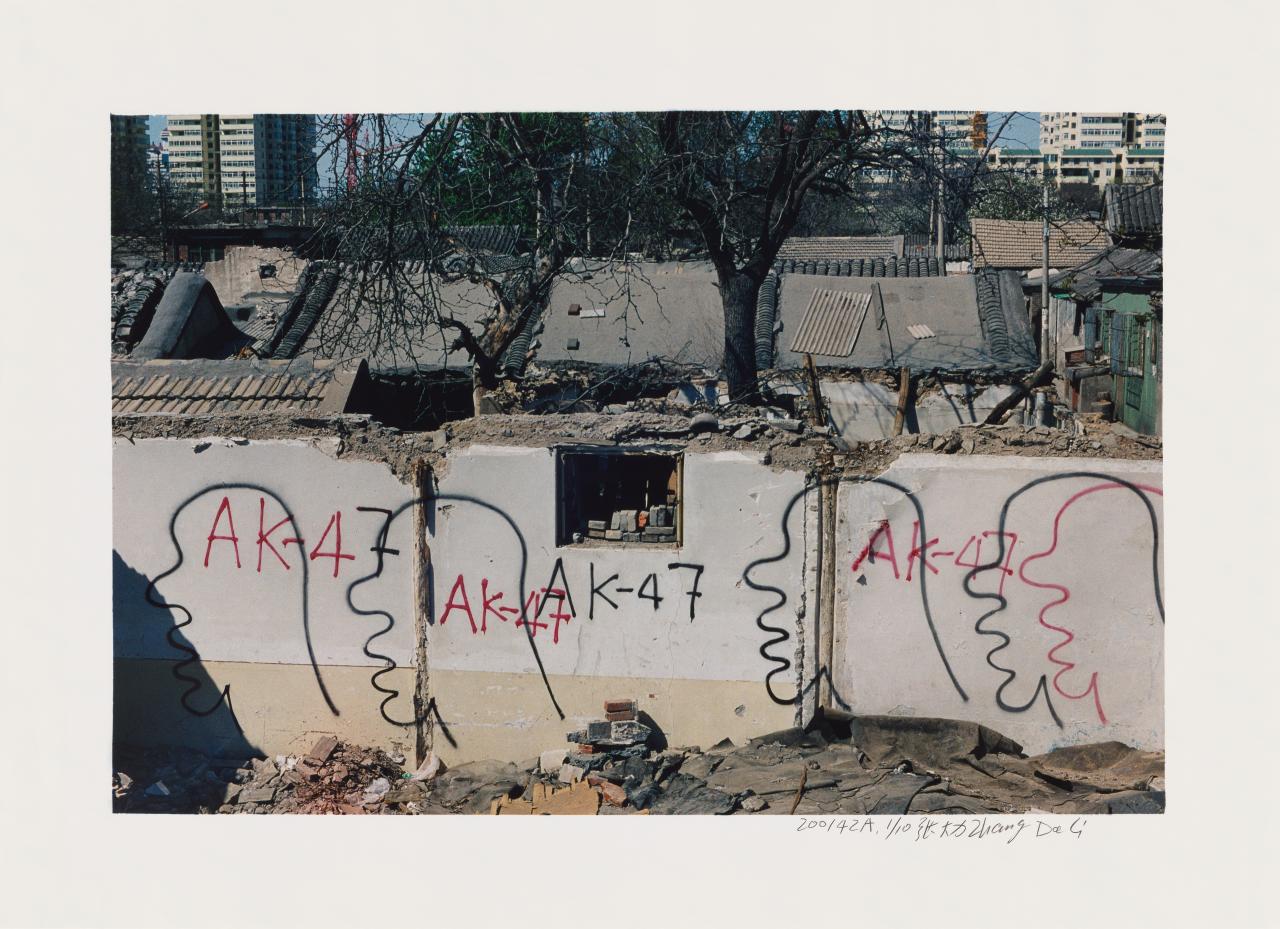
Zhang Dali (Chinese, b. 1963)
2001 42A
2001
from the Demolition and dialogue series
type C photograph
63.5 × 114.0cm
National Gallery of Victoria, Melbourne
Gift of Larry Warsh, 2016
© Courtesy of the artist
This photograph, showing a partially demolished wall emblazoned with a large-scale painted outline of the artist’s head and his pseudonym, AK-47, brings together several aspects of the practice of multidisciplinary artist Zhang Dali. Zhang went into self-imposed exile from China in 1989 and when he returned to Beijing six years later, he found his home was in the midst of rapid change. Zhang wanted to protest the loss of traditional buildings, document the ruined remnants before they were swept away, and convey his sense of the loss of history and identity that was a consequence of those changes.
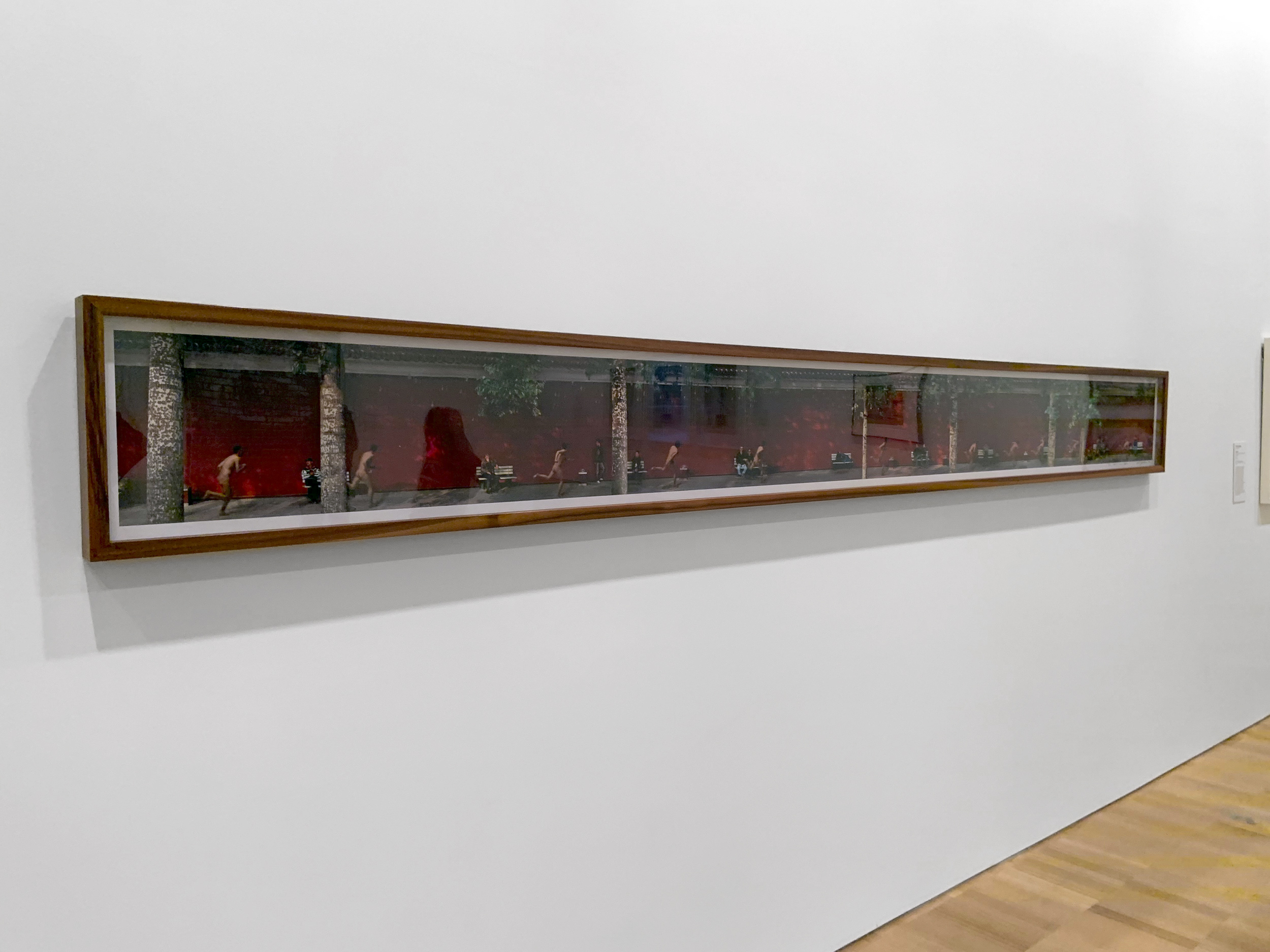

Installation views of the exhibition Turning Points: Contemporary Photography from China at the National Gallery of Victoria, Melbourne showing Chi Peng’s Apollo in transit (2005)
Photos: Marcus Bunyan
Chi Peng’s works often contain naked figures spiriting or running through ‘history’, while refusing any start or ending of their visual narrative. Unravelling like a traditional Chinese scroll, the red brick wall surrounding the Forbidden City extends the length of this digitally altered panoramic image. The artist has inserted repeat images of himself running left to right alongside the wall, in front of a variety of onlookers. A metaphor for East / West relations, this theatrical image brings together potent symbols of traditional and contemporary life in China.

Yongliang Yang (Chinese, b. 1980)
Eclipse
2008
From the On the quiet water, heavenly city series 2008
Inkjet print 73.0 x 200.0cm (image) 81.6 x 208.2cm (sheet)
National Gallery of Victoria, Melbourne
Presented by the Mering Corporation Pty Ltd through the Australian Government’s Cultural Gifts Program, 2012
© Yang Yongliang

Yongliang Yang (Chinese, b. 1980)
Eclipse (detail)
2008
From the On the quiet water, heavenly city series 2008
Inkjet print 73.0 x 200.0cm (image) 81.6 x 208.2cm (sheet)
National Gallery of Victoria, Melbourne
Presented by the Mering Corporation Pty Ltd through the Australian Government’s Cultural Gifts Program, 2012
© Yang Yongliang
Yang Yongliang creates an optical illusion by combining elements of a traditional Chinese shānshuǐ (mountain-water) landscape painting with imagery from modern Shanghai life. From afar, the work appears to be a watercolour on paper, representing misty mountains and an ethereal sea stretching to the horizon. Upon closer inspection, the ghostly formations are revealed as digitally constructed collages of apartment blocks, buildings, construction sites and giant cranes. The built metropolis becomes indistinguishable from the natural landscape, highlighting the insidious modernisation, construction and environmental degradation characteristic of contemporary existence.

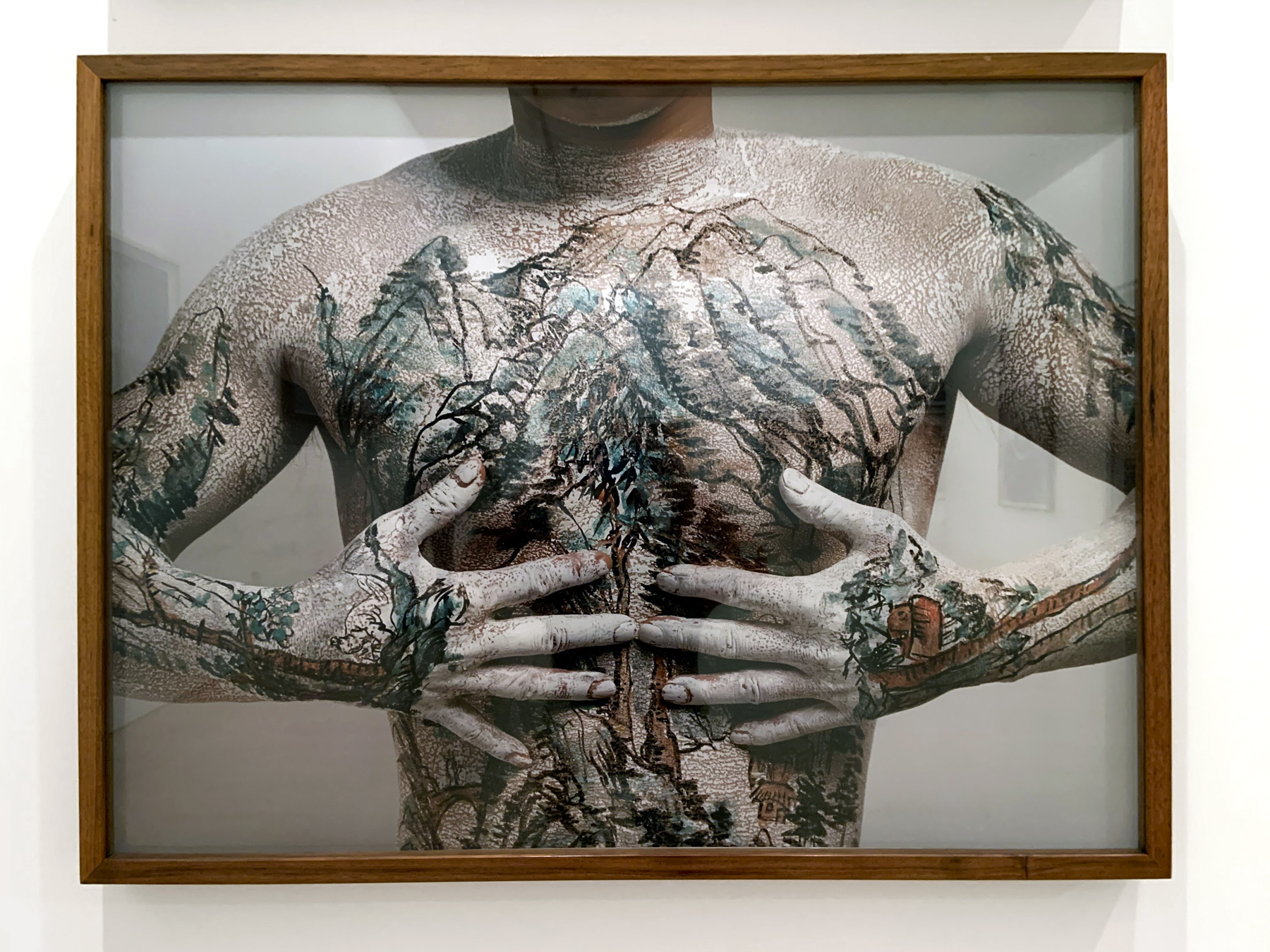
Installation views of the exhibition Turning Points: Contemporary Photography from China at the National Gallery of Victoria, Melbourne showing Huang Yan’s Chinese landscape – Tattoo No. 4 and Chinese landscape – Tattoo No. 1 (1999)
Photos: Marcus Bunyan
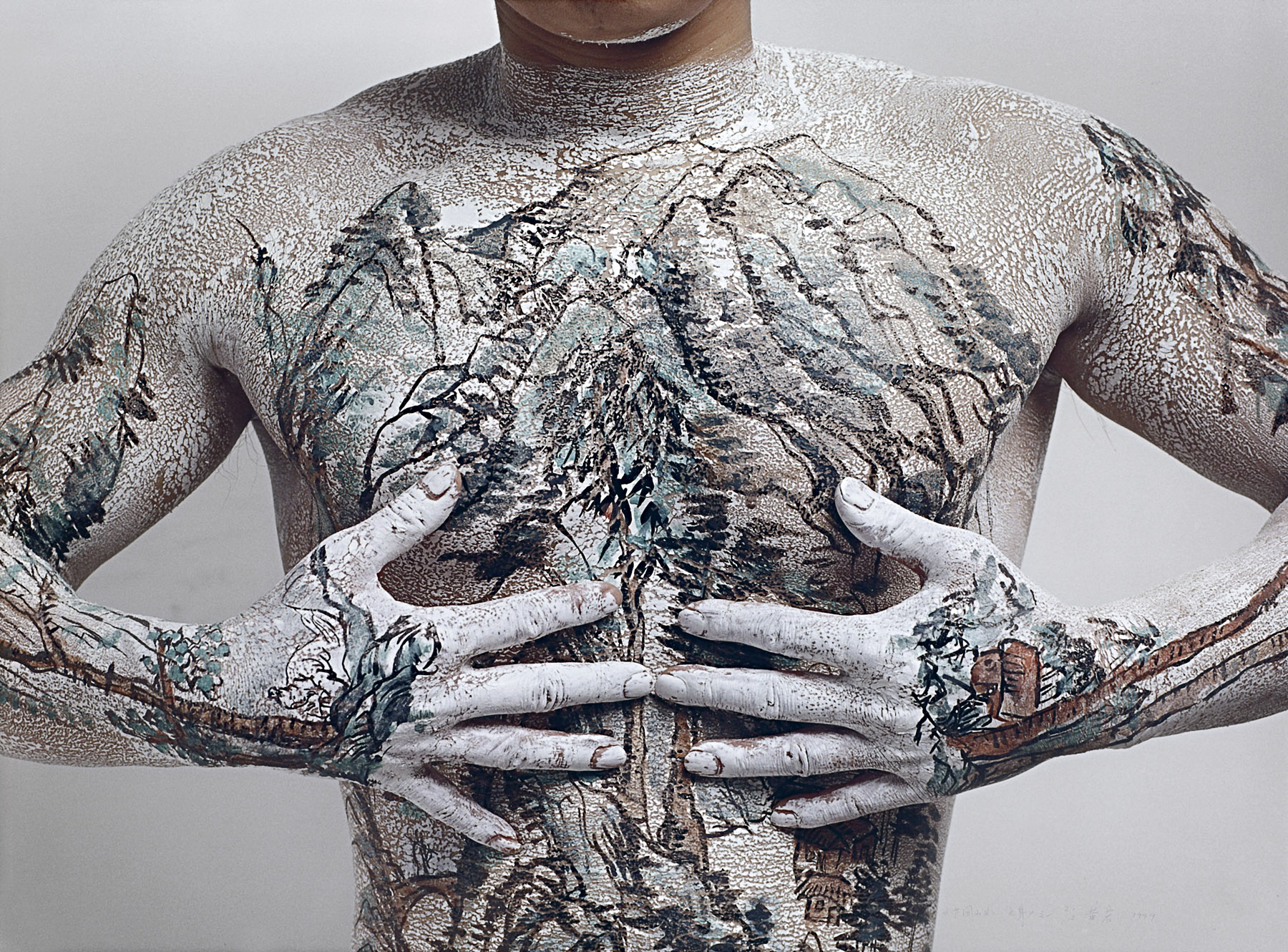
Huang Yan (Chinese, b. 1966)
Chinese landscape – Tattoo (Number 1)
1999, printed 2004
Type C photograph, ed. 2/12
80.1 x 108.0cm irreg. (image and sheet)
National Gallery of Victoria, Melbourne
Purchased, 2004
© Huang Yan, courtesy of Red Gate Gallery, Beijing
Prior to commencing his photography practice in the 1990s, Huang Yan trained as a painter. His recent work combines the centuries-old, traditional style of landscape painting with new technology; the images are contemporary while also affirming traditional Chinese culture and values. The artist alludes to complex traditions in this ‘self-portrait’ in which his bare chest is painted with a traditional shānshuǐ (mountain-water) landscape painting. The title of the work implies permanence, yet the scenes painted on the body are ephemeral, suggesting the fragility of the natural environment and the transience of the body.

Hong Lei (Chinese, b. 1960)
After Zhao Ji’s loquat and birds (Song dynasty)
1999
Type C photograph, ed. 9/10
60.9 x 76.2cm
National Gallery of Victoria, Melbourne
Gift of Larry Warsh, 2016
© Courtesy of the artist

Hong Lei (Chinese, b. 1960)
Autumn in the Forbidden City
1998
Type C photograph, ed. 7/10
60.9 x 76.2cm
National Gallery of Victoria, Melbourne
Gift of Larry Warsh, 2016
© Courtesy of the artist
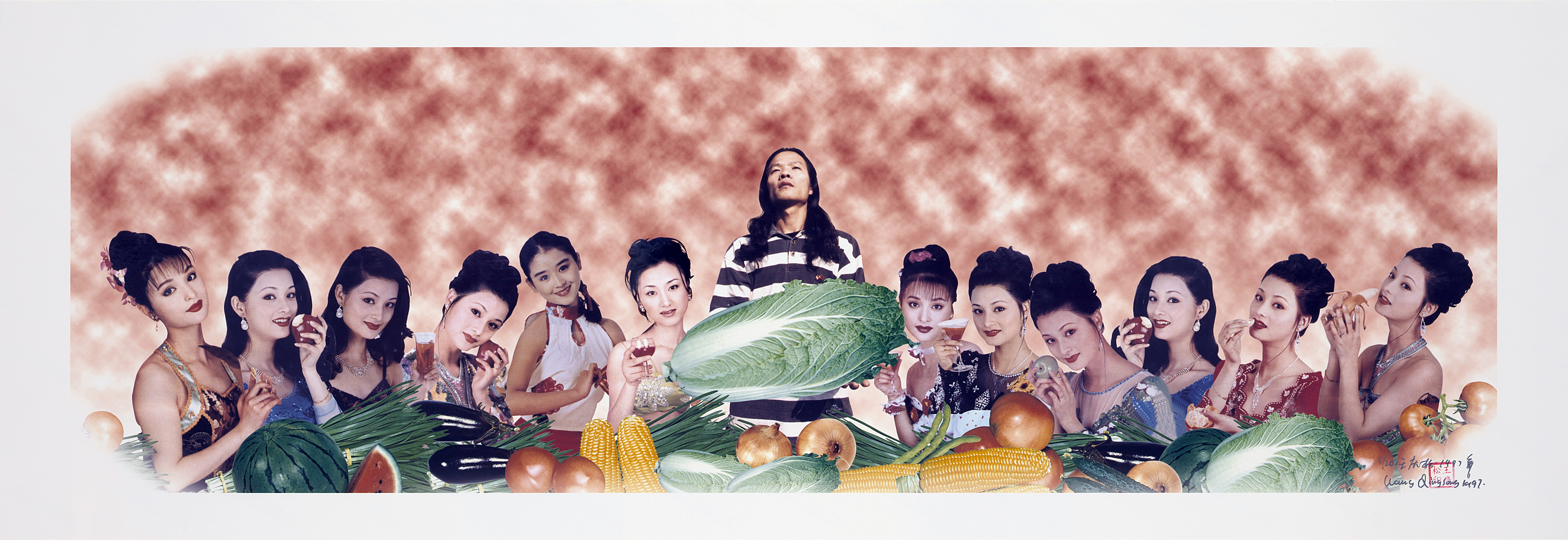
Wang Qingsong (Chinese, b. 1966)
Last supper
1997
Type C photograph, ed. 3/20
30.5 x 100.0cm
National Gallery of Victoria, Melbourne
Gift of Larry Warsh, 2016
© Courtesy of the artist
Last supper was one of a number of photographs commissioned for the exhibition Christian Dior and Chinese Artists that opened at the Ullens Center for Contemporary Art (UCCA), Beijing, in 2008. The work references the iconography of Western paintings of Christian subjects, in particular depictions of the Last Supper; however, in place of the twelve disciples Wang presents fashion models, and the simple meal traditionally depicted in Western art has been replaced with a feast of digitally enhanced, oversized, unnaturally perfect fruit and vegetables. The result is an image of affluence and excess.

Installation view of the exhibition Turning Points: Contemporary Photography from China at the National Gallery of Victoria, Melbourne showing at centre, Wang Qingsong’s Preincarnation (2002) and at right, Shi Guowei’s Cactus garden (2016)
Photo: Marcus Bunyan
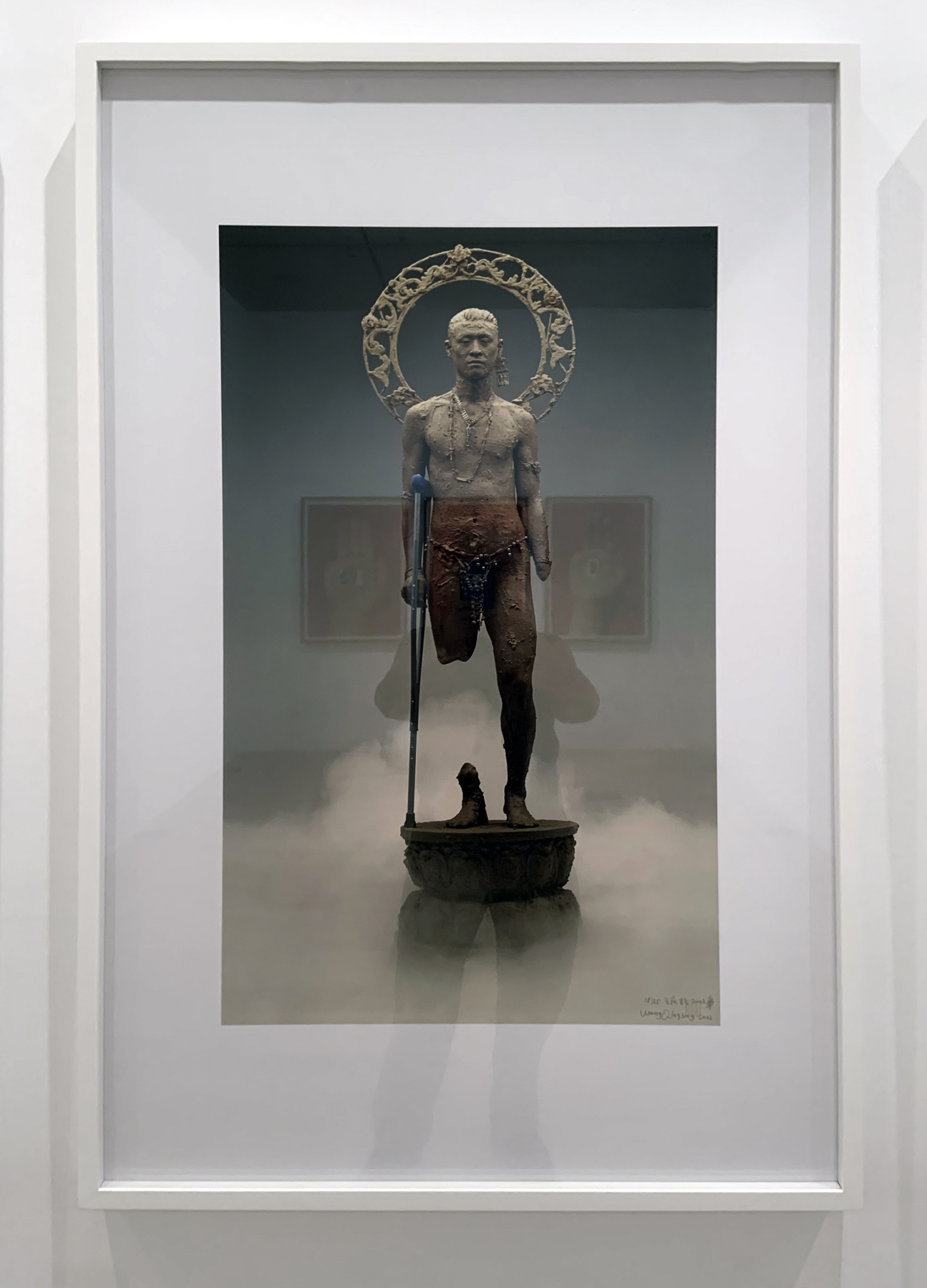
Installation view of the exhibition Turning Points: Contemporary Photography from China at the National Gallery of Victoria, Melbourne showing one image from Wang Qingsong’s Preincarnation (2002)
Photo: Marcus Bunyan
Wang Qingsong works in a theatrical style, constructing and photographing elaborate tableaux in which his models play the roles of characters from traditional Chinese stories and paintings, popular culture and Western historical painting. In the foreground of this work, men carry tools to vandalise or disassemble giant sacred ‘sculptures’ standing atop lotus thrones. The title suggests that the man has been reborn into the past, and upon arriving in Chinese pre-history, is set to destroy it in his relentless pursuit of materialism. This work alludes to China’s relationship with its early history, and the dismantling of tradition during a period of rampant consumerism and modernisation.

Installation view of the exhibition Turning Points: Contemporary Photography from China at the National Gallery of Victoria, Melbourne showing Shi Guowei’s Cactus garden (2016)
Photo: Marcus Bunyan

Shi Guowei (Chinese, b. 1977)
Cactus garden
2016
Gelatin silver photograph, colour dyes
Purchased NGV Foundation, 2017
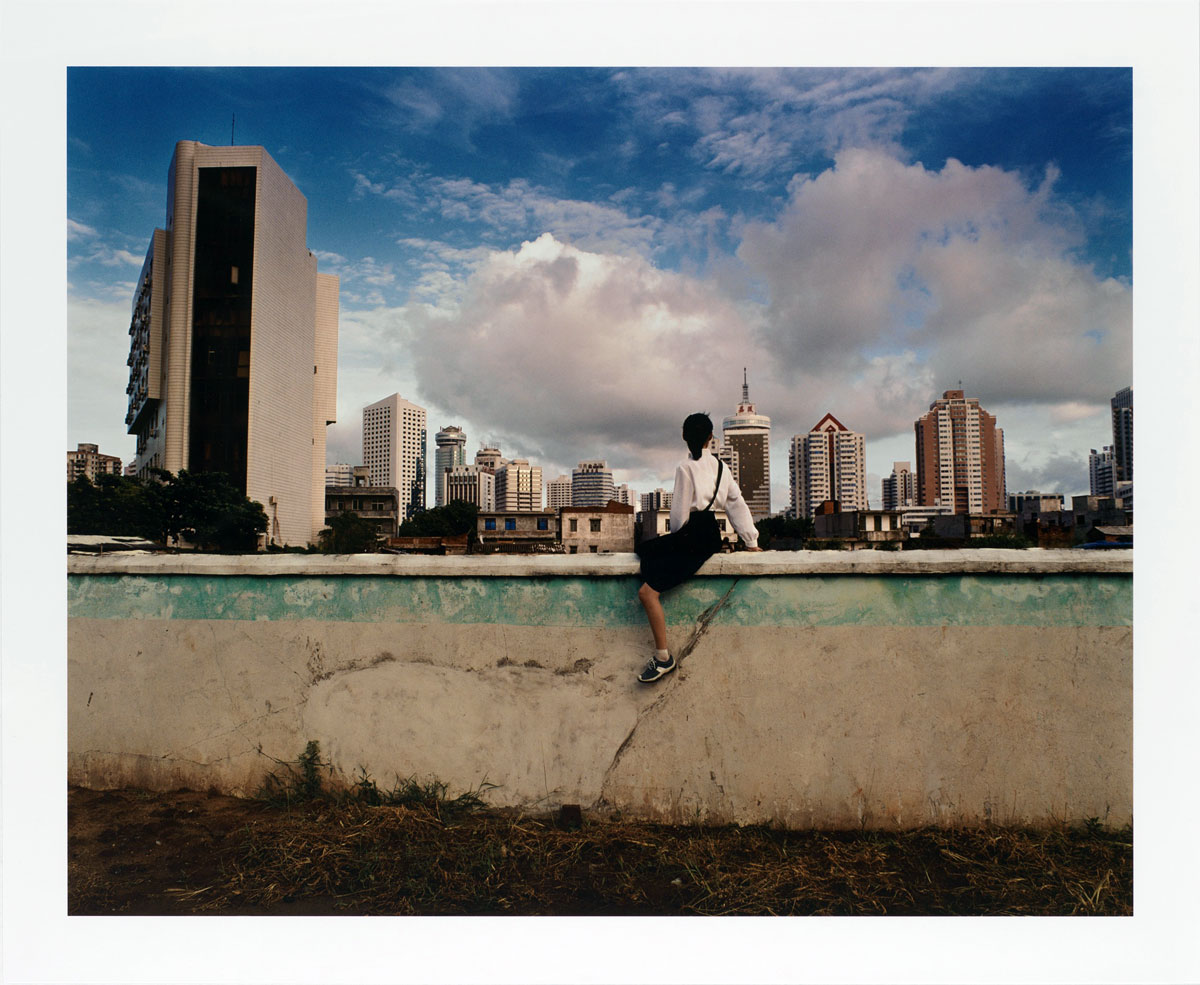
Shi Guowei’s subtly coloured image is created through the application of layered pigment to the surface of the photograph. In some areas of the work, the colour is applied with lifelike precision, in others it registers as being ‘not quite right’. His palette recalls that of early colour photographs in which the colour fades or shifts over time, creating a nostalgic quality; however, it also creates an awareness of the artificiality inherent in the scene. Although the planting in this cactus garden is ‘naturalistic’, it is clearly a constructed landscape, and not the wild arid landscape it would seem at first glance.


Installation view of the exhibition Turning Points: Contemporary Photography from China at the National Gallery of Victoria, Melbourne showing at top, Sheng Qi’s Memories (Mother), Memories (Me) and Memories (Mao) (2000)
Photos: Marcus Bunyan
Sheng Qi was a key member of the ’85 New Wave art movement in China that championed freedom of expression in the arts over state-approved Social Realism. He was deeply affected by the changed political climate following the Tiananmen Square protests of 1989, and responded in a physically direct and shocking way. He cut off the little finger of his left hand, buried it in a flowerpot, and went into self-imposed exile in Rome. When he returned to Beijing a decade later, he used his disfigured hand as the backdrop for a series of self-portraits that juxtapose his past and present.
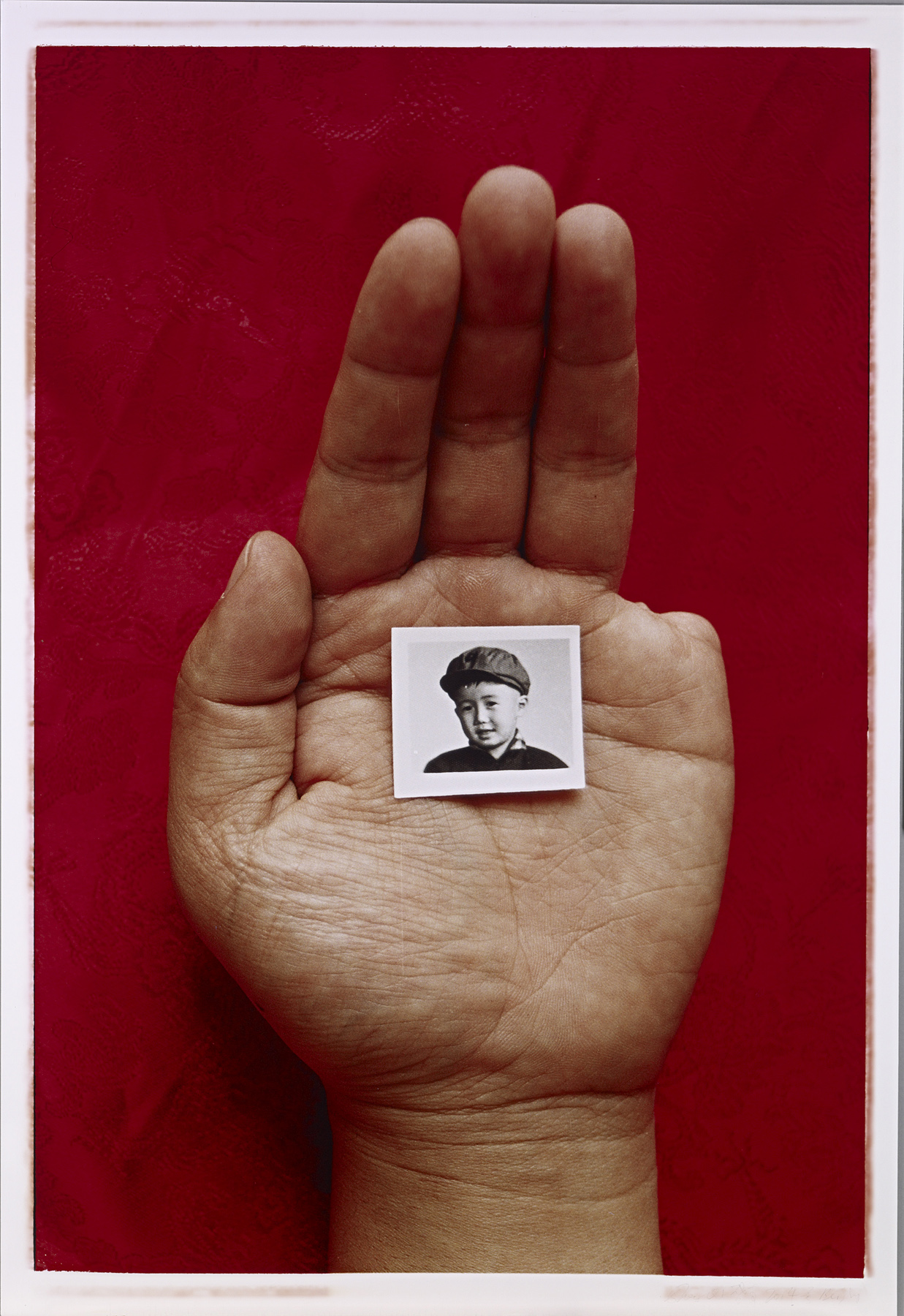
Sheng Qi (Chinese, b. 1965)
Memories (Me)
2000, printed 2004
Type C photograph, ed. 2/5
119.1 x 80.5cm irreg. (image) 126.9 x 86.9cm irreg. (sheet)
National Gallery of Victoria, Melbourne
Purchased, 2004
© Sheng Qi, courtesy of Red Gate Gallery, Beijing


Installation view of the exhibition Turning Points: Contemporary Photography from China at the National Gallery of Victoria, Melbourne showing at left in the top image, Wang Qingsong’s Another battle no. 3 (2001) and at right, Hong Hao’s My things no. 2 (2001-2002)
Photos: Marcus Bunyan

Wang Qingsong (Chinese, b. 1966)
Another battle no. 3
2001
Type C photograph, ed. 1/20
100 x 66cm
National Gallery of Victoria, Melbourne Gift of Larry Warsh, 2016
© Wang Qingsong
Wang Qingsong works in a theatrical style, constructing and photographing elaborate tableaux in which his models play the roles of characters from traditional Chinese stories and paintings, contemporary life, popular culture, and Western historical painting. In this work he shows a wounded soldier, trapped behind the battlelines, caught between gunfire and razor wire that is littered with soft-drink cans, one of the most common forms of litter found globally. In this highly theatrical image Wang has taken imagery from popular cinema and used it to highlight the challenges presented by Western-style consumerism.
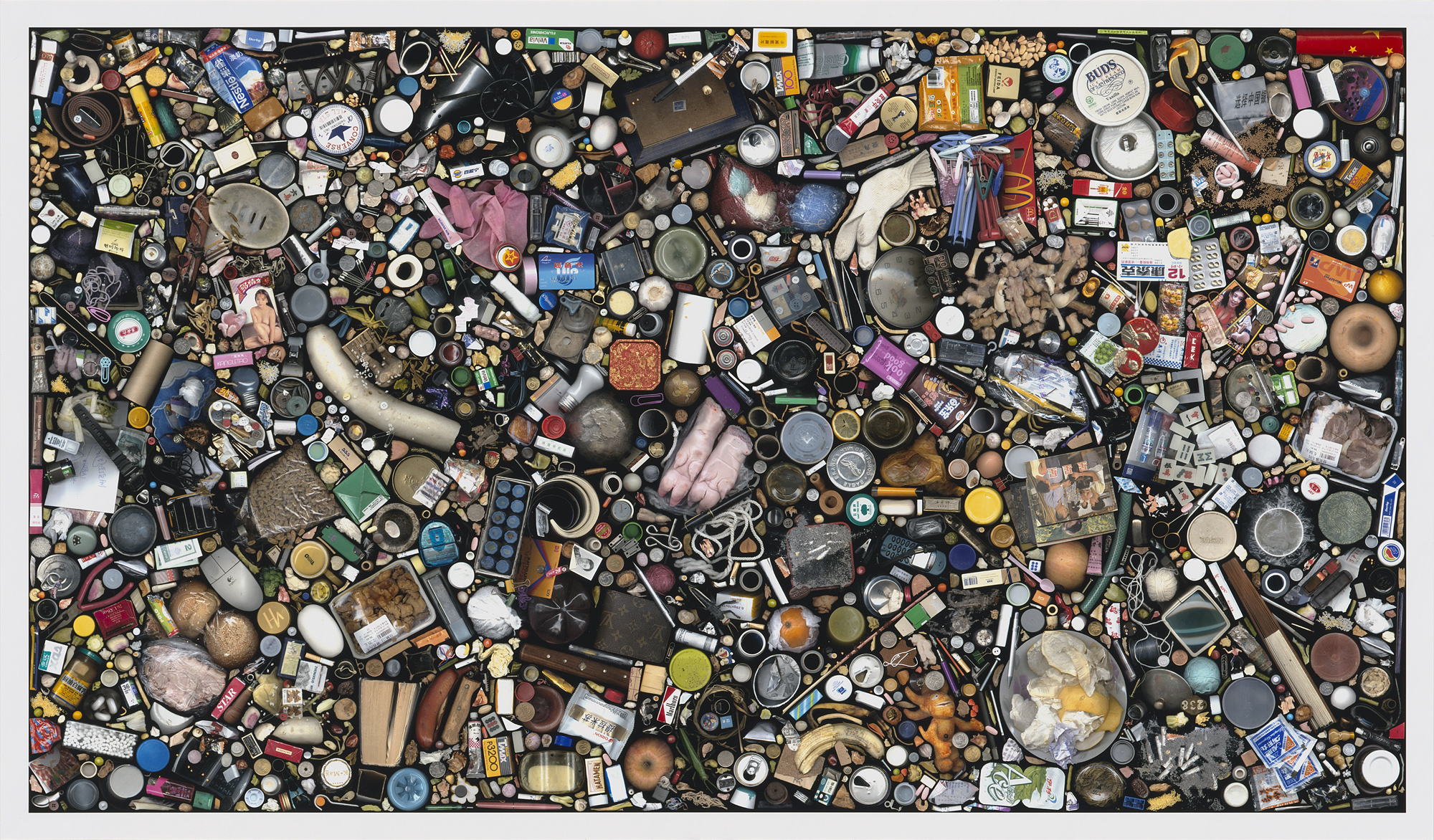
Hong Hao (Chinese, b. 1965)
My things no. 2
2001-02
Type C photograph, ed. 6/15
59.6 x 101.6cm
National Gallery of Victoria, Melbourne
Gift of Larry Warsh, 2016
© Courtesy of the artist
Completely filled from edge to edge with ordinary, domestic objects, this image is a visual archive of things used by the artist in everyday life. Describing his creative process, Hong Hao writes, ‘Day by day, I put my daily consumed objects into a scanner piece by piece, like keeping a visual diary. After scanning the original objects, I’ll save them in digital forms and categorise these digital files into different folders [on] my PC, in order to make a collage of them later on. This task, like a yogi’s daily practice, has become a habit in my day-to-day life as well as a tool to observe the human condition in contemporary consumer society’.

Installation view of the exhibition Turning Points: Contemporary Photography from China at the National Gallery of Victoria, Melbourne showing Wang Jinsong’s One hundred signs of demolition #1980 (1998)
Photo: Marcus Bunyan

Wang Jinsong (Chinese, 1963)
One hundred signs of demolition #1980
1998
Type C photograph ed. 22/30
National Gallery of Victoria, Melbourne
Gift of Larry Warsh, 2016
© Courtesy of the artist

Wang Jinsong (Chinese, 1963)
One hundred signs of demolition #1995
1998
Type C photograph ed. 22/30
National Gallery of Victoria, Melbourne
Gift of Larry Warsh, 2016
© Courtesy of the artist
The two photographs from the series One Hundred Signs of Demolition show the Chinese character ‘chai’, meaning ‘demolition’, that is commonly painted on the walls of buildings earmarked for destruction. For Wang Jinsong it has become a symbol of the inexorable push for urban reconstruction. In his photographs ‘chai’ came to stand for the loss of the ancient city, where buildings were once on a domestic scale and constructed to facilitate interaction in communal space, and their replacement with more socially isolating multistorey tower blocks.

Hai Bo (Chinese, b. 1962)
I am Chairman Mao’s Red Guard
2000
Type C photograph, ed. 9/18
40.6 x 60.9cm
National Gallery of Victoria, Melbourne
Gift of Larry Warsh, 2016
© Courtesy of the artist
Hai Bo’s paired portraits illustrate the cultural shifts that have occurred over forty years as people in China have become increasingly able to show their individuality. In this image, a photograph of a young woman proudly wearing the uniform of the student paramilitary movement, known as the Red Guard, and holding Mao’s Quotations from Chairman Mao Zedong (commonly known as the Little Red Book) is shown counterpointed by a contemporary picture of the same person, now a smiling middle-aged woman wearing a floral dress. Such a garment would have been unthinkable – and unattainable – forty years earlier.

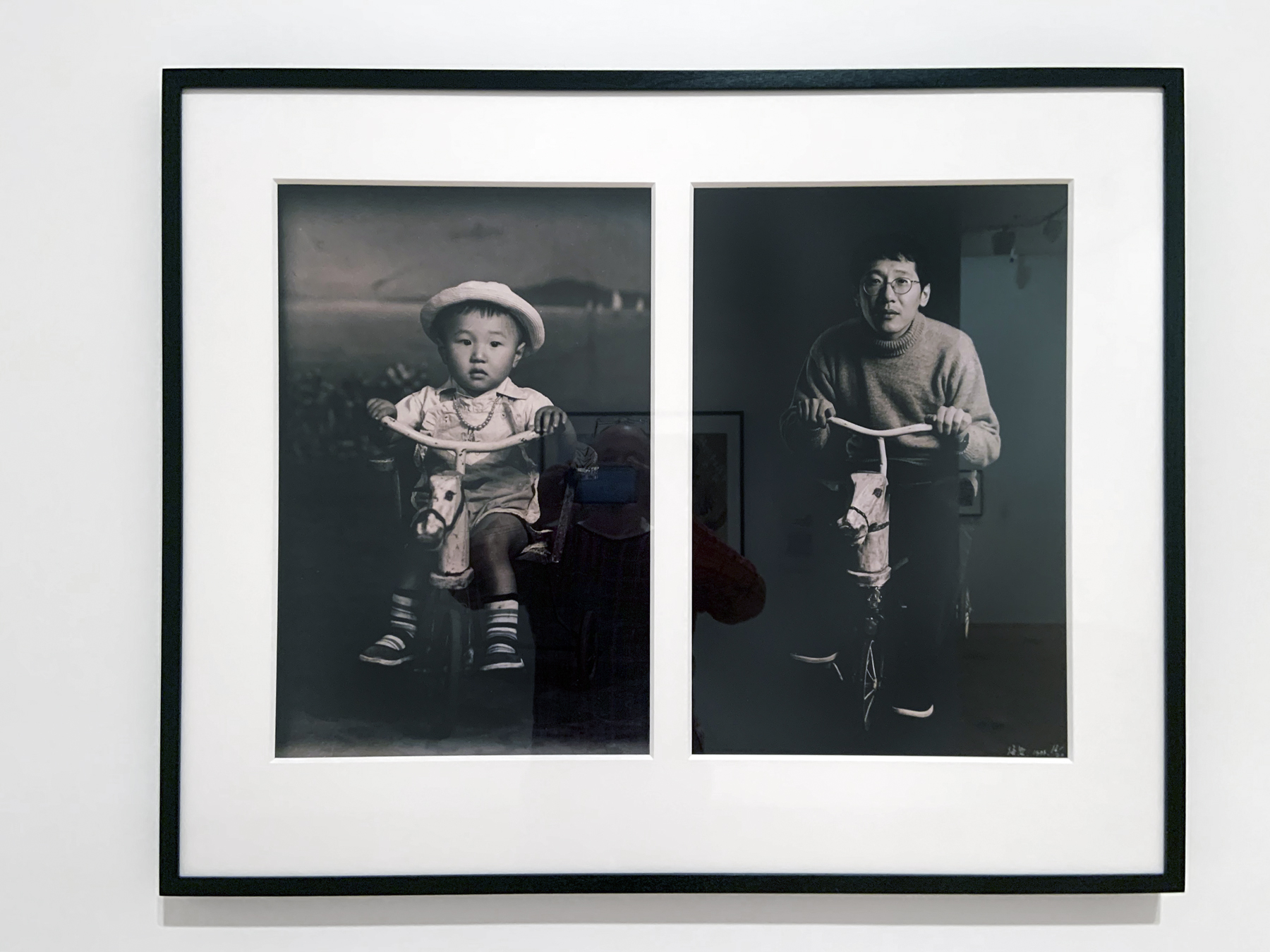
Installation view of the exhibition Turning Points: Contemporary Photography from China at the National Gallery of Victoria, Melbourne showing Hai Bo’s Wood horse (1999)
Photos: Marcus Bunyan

Hai Bo (Chinese, 1962)
Wood horse
1999
Gelatin silver photograph ed. 16/20
National Gallery of Victoria, Melbourne
Gift of Larry Warsh, 2016
© Courtesy of the artist
NGV International
180 St Kilda Road
Opening hours:
Daily 10am – 5pm

![Felix Gonzalez-Torres (American born Cuba, 1957–1996) '[No Title]' 1985 from the exhibition 'Between Here and There: Passages in Contemporary Photography' at The Metropolitan Museum of Art](https://artblart.com/wp-content/uploads/2011/02/felix-gonzalez-torres-no-title-1985.jpg "Felix Gonzalez-Torres (American born Cuba, 1957–1996) '[No Title]' 1985 from the exhibition 'Between Here and There: Passages in Contemporary Photography' at The Metropolitan Museum of Art")


 Art Blart _ art and cultural memory archive
You must be logged in to post a comment.