Exhibitions: ‘Australian Airliners Across the Pacific’, ‘Airmail Down Under’ and ‘Flying the Southern Cross Route: Seventy-Five years of Australian Commercial Air Service to North America’ at SFO Museum, San Francisco international airport

Australian Airliners Across the Pacific exhibition dates: 4th March, 2021 – 28th November, 2022

International Terminal: Aviation Museum & Library

Airmail Down Under exhibition dates: 4th March, 2021 – 2nd December, 2022

International Terminal: Aviation Museum & Library

Flying the Southern Cross Route: Seventy-Five years of Australian Commercial Air Service to North America exhibition dates: 8th January, 2022 – 5th March, 2023

International Terminal: Aviation Museum & Library


Australian Airliners Across the Pacific
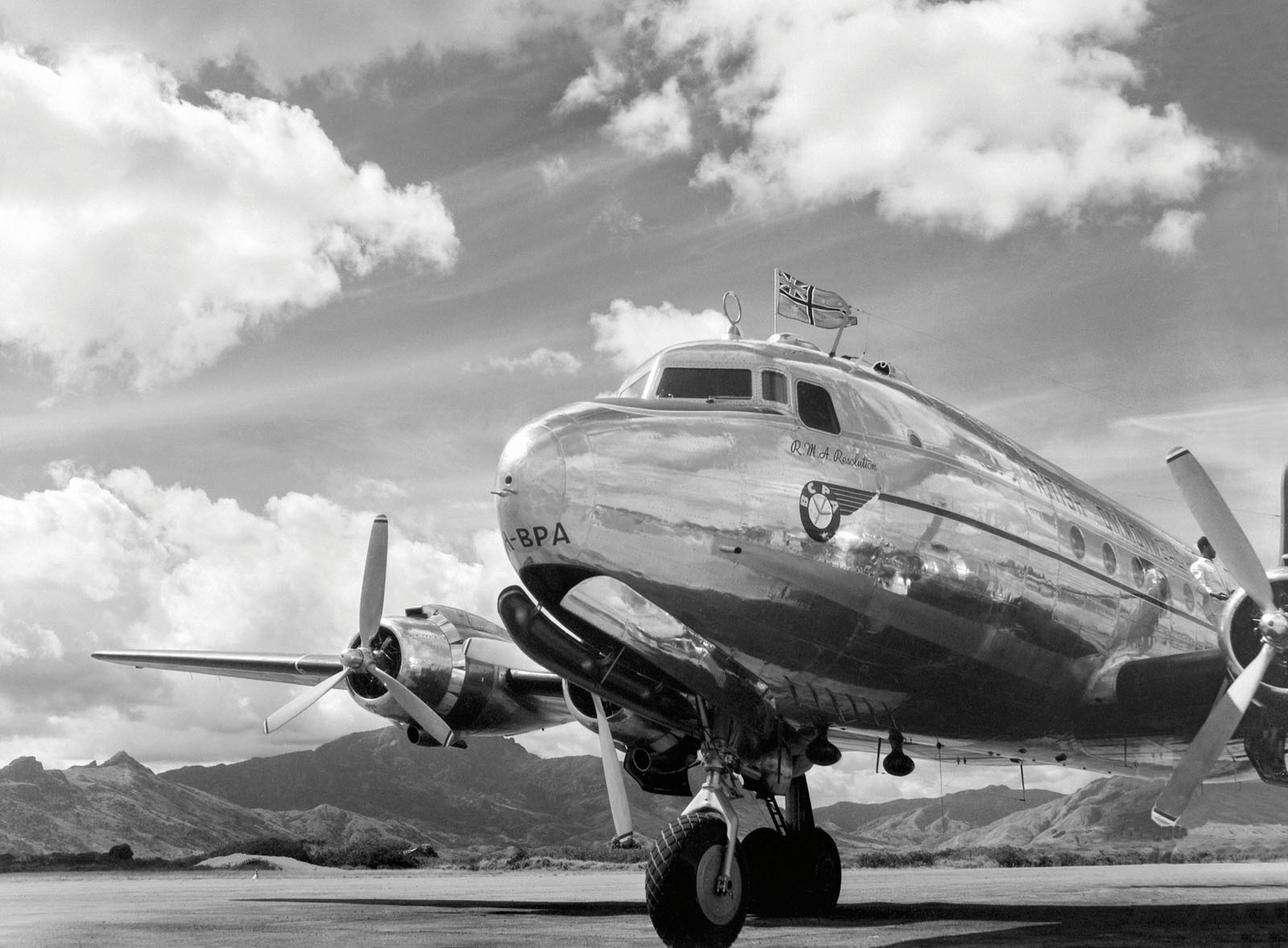
 

Anonymous photographer. 'British Commonwealth Pacific Airways (BCPA) Douglas DC-4 R.M.A. Resolution at Nadi Airport, Fiji' 1948 from the exhibition 'Australian Airliners Across the Pacific' at SFO Museum, San Francisco international airport, March 2021 - November 2022


Anonymous photographer
British Commonwealth Pacific Airways (BCPA) Douglas DC-4 R.M.A. Resolution at Nadi Airport, Fiji
1948
Gelatin silver photograph
Courtesy AussieAirliners.org and Whites Aviation via Sheehan Collection


The first leg of a flight from Australia to the United States was from Sydney to Nadi, in Fiji. The journey was just under two thousand miles and took about nine hours.


I wholeheartedly commend the SFO Museum for the exhibitions they put on. The themes of their exhibitions are always interesting, eclectic and memorable.

As with my recent posting on their exhibition Japonisme, other current exhibitions include fascinating topics such as The Victorian Papered Wall and California Modernist Women: Groundbreaking Creativity … and the photographs used to illustrate the exhibitions online are always so polished and professional.

While two of the exhibitions in this posting have already finished, the exhibition Flying the Southern Cross Route: Seventy-Five years of Australian Commercial Air Service to North America continues until 5th March 2023. Viewing the history of air routes across the Pacific Ocean to the United States recorded through photographs, objects, posters and attire makes you realise – back in those early days of trans-Pacific flight – how long it took to get anywhere; how glamorous, class-orientated and exclusive flying was in those days; and how precarious and dangerous flying in twin turbo-prop aircraft or seaplanes could be.

Dr Marcus Bunyan


Many thankx to the SFO Museum for allowing me to publish the photographs in the posting. Please click on the photographs for a larger version of the image.
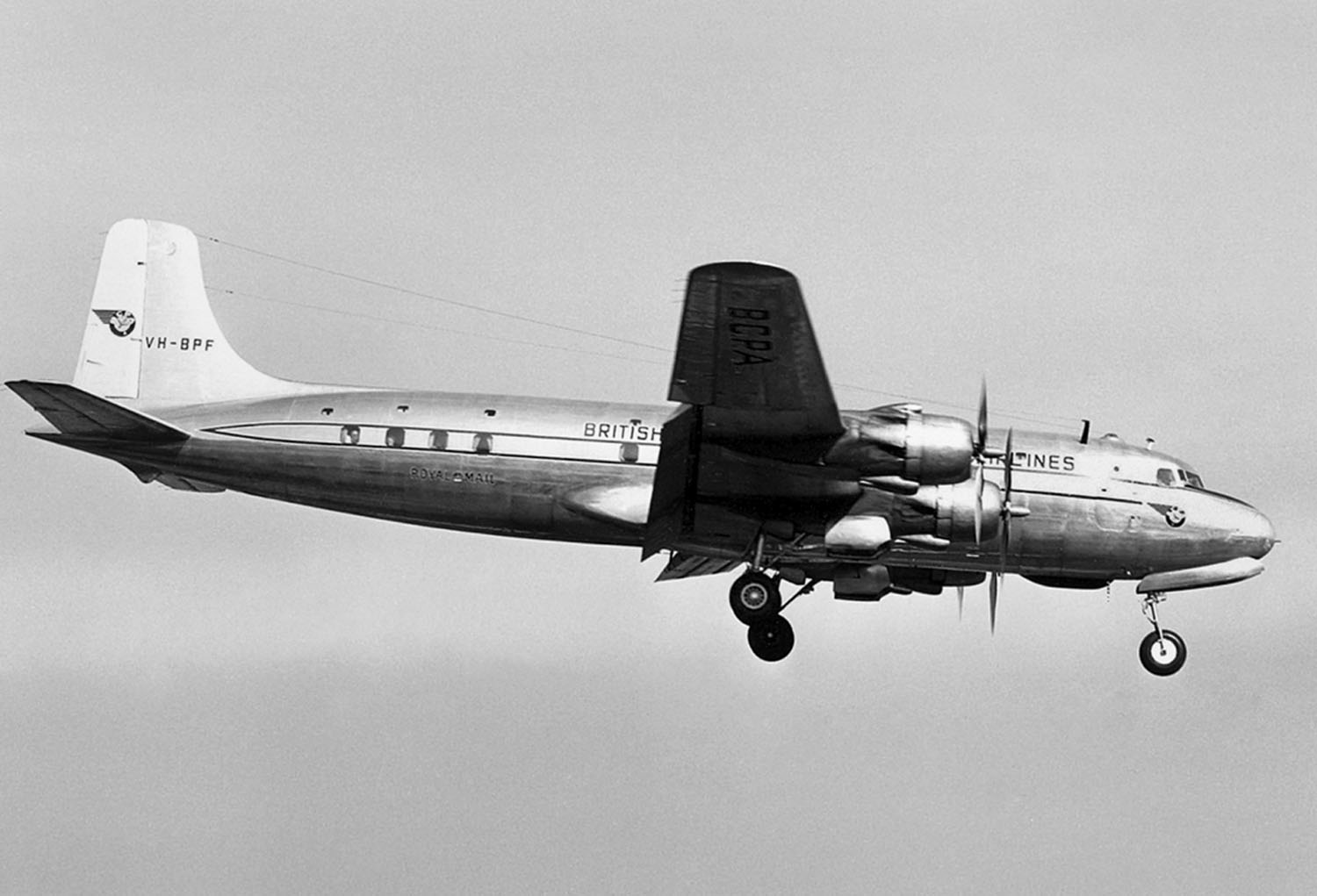


Anonymous photographer. 'British Commonwealth Pacific Airways (BCPA) Douglas DC-6 R.M.A. Endeavor on approach to San Francisco' 1952 from the exhibition 'Australian Airliners Across the Pacific' at SFO Museum, San Francisco international airport, March 2021 - November 2022


Anonymous photographer
British Commonwealth Pacific Airways (BCPA) Douglas DC-6 R.M.A. Endeavor on approach to San Francisco
1952
Gelatin silver photograph
Courtesy AussieAirliners.org and W. Larkins Collection
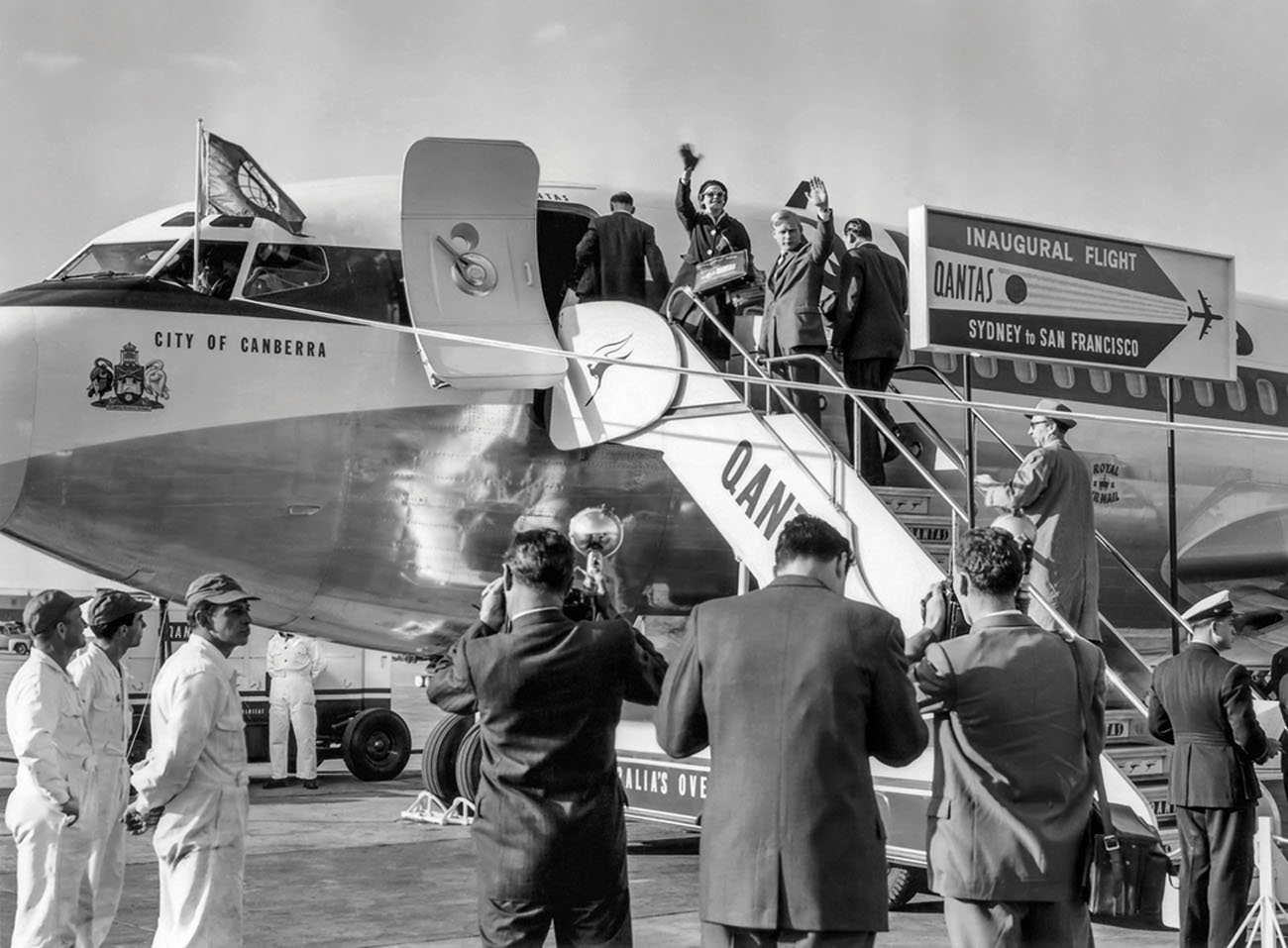
 

Qantas Airways Boeing 707 City of Canberra on inaugural Sydney to San Francisco flight 1959 from the exhibition 'Australian Airliners Across the Pacific' at SFO Museum, San Francisco international airport, March 2021 - November 2022


Anonymous photographer
Qantas Airways Boeing 707 City of Canberra on inaugural Sydney to San Francisco flight
1959
Gelatin silver photograph
Courtesy Qantas Heritage Collection


In the wake of World War II, Australian airline companies embarked on the task establishing an air route across the Pacific Ocean to the United States. Initially, the long, island-hopping journey stopped at several wartime airfields along the way. Australians dubbed this transpacific airway the Southern Cross Route, named after Charles Kingsford-Smith’s aircraft the Southern Cross, the first to make the long flight between the two countries in 1928. Smith had named his aircraft after one of the signature constellations of the southern hemisphere. The first passenger flights in the late 1940s lasted almost two days and made three stops along the way. In the decades that followed, faster and longer-ranged aircraft improved the experience of the flight. Today, non-stop air travel between the two countries requires only fifteen hours of flight. This exhibition illustrates the evolution of the aircraft and the passenger service through images drawn from the collections of the Qantas Heritage Collection and AussieAirliners.org.

Text from the SFO Museum website
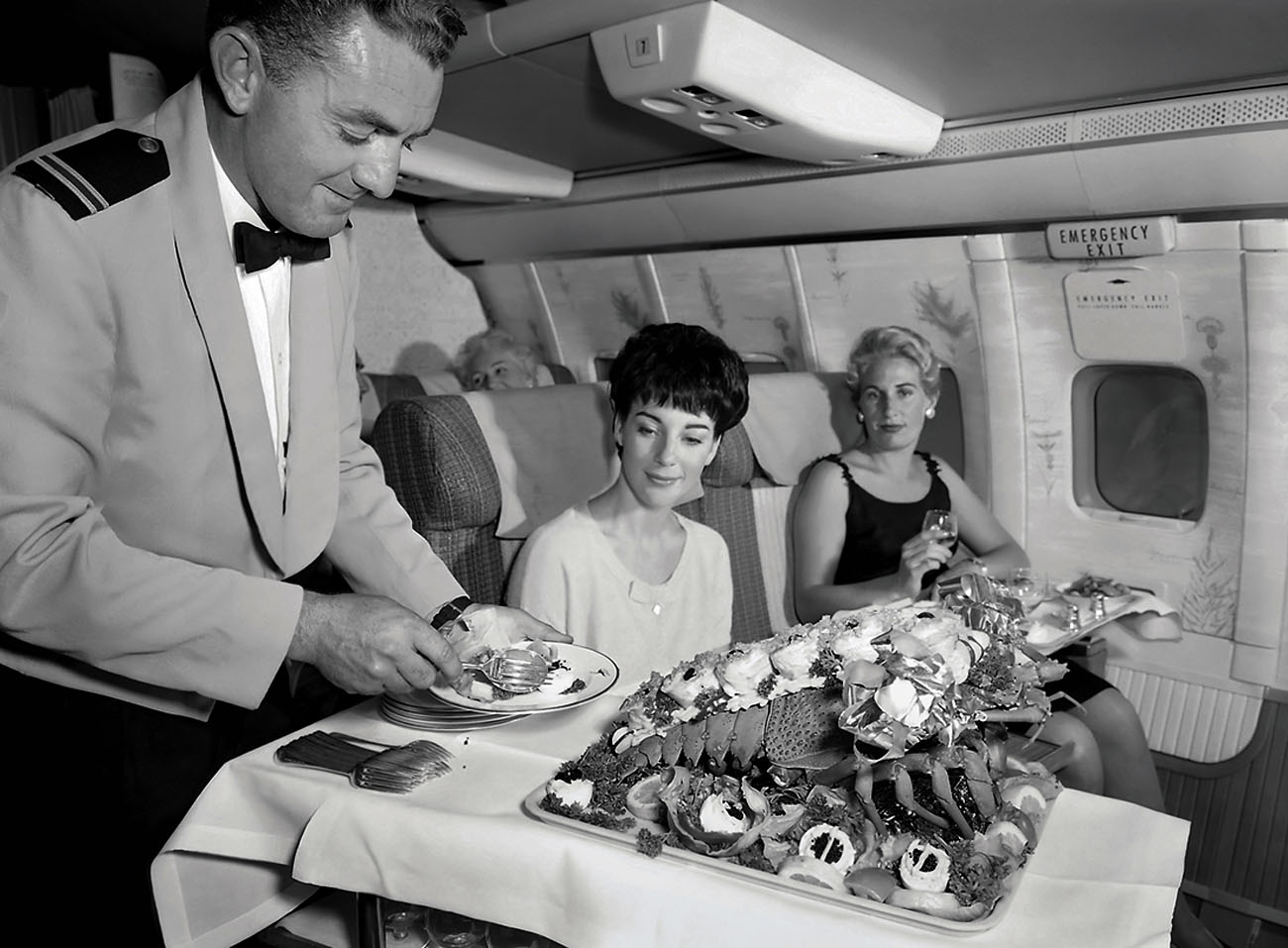
 

Anonymous photographer. 'Qantas Airways first class "Blue Ribbon Service" aboard Boeing 707s' c. 1960


Anonymous photographer
Qantas Airways first class “Blue Ribbon Service” aboard Boeing 707s
c. 1960
Courtesy Qantas Heritage Collection
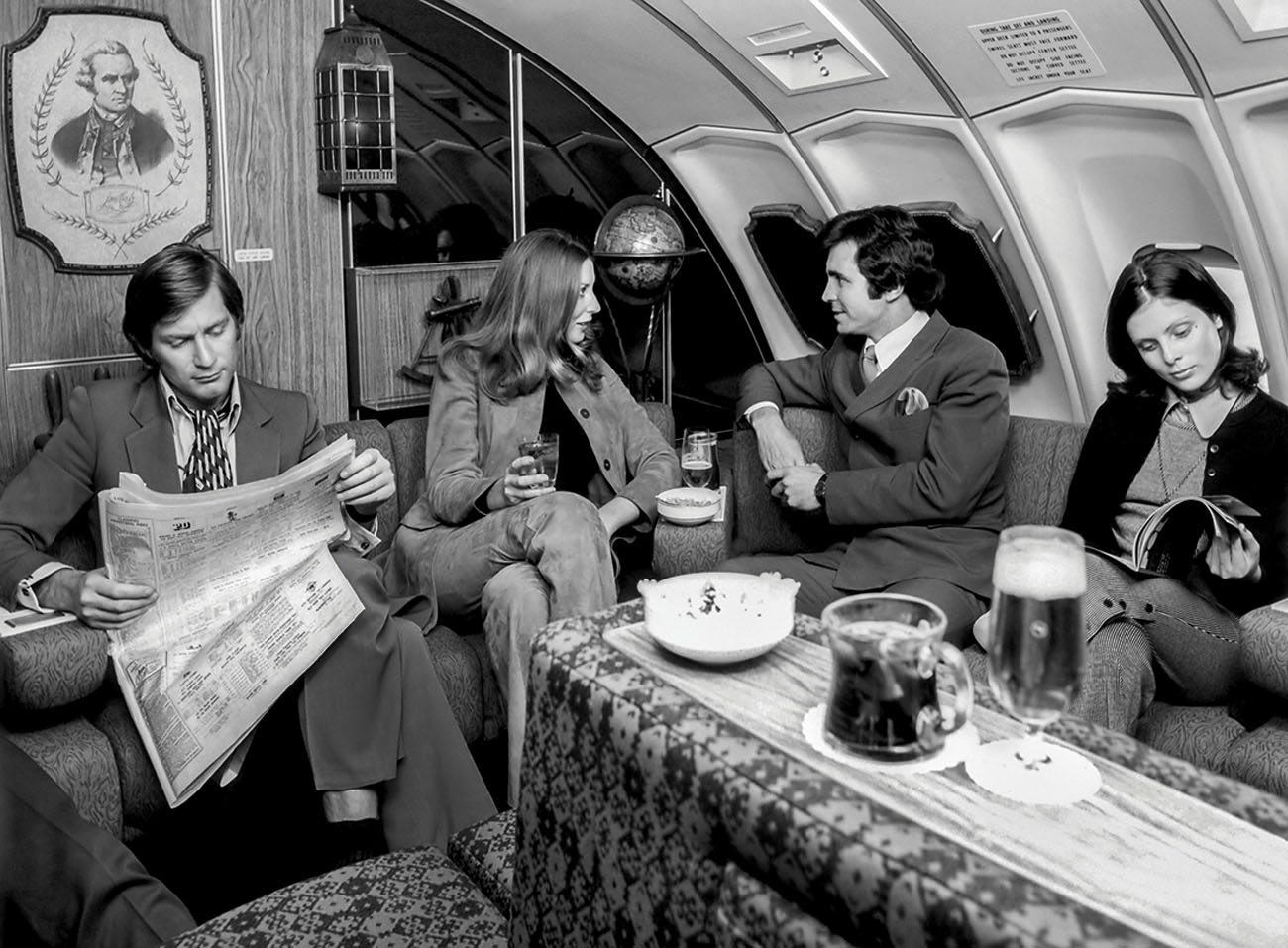
 

Anonymous photographer. 'Qantas Airways upper deck "Captain Cook Lounge" aboard Boeing 747s' Early 1970s


Anonymous photographer
Qantas Airways upper deck “Captain Cook Lounge” aboard Boeing 747s
Early 1970s
Gelatin silver photograph
Courtesy Qantas Heritage Collection
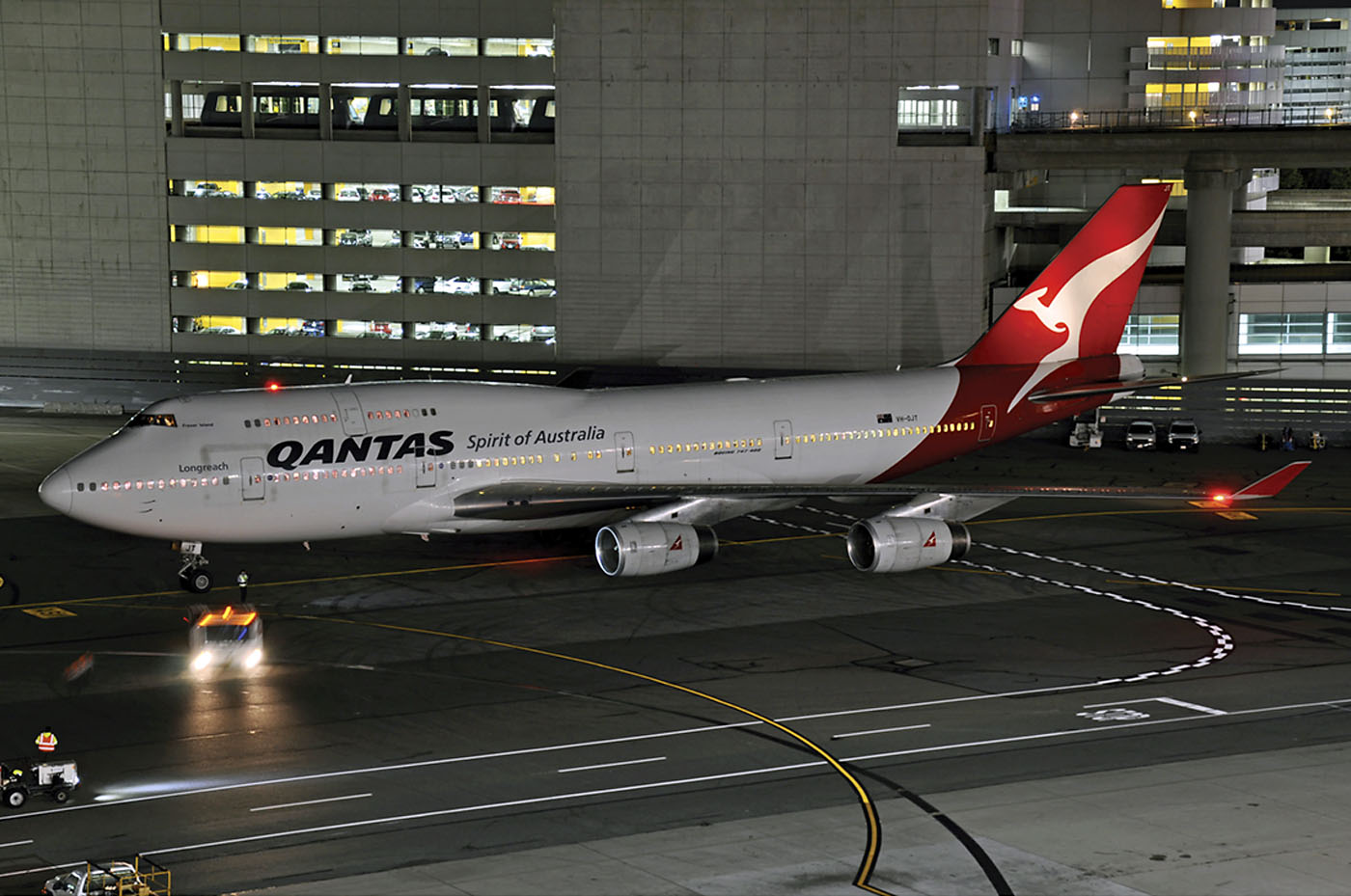
 

Anonymous photographer. 'Qantas Airways Boeing 747-400ER Fraser Island at San Francisco International Airport' 2018


Anonymous photographer
Qantas Airways Boeing 747-400ER Fraser Island at San Francisco International Airport
2018
Courtesy AussieAirliners.org and G. Snyder


Although a common and beloved site for decades, Qantas is taking advantage of the lull caused by the COVID pandemic to accelerate the retirement of their 747 fleet. The aircraft will be replaced by more efficient and economical twin-engine wide-body models.


Flying the Southern Cross Route: Seventy-Five years of Australian Commercial Air Service to North America
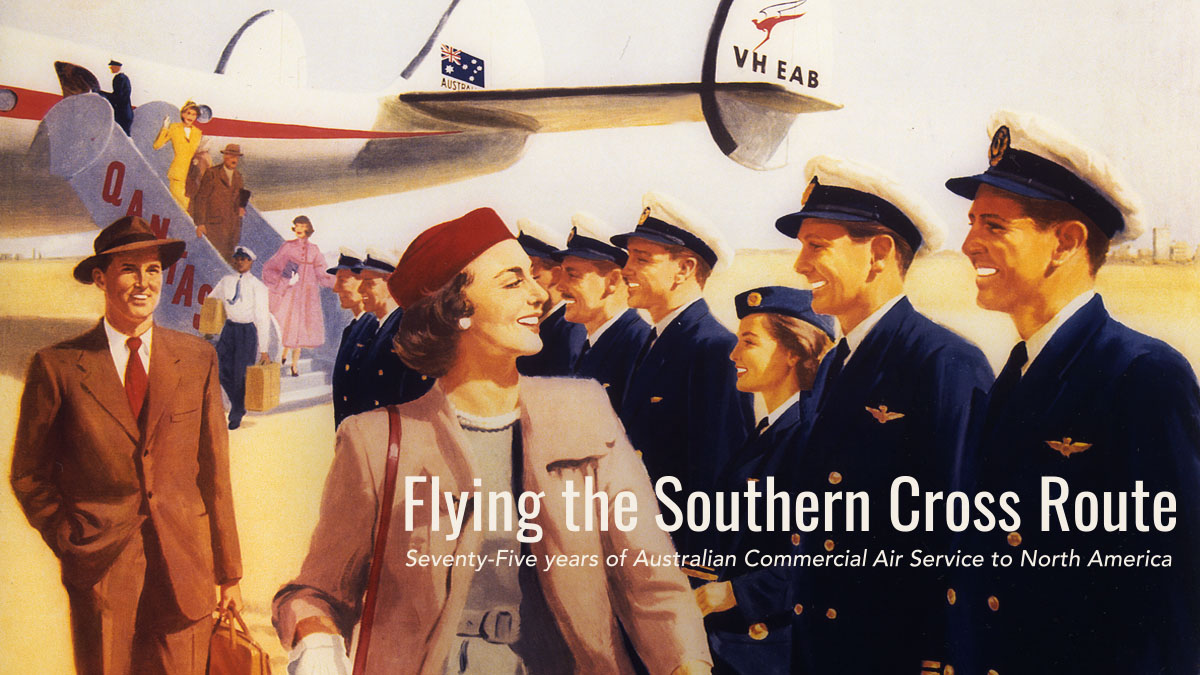
 

'Qantas Empire Airways advertisement' 1950s from the exhibition 'Flying the Southern Cross Route: Seventy-Five years of Australian Commercial Air Service to North America' at at SFO Museum, San Francisco international airport, Jan 2022 - March 2023


Qantas Empire Airways advertisement
1950s
Paper, ink
Collection of SFO Museum
Gift of Qantas Airways Limited


Following the historic first flight from North America to Australia by Charles Kingsford Smith and crew in 1928, the transpacific “Southern Cross” route – named after the aircraft they flew, the Fokker F.VIIb/3m Southern Cross – received worldwide fame. After World War II, BCPA (British Commonwealth Pacific Airlines) and ANA (Australian National Airways) commenced commercial air services on their branded “Southern Cross Route” between Australia and San Francisco via Fiji and Hawai’i. When Qantas Empire Airways acquired BCPA in 1954, the airline assumed operations of the route. Since then, Qantas has continuously offered premier air service between the two continents on the most advanced airliners of the day. Through a diverse collection of airliner models, promotional items, meal service wares, cabin crew uniforms, and photographs, Flying the Southern Cross Route presents a legacy of Australian air service on this long celebrated route that connects two diverse regions and both hemispheres.

Text from the SFO Museum website
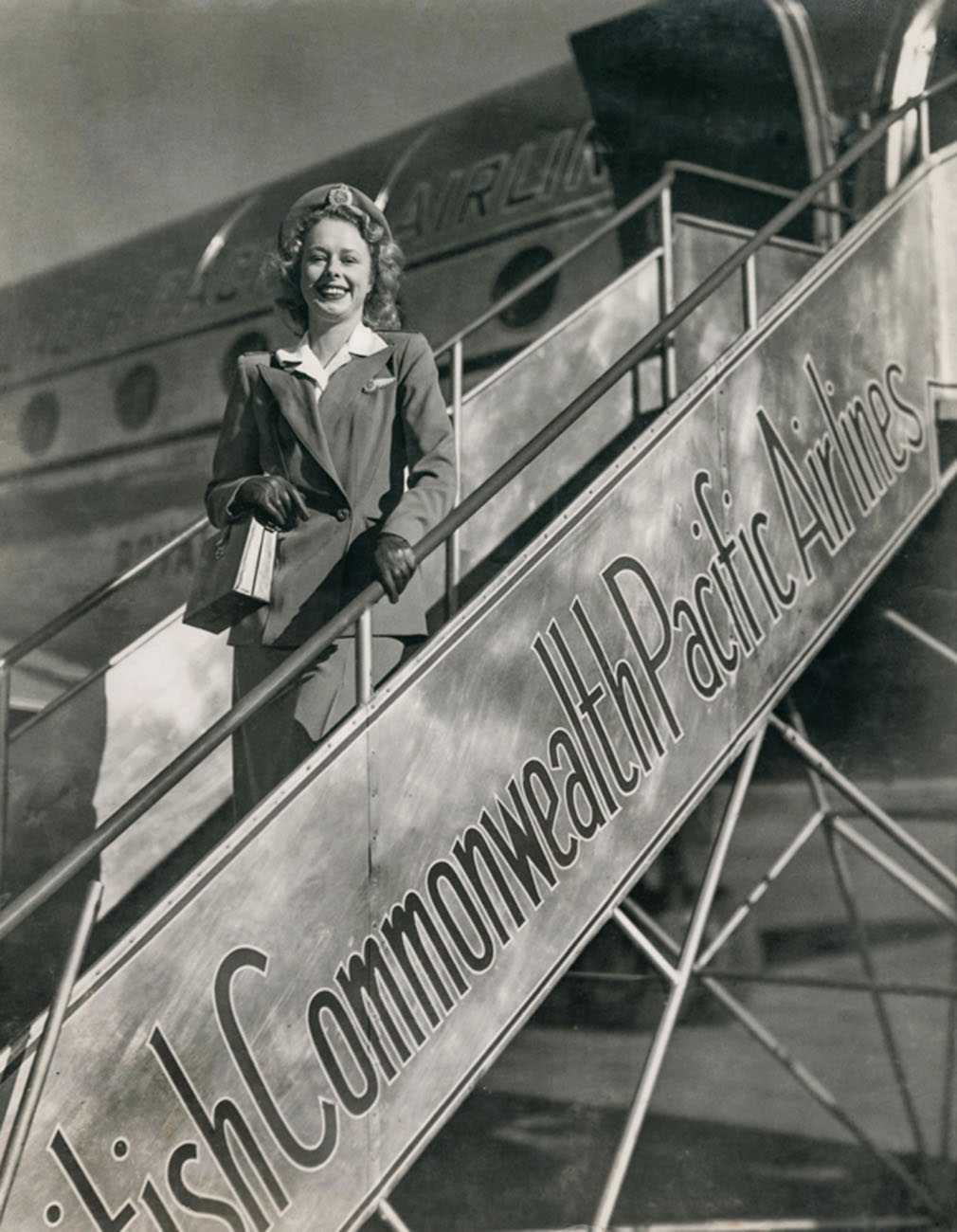
 

Anonymous photographer. 'BCPA (British Commonwealth Pacific Airlines) stewardess Daughne Kelpe on the stairs next to a BCPA Douglas DC-4' Late 1940s from the exhibition 'Flying the Southern Cross Route: Seventy-Five years of Australian Commercial Air Service to North America' at at SFO Museum, San Francisco international airport, Jan 2022 - March 2023


Anonymous photographer
BCPA (British Commonwealth Pacific Airlines) stewardess Daughne Kelpe on the stairs next to a BCPA Douglas DC-4
Late 1940s
Gelatin silver photograph
Qantas Heritage Collection
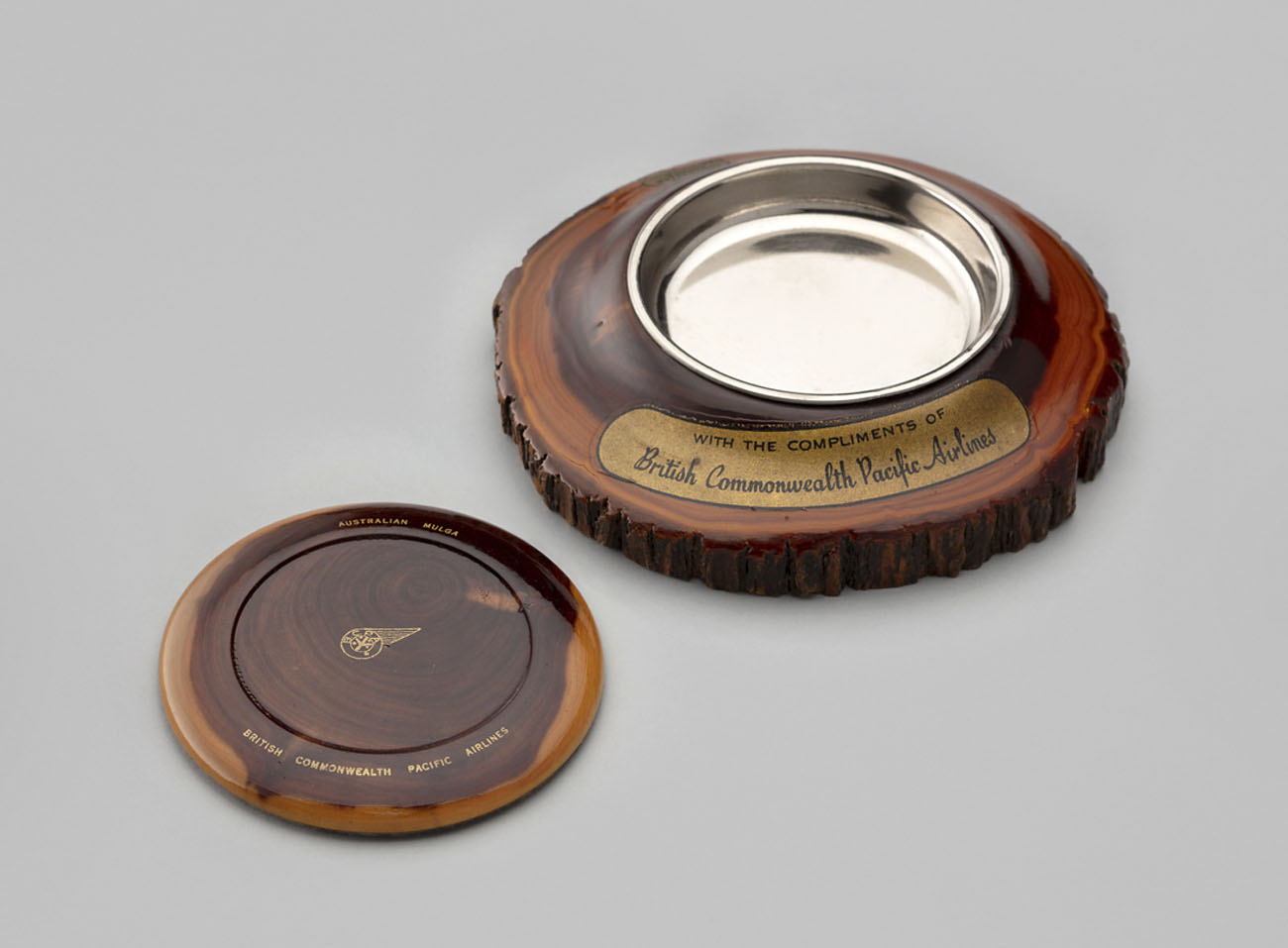
 

'BCPA (British Commonwealth Pacific Airlines) coaster and ashtray' c. 1950 from the exhibition 'Flying the Southern Cross Route: Seventy-Five years of Australian Commercial Air Service to North America' at at SFO Museum, San Francisco international airport, Jan 2022 - March 2023


BCPA (British Commonwealth Pacific Airlines) coaster and ashtray
c. 1950
Wood, paint, paper, metal, ink
SFO Museum
Coaster: gift of Thomas G. Dragges
Ashtray: gift of Walton F. Kemmerle
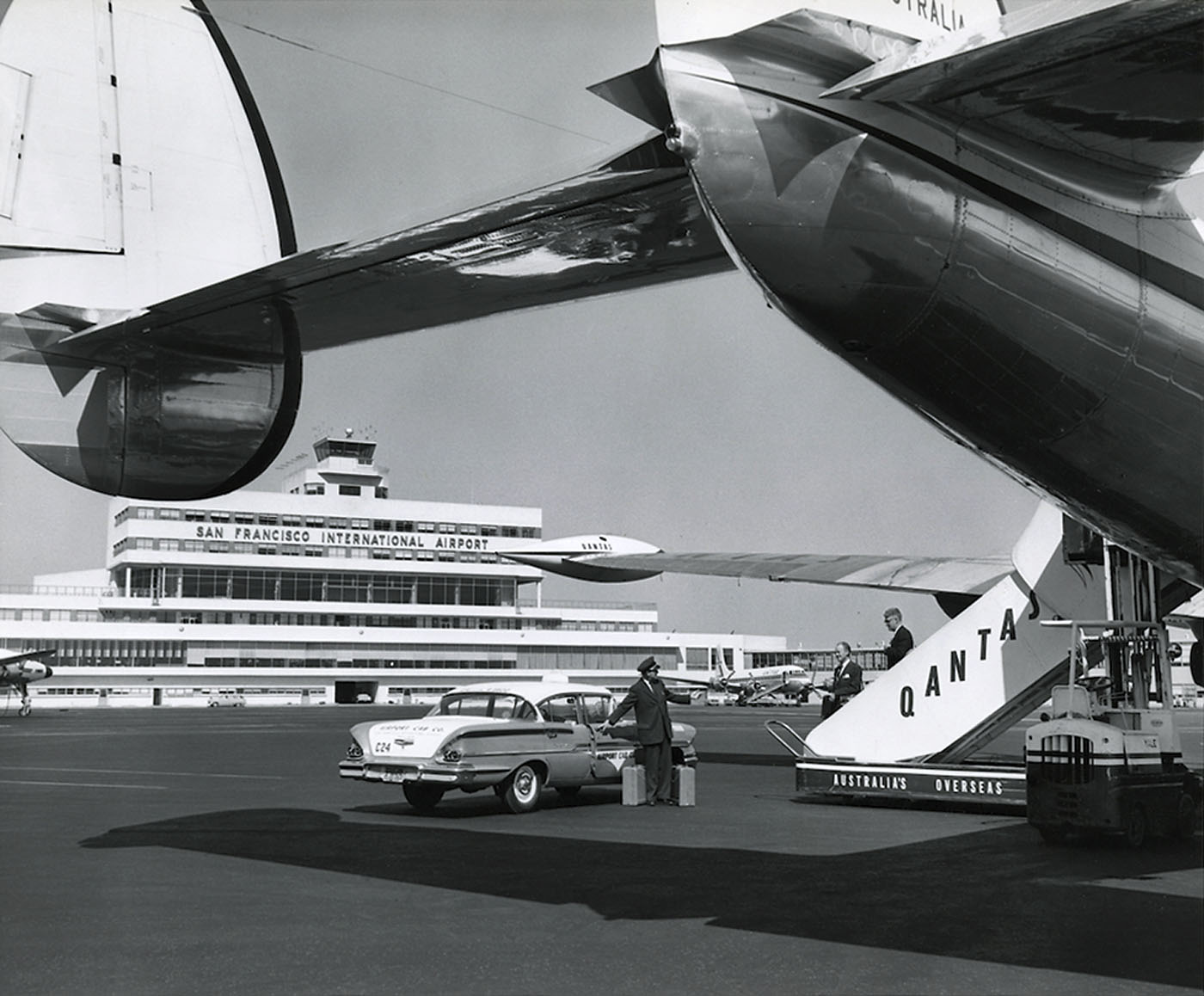
 

Anonymous photographer. 'Qantas Empire Airways Lockheed L-1049 Super Constellation at San Francisco International Airport' c. 1958


Anonymous photographer
Qantas Empire Airways Lockheed L-1049 Super Constellation at San Francisco International Airport
c. 1958
Gelatin silver photograph
Collection of SFO Museum
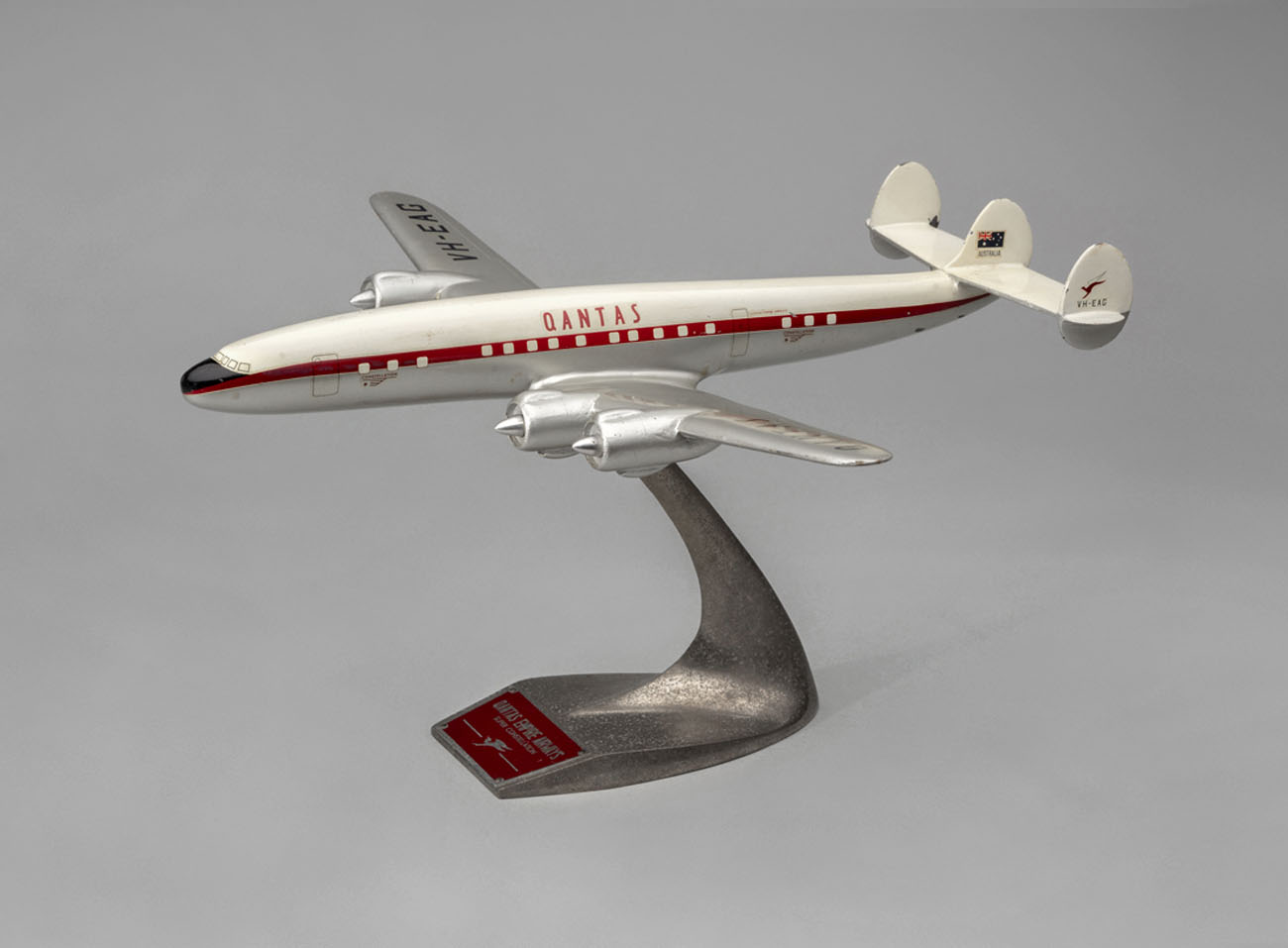
 

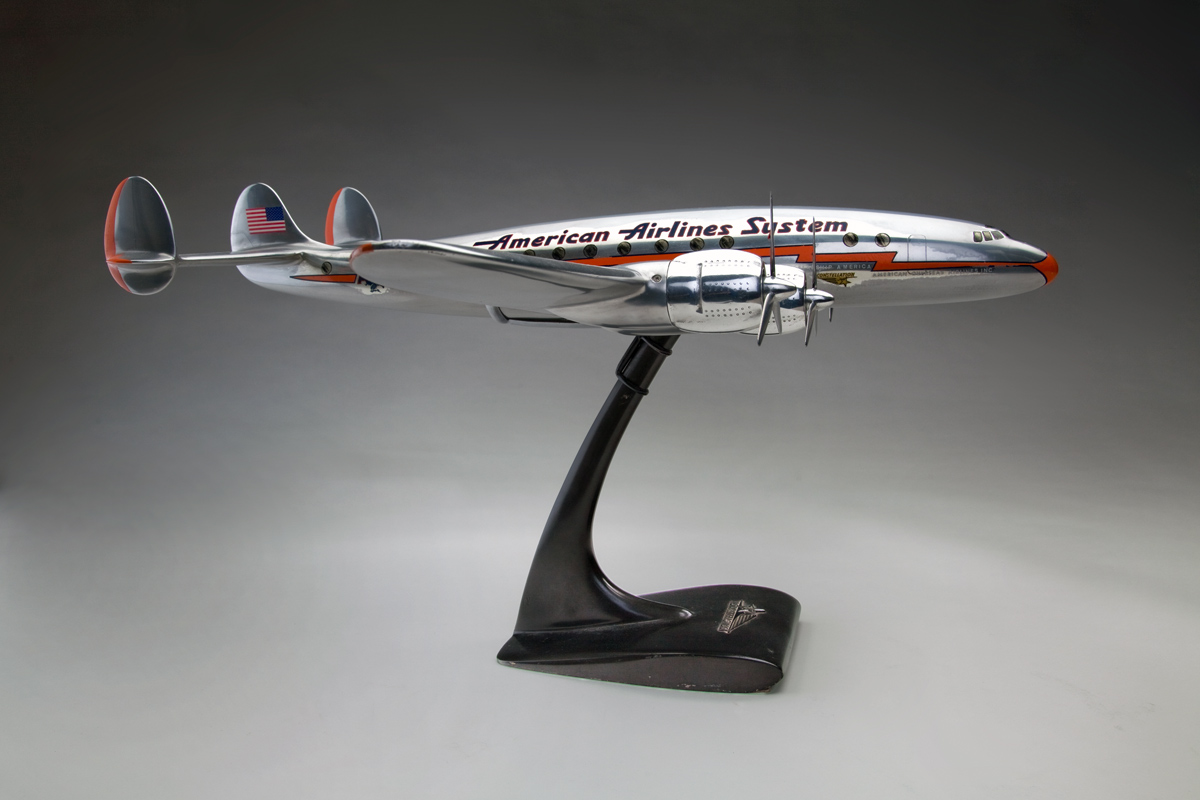
'Qantas Empire Airways Lockheed L-1049 Super Constellation model aircraft' 1950s


Qantas Empire Airways Lockheed L-1049 Super Constellation model aircraft
1950s
Raise Up, Rotterdam, Holland
Scale 1:72
Metal, paint
Courtesy of Anthony J. Lawler
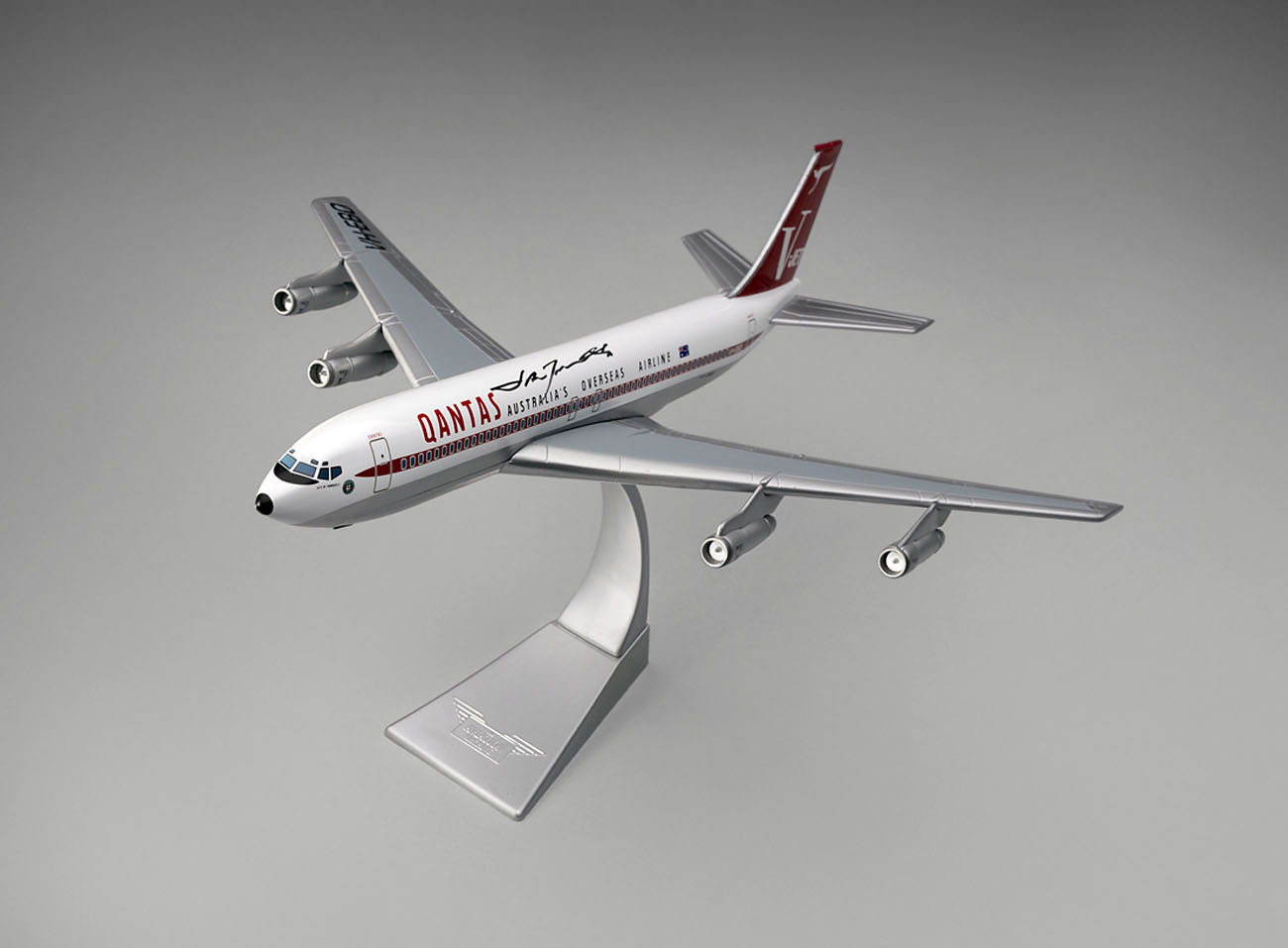
 

'Qantas Airways Boeing 707 model aircraft' c. 2006


Qantas Airways Boeing 707 model aircraft
c. 2006
Scale 1:200
Corgi Classics
Metal, paint
SFO Museum
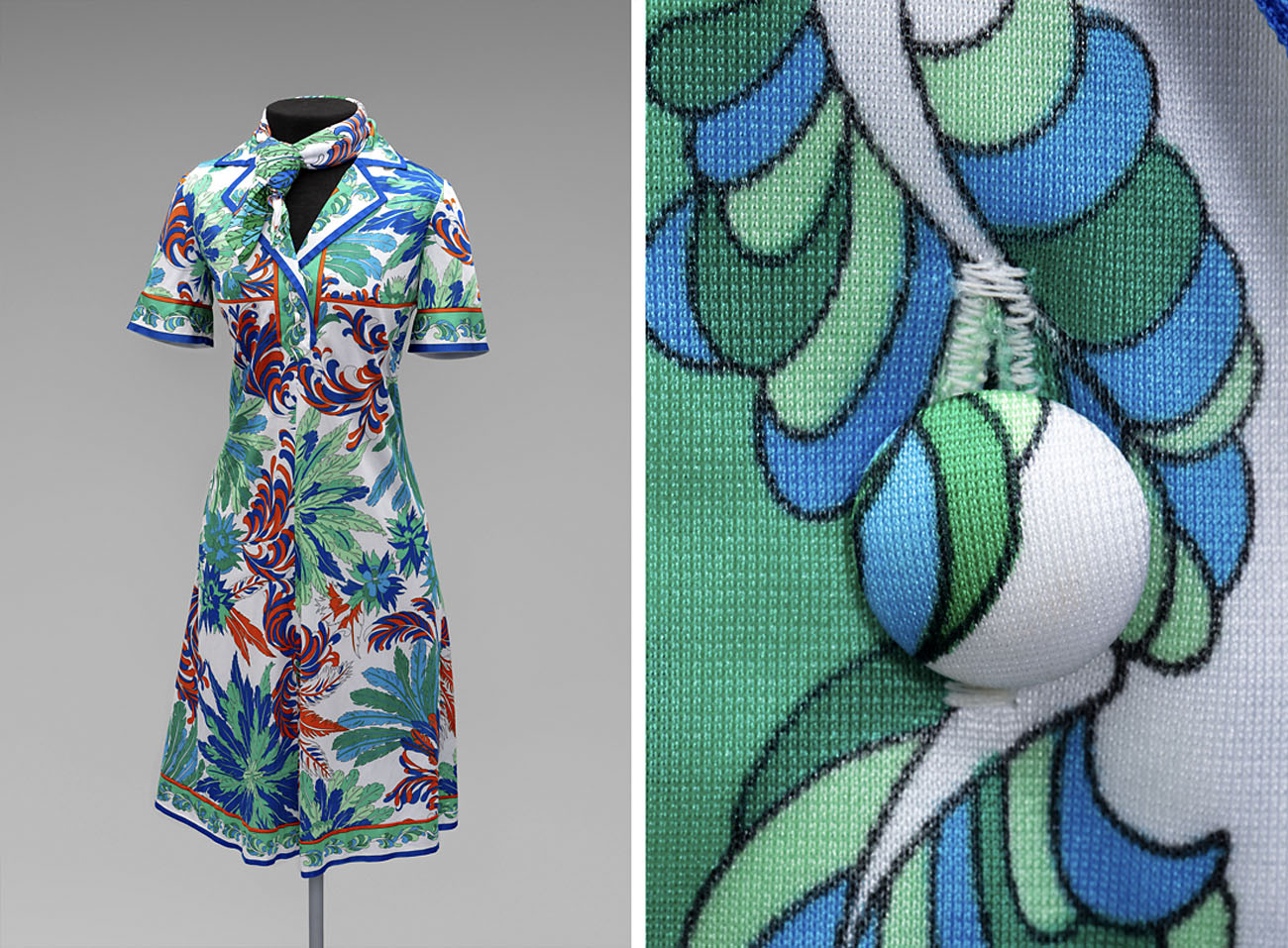
 

Emilio Pucci (Italian, 1914-1992) (designer) 'Qantas Airways flight hostess dress' 1974


Emilio Pucci (Italian, 1914-1992) (designer)
Qantas Airways flight hostess dress
1974
Polyester, wool
SFO Museum
Dress gift of Margaret Bowen-Jones
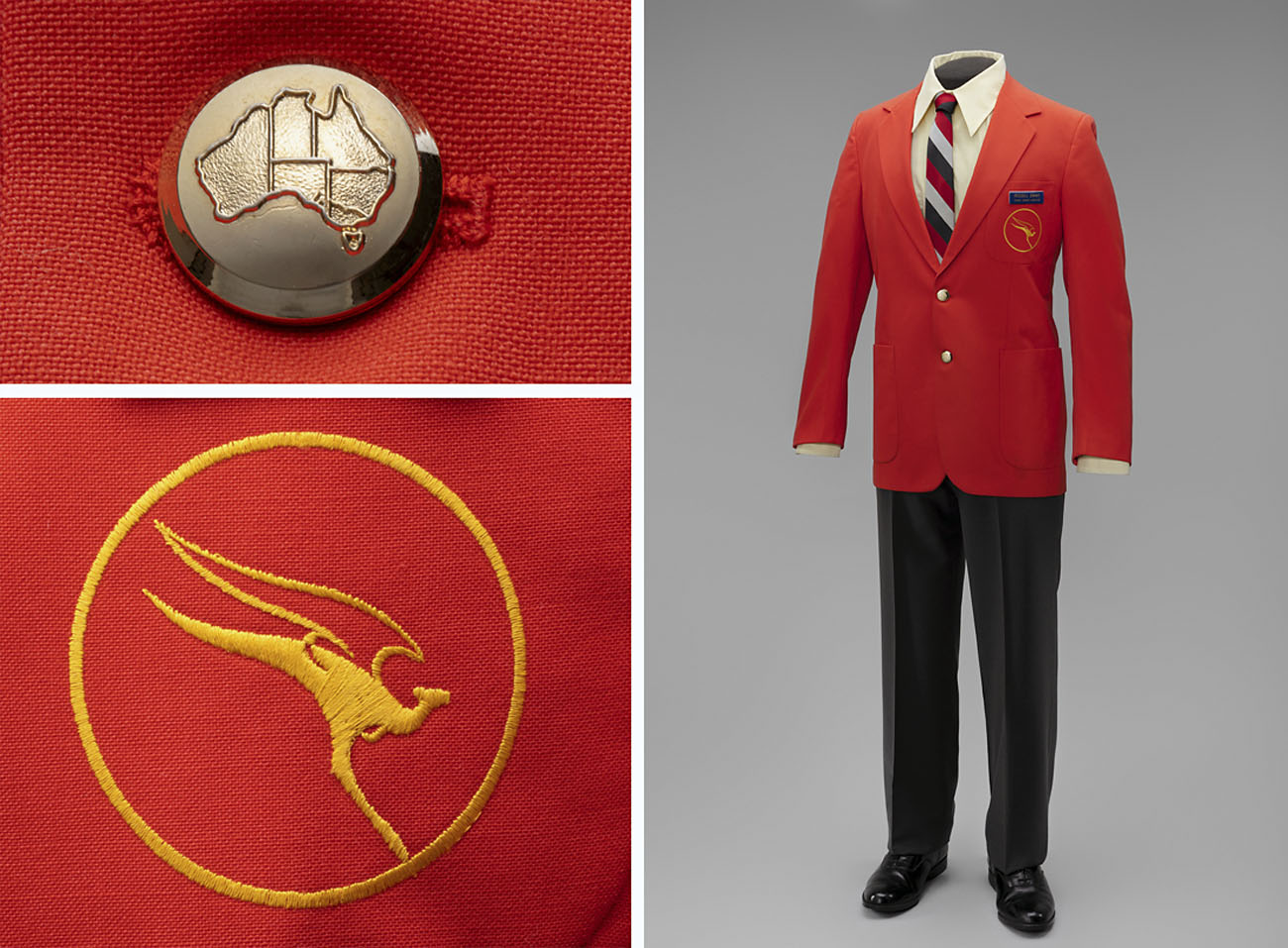
 

Emilio Pucci (Italian, 1914-1992) (designer) 'Qantas Airways male service director uniform' 1974


Emilio Pucci (Italian, 1914-1992) (designer)
Qantas Airways male service director uniform
1974
Polyester, wool, cotton
SFO Museum
Jacket, pants, and tie gift of Juris Turmanis
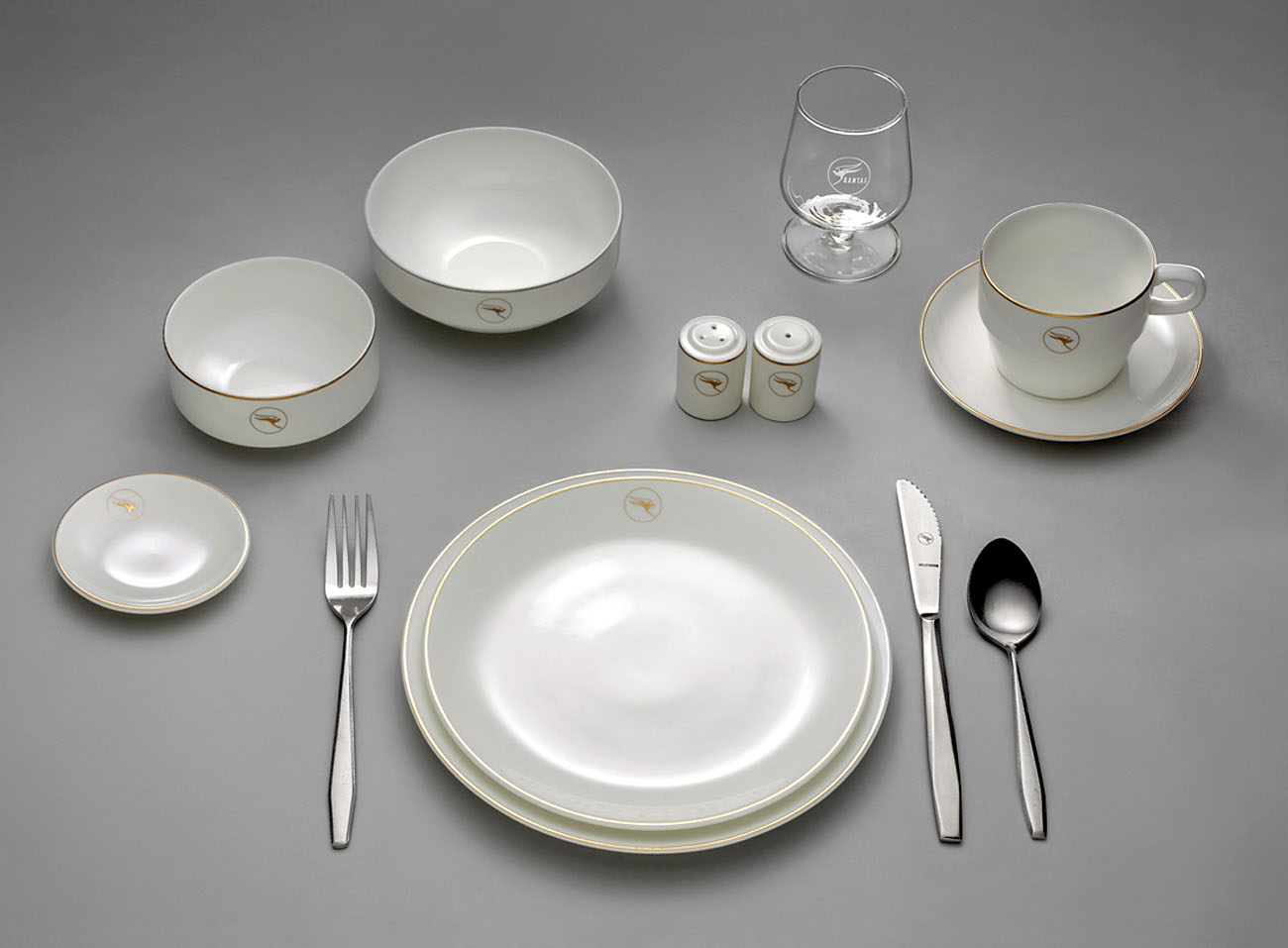
 

Wedgwood, England (manufacturer). 'Qantas Airways "Alice Springs" first-class meal service set' 1970s


Wedgwood, England (manufacturer)
Qantas Airways “Alice Springs” first-class meal service set
1970s
Ceramic, glaze
SFO Museum
Gift of Thomas G. Dragges

Qantas Airways flatware set
1970s
Metal
SFO Museum
Knife gift of Adam Wong
Spoon and fork gift of Thomas G. Dragges
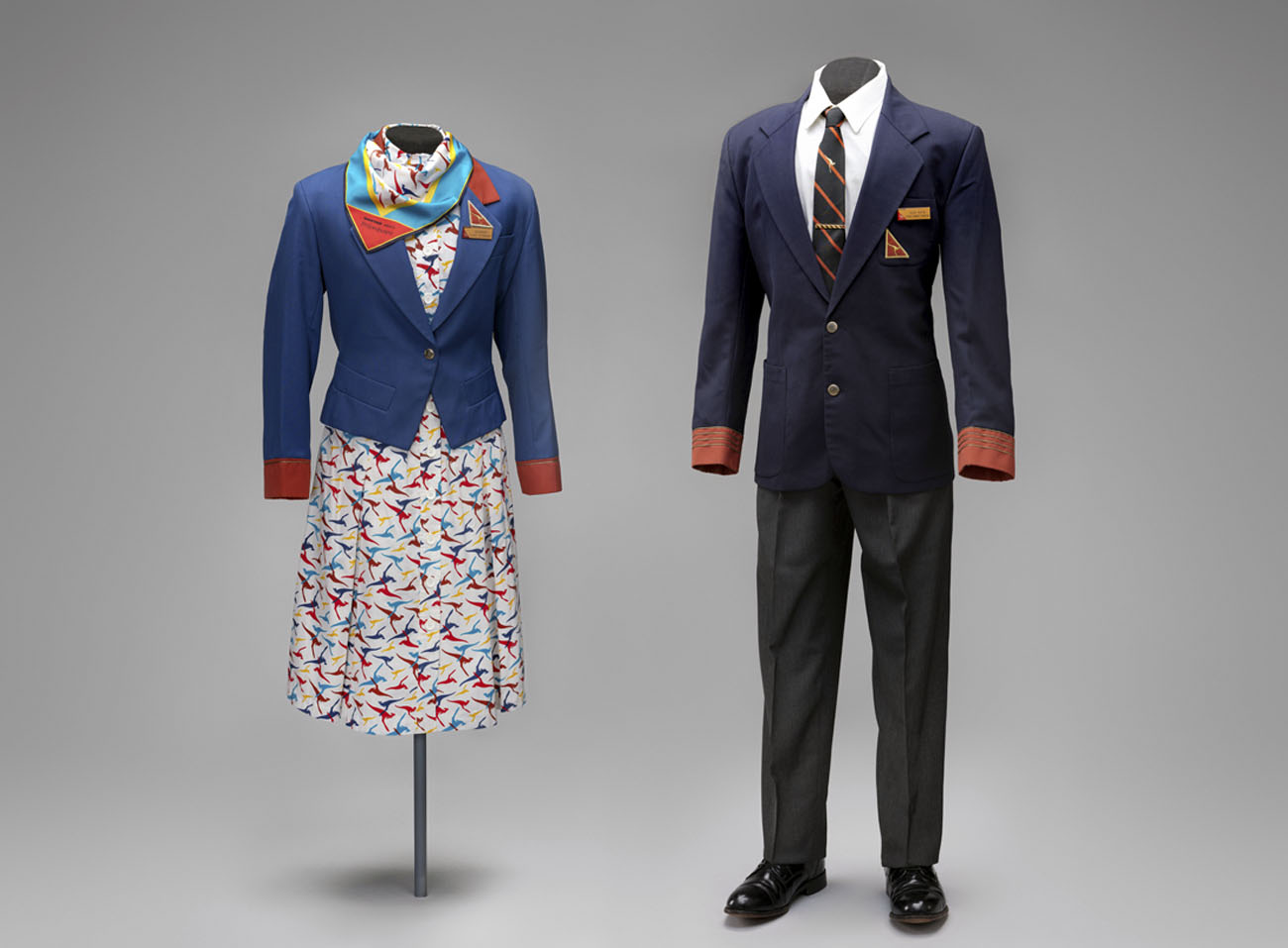
 

Yves Saint Laurent (French, 1936-2008) 'Qantas Airways female flight attendant uniform' 1986 and 'Qantas Flight Service Director uniform' c. 1987


Yves Saint Laurent (French, 1936-2008)
Qantas Airways female flight attendant uniform
1986
Polyester, cotton, plastic
SFO Museum
Gift of Suzanne de Monchaux

Qantas Flight Service Director uniform
c. 1987
Wool, cotton, polyester, metal, plastic
Collection of SFO Museum
Gift of Ron Reyn
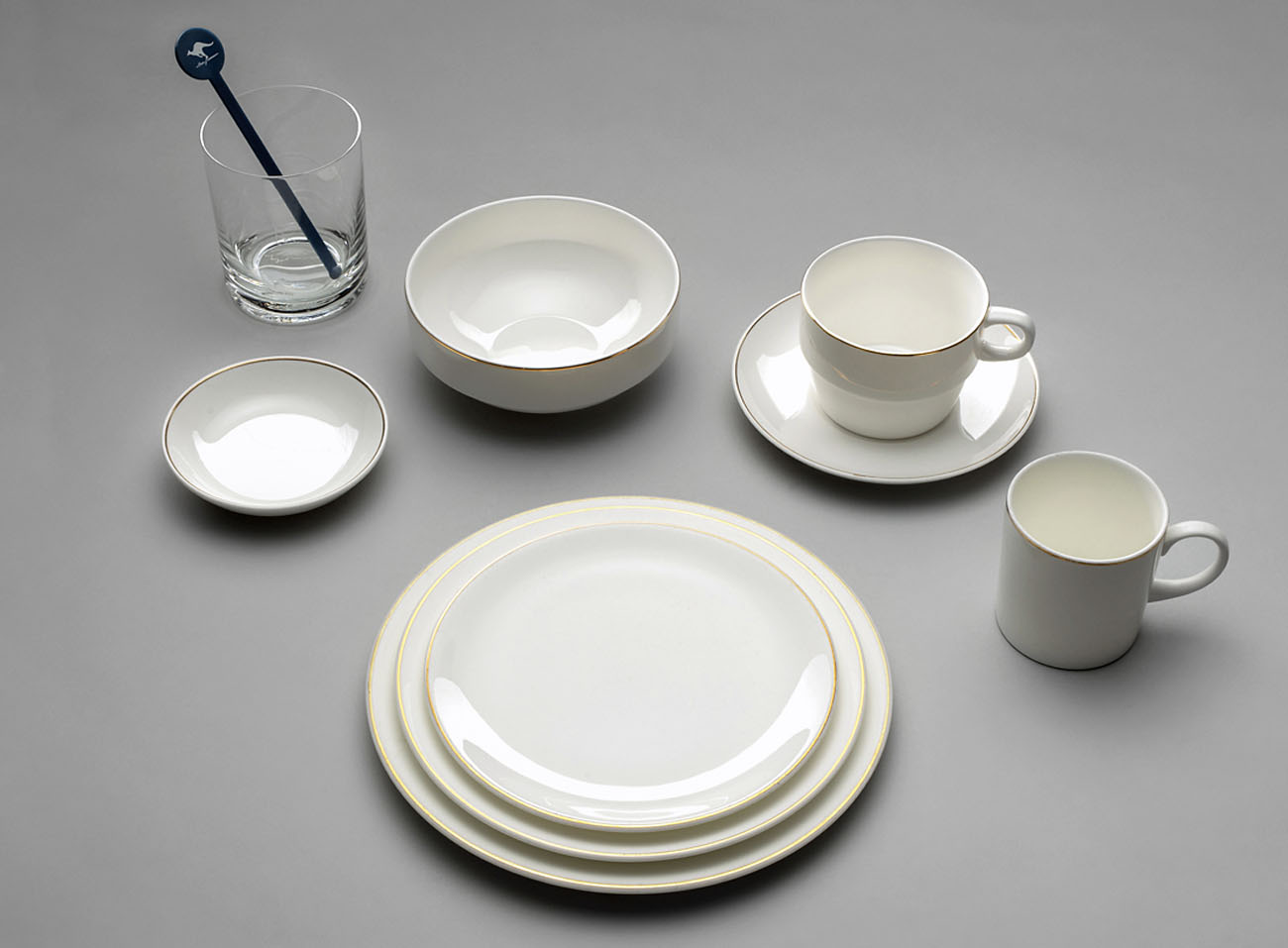
 

Wedgwood, England (manufacturer) 'Qantas Airways first class meal service set' 1990s


Wedgwood, England (manufacturer)
Qantas Airways first class meal service set
1990s
Ceramic
Collection of SFO Museum
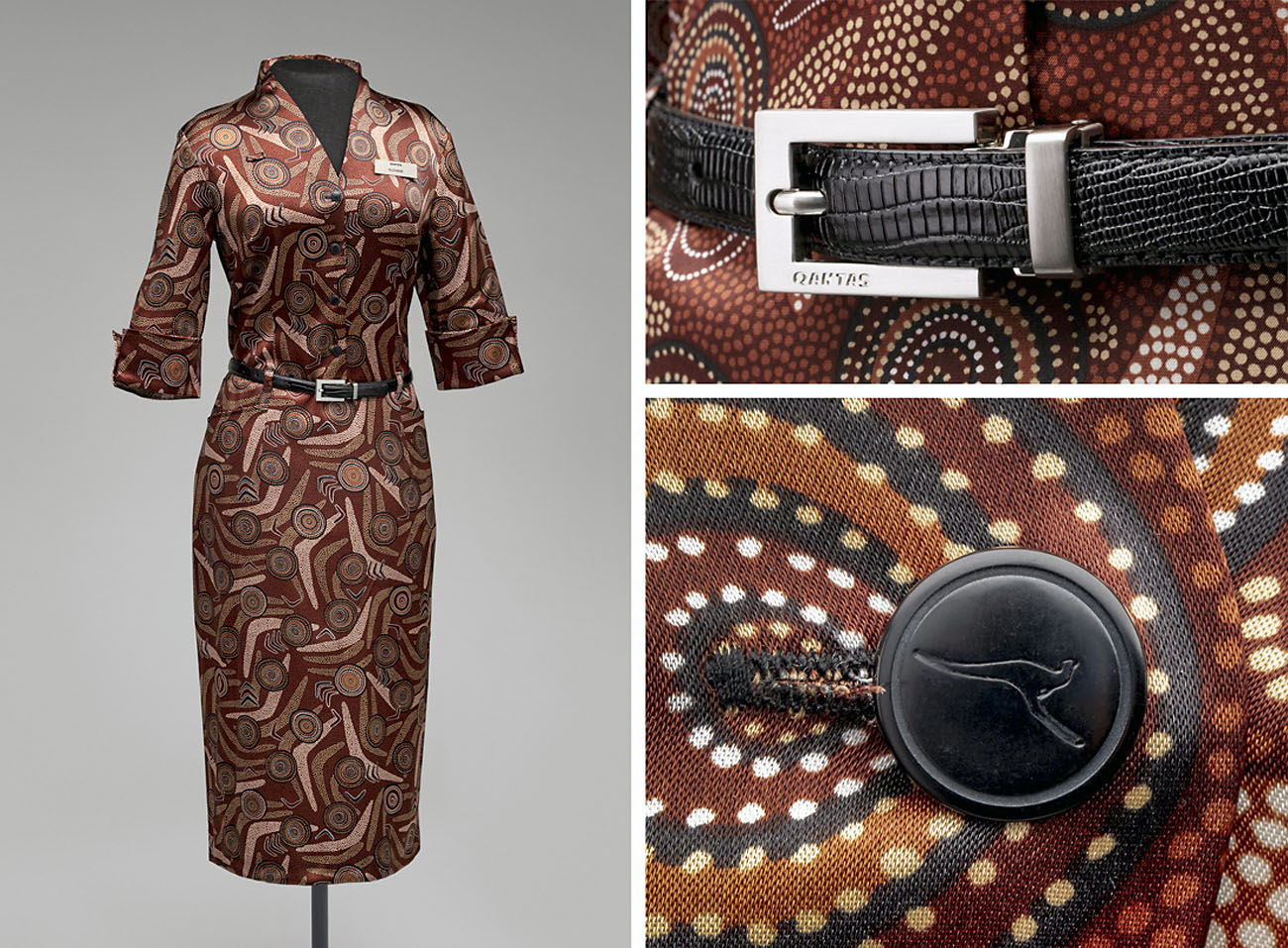
 

Peter Morrissey (Australian, b. 1968) (designer) 'Qantas Airways female flight attendant dress and name tag' 2003


Peter Morrissey (Australian, b. 1968) (designer)
Qantas Airways female flight attendant dress and name tag
2003
Polyester, plastic
Collection of SFO Museum
Gift of Suzanne de Monchaux
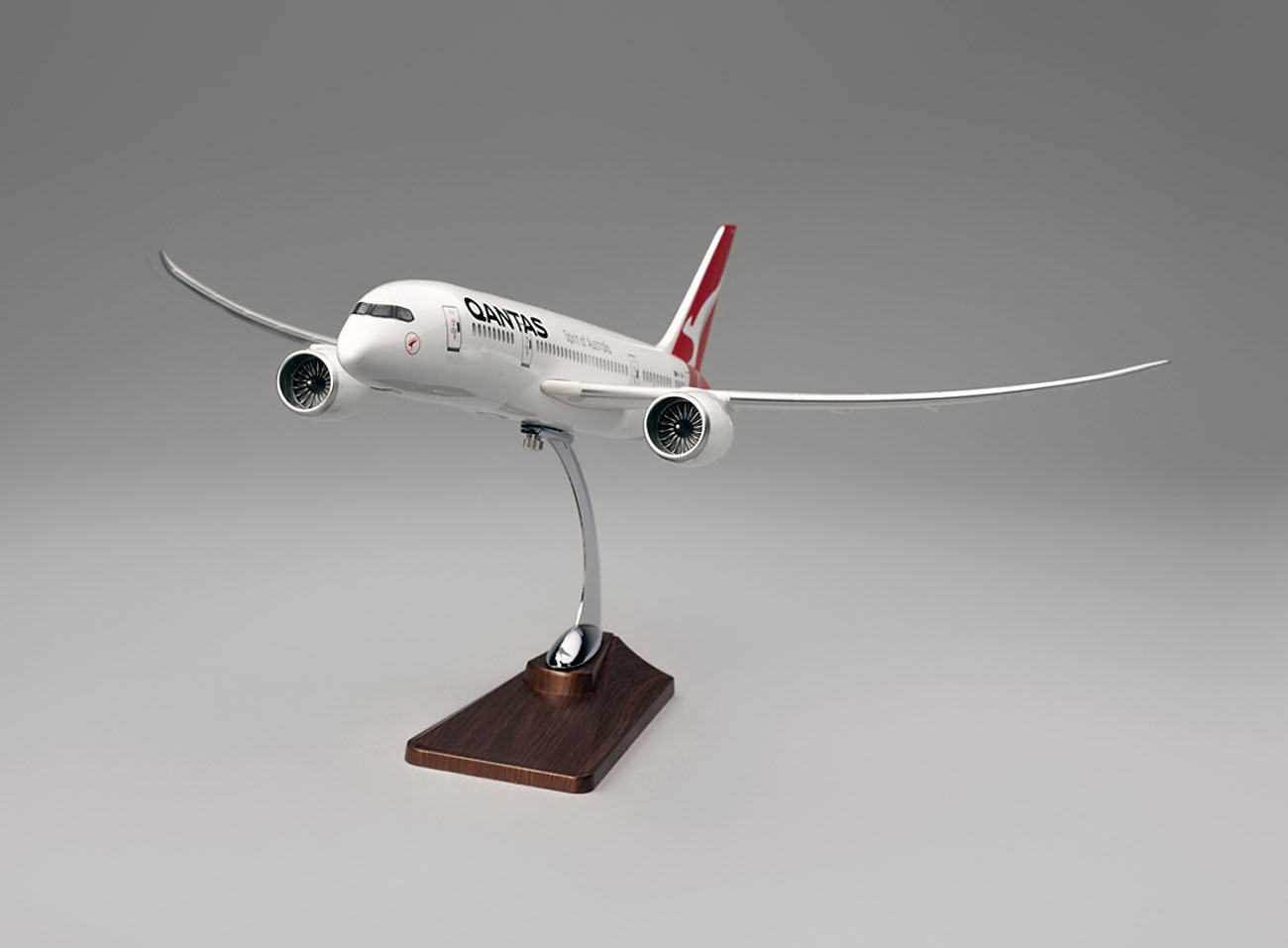
 

'Qantas Airways Boeing 787 Dreamliner model aircraft' c. 2019


Qantas Airways Boeing 787 Dreamliner model aircraft
c. 2019
Scale 1:140
Plastic resin, metal, ink
Collection of SFO Museum


Airmail Down Under
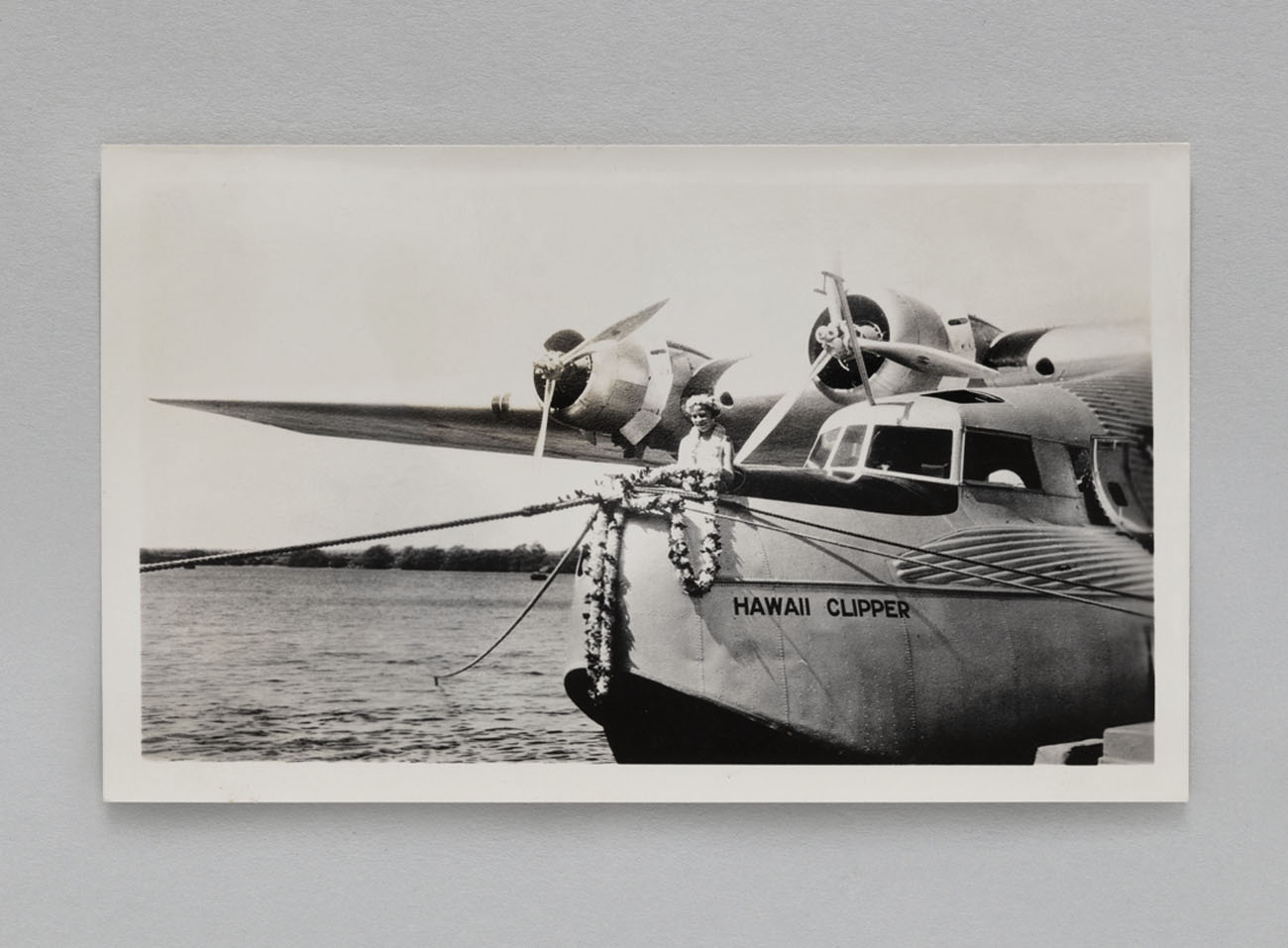
 

Anonymous photographer. 'Pan American Airways Martin M-130 Hawaii Clipper in Honolulu' c. 1935 from the exhibition 'Airmail Down Under' at SFO Museum, San Francisco international airport, March 2021 - December 2022


Anonymous photographer
Pan American Airways Martin M-130 Hawaii Clipper in Honolulu
c. 1935
Gelatin silver photograph
SFO Museum, Gift of the Pan Am Association
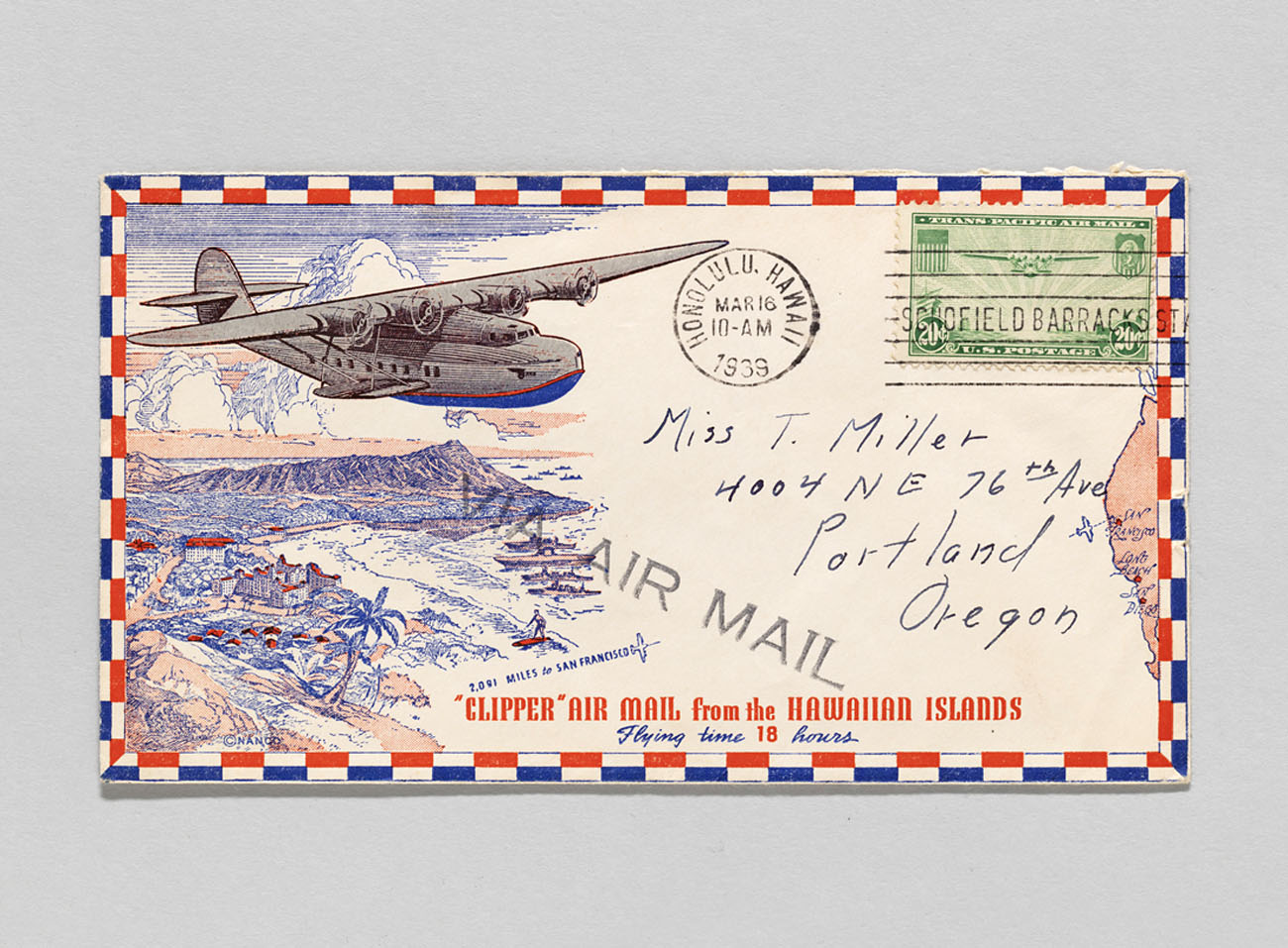
 

Pan American Airways, Honolulu–San Francisco airmail flight cover March 16, 1939 from the exhibition 'Airmail Down Under' at SFO Museum, San Francisco international airport, March 2021 - December 2022


Pan American Airways, Honolulu-San Francisco airmail flight cover
March 16, 1939
Paper, ink
SFO Museum


In the 1920s, aviation visionaries imagined how the nations of the Pacific Rim could be linked by a new mode of transportation, the aircraft. Governments encouraged the development of new air routes with lucrative airmail contracts and the Pacific arena was no exception. One of the key obstacles to this endeavour was the vast 2400-mile water gap between the coast of California and the Hawaiian Islands. To successfully traverse this distance and open the rest of the Pacific region for air travel, the U.S. Navy attempted a flight using two Naval Aircraft Factory PN-9 flying boats in 1925. One plane turned back, but the other, led by Commander John Rodgers, continued, only to run out of fuel about four hundred miles from Hawai’i. Commander Rodgers managed to complete the journey by stripping fabric off the wings and fashioning improvised sails. In 1928, an aircrew led by Australian Charles Kingsford Smith flew the modified Fokker F.VIIb Southern Cross to Hawai’i, then continued on to Fiji and, finally, to Brisbane, Australia. In the 1930s, the U.S. Navy developed a practical flight route to Hawai’i with a squadron of Consolidated P2Y patrol aircraft. making the journey. In 1935, Pan American Airways opened the first regularly scheduled air service flying the Sikorsky S-42 and Martin M-130 flying boats. With this obstacle surmounted, planners trained their eyes on a commercial air route to Oceania.

Upon forging an air route to Hawai’i, Pan American Airways began planning further air links to destinations in Asia, Australia, and New Zealand. Each of these employed the long range of large flying boats to link a chain of island bases along the way. The route to the south was planned to fly through Fiji and New Caledonia. However, the distance from Hawai’i to Fiji was over 3,000 miles, beyond the safe operating range of even Pan American’s largest aircraft. The solution was to establish a refuelling base at the remote and barren Canton Island, an atoll in the Phoenix Islands, located 1,900 miles from Hawai’i and 1,200 miles from Fiji. After refuelling on Canton Island, the aircraft flew either to Suva in Fiji or Nouméa in New Caledonia on their way south. Although Pan American Airways desired a route all the way through to Australia, negotiations between the governments and Britain’s Imperial Airways proved more difficult than anticipated. As a result, the transpacific route in the south terminated at Auckland, New Zealand. These incredibly long-range routes were surveyed using the Sikorsky S-42 flying boat and opened with the new Boeing 314 Clipper.

In the early 1940s, Pan American Airways established regular service to Auckland, New Zealand, with their Boeing 314 Clipper flying boats. Although this service was halted by the outbreak of World War II in the Pacific Ocean theatre, the war years were transformational for transpacific air travel. Not only were new and improved aircraft developed, but a network of airfields were built across the Pacific basin as part of the war effort. In the late 1940s, land-based aircraft, like the Douglas DC-4 and the larger DC-6, made regularly-operated commercial air routes between the United States and Australia a reality for airmail and cargo, and for passengers as well. Pan American was also finally able to obtain permission for their service to extend all the way to Australia. Pan American was joined in flying these routes by Australian airlines like Australian National Airways (ANA), British Commonwealth Pacific Airlines (BCPA) and, later, Qantas Empire Airways. The route flown was the same as that pioneered before the war, using New Caledonia, Fiji, Canton Island, and Hawai’i as stepping-stones between Australia and the west coast of the United States. This route persisted through the propeller airliner era, even as newer aircraft like the Boeing 377 Stratocruiser were introduced.

In the late 1950s, jet airliners began to enter service for airlines around the world. These new aircraft revolutionised transpacific air travel with their high speed and longer range. Pan American World Airways and Qantas favoured the Boeing 707 airliner for their long-range international routes. These planes did not need to stop as frequently and layovers in New Caledonia and Canton Island were no longer required. Regular, same-day air travel between the United States and Australia had been realised.

Today, these rare surviving airmail flight covers document how the air route across the Pacific Ocean was established during the 1920s and 30s, and then strengthened in the post-war era with the introduction of more advanced aircraft making non-stop travel between the United States and Australia a reality.

Text from the SFO Museum website
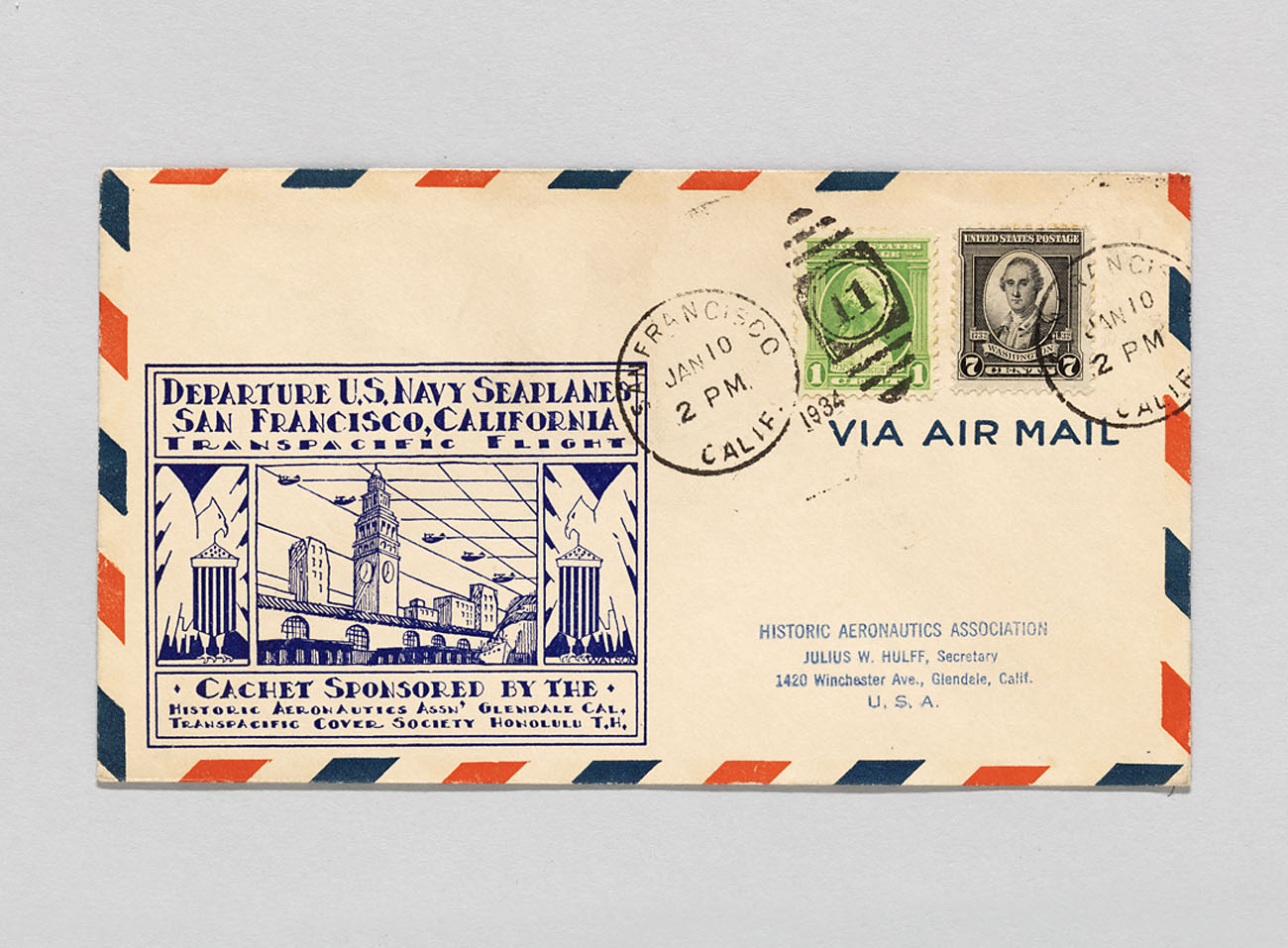
 

First U.S. Navy Flight Squadron VP-10, San Francisco–Honolulu airmail flight cover January 10, 1934 from the exhibition 'Airmail Down Under' at SFO Museum, San Francisco international airport, March 2021 - December 2022


First U.S. Navy Flight Squadron VP-10, San Francisco-Honolulu airmail flight cover
January 10, 1934
Paper, ink
SFO Museum, Gift of Jon E. Krupnick
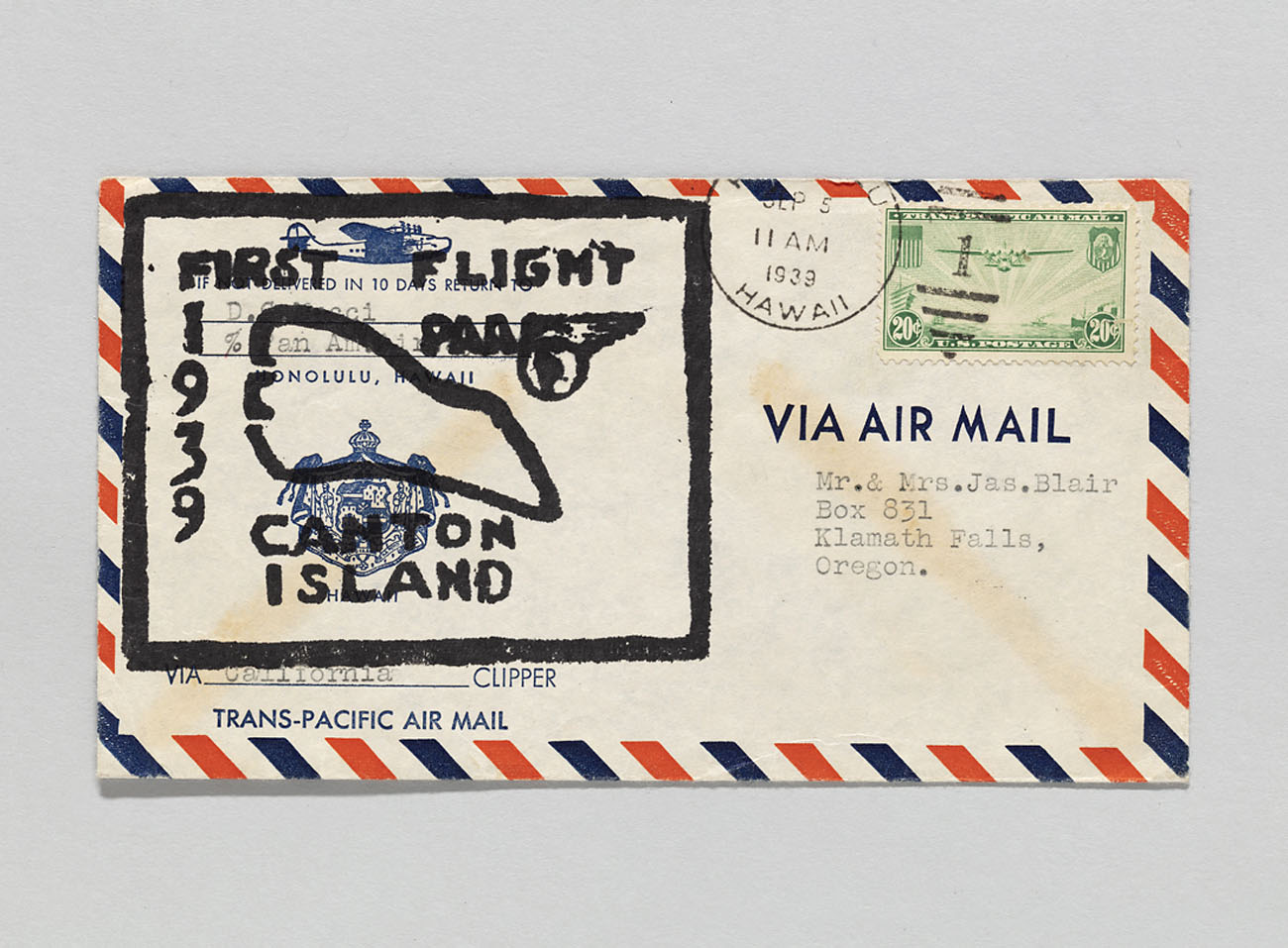
 

Pan American Airways, Honolulu–Canton Island airmail flight cover September 5, 1939


Pan American Airways, Honolulu-Canton Island airmail flight cover
September 5, 1939
Paper, ink
SFO Museum, Gift of Jon E. Krupnick
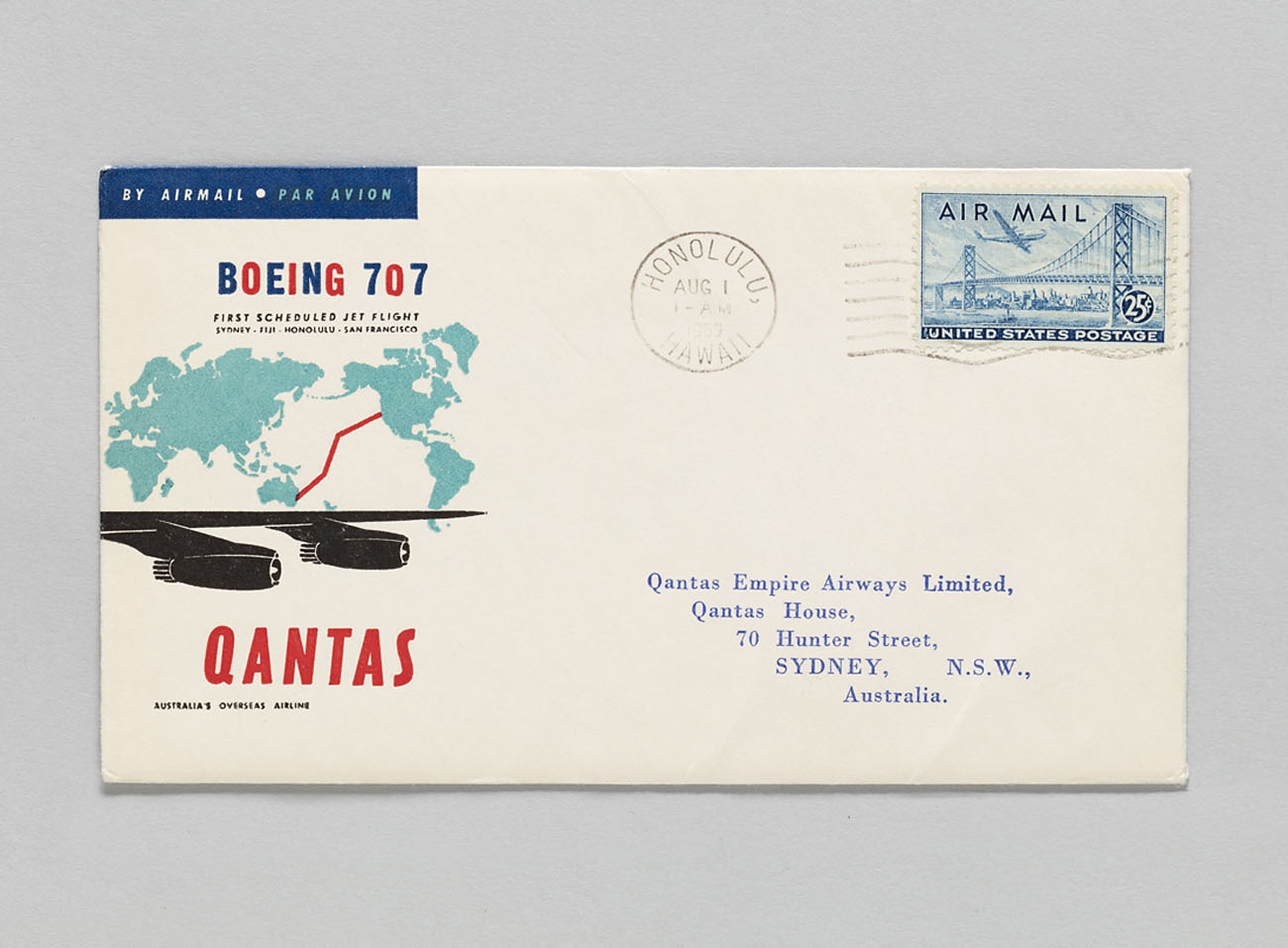
 

Qantas Empire Airways, First Boeing 707 Flight, Honolulu–Sydney airmail flight cover August 1, 1959


Qantas Empire Airways, First Boeing 707 Flight, Honolulu-Sydney airmail flight cover
August 1, 1959
Paper, ink
SFO Museum, Gift of Mrs. Siusiadh Rasmussen
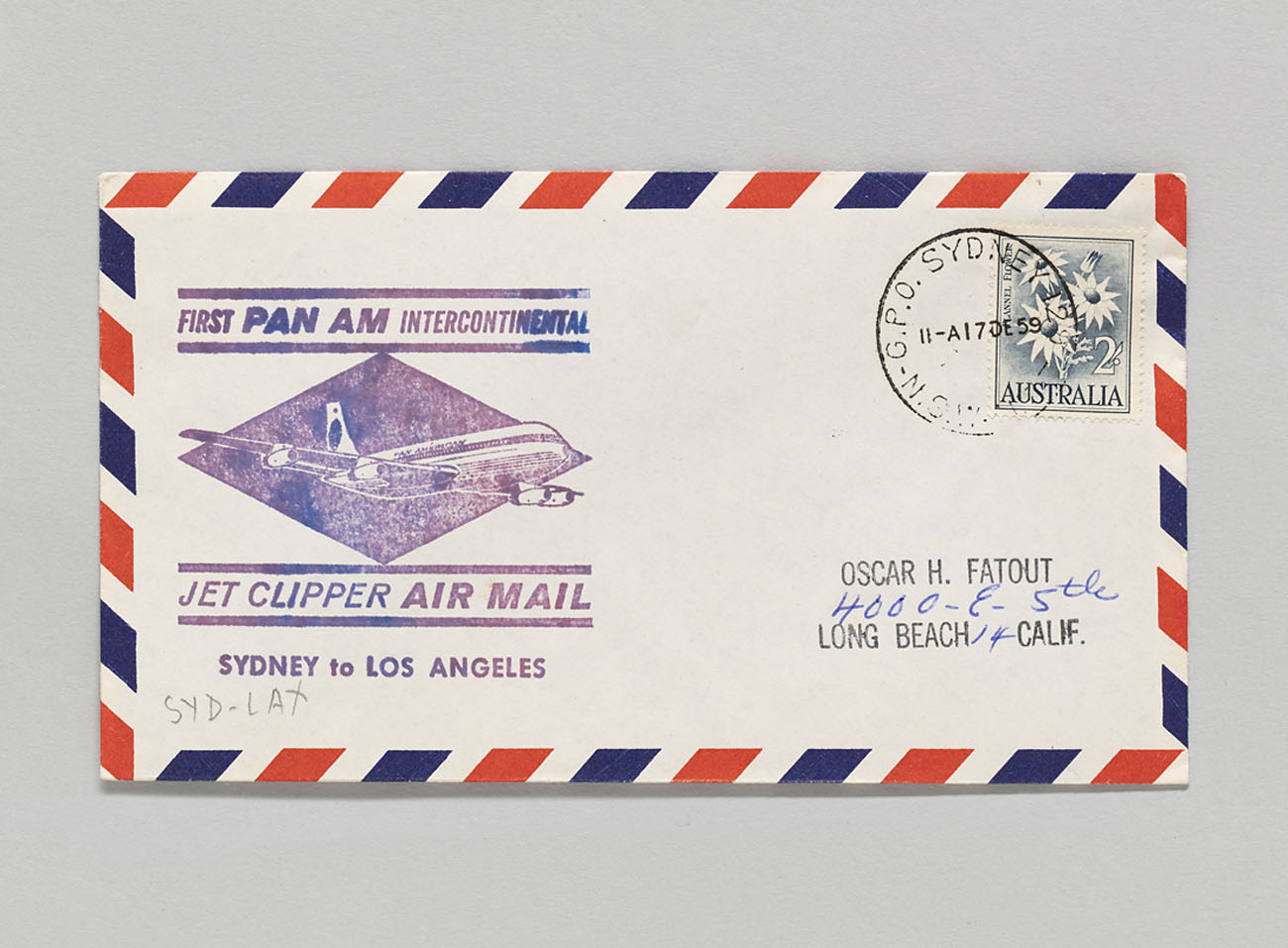
 

Pan American World Airways, First Jet Clipper Air Mail, Sydney – Los Angeles airmail flight cover December 17, 1959


Pan American World Airways, First Jet Clipper Air Mail, Sydney – Los Angeles airmail flight cover
December 17, 1959
Paper, ink
SFO Museum, Gift of the Captain John B. Russell Family


SFO Museum 
San Francisco International Airport
P.O. Box 8097
San Francisco, CA 94128 USA
Phone: 650.821.6700
SFO Museum website

LIKE ART BLART ON FACEBOOK

Back to top

Exhibition: ‘Japonisme: A Passion for Japan’ at SFO Museum, San Francisco international airport

Exhibition dates: 4th May, 2022 – 2nd April, 2023

Terminal 2, Departures Level 2, Gallery 2A


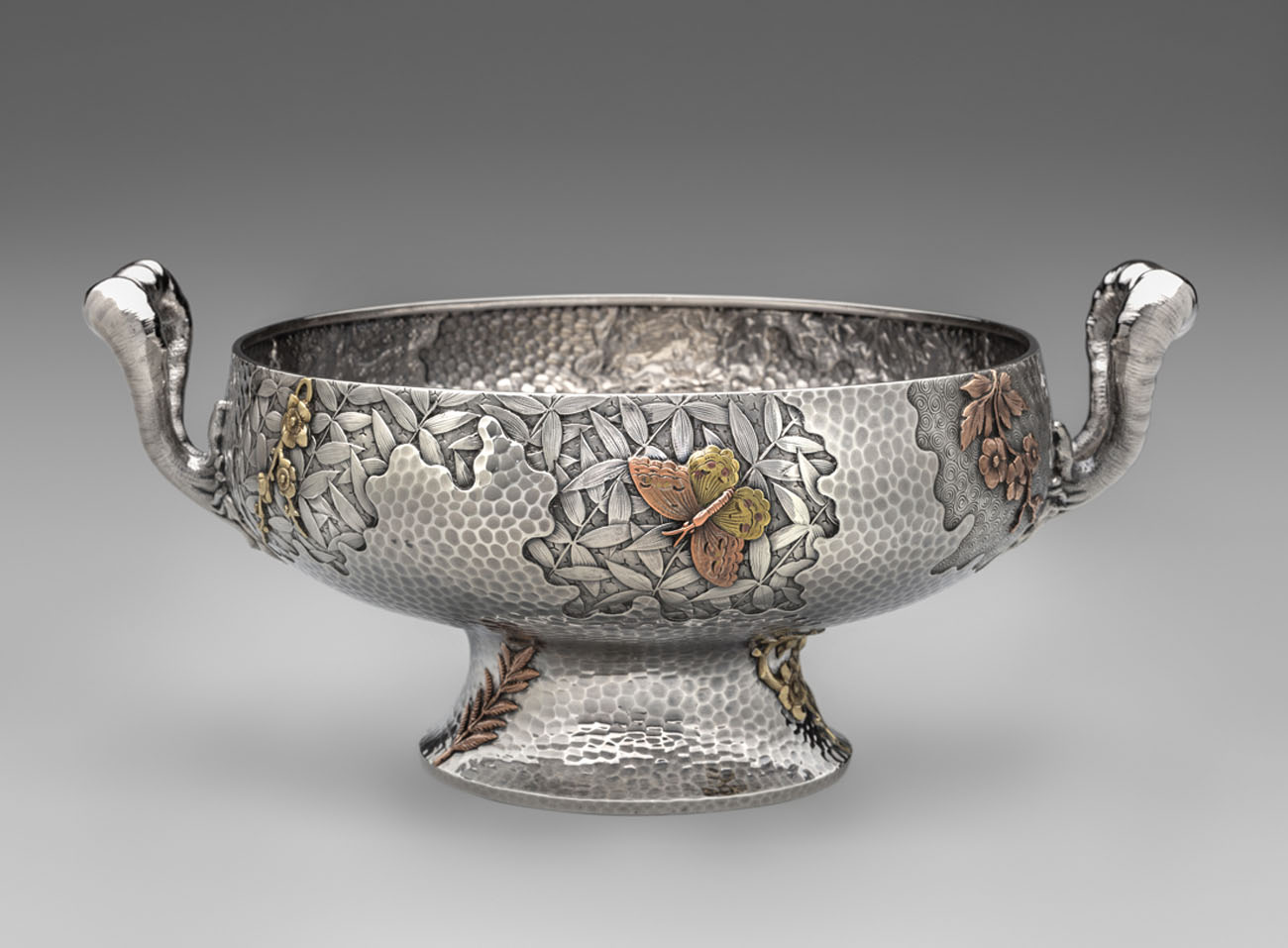
Dominick & Haff (American, New York) (manufacturer) 'Footed dish' 1880 from the exhibition 'Japonisme: A Passion for Japan' at SFO Museum, San Francisco international airport, May 2022 - April 2023


Dominick & Haff (American, New York) (manufacturer)
Footed dish
1880
Sterling silver, mixed metal
Private Collection


Dominick & Haff, based in New York City, produced some of the most magnificent silver objects during the late nineteenth century. The “outer” layer of this footed dish displays hexagonal hammering that appears torn away to reveal differing patterns beneath. Multi-coloured gold butterflies and foliage accent the piece.


A change of pace… time for things exquisite!

Dr Marcus Bunyan


Many thankx to the SFO Museum for allowing me to publish the photographs in the posting. Please click on the photographs for a larger version of the image.


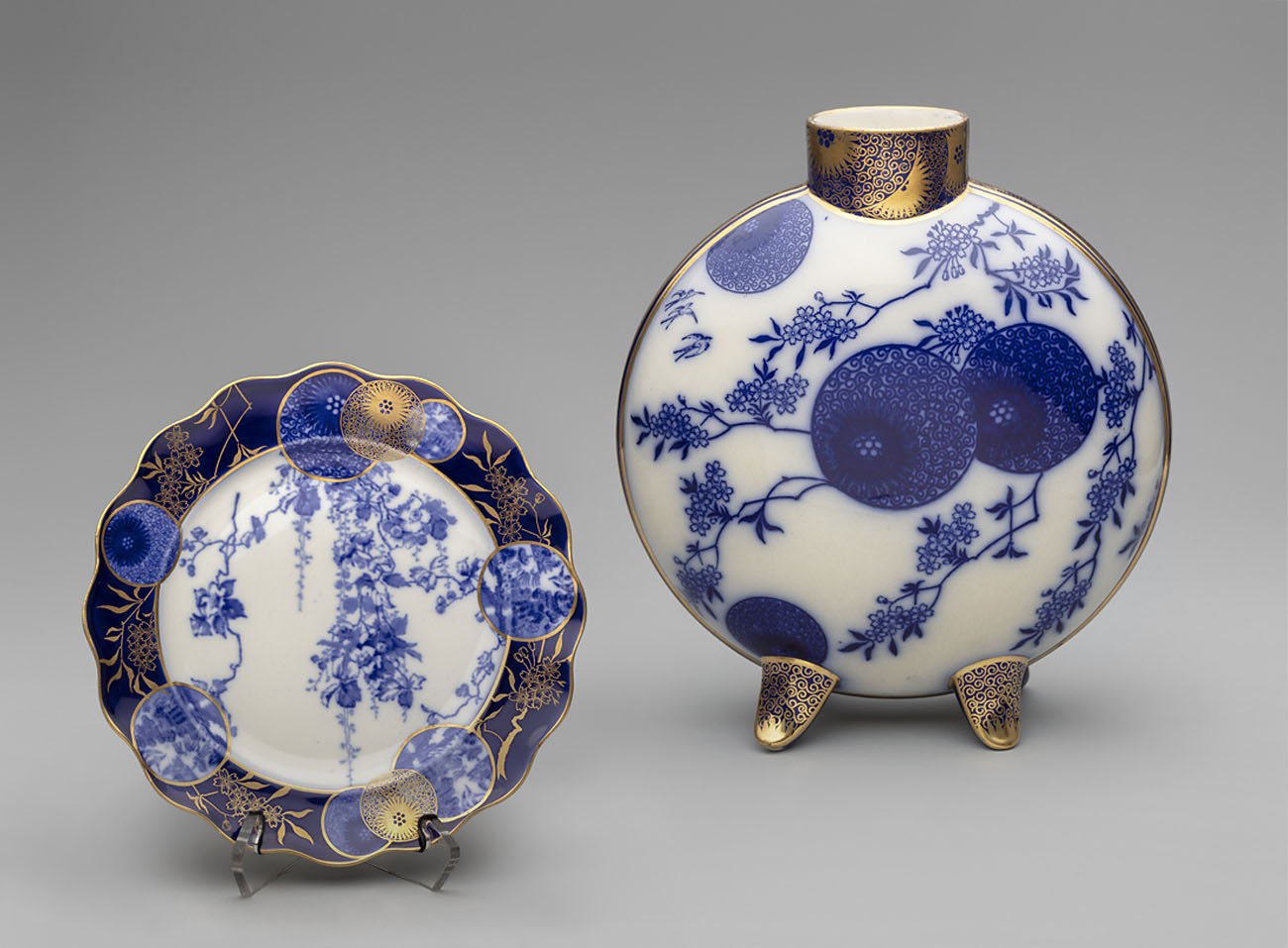
Royal Doulton (Burslem, Staffordshire, England) (manufacturer) 'Plate, "Spray" pattern border' c. 1896; 'Moon flask, "Spray" pattern' c. 1880 from the exhibition 'Japonisme: A Passion for Japan' at SFO Museum, San Francisco international airport, May 2022 - April 2023


Royal Doulton (Burslem, Staffordshire, England) (manufacturer)
Plate, “Spray” pattern border
c. 1896
Earthenware with transfer print, glaze, gilding
Courtesy of Jeffrey Ruda

Royal Doulton (Burslem, Staffordshire, England) (manufacturer)
Moon flask, “Spray” pattern
c. 1880
Earthenware with transfer print, glaze, gilding
Courtesy of Jeffrey Ruda


This plate features hanging wisteria. A symbol of longevity (fuji, 藤), wisteria has been grown for thousands of years in Japan. The motif often appears on kimono and many forms of Japanese art. Royal Doulton, which was founded in 1815, produced this “Spray” pattern in the 1880s, likely inspired by Japanese mon (紋). Mon are decorative crests traditionally used to identify a Japanese family.


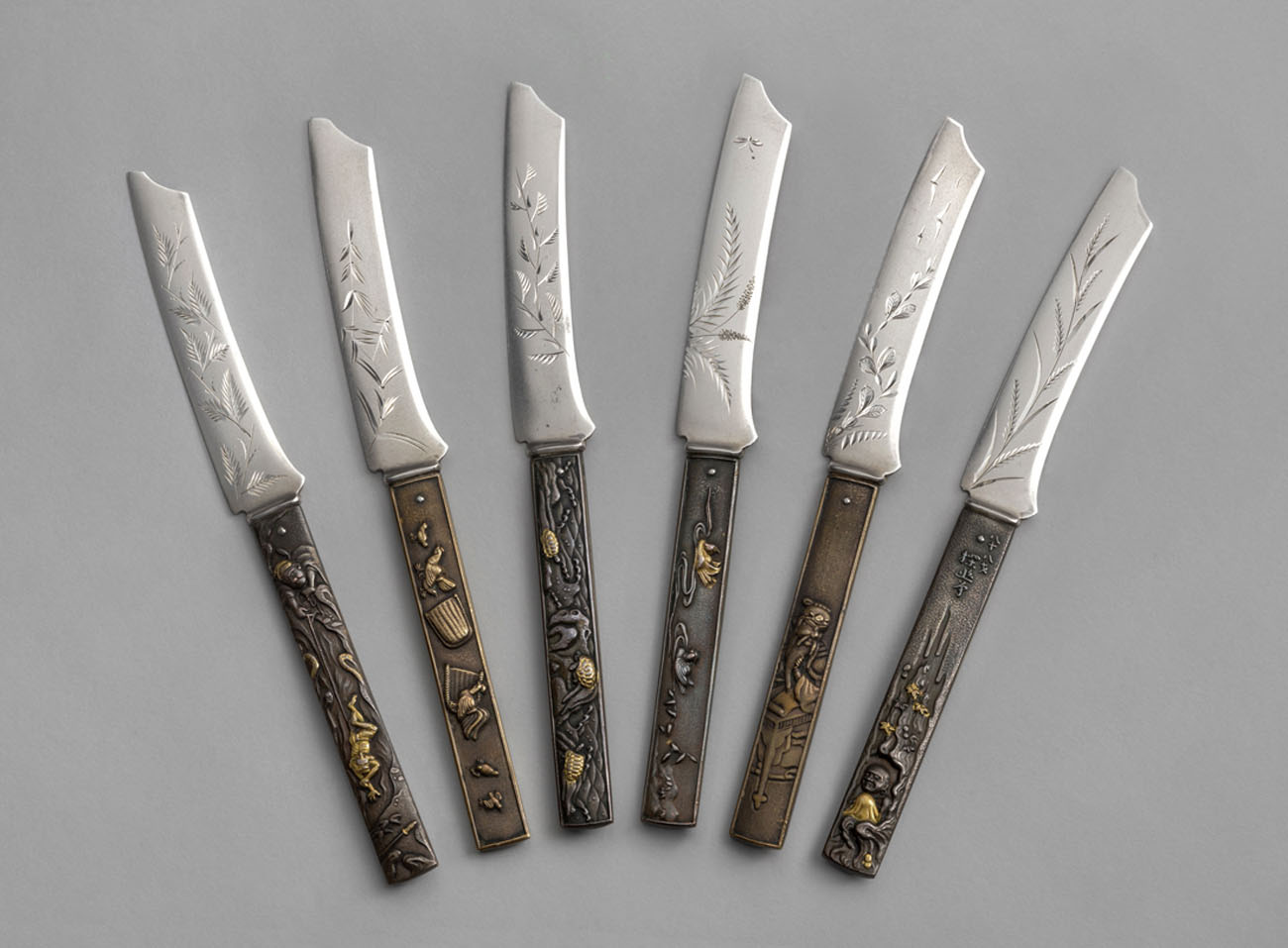
Gorham Manufacturing Company (American, Providence, Rhode Island) (manufacturer) 'Set of fruit knives' c. 1875 from the exhibition 'Japonisme: A Passion for Japan' at SFO Museum, San Francisco international airport, May 2022 - April 2023


Gorham Manufacturing Company (American, Providence, Rhode Island) (manufacturer)
Set of fruit knives
c. 1875
Sterling silver, bronze, gilding
Private Collection


Small utility knives, known as kozuka (小柄), had long been highly valued craft objects in Japan where they were traditionally cast from fine metals, such as bronze. After Japan opened to international trade, craftsmen produced kozuka for Westerners who sometimes repurposed the handles to make dining knives. Eventually Japanese manufacturers began selling the handles alone, crafting them from various metals with die stamped decoration gilded in select areas. The Gorham Manufacturing Company added their own sterling silver blade designs, decorated with butterflies, fans, and geometric patterns applied to Western-style utensils, such as dessert forks and salad servers. The resulting knives resemble Japanese swords with decorated handles.


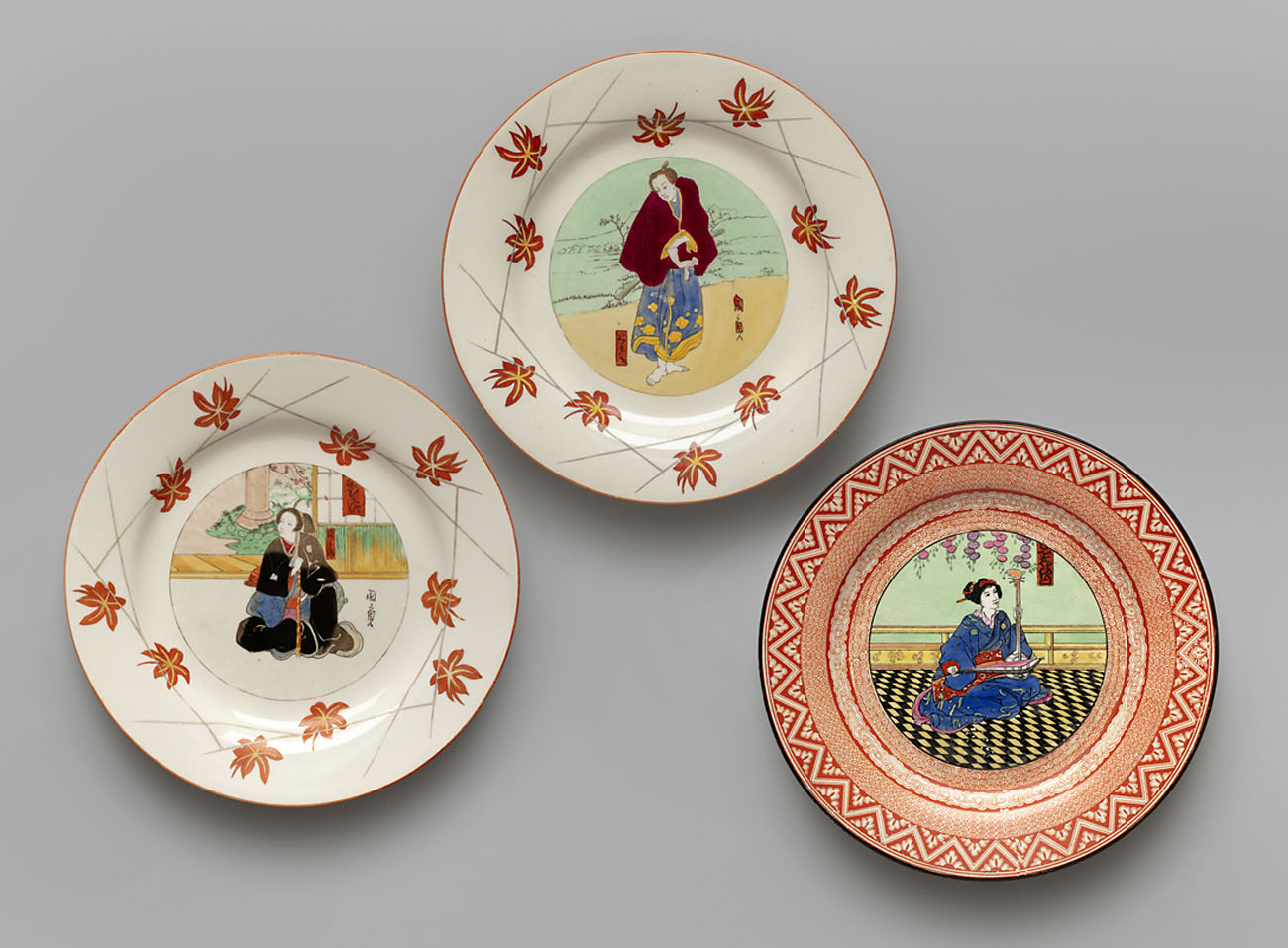
Josiah Wedgwood & Sons (Etruria, Staffordshire, England) (manufacturer) 'Plate depicting an actor' c. 1875; 'Plate depicting an actor' c. 1875; 'Plate depicting a musician, "Mikado" border pattern' c. 1875


[left to right]

Josiah Wedgwood & Sons (Etruria, Staffordshire, England) (manufacturer)
Plate depicting an actor
c. 1875
Earthenware with transfer print and enamels
Courtesy of Jeffrey Ruda

Josiah Wedgwood & Sons (Etruria, Staffordshire, England) (manufacturer)
Plate depicting an actor
c. 1875
Earthenware with transfer print and enamels
Courtesy of Jeffrey Ruda

Josiah Wedgwood & Sons (Etruria, Staffordshire, England) (manufacturer)
Plate depicting a musician, “Mikado” border pattern
c. 1875
Earthenware with transfer print and enamels
Courtesy of Jeffrey Ruda


Josiah Wedgwood & Sons

Established in the eighteenth century, Josiah Wedgwood & Sons embraced Japonisme during the late nineteenth century when English transfer-printed earthenware with complex, inventive Japanese-inspired patterns reached an apex.

[centre plate]

The young man with a sword and the landscape backdrop on this plate are broadly adapted from Japanese woodblock prints of actors. A few details suggest that Wedgwood’s artist studied Japanese prints: the placement of the feet and the bend of a wrist. However, the clothing and the landscape structure are so unlike Japanese styles, they prove they were not copied from a Japanese source.


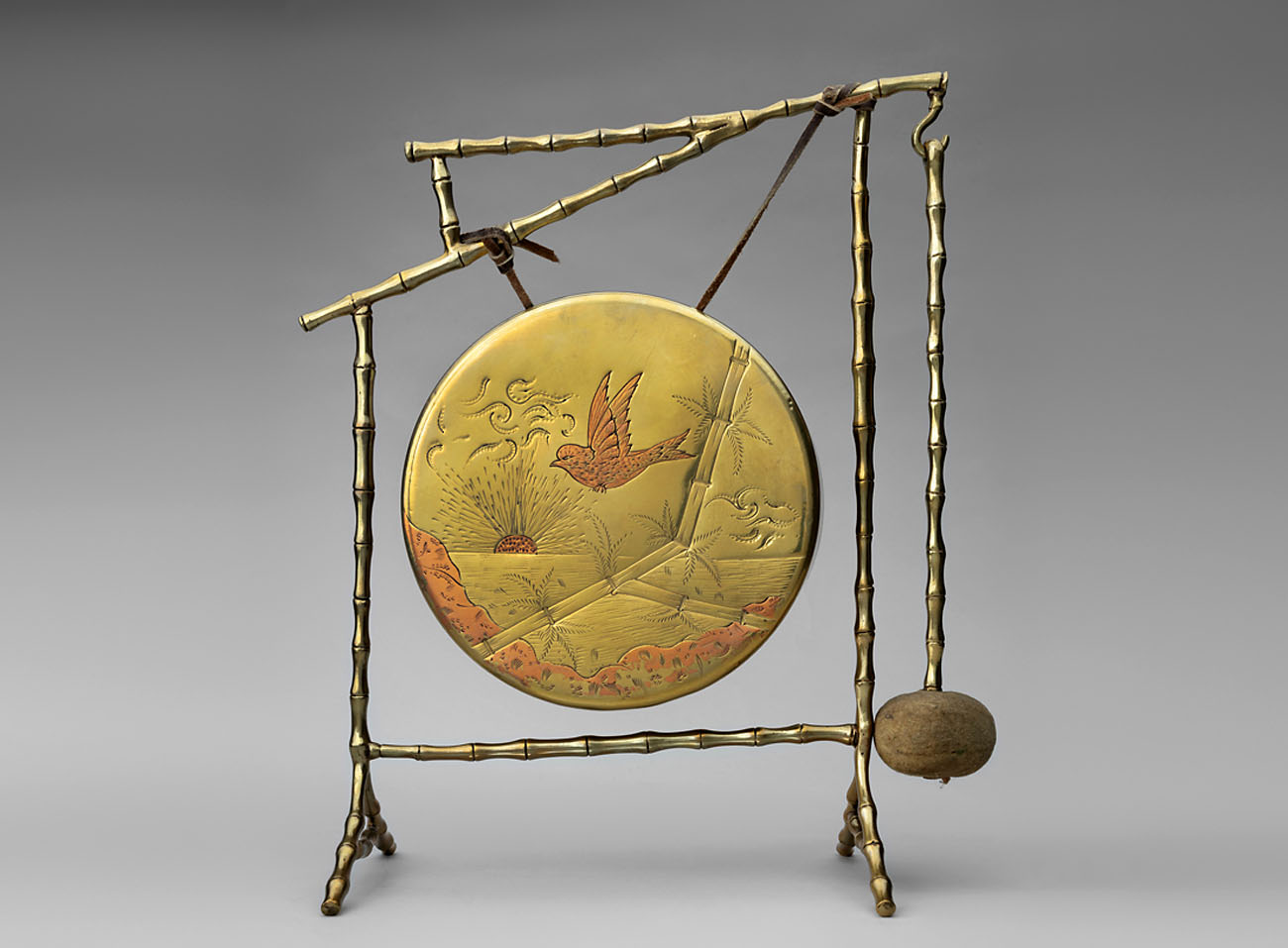
Unknown manufacturer (English) 'Dinner gong with sparrow' c. 1885


Unknown manufacturer (English)
Dinner gong with sparrow
c. 1885
brass, copper
Courtesy of Brian D. Coleman


This dinner gong exhibits faux bamboo supports and a sparrow in flight, highlighting the European maker’s interpretation of Japan’s admiration for the natural world and its influence on Western art.


French author Philippe Burty (1830-1890) coined the term Japonisme in 1872 to describe the new fervor for all things Japanese, following Japan’s opening to international trade after a prolonged period of isolation from the West. The increased visibility of Japanese art and design overseas profoundly affected European and North American audiences as ceramics, ukiyo-e woodblock prints, metalwork, lacquerware, fans, and textiles flooded Western markets. Japonisme permeated fine and decorative arts, interior design, and graphic arts. Artists such as Vincent van Gogh (1853-1890) and James Abbott McNeill Whistler (1834-1903) were deeply inspired by Japanese art. American silver manufacturers including Tiffany & Company and the Gorham Manufacturing Company were determined to create metalwork as fine as Japan’s. English potteries took heed of Japanese designs to create a plethora of new patterns.

The first world’s fair to feature Japanese art took place in London in 1862. Japan’s official participation in an international exposition occurred in Paris in 1867, followed by Vienna in 1873, and Philadelphia in 1876. These expositions exposed millions of people to Japanese art, craft, design, and architecture. Japanese art dealers, such as Hiromichi Shugio (1853-1927) in New York, Bunkio Matsuki (1867-1940) in Boston, and Tadamasa Hayashi (1853-1906) in Paris, helped introduce Japanese arts to American and European clienteles. Prominent English designer Christopher Dresser (1834-1904) travelled to Japan in 1876, later publishing his influential book Japan: Its Architecture, Art, and Art Manufacturers (1882). Art critics and home journals of the era regularly published articles addressing how to decorate one’s home in a Japanese-inspired style. Collectors eagerly purchased authentic Japanese goods and Western interpretations of them.

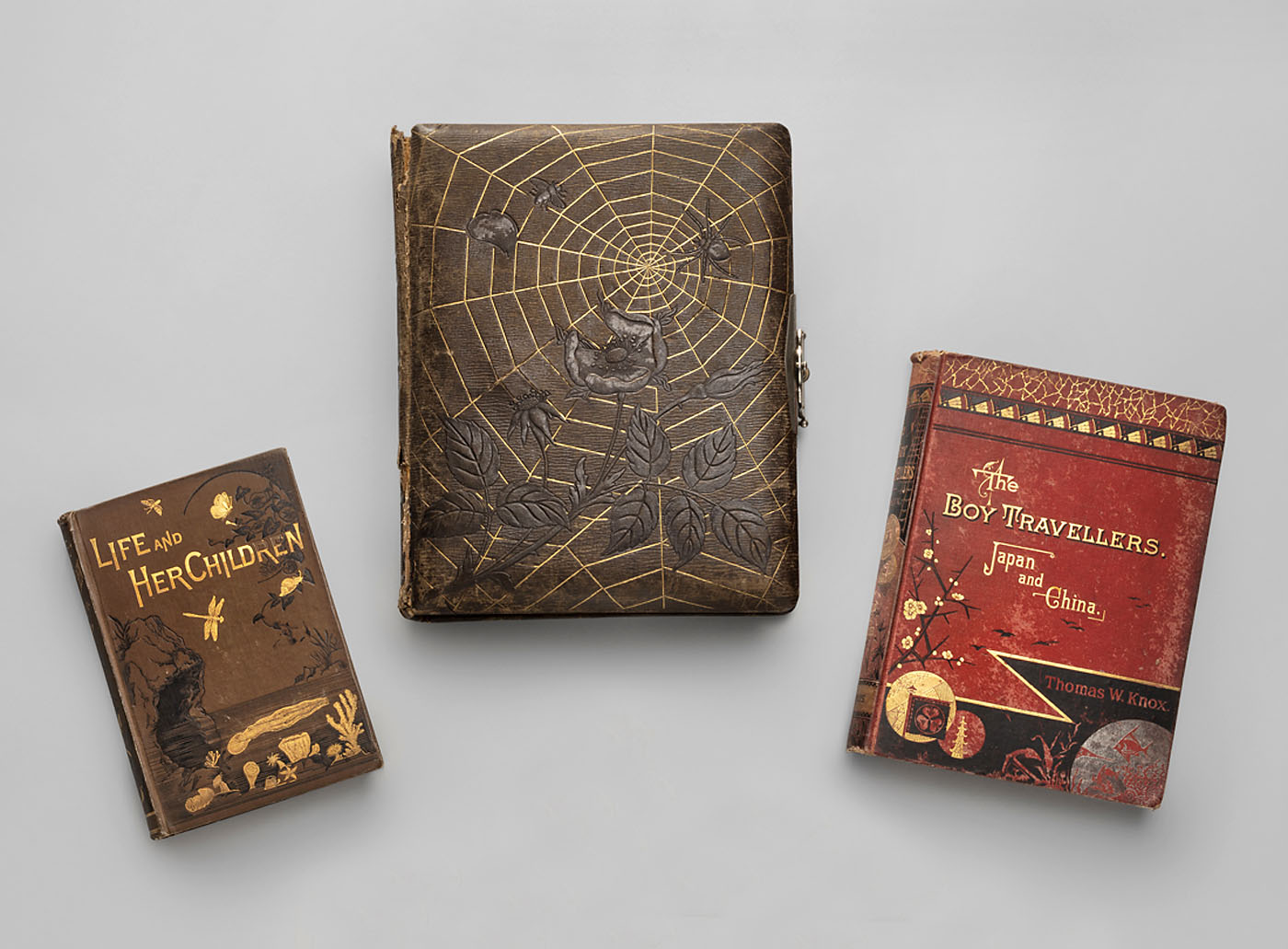
Western decorative arts manufacturers adopted Japanese motifs, such as asymmetry and imagery inspired by the natural world, including insects – from butterflies and dragonflies to black flies. The spider and its web now adorned everything from silver plate to wallpaper and framed portraits. Birds and sea creatures, such as cranes, owls, and carp were introduced as decorative motifs. Western artists looked at familiar trees and changing foliage in a new light – from cherry blossoms to autumn maple leaves, and bamboo. A variety of flowers found new meaning, including peonies, wisteria, and irises. The intriguing decorative lexicon of Japan also included ocean waves, clouds, lightning bolts, and cracked ice.

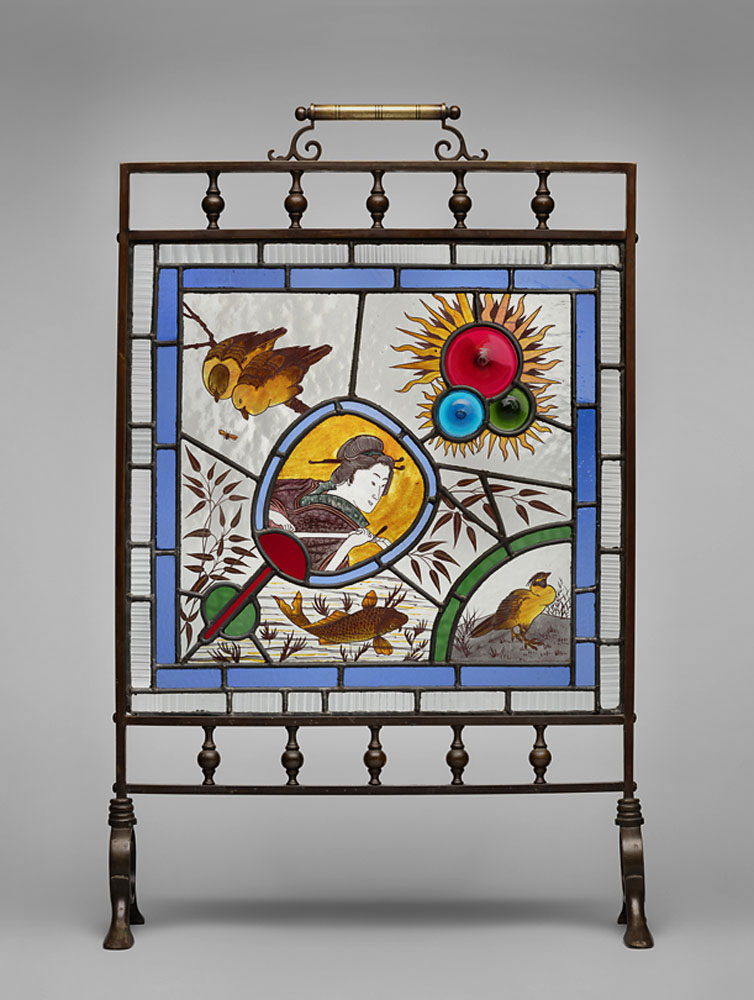
This exhibition features American and European decorative arts from the 1870s-1890s, when Japonisme reached its peak in popularity. Rather than directly copying, Western artists drew freely from Japanese ornament reinterpreting objects ranging from sterling silver flatware and holloware to colourful ceramic plates and vessels. Designs on Japanesque lamps, fire screens, and book covers are among the many everyday items that also feature imaginative imagery, all of which reflect an early and remarkable example of international cultural exchange between Japan and the West.

Text from the SFO Museum website


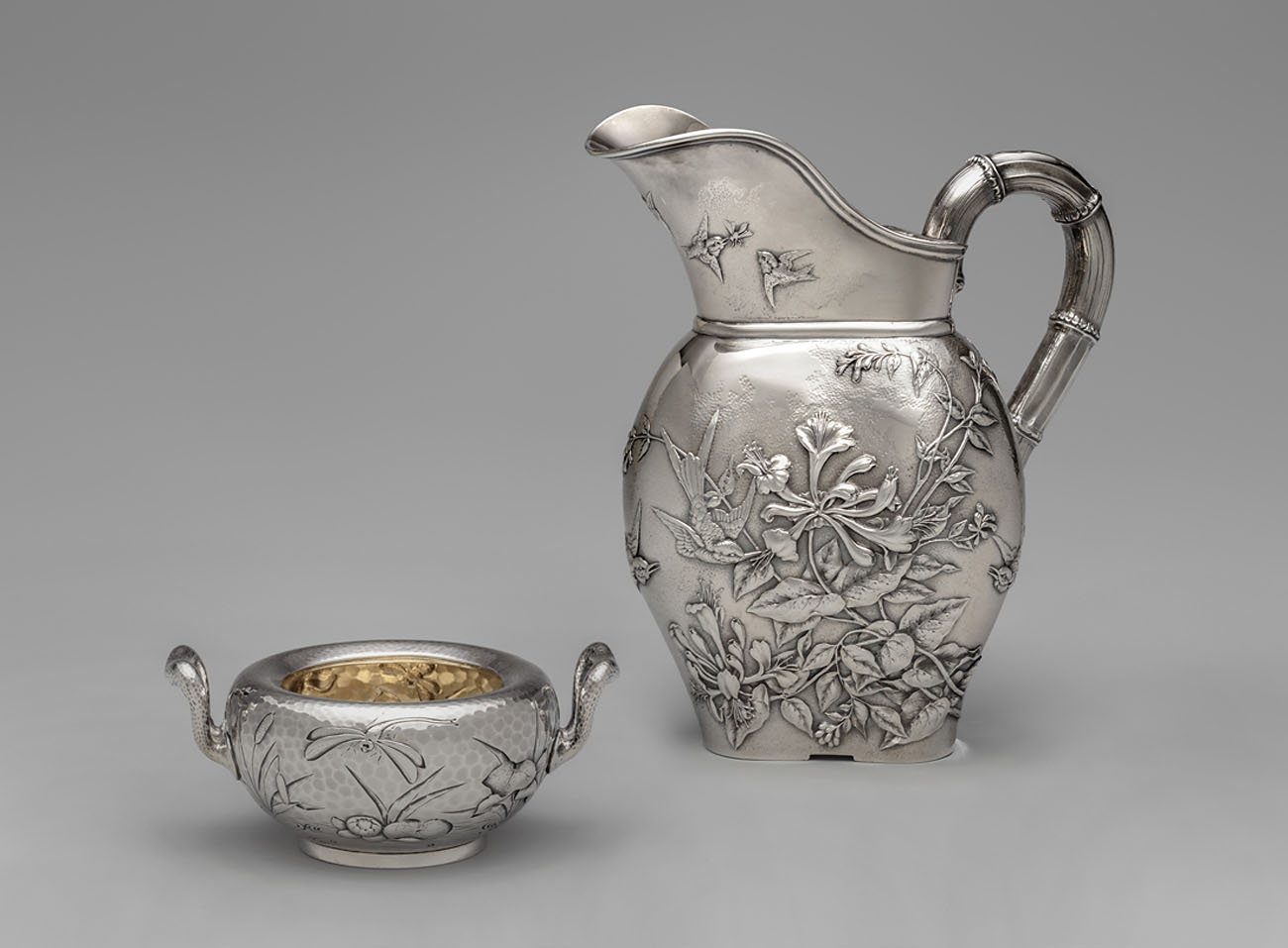
Dominick & Haff (American, New York) (manufacturer) 'Sugar bowl' 1884; William B. Durgin Company (American, Concord, New Hampshire) (manufacturer) 'Pitcher' c. 1885


Dominick & Haff (American, New York) (manufacturer)
Sugar bowl
1884
Sterling silver
Private Collection

William B. Durgin Company (American, Concord, New Hampshire) (manufacturer)
Pitcher
c. 1885
Sterling silver
Private Collection


A dragonfly appears on this sugar bowl. This common Japanese decorative motif was eagerly absorbed by the West during the height of Japonisme and by the Art Nouveau movement that followed it. This unusually shaped pitcher, with chased decoration wrapping around all three sides, has a handle shaped like a segmented stalk of bamboo.


Gildea & Walker (Burslem, Stoke-on-Trent, England) (manufacturer) 'Serving platter, "Melbourne" pattern' 1881-1885; Christopher Dresser (English, 1834-1904) (designer) Old Hall Earthenware Company (Stoke-on-Trent, Staffordshire, England) (manufacturer) 'Pitcher' c. 1881


Gildea & Walker (Burslem, Stoke-on-Trent, England) (manufacturer)
Serving platter, “Melbourne” pattern
1881-1885
Earthenware with transfer print and enamels
Courtesy of Jeffrey Ruda

Christopher Dresser (English, 1834-1904) (designer)
Old Hall Earthenware Company (Stoke-on-Trent, Staffordshire, England) (manufacturer)
Pitcher
c. 1881
Earthenware with transfer print and enamels
Courtesy of Brian D. Coleman


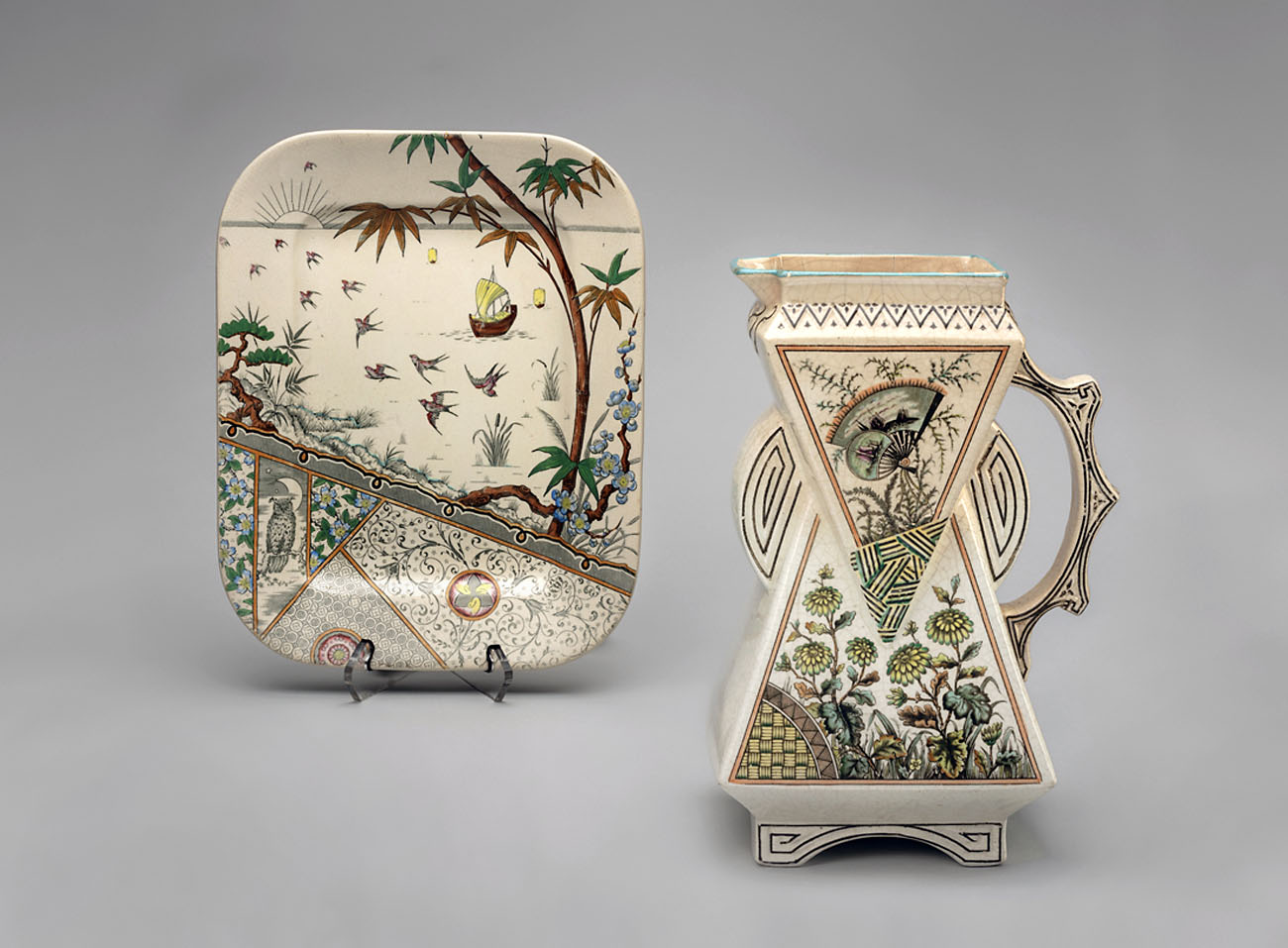
The pattern Gildea & Walker marketed under the trade name of “Melbourne” was one of the most popular transfer-printed designs in the Japanesque style and was offered in several colours. The eclectic, asymmetrical pattern incorporates a seascape, horizon line, sparrows, bamboo, blossoms, and an owl in the moonlight.

English designer Christopher Dresser (1834-1904) traveled extensively throughout Japan in 1876-1877 as a guest of the Japanese government. He was accompanied by translators, guides, sketch artists, and photographers. Dresser visited Buddhist temples, Shinto shrines, and historic sites. He met artists and craftspeople at dozens of potteries and workshops focusing on metalwork, basketry, and lacquer. Upon returning, he published Japan: Its Architecture, Art, and Art Manufacturers (1882), one of the first wide-ranging Western publications on Japanese arts and architecture.


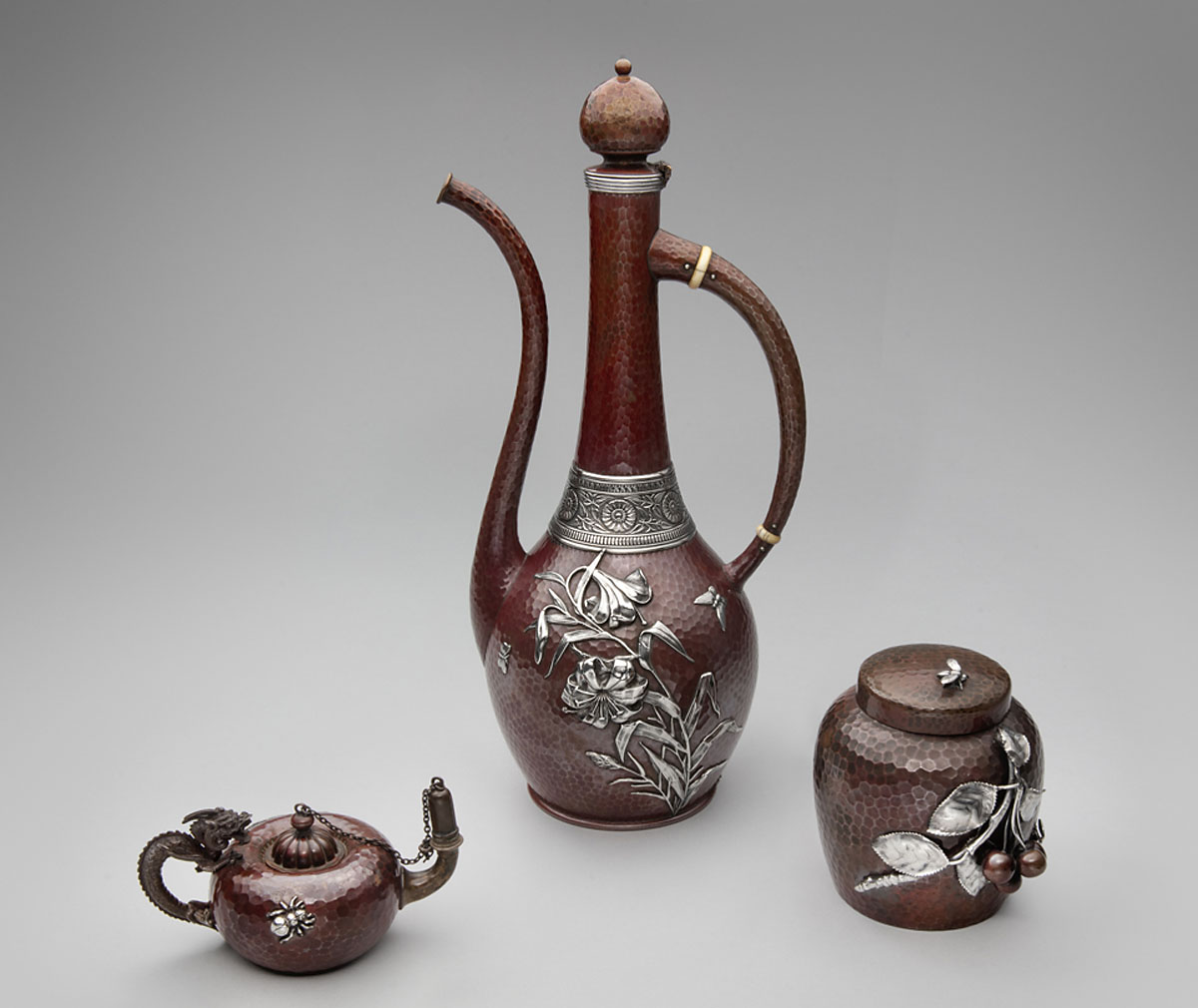
Gorham Manufacturing Company (American, Providence, Rhode Island) (manufacturer) 'Cigar lighter' 1881; 'Coffee pot' c. 1883; 'Tea caddy' 1881


[Left to right]

Gorham Manufacturing Company (American, Providence, Rhode Island) (manufacturer)
Cigar lighter
1881
Mixed metal
Private Collection

Gorham Manufacturing Company (American, Providence, Rhode Island) (manufacturer)
Coffee pot
c. 1883
Copper, silver
Private Collection

Gorham Manufacturing Company (American, Providence, Rhode Island) (manufacturer)
Tea caddy
1881
Copper, silver
Private Collection


The Gorham Manufacturing Company excelled in crafting Japanese-inspired objects of copper with silver appliqués that were hand hammered by their artisans. The small, patinated copper lighter exhibited here has a dragon handle; a spider appears on one side, while a Japanese woman and crane appear on the other side.

The Gorham Manufacturing Company began as a small silversmithing company in 1831, later becoming New England’s premier artistic silver manufacturer. John Gorham (1820-1898) and his chief designer George Wilkinson (1819-1894), who traveled to Japan in 1880, rivalled Tiffany & Company in their successful adoption of Japanese principles in the development of a wide range of wares. This eclectic Turkish-style coffee pot exhibits applied silver floral decoration on its front and a dragonfly on back.

Two flies are perched upon this tea caddy. Like the spider-and-web motif, Western artists had never thought to use flies as applied ornament before exploring Japanese art.


Christopher Dresser (English, 1834-1904) (designer, attributed to) Minton's China Works/Minton & Company (Stoke-on-Trent, Staffordshire, England) (manufacturer) 'Tile' c. 1870-1880; Pierre Mallet (French, 1836-1898, active in England c. 1870) (designer) Brown-Westhead, Moore & Co. (Cauldon Place, Hanley, Staffordshire, England) (manufacturer) 'Tile' c. 1880; Sherwin & Cotton (Hanley, Staffordshire, England) (manufacturer) 'Tile, "Cracked Ice" pattern' c. 1880


[Clockwise]

Christopher Dresser (English, 1834-1904) (designer, attributed to)
Minton’s China Works/Minton & Company (Stoke-on-Trent, Staffordshire, England) (manufacturer)
Tile
c. 1870-1880
Earthenware with block printing
Courtesy of Jeffrey Ruda

Pierre Mallet (French, 1836-1898, active in England c. 1870) (designer)
Brown-Westhead, Moore & Co. (Cauldon Place, Hanley, Staffordshire, England) (manufacturer)
Tile
c. 1880
Earthenware with transfer-printed etching and enamels
Courtesy of Jeffrey Ruda

Sherwin & Cotton (Hanley, Staffordshire, England) (manufacturer)
Tile, “Cracked Ice” pattern
c. 1880
Earthenware with transfer prints and enamels
Courtesy of Jeffrey Ruda


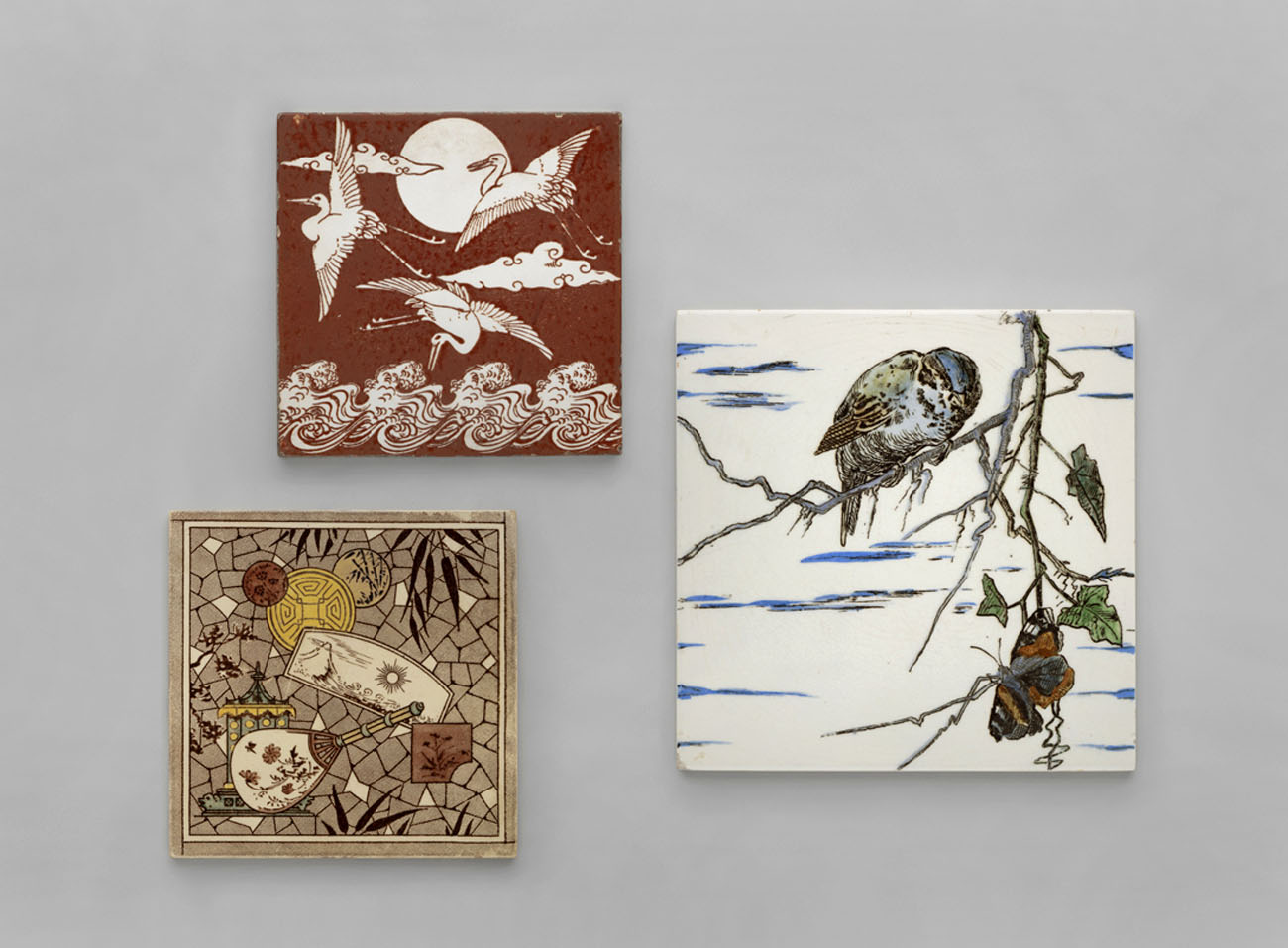
This first tile shows three cranes flying above waves, with a full moon and two clouds behind them. The cranes and waves are adapted from a Japanese pot that was displayed as a “jardinière” at the International Exhibition in London in 1862. The Minton Archive holds a drawing signed by Christopher Dresser that shifts the motif on the pot to a horizontal format with three cranes flying over stylised waves, along with a cloud and full moon.


Whiting Manufacturing Company (American, New York) (manufacturer) 'Seafood salad bowl, "Fish-net" pattern' 1885; Tiffany & Company (American, New York) (manufacturer) 'Ice bowl' c. 1877


Whiting Manufacturing Company (American, New York) (manufacturer)
Seafood salad bowl, “Fish-net” pattern
1885
Sterling silver
Private Collection

Tiffany & Company (American, New York) (manufacturer)
Ice bowl
c. 1877
Sterling silver
Private Collection


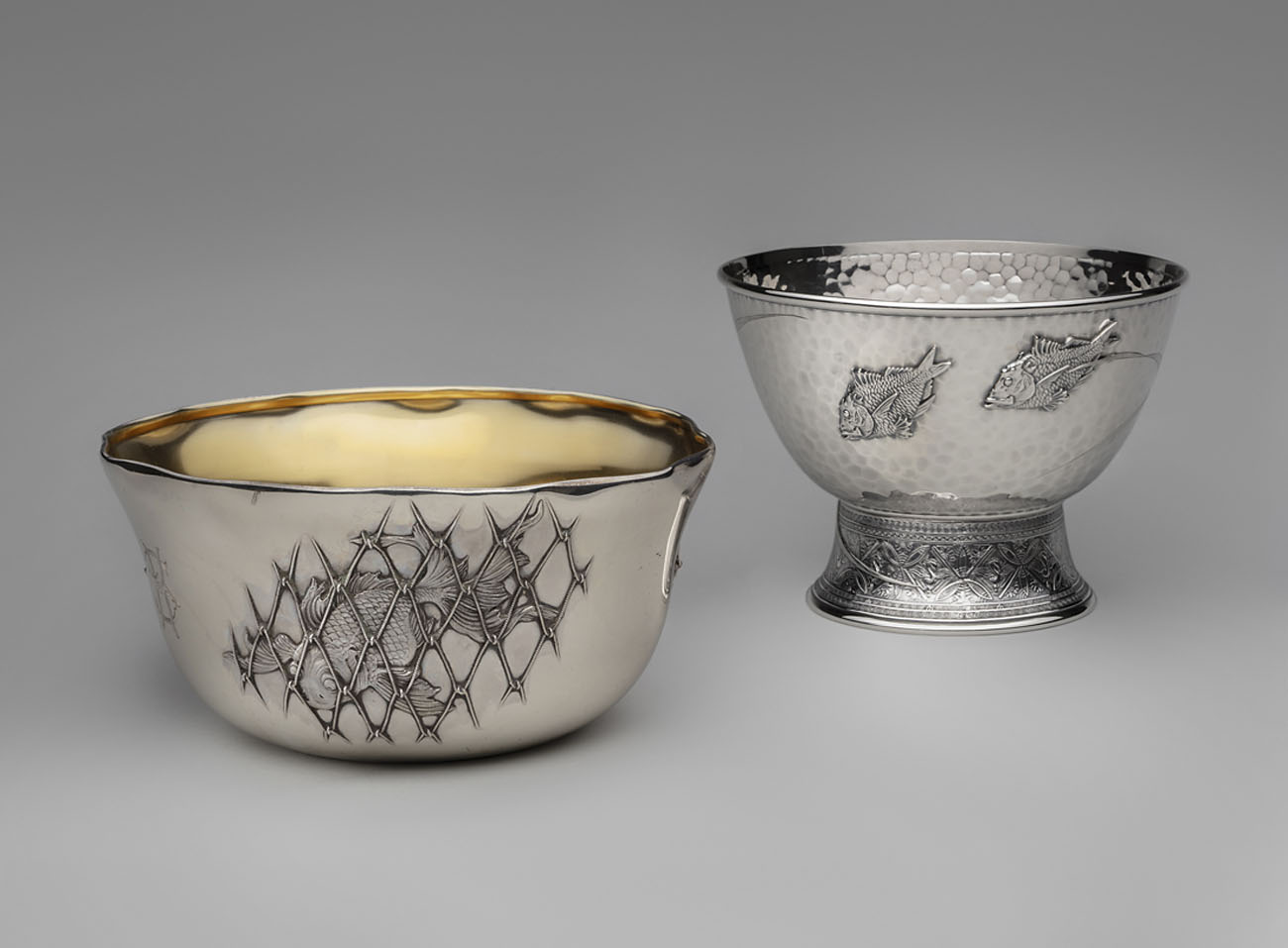
The exterior of this seafood salad bowl is decorated with three different applied decorations in the form of a stylised carp caught in a net. In Japan, the carp (koi, 鯉) symbolises courage, strength, and fertility.

Tiffany & Company was America’s most distinguished artistic goods manufacturer and one of the first to adopt Japanese-influenced decoration, which was lauded as far as Europe and Japan. The company began importing Japanese works under the guidance of designer Edward C. Moore (1827-1891). Moore amassed a large collection of Japanese art, including ceramics, textiles, and metalwork that was later bequeathed to the Metropolitan Museum of Art. He also established Tiffany’s study collection and library. Most likely, Moore commissioned Christopher Dresser (1834-1904) to assemble a collection of objects during his tour of Japan in 1876-1877.


Arabella B. Buckley (British, 1840-1929) ‘Life and Her Children’ 1893; Unknown manufacturer (American) ‘Photo album’ c. 1880s; Thomas W. Knox (American, 1835-1896) ‘The Boy Travellers: Japan and China’ 1880


Arabella B. Buckley (British, 1840-1929) (author)
D. Appleton and Company (American, New York) (publisher)
Life and Her Children
1893
Collection of Catherine A. Ferron and Paul T. Roberts

Unknown manufacturer (American)
Photo album
c. 1880s
Paper, ink, gilding
Anonymous lender

Thomas W. Knox (American, 1835-1896) (author)
Harper & Brothers Publishers (American, New York) (publisher)
The Boy Travellers: Japan and China
1880
Collection of Catherine A. Ferron and Paul T. Roberts


Unknown manufacturer (English) 'Hand-painted fire screen' c. 1880


Unknown manufacturer (English)
Hand-painted fire screen
c. 1880
glass, metal, paint
Courtesy of Brian D. Coleman


During the 1870s, stores specialising in Japanese art and merchandise, commonly referred to as Japanese novelty stores or fancy goods stores, opened across the United States – from New York and Boston to Philadelphia, Houston, and San Francisco. Many of the stores were owned by Japanese entrepreneurs. Art historian and print collector Hiromichi Shugio (1853-1927), was born into a privileged family in Saga Prefecture. He arrived in New York around 1880 and became the proprietor of First Japan Manufacturing and Trading Company in New York. Shugio curated the first major American exhibition of ukiyo-e prints at the Grolier Club in New York City in 1889. Bunkio Matsuki (1867-1940) came to San Francisco in 1888, soon moving to Salem, Massachusetts, where he established a Japanese section in the city’s leading department store, Almy, Bigelow & Washburn, stocking more than twenty-thousand items. Matsuki also opened a store in Boston and supplied works of art to the Museum of Fine Arts, Boston. Tadamasa Hayashi (1853-1906) learned French in his native country of Japan before travelling to Paris in 1878 to serve as a translator at the Exposition Universelle. Hayashi decided to remain in Paris and became a highly regarded art dealer, selling ukiyo-e and other artworks to an international clientele.


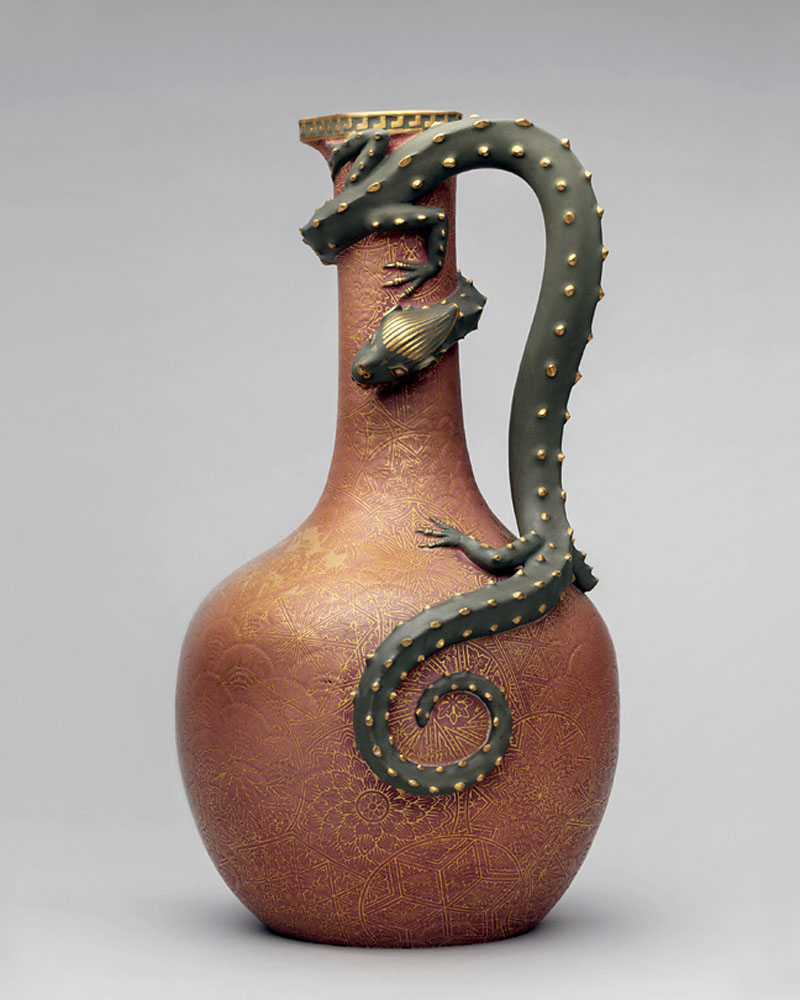
Royal Worcester (Stoke-on-Trent, Staffordshire, England) (manufacturer) 'Dragon vase' c. 1880s


Royal Worcester (Stoke-on-Trent, Staffordshire, England) (manufacturer)
Dragon vase
c. 1880s
Earthenware, glaze
Courtesy of Brian D. Coleman


SFO Museum 
San Francisco International Airport
P.O. Box 8097
San Francisco, CA 94128 USA
Phone: 650.821.6700

SFO Museum website

LIKE ART BLART ON FACEBOOK

Back to top

Exhibition: ‘Postwar Propliners in Miniature: Models from the Collection of Anthony J. Lawler’ at SFO Museum (SFOM), San Francisco International Airport

Exhibition dates: June 2011 – December 2011

Location: Aviation Museum and Library 1 – Front Wall Cases


Lockheed Aircraft Co., Burbank, California. 'American Overseas Airlines Lockheed L-049 Constellation' c. 1946


Lockheed Aircraft Co., Burbank, California
American Overseas Airlines Lockheed L-049 Constellation
c. 1946
Scale 1:44
Metal, paint
Collection of Anthony J. Lawler


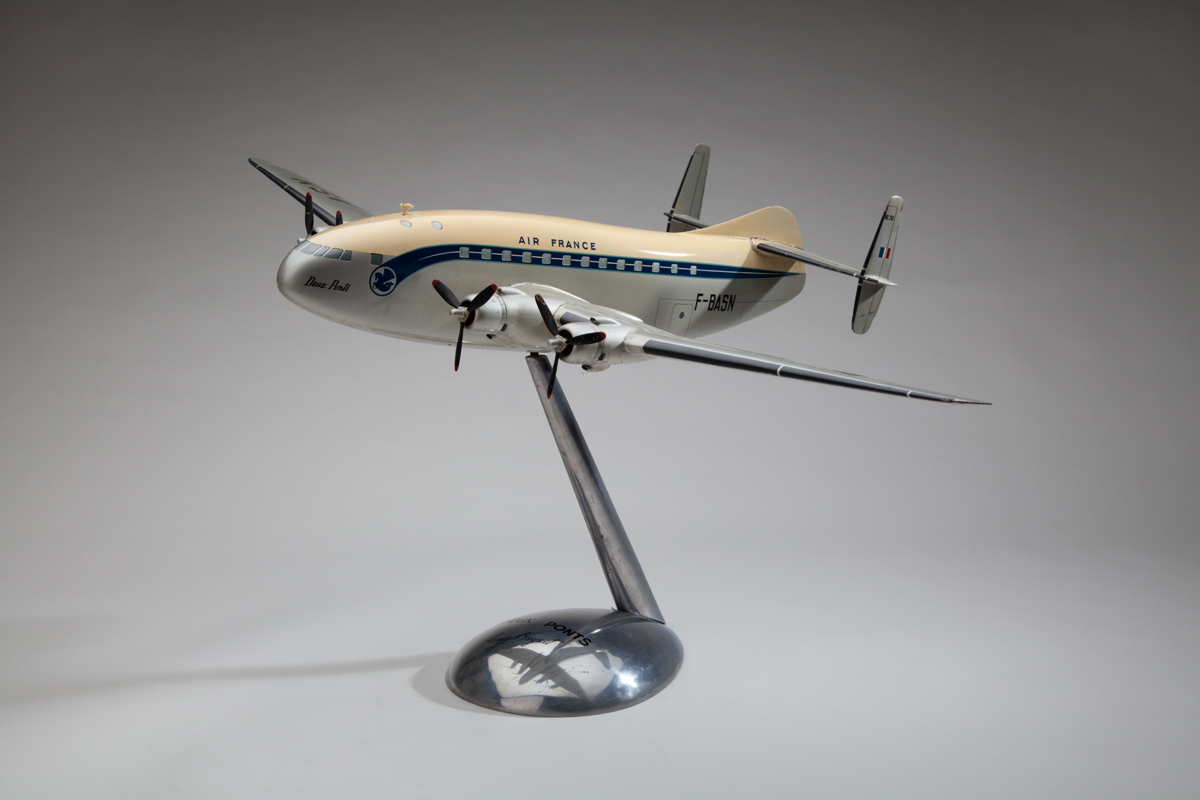
One of my favourite postings in a long while. As an inveterate collector how I would love to have these in my collection. What beautiful aircraft; what graceful models; what simple, gorgeous photographs by photographer Chad Michael Anderson. The Lockheed Constellation has to be one of the most delicious aircraft ever made. But the model I would take is the gorgeous Air France Breguet 763 Provence, because of it’s aerodynamic beauty and angle of flight.

Dr Marcus Bunyan


Many thankx to John Hill, Assistant Director, Aviation for his help and to SFO Museum for allowing me to publish the text and the photographs. Attribution for the photographs is to the SFO Museum (actual photographer unknown). Please click on the photographs for a larger version of the image.


Lockheed Aircraft Co., Burbank, California. 'American Overseas Airlines Lockheed L-049 Constellation' c. 1946


Lockheed Aircraft Co., Burbank, California
American Overseas Airlines Lockheed L-049 Constellation
c. 1946
Scale 1:44
Metal, paint
Collection of Anthony J. Lawler


In 1945, in an effort to gain transatlantic routes to Europe, American Airlines purchased American Export Airlines (founded in 1937 as a subsidiary of the shipping company American Export Lines) and renamed it American Overseas Airlines (AOA). The airline then began purchasing suitable aircraft for its new subsidiary. The best choice for the lengthy route to Europe was the Lockheed Model 047 Constellation, one the longest-range and fastest airliners produced at the time. Like other airliner manufacturers, Lockheed had its own in-house model factory that constructed highly-accurately scaled models for its customers. It produced this 1:44 scale model for AOA in polished sheet aluminium and painted in the airline’s earliest livery scheme.

Text from the SFO Museum website


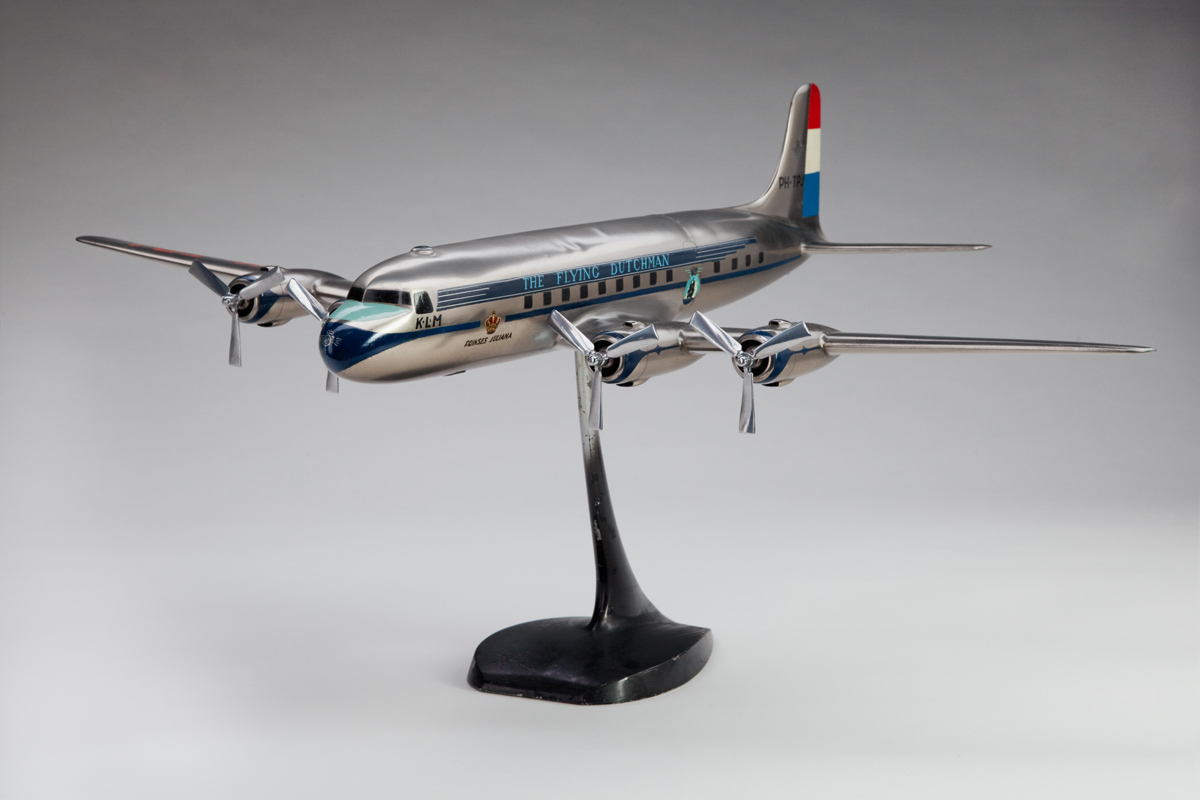
Maarten Matthys Verkuyl (Dutch). 'KLM (Koninklijke Luchtvaart Maatschappij) Royal Dutch Airlines Douglas DC-6' c. 1950


Maarten Matthys Verkuyl (Dutch)
KLM (Koninklijke Luchtvaart Maatschappij) Royal Dutch Airlines Douglas DC-6
c. 1950
Scale 1:48
Metal, paint
Collection of Anthony J. Lawler


KLM (Koninklijke Luchtvaart Maatschappij) Royal Dutch Airlines commenced service in 1920. After ceasing operations during World War II, the airline rapidly emerged to become a leading European and international carrier during the postwar era. KLM received its first deliveries of the Douglas DC-6, both freighter and passenger versions, in 1948. The DC-6 was the first American-produced airliner to be introduced after the war. The model represents the DC-6 Princess Juliana (Koningin Juliana), which was the second aircraft Douglas delivered of the passenger version. The Dutch model maker Maarten Matthys Verkuyl fabricated the model from sheet zinc for a KLM pilot around 1950. It is one of only two produced by Verkuyl of the type using this material during this period.

Text from the SFO Museum website


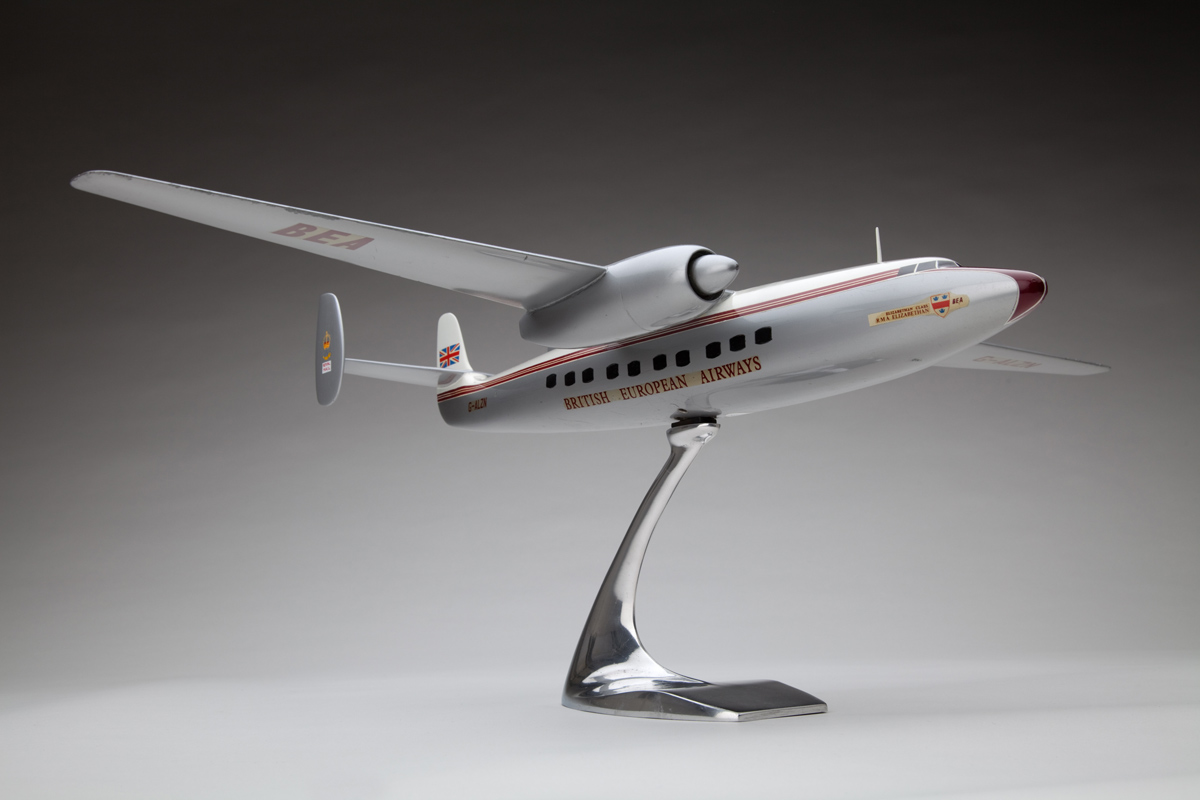
Shawcraft Models, Uxbridge, England. 'BEA Airspeed AS.57 Ambassador' 1950s


Shawcraft Models, Uxbridge, England
BEA Airspeed AS.57 Ambassador
1950s
Scale 1:48
Wood, metal, paint
Collection of Anthony J. Lawler


In 1946, BEA (British European Airways) was formed as the British flag carrier for domestic and Continental Europe flights. By 1947, a number of independent airlines, including Scottish Airways, had merged with the company. In 1948, BEA placed an order for twenty of the Ambassador, a Douglas DC-3 replacement that had been under development by Airspeed of Great Britain since the latter years of World War II. This high-wing, tripletail, two-engine, mid-range aircraft was introduced in 1952 and operated by the airline until 1958. Shawcraft of Great Britain crafted the model of wood during the same decade, which accurately represents the Ambassador RMA Elizabethan, the flagship of the fleet. BEA’s comfortable Ambassador service, which was named “Elizabethan Class,” became highly popular among commuters between Britain and the Continent.

Text from the SFO Museum website


Peter V. Nelson, Reading, England 'Ethiopian Air Lines Convair 240 model aircraft' Early 1950s


Peter V. Nelson, Reading, England
Ethiopian Air Lines Convair 240 model aircraft
Early 1950s
Scale 1:48
Metal, paint
Collection of Anthony J. Lawler


Ethiopian Air Lines was founded in 1946 and began operating out of Addis Ababa Airport in 1947, with administrative, managerial, and flight crew support from TWA (Transcontinental & Western Airlines). In 1950, the airline acquired three Convair 240s in order to expand its routes and offer international service to Europe and Asia. These aircraft were produced by Convair of San Diego, California and developed to replace the Douglas DC-3. The sand-casted metal model represents the first aircraft to be delivered, ET-T-20, and was crafted by Peter V. Nelson in Great Britain during the same period. It was accurately painted in Ethiopian Air Lines’ vibrant early livery with the national colours of red, yellow, and green, and the Lion of Judah, the symbol of Ethiopia’s former ruler Haile Selassie – whose family traces their origins to King Solomon. Selassie played a major role in establishing the national airline, which was considered vital to the modernisation of Ethiopia after World War II.

Text from the SFO Museum website


Walkers Westway Models, London, England 'Capital Airlines Vickers Viscount model aircraft' 1950s


Walkers Westway Models, London, England
Capital Airlines Vickers Viscount model aircraft
1950s
Scale 1:48
Metal, paint
Collection of Anthony J. Lawler


Capital Airlines originated out of a merger between Pennsylvania and Central Airlines to form Pennsylvania Central Airlines or PCA in 1936. In 1941, the airline moved its headquarters to the newly built Washington National Airport, and in 1948, changed its name to Capital Airlines. In 1955, in an effort to attract more passengers by offering technologically advanced aircraft, it became the first U.S. carrier to inaugurate turboprop-powered airliner service with the introduction of the British produced Vickers Viscount. The aircraft was originally introduced by BEA (British European Airways) in 1950, which made it the first of its kind to go into service, and moreover, it was years ahead of the introduction of other turboprop airliners. Capital purchased sixty of the aircraft and realised an increased market share nearly everywhere the Viscount flew. This sand-cast metal model was produced in the 1950s by Walkers Westway in London, England, and accurately painted in Capital’s iconic 1950s red, white, and blue livery with eagle logo.

Text from the SFO Museum website


La Maquette d'Etude et d'Exposition à Aubervilliers, France. 'Air France Breguet 763 Provence' 1950s


La Maquette d’Etude et d’Exposition à Aubervilliers, France
Air France Breguet 763 Provence
1950s
Scale 1:50
Wood, plastic, metal, paint
Collection of Anthony J. Lawler


Created in 1933 through a merger of several French aviation concerns, Air France became one of the largest airlines in Europe by the late 1930s, with routes throughout Europe and to French colonies in North Africa and Asia. During World War II, the carrier moved its base of operation to Morocco, and by 1946, became nationalized by the French government and opened its first terminal in central Paris. During the latter years of the war, the French aircraft manufacturer Breguet began designing a large capacity, mid-range airliner that would ultimately become the double deck (Deux Ponts in French), twin-tail, four-engine 763 Provence. Air France ordered twelve of the aircraft, which entered service in 1953 and were operated on routes to Algiers and Southern Europe for carrying both passengers and freight. Crafted from wood by the French model maker La Maquette d’Etude et d’Exposition à Aubervilliers, the model represents the first aircraft delivered to Air France, F-BASN.

Text from the SFO Museum website


Immediately following the end of World War II in 1945, airlines and passengers benefited from a surplus of inexpensive, advanced propeller-driven transport aircraft, or “propliners.” Over the next fifteen years, commercial aviation expanded rapidly as airlines persistently requested improved propliner designs to lower costs, attract new customers, and gain advantages over competitors. In meeting these demands the manufacturers of North America and Europe developed increasingly superior aircraft. These included the jet-powered turboprop airliners that flew successively faster, higher, and farther.

Making scale models of these airliners was an important part of the design, manufacturing, and marketing process during this period. Crafted by in-house model shops or independent model makers, they represented the new designs in miniature for convenient three-dimensional analysis. Accurately painted livery schemes on the models helped the airlines to imagine the new airliner operating within their fleet. Carriers also commissioned the making of models to promote their improved services in airline offices and travel agencies. During the late 1940s and early 1950s, they were usually made of sheet or cast metal and complemented with metal bases often formed into unique streamline shapes. By the late 1950s, models began to be produced from plastic, which was easier to mold into intricate shapes and reflected the proliferation of new synthetic resins.

These models represent the age of postwar propliners, which lasted until the 1960s when faster, more fuel-efficient and propeller-less turbojet airliners began to supersede them. They are from the collection of Anthony J. Lawler, an aviation industry professional and avid airplane model collector since first seeing the De Havilland Comet – the world’s first jetliner – fly over his boyhood home in Rhodesia. Mr. Lawler has spent decades assembling one of the finest collections of scale airliner display models, most of which were acquired while working as a senior sales representative for Airbus North America during the 1980s and 1990s. His collection spans a century of commercial aviation design innovation.

Text from the SFO Museum website


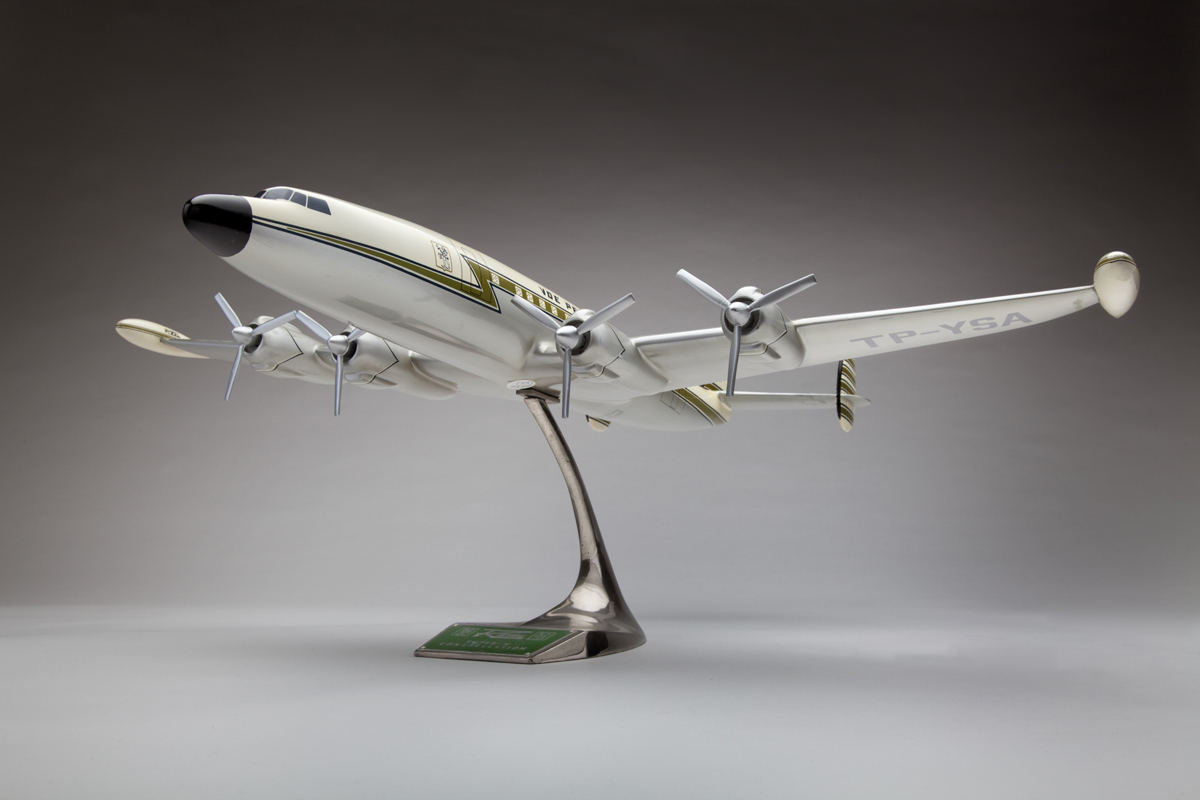
Raise-Up Models, Rotterdam, Netherlands. 'REAL (Redes Estaduais Aéreas Limitadas) Transportes Aéreos Lockheed 1049H Super Constellation' 1950s


Raise-Up Models, Rotterdam, Netherlands
REAL (Redes Estaduais Aéreas Limitadas) Transportes Aéreos Lockheed 1049H Super Constellation
1950s
Metal, paint
Collection of Anthony J. Lawler


In 1945, Vicente Mammana Netto and Linneu Gomes formed REAL (Redes Estaduais Aéreas Limitadas) Transportes Aéreos, as a small regional Brazilian airline. By the mid-1950s, the airline had grown substantially by acquiring numerous other Brazilian airlines and expanding its routes through South America. In 1958, in order to compete with its rival Varig, REAL acquired three long-range Lockheed 1049H Super Constellations. The next year, the airline inaugurated international service between Rio de Janeiro and Los Angeles with stops in Manaus-Ponta Pelada, Bogotá, and Mexico City. By 1960, REAL had expanded its Constellation service to include trans-pacific flights to Tokyo. Ultimately, however, the international service proved too costly for the airline, and in 1961, amid financial difficulties, it was acquired by Varig. Raise-Up Models of the Netherlands produced the cast-metal model of the REAL Super Constellation. It was painted in the airline’s eye-catching green livery of the late 1950s, with the slogan “Voe Pela REAL,” meaning, “Fly on REAL” in Portuguese.

Text from the SFO Museum website


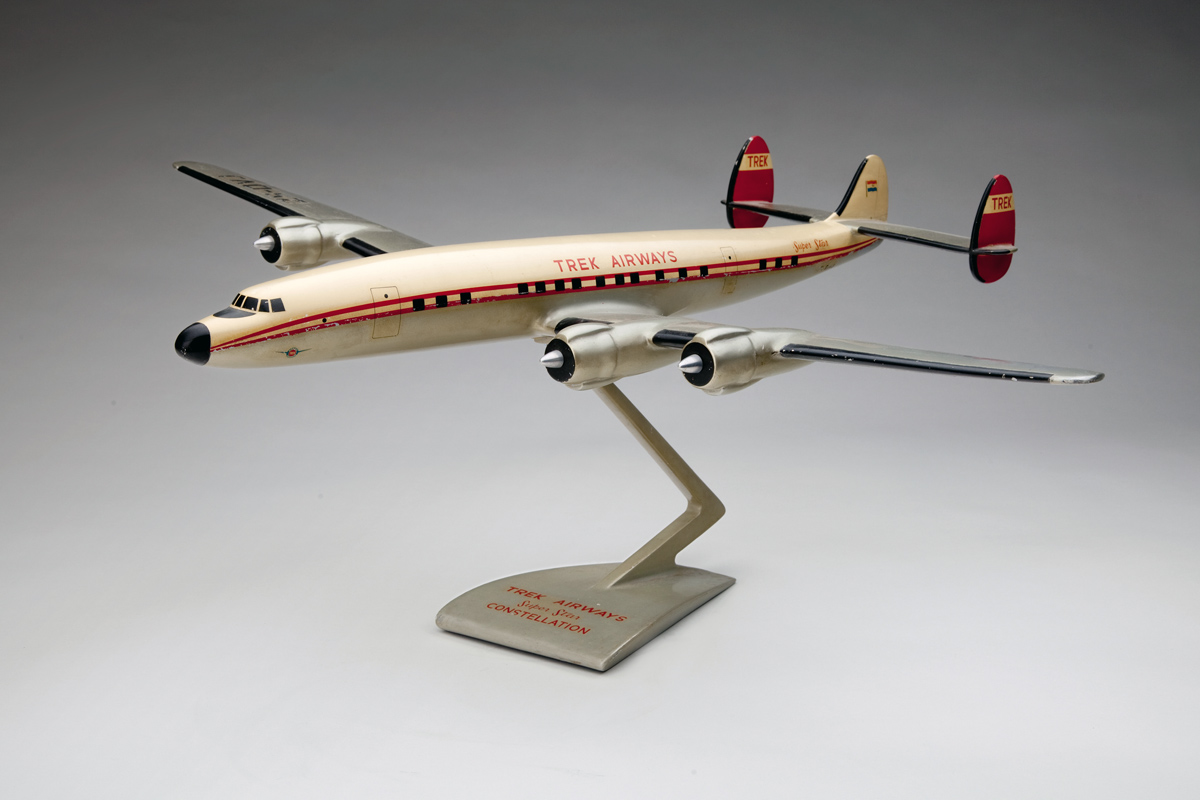
Peter V. Nelson, Reading, England. 'Trek Airways Lockheed 1649 Starliner' early 1960s


Peter V. Nelson, Reading, England
Trek Airways Lockheed 1649 Starliner
Early 1960s
Scale 1:62
Metal, paint
Collection of Anthony J. Lawler


Founded in 1953, Trek Airways was a South African airline based out of Johannesburg with service to Northern Europe. Initially, Trek was equipped with Vickers Vikings, which required overnight stops on routes to Europe. By the early 1960s, the airline began acquiring long-range Lockheed 1649 Starliners from carriers like TWA (Trans World Airlines) and Lufthansa, which had begun to replace these models with jetliners such as the Boeing 707 and Douglas DC-8. The Starliner provided fast, smooth, and comfortable service, along with the range and speed necessary for limited stops on routes to Düsseldorf, Vienna, and Luxembourg. British model maker Peter V. Nielson crafted the Starliner model for the airline in the early 1960s. At the time of acquisition, the heavy, all-metal model was used as a doorstop for the airline’s storeroom.

Text from the SFO Museum website


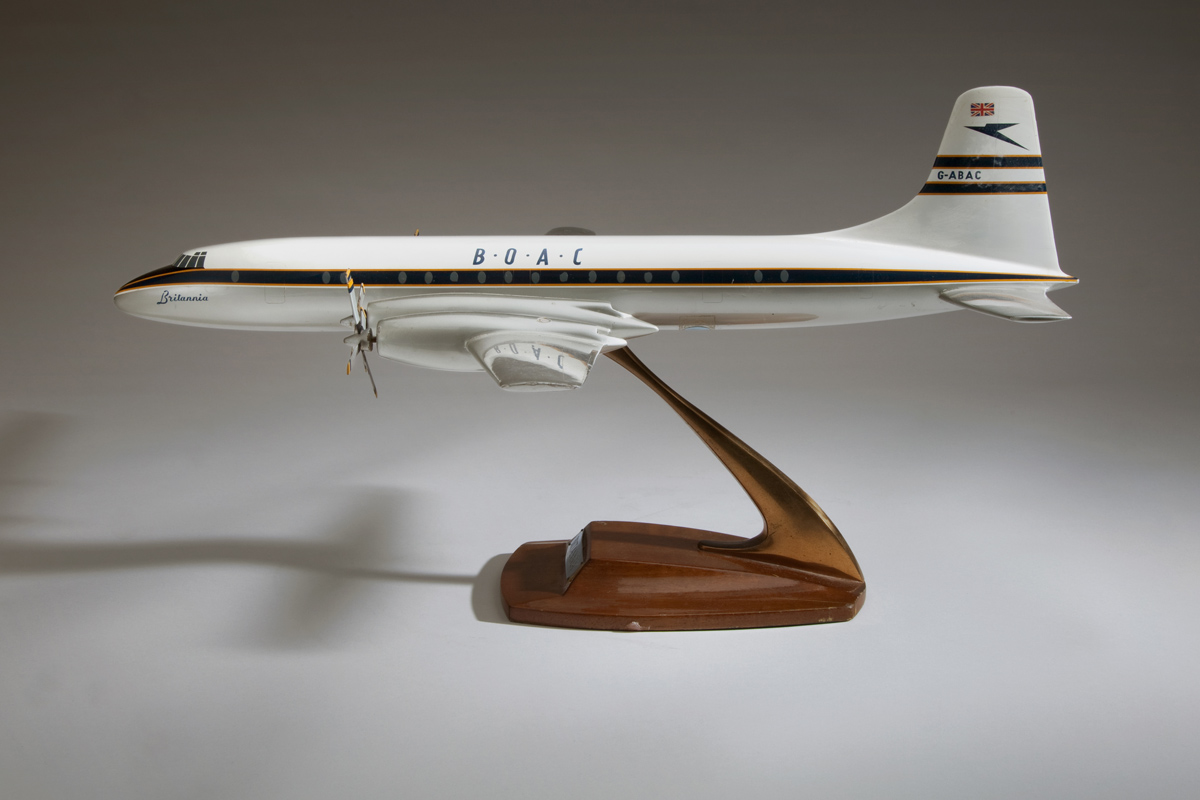
Westway Models, London, England. 'BOAC Bristol Britannia 300' late 1950s


Westway Models, London, England
BOAC Bristol Britannia 300
Late 1950s
Scale 1:72
Metal, plastic, wood, paint
Collection of Anthony J. Lawler


In 1957, Britain’s long-haul international flag carrier BOAC (British Overseas Airways Corporation) introduced the Bristol Aircraft Company’s turboprop Britannia on its routes to South Africa and New York. Two years later, the airline inaugurated the first regular round-the-world Britannia service via San Francisco, Hong Kong, and Tokyo. The large capacity, long-range, jet-prop-powered airliner, nicknamed the “Whispering Giant,” was significantly quieter than piston-engine airliners of the period and provided smooth, fast service with comfortable accommodations. Due to many delays in its development, the airliner was introduced later than anticipated and only operated into the early 1960s, before it was replaced by faster jetliners with similar range and capacity, such as the Boeing 707. The all-metal model was crafted in England by Westway, a prominent builder of airliner models for the British aerospace industry during the 1950s.

Text from the SFO Museum website


Raise-Up Models, Rotterdam, the Netherlands 'Western Airlines Lockheed L-188 Electra model aircraft'
Late 1950s


Raise-Up Models, Rotterdam, the Netherlands
Western Airlines Lockheed L-188 Electra model aircraft
Late 1950s
Scale 1:40
Metal, paint
Collection of Anthony J. Lawler


Western Air Express was founded in 1925, and after several mergers and name changes, became Western Air Lines in 1941. During the postwar era, Western quickly grew as a regional airline serving routes from Minneapolis, Minnesota, to the West Coast. In 1959, the airline began receiving delivery of the Lockheed L-188 Electra, a new, revolutionary turboprop airliner developed and produced by Lockheed Aircraft of Burbank, California. With medium range, a cruise speed of nearly four hundred miles per hour, and a capacity for approximately one hundred passengers, the Electra was ideal for Western’s regional needs and, initially, was instrumental in attracting a larger customer base. This large-scale model was fabricated of metal by Raise-Up Models of Rotterdam, Holland, and was painted to represent one of the first aircraft received from Lockheed in Western’s late 1950s red-and-white livery with the Native American logo.

Text from the SFO Museum website


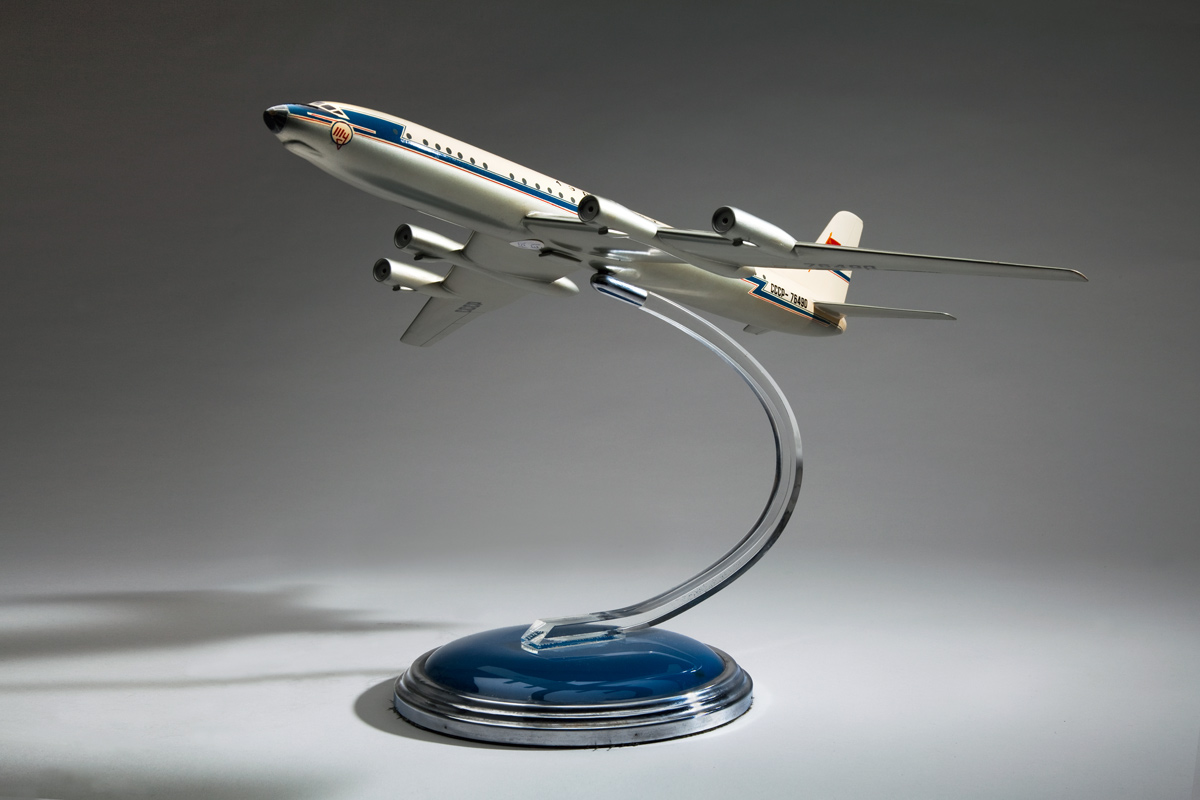
U.S.S.R. 'Aeroflot Tupolev Tu-114 Rossiya' early 1960s


U.S.S.R.
Aeroflot Tupolev Tu-114 Rossiya
Early 1960s
Scale 1:100
Metal, paint, plastic
Collection of Anthony J. Lawler


SFO Museum 
San Francisco International Airport
P.O. Box 8097
San Francisco, CA 94128 USA
Phone: 650.821.6700

SFO Museum website

LIKE ART BLART ON FACEBOOK

Back to top