Exhibition: ‘A Memorial Exhibition in Tom Garver’s Memory of O. Winston Link’s Photographs’ at the Jane Lutnick Fine Arts Center, Haverford College, Haverford, PA

Exhibition Dates: 3rd June – 7th December, 2024
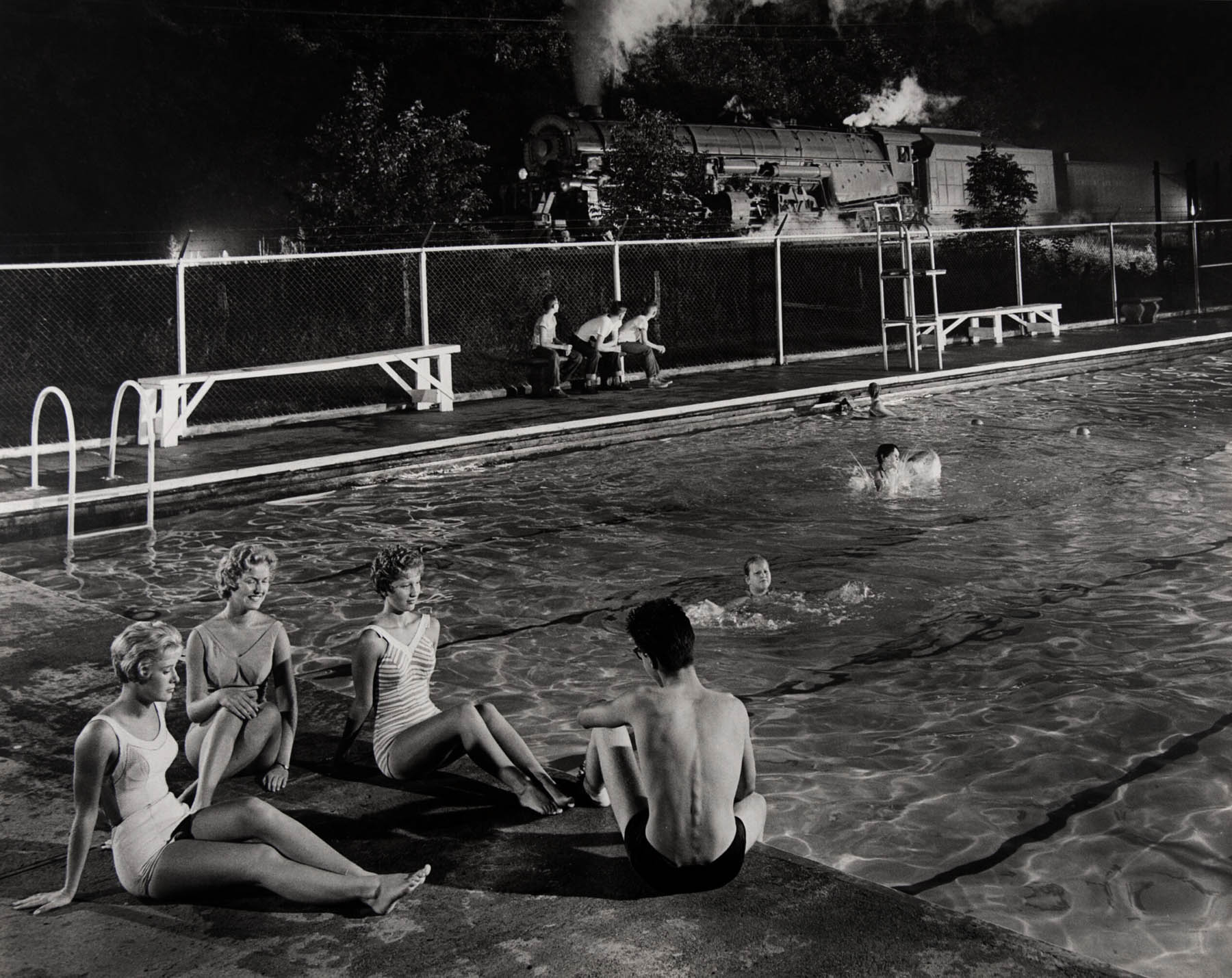
 

O. Winston Link (American, 1914-2001) 'Swimming pool, Welch, West Virginia' 1958, printed c. 1987 from the exhibition 'A Memorial Exhibition in Tom Garver's Memory of O. Winston Link's Photographs' at the Jane Lutnick Fine Arts Center


O. Winston Link (American, 1914-2001)
Swimming pool, Welch, West Virginia
1958, printed c. 1987
Gelatin silver print


What a pleasure it is to present the work of the renowned American photographer O. Winston Link (1914-2001) on this archive. I’ve only ever posted on one exhibition of his work before, way back in 2009.

I’ve always loved steam trains ever since I was denied a Hornby train set as a kid. I love their scale, design, colour, noise, smell … and their muscularity. As a machine emerging from the early days of the Industrial Revolution there is something so essential and raw about them.

Link’s elaborately staged, choreographed even, large format photographs in which he employs large banks of synchronised flash lights to capture the locomotives in action, mainly at night – have a visceral effect on me, stirring up deep passions for this primordial machine.

Link’s previsualisation was strong. As Tom Garver observes, “Winston Link innately possessed what has been called photographic vision, the ability to visualise photographs before they are created and to recognise in the process that what one sees, no matter how interesting, does not necessarily translate into an interesting photograph.”

It was Link’s ability to capture the spirit and essence of the tableaux vivants, the “living picture”, that brings these static scenes alive. You can almost reach out and touch these Jurassic trains, these workhorses trundling through small American communities. Again, Tom Garver insightfully notes that “there was this great intense spirit to really document and record this, to capture it. I think what I didn’t realise is how much we were capturing a whole way of life that was disappearing. Not only steam locomotives versus diesel locomotives but this isolated small town individualised kind of America that was vanishing.”

The spirit of the thing itself.

As Minor White says in one of his ‘Three Canons’:

Be still with yourself
Until the object of your attention
Affirms your presence


Then you look at magnificent photographs such as Locomotive Driving Wheels (1955, printed 1993?, below) with its low perspective of the enormous wheels and the light falling on the metal; the dark, disturbing creatures in Coaling Locomotives, (Puff of Steam) Shaffers Crossing Yards, Roanoke, Virginia (1955, below) like fire breathing dragons; or the incongruous sight of the train as big as the buildings and running right next to them in Main Line on Main Street, North Fork, West Virginia, August 29, 1958 (1958, printed 1997, below) – and you go… YES!

This artist gets it. He gets he gets it he gets it. And he has the skill and this really great intense spirit and the dedication to apply that skill and spirit… in order to capture the presence of these vanishing machines and worlds.

O. Winston Link … thank you.

Dr Marcus Bunyan


Many thankx to the Jane Lutnick Fine Arts Center, Haverford College for allowing me to publish the photographs in the posting. Please click on the photographs for a larger version of the image.


“I can’t move the sun – and it’s always in the wrong place – and I can’t even move the tracks, so I had to create my own environment through lighting.”


O. Winston Link


“Winston’s spirit so imbued the project that it was never really work. It was such a pleasure, there was also that kind of tingle that this was high adventure. You know, you had to get it. There were times when we would be absolutely exhausted, I remember once, we arrived at a place to tape record in this case, we got there at six and discovered that the train had left at five, we got there the next day at five and discovered it had left at four, we got there at four and that time it didn’t come until midnight. So, we sat there and waited and talked about what we were doing and about life and how it was changing and the many varieties of architecture and construction and the quality of things, how they were disappearing. So, there was this great intense spirit to really document and record this, to capture it. I think what I didn’t realise is how much we were capturing a whole way of life that was disappearing. Not only steam locomotives versus diesel locomotives but this isolated small town individualised kind of America that was vanishing.”


Tom Garver, Curator and Museum Director, a former assistant for Link’s photo projects.
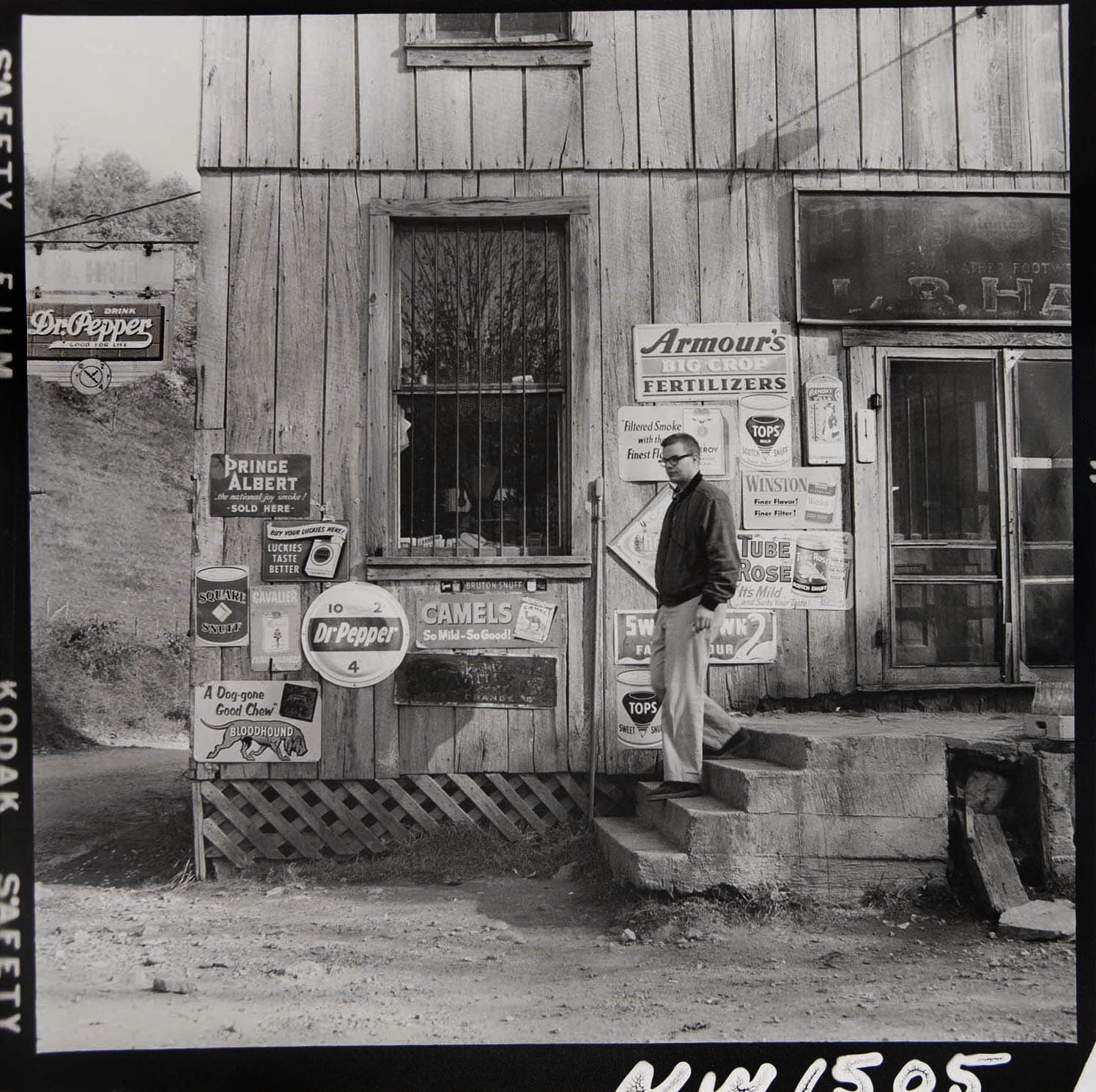


O. Winston Link (American, 1914-2001) 'Tom Garver at the General Store, Husk (Nella), North Carolina, 1957' 1957


O. Winston Link (American, 1914-2001)
Tom Garver at the General Store, Husk (Nella), North Carolina, 1957
1957
Gelatin silver print


O. Winston Link (American, 1914-2001) 'Haverford Chemistry Lecture' 1952


O. Winston Link (American, 1914-2001)
Haverford Chemistry Lecture
1952
Gelatin silver print


O. Winston Link (American, 1914-2001) 'Locomotive Driving Wheels' 1955, printed 1993? from the exhibition 'A Memorial Exhibition in Tom Garver's Memory of O. Winston Link's Photographs' at the Jane Lutnick Fine Arts Center


O. Winston Link (American, 1914-2001)
Locomotive Driving Wheels
1955, printed 1993?
Gelatin silver print
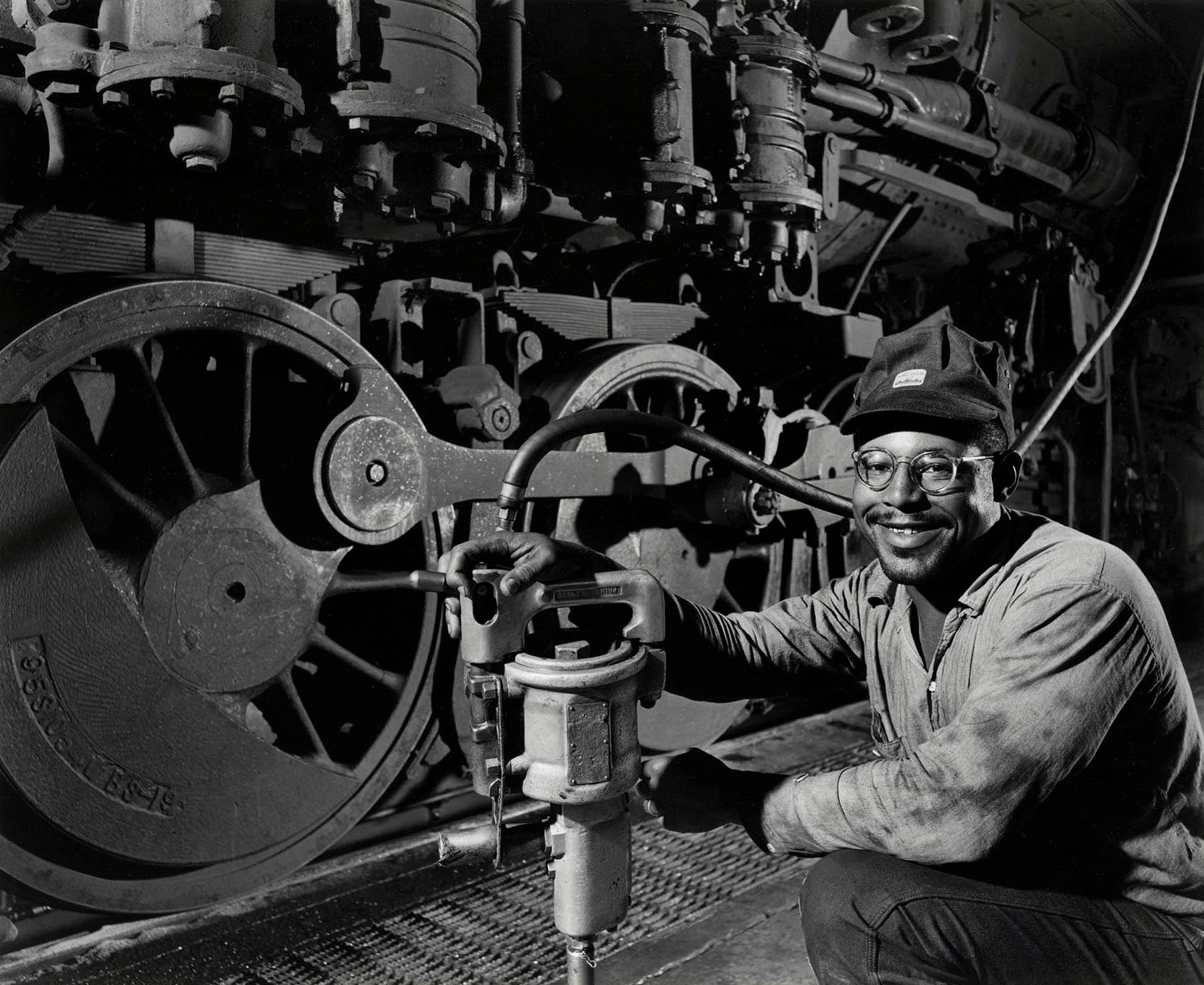
 

O. Winston Link (American, 1914-2001) 'J. O. Hayden with His Grease Gun, Bluefield Lubritorium' 1955 from the exhibition 'A Memorial Exhibition in Tom Garver's Memory of O. Winston Link's Photographs' at the Jane Lutnick Fine Arts Center


O. Winston Link (American, 1914-2001)
J. O. Hayden with His Grease Gun, Bluefield Lubritorium
1955
Gelatin silver print
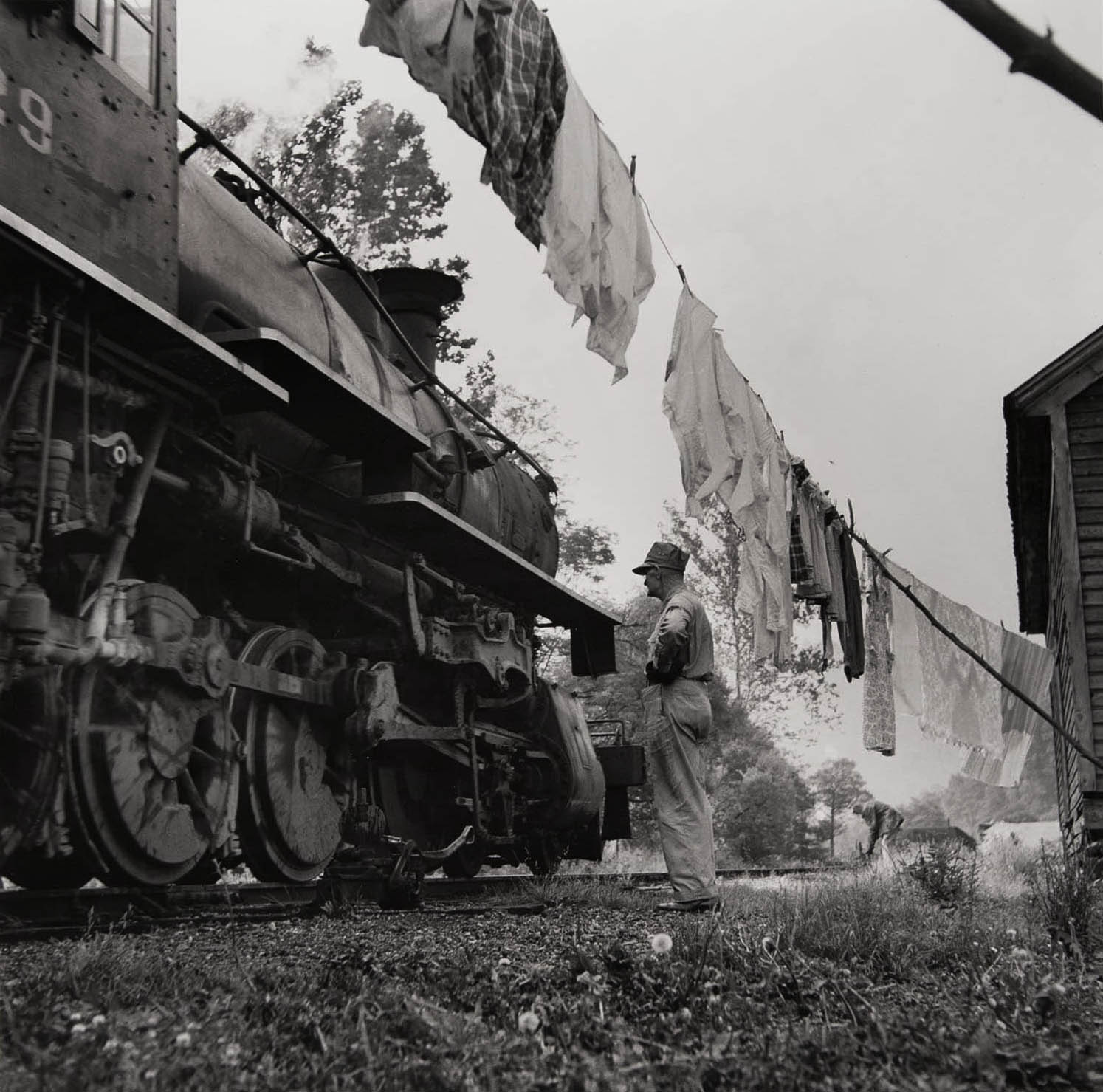
 

O. Winston Link (American, 1914-2001) 'Ralph White, Abingdon Branch Train Conductor, and Laundry on the Line, Damascus' 1955


O. Winston Link (American, 1914-2001)
Ralph White, Abingdon Branch Train Conductor, and Laundry on the Line, Damascus
1955
Gelatin silver print


O. Winston Link (American, 1914-2001) 'Coaling Locomotives, (Puff of Steam) Shaffers Crossing Yards, Roanoke, Virginia' 1955


O. Winston Link (American, 1914-2001)
Coaling Locomotives, (Puff of Steam) Shaffers Crossing Yards, Roanoke, Virginia
1955
Gelatin silver print


The exhibition consists of photographs by O. Winston Link (1914-2001) of steam locomotion on the Norfolk and Western Railroad from 1955 to 1960 and photographs taken by Link in 1952 of Haverford College for publicity purposes. Thomas “Tom” Haskell Garver (1934-2023) Haverford class of 1956 first met Link in 1952. Garver recalled that first meeting like this. “Link, a New York photographer, created admissions brochure photos at Haverford in 1952. After graduation, I was studying in New York City and worked part time for him for about a year. This included three trips with Winston to work on his documentation of the last years of steam powered railroading.”

Garver, an accomplished museum administrator and curator, stepped in when Link needed a friend and supporter. Forty years after Garver first met Link his life was marred by tragedy. Conchita Mendoza Link, his second wife, who also was her husband’s agent, fabricated a story that Link suffered from Alzheimer’s Disease in an attempt to steal from Link payments for his work. Mrs. Link was also found to have stolen many of Link’s negatives and prints from which she pocketed the money from their sale. Mrs. Link was criminally charged, found guilty, and sentenced to prison in 1996. Garver began to assist again Link by becoming his business agent. After Link’s death Garver became the organising curator of the O. Winston Link Museum in Roanoke, Virginia. The Last Steam Railroad in North America, published in 1995 by Harry N. Abrams, Inc. and authored by Garver is the definitive publication on Link and his photography.

Garver wrote in the book: “These photographs are, in every way, works of art,” … “Winston Link innately possessed what has been called photographic vision, the ability to visualise photographs before they are created and to recognise in the process that what one sees, no matter how interesting, does not necessarily translate into an interesting photograph. The thing photographed and a photograph of it are coequal neither in interest, nor in appearance.” Garver’s efforts were instrumental on so many levels in gaining recognition for Link’s photographs as they are now recognised as some of the greatest photographs of the 20th century.

Tom Garver was a great supporter of Haverford College in all manner of ways. As an active member of the class of 1956 with each reunion cycle he compiled Class of 1956 Collective Biography. Furthermore, in his case, that also meant contributing hundreds of art photographs to the Fine Art Photography Collection. Manuscripts including letters from Paul Strand and George Segal and documentary photographs of American scenes by Charles Currier, who was the subject of Garver’s Master’s thesis to further support Special Collections at Haverford. Among this bounty of collections of photographs are a choice selection of O. Winston Link’s black and white, and colour photographs. This exhibition is a fitting memorial to a loyal and generous alumnus.

Text from the Jane Lutnick Fine Arts Center, Haverford College website


O. Winston Link (American, 1914-2001) 'Hotshot Eastbound, Iaeger, West Virginia, 1956' 1956, printed 2001 from the exhibition 'A Memorial Exhibition in Tom Garver's Memory of O. Winston Link's Photographs' at the Jane Lutnick Fine Arts Center


O. Winston Link (American, 1914-2001)
Hotshot Eastbound, Iaeger, West Virginia, 1956
1956, printed 2001
Gelatin silver print


O. Winston Link (American, 1914-2001) 'Archie Stover, Crossing Watchman' 1956


O. Winston Link (American, 1914-2001)
Archie Stover, Crossing Watchman
1956
Gelatin silver print
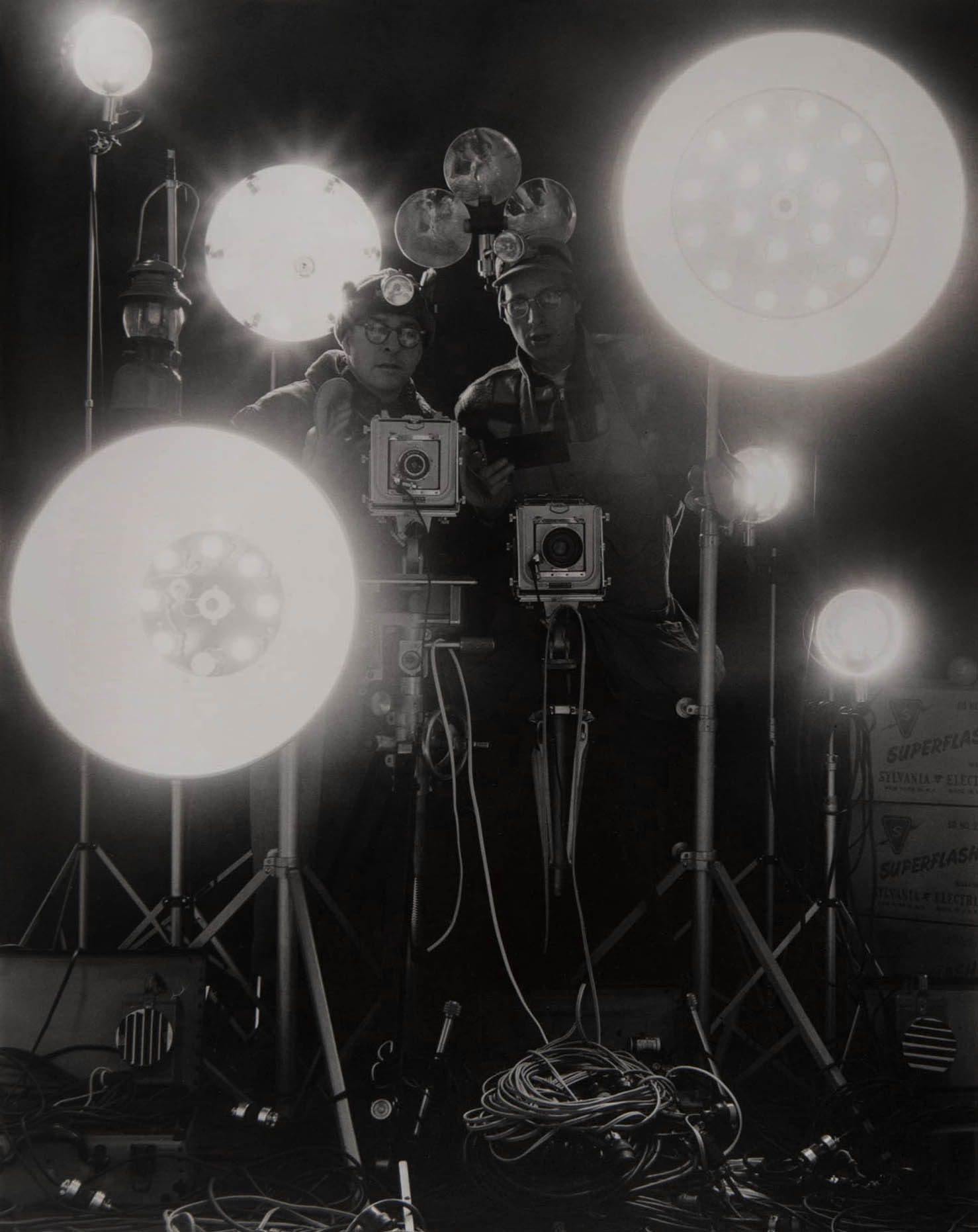
 

O. Winston Link (American, 1914-2001) 'Winston Link, George Thom and Night Flash Equipment: All Flashbulbs Firing' 1956


O. Winston Link (American, 1914-2001)
Winston Link, George Thom and Night Flash Equipment: All Flashbulbs Firing
1956
Gelatin silver print


Preserving the Golden Age of Railroads

In the 1950s, O. Winston Link, a photographer with an astute affinity for technical photography and a fond fascination with trains, set out to record the last steam locomotives operating in the country. After contacting the Norfolk and Western Railway and gaining access to the company’s premises, Link would begin recording the last surviving fleet of locomotives against the night sky, preserving the golden age of railroads and the remaining vestiges of American 20th-century industry. …

Staunton, Virginia

In 1955, O. Winston Link would begin exploring a series of photographs that would have a lasting impact on the medium’s history. After accepting a job that would take him to Staunton, Virginia, Link noticed the Norfolk and Western Railway, the last major steam railroad in the country. The company was ceasing operations as an industry-wide change from steam to diesel was in effect. Link was further impressed by the human connection to the railroad, a thread of sparsely spread communities that lived near the tracks. The photographer noticed not only the facilities and locomotives but the trackside communities that were profoundly immersed with the steam locomotives and rail transportation.

From 1955 to 1960, Winston Link returned to Virginia around 20 times. He photographed the clouds of steam and massive steel bodies of the locomotives passing through the Virginian and Appalachian communities, documenting some of the last days of the steam engine. In this unique quest, Link traveled by night covering a large swath of area, from Virginia and North Carolina to Maryland. With his preference for capturing the locomotives at night and prior experience with highly technical photographs for corporate clients, Link had the aptitude to develop a unique flash photography system. His unique system rigged flashbulbs, sometimes up to 80 of them, to fire simultaneously and allow the camera to capture the high-speed trains moving past his frame at night. As to why he chose to take his pictures at night, the photographer notedly said:

“I can’t move the sun – and it’s always in the wrong place – and I can’t even move the tracks, so I had to create my own environment through lighting.” ~ O. Winston Link


O. Winston Link’s perseverance in recording the nightly locomotives that passed Appalachia made him a pioneer not only for his subject matter but also as a trailblazer in night photography. Most likely inspired by his legendary predecessor, the Hungarian-French photographer Brassai, who captured the underbelly of Paris by night, Winston Link’s contributions to the preservation of American history helped chronicle these once, one-of-a-kind towns. Whether at the drive-in, splashing in the river below a railway bridge, pumping gas trackside by a passing locomotive, or directing a train through the quiet night of the rural countryside, Link’s pictures conserve small towns, whose lives revolved around the coming and going of steam engines. Through the rising pillars of steam, the sounds of bells and whistles announcing the arrival of the steam engines, and the camaraderie of community members in his pictures, Winston Link preserves a romantic, golden age of American railroads. When asked what about steam engines he found so appealing, Link said:

“I guess it’s because of the places they go. They’re always going through some mountains, through the valleys, and through the rivers, and forests, it’s always country. And I’ve lived in New York City, in Manhattan and Brooklyn, where you didn’t have anything like that. So, it’s always great to get on a train and take a long trip. I suppose that’s part of it. And the sounds that it makes, the smells that it has. It has a bell in it, it has air pumps, and it has valves that are releasing shots of steam every now and then. It has a turbo, which has a whine to it. It has a beautiful whistle, the old steam engines had different whistles, all had different characteristics and different sounds. And they had smells from hot grease and oil, the smell of coal smoked, the soft coal, has a nice smell to it as long as you don’t get it blasted in the face, as long as you’re far away from it, its Ok. It’s things like that. The sound of the wheels, the sound of the drivers, you can tell exactly what’s happening to the engine, and how fast its going, if the rods are lose, it makes different sounds. So, it has all these characteristics. The diesel engine is great, it’s very efficient, there’s nothing like them but, it’ll never replace a steam engine.” ~ O. Winston Link, 1980s


Holden Luntz. “O. Winston Link’s Birmingham Special, Rural Retreat, Virginia,” on the Holden Luntz Gallery website October 12, 2012 [Online] Cited 11/10/2024
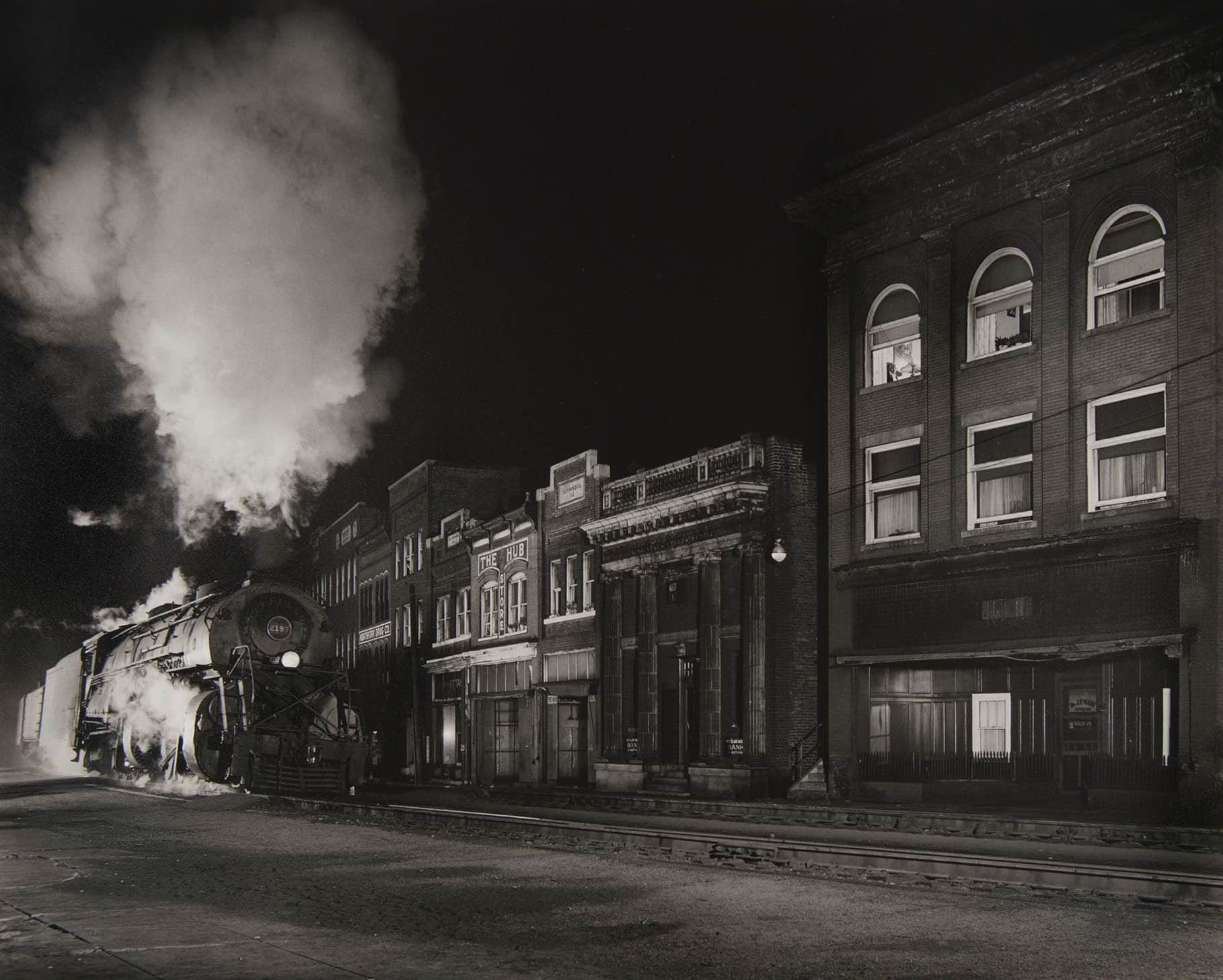
 

O. Winston Link (American, 1914-2001) 'Main Line on Main Street, North Fork, West Virginia, August 29, 1958' 1958, printed 1997


O. Winston Link (American, 1914-2001)
Main Line on Main Street, North Fork, West Virginia, August 29, 1958
1958, printed 1997
Gelatin silver print
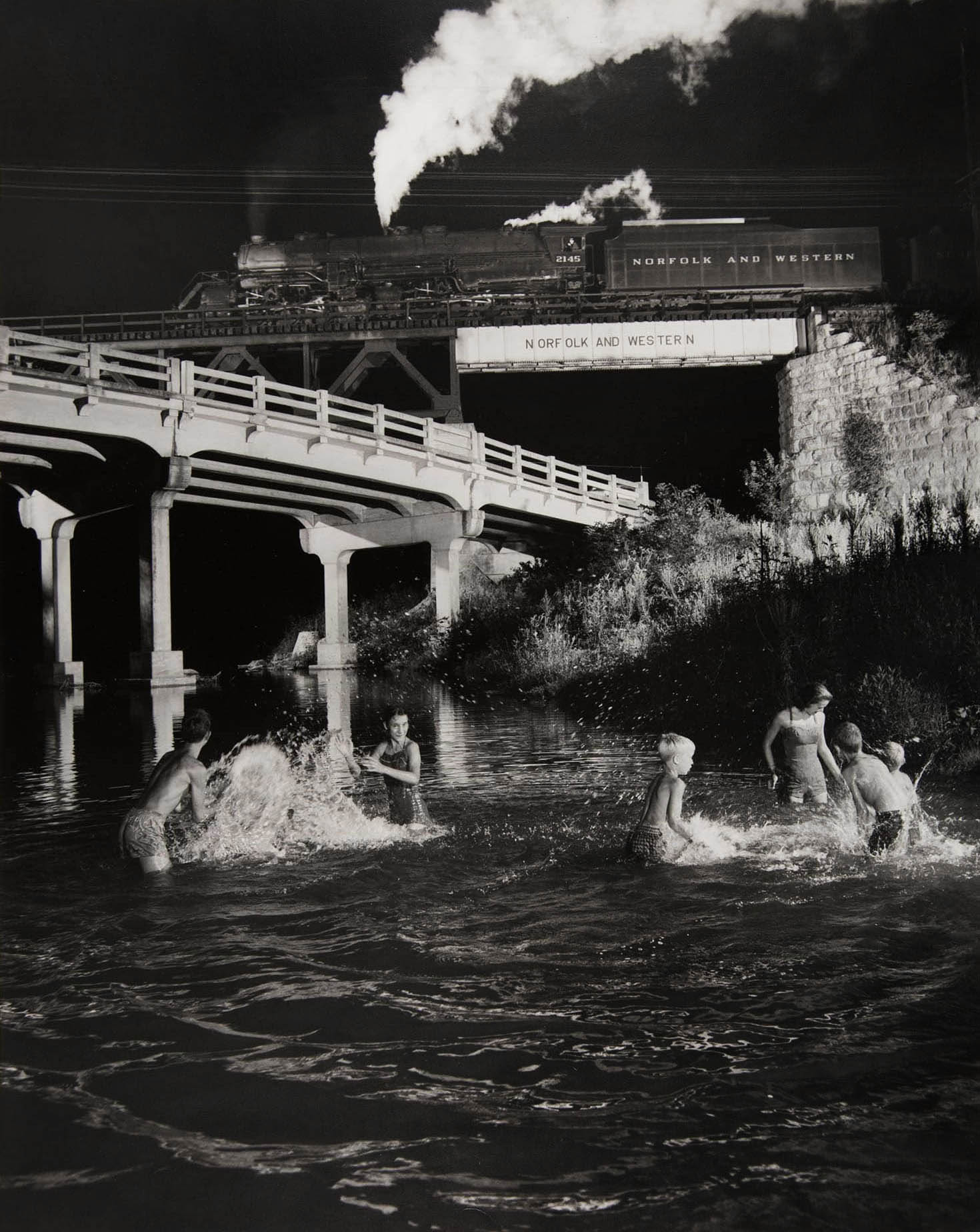
 

O. Winston Link (American, 1914-2001) 'Hawksbill Creek Swimming Hole, Luray, Virginia, 1956' 1956


O. Winston Link (American, 1914-2001)
Hawksbill Creek Swimming Hole, Luray, Virginia, 1956
1956
Gelatin silver print


Further O. Winston Link photographs from the Norfolk and Western Railroad


O. Winston Link (American, 1914-2001) 'Y-6 Locomotive on the Turntable, Shaffers Crossing Yards, Roanoke, Virginia' 1955, printed 1994


O. Winston Link (American, 1914-2001)
Y-6 Locomotive on the Turntable, Shaffers Crossing Yards, Roanoke, Virginia
1955, printed 1994
Gelatin silver print


O. Winston Link (American, 1914-2001) 'Norfolk and Western Railway' 1955


O. Winston Link (American, 1914-2001)
Norfolk and Western Railway
1955
Gelatin silver print


O. Winston Link (American, 1914-2001) 'Locomotive 261' 1955


O. Winston Link (American, 1914-2001)
Locomotive 261
1955
Gelatin silver print
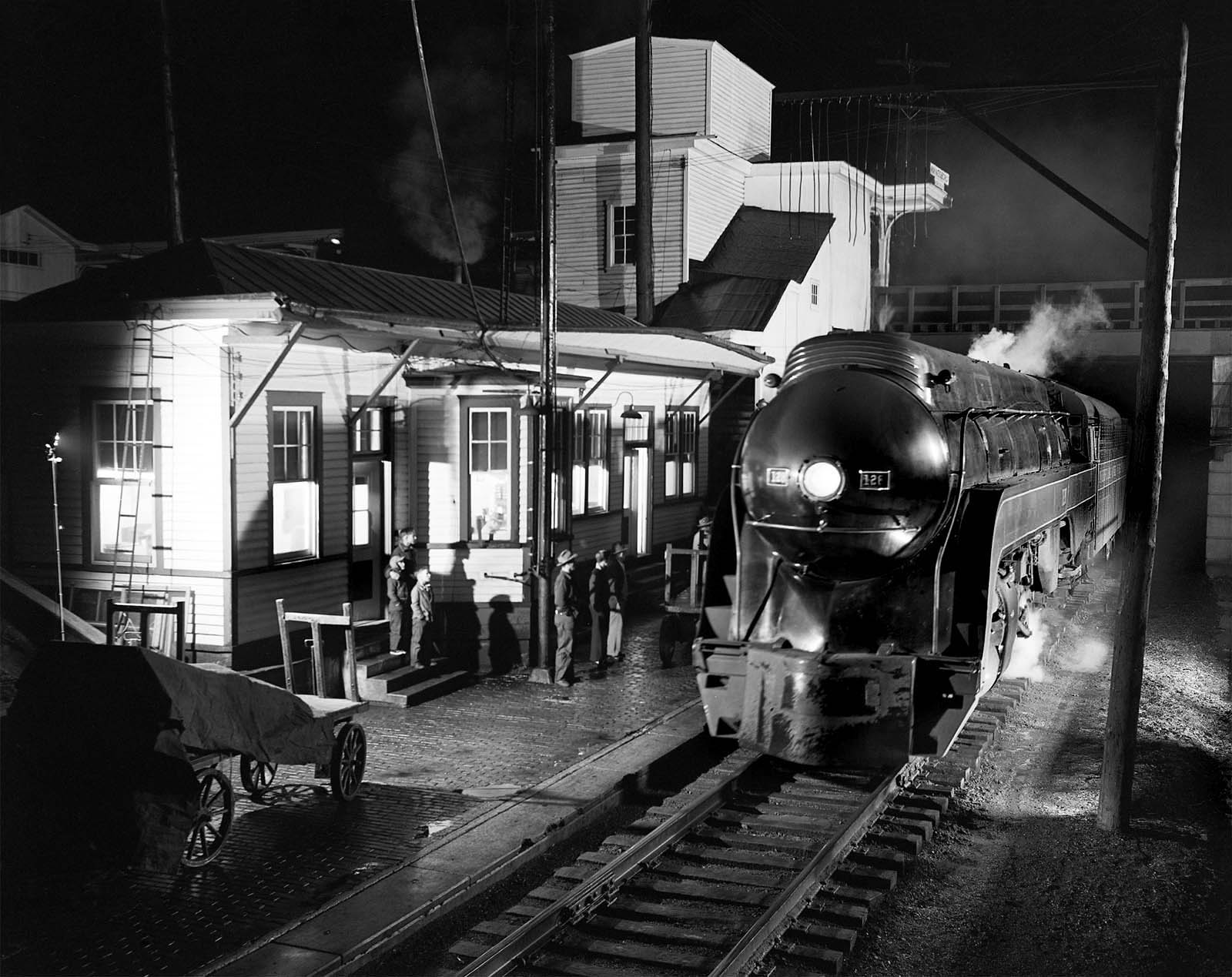
 

O. Winston Link (American, 1914-2001) 'Train #2 arrives at the Waynesboro Station, Waynesboro, Virgnia, April 14, 1955' 1955, printed 1996


O. Winston Link (American, 1914-2001)
Train #2 arrives at the Waynesboro Station, Waynesboro, Virgnia, April 14, 1955
1955, printed 1996
Gelatin silver print
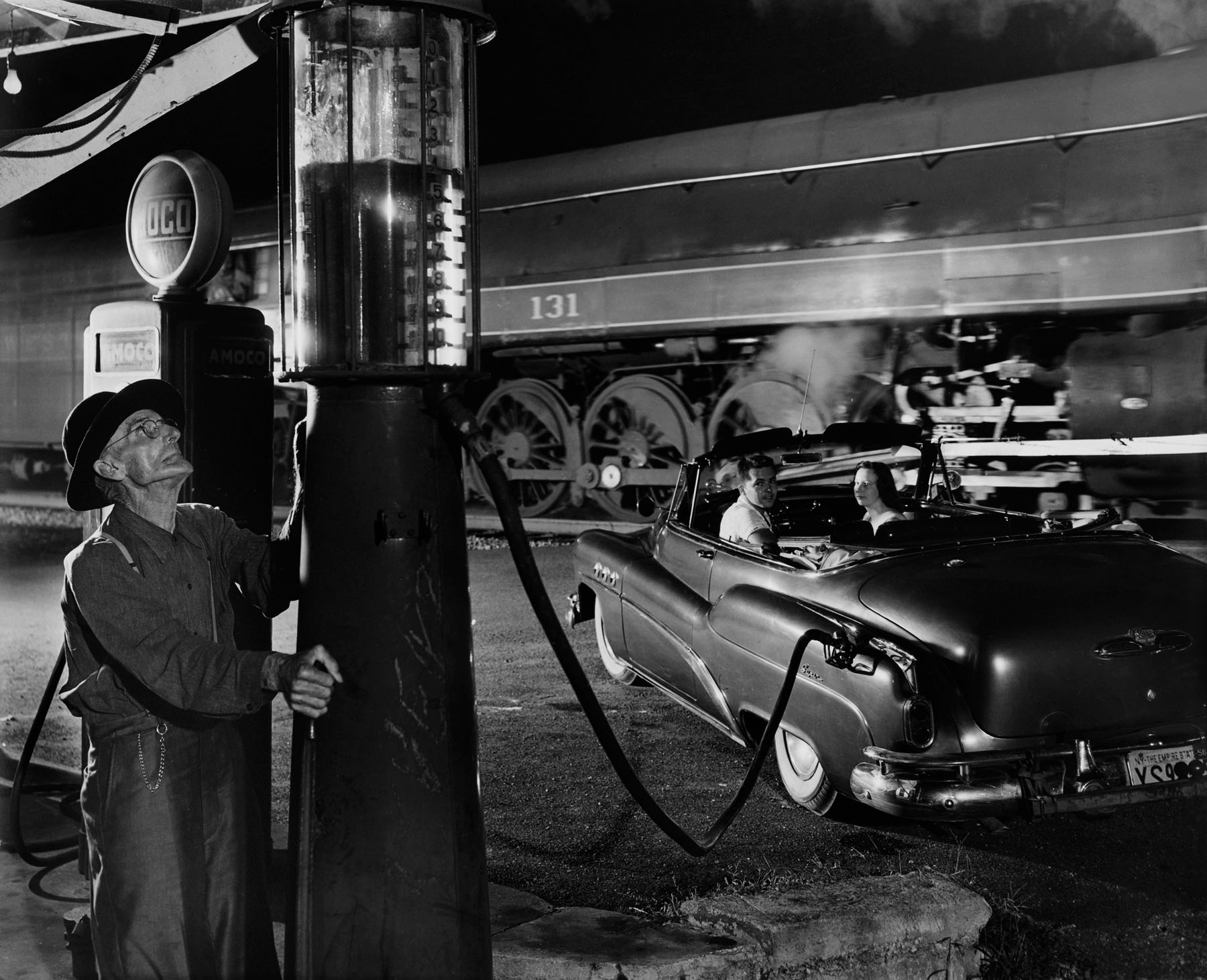
 

O. Winston Link (American, 1914-2001) 'Sometimes the Electricity Fails, Vesuvius, Virginia, 1956' 1956, printed 1988


O. Winston Link (American, 1914-2001)
Sometimes the Electricity Fails, Vesuvius, Virginia, 1956
1956, printed 1988
Gelatin silver print
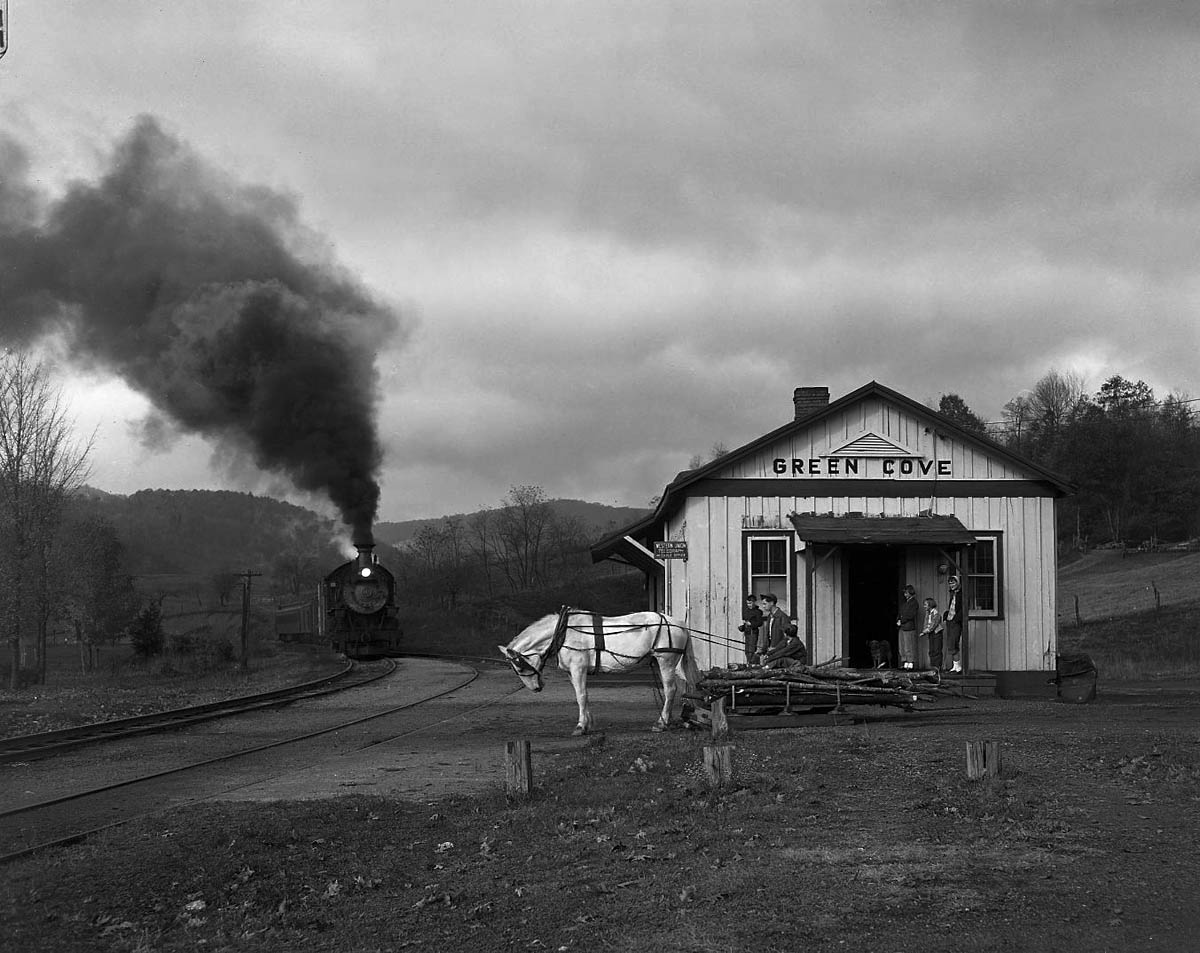
 

O. Winston Link (American, 1914-2001) 'Maud Bows to the Virginia Creeper' 1956


O. Winston Link (American, 1914-2001)
Maud Bows to the Virginia Creeper
1956
Gelatin silver print
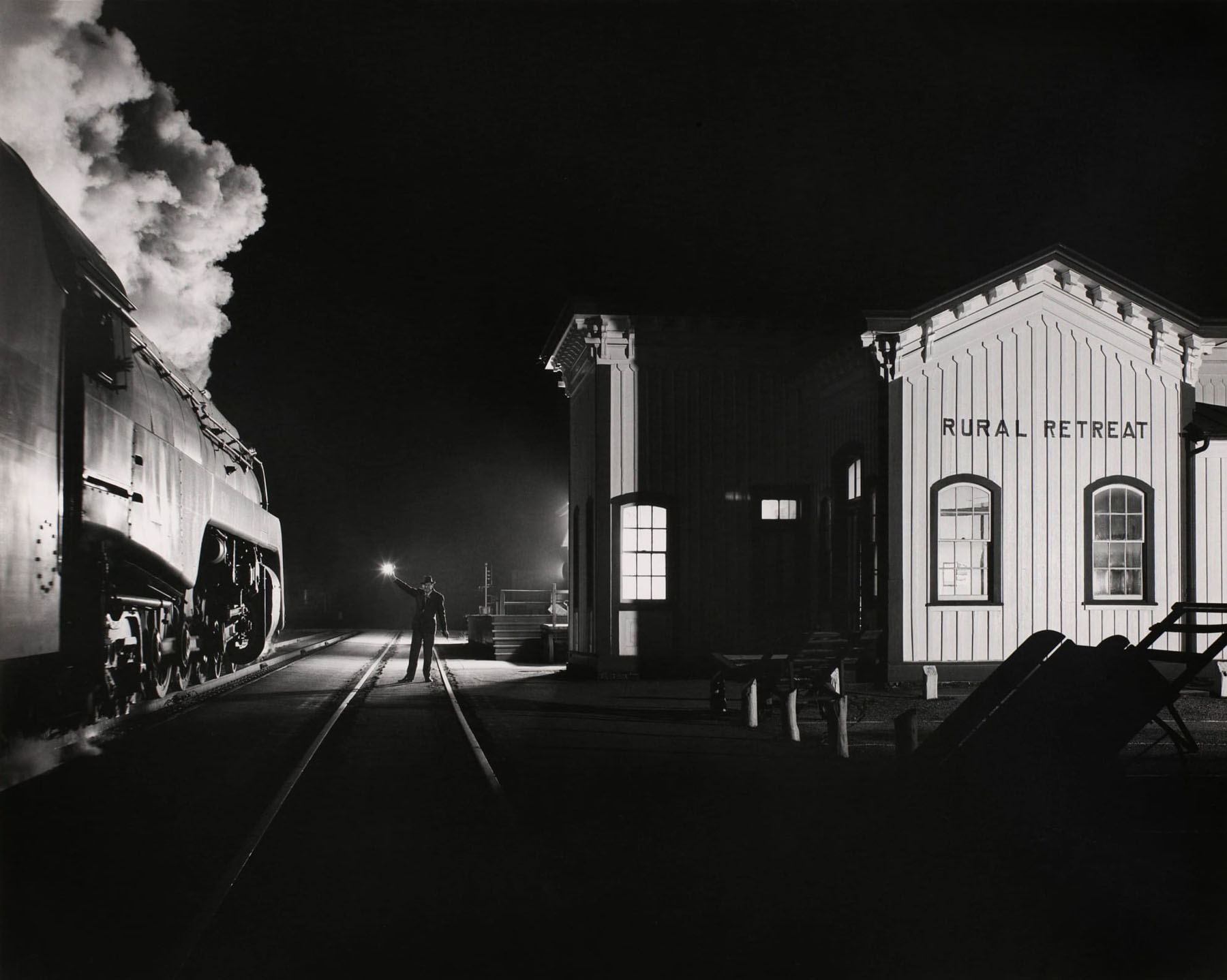
 

O. Winston Link (American, 1914-2001) 'Birmingham Special, Rural Retreat, Virginia, 1957' 1957, printed 1986


O. Winston Link (American, 1914-2001)
Birmingham Special, Rural Retreat, Virginia, 1957
1957, printed 1986
Gelatin silver print
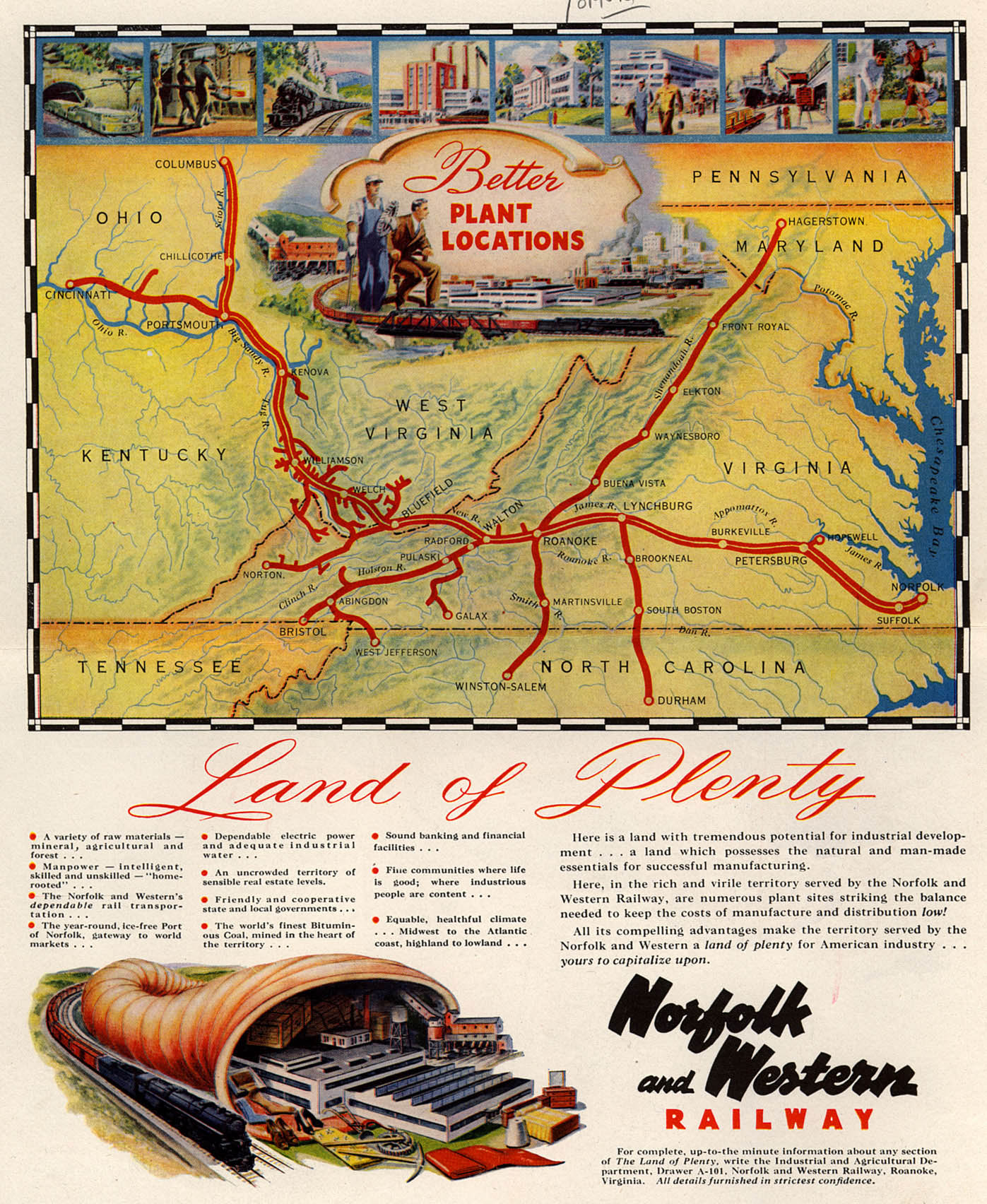
 

'1948 Norfolk and Western Railway - Land of Plenty Norfolk and Western magazine ad with system map' 1948


1948 Norfolk and Western Railway – Land of Plenty
Norfolk and Western magazine ad with system map
1948
Duke University Libraries
Public domain


Haverford College
370 Lancaster Avenue, Haverford, PA 19041

Monday – Friday, 9am – 5pm
Weekends, Noon – 5pm
Haverford College website

LIKE ART BLART ON FACEBOOK

Back to top

Exhibition / text: ‘From Steam to Diesel’ at the Portobello Library, Edinburgh

Exhibition dates: 20th October – 7th November 2014


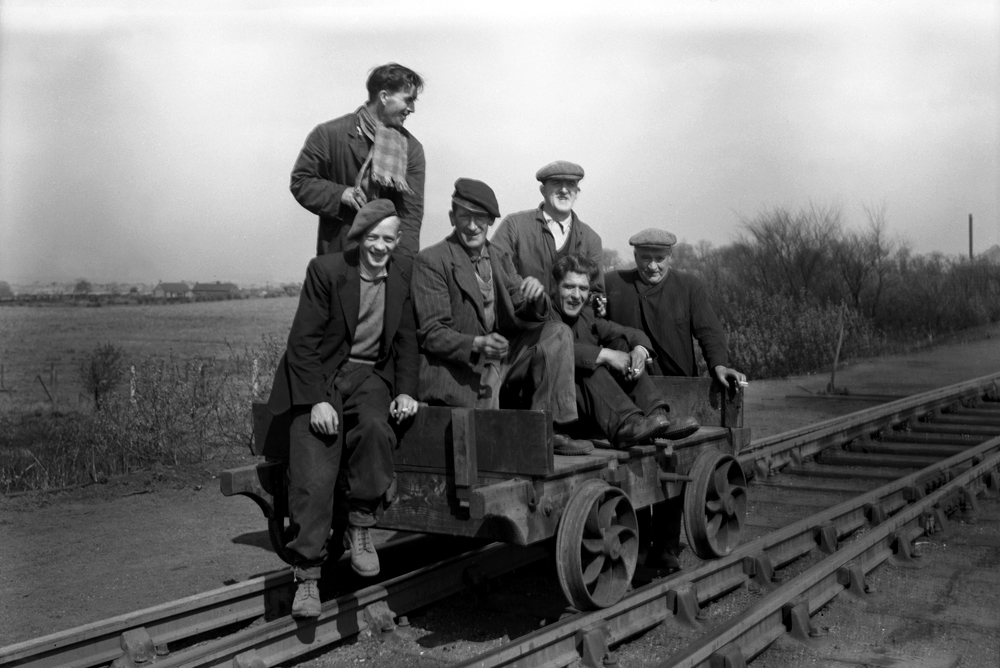
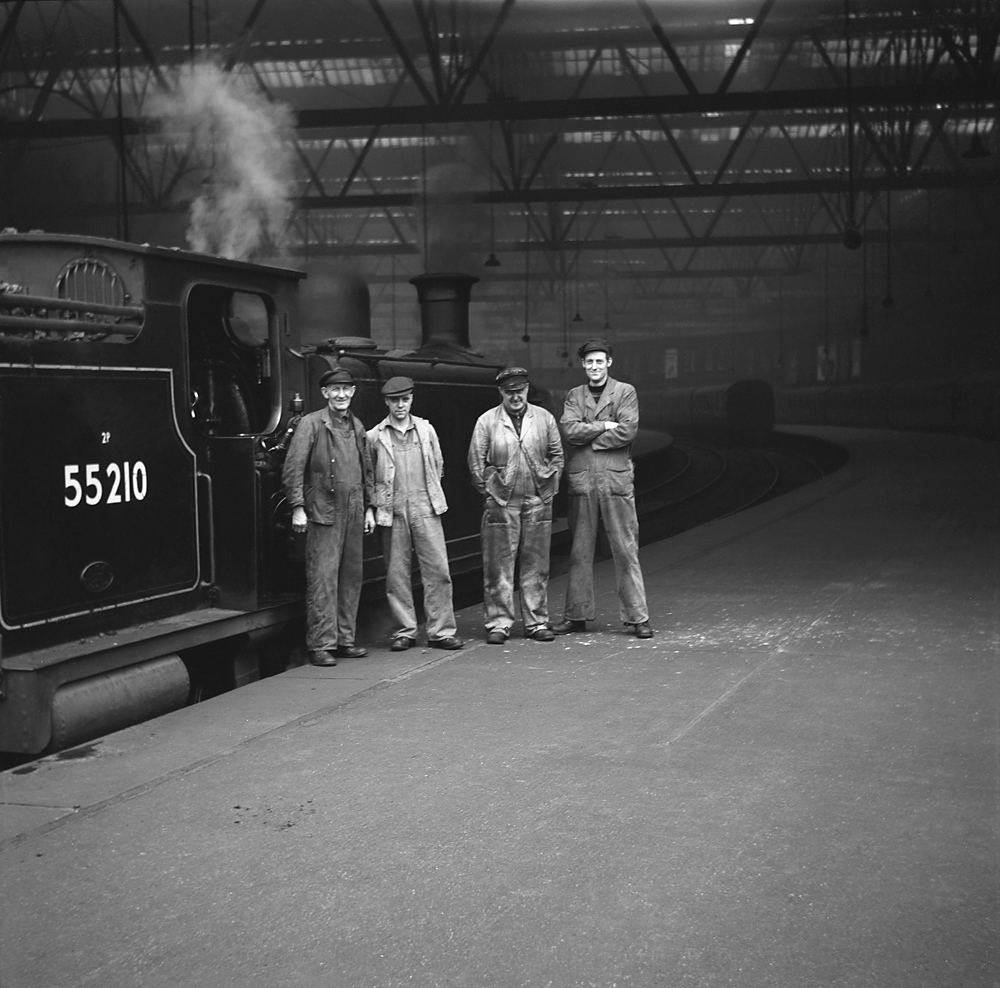
Anonymous photographer. 'Four men with loco 55210' mid-1950s to the early 1960s


Anonymous photographer
Four men with loco 55210
mid-1950s to the early 1960s
© Archie Foley and Peter Ross


This is a great project. The photographs are wonderful. At one time they could have almost been made here in Victoria, Australia.

Archie Foley who found the 500 or so railway related negatives taken by, at this stage, an anonymous British Railways engine driver was quite taken aback to get an email from half way around the world asking for some press images – but this is what this blog does, promote eclectic exhibitions of interesting photography from around the world, no matter how small they are.

I have always loved trains and the photographs of them (including the ones by Winston O. Link). Once I saw the images I think I shed a tear at the beauty of them. Archie informs me that the negatives are a mixture of 127; 6cm square and a larger 6cm x 8cm. There are notes of the cameras the photographer used and his favourite appears to have been an Isolette 11 (see below). However he also used Ikonta; Suprima; Isola and Super Isolette. These cameras have reasonable optical quality (not as good as a Rollei twin lens for example) with the advantage that they have a large negative and can be folded up and put in a jacket pocket, to be taken out when needed.

As a good friend of mine Ian Lobb observed,

“I nearly said 6×8 cm last night – I know its difficult to believe after the event, and the Isolette has the same basic shape as the Voigtlander I suspected. The Voigtlander was like some of the Rolleis and you could put in a metal mask that would allow 6 x 8, 6 x 6, 6 x 4.5 as well the full 6 x 9. I suspect the Voigtlander was a bit upmarket from the Isolette: the Agfa cameras at the time of these pictures were good cameras and (obviously) with German lenses. I don’t know if they had those masks but I am guessing you could do the same with the Isolette. One claim I have seen is that the lenses were more matched to emulsions of the 50’s and were contrasty with later emulsions. I would have to know a lot more to verify that. The pictures look optically good to me. There were some extraordinary European films in 120 stock – I caught the end of them – 12 ISO and wooden spools – and SENSATIONAL tonal scales.

Of all cameras (even 35mm), the drop front cameras like the Isolette had the best connection to the people you were photographing. I don’t mean through the viewfinder – I mean that the viewfinder was just for checking the composition – you really had to do a lot of looking over the camera. Probably the old Stieglitz Graflex was just as communicative. With the bellows extension there would be a scale on the focussing track that would tell you the distance the camera was focussed to – no other way to check!

As a kid I played with Marklin toy trains and they published a book that I still have called “The Marklin Miniature Railway and its Prototype”. It is old and faded now, but there were sections on how to do signalling etc. on your train set so that it matched the real thing etc…”


What interests me most about these stunning images is the use of space by the photographer. These railway photographs with their beautiful but naive space have an almost mythic quality to them. I know a little about photography and from my knowledge I cannot think of anyone else that handles space like this in a photograph (save for perhaps Thomas Struth and the space around the people in his museum photographs or his group portraits of people in Japan, and even then he blocks the exit for the eye behind his tableaux vivant).

I have been racking my brains but these are really unique, especially the square format portrait shots. Look at the first photograph Four men with loco 55210 (below) and notice the expanse of platform and line of the train that leads the eye into the depiction of the four men. The light that falls on them is superlative but notice how the photographer keeps a respectful distance for this is not portrait photography which attempts to capture a fleeting, revealing moment or expression. The photographer places them as though to “encourage contemplation and investigation, inviting the viewer to reflect upon the limits of his or her knowledge of other people.” The eye scans the image for clues, giving the viewer pause to take in the scene: and low and behold what opens up behind the four men is this most magnificent space with the curve of the platform, the girders and the silence of the dark train in the distance.

As in Thomas Struth’s photographs of architectural East Berlin these photographs bring about ‘a move to investigative viewing’ which is also a ‘call to interact’. But these photographs don’t possess the base objectivity of Struth for they are a little too engaging of their space (their antithesis being the photographs by Alec Soth from his series Niagara).

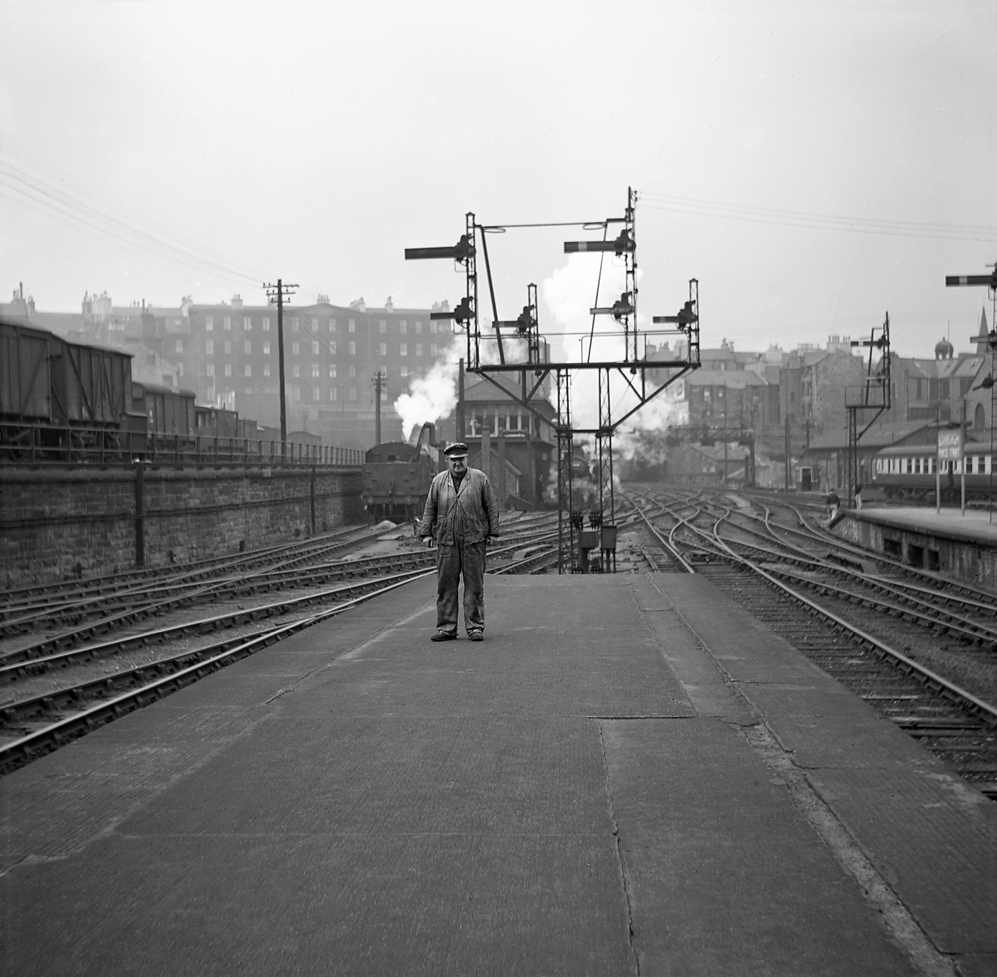
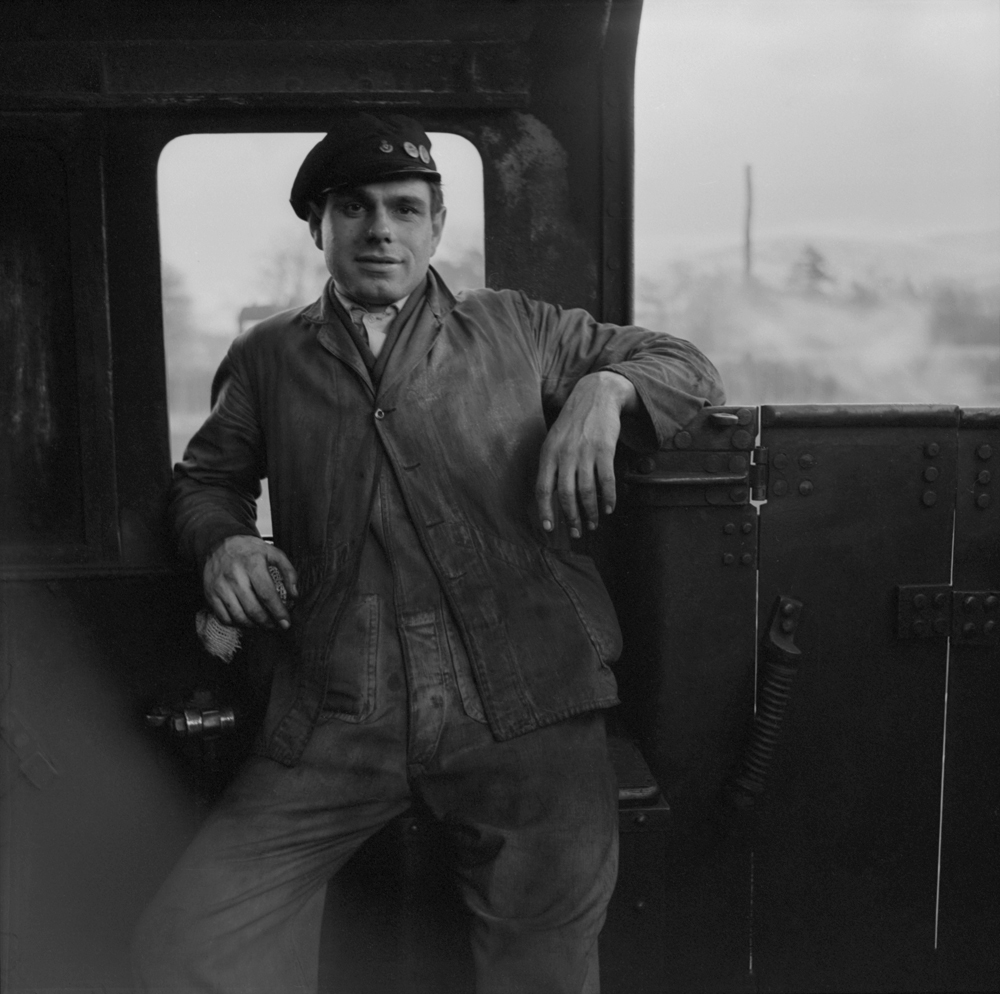
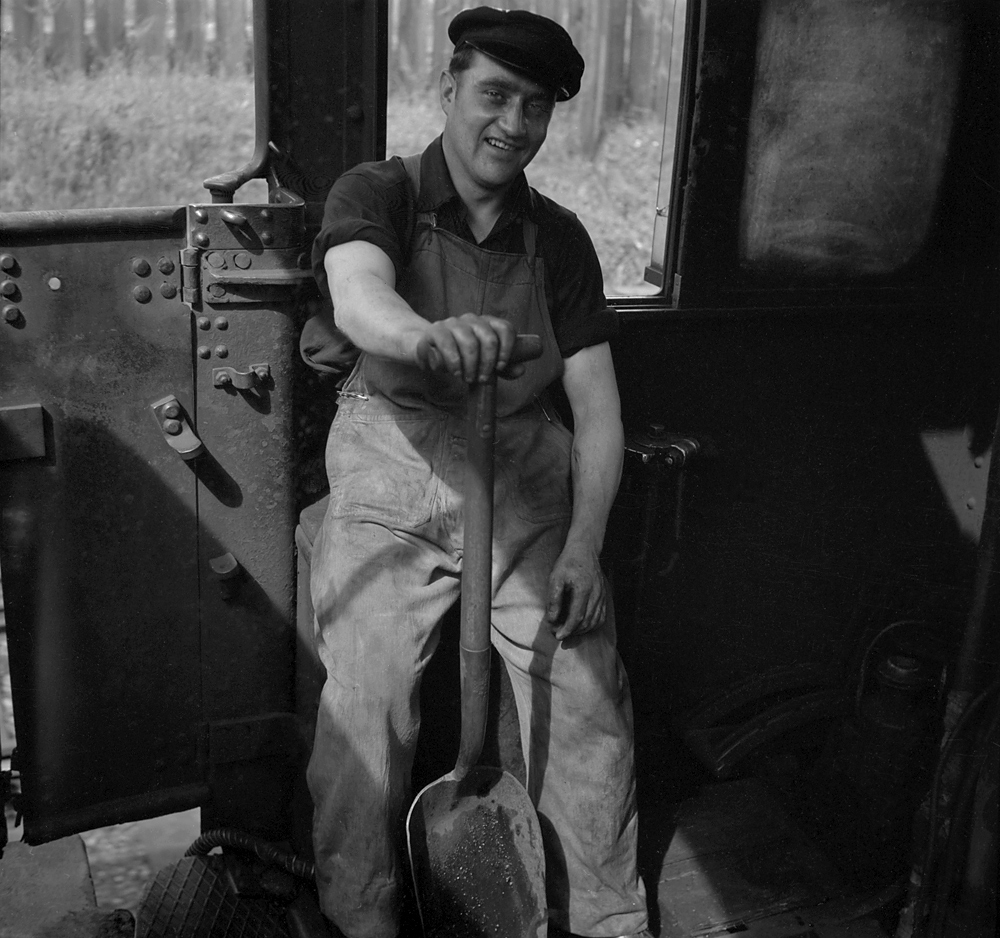
Further evidence of the sophistication of the composition of these images can be found in the two photographs Shotts Iron Work’s Signalbox and Man on platform in front of signal array (below). In the first photograph the man is embedded in the landscape, his weight shifting slightly to his right foot as his shadow falls on the fence beside him, the fence line and train tracks lead the eye into the image and off into an amorphous, infinite distance. Again, in the second photograph the figure is not front and centre but part of an ensemble as the eye is led this time by a massive horizontal plane into the image. He stands on the platform as if on the deck of an aircraft carrier. And then there are the two close up portraits, Jackie Collett at Beattock and A smiling fireman (below) where the photographer has climbed up into the intimate space of the drivers cab and got them to be comfortable enough to reveal themselves to the camera – in that light! – with those backgrounds!


The use of lenses today is proof of how difficult it is to think and feel space while taking a picture. These days everyone has a zoom lens but it is nearly always used by people to fill the frame with the main subject. But with a zoom there are infinite relationships between foreground and background if the photographer is free to move in relation to the main subject… and sometimes we are. Or to put it another way, we are able to control the degree of flattening of space with a zoom lens infinitely. If we have 2 fixed lenses we have 2 controls of space. This anonymous photographer and the German photographer Thomas Struth in particular seem to have the ability to think about this space control, and resolve it in different ways. Sometimes for Struth the quality of the space in the city streets or in a museum announces these places as pictures.

Struth is someone who has an affinity with the railway group photographs for his photographs, like these, resist immediate consumption. They make the viewer pause and think. “Discussing Struth’s work, the critic Richard Sennett has written: ‘We relate to these images as we might appreciate strangers in a crowd; we feel their presence without the need to transgress boundaries by demanding intimacy or revelation … people guard their separateness even as they present themselves directly to us.’ (Sennett p. 94.) Struth’s portraits encourage contemplation and investigation, inviting the viewer to reflect upon the limits of his or her knowledge of other people.”1 And, sotto voce, so do these photographs… The speaker gives the impression of uttering a truth which may surprise and delight.

As Archie has noted in his correspondence with me, the exhibition has been done on a shoestring budget but from small beginnings – and acorns – mighty oaks grow. All power to both Archie Foley and Peter Ross for arranging it. A book and larger exhibition would be a wonderful representation of this work. All I can say is this: that I hope this posting helps that process along for these photographs have a magnificent soul. Simply put, they are great.

Dr Marcus Bunyan


Footnotes

1/ Richard Sennett, Thomas Struth: Strangers and Friends, exhibition catalogue, Institute of Contemporary Art, London 1994 quoted in “Thomas Struth: The Shimada Family, Yamaguchi, Japan 1986” Text summary on the Tate website [Online] Cited 04/11/2014


Many thankx to Archie Foley and Peter Ross for allowing me to publish the photographs in the posting. Please click on the photographs for a larger version of the image. All images © Archie Foley and Peter Ross and may not be used without permission.

Acknowledgement: Thank you to John of Print Vision (0131 661 8855) for his advice during the preparation and for producing such excellent prints.


Anonymous photographer. 'Women workers in front of posters' mid-1950s to the early 1960s


Anonymous photographer
Women workers in front of posters
mid-1950s to the early 1960s
© Archie Foley and Peter Ross


Anonymous photographer. 'Shotts Iron Work’s Signalbox' mid-1950s to the early 1960s


Anonymous photographer
Shotts Iron Work’s Signalbox
mid-1950s to the early 1960s
© Archie Foley and Peter Ross


Anonymous photographer. 'Man on platform in front of signal array' mid-1950s to the early 1960s


Anonymous photographer
Man on platform in front of signal array
mid-1950s to the early 1960s
© Archie Foley and Peter Ross


Anonymous photographer. 'Jackie Collett at Beattock' mid-1950s to the early 1960s


Anonymous photographer
Jackie Collett at Beattock
mid-1950s to the early 1960s
© Archie Foley and Peter Ross


Anonymous photographer. 'A smiling fireman' mid-1950s to the early 1960s


Anonymous photographer
A smiling fireman
mid-1950s to the early 1960s
© Archie Foley and Peter Ross


This exhibition has been compiled from a collection of photo negatives found by Archie Foley in a collector’s fair in Portobello. As he went through the collection he was able to extract 100s of railway related negatives dating from the mid-1950s to the early 1960s that showed that the photographer must have been a British Railways engine driver. A chance meeting and conversation with local photographer and video producer, Peter E. Ross, on a bus going into Edinburgh led to the decision to mount an exhibition of photographs made from selected negatives.

As a colleague the driver/photographer was able to snap drivers, shunters, platelayers, signalmen, cleaners and others at work in locations in and around Edinburgh and, occasionally, a bit further afield. The photographs are a unique behind the scenes record of the men and women who worked on the railway and how it looked before diesel power finally replaced steam in 1968.

This is the first time that the photographs have been on public show and Archie and Peter feel privileged to be able to display, and pay tribute to, the dedication and skill of the, as yet unidentified, photographer. Neither Archie nor Peter is an expert on railways and invite visitors to use the Visitors’ Book to suggest possible locations for photographs where these are not given. Please also suggest amendments if you believe any of the captions are incorrect.

The exhibition is at Portobello Library, Rosefield Avenue from Monday, 20th October to Friday, 7th November.

Archie Foley and Peter Ross


Anonymous photographer. 'The game's a bogie' mid-1950s to the early 1960s


Anonymous photographer
The game’s a bogie
mid-1950s to the early 1960s
© Archie Foley and Peter Ross


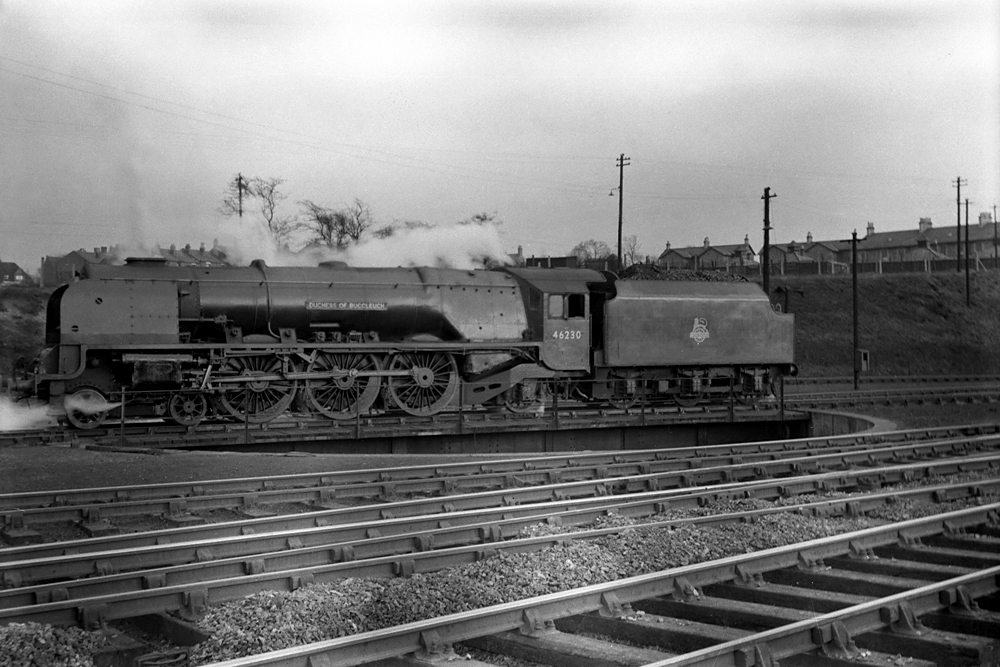
Anonymous photographer. 'Duchess of Buccleuch on turntable' mid-1950s to the early 1960s


Anonymous photographer
Duchess of Buccleuch on turntable
mid-1950s to the early 1960s
© Archie Foley and Peter Ross


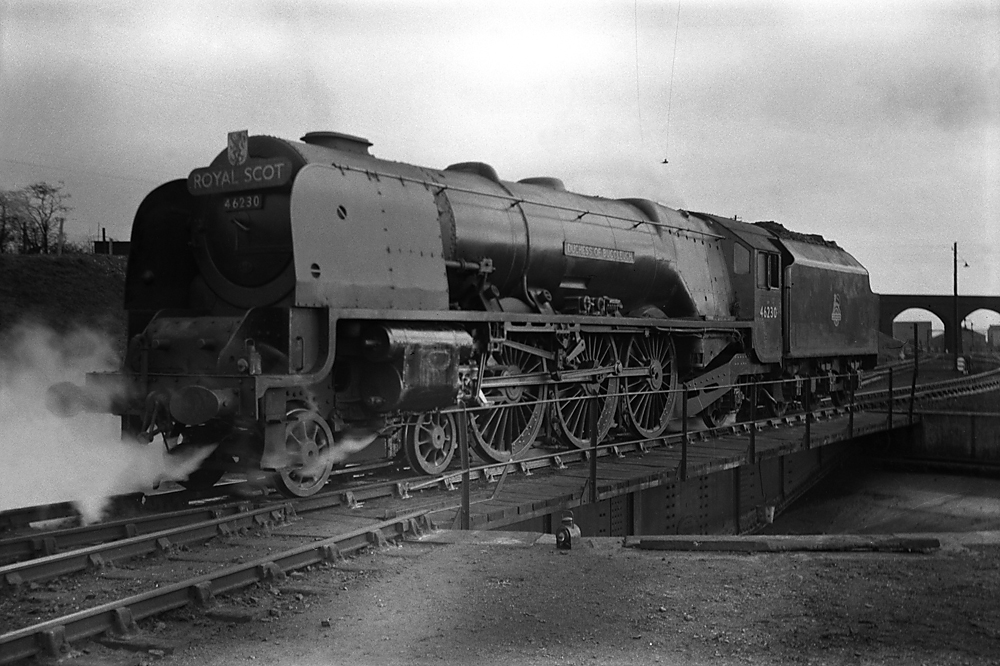
Anonymous photographer. 'Duchess of Buccleuch bearing "Royal Scot" headboard' mid-1950s to the early 1960s


Anonymous photographer
Duchess of Buccleuch bearing “Royal Scot” headboard
mid-1950s to the early 1960s
© Archie Foley and Peter Ross


The two photographs above were obviously taken at the same time as each other (look at the tall trees in the background). I love how the photographer has moved across the tracks from the distance shot onto an oblique angle with the twin arches of the bridge in the background for the closer photograph. You can seen some unevenness in the development of the film in the foreground of both images but no matter, these images give real insight into how this artist was operating, what his thinking was when photographing their behemoths.


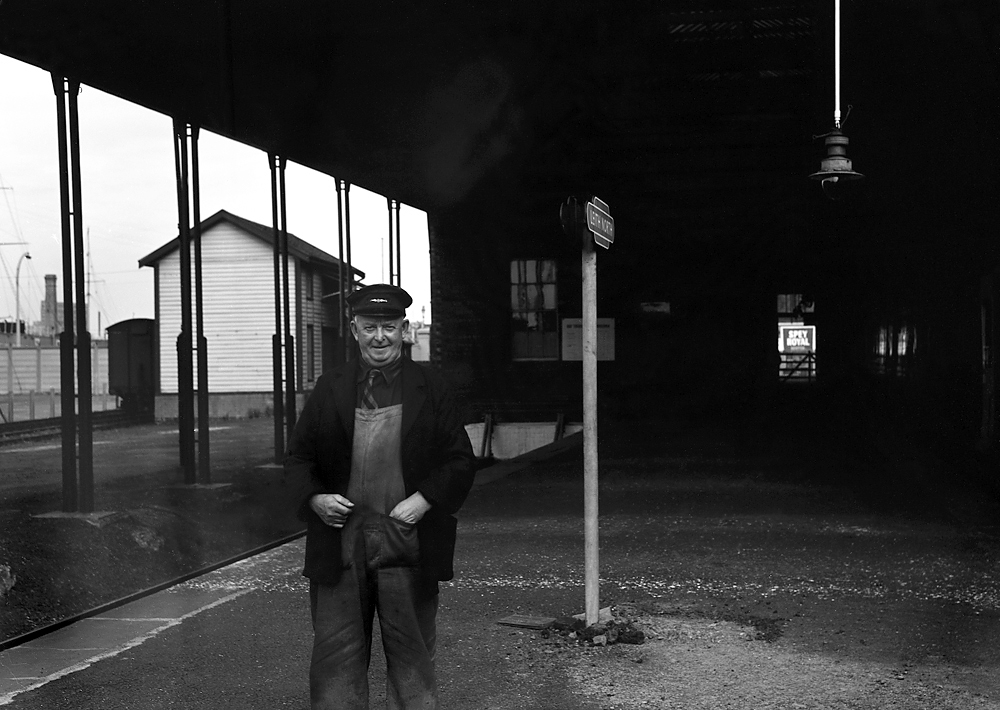
Anonymous photographer. 'The photographer in working clothes' mid-1950s to the early 1960s


Anonymous photographer
The photographer in working clothes
mid-1950s to the early 1960s
© Archie Foley and Peter Ross


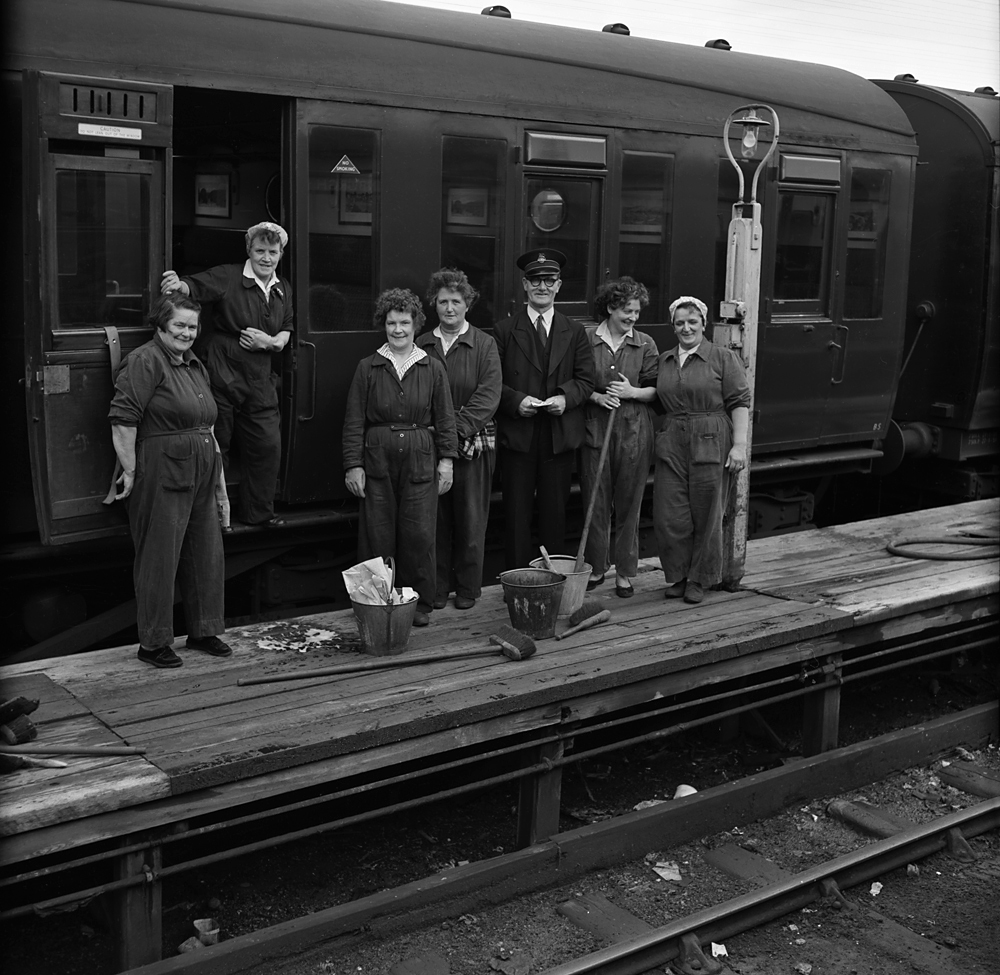
Anonymous photographer. 'Six cleaners, one man and three buckets' mid-1950s to the early 1960s


Anonymous photographer
Six cleaners, one man and three buckets
mid-1950s to the early 1960s
© Archie Foley and Peter Ross


Anonymous photographer. 'Colinton Station with guard on loco' mid-1950s to the early 1960s


Anonymous photographer
Colinton Station with guard on loco
mid-1950s to the early 1960s
© Archie Foley and Peter Ross


Anonymous photographer. 'Diesel unit with guard' mid-1950s to the early 1960s


Anonymous photographer
Diesel unit with guard
mid-1950s to the early 1960s
© Archie Foley and Peter Ross


Agfa Isolette II camera 1960s


Agfa Isolette II (1950-60), showing the characteristic wide raised centre of its top housing. The thick knurled disc on the right (of the picture) is a film-type reminder dial.


Isolette II

The Isolette II (1950-1960) was sold alongside the ‘I’; it is an alternative model offering higher specification than the ‘I’, not a successor to it. The camera was available (for at least some time) with coated 85 mm f/4.5 Agnar or Apotar or 75 mm f/3.5 Solinar lenses; however, most examples seen have the Apotar. McKeown gives a very wide range of shutters (Vario, Pronto, Prontor-S and SV, Compur Rapid and Synchro-Compur). This reflects changes in the specification over the period the camera was made (i.e. not all of these shutters were available at the same time): for example, a user’s manual (of unknown date) only lists the Pronto and Prontor SVS. The range of shutter speeds is therefore variable between examples. Some of the shutters have a delayed action. Most are synchronised (some have switchable M and X-synchronisation). On some examples of the camera, there is a shutter locking lever on the back of the top housing, to provide ‘T’ shutter by locking the release button down, where the shutter itself does not have a ‘T’ setting.

Unlike the Isolette I and all the preceding models, the film advance knob is on the right. The camera still has a swing-out spool-holder on the supply side of the film chamber. There is a double-exposure prevention interlock; this engages after releasing the shutter, and is disengaged by advancing the film. It has a red (locked) or silver (unlocked) indicator in a hole in the top-plate, next to the advance knob. Like the ‘T’ lock, this interlock acts on the body release button, so if the lock engages accidentally, or a double exposure is desired, it is still possible to release the shutter by pressing the linkage on the shutter itself (or with a cable release, on versions of the camera on which the cable attaches directly to the shutter, not the body release; they vary in this respect).

Like the Isolette I, early versions of the II have a disc-type depth-of-field indicator on the left of the top plate. On later cameras this is replaced with a film-type reminder, and the DOF scale, if any, is on the shutter face-plate.

Text from the Camera-wiki.org website


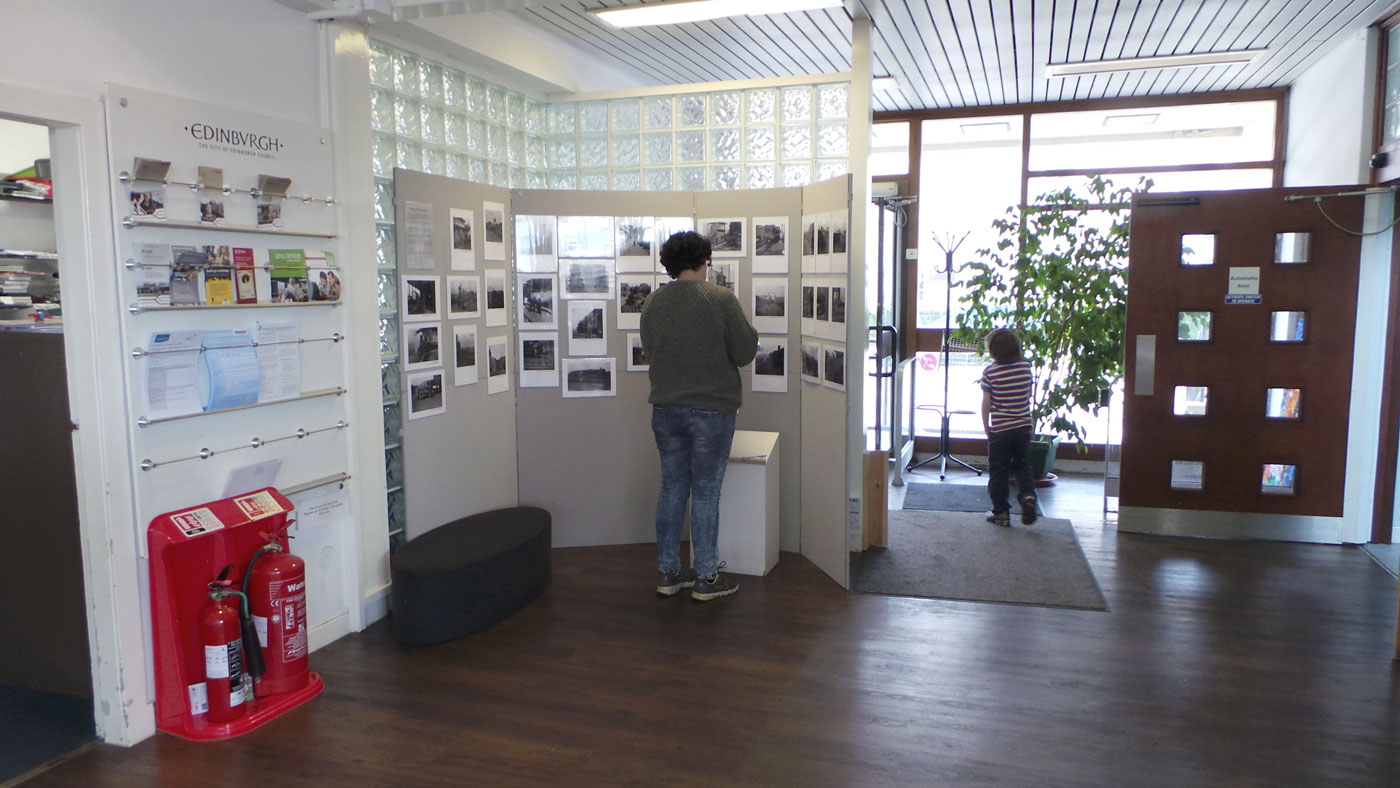
Installation photograph of the exhibition 'From Steam to Diesel' at the Portobello Library, Edinburgh


Installation photograph of one half of the exhibition From Steam to Diesel at the Portobello Library, Edinburgh. The other half of the exhibition is off camera to the right.


Portobello Library
14 Rosefield Avenue, Edinburgh,
Midlothian, EH15 1AU

Opening hours
Monday 10.00 – 20.00
Tuesday 10.00 – 20.00
Wednesday 10.00 – 20.00
Thursday 10.00 – 20.00
Friday 10.00 – 17.00
Saturday 09.00 – 17.00
Sunday 13.00 – 17.00

LIKE ART BLART ON FACEBOOK

Back to top