
Exhibition dates: 24th May – 11th August 2013
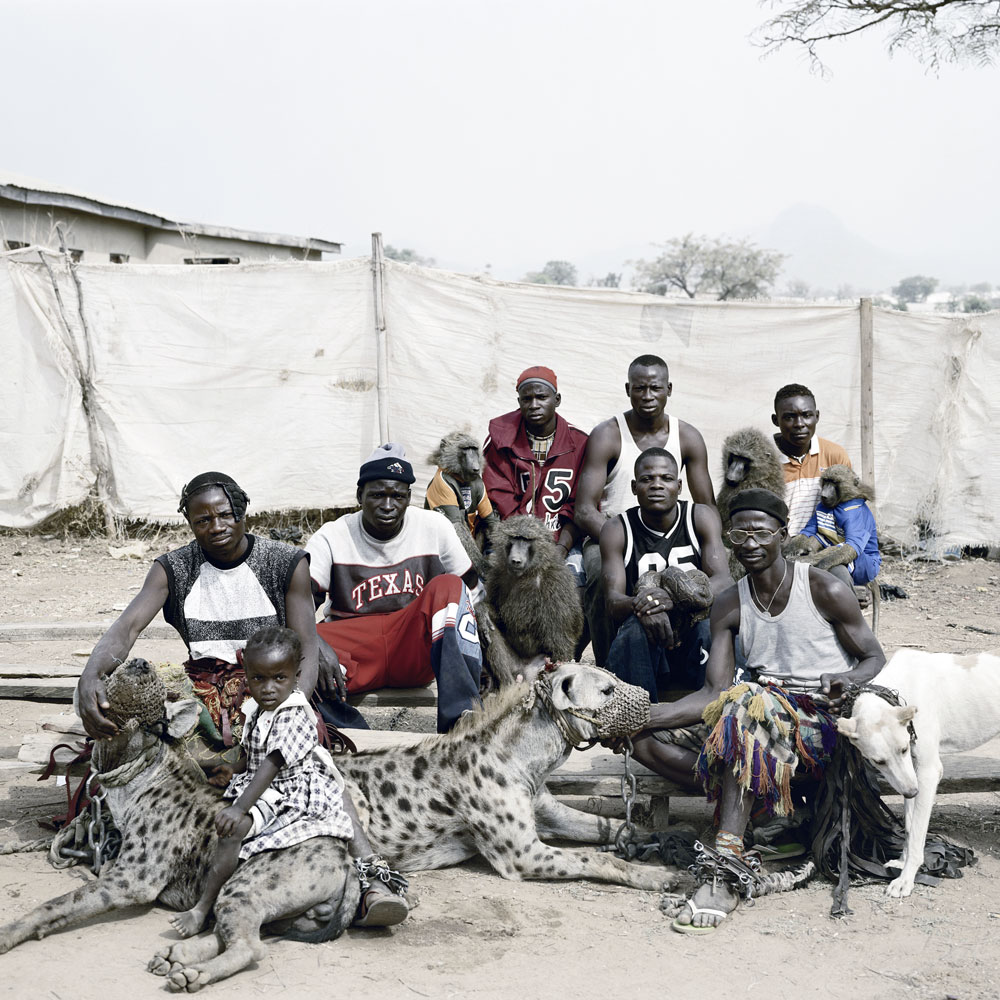
Pieter Hugo (South African, b. 1976)
The Hyena Men of Abuja, Nigeria
2005
From the series The Hyena & Other Men
© Pieter Hugo
Courtesy of Stevenson, Cape Town/Johannesburg and Yossi Milo, New York
I have not seen enough of the other series of Pieter Hugo to make an informed decision, but work from the The Hyena & Other Men (2005-2007) and Permanent Error (2009-2010) series, the most often reproduced, is certainly strong. Whether I am fully convinced by his singular frontality is another matter…
Dr Marcus Bunyan
Many thankx to the Ludwig Museum of Contemporary Art for allowing me to publish the photographs in the posting. Please click on the photographs for a larger version of the image.
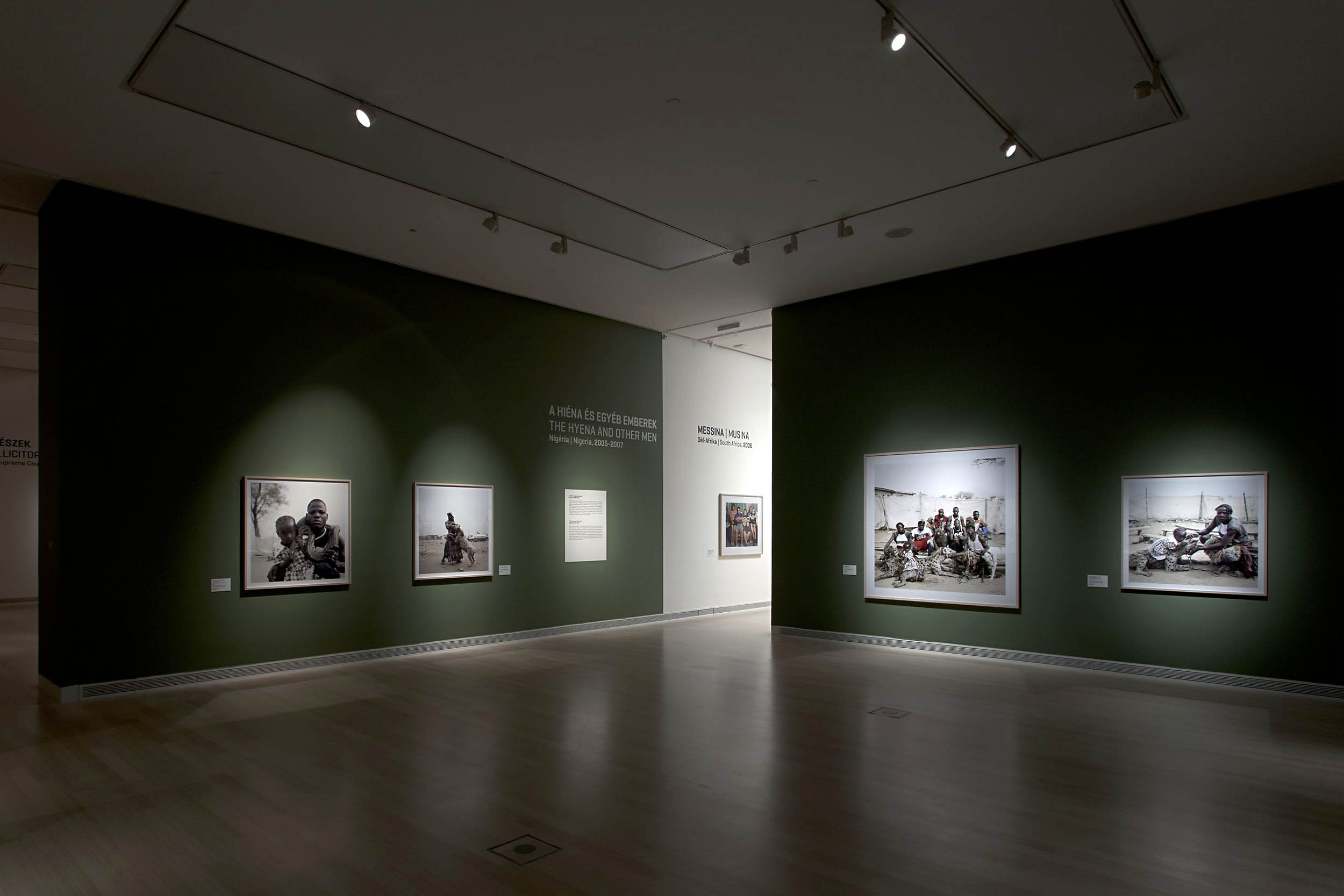
Installation view of the exhibition Pieter Hugo: This Must Be The Place – Selected Works 2003-2012 at the Ludwig Museum of Contemporary Art, Budapest showing work from Hugo’s The Hyena and Other Men Nigeria, 2005-2007
Exhibition view © Tamás Bujnovszky / Ludwig Museum – Museum of Contemporary Art, Archives
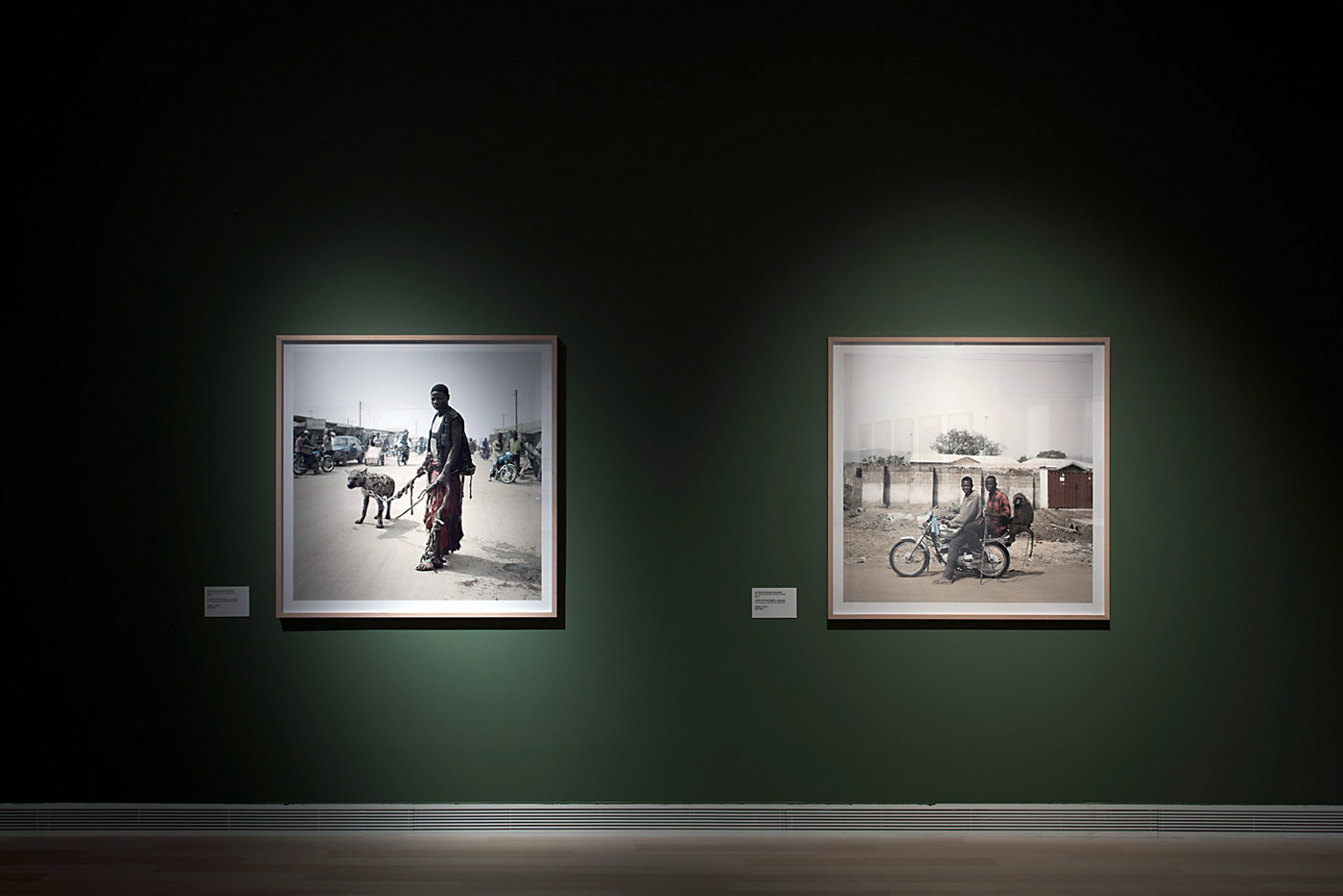
Installation view of the exhibition Pieter Hugo: This Must Be The Place – Selected Works 2003-2012 at the Ludwig Museum of Contemporary Art, Budapest showing work from Hugo’s The Hyena and Other Men Nigeria, 2005-2007
Exhibition view © Tamás Bujnovszky / Ludwig Museum – Museum of Contemporary Art, Archives
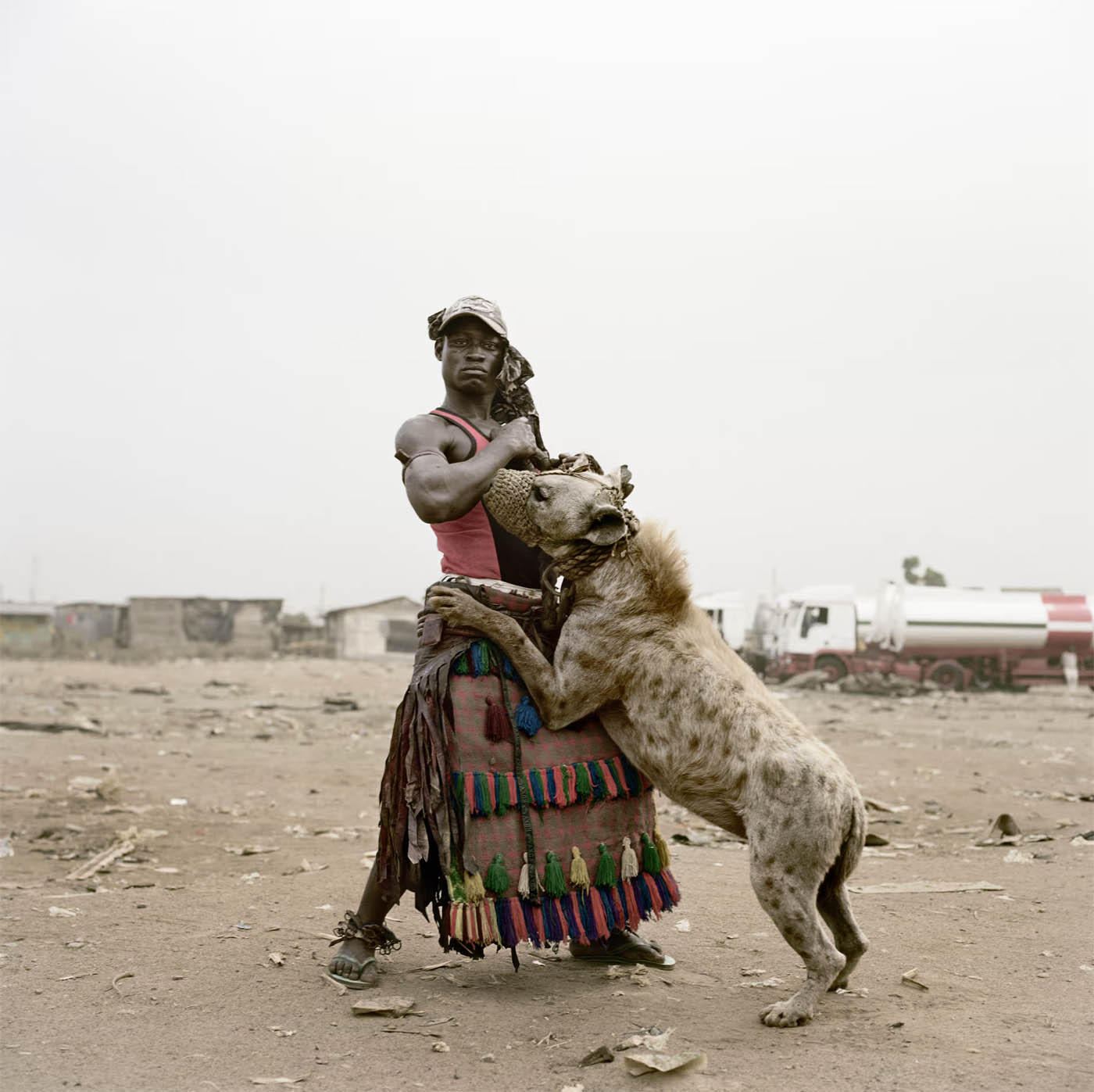
Pieter Hugo (South African, b. 1976)
The Hyena Men of Abuja, Nigeria
2005
From the series The Hyena & Other Men
© Pieter Hugo
Courtesy of Stevenson, Cape Town/Johannesburg and Yossi Milo, New York
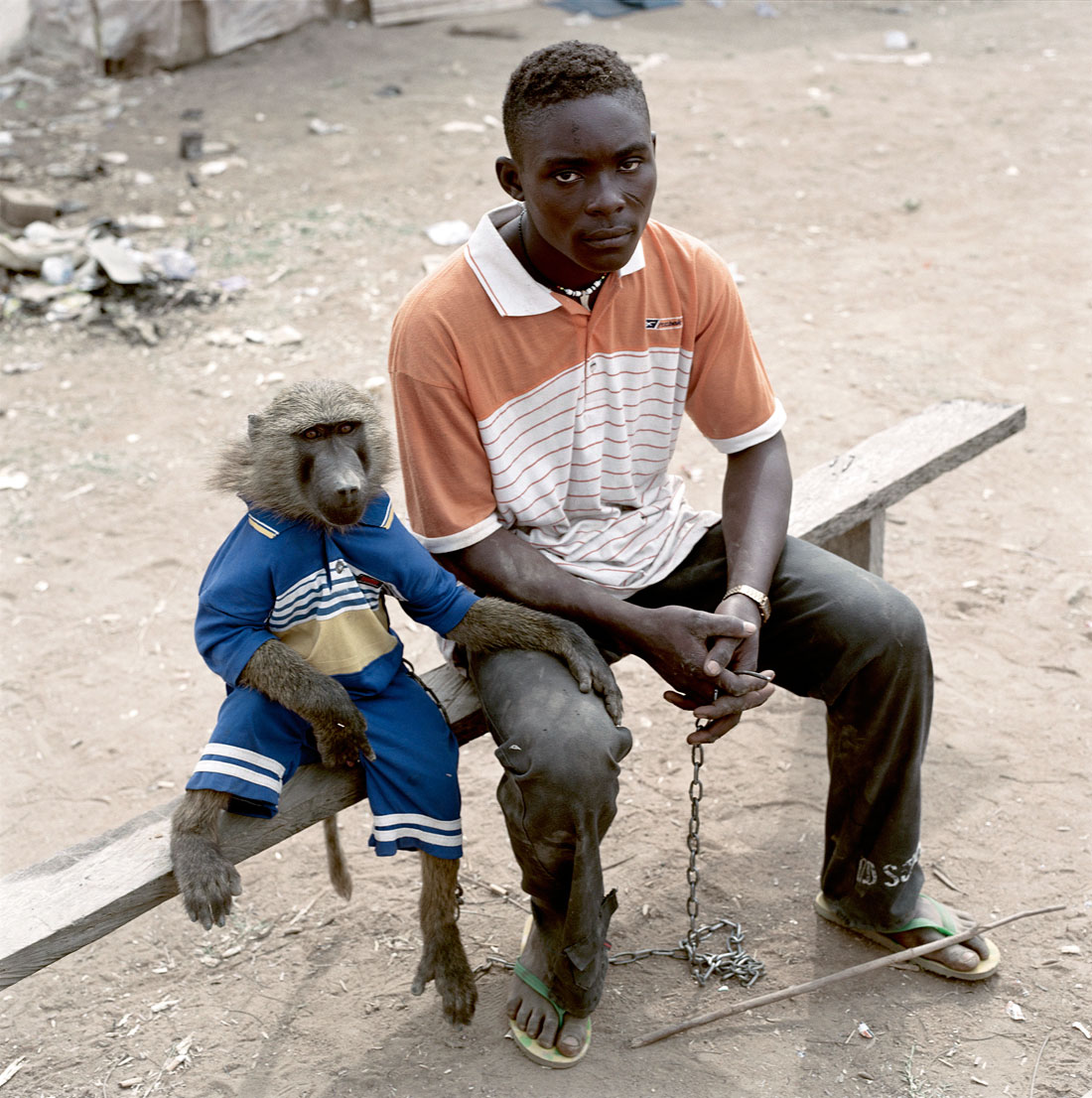
The hyena men are itinerants: they never spend more than two days anywhere. I found them in a shanty town near Abuja, the capital. Despite the language barrier we got to know each other pretty quickly. Outside of Lagos and Port Harcourt, I didn’t see a single white person in Nigeria. So I probably seemed as odd to them as a guy walking a hyena in the street seemed to me.
We smoked some weed to break the ice. It turned out they weren’t debt collectors – they were more like town criers, traditional storytellers who performed in the streets and sold potions after their shows. It reminded me of stories I’d read about eastern European circus troupes in the 1930s – except instead of bears, these guys had hyenas, baboons and pythons.
Seeing them perform was unforgettable. It was a huge spectacle. They would beat drums to draw in the crowds, then take the muzzles off the hyenas. Next they’d put their arms and even their heads between the animals’ jaws. The aim was to convince the audience they had special powers, and that the audience could acquire them too, if they bought their potions.
At first I tried photographing the street shows, but there was just too much going on. Then I realised that the relationship between man and beast was more interesting than all the fireworks of the performance. There was something very strange going on between the guys and the hyenas, bordering on sadomasochism. These animals had been taken out of the wild as pups. They couldn’t return. They were entirely dependent on these guys for food. And these men were dependent on the animals for their livelihoods. They needed each other, but it wasn’t an easy symbiosis. …
I love how confrontational this shot is. At no point did I tell him how to pose. It’s all him. He flexed his bicep, stared straight at me, while his hyena jumped all over him. Then in the background, there’s this kind of Mad Max landscape strewn with broken-down trucks, though you can hardly see them because of the light. It was Harmattan season, a time between November and March when the sands of the Sahara blow over western Africa creating this murky, diffused lighting, which I love. It’s a simple shot with an incredible economy. I wish I could take more like it.
Interview by Edward Siddons. “Pieter Hugo’s best photograph: the hyena men of Nigeria,” on the Guardian website Thursday 19 Jul 2018 [Online] Cited 09/07/2024
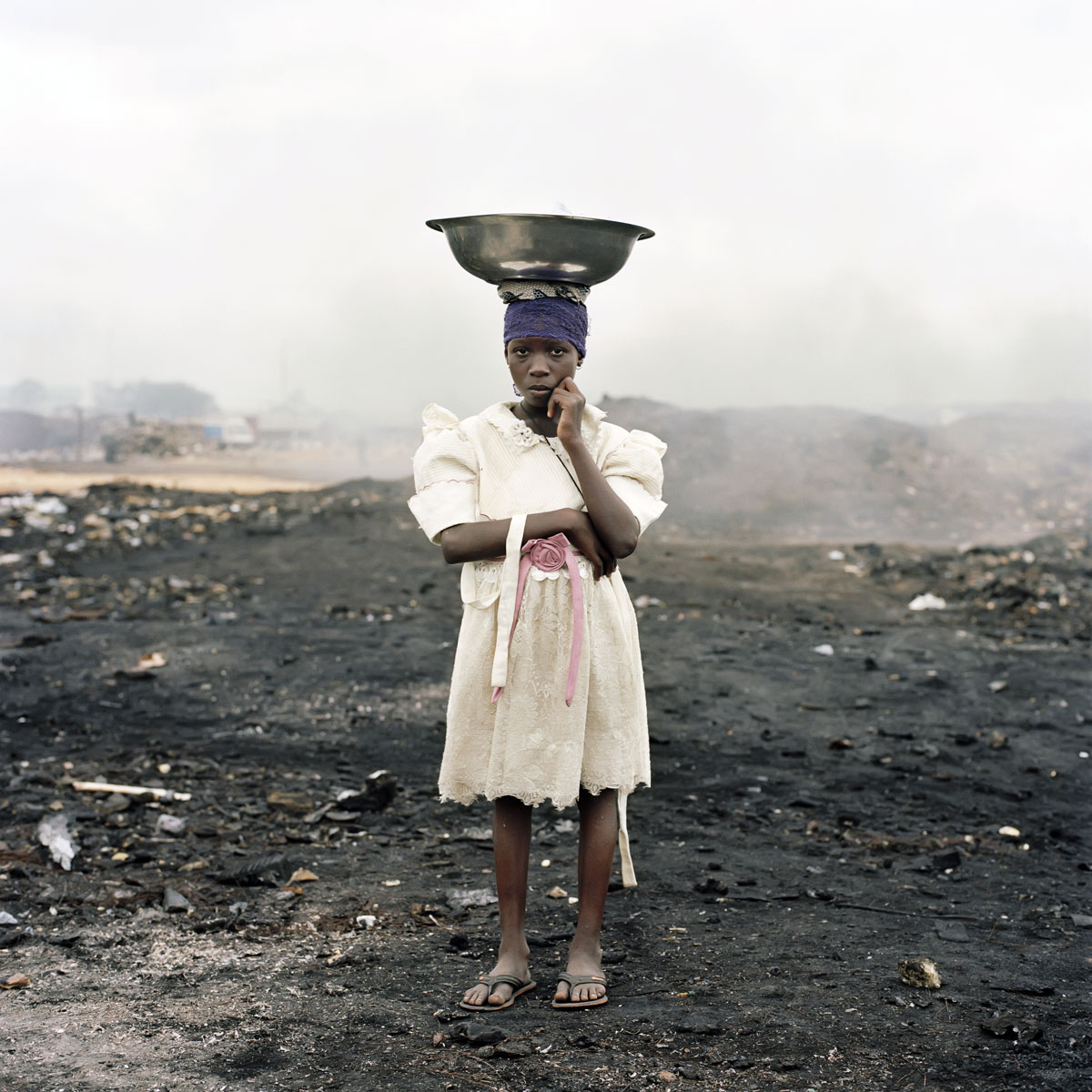
Pieter Hugo (South African, b. 1976)
Naasra Yeti, Agbogbloshie Market, Accra, Ghana
2009
From the series Permanent Error (2009-2010)
© Pieter Hugo
Courtesy of Stevenson, Cape Town/Johannesburg and Yossi Milo, New York
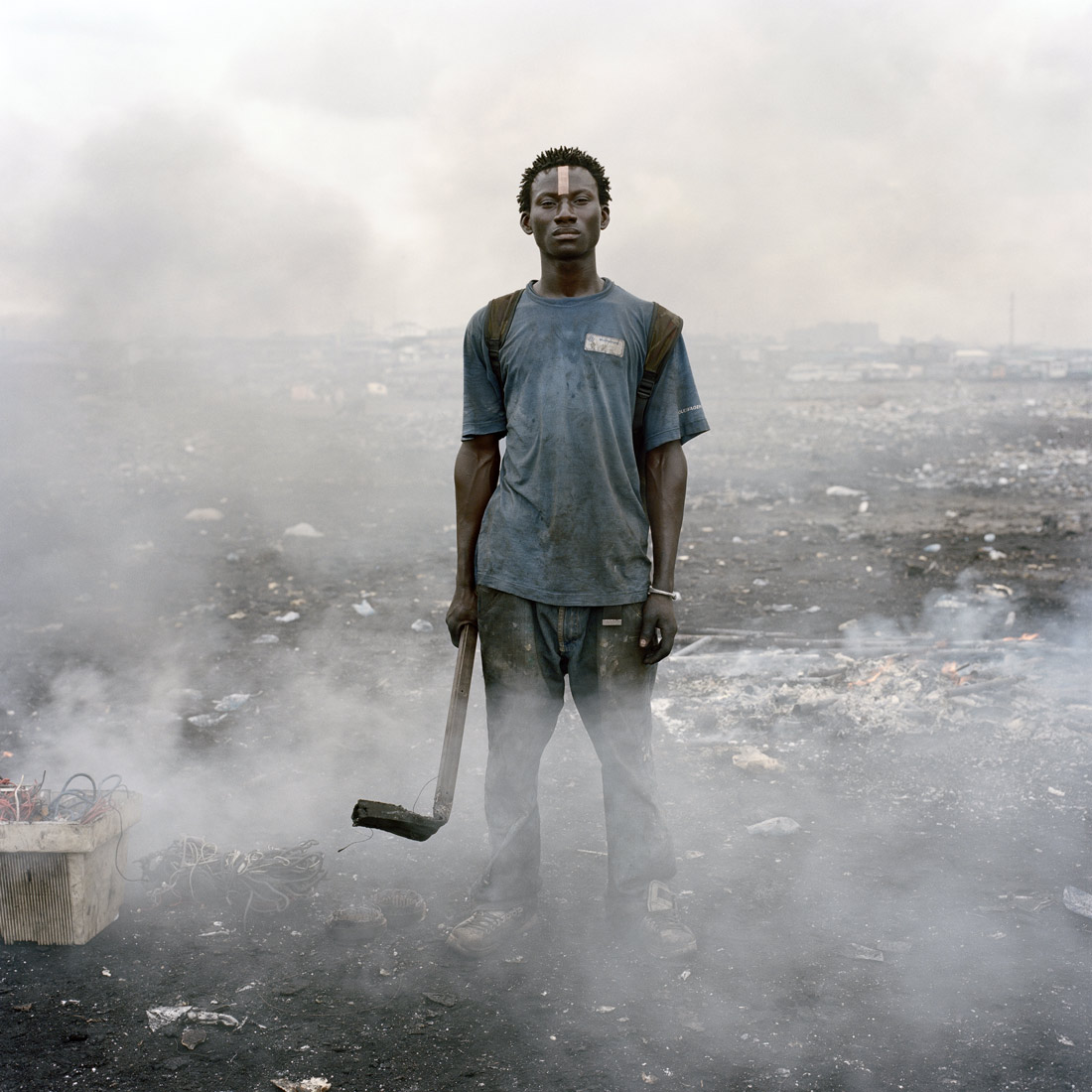
Pieter Hugo (South African, b. 1976)
Aissah Salifu, Agbogbloshie Market, Accra, Ghana
2010
From the series Permanent Error (2009-2010)
© Pieter Hugo
Courtesy of Stevenson, Cape Town/Johannesburg and Yossi Milo, New York
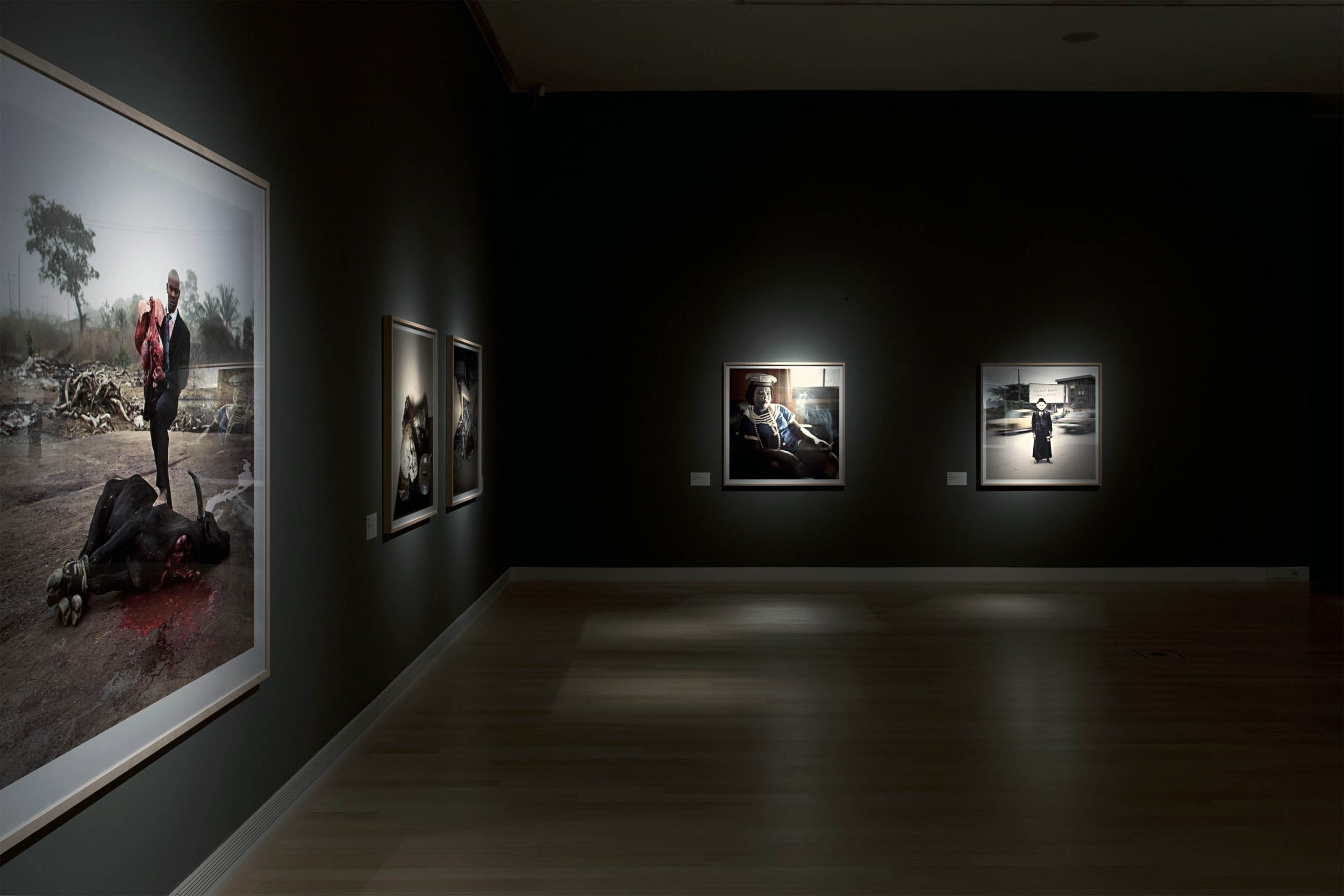
Installation view of the exhibition Pieter Hugo: This Must Be The Place – Selected Works 2003-2012 at the Ludwig Museum of Contemporary Art, Budapest showing at second right, Hugo’s Obechukwu Nwoye, Enugu 2008-2009; and at right, Escort Kama. Enugu, Nigeria 2008 (below) both from the series Nollywood (2008-2009)
Exhibition view © Tamás Bujnovszky / Ludwig Museum – Museum of Contemporary Art, Archives
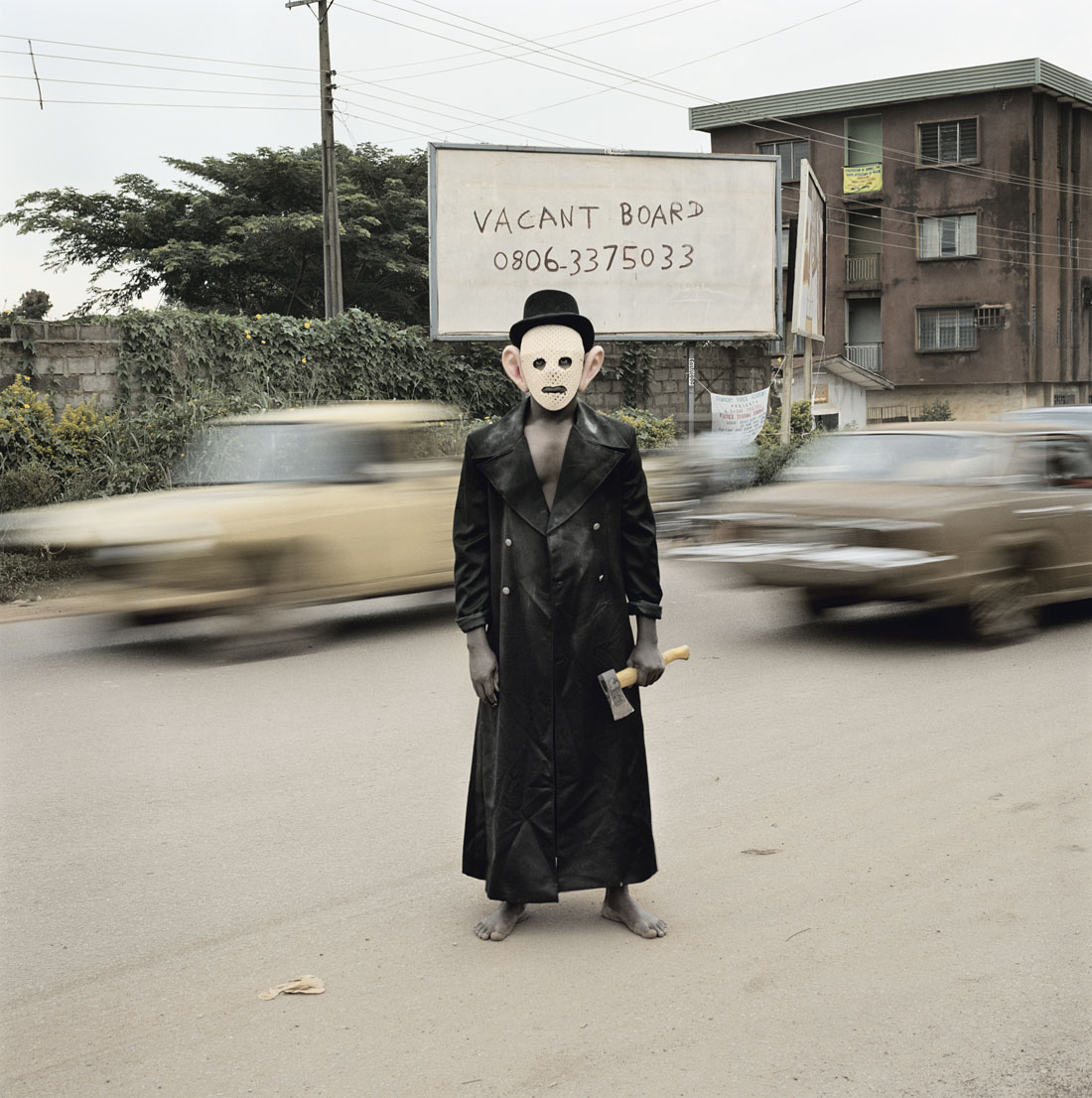
Pieter Hugo (South African, b. 1976)
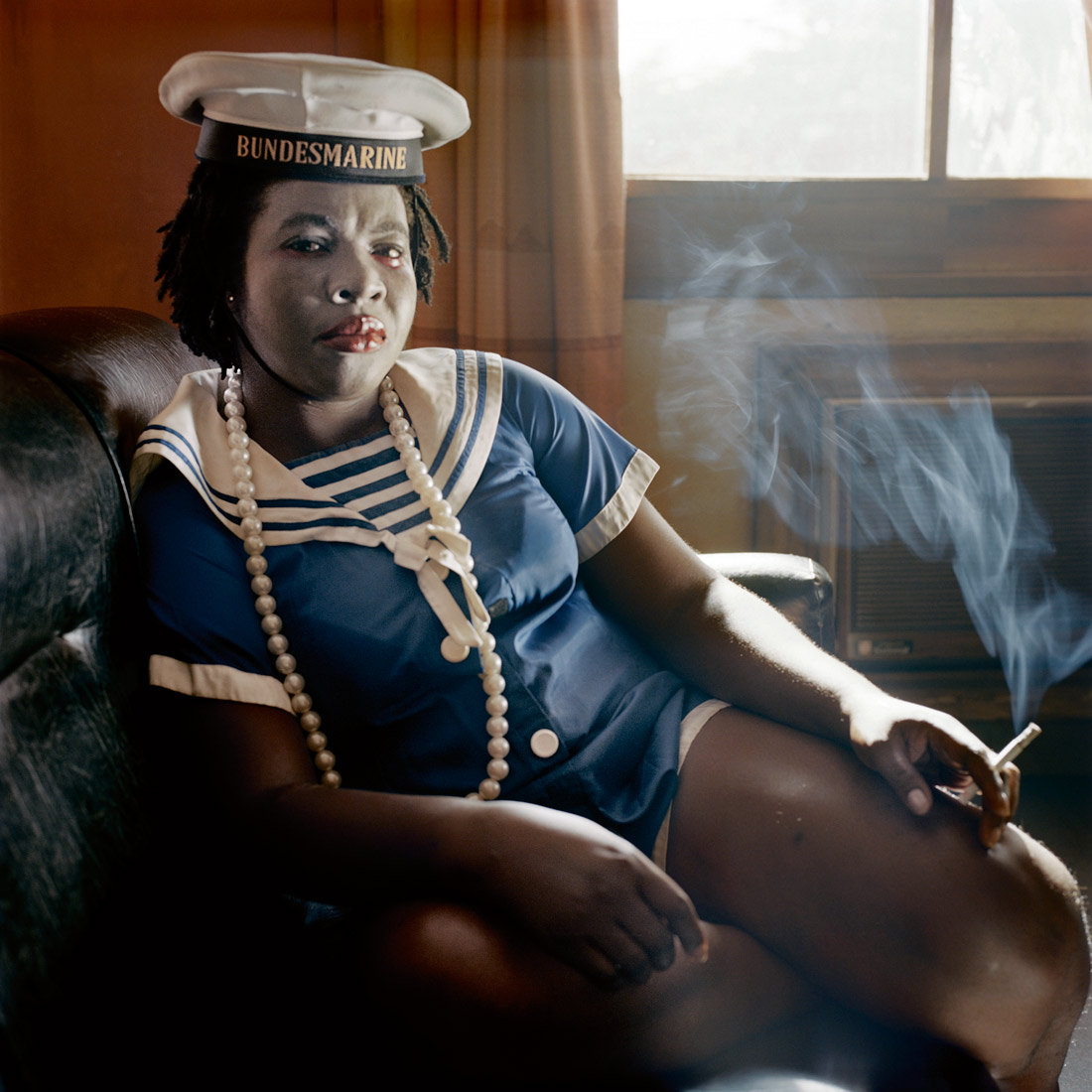
Escort Kama. Enugu, Nigeria
2008
From the series Nollywood (2008-2009)
© Pieter Hugo
Courtesy of Stevenson, Cape Town/Johannesburg and Yossi Milo, New York
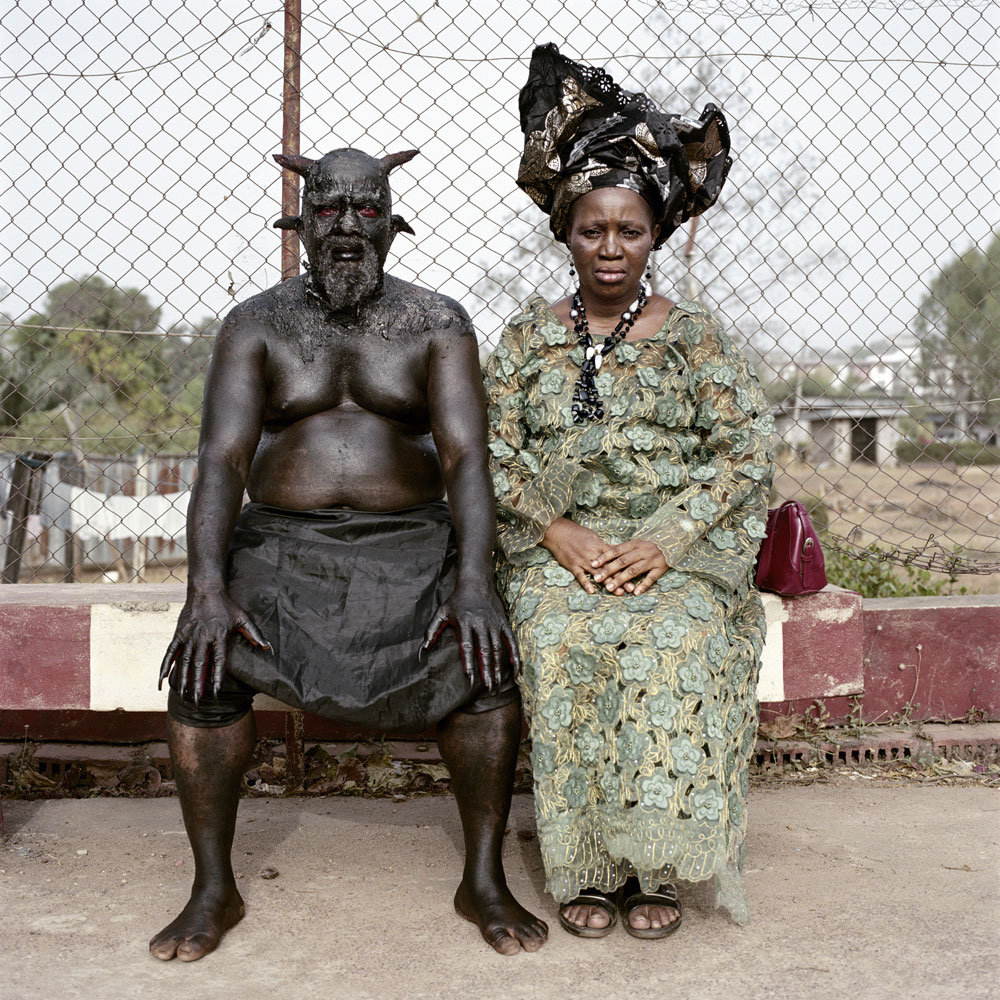
Pieter Hugo (South African, b. 1976)
Chris Nkulo and Patience Umeh. Enugu, Nigeria
2008
From the series Nollywood (2008-2009)
© Pieter Hugo
Courtesy of Stevenson, Cape Town/Johannesburg and Yossi Milo, New York
Pieter Hugo’s (b. Johannesburg, 1976) career is quite young, yet his photography is already so comprehensive that we can rightly speak of a consistent oeuvre. Since 2003 Hugo has photographed people and themes exclusively in sub-Saharan Africa. Daily life in post-colonial Africa, the complex conditions after the end of apartheid in his own land and the impact of global trade and commerce are themes that circulate throughout his intriguing series.
Pieter Hugo spends long periods of time photographing his extensive series in order to capture intimate and often bizarre moments. His use of a large-format camera requires patience and trust between photographer and subject, which is visible in straightforward expressions and candid interactions. There is a moment of calm and even timelessness in these works that allows the viewer to engage more fully with the subject matter.
The political diversity of a continent that is rapidly transforming – some note that Africa will be a global economic power of the future – is portrayed by Pieter Hugo with the clarity of familiar painting genres such as landscape, portraiture, group portraiture and still life. The subjects of his photography: the elderly, the poor, the blind, street artists, soap actors, close family and friends – form a social tableau that is at once personalised while also presenting a more universal image of Africa at the beginning of the twenty first century.
The initial motivation for the series The Hyena & Other Men (2005-2007) comes from a cell phone camera image Pieter Hugo discovered on the internet. The image concerns a group of performers who travel throughout Nigeria with tamed hyenas and other wild animals and collect money from their choreographed public performances. Hugo embarked on two separate trips to document this remarkable nomadic group up close. Hugo presents the complex relationship between animal and owner, capturing moments of calm and tenderness amidst situations full of drama and spectacle.
The Agbogbloshie market on the outskirts of Accra (Ghana) is the thematic of the Permanent Error series (2009-2010), which is mainly a dumping site for the technological waste of the western world. Here computers and other electronic equipment are collected and burned by inhabitants, often children, to extract precious raw materials. These machines formerly representing prosperity and progress are here transformed into only noxious and life threatening vapours. The charred ground, grey sky and scattered groups of foragers and cattle seem isolated from the world, but are in fact one of the last links in a chain of global commerce. Despite the harsh surroundings, the subjects stand tall, identified by full name and framed in the style of classical portraiture.
Nollywood (2008-2009) is the third largest film industry in the world, releasing between 500 and 1,000 movies each year. It produces movies on its own terms, telling stories that appeal to and reflect the lives of its public: it is a rare instance of self-representation on such a scale in Africa. The continent has a rich tradition of story-telling that has been expressed abundantly through oral and written fiction, but has never been conveyed through the popular media before. Stars are local actors; plots confront the public with familiar situations of romance, comedy, witchcraft, bribery, prostitution. The narrative is overdramatic, deprived of happy endings, tragic. The aesthetic is loud, violent, excessive; nothing is said, everything is shouted.
At a morgue in the township of Khayelitsha in Cape Town, Pieter Hugo turns his camera to individuals who have died of AIDS related illnesses. In The Bereaved (2005) as with many of his other series, Hugo gives first and last names of his subjects. Such a personal statement challenges the anonymity of AIDS statistics in South Africa. Ten years after the Rwandan Genocide, Pieter Hugo captures the unimaginable violence of these events through leftover fragments (Vestiges of a Genocide, 2004). The absence of human life is disturbingly present in the images. Bones are preserved with lime so as not to disintegrate. Heavy dust and dirt create an organic seal over the remains. While these substances often signify what is past and forgotten, the items in the photographs are preserved artificially and naturally for all to remember.
The series entitled Messina / Musina (2006) deals with the inhabitants of a small town on the border of Zimbabwe in South Africa’s Limpopo Province. The title reflects the correction of an earlier colonial misspelling of the town’s name (Messina), as well as the transition taking place at this geographical and social periphery.
In Pieter Hugo’s studio portraits of the elderly, the blind and people with albinism – Looking Aside, 2003-2006 – there is a direct and confrontational engagement between the viewer and the subjects. The viewer is made to feel uncomfortable and immobilised by the subject’s gaze. In There’s a Place in Hell for Me and My Friends (2011) – a recent series of portraits realised in the same spirit and adopting a stripped back, close-up and confrontationally direct approach – Hugo explores similar territory [to his earlier series Looking Aside] but from practically the opposite angle. In this case, the subjects are simply the photographer and his friends, who represent an array of ethnicities but are not particularly atypical, abnormal or ‘unusual’ in a genetic sense. Instead they are rendered unusually, portrayed in a heightened monotone with their skin transformed into a range of exaggerated black spots and dark tones.
With Kin (2011), his most autobiographical series to date, Pieter Hugo reflects on his own family and deep ambivalence towards the notion of home. Personal moments such as the pregnancy of his wife, the birth of their child and an operation of his mother are interspersed with national icons: open landscapes, anthropological museums and references to historical places and figures in South Africa. The recent and historical, private and public, rich and poor, ugly and beautiful interact closely in this series and represent the social complexities of post-apartheid South Africa.
Press release from the Ludwig Museum of Contemporary Art website
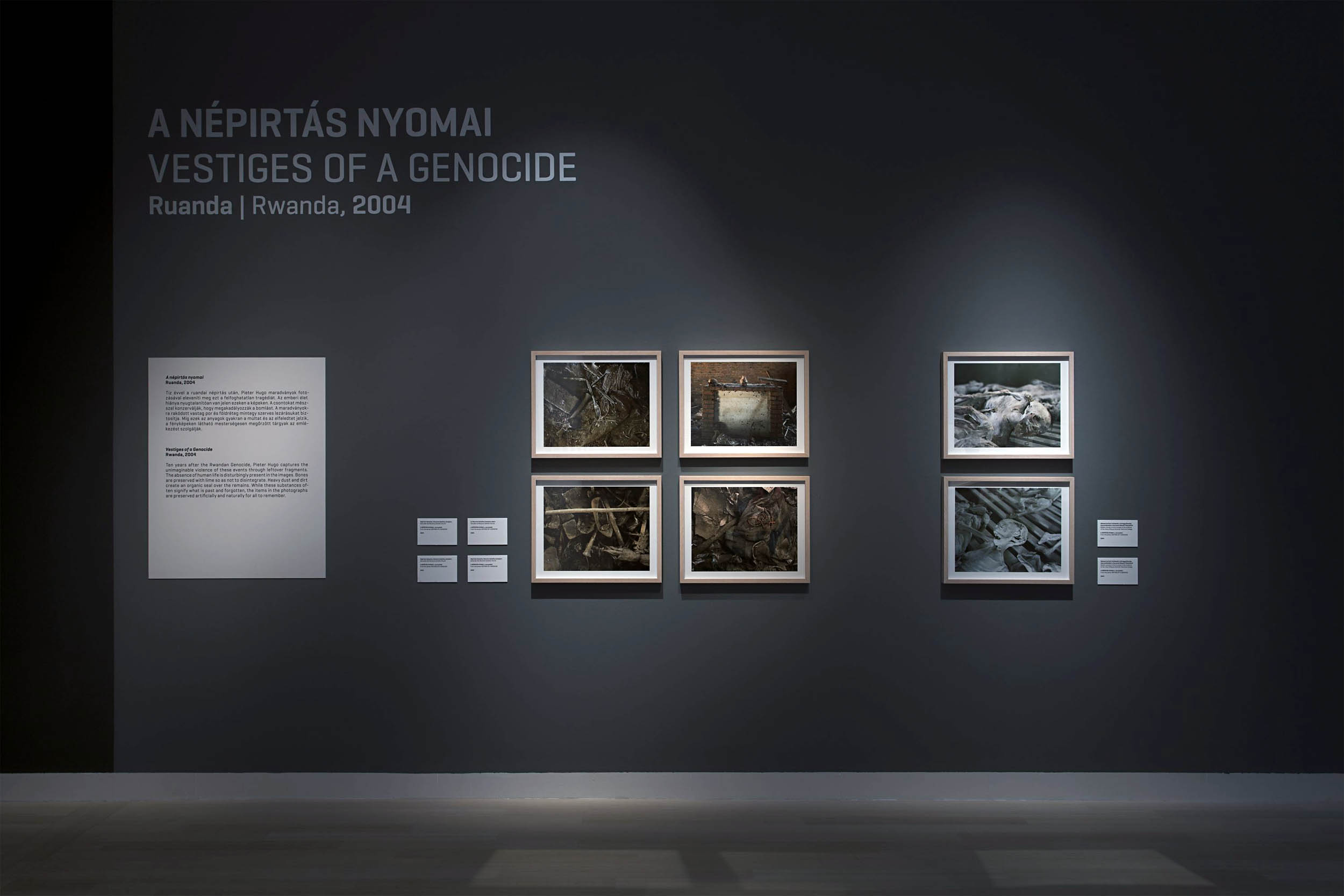
Installation view of the exhibition Pieter Hugo: This Must Be The Place – Selected Works 2003-2012 at the Ludwig Museum of Contemporary Art, Budapest showing work from Hugo’s Vestiges of a Genocide Rwanda, 2004
Exhibition view © Tamás Bujnovszky / Ludwig Museum – Museum of Contemporary Art, Archives
Vestiges of a Genocide
Rwanda, 2004
Ten years after the Rwandan Genocide, Pieter Hugo captures the unimaginable violence of these evens through leftover fragments. The absence of human life is disturbingly person in the images. Bones are preserved with lime so as not to disintegrate. Heavy dust and dirt create an organic seal over the remains. While these substances often signify what is past and forgotten, the items in the photographs are preserved artificially and naturally for all to remember.
Wall text from the exhibition
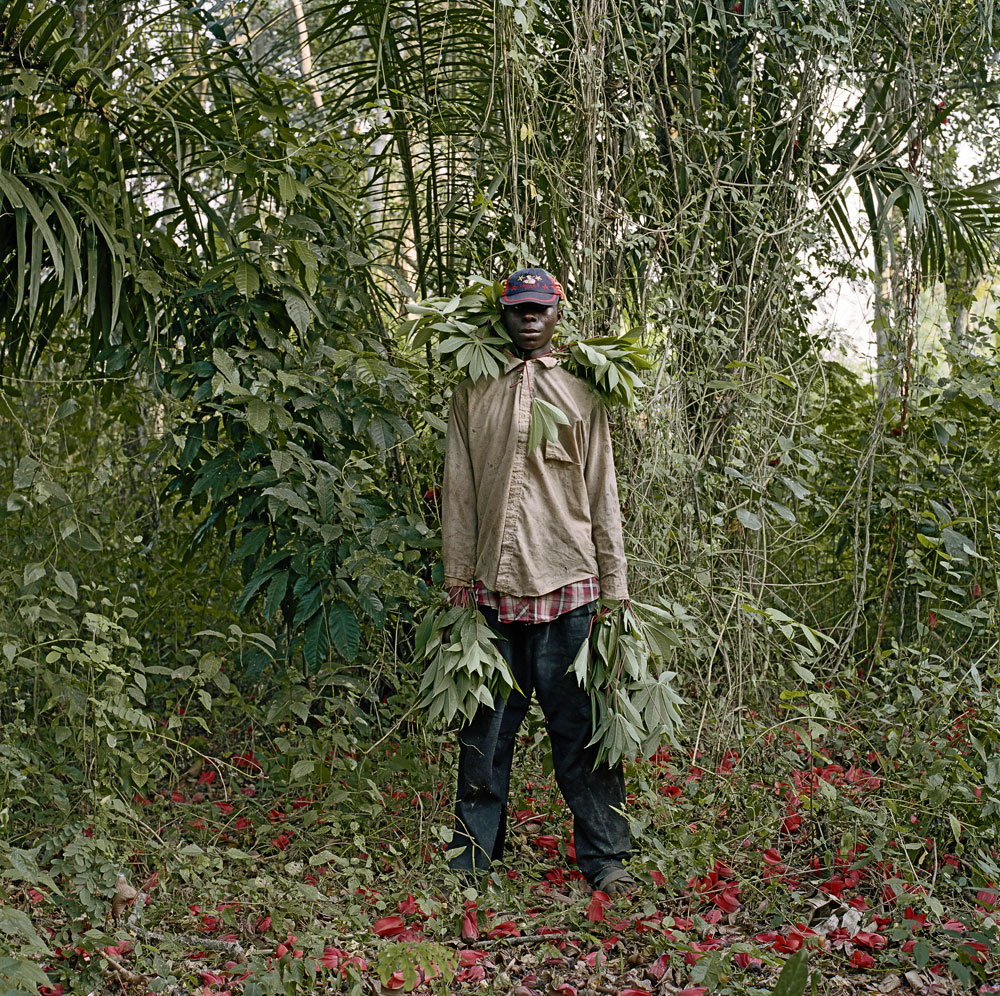
Pieter Hugo (South African, b. 1976)
John Kwesi, Wild Honey Collector, Techiman District, Ghana
2005
From the series Wild Honey Collectors Ghana 2005
© Pieter Hugo
Courtesy of Stevenson, Cape Town/Johannesburg and Yossi Milo, New York
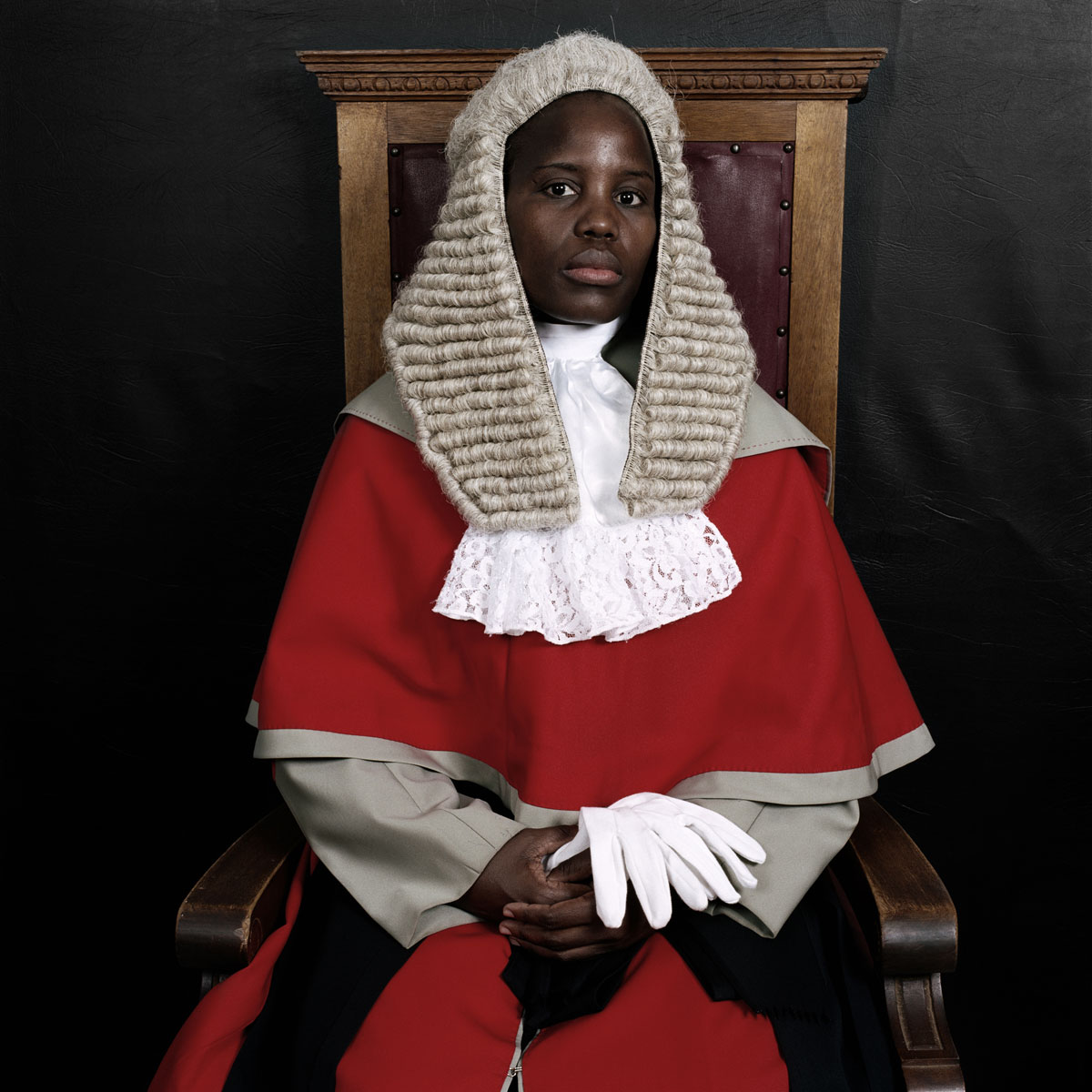
Pieter Hugo (South African, b. 1976)
The Honourable Justice Unity Dow
2005
© Pieter Hugo
Courtesy of Stevenson, Cape Town/Johannesburg and Yossi Milo, New York
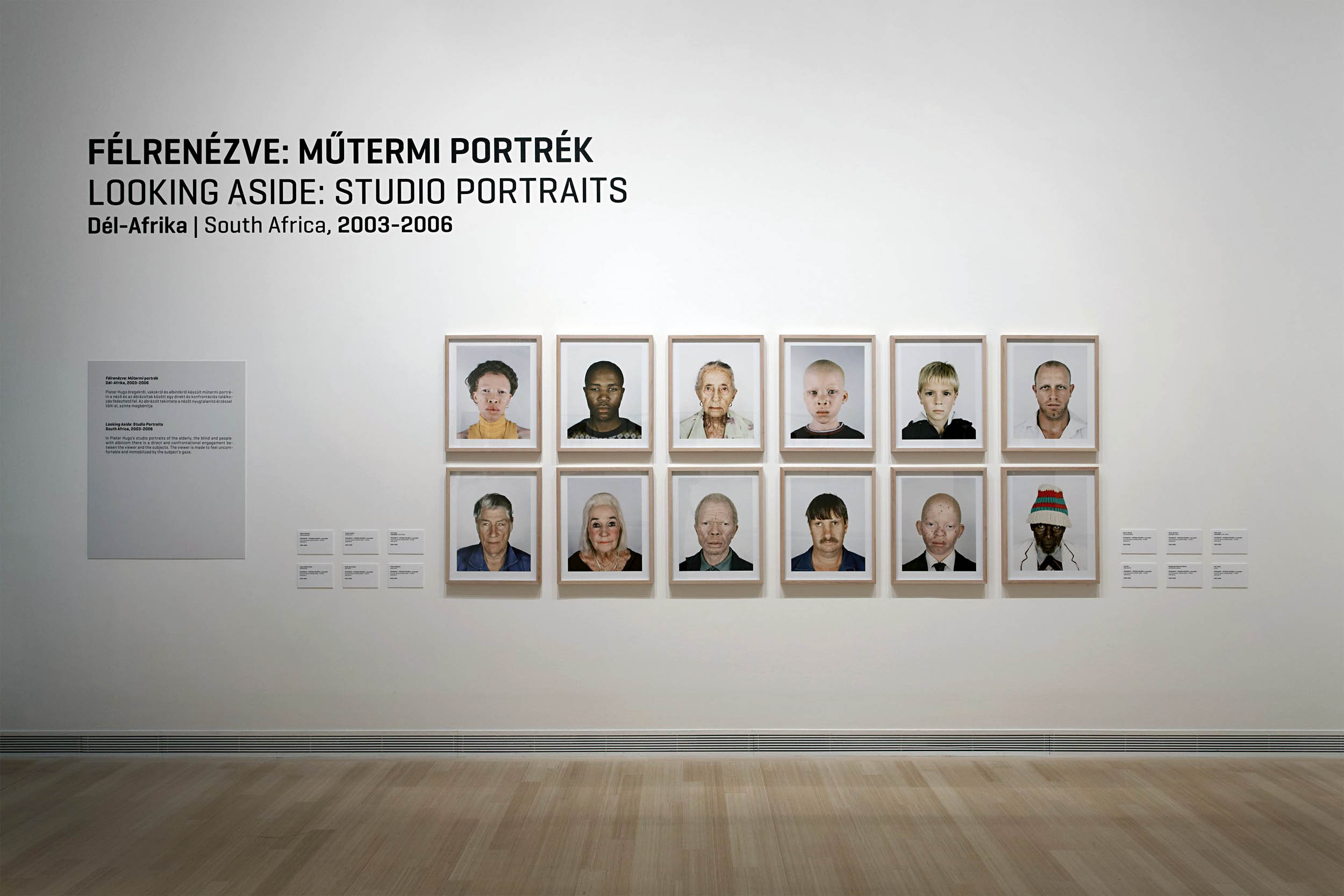
Installation view of the exhibition Pieter Hugo: This Must Be The Place – Selected Works 2003-2012 at the Ludwig Museum of Contemporary Art, Budapest showing work from Hugo’s Looking Aside: Studio Portraits South Africa, 2003-2006
Exhibition view © Tamás Bujnovszky / Ludwig Museum – Museum of Contemporary Art, Archives
Looking Aside: Studio Portraits
South Africa, 2003-2006
In Pieter Hugo’s studio portraits of the elderly, the blind and people with albinism there is a direct and confrontational engagement between the viewer and the subjects. The viewer is made to feel uncomfortable and immobilised by the subject’s gaze.
Wall text from the exhibition
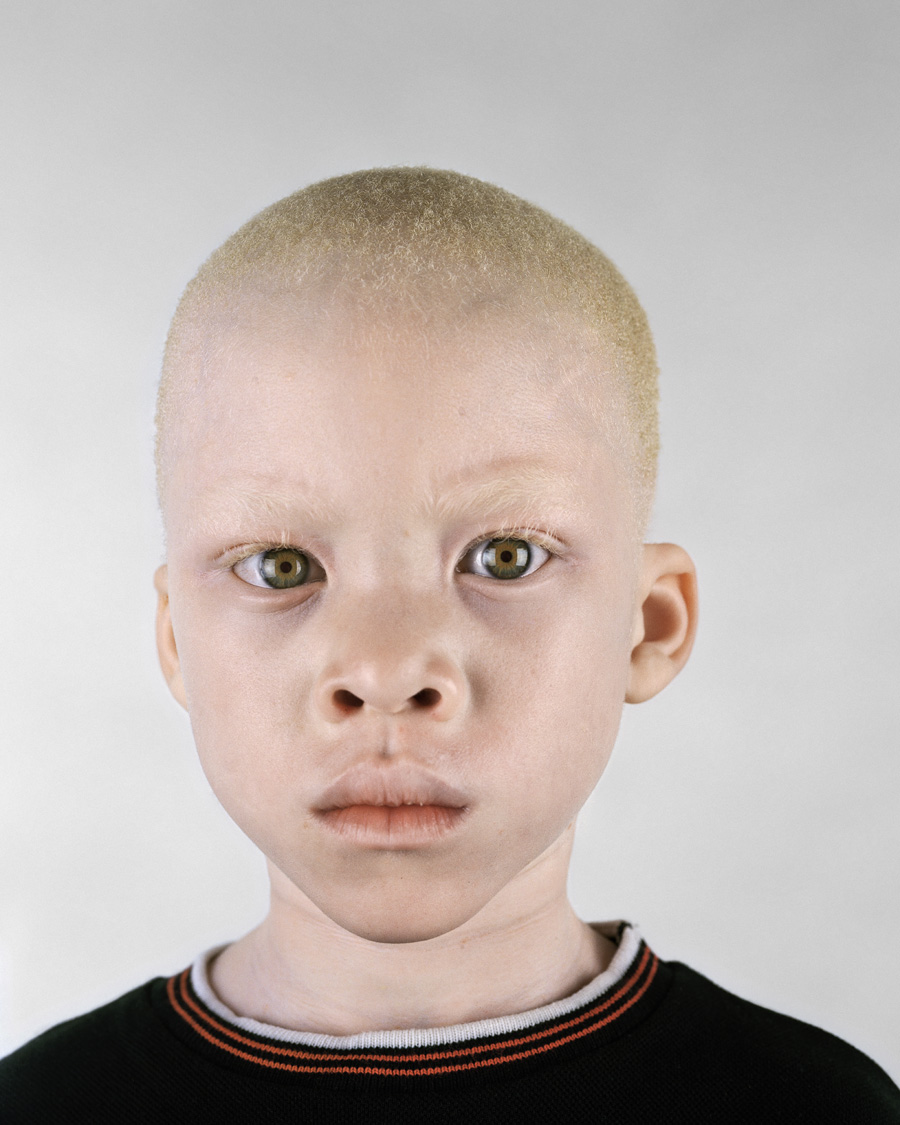
Pieter Hugo (South African, b. 1976)
Steven Mohapi, Johannesburg
2003
From the series Looking Aside: Studio Portraits South Africa, 2003-2006
© Pieter Hugo
Courtesy of Stevenson, Cape Town/Johannesburg and Yossi Milo, New York

Pieter Hugo (South African, b. 1976)
Themba Tshabalala, Cape Town
2011
From the series There’s a Place in Hell for Me and My Friends
© Pieter Hugo
Courtesy of Stevenson, Cape Town/Johannesburg and Yossi Milo, New York
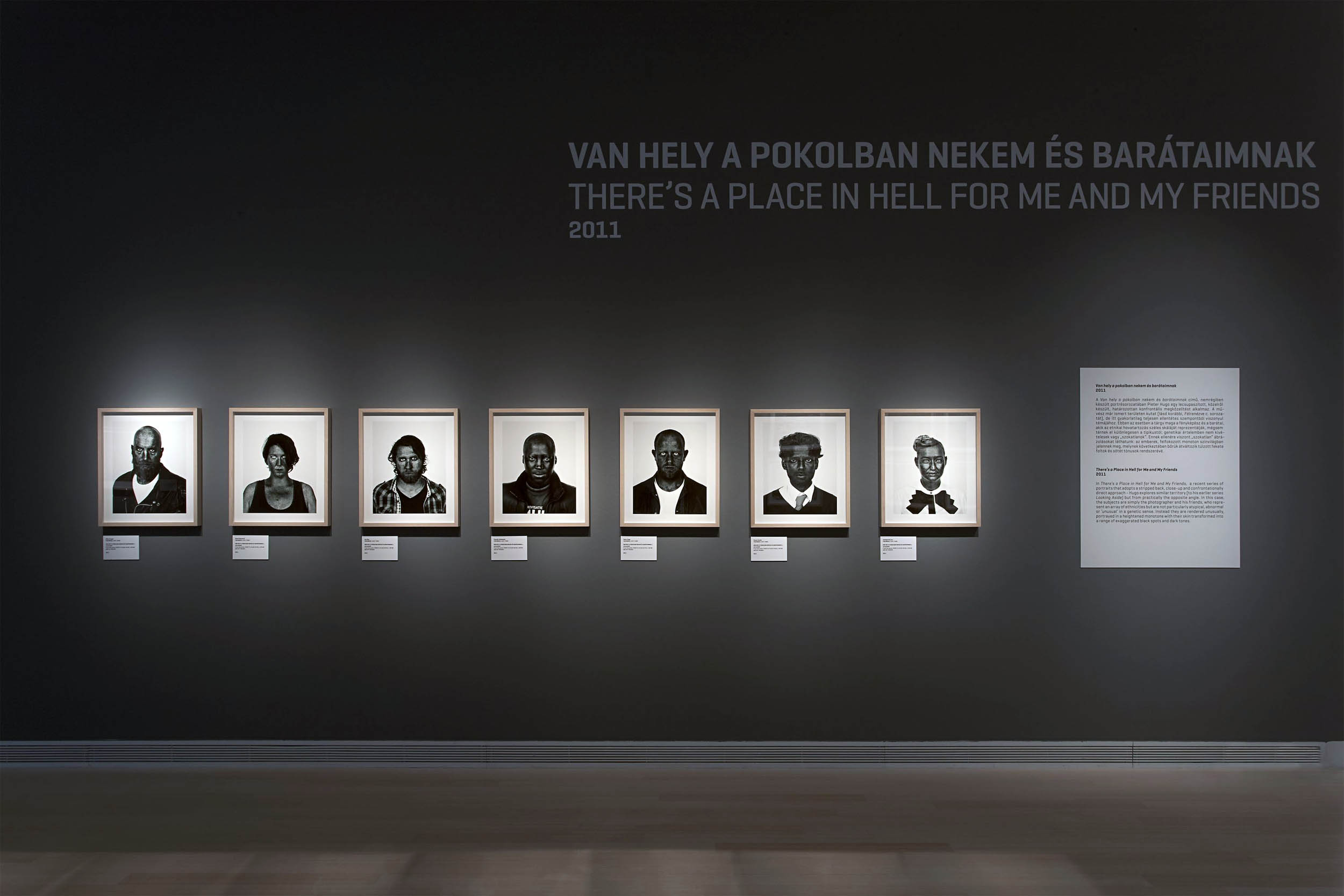
Installation view of the exhibition Pieter Hugo: This Must Be The Place – Selected Works 2003-2012 at the Ludwig Museum of Contemporary Art, Budapest showing work from Hugo’s There’s a Place in Hell for Me and My Friends, 2011
Exhibition view © Tamás Bujnovszky / Ludwig Museum – Museum of Contemporary Art, Archives
There’s a Place in Hell for Me and My Friends
2011
In There’s a Place in Hell for Me and My Friends, a recent series of portraits that adopts a stripped back, close-up confrontationally direct approach – Hugo explores similar territory (to his earlier series Looking Aside, above) but from practically the opposite angle. In this case the subjects are simply the photographer and his friends, who represent an array of ethnicities but are not particularly atypical, abnormal or ‘unusual’ in a genetic sense. Instead they are rendered unusually, portrayed in a heightened monotone with their skin transformed into a range of exaggerated black spots and dark tones.
Wall text from the exhibition
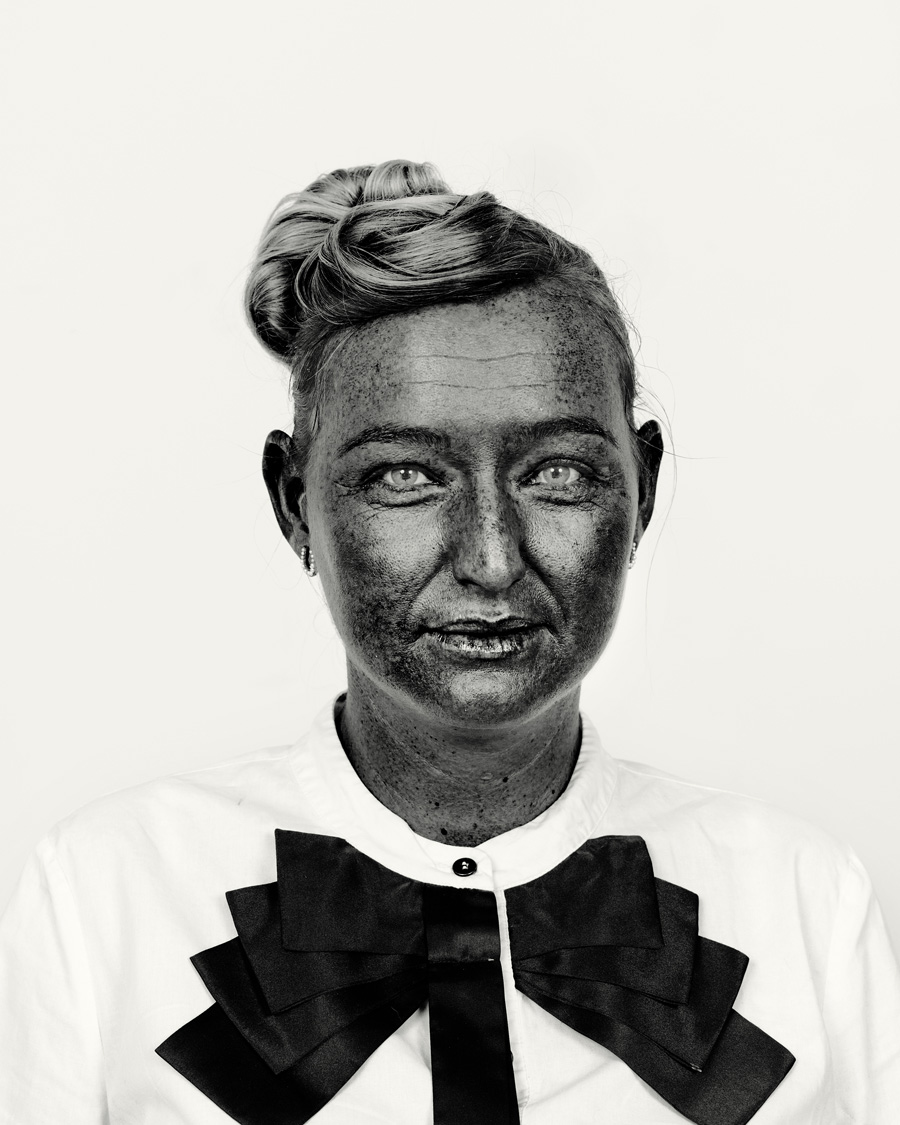
Pieter Hugo (South African, b. 1976)
Ashleigh McLean
2011
From the series There’s a Place in Hell for Me and My Friends
© Pieter Hugo
Courtesy of Stevenson, Cape Town/Johannesburg and Yossi Milo, New York

Pieter Hugo (South African, b. 1976)
Yasser Booley, Cape Town
2011
From the series There’s a Place in Hell for Me and My Friends
© Pieter Hugo
Courtesy of Stevenson, Cape Town/Johannesburg and Yossi Milo, New York
Ludwig Museum of Contemporary Art
1095 Budapest Komor Marcell Street 1
Hungary 06 1 555-3444
Opening hours:
Tuesday – Sunday: 10.00 – 18.00
Closed on Mondays





 Art Blart _ art and cultural memory archive
You must be logged in to post a comment.