Exhibition: ‘Zbigniew DÅ‚ubak – Heir of the Avant-Garde’ at Fondation Henri Cartier-Bresson, Paris

Exhibition dates: 17th January – 29th April, 2018

Curator: The exhibition is curated by Karolina Ziebinska-Lewandowska, curator at the Centre Pompidou.


Zbigniew Dłubak (Polish, 1921-2005) 'Untitled' c. 1946 from the exhibition 'Zbigniew Dłubak – Heir of the Avant-Garde' at Fondation Henri Cartier-Bresson, Paris, Jan - April, 2018


Zbigniew Dłubak (Polish, 1921-2005)
Untitled
c. 1946
© Armelle Dłubak/Archeology of Photography Foundation, Warsaw


Photography, the object, conceptual art, reality and the empty sign.

An interesting artist who warrants further investigation. The text and images provide an introduction, but I really need further evidence before I can make informed comment.

Dr Marcus Bunyan


Many thankx to the Fondation HCB for allowing me to publish the photographs in the posting. Please click on the photographs for a larger version of the image.


“I’m not interested in stylistic effects, whether they’re derived from modern art or conceptualism. I use shapes, ideas, colours, words, photographs and actions as my materials in a way that best suits my art, to create an empty sign in the context of the reality I live in.”


“The social role of art consists in introducing the factor of negation into the human consciousness, it challenges the rigidity of systems and conventions in the rendering of reality. Art itself is evolution, it’s the introduction of all new means of expression.”


“Photography is in phase with the rhythm of life. It impatiently looks for new images. The more effigies it accumulates, the greater its appetite; it’s increasingly obsessive. Not only does it record but, subject to the imagination, it also creates new phenomena. It constantly takes us on new adventures, it shakes us up, and does not allow us to rest.”


Zbigniew Dłubak


Zbigniew Dłubak (Polish, 1921-2005) 'I recall the solitude of the straits' 1948 from the exhibition 'Zbigniew Dłubak – Heir of the Avant-Garde' at Fondation Henri Cartier-Bresson, Paris, Jan - April, 2018


Zbigniew Dłubak (Polish, 1921-2005)
I recall the solitude of the straits
1948
Illustration for Pablo Neruda’s poem “Le coeur magellanique”
© Armelle Dłubak / Archeology of Photography Foundation, Warsaw


Zbigniew Dłubak (Polish, 1921-2005) 'The streets are for the sun and not for people' 1948


Zbigniew Dłubak (Polish, 1921-2005)
The streets are for the sun and not for people
1948
© Armelle Dłubak / Archeology of Photography Foundation, Warsaw


In the post-war period, Zbigniew Dłubak (1921-2005) was one of the driving forces behind the profound changes in the Polish artistic scene. A great experimenter of photographic forms, he was also a painter, art theoretician, teacher and editor of the Fotografia magazine for twenty years, introducing into this publication a robust photographic critique and interdisciplinary approach to the medium.

Although Dłubak was primarily known as a photographer, he initially aspired to become a painter, tirelessly searching for materials for drawing during the war. Very active in these two traditionally separate disciplines, he greatly influenced the decompartmentalisation of artistic forms. He also defended the right of photography to exist as a completely separate discipline. His first photographic experiments reveal a diversity of inspirations characteristic of pre-war practices, stemming from constructivist and surrealist traditions.

This exhibition proposes to highlight the similarities and complementary focuses on two decisive periods in the artist’s life: the year 1948, which marks the beginning of his career and places it within the avant-garde movement, and the 1970s, which symbolise his ambiguous position regarding conceptual art. The selection presents iconic works and hitherto unseen photographs.

Curated by Karolina Ziebinska-Lewandowska, a specialist in DÅ‚ubak’s work, the exhibition is accompanied by a book published by Éditions Xavier Barral under the direction of Karolina Ziebinska-Lewandowska. The exhibition is being organised in collaboration with the Fundacja Archaeologia Fotografii in Warsaw, with the support of the Adam Mickiewicz Institute and the Polish Institute in Paris.

Text from the Fondation Henri Cartier-Bresson


Zbigniew Dłubak (Polish, 1921-2005) 'Untitled' c. 1950


Zbigniew Dłubak (Polish, 1921-2005)
Untitled
c. 1950
© Armelle Dłubak


Zbigniew Dłubak (Polish, 1921-2005) Sketch for the series 'Ammonites' 1959-1961


Zbigniew Dłubak (Polish, 1921-2005)
Sketch for the series Ammonites
1959-1961
© Armelle Dłubak


The Zbigniew Dłubak – Héritier des avant-gardes exhibition is being held at the Fondation Henri Cartier-Bresson between January 17 and April 29, 2018. In the post-war period, Zbigniew Dłubak (1921-2005) was one of the driving forces behind the profound changes in the Polish artistic scene. A great experimenter of photographic forms, he was also a painter, art theoretician, teacher and editor of the Fotografia magazine for twenty years, introducing into this publication a robust photographic critique and interdisciplinary approach to the medium. He enjoyed a certain notoriety in Poland during his lifetime. Several monographic exhibitions were dedicated to him and some of his major works are part of Polish public collections.

Although Dłubak was primarily known as a photographer, he initially aspired to become a painter, tirelessly searching for materials for drawing during the war. Very active in these two traditionally separate disciplines, he greatly influenced the decompartmentalisation of artistic forms. He also defended the right of photography to exist as a completely separate discipline.

His first photographic experiments reveal a diversity of inspirations characteristic of pre-war practices, stemming from constructivist and surrealist traditions. Fascinated by linguistics, Dłubak then moves towards the mechanisms of a systematic approach and then onto the disappearance and fading of signs.

The work carried out by the Fundacja Archaeologia Fotografii where his archives have been deposited offers a new insight into his oeuvre and a new way of looking at it. Continuing in this vein of offering a different reading, this exhibition proposes to highlight the similarities and complementary aspects of photography and painting in his work. It focuses on two decisive periods in the artist’s life: the year 1948, which marks the beginning of his career and places it within the avant-garde movement, and the 1970s, which symbolise his ambiguous position regarding conceptual art. The selection presents iconic works and hitherto unseen photographs.

Press release from the Fondation Henri Cartier-Bresson


Zbigniew Dłubak (Polish, 1921-2005) From the series 'Existences' 1959-1966


Zbigniew Dłubak (Polish, 1921-2005)
From the series Existences
1959-1966
© Armelle Dłubak / Archeology of Photography Foundation, Warsaw


Zbigniew Dłubak (Polish, 1921-2005) From the series 'Existences' 1959-1966


Zbigniew Dłubak (Polish, 1921-2005)
From the series Existences
1959-1966
© Armelle Dłubak / Archeology of Photography Foundation, Warsaw


Zbigniew Dłubak (Polish, 1921-2005) Study for 'Iconosphere I' 1967


Zbigniew Dłubak (Polish, 1921-2005)
Study for Iconosphere I
1967
© Armelle Dłubak / Archeology of Photography Foundation, Warsaw


Extracts from the book

Éditions Xavier Barral

The first photographic images created by DÅ‚ubak, who taught himself to paint and draw in the early 1940s, were undoubtedly strictly utilitarian: they documented the activities of the clandestine army he joined and then, when he was deported to the Mauthausen concentration camp after his participation in the Warsaw uprising in 1944, they were dictated by the tasks the Nazis assigned to him in the camp’s photography studio (touchups and perhaps portraits or reproductions). The images he shows in Krakow1 were however preceded by a few more artistic attempts, created in 1947 and early 1948, which show the desire to understand from within two significant trends of what photographic modernism might have constituted in the eyes of a Polish novice. On the one hand, DÅ‚ubak creates images of trees using a low-angle shot or fragments of ground using a sharp high-angle shot, stemming from a sort of Pictorialism marked by a superficial link with the Germanic New Vision, in keeping with Jan BuÅ‚hak, then considered the father of Polish modern photography. On the other hand, he arranges compositions of insignificant little objects (like matches, springs, buttons, screws and so on) on tables, which he photographs like abstract not-to-scale landscapes, as practised by constructivists and notably Florence Henri (some of whose images he might have known, even though he never seems to have mentioned them). However, nothing in these two series really prepares for what can be seen in the photographs shown in 1948. […]

DÅ‚ubak’s key originality comes from the fact that he focuses less on producing the supernatural and more on finding it, by blurring the too-certain habits of ordinary vision but without the factual origin of his image obscuring its poetic efficacy. […]

So, for DÅ‚ubak, it’s not just about reconciling previously separate artistic traditions, but dismantling the traditional opposition between abstraction and figuration. The use of the extreme close-up (on the scale of macro photography) and technical manipulations (solarisation or pseudo-solarisation, presentation of the negative as a positive) must not be seen as a distancing from external reality but, on the contrary, as a way of penetrating its core; less like a hidden thing than a spiritual vision, and less like burying than a revelation of what is latent within, giving us a subtler understanding of it. As DÅ‚ubak writes in 1948 in an article on method called “Reflections on photography”: “Photographic realism is a different kind of realism and, fittingly, the faithfulness and attachment to the object, which has the nature of a raw material here, prohibits any artifice, because it is immediately unmasked. Such realism requires one to rely essentially on nature avoiding any narration.”2

Éric de Chassey
Extracts from “1948-1949: un réalisme de l’extrême proximité”


1/ At the “1st Exhibition of Modern Art” (I Wystawa Sztuki Nowoczesnej) opened on 19 December 1948. This exhibition included artists from across the country, often young (the vast majority were under thirty): painters, sculptors but also, and this was a huge novelty in Poland, photographers. Zbigniew DÅ‚ubak was even one of the key organisers of the event

2/ Zbigniew DÅ‚ubak, “RozmyÅ›lania o fotografii II,” Åšwiat fotografii, no 11, January-February 1949, reproduced in Lech Lechowicz and Jadwiga Janik (dir.), cat. exp. DÅ‚ubak, fotografie photographs, 1947-1950, Lodz, Muzeum Sztuki, 1995, p. 47


Two events occurred in 1970 which are traditionally considered by Polish historiography as key manifestations of conceptual art: the WrocÅ‚aw Symposium ’70 and the Åšwidwin-Osieki ’70 (Osieki open air events). It would of course be illusory to bring the appearance of conceptual art in Poland down to this one year, since it was a much more complex process, as demonstrated by Piotr Piotrowski and Luiza Nader in particular. However, referring to these events helps explain the work and engagement of Zbigniew DÅ‚ubak during these years. Organised thanks to a close collaboration between local authorities and artistic circles, they brought together artists and art critics, representing various experimental trends in Polish art. The aim of the WrocÅ‚aw Symposium was to attract an audience not accustomed to experimental art. The primary idea, justifying the participation of local organisations, was to bring contemporary art into the public space, particularly social housing areas, squares and undefined suburban sites. […]

Finally, for DÅ‚ubak, 1970 marks the beginning of a series to which he is to dedicate the next eight years: Systems – Gesticulations. This series which, at first glance perfectly conforms to the codes of conceptual art, in reality indicates DÅ‚ubak’s break from conceptualism. Although he saw theoretical activity as an integral part of his artistic practice, he was convinced of the need to preserve a role of mediation in the artistic object. So why did Zbigniew DÅ‚ubak, one of the ardent protagonists of the development of conceptualism in Poland, finally break away from the movement?

His writings suggest some answers to this question. In 1977, when the movement was still very much alive, he wrote: “In aspiring to total purification, conceptual art has created a list of ‘don’ts’ regarding methods of recording and transmission. […] But conceptualism immediately developed a morphology of its own means [of expression] and became frozen.”1 In an (undated) manuscript, he added: “The causes of the failure of conceptualism: an erroneous interpretation of art (false models of ancient art); an under-estimation of the fight against aestheticism in the first half of the 20th century; too much attention paid to ways of recording ideas; unjustified faith in the existence of the idea outside its recording; the belief in the advent of a new era of art through the choice of another material for realising ideas.”2 He too relied on this new morphology but tried nevertheless to preserve his autonomy. He didn’t believe in the annihilation of the artistic object, considering the work of art as the result of an encounter. The object started the social dialogue.

Karolina Ziebinska-Lewandowska
Extracts from “1970: l’art du concept (non) assimilé”


1/ Uwagi o sztuce i fotografii (Comments about art and photography), 1977, Fotografia, no 8, 1969

2/ Untitled text, reproduced in Teoria sztuki Zbigniewa Dłubaka (Theory of art of Zbigniew Dłubak), Magdalena Ziółkowska (dir.), Warsaw, Fundacja Archeologia Fotografii, 2013, p. 145


Zbigniew Dłubak (Polish, 1921-2005) 'Untitled' c. 1970


Zbigniew Dłubak (Polish, 1921-2005)
Untitled
c. 1970
© Armelle Dłubak / Archeology of Photography Foundation, Warsaw


Zbigniew Dłubak (Polish, 1921-2005) 'Tautologies' 1971


Zbigniew Dłubak (Polish, 1921-2005)
Tautologies
1971
© Armelle Dłubak / Archeology of Photography Foundation, Warsaw


Zbigniew Dłubak (Polish, 1921-2005) 'Gesticulations' 1970-1978


Zbigniew Dłubak (Polish, 1921-2005)
Gesticulations
1970-1978
© Armelle Dłubak / Archeology of Photography Foundation, Warsaw


Zbigniew Dłubak (Polish, 1921-2005) 'Desymbolisations' 1978


Zbigniew Dłubak (Polish, 1921-2005)
Desymbolisations
1978
© Armelle Dłubak / Archeology of Photography Foundation, Warsaw


Fondation Henri Cartier-Bresson
79 rue des Archives
75003 Paris

Opening hours:
Tuesday – Sunday 11am – 7pm
Closed on Mondays

Fondation Henri Cartier-Bresson website

LIKE ART BLART ON FACEBOOK

Back to top

Exhibition: ‘Delacroix and Photography’ at Musée National Eugène Delacroix, Paris

Exhibition dates: 28th November, 2008 – 2nd March, 2009


Many thankx to the Musée national Eugène Delacroix for allowing me to publish the artwork in the posting. Please click on the photographs for a larger version of the image.


Eugène Delacroix (French, 1798-1863) 'Etude de jambes d'homme assis et étude d'une tête' Nd from the exhibition 'Delacroix and Photography' at Musée National Eugène Delacroix, Paris, Nov 2008 - March 2009


Eugène Delacroix (French, 1798-1863)
Etude de jambes d’homme assis et étude d’une tête
Nd
Lead pencil
20.3 x 15.2cm
Museum of Fine Arts and Archeology of Besançon
© Museum of Fine Arts and Archeology of Besançon


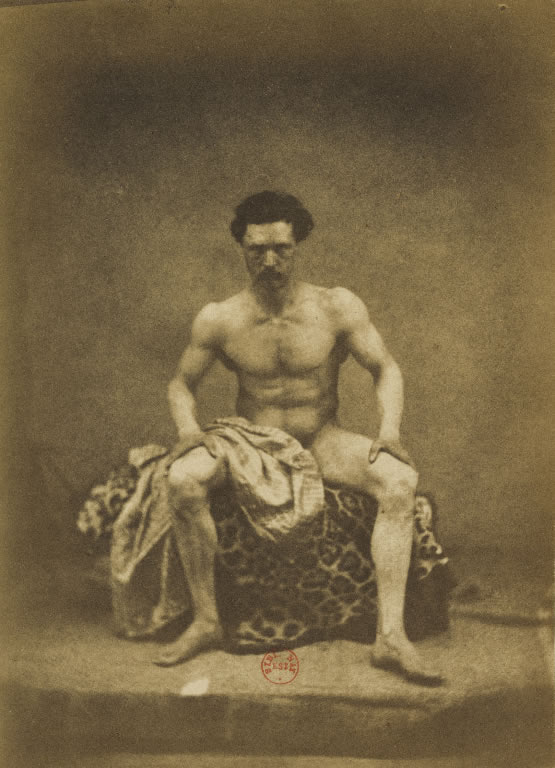
Eugène Durieu (French, 1800-1874) 'Nu masculin assis de face, les jambes écartées' 1854 from the exhibition 'Delacroix and Photography' at Musée National Eugène Delacroix, Paris, Nov 2008 - March 2009


Eugène Durieu (French, 1800-1874)
Nu masculin assis de face, les jambes écartées
1854
Plate XV of the Durieu Album
Salted paper from negative paper
17.8 x 12.8cm
BnF, Department of Prints and photography
© BnF


Jean Louis Marie Eugène Durieu (1800-1874) was an early French amateur nude photographer, primarily known for his early nude photographs of men and women. A number of his male and female models were also painted by Eugène Delacroix, with whom he was friends.

Durieu was born in Nîmes, and became known for making studies of nudes for Delacroix. During his career Durieu was a lawyer. His last job was inspector for education and culture. In 1849 he went into early retirement and devoted himself to the newly developing technology of photography. In 1853, Durieu worked with Delacroix on a series of photographs of different male and female nude models.

Text from the Wikipedia website


In the early 1850s, Durieu, like many of his photographic peers, gravitated from the daguerreotype to the calotype. None of the works from his daguerreotypical oeuvre can be attributed to him with any certainty. Apart from the Delacroix album held at the Bibliothèque Nationale de Paris, another work on paper does exist, however, a more personal album preserved at the George Eastman House in Rochester, which was once part of the Gabriel Cromer collection. Its repertoire is more varied and includes female nudes in fairly elaborate settings, as well as portraits and reproductions of paintings and engravings. …

In 1851, along with Delacroix, Durieu became one of the founder members of the Société Heliographique, the first French institution to be created specifically for photographers. Above all, its brief was to encourage the development of photography on paper and in particular the calotype as opposed to the daguerreotype.

It was at precisely this time in the early 1850s that Delacroix’s interest in photography was at its height, coinciding with that of Durieu. In February 1850, he wrote in his journal: “ask Boissard for some daguerreotypes on paper,” and later, in September 1850: “Laurens tells me that Ziegler is producing a sizeable number of daguerreotypes, including portrayals of nude men. I intend to go and see him to ask if he can lend me a few.” In May 1853, he showed Pierret and his cousin Léon Riesener the prints given to him by Durieu. In November 1853, he discussed the topic of photography with Riesener, who in the 1840s had not only been a painter but an ‘author’ of daguerreotypes. Delacroix maintained that the term author was a misnomer for what he regarded as a mechanical recording process, a machine-led art: “He referred to the solemn account the good Durieu and his friend, who assists him in these operations, give of their time and trouble, whilst taking much of the credit for the success of the aforementioned operations, or more precisely their results.” He made fun of Riesener, who had asked them with great trepidation if he could use their pictures as models for his paintings without being accused of plagiarism. Finally, on two successive Sundays, 18 and 25 June 1854, he visited Durieu on the seventh floor of his home at 40 rue de Bourgogne to ask him to make a series of photographs of models under his guidance…

Extract from Sylvie Aubenas. “Eugène Durieu, senior civil servant, photographer and forger,” in No 32 Printemps 2015 (translation Caroline Bouché) on the Etudes photographiques website [Online] Cited 04/10/2018


Eugène Durieu (French, 1800-1874) 'Nude couple: female nude standing in the background, male nude sitting in profile on a leopard skin' 1854


Eugène Durieu (French, 1800-1874)
Nude couple: female nude standing in the background, male nude sitting in profile on a leopard skin
1854
Plate 3 of an album containing 32 studies of models
Salted paper print
16.2 x 11.5cm
BnF coll., Paris
© BnF


Eugène Durieu (French, 1800-1874) 'Model of male nude sitting in profile on a leopard skin' 1854


Eugène Durieu (French, 1800-1874)
Model of male nude sitting in profile on a leopard skin
1854
Plate 11 of an album containing 32 studies of models
Salted paper print
17 x 13.5cm
BnF coll., Paris
© BnF


“I look with passion and without fatigue at these photographs of naked men, this admirable poem, this human body on which I learn to read and whose sight tells me more than the inventions of scribblers.”


Delacroix, ‘Journal’, October 5, 1855


Delacroix was confronted, like his entire generation, with the emergence of photography. An intriguing tool fascinating for the painter, this medium occupies a place apart in all of his work. He is at the source of a deep reflection on artistic truth in the face of photographic realism.

Far from seeing photography as a potential rival to painting, Delacroix took a keen interest in the development of this new medium, following its technical progress with sufficient curiosity to become a founding member of the Heliographic Society in 1851. He amassed a considerable photographic collection-of frescoes by Raphael, paintings by Rubens, and cathedral sculptures. Moreover, although he did not use a camera himself, a series of male and female nude models were photographed at his request by Eugène Durieu, in 1854. We know from his diary and letters that he sometimes used these photographs to practice drawing when no live models were available. These shots, which he sometimes carries with him, are a valuable tool for practicing drawing during his stays in the province. They meet very personal criteria; Delacroix wanted to use images voluntarily a little blurry and mostly stripped of all the quaint accessories conveyed by commercial photographs to the attention of artists.

However, despite a deep fascination for photography, Delacroix keeps a critical eye on this new medium. He adopts an attitude sometimes skeptical about his proper use and mastery of the technique, refusing to award benefits beyond its instrumental value. His reluctance is particularly keen with regard to one’s own photographed image: he even goes so far as to demand the destruction of some negatives, fortunately in vain.

Almost all the photographs and the drawings done from them (together with a number of paintings) have been assembled for the first time at the Musée Delacroix, with the generous support of the Bibliothèque Nationale de France and other collections. The exhibition also features a surprising series of photographic portraits of Delacroix himself, ranging from the precious intimate daguerreotypes of the 1840s to the more posed and strikingly dignified pictures taken by Carjat or Nadar toward the end of his life-many of which images the great man himself would rather have had destroyed.

Press release from the Musée National Eugène Delacroix


The Durieu Album

The album of thirty-two photographs preserved in the department Prints and Photography of the National Library de France and commonly known as “Durieu Album”, by the name of the author of the photographs contains mainly photographs of two nude models, a man and a woman, taken by Eugene Durieu in the presence and on the indications of Delacroix during two sessions of successive poses, on Sunday 18 and 25 June 1854. The album was probably in lot 1532 of the sale after the painter’s death, bought by the critic Philippe Burty, who said on the front page: “All this sequence of photographs was bought by me at the posthumous sale of Eugène Delacroix’s workshop. He used it often and his cartons contained a considerable number of pencil studies from these photographs some of which were made expressly for him by one of his friends, and the models posed by him.” This album went on to the bibliographer and historian of the art Maurice Tourneux, who offered it in 1899 to the Cabinet des Prints.

The examination of the album, whose pages are all presented here in the order of the pages, shows that divides into four distinct sequences. Plate I represents a seated male nude model. His black beard and its abundant hair absolutely distinguishes him from the model with the better drawn musculature having posed in the following photographs. This test is undoubtedly part of a different set provided by Durieu to Delacroix.

The twenty-six photographs that follow in the album are, like the first, calotypes, that is to say prints from negative on paper. The calotype is characterised by a slight blur that Delacroix’s eyes found useful and tolerable photography, the grain of the negative paper producing, in the prints, less precise contours than in the daguerreotype or prints based on collodion glass. These twenty-six photographs of June 1854 form a very homogeneous series, with two models. The man that Delacroix calls “the Bohemian” appears by the development of his musculature and his ease to pose, as a professional model. He is present alone on seventeen views, and on the other nine in the company of a female model, probably an Italian, also a professional model, who posed again in 1855 for two other photographers.

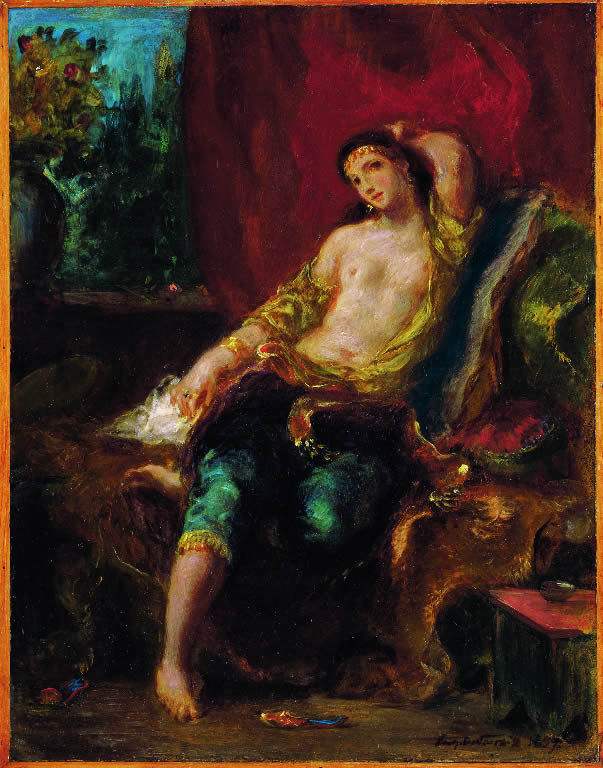
After this series, the album contains two studies (plates XXVIII and XXIX) of the same young woman, of which one served as the model for Odalisque of 1857 (private collection). The model is Miss Hamély, a small actress who appeared in tableaux vivants and pantomimes at the Porte-Saint-Martin theater (1853) but who also posed for photographers. The freedom that Delacroix takes in the painting in relation to the photography confirms that, he only uses it as a support for the imagination, unlike a painter like Gérôme for whom the cliche really replaces the model. So photography is amalgamated, among other ingredients, in a personal universe, not to mention the colours of the painting.

The album ends with three prints, based on a glass negative, of the same model draped to the waist, sitting in front of a plain canvas background. The sharpness, due to the negative on glass, the rigorous composition and images, their “professional” aspect make them totally different from the previous ones, to such that we can hesitate to attribute them to Durieu. While the calotypes posed by Delacroix are very rare, these last three images are seen in more than one collection; they have been broadcast to a wider audience.

Text from the Delacroix et la photographie exhibition pdf (translated from the French by Google translate)


Eugène Delacroix (French, 1798-1863) 'Two studies of naked men one standing, the other sitting' Nd


Eugène Delacroix (French, 1798-1863)
Two studies of naked men one standing, the other sitting
Nd
Graphite
Musée Eugène-Delacroix
© RMN / Michèle Bellot


Eugène Durieu (French, 1800-1874) 'Nu féminin assis sur un divan, la tête soutenue par un bras' 1854


Eugène Durieu (French, 1800-1874)
Nu féminin assis sur un divan, la 
tête soutenue par un bras
1854
Plate XXIX of the Durieu Album
Salted paper varnished from negative paper
14 x 9.5cm
BnF, Department of Prints and Photography
© BnF


Eugène Delacroix (French, 1798-1863) 'Odalisque' 1857


Eugène Delacroix (French, 1798-1863)
Odalisque
1857
Oil on wood
39.5 x 31cm
Private Collection


Eugène Durieu (French, 1800-1874) 'Model Study' 1854


Eugène Durieu (French, 1800-1874)
Model Study
1854
Calotype
BnF, Department of Prints and photography, Paris
© BnF


Louis Camille d'Olivier (French, 1827-1870) 'Female nude' 1855


Louis Camille d’Olivier (French, 1827-1870)
Female nude
1855
Salted paper print
21 x 16cm
BnF, Department of Prints and Photography
© BnF


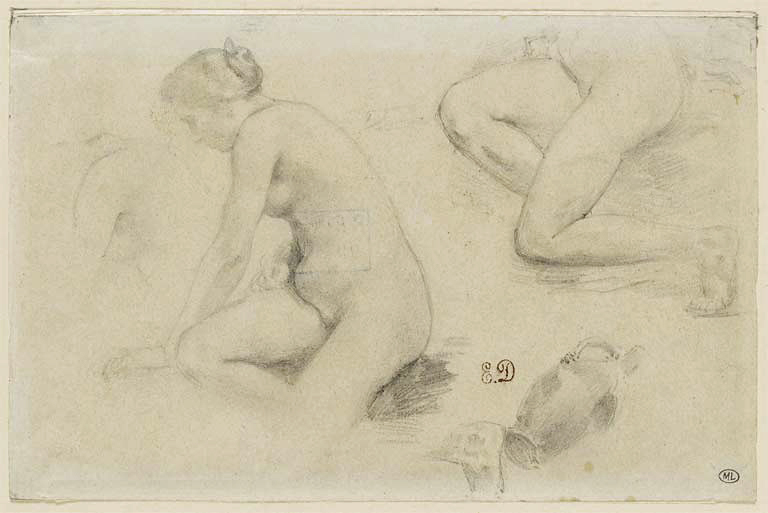
Eugène Delacroix (French, 1798-1863) 'Study of naked woman in profile on the left' Nd


Eugène Delacroix (French, 1798-1863)
Study of naked woman in profile on the left
Nd
Lead pencil
13.6 x 20.9cm
Louvre Museum, Department of the Arts graphics
© RMN Photo / Thierry Le Mage


Eugène Delacroix (French, 1798-1863) 'Three studies of men' Nd


Eugène Delacroix (French, 1798-1863)
Three studies of men
Nd
Lead pencil
19.2 x 25.3cm
Museum of Fine Arts and Archeology from Besançon
© Museum of Fine Arts and Archeology from Besançon


Eugène Durieu (French, 1800-1874) 'Naked man standing, back, holding a vertical stick' Nd


Eugène Durieu (French, 1800-1874)
Naked man standing, back, holding a vertical stick
Nd
Albumine paper
9.9 x 5.8cm
Gérard Lévy Collection
© 2008 Louvre Museum / Pierre Ballif


Eugène Durieu (French, 1800-1874) 'Naked man sitting on a chair' Nd


Eugène Durieu (French, 1800-1874)
Naked man sitting on a chair
Nd
Albumen paper
9.7 x 5.8cm
Gérard Lévy Collection
© 2008 Louvre Museum / Pierre Ballif


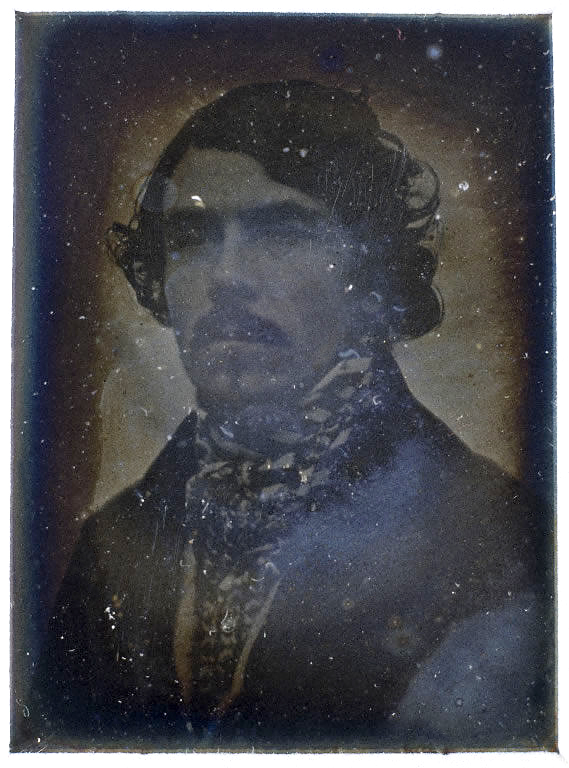
Léon Riesener (French, 1808-1878) 'Portrait of Eugène Delacroix (1798-1863)' 1842


Léon Riesener (French, 1808-1878)
Portrait of Eugène Delacroix (1798-1863)
1842
Daguerreotype
© Musée d’Orsay, Dist RMN / Patrice Schmidt


Louis Antoine Léon Riesener (21 January 1808 in Paris – 25 May 1878 in Paris) was a French Romantic painter.

Enchanted by the play of light and reflections which transformed the appearance of matter, Riesener began a new aesthetic that made him one of the precursors of impressionism. A passionate colourist, he researched all the nuances of colour and studied the techniques of ancient Greece and the Renaissance, including Titian, Veronese and Corregio. Impressed by his research into colour, he turned towards Rubens, which for him was the Shakespeare of painting. Very early in his career Riesener studied tonal divisions, well before the physician Chevreul discovered their scientific basis. His tactile taste led him to look for the most perfect expression of matter and particularly of skin. He put poetry into his painting by the play of shadow and he passionately admired nature, life and all the beauties they produced.

He researched the subject of life in the countryside and, liking to paint reality, said he wanted to express “the heat of the day, the melancholy of the evening, meadows, flowers as they are in nature”. His study of the elements caused him to paint a series of skies which varied according to the light and time of day – the subjects were ahead of their time and Riesener had to fight hard against the Salon juries and the Institut. Using pure colours, he excluded the blacks and whites which had been used for shadows and light before him. His material science of colour was the opposition which gave birth to contrasts from juxtaposed pigments. He did not portray faces by contours, but by shadows and modelling.

Relations with Delacroix

After his father’s return from Russia in 1823 Léon got to know Eugène Delacroix better. Ten years older than Riesener, Delacroix was his first-cousin – they shared a grandmother, Marguerite-Françoise Vandercruse, whose daughter by her first marriage was Delacroix’s mother and whose second husband Jean-Henri Riesener was Riesener’s grandfather. Delacroix quickly recognised Riesener’s talent and originality and he supported his early career by recommending him to civil servants he knew. On trips to the countryside they met at Valmont, near Fécamp, the home of their cousin Bataille, owner of the abbaye from 1822 onwards. Riesener devotedly attended Pierret’s salon (Pierret was a school friend of Delacroix), where he met Mérimée, Viel-Castel, Sauvageot, Feuillet de Conches, Viollet-le-Duc, Lasus and Guillemardet. Later, Riesener became friends with Fantin-Latour, Ernest Chausson and the Morisots (the Morisot family was very friendly with the Riesener family, with Rosalie Riesener’s friend Berthe Morisot researching Léon’s opinions, listening to his advice and copying out about 135 pages of his writings) – his friends were artists and he preferred a quiet life rather than the high life favoured by Delacroix.

From childhood, Riesener and Delacroix were friends and confidants. So different in life and character and so independent, they were preoccupied by the same artistic problems and enjoyed exchanging ideas, both having been formed by the 18th century and its neo-classical culture. They discussed their study of the classical world and they were both colourist painters searching for new techniques in tonal division. The difference in their temperaments expressed itself in their ways of looking at nature – Delacroix thought of drama, Riesener thought of sensuality. Delacroix bought Riesener’s painting Angélique as an exemplar for all painters and put it in his studio. On his death in 1863, Delacroix left Riesener his country house at Champrosay.

Text from the Wikipedia website


Nadar (Gaspard-Félix Tournachon) (French, 1820-1910) 'Eugène Delacroix seated three-quarter facing, his hand in the waistcoat' 1858


Nadar (Gaspard-Félix Tournachon) (French, 1820-1910)
Eugène Delacroix seated three-quarter facing, his hand in the waistcoat
1858
Salted paper
24.5 x 18cm
BnF, Department of Prints and Photography
© BnF


Musée National Eugène Delacroix
6 rue de Furstenberg
75 006 Paris
Phone: +33 (0)1 44 41 86 50

Opening hours:
The museum is open daily except Tuesday, 9.30am – 5pm (tickets sold until 4.30pm)

Musée national Eugène Delacroix website

LIKE ART BLART ON FACEBOOK

Back to top