Exhibition: ‘ “My verses are like dynamite”: Curt Bloch’s ‘Het Onderwater Cabaret” at the Jewish Museum Berlin

Exhibition dates: 9th February to 26th May 2024


Curt Bloch (German Jewish, 1908-1975) 'Het Onderwater Cabaret', Magazine cover from 30.08.1943


Curt Bloch (German Jewish, 1908-1975)
Het Onderwater Cabaret, Magazine cover 1st volume, no. 2 from 30.08.1943
Jewish Museum Berlin, Convolute/816, Curt Bloch collection, loaned by the Charities Aid Foundation America thanks to the generous support of Curt Bloch’s family


Unquenchable flame

Between August 1943 and April 1945, German Jew Curt Bloch created his own weekly, satirical poetry magazine, a unique work of creative resistance titled Het Onderwater Cabaret (The Underwater Cabaret) while holed up in an attic with two other adults on the Dutch German border.

Bloch conceived, wrote, designed, and produced 96 individual copies of “OWC” (Het Onderwater Cabaret‘s abbreviation after issue 33) with a total of 492 poems spanning over 1,700 pages. “The title alluded to a modern form of cabaret that had enthralled a large audience during the Weimar Republic (1918-1933). Cabaret performances typically consisted of a series of creatively crafted texts, songs, and scenes in which artists criticised societal injustices, mocked celebrities, and confronted the people with their perceived ignorance.”1
“… the Underwater Cabaret, which took its title from a unique term in Dutch for the act of going into hiding: “onderduiken.” Its literal translation is “to dive under,” but a common translation is “to slip out of public view.” A person in hiding was an “onderduiker,” who had gone “under water,” or was submerged.”2

Although he had no formal design training (he trained as a lawyer), Bloch had an innate understanding of modern design at that time: Bauhaus, Russian Constructivism, advertising, typography, collage, contemporary magazines such as the socialist Arbeiter-Illustrierte Zeitung and the satirical and politically provocative collages of the artist John Heartfield. This knowledge of contemporary art practice undoubtedly shows in the inventive photomontages of the OWC front covers.

“He cut out letters, images, and shapes from various print media and glued them onto the cover paper… [using the] artistic technique of collage, which was also used in contemporary mass media… small artworks with the simplest materials and means, using creativity, improvisational talent, and subtle humour.”3

Each edition of Bloch’s magazine consisted of just a single copy which was passed around to a small number of people external to the attic. The small “OWC” booklets could be discreetly delivered from house to house in a jacket or pants pocket. All copies were returned to him.

“Bloch mocked and ridiculed all of the major fascist leaders, from Hitler, Goebbels and Göring, to Mussolini and Seyß-Inquart, Reich commissioner of the Netherlands, alongside a host of their subordinates and henchmen, while always remaining acutely conscious of the enormity of their atrocities.”4

And here’s the rub. Despite the threat to his life, the possibility of death if their hiding place or a copy of the magazine where discovered, this man – through his spirit, creativity and humour – stared down with unquenchable spirit the unconscionable behaviour of the Nazis.

In the last edition there appears one poem, the only one he wrote in English, which reads:

At Berlin with our Russian friends,
The German Nightingale,
Herr Hitler, doesn’t sing today
He’s feeling, after some delay
A tie around his neck.


The ogre had met his maker.

While Bloch survived his mother and his sisters and most of the rest of his family in Germany died in the war. He survived and so did his magazines, now to be appreciated as a unique work of creative resistance published during the Second World War. Respect.

Human nature will always resist oppression, something that should be remembered in these troubled times.

Dr Marcus Bunyan


1/ Anonymous text from the Curt Bloch Het Onderwater Cabaret website Nd [Online] 23/04/2024
2/ Nina Siegal. “He Made a Magazine, 95 Issues, While Hiding From the Nazis in an Attic,” on The New York Times website Dec. 18, 2023 [Online] Cited 20/12/2023
3/ Anonymous text from the Curt Bloch Het Onderwater Cabaret website Nd [Online] 23/04/2024
4/ Text from the Jewish Museum Berlin website


Many thankx to the Jewish Museum Berlin for allowing me to publish the photographs in the posting. Please click on the photographs for a larger version of the image. For more information about Curt Bloch and the Het Onderwater Cabaret please see the Curt Bloch Het Onderwater Cabaret website.

Read more about Curt Bloch and his little magazine below.


Vielleicht kommen euch die Gedichte,
Die ich in eurer Sprache schrieb
In spätren Zeiten zu Gesichte
Und täten sie’s, wär mir’s recht lieb.

Perhaps at some point in the future,
the poems in your tongue I composed,
will be brought to your notice,
and if so, to delight will I then be disposed.


(Transl. by Aubrey Pomerance)


“Bloch’s experience was different because, in addition to sustenance and care, his helpers brought him pens, glue, newspapers and other printed materials that he used to produce a startling publication: his own weekly, satirical poetry magazine.”


The New York Times


Over a period of more than 19 months between August 1943 and April 1945, the hitherto unknown German Jewish author Curt Bloch produced a unique work of creative resistance while in hiding in the Netherlands: Het Onderwater Cabaret.

Week for week, Bloch put together a small format booklet comprising of handwritten poems in both Dutch and German which confronted Nazi propaganda and addressed a wide variety of themes: the course of the war, the lies and crimes of the National Socialists and their collaborators, his situation in hiding and the fate of his family, the approaching downfall and defeat of the Axis forces, and the fate of the German people. Through caustic satire and sardonic wit, Bloch mocked and ridiculed all of the major fascist leaders, from Hitler, Goebbels and Göring, to Mussolini and Seyß-Inquart, Reich commissioner of the Netherlands, alongside a host of their subordinates and henchmen, while always remaining acutely conscious of the enormity of their atrocities.

Some eight decades since the creation of the work and nearly fifty years after his death, Curt Bloch’s hope is now finally being fulfilled: The exhibition presents all 95 original issues of the Het Onderwater Cabaret, accompanied by insight into the production of their covers, which Bloch adorned with photomontages put together using materials from newspapers and magazines at his disposal. Audio readings of selected poems and a video performance staged by the actors Marina Frenk, Richard Gonlag and Mathias Schäfer bring Bloch’s verses to life.

Alongside the display of additional works written by Bloch while “under water”, his helpers and those who were with him in hiding are introduced, accompanied by eyewitness interviews. The entire Het Onderwater Cabaret is accessible in digital form, accompanied by transcriptions.

Bloch’s works, known to only a handful of people at the time of their composition, will now find the recognition and appreciation they so greatly deserve. In today’s world, in which war, disinformation, discrimination, exclusion and persecution are widespread, they remain highly pertinent.

Text from the Jewish Museum Berlin website


Curt Bloch (German Jewish, 1908-1975)

Curt Bloch (German Jewish, 1908-1975)

Curt Bloch (German Jewish, 1908-1975)


Curt Bloch (German Jewish, 1908-1975)
Het Onderwater Cabaret, Magazine covers No.’s 1-95


Curt Bloch (German Jewish, 1908-1975) 'Het Onderwater Cabaret', Magazine cover from 25.09.1943


Curt Bloch (German Jewish, 1908-1975)
Het Onderwater Cabaret, Magazine cover 1st volume, no. 6 from 25.09.1943
Jewish Museum Berlin, Convolute/816, Curt Bloch collection, loaned by the Charities Aid Foundation America thanks to the generous support of Curt Bloch’s family


One of the earliest issues of “The Underwater Cabaret,” a weekly magazine made by a Jewish man hiding from the Nazis in Holland during World War II.


Curt Bloch (German Jewish, 1908-1975) 'Het Onderwater Cabaret', Magazine cover from 16.10.1943


Curt Bloch (German Jewish, 1908-1975)
Het Onderwater Cabaret, Magazine cover 1st volume, no. 9 from 16.10.1943
Jewish Museum Berlin, Convolute/816, Curt Bloch collection, loaned by the Charities Aid Foundation America thanks to the generous support of Curt Bloch’s family


Bloch’s magazine was satirical. Here he depicts British Prime Minister Neville Chamberlain, whose policy of appeasing Hitler drew criticism.


Curt Bloch (German Jewish, 1908-1975) 'Het Onderwater Cabaret', Magazine cover 1st volume, no. 18 from 18.12.1943


Curt Bloch (German Jewish, 1908-1975)
Het Onderwater Cabaret, Magazine cover 1st volume, no. 18 from 18.12.1943
Jewish Museum Berlin, Convolute/816, Curt Bloch collection, loaned by the Charities Aid Foundation America thanks to the generous support of Curt Bloch’s family


During the German occupation of the Netherlands, Curt Bloch lived in hiding, to avoid deportation to a labor or extermination camp. Under extremely challenging circumstances, Bloch developed a very personal form of resistance against the Nazi regime: “During the time I had to hide, I published a booklet of satirical poems in German and Dutch every week and circulated it among a small group.”

In reference to his fugitive situation, Bloch named his publication “Het Onderwater-Cabaret” (The Underwater Cabaret). The title alluded to a modern form of cabaret that had enthralled a large audience during the Weimar Republic (1918-1933). Cabaret performances typically consisted of a series of creatively crafted texts, songs, and scenes in which artists criticised societal injustices, mocked celebrities, and confronted the people with their perceived ignorance. Under Nazi rule, political cabarets were censored, closed, or forced to conform. The Dutch radio program “Cabaret op zondagmiddag” (Sunday Afternoon Cabaret) may have inspired Bloch to counter this fascist and anti-Semitic propaganda with his own subversive cabaret.

From 22 August, 1943, to 3 April, 1945, Curt Bloch conceived, wrote, designed, and produced 96 individual copies of “OWC” with a total of 492 poems spanning over 1,700 pages.
In 1943, he published 19 issues of his magazine. The following year: 61, including a special edition in July 1944 with no specific date assigned. The year 1945 included 15 magazines.

The magazines were typically published on Saturdays, but there were particularly productive periods, especially in August and September 1944, when he produced two issues per week.

Curt Bloch’s handmade booklets were slightly smaller than a standard postcard, measuring approximately 10 cm × 13.5 cm, and usually contained 16 or 20 pages.

All editions are fully preserved in numbered order. Only one poem, Farewell to ‘De Gouden Bommen’, had parts of the pages torn out, presumably intentionally, to remove any hints of a hiding place.

Content

In the first year of the OWC, Curt Bloch published 111 poems; in the second year, 302 poems (plus nine in the special edition); and in the third year, 70 poems. Most verses were written in rhymed quatrains, some as couplets or tail-rhymes. …

The Underwater Cabaret primarily dealt with current events of the time. Many contributions satirised well-known representatives of the Nazi regime, and some even dedicated entire poems to them. Besides Adolf Hitler and Joseph Goebbels, who appeared most frequently in the verses, other figures such as Heinrich Himmler (Reich Interior Minister), Joachim von Ribbentrop (Reich Foreign Minister), Gerd von Rundstedt (Commander-in-Chief West), as well as foreign dictators Benito Mussolini (Italy) and Francisco Franco (Spain) were also targets for ridicule. Prominent Dutch fascists like Arthur Seyß-Inquart (Reichskommissar of the Netherlands), Anton Mussert (founder and leader of the Nationaal-Socialistische Beweging, NSB), and Maarten van Nierop (NSB member and editor of the Nazi-controlled Twentsch Nieuwsblad) were also targets of his ridicule and mockery.

Another major theme of the OWC was the everyday experience of the occupation, including hunger, strikes, and raids. Bloch’s lyrical self also provided deep insights into his emotional world: concern for his family, especially his beloved sister Helene; despair and impatience in hiding; frustration over his isolated situation; gratitude for any form of support; joy at the victories of the Allies; and, repeatedly, hope for a swift return to freedom. Bloch’s rhymes display a wide range of emotions and changing moods depending on the course of the war.

Design

While the first covers of the OWC magazine were in black and white, Curt Bloch designed the covers of his magazine in colour from the 17th issue in 1943. He cut out letters, images, and shapes from various print media and glued them onto the cover paper.

In July 1944, Bloch decided to abbreviate the name of his magazine on the cover. Until issue 32 of the second year, he used the title “Het Onderwater-Cabaret.” From issue 33 onward, he used the abbreviation “OWC.” He retained this acronym on the cover until the final magazine.

Just as with the name of his magazine, Bloch’s cover design also refers to the characteristic popular culture of the Weimar Republic. His designs reference the artistic technique of collage, which was also used in contemporary mass media. Satirical and politically provocative collages by artist John Heartfield for the socialist Arbeiter-Illustrierte Zeitung were particularly well-known.

Cabaret artists, collage artists, and Curt Bloch – who, as a trained lawyer, did not have formal design training – share the fact that they created unique small artworks with the simplest materials and means, using creativity, improvisational talent, and subtle humour.

Readership and Circulation

The weekly reading circle of the “Onderwater-Cabaret” began in Curt Bloch’s immediate environment, with the people who provided him with shelter, fellow fugitives like Karola Wolf and Bruno Löwenberg, and members of the resistance movement in Enschede. Once the window shutters were closed at night, Bloch could leave his hiding place. He often sat with his hosts and their visitors in the living room, where he could personally perform the cabaret pieces. However, his audience also included other fugitives and their supporters in different homes. Based on his research, Gerard Groeneveld, a Dutch historian and author (Het Onderwater Cabaret) estimates that the booklets reached up to thirty people. However, the exact number of readers and their names had to remain unknown due to the clandestine nature of the operation. …

The small “OWC” booklets could be discreetly delivered from house to house in a jacket or pants pocket. Getting caught with a magazine that satirised Adolf Hitler and other Nazi leaders would have been life-threatening for the couriers. In Germany, in 1943, four people who had disseminated one single satirical poem were sentenced to death for “undermining military morale.” Bloch wondered in A Goal: “What would happen to me, I have almost four hundred?”

Despite the extensive secret handovers required for circulation, Curt Bloch’s resistance operation remained undiscovered. All 96 editions were returned to him in good condition. After the war, he emigrated to the USA, where he had the booklets bound into four collected volumes.

Anonymous text from the Curt Bloch Het Onderwater Cabaret website Nd [Online] 23/04/2024


Curt Bloch (German Jewish, 1908-1975) 'Het Onderwater Cabaret', Magazine cover 2nd volume, no. 3 from 15.01.1944


Curt Bloch (German Jewish, 1908-1975)
Het Onderwater Cabaret, Magazine cover 2nd volume, no. 3 from 15.01.1944
Jewish Museum Berlin, Convolute/816, Curt Bloch collection, loaned by the Charities Aid Foundation America thanks to the generous support of Curt Bloch’s family


Doktor Göbbels Mummenschanz
Doctor Goebbels mask

The name “Mummenschanz” is a combination of “Mummen”, meaning to conceal or to mask (similar to the English “mummer”), and “Schanz”, a play on “chance”.


Curt Bloch (German Jewish, 1908-1975) 'Het Onderwater Cabaret' 2nd volume, no. 20 from 13.05.1944


Curt Bloch (German Jewish, 1908-1975)
Het Onderwater Cabaret 2nd volume, no. 20 from 13.05.1944
Jewish Museum Berlin, Convolute/816, Curt Bloch collection, loaned by the Charities Aid Foundation America thanks to the generous support of Curt Bloch’s family


Curt Bloch (German Jewish, 1908-1975) 'Het Onderwater Cabaret', Magazine cover 2nd volume, no. 21 from 20.05.1944


Curt Bloch (German Jewish, 1908-1975)
Het Onderwater Cabaret, Magazine cover 2nd volume, no. 21 from 20.05.1944
Jewish Museum Berlin, Convolute/816, Curt Bloch collection, loaned by the Charities Aid Foundation America thanks to the generous support of Curt Bloch’s family


Pioneers of Labor

They, who always reduced your wages
And increased your working hours
Plunged you comrades and metal proletarians
Into ever deeper poverty,

Those who only kept you in check
By delivering you to fascism,
Do you still remember the old
Representatives of capitalism?

Indeed, you will still recognise them,
The gentlemen and their crimes,
When you hear the name Röchling mentioned,
Then you think of the mines of the Stumm brothers

In the Saar region and the sufferings
The miner must endure there,
Mr. Röchling called you ungrateful
You were not hungry without complaints.

And Vögler, the head of the steel barons
In the Ruhr region, also let you starve
And ultimately left you to loiter
Without income in the streets.

And with their
Socio-political “merits”
Today the Führer makes these men “Pioneers
Of German labor,” well-regarded.

They are exploiters and oppressors
In Adolf’s beautiful miracle state,
They are even honoured as bringers of people’s happiness
And their praises are sung loudly.

These are the new “socialists”
Who vouch for your future,
The masterminds of the fascists,
Who strangle welfare, freedom, life.

They are the pioneers of misfortune,
Who cause unhappiness, hardship, and death,
How long will Germany endure their
Criminal tyranny?

Curt Bloch

Post-Editing: Sylvia Stawski, Ernst Sittig


Curt Bloch (German Jewish, 1908-1975) 'Het Onderwater Cabaret', Magazine cover 2nd volume, no. 46 from 16.09.1944


Curt Bloch (German Jewish, 1908-1975)
Het Onderwater Cabaret, Magazine cover 2nd volume, no. 46 from 16.09.1944
Jewish Museum Berlin, Convolute/816, Curt Bloch collection, loaned by the Charities Aid Foundation America thanks to the generous support of Curt Bloch’s family


This OWC edition was published on September 16 – four days earlier, the south of the Netherlands was liberated by the Allies as part of Operation “Market Garden.” Curt Bloch is pleased with the positive developments – and also with the fact that members of the Dutch Nazi movement are now filled with fear. He observes: The NSB members tremble. Their leader, Anton Mussert, calls for the evacuation of the families of his followers to the northeast of the Netherlands. In his verses, Bloch suspects that it will only be weeks before all of the Netherlands is liberated. However, he will have to wait more than half a year before he can leave his hiding place.

Text from the Curt Bloch Het Onderwater Cabaret website


Curt Bloch (German Jewish, 1908-1975) 'Het Onderwater Cabaret', Magazine cover 2nd volume, no. 50 from 07.10.1944


Curt Bloch (German Jewish, 1908-1975)
Het Onderwater Cabaret, Magazine cover 2nd volume, no. 50 from 07.10.1944
Jewish Museum Berlin, Convolute/816, Curt Bloch collection, loaned by the Charities Aid Foundation America thanks to the generous support of Curt Bloch’s family


“Die Man Rief, Die Geister…”
“The Spirits That I’ve Cited …”

Bloch depicted the brutish character of Nazism in some of his covers.


For more than two years, home for Curt Bloch was a tiny crawl space below the rafters of a modest brick home in Enschede, a Dutch city near the German border. The attic had a single small window. He shared it with two other adults.

During that time, Bloch, a German Jew, survived in the Nazi-occupied Netherlands by relying on a network of people who gave him food and kept his secrets.

In that respect, he was like at least 10,000 Jews who hid in Holland and managed to live by pretending not to exist. At least 104,000 others – many of whom also sought refuge, but were found – ended up being sent to their deaths.

But Bloch’s experience was different because, in addition to sustenance and care, his helpers brought him pens, glue, newspapers and other printed materials that he used to produce a startling publication: his own weekly, satirical poetry magazine.

From August 1943 until he was liberated in April 1945, Bloch produced 95 issues of Het Onderwater Cabaret, or The Underwater Cabaret.

Each issue included original art, poetry and songs that often took aim at the Nazis and their Dutch collaborators. Bloch, writing in both German and Dutch, mocked Nazi propaganda, responded to war news and offered personal perspectives on wartime deprivations.

In one poem, he sardonically suggested how recent events had reordered what it meant to be a beast in the animal kingdom:

Hyenas and jackals
Look on with jealousy
For they now seem as choirboys
Compared to humanity.

Bloch shared his handwritten magazine with the people he lived with, the family who sheltered him and, possibly, outside helpers and other Jews in hiding. After the war, which Bloch survived, he collected his magazines and brought them home and ultimately to New York, where he emigrated. There they sat on some bookshelves, the unknown creations of a man who was trained not as a poet, or an artist, but as a lawyer.

Bloch’s daughter, Simone Bloch, now 64, remembers seeing the magazines in the family home growing up. She didn’t fully grasp their significance, or particularly care to. A rebellious teenager by her own account, Simone said she never connected particularly well with her father, who died suddenly from a liver ailment when she was 15.

“A couple of times he read from them at dinner parties,” she said in an interview, “but I didn’t understand German then.”

Many years later, though, Simone’s daughter, Lucy, took an interest in the magazines, not just as family mementos but as markers of history. She got a research grant to travel to Germany, where she was able to study more about her grandfather’s history. Simone then spent years searching for a way to expand public awareness of the magazines, one of the few previously undiscovered literary efforts that document the Holocaust in Europe.

This led to the production of a book, The Underwater Cabaret: The Satirical Resistance of Curt Bloch, by Gerard Groeneveld, which was published in the Netherlands earlier this year. Soon there will also be a museum exhibition, “‘My Verses Are Like Dynamite.’ Curt Bloch’s Het Onderwater Cabaret,” which is scheduled to open in February at the Jüdisches Museum Berlin.

“Any time that an almost completely unknown work of this caliber comes to the fore, it’s very significant,” said Aubrey Pomerance, a curator of the Berlin museum exhibition. “The overwhelming majority of writings that were created in hiding were destroyed. If they weren’t, they’ve come to the public attention before now. So, it’s tremendously exciting.”

Research by Pomerance and Groeneveld for the exhibition and the book has helped to illuminate many aspects of Bloch’s life, which had not previously drawn much attention. Born in Dortmund, an industrial city in western Germany, Bloch was 22 and working at his first job as a legal secretary when Adolf Hitler became the chancellor of Germany in 1933. Antisemitic violence in Bloch’s hometown escalated even before official anti-Jewish measures were instituted.

After a colleague threatened his life that same year, Bloch fled to Amsterdam, where he took a job with a Persian rug importer and dealer. He hoped to find refuge there before escaping farther west, but his plans were dashed when the Germans invaded in 1940, the borders closed, and the nightmare expanded to Jews there as well.

Bloch’s firm transferred him to The Hague, but when non-Dutch Jews were forced out of the western Dutch provinces by the occupier’s decree, he was sent to work in a subsidiary in Enschede.

There, he got a job with the local Jewish Council, an organisation installed by the German overseers to implement Nazi antisemitic edicts. Jews who worked for the council were assured that they were safe from deportation.

Technically, Bloch was an adviser for “immigrant affairs,” although no opportunities for immigration existed – only transport to a concentration camp. The Enschede council understood the dangers and warned its members to go into hiding.

It was aided by an influential Dutch Reformed Church pastor, Leendert Overduin, who secretly ran a resistance organisation that helped some 1,000 Jews find places to hide. Known as Group Overduin, it consisted of about 50 people, including Overduin’s two sisters. Overduin was arrested three times and was imprisoned for this work; he has been recognised since as Righteous Among Nations by Yad Vashem, the Holocaust remembrance center in Jerusalem.

Group Overduin found Bloch a hiding place in the home of Bertus Menneken, an undertaker, and his wife, Aleida Menneken, a housekeeper. Their two-story brick house on Plataanstraat 15 was in a middle-class district of western Enschede.

There, Bloch shared the crawl space with a 44-year-old German-Jewish refugee, Bruno Löwenberg, and Löwenberg’s 22-year-old girlfriend, Karola Wolf, whom they called Ola. During their time in hiding, Bloch fell in love with Ola and wrote many verses just for her.

“He had a lot of courage, but he also had a reckless streak,” Groeneveld said.

Each edition of Bloch’s magazine consisted of just a single copy. But it may have been read by as many as 20 to 30 people, Groeneveld estimated.

There was a “huge organisation behind him, which included couriers, who brought food, but who could also bring the magazine out, to share with other people in the group who could be trusted,” Groeneveld said. “The magazines are very small, you can easily put one in your pocket or hide it in a book. He got them all back. They must have also returned them in some way.”

Bloch named his magazine in response to a German-language radio program that played on Dutch airwaves during the occupation, the Sunday Afternoon Cabaret. But this, Groeneveld explained, was the Underwater Cabaret, which took its title from a unique term in Dutch for the act of going into hiding: “onderduiken.” Its literal translation is “to dive under,” but a common translation is “to slip out of public view.” A person in hiding was an “onderduiker,” who had gone “under water,” or was submerged.

Groeneveld said Bloch’s covers, which were stylised photomontages, drew inspiration from anti-fascist satirical magazines of the prewar era, like the French “Marianne,” known for its anti-Nazi illustrations, and the German workers’ magazine Arbeiter-Illustrierte-Zeitung.

“His main target was Joseph Goebbels, the Nazi propaganda minister,” Pomerance said. “He often refers to articles that talk about a ‘final victory for the Nazis,’ and he mocks that notion, calling them murderers and liars. He was always sure that Germany would not win the war.”

In his poem, “The Way to Truth,” for example, he advised an imagined German reader how to approach Goebbels’ falsehoods:

If he writes straight, read it crooked.
If he writes crooked, read it straight.
Yes, just turn his writings around.
In all his useful words, harm is found.

Bloch’s writing wasn’t necessarily intended to live only on the page. During his time in hiding, he may have recited his poetry or performed the songs, Pomerance said.

“Quite a number of his poems were identified as being songs,” he said. “But unfortunately he didn’t provide any melodies that they should be sung to,” except for one, titled “Resistance Song.” The cover of the final issue, dated April 1945, after his liberation, is a photomontage of two people climbing out of a hatch. The title of that issue declares they are finally “above water.”

One poem in the edition, the only one he wrote in English, reads:

At Berlin with our Russian friends,
The German Nightingale,
Herr Hitler, doesn’t sing today
He’s feeling, after some delay
A tie around his neck.

Though Bloch survived, his mother and his sisters and most of the rest of his family in Germany died in the war. After the liberation of the Netherlands, he met Ruth Kan, who had survived a number of concentration camps, including Auschwitz. They married in 1946, had a son, Stephen, and moved to New York in 1948, where they later opened a business that sold European antiques and had Simone in 1959.

Beyond the new book and museum exhibition, Simone is developing a website that will feature her father’s art and poetry in three languages: German, Dutch and English.

That process has had a profound impact on her, she said.

“It provides not just insight, but access to my father in a way that I wish I’d had when I was young,” she said.

Nina Siegal. “He Made a Magazine, 95 Issues, While Hiding From the Nazis in an Attic,” on The New York Times website Dec. 18, 2023 [Online] Cited 20/12/2023


Curt Bloch (German Jewish, 1908-1975) 'Het Onderwater Cabaret', Magazine cover 2nd volume, no. 53 from 04.11.1944


Curt Bloch (German Jewish, 1908-1975)
Het Onderwater Cabaret Magazine cover 2nd volume, no. 53 from 04.11.1944
Jewish Museum Berlin, Convolute/816, Curt Bloch collection, loaned by the Charities Aid Foundation America thanks to the generous support of Curt Bloch’s family


“Ich schieb wache” I keep watch

Bloch was dedicated to publishing his magazine each week and numbered them.


Curt Bloch (German Jewish, 1908-1975) 'Het Onderwater Cabaret', Magazine cover 2nd volume, no. 57 from 05.12.1944


Curt Bloch (German Jewish, 1908-1975)
Het Onderwater Cabaret Magazine cover 2nd volume, no. 57 from 05.12.1944
Jewish Museum Berlin, Convolute/816, Curt Bloch collection, loaned by the Charities Aid Foundation America thanks to the generous support of Curt Bloch’s family


St. Nicholas in Wartime


Curt Bloch (German Jewish, 1908-1975) 'Het Onderwater Cabaret', Magazine cover 3rd volume, no. 5 from 03.02.1945


Curt Bloch (German Jewish, 1908-1975)
Het Onderwater Cabaret, Magazine cover 3rd volume, no. 5 from 03.02.1945
Jewish Museum Berlin, Convolute/816, Curt Bloch collection, loaned by the Charities Aid Foundation America thanks to the generous support of Curt Bloch’s family


Curt Bloch (German Jewish, 1908-1975) 'Het Onderwater Cabaret', Magazine cover 3rd volume, no. 12 from 24.03.1945


Curt Bloch (German Jewish, 1908-1975)
Het Onderwater Cabaret, Magazine cover 3rd volume, no. 12 from 24.03.1945
Jewish Museum Berlin, Convolute/816, Curt Bloch collection, loaned by the Charities Aid Foundation America thanks to the generous support of Curt Bloch’s family


Bloch’s title: “The Fuhrer’s Mother”


Curt Bloch (German Jewish, 1908-1975) 'Het Onderwater Cabaret', Magazine cover 3rd volume, no. 15 from 03.04.1945


Curt Bloch (German Jewish, 1908-1975)
Het Onderwater Cabaret, Magazine cover 3rd volume, no. 15 from 03.04.1945
Jewish Museum Berlin, Convolute/816, Curt Bloch collection, loaned by the Charities Aid Foundation America thanks to the generous support of Curt Bloch’s family


The final issue: liberated and “above water”

Immediately after the liberation of Enschede by British troops, Curt Bloch publishes his final magazine from underground. The headline on the front page reads “Bovenwater Finale van het O.W.C.” (Above Water Finale of the O.W.C.), accompanied by an image of a hidden person opening a cellar hatch. …

With the poem “Bovenwaterfinale van het O.W.C.” (Above Water Finale of the O.W.C.), Curt Bloch bids farewell as an underground publisher. He announces the end of The Underwater Cabaret and expresses gratitude for the attention. Now, one can return to the daylight, and his dream of freedom has come true. Bloch hopes that those who were taken from him will return (referring to his mother and two sisters, who were already murdered in concentration camps at this time, though Bloch will learn this not until later). Closing the chapter of his extensive publishing work in hiding, Bloch ends with the old-fashioned greeting “Tabé!” – a farewell phrase derived from Asian language usage.

Text from the Curt Bloch Het Onderwater Cabaret website


Above-Water Finale of the O.W.C.

We brought to you the final sounds
of the Underwater Cabaret,
And will thank you for your attention,
Since with this it will be ending.

Yes, it finally will close,
We now resurface
And no longer feel like outcasts
And not as pressurised as Hiob

Today, we crawl toward the daylight,
Our hiding time is in the past, thank God
And we are happy and are contented,
Because we finally are free –

This is the O.W.C. Finale
We long expected this,
That sometime we would be brought to daylight
After these years’ fearful night.

We were quiet partisans
And empathised with the fight for justice
And today the banners are waving.
And this fight has – almost – ended.

They did not cut us down to size
Although they wanted to,
You see: Injustice does not bring a blessing,
Our dream of freedom did come true.

Today we breathe in freedom’s air
Delightedly and greedily,
We, recently still sighing,
find the present to our liking.

And hope, that those who were sadly
torn away from us, will return,
Whether this will happen? Time will tell.
Sometimes we’re hopeful, sometimes sad.

After this time of cruel murders
Now comes a new melody,
Peaceful chords are coming,
There come prosperity and harmony

Now we will be building peace
And building a new era
Of charity and trust,
Of freedom and of justice.

Gone is the time of war and bombs,
Gone the wartime woe.
The OWC closes its columns
And says today forever:
Tabé!

Curt Bloch

Post-Editing: Hanny Veenendaal


Curt Bloch, undated


Curt Bloch, undated; Jewish Museum Berlin, accession 2023/90/5, gift of Lide Schattenkerk


Jewish Museum Berlin
Libeskind Building, ground level, Eric F. Ross Gallery
Lindenstraße 9-14, 10969 Berlin

Opening hours: 10am – 6pm

Jewish Museum Berlin website

Curt Bloch Het Onderwater Cabaret website

LIKE ART BLART ON FACEBOOK

Back to top

Exhibition: ‘The Memory of the Future. Photographic Dialogues between Past, Present and Future’ at the Musée de l’Elysée, Lausanne

Exhibition dates: 25th May – 28th August, 2016

Curator: Tatyana Franck, Director, Musée de l’Elysée, assisted by Lydia Dorner and Emilie Delcambre

Artists: Takashi Arai / Israel Ariño / Anna Atkins / Patrick Bailly-Maître-Grand Pierre Cordier / Bernd and Hilla Becher / Martin Becka / Binh Danh /Jayne Hinds Bidaut John Dugdale / Jean-Gabriel Eynard / Joan Fontcuberta / Dennis Gabor / Loris Gréaud / JR Idris Khan / Laure Ledoux / Gustave Le Gray / Gabriel Lippmann / Vera Lutter / Christian Marclay / Mathew Brady / Vik Muniz / Oscar Muñoz / Eadweard Muybridge / France Scully Osterman and Mark Osterman Andreas / Andreas Müller-Pohle / Florio Puenter Benjamin Recordon / Dino Simonett / Jerry Spagnoli / Joni Sternbach / James Turrell Martial Verdier / Paul Vionnet / Pierre Wetzel / Victoria Will / Nancy Wilson-Pajic


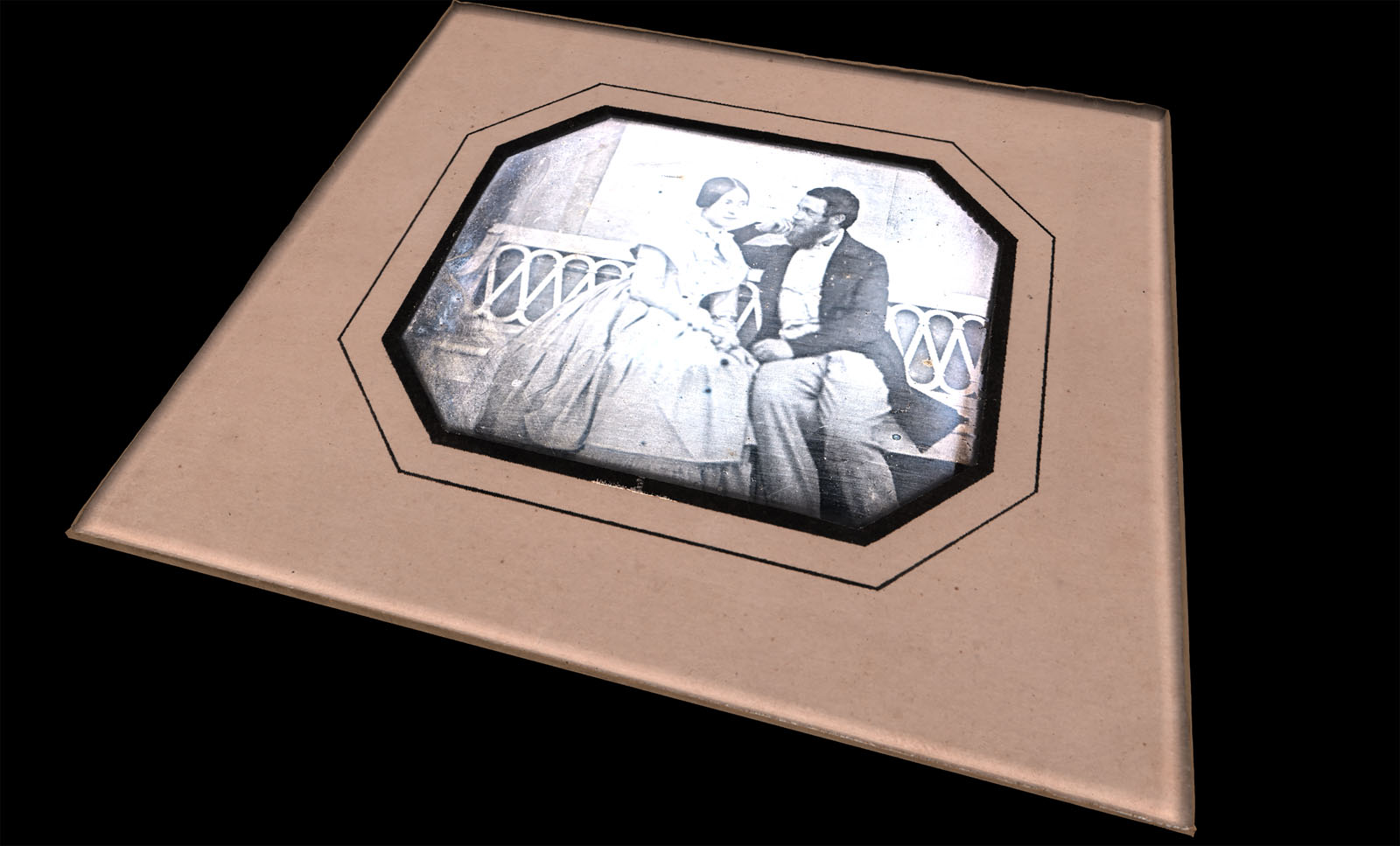
3D Digitisation of Jean-Gabriel Eynard (Swiss, 1775-1863) 'Charles et Mathilde Horngascher-Odier' 1845 from the exhibition 'The Memory of the Future. Photographic Dialogues between Past, Present and Future' at the Musée de l'Elysée, Lausanne, May - August, 2016


3D Digitisation of Jean-Gabriel Eynard (Swiss, 1775-1863)
Charles and Mathilde Horngascher-Odier
1845
© Musée de l’Elysée, Lausanne


Gabriel Lippmann (colour photography) and Dennis Gabor (holograms). Eadweard Muybridge (movement) and Pierre Cordier (chemigrams). Daguerreotypes, calotypes, negatives on dry waxed paper, tintypes, ambrotypes, cyanotypes. Heliogravure, ferrotype, collage and carbon printing. 3D digitisations that “light up” the image from every angle.

What’s old is new again. Then and now, here and there. The memory of future past.

Dr Marcus Bunyan


Many thankx to the Musée de l’Elysée for allowing me to publish the photographs in the posting. Please click on the photographs for a larger version of the image.


Oscar Muñoz (Colombian, b. 1951) 'Ante la Imagen' 2009 from the exhibition 'The Memory of the Future. Photographic Dialogues between Past, Present and Future' at the Musée de l'Elysée, Lausanne, May - August, 2016


Oscar Muñoz (Colombian, b. 1951)
Ante la Imagen
2009
© Oscar Muñoz, courtesy of the artist and Mor charpentier gallery


Oscar Muñoz’s work combines photography, engraving, drawing, installation, video and sculpture, defying all attempts at categorisation. Using non-conventional techniques, his work is a reflection on social concerns and addresses the themes of memory and forgetting, appearance and disappearance, loss and the insecurity of human life. In his work El Coleccionista, the artist uses a triple video projection to show a figure that is sorting, organising and grouping what appears to be personal archives. Oscar Muñoz evokes here the ability of images to be part of multiple narratives, from one image to another, from one context to another. These images propose multiple narrations that overlap and intermingle between the past and present, memory and time.

For Ante la Imagen, Muñoz uses the portrait of the chemist Robert Cornelius (1809-1893), known for having reduced the exposure time of the photographic process of the daguerreotype and for producing one of the first self-portraits, to demonstrate the effectiveness of his method. Muñoz reproduces this portrait by engraving it on a reflecting metallic surface, like a daguerreotype. With each manipulation, the viewer sees the portrait of Cornelius superimposed on his own. The work is composed and decomposed and questions the interior multiplicity of one and the same image. Muñoz replaces this frozen image by a constantly-changing one, vulnerable to deterioration under the effect of air, like life itself.


Gabriel Lippmann (Franco-Luxembourgish, 1845-1921) 'Selfportrait' c. 1892


Gabriel Lippmann (Franco-Luxembourgish, 1845-1921)
Selfportrait
c. 1892
© Musée de l’Elysée, Lausanne


Professor of physics at the Sorbonne, a member of the French Academy of Sciences and author of many scientific works, the international renown of Gabriel Lippmann Is mainly due to his invention of colour photography using the interferential method. He was awarded the Nobel Prize in physics in 1908.

In 1891, he presented his invention, which would revolutionise photography, to the public. Lippmann developed the “wave theory of light”, which held that light bodies vibrate (like sound) and that light is propagated by waves of different speeds. The variations in wavelengths lead to changes in colour. To prove the validity of his theory, Lippmann worked for five years to find a method that would fix these interferences. To do so, he developed a device that made it possible to place a special photographic plate (made of layers proportional to the wavelengths) in contact with a mercury mirror, a very complicated process. The sensitive layer of an average wavelength, green, for example, has 4,000 bright points per millimetre in its thickness, separated by dark intervals. The Musée de l’Elysée has the largest collection of Lippmann prisms in the world.


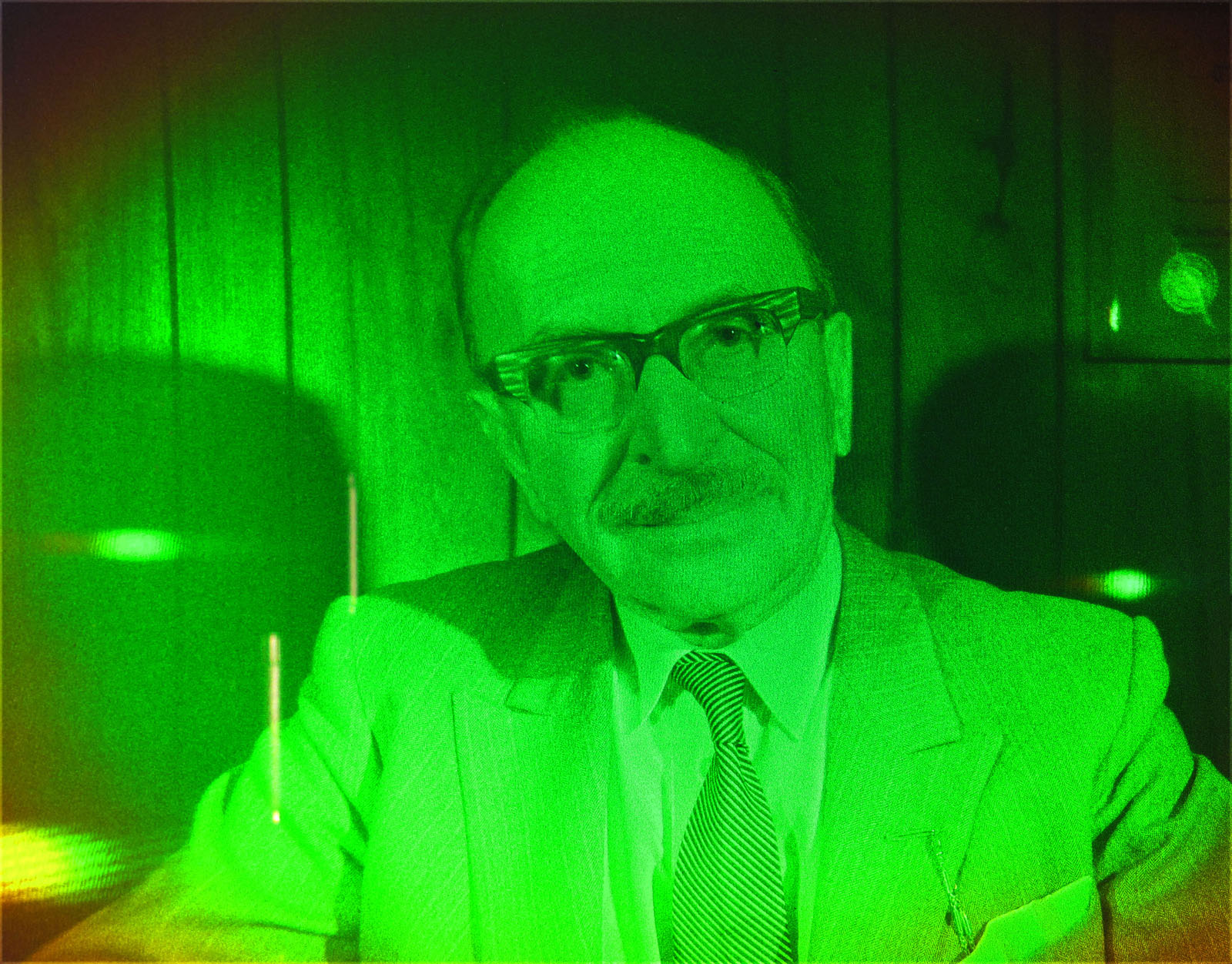
McDonnell Douglas Corp. / Spindler & Hoyer. 'Portrait of Dennis Gabor' 1975


McDonnell Douglas Corp. / Spindler & Hoyer
Portrait of Dennis Gabor
1975
© Jonathan Ross Hologram Collection


Engineer and physicist, Dennis Gabor is known for having invented the hologram in 1947, for which he was awarded the Holweck prize in 1970, and then the Nobel Prize in physics in 1971. Fascinated by Abbé’s theory of the microscope and Gabriel Lippmann’s method of colour photography, he studied electron optics, which led him to propose the concept of holography that he referred to as “wavefront reconstruction” at the time. The initial project consisted of an electron microscope capable of visualising atom networks and the atoms themselves, but that was not put into practice until 20 years later, whereas the hologram as a photographic process would have to wait for the invention of the laser in the 1960s, the light source necessary for the hologram. Subsequently, Emmett Leith and Juris Upatnieks in the United States and Yuri Denisyuk in Russia contributed to the improvement of Gabor’s invention and presented three-dimensional holograms. Since then, holograms are widely know to the general public through advertising, the production of packaging materials and jewellery items.

The life-size version of the portrait of Gabor can be seen at the offices of the McDonnell Douglas Corporation in the United States, one of the first companies to have attempted to market the holograph. The reduced-size copy presented here was made several years later by Spindler & Hoyer, a German optical company.


Eadweard Muybridge (English, 1830-1904) 'Animal Locomotion, Plate 597' 1887


Eadweard Muybridge (English, 1830-1904)
Animal Locomotion, Plate 597
1887
© Musée de l’Elysée, Lausanne


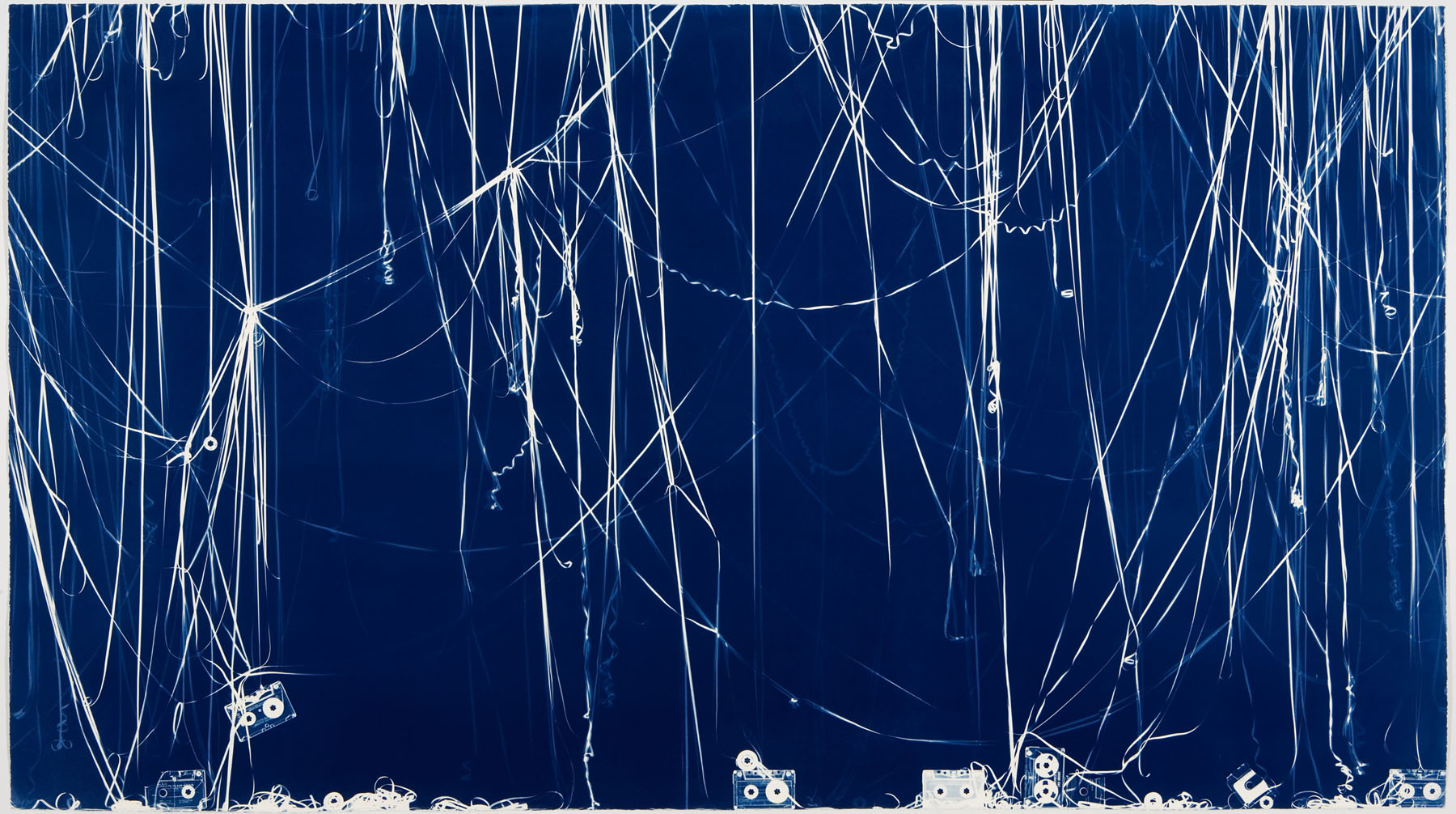
Christian Marclay (American-Swiss, b. 1955) 'Memento (Survival of the Fittest)' 2008


Christian Marclay (American-Swiss, b. 1955)
Memento (Survival of the Fittest)
2008
© Christian Marclay, courtesy Paula Cooper Gallery, New York


A well-known filmmaker and multimedia artist, Christian Marclay made his mark on the contemporary art scene by combining the visual arts, film and musical culture. In 2007, he began a project that explores the interactions between sound and vision, as well as the manipulation and the conservation of different forms of recordings. He initiated a series together with the Graphicstudio, University of South Florida involving the use of two archaic recording systems – the cyanotype photography process and the audiotape.

He adopted and adapted the subject of the audiotape, which has become just about obsolete as a result of technological developments, and placed it at the center of his visual abstraction to capture the old soundtracks of hundreds of cassette tapes unfurled like so many streamers, using the cyanotype process. “We assume, because we’re able to capture sounds or images, that they will exist forever – when, in fact, obsolescence makes you feel the limit of those assumptions.” By combining these two mediums, the artist brilliantly explores the resonances between the past and present.


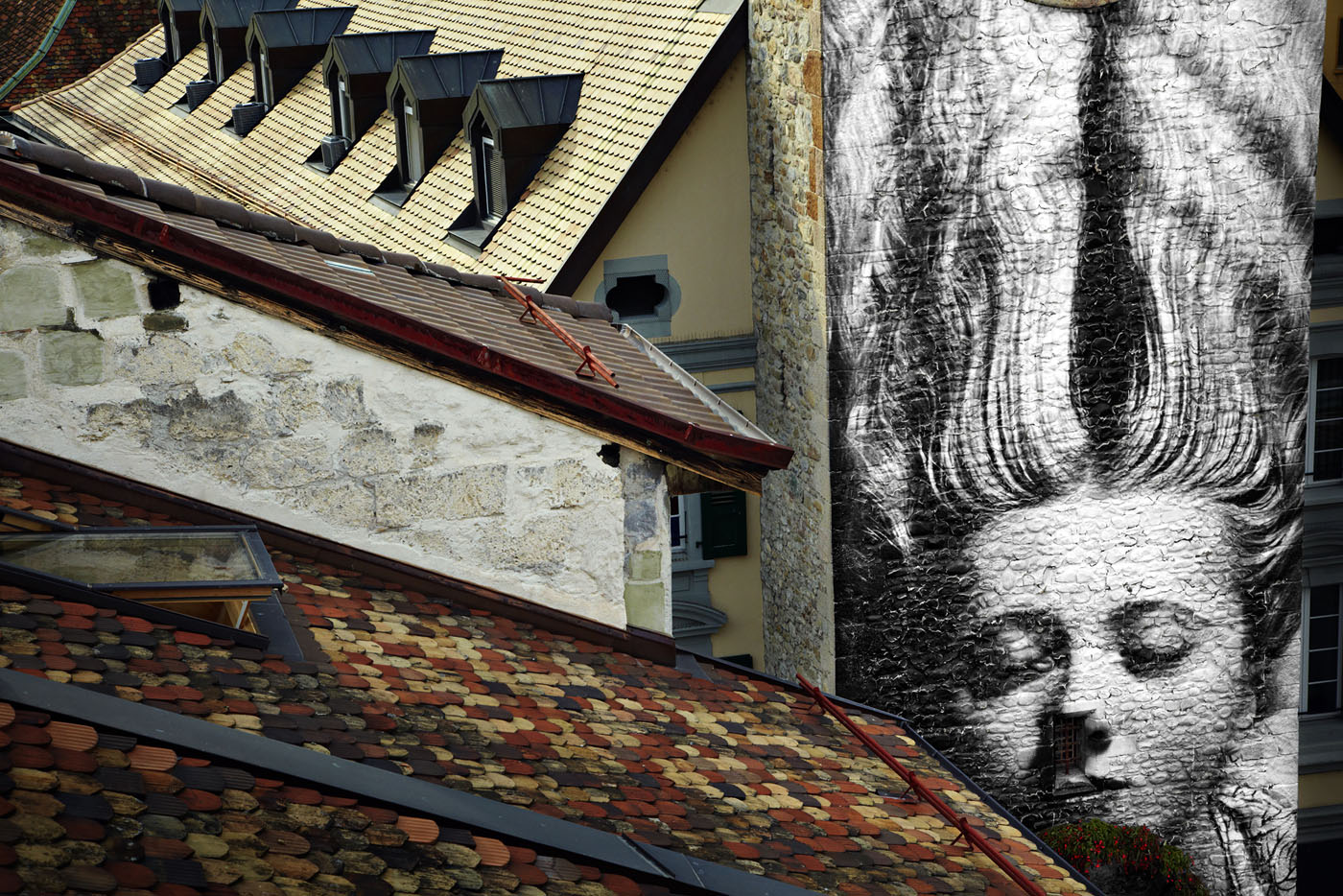
JR. 'UNFRAMED, Man Ray revu par JR, Femme aux cheveux longs, 1929, Vevey, Suisse' 2010


JR
UNFRAMED, Man Ray revu par JR, Femme aux cheveux longs, 1929, Vevey, Suisse
2010
© JR / Musée de l’Elysée, Lausanne


JR has “the largest art gallery in the world”. Thanks to the technique of photo collage, he freely exhibits his work on walls worldwide, thus attracting the attention of those who rarely or never go to museums. His work is a mixture of art and action and deals with commitment, freedom, identity and limits. After finding a camera in the Paris Metro in 2001, he travelled throughout Europe to meet other people whose mode of artistic expression involved the use of the walls and façades that give form to our cities. After observing the people he met and listening to their message, JR pasted their portraits up in streets and basements and on the roof tops of Paris.

JR thus creates “pervasive art” that he puts up on buildings in the Paris suburbs, on walls in the Middle East, on broken bridges in Africa and in the favelas of Brazil. These artistic actions make no distinction between the actors and the spectators. JR’s approach presented here is a mixture of the reinterpretation and recontextualisation of the icons of the history of photography taken from the collections of the Musée de l’Elysée of Lausanne, which he applies to the façades of buildings in the city of Vevey. He thus crops and enlarges the photos of Robert Capa, Man Ray, Gilles Caron and Helen Levitt so that the city becomes a gigantic open-air museum.


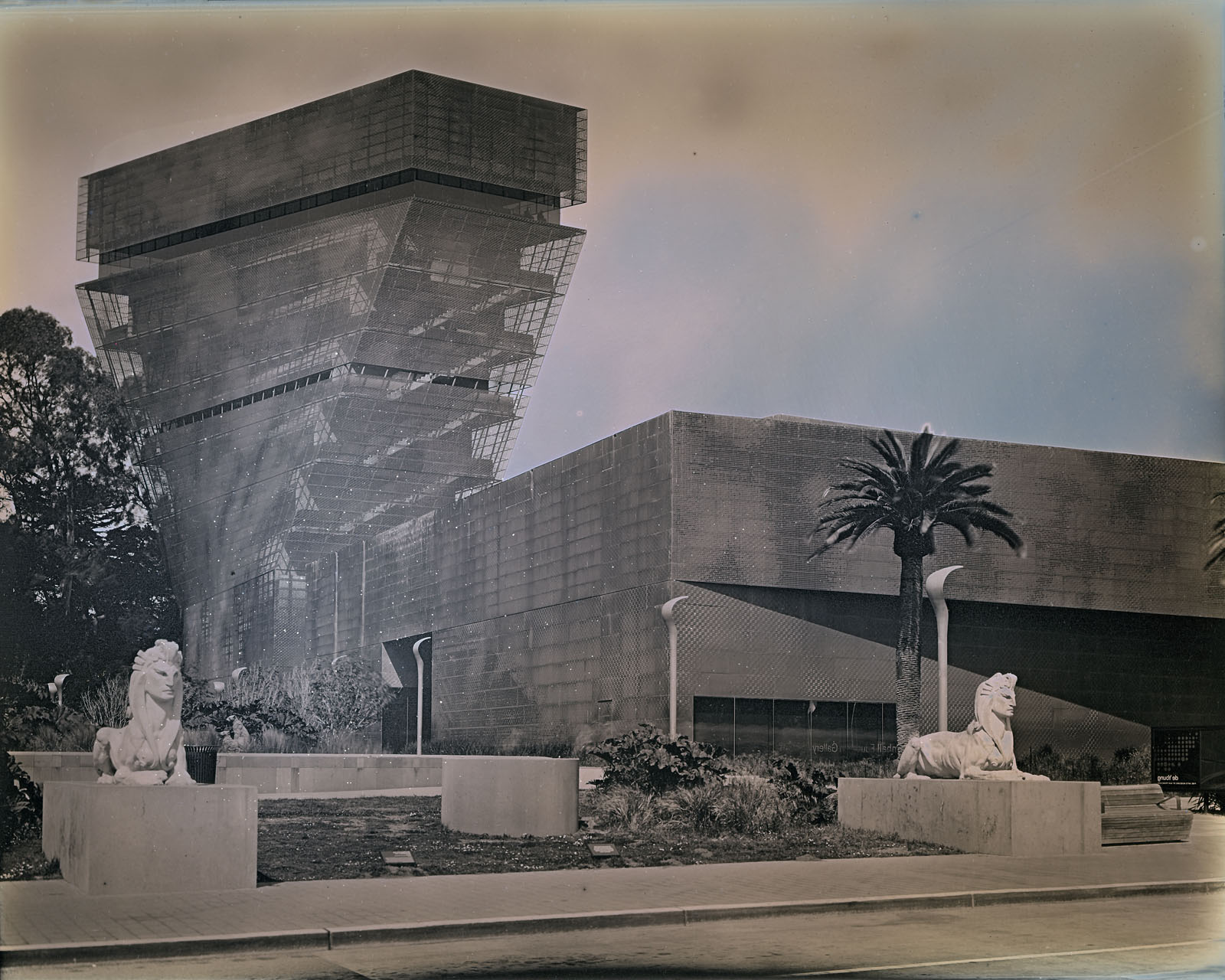
Binh Danh (American born Vietnam, b. 1979) 'Sphinxes' (by Arthur Putnam, 1912) 2014


Binh Danh (American born Vietnam, b. 1979)
Sphinxes (by Arthur Putnam, 1912)
2014
Artist and Haines Gallery courtesy, San Francisco
© Binh Danh


“Landscape is what defines me. When I am somewhere new or unfamiliar, I am constantly in dialogue with the past, present and my future self. When I am thinking about landscape, I am thinking about those who have stood on this land before me. Whoever they are, hopefully history recorded their makings on the land for me to study and contemplate.”

Born in Viet Nam, Binh Danh addresses themes of collective and personal memories, history, heritage and mortality. Known for printing his works on unconventional supports such as leaves or grass, he experiments with the photographic process of the daguerreotype in his most recent creations in order to document the history of the city of San Francisco.

Reminiscent of the work of photographic pioneers such as Eadweard Muybridge (1830-1904), Charles Marville (1813-1879) and Eugène Atget (1857-1927), Binh Danh explores the complexities of a constantly evolving city, from the first major expansion in recent years of Silicon Valley. He places San Francisco, cliché of the culture of technology and success, in another time space in order to incite the viewer to reflect on the rapid pace of changes in a city. By choosing the daguerreotype, the artist works on the reflecting surface of the process to incorporate the spectator into his work and to thus transform it into a shared experience.


Paul Vionnet (Swiss, 1830-1914) 'La cure d'Etoy' 1870


Paul Vionnet (Swiss, 1830-1914)
La cure d’Etoy
1870
Tirage sur papier aristotype
13.4 × 17.8cm
Collection iconographique vaudoise
© Musée de l’Elysée, Lausanne


With the exhibition The Memory of the Future. Photographic Dialogues between Past, Present and Future, the Musée de l’Elysée encourages contemporary artists to take a close look at photography as a medium, innovates as it reveals a 3D digitisation technology developed by a spin-off from Lausanne’s Swiss Federal Institute of Technology (EPFL), and displays its unique visual heritage. 

The Memory of the Future. Photographic Dialogues between Past, Present and Future is the first exhibition that Director Tatyana Franck has curated at the Musée de l’Elysée. It opens up a dialogue between the work of the pioneers of photographic techniques (the past), those of contemporary artists that breathe new life into these skills (the present), and avant-garde technologies that update these early processes (the future). Works from the museum’s collections, contemporary artists and new technologies come face to face and join forces to give a brand new vision of the history of photography. The Memory of the Future aims to configure the present by reconfiguring the past in order to prefigure the future.

Techniques over time

First of all, early photographic processes such as ambrotypes, daguerreotypes, ferrotypes, cyanotypes, etc. are displayed next to works by contemporary artists who breathe life into them. The technical innovations of the past are fertile ground for contemporary art and design. The exhibition includes a waxed paper negative by Gustave Le Gray in dialogue with those by Martin Becka, while cyanotypes by Anna Atkins and Paul Vionnet converse with those by Christian Marclay, Nancy Wilson-Pajic and John Dugdale. Jean-Gabriel Eynard’s daguerreotypes from the museum’s collections are exhibited next to portraits by Takashi Arai and Patrick Bailly-Maître-Grand and landscapes by Binh Danh and Jerry Spagnoli. And as for contemporary ferrotypes, The Memory of the Future shows the work of Joni Sternbach and Jayne Hinds Bidaut as well as portraits taken by Victoria Will at the Sundance Independent Film Festival in 2014.

Works of two scientists who won a Nobel Prize and invented a photographic technique also have pride of place – a self portrait by Gabriel Lippmann (Nobel Prize in Physics in 1908) who invented color photography using the interferential method and a portrait of Dennis Gabor (Nobel Prize in Physics in 1971), the inventor of the holographic process, a photographic technique in relief – echoing a holographic picture by James Turrell, a contemporary artist primarily concerned with light. Lastly, and as a point of convergence for all these photographic processes to fix an image on to a support, the camera obscura is presented through the works of Florio Puenter, Dino Simonett and Vera Lutter. Loris Gréaud – an artist invited to present an original installation capturing the spirit of the Musée de l’Elysée by recording its shadows and light – also explores this technique.

Homage and metamorphosis

The exhibition also presents the “mise en abyme” of iconic pictures from the history of photography reinterpreted by contemporary artists whose works examine the very notion of time or memory.

The earliest photograph in history – by Nicéphore Niépce and dating back to 1826 – is thus transformed by Joan Fontcuberta (Googlegramme Niépce, 2005) using PhotoMosaïque freeware connected online to the Google search engine, and by Andreas Müller-Pohle (Digital Scores VI). The first photographic self portrait in history – by Robert Cornelius in 1839 – is reproduced on a series of mirrors by Oscar Muñoz in 2009 to examine the paradox of the aging of the photographic support, which is, however, supposed to record an image for eternity. While Pierre Cordier pays homage to Eadweard Muybridge’s photographic breaking down of movement, Idris Khan (who took part in the reGeneration exhibition in 2005) pays homage to the iconic photographs of Bernd and Hilla Becher.

Innovating to preserve and showcase

Having launched a campaign in 2014 to digitise its photography books – 1500 books have been scanned so far – the Musée de l’Elysée is continuing to explore techniques to dematerialise its visual heritage for conservation and promotion purposes. Launched in 2015 thanks to the Engagement Migros development fund, an ambitious three dimensional digitisation project puts the Musée de l’Elysée at the forefront of museum innovation.

A venue for exhibitions, conservation and now an experimentation, as part of the exhibition La Mémoire du futur the Musée de l’Elysée is proposing for the first time a space dedicated to the presentation of digitised virtual objects from its collections. This innovative project aims to introduce new collaborative and interactive experiences using the Museum’s collections to a wide range of audiences – whether they be photography enthusiasts, curators or researchers.

Thanks to the Engagement Migros development fund, Innovation partner of the Musée de l’Elysée, the public is invited to experimentally test the first 3D digitisations carried out in partnership with the start-up Artmyn, created at EPFL’s Audiovisual Communications Laboratory (LCAV) led by Martin Vetterli. It will thus be possible to look at the works in 3D with unprecedented precision, but above all, to make the different textures of which they are composed appear on screen by lighting up the digital replicas from any angle.

This new technology comes in the form of a scanner made up of a dome on which are fixed several small lamps of precisely-adjusted intensity that switch on and off in turn depending on each picture scanned. “We are returning to an ancient theory of vision that imagined the eye’s projection towards the world, allowing the spectator once again to become an actor in the photographic experience,” explains Martin Vetterli in the exhibition catalogue.

Preliminary work was carried out with the Collections Department to select the processes that would most benefit from this scanning technology – heliogravure, ambrotype, ferrotype, collage and carbon printing. The first results will be presented in the exhibition. A tactile device supplemented by a video tour of the work presents a collage by René Burri from the René Burri Foundation housed at the Musée de l’Elysée. Rendered in real time and very high resolution, the images that have been cut out and superimposed by the artist can be freely explored so that the visitor can appreciate the visual richness of the work. Visitor experience appraisal is an integral part of the project to optimise presentation techniques and create a digital experimentation area in the museum.

The active participation of visitors to the Museum is an essential step for this first test phase: the interactions and different perceptions of the benefits of the prototype presented will be taken into account for the purpose of developing teaching and learning tools that will subsequently be used to refine and expand the user’s experience and to develop a digital, educational discovery space within the exhibition areas.

Press release from the Musée de l’Elysée


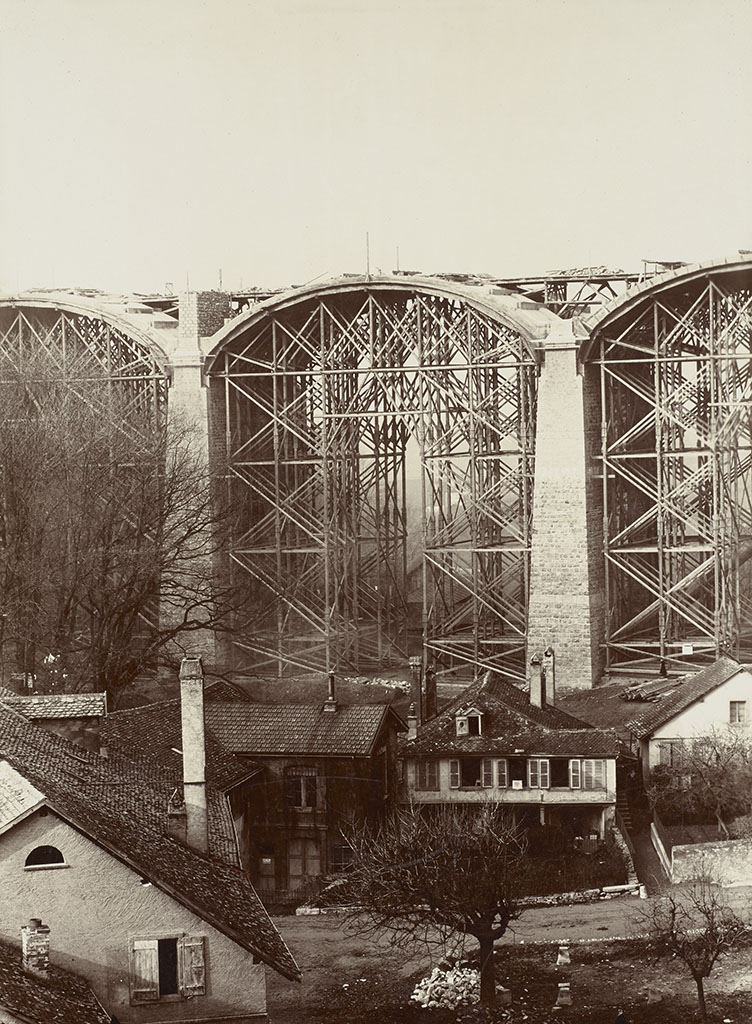
Paul Vionnet (Swiss, 1830-1914) 'Lausanne, le pont Chauderon en construction' 1904


Paul Vionnet (Swiss, 1830-1914)
Lausanne, le pont Chauderon en construction
1904
Tirage au gélatino-bromure d’argent
39.5 × 23.0cm
Collection iconographique vaudoise
© Musée de l’Elysée, Lausanne


Paul Vionnet, a local photographic pioneer, is at the origin of the Iconographic Collection of the Canton of Vaud. This collection, devoted to the history of the Vaud, is at the very foundation of the creation of the Musée de l’Elysée in 1985 as a museum dedicated to the image. During his childhood, Paul Vionnet spent his vacations at his grandparents’ home in Aubonne and was a frequent visitor of Adrien Constant Delessert (1806-1876), a neighbour and renowned Vaud photographer. During his stays there in 1845, Delessert taught him photographic techniques and the calotype.

Fascinated by the sciences, nature and his canton, Paul Vionnet took it upon himself to collect the greatest number of iconographic documents possible concerning the history, landscapes and monuments of the region for the purpose of enriching the collection of the Historical Monuments Service in Lausanne. The documents that he was not able to acquire himself were reproduced using photography. Following in his father’s footsteps, he was ordained pastor in 1856, and assigned to Granges de Sainte-Croix, near Aubonne, and then to Pampigny in 1858. He nevertheless continued to take photographs, having since adopted the wet collodion technique, documenting landscapes and monuments during his free time.

He retired in 1896 and founded the Collection historiographique vaudoise that would house his documents. In 1903, Paul Vionnet bequeathed his private collection to the canton of Vaud, forming the fifth section of the Musée Cantonal des Antiquités. He was named assistant curator, and several years later, the municipality commissioned him to take the photographs for Lausanne à travers les âges.


Anna Atkins (English, 1799-1871) 'Adiantum tenerum (Jamaica)' c. 1852


Anna Atkins (English, 1799-1871)
Adiantum tenerum (Jamaica)
c. 1852
© Wilson Centre for Photography


A British photographer considered to be the first woman to create a photograph, Anna Atkins is also known to have published the first books on botany illustrated with cyanotypes. Passionately interested in science and art, she became a member of the Botanical Society of London in 1839 and realised that the photographic process could be used to obtain precise and detailed botanical images and to provide information at all levels of a society increasingly eager for knowledge.

Anna Atkins drew her inspiration from the inventor of photography, William Henry Fox Talbot (1800-1877), and from a close family friend, John Herschel (1792-1871), a scientist known for the invention and the improvement of the cyanotype. She subsequently developed the process on her own that would allow her to obtain authentic and inexpensive photographic reproductions and that would make her part of the great tradition of her teachers. In 1843, she published her work, British Algae: Cyanotype Impressions, the first volume of which preceded the famous work of Talbot, The Pencil of Nature, by several months. In 1853, she applied the same process to ferns and published Cyanotypes of British and Foreign Ferns,a page of which is presented here.


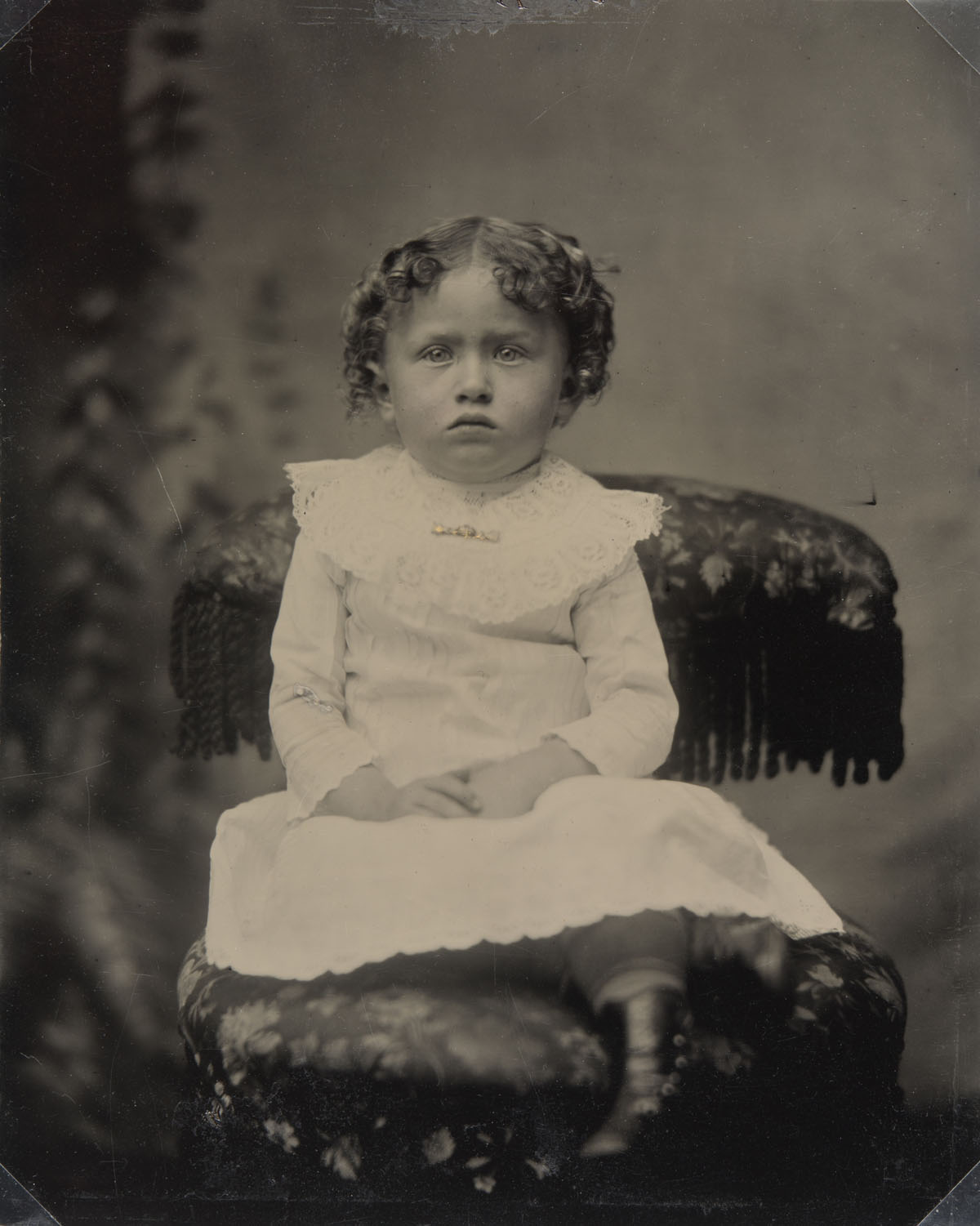
Anonymous. 'Portrait of a young girl' 1860-1870


Anonymous
Portrait of a young girl
1860-1870
© Musée de l’Elysée, Lausanne


This exhibition is an odyssey into the history of photography where different eras are juxtaposed and where artists and their methods dialogue with each other. Through a selection of historic photographic processes and the works of contemporary artists, the spectator is encouraged to observe the influence of the past on today’s artistic creations. The exhibition The Memory of the Future proposes a three-pronged vision: that of the past with the works of the pioneers of photographic techniques, that of the present with contemporary works that revive this know-how, and that of the future with technologies that give a new perspective on the works of the past.

Through century-old processes such as daguerreotypes, calotypes, negatives on dry waxed paper, tintypes, ambrotypes, cyanotypes and including holograms, The Memory of the Future celebrates the founding fathers of photographic techniques by establishing a dialogue between them and contemporary artists. From Gabriel Lippmann to James Turrell, including Robert Cornelius and Oscar Muñoz, this exhibition brings together for the first time some one hundred works whose common thread is their ability to withstand time. The Memory of the Future also proposes a selection of works from the Musée de l’Elysée’s collections that have never before been presented to the public.

After having launched a campaign to digitise its photography books in 2014 – 1,500 books have been digitised as of this time – the Musée de l’Elysée continues to explore techniques to dematerialise its visual heritage in order to preserve and enhance it. Consistent with its ambition to not only preserve works of value but to prospect for new ones, the Musée de l’Elysée has undertaken a 3D digitisation project of its works using a prototype developed by the EPFL (Ecole Polytechnique Fédérale de Lausanne). This technology of the future is presented in this exhibition in the form of a touch screen monitor.

Press release from the Musée de l’Elysée, Lausanne


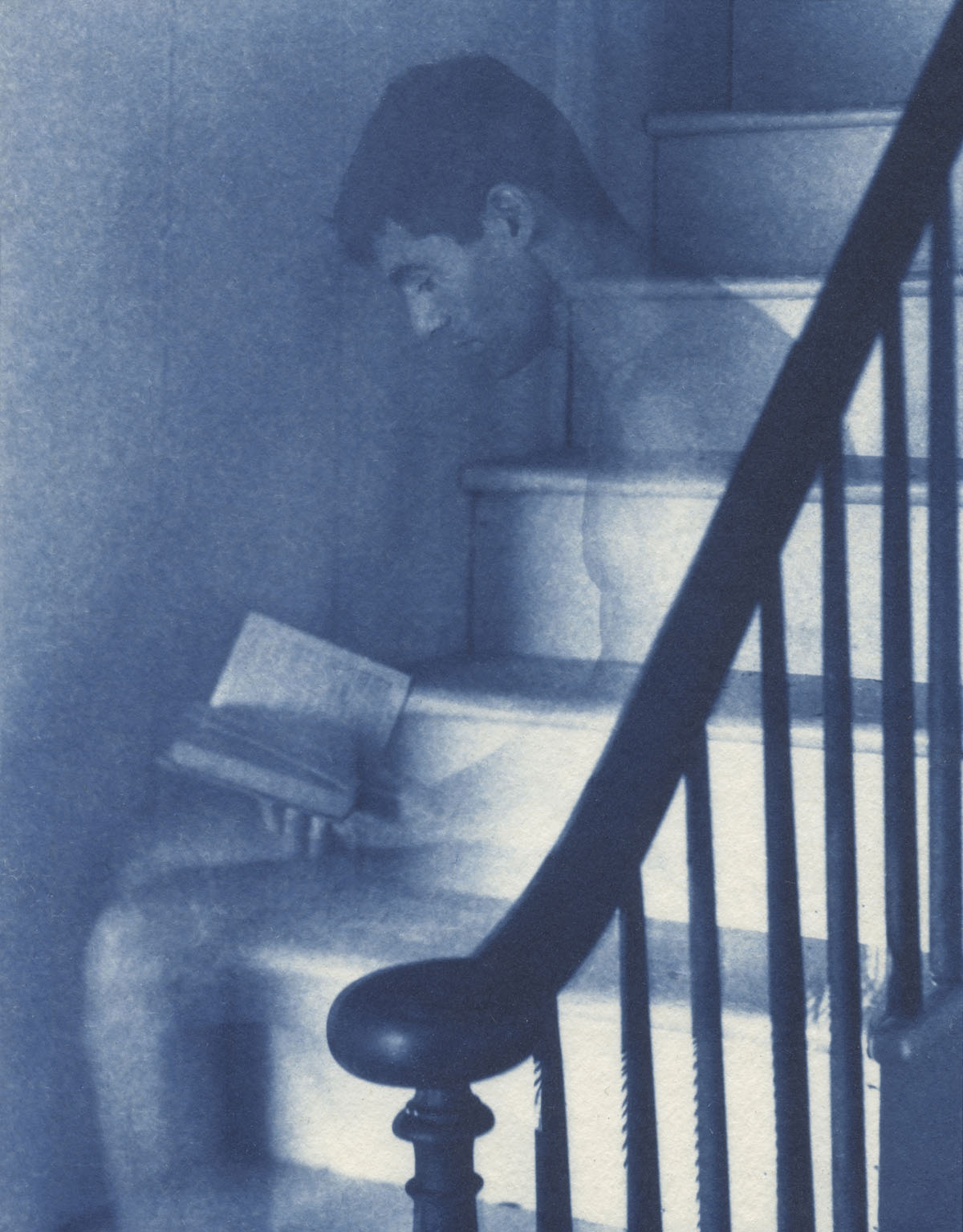
John Dugdale. 'The Clandestine Mind' 1999


John Dugdale (American, b. 1960)
The Clandestine Mind
1999
© The John Dugdale Studio


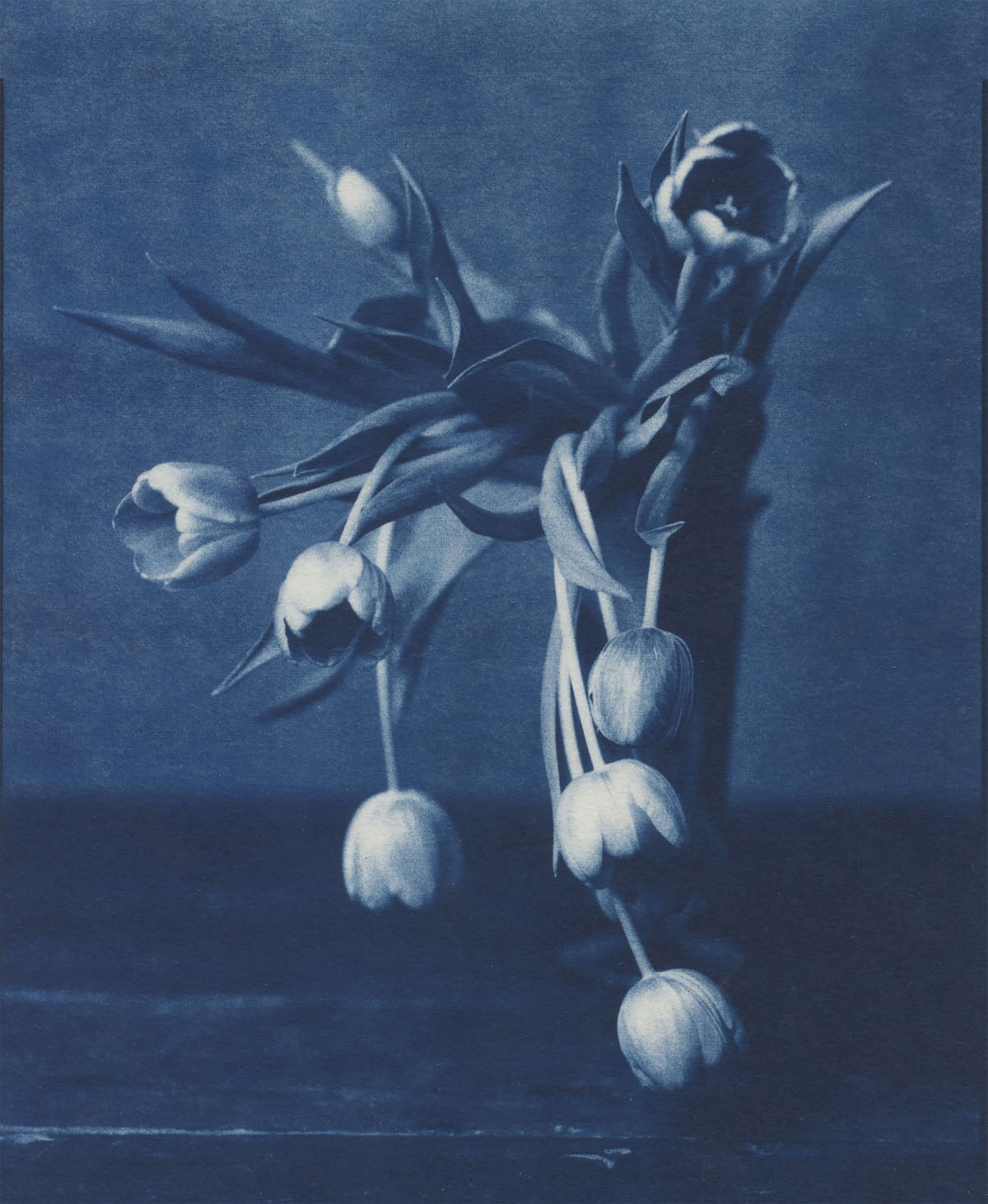
John Dugdale (American, b. 1960) 'Mourning Tulips' 1999


John Dugdale (American, b. 1960)
Mourning Tulips
1999
© The John Dugdale Studio


John Dugdale’s interest in photography goes back to his childhood when he received his first camera at the age of 12 and dreamed of becoming one of the major photographers of the 20th century. After a brilliant career as a fashion photographer, the year 1993 marked the turning point in the life of the artist who lost his sight following a stroke and CMV retinitis. Dugdale nevertheless refused to give up photography and began to take an interest in 19th century photographic techniques, using his family and friends as assistants. He discovered the large format and decided to use the cyanotype process, considering it to be the most direct and the easiest to use.

In his blue works, he portrays his everyday life by reversing the roles. Dugdale poses with a simplistic spirituality that could appear to be in contradiction with the 21st century. Generally posing in the nude, he considers that “life is transient. Once you leave this world, you fly into the universe without clothes. I want people to learn you cannot protect yourself by hiding behind clothes.”

Thanks to its low toxicity, the use of this process allows him to be involved in the printing of his photographs. His sensitivity to historic techniques emphasises the poetry of his work and the transitory nature of time and place. In the hopes of sharing his experience and his healing, Dugdale creates a new body of art by “showing the beauty of life and how one should act around illness.


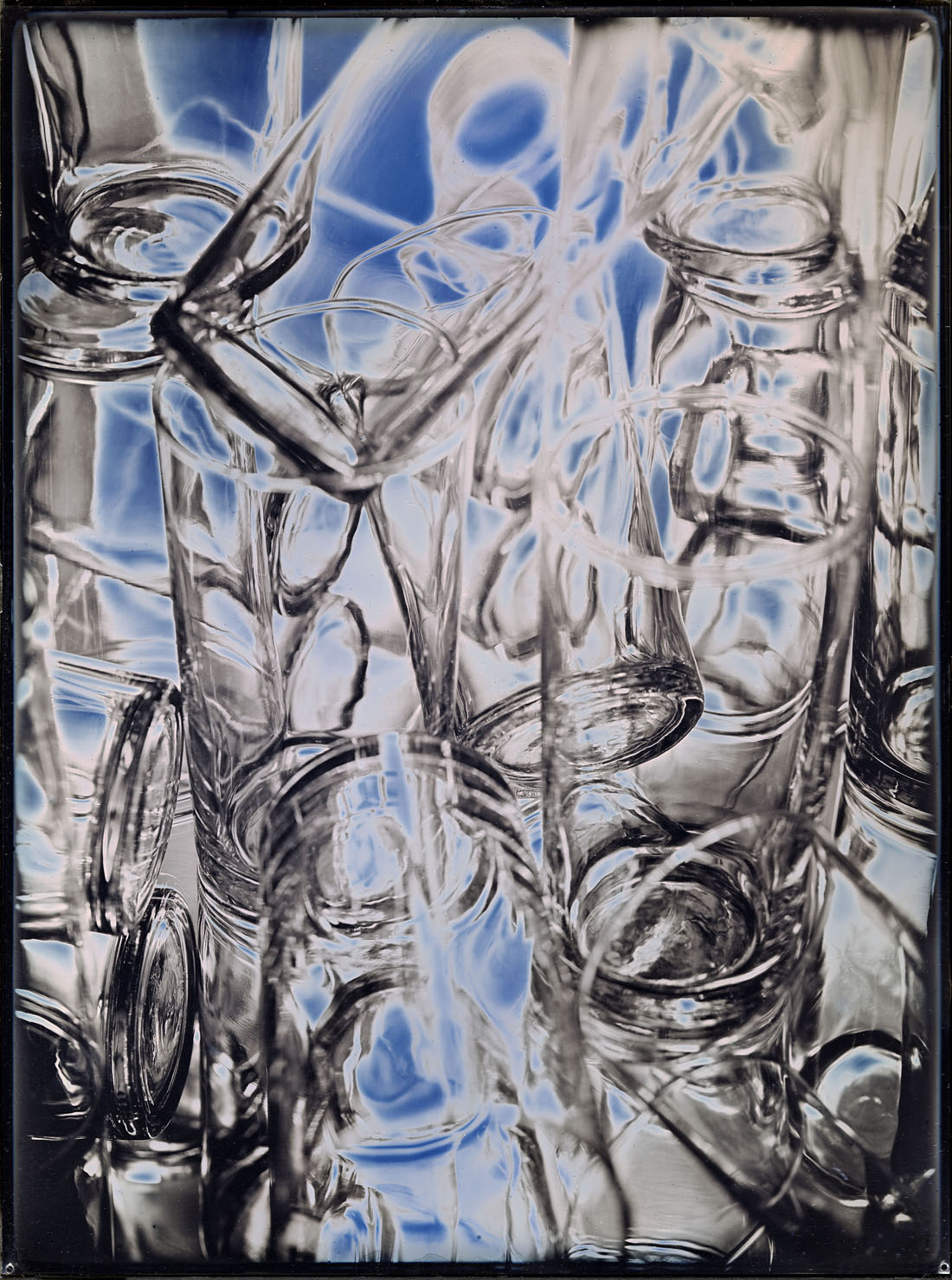
Jerry Spagnoli (American, b. 1956) 'Glass 10/9/12' 2012


Jerry Spagnoli (American, b. 1956)
Glass 10/9/12
2012
© Jerry Spagnoli


When the photographer Jerry Spagnoli discovered a daguerreotype at a flea market, he described it as the most perfect photograph he had ever seen, a discovery that would influence the rest of his work. After familiarising himself with the process in his studio in San Francisco, the artist experimented with it using equipment from the 19th century and studying the effects obtained in order to understand the technical aspects as well as the visual and expressive potential.

By studying the body and the roots of photographic imagination in his series Anatomical Studies, the portrait, objects and contemporary street scenes, events and non-events in his series The Last Great Daguerreian Survey of the Twentieth Century, Spagnoli attempts to highlight the qualities of the daguerreotype – uniqueness, richness of detail – through the four series presented here, in order to allow a contemporary public to rediscover its virtues. It is also a way for him to approach the optical essence of photography. “With other processes the material substrate of the image can be intrusive, but when you look at a daguerreotype, there is a transparency to the depiction as if you were looking through the lens itself.”


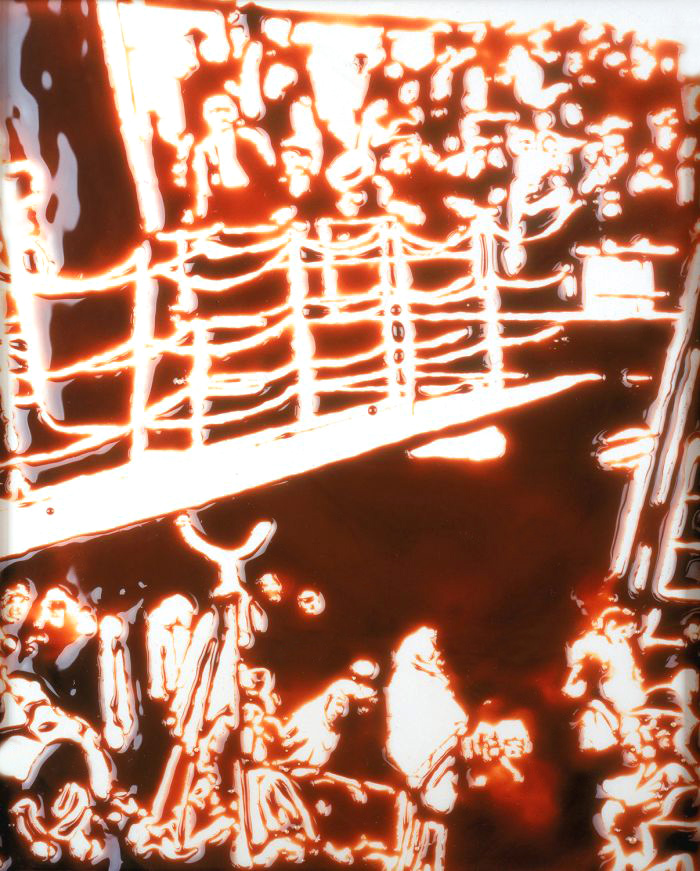
Vik Muniz (Brazilian, b. 1961) 'The Steerage (After Alfred Stieglitz)' 2000


Vik Muniz (Brazilian, b. 1961)
The Steerage (After Alfred Stieglitz)
2000
from the Pictures of Chocolate series


When the photographer Jerry Spagnoli discovered a daguerreotype at a flea market, he described it as the most perfect photograph he had ever seen, a discovery that would influence the rest of his work. After familiarising himself with the process in his studio in San Francisco, the artist experimented with it using equipment from the 19th century and studying the effects obtained in order to understand the technical aspects as well as the visual and expressive potential.

By studying the body and the roots of photographic imagination in his series Anatomical Studies, the portrait, objects and contemporary street scenes, events and non-events in his series The Last Great Daguerreian Survey of the Twentieth Century, Spagnoli attempts to highlight the qualities of the daguerreotype – uniqueness, richness of detail – through the four series presented here, in order to allow a contemporary public to rediscover its virtues. It is also a way for him to approach the optical essence of photography. “With other processes the material substrate of the image can be intrusive, but when you look at a daguerreotype, there is a transparency to the depiction as if you were looking through the lens itself.”


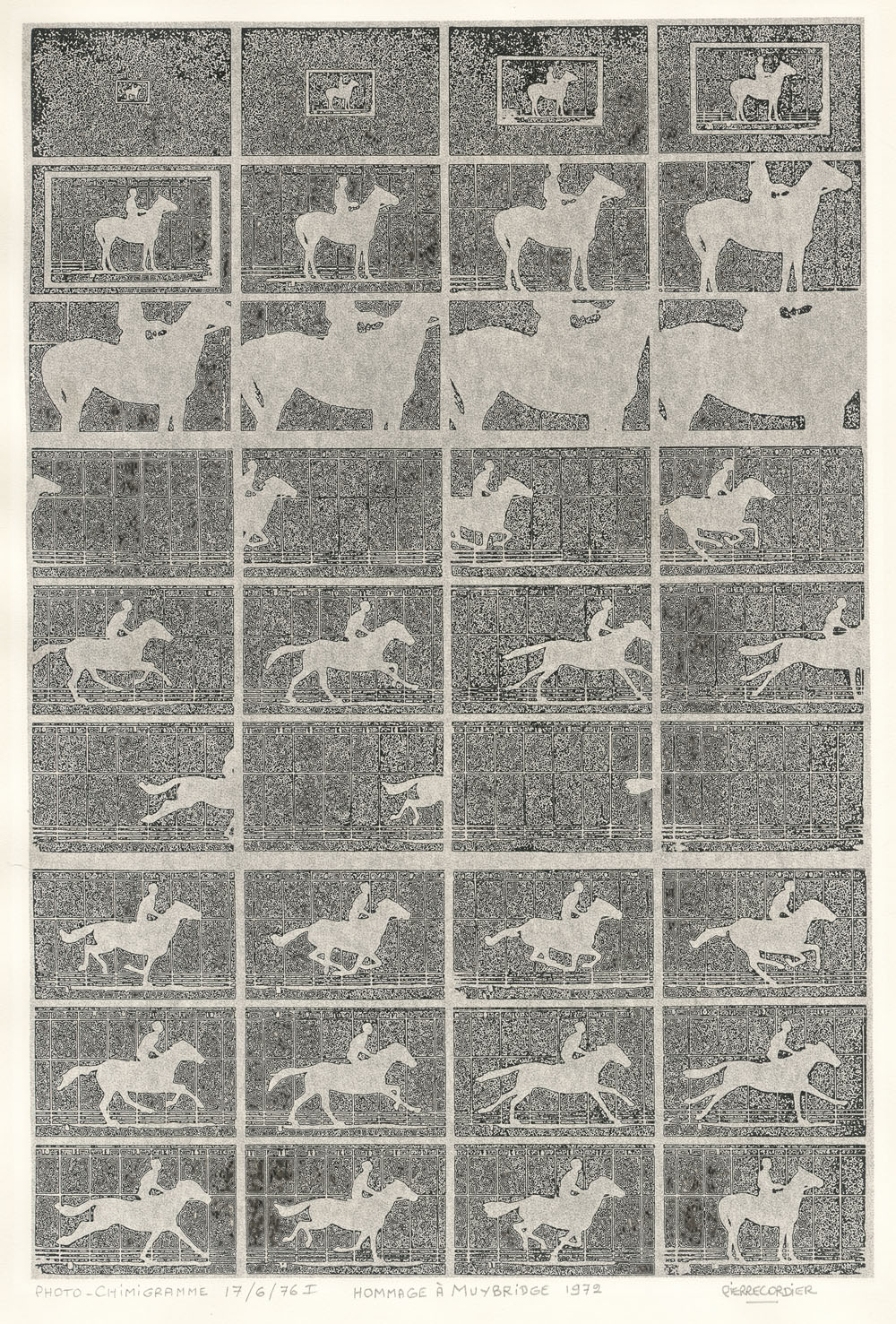
Pierre Cordier (Belgian, b. 1933) 'Photo-Chimigramme 17/6/76 I "Hommage à Muybridge 1972"' 1976


Pierre Cordier (Belgian, b. 1933)
Photo-Chimigramme 17/6/76 I “Hommage à Muybridge 1972”
1976
© Pierre Cordier


Pierre Cordier is a Belgian artist known as the father of the chemigram and for its development as a means of artistic expression. In 1956, writing a dedication with nail polish on photographic paper to a young German woman, Pierre Cordier discovered what he later called the chemigram. This technique “combines the physics of painting (varnish, oil, wax) and the chemistry of photography (photosensitive emulsion, developer and fixer), without the use of a camera or enlarger, and in full light.”

He worked for 30 years as a lecturer on the history of photography at the École Nationale des Arts Visuels in Brussels. When he gave up photography in 1968 to devote himself exclusively to the chemigram, he wanted to pay tribute to the great photography pioneers – Muybridge in 1972 and Marey in 1975. The Homage to Muybridge presented here was inspired by Allan Porter, chief editor of the Swiss revue Camera, one of the most prominent revues in the history of photography. In the issue of Camera of October 1972, we can read: “Cordier used Muybridge’s famous sequence, The Horse in Motion, which he transformed in three different ways: 1. Still subject and mobile camera. 2. Mobile subject and still camera. 3. Subject and camera, both mobile. He then combined the three sequences into one and treated it according to the photochemigram process.”


Andreas Muller-Pohle (German, b. 1951) 'Digital scores V (after Nicephore Niepce)' 2001


Andreas Muller-Pohle (German, b. 1951)
Digital scores V (after Nicephore Niepce)
2001
Inkjet print
Image: 10 7/8 in x 11 in
Mat: 16 1/8 in x 20 1/8 in
Paper: 12 1/8 in x 12 1/8 in


Andreas Müller-Pohle is one of the key figures involved in the ontological as well as the representational nature of photography. Since the 1990s, he has reflected on the radical changes in the essence of technical images. His first artistic project focused on questions of photographic perception and on the recycled photograph.

In the mid-1990s, Müller-Pohle began to explore the use of digital, genetic and political codes. He is one of the first artists to have broken down and translated the analog and the digital codes of images. In his series Digital Scores (after Nicéphore Niépce), he takes us back to the origin of analog photography by translating the photograph of Niépce, View from the Window at Le Gras (taken from a window of his house in 1826), into alphanumeric code. The complete binary transcription of this photograph is then distributed over eight panels.


Martin Becka (Czech, b. 1956) 'Le Parc' 2002


Martin Becka (Czech, b. 1956)
Le Parc
2002
© Martin Becka


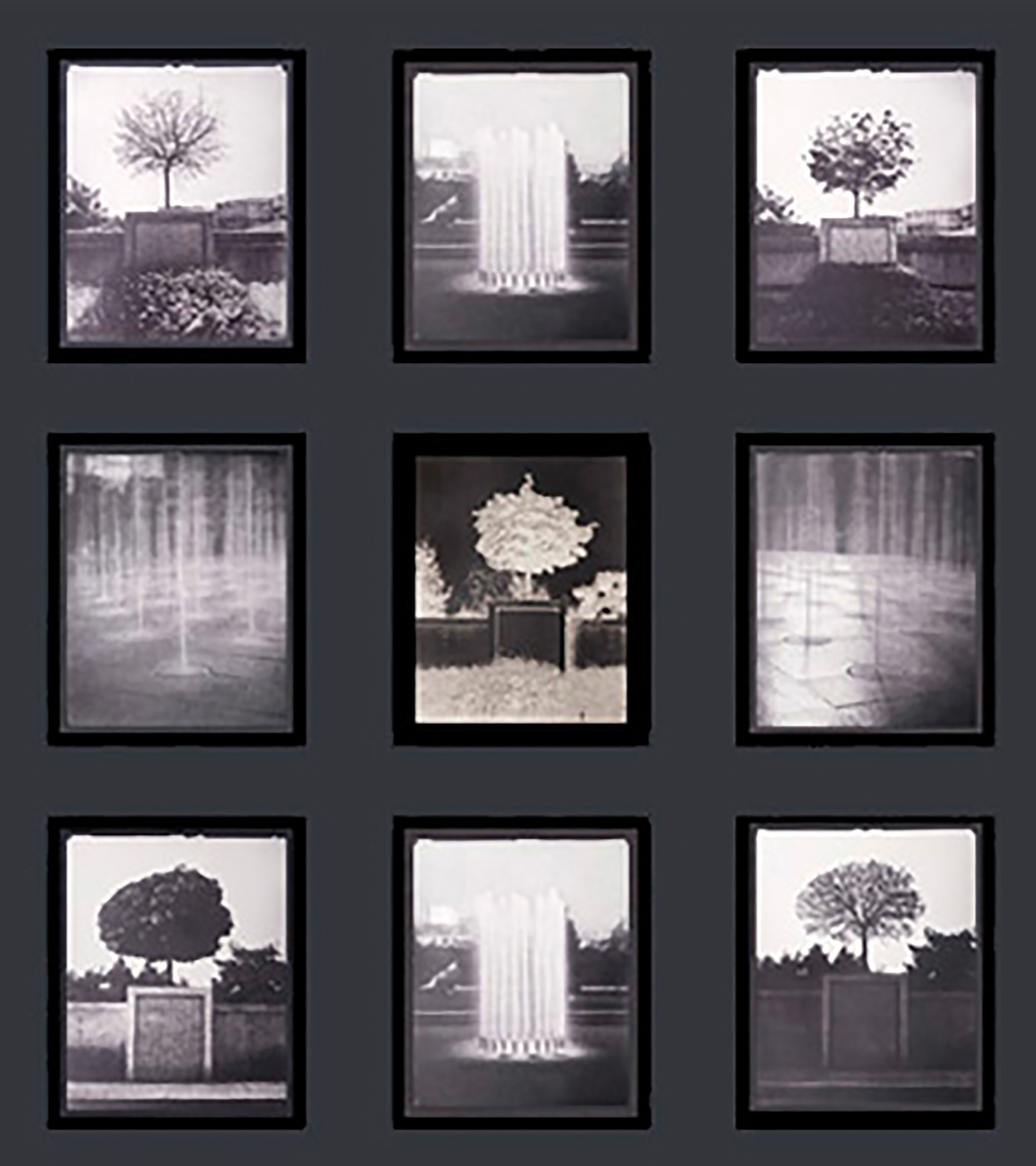
After studying photography, Martin Becka worked as a print developer for the Sepia Agency before becoming an independent news photographer. As of the beginning of the 1980s, he began doing research on the history of photography and the pre-industrial photographic processes that he incorporated into his personal creative work. By using traditional processes to photograph ultramodern cities like Dubai and business districts such as La Défense in Paris, the artist proposes a sort of “archeology of the present”, making the spectator reflect on the period in which he lives, the future, and the multiplication of images at a time when their reproducibility is unlimited. He sees photography as a means to “bend time in every possible direction.”

In his installation Le Parc (the André Citroën Public Park in Paris), Becka establishes a dialogue between the past and the present by paying homage to the photographic work of Alfred-Nicolas Normand (1822-1909) and the dry waxed paper negative process developed in 1851 by Gustave Le Gray (1820-1884). By choosing this century-old technique that requires an approach to work that is radically different from those currently in vogue, he is able to obtain negatives with a density adapted to a presentation by transparency and to create and control movement and unique atmospheres. Becka thus encourages the spectator to reflect on the notion of the photographic object.


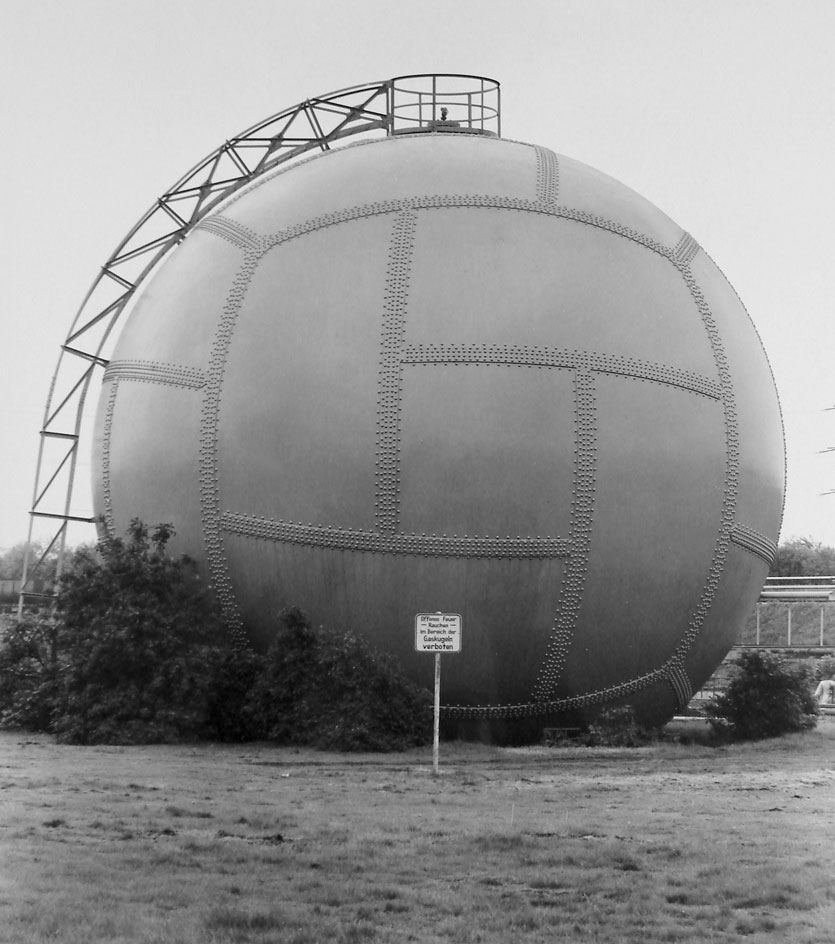
Bernd and Hilla Becher (German, 1931-2007/1934-2015) 'Gas Tank: Essen-Karnap D' 1973


Bernd and Hilla Becher (German, 1931-2007/1934-2015)
Gas Tank: Essen-Karnap D
1973
Gelatin silver print


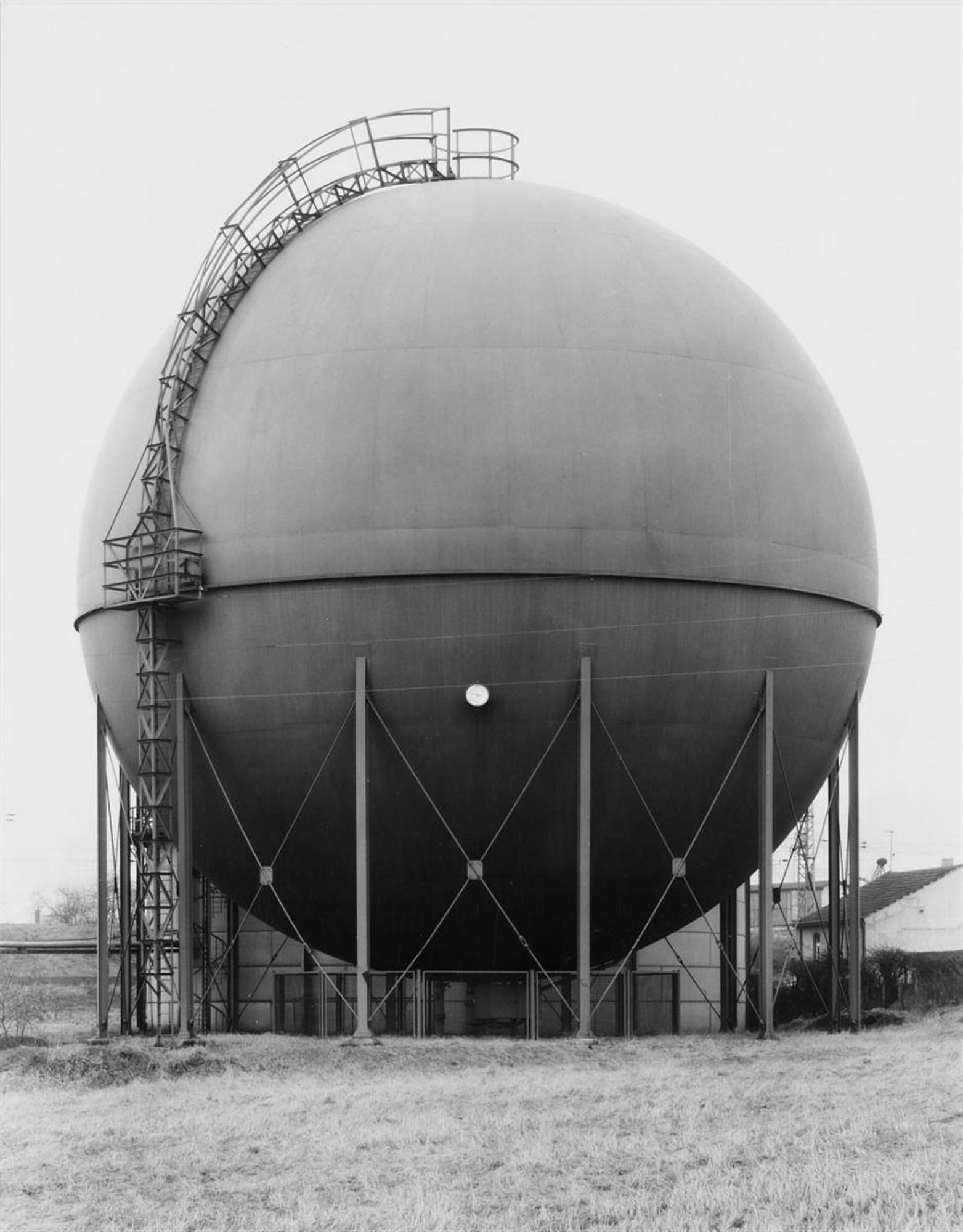
Bernd and Hilla Becher (German, 1931-2007/1934-2015) 'Gasbehälter bei Wuppertal (Gas tank near Wuppertal)' 1966


Bernd and Hilla Becher (German, 1931-2007/1934-2015)
Gasbehälter bei Wuppertal (Gas tank near Wuppertal)
1966
Gelatin silver print


Born during the period of industrial archeology, the Bechers’ work consists, in the words of Pierre Restany, “of an optical pilgrimage at the roots of the industrial world”. The couple proposes a way do see industrial architecture by taking an approach based on inventory methodology. Their work is a reflection on the creation of heritage and raises the question of the heritage value of industrial objects, which is inseparable from their artistic value.

With a focus on archiving and industrial memory, Bernd and Hilla Becher’s approach consists of establishing a detailed inventory and keeping track of industrial structures by photographing sites threatened by obsolescence and often abandoned. The series Gas Tanks includes nine photographs from the period between 1965 and 1973, taken according to the extremely stringent protocol that is characteristic of their work (frontal view, centring of the subject, mid-height, absence of light, etc.). The composition of each portrait is standardised and identical, with emphasis on the frontal aspect and the monumentality of industrial constructions classified according to their functionality and form.

Taking advantage of the extremely reproducible nature of the photograph, the Bechers reveal the massive diffusion and production of images that contribute to erasing our memories of their origins and their authors. In doing so, they observe a civilisation on the decline and highlight the production of an era, vestiges of the human imagination and life.


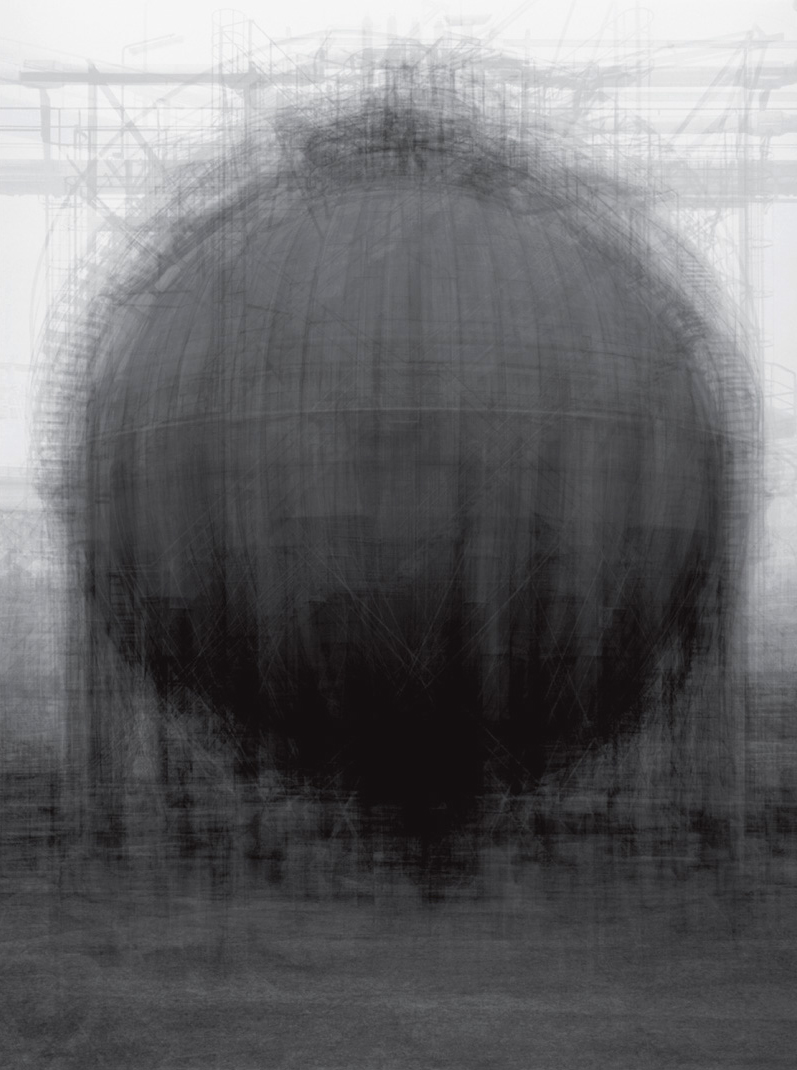
Idris Khan (British, b. 1978) 'Every ... Bernd and Hilla Becher Spherical Type Gasholder' One panel triptych, 2003


Idris Khan (British, b. 1978)
Every … Bernd and Hilla Becher Spherical Type Gasholder
One panel triptych, 2003
Lambda Digital C print mounted on aluminium
20 1/2 x 26 1/2 inches


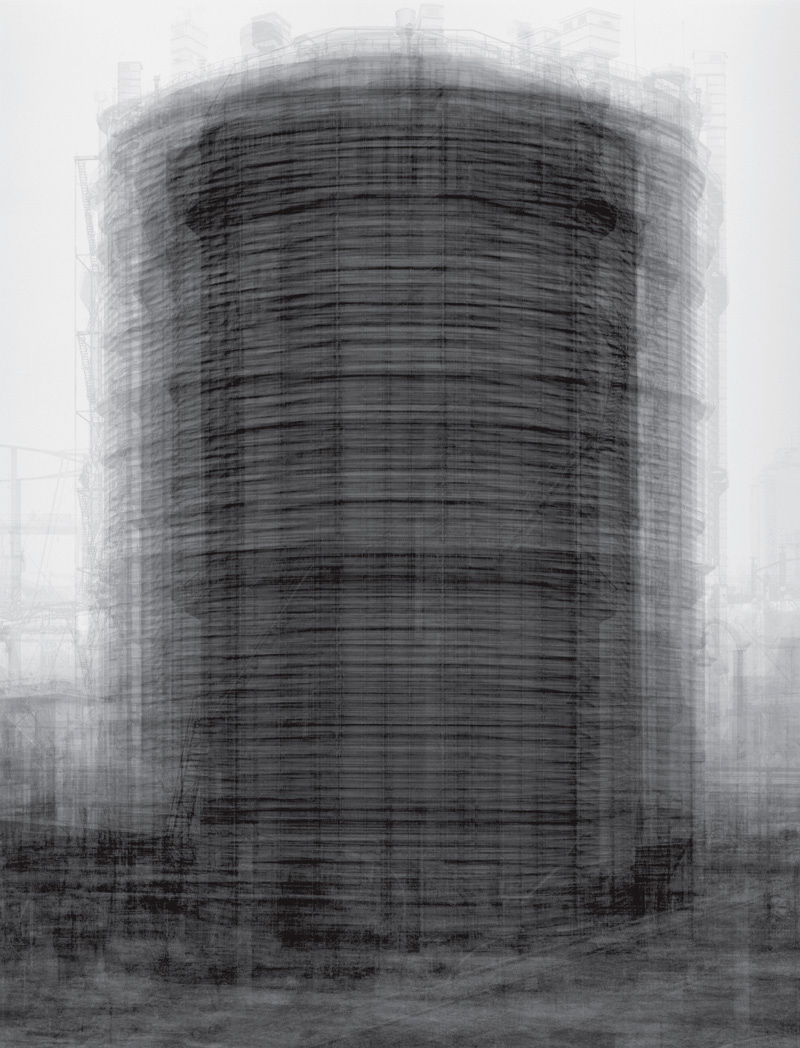
Idris Khan (British, b. 1978) 'Every ... Bernd and Hilla Becher Prison Type Gasholder' 2004


Idris Khan (British, b. 1978)
Every … Bernd and Hilla Becher Prison Type Gasholder
2004
Lambda Digital C print mounted on aluminium
80 × 65 inches


“I try to capture the essence of the building – something that’s been permanently imprinted in someone’s mind, like a memory.”

Idris Khan is fascinated by the photographic medium. Fuelled by images and influential theoretical essays on the history of photography, he re-appropriates the works that had an impact on him and subjects them to a series of transformations in order to see them from a different perspective. His work is a reflection on the passage of time, the accumulation of experiences and, as such, the decrease of unique moments. In his series Homage…, he presents rephotographed works, enlarged and superimposed in multiple layers. He uses digital tools to play with the opacity of the layers so as to strengthen the mystery of the original objects whose layering reveals new details. The work Homage to Bernd Becher shown here reproduces and compiles the photographs that correspond to the Bechers’ typology in order to celebrate the vestiges of these vanished industrial infrastructures.

Fascinated by the ability of the photographic medium to capture the soul as well as the body image, Idris Khan, in his series Rising Series… After Eadweard Muybridge “Human and Animal Locomotion”, pays homage to Muybridge’s early scientific experiments using the camera to sequentially record human and animal movement. Beyond the tribute paid to photography that is defined here as a compilation of knowledge, Idris Khan positions himself with respect to a medium laden with history and with a bright future ahead of it.


Victoria Will (American, b. 1980) 'Kristen Stewart' 2014


Victoria Will (American, b. 1980)
Kristen Stewart
2014
© Victoria Will


Kristen Stewart poses for a tintype (wet collodion) portrait at The Collective and Gibson Lounge, during the 2014 Sundance Film Festival in Park City, Utah. (Photo by Victoria Will/Invision/AP)

Victoria Will began her career as a staff photographer for the New York Post.Specialized at the time in portraits and fashion, her photographs were disseminated worldwide by the magazines W, the New York Times and Vogue. When she was invited for the fourth time to the Sundance Film Festival, an American independent film festival, she decided to try something new and to replace her digital reflex camera with the century-old tintype process to make portraits of movie stars. Following her success, she renewed the experience in the following years and gradually improved this complex technique.

Overcoming the difficulties of the process, its sensitivity to time and the danger of the chemical products involved, the photographer successively made portraits in 7 to 8 minutes of actors such as Vincent Cassel, Robert Redford, Jennifer Connelly, Spike Lee and Ethan Hawke. “What I love about the process is how raw it is,” says Victoria. “We live in an age of glossy magazines and overly retouched skin. But there is no lying with tintypes. You can’t get rid of a few wrinkles like in Photoshop.”

Both the photographer and her public “appreciate the honesty of these photographs. Development leaves a lot of room for the unexpected: we discover a face that we thought was familiar while being the contrary of digital portraits. The stages in the darkroom contribute to the idea of creating something unique and refreshing.”


The Musée de l’Elysée
18, avenue de l’Elysée
CH - 1014 Lausanne
Phone: + 41 21 316 99 11

Opening hours:
Tuesday – Sunday, 11am – 6pm
Closed Monday, except for bank holidays

The Musée de l’Elysée website

LIKE ART BLART ON FACEBOOK

Back to top

Exhibition: ‘Bob Mizer and Tom of Finland’ at The Museum Of Contemporary Art, Los Angeles (MOCA)

Exhibition dates: 2nd November 2013 – 26th January 2014
MOCA Pacific Design Center

PLEASE NOTE: THIS POSTING CONTAINS ART WORK OF MALE NUDITY AND EROTIC IMAGES OF GAY MALE SEX – IF YOU DO NOT LIKE PLEASE DO NOT LOOK, FAIR WARNING HAS BEEN GIVEN


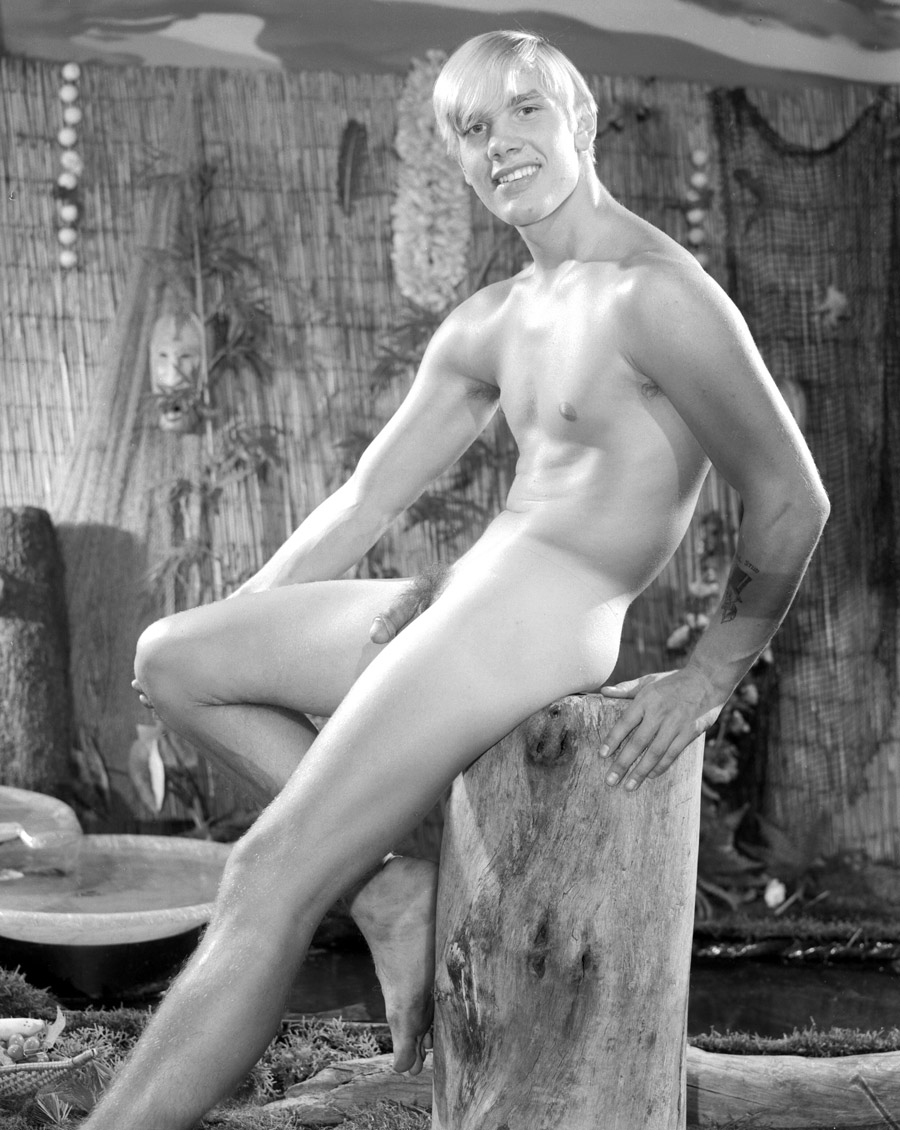
Bob Mizer (American, 1922-1992) 'Physique Pictorial Volume 16 Number 4, February 1968' 1968


Bob Mizer (American, 1922-1992)
Physique Pictorial Volume 16 Number 4, February 1968
1968
Publication
Printed with permission of Bob Mizer Foundation, Inc .


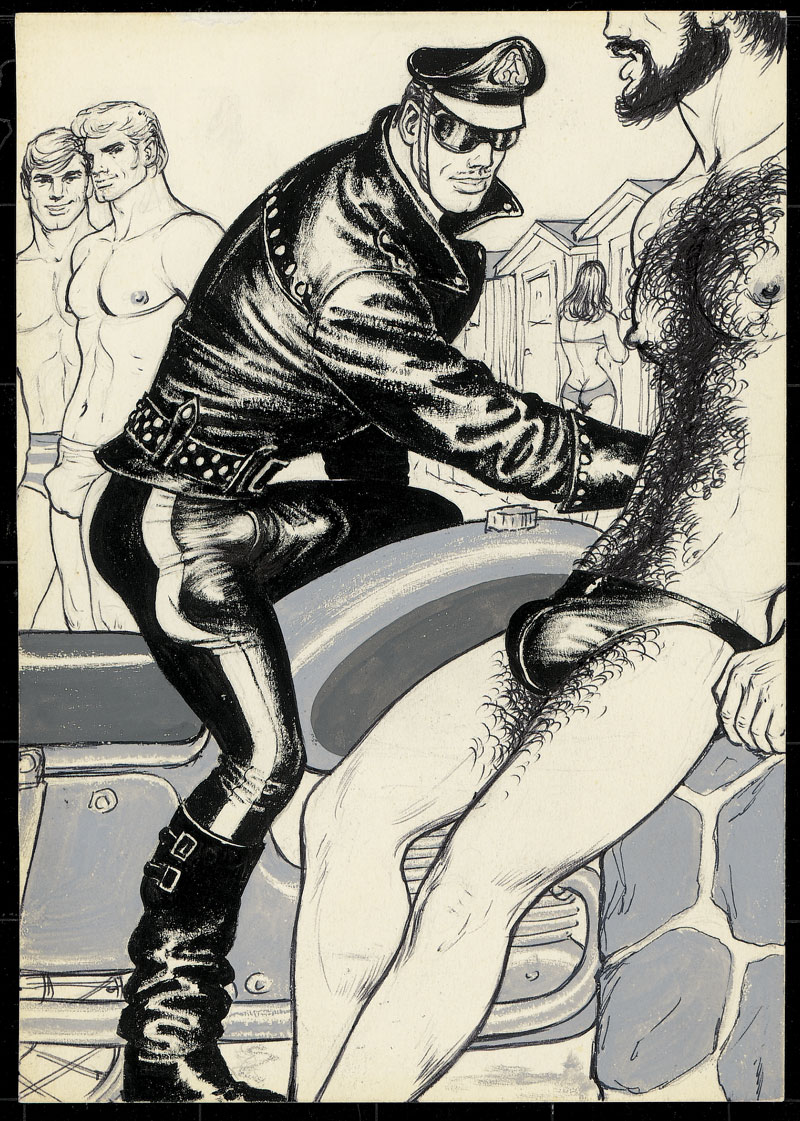
What a fantastic pairing in this exhibition and in their relationship in real life. We must remember that Tom of Finland was a ground-breaking artist, one of the very first to picture masculine gay men, “robbing straight homophobic culture of its most virile and masculine archetypes (bikers, hoodlums, lumberjacks, cops, cowboys and sailors) and recasting them – through deft skill and fantastic imagination – as unapologetic, self-aware and boastfully proud enthusiasts of gay sex.”

He would have only just been in his twenties when he started drawing men in the early 1940s, inspired by the soldiers and uniforms he saw around him from the Second World War. With no outward gay culture in Finland, let alone in America until the late 1960s, just imagine being an artist producing this kind of erotic imagery at that time. To go on to be the seminal figure in the creation of gay leather culture… what an impact this artist had on gay and popular culture. Of course, as tastes were liberalised in the era of free love, Stonewall and after, the muscles of his hunks became bigger, the size of their endowments larger and the actions portrayed became more open and transparent (as can be seen from Untitled (From Beach Boy 2 story), 1971, below).

During my PhD research I visited the One Institute/International Gay and Lesbian Archives Collection, University of Southern California, Los Angeles, to investigate the cross-over between physique magazines and early gay pornography magazines of the 1960s to early 1970s. I was interested to see whether the muscular mesomorphic bodies of the physique magazines crossed straight over into the first gay pornography magazines. To my surprise, the answer was that they did not.

After the American Supreme Court ruled on obscenity laws in the late 1960s, the first gay pornography magazines started appearing. The earliest gay porn magazine in the One Institute / IGLA collection, Action Line. No.1. San Francisco: Mark Vaughn Associates. 1969, features mostly smooth but natural bodies, not as built as in physique magazines, with nude young men with full erections lying next too each other touching. There is no sex, no sucking or fucking. Only a year later, in 1970, the story is different. In Album 1501: A Study of Sexual Activity Between Males. Los Angeles: Greyhuff Publishing, 1970 their is sexual intercourse pictured between men in an openly available publication for the first time.

Bodies in this magazine are smooth, young toned men, much as in the early photographs of George Platt Lynes (such as those of Charles ‘Tex’ Smutney, Charles ‘Buddy’ Stanley, and Bradbury Ball). They are also similar to the bodies in the photographs that Lynes submitted to the Zurich published homosexual magazine Der Kries after he found out that he had cancer, during the last years of his life (under the pseudonym Roberto Rolf late 1940s – early 1950s). The participants in Album 1501 perform sex on each other in a lounge room lit by strong lights (shadows on walls). The black and white photographs, well shot, feature in a magazine that is about 5″ wide and 10″ high, well laid out and printed. The magazine is a thin volume and features just the two models in one sex scene of them undressing each other and then having sex. One man wears a Pepsi-Cola T-shirt at first and he also has tattoos one of which says ‘Cheri’. The photographs almost have a private feel to them.

In their introduction the publishers disclaim any agreement with the content of the magazine and are only publishing it for the freedom of everybody to study the material in the privacy of their own homes. In other words male to male sex is a natural phenomenon and the publication is educational. This was a common ploy in early nudist and pornographic publications (along with classical themes) that was used to justify the content – to claim that the material was for private educational purposes only:

Introduction.

“Publishers of material dealing frankly with sexual activity have suffered greatly in the past because of society’s anxiety over the existence and propagation of such material. But the real issue is why should such material dealing with sexual activity be any less valid or acceptable than material dealing with other facets of human behaviour? …
This book was produced so that all interested adults may have an opportunity to acquire it for their own private interests in matters relating to sex …
Our publication of this book is not to be construed that we agree with, condone or encourage any of the behaviour depicted herein. However, sexual activity between males is a fact of life and interested adults should not be denied an opportunity to study this, or any other, facet of human behaviour.”


The Publishers


It is interesting to note the progression from physique magazines and models in posing pouches in 1966-68 (such as the photographs of Bob Mizer featured in this posting), then to full erection and stories of anal penetration in Action Line in 1969, to full on photographs of gay sex in this magazine in 1970. Bodies are all smooth, quite solid, toned natural physiques, not as ‘built’ as in earlier physique magazines, but still featuring younger smooth men and not older heavier set men. It was not until the development of the clone, leatherman and magazines such a Colt from Colt Studios that Tom of Finland’s muscular mesomorphic leatherman took hold in the popular gay imagination.

Even in the mid 1970’s companies such as Colt Studios, which has built a reputation for photographing hunky, very well built masculine men, used classical themes in their photography of muscular young men. Most of the early Colt magazines have photographs of naked young men that are accompanied by photographs and illustrations based on classical themes. In their early magazines quite a large proportion of the bodies were hirsute or had moustaches as was popular with the ‘clone’ image at the time. Later Colt models of the early 1980’s tend towards the buff, tanned, stereotypical muscular mesomorph in even greater numbers. Sometimes sexual acts are portrayed in Colt magazines but mainly they are not. It is the “look” of the body and the face that the viewers desiring gaze is directed towards – not the sexual act itself.

Photographers such as Bob Mizer from Athletic Model Guild produced more openly homoerotic images. In his work from the 1970’s full erections are not prevalent but semi-erect penises do feature, as do revealing “moon” shots from the rear focusing on the arsehole as a site for male libidinal desires. A less closeted, more open expression of homosexual desire can be seen in the photographs of the male body in the 1970’s.

Dr Marcus Bunyan


Many thankx to The Museum Of Contemporary Art (MOCA) for allowing me to publish the art work in the posting. Please click on the photographs for a larger version of the image.


Tom of Finland (Touko Laaksonen, Finnish, 1920-1991) 'Untitled' 1962


Tom of Finland (Touko Laaksonen, Finnish, 1920-1991)
Untitled
1962
Graphite on paper
12.00″ x 9.50″
ToFF Cat. #62.27, Collection of Volker Morlock
© 1962 Tom of Finland Foundation


Bob Mizer (American, 1922-1992) 'Physique Pictorial Volume 11 Number 4, May 1962' 1962


Bob Mizer (American, 1922-1992)
Physique Pictorial Volume 11 Number 4, May 1962
1962
Publication
Printed with permission of Bob Mizer Foundation, Inc .


Bob Mizer (American, 1922-1992) 'Physique Pictorial Volume 7 Number 1, 1957' 1957


Bob Mizer (American, 1922-1992)
Physique Pictorial Volume 7 Number 1, 1957
1957
Publication
Printed with permission of Bob Mizer Foundation, Inc .


Bob Mizer (American, 1922-1992) 'Physique Pictorial Volume 10 Number 4, April 1961' 1961


Bob Mizer (American, 1922-1992)
Physique Pictorial Volume 10 Number 4, April 1961
1961
Publication
Printed with permission of Bob Mizer Foundation, Inc .


Tom of Finland (Touko Laaksonen, Finnish, 1920-1991) 'Untitled' (1 of 4 from 'Circus Life' series) 1961


Tom of Finland (Touko Laaksonen, Finnish, 1920-1991)
Untitled (1 of 4 from Circus Life series)
1961
Graphite on paper
12.25″ x 9.75″
Bob Mizer/AMG Collection, Tom of Finland Foundation Permanent Collection #61.11
© 1961 Tom of Finland Foundation


Bob Mizer (American, 1922-1992) 'Jim Horn, Los Angeles' c. 1966


Bob Mizer (American, 1922-1992)
Jim Horn, Los Angeles
c. 1966
Vintage large-format black and white negative
Silver gelatin print
8 x 10 inches
Printed with permission of Bob Mizer Foundation, Inc .


Bob Mizer (American, 1922-1992) 'Untitled [Barry Maurer, Hand on Gun], Los Angeles' c. 1961


Bob Mizer (American, 1922-1992)
Untitled [Barry Maurer, Hand on Gun], Los Angeles
c. 1961
Vintage large-format black and white negative
Silver gelatin print
8 x 10 inches
Printed with permission of Bob Mizer Foundation, Inc .


Bob Mizer (American, 1922-1992) 'Untitled [Larry Lamb, with Tumbleweed], Los Angeles' c. 1959


Bob Mizer (American, 1922-1992)
Untitled [Larry Lamb, with Tumbleweed], Los Angeles
c. 1959
Vintage large-format black and white negative
Silver gelatin print
8 x 10 inches
Printed with permission of Bob Mizer Foundation, Inc .


Tom of Finland (Touko Laaksonen, Finnish, 1920-1991) 'Untitled' 1968


Tom of Finland (Touko Laaksonen, Finnish, 1920-1991)
Untitled
1968
Graphite on paper
12.94″ x 9.38″
ToFF Cat. #68.06, Collection of Volker Morlock
© 1968 Tom of Finland Foundation


Tom of Finland (Touko Laaksonen, Finnish, 1920-1991) 'Youthful Innocence' 1969


Tom of Finland (Touko Laaksonen, Finnish, 1920-1991)
Youthful Innocence
1969
The New Biker Stud – Bob Mizer title
Graphite on paper
11.75″ x 8.50″
ToFF Cat. #69.02, Collection of Volker Morlock
© 1969 Tom of Finland Foundation


Tom of Finland (Touko Laaksonen, Finnish, 1920-1991) 'Untitled' (No.1 from 'Cyclist and the Farm Boy' series) 1973


Tom of Finland (Touko Laaksonen, Finnish, 1920-1991)
Untitled (No.1 from Cyclist and the Farm Boy series)
1973
Graphite on paper
11″ x 8″
Bob Mizer/AMG Collection, Tom of Finland Foundation Permanent Collection #73.10
© 1973 Tom of Finland Foundation


Bob Mizer (American, 1922-1992) 'Untitled [Ray Hornsby, Motorcycle], Los Angeles' c. 1957


Bob Mizer (American, 1922-1992)
Untitled [Ray Hornsby, Motorcycle], Los Angeles
c. 1957
Vintage large-format black and white negative
Silver gelatin print
8 x 10 inches
Printed with permission of Bob Mizer Foundation, Inc .


“To my mind, there is no clearer representation of Mizer’s almost manic attempts to condense the joyful, celebratory chaos of his daily photo shoots down to their most selectively stupendous moments than his catalogue boards.” ~ artist and exhibition co-curator Richard Hawkins


The Museum of Contemporary Art, Los Angeles (MOCA), is proud to present Bob Mizer and Tom of the Finland, the first American museum exhibition devoted to the art of Bob Mizer (1922-1992) and Touko Laaksonen, aka “Tom of Finland” (1920-1991), two of the most significant figures of twentieth century erotic art and forefathers of an emergent post-war gay culture. The exhibition features a selection of Tom of Finland’s masterful drawings and collages, alongside Mizer’s rarely seen photo-collage “catalogue boards” and films, as well as a comprehensive collection of his groundbreaking magazine Physique Pictorial, where drawings by Tom were first published in 1957. Organised by MOCA Curator Bennett Simpson and guest co-curator Richard Hawkins, the exhibition is presented with the full collaboration of the Bob Mizer Foundation, El Cerrito, and the Tom of Finland Foundation, Los Angeles.

Tom of Finland is the creator of some of the most iconic and readily recognisable imagery of post-war gay culture. He produced thousands of images beginning in the 1940s, robbing straight homophobic culture of its most virile and masculine archetypes (bikers, hoodlums, lumberjacks, cops, cowboys and sailors) and recasting them – through deft skill and fantastic imagination – as unapologetic, self-aware and boastfully proud enthusiasts of gay sex. His most innovative achievement though, worked out in fastidious renderings of gear, props, settings and power relations inherent therein, was to create the depictions that would eventually become the foundation of an emerging gay leather culture. Tom imagined the leather scene by drawing it; real men were inspired by it … and suited themselves up.

Bob Mizer began photographing as early as 1942 but, unlike many of his contemporaries in the subculture of illicit physique nudes, Mizer took the Hollywood star-system approach and founded the Athletic Model Guild in 1945, a film and photo studio specialising in handsome natural-bodied (as opposed to exclusively musclebound, the norm of the day) boy-next-door talent. In his myriad satirical prison dramas, sci-fi flix, domesticated bachelor scenarios and elegantly captivating studio sessions, Mizer photographed and filmed over 10,000 models at a rough estimate of 60 photos a day, seven days a week for almost 50 years. Mizer always presented a fresh-faced and free, unashamed and gregarious, totally natural and light-hearted approach to male nudity and intimate physical contact between men. For these groundbreaking perspectives in eroticised representation alone, Mizer ranks with Alfred Kinsey at the forefront of the sexual revolution.

Though Laaksonen did not move to Los Angeles until the 1970s, he had long known of Mizer and the photographer’s work through Physique Pictorial, the house publication and sales tool for Athletic Model Guild. It was to this magazine that the artist first sent his drawings and it was Mizer, finding the artworks remarkable and seeking to promote them on the magazine’s cover, but finding the artist’s Finnish name too difficult for his clientele, who is responsible for the now famous “Tom of Finland” pseudonym.

By the time the gay liberation movement swept through the United States in the late 1960s, both Tom of Finland and Bob Mizer were already well-known and widely celebrated as veritable pioneers of gay art. Decades before Stonewall and the raid on the Black Cat these evocative and lusty representations of masculine desire and joyful, eager sex between men proliferated and were disseminated worldwide at a time when the closet was still very much the norm – there was no such thing as a gay community. If these artists were not ahead of their time, they might just have foreseen and even invented a time.

Spanning five decades, the exhibition seeks a wider appreciation for Tom of Finland and Bob Mizer’s work, considering their aesthetic influence on generations of artists, both gay and straight, among them, Kenneth Anger, Rainer Werner Fassbinder, David Hockney, G.B. Jones, Mike Kelley, Robert Mapplethorpe, Henrik Olesen, Jack Pierson, John Waters, and Andy Warhol. The exhibition also acknowledges the profound cultural and social impact both artists have made, especially in providing open, powerful imagery for a community of desires at a time when it was still very much criminal. Presenting the broader historical context and key aspects of their shared interests and working relationship, as well as more in-depth solo rooms dedicated to each artist, the exhibition establishes the art historical importance of the staggering work of these legendary figures.

In addition to approximately 75 finished and preparatory drawings by Tom of Finland spanning 1947-1991, the exhibition includes a selection of Tom’s never before exhibited scrapbook collages, and examples of his serialised graphic novels, including the legendary leatherman Kake, as well as a selection of Mizer’s “catalogue boards,” AMG films, and a complete set of Physique Pictorial magazine. An accompanying publication includes texts by the exhibition co-curators and a selection of images.

Press release from the MOCA website


Bob Mizer (American, 1922-1992) 'Untitled [Ray Hornsby, with Skull Staff], Los Angeles' c. 1957


Bob Mizer (American, 1922-1992)
Untitled [Ray Hornsby, with Skull Staff], Los Angeles
c. 1957
Vintage large-format black and white negative
Silver gelatin print
8 x 10 inches
Printed with permission of Bob Mizer Foundation, Inc .


Bob Mizer (American, 1922-1992) 'Untitled [Ernie Rabb, Pointed Pistol], Los Angeles' c. 1957


Bob Mizer (American, 1922-1992)
Untitled [Ernie Rabb, Pointed Pistol], Los Angeles
c. 1957
Vintage large-format black and white negative
Silver gelatin print
8 x 10 inches
Printed with permission of Bob Mizer Foundation, Inc .


Tom of Finland (Touko Laaksonen, Finnish, 1920-1991) 'Untitled' (From 'Beach Boy 1' story) 1971


Tom of Finland (Touko Laaksonen, Finnish, 1920-1991)
Untitled (From Beach Boy 1 story)
1971
Pen and ink, gouache on paper
8.25″ x 5.75″
COQ International Collection, Tom of Finland Foundation Permanent Collection #71.24
© 1971 Tom of Finland Foundation


Tom of Finland (Touko Laaksonen, Finnish, 1920-1991) 'Untitled' (From 'Jungle Seafood' story) 1972


Tom of Finland (Touko Laaksonen, Finnish, 1920-1991)
Untitled (From Jungle Seafood story)
1972
Pen and ink, gouache on paper
8.63″ x 6.94″
Tom of Finland Foundation Permanent Collection #72.41
© 1972 Tom of Finland Foundation


Bob Mizer (American, 1922-1992) 'Untitled [Larry Lamb, Profile with Chains], Los Angeles' c. 1959


Bob Mizer (American, 1922-1992)
Untitled [Larry Lamb, Profile with Chains], Los Angeles
c. 1959
Vintage large-format black and white negative
Silver gelatin print
8 x 10 inches
Printed with permission of Bob Mizer Foundation, Inc .


Bob Mizer (American, 1922-1992) 'Untitled [Dennis Schreffer, Wand Balance], Los Angeles' c. 1957


Bob Mizer (American, 1922-1992)
Untitled [Dennis Schreffer, Wand Balance], Los Angeles
c. 1957
Vintage large-format black and white negative
Silver gelatin print
8 x 10 inches
Printed with permission of Bob Mizer Foundation, Inc .


Bob Mizer (American, 1922-1992) 'Untitled [Dennis Schreffer with Portrait], Los Angeles' c. 1957


Bob Mizer (American, 1922-1992)
Untitled [Dennis Schreffer with Portrait], Los Angeles
c. 1957
Vintage large-format black and white negative
Silver gelatin print
8 x 10 inches
Printed with permission of Bob Mizer Foundation, Inc .


Tom of Finland (Touko Laaksonen, Finnish, 1920-1991) 'Untitled' (From 'Beach Boy 2' story) 1971


Tom of Finland (Touko Laaksonen, Finnish, 1920-1991)
Untitled (From Beach Boy 2 story)
1971
Pen and ink, gouache on paper
8.25″ x 5.25″
Tom of Finland Foundation Permanent Collection #71.45
© 1971 Tom of Finland Foundation


Tom of Finland (Touko Laaksonen, Finnish, 1920-1991) 'Untitled' (From 'Beach Boy 2' story) 197


Tom of Finland (Touko Laaksonen, Finnish, 1920-1991)
Untitled (From Beach Boy 2 story)
1971
Pen and ink, gouache on paper
8.25″ x 5.25″
Tom of Finland Foundation Permanent Collection #71.58
© 1971 Tom of Finland Foundation


Bob Mizer (American, 1922-1992) 'Athletic Model Guild Catalog Board, David Elliott. [Double-sided; This side Page 1 of SW series]' c. 1965


Bob Mizer (American, 1922-1992)
Athletic Model Guild Catalog Board, David Elliott. [Double-sided; This side Page 1 of SW series]
c. 1965
Photographs mounted to matboard and mixed media
Printed with permission of Bob Mizer Foundation, Inc .
The Museum of Contemporary Art, Los Angeles
Proposed purchase with funds provided by the Photography Committee
The Bob Mizer Foundation & INVISIBLE-EXPORTS, New York


Bob Mizer (American, 1922-1992) 'Athletic Model Guild Catalog Board, David Elliott. [Double-sided; This side Page 2 of SW series]' c. 1965


Bob Mizer (American, 1922-1992)
Athletic Model Guild Catalog Board, David Elliott. [Double-sided; This side Page 2 of SW series]
c. 1965
Photographs mounted to matboard and mixed media
Printed with permission of Bob Mizer Foundation, Inc .
The Museum of Contemporary Art, Los Angeles
Proposed purchase with funds provided by the Photography Committee
The Bob Mizer Foundation & INVISIBLE-EXPORTS, New York


Bob Mizer (American, 1922-1992) 'Athletic Model Guild Catalog Board, Ernie Rabb. [Double-sided; This side Page 57 of XT series]' c. 1957


Bob Mizer (American, 1922-1992)
Athletic Model Guild Catalog Board, Ernie Rabb. [Double-sided; This side Page 57 of XT series]
c. 1957
Photographs mounted to matboard and mixed media
Printed with permission of Bob Mizer Foundation, Inc .
The Museum of Contemporary Art, Los Angeles
Proposed purchase with funds provided by the Photography Committee
The Bob Mizer Foundation & INVISIBLE-EXPORTS, New York


Bob Mizer (American, 1922-1992) 'Athletic Model Guild Catalog Board, Ernie Rabb. [Double-sided; This side Page 58 of XT series]' c. 1957


Bob Mizer (American, 1922-1992)
Athletic Model Guild Catalog Board, Ernie Rabb. [Double-sided; This side Page 58 of XT series]
c. 1957
Photographs mounted to matboard and mixed media
Printed with permission of Bob Mizer Foundation, Inc .
The Museum of Contemporary Art, Los Angeles
Proposed purchase with funds provided by the Photography Committee
The Bob Mizer Foundation & INVISIBLE-EXPORTS, New York


Tom of Finland (Touko Laaksonen, Finnish, 1920-1991) 'Untitled' (From 'Beach Boy 2' story) 1971


Tom of Finland (Touko Laaksonen, Finnish, 1920-1991)
Untitled (From Beach Boy 2 story)
1971
Pen and ink, gouache on paper
8.25″ x 5.25″
Tom of Finland Foundation Permanent Collection #71.61
© 1971 Tom of Finland Foundation


MOCA Pacific Design Center

The design center has permanently closed.

MOCA website

LIKE ART BLART ON FACEBOOK

Back to top