Review: ‘ManStyle’ at the National Gallery of Victoria, Melbourne

Exhibition: 2 venues

NGV International (St Kilda Road) 11 March – 30 October 2011
NGV Australia (Federation Square) 11 March – 27 November 2011


Dr Marcus Bunyan at the opening of Manstyle in front of a two-piece c. 1949 Simpsons of Picadilly, London blue pin-stripped suit and 1940's tie from his collection


Dr Marcus Bunyan at the opening of Manstyle in front of a two-piece Simpsons of Picadilly, London blue pin-stripped suit c. 1949 and Van Heusen 1940’s tie loaned from his collection for the exhibition. Photograph courtesy of the National Gallery of Victoria.


The joy of this exhibition, spread across two NGV locations, is the creativity of local contemporary designers such Gavin Brown, Leigh Bowery, Peter Tully, Michael Glover and Sarah Thorn – a match for anything the international contingent has to offer. Another positive is the wonderful catalogue with its luscious colour plates, insightful essays and interviews with people such as Benny Castles, Luke Sales, Rick Owens and Walter Van Beirendonck.

Less enamouring is the prosaic way that the male attire is displayed – either hermetically sealed behind glass (look, but don’t touch!) or assembled in serried ranks on mannequins that make the clothes look two-dimensional. The display of these historical objects takes all the fun out of their being visually alive garments; it takes all the fun out of men “dressing up.” While acknowledging the conservation issues inherent when displaying such costume the display, the performance, the spectacle of male attire could have been better conveyed to the viewing public. Moving images, placing the work in context both locally and internationally, would have helped.

Continuing with these thoughts, what we wear can be seen as a spectacular, hypertextual construction. This construction comprises the authorship / designer of individual pieces (such as jacket, trousers, shirt) which can be seen as lexias, or nodal points, complimented by the wearer (reader) as author. The wearer appropriates and recasts individual garments, partially constructing the outfit through active choice, through a dissolution of the author-reader binary, through a very public characterisation of form: look at me, look at my style! Fashion can be seen as a “set of interconnecting and competing discourses than can never result in a single articulation,”1 discourses that generate and dissolve meaning. Men now use these discourses to enact the ‘performing self’, as it is known, which places greater emphasis on appearance.

“Within consumer culture … the new conception of self which has emerged, which we shall refer to as the ‘performing self’, places greater emphasis upon appearance, display and the management of impressions.”2

Appearance is critical to an understanding of self-concept. This self-concept consists of:

a/ the actual self (how a person perceives him/herself),
b/ the ideal self (how a person would like to perceive him/herself), and
c/ the social self (how a person presents him/herself to others).3


As Sproles and Burns observe, “Appearance is an extremely important part of the self-concept. Through personal appearance – dress, cosmetics, fashion expressions, body movements – an individual presents personal identity, attitudes, moods, and value or self-worth. In addition, individuals receive positive or negative evaluations from others with regard to appearance. Hence, appearance is one of the most prominent ways to display and reinforce a self-concept.”4

Appearance and the textuality of representation (stressing that representations are presentations entailing the use of codes and conventions of the available cultural forms of presentation),5 are continually being subverted throughout the history of fashion. In postmodernist fashion imitation and integration of an eclectic mixture of styles and periods into a new discourse (or montage, or collage, or bricolage)6 is critical to the constant regeneration of self using appearance as the embodiment of self-concept. Why this exhibition is so crucial is it shows that men are becoming more and more adept at manipulating their aesthetic style, not as something to be afraid of, not as something that they have to conform to, but as an expression of personal freedom. Which makes it all the more disappointing that the display of the male attire is so staid and reserved. The aesthetic display of these garments did not match up to the clothes exuberance.

Small things also irritated. At the opening a great deal was made of the multimedia element where local designers and celebrities talked about male style. In several of these videos, the men being interviewed mentioned how the shoe was always the basis for a good outfit. Fast forward to the exhibition and what do we find – photostated paper cut-outs of shoes on the mannequins instead of the real thing! Apparently the multimedia was shot after the design of the exhibition was finalised. Surely, if several people mention the basis of a good outfit is the shoe, and you promote the videos heavily, then you need to follow through on this concept. It is like putting the cart before the horse.

The fragmentary dis/locating mix and match eclecticism of contemporary male fashion needed more of a run in this exhibition, but as it stands it gives the viewer a solid overview of male attire throughout the centuries.

Dr Marcus Bunyan


Many thankx to the National Gallery of Victoria for allowing me to publish the photographs in the posting. Please click on the photographs for a larger version of the image.


Endnotes

1/ Johnson-Eilola cited in Mason, J.S. From Text To Hypertext [Online] Cited 28th May, 2003. No longer available online

2/ Lasch, C. The Culture of Narcissism. New York: Norton, 1979, quoted in Featherstone, Mike. “The Body in Consumer Culture,” in Featherstone, Mike; Hepworth, Mike and Turner, Bryan (eds.). The Body. London: Sage Publications, 1991, p. 187

3/ Sproles, George and Burns, Leslie Davis. Changing Appearances: Understanding Dress in Contemporary Society. New York: Fairchild Publications, 1994, pp. 208-209

4/ Ibid.,

5/ Dyer, Richard. The Matter of Images: Essays on Representations. London: Routledge, 1993, pp. 2-3

6/ Tseëlon, E. The Masque of Femininity: The Representation of Women in Everyday Life. London: Sage, 1995, pp. 132-133


H. Lehmann, Aldershot (tailor) 'Royal Gloucester Hussar's uniform' c. 1900


H. Lehmann, Aldershot (tailor)
active in England c. 1900
Royal Gloucester Hussar’s uniform
c. 1900
Wool, cotton, metal
(a) 51cm (centre back), 64cm (sleeve length) (jacket)
(b) 48cm (centre back), 44cm (width) (waistcoat)
National Gallery of Victoria, Melbourne
Gift of the Stone Family, 1963


England 'Coat' 1740s


England
Coat
1740s
Silk, wood, wool, linen
102cm (centre back), 65cm (sleeve length)
National Gallery of Victoria, Melbourne
Purchased, 1970
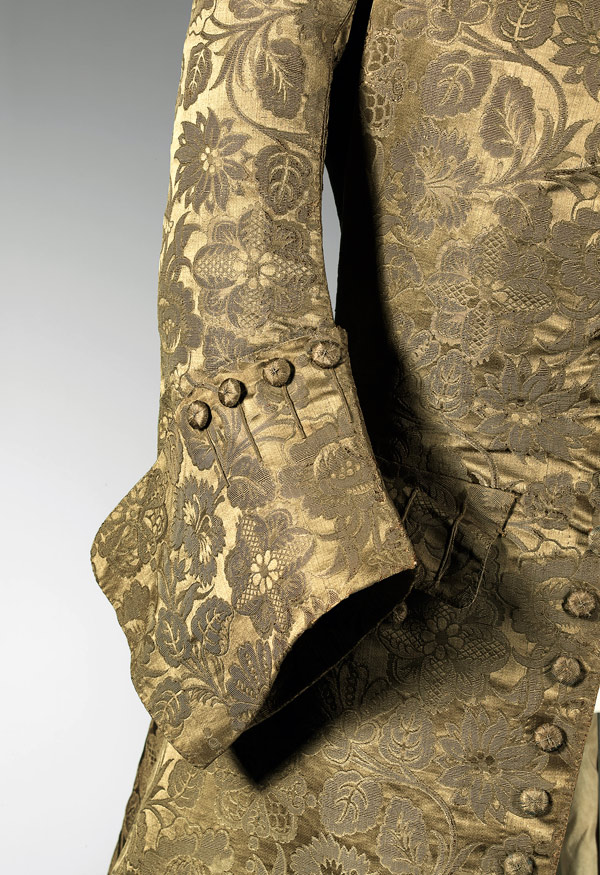
 

England 'Coat' 1740s (detail)


England
Coat (detail)
1740s
Silk, wood, wool, linen
102cm (centre back), 65cm (sleeve length)
National Gallery of Victoria, Melbourne
Purchased, 1970


France 'Coat' c. 1810


France
Coat
c. 1810
Wool, silk, wood
105.8cm (centre back), 70.5cm (sleeve length)
National Gallery of Victoria, Melbourne
Purchased, 1975


England 'Waistcoat' c. 1850


England
Waistcoat
c. 1850
Silk, cotton, leather, metal
65.5cm (centre back), 51.5cm (waist, flat)
National Gallery of Victoria, Melbourne
Gift of Mrs A. Butler, 1954


Nutters, London (tailor) est. 1968. Tommy Nutter (designer) 'Suit and tie 1971' (detail)


Nutters, London (tailor)
est. 1968
Tommy Nutter (designer)(Wales, b. 1943, lived in England c. 1952- )
Suit and tie 1971 (detail)
Wool, silk, cotton, acetate (lining), metal
(a) 77cm (centre back), 58cm (sleeve length) (jacket)
(b) 52cm (centre back), 40.4cm (waist, flat) (vest)
(c) 103cm (outer leg), 37cm (waist, flat) (trousers)
(d) 142 x 10.5cm (tie)
National Gallery of Victoria, Melbourne
Gift of Roger Evans, 1998


This March, the National Gallery of Victoria will showcase the first exhibition in Australia to focus on men’s fashion from the 18th century to the present day. Drawn largely from the NGV Collection, ManStyle will feature over 80 works including outfits and a selection of paintings exploring influential ideas in menswear over the past three centuries.

Charting a course between flamboyant display and absolute restraint, the exhibition begins in the 18th century with the evolution of the modern suit and concludes with contemporary outfits from today’s menswear designers. ManStyle will explore the elegantly honed lines and details of the dandy in the 19th century, a period which heralded the rise of tailoring with its focus on perfect cut and fit.

This exhibition will include recent works by contemporary designers such as Hedi Slimane for Dior Homme who have drawn upon this legacy of exacting tailoring for a new generation of young men. Roger Leong, Curator, International Fashion and Textiles, NGV said: “Men’s fashion is often seen as bound by tradition when, in fact, it has undergone a number of profound changes that reflect the shifting attitudes to class, sexuality, work and leisure over the past three centuries.

From the beginnings of the modern suit in the 18th century to 20th century sportswear, sub-cultural attire and street wear, men’s fashion has continued to transform in style and function to the present day,” said Mr Leong.

The most dramatic changes to men’s fashion occurred during the 1960s when designers such as Pierre Cardin challenged convention by creating streamlined Space-Age style outfits. Likewise, the ‘peacock revolution’ of this era reintroduced the phenomenon of the decorated man, adorned with colour, pattern and texture. Katie Somerville, Curator, Australian Fashion and Textiles, NGV said the House of Merivale was Australia’s answer to this new, colourful trend.

“Embodying the Carnaby Street look and style of bands like The Beatles, design houses such as Biba and the House of Merivale dressed men in flamboyant, body-hugging suits with wide flared trousers and shirts of contrasting patterns.

During this period, men ‘dressed up’, preened and flaunted their bodies in a new display of ostentatious masculine style.”

By the late 1970s, men’s style had fractured into a heady mix of alternatives. ManStyle features works by Vivienne Westwood and Malcolm McLaren, who defined the punk era with their ripped and distressed clothes plastered with offensive and anarchic slogans and symbols. This exhibition also captures the intense mood of the 1980s; which witnessed an outpouring of creativity across the spectrum of art, music and fashion, unleashing ideas from underground club cultures that reconfigured ideas about men’s sexuality.

“Today, new and traditional modes of dressing are continually merging to challenge our view of masculinity and contemporary style. ManStyle, it seems, offers greater possibilities than ever before,” said Ms Somerville.

Gerard Vaughan, NGV Director said: “By defining these periods in men’s fashion, visitors will be able to discover the contrasting identities men have experimented with over the past three centuries.

Visitors will be mesmerised and surprised by the richness of works in this Australia-first exhibition, showcasing the NGV’s magnificent Collection of this otherwise under-documented genre.”

ManStyle will be on display at the National Gallery of Victoria’s two locations. NGV Australia will look at transformations in the history of tailoring beginning with the notion of the dandy – a gallant man who put a lot of effort into a flawless appearance. The most famous dandy was Beau Brummell (1778-1840) who was always immaculately dressed, seeking to reflect an aristocratic style of life. The display at NGV International will focus on the peacock male, tracing a history of sartorial decoration and display that has its roots in the Renaissance and Tudor eras, and which was spectacularly revived during the 1960s when plain dark suits were discarded in favour of colour, cravats and frilled collars. Ever since then, the peacock phenomenon continues to surface with vivid intensity.

This exhibition will feature works by Vivienne Westwood, Jean Paul Gaultier, Morrissey & Edmiston, Leigh Bowery, Walter Van Beirendonck, Romance Was Born, Bernhard Willhelm, Rick Owens, Pierre Cardin, Biba and many more.

Press release from the National Gallery of Victoria website


WORLD, Auckland (fashion house) 'Percy shops at WORLD' 1999


WORLD, Auckland (fashion house)
est. 1989
Denise L’Estrange-Corbet (designer)(New Zealand, b. 1964)
Percy shops at WORLD
1999
Wool, acetate, raffia, leather, velcro, brass
(a) 68.1cm (centre back), 60cm (sleeve length) (jumper)
(b) 90 x 40cm (corset)
(c) 59.4cm (outer leg), 35.5cm (waist, flat) (knickerbockers)
(d) 120 x 4cm
(e-f) 40 x 11cm (each) (socks)
(g-h) 27 x 15 x 12cm (each) (sandals)
(i) 85cm (outer circumference), 22cm (height), 25.9cm (width) (hat)
National Gallery of Victoria, Melbourne
Purchased, 1999


Plain Jane, Melbourne (fashion house) Gavin Brown (designer) 'Indian snakes and ladders outfit' 1985


Plain Jane, Melbourne (fashion house)
Australia 1984-1987
Gavin Brown (designer)(Australia, b. 1964)
Indian snakes and ladders outfit
1985
Screenprinted cotton, metal, plastic, wood
(a) 109cm (centre back), 61cm (sleeve length) (frock shirt)
(b) 114cm (outer leg), 41cm (waist, flat) (pants)
(c) 52 x 20.5 x 4.5cm (necklace)
National Gallery of Victoria, Melbourne
Purchased NGV Foundation, 2009


Leigh Bowery (Australia 1961-1994, worked in England 1981-1994) 'Pregnant tutu head' 1992


Leigh Bowery (Australia 1961-1994, worked in England 1981-1994)
Pregnant tutu head
1992
Cotton, rayon, polyester, nylon, foam, leather
(a) 87cm (centre back), 25cm (sleeve length) (top)
(b) 130cm (length), 92cm (inner leg) (tights)
(c) 45cm (height), 130cm (outer circumference) (headpiece)
(d-e) 54 x 14cm irreg. (each) (gloves)
(f-g) 35 x 29.5 x 50cm (each) (shoes)
National Gallery of Victoria, Melbourne
Gift of Nicola Bateman Bowery, 1999


Sara Thorn, Melbourne (fashion house) 'Jacket and kilt' 1985


Sara Thorn, Melbourne (fashion house)
1983-1985
Sara Thorn (designer)(Australia, b. 1961)
Bruce Slorach (designer)(Australia, b. 1961)
Jacket and kilt
1985
Screenprinted cotton
(a) 57cm (centre back), 59cm (sleeve length) (jacket)
(b) 73cm (centre back), 43cm (waist, flat) (kilt)
National Gallery of Victoria, Melbourne
Presented by the National Gallery Women’s Association, 1995
© Courtesy of the artists


Vivienne Westwood, London (fashion house) 'Outfit' (detail) 1991 spring-summer 1991 'Cut and Slash' collection


Vivienne Westwood, London (fashion house)
est. 1985
Vivienne Westwood (designer)(England, b. 1941)
Outfit (detail)
1991
Spring-summer 1991 Cut and Slash collection
Cotton, polyester, metal buttons
(a) 62.5cm (centre back), 55cm (sleeve length) (jacket)
(b) 93.4cm (outer leg), 41.2cm (waist, flat) (jeans)
(c) 27 x 17cm (codpiece)
National Gallery of Victoria, Melbourne
Purchased, 1995


Peter Tully (Australia 1947-1992) 'Early flight attendant's vest' 1990


Peter Tully (Australia 1947-1992)
Early flight attendant’s vest
1990
Retrospectra graphic plastic, lamé, metallic thread, cotton
48.5cm (centre back), 48cm (width)
National Gallery of Victoria, Melbourne
Purchased from Admission Funds, 1991
© Courtesy of the artist’s Estate


NGV International
180 St Kilda Road

Opening hours:
Daily 10am – 5pm

The Ian Potter Centre: NGV Australia
Federation Square
Corner of Russell and 
Flinders Streets, Melbourne

Opening hours:
Daily 10am – 5pm

National Gallery of Victoria website

LIKE ART BLART ON FACEBOOK

Back to top

Review: ‘Up Close: Carol Jerrems with Larry Clark, Nan Goldin and William Yang’ at Heide Museum of Modern Art, Melbourne

Exhibition dates: 31st July – 31st October 2010


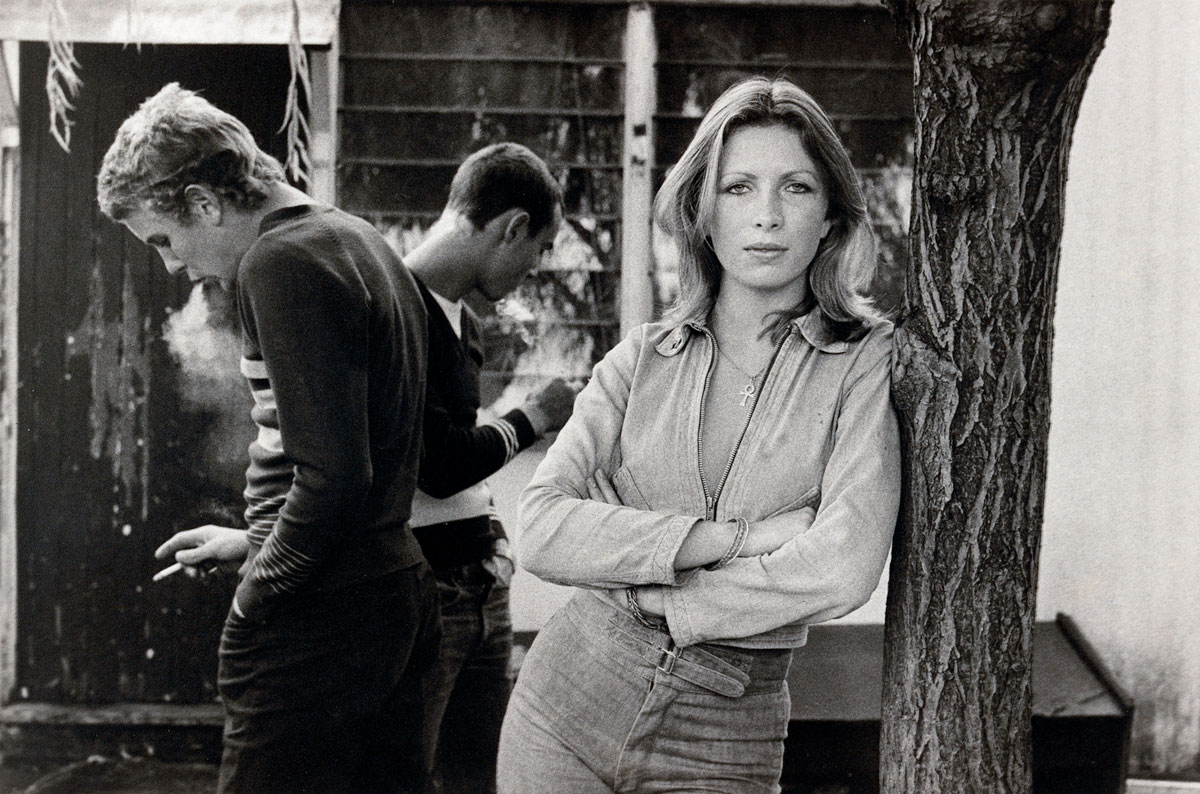
Carol Jerrems (Australian, 1949-1980) 'Vale Street' 1975 from the exhibition 'Up Close: Carol Jerrems with Larry Clark, Nan Goldin and William Yang' at Heide Museum of Modern Art, Melbourne, July - Oct 2010


Carol Jerrems (Australian, 1949-1980)
Vale Street
1975
Gelatin silver print
National Gallery of Australia, Canberra
Gift of the Philip Morris Arts Grant, 1982
© Ken Jerrems & the Estate of Lance Jerrems


“A face tells the story of what a person is thinking. The eyes reveal the suffering.”


Carol Jerems


Time and Truth: Looking again at the work of Carol Jerrems

This is a solid exhibition of the photographs of Carol Jerrems at Heide Museum of Modern Art, accompanied by small selections of the work of Larry Clark and William Yang and the sequence The Ballad of Sexual Dependency (1979) by Nan Goldin.

I like Jerrems work: it is strong, frontal, direct and truthful. What I dislike is the hagiography that has grown up around this artist, the mythologizing of Saint Jerrems. We don’t need a saint of Australian photography; what we need is an appreciation of the artist, the person and her legacy. While the personal history of this artist is well known – facing depression, putting herself in danger, sexually active, documenting the counter-culture sharps and skinheads and urban indigenous people, the photographing of women and her death at far too young an age – few people actually look at the photographs clearly.

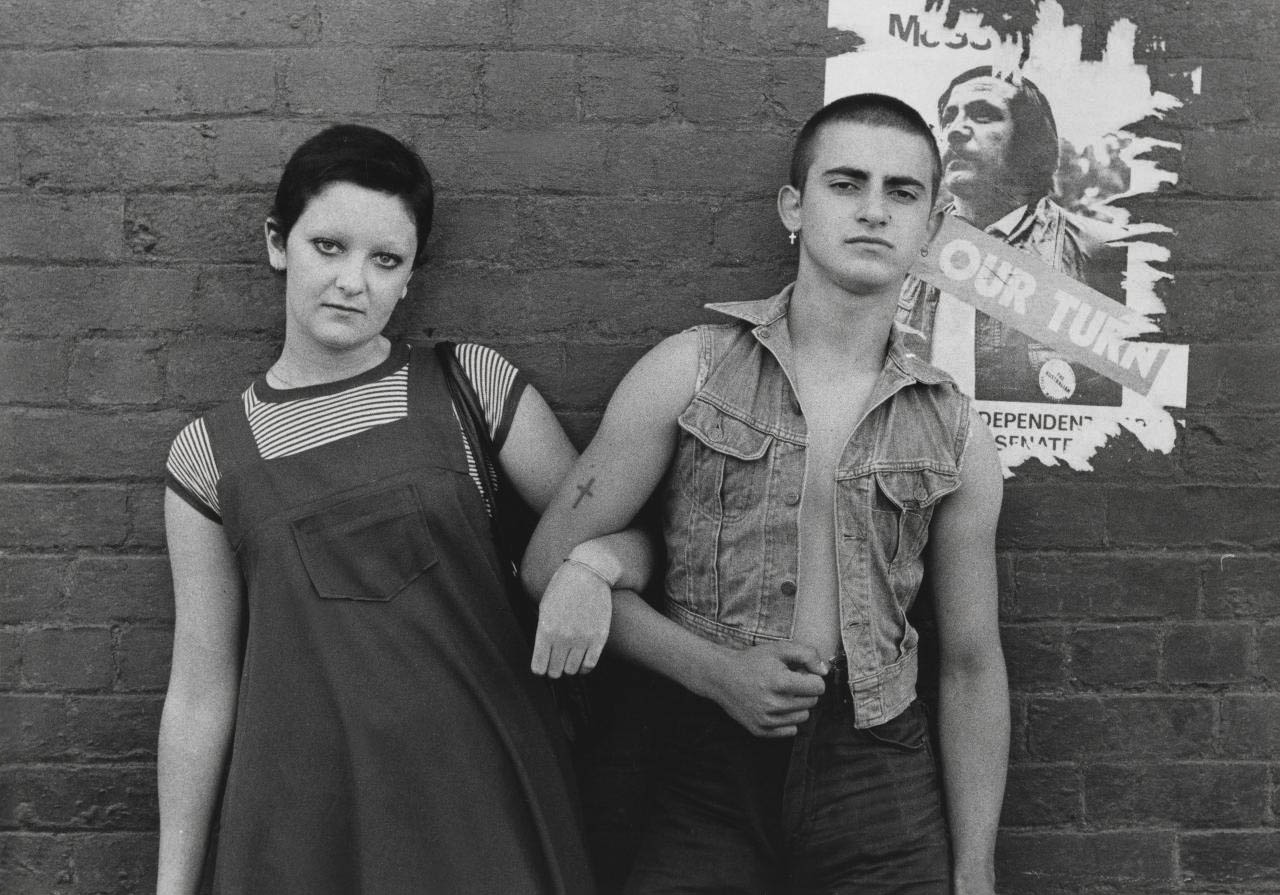
Most of the photographs are 8″ x 10″ prints, mainly portraits, that are usually dark and contrasty, small and emotionally intense. Jerrems images are made full frame (the modernist conceit of filing out a negative carrier, so that if the negative was printed full frame there would be a black border around the picture) to avoid cropping in the darkroom. This shows good previsualisation by the artist, the composition of the image made at the time of the exposure. There is a closeness to the framing of the portraits and a conversant ambiguity about all of her backgrounds – mainly low depth of field, anonymous places (perhaps a brick wall or a close up of a street corner). In fact it is difficult to pin down any actual place in her photographs unless you are told in the title of the work. The contextlessness of her backgrounds allows the viewer to focus on the people placed before her lens and here Jerrems gets up close and personal, trying to capture the truth of her subjects, their soul (in this sense she is like Diane Arbus, thrusting her camera into places it was not supposed to go until something gives – the subject gives up, drops the mask, even if just for a split second, and click, the artist has their image). The mainly head and shoulders photographs of women are most impressive in this regard as Jerrems portrays the women’s strength and vulnerability as are the photographs of the artist herself in hospital fighting her debilitating illness, the most moving, emotional photographs in the exhibition.

Other photographs show constructed intimacies between people, the camera and the artist. In Esben and Dusan, Cronulla (1977, above), Jerrems uses the yin yang black, white background to frame the two protagonists, bringing forward the body of Esben in the right portion of the frame and letting Dusan recede into the darkness. In Boys (1973) two bodies are photographed in a bed, legs and arms entwined but the print is so dark that you would never know they were two boys unless you were told – and this adds to a sense of mystery, the imaging of the most beautiful, sensitive, abstract embrace. Mark Lean with Arms Crossed (1975) shows a cocky, self-assured Lean staring directly at the camera as though it were not there, as though he were conversing directly with Jerrems, the camera an extension of the artist capturing his brave-aura: one camera, one lens, one vision. If you study the contact sheet for the photograph Vale Street (1975, above), Jerrems eventually draws the central luminous figure forward in the frame to create the now iconic image while the two acolytes hover, brooding and menacing in the darkened background.

As Kathy Drayton has observed, “Her photographs engage the viewer in an intimate relationship with her subjects. It’s not always a friendly intimacy – sometimes her subjects look defensive, irritated or even menacing, but you always sense that you’re seeing beyond the mask into the soul.”1


Jerrems saw herself as a serious photographer; if something happened she felt she should be commenting on it. She was also quite naive but always pushed herself and her art into sometimes dangerous places. She would have thought ‘how do I say something that is true’ and her endeavour, which is also constructed, was seeing things in terms of opportunities for a good photograph. Jerrems removed the safeguards; she got right in there among her volatile characters, her potential sexual predators: let’s just see what happens when the safety fence goes down. Although I believe there is a lack of really good photographs that Jerrems made (what I call highlight pieces, namely the iconic Vale Street, Mozart Street, and Mark and Flappers all 1975, see photographs below) there is a consistency to her work and how it exemplifies an exchange that takes place between the artist and the world. What I would call “a good deal.”

When looking at art, one of the best experiences for me is gaining the sense that something is open before you, that wasn’t open before. I don’t mean accessible, I mean open like making a clearing in the jungle, or being able to see further up a road, or just further on. And also like an open marketplace – where there were always good trades. There is the feeling that if you put in a certain amount of honesty, then you would get something back that made some room for you in front – some room that would allow you to look forward, and maybe even walk into that space. Seeing Jerrems work gives you that feeling.

Jerrems had the power to draw themes together, to ramp up the intensity, to empower her photographs and she was possibly on the way to becoming the things that people now say she was, but her early death curtailed this journey. Her photographs have social significance and photographic integrity and evidence time in the visible – the time in which Jerrems took them, the 1970s, and the truthfulness of her self and her style. I would have loved to have seen Jerrem’s response to the film still work of Cindy Sherman, the layering of the Sherman personas and the challenge to the feminist critique. As it is Jerrems photographs are very frontal in today’s terms and, because of her early death, she lacked the opportunity to interact with the development of more complex theories. The layers present at the time are now conflated into seemingly one layer, supported by back stories and obfuscation that clouds the work – it’s naked frontality and boldness. This obfuscation formalises her legacy into mythology.

Jerrems work does not need this. She struggled with her art, to get the best out of herself and her visualisation, to step into those spaces that I mentioned earlier. What we need is an appreciation of the time of her endeavour and the truthfulness of her art. To say that the work achieved fulfilment is to deny the importance of her death.

Dr Marcus Bunyan


1/ Drayton, Kathy quoted in Wilmoth, Peter. “The ’70s stripped bare,” on The Age website. July 17th, 2005. [Online] Cited 05/10/2010


Many thankx to Jade Enge and Heide Museum of Modern Art for allowing me publish the photographs in the posting. Please click on all of the photographs for a larger version of the image.


Carol Jerrems. 'Mozart Street' 1975 from the exhibition 'Up Close: Carol Jerrems with Larry Clark, Nan Goldin and William Yang' at Heide Museum of Modern Art, Melbourne, July - Oct 2010


Carol Jerrems (Australian, 1949-1980)
Mozart Street
1975
Gelatin silver print
National Gallery of Australia, Canberra
Gift of the Philip Morris Arts Grant, 1982
© Ken Jerrems & the Estate of Lance Jerrems


Carol Jerrems (Australian, 1949-1980) 'Mark and Flappers' 1975


Carol Jerrems (Australian, 1949-1980)
Mark and Flappers
1975
Gelatin silver print
National Gallery of Victoria, Melbourne
Gift of James Mollison, 1994
© Ken Jerrems & the Estate of Lance Jerrems


Carol Jerrems (Australian, 1949-1980) 'Sharpies' 1976


Carol Jerrems (Australian, 1949-1980)
Sharpies
1976
Gelatin silver print
© Ken Jerrems & the Estate of Lance Jerrems


Carol Jerrems (Australian, 1949-1980) 'Dusan and Esben' 1977


Carol Jerrems (Australian, 1949-1980)
Dusan and Esben
1977
Gelatin silver print
© Ken Jerrems & the Estate of Lance Jerrems


Carol Jerrems (Australian, 1949-1980) 'Flying Dog' Nd


Carol Jerrems (Australian, 1949-1980)
Flying Dog
Nd
Gelatin silver print
© Ken Jerrems & the Estate of Lance Jerrems


Carol Jerrems (Australian, 1949-1980) 'Butterfly Behind Glass' 1975


Carol Jerrems (Australian, 1949-1980)
Butterfly Behind Glass
1975
Gelatin silver print
National Gallery of Australia, Canberra
Gift of Mrs Joy Jerrems, 1981
© Ken Jerrems & the Estate of Lance Jerrems


Carol Jerrems (Australian, 1949-1980) 'Evonne Goolagong, Melbourne' 1973


Carol Jerrems (Australian, 1949-1980)
Evonne Goolagong, Melbourne
1973
Gelatin silver print
National Gallery of Australia, Canberra
Gift of Mrs Joy Jerrems, 1981
© Ken Jerrems & the Estate of Lance Jerrems


Featuring the exceptional talent of four photographers whose images capture people, places and events with candid intimacy, Up Close traces the significant legacy of Australian photographer Carol Jerrems (1949-1980) alongside that of contemporary artists Larry Clark (USA), Nan Goldin (USA) and William Yang (Sydney). According to Guest Curator Natalie King, ‘Up Close takes its inspiration from the way each artist candidly depicts a social milieu and urban life of the 1970s and early 1980s’. Sharing an interest in sub-cultural groups and individuals on the margins of society, each artist reveals a remarkable capacity to provide an empathetic glimpse into semi-private worlds through intimate depictions of people and their surroundings.

Newly discovered prints by Jerrems are included as well as rare archival material from Jerrems’ family and previously unseen out-takes from Kathy Drayton’s documentary film, ‘Girl in the Mirror.’ It is 30 years since Jerrems’ death and 20 years since the first and only survey of her work was presented. Jerrems’ photographic practice was associated with a feminist and political imperative; as she put it: ‘the society is sick and I must help change it’. This exhibition uncovers Jerrems’ preoccupation with people and their environment, subcultures, forgotten and dispossessed groups, especially Aboriginal communities of the time.

Larry Clark unflinchingly turned the camera onto himself and his amphetamine-shooting coterie to produce Tulsa (1971), a series of photographs repeatedly cited for its raw depiction of marginalized youth. This significant publication and photographic series influenced Goldin and a generation of artists who aspired to break with the more traditional documentary modes. With its grainy shot-from-the-hip style, Tulsa exposes a world of sex, death, violence, anxiety and boredom capturing the aimlessness and ennui of teenagers.

First shown at Frank Zappa’s birthday party in 1979 at the Mudd Club in New York, Nan Goldin’s The Ballad of Sexual Dependency has evolved to be an iconic work of its time. Goldin’s snapshot aesthetic is evident in this immersive installation of close to 700 slides full of saturated colour and intimate framing accompanied by a soundtrack. Mining the emotional depths of her friends, lovers and family, Ballad signals a riveting intimacy whilst uncovering the bohemian life of New York’s Lower East Side. Goldin says, ‘I was documenting my life. It comes directly from the snapshot, which is always about love…’

William Yang’s photographs from the 1970s further the snapshot aesthetic through journeying into the intimate world of his particular social milieu: drag queens, Sydney gay and inner-city culture. Yang’s direct, unpretentious photographs provide a unique chronicle of marginalised groups especially as he put it: “… people who are gay, who were invisible, who were too scared to come out. During gay liberation people became visible, people became politicised, and there was a Mardi Gras that was a symbol of the movement.”

Up Close reveals how photographic practices provide an empathetic glimpse into semi-private worlds with close up depictions of people and their surroundings.

The accompanying publication provides for the first time an in-depth account of Carol Jerrems’ work alongside that of her peers and will feature a number of newly commissioned essays. Edited by Natalie King and co-published by Heide and Schwartz City, it will be available at the Heide Store from 31 July.”

Press release from the Heide Museum of Modern Art website


Carol Jerrems (Australian, 1949-1980) 'Juliet Holding Vale Street' 1976


Carol Jerrems (Australian, 1949-1980)
Juliet Holding Vale Street
1976
Gelatin silver print
National Gallery of Australia, Canberra
Gift of Mrs Joy Jerrems 1981
© Ken Jerrems & the Estate of Lance Jerrems


Carol Jerrems (Australian, 1949-1980) 'Lynn' 1976


Carol Jerrems (Australian, 1949-1980)
Lynn
1976
Gelatin silver print
National Gallery of Australia, Canberra
Gift of the Philip Morris Arts Grant 1982
© Ken Jerrems & the Estate of Lance Jerrems


Larry Clark (American, b. 1943) 'Untitled' 1979


Larry Clark (American, b. 1943)
Untitled
1979
Gelatin silver print
National Gallery of Australia, Canberra
Purchased 1980
© Larry Clark
Image courtesy of the artist and Luhring Augustine, New York


Larry Clark (American, b. 1943) 'No Title (Billy Mann)' 1963 from the portfolio 'Tulsa'


Larry Clark (American, b. 1943)
No Title (Billy Mann)
1963
from the portfolio Tulsa
Gelatin silver print
National Gallery of Australia, Canberra
Purchased 1980
Image courtesy of the artist and Luhring Augustine, New York


William Yang (Australian, b. 1943) 'Peter Tully, Gay & Lesbian Mardi Gras' 1981


William Yang (Australian, b. 1943)
Peter Tully, Gay & Lesbian Mardi Gras
1981
Gelatin silver print
edition 2/10
40.4 x 27cm
National Library of Australia
Courtesy of the artist


Heide Museum of Modern Art
7 Templestowe Road, Bulleen, Victoria 3105

Opening hours:
(Heide II & Heide III)
Tues – Sun 10.00am – 5.00pm

Heide Museum of Art website

LIKE ART BLART ON FACEBOOK

Back to top