Exhibition: ‘Photo-Poetics: An Anthology’ at the Solomon R. Guggenheim Museum, New York

Exhibition dates: 20th November 2015 – 23rd March 2016


Photo-Poetics image


My apologies, I am feeling very poorly at the moment, so just a small comment on this exhibition.

After the trilogy of 19th century photography, now for something completely different… two consecutive postings on contemporary photography.

In this art, the photograph becomes a conceptual “speech” act, where the artists speak with photographs, working with the context of the image – the image as concept, as talk.

It’s not just that the artists make photographic objects, they push what the medium can do. As the press release observes, “Theirs is a sort of “photo poetics,” an art that self-consciously investigates the laws of photography and the nature of photographic representation, reproduction, and the photographic object.” It is art that requires contemplation and meditation on source by Self. I have included several videos and extra text to illuminate aspects of the work in the posting.

I like the intertextuality that the artists employ when pushing the boundaries of photographic practice and representation, particularly Claudia Angelmaier’s series Works on Paper (2008-) and Lisa Oppenheim’s series The Sun is Always Setting Somewhere Else (2006).

Dr Marcus Bunyan


Many thankx to the Solomon R. Guggenheim Museum for allowing me to publish the photographs in the posting. Please click on the photographs for a larger version of the image.


99 SECONDS OF: PHOTO-POETICS: An Anthology / Guggenheim New York


The exhibition and its accompanying catalogue examine an important new development in contemporary photography, offering an opportunity to define the concerns of a younger generation of artists and contextualise their work within the history of art and visual culture. Drawing on the legacies of Conceptualism, these artists pursue a largely studio-based approach to still-life photography that centres on the representation of objects, often printed matter such as books, magazines, and record covers. The result is an image imbued with poetic and evocative personal significance – a sort of displaced self-portraiture – that resonates with larger cultural and historical meanings. Driven by a profound engagement with the medium of photography, these artists investigate the nature, traditions, and magic of photography at a moment characterised by rapid digital transformation. They attempt to rematerialise the photograph through meticulous printing, using film and other disappearing photo technologies, and creating artist’s books, installations, and photo-sculptures. While they are invested in exploring the processes, supports, and techniques of photography, they are also deeply interested in how photographic images circulate. Theirs is a sort of “photo poetics,” an art that self-consciously investigates the laws of photography and the nature of photographic representation, reproduction, and the photographic object.

Text from the exhibition web page.


Anne Collier (American, b. 1970) 'Crying' 2005


Anne Collier (American, b. 1970)
Crying
2005
Chromogenic print
99.1 x 134cm
Solomon R. Guggenheim Museum, New York
Purchased with funds contributed by Mr. and Mrs. Aaron M. Tighe
© Anne Collier


Collier’s photographs offer a straightforward presentation of found images and printed ephemera, and explore themes of appropriation, iconography, and surrogacy… Though implicitly layered with feminist critiques of mass media, Collier’s images of famous women – especially those of other artists, like Cindy Sherman, for example – can also be interpreted as oblique self-portraits.

Text from the Guggenheim artist’s web page


“Ephemera and mediation are at the quiet center of Collier’s Crying, one of her works in the exhibition. Seen from across the room, “Crying” looks like a photograph overlaid upon a painted surface, or perhaps a portrait integrated within a two-dimensional space. The image, indeed a photo, is divided horizontally; the upper two-thirds are white, the bottom third is black, and on the left-hand side there is a small square close-up of a distraught woman crying. The woman is Ingrid Bergman, and this is the cover of the LP that accompanied her 1943 film For Whom the Bell Tolls. The LP is upright, facing the viewer dead-on, and up close we can see that there are a number of records behind it and that the flat spaces above and below are actually a white wall and black floor. The work is in no way overwhelming; there is nothing bombastic about it. Rather, the thrill of it comes from the reading it requires. Collier deploys her references strategically – this brings to mind abstract painting, Bas Jan Ader’s I’m Too Sad to Tell You, Bergman’s films and unconventional life, and the joy of the collector in the record store. Should that not be enough, it also awakens the empathy centers that begin firing when we see someone cry. Crying is part of a series involving records – others are of The Smiths and Sylvia Plath – but it contains the tensions within all of her work: advertising and fine art, nostalgia and distance, the camera and the eye. Collier has said she is interested in photographing objects that have “had previous lives… been handed and used,” and these rely on a kind of slow intertextuality; the gradual unfolding of meaning and feeling working towards a dizzying remove. It’s disorienting and evocative, a poetics in which the camera is not just the set-up but the punchline, and all the previous lives can be felt lurking beneath the surface.”

Anonymous text from “Woman with Camera: Anne Collier’s Feminist Image Critique,” on the Deutsche Bank ArtMag 88 website Nd [Online] Cited 13/03/2016. No longer available online


Moyra Davey (American, b. 1958) 'Les Goddesses' 2011


Moyra Davey (American, b. 1958)
Les Goddesses (still)
2011
HD colour video, with sound, 61 min.
Courtesy the artist and Murray Guy, New York
© Moyra Davey


In the mid-2000s, the moving image took on a renewed prominence in Davey’s work. Inspired by her deep interest in the process of reading and writing, the artist’s essayistic video practice layers personal narrative with detailed explorations of the texts and lives of authors and thinkers she admires, such as Walter Benjamin, Jean Genet, and Mary Wollstonecraft. Davey’s own writing is central to her videos. The transcript of Fifty Minutes (2006), in which the artist reflects on her years in psychoanalysis, was published as a personal essay in the artist book Long Life Cool White: Photographs and Essays by Moyra Davey (2008), and her text “The Wet and the Dry” formed the basis of the narration of Les Goddesses (2011).

Text from the Guggenheim artist’s web page


Erin Shirreff (Canadian, b. 1975) 'UN 2010' 2010


Erin Shirreff (Canadian, b. 1975)
UN 2010 (still)
2010
HD color video, silent, 17 min.
Solomon R. Guggenheim Museum, New York
Purchased with funds contributed by Erica Gervais
© Erin Shirreff


Erin Shirreff (Canadian, b. 1975)
UN 2010 (excerpt)
2010
HD color video, silent, 17 min.
Solomon R. Guggenheim Museum, New York
Purchased with funds contributed by Erica Gervais
© Erin Shirreff


Shirreff’s work in photography, video, and sculpture reflects on the distance between an object and its representation, exploring the capacities of photography in conveying a sculptural experience.

Since scale and presence were central concerns of much mid-century abstract sculpture, Shirreff often draws on images of such works as she explores the disjunction between photographs and their subjects. Sculpture Park (Tony Smith) (2006), Shirreff’s first video work, features small cardboard maquettes the artist made of five Tony Smith sculptures. Filmed against a black background, their dark forms become discernible only as “snow” (Styrofoam) slowly accumulates on their surfaces. For subsequent video works, including Ansel Adams, RCA Building, circa 1940 (2009), Roden Crater (2009), and UN 2010 (2010), Shirreff photographed printed pictures of her subjects – often landscapes or iconic modernist buildings – under varying lighting conditions in the studio, inputting the resultant images into video editing software. These videos appear at first to be long, static shots of the subjects pictured, but eventually belie their own artifice as the viewer becomes gradually aware of the texture of the image surface.

Text from the Guggenheim artist’s web page


Lisa Oppenheim (American, b. 1975) 'The Sun is Always Setting Somewhere Else' 2006 (detail)


Lisa Oppenheim (American, b. 1975)
The Sun is Always Setting Somewhere Else (detail)
2006
Slide projection of fifteen 35 mm slides, continuous loop, dimensions variable
Solomon R. Guggenheim Museum, New York
Purchased with funds contributed by the Photography Committee


Oppenheim’s work explores the interactions between an image, its source, and the context in which it is encountered. The Sun is Always Setting Somewhere Else (2006) originates from photographs of the setting sun taken by U.S. soldiers in Iraq, which Oppenheim found on the image-sharing website Flickr. Holding each photograph at arm’s length in such a way that it aligns with the horizon of the setting sun in the artist’s native New York, the artist reshot the images as the sun set within the frame. Presented as a 35 mm slide show, the significance of seemingly quotidian sunsets shifts with the knowledge of who captured them and where.

Text from the Guggenheim artist’s web page


Guggenheim Examines New Developments in Contemporary Photography with Photo-Poetics: An Anthology

The Solomon R. Guggenheim Museum presents Photo-Poetics: An Anthology, an exhibition documenting recent developments in contemporary photography and consisting of photographs, videos, and slide installations by ten international artists. With more than 70 works by Claudia Angelmaier, Erica Baum, Anne Collier, Moyra Davey, Leslie Hewitt, Elad Lassry, Lisa Oppenheim, Erin Shirreff, Kathrin Sonntag, and Sara VanDerBeek, the exhibition runs from November 20, 2015 – March 23, 2016, and presents a focused study into the nature, traditions, and magic of photography in the context of the rapid digital transformation of the medium.

Organised by Jennifer Blessing, Senior Curator, Photography, with Susan Thompson, Assistant Curator, Solomon R. Guggenheim Museum, Photo-Poetics: An Anthology offers an opportunity to define the concerns of a new generation of photographic artists and contextualise their work within the history of art and visual culture. These artists mainly pursue a studio-based approach to still-life photography that centres on the representation of objects, often printed matter such as books, magazines, and record covers. The result is often an image imbued with poetic and evocative personal significance that resonates with larger cultural and historical meanings.

The artists in the exhibition attempt to rematerialise the photograph through meticulous printing, using film and other disappearing photo technologies. Drawing on the legacies of Conceptualism and invested in exploring the processes and techniques of photography, they are also deeply interested in how photographic images circulate. Theirs is a sort of “photo poetics,” an art that self-consciously investigates the laws of photography and the nature of photographic representation, reproduction, and the photographic object. The works in the exhibition, rich with detail, reward close and prolonged regard; they ask for a mode of looking that is closer to reading than the cursory scanning fostered by the clicking and swiping functionalities of smartphones and social media. Both the exhibition and its accompanying catalogue are conceived as anthologies, as independent vehicles to introduce each artist’s important and unique practice. #photopoetics

Press release from the Solomon R. Guggenheim Museum


Sara VanDerBeek (American, b. 1976) 'From the Means of Reproduction' 2007


Sara VanDerBeek (American, b. 1976)
From the Means of Reproduction
2007
Chromogenic print
101.6 x 76.2cm
Solomon R. Guggenheim Museum, New York
Purchased with funds contributed by the Photography Committee
© Sara VanDerBeek


VanDerBeek’s photographs utilise a variety of formal strategies and references yet remain consistently engaged with issues of memory and the experience of time and space.

VanDerBeek first became known in the mid-2000s for photographs featuring her own makeshift sculptural configurations in which appropriated photos were combined into collages that resounded with personal and political meaning. Constructed in the studio out of found images and pieces of wood, metal, and string, these works, such as From the Means of Reproduction (2007) and Calder and Julia (2006), were created solely for the camera and were disassembled after being photographed.

Text from the Guggenheim artist’s web page


Kathrin Sonntag (German, b. 1981) 'Mittnacht' 2008 (detail)


Kathrin Sonntag (German, b. 1981)
Mittnacht (detail)
2008
Slide projection of eighty one 35 mm slides, continuous loop, dimensions variable
Solomon R. Guggenheim Museum, New York
Purchased with funds contributed by the Photography Committee and Manuel de Santaren
© Kathrin Sonntag


Kathrin Sonntag (German, b. 1981) 'Mittnacht' 2008 (detail)


Kathrin Sonntag (German, b. 1981)
Mittnacht (detail)
2008
Slide projection of eighty one 35 mm slides, continuous loop, dimensions variable
Solomon R. Guggenheim Museum, New York
Purchased with funds contributed by the Photography Committee and Manuel de Santaren
© Kathrin Sonntag


Encompassing sculpture, photography, film, and drawing, Sonntag’s work offers a complex analysis of the nature of objects and the division between fiction and reality. Using stools, tripods, tables, and mirrors to create unusual perspectives, her installations strip meaning from readily identifiable objects via photographic experiments within the confines of her studio. Mittnacht (2008) comprises eighty-one slides of found images of paranormal phenomena photographed among the artist’s studio tools and furniture. The supernatural elements are enhanced by their disorienting placement within the studio, which both creates illusions and allows errors and smudges in processing to cast an eerie shadow on certain images in the series.

Text from the Guggenheim artist’s web page


Claudia Angelmaier (German, b. 1972) 'Betty' 2008


Claudia Angelmaier (German, b. 1972)
Betty
2008
Chromogenic print, face-mounted to acrylic
130 x 100cm
Solomon R. Guggenheim Museum, New York
Purchased with funds contributed by the Photography Committee with additional funds contributed by Mr. and Mrs. Aaron M. Tighe, and Rona and Jeffrey Citrin
© Claudia Angelmaier


Taking art historical masterpieces – and, by extension, art history itself – as her referents, Angelmaier traces the photographic representation of artworks across the pages of textbooks, classroom slides, coffee table monographs, and postcards. Cognisant that major artworks are most often encountered via reproduction rather than in person, she highlights the analogue media that have facilitated the circulation of such images for many decades…

The larger scope of Angelmaier’s concerns is particularly evident in the series Works on Paper (2008- ). Here, the artist photographs the backlit versos of postcards from museum gift shops. The artwork pictured on a card’s front appears muted yet faintly discernible, while the caption information and museum insignia on the back remain fully legible. By foregrounding the text, logos, and barcodes, Angelmaier not only examines the material realities of the postcard, but the social and economic systems both the souvenir and the work it depicts inhabit.

Text from the Guggenheim artist’s web page
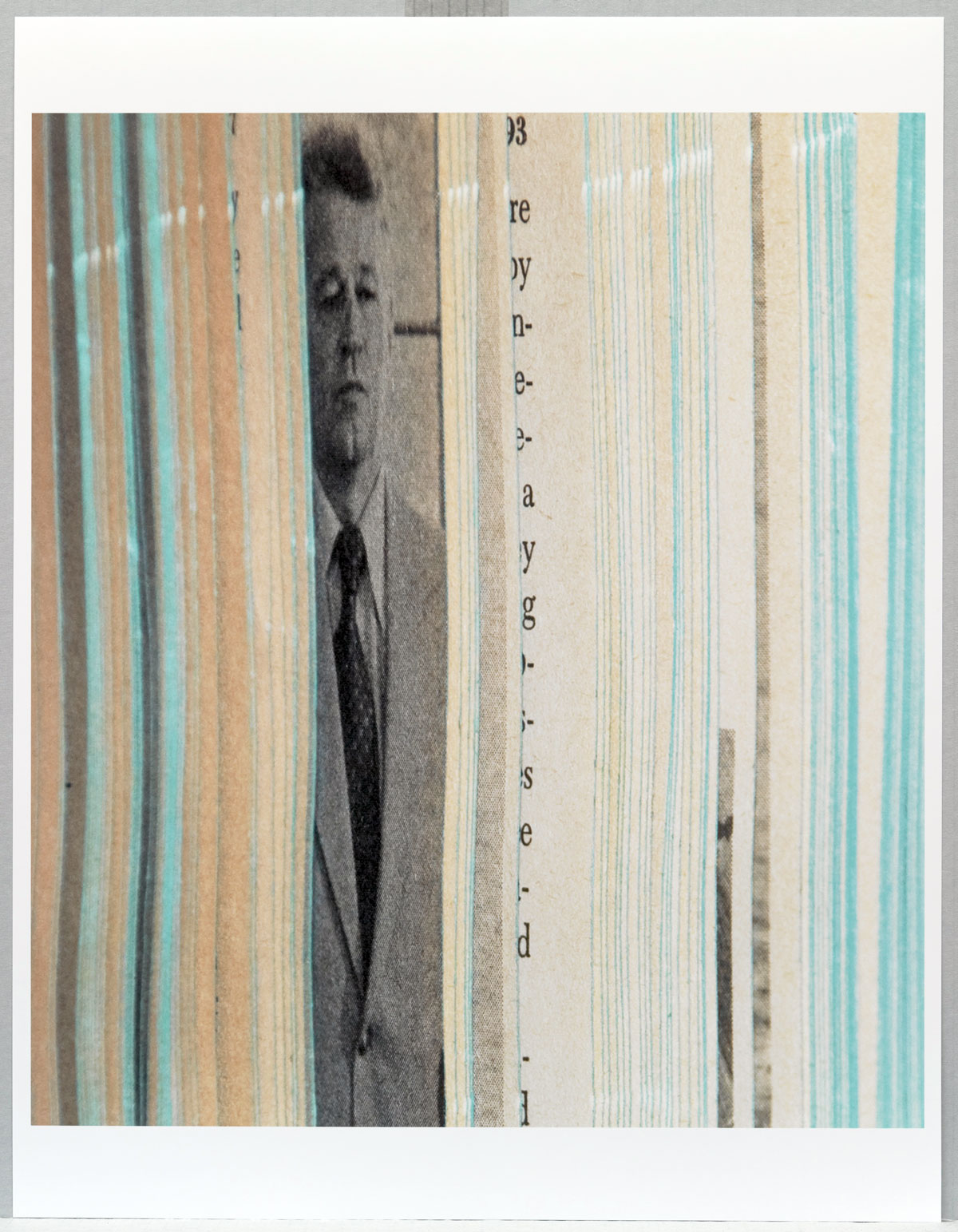
 

Erica Baum (American, b. 1961) 'Jaws' (from the series 'Naked Eye'), 2008


Erica Baum (American, b. 1961)
Jaws (from the series Naked Eye)
2008
Inkjet print
47 x 41.6cm
Solomon R. Guggenheim Museum, New York
Purchased with funds contributed by Mr. and Mrs. Aaron M. Tighe
© Erica Baum


Baum takes the printed page as her primary subject, photographing fragments of found language at close range. Commingling image and text, her works often operate simultaneously as both photograph and poem… For the Naked Eye series (2008- ), Baum directs her camera into the partially opened pages of stipple-edged paperbacks from the 1960s and ’70s, capturing slivers of image and text separated by the vertical striations of adjacent pages’ brightly dyed edges. Although the compositions are each the result of a single, unaltered photograph, they operate visually as collages and veer toward abstraction.

Text from the Guggenheim artist’s web page


Elad Lassry (Israeli-American, b. 1977) 'Bengal' 2011


Elad Lassry (Israeli-American, b. 1977)
Bengal
2011
Chromogenic print in painted frame
36.8 x 29.2 x 3.8cm
A.P. 1/2, edition of 5
Solomon R. Guggenheim Museum, New York, Purchased with funds contributed by the Photography Committee
© Elad Lassry. Photo: Kristopher McKay © Solomon R. Guggenheim Foundation


Elad Lassry (Israeli-American, b. 1977) 'Untitled (Woman, Blond)' 2013


Elad Lassry (Israeli-American, b. 1977)
Untitled (Woman, Blond)
2013
Chromogenic print in walnut frame with four-ply silk
36.8 x 29.2 x 3.8cm
Solomon R. Guggenheim Museum, New York
Purchased with funds contributed by the Photography Committee
© Elad Lassry


Lassry positions his photographic works as “pictures,” entities that operate simultaneously as both objects and images. In doing so, he shifts their relationship to the viewer, inviting a broader examination of how photographs are seen and understood.

Lassry regularly presents his photographs in lacquered frames that match the colours of his bright, saturated images, or in warm walnut frames in the case of his work in black and white. The artist used this approach as early as 2008, in works such as Wolf (Blue) (2008). The continuity between frame and photo, heightened by the absence of matting, highlights the physicality of the picture without disrupting the illusion of depth in the photographic image. Lassry’s pictures derive from his own studio-based photographs as well as appropriated imagery. In both cases, the images reference the language of advertising and stock photography – and the attendant notions of desire therein. However, the would-be product is either obscured or excluded, removing the sense of purpose that drives such imagery. The artist sometimes employs techniques such as double exposure, blurring, superimposition, or collage that create an unsettling instability within his pictures. In more recent works, Lassry has incorporated sculptural elements, most often silk valances that cover significant sections of the image, as in Untitled (Woman, Blond) (2013), or looping coloured wires that penetrate it, as in Untitled (Dolphins, Two) (2014).

Text from the Guggenheim artist’s web page


Leslie Hewitt (American, b. 1977) 'Riffs on Real Time (3 of 10)', 2006-2009


Leslie Hewitt (American, b. 1977)
Riffs on Real Time (3 of 10)
2006-09
Chromogenic print
76.2 x 61cm
Solomon R. Guggenheim Museum, New York
Purchased with funds contributed by the Photography Committee


Commingling photography and sculpture, Hewitt’s works often present arrangements of personally and politically charged materials – including historically significant books and magazines from the 1960s and ’70s as well as family photos (not necessarily her own) – that conjure associative meaning through juxtaposition.

In Hewitt’s series Riffs on Real Time (2006-2009), snapshots lay atop appropriated printed matter shot against a wood floor or carpet so that the contrasting textures of these layered materials build up and outward toward the viewer. In Hewitt’s various photo-sculptural series, the photographs begin to pointedly inhabit the space of the viewer. Positioned on the floor, their frames lean against the gallery walls, asserting their own materiality and calling attention to the space of the gallery.

Text from the Guggenheim artist’s web page


Solomon R. Guggenheim Museum
1071 5th Avenue (at 89th Street)
New York

Opening hours:
Sunday – Friday 11am – 6pm
Saturday 11am – 8pm
Solomon R. Guggenheim Museum website

LIKE ART BLART ON FACEBOOK

Back to top

Exhibition: ‘After the Gold Rush: Contemporary Photographs from the Collection’ at The Metropolitan Museum of Art, New York

Exhibition dates: 22nd March, 2011 – 2nd January, 2012


Many thankx to The Metropolitan Museum of Art, New York for allowing me to publish the photographs in the posting. Please click on the photographs for a larger version of the image.


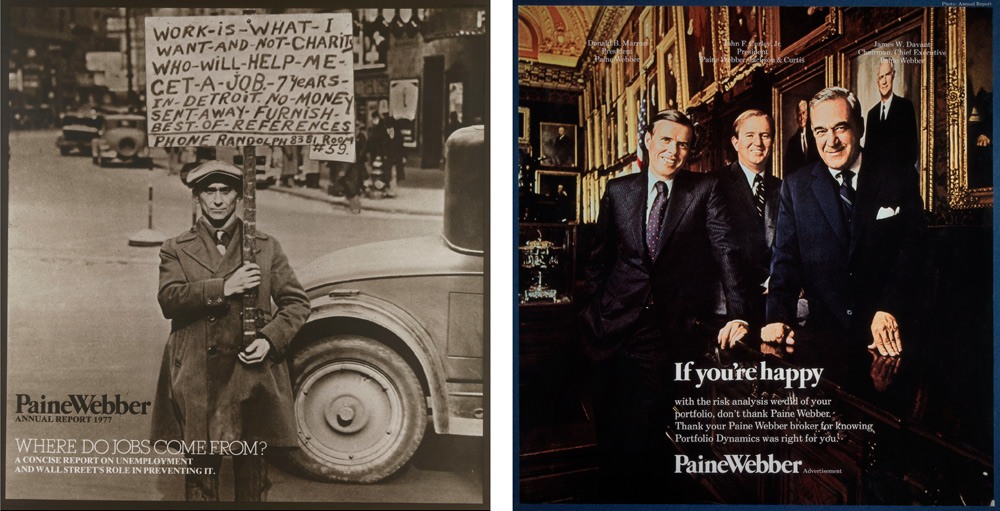
Hans Haacke (German, born 1936). 'Thank You, Paine Webber' 1979


Hans Haacke (German, b. 1936)
Thank You, Paine Webber
1979
Gelatin silver print and chromogenic print
The Metropolitan Museum of Art
Purchase, Vital Projects Fund Inc. Gift, through Joyce and Robert Menschel, 2010
© Hans Haacke


Since the early 1970s Haacke has taken on the intertwined political and corporate forces that use cultural patronage as a smokescreen to advance interests that are often antithetical to the vitality of free speech and expression in democracies. Haacke made this work just as the strategy of appropriation – lifting an image out of its original context and re-presenting it in critical fashion – began to make waves in the New York art world of the late 1970s. Like all effective appropriation, it exposes a prior instance of borrowing – in this case, how the investment firm Paine Webber used a documentary photograph to give its annual report the veneer of social concern. The artist then pointedly contrasted it with an image from the same annual report of a beaming trio of executives in a painting-lined gallery. As a counterpoint to the protestor’s signboard, Haacke dropped in text from a different Paine Webber ad campaign to show on whose backs the “risk management” is taking place – a biting indictment, the relevance of which has only increased since the recent economic downturn.

Wall text


Jeff Wall (Canadian, born 1946). 'The Storyteller' 1986


Jeff Wall (Canadian, b. 1946)
The Storyteller
1986
Silver dye bleach transparency in light box
The Metropolitan Museum of Art
Purchase, Charlene and David Howe, Henry Nias Foundation Inc., Jennifer and Robert Yaffa, Harriet Ames Charitable Trust, and Gary and Sarah Wolkowitz Gifts, 2006
Image courtesy of the artist
© Jeff Wall


Wall’s staged tableaux straddle the worlds of the museum and the street. His subjects are scenes of urban and suburban disarray that he witnessed firsthand – the kinds of things anyone might see while wandering around a city and its outskirts. Working like a movie director, he restages the scene using nonprofessionals as actors and presents his photographs as colour transparencies in light boxes such as those of large-scale public advertisements found at airports and bus stops. The scale and ambition of his pictures – scenes of everyday life shot through with larger intimations of political struggle – equally evoke the Salon paintings of nineteenth century French painters such as Gustave Courbet and Édouard Manet, which were themselves brazen combinations of canonical and contemporary subjects.

The Storyteller is set in a barren, leftover slice of land next to a highway overpass in Vancouver, where the artist lives. Various groupings of modern urban castaways – perhaps descendants of the Native Americans who occupied the land before the arrival of Europeans – are dispersed around the hillside, a mini-catalogue of art-historical reference. Like the upside-down, half-submerged figure of Icarus in the background of Brueghel’s Landscape with the Fall of Icarus, the woman speaking and gesticulating to the two men listening at the lower left becomes the key to unifying the fractured and alienating environment from which Wall’s picture is constructed.

Wall text


Laurie Simmons (American, b. 1949). 'Walking Gun' 1991


Laurie Simmons (American, b. 1949)
Walking Gun
1991
Gelatin silver print
The Metropolitan Museum of Art
Purchase, Anonymous Gift, 1998
© Laurie Simmons


The early 1990s marked the last moment when a wide swath of women artists responded to the sexism they saw as pervasive in the culture – from the rape trial of William Kennedy Smith to the Supreme Court nomination hearings for Clarence Thomas. A pioneer of set-up photography, Simmons dramatically expanded the scale of her constructed tableaux for a series of spotlighted puppet-like objects perched atop doll legs: revolvers, houses, cameras, and cakes. This armed and dangerous example refers to the old-movie cliché where a man carrying a gun is shown in shadow profile. Here, Simmons offers instead the death-dealing seductress – also familiar from film noir – in monumental miniature, a doll capable of turning on its master at a moment’s notice.

Wall text


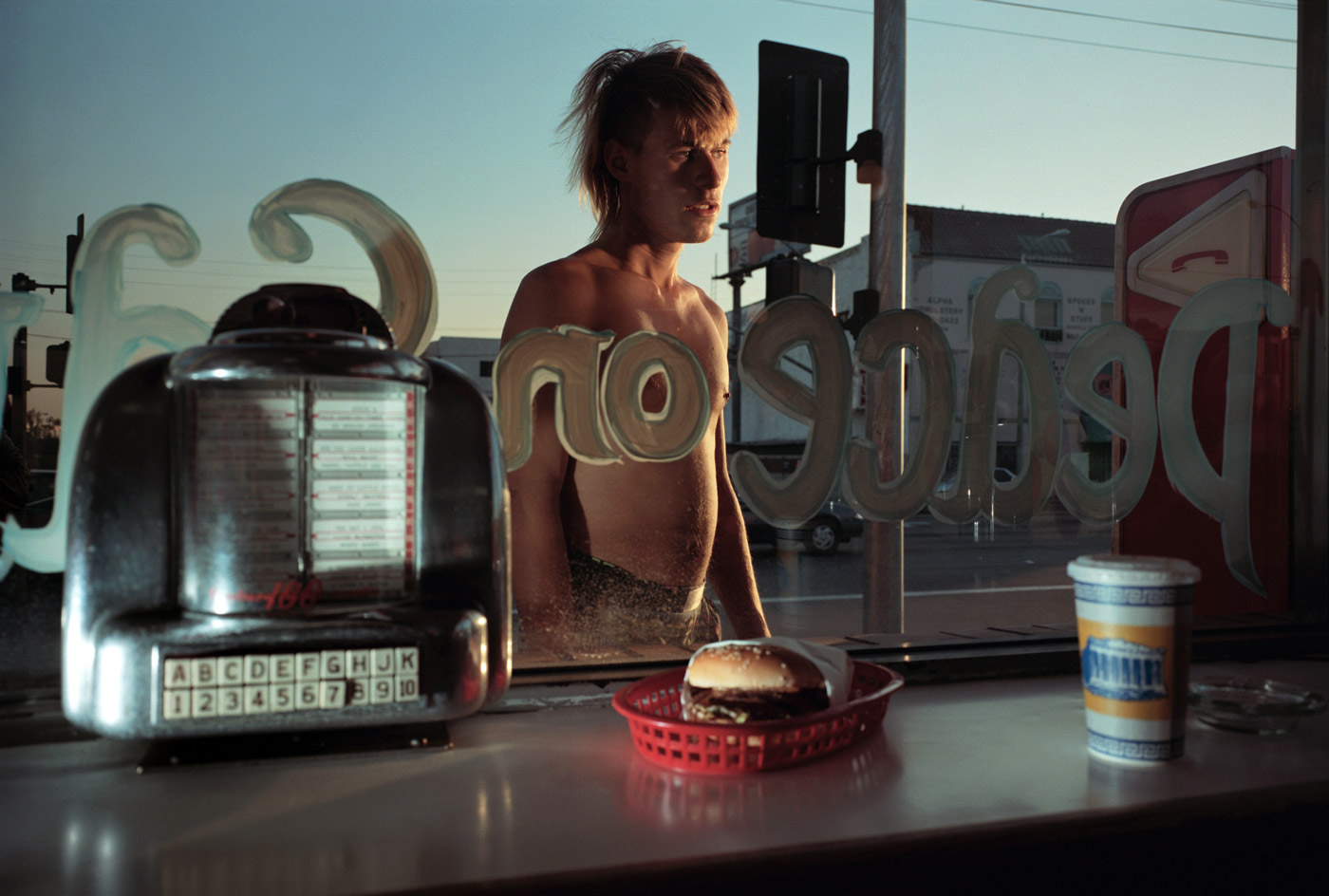
Philip-Lorca diCorcia (American, b. 1953). 'Todd M. Brooks, 22 Years Old, from Denver, Colorado, $40' 1991


Philip-Lorca diCorcia (American, b. 1953)
Todd M. Brooks, 22 Years Old, from Denver, Colorado, $40
1991
Chromogenic print
The Metropolitan Museum of Art
Purchase, The Horace W. Goldsmith Foundation Gift, through Joyce and Robert Menschel, 1991
Image courtesy the artist and David Zwirner, New York
© Philip-Lorca diCorcia


In the middle of the 1990’s, diCorcia gained international recognition for his large color photographs of street scenes and passersby. For an earlier series, he traveled to Los Angeles on a fellowship from the National Endowment for the Arts, and worked on a part of Santa Monica Boulevard frequented by male prostitutes and drug addicts. For each picture he made there, he carefully composed his setting, then asked young men to pose for him, giving them a small fee (from twenty to fifty dollars) that was negotiated each time.

At that time, NEA support of artists such as Robert Mapplethorpe was highly controversial, and diCorcia had to sign a document stating that he would not produce any “obscene” work while on his fellowship. He set up the whole negotiating procedure as a symbolic way of sharing his grant with people whose behavior would surely have been condemned by the censors. The titles always mention the name, the age and the origin of the model, as well as the amount paid. The staged situation interacts with the raw reality of the exchange of money, blurring the boundaries between documentary and fiction, yet preserving an authentic emotional charge.

Text from The Metropolitan Museum of Art website


Philip-Lorca diCorcia (American, b. 1953) 'Eddie Anderson, 21 Years Old, from Houston, Texas, $20' 1991


Philip-Lorca diCorcia (American, b. 1953)
Eddie Anderson, 21 Years Old, from Houston, Texas, $20
1991
Chromogenic print
Image: 39.2 x 57.8 cm (15 7/16 x 22 3/4 in.)
The Metropolitan Museum of Art
Purchase, The Horace W. Goldsmith Foundation Gift, through Joyce and Robert Menschel, 1991
Image courtesy the artist and David Zwirner, New York
© Philip-Lorca diCorcia


The Metropolitan Museum of Art will present After the Gold Rush: Contemporary Photographs from the Collection from March 22, 2011, through January 2, 2012, in the Joyce and Robert Menschel Hall for Modern Photography. Drawn entirely from the Museum’s permanent collection, the exhibition features 25 photographs dating from 1979 to the present by 15 contemporary artists.

The exhibition’s title, After the Gold Rush, is taken from a classic 1970 song by Neil Young, whose verses contrast a romanticised past with a present of squandered plenty and an uncertain future. Inspired by the recent political and economic upheavals in America and abroad, this selection juxtaposes new photographs that take the long view of the world’s current condition with prescient works from the 1980s and 1990s that remain startlingly relevant today.

This is the first occasion for the Museum to present recently acquired works by: Gretchen Bender, James Casebere, Moyra Davey, Katy Grannan, Hans Haacke, An-My Lê, Curtis Mann, Trevor Paglen, and Wolfgang Tillmans. Also featured are photographs by: Philip-Lorca diCorcia, Robert Gober, Adrian Piper, Laurie Simmons, Jeff Wall, and Christopher Williams.

After the Gold Rush begins with Hans Haacke’s Thank You, Paine Webber (1979) – the first work by this legendary provocateur of Conceptual art to enter the Metropolitan’s collection. Haacke’s biting photo-diptych is so pertinent to the recent economic downturn that it seems as if it could have been made yesterday. In this work, the artist appropriated images from the investment firm’s annual report to convey his viewpoint that big business provides a veneer of social concern to mask the brutal effects of the “risk management” they offer their clients.

Other works in After the Gold Rush use varying degrees of artifice and photographic realism to reflect on marginalised and repressed voices. Measuring over 14 feet long and presented as a backlit transparency in a light box, The Storyteller (1986) is Jeff Wall’s signature image and is typical of his method. Working from memory, the artist uses nonprofessional actors and real locations to meticulously restage a scene of urban blight that he witnessed in his native Vancouver. Wall plays this photographic verisimilitude against compositions and figural poses indebted to French painters such as Gustave Courbet, Edouard Manet, and Georges Seurat. A comparison of Wall’s Storyteller with Courbet’s Young Ladies of the Village (1852), on view in the Museum’s galleries for Nineteenth and Early Twentieth-Century European Paintings and Sculpture, reveals parallels: in both, a keenly observed moment of telling social interaction taking place on a sloping landscape. Each artist has combined a daringly modern subject with references to earlier art.

Philip-Lorca diCorcia is another key figure in the development of staged photography. In the early 1990s, the artist created a series of works in response to the political attacks on gays and federal funding of the arts in the U.S. DiCorcia hired male hustlers to pose for their portraits out on the streets – and paid them with grant money he received from the National Endowment for the Arts. At the same moment, a wide swath of women artists addressed issues of sexism and racism: examples of this politically pointed art are represented by Laurie Simmons’ Walking Gun (1991) – a spotlighted puppet of doll legs and a revolver that seems capable of turning on its master at a moment’s notice – and Adrian Piper’s 1992 work Decide Who You Are #24 (A Moving Target), which includes a childhood image of Anita Hill as part of a blistering meditation in word and image on racial politics. Such works are missives from a time not so long ago when artists regularly commented on present-day politics and culture through their art. (Because of light sensitivity, this work by Adrian Piper will be on view through Sunday, September 26.)

Although the recently made photographs in After the Gold Rush seem at first glance to be less overtly political than their predecessors, they nevertheless address vital issues about contemporary society. James Casebere’s epic vision of America, Landscape with Houses (Dutchess County, NY) #1, (2009), is based on a tabletop model that the artist spent 18 months building. The photograph shows a suburban subdivision of the kind recently ravaged by the foreclosure crisis, and its sunny sense of “Morning in America” comments ironically on the country’s future prospects. An-My Lê’s similarly sweeping five-part photographic piece Suez Canal Transit, USS Dwight Eisenhower, Egypt (2009) will also be featured. Lê is interested in the way in which U.S. armed forces come into contact with the rest of the world. This major new work – which seems at first to be a straightforward panorama of military might overseas – subtly undercuts the viewer’s expectations to question the current position of the U.S. on the global stage.

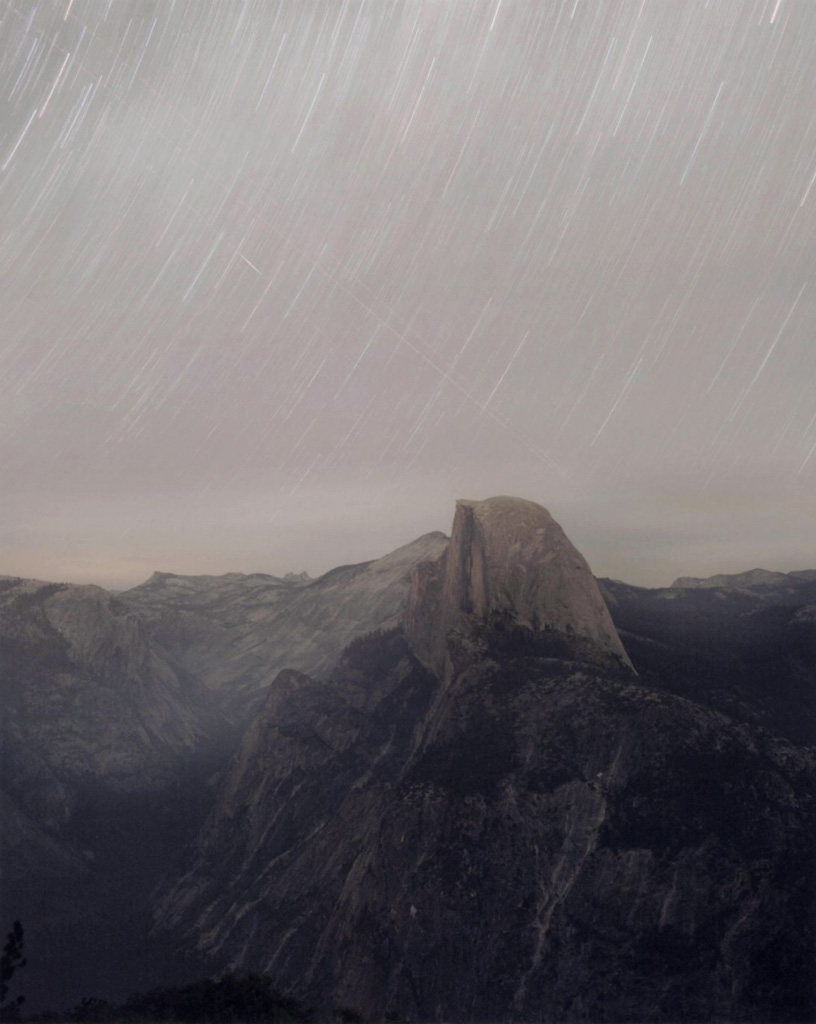
Trevor Paglen is a young artist whose works plot the “black world” of covert military operations, from telephoto images of predator drones taken from miles away, to software that follows planes used for the extraordinary rendition of suspected terrorists. Paglen’s 2008 photograph KEYHOLE IMPROVED CRYSTAL from Glacier Point (Optical Reconnaissance Satellite; USA 186) shows the ghostly white streak of an American reconnaissance satellite bisecting star trails above Yosemite’s Half Dome, a rock formation photographed in the 1860s by artists including Carleton Watkins. To make these and other photographs, Paglen collaborated with amateur astronomers who were originally trained by the U.S. government to look out for Soviet satellites during the Cold War, but turned their attention to American surveillance in recent years.

The final piece in After the Gold Rush is a suite of five recently acquired photographs from 2007-2009 by the celebrated photographer Wolfgang Tillmans. The grouping shifts focus from macro to micro: from expansive aerial views of Shanghai and Dubai to close ups that suggest the smallest increments of sustenance and regeneration. Taken together, they evoke the interconnectedness of all things and a grounding of the political in the personal as a way for an engaged yet expressive art.

Press release from The Metropolitan Museum of Art website


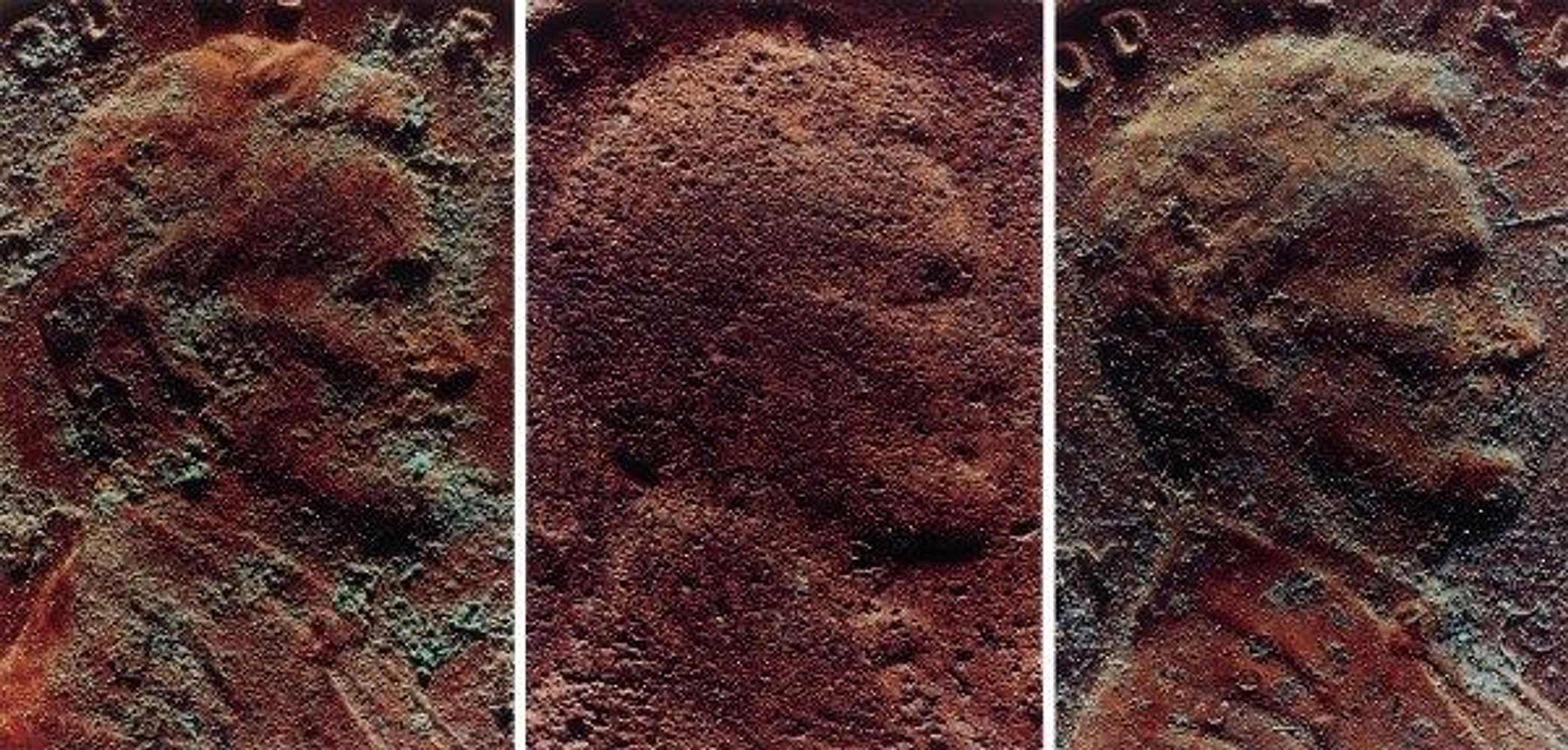
Moyra Davey (American born Canada, b. 1958) 'Copperhead Grid' 1990 (detail)


Moyra Davey (American born Canada, b. 1958)
Copperhead Grid (detail)
1990
Chromogenic prints
Image: 8 3/4 in. × 6 in. (22.3 × 15.3cm) each
Sheet: 10 × 8 in. (25.4 × 20.3cm) each
The Metropolitan Museum of Art
Purchase, Vital Projects Fund Inc. Gift, through Joyce and Robert Menschel, 2011
© Moyra Davey


It was in 1990 – at the height of a worldwide economic recession that also marked the end of the 1980s art bubble – that Davey began photographing the scratched, worn-away surfaces of pennies, the most devalued and lowest form of currency. Her accumulation of one hundred micro-photographic specimens is constructed around the readymade patterns of decay that countless anonymous owners have unconsciously wrought upon their surfaces; their base materiality is incisively contrasted with the most elevated of national symbols. As with all of Davey’s work, there is a melancholic sense of loss that connects subject and form: like pennies, photographs are objects of exchange imprinted by contact with the world around them.

Text from The Metropolitan Museum of Art website


Adrian Piper (American, born 1948). 'Decide Who You Are #24: A Moving Target' 1992


Adrian Piper (American, b. 1948)
Decide Who You Are #24: A Moving Target
1992
Photo-mechanical processes on three panels
The Metropolitan Museum of Art
Gift of Peter Norton Family Foundation, 1994
© Adrian Piper


Piper is an artist and a philosophy professor who works in a variety of media, including performance, video, sound pieces, photography, drawing, and writing. She often explores issues of autobiography, racism, and stereotyping. For her 1992 series Decide Who You Are, the artist used a triptych format in which a different appropriated photograph is flanked by an image of the “three wise monkeys” maxim advocating “See No Evil, Speak No Evil, Hear No Evil” at left, and at right a photograph of a young girl who, though not identified, is Anita Hill – who had recently been thrust into the spotlight for accusing then-nominee for Supreme Court Justice Clarence Thomas of sexual harassment. The verse in the left panel changes in each individual work in the series, while that on the right is unchanging – what the artist once described as “a comprehensive, textbook compendium of commonly invoked litanies of denial and intimidation, from the bland to the vaguely menacing” and “a must for novices and aspiring leaders in business, politics, and culture.”

Wall text


Christopher Williams (American, b. 1956). '3 White (DG's Mr. Postman) Fourth Race, Phoenix Greyhound Park, Phoenix, Arizona, August 22, 1994' 1994


Christopher Williams (American, b. 1956)
3 White (DG’s Mr. Postman) Fourth Race, Phoenix Greyhound Park, Phoenix, Arizona, August 22, 1994
1994
Gelatin silver print
The Metropolitan Museum of Art
Purchase, Charina Foundation Inc. and Jennifer and Joseph Duke Gifts, 2003
© Christopher Williams


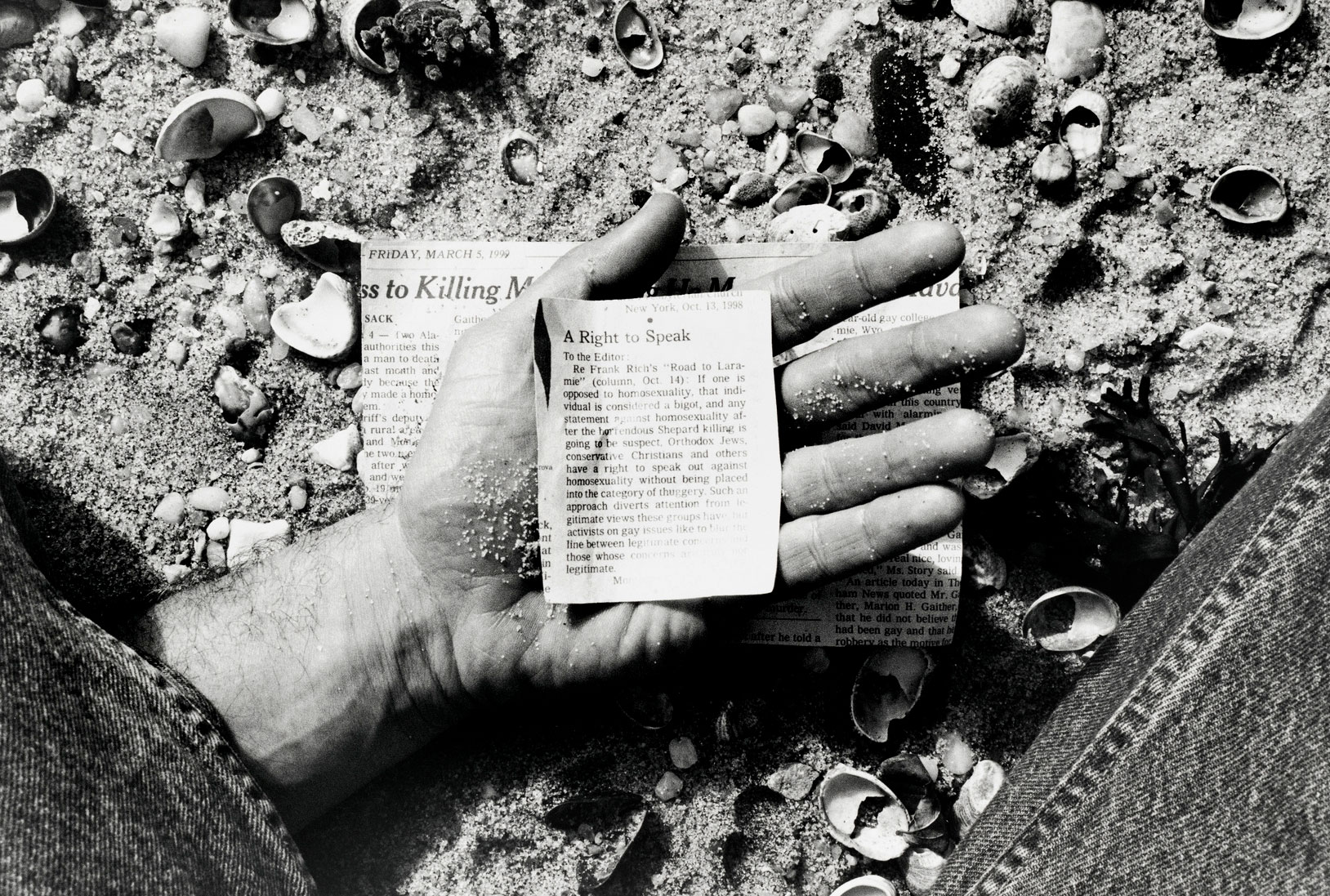
Robert Gober (American, b. 1954) 'Page 12 / Untitled (Detail from 1978-2000)' 1978-2000


Robert Gober (American, b. 1954)
Page 12 / Untitled (Detail from 1978-2000)
1978-2000
Gelatin silver print
40.6 x 50.8cm (16 x 20 in.)
The Metropolitan Museum of Art
Purchase, Charina Foundation Inc. Gift, 2002
© Robert Gober


Robert Gober works primarily in sculpture, installations, and photography. He is perhaps best known for his delicate, ghostly hand crafted versions of domestic fixtures, such as drains, beds, doors, and sinks. Through these uncanny replicas, Gober invests mass produced objects with personal meaning – the private, unruly desires and memories of the individual. This image appeared in the book (his first in the genre) that Gober created to accompany his installation representing the United States at the 2000 Venice Biennale. In it, the artist interweaves his own journey to New York in 1978 as a young gay man with the toxic fallout of homophobic recrimination that accompanied the murder of the Wyoming college student Matthew Shepard twenty years later.

Text from The Metropolitan Museum of Art website


Robert Gober superimposes a man’s hand between two newspaper articles, clipped neatly and placed on a shell-strewn beach. Below his hand, the article refers to Matthew Shepard’s death. Above it, a letter to the editor argues that “Orthodox Jews, conservative Christians and others have a right to speak out against homosexuality without being placed in the category of thuggery.” While the piece obviously precedes Jonathan Rauch’s provocative and important piece in the December issue of the Advocate arguing that gay people should tolerate a certain amount of anti-gay sentiment as a sign that they’re legally and socially secure enough to practice tolerance, it’s a useful encapsulation of the dilemma behind that argument. It’s hard to cast off past threats if you’re not entirely sure they’re past.

Alyssa Rosenberg. “Gay Americans, Censorship, And ‘After The Gold Rush’ At The Metropolitan Museum Of Art,” on the Think Progress website November 28, 2011 [Online] Cited 11/12/2024


Robert Gober (American, b. 1954). 'Untitled (Detail from "1978-2000")' 2000


Robert Gober (American, b. 1954)
Untitled (Detail from “1978-2000”)
2000
Gelatin silver print
The Metropolitan Museum of Art
Purchase, Jennifer and Joseph Duke Gift, 2002
© Robert Gober


James Casebere (American, b. 1953). 'Landscape with Houses (Dutchess County, NY) #1' 2009


James Casebere (American, b. 1953)
Landscape with Houses (Dutchess County, NY) #1
2009
Chromogenic print
The Metropolitan Museum of Art
Purchase, Alfred Stieglitz Society Gifts, 2011
© James Casebere


Trevor Paglen (American, b. 1974) 'KEYHOLE IMPROVED CRYSTAL from Glacier Point (Optical Reconnaissance Satelltte; USA 186)' 2008


Trevor Paglen (American, b. 1974)
KEYHOLE IMPROVED CRYSTAL from Glacier Point (Optical Reconnaissance Satelltte; USA 186)
2008
Chromogenic print
Image: 95.3 x 76.2cm (37 1/2 x 30 in.)
Frame: 96.5 × 77.5cm (38 × 30 1/2 in.)
The Metropolitan Museum of Art
Purchase, Vital Projects Fund Inc. Gift, through Joyce and Robert Menschel, 2011
© Trevor Paglen


Trained as a geographer, Paglen is an artist who plots the topography of a new global and celestial space – the “black world” of covert military operations. Examples of his subjects include the supposed sites used for the extraordinary rendition of prisoners, which he shoots with specially designed cameras from up to forty miles away, and the network of private planes used to transport them under the radar. This image shows the ghostly white streak of an American reconnaissance satellite bisecting star trails above Yosemite’s Half Dome, a rock formation photographed in the 1860s by the photographer Carleton Watkins when the West was still being explored. In order to track such spacecraft, Paglen uses a database created by amateur astronomers who were trained by the U.S. government to search the skies for Soviet sputniks but continued their hobby after the end of the Cold War by tracking our own satellites. In this work, the artist brings into one composition two historically disparate moments in geographic and celestial colonisation.

Text from The Metropolitan Museum of Art website


Wolfgang Tillmans (German, b. 1968).' Oriental Pearl' 2009


Wolfgang Tillmans (German, b. 1968)
Oriental Pearl
2009
Inkjet print
The Metropolitan Museum of Art
Purchase, Vital Projects Fund Inc. Gift, through Joyce and Robert Menschel, 2010
Image courtesy the artist and Andrea Rosen Gallery, New York
© Wolfgang Tillmans


The Metropolitan Museum of Art
1000 Fifth Avenue at 82nd Street
New York, New York 10028-0198
Phone: 212-535-7710

Opening hours:
Sunday – Tuesday and Thursday: 10am – 5pm
Friday and Saturday: 10am – 9pm
Closed Wednesday

The Metropolitan Museum of Art website

LIKE ART BLART ON FACEBOOK

Back to top