Exhibition: ‘Weegee. Autopsy of the Spectacle’ at Fundación MAPFRE, Madrid

Exhibition dates: 19th September, 2024 – 5th January, 2025

Curator: Exhibition curated by Clément Chéroux, director of the Fondation Henri Cartier-Bresson.


Weegee (Arthur Fellig) (American born Ukraine, 1899-1968) 'Self-Portrait with Speed Graphic Camera' October 13th 1950 from the exhibition 'Weegee. Autopsy of the Spectacle' at Fundacion Mapfre, Madrid Sept 2024 - January 2025


Weegee (Arthur Fellig) (American, 1899-1968)
Self-Portrait with Speed Graphic Camera
October 13th 1950
Gelatin-silver print
© International Center of Photography. Collection Friedsam


Self Seen

I’ve posted on this exhibition once before when it was shown at the Foundation Henri Cartier-Bresson, Paris. While there some photographs that are the same in both postings there are new photographs to admire here. So, let’s have some fun with the text!

I started playing around with ideas in my head… and instead of the “autopsy of the spectacle” – an examination to discover the cause of the spectacle – I inverted that statement to make it the “spectacle of the autopsy”.

What immediately came to mind when I did this was the spectacle, the spectacular, painting that is Rembrandt’s early masterpiece The Anatomy Lesson of Dr. Nicolaes Tulp (1632, below), that tableau – French, late 17th century (in the sense ‘picture’, figuratively ‘picturesque description’) – of figures, spectators, gathered around the corpse of the “criminal Aris Kindt (alias of Adriaan Adriaanszoon), who was convicted for armed robbery and sentenced to death by hanging.”1

Fast forward a few centuries to the “Murder is my business” photographs of Arthur Fellig (alias Weegee) and I again observe spectators gathered around the body of a corpse, either physically examining it or wilfully ignoring it (Drowning victim, Coney Island c. 1940, below), where the men “examine” the drowning victim surrounded by men that stare and the women who smiles for the camera. With the crowd behind, all are physically and metaphorically drawn in to the spectacle of the autopsy and the presence of the camera. “”Spectacle is Capital to such a degree of accumulation that it becomes an image,” explained Guy Debord in 1967. Weegee understood this well.”

In other photographs such as Body of Andrew Izzo, killed by off-duty policeman Elegio Sarro (1942, below) and Body of Dominic Didato (1936, below) Weegee’s camera becomes the spectator, standing in for us as we crane our necks to get a better view of the action. Together, the camera and the viewer, perform what could be seen as a form of “necropsy” – from the Greek words nekros (meaning “corpse”) and opsis (meaning “to view”), and together they mean “to look at the dead body with naked eyes” – that is, a macroscopic examination of a dead body.

Witness, and we do stand witness in Weegee’s photographs looking at dead bodies with naked eyes, the perspectival viewpoint of the bodies of both Andrew Izzo and Dominic Didato similar to the elongated perspective in the painting by Rembrandt, the shading of the face in that painting – the umbra mortis (shadow of death) – now supplanted by the reversed body, head shaded / covered in blood, surmounted with out flung gun and boater.

While these photographs fail “to give shape to feelings of compassion, grief, horror (as if the pictorial repetition of events were a way of understanding these events, being able to live with them)”2 finally, in the derivation of the word “autopsy” – and in the spectacular images of Weegee – we may begin to understand that these photographs are as much about us, the spectator and viewer, and our discontinuous nature (we die) as they are about the pictured bodies. For the meaning of the word autopsy – early 17th century (in the sense ‘personal observation’): from modern Latin autopsia, from Greek, from autoptos ‘self-revealed’, from autos ‘self’ + optos ‘seen’ – reveals as much about ourselves as it does the object of our attention.

Looking at mortality with naked eyes, our self-revealed, our self seen, reflected back to us in the photographs of Weegee.

Dr Marcus Bunyan


1/ Anonymous. “The Anatomy Lesson of Dr. Nicolaes Tulp,” on the Wikipedia website Nd [Online] Cited 05/12/2024

2/ Leah Dickerman. “Gerhard Richter’s Enigmatic Cycle in The Long Run,” on the MoMA website March 1, 2019 [Online] Cited 05/12/2024


Many thankx to Fundación MAPFRE for allowing me to publish the photographs in the posting. Please click on the photographs for a larger version of the image.


“Weegee knew the power of imagery to speak to larger truths about human nature and society. He captured New York as it truly was: gritty, raw, and filled with contrasts. His work turned the everyday violence and chaos of the city into art, making the mundane extraordinary. In Weegee’s own words, “I picked a story that meant something.” He had an instinct for identifying moments that held deeper significance, even if they were just snapshots of daily life in a chaotic metropolis.”


Danny Dutch. “Weegee: The Lens Behind New York’s Darkest Hours,” on the Danny Dutch website Nd [Online] Cited 12/11/2024
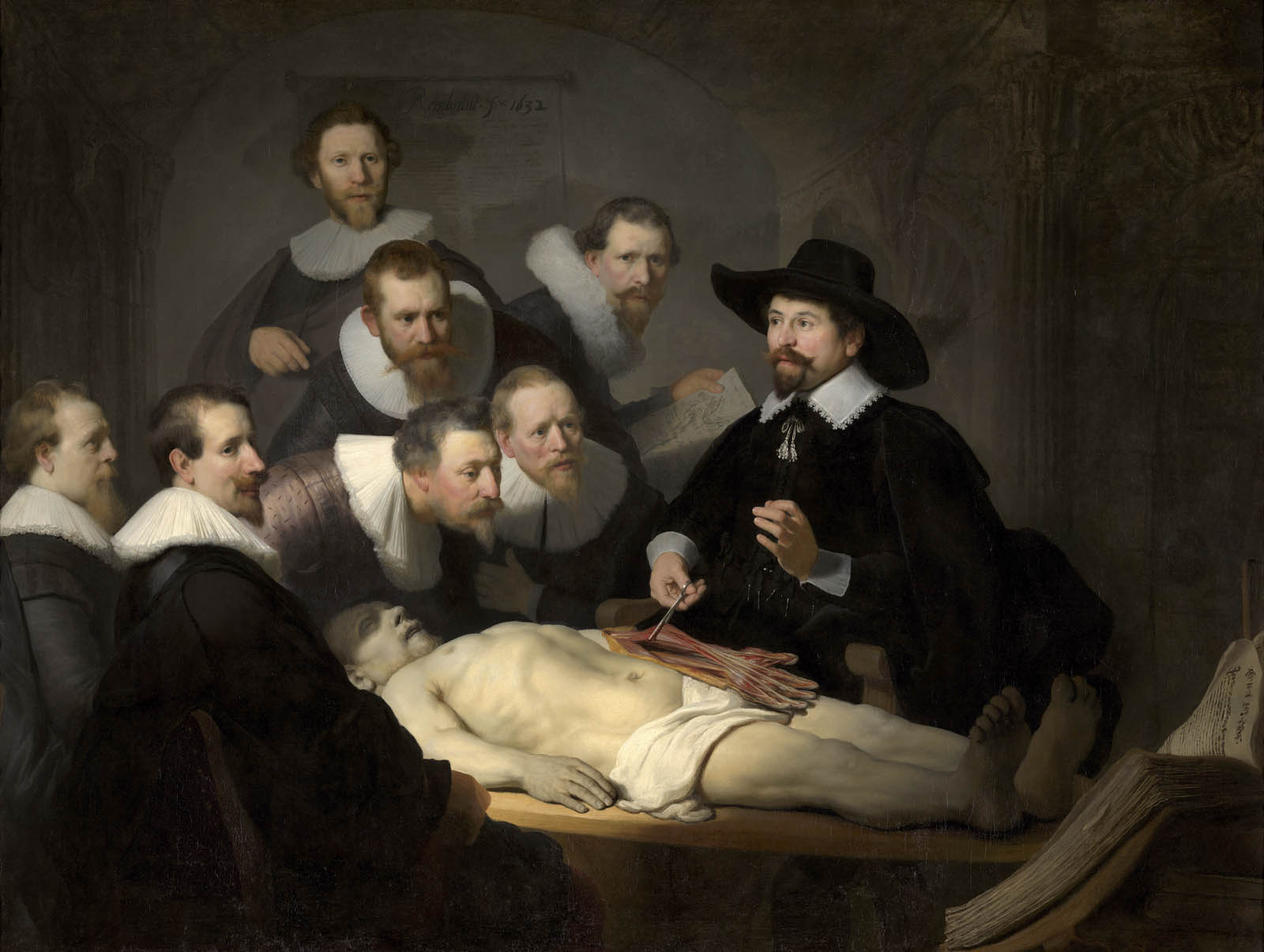


Rembrandt Harmenszoon van Rijn (Dutch, 1606-1669) 'The Anatomy Lesson of Dr. Nicolaes Tulp' 1632


Rembrandt Harmenszoon van Rijn (Dutch, 1606-1669)
The Anatomy Lesson of Dr. Nicolaes Tulp
1632
Oil on canvas
216.5cm × 169.5cm (85.2 in × 66.7 in)
Mauritshuis, The Hague
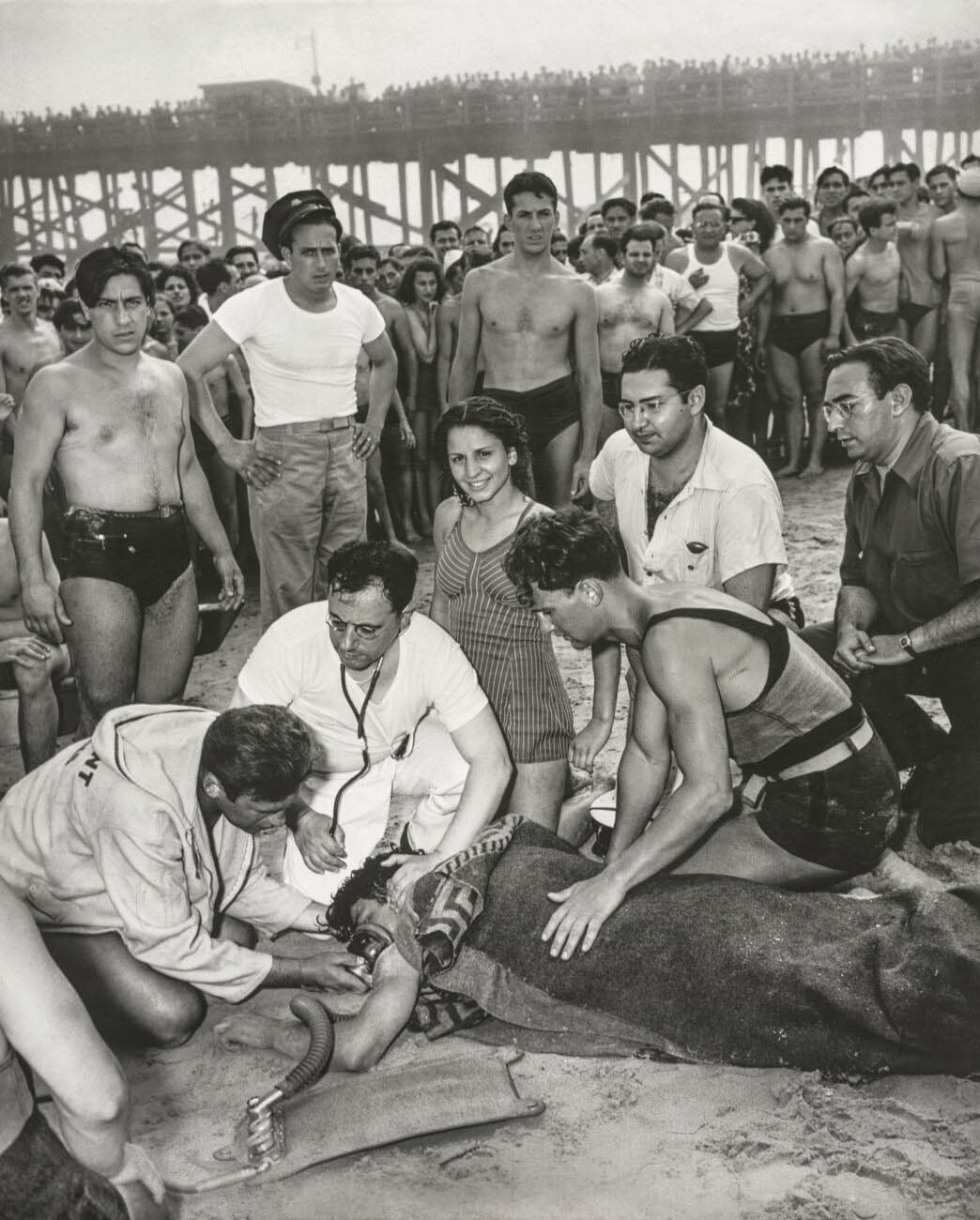
 

Weegee (American, 1899-1968) 'Drowning victim, Coney Island' c. 1940


Weegee (American, 1899-1968)
Drowning victim, Coney Island
c. 1940
Gelatin silver print
© Weegee Archive / International Center of Photography, New York / Collection Galerie Berinson, Berlin
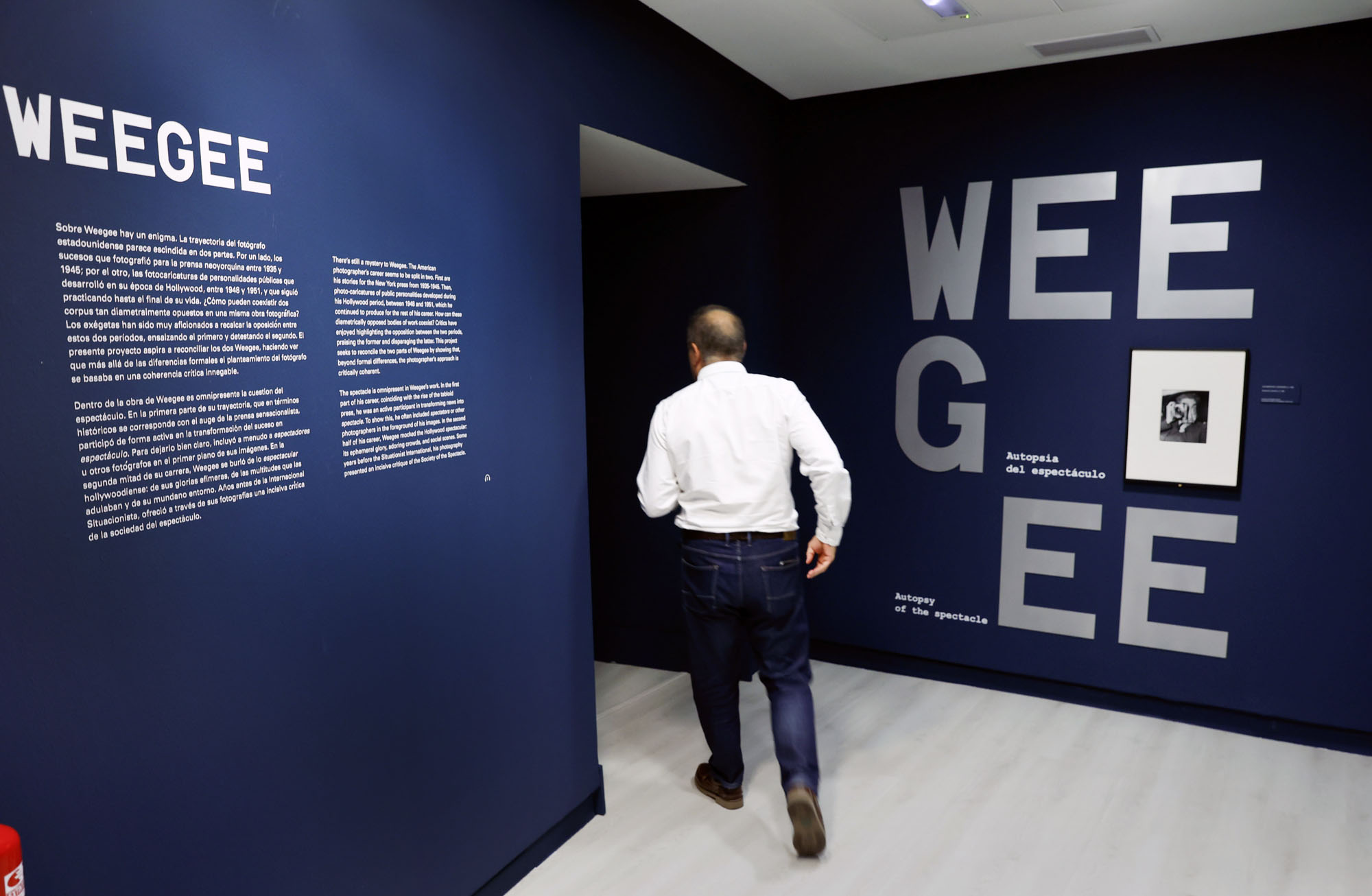
 

Installation view of the exhibition Weegee. 'Autopsy of the Spectacle' at Fundacion Mapfre, Madrid showing at right Weegee's 'Self-portrait, Distortion' (1955)


Installation view of the exhibition Weegee. Autopsy of the Spectacle at Fundación MAPFRE, Madrid showing at right Weegee’s Self-portrait, Distortion (1955, below)


Weegee (Arthur Fellig) (American born Ukraine, 1899-1968) 'Self-portrait, Distortion' 1955


Weegee (Arthur Fellig) (American born Ukraine, 1899-1968)
Self-portrait, Distortion
1955
Gelatin silver print
© International Center of Photography
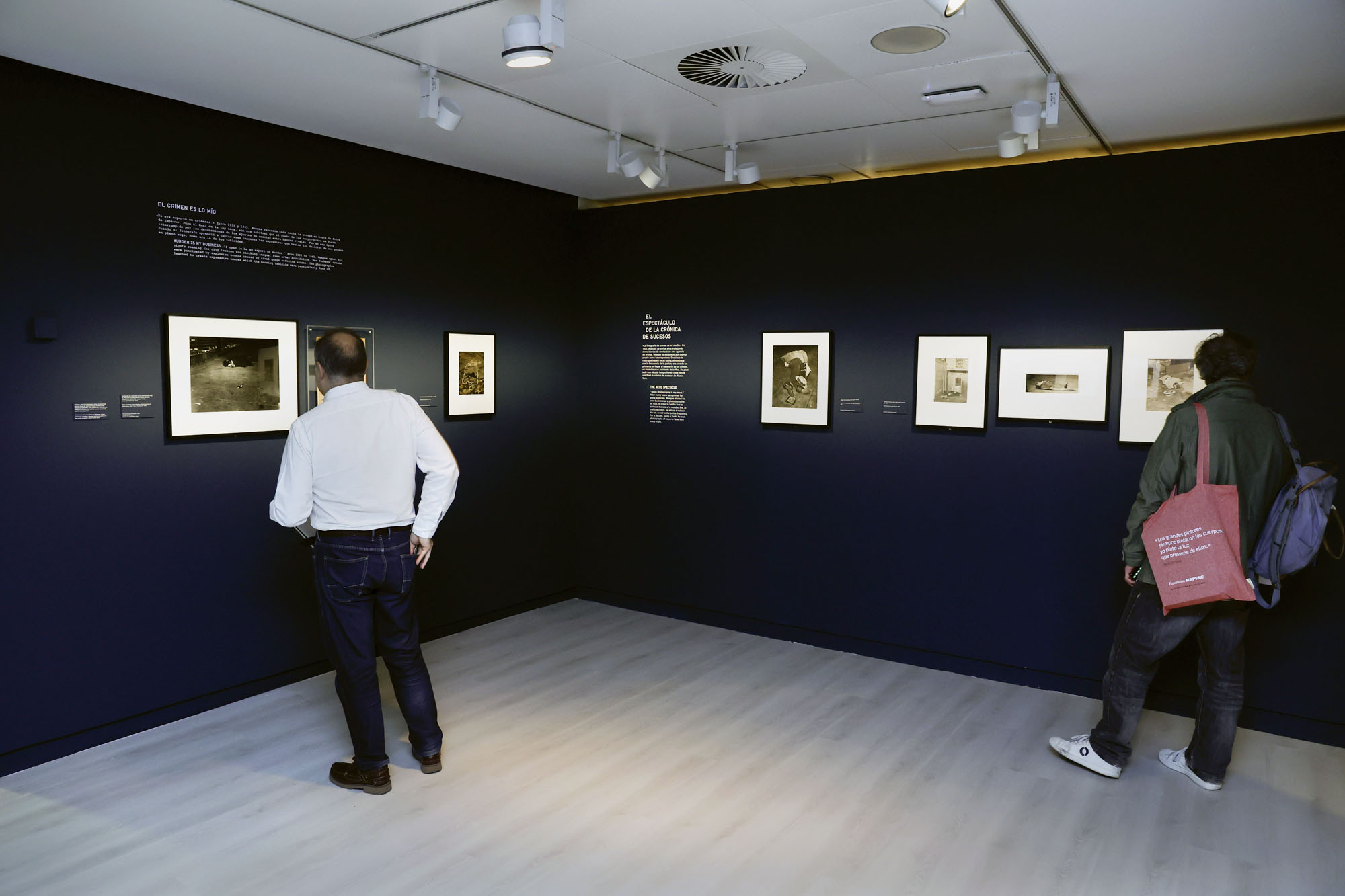
 

Installation view of the exhibition Weegee. 'Autopsy of the Spectacle' at Fundacion Mapfre, Madrid 


Installation view of the exhibition Weegee. Autopsy of the Spectacle at Fundacion Mapfre, Madrid showing at left Weegee’s Body of Andrew Izzo, killed by off-duty policeman Elegio Sarro (1942, below); at second left, [Outline of a Murder Victim] (1942);  and at right, Body of Dominic Didato, (1936, below)
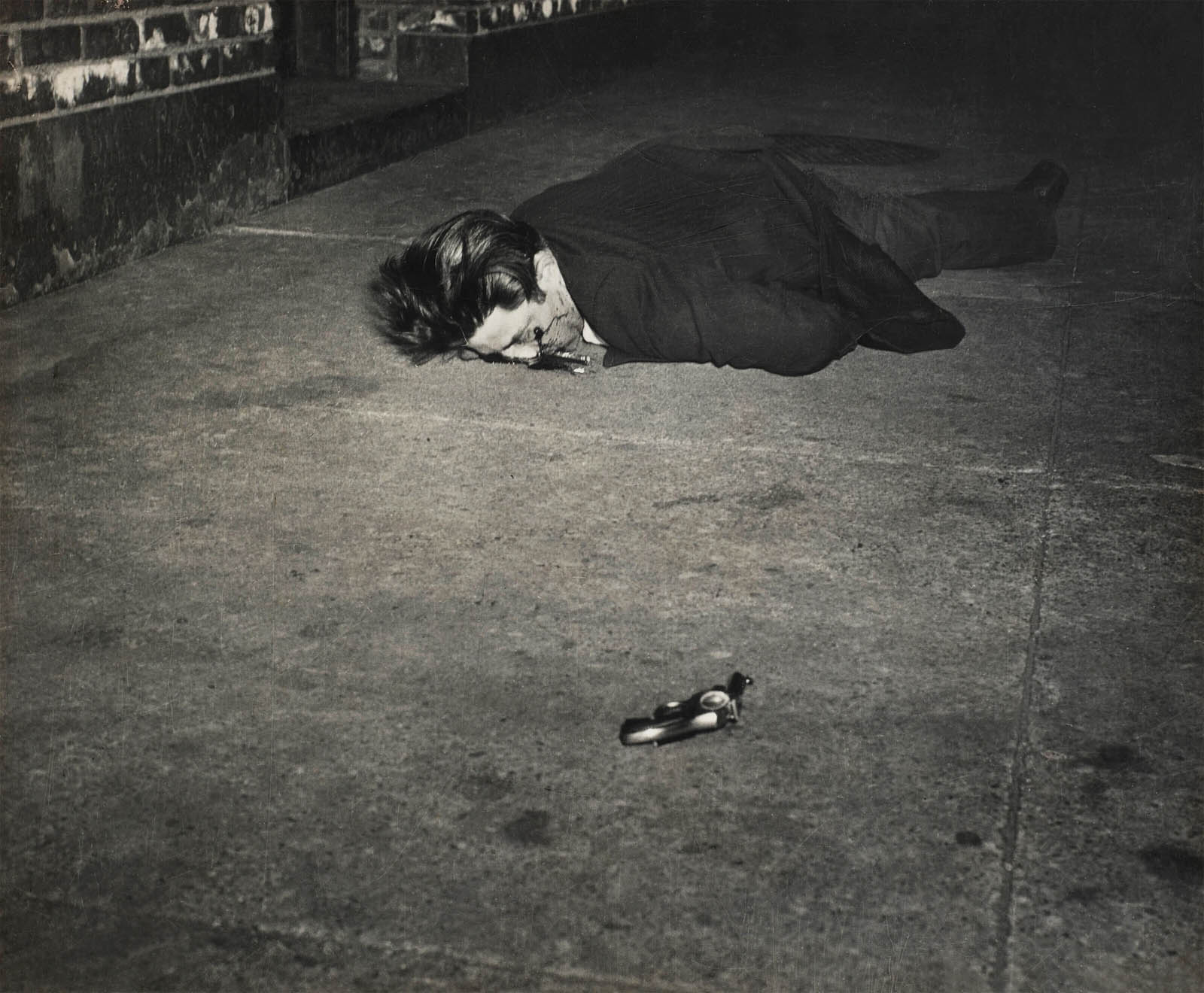
 

Weegee (Arthur Fellig) (American born Ukraine, 1899-1968) 'Body of Andrew Izzo, killed by off-duty policeman Elegio Sarro' 1942 from the exhibition 'Weegee. Autopsy of the Spectacle' at Fundacion Mapfre, Madrid Sept 2024 - January 2025


Weegee (Arthur Fellig) (American born Ukraine, 1899-1968)
Body of Andrew Izzo, killed by off-duty policeman Elegio Sarro
1942
Gelatin silver print
© International Center of Photography
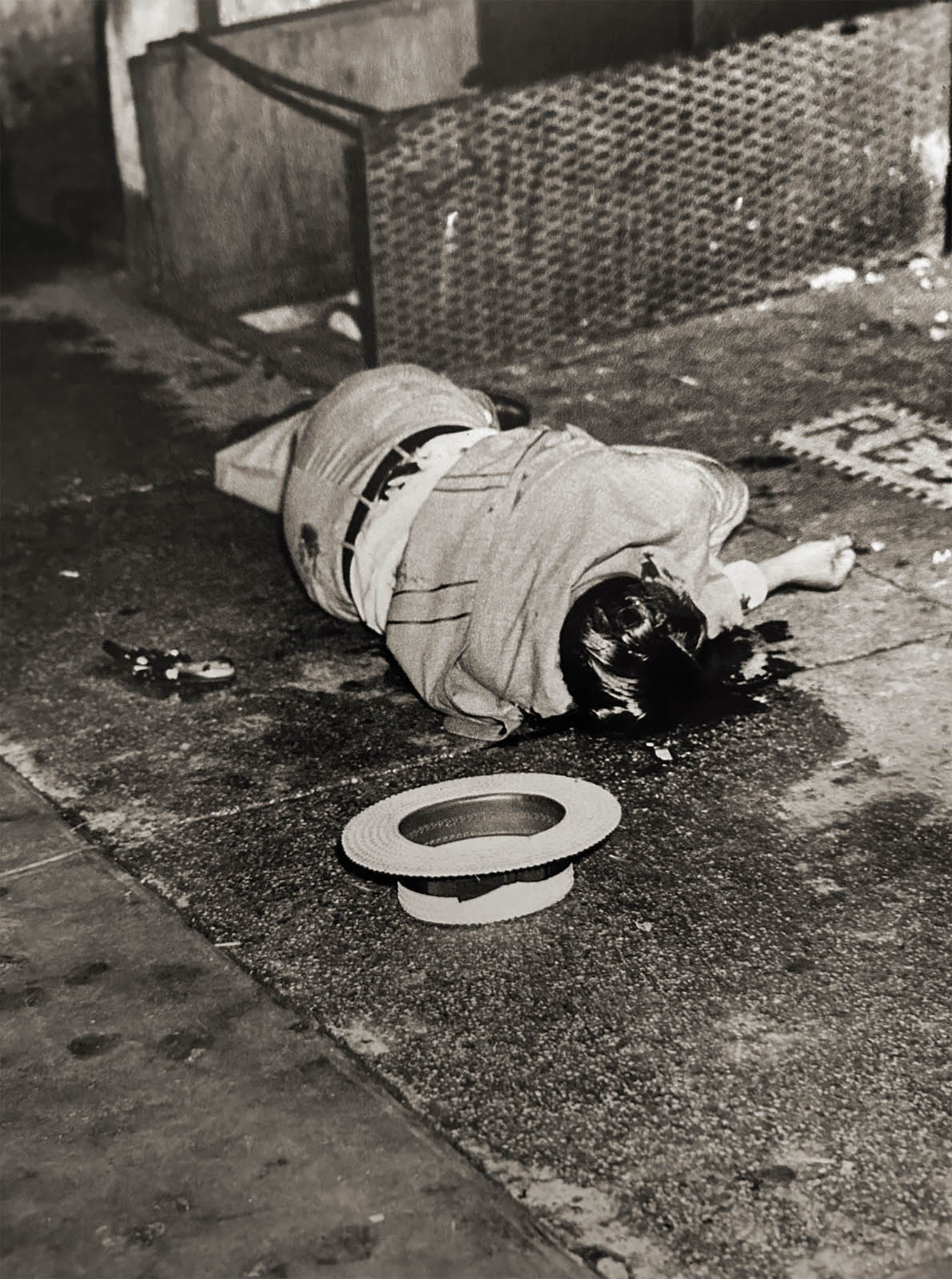
 

Weegee (Arthur Fellig) (American born Ukraine, 1899-1968) 'Body of Dominic Didato' 1936 from the exhibition 'Weegee. Autopsy of the Spectacle' at Fundacion Mapfre, Madrid Sept 2024 - January 2025


Weegee (Arthur Fellig) (American born Ukraine, 1899-1968)
Body of Dominic Didato
1936
Gelatin silver print
© International Center of Photography


Dominick Didato, aka Terry Burns, who you see above in a photo made by Arthur Fellig, aka Weegee, lies dead on a New York City street where he was gunned down today in 1936. He was killed for interfering with rackets run by Lucky Luciano. It was a low percentage play. Luciano was literally the most powerful mobster in the U.S. at the time, and as the saying goes, you come at the king, you best not miss.

Anonymous. “Urban Decay,” on the Pulp International website August 22, 2024 [Online] Cited 11/11/2024


The work of Arthur H. Fellig, known as Weegee (Zolochiv, Ukraine, 1899 – New York, 1968), is, in a sense, an enigma that this exhibition seeks to unravel. His photographs of the underworld and the fringe circles of New York nightlife in the 1930s and 1940s quickly gained wide international recognition. However, the same cannot be said for the photographs he took after settling in Hollywood in 1948: images of Californian high society and the social life of major film celebrities, whom he often portrayed in a markedly ironic or satirical manner, sometimes (as in the case of the “photocaricatures”) as a result of his later work in the laboratory. At the time, critics emphasised the radical opposition between the two periods, openly praising the former and dismissing the latter. In these photographs of his Californian experience (1948-1951), Weegee expressed his critical vision of society and culture from a perspective that anticipated the well-known cultural and social analyses of ‘the society of the spectacle’ (Guy Debord).

Weegee. Autopsy of the Spectacle aims to show the profound coherence that, beyond their stylistic and thematic differences, links these two stages, as well as to highlight the relevance of the critical perspective from which Weegee’s images expose the features and mechanisms of our time as a ‘society of the spectacle’.

Exhibition organised by the Fondation Henri Cartier-Bresson in collaboration with Fundación MAPFRE.

Text from the Fundación MAPFRE website
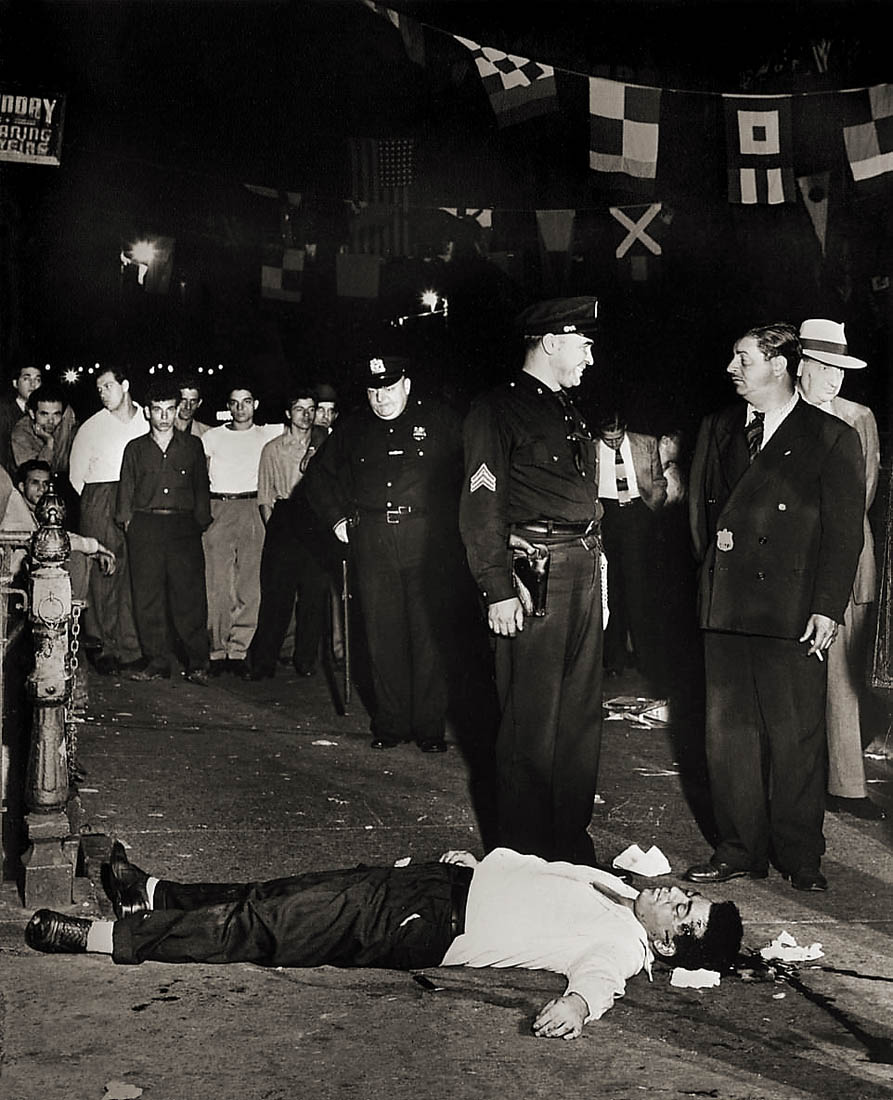
 

Weegee (Arthur Fellig) (American born Ukraine, 1899-1968) 'Police and onlookers with body of Joseph "Little Joe" La Cava, killed during the feast of San Gennaro' 1939


Weegee (Arthur Fellig) (American born Ukraine, 1899-1968)
Police and onlookers with body of Joseph “Little Joe” La Cava, killed during the feast of San Gennaro
1939
Gelatin silver print
© International Center of Photography


The above photo shows the murder scene of a mid-level gangster named Joseph “Little Joe” La Cava, and occurred in New York City on Mulberry Street at the Feast of San Gennaro today in 1939. We’ll go out on a limb and say the festive atmosphere took a fatal hit too. Luckily, the celebration usually went for a week, so we suppose it was salvaged. La Cava was gunned down along with Rocco “Chickee” Fagio… Also interesting, cops being cops, the flatfoot closest to La Cava looks incongruously jocular as he chats with a higher-up. If this wasn’t the most unforgettable Feast of San Gennaro in Little Italy’s history it had to be close.

Anonymous. “Urban Decay,” on the Pulp International website August 22, 2024 [Online] Cited 11/11/2024


Weegee (Arthur Fellig) (American born Ukraine, 1899-1968) 'Nurse Irma Twiss Epstein, accused of killing a baby' 1942


Weegee (Arthur Fellig) (American born Ukraine, 1899-1968)
Nurse Irma Twiss Epstein, accused of killing a baby
1942
Gelatin silver print
© International Center of Photography


“Distraught and pale with grief, Irma Twiss Epstein, 32-year-old nurse, whose own baby died 18 months ago, is booked on a homicide charge in the death of a baby whose crying, she said, ‘drove me crazy.’ Miss Epstein, Bronx Maternity Hospital nurse, is accused of giving a powerful drug to the 20 hour-old daughter of Mr. and Mrs. Castro Vallee, whose only other child died after birth 11 years ago. Another infant, 4 days old, was revived by nurses and doctors after Miss Epstein was found in a hallway hysterically sobbing: ‘eyedropper, baby.’ Hospital records showed she entered service there in 1940 and after nine months took a leave of absence to have a baby. Police said she had been in Bellevue’s psychopathic ward two years ago for observation after tasking an overdose of sleeping tablets. She told police at Morrisania Station she expected to be married soon.”

PM Daily, December 23, 1940 quoted on the International Center of Photography website


Weegee (Arthur Fellig) (American born Ukraine, 1899-1968) 'Harry Maxwell shot in a car' 1941


Weegee (Arthur Fellig) (American born Ukraine, 1899-1968)
Harry Maxwell shot in a car
1941
Gelatin silver print
© International Center of Photography


A pivotal figure of American photography in the first half of the twentieth century, Arthur H. Fellig, known by his pseudonym Weegee (Zolochiv, 1899 – New York, 1968) was an immensely popular artist thanks to the news photographs he took in New York in the 1930s and 1940s. This new exhibition aims to reveal a lesser-known facet of his career: the work he did between 1948 and 1951 in Hollywood, where he focused on the “society of the spectacle”.

Key themes

High-impact photographs

Some of Weegee’s photographs were veritable “visual punches”. This is true of the pictures he took of murders, corpses, fires and prisoners during the years spent covering crimes and accidents in New York, as well as of his later work, like the series showing circus artist Egle Zacchini being fired from a cannon at a speed of 100 metres per second, or his photo-caricatures of Marilyn Monroe, President Kennedy and other prominent personalities. His images almost always had a powerful impact on viewers, making them think not only about the scene they were contemplating but also about how they were looking at it.

The society of the spectacle

First published in 1967, Society of the Spectacle is one of the most important books by the philosopher Guy Debord, founding member of the Situationist International. It paints an incisive portrait of contemporary society, presumably replaced by its represented image. Throughout the work, Debord critically exposes the theory and practice of the spectacle, explaining how it governs our experience of time, history, goods, territory and happiness. In the twenty-first century, when immediacy reigns supreme, Debord’s ideas resound as the severest, most lucid assessment of the meanness and bondage of a society – the society of the spectacle – in which we all live.

Critique of the society of the spectacle

Class consciousness and empathy for the disadvantaged permeate Weegee’s work, as he never forgot his humble beginnings. Yet his most famous images are snapshots of accidents, fires and murders, in which he underscores the idea that bystanders are also spectators of the tragedies they contemplate, watching a scene in much the same way as cinema-goers watch Hollywood films (which are not all that different to the events captured by Weegee’s camera). He also used trick photography to critique the image of actors, singers, broadcasters, politicians and other public figures.

Weegee’s “satires”, as he called them, were visionary, appearing several years before the Situationist International first posited its theories. As Clement Che roux, curator of the exhibition, has pointed out, during his first period in New York, Weegee proved that the tabloids were selling news as a spectacle, and after 1945 he exposed how the media system radically spectacularised celebrities.

Biography

Weegee was born Usher Felig on 12 June 1899 to a Jewish family in Zolochiv, now in western Ukraine. At the age of ten he travelled to the United States to be reunited with his father, and immigration officers on Ellis Island registered him as Arthur Fellig. At 14, having settled into New York’s Lower East Side, a poor neighbourhood at the time, he left school and started working to help support his family. After trying several jobs, he became an itinerant photographer. He subsequently worked for the photographers Duckett & Adler and later in the ACME Newspictures agency laboratories. In 1935, he went into business for himself as a freelance photojournalist. He began using the pseudonym Weegee around 1937, and in 1941, the year he joined the Photo League (a group of freelance photographers who firmly believed in the emancipating power of images and fought for social justice), he started signing his prints as “Weegee the Famous”. In 1943, his work was included in a group exhibition at New York’s Museum of Modern Art (MoMA).

In 1945 he compiled his best photos in a book titled Naked City, which was a huge critical and commercial success. In the spring of 1948 Weegee moved to Hollywood, where he worked in cinema as a technical consultant and occasionally as an actor. In addition to photographing parties, he devised several trick photography techniques and used them to caricature celebrities. After four years on the West Coast, in December 1951 he returned to New York, although he did not resume his former practice. From that moment until his death on 26 December 1968, Weegee mainly capitalised on his fame to publish more books, do lecture tours, and widely circulate his photo-caricatures in the press.

The exhibition

There is a mystery in Weegee’s work which the exhibition now on view at Fundacio n MAPFRE aims to unravel. From very early on, the artist was internationally renowned for his photographs taken in the 1930s and 1940s and printed in the New York tabloids: corpses, fires, detainees in police wagons, etc. But Weegee had another group of works which, at first glance, might seem diametrically opposed to his reportage: the photo-caricatures of public figures created in Hollywood between 1948 and 1951. Critics highlighted the opposition between these two periods, praising the former and rejecting the latter. Weegee: Autopsy of the Spectacle attempts to reconcile both bodies of work by showing that, stylistic differences aside, they are fundamentally consistent in their portrayal of the “society of the spectacle” which was taking shape in the United States at that time.

In his early years, the artist photographed lurid, violent subjects, but those shots were often deeply ironic and exposed the “spectacular” nature of the depicted events. His images were printed in newspapers, and Weegee often included spectators or fellow photographers – individuals gawking at a traffic accident or murder scene – in the fore or background of his compositions. In a consistent manner, during the second part of his career the artist mocked the Hollywood spectacle: the short-lived fame, the adoring crowds who flocked to see “celebrities”, and the banal society scene. Weegee personally edited and altered these ironic, satirical images in the lab, anticipating the theories of the Situationist International and the critique of the society of the spectacle and its commodification, and always acted in consonance with his own political convictions.

The exhibition curated by Clement Che roux, director of Fondation Henri Cartier-Bresson, features over one hundred photographs and a variety of documentary material. With a new perspective on Weegee’s oeuvre, the itinerary is divided into three sections and offers a sweeping overview of his work.

The spectacle of news reportage

In 1935, Weegee went into business for himself as a freelance photojournalist. Thanks to a radio tuned to the police frequency which he installed in his car – basically a mobile office where he kept everything he needed to take photos – Weegee was always one of the first to arrive at the scene of a crime, fire or traffic accident. It was the Prohibition era, and gang violence was rampant in New York. Every night for ten years, Weegee covered the city’s accidents and crimes with flash photographs and, starting in 1940, did the same for the NP Daily, a newspaper with Marxist leanings. As the artist himself confessed, “Murder is my business.”

In addition to fires and crimes, during this period Weegee also took highly expressive portraits of the individuals who emerged from police wagons after a raid. At a time when it was considered criminal for a man to wear women’s clothes, some of those detainees tried to hide their faces while others basked in the attention, exiting the vehicle as if making a stage entrance. With these images, the artist emphasised the idea that social relations and the world in general were becoming pure spectacle.

At the same time, Weegee never forgot his roots as the son of poor Jewish immigrants and was keenly aware of the living conditions of the most destitute. For this reason, he also captured homeless people and acts of racial and everyday discrimination against the underprivileged, making his photographs “genuine social documents”.

The society of spectators

“The Curious Ones” is the title of a chapter in Naked City, the compilation of Weegee’s best photographs that he published in 1945. Thanks to that book, which was a huge critical and commercial success, he began to attend New York’s important society events much more frequently, photographing them exactly as he would a crime or accident scene. This is illustrated by two images taken in New York on 22 November 1943, The Critic and In the Lobby at the Metropolitan Opera, Opening Night. The artist was particularly interested in representing human emotions and tried to prevent his subjects from altering their expressions to pose for the camera. Little by little, he began to portray the witnesses to events that happened after dark in New York City, attempting to reflect the entire range of possible human reactions to a tragedy, from astonishment to nervous laughter or tears. Other photographers who came to the same scenes also caught his interest, prompting him to reflect on the very act of taking photos.

With all this repertoire, Weegee showed how ordinary individuals became voyeurs by treating the scene of the crime as a theatrical stage. Recalling the moment in 1939 when he took the photograph Balcony Seats at a Murder, he explained, “The detectives are all over […]. To me this was drama. This was like a backdrop. I stepped back about a hundred feet. I used flash powder and I got this whole scene. The people on the fire escapes, the body, everything!”

The comedy of the spectacular

In 1967, Guy Debord wrote that “the spectacle is capital to such a degree of accumulation that it becomes an image” in his book Society of the Spectacle. Weegee, who understood this very well, photographed every sight that struck him as out of the ordinary. Fascinated by the makeup of crowds, he portrayed them enjoying a peaceable Sunday afternoon at the beach on Coney Island or celebrating the end of World War II in Chinatown; but he was also drawn to carnival and circus attractions and to cinemas, where he photographed movie-goers in the dark, engrossed in the film on screen.

Tired of murders and crime scenes, in 1948 Weegee moved to Hollywood and traded the direct, documentary-style photography he had practised in New York for manipulated images that required hours in the lab. During his stint in California, he turned his lens upon actors, singers, broadcasters and society figures. His vision of these individuals was not usually very flattering, photographing them from behind or in awkward situations. In some cases he would later distort the images using a kaleidoscope, photomontage or multiple exposure. Weegee created what he called “photo-caricatures”, a tradition that started among amateur photographers in the late nineteenth century and was originally known as “photographic amusements”, although he stated in his autobiography that his photo-caricatures had never been done before. Though a celebrity himself, the artist used photography to criticise the star system.

Catalogue

The exhibition, organised by Fondation Henri Cartier-Bresson in partnership with Fundacion MAPFRE, is accompanied by a publication titled Weegee. Autopsia del espectáculo, in which the majority of the images on display are reproduced. The catalogue contains a text by Clement Che roux, the show’s curator and director of Fondation Henri Cartier-Bresson, and two more essays by Cynthia Young, a curator specialised in photojournalism, and Isabelle Bonnet, a lecturer at the Sorbonne and photography expert. The writer, curator and photography lecturer David Campany has also made an important contribution to the volume, in which he compares Weegee and Stanley Kubrick based on their collaboration on Dr. Strangelove or: How I Learned to Stop Worrying and Love the Bomb.

The original edition in French was published by Éditions Textuel with Fondation Henri Cartier-Bresson, and the Spanish-language edition has been co-published with Fundación MAPFRE.

Text from the Fundación MAPFRE
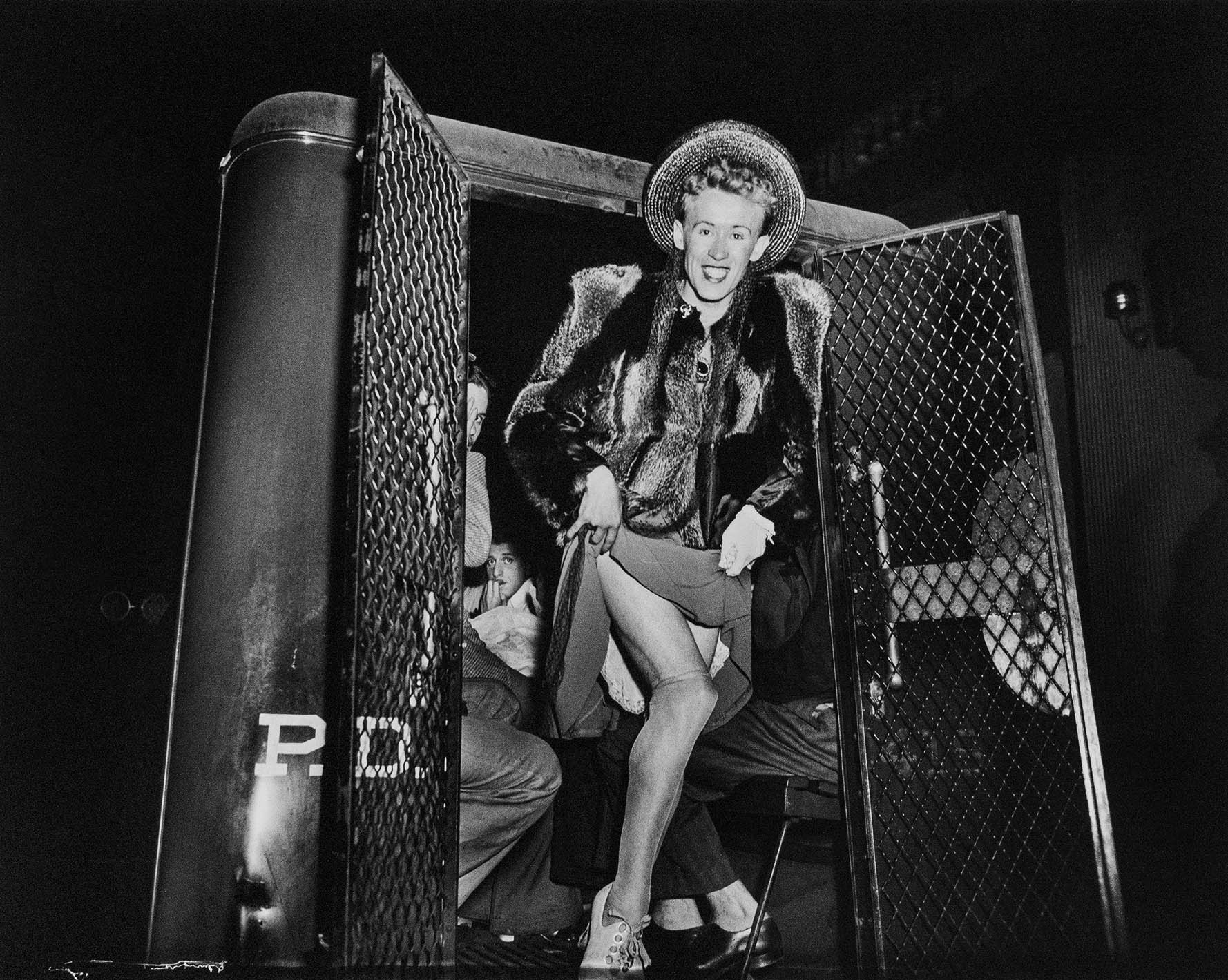
 

Weegee (Arthur Fellig) (American born Ukraine, 1899-1968) 'Man Arrested for Cross-Dressing, New York' c. 1939


Weegee (Arthur Fellig) (American born Ukraine, 1899-1968)
Man Arrested for Cross-Dressing, New York
c. 1939
Gelatin-silver print
© International Center of Photography. Louis Stettner Archives, Paris
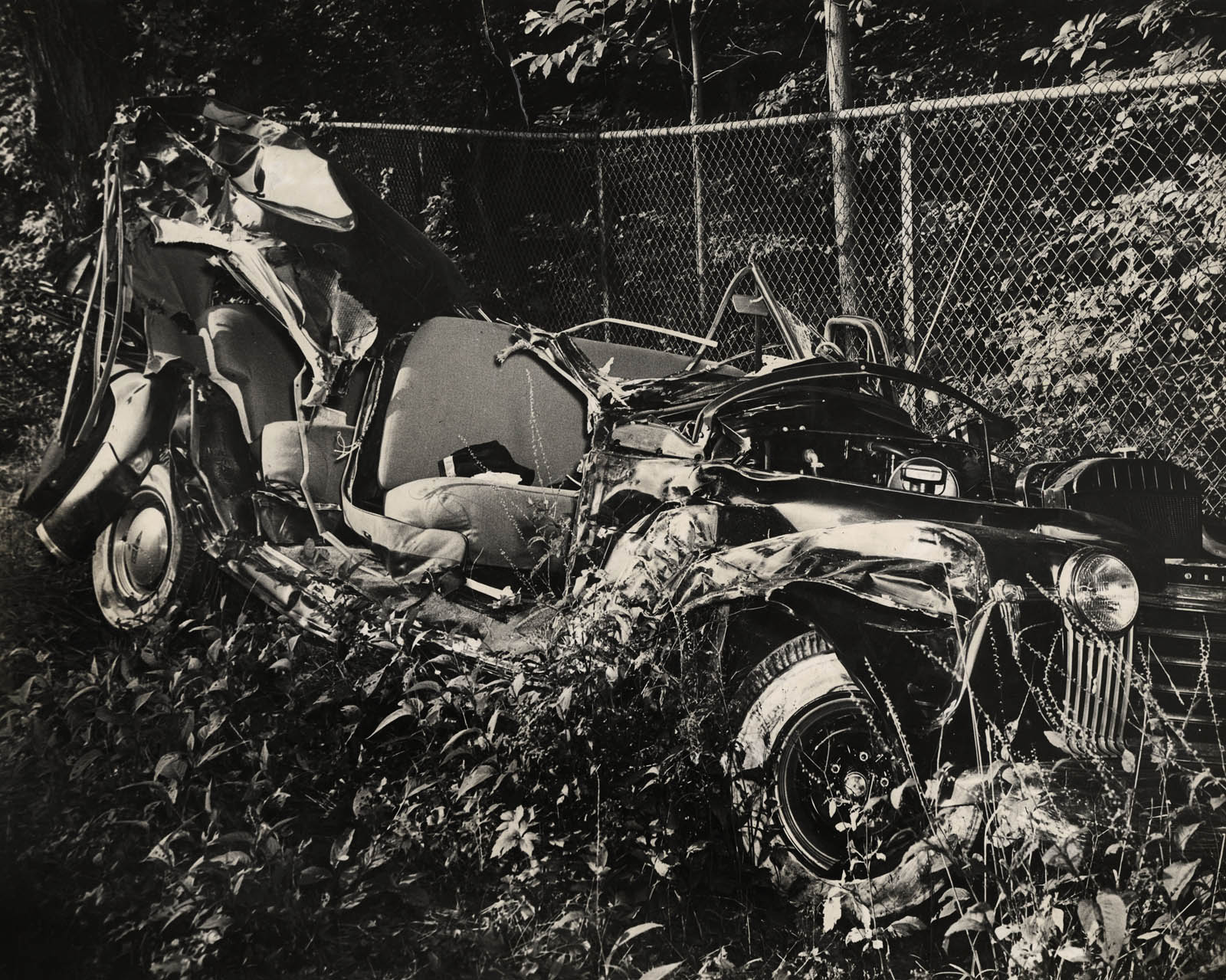
 

Weegee (Arthur Fellig) (American born Ukraine, 1899-1968) 'Holiday Accident in the Bronx' July 30th 1941


Weegee (Arthur Fellig) (American born Ukraine, 1899-1968)
Holiday Accident in the Bronx
July 30th 1941
Gelatin-silver print
© International Center of Photography
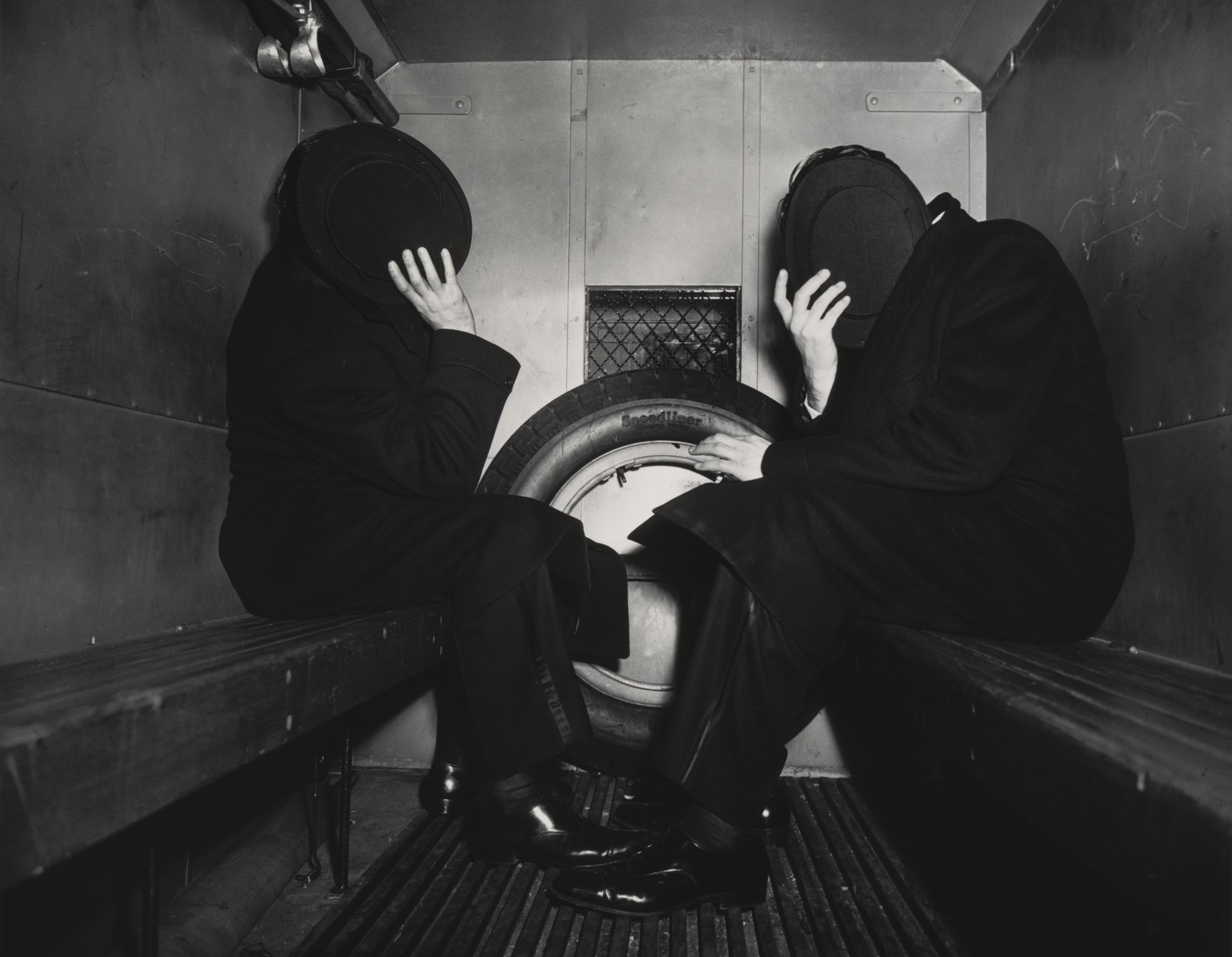
 

Weegee (Arthur Fellig) (American born Ukraine, 1899-1968) 'Charles Sodokoff and Arthur Webber Use Their Top Hats to Hide Their Faces, New York' January 26th 1942


Weegee (Arthur Fellig) (American born Ukraine, 1899-1968)
Charles Sodokoff and Arthur Webber Use Their Top Hats to Hide Their Faces, New York
January 26th 1942
Gelatin silver print
© International Center of Photography. Louis Stettner Archives, Paris


Weegee (Arthur Fellig) (American born Ukraine, 1899-1968) 'Balcony Seats at a Murder' 1939


Weegee (Arthur Fellig) (American born Ukraine, 1899-1968)
Balcony Seats at a Murder
1939
Gelatin silver print
© International Center of Photography
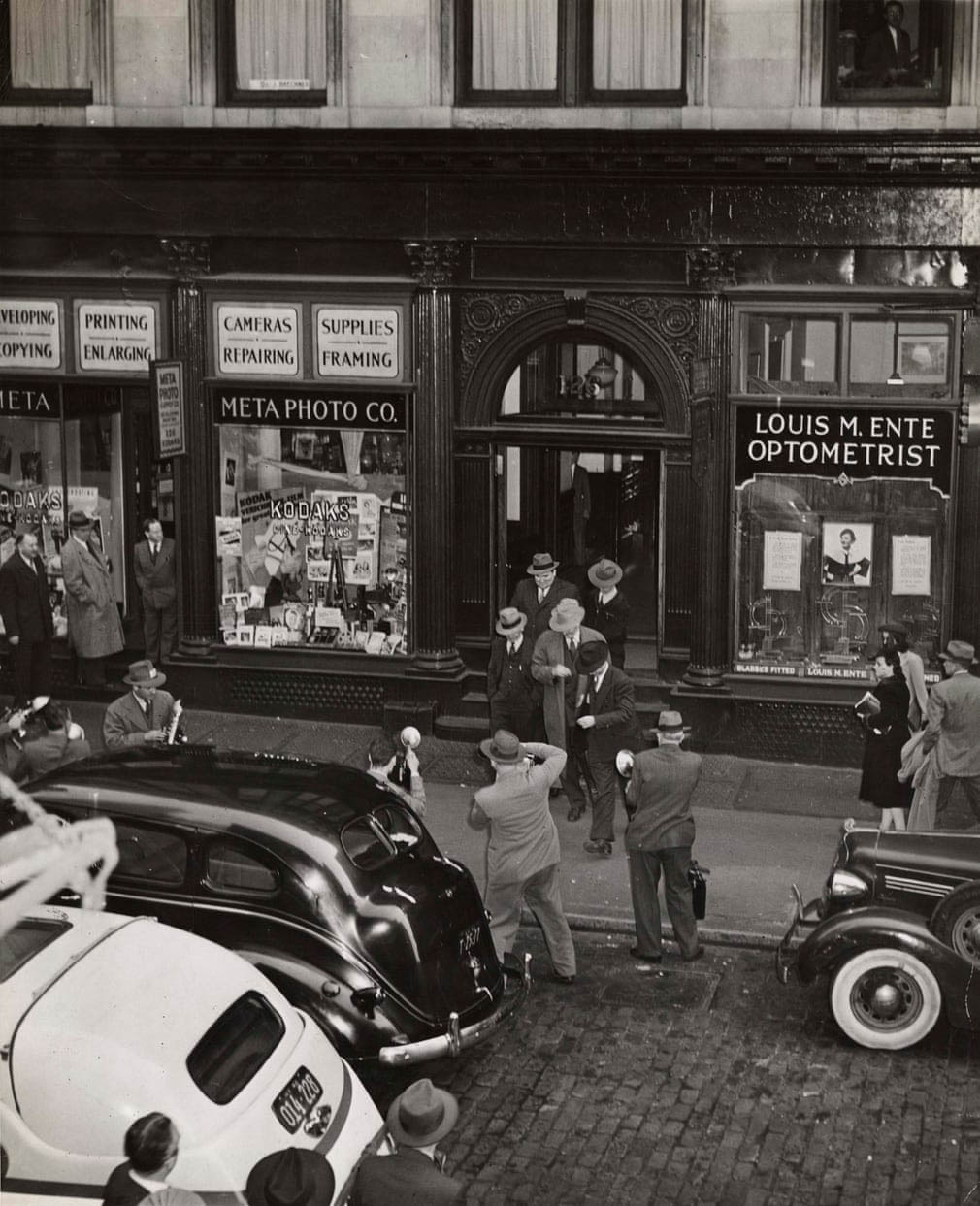
 

Weegee (Arthur Fellig) (American born Ukraine, 1899-1968) 'Arrests made during a gambling raid in lower Manhattan’s Liberty Street' October 1942


Weegee (Arthur Fellig) (American born Ukraine, 1899-1968)
Arrests made during a gambling raid in lower Manhattan’s Liberty Street
October 1942
Gelatin silver print
© International Center of Photography


Weegee (Arthur Fellig) (American born Ukraine, 1899-1968) 'Simply adding boiling water' 1943


Weegee (Arthur Fellig) (American born Ukraine, 1899-1968)
Simply adding boiling water
1943
Gelatin silver print
© International Center of Photography


Weegee (Arthur Fellig) (American born Ukraine, 1899-1968) 'Untitled [Fire in loft building, New York]' 1947


Weegee (Arthur Fellig) (American born Ukraine, 1899-1968)
Untitled [Fire in loft building, New York]
1947
Gelatin silver print
© International Center of Photography


There’s still a mystery to Weegee. The American photographer’s career seems to be split in two. First are his stories for the New York press from 1935-1945. Then, photo-caricatures of public personalities developed during his Hollywood period, between 1948 and 1951, which he continued to produce for the rest of his career. How can these diametrically opposed bodies of work coexist? Critics have enjoyed highlighting the opposition between the two periods, praising the former and disparaging the latter. This project seeks to reconcile the two parts of Weegee by showing that, beyond formal differences, the photographer’s approach is critically coherent.

The spectacle is omnipresent in Weegee’s work. In the first part of his career, coinciding with the rise of the tabloid press, he was an active participant in transforming news into spectacle. To show this, he often included spectators or other photographers in the foreground of his images. In the second half of his career, Weegee mocked the Hollywood spectacular: its ephemeral glory, adoring crowds, and social scenes. Some years before the Situationist International, his photography presented an incisive critique of the Society of the Spectacle.

The News Spectacle

“News photography is my meat.” After many years as a printer for press agencies, Weegee started his own business as a photojournalist in 1935. In order to be the first to arrive at the site of a murder, fire, or traffic accident, he set up a radio in his car, tuned to the police frequency. For a decade, using a flash, he took photographs of news in New York every night.

Weegee Himself

“I have always been a doer and not a thinker.” Weegee enjoyed putting himself in front of the camera, re-enacting circumstances he was confronted with in his daily work. In the name of pedagogy, and probably a little out of narcissism and self-advertisement, he took pictures of himself writing captions for his photographs in the back of his car, in police wagons and behind bars, never without his camera.

Murder Is My Business

“I used to be an expert on murder.” From 1935 to 1945, Weegee spent his nights roaming the city looking for shocking images. Even after Prohibition, New Yorkers’ dreams were punctuated by explosion sounds caused by rival gangs settling scores. The photographer learned to create expressive images which the booming tabloids were particularly fond of.

Off Road

“Sudden death for one…, sudden shock for the other.” American culture is fascinated by twisted metal. In the 19th century, a railroad company staged public collisions between locomotives destined for the junkyard. Weegee photographed many traffic accidents, introducing the “car crash” genre, later adopted by other figures, such as Andy Warhol, J. G. Ballard, David Cronenberg, etc.

The Tragedy of Fire

“Murders and fires (my two best sellers, my bread and butter).” In the darkness of the city, like a moth to a flame, Weegee took photographs of fires. The urban landscape of New York, with its many substandard buildings, provided him with many such opportunities. The combination of fire, smoke and gushing water offered a particularly photogenic spectacle that the press adored.

On The Spot

“The Parade never ceases as the ‘pie’ Wagons unload.” When he wasn’t in the field, Weegee waited at the entrance of the police station for the prison wagon to return with its load of offenders arrested in the night. At a time when it was a criminal act for a man to dress as a woman, some tried to hide their faces, while others took the opportunity to step out of the wagon as if onto a stage.

In Flagrante Delicto

“When criminals tried to cover their faces, it was a challenge to me. I literally uncovered not only their faces, but their black souls as well.” Faced with Weegee’s scrutinising lens, defendants often tried to conceal their identities. In his autobiography, the photographer recounts the many stratagems he developed to oblige them to reveal themselves. Clearly, they didn’t always work.

Social Documents

“The people in these photographs are real.” Coming from a Jewish family who emigrated to the United States from Ukraine at the beginning of the 20th century, experiencing extreme poverty upon their arrival, Weegee was quite aware of standards of living among the underprivileged. He took photographs of ordinary forms of discrimination, people with small trades, and the homeless. His photographs can be seen, in his own words, as “veritable social documents.”

Society of the Spectators

“The Curious ones” is a chapter title from Weegee’s best-seller: Naked City. The photographer takes an interest in people who, like himself, indulge unreservedly in the act of looking. He often includes them in the scenes he photographs, framing them in close-up to create veritable portraits of on-lookers. His work is a particularly striking testimony to the society of spectators developing in the United States at the time.

Meta Photo Co.

“I have no time for messages in my pictures.” Yet Weegee often included other photographers in his compositions as if, through this mise en abyme, he was inciting people to reflect on what it meant to take a photograph. An image from 1942, published in PM’s Weekly, is a good example. Three reporters and the words “Meta Photo Co.” on a window in the background of the photograph indicate there is something to be learned here about photography itself.

The Critic

“‘What is the best picture you ever took?’ Without hesitation I answer, ‘A picture I took at the opening of the Metropolitan Opera House. I consider this to be my masterpiece.'” The circumstances were contrived. Weegee went to a working-class neighbourhood to pick the woman up, then brought her to the entrance of this gala. The image illustrates the widening gap between the rich and the poor under American capitalism. It also reflects the critical power of a simple look.

Looking at Death

“I stepped back far enough to take in the whole scene: the puzzled detectives examining the body, the people on the fire escape, watching… it was like a stage setting.” Balcony seat at a murder: by including spectators in many of his images, Weegee imagines crime scenes as theatrical scenes, underscoring how American society transforms news into spectacle.

Spectators

“When I take a picture of a fire, I forget all about the burning building and I go out to the human element.” After years of tirelessly documenting events of the New York night, Weegee began taking photographs of the individuals who witnessed them. He was thus able to take portraits of groups expressing the full range of human reactions to tragedy, from surprise and tears to nervous laughter.

Out of Frame

“The curious […] ones always rushing by […] but always finding time to stop and look at.” On July 28, 1945, at 9:40 a.m., as a thick fog enveloped New York, a small plane crashed into the 79th floor of the Empire State Building. Weegee photographed spectators trying to catch a glimpse of it. People discovering his photographs in newspapers found themselves in the same position as these observers, a voyeuristic one.

Seeing in the Dark

“It’s hard to photograph people and get natural expressions. The minute they see the camera, they ‘freeze’ up on you.” Weegee was especially interested in depicting emotions on the faces of observers. Concerned that his presence would change their reaction, he had the ingenious idea of taking their photographs in the darkness of a theatre using infrared film. The result is a series of stunning portraits of wide-eyed spectators.

She Gestures of Art

“I used the same technique […] whether it was a murder, a pickpocket, or a society ball.” Following the success of his book Naked City, Weegee was routinely invited to high society events in New York, which he took pleasure in photographing as news items. In October 1945, at the opening of an exhibition by painter Stuart Davis at the MoMA, he captured the strange gestures of the art world.

The Theatre of the Spectacular

“Spectacle is Capital to such a degree of accumulation that it becomes an image,” explained Guy Debord in 1967. Weegee understood this well. He took photographs of all that was visually uncommon: crowds at Coney Island, fairground attractions, stars, acrobats, clowns… and finally, himself. A few years before the Situationist International, he pioneered a visual form of critique of the Society of the Spectacle.

In the Company of Crowds

“And this is Coney Island on a quiet Sunday afternoon […]. A crowd of over a MILLION is usual and attracts no attention.” On a Brooklyn beach, in Times Square or in Chinatown celebrating victory over Nazi power, Weegee never missed the opportunity to photograph crowds. Beyond “mass ornament,” theorised a few years earlier by Siegfried Kracauer, he was fascinated by the ways in which the people constitute themselves as images.

The Cannonball Woman

“Punch in Pictures.” That’s how one magazine described an article on Weegee. The scoop-hunter knows better than anyone else how to produce hard-hitting images. In 1943, Weegee photographed circus performer Egle Zacchini, nicknamed Miss Victory, or The Cannonball Woman, shot out of a cannon at 360 feet per second. As war was raging in Europe, it was a strange metaphor for the role of women in the conflict.

A Circus Community

“Someday they, too, will be stars.” Weegee especially enjoyed hanging around behind the scenes of fairgrounds in the suburbs. He photographed the way a performer at Sammy’s Bar placed her money in her stocking. Elsewhere, a dwarf with a forced smile, a melancholy clown slumped in his dressing room, what remains of the parade after the crowd passes by. Many of his photographs display the ambiance of a sad party.

Photo-caricatures

“I was tired of gangsters lying dead with their guts spewed in the gutter, of women crying at tenement-house fires, of automobile accidents […]. I was off to Hollywood.” In the City of Angels, Weegee not only photographs the celebrities he meets, he delights in making caricatures of them with what he calls his “elastic lens,” now mocking the star system.

The Spyglass

“I have used the camera to provoke good old-fashioned belly laughs.” In 1963, Weegee was invited to the set of Stanley Kubrick’s Doctor Strangelove. The director was a great fan of Weegee, and had begun his own career as a press photographer. On set, Weegee applied a new technique for the tubular distortion of faces, as if one were looking through the small end of a spyglass.

Trick Inventory

“Their originality was such that they sold like hot cakes.” This is how Weegee described his photo-caricatures, the first of which appeared in papers in 1947. For 20 years and up until his death in 1968, he would regularly publish these works. Around fifty of the publications are known today. There are most likely many more. In his daily work, the photo-caricature came to definitively replace the news item.

Weegee, Ouija

“I’m called Weegee which comes from Ouija.” The pseudonym Weegee refers to the name of a board used in seances to decipher messages from the beyond. Weegee liked to describe himself as a “psychic photographer”, able to predict in advance where a story will take place. On the scene, he said he photographed using his “third eye.” Whether clairvoyant or voyeur, Weegee was able to see, better than anyone else, transformations in American society.

Text from the Fundación MAPFRE
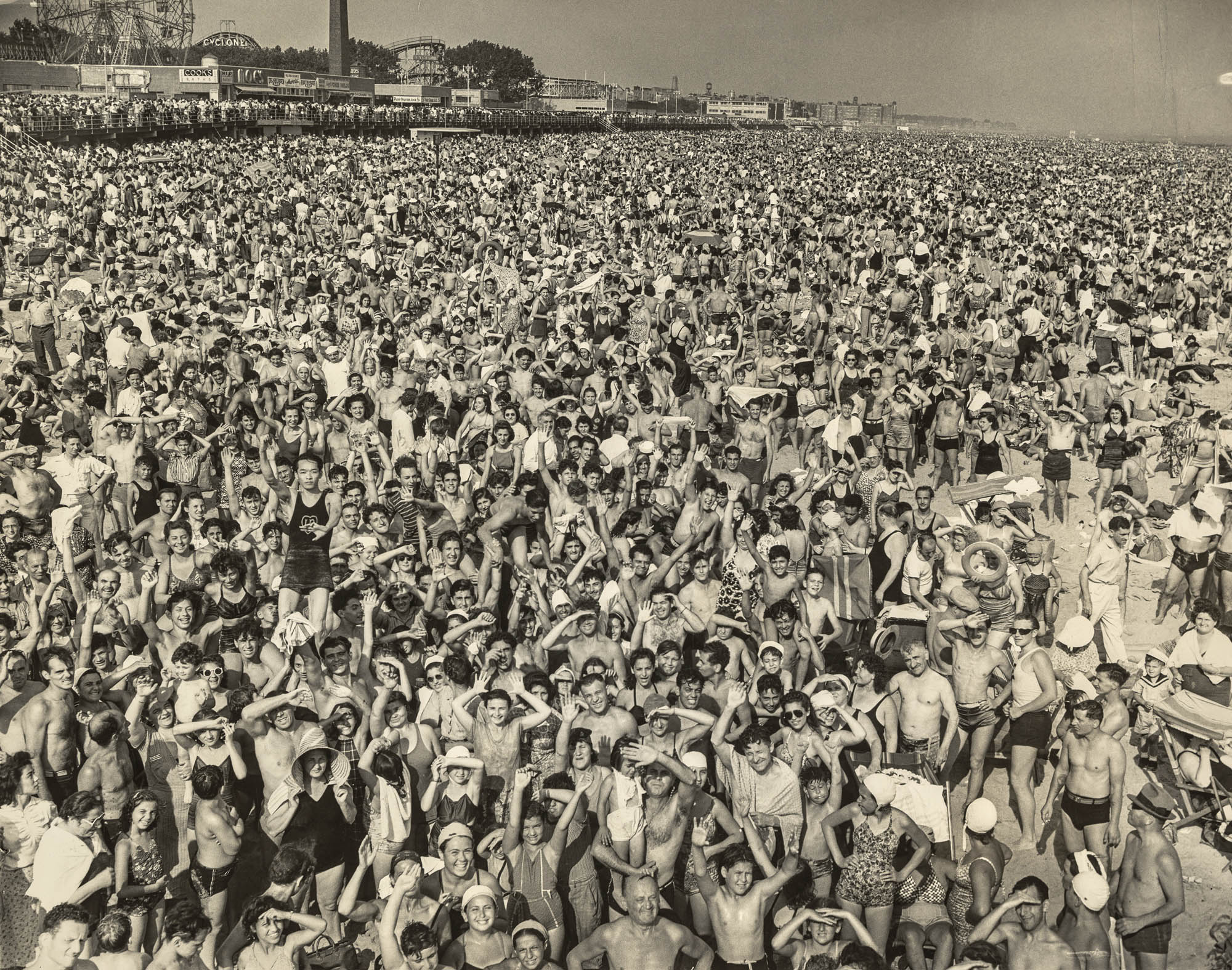
 

Weegee (Arthur Fellig) (American born Ukraine, 1899-1968) 'Afternoon Crowd at Coney Island' July 21st 1940


Weegee (Arthur Fellig) (American born Ukraine, 1899-1968)
Afternoon Crowd at Coney Island
July 21st 1940
Gelatin-silver print
© International Center of Photography. Courtesy Galerie Berinson, Berlin


Weegee (Arthur Fellig) (American born Ukraine, 1899-1968) 'Anthony Esposito, Booked on Suspicion of Killing a Policeman, New York' January 16th 1941


Weegee (Arthur Fellig) (American born Ukraine, 1899-1968)
Anthony Esposito, Booked on Suspicion of Killing a Policeman, New York
January 16th 1941
Gelatin silver print
© International Center of Photography. Louis Stettner Archives, Paris


Weegee (Arthur Fellig) (American born Ukraine, 1899-1968) '[Black Buick with dead passenger pulled out of the Harlem River, New York]' February 23, 1942


Weegee (Arthur Fellig) (American born Ukraine, 1899-1968)
[Black Buick with dead passenger pulled out of the Harlem River, New York]
February 23, 1942
Gelatin silver print
© Weegee Archive/International Center of Photography
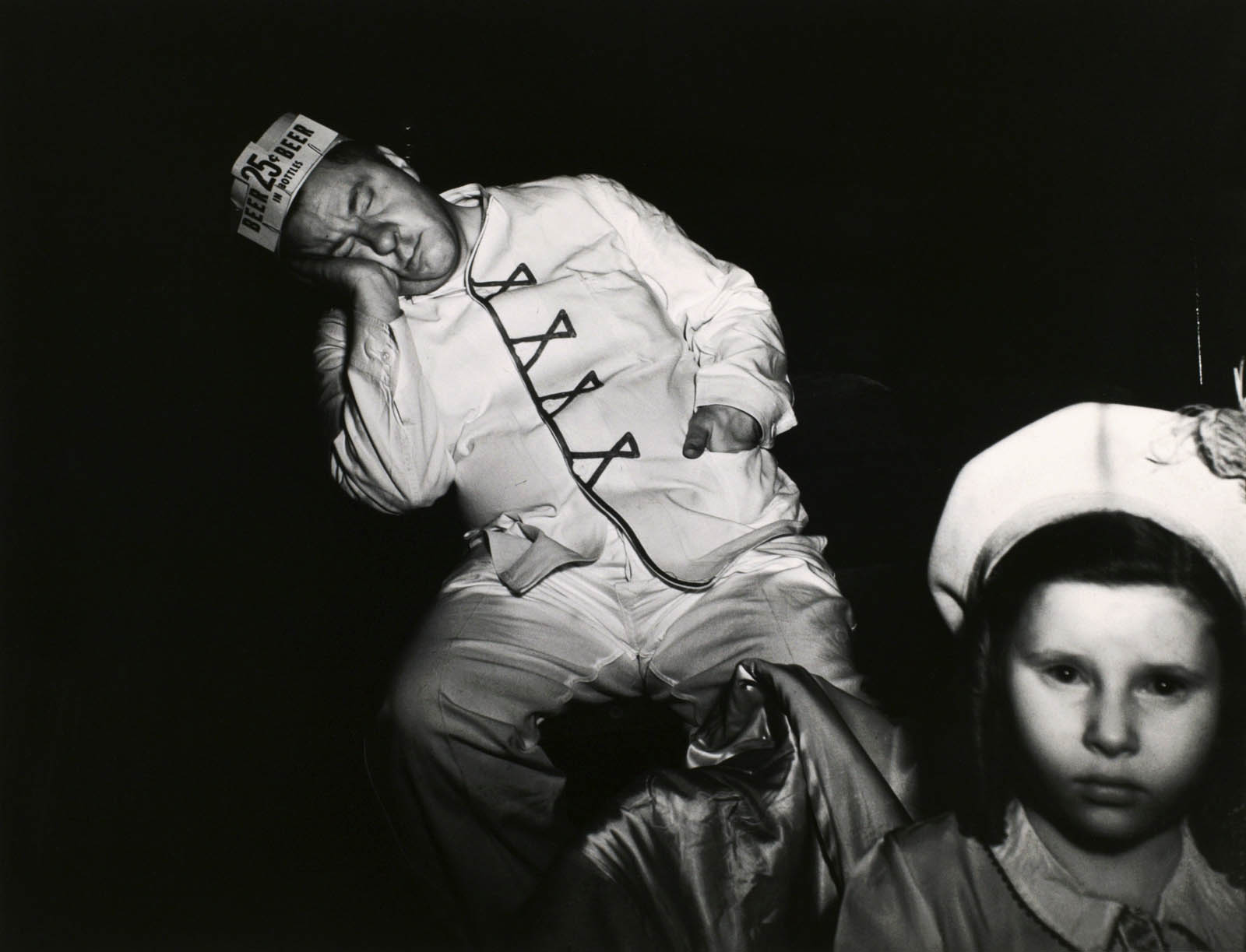
 

Weegee (Arthur Fellig) (American born Ukraine, 1899-1968) 'Sleeping at the Circus, Madison Square Garden, New York' June 28th 1943


Weegee (Arthur Fellig) (American born Ukraine, 1899-1968)
Sleeping at the Circus, Madison Square Garden, New York
June 28th 1943
Gelatin-silver print
© International Center of Photography


Weegee (Arthur Fellig) (American born Ukraine, 1899-1968) 'The Critic, New York' November 22nd 1943


Weegee (Arthur Fellig) (American born Ukraine, 1899-1968)
The Critic, New York
November 22nd 1943
Gelatin silver print
© International Center of Photography. Collection Friedsam


Weegee (Arthur Fellig) (American born Ukraine, 1899-1968) '[After the opera, Sammy's on the Bowery, New York]' 1943-1945


Weegee (Arthur Fellig) (American born Ukraine, 1899-1968)
[After the opera, Sammy’s on the Bowery, New York]
1943-1945
© Weegee Archive/International Center of Photography
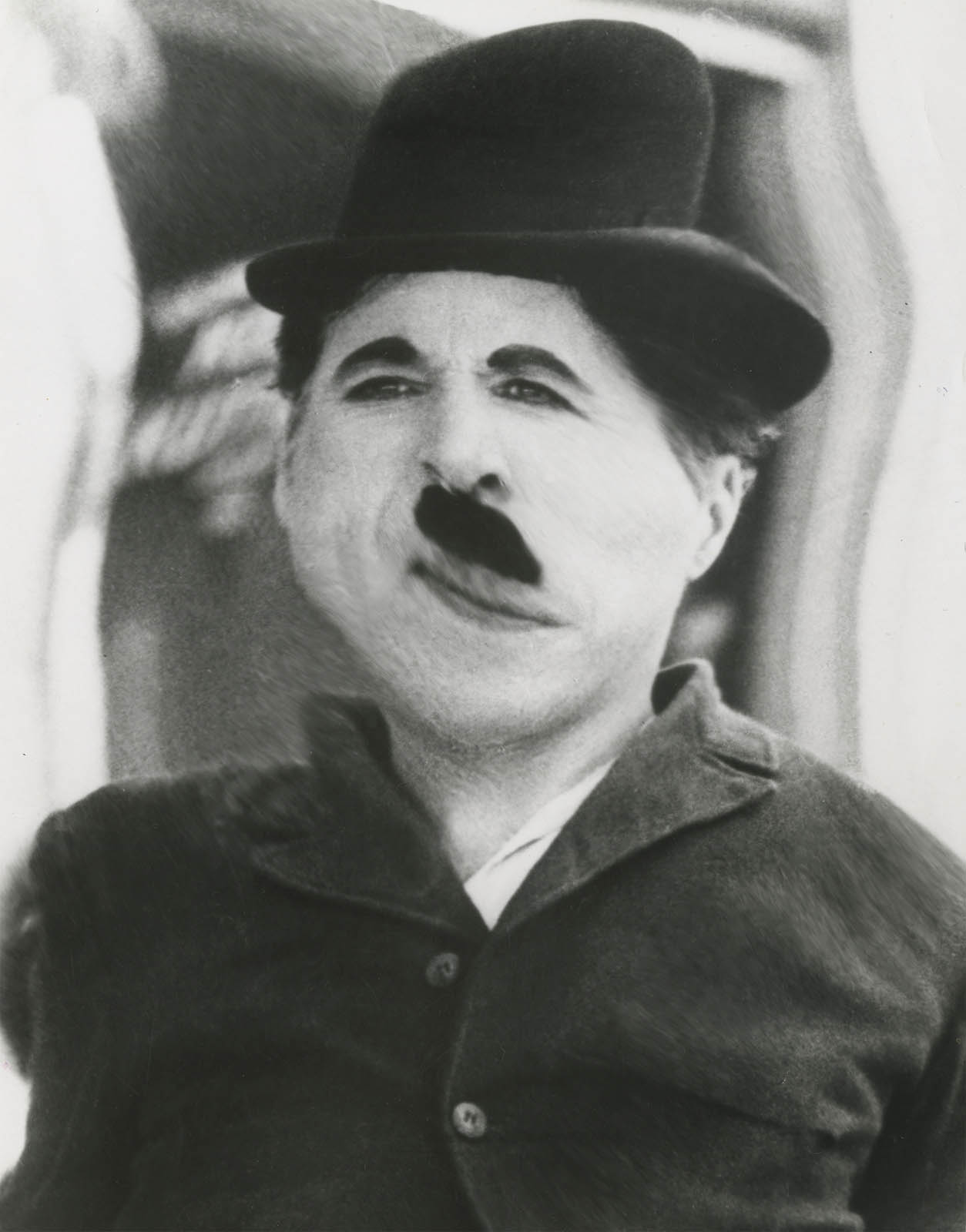
 

Weegee (Arthur Fellig) (American born Ukraine, 1899-1968) 'Charlie Chaplin, Distortion' c. 1950


Weegee (Arthur Fellig) (American born Ukraine, 1899-1968)
Charlie Chaplin, Distortion
c. 1950
Gelatin silver print
© International Center of Photography
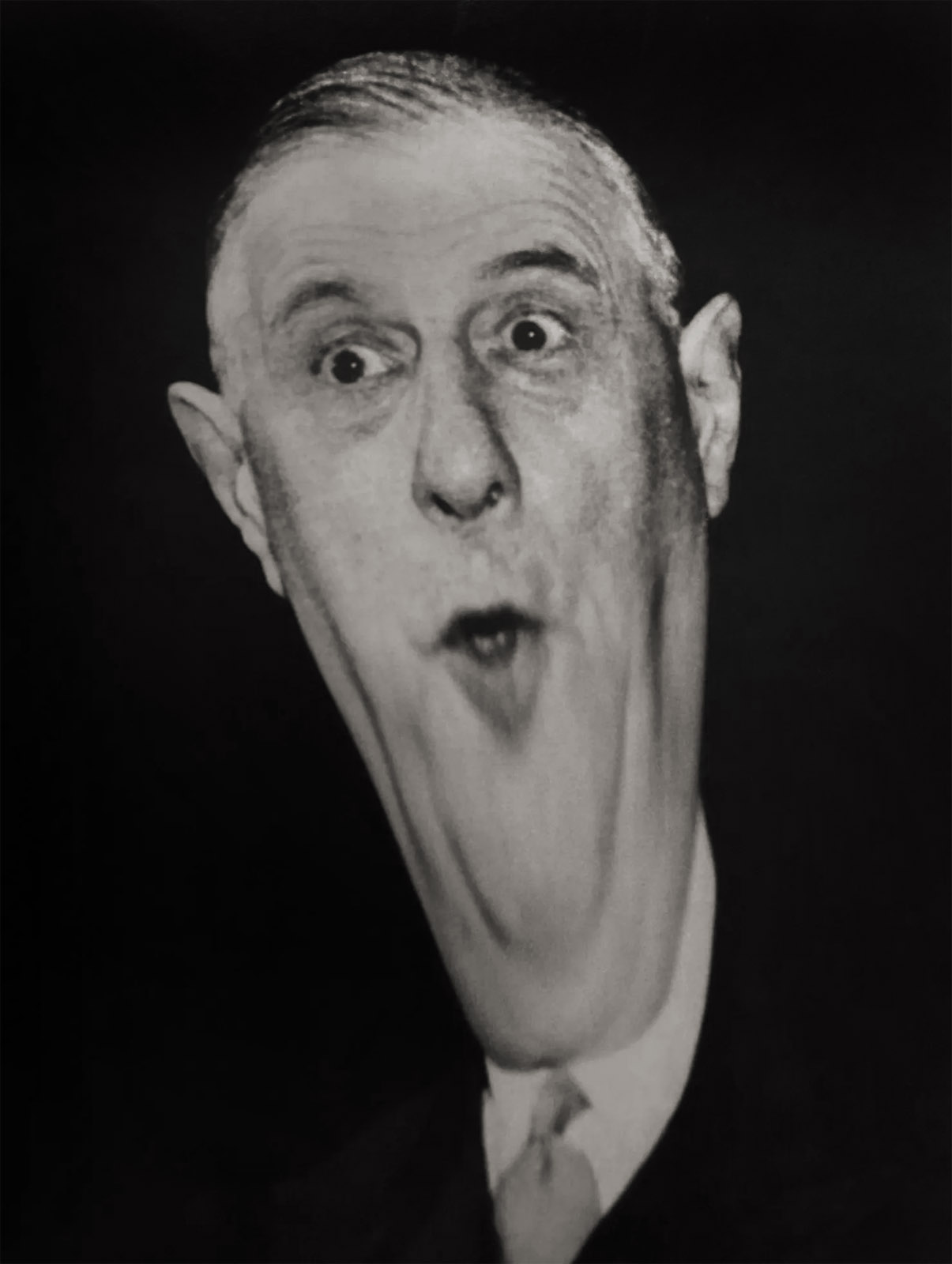
 

Weegee (Arthur Fellig) (American born Ukraine, 1899-1968) 'Charles de Gaulle, Distortion' 1959


Weegee (Arthur Fellig) (American born Ukraine, 1899-1968)
Charles de Gaulle, Distortion
1959
Gelatin silver print
© International Center of Photography
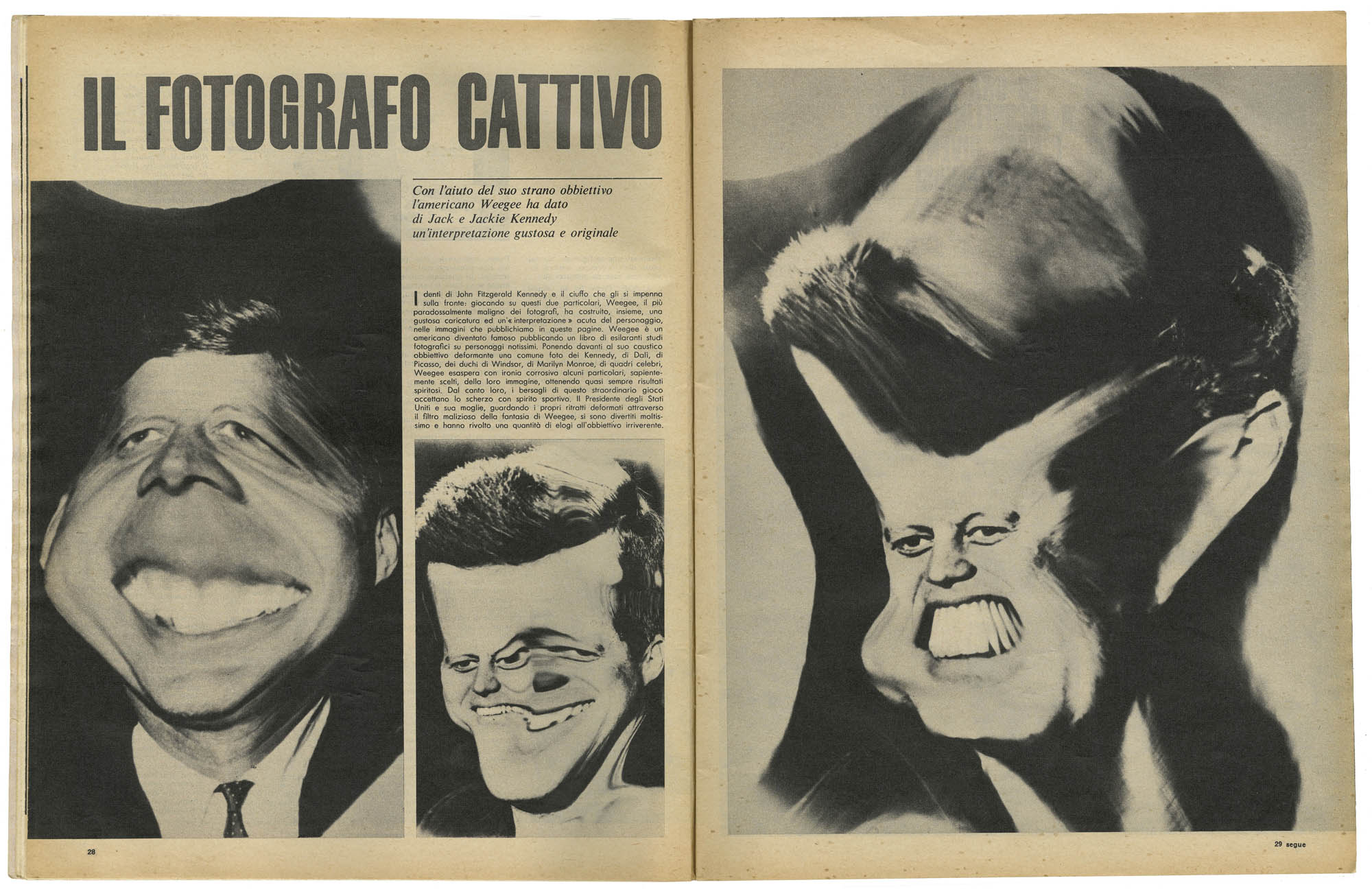
 

"Il Fotografo cattivo", Epoca, vol. XIII, No. 636, December 1962


“Il Fotografo cattivo”, Epoca, vol. XIII, No. 636, December 1962
© International Center of Photography. Collection privée Paris
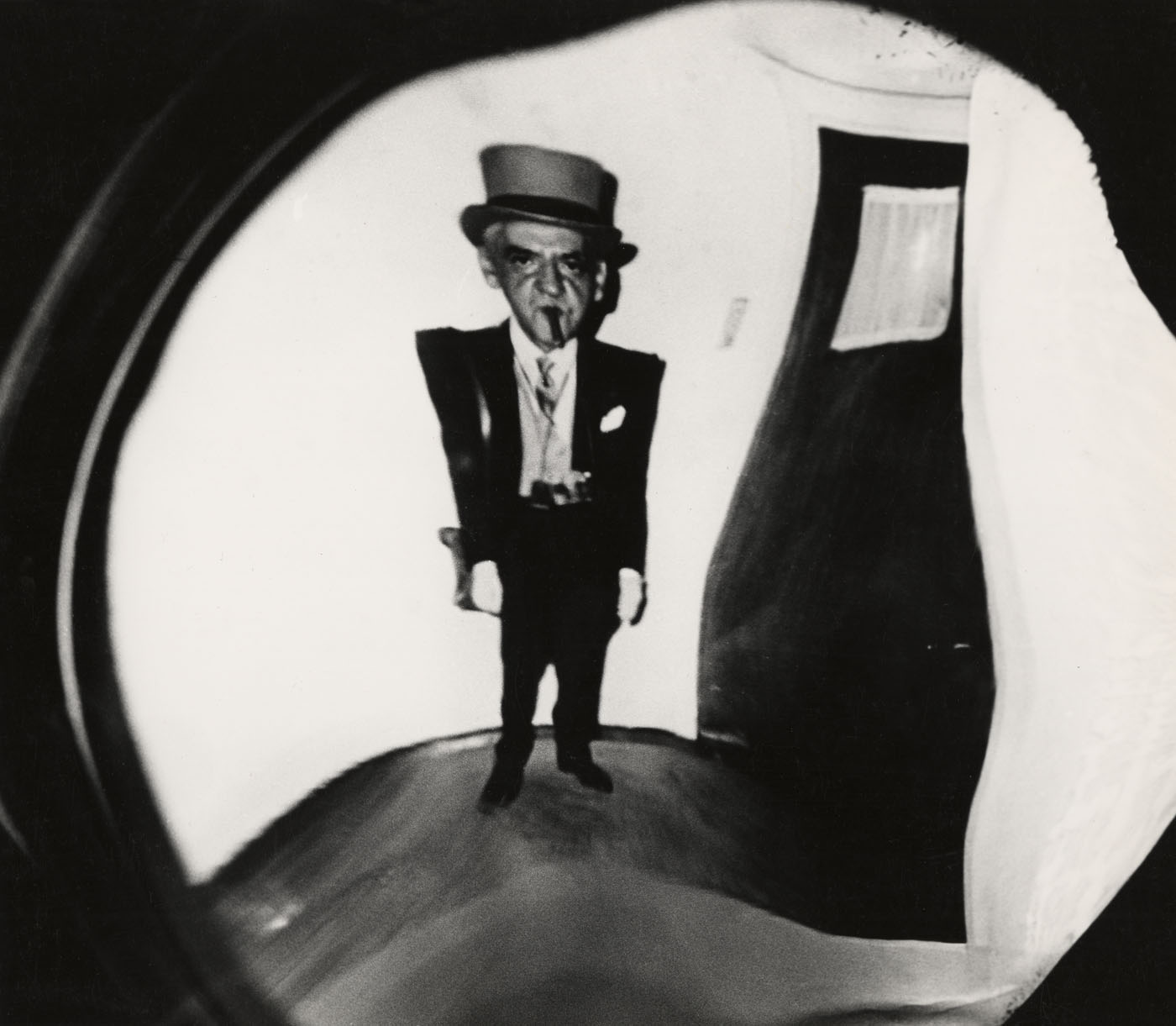
 

Weegee (Arthur Fellig) (American born Ukraine, 1899-1968) 'Self-Portrait' c. 1963 from the exhibition 'Weegee. Autopsy of the Spectacle' at Fundacion Mapfre, Madrid Sept 2024 - January 2025


Weegee (Arthur Fellig) (American born Ukraine, 1899-1968)
Self-Portrait
c. 1963
Gelatin silver print
© International Center of Photography


Fundación MAPFRE
Recoletos Exhibition Hall
Paseo Recoletos 23, 28004 Madrid

Opening hours:
Mondays (except holidays): 2pm – 8pm
Tuesday to Saturday: 11am – 8pm
Sunday and holidays: 11am – 7pm
Fundación MAPFRE website

LIKE ART BLART ON FACEBOOK

Back to top

Exhibition: ‘The Memory of the Future. Photographic Dialogues between Past, Present and Future’ at the Musée de l’Elysée, Lausanne

Exhibition dates: 25th May – 28th August, 2016

Curator: Tatyana Franck, Director, Musée de l’Elysée, assisted by Lydia Dorner and Emilie Delcambre

Artists: Takashi Arai / Israel Ariño / Anna Atkins / Patrick Bailly-Maître-Grand Pierre Cordier / Bernd and Hilla Becher / Martin Becka / Binh Danh /Jayne Hinds Bidaut John Dugdale / Jean-Gabriel Eynard / Joan Fontcuberta / Dennis Gabor / Loris Gréaud / JR Idris Khan / Laure Ledoux / Gustave Le Gray / Gabriel Lippmann / Vera Lutter / Christian Marclay / Mathew Brady / Vik Muniz / Oscar Muñoz / Eadweard Muybridge / France Scully Osterman and Mark Osterman Andreas / Andreas Müller-Pohle / Florio Puenter Benjamin Recordon / Dino Simonett / Jerry Spagnoli / Joni Sternbach / James Turrell Martial Verdier / Paul Vionnet / Pierre Wetzel / Victoria Will / Nancy Wilson-Pajic


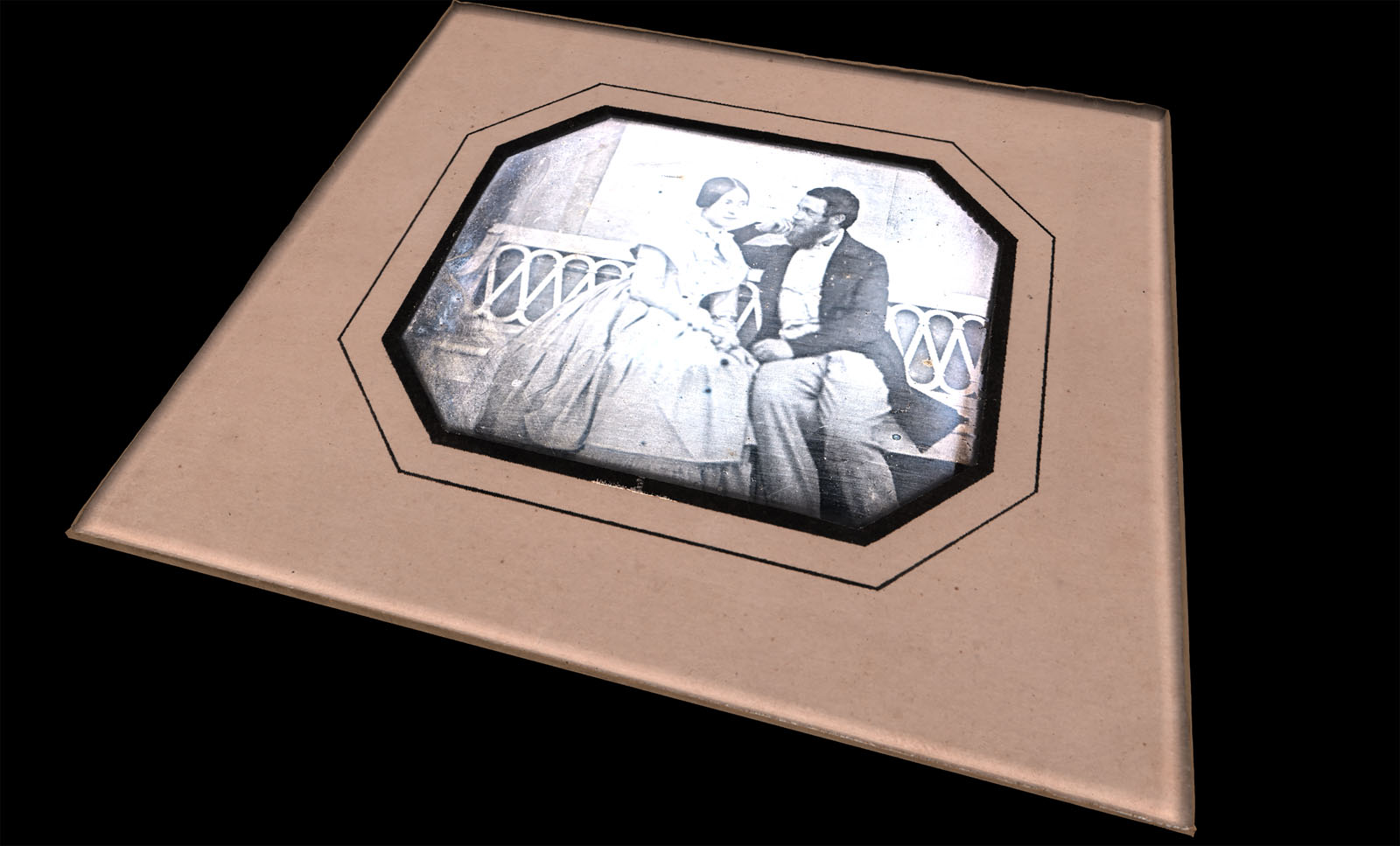
3D Digitisation of Jean-Gabriel Eynard (Swiss, 1775-1863) 'Charles et Mathilde Horngascher-Odier' 1845 from the exhibition 'The Memory of the Future. Photographic Dialogues between Past, Present and Future' at the Musée de l'Elysée, Lausanne, May - August, 2016


3D Digitisation of Jean-Gabriel Eynard (Swiss, 1775-1863)
Charles and Mathilde Horngascher-Odier
1845
© Musée de l’Elysée, Lausanne


Gabriel Lippmann (colour photography) and Dennis Gabor (holograms). Eadweard Muybridge (movement) and Pierre Cordier (chemigrams). Daguerreotypes, calotypes, negatives on dry waxed paper, tintypes, ambrotypes, cyanotypes. Heliogravure, ferrotype, collage and carbon printing. 3D digitisations that “light up” the image from every angle.

What’s old is new again. Then and now, here and there. The memory of future past.

Dr Marcus Bunyan


Many thankx to the Musée de l’Elysée for allowing me to publish the photographs in the posting. Please click on the photographs for a larger version of the image.


Oscar Muñoz (Colombian, b. 1951) 'Ante la Imagen' 2009 from the exhibition 'The Memory of the Future. Photographic Dialogues between Past, Present and Future' at the Musée de l'Elysée, Lausanne, May - August, 2016


Oscar Muñoz (Colombian, b. 1951)
Ante la Imagen
2009
© Oscar Muñoz, courtesy of the artist and Mor charpentier gallery


Oscar Muñoz’s work combines photography, engraving, drawing, installation, video and sculpture, defying all attempts at categorisation. Using non-conventional techniques, his work is a reflection on social concerns and addresses the themes of memory and forgetting, appearance and disappearance, loss and the insecurity of human life. In his work El Coleccionista, the artist uses a triple video projection to show a figure that is sorting, organising and grouping what appears to be personal archives. Oscar Muñoz evokes here the ability of images to be part of multiple narratives, from one image to another, from one context to another. These images propose multiple narrations that overlap and intermingle between the past and present, memory and time.

For Ante la Imagen, Muñoz uses the portrait of the chemist Robert Cornelius (1809-1893), known for having reduced the exposure time of the photographic process of the daguerreotype and for producing one of the first self-portraits, to demonstrate the effectiveness of his method. Muñoz reproduces this portrait by engraving it on a reflecting metallic surface, like a daguerreotype. With each manipulation, the viewer sees the portrait of Cornelius superimposed on his own. The work is composed and decomposed and questions the interior multiplicity of one and the same image. Muñoz replaces this frozen image by a constantly-changing one, vulnerable to deterioration under the effect of air, like life itself.


Gabriel Lippmann (Franco-Luxembourgish, 1845-1921) 'Selfportrait' c. 1892


Gabriel Lippmann (Franco-Luxembourgish, 1845-1921)
Selfportrait
c. 1892
© Musée de l’Elysée, Lausanne


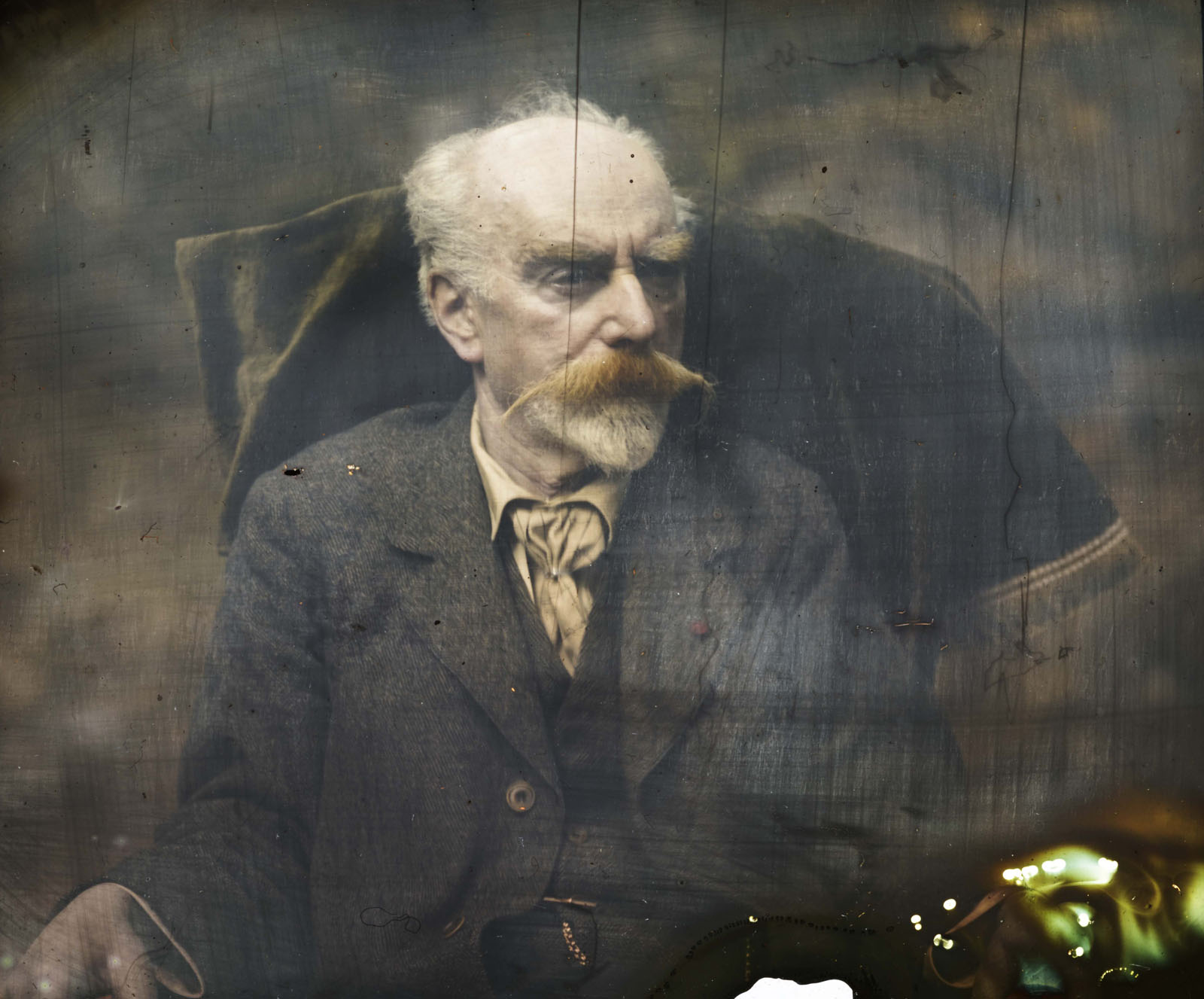
Professor of physics at the Sorbonne, a member of the French Academy of Sciences and author of many scientific works, the international renown of Gabriel Lippmann Is mainly due to his invention of colour photography using the interferential method. He was awarded the Nobel Prize in physics in 1908.

In 1891, he presented his invention, which would revolutionise photography, to the public. Lippmann developed the “wave theory of light”, which held that light bodies vibrate (like sound) and that light is propagated by waves of different speeds. The variations in wavelengths lead to changes in colour. To prove the validity of his theory, Lippmann worked for five years to find a method that would fix these interferences. To do so, he developed a device that made it possible to place a special photographic plate (made of layers proportional to the wavelengths) in contact with a mercury mirror, a very complicated process. The sensitive layer of an average wavelength, green, for example, has 4,000 bright points per millimetre in its thickness, separated by dark intervals. The Musée de l’Elysée has the largest collection of Lippmann prisms in the world.


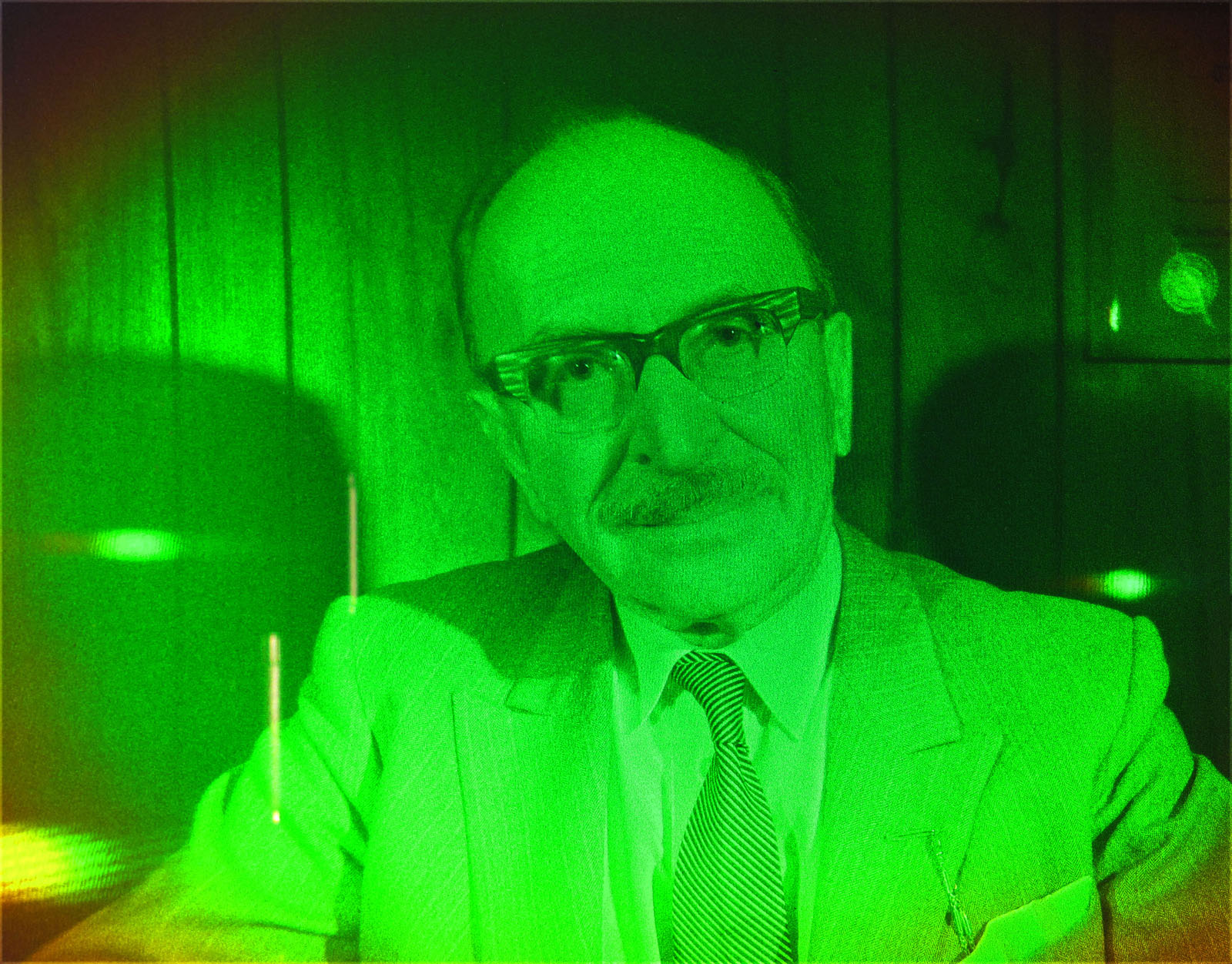
McDonnell Douglas Corp. / Spindler & Hoyer. 'Portrait of Dennis Gabor' 1975


McDonnell Douglas Corp. / Spindler & Hoyer
Portrait of Dennis Gabor
1975
© Jonathan Ross Hologram Collection


Engineer and physicist, Dennis Gabor is known for having invented the hologram in 1947, for which he was awarded the Holweck prize in 1970, and then the Nobel Prize in physics in 1971. Fascinated by Abbé’s theory of the microscope and Gabriel Lippmann’s method of colour photography, he studied electron optics, which led him to propose the concept of holography that he referred to as “wavefront reconstruction” at the time. The initial project consisted of an electron microscope capable of visualising atom networks and the atoms themselves, but that was not put into practice until 20 years later, whereas the hologram as a photographic process would have to wait for the invention of the laser in the 1960s, the light source necessary for the hologram. Subsequently, Emmett Leith and Juris Upatnieks in the United States and Yuri Denisyuk in Russia contributed to the improvement of Gabor’s invention and presented three-dimensional holograms. Since then, holograms are widely know to the general public through advertising, the production of packaging materials and jewellery items.

The life-size version of the portrait of Gabor can be seen at the offices of the McDonnell Douglas Corporation in the United States, one of the first companies to have attempted to market the holograph. The reduced-size copy presented here was made several years later by Spindler & Hoyer, a German optical company.


Eadweard Muybridge (English, 1830-1904) 'Animal Locomotion, Plate 597' 1887


Eadweard Muybridge (English, 1830-1904)
Animal Locomotion, Plate 597
1887
© Musée de l’Elysée, Lausanne


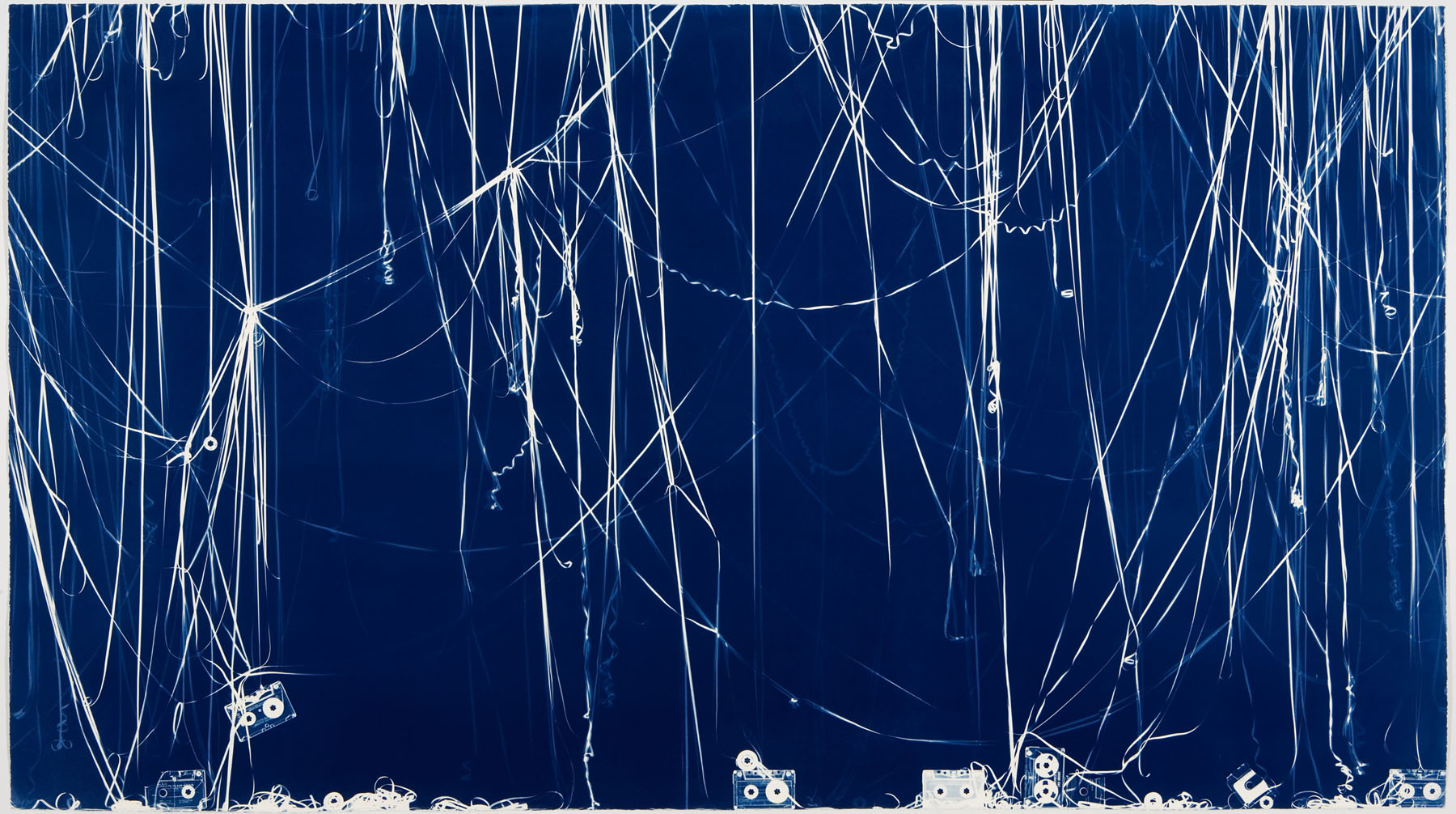
Christian Marclay (American-Swiss, b. 1955) 'Memento (Survival of the Fittest)' 2008


Christian Marclay (American-Swiss, b. 1955)
Memento (Survival of the Fittest)
2008
© Christian Marclay, courtesy Paula Cooper Gallery, New York


A well-known filmmaker and multimedia artist, Christian Marclay made his mark on the contemporary art scene by combining the visual arts, film and musical culture. In 2007, he began a project that explores the interactions between sound and vision, as well as the manipulation and the conservation of different forms of recordings. He initiated a series together with the Graphicstudio, University of South Florida involving the use of two archaic recording systems – the cyanotype photography process and the audiotape.

He adopted and adapted the subject of the audiotape, which has become just about obsolete as a result of technological developments, and placed it at the center of his visual abstraction to capture the old soundtracks of hundreds of cassette tapes unfurled like so many streamers, using the cyanotype process. “We assume, because we’re able to capture sounds or images, that they will exist forever – when, in fact, obsolescence makes you feel the limit of those assumptions.” By combining these two mediums, the artist brilliantly explores the resonances between the past and present.


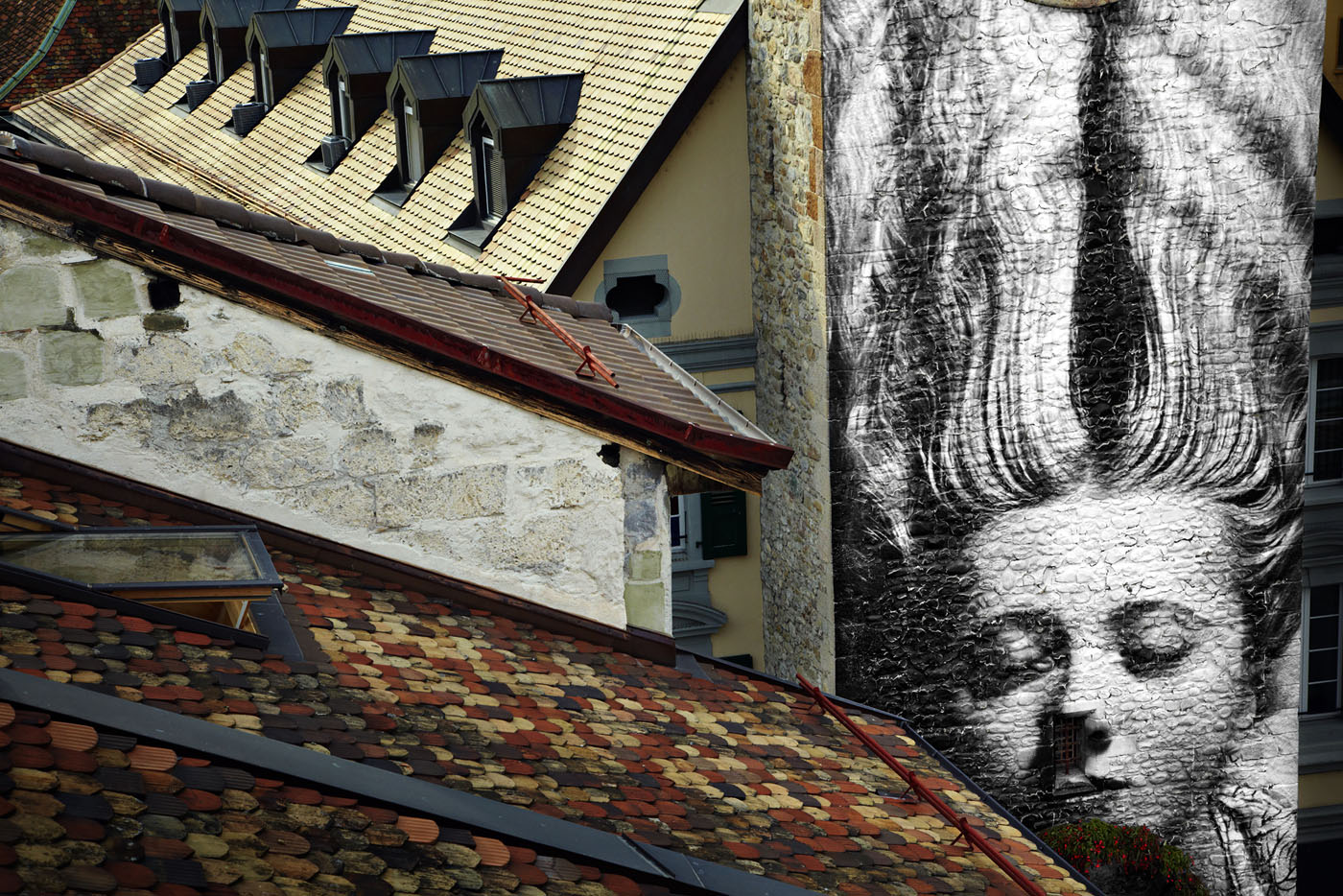
JR. 'UNFRAMED, Man Ray revu par JR, Femme aux cheveux longs, 1929, Vevey, Suisse' 2010


JR
UNFRAMED, Man Ray revu par JR, Femme aux cheveux longs, 1929, Vevey, Suisse
2010
© JR / Musée de l’Elysée, Lausanne


JR has “the largest art gallery in the world”. Thanks to the technique of photo collage, he freely exhibits his work on walls worldwide, thus attracting the attention of those who rarely or never go to museums. His work is a mixture of art and action and deals with commitment, freedom, identity and limits. After finding a camera in the Paris Metro in 2001, he travelled throughout Europe to meet other people whose mode of artistic expression involved the use of the walls and façades that give form to our cities. After observing the people he met and listening to their message, JR pasted their portraits up in streets and basements and on the roof tops of Paris.

JR thus creates “pervasive art” that he puts up on buildings in the Paris suburbs, on walls in the Middle East, on broken bridges in Africa and in the favelas of Brazil. These artistic actions make no distinction between the actors and the spectators. JR’s approach presented here is a mixture of the reinterpretation and recontextualisation of the icons of the history of photography taken from the collections of the Musée de l’Elysée of Lausanne, which he applies to the façades of buildings in the city of Vevey. He thus crops and enlarges the photos of Robert Capa, Man Ray, Gilles Caron and Helen Levitt so that the city becomes a gigantic open-air museum.


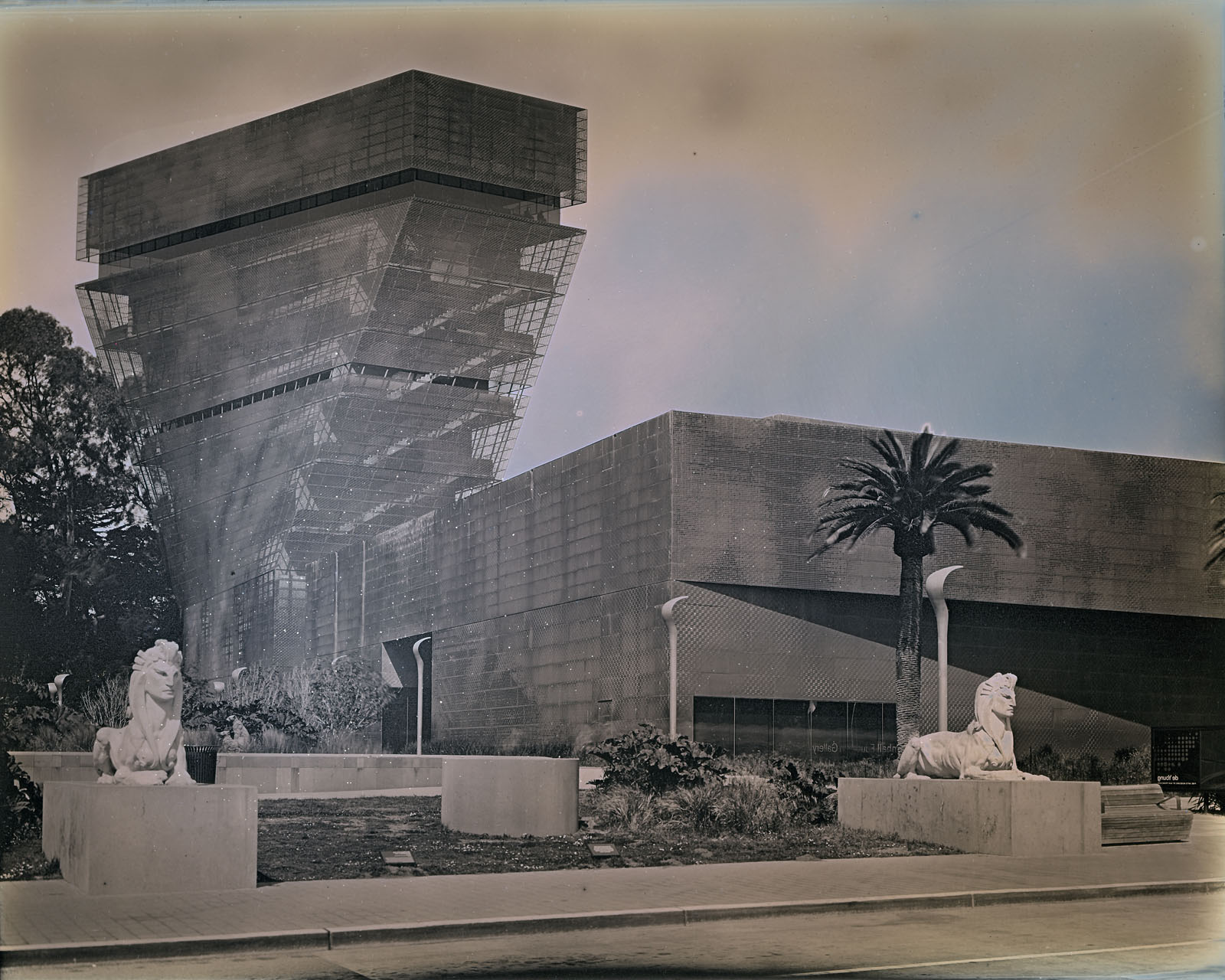
Binh Danh (American born Vietnam, b. 1979) 'Sphinxes' (by Arthur Putnam, 1912) 2014


Binh Danh (American born Vietnam, b. 1979)
Sphinxes (by Arthur Putnam, 1912)
2014
Artist and Haines Gallery courtesy, San Francisco
© Binh Danh


“Landscape is what defines me. When I am somewhere new or unfamiliar, I am constantly in dialogue with the past, present and my future self. When I am thinking about landscape, I am thinking about those who have stood on this land before me. Whoever they are, hopefully history recorded their makings on the land for me to study and contemplate.”

Born in Viet Nam, Binh Danh addresses themes of collective and personal memories, history, heritage and mortality. Known for printing his works on unconventional supports such as leaves or grass, he experiments with the photographic process of the daguerreotype in his most recent creations in order to document the history of the city of San Francisco.

Reminiscent of the work of photographic pioneers such as Eadweard Muybridge (1830-1904), Charles Marville (1813-1879) and Eugène Atget (1857-1927), Binh Danh explores the complexities of a constantly evolving city, from the first major expansion in recent years of Silicon Valley. He places San Francisco, cliché of the culture of technology and success, in another time space in order to incite the viewer to reflect on the rapid pace of changes in a city. By choosing the daguerreotype, the artist works on the reflecting surface of the process to incorporate the spectator into his work and to thus transform it into a shared experience.


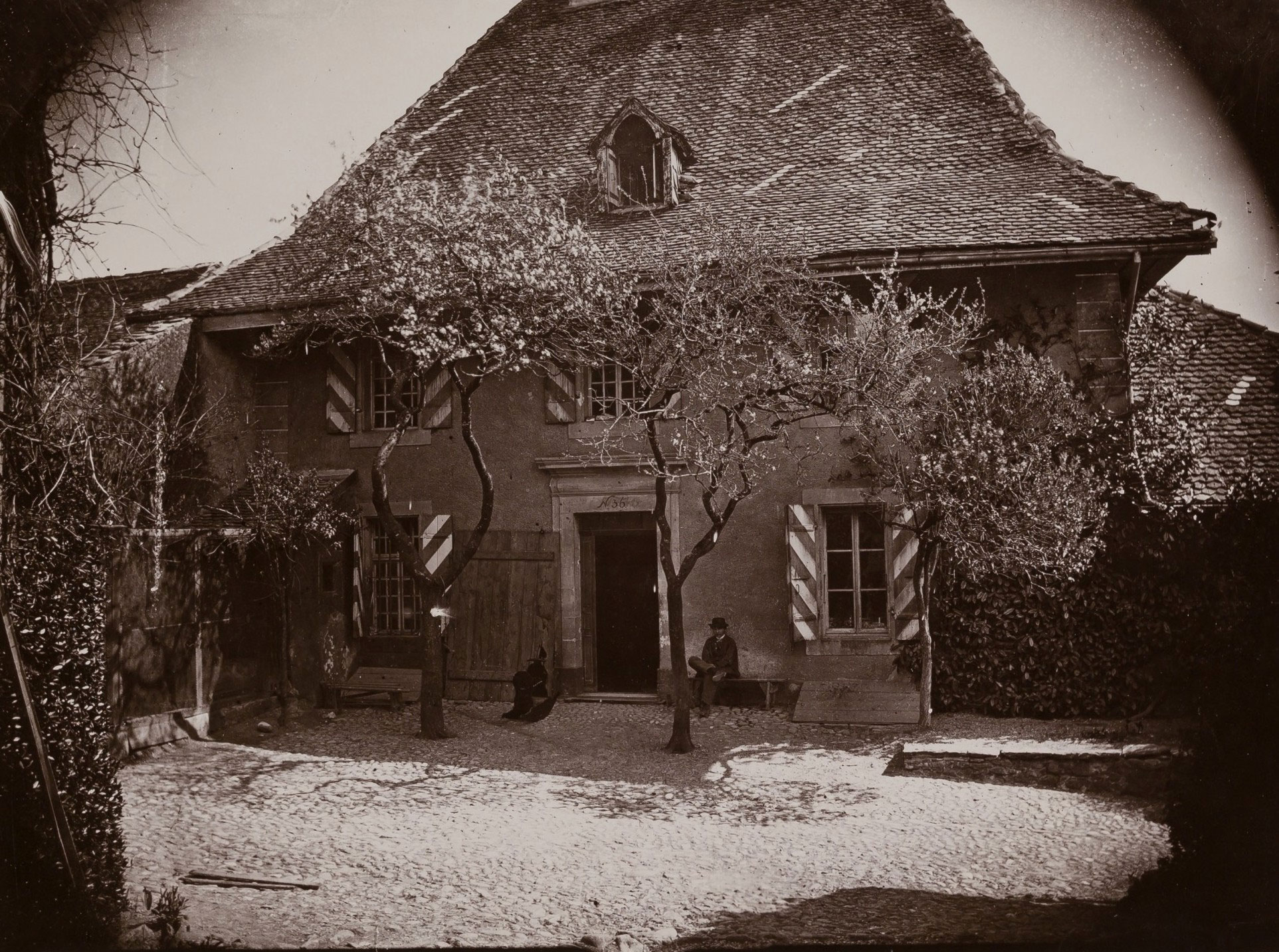
Paul Vionnet (Swiss, 1830-1914) 'La cure d'Etoy' 1870


Paul Vionnet (Swiss, 1830-1914)
La cure d’Etoy
1870
Tirage sur papier aristotype
13.4 × 17.8cm
Collection iconographique vaudoise
© Musée de l’Elysée, Lausanne


With the exhibition The Memory of the Future. Photographic Dialogues between Past, Present and Future, the Musée de l’Elysée encourages contemporary artists to take a close look at photography as a medium, innovates as it reveals a 3D digitisation technology developed by a spin-off from Lausanne’s Swiss Federal Institute of Technology (EPFL), and displays its unique visual heritage. 

The Memory of the Future. Photographic Dialogues between Past, Present and Future is the first exhibition that Director Tatyana Franck has curated at the Musée de l’Elysée. It opens up a dialogue between the work of the pioneers of photographic techniques (the past), those of contemporary artists that breathe new life into these skills (the present), and avant-garde technologies that update these early processes (the future). Works from the museum’s collections, contemporary artists and new technologies come face to face and join forces to give a brand new vision of the history of photography. The Memory of the Future aims to configure the present by reconfiguring the past in order to prefigure the future.

Techniques over time

First of all, early photographic processes such as ambrotypes, daguerreotypes, ferrotypes, cyanotypes, etc. are displayed next to works by contemporary artists who breathe life into them. The technical innovations of the past are fertile ground for contemporary art and design. The exhibition includes a waxed paper negative by Gustave Le Gray in dialogue with those by Martin Becka, while cyanotypes by Anna Atkins and Paul Vionnet converse with those by Christian Marclay, Nancy Wilson-Pajic and John Dugdale. Jean-Gabriel Eynard’s daguerreotypes from the museum’s collections are exhibited next to portraits by Takashi Arai and Patrick Bailly-Maître-Grand and landscapes by Binh Danh and Jerry Spagnoli. And as for contemporary ferrotypes, The Memory of the Future shows the work of Joni Sternbach and Jayne Hinds Bidaut as well as portraits taken by Victoria Will at the Sundance Independent Film Festival in 2014.

Works of two scientists who won a Nobel Prize and invented a photographic technique also have pride of place – a self portrait by Gabriel Lippmann (Nobel Prize in Physics in 1908) who invented color photography using the interferential method and a portrait of Dennis Gabor (Nobel Prize in Physics in 1971), the inventor of the holographic process, a photographic technique in relief – echoing a holographic picture by James Turrell, a contemporary artist primarily concerned with light. Lastly, and as a point of convergence for all these photographic processes to fix an image on to a support, the camera obscura is presented through the works of Florio Puenter, Dino Simonett and Vera Lutter. Loris Gréaud – an artist invited to present an original installation capturing the spirit of the Musée de l’Elysée by recording its shadows and light – also explores this technique.

Homage and metamorphosis

The exhibition also presents the “mise en abyme” of iconic pictures from the history of photography reinterpreted by contemporary artists whose works examine the very notion of time or memory.

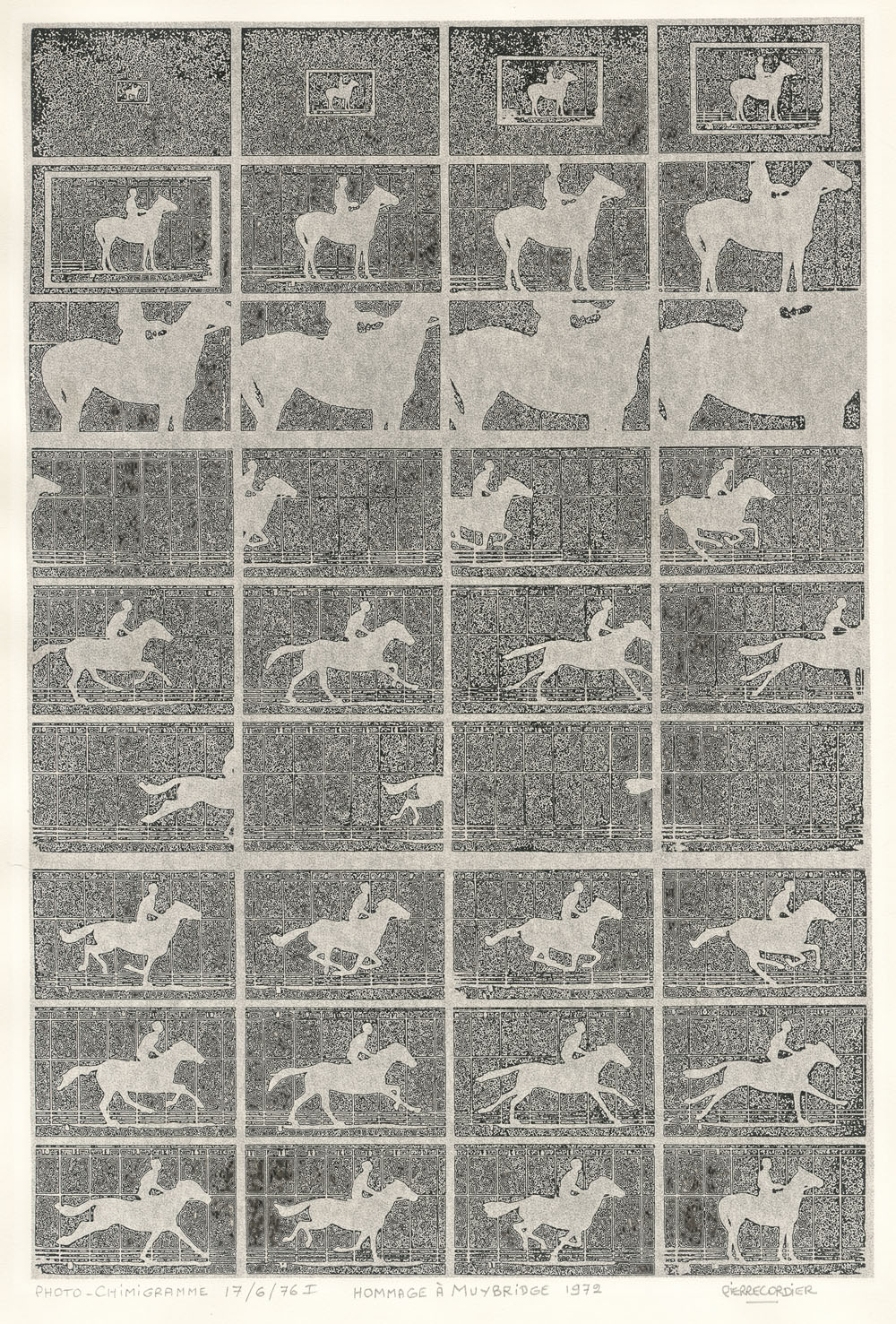
The earliest photograph in history – by Nicéphore Niépce and dating back to 1826 – is thus transformed by Joan Fontcuberta (Googlegramme Niépce, 2005) using PhotoMosaïque freeware connected online to the Google search engine, and by Andreas Müller-Pohle (Digital Scores VI). The first photographic self portrait in history – by Robert Cornelius in 1839 – is reproduced on a series of mirrors by Oscar Muñoz in 2009 to examine the paradox of the aging of the photographic support, which is, however, supposed to record an image for eternity. While Pierre Cordier pays homage to Eadweard Muybridge’s photographic breaking down of movement, Idris Khan (who took part in the reGeneration exhibition in 2005) pays homage to the iconic photographs of Bernd and Hilla Becher.

Innovating to preserve and showcase

Having launched a campaign in 2014 to digitise its photography books – 1500 books have been scanned so far – the Musée de l’Elysée is continuing to explore techniques to dematerialise its visual heritage for conservation and promotion purposes. Launched in 2015 thanks to the Engagement Migros development fund, an ambitious three dimensional digitisation project puts the Musée de l’Elysée at the forefront of museum innovation.

A venue for exhibitions, conservation and now an experimentation, as part of the exhibition La Mémoire du futur the Musée de l’Elysée is proposing for the first time a space dedicated to the presentation of digitised virtual objects from its collections. This innovative project aims to introduce new collaborative and interactive experiences using the Museum’s collections to a wide range of audiences – whether they be photography enthusiasts, curators or researchers.

Thanks to the Engagement Migros development fund, Innovation partner of the Musée de l’Elysée, the public is invited to experimentally test the first 3D digitisations carried out in partnership with the start-up Artmyn, created at EPFL’s Audiovisual Communications Laboratory (LCAV) led by Martin Vetterli. It will thus be possible to look at the works in 3D with unprecedented precision, but above all, to make the different textures of which they are composed appear on screen by lighting up the digital replicas from any angle.

This new technology comes in the form of a scanner made up of a dome on which are fixed several small lamps of precisely-adjusted intensity that switch on and off in turn depending on each picture scanned. “We are returning to an ancient theory of vision that imagined the eye’s projection towards the world, allowing the spectator once again to become an actor in the photographic experience,” explains Martin Vetterli in the exhibition catalogue.

Preliminary work was carried out with the Collections Department to select the processes that would most benefit from this scanning technology – heliogravure, ambrotype, ferrotype, collage and carbon printing. The first results will be presented in the exhibition. A tactile device supplemented by a video tour of the work presents a collage by René Burri from the René Burri Foundation housed at the Musée de l’Elysée. Rendered in real time and very high resolution, the images that have been cut out and superimposed by the artist can be freely explored so that the visitor can appreciate the visual richness of the work. Visitor experience appraisal is an integral part of the project to optimise presentation techniques and create a digital experimentation area in the museum.

The active participation of visitors to the Museum is an essential step for this first test phase: the interactions and different perceptions of the benefits of the prototype presented will be taken into account for the purpose of developing teaching and learning tools that will subsequently be used to refine and expand the user’s experience and to develop a digital, educational discovery space within the exhibition areas.

Press release from the Musée de l’Elysée


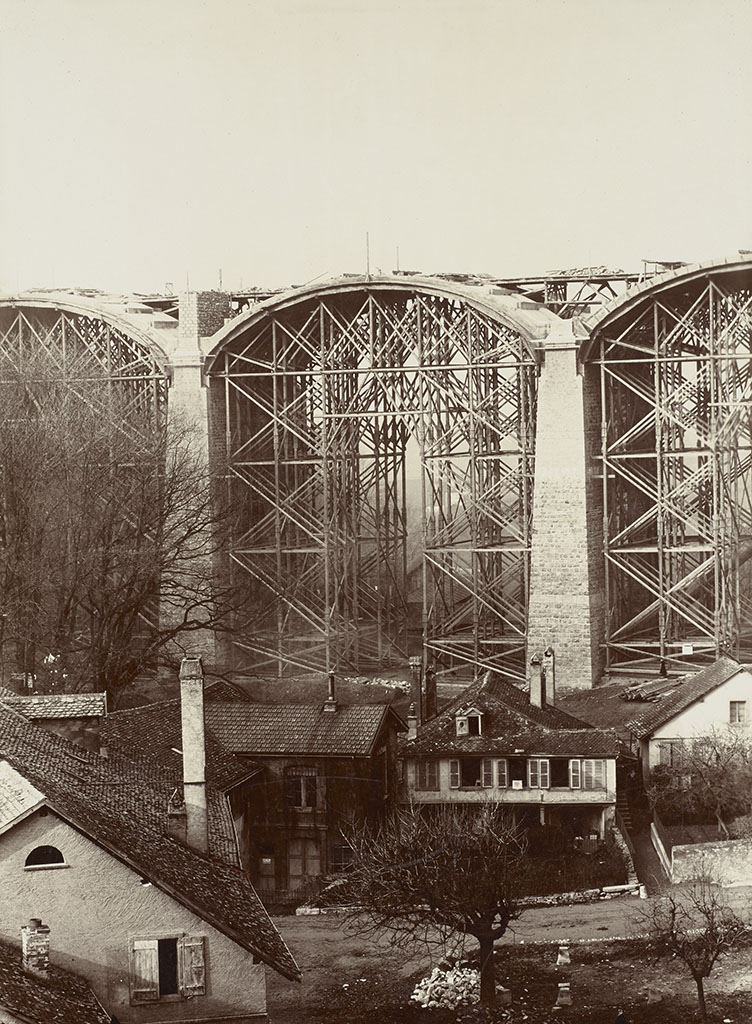
Paul Vionnet (Swiss, 1830-1914) 'Lausanne, le pont Chauderon en construction' 1904


Paul Vionnet (Swiss, 1830-1914)
Lausanne, le pont Chauderon en construction
1904
Tirage au gélatino-bromure d’argent
39.5 × 23.0cm
Collection iconographique vaudoise
© Musée de l’Elysée, Lausanne


Paul Vionnet, a local photographic pioneer, is at the origin of the Iconographic Collection of the Canton of Vaud. This collection, devoted to the history of the Vaud, is at the very foundation of the creation of the Musée de l’Elysée in 1985 as a museum dedicated to the image. During his childhood, Paul Vionnet spent his vacations at his grandparents’ home in Aubonne and was a frequent visitor of Adrien Constant Delessert (1806-1876), a neighbour and renowned Vaud photographer. During his stays there in 1845, Delessert taught him photographic techniques and the calotype.

Fascinated by the sciences, nature and his canton, Paul Vionnet took it upon himself to collect the greatest number of iconographic documents possible concerning the history, landscapes and monuments of the region for the purpose of enriching the collection of the Historical Monuments Service in Lausanne. The documents that he was not able to acquire himself were reproduced using photography. Following in his father’s footsteps, he was ordained pastor in 1856, and assigned to Granges de Sainte-Croix, near Aubonne, and then to Pampigny in 1858. He nevertheless continued to take photographs, having since adopted the wet collodion technique, documenting landscapes and monuments during his free time.

He retired in 1896 and founded the Collection historiographique vaudoise that would house his documents. In 1903, Paul Vionnet bequeathed his private collection to the canton of Vaud, forming the fifth section of the Musée Cantonal des Antiquités. He was named assistant curator, and several years later, the municipality commissioned him to take the photographs for Lausanne à travers les âges.


Anna Atkins (English, 1799-1871) 'Adiantum tenerum (Jamaica)' c. 1852


Anna Atkins (English, 1799-1871)
Adiantum tenerum (Jamaica)
c. 1852
© Wilson Centre for Photography


A British photographer considered to be the first woman to create a photograph, Anna Atkins is also known to have published the first books on botany illustrated with cyanotypes. Passionately interested in science and art, she became a member of the Botanical Society of London in 1839 and realised that the photographic process could be used to obtain precise and detailed botanical images and to provide information at all levels of a society increasingly eager for knowledge.

Anna Atkins drew her inspiration from the inventor of photography, William Henry Fox Talbot (1800-1877), and from a close family friend, John Herschel (1792-1871), a scientist known for the invention and the improvement of the cyanotype. She subsequently developed the process on her own that would allow her to obtain authentic and inexpensive photographic reproductions and that would make her part of the great tradition of her teachers. In 1843, she published her work, British Algae: Cyanotype Impressions, the first volume of which preceded the famous work of Talbot, The Pencil of Nature, by several months. In 1853, she applied the same process to ferns and published Cyanotypes of British and Foreign Ferns,a page of which is presented here.


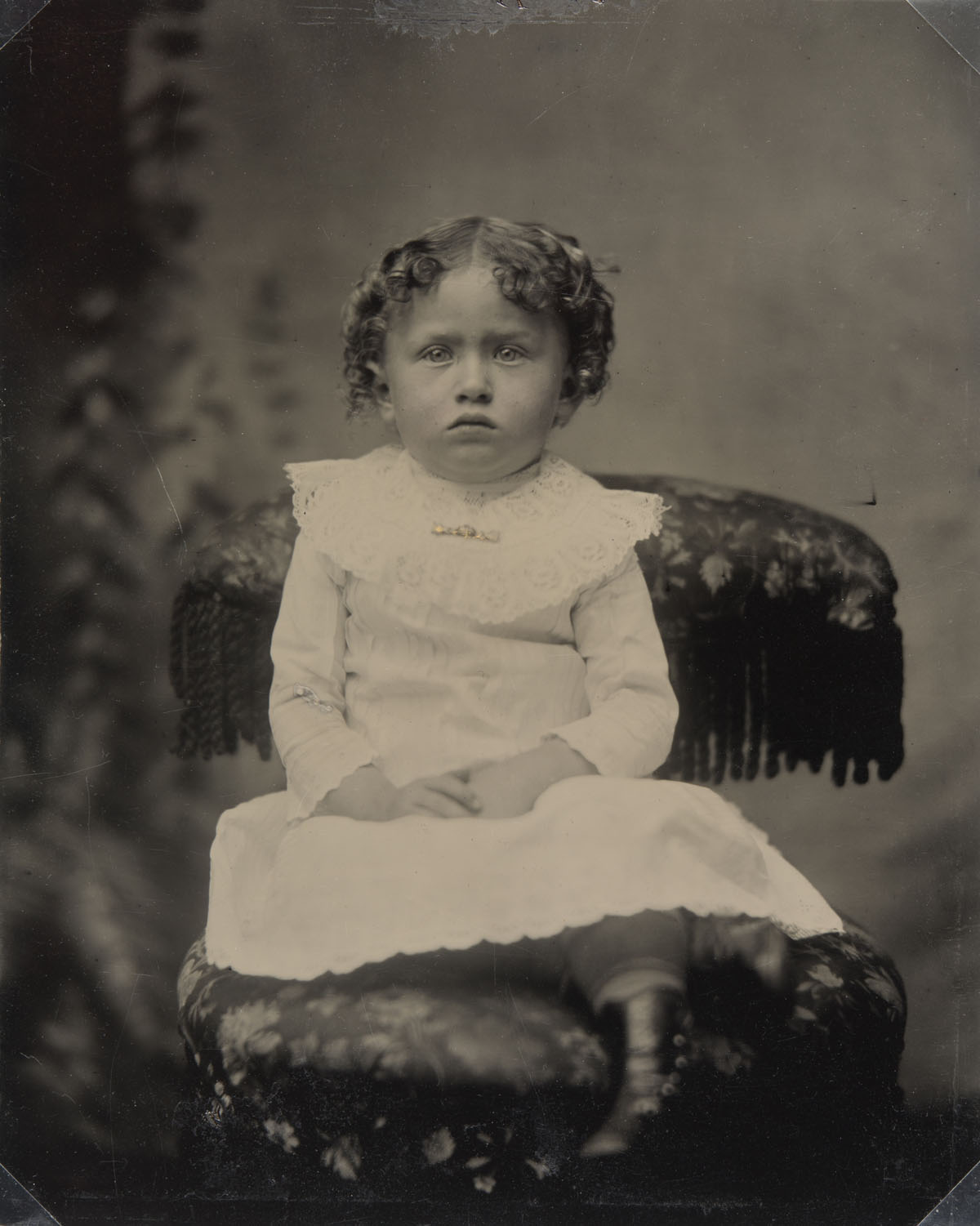
Anonymous. 'Portrait of a young girl' 1860-1870


Anonymous
Portrait of a young girl
1860-1870
© Musée de l’Elysée, Lausanne


This exhibition is an odyssey into the history of photography where different eras are juxtaposed and where artists and their methods dialogue with each other. Through a selection of historic photographic processes and the works of contemporary artists, the spectator is encouraged to observe the influence of the past on today’s artistic creations. The exhibition The Memory of the Future proposes a three-pronged vision: that of the past with the works of the pioneers of photographic techniques, that of the present with contemporary works that revive this know-how, and that of the future with technologies that give a new perspective on the works of the past.

Through century-old processes such as daguerreotypes, calotypes, negatives on dry waxed paper, tintypes, ambrotypes, cyanotypes and including holograms, The Memory of the Future celebrates the founding fathers of photographic techniques by establishing a dialogue between them and contemporary artists. From Gabriel Lippmann to James Turrell, including Robert Cornelius and Oscar Muñoz, this exhibition brings together for the first time some one hundred works whose common thread is their ability to withstand time. The Memory of the Future also proposes a selection of works from the Musée de l’Elysée’s collections that have never before been presented to the public.

After having launched a campaign to digitise its photography books in 2014 – 1,500 books have been digitised as of this time – the Musée de l’Elysée continues to explore techniques to dematerialise its visual heritage in order to preserve and enhance it. Consistent with its ambition to not only preserve works of value but to prospect for new ones, the Musée de l’Elysée has undertaken a 3D digitisation project of its works using a prototype developed by the EPFL (Ecole Polytechnique Fédérale de Lausanne). This technology of the future is presented in this exhibition in the form of a touch screen monitor.

Press release from the Musée de l’Elysée, Lausanne


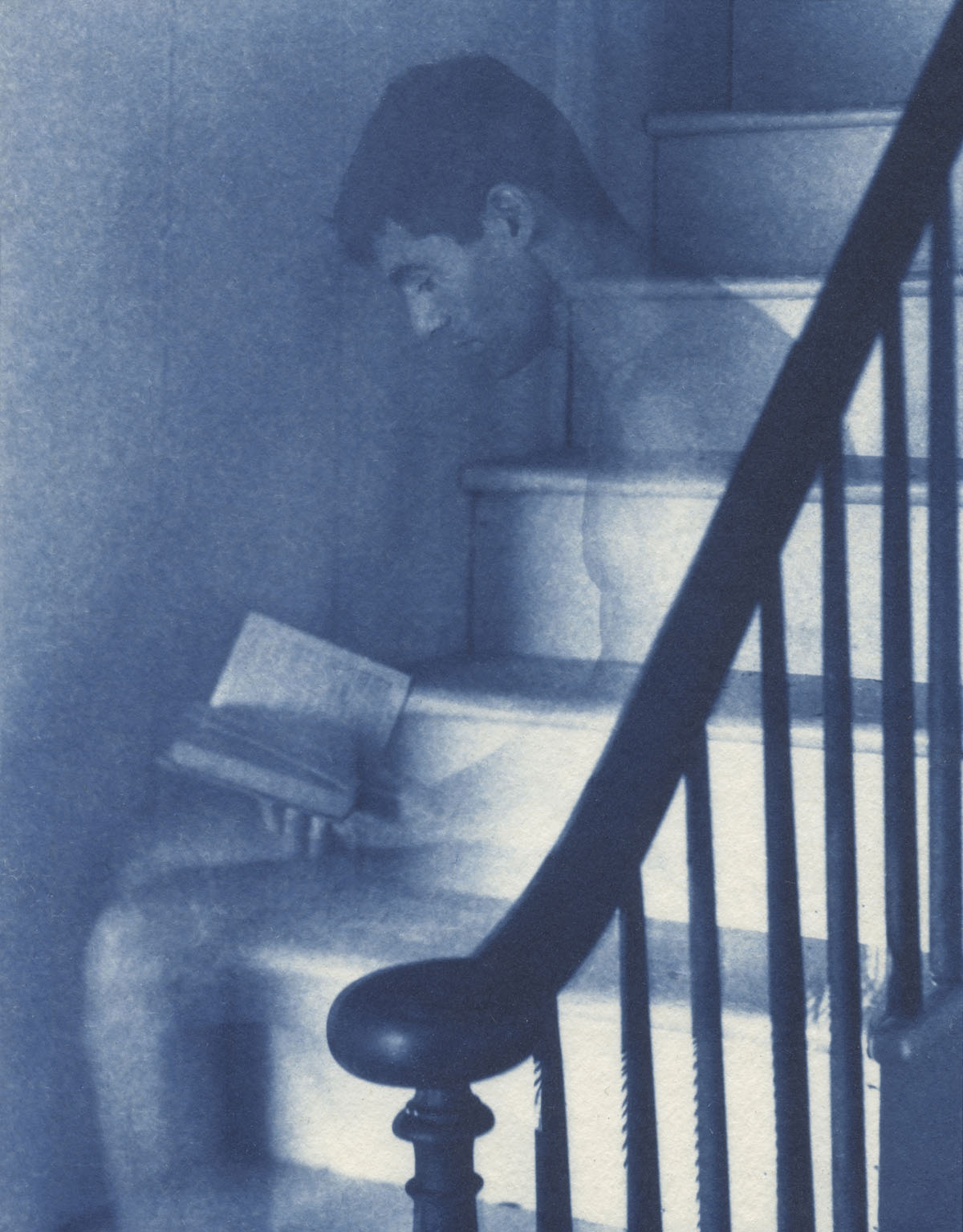
John Dugdale. 'The Clandestine Mind' 1999


John Dugdale (American, b. 1960)
The Clandestine Mind
1999
© The John Dugdale Studio


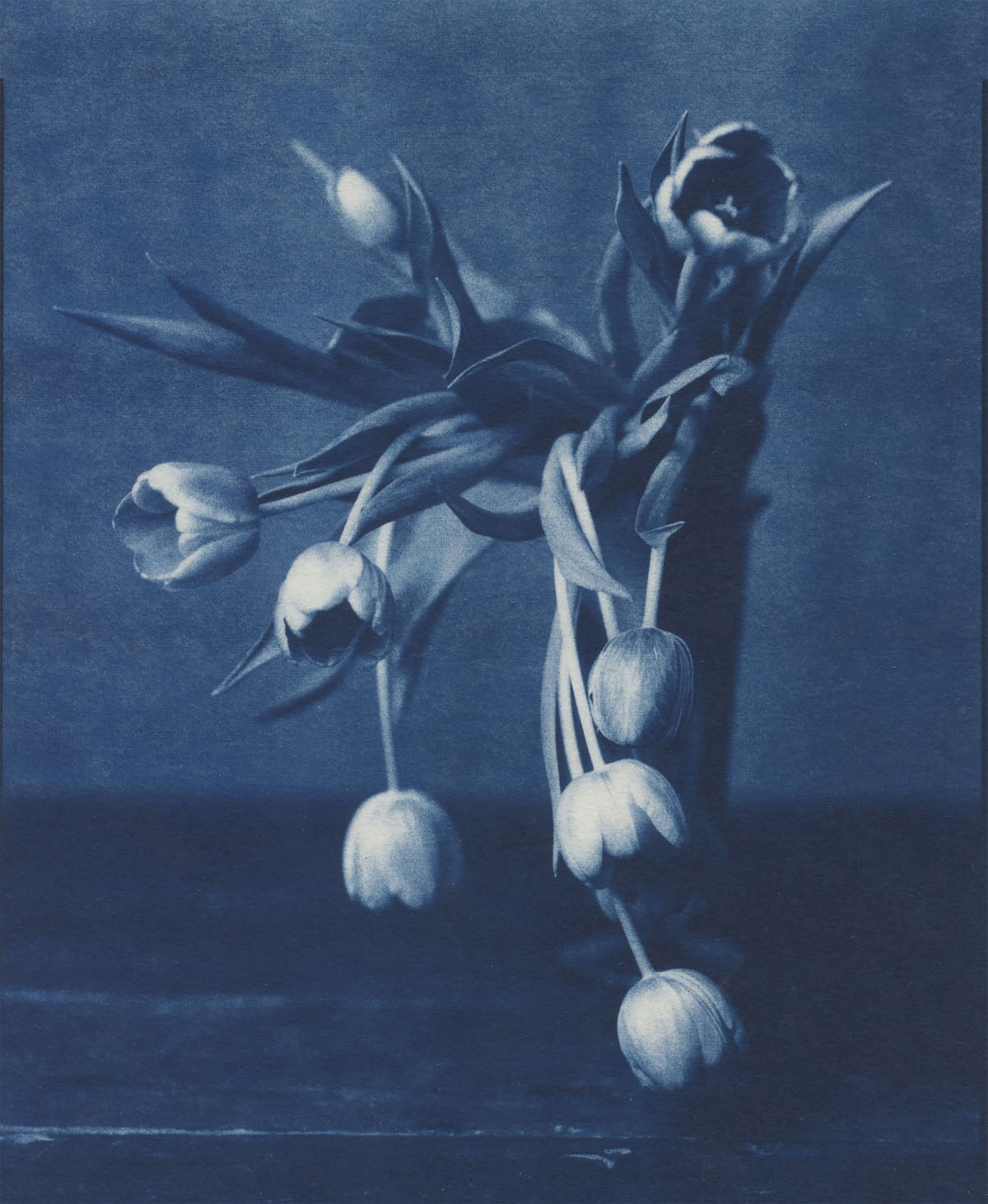
John Dugdale (American, b. 1960) 'Mourning Tulips' 1999


John Dugdale (American, b. 1960)
Mourning Tulips
1999
© The John Dugdale Studio


John Dugdale’s interest in photography goes back to his childhood when he received his first camera at the age of 12 and dreamed of becoming one of the major photographers of the 20th century. After a brilliant career as a fashion photographer, the year 1993 marked the turning point in the life of the artist who lost his sight following a stroke and CMV retinitis. Dugdale nevertheless refused to give up photography and began to take an interest in 19th century photographic techniques, using his family and friends as assistants. He discovered the large format and decided to use the cyanotype process, considering it to be the most direct and the easiest to use.

In his blue works, he portrays his everyday life by reversing the roles. Dugdale poses with a simplistic spirituality that could appear to be in contradiction with the 21st century. Generally posing in the nude, he considers that “life is transient. Once you leave this world, you fly into the universe without clothes. I want people to learn you cannot protect yourself by hiding behind clothes.”

Thanks to its low toxicity, the use of this process allows him to be involved in the printing of his photographs. His sensitivity to historic techniques emphasises the poetry of his work and the transitory nature of time and place. In the hopes of sharing his experience and his healing, Dugdale creates a new body of art by “showing the beauty of life and how one should act around illness.


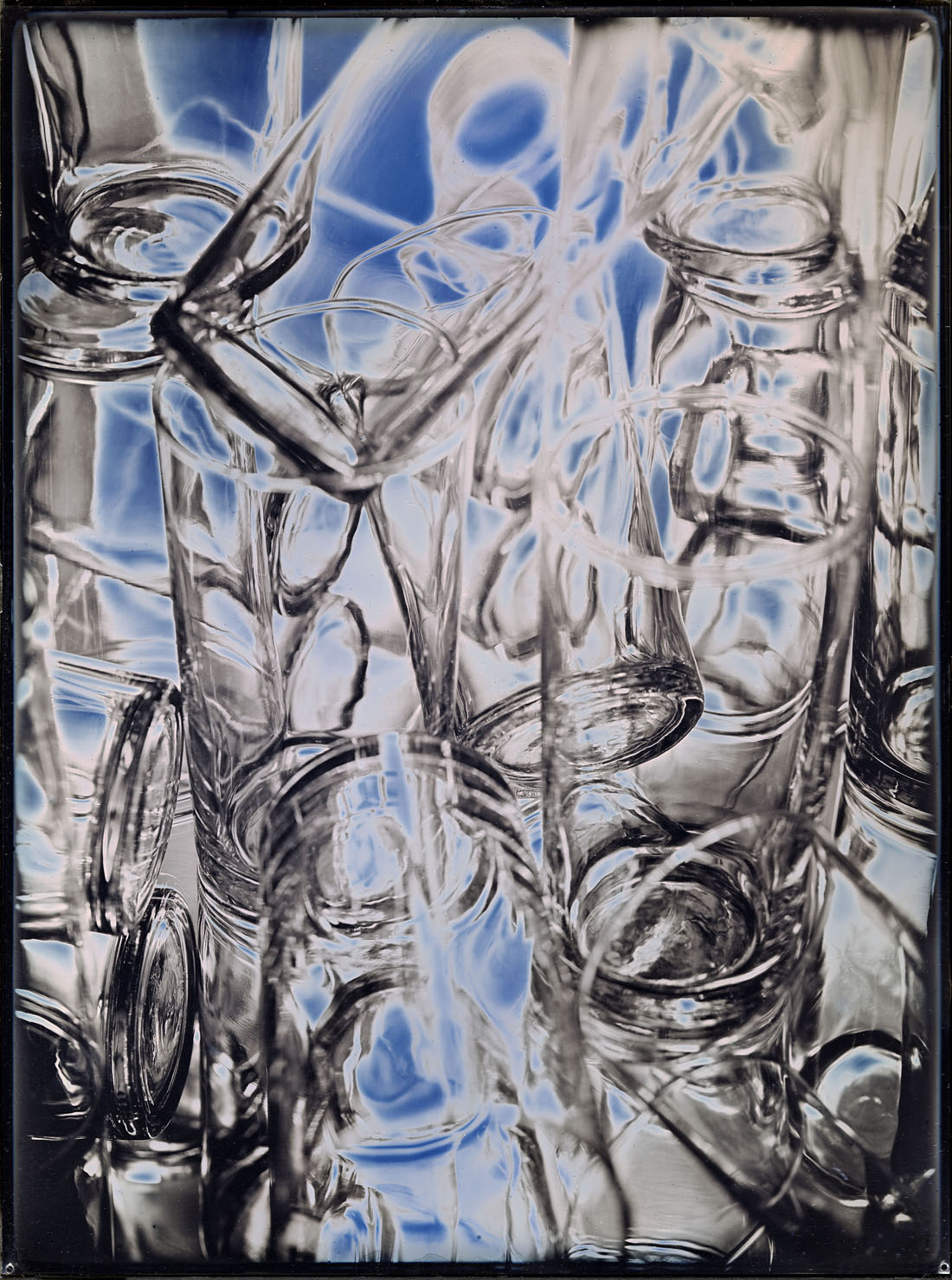
Jerry Spagnoli (American, b. 1956) 'Glass 10/9/12' 2012


Jerry Spagnoli (American, b. 1956)
Glass 10/9/12
2012
© Jerry Spagnoli


When the photographer Jerry Spagnoli discovered a daguerreotype at a flea market, he described it as the most perfect photograph he had ever seen, a discovery that would influence the rest of his work. After familiarising himself with the process in his studio in San Francisco, the artist experimented with it using equipment from the 19th century and studying the effects obtained in order to understand the technical aspects as well as the visual and expressive potential.

By studying the body and the roots of photographic imagination in his series Anatomical Studies, the portrait, objects and contemporary street scenes, events and non-events in his series The Last Great Daguerreian Survey of the Twentieth Century, Spagnoli attempts to highlight the qualities of the daguerreotype – uniqueness, richness of detail – through the four series presented here, in order to allow a contemporary public to rediscover its virtues. It is also a way for him to approach the optical essence of photography. “With other processes the material substrate of the image can be intrusive, but when you look at a daguerreotype, there is a transparency to the depiction as if you were looking through the lens itself.”


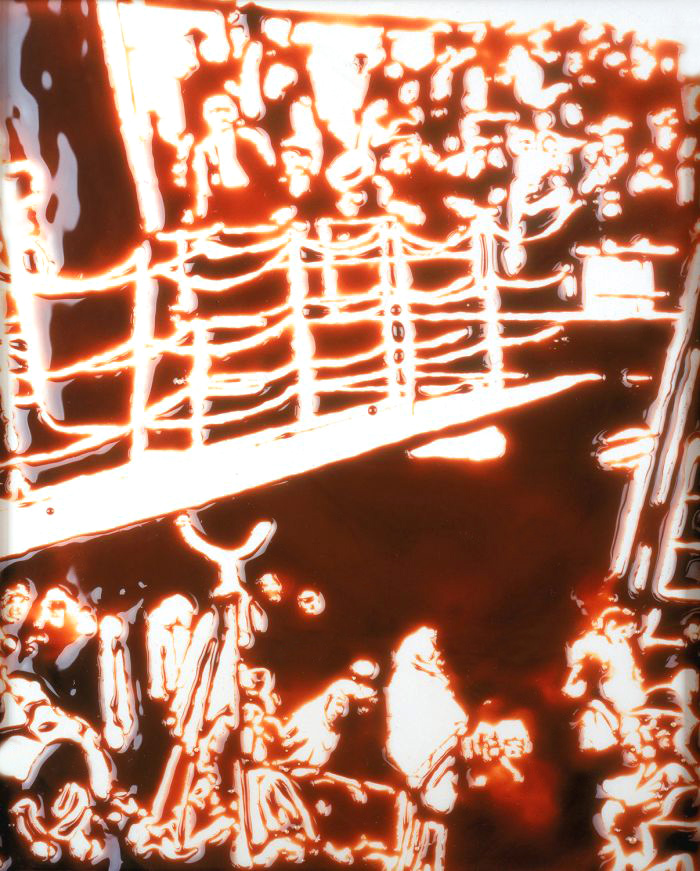
Vik Muniz (Brazilian, b. 1961) 'The Steerage (After Alfred Stieglitz)' 2000


Vik Muniz (Brazilian, b. 1961)
The Steerage (After Alfred Stieglitz)
2000
from the Pictures of Chocolate series


When the photographer Jerry Spagnoli discovered a daguerreotype at a flea market, he described it as the most perfect photograph he had ever seen, a discovery that would influence the rest of his work. After familiarising himself with the process in his studio in San Francisco, the artist experimented with it using equipment from the 19th century and studying the effects obtained in order to understand the technical aspects as well as the visual and expressive potential.

By studying the body and the roots of photographic imagination in his series Anatomical Studies, the portrait, objects and contemporary street scenes, events and non-events in his series The Last Great Daguerreian Survey of the Twentieth Century, Spagnoli attempts to highlight the qualities of the daguerreotype – uniqueness, richness of detail – through the four series presented here, in order to allow a contemporary public to rediscover its virtues. It is also a way for him to approach the optical essence of photography. “With other processes the material substrate of the image can be intrusive, but when you look at a daguerreotype, there is a transparency to the depiction as if you were looking through the lens itself.”


Pierre Cordier (Belgian, b. 1933) 'Photo-Chimigramme 17/6/76 I "Hommage à Muybridge 1972"' 1976


Pierre Cordier (Belgian, b. 1933)
Photo-Chimigramme 17/6/76 I “Hommage à Muybridge 1972”
1976
© Pierre Cordier


Pierre Cordier is a Belgian artist known as the father of the chemigram and for its development as a means of artistic expression. In 1956, writing a dedication with nail polish on photographic paper to a young German woman, Pierre Cordier discovered what he later called the chemigram. This technique “combines the physics of painting (varnish, oil, wax) and the chemistry of photography (photosensitive emulsion, developer and fixer), without the use of a camera or enlarger, and in full light.”

He worked for 30 years as a lecturer on the history of photography at the École Nationale des Arts Visuels in Brussels. When he gave up photography in 1968 to devote himself exclusively to the chemigram, he wanted to pay tribute to the great photography pioneers – Muybridge in 1972 and Marey in 1975. The Homage to Muybridge presented here was inspired by Allan Porter, chief editor of the Swiss revue Camera, one of the most prominent revues in the history of photography. In the issue of Camera of October 1972, we can read: “Cordier used Muybridge’s famous sequence, The Horse in Motion, which he transformed in three different ways: 1. Still subject and mobile camera. 2. Mobile subject and still camera. 3. Subject and camera, both mobile. He then combined the three sequences into one and treated it according to the photochemigram process.”


Andreas Muller-Pohle (German, b. 1951) 'Digital scores V (after Nicephore Niepce)' 2001


Andreas Muller-Pohle (German, b. 1951)
Digital scores V (after Nicephore Niepce)
2001
Inkjet print
Image: 10 7/8 in x 11 in
Mat: 16 1/8 in x 20 1/8 in
Paper: 12 1/8 in x 12 1/8 in


Andreas Müller-Pohle is one of the key figures involved in the ontological as well as the representational nature of photography. Since the 1990s, he has reflected on the radical changes in the essence of technical images. His first artistic project focused on questions of photographic perception and on the recycled photograph.

In the mid-1990s, Müller-Pohle began to explore the use of digital, genetic and political codes. He is one of the first artists to have broken down and translated the analog and the digital codes of images. In his series Digital Scores (after Nicéphore Niépce), he takes us back to the origin of analog photography by translating the photograph of Niépce, View from the Window at Le Gras (taken from a window of his house in 1826), into alphanumeric code. The complete binary transcription of this photograph is then distributed over eight panels.


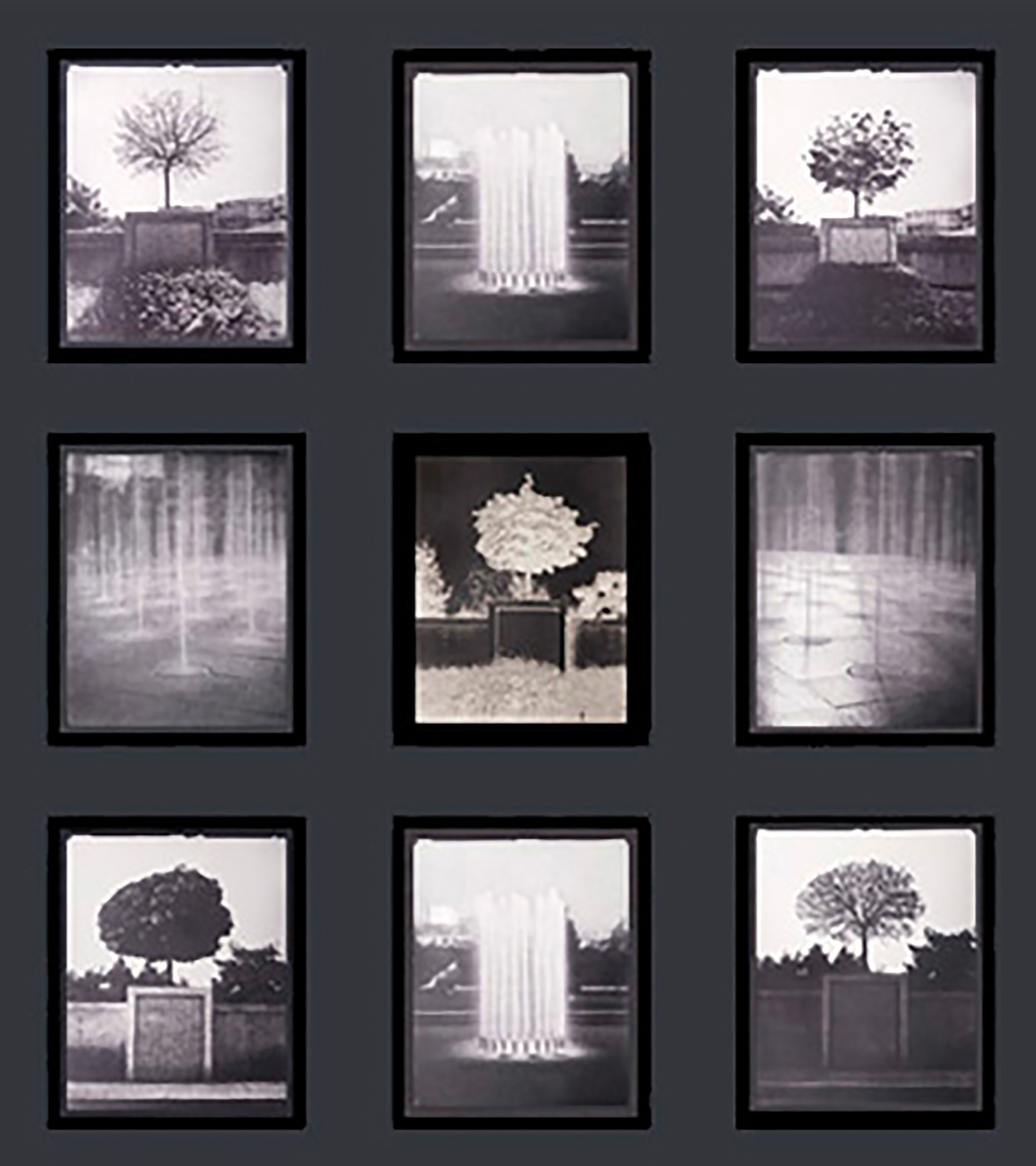
Martin Becka (Czech, b. 1956) 'Le Parc' 2002


Martin Becka (Czech, b. 1956)
Le Parc
2002
© Martin Becka


After studying photography, Martin Becka worked as a print developer for the Sepia Agency before becoming an independent news photographer. As of the beginning of the 1980s, he began doing research on the history of photography and the pre-industrial photographic processes that he incorporated into his personal creative work. By using traditional processes to photograph ultramodern cities like Dubai and business districts such as La Défense in Paris, the artist proposes a sort of “archeology of the present”, making the spectator reflect on the period in which he lives, the future, and the multiplication of images at a time when their reproducibility is unlimited. He sees photography as a means to “bend time in every possible direction.”

In his installation Le Parc (the André Citroën Public Park in Paris), Becka establishes a dialogue between the past and the present by paying homage to the photographic work of Alfred-Nicolas Normand (1822-1909) and the dry waxed paper negative process developed in 1851 by Gustave Le Gray (1820-1884). By choosing this century-old technique that requires an approach to work that is radically different from those currently in vogue, he is able to obtain negatives with a density adapted to a presentation by transparency and to create and control movement and unique atmospheres. Becka thus encourages the spectator to reflect on the notion of the photographic object.


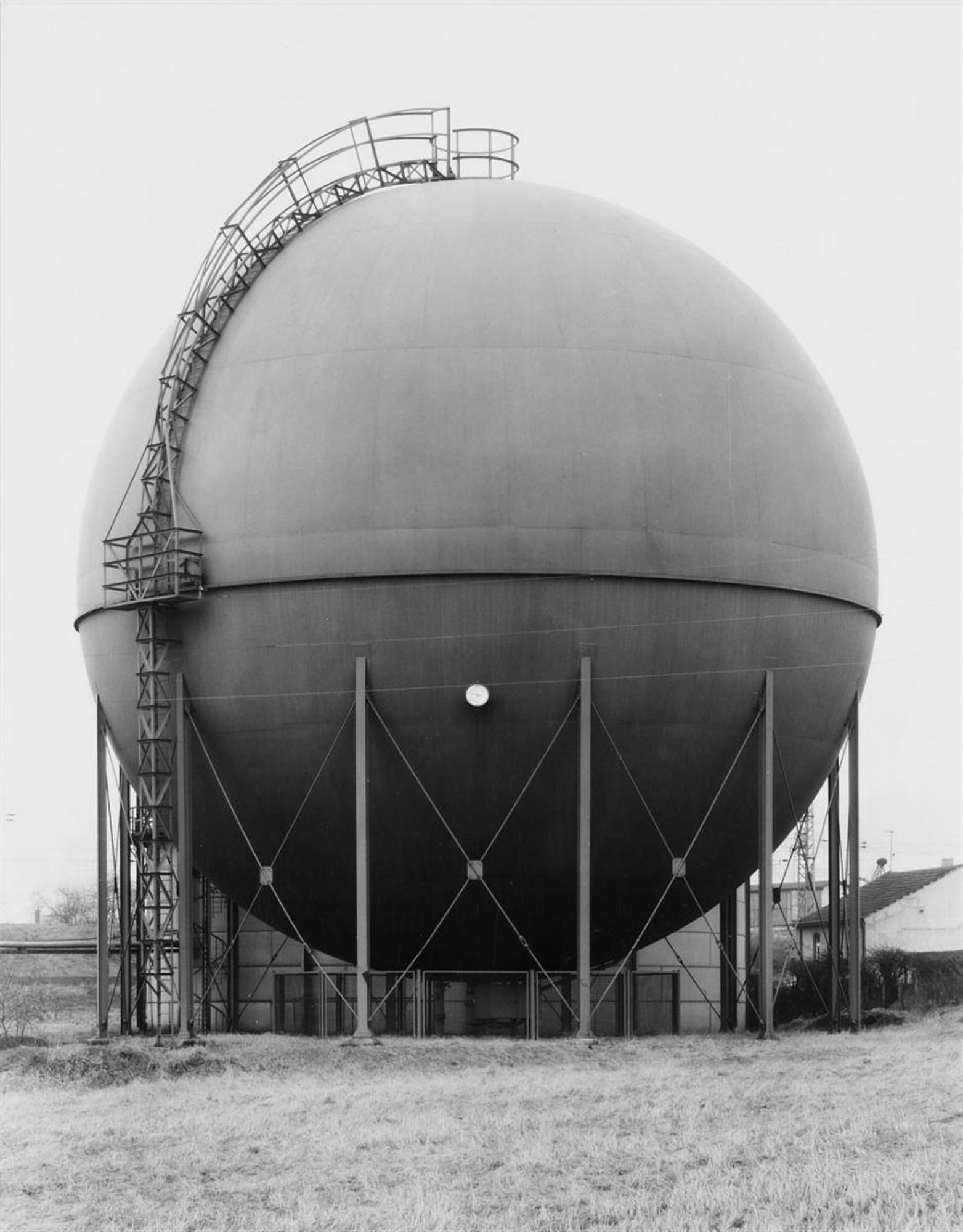
Bernd and Hilla Becher (German, 1931-2007/1934-2015) 'Gas Tank: Essen-Karnap D' 1973


Bernd and Hilla Becher (German, 1931-2007/1934-2015)
Gas Tank: Essen-Karnap D
1973
Gelatin silver print


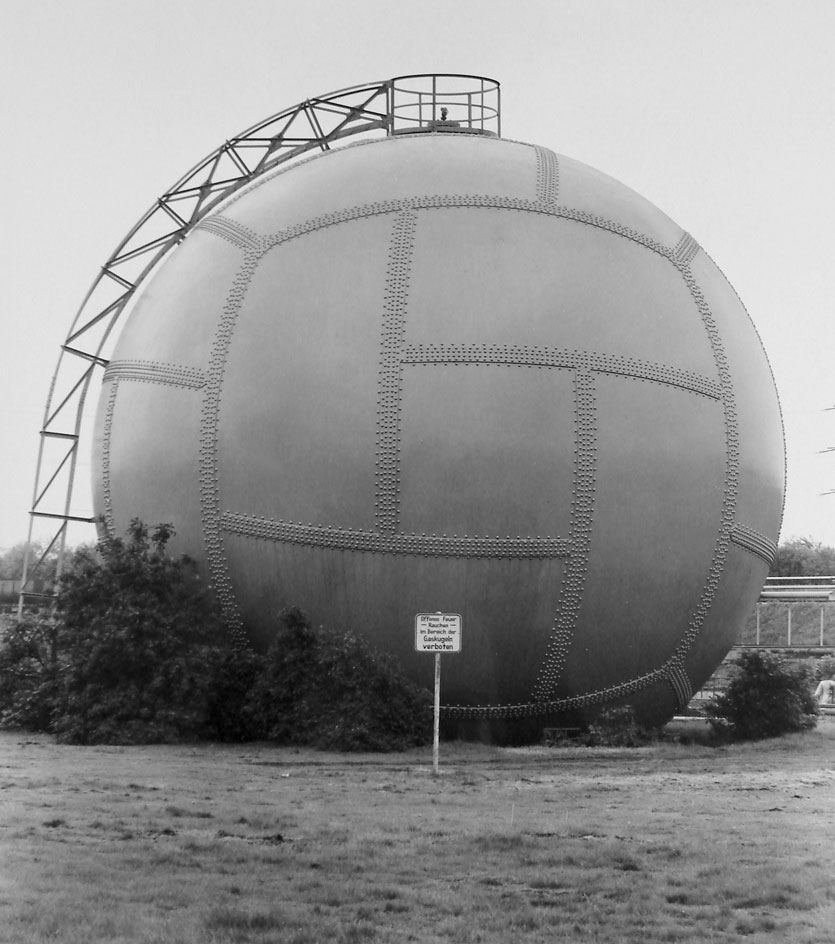
Bernd and Hilla Becher (German, 1931-2007/1934-2015) 'Gasbehälter bei Wuppertal (Gas tank near Wuppertal)' 1966


Bernd and Hilla Becher (German, 1931-2007/1934-2015)
Gasbehälter bei Wuppertal (Gas tank near Wuppertal)
1966
Gelatin silver print


Born during the period of industrial archeology, the Bechers’ work consists, in the words of Pierre Restany, “of an optical pilgrimage at the roots of the industrial world”. The couple proposes a way do see industrial architecture by taking an approach based on inventory methodology. Their work is a reflection on the creation of heritage and raises the question of the heritage value of industrial objects, which is inseparable from their artistic value.

With a focus on archiving and industrial memory, Bernd and Hilla Becher’s approach consists of establishing a detailed inventory and keeping track of industrial structures by photographing sites threatened by obsolescence and often abandoned. The series Gas Tanks includes nine photographs from the period between 1965 and 1973, taken according to the extremely stringent protocol that is characteristic of their work (frontal view, centring of the subject, mid-height, absence of light, etc.). The composition of each portrait is standardised and identical, with emphasis on the frontal aspect and the monumentality of industrial constructions classified according to their functionality and form.

Taking advantage of the extremely reproducible nature of the photograph, the Bechers reveal the massive diffusion and production of images that contribute to erasing our memories of their origins and their authors. In doing so, they observe a civilisation on the decline and highlight the production of an era, vestiges of the human imagination and life.


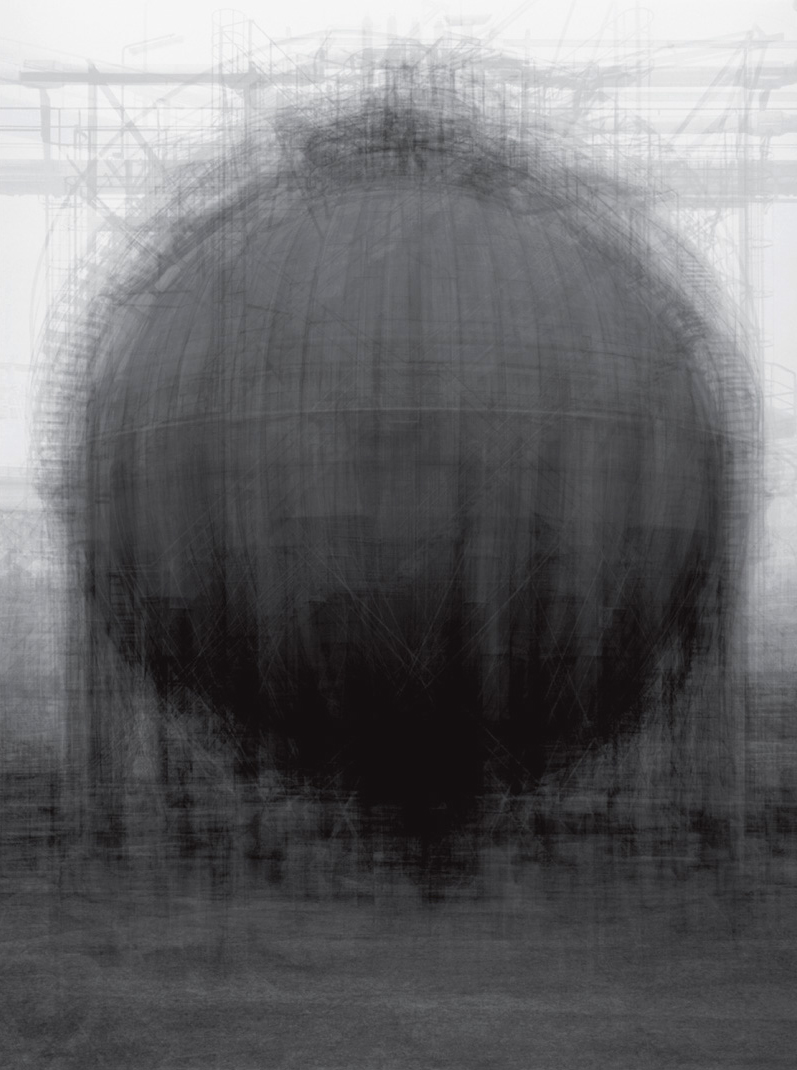
Idris Khan (British, b. 1978) 'Every ... Bernd and Hilla Becher Spherical Type Gasholder' One panel triptych, 2003


Idris Khan (British, b. 1978)
Every … Bernd and Hilla Becher Spherical Type Gasholder
One panel triptych, 2003
Lambda Digital C print mounted on aluminium
20 1/2 x 26 1/2 inches


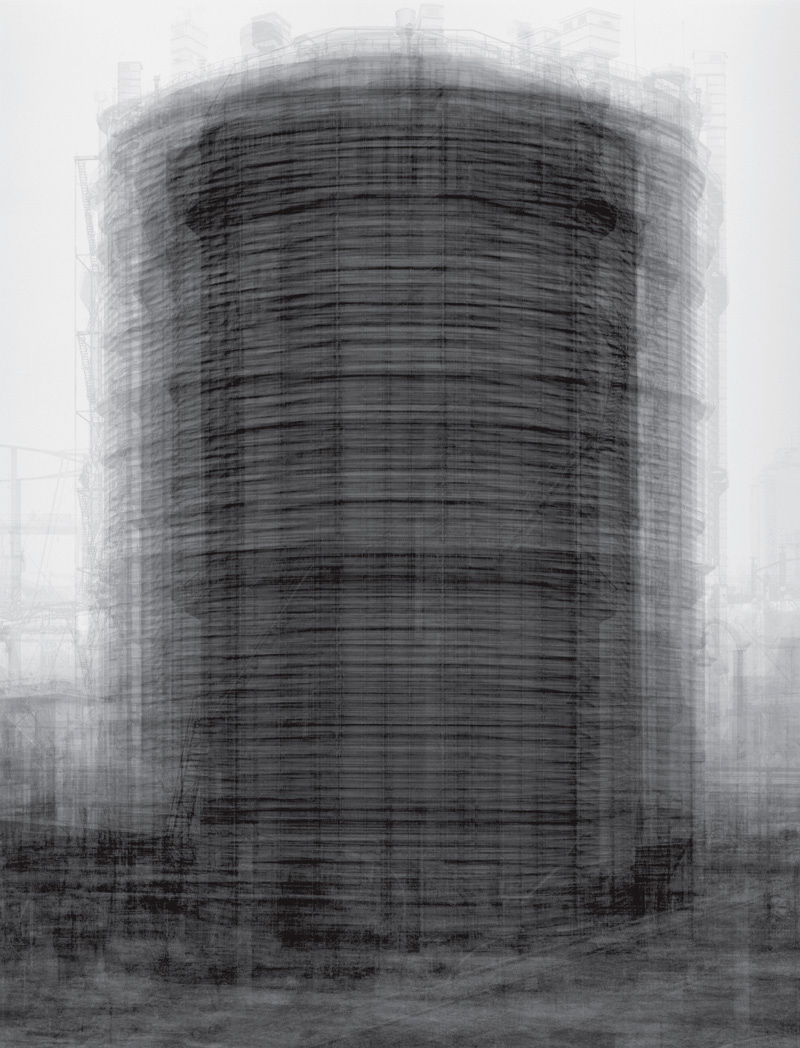
Idris Khan (British, b. 1978) 'Every ... Bernd and Hilla Becher Prison Type Gasholder' 2004


Idris Khan (British, b. 1978)
Every … Bernd and Hilla Becher Prison Type Gasholder
2004
Lambda Digital C print mounted on aluminium
80 × 65 inches


“I try to capture the essence of the building – something that’s been permanently imprinted in someone’s mind, like a memory.”

Idris Khan is fascinated by the photographic medium. Fuelled by images and influential theoretical essays on the history of photography, he re-appropriates the works that had an impact on him and subjects them to a series of transformations in order to see them from a different perspective. His work is a reflection on the passage of time, the accumulation of experiences and, as such, the decrease of unique moments. In his series Homage…, he presents rephotographed works, enlarged and superimposed in multiple layers. He uses digital tools to play with the opacity of the layers so as to strengthen the mystery of the original objects whose layering reveals new details. The work Homage to Bernd Becher shown here reproduces and compiles the photographs that correspond to the Bechers’ typology in order to celebrate the vestiges of these vanished industrial infrastructures.

Fascinated by the ability of the photographic medium to capture the soul as well as the body image, Idris Khan, in his series Rising Series… After Eadweard Muybridge “Human and Animal Locomotion”, pays homage to Muybridge’s early scientific experiments using the camera to sequentially record human and animal movement. Beyond the tribute paid to photography that is defined here as a compilation of knowledge, Idris Khan positions himself with respect to a medium laden with history and with a bright future ahead of it.


Victoria Will (American, b. 1980) 'Kristen Stewart' 2014


Victoria Will (American, b. 1980)
Kristen Stewart
2014
© Victoria Will


Kristen Stewart poses for a tintype (wet collodion) portrait at The Collective and Gibson Lounge, during the 2014 Sundance Film Festival in Park City, Utah. (Photo by Victoria Will/Invision/AP)

Victoria Will began her career as a staff photographer for the New York Post.Specialized at the time in portraits and fashion, her photographs were disseminated worldwide by the magazines W, the New York Times and Vogue. When she was invited for the fourth time to the Sundance Film Festival, an American independent film festival, she decided to try something new and to replace her digital reflex camera with the century-old tintype process to make portraits of movie stars. Following her success, she renewed the experience in the following years and gradually improved this complex technique.

Overcoming the difficulties of the process, its sensitivity to time and the danger of the chemical products involved, the photographer successively made portraits in 7 to 8 minutes of actors such as Vincent Cassel, Robert Redford, Jennifer Connelly, Spike Lee and Ethan Hawke. “What I love about the process is how raw it is,” says Victoria. “We live in an age of glossy magazines and overly retouched skin. But there is no lying with tintypes. You can’t get rid of a few wrinkles like in Photoshop.”

Both the photographer and her public “appreciate the honesty of these photographs. Development leaves a lot of room for the unexpected: we discover a face that we thought was familiar while being the contrary of digital portraits. The stages in the darkroom contribute to the idea of creating something unique and refreshing.”


The Musée de l’Elysée
18, avenue de l’Elysée
CH - 1014 Lausanne
Phone: + 41 21 316 99 11

Opening hours:
Tuesday – Sunday, 11am – 6pm
Closed Monday, except for bank holidays

The Musée de l’Elysée website

LIKE ART BLART ON FACEBOOK

Back to top