Exhibition: ‘Monet’ at the Fondation Beyeler, Riehen, Switzerland

Exhibition dates: 22nd January – 28th May, 2017
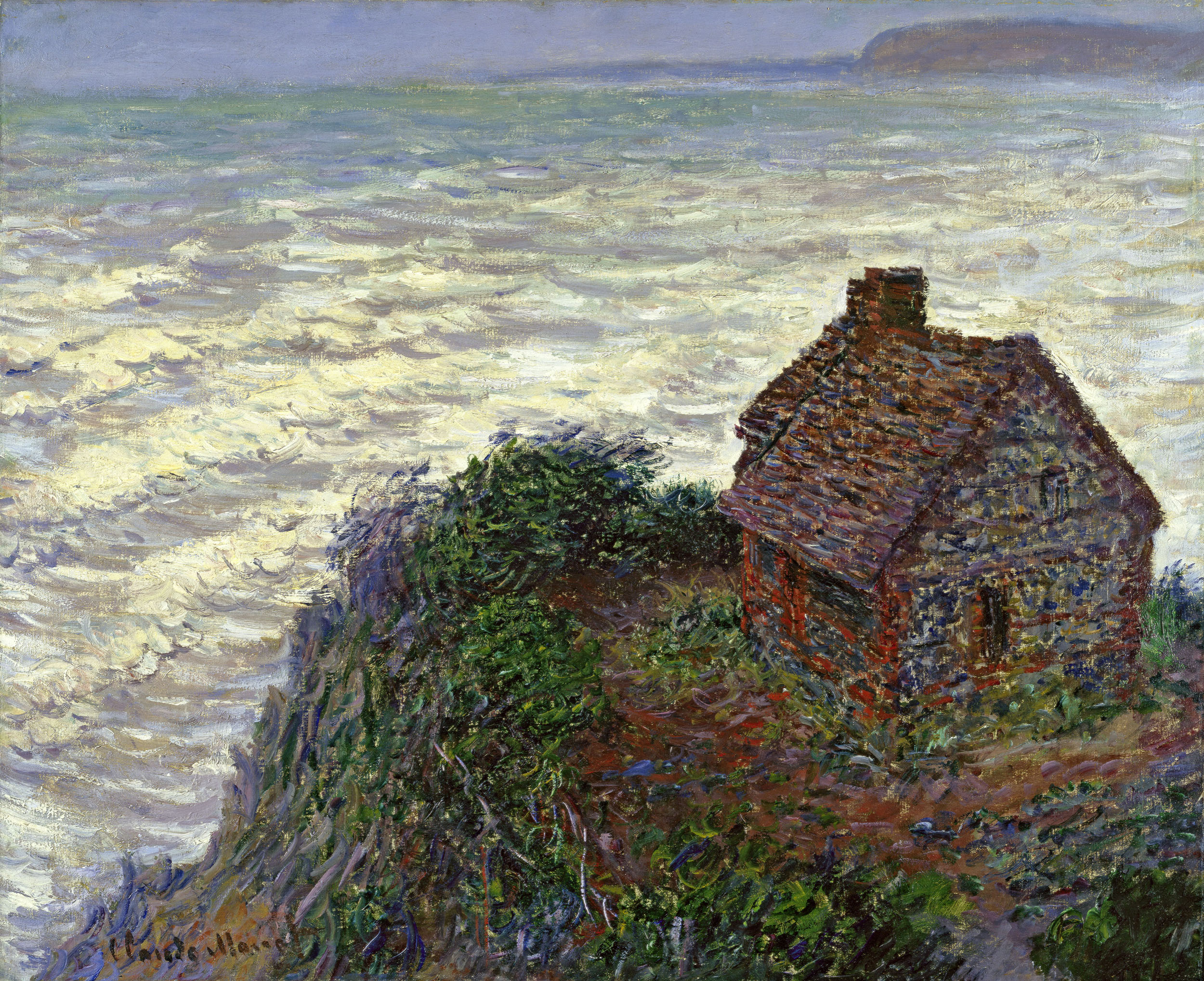


Claude Monet (French, 1840-1926) 'The Customhouse' 1882 from the exhibition 'Monet' at the Fondation Beyeler, Riehen, Switzerland, Jan - May, 2017


Claude Monet (French, 1840-1926)
The Customhouse
1882
Oil on canvas
61 x 75cm
Harvard Art Museums/Fogg Museum, Bequest of Annie Swan Coburn, 1934
Photo: Imaging Department © President and Fellows of Harvard College


Underlying these “impressions” of light, shadow and reflection is structure. Perceiving the spaces in between things as things… means that you need to define the original things as a first point of call. Order / chaos, pattern / randomness, harmony / discord. One does not exist without the other.

Grounding all of Monet’s work is an intrinsic understanding of the structure of the world.

Dr Marcus Bunyan


Many thankx to the Fondation Beyeler for allowing me to publish the images in the posting. Please click on the images for a larger version of the art.


“The world’s appearance would be shaken if we succeeded in perceiving the spaces in between things as things.”


Maurice Merleau-Ponty
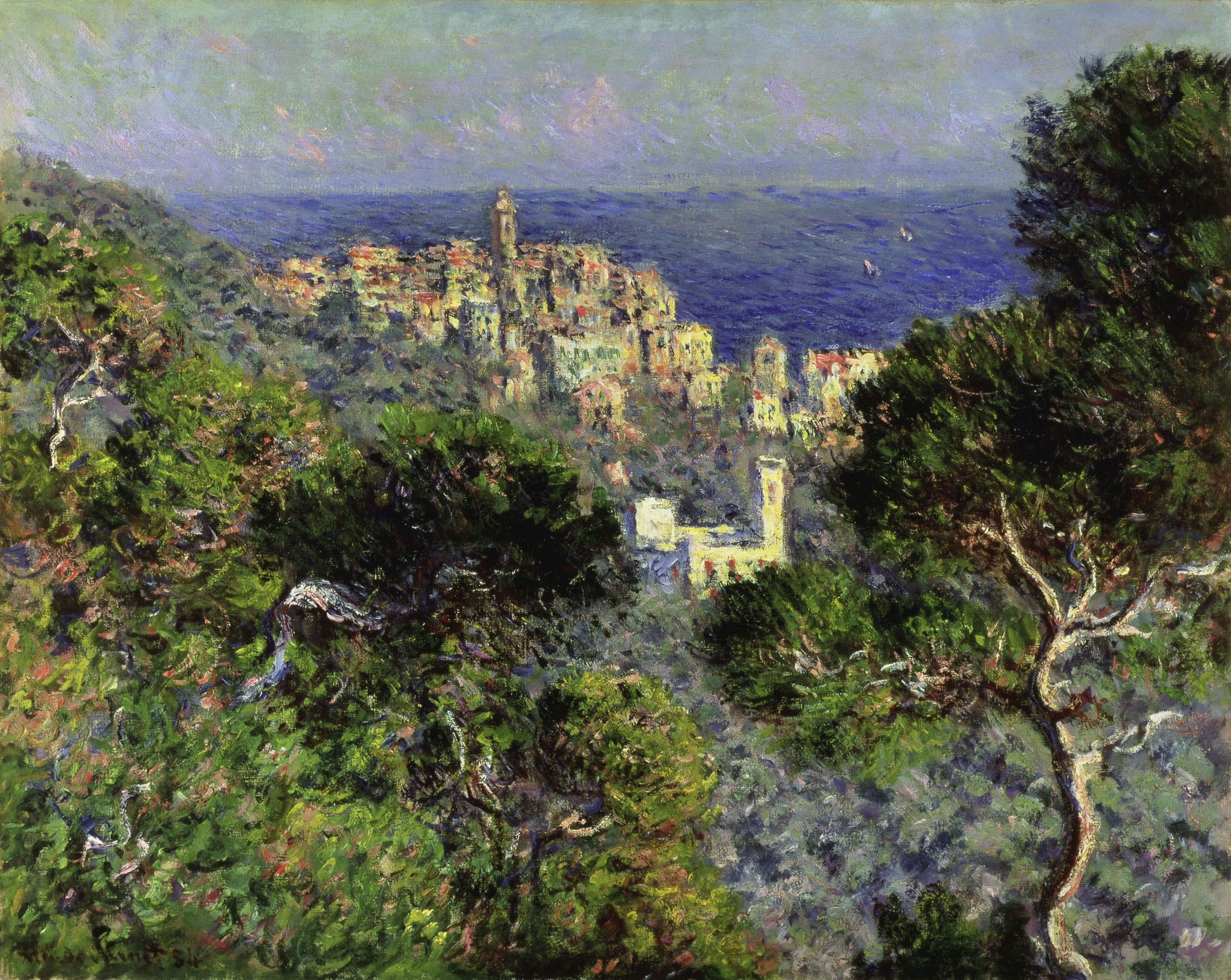


Claude Monet (French, 1840-1926) 'The Customhouse' 1882 'View of Bordighera' 1884 from the exhibition 'Monet' at the Fondation Beyeler, Riehen, Switzerland, Jan - May, 2017


Claude Monet (French, 1840-1926)
View of Bordighera
1884
Oil on canvas
66 x 81.8cm
The Armand Hammer Collection, Schenkung der Armand Hammer Foundation, Hammer Museum, Los Angeles


Claude Monet (French, 1840-1926) 'Vagues a la Manneporte' c. 1885


Claude Monet (French, 1840-1926)
Vagues a la Manneporte (Waves at Manneporte)
c. 1885
Oil on canvas
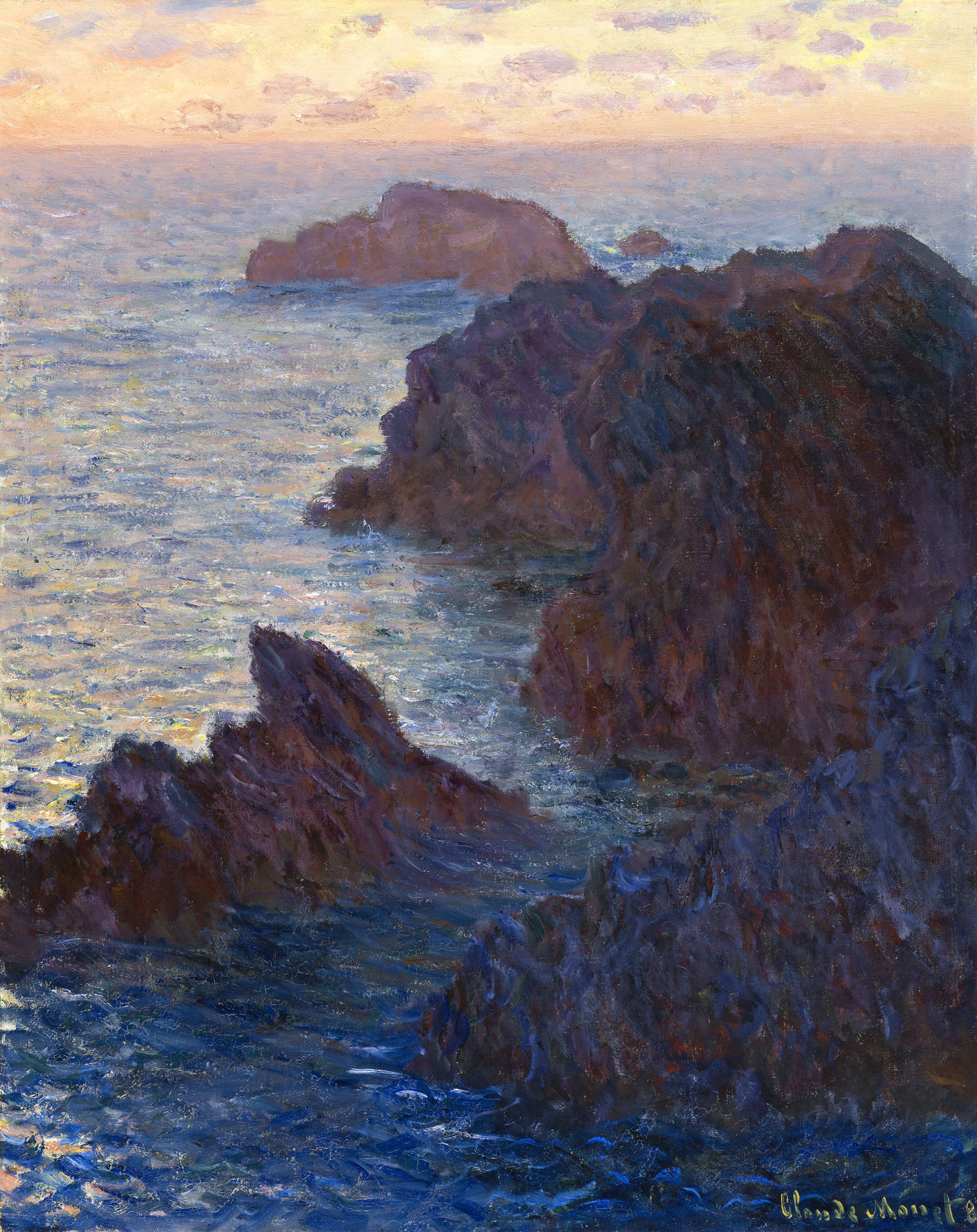
 

Claude Monet (French, 1840-1926) 'Rocks at Belle-Île, Port-Domois' 1886


Claude Monet (French, 1840-1926)
Rocks at Belle-ÃŽle, Port-Domois
1886
Oil on canvas
81.3 x 64.8cm
Cincinnati Art Museum, Fanny Bryce Lehmer Endowment and The Edwin and Virginia Irwin Memorial, 1985
Photo: Bridgeman Images


In the year of its 20th birthday, the Fondation Beyeler is devoting an exhibition to Claude Monet, one of the most important artists in its collection. Selected aspects of Monet’s oeuvre will be presented in a distilled overview. By concentrating on his work between 1880 and the beginning of the 20th century, with a forward gaze to his late paintings, the show will reveal a fresh and sometimes unexpected facet of the pictorial magician, who still influences our visual experiencing of nature and landscape today. The leitmotif of the “Monet” exhibition will be light, shadow, and reflection as well as the constantly evolving way in which Monet treated them. It will be a celebration of light and colours. Monet’s famed pictorial worlds – his Mediterranean landscapes, wild Atlantic coastal scenes, various locations places along the course of the River Seine, his flower meadows, haystacks, cathedrals and fog-shrouded bridges – are the exhibition’s focal points.

In his paintings, Monet experimented with the changing play of light and colours in the course of the day and the seasons. He conjured up magical moods through reflections and shade. Claude Monet was a great pioneer, who found the key to the secret garden of modern painting, and opened everyone’s eyes to a new way of seeing the world. The exhibition will show 62 paintings from leading museums in Europe, the USA and Japan, including the Musée d’Orsay, Paris; the Metropolitan Museum, New York; the Museum of Modern Art, New York; the Museum of Fine Art, Boston and the Tate, London. 15 paintings from various private collections that are seen extremely rarely and that have not been shown in the context of a Monet exhibition for many years will be special highlights of the show.

Light, shadow, and reflection

Following the death of his wife in 1879, Monet embarked on a phase of reorientation. His time as a pioneer of Impressionism was over; while by no means generally acknowledged as an artist, he was beginning to become more independent financially thanks to the help of his dealer, as is documented by his frequent journeys. Through them, he was, for example, first able to concern himself with Mediterranean light, which provided new impulses for his paintings. His art became more personal, moving away from a strictly Impressionist style.

Above all, however, Monet seems to have increasingly turned painting itself into the theme of his paintings. His comment, as passed down by his stepson Jean Hoschedé, that, for him, the motif was of secondary importance to what happened between him and the motif, should be seen in this light. Monet’s reflections on paintings should be interpreted in two ways. The repetition of his motifs through reflections, which reach their zenith and conclusion in his paintings of the reflections in his water-lily ponds, can also be seen as a continuous reflecting on the potential of painting, which is conveyed through the representation and repetition of a motif on a canvas.

Monet’s representations of shade are another way in which he represented the potential of painting. They are both the imitation and the reverse side of the motif, and their abstract form gives the painting a structure that seems to question the mere copying of the motif. This led to the situation in which Wassily Kandinsky, on the occasion of his famous encounter with Monet’s painting of a haystack seen against the light (Kunsthaus Zurich and in the exhibition), did not recognise the subject for what it was: the painting itself had taken on far greater meaning that the representation of a traditional motif.

Monet’s Pictorial Worlds

The exhibition is a journey through Monet’s pictorial worlds. It is arranged according to different themes. The large first room in the exhibition is devoted to Monet’s numerous and diverse representations of the River Seine. One of the most notable exhibits is his rarely shown portrait of his partner and subsequent wife Alice Hoschedé, sitting in the garden in Vetheuil directly on the Seine.

The next room celebrates Monet’s representation of trees: a subtle tribute to Ernst Beyeler, who devoted an entire exhibition to the theme of trees in 1998. Inspired by coloured Japanese woodcuts, Monet repeatedly returned to the motif of trees in different lights, their form, and the shade they cast. Trees often give his paintings a geometric structure, as is particularly obvious in his series.

The luminous colours of the Mediterranean are conveyed by a group of canvases Monet painted in the 1880s. In a letter written at that time, he spoke of the “fairytale light” he had discovered in the South.

In 1886 Monet wrote to Alice Hoschedé that he was “crazy about the sea”. A large section of the exhibition is devoted to the coasts of Normandy and the island Belle-ÃŽle as well as to the ever-changing light by the sea. It includes a fascinating sequence of different views of a customs official’s cottage on a cliff that lies in brilliant sunlight at times and in the shade at others. On closer examination, the shade seems to have been created out of myriad colours.

Monet’s paintings of early-morning views of the Seine radiate contemplative peace: the painted motif is repeated as a painted reflection in such a way that the distinction between painted reality and its painted reflection seems to disappear in the rising mist. The entire motif is repeated as a reflection. There is no longer any clear-cut differentiation between the top and bottom parts of the painting, which could equally well be hung upside down. In other words, the convention about how paintings ought to be viewed is abandoned and viewers are left to make their own decision. It is as if Monet sought to convey the constant flux (panta rhei) that is such a fundamental characteristic of nature, capturing not only the way light changes from night to day but also the constant merging of two water courses.

Monet loved London. He sought refuge in the city during the Franco-Prussian War of 1870/1871. As a successful and already well known painter, he went back there at the turn of the century, painting famous views of Waterloo and Charing Cross Bridge as well as of the Houses of Parliament in different lights, particularly in the fog, which turns all forms into mysterious silhouettes. A tribute not only Monet’s famous hero / forerunner William Turner, but also to the world power of Great Britain with its Parliament and the bridges it built through trade.

Monet’s late work consists almost exclusively of paintings of his garden and the reflections in his waterlily ponds, of which the Beyeler Collection owns some outstanding examples. The exhibition’s last room contains a selection of paintings of Monet’s garden in Giverny.

Press release from the Fondation Beyeler
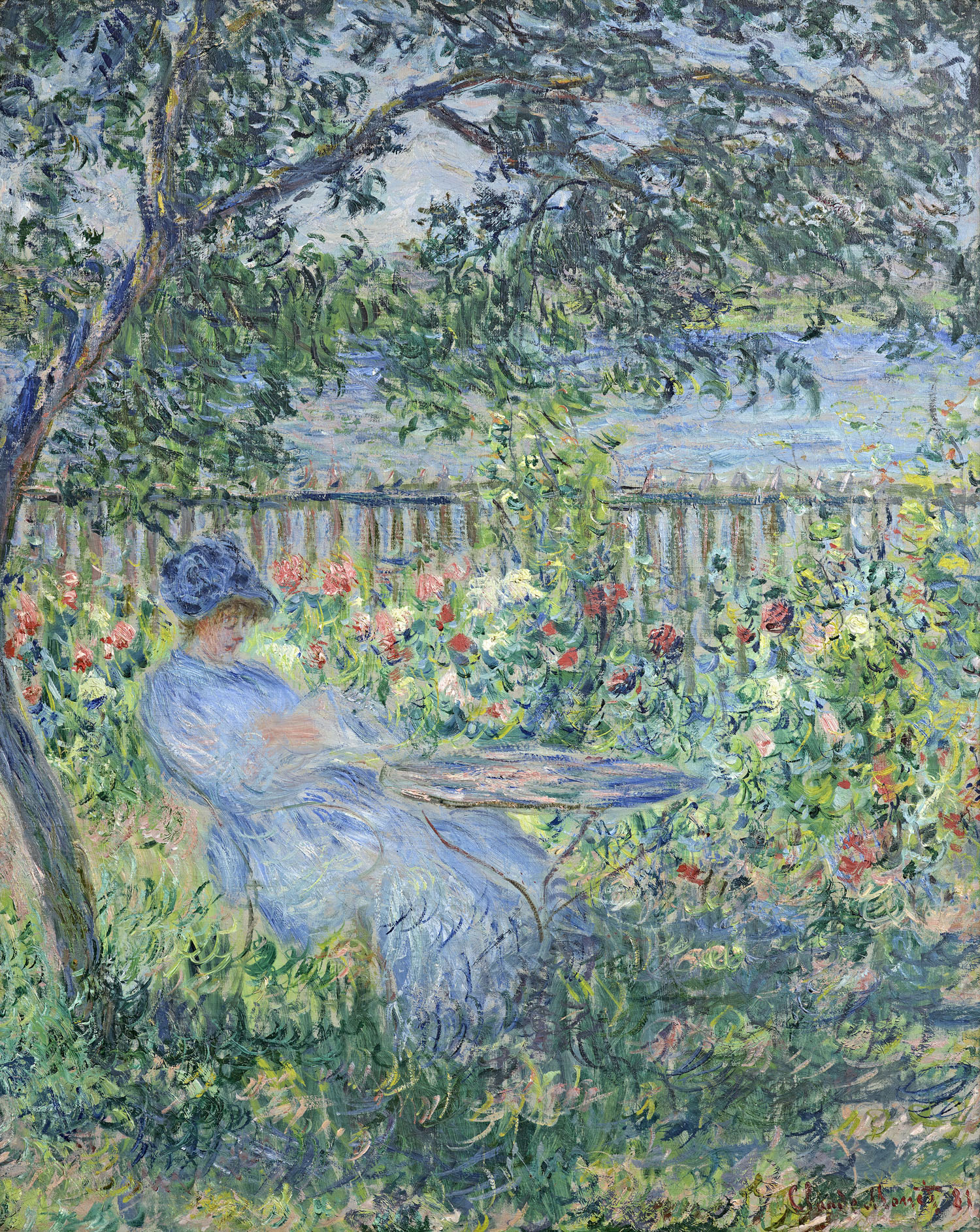
 

Claude Monet (French, 1840-1926) 'The Terrace at Vétheuil' 1881


Claude Monet (French, 1840-1926)
The Terrace at Vétheuil
1881
Oil on canvas
81 x 65cm
Private Collection
Photo: Robert Bayer


Claude Monet (French, 1840-1926) 'In the "Norvégienne"' 1887


Claude Monet (French, 1840-1926)
In the “Norvégienne”
1887
Oil on canvas
97.5 x 130.5cm
Musée d’Orsay, Paris, legacy of Princesse Edmond de Polignac, 1947
Photo: © RMN-Grand Palais (Musée d’Orsay) / Hervé Lewandowski
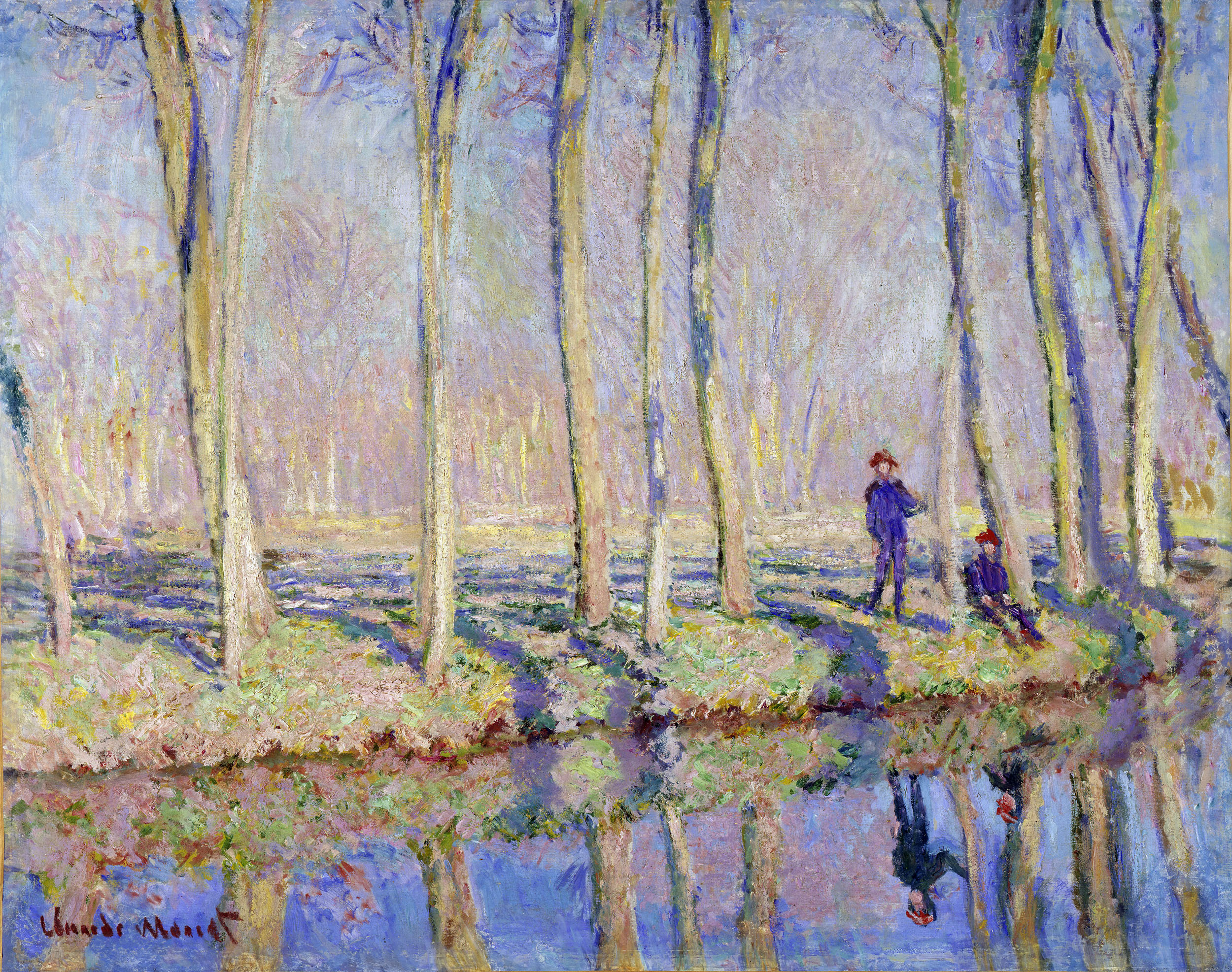
 

Claude Monet (French, 1840-1926) 'Jean-Pierre Hoschedé and Michel Monet on the Banks of the Epte' c. 1887-1890


Claude Monet (French, 1840-1926)
Jean-Pierre Hoschedé and Michel Monet on the Banks of the Epte
c. 1887-1890
Oil on canvas
76 x 96.5cm
National Gallery of Canada, Ottawa, Gift of the Saidye Bronfman Foundation, 1995
Photo: © National Gallery of Canada
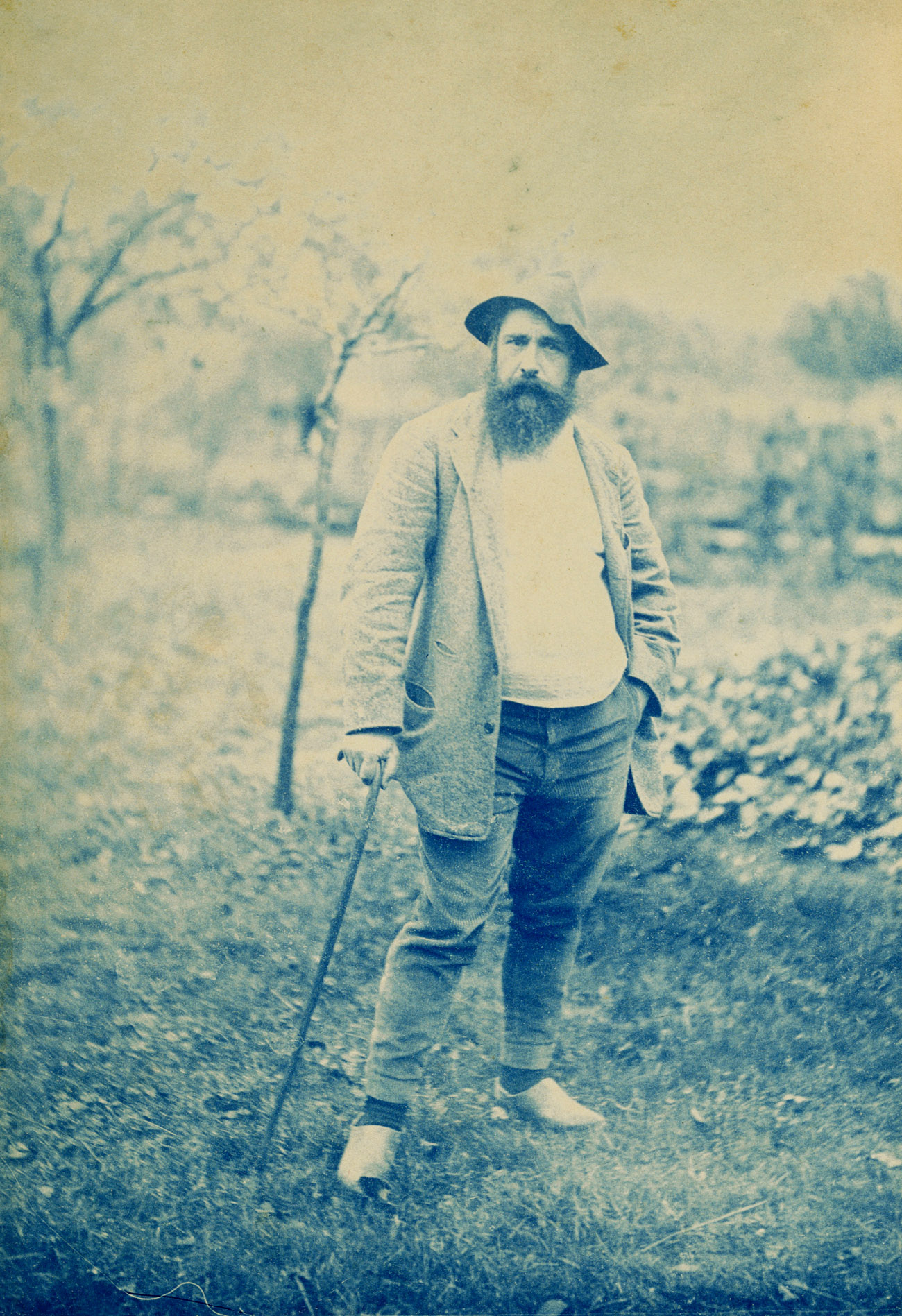
 

Theodore Robinson (American, 1852-1896) 'Portrait of Monet' c. 1888-1890


Theodore Robinson (American, 1852-1896)
Portrait of Monet
c. 1888-1890
Cyanotype
24 x 16.8cm
Terra Foundation for American Art, Chicago, gift of Mr. Ira Spanierman, 1985
Photo: © Terra Foundation for American Art, Chicago / Art Ressource, NY


Theodore Robinson (1852-1896) was an American painter best known for his Impressionist landscapes. He was one of the first american artists to take up impressionism in the late 1880s, visiting Giverny and developing a close friendship with Claude Monet. Several of his works are considered masterpieces of American Impressionism.

An early exponent of American Impressionism, Theodore Robinson made a number of visits to France, between the years 1876 and 1892, and became a close friend of Claude Monet, whom he visited at Giverny. Paradoxically, despite his willingness to explore a new type of modern art, his particular style of Impressionism was relatively conservative. Even so, several of his paintings are considered to be masterpieces of American art in the Impressionist style. Best known for his landscape painting, he was also noted for his genre painting of village and farm life, as well as his Connecticut boat scenes. His famous works include: By the River (1887, Private Collection), La Vachere (1888, Smithsonian American Art Museum), La Debacle (1892, Scripps College, Claremont) and Union Square (1895, New Britain Museum of American Art, Conn). Shortly before his premature death from an acute asthma attack, he wrote in-depth articles on the Barbizon painter Camille Corot (1796-1875) and his friend Claude Monet (1840-1926).
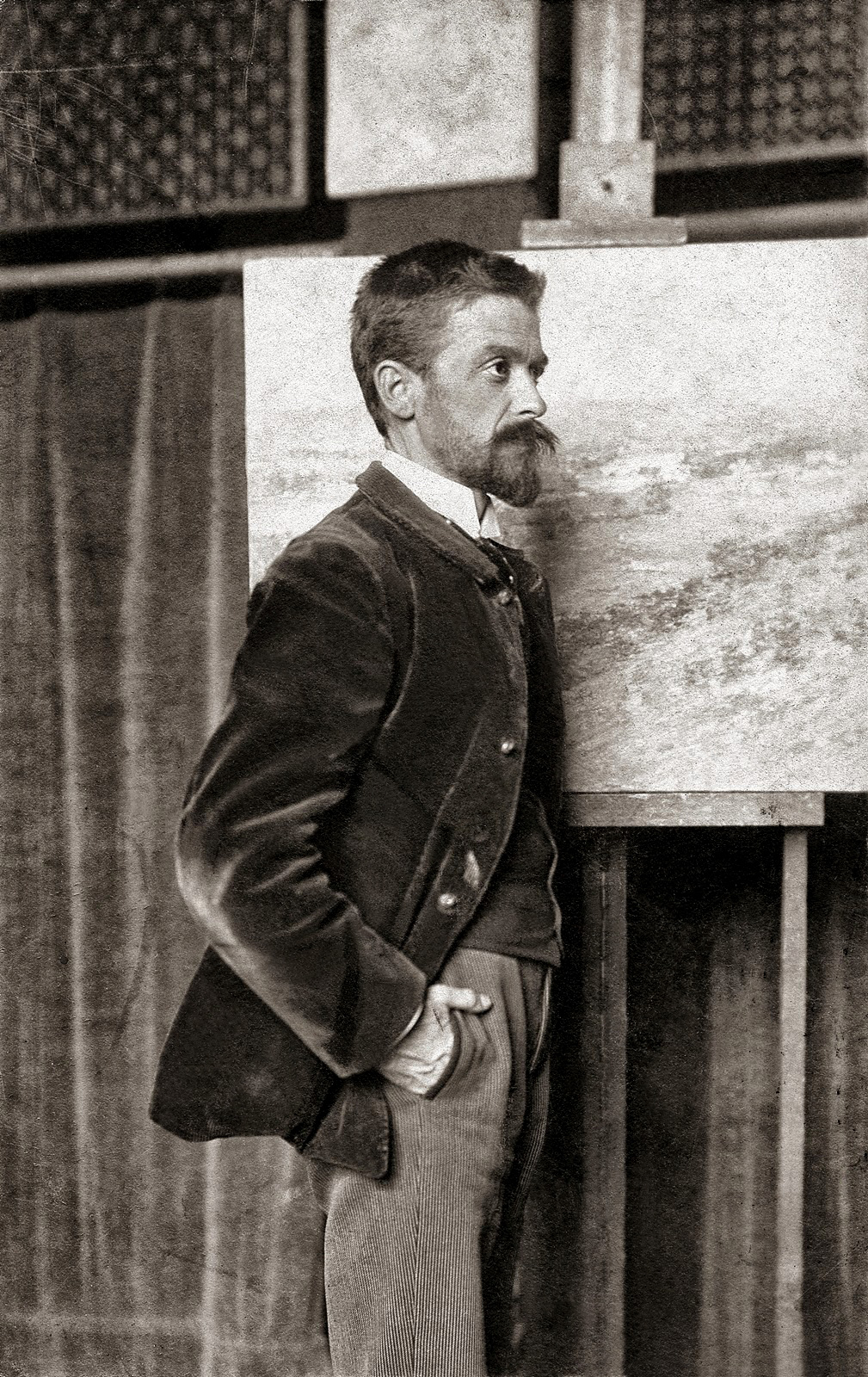
 

Unknown photographer. 'Portrait of Theodore Robinson' Nd


Unknown photographer
Portrait of Theodore Robinson
Nd
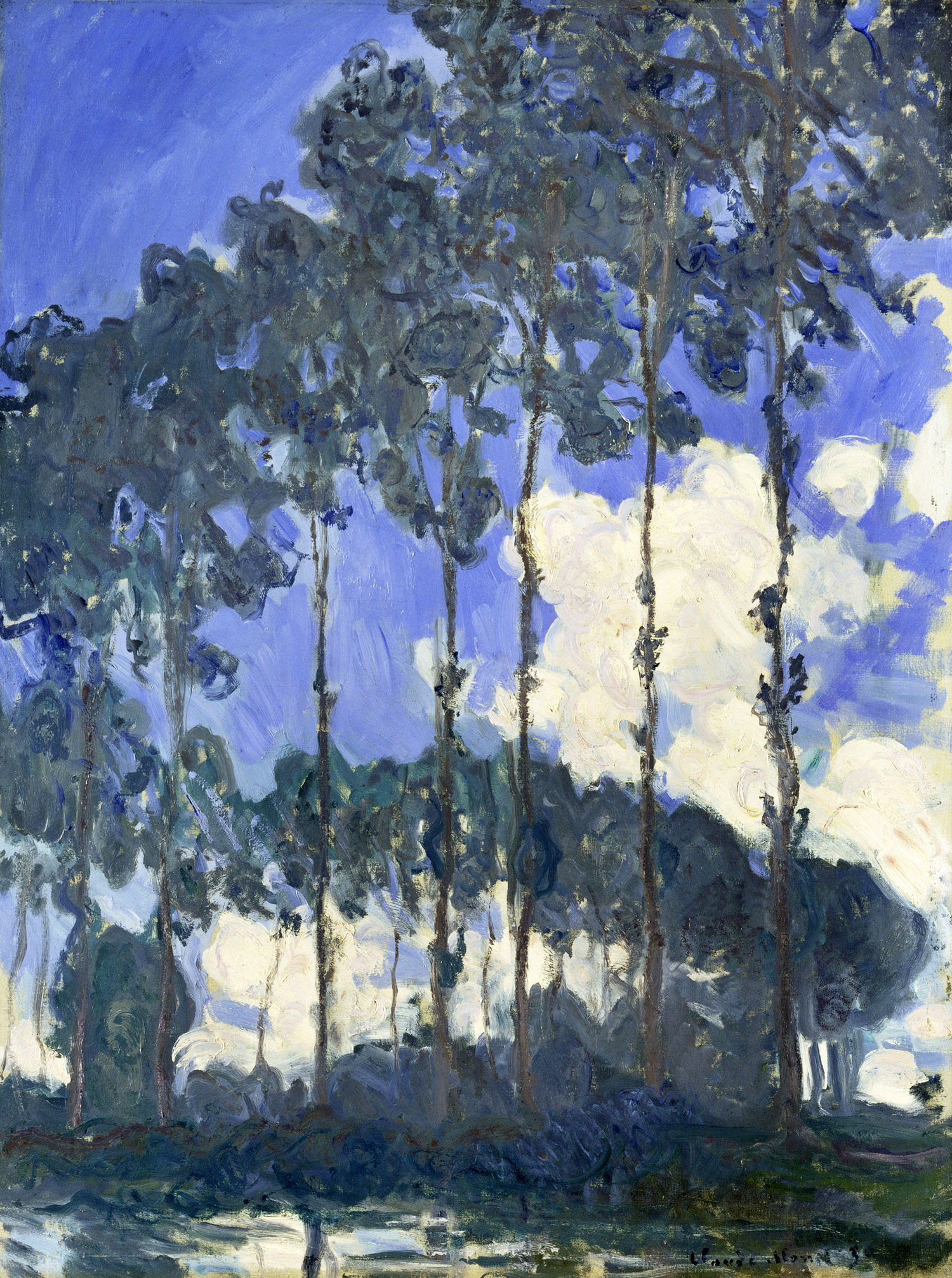
 

Claude Monet (French, 1840-1926) 'Poplars on the Banks of the Epte' 1891


Claude Monet (French, 1840-1926)
Poplars on the Banks of the Epte
1891
Oil on canvas
92,4 x 73.7 cm
Tate, Presented by the Art Fund 1926
Photo: © Tate, London 2016


The Travels of Monsieur Monet: A Geographical Survey

Hannah Rocchi

Le Havre

Oscar-Claude Monet was born in Paris on November 14, 1840, the son of Claude-Alphonse, a commercial officer, and Louise-Justine Aubrée. From 1845 on he grew up in the port city of Le Havre in Normandy, his father having found employment in the trading house of his brother-in-law, Jacques Lecadre. The Lecadres owned a house three kilometres away in the little fishing village of Sainte-Adresse, which as a burgeoning bathing resort was much loved by the Monets. Claude attended the local high school beginning in 1851 and there received his first drawing lessons. His earliest surviving sketches dating from 1856 show caricatures of his teachers and the landscapes of Le Havre. When Monet’s mother died, in 1857, Claude and his elder brother, Léon, moved in with their aunt, Marie-Jeanne Lecadre, who would become very important to him and support him in his pursuit of an artistic career. As an amateur painter with a studio of her own, she had connections to local artists and made sure that her nephew could continue his drawing lessons in Le Havre. Monet’s caricatures soon attracted notice and were exhibited at the local stationer’s, Gravier, who also sold paints and frames. This brought his work to the attention of Eugène Boudin, a former partner in the business, who became Monet’s new teacher.

Boudin invited the young Monet to join him on plein air painting expeditions around Le Havre, an experience that made a lasting impression on his pupil. Monet twice applied for a municipal scholarship, but was turned down both times. Despite moving to Paris to take painting lessons there in 1859, Monet repeatedly returned to Le Havre, including in 1862, when after a year of military service in Algeria he had to return to France on grounds of poor health. Later that year he was discharged from military service thanks to the replacement fee paid by his aunt. It was in the summer of that year that he met the Dutch painter Johan Barthold Jongkind and claimed to have found in him his “true teacher.” He also spent the months May to November 1864 painting landscapes in and around Le Havre. His lover and future wife, Camille Doncieux, gave birth to their first child, Jean-Armand- Claude Monet, in Paris in 1867; yet, urged by his father, who was against the relationship, to leave Paris, the painter spent the summer without them, painting seascapes, gardens, figural compositions, and regattas in Sainte-Adresse. A year later he won a silver medal at the Le Havre art show. After the death of his aunt, in 1870, followed by that of his father just a year later, his visits to Le Havre became less frequent. At the same time, he was drawn more to the towns further up the Normandy coast, to Étretat, Fécamp, and Pourville, where he found even more impressive subjects for paintings.

Paris

Monet, who was born in Paris, returned to the capital in the spring of 1859 to visit the Salon and take painting lessons. During his stays in “chaotic Paris” he incurred numerous expenses, which he was able to defray thanks only to the support of his father and his aunt. Instead of enrolling at the atelier of the painter Thomas Couture for the preparatory course for admission to the École des Beaux-Arts, he chose the academy of Charles Suisse, where he probably met Camille Pissarro. After his discharge from the army in 1862, Monet returned to Paris and there joined the studio of the Swiss history painter Charles Gleyre, where he made the acquaintance of Alfred Sisley, Frédéric Bazille, and Pierre-Auguste Renoir. Two years later, when Gleyre ran into financial difficulties and had to close his studio, Monet’s father provided him with the funds he needed to rent a studio together with Bazille on the rue de Furstenberg. Renoir, Sisley, Pissarro, and even Paul Cézanne were all regular visitors there. Monet was experimenting with figural paintings at the time, including his large Déjeuner sur l’herbe (1865-66). When their money troubles came to a head in January 1866, Monet and Bazille had no choice but to relinquish their shared space. Monet then rented a small studio of his own on the place Pigalle, and it was there that he engaged Camille Doncieux, the woman he would marry in 1870, to sit for him. His painting of the nineteen-year-old Camille (Camille, or La Femme à la robe verte, 1866), was accepted for the Salon and not only won fulsome praise from the critic Émile Zola, but also aroused the interest of Édouard Manet.

Together with other Impressionists, Monet founded the Société anonyme coopérative des artistes peintres, sculpteurs, graveurs, etc., whose first group show was held in the studio of the photographer Nadar on the boulevard des Capucines in Paris in 1874. Among the works exhibited was Monet’s work Impression, soleil levant, painted in Le Havre in 1872. The show was savaged by the critics, who in a play on the title of Monet’s painting derided it as an “exhibition of impressionists.” Monet tended to find his subjects in the suburbs of Paris rather than in the capital itself, one exception being Saint-Lazare railway station, which he captured on several canvases in 1877. When Monet moved to Vétheuil, in 1878, he held onto a small studio in Paris, even if he used it mainly as a showroom for art dealers and potential collectors. When Monet’s patron Ernest Hoschedé declared bankruptcy, in 1877, he had no choice but to sell his large collection of works by the Impressionists a year later. It was through the sale of Hoschedé’s paintings that Monet met the collector and gallerist Georges Petit, who in the world of Impressionism would soon come to rival the art dealer Paul Durand-Ruel. In 1882 Durand-Ruel himself commissioned Monet with several still lifes for his home on the rue de Rome. In 1914, in Giverny, Monet began work on his last major project, the famous Grandes Décorations, and after his death, in 1927, twenty-two of these large-format paintings of water lilies were installed in the Musée de l’Orangerie in Paris.

The Normandy coast

Although his career necessitated ever more frequent trips to Paris, in 1868 Monet wanted to make a home for himself, his partner Camille Doncieux, and their son, Jean, in Normandy. He wrote to Bazille that he could not imagine spending longer than a month at a time in Paris and that whatever he might paint on the coast of Normandy would be very different from anything produced in the French capital. The cliffs near Fécamp that he painted in early 1881 show how his style of painting was already beginning to change, how his once idyllic landscapes were becoming wilder. Monet spent a few months in Poissy near Paris beginning in December of that year, but found the village uninspiring and returned to the coast, this time to the fishing village of Pourville. This was a landscape of rugged cliffs with several subjects of interest to him, among them the customs officer’s house near Varengeville. Furthermore, the beaches were deserted in the winter months, making them ideal for painting. Monet began several new series, sometimes working on eight canvases at once so that he needed help transporting his equipment and canvases from one place to another.

In the 1880s, when sales of his paintings began to pick up and his financial situation became less dire, Monet was at last able to rent a holiday home in Pourville. His new partner, Alice Hoschedé, and her daughter Blanche, who also painted, often accompanied him on his painting expeditions there, and he received visits from both Durand-Ruel and Renoir. In January 1883 Monet visited the village of Étretat, famed for its precipitous cliffs and arches, and there found several motifs right in front of the hotel. He also sought out remote beaches with views of the Manneporte Arch, which he proceeded to paint in different light conditions, often working on several canvases at once. While painting on a secluded beach on November 27, 1885, Monet miscalculated the incoming tide and was hurled against the face of a cliff by a wave. He told Alice that his brush and painting equipment had fallen into the sea, but that what annoyed him most was that the wave had washed away the canvas he was working on. Monet finished all of his over fifty paintings of Étretat in his studio in Giverny, which by then had become his permanent home.

On the Seine: Argenteuil, Vétheuil, and Poissy

On December 21, 1871, Monet rented a house in Argenteuil, a suburb northwest of Paris that allowed him to live in the country but remain within easy reach of the city. Thanks to the sale of several paintings as well as Camille s dowry and inheritance, the Monets were able to employ three servants and Monet himself bought a boat that he converted into a floating studio. Argenteuil became an important center for the Impressionists; Cézanne, Manet, Pissarro, Sisley, and Renoir all visited Monet there. In 1873 Monet met Gustave Caillebotte. One motif that Monet found especially interesting was the railway bridge of Argenteuil. It was destroyed in the Franco-Prussian War but rebuilt soon afterward, making it a symbol of French resilience – and further evidence of Monet’s general interest in bridges. In 1878 the Monets moved to Vétheuil, a little village on the Seine, some sixty kilometers away from Paris. As Monet’s patron Hoschedé was undergoing financial difficulties at the time, he and his wife, Alice, and their six children shared a house with the Monets. Monet’s wife, Camille, had just given birth to their second son, Michel, but was already ill with cervical cancer.

Their financial situation had deteriorated and they were no longer able to pay their servants. As a devout Christian, Alice Hoschedé took it upon herself to ensure that the Monets, who had married in a civil ceremony only, received the blessing of the Church for their union and that Camille Monet was given the last rites. Camille died on September 5, 1879, in Vétheuil and was buried in the cemetery there. The winter of 1879-1880 was exceptionally cold and the Seine froze over. On January 5, 1880, the Hoschedé-Monet family awoke to the sound of the ice breaking apart, and Monet spent the next few days painting dozens of impressions of this spectacle. As Ernest Hoschedé mainly resided in Paris and visited his family only occasionally, Monet and Alice lived more or less alone with their children in Vétheuil, and before long they were rumoured to be having an affair. In 1881 they decided to move again. Monet had been unable to find a suitable school for his son Jean, and Alice was considering whether to return to Ernest in Paris with the children. In the end, however, both Monet and Alice moved to Poissy in December of that year. When Poissy proved uninspiring, however, the two families resumed their quest for the perfect home, which they would find in Giverny in 1883, some seventy kilometers northeast of Paris.

On the Mediterranean

In December 1883 Monet accompanied Renoir on a short trip to the Mediterranean. They traveled from Marseille to Genoa and visited Cézanne in L’Estaque. Monet was especially taken with the little town of Bordighera on the Ligurian Riviera and vowed to return there in January 1884, this time without Renoir, in order to paint in peace. The three-week stay originally planned eventually turned into three months, during which Monet explored the region, visited several mountain villages, and admired the wonderful gardens of Francesco Moreno, where to his great delight he was able to paint palms. The colours and new motifs brought Monet close to despair, and he complained to Alice of how difficult it was to paint the landscape as it really looked. Visibly fascinated by the warm light of the Mediterranean, he declared that he would need a palette of diamonds and jewels to capture its féerique (magical) atmosphere. Although in her replies Alice made no secret of her displeasure at the painter’s constant absences, Monet chose to linger in the south and continued the series he had just begun. He also traveled to Cap Martin and to Monte Carlo, painting as he went. In January 1888 he painted several views of Antibes.

In late September 1908 he visited Venice – one of only a few trips undertaken together with Alice – where he was especially impressed by the Grand Canal, the Doge’s Palace, and the church of San Giorgio Maggiore. When the pair left Venice again, in December 1908, Monet consoled himself with the thought that he would return there the following year, although he already had an inkling that that was “a forlorn hope.” Even so, the 1912 Claude Monet: Venise exhibition, comprising twenty-nine views of Venice and held at the Galerie Bernheim-Jeune, was a great success.

Rouen

Léon Monet, who ran the Rouen branch of a Swiss chemical company, was on good terms with his younger brother, Claude. Jean, the elder of Monet’s two sons, would later work for Léon, providing the painter with another good reason for visiting Rouen. It was probably at his brother’s instigation that Monet took part in the 23ème Exposition municipale des Beaux-Arts, in Rouen in March 1872. Monet discovered his fascination with the Gothic towers of Notre-Dame de l’Assomption, the cathedral in Rouen, which would become such a major preoccupation of his later years. He had planned to return to Rouen for longer painting projects as early as the spring of 1891, but in the end was too busy expanding his garden in Giverny to leave. In February 1892, however, he was offered the use of an empty apartment that looked out onto the cathedral’s west façade. In March of that year he took lodgings above a boutique that offered a similar view but from a slightly different angle. While in Rouen he worked on nine canvases at the same time, painting from early morning to late evening. The intensity was not without consequences, and Monet was afflicted by nightmares in which the cathedral – “it seemed to be blue, pink, or yellow” – came crashing down on top of him. The constantly changing light drove Monet almost to despair, and by 1893 he was working on up to fourteen canvases at once. In early 1894 he began preparing an exhibition of his cathedral paintings, but was plagued by doubts over whether he was up to the task. Twenty paintings in the series were to be exhibited as a solo show at the gallery of his art dealer, Durand-Ruel, in 1895. Believing that this might be an opportunity to raise his market value, he decided to demand 15,000 francs per painting. Durand-Ruel was so appalled that he refused to be involved in the actual sales and left the negotiations to the painter himself. Most of the works were well received in the press and would meet with acclaim in other exhibitions, too. Although Monet never received 15,000 francs for his cathedrals during his lifetime, the French state did at least pay 10,500 francs for the one that it bought for the Musée du Luxembourg in Paris in 1907.

London

On July 19, 1870, Napoléon III declared war on Prussia. Fearful of being conscripted, Monet fled to London at the beginning of October that year, taking Camille and their son Jean with him. There he met Paul Durand-Ruel, who was likewise a refugee and would become Monet’s most important art dealer. Durand-Ruel’s first documented sale of a Monet work was in May 1871. Together with Pissarro, Monet visited London’s many museums and there admired the works of Joseph Mallord William Turner and John Constable. When the war ended in late May 1871, Monet returned to France via the Netherlands. Although he would return to London on several occasions in the following years, his stays would invariably be brief and motivated mainly by visits to fellow painters. His desire to paint various views of the Thames swathed in fog nevertheless comes up in several letters. When his youngest son, Michel, went to London to study, Monet, Alice, and Alice’s daughter Germaine paid him a visit there in September 1899. They stayed at the luxurious Savoy Hotel, which has excellent views of the Thames. Monet was thus able to spend a whole month painting Charing Cross Bridge to excess, dedicating himself intensively to Waterloo Bridge later on.

He would return to London in the next two years, and in 1900 set up his easel in a room in St. Thomas’ Hospital that commanded an especially fine view of Westminster. While there, Monet received a visit from Georges Clemenceau, a personal friend of his and later an important French statesman, through whose good offices he was granted permission to paint in the Tower of London – a dispensation he never made use of. The thick fog that he woke up to toward the end of his stay in 1901 was grounds enough for him to postpone his departure. Many of the canvases begun in London were actually finished back in Monet’s studio in Giverny. There he also began to destroy some of them, admitting to Durand-Ruel that “my mistake is to try to improve them.” An exhibition of selected London paintings held in Paris at Durand-Ruel’s in May 1904 met with great acclaim.

Giverny

Monet signed a lease for a house with a plot of land in Giverny and moved in on April 29, 1883, bought it in 1890, and lived there until his death, for over forty years all told. Alice and her children moved in the very next day after the lease was signed. The village near the Seine is not far from Vernon, which is where the older children went to school. The two-story house was big enough to accommodate the large family, and the barn was readily converted into a painting studio. In the first summer there, Monet built a boathouse so that he could explore his environs in search of suitable motifs by boat. He also began planting a garden, which soon became an enduring passion. He painted views of the church of Vernon as well as his first fields with grain stacks. It was on the tiny ÃŽle aux Orties, which Monet bought as a place to moor his boats, that he painted Alice’s daughter Suzanne with a parasol (Essai de figure en plein-air: Femme à l’obrelle, 1886). Apart from his French painter friends, he was visited by both the American painter John Singer Sargent (in 1885 and 1887) and Georges Clemenceau, the former of whom painted both Monet and Blanche Hoschedé at work. The first grain stacks began to appear in late 1888. Monet traveled much less after 1890 and tended to confine himself to just a few motifs that he painted in series. He clearly felt at home in Giverny and lavished a great amount of time (and money) on the cultivation of his garden there, which became a favourite preoccupation. Many of his motifs were now to be found on his doorstep, among them the aforementioned grain stacks, which in 1890-1891 he painted no fewer than twenty-five times in varying light. Ernest Hoschedé died in Paris in 1891 with his wife, Alice, at his side. He was buried in Giverny. In the spring of 1891 Monet began painting a series of a row of poplars on the Epte River two kilometres away from his home, which he visited in his studio boat. When the poplars came up for auction in August of that year, he paid the timber merchant to leave them standing until he had finished painting them.

A little less than a year later Monet and Alice married in Giverny. Work on their property continued, and in early 1893 Monet purchased the adjoining plot with the aim of creating a water lily pond. In the summer of 1896 Monet began work on his Matinée sur la Seine series, for which he set off for work in his boat at half past three in the morning. In 1899 he had a second studio built specifically for the purpose of finishing paintings begun en plein air, while the first studio, being larger, would henceforth serve mainly as a showroom. Water lilies were becoming an increasingly important subject by now, and in 1901 he purchased land again, to enlarge his pond. He also had a third studio built to allow him to commence work on the monumental water lily wall panels (the Grandes Décorations). From 1909 on, Monet’s sight deteriorated to such an extent that he had to undergo various operations, notwithstanding his fears that these might change his perception of colour. Alice fell ill with a rare form of leukaemia and died in 1911, with a distraught Monet by her side. Following the death of his son Jean, in 1914, Blanche, who was both Monet’s stepdaughter and daughter-in-law, moved into the house at Giverny and cared for the deeply grieved artist. Yet he continued painting, right to the end of his days, finding most of his motifs in his own garden. It was also in Giverny that Monet, who died of lung cancer on December 5, 1926, would find his final resting place. He was buried in the same grave as his son Jean (1914), his wife Alice (1911), her first husband, Ernest Hoschedé (1891), and their daughters Suzanne (1899) and Marthe (1925).


The present chronology is based on the accounts provided in Charles F. Stuckey, “Chronology,” in Claude Monet 1840-1926, exh. cat. The Art Institute of Chicago (London and Chicago, 1995), pp. 185-266; and quotations cited from the artist’s letters published in Daniel Wildenstein, Claude Monet: Biographie et catalogue raisonné (Paris and Lausanne, 1974-1991), vols. 1-5.
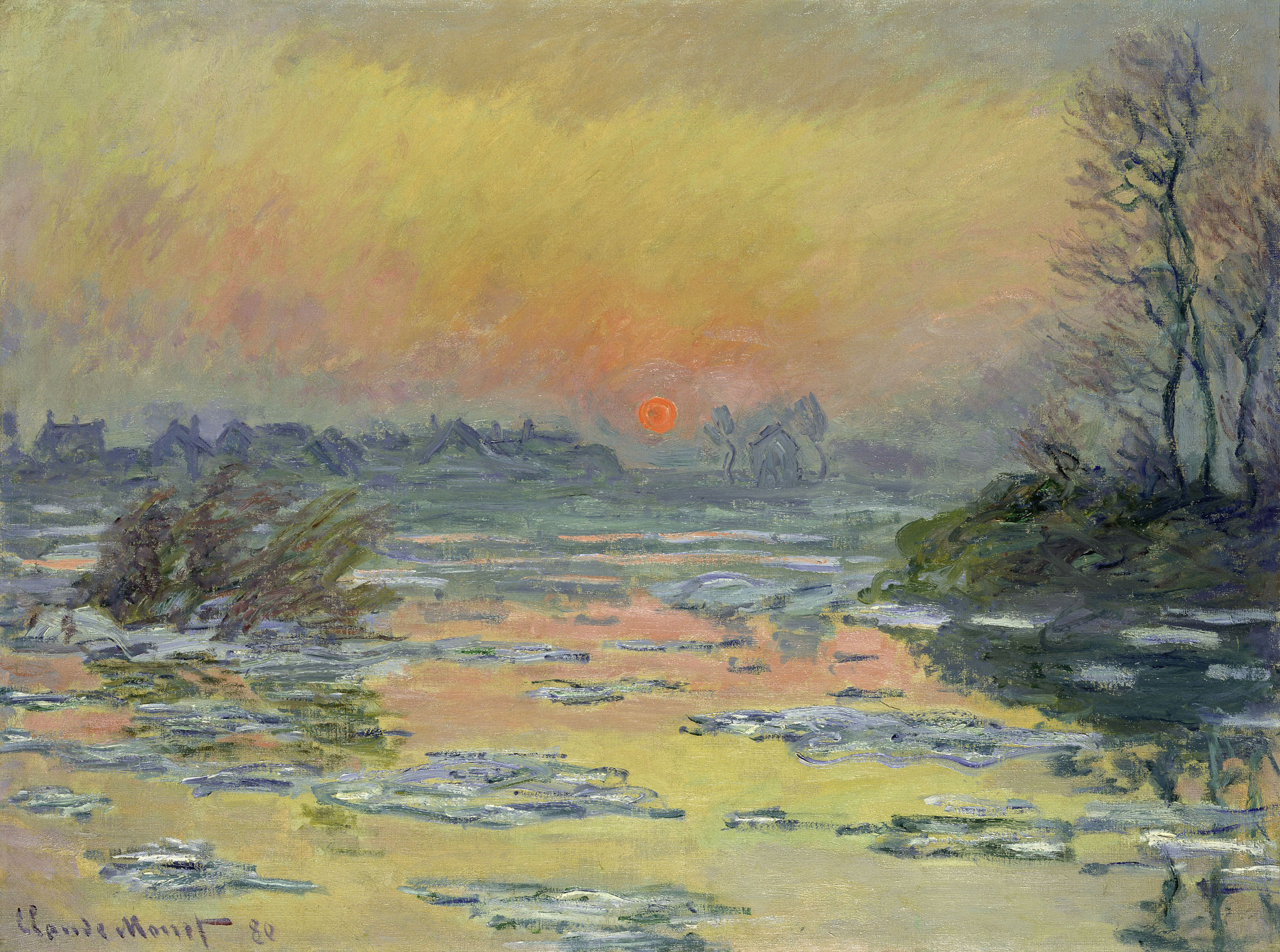
 

Claude Monet (French, 1840-1926) 'Sunset on the Seine in Winter' 1880


Claude Monet (French, 1840-1926)
Sunset on the Seine in Winter
1880
Oil on canvas
60.6 x 81.1cm
Pola Museum of Art, Pola Art Foundation
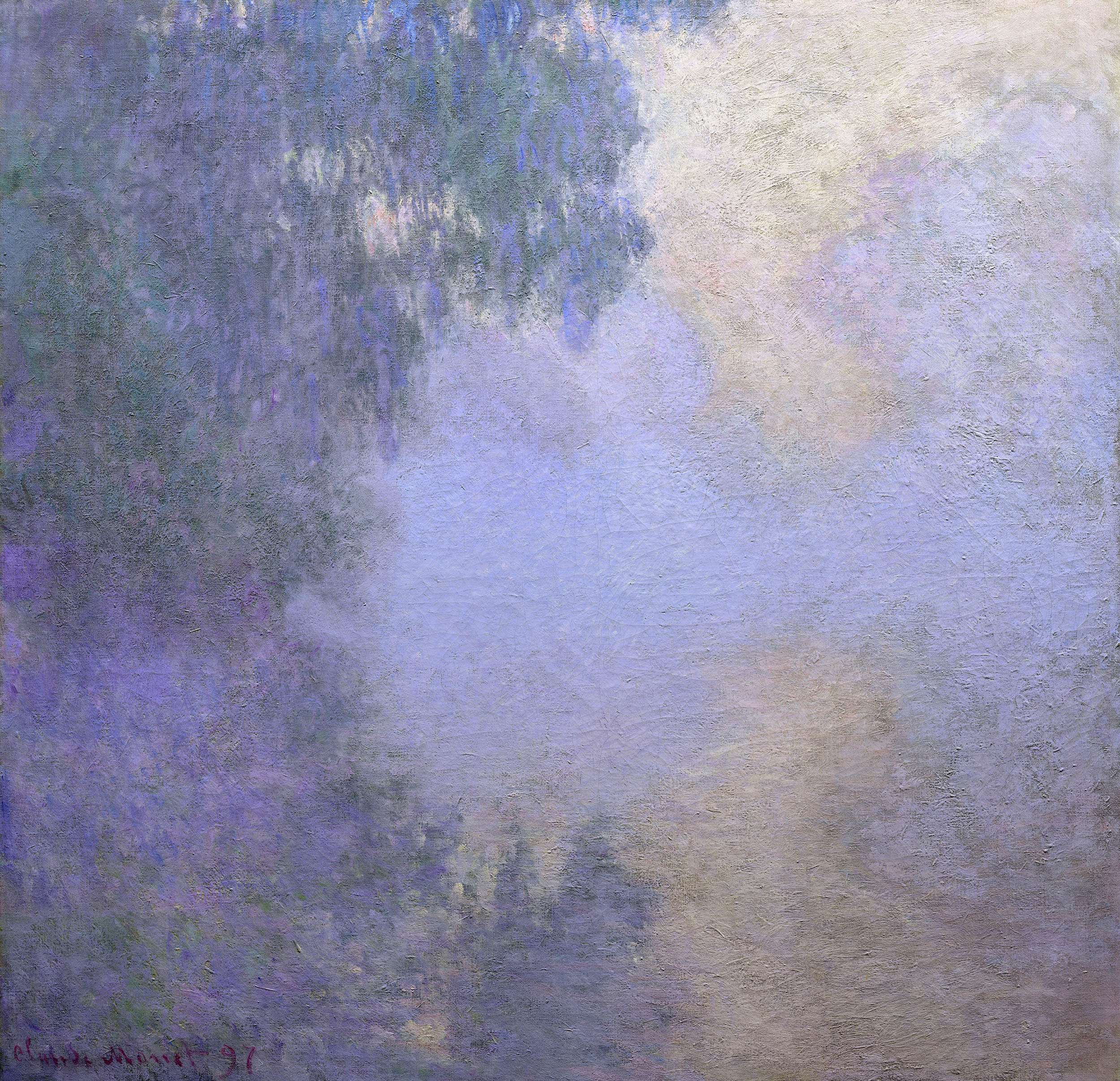
 

Claude Monet (French, 1840-1926) 'Morning on the Seine' 1897


Claude Monet (French, 1840-1926)
Morning on the Seine
1897
Oil on canvas
89.9 x 92.7cm
The Art Institute of Chicago, Mr and Mrs Martin A. Ryerson Collection, 1933
Photo: © The Art Institute of Chicago / Art Resource, NY / Scala, Florence


Claude Monet (French, 1840-1926) 'Charing Cross Bridge: Fog on the Thames' 1903


Claude Monet (French, 1840-1926)
Charing Cross Bridge: Fog on the Thames
1903
Oil on canvas
73.7 x 92.4cm
Harvard Art Museums / Fogg Museum, Donation of Mrs Henry Lyman, 1979
Photo: Imaging Department © President and Fellows of Harvard College
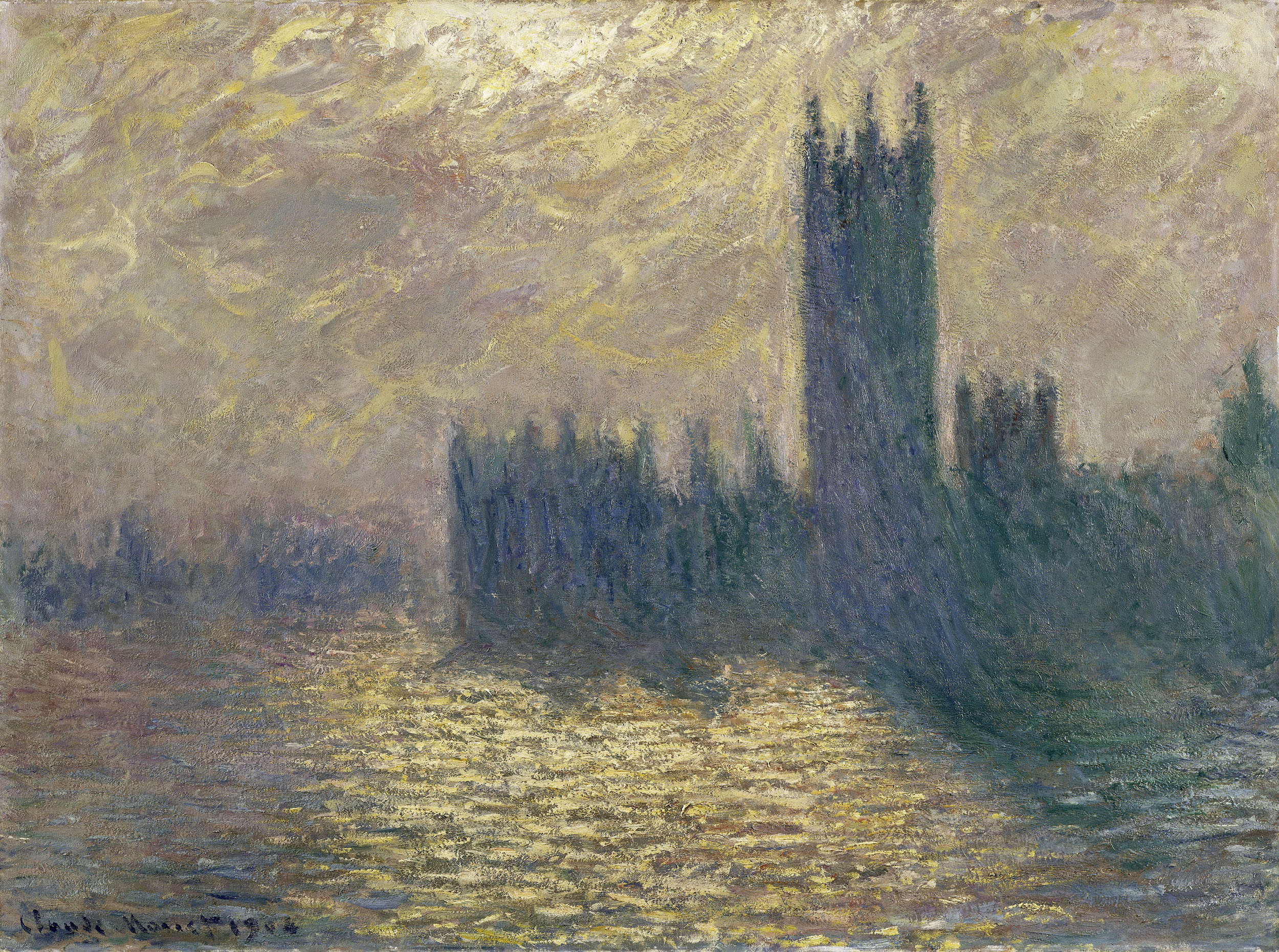
 

Claude Monet (French, 1840-1926) 'Houses of Parliament, Stormy Sky' 1904


Claude Monet (French, 1840-1926)
Houses of Parliament, Stormy Sky
1904
Oil on canvas
81 x 92cm
Palais des Beaux-Arts de Lille, legs de Maurice Masson, 1949
Photo: © RMN-Grand Palais / René-Gabriel Ojéda
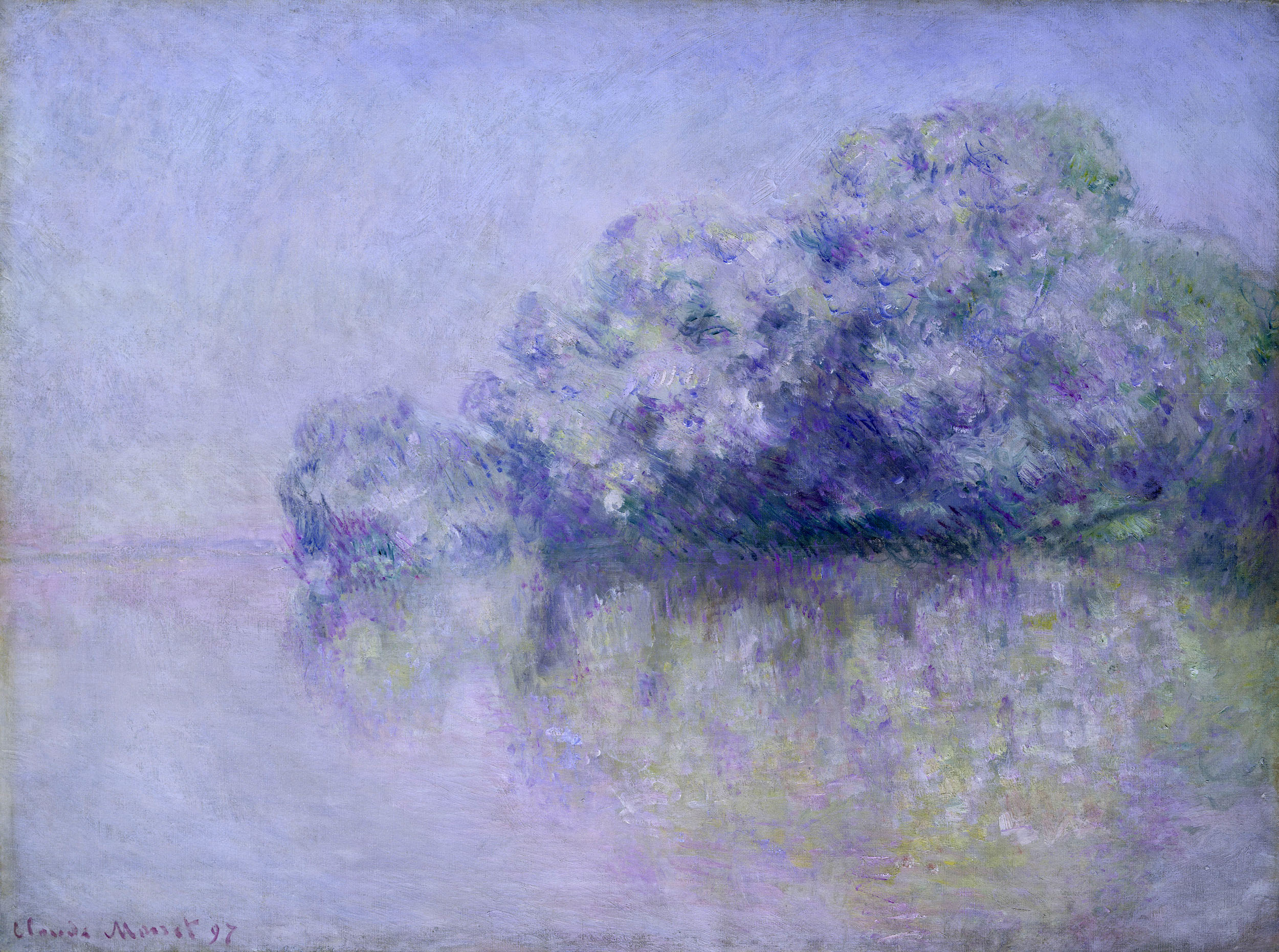
 

Claude Monet (French, 1840-1926) 'Île aux Orties near Vernon' 1897


Claude Monet (French, 1840-1926)
ÃŽle aux Orties near Vernon
1897
Oil on canvas
73.3 x 92.7cm
The Metropolitan Museum of Art, Gift of Mr. and Mrs. Charles S. McVeigh, 1960
Photo: © bpk / The Metropolitan Museum of Art
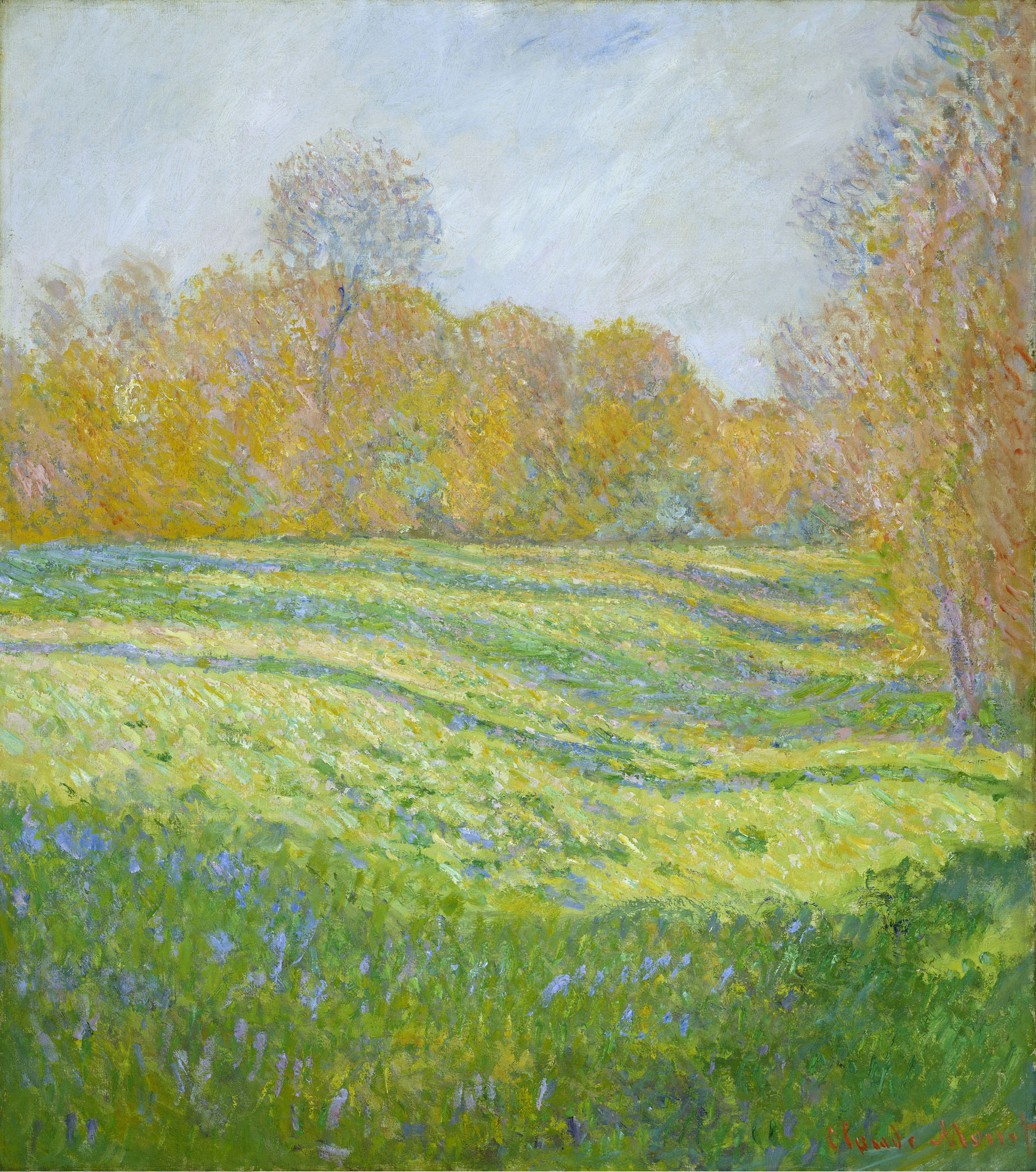
 

Claude Monet (French, 1840-1926) 'Meadow at Giverny, Autumn Effect' 1886


Claude Monet (French, 1840-1926)
Meadow at Giverny, Autumn Effect
1886
Oil on canvas
92.1 x 81.6cm
Museum of Fine Arts, Boston, Juliana Cheney Edwards Collection
Photo: © 2017 Museum of Fine Arts, Boston
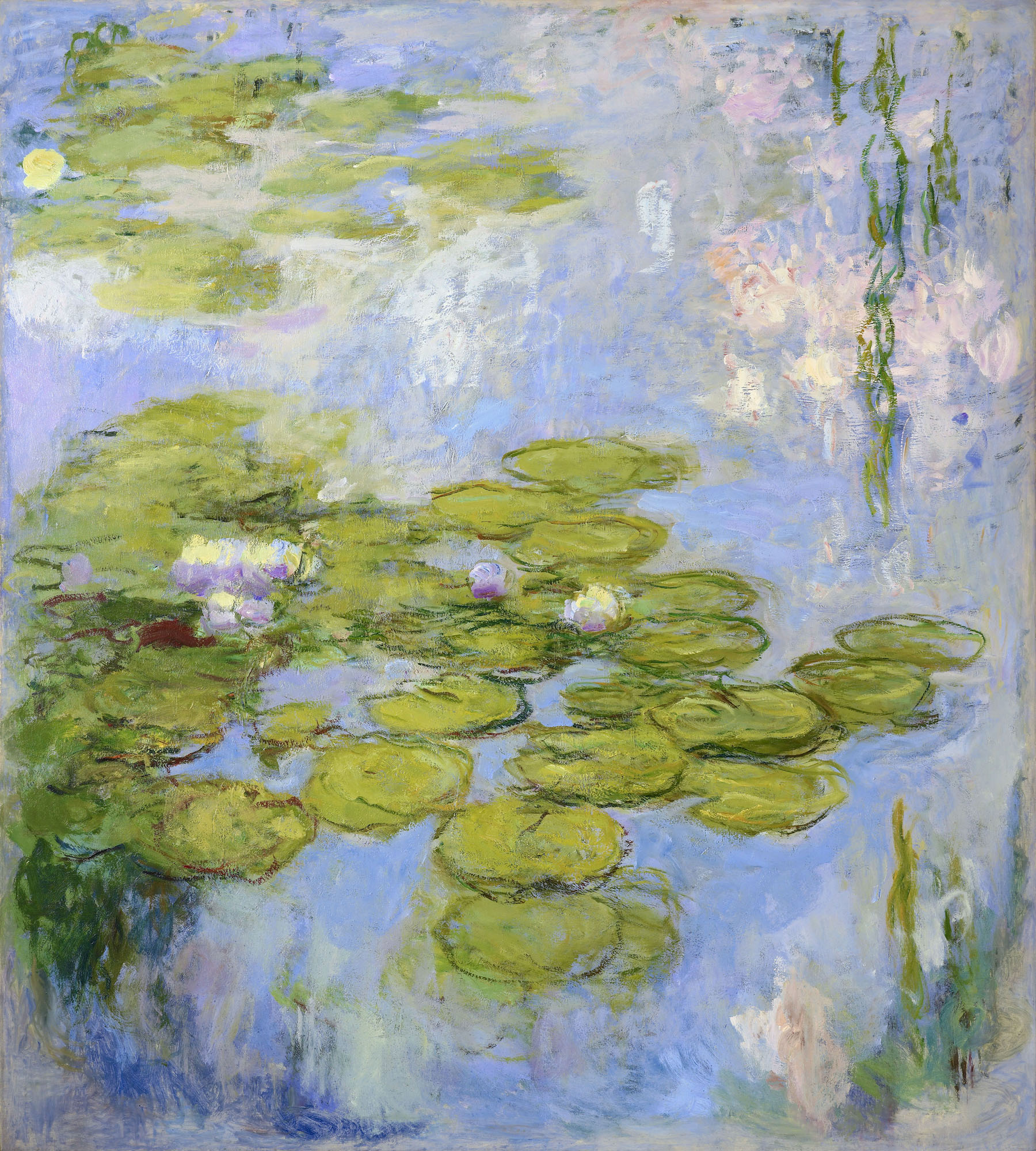
 

Claude Monet (French, 1840-1926) 'Water-Lilies' 1916-1919


Claude Monet (French, 1840-1926)
Water-Lilies
1916-1919
Oil on canvas
200 x 180cm
Fondation Beyeler, Riehen / Basel, Beyeler Collection
Photo: Robert Bayer
The restoration of this art work is supported by the BNP Paribas Swiss Fondation


Fondation Beyeler
Beyeler Museum AG
Baselstrasse 77, CH-4125
Riehen, Switzerland

Opening hours:
10am – 6pm daily, Wednesdays until 8pm
Fondation Beyeler website

LIKE ART BLART ON FACEBOOK

Back to top

Exhibition: ‘J.M.W. Turner: Painting Set Free’ at the J. Paul Getty Museum, Getty Center, Los Angeles

Exhibition dates: 24th February – 24th May 2015

Curators: Julian Brooks, curator of drawings, and Peter Björn Kerber, assistant curator of paintings


Water, Wind, and Whales


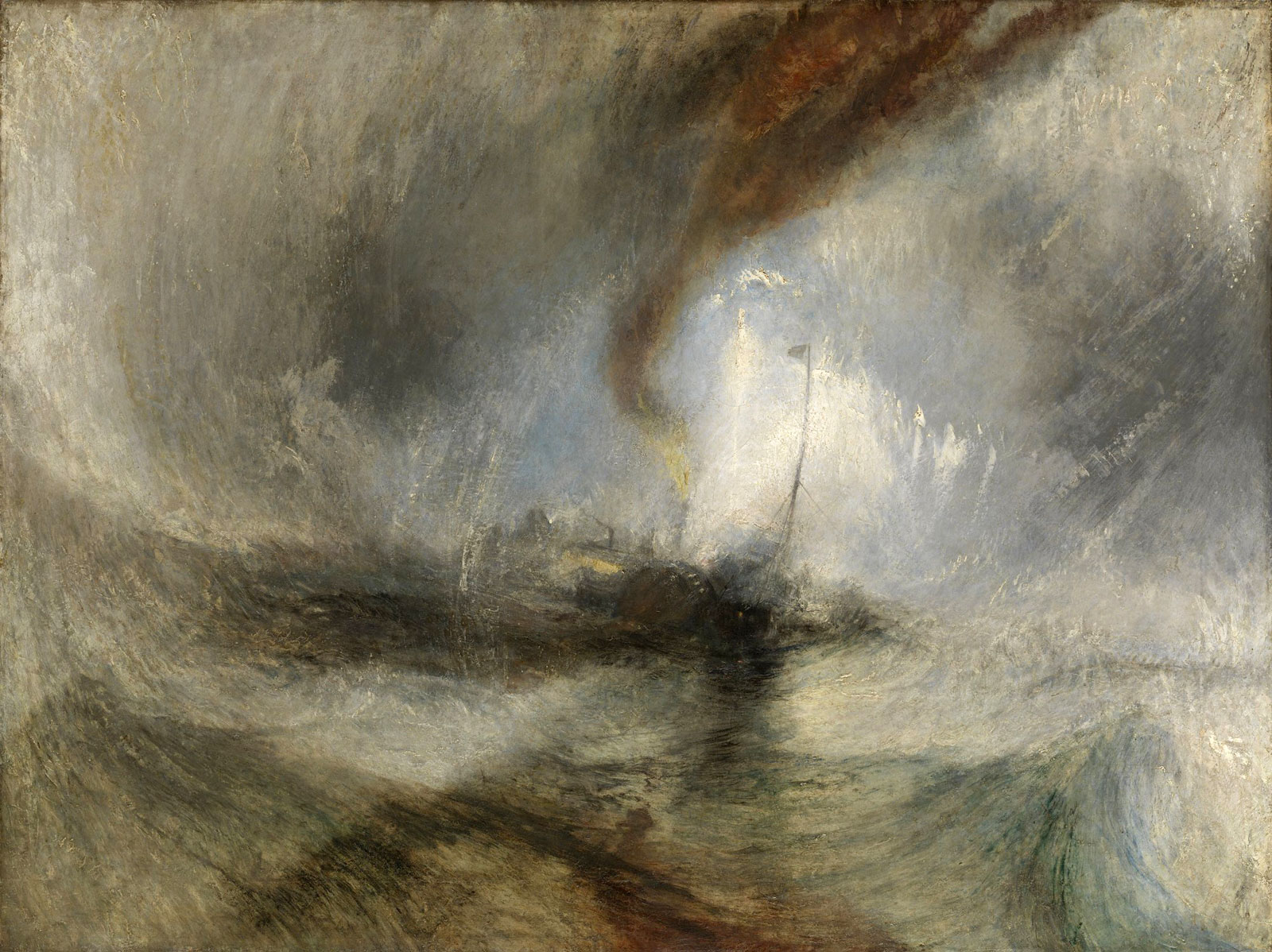
Joseph Mallord William Turner (British, 1775-1851) 'Snow Storm: Steam-Boat off a Harbour's Mouth' Exhibited 1842


Joseph Mallord William Turner (British, 1775-1851)
Snow Storm: Steam-Boat off a Harbour’s Mouth
Exhibited 1842
Oil on canvas
Unframed: 91.4 x 121.9cm (36 x 48 in.)
Tate: Accepted by the nation as part of the Turner Bequest 1856
Photo: © Tate, London 2014


No words are necessary.

Marcus


Many thankx to the J. Paul Getty Museum for allowing me to publish the photographs in the posting. Please click on the photographs for a larger version of the image.


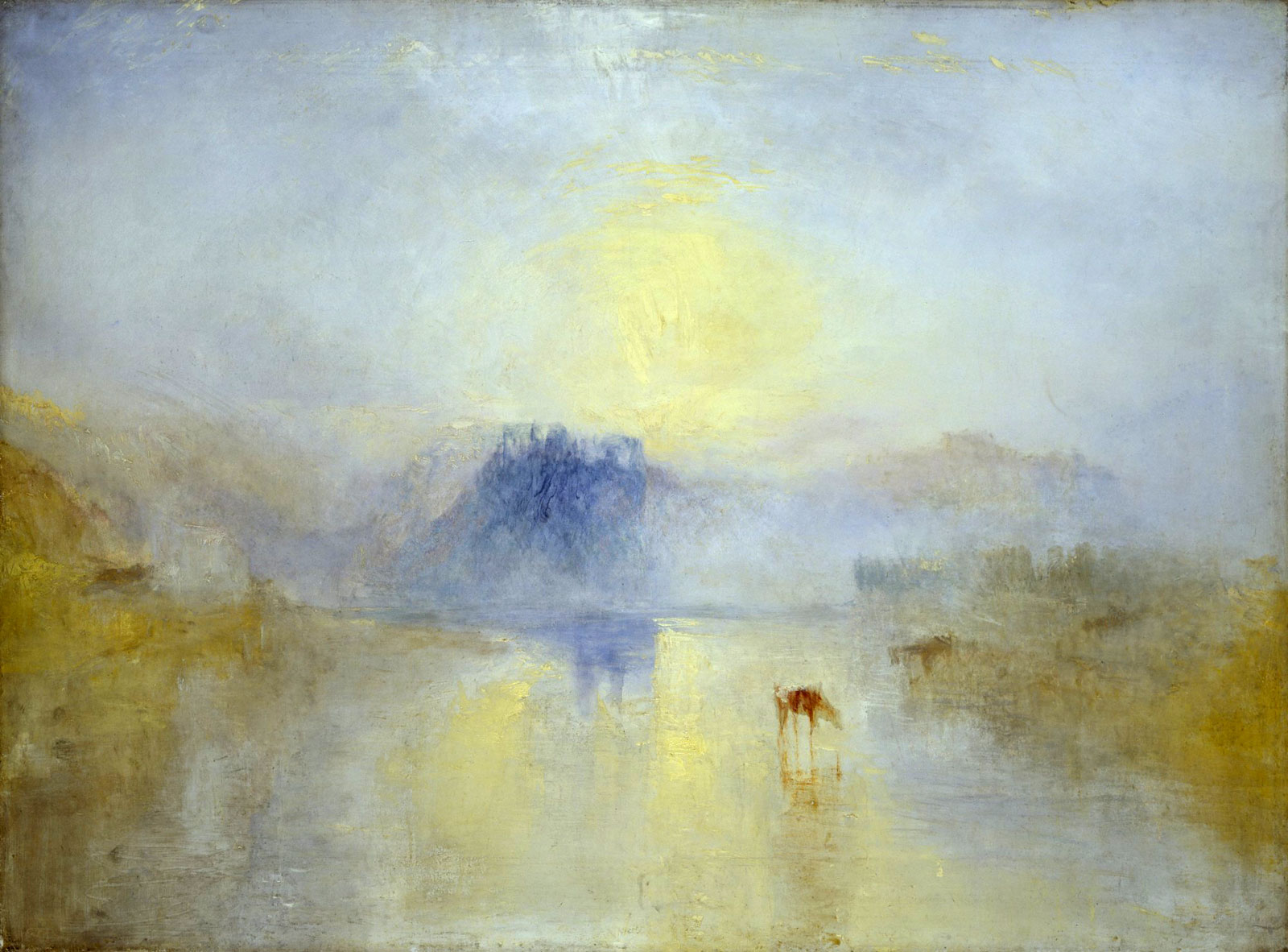
Joseph Mallord William Turner (British, 1775-1851) 'Norham Castle, Sunrise' About 1845


Joseph Mallord William Turner (British, 1775-1851)
Norham Castle, Sunrise
About 1845
Oil on canvas
Unframed: 90.8 x 121.9cm (35 3/4 x 48 in.)
Tate: Accepted by the nation as part of the Turner Bequest 1856
Photo: © Tate, London 2014


Turner first saw Norham, bordering Scotland on the river Tweed in Northumberland, in 1797. He was at the limits of his trip to northern England, when he also visited Buttermere, seen in the painting of nearly fifty years earlier shown nearby. After that first visit he made watercolours showing the ruin at sunrise, and visits in 1801 and 1831 resulted in further views. Here, finally, is one of a series of unfinished, unexhibited paintings reworking his monochrome Liber Studiorum landscape prints. Pure colours rather than contrasting tones express the blazing light as the historic building and landscape merge.


It is a hundred years since Turner’s painting, Norham Castle, Sunrise, went on display for the first time. The painting was among a group of twenty-one previously unknown, and essentially ‘unfinished’, canvases that were the focal point of a new Turner room inaugurated at the Tate Gallery (now Tate Britain) in February 1906.

These pictures had entered to the national collection in 1856, but remained uncatalogued. This was chiefly due to a lack of adequate hanging space for the many oil paintings in the collection. But a bigger issue was the concern that the images would not be properly understood by the public. Gallery officials themselves had serious reservations, considering them only ‘rude beginnings’ or even ‘mere botches’.

Consequently, it was not until 1906, when a new generation began to look at Turner afresh, that space was made for the first batch of pictures disinterred from the National Gallery’s basement. These revelatory ‘new’ works were quite unlike the detailed pictures that the artist had exhibited. Their unresolved brushwork and luminous palette seemed to confirm the patriotic belief that Turner (and John Constable) had paved the way for the French Impressionists.

During the last hundred years, Norham Castle has gradually become the embodiment of many ideas about Turner’s later style, above all, its reduction of content to a minimum giving emphasis to the play of colour and light. This display explores the origins of Turner’s interest in Norham Castle as a subject and charts the impact the picture has had during its recent history.

Norham Castle, Sunrise: from incomprehension to icon,” on the Tate website


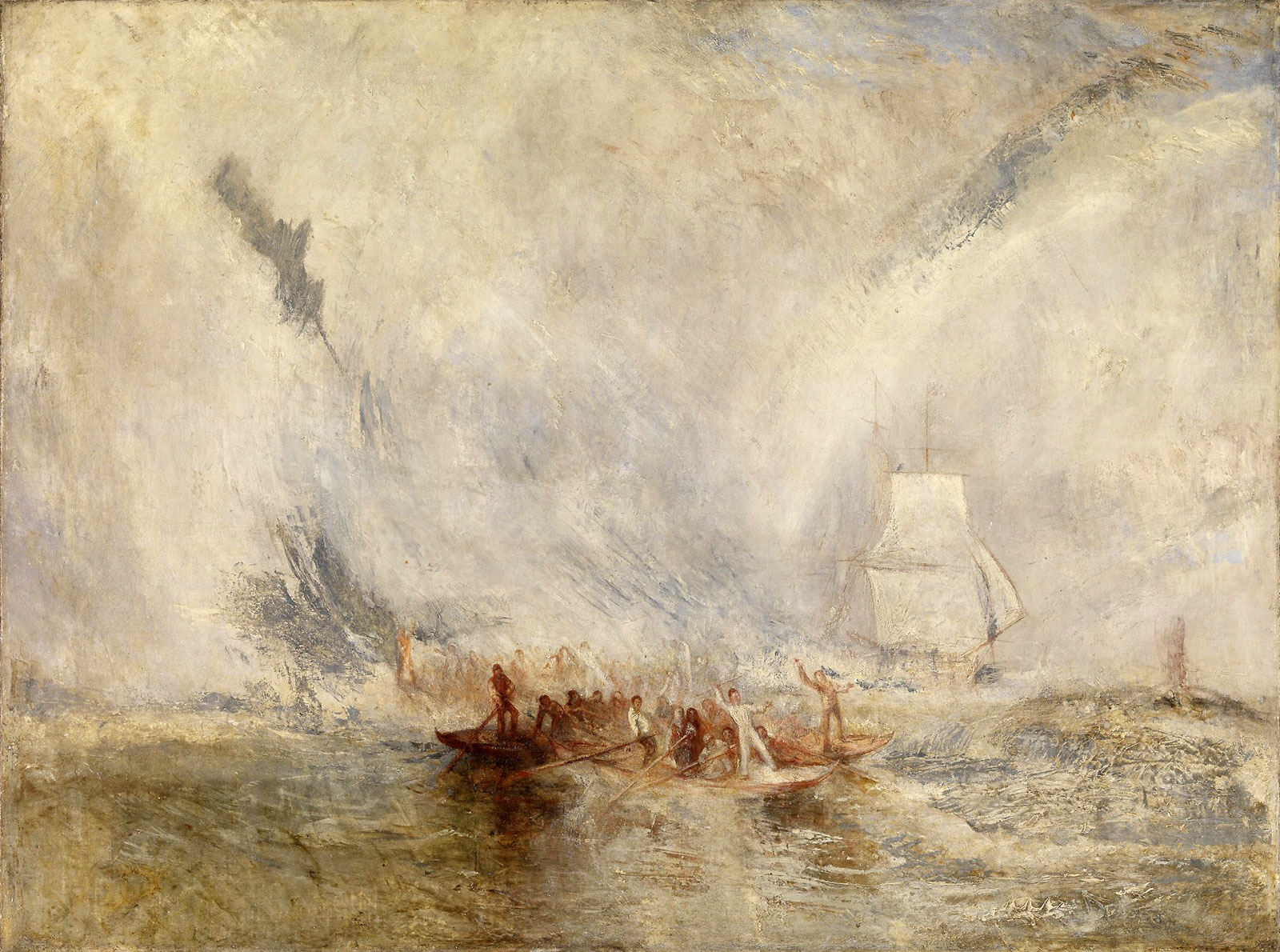
Joseph Mallord William Turner (British, 1775-1851) 'Whalers', exhibited 1845


Joseph Mallord William Turner (British, 1775-1851)
Whalers
Exhibited 1845
Oil on canvas
Unframed: 91.1 x 121.9cm (35 7/8 x 48 in.)
Tate: Accepted by the nation as part of the Turner Bequest 1856
Photo: © Tate, London 2014


Continental Travels


Joseph Mallord William Turner (British, 1775-1851) 'The Dogano, San Giorgio, Citella from the Steps of the Europa' Exhibited 1842


Joseph Mallord William Turner (British, 1775-1851)
The Dogano, San Giorgio, Citella from the Steps of the Europa
Exhibited 1842
Oil on canvas
Unframed: 61.6 x 92.7cm (24 1/4 x 36 1/2 in.)
Tate: Presented by Robert Vernon 1847
Photo: © Tate, London 2014


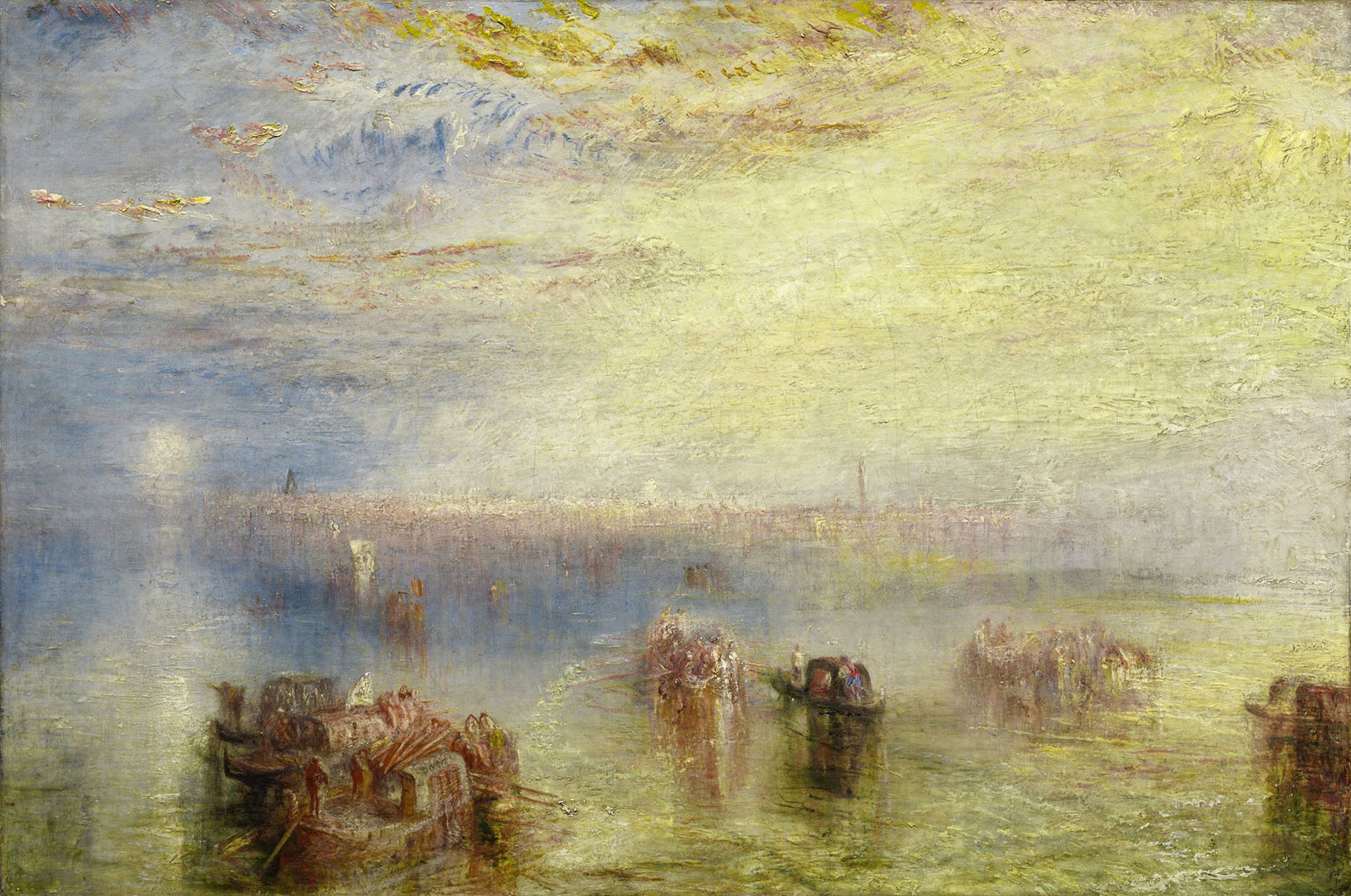
Joseph Mallord William Turner (British, 1775-1851) 'Approach to Venice' Exhibited 1844


Joseph Mallord William Turner (British, 1775-1851)
Approach to Venice
Exhibited 1844
Oil on canvas
Unframed: 62 x 94cm (24 7/16 x 37 in.)
National Gallery of Art, Washington, Andrew W. Mellon Collection
Image courtesy National Gallery of Art, Washington


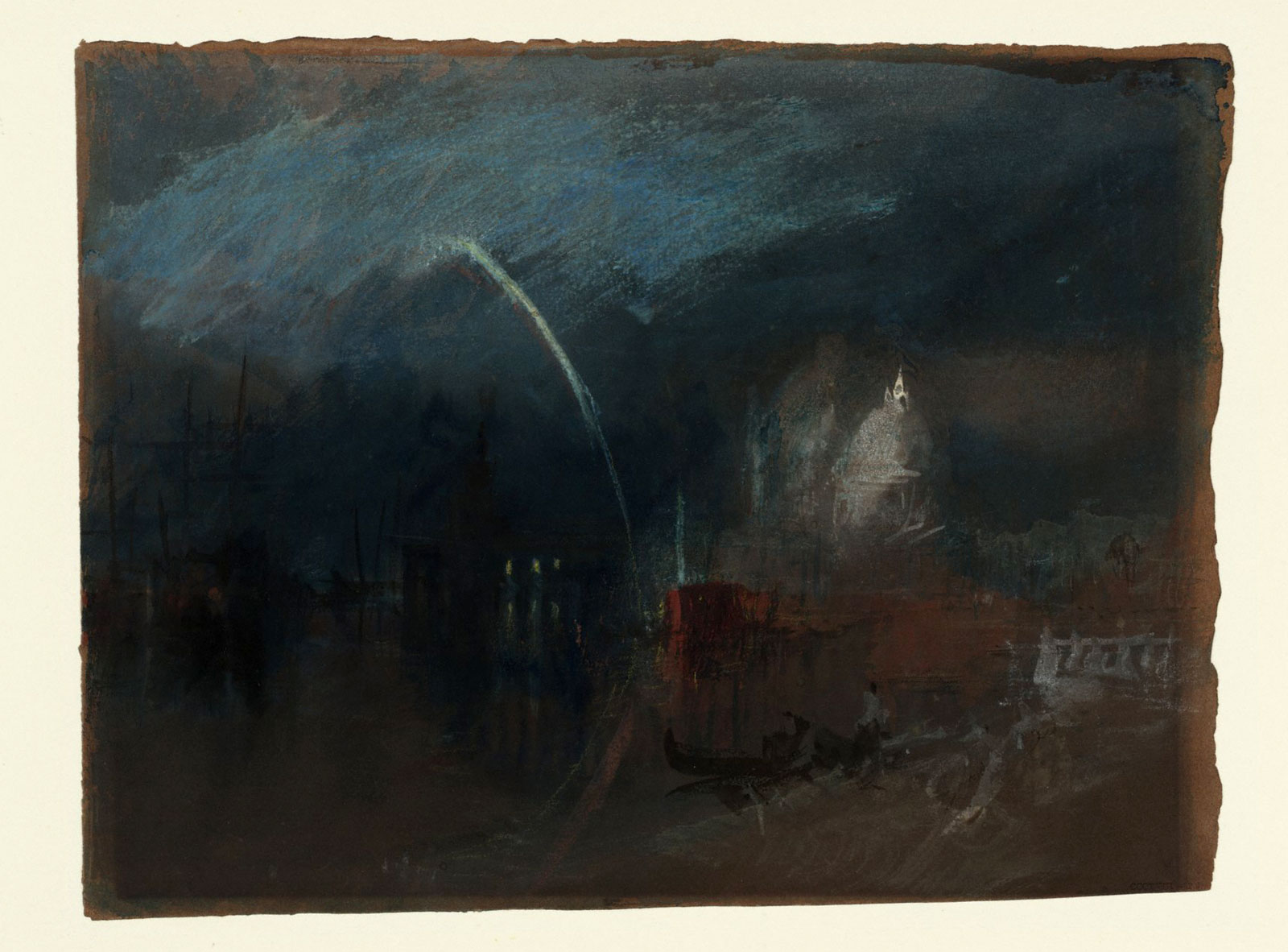
Joseph Mallord William Turner (British, 1775-1851) 'Venice: Santa Maria della Salute, Night Scene with Rockets' about 1840


Joseph Mallord William Turner (British, 1775-1851)
Venice: Santa Maria della Salute, Night Scene with Rockets
About 1840
Watercolour and bodycolor
Unframed: 24 x 31.5cm (9 7/16 x 12 3/8 in.)
Tate: Accepted by the nation as part of the Turner Bequest 1856
Photo: © Tate, London 2014


Joseph Mallord William Turner (British, 1775-1851) 'The Sun of Venice Going to Sea' Exhibited 1843


Joseph Mallord William Turner (British, 1775-1851)
The Sun of Venice Going to Sea
Exhibited 1843
Oil on canvas
Unframed: 61.6 x 92.1 cm (24 1/4 x 36 1/4 in.)
Tate: Accepted by the nation as part of the Turner Bequest 1856
Photo: © Tate, London 2014


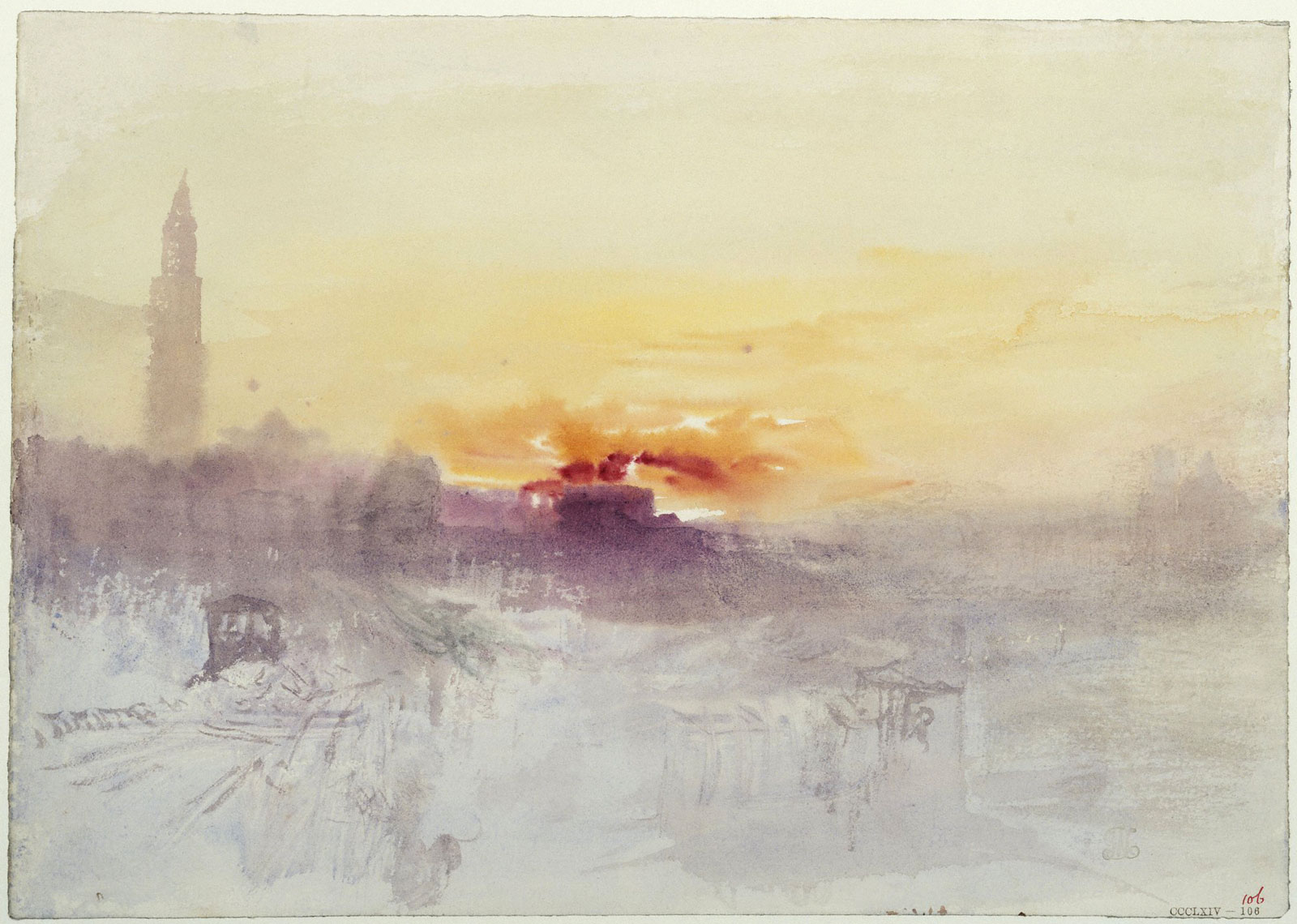
Joseph Mallord William Turner (British, 1775-1851) 'Venice at Sunrise from the Hotel Europa, with Campanile of San Marco' About 1840


Joseph Mallord William Turner (British, 1775-1851)
Venice at Sunrise from the Hotel Europa, with Campanile of San Marco
About 1840
Watercolor
Unframed: 19.8 x 28cm (7 13/16 x 11 in.)
Tate: Accepted by the nation as part of the Turner Bequest 1856
Photo: © Tate, London 2014


The large group of watercolours which resulted from Turner’s last visit to Venice in 1840 is characterised by a delicious liquidity which unifies air and water in layered, coloured mists. He stayed near the mouth of the Grand Canal at the Hotel Europe, from where he made sketches over the rooftops after dark. Alternatively, from a gongola off the great Piazzetta, he was able to see the sun set down the wide canal of the Giudecca.


Joseph Mallord William Turner (British, 1775-1851) 'Ehrenbreitstein' 1841


Joseph Mallord William Turner (British, 1775-1851)
Ehrenbreitstein
1841
Watercolour and pen and ink
Unframed: 23.7 x 30cm (9 5/16 x 11 13/16 in.)
Tate: Accepted by the nation as part of the Turner Bequest 1856
Photo: © Tate, London 2014


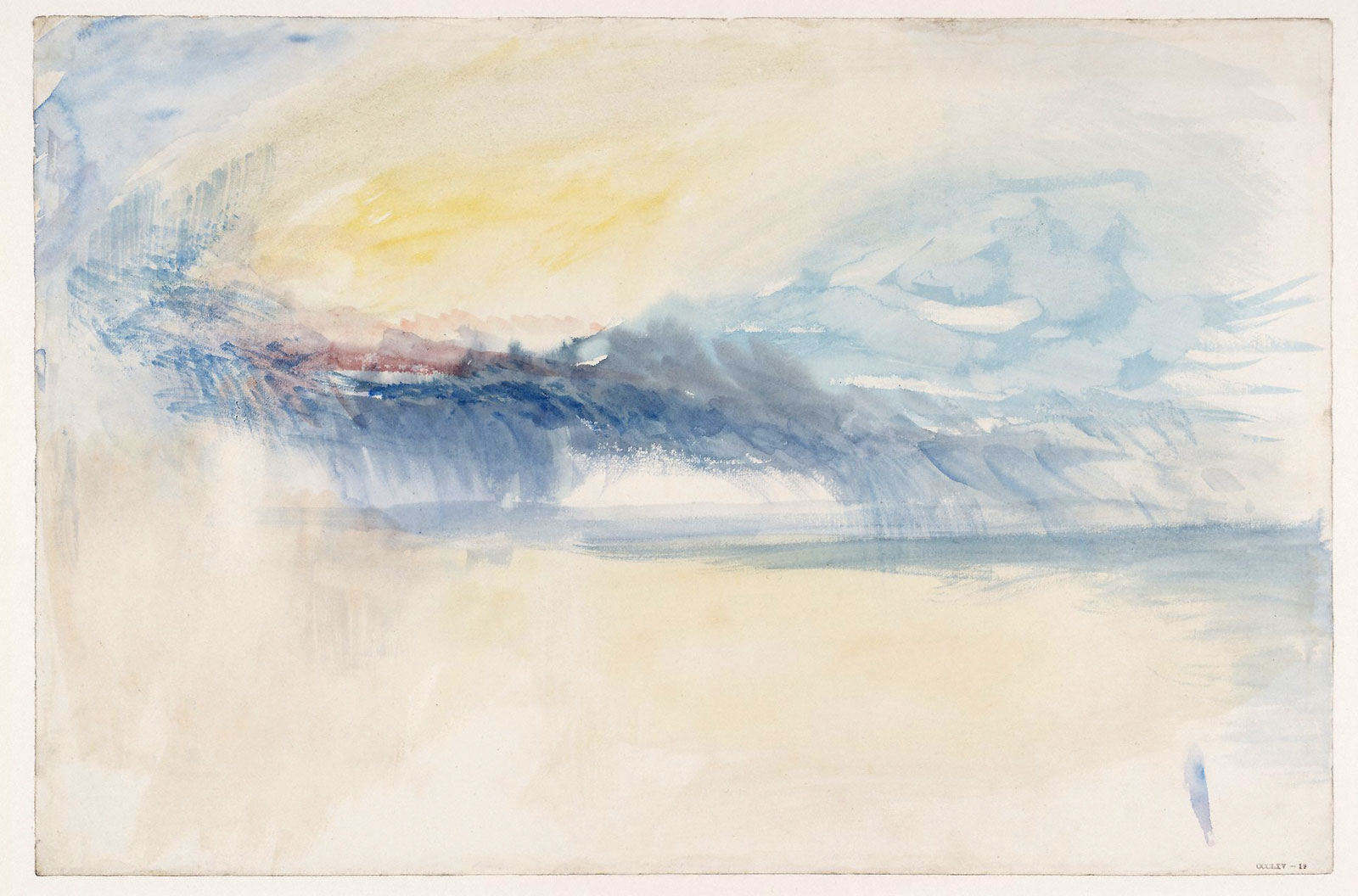
Joseph Mallord William Turner (British, 1775-1851) 'Rain Clouds' About 1845


Joseph Mallord William Turner (British, 1775-1851)
Rain Clouds
About 1845
Watercolour
Unframed: 29.1 x 44cm (11 7/16 x 17 5/16 in.)
Tate: Accepted by the nation as part of the Turner Bequest 1856
Photo: © Tate, London 2014


Joseph Mallord William Turner (British, 1775-1851) 'The Blue Rigi, Sunrise' 1842


Joseph Mallord William Turner (British, 1775-1851)
The Blue Rigi, Sunrise
1842
Watercolour
Unframed: 29.7 x 45cm (11 11/16 x 17 11/16 in.)
Tate: Purchased with assistance from the National Heritage Memorial Fund, the Art Fund (with a contribution from the Wolfson Foundation and including generous support from David and Susan Gradel, and from other members of the public through the Save the Blue Rigi appeal) Tate Members and other donors 2007
Photo: © Tate, London 2014


First major West Coast international loan exhibition focuses on Turner’s late work; Famed 19th-century master created many of his most renowned pieces after age 60.

One of the most influential painters of nature who ever lived, Joseph Mallord William Turner (English, 1775-1851) was especially creative and inventive in the latter years of his life, producing many of his most famous and important paintings after the age of 60. On view at the J. Paul Getty Museum February 24, 2015, through May 24, 2015, J.M.W. Turner: Painting Set Free brings together more than 60 key oil paintings and watercolours from this culminating period of his career, and is the West Coast’s first major exhibition of Turner’s work.

“J.M.W. Turner is the towering figure of British 19th century art, a ground-breaking innovator in his own day whose relevance and status as a seeming harbinger of 20th century ‘modernism; has made him an inspiration to generations of later artists up to the present day. A successful and well-known public figure in his own day, Turner produced some of his most innovative and challenging work during the last 16 years of his life,” explains Timothy Potts, director of the J. Paul Getty Museum. “He was frequently mocked and misunderstood for his choice of unusual subject matters, his experimentation with different canvas formats, and his pioneering free and spontaneous techniques in both oil and watercolour. While Turner could not knowingly have anticipated future artistic trends, he is seen today by many as a prophet of modernism because of his rough, gestural brushwork and quasi-abstract subject matter. His work captured the natural landscape’s atmosphere and colour like no other artist before him, and conveyed the awe-inspiring power of the elements as never before. This exhibition celebrates Turner as the most innovative and experimental artist of his time, and I have no doubt that it will be inspiring to a new generation of artists working in California today.”

“The exhibition shows an artist at the top of his game, totally at ease with his media, and still keen to push boundaries and challenge assumptions. We see how Turner was modern in his own time, but the results are astonishing even for us today,” said Julian Brooks, one of the exhibition curators.

The Sea

In his later years, Turner’s continuing fascination with the sea reached a zenith. Although he respected existing conventions of marine painting, particularly its 17th-century Dutch roots, he consistently moved beyond them, turning the water into a theatre for drama and effect. At the Royal Academy exhibitions, he confounded viewers with his bold portrayals of modern maritime action – whales and their hunters battling for survival – while striving to capture the mysterious depths and forces of the elements. Never having witnessed a whale hunt himself, he included a reference to “Beale’s Voyage” in the catalogues, acknowledging that his source of inspiration was Thomas Beale’s Natural History of the Sperm Whale (1839). (Herman Melville consulted the same book when writing Moby-Dick, published in 1851.)

The London press at the time greeted Turner’s whaling pictures, such as Hurrah! for the Whaler Erebus! Another Fish!, 1846, with scathing attacks, lambasting their yellow palette and lack of finish. The Almanack of the Month printed a cartoon of a Turner painting with a large mop and a bucket labeled “yellow,” and opined that his pictures resembled a lobster salad.

Travel

In addition to the sea, Turner’s insatiable appetite for history, different cultures, and sublime natural scenery drew him time and again to Continental Europe, where he observed not only spectacular sites such as ancient ruins, medieval castles, jagged mountain peaks, and meandering rivers, but also local customs and dress. On such travels he made numerous watercolour sketches, which effectively captured fleeting effects of nature on paper. These works display a complex layering of colour animated through the pulsing energy of turbulent handling. They demonstrate both Turner’s commitment to observed natural effects and his unwavering obsession with the vagaries and delights of watercolour, a medium he had indisputably made his own. Some of the finished watercolours he made for sale after his trips, such as The Blue Rigi, Sunrise, 1842, represent pinnacles in the use of watercolour technique.

Turner was especially captivated by the particular combination of light and colour he found in Venice, and revisited the city several times. He traveled lightly, usually alone, making few concessions to his age or failing strength, and drew constantly in his sketchbooks. Turner’s many images of Venice were among his most potent late works, influencing later artists such as James Abbott McNeill Whistler (American, 1834-1903) and Claude Monet (French, 1840-1926).

For Turner, watercolour was the perfect medium to capture Venice’s aqueous and luminous effects. While based on on-the-spot sketches done there in 1840, Turner’s later paintings of Venice drew out the city’s essence and spirit rather than its exact topography. His Venice was often touched with a melancholy that echoed the romantic fatalism popularised by writers such as Lord Byron, offering a warning from history to Britain’s rise as a commercial empire.

Poetry

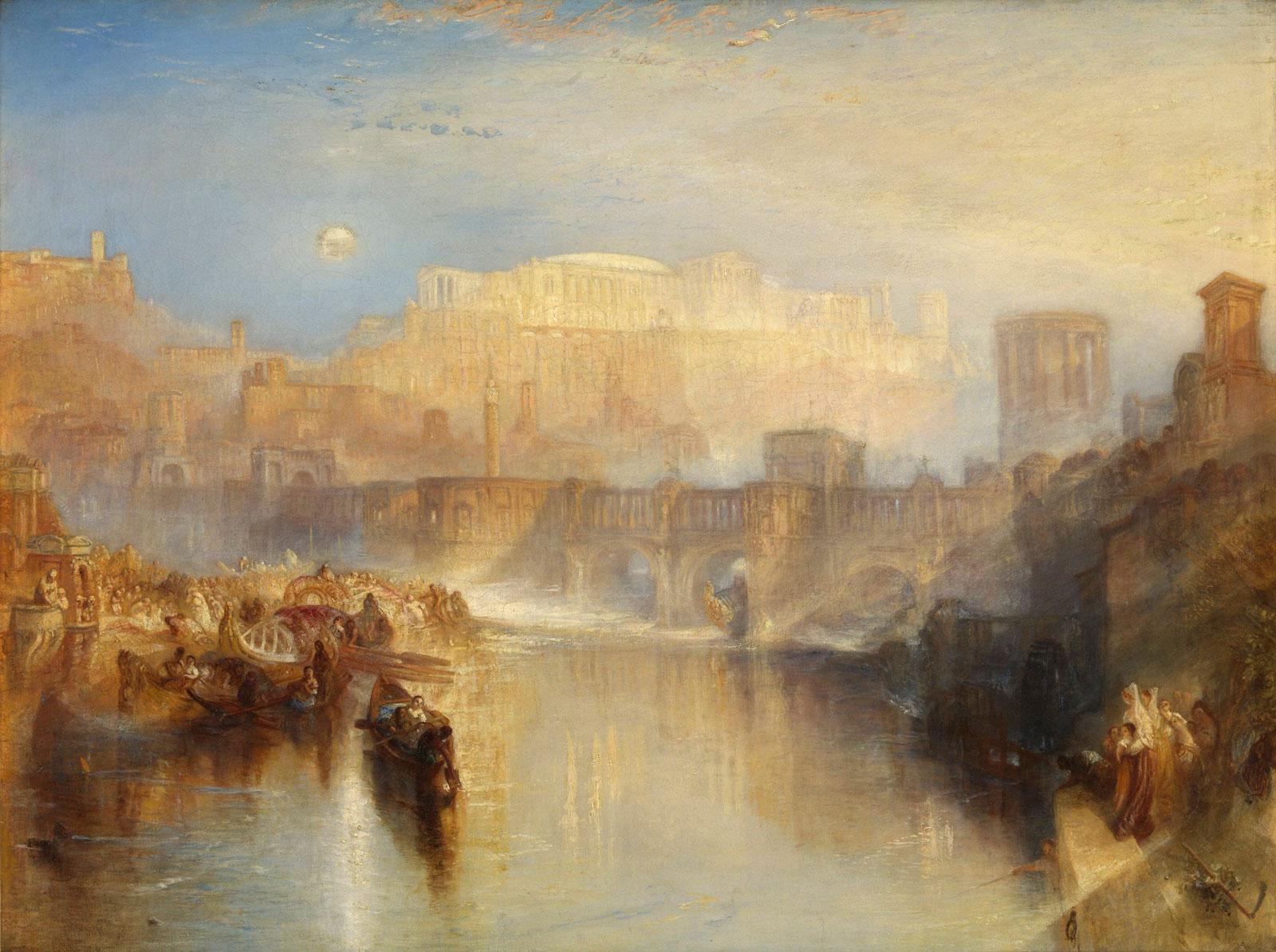
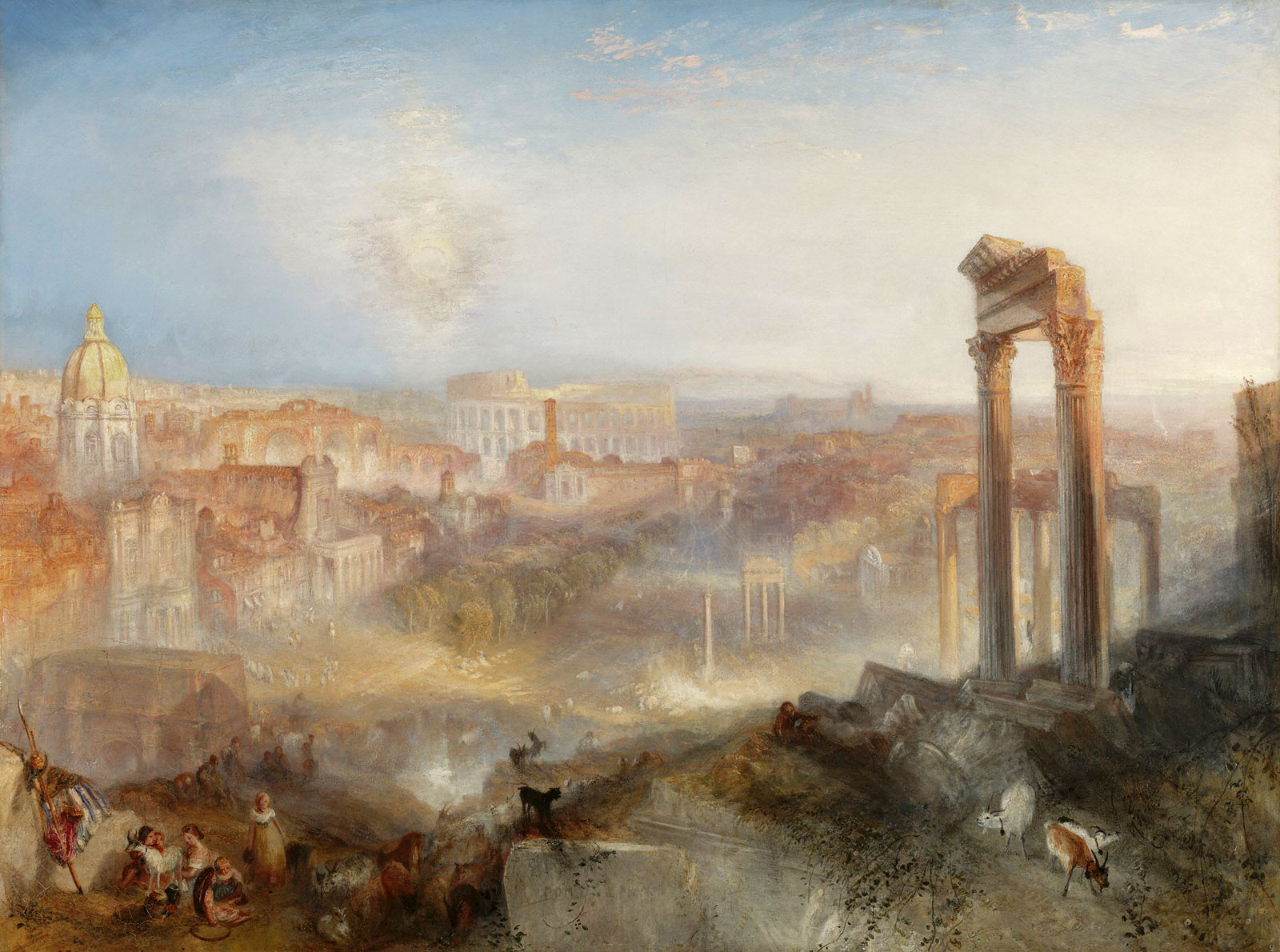
Turner was deeply interested in poetry and often paired his paintings with lines of text in order to elucidate their themes. In some cases he authored the poems himself but often he quoted celebrated 18th- and 19th-century British poets such as Thomas Gray and, most especially, Lord Bryon. Throughout the Getty exhibition, many of the lines of poetry or prose that he chose or wrote are reunited with his pictures on the gallery walls. For example, the lines “The moon is up, and yet it is not night/ The sun as yet disputes the day with her” from Byron’s Childe Harold’s Pilgrimage (1812-1818) were chosen, and slightly altered by Turner to accompany two paintings: Modern Rome – Campo Vaccino, exhibited 1839, and Approach to Venice, exhibited 1844, which both feature the setting sun and a rising moon but also evoke the rise and fall of empires.

Contemporary Events

Much of Tuner’s later work reflects on contemporary events including the modern state of Italy, the legacy of the Napoleonic Wars, and the spectacular fires that ravaged the Palace of Westminster and the Tower of London in 1834 and 1841, respectively. In addition, Turner was the first major European artist to engage with innovations such as steam power, as seen in Snow Storm: Steam-Boat off a Harbour’s Mouth, 1842, which shows this much-vaunted new technology at the mercy of the awesome power of the elements.

Technique

Perhaps nothing demonstrates Turner’s virtuosity as a painter better than the stories of his performances on “Varnishing Days.” The Royal Academy and the British Institution would set aside a short period of time for artists to put final touches on their work before an exhibition opened to the public. Turner revelled in the competitive jostling and repartee that occurred on these occasions. In his later years, he would frequently submit canvases with only the roughest indications of colour and form, speedily bringing them to completion on-site. Eyewitnesses record that Turner painted most of The Hero of a Hundred Fights, 1800-10, reworked and exhibited 1847, and Burning of the Houses of Lords and Commons, 16th October 1834, 1834-1835, on their respective varnishing days.

Pairs and Shapes

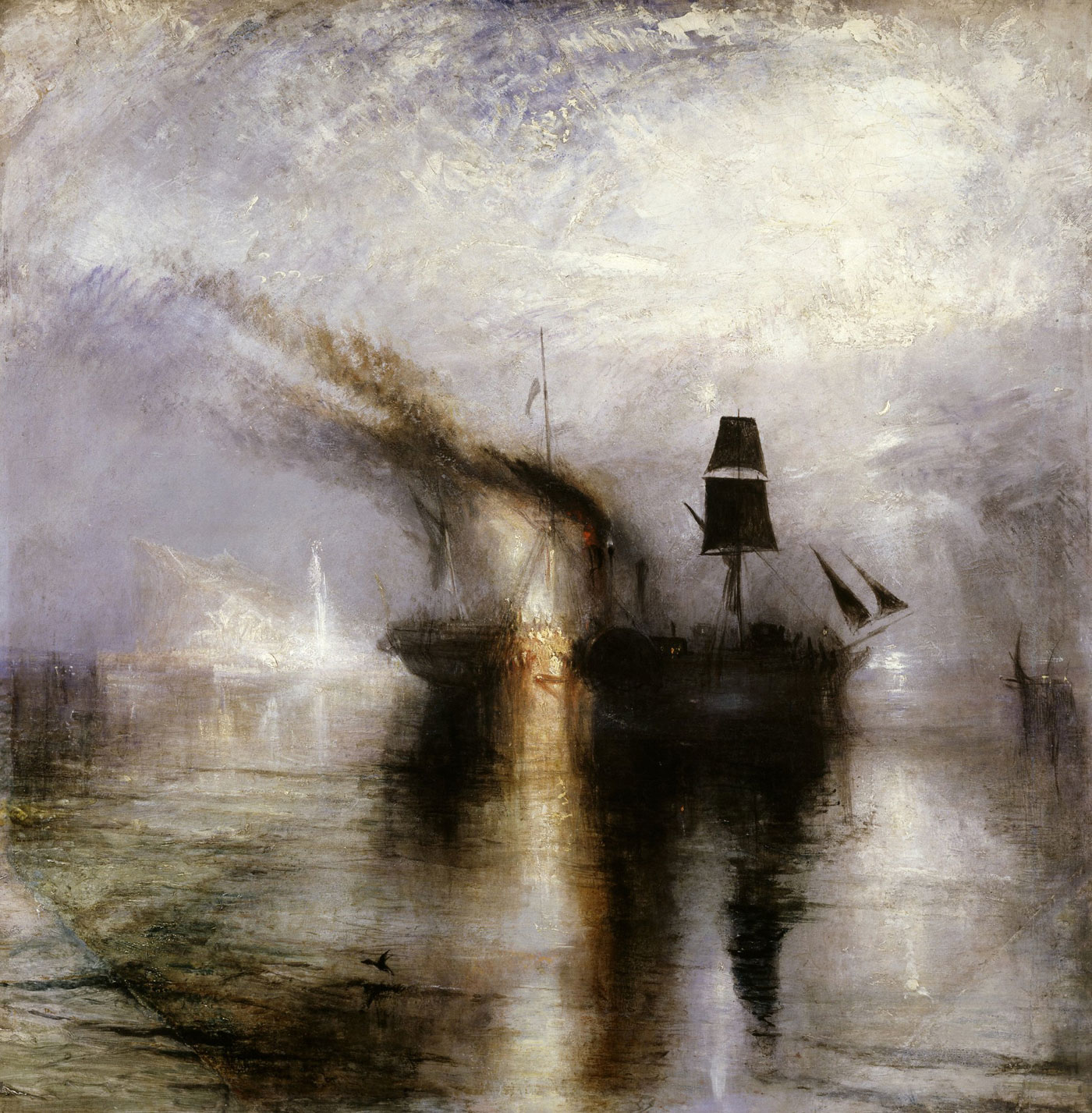
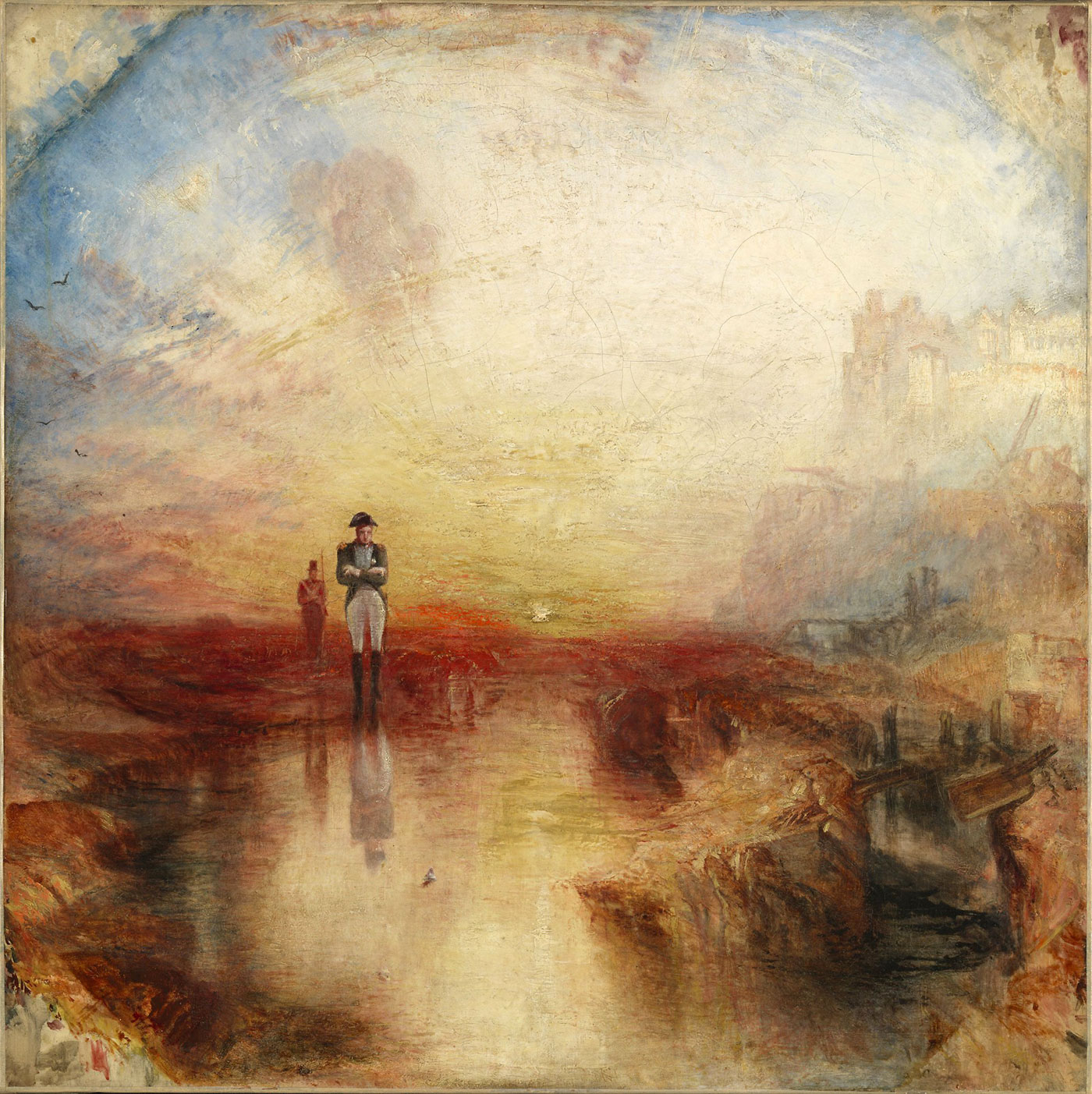
In his later years, Turner was as creative in his approach to media, materials, and techniques as he was in his choice of subject matter. He created works that offer some of his most dazzling displays of colour, audacious handling, and complex iconographies. From 1840 to 1846, the artist employed a smaller canvas size for a series of paintings, which were often conceived as pairs expressing opposites, such as two that were exhibited in 1842: Peace – Burial at Sea and War. The Exile and the Rock Limpet. These were principally square but could also be round or octagonal. Exploring states of consciousness, optics, and the emotive power of colour, they shocked and mystified his audience, who thought them the products of senility or madness. Painted near the end of his life, these inventive works are a coda to Turner’s career, representing a synthesis of his innovations in technique, composition and theme.

Turner died in 1851 at age 76, leaving the majority of his work to the English nation along with an intended bequest to support impoverished artists. In the years since, while popular and scholarly ideas about his work have changed, he inarguably emerges as one of the most beloved figures and popular painters in the history of the United Kingdom.

This exhibition was organised by Tate Britain in association with the J. Paul Getty Museum and the Fine Arts Museums of San Francisco. It is supported by an indemnity from the Federal Council on the Arts and the Humanities. The Getty Museum curators of the exhibition are Julian Brooks, curator of drawings, and Peter Björn Kerber, assistant curator of paintings.

The exhibition is accompanied by the publication J.M.W. Turner: Painting Set Free. Edited by David Blayney Brown, Amy Concannon, and Sam Smiles, this 250-page volume is richly illustrated.

~ Water, Wind, and Whales
~ Continental Travels
~ Contemporary Subjects
~ History, Myth, and Meaning
~ Pairs and Shapes


Press release from the J. Paul Getty Museum website


Contemporary Subjects


Joseph Mallord William Turner (British, 1775-1851) 'The Burning of the Houses of Lords and Commons, October 16, 1834' 1834-1835


Joseph Mallord William Turner (British, 1775-1851)
The Burning of the Houses of Lords and Commons, October 16, 1834
1834-1835
Oil on canvas
Unframed: 92.1 x 123.2cm (36 1/4 x 48 1/2 in.)
Philadelphia Museum of Art: The John Howard McFadden Collection, 1928


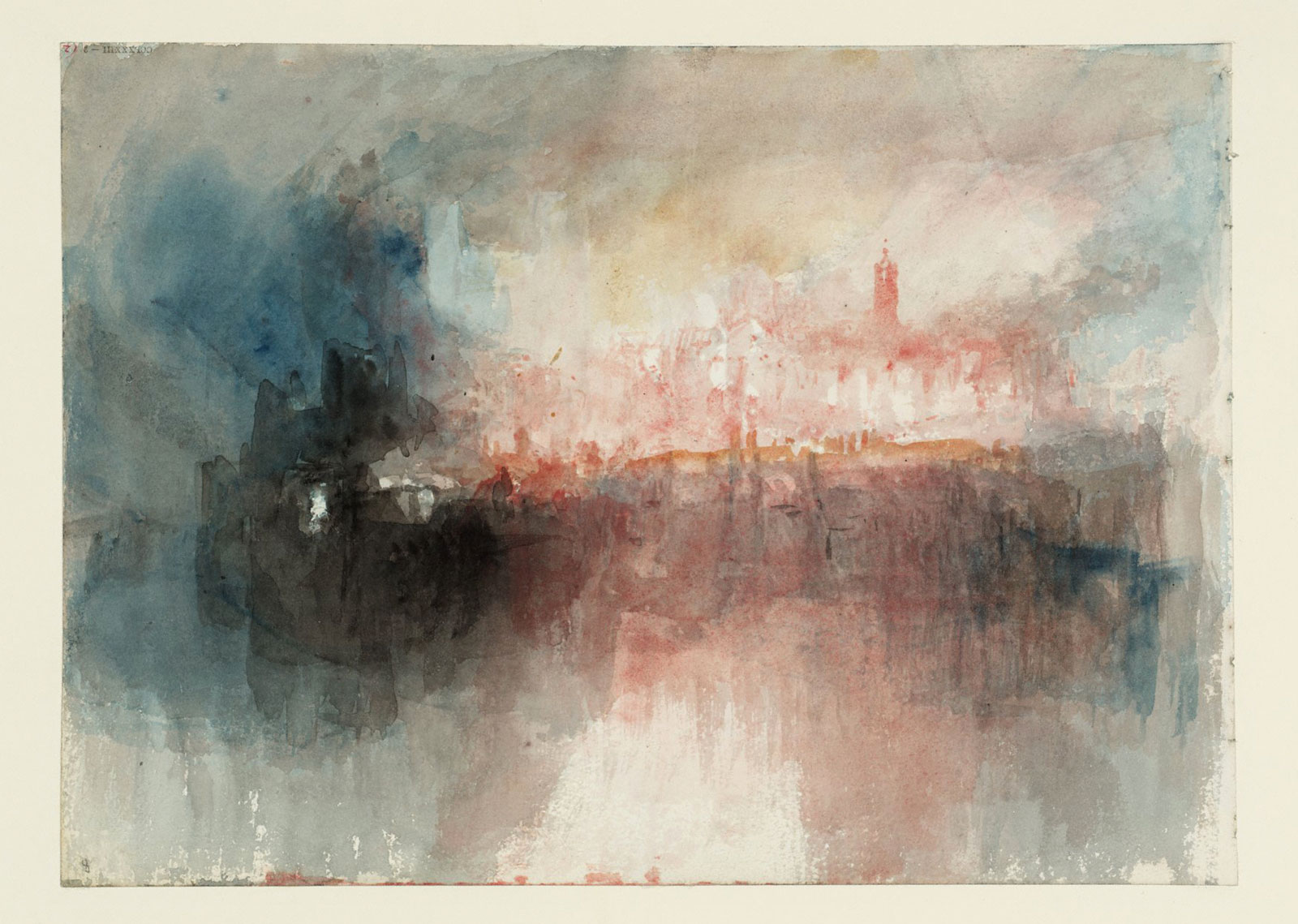
Joseph Mallord William Turner (British, 1775-1851) 'Fire at the Grand Storehouse of the Tower of London' 1841


Joseph Mallord William Turner (British, 1775-1851)
Fire at the Grand Storehouse of the Tower of London
1841
Watercolour
Unframed: 23.5 x 32.5cm (9 1/4 x 12 13/16 in.)
Tate: Accepted by the nation as part of the Turner Bequest 1856
Photo: © Tate, London 2014


This watercolour study was originally one of nine consecutive leaves (D27846 – D27854; Turner Bequest CCLXXXIII 1-9) in a sketchbook. They have previously been documented with varying degrees of certainty as showing the 1834 fire at the Houses of Parliament beside the River Thames in central London, but are here identified as representing the similarly large and dramatic fire which broke out at the moated Tower of London on 30 October 1841, destroying the late seventeenth-century Grand Storehouse (see the Introduction to the sketchbook for detailed discussion).

Conflagration of the Tower of London, on the Night of the 30th of October 1841, a colour lithograph published on 3 November of a view ‘drawn upon the spot by William Oliver’ (1804-1853) shows the Tower complex from the north, with flames and smoke pouring from the windows and rafters of the Grand Storehouse, largely obscuring the White Tower. This can be compared with the present work, the most precisely detailed of Turner’s studies in terms of architectural features. (See the Introduction for other comparisons between Turner’s studies and contemporary prints.) The pale blue form towards the left is presumably intended as the White Tower; otherwise lacking in detail, the inner faces of its corner turrets are shown receding in steep perspective, although in fact the north-west turret is cylindrical. Turner has included details of rafters, a pediment and what seems to be the clock tower of the Grand Storehouse (which fell in at quite an early stage of the fire), but it is not clear whether he intended to show the scene directly from the north, aligned directly on the façade of the storehouse, or obliquely from the north-east, which would explain the relative positions of the clock tower and the White Tower.

In addition to the newspaper stories extensively quoted in the sketchbook’s Introduction, the following details from the Times relate to the raising of the alarm late on the evening of Saturday 30 October:

[Sergeant] Edwards [‘of the 1st Battalion of Fusilier Guards’] states, that while he was in the Nag’s Head public-house, in Postern-row [opposite the north side of the Tower], he perceived, to his great surprise, a light through one of the windows, just above the bomb proof part of the Bowyer Tower. He went out and crossed to the railings at the top of the moat by which the Tower is surrounded, and watched the light for a minute or two. At first it appeared but little larger than the glimmer of a candle, but it suddenly increased to such an extent, that no doubt was left upon his mind that the place was on fire.1


The present Tower study is notable in being the only one of the nine to incorporate gouache: a touch of white is combined with scratching out to render a bright light through a window of the towers silhouetted towards the left. This may be an effect Turner observed or imagined, or perhaps the report caught his attention.

Addressing the sequence of studies in the context of the traditional former 1834 identification, Katherine Solender felt that only this and D27850, D27853 and D27854 included ‘shapes that can be remotely identified with the Parliamentary complex’, in this case possibly indicating the roof and lantern of Westminster Hall on the right, with the Towers of Westminster Abbey beyond to the left.2 In his extended catalogue entry for Turner’s painting The Burning of the House of Lords and Commons, 16th October, 1834, exhibited at the British Institution in 1835 (Philadelphia Museum of Art),3 Richard Dorment presented a sustained interpretation of the this and the other eight watercolour studies in terms of a sequence reflecting the topography and chronology of the 1834 Westminster fire.4

Matthew Imms, April 2014 from catalogue entry to David Blayney Brown (ed.), J.M.W. Turner: Sketchbooks, Drawings and Watercolours, September 2014

1/ ‘The Tower of London. Destructive Conflagration. (Additional Particulars.)’, The Times, Tuesday 2 November 1841, p. 5.
2/ Solender 1984, pp. 50-1; see also Lyles 1992, p. 72.
3/ Martin Butlin and Evelyn Joll, The Paintings of J.M.W. Turner, revised ed., New Haven and London 1984, pp. 207-10 no. 359, pl. 364 (colour).
4/ Dorment 1986, pp. 400-1; see also Lyles 1992, p. 72.


Joseph Mallord William Turner (British, 1775-1851) 'The Hero of a Hundred Fights' About 1800 - 1810, reworked and exhibited 1847


Joseph Mallord William Turner (British, 1775-1851)
The Hero of a Hundred Fights
About 1800-1810, reworked and exhibited 1847
Oil on canvas
Unframed: 90.8 x 121.3cm (35 3/4 x 47 3/4 in.)
Framed: 127.5 x 158.5 x 18cm (50 3/16 x 62 3/8 x 7 1/16 in.)
Tate: Accepted by the nation as part of the Turner Bequest 1856
Photo: © Tate, London 2014


This canvas was originally an exploration of industrial machinery, but it was reworked to show the moment when a bronze statue of the Duke of Wellington was removed from its mould. Using the intense light of the foundry to obscure the figure, Turner transforms Wellington into an ethereal presence. The image is in stark contrast to Turner’s carefully researched battle scenes. Here, tone and colour are employed to endow a national hero with elemental force.


Joseph Mallord William Turner (British, 1775-1851) 'The Disembarkation of Louis-Philippe at the Royal Clarence Yard, Gosport, 8 October 1844' About 1844-1845


Joseph Mallord William Turner (British, 1775-1851)
The Disembarkation of Louis-Philippe at the Royal Clarence Yard, Gosport, 8 October 1844
About 1844-1845
Oil on canvas
Unframed: 90.8 x 121.3cm (35 3/4 x 47 3/4 in.)
Framed: 128.4 x 159 x 8.3cm (50 9/16 x 62 5/8 x 3 1/4 in.)
Tate: Accepted by the nation as part of the Turner Bequest 1856
Photo: © Tate, London 2014


Turner visited Portsmouth to record the arrival of the French king, who was on a State Visit. He made numerous sketches of the event and also painted two unfinished oils: one showing the king’s arrival, the other his disembarkation. Both are principally concerned with the atmosphere of the occasion, concentrating on the crowd of onlookers. Turner had met Louis-Philippe when the king was living in exile at Twickenham in the 1810s. Contact between them was renewed in the mid-1830s and he was invited to dine with him at his château at Eu in 1845.


History, Myth, and Meaning


Joseph Mallord William Turner (British, 1775-1851) 'Regulus' 1828, reworked 1837


Joseph Mallord William Turner (British, 1775-1851)
Regulus
1828, reworked 1837
Oil on canvas
Unframed: 89.5 x 123.8cm (35 1/4 x 48 3/4 in.)
Framed: 113.5 x 146 x 9.3cm (44 11/16 x 57 1/2 x 3 11/16 in.)
Tate: Accepted by the nation as part of the Turner Bequest 1856
Photo: © Tate, London 2014


Joseph Mallord William Turner (British, 1775-1851) 'Mercury Sent to Admonish Aeneas' Exhibited 1850


Joseph Mallord William Turner (British, 1775-1851)
Mercury Sent to Admonish Aeneas
Exhibited 1850
Oil on canvas
Unframed: 90.2 x 120.6cm (35 1/2 x 47 1/2 in.)
Framed: 129.6 x 160.7 x 18.5cm (51 x 63 1/4 x 7 5/16 in.)
Tate: Accepted by the nation as part of the Turner Bequest 1856


Joseph Mallord William Turner (British, 1775-1851) 'Mercury and Argus' Before 1836


Joseph Mallord William Turner (British, 1775-1851)
Mercury and Argus
Before 1836
Oil on canvas
Unframed: 151.8 x 111.8cm (59 3/4 x 44 in.)
National Gallery of Canada, Ottawa, Purchased 1951
Photo: © National Gallery of Canada


Pairs and Shapes


Joseph Mallord William Turner (British, 1775-1851) 'Peace – Burial at Sea' Exhibited 1842


Joseph Mallord William Turner (British, 1775-1851)
Peace – Burial at Sea
Exhibited 1842
Oil on canvas
Unframed: 87 x 86.7cm (34 1/4 x 34 1/8 in.)
Tate: Accepted by the nation as part of the Turner Bequest 1856
Photo: © Tate, London 2014


Joseph Mallord William Turner (British, 1775-1851) 'War. The Exile and the Rock Limpet' Exhibited 1842


Joseph Mallord William Turner (British, 1775-1851)
War. The Exile and the Rock Limpet
Exhibited 1842
Oil on canvas
Unframed: 79.4 x 79.4cm (31 1/4 x 31 1/4 in.)
Tate: Accepted by the nation as part of the Turner Bequest 1856
Photo: © Tate, London 2014


Joseph Mallord William Turner (British, 1775-1851) 'Light and Color (Goethe's Theory) – The Morning After the Deluge – Moses Writing the Book of Genesis' Exhibited 1843


Joseph Mallord William Turner (British, 1775-1851)
Light and Color (Goethe’s Theory) – The Morning After the Deluge – Moses Writing the Book of Genesis
Exhibited 1843
Oil on canvas
Unframed: 78.7 x 78.7cm (31 x 31 in.)
Framed: 103.5 x 103.5 x 12cm (40 3/4 x 40 3/4 x 4 3/4 in.)
Tate: Accepted by the nation as part of the Turner Bequest 1856
Photo: © Tate, London 2014


The nine finished paintings are being shown in a dedicated room of the exhibition which brings new perspectives on Turner’s work during the final period of his life. At the time of their creation Turner’s square canvases were his most controversial and they were famously subjected to a hail of abuse in the press. Even Ruskin, a devoted fan, described Turner’s work by 1846 as ‘indicative of mental disease’. The show will reposition Turner in his old age as a challenging and daring artist who continued his lifelong engagement with the changing world around him right up until his death in 1851.

When Turner began painting on square canvases in the later years of his life between 1840 and 1846 they were a new format for the artist to be working in. In works known as Shade and Darkness and Light and Colour, both exhibited 1843, it can be seen how Turner developed his dramatic use of the vortex, a technique characteristic in his later work.

The display of the square canvases, along with one unfinished square composition, has been made possible by the important loans of Glaucus and Scylla 1841 (Kimbell Art Museum, Fort Worth, USA), and Dawn of Christianity 1841 (Ulster Museum, Belfast, UK). The group of works includes some of Turner’s most iconic pairings such as Peace andWar, both exhibited 1842 (Tate). The exhibition as a whole will also include a number of pairings from throughout this period of his life, showing Turner’s fondness for working in sets or sequences in his old age.

“Turner’s controversial square canvases to be brought together for the first time,” from the Tate website 13 March 2014


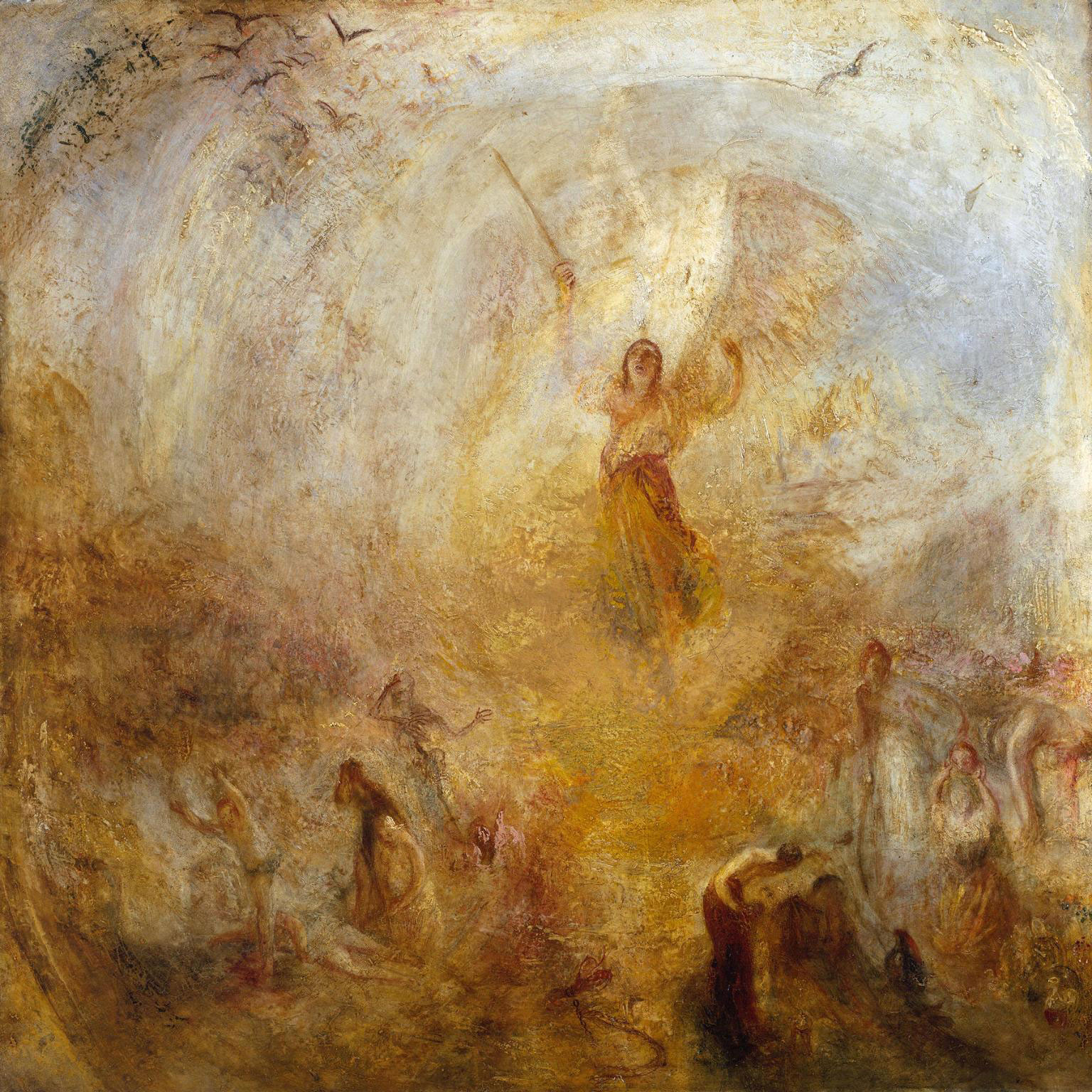
Joseph Mallord William Turner (British, 1775-1851) 'The Angel Standing in the Sun' Exhibited 1846


Joseph Mallord William Turner (British, 1775-1851)
The Angel Standing in the Sun
Exhibited 1846
Oil on canvas
Unframed: 78.7 x 78.7cm (31 x 31 in.)
Framed: 103.5 x 103.5 x 12cm (40 3/4 x 40 3/4 x 4 3/4 in.)
Tate: Accepted by the nation as part of the Turner Bequest 1856
Photo: © Tate, London 2014


Joseph Mallord William Turner (British, 1775-1851) 'Ancient Rome: Agrippina Landing with the Ashes of Germanicus' Exhibited 1839


Joseph Mallord William Turner (British, 1775-1851)
Ancient Rome: Agrippina Landing with the Ashes of Germanicus
Exhibited 1839
Oil on canvas
Unframed: 91.4 x 121.9cm (36 x 48 in.)
Tate: Accepted by the nation as part of the Turner Bequest 1856
Photo: © Tate, London 2014


Joseph Mallord William Turner (British, 1775-1851) 'Modern Rome – Campo Vaccino' 1839


Joseph Mallord William Turner (British, 1775-1851)
Modern Rome – Campo Vaccino
1839
Oil on canvas
Unframed: 91.8 x 122.6cm (36 1/8 x 48 1/4 in.)
The J. Paul Getty Museum, Los Angeles


The J. Paul Getty Museum
1200 Getty Center Drive
Los Angeles, California 90049

Opening hours:
Daily 10am – 5pm

The J. Paul Getty Museum website

LIKE ART BLART ON FACEBOOK

Back to top

Review: ‘Trace’ by Murray Fredericks at Arc One Gallery, Melbourne

Exhibition dates: 24th May – 18th June 2011


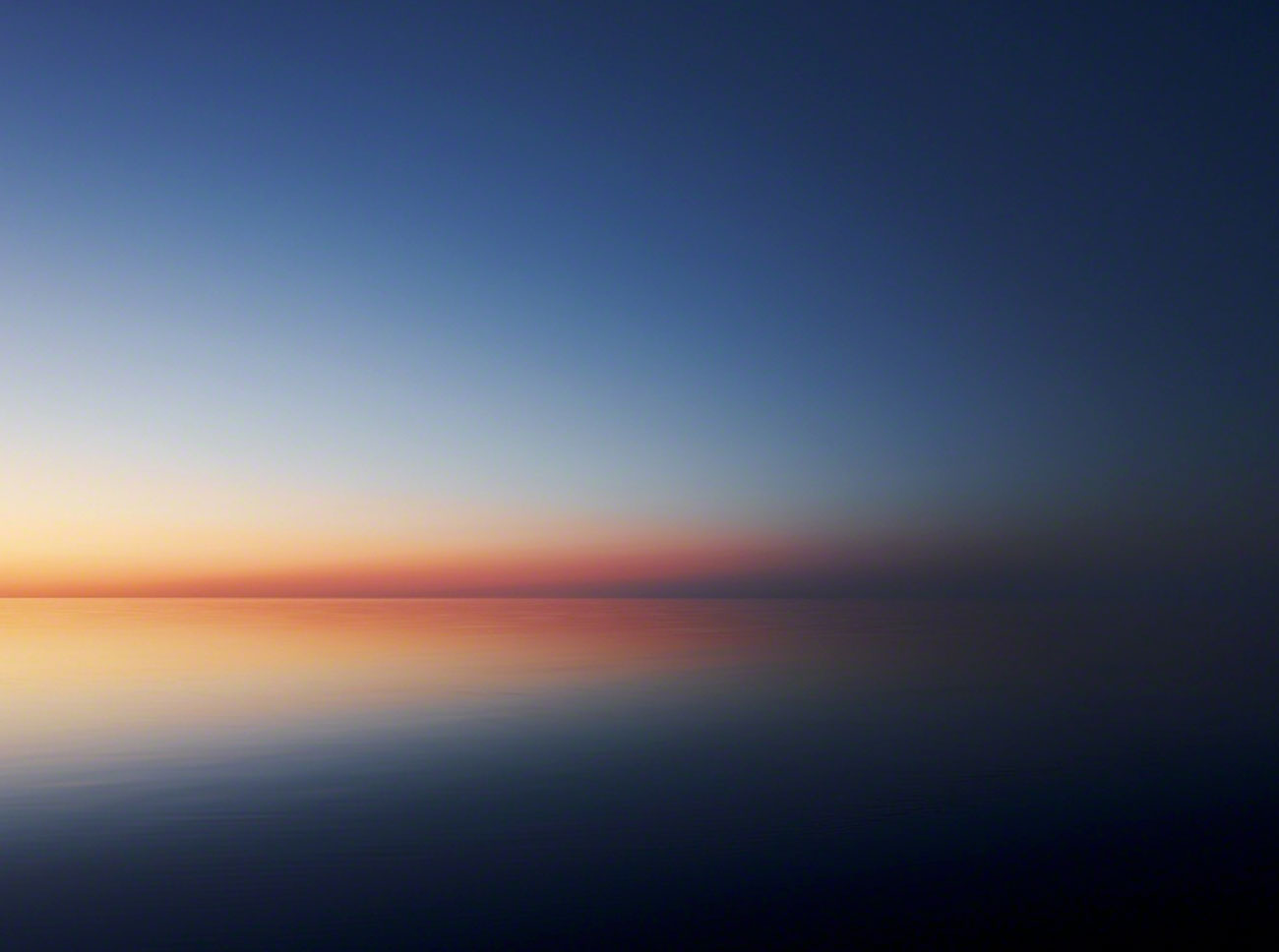
Murray Fredericks (Australian, b. 1970) 'Salt 271' 2011


Murray Fredericks (Australian, b. 1970)
Salt 271
2011
150 x 120cm
Pigment print on cotton rag


“Photographers tell me what I already know. The recognition of the beautiful, bizarre, or boring (the three photographic B’s) is not the problem. You would have to be a refrigerator not to be moved by the beauty of Yosemite. The problem is to deal with one’s total experience, emotionally as well as visually. Photographers should tell me what I don’t know.”


Duane Michals Real Dreams1


“While we cannot describe its appearance (the equivalent), we can define its function. When a photograph functions as an Equivalent we can say that at that moment, and for that person the photograph acts as a symbol or plays the role of a metaphor for something that is beyond the subject photographed.”


Minor White


Fredericks new infrared panoramic works show the strength of nature at it’s finest (9 out of 10 to nature especially when see through this type of filtration), excellent technical skills and good printing but somehow any revelation of spirit in the sublime has been lost in these photographs.

The photographer does not take me anywhere, there is no new space to step into, another view of the world that I want to spend time with. The relationship between the two series is also nebulous, the critical ice / fire space between the works adding little frisson to the exhibition.

I ask: Is it sufficient to use a digital scientific infrared back, if for no other reason that it is there? Is it sufficient to know that these climatic conditions take place in the same area each day, at the same time, place the camera down and just capture the scene? Is there really a non-decisive moment in these photographs, a poetic insight, or is this just what was, literally, hanging around so to speak?

The answer to all three questions I leave up to the reader.

Personally, I need photography to push the boundaries of elusiveness through an understanding in revelation, not just through an understanding of space and form, light and colour. I believe that conventional patterns of perception are there to be broken in ways that disrupt the technologies of the self – the self-regulating of our senses, the conventions of cultural capital – but too what do we open ourselves up to?

As Minor White says: ‘The sound of one hand clapping’.

While the photographs have the weight of serious equipment and professional acumen behind them after the initial awe on viewing they fall to earth, like the rainstorms they portray. As with my earlier review of Salt they seem to be more about the photographer than any revelation of the thing being photographed.

Duane Michals observes that, “The best artists give themselves in their work” but this giving is ego-less, the dropping away of the bells and whistles to let an’other’ emerge: in this sense I do not feel the total experience, emotionally as well as visually.

Paul Strand said that it took him 10 years to start to become an artist, to let go of ego in his work; paradoxically after this the work became more his own.

For me, these photographs never become a metaphor for something that is beyond the subject being photographed.

Dr Marcus Bunyan


1/ Michals, Duane. Real Dreams 1976 [Online] Cited 08/06/2011, on longer available online.


Many thankx to Angela Connor for her help and to Arc One Gallery for allowing me to publish the photographs in the posting. Please click on the photographs for a larger version of the image.


Murray Fredericks (Australian, b. 1970) 'Salt 272' 2010


Murray Fredericks (Australian, b. 1970)
Salt 272
2010
Pigment print on cotton rag
150 x 120cm


Murray Fredericks (Australian, b. 1970) 'Salt 273' 2011


Murray Fredericks (Australian, b. 1970)
Salt 273
2011
Pigment print on cotton rag
150 x 120cm


Salt began in 2003 and is a series of photographs of vast empty landscapes. Each image in the series is connected by the placement of the horizon running across the lower third of the frame. The horizon is the only referential form, breaking the void and providing the viewer with an element that paradoxically ‘defines’ the space. These new works add another dimension to Salt, with the water from last year’s rains now creating scenes diametrically opposed to the work occupying the adjacent walls as Hector.

Hector draws its title from an affectionately name atmospheric phenomenon that produces some of the world’s biggest thunderstorms. These new black and white works employ Murray’s methodical consistency of composition with distinctly different outcomes to the Zen-like vistas of Salt. In these works the expanse of the storm is consciously contained and forced into a barometric battle with the invisible air at its limits for the place of subject within the photograph…

By juxtaposing these series, each viewer is at once placed outside the containers which harbour these landscapes of remote territories – one calm and one facing the eye of the storm – and at the same time place in the centre of Murray’s minimal, ethereal representations of these places. In this way we can trace his exploration into these subjects – capturing the moment is our witness to a reverence to land and country.

Text from Arc One Gallery


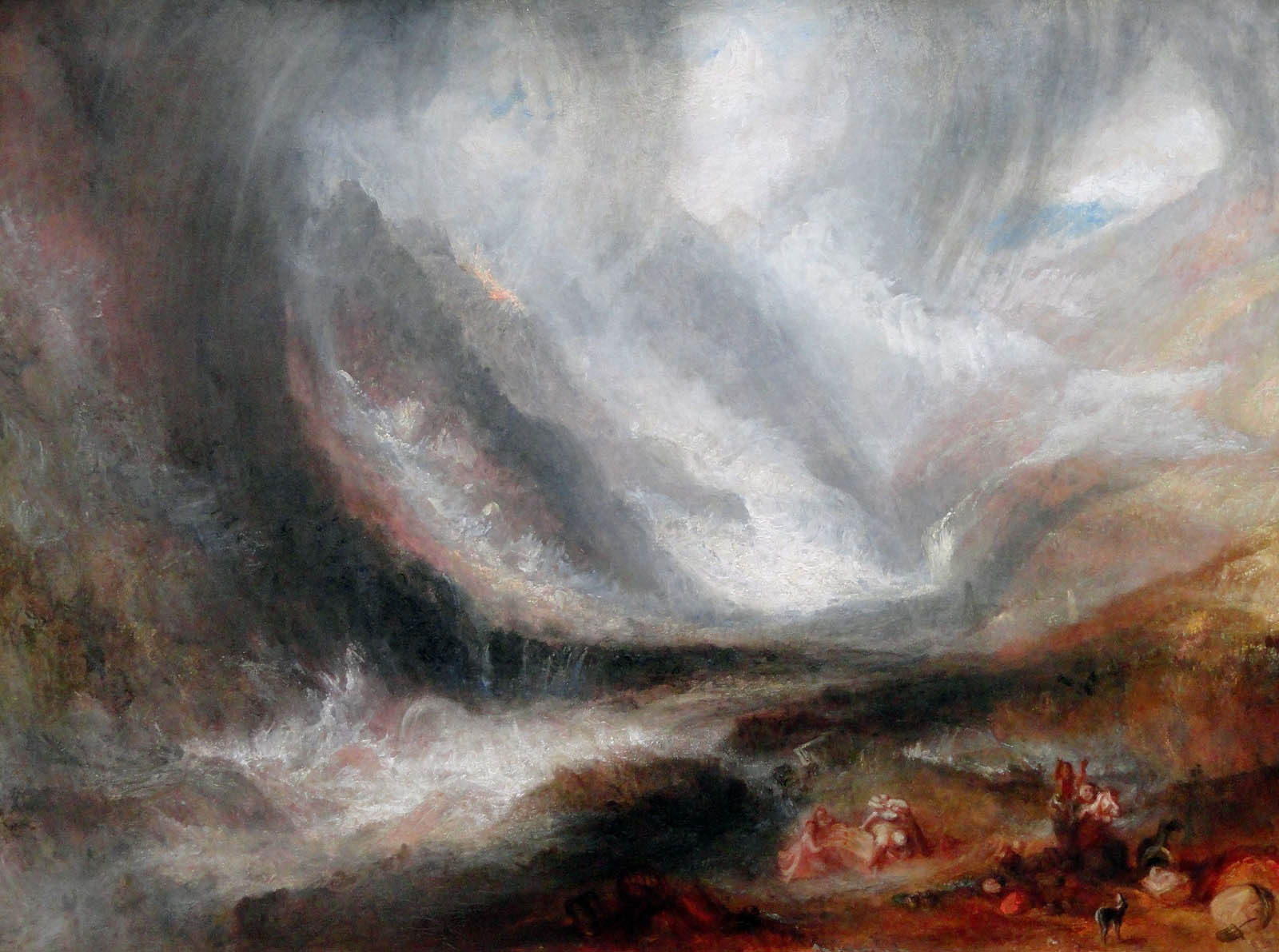
Joseph Mallord William Turner (English, 1775-1851) 'Valley of Aosta: Snowstorm, Avalanche, and Thunderstorm' 1836/37


Joseph Mallord William Turner (English, 1775-1851)
Valley of Aosta: Snowstorm, Avalanche, and Thunderstorm
1836/37
Oil on canvas
36 1/4 x 48 in. (92.2 x 123cm)
The Art Institute of Chicago: Frederick T. Haskell Collection


Murray Fredericks (Australian, b. 1970) 'Hector 10' 2011


Murray Fredericks (Australian, b. 1970)
Hector 10
2011
220 x 120cm
Pigment print on cotton rag


Murray Fredericks (Australian, b. 1970) 'Hector 11' 2011


Murray Fredericks (Australian, b. 1970)
Hector 11
2011
204 x 120cm
Pigment print on cotton rag


Arc One Gallery
45 Flinders Lane
Melbourne, 3000
Phone: (03) 9650 0589

Opening hours:
Wed – Sat 11am – 5pm

Arc One Gallery website

LIKE ART BLART ON FACEBOOK

Back to top