Review: ‘Lost & Found: Family Photos Swept away by the 3.11 East Japan Tsunami’ at the Centre for Contemporary Photography (CCP), Fitzroy, Melbourne

Exhibition dates: 1st June – 15th July 2012
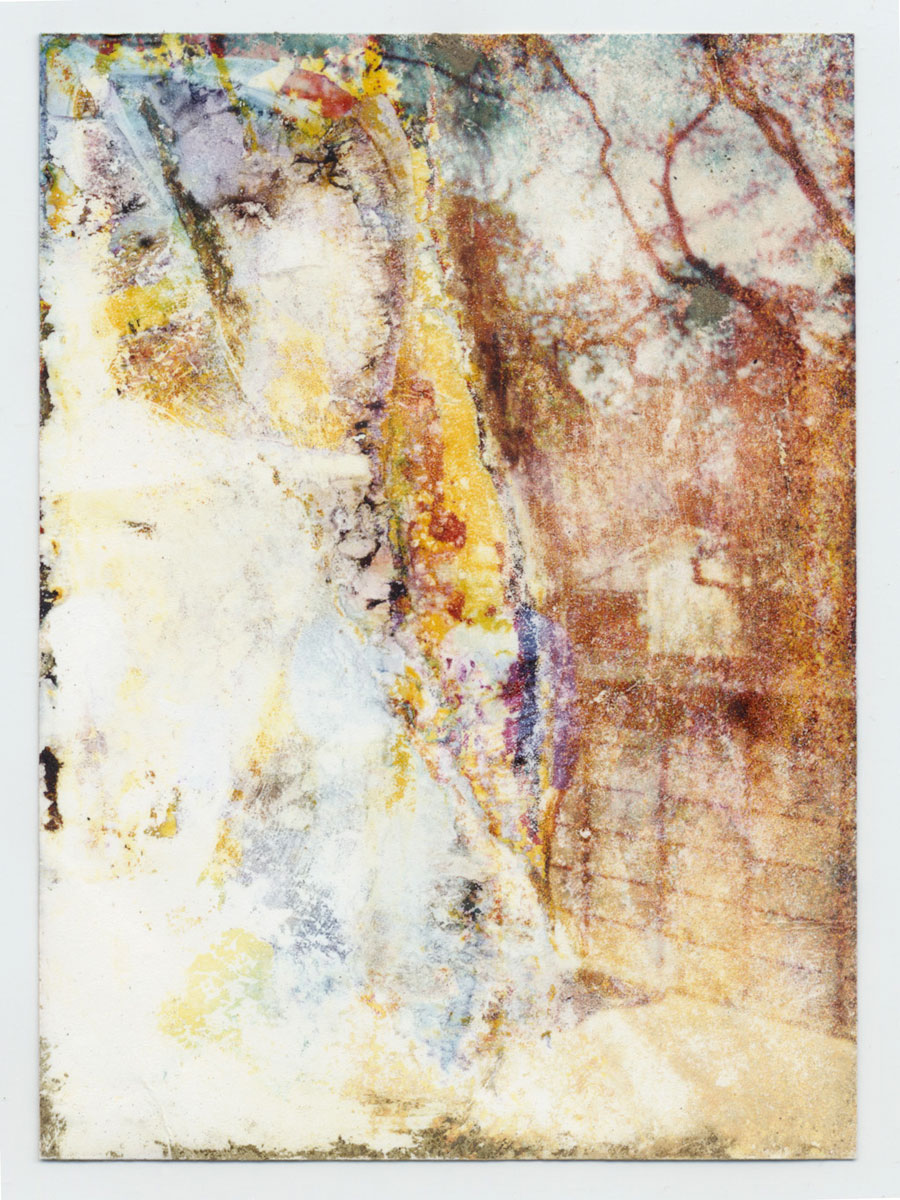
 

'Untitled' from 'Lost and Found' 2011


This is a profound exhibition of photographs that have been lost then found. Too damaged to be returned to the families of their missing owners after the 3.11 East Japan Tsunami they have been cleaned, dried, digitally catalogued and put on display. As remnants of disaster they have taken on an ethereal, abstract expressionist beauty.

Like Atget’s photographs (his “documents for artists”) they were never meant to be “art”, but through morphogenesis (‘beginning of the shape’) these snapshots of places, family and friends reveal their inherent form. This beginning of form has been exposed through displacement, washing and erasure. Through this process of erasure these anonymous images reveal their underlying structure with its link to alchemy, as the image dis/appears from view; they have become unfixed (as in the fixer that stabilises the image in the analogue darkroom) from reality. In this process they have become art.


The images are incredibly beautiful.

They hid secrets (of ownership, names, families and places, of time and space).

Something (energy, spirit?) emerges when you least expect it.


Photographs are coded, but usually so as to appear uncoded but here the link to the indexicality of the image – the idea of the visible as evidence of truth – has been broken. These photographs, taken out of their original context, have lost their specific use value in the particular time and place of their consumption. The fragmentation of this use value, together with the dissolution of their formal characteristics, means that they are freed of the conditions that limit and determine their meaning.1 As Annette Kuhn has written in The Power of the Image, “Meanings do not reside in images, then: they are circulated between representation, spectator and social function.”2 And in these images all three things have changed.

Further, the link between the image and its referent, the photograph and the thing being photographed has been irreversibly broken. As the French critic Maurice Blanchot has written, “The image has nothing to do with signification, meaning, as implied by the existence of the world, the effort of truth, the law and the brightness of the day. Not only is the image of an object not the meaning of that object and of no help in comprehending it, but it tends to withdraw it from its meaning by maintaining it in the immobility of a resemblance that it has nothing to resemble.”3 In other words (and especially in these photographs) it is this severance of meaning and its object, this resemblance of nothing.

But think about this idea:

THINK ABOUT THE IDEA OF RE(AS)SEMBLANCE!

DOES THE PHOTOGRAPH REASSEMBLE A SIGNIFICATION, A MEANING WHOLLY ITS OWN, OR IS THAT RE(AS)SEMBLANCE PART OF THE ORIGINAL MEANING OF THE OBJECT PHOTOGRAPHED?


In these photographs there is an obfuscation of reality in which the usually coded photographs now appear to be uncoded in some visceral sense. In fact there is a double obfuscation, a double effacement, as the images are displayed on the wall like a series of bathroom tiles in plastic sleeves, here not at one remove but at two (the clouding of the image and the clouding through the plastic). What emerges from this alchemical miasma is the ghost of the meaning of the object, where we acknowledge that the essence of these people did really exist. The recognition of their presence, this partial reassemblance of the context and meaning of the object originally photographed, is the strength of these images: our acknowledgment of some form of existence in the trace of the photograph, where seeing is subconsciously believing.

What we are left with in these images are vestiges of presence, remnants or traces of people that have passed on. In a kind of divine intervention, these photographs ask the viewer questions about the one fact that we cannot avoid in our lives, our own mortality, and what remains after we pass on. We can never know these people and places, just as we can never know the place and time of our death – when our “time” is up – but these photographs awaken in us a subconscious remembering: that we may be found (in life), then lost (through death), then found again in the gaze of the viewer looking at the photographs in the future present. We are (dis)continuous beings.

There is no one single reading of these photographs for “there are only competing narratives and interpretations of a world that cannot be wholly, accurately described.”4 These indescribable photographs impinge on our consciousness calling on us to remember even as the speed of contemporary life asks us to forget. This ethical act of looking, of mourning and remembering, of paying homage to presence acknowledges that we choose not to let pass into the dark night of the soul these traces of our forebears, for each emanation is deeply embedded within individual and cultural memory.

These photographs are a contemporary form of Western ‘dreaming’ in which we feel a link to the collective human experience. In this reification, we bear witness to the (re)assemblance of life, the abstract made (subconsciously) concrete, as material thing. These images of absent presence certainly reached out and touched my soul.

Vividly, I choose to remember rather than to forget.

Dr Marcus Bunyan


Footnotes

1/ Kuhn, Annette. The Power of the Image: Essays on Representation and Sexuality. London: Routledge and Kegan Paul, 1985, p. 6

2/ Ibid.,

3/ Blanchot, Maurice. The Gaze of Orpheus. New York: Barrytown, 1981, p. 85

4/ Townsend, Chris. Vile Bodies: Photography and the Crisis of Looking. Munich: Prestel, 1998, p. 10


Many thankx to Munemasa Takahashi, Kristian Haggblom and Karra Rees for their help and the CCP for allowing me to publish the photographs in the posting. Please click on the photographs to view a larger version of the image.


'Untitled' from 'Lost and Found' 2011


Opening of the 'Lost & Found' exhibition at the Centre for Contemporary Photography


Opening of the Lost & Found exhibition at the Centre for Contemporary Photography, Melbourne


'Untitled' from 'Lost and Found' 2011


'Untitled' from 'Lost and Found' 2011


'Untitled' from 'Lost and Found' 2011


Lost & Found is a profoundly moving exhibition of collected photographs recovered from the devastation following the earthquake and tsunami and subsequent nuclear catastrophe that took place in the Tohoku region in 2011. 

The tsunami not only swept the harbour away, but also houses, cars, trains; and many people lost their lives. Although no longer in the media, people in this region are still in great need. These photographs remind us of their presence and make us aware of their silent voices. The exhibition also gives us an opportunity to think about the relationship people have with their photographs.

The Lost & Found project is attempting to return pictures from the collection to their owners by cleaning, cataloguing and creating a digital database of the photographs. Many images were too badly damaged and can not be returned; rather than discard them, the project team decided to exhibit the imagery and give people the opportunity to see these photographs in the belief that they carry powerful messages. 

This project was initiated by Munemasa Takahashi and Hiroshi Hatate in Japan and Kristian Haggblom from Wallflower Photomedia Gallery in Australia. Funds raised will go directly to the people of Yamamoto-cho.

Text from the CCP website


'Untitled' from 'Lost and Found' 2011


'Untitled' from 'Lost and Found' 2011


'Untitled' from 'Lost and Found' 2011


'Untitled' from 'Lost and Found' 2011


'Untitled' from 'Lost and Found' 2011


All photographs are from the exhibition Lost & Found


Centre for Contemporary Photography

No permanent exhibition space at the moment

Centre for Contemporary Photography website

LIKE ART BLART ON FACEBOOK

Back to top

Exhibition: ‘Thomas Demand in Berlin’ at the Neue Nationalgalerie, Berlin

Exhibition dates: 18th September, 2009 – 17th January, 2010


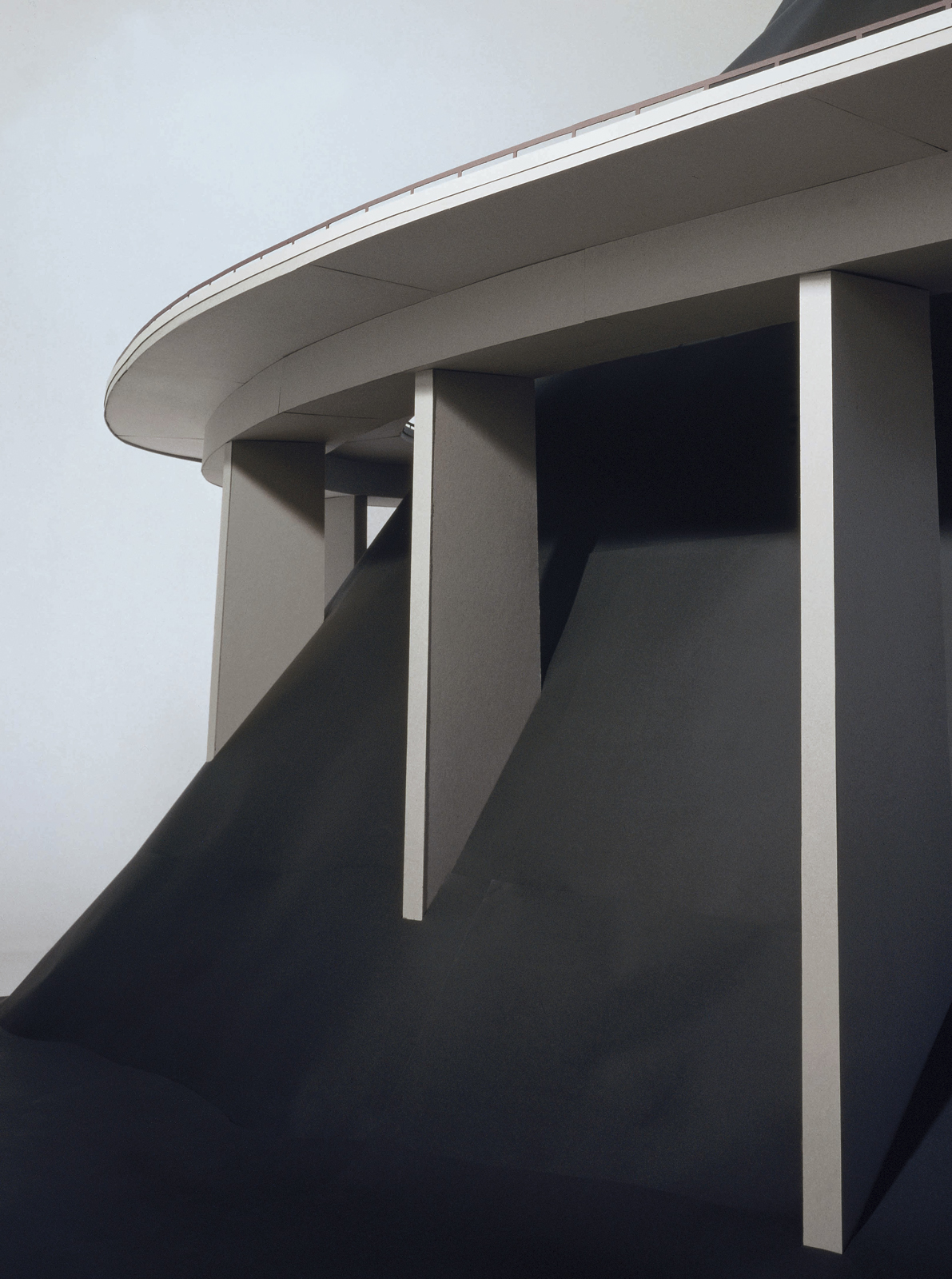
Thomas Demand. 'Diving Board' (Sprungturm)1994 from the exhibition 'Thomas Demand in Berlin' at the Neue Nationalgalerie, Berlin, Sept 2009 - Jan 2010


Thomas Demand (German, b. 1964)
Diving Board (Sprungturm)
1994
C-Print / Diasec
© Thomas Demand, VG Bild-Kunst, Bonn


“It’s not about the real place,” Demand has said. “It’s much more about what we have seen as the real place.”

All photographs in the posting appear in the exhibition.

A review of the catalogue that accompanied the exhibition can be found on the 5B4: Photographs and Books blog.

Dr Marcus Bunyan


Many thankx to the Neue Nationalgalerie for allowing me to publish the photographs in the posting. Please click on the photographs for a larger version of the image.


Thomas Demand (German, b. 1964) 'Brennerautobahn' 1994 from the exhibition 'Thomas Demand in Berlin' at the Neue Nationalgalerie, Berlin, Sept 2009 - Jan 2010


Thomas Demand (German, b. 1964)
Brennerautobahn
1994
C-Print/ Diasec
150 x 118 cm
© Thomas Demand, VG Bild-Kunst, Bonn


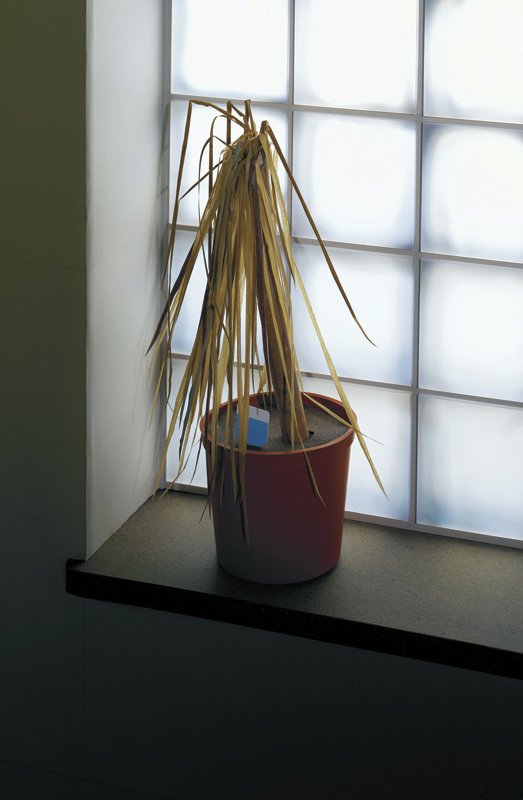
Thomas Demand (German, b. 1964) 'Tavern IV' 2006 Thomas Demand (German, b. 1964) 'Brennerautobahn' 1994 from the exhibition 'Thomas Demand in Berlin' at the Neue Nationalgalerie, Berlin, Sept 2009 - Jan 2010


Thomas Demand (German, b. 1964)
Klause IV / Tavern IV
2006
C-Print / Diasec
103 x 68 cm
© Thomas Demand, VG Bild-Kunst, Bonn


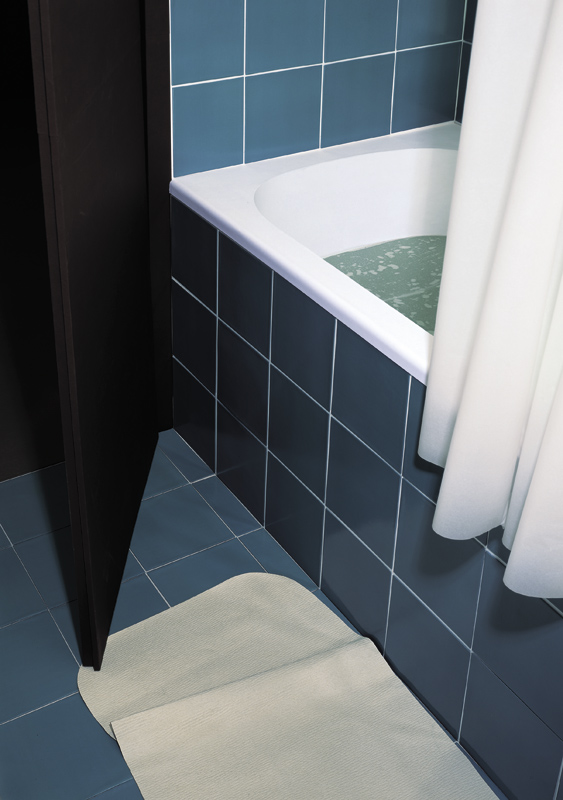
Thomas Demand (German, b. 1964) 'Bathroom' 1997


Thomas Demand (German, b. 1964)
Badezimmer / Bathroom
1997
C-Print / Diasec
160 x 122 cm
© Thomas Demand, VG Bild-Kunst, Bonn


Thomas Demand (German, b. 1964) 'Treppenhaus / Staircase' 1995


Thomas Demand (German, b. 1964)
Treppenhaus / Staircase
1995
C-Print/ Diasec
150 x 118 cm
© Thomas Demand, VG Bild-Kunst, Bonn


The Nationalgalerie presents Thomas Demand’s show National Gallery Berlin. From September 18, 2009, the Nationalgalerie – Staatliche Museen zu Berlin devotes a comprehensive solo show to one of the internationally most influential artists of our time: Thomas Demand. It is so far the largest presentation of his work in this country. However, the exhibition National Gallery is not designed as an overall retrospective but it is firmly dedicated to only one subject, which is perhaps the most important in Demand’s multi-facetted oeuvre: Germany.

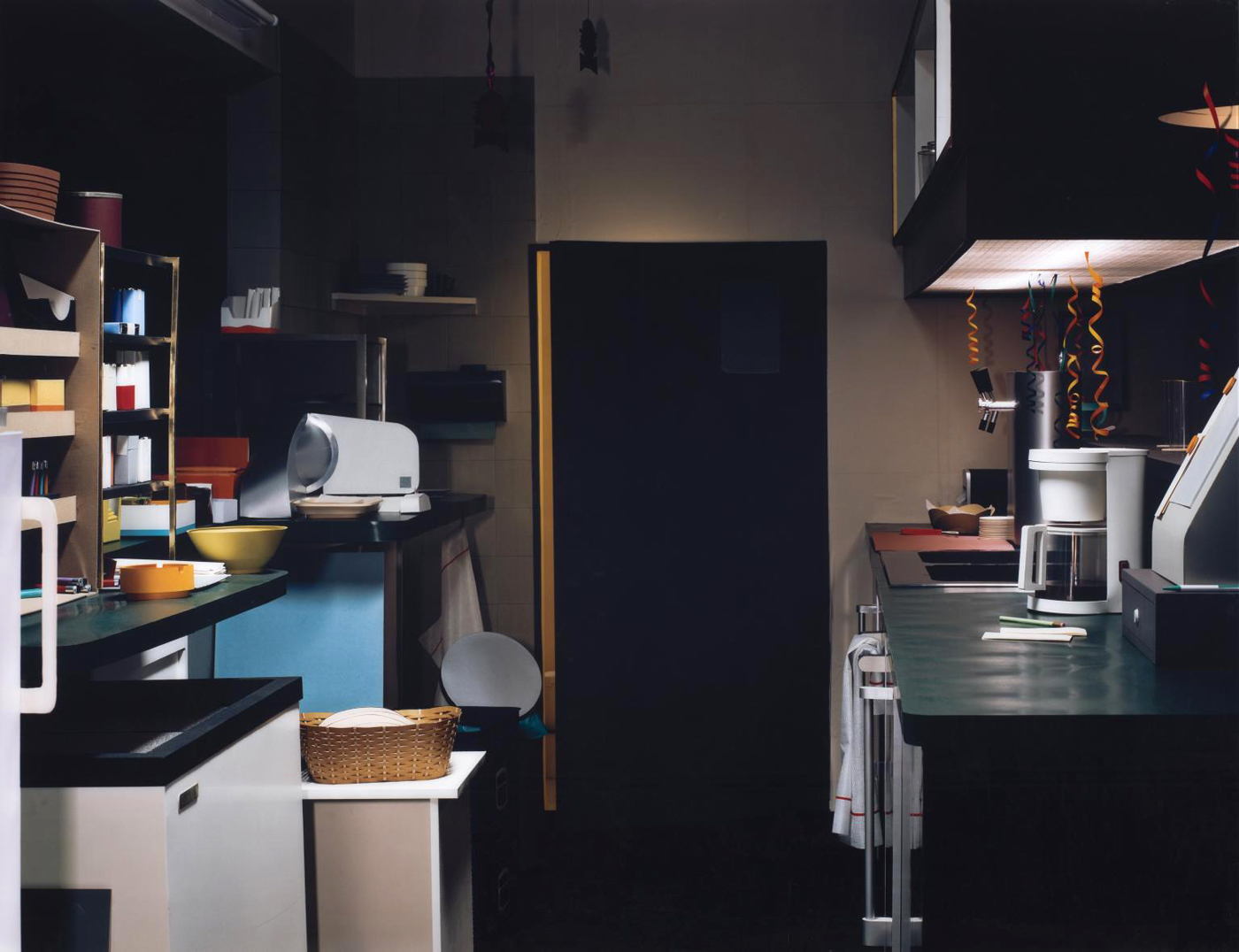
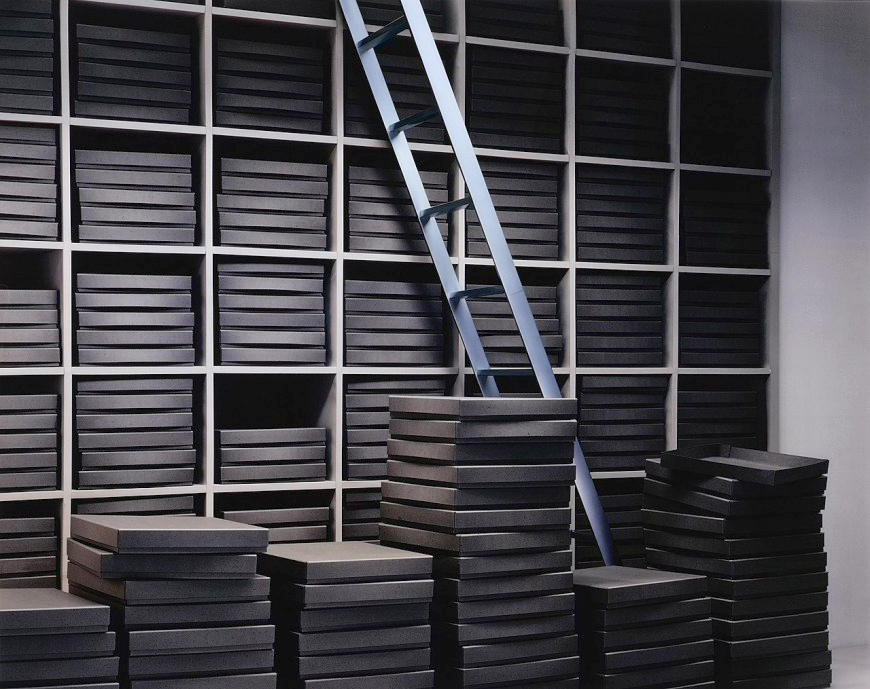
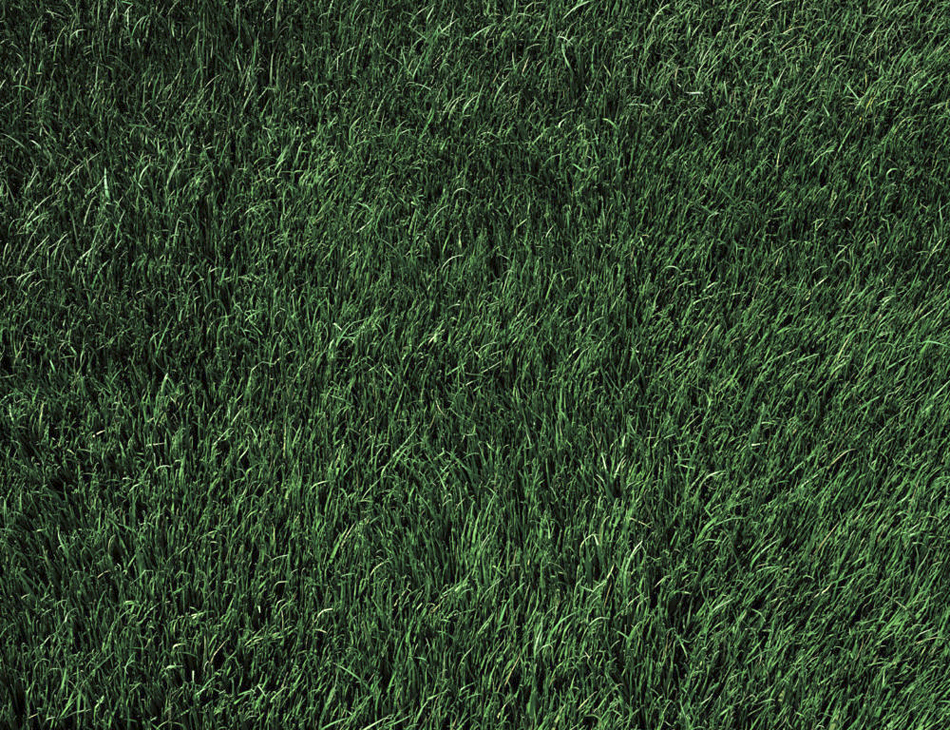
Living in Berlin since 1996 Thomas Demand is an artist known for his large-format photographs, which explore the blank domain between reality and the ways it is being represented. He is undoubtedly regarded as one of the most renowned artists of his generation. Using paper and cardboard he builds three-dimensional, usually life-size models of places which often make references to pictures found in the mass media. By taking photographs of the scenery created in this way, he produces artefacts of a kind of their own which play with the beholder’s ideas of fiction and reality.

Until January, 17, 2010, about 40 works by the artist will be on display in the glass hall of the Neue Nationalgalerie built by Mies van der Rohe. There is hardly a location which is more suitable to convey to the beholder the panorama of a nation’s history than the large glass hall of the Neue Nationalgalerie, which is not only regarded as an incunabulum of post-war architecture but also as a symbol for the self-image of the Federal Republic of Germany at the former border between East and West. The exceptional exhibition architecture of the firm, Caruso St. John, London, forms an ideal link between Demand’s works and Mies van der Rohe’s bright hall.

Each picture shown in the exhibition is accompanied by a specific caption written by Botho Strauß which does not so much explain or define Demand’s work but rather creates a space between the pictures and the texts to allow new versions of interpretation.

Text from the New National Gallery website [Online] Cited 01/11/2009 no longer available online


Thomas Demand (German, b. 1964) 'Copyshop' 1999


Thomas Demand (German, b. 1964)
Copyshop
1999
C-Print / Diasec
© Thomas Demand, VG Bild-Kunst, Bonn


Thomas Demand (German, b. 1964) 'Drafting Room' 1996


Thomas Demand (German, b. 1964)
Drafting Room
1996
C-Print / Diasec
© Thomas Demand, VG Bild-Kunst, Bonn


Thomas Demand (German, b. 1964) 'Laboratory (77-E-217)' 2000


Thomas Demand (German, b. 1964)
Laboratory (77-E-217)
2000
C-Print / Diasec
© Thomas Demand, VG Bild-Kunst, Bonn


Thomas Demand (German, b. 1964) 'Haltestelle' 2009


Thomas Demand (German, b. 1964)
Haltestelle
2009
C-Print / Diasec, 240 x 330 cm
© Thomas Demand, VG Bild-Kunst, Bonn 2009


List of works that appear in the exhibition:

Archiv / Archive, 1995, C-Print/ Diasec, 183,5 x 233 cm
Attempt, 2005, C-Print/ Diasec, 166 x 190 cm
Badezimmer / Bathroom, 1997, C-Print/ Diasec, 160 x 122 cm
Balkone / Balconies, 1997, C-Print/ Diasec, 150 x 128 cm
Brennerautobahn, 1994, C-Print/ Diasec, 150 x 118 cm
Büro / Office, 1995, C-Print/ Diasec, 183.5 x 240 cm
Campingtisch / Camping Table, 1999, C-Print/ Diasec, 85 x 58 cm
Copyshop, 1999, C-Print/ Diasec, 183.5 x 300 cm
Drei Garagen / Three Garages, 1995, C-Print/ Diasec, 108 x 223 cm
Fabrik (ohne Namen), 1994, C-Print/ Diasec, 120 x 185 cm
Fassade / Facade, 2004, C-Print/ Diasec, 178 x 250 cm
Fenster / Window, 1998, C-Print/ Diasec, 183.5 x 286 cm
Fotoecke, 2009, C-Print/ Diasec, 180 x 198 cm
Gangway, 2001, C-Print/ Diasec, 225 x 180 cm
Grube / Pit, 1999, C-Print/ Diasec, 229 x 167 cm
Haltestelle, 2009, C-Print/Diasec, 240 x 330 cm
Heldenorgel, 2009, C-Print/Diasec, 240 x 380 cm
Hinterhaus, 2005, C-Print/ framed, 26.9 x 21.5 cm
Kabine, 2002, C-Print/ Diasec, 180 x 254 cm
Kinderzimmer /Nursery, 2009, C-Print/Diasec, 140 x 230 cm
Klause 1 / Tavern, 2006, C-Print/ Diasec, 275 x 170 cm
Klause 2 / Tavern, 2006, C-Print/ Diasec, 178 x 244 cm
Klause 3 / Tavern, 2006, C-Print/ Diasec, 199 x 258 cm
Klause 4 / Tavern, 2006, C-Print/ Diasec, 103 x 68 cm
Klause 5 / Tavern, 2006, C-Print/ Diasec, 197 x 137 cm
Labor (77-E-217), 2000, C-Print/ Diasec, 180 x 268 cm
Lichtung / Clearing, 2003, C-Print/ Diasec, 192 x 495 cm
Modell / Model, 2000, C-Print/ Diasec, 164,5 x 210 cm
Paneel / Peg Board, 1996, C-Print/ Diasec, 160 x 121 cm
Parlament / Parliament, 2009, C-Print/ Diasec, 180 x 223 cm
Raum / Room, 1994, C-Print/ Diasec, 183.5 x 270 cm
Sprungturm / Diving Board, 1994, C-Print/ Diasec, 150 x 118 cm
Spüle / Sink, 1997, C-Print/ Diasec, 52 x 56.5 cm
Studio, 1997, C-Print/ Diasec, 183.5 x 349.5 cm
Rasen / Lawn, 1998, C-Print/ Diasec, 122 x 170 cm
Terrasse / Terrace, 1998, C-Print/ Diasec, 183.5 x 268 cm
Treppenhaus / Staircase, 1995, C-Print/ Diasec, 150 x 118 cm
Wand /Mural, 1999, C-Print/ Diasec, 183.5 x 270 cm
Zeichensaal / Drafting Room, 1996, C-Print/ Diasec, 183.5 x 285 cm


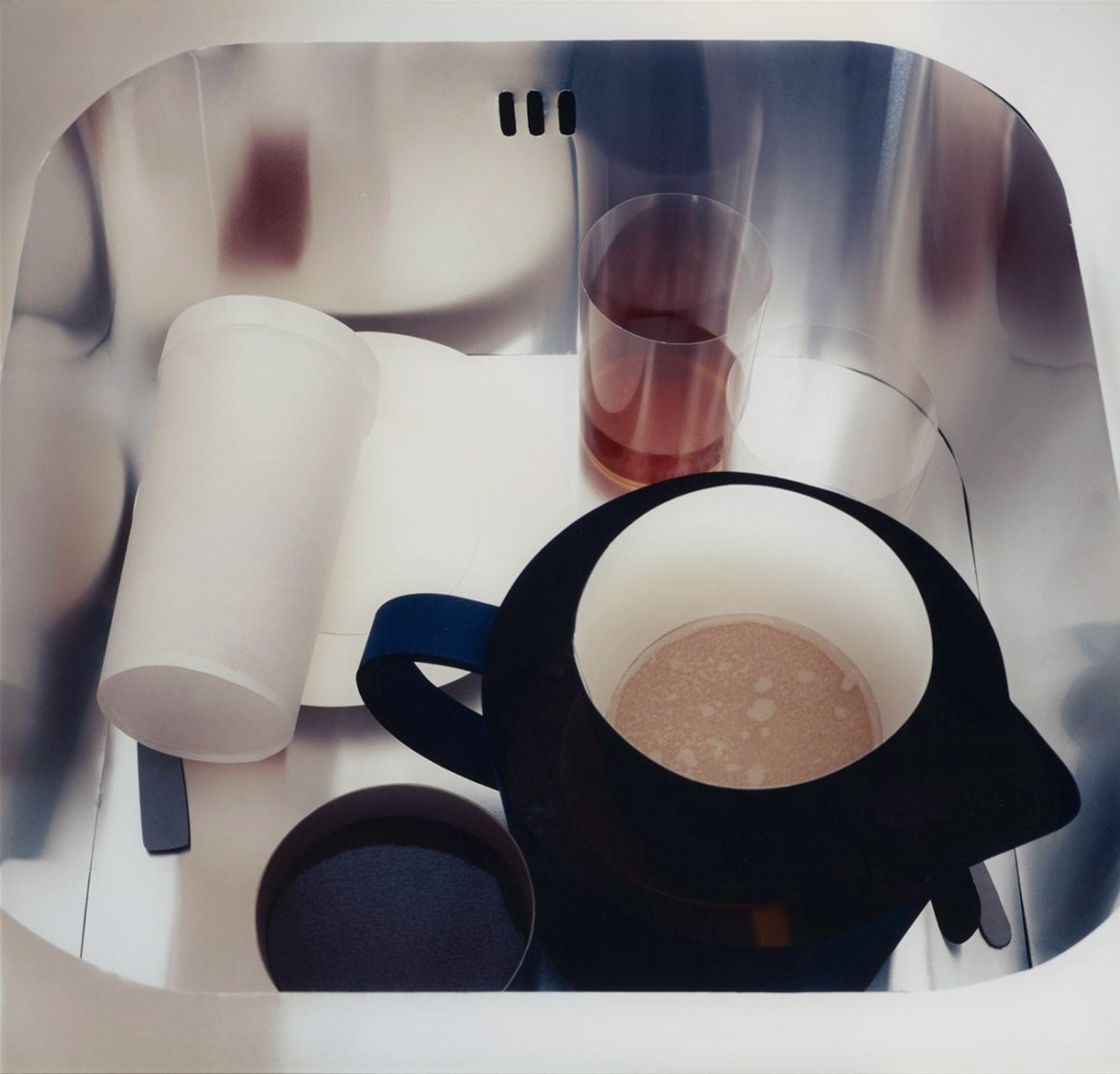
Thomas Demand (German, b. 1964) 'Sink' 1997


Thomas Demand (German, b. 1964)
Sink
1997
C-Print / Diasec
© Thomas Demand, VG Bild-Kunst, Bonn


Thomas Demand (German, b. 1964) 'Tavern 3' 2006


Thomas Demand (German, b. 1964)
Tavern 3
2006
C-Print / Diasec
© Thomas Demand, VG Bild-Kunst, Bonn


Demand’s work is based on pre-existing images from the media, often of sites of political or cultural interest. He translates these images into life-size models using paper and cardboard, and photographs the resulting tableaux. These five photographs [of which the above is just one] depict a tavern in the German village of Burbach where a young boy was kidnapped, held hostage and ultimately murdered in 2001. His body was never recovered. The case was covered extensively in the German press, and images of the tavern became imbued with the public’s horrified imagination of the crime. Demand’s photographs investigate the traces these mediated images leave in the collective memory.

Tate Gallery label, April 2008


Thomas Demand (German, b. 1964) 'Archive' 1995


Thomas Demand (German, b. 1964)
Archive
1995
C-Print / Diasec
© Thomas Demand, VG Bild-Kunst, Bonn


Thomas Demand (German, b. 1964) 'Lawn' 1998


Thomas Demand (German, b. 1964)
Lawn
1998
C-Print / Diasec
122 x 170 cm
© Thomas Demand, VG Bild-Kunst, Bonn


Thomas Demand (German, b. 1964) 'Office' 1995


Thomas Demand (German, b. 1964)
Büro / Office
1995
C-Print / Diasec
183.5 x 240 cm
© Thomas Demand, VG Bild-Kunst, Bonn 2009


Thomas Demand (German, b. 1964) 'Gangway' 2001


Thomas Demand (German, b. 1964)
Gangway
2001
C-Print / Diasec
© Thomas Demand, VG Bild-Kunst, Bonn 2009


Thomas Demand (German, b. 1964) 'Attempt' 2005


Thomas Demand (German, b. 1964)
Attempt
2005
C-Print / Diasec
© Thomas Demand, VG Bild-Kunst, Bonn 2009


Thomas Demand (German, b. 1964) 'Balconies' 1997


Thomas Demand (German, b. 1964)
Balconies
1997
C-Print / Diasec
© Thomas Demand, VG Bild-Kunst, Bonn 2009


Neue Nationalgalerie
Potsdamer Straße 50
10785
Berlin
Kulturforum-Potsdamer Platz

Opening hours:
Tuesday – Sunday 10am – 6pm
Closed Mondays

Neue Nationalgalerie website

LIKE ART BLART ON FACEBOOK

Back to top