Exhibition: ‘Under Cover: J.C. Leyendecker and American Masculinity’ at the New-York Historical Society

Exhibition dates: 5th May – 13th August, 2023

Curator: Donald Albrecht


J.C. Leyendecker (American, 1874-1951) 'Ivory Soap It Floats' 1900 from the exhibition 'Under Cover: J.C. Leyendecker and American Masculinity' at the New-York Historical Society, May - August 2023


J.C. Leyendecker (American, 1874-1951)
Ivory Soap It Floats
Painting for Ivory soap advertisement, 1900
Gouache on board
Private collection
Image courtesy of the National Museum of American Illustration, Newport, RI


Featured in mainstream national magazines, ads for Ivory soap often depicted scenes of conventional domesticity. Some, however, were erotic, like this one by Leyendecker featuring a man in a floor-length robe, whose crotch is suggestively rendered.


The Eye of the Beholder

“Leyendecker’s subjects exemplify an elite white masculinity that was hardly representative of the diversity of the United States in his time, or since” observes Sonya Abrego. The artist’s subjects are white, cultured, privileged, “upholding racial, social and nationalist hierarchies”.

But how representations were and are understood depends on the eye of the beholder. At the time that Lyendecker was painting and illustrating commercial magazines his flirtatious subliminal erotic messages would have been all too decipherable to a knowing gay male readership – even as these very illustrations “passed” the scrutiny of heterosexual normativity. For gay men “passing” allowed them to hide their real identity and to fit into society without discrimination and fear of loosing their job, their home and/or going to jail.1 Leyendecker’s works both hide and transgress the taboo when they pass inspection.

For the initiated, Leyendecker’s paintings and illustrations were at the very heart of the subversion of hegemonic masculinity – “a practice that legitimises men’s dominant position in society and justifies the subordination of the common male population and women, and other marginalised ways of being a man.”2 Witness the man holding the “stiff rod” of the golf club in Men with Golf Clubs (c. 1909, below); the knowing looks of the two men in Men and Woman, Arrow Shirts with Golf Clubs and Collie (1910, below); the camp hands on hip languid pose of the man on the Cover of Saturday Evening Post (June 29, 1907, below) and the butcher, hand of hip, frontal crotch shot with Janet Jackson garment malfunction / nipple exposure that is Cover of Collier’s (June 24, 1916, below). The fact that some of the paintings such as Record Time, Cool Summer Comfort (c. 1920, below) feature Leyendecker’s lover of 48 years Charles A. Beach, only adds to the surreptitious nature of the paintings societal relationship. Much as the gay movie star Rock Hudson had to keep his private and public lives separate in order to “pass”, so Leyendecker kept his gay relationship a secret from the public.

While the exhibition would like us to address Leyendecker’s work within a broader context (according to curator Donald Albrecht talking about the artist in “gender terms, racial terms, sexual terms,” treating him in an intersectional way) – that is, through “the interconnected nature of social categorisations such as race, class, and gender as they apply to a given individual or group, regarded as creating overlapping and interdependent systems of discrimination or disadvantage”3 – this is only, and can only ever be, a post-post-posterior inflection on the rump of his work, a point of view wholly constructed in the present (the word and concept becoming popular after 1989 when the term ‘intersectionality’, which has its roots in Black feminist activism, and was originally coined by American critical legal race scholar Kimberlé Williams Crenshaw). Attitudes may have changed over the years and in some parts of the world, but to believe that heterosexual Black, white or Asian men would have understood the intersectional relationships in Leyendecker’s work back in the day is contemporary fairy floss. While it would be nice to think of Leyendecker’s work in all it’s supposed intersectional glory this was not how the work was seen by the general public (and white men in particular) when it was produced and published.

Today the eye of the beholder can still be just as blinded and prejudiced… for the dominant stereotype of the body, that of the white male, constantly reinforces its value in a capitalist consumer society. Body processes are drawn into social relations through fashion, sport, body culture, etc and, “As soon as we are articulated as a male or female body, a raced, classed, or sexed body in the context of the larger culture, a subject position construed hierarchically is not far behind, due in part to that means of articulation, our language. We take up a position according to a dialectic of presence and lack in terms of our relative proximity (still generally connected to our biological bodies) to the monied white male as signifier.”4

What we can do in this case is to inform the ‘conditions of understanding’ of the beholder: in other words, by making the viewer informed of the processes of production we can undermine the “ability of dominant groupings to define their bodies and lifestyles as superior, worthy of reward, and as, metaphorically and literally, the embodiment of class.”5 While the self is a social construction it is still all to easy for the dominant hegemonic group within a culture or society to identify and impose a valuable body – for example, that of the muscular mesomorph or the body of the athlete (or super jock). What we must encourage are processes in society “which will make it extremely difficult for any one group to impose as hegemonic, as worthy of respect and deference across society, a single classificatory scheme of ‘valuable bodies’.”6

A difficult task but I believe a worthy one.

Dr Marcus Bunyan


Footnotes

1/ “Passing is the ability of a person to be regarded as a member of an identity group or category, such as racial identity, ethnicity, caste, social class, sexual orientation, gender, religion, age and/or disability status, that is often different from their own. Passing may be used to increase social acceptance in order to cope with stigma by removing stigma from the presented self and could result in other social benefits as well. Thus, passing may serve as a form of self-preservation or self-protection in instances where expressing one’s true or prior identity may be dangerous.”

Passing (sociology) on the Wikipedia website

2/ Hegemonic masculinity on the Wikipedia website

3/ Definition of intersectionality by Oxford Languages on the Google website

4/ Leslie Heywood. Dedication To Hunger: The Anorexic Aesthetic in Modern Culture. Los Angeles: University of California Press, 1996, p. 12.

5/ Chris Schilling. The Body and Social Theory. London: Sage Publications, 1993, p. 140.

6/ Ibid., p. 143.

Many thankx to the New-York Historical Society for allowing me to publish the photographs in the posting. Please click on the art work for a larger version of the image.


“An effeminate man … expresses his abdication of power. For a man to behave effeminately is an expression of the paradox. With each flap of the wrist he slides deeper into the underclass and, in so doing, betrays the birthright of men to mythic power. Such gestures are violations of masculinity, insults to the meaning of manhood. This is why they are met with such contempt by so many, including many gay men who long for the power of patriarchy.”


Brian Pronger. The Arena of Masculinity: Sports, Homosexuality, and the Meaning of Sex. New York: St. Martin’s Press, 1990, p. 221.


“The Arrow collar man – handsome, well-groomed, and always dapper in crisp shirts with starched white collars – was a pop culture icon. He was so dashing that women who weren’t quite familiar with the idea of a brand personification yet, wrote to Arrow’s parent company hoping they could meet him. He shares a lot in common with the Gibson Girl of the same era: an elegant, youthful ideal of American beauty. But unlike Charles Dana Gibson’s illustrated feminine creation, which he insisted was an amalgam of modern American women of his time, The Arrow Collar Man was originally modelled after a specific person, Charles Beach, who happened to also be Leyendecker’s partner. The two lived together for close to fifty years, and he helped manage the illustrator’s career, a relationship that would have likely disappointed the Arrow man’s female fans. …

Leyendecker’s subjects exemplify an elite white masculinity that was hardly representative of the diversity of the United States in his time, or since. It was working in line with nationalist standards of rugged masculinity espoused from the top by figures like Teddy Roosevelt that permeated the culture at large…


Sonya Abrego. “Going Undercover with Leyendecker at the New York Historical Society,” on the Observer website 06/14/23 [Online] Cited 20/07/2023
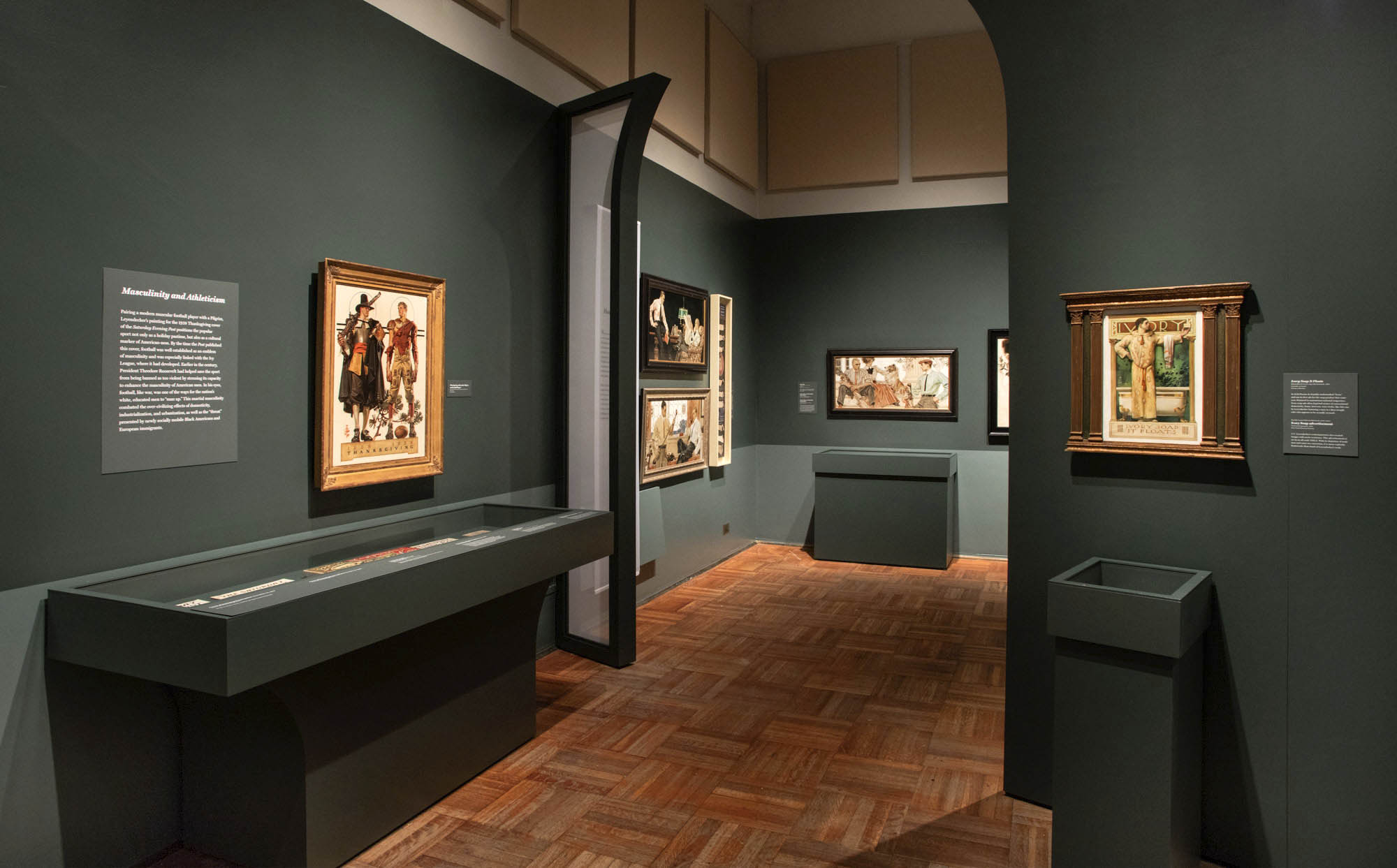


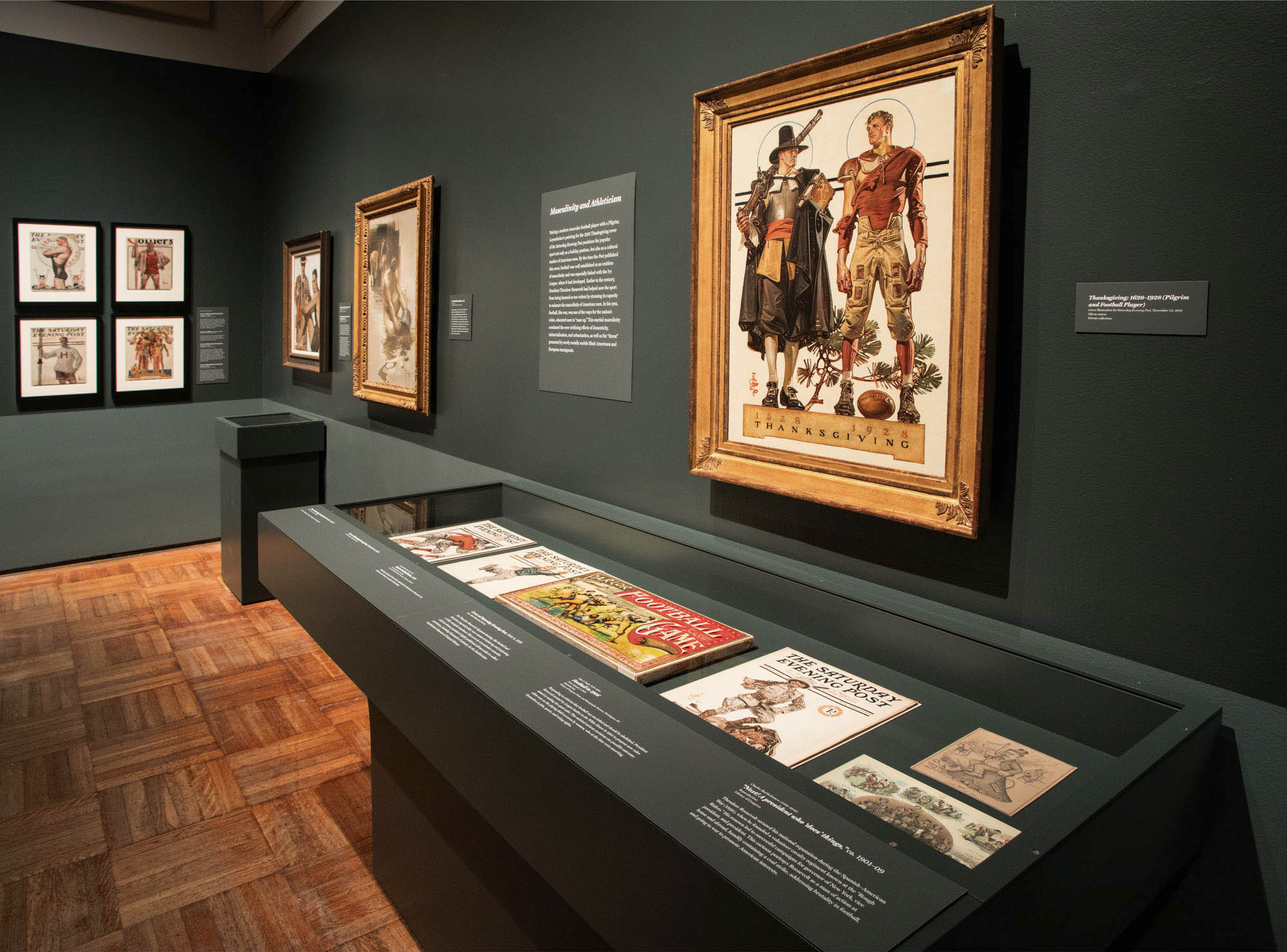
Installation view of the exhibition 'Under Cover: J.C. Leyendecker and American Masculinity' at the New-York Historical Society showing at left, 'Thanksgiving: 1628-1928 (Pilgrim and Football Player)' (1928); and at right, 'Ivory Soap It Floats' (1900)


Installation view of the exhibition Under Cover: J.C. Leyendecker and American Masculinity at the New-York Historical Society showing at left, Thanksgiving: 1628-1928 (Pilgrim and Football Player) (1928, below); and at right, Ivory Soap It Floats (1900, above)
Photo: Glenn Castellano, New-York Historical Society


A new exhibition at the New-York Historical Society examines the work and influence of J.C. Leyendecker (1874-1951), a preeminent illustrator and commercial artist who helped shape American visual culture in the first three decades of the 20th century through captivating advertisement campaigns including the legendary “Arrow Collar Man” and countless covers for the Saturday Evening Post. As a gay artist whose illustrations for a mainstream audience often had unspoken homoerotic undertones, his work is especially revealing for what it says about the cultural attitudes towards homosexuality of the period. Under Cover: J. C. Leyendecker and American Masculinity is organised by New-York Historical from the collection of the National Museum of American Illustration, Newport, RI.

Born in 1874 in Montabaur, Germany, Leyendecker immigrated to Chicago in 1882 with his parents and three siblings. Showing an early artistic talent, Leyendecker and his youngest brother, F. X., studied at the Art Institute of Chicago before moving to Paris where they developed their distinctive styles. Upon returning to the United States, the brothers entered a publishing renaissance and soon found themselves at its center, New York City. In 1914, they moved into a 14-room house in New Rochelle, New York, along with Charles Beach, for 48 years.
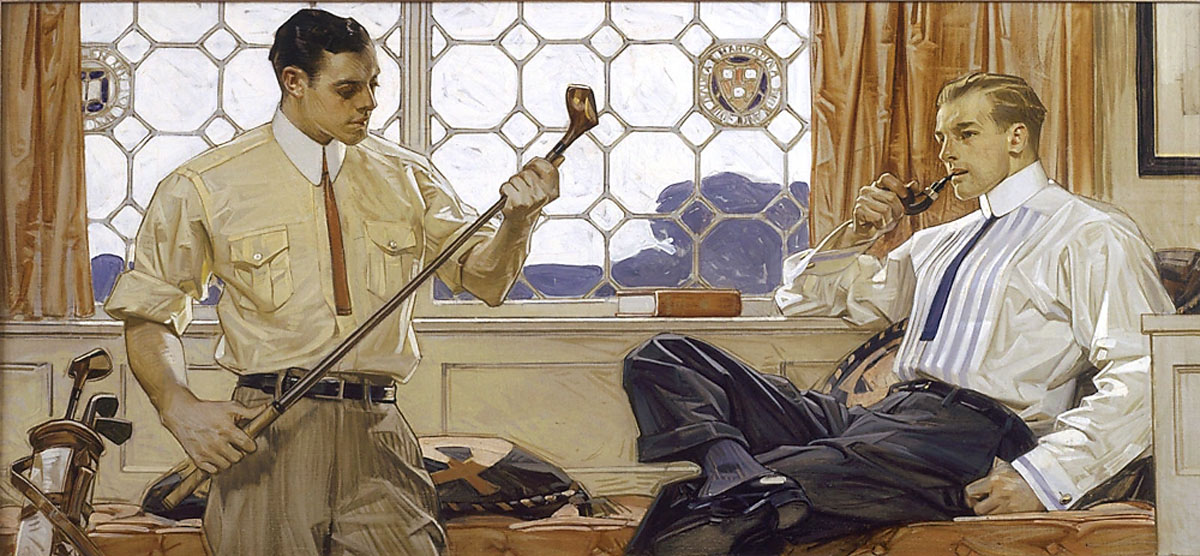
 

J.C. Leyendecker (American, 1874-1951) 'Men with Golf Clubs' 1909 from the exhibition 'Under Cover: J.C. Leyendecker and American Masculinity' at the New-York Historical Society, May - August 2023


J.C. Leyendecker (American, 1874-1951)
Men with Golf Clubs
Painting for Arrow Collar advertisement, c. 1909
Oil on canvas
National Museum of American Illustration, Newport, RI


In Leyendecker’s illustrations, interactions between men often took place in homosocial spaces such as all-male dormitories, clubs, haberdasheries, and gymnasiums. In this example, the men’s informal dress and posture plus the heraldic marks of Harvard and Yale in the window suggest an elite college clubhouse and seem to target the ad to college men.
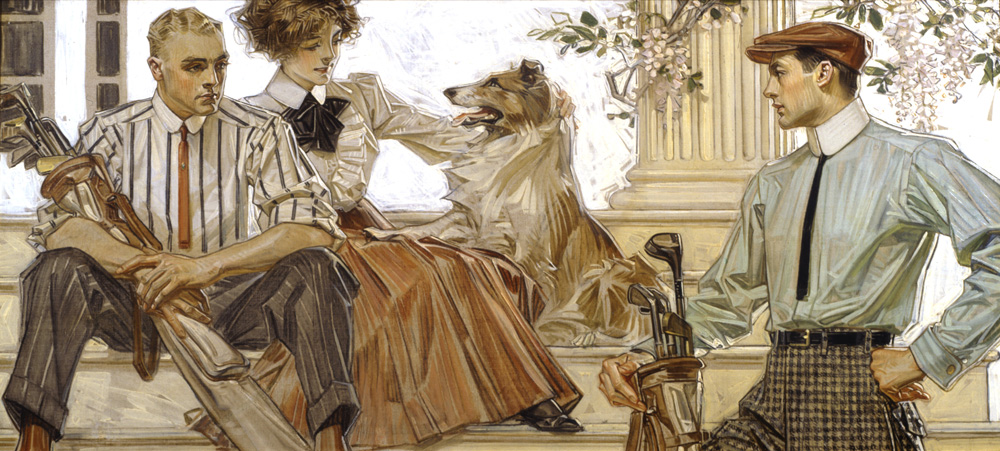
 

J.C. Leyendecker (American, 1874-1951) 'Men and Woman, Arrow Shirts with Golf Clubs and Collie' 1910 from the exhibition 'Under Cover: J.C. Leyendecker and American Masculinity' at the New-York Historical Society, May - August 2023


J.C. Leyendecker (American, 1874-1951)
Men and Woman, Arrow Shirts with Golf Clubs and Collie
Painting for Arrow Collar advertisement, 1910
Oil on board
National Museum of American Illustration, Newport, RI


Leyendecker developed campaigns for Arrow collars depicting handsome, idealised men wearing shirts and detachable collars manufactured by Cluett Peabody & Co. These ads often depicted fashionable men in stylish settings engaged in activities such as boating, golfing, or reading in men’s clubs. Even when women are present, the men depicted seem indifferent to them, often sharing sexually charged glances with each other instead.


J.C. Leyendecker (American, 1874-1951) 'Couple in Boat' 1912 from the exhibition 'Under Cover: J.C. Leyendecker and American Masculinity' at the New-York Historical Society, May - August 2023


J.C. Leyendecker (American, 1874-1951)
Couple in Boat
Painting for Arrow Collar advertisement, 1912
Oil on canvas
National Museum of American Illustration, Newport, RI


The exhibition locates Leyendecker’s work within the evolution of commercial illustration, when advertisers sought to sell products by emotion and feeling, not only by factual representation of a product’s utilitarian characteristics. These commercial trends can be seen in Leyendecker’s advertising illustrations for Arrow collars.


A new exhibition examines the work and influence of J.C. Leyendecker (1874-1951), a preeminent illustrator and commercial artist who helped shape American visual culture in the first three decades of the 20th century through captivating advertising campaigns including the legendary “Arrow Collar Man” and countless covers for the Saturday Evening Post. As a gay artist whose illustrations for a mainstream audience often had unspoken homoerotic undertones, his work is especially revealing for what it says about the cultural attitudes towards homosexuality of the period.

The exhibition showcases 19 of the artist’s original oil paintings and a wealth of related ephemera, and features both Leyendecker’s editorial work, such as magazine covers, as well as commercial illustrations that appeared in the pages of popular publications, on roadside billboards, in store windows, and on mass transit. Laying the groundwork of Leyendecker’s implied gay narratives, these ads starred fashionable men in stylish settings engaged in activities such as boating, golfing, or reading in men’s clubs.

Under Cover delves into the early politics of sexual identity and gender while simultaneously examining how Leyendecker helped establish a nationalistic ideal of elite and athletic white male beauty. To address this aspect of his work, the exhibition juxtaposes some of Leyendecker’s paintings with artefacts that offer counter-narratives to his works’ exclusionary nature, including depictions of fashionable African American men during the Harlem Renaissance, as well as a selection of contemporaneous advertisements with homoerotic connotations and a digital show of images depicting gay culture in New York during Leyendecker’s time.

Under Cover is organised by New-York Historical from the collection of the National Museum of American Illustration, Newport, RI. The show is guest-curated by Donald Albrecht, and coordinated at New-York Historical by Rebecca Klassen, curator of material culture.

Text from the New-York Historical Society website
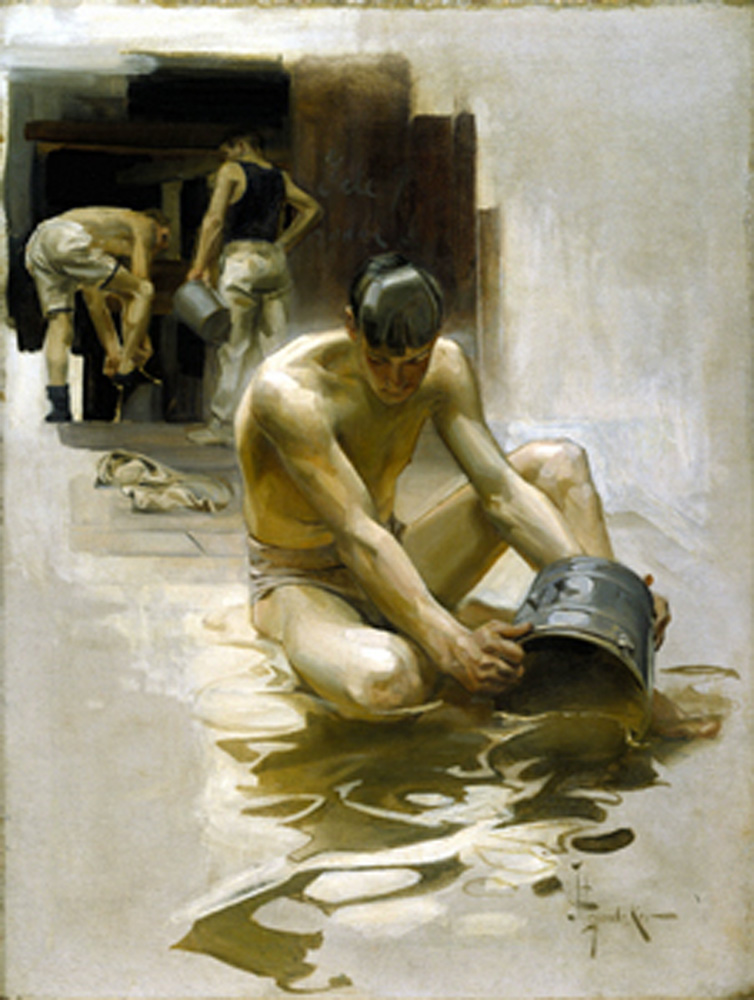
 

J.C. Leyendecker (American, 1874-1951) 'In the Yale Boathouse' 1905


J.C. Leyendecker (American, 1874-1951)
In the Yale Boathouse
1905
Oil on canvas
National Museum of American Illustration, Newport, RI


This painting was one of seven by Leyendecker that illustrated Ralph D. Paine’s “A Victory Unforeseen,” published in the July 1905 issue of Scribner’s Magazine. The short story centres on a Yale-Harvard boat race, and in this image, the hero cools himself off by pouring a pail of water over his sweating shoulders.
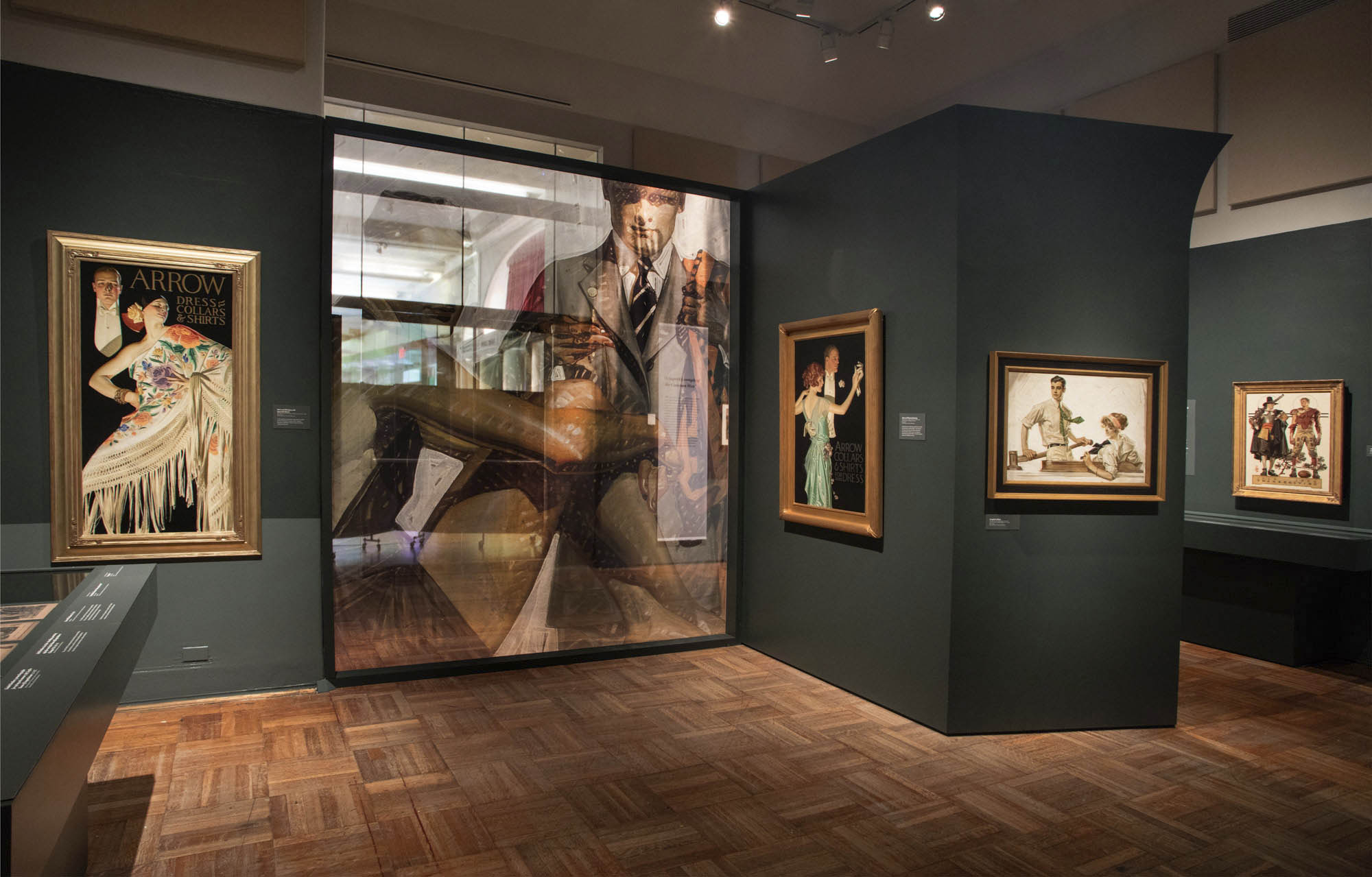
 

Installation view of the exhibition 'Under Cover: J.C. Leyendecker and American Masculinity' at the New-York Historical Society showing at third right, 'Man and Woman Dancing' (1923); at second right, 'Couple in Boat' (1912); and at right, 'Thanksgiving: 1628-1928 (Pilgrim and Football Player)' (1928)


Installation view of the exhibition Under Cover: J.C. Leyendecker and American Masculinity at the New-York Historical Society showing at third right, Man and Woman Dancing (1923, below); at second right, Couple in Boat (1912, above); and at right, Thanksgiving: 1628-1928 (Pilgrim and Football Player) (1928, below)
Photo: Glenn Castellano, New-York Historical Society
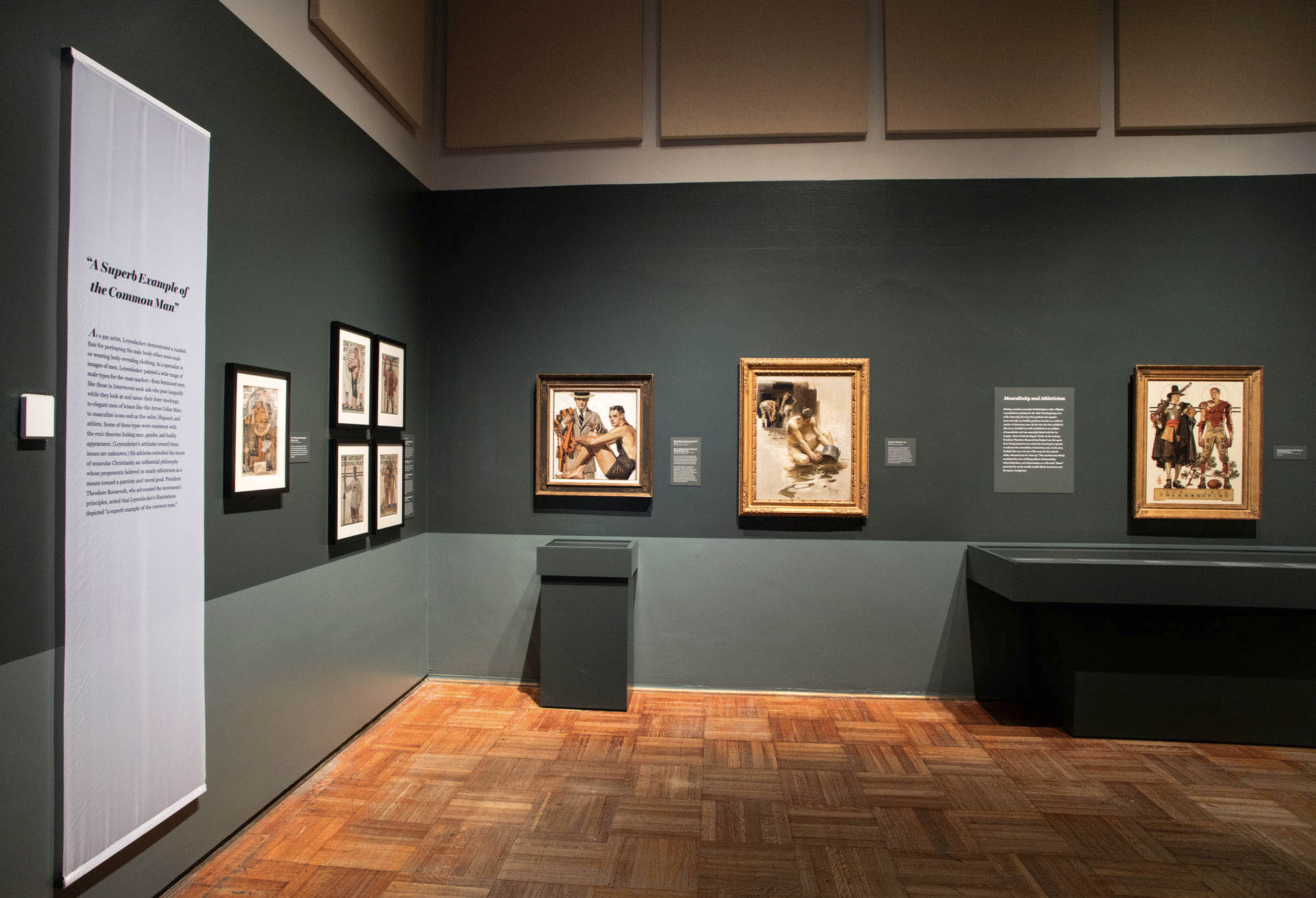
 

Installation view of the exhibition 'Under Cover: J.C. Leyendecker and American Masculinity' at the New-York Historical Society showing at left centre, 'Record Time, Cool Summer Comfort' (c. 1920); at centre, 'In the Yale Boathouse' (1905); and at right, 'Thanksgiving: 1628-1928 (Pilgrim and Football Player)' (1928)


Installation view of the exhibition Under Cover: J.C. Leyendecker and American Masculinity at the New-York Historical Society showing at left centre, Record Time, Cool Summer Comfort (c. 1920, below); at centre, In the Yale Boathouse (1905, above); and at right, Thanksgiving: 1628-1928 (Pilgrim and Football Player) (1928, below)
Photo: Glenn Castellano, New-York Historical Society


“A Superb Example of the Common Man”

As a gay artist, Leyedecker demonstrated a marked flare for portraying the male body either semi-nude or wearing body-revealing clothing. As a specialist in images of men, Leyedecker painted a whole range of male types from the mass market – from feminised men, like those in interwoven sock ads who pose languidly while they look at and caress their stockings; to elegant men of leisure like the Arrow Collar Man; to masculine icons such as the sailor, lifeguard, and athlete. Some of these types were consistent with the era’s theories linking race, gender, and bodily appearance. (Leyedecker’s attitudes toward these issues is unknown). His athletes embodied the tenets of muscular Christianity, and influential philosophy whose proponents believed in manly athleticism as a means toward a patriotic and moral good. President Theodore Roosevelt, who advocated the movement’s principles, noted that Leyendecker’s illustrations depicted “a superb example of the common man.”

Wall text from the exhibition
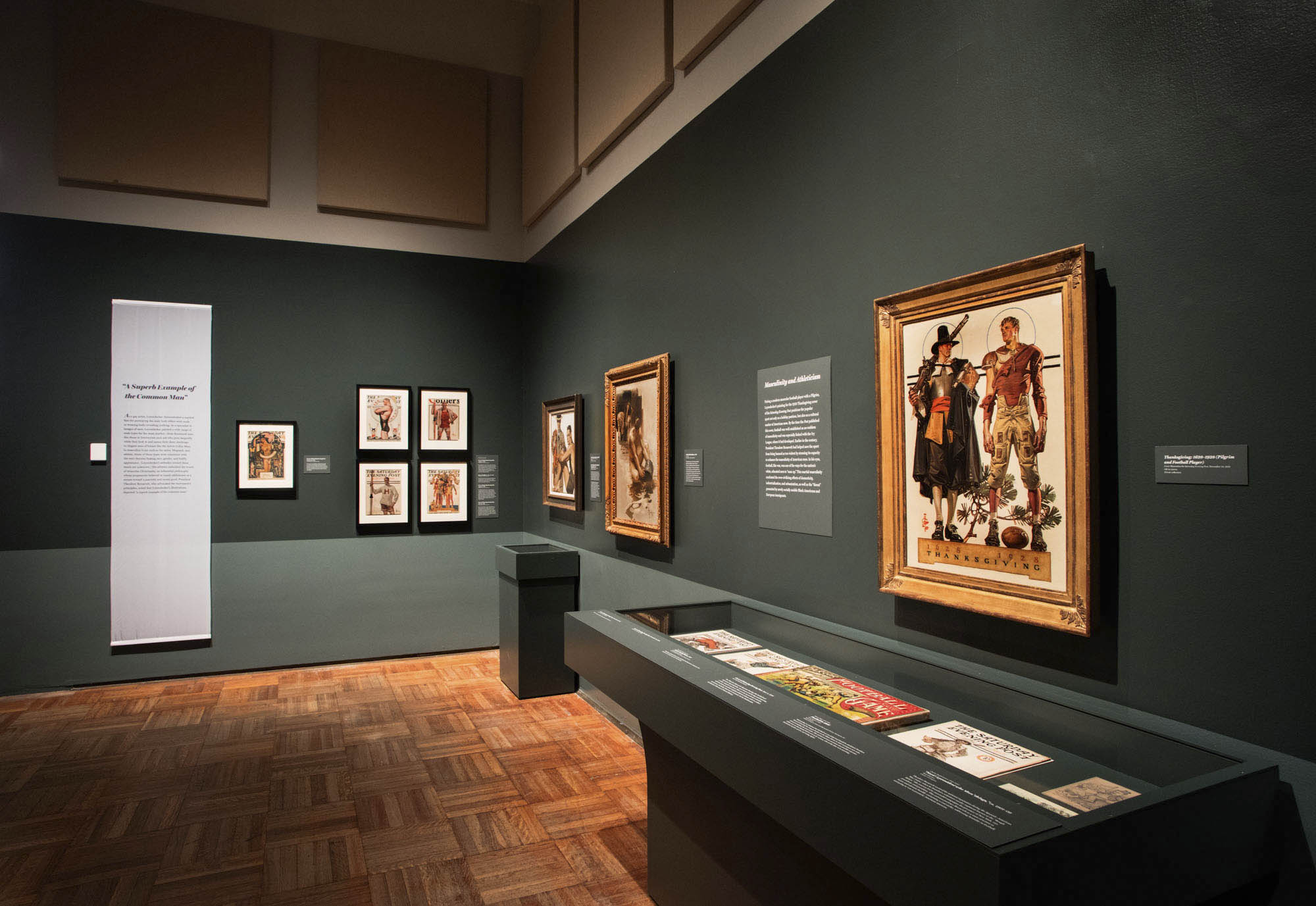
 

Installation view of the exhibition 'Under Cover: J.C. Leyendecker and American Masculinity' at the New-York Historical Society

Installation view of the exhibition 'Under Cover: J.C. Leyendecker and American Masculinity' at the New-York Historical Society showing at left in the bottom image, 'Cover of Saturday Evening Post' (June 29, 1907) and 'Cover of Collier's' (June 24, 1916); at second right, 'In the Yale Boathouse' (1905); and at right, 'Thanksgiving: 1628-1928 (Pilgrim and Football Player)' (1928)


Installation views of the exhibition Under Cover: J.C. Leyendecker and American Masculinity at the New-York Historical Society showing at left in the bottom image, Cover of Saturday Evening Post (June 29, 1907, below) and Cover of Collier’s (June 24, 1916, below); at second right, In the Yale Boathouse (1905, above); and at right, Thanksgiving: 1628-1928 (Pilgrim and Football Player) (1928, below)
Photo: Glenn Castellano, New-York Historical Society
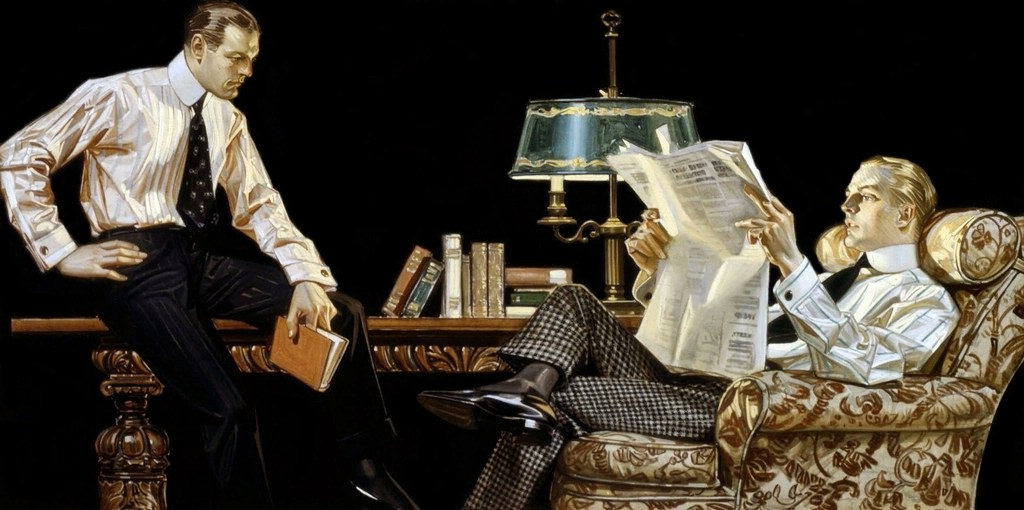
 

J.C. Leyendecker (American, 1874-1951) 'Men reading' 1914


J.C. Leyendecker (American, 1874-1951)
Men reading
Arrow Collar advertisement 1914
Oil on canvas
National Museum of American Illustration, Newport, RI
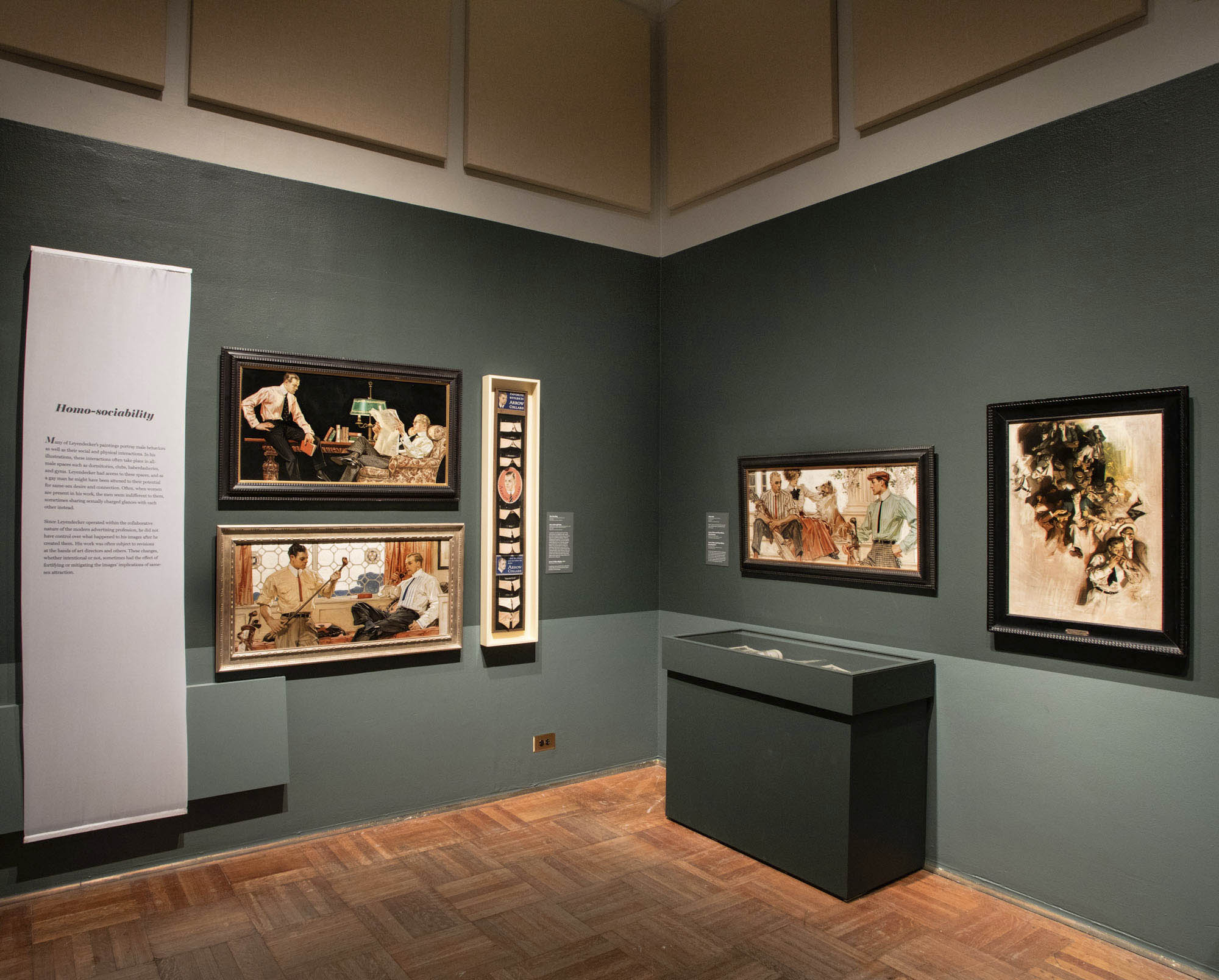
 

Installation view of the exhibition 'Under Cover: J.C. Leyendecker and American Masculinity' at the New-York Historical Society showing at left top, 'Men Reading' (1914) and at left bottom, 'Men with Golf Clubs' (c. 1909)


Installation view of the exhibition Under Cover: J.C. Leyendecker and American Masculinity at the New-York Historical Society showing at left top, Men Reading (1914, above) and at left bottom, Men with Golf Clubs (c. 1909, above)
Photo: Glenn Castellano, New-York Historical Society


Homo-sociability

Many of Leyendecker’s paintings portray male behaviour as well as their social and physical interactions. In his illustrations, there interactions often take place in all-male queer spaces such as dormitories, clubs, haberdasheries and gyms. Leyendecker had access to these spaces, and as a gay man he might have been attuned to their potential for same-sex desire and connection. Often, when women are present in his work, the men seem indifferent to them, sometimes sharing sexually charged glances with each other instead.

Since Leyendecker operated within the collaborative nature of the modern advertising profession, he did not have control over what happened to his images after the created them. His work was often subject to revisions at the hands of art directors and others. These changes, whether intentional or not, sometimes had the effect of fortifying or mitigating the images implications of same-sex attraction.

Wall text from the exhibition
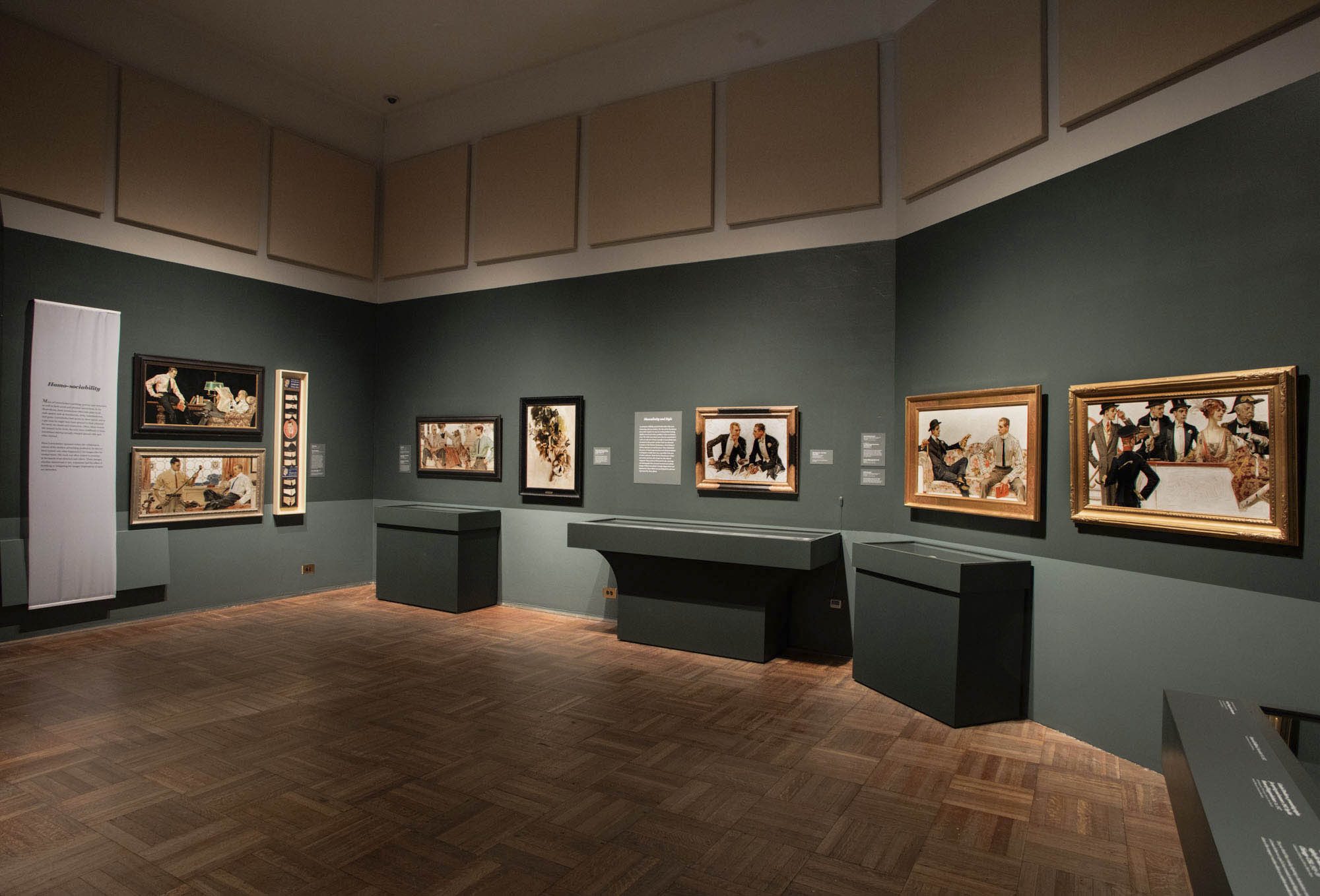
 

Installation view of the exhibition 'Under Cover: J.C. Leyendecker and American Masculinity' at the New-York Historical Society showing at left top, 'Men Reading' (1914) and at left bottom, 'Men with Golf Clubs' (c. 1909); at centre, 'The Donchester – the Cluett Dress Shirt' (1911); and at right, 'In the Stands 2' (1913)


Installation view of the exhibition Under Cover: J.C. Leyendecker and American Masculinity at the New-York Historical Society showing at left top, Men Reading (1914, above) and at left bottom, Men with Golf Clubs (c. 1909, above); at centre, The Donchester – the Cluett Dress Shirt (1911, below); and at right, In the Stands 2 (1913, below)
Photo: Glenn Castellano, New-York Historical Society
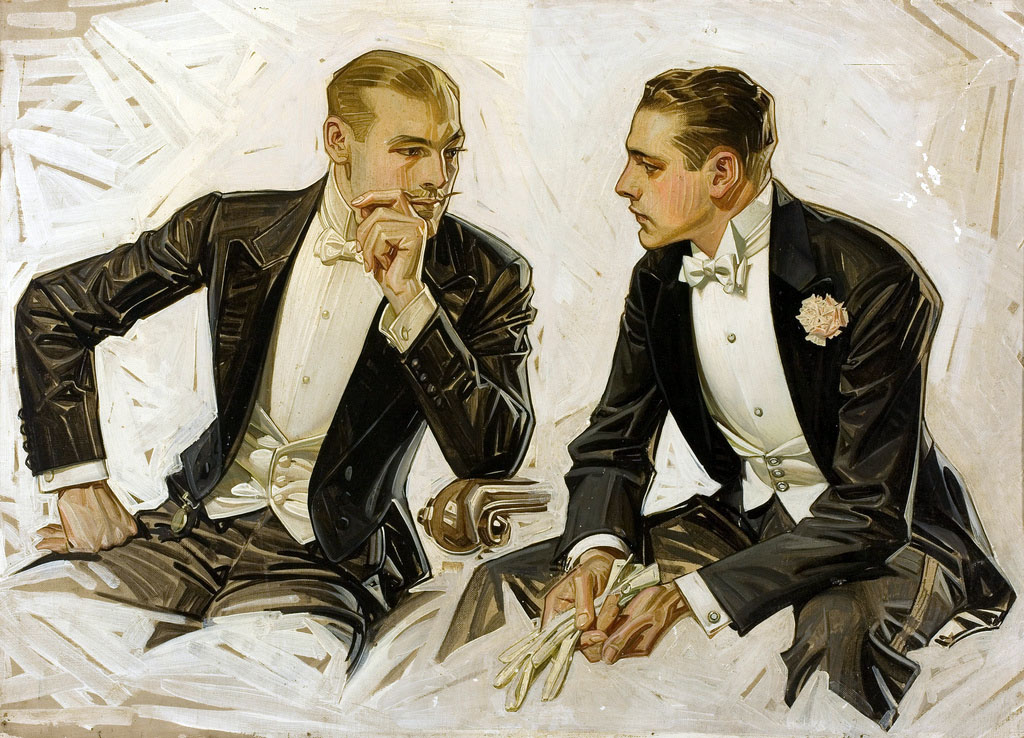
 

J.C. Leyendecker (American, 1874-1951) 'The Donchester – the Cluett Dress Shirt' 1912


J.C. Leyendecker (American, 1874-1951)
The Donchester – the Cluett Dress Shirt
Arrow shirt advertisement, 1911
Oil on canvas
National Museum of American Illustration, Newport, RI
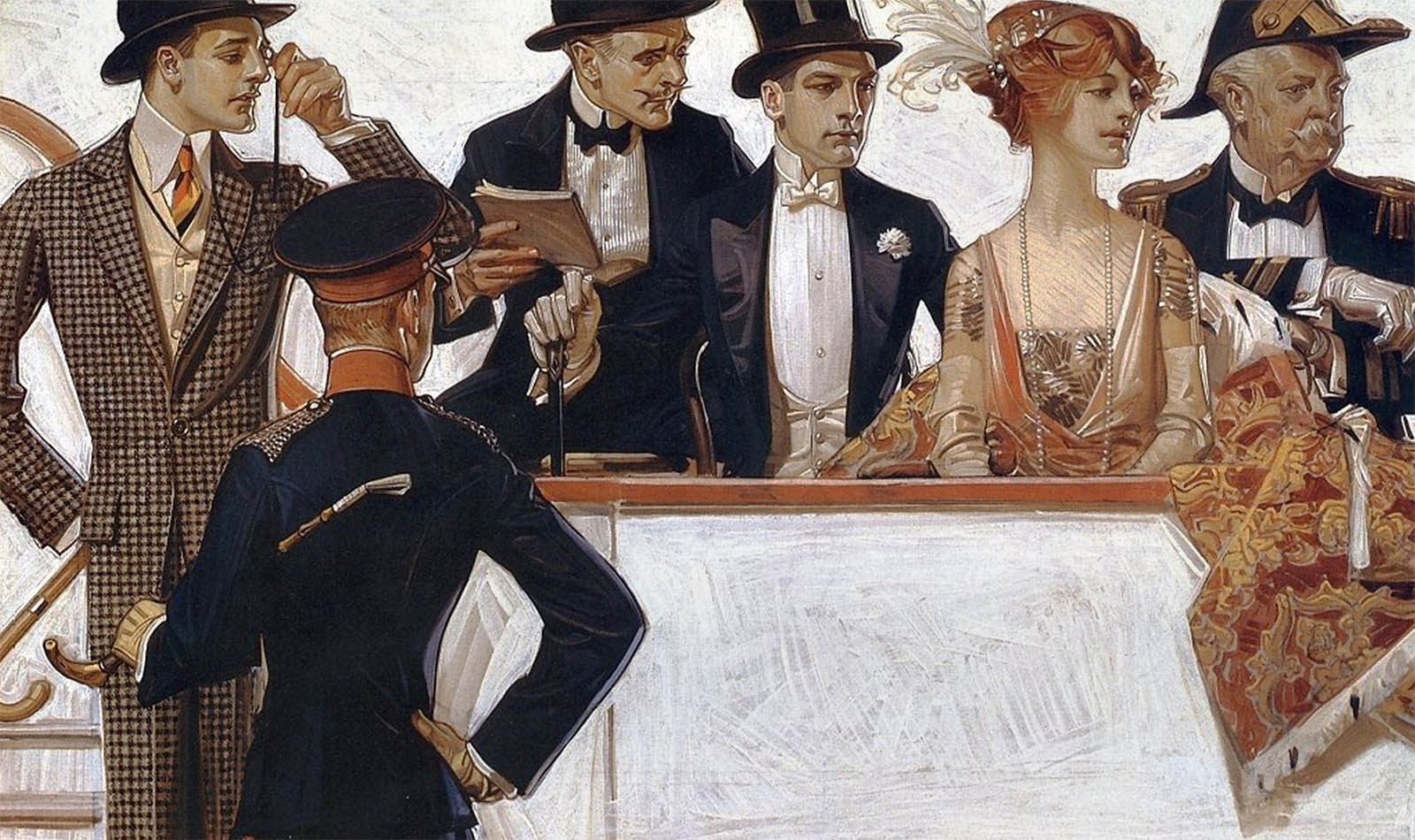
 

J.C. Leyendecker (American, 1874-1951) 'In the Stands' 2


J.C. Leyendecker (American, 1874-1951)
In the Stands 2
Arrow shirt advertisement, 1913
Oil on canvas
National Museum of American Illustration, Newport, RI
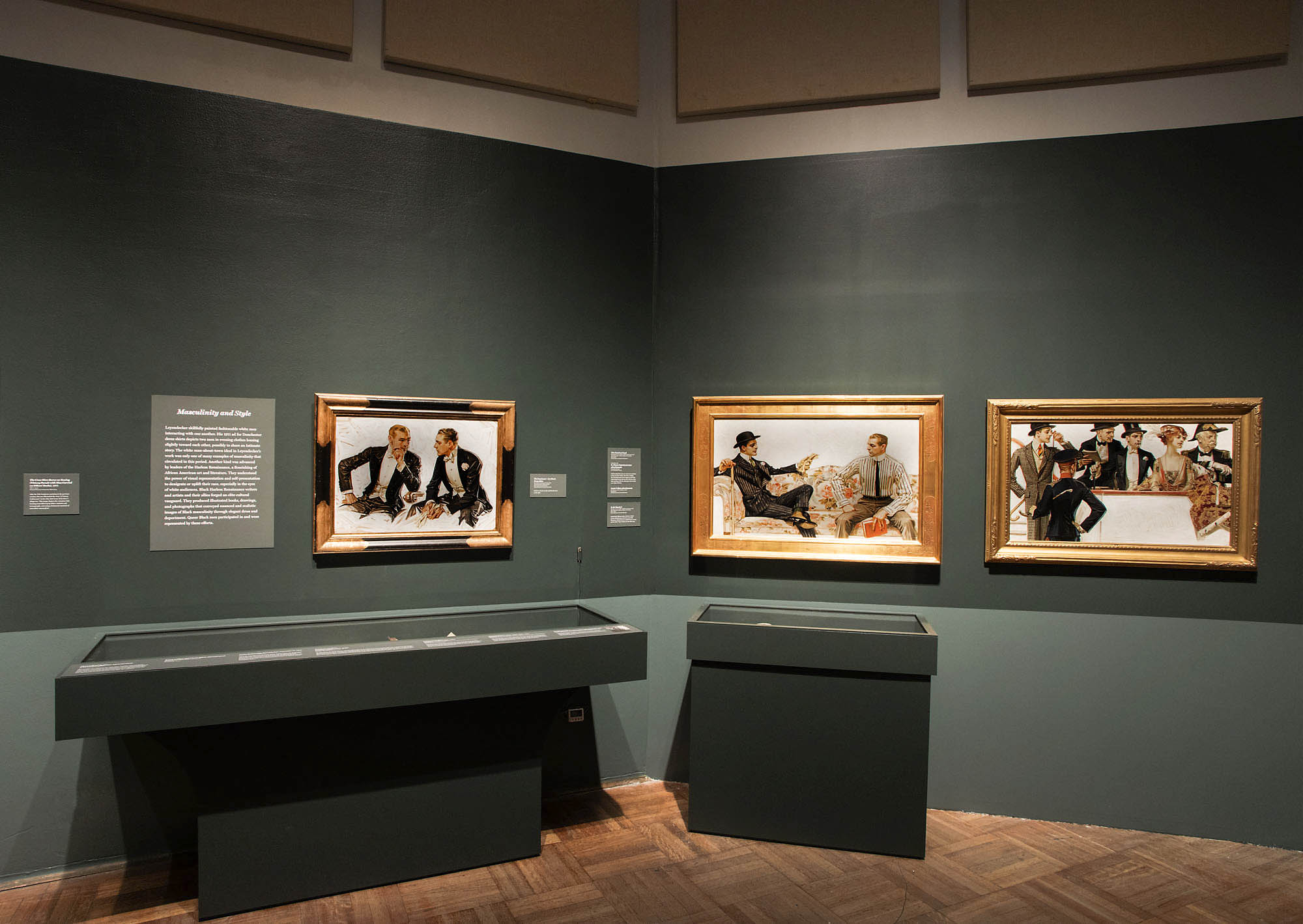
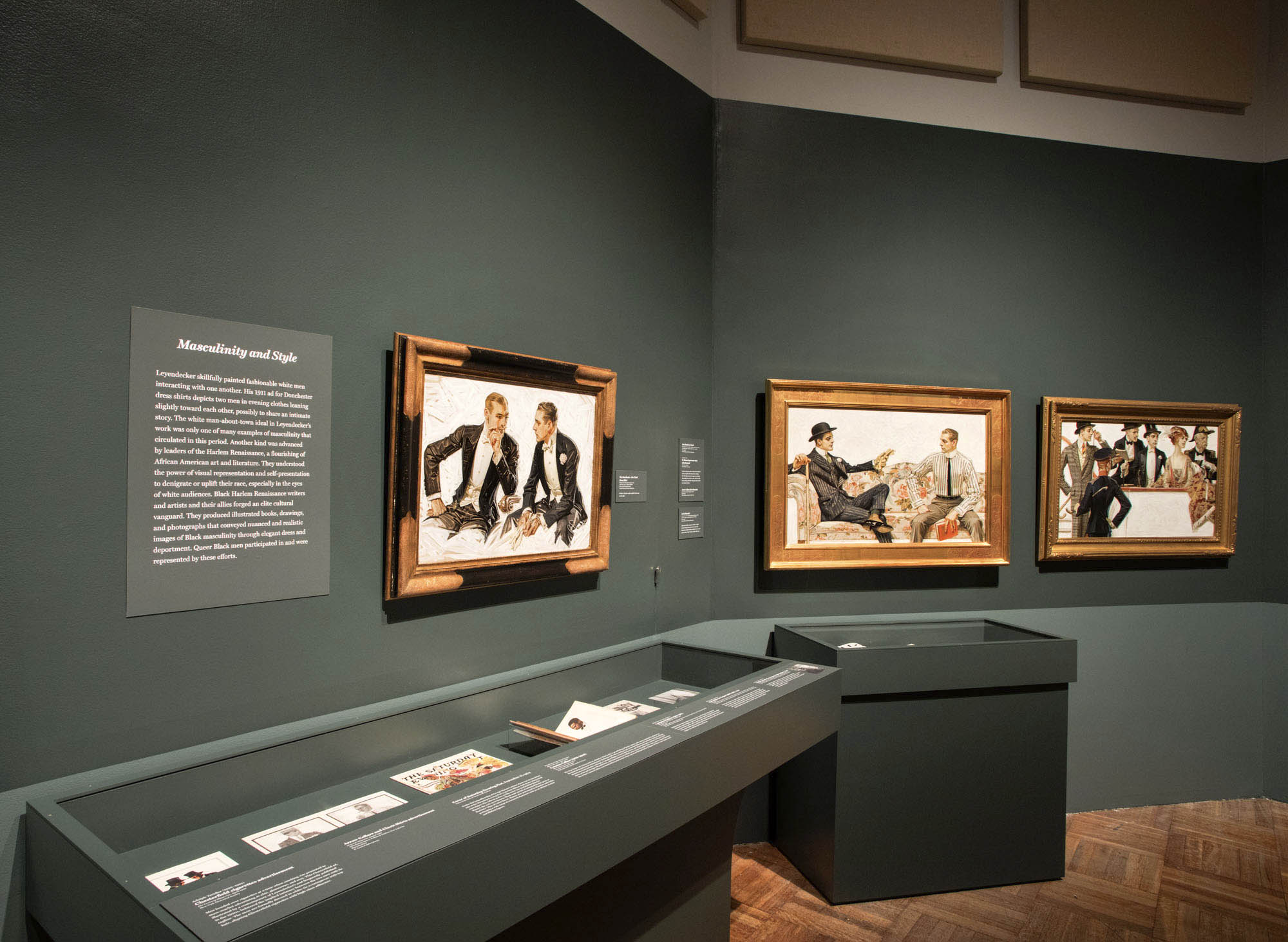
 

Installation view of the exhibition 'Under Cover: J.C. Leyendecker and American Masculinity' at the New-York Historical Society at left, 'The Donchester – the Cluett Dress Shirt' (1911); and at right, In the 'Stands 2' (1913)

Installation view of the exhibition 'Under Cover: J.C. Leyendecker and American Masculinity' at the New-York Historical Society at left, 'The Donchester – the Cluett Dress Shirt' (1911); and at right, In the 'Stands 2' (1913)


Installation views of the exhibition Under Cover: J.C. Leyendecker and American Masculinity at the New-York Historical Society at left, The Donchester – the Cluett Dress Shirt (1911, above); and at right, In the Stands 2 (1913, above)
Photo: Glenn Castellano, New-York Historical Society


Masculinity and Style

Leyendecker skilfully painted fashionable white men interaction with one another. His 1911 ad for Dorchester dress shirts depicts two men in evening clothes leaning slightly toward each other, possibly to share an intimate story. The whit man-about-town ideal in Leyendecker’s work was only one of many examples of masculinity that circulated in this period. Another kind was advanced by leaders of the Harlem Renaissance, a flourishing of African American art and literature. They understood the power of visual representation and self-presentation to denigrate or uplift their race, especially in the eyes of white audiences. Black Harlem Renaissance writers and artists and their allies forged an elite cultural vanguard. They produced illustrated books, drawings, and photographs that conveyed nuanced and realistic images of Black masculinity through elegant dress and deportment. Queer Black men participated in and were represented by these efforts.

Wall text from the exhibition
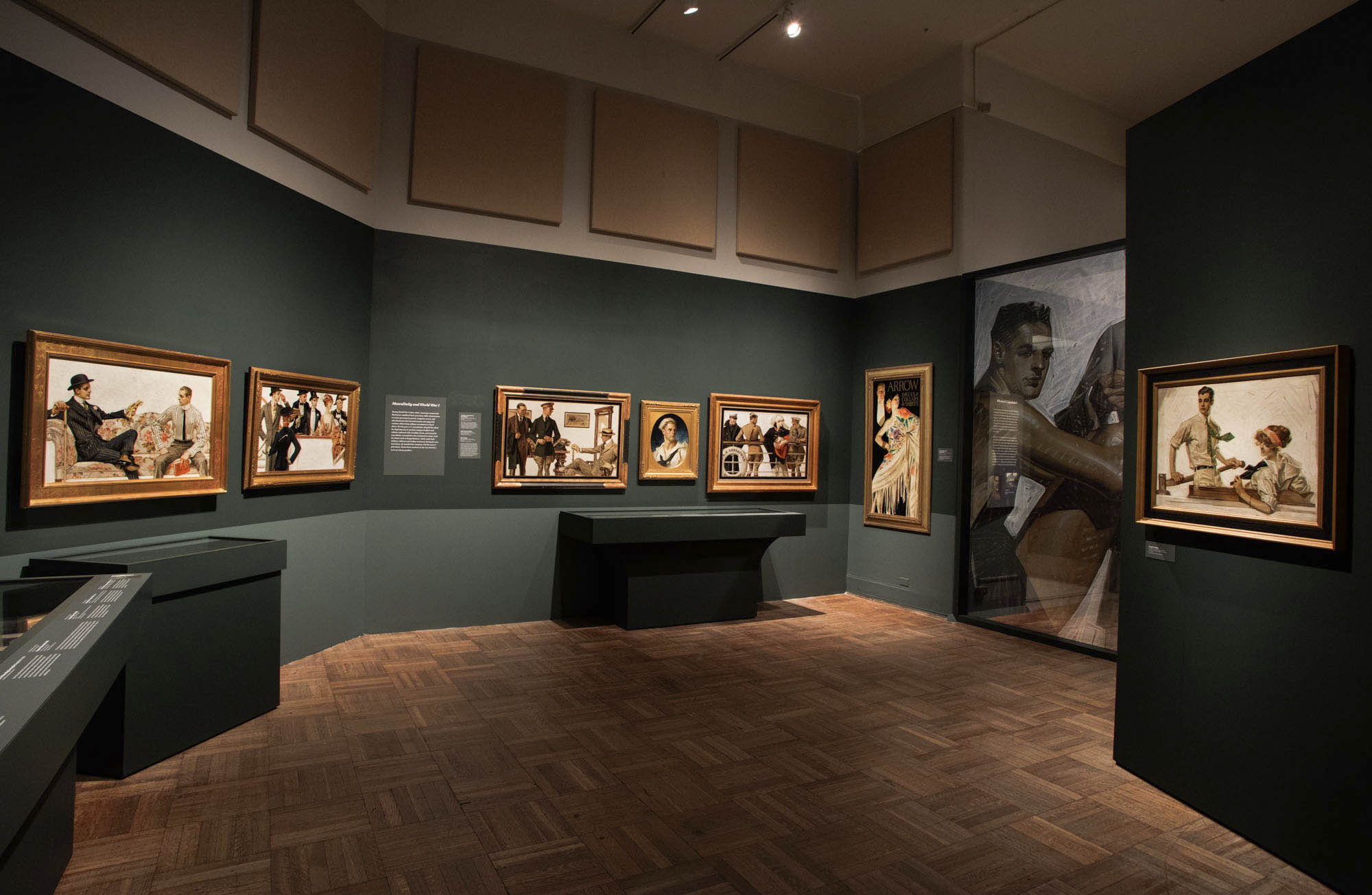
 

Installation view of the exhibition 'Under Cover: J.C. Leyendecker and American Masculinity' at the New-York Historical Society showing at second left, 'In the Stands 2' (1913); at centre, 'Portrait of an American Sailor, Charles Beach' (1918); at third right, 'Man and Woman with Spanish Shawl' (1926); and at right, 'Couple in Boat' (1912)


Installation view of the exhibition Under Cover: J.C. Leyendecker and American Masculinity at the New-York Historical Society showing at second left, In the Stands 2 (1913, above); at centre, Portrait of an American Sailor, Charles Beach (1918, below); at third right, Man and Woman with Spanish Shawl (1926); and at right, Couple in Boat (1912, above)
Photo: Glenn Castellano, New-York Historical Society
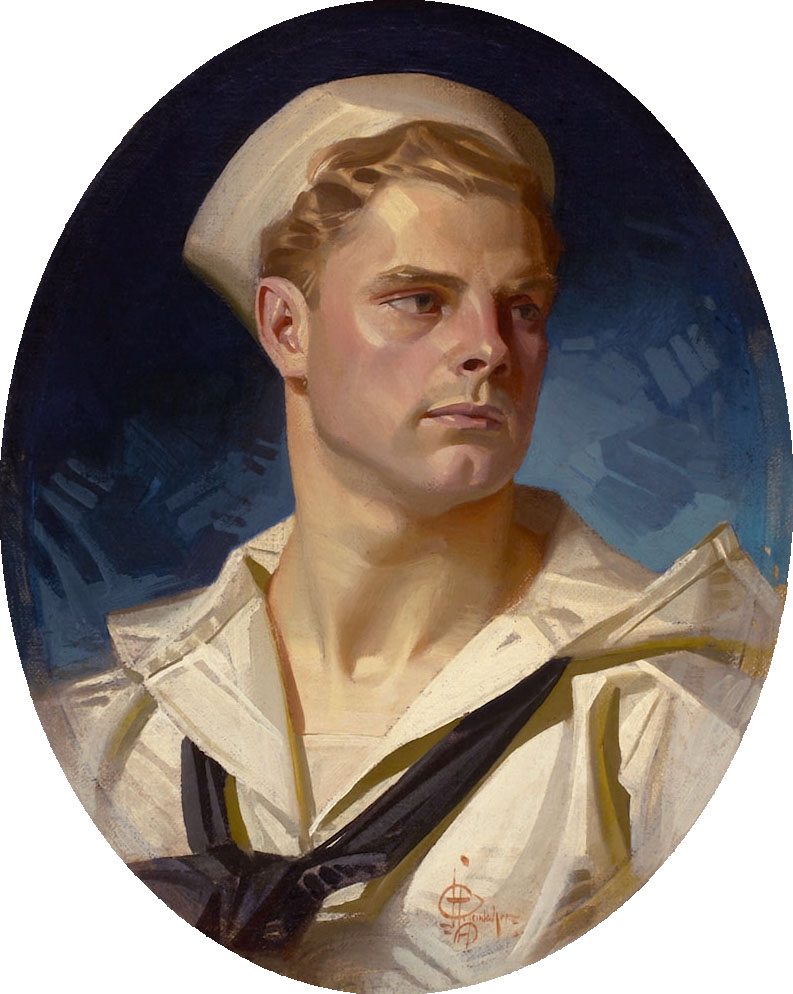
 

J.C. Leyendecker (American, 1874-1951) 'Portrait of an American Sailor, Charles Beach' 1918


J.C. Leyendecker (American, 1874-1951)
Portrait of an American Sailor, Charles Beach
1918
Oil on canvas
National Museum of American Illustration, Newport, RI
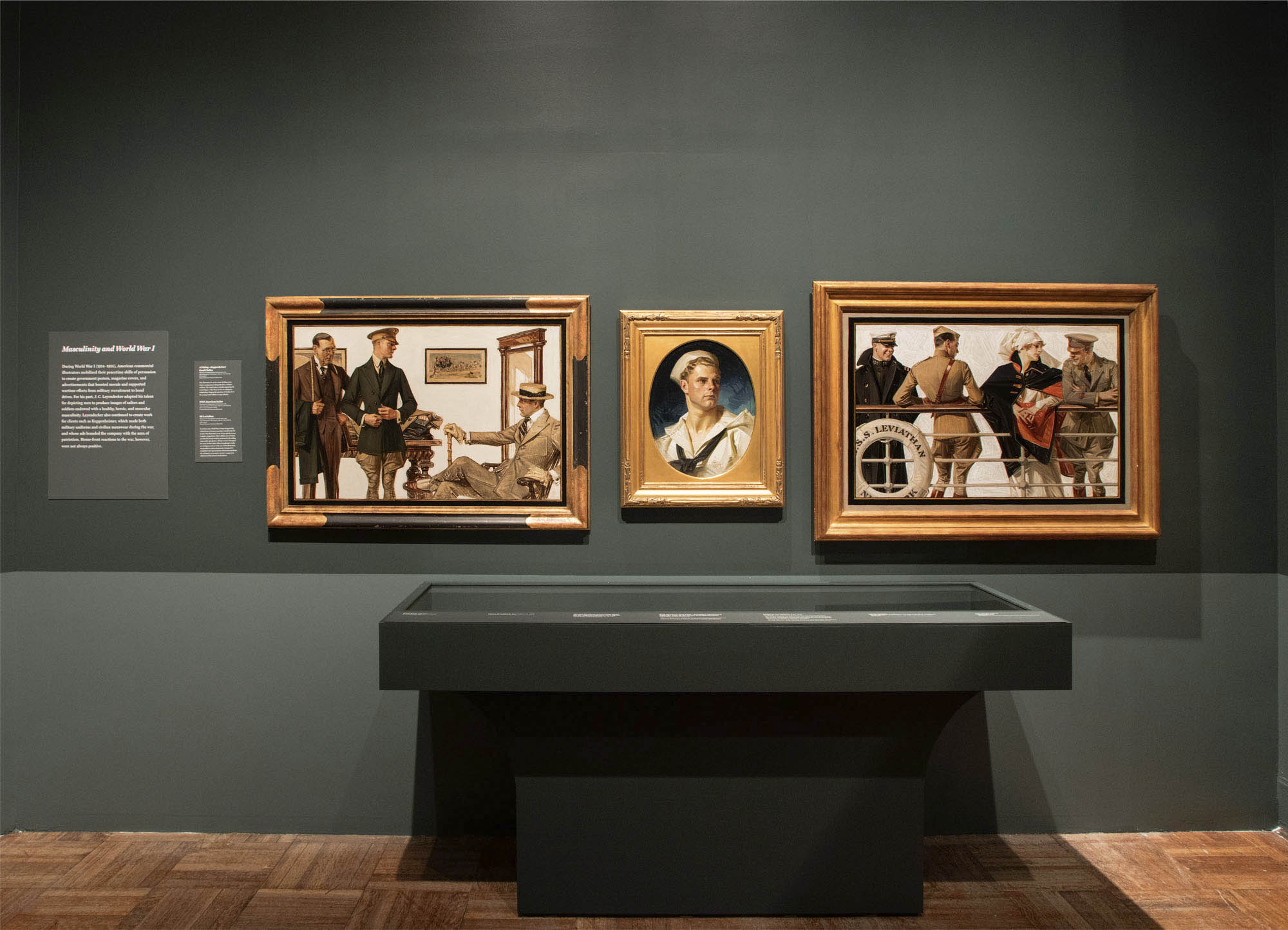
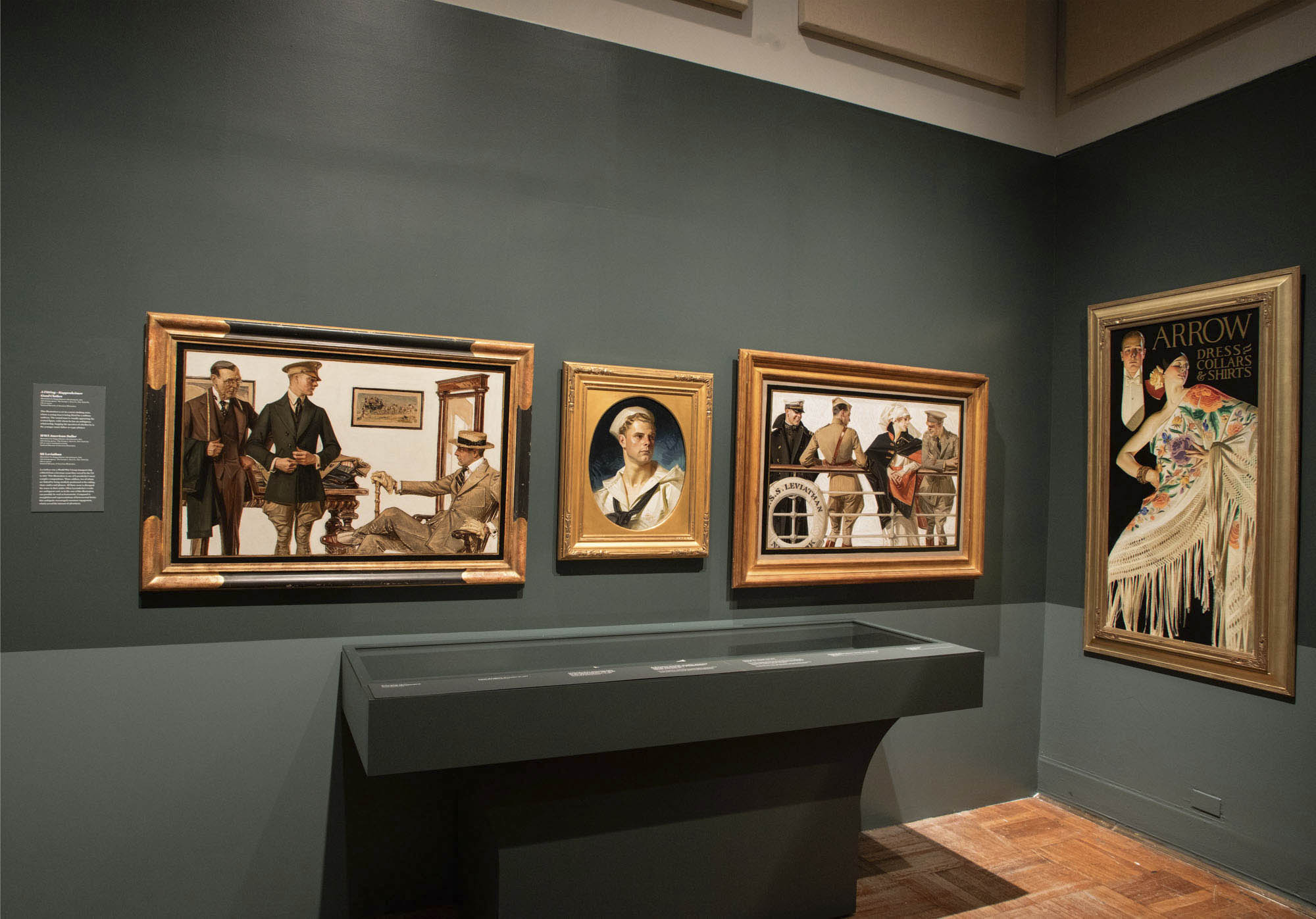
 

Installation view of the exhibition 'Under Cover: J.C. Leyendecker and American Masculinity' at the New-York Historical Society

Installation view of the exhibition 'Under Cover: J.C. Leyendecker and American Masculinity' at the New-York Historical Society showing at centre, 'Portrait of an American Sailor, Charles Beach' (1918); at second right, 'The S.S. Leviathan' (1918); and at right, 'Man and Woman with Spanish Shawl' (1926)


Installation view of the exhibition Under Cover: J.C. Leyendecker and American Masculinity at the New-York Historical Society showing at centre, Portrait of an American Sailor, Charles Beach (1918, below); at second right, The S.S. Leviathan (1918, below); and at right, Man and Woman with Spanish Shawl (1926)
Photo: Glenn Castellano, New-York Historical Society
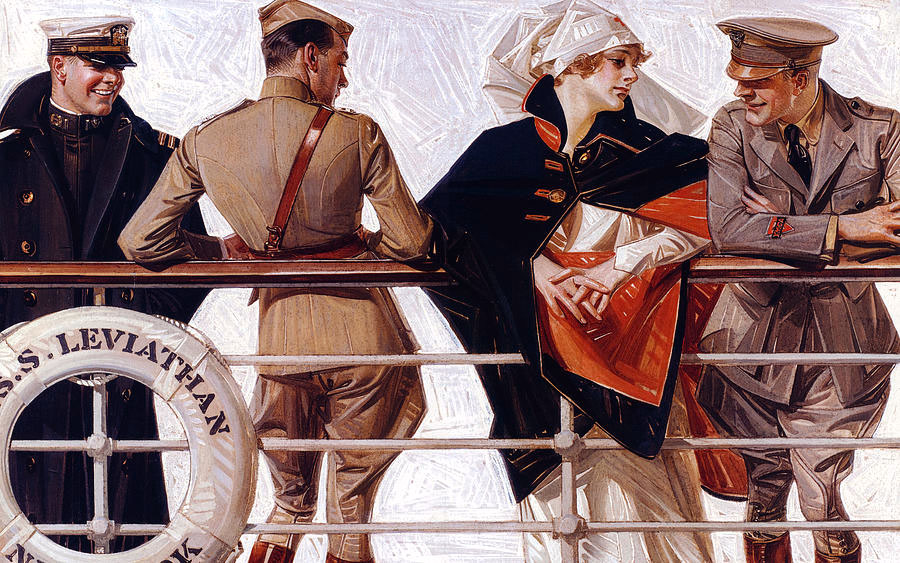
 

J.C. Leyendecker (American, 1874-1951) 'The S.S. Leviathan' 1918


J.C. Leyendecker (American, 1874-1951)
The S.S. Leviathan
House of Kuppenheimer advertisement, 1918
Oil on canvas
National Museum of American Illustration, Newport, RI


New-York Historical Society Exhibition Explores the Work of J.C. Leyendecker, a Pivotal Gay Artist and Illustrator Who Helped Shape American Visual Culture.

This spring, a new exhibition at the New-York Historical Society examines the work and influence of J.C. Leyendecker (1874-1951), a preeminent illustrator and commercial artist who helped shape American visual culture in the first three decades of the 20th century through captivating advertising campaigns including the legendary “Arrow Collar Man” and countless covers for the Saturday Evening Post. As a gay artist whose illustrations for a mainstream audience often had unspoken homoerotic undertones, his work is especially revealing for what it says about the cultural attitudes towards homosexuality of the period. Under Cover: J. C. Leyendecker and American Masculinity, on view May 5 – August 13, 2023, is organised by New-York Historical from the collection of the National Museum of American Illustration, Newport, RI.

Under Cover: J.C. Leyendecker and American Masculinity deepens our understanding of the struggle for full civil rights as Americans of the LGBTQ+ community,” said Dr. Louise Mirrer, president and CEO of New-York Historical. “The exhibition is part of New-York Historical’s ongoing commitment to tell stories of Americans whose lived experience, though important and consequential to our history, is so often absent from textbooks in schools and colleges. New-York Historical’s collaboration with the American LGBTQ+ Museum, which will be housed in our institution’s new wing, will further enable meaningful conversations about LGBTQ+ history and its rightful place within the American narrative.”

“J.C. Leyendecker was an amazingly talented artist whose illustrations have come to embody the look and feel of the first half of the century while simultaneously demonstrating how fluidity in gender expression and gay representation were actually quite common at the time, contrary to current assertions that they are unique to our own moment,” said Donald Albrecht, guest curator. “Not only did his work exemplify the zeitgeist, but it depicts a deeply nuanced view of sexuality and advertising that broadens our understanding of American culture.”

Under Cover: J.C. Leyendecker and American Masculinity showcases 19 of the artist’s original oil paintings and a wealth of related ephemera, and features both Leyendecker’s editorial work, such as magazine covers, as well as commercial illustrations that appeared in the pages of popular publications, on roadside billboards, in store windows, and on mass transit. His aesthetic influence extended to Norman Rockwell, his colleague and eventual successor as the Post’s premier illustrator. The exhibition is organised into two primary sections: one exploring Leyendecker’s depictions of the male body, either semi-nude or clad in body-revealing garments, and a second focusing on his images of male intimacies, often of men sharing sexually charged looks. The model for many of his illustrations was Charles Beach, his lover and eventual business manager.

Under Cover delves into the early politics of sexual identity and gender while simultaneously examining how Leyendecker helped establish a nationalistic ideal of elite and athletic white male beauty. To address this aspect of his work, the exhibition juxtaposes some of Leyendecker’s paintings with artefacts that offer counter-narratives to his works’ exclusionary nature, including depictions of fashionable African American men during the Harlem Renaissance. Also providing crucial context: a selection of contemporaneous advertisements with homoerotic connotations and a digital show of images depicting gay culture in New York during Leyendecker’s time, including plays about lesbians and men in drag that appeared on Broadway, effeminate male nightclub performers, and gay artists who wrote poems and created drawings about same-sex desire.

The exhibition locates Leyendecker’s work within the evolution of commercial illustration, when advertisers sought to sell products by emotion and feeling and not only by factual representation of a product’s utilitarian characteristics. These commercial trends can be seen in Leyendecker’s work creating advertising illustrations for companies such as Gillette razors, Ivory soap, House of Kuppenheimer menswear, and Interwoven socks. He also developed campaigns for Arrow collars depicting handsome, idealised men wearing shirts and detachable collars manufactured by Cluett, Peabody & Co. Laying the groundwork of Leyendecker’s implied gay narratives, these ads starred fashionable men in stylish settings engaged in activities such as boating, golfing, or reading in men’s clubs. In his work, Leyendecker created drawings depicting multiple kinds of masculinity for the mass market, from feminized men like the languidly posed males in Interwoven ads who look at and caress their sheer stockings to elegant men of leisure like the Arrow Collar Man to manly men like muscular sailors, lifeguards, and athletes.

Leyendecker’s suggestive images aligned with his era’s sexual mores. Starting in the latter decades of the 19th century, small but dense subcultures that defied sexual and gender conventions became increasingly visible in cities like New York. Members of these subcultures often identified themselves with specific styles of dress, mannerisms, and language. As a gay Manhattanite immersed in the city’s sophisticated visual culture industries, Leyendecker was most likely cognisant of these gay identity markers, sometimes depicting them in his illustrations.

Under Cover is organised by New-York Historical from the collection of the National Museum of American Illustration, Newport, RI. The show is guest-curated by Donald Albrecht, and coordinated at New-York Historical by Rebecca Klassen, curator of material culture. Drawing on three decades of scholarship, the exhibition is aided by a committee of advisors: Dr. Elspeth Brown, Professor of History at the University of Toronto; Dr. Monica L. Miller, Professor of English and Africana Studies, Barnard College; and Dr. Michael Murphy, Associate Professor of Gender and Sexuality Studies at the University of Illinois Springfield.

Press release from the New-York Historical Society
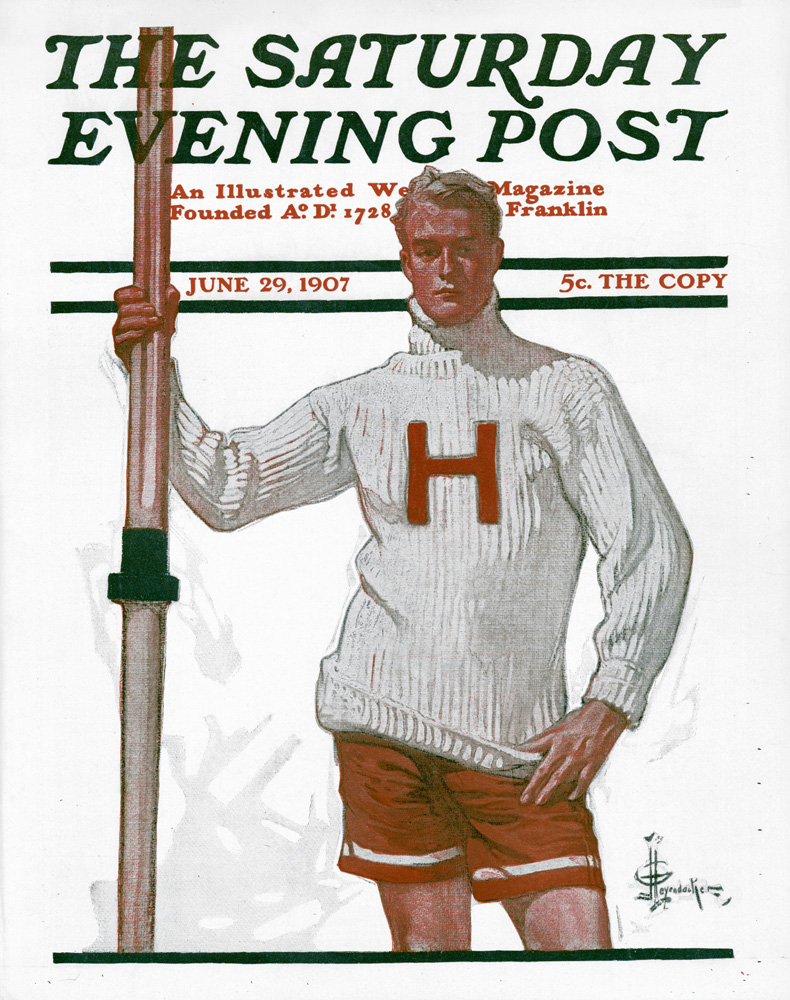
 

J.C. Leyendecker (American, 1874-1951) 'Cover of Saturday Evening Post' June 29, 1907


J.C. Leyendecker (American, 1874-1951)
Cover of Saturday Evening Post
June 29, 1907
National Museum of American Illustration, Newport, RI


Leyendecker’s Ivy League athletes embodied the ideals of muscular Christianity, a philosophy whose proponents believed in athleticism as a means toward a patriotic and moral good. President Theodore Roosevelt, who advocated the movement’s principles, noted that Leyendecker’s illustrations depicted “a superb example of the common man.”
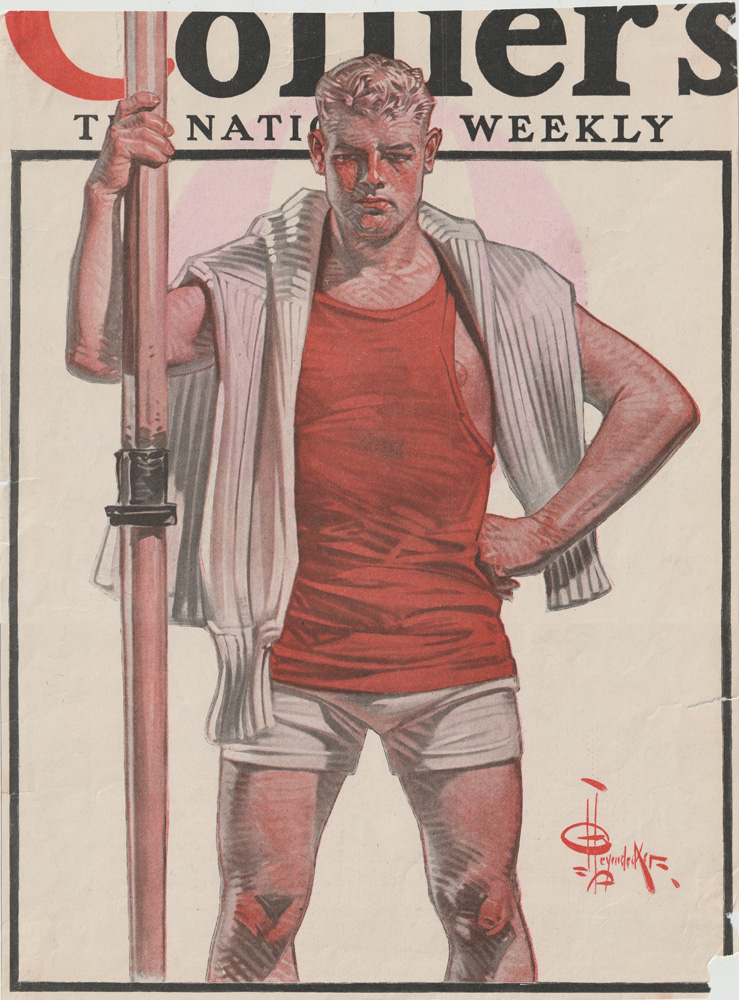
 

J.C. Leyendecker (American, 1874-1951) 'Cover of Collier's' June 24, 1916


J.C. Leyendecker (American, 1874-1951)
Cover of Collier’s
June 24, 1916
National Museum of American Illustration, Newport, RI


As a gay male artist, Leyendecker demonstrated a marked flair for depicting the male body either semi-nude or wearing body-revealing clothing. In this cover, Leyendecker partially exposes the athlete’s left nipple.
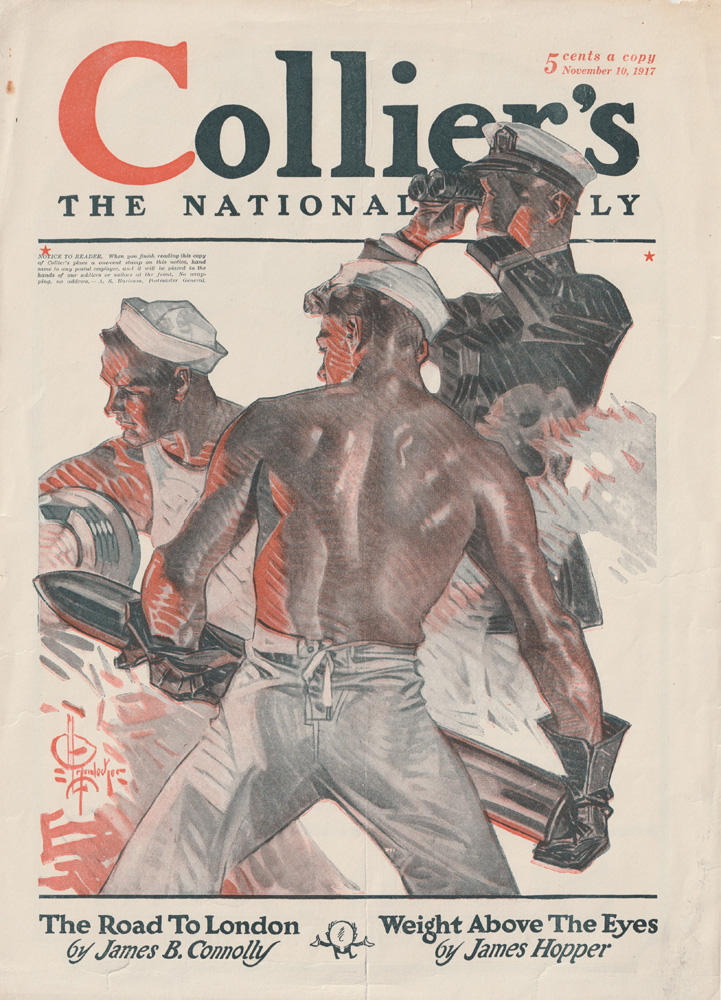
 

J.C. Leyendecker (American, 1874-1951) 'Cover of Collier's' November 10, 1917


J.C. Leyendecker (American, 1874-1951)
Cover of Collier’s
November 10, 1917
National Museum of American Illustration, Newport, RI


During World War I, Leyendecker adapted his flair for depicting men to produce images of sailors and soldiers endowed with a healthy, heroic, and muscular masculinity.
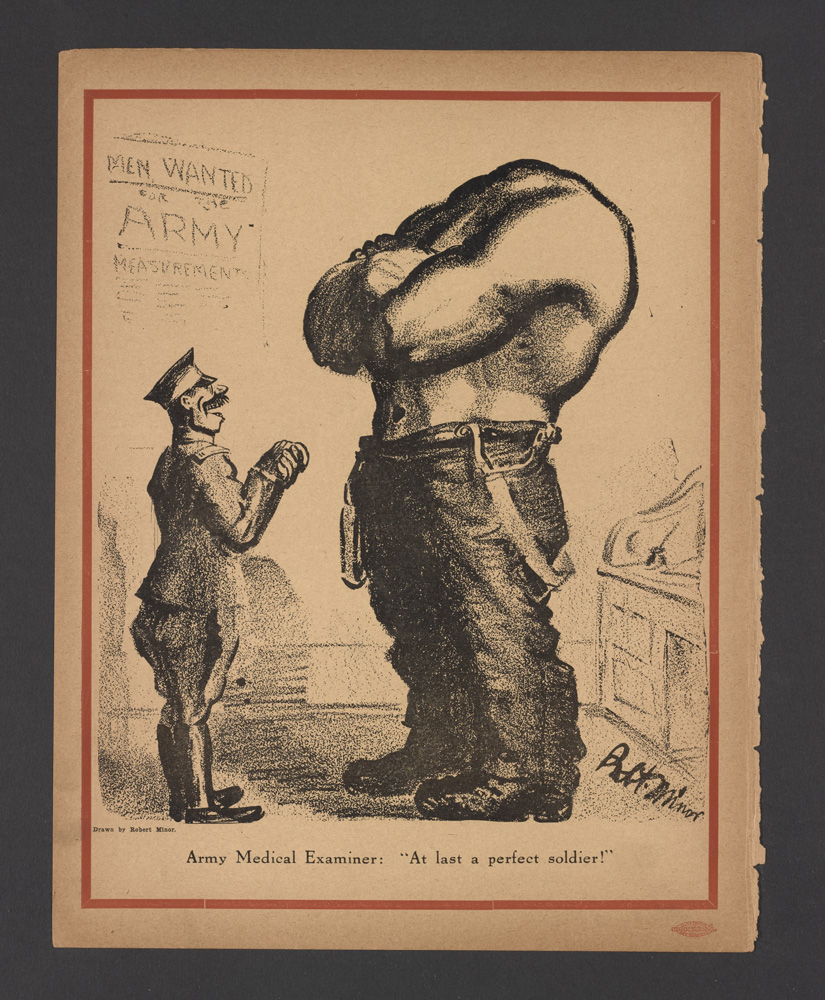
 

Robert Minor (American, 1884-1952) '"Army Medical Examiner: 'At last a perfect soldier!'"'


Robert Minor (American, 1884-1952)
“Army Medical Examiner: ‘At last a perfect soldier!'”
The Masses, July 1916
Reproduction
The Tamiment Library and Robert F. Wagner Labor Archives, New York University Libraries


Home-front depictions of World War I were not always as positive as those created by Leyendecker. Chronicling the war’s dehumanising and deathly toll, this illustration from the leftist magazine The Masses rendered the male body with biting satire.
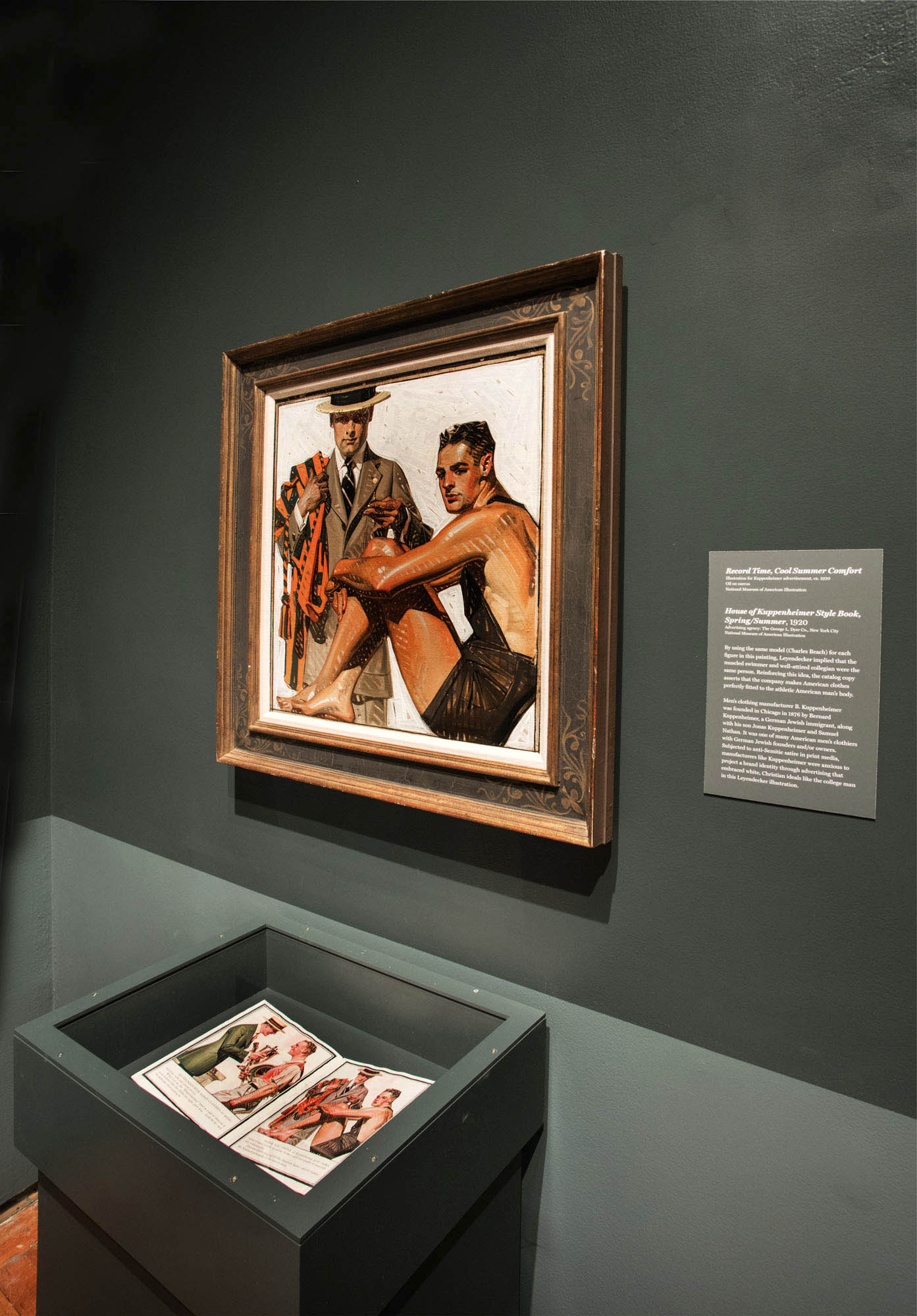
 

Installation view of the exhibition 'Under Cover: J.C. Leyendecker and American Masculinity' at the New-York Historical Society showing 'Record Time, Cool Summer Comfort' (c. 1920)


Installation view of the exhibition Under Cover: J.C. Leyendecker and American Masculinity at the New-York Historical Society showing Record Time, Cool Summer Comfort (c. 1920, below)
Photo: Glenn Castellano, New-York Historical Society


By using the same model (Charles Beach) for each figure in this painting, Leyendecker implied that the muscled swimmer and eel-attired collegian were the same person. Reinforcing this idea, the catalog copy assets that the company makes American clothes perfectly fitted to the athletic American man’s body.

Men’s clothing manufacturer B. Kuppenheimer was founded in Chicago in 1876 by Bernard Kuppenheimer, a German Jewish immigrant, along with his son Jonas Kuppenheimer and Samuel Nathan. It was one of many American men’s clothiers with German Jewish founders and/or owners. Subjected to anti-Semitic satire in print media, manufacturers like Kuppenheimer were anxious to project a brand identity though advertising that embraced white, Christian ideals like the college man in the Leyendecker illustration.

Wall text from the exhibition
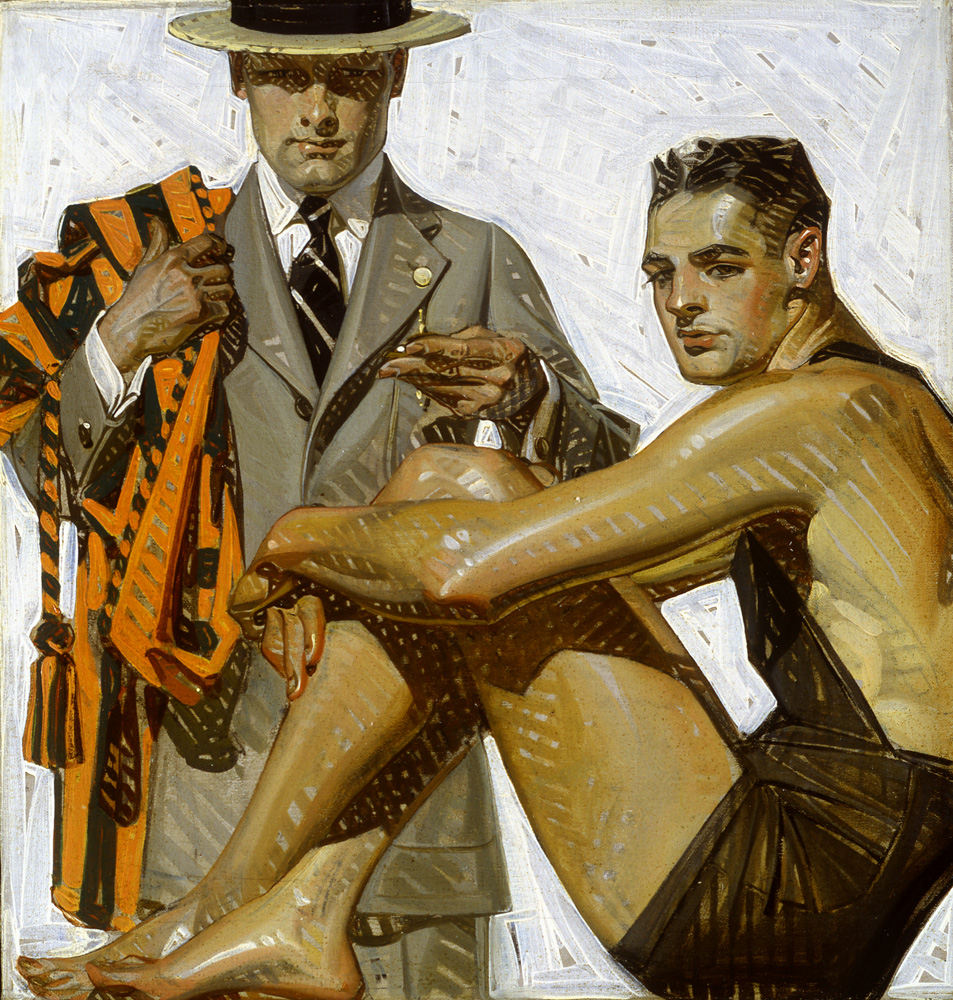
 

J.C. Leyendecker (American, 1874-1951) 'Record Time, Cool Summer Comfort' c. 1920


J.C. Leyendecker (American, 1874-1951)
Record Time, Cool Summer Comfort
Painting for Kuppenheimer advertisement, c. 1920
Oil on canvas
National Museum of American Illustration, Newport, RI


By pairing a muscled swimmer with a well-tailored collegian, both modelled by Charles A. Beach, this advertisement illustrated Kuppenheimer’s claim in the ad for “truly American clothes” designed “for the American figure” and expressing “the American personality.” Men’s clothing manufacturer B. Kuppenheimer was founded in Chicago in 1876 by Bernard Kuppenheimer, a German Jewish immigrant, along with his son Jonas and Samuel Nathan.
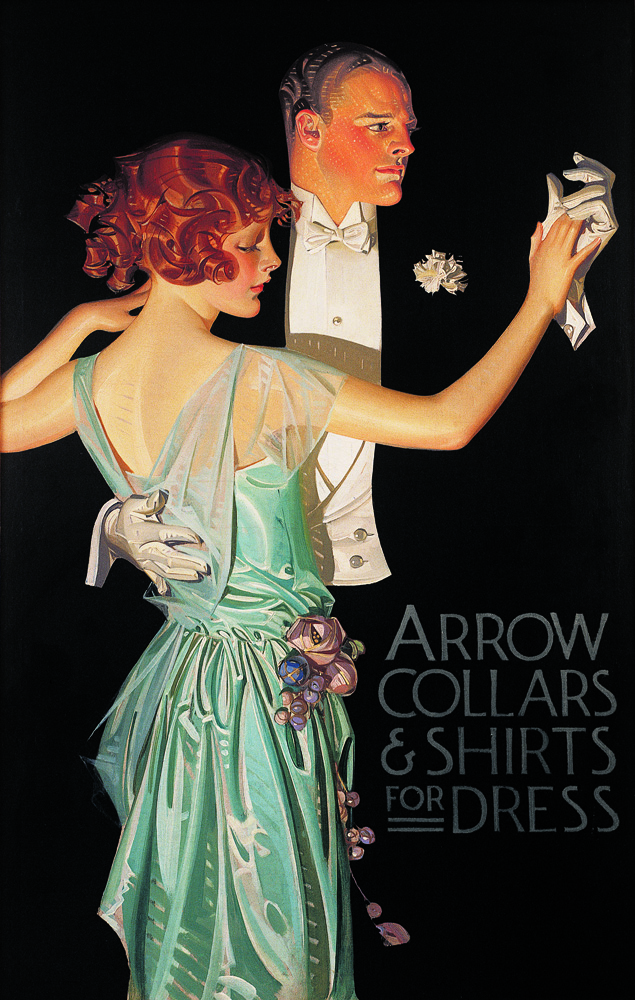
 

J.C. Leyendecker (American, 1874-1951) 'Man and Woman Dancing' 1923


J.C. Leyendecker (American, 1874-1951)
Man and Woman Dancing
Painting for Arrow Collar advertisement, 1923
Oil on canvas
National Museum of American Illustration, Newport, RI


This illustration features models Phyllis Frederic and Brian Donlevy, who launched his acting career in the early 1920s while posing for Leyendecker. Donlevy went on to perform in Broadway plays and silent films, eventually taking on major roles in Hollywood movies.
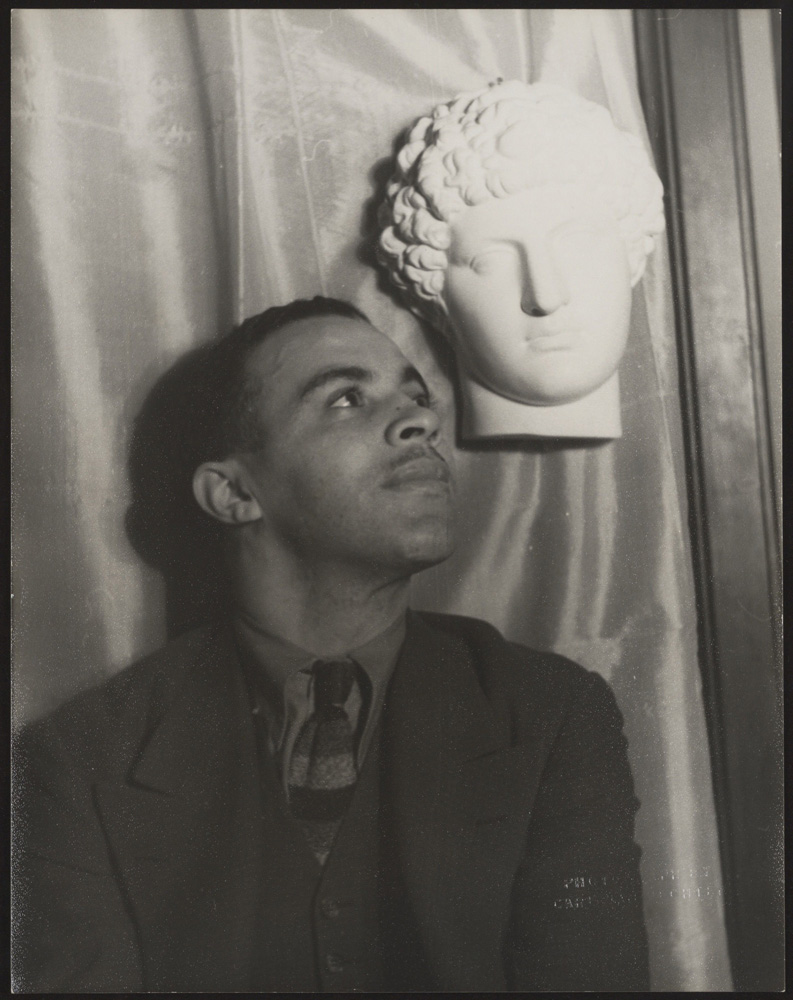
 

Carl Van Vechten (American, 1880-1964) 'Richard Bruce Nugent (1906-1987)' 1936


Carl Van Vechten (American, 1880-1964)
Richard Bruce Nugent (1906-1987)
1936
Reproduction
Carl Van Vechten Papers Relating to African American Arts and Letters, James Weldon Johnson Collection in the Yale Collection of American Literature, Beinecke Rare Book and Manuscript Library
© Van Vechten Trust


Paralleling Leyendecker’s idealised depictions of white men and often stereotypical images of Black ones, members of the Harlem Renaissance produced illustrated books, drawings, and photographs that conveyed positive images of Black masculinity through elegant dress and deportment. Taken by Carl Van Vechten, a gay white critic, novelist, and Renaissance promoter, this photograph of author and artist Richard Bruce Nugent signalled its subject’s gayness by including a bust of Antinous, the male lover of the Roman emperor Hadrian.
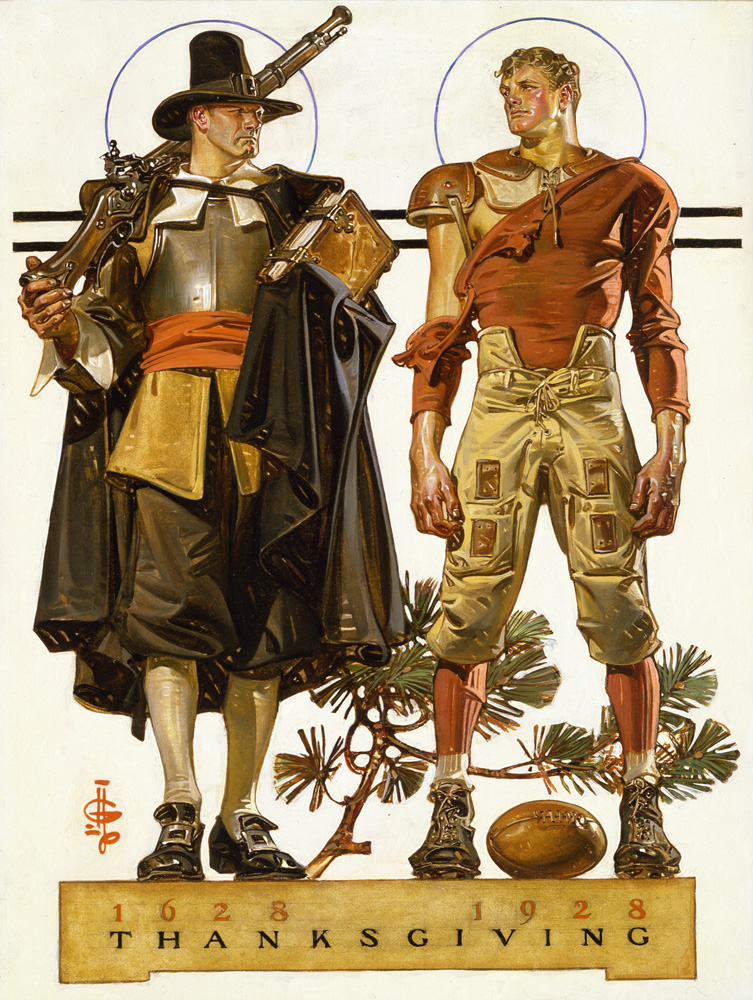
 

J.C. Leyendecker (American, 1874-1951) 'Thanksgiving: 1628-1928 (Pilgrim and Football Player)' 1928


J.C. Leyendecker (American, 1874-1951)
Thanksgiving: 1628-1928 (Pilgrim and Football Player)
Painting for cover of Saturday Evening Post, November 24, 1928
Oil on canvas
Private collection
Image courtesy of the National Museum of American Illustration, Newport, RI


Juxtaposing a modern muscular football player with a Pilgrim, Leyendecker’s painting for the 1928 Thanksgiving cover of the Saturday Evening Post positions the popular sport not only as a Thanksgiving pastime, but also as a cultural marker of American-ness. By the time the Post published this cover, football had been emerging for decades as an emblem of masculinity.
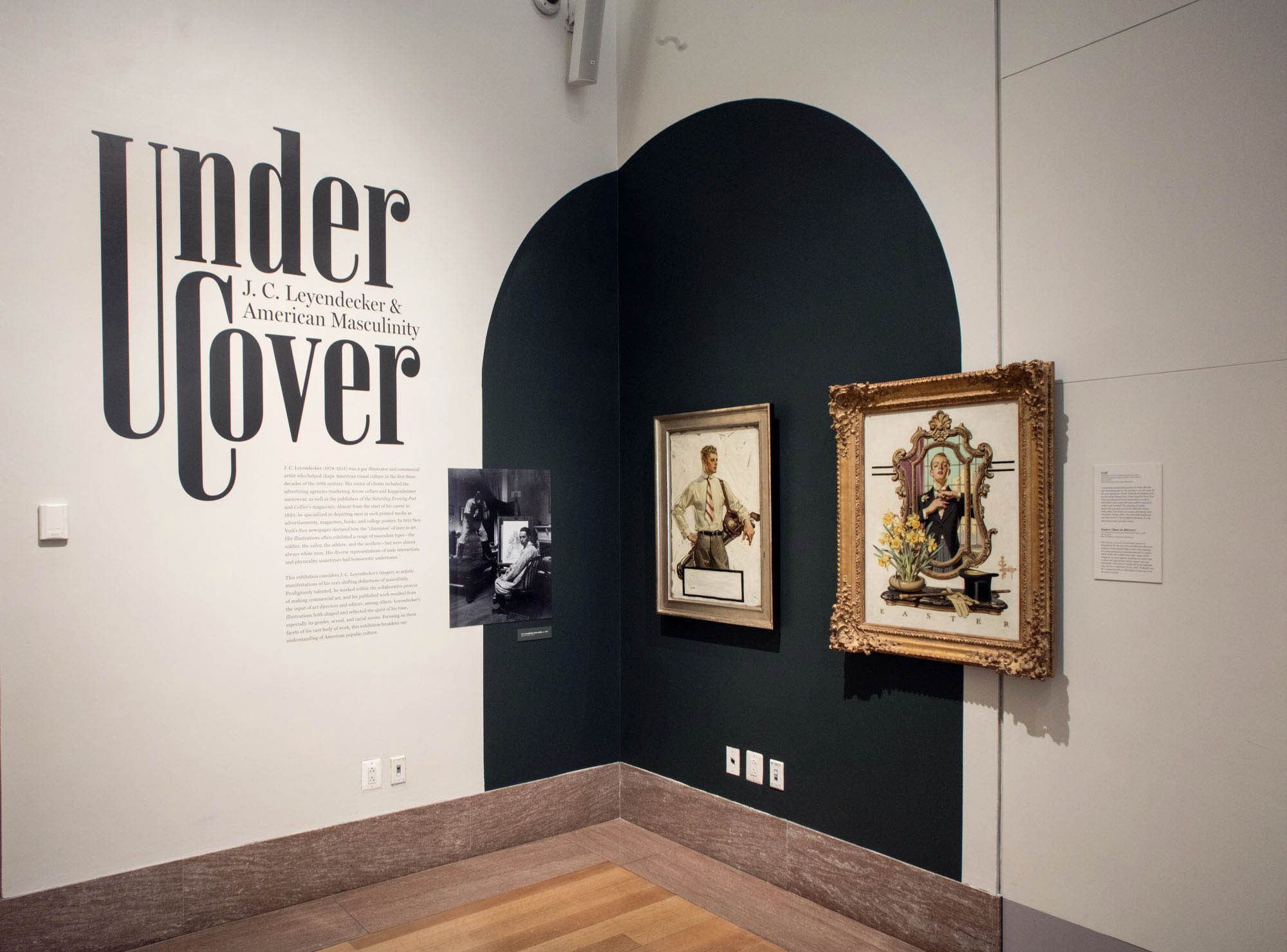
 

Installation view of the exhibition 'Under Cover: J.C. Leyendecker and American Masculinity' at the New-York Historical Society showing at right, Leyendecker's 'Easter – Man in the Mirror Painting' for cover of 'Saturday Evening Post', April 11, 1936 (below)


Installation view of the exhibition Under Cover: J.C. Leyendecker and American Masculinity at the New-York Historical Society showing at right, Leyendecker’s Easter – Man in the Mirror Painting for cover of Saturday Evening Post, April 11, 1936 (below)
Photo: Glenn Castellano, New-York Historical Society
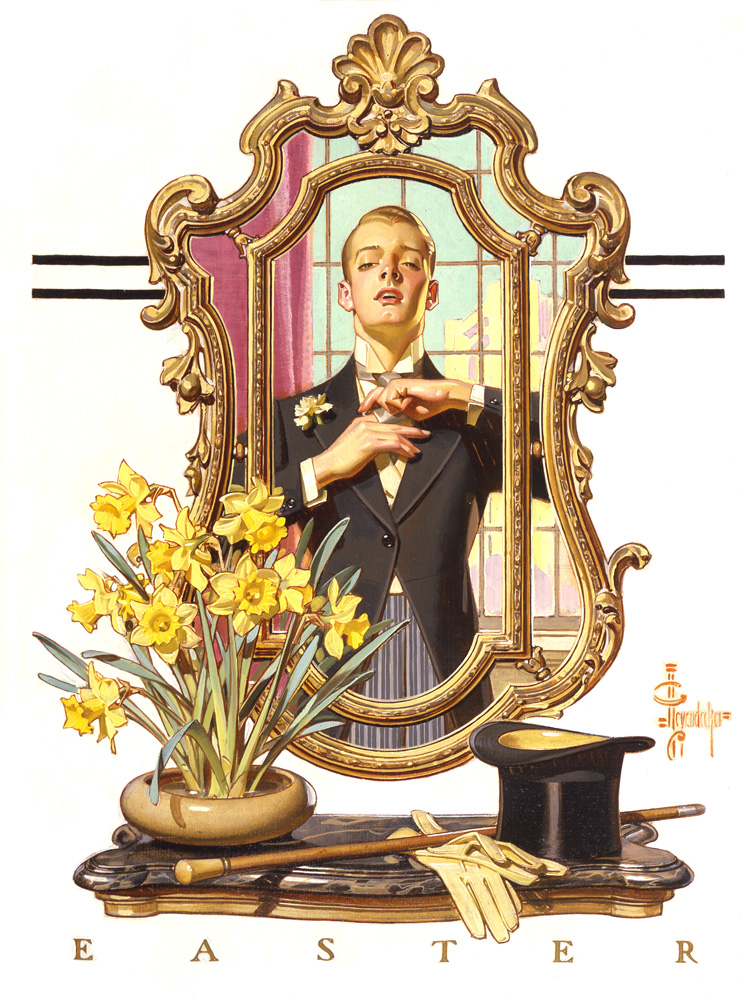
 

J.C. Leyendecker (American, 1874-1951) 'Easter – Man in the Mirror' 1936


J.C. Leyendecker (American, 1874-1951)
Easter – Man in the Mirror
Painting for cover of Saturday Evening Post, April 11, 1936
Oil on canvas
National Museum of American Illustration, Newport, RI


In his work, Leyendecker created drawings depicting multiple kinds of masculinity for the mass market, from preening, dandified men like this artwork’s subject to elegant men of leisure like the Arrow Collar Man to manly men like muscular sailors, lifeguards, and athletes. Timed to Easter, this cover illustration was also one of many instances of the artist creating Post illustrations themed to the seasons and holidays.


New-York Historical Society
170 Central Park West
at Richard Gilder Way (77th Street)
New York, NY 10024
Phone: (212) 873-3400

Opening hours:
Monday CLOSED
Tuesday – Thursday 11am – 5pm
Friday 11am – 8pm
Saturday – Sunday 11am – 5pm

New-York Historical Society website

LIKE ART BLART ON FACEBOOK

Back to top

Exhibition: ‘Photography in Argentina, 1850-2010: Contradiction and Continuity’ at The J. Paul Getty Museum, Los Angeles

Exhibition dates: 16th September, 2017 – 28th January, 2018


Charles DeForest Fredricks (American, 1823-1894) 'Inmigrantes alemanes en Buenos Aires jugando cartas' / 'German Immigrants in Buenos Aires Playing Cards' c. 1852 from the exhibition 'Photography in Argentina, 1850-2010: Contradiction and Continuity' at The J. Paul Getty Museum, Los Angeles, Sept 2017 - Jan 2018


Charles DeForest Fredricks (American, 1823-1894)
Inmigrantes alemanes en Buenos Aires jugando cartas / German Immigrants in Buenos Aires Playing Cards
c. 1852
Daguerreotype
Courtesy of Carlos G. Vertanessian


Charles DeForest Fredricks (American, 1823-1894)

Charles DeForest Fredricks (December 11, 1823 – May 25, 1894) was an American photographer.

Charles D. Fredricks was born in New York City on December 11, 1823. He learned the art of the daguerreotype from Jeremiah Gurney in New York, while he worked as a casemaker for Edward Anthony. In 1843, at the suggestion of his brother, Fredricks sailed for Angostura, today Ciudad Bolívar, Venezuela. His business took him to Pará, Rio Grande do Sul, Montevideo, Buenos Aires. He enjoyed great success in South America, remaining there until some time in the early 1850s.

Following a brief period in Charleston, South Carolina, Fredricks moved to Paris in 1853. Here he became the first photographer to create life-sized portraits, which artists (like Jules-Émile Saintin) were hired to colour using pastel.

On his return to New York City, he rejoined Jeremiah Gurney, though it is not clear whether he was initially a partner or an employee. By 1854, he had developed an early process for enlarging photographs. His partnership with Gurney ended in 1855.

During the latter half of the decade he operated a studio in Havana. Here he received awards for his photographic oil colours and watercolours. During the 1860s he operated a studio on Broadway that was noted for its cartes de visites. In the early 1860s, Charles Fredricks personally photographed John Wilkes Booth (the assassin of President Lincoln) on several occasions at his studio.

He retired from photography in 1889 and died in Newark, New Jersey, five years later, on May 25, 1894.

Text from the Wikipedia website


Charles DeForest Fredricks (American, 1823-1894) 'Inmigrantes alemanes en Buenos Aires jugando cartas' / 'German Immigrants in Buenos Aires Playing Cards' c. 1852 (detail)


Charles DeForest Fredricks (American, 1823-1894)
Inmigrantes alemanes en Buenos Aires jugando cartas / German Immigrants in Buenos Aires Playing Cards (detail)
c. 1852
Daguerreotype
Courtesy of Carlos G. Vertanessian


I knew very little about Argentinian photography before researching for this posting.

Such a rich historical photographic archive – Indigenous, political, activist, performative – engaged in the dissection of national identity construction. Lots of German émigrés, lots of strong women photographers e.g. Grete Stern, Annemarie Heinrich, Julio Pantoja and Graciela Sacco.

There is a deep probing in Argentinian photography. There is the irony of the not quite right and an investigation of the dark side, of danger, fear and violence, of loss, grief, rage and resignation. As one of the sections of the exhibition is titled, of Civilisation and Barbarism. A quotation in the posting observes, “One of the most effective means to exercise control of populations in contemporary capitalism is the production of fear.” Drop dead fear.

The bloodlines of the collective consciousness of the Argentinian people run very deep. The dead ones are still there…

Apologies for the lack of photographs in The Aesthetic Gesture section, there were just no good images available.

Dr Marcus Bunyan


Many thankx to the J. Paul Getty Museum for allowing me to publish the photographs in the posting. Please click on the photographs for a larger version of the image.


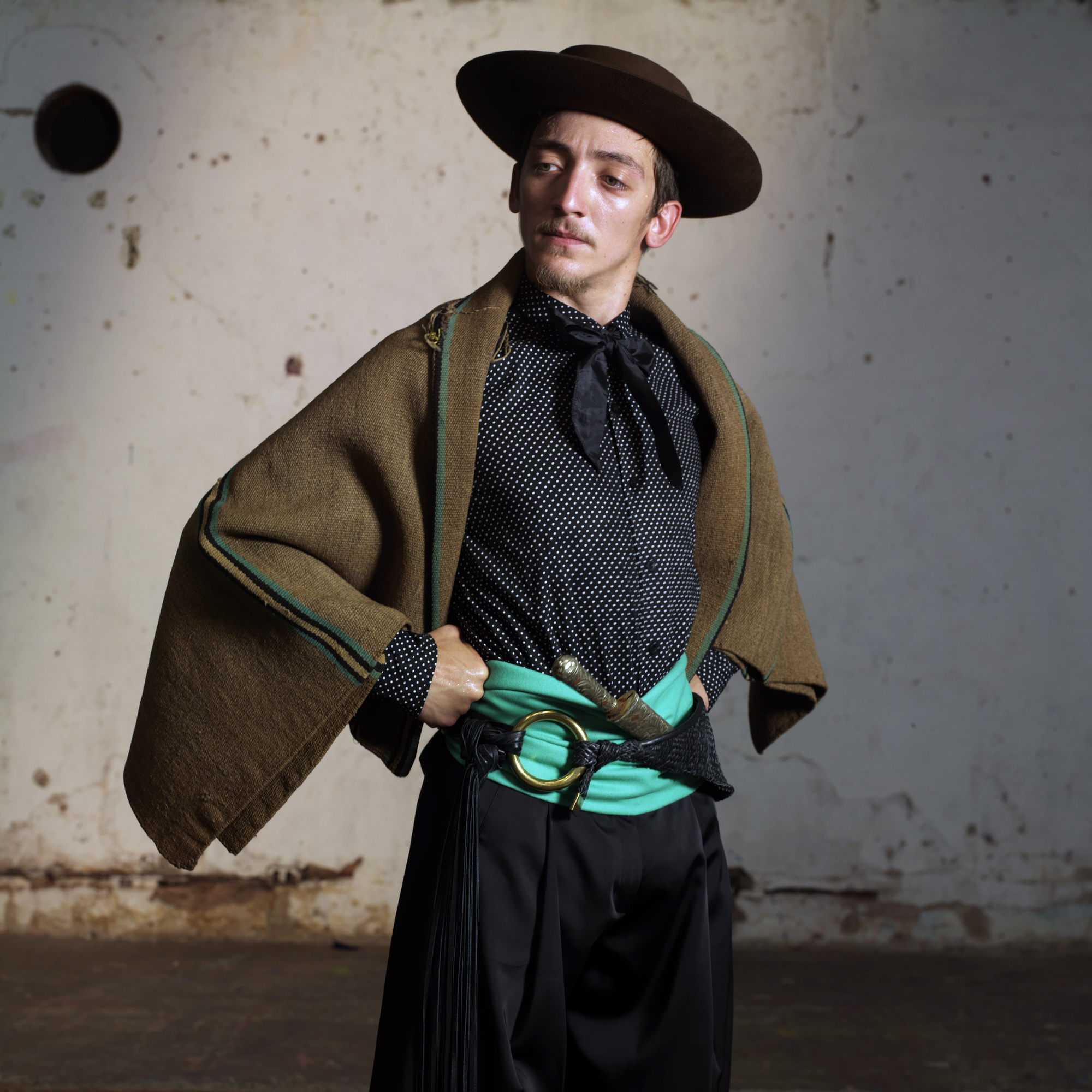
Gustavo Di Mario (Argentine, b. 1969) 'Malambistas I' / 'Malambo Dancers I' Negative 2014, print 2016 from the exhibition 'Photography in Argentina, 1850-2010: Contradiction and Continuity' at The J. Paul Getty Museum, Los Angeles, Sept 2017 - Jan 2018


Gustavo Di Mario (Argentinian, b. 1969)
Malambistas I / Malambo Dancers I
Negative 2014, print 2016
Chromogenic print
60 x 50cm
Courtesy of Gustavo Di Mario
© Gustavo Di Mario


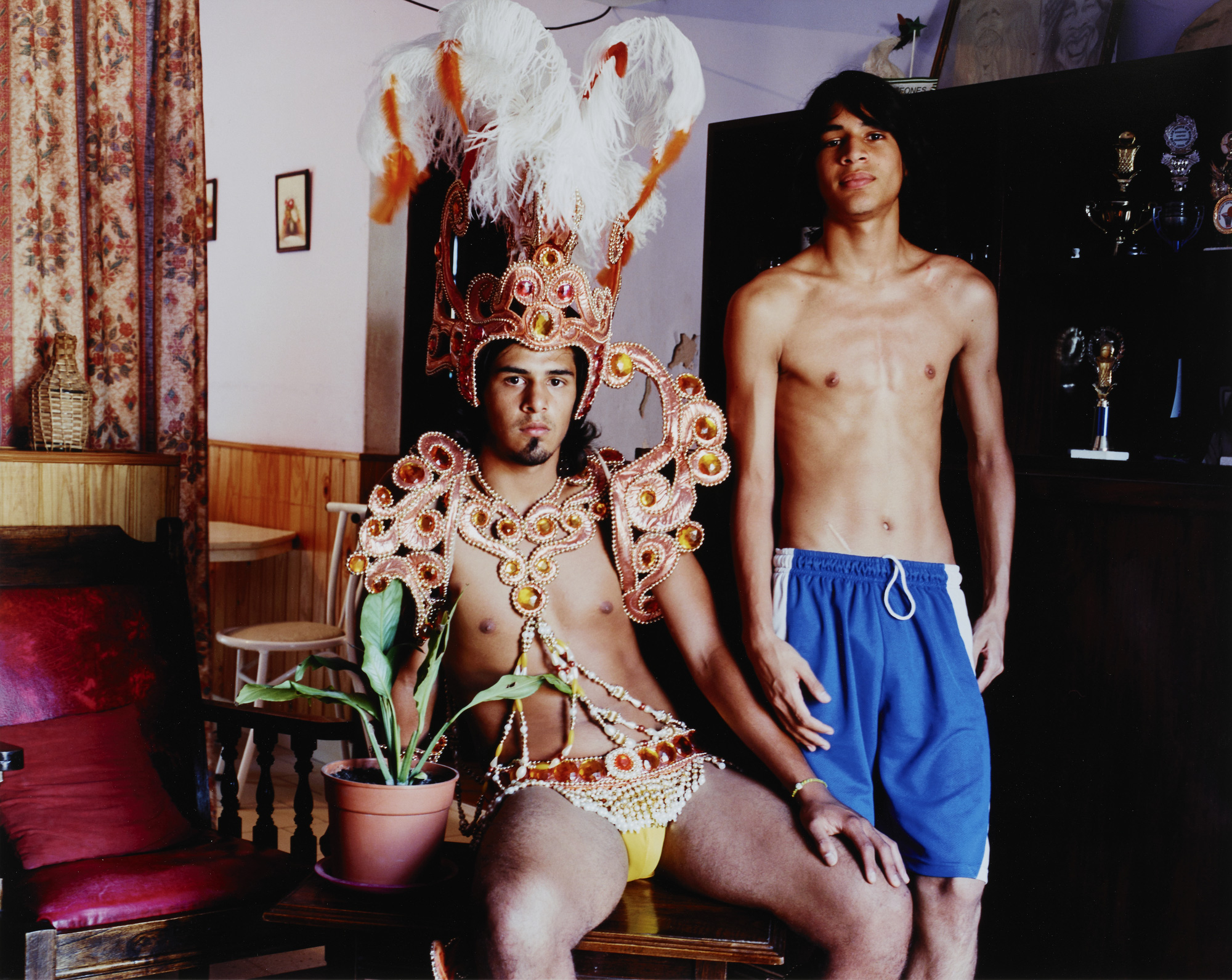
Gustavo Di Mario (Argentinian, b. 1969) 'Carnaval' Negative 2005, printed 2015


Gustavo Di Mario (Argentinian, b. 1969)
Carnaval
Negative 2005, printed 2015
Chromogenic print
50 x 63.1cm
The J. Paul Getty Museum, purchased with funds provided by the Photographs Council
© Gustavo Di Mario


From its independence in 1810 until the economic crisis of 2001, Argentina was perceived as a modern country with a powerful economic system, a strong middle class, a large European-immigrant population, and an almost nonexistent indigenous culture. This perception differs greatly from the way that other Latin American countries have been viewed, and underlines the difference between Argentina’s colonial and postcolonial process and those of its neighbours. Comprising three hundred works by sixty artists, this exhibition examines crucial periods and aesthetic movements in which photography had a critical role, producing – and, at times, dismantling – national constructions, utopian visions, and avant-garde artistic trends.

This exhibition is part of Pacific Standard Time: LA/LA, a far reaching and ambitious exploration of Latin American and Latino art in dialogue with Los Angeles, taking place from September 2017 through January 2018 at more than 70 cultural institutions across Southern California. Pacific Standard Time is an initiative of the Getty. The presenting sponsor is Bank of America.

Contradiction and Continuity examines the complexities of Argentina’s history over 160 years, stressing the creation of contradictory narratives and the role of photography in constructing them. The exhibition concentrates on photographs that are fabricated rather than found, such as narrative tableaux and performances staged for the camera. However, it also includes examples of what has been considered documentary photography but can be interpreted as imagery intended as political propaganda or expressions of personal ideology.

The exhibition comprises seven sections: Civilization and Barbarism; National Myths: The Indigenous People; National Myths: The Gaucho; National Myths: Evita and the Modern City; The Aesthetic Gesture; The Political Gesture; and Fissures. These themes were chosen to emphasise crucial historical moments and aesthetic movements in Argentina in which photography played a critical role.

Civilisation and Barbarism

In 1845 Domingo Sarmiento (1811-1888), a prominent Argentine intellectual, published the novel Facundo, subtitled Civilization and Barbarism. Sarmiento, who would later be elected president, presented his political ideas in terms of an opposition between civilisation, represented by the capital city of Buenos Aires and European culture, and barbarism, represented by colonial customs, the gauchos, and the indigenous peoples. This section of the exhibition employs these antagonistic themes to introduce some of the complexities of Argentina’s history and culture. Nineteenth-century albums show the growth and advancement of the country through views of Buenos Aires and images that refer to progressive strategies initiated during this period, including railroad construction and the development of the educational system. In contrast, the work of several contemporary artists embodies the lifestyle and popular culture of the vast interior provinces of Argentina.

Like Sarmiento, Juan Bautista Alberdi (1810-1884), another influential intellectual, viewed immigration as a definitive measure for modernising the country. In Bases, published in 1853, he addressed the necessity of implementing policies to encourage immigration. The studio photographs in this section depict the growing presence of immigrant communities. Immigration is a key component to understanding Argentine society that continues to inspire contemporary artists.


Esteban Gonnet (French, 1830-1868) 'Recuerdos de Beunos Ayres' / 'Memories of Beunos Aires' 1864


Esteban Gonnet (French, 1830-1868)
Recuerdos de Beunos Ayres / Memories of Beunos Aires
1864
Page opening: La pirámide / The Pyramid
Albumen print


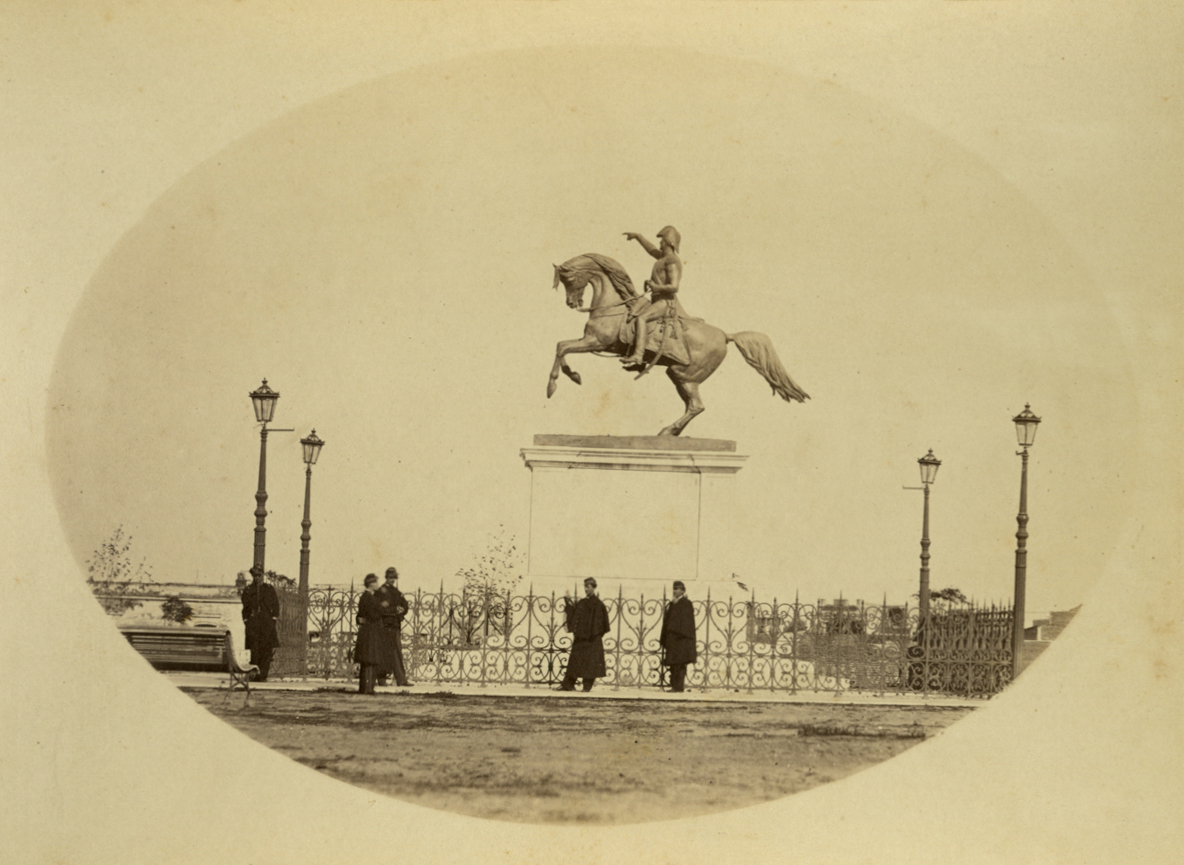
Benito Panunzi (Italian, 1835-1896) 'Monument to General San Martín' c. 1860-1869


Benito Panunzi (Italian, 1835-1896)
Monument to General San Martín
c. 1860-1869
Albumen print


National Myths: The Gaucho

The National Myths section of the exhibition focuses on the construction of specific state symbols, including indigenous people, the gaucho, First Lady Eva Perón, and the city of Buenos Aires. Around 1880, coinciding with increasing waves of immigration and efforts at modernisation, an avid debate on national identity arose among Argentine intellectuals and politicians.

By 1910, when the Centennial of Independence was celebrated, the gaucho emerged as an emblematic figure in the national iconography. The gaucho was already a common theme in Costumbrista (customs and character types) paintings of the eighteenth and nineteenth centuries. Criollismo (native culture), a movement of the late nineteenth century, stimulated a wider interest in gaucho-themed art, fiction, theatre, and photographs.

José Hernández’s epic narrative poem Martín Fierro (1872) and Eduardo Gutiérrez’s novel Juan Moreira (1879) were major influences. About 1890, amateur photographer Francisco Ayerza staged a series of romanticised photographs meant to illustrate a later edition of Fierro. Commercial studios accommodated women and children who wanted to be pictured as gauchos. More than a national symbol, the gaucho embodied the idealised masculinity of the virile Argentine man; the contemporary fashion photographs of Gustavo Di Mario present a queer interpretation of the gauchesque.


Francisco Ayerza (Argentinian, 1860-1901) 'Estudio para la edición de "Martín Fierro," gaucho con caballo' / 'Study for an edition of Martín Fierro, Gaucho with Horse' c. 1890, print about 1900-1905


Francisco Ayerza (Argentinian, 1860-1901)
Estudio para la edición de “Martín Fierro,” gaucho con caballo / Study for an edition of Martín Fierro, Gaucho with Horse
c. 1890, print about 1900-1905
Gelatin silver print
Courtesy of a private collection


Francisco Ayerza (1860 – Buenos Aires, Argentina – 1901), was a photographic artist founding member of the Argentine Photographic Society. He formed an artistic movement in Latin America .

At the end of the 19th century, Doctor Francisco Ayerza cultivated the still new photographic art as an amateur. He was one of the organizers of the Argentine Amateur Photographic Society, the first entity of the genre created in that country.

It was at Francisco Ayerza’s house (1266 Piedad Street) where a group of gentlemen met “with the aim of forming a society of photography amateurs”, which ultimately constituted the Argentine Amateur Photographic Society (1889). The following participated in the first session: Leonardo Pereyra, who was elected president; Germán Kühr, Francisco Ayerza (secretary), José María Gutiérrez, Roberto Wernicke, Ricardo N. Murray, Fritz Büsch, Juan Quevedo, Isidro Calderón de la Barca Piñeyro, Daniel MacKinglay, Leonardo Pereyra Iraola, Fernando Steinius and Fernando Denis. …

An aspect of the immediate reality that seduced Francisco Ayerza and his friends for its picturesque appearance was the Pampa, whose geography began to be altered by machinism and immigration, as documented by some prints. From this interest in the Argentine countryside and its customs was born the idea of ​​photographically illustrating the Martín Fierro and, although they made many shots, it could not be finished, despite the efforts made by the authors in such an exhausting task, and although the selected field to photograph was the Estancia San Juan de Pereyra, very close to Buenos Aires.

Text translated from the Spanish Wikipedia website


Gustavo Di Mario (Argentinian, b. 1969) 'Malambistas IV' / 'Malambo Dancers IV' Negative 2014, print 2016


Gustavo Di Mario (Argentinian, b. 1969)
Malambistas IV / Malambo Dancers IV
Negative 2014, print 2016
Chromogenic print
60 x 50cm
Courtesy of Gustavo Di Mario
© Gustavo Di Mario


Malambo was born in the Pampas around the 1600. Malambo is a peculiar native dance that is executed by men only. Its music has no lyrics and it is based entirely on rhythm. The malambo dancer is a master of tap dancing wearing gaucho’s boots. Among the most important malambo moves are: “la cepillada” (the foot sole brushes the ground), “el repique” (a strike to the floor using the back part of the boot) and the “floreos”. Malambo dancers’ feet barely touch the ground but all moves are energetic and complex. Together with tap dancing, malambo dancers use “boleadoras” and other aids such as “lazos”. Like “Payadas” for gauchos (improve singing), malambo was *the* competition among gaucho dancers.

Read more about the Malambo dance


Nicola Constantino (Argentinian, b. 1964) 'Nicola alada, inspirado en Bacon inspirado en Rembrandt' / 'Winged Nicola, Inspired by Bacon Inspired by Rembrandt' 2010


Nicola Constantino (Argentinian, b. 1964)
Nicola alada, inspirado en Bacon inspirado en Rembrandt / Winged Nicola, Inspired by Bacon Inspired by Rembrandt
2010
Inkjet print
173 x 135cm
Courtesy of Nicola Constantino
© Nicola Constantino


Marcos López (Argentinian, b. 1958) 'Reina del trigo. Gálvez, Provincia de Santa Fe' (Queen of Wheat, Gálvez, Santa Fe Province) 1997


Marcos López (Argentinian, b. 1958)
Reina del trigo. Gálvez, Provincia de Santa Fe (Queen of Wheat, Gálvez, Santa Fe Province)
1997, printed 2017
Hand-coloured inkjet print
50 × 70cm (19 11/16 × 27 9/16 in.)
Courtesy of the artist and Rolf Art, Buenos Aires
© Marcos López


Marcos López (Argentinian, b. 1958) 'Gaucho Gil. Buenos Aires' 2009, print 2017


Marcos López (Argentinian, b. 1958)
Gaucho Gil. Buenos Aires
2009, printed 2017
Hand-coloured inkjet print
144 × 100cm
Courtesy of Rolf Art and Marcos López
© Marcos López


National Myths: The Indigenous People

While the gaucho became a national myth, “official” images rarely addressed the existence of indigenous peoples. The practice of recording their presence in photography, however, was well established by the late nineteenth century. It began in the portrait studios of Buenos Aires when native caciques (chiefs) visited the capital for peaceful negotiations, or when they were brought in as prisoners and made to pose in traditional garb. Later, photographers would travel by train or wagon to Native American settlements or plantations where indigenous people worked.

These staged compositions, as in the rest of Latin America, portrayed indigenous people as exotic and passive, objectifying them and emphasising their “otherness.” Sitters were always isolated from signs of the “civilised” or “Christian” world. The iconography found in these nineteenth- and early twentieth century photographs corresponds to a nostalgic image of a backward and subjugated group ignored by progress. Modernist and contemporary artists, such as Grete Stern and Guadalupe Miles, presented a different and more accurate view of these people. Both Stern and Miles immersed themselves in indigenous communities, portraying their subjects as individuals rather than stereotypes.


Esteban Gonnet (French, 1830-1868) 'Cacique Tehuelche Casimiro Biguá' / 'Tehuelche Chief, Casimiro Biguá' 1864


Esteban Gonnet (French, 1830-1868)
Cacique Tehuelche Casimiro Biguá / Tehuelche Chief, Casimiro Biguá
1864
Albumen print
14.1 x 9.7cm
Courtesy of the Daniel Sale Collection
Photo: Javier Augustín Rojas


Born in Grenoble, France, Esteban Gonnet moved to Argentina from Newcastle, England, in 1857. Gonnet became a photographer after arriving in Buenos Aires in 1857. He was a surveyor, working with his cousin Hippolyte Gaillard, also a surveyor.

Gonnet’s work reflected the rural lifetime and customs, showing the life and customs of Aboriginal people and paisanos of that era, although Gonnet also took photographies in urban places. In most of his photography he tried to show the typical image of the creole, stereotyping Argentine customs, and using objects as symbols that would create iconic images of the era. His photos were then sold abroad (mostly in Europe), when photography of travels or distant places where gaining in popularity. Gonnet’s innovative style of work consisted of the use of negative system rather than daguerreotype (that was the most common technique by then). Furthermore, Gonnet usually chose to take pictures outdoors instead of working at a studio, which was also his hallmark.

Text from Wikipedia website


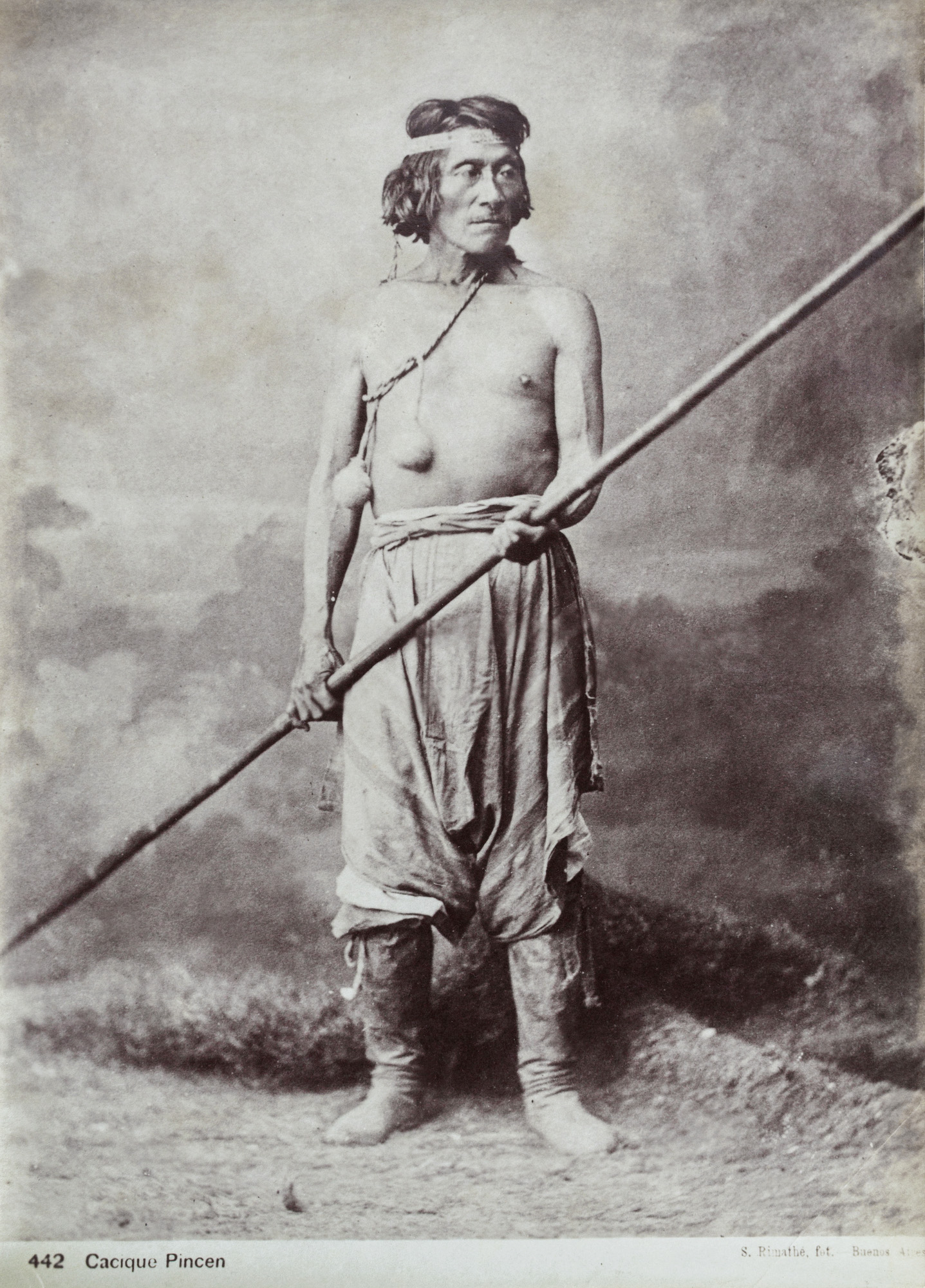
Antonio Pozzo (Argentinian born Italy, 1829-1910) 'Cacique Pincén' (Chief Pincén) 1878


Antonio Pozzo (Argentinian born Italy, 1829-1910)
Cacique Pincén (Chief Pincén)
1878
Printed by Samuel Rimathé, Swiss, born Italy, 1863-unknown
Albumen print
20.2 x 14cm (7 15/16 x 5 1/2 in.)
Collection of Diran Sirinian


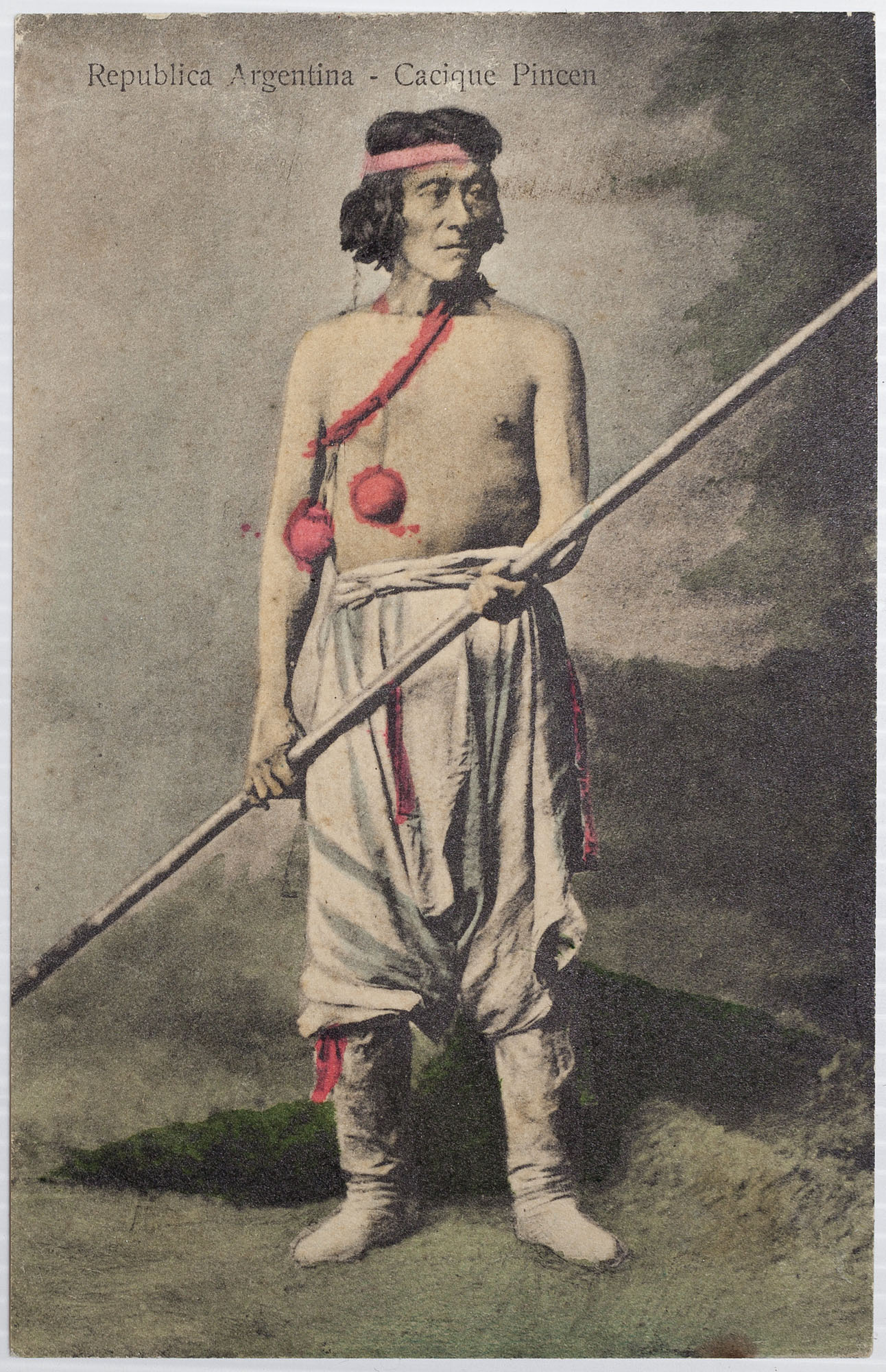
Antonio Pozzo (Argentinian born Italy, 1829-1910) 'Cacique Pincén' (Chief Pincén) negative 1878; print c. 1900


Antonio Pozzo (Argentinian born Italy, 1829-1910)
Cacique Pincén (Chief Pincén)
Negative 1878; print c. 1900
Unknown printer, active Argentina, c. 1900
Hand-coloured halftone postcard
13.7 x 8.7cm
Courtesy of the Daniel Sale Collection
Photo: Javier Augustín Rojas


Sociedad Fotográfica Argentina de Aficionados (Argentine, active 1889-1926) 'India yagán u ona tejiendo una canasta' / 'Yagán or Ona Woman Weaving a Basket' c. 1890s


Sociedad Fotográfica Argentina de Aficionados (Argentine, active 1889-1926)
India yagán u ona tejiendo una canasta / Yagán or Ona Woman Weaving a Basket
c. 1890s
Printing-out paper
21 x 17cm
Courtesy of the Daniel Sale Collection
Photo: Javier Augustín Rojas


Attributed to Carlos R. Gallardo (Argentinian, 1855-1938) 'Esperando el ataque' / 'Waiting for the Attack' 1902


Attributed to Carlos R. Gallardo (Argentinian, 1855-1938)
Esperando el ataque / Waiting for the Attack
1902
Gelatin silver print
15.5 x 22cm
Courtesy of the Diran Sirinian
Photo: Javier Augustín Rojas


Grete Stern (Argentinian born Germany, 1904-1999) 'Mujer pilagá con sus hijos. Los Lomitas, Formosa' / 'Pilagá Woman with her Kids. Las Lomitas, Formosa' 1964


Grete Stern (Argentinian born Germany, 1904-1999)
Mujer pilagá con sus hijos. Los Lomitas, Formosa / Pilagá Woman with her Kids. Las Lomitas, Formosa
1964
From the series Aborígenes del gran Chaco argentine / Indigenous People from the Argentine Gran Chaco
Gelatin silver print
30 x 38cm
Courtesy of a private collection
© Estate of Grete Stern courtesy Galería Jorge Mara – La Ruche, Buenos Aires, 2016


Grete Stern (9 May 1904 – 24 December 1999) was a German-Argentinian photographer. Like her husband Horacio Coppola, she helped modernise the visual arts in Argentina, and in fact presented the first exhibition of modern photographic art in Buenos Aires, in 1935. (Wikipedia)

In Berlin in 1927, Stern began taking private classes with Walter Peterhans, who was soon to become head of photography at the Bauhaus. A year later, in Peterhans’s studio, she met Ellen (Rosenberg) Auerbach, with whom she opened a pioneering studio specialising in portraiture and advertising. Named after their childhood nicknames, the studio ringl + pit embraced both commercial and avant-garde loyalties, creating proto-feminist works. In Buenos Aires during the same period, Coppola initiated his photographic experimentations, exploring his surroundings and contributing to the discourse on modernist practices across media in local cultural magazines. In 1929 he founded the Buenos Aires Film Club to introduce the most innovative foreign films to Argentine audiences. His early works show the burgeoning interest in new modes of photographic expression that led him to the Bauhaus in 1932, where he met Stern and they began their joint history.

Following the close of the Bauhaus and amid the rising threat of the Nazi powers in 1933, Stern and Coppola fled Germany. Stern arrived first in London, where her friends included activists affiliated with leftist circles and where she made her now iconic portraits of German exiles, including those of Bertolt Brecht and Karl Korsch. After traveling through Europe, camera in hand, Coppola joined Stern in London, where he pursued a modernist idiom in his photographs of the fabric of the city, tinged alternately with social concern and surrealist strangeness.

In the summer of 1935, Stern and Coppola embarked for Buenos Aires [the had married in the same year, divorcing in 1943], where they mounted an exhibition in the offices of the avant-garde magazine Sur, announcing the arrival of modern photography in Argentina. The unique character of Buenos Aires was captured in Coppola’s photographic encounters from the city’s centre to its outskirts, and in Stern’s numerous portraits of the city’s intelligentsia, from feminist playwright Amparo Alvajar to essayist Jorge Luis Borges to poet-politician Pablo Neruda.

Text from the MoMA website


Leonel Luna (Argentinian, b. 1965) 'El rapto de Guinnard' / 'The Kidnap of Guinnard' 2002; print, 2017


Leonel Luna (Argentinian, b. 1965)
El rapto de Guinnard / The Kidnap of Guinnard
2002; print, 2017
Inkjet print on vinyl
112 x 72cm
Courtesy of a private collection
© Leonel Luna


National Myths: Evita and the Modern City

Photography contributed substantially to the construction of the myths of Buenos Aires as the “Modern City” and Evita as the symbol of Peronism. From the 1930s into the 1950s, the capital, like other advanced cosmopolitan metropolises, continued to expand. Some of the emblematic streets and monuments of the city, such as the Obelisk (1936), Avenida 9 de Julio (begun 1935), and Avenida Corrientes (1936), were built or renovated during this period. Buenos Aires became a model of progress for photographers like Horacio Coppola and Sameer Makarius, who produced series reinforcing this view.

Photography was among the propagandistic strategies deployed by the populist Perón administration (1946-1955). Eva Duarte de Perón (1919-1952), known as Evita, had an important role during the first presidency of her husband, Juan Perón (1895-1974), and became the most enduring image of Peronist ideology. Numerous photographers contributed to building an image of Evita as both an elegant celebrity and a compassionate politician. While Juan Di Sandro, considered the father of photojournalism in Argentina, made her political life accessible through views of official events, Annemarie Heinrich helped create her “new” femininity in glamorous studio portraits. Jaime Davidovich’s installation Evita, Then and Now: A Video Scrapbook (1984) and Santiago Porter’s Evita (2008) offer contrasting – critical as well as multidimensional – views of this complex figure.


Annemarie Heinrich (Argentinian born Germany, 1912-2005) 'Eva Perón' Negative 1944, print 1995


Annemarie Heinrich (Argentinian born Germany, 1912-2005)
Eva Perón
Negative 1944, print 1995
Gelatin silver print
32.5 x 27cm
Courtesy of Galería Vasari
© Archivo Heinrich Sanguinetti


Annemarie Heinrich (9 January 1912 – 22 September 2005) was a German-born naturalised Argentine photographer, who specialised in portraits and nudity. She is known for having photographed various celebrities of Argentine cinema, such as Tita Merello, Carmen Miranda, Zully Moreno and Mirtha Legrand; as well as other cultural personalities like Jorge Luis Borges, Pablo Neruda and Eva Perón.

Heinrich was born in Darmstadt and moved to Larroque, Entre Ríos Province, with her family in 1926, her father having been injured during the First World War. In 1930 she opened her first studio in Buenos Aires. Two years later she moved to a larger studio, and began photographing actors from the Teatro Colón. Her photos were also the cover of magazines such as El Hogar, Sintonía, Alta Sociedad, Radiolandia and Antena for forty years.

Heinrich’s work was shown in New York for the first time in 2016 at Nailya Alexander Gallery in the show “Annemarie Heinrich: Glamour and Modernity in Buenos Aires.” Heinrich is considered one of Argentina’s most important photographers.

Text from the Wikipedia website


Annemarie Heinrich (Argentinian born Germany, 1912-2005) 'Veraneando en la ciudad' / 'Spending the Summer in the City' 1959


Annemarie Heinrich (Argentinian born Germany, 1912-2005)
Veraneando en la ciudad / Spending the Summer in the City
1959
Gelatin silver print
18 x 18cm
Courtesy of the Guillermo Navone Collection
© Archivo Heinrich Sanguinetti


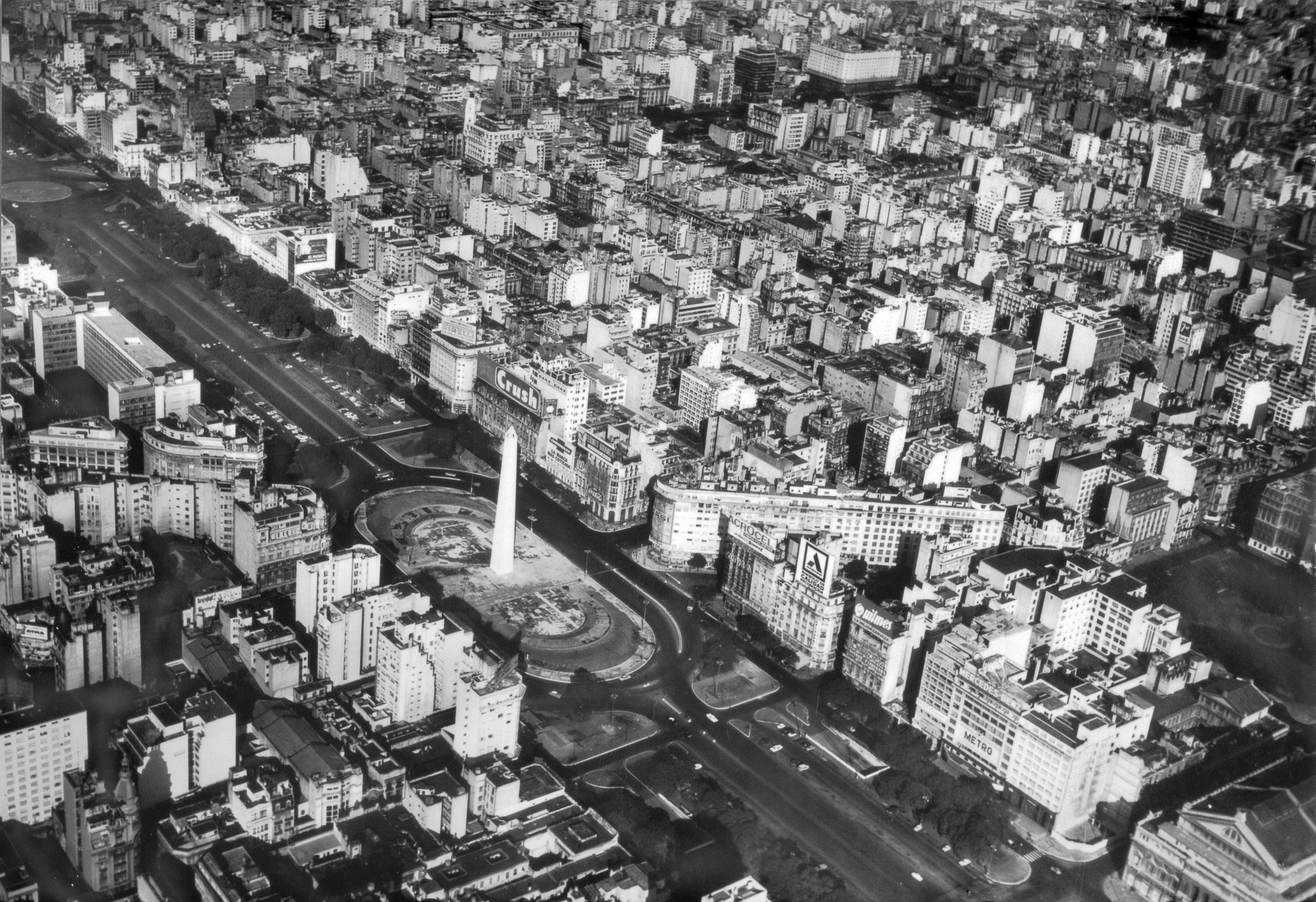
Juan Di Sandro (Argentinian born Italy, 1898-1988) 'Avenida 9 de julio con obelisco. Vista panorámica' / 'Avenida 9 de Julio with Obelisk. Panoramic View' 1956


Juan Di Sandro (Argentinian born Italy, 1898-1988)
Avenida 9 de julio con obelisco. Vista panorámica / Avenida 9 de Julio with Obelisk. Panoramic View
1956
Gelatin silver print
29 x 42cm
Courtesy of Galería Vasari
© Familia Di Sandro


Sameer Makarius (Argentinian born Egypt, 1924-2009) 'Obelisco' / 'Obelisk' 1957


Sameer Makarius (Argentinian born Egypt, 1924-2009)
Obelisco / Obelisk
1957
Gelatin silver print
Courtesy of Diran Sirinian
Photo: Javier Agustin Rojas
© Throckmorton Fine Arts


Sameer Makarius was without doubt one of the most prolific photographers in Buenos Aires during the 1950s and 60s. Almost every weekend, he ventured out taking along with him his two cameras, a Leica and an Olympus, to record his new home town. Makarius arrived in Buenos Aires in 1953 and the city must have made a real impact on him. Europe was scarred and slowly recuperating, but things were completely different here. A bustling, modern, elegant plus very confident capital was waiting to be explored. Taking photographs probably helped him to find his bearings and get to know the customs of the city’s inhabitants really well. But then, everybody’s past often determines both their present and their future. Makarius had studied art in Hungary and – being an artist – was inclined to a visual approach. He started out as a painter and abstraction, in all its various ramifications, was one of the main tendencies at the time, with Makarius following suit. Still, when he came to Argentina he was already principally interested in photography. At some stage, probably between the mid and late nineteen forties, a major shift had thus taken place and it is interesting to speculate why. Maybe, Makarius switched to photography because of practical reasons. Cameras were not only widely available at the time, but also coincided perfectly with his wandering life after the end of the war. Before moving to Argentina, he visited and lived in many countries, for example France and Switzerland. And, last but not least, because of his artistic background, he already knew how to deal with composition, light and shadow.

Marjan Groothuis. “Sameer Makarius,” on the Arte Aldia website Nd [Online] Cited 03/02/2022


Santiago Porter (Argentine, b. 1971) 'Evita' 2008


Santiago Porter (Argentinian, b. 1971)
Evita
2008
From the series Bruma II / Mist II
Inkjet print
154 x 123.5cm
Courtesy of the Collection Malba, Museo de Arte Latinoamericano de Buenos Aires
© Santiago Porter


The Political Gesture

The gesture of “pointing out” had its origin in conceptual Argentine photography of the 1960s and 1970s. The artistic act evolved into radical actions as the sociopolitical situation in Argentina deteriorated. This section of the exhibition investigates photographs of political gestures provoked by the last dictatorship of 1976-83, in relation to the earlier conceptual practice presented in the adjacent gallery, “The Aesthetic Gesture.”

The action of showing a photograph of a person who was kidnapped or “disappeared” during the dictatorship was employed by the activist group Madres de Plaza de Mayo. In their weekly marches, the Mothers always wore white head scarves and carried photographs of their children on homemade signs demanding they “Return Alive.” With the arrival of democracy and Nunca Más (Never Again), the official 1984 report of crimes against humanity, trials of the military leaders began. However, over the next fifteen years, many of those who were culpable operated with impunity due to such regulations as the Full Stop Law (1986), the Law of Due Obedience (1987), and the Pardons Act (1990). During this time, activist artist groups, such as Grupo Etcétera… and Escombros, emerged to remind the public of crimes and atrocities, pointing out those assassins who had hoped to remain anonymous.


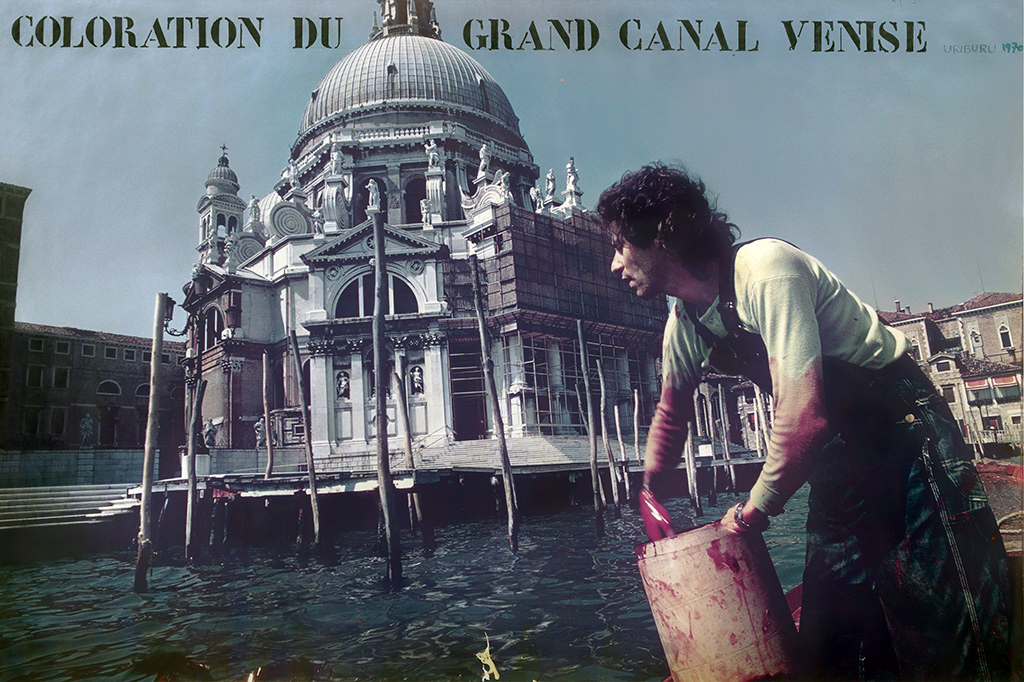
Nicolás García Uriburu (Argentinian, 1937-2016) 'Le Geste - Coloration Du Grand Canale - Venise 1968-1970' / 'The Gesture - Colouring the Grand Canal - Venice 1968-70' 1968-1970


Nicolás García Uriburu (Argentinian, 1937-2016)
Le Geste – Coloration Du Grand Canale – Venise 1970 / The Gesture – Colouring the Grand Canal – Venice 1970
1968-70
Chromogenic print, stencil and ink
67 x 101cm
Courtesy of Rubén and Agustina Esposito
© Nicolás García Uriburu


Born in Buenos Aires in 1937, García Uriburu began painting at an early age and, in 1954, secured his first exhibition at the local Müller Gallery. He enrolled at the University of Buenos Aires, where he received a degree in architecture, and relocated to Paris with his wife, Blanca Isabel Álvarez de Toledo, in 1965. He would later father a child named “Azul” with Blanca. His Three Graces, a sculpture in the pop art style, earned him a Grand Prize at the National Sculpture Salon in 1968. Venturing into conceptual art, he mounted an acrylic display at the Iris Clert Gallery, creating an artificial garden that set a new direction for García Uriburu’s work towards environmental activism.

He was invited to the prestigious Venice Biennale in June 1968, where García Uriburu dyed Venice’s Grand Canal using fluorescein, a pigment which turns a bright green when synthesised by microorganisms in the water. Between 1968 and 1970, he repeated the feat in New York’s East River, the Seine, in Paris, and at the mouth of Buenos Aires’ polluted southside Riachuelo.

A pioneer in what became known as land art, he created a montage in pastel colours over photographs of the scenes in 1970, allowing the unlimited photographic reproduction of the work for the sake of raising awareness of worsening water pollution, worldwide. In addition to environmental conservation he also produced works of art that showcased humanistic naturalism and an antagonism between society and nature, such as: Unión de Latinoamérica por los ríos (Latin America Union for Rivers), and No a las fronteras políticas (No to Political Borders).

Text from the Wikipedia website


Eduardo Longoni (Argentinian, b. 1959) 'Madres de Plaza de Mayo durante su habitual ronda' / 'Mothers of Plaza de Mayo during Their Customary March' 1981


Eduardo Longoni (Argentinian, b. 1959)
Madres de Plaza de Mayo durante su habitual ronda / Mothers of Plaza de Mayo during Their Customary March
1981
Gelatin silver print
Courtesy of and © Eduardo Longoni


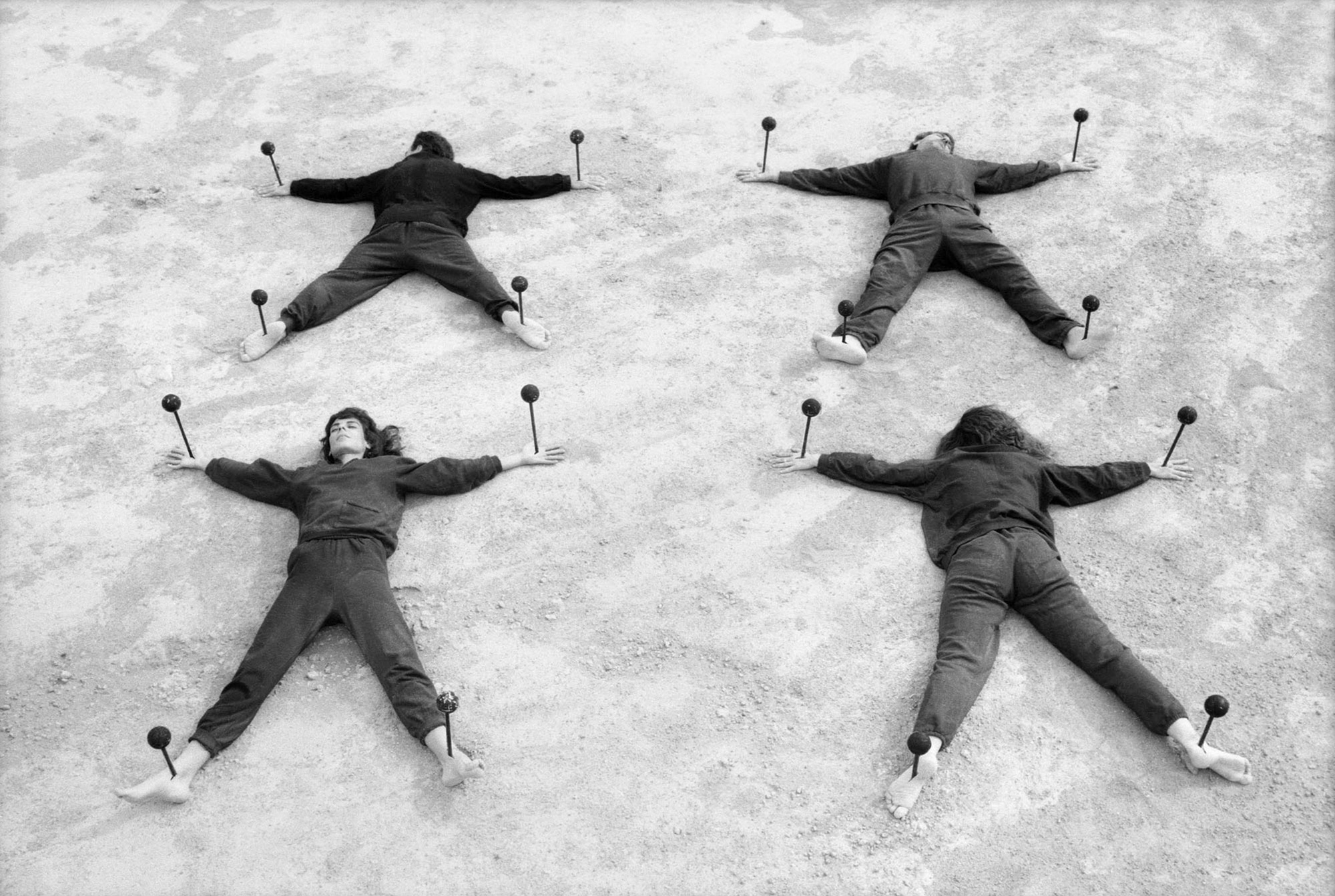
Eduardo Gil (Argentinian, b. 1948) 'Siluetas y canas. El Siluetazo. Buenos Aires 21-22 de setiembre, 1983' / 'Silhouettes and Cops. El Siluetazo. Buenos Aires, September 21-22, 1983' 1983


Eduardo Gil (Argentinian, b. 1948)
Siluetas y canas. El Siluetazo. Buenos Aires 21-22 de setiembre, 1983 / Silhouettes and Cops. El Siluetazo. Buenos Aires, September 21-22, 1983
1983
Gelatin silver print
17.5 x 24.5cm
Courtesy of a private collection
© Eduardo Gil


Adriano Lestido (Argentinian, b. 1955) 'Madre e hija de Plaza de Mayo' / 'Mother and Daughter from Plaza de Mayo' 1982, printed 1984


Adriano Lestido (Argentinian, b. 1955)
Madre e hija de Plaza de Mayo / Mother and Daughter from Plaza de Mayo
1982, printed 1984
Gelatin silver image
16.5 x 21.2cm
Courtesy of Rolf Art and Adriana Lestido
© Adriana Lestido


Grupo Escombros (Argentine, active since 1988) 'Mariposas' (Butterflies) 1988


Grupo Escombros (Argentine, active since 1988)
Mariposas (Butterflies)
1988
Pancartas (Signs) series
Chromogenic print (printed in monochrome) mounted on wood
40 × 60cm (15 3/4 × 23 5/8 in.)
Courtesy of the artists and WALDEN, Buenos Aires
© Grupo Escombros / WALDEN


Grupo Escombros was born in 1988, in full hyperinflation, as a group of street art or public art as it is usually defined. In that Argentina where the economic value of things changed hour by hour, everything seemed to collapse, including democracy reconquered at the cost of 30,000 missing and collective wounds that may never close.

When analysing this social, political and economic situation, the founding artists of the group asked themselves what would be left of the country. The answer was: “the rubble.” That day the group acquired its name. A name that today is more current than ever, because Argentina continues to collapse, relentlessly. Next to the name, and beyond the inevitable changes, there are characteristics that remained intact:

Most of the works were made outdoors, one street, a square, a cellar, an urban stream

They always express the sociopolitical reality that the country lives at that moment

It is expressed through all possible forms of communication: installations, manifestos, murals, objects, posters, poems, prints, talks, visual poems, graffiti, postcards, net art

Its members come from various disciplines: plastic, journalism, design, architecture. Their works are always collective, annulling the individualities that compose it. They do not belong to any political party or religious creed in particular. Despite constantly denouncing the conditions of absolute injustice in which the men, women and children of Argentina and Latin America live, it is a mistaken simplification to say that it is only a protest group.

Anonymous text from the Grupo Escombros website Nd [Online] 24/01/2018. No longer available online


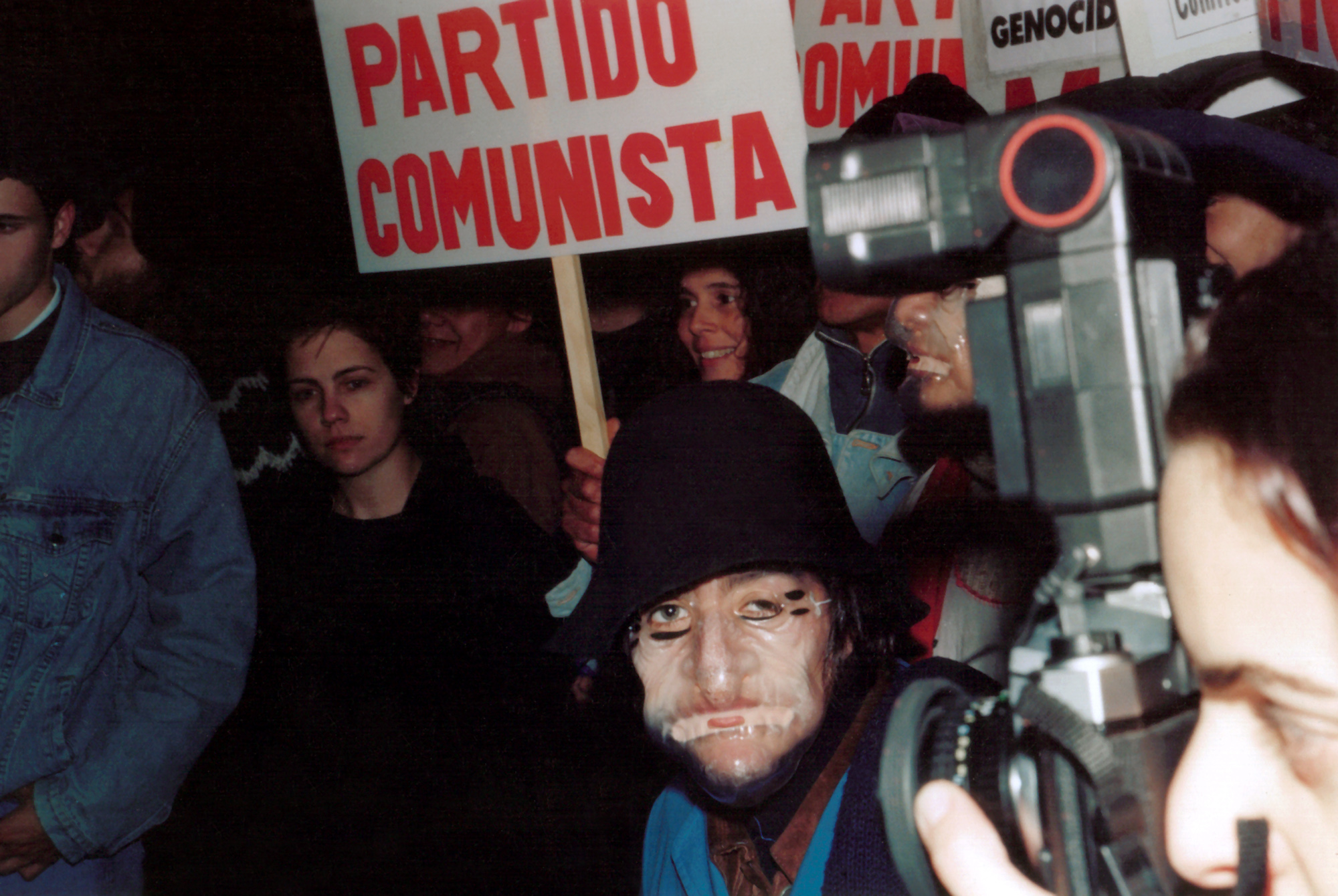
Grupo Etcétera (Argentine, active since 1997) 'MÁSCARAS DESINHIBIDORAS - Escraches a los militares Riverso y Peyón' / 'UNINHIBITING MASKS - Escraches to (Former) Military Officers Riverso and Peyón (2)' 1998


Grupo Etcétera (Argentine, active since 1997)
MÁSCARAS DESINHIBIDORAS – Escraches a los militares Riverso y Peyón / UNINHIBITING MASKS – Escraches to (Former) Military Officers Riverso and Peyón (2)
1998
Chromogenic print
15 x 21.5cm
Courtesy of Archivo Etcétera
© Etcétera Archive


Etcétera is a multi-disciplinary collective created in Buenos Aires in 1997. It is made up of artists with a background in poetry, theater, visual arts and music. Its original purpose was to bring artistic expression closer to places of social conflict and shift these problems to cultural production spaces. These experiences take place at contemporary art venues such as museums, galleries and cultural centres, but also in the streets, at festivals, during protests and demonstrations, using different strategies including contextual and ephemeral public interventions. They consider themselves part of the “committed art” movement. In 2005, they created the Fundación del Movimiento Internacional Errorista (International Errorist Movement Foundation) with other artists and activists. This international organisation seeks to consolidate error as a life philosophy. The co-founders of the collective, Loreto Garín Guzmán y Federico Zukerfeld, are responsible for coordinating all activities, archives and other initiatives since 2007.


Grupo Etcétera (Argentine, active since 1997) 'ARGENTINA VS. ARGENTINA. Escrache to General Galtieri' 1998


Grupo Etcétera (Argentine, active since 1997)
ARGENTINA VS. ARGENTINA. Escrache to General Galtieri
1998
Chromogenic print
15 x 21.5cm
Courtesy of Archivo Etcétera
© Etcétera Archive


Escrache: Intimidatory action by citizens against persons in the political, administrative or military sphere, which consists in disseminating information about the abuses committed during their administration to their private homes or to any public place where they are identified.


Florencia Blanco (French, b. 1971) 'María y Andrés Pedro. Lobería, Buenos Aires' 2008


Florencia Blanco (French, b. 1971)
María y Andrés Pedro. Lobería, Buenos Aires
2008
From the series Donde están los muertos? / Where Are the Dead Ones?
Chromogenic print
70 x 70cm
Courtesy of Florencia Blanco
© Florencia Blanco


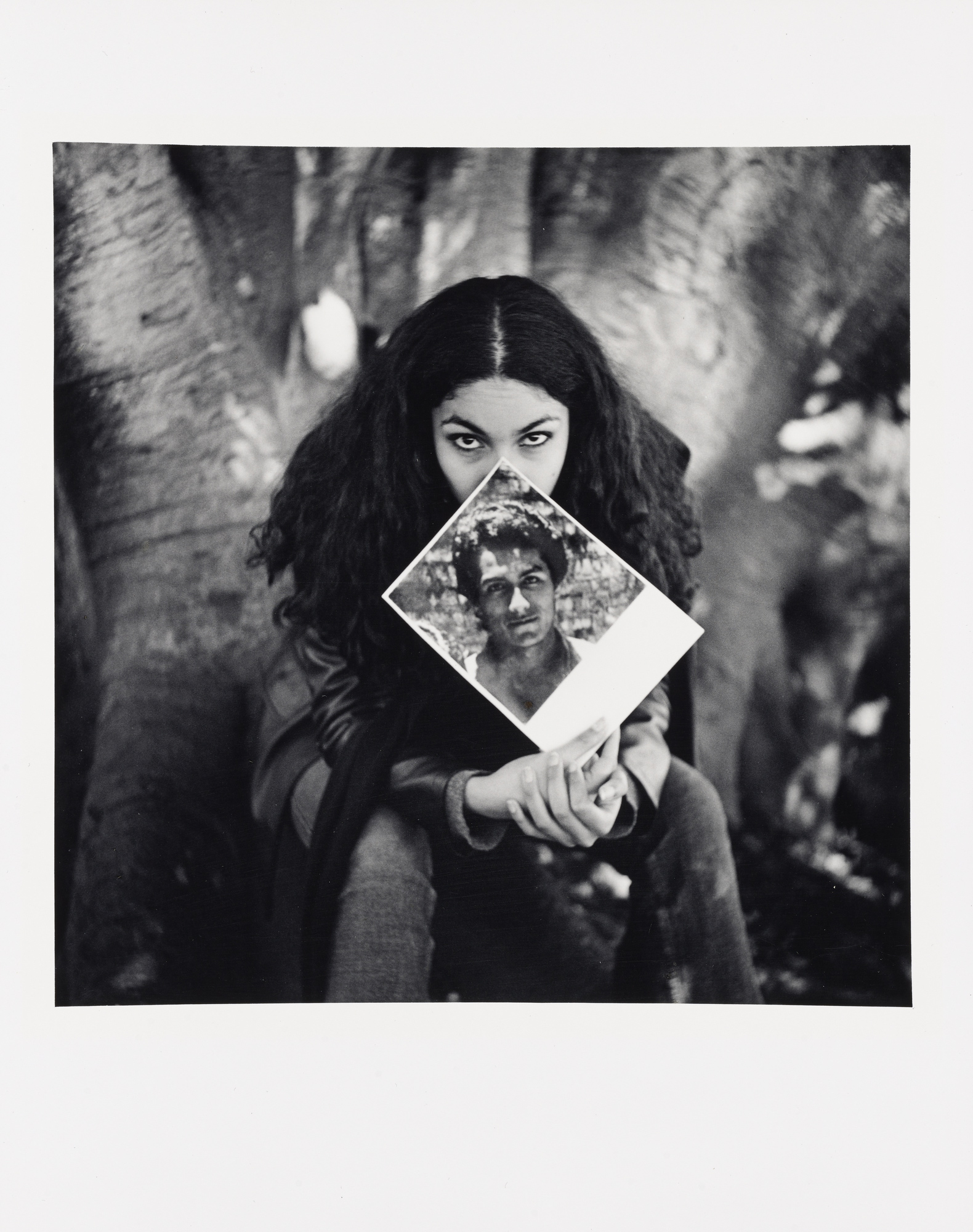
Julio Pantoja (Argentinian, b. 1961) 'Laura Romero, 26 años, estudiante de artes de la serie Los hijos. Tucumán, veinte años despues' / 'Laura Romero, 26 Years Old, Art Student from the series The Sons and Daughters. Tucumán, Twenty Years Later' 1996


Julio Pantoja (Argentinian, b. 1961)
Laura Romero, 26 años, estudiante de artes de la serie Los hijos. Tucumán, veinte años despues /
Laura Romero, 26 Years Old, Art Student from the series The Sons and Daughters. Tucumán, Twenty Years Later

1996
Gelatin silver print
20.7 x 20.7cm
The J. Paul Getty Museum, purchased with funds provided by the Photographs Council
© Julio Pantoja


Julio Pantoja (Argentinian, b. 1961) 'Natalia Ariñez, 23 años, esudiante de arquitectura' / 'Natalia Ariñez, 23 Years Old, Architecture Student' 1999


Julio Pantoja (Argentinian, b. 1961)
Natalia Ariñez, 23 años, esudiante de arquitectura / Natalia Ariñez, 23 Years Old, Architecture Student
1999
From the series The Sons and Daughters. Tucumán, Twenty Years Later
Gelatin silver print
20.7 x 20.7cm
The J. Paul Getty Museum, purchased with funds provided by the Photographs Council
© Julio Pantoja


Graciela Sacco (Argentinian, b. 1956) 'Untitled (#2)' 1993


Graciela Sacco (Argentinian, b. 1956)
Untitled (#2)
1993
From the series Bocanada
Heliography on paper
72.1 x 50.1cm
The J. Paul Getty Museum purchase with funds provided by the Photographs Council
© Graciela Sacco


Graciela Sacco (Argentina, Rosario, 1956 – November 5, 2017) was a visual artist and teacher from Argentina. She worked mainly with photography, video and installation.She received great recognition for the wide participation of his work in individual and collective exhibitions in his country, fairs and international biennials as those in Mexico, Venice and Shanghai , the most important worldwide… She was an artist committed to the problems of her country. …

Through light, shadows, space, time and movement, she captures the themes he addresses, builds, dialogues and discusses in his works; her first technical interest was photography as a visual language to portray time in a certain space, a certain context lived in a fixed image, navigating analogue and digital media, working with techniques such as Heliography , through which she transfers images to the surface of objects chosen for their compositions, which have been previously emulsified with photosensitive substances which allows their printing and thus provide wooden blocks, acrylic sheets, PVC, paintings, windows, suitcases, dishes, spoons, knives of new meanings and meanings that speak beyond their own meaning; how to use an empty spoon with the “reflection” of the mouth that will eat from it to talk about a society that goes hungry and needs, because as she herself has said: “we are individuals different from each other in their personal growth, but with shared or unresolved needs that unite us and relate”. For this reason Bocanada (1993-2014) and “Body to Body” (1996-2014) become an active work as long as the situation is repeated or is not solved (societies with hunger and ignored basic needs), will remain valid, in force and it can be traced and displayed as many times as necessary.

The first was a set of images reproduced and multiplied, a technique that took from the media and its means to advertise and promote ideas, events, news and products, but through art, taking advantage of the reproducibility of the same product, worth the redundancy, of modernity in the technification and technological evolution of the visual arts. It was born from the urban interventions that Sacco practiced in schools and public squares in Argentina, Brazil and European cities, in which she painted the streets with the image repeated hundreds of times of open mouths, which portray the hunger of the world, the poverty, the need, humility, problems that affect much of the world and that are of human and universal interest, anyone can understand or arouse.

Hence, the work can be reinterpreted anywhere in the world, alluding to the context in which it is presented. As in the second work mentioned in which is not hunger but protests and public demonstrations to claim rights and welfare of student and civil communities, then take advantage of public space as the space of free thought where they can be transformed, evidence and manifest the plurality of ideas and get the support or rejection of their listeners.

Google Translate from the Spanish Wikipedia entry


The Aesthetic Gesture

During the 1960s and 1970s, the art scene in Argentina fostered a radical break with traditional forms of art. The opening of new spaces dedicated to experimental art, most notably the Instituto Torcuato di Tella and CAyC (Centro de Arte y Comunicación), gave rise to conceptual art and the engagement of intellectual artists, who began to generate works in unconventional forms, including performances, actions, and installations.

Among these innovations was the “aesthetic gesture,” in which artists used actions and performances to “point out” or signal everyday life events, objects, and people, thus transforming them into works of art. Documented primarily with photographs, these pieces sought to invoke viewers as active participants in artistic actions, erasing the divisions between art and life. In his 1962 Vivo-Dito manifesto, for example, Alberto Greco advocated for “a living art”; and in his Signaling series of 1968, Edgardo Antonio Vigo “pointed out” common objects and events with the intention of producing aesthetic experiences. The difficult political climate of repression in the early 1970s, which culminated in the dictatorship period, provoked artists to undertake increasingly political productions.


Jaime Davidovich (Argentine-American, 1936-2016) 'Tape Project: Sidewalk 1' 1971


Jaime Davidovich (Argentine-American, 1936-2016)
Tape Project: Sidewalk 1
1971
Gelatin silver print
The J. Paul Getty Museum
© Jaime Davidovich


Fissures

The democracy restored to Argentina in 1983 followed a neoliberal model, one that favoured free-market capitalism. The implementation of neoliberalism, during the presidency of Carlos Menem (1989-99), together with the catastrophic economic collapse of 2001, provoked the questioning of long-held national ideals. The works in this section utilise architecture to highlight aspects of national history in relation to current sociopolitical issues. Santiago Porter’s photographs reflect the prosperity of the past in contrast to the present fiscal situation. Similarly, Nuna Mangiante’s graphite-altered pictures revolve around the 2001 crisis and, specifically, the corralito (when citizens were not allowed to withdraw their money from banks).

The works in this section stress inequality and its consequences in contemporary Argentina. SUB, Photographic Cooperative’s series A puertas cerradas (Behind Closed Gates) documents the comfortable life of a wealthy family in a gated neighbourhood outside Buenos Aires, while Gian Paolo Minelli’s photographs focus on people living in Barrio Piedrabuena, an impoverished neighbourhood in the capital city. Ananké Asseff’s portraits of middle-class citizens with their guns attest to rising fear and paranoia in contemporary Argentine society.


Santiago Porter (Argentinian, b. 1971) 'Casa de Moneda de la serie Bruma' / 'The Mint' Negative, 2007; print, 2015


Santiago Porter (Argentinian, b. 1971)
Casa de Moneda de la serie Bruma / The Mint
Negative, 2007; print, 2015
From the series Mist
inkjet print
The J. Paul Getty Museum, purchased with funds provided by the Photographs Council
© Santiago Porter


Martín Weber (Argentinian-Chilean, b. 1868) 'El jugador' / 'The Chess Player' 1999


Martín Weber (Argentinian-Chilean, b. 1868)
El jugador / The Chess Player
1999
From the series Ecos del interior / Echoes from the Interior
Silver dye bleach print
84 x 99cm framed
Courtesy and © Martín Weber


In the mid-nineteenth century, Argentina opened up to several waves of immigration, mostly European, which arrived through the port of Buenos Aires. The country also experienced strong waves of emigration: the first was in the 40s and was followed by two of a more political nature. One during the political persecution at universities under the dictatorship of Juan Carlos Onganía and the second following the coup in 1976. None however compared with the emigration that took place as from December 2001, when unemployment reached 22%.


Martín Weber (Argentinian-Chilean, b. 1868) 'Barras de colores' / 'Color Bars' 1996


Martín Weber (Argentinian-Chilean, b. 1868)
Barras de colores / Color Bars
1996
From the series Ecos del interior / Echoes from the Interior
Silver dye bleach print
84 x 99cm framed
Courtesy and © Martín Weber


Black-and-white TV began to be broadcast during Peron’s regime. The inaugural transmission showed Evita’s speaking from Plaza de Mayo. Color TV arrived under the military dictatorship of 1978, in time to broadcast soccer’s World Cup.


Guadalupe Miles (Argentinian, b. 1971) 'Sin título' (Untitled) 2001


Guadalupe Miles (Argentinian, b. 1971)
Sin título (Untitled)
2001, printed 2017
Chaco series
Inkjet print
100 × 100cm (39 3/8 × 39 3/8 in.)
Courtesy of the artist
© Guadalupe Miles


Guadalupe Miles (Argentinian, b. 1971) 'Untitled' 2001


Guadalupe Miles (Argentinian, b. 1971)
Sin título (Untitled)
2001, printed 2017
Chaco series
Inkjet print
100 × 100cm (39 3/8 × 39 3/8 in.)
Courtesy of the artist
© Guadalupe Miles


Alessandra Sanguinetti (American, b. 1968) 'Untitled' 1996-2004


Alessandra Sanguinetti (American, b. 1968)
Untitled
1996-2004
From the series En el sexto día / On the Sixth Day
Chromogenic (FujiFlex) print
73.7 x 73.7cm
Courtesy of Yossi milo Gallery, New York
© Alessandra Sanguinetti, Courtesy of Yossi milo Gallery, New York


Alessandra Sanguinetti (1968, New York, New York) is an American photographer. Born in New York, Sanguinetti moved to Argentina at the age of two and lived there until 2003. Sanguinetti has stated that she began taking photographs to create a sense of permanence in her life after realising that “everything is transitory.” Currently, she lives in San Francisco, California.

Her most involved project is a documentary photography project about two cousins – Guillermina and Belinda – as they grow up outside of Buenos Aires. The project began in 1999 when Sanguinetti visited her grandmother, Juana, in Argentina. She intended to take pictures of the animals which occupied her grandmother’s rural farm. However, she saw potential in her cousins, whom she had previously disregarded. Sanguinetti recounts this, “I was shooting them without even thinking it was work. My first idea was to just do a single story trying to figure out what they imagined life to be, just so I could get into their world.” Titled The Adventures of Guille and Belinda and the Enigmatic Meaning of their Dreams, the project follows them as they fantasise about becoming adults, early motherhood, and becoming young women while their relationship changes. In this particular collection of photographs, Alessandra makes commentaries about feminine conventions of beauty and behaviour, as well as gender roles and gender identity. She occasionally ridicules social expectations through her images, which are often satirical in nature.  These commentaries are best typified in Petals (2000) and The Couple (1999). Her images focus on the lives of young women and children. Sanguinetti told Vice reporter, Bruno Bayley, “Children are fascinating… As a society, we project so much of our hopes, frustrations, denials, and aspirations on children, and they are so transparent in how they reflect everything that is thrust upon them. How could I not photograph them?”

Text from the Wikipedia website


Alessandra Sanguinetti (American, b. 1968) 'Untitled' 1996-2004


Alessandra Sanguinetti (American, b. 1968)
Untitled
1996-2004
From the series En el sexto día / On the Sixth Day
Chromogenic (FujiFlex) print
73.7 x 73.7cm
Courtesy of Yossi milo Gallery, New York
© Alessandra Sanguinetti, Courtesy of Yossi milo Gallery, New York


Sebastián Friedman (Argentinian, b. 1973) 'Segurismos #7' c. 2010-11, printed 2016


Sebastián Friedman (Argentinian, b. 1973)
Segurismos #7
c. 2010-2011, printed 2016
From the series Segurismos
Chromogenic print
59.7 x 80cm
Courtesy of Sebastián Friedman
© Sebastián Friedman


SUB, Photographic Cooperative (Argentine, active since 2004) 'Titi (She Has the Same Name as Her Mother, Silvina) and Lili, One of the Maids, Share Moments of Relaxation. Titi Was Born in San Jorge Village and Her Relationship with Liliana Has developed since Birth' 2012, printed in 2017


SUB, Photographic Cooperative (Argentine, active since 2004)
Titi (She Has the Same Name as Her Mother, Silvina) and Lili, One of the Maids, Share Moments of Relaxation. Titi Was Born in San Jorge Village and Her Relationship with Liliana Has developed since Birth
2012, printed 2017
From the series A puertas cerradas (Behind Closed Gates)
Inkjet print
60 x 80cm
Courtesy of SUB, Photographic Cooperative
© Sub. Coop Todos los derechos reservados


Ananké Asseff (Argentinian, b. 1971) 'Luis' c. 2005-07, printed 2015


Ananké Asseff (Argentinian, b. 1971)
Luis
c. 2005-07, printed 2015
From the series Potential
198.6 x 129.2cm
Courtesy of Rolf Art and Ananké Asseff
© Ananké Asseff


One of the most effective means to exercise control of populations in contemporary capitalism is the production of fear.

To talk about one of my projects, in “Potential” I worked on the reaction of contemporary society when facing fear, and I got involved with Argentinian society more directly when I photographed the middle and upper classes with weapons in their houses. In this country, this is not something socially accepted, on the contrary. The embedded image of people carrying weapons is something associated with low-income earners and criminals. I put into question the prototype of the “suspect” that is generated by each society, but this issue, like all the other aspects that make up this project, goes beyond Argentinian society. It is something that involves us on a global level. At the time I made this work, people talked exhaustively about the lack of safety in Argentina and terrorism around the world. At the time I lived in Germany for a while (I got a scholarship from KHM) and the sense of insecurity was evident there as well, the weariness before someone unknown approaching or the presence of a stranger (a feeling that was much stronger if the other person looked like they were from the Middle East). Everything was exacerbated and worsened by the obsession of the mass media which propagated fear and terror in society. How awake we had to be (and still have to be) to avoid succumbing to these manipulations!

As Leonor Arfuch says, “certain registers of contemporary communication, certain topics and media obsessions allow the defining, and building, of tendentious trends and consensus, shared beliefs and feelings that invade our intimate and family structures, thus spreading easily into our personal history.”

Fear is a feeling that’s experienced individually but built within a society.

Anonymous text. “Argentina Notebook: Interview with Ananké Asseff,” on the Fototazo website 30/10/2015 [Online] Cited 03/02/2022


Ananké Asseff (Argentinian, b. 1971) 'Alberto de la serie (POTENCIAL)' / 'Alberto from the series (POTENTIAL)' c. 2005-2007; print, 2015


Ananké Asseff (Argentinian, b. 1971)
Alberto de la serie (POTENCIAL) / Alberto from the series (POTENTIAL)
c. 2005-2007; printed 2015
Inkjet print
The J. Paul Getty Museum, purchased with funds provided by the Photographs Council
© Ananké Asseff


Gian Paolo Minelli (Swiss, b. 1968) 'Milton' 2009, printed 2016


Gian Paolo Minelli (Swiss, b. 1968)
Milton
2009, printed 2016
From the series Zona Sur Barrio Piedrabuena
54 x 66cm
Courtesy of Dot Fiftyone Gallery and the artist
© Gian Paolo Minelli


Gian Paolo Minelli (Swiss, b. 1968) 'Luciano con tatuaje' / 'Luciano with Tatoo' 2009, printed 2016


Gian Paolo Minelli (Swiss, b. 1968)
Luciano con tatuaje / Luciano with Tatoo
2009, printed 2016
From the series Zona Sur Barrio Piedrabuena
54 x 66cm
Courtesy of Dot Fiftyone Gallery and the artist
© Gian Paolo Minelli


The J. Paul Getty Museum
1200 Getty Center Drive
Los Angeles, California 90049

Opening hours:
Daily 10am – 5pm
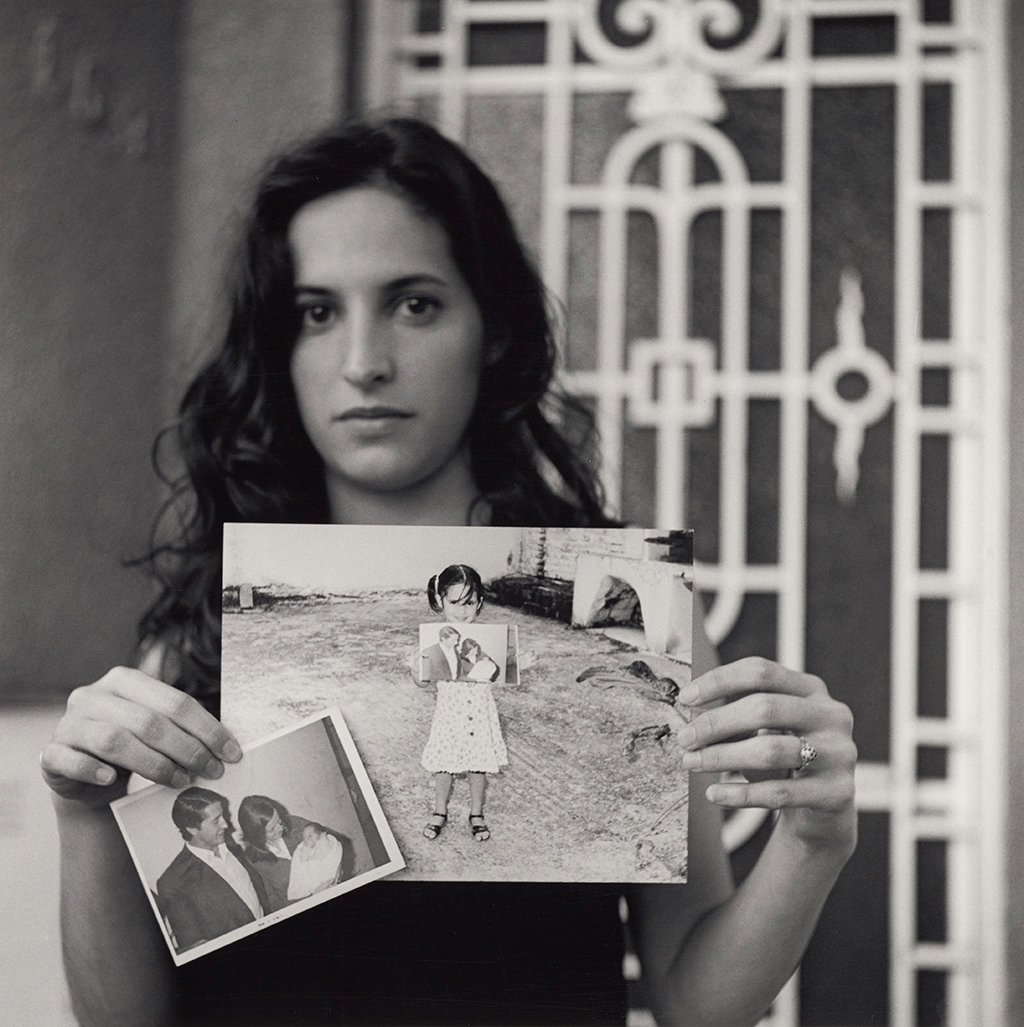
The J. Paul Getty Museum website

LIKE ART BLART ON FACEBOOK

Back to top