Review: ‘Mari Funaki: Objects’ at the Ian Potter Centre: NGV Australia, Melbourne

Exhibition dates: 6th August – 24th October 2010


Mari Funaki (born Japan 1950, arrived Australia 1979, died 2010) 'Object' 2008 from the exhibition 'Mari Funaki: Objects' at the Ian Potter Centre: NGV Australia, Melbourne, Aug - Oct 2010


Mari Funaki (born Japan 1950, arrived Australia 1979, died 2010)
Object
2008
Heat-coloured mild steel
20.0 x 28.0 x 5.0cm
Collection of Raphy Star, Melbourne
© The Estate of Mari Funaki


Mari Funaki (born Japan 1950, arrived Australia 1979, died 2010) 'Container' 2008 from the exhibition 'Mari Funaki: Objects' at the Ian Potter Centre: NGV Australia, Melbourne, Aug - Oct 2010


Mari Funaki (born Japan 1950, arrived Australia 1979, died 2010)
Container
2008
heat-coloured mild steel
(a–c) 21.3 x 40.5 x 8.5cm (overall)
Private collection, Melbourne
© The Estate of Mari Funaki


Mari Funaki (born Japan 1950, arrived Australia 1979, died 2010) 'Container' 2008 from the exhibition 'Mari Funaki: Objects' at the Ian Potter Centre: NGV Australia, Melbourne, Aug - Oct 2010


Mari Funaki (born Japan 1950, arrived Australia 1979, died 2010)
Container
2008
heat-coloured mild steel
4.8 x 16.0 x 15.5cm
Private Collection, Melbourne
© The Estate of Mari Funaki


Mari Funaki (born Japan 1950, arrived Australia 1979, died 2010) 'Object' 2008 from the exhibition 'Mari Funaki: Objects' at the Ian Potter Centre: NGV Australia, Melbourne, Aug - Oct 2010


Mari Funaki (born Japan 1950, arrived Australia 1979, died 2010)
Object
2008
heat-coloured mild steel
20.0 x 28.0 x 5.0cm
Collection of Raphy Star, Melbourne
© The Estate of Mari Funaki


Let us drop away all interpretation and look at the thing in itself.
The literal feeling of standing before these objects.


Form

Balance

Colour

Surface

Precision

Will

Style

Silence


Quiet, precise works. Forms of insect-like legs and proboscises. They balance, seeming to almost teeter on the edge – but the objects are incredibly grounded at the same time. As you walk into the darkened gallery and observe these creatures you feel this pull – lightness and weight. Fantastic!

The surfaces, sublime matt grey colour and precision of their manufacture add to this sense of the ineffable. These are not mere renderings of content, but expressions of things that cannot be said.

Sontag observes, “Art is the objectifying of the will in a thing or performance, and the provoking or arousing of the will … Style is the principle of decision in a work of art, the signature of the artist’s will.”1

Sontag insightfully notes, “The most potent elements in a work of art are, often, its silences.”2


And so it came to pass in silence, for these works are still, quiet and have a quality of the presence of the inexpressible.

Funaki achieves these incredible silences through being true to her self and her style through an expression of her endearing will.

While Mari may no longer be amongst us as expressions of her will the silences of these objects will be forever with us.

Dr Marcus Bunyan


1/ Sontag, Susan. “On Style,” in Against Interpretation and Other Essays. New York: Delta Book, 1966, pp. 31-32.

2/ Ibid., p. 36.


Many thanxk to Alison Murray, Jemma Altmeier and The National Gallery of Victoria for allowing me to publish the photographs in the posting. Please click on the photographs for a larger version of the image. All individual photographs of work by Jeremy Dillon.


'Mari Funaki: Objects' installation shot on opening night at NGV Australia

'Mari Funaki: Objects' installation shot on opening night at NGV Australia

'Mari Funaki: Objects' installation shot on opening night at NGV Australia


Mari Funaki: Objects installation shots on opening night at NGV Australia
Photos: © Marcus Bunyan


Opening 6 August, the National Gallery of Victoria will present Mari Funaki: Objects, an exhibition showcasing a range of sculptural objects by the renowned contemporary jeweller and metalsmith, Mari Funaki (1950-2010).

This exhibition will present a selection of Funaki’s distinctive objects, dating from the late 1990s to 2010 including four recent large scale sculptures. The artist was working on the exhibition right up until the time of her recent death.

Jane Devery, Acting Curator, Contemporary Art, NGV said: “It was a great privilege to work with Mari Funaki on this exhibition. She possessed a clarity of vision and a capacity for ongoing invention that is rare among artists. Funaki produced some of the most captivating works in the field of contemporary jewellery and metalwork. Her unique geometric objects, meticulously constructed from blackened mild-steel, stemmed from a desire to express the world around her.”

“Funaki was interested in the expressive and associative capacities of her objects, creating forms that might stir our imaginations or trigger something from our memories. It has been particularly thrilling to see her extend these concerns in large scale works,” said Ms Devery. In 1979 Funaki left her home in Japan for Melbourne where she pursued her creative ambitions, enrolling in Gold and Silversmithing at RMIT in the late 1980s. At RMIT she studied under the prominent jewellers Marian Hosking, Robert Baines and Carlier Makigawa.

In 1995, Mari Funaki established Gallery Funaki in Melbourne’s CBD which remains Australia’s most important space dedicated to contemporary jewellery. Throughout her career she exhibited widely within Australia and overseas and won many awards, twice winning the prestigious Herbert Hoffman prize in Munich. In 2007 she was awarded an Australian Council Emeritus Award for her work as an artist and for her success in promoting Australian and international contemporary jewellery.

Frances Lindsay, Deputy Director, NGV said: “The NGV is delighted to exhibit many never-before-seen works by such an innovative and celebrated Melbourne artist. The exquisite objects assembled in this exhibition allow us to appreciate Mari Funaki’s remarkable artistic achievements.”

Mari Funaki: Objects will be on display at The Ian Potter Centre: NGV Australia, Federation Square from 6 August to 24 October, 2010. The exhibition will be open from 10am-5pm. Closed Mondays. Entry is free.

Press release from the National Gallery of Victoria website


Mari Funaki (born Japan 1950, arrived Australia 1979, died 2010) 'Object' 2008


Mari Funaki (born Japan 1950, arrived Australia 1979, died 2010)
Object
2008
Heat-coloured mild steel
36.0 x 47.5 x 14.5cm
Collection of Johannes Hartfuss & Fabian Jungbeck, Melbourne
© The Estate of Mari Funaki


Mari Funaki (born Japan 1950, arrived Australia 1979, died 2010) 'Container' 2006


Mari Funaki (born Japan 1950, arrived Australia 1979, died 2010)
Container
2006
Heat-coloured mild steel
26.0 x 8.5 x 6.0cm
Collection of Peter and Jennifer McMahon, Melbourne
© The Estate of Mari Funaki


Mari Funaki (born Japan 1950, arrived Australia 1979, died 2010) 'Object' 2010


Mari Funaki (born Japan 1950, arrived Australia 1979, died 2010)
Object
2010
Heat-coloured mild steel
30.0 x 19.0 x 20.5cm
Collection of the Estate of Mari Funaki, Melbourne
© The Estate of Mari Funaki


Mari Funaki (born Japan 1950, arrived Australia 1979, died 2010) 'Object' 2010


Mari Funaki (born Japan 1950, arrived Australia 1979, died 2010)
Object
2010
heat-coloured mild steel
45.0 x 52.0 3.5cm
Collection of the Estate of Mari Funaki, Melbourne
© The Estate of Mari Funaki


Mari Funaki (born Japan 1950, arrived Australia 1979, died 2010) 'Object' 2010


Mari Funaki (born Japan 1950, arrived Australia 1979, died 2010)
Object
2010
heat-coloured mild steel
12.0 x 44.0 x 14.0cm
Collection of the Estate of Mari Funaki, Melbourne
© The Estate of Mari Funaki


The Ian Potter Centre: NGV Australia
Federation Square

Corner of Russell and 
Flinders Streets, Melbourne

Opening hours:
Daily 10am – 5pm
National Gallery of Victoria website

LIKE ART BLART ON FACEBOOK

Back to top

Exhibition: ‘Klippel/Klippel: Opus 2008’ at Ian Potter Centre: NGV Australia

Exhibition dates: 7th August – 2nd November, 2008


'Klippel/Klippel: Opus 2008' exhibition sculpture and installation from the first space

Robert Klippel 'Opus 2008' exhibition installation from the first space


Klippel/Klippel: Opus 2008 exhibition sculpture and installation from the first space


A magical exhibition of the work of the Australian sculptor Robert Klippel (1920-2001) is presented together with a soundscape to accompany the works by his son Andrew Klippel. The exhibition presents two distinct rooms of light and shade and finishes with a singular monumental bronze work No. 709, but it is the two rooms that astound. They contain small assemblages and bronze sculpture made in the 1980s-1990s.

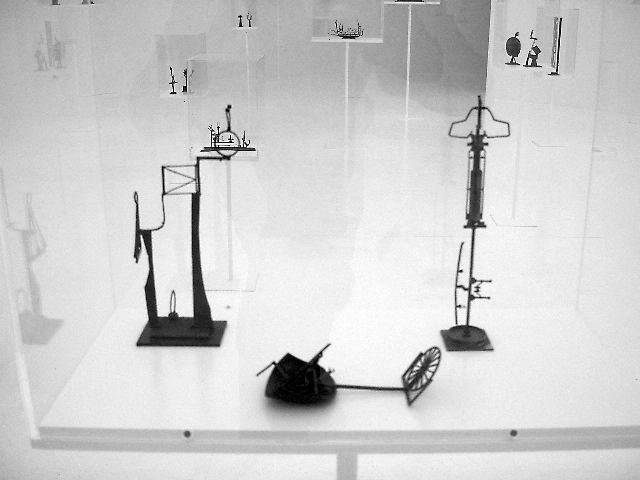
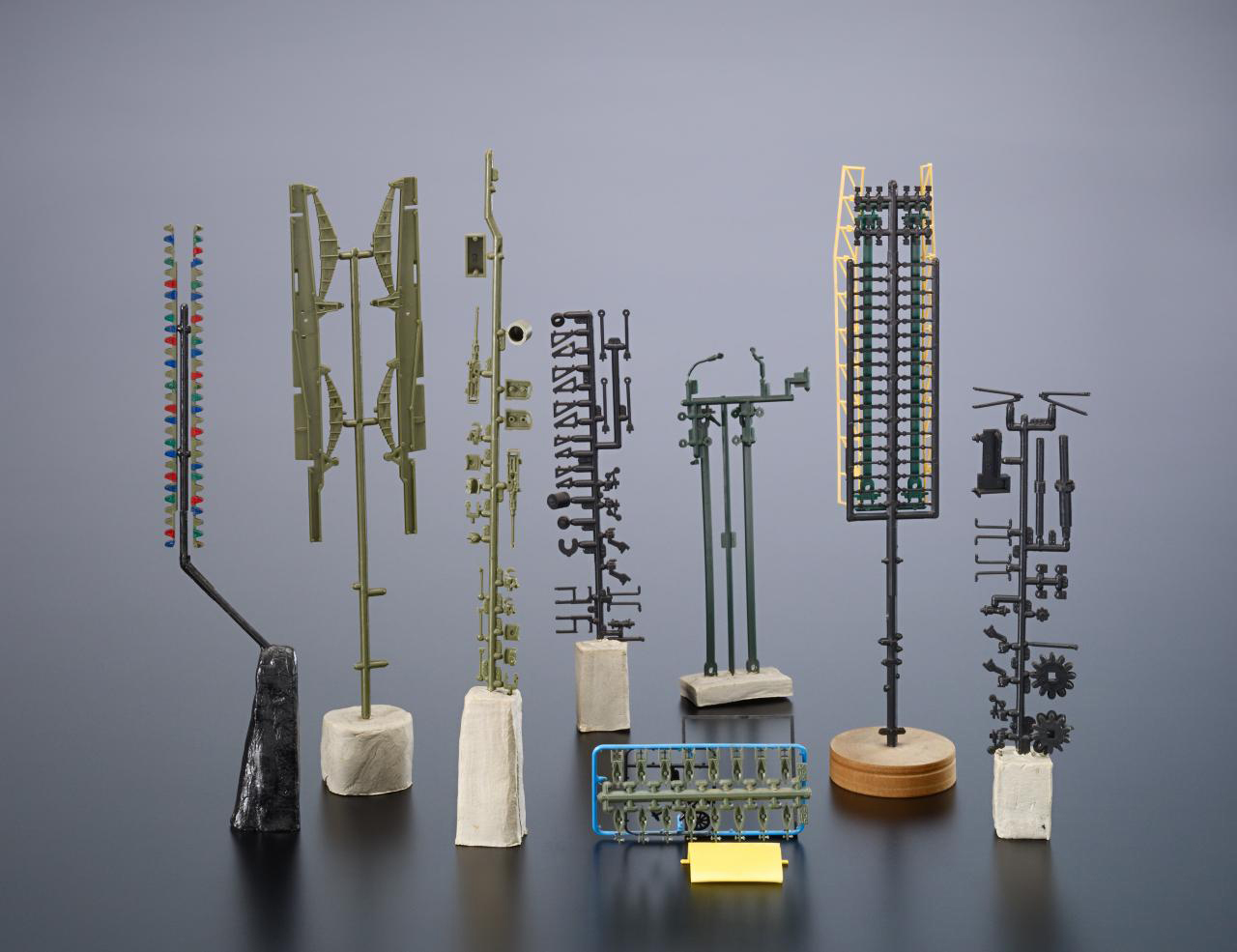
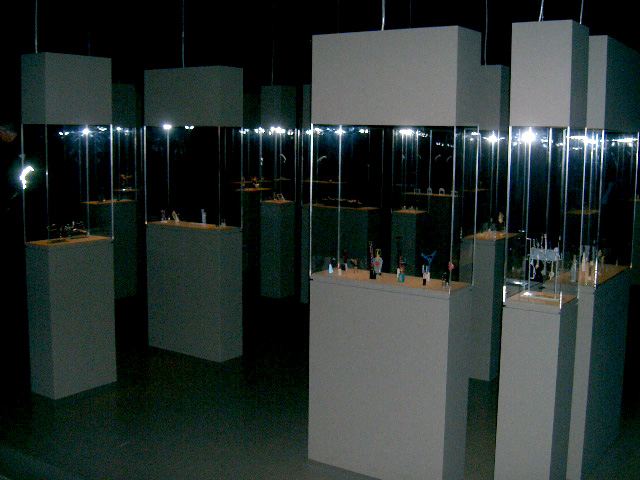
In the first space lit glass cases hover in darkness, containing delicate constructions of found objects, beautifully crafted. Made of plastic and metal, some parts taken from modelling kits, the sculptures morph and weave a delicate narrative, a powerful artistic vision. Mostly totemic in nature they transport the viewer with wonder and delight, the artists vision fully realised: no unnecessary flourishes, no wasted energy on forms that are redundant.

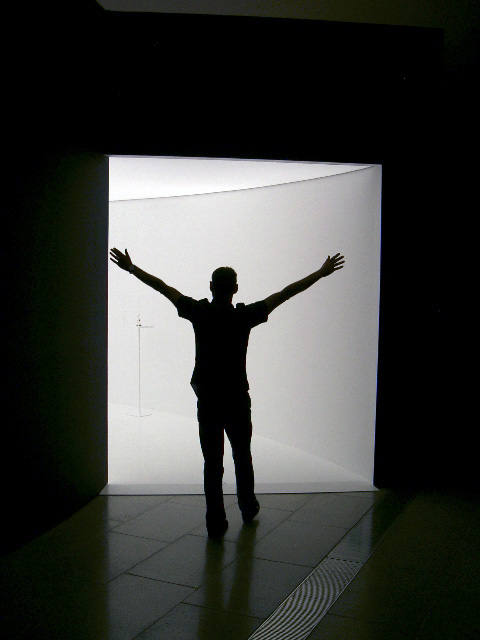
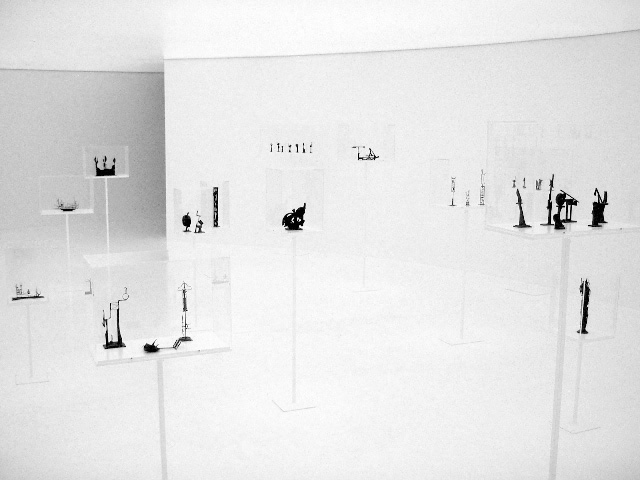
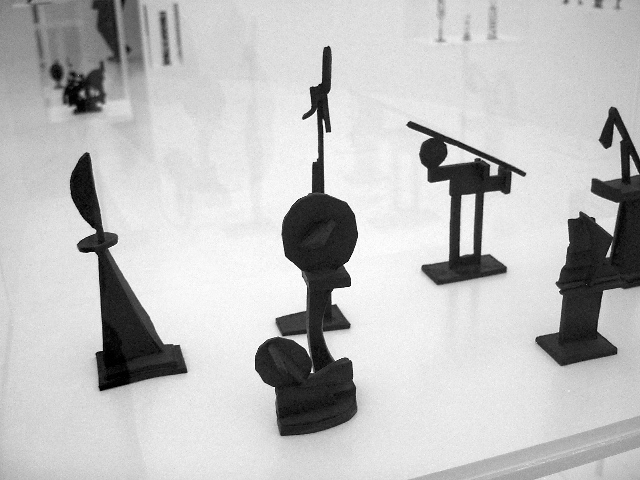
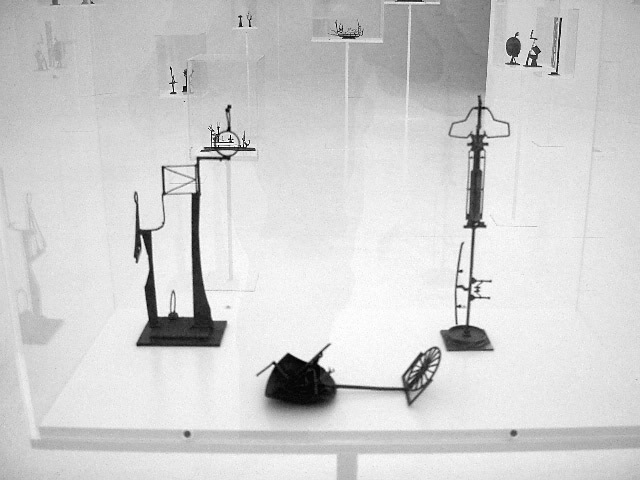
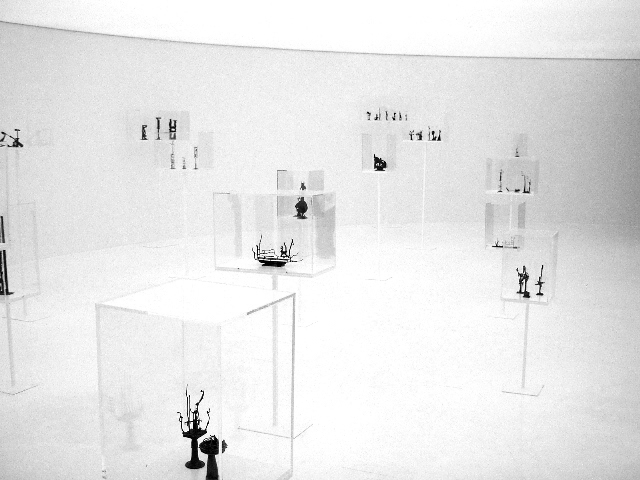
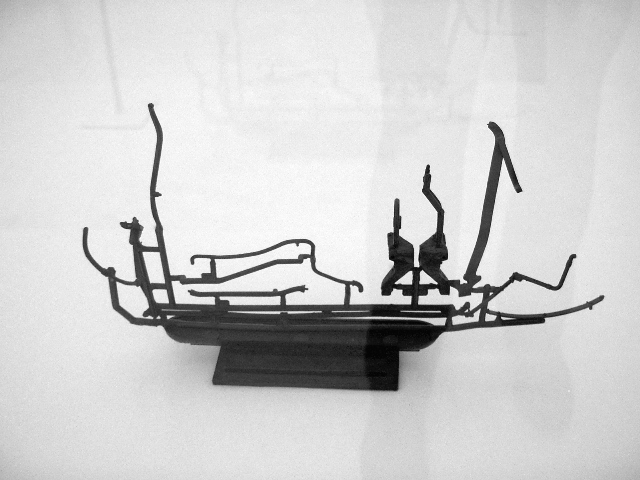
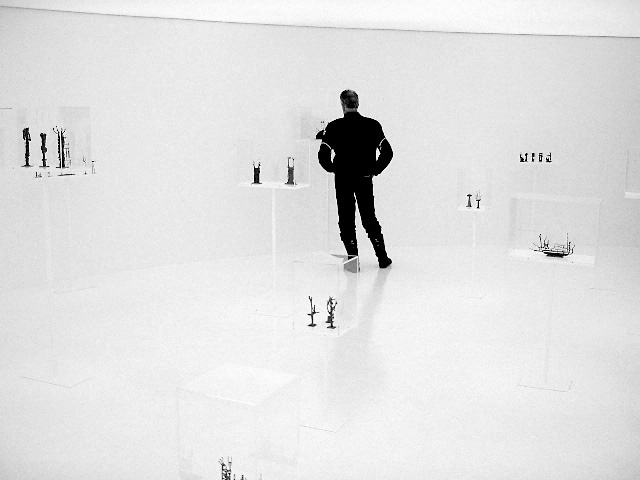
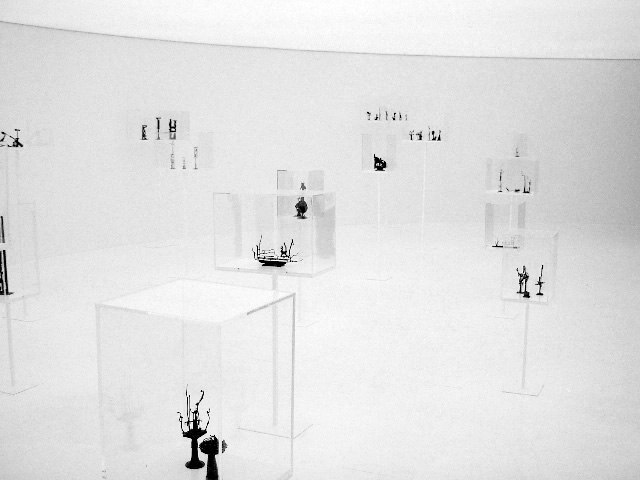
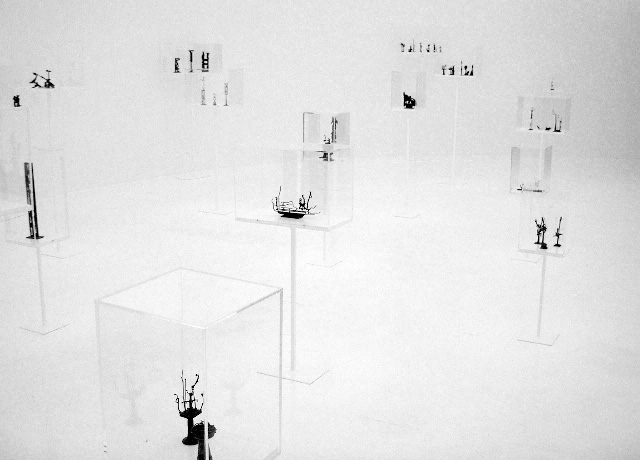
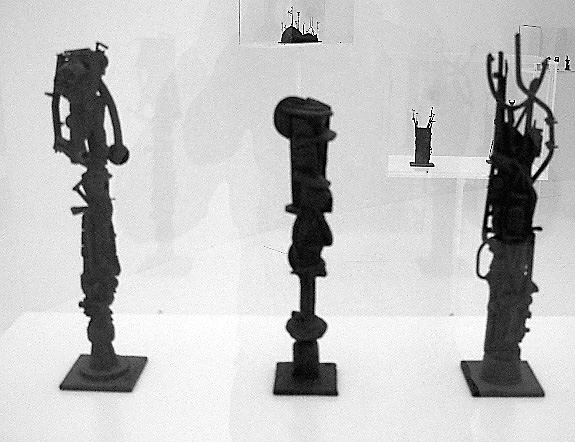
Wandering from the first darkened space we face a curved wall of black with a bright white opening, almost like the mouth of a Nautilus shell. Upon entering we are enveloped in white – walls, floor, stretched acrylic ceiling and stands upon which glass cases sit all being pure white. It is like stepping into the spacecraft from Stanley Kubrick’s 2001: A Space Odyssey – quite disorientating but transformational. In the cases sit small very dark bronze sculptures contrasting with the white. Again mostly totemic in nature the sculptures have great power and presence. Some portray small cities on top of hills. Others intricate machine and figure like constructions. All of the cases are mounted at different eye levels, unlike the first room.

When looking across the gallery space, the boxes and sculpture within create a diorama, almost a tableaux vivant, where you can move the focus of your gaze from foreground to mid to background, all suspended in white. If you can be in this space alone with the work and wander around soaking in the vision of this artist so much the better. The contrast and parallels between the two rooms is striking – here is an artist at the height of his powers commanding his materials and his vision in two distinct bodies of work: one delicate, found, plastic the other solid, dark and essential, both dealing with the essence of human creativity and being, leaving the viewer with a sensory experience long remembered.

Dr Marcus Bunyan


All installation photographs © Marcus Bunyan


'Klippel/Klippel: Opus 2008' exhibition entrance to the second space


Klippel/Klippel: Opus 2008 exhibition entrance to the second space


Robert Klippel is regarded as Australia’s most important sculptor of the post-war 20th century period. Known for his abstract assemblages created from found objects he is a distinguished figure in the history of Australian art. Andrew Klippel, Robert’s son, is a composer and musician who has achieved international recognition as a solo musician, songwriter and influential music producer.

Klippel/Klippel: Opus 2008 is a unique and compelling sensory experience which presents a group of Robert Klippel’s small-scale sculptures that were produced during the 1980s and 1990s – some of these have never been publicly displayed. It also includes the monumental bronze work No. 709. Andrew has arranged for this work, which Robert was preparing to cast at the time of his death, to be executed for the National Gallery of Victoria and included in the exhibition. And, in an important artistic response, Andrew Klippel has created a soundscape – a meditation on his father’s work.

Klippel/Klippel: Opus 2008 is an extraordinary and immersive exhibition that celebrates the creative process.

Text from the National Gallery of Victoria website


Robert Klippel 'Opus 2008' exhibition bronze sculptures from the second space

Robert Klippel 'Opus 2008' exhibition bronze sculptures from the second space

Robert Klippel 'Opus 2008' exhibition bronze sculptures from the second space

Robert Klippel 'Opus 2008' exhibition bronze sculptures from the second space

Robert Klippel 'Opus 2008' exhibition bronze sculptures from the second space

Robert Klippel 'Opus 2008' exhibition bronze sculptures from the second space

Robert Klippel 'Opus 2008' exhibition bronze sculptures from the second space

Robert Klippel 'Opus 2008' exhibition bronze sculptures from the second space

Robert Klippel 'Opus 2008' exhibition bronze sculptures from the second space

Robert Klippel 'Opus 2008' exhibition bronze sculptures from the second space


Klippel/Klippel: Opus 2008 exhibition bronze sculptures from the second space


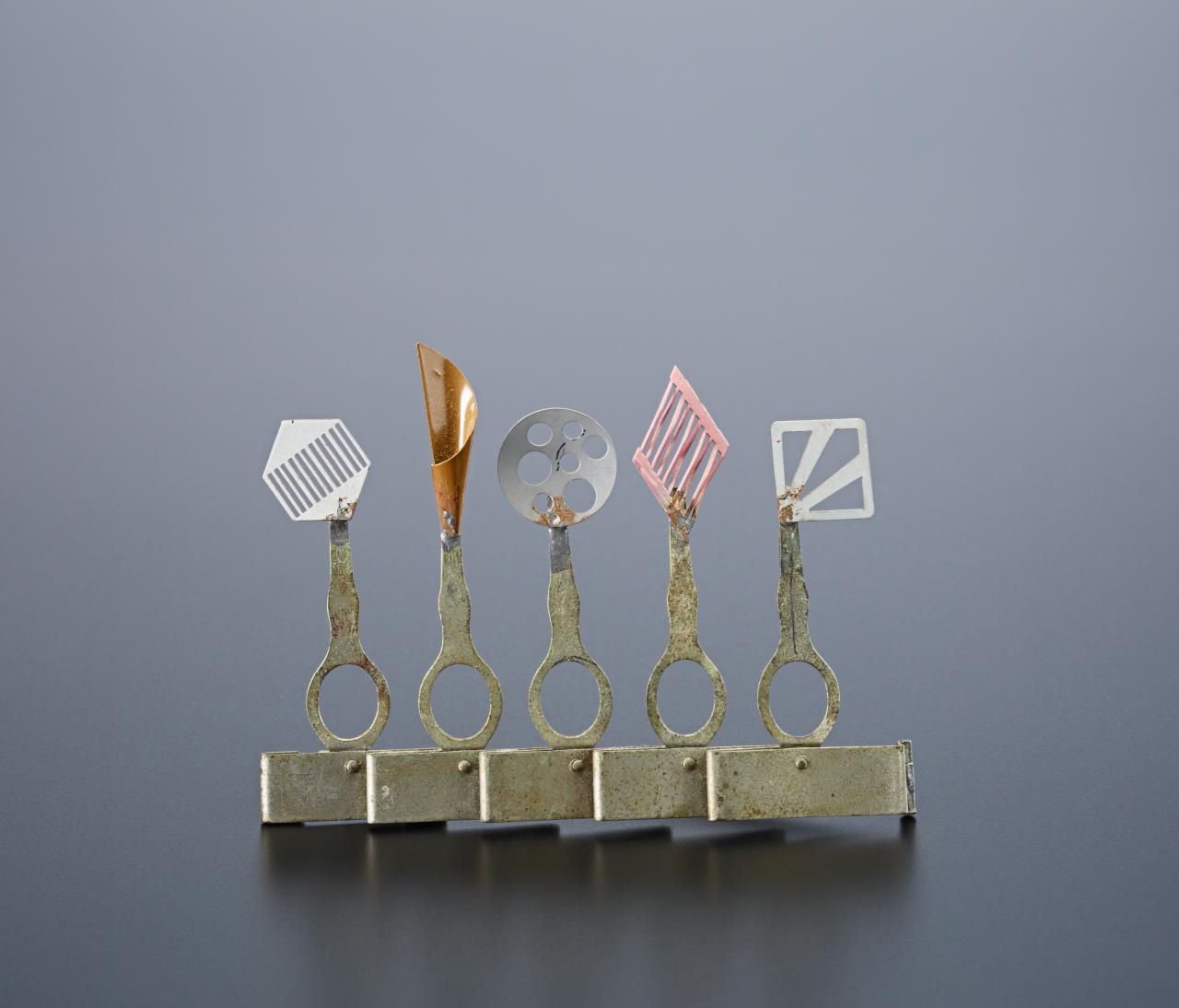
Robert Klippel (Australian, 1920-2001) 'No. 879 (No. 1126)' 1995


Robert Klippel (Australian, 1920-2001)
No. 879 (No. 1126)
1995
Metal, enamel paint
9.5 x 13.3. x 4.2cm
Private collection, Sydney
© Andrew Klippel


Robert Klippel (Australian, 1920-2001) 'No. 881' c.1990 'No title (No. 1326)' c.1990 and works from the series 'No title (No. 1232)' 1980


Robert Klippel (Australian, 1920-2001)
No. 881
c.1990
No title (No. 1326)
c.1990
and works from the series
No title (No. 1232)
1980
Private collection, Sydney
© Andrew Klippel


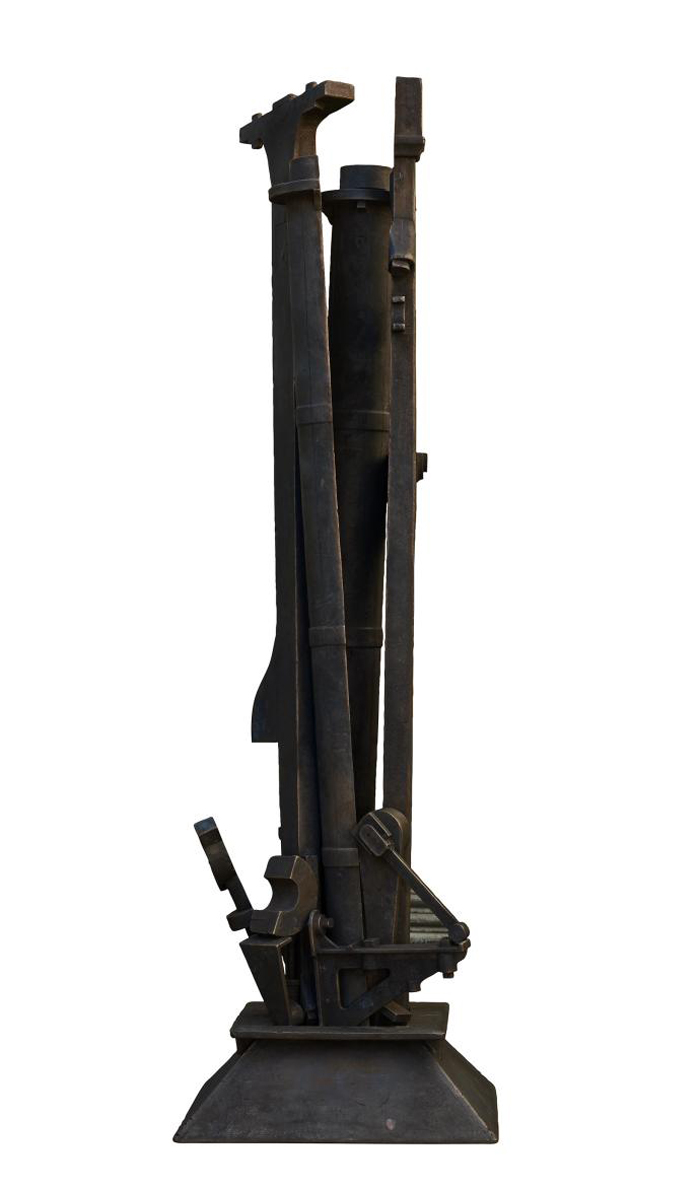
Robert Klippel (Australian, 1920-2001) 'No. 709' 1988


Robert Klippel (Australian, 1920-2001)
No. 709
1988; 2008 {cast}
Bronze
318.9 x 94.8 x 100.2cm
Artist’s proof
National Gallery of Victoria, Melbourne
Purchased with the assistance of Andrew Klippel and the Estate of Patrick Byrne, 2008
© Andrew Klippel


The Ian Potter Centre: NGV Australia
Federation Square
Corner of Russell and 
Flinders Streets, Melbourne

Opening hours:
Daily 10am – 5pm
National Gallery of Victoria website

LIKE ART BLART ON FACEBOOK

Back to top