Herbert Ponting (British, 1870-1935) (photographer) The Universal Photo Art Co., (C.H. Graves) (publisher) At the barber’s, Peking, China c. 1902 Albumen print on card
Fabulous, early Herbert Ponting social documentary stereoviews. I have never seen these before.
The placement of figures and the formal construction of the pictorial plane – strong diagonals and verticals, near to far, vanishing point – make for beautifully balanced, tensioned and dynamic images.
Marcus
Please click on the photographs for a larger version of the image.
Herbert Ponting (British, 1870-1935) (photographer) The Universal Photo Art Co., (C.H. Graves) (publisher) A Chinese strawberry garden.Proprietor and coolie. China c. 1902 Albumen print on card
Herbert Ponting (British, 1870-1935) (photographer) The Universal Photo Art Co., (C.H. Graves) (publisher) En Route to the Great Wall of China. Entrance to the city of Nankow c. 1902 Albumen print on card
Herbert Ponting (British, 1870-1935) (photographer) Underwood & Underwood (publisher) Where China’s Great Wall begins its 1,250 mile course – from Shan-hai-ewan (N.) to Liao Hsi Mountains 1904 Albumen print on card
Herbert Ponting (British, 1870-1935)
Herbert George Ponting, FRGS (21 March 1870 – 7 February 1935) was a professional photographer. He is best known as the expedition photographer and cinematographer for Robert Falcon Scott’s Terra Nova Expedition to the Ross Sea and South Pole (1910-1913). In this role, he captured some of the most enduring images of the Heroic Age of Antarctic Exploration. …
Early life
Ponting was born in Salisbury, Wiltshire in the south of England, on 21 March 1870. His father was a successful banker, Francis Ponting, and his mother was Mary Sydenham. From the age of eighteen Herbert was employed at a local bank branch in Liverpool, where he stayed for four years. That time was long enough to convince him that he did not wish to follow in the profession of his father, and attracted to stories of the American West, he moved to California where he worked in mining and then bought a fruit ranch in the 1890s. In 1895 he married a California woman, Mary Biddle Elliott; their daughter Mildred, was born in Auburn, California in January 1897.
Ponting sold his fruit farm in 1898 and, with his wife and daughter, returned to Britain to stay with his family. When they returned to the USA he turned his long-standing hobby of photography in his next career. Following a chance meeting with a professional photographer in California, to whom he had given advice about the locality and showed his own photos, he entered his pictures in competitions and won awards; he also sent some of his stereoscopic photographs to companies who published them. His work was also selected for the first San Francisco Salon; at that time he was living in Sausalito, north of San Francisco. He took stereoviews of and reported on the Russo-Japanese war of 1904-1905, and afterwards continued to travel around Asia, working in Burma, Korea, Java, China and India taking stereoviews and working as a freelance photographer for English-speaking periodicals. Improvements in the printing press had made it possible, for the first time, for mass-market magazines to print and publish photographic illustrations.
After spending much of 1901-1906 travelling around photographing in Asia, Ponting returned to Europe, where he continued to take stereoviews (including in Switzerland and Spain) and wrote illustrated articles for magazines including Country Life, the Graphic, the Illustrated London News, Pearson’s, and the Strand Magazine. In the Strand, Ponting’s work appeared side by side with the Sherlock Holmes stories of Arthur Conan Doyle, one of Ponting’s contemporaries.
Ponting expanded his photographs of Japan into a 1910 book, In Lotus-land Japan. He took extensive photographs in Spain. He was elected a Fellow of the Royal Geographical Society (FRGS). His flair for journalism and ability to shape his photographic illustrations into a narrative led to his being signed as expedition photographer aboard the Terra Nova, the first time a professional photographer was included on an Antarctic expedition.
Herbert Ponting (British, 1870-1935) (photographer) The “Perfec” Stereograph. H.C. White Co., (publisher) The-Tien-ning-ssu Pagoda, near Peking, China 1907 Albumen print on card
Herbert Ponting (British, 1870-1935) (photographer) The “Perfec” Stereograph. H.C. White Co., (publisher) Peking, the capital of China, looking east from a balcony of the Drum Tower 1907 Albumen print on card
William Cooper (British, 1878-1945) Drum Tower, Peking 1910 Gelatin silver print University of Bristol – Historical Photographs of China Creative Commons 3.0
Beijing’s Bell and Drum Towers are situated on a small square north of the Forbidden City. The towers, which were used for telling time until 1924, were built in 1272 during the reign of Kublai Khan and were rebuilt after two fires during the Ming and Qing dynasties. The Bell and Drum Towers are quintessential landmarks of historic Beijing.
William Boyd Cooper (1878-1945)
William Boyd Cooper (1878-1945) was born in Belfast, Northern Ireland. Around 1911, he was appointed Professor of Commerce at Peking University, where he lectured in English and French. Cooper joined the North China British Volunteer Corps. On 12 February 1917, he was commissioned as a Second Lieutenant in the Chinese Labour Corps (CLC). He served in France with the CLC and rose to be a captain, relinquishing his Commission in 1919. William Cooper and his family returned from China and settled in Wimbledon, London. The William Cooper Collection is held in Special Collections, University of Bristol Library (Special Collections ref DM2823). 336 images.
Anonymous text. “Cooper, William Collection,” on the Historical Photographs of China website Nd [Online] Cited 04/06/2023
Herbert Ponting (British, 1870-1935) (photographer) The “Perfec” Stereograph. H.C. White Co., (publisher) A Tea seller in the streets of Moukden, Manchuria c. 1906 Albumen print on card
Herbert Ponting (British, 1870-1935) (photographer) The “Perfec” Stereograph. H.C. White Co., (publisher) A poppy field in Manchuria, natives extracting fluid from which opium is made c. 1902-1907 Albumen print on card
Herbert Ponting (1870-1935) (photographer) The “Perfec” Stereograph. H.C. White Co., (publisher) The Old Bell Tower in the heart of Mukden, Manchuria 1905 Albumen print on card
Herbert Ponting (British, 1870-1935) (photographer) The “Perfec” Stereograph. H.C. White Co., (publisher) Along the Great Wall of China (originally 1700 miles long), looking east up to a watch tower 1907 Albumen print on card
Herbert Ponting (British, 1870-1935) (photographer) The “Perfec” Stereograph. H.C. White Co., (publisher) Scene on Ha-ta-Men St., one of the principal thoroughfares of Peking, China 1907 Albumen print on card
Exhibition dates: 10th January – 16th February 2013
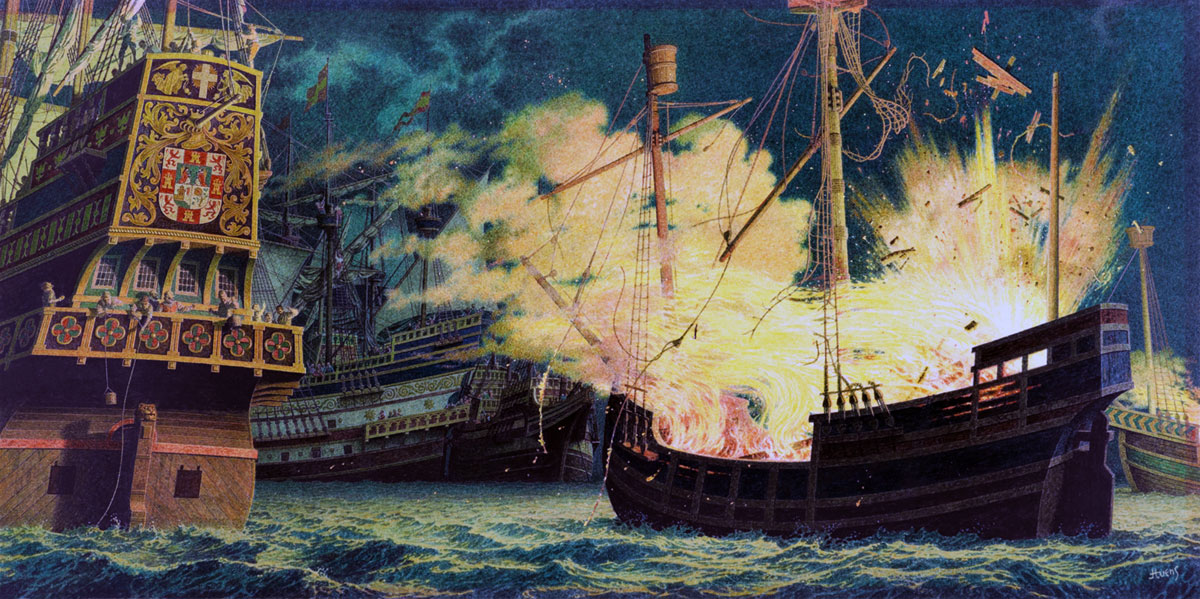
Jean-Leon Huens (Belgian, 1921-1984) Sir Frances Drake, Unmanned British Ships with Flammables Explode Among Spanish Ships
Nd
Jean-Leon Huens / National Geographic Society / Steven Kasher Gallery
A wonderfully eclectic posting!
Marcus
Many thankx to Steven Kasher Gallery for allowing me to publish the photographs in the posting. Please click on the photographs for a larger version of the image.
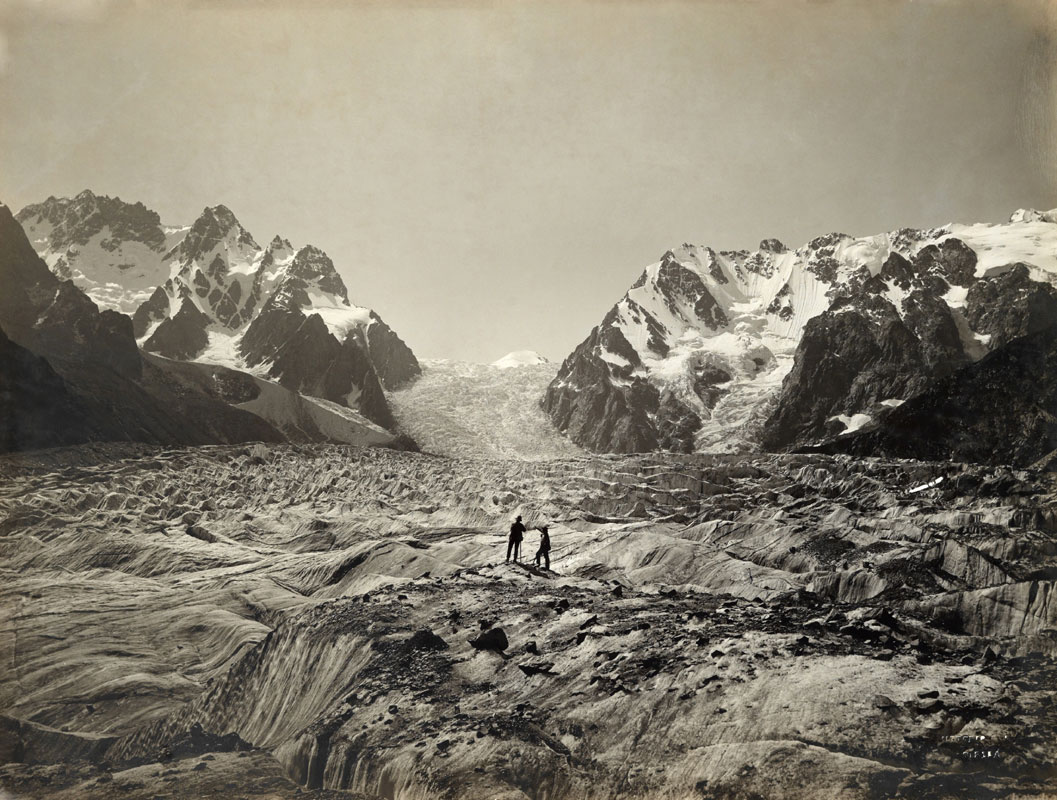
Vittorio Sella (Italian, 1859-1943) A Cascade of Weathered Ice Spills From the 14 Square Mile Glacier
Karagom Glacier, Caucasus Mountains, Russia
1890
Vittorio Sella / National Geographic Image Collection / Steven Kasher Gallery
Vittorio Sella (28 August 1859 – 12 August 1943) was an Italian photographer and mountaineer, whose photographs of mountains are regarded as some of the finest ever made. …
The high quality of Sella’s photography was in part due to his use of 30×40 cm photographic plates, in spite of the difficulty of carrying bulky and fragile equipment into remote places. He had to invent equipment, including modified pack saddles and rucksacks, to allow these particularly large glass plates to be transported safely. His photographs were widely published and exhibited, and highly praised; Ansel Adams, who saw thirty-one that Sella had presented to the US Sierra Club, said they inspired “a definitely religious awe.” Many of the photographs he took were of mountains which had not been previously recorded and so have historical as well as artistic significance; for example by recording the retreat of glaciers in the Rwenzori mountains in Central Africa.
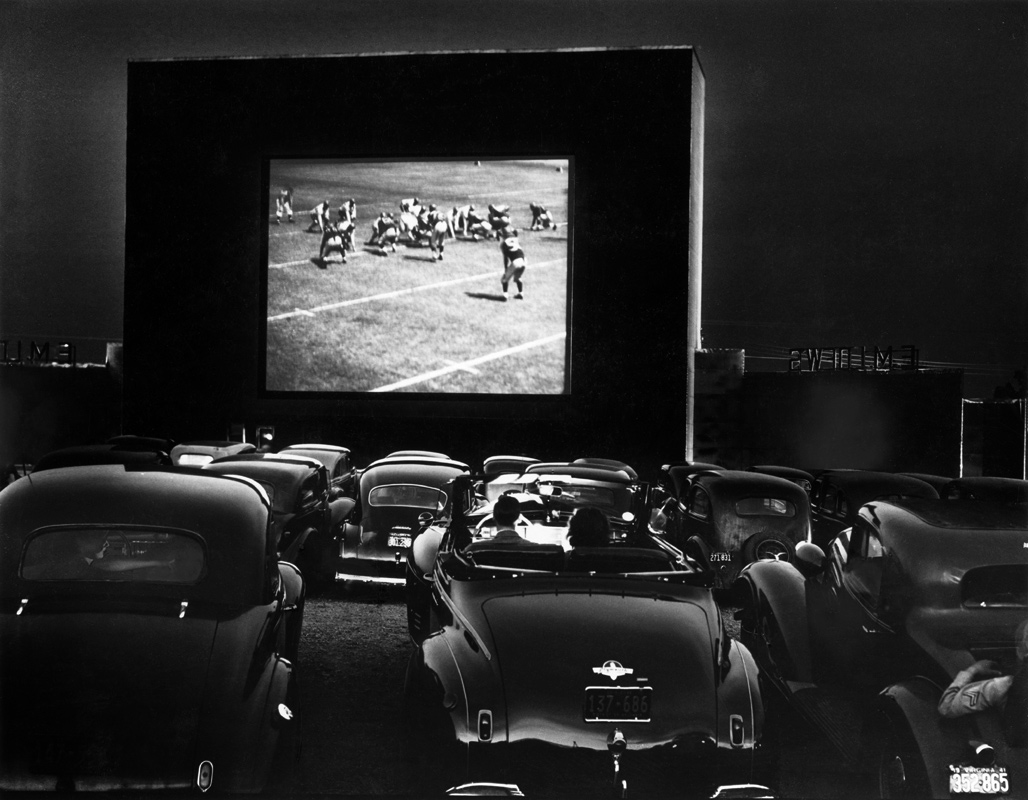
J. Baylor Roberts (American, 1902-1994) The Drive-In on Route 1
Alexandria, Virginia, 1941
J. Baylor Roberts / National Geographic Image Collection / Steven Kasher Gallery
Jacques Ertaud (French, 1924-1995) Jacques Yves Cousteau Films A Jet-propelled Submersible
Caribbean Sea, 1959
Jacques Ertaud / National Geographic Image Collection / Steven Kasher Gallery
Ned M. Seidler (American, 1922-2007) Freshwater Pond Life
c. 1970
Gouache and watercolour on paper
12 1/2 x 28 1/2 inches
Steven Kasher Gallery is proud to present the exhibition National Geographic: The Past and Future Present. It is the gallery’s fifth show of works from the National Geographic archives, but our first that presents vintage illustrations side by side with vintage photographs. The one hundred works presented span the entire 20th century. Photographers will include Herbert Ponting, Baron von Gloeden, Maynard Owen Williams, and Hiram Bingham. Illustrators will include Thornton Oakley, Louis Agassi Fuertes, and Tom Lovell. The exhibition will encompass works that represent National Geographic’s rich history in the fields of geography, archaeology, exploration, science, wildlife and world cultures.
Themes explored include Past Civilizations, the Age of the Dinosaur, Space Travel, Native American Cultures, American Industry, the Sea, and Flora and Fauna. National Geographic: The Past and Future Present juxtaposes photographic images taken from life, botanical studies drawn from live specimens, and depictions of the past and the future, imagined but unseen. These juxtapositions will highlight changing visions of natural and human history as they have evolved over the twelve decades of the Society’s image making.
“This exhibition represents the continuation of a four-year partnership with the Steven Kasher Gallery to put our commissioned work in the public eye. The inclusion of illustrations in this exhibition demonstrates the overall range of our archive, which spans vintage and contemporary photography, as well as drawings, paintings and other illustrations from the late 1800s to the present day.”
Maura Mulvihill, Senior Vice President for National Geographic Society and Director of the National Geographic Image Collection
Press release from the Steven Kasher Gallery website
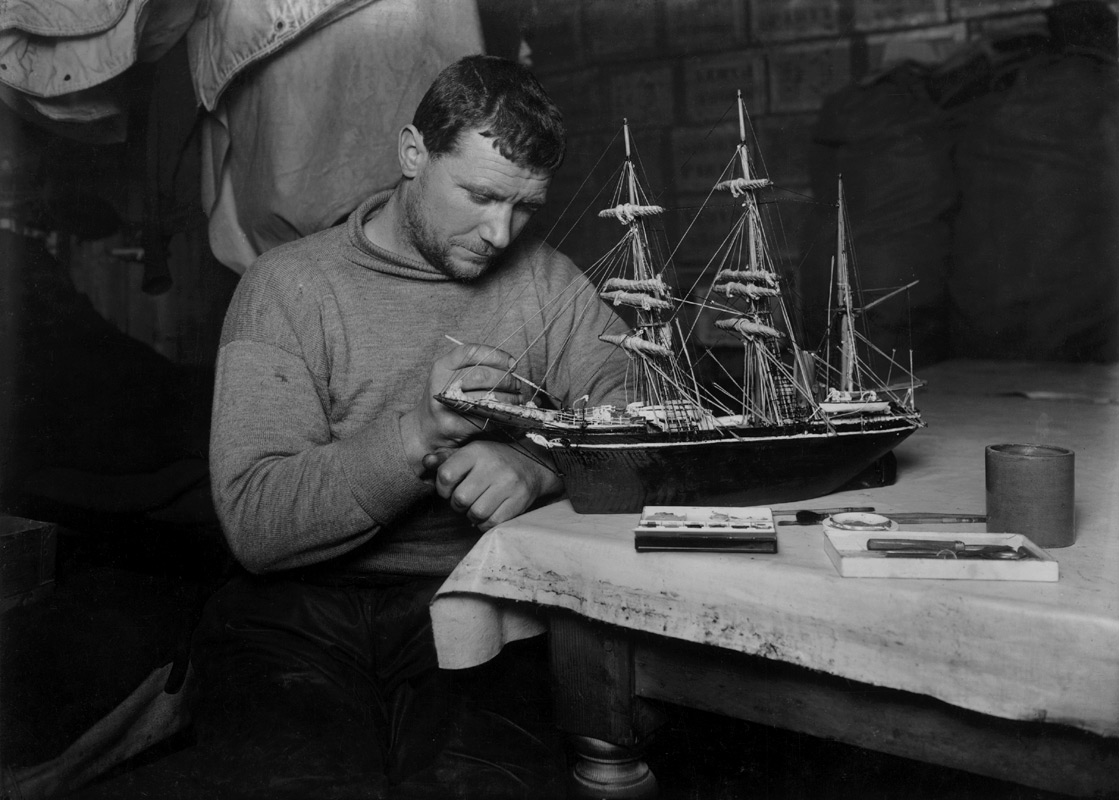
Herbert Ponting (British, 1870-1935) Aboard the Terra Nova on the British Antarctic Expedition 1910-1913
c. 1911
Herbert Ponting / National Geographic Image Collection / Steven Kasher Gallery
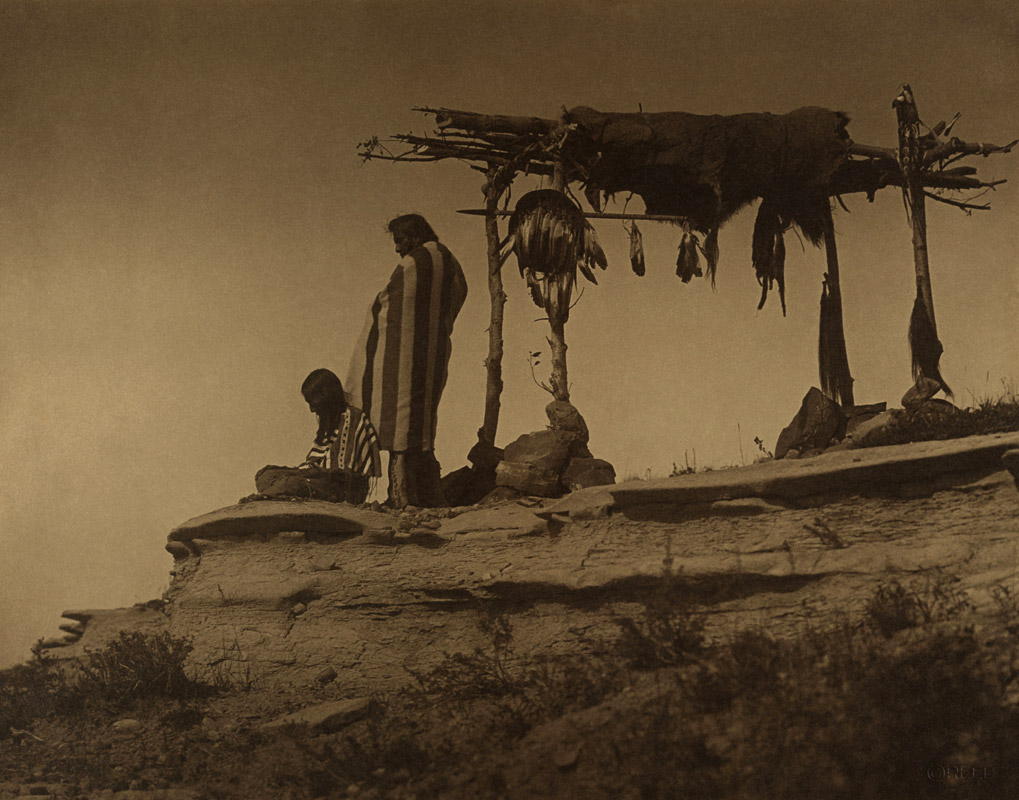
Roland Reed (American, 1864-1934) Tribute to Dead Piegan Blackfoot
Montana, 1912
Roland Reed / National Geographic Image Collection / Steven Kasher Gallery
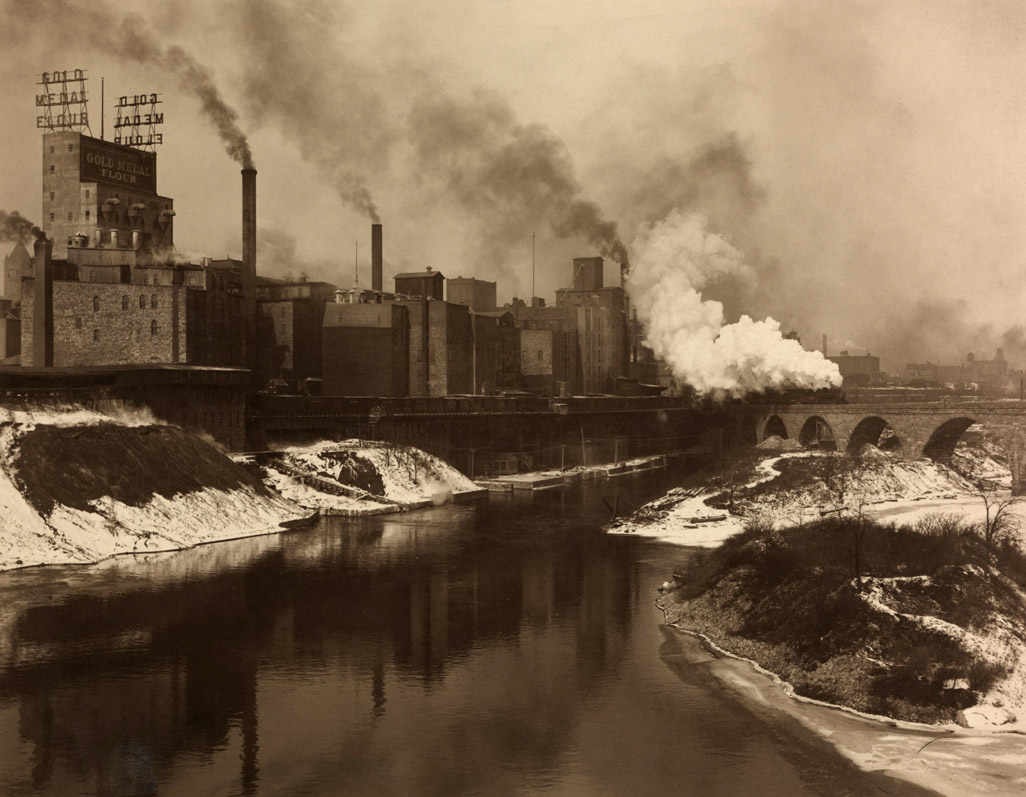
Washburn-Crosby Company (American) The Minneapolis Milling District, The Largest U.S. Flour Producer
1915
Washburn-Crosby Company / National Geographic Image Collection / Steven Kasher Gallery
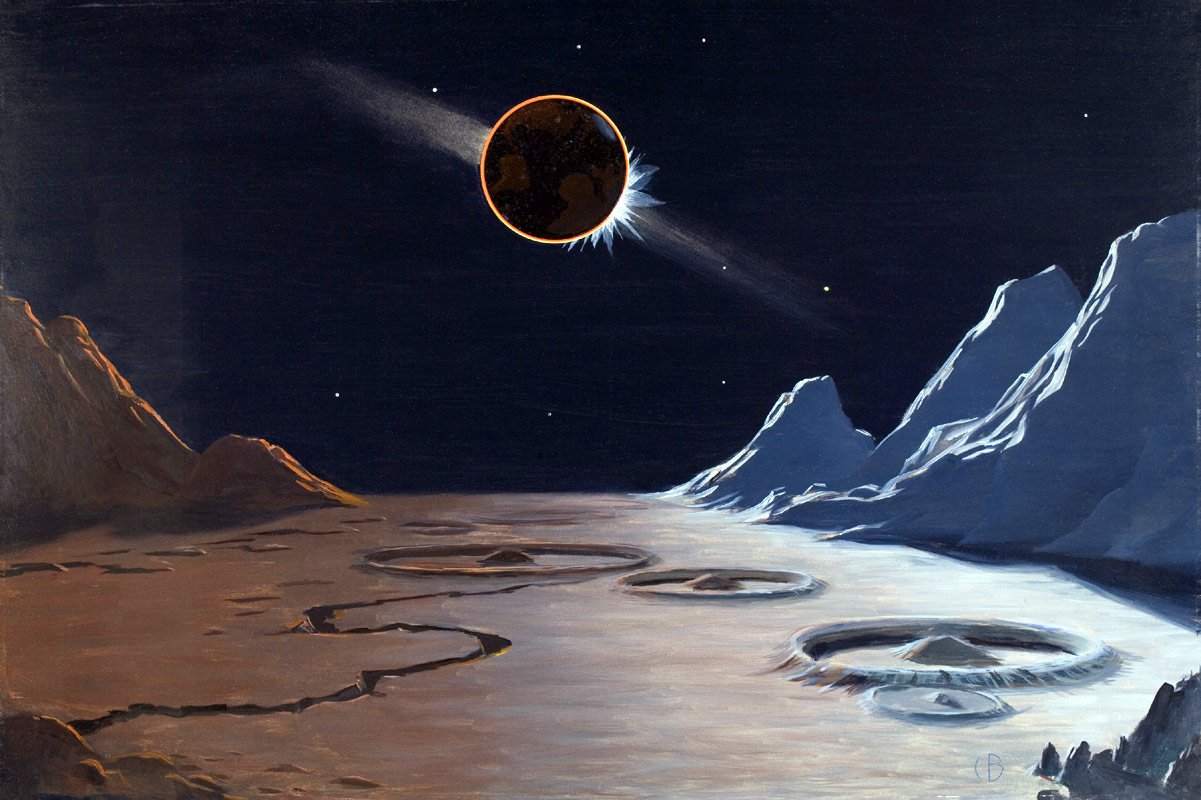
Charles Bittinger (American, 1879-1970) Eclipse of the Sun by the Earth
1930s
Charles Bittinger / National Geographic Society / Steven Kasher Gallery
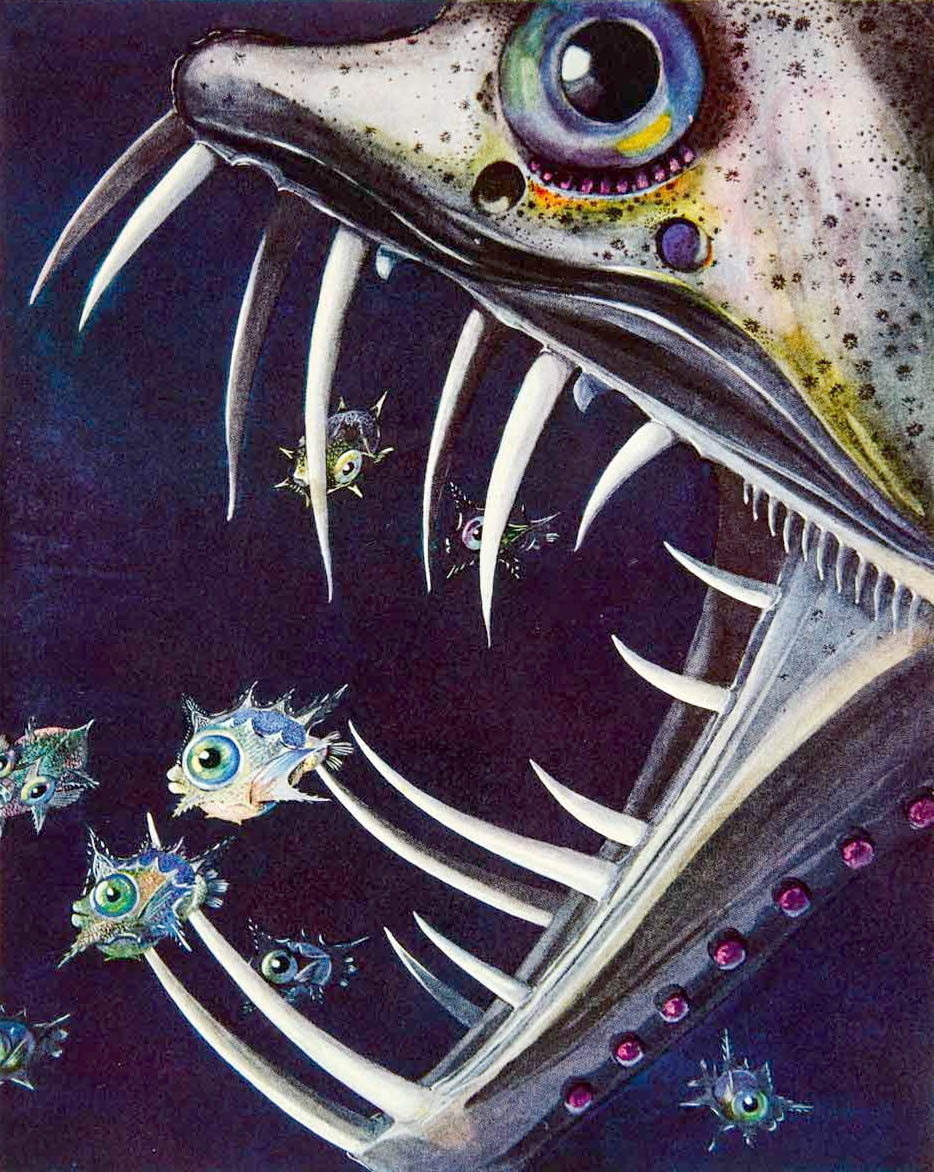
Else Bostelmann (American born Germany, 1882-1961) A Saber-Toothed Viperfish Attacking Young Ocean Sunfish
c. 1934
Gouache on paper
14 x 11 inches
Else Winkler von Röder (Roeder) Bostelmann (1882-1961), a German Empire-born American artist, joined the New York Zoological Society (now the Wildlife Conservation Society) in 1929 to paint marine life during William Beebe’s bathysphere oceanographic expeditions at Bermuda’s Nonsuch Island (1930-1934).
Bostelmann’s marine life paintings depicted the unbelievable sights that Beebe encountered from great depths in the ocean. “Had it not been for Mrs. Bostelmann’s deftness in rapidly sketching what she saw, much of the colour and drama would have been lost.” …
Bostelmann’s marine life art was published in several National Geographic Magazines in the 1930s, 1940s and beyond. Her depiction of the bioluminescence of unknown ocean life caused a stir in the oceanographic world.
Although she did not descend in the Bathysphere, her studies and final paintings were true to life at the time. Beebe described what he saw as he descended in the bathysphere through a direct telephone line to the ship above him. Detailed notes were taken by Gloria Hollister, a member of the research team. When Beebe exited the bathysphere, he immediately worked with Bostelmann as she put his descriptions to paper using watercolour, gouache and pencil. She did don a 16-pound copper helmet with an air hose attached to the ship above, sat on a chair on the ocean floor (20-35 feet down) with her canvas attached to an iron music stand weighted with lead and her brushes tied to the stand as she painted with oil the fish she saw around her. Due to the change in available light at that depth, the colours in her paintings were muted.
Richard Hewitt Stewart (American, 1901-2004) Colossal Olmec Head
La Venta, Mexico, 1940
Richard Hewitt Stewart / National Geographic Image Collection / Steven Kasher Gallery
Richard Hewett Stewart (1901-2004) began working for the National Geographic Society as a photo lab technician in 1924. Ten years later, he joined Matthew Stirling’s archeological team to photograph and, to a lesser extent, film the team’s eight expeditions to Veracruz and Tabasco (1939-1946). As a result, Stewart’s photographs illustrated all of National Geographic articles about the Olmec excavations carried out by the Smithsonian. Stewart again joined Stirling for the 1948-1949 archaeological expedition to Panama, sponsored by the Smithsonian Institution and the National Geographic Society.
Text from the Smithsonian Institution website
Thorton Oakley (American, 1881-1953) Liquid Steel Pours From an Electric Furnace
1940s
Thorton Oakley / National Geographic Society / Steven Kasher Gallery
Steven Kasher Gallery
166 Second Ave., 3A
New York, NY 10003 Phone: 917 922 6861
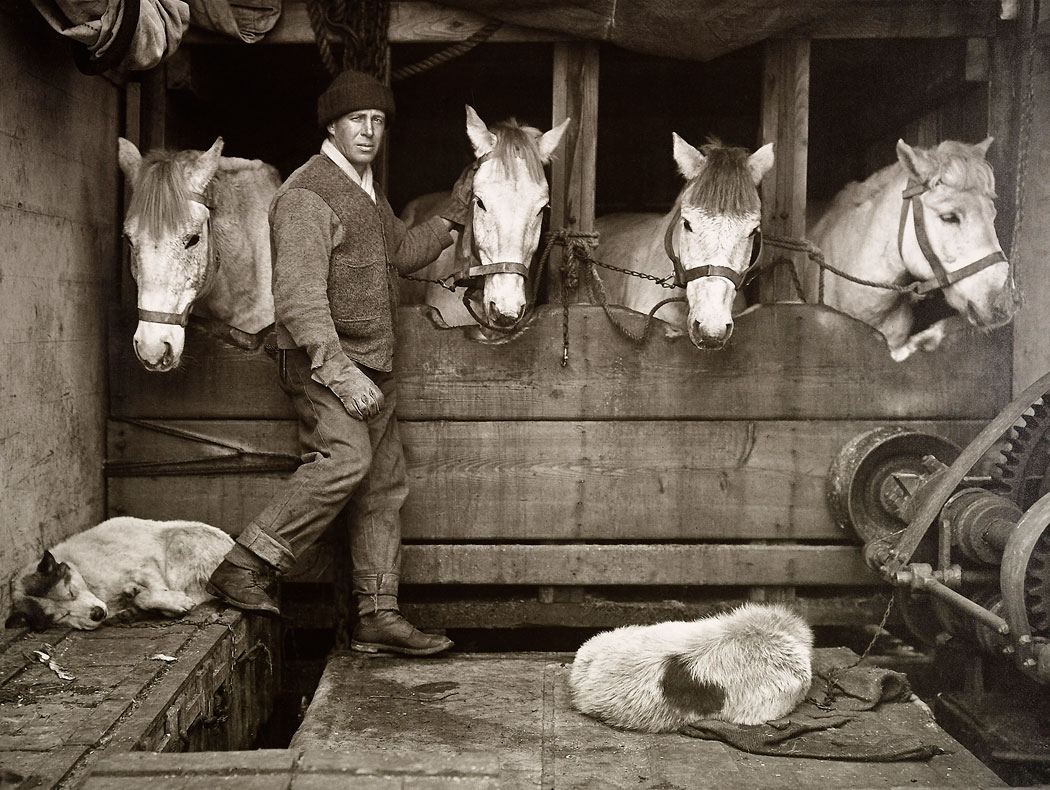
Continuing my fascination with all things Antarctic, here are more photographs from the Scott and Shackleton expeditions. The photograph Captain Lawrence Oates and Siberian ponies on board ‘Terra Nova’ by Herbert Ponting (1910, above) is simply breathtaking.
Dr Marcus Bunyan
Many thankx to The Royal Collection for allowing me to publish the photographs in the posting. Please click on the photographs for a larger version of the image.
This exhibition of remarkable Antarctic photography by George Herbert Ponting and Frank Hurley marks the 100th anniversary of Captain Scott’s ill-fated journey to the South Pole. Ponting’s dramatic images record Scott’s Terra Nova expedition of 1910-1912, which led to the tragic death of five of the team on their return from the South Pole. Hurley’s extraordinary icescapes were taken during Ernest Shackleton’s polar expedition on Endurance in 1914-1917, which ended with the heroic sea journey from Elephant Island to South Georgia. Both collections of photographs were presented to King George V and are today part of the Royal Photograph Collection.
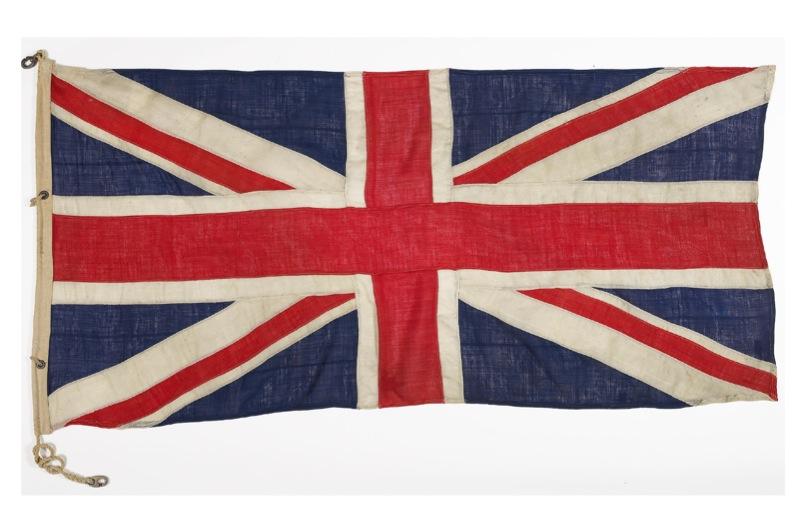
This Union Jack was given to Scott by the recently widowed Queen Alexandra on 25 June 1910 for him to plant at the South Pole. The flag was recovered with Scott’s body and returned to the queen by his wife, Kathleen, on 12 July 1913.
The photographs of Herbert Ponting and Frank Hurley may be stencilled into the collective memory after nearly a century of over-exposure. But it’s not often you get to see them away from the printed page, and they certainly bring out fresh depths and new perspectives…
It turns out to be highly instructive seeing Hurley and Ponting hung in neighbouring rooms. I’ve always taken Ponting to be somehow the lesser snapper. Hurley had the greatest photostory ever captured land in his lap when Shackleton’s ship the Endurance was trapped in ice floes and held fast for months before pressure ridges eventually crushed it like a dry autumn leaf. Like a good journalist Hurley recorded these traumas and more while also taking the chance to experiment with the strange light and baroque shapes supplied by his surroundings.
Ponting’s story was different. Four or so years earlier, and on the other side of the Antarctic land mass, he didn’t stray far from the expedition base, and indeed was left on the Terra Nova while Scott’s polar party were still out on the ice, trudging balefully towards immortality. There’s something about Ponting’s floridly unmodern moustache which sets him apart from the clean-shaven younger men in either expedition, as if he never quite left the studio behind.
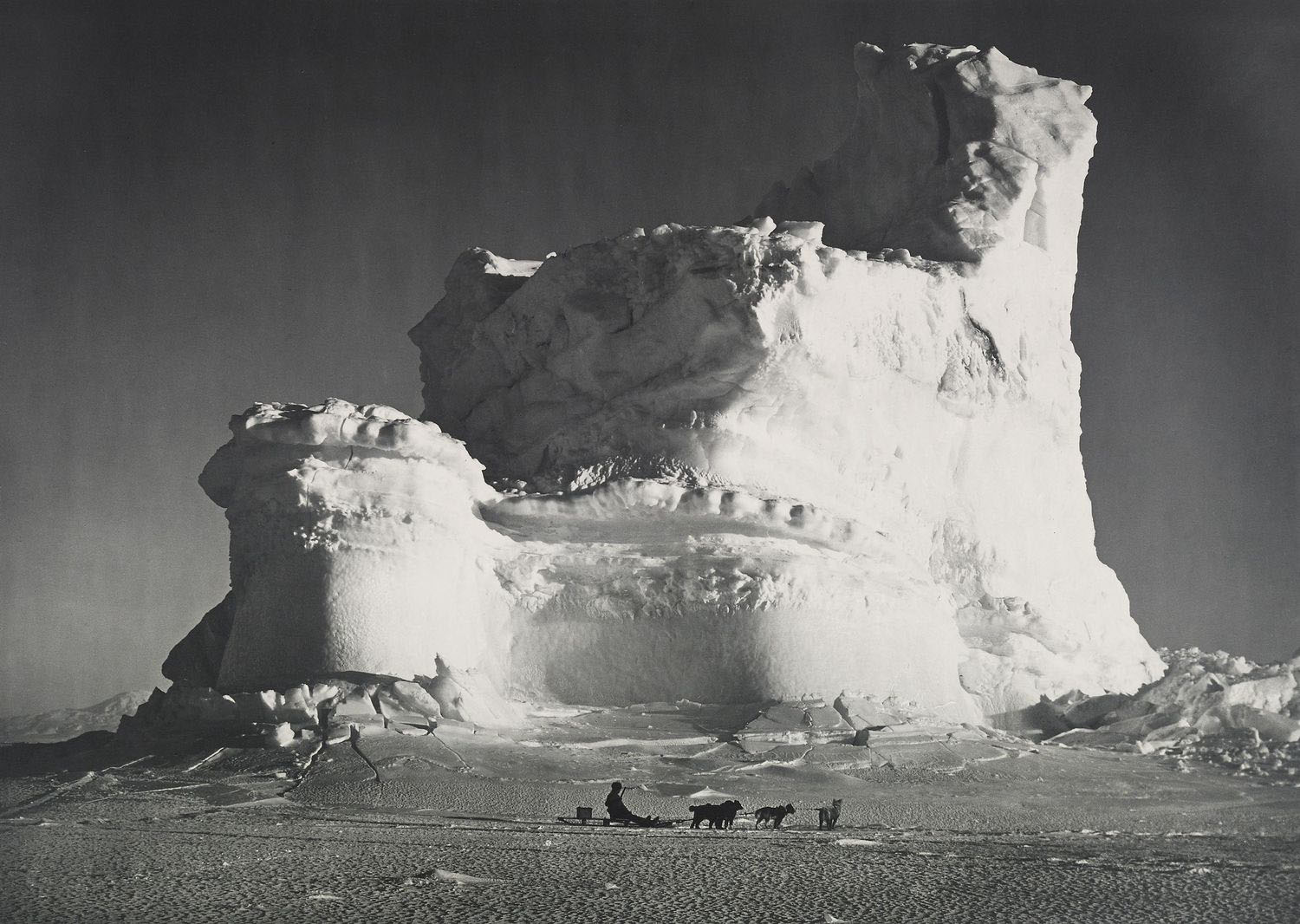
But the photographs are astonishing… The story here is the unequal battle between man and ice, the castellations and ramparts of bergs dwarfing explorers with dogs and sledges placed at their foot to give a sense of scale. Ponting also has a beautiful eye for filigree detail, never more than in one picture of long spindly icicles echoing the adjacent rigging of the Terra Nova.
One of the revelations is that the originals play up the drama of Ponting’s work much more than Hurley’s, which are printed at half the size. For all the astonishing pictures – a field of ice flowers, the masts of the Endurance all but shrouded by Brobdingnagian ice clumps – the final impact of Hurley’s collection lies in the fact that they exist at all… That is partly why Ponting trumps Hurley in this show. His pictures of Scott’s men have never felt more immediate.
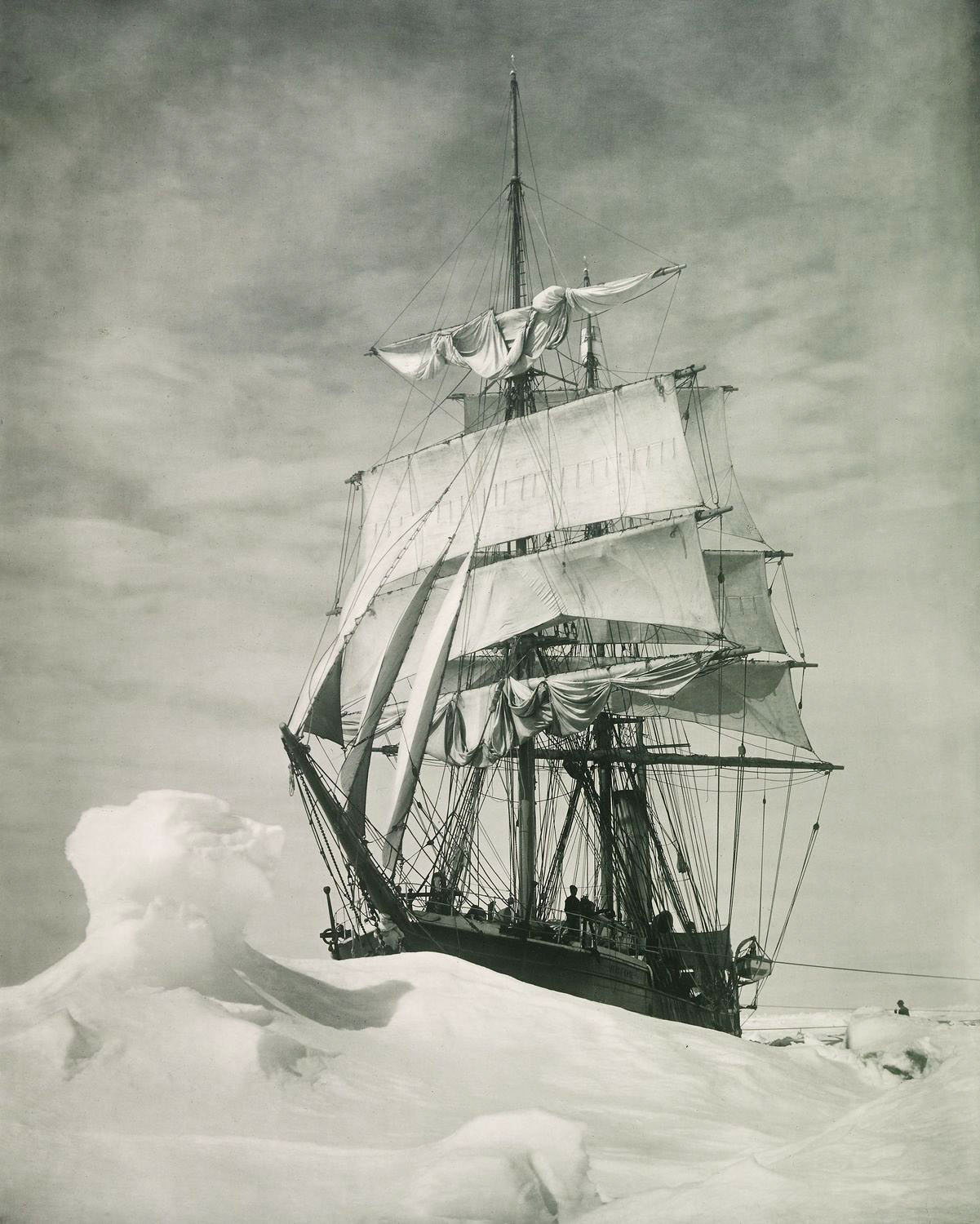
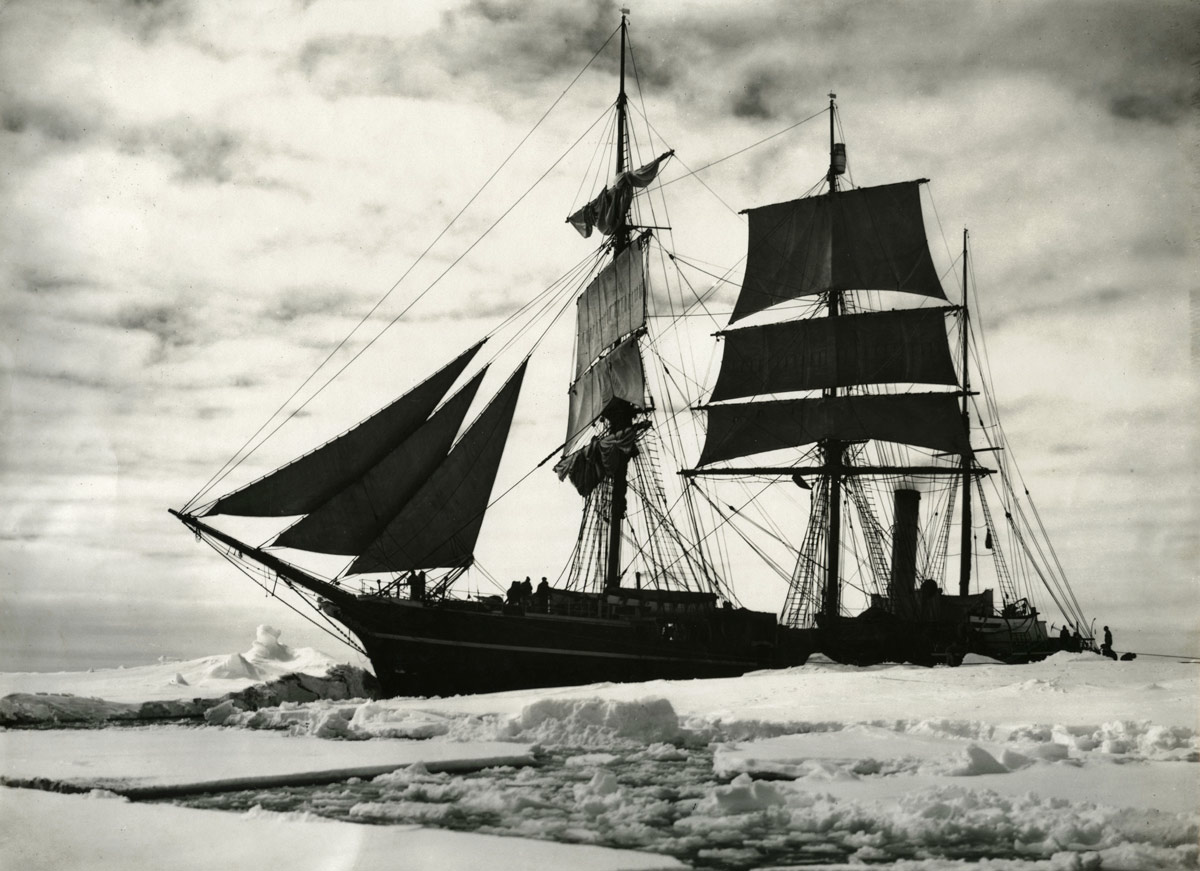
Photograph of the Terra Nova in sail, passing through ice and snow. Scott’s ship is seen here held up by the ice pack, with a curiously shaped ‘ice bollard’ in the foreground. The Terra Nova was launched in 1884 as a whaling ship. She had sailed to both the Arctic and Antarctic before serving as Scott’s ship in 1910. She survived until 1943 when she was damaged by ice and sank off the coast of Greenland.
British Antarctic Expedition
Scott and his men reached Antarctica on board the Terra Nova on 31 December 1910. The expedition had several aims that were scientific in nature, but the principal goal for Scott was to lead the first team to the South Pole.
Following his earlier polar experience on the Discovery expedition of 1901-1904, Scott realised the importance of good photographic images for fund-raising and publicising the achievements of the expedition. Scott employed the photographer Herbert Ponting to accompany him. This was the first time a professional photographer had been included in an Antarctic expedition.
Ponting had previously worked in the United States and Asia. He had a great deal of experience, and during his time in Antarctica, he produced around 2,000 glass plate negatives as well as making films. Ponting also taught photography to Scott and other members of the team so that they could record their assault on the Pole.
In March 1912 Ponting left the Antarctic, according to previously-laid plans. After his return to Britain, Ponting exhibited his work and lectured widely about Scott, thus ensuring that his photographs became inextricably linked with Scott and the heroic age of Antarctic exploration.
This iceberg, which resembles a medieval castle, was greatly admired by members of the expedition. Ponting returned several times during 1911 to photograph it, including once in June, the middle of the Antarctic winter, when he set up flashlights to make an image. At its highest point the berg is around 100 feet high (30.5 m).
Mount Erebus, an active volcano on Ross Island which last erupted in 2008, was first climbed in 1908 by members of Shackleton’s Nimrod expedition. Ponting has contrasted the overwhelming size of the natural world against the tiny human figure pulling a sledge, in the lower left corner of the photograph.
It is a story of heroism and bravery, and ultimately of tragedy, that has mesmerised generations. One hundred years on from their epic voyages to the very limits of the Earth, and of man’s endurance, the legends of Scott and Shackleton live on.
To mark the centenary of Captain Robert Falcon Scott’s expedition to the South Pole, the Royal Collection brings together, for the first time, a collection of the photographs presented to King George V by the official photographers from Scott’s Terra Nova expedition of 1910-1913 and Shackleton’s expedition on Endurance in 1914-1916, and unique artefacts, such as the flag given to Scott by Queen Alexandra (widow of King Edward VII) and taken to the Pole.
The exhibition documents the dramatic landscapes and harsh conditions the men experienced, through the work of expedition photographers Herbert Ponting and Frank Hurley. These sets of photographs are among the finest examples of the artists’ work in existence – and the men who took them play a vital part in the explorers’ stories. Highlights from Scott’s voyage include Ponting’s The ramparts of Mount Erebus, which presents the vast scale of the icescape, and the ethereal The freezing of the sea. Among the most arresting images from Hurley’s work on Shackleton’s expedition are those of the ship Endurance listing in the frozen depths and then crushed between floes.
The photographs also give insights into the men themselves. For instance, at the start of the journey Scott appears confident and relaxed, with his goggles off for the camera. In contrast, a photograph taken at the Pole shows him and his team devastated and unsmiling, knowing they had been beaten. The exhibition also records the lighter moments of expedition life, essential for teams cut off from the outside world for years at a time. On Shackleton’s expedition, a derby for the dogs was organised – with bets laid in cigarettes and chocolate. A menu for Midwinter’s Day, on 22 June 1911, shown in the accompanying exhibition publication, includes roast beef and Yorkshire pudding, ‘caviare Antarctic’ and crystallised fruits.
Antarctic adventurer David Hempleman Adams has been closely involved in the exhibition and has written an introduction to the catalogue. First given the taste for adventure by The Duke of Edinburgh’s Award scheme, he was inspired, like generations of school children, by the tales of discovery. As a South Pole veteran, the first Briton to reach the Pole solo and unsupported, he is still in awe of Scott and Shackleton’s achievements – and will return with his daughter this year to mark the centenary. David Hempleman Adams said: “We have a big psychological advantage today: We know it is possible to reach the South Pole. Nowadays you can go on Google Earth and see what’s there. Back then, it was just a big white piece of paper. Scott and Shackleton had no TVs, radios or satellite phones – they were cut off from the outside world – and in terms of equipment, the tents, skis and sledges, today, we carry about one tenth of what they carried, over the same mileage. What they achieved, with what they had, is really magnificent. This is the 100th anniversary and the legend has stood the test of time. Even in this modern world, there’s still just as much interest.”
As the photographs show, animals played an important part in the expeditions. There are portraits of the ponies and of individual sledge dogs. In his diaries, Scott describes the relationship he struck up with the bad tempered husky Vida: “He became a bad wreck with his poor coat… and… I used to massage him; at first the operation was mistrusted and only continued to the accompaniment of much growling, but later he evidently grew to like the warming effect and sidled up to me whenever I came out of the hut… He is a strange beast – I imagine so unused to kindness that it took him time to appreciate it.”
Ponting also photographed wildlife, including seals, gulls and penguins. Scott writes of the moment Ponting tried to photograph killer whales and how the creatures crashed through the ice to catch him. Scott, watching but unable to help, observes, “It was possible to see their tawny head markings, their small glistening eyes, and their terrible array of teeth – by far the largest and most terrifying in the world.”
The inspirational qualities of the explorers were recognised by King George V. In his book, The Great White South, Ponting records what the Monarch said to him when he went to Buckingham Palace to show his Antarctic film: “His Majesty King George expressed to me the hope that it might be possible for every British boy to see the pictures – as the story of the Scott Expedition could not be known too widely among the youth of the nation, for it would help to promote the spirit of adventure that had made the Empire.”
Royal interest in polar exploration began with Queen Victoria and Prince Albert, who followed the fortunes of the early adventurers, such as Sir John Franklin and William Bradford, and it continues to this day. The Duke of Edinburgh, who has written a foreword to the exhibition catalogue, has been the patron of many of David Hempleman Adams’s expeditions and has himself crossed the Antarctic Circle. HRH The Princess Royal is Patron of the UK Antarctic Heritage Trust.
Photograph of the Terra Nova seen from inside a grotto that was formed by an iceberg as it turned over, carrying a large floe which froze onto it. Both Ponting and Scott were struck by the colours of the ice inside this ice grotto; they were a rich mix of blues, purples and greens. Ponting thought that this photograph, framing the Terra Nova, was one of his best.
Both Captain Scott and Herbert Ponting – the photographer accompanying him on the Terra Nova expedition – wrote about the intense colours that they encountered in the landscape of Antarctica. In this series of three short talks by Royal Collection curator Sophie Gordon, we examine how Ponting attempted to capture these magical blues, greens and oranges in his photographs beginning here with the blues of this grotto within an iceberg, taken in January, 1911.
Royal Collection: ‘A Lovely Symphony of Blue and Green’ – Grotto in an Iceberg
Both Captain Scott and Herbert Ponting – the photographer accompanying him on the Terra Nova expedition – wrote about the intense colours that they encountered in the landscape of Antarctica. In this series of three short talks by Royal Collection curator Sophie Gordon, we examine how Ponting attempted to capture these magical blues, greens and oranges in his photographs beginning here with the blues of this grotto within an iceberg, taken in January, 1911.
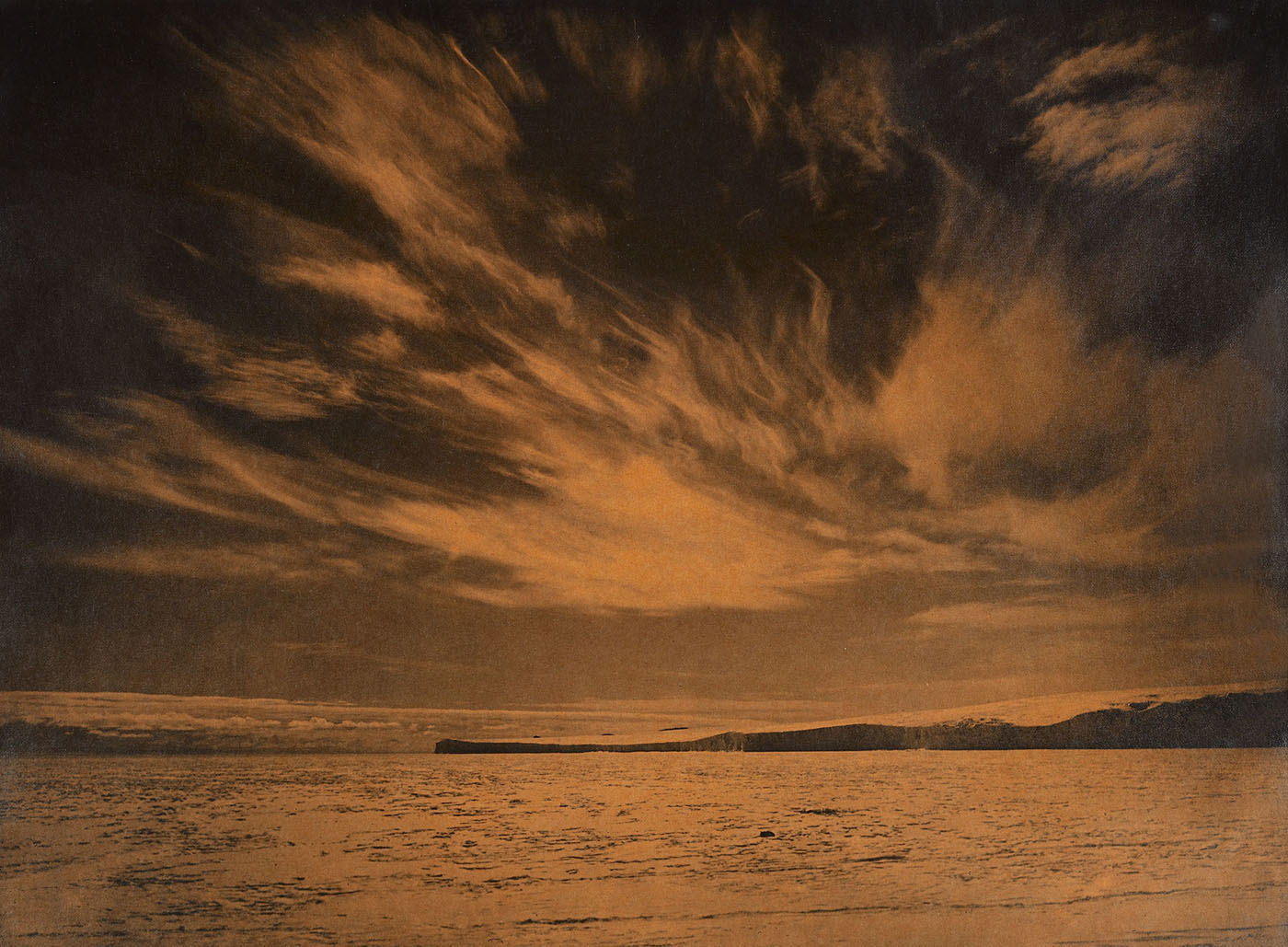
Photograph of a thin film of new ice covering the sea with ice blocks in the foreground. The Barne Glacier can be seen in the distance. This view, looking from Cape Evans towards Cape Barne on Ross Island, shows the moment when the sea began to freeze. The men would have realised that they could no longer leave Antarctica. Once winter began, no ships would be able to reach them to bring in supplies or to take anyone out.
Royal Collection: ‘A Lovely Symphony of Blue and Green’ – The Freezing of the Sea
In the second of these three short talks, Royal Collection curator Sophie Gordon, briefly considers this atmospheric photograph which captured the moment the sea began to freeze, cutting the men off in Antarctica for the winter.
Royal Collection: ‘A Lovely Symphony of Blue and Green’ – Cirrus Clouds over the Barne Glacier
In this, the third in her series of talks, Royal Collection curator Sophie Gordon examines how Ponting captured the dramatic reds and oranges and the beauty of the natural landscape that he experienced during his time in the Antarctic.
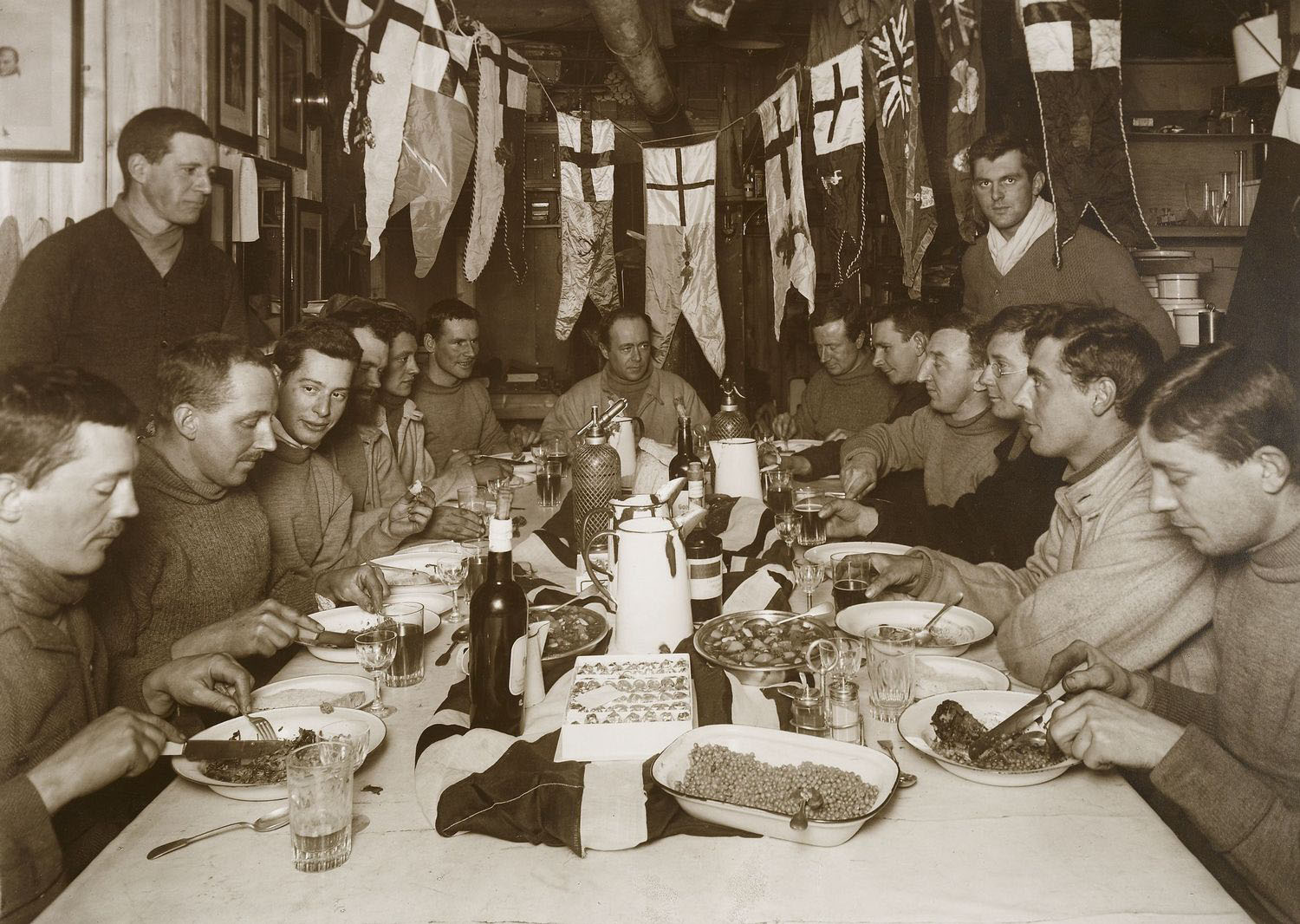
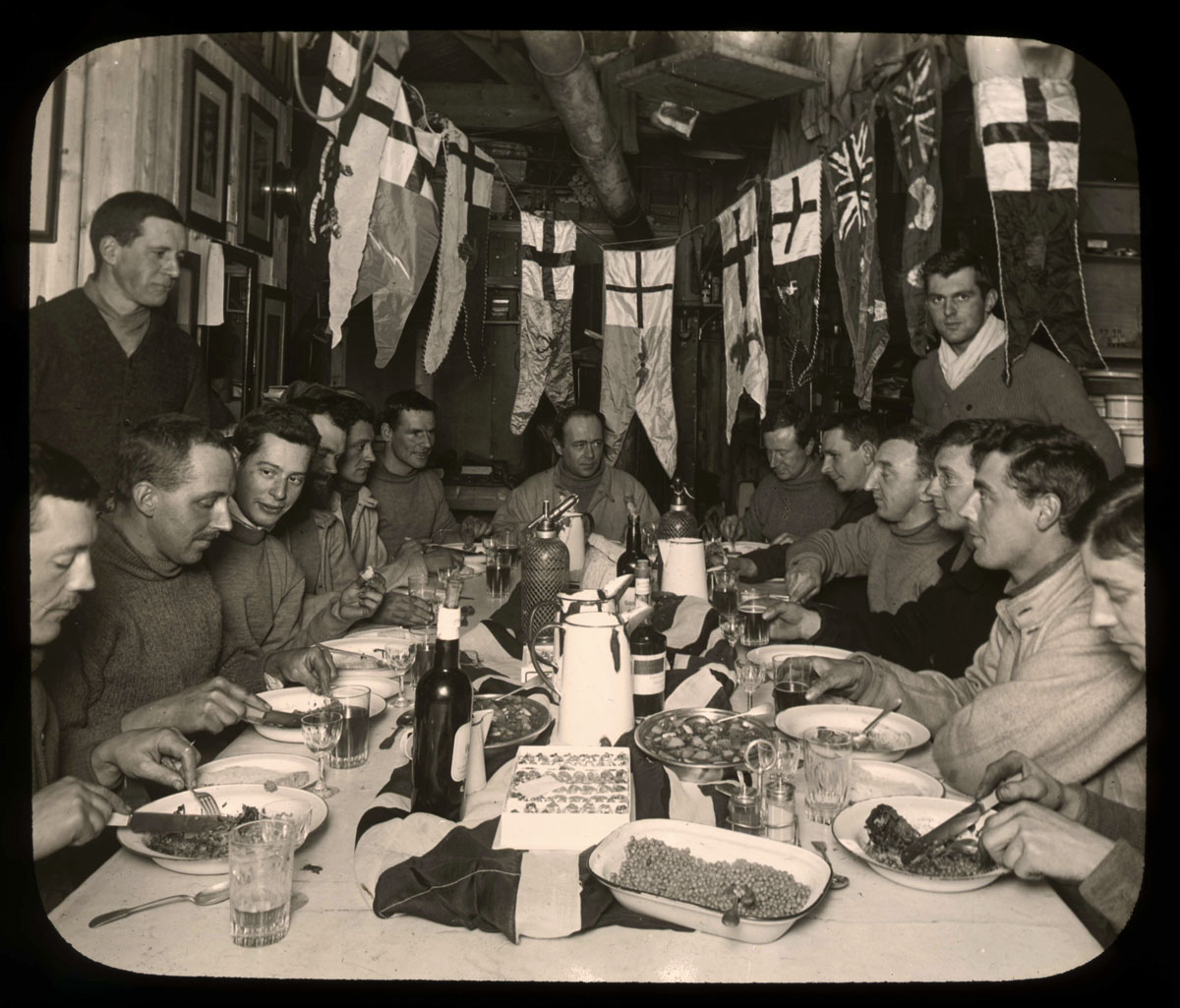
Photograph of the Officer’s table for Captain Scott’s birthday dinner with a variety of food and drink laid out on the table. The men are celebrating Scott’s 43rd birthday – his last – on 6 June 1911. He sits at the head of the table, and is surrounded by the officers and senior members of the team. The only man looking at the camera is the Norwegian naval officer Tryggve Gran (1889-1980). The atmosphere is both festive and patriotic.
Photograph of Vida. One of Scott’s favourite dogs, Vida suffered from a bad coat and would creep up to Scott for attention. Scott noted in his diary that initially the dog would growl at him but eventually his suspicion grew less: ‘He is a strange beast – I imagine so unused to kindness that it took him time to appreciate it’.
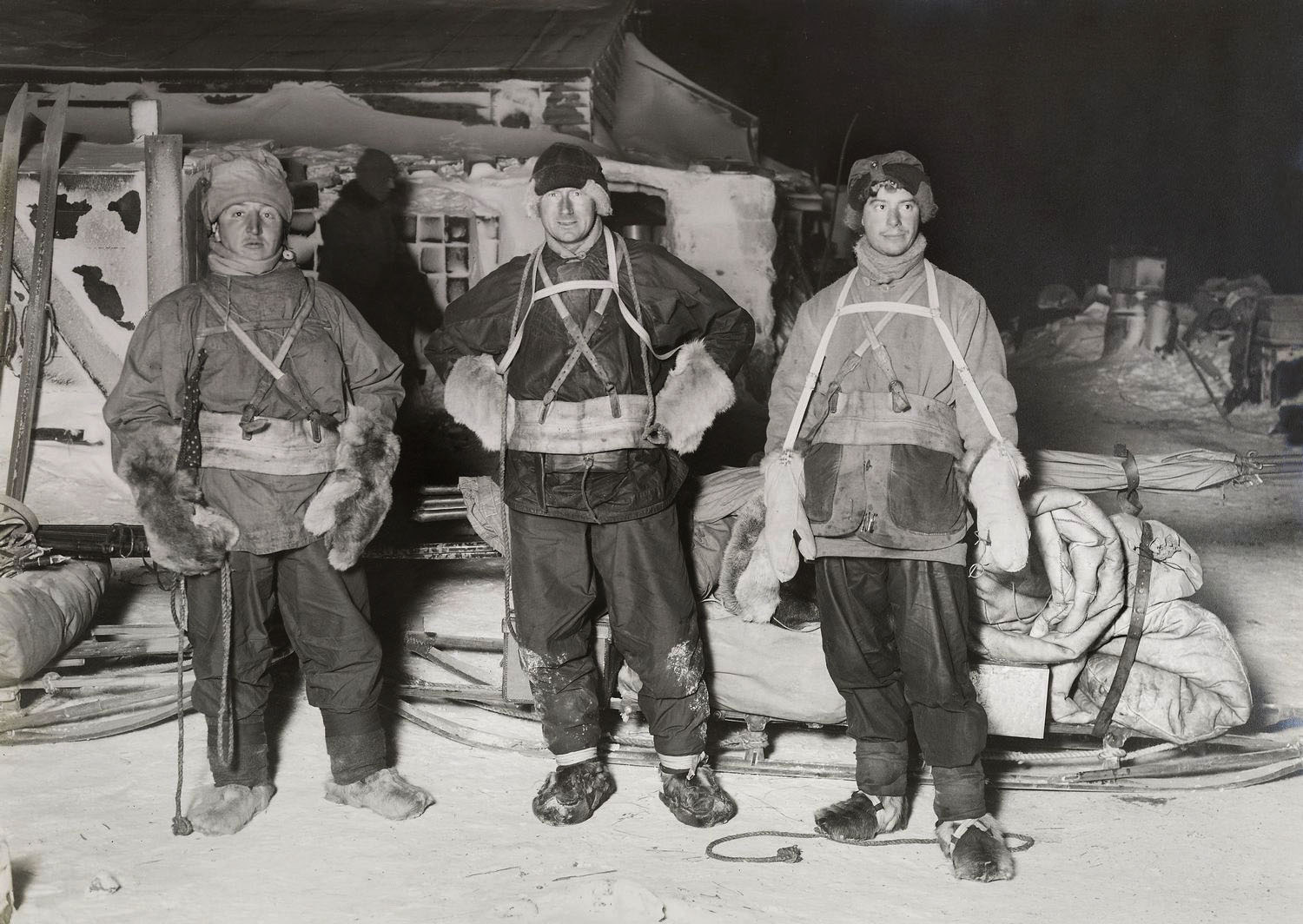
Henry Bowers (1883-1912), Edward Wilson (1872-1912) and Apsley Cherry-Garrard (1886-1959) are shown shortly before departing for Cape Crozier in search of Emperor penguin eggs. Between 27 June and 1 August, the trio endured extreme weather conditions and winter darkness as they crossed Ross Island and then returned, having collected three eggs. Cherry-Garrard famously described it as ‘the worst journey in the world’.
Royal Collection: ‘The weirdest bird’s-nesting expedition that has ever been’ – Part Two
In the second in this series of talks, Royal Collection curator Emma Stuart takes us on a journey with three intrepid explorers as they faced the hostile conditions of the Antarctic to recover an Emperor Penguin’s egg.
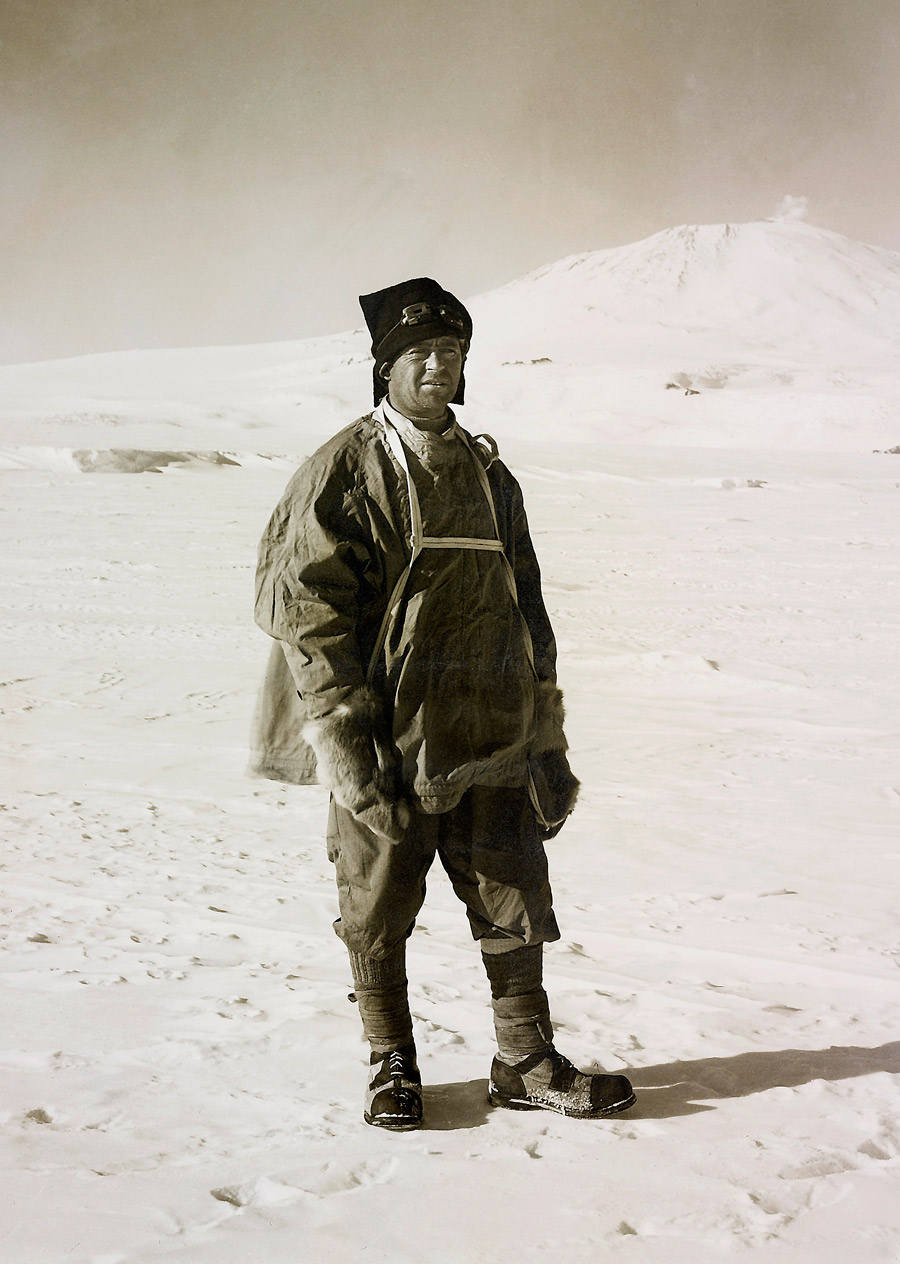
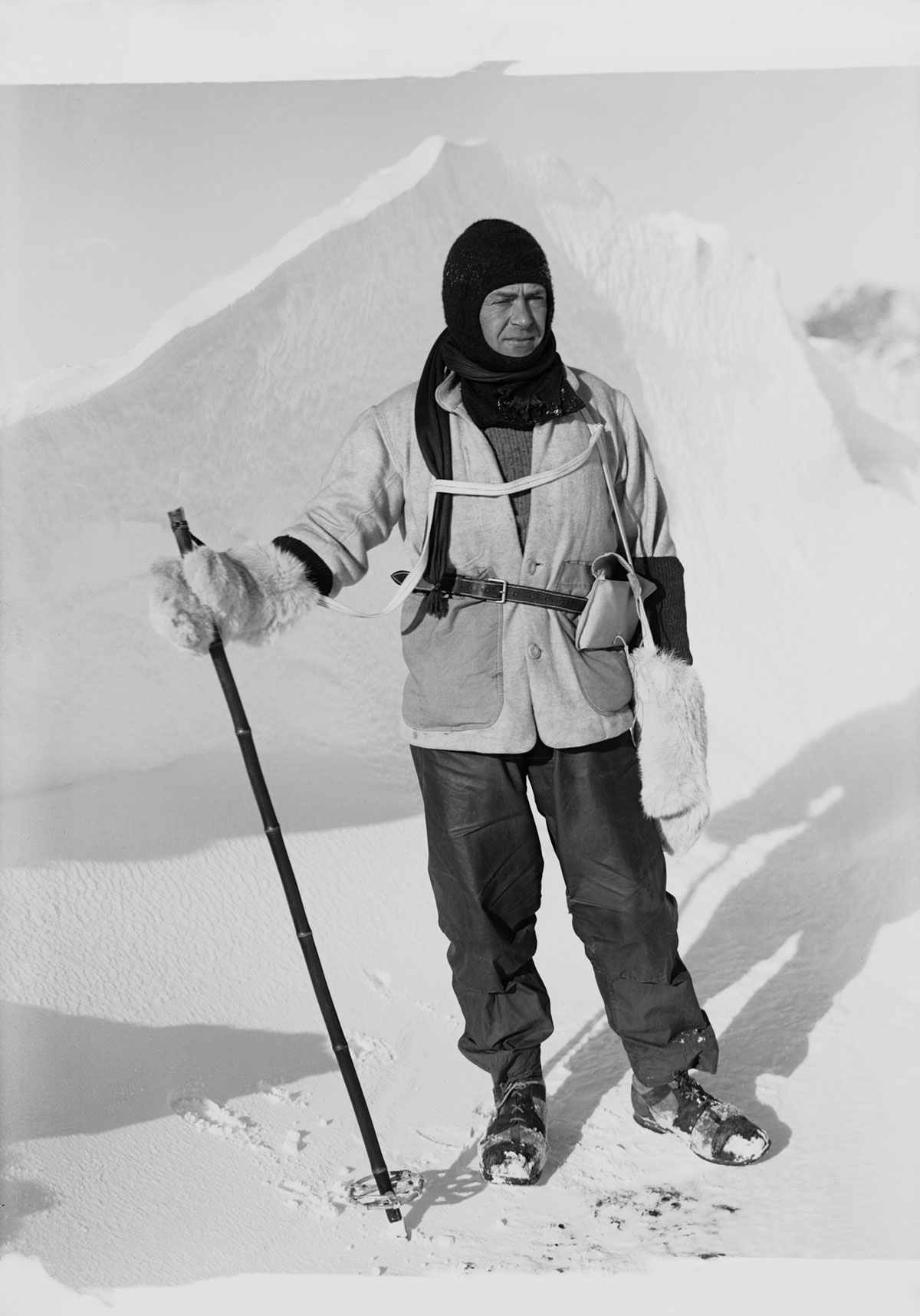
This photograph of Scott, with Mount Erebus in the background, was taken at the start of the expedition. He is wearing fur gloves with an attached cord, leather boots, gaiters and thick socks.
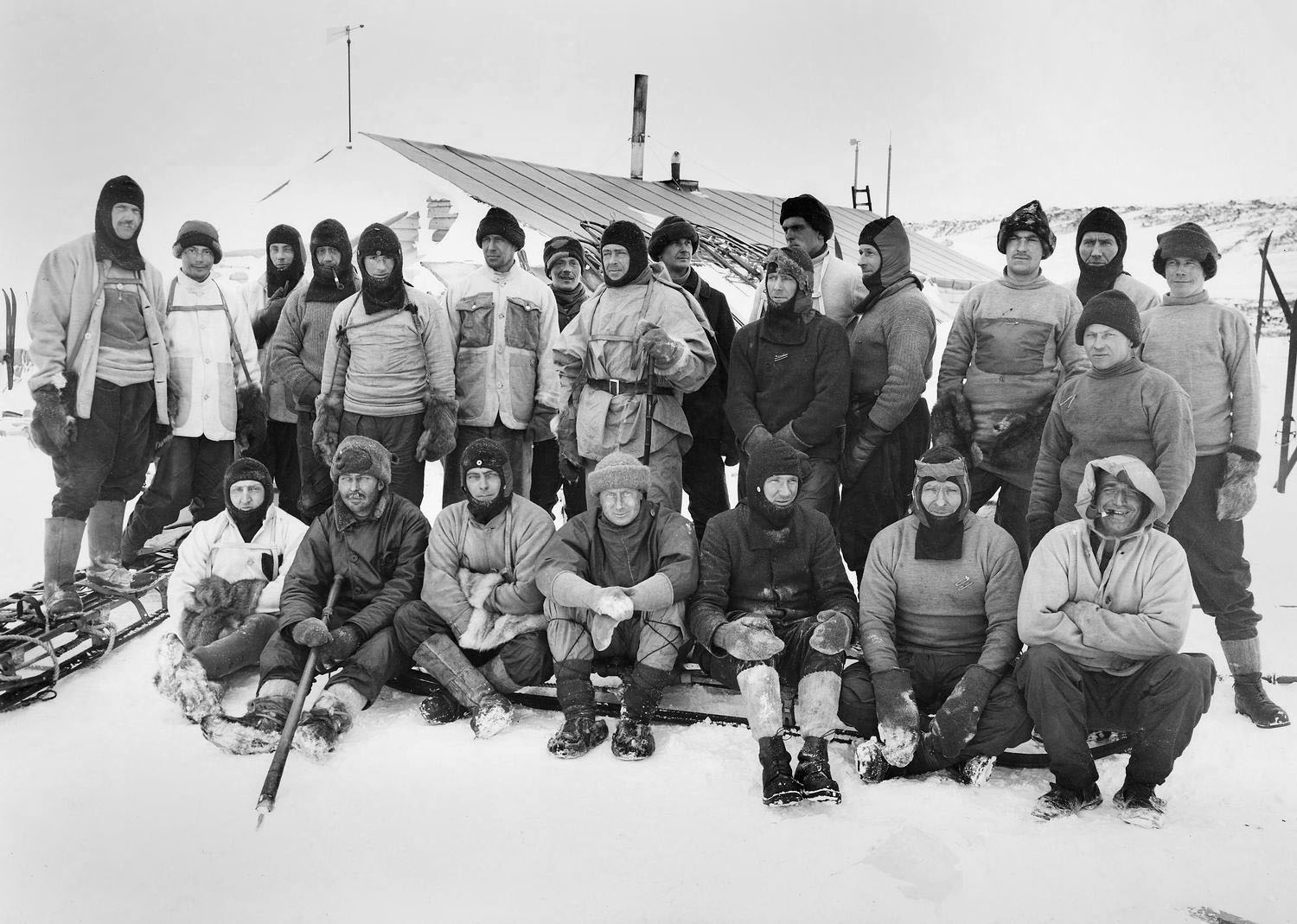
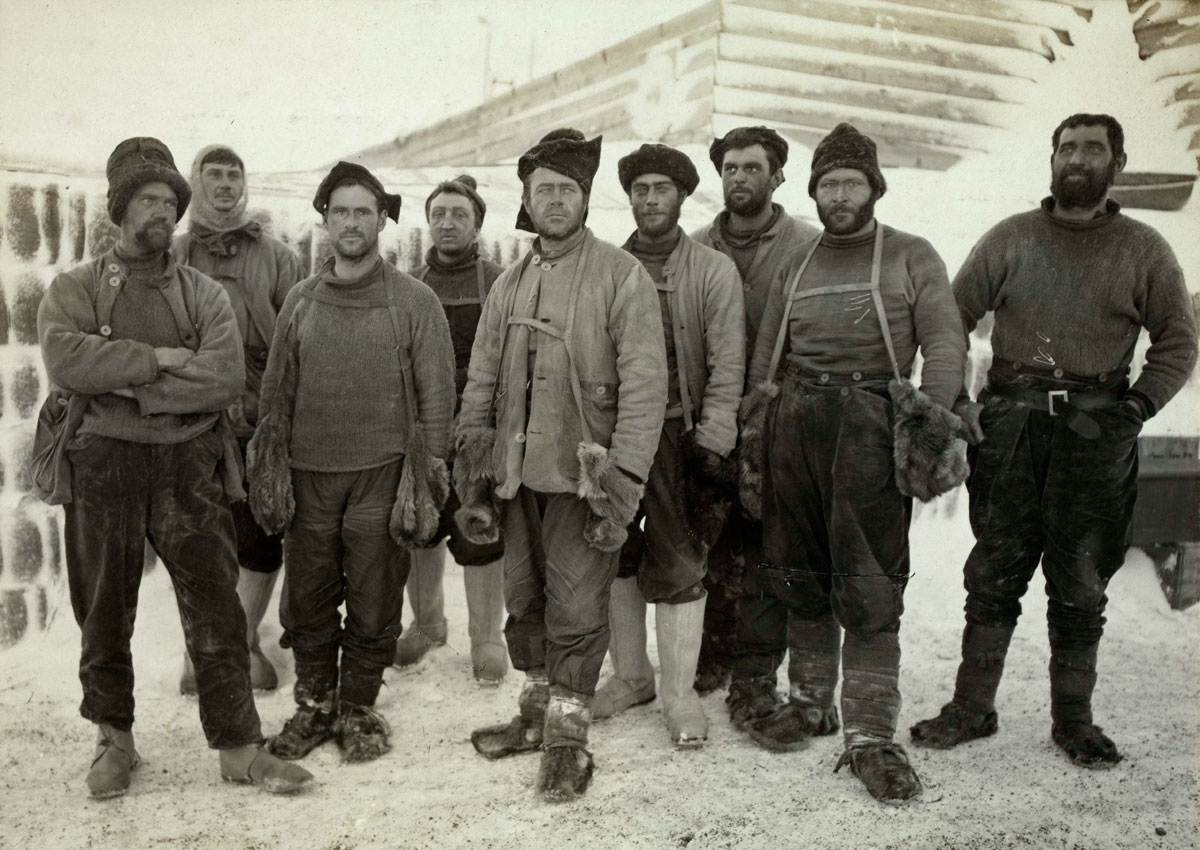
Photograph of the Shore party. On the back row are (from left to right): T. Griffith Taylor; Apsley Cherry-Garrard; Bernard Day; Edward Nelson; Edward Evans; Lawrence Oates; Edward Atkinson; Robert Falcon Scott; Charles Wright; Patrick Keohane; Tryggve Gran; William Lashly; Frederick Hooper; Robert Forde; Anton Omelchenko; Dimitri Gerov. On the front row are (from left to right): Henry Bowers; Cecil Meares; Frank Debenham; Edward Wilson; George Simpson; Edgar Evans and Tom Crean. This group is the Shore Party – the men who remained in Antarctica throughout the winter of 1911, preparing for Scott’s final departure for the Pole. They pose in front of the expedition hut at Cape Evans. The only people not visible are Clissold, the cook, and Ponting, the photographer. Scott is at the centre of the group and all the men look relaxed. This was taken at the very beginning of the expedition, when they would have been optimistic and excited about the future.
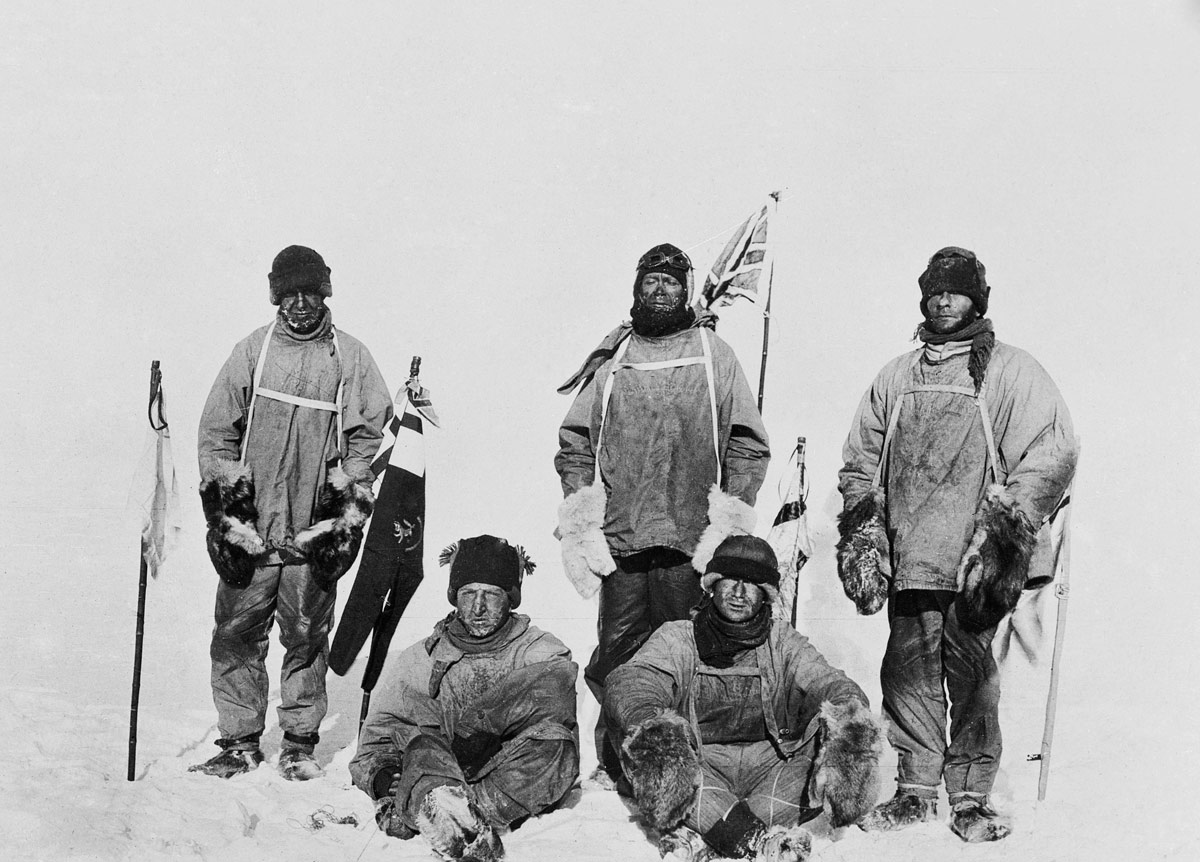
Photograph of Scott’s party at Amundsen’s tent at the South Pole. (from left to right are): Robert Falcon Scott (1868-1912); Lawrence Oates (1880-1912); Edward Wilson (1872-1912) and Edgar Evans (1876-1912). This photograph shows the dejection of the team as they explore the tent left by Roald Amundsen, who reached the South Pole on 14 December 1911, thirty-five days before Scott. There is a Norwegian flag at the top of the tent; inside, Scott found a letter recording their achievement, left by Amundsen in case he did not return safely.
Shackleton set out in October 1914 on the Endurance with the intention of making the first crossing of the Antarctic continent via the South Pole. While he and his men planned to reach Antarctica through the Weddell Sea, another party aboard the Aurora sailed to the other side of the continent to lay food depots for the expected party.
The intention was that only six men would complete the crossing; the photographer Frank Hurley was to be one of the team. Hurley had been to the Antarctic before, as part of the Australasian Expedition of 1911-1914. He was intrepid in his search for dramatic images. The role of photographer was important not just to document the achievements of the expedition, but also to create a source of income. The rights to publish the images would be sold for a great deal of money after the return to Britain.
The expedition ran into difficulties almost immediately. By mid-January 1915, Endurance became trapped in ice and had to become a floating scientific station. The men waited out the harsh Antarctic winter in the hope that their situation would improve.
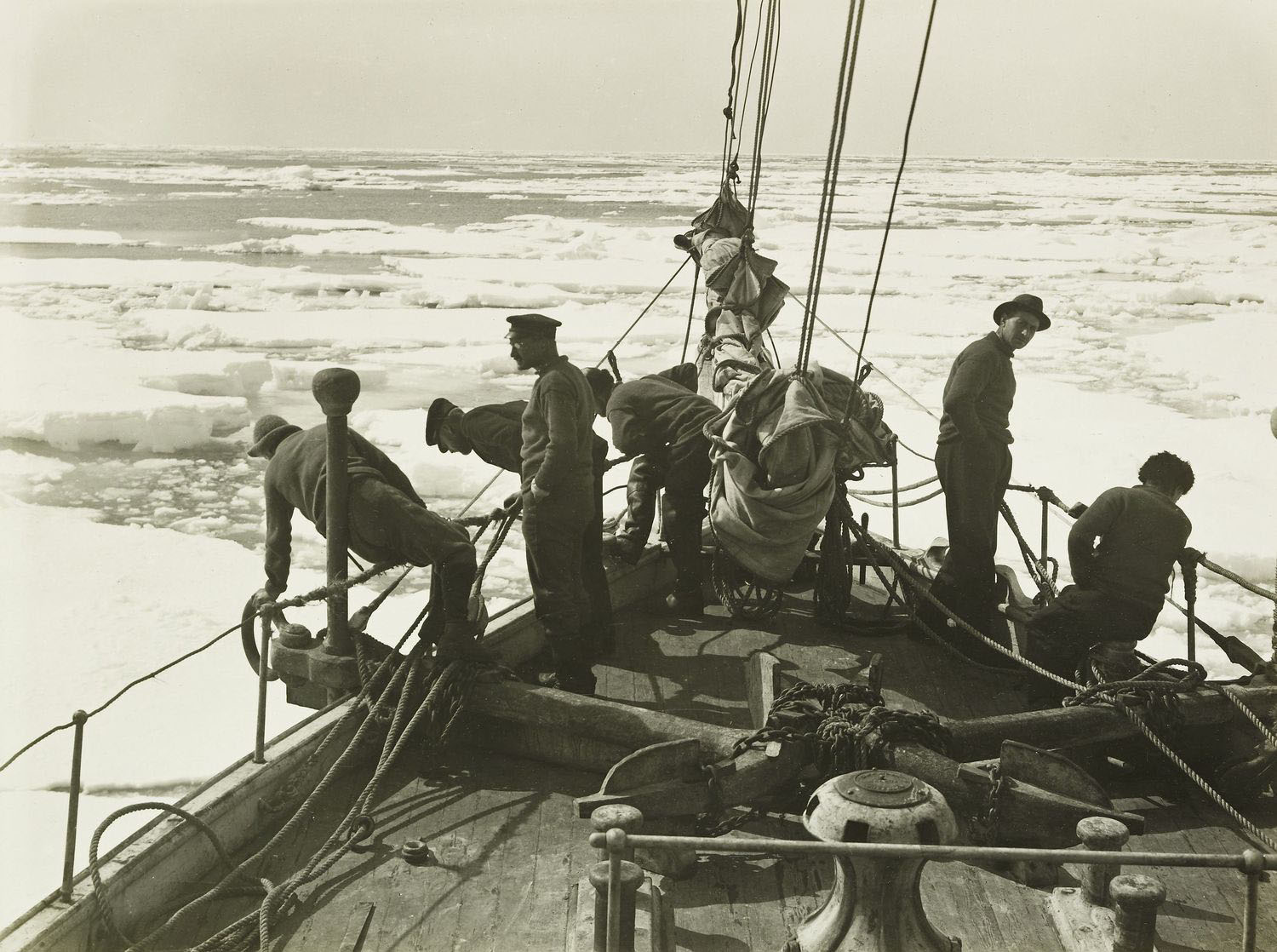
Photograph of six members of Shackleton’s crew standing on the deck of Endurance. This was the men’s first view of the pack ice through which they had to navigate in order to reach the coast of Antarctica. The Endurance met the ice far further north than they had hoped. The whalers on South Georgia had warned them of the poor ice conditions before they set out. This was a warning of things to come.
Hurley poses with his cinematograph, which was used to shoot moving film footage. The footage was later turned into a film released after his return under the name of In the Grip of the Polar Pack Ice.
Endurance sits benignly at rest in the midst of the ice field. A recent blizzard has coated the hummocks in a layer of snow, softening the contours. All looks peaceful, but within a few months these same hummocks will have crushed the ship.
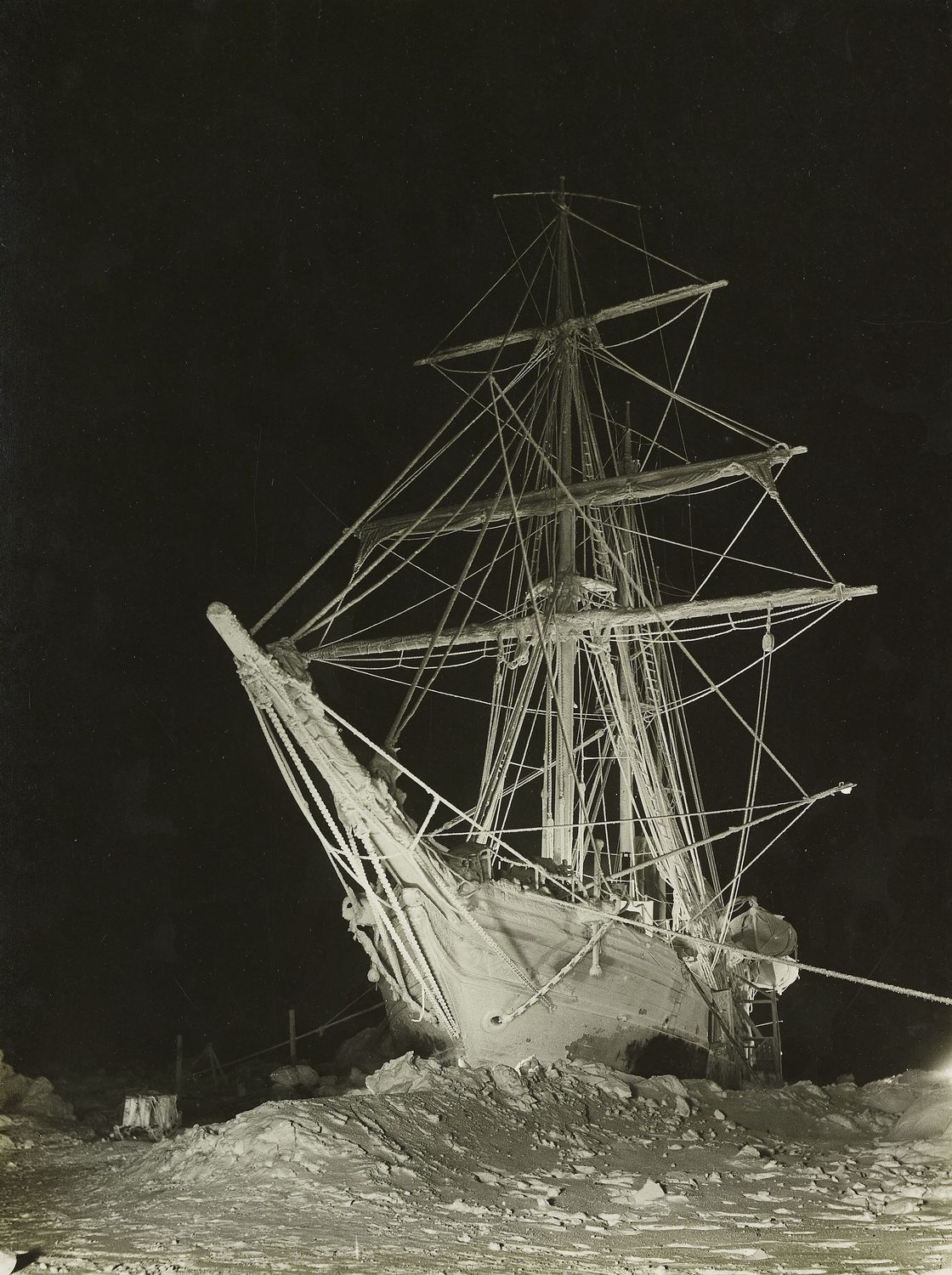
Photograph of the bow and part of the left side of Endurance, lit by flashlight in the darkness of the night. This is probably Hurley’s best-known photograph, which he took with flashlights at -38 °F/-39 °C. It was later used on the front cover of Shackleton’s account of the expedition, South. Hurley described the scene in his autobiography: Never did the ship look quite so beautiful as when the bright moonlight etched her in inky silhouette, or transformed her into a vessel from fairy-land.
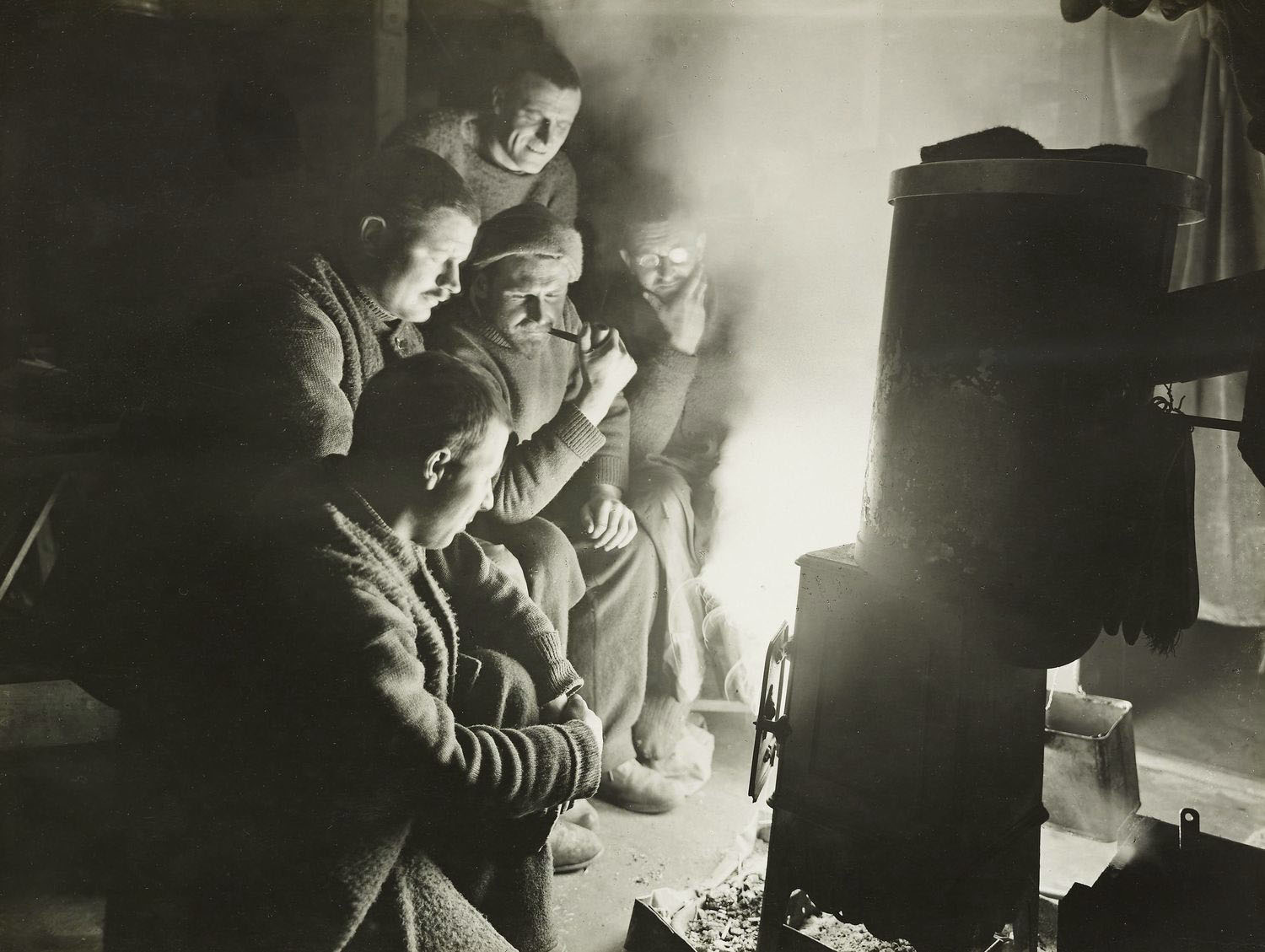
After Endurance became a winter station in February 1915, Shackleton abandoned the usual system of watches. The single nightwatchman had little to do, apart from tending the dogs and observing ice movements. It was private leisure time, to read, or do some washing, but often became a social occasion as shown here, as the men gather companionably round the fire.
Following the onset of winter and the transformation of Endurance into a scientific station, the main cargo hold was emptied and turned into a communal living space for the men, nicknamed the ‘Ritz’. The traditional Antarctic Christmas on Midwinter’s Day (22 June) saw the ‘Ritz’ transformed for a cabaret, featuring satirical speeches, songs, poems and even a drag act. From left to right are Wordie (1889-1962), Cheetham (1867-1918) and Macklin (1889-1967).
This photograph was actually taken at the time of the ‘James Caird’s’ departure on 24 April. Hurley has altered it to represent the moment of rescue, with the arrival of Shackleton on the ‘Yelcho’. The actual rescue was not photographed.
The Royal Collection
The Queen’s Gallery, Buckingham Palace
London SW1A 1AA
Herbert Ponting (British, 1870-1935) The former whaling ship, the ‘Terra Nova’ 1911
Gelatin silver print
Canterbury Museum NZ
“Greater love hath no man than this, that a man lay down his life for his friends.”
John 15:13
It is difficult to describe how heroic a figure Robert Scott, ‘Scott of the Antarctic’ was to a child of the Empire growing up in the 1960s. He and his doomed party were, and still are, the quintessential heroes of my youth. Despite what we now know of Scott’s failures in leadership and organisation, he and his comrades remain embedded in English consciousness as all that is noble about the explorers of the time. They may have failed to become the first to reach the South Pole and died on the return journey but what a magnificent effort it was, what camaraderie and fortitude they showed in the face of adversity.
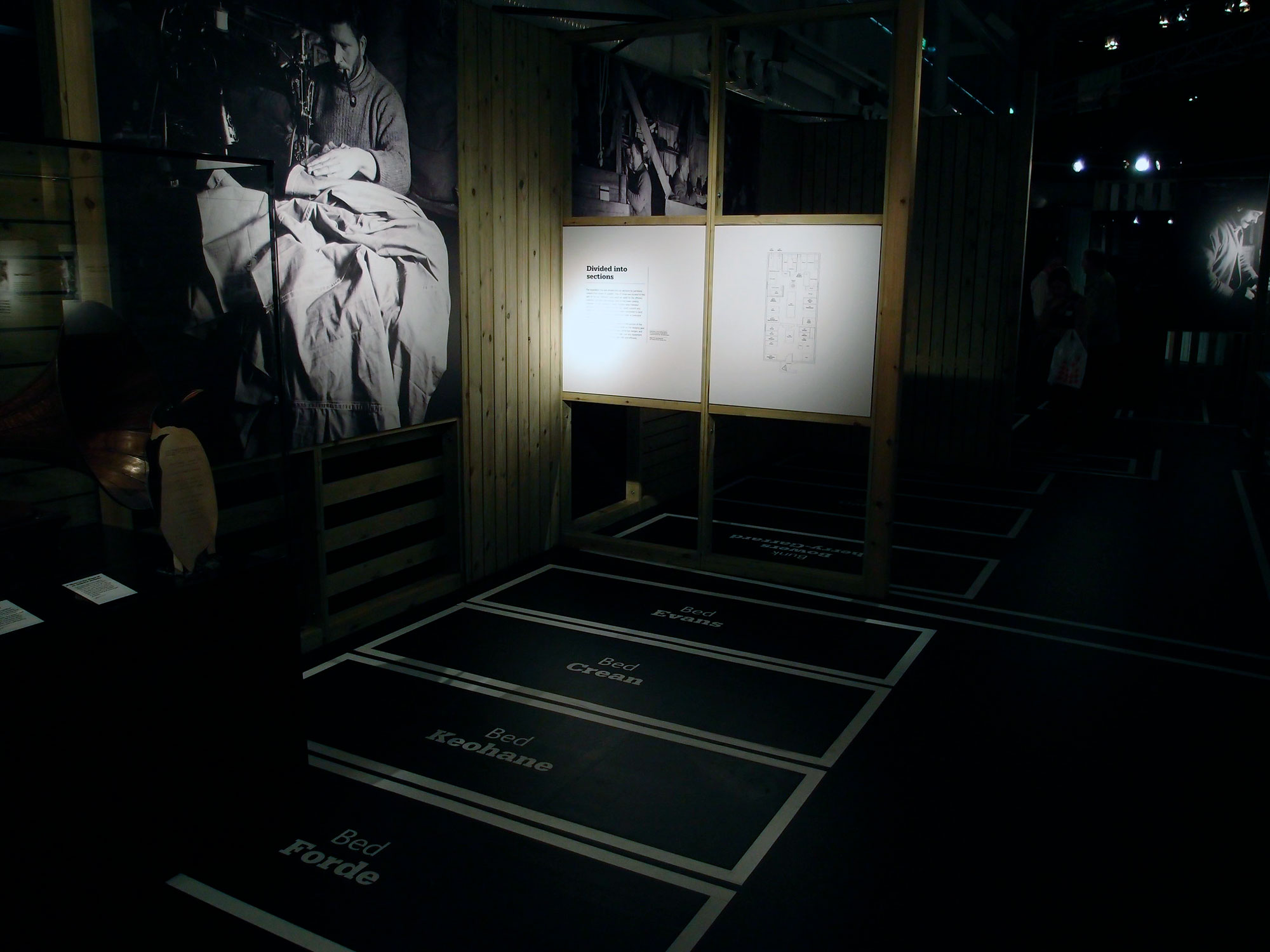
At the centre of the exhibition at the Australian National Maritime Museum, Sydney is a representation of Scott’s base camp at Cape Evans. Visitors can walk inside the life-size hut and get a sense of the everyday realities for the 25 expedition members, from the cramped conditions and homeliness of the hut, to the wealth of specimens collected and experiments conducted. The exhibition also reunites the artefacts used by Scott and his team together with scientific specimens collected during the 1910-1913 expedition for the first time since their use in Antarctica. The exhibition uses life-size reproductions of the photographs of Herbert Ponting. At this scale it enables the viewer to inspect in intimate detail the habitus of their lives.
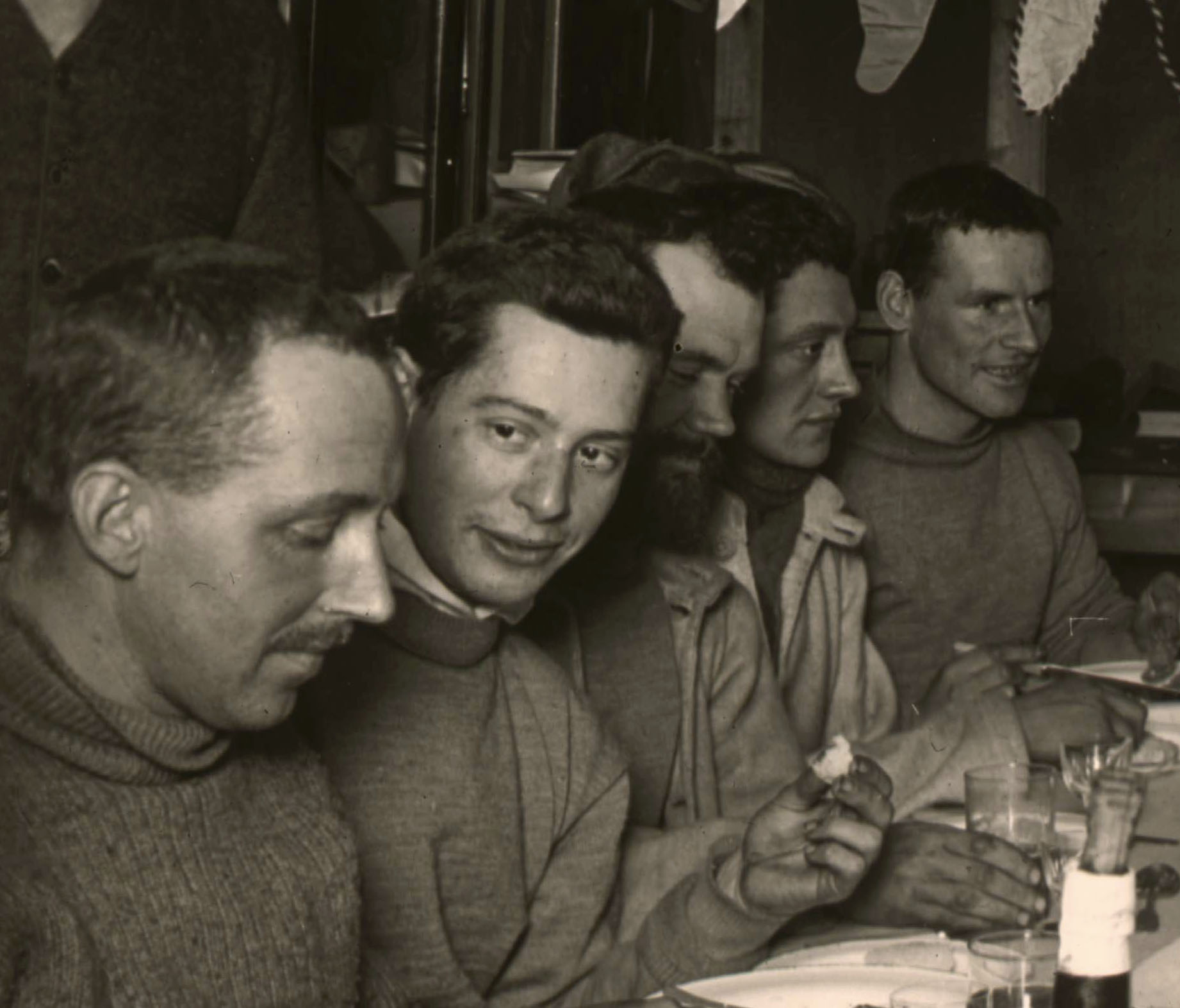
What a master of photography Ponting was. His photographs are classically framed and formally restrained; his use of light is magical. The camera always seems to be in the perfect position to capture the subject, neither too high or low but beautifully balanced so that the eye is led into the photograph, to investigate those wonderful nooks and crannies of the image plane. Because of the excellent quality press images I have been able to close in on details of the photographs (a la Ken Burns). The receding row of male faces to the left of Scott’s birthday dinner, June 1911 (below) that lead to Scott as the focal point at the head of the table, flags of St. George flying above, the two standing men acting as vertical counterpoints to the equipoise of the horizontal perspectival point – and then we glimpse the punctum of the piece of bread held between darkened fingers and thumb of the man caught in mid-conversation with his neighbour. Also note the framed images on the wall behind at top left, bearing witness to the fact that living is more civilised in such a desolate place if you are surrounded by images of culture and home.
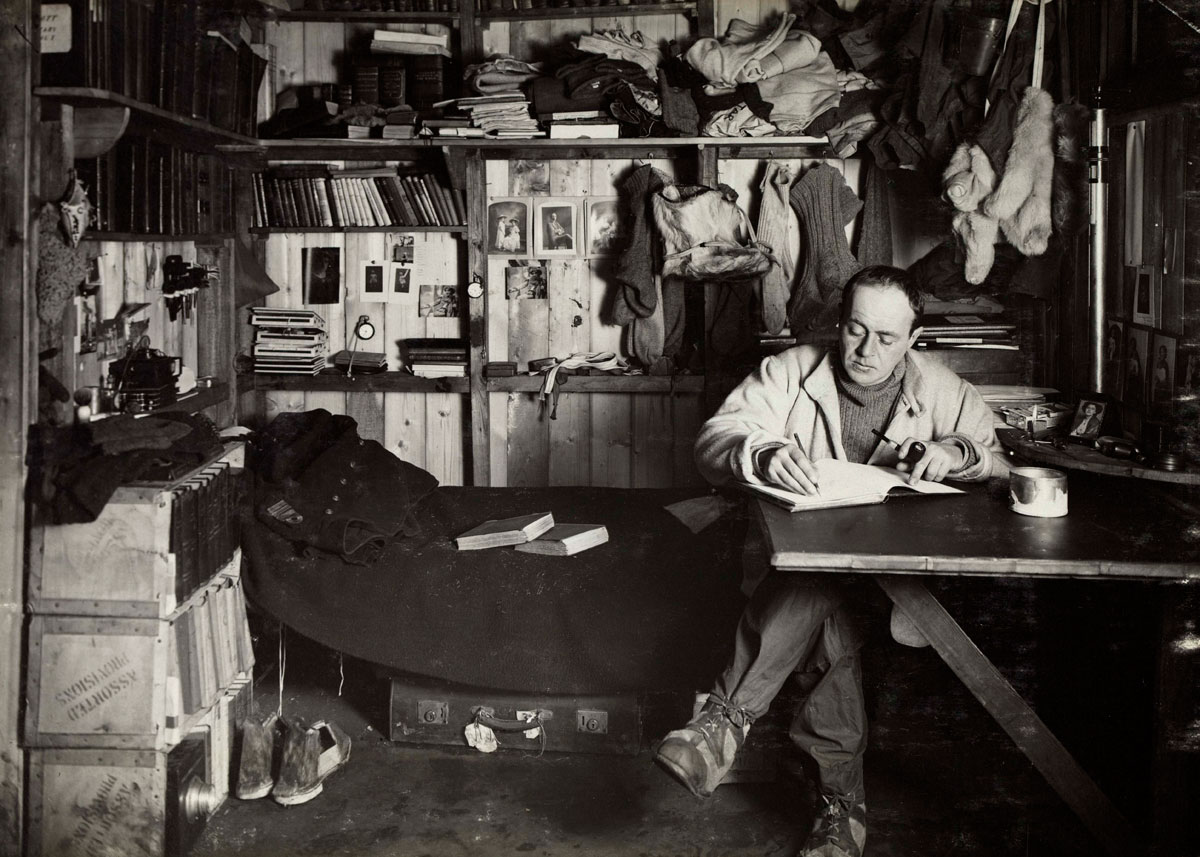
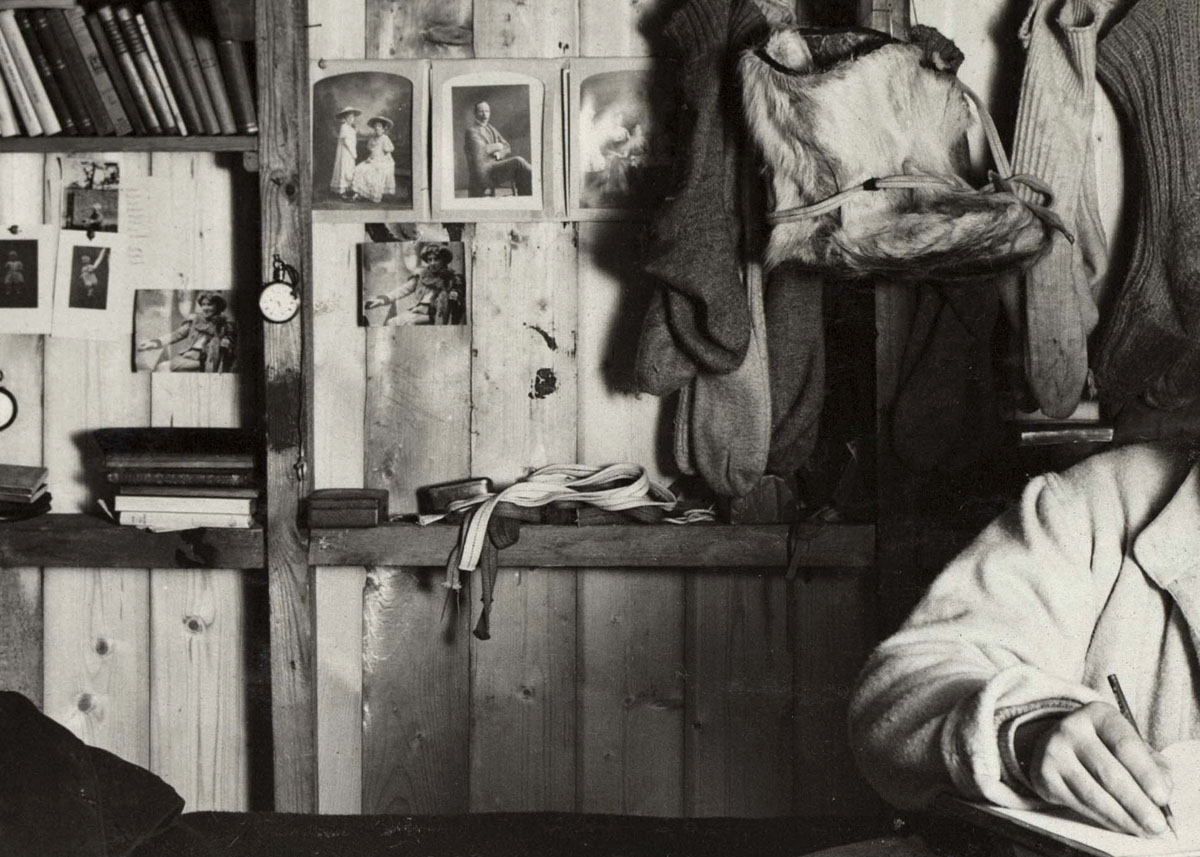
This remembrance becomes poignant in the photograph Scott writing in his area of the expedition hut, Scott’s cubicle (below). In the detail of the image we observe candid photographs of what are presumably Scott’s wife in two photographs that are slightly different from each other, his wife and child, his father and small photographs of his children pinned to the hut’s wall. Memories of home and family that become multiple momenti mori – the death of the people in the images pinned to the wall, the death present in Pontings’ photograph (the little death at the point in time that the photograph was taken) and the death of Scott himself. The pocket watch hung from a wooden post only adds to this sense of refractive timelessness.
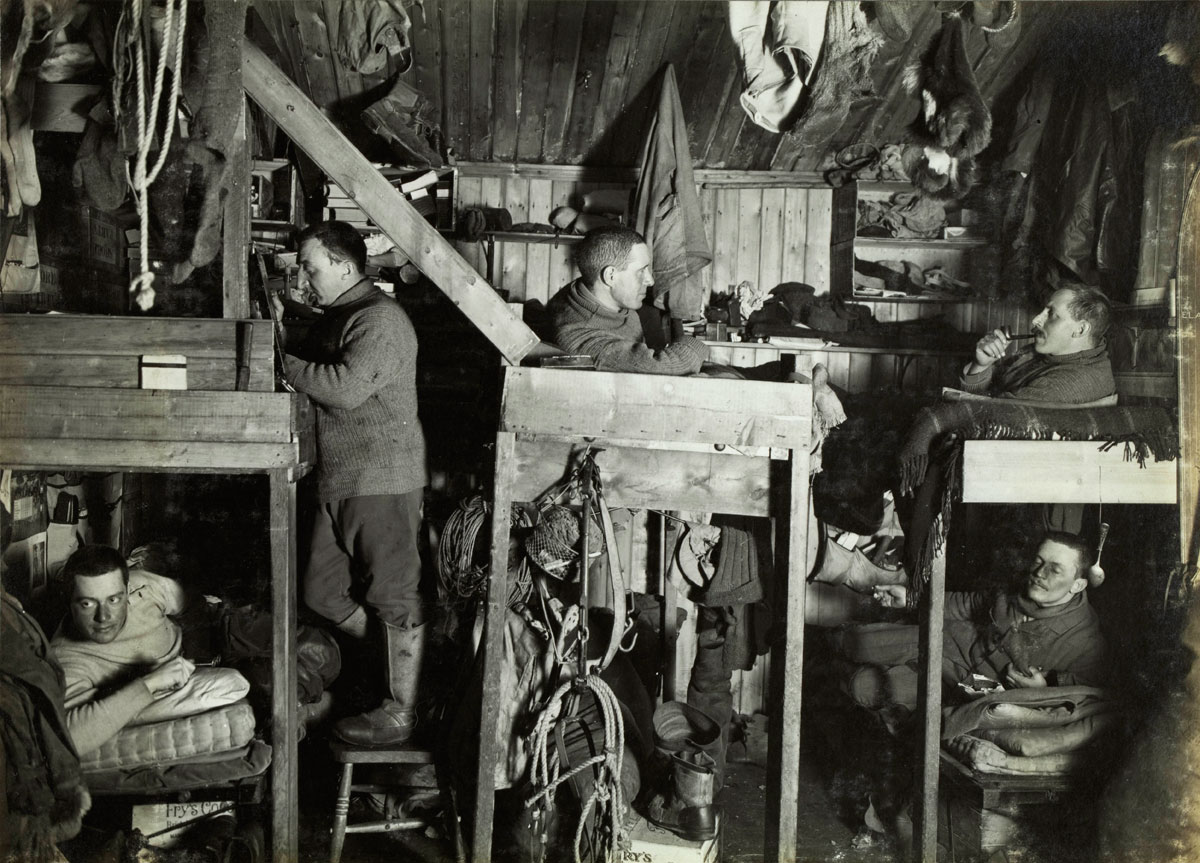
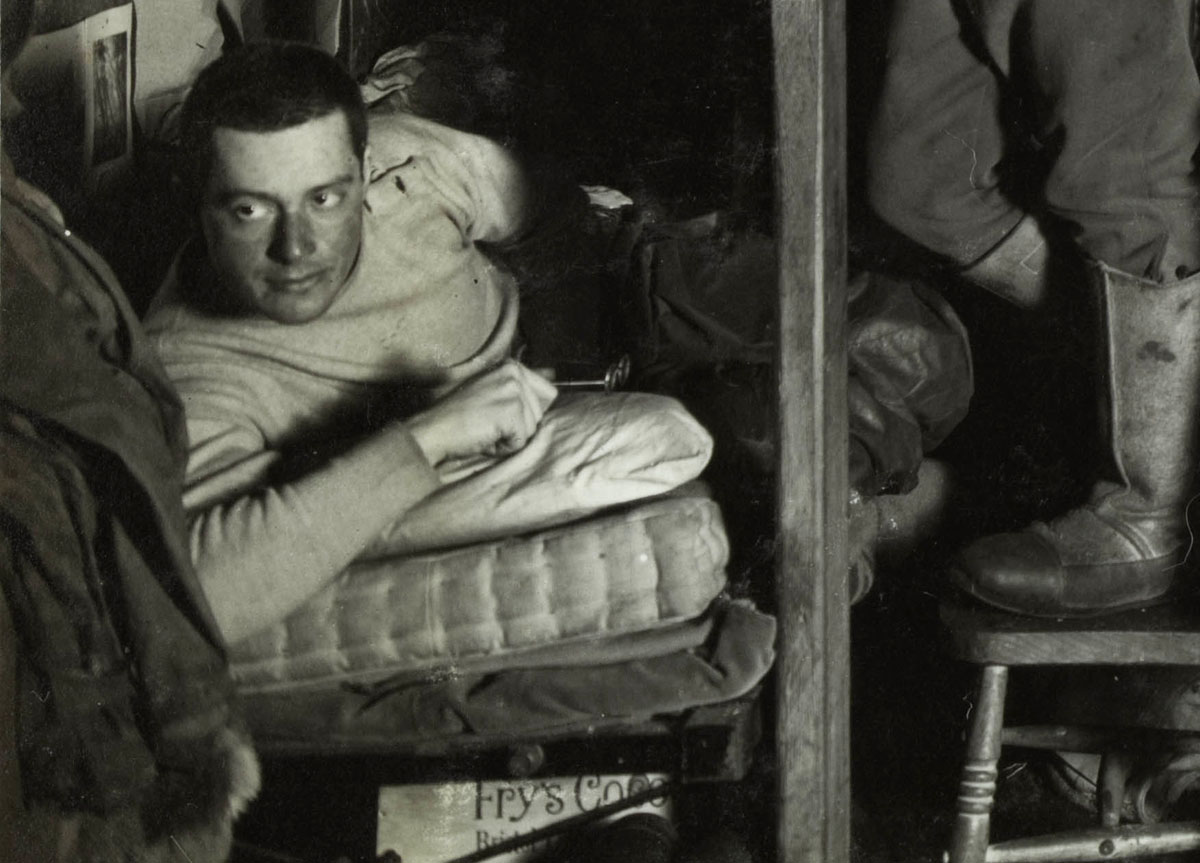
The sense of these men living in close quarters in this community is beautifully captured in Ponting’s photograph The Tenements, 9 October 1911 (below). Three vertical lozenges project into the space from the bottom of the image, each containing its own theatrical diorama. The balance and space between the men looking across, down, up and out of the image is outstanding. The distance between Oates in the top centre and the man on the right seems somehow infinite in the photograph, like the distance in Alfred Hitchcock’s film North by Northwest where Cary Grant is waiting for the bus in the middle of nowhere and on the other side of the road is another man, also waiting. The spatial tension between the two men in the photograph is palpable, emphasised by the stacked horizontal shelf behind them. The gaze of the man at bottom left allows the viewer some room for escape from the confines of the tenements and the confines of the image plane, for without that gaze the viewer would be caught with no way out. In the detail of this man we can, as before, note the importance of personal remembrances of home with a picture pinned on the wall behind his bunk and a Fry’s Cocoa box stored underneath.
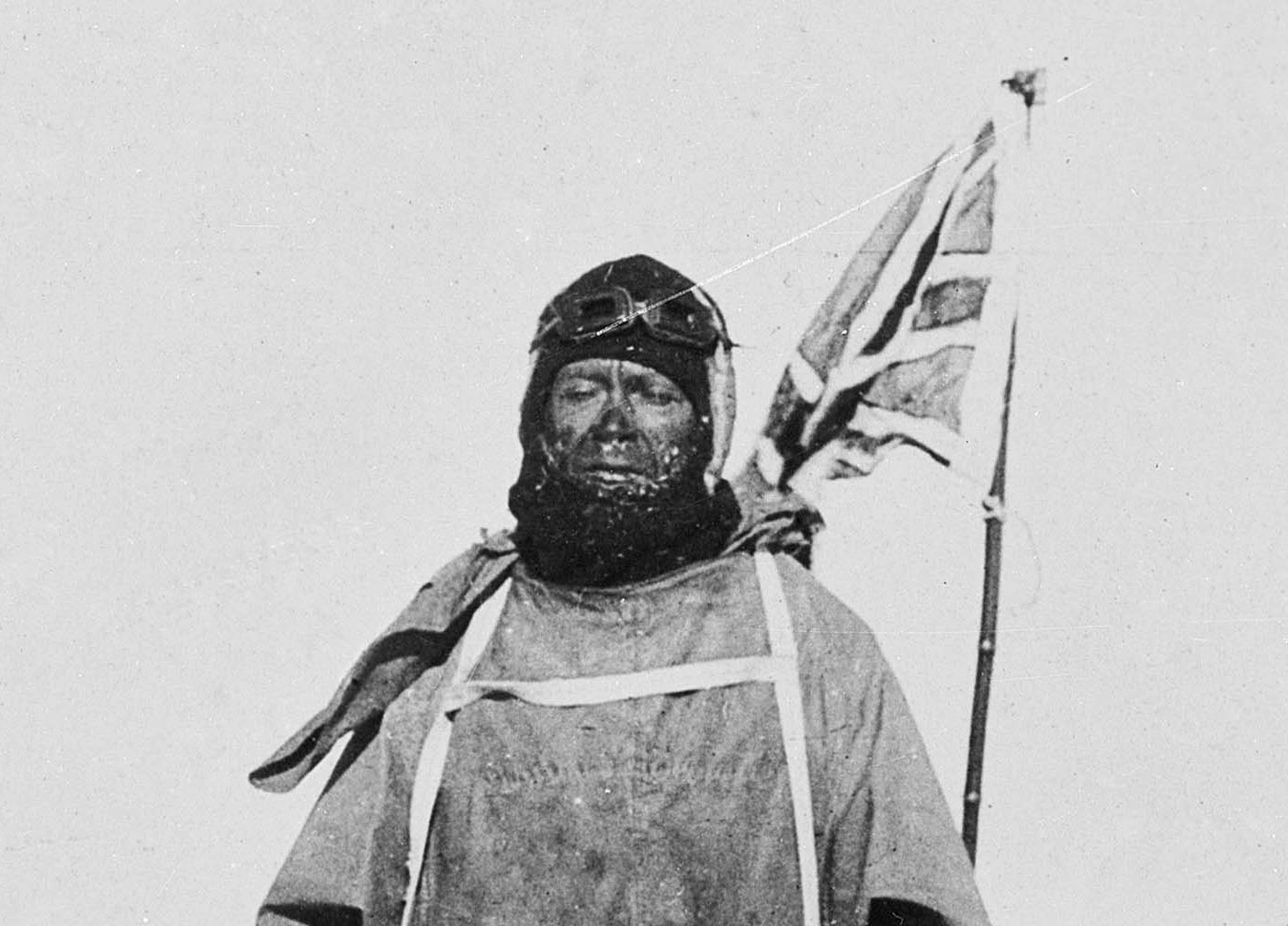
And so to the final few photographs in the posting: the famous photograph of Scott and the Polar Party at the South Pole (below) taken by Henry Bowers. Taken the day after the party had arrived at the South Pole, only to discover that Roald Amundsen had beaten them to their goal by five weeks, Bowers (seated at bottom left) used a string to release the shutter of the camera that can just be seen in his right hand in the photograph – a photograph that was then printed by Herbert Ponting from the recovered glass plate negative. In the detail of Scott and Oates in this photograph you can see the weariness, anguish and defeat in faces that are sun and wind damaged, knowing that they had to trek all the way back from this awful place (as Scott himself said, “Great God! This is an awful place”).
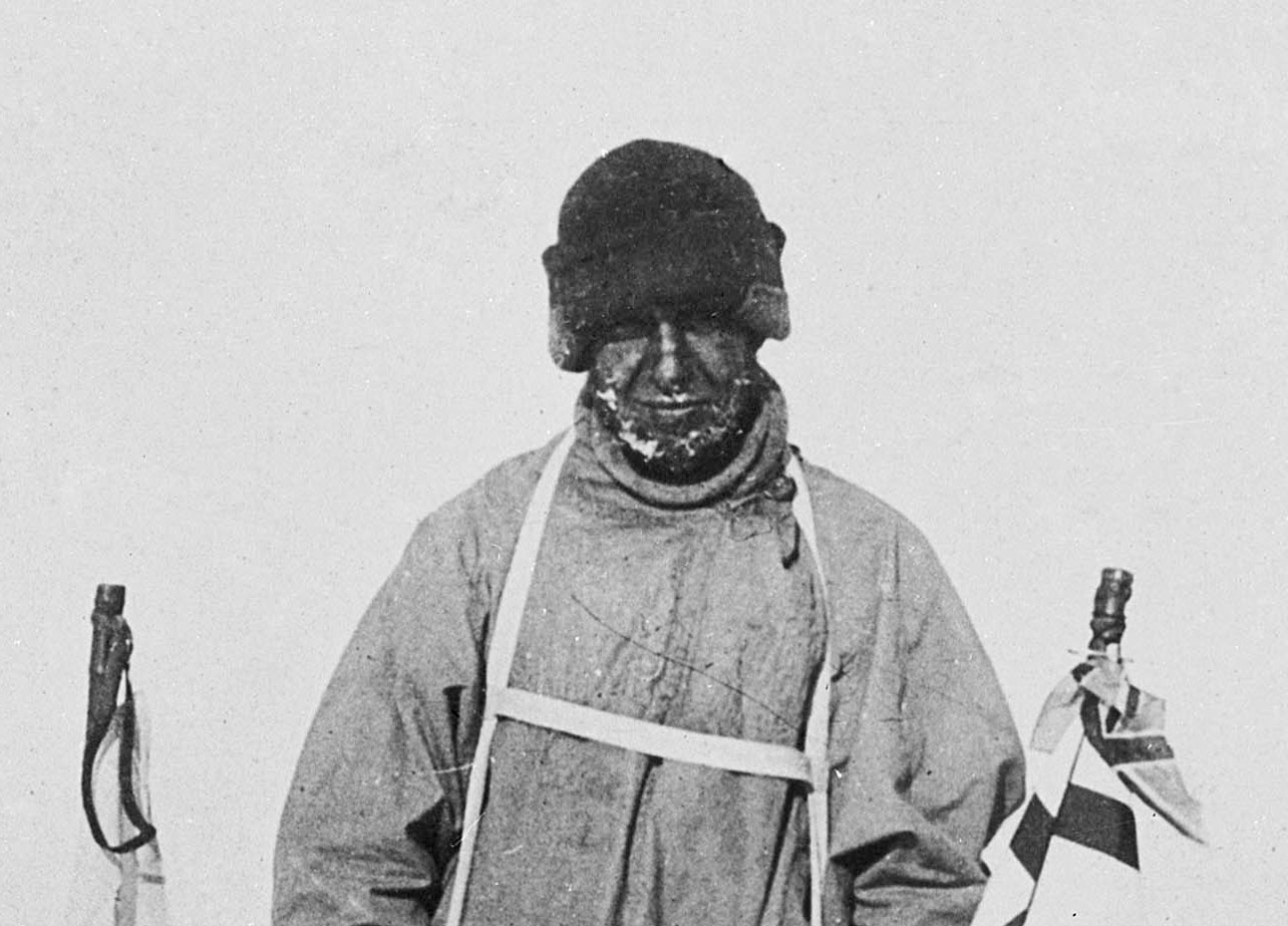
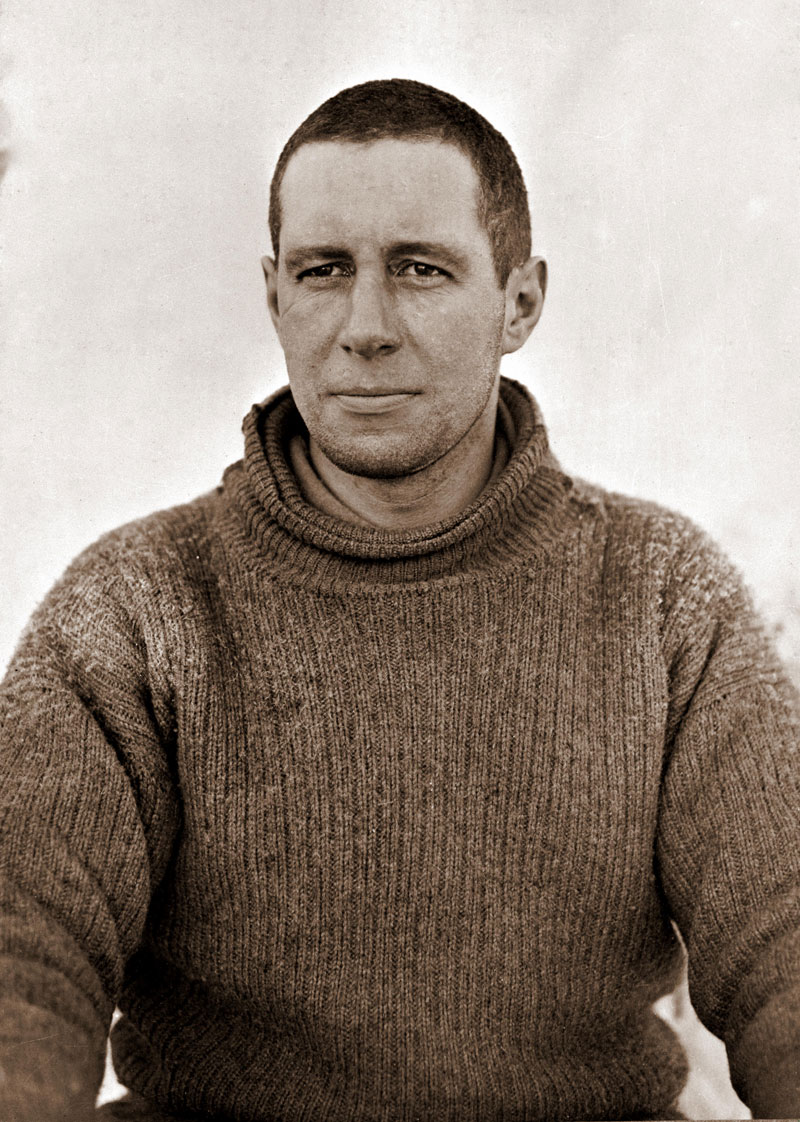
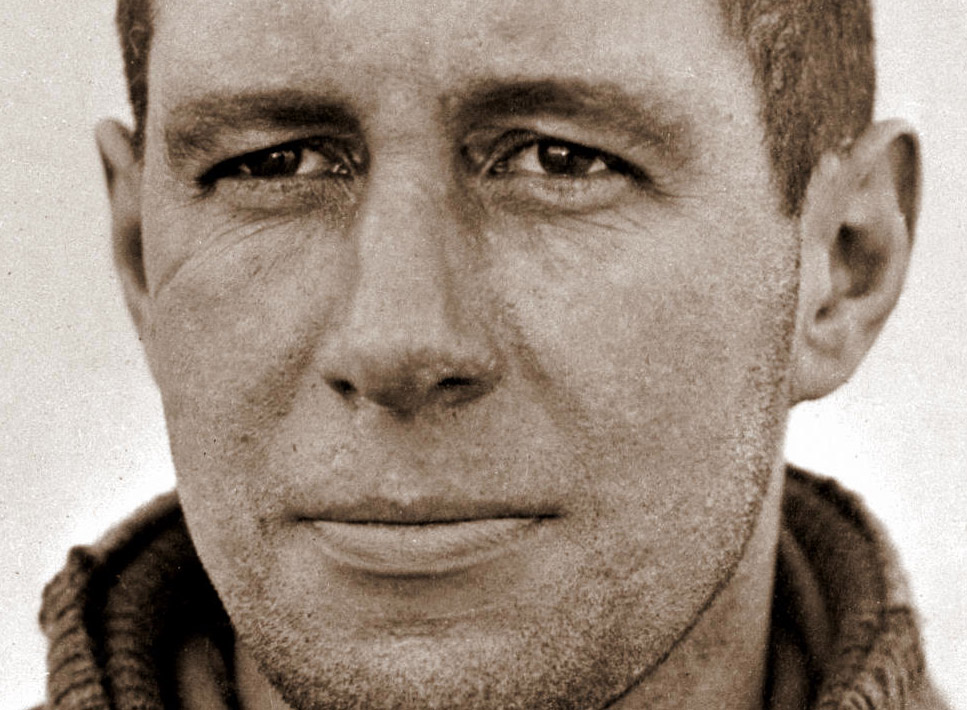
I have put a photograph by Herbert Ponting, Captain Lawrence Edward Grace Oates during the British Antarctic Expedition of 1911-1913, below the detail of him at the South Pole. The face is almost unrecognisable from the strong, handsome face in Ponting’s picture, the prominent nose now blackened and dark being the only thing that make it recognisably the same person. In the detail of Ponting’s photograph, if you enlarge it, you can see two small points of light in his eyes, probably the light of the polar sun when Ponting took the photograph. For me these two spots of light become portents of what was to come as Oates walked out into a blizzard saying those immortal words, “I am just going outside and may be some time”. To me these points of light seared into his retina are like the driving snow that he walked out into in such a selfless act. It is very emotional for me as an Englishman and as a human being to look into the face of this man knowing what he was eventually to go through.
Though they failed in their quest to become the first to the South Pole, for this child, for this man they will forever remain my heroes.
Dr Marcus Bunyan
Many thankx to the Australian National Maritime Museum for allowing me to publish the photographs in the posting. Please click on the photographs for a larger version of the image.
Anonymous photographer Captain Robert Falcon Scott
Nd
Gelatin silver print
Licensed with permission of the Scott Polar Research Institute, University of Cambridge
Herbert Ponting (British, 1870-1935) Members of the ‘Terra Nova’ expedition with Scott in the centre
1911
Gelatin silver print
Canterbury Museum NZ
Herbert Ponting (British, 1870-1935) Scott’s birthday dinner, June 1911
1911
Gelatin silver print
Canterbury Museum NZ
Herbert Ponting (British, 1870-1935) Scott’s birthday dinner, June 1911 (detail)
1911
Gelatin silver print
Canterbury Museum NZ
Herbert Ponting (British, 1870-1935) Scott writing in his area of the expedition hut, Scott’s cubicle
1911
Gelatin silver print
Pennell Collection, Canterbury Museum NZ
Herbert Ponting (British, 1870-1935) Scott writing in his area of the expedition hut, Scott’s cubicle (detail)
1911
Gelatin silver print
Pennell Collection, Canterbury Museum NZ
Herbert Ponting (British, 1870-1935) The Tenements, 9 October 1911
1911
Gelatin silver print
Pennell Collection, Canterbury Museum NZ
Herbert Ponting (British, 1870-1935) The Tenements, 9 October 1911 (detail)
1911
Gelatin silver print
Pennell Collection, Canterbury Museum NZ
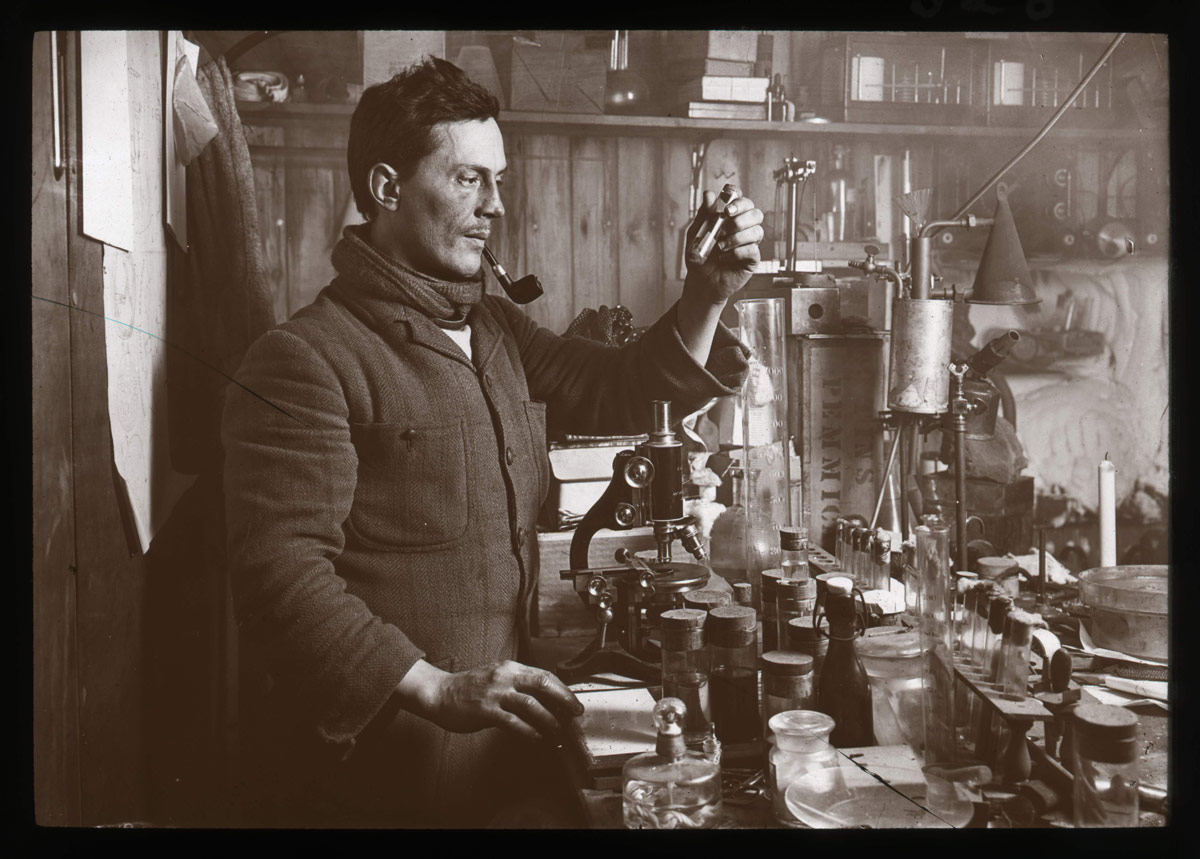
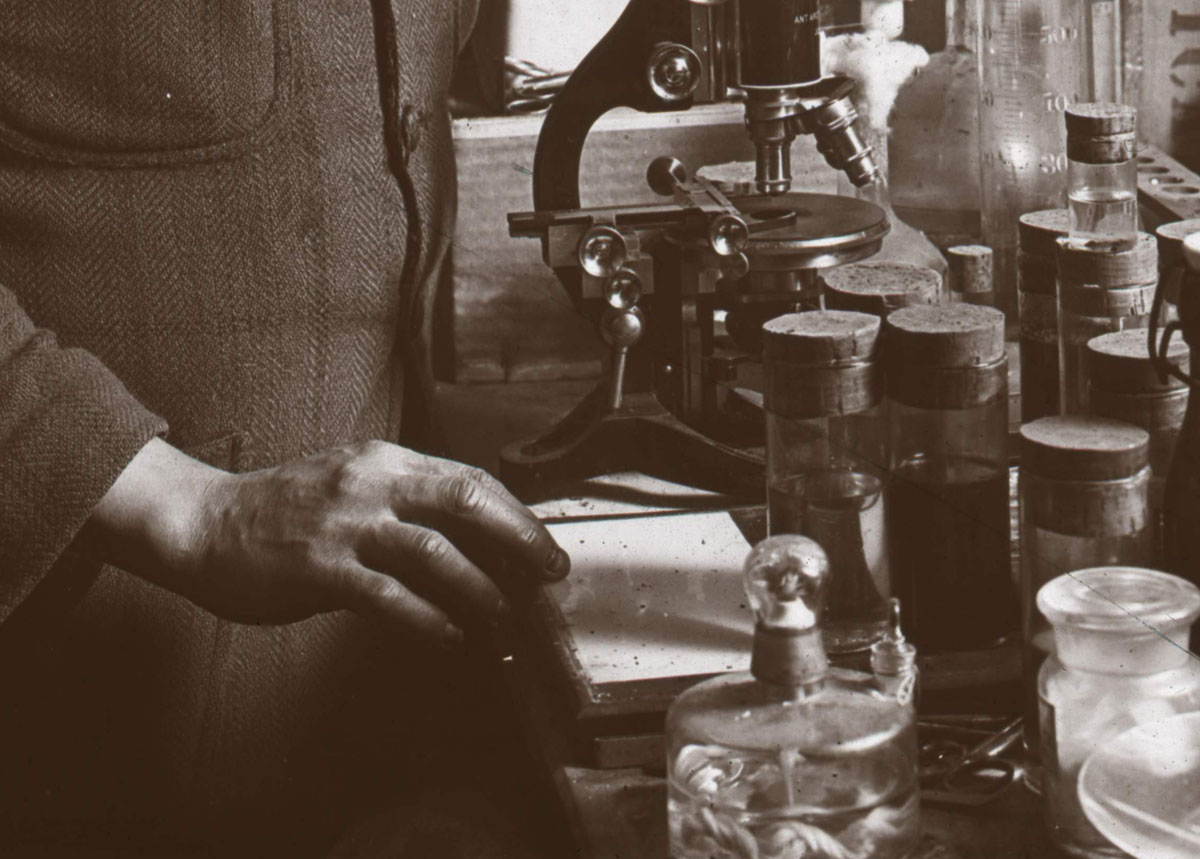
Herbert Ponting (British, 1870-1935) Edward Atkinson in the laboratory
1911
Silver gelatin print
Canterbury Museum NZ
Herbert Ponting (British, 1870-1935) Edward Atkinson in the laboratory (detail)
1911
Silver gelatin print
Canterbury Museum NZ
One hundred years after its tragic end, the definitive story of British explorer Captain Robert Falcon Scott’s Terra Nova expedition to Antarctica is being told in a major international exhibition coming to the Australian National Maritime Museum this June.
Scott’s Last Expedition will reunite real artefacts used by Scott and his team together with rare scientific specimens collected during the 1910-1913 expedition for the first time since their use in Antarctica.
When Scott set off on what was his second journey to explore the Antarctic on board the former whaling ship Terra Nova, he could not have predicted it would be his last. Tragically he and four of his colleagues died on the return trek to the South Pole two years later, having lost the race to be first. The exhibition however will go beyond the familiar tales of the journey to the Pole and the death of the Polar party to explore the Terra Nova expedition from every angle.
“Over the years public perceptions of Scott have varied greatly, from hero to flawed leader, and discussions of what really happened still captivate people,” said museum director Mary-Louise Williams today. “This exhibition will give visitors a unique opportunity to immerse themselves in this epic journey and the remarkable landscape of Antarctica,” she said.
Visitors will uncover Scott the man, learn more about the people who made up the expedition and explore every fascinating detail of this historic journey. At the centre of the exhibition will be a life-size representation of Scott’s Cape Evans’ base camp. Visitors can walk inside and get a sense of the everyday realities for the expedition’s members… from the cramped conditions and homeliness of the hut to the wealth of specimens collected and scientific investigations conducted.
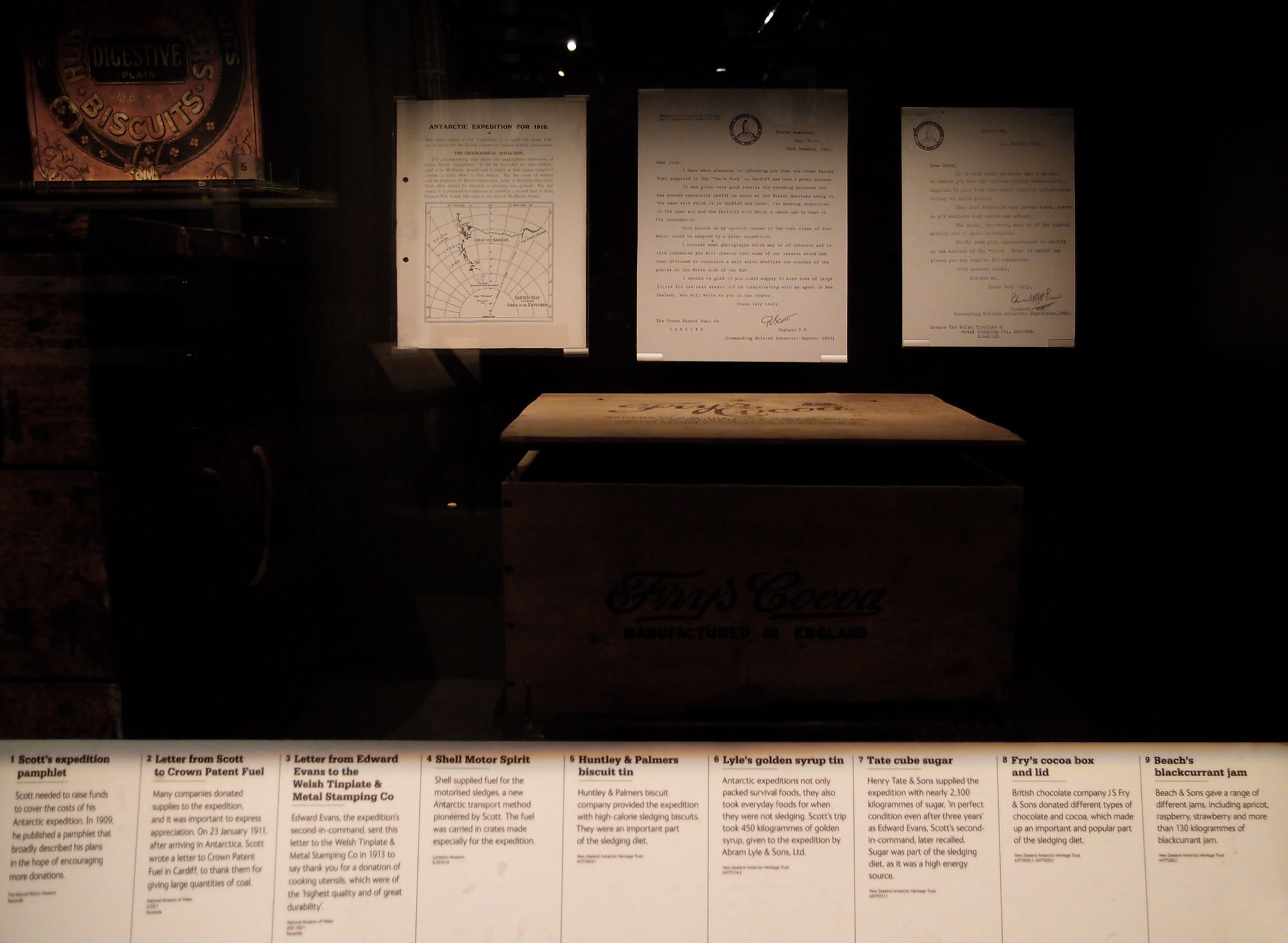
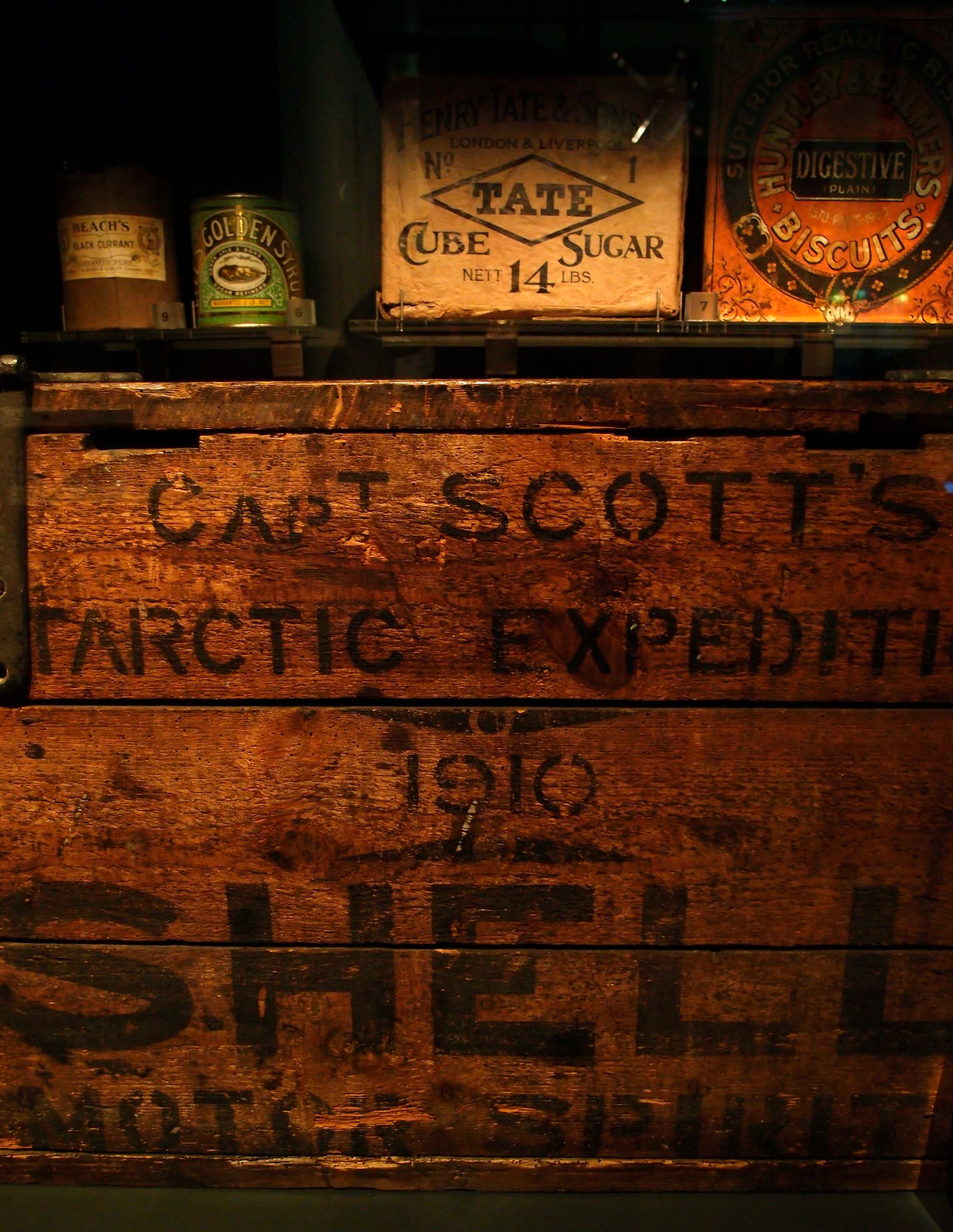
Original artefacts, equipment, clothes, and personal effects will be displayed for the first time in Australia and show the group’s attempts to make life in one of the most hostile environments on Earth as bearable as possible. Food tins including Fry’s Cocoa, Trufood Trumilk, and Symington’s Pea Flour recovered from the hut will be on display together with instruments, a microscope, and even Scott’s gramophone.
Photographs of the environment and life in camp taken by expedition photographer Herbert Ponting and poignant letters and diaries by various expedition members create a vivid picture of what life was like… working in hostile conditions, the struggles for survival and the strength of human endurance and courage.
Scott’s Terra Nova expedition made a significant contribution to Antarctic science. The expedition included a full scientific program with a large team of scientists making new discoveries which directly led to a greater understanding of Antarctica. The scientists had to endure harsh Antarctic conditions to carry out their work. It was cold, windy and completely dark in winter and, if not careful, the scientists could easily get frostbitten. And yet despite the conditions, the expedition left a rich legacy that continues to inspire and inform today.
Natural History Museum, London, the Canterbury Museum, Christchurch, New Zealand and the Antarctic Heritage Trust, New Zealand, have collaborated to create this exhibition to commemorate the centenary of the expedition and celebrate its achievements.
Press release from the Australian National Maritime Museum
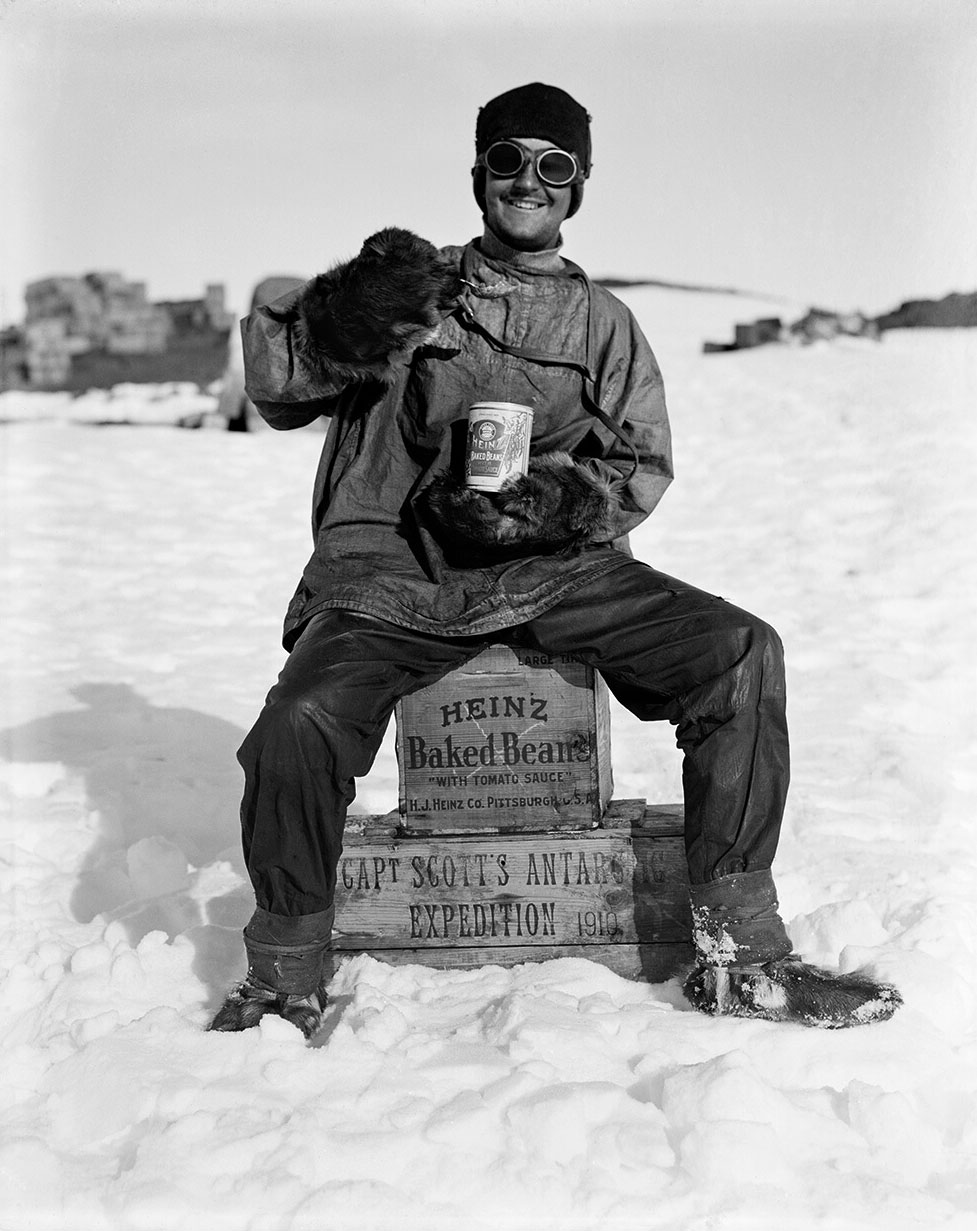
Herbert Ponting (British, 1870-1935) A member of the team tucks into a tin of Heinz baked beans in the Ross Dependency, during Captain Robert Falcon Scott’s Terra Nova Expedition to the Antarctic, January 1912
1912
Silver gelatin print
Canterbury Museum NZ
Neerav Bhatt (photographer)
Installation view of the exhibition Scott’s Last Expedition at the Australian National Maritime Museum, Sydney, June – October 2011 CC BY-NC-SA 2.0
Scott and the Polar Party at the South Pole
Left to right: Captain Lawrence Oates, Lieutenant Henry Bowers (seated), Captain Robert Falcon Scott, Dr Edward Wilson (Seated), Petty Officer Edgar Evans
1912
Licensed with permission of the Scott Polar Research Institute, University of Cambridge.
Notice the camera release cord in the right hand of Lieutenant Henry Bowers.
The fatal journey
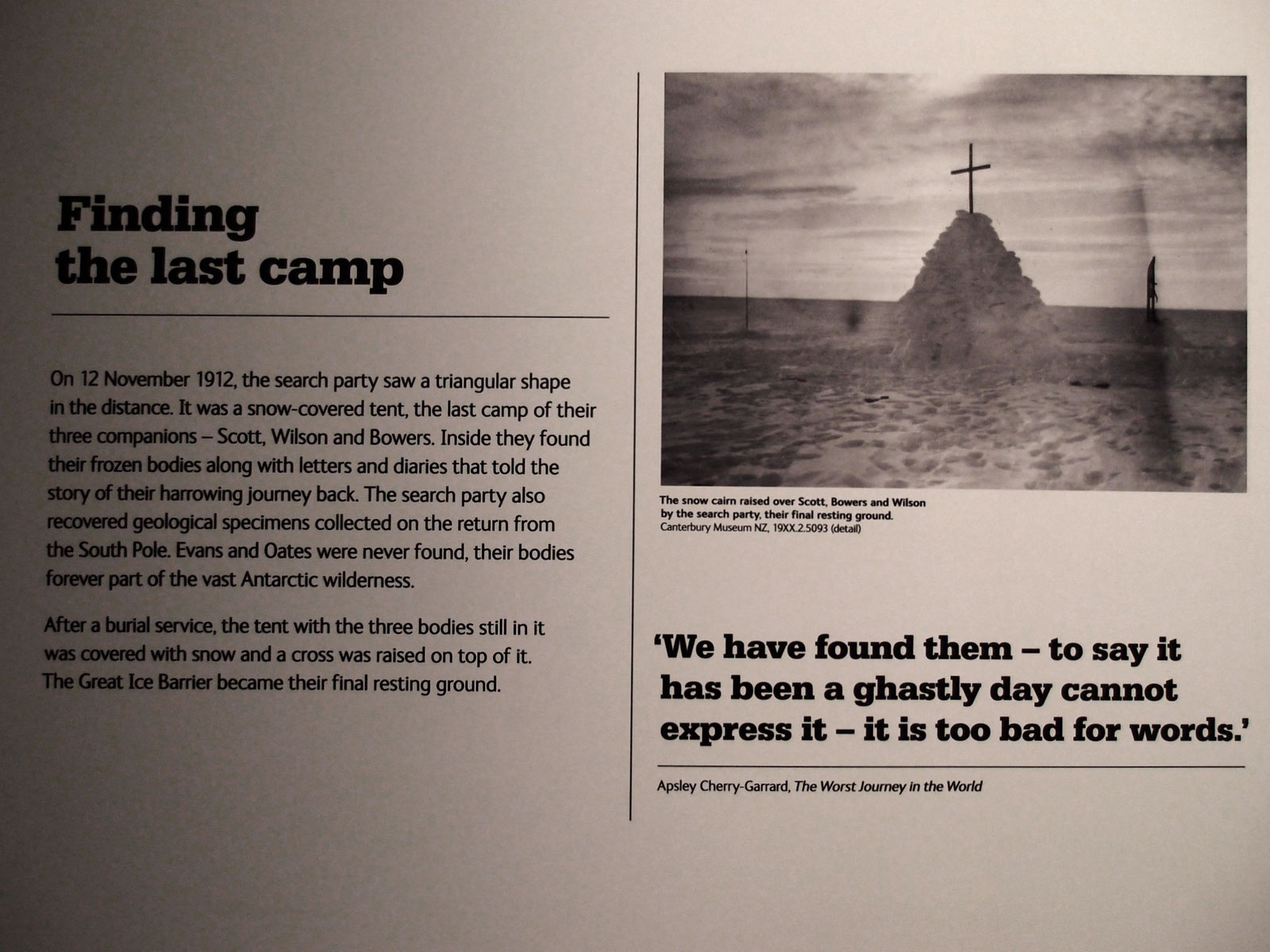
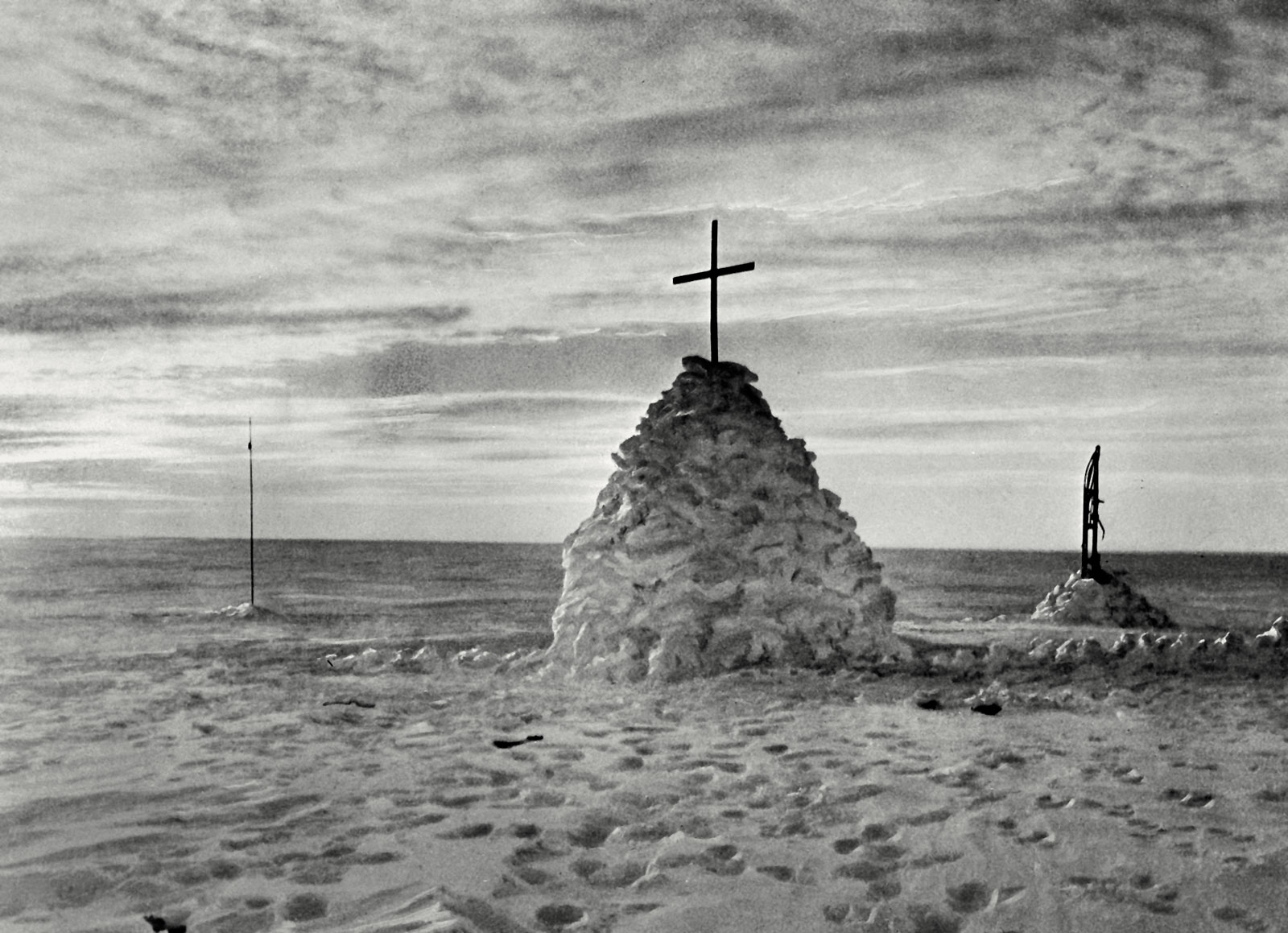
Scott’s 1,450 km journey to the geographic South Pole began on 1 November 1911, two weeks after the Norwegian polar explorer Roald Amundsen left his base camp at the Bay of Whales. Amundsen reached the pole first – on 14 December 1911 – and then raced back to tell the world their news. Scott and his team reached the Pole a month later on 17 January 1912 having been beset by fierce weather conditions. The disappointment was immense. The return journey was undertaken in horrid weather with harsh, intense cold and violent blizzards that, in the end, defeated them. Evans failed first, suffering concussion from a fall; Oates suffered dramatic frostbite to his feet – gangrene had set in – and he crawled out of the tent saying the now famous words, “I am just going outside and may be some time”. The remaining men – Scott, Wilson and Bowers – were weak with malnutrition, starvation and exhaustion and perished on or around 29/30 March 1912 – some three weeks after the world learned that Amundsen had reached the Pole first.
Captain Robert Falcon Scott at the South Pole (detail)
Captain Lawrence Oates at the South Pole (detail)
Herbert Ponting (British, 1870-1935) Captain Lawrence Edward Grace Oates during the British Antarctic Expedition of 1911-1913
c. 1911
Silver gelatin print
Photographic Archive, Alexander Turnbull Library
Herbert Ponting (British, 1870-1935) Captain Lawrence Edward Grace Oates during the British Antarctic Expedition of 1911-1913 (detail)
c. 1911
Silver gelatin print
Photographic Archive, Alexander Turnbull Library
Anonymous photographer The snow cairn raised over Scott, Bowers and Wilson by the search party, their final resting ground (detail)
1912
Silver gelatine print
Canterbury Museum NZ
Australian National Maritime Museum 2 Murray Street
Darling Harbour
Sydney NSW 2000
Australia














 Art Blart _ art and cultural memory archive
You must be logged in to post a comment.