
Exhibition dates: 29th September, 2024 – 16th March, 2025

Raúl Cañibano (Cuban, b. 1961)
Untitled
2009
From the series Country Land (Tierra guajira)
Inkjet print
The Museum of Fine Arts, Houston
The Madeleine P. Plonsker Collection, gift of Madeleine and Harvey Plonsker
© 2009 Raúl Cañibano
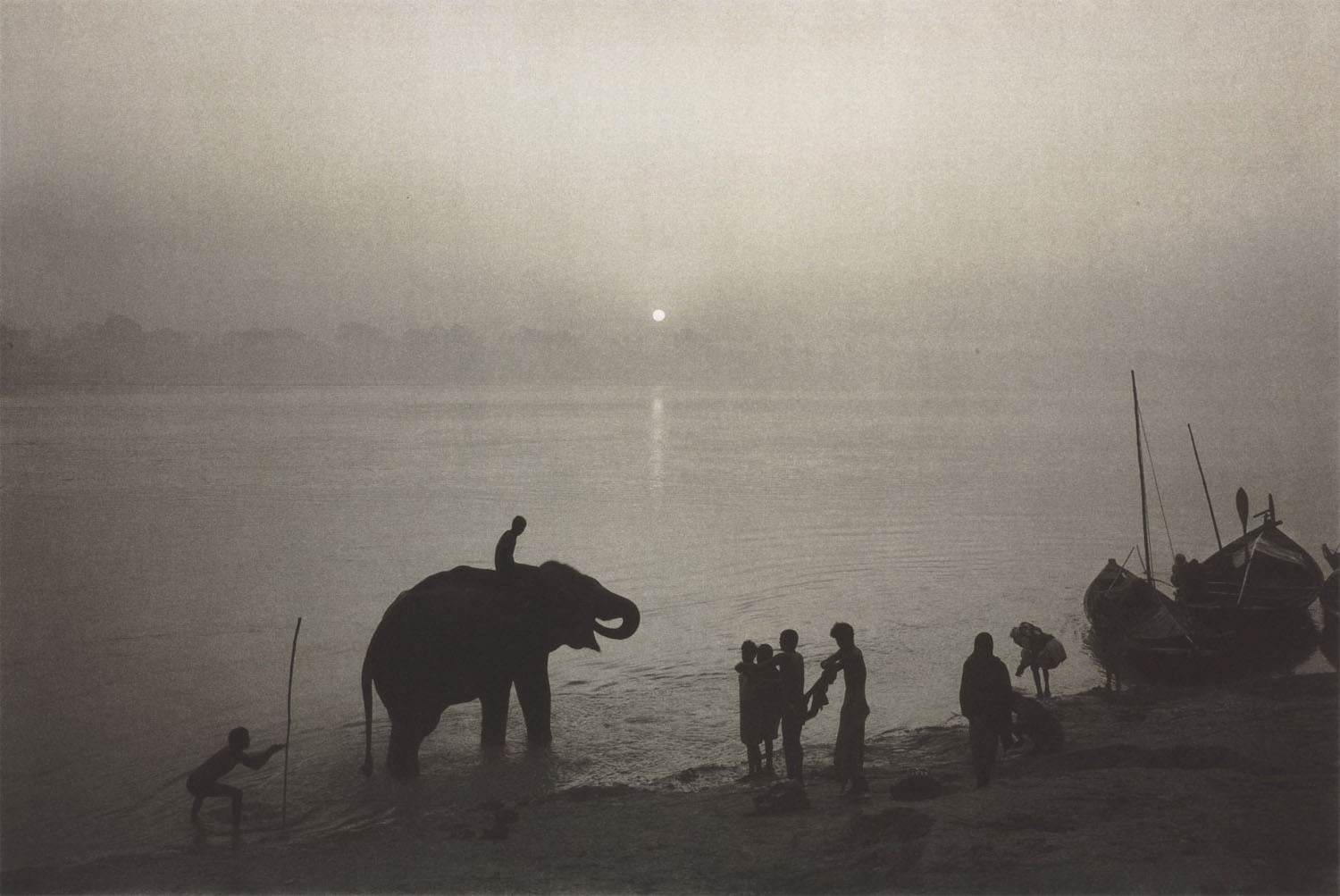
Raúl Cañibano grew up in both Havana and the eastern part of the country, and in 1998 he returned to the east to develop his series Tierra guajira (Country Land), a project strongly linked to his childhood memories. There, rural life and labor remained little changed despite the vast social and political waves that had swept across the nation in the intervening years.
This is an exhibition on a subject that I had little knowledge of before constructing the posting.
Imagine
Being born after the Cuban Revolution in 1953.
Being a child during the Bay of Pigs Invasion in 1961 (a clandestine invasion of Cuba by a brigade of Cuban exiles planned and executed by the CIA, with the support of the US government) and the Cuban Missile Crisis of 1962 (when nuclear missile sites were being built by the Soviet Union on the island of Cuba).
The fear of invasion and nuclear war.
Imagine
Growing up in a nation full of national fervour and revolutionary heroes, a “cult of personality”.
Growing up in country that defied the United States of America to stand on its own two feet but was plagued by shortages of foods, fuel, and other necessities, where “hundreds of thousands of Cubans, especially skilled workers and wealthy investors, emigrated to the United States (principally to Miami, Florida), Spain, and other countries”1 even as the country drew closer to the Soviet Union.
Growing up in a country where prominent dissidents were jailed and repressive laws enacted.
Imagine
Living under a communist regime where, when Soviet troops withdrew in 1991, there was high unemployment, energy conservation and severe internal “shortages of food, medical supplies, raw materials, and fuel which were exacerbated by the ongoing U.S. trade embargo.”1
Imagine
Growing up gay in a country where during The First Period (1965-1979) LGBTQ+ individuals were imprisoned in labor camps called Unidades Militares de Ayuda a la Producción (UMAPs); and during The Second Period (1980-2004) “the homophobia possessed by the government led to more acts of oppression toward LGBTQ+ individuals, but the government also extended more rights to gays.”2
Imagine
Growing up to be an artist, a photographer, living and working under the regime.
Living in a country as a creative person and trying to subversively comment on the precarious nature of life in present-day Cuba (questioning the power of photography and its relationship to political authority) without ending up in prison.
Despite these conditions of becoming, Cuban photographers continue to photograph their own lives and the life and spirit of the people. Through reality, myth and fantasy, through rituals, personal history, queer identity, race and gender they examine Cuban culture and history from a constructive and/or critical perspective.
The light of the artist and the light of the people shines on.
Dr Marcus Bunyan
1/ Sandra H. Levinson and Franklin W. Knight. “National evolution and Soviet influence,” on the Britannica website last updated Mar 11, 2025 [Online] Cited 13/03/2025
2/ Giovanny Bravo. “the cuban government’s treatment of lgbtq+ cubans since the revolution,” on the Cow Latin America website, May 2, 2020 [Online] Cited 13/03/2025
Many thankx for the Museum of Fine Arts, Houston for allowing me to publish the photographs in the posting. Please click on the photographs for a larger version of the image.

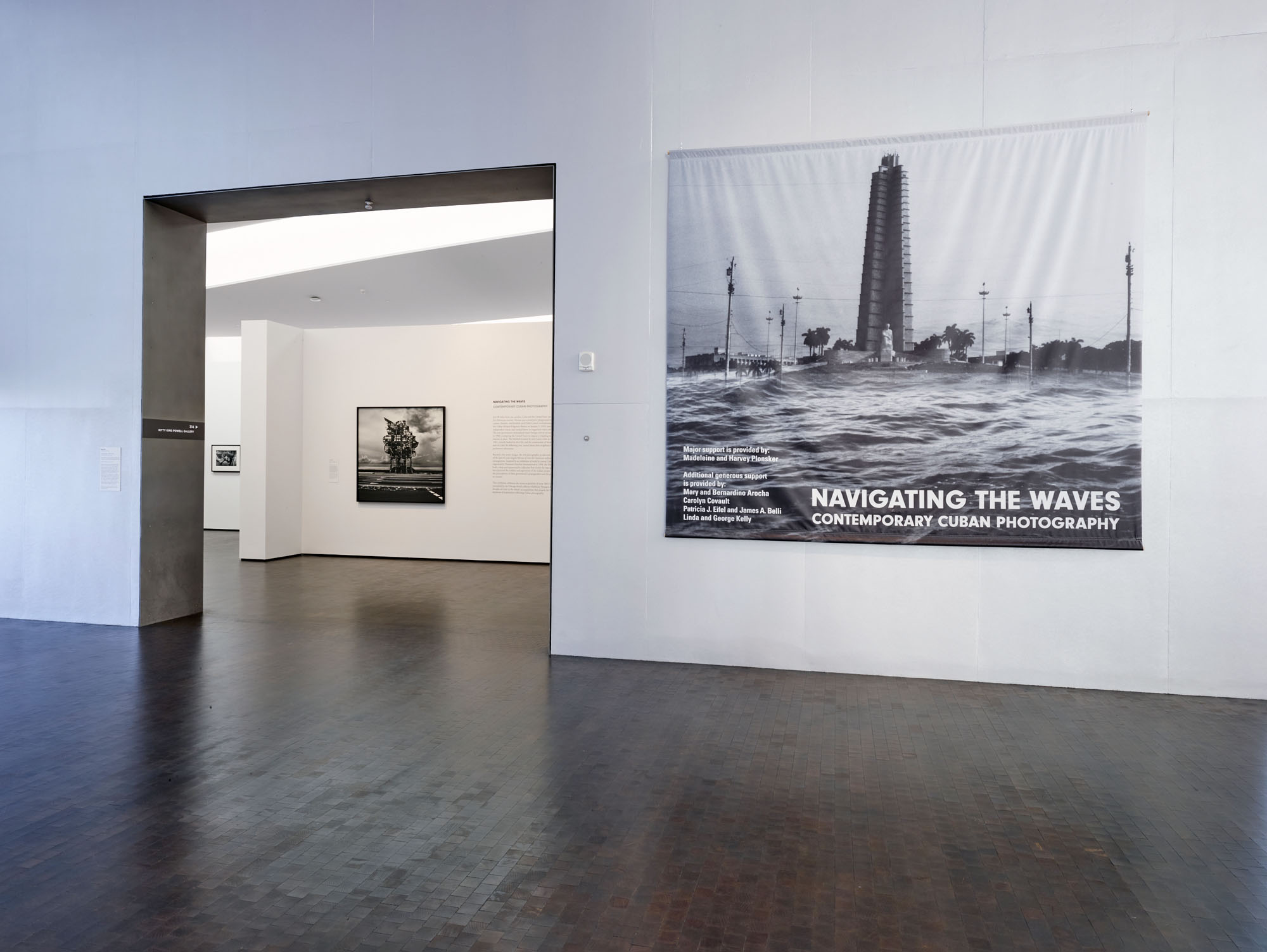
Installation views of the exhibition Navigating the Waves: Contemporary Cuban Photography at the Museum of Fine Arts, Houston showing at left, Adrián Fernández’s Untitled No. 1 2017 (below) from the series Pending Memories (Memorias pendientes); and at right in the banner image a reproduction of Liudmila & Nelson’s photograph Absolut Revolution – La Isla (Absolut Revolution – The Island) 2002 (below)
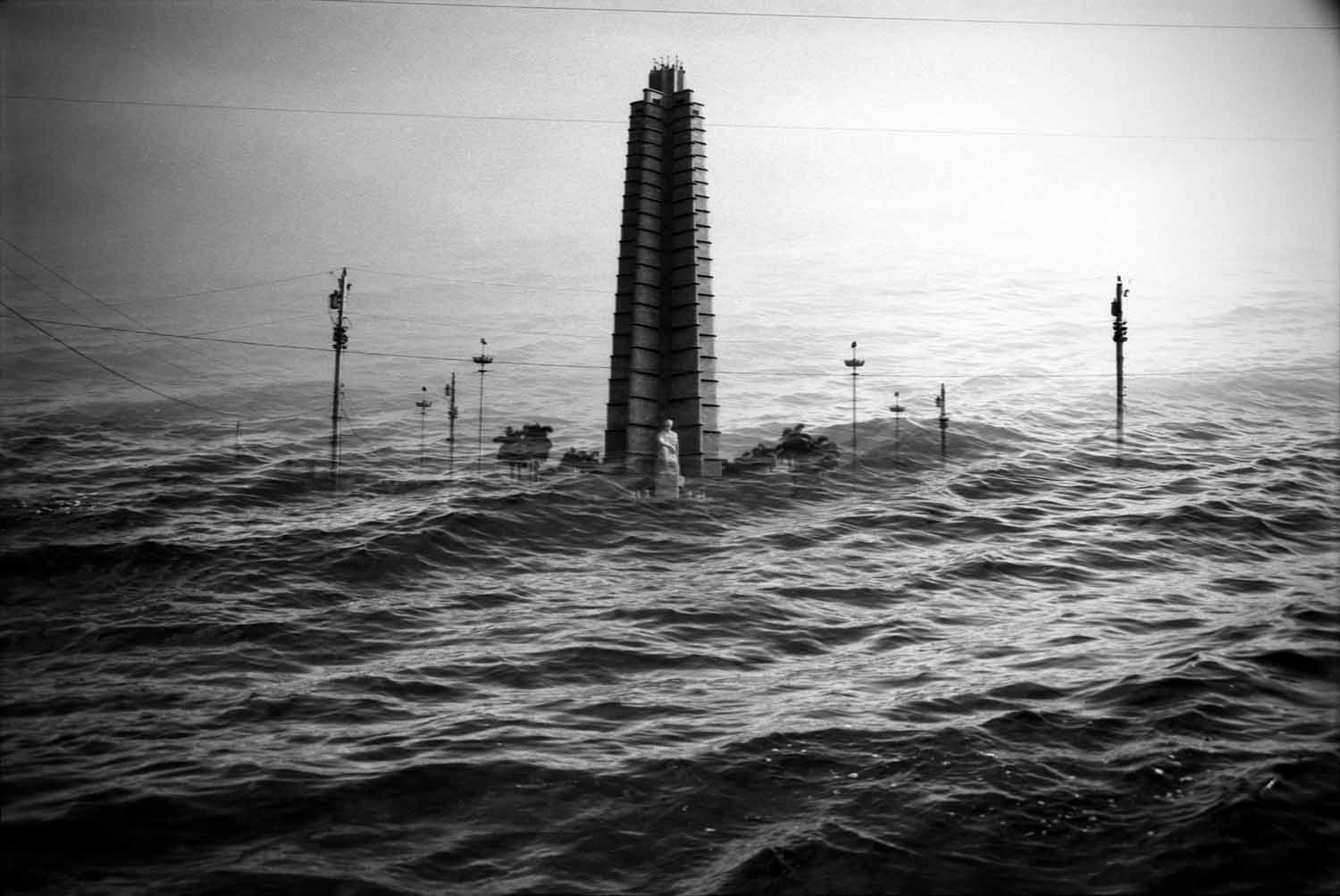
Liudmila & Nelson (active Cuba, founded 1994)
Liudmila Velazco (Cuban born Russia, b. 1969)
Nelson Ramírez de Arellano (Cuban born Germany, b. 1969)
Absolut Revolution – La Isla (Absolut Revolution – The Island)
2002
From the series Absolut Revolution
Gelatin silver print
15 1/2 × 23 in. (39.3 × 58.4cm)
The Museum of Fine Arts, Houston
The Madeleine P. Plonsker Collection, Gift of Madeleine and Harvey Plonsker
The José Martí monument holds a powerful, symbolic place in the history and psyche of the nation. From its base, Fidel Castro routinely addressed vast crowds gathered in the expansive Plaza de la Revolución. Is Liudmila & Nelson’s imagining of a flooded Havana meant to represent the nation, battered by forces beyond its control, still standing strong, or a revolution that has sacrificed the lives of its people for its own survival? Where art and literature are scrutinised by official censors, it pays to retain plausible deniability, even in photography, a medium often thought to be unambiguously truthful.
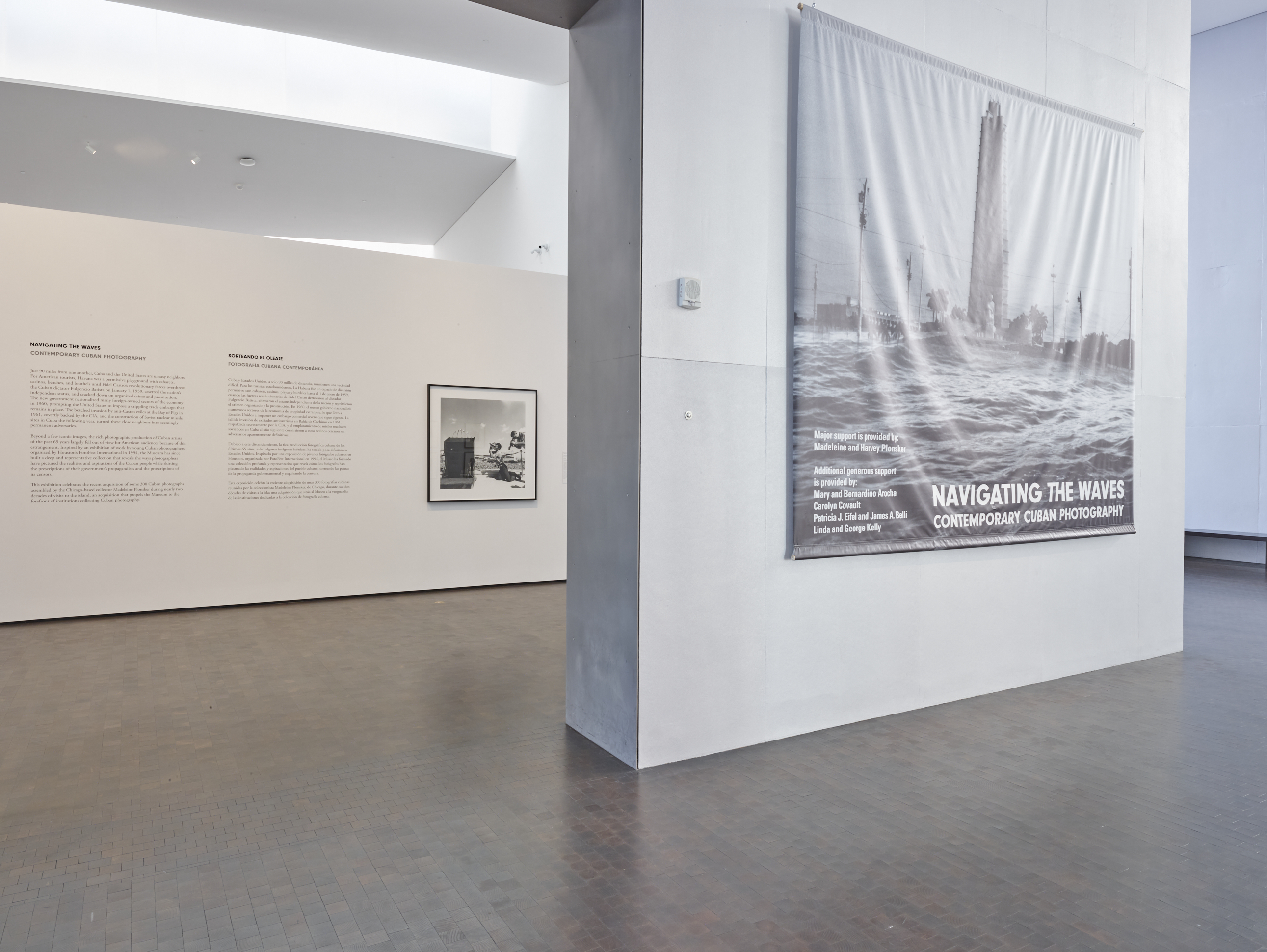
Installation view of the exhibition Navigating the Waves: Contemporary Cuban Photography at the Museum of Fine Arts, Houston
Navigating the Waves: Contemporary Cuban Photography traces the evolution of photography in Cuba over nearly five decades, from the 1960s to early 2000s.
The exhibition looks at contemporary Cuban photography from its role in promoting the Cuban Revolution after Fidel Castro’s 1959 takeover of the Batista government to engaging in social and political critique following the 1991 collapse of the Soviet Union. Over the subsequent years, Cuban photographers created powerful personal expressions by exploring individual identity, the body and spirit, Afro-Cuban heritage, and the margins of society, all while navigating the changing prescriptions and proscriptions of official cultural policy.
Showcasing approximately 100 images, Navigating the Waves: Contemporary Cuban Photography celebrates the acquisition and promised gift to the MFAH of some 300 photographs from Chicago-based collectors Madeleine and Harvey Plonsker.
Text from the Museum of Fine Arts, Houston website
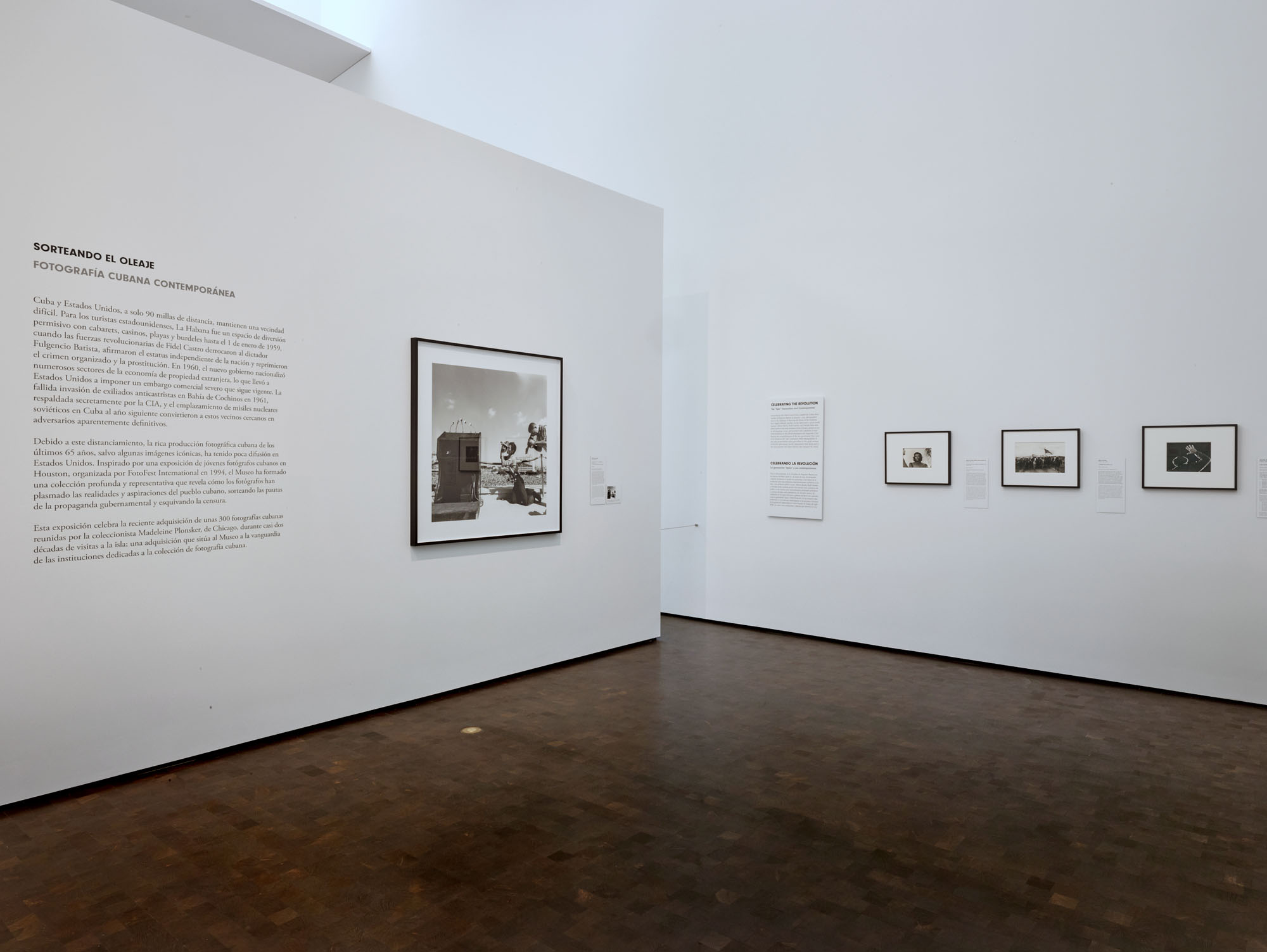
Installation view of the exhibition Navigating the Waves: Contemporary Cuban Photography at the Museum of Fine Arts, Houston showing at left, Reynier Leyva Novo’s Un día feliz FC No. 11 (A Happy Day FC No. 11) 2016 (below); and at right the section “Celebrating the Revolution” including at third right, Alberto Korda’s Heroic Guerrilla (Guerillero heroico) 1960 (below); at second right, Raúl Corrales’ Caballería (Cavalry) 1960 (below); and at right, Osvaldo Salas’ Five Points of Fidel (Cinco puntos de Fidel) 1982 (below)

Reynier Leyva Novo (Cuban, b. 1983)
Un día feliz FC No. 11 (A Happy Day FC No. 11)
2016, printed 2024
From the series Un día feliz
From the series A Happy Day
Inkjet print
39 3/4 × 39 3/4 in. (101 × 101cm)
The Museum of Fine Arts, Houston
Museum purchase funded by Joan Morgenstern, Jereann Chaney, and Carl Niendorff
In meticulous digital postproduction, Reynier Leyva Novo removed Fidel Castro from a photograph by Alberto Korda, the photographer most credited with establishing the iconography of the triumphant revolution and its leaders. Here, Castro’s presence is suggested only by the photographers stretching to film and photograph him addressing the crowds gathered below in the Plaza de la Revolución. What would modern-day Cuba look like without the imagery of its charismatic leader that fed a cult of personality for half a century? This is what Leyva Novo asks in his series Un día feliz (A Happy Day), begun in the year of Castro’s death.
Navigating the Waves: Contemporary Cuban Photography
Just 90 miles from one another, Cuba and the United States are uneasy neighbours. For American tourists, Havana was a permissive playground with cabarets, casinos, beaches, and brothels until Fidel Castro’s revolutionary forces overthrew the Cuban dictator Fulgencio Batista on January 1, 1959, asserted the nation’s independent status, and cracked down on organised crime and prostitution. The new government nationalised many foreign-owned sectors of the economy in 1960, prompting the United States to impose a crippling trade embargo that remains in place. The botched invasion by anti-Castro exiles at the Bay of Pigs in 1961, covertly backed by the CIA, and the construction of Soviet nuclear missile sites in Cuba the following year, turned these close neighbours into seemingly permanent adversaries.
Beyond a few iconic images, the rich photographic production of Cuban artists of the past 65 years largely fell out of view for American audiences because of this estrangement. Inspired by an exhibition of work by young Cuban photographers organised by Houston’s FotoFest International in 1994, the Museum has since built a deep and representative collection that reveals the ways photographers have pictured the realities and aspirations of the Cuban people while skirting the prescriptions of their government’s propagandists and the proscriptions of its censors.
This exhibition celebrates the recent acquisition of some 300 Cuban photographs assembled by the Chicago-based collector Madeleine Plonsker during nearly two decades of visits to the island, an acquisition that propels the Museum to the forefront of institutions collecting Cuban photography.
Celebrating the Revolution: The “Epic” Generation and Contemporaries
Immediately after Fidel Castro’s forces toppled the Cuban dictatorship of Fulgencio Batista on January 1, 1959, photographers rose to the challenge of depicting the heroes of the revolution for a largely illiterate populace on the island and a curious world beyond. Alberto Korda, Raúl Corrales, and Osvaldo Salas were given entrée to the most exclusive circles of power, granted access to all important events, and provided with a platform of mass communication in the official newspapers and magazines. Celebrating the accomplishments of the new government, they came to be known as the “epic” generation. Other photographers of the early post-revolution years paid tribute to the aging veterans of the late 19th-century war for independence from Spain and to the rural peasants and urban labourers who sustained the island.
Wall text from the exhibition

Alberto Korda (Cuban, 1928-2001)
Heroic Guerrilla (Guerillero heroico)
1960, printed 1995
Gelatin silver print
The Museum of Fine Arts, Houston
Museum purchase funded by Dan and Mary Solomon
© Estate Alberto Korda
Alberto Korda’s portrait of Che Guevara, stoic and implacable at a memorial for victims of an explosion in Havana’s harbour, is undoubtedly the best known of all Cuban photographs. The image sat mostly unused in the artist’s files from 1960 to 1967, when Che was captured and assassinated by government forces in Bolivia while trying to organize a popular revolution. He was lionised in Cuba as the exemplar of revolutionary self-sacrifice, and Korda’s portrait of him came to function like a secular image of a martyred saint, appearing on everything from billboards to refrigerator magnets and tattoos to book covers.

Raúl Corrales (Cuban, 1925-2006)
Caballería (Cavalry)
1960
Gelatin silver print
The Museum of Fine Arts, Houston
Gift of the estate of Esther Parada
Raúl Corrales’s Cavalry records an event at which the nationalisation and expropriation of a plantation owned by the United Fruit Company were celebrated by reenacting a famous scene from Cuba’s late 19th-century war for independence from Spain. With reenactments such as this, the triumph of the revolution was linked to a decades-long struggle to shake off the bonds of colonialism. Corrales’s photograph of smiling guerrillas wearing matching straw hats, riding horses, and waving Cuban flags also conjures associations with heroic 19th-century history paintings.

Osvaldo Salas (Cuban, 1938-2005)
Five Points of Fidel (Cinco puntos de Fidel)
1982
Gelatin silver print
The Museum of Fine Arts, Houston
Gift of the estate of Esther Parada
© 1982 Osvaldo Salas
The title of this photograph, taken in 1982, links Fidel Castro’s gesture to a crucial speech 20 years earlier aimed at President John F. Kennedy amid the Cuban Missile Crisis. Castro outlined five conditions for Cuba’s consent to the withdrawal of Soviet missiles from its territory:
1/ Ending the economic blockade and other commercial and economic pressures
2/ Ending subversive activities
3/ Ending pirate attacks
4/ Ending violations of Cuban airspace
5/ Withdrawal from the Guantanamo Naval Base and its return to the Cuban government.
At the time, however, Castro was unaware that President Kennedy and Soviet Premier Nikita Khrushchev were already discussing missile withdrawal without Cuba’s participation.
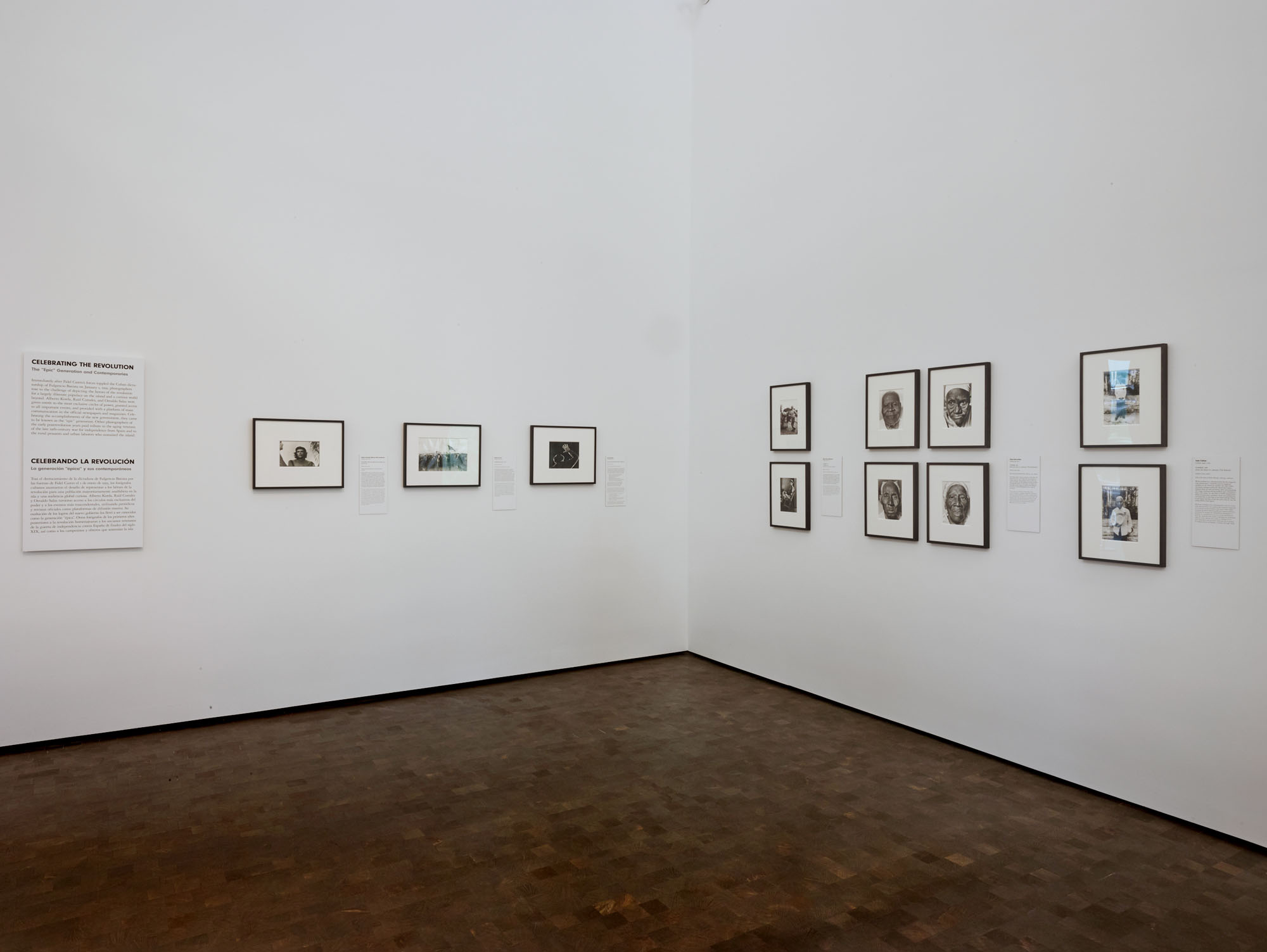
Installation view of the exhibition Navigating the Waves: Contemporary Cuban Photography at the Museum of Fine Arts, Houston showing at left the section “Celebrating the Revolution” including at left, Alberto Korda’s Heroic Guerrilla (Guerillero heroico) 1960 (above); at second left, Raúl Corrales’ Caballería (Cavalry) 1960 (above); and at third right, Osvaldo Salas’ Five Points of Fidel (Cinco puntos de Fidel) 1982 (above)
Celebrating the acquisition of some 300 Cuban photographs from the Chicago-based collectors Madeleine and Harvey Plonsker, Navigating the Waves: Contemporary Cuban Photography traces the medium’s evolution in Cuba over nearly six decades – from promoting the Revolution following Fidel Castro’s 1959 overthrow of the Batista government, to engaging in social and political critique in more recent times as the triumph of the Revolution increasingly gave way to economic hardship and political repression. Particularly in the years after the 1991 collapse of the Soviet Union, Cuban photographers created powerful personal expressions by exploring individual identity, the body and spirit, Afro-Cuban heritage, and the margins of society, all while navigating the fluctuating prescriptions and proscriptions of official cultural policy.
The exhibition of some 100 works will be on view September 29, 2024 through March 16, 2025, in the Museum’s Nancy and Rich Kinder Building for modern and contemporary art.
“With the acquisition of the Madeleine P. Plonsker Collection, the Museum of Fine Arts, Houston, now boasts the most complete collection anywhere of post-Revolution Cuban photography, with an emphasis on the years since 1990: nearly 700 works by more than 80 Cuban artists,” commented Gary Tinterow, director and Margaret Alkek Williams Chair of the Museum of Fine Arts, Houston. “We are enormously grateful to Mrs. Plonsker, who assembled the collection through the lasting relationships she forged with artists over many visits to Cuba from 2005 to 2020.”
“The strengths of the Plonsker Collection are unparalleled, in terms of telling the complex and compelling story of post-Revolution Cuban photography,” commented Malcolm Daniel, Gus and Lyndall Wortham Curator of photography at the MFAH. “Combined in this exhibition with works already in the Museum’s holdings, the collection allows us to chronicle that story from the ‘epic generation,’ whose work would define the image of the Cuban Revolution, to the succeeding generations of photographers, who questioned the power of photography and its relationship to political authority and who created highly personal work in the context of a greater awareness of international contemporary art.”
Prologue: The “Epic” Generation
The exhibition begins with a brief prologue featuring works by the so-called “epic” generation of photographers – Alberto Korda, Raul Corrales and Osvaldo Salas among them – who used the medium to further the ideals of the Cuban Revolution, celebrating its heroes and promoting its ambitions. It opens with Korda’s iconic portrait of Che Guevara, Guerrillero Heroico (1960), the most widely reproduced and recognised of all Cuban photographs.
Gallery 1: Life in Post-Revolution Cuba
The first gallery presents images of daily life in Cuba, primarily from the 1990s and early 2000s, beginning with photographs that reference patriotic themes: the Cuban flag, veterans, a military parade and public portraits of 19th-century Independence hero José Martí and Cuban leader Fidel Castro. While ostensibly honoring the new Cuba, many of the images question both the power of photography and its relationship to political authority. An Untitled 1992 photograph by José Figueroa depicts dozens of freshly made prints of Alberto Korda’s iconic portrait of Che laid out on a bed – Figueroa was Korda’s longtime printer – and suggests the ubiquity of that iconic image as both propaganda and commodity. Other photographs in this section of the exhibition depict the hardships and aspirations of rural Cubans in the post-revolutionary era as well as the day-to-day joys of life divorced from political concerns. Photographers in this section include Pedro Abascal, Raúl Cañibano, María Cienfuegos Leiseca, José Julián Martí, Humberto Mayol and Eduardo Muñoz Ordoqui.
Gallery 2: Memory, the Body, and Identity
The second section of the exhibition marks a pivotal shift in Cuban photography. As the nation plunged into economic, social and political crisis following the collapse of the Soviet Union [1991] and the loss of its financial support, a time that Castro dubbed the “Special Period,” many photographers turned from documentation of the public sphere to a more personal and poetic exploration of the private realm. Photographers treated the body, often their own, as the path through which to examine their present situation through the lens of Afro-Cuban rituals, personal history, queer identity, race and gender. This particularly rich section features exceptional work by Juan Carlos Alom, Arien Chang Castán, José Manuel Fors, Alejandro González, Eduardo Hernandez Santos, Cirenaica Moreira, René Peña, and others.
Gallery 3: Myth and Reality
In the final section of the exhibition, composed primarily of work made since 2005, photographers address the current political, social and economic situation more directly than in previous years – but slyly still, in order not to run afoul of government dictates and official arbiters of culture. This most recent generation of photographers, born well after the Revolution, came of age in the depths of the Special Period, and began their artistic careers with a greater awareness of international contemporary art. Again, national symbols appear – the Cuban flag, currency, stamps, historic events – but this time with a knowing nod to their emptiness. The precarious nature of life in present-day Cuba and the widespread desire for emigration are common subjects.
This gallery includes work by Adrián Fernández, Alejandro González, Glenda Léon, Liudmila & Nelson, Yasser Piña Peña, Sandra Ramos, Esterio Segura, Lisette Solórzano, and others.
Press release from the Museum of Fine Arts, Houston
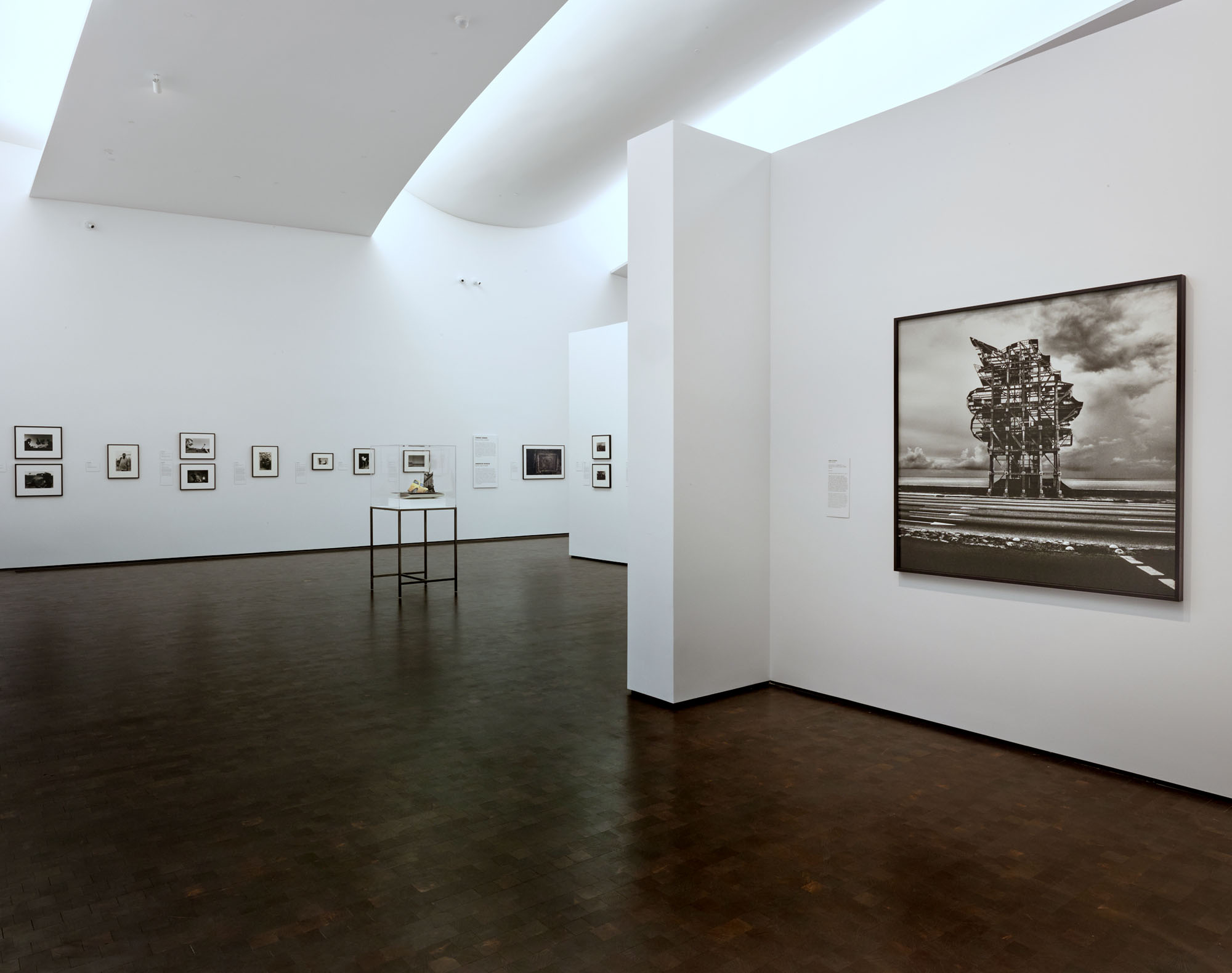
Installation view of the exhibition Navigating the Waves: Contemporary Cuban Photography at the Museum of Fine Arts, Houston showing at right, Adrián Fernández’s Untitled No. 1 2017 (below) from the series Pending Memories (Memorias pendientes)

Adrián Fernández (Cuban, b. 1984)
Untitled No. 1 (Sin título No. 1)
2017, printed 2020
From the series Pending Memories (Memorias pendientes)
Inkjet print
The Museum of Fine Arts, Houston
Museum purchase funded by Photo Forum 2021
© 2017 Adrián Fernández
Inspired by industrial remnants, unfinished construction projects, propaganda billboards, and carnival decorations, Adrián Fernández collaborated with architects, engineers, and computer specialists to combine a lens-based photograph (the landscape) with a digitally constructed image of the back of a fictional structure. It is easy to imagine this structure, set along the Malecón (Havana’s seaside esplanade), as the remains of a once-grand declaration, facing north like a challenge to the United States and as a greeting to anyone arriving in Havana by sea. Fernández intends this image to be a metaphor for today’s teetering ruins of the Cuban Revolution’s grand ambitions.
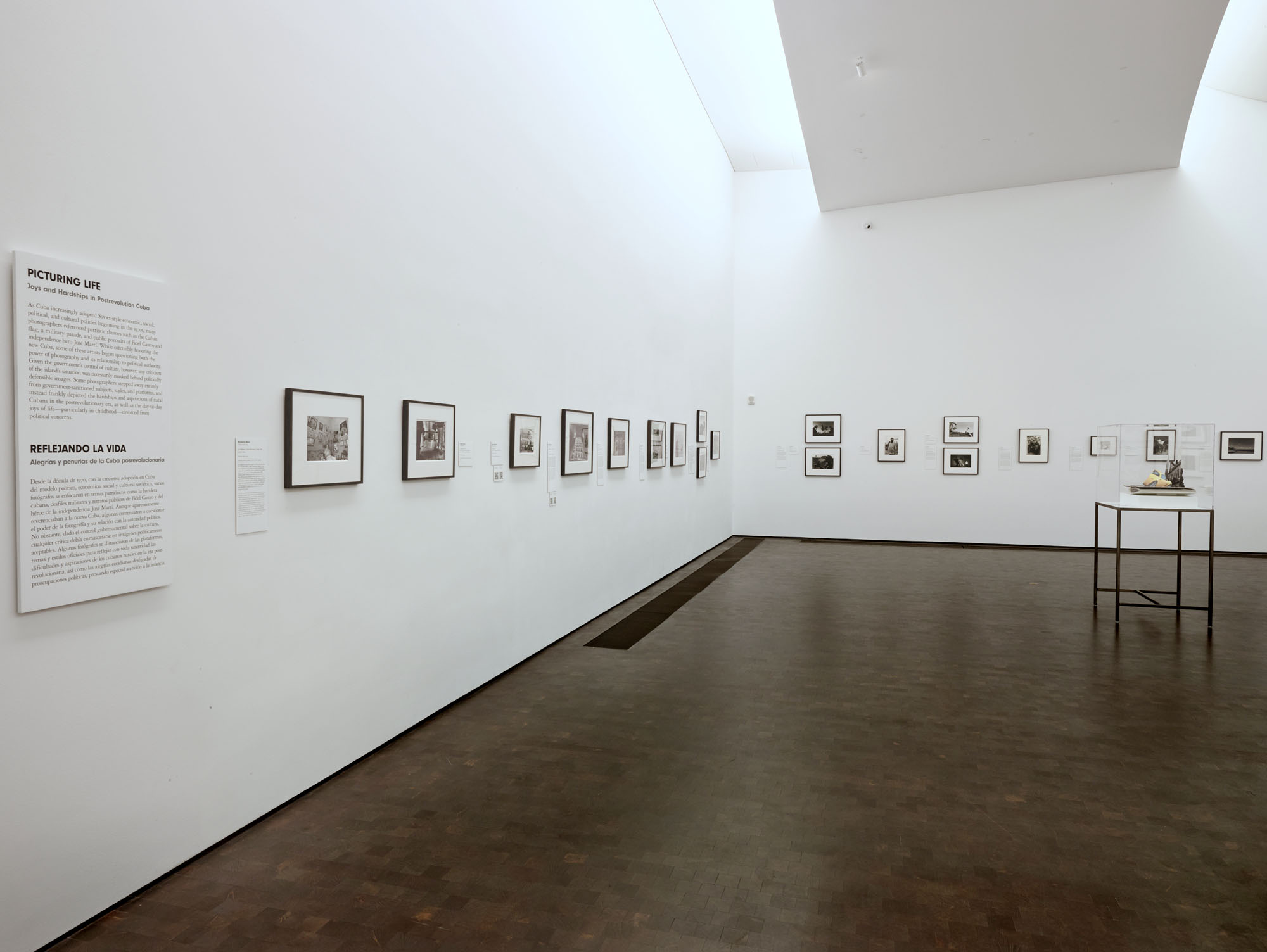
Installation view of the exhibition Navigating the Waves: Contemporary Cuban Photography at the Museum of Fine Arts, Houston showing at left the wall text for the section “Picturing Life: Joys and Hardships in Postrevolution Cuba”
Picturing Life: Joys and Hardships in Postrevolution Cuba
As Cuba increasingly adopted Soviet-style economic, social, political, and cultural policies beginning in the 1970s, many photographers referenced patriotic themes such as the Cuban flag, a military parade, and public portraits of Fidel Castro and independence hero José Martí. While ostensibly honouring the new Cuba, some of these artists began questioning both the power of photography and its relationship to political authority. Given the government’s control of culture, however, any criticism of the island’s situation was necessarily masked behind politically defensible images. Some photographers stepped away entirely from government-sanctioned subjects, styles, and platforms, and instead frankly depicted the hardships and aspirations of rural Cubans in the post-revolutionary era, as well as the day-to-day joys of life – particularly in childhood – divorced from political concerns.
Wall text from the exhibition
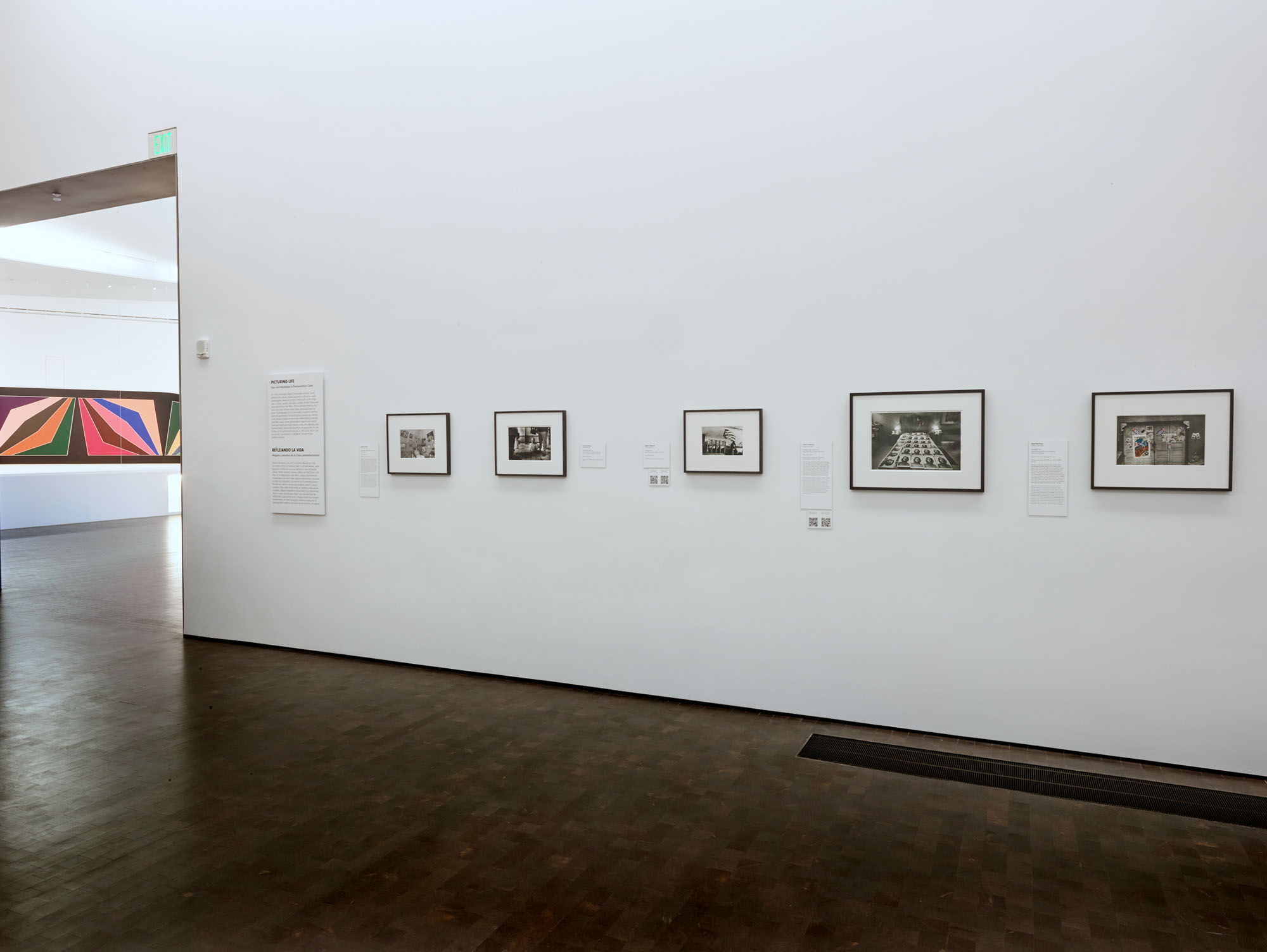
Installation view of the exhibition Navigating the Waves: Contemporary Cuban Photography at the Museum of Fine Arts, Houston showing at second right, José A. Figueroa’s Untitled 1992 from the series The Image (below)

José A. Figueroa (Cuban, b. 1946)
Untitled
1992, printed 2023
From the series The Image
Gelatin silver print
40 x 50cm
The Museum of Fine Arts, Houston
Museum purchase funded by Joan Morgenstern in honor of Raquel Carrera
Over the course of decades, Alberto Korda’s protégé and longtime printer José Figueroa printed thousands of copies of Korda’s iconic portrait of Che Guevara. As he worked to fulfil the never-ending demand for Guerrillero heroico, in 1992, 25 years after Che’s death, Figueroa photographed dozens of fresh prints laid out on his bed to dry, an image that revealed his own awareness of the changing nature and role of photography in Cuba from servant of the socialist revolution to commodity and social commentary.
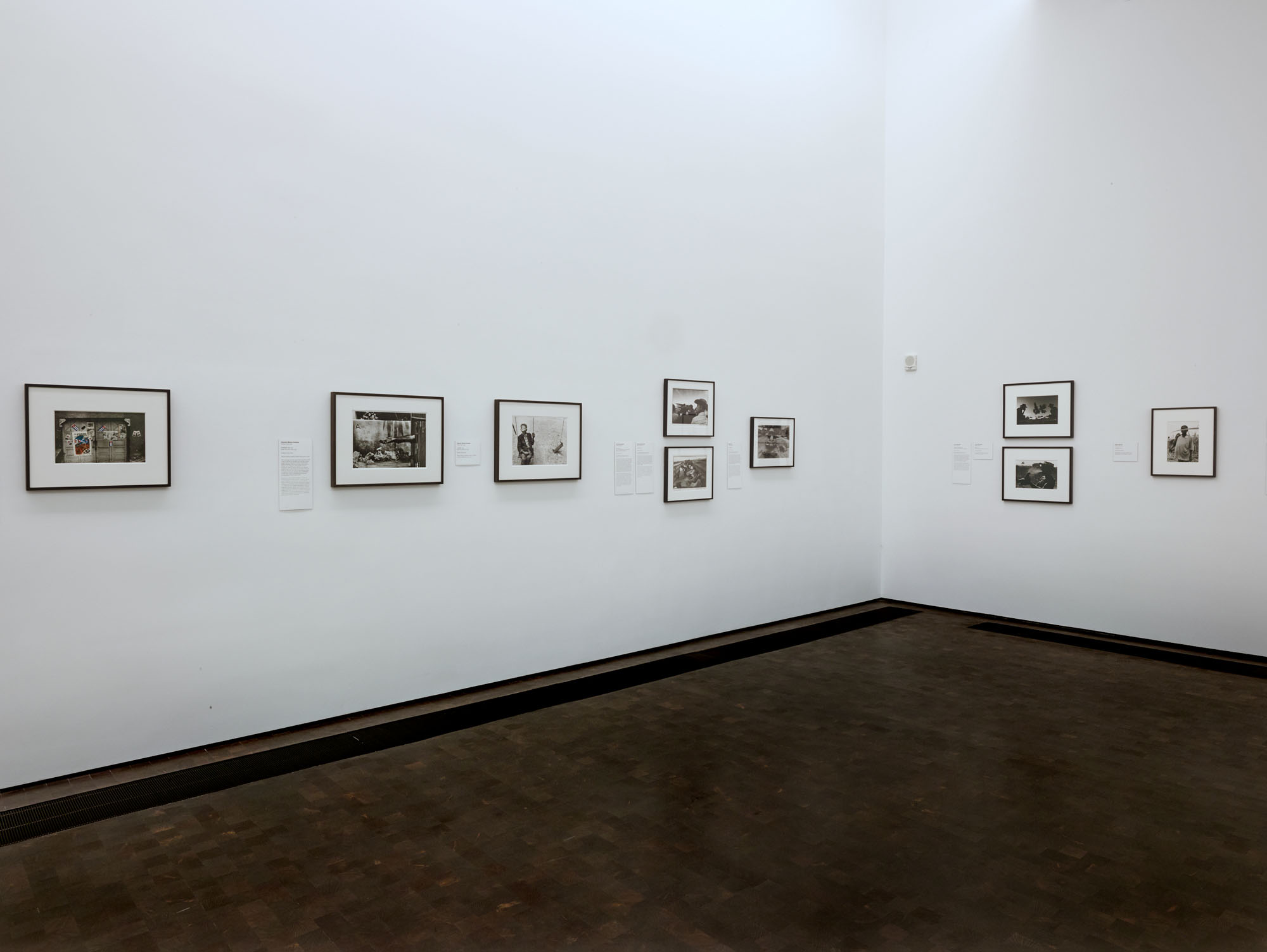
Installation view of the exhibition Navigating the Waves: Contemporary Cuban Photography at the Museum of Fine Arts, Houston showing at second left, Eduardo Muñoz Ordoqui’s Untitled 1992 from the series Zoo-Logos (below); and at third right, Eduardo Muñoz Ordoqui’s Untitled 1992 from the series Zoo-Logos (below)
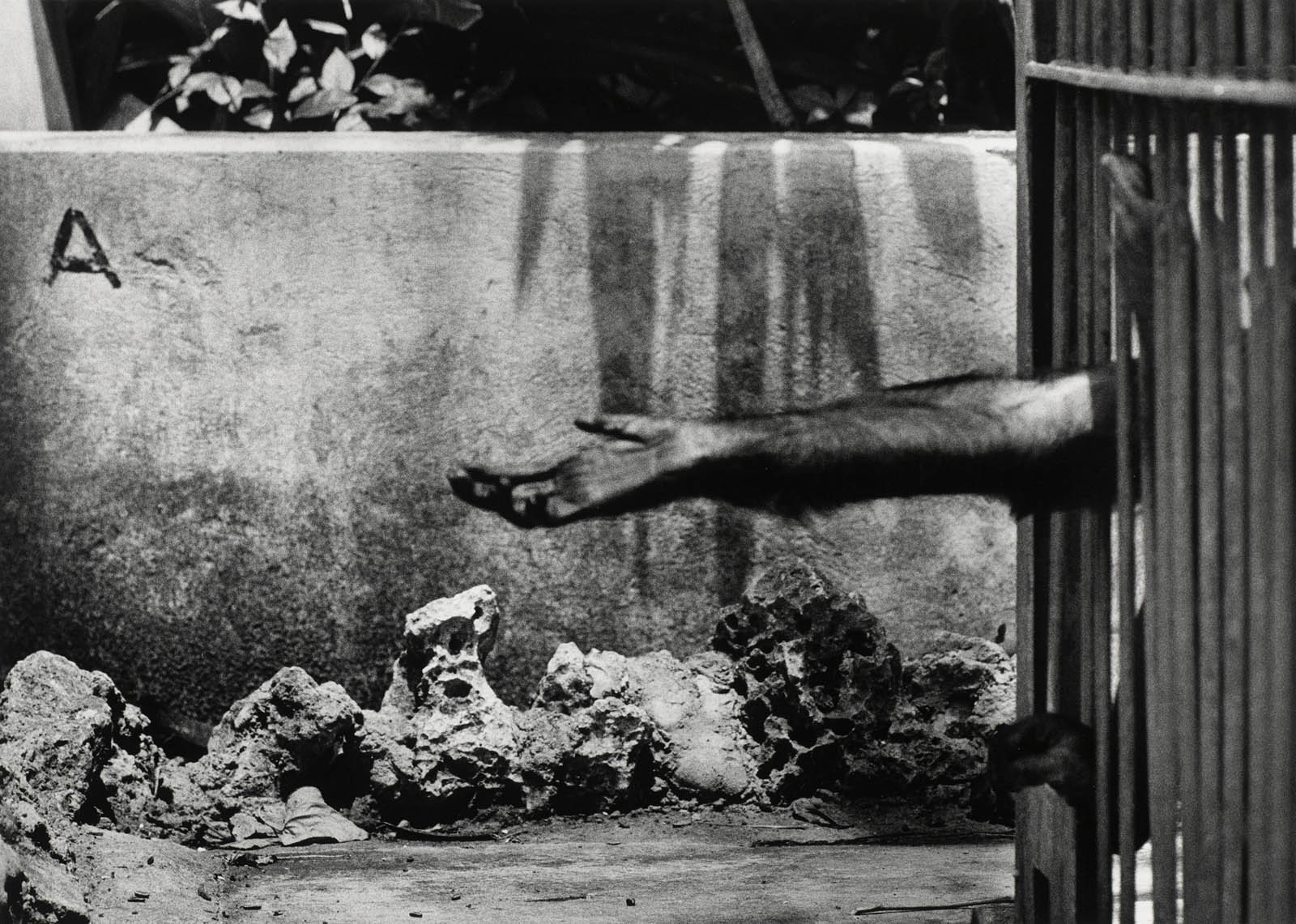
Eduardo Muñoz Ordoqui (Cuban, b. 1964)
Untitled
1992
From the series Zoo-Logos
Gelatin silver print
The Museum of Fine Arts, Houston
Museum purchase funded by Clinton T. Willour in honor of Mickey Marvins
© 1992 Eduardo Muñoz Oroqui
The challenge for Cuban artists has long been to find a way to portray life candidly and critically without triggering the attention of censors. For Eduardo Muñoz Ordoqui, this process began with trips to Havana’s zoo, where he photographed visitors, employees, caged animals, and even the adjacent slaughterhouse, where horses were killed to feed the large cats. By the 1990s, the zoo had become home to neglected creatures enduring their confinement as best they could, a metaphor for the extreme circumstances of life in 1990s Cuba.

Eduardo Muñoz Ordoqui (Cuban, b. 1964)
Untitled
1990-1992
From the series Zoo-Logos
Gelatin silver print
The Museum of Fine Arts, Houston
Museum purchase funded by Clinton T. Willour in honor of Mickey Marvins
© 1992 Eduardo Muñoz Oroqui
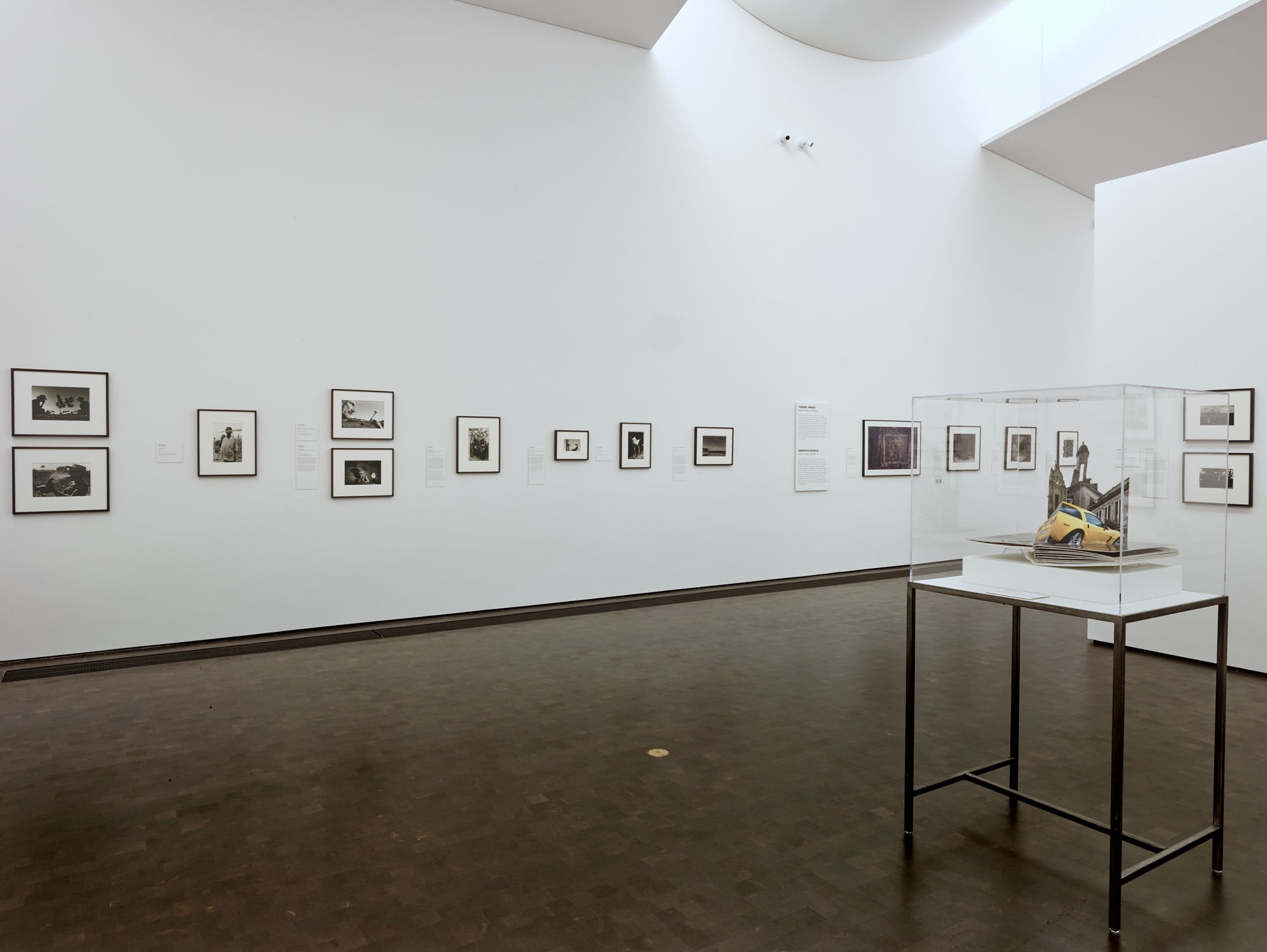

Installation views of the exhibition Navigating the Waves: Contemporary Cuban Photography at the Museum of Fine Arts, Houston
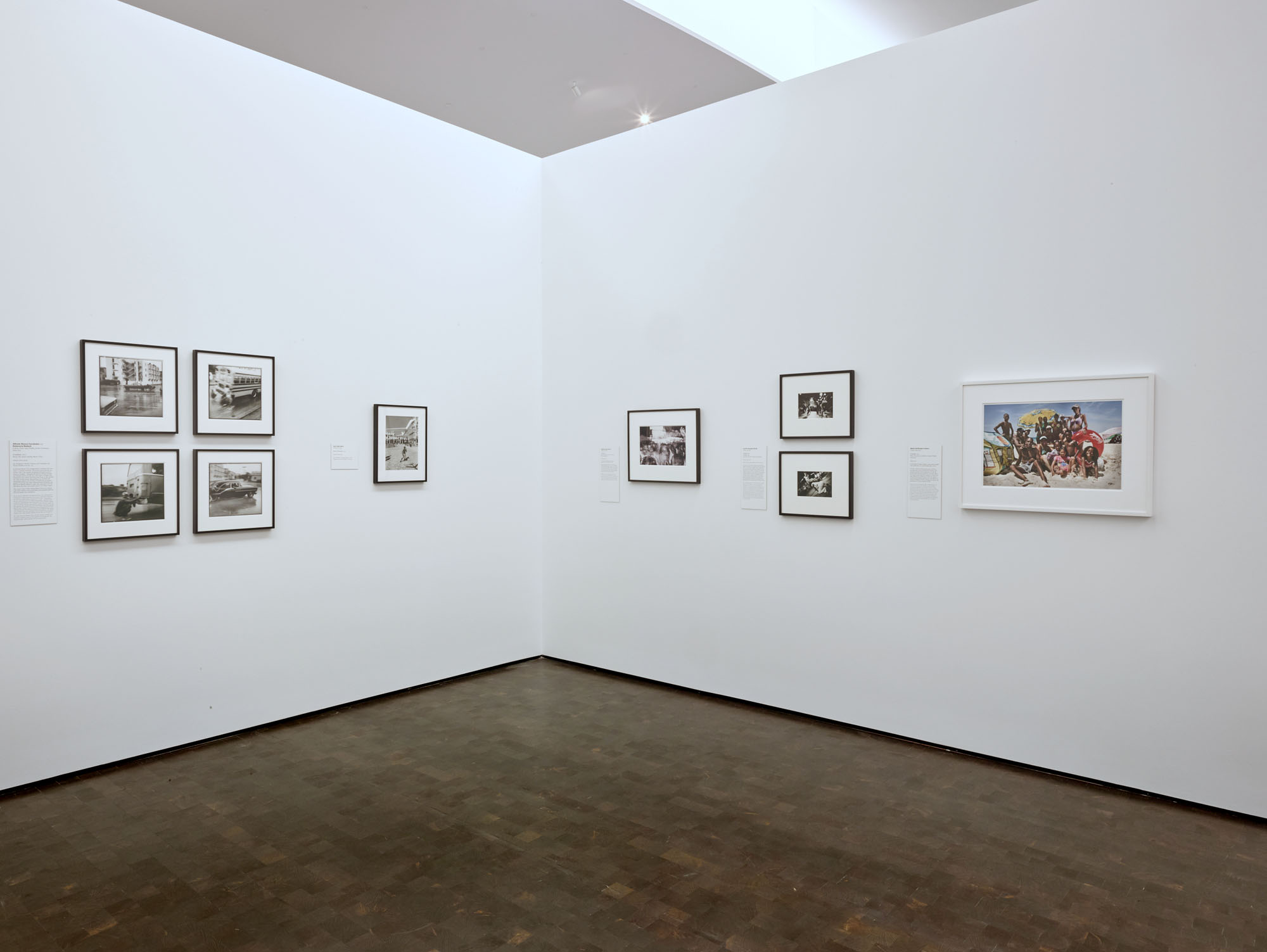
Installation view of the exhibition Navigating the Waves: Contemporary Cuban Photography at the Museum of Fine Arts, Houston showing at right, María Cienfuegos Leiseca’s Untitled 2011 from the series La familia se retrata (below)
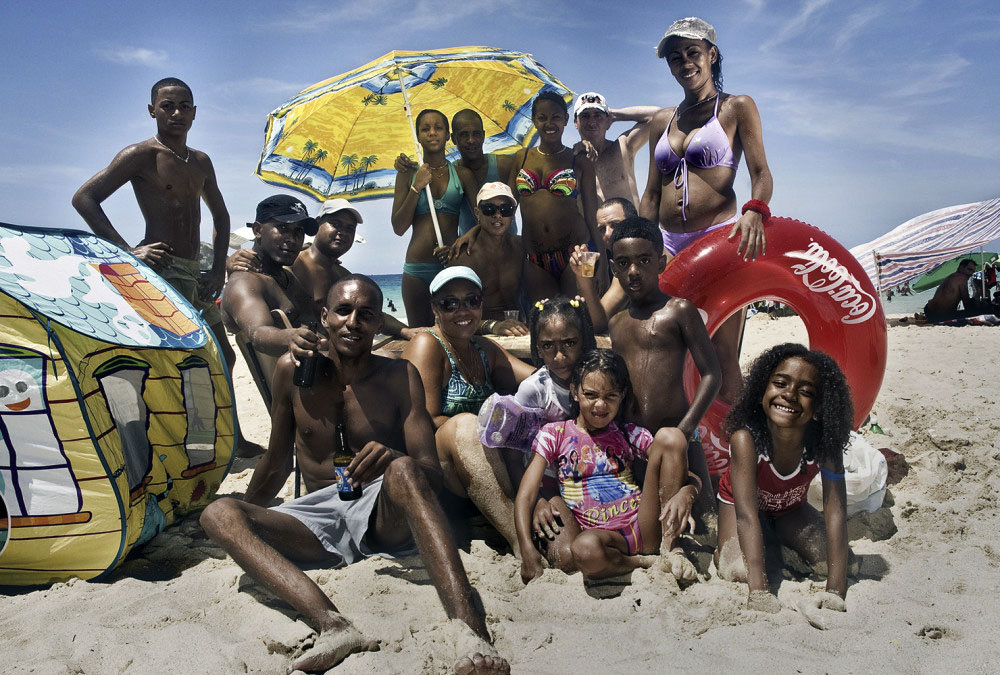
María Cienfuegos Leiseca (Cuban, b. 1974)
Untitled
2011
From the series La familia se retrata
From the series Family Portrayed
Inkjet print
15 11/16 × 23 5/8 in. (39.9 × 60 cm)
The Museum of Fine Arts, Houston
The Madeleine P. Plonsker Collection, museum purchase funded by the Caroline Wiess Law Accessions Endowment
In Cuba, a narrow island spanning just 118 miles at its widest point, beach excursions are common, often bringing together several generations of a family. For her series of family portraits at the beach, María Cienfuegos Leiseca asked her subjects to choose how they wished to be represented. Unlike the solemn, carefully posed formal portraits seen throughout art history, Cienfuegos Leiseca’s photographs capture the spontaneity of a joyous family reunion.
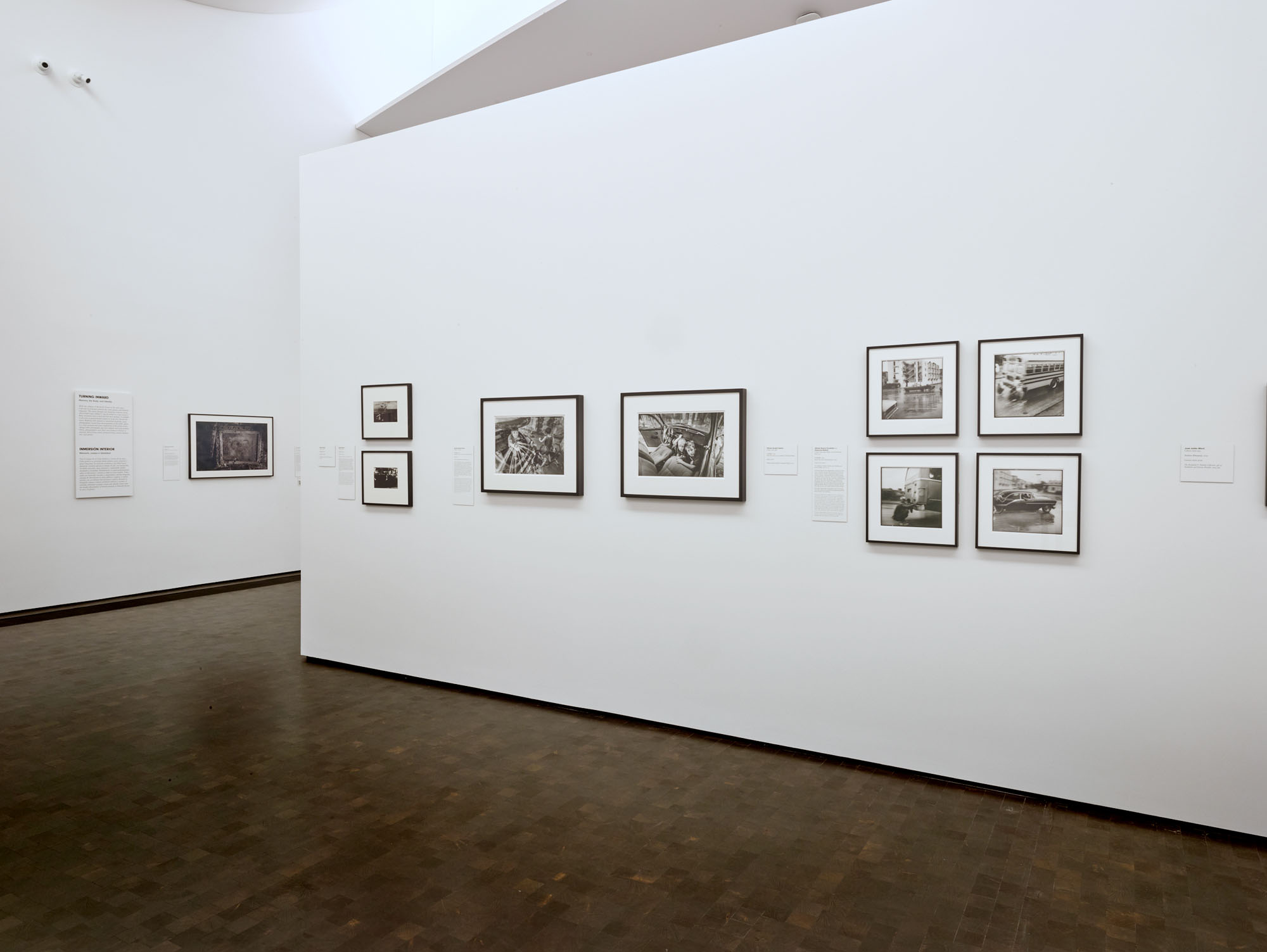
Installation view of the exhibition Navigating the Waves: Contemporary Cuban Photography at the Museum of Fine Arts, Houston showing at third right, Alfredo Sarabia Fajardo’s Untitled 2017 from the series Casa Redonda (below)

Alfredo Sarabia Fajardo (Cuban, b. 1986)
Untitled
2017, printed 2021
From the series Casa Redonda
From the series Round House
Inkjet print
13 9/16 × 20 1/2 in. (34.5 × 52cm)
The Museum of Fine Arts, Houston
Museum purchase funded by Madeleine Plonsker
The family Volkswagen dating to his childhood has become a playground for Alfredo Sarabia Fajardo’s young children and a way to connect to his father who died when the younger Alfredo was just six. “I frequently travel with my family, just as my father did with me, even using the same or similar objects,” the photographer explained. “As a natural consequence of this, I reactivate the memories of my childhood, refresh the nostalgia, and end up reliving some of those experiences. I like to think of it as a creative legacy that gets renewed, embodying the very spirit of a journey.”
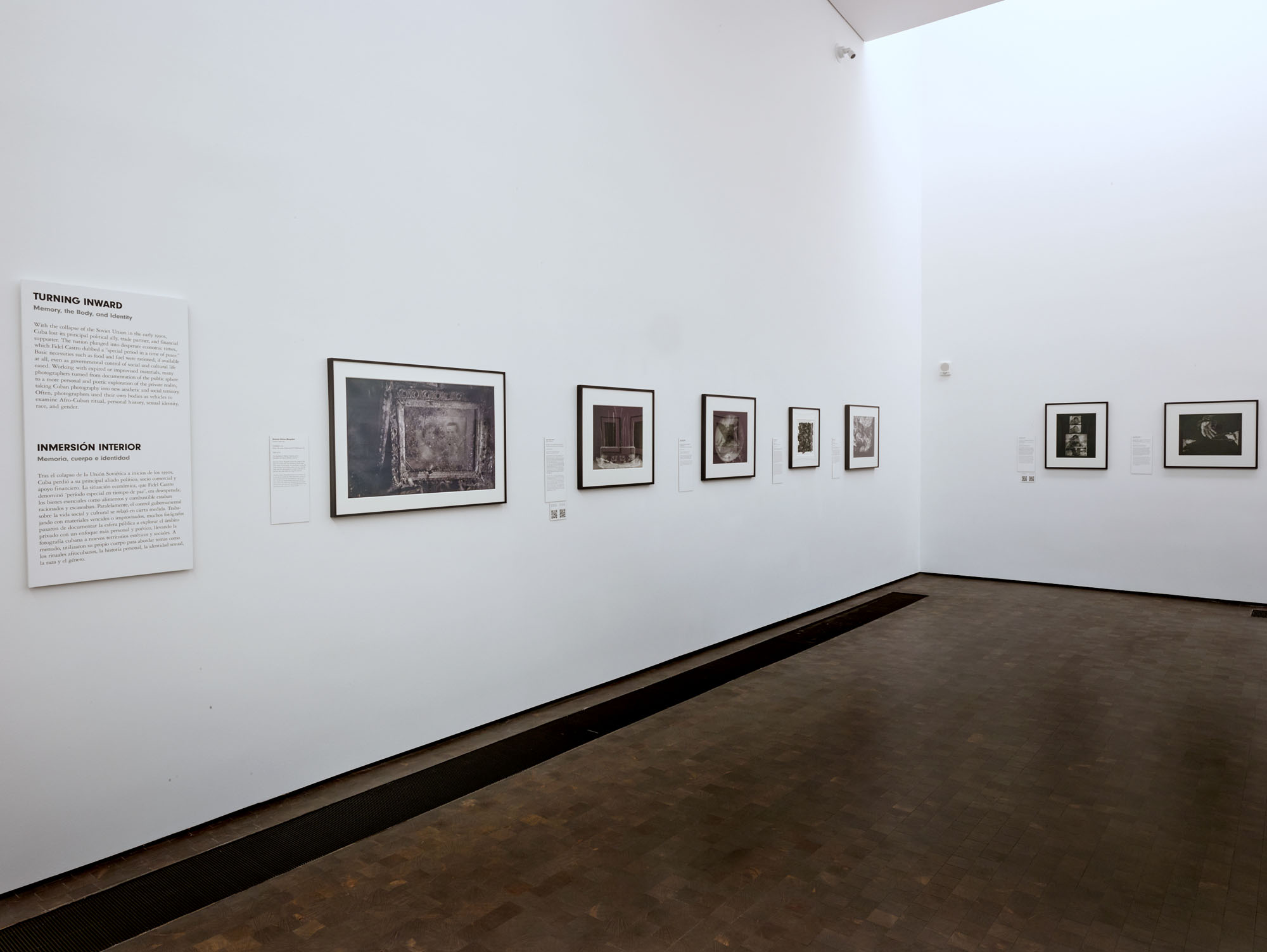
Installation view of the exhibition Navigating the Waves: Contemporary Cuban Photography at the Museum of Fine Arts, Houston showing at left the wall text for the section “Turning Inward: Memory, the Body, and Identity”
Turning Inward: Memory, the Body, and Identity
With the collapse of the Soviet Union in the early 1990s, Cuba lost its principal political ally, trade partner, and financial supporter. The nation plunged into desperate economic times, which Fidel Castro dubbed a “special period in a time of peace.” Basic necessities such as food and fuel were rationed, if available at all, even as governmental control of social and cultural life eased. Working with expired or improvised materials, many photographers turned from documentation of the public sphere to a more personal and poetic exploration of the private realm, taking Cuban photography into new aesthetic and social territory. Often, photographers used their own bodies as vehicles to examine Afro-Cuban ritual, personal history, sexual identity, race, and gender.

Gory (Rogelio López Marin) (Cuban, b. 1953)
From the series It’s Only Water in the Teardrop of a Stranger (Es sólo agua en la lágrima de un extraño)
1986, printed 2023
Chromogenic print
The Museum of Fine Arts, Houston
Museum purchase funded by the Photography Subcommittee, 2023
© 1986 Rogelio López Marín (Gory)
Gory originally presented this series – perhaps the most prominent example of experimental Cuban photography of the 1980s – as an installation of nine photographs. Eight are photomontages in which a pool ladder in the foreground
gives access to an alternate world in the middle distance; the final image presents the empty pool, with an aura of abandonment. When first shown, each photograph was accompanied by a text fragment from Michael Ende’s The Mirror in the Mirror: A Labyrinth (1984). The first of those phrases began: “Like a swimmer who has gotten lost under a layer of ice, I look for a place to emerge, but there is no place. All life long I swim holding my breath.”

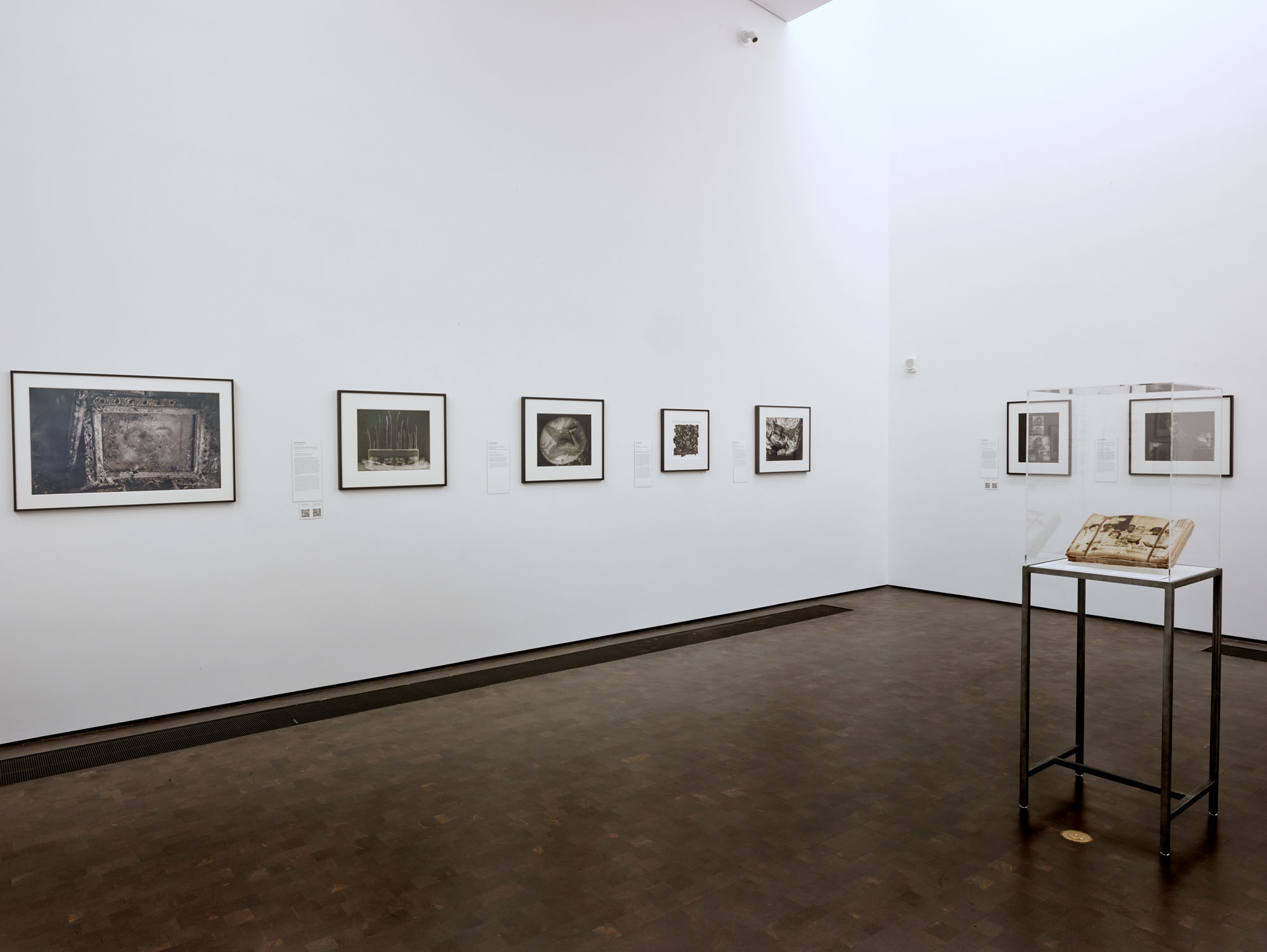
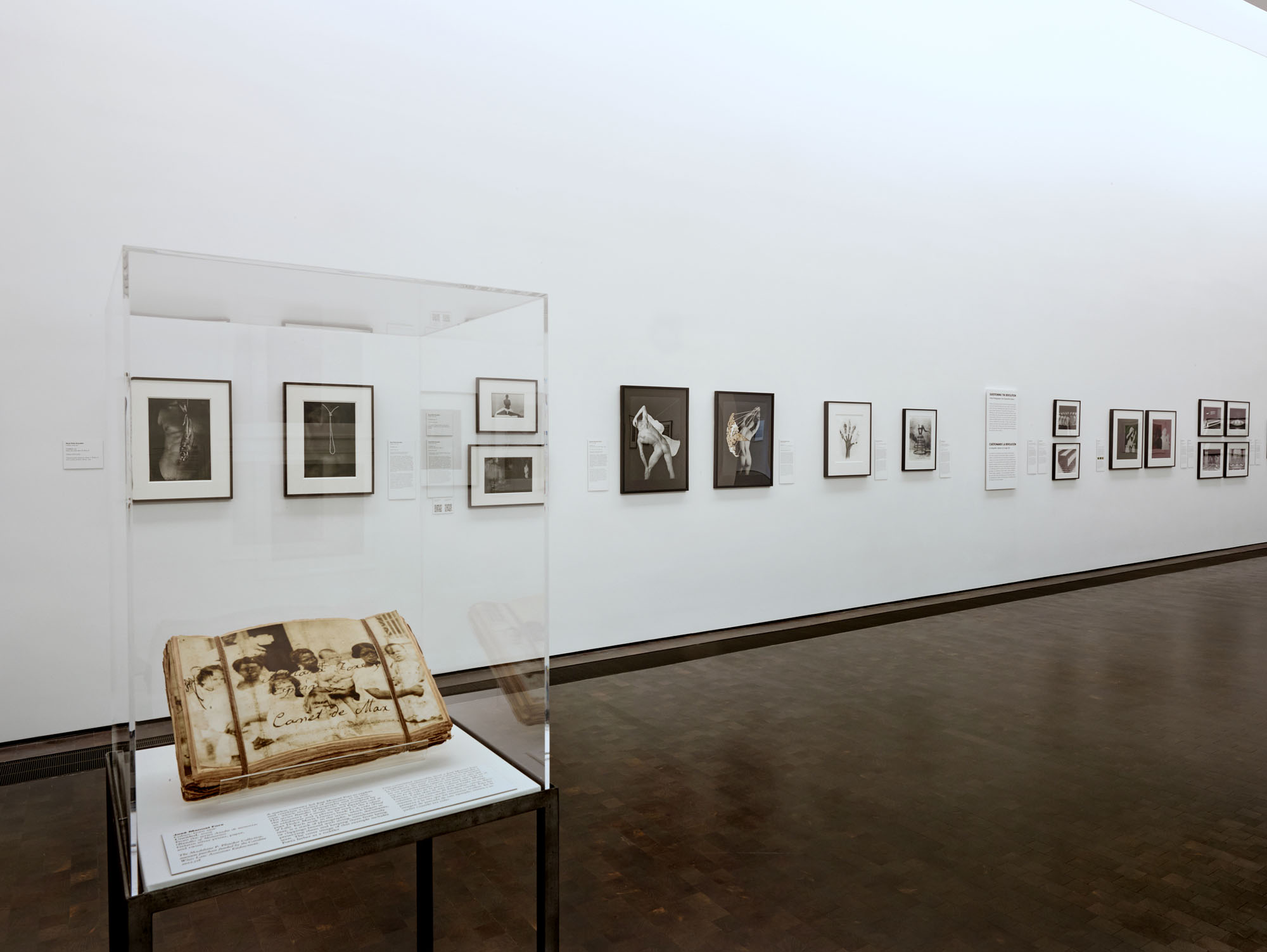
Installation views of the exhibition Navigating the Waves: Contemporary Cuban Photography at the Museum of Fine Arts, Houston
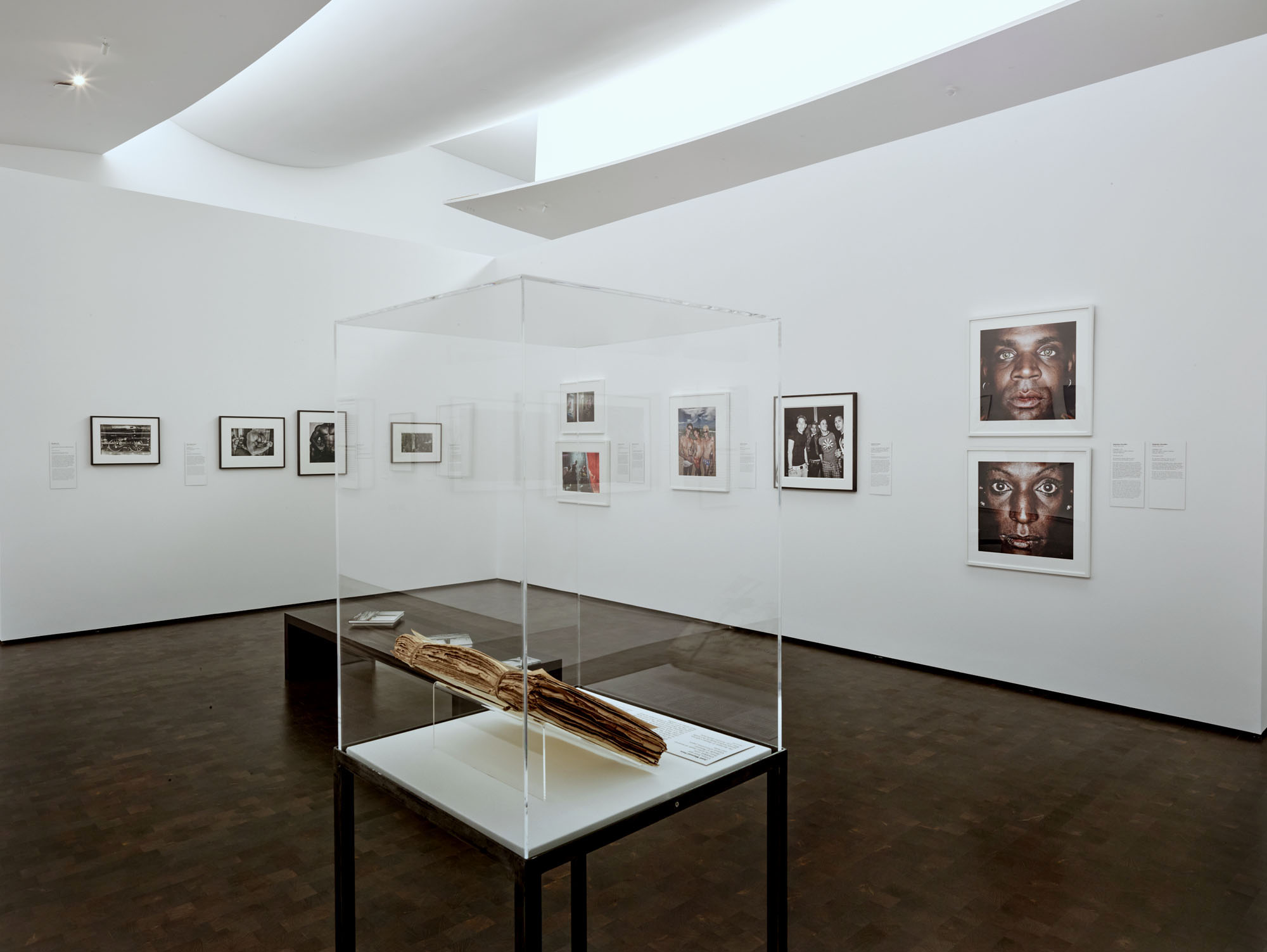
Installation view of the exhibition Navigating the Waves: Contemporary Cuban Photography at the Museum of Fine Arts, Houston showing at right top, Alejandro González’s Untitled 2008 from the series Conducta impropia (below); and at second right, Alejandro González’s 2:57 am, 24 de dic de 2005, Vedado, La Habana, Cuba 2005 from the series AM-PM (below)

Alejandro González (Cuban, b. 1974)
Untitled
2008
From the series Conducta impropia
From the seres Improper Behaviour
Chromogenic print
23 × 22 15/16 in. (58.4 × 58.3cm)
The Museum of Fine Arts, Houston
The Madeleine P. Plonsker Collection, Gift of Madeleine and Harvey Plonsker
Not without setbacks, major advances in LGBTQ+ legal rights had occurred in Cuba by the 2000s, and most legal prohibitions against homosexuality had been lifted. Alejandro González was on hand for the second annual event in observance of the International Day Against Homophobia in 2008. There, he carried out the first part of a series titled Improper Behavior – large, extreme close-up portraits of participants, so close that the subjects’ gender becomes hard to identify. Although frontal and straightforward as a mugshot, they are nonetheless assertive of power rather than subservient to it.
The title of Alejandro González’s series Conducta impropia is an intentional reference to the 1984 documentary of the same name by Cuban exiles Néstor Almendros and Orlando Jiménez Leal detailing the Castro government’s oppression of Cuba’s gay population.

Alejandro González (Cuban, b. 1974)
2:57 am, 24 de dic de 2005, Vedado, La Habana, Cuba
2005
From the series AM-PM
Inkjet print
21 1/4 × 21 1/4 in. (54 × 54cm)
The Museum of Fine Arts, Houston
The Madeleine P. Plonsker Collection, museum purchase funded by the Caroline Wiess Law Accessions Endowment
“In 2005, I started getting interested in social topics and people,” Alejandro González has said. “I was seeing what was happening in society, and I was feeling that I was not participating.” A night creature himself at age 31, Alejandro González began with a candid look at youth culture in the wee hours of the morning along Havana’s 23rd Street, a hub of nightlife. Using a Rolleiflex camera, with its square format and characteristically low vantage point, his method was straightforward, and his pictures – almost always made with the permission of his subjects – felt undeniably authentic.
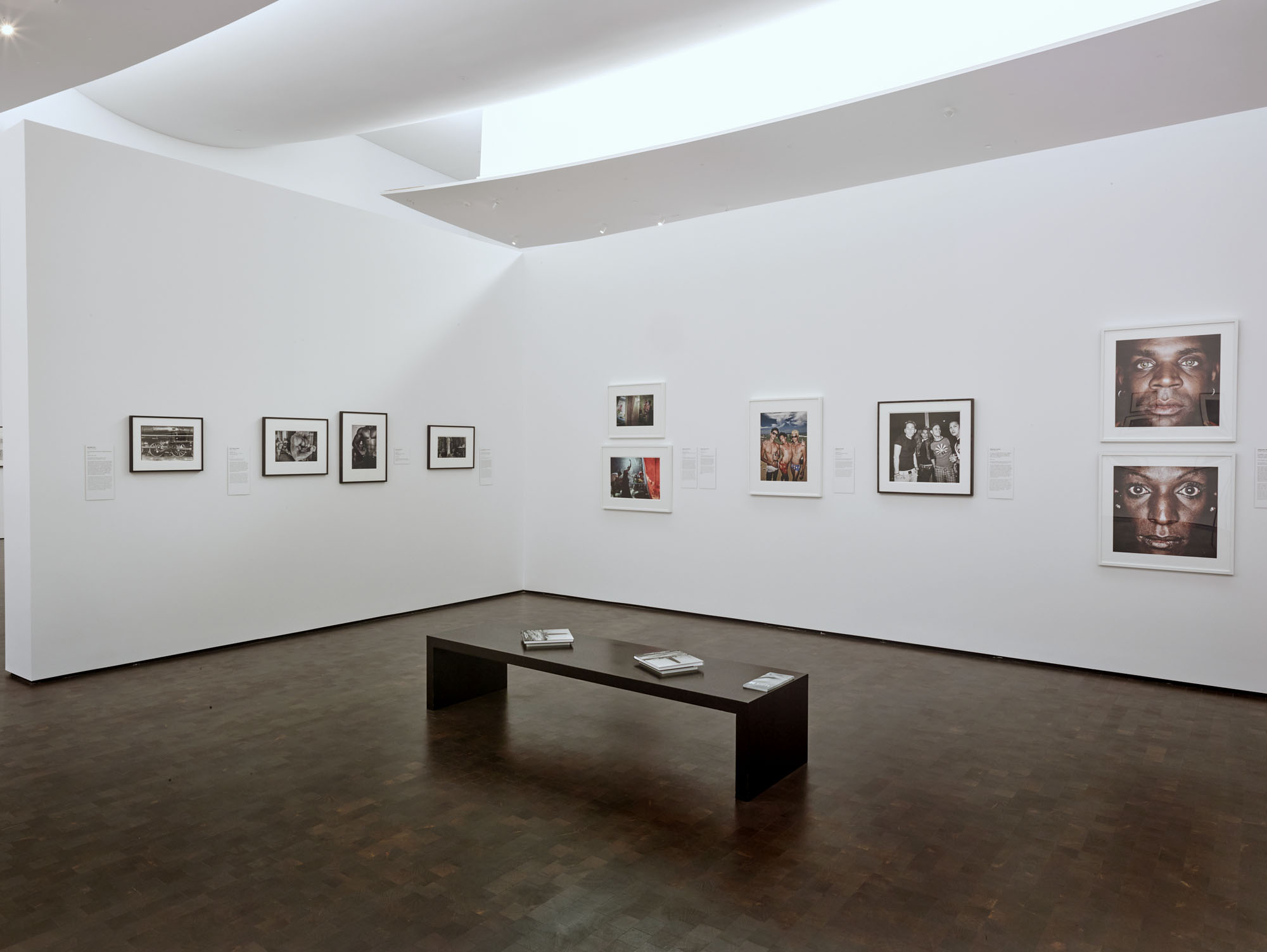
Installation view of the exhibition Navigating the Waves: Contemporary Cuban Photography at the Museum of Fine Arts, Houston showing at right top, Alejandro González’s Untitled 2008 from the series Conducta impropia (above); and at second right, Alejandro González’s 2:57 am, 24 de dic de 2005, Vedado, La Habana, Cuba 2005 from the series AM-PM (above); and at third right, Alejandro González’s Untitled 2008 from the series Conducta impropia (below)

Alejandro González (Cuban, b. 1974)
Untitled
2008
From the series Conducta impropia
From the series Improper Behaviour
Chromogenic print
23 3/8 × 17 3/8 in. (59.3 × 44.2cm)
The Museum of Fine Arts, Houston
The Madeleine P. Plonsker Collection, museum purchase funded by the Caroline Wiess Law Accessions Endowment
A month after beginning his series Improper Behaviour with close-up portraits, Alejandro González continued the project by photographing jubilant young people at a gay pride party at Mi Cayito, a popular gay beach east of Havana that little more than a decade earlier had been subject to police raids, arrests, fines, and threats of imprisonment.
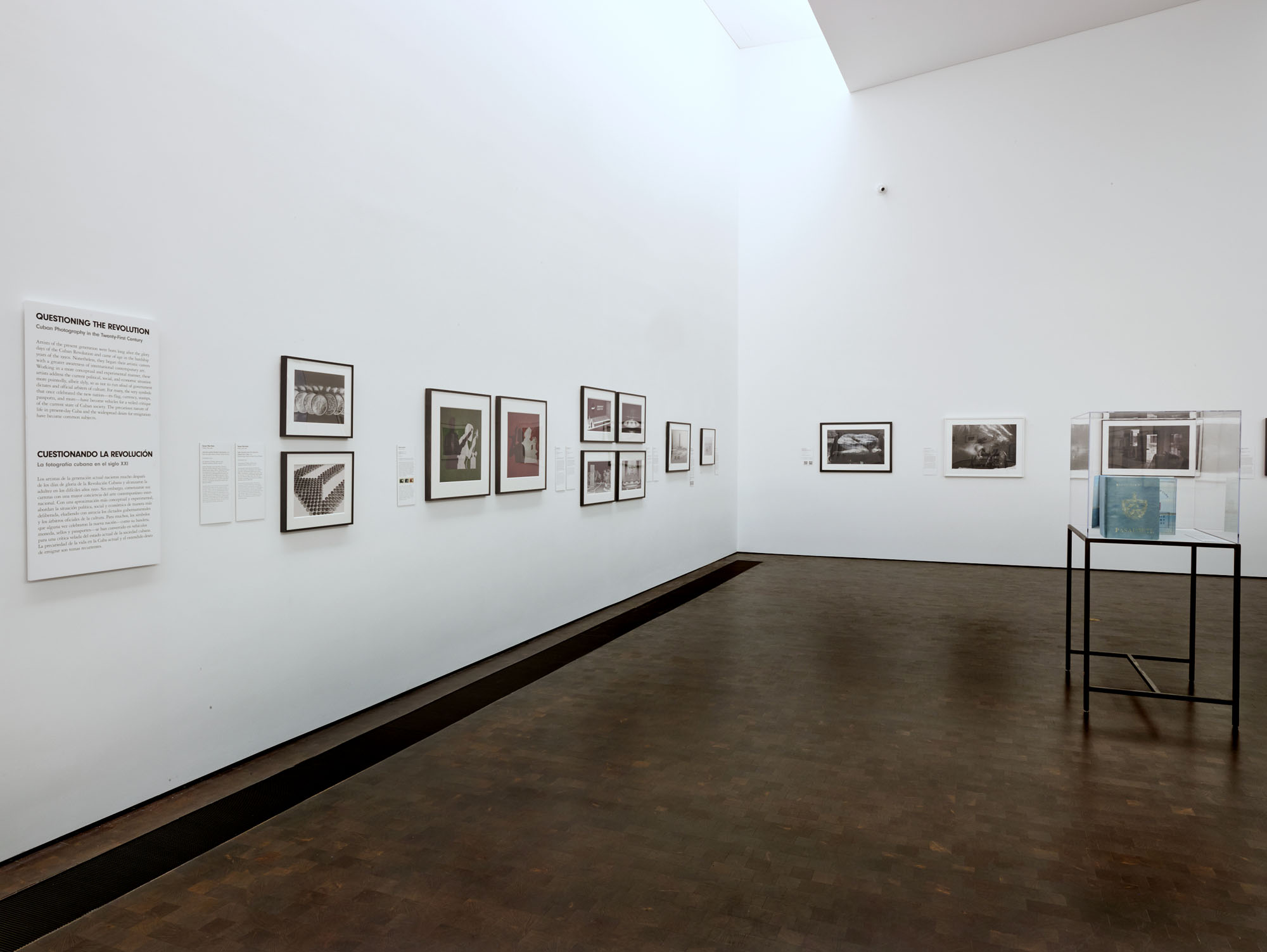
Installation view of the exhibition Navigating the Waves: Contemporary Cuban Photography at the Museum of Fine Arts, Houston showing at left the wall text from the section “Questioning the Revolution: Cuban Photography in the Twentieth-First Century”
Questioning the Revolution: Cuban Photography in the Twentieth-First Century
Artists of the present generation were born long after the glory days of the Cuban Revolution and came of age in the hardship years of the 1990s. Nonetheless, they began their artistic careers with a greater awareness of international contemporary art. Working in a more conceptual and experimental manner, these artists address the current political, social, and economic situation more pointedly, albeit slyly, so as not to run afoul of government dictates and official arbiters of culture. For many, the very symbols that once celebrated the new nation – its flag, currency, stamps, passports, and more – have become vehicles for a veiled critique of the current state of Cuban society. The precarious nature of life in present-day Cuba and the widespread desire for emigration have become common subjects.

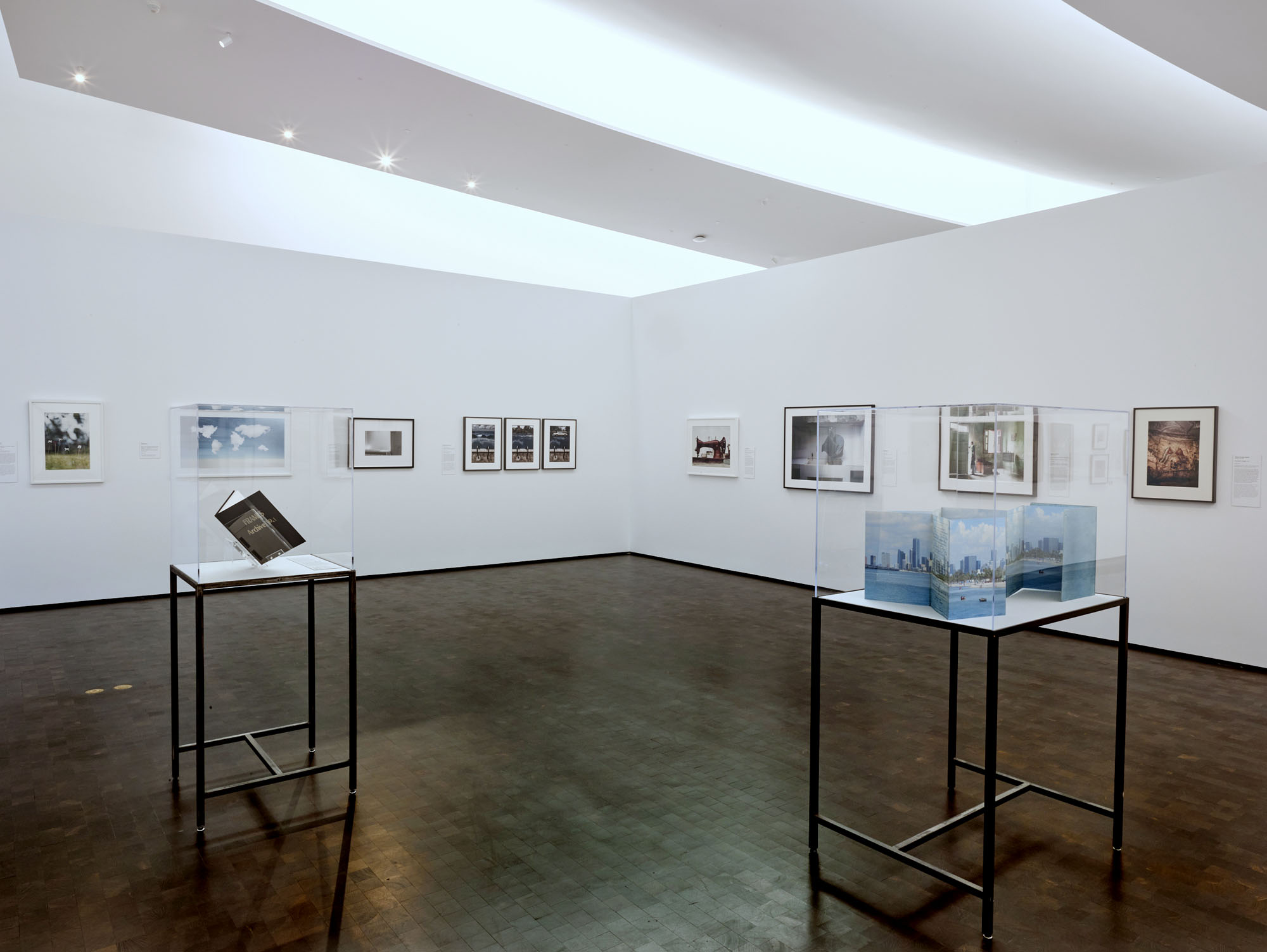
Installation views of the exhibition Navigating the Waves: Contemporary Cuban Photography at the Museum of Fine Arts, Houston

Installation view of the exhibition Navigating the Waves: Contemporary Cuban Photography at the Museum of Fine Arts showing at left, Houston Liudmila & Nelson’s photograph Absolut Revolution – La Isla (Absolut Revolution – The Island) 2002
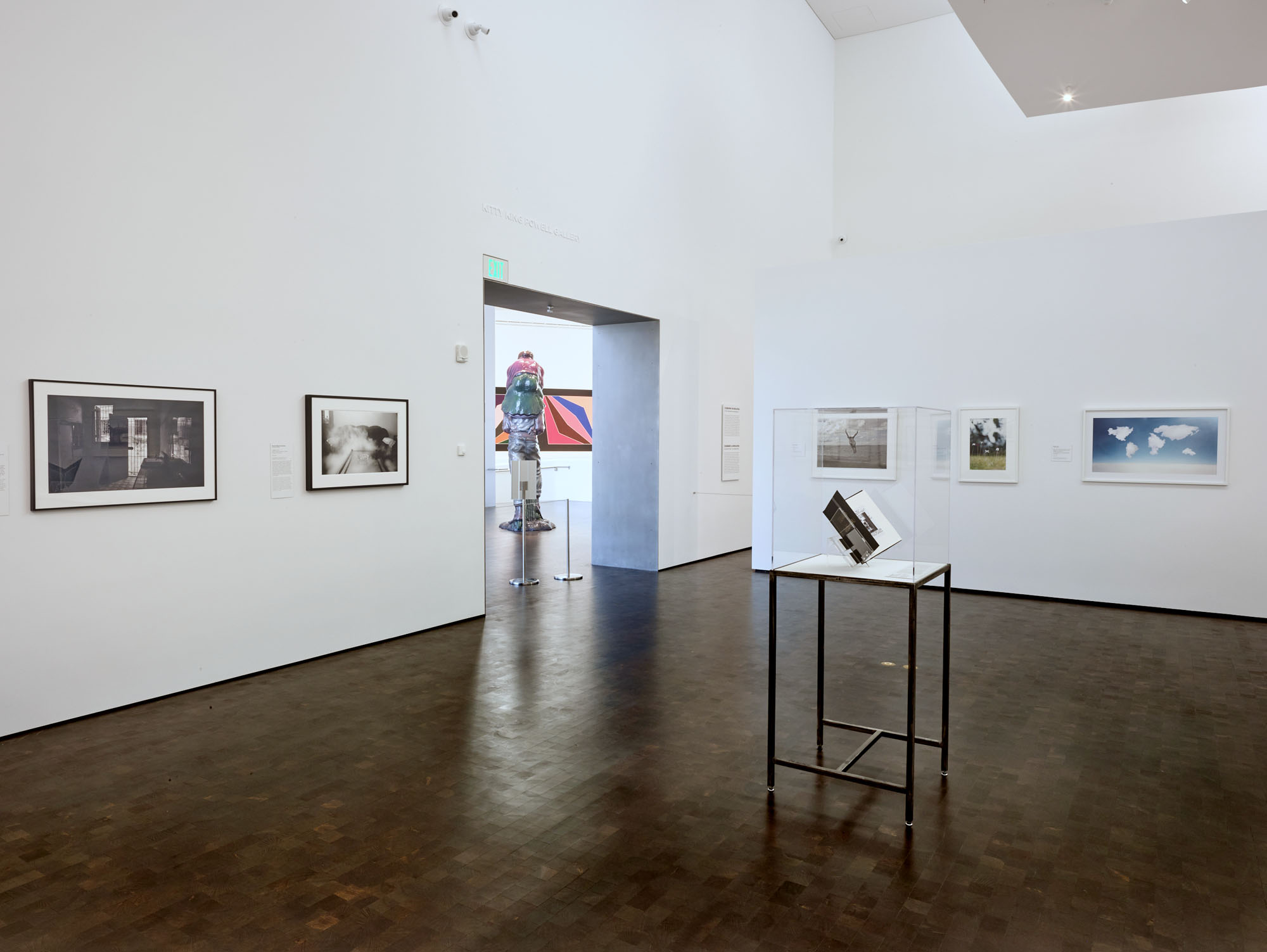
Installation view of the exhibition Navigating the Waves: Contemporary Cuban Photography at the Museum of Fine Arts
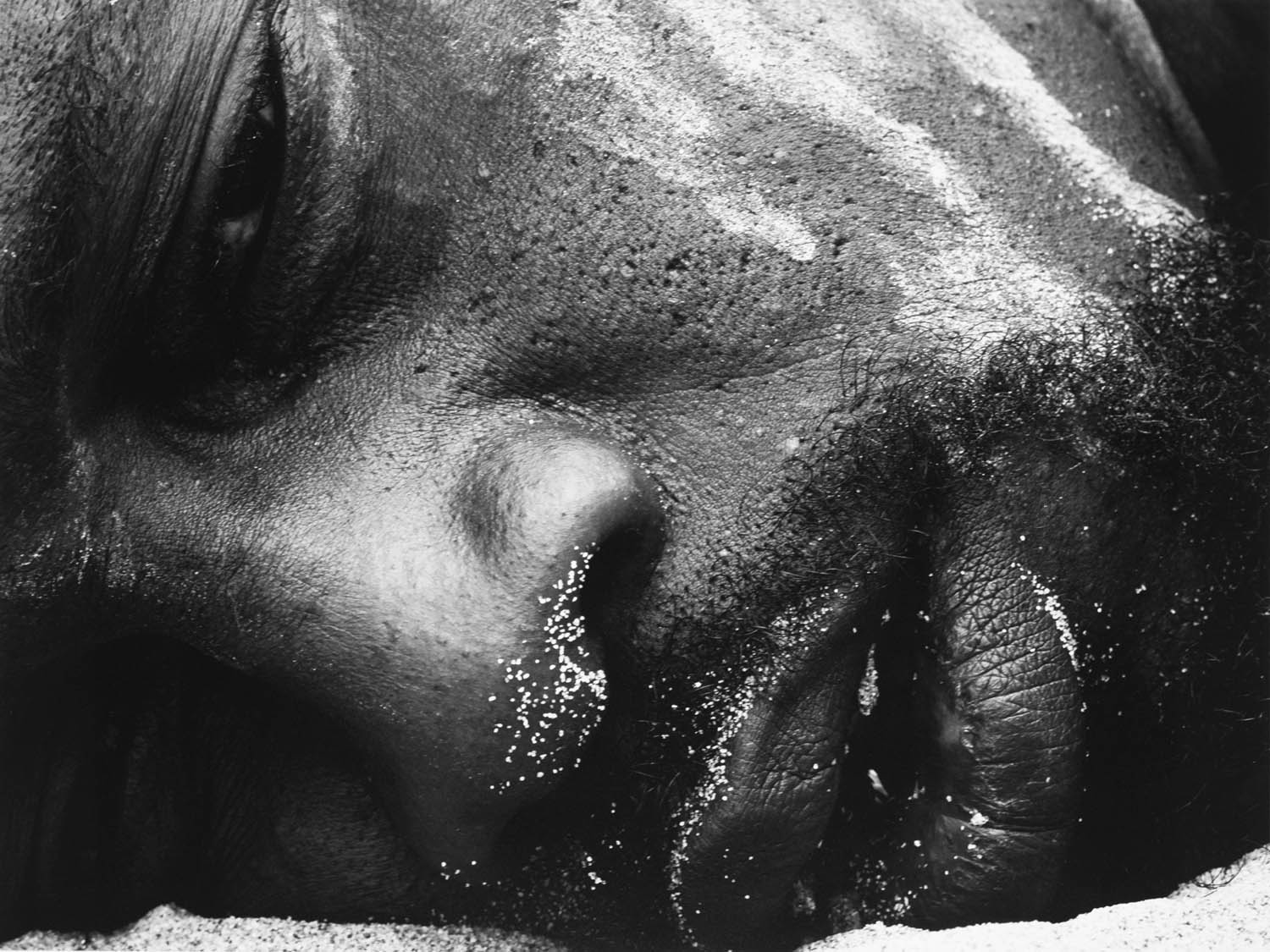
Jorge Luis Álvarez Pupo (Cuban, b. 1970)
Wandering Paths No. 15 (Caminos errantes No. 15)
2009
From the series Wandering Paths (Caminos errantes)
Gelatin silver print
The Museum of Fine Arts, Houston
The Madeleine P. Plonsker Collection, gift of Madeleine and Harvey Plonsker
© 2009 Jorge Luis Álvarez Pupo
Born, raised, and schooled in Havana, Jorge Luis Álvarez Pupo continued to think of himself as Cuban even when residing abroad. His series Wandering Paths is a visual reflection on the theme of migration. Now living and working in Belgium, Álvarez Pupo said the series takes “as inspiration the moment I realised that I myself had become an immigrant, even when visiting my own country. It reflects on people who have been forced to leave their environment to face the unknown, which is not always welcoming.”
Museum of Fine Arts, Houston
1001 Bissonnet Street
Houston, TX 77005
Opening hours:
Wednesday 11am – 5pm
Thursday 11am – 9pm
Friday 11am – 6pm
Saturday 11am – 6pm
Sunday 12.30pm – 6pm
Closed Monday and Tuesday, except Monday holidays
Closed Thanksgiving Day and Christmas Day







![Osvaldo Salas (Cuban, 1914-1992) 'Che fumano' [Che smoking] 1964](https://artblart.com/wp-content/uploads/2013/01/mdm-rupertinum_bilder-revolution_salas_che-fumano-web.jpg "Osvaldo Salas (Cuban, 1914-1992) 'Che fumano' [Che smoking] 1964")


 Art Blart _ art and cultural memory archive
You must be logged in to post a comment.