Exhibition: ‘Che Guevara: Images of revolution. From the Skrein Photo Collection’ at Museum de Moderne Salzburg, Austria

Exhibition dates: 24th November 2012 – 3rd February 2013


Many thankx to the Museum de Moderne Salzburg for allowing me to publish the photographs in the posting. Please click on the photographs for a larger version of the image.


Osvaldo Salas (Cuban, 1914-1992) 'Che fumano' [Che smoking] 1964


Osvaldo Salas (Cuban, 1914-1992)
Che fumano (Che smoking)
1964
Gelatine-Silberprint, Vintage
40 x 50cm
From the Skrein Photo Collection


Perfecto Romero (Cuban, b. 1936) 'Miliz Campesinos' 1961


Perfecto Romero (Cuban, b. 1936)
Miliz Campesinos (Military peasants)
1961
Gelatine-Silberprint, Vintage
30 x 40cm
From the Skrein Photo Collection


Osvaldo Salas (Cuban, 1914-1992) 'Camilo beim Einzug in Havanna 8.1.1959' 1959


Osvaldo Salas (Cuban, 1914-1992)
Camilo beim Einzug in Havanna, 8.1.1959 (Camilo moving into Havana, 8.1.1959) (Camilo Cienfuegos)
1959
Gelatine-Silberprint, Vintage
40 x 50cm
From the Skrein Photo Collection


Alberto Korda (Cuban, 1928-2001) '1. Mai 1960, Volksverteidigungsarmee' 1960


Alberto Korda (Cuban, 1928-2001)
1. Mai 1960, Volksverteidigungsarmee (1. May 1960, People’s Defence Force)
1960
s/w Fotografie
From the Skrein Photo Collection
© VBK, Wien, 2012


René Burri (Swiss, 1933-2014) 'Che Guevara' 1963


René Burri (Swiss, 1933-2014)
Che Guevara
1963
Kontaktbogen, Gelatine-Silberprint
22 x 34cm
From the Skrein Photo Collection


Raúl Corrales (Cuban, 1925-2006) 'La Cabelleria' 1961


Raúl Corrales (Cuban, 1925-2006)
La Cabelleria (The Cavalry)
1961


Cuban President Fulgencio Batista, who seized power in a military coup in 1952, ran a corrupt and dictatorial regime. This gave rise to the Cuban revolutionary movement that still continues today: In 1953 Fidel Castro and his loyal followers organised an armed attack on the Moncada Barracks, which was brutally quashed by the Batista regime.

M-26-7 is a reference to this failed attack which marks the beginning of the Cuban Revolution and became a symbol of the revolution for Castro’s followers. On 26th of July 1953 the protagonists of the revolution were arrested, Fidel and Raul Castro were sentenced to many years in prison and numerous combatants were executed. In 1955 Batista released Castro from prison, who went into exile in Mexico, where Che Guevara, an Argentine-born physician, joined his movement. In 1956 they returned to Cuba from Mexico with 82 fighters; they landed in the Granma Province, south of Havana which also became a synonym of the revolution, like the Sierra Maestra Mountains.

This is where the Skrein Collection begins: the preparation of the guerilla war, the recruitment of new fighters, including Camilo Cienfuegos, who formed the triumvirate of the revolution with Che Guevara and Fidel Castro, or Celia Sánchez, one of the first women of the revolutionary movement. The activities of the revolutionists attracted many followers and enjoyed strong support among the population until victory was finally achieved with the Castro‘s triumphal entry in Havanna in 1959. This was followed by a phase of consolidation, during which Castro, Guevara and other revolutionaries assumed political offices and were appointed as ministers. After the Bay of Pigs disaster in 1961, the USA imposed a total embargo on Cuba, thus contributing to the isolation of the Caribbean island and its political leadership.

The photographs from the Skrein Photo Collection cover the period from the end of the Batista-Regime to the Cuban Missile Crisis. Both Cuban and foreign photographers were involved into political events as reporters, sympathisers, journalists and adventurers and spread the revolutionary ideology. Leading European photographers travelled into this troubled country in the midst of social upheavals and turned the leaders of the revolution into icons and symbols of a dissatisfied youth on the eve of the global 1968 movement world wide.

Austrian photographer Christian Skrein (b. 1945, Vienna) began his career as an art, commercial and fashion photographer. He later became an enthusiastic and expert collector of photography and compiled comprehensive archives of snapshot photography and international press and art photography. For over 15 years now, he has focused on photographs of the Cuban Revolution and its protagonists. Today, his collection comprises more than 4,500 items, including several icons of the history of photography as well as numerous less spectacular photographs which document the political situation and social life in Cuba from the 1950s to the 1970s.

In 2011 the Getty Museum in Los Angeles selected a set of 60 photographs from the Skrein Collection for its first exhibition on the Cuban Revolution: the onslaught of visitors testified to the huge interest in this historical period and its profound and far-reaching impact on global politics and in the role of photography as mediator of pictures that create identity. The presentation of 150 photographs at the Museum der Moderne Salzburg offers visitors insights into this extensive specialised collection, but also shows the importance of photography and media for events and personalities. No other political event of this period was photographically documented as much as the Cuban Revolution; the pictures of its heroes were reproduced many thousands of times. The world famous photograph of Che Guevara by Alberto Korda is the most often reproduced photograph in the world, owing to a large-scale ideological and PR campaign initiated in 1967 by Italian publisher Giangiacomo Feltrinelli.

The myth of revolution – image pictures and iconic reception

Che Guevara was recognised as media star already during the revolution; his portrait adorned the walls of every government authority and factory building, every office and tobacco factory – he was omnipresent, an icon and role model and a crucial propaganda instrument of the political movement. The charismatic, eternally young revolutionary adorned public and private rooms as poster, photograph and icon, and the people identified themselves with their leader on a never-before-seen scale. Che united the revolution with the idea of social upheaval and personified a socialist future, a new man and a new country.

After the successful revolution the photographs of its heroes became a synonym of the new society; they were revered and distributed all over the country like pictures of saints. While the early iconic pictures of the revolution were made by Cuban photographers, who were part of the revolutionary movement, the Western world began to take notice of developments in Cuba in 1959. Leading European photographers travelled into this troubled country in the midst of social upheavals and turned the leaders of the revolution into icons and symbols of a dissatisfied youth on the eve of the global 1968 movement. Particularly the word famous portrait of Che Guevara as “guerrillero heroico” with beret and red star, photographed by Alberto Korda, is still regarded as an epitome of revolution and rebellion today and considered the most famous portrait of a person worldwide.

The photographic language of the revolution

Few photographs exist from the early years of the revolutionary movement against the Batista regime, and most of them were made by amateur photographers and travellers. They resemble the documentary photographic style of the 1930s which was popular in the United States and Europe at that time. Event photography, like the picture of Fidel Castro’s release from prison in 1955, retrospectively achieved iconic status and became the initial image of the revolution widely distributed in numerous reproductions, details and enlargements. The guerrilla fights in the Sierra Maestra are only documented in small incidental photographs made by sympathisers and fellow guerrillas with their own cameras.

Professional photographers discovered the “faces of the revolution” and their protagonists only in 1959. From then on countless portraits of Che Guevara, Fidel and Raúl Castro and their combatants were created. This is also the reason why so few photographs exist of Camilo Cienfuegos, who died in 1959, and of the authentic event of the triumphant entry into Havana on 8 January 1959, which were replaced by pictures of Fidel Castro’s famous speech. Photographers developed a photographic language with an epic style which was situated between documentation and homage and supported the political scope of the revolution. A photograph by Raúl Corrales became famous under the name “La Cabelleria”, even though the occasion (illegal entry into the premises of the American Fruit company) was not primarily heroic. The image created the identity of event and ideology and thus became a political statement.

The style of the photographers – from Alberto Korda to Liborio Noval and Osvaldo Salas, from Corrales to Tirso and Mayito – was characterised by a pictorial dramaturgy that was suitable for the media: strong contrasts, little internal drawing, silhouette-like figures against a discreet background – in other words the criteria of good news photography as it has been practiced since the 1940s. In addition, the photographers sympathising with and involved in the revolution had a feel and understanding for pathos and staging and paid attention to small details and scenes on the fringe of large events.

Press release from the Museum de Moderne Rupertinum website


Alberto Korda (Cuban, 1928-2001) 'Siegesfeier nach der Schlacht in der Schweinebucht, Fidel Castro mit aufgemalter Flagge' 1961


Alberto Korda (Cuban, 1928-2001)
Siegesfeier nach der Schlacht in der Schweinebucht, Fidel Castro mit aufgemalter Flagge
(Victory celebration after the Battle in the Bay of Pigs, Fidel Castro with painted flag)

1961
Gelatine-Silberprint, Vintage, Deckfarben
40 x 30cm
From the Skrein Photo Collection
© VBK, Wien, 2012


Carlos Morales. 'Siegreiche Revolution, 8.1.1959' 1959


Carlos Morales
Siegreiche Revolution, 8.1.1959 (Victorious Revolution, 8.1.1959)
1959
Gelatine-Silberprint, Vintage
28 x 20cm
From the Skrein Photo Collection


Venancio Diaz (Cuban, 1916-2003) 'Volksparade anlässlich "La Coubre“,' 1960


Venancio Diaz (Cuban, 1916-2003)
Volksparade anlässlich “La Coubre” (People’s parade dedicated to “Coubre”)
1960
Gelatine-Silberprint, Vintage
27 x 15cm
From the Skrein Photo Collection


Anonymous photographer. 'Fidel Castro' c. 1970


Anonymous photographer
Fidel Castro
c. 1970
Vintage silver gelatin print
33.5 x 28cm
From the Skrein Photo Collection


Alberto Korda (Cuban, 1928-2001) 'Che Guevara' 1960


Alberto Korda (Cuban, 1928-2001)
Che Guevara
1960
s/w Fotografie
From the Skrein Photo Collection
© VBK, Wien, 2012


Museum de Moderne Salzburg
Mönchsberg 32
5020 Salzburg, Austria

Opening hours:
Tuesday – Sunday: 10.00am – 6.00pm
Wednesday: 10.00am – 8.00pm
Monday: closed
Museum de Moderne Salzburg website

LIKE ART BLART ON FACEBOOK

Back to top

Exhibition: ‘A Revolutionary Project: Cuba from Walker Evans to Now’ at the J. Paul Getty Museum, Los Angeles

Exhibition dates: 17th May – 2nd October 2011


Many thankx to the J. Paul Getty Museum for allowing me to publish the photographs in the posting. Please click on the photographs for a larger version of the image.


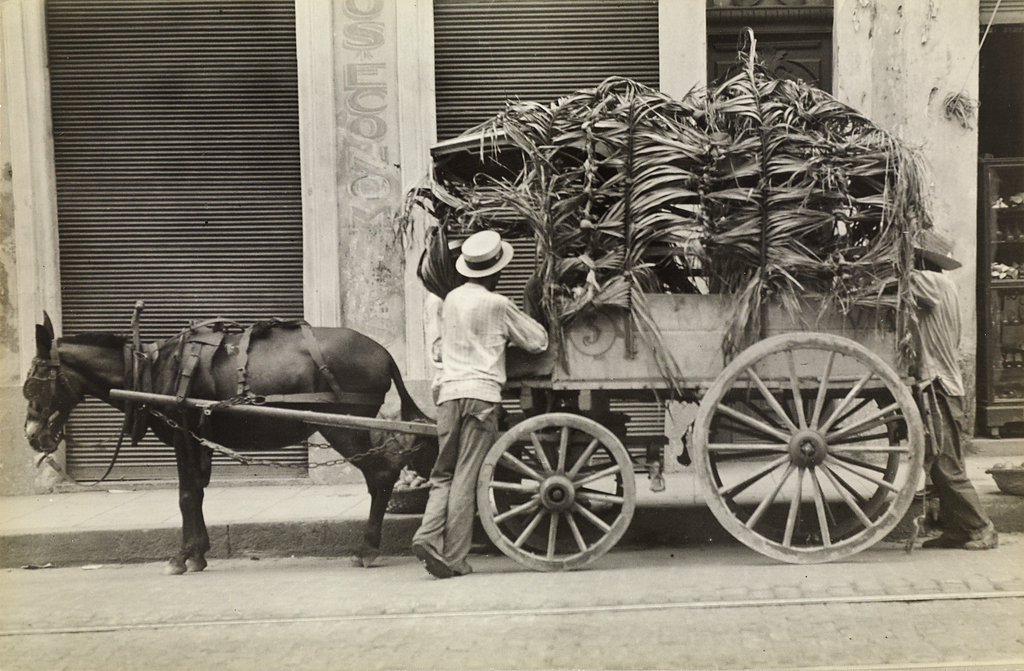
Walker Evans (American, 1903-1975) 'Mule, Wagon and Two Men, Havana' 1933


Walker Evans (American, 1903-1975)
Mule, Wagon and Two Men, Havana
1933
Gelatin silver print
13.8 x 21cm (5 7/16 x 8 1/4 in.)
The J. Paul Getty Museum, Los Angeles
© Walker Evans Archive, The Metropolitan Museum of Art


Walker Evans (American, 1903-1975) 'Spectacle, Capital Steps, Possibly Independence Day' May 20, 1933


Walker Evans (American, 1903-1975)
Spectacle, Capital Steps, Possibly Independence Day
May 20, 1933
Gelatin silver print
19.7 x 25.3cm (7 3/4 x 9 15/16 in.)
The J. Paul Getty Museum, Los Angeles
© Walker Evans Archive, The Metropolitan Museum of Art


Walker Evans (American, 1903-1975) 'Old Havana Housefronts' 1933


Walker Evans (American, 1903-1975)
Old Havana Housefronts
1933
Gelatin silver print
17.6 x 22.7cm (6 15/16 x 8 15/16 in.)
The J. Paul Getty Museum, Los Angeles
© Walker Evans Archive, The Metropolitan Museum of Art


Walker Evans (American, 1903-1975) 'Balcony Spectators' 1933


Walker Evans (American, 1903-1975)
Balcony Spectators
1933
Gelatin silver print
19.8 x 25.2cm (7 13/16 x 9 15/16 in.)
The J. Paul Getty Museum, Los Angeles
© Walker Evans Archive, The Metropolitan Museum of Art


Exhibition Marks First Showing of Getty’s Walker Evan’s Cuban Photographs; Also on view are Cuban Revolutionary Photographs and Contemporary Work by Virginia Beahan, Alex Harris, and Alexey Titarenko

Cuba’s attempt to forge an independent state with an ambitious set of social goals, all the while moored to powerful political and economic interests, has been a source of fascination for nations, intellectuals, and artists alike. On display at the J. Paul Getty Museum, the Getty Center, May 17 – October 2, 2011, A Revolutionary Project: Cuba from Walker Evans to Now, looks at three critical periods in the island nation’s history as witnessed by photographers before, during, and after the country’s 1959 Revolution.

A Revolutionary Project juxtaposes Walker Evans’s 1933 images from the end of the Gerardo Machado dictatorship with views by contemporary foreign photographers Virginia Beahan (American, b. 1946), Alex Harris (American, b. 1949), and Alexey Titarenko (Russian, b. 1962), who have explored Cuba since the withdrawal of Soviet support in the 1990s. A third section bridging these two eras presents pictures by Cuban photographers who participated in the country’s 1959 Revolution, including Alberto Korda, Perfecto Romero, and Osvaldo Salas.

“The Museum’s collection of Walker Evans prints is the largest in the U.S., but until now, we have not shown his photographs of Cuba,” explains Judith Keller, senior curator of photographs. “This exhibition allows us the opportunity to showcase this body of work, alongside newer work in the collection.”

1933: Evans in Havana

Walker Evans (1903-1975) is one of the photographers most responsible for the way we now imagine American life in the 1930s. His distinctive photographic style, which he declared “transcendent documentary,” was nurtured in New York in the late 1920s and fully formed by his experience in Cuba in 1933. In the spring of that year, Walker Evans was asked by publisher J. B. Lippincott to produce a body of work about Cuba to accompany a book by the radical journalist Carleton Beals (1893-1979). This book, The Crime of Cuba, would be a scathing indictment of the then-current regime of Cuban President Gerardo Machado. Leaving the country less than two months before Machado was forced out of office, Evans was able to capture Cuba at the start of the revolutionary movement but almost 30 years before the 1959 Revolution.

During Evans’s time in Cuba, he made substantial strides in his photographic practice. There he worked with different format cameras, large and small, one more deliberate and descriptive, the other more spontaneous and agile. He created both close-up and wide, inclusive compositions that he could then combine in intense sequences to best communicate his response to the poverty, the ferment, and the beauty of his environment. While in Havana, Evans met the American writer, Ernest Hemingway (1899-1961), whose acclaimed avant-garde work he knew and admired. Hemingway’s terse narrative style, which he was then applying to his own Harry Morgan stories set in Havana and Key West, no doubt influenced Evans’s approach to the subject of Cuba’s current political and economic struggles. Evans’s photographs also reflect the inspiration of French photographer Eugène Atget’s Parisian pictures that Evans critiqued for an arts journal in 1931. The series that comprised Atget’s thorough study of “Old Paris” seem to have provided additional motivation for Evans’s selection of Havana subjects: the signage of urban storefronts, the abundant street offerings of fresh produce, the decorative balconies of old houses, the many studies of archaic horse-drawn wagons and carriages, and the portraits of women, some of whom appear to be prostitutes.

1958-1966: Revolution

Machado’s fall from rule in 1933 resulted in a long power struggle that culminated in the country’s 1959 socialist revolution to overthrow dictator Fulgencio Batista, anchoring Cuba to the Soviet bloc for the next thirty years and defining a relationship with the United States that still exists today. Fidel Castro, Ernesto “Che” Guevara, and their new government harnessed photography as a means of keeping the project of the Revolution at the forefront of Cuba’s collective consciousness. As both genuine records of popular insurrection and propagandistic documents used for political purposes, pictures of the Revolution and its aftermath have shaped how both Cubans and Americans understand the significance of that revolutionary moment. Photographs in the second section of the exhibition are drawn from the work of nine Cuban photographers who participated in recording the political context and triumphs of the emerging state in the years surrounding 1959.

Included in the exhibition is an iconic image of the revolutionary hero Che Guevara by Alberto Korda titled Guerrillero Heroico (March 5, 1960). One of the world’s most reproduced images, it has been adopted for political causes, appearing on countless numbers of t-shirts, banners, and street art around the globe. The print on view in the exhibition is among the earliest versions of the photograph known to exist. Made as a press print, it was used as a source to reproduce the image in media outlets a year after Korda photographed Guevara at a rally in Havana.

Also on display in the exhibition is the well-known revolutionary photograph Patria o Muerte, Cuba (Negative, January 1959; print, 1984) by Osvaldo Salas, one of Cuba’s most important photographers. Salas effectively captures and conveys the populist fervour in Cuba shortly after the movement’s triumph with an image of a patriotic sign framed by a celebratory crowd.

The photographs included in this section of the exhibition are culled from the extensive holdings of Cuban photography assembled by the Austrian collector, Christian Skrein, including a number of recent acquisitions by the Museum.

Since 1991: The Special Period

After Soviet troops began to withdraw from Cuba in September of 1991, the troubled Cuban economy suffered severe internal shortages, and Fidel Castro declared what is known as the “Special Period” (período especial), marked by food rationing, energy conservation, and a decline of public services. In the nearly twenty years since the Soviet withdrawal, Cubans have managed to survive through perseverance, the forging of new political relationships, and the easing of socialist systems. This period of transition, which continues today with the recent transfer of power from Fidel Castro to his brother Raúl, has attracted the attention of photographers from around the world who are interested in exploring the relationship between Cuba’s revolutionary past and its uncertain future. The final section of the exhibition looks specifically at the work of three contemporary photographers with diverse approaches to documenting the island in recent decades: Virginia Beahan, Alex Harris, and Alexey Titarenko.

Virginia Beahan’s work concentrates on the landscape’s relationship to history and culture. In 2001, she began a multiyear project on Cuba, photographing its topography in search of remnants of the island’s diverse past. The work resulted in a publication in 2009 called Cuba: Singing with Bright Tears. Beahan’s Cuba is a land of contradictions, full of disappointments and hope, decay and rejuvenating beauty, simultaneously anchored to the past while looking beyond the present. Born and raised in Leningrad (now Saint Petersburg), Russia, Alexey Titarenko became fascinated with Cuba in 2003, when he made his first trip to Havana. Titarenko’s goal was to represent the soul of the Cuban capital. In the artist’s photographs, the city is shown with little overt reference to its politics. Instead, Titarenko describes the conditions of life in the communist country, depicting people persevering amid varying states of ruin. Venturing out of the tourist zones of Havana into the network of dilapidated avenues beyond the old city walls, his images depict a grey metropolis whose inhabitants congregate on the streets to collect food rations, fix long-outmoded cars, and play baseball.

A former student of Walker Evans, Alex Harris made several trips to Cuba following the collapse of the eastern bloc and the dissolution of the Soviet Union, developing a powerful body of colour work that addresses the country’s cultural fabric during a period of difficult economic circumstances. His photographs focus on portraits of women whose lives are affected by the tourist-fuelled sex trade, landscapes made through the windshields of refurbished 1950s American cars, and monuments to the Cuban national hero José Martí. His study was published in the form of a book, The Idea of Cuba, in 2007. Through these distinct vantage points, Harris probed the country’s propensity for ingenuity as it underwent great transition.

Press release from the J. Paul Getty Museum website


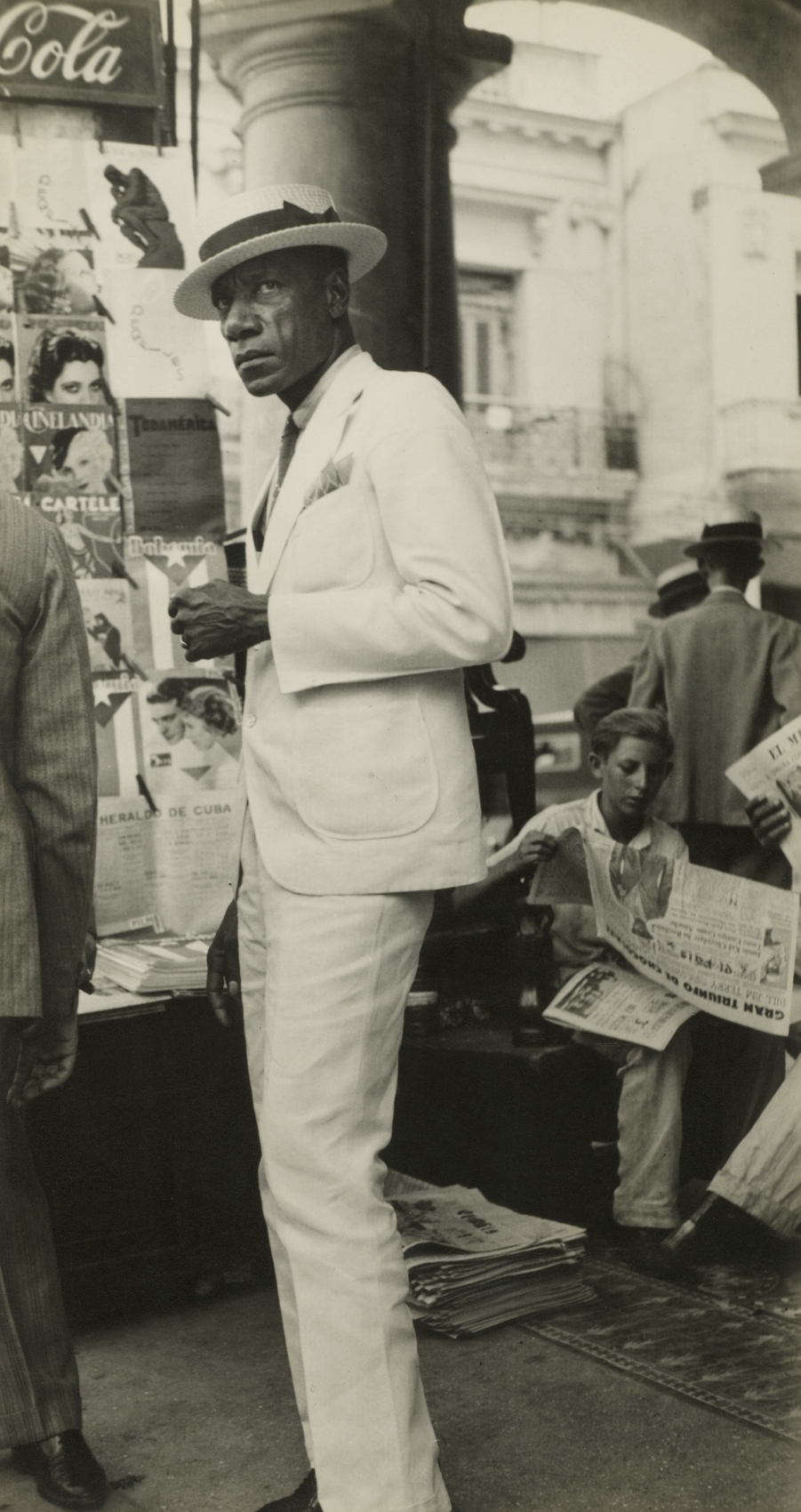
Walker Evans (American, 1903-1975) 'Citizen in Downtown Havana' 1933


Walker Evans (American, 1903-1975)
Citizen in Downtown Havana
1933
Gelatin silver print
22.2 x 11.7cm (8 3/4 x 4 5/8 in.)
The J. Paul Getty Museum, Los Angeles


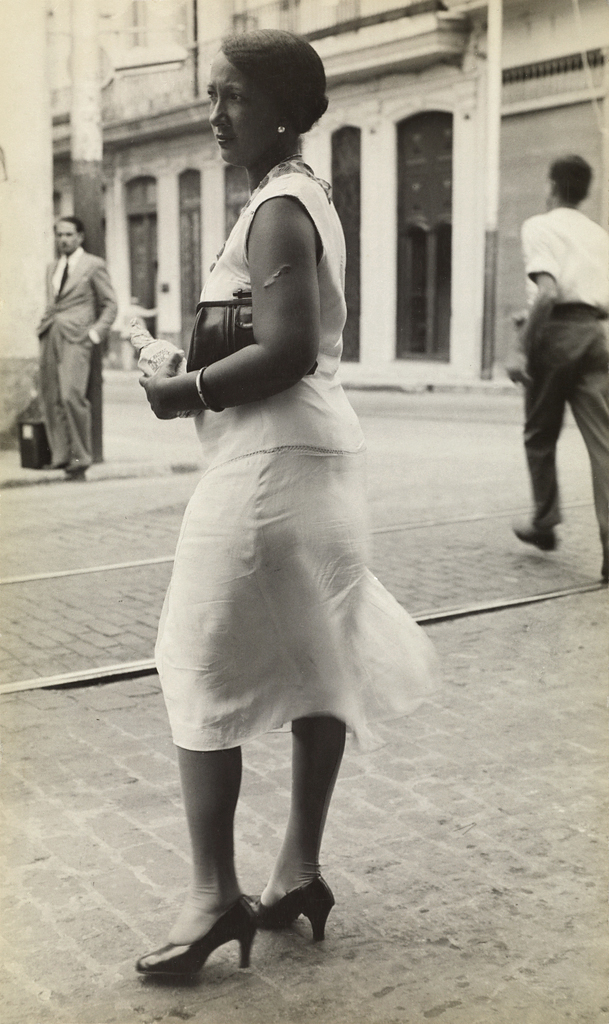
Walker Evans (American, 1903-1975) 'Woman on the Street, Havana' 1933


Walker Evans (American, 1903-1975)
Woman on the Street, Havana
1933
Gelatin silver print
24.6 x 14.6cm (9 11/16 x 5 3/4 in.)
The J. Paul Getty Museum, Los Angeles
© Walker Evans Archive, The Metropolitan Museum of Art


Walker Evans (American, 1903-1975) 'Woman in a Courtyard' 1933


Walker Evans (American, 1903-1975)
Woman in a Courtyard
1933
Gelatin silver print
25.3 x 16.2cm (9 15/16 x 6 3/8 in.)
The J. Paul Getty Museum, Los Angeles
© Walker Evans Archive, The Metropolitan Museum of Art


Walker Evans (American, 1903-1975) 'Coal Dockworkers, Havana' 1933


Walker Evans (American, 1903-1975)
Coal Dockworkers, Havana
1933
Gelatin silver print
15.6 × 21.1cm (6 1/8 × 8 5/16 in.)
The J. Paul Getty Museum, Los Angeles
© Walker Evans Archive, The Metropolitan Museum of Art


Walker Evans (American, 1903-1975) 'Coal Dockworkers, Havana' 1933


Walker Evans (American, 1903-1975)
Coal Dockworkers, Havana
1933
Gelatin silver print
12.7 × 17.7cm (5 × 6 15/16 in.)
The J. Paul Getty Museum, Los Angeles
© Walker Evans Archive, The Metropolitan Museum of Art


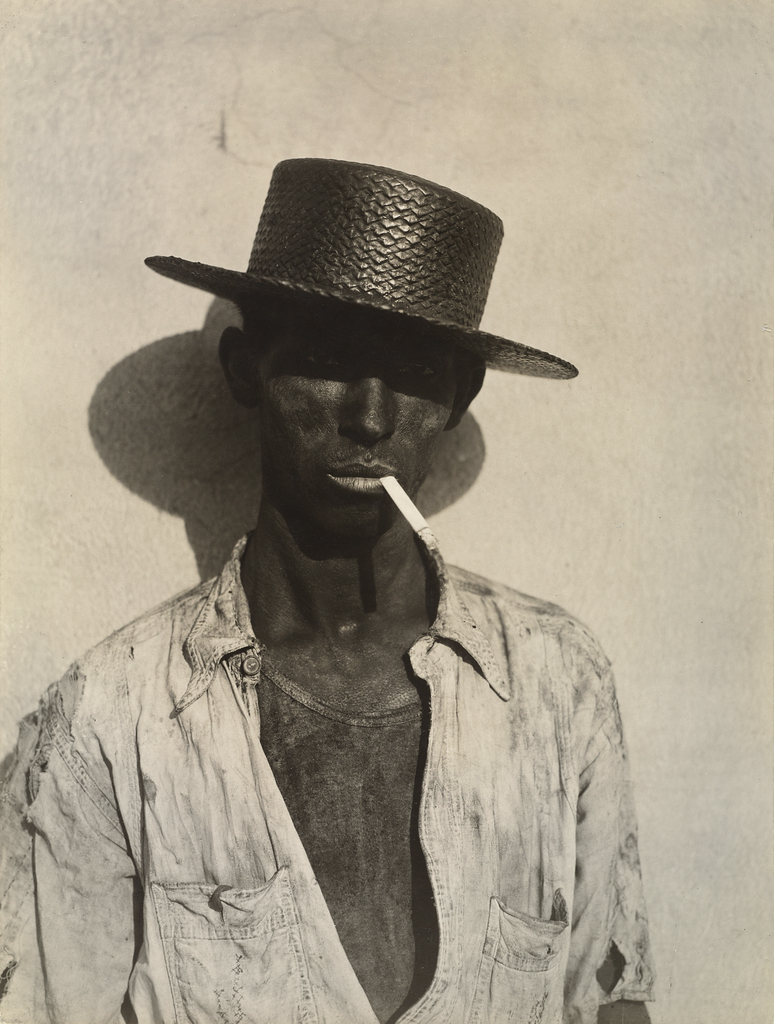
Walker Evans (American, 1903-1975) 'Coal Dockworker, Havana' 1933


Walker Evans (American, 1903-1975)
Coal Dockworker, Havana
1933
Gelatin silver print
9.7 × 13.7cm (3 13/16 × 5 3/8 in.)
The J. Paul Getty Museum, Los Angeles
© Walker Evans Archive, The Metropolitan Museum of Art


Walker Evans (American, 1903-1975) 'Coal Loader, Havana' 1933


Walker Evans (American, 1903-1975)
Coal Loader, Havana
1933
Gelatin silver print
17.1 × 12.2cm (6 3/4 × 4 13/16 in.)
The J. Paul Getty Museum, Los Angeles
© Walker Evans Archive, The Metropolitan Museum of Art


Walker Evans (American, 1903-1975) 'Coal Stevedore, Havana' 1933


Walker Evans (American, 1903-1975)
Coal Stevedore, Havana
1933
Gelatin silver print
20.2 x 15.2cm (7 15/16 x 6 in.)
The J. Paul Getty Museum, Los Angeles
© Walker Evans Archive, The Metropolitan Museum of Art


Walker Evans (American, 1903-1975) 'Stevedore' 1933


Walker Evans (American, 1903-1975)
Stevedore
1933
Gelatin silver print
20.1 x 15.1cm (7 15/16 x 5 15/16 in.)
The J. Paul Getty Museum, Los Angeles
© Walker Evans Archive, The Metropolitan Museum


Walker Evans (American, 1903-1975) 'Negro Child, Havana' 1933


Walker Evans (American, 1903-1975)
Negro Child, Havana
1933
Gelatin silver print
19.5 x 14.8cm (7 11/16 x 5 13/16 in.)
The J. Paul Getty Museum, Los Angeles
© Walker Evans Archive, The Metropolitan Museum


Walker Evans (American, 1903-1975) 'Negro Child, Havana' 1933


Walker Evans (American, 1903-1975)
Negro Child, Havana
1933
Gelatin silver print
19.8 x 13.2cm (7 13/16 × 5 3/16 in.)
The J. Paul Getty Museum, Los Angeles
© Walker Evans Archive, The Metropolitan Museum


The J. Paul Getty Museum
1200 Getty Center Drive
Los Angeles, California 90049

Opening hours:
Tuesday – Friday, Sunday 10am – 5.30pm
Saturday 10am – 8pm
Monday Closed

The J. Paul Getty Museum website

LIKE ART BLART ON FACEBOOK

Back to top