Exhibition: ‘1,001 Remarkable Objects’ at Powerhouse Ultimo, Sydney

Exhibition dates: 26th August – 31st December 2023

Curatorium: Leo Schofield AM (curatorium chair), Ronan Sulich (advisor), Mark Sutcliffe (advisor) and Eva Czernis-Ryl (Powerhouse)
Assistant curator: Chloe Appleby (Powerhouse)
Exhibition manager: Anna Gardner (Powerhouse)
Exhibition coordinator: Kerrie Goodwin (Powerhouse)
Exhibition designers: Pip Runciman, Julie Lynch and Ross Wallace
Lighting Designer: Damien Cooper


Wedgwood & Bentley (English, manufacturer) 'Venus' early 1800s


Wedgwood & Bentley (English, manufacturer)
Venus
Early 1800s
Black basalt, stoneware
Height: 350 mm
Width: 210 mm
Depth: 150 mm
Powerhouse Collection
Purchased 1949


Many rooms of wonder

What a visual feast we have for you this week!

Being an inveterate collector of eclectic objects who then puts them together in disparate but sympathetic arrangements (as in a Wunderkammer or ‘Cabinet of Curiosities’), the exhibition 1,001 Remarkable Objects at Powerhouse Ultimo, Sydney was a natural for me to post on.

“… the idea of a Wunderkammer was fully born in the sixteenth century as the princely courts of Europe became less peripatetic and as humanist philosophy spread. It was no longer enough simply to show off one’s wealth; every object should also enhance the virtues of the prince. In Inscriptiones vel tituli theatre amplissimi (1565), Samuel Quiccheberg detailed the ideal formula for the Wunderkammer as including naturalia (items created by the earth and items drawn from nature), mirabilia (unusual natural phenomena), artificialia (items wrought by man), ethnographica (items from the wider world), scientifica (items that brought a great understanding of the universe) and artefacta (items relating to history). Together these works would bring the wider world into the court and provide an understanding of the entire universe.”1


While Wunderkammer were the playthings of princes they brought to wider attention the miracles of the universe both natural and manmade. They made human beings aware of the enormity of the forces of nature and (human) industry that surrounded them … through the history and memory of objects.

John McDonald observes every piece has a story. But it is only through (in my case as a collector) being in the presence of these objects and physically handling them that we begin to understand the difference between one piece of Chinese bronze and another, one from the Ming dynasty and another from the Qing dynasty… and the difference in feeling between the two in terms of quality, casting, detail, aesthetics, form. Only through the physical handling of objects do we begin to understand the difference between an original and a fake, how old they are, how they were constructed, what their patina means, and what aura and power the object possesses. I have several pieces of treen (carved wood) in my collection and through the act of holding these objects I wonder about their history. The process is as much a tactile experience as it is a visual one.

The exhibition curators know their art. It is with great pleasure that I observe in an installation photograph in this posting the conflation of two objects that form what Minor White would call “ice/fire” where two disparate objects play off of each other: in this case a vase by that most famous and radical 19th century British designer Sir Christopher Dresser paired with a plate by the equally radical 20th century Russian designer El Lissitzky. A match made in heaven that plays out across the decades, repeated in numerous quirky juxtapositions and inspired nexus throughout the exhibition.

What further sets this exhibition off for me if the absolutely gorgeous and sympathetic “theatrical environments for these whimsical-but-rational groupings.” Exhibition designers Pip Runciman, Julie Lynch and Ross Wallace evoke a visually ravishing atmosphere in which the exhibition flâneur/flâneuse can stroll and take in the sights. Compare this stunning installation to the execrable rooting of the June 2023 Melbourne Winter Masterpieces exhibition Pierre Bonnard at the National Gallery of Victoria, Melbourne which presented the iridescent paintings of Bonnard within immersive scenography by Paris-based designer India Mahdavi. Here the work of Pierre Bonnard (which was supposed to be the subject of the exhibition not its addendum) was almost completely overwhelmed by the manic graphic design background of the installation. “Immersive scenography” = art speak for a load of no/sense.

Let the objects speak to us directly or not at all.

Dr Marcus Bunyan


1/ Anonymous. “Wunderkammer: Cabinet of Curiosities,” on the Royal Collection Trust website Nd [Online] Cited 01/12/2023


Many thankx to the Powerhouse Ultimo for allowing me to publish the photographs in the posting. Please click on the photographs for a larger version of the image.


“Every piece in this show has a story, but they are best sampled first-hand. Curatorially, 1,001 Remarkable Objects is a cultural pot-pourri, with disparate items clustered together based on a shared motif or theme. In some rooms, it’s as if Schofield, along with Mark Sutcliffe, Ronan Sulich and Eva Czernis-Ryl, simply put a word such as “peacock” or “music” into the collection database and selected the strangest things that popped up.

Ephemeral items of pop culture are juxtaposed with artefacts of ancient civilisations, tiny pieces of jewellery are linked with great clunking pieces of furniture. Viewers see everything from an Arnott’s biscuit to an electric car manufactured in Detroit in 1917. One extraordinary pairing puts a medieval suit of armour alongside the wheel of the plane in which Charles Kingsford-Smith perished when he crashed in November 1935.

The effect is almost hallucinogenic, and here one needs to give credit to exhibition designers Pip Runciman, Julie Lynch and Ross Wallace, who have created appropriately theatrical environments for these whimsical-but-rational groupings.

This approach, so contrary to the usual curatorial processes, harks back to the ancestor of the modern museum: the Wunderkammer, or cabinet of curiosities, in which royal courts and wealthy connoisseurs in the 17th and 18th centuries would display historical treasures, works of art, items of natural history and ingenious mechanisms.


John McDonald. “An irresistible, mind-boggling exhibition awakens sense of wonder,” on The Sydney Morning Herald website November 11, 2023 [Online] Cited 12/11/2023
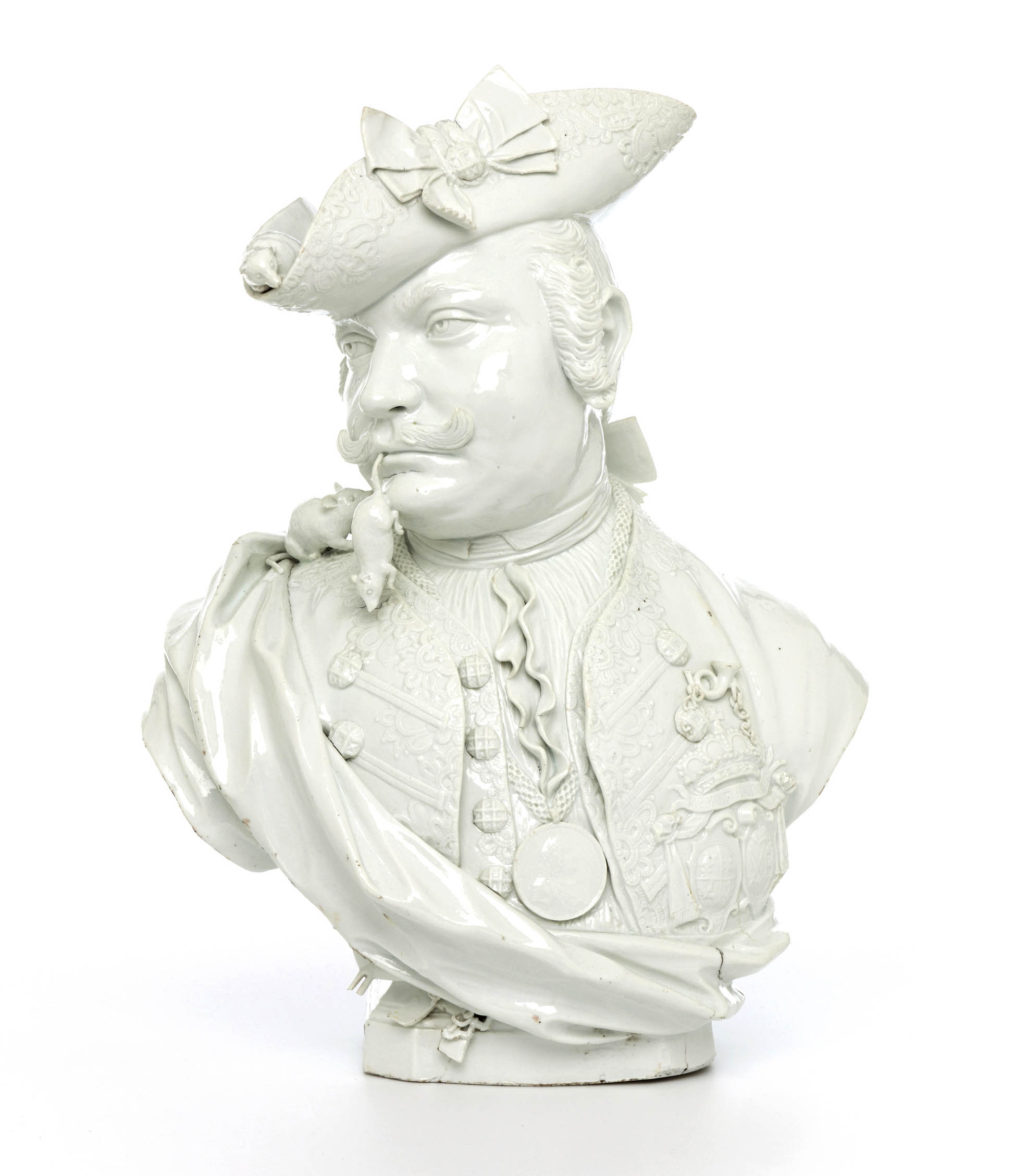


Johann Joachim Kändler (modeller) Royal Saxon Porcelain Manufactory (manufacturer, Meissen, Germany) 'Portrait bust, 'Baron Schmiedel'' 1739


Johann Joachim Kändler (modeller)
Royal Saxon Porcelain Manufactory (manufacturer, Meissen, Germany)
Portrait bust, ‘Baron Schmiedel’
1739
Hard-paste porcelain
Height: 475 mm
Width: 360 mm
Depth: 260 mm
Powerhouse Collection
Purchased 1951


Baron Schmiedel bust by Joachim Kändler

The satirical portrait bust of the court jester Johann Gottfried Tuscheer (born as Johann Gottfried Graf), better known as Baron Schmiedel or Postmaster Schmiedel, was one of the last royal commissions for the Japanese Palace of Augustus the Strong, King of Poland (ruled 1694-1733) and Elector of Saxony. The Japanese Palace was a lavish structure in Dresden refurbished to house both the fabulous royal collection of East Asian porcelains and the amazing new products of the Royal Saxon Porcelain Manufactory in Meissen near Dresden in Germany. Established in 1710, following re-discovery of secret Chinese porcelain formula by the King’s imprisoned alchemist Johann Joachim Böttger, Meissen was Europe’s first factory to make true or hard-paste porcelain. By the mid 1730s, the factory had been able to make monumental animal sculptures, apostle figures and even architectural elements alongside their exquisitely painted vases and tableware.

The bust was modelled by Johann Joachim Kändler (1706-75), the court ‘Modellmeister’ (master modeller) who worked at the Meissen manufactory from 1731 until his death in 1775. The bust was ordered by Augustus III, Augustus the Strong’s son and successor. The medallion on Schmiedel’s chest is based on one of Augustus’ coronation medals.

A highly talented individual who delighted in dressing in the latest fashions, Schmiedel was one of two most prominent jesters at the Saxon court at the time. His role as a jester involved attending the kings in their dressing rooms, at dinners and even at the most intimate court gatherings. He kept company with the kings on visits and hunting expeditions, always ready to crack a joke, exchange witty badinage or play magic tricks with mice while pretending to have morbid fear of rodents. Schmiedel was rewarded with numerous ‘titles’ and valuable presents including Meissen porcelain.

The Schmiedel bust was discovered in Sydney in 1949 by the noted Sydney antique dealer William Bradshaw at a time when its importance and history had been long forgotten. It was acquired by the Museum in 1951. One of the most important objects in the Powerhouse Museum’s collection of ceramics, it is one of only four surviving the the world.

Eva Czernis-Ryl, Curator

For full story see: E. Czernis-Ryl, ‘The golden years of Meissen porcelain and Saxon jesters: the Schmiedel bust in Australia’, Keramik-Freunde der Schweiz (Bulletin des Amis Suisses de la Ceramique), Mitteilungsblatt nr 104, October 1989, pp. 5-11

Text from the Powerhouse Collection website
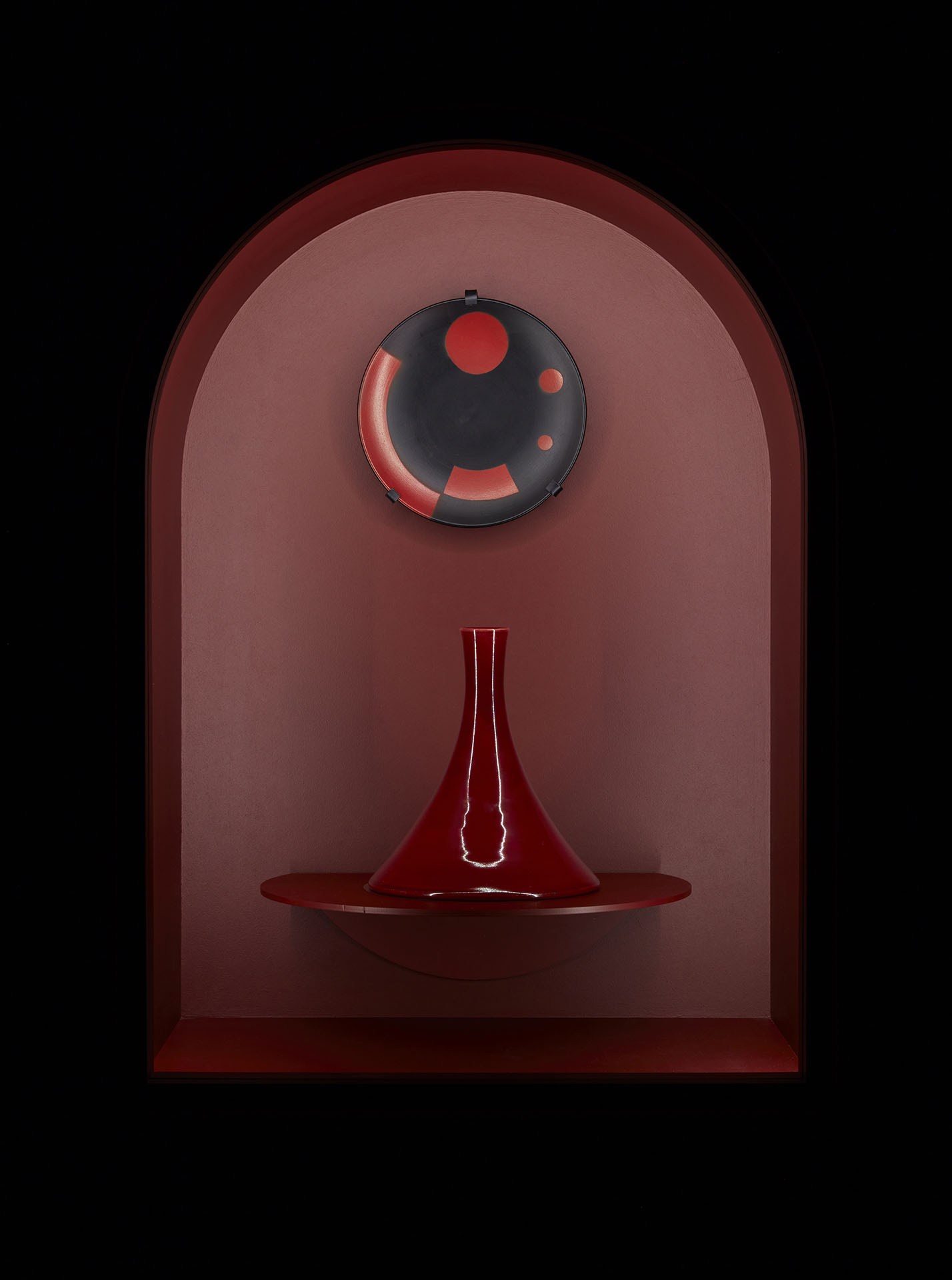
 

Installation view of the exhibition '1,001 Remarkable Objects' at Powerhouse Ultimo, Sydney showing at top, El Lissitzky's 'Plate' (c. 1923); and at bottom, Christopher Dresser's 'Vase' (c. 1888)


Installation view of the exhibition 1,001 Remarkable Objects at Powerhouse Ultimo, Sydney showing at top, El Lissitzky’s Plate (c. 1923, below); and at bottom, Christopher Dresser’s Vase (c. 1888, below)
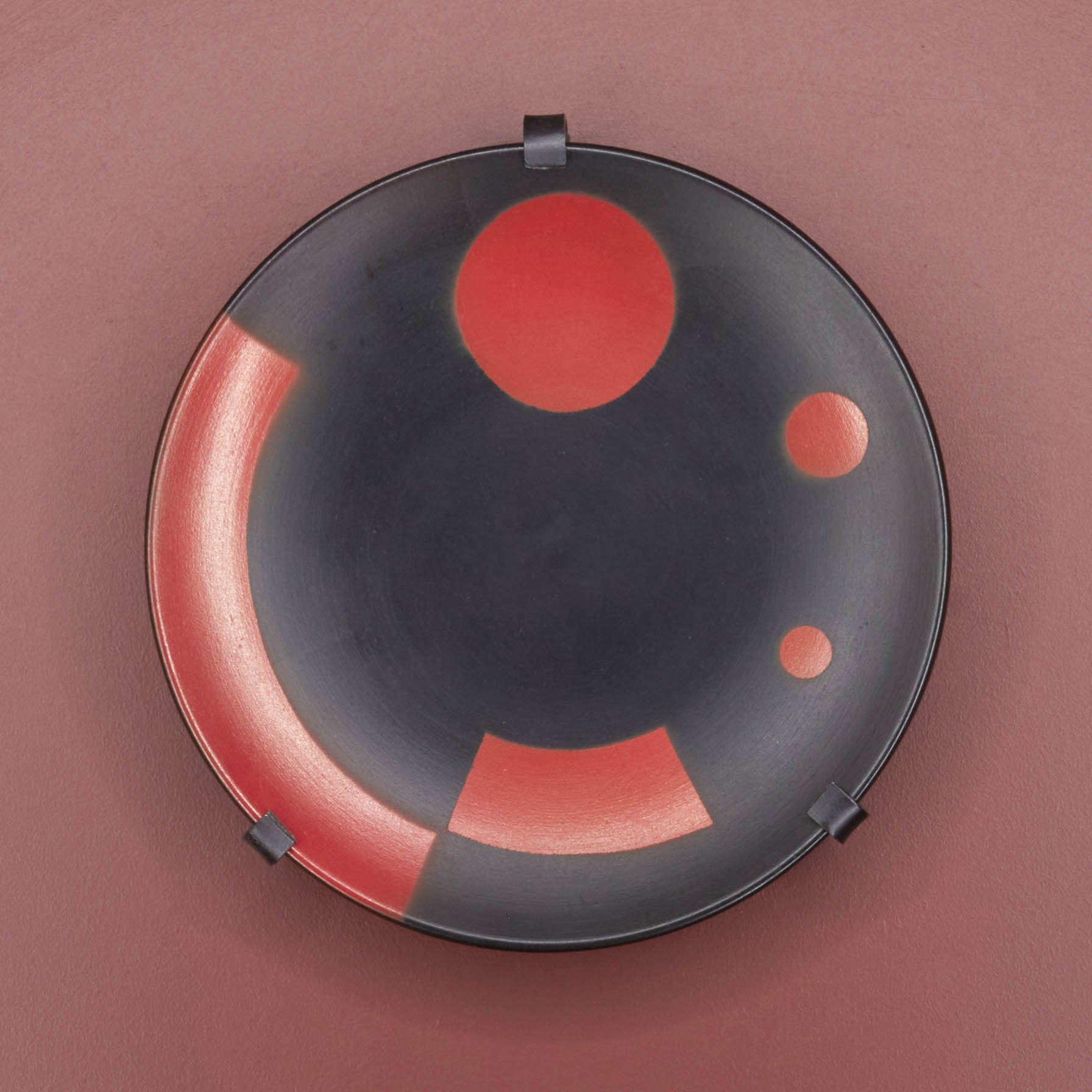
 

Lazar Markovich Lissitzky (El Lissitzky, Russian, 1890-1941)(designer and maker, Germany) 'Plate' c. 1923 (installation view)


Lazar Markovich Lissitzky (El Lissitzky, Russian, 1890-1941)(designer and maker, Germany)
Plate (installation view)
c. 1923
Unglazed, earthenware
Depth: 26 mm
Diameter: 190 mm
Powerhouse Collection
Purchased 2002


Plate by Lazar Markovich Lissitzky

A round plate made of heavy unglazed earthenware. Decorated in red enamel, sprayed in a stencil like manner (schablonendecor), with geometric motifs along the rim. Three red circles of differing sizes decorate one side of the plate. Two red curved rectangular bands, one short and one long, decorate the other side of the plate. The text ‘Z 2864’ is impressed on the base of the plate.

An architect and graphic designer, El Lissitzky (1890-1941) was among the most important Russian artists to influence Modernism and one of the great avant-garde figures of the 20th century.

His lifetime involvement with abstract art began in 1919 soon after he met the Suprematist artist Kazimir Malevich (see the ‘Design’ section for a summary of his artistic development and achievements). Between December 1921 and January 1924 he lived and worked in Germany and in 1924 was being treated for tuberculosis in Switzerland. Although initially reluctant to apply his distinctive pictorial vocabulary to utilitarian objects, it is during that time that his abstract pictures known as Prouns began to inform Lissitzky’s designs for a group of ceramics. Soon Prouns were also to become the source of his typography, photography and book, furniture and poster design.

This boldly coloured plate is one of the relatively rare examples of Lissitzky’s ceramics. Examples of plates for the same series comprising plates of different sizes can be found in the Sammlung Ludewig in Berlin, National Museum in Nuremberg, Deutsches Museum in Munich, Australian National Gallery in Canberra and in other collections.

Eva Czernis-Ryl, Curator, 2003

Text from the Powerhouse Collection website
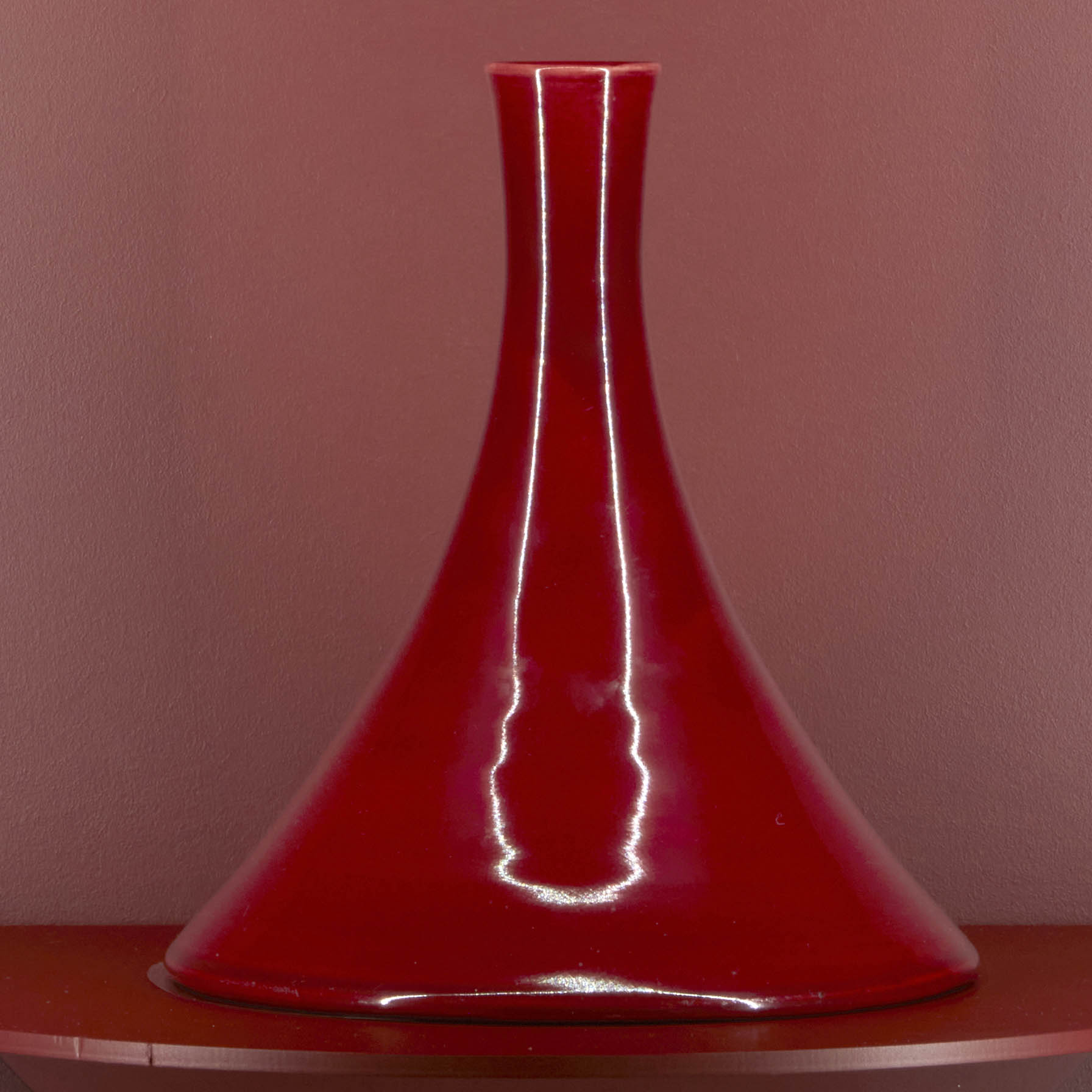
 

Christopher Dresser (designer, British, 1834-1906) Linthorpe Pottery (manufacturer, Middlesbrough, Yorkshire, England) 'Vase' c. 1888 (installation view)


Christopher Dresser (designer, British, 1834-1906)
Linthorpe Pottery (manufacturer, Middlesbrough, Yorkshire, England)
Vase (installation view)
c. 1888
Earthenware
Powerhouse Collection
Gift of Bob Meyer under the Tax Incentives for the Arts Scheme, 1997


As opposed to John Ruskin and William Morris, Christopher Dresser was an enthusiastic advocate of scientific progress and the machine. The association of simplicity with progress led him to reject the taste for rich decoration of 19th century historical styles and Naturalism which used representational decoration and high-relief ornaments indiscriminately applied to objects. Dresser’s interest in forms based on the structure of plants, his emphasis on function in design and the economic use of materials such as electroplated silver, have no precedent in Western design traditions.The restrained design of this striking vase is a fine example of Dresser’s innovative pottery produced by the Linthrope Pottery.

Eva Czernis-Ryl. Curator

Text from the Powerhouse Collection website
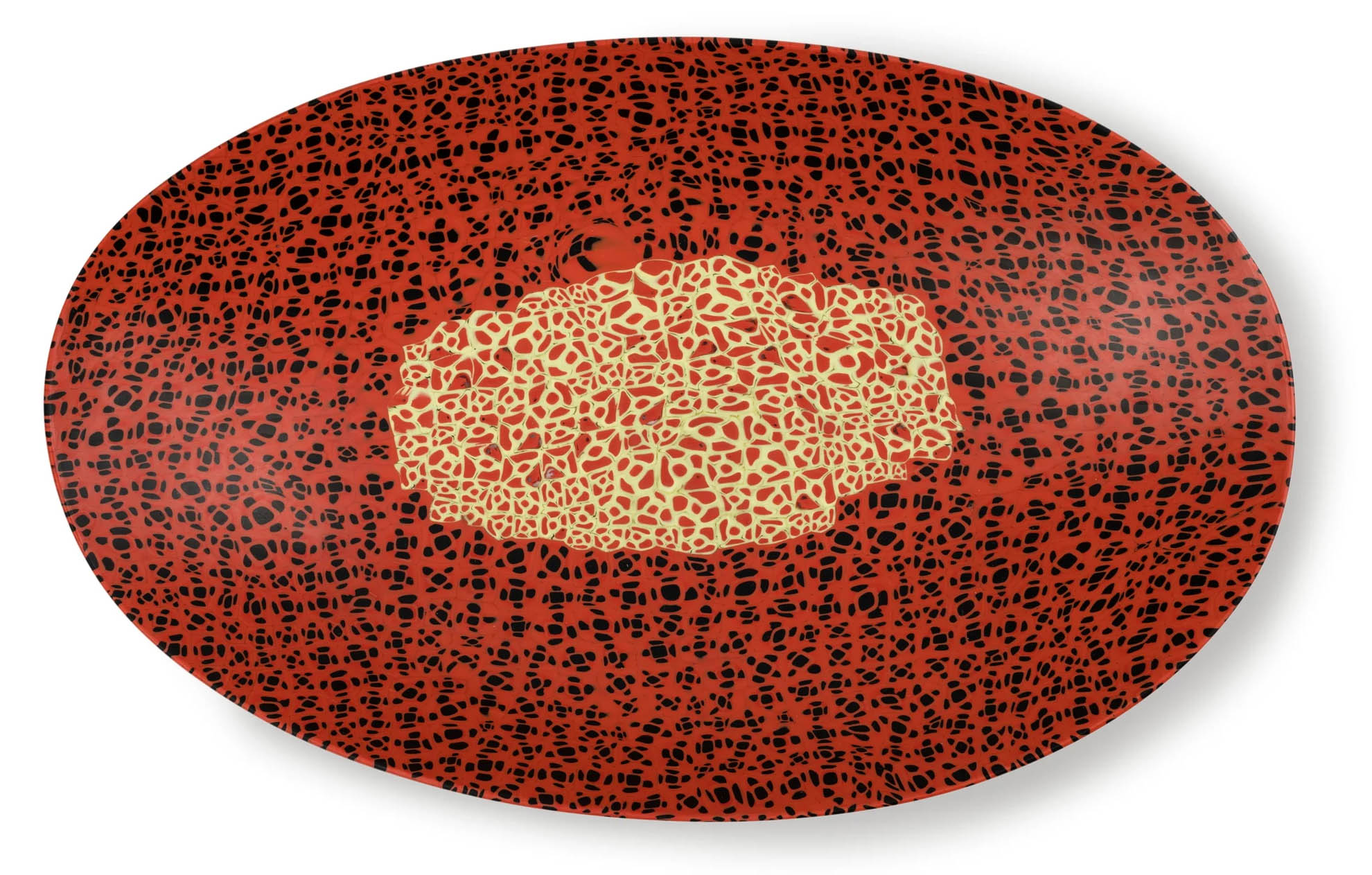
 

Carlo Scarpa for VSM Paolo Venini & Co (Murano, Venice, Italy) Carlo Scarpa (designer, Italian, 1906-1978) 'Bowl' c. 1940


Carlo Scarpa for VSM Paolo Venini & Co (Murano, Venice, Italy)
Carlo Scarpa (designer, Italian, 1906-1978)
Bowl
c. 1940
Murrine opache
Height: 60 mm
Width: 232 mm
Depth: 365 mm
Powerhouse Collection
Purchased 1984


Before Carlo Scarpa began designing some of Italy’s most celebrated modernist buildings, he spent 15 years with Venini, pushing the boundaries of Venetian glassblowing techniques. He worked for Venini between 1932 and 1947, both pioneering new techniques and reviving traditional Veentian techniques. Franco Deboni, observes: ‘Scarpa’s glass was so radical and innovative for its time. You can see it in the colours, shapes, textures and quality of execution…When you start to analyse the glass, you also realise how extremely complex it was for the master blowers to execute.’ Many of Scarpa’s designs reinterpreted historical designs using modern methods. His murrine romane combined the traditionally round murrina patterns with the square tiles of Roman mosaics. Revealed at the XXII Venice Biennale of 1940, the Murrine Opache technique is amongst the architect’s greatest technical and stylistic achievements.

Text from the Powerhouse Collection website
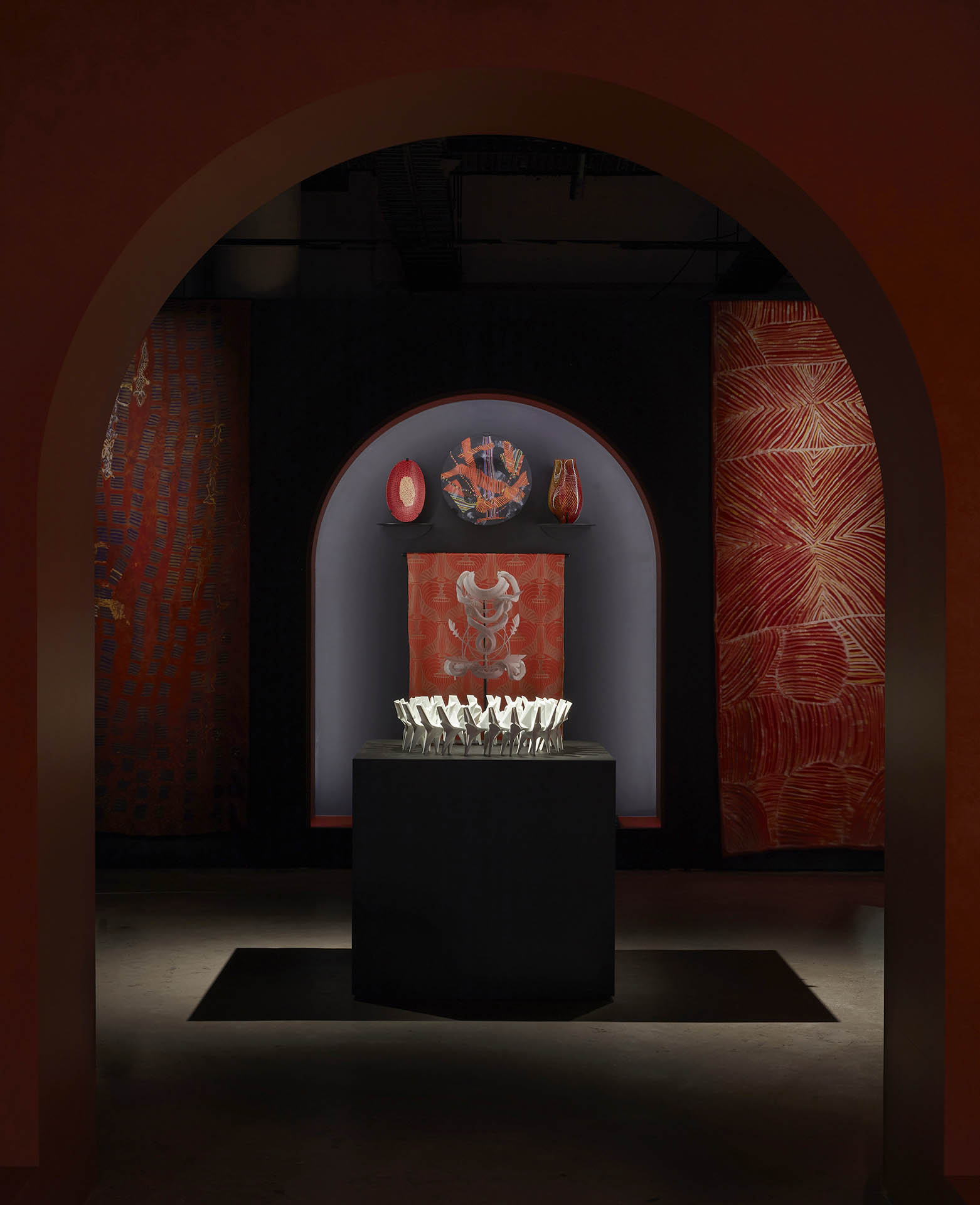
 

Installation view of the exhibition '1,001 Remarkable Objects' at Powerhouse Ultimo, Sydney showing at top left, Bowl, murrine opache, Carlo Scarpa for VSM Paolo Venini & Co, Murano, Venice, Italy, c. 1940; at top centre, Bowl form, Untitled, kiln formed fused mosaic glass, designed and made by Klaus Moje, Canberra, Australian Capital Territory, Australia, 1990-1991; at top right, Vase, blown glass with cane inclusions, Lino Tagliapietra, Rozelle, New South Wales, Australia, 1997; and at centre back, Textile length, Mohnkopfe (poppy heads), silk-double weave, Art Nouveau style, woven by Johann Backhausen and Sohne, Vienna, Austria, made by Koloman Moser, Vienna, Austria, 1900-1903
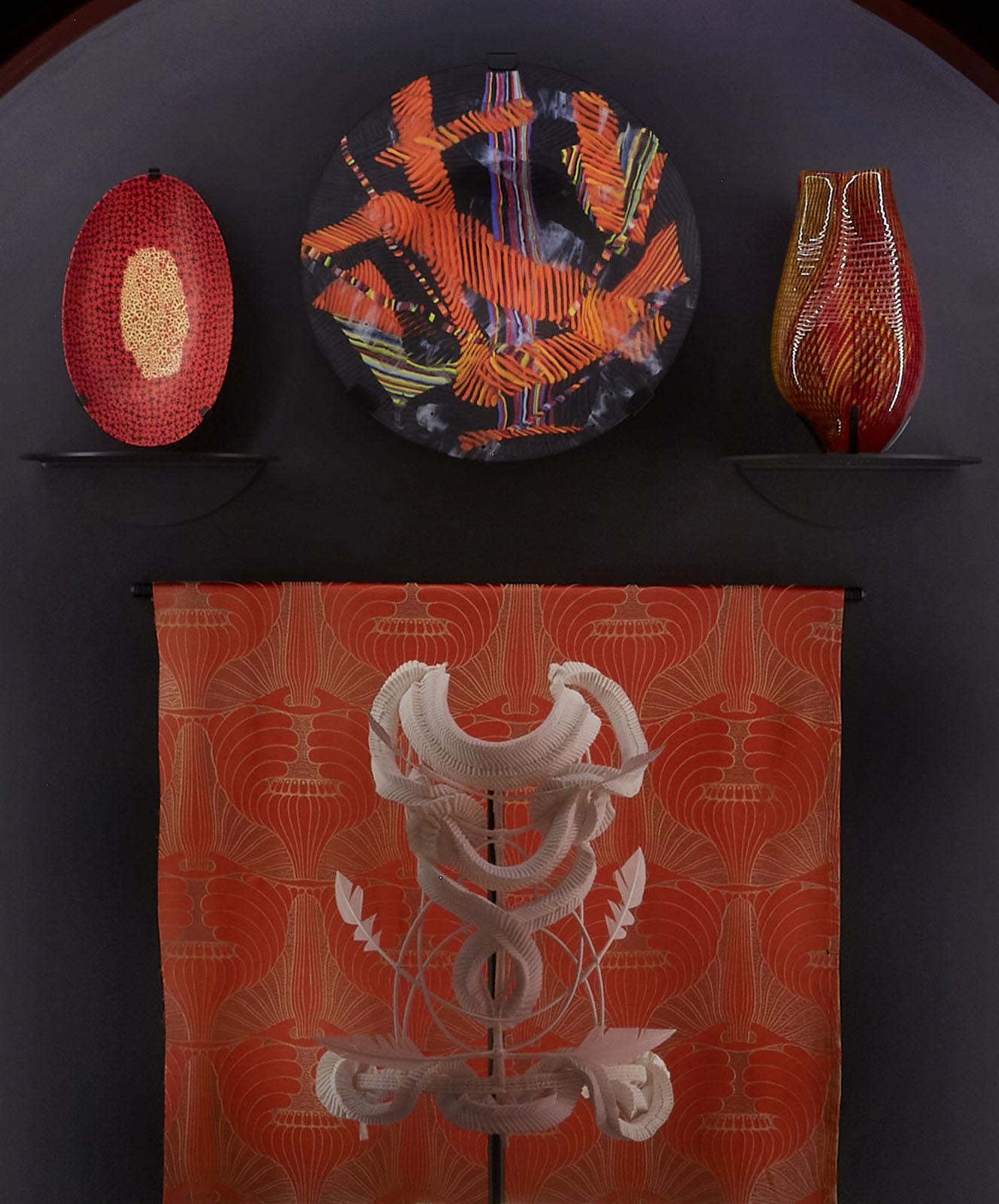
 

Installation view of the exhibition 1,001 Remarkable Objects at Powerhouse Ultimo, Sydney showing at top left, Bowl, murrine opache, Carlo Scarpa for VSM Paolo Venini & Co, Murano, Venice, Italy, c. 1940; at top centre, Bowl form, Untitled, kiln formed fused mosaic glass, designed and made by Klaus Moje, Canberra, Australian Capital Territory, Australia, 1990-1991; at top right, Vase, blown glass with cane inclusions, Lino Tagliapietra, Rozelle, New South Wales, Australia, 1997; and at centre back, Textile length, Mohnkopfe (poppy heads), silk-double weave, Art Nouveau style, woven by Johann Backhausen and Sohne, Vienna, Austria, made by Koloman Moser, Vienna, Austria, 1900-1903
 

Installation view detail of the exhibition '1,001 Remarkable Objects' at Powerhouse Ultimo, Sydney showing at top left, Bowl, murrine opache, Carlo Scarpa for VSM Paolo Venini & Co, Murano, Venice, Italy, c. 1940; at top centre, Bowl form, Untitled, kiln formed fused mosaic glass, designed and made by Klaus Moje, Canberra, Australian Capital Territory, Australia, 1990-1991; at top right, Vase, blown glass with cane inclusions, Lino Tagliapietra, Rozelle, New South Wales, Australia, 1997; and at centre back, Textile length, Mohnkopfe (poppy heads), silk-double weave, Art Nouveau style, woven by Johann Backhausen and Sohne, Vienna, Austria, made by Koloman Moser, Vienna, Austria, 1900-1903


Installation view of the exhibition 1,001 Remarkable Objects at Powerhouse Ultimo, Sydney showing at top left, Bowl, murrine opache, Carlo Scarpa for VSM Paolo Venini & Co, Murano, Venice, Italy, c. 1940; at top centre, Bowl form, Untitled, kiln formed fused mosaic glass, designed and made by Klaus Moje, Canberra, Australian Capital Territory, Australia, 1990-1991; at top right, Vase, blown glass with cane inclusions, Lino Tagliapietra, Rozelle, New South Wales, Australia, 1997; and at centre back, Textile length, Mohnkopfe (poppy heads), silk-double weave, Art Nouveau style, woven by Johann Backhausen and Sohne, Vienna, Austria, made by Koloman Moser, Vienna, Austria, 1900-1903


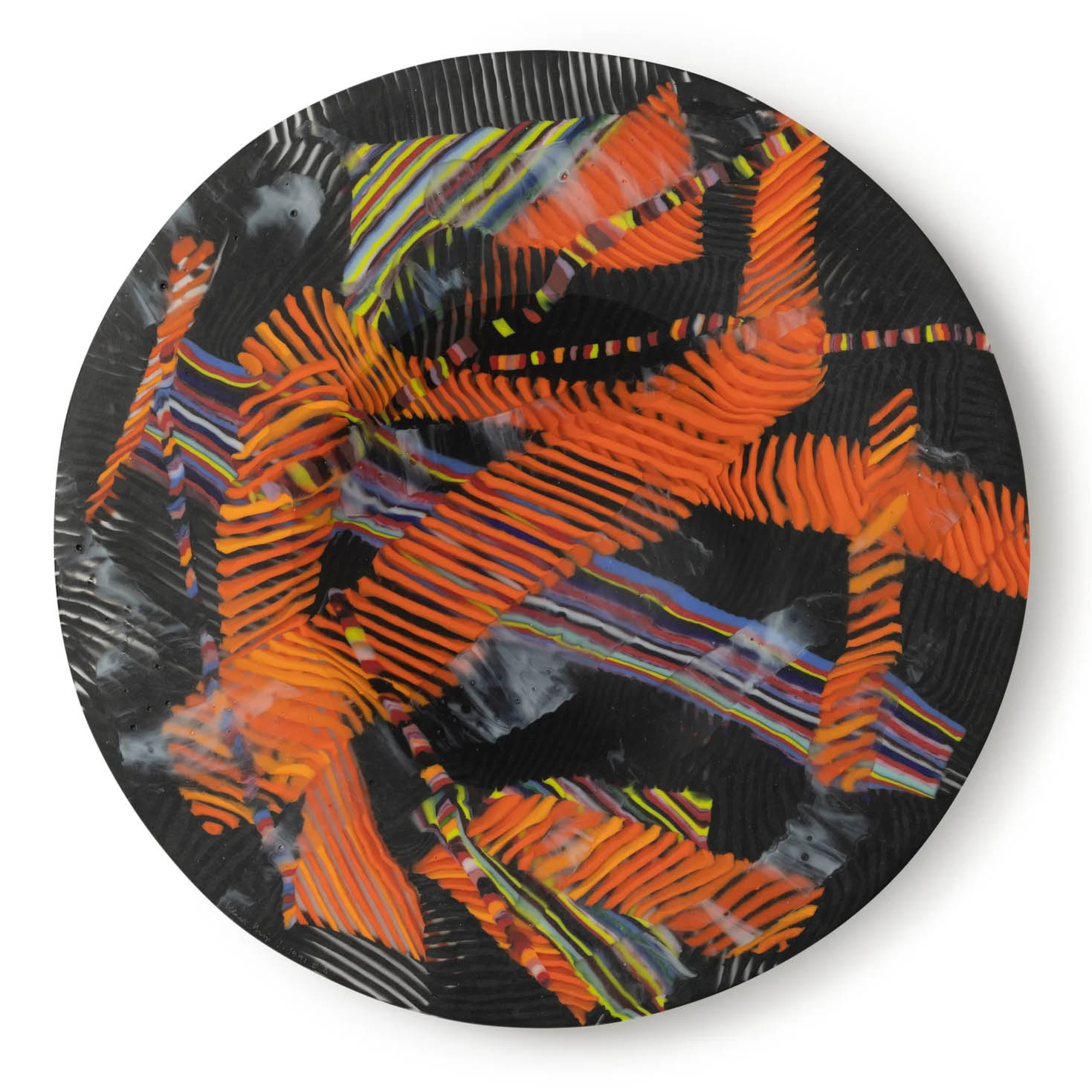
Klaus Moje (Australian born Germany, 1936-2016) (designer and maker, Canberra, Australian Capital Territory, Australia) Bowl form, 'Untitled' 1990-1991


Klaus Moje (Australian born Germany, 1936-2016) (designer and maker, Canberra, Australian Capital Territory, Australia)
Bowl form, Untitled
1990-1991
Kiln formed fused mosaic glass
Height: 75 mm
Diameter: 540 mm
Powerhouse Collection
Purchased 1991


Fused Mosaic Glass Bowl by Klaus Moje

This bowl form, ‘Untitled’, was made from fused mosaic Bullseye glass, in Canberra, Australian Capital Territory, Australia, 1990-1991.

Klaus Moje (1936-2016, born Hamburg, Germany) was one of Australia’s most significant glass artists, and also one of the most influential through his teaching in Canberra for 10 years from 1982. His international connections provided many exhibiting and teaching opportunities for others.

The Bullseye Glass Company had been set up in Portland, Oregon, in 1974 by three young glassblowers, Daniel Schwoerer, Boyce Lundstrom and Ray Ahlgren. Schwoerer had also studied glass as graduate assistant to Harvey Littleton at the University of Wisconsin in the 1960s as well as doing graduate work in engineering. Although they were glass blowers, they wanted to support their art through an income-generating industry and saw a need for a manufacturer of flat glass. Schwoerer explains, ‘In the early ’70s the few American companies making opalescent glass were back-ordered for at least two years and weren’t taking on new customers.’ In the following years Ahlgren and Lundstrom both left to start up other glass-related ventures and Lani McGregor, now artistic director of the Bullseye Connection gallery, joined Schwoerer as partner in 1985.

Bullseye kept closely involved with the needs of the marketplace through direct connections with the art world. In the early 1980s Klaus Moje wanted to make kilnformed mosaic glass and needed colours that fused compatibly. He met Lundstrom at the Pilchuck Glass School and found they had a mutual interest in the development of what became Bullseye’s Tested Compatible sheet glasses. ‘Moje provided a huge further inspiration to continue on this path which really had no justifiable commercial rationale at that time,’ says Lani McGregor. This liaison had far-reaching repercussions, especially for Australians, because Moje moved to teach at the Canberra School of Art in 1982: ‘Bullseye made hand-rolled glass for architectural purposes. They saw the problems I had with compatible glass and a limited colour palette…[and] started to see a serious way of entering the studio glass movement with their product.’

By the 1990s Moje wanted to make vessel forms from his fused mosaic sheets. It required further collaboration to develop a glass working process to enable this to happen. He first tried with Bullseye glass at Pilchuck with glassblower Billy Morris in 1987 and again with Dante Marioni in Portland in 1993. Bullseye provided a compatible blowing glass for these sessions, where the sheets were wrapped around a gather of furnace glass, but ‘what eventually came out of them’ says McGregor, ‘was that Klaus discovered that a blowing glass is not necessary for blowing previously fused forms. What Dante was doing was a variation on the long-known Italian pick-up method. What evolved was the truly amazing Australian Roll-up that – although we do now make a blowing compatible glass – doesn’t need it’. Artists were to discover, however, that the provision of these two compatible glasses allows other processes to take place, where, for example, sections of blown and fused glass can be successfully joined using the encalmo technique.

Bullseye’s connection with Australia was established mainly through Moje’s interest in providing opportunities for graduates and colleagues to travel, study and exhibit elsewhere, that were continued later by his successor Stephen Procter, and Jane Bruce. In turn Bullseye became involved in supporting programs in Australia, the most notable being the Latitudes workshops and exhibitions of 1995 and 1997 organised at the Canberra School of Art by Kirstie Rea, where participants experimented with the many options now possible. Kirstie Rea and Scott Chaseling continued their own explorations of these new possibilities, and became well-known in the 1990s for their international ‘Roll-up’ workshops.

Text from the Powerhouse Collection website
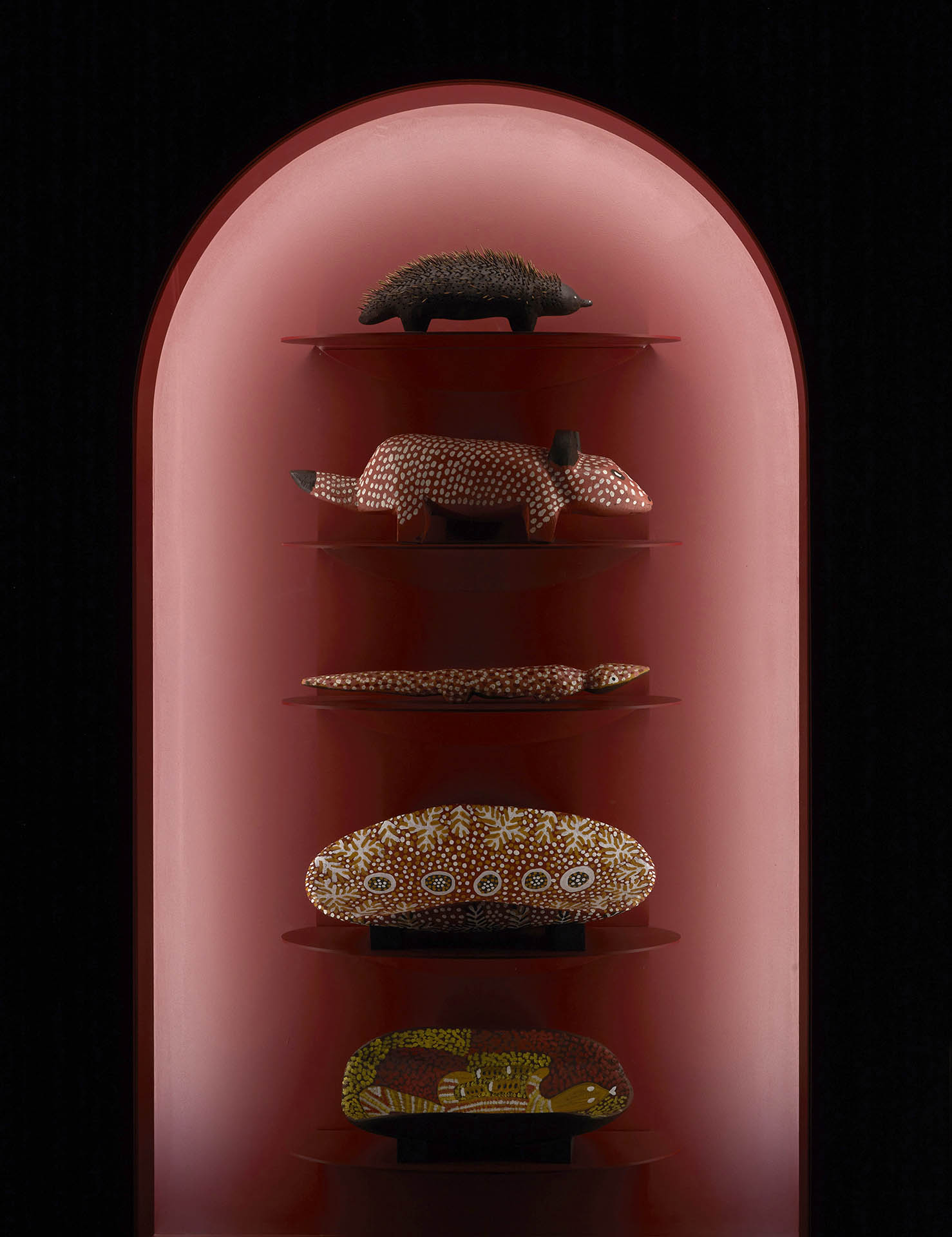
 

Installation view of the exhibition '1,001 Remarkable Objects' at Powerhouse Ultimo, Sydney showing at top, Carved form, Echidna shape, bean wood / echidna quills, painted, Louie Pwerle, Ngkawenyerre camp, Utopia, Northern Territory, Australia, 1996; and at second top, Figure, dog, Devil Dog, wood, Billy Petyarre, Utopia Station, Northern Territory, Australia, 1991; at second bottom, Coolamon, Bush Tomato Dreaming, wood / acrylic paint, Billy Petyarre, Utopia Station, Northern Territory, 1990-1991
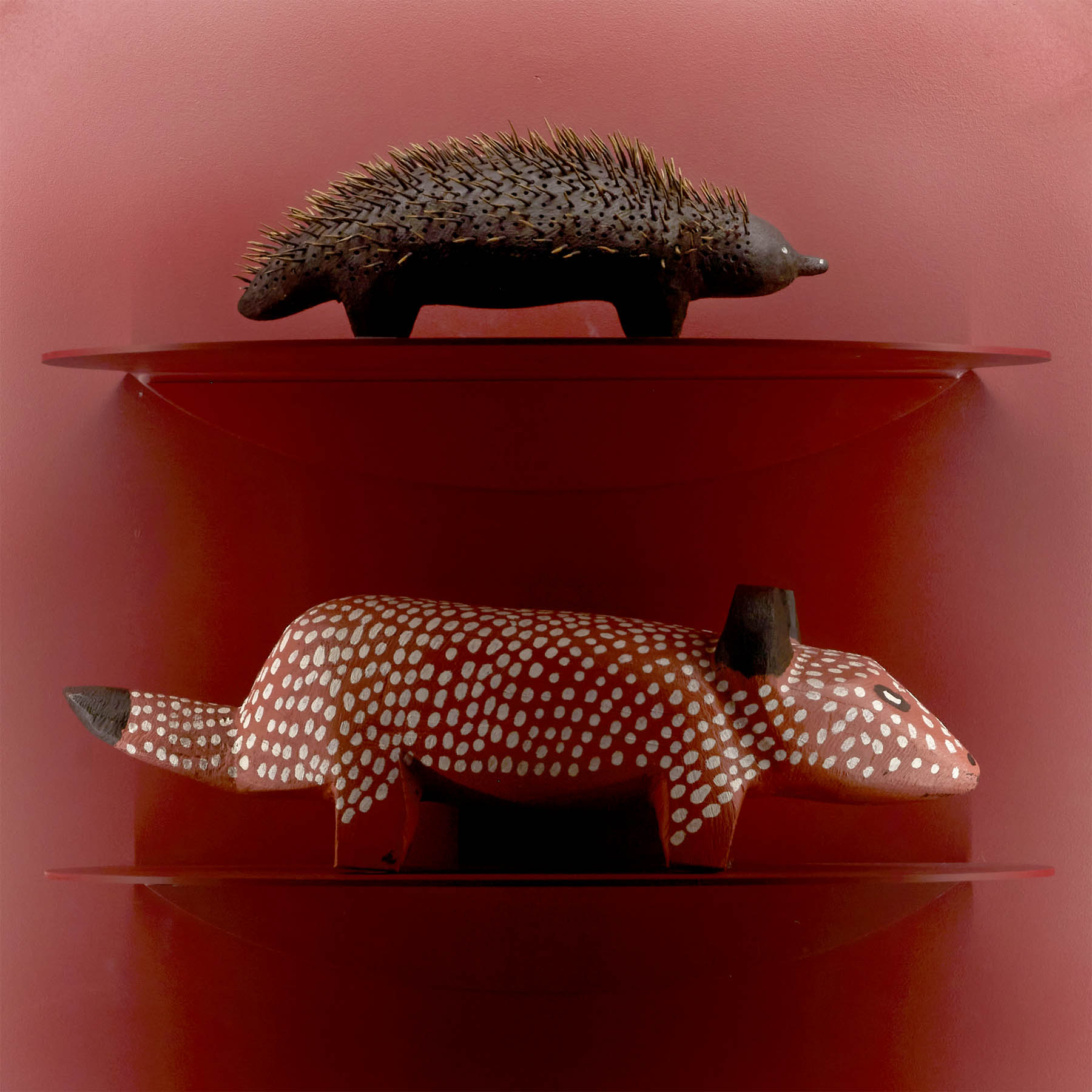
 

Installation view of the exhibition 1,001 Remarkable Objects at Powerhouse Ultimo, Sydney showing at top, Carved form, Echidna shape, bean wood / echidna quills, painted, Louie Pwerle, Ngkawenyerre camp, Utopia, Northern Territory, Australia, 1996; and at second top, Figure, dog, Devil Dog, wood, Billy Petyarre, Utopia Station, Northern Territory, Australia, 1991; at second bottom, Coolamon, Bush Tomato Dreaming, wood / acrylic paint, Billy Petyarre, Utopia Station, Northern Territory, 1990-1991


Installation view detail of the exhibition '1,001 Remarkable Objects' at Powerhouse Ultimo, Sydney showing at top, Carved form, Echidna shape, bean wood / echidna quills, painted, Louie Pwerle, Ngkawenyerre camp, Utopia, Northern Territory, Australia, 1996; and at second top, Figure, dog, Devil Dog, wood, Billy Petyarre, Utopia Station, Northern Territory, Australia, 1991
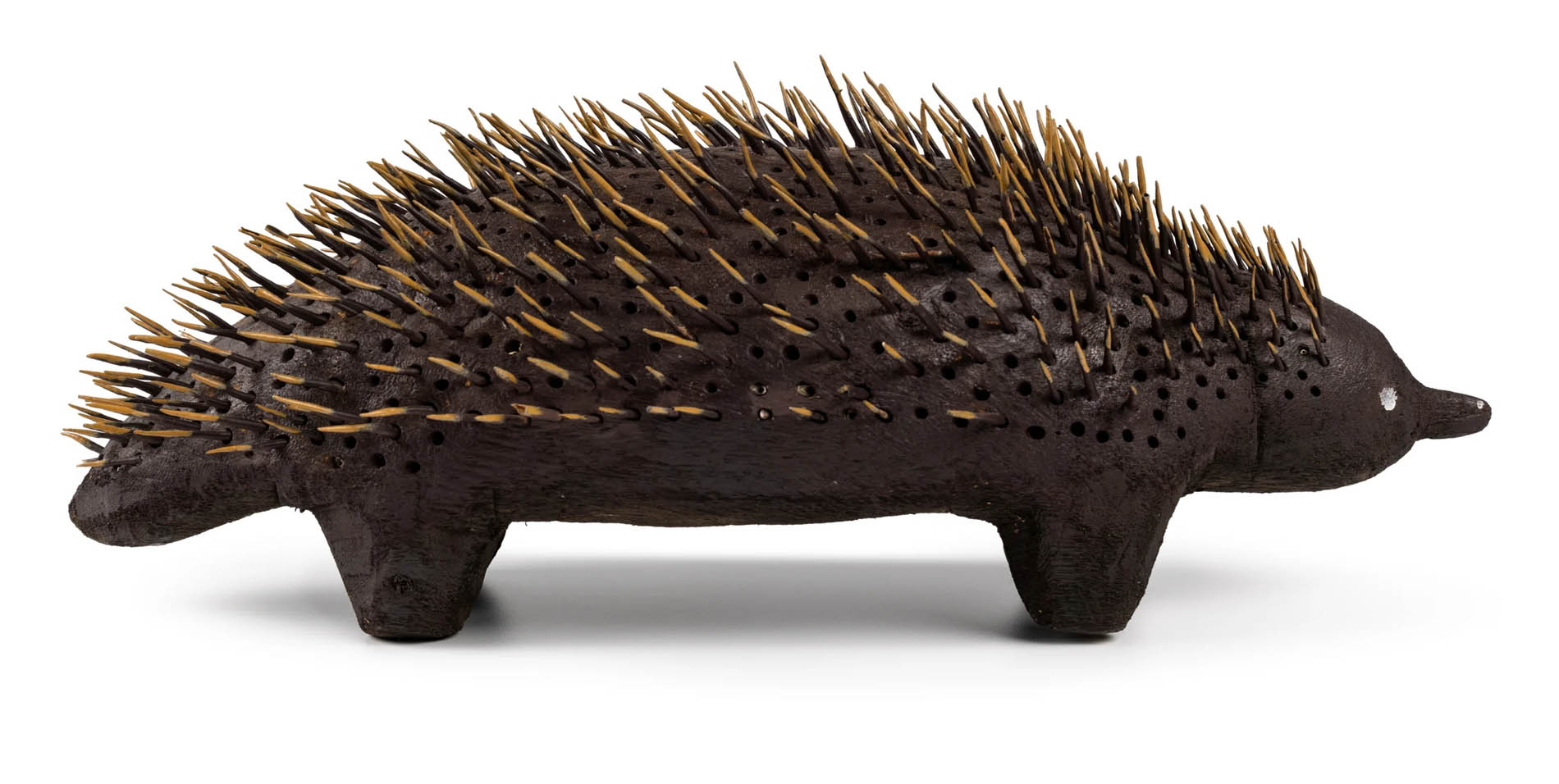
 

Installation view of the exhibition 1,001 Remarkable Objects at Powerhouse Ultimo, Sydney showing at top, Carved form, Echidna shape, bean wood / echidna quills, painted, Louie Pwerle, Ngkawenyerre camp, Utopia, Northern Territory, Australia, 1996; and at second top, Figure, dog, Devil Dog, wood, Billy Petyarre, Utopia Station, Northern Territory, Australia, 1991


Louie Pwerle (Cowboy 'Louie' Pula Pwerle (Australian, c. 1940-2022)(Ngkawenyerre camp, Utopia, Northern Territory, Australia) 'Echidna shape' 1996


Louie Pwerle (Cowboy ‘Louie’ Pula Pwerle (Australian, c. 1940-2022)(Ngkawenyerre camp, Utopia, Northern Territory, Australia)
Carved form, echidna shape
1996
Bean wood/ echidna quills, painted
Height: 160 mm
Width: 170 mm
Powerhouse Collection
Purchased 1996


Carved Echidna by Louie Pwerle

Carved animals and dishes, and painted seed necklaces, are made variously by artists including Queenie Kemarre, Louie Pwerle, Billy Petyarre, Wally Pwerle, Elizabeth Kngwarreye, Angelina Pwerle at the Ngkawenterre camp in the Utopia homelands. This particular camp is known for the carved animals made there.

Goannas, lizards, echidnas and kangaroos are sought after for food, as ‘bush tucker’, while the dogs are ‘devil dogs’. The devil dogs assist the ritual law enforcer, Kwertatye, in the beliefs of this group of Aboriginal people. Carved figures were made in earlier times, but it is not known what these were. The Ngkwarlerlaneme people at Utopia have revived the practice, following the introduction of acrylic painting in the 1980s; the dogs are painted in the manner of acrylic painting. Similalry the silk batiks made by this group often include figures or representations of animals and figures, real or mythological.

Designed and made by Louie Pwerle from a soft wood, locally called beanwood. The echidna is well-known as a form of bush tucker. Louie is part of a family who live at the Ngkawenterre camp in the Utopia homelands, and mostly carves and paints animals. He made three kangaroos in 1989 and none other until 1996, after Rodney Gooch brought back a ‘tree kangaroo’ (squirrel or possum) from Indonesia; following this Louie started to make kangaroos again. Only a few echidnas appear to be made (about 12 in the last 6 years), and only two with real quills seen by the Sydney agent in the last few years. This is (in 1996) the only camp where carved animals, figures and bowls are made, and paintings on canvas are also made at this camp. All the works in this particular collection are made by members of this family at this camp. All are consistent carvers, some like Queenie and Louie since about 1988.

Text from the Powerhouse Collection website
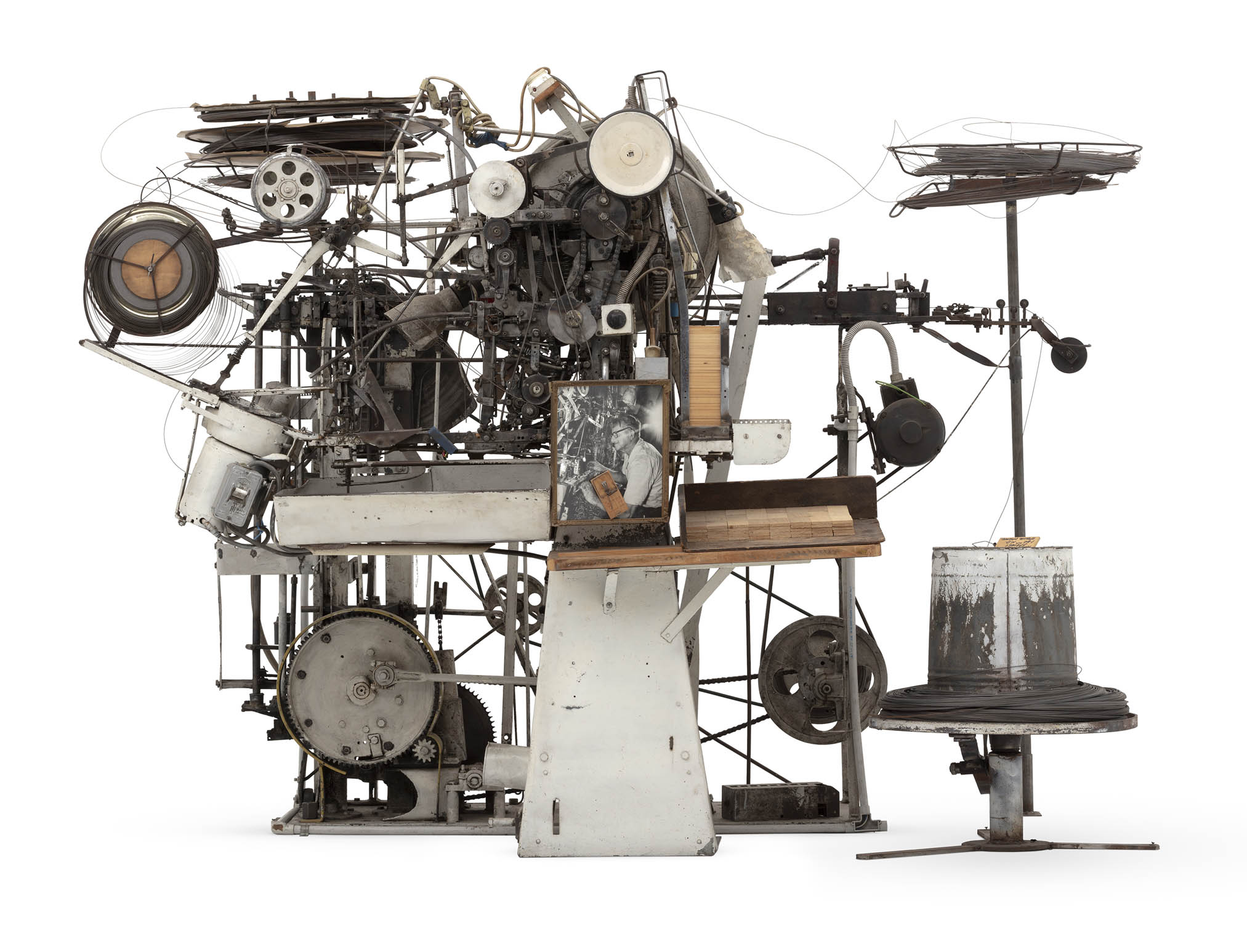
 

AW Standfield and Co (manufacturer, Mascot, New South Wales, Australia, active 1925-2000) ''Supreme' Mouse Trap Making Machine' 1942-1943


AW Standfield and Co (manufacturer, Mascot, New South Wales, Australia, active 1925-2000)
‘Supreme’ Mouse Trap Making Machine
1942-1943
Metal/wood
1950 mm H x 2470 mm W x 1500 mm D
Weight 830 kg
Powerhouse Collection
Acquired October 2001


‘Supreme’ Mouse Trap Making Machine

This mouse trap making machine is part of the Museum’s Standfield collection of trap-making machines and associated items which are an unusual, indeed curious, ensemble of purpose-built machines and products that defined an Australian industry for sixty years.

The collection exemplifies a ‘making do’ approach to manufacturing in that the machines were built from secondhand parts from a range of sources; it also exemplifies the notion of technological stasis in that the machines were always considered efficient and sophisticated artefacts for the making of rodent traps. Likewise, the organisation, traditional skills, and daily customs of the Standfield firm did not change from the Second World War to the end of the twentieth century, a period when rapid industrial change was the norm.

The nature of production at Standfields was based on a belief that a unique machine would provide a quality product whose market was based upon the natural cycle of rodent population size. According to the Standfields, production was never based upon the traditional economic factors of supply and demand, as these concepts did not seem applicable to a production facility of this nature, size, and scale. Productivity was rarely increased or decreased from the machine’s range, that is, 1,000 traps per hour. Product stockpiling was a normative value that was practised by the firm.

Less demonstrative, but deeply embedded in the Standfield approach to manufacturing, was a belief that a well-made and simple product defined an Australian approach to the making of things.

The mouse trap making machine is made from a variety of metal and electronic components, painted white for framework and left plain for working parts. The machine can be divided into two segments consisting of the mouse trap assembly line and the spring and hammer making mechanism.

The front section of the machine features the assembly line from right to left. This section contains an intricate series of levers, pulleys and gears which feed the wooden mouse trap platforms through the production line. On the right is the platform feeder, filled with wooden platforms. From here the bases are pressed in a stamper, leaving the imprint, ‘Supreme / MOUSE TRAP / MADE IN AUSTRALIA’ on the top. The next phase involves the the catch or baiter and the holding bar both being stapled on to the platform. Once through this process, there is an open section in the centre for a worker to manually attach the spring and hammer device to the mousetrap and then place the traps back in the conveyor channel. The traps then pass through a plane or sander to remove any points on the base, and the process is complete. The power switch for this portion of the machine is positioned just below the sander, with a speed switch also present in the machines centre. On each side of the production line segment are different coils of metal, for each of the components used in constructing the mouse traps. Each of the coils is labelled with different specifications, based on their thickness, with some spare coils placed underneath. A counter, in a red casing, can be seen in the centre of the machine, indicating the number of traps which have been processed. Above the counter are two lamps, plugged into a powerboard at the top of the machine, for providing additional light in the dark workshop.

The back section is designed with the specific purpose of constructing the spring and hammer mechanism for the traps. This section also works like a production line with two sets of metal coils, suspended on metal poles, on the right and left sides of the machine. The wires are fed through a set of gears, pulleys and levers, which bend, coil and shape the wire to create the spring and hammer. The finished product reaches the end of the production line and is released down a slide or ramp, into a white tray at the front of the main production line for the worker to retrieve. A power switch can be found on the right side of this section

At the front of the machine is a black and white image of Arnold Wesley Standfield woking on the machine, with the final mousetrap that the machine made stuck to the front. A number of finished and half finished mousetraps as well plain platforms can be found on a wooden shelf on the machines right.

Formal patent applications were taken by Arnold Wesley Standfield for the ‘Westan’ all metal rodent trap, and the Kyogle cow-tail clip. The patent documents are supplemented with schematic designs, which illustrate the operational requirements of the products. Interestingly, no formal machine design or patent was ever taken on Standfield’s principal item, namely, the mouse-trap machine. The Standfield archives hold the patent applications for the ‘Westan’ mouse trap and Kyogle cow-tail clip, as well as other documentary accounts of these items.

The machines, traps, and the cow-tail clip, were entirely the creations of Arnold Wesley Standfield (1901-1990), the founder of A.W. Standfield and Co., ‘Supreme’ Mouse and Rat Traps. His sons Dave and Ron Standfield assisted their father with the repair and maintenance of the machines, and the sons became the owners and managers of the firm upon the death of their father. Knowledge of the machines and its products was passed to the sons by their father, and in turn they passed on knowledge and skill to long-term employees of the firm.

A.W. Standfield made the machine from wheels, gears and pieces of metal taken from scrapped machines he found in scrap-iron yards around Sydney. Although Standfield had no formal training in machining or associated trades, his accomplishment does suggest that he had an innate ability to build production machines. In a single operation, a mouse trap can be assembled in 1.5 seconds. The standard production rate is “over 1,000 traps per hour” (‘Mouse-Trap Making Machine’, n.d. probably composed by A.W. Standfield, Standfield archives).

The machine was made over a two-year period (1942-1943) and the first traps ‘came off’ the machine on 7 January, 1944. The machine is as it was first made, although broken and worn parts have been replaced over the years.

The machine itself makes all parts, and, as mentioned above, assembles a trap in 1.5 seconds. In operational terms, four strands of staple wire are fed, straightened, cut off, folded and driven into the base of the trap. The machine grounds off protruding staple ends. It feeds, straightens, cuts off, and forms into a trigger, wire of 3″ (76.2mm) length of 17 gauge wire, which was supplied by BHP. The machine staples the trigger wire to the pine base.

The machine makes and assembles the bait holder. The machine selects the length of steel for the bait-holder, cuts it, punches and forms the steel into the bait holder and affixes the holder (under the staple) to the pine base. The machine feeds, straightens, and cuts off 18″ (457.2mm) of 17 gauge spring wire and forms this as the mouse-trap spring. In the process, the wire is turned and bent 23 times at varying degrees to make a spring. The mouse-trap machine pushes the piece of pine along a slot and brands the base. The machine turns the spring ends. The spring is fed through and stapled by hand to the base. This operation completes the assembly of a mouse trap.

Text from the Powerhouse Collection website
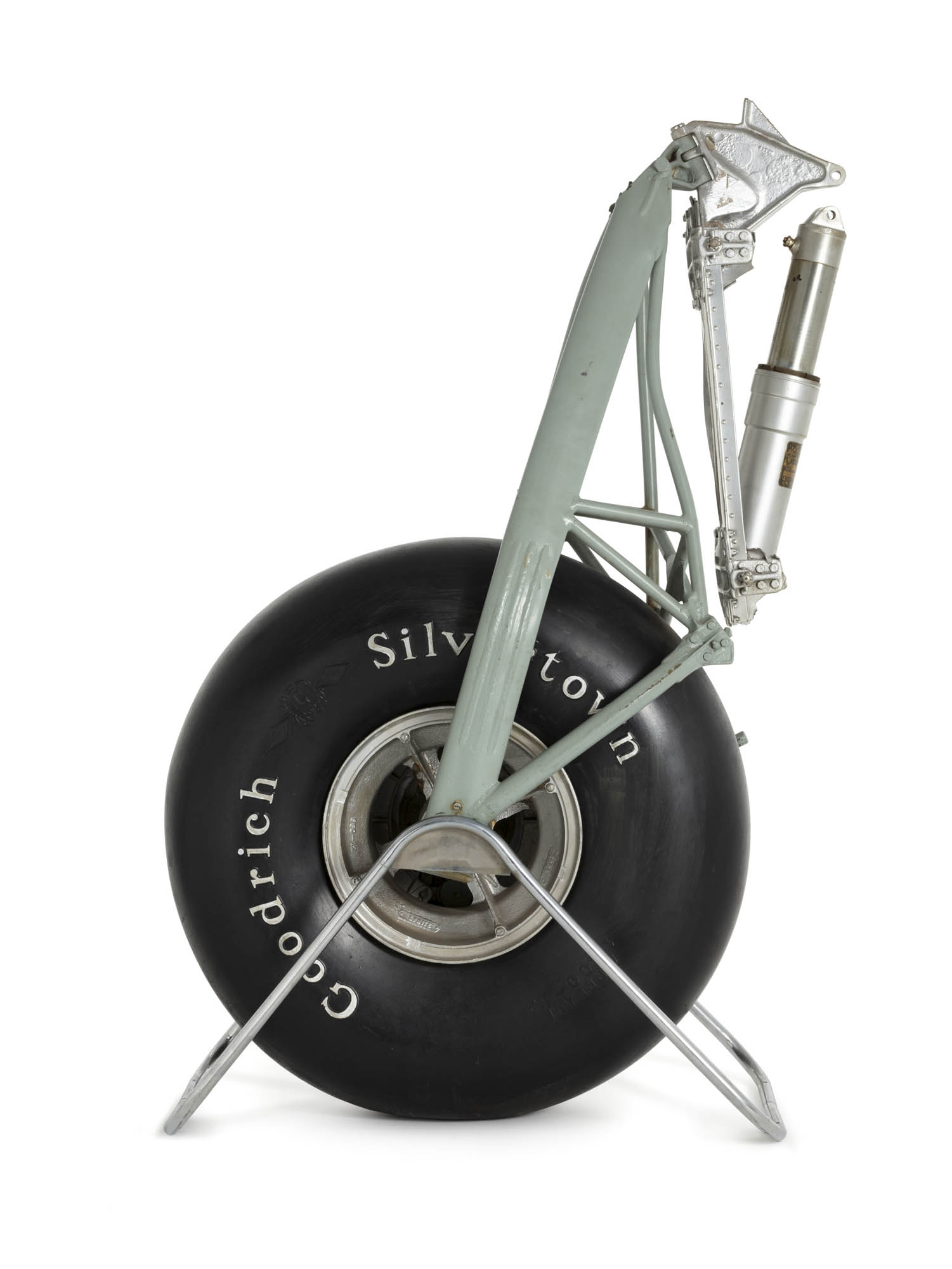
 

Lockheed Aircraft Company (manufacturer, Burbank, California, United States of America) 'Aircraft undercarriage from Lockheed Altair monoplane 'Lady Southern Cross', starboard side' Probably 1933


Lockheed Aircraft Company (manufacturer, Burbank, California, United States of America)
Aircraft undercarriage from Lockheed Altair monoplane ‘Lady Southern Cross’, starboard side
Probably 1933
Metal/rubber
Height: 1420 mm
Width: 480 mm
Diameter/Length: 1000 mm
Powerhouse Collection
Acquired February 1994


Aircraft undercarriage from the Lady Southern Cross

The only surviving fragment of aircraft in which Sir Charles Kingsford Smith died, 8 November 1935

This wheel and oleo strut are part of the starboard undercarriage used by Sir Charles Kingsford Smith (Smithy) in his Lockheed Altair aircraft VH-USB ‘Lady Southern Cross’ for his attempt at a record breaking flight from England to Australia in 1935. On 8 November 1935 ‘Lady Southern Cross’ is estimated to have crashed into the Gulf of Martaban in the vicinity of Aye Island off the coast of Burma, now Myanmarm, at approximately 0216 local time. The undercarriage is the only major component to have been located and preserved after the loss of the aircraft with Smithy and his co-pilot/engineer, Tom Pethybridge, on board.

Sir Charles Kingsford Smith is Australia’s most renowned pioneer aviator. He established a number of records in a variety of aircraft, most notably the Fokker Trimotor, ‘Southern Cross’. His interest in competing in the MacRobertson Air Race of 1934 gave him the impetus to purchase the Lockheed Altair as an aircraft with the capability of achieving first place, but engineering problems and lack of time mean that he had to withdraw from the race. In testing the aircraft in Australia, he established a number of city to city speed records in the Altair. To ‘save face’ for withdrawing from the race he flew the Pacific instead in the west east direction establishing another record. Smithy and Tom Pethybridge, lost their lives endeavouring to break yet another record, the England-Australia speed record.

The single engined Lockheed monoplane aircraft of the late 1920s and 1930, encompassing the Sirius, Orion, Altair, Air Express, Explorer and Vega, were considered to be revolutionary in their time. According the their ‘biographer’, Richard Sanders Allen in ‘Revolution in the Sky’, those fabulous Lockheeds, the pilots who flew them, “…became the most copied, coveted, news making airplanes of their era”. They achieved a number of records in the hands of such famous aviators as Amelia Earhart, Charles Lindbergh, Wiley Post, Hubert Wilkins and Sir Charles Kingsford Smith, to name a few. As well as providing record breaking aircraft the Lockheed Aircraft Corporation, as it became, used the basic designs and manufacturing techniques to produce small airliners such as the Orion, Air Express and Vega. After the completion of the last of this series of designs Lockheed went on to design and manufacture such significant airliners as the Lockheed 10 Electra and the Lockheed 14 Super Electra. During World War II, Lockheed designed the Constellation which became the backbone of many airlines restarting services post-world War II. Qantas based its fleet on the Constellation before converting to the gas turbine powered Boeing 707.

Text from the Powerhouse Collection website
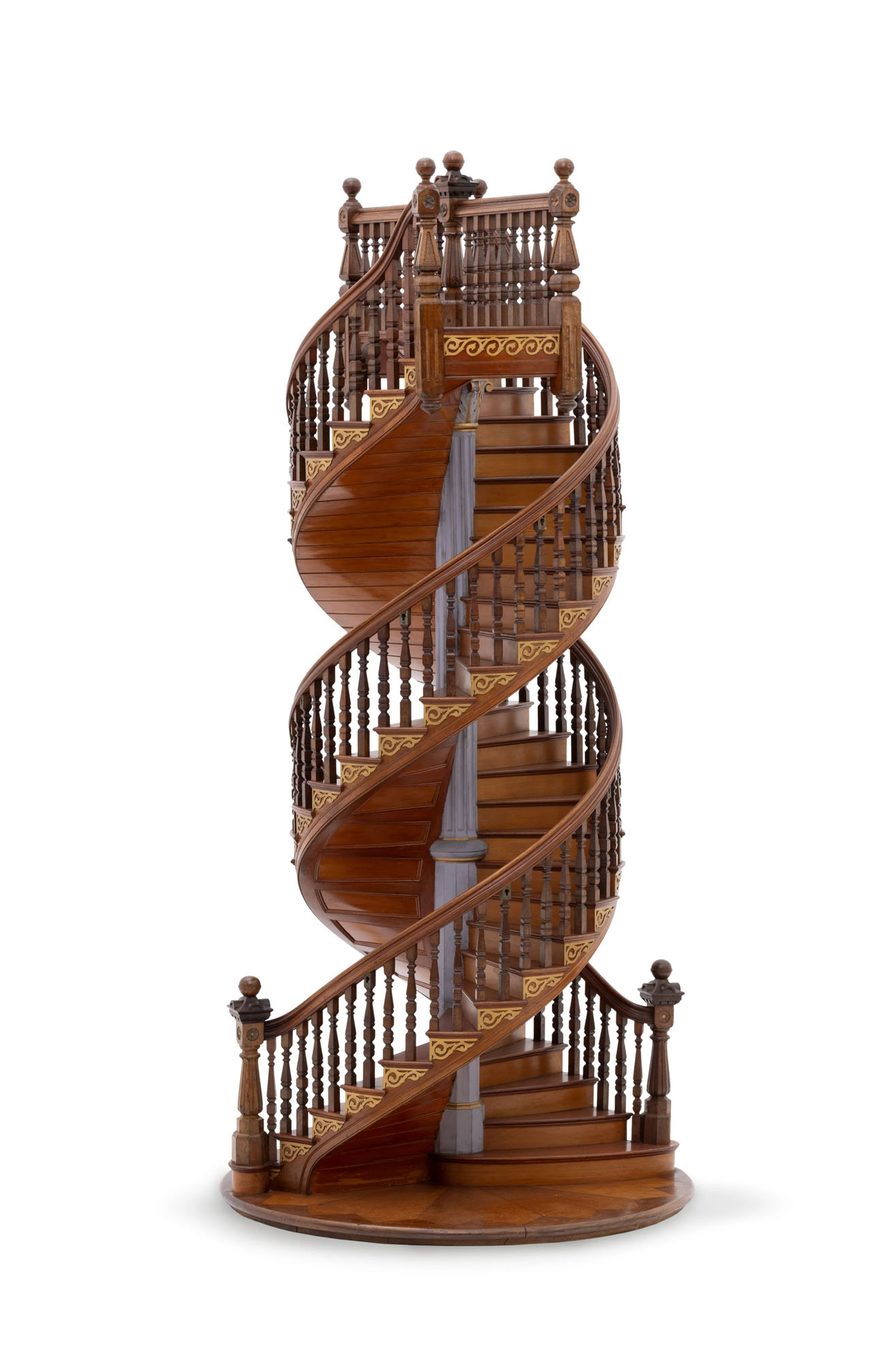
 

John Lyon Gardiner (maker, Sydney Technical College, Sydney, New South Wales, Australia) 'Model staircase' 1891


John Lyon Gardiner (maker, Sydney Technical College, Sydney, New South Wales, Australia)
Model staircase
1891
Cedar (Toona australis)
Height: 2730 mm
Width: 1390 mm
Depth: 990 mm
Powerhouse Collection
Presented by Sydney Technical College, 11 November 1953


Model staircase

This model staircase is a significant example of the work of Sydney Technical College instructor, John Lyon Gardiner. It was built to demonstrate the principles of stair construction. Almost from its inception the Museum had a close relationship with the Technical College which was its immediate neighbour in Harris Street. At the time there was a new interest in education through observation or ‘learning by looking’. This was thought particularly important in the training of ‘practical men’ and museum’s were an essential part of this process. As the English philanthropist, Thomas Twining, wrote in Science made easy (1876) about the purpose behind his own Museum in Twickenham, outside London:

‘I became more and more impressed with the desirableness of propagating among the working population, sound practical knowledge calculated to secure for steady persevering industry, a well earned mead of Health and Comfort … [through] VISUAL EDUCATION.’

The staircase is made from cedar which is also significant as, at the time, the Museum was actively promoting commercial applications for colonial timbers.

Text from the Powerhouse Collection website
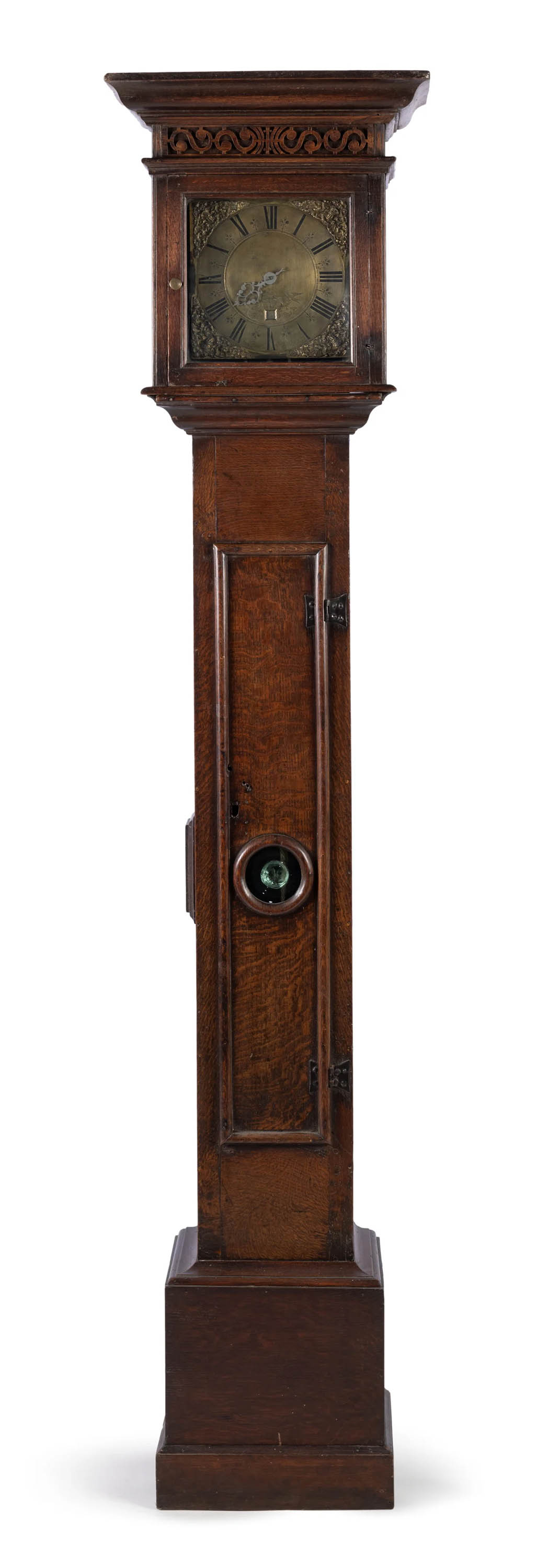
 

James Brewer (maker, Darlestone, United Kingdom) 'Long case clock' 1690


James Brewer (maker, Darlestone, United Kingdom)
Long case clock
1690
Wood/glass/brass/metal
Height: 2240 mm
Width: 495 mm
Depth: 300 mm
Powerhouse Collection
Purchased 1963
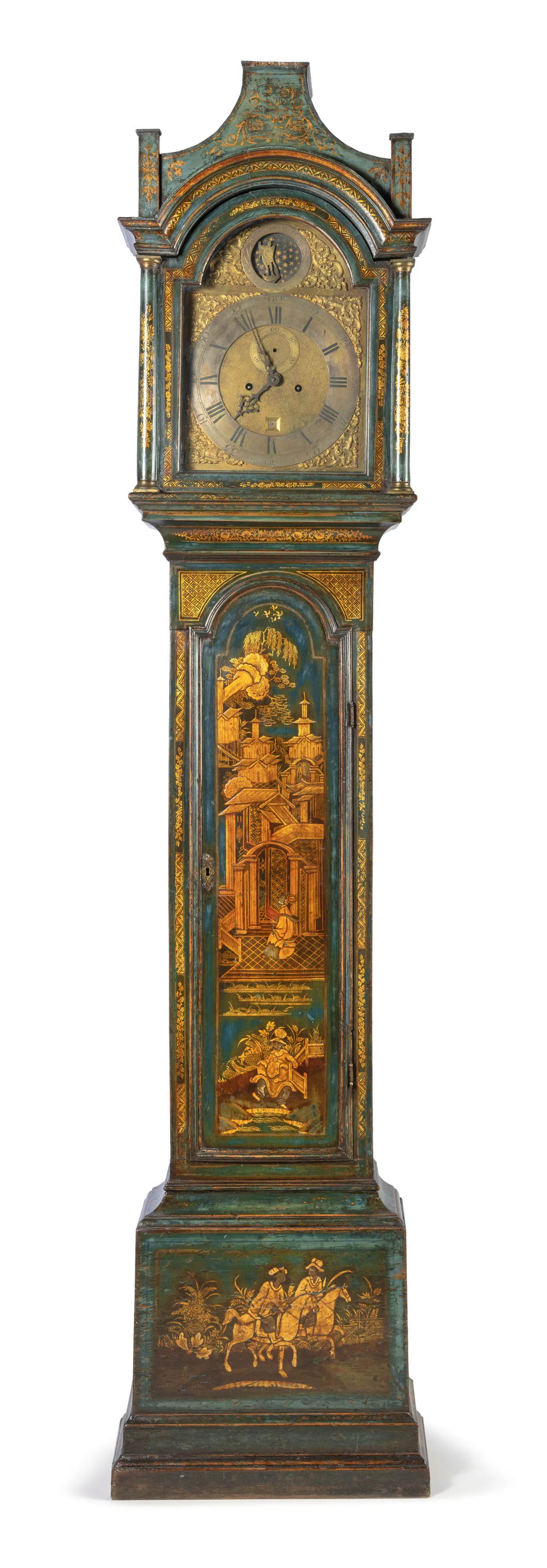
 

John Dewe (maker, London, England) 'Long case clock' 1733-1764


John Dewe (maker, London, England)
Long case clock
1733-1764
Lapis-blue Japanned case, wood/metal
Height: 2240 mm
Width: 515 mm
Depth: 240 mm
Powerhouse Collection
Purchased 1964
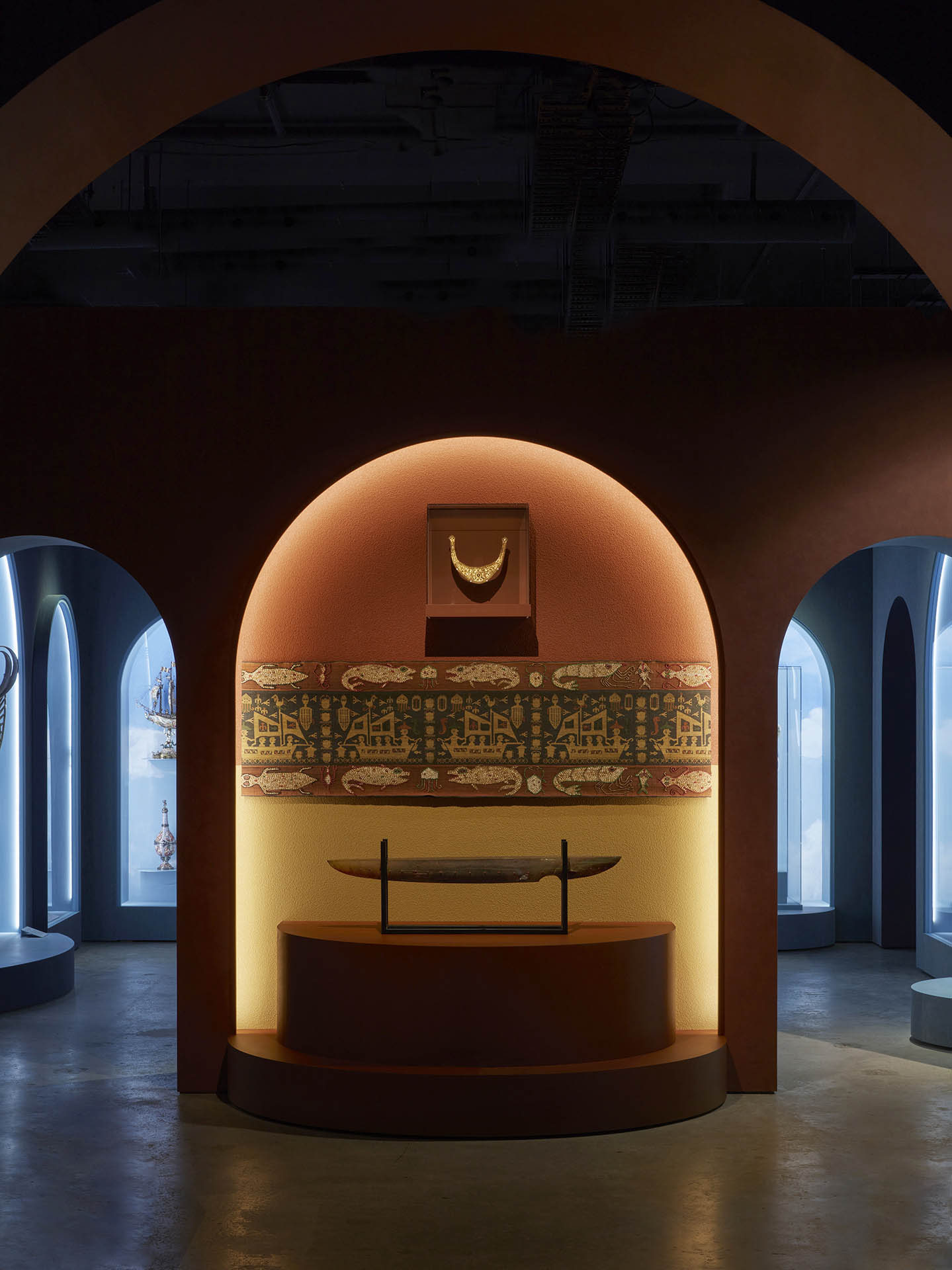
 

Installation view of the exhibition '1,001 Remarkable Objects' at Powerhouse Ultimo, Sydney showing at top, Man's ceremonial headpiece (lamba), sheet gold alloy, Sumba, Indonesia, 1880-1950; and at second top, Textile length (mens waist cloth), handwoven cotton / shells / beads, maker unknown, East Sumba, Indonesia, 2000-2004
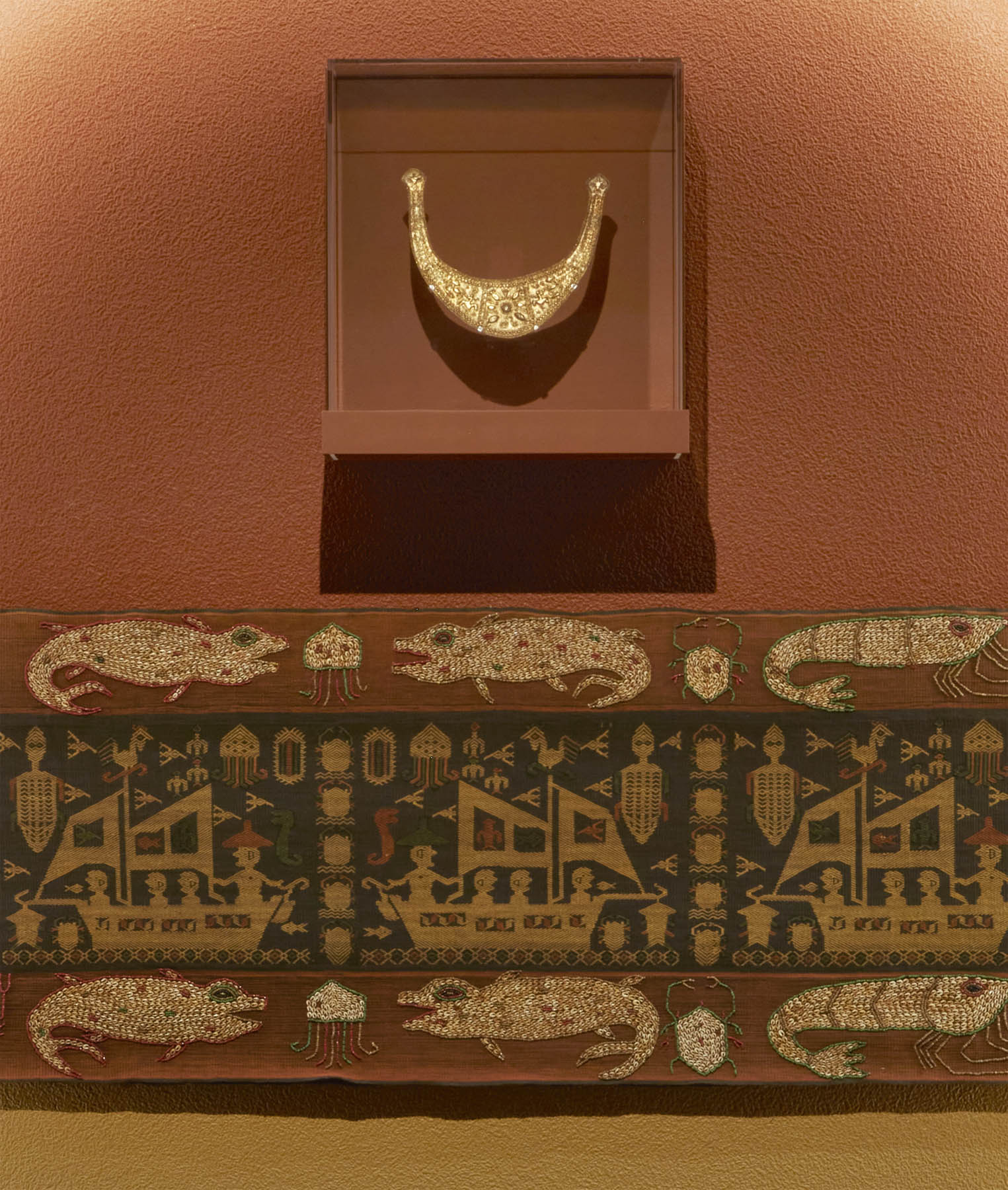
 

Installation view of the exhibition 1,001 Remarkable Objects at Powerhouse Ultimo, Sydney showing at top, Man’s ceremonial headpiece (lamba), sheet gold alloy, Sumba, Indonesia, 1880-1950; and at second top, Textile length (mens waist cloth), handwoven cotton / shells / beads, maker unknown, East Sumba, Indonesia, 2000-2004
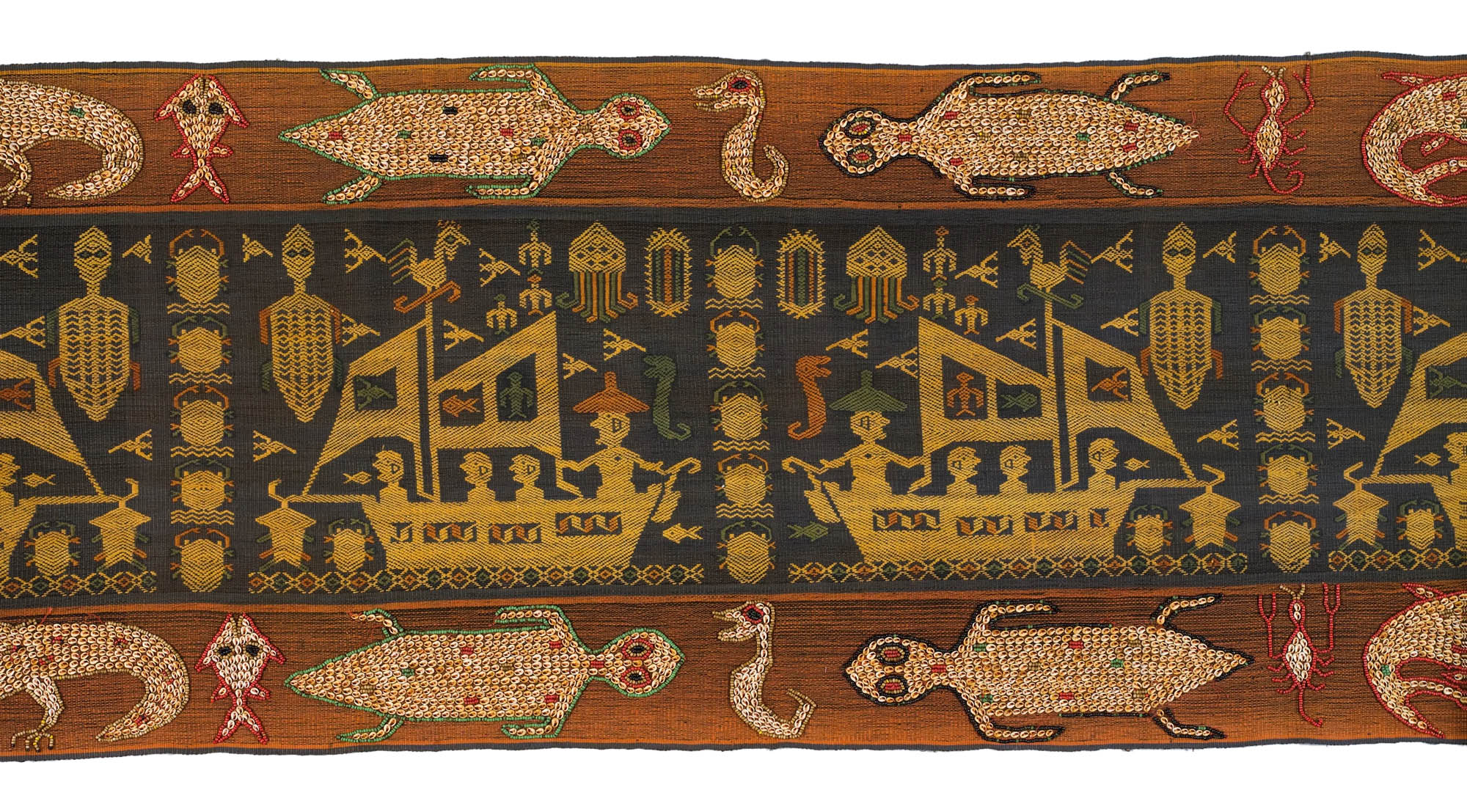
 

Installation view detail of the exhibition '1,001 Remarkable Objects' at Powerhouse Ultimo, Sydney showing at top, Man's ceremonial headpiece (lamba), sheet gold alloy, Sumba, Indonesia, 1880-1950; and at second top, Textile length (mens waist cloth), handwoven cotton / shells / beads, maker unknown, East Sumba, Indonesia, 2000-2004


Installation view detail of the exhibition 1,001 Remarkable Objects at Powerhouse Ultimo, Sydney showing at top, Man’s ceremonial headpiece (lamba), sheet gold alloy, Sumba, Indonesia, 1880-1950; and at second top, Textile length (mens waist cloth), handwoven cotton / shells / beads, maker unknown, East Sumba, Indonesia, 2000-2004


Maker unknown (East Sumba, Indonesia) 'Textile length (mens waist cloth)' 2000-2004


Maker unknown (East Sumba, Indonesia)
Textile length (mens waist cloth)
2000-2004
Handwoven cotton/shells/beads
Width: 560 mm
Powerhouse Collection
Purchased 2010


Pictorial textile from East Sumba

This exceptionally long and narrow pictorial textile was woven on the island of Sumba in Indonesia. While the textile exemplifies the renowned skills of the Sumbanese women weavers, its design is highly innovative and a distinct departure from tradition. Innovation in textile design was not new to the Sumbanese weavers who certainly embodied strong traditions but who, under Dutch colonial rule, were encouraged to produce textiles specially designed to appeal to the Dutch market.

This long textile was probably produced for the tourist trade and reflects innovative approaches to design and production in several respects.

Supplementary warp patterning, known as pahikung on Sumba, has been used in the central decorative band for the full five metre length of the textile. In accomplishing such an extended length of pahikung, the weaver has produced a masterpiece of intricate and evenly tensioned weaving. This exacting technique was generally used for the short and highly decorative bands around a woman’s tube skirt or sarong whereas here it has been combined with the traditional five metre long men’s waist wraps called rohobanggi. However rohobanggi, which had a ritual function, were always woven with a simple design of stripes and had no additional ornament.

The most dominant motif in the textile, which is repeated in pahikung down the middle of the cloth, is a sailing boat with one person wearing a large hat at the tiller and three passengers. Boat motifs are not part of the traditional iconography of Sumbanese art; they are common in Sumatra however, where ‘ship cloths’ appear in several well-known forms. The ship imagery must have been brought to Sumba in some form, probably from Sumatra, for incorporation into the weavers’ design repertoire. Forming a wide border down each side of the cloth, are motifs traditional to Sumba which depict water creatures such as crocodiles, turtles and crayfish and have been worked in beads and small shells. Traditionally, shell decoration was also restricted to women’s tube skirts or sarongs.

Sumbanese textiles have changed significantly through interaction with the Dutch and other global markets, especially during the last decades during which tourism has grown exponentially in Indonesia. As exemplified in this remarkable example, textiles in Sumba today combine ancient ancestral symbols with contemporary images drawn from other sources. Their designers can pick and choose from a wealth of possibilities while still maintaining non-negotiable traditional design forms, weaving techniques and iconography.

Text from the Powerhouse Collection website
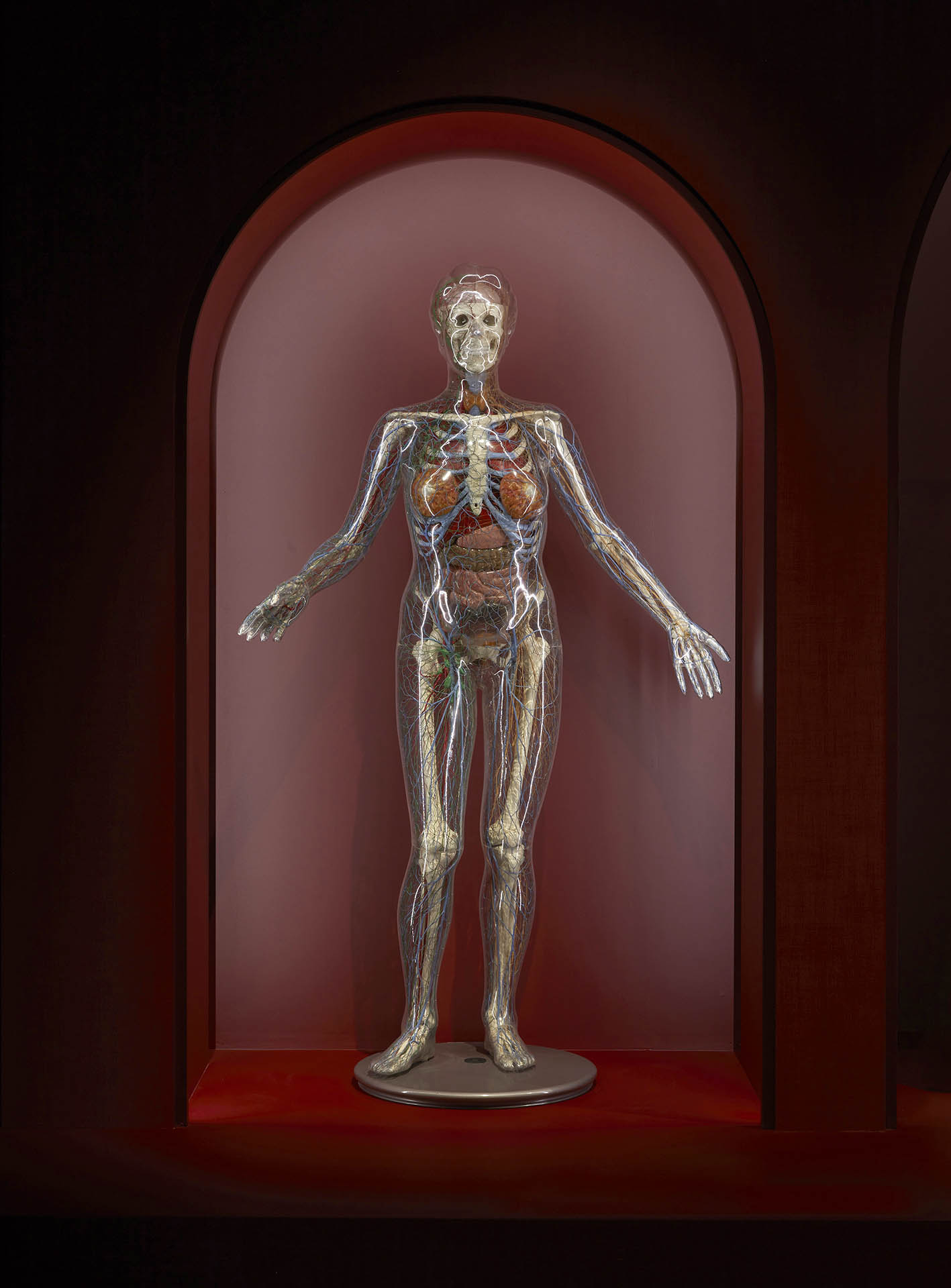
 

Installation view of the exhibition '1,001 Remarkable Objects' at Powerhouse Ultimo, Sydney showing The Transparent Woman (1950-1953)


Installation view of the exhibition 1,001 Remarkable Objects at Powerhouse Ultimo, Sydney showing The Transparent Woman (1950-1953, below)
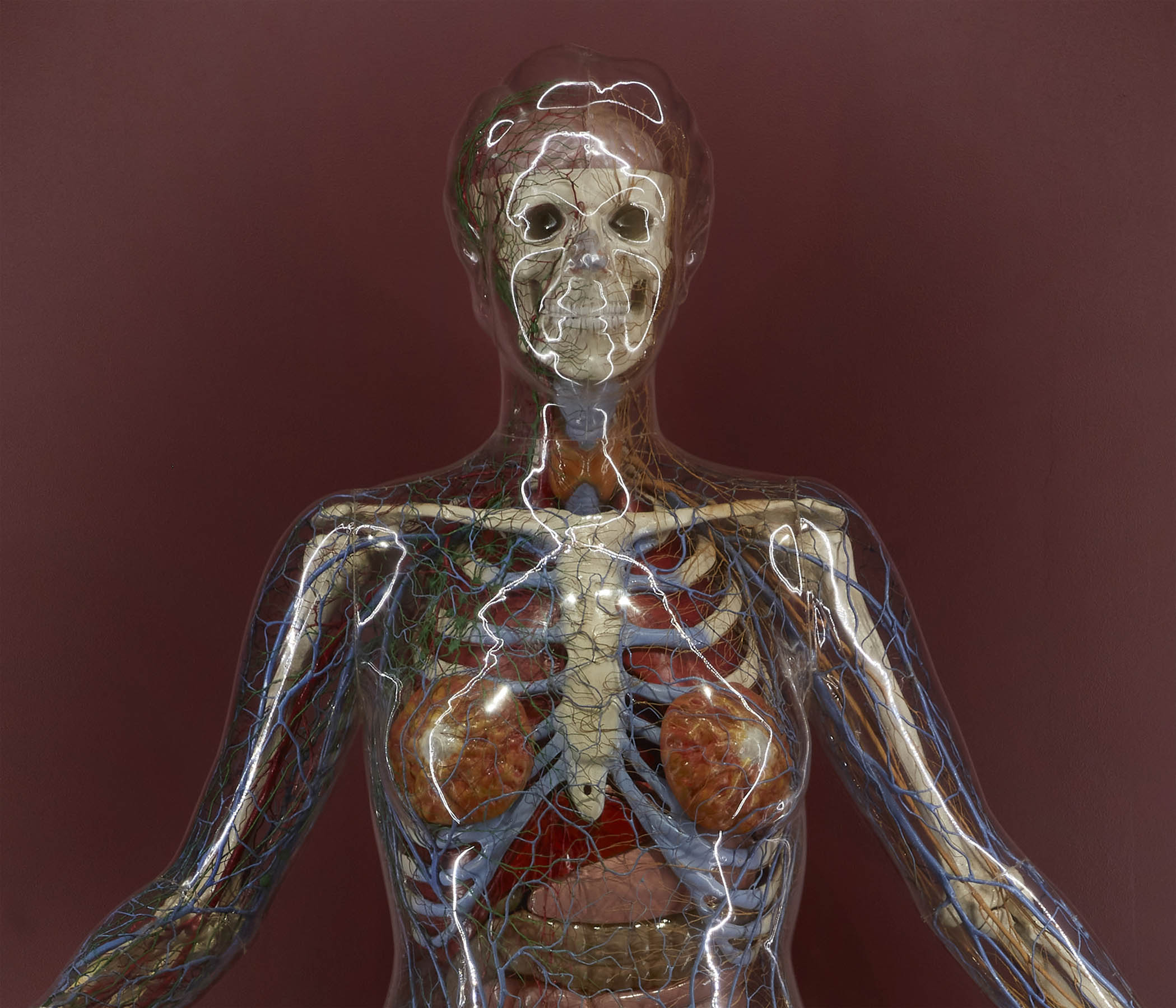
 

Installation view detail of the exhibition '1,001 Remarkable Objects' at Powerhouse Ultimo, Sydney showing a detail of The Transparent Woman (1950-1953)


Installation view detail of the exhibition 1,001 Remarkable Objects at Powerhouse Ultimo, Sydney showing a detail of The Transparent Woman (1950-1953, below)
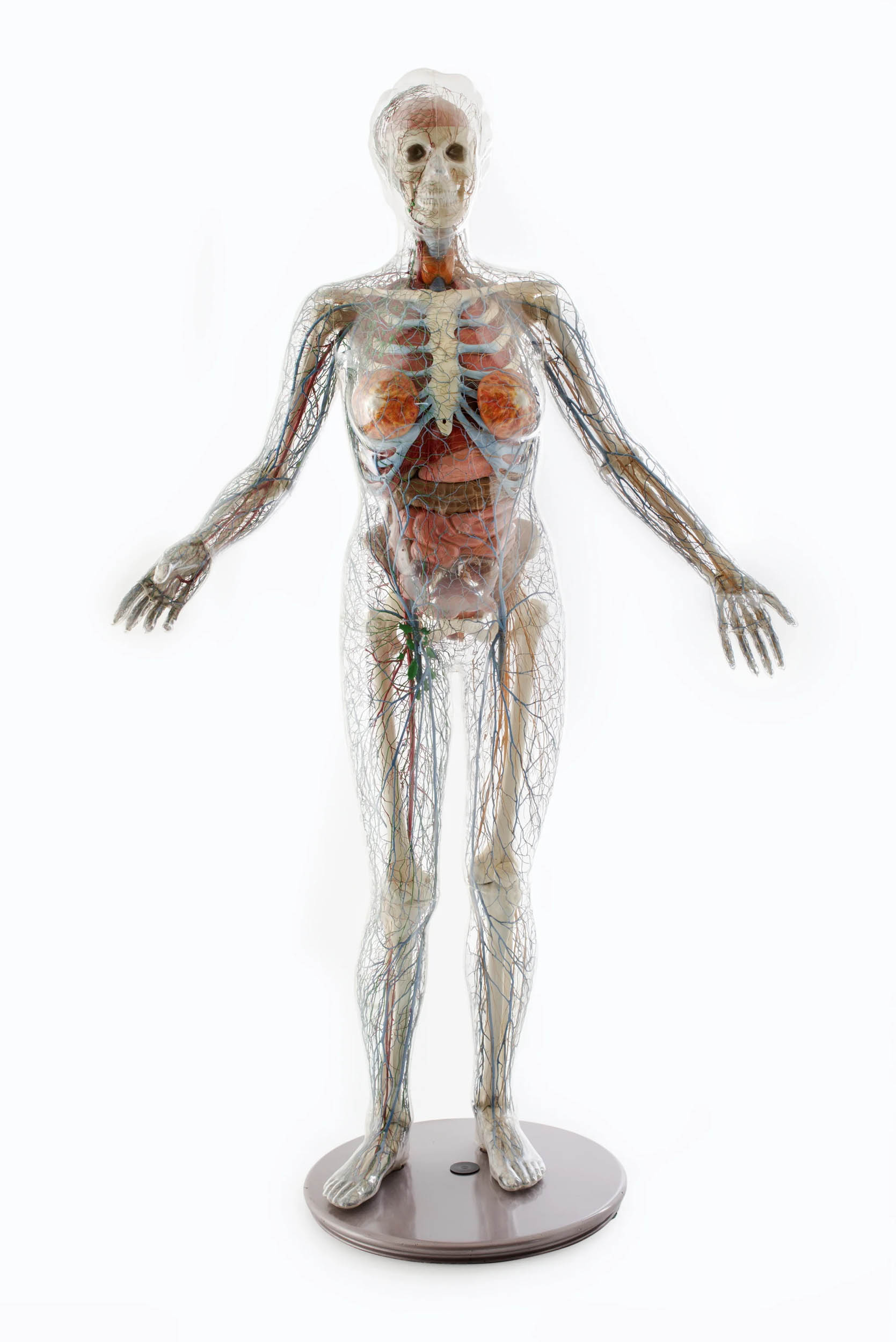
 

The German Health Museum (Cologne, Germany) 'Anatomical model, full size, 'The Transparent Woman'' 1950-1953


The German Health Museum (Cologne, Germany)
Anatomical model, full size, ‘The Transparent Woman’
1950-1953
Used by Museum of Applied Arts and Sciences, Sydney, New South Wales, Australia, 1954-2007
Perspex/aluminium/metal/wood/plastic
Height: 1740 mm
Width: 1060 mm
Powerhouse Collection
Purchased 1958


The Transparent Woman

This the first transparent anatomical model of a woman ever to be exhibited in Australia.

In 1939 the director of the Museum, Arthur Penfold, embarked on an international study tour visiting many different museums and galleries overseas. He visited museums in both Chicago and New York and became captivated by their displays of transparent human models and their promotion of healthy living and sanitary practices. Due to lack of funding, the Transparent Woman was not acquired by the Museum until 1954. She was the first electronic scientific anatomical model to be displayed in Australia and was acquired to further the Museum’s mission to shape model citizens.

People have historically been curious about seeing what is inside objects, especially the human body. In the nineteenth century members of the public were able to witness dissections on cadavers; however the sights, and smells must have been overwhelming at times. The technology then became available to preserve human organs and make them semi-transparent by passing light through them. People were able to see what was inside the body without the blood and guts of dissections. Papier mache and wax models were used and, with advancements in plastics technology, clear and flexible plastic became available for model making.

These models were a German innovation, originating in the early 1930s at the Museum of Hygiene in Dresden. They served as a teaching aid for students of anatomy, and promoted a message of health and sanitation to the general public. The models were based on ‘perfect forms’, of young men and women, and symbolised the healthy body that people should strive to achieve. Germany was undergoing rapid industrialisation; thus prompted rapid urban growth accompanied by inadequate sanitation. The German Government promoted the use of these models as a way of educating and preserving a healthy working class. In the early 1950s the Health Museum in Cologne, West Germany, was established and began producing the transparent models and exporting them to America and other countries.

In the late 1930s some thought that the transparent models were symbols of Nazi ideal racial ideology, most who saw them were transfixed by the eugenic ideal of a healthy body. The Powerhouse Museum’s Transparent Woman arrived in 1954 to advocate a message of individual responsibility to maintain a healthy body.

It is hard to imagine being shocked or offended by this model, but the Transparent Woman must have been something of a spectacle in the 1950s. On importation it is recorded that one customs official was so offended by the nature of the exhibit that she almost never made it into the country. To cover some of the huge cost involved in obtaining the model, she was put on displayed in the State Theatre and the public were charged 2 shillings per adult and 9 pence per child to see her. The viewing sessions were segregated by gender and a trained nurse was on standby to assist if anyone was overcome by the experience. To add to the sensationalism she was marketed using images depicting a dark and shadowy ‘sex siren’ type of woman.

After several months at the State Theatre, the Transparent Woman was moved to the Museum where she continued efforts to promote health and hygiene. The accompanying souvenir booklet proclaimed, “The transparent woman will help us to understand the mysteries of our body, nature’s crowning masterpiece. The transparent woman tells us how our body is made and how it works [she] provides us with the means towards greater understanding of ourselves – so necessary to our wellbeing and healthy living, it is the responsibility of the individual to keep his body healthy so that he may live a useful and a successful life.”.

She later assisted in the Museum’s first attempts to discuss the subject of sex. During the 1970s and 1980s the museum utilised the Transparent Woman to provide human anatomy lessons for school groups. Children were allowed to ask questions and teachers were assured that the museum’s education officers would “endeavour to answer each question openly and as scientifically as possible if the subject of reproduction was raised”. The model was a significant public education tool and, as her accompanying booklet declares, “has helped lift the veil of mystery from womanhood”.

The Transparent Woman has a long history of service to Museum. Starting life as a controversial sensation, she then became the iconic symbol of the Museum’s hygienic crusade. In the past 50 years she has been used to demonstrate how the nervous system works, for sex education, and to demonstrate the areas of the body where contraceptive activities take place. The Powerhouse Museum has a collection of over 380,000 objects, only a small amount of which are on display at any one time, yet the Transparent Woman has spent little of her working life in storage.

References:
Correspondence. A. R. Penfold to F.R. Morrison, 27th Oct 1952, museum records.
The Transparent Woman [souvenir booklet]. Sydney, 1954.
Internal Correspondence. A.R. Penfolds overseas trip, 1939, museum records.
Internal Correspondence. Memorandum to the Secretary: Department of Technical Education, Sydney, From A. R. Penfold, Museum Director, 22nd November, 1954, museum records.
Terence Measham, Discovering the Powerhouse Museum, Powerhouse Publishing, Sydney, 1997, pp. 139-147.
Klaus Vogel. Manifesting Medicines, Bodies and Machines: The transparent man- some comments on the history of a symbol, Harwood Academic Publishers, Netherlands, 1999.
Graeme Davidson and Kimberley Webber. Yesterday’s Tomorrows: The Powerhouse Museum and its Precursors 1880-2005. Powerhouse Publishing, Sydney, 2005, pp. 68-81.
The Museum of Applied Arts and Sciences Annual Report, 1954, museum records.

Written by Erika Dicker
Assistant Curator, October 2007


A life-size anatomical model of a woman with transparent plastic casing revealing her internal construction. The skeleton is cast aluminium painted white. The arterial and venous systems are represented by red and blue coloured plastic tubing. The nervous and lymphatic systems are represented by brown and green coloured plastic tubing.

The body organs and brain are made from pink, orange, brown and yellow plastics. The plastic organs consist of the brain, larynx, thyroid gland, lungs, heart, liver, gall bladder, spleen, pancreas, stomach, small intestine, caecum, transverse intestine, large intestine, rectum, kidneys, bladder, ovaries, womb and breasts. The organs and brain are fitted with small pilot lights that are controlled from the console to illuminate during different parts of a pre-recorded presentation.

The figure is standing on a turntable, is raised on a two tier platform, which contains rotating mechanisms and loud speakers. The wooden console contains an automatic operating tape recorder and relay switches to operate lighting of organs and rotation of figure.

Text from the Powerhouse Collection website
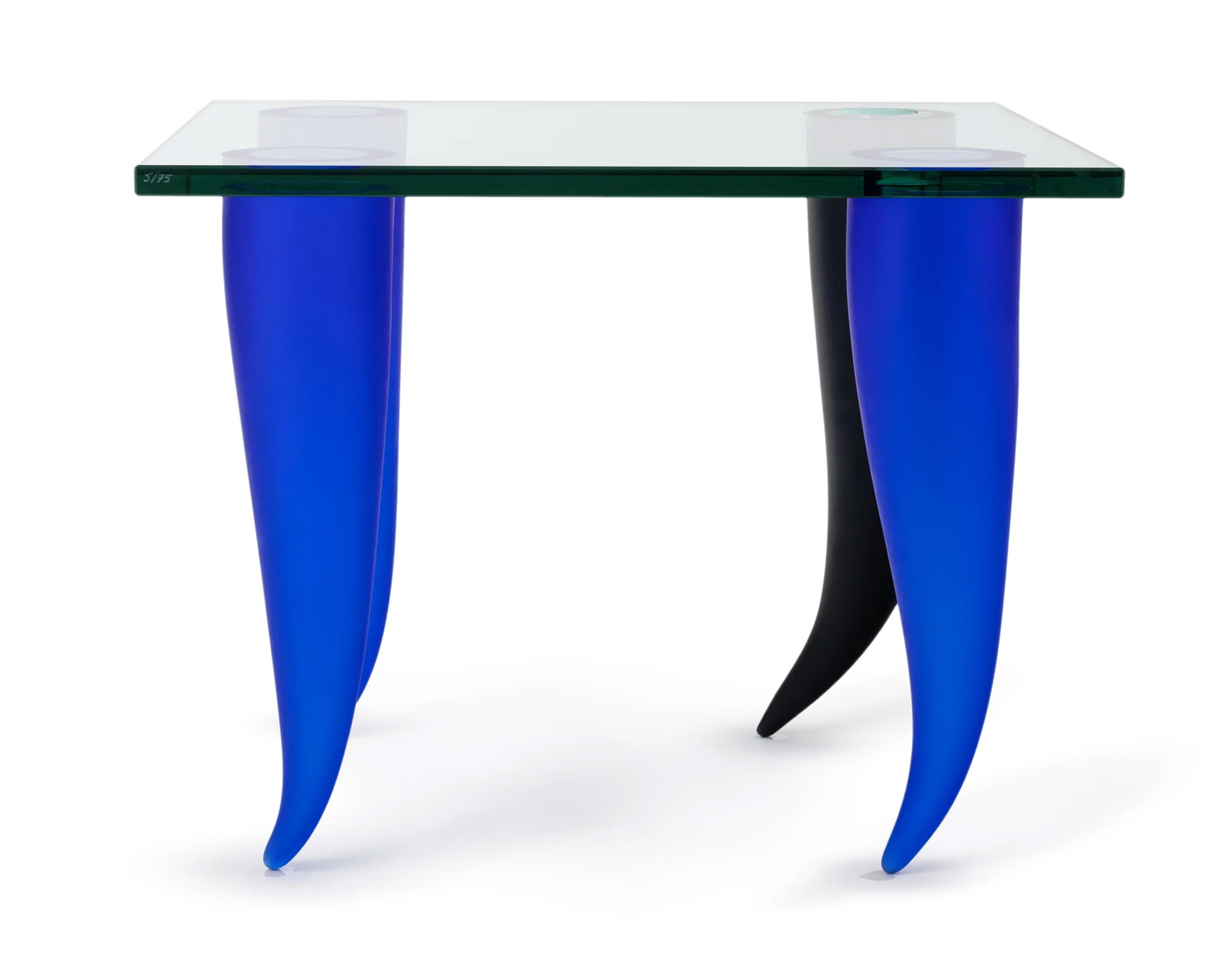
 

Philippe Starck (designer) (French, b. 1949) Daum Crystal (manufacturer, Nancy, France) Table vase, 'Quatre Etrangetes sous un mur' (Four curiosities below a wall) 1988


Philippe Starck (designer) (French, b. 1949)
Daum Crystal (manufacturer, Nancy, France)
Table vase, ‘Quatre Etrangetes sous un mur’ (Four curiosities below a wall)
1988
Glass
Height: 490 mm
Width: 600 mm
Depth: 500 mm
Powerhouse Collection
Purchased 1996
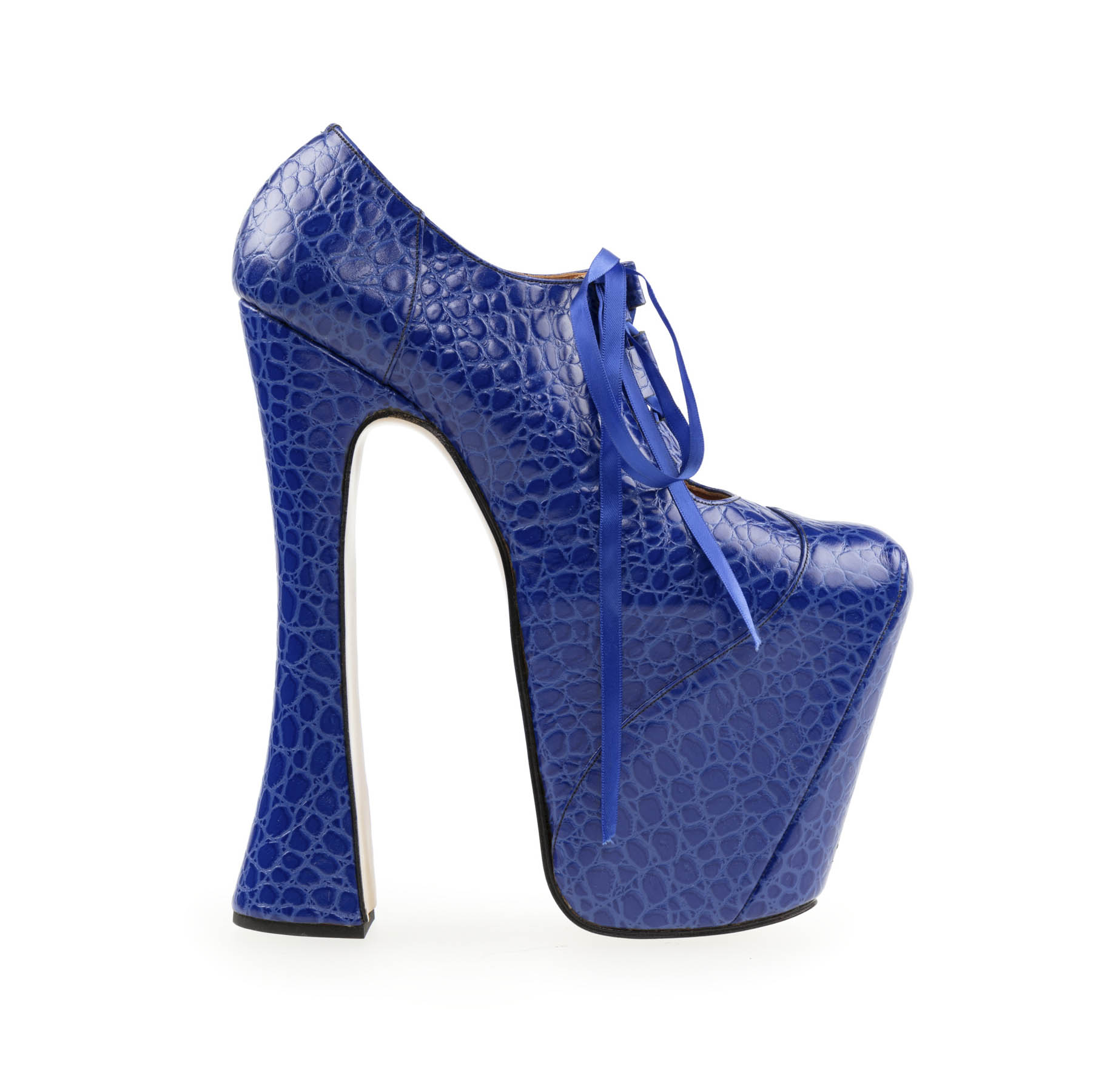
 

Vivienne Westwood (designer, London, England) (English, 1941-2022) 'Shoes (pair), 'Super Elevated Gillie', 'Anglomania' collection, Autumn / Winter 1993-1994' 1993 Shoes (pair), 'Super Elevated Gillie'


Vivienne Westwood (designer, London, England) (English, 1941-2022)
Shoes (pair), ‘Super Elevated Gillie’, ‘Anglomania’ collection, Autumn / Winter 1993-1994
1993
Leather/cork/silk
Height: 270 mm
Width: 68 mm
Powerhouse Collection
Purchased 1997


Powerhouse today unveiled 1001 Remarkable Objects, a major new exhibition led by Leo Schofield AM.

‘Our vision for 1001 Remarkable Objects was a seemingly simple one: to create an exhibition celebrating the sheer scale, breadth and relevance of the Powerhouse Collection. But how to choose? We rejected the nomenclature of ‘treasures’ or ‘masterpieces’ and instead determined all choices must be in some way ‘remarkable’ – whether by virtue of rarity, visual appeal, social history or an ability to invoke wonder. The result is a cornucopia of eras, styles, form, function, size and colour, to stoke memories that so many have of this iconic institution and signal the beginning of a new phase in its marvellous existence’, said Curatorium Chair Leo Schofield AM.

Leo Schofield AM has a long association with Powerhouse, as a former member of the Board of Trustees and a significant donor. He has worked in collaboration with advisors Ronan Sulich, Mark Sutcliffe and Powerhouse curator Eva Czernis-Ryl to select 1001 objects from the more than half a million objects within the collection. This selection includes objects that have never been exhibited before alongside much loved collection icons.

The Powerhouse Collection will be presented across the applied arts and applied sciences including the decorative arts, jewellery, costume, textiles, furniture, clocks, musical instruments, industrial design and social history.

Exhibition designers Pip Runciman, Julie Lynch and Ross Wallace were invited to respond to underlying themes of nature, power, movement and joy. They have created an exhibition that features more than 25 rooms, presenting an unexpected juxtaposition of objects and leads visitors on a journey across time and memory.

Extraordinary objects include a rare Meissen porcelain satirical portrait bust of the court jester known as Baron Schmiedel, made in 1739; the only surviving fragment of the Lockheed Altair aircraft Lady Southern Cross flown by pioneer aviator Sir Charles Kingsford Smith for his final flight in 1935; an Edo period samurai warrior’s suit of armour; and a Detroit Electric car manufactured in 1917.

Musical instruments include a double bass made in 1856 by John Devereux, one of the oldest surviving bowed string instruments made in Australia by a professional instrument maker; an acoustic guitar decorated with hand painted designs by Harold ‘The Kangaroo’ Thornton; and an upright bookcase grand piano, made in 1809.

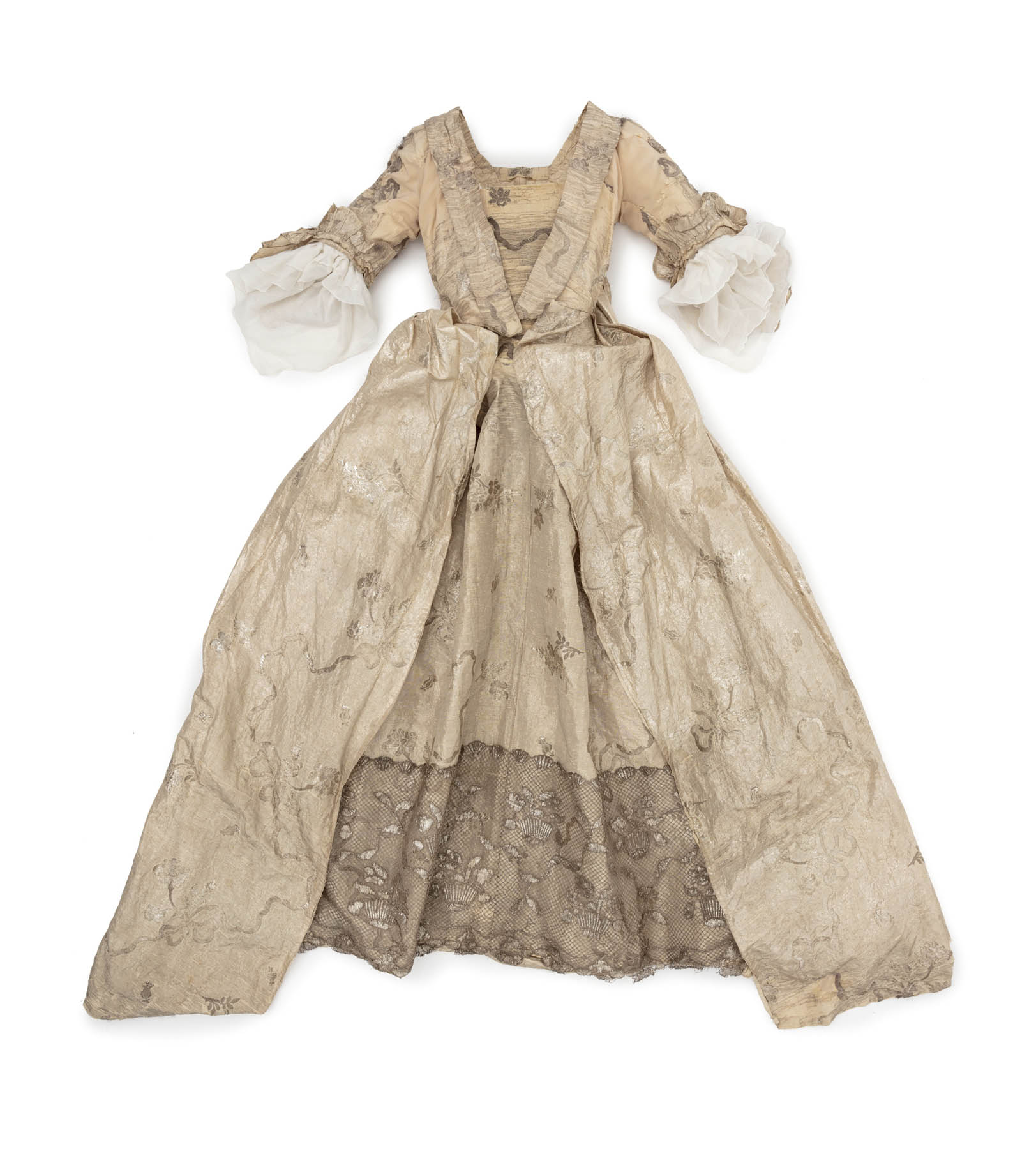
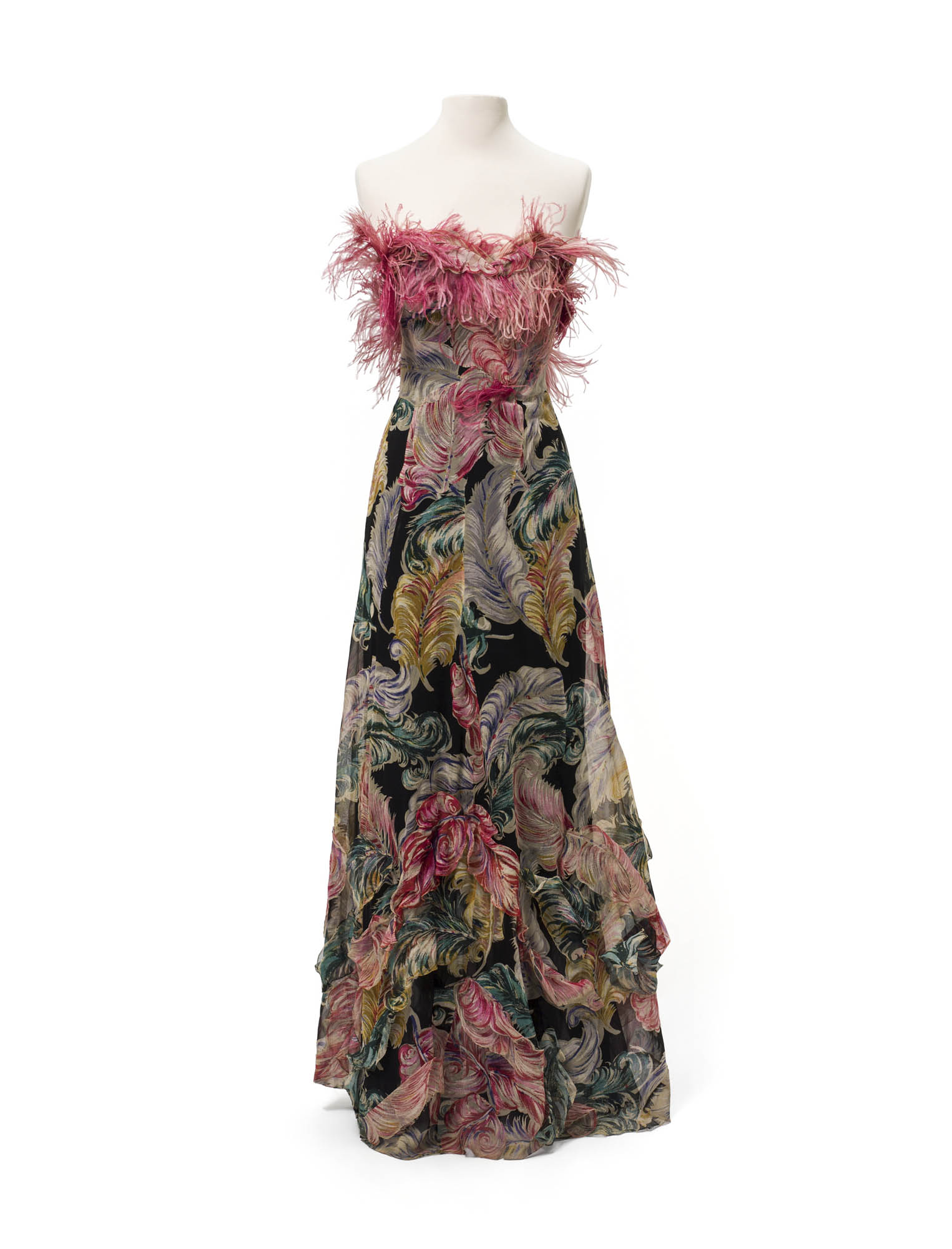
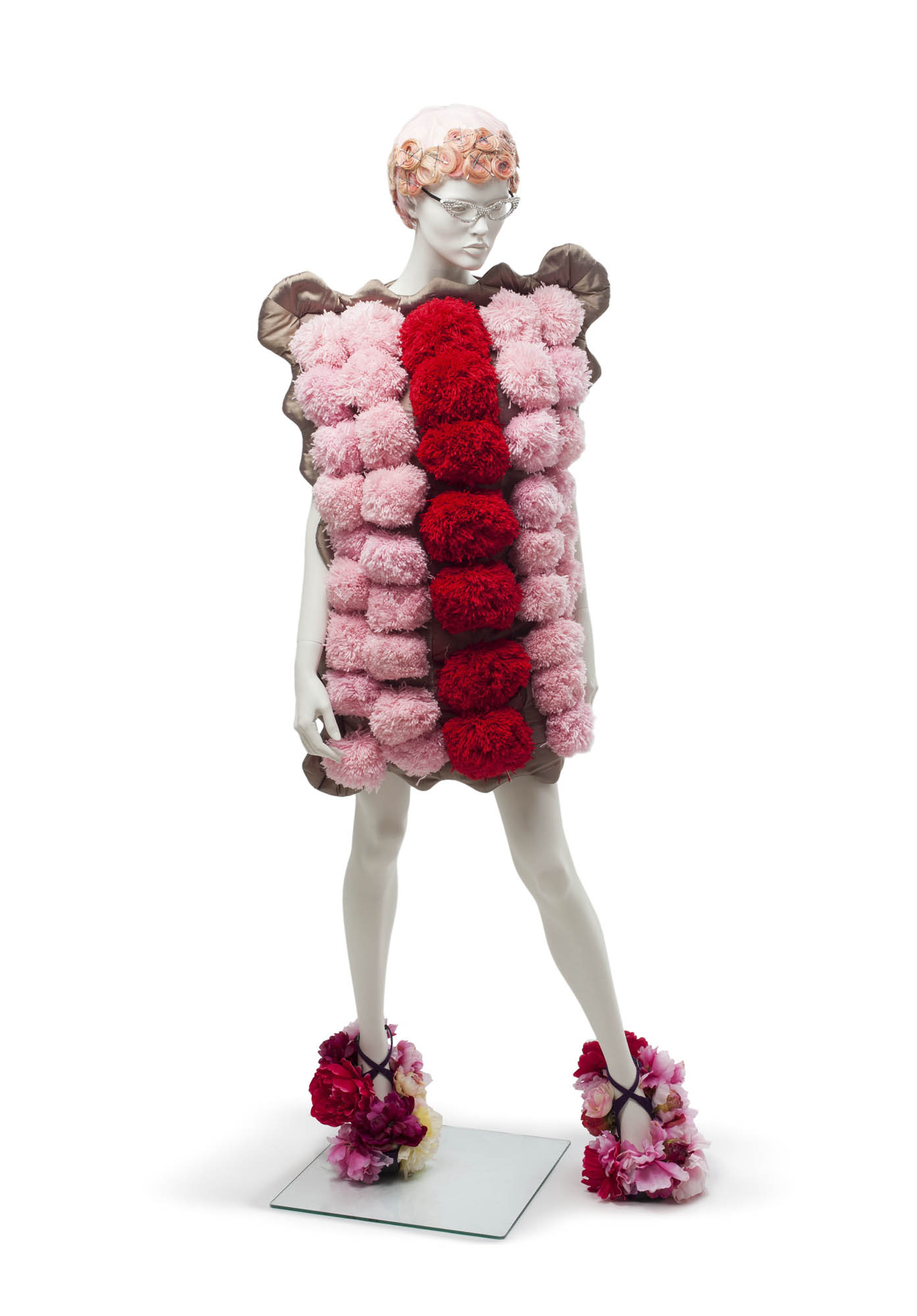
Fashion highlights include a 1700s court dress; an evening dress by Gabrielle ‘Coco’ Chanel for her Spring collection of 1939; a pair of Super Elevated Gillie platform shoes by British designer Vivienne Westwood from Anglomania, her Autumn/Winter collection 1993-1994; and Romance Was Born’s 2009 ‘Iced VoVo’ dress.

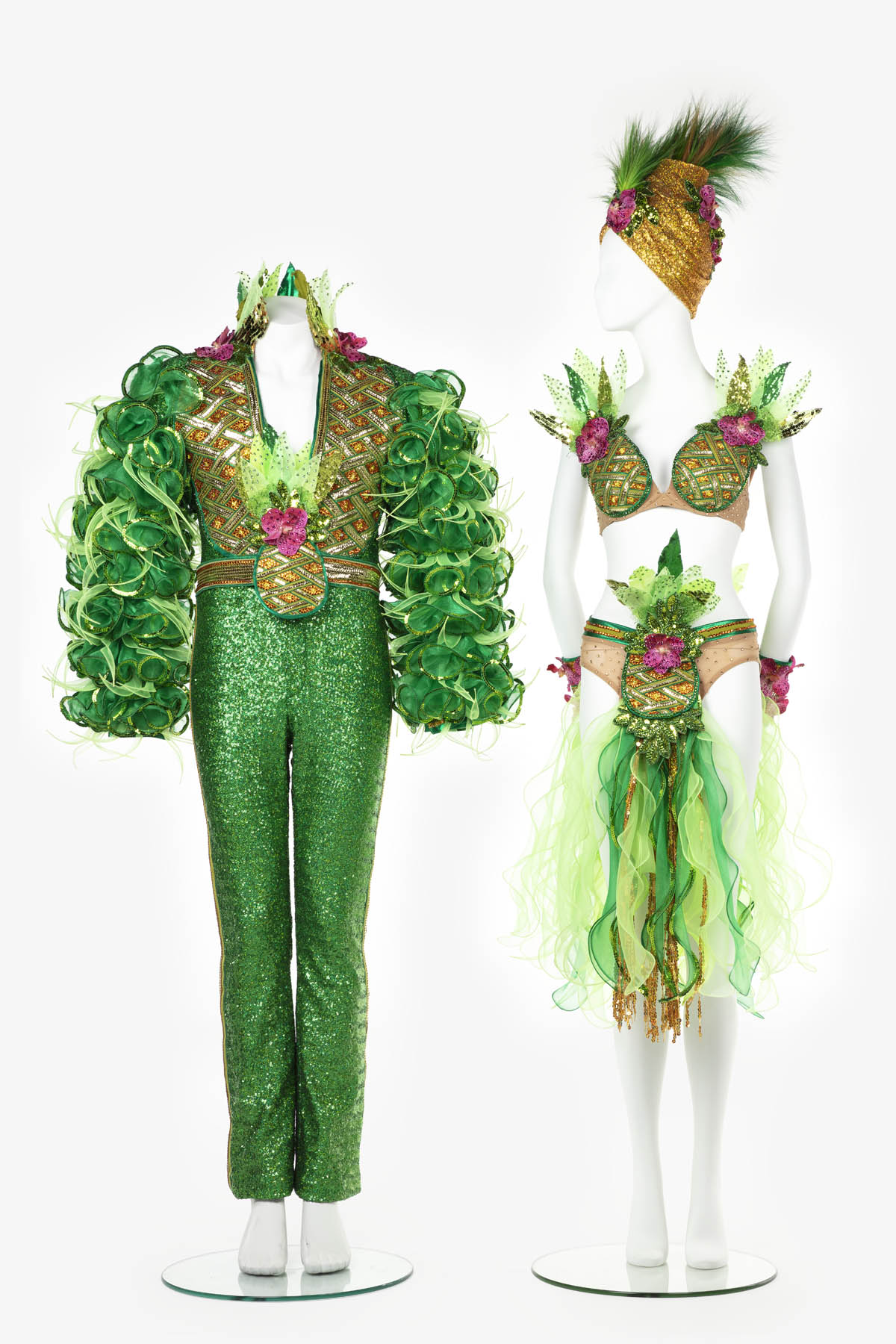
Costumes include the ‘Showgirl’ costume worn by Kylie Minogue for the Closing Ceremony of the Sydney 2000 Olympic Games; the ‘Pink Diamonds’ dress worn by Nicole Kidman in the Baz Luhrmann film, Moulin Rouge and the ‘Fruity Mambo’ costumes designed by Catherine Martin for Strictly Ballroom the Musical.

More than 100 rare and remarkable pieces of jewellery will highlight a recent major donation by Anne Schofield AM. This includes Egyptian revival designs from the 1800s and mourning jewellery crafted from human hair, which will be on display at Powerhouse for the first time.

French and Venetian glass from the 1800-1900s will be presented, as will an English stained-glass window, ‘The Delphic Sibyl’, based on an 1873 painting by Sir Edward Coley Burne-Jones made by Morris & Co about 1900, alongside key examples of Australian and international studio glass ranging from Dale Chihuly to Canberra-based artist Jennifer Kemarre Martiniello and Sydney-based artist Brian Hirst.

‘Leo Schofield and his collaborators, through this exhibition, shed new light and new perspectives on the Powerhouse Collection. In 1001 Remarkable Objects we continue to extend our commitment to sharing with our communities the Powerhouse Collection and the many insights and connections it makes to both our past and our future’, said Powerhouse Chief Executive Lisa Havilah.

Powerhouse will present two special Powerhouse Late programs presented in collaboration with Liquid Architecture. The first program on 5 October is an exploration of the unusual and remarkable sonics in response to the exhibition with creative practitioners who evoke a range of moods through their work. On 23 November, a range of artists will take inspiration from the designers who have created unique worlds for these objects in conjunction with a celebration to launch companion publication 1001.

Press release from the Powerhouse


J Hubert Newman (photographer, Sydney, New South Wales, Australia) (Australian, c. 1835-1916) 'Untitled [young boy in sailor suit]' Nd


J Hubert Newman (photographer, Sydney, New South Wales, Australia) (Australian, c. 1835-1916)
Untitled [young boy in sailor suit]
Nd
Carte de visite
Paper/card
Height: 165 mm
Width: 107 mm
Powerhouse Collection
Acquired September 1984
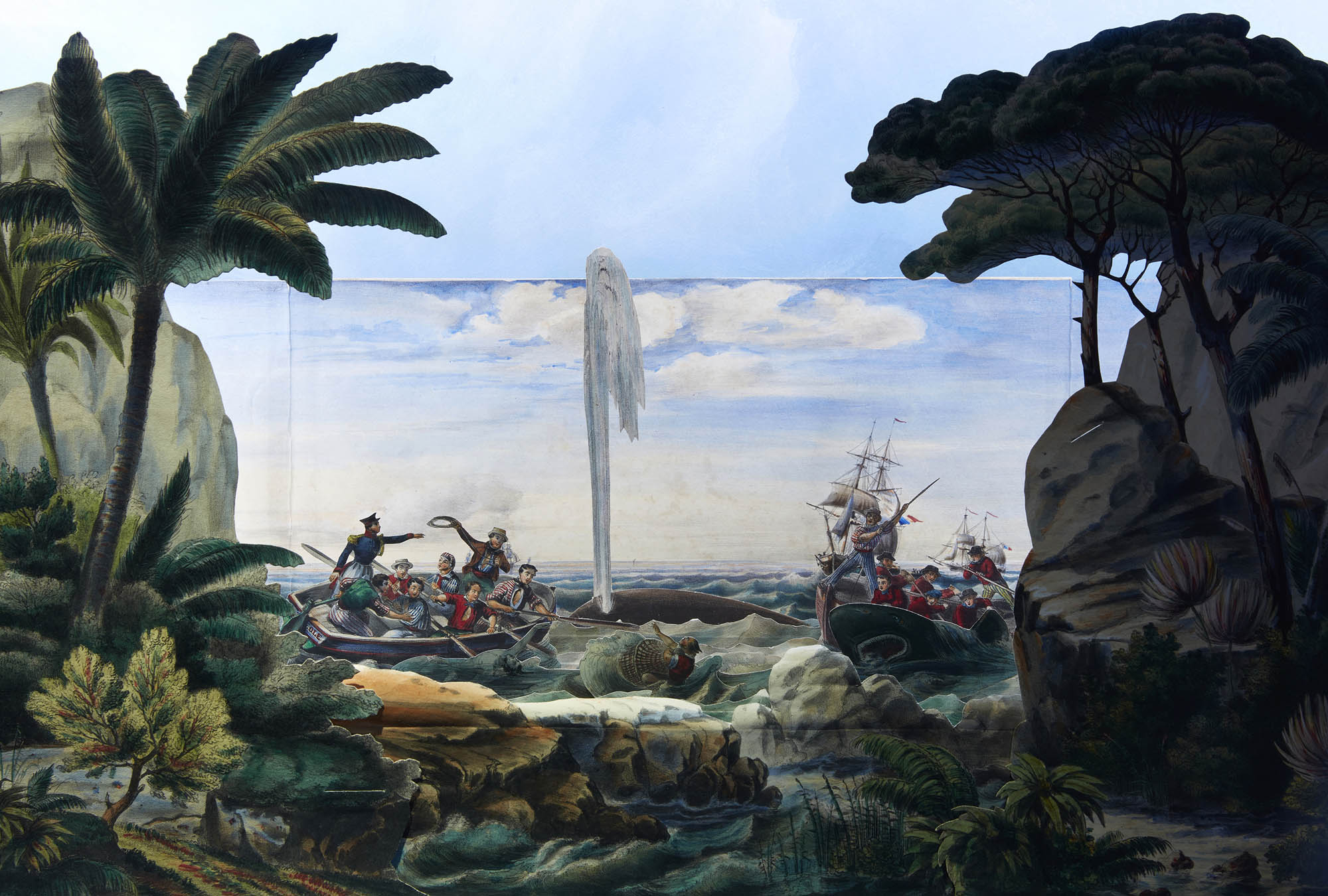
 

Charles Letaille (designer) J Pintard (publisher, Rue Saint-Jacques, Paris, France) 'Toy theatre, 'La Pleine Mer, Scenes Maritimes en Action'' 1836


Charles Letaille (designer)
J Pintard (publisher, Rue Saint-Jacques, Paris, France)
Toy theatre, ‘La Pleine Mer, Scenes Maritimes en Action’
1836
Paper/cardboard/textile/metal/timber
Height: 320 mm
Width: 704 mm
Depth: 85 mm
Powerhouse Collection
Purchased with funds donated by the Patrons of the Powerhouse, 1985


Children’s toy theatre, ‘La Pleine Mer’ (The Open Sea) by Charles Lataille

This extremely rare, hand-coloured, French children’s toy theatre ‘La Pleine Mer, Scenes Maritimes en Action’ (‘The Open Sea, Maritime Scenes in Action’) dates from 1836. The theatre comprises an ocean backdrop, a middle ground of waves and foreground of a South Pacific island reef. Numerous cardboard pieces of French ships, long boats, a drowning sailor and a shark attack can be slid in and out of the scene. By means of a booklet of seven short melodramatic plays (in French), to be read aloud by an adult or teacher, the drama and excitement of maritime adventures in the exotic South Pacific can be performed. The plays cover accounts of Australian aborigines fishing and building canoes, visits by French wayfarers to the Solomon Islands and Tahiti, and Maoris in New Zealand.

Many children’s theatres were made in the early 19th century with their popularity peaking between 1830 and 1860 when adult theatre was enjoying an unprecedented success with melodramas, masques and pantomimes. English toy theatres were the most complex often with a proscenium, stage, trap-doors, machinery for working curtains and trick effects, supports for scenery and a multitude of characters. However, Continental publishers produced simplified versions, although what they lacked in technical complexity was made up in settings and characters. French theatres, such as this one produced by J. Pintard in Paris, were noted for their beautiful hand-colouring.

Toys of the mid to late 19th century were designed to be educational rather than for play. The toy theatre, ‘La Pleine Mer’, would have instructed children in aspects of navigation, maritime life, exploration, geography and the people of the Pacific. The theatre features an unusual and appealing use of maritime pictorial material which is drawn heavily from books, paintings and journals of discovery of the day. It illustrates a popular representation of Australia and the South Pacific at the time. The theatre is one of the earliest graphic representations of Australia and the South Seas in the Museum’s collection. Furthermore, whereas the books, journals and paintings of this period survive in state, national and international libraries and art galleries virtually no toys depicting content related to Australia and the South Pacific in the 1830s are extant worldwide.

Margaret Simpson
Curator, Transport & Toys
August 2011

Mitchell, Louise, ‘La Pleine Mer Sailing over a cardboard sea’, in The Australian Antique Collector, 36th edition, 1988. pp. 37-41.

Publication of La Pleine Mer noted in Bibliographie de la France, 10 December 1836, p. 597, entry No. 6239.


Toy theatre comprising 27 printed and hand-coloured lithographic cardboard pieces, in a South Pacific setting. When assembled the theatre comprises a painted backdrop with two ships under sail flying French colours, a longboat pulling away, more ships in the background and a blue sky with clouds. Between this and the proscenium are five ranks of waves (two of which have wooden runners to support the moving pieces).

The foreground features lush tropical vegetation and a reef battered by breakers. It is in three parts with a base showing the shore and large pieces which are installed at the left and right composed of trees and rocks. There are seven separate lithograph boats, one for each of the plays, with a further six separate pieces to be added in where instructed in the script. The scenes are either fixed into slots in the foreground or locked into a balance placed on wooden runners obscured by the middle waves.

The script comprises a 32-page booklet designed to be read aloud by an adult or older child while the different scenes are activated. The plays depict customs of the Solomon Islands, Natives of New Guinea and Tahiti, whaling activity in the South Pacific and landing in New Zealand.

According to the ‘Bibliographie de la France’, this toy theatre was produced by J. Pintard on 10 December 1836. Pintard’s other toy theatres had titles including ‘Le Theatre Enfantin’, ‘Le Spectacle Asiatique’, ‘Ou Danse et Voltige sur La Corde’ and ‘La Voiere’.

In keeping with most toymakers of the period, Pintard produced a variety of toys and related material aimed at educating children in art, geography, scripture, history and natural history. Advertising his stock at the conclusion of the ‘La Pleine Mer’ script, he claimed “L’enseignement de la moral la plus pure forme la base de tous ces petits ouvrages instructifs” (“The moral teaching in its purest form is the basis of all these little educational works”).

This toy theatre, ‘La Pleine Mer’, includes seven plays written by Charles Letaille, who also produced the lithography. Letaille collaborated with his publisher to produce other children’s material during the 1830s and 1840s. The first play is entitled ‘The Sea, The Birth of Navigation’ and describes the simple craft of the natives of New Holland (Australia) and concludes with an account of the carved and outrigger canoes of New Guinea and Tahiti.

In the more dramatic second play, ‘The Whale’, native canoes are replaced with a spouting whale and a long boat from the whaling ship ‘Albatross’. The narrative begins in a bay of the Chilean coast and concludes with a whale-hunting drama. The play instructs children about the uses of whale products, (whale rib bones for umbrellas and whale fat boiled on board in large vats for oil) and includes a gruesome description of the sailors climbing over the carcass of the whale while tied to the side of the ship to remove the ribs, skin and fat.

The third and fourth plays, entitled ‘Man Overboard’ and ‘The Rescue’, describe an unlucky sailor falling overboard from the ship and being thrown a woven cane life preserver. In the meantime the ship is brought into the wind and the long boat launched for the sailor’s rescue.

The next play ‘The Shark’ begins with the deceptively calm description: “We are aboard the American three-master ‘Oceanic’ the sea breeze was barely enough to cause the waves to break on the nearby beach”. The pace picks up quickly with nail biting anticipation as it is revealed the ship’s master is repeatedly diving from the ship and hauling himself up on a rope to cool off from the heat while a short distance away a shark’s fin creates a “frothing shimmering wake”. Climbing into a small boat, the sailors go to his rescue. Gripped with fear they ‘could all foresee the struggle that was about to take place between themselves and the shark; a terrible struggle with a man as the contest’.

In the final play, ‘Putting in at New Zealand’, native figures are slotted into the foreground and a longboat is set into the waves. The play relates the meeting between French sailors and friendly Maoris. After an exchange of branches, the natives return with the sailors in their canoes and a priestess is invited on board ship. Attempts to rub noses with the ship’s steward end in chaos when he makes a sudden movement dislodging his wig and frightening the priestess into believing that he is a sorcerer.

According to Louise Mitchell in her article ‘La Pleine Mer Sailing over a cardboard sea’ many of the original details in the lithographs seen in this toy theatre can be traced to paintings, books and journals of the period. For example, the lithograph depicting New Holland natives tumbling from their capsized canoe while spearing fish, can be traced to an illustration by the Scottish engraver and miniaturist, John Heaviside Clark (c. 1777-1863). Clark had never seen Australian aborigines but adhered to the popular European imagery of them as being noble and savage sportsmen. The illustration appeared in a book published in London in 1813 with the title ‘Field sports & of the Native Inhabitants of New South Wales’, reprinted a year later as a supplement to ‘Foreign Field Sports, Fisheries, Sporting Anecdotes, etc’.

Several of the script’s plays can be traced to a journal entitled ‘La France Maritime’. The shark attack lithograph was derived from an American romantic horror-painting of 1778 by John Singleton Copley (1738-1815) ‘Watson and the Shark’. In the toy theatre play the man overboard facing a shark’s jaws of death is pulled to safety. Ironically, the victim in the play ends up being the 16-foot shark which is split open by the ship’s cook. In a scene which initially evokes terror the mood is transformed into humour when the sailors discover that a man’s otter-skin hat belonging to the ship’s doctor is inside the shark’s stomach. (Clothes and belongings hung over the side of ships were regularly eaten by sharks).

Other illustrations can be traced to ‘Le Voyage Pittoresque Autour du Monde’ also published in 1836 by the French explorer of the South Pacific renowned for his seamanship, Jules Dumont d’Urville (1790-1842). A canoe from the Solomon Islands and a Tahitian sailing boat are directly derived from d’Urville’s book.

By the 1830s Europeans were familiar with many popular accounts of seamen’s journals of scientific and exploratory maritime expeditions. Suitable pictorial material was also available from the atlases of the Pacific voyages of Cook, La Perouse, d’Urville and others, and were reproduced extensively in all kinds of publications.

Text from the Powerhouse Collection website
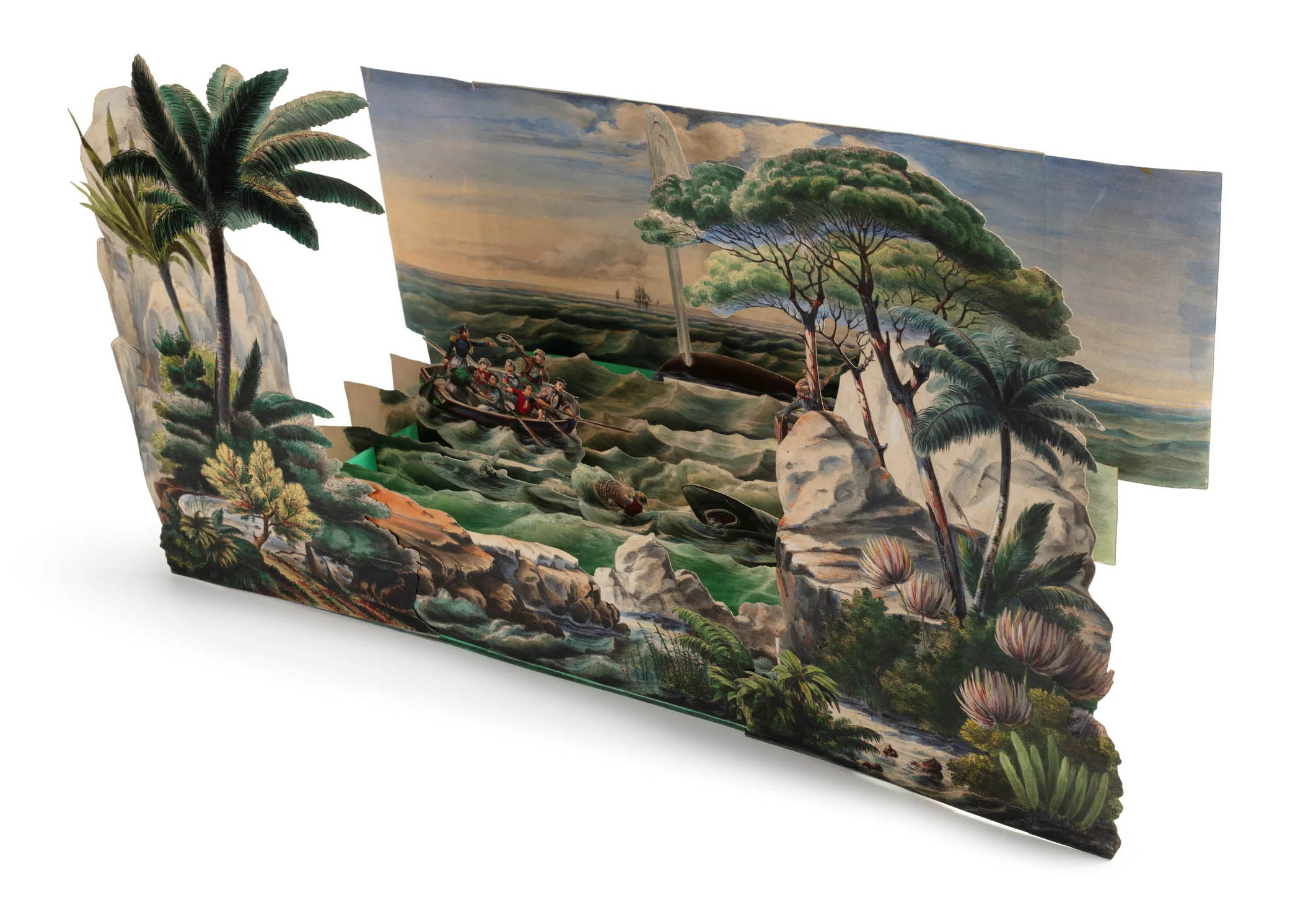
 

Charles Letaille (designer) J Pintard (publisher, Rue Saint-Jacques, Paris, France) 'Toy theatre, 'La Pleine Mer, Scenes Maritimes en Action'' 1836


Charles Letaille (designer)
J Pintard (publisher, Rue Saint-Jacques, Paris, France)
Toy theatre, ‘La Pleine Mer, Scenes Maritimes en Action’
1836
Paper/cardboard/textile/metal/timber
Height: 320 mm
Width: 704 mm
Depth: 85 mm
Powerhouse Collection
Purchased with funds donated by the Patrons of the Powerhouse, 1985
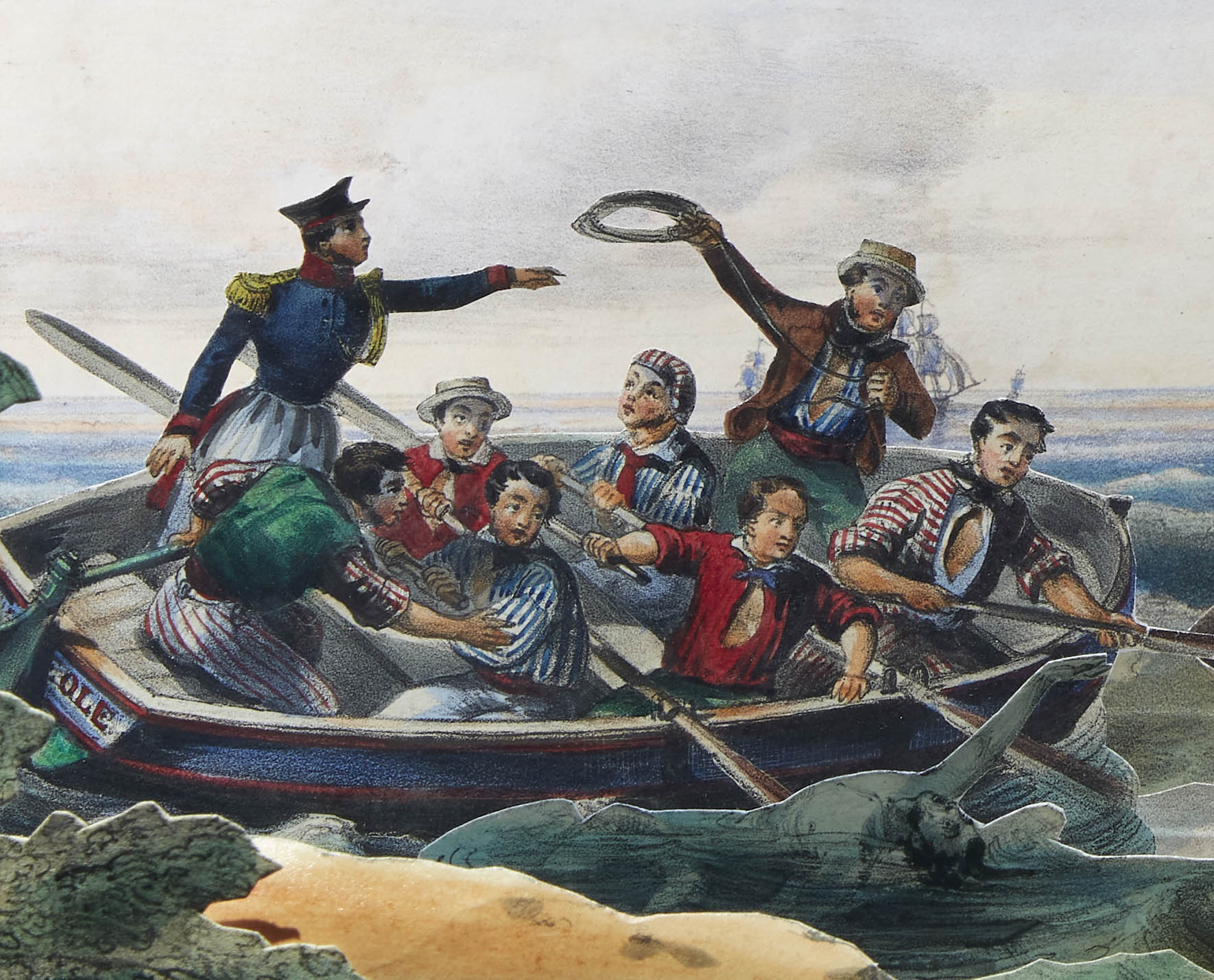
 

Charles Letaille (designer) J Pintard (publisher, Rue Saint-Jacques, Paris, France) 'Toy theatre, 'La Pleine Mer, Scenes Maritimes en Action'' 1836 (detail)


Charles Letaille (designer)
J Pintard (publisher, Rue Saint-Jacques, Paris, France)
Toy theatre, ‘La Pleine Mer, Scenes Maritimes en Action’ (detail)
1836
Paper/cardboard/textile/metal/timber
Height: 320 mm
Width: 704 mm
Depth: 85 mm
Powerhouse Collection
Purchased with funds donated by the Patrons of the Powerhouse, 1985
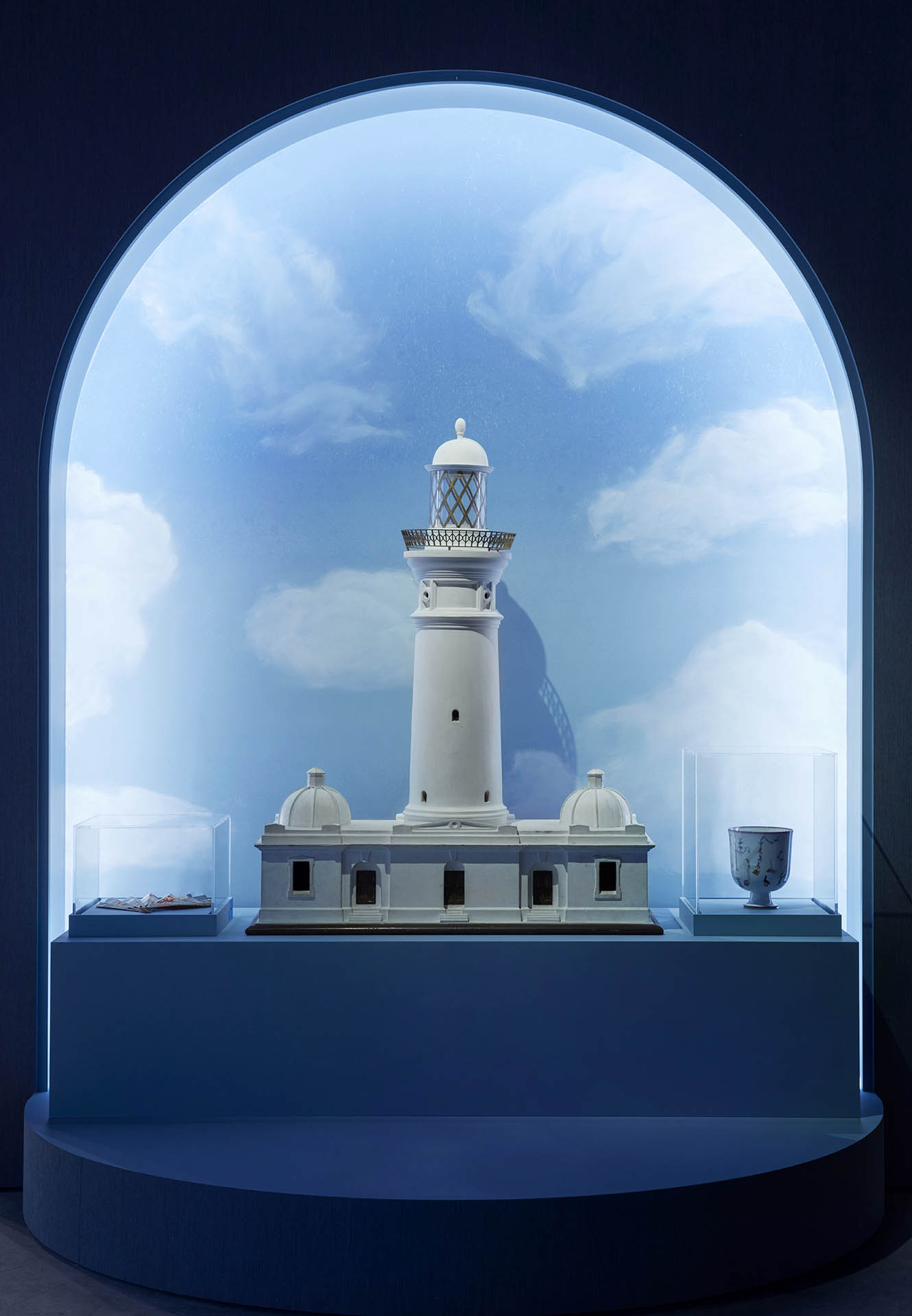
 

Installation view of the exhibition '1,001 Remarkable Objects' at Powerhouse Ultimo, Sydney showing at centre an architectural model of the Macquarie Lighthouse made by the Department of Navigation, Sydney, New South Wales, Australia, c. 1880
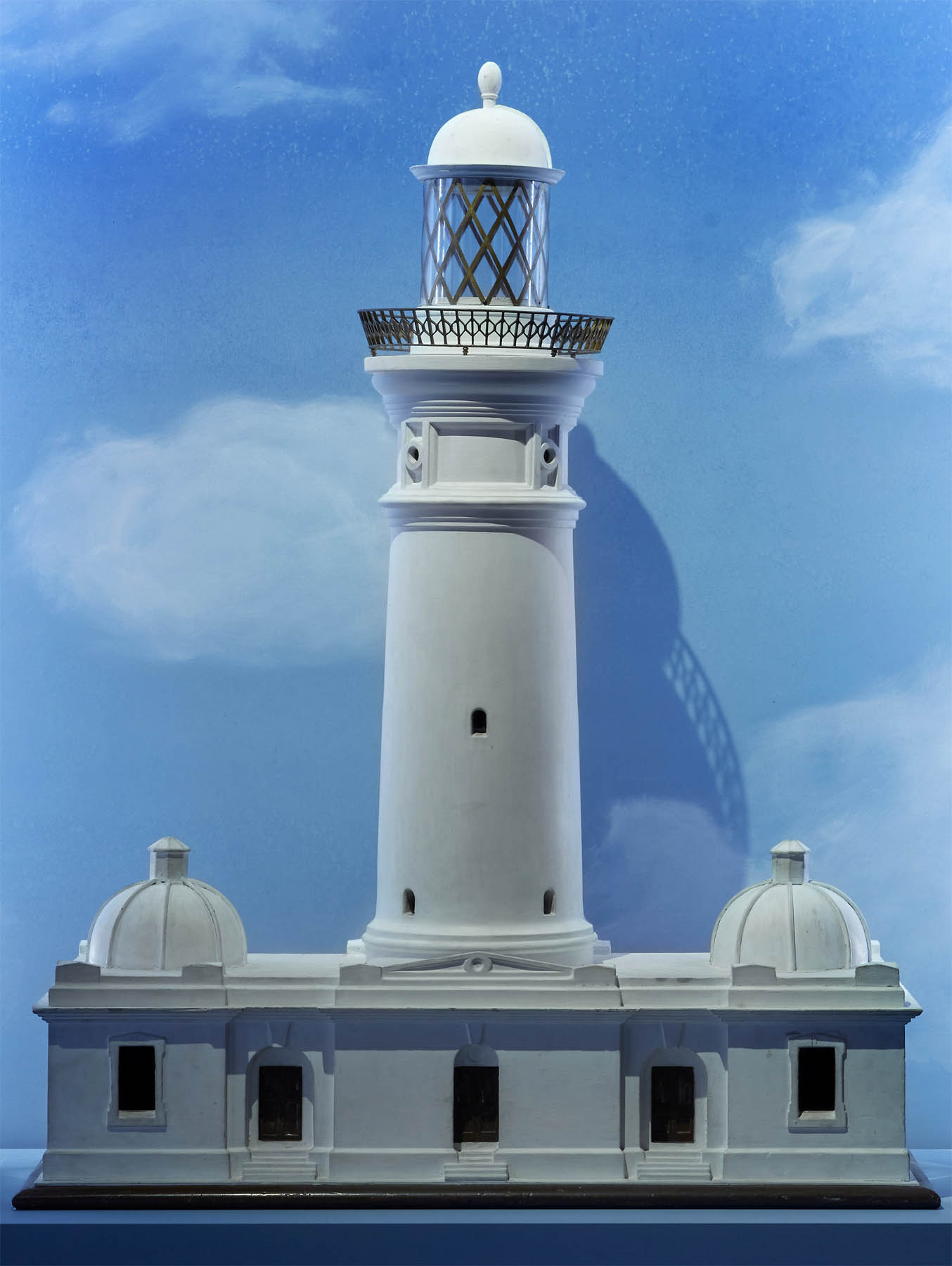
 

Installation view of the exhibition 1,001 Remarkable Objects at Powerhouse Ultimo, Sydney showing at centre an architectural model of the Macquarie Lighthouse made by the Department of Navigation, Sydney, New South Wales, Australia, c. 1880


Installation view detail of the exhibition '1,001 Remarkable Objects' at Powerhouse Ultimo, Sydney showing at centre an architectural model of the Macquarie Lighthouse made by the Department of Navigation, Sydney, New South Wales, Australia, c. 1880


Installation view detail of the exhibition 1,001 Remarkable Objects at Powerhouse Ultimo, Sydney showing at centre an architectural model of the Macquarie Lighthouse made by the Department of Navigation, Sydney, New South Wales, Australia, c. 1880


Architectural model, Macquarie Lighthouse, c. 1880

This lighthouse model is a record of a significant Sydney building and landmark. It shows the design of the second lighthouse built on the sight at Dunbar Head, Vaucluse, lit in 1883, and designed by colonial architect James Barnet. The original lighthouse, designed by convict architect Francis Greenway and lit in 1818 had deteriorated by 1823 due to the soft sandstone used in construction.

Scottish immigrant James Barnet arrived in Sydney in 1854. A trained builder and architect, he became Clerk of Works at the University of Sydney soon after his arrival. in 1860 he joined the Colonial Architect’s Office, and within two years was its Head. Barnet was strongly influenced by the Italian Renaissance, and had no sympathy for new American styles of architecture which were becoming fashionable in Sydney at the end of the century. He was equally critical of domestic architecture cluttered with ornamentation. As colonial architect for twenty-five years he has had a lasting influence the architecture of Sydney. As well as the genesis of the Museum of Applied Arts and Sciences, the 1879 Sydney International Exhibition Garden Palace building, Barnet’s buildings include the 1857 new wing of the Australian Museum, the Sydney General Post Office at Martin Place, Customs House, Medical School Anderson Stuart building at the University of Sydney, Callan Park Lunatic Asylum, East Sydney Technical College, Darlinghurst Court House, Victoria Lodge at the Botanical Gardens, and Mortuary Station, Central Railway.

The Macquarie Lighthouse is Australia’s longest serving lighthouse, and its current state is still well represented by this over-a-century year old model.

Damian McDonald
Curator

Text from the Powerhouse Collection website
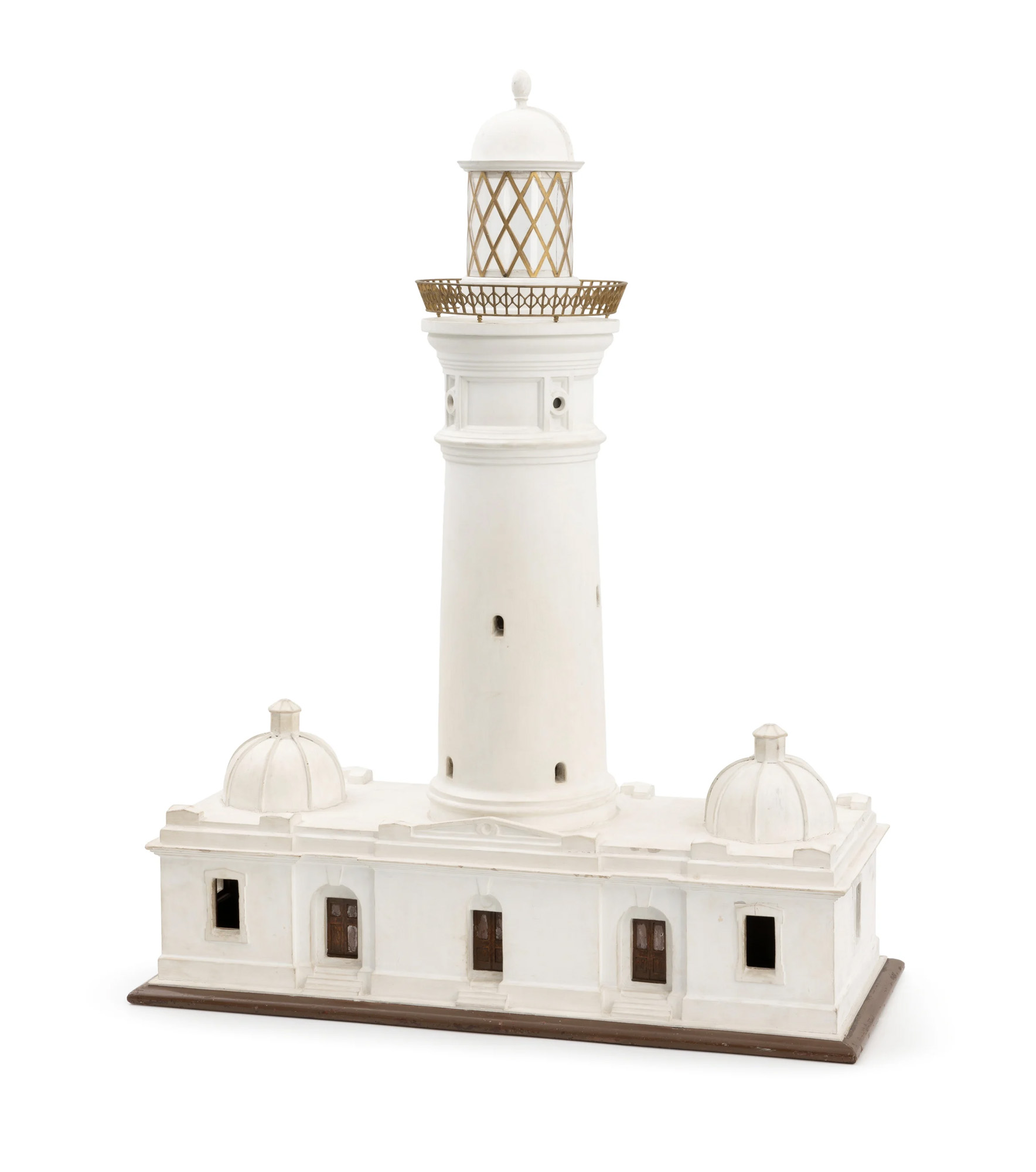
 

Department of Navigation, Sydney, New South Wales, Australia. 'Architectural model, Macquarie Lighthouse' c. 1880


Department of Navigation, Sydney, New South Wales, Australia
Architectural model, Macquarie Lighthouse
c. 1880
Wood / plastic
Height: 1885 mm
Width: 975 mm
Depth: 420 mm
Powerhouse Collection
Gift of Port Authority of New South Wales, 2015
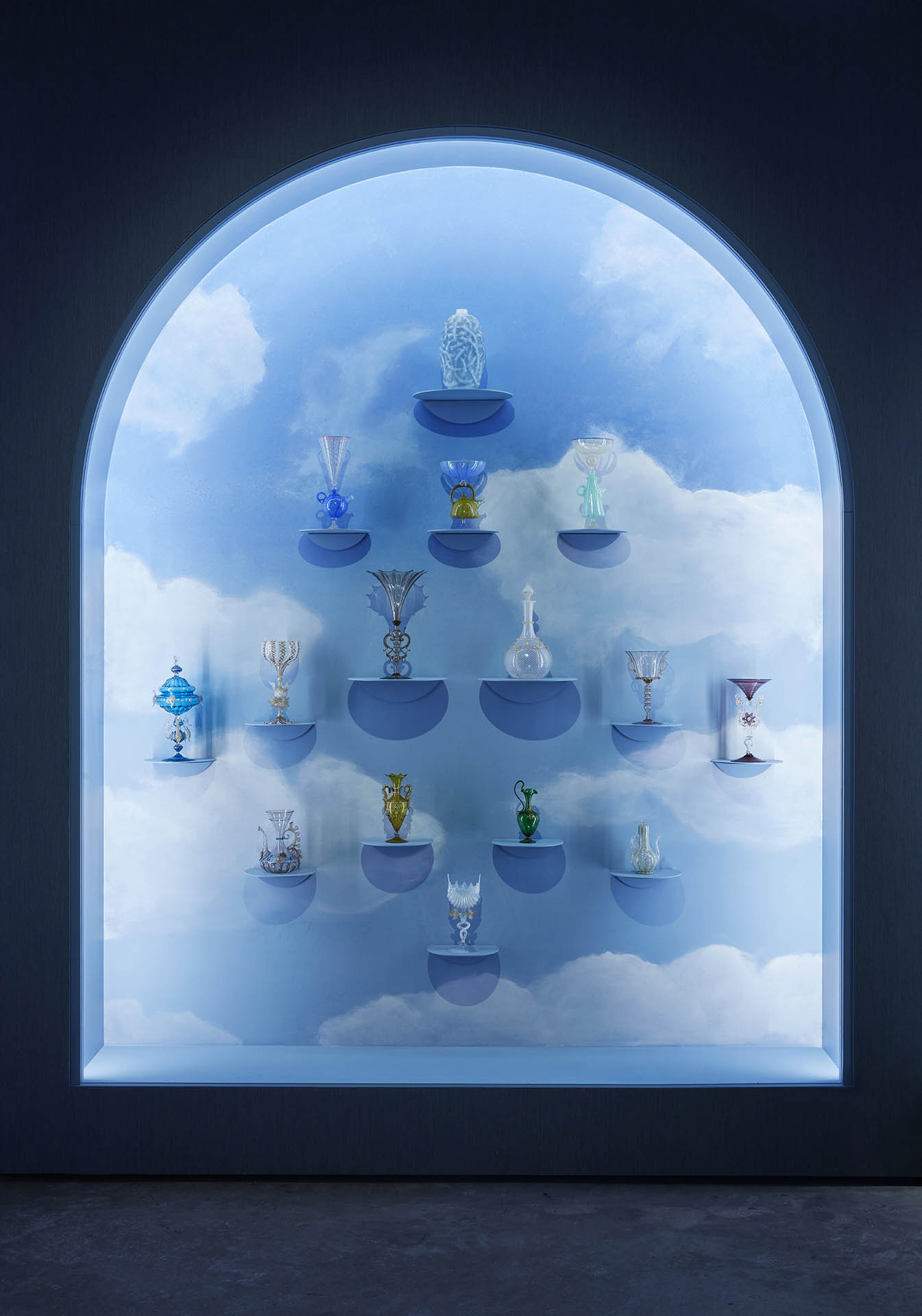
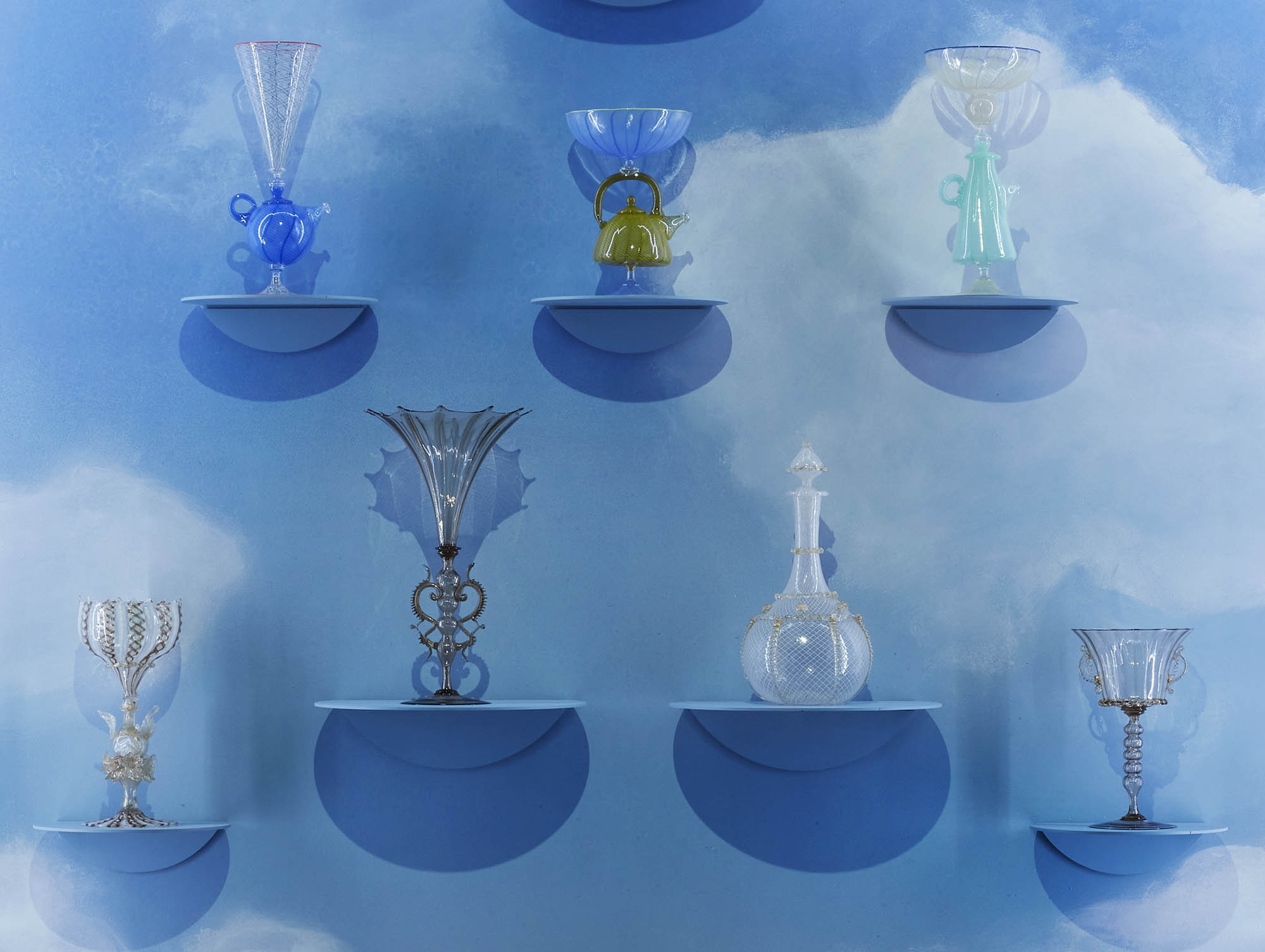
 

Installation view of the exhibition '1,001 Remarkable Objects' at Powerhouse Ultimo, Sydney showing 1880s Murano glass from Venice, Italy made by the Venice & Murano Glass and Mosaic Co. (except from the very top piece in the first image, which is a vase, 'Ronces' (Thorns), model 946, glass, designed by René Lalique, 1921, made by René Lalique et Cie, Wingen-sur-Moder, France, c. 1950)
Installation view detail of the exhibition '1,001 Remarkable Objects' at Powerhouse Ultimo, Sydney showing 1880s Murano glass from Venice, Italy made by the Venice & Murano Glass and Mosaic Co. (except from the very top piece in the first image, which is a vase, 'Ronces' (Thorns), model 946, glass, designed by René Lalique, 1921, made by René Lalique et Cie, Wingen-sur-Moder, France, c. 1950)


Installation views of the exhibition 1,001 Remarkable Objects at Powerhouse Ultimo, Sydney showing 1880s Murano glass from Venice, Italy made by the Venice & Murano Glass and Mosaic Co. (except from the very top piece in the first image, which is a vase, ‘Ronces’ (Thorns), model 946, glass, designed by René Lalique, 1921, made by René Lalique et Cie, Wingen-sur-Moder, France, c. 1950)


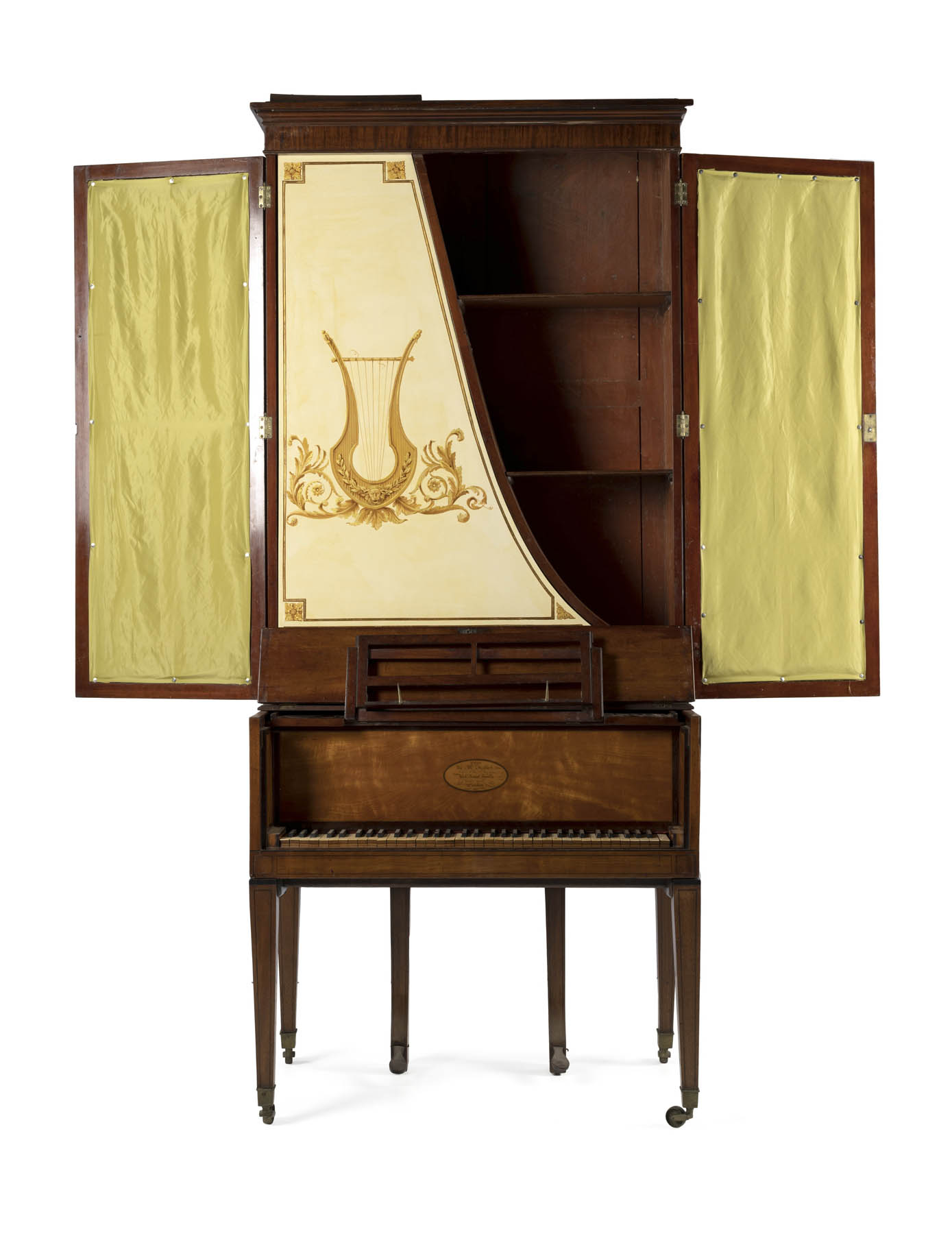
W & M Stodart (maker, London, England) 'Upright grand piano' 1809


W & M Stodart (maker, London, England)
Upright grand piano
1809
Timber, metal/ivory/fabric
Height: 2480 mm
Width: 1100 mm
Depth: 560 mm
Powerhouse Collection
Bequest of Mr William F Bradshaw, 2010


Upright Grand Piano by W & M Stodart

This upright grand bookcase piano is the first of its type to enter the Powerhouse Museum’s collection and the earliest upright piano to be found in it. Dating from 1809 it is made by one of London’s leading piano manufacturers, Matthew and William Stodart, and one of the few examples of this type of piano to be found in Australia. Apart from its rarity it is significant for its construction and design showing the transition from the standard horizontal grand piano to the cabinet piano, which then developed further into the upright piano known today.

This style of upright grand is also unique as it was purposely designed to incorporate a bookcase and therefore had the dual function of musical instrument and drawing room furniture. The style was first patented by William Stodart, one of the makers of this piano, in 1795. Rosamond Harding recounts that Joseph Haydn visited the Stodart shop and “expressed himself delighted with the new possibilities it foreshadowed in case-making and with the quality of tone.” (Harding, p. 63).

Unlike later upright pianos the design is similar to a horizontal grand which has been inverted to the vertical from the keyboard. This accounts for the great height of these instruments, having approximately the same string length as horizontal grand pianos of the time. The bookcase piano was an ornate instrument and expensive to buy as well as produce. This together with their unwieldy height and lack of portability as well as tuning difficulties contributed to bookcase grands only being produced up until about 1825. From this time the upright idea evolved further into the cabinet piano where the string and soundboard section of the piano was dropped to floor level thus reducing the height. This created other problems related to the position the hammers needed to be in to strike the strings to produce an optimum tone. This lead to further developments in piano action design to overcome the problem.

However, the trend to make pianos as ornate pieces of domestic furniture continued well into the 19th century when cabinet pianos would continue to be decorated with ornate fabric fronts or large mirrors, suitable for large domestic rooms.

Michael Lea
Curator, music & musical instruments
March 2010

Text from the Powerhouse Collection website
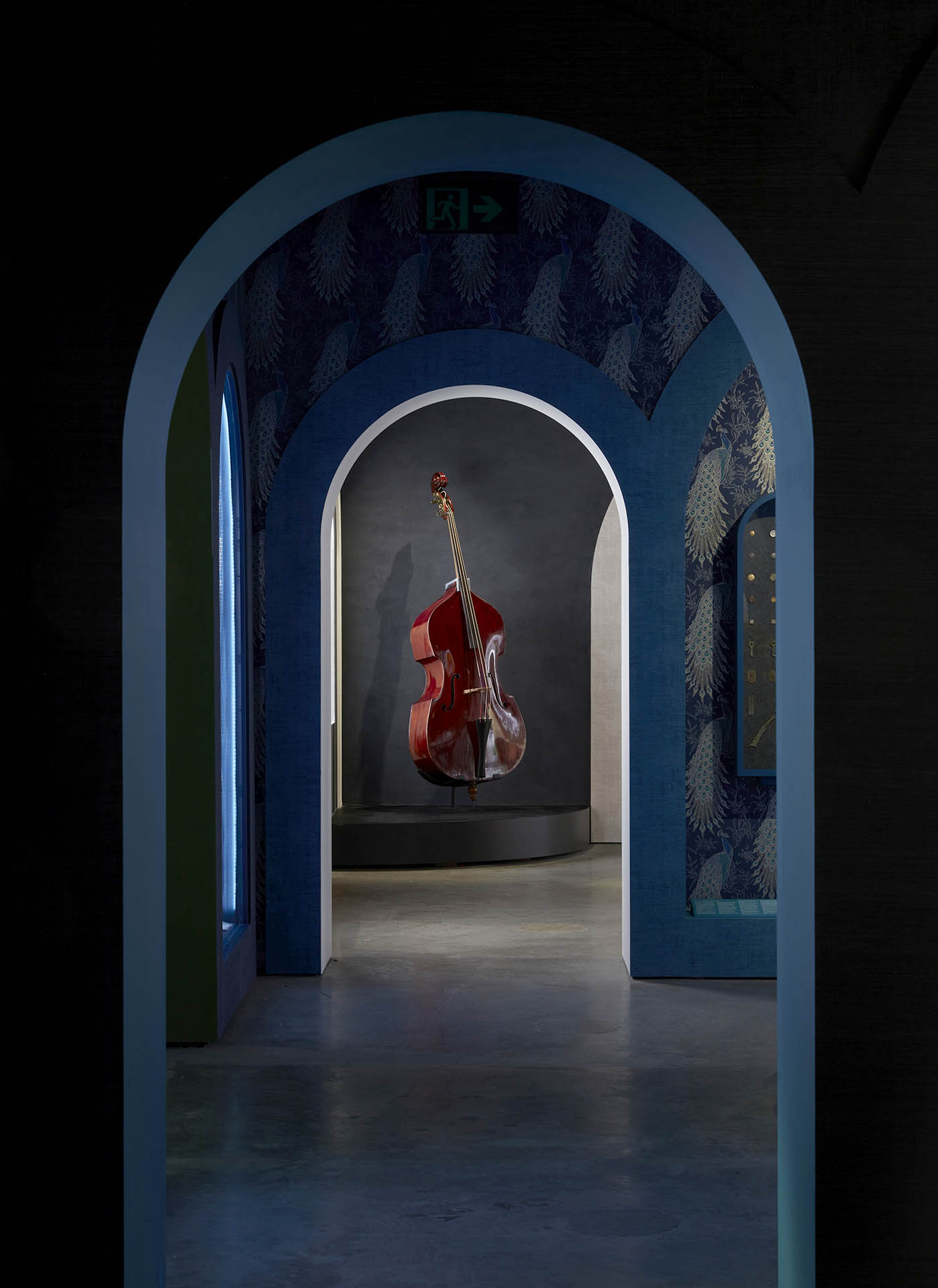
 

Installation view of the exhibition '1,001 Remarkable Objects' at Powerhouse Ultimo, Sydney showing John Devereux's Double bass (1856)


Installation view of the exhibition 1,001 Remarkable Objects at Powerhouse Ultimo, Sydney showing John Devereux’s Double bass (1856, below)
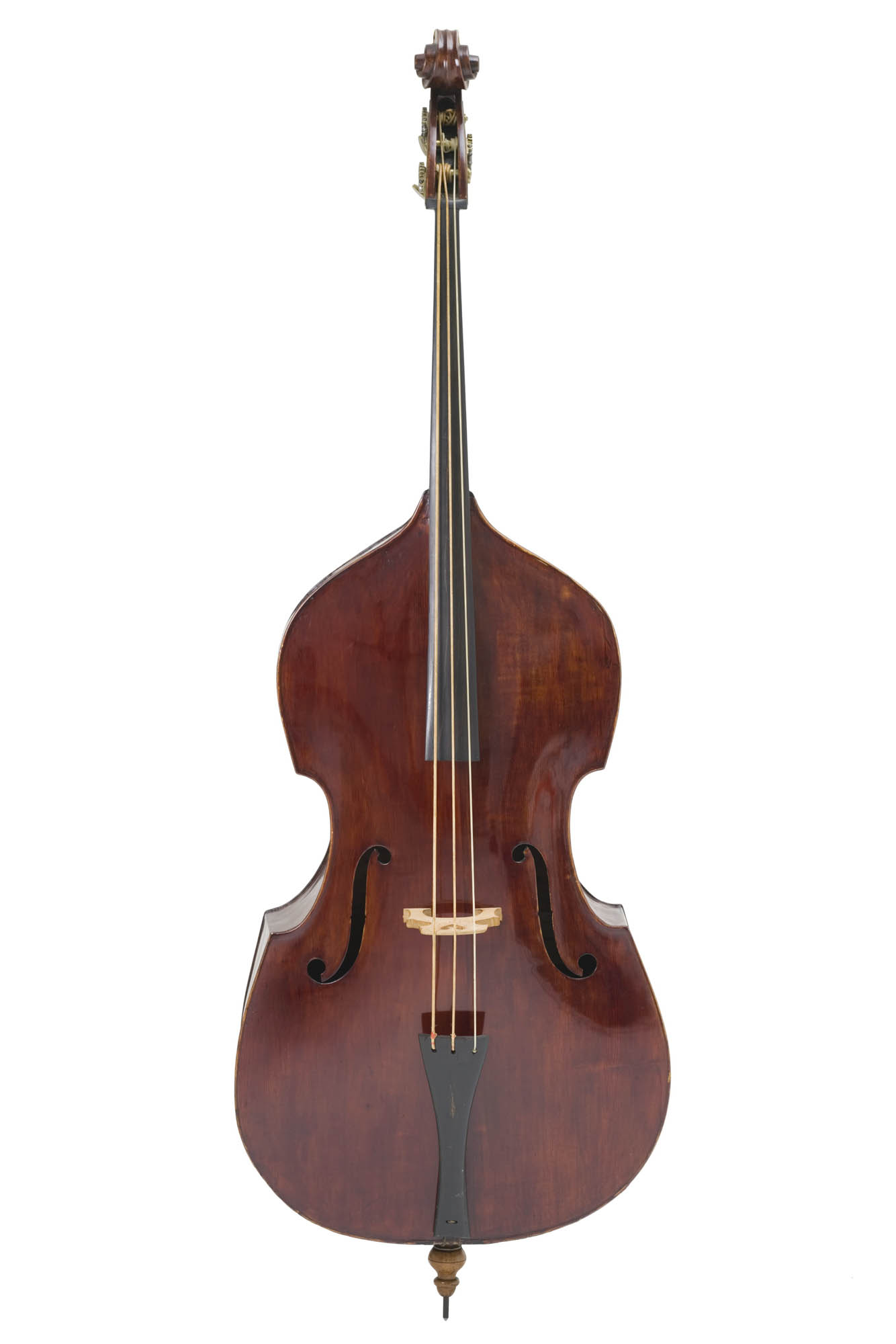
 

John Devereux (Australian born England, (c. 1815-1883)(maker, Melbourne, Victoria, Australia) 'Double bass' 1856


John Devereux (Australian born England, (c. 1815-1883)(maker, Melbourne, Victoria, Australia)
Double bass
1856
Red brown varnish, European Spruce/European Maple/Australian Cedar/brass/paper
Height: 1990 mm
Width: 655 mm
Depth: 385 mm
Powerhouse Collection
Purchased with the assistance of the Australian Government through the National Cultural Heritage Account and supporters of the Powerhouse Museum Foundation and the Pinchgut Opera, 2007


Double Bass made by John Devereux

John Devereux is one of the earliest violin makers known to have been working in Australia and is seen as Australia’s first professional bowed string instrument maker. He had a significant reputation and output from the 1860s to 1880s and was a contemporary of Australia’s other great maker of this period William Dow, also of Melbourne. Born in England in 1810, Devereux arrived in Australia in 1854 from London where he had been working in the workshop of violin maker Bernhard Simon Fendt (1800-1852). He settled in Melbourne and operated a violin making business there until his death in 1883. Apart from double basses he is known to have made violins, violas and cellos. He was apparently an accomplished double bass player and performed regularly at Government House in Melbourne. …

This double bass is possibly Devereux’s earliest instrument made in Australia that still survives. The instrument is made as a 3 string rather than 4 string bass which denotes an early period in bass making generally. Although the label is not original the bass has all the same characteristics of Devereux’s other instruments including two features that typify his work in Australia – his use in his double basses of Australian cedar especially for the back and an internal tension bar running the length of the body of the instrument from top to bottom. Independent assessments of the instrument also confirm this as a Devereux instrument. Most Devereux instruments remaining in original condition contain the tension bar which he devised in Australia to strengthen the instrument and prevent twisting of it in the Australian climate. This rigidity was also a way of keeping his instruments in tune in the local climate. There are only 4 other Australian made Devereux basses known to exist which date from a later period to this one.

In addition to the double bass the Powerhouse Museum also contains 2 violins by Devereux dating from 1869 and 1871 respectively, a viola by Devereux dated 1869, the 1866 gold medallion inter-colonial exhibition award, referred to above, and a separate tension bar and labels.

The exact number of instruments John Devereux made is unknown. Double basses made by Devereux both when he worked in London and in Australia survive, however, only five Australian made basses are currently known. Devereux also made violins, violas and cellos in Australia and examples of his work in general exist. He exhibited in a number of inter-colonial exhibitions and the catalogues of these mention the types of instruments he made. These catalogues also state that he used both European and Australian native timbers for his instruments.

Michael Lea,
Curator, music and musical instruments
May 2007

Text from the Powerhouse Collection website
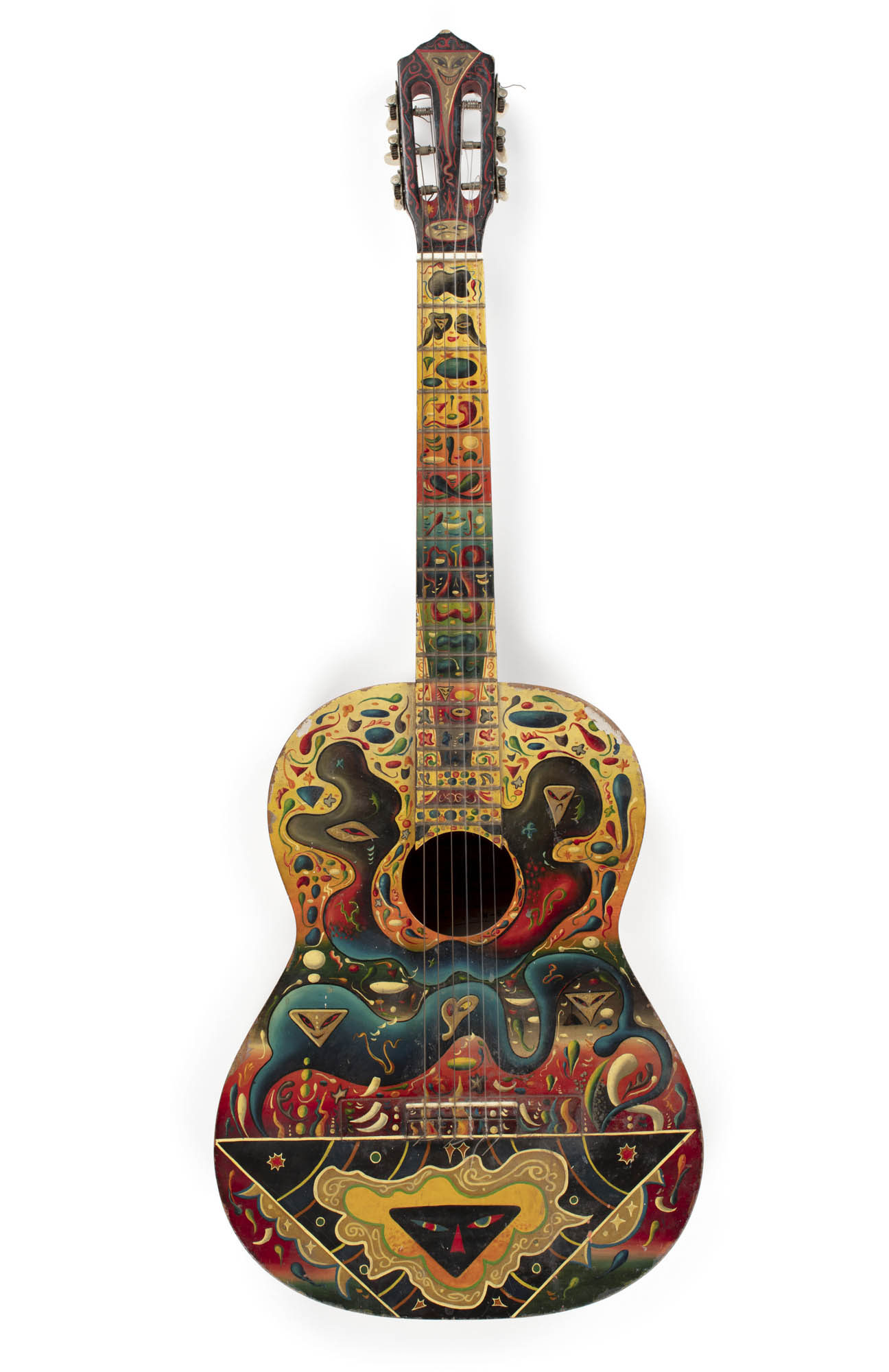
 

Lorenzo (maker, Japan) 'Guitar' c. 1975 painted and used by Harold 'The Kangaroo' Thornton, Sydney, New South Wales, Australia, 1980-2000


Lorenzo (maker, Japan)
Guitar
c. 1975
Painted and used by Harold ‘The Kangaroo’ Thornton, Sydney, New South Wales, Australia, 1980-2000
Handpainted, wood/nylon/plastic/metal/paper
Height: 1150 mm
Width: 375 mm
Depth: 97 mm
Powerhouse Collection
Gift of Philip Thornton, 2018


Hand painted Guitar by Harold ‘The Kangaroo’ Thornton

The guitar is part of a collection of extraordinary outfits and objects belonging to artist Harold ‘The Kangaroo’ Thornton (1915-2004), the creator of one of Australia’s rare historically themed art works, ‘Dr Brown and Green Old Time Waltz’. Hand painted by Harold, the guitar beautifully represents Harold’s personality and passion for art which shines through all of his works. In common with the other painted pieces in the collection, the artwork on the guitar is characterised by a sense of exuberant boldness and carefree abandon. The use of kaleidoscopic colours, uninhibited patterns both geometric and organic, mirrors Harold’s sense of playfulness and joy for life.

Largely self taught, Harold began painting at 8 years of age following the traditional art conventions of the times. It wasn’t until the 1980s however that Harold began painting in the style that perfectly matched his personality and philosophy of life. Stylistically, his work has been described as ‘psychedelic, naive or magic realistic’. Harold was never interested in making money or being aligned to a specific genre. His single-minded focus was to paint whatever took his fancy in his own inimitable way.

Several well-known Australian artists including Ken Done, Martin Sharp and body artist, Tim Gratton acknowledge Harold’s influence on their work. Largely denied recognition as a serious artist in life, over time there has been a growing appreciation of Harold’s artistic gift.

Glynis Jones and Wendy Circosta, 2017
Curator and Curatorial Volunteer


This guitar was hand painted by artist, Harold ‘The Kangaroo’ Thornton in Sydney possibly between 1980 and 1995.

Prominent Australian, Dr Bob Brown has described Harold as a ‘very unusual character. He had a little goatee, a wisp of beard coming out of his chin and he had a naked woman enamelled on to one of his teeth.’ Born in Enfield, an inner west suburb of Sydney, in 1915, Harold Leslie Thornton began his art career at the age of 8 when he used to write signs for the local butcher and grocer. Finding school a waste of time, he left at age 14 to work as a sign writer, learning by watching how others worked. In later years he spent some time at the Julian Ashton Art School and Desiderius Orban School of Art (1944-46), though he remained largely self-taught. In 1937, Harold departed Sydney with a friend on a motorbike and ended up settling in Griffith, New South Wales until 1941. Painting and wrestling were sources of income at this time. During the remainder of World War II, he lived in Sydney and worked as a sign painter at several places in the war industry. It wasn’t until after World War II that Harold began painting in earnest.

Harold returned to Griffith in 1947 and ran a sign writing business. In 1950 he began touring the Australian countryside setting up his own mini exhibitions in places such as Condobolin, Leeton, Wagga Wagga, Wollongong and Griffith for the next 10 years. He returned to Sydney in 1963.

He has said in both print and recorded interviews that he didn’t fit the mould of what the established art world considered an artist. From head to toe, he dressed flamboyantly in clothes which he’d fashioned and painted and he revelled in fun, whimsy and theatricality that had the art world questioning, ‘was he an artist or a showman’. Self-styled ‘ The Greatest Genius That Ever Lived’, Harold believed very much tongue in cheek that ‘You are what the public thinks you are so I’m the greatest genius that ever lived!’

Not represented by any local dealers and disenchanted with the power of art critics to make or break an artist, Harold left Australia to live in Papua New Guinea from 1968-1970 before making his way to Amsterdam where he spent many years creating art, writing songs and modelling for art classes. In Amsterdam, Harold received the recognition that the Sydney academic art world denied him. Known for his painted murals on shop windows, he was a well-loved and recognised figure in Amsterdam. His most famous mural was painted in 1975 on ‘The Bulldog’, one of the first establishments where marijuana from around the world could be sampled. It is now a landmark site protected by the Netherlands National Trust.

Harolds’s earlier works followed the more conventional style of realistic portraiture and landscapes. It wasn’t until the 1980s that Harold developed his own ‘magic realistic’ style. Nonconformist and reminiscent of psychedelia describes not only his art but Harold himself. A larger than life figure, he dedicated his life to his art, surrounding himself with objects that had received the ‘genius’ treatment, including clothing, accessories, his van, and a guitar and suitcase which are both included in the Museum’s collection.

Professionally, Harold had three portraits selected as finalists in the prestigious Archibald Prize which is held annually at the Art Gallery of NSW: comic Roy Rene (1948), Al Grassby (1982) Minister for Immigration in the Whitlam Government and Dr Bob Brown (1983), founder and leader of the Greens political party. Dr Brown was the subject of a very important Australian historical work, ‘Dr Brown and Green Old Time Waltz’ which is held in the National Portrait Gallery in Canberra. It documents the story of one of Australia’s most controversial environmental issues – the Gordon-below-Franklin Project. He also held several exhibitions in Sydney, Griffith and Amsterdam and has influenced well known Australian artists, Martin Sharp, Ken Done and Tim Gratton.

Harold died on 7 April 2004, leaving an archive of over 200 paintings. His greatest wish was for all of his paintings to be in the one place on permanent exhibition.

Text from the Powerhouse Collection website
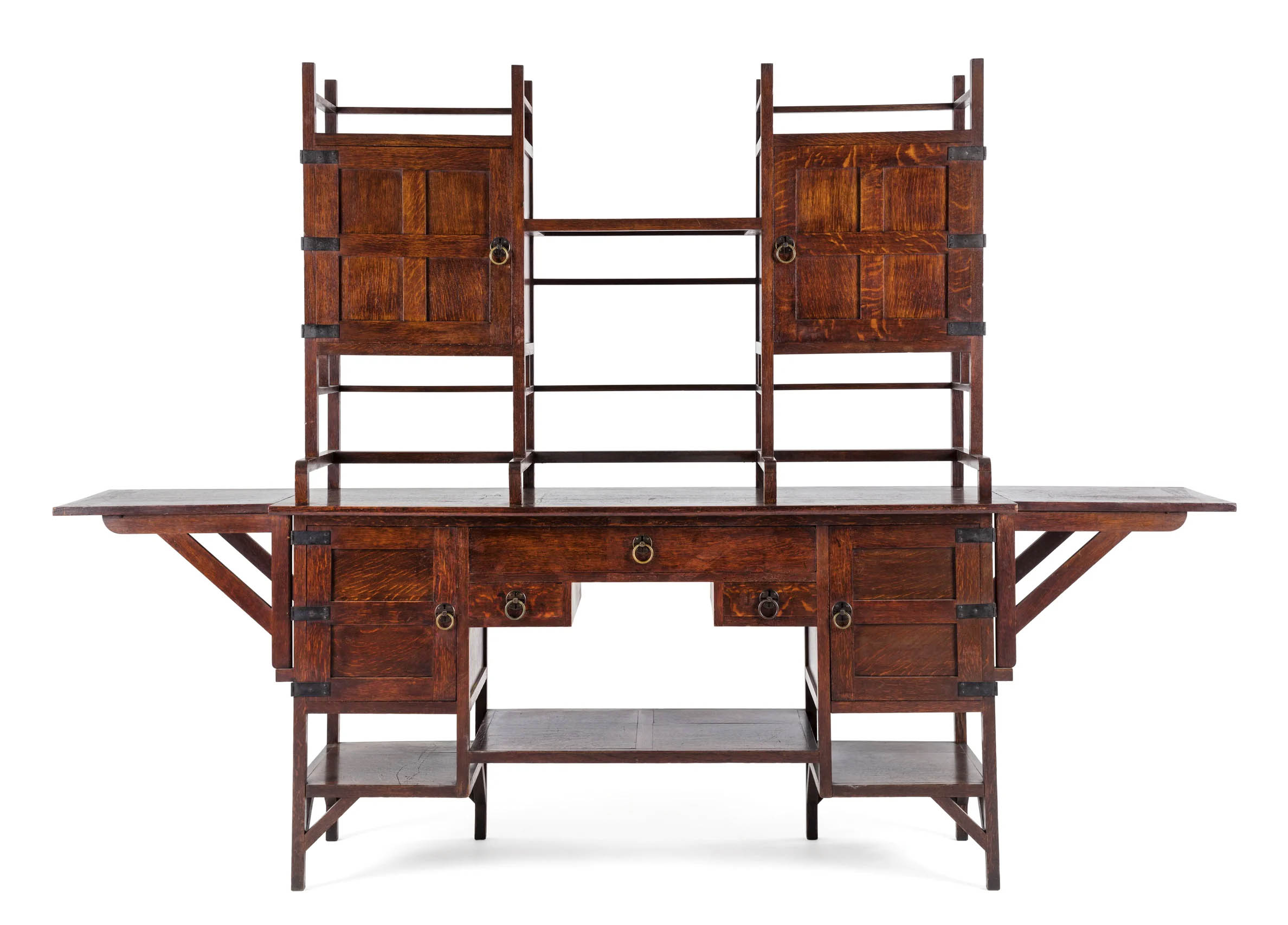
 

Edward William Godwin (designer) (English, 1833-1886) William Watt (maker, England, 1834-1885) 'Sideboard' 1867-1880


Edward William Godwin (designer) (English, 1833-1886)
William Watt (maker, England, 1834-1885)
Sideboard
1867-1880
Oak/metal
Height: 1810 mm
Width: 2550 mm
Depth: 520 mm
Powerhouse Collection
Purchased 1991


Sideboard designed by Edward William Godwin

Edward William Godwin (1833-1886) was one of the most important designers of the English design reform movement in the second half of the 19th century. He was an active and influential member of the Aesthetic Movement and the first 19th century English furniture designer to turn to Japanese art for inspiration. His emphasis on the need to reconcile function and design, utility and beauty did much to redirect Victorian design and is now believed to have influenced the direction of 20th century design. The Anglo-Japanese sideboard is one of the earliest pieces of furniture by Godwin and expresses his enthusiasm for Japanese design as well as the importance he attached to function, lightness and simplicity. The sideboard remained his most radical Japanese-inspired design and is his best known piece of furniture.

Text from the Powerhouse Collection website
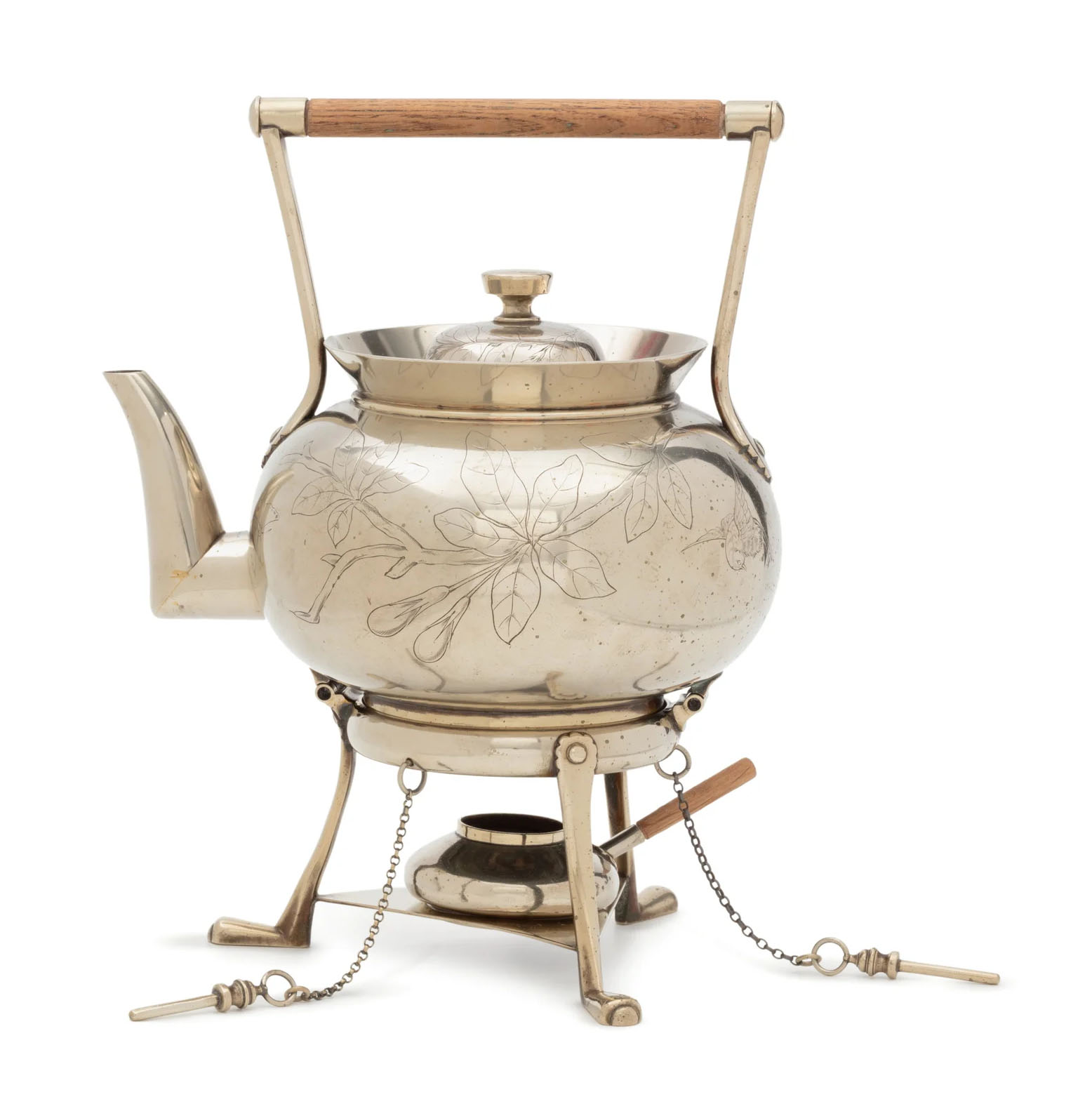
 

Christopher Dresser (designer, British, 1834-1906) J.W. Hukin and J.T. Heath (maker, London, England) 'Kettle and burner on stand' 1878


Christopher Dresser (designer, British, 1834-1906)
J.W. Hukin and J.T. Heath (maker, London, England)
Kettle and burner on stand
1878
Electroplated silver/wood
Height: 275 mm
Width: 223 mm
Depth: 170 mm
Powerhouse Collection
Purchased 1991


Kettle and burner on stand designed by Christopher Dresser

This kettle was designed by Christopher Dresser for J.W. Hukin and J.T. Heath in London in 1878. A trained botanist and a visionary designer who bridged the gap between art and industry in Victorian England, Dr Christopher Dresser was a leading design reformer of the era. As opposed to John Ruskin and William Morris, Christopher Dresser was an enthusiastic advocate of the machine, believing that household items should be more affordable while being both beautiful and functional. The association of simplicity with progress led him to reject the taste for rich decoration of Victorian historicism and naturalism which used representational, often relief ornaments indiscriminately applied to objects. Dresser’s interest in forms based on the structure of plants, his emphasis on function in design and the economic use of materials such as electroplated silver, have no precedent in Western design traditions.

Dresser had a passion for Japanese art, which was rediscovered by the West in the 1850s, strengthened by his travel to Japan in 1876. The kettle’s chased plum-blossom-and-bamboo decoration, the angular spout and feet, straight wooden handle and exposed rivets reference the Japanese aesthetic. Dresser diverse designs for metal, textiles, glass and ceramics inspired by Japanese art and design are also associated with the Aesthetic movement which has a strong impact on the visual arts, literature and fashionable living in Britain from the 1860s to the 1895 trial of the writer Oscar Wilde, the movement’s best-known advocate and exponent. With its famous credo ‘art for art’s sake’, it highlighted the aesthetic value of the arts, privileging beauty over any moral or didactive purpose.

Eva Czernis-Ryl, Curator

Text from the Powerhouse Collection website
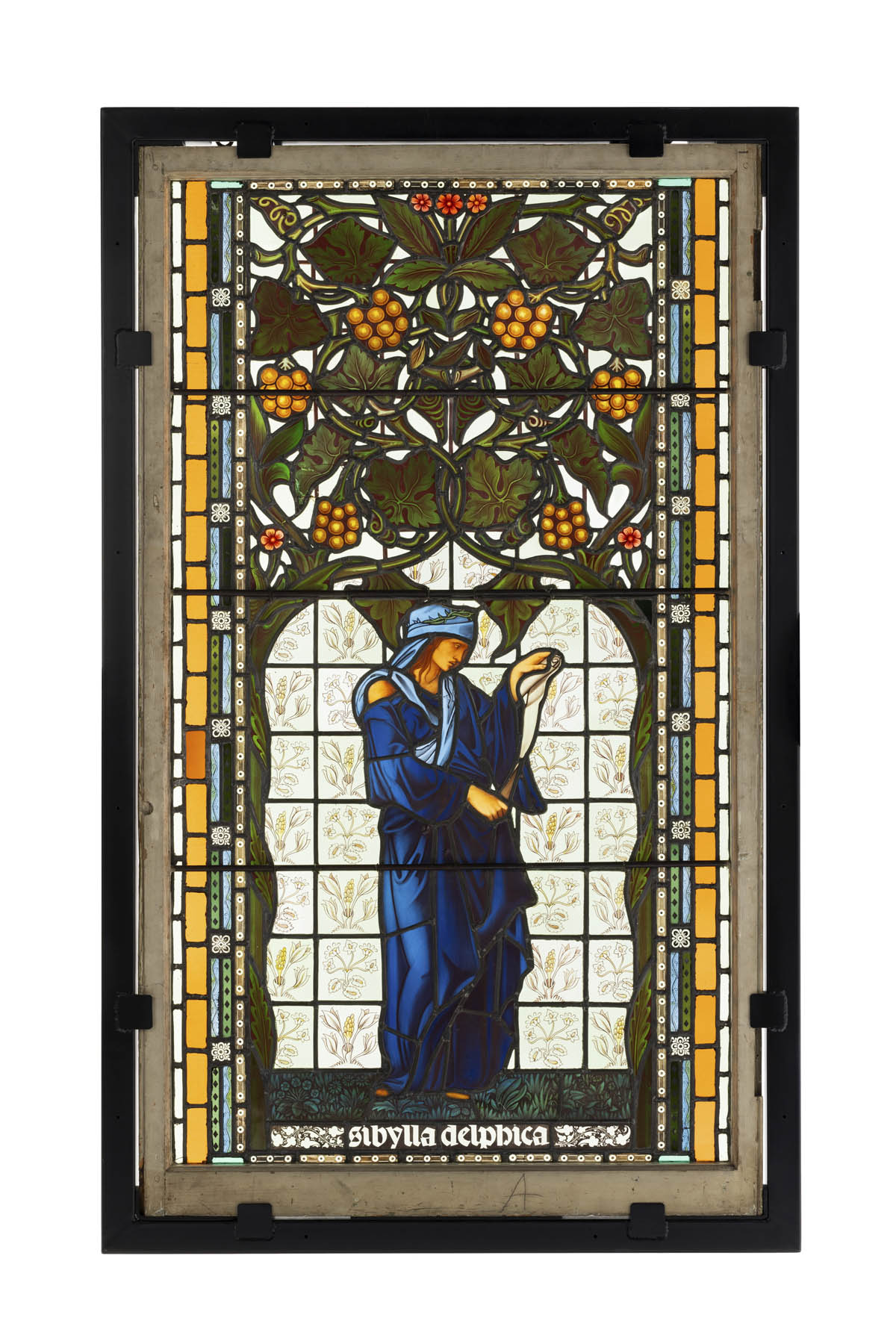
 

Sir Edward Coley Burne-Jones (English, 1833-1898)(designer) William Morris Workshops (maker, England) 'Stained glass window, 'The Delphic Sibyl'' 1869-1875


Sir Edward Coley Burne-Jones (English, 1833-1898)(designer)
William Morris Workshops (maker, England)
Stained glass window, ‘The Delphic Sibyl’
1869-1875
Glass/lead
Height: 1549 mm
Width: 915 mm
Depth: 140 mm
Powerhouse Collection
Purchased with funds donated by the Patrons of the Powerhouse, 1984


‘The Delphic Sibyl’ window designed by Sir Edward Coley Burne-Jones

This magnificent stained-glass window entitled, ‘Sibylla Delphica’, was produced in about 1900 in the workshops of Morris & Co. at Merton Abbey southwest of London after designs by the pre-Raphaelite painter, Sir Edward Coley Burne-Jones.

The window is an example of work from the Arts and Crafts Movement (1850s-1930s), which was born in industrialised England out of enthusiasm for the ‘morally superior’ work of the medieval craftsman. The movement was led by the great Victorian philosopher and art critic, John Ruskin, and the influential designer, William Morris.

While the Arts and Crafts movement drew on different cultures and periods, its members were united in their opposition to poor design standards and the dehumanising effects of industrialisation. They mostly handcrafted objects in small workshops, explored traditional techniques and materials and intended to make beautiful objects for all.

William Morris set out to produce only the finest quality furnishings for discerning customers including furniture and stained glass. This window is a later version of one made in England for the chapel of Jesus College, Cambridge, in 1872. Morris was most likely responsible for the pale painted botanical patterned background and stylised canopy of vines which frame the figure of Sibyl. (Sibyls were women the Ancient Greeks believed were oracles).

William Morris was a poet, writer, politician and conservationist as well as being an artist, designer and manufacturer, whose products underpinned a successful, long-lasting business. His innate ability to unify form, colour and pattern and his boundless creativity made him the most innovative and outstanding pattern designer of his generation. Even in the 1900s Morris’ wallpaper and textile designs remained popular.

Text from the Powerhouse Collection website
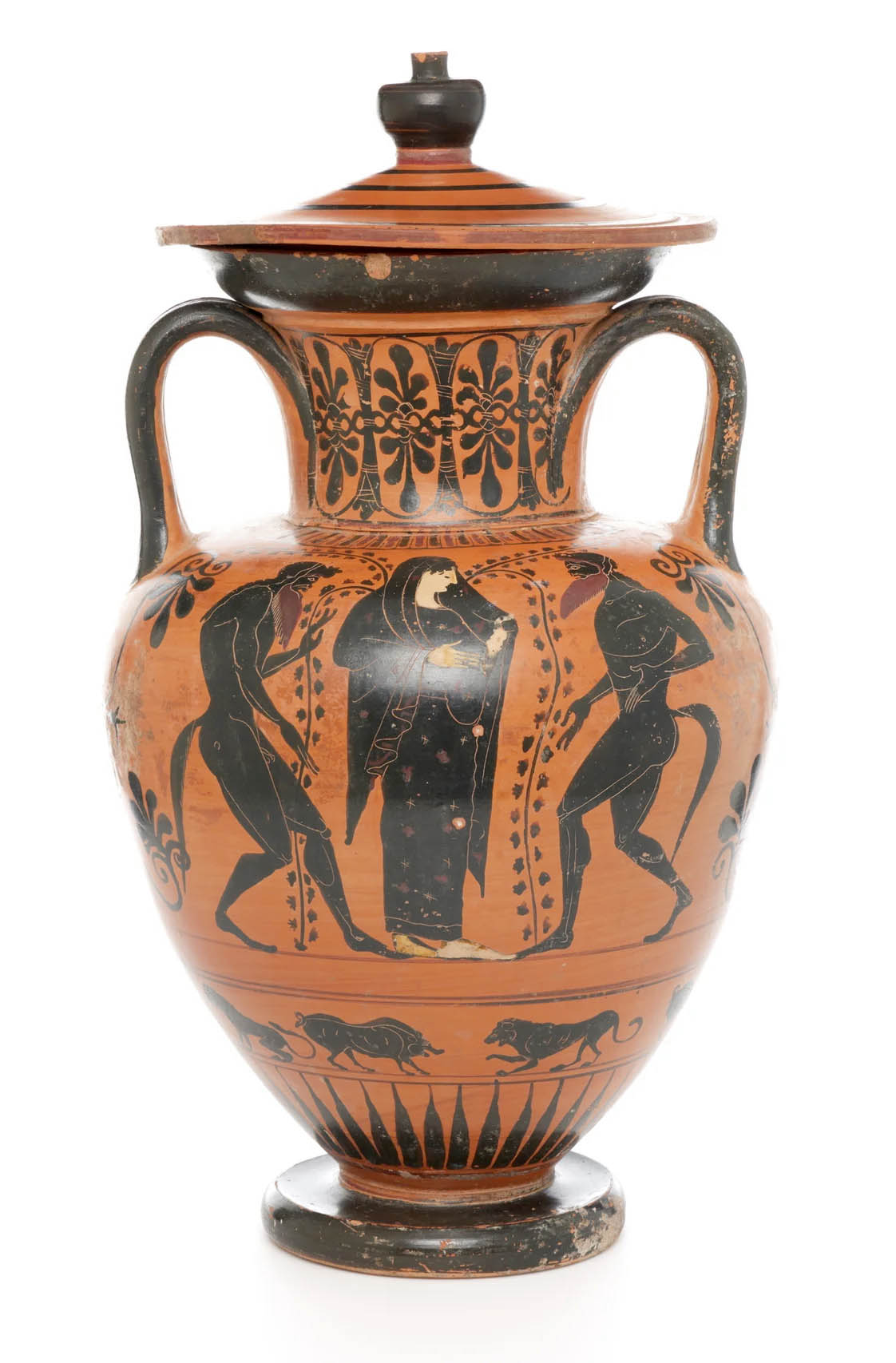
 

Attributed to the painter of 'Group of Taranto 305', Athens, Greece. Amphora with cover, 'Attic black figure' 530-510 BC


Attributed to the painter of ‘Group of Taranto 305’, Athens, Greece
Amphora with cover, Attic black figure
530-510 BC
Red earthenware
Height: 470 mm
Width: 265 mm
Depth: 270 mm
Powerhouse Collection
Gift of Sir Robert Webster and Sir Norman Rydge, 1952


Attic Black Figure Amphora

The amphora was made in Greece, c. 530-510 BC. The amphora is part of a large group of over 300 vessels (mostly amphorae) which are stylistically very closely related. More than 150 of these vessels have been divided into closely related groups, one called ‘Group of Taranto 305’ to which this amphora belongs, probably painted by one artist.

Terracotta amphora with Attic black figure design on a red ground. The amphora has a pedestalled foot, bulbous body, rounded shoulders and slim neck with flaring rim. Two ribbed strap handles extend from the shoulders to the top of neck. On one side is a female figure holding her cloak around her head and shoulders like a veil, a traditional gesture of modesty, especially associated with a bride. To the left, a satyr approaches with one arm outstretched; another satyr approaches from the right. This scene possibly represents Ariadne about to be conducted to her marriage to Dionysus. On the other side of the amphora are two young naked horsemen, each carrying two spears. The subsidiary decoration includes a double lotus and palmette chain on the neck of the vase; an elaborate palmette cross under the handles; a band of alternately black and red tongues around the base of the neck; a band of rays around the base of the vase and an animal frieze below the figured area. The lid or cover of the amphora is circular and has a knob handle. It features four concentric circles and two rows of small hearts or leaves around the perimeter of the rim.

Text from the Powerhouse Collection website
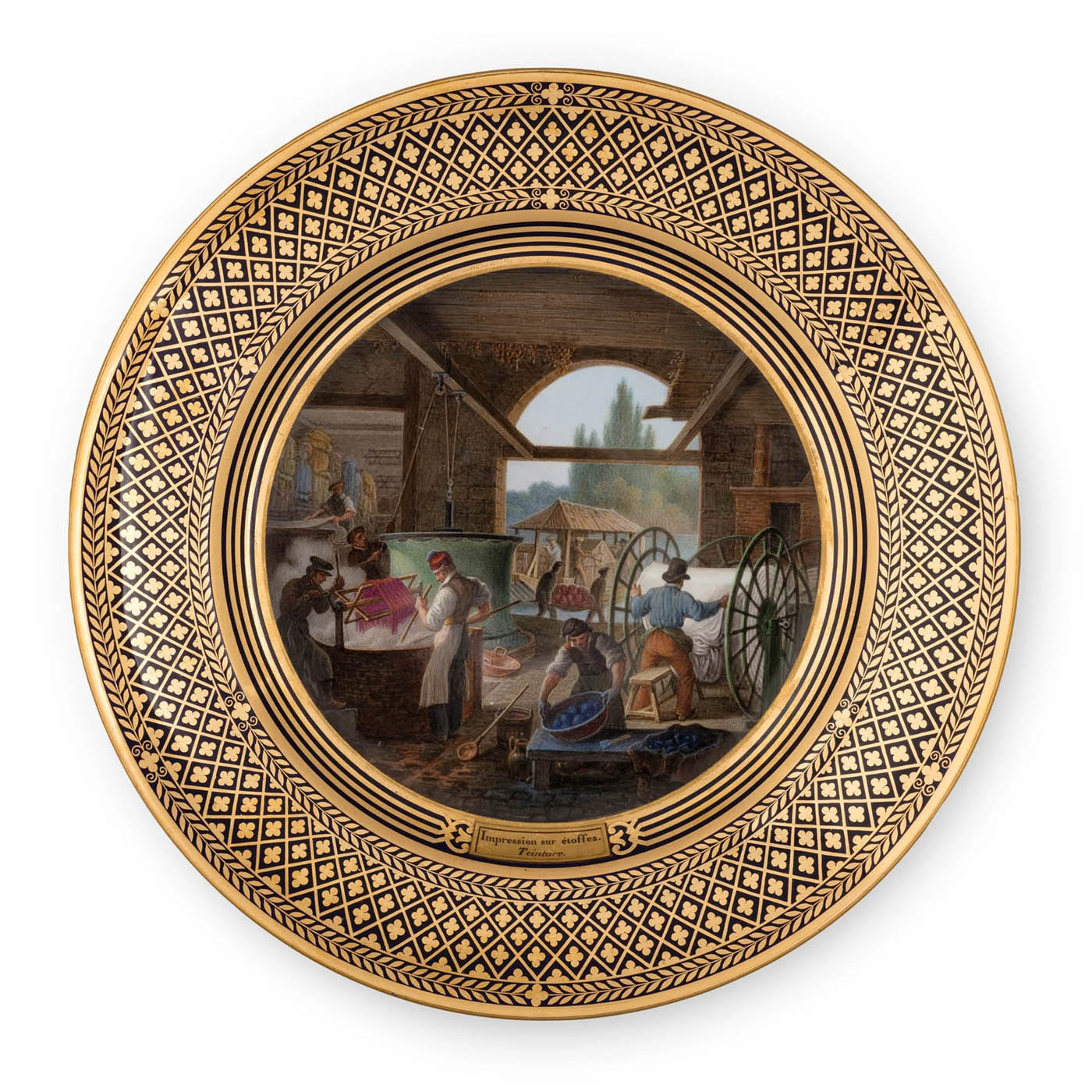
 

Jean-Charles Develly (French, 1783-1862)(painter) Sevres Royal Porcelain Manufactory (manufacturer, Sevres, Paris, France) 'Plate, 'Impression sur Etoffes: Teinture', from the 'Service des Arts Industriels' (Industrial Arts Service), with a scene illustrating textile dyeing workshop in the Manufacture Royale de Jouy' 1830


Jean-Charles Develly (French, 1783-1862)(painter)
Sevres Royal Porcelain Manufactory (manufacturer, Sevres, Paris, France)
Plate, ‘Impression sur Etoffes: Teinture’, from the ‘Service des Arts Industriels’ (Industrial Arts Service), with a scene illustrating textile dyeing workshop in the Manufacture Royale de Jouy
1830
Hard paste porcelain
Height: 32 mm
Width: 240 mm
Depth: 240 mm
Powerhouse Collection
Purchased 1993


Sevres plate with painted textile workshop scene

This unique plate belongs to a relatively small group of sumptuous tableware that survive today from the unique 173-piece dessert service known as ‘Service des Arts Industriels’ (industrial arts service). There were 108 plates in the service.

The Sevres Royal Porcelain Manufactory took 15 years to complete the set, which was never replicated. The service was presented by King Louis-Philippe to the Austrian chancellor Prince von Metternich in 1836. Later it belonged to the royal house of Romania.

The service is among the Sèvres factory’s most brilliant technological and artistic achievements. It was made from true (hard-paste) porcelain and its scenes are painted with newly developed pigments that produced colours as richly toned as in oil paintings. These were developed under Alexandre Brongniart (1770-184), the Sèvres factory’s director. The scenes were painted by Jean-Charles Develly who based them on his sketches drawn entirely from life. This was a significant innovation as most services were decorated with subjects copied from engravings or paintings. The service celebrated the progress of technology as applied to different industries in France at the time. The choice of this unusual subject reflected the economic and political importance of a wide range of crafts and industries in France in the early 1800s. The scene decorating the well of this plate is entitled ‘Impression sur etoffes. Teinture.’ and depicts various activities in the textile dyeing workshop at the Manufacture Royale de Jouy in Josas (Yvelines).

The service is a late example of the Empire style in ceramics. The style was developed by the Sèvres factory under the patronage of Napoleon Bonaparte (1805-15) and was widely imitated by other European ceramic factories, remaining popular long after the defeat of Napoleon.

Eva Czernis-Ryl, 1993

References:
Pierre Ennès, ‘Four Plates from the Sèvres “Service des Arts Industriels” (1820 – 1835),’ Journal of the Museum of Fine Arts, Boston 2 (1990): 89-106
Tamara Préaud, ‘Brongniart as Administrator,’ in The Sèvres Porcelain Manufactory: Alexandre Brongniart and the Triumph of Art and Industry, 1800-1847, ed. Derek E.Ostergard (New Haven and London: Yale University Press, 1997), 43-53.

Text from the Powerhouse Collection website
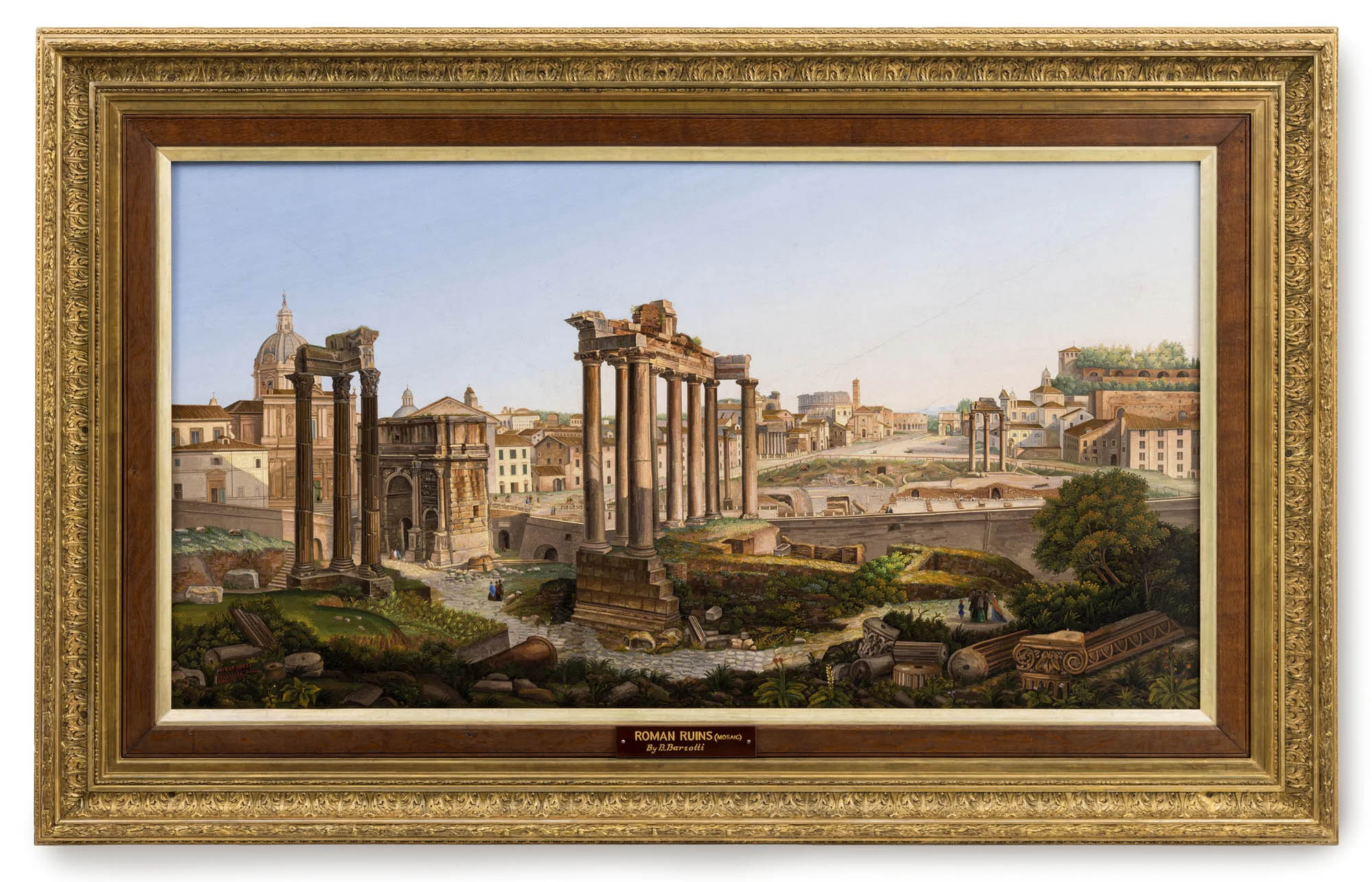
 

Biagio Barzotti (Italian, 1835-1908)(maker, Rome, Italy) 'Roman Ruins' c. 1876


Biagio Barzotti (Italian, 1835-1908)(maker, Rome, Italy)
Roman Ruins
c. 1876
Mosaic panel, framed
Glass/gilt and stained wood/metal
Height: 1261 mm
Width: 2005 mm
Depth: 170 mm
Weight: 250 kg
Powerhouse Collection
Purchased 1948


This framed mosaic panel is entitled ‘Roman Ruins’. It was created by Biagio Barzotti (1835-1908) in Italy in about 1876 by means of a mosaic of coloured glass ‘tesserae’. Rome’s Forum was not completely excavated until the 1870s. Like the many ancient sites uncovered during the 1800s, its exposure increased interest in the classical past and inspired numerous artistic representations.
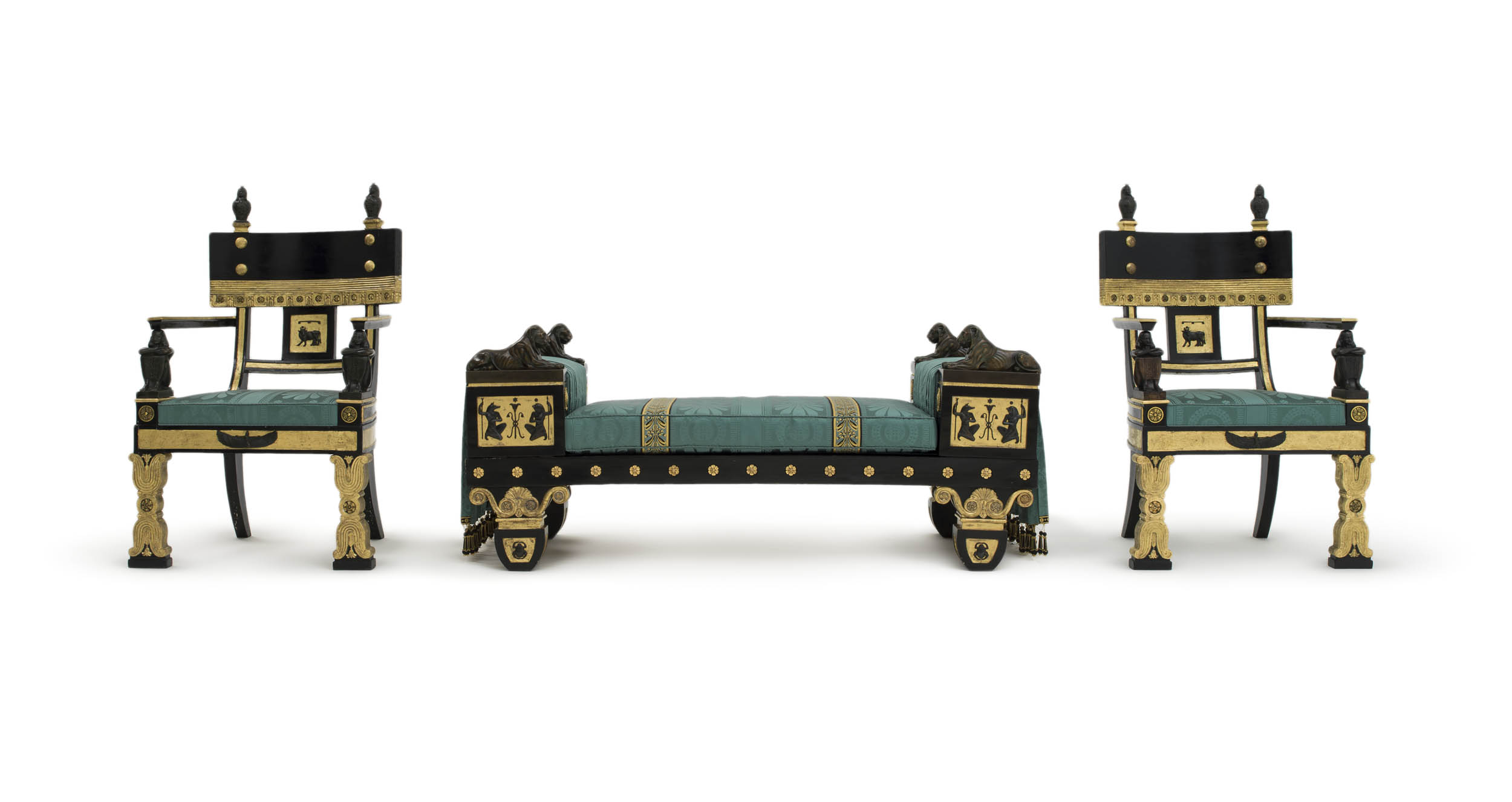
 

Thomas Hope (English born Holland, 1769-1831)(designer) 'Settee, Regency Egyptian Revival style' c. 1802


Thomas Hope (English born Holland, 1769-1831)(designer)
Settee, Regency Egyptian Revival style
c. 1802
Ebonised and gilt beech/bronze and gilt brass mounts/reproduction silk damask and trimmings
Height: 610 mm
Width: 1676 mm
Depth: 660 mm
Powerhouse Collection
Purchased with the funds donated by the Patrons of the Powerhouse, 1987
Bronze lions reproduced courtesy of Lord Faringdon, Buscot Park, England
The assistance of George Levy, H Blairman & sons, London is gratefully acknowledged


Regency Egyptian Revival settee by Thomas Hope

This pair of armchairs and settee in the Egyptian Revival style were designed by the English Regency designer, Thomas Hope, as part of the furnishings for the Egyptian room of his grand Robert Adam-designed residence in Duchess Street, London. The house was created as a showpiece for Hope’s collection of antiquities, and featured themed rooms with suites of furniture designed by Hope to provide a suitable background for his collection of classical and neoclassical statuary and objets d’art. His Egyptian room was located on the first floor, which was intended to be opened ‘museum-like’ to the public.

Thomas Hope was born in Amsterdam in 1769 into a wealthy Dutch banking family of Scottish descent. He settled in England around 1796 after an exhaustive eight-year grand tour of the Mediterranean countries, including Egypt, Turkey, Greece and Italy. His work in the Egyptian style has various sources including inspiration from his own travels and publications such as V. Denon’s “Voyage dans la basse et la haute Egypte” of 1802. The entire suite and its placement within the Egyptian room is illustrated in a meticulous line drawing in Thomas Hope’s “Household Furniture and Interior Decoration” of 1807 (plate VIII), an exceptional publication which established Hope’s reputation as a designer of outstanding vision and influential style. The Museum’s armchairs and couch form half of the suite of seating furniture originally in the Egyptian room; the other half is presently owned by the Faringdon Collection Trust, Buscot Park, England.

The provenance of the Powerhouse Museum’s pieces is interesting. A businessman, Sir Alfred Ashbolt, brought the suite to Australia in 1924 when he returned to Hobart after a term in London as agent-general for Tasmania (1919-1924). The furniture had been sold from the Hope estate to a London antique dealer in 1917. The couch and chairs were sold again at auction in the 1940s by the family of Sir Alfred Ashbolt. From then on, knowledge about their significance and origin appears to have faded until the armchairs were acquired at a Sydney auction by the Powerhouse Museum in 1984, and the couch acquired three years later, in 1987.

Anne Watson, 1984

Text from the Powerhouse Collection website
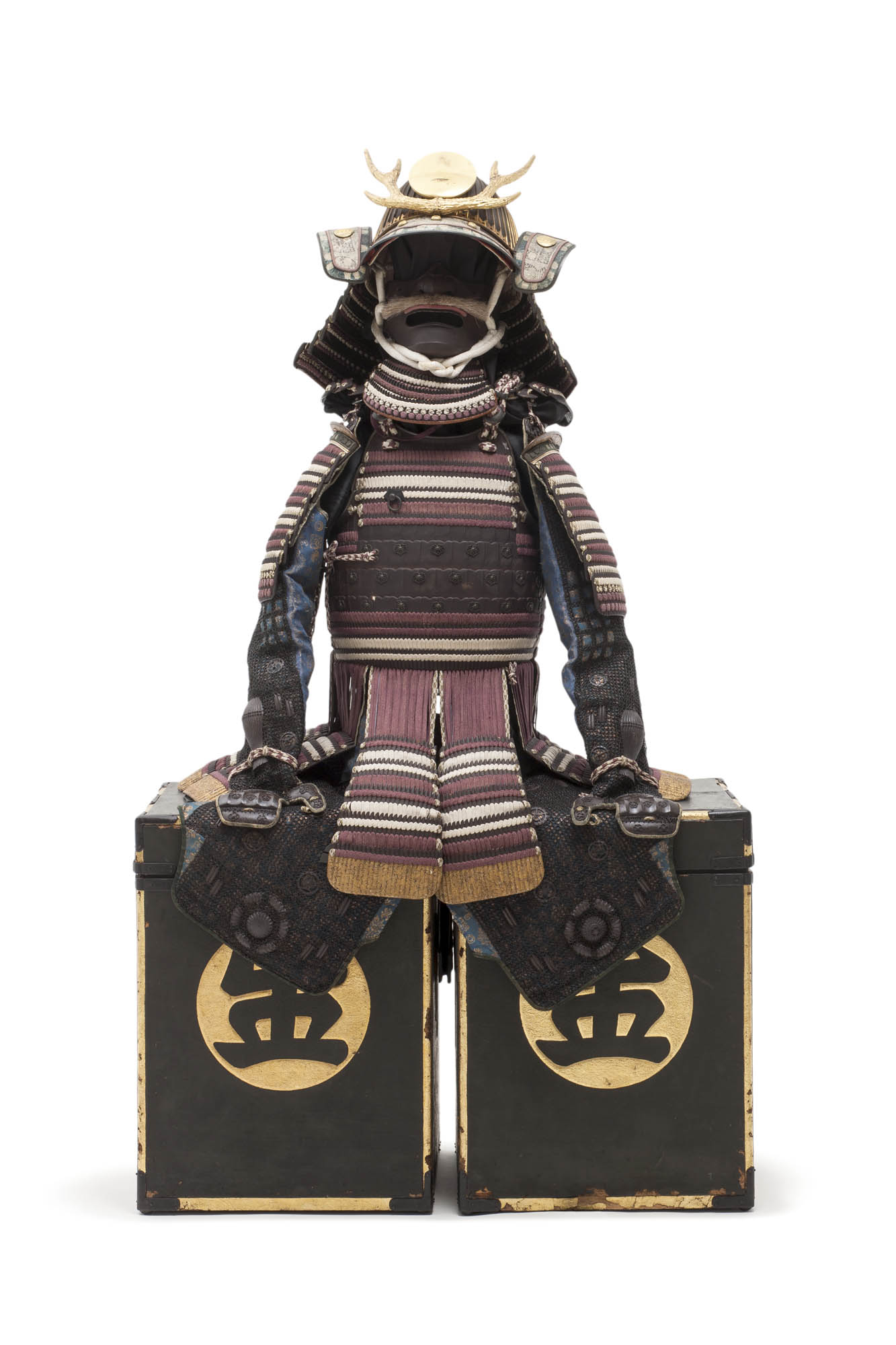
 

Unknown maker (Japan, Edo period) 'Suit of armour and horse tack, possibly insignia of samurai officer Koma Kaemon of Bizen clan' Possibly 1775


Unknown maker (Japan, Edo period)
Suit of armour and horse tack, possibly insignia of samurai officer Koma Kaemon of Bizen clan
Possibly 1775
Textile/leather/wood/lacquer/metal/paper/fibre/hair
Height: 1430 mm
Width: 800 mm
Depth: 520 mm
Powerhouse Collection
Purchased by the museum from Lawson’s auctioneers, Sydney, 1948
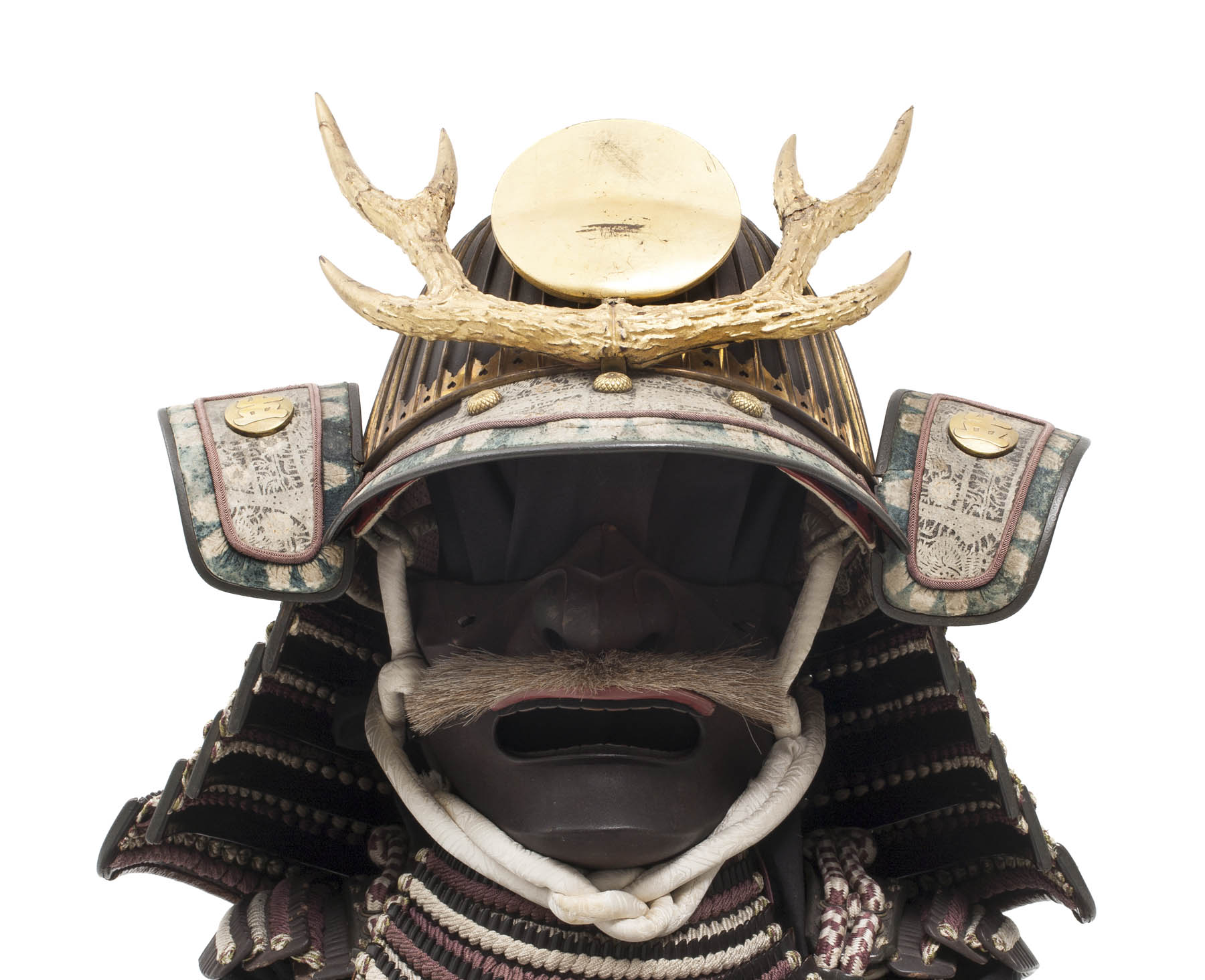
 

Unknown maker (Japan, Edo period) 'Suit of armour and horse tack, possibly insignia of samurai officer Koma Kaemon of Bizen clan' Possibly 1775 (detail)


Unknown maker (Japan, Edo period)
Suit of armour and horse tack, possibly insignia of samurai officer Koma Kaemon of Bizen clan (detail)
Possibly 1775
Textile/leather/wood/lacquer/metal/paper/fibre/hair
Height: 1430 mm
Width: 800 mm
Depth: 520 mm
Powerhouse Collection
Purchased by the museum from Lawson’s auctioneers, Sydney, 1948
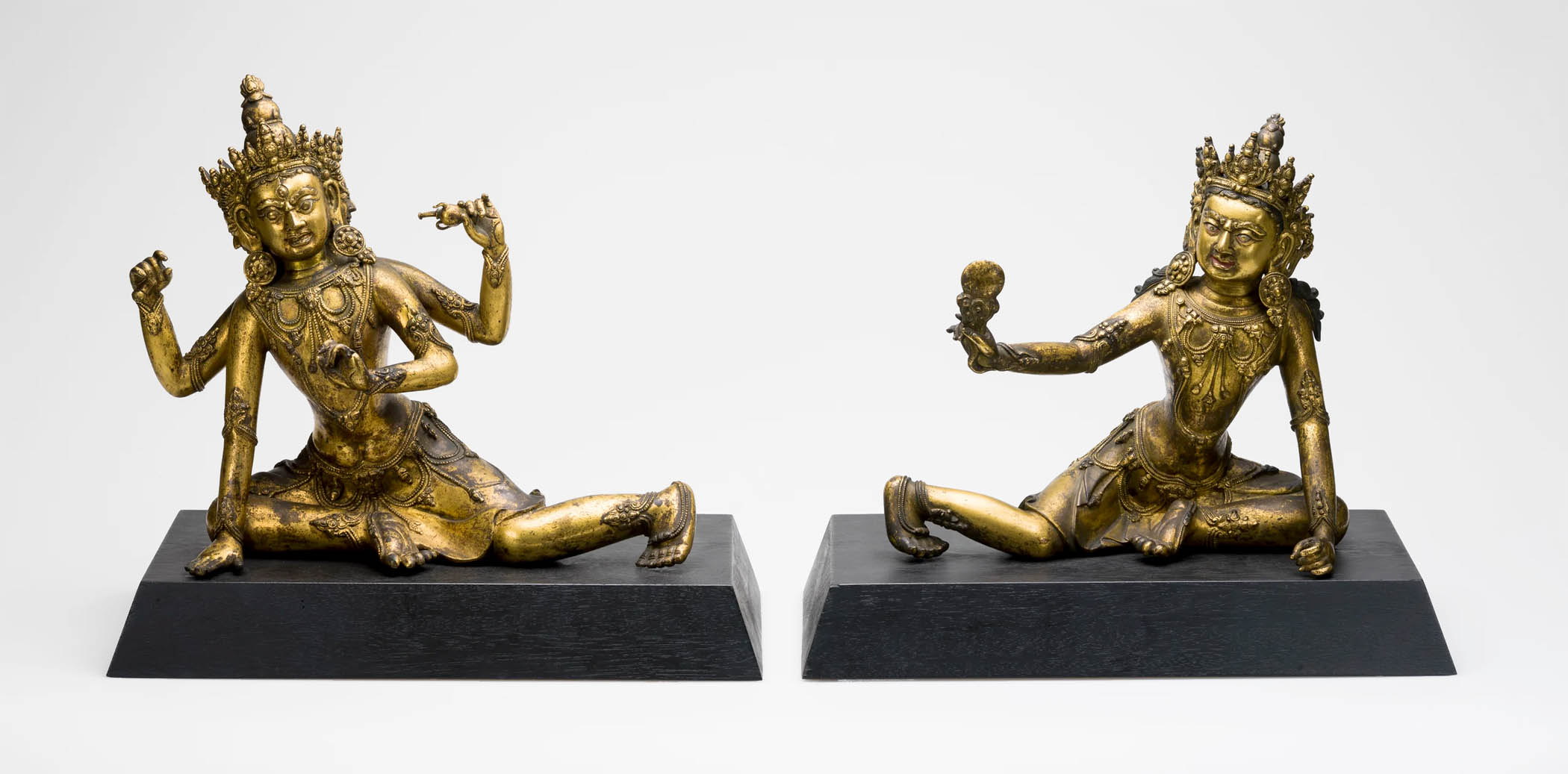
 

Gelugpa school (China, Ming dynasty, Yongle reign) 'Figures (2), Sino-Tibetan deities, Brahma and Chandra, from Vajrabhairava group' 1403-1424 or Xuande reign, 1426-1435


Gelugpa school (China, Ming dynasty, Yongle reign)
Figures (2), Sino-Tibetan deities, Brahma and Chandra, from Vajrabhairava group
1403-1424 or Xuande reign, 1426-1435
Gilt copper alloy/wood
Height: 350 mm
Width: 320 mm
Depth: 135 mm
Powerhouse Collection
Presented to the New South Wales Collection of Applied Art by Dame Eadith Campbell Walker, 1927


Sino-Tibetan figures from Vajrabhairava group

Manifestations of Hindu deities (Brahma and Chandra), which would have originally formed part of a Vajrabhairava group.
(-1) Figure, Brahma, seated, single head with 6 faces and four arms.
(-2) Figure, Chandra, similar to (-1) but with single head and two arms.

These two gilt bronze Sino-Tibetan figures are part of a set of eight Hindu gods enshrined in a Tibetan Buddhist temple in Beijing in the 15th century. These two figures would have been fourth and sixth from the left: Brahma and Chandra. These were most likely imperially commissioned, given the scale and quality of the figures, and were made by Newari metal craftsman who moved to China from Kathmandu Valley. The figures would have decorated the base of a monumental image of the cosmic deity Vajrabhairava, the wrathful manifestation of the Buddhisattva Manjusuri, the god of knowledge and wisdom. He is an important meditational deity of the Gelukpas, the largest and most powerful Buddhist order in Tibet. His form is characterised by multiple heads, including a buffalo head, and multiple limbs. The propositions of the present attendant figure suggest that the original sculpture would have stood over five feet high, arguable marking it one of the most important early Buddhist images recorded. A large embroidered silk thangka (Tibetan Buddhist painting) of Vajrabhairava in the Jokhang temple demonstrates the actual convention, showing eight deities in order were Shiva, Vishnu, Indra, Brahma, Katikeya, Chandra, Surya and Gannesha.

Min-Jung Kim
Curator
Feb 2017

Text from the Powerhouse Collection website
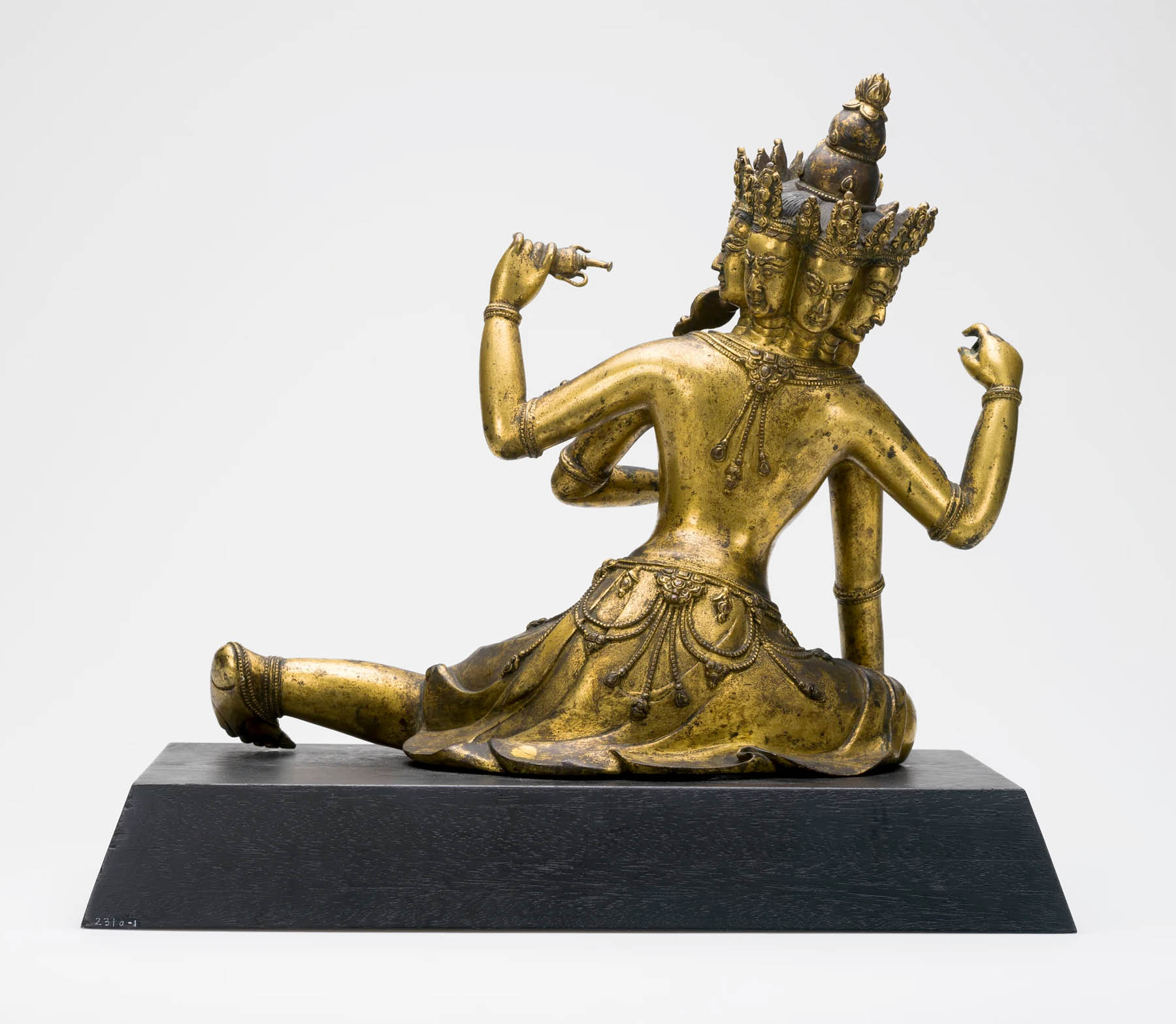
 

Gelugpa school (China, Ming dynasty, Yongle reign) 'Figures (2), Sino-Tibetan deities, Brahma and Chandra, from Vajrabhairava group' 1403-1424 or Xuande reign, 1426-1435 (detail)

Gelugpa school (China, Ming dynasty, Yongle reign) 'Figures (2), Sino-Tibetan deities, Brahma and Chandra, from Vajrabhairava group' 1403-1424 or Xuande reign, 1426-1435 (detail)


Gelugpa school (China, Ming dynasty, Yongle reign)
Figures (2), Sino-Tibetan deities, Brahma and Chandra, from Vajrabhairava group (details)
1403-1424 or Xuande reign, 1426-1435
Gilt copper alloy/wood
Height: 350 mm
Width: 320 mm
Depth: 135 mm
Powerhouse Collection
Presented to the New South Wales Collection of Applied Art by Dame Eadith Campbell Walker, 1927


Charles Rennie Mackintosh (Scottish, 1868-1928)(designer, Glasgow, Scotland) 'Chair, 'Argyle'' 1898-1899


Charles Rennie Mackintosh (Scottish, 1868-1928)(designer, Glasgow, Scotland)
Chair, ‘Argyle’
1898-1899
Designed for the Argyle Street Tearooms, Glasgow, c. 1897
Height: 1370 mm
Width: 505 mm
Depth: 470 mm
Powerhouse Collection
Purchased with funds donated by the Patrons of the Powerhouse, 1984


‘Argyle’ chair by Charles Rennie Mackintosh

This unusually high backed chair was designed by the Scottish architect, Charles Rennie Mackintosh for Catherine Cranston’s Argyle Street Tearooms in Glasgow around 1898-1899. The design for the furniture of the tearooms was the first major private commission of Mackintosh’s career. The Argyle chair was shown at the Eighth Exhibition of the Vienna Secession, Austria in 1900 where Mackintosh’s highly individual style strongly influenced and contributed to the development of work at the Wiener Werkstatte.

The attenuated lines and exaggerated height of its back anticipated many of Mackintosh’s later designs. It is the first of his high back chairs to feature the top rail as an emblematic iconic symbol. The back uprights support an enlarged oval headrest with a fretted stylised flying swallow shape. Mackintosh raised the height of the chairs in order that the furniture make a dramatic statement within the room.

Mackintosh’s concentration on the formal qualities of the furniture within the interior very much anticipated the spirit of 20th century modernism. Although he was not as appreciated at home as he was on the continent (he died in relative poverty in London in 1928), his architecture and design went on to be revered worldwide and is appreciated for forming an important bridge between the 19th and 20th centuries, and between England and continental Europe.

Text from the Powerhouse Collection website
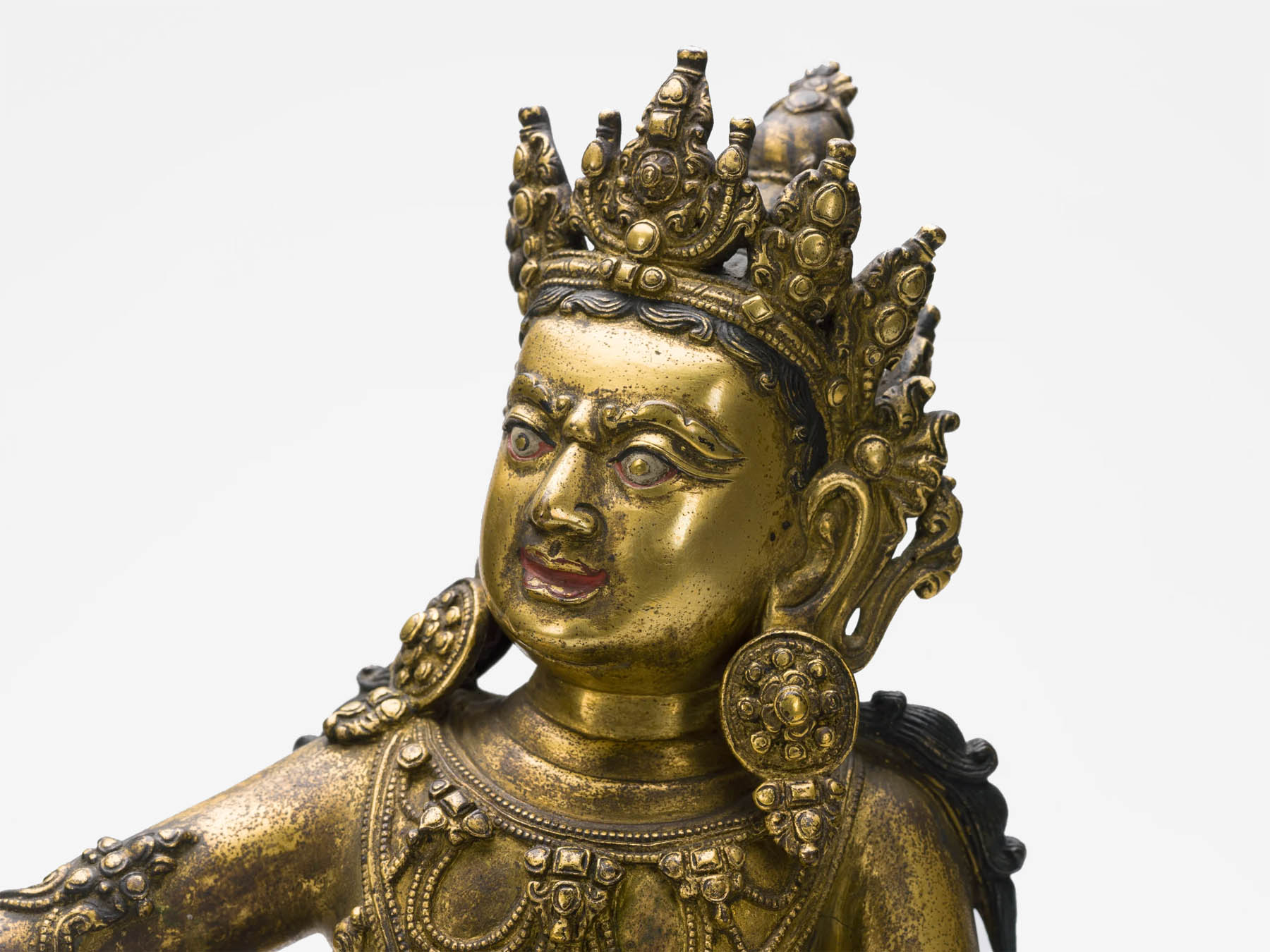
 

Unknown maker (English) 'Mourning brooch' c. 1870


Unknown maker (English)
Mourning brooch
c. 1870
Metal/human hair
Height: 50 mm
Width: 75 mm
Depth: 25 mm
Powerhouse Collection
Gift of Margaret Vella, 1995


Meticulously crafted from human hair about 1870, this brooch is an example of a practice which flourished in Europe for almost four centuries. Wearing finger-rings as a memento of a deceased relative or friend had been well established by the 1400s, but it was during the late 1700s that mourning jewellery became truly fashionable. Rings, brooches, bracelets and even earrings made from black-enamelled gold, jet and human hair were widely worn particularly in Britain and colonies including Australia.

Alongside a flourishing hair-jewellery industry that sprang up in the 1800s, self-help manuals provided patterns and instructions for braiding and plaiting of hair into jewellery at home. Sometimes seen as macabre, the keeping of the deceased relative’ s hair reflects a different sensibility from the modern sanitised view of death. Although most hair jewellery was intended for mourning, it was also made to celebrate love. Sadly, we don’ t know who wore this brooch. Though it was probably an expression of someone’ s grief, it could also have been intended as a token of love as the hair appears to have belonged to two people. It was made at a time when the fashion for hair jewellery was fading.

Eva Czernis-Ryl, Curator, 2020

Text from the Powerhouse Collection website
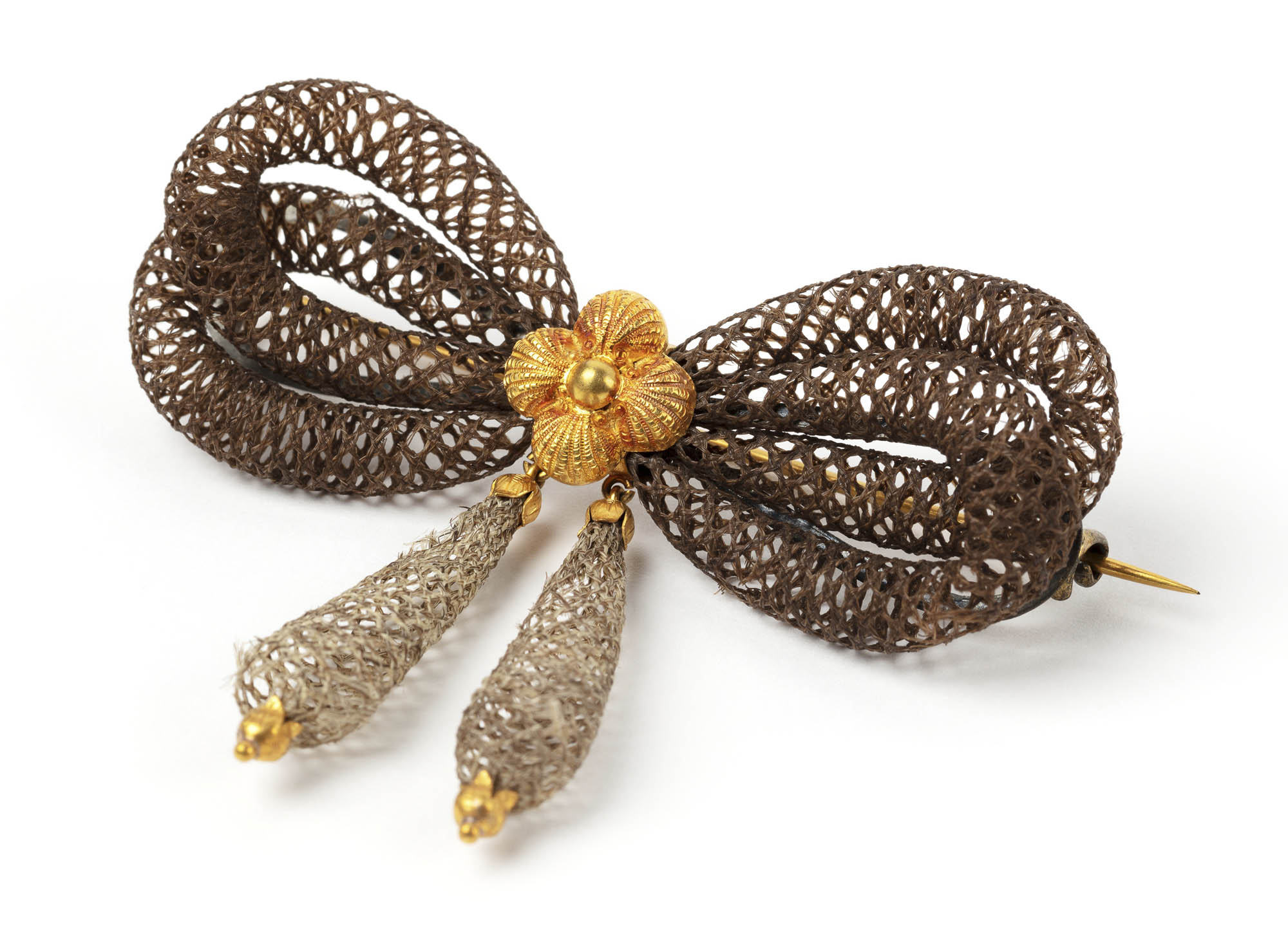
 

Ken + Julia Yonetani (Katoomba, New South Wales, Australia) 'Chandelier, 'USA'' 2013


Ken + Julia Yonetani (Katoomba, New South Wales, Australia)
Chandelier, ‘USA’
2013
From art installation Crystal Palace: The Great Exhibition of the Works of Industry of All Nuclear Nations
Uranium glass/UV lights/metal
Height: 2000 mm
Width: 1600 mm
Weight: 80 kg
Powerhouse Collection
Purchased with funds donated through the annual appeal and from the MAAS Foundation, 2016


‘USA’ Chandelier by Ken + Julia Yonetani

The chandelier is part of an installation created in response to the 2011 Fukushima Daiichi nuclear disaster. There are 31 chandeliers in the installation, each representing a country with nuclear power stations. Their sizes correspond to the nuclear capacity in that country, with the USA chandelier being the largest. All chandeliers are densely covered with specially sourced uranium glass beads and feature uranium glass crystal pendants. When lit in darkness, the ultraviolet light tubes react with the uranium inside the glass to create a fluorescent green effect, reminiscent of the presence of radiation. (Uranium glass contains very small traces of uranium and poses no health risks).

Working with a thrilling variety of conventional and unconventional materials including sugar and salt, Ken (b. 1971, Tokyo) who is Japanese with Australian residency, and his Australian partner Julia (b. 1972, Tokyo) are among the most creative contemporary artists emerging on the international art scene today. They explore environmental concerns through powerful installations such as the ‘Sweet Barrier Reef’ which comments on the effects of climate change and was first shown at the 2009 Venice Biennale. Other international shows include an installation at the 2013 Singapore Biennale and a major solo exhibition at the Abbey de Maubuisson in Paris in 2015.

The Yonetanis divide their time between Australia and Japan. The Fukushima plant accident had a profound effect on the artists and this installation explores their deeply-felt sense of fear associated with the impacts of radiation. Inspired by the world’s first large-scale international expo, the 1851 Great Exhibition of the Works of Industry of All Nations, the artists have created a provocative statement on our accelerating seduction with nuclear technology and power. Eerily beautiful, they mesmerise the viewer with the chandeliers’ magical presence while also posing timely questions. The artists explain: ‘You can’t see, smell or perceive radiation with your senses, but it becomes visible in our works when illuminated with ultraviolet lights… We hope to prompt viewers to react in their own way to this radioactive presence.’ (Interview, National Gallery of Australia, Canberra 2016)

In the MAAS context, this multi-media artwork highlights this Museum’s own history and its interlinked arts, design and technology collections: MAAS was modelled on London’s South Kensington Museum (now The Victoria & Albert Museum), a direct result of the Great Exhibition. This Museum also originated as a response to the 1879 Sydney International Exhibition, the first world’s fair in the southern hemisphere.

Eva Czernis-Ryl, Curator, 2016

Text from the Powerhouse Collection website
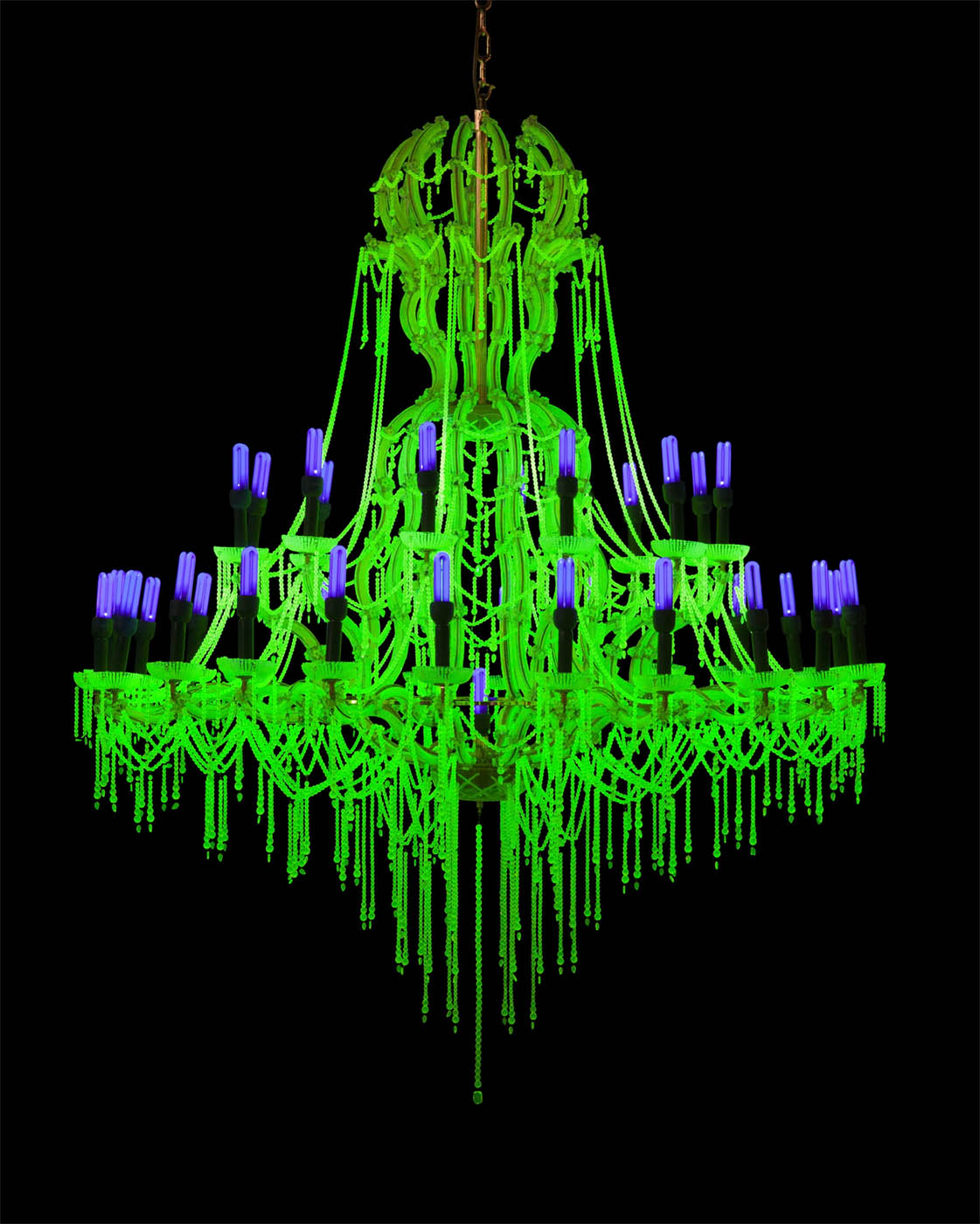
 

Installation view of the exhibition '1,001 Remarkable Objects' at Powerhouse Ultimo, Sydney showing numerous examples of Australian colonial silver in the Powerhouse Collection including at centre, Evan Jones' Inkstand, seated emu form (c. 1875)


Installation view of the exhibition 1,001 Remarkable Objects at Powerhouse Ultimo, Sydney showing numerous examples of Australian colonial silver in the Powerhouse Collection including at centre, Evan Jones’ Inkstand, seated emu form (c. 1875, below)


Installation view of the exhibition '1001 Remarkable Objects' at Powerhouse Ultimo, Sydney (detail)


Evan Jones (Australian born England)(Sydney, New South Wales, Australia)
Inkstand, seated emu form (installation view)
c. 1875
Silver gilt/emu egg shell/glass/wood
Height: 350 mm
Width: 400 mm
Depth: 260 mm
Weight: 6.5 kg
Powerhouse Collection
Purchased 1984


Silver Gilt Emu Inkstand by Evan Jones

This inkstand is the only one of its kind known to have been made in colonial Australia. It is a fine example of Australian-made presentation pieces bought or commissioned from silversmiths working in gold-rush Australia between the late 1850s and the depression of the early 1890s. Before that time, presentation silver was imported, mostly from England. From the late 1850s, newly arrived immigrant silversmiths from England, Ireland and continental Europe could more than satisfactorily meet the growing demand for silver or gold testimonials and sporting trophies. They developed a uniquely Australian style using Australian motifs such as the emu and kangaroo, and incorporating local materials, particularly the vivid-green emu egg and Australian malachite that provided such a striking contrast to polished silver.

This inkstand is one of the most impressive works made by Evan Jones, a leading silversmith in late colonial Sydney. Born in England, Jones worked as silversmith, watchmaker, medallist and jeweller in Sydney between about 1873 and 1917. At the age of twelve Jones became an apprentice at Hardy Brothers, and he later gained experience at the renowned firm of Hogarth, Erichsen & Co, and with Christian L Qwist. His business was first listed in the Sydney Directory in 1873 at 15 Hunter Street, a former address of Qwist. He established several branches in the city in the 1890s, but his principal workshop was in Erskine Street.

Evan Jones frequently exhibited in colonial and international exhibitions. It was reported, for example, that in the Sydney International Exhibition of 1879, Australia’s first, he showed “emu’s eggs …mounted in 101 different ways”. Jones also produced gold and silver racing cups, rowing and sculling trophies, and decorative tableware including spectacular silver epergnes (table centrepieces) with Australian motifs. His modelling skills in silver can be best appreciated in this marvellous sculptural inkstand made about 1875.

Eva Czernis-Ryl, curator, June 2007

Text from the Powerhouse Collection website
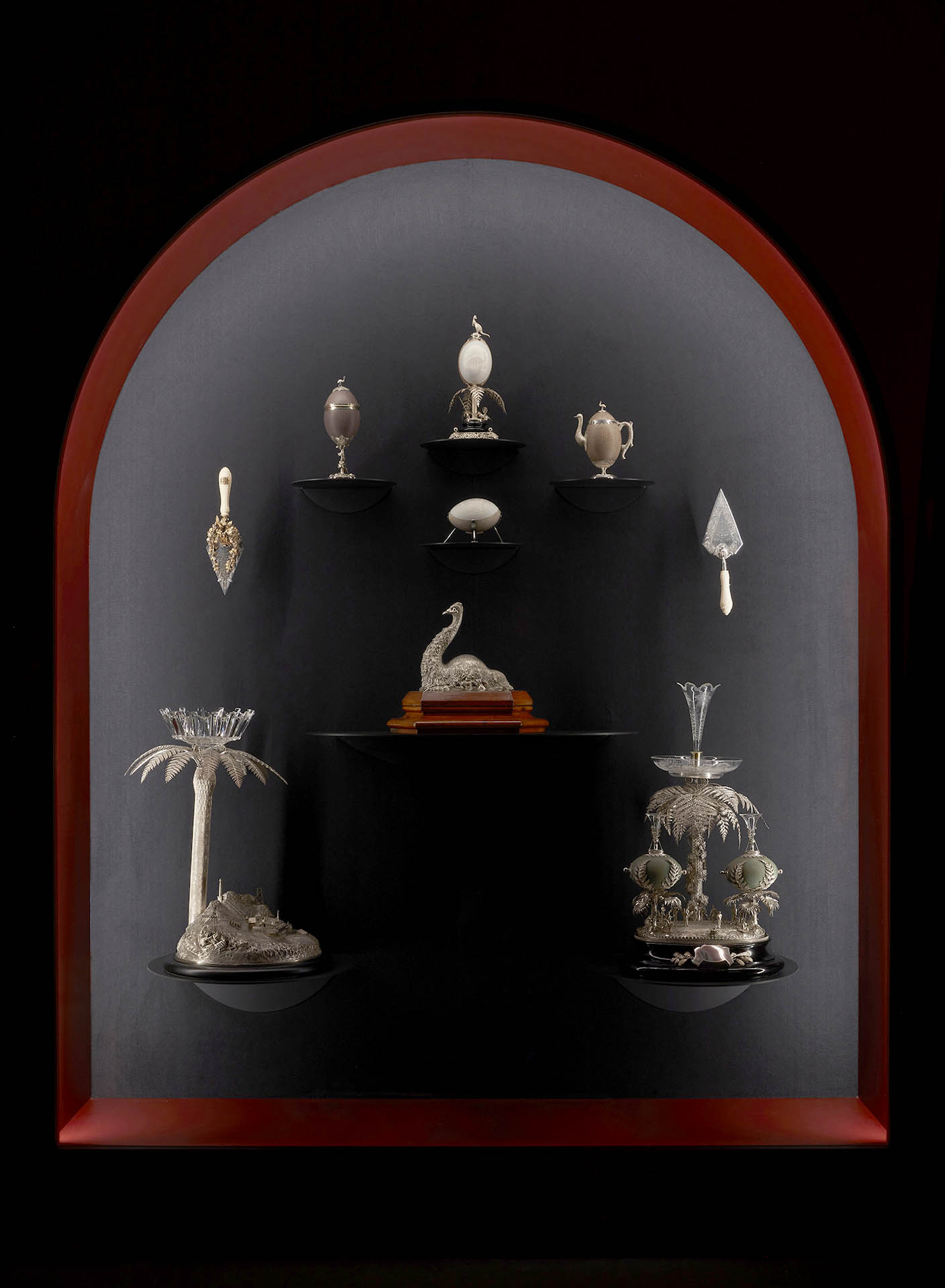
 

Installation view of the exhibition '1,001 Remarkable Objects' at Powerhouse Ultimo, Sydney showing William Kerr's Presentation trowel (c. 1883)


Installation view of the exhibition 1,001 Remarkable Objects at Powerhouse Ultimo, Sydney showing William Kerr’s Presentation trowel (c. 1883, below)


William Kerr (Australian born Ireland, 1838-1896)(maker, Sydney, New South Wales, Australia) 'Presentation trowel' c. 1883 (installation view detail)


William Kerr (Australian born Ireland, 1838-1896)(maker, Sydney, New South Wales, Australia)
Presentation trowel (installation view)
c. 1883
Used by Lizzie Henrietta Harris to lay the foundation stone of the Great Hall of Sydney Town Hall, Sydney, New South Wales, Australia, 1883
Silver/gold/ivory
Width: 97 mm
Depth: 53 mm
Weight: 283.5 g
Powerhouse Collection
Donated through the Australian Government’s Cultural Gifts Program by John Atkinson, 2006


Presentation trowel used in laying the foundation stone of Sydney Town Hall

This trowel was used in laying the foundation stone of the Great Hall of Sydney Town Hall on 13 November 1883.

It relates to the history of a prominent Sydney family. Lizzie Henrietta Harris, to whom the trowel was presented by aldermen of the city, was wife of John Harris, Mayor of Sydney. Their daughter Mary Ann was herself Mayoress of Sydney in 1888 and 1889, during the five terms in which her father was Mayor.

It was made in the workshop of William Kerr (1838-1896), a leading watchmaker, jeweller and silversmith in Sydney in late 19th century. Today, Kerr is mostly remembered for his distinctive silver trophies, three of them receiving an award at Australia’s first International Exhibition which took place in Sydney in 1879. Kerr’s work was commended for ‘tasteful design’ and ‘careful workmanship’.

William Kerr was born in Northern Ireland and came to Australia on board of the ‘New York Packet’ with his family in 1841. Kerr obtained many important commissions for presentation pieces, like this trowel, often from the Sydney City Council. Recognising the importance of sporting life in Australia, Kerr also sponsored clubs which gave him a steady stream of orders. He used Australian motifs, mostly plants and animals, in his distinctive, finely worked pieces.

The striking design and execution as well as the original condition of the trowel, which is applied with Australian flowers crafted in gold, make it an outstanding item of Australian metalwork of the period. It is the only example of its kind known to have been made and survived.

Text from the Powerhouse Collection website
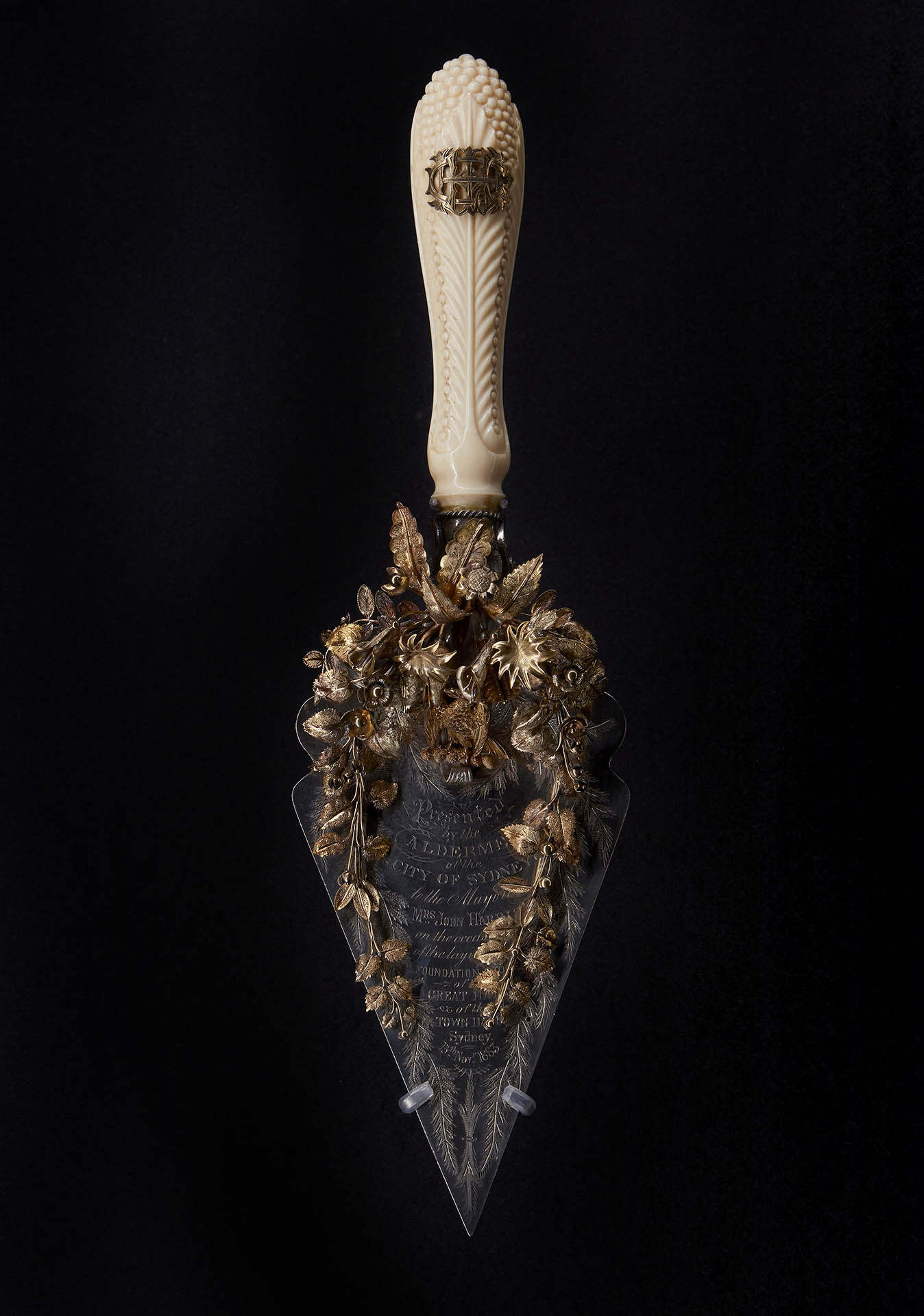
 

William Edwards (Australian born England, c. 1819 - c. 1889)(maker) Kilpatrick & Co (retailer est. 1853, Melbourne, Victoria, Australia) 'Inkstand with kangaroo and emu motifs, gold and silver, presented to John Todd by Thomas Bibby Guest' 1865


William Edwards (Australian born England, c. 1819 – c. 1889)(maker)
Kilpatrick & Co (retailer est. 1853, Melbourne, Victoria, Australia)
Inkstand with kangaroo and emu motifs, gold and silver, presented to John Todd by Thomas Bibby Guest
1865
Gold and silver
Height: 245 mm
Width: 320 mm
Depth: 190 mm
Powerhouse Collection
Purchased with the assistance of Silvanus Gladstone Evans bequest, 1986


Inkstand with Kangaroo and Emu Motifs by William Edwards

Only twenty four significant examples of Australian-made secular presentation pieces crafted in gold are known to have survived from the colonial period; almost eighty are known to have been made. This unique inkstand is one of the most striking, particularly in its use of sculptural elements and Australian iconography. Fashioned in silver and almost pure gold, it was made in the workshop of William Edwards (c. 1819 -c. 1889) in Melbourne in 1865 and retailed by Kilpatrick & Co (est. 1853). The son of a London silversmith and a manufacturing silversmith, Edwards came to Australia in 1857. Until about 1872 he ran a business in Melbourne which supplied silverware to major retailers; some objects were imported from the family business in London. From about 1873 Edwards was in partnership with Alexander Kaul.

William Edwards’ workshop excelled in the production of silver-mounted emu egg trophies and is credited with making the earliest surviving piece, the covered cup presented in 1859 to a Melbourne University scholar by his students (also in this Museum’s collection). Although silver-mounted emu eggs form the largest surviving body of Edward’s output, his workshop also produced a number of silver and occasionally gold trophies and epergnes, some of which were displayed in international exhibitions. Edwards was also responsible for major commissions such as the gifts for Prince Alfred, Duke of Edinburgh which subsequently brought him an appointment as goldsmith and jeweller the the Duke’s household.

The majority of the firm’s wares were designed in the naturalistic and rococo revival styles. From the early 1860s, classical revival motifs and forms began appearing, often in combination with rococo and sometimes gothic elements. Regency detailing, evident in the design of the base of this inkstand, was rare. Also well known are Edward’s silver claret jugs of the 1860s, which were made in many variations including richly repoussed pieces and even emu and ostrich egg versions.

Thomas Bibby Guest was a steam biscuit manufacturer in William Street in Melbourne who succumbed to the lure of the goldfields in about 1857 and ‘made a considerable sum of money in mining [and] … lost most of it’. John Todd, his English business associate, helped Guest by sending the latest biscuit-making machinery on credit which enabled Guest “to produce such a quality that no one else could & by this means I have got back my lost trade, & my returns… more than trebled & still go on increasing” ( TB Guest & Co, papers, University of Melbourne Archives, 1875). The loan was repaid in full in August 1865, when the inkstand was delivered to Todd in Manchester. Guest’s biscuit works were relocated to North Melbourne in 1897, and in 1900 the business was converted into a proprietary company. Guest died on 3 April 1908 as ‘a man of exceptional business capacity, and his enterprise in starting a new industry so early, earned him the esteem and respect of his fellow colonists.” (‘Age’, 4 April 1908, p. 17). John Todd died in Manchester in 1875, and the fate of his inkstand, until it was located in 1986 in England and purchased by the Powerhouse Museum, is unknown. The original invoice for the inkstand, for 100 pounds, dated 11 April 1865 and made out to TB Guest still survives in the University of Melbourne Archives.

Eva Czernis-Ryl, September 2007

Recommended further reading:
C Thompson, ‘Substantial evidence of your gratitude… A silver and gold presentation inkstand by William Edwards, Melbourne, 1865’, Australiana, August 1987, pp 91-95.

Text from the Powerhouse Collection website
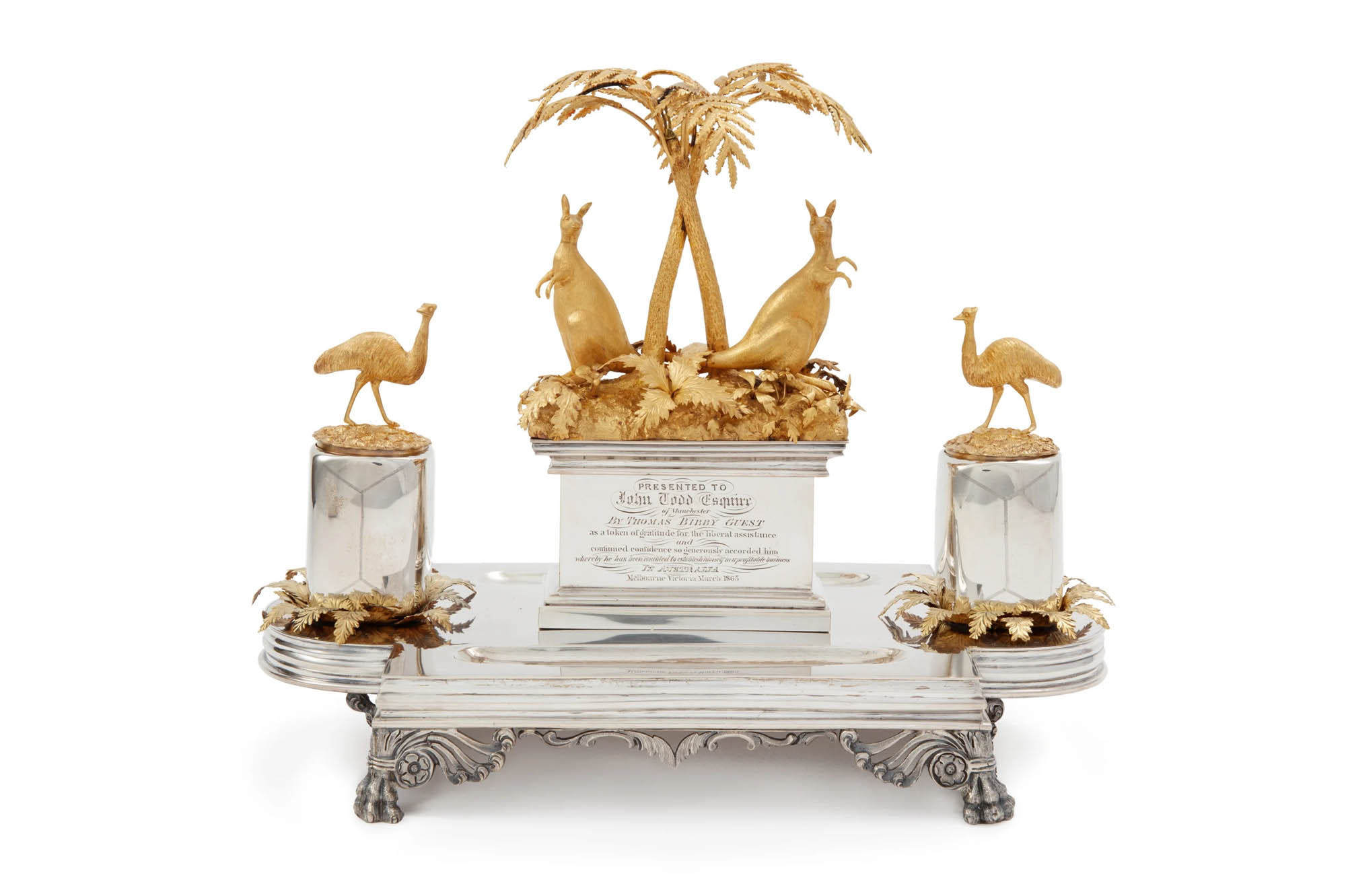
 

Installation view of the exhibition '1,001 Remarkable Objects' at Powerhouse Ultimo, Sydney showing examples of 19th century Australian gold jewellery in the Powerhouse Collection including at top, a parure comprising necklace, locket and earrings (pair), gold / operculum by F Allerding & Son, Sydney, New South Wales, Australia, 1879-1884; and at second top centre, Bangle, 'Soyons toujours unis / Par un divin amour', 18 carat gold, Henry Steiner, Adelaide, South Australia, c. 1878

Installation view detail of the exhibition '1,001 Remarkable Objects' at Powerhouse Ultimo, Sydney showing examples of 19th century Australian gold jewellery in the Powerhouse Collection including at top, a parure comprising necklace, locket and earrings (pair), gold / operculum by F Allerding & Son, Sydney, New South Wales, Australia, 1879-1884; and at second top centre, Bangle, 'Soyons toujours unis / Par un divin amour', 18 carat gold, Henry Steiner, Adelaide, South Australia, c. 1878


Installation views of the exhibition 1,001 Remarkable Objects at Powerhouse Ultimo, Sydney showing examples of 19th century Australian gold jewellery in the Powerhouse Collection including at top, a parure comprising necklace, locket and earrings (pair), gold/operculum by F Allerding & Son, Sydney, New South Wales, Australia, 1879-1884 (below); and at second top centre, Bangle, ‘Soyons toujours unis / Par un divin amour’, 18 carat gold, Henry Steiner, Adelaide, South Australia, c. 1878 (below)


F Allerding & Son (maker, Sydney, New South Wales, Australia) 'Necklace from a parure which includes locket and earrings (pair)' 1879-1884 (installation view)


F Allerding & Son (maker, Sydney, New South Wales, Australia)
Necklace from a parure which includes locket and earrings (pair) (installation view)
1879-1884
Gold/operculum
Powerhouse Collection
Purchased, 1994


Operculum and Gold Parure by F Allerding & Son

This parure is probably the finest known surviving example of gold-mounted operculum jewellery made (and fully marked) in colonial Australia. Among the more unusual materials used in 19th century jewellery in Australia were shells of many varieties- nautilus, trigonia mother of pearl and operculum, the shell valve of the mouth of a sea-snail shell, which, when polished, resembles a ‘cat’s eye’. A fine necklace of operculum mounted in gold was shown by F Allerding & Son at the Sydney International Exhibition in 1879, alongside some examples by other Sydney jewellers: Evan Jones, William Kerr and Hippoyte Delarue.

F. Allerding & Son were jewellers and scientific instrument retailers who operated from 25 Hunter Street in Sydney. Friederich Allerding had been operating a shop in Hunter Street from as early as 1863 and around 1879 changed the name to incorporate his son Henry into the business. The firm’s name was changed to Allerding F. & Co. around 1892 and Henry continued to operate the business into the early 1900s.

Allerding was obviously well regarded by the local scientists in Sydney as he was invited by H. C. Russell, the Government Astronomer, to participate in the observation of the 1874 Transit of Venus. Allerding viewed the transit from the back-yard of his Hunter Street business and this is recorded in Russell’s book on the Transit observations. This books also refers to the fact that Allerding at this time was listed as a ‘chronometer maker’ although it appears more likely that he was a retailer of imported chronometers. This was not uncommon for the maker whose name is on the instrument typically organised for the parts to be brought together and supervised the final stages of its construction such as ‘springing’ or adjusting the mechanism. However the company also specialised in jewellery making and at the Sydney International Exhibition in 1879 were commended ‘for skilful workmanship and good quality of gold and shell jewellery’. Designed in the style popular in England particularly in the late 1870s and 1880s, this the finest example of Allerding’s parure work known to exist.

Eva Czernis-Ryl and Geoff Barker, Curatorial, 2007-2008

Further reading:
A.Schofield, ‘Materials used in 19th century Australian jewellery’, The Australian Antique Collector, April-October 1996, pp. 157-159.

Text from the Powerhouse Collection website
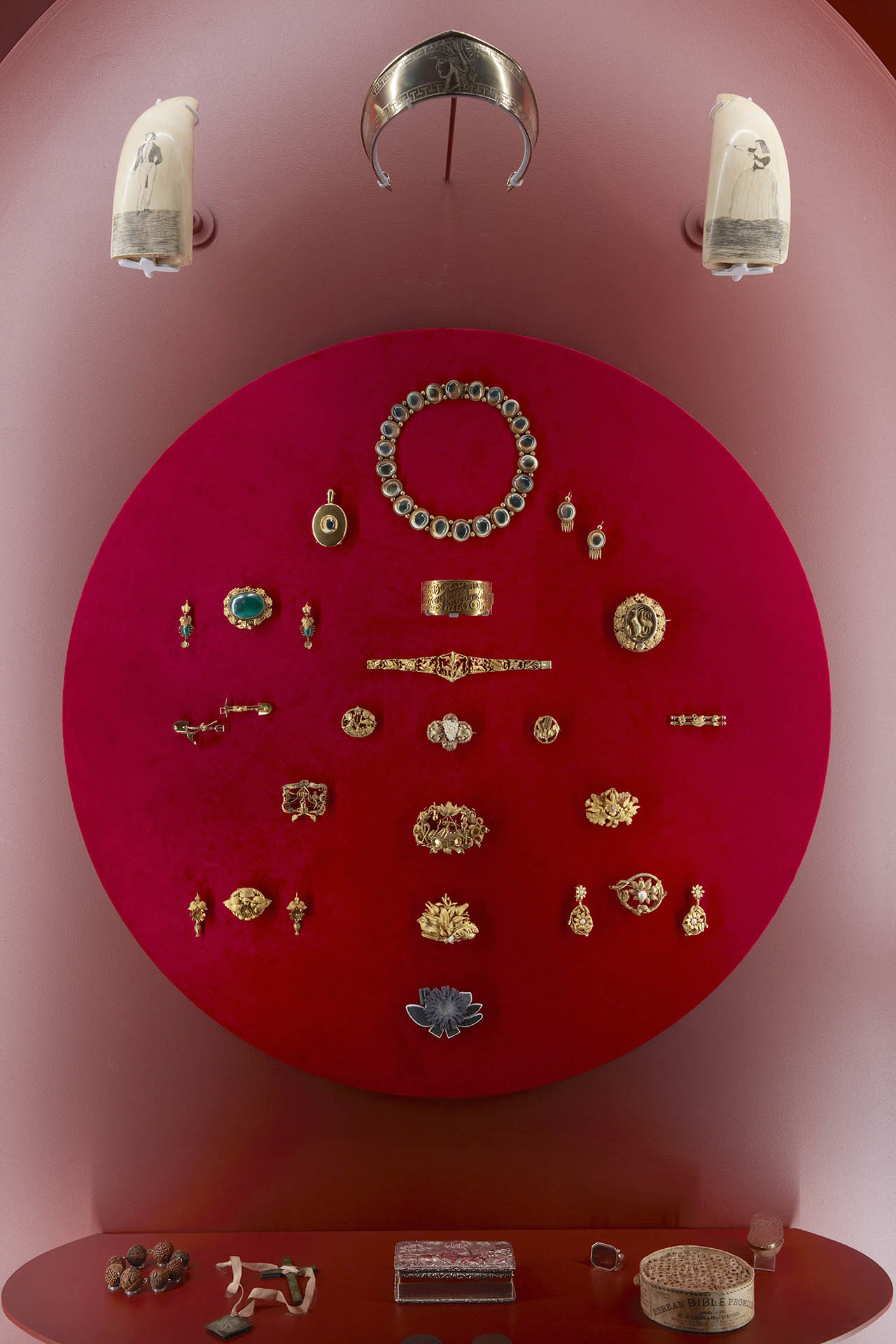
 

Henry Steiner (maker, Adelaide, South Australia) 'Bangle, 'Soyons toujours unis / Par un divin amour'' c. 1878 (installation view)


Henry Steiner (Australian born Germany, 1835-1914)(maker, Adelaide, South Australia)
Bangle, ‘Soyons toujours unis / Par un divin amour’ (installation view)
c. 1878
18 carat gold
Height: 32 mm
Width: 59 mm
Depth: 68 mm
Powerhouse Collection
Purchased 1988


Gold Bangle by Henry Steiner

Only a small number of substantial, fully marked gold jewellery crafted in colonial Australia has survived and this rare bangle is one such work. Its significance is further enhanced by its believed association with the Paris Universal Exposition of 1878 where Steiner in known to have exhibited jewellery. This piece is one of Steiner’s finest. Meticulously crafted and decorated with a lavish French inscription, the bangle was most likely made for the Paris Universal Exposition of 1878 where Steiner exhibited.

Born in Bremen, Germany in 1835, Johann Henry Steiner arrived in Australia about 1858 and was first listed in the South Australian Almanac in 1864. While Steiner is best known for his silver presentation pieces (including silver-mounted emu eggs) often decorated with Australian flora and fauna, he also supplied a wide range of gold jewellery in Adelaide between 1864 and 1884, when he sold the business to August Brunkhorst, another German-born jeweller and silversmith. Steiner exhibited at a number of international exhibitions in Australia and overseas, receiving a first degree of merit in Sydney in 1879. Alongside J M Wendt, Henry Steiner was also a leading retailer of other silversmiths’ work in Adelaide.

Text from the Powerhouse Collection website
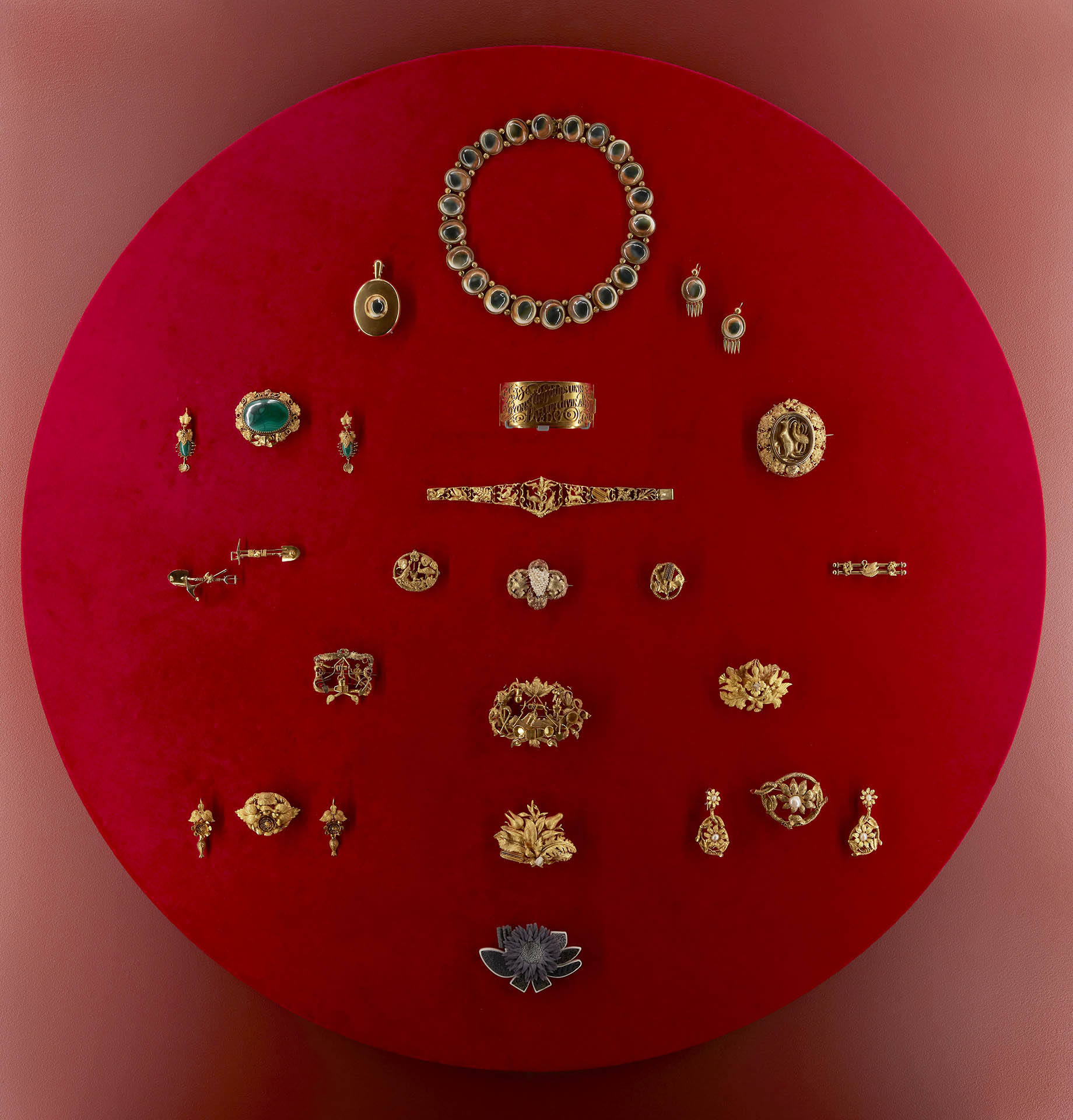
 

Unknown maker (English) 'Diamond brooch in the form of a bee with sapphires on his head and in stripes across his body and with ruby eyes' 1860-1870


Unknown maker (English)
Diamond brooch in the form of a bee with sapphires on his head and in stripes across his body and with ruby eyes
1860-1870
Gold/diamonds/sapphires/rubies


Tooth & Co Ltd (Sydney, New South Wales, Australia) 'Advertising signage (1 of 5), white horse rampant' c. 1930s (installation view)


Tooth & Co Ltd (Sydney, New South Wales, Australia)
Advertising signage (1 of 5), white horse rampant (installation view)
c. 1930s
Plaster
Height: 610 mm
Width: 188 mm
Depth: 433 mm
Powerhouse Collection
Acquired 1986


Installation view of the exhibition '1,001 Remarkable Objects' at Powerhouse Ultimo, Sydney showing in the foreground, Figure, 'Peacock', earthenware with majolica glazes, modelled by Paul Comolera, made by Mintons, Stoke-on-Trent, Staffordshire, England, c. 1873-1875

Installation view detail of the exhibition '1,001 Remarkable Objects' at Powerhouse Ultimo, Sydney showing in the foreground, Figure, 'Peacock', earthenware with majolica glazes, modelled by Paul Comolera, made by Mintons, Stoke-on-Trent, Staffordshire, England, c. 1873-1875


Installation views of the exhibition 1,001 Remarkable Objects at Powerhouse Ultimo, Sydney showing in the foreground, Figure, ‘Peacock’, earthenware with majolica glazes, modelled by Paul Comolera, made by Mintons, Stoke-on-Trent, Staffordshire, England, c. 1873-1875


Florence Broadhurst (Australian, 1899-1977)(designer) Florence Broadhurst Wallpapers Pty Ltd (maker, Sydney, New South Wales, Australia) 'Wallpaper roll, 'Peacocks' design' 1969-1977 (installation view)


Florence Broadhurst (Australian, 1899-1977)(designer)
Florence Broadhurst Wallpapers Pty Ltd (maker, Sydney, New South Wales, Australia)
Wallpaper roll, ‘Peacocks’ design (installation view)
1969-1977
Polyester/paper
Width: 758 mm


Wallpaper roll, ‘Peacocks’ design by Florence Broadhurst Wallpapers

Florence Broadhurst perceived her ‘Peacocks’ wallpaper as one of her best mature works. It became a ‘signature’ piece when Florence posed in front of it for her business advertisements in the 1970s. Sydney identities used the design in their homes, including Jill Wran and her husband Neville Wran, former Premier of NSW.

The full set of screens required to print the original ‘Peacocks’ design were acquired into the Museum’s collection in 1997 (97/322/2). Unused lengths or rolls of the ‘Peacocks’ wallpaper are extremely rare. This length was acquired opportunistically by the donor who purchased it from a local St Vincent de Paul outlet.

Florence Broadhurst is most renowned in Australia for her Sydney-based wallpaper business. As well as being a business woman, wallpaper and textile designer, Florence also had earlier careers as an artist (painter), dress consultant/designer and performer (singer and banjolele player). Born in Mt Perry, Queensland in 1899, she died in Sydney during 1977.

She established Australian (Hand Printed) Wallpapers Pty Ltd in St Leonards in 1959 moving to 12-24 Roylston Street, Paddington in 1969. She then changed the name of the business to Florence Broadhurst Wallpapers Pty Ltd advertising it as ‘the only studio of its kind in the world’. With the aid of a small number of production, office and design staff, Florence designed, manufactured and single-handedly marketed, locally-produced high quality, hand-crafted wallpapers with luxurious, oversized patterns in vivid combinations of psychedelic colours. The designs were drawn from, and inspired by, an eclectic range of sources. The colourful peacock, along with bold geometric, stripe and floral designs printed on metallic papers, became hallmark designs.

As well as being renowned for her flamboyant wallpapers, Florence was also a Sydney personality. With her vibrant personality she represented many charitable and fund raising organisations and committees, in particular those associated with the manifestation of memorable public occasions such as grand fund-raising balls for which Florence occasionally prepared elaborate festive decorations. …

Anne-Marie Van de Ven, Curator June 2002


Locally Broadhurst’s reputation hinges on her vibrant personality and her renowned and flamboyant wallpapers. She established Australian (Hand Printed) Wallpapers Pty Ltd in 1959 in premises behind her husband’s trucking business, L. Lewis & Son Pty. Ltd., 466 Pacific Highway, St. Leonards, Sydney. With the aid of a small number of production, office and design staff, she set out to design, manufacture and single-handedly market, locally-produced high quality, hand-crafted wallpapers with luxurious, oversized patterns in vivid combinations of psychedelic colours, often on metallic surfaces – the designs inspired by an eclectic range of sources. Brightly coloured peacocks became a hallmark piece, along with bold geometric, stripe and floral designs. Innovations included printing onto metallic surfaces, developing a washable vinyl coating finish and installing a drying rack system that allowed her wallpapers to be produced in large quantities.

Florence moved Australian (Hand Printed) Wallpapers to 12-24 Roylston Street, Paddington on 1 July, 1969. The company then became known as Florence Broadhurst Wallpapers Pty Ltd, advertising as ‘ the only studio of its kind in the world’ and ‘exporting to America, England, Hawaii, Kuwait, Peru, Norway, Paris, and Oslo’. In 1972, the Australia News and Information Bureau issued a press release titled ‘Australian Designer has international reputation’. By the mid 1970s, Florence Broadhurst Wallpapers reportedly contained around 800 designs in 80 different colour ways. With her eyesight and hearing failing, Florence flew to the United Kingdom to attend a Cell Therapy Clinic in 1973 in the hope of improving her health and rejuvenating her body. Four years later, she was brutally murdered on Saturday, 15 October 1977 in her Paddington premises. Her body was not discovered until the morning of Sunday 16 October. The murderer has never been convicted. Florence was cremated at Sydney’s Northern Suburbs Crematorium.

Text from the Powerhouse Collection website
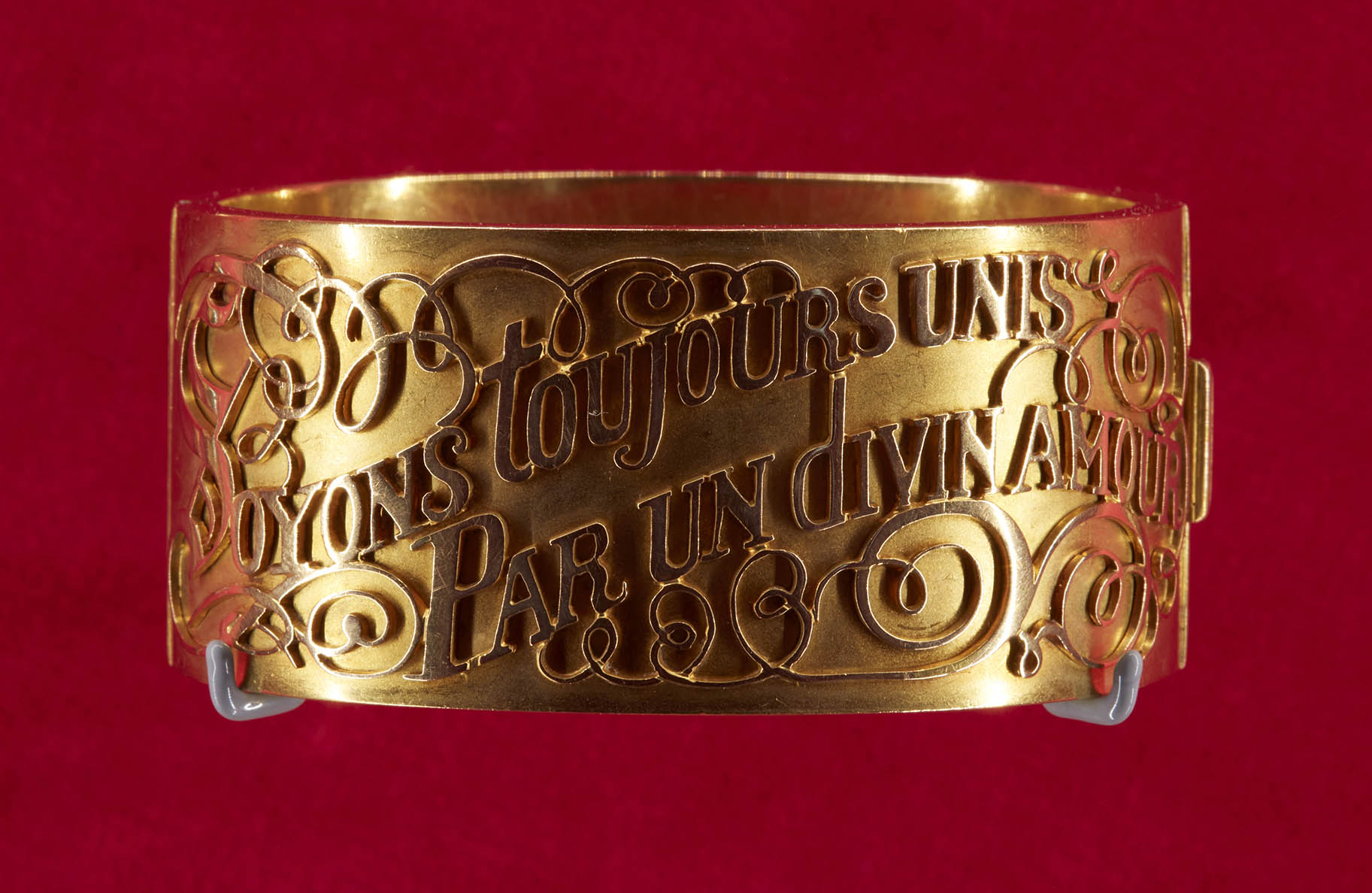
 

Installation view of the exhibition '1,001 Remarkable Objects' at Powerhouse Ultimo, Sydney showing in the background, Painting, 'Althouse & Geiger / Sign Writers, Painters, Decorators', glass / oil / gold leaf, designed and made by Althouse and Geiger Pty Ltd, Sydney, New South Wales, Australia, 1895-1905; and in the foreground Chair, reproduction, based on Lucien Henry, 'Lyrebird' or 'staghorn fern' design, jelutong & kauri timber / gesso finish / needlework, made by International Conservation Services Pty Ltd, Australia, 2000

Installation view of the exhibition '1,001 Remarkable Objects' at Powerhouse Ultimo, Sydney showing in the background, Painting, 'Althouse & Geiger / Sign Writers, Painters, Decorators', glass / oil / gold leaf, designed and made by Althouse and Geiger Pty Ltd, Sydney, New South Wales, Australia, 1895-1905; and in the foreground Chair, reproduction, based on Lucien Henry, 'Lyrebird' or 'staghorn fern' design, jelutong & kauri timber / gesso finish / needlework, made by International Conservation Services Pty Ltd, Australia, 2000

Installation view detail of the exhibition '1,001 Remarkable Objects' at Powerhouse Ultimo, Sydney showing in the background, Painting, 'Althouse & Geiger / Sign Writers, Painters, Decorators', glass / oil / gold leaf, designed and made by Althouse and Geiger Pty Ltd, Sydney, New South Wales, Australia, 1895-1905; and in the foreground Chair, reproduction, based on Lucien Henry, 'Lyrebird' or 'staghorn fern' design, jelutong & kauri timber / gesso finish / needlework, made by International Conservation Services Pty Ltd, Australia, 2000


Installation views of the exhibition 1,001 Remarkable Objects at Powerhouse Ultimo, Sydney showing in the background, Painting, ‘Althouse & Geiger / Sign Writers, Painters, Decorators’, glass / oil / gold leaf, designed and made by Althouse and Geiger Pty Ltd, Sydney, New South Wales, Australia, 1895-1905; and in the foreground Chair, reproduction, based on Lucien Henry, ‘Lyrebird’ or ‘staghorn fern’ design, jelutong & kauri timber / gesso finish / needlework, made by International Conservation Services Pty Ltd, Australia, 2000


International Conservation Services Pty Ltd (maker, Australia) 'Chair, reproduction, based on Lucien Henry, 'Lyrebird' or 'staghorn fern' design' 2000 (installation view)


International Conservation Services Pty Ltd (maker, Australia)
Chair, reproduction, based on Lucien Henry, ‘Lyrebird’ or ‘staghorn fern’ design (installation view)
2000
Jelutong & kauri timber/gesso finish/needlework
Height: 979 mm
Width: 500 mm
Depth: 470 mm
Powerhouse Collection
Purchased 2000


Reproduction chair based on ‘Lyrebird’ or ‘Staghorn Fern’ Design by Lucien Henry

Lucien Felix Henry was born in 1850 in Provence, in the south of France. He arrived in Paris to study art in 1867 and was accepted into Gerome’s studio at the Ecoles des Beaux Arts. His studies were disrupted by the Franco-Prussian War and the siege of Paris. He played a leading role in the popular movement to defend the Paris Commune in 1871 as Chef de la Legion, responsible for the defence of the 14th arrondissement. After their defeat, Henry, along with some 4000 other Communards, was incarcerated in the French penal colony of New Caledonia for seven years. In 1879 the Communards were given amnesty and Henry arrived in Sydney.

That year the International Exhibition was held in Sydney, ushering in a decade of prosperous growth for the colony. Henry successfully argued for state involvement in art education and by the end of the decade he had become a widely respected teacher and artist at Sydney Technical College. His Parisian art education had encouraged interdisciplinary work between the arts and industry which he sought to foster locally. Coinciding with the movement towards federation, Henry expressed a strong desire to see the development of an ‘Australian Style’. Henry proposed to reinvigorate the classical language of decoration with stylised versions of Australian flora and fauna as ‘motives for the decoration of any construction from a cottage to a public building’. His major project was to be a book entitled ‘Australian Decorative Arts’ for which he made some one hundred watercolour designs between 1889-91. In 1891 Henry returned to Paris to seek a publisher. The accompanying text, however, remained largely unwritten and the severe economic depression of the 1890s made publication of such a lavish work impossible. Henry died in 1896 before the book could be published.

The watercolour designs from the unpublished book were given to the Museum in 1911 by Elizabeth Catherine Sea. These designs reflect Henry’s intense interest in the use of native motifs, and in particular explore what Henry argued was the artistic potential of the waratah. Henry wrote that the waratah’s ‘rigid lines offer themselves ready for use for constructive ornamentation…it carries qualities of style and a firmness such as very few flowers, if any, could give so abundantly.’ The illustrations were championed at the time of acquisition by the Museum’s director, R T Baker, who shared Henry’s interest in the potential of Australian imagery to define a distinctively Australian school of decorative art. Baker described Henry as ‘an artist possessing real genius, and his originality in design and other fields of fine and Applied Art will live long in the annals of New South Wales technical education’. However, the illustrations were subsequently overlooked for half a century until they were rediscovered in a storeroom in 1977.

In 2000, the Powerhouse Museum commissioned International Conservation Services to realise Lucien Henry’s ‘Lyrebird chair’ from full-size computer designs based on his three elevations. Vladimir Tsourkan carved the lyrebird, rising sun and staghorn fern on the reverse from jelutong timber on a kauri and hoop-pine frame. Tessa Evans made the needlework seat from Henry’s circular design. henry’s designs in their vernacular interpretation of classicism suggest a local version of the Neo-Grec style, popular when he was a student at the Ecole des Beaux-Arts in the late 1860s. As few of his designs were realised the reproduction chair provides an excellent opportunity to display henry’s innovative and witty combination of European style with local materials. Such hybrid forms give expression to the diverse forces that have shaped Australian culture.

Henry relished the possibility of transforming native flora and fauna into decorative forms. As an instructor in art at Sydney Technical College, he championed their use in the decorative arts, design and architecture. His own work draws on the shapes and forms of Australian native plants as the basis of his designs, as reflected in his design for the ‘Lyrebird/staghorn fern’ chair.

Text from the Powerhouse Collection website
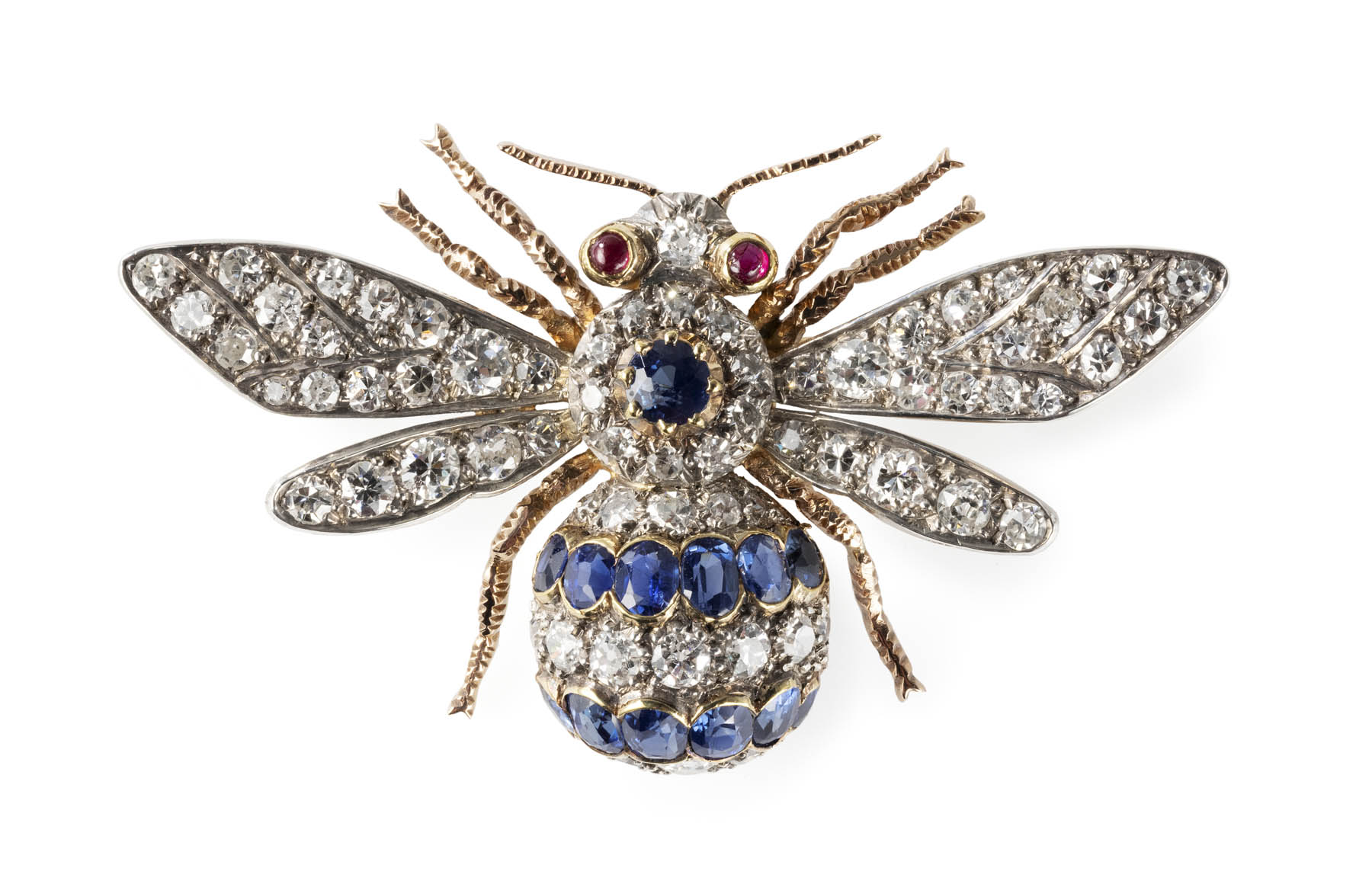
 

Unknown maker (English) 'Court dress, comprising open robe, petticoat, length of fabric and galloon (2)' c. 1760


Unknown maker (English)
Court dress, comprising open robe, petticoat, length of fabric and galloon (2)
c. 1760
Silk brocade
Height: 1650 mm
Width: 1470 mm
Depth: 1220 mm
Powerhouse Collection
Gift of Nadine Turner through the Australian Costume and Textile Society, 1985


Court dress of silk brocade

The robe à la française or sack-back open robe was the most popular and lasting dress style for the fashionable women in the 18th century. So named for its association with the French court at Versailles and for the loose double box pleat of drapery that falls down the back from the shoulders. The gown is slipped on like a coat and is open at the front to reveal a matching petticoat and a triangular shaped bodice piece (which covers the corset) called the stomacher. Stomachers were usually pinned or tied in place and could be in a different fabric or match the rest of the open-robe like this one.

For much of the 18th century women’s fashionable dress featured an exaggerated wide-hipped silhouette which displayed the beautiful and costly silk fabrics to full advantage. This dress features a cream silk fabric which has been brocaded in silver thread with a design of bows, ribbons and flowers. Enhancing its sumptuous appearance is an applied border of metallic bobbin lace. It was probably worn for grand occasions like attendance at court. Although the basic construction of the sack gown remained relatively unchanged, the design of fabrics changed yearly.

The exaggerated shape was achieved by layers of foundation garments including linen stays stiffened with whalebone and a hoop shaped with insertions of cane or whalebone to create a pannier effect at the sides of the garment. At a time when baths were not a daily occurrence layers of washable linen kept the costly silks away from the skin. Accessories were an important part of the total look and would include a fan, high-heeled shoes and a powdered wig.

The sack-back robe was in origin a more informal negligee gown but by the mid 1700s was worn at court and formal occasions. While women’s dress changed dramatically in style in the last quarter of the 18th century these lavish panniered dresses continued to be worn as formal court dress into the early 19th century. The provenance accompanying this dress suggested it may have been worn by Lady Collingwood.

Text from the Powerhouse Collection website
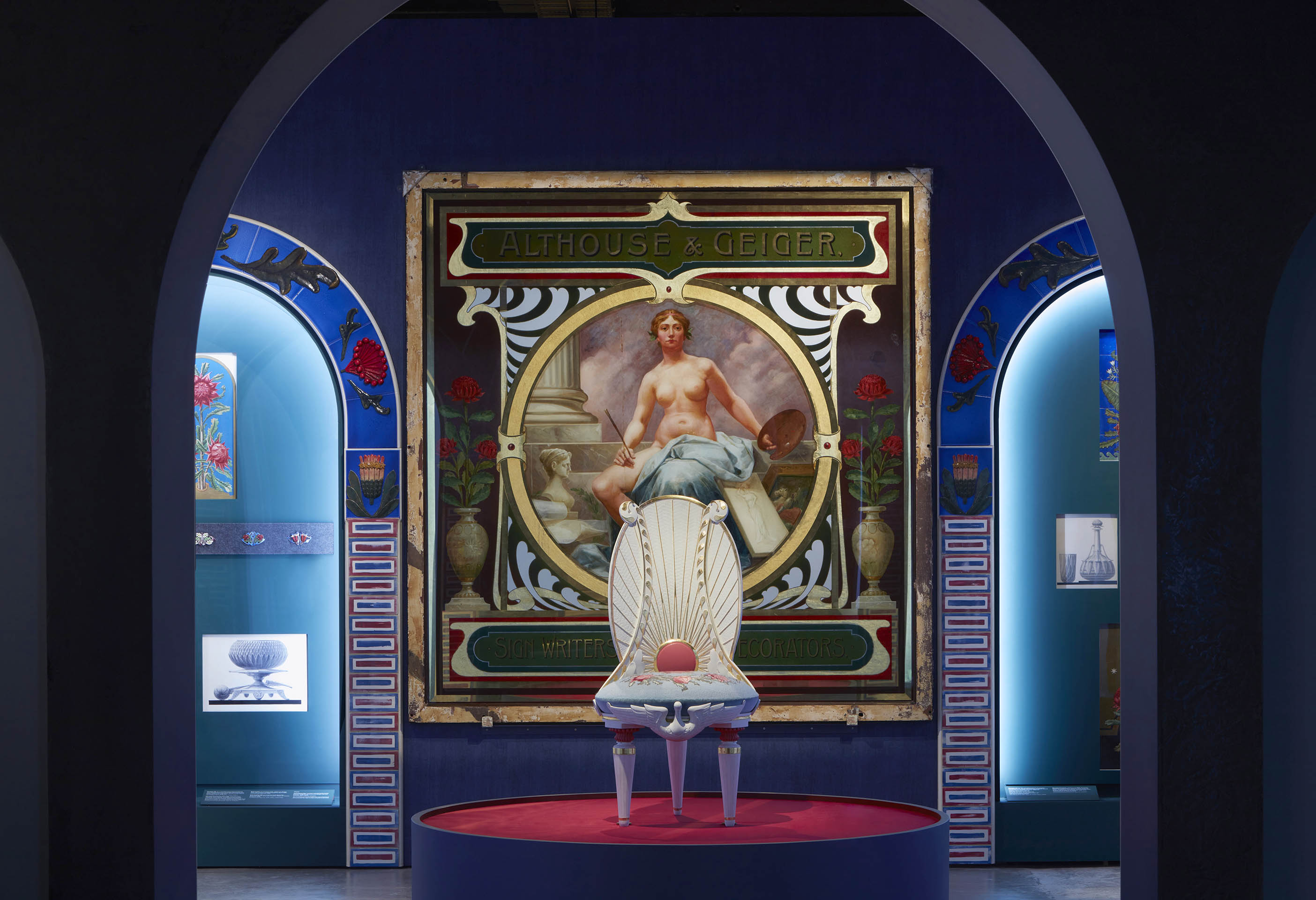
 

Gabrielle Chanel (French, 1883-1971)(designer, Paris, France) 'Evening dress, womens, spring-summer 1939' 1939


Gabrielle Chanel (French, 1883-1971)(designer, Paris, France)
Evening dress, womens, spring-summer 1939
1939
Silk/ostrich feather
Height: 1550 mm
Width: 500 mm
Powerhouse Collection
Purchased 1996


Chanel Evening Dress with Stole

Over the four decades that Gabrielle Chanel worked in haute couture she created many diverse styles of dress. She was known in the 1920s for her cardigan suits or sheath-like dresses and the 1950s and early 1960s when her braid trimmed, English tweed suits fastened with gilt buttons, became the default uniform for many affluent matrons.

Arguably, Chanel’s designs from the 1930s are less recognisable yet it was a period when the designer produced some of her most interesting work such as this full-length evening dress from the Chanel Spring 1939 collection. This strapless dress, made from a fine lightweight plain silk weave printed with a painterly feather motif in cyclamen, green, blue and yellow on a black ground, features cut-outs of the individual feather designs with meticulously oversewn edges, adorning the surface of the print, bringing the two-dimensional design to life. Chanel’s clothes were not usually known for their wit yet this effect, heightened with the use of dyed ostrich feathers around the bodice is a playful nod to Surrealist art of the 1930s.

Roger Leong, Senior Curator, 2016

Text from the Powerhouse Collection website
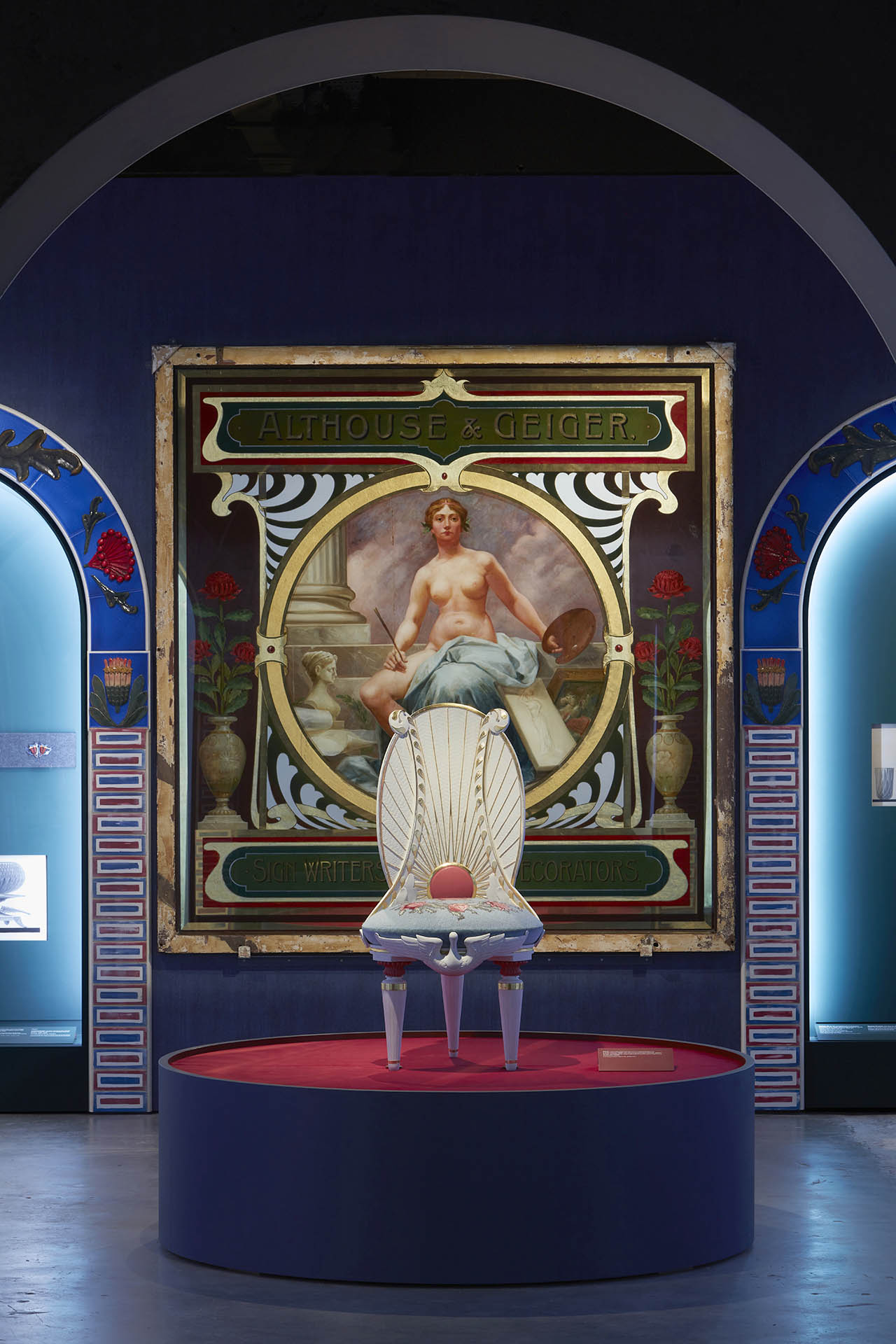
 

Catherine Martin (Australian, b. 1965)(designer) Bazmark workrooms (maker, Sydney, New South Wales, Australia) Headpiece by Rosie Boylan (maker, Sydney, New South Wales, Australia) 'Performance costumes (2), 'Fruity Mambo', mens and womens, for 'Strictly Ballroom The Musical'' 2014


Catherine Martin (Australian, b. 1965)(designer)
Bazmark workrooms (maker, Sydney, New South Wales, Australia)
Headpiece by Rosie Boylan (maker, Sydney, New South Wales, Australia)
Performance costumes (2), ‘Fruity Mambo’, mens and womens, for ‘Strictly Ballroom The Musical’
2014
Lycra/leather/suede/cotton/synthetic/metal/plastic
Powerhouse Collection


Luke Sales and Anna Plunkett of Romance Was Born (designer and maker, Sydney, New South Wales, Australia) 'Outfit, 'Iced Vo Vo', comprising of dress and shoes (pair), womens, Doilies and Pearls, Oysters and Shells collection, spring-summer 2009/2010' 2009


Luke Sales and Anna Plunkett of Romance Was Born (designer and maker, Sydney, New South Wales, Australia)
Outfit, ‘Iced Vo Vo’, comprising of dress and shoes (pair), womens, Doilies and Pearls, Oysters and Shells collection, spring-summer 2009/2010
2009
Textile/metal/leather
Powerhouse Collection
Purchased 2010


‘Iced VoVo’ Outfit by Romance Was Born

The Iced VoVo dress by fashion design label Romance Was Born is an eccentric and cheeky take on an iconic Australian biscuit. Larrikin designers, Anna Plunkett and Luke Sales are famous for their portrayal of Australian kitsch and use of traditional craft techniques. Shown at Rosemount Australian Fashion Week, Spring/Summer 2009/2010 as part of the Doilies and Lace collection it was widely covered by both newspapers and magazine. Flamboyant and whimsical the collection included everything from a crochet dress, octopus hats and a budgie inspired dress. Their clothes have graced the cover of Australian Vogue and in 2009 they won the Woolmark Young Designer Award.

Anna Plunkett and Luke Sales met and became firm friends while studying at The Fashion Design Studio, Sydney Institute of Technology. After graduation they were selected to attend The Fourth International Support Awards in Italy where they famously turned down an invitation to intern with John Galliano designer for fashion house Dior. The pair had other plans for their designs and launched their label, Romance Was Born shortly after. Inspired by iconic 1980’s Australian designers Linda Jackson and Jenny Kee they are in Luke’s own words, ‘obsessed’! This influence can be seen through the use of bright eclectic prints, collaboration with Indigenous Australian artist, Esme Timbery and a recurring Australian theme. The duo have also collaborated with artist Del Kathryn Barton and high street fashion store Sportsgirl. They have dressed musicians Karen O of the Yeah Yeah Yeahs, Cindy Lauper, Bat For Lashes, Debbie Harry, Lilly Allen, MIA, the Presets and Architecture in Helsinki. Australian actress and Academy Award winner, Cate Blanchett has also worn their designs.

This Iced VoVo dress is significant as an example of unique and original contemporary Australian fashion design. It represents Australian themes in a playful manner and was one of the most talked about and acclaimed collections at Rosemount Australian Fashion Week, Spring/Summer 2009/2010. Anna Plunkett and Luke Sales are among the most creative and challenging Australian design teams to emerge in the last decade.

Assistant Curator, Rebecca Evans. March 2010.

Text from the Powerhouse Collection website
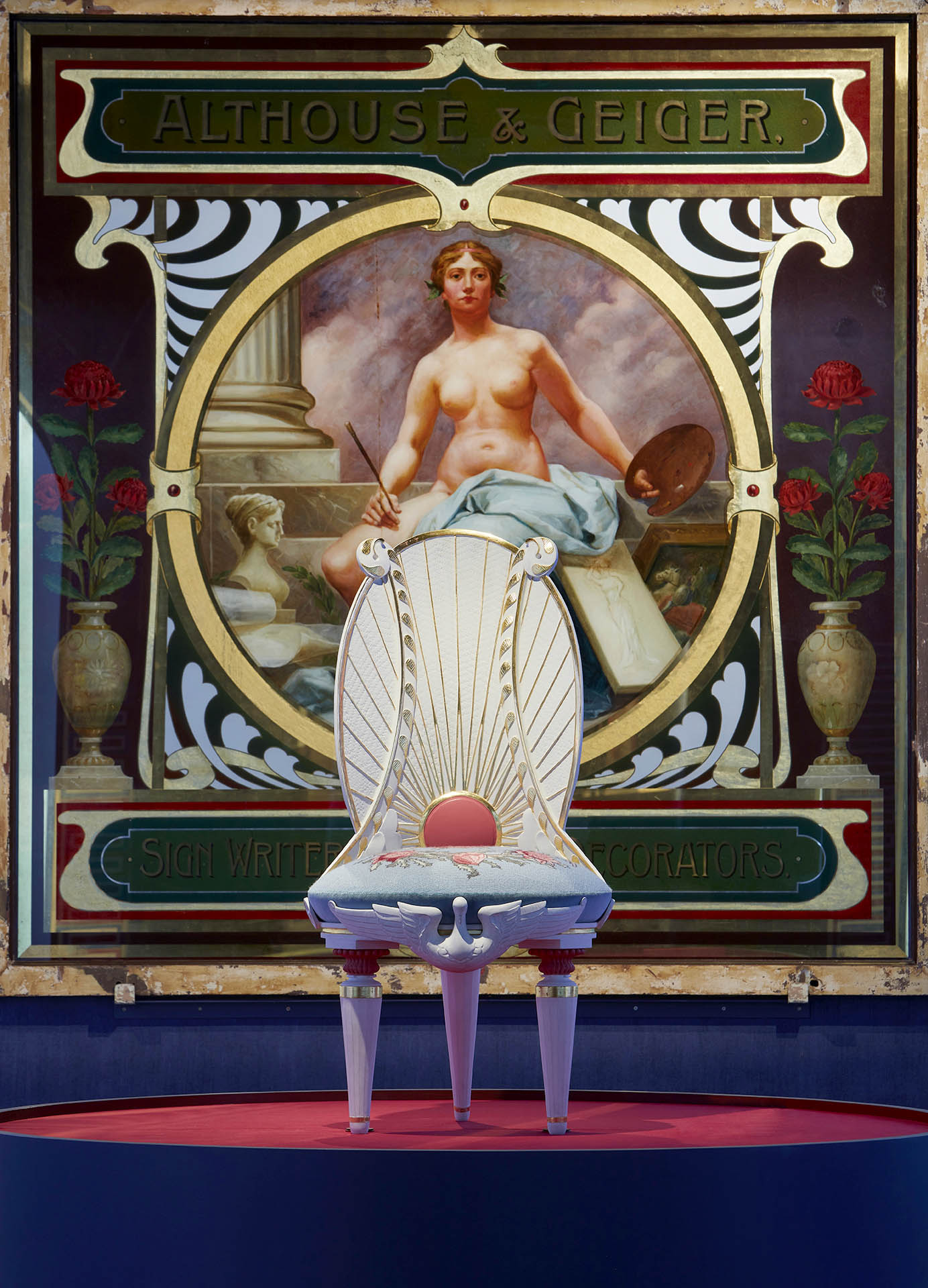


Powerhouse Ultimo
500 Harris Street,
Ultimo NSW 2007

Opening hours:
Daily 10am – 5pm

Powerhouse Ultimo website

LIKE ART BLART ON FACEBOOK

Back to top

Exhibition: ‘Aubrey Beardsley’ at Tate Britain, London

Exhibition dates: 4th March – 25th May, 2020

Curators: Caroline Corbeau-Parsons, Curator of British Art 1850-1915, and Stephen Calloway with Alice Insley, Assistant Curator, Historic British Art

#MuseumFromHome


Frederick Evans (British, 1853-1943) 'Aubrey Beardsley [with hands]' 1893 from the exhibition 'Aubrey Beardsley' at Tate Britain, London, March - May, 2020


Frederick Evans (British, 1853-1943)
Aubrey Beardsley [with hands]
1893
Platinum print and photogravure, mounted on opposing pages of a paper folio
Wilson Centre for Photography


While working as a clerk, Beardsley spent his lunchtimes browsing in Frederick Evans’ nearby second-hand bookshop. This had an important impact on his developing artistic and literary tastes. Beardsley became close friends with Evans, who was also a talented amateur photographer. The image on the left has become known as the ‘gargoyle portrait’ because Beardsley’s pose echoes the famous carved figure on Notre-Dame Cathedral in Paris. This portrait was used in early editions of Beardsley’s work and has become the defining image of the artist.


There he is

There he is, all aquiline nose, patrician air; thin wrists and hands that infinity strengthens,

Mannerist hands, hands like the buttresses of some great cathedral, supporting that noble face.

There he is, this genius of invention, this suave sophisticate, this pervader of decadent beauty,

this grotesque who produced a thousand drawings in seven years, who lived a thousand lives in just seven years.

There he is, this son of Blake, this offspring of Lautrec and japonaiserie,

all primed in subtle sexualities, shocking, fame, subversion… strange.

There he is, love of yellow, flowering enormous genitalia, erotic illustrations of distorting scale, women ambiguity,

as bold as life, diseased as death, driving his body on while his mind accretes mythologies.

Now he stands, a fantastical visionary, existing as product of unchecked imagination.

An illusion, a fabrication of the mind; an unrealisable dream, a fancy,

his utopia a grotesque, chimerical beauty.


Dr Marcus Bunyan


Many thankx to Tate Britain for allowing me to publish the media images in the posting. Please click on the photographs for a larger version of the image.


Tate Britain’s major new exhibition celebrates the brief but astonishing career of Aubrey Beardsley. Although he died tragically young at the age of just 25, Beardsley’s strange, sinuous black-and-white images have continued to shock and delight for over a century. Bringing together 200 spectacular works, this is the largest display of his original drawings in over 50 years and the first exhibition of his work at Tate since 1923.

Beardsley (1872-1898) became one of the enfants terribles of fin-de-siècle London, best remembered for illustrating Oscar Wilde’s controversial play Salomé. His opulent imagery anticipated the elegance of Art Nouveau but also alighted on the subversive and erotic aspects of life and legend, shocking audiences with a bizarre sense of humour and fascination with the grotesque. Beardsley was prolific, producing hundreds of illustrations for books, periodicals and posters in a career spanning just under seven years. Line block printing enabled his distinct black-and-white works to be easily reproduced and widely circulated, winning notoriety and admirers around the world, but the original pen and ink drawings are rarely seen. Tate Britain exhibits a huge array of these drawings, revealing his unrivalled skill as a draughtsman in exquisite detail.

The exhibition highlights each of the key commissions that defined Beardsley’s career as an illustrator, notably Malory’s Le Morte d’Arthur 1893-1894, Wilde’s Salomé 1893 and Alexander Pope’s The Rape of the Lock 1896, of which five of the original drawings are shown together for the first time. As art director of the daring literary quarterly The Yellow Book, the artist also created seminal graphic works that came to define the decadence of the era and scandalised public opinion. Bound editions and plates are displayed alongside subsequent works from The Savoy and illustrations for Volpone 1898 and Lysistrata 1896, in which Beardsley further explored his fascination with eroticism and the absurd.

Beardsley’s imagination was fuelled by diverse cultural influences, from ancient Greek vases and Japanese woodblock prints, to illicit French literature and the Rococo. He also responded to his contemporaries such as Gustave Moreau, Edward Burne-Jones and Toulouse Lautrec, whose works are shown at Tate Britain to provide context for Beardsley’s individual mode of expression. A room in the exhibition is dedicated to portraits of Beardsley and the artist’s wider circle, presenting him at the heart of the arts scene in London in the 1890’s despite the frequent confinement of his rapidly declining health. As notorious for his complex persona as he was for his work, the artist had a preoccupation with his own image, relayed throughout the exhibition by striking self-portraits and depictions by the likes of Walter Sickert and Jacques-Emile Blanche.

Additional highlights include a selection of Beardsley’s bold poster designs and his only oil painting. Charles Bryant and Alla Nazimova’s remarkable 1923 film Salomé is also screened in a gallery adjacent to Beardsley’s illustrations, showcasing the costume and set designs they inspired. The exhibition closes with an overview of Beardsley’s legacy from Art Nouveau to the present day, including Picasso’s Portrait of Marie Derval 1901 and Klaus Voormann’s iconic artwork for the cover of Revolver 1966 by the Beatles.

Aubrey Beardsley is organised by Tate Britain in collaboration with the Musée d’Orsay, Paris, with the generous support of the V&A, private lenders and other public institutions. It is curated by Caroline Corbeau-Parsons, Curator of British Art 1850-1915, and Stephen Calloway with Alice Insley, Assistant Curator, Historic British Art.

Press release from the Tate Britain website


Aubrey Beardsley at Tate Britain – Exhibition Tour | Tate

Join Tate curators Caroline Corbeau-Parsons and Alice Insley as they discuss the iconic illustrator’s short and scandalous career.

Before his untimely death aged twenty-five, Beardsley produced over a thousand illustrations. He drew everything from legendary tales featuring dragons and knights, to explicit scenes of sex and debauchery. His fearless attitude to art continues to inspire creatives more than a century after his death.


Aubrey Beardsley (British, 1872-98) 'Withered Spring' 1891 from the exhibition 'Aubrey Beardsley' at Tate Britain, London, March - May, 2020


Aubrey Beardsley (British, 1872-1898)
Withered Spring
1891
Graphite, ink and gouache on paper
National Gallery of Art, Washington, Rosenwald Collection


The framing of the main image by ornamental panels and lettering shows the influence of aesthetic movement illustrators, as well as that of Burne-Jones. The inscription on the gate behind the figure is partly obscured. In full it would read ‘Ars Longa Vita Brevis’ (‘art is long-lasting, life is short’). As Beardsley was diagnosed with tuberculosis aged seven, this Latin saying must have had personal resonance.


Introduction

Few artists have stamped their personality so indelibly on their era as Aubrey Beardsley. He died in 1898 at the age of just 25 but had already become one of the most discussed and celebrated artists in Europe. His extraordinary black-and-white drawings were instantly recognisable. Then, as now, he seemed the quintessential figure of 1890s decadence.

At the end of the 19th century, a period that had seen vast social and technological changes, many began to fear that civilisation had reached its peak and was doomed to crumble. ‘Decadent’ artists and writers retreated into the imagination. Severing the link between art and nature, they created a new sensibility based upon self-indulgence, refinement and often a love of the bizarre. No other artist captured the danger and the beauty, the cynicism and brilliance of the age as Beardsley did with pen and ink.

Beardsley was diagnosed with tuberculosis at the age of seven. The disease was then incurable, so he knew from childhood that his life would be a brief one. This led him to work at a hectic pace. One contemporary described his determination ‘to fill his few working years with the immediate echo of a great notoriety’. Moving rapidly from style to style, he created well over a thousand illustrations and designs in just five years. Beardsley was catapulted to fame in 1893 by an article about his work in The Studio magazine. He went on to illustrate Oscar Wilde’s play Salome and become art editor of The Yellow Book, a periodical that came to define the era.

Beardsley’s illustrations displayed remarkable skill and versatility, but few people ever saw his actual drawings. He always drew for publication and his work was seen primarily in books and magazines. He was one of the first artists whose fame came through the easy dissemination of images, his reputation growing day by day as his sensational designs appeared.

This exhibition offers a rare chance to see many of Beardsley’s original drawings. It also sets Beardsley in his social and artistic context. Works by other artists punctuate the exhibition, showing how he absorbed diverse artistic influences but always retained his own style.


Aubrey Beardsley (British, 1872-98) 'Incipit Vita Nova' 1892


Aubrey Beardsley (British, 1872-1898)
Incipit Vita Nova
1892
Graphite, ink and gouache on paper
Linda Gertner Zatlin


The title of this drawing refers to Dante Alighieri’s 1294 text La Vita Nuova and translates as ‘New Life Begins’. Some have seen the foetus as a potent symbol for Beardsley. Its significance is unclear beyond linking sexuality, life and death, all key themes in Beardsley’s work. It also reflects his fascination with shocking imagery and the grotesque, the term used traditionally to describe deliberate distortions and exaggerations of forms to create an effect of fantasy or strangeness. He once said, ‘if I am not grotesque I am nothing’.


Beginnings

Beardsley’s artistic career spanned just under seven years, between 1891 and 1898. When he was 18 he met the Pre-Raphaelite painter Edward Burne-Jones, an artist he deeply admired. Having seen Beardsley’s portfolio, Burne-Jones responded: ‘I seldom or never advise anyone to take up art as a profession, but in your case I can do nothing else.’ On his recommendation, for a short time Beardsley attended classes at Westminster School of Art.

Beardsley longed for fame and recognition. This went hand in hand with an intensely cultivated self-image and pose as a dandy-aesthete. This important aspect of his identity is illuminated through self-portraits and portraits by his contemporaries throughout the exhibition.

Witty, tall, ‘spotlessly clean & well-groomed’, Beardsley was soon noted for his dandyism. A delight in refinement and artificiality in both dress and manner, dandyism was integral to the decadent creed. Some contemporaries related the artist’s extreme thinness and fragile physical appearance to ideas of morbidity also associated with decadence.

While Beardsley rejected the label of decadence, his work explores many aspects of it, such as a fascination with the ‘anti-natural’ and the bizarre, with sexual freedom and gender fluidity. What present-day society refers to as LGBTQIA+ identities were only just beginning to be formulated and articulated during his lifetime. Beardsley was attracted to women, but he was a pioneer in representing what we might now call queer desires and identities. Though fascinated by all aspects of sexuality, it seems likely that his explorations of these interests were primarily through literature and art.


Aubrey Beardsley (British, 1872-98) 'Self-portrait' 1892


Aubrey Beardsley (British, 1872-1898)
Self-portrait
1892
Ink on paper
British Museum
Presented by Robert Ross in 1906


Apart from a few childish sketches, this is Beardsley’s first recorded self-portrait, made at the age of about 19. His newly adopted centre-parted fringe, fashionable high collar and large bow tie show that he had already formed a distinctive self-image. A few months earlier, he had described himself as having ‘a vile constitution, a sallow face and sunken eyes’.


Russell & Sons. 'Portrait of Aubrey Beardsley' c. 1893?


Russell & Sons (Photographers)
Portrait of Aubrey Beardsley
c. 1893?
Cartes de visite / cabinet card
Albumen print

Please note: This photograph is not in the exhibition


Edward Coley Burne-Jones (British, 1833-1898) 'The Finding of Medusa; The Death of Medusa (The Birth of Pegasus and Chrysaor); Perseus Pursued by the Gorgons' 1875-1876


Edward Coley Burne-Jones (British, 1833-1898)
The Finding of Medusa; The Death of Medusa (The Birth of Pegasus and Chrysaor); Perseus Pursued by the Gorgons
1875-1876
Gouache, paint and ink on paper
Tate. Presented by the Trustees of the Chantrey Bequest 1919
Image released under Creative Commons CC-BY-NC-ND (3.0 Unported)


This design forms part of Burne-Jones’s ambitious scheme for a series of large wall decorations on the theme of Perseus. Although the work was never completed as he intended, Burne-Jones still proudly displayed ten full-scale preparatory drawings for the panels in his garden studio. They must have made a strong impression on Beardsley when he visited Burne-Jones in August 1891.


Edward Coley Burne-Jones (British, 1833-1898) 'The Finding of Medusa' 1875-1876


Edward Coley Burne-Jones (British, 1833-1898)
The Finding of Medusa
1875-1876
Gouache, paint and ink on paper
Tate. Presented by the Trustees of the Chantrey Bequest 1919
Image released under Creative Commons CC-BY-NC-ND (3.0 Unported)


Edward Coley Burne-Jones (British, 1833-1898) 'The Death of Medusa (The Birth of Pegasus and Chrysaor)' 1875-1876


Edward Coley Burne-Jones (British, 1833-1898)
The Death of Medusa (The Birth of Pegasus and Chrysaor)
1875-1876
Gouache, paint and ink on paper
Tate. Presented by the Trustees of the Chantrey Bequest 1919
Image released under Creative Commons CC-BY-NC-ND (3.0 Unported)


Edward Coley Burne-Jones (British, 1833-1898) 'Perseus Pursued by the Gorgons' 1875-1876


Edward Coley Burne-Jones (British, 1833-1898)
Perseus Pursued by the Gorgons
1875-1876
Gouache, paint and ink on paper
Tate. Presented by the Trustees of the Chantrey Bequest 1919
Image released under Creative Commons CC-BY-NC-ND (3.0 Unported)


Perseus eventually discovers Medusa with her sisters, the Gorgons. Unlike her they are all immortal. Using Athena’s mirror to defend himself, Perseus beheads Medusa, at which point the winged horse Pegasus and the warrior Chrysaor spring from her decapitated body. When the Gorgons attempt to punish Perseus for killing their sister, he evades them by using the helmet given to him by the sea nymphs, thus becoming invisible.

Gallery label, June 1993


Aubrey Beardsley (British, 1872-98) 'The Litany of Mary Magdalen' 1891


Aubrey Beardsley (British, 1872-1898)
The Litany of Mary Magdalen
1891
Graphite on cream wove paper laid down on board
227 × 169 mm
The Art Institute of Chicago, The Charles Deering Collection
Public domain


The Italian painter Andrea Mantegna (c. 1431-1506) was a key reference for both Burne-Jones and Beardsley. At Burne-Jones’s suggestion, Beardsley particularly studied the early engravings after Mantegna’s designs. Throughout his life Beardsley kept a set of reproductions of these prints pinned to his wall. In this subject of his own invention, he freely borrows details of costume, pose and gesture from figures in various of Mantegna’s works, particularly The Entombment (c. 1465-1470).


Andrea Mantegna (Italian, c.  1431-1506) 'The Entombment of Christ' c. 1465-1475


Andrea Mantegna (Italian, c.  1431-1506)
The Entombment of Christ
c. 1465-1475
Engraving and drypoint; second state of two
11 7/16 × 16 3/8 in. (29 × 41.6cm)
The Metropolitan Museum of Art, Harris Brisbane Dick Fund, 1937
Public domain

Please note: This engraving is not in the exhibition


Aubrey Beardsley (British, 1872-98) 'Tannhäuser' 1891


Aubrey Beardsley (British, 1872-1898)
Tannhäuser
1891
Ink, wash and gouache on paper
National Gallery of Art, Washington, Rosenwald Collection
Public domain


Beardsley was an avid opera-goer. He attended several performances of Wagner’s works at this time, including Tannhäuser at Covent Garden in April or May 1891. He would return to Wagnerian subjects many times in his art and writings. The story of Tannhäuser was a particular favourite. He later made it the subject of his own erotic novella The Story of Venus and Tannhäuser. Here he shows the knight in pilgrim’s robes, among trees that appear like prison bars, trying to find his way back to the goddess’s enchanted realm, the Venusberg.


Aubrey Beardsley (British, 1872-98) 'Die Götterdämmerung' 1892


Aubrey Beardsley (British, 1872-1898)
Die Götterdämmerung
1892
Ink, wash and gouache on paper
Aubrey Beardsley Collection, Manuscripts Division, Department of Special Collections, Princeton University


Beardsley took this subject from Wagner’s opera, the title of which translates as ‘The Twilight of the Gods’. It has been suggested that the frieze-like composition depicts three different moments of the story. According to this interpretation, the scene to the right refers to the prologue, showing the Fates, with the bearded Wotan holding his magic spear. He also appears seated at the centre of the composition with Siegfried standing by him to tell his story to a group of hunters. Finally, Wotan may be represented again seated, in profile, wearing his Wanderer’s hat.


Götterdämmerung (Twilight of the Gods), is the last in Richard Wagner’s cycle of four music dramas titled Der Ring des Nibelungen (The Ring of the Nibelung, or The Ring for short). It received its premiere at the Bayreuth Festspielhaus on 17 August 1876, as part of the first complete performance of the Ring.

Die Götterdämmerung,” notes Emma Sutton in Aubrey Beardsley and British Wagnerism in the 1890s (2002), “Beardsley’s only drawing of the concluding part of the Ring cycle, was probably prompted by the first performance for a decade of the Ring in London in June and July 1892. It is extremely likely that he attended a performance of the drama; he certainly attended Siegfried, and produced drawings on Siegfried and Götterdämmerung, and of the principle singers, in this year.

No interpretation of the drawing has, to my knowledge, ever been offered, perhaps because its stylistics might suggest that it is an incomplete or experimental, Impressionistic work. The drawing is, however, an intricate and highly knowledgeable representation of Wagner’s work, demonstrating Beardsley’s comprehensive knowledge of Die Götterdämmerung (and, indeed, of the whole cycle) from the very start of the decade. Beardsley presents the gods shrouded in long drapes in a bleak forest setting; with their elongated limbs and enveloping robes they appear androgynous figures, listless and melancholy, entrapped by the sharp bare stems that rise from the border and ground around them.

Despite the undulating lines of the landscape, Die Gotterdammerung is a scene of desolate stasis, bleakly portraying Wagner’s Twilight of the Gods. A compression of several scenes from Wagner’s drama, the drawing is, I would suggest, an extraordinarily innovative and ambitious attempt to evoke concisely the narrative events and cumulative tone of the entire drama.”

~ Emma Sutton, Aubrey Beardsley and British Wagnerism in the 1890s (2002)


Anonymous. “Aubrey Beardsley’s “Die Götterdämmerung”,” on the Graphic Arts Collection, Princeton website [Online] Cited 02/03/2020


Le Morte Darthur

In early 1892, Beardsley received his first major commission. His friend, the photographer and bookseller Frederick H. Evans, introduced him to J.M. Dent. The energetic and enterprising publisher was looking for an illustrator for Le Morte Darthur, Sir Thomas Malory’s 15th-century version of the legends of King Arthur. Dent planned a substantial edition in the style of William Morris’s Kelmscott Press books. Between autumn 1892 and June 1894 Beardsley produced 353 drawings, including full and double-page illustrations, elaborate border designs and numerous small-scale ornamental chapter headings. He received £250 over the course of this commission. This freed him to leave his hated job as a clerk and focus on art-making.

Beardsley gradually grew weary of this colossal undertaking and went off-brief. Subversive details started to appear in his drawings. He also introduced incongruous characters such as mermaids and satyrs, goat-legged hybrid creatures from classical mythology.

His illustrations were reproduced using the relatively new and economical line block printing process in which drawings are transferred onto printing plates photographically. Beardsley was at first disappointed with the printing of his drawings, but he quickly adapted his style to suit the line block process. Uniquely, this could reproduce both the finest of lines and large, flat areas of black.

The works in this room demonstrate the development of Beardsley’s art over two years, and how he combined many different sources to create his own visual language.


Aubrey Beardsley (British, 1872-98) 'The Achieving of the Sangreal' 1892


Aubrey Beardsley (British, 1872-1898)
The Achieving of the Sangreal
1892
Ink and wash on paper
Private collection


This is the sample drawing that secured Beardsley the Morte Darthur commission. Dent declared it ‘a masterpiece’, and it was used as the frontispiece for Volume II. It seems to refer to the crucial episode of the book, in Chapter XIV, where Sir Percival kneels to make a prayer to Jesus in the presence of Sir Ector, and the Sangreal (popularly called the Holy Grail) appears to him, ‘borne by a maiden’.


Aubrey Beardsley (British, 1872-98) 'How Morgan Le Fay Gave a Shield to Sir Tristram' 1893


Aubrey Beardsley (British, 1872-1898)
How Morgan Le Fay Gave a Shield to Sir Tristram
1893
Ink on paper
The Syndics of the Fitzwilliam Museum, University of Cambridge


(Illustration from: Sir Thomas Malory, Le Morte d’Arthur. London: Dent, 1894)


Aubrey Beardsley (British, 1872-98) 'How la Beale Isoud Wrote to Sir Tristram' c. 1893


Aubrey Beardsley (British, 1872-1898)
How la Beale Isoud Wrote to Sir Tristram
c. 1893
Ink over graphite on paper
Alessandra and Simon Wilson


This drawing brings to mind the comment by the art historian John Rothenstein that ‘the greatest among Beardsley’s gifts was his power of assimilating every influence and yet retaining, nay developing, his own peculiar individuality’.

Isoud (Isolde) here resembles the Pre-Raphaelite figure Jane Morris. The German Renaissance form of her desk is borrowed from Albrecht Dürer’s engraving St Jerome in his Study (1513-1514). The simple, flattened construction of the space reflects Beardsley’s interest in Japanese prints. These contrast with the flowing lines of the sunflower border, a typical aesthetic motif.


Aubrey Beardsley (British, 1872-98) 'How Sir Tristram Drank of the Love Drink' 1893


Aubrey Beardsley (British, 1872-1898)
How Sir Tristram Drank of the Love Drink
1893
Ink on paper
Harvard Art Museums/Fogg Museum, Bequest of Scofield Thayer


This is one of Beardsley’s boldest and most rhythmic drawings. Tristram’s outstretched arm follows the movement of the hybrid flower. The flat outline of Isolde’s recoiling body parallels that of Tristram’s cloak, all against the strong vertical and horizontal lines formed by the curtains with their stylised rose border. Isolde’s long cape, seen from the back, is a forerunner of Beardsley’s famous Peacock Skirt in his Salome illustrations (on display later in this exhibition).


Aubrey Beardsley (British, 1872-98) 'How La Beale Isoud Nursed Sir Tristram' 1893


Aubrey Beardsley (British, 1872-1898)
How La Beale Isoud Nursed Sir Tristram
1893
Ink over graphite on paper
Harvard Art Museums/Fogg Museum, Bequest of Scofield Thayer


Aubrey Beardsley (British, 1872-1898) 'How King Arthur saw the Questing Beast, and thereof had great marvel' 1893


Aubrey Beardsley (British, 1872-1898)
How King Arthur saw the Questing Beast, and thereof had great marvel
1893
Ink and wash on paper
Victoria and Albert Museum


Together with Siegfried Act II (shown nearby), this drawing reflects the height of Beardsley’s fine ‘hair-line manner’. The drawing has great variety of treatment, showing that Beardsley’s style evolved while working on the commission. To alleviate boredom, he took great liberties with Malory’s text. He introduced mythological characters with little to do with the Arthurian legend, such as Pan, here. There are also discreet additions, including a treble clef top right, and even a phallus on the far left of the bank.


Something suggestive of Japan

The European craze for Japanese visual culture had begun in the 1860s after trade links were re-established. Beardsley grew up surrounded by western interpretations of Japanese art. In the summer of 1891, together with his sister Mabel, he visited the London mansion of the shipping magnate Frederick Leyland. There he saw the ‘Peacock Room’ created 15 years earlier by the expatriate North American artist James McNeill Whistler. Decorated with borrowed and reworked Japanese motifs, this masterpiece of the aesthetic movement had become one of the most celebrated interiors in London. Mesmerised by his visit, Beardsley began to introduce such details into his own drawings.

Japanese woodblock prints (Ukiyo-e) were also an important influence. Beardsley adopted their graphic conventions. His new style included areas of flat pattern contrasted with precisely drawn figures against abstracted or empty backgrounds. Like several artists at this time, he also favoured the distinctive, tall and narrow format of traditional Japanese kakemono scrolls.

In a letter to a friend, Beardsley bragged, ‘I struck for myself an entirely new method of drawing and composition, something suggestive of Japan… The subjects were quite mad and a little indecent.’


Aubrey Beardsley (British, 1872-1898) Design for a Frontispiece to 'Virgilius the Sorcerer' c. 1893


Aubrey Beardsley (British, 1872-98)
Design for a Frontispiece to Virgilius the Sorcerer
c. 1893
Ink over graphite on paper laid down on board
The Art Institute of Chicago, Gift of Robert Allerton


Following the glowing article in The Studio, many publishers approached Beardsley with commissions for illustrations and book covers. David Nutt, an old established publishing firm, generally specialised in early texts and folklore. Although made for Nutt’s ‘medieval legends’ series, Beardsley’s design is, somewhat incongruously, in the style of a Japanese print.


A New Illustrator

Beardsley first came to public notice in April 1893. He was the subject of the lead article, ‘A New Illustrator’, in the first issue of the new art magazine The Studio. In it, the graphic art expert Joseph Pennell praised Beardsley’s work as ‘quite as remarkable in its execution as in its invention: a very rare combination.’

Pennell welcomed Beardsley’s use of ‘mechanical reproduction for the publication of his drawings’. The article highlighted how photographic line block printing showed the true quality of an artist’s line.

The reproductions in The Studio article included both medieval and Pre-Raphaelite style illustrations for the forthcoming Le Morte Darthur and examples of Beardsley’s work inspired by Japanese woodblock prints. This displayed his versatility and led to further commissions for books and popular journals, such as the Pall Mall Magazine. J.M. Dent, the publisher of Le Morte Darthur, rightly worried Beardsley would get bored of that long-term project. To keep him interested, he invited him to create hundreds of tiny ‘grotesque’ illustrations for the Bon-Mots series, three miniature books of witty sayings. In this context, the term grotesque relates to distortion or exaggeration of form to create an effect of fantasy or strangeness. For Beardsley the idea was central to his way of seeing the world. Summing up his own art, he later said, ‘I am nothing if I am not grotesque.’

Grotesque

In art history, the grotesque – which originally referred to the decoration of grottoes – has come to denote a strand of Renaissance art composed of deliberately weird elements, often including imaginary hybrid forms. These often combine parts of human heads and bodies, animals and plants. Mermaids, satyrs, fauns and other mythical figures frequently appear in Beardsley’s art. But he also added foetuses, often with adult bodies, and other distorted figures to his grotesque repertoire. The resulting imagery is playful, irreverent and fantastical, but also has dark undertones. The grotesque lies at the heart of Beardsley’s art. He explained: ‘I see everything in a grotesque way. When I go to the theatre, for example, things shape themselves before my eyes just as a I draw them… They all seem weird and strange to me. Things have always impressed me in this way.’


Aubrey Beardsley (British, 1872-1898) 'The Kiss of Judas' 1893


Aubrey Beardsley (British, 1872-1898)
The Kiss of Judas
1893
Ink on paper
Victoria and Albert Museum


This drawing illustrates a short story by ‘X.L’ (the North American writer of horror fiction Julian Osgood Field). The macabre tale tells of a legend of the descendants of Judas, the disciple who betrayed Jesus in the Christian New Testament. It is written with the arch tone of much 1890s fiction:

‘They say that the children of Judas, lineal descendants of the arch traitor, are prowling about the world, seeking to do harm, and that they will kill you with a kiss.’ ‘Oh, how delightful!’ murmured the Dowager Duchess.


Smaller figures appear in many of Beardsley’s works, such as the nude in The Kiss of Judas. Some viewers have read these as representations of people with dwarfism. In most cases we do not know if this was Beardsley’s intention. He never strived for realism in his work. He played with scale, exaggerating and distorting lines and shapes, including in self-portraits. But the cultural stereotyping of people with dwarfism was prevalent in Beardsley’s lifetime. In the late 19th and early 20th century, they were predominantly seen as sources of entertainment in ‘freak shows’ and carnivals. These offensive attitudes almost certainly influenced Beardsley’s imagery to some extent.

Salomé

In 1892, Beardsley made a drawing in response to Salomé, Oscar Wilde’s play, originally written in French and based on the biblical story. Salomé falls in love with Iokanaan (John the Baptist). When he rejects her, she demands his head from her step-father, Herod Antipas, as a reward for performing the dance of the seven veils. Beardsley depicts her about to kiss Iokanaan’s severed head. Wilde admired the drawing and he and his publisher, John Lane, chose Beardsley to illustrate the English translation of the play. The illustrations weave together themes of sensuality and death, and explore a wide range of sexual desires. The play’s publication created a sensation, just as Beardsley and Wilde had hoped.

Beardsley delighted in hiding provocative elements in his drawings. Lane recalled, ‘one had, so to speak, to place his drawings under a microscope, and look at them upside down’. Nervously, he censored ‘problematic’ details in Beardsley’s title page and the illustration Enter Herodias and rejected two designs altogether from the first edition. Even so, Lane missed many erotic details and, surprisingly, also allowed publication of Beardsley’s teasing drawings that include caricatures of Wilde.

Beardsley produced 18 designs in total, of which only 10 appeared in the first printing of the play. The impressions exhibited here come from the portfolio which Lane issued in 1907, almost a decade after Beardsley’s death. This was the first edition to contain all the original designs and an additional one, Salome on Settle.


Aubrey Beardsley (British, 1872-1898) 'The Climax' 1893


Aubrey Beardsley (British, 1872-1898)
The Climax
1893
Line block print on paper
Stephen Calloway


The flowing, sinuous lines in this design demonstrate how much art nouveau is indebted to Beardsley. He abandoned the Japanese kakemono format and hairline style of his original version of the image J’ai baisé ta bouche, Iokanaan (also in this room). By simplifying the lines of the design, he creates a more powerful focus on the moment when Salome can finally kiss Jokanaan’s lips – now that he has been beheaded. The stream of blood forms an elegant ribbon, while the lily rising from the pool that the fluid creates symbolises his chastity.


The Climax

The Climax is an 1893 illustration by Aubrey Beardsley (1872-1898), a leading artist of the Decadent (1880-1900) and Aesthetic movements. It depicts a scene from Oscar Wilde’s play Salome, in which the femme fatale Salome has just kissed the severed head of John the Baptist, which she grasps in her hands. Elements of eroticism, symbolism, and Orientalism are present in the piece. This illustration is one of sixteen Wilde commissioned Beardsley to create for the publication of the play. The series is considered to be Beardsley’s most celebrated work, created at the age of 21. …

First published in 1894, The Climax consists of strong, precise lines, decorative motifs characteristic of the developing Art Nouveau style, and the use of only black ink. Beardsley’s style was influenced by Japanese woodcuts also known as Ukiyo-e, which comes through in the flatness of imagery, compositional arrangement, and the stylistic motifs. Elements of eroticism are also apparent.

The main focus of this illustration, Salome, floats in midair and in her hands she holds the head of John the Baptist just after she kissed it, depicting the final words said by Salome in the play “J’ai baisé ta bouche Iokanaan, j’ai baisé ta bouche” (“I have kissed your mouth, Jokannan, I have kissed your mouth”). Her hair billows in snake-like tendrils above her as she stares powerfully into the eyes of John the Baptist. His severed head drips blood that nourishes the phallic lily. The flower also symbolises purity. Composing the background behind these two figures is a white quarter section of the moon and a stylised depiction of peacock feathers, a signature motif in Beardsley’s illustrations, made of concentric circles.

Beardsley satirised Victorian values regarding sex, that at the time highly valued respectability, and men’s fear of female superiority, as the women’s movement made gains in economic rights and occupational and educational opportunities by the 1880s. Salome’s power over men can be seen in the way that Beardsley presents her as a monster-like figure, reminiscent of Medusa.

Reaction

Beardsley said of his drawing that rather than using thicker lines for the foreground than those for the background, he felt that the lines should be the same width. Morgan Meis of The New Yorker states that “his influence on the look of Art Nouveau, and then on early modernism, is hard to overstate. His thick black lines fused the graphical ideas of the past with the techniques and subject matter of a new age just on the horizon.” He was an inspiration to Japanese illustrators, graphic designers, and printmakers of the early 20th century Taishō period.

The Climax is described as among his finest works by Ian Fletcher and established him as one of the “Decadence”. It was not appreciated, though, by mainstream art critics of the time, who found the Salome drawings repulsive and unintelligible. Art historian Kenneth Clark said that it “aroused more horror and indignation than any graphic work hitherto produced in England.”

Text from the Wikipedia website


Aubrey Beardsley (British, 1872-1898) 'The Dancer’s Reward' 1893


Aubrey Beardsley (British, 1872-1898)
The Dancer’s Reward
1893
Line block print on paper
Stephen Calloway


Salome is contemplating her prize. Gaping, she tilts Jokanaan’s severed and bleeding head towards her. Once again, their expressions mirror each other. The elongated arm of the executioner holds up the platter on which the head rests. This drawing resonates with European symbolist art, in which the contemplation of a severed head is a recurring image.


Aubrey Beardsley (British, 1872-1898) 'The Toilette of Salome' (second version) 1893


Aubrey Beardsley (British, 1872-1898)
The Toilette of Salome (second version)
1893
Line block print on paper
Stephen Calloway


Aubrey Beardsley (British, 1872-1898) 'The Stomach Dance' 1893


Aubrey Beardsley (British, 1872-1898)
The Stomach Dance
1893
Line block print on paper
Stephen Calloway


Salome is shown performing her celebrated dance to the sounds produced by an impish musician. Wilde wrote appreciatively to Beardsley after Salome was published: ‘For Aubrey: for the only artist who, besides myself, knows what the dance of the seven veils is, and can see that invisible dance.’


Aubrey Beardsley (British, 1872-1898) 'The Eyes of Herod' 1893


Aubrey Beardsley (British, 1872-1898)
The Eyes of Herod
1893
Line block print on paper
Stephen Calloway


This illustrates the passage before Salome’s famous dance in exchange for the head of Jokanaan. Talking about Herod, Salome remarks pensively: ‘Why does the Tetrarch look at me all the while with his mole’s eyes under his shaking eyelids? It is strange that the husband of my mother looks at me like that. I know not what it means. Of a truth I know it too well.’


Aubrey Beardsley (British, 1872-1898) 'Enter Herodias' 1893


Aubrey Beardsley (British, 1872-1898)
Enter Herodias
1893 (published 1907)
Stephen Calloway


Enter Herodias is named after a stage direction in Oscar Wilde’s play Salomé. Wilde originally wrote the play in French, and he chose Beardsley to illustrate the English translation of the play. Beardsley drew erotic and satirical images, some of which were entirely unrelated to the plot of play.

Enter Herodias shows the moment when Salome’s mother enters the stage. To the bottom right there is a caricature of Oscar Wilde holding a copy of Salome and gesturing up at his own play. It also includes two nude figures. Herodias’s breasts are exposed but she is covered by the large cloak. John Lane, who was Beardsley’s publisher, demanded that Beardsley cover the page on the right’s genitalia with a fig-leaf. But he failed to spot the penis-shaped candles the artist had drawn in the foreground, and the erection of the figure to the left.

Beardsley’s obsession with the erotic played upon Victorian taboos. Beardsley was often deliberately trying to be provocative. Many people at the time thought that Beardsley’s obsession with erotic art came from the fact that he was young and ‘consumptive’. Today we call ‘consumption’ Tuberculosis (or TB). A strange, but frequent 19th century perception of TB was that it went hand in hand with an obsession about sex.


Aubrey Beardsley (British, 1872-1898) 'John and Salome' 1893


Aubrey Beardsley (British, 1872-1898)
John and Salome
1893
Line block print on paper
Stephen Calloway


This depicts a scene of powerful tension between Jokanaan (left) and Salome (right). By the use of mirrored poses and interlocking folds of drapery – like an image of yin and yang – he expresses the characters’ conflicted feelings of attraction and rejection. John Lane refused the design, either because of the partial nudity of Salome, or possibly because of the androgynous appearance of the Baptist who could here be Salome’s twin.


Aubrey Beardsley (British, 1872-1898) 'The Black Cape' 1893


Aubrey Beardsley (British, 1872-1898)
The Black Cape
1893
Line block print on paper
Stephen Calloway


Aubrey Beardsley (British, 1872-1898) 'The Peacock Skirt' 1893


Aubrey Beardsley (British, 1872-1898)
The Peacock Skirt
1893
Line block print on paper
Stephen Calloway


This is one of Beardsley’s most famous and acclaimed designs. It conflates two scenes from the play. In one, the page of Herodias warns the young Syrian about looking too much at Salome. In the other, Herod promises 50 of his white peacocks in exchange for Salome’s dance and imagines them forming a ‘great white cloud’ around her. The scene was abstracted by Beardsley in a flamboyant demonstration of his calligraphic skills.


Aubrey Beardsley (British, 1872-1898) 'J’ai baisé ta bouche Iokanaan' 1892-1893


Aubrey Beardsley (British, 1872-1898)
J’ai baisé ta bouche Iokanaan
1892-3
Ink and wash on paper
Aubrey Beardsley Collection, Manuscripts Division, Department of Special Collections, Princeton University


This is Beardsley’s first interpretation of Oscar Wilde’s play, before it was translated into English. It was reproduced in the first issue of The Studio, and it is characteristic of Beardsley’s intricate hairline style. It may well have been a bid to illustrate the play. If it was, it paid off, as Wilde did ask John Lane to commission Beardsley. The artist applied some green watercolour to the drawing after it was published.


Gustave Moreau. 'The apparition' 1874-1876 (detail)


Gustave Moreau (French, 1826-1898)
The Apparition (detail)
1874-1876
Watercolour on paper
Musée d’Orsay, Paris, gift of Charles Ayem


This watercolour made a strong impression on Oscar Wilde at the 1876 Paris Salon exhibition. It represents the bloody vision of John the Baptist’s head appearing while Salomé dances for Herod. It featured in Joris-Karl Huysmans’s 1884 novel À Rebours (Against Nature). In it, the reclusive hero contemplates this watercolour. Wilde could quote at length from this ‘bible’ of decadence. Both the novel and The Apparition played a part in the creation of Wilde’s own Salomé.


Alla Nazimova (1879-1945)
Charles Bryant (1879-1948)
Salomé
1923
Film, 35 mm, black and white
Running time: 1hr 12mins
Sets and costumes by Natacha Rambova, after Aubrey Beardsley


This 1923 silent “Salome” is probably the best filmed version of the scandalous Oscar Wilde one-act play. It’s basically a photographed avant-garde theatre production performed on a single set based on Aubrey Beardsley’s illustrations for the published play.


Alla Nazimova’s Salomé

This 1923 silent film is an adaptation of Oscar Wilde’s play. The imaginative set and costumes by Natacha Rambova are directly inspired by Beardsley’s drawings, and credited as such. The project was conceived and led by Alla Nazimova, a famous Hollywood actor during the silent movie era. She was drawn to Salome and financed its screen adaptation herself. Nazimova had relationships with women and her film reflects themes of same-sex desire present in Beardsley’s drawings. Charles Bryant, with whom she pretended to be married, was credited as the director, as women did not have equal status in Hollywood.

This film perpetuates some demeaning stereotypes that were current during Beardsley’s lifetime and beyond. This is reflected particularly in the portrayal of the musicians with dwarfism. At that time people with restricted growth were widely associated with servitude and treated as a source of spectacle.

Posters

When Beardsley first travelled to Paris in 1892, he was enthralled by the many posters that adorned the city. The French posters showed the possibilities of this new mass-produced outdoor format and the potential of large-scale colour reproduction. Beardsley was quick to embrace this. Understanding that posters would be viewed in passing, often at a distance, his designs experimented with bold, simplified forms and solid blocks of colour. For Beardsley, advertising was central to modern life and an opportunity to integrate art into everyday experience. As he put it, ‘Beauty has laid siege to the city’.

In the autumn of 1894, the first ever English exhibition of posters opened in London. Pictorial posters were enjoying a boom in Britain and were beginning to be recognised as an art form. The exhibition featured work by celebrated French artists such as Jules Chéret and Henri de Toulouse-Lautrec, known as the ‘fathers’ of the modern poster. Significantly, it also included several works by Beardsley. Not only did this place Beardsley’s posters on a par with the art that had inspired him, it also attested to his importance in the development of British poster design.


Henri de Toulouse-Lautrec (French, 1864-1901) Divan Japonais 1892


Henri de Toulouse-Lautrec (French, 1864-1901)
Divan Japonais
1892
Colour lithograph on paper
Victoria and Albert Museum


In Paris, Beardsley would have encountered Toulouse-Lautrec’s posters, including this one, on hoardings across the city. It advertises the popular cabaret nightspot, the Divan Japonais, and depicts two stars of Parisian nightlife, the singer Yvette Guilbert and the dancer Jane Avril. Beardsley was inspired as much by Toulouse-Lautrec’s vivid portrayal of modern life as his striking style, typified by dramatic blocks of colour, silhouettes and bold outlines. The admiration was mutual: Toulouse-Lautrec also expressed the wish to buy a copy of Salome.


Aubrey Beardsley (British, 1872-1898) 'The Pseudonym and Autonym Libraries' 1894


Aubrey Beardsley (British, 1872-1898)
The Pseudonym and Autonym Libraries
1894
Colour lithograph on paper
Victoria and Albert Museum


This poster shares its title with the series of novels and short story collections it promotes. The name was inspired by the publisher, T. Fisher Unwin’s, recognition that women often wrote under a pseudonym, whereas men used their actual name (autonym). The woman pictured here appears confident as she rushes towards the bookshop, implying that knowledge brings freedom.


Aubrey Beardsley (British, 1872-1898) 'Isolde' Printed 1899


Aubrey Beardsley (British, 1872-1898)
Isolde
Printed 1899
Colour lithograph and line block print on paper
Victoria and Albert Museum


Turning again to Wagner for inspiration, Beardsley depicts the tragic heroine, Isolde, on the brink of drinking the fateful love potion. She stands against a stage curtain, bright red in the original design and equally bold in the orange used for this first printing. Beardsley asserted, ‘I have no great care for colour, but [in posters] colour is essential’. This design was published as a colour lithograph supplement in The Studio in October 1895.


Aubrey Beardsley (British, 1872-1898) 'A Comedy of Sighs' 1894


Aubrey Beardsley (British, 1872-1898)
A Comedy of Sighs
1894
Colour lithograph on paper
Victoria and Albert Museum


This was Beardsley’s first poster design. It appeared on walls and hoardings around London shortly after the publication of Salome and introduced his art to an even wider audience. The poster stole the limelight from the performances of the two short plays it advertised. Critics were outraged by the woman’s ‘ugliness’ and the indecency of her plunging neckline. Punch magazine even punned, ‘Let’s “Ave-a-nue” Poster!’


Beardsley’s Circle

This room introduces the key figures in Beardsley’s life. The glowing article in The Studio and his success with Le Morte Darthur had brought him into the public eye at the age of 20. Following this, a sequence of fortuitous meetings with leading cultural figures of the day led him to the heart of avant-garde literary and artistic circles in 1890s London. Witty, talented and well-read, he was rapidly taken up by a group of young artists and writers who identified as aesthetes, acutely sensitive to art and beauty. These included the portrait painter William Rothenstein; Max Beerbohm, the essayist and caricaturist; and the art critic and dealer Robert Ross, the friend and former lover of Oscar Wilde. Beardsley’s fame grew with the publication of his illustrations to Wilde’s Salome in 1894 and his involvement in the fashionable magazine The Yellow Book, a period addressed in the following room. At this point his group of friends began to expand rapidly. But with the fall of Wilde early in 1895, Beardsley moved first to Dieppe, and thereafter spent little time in England.

In his last years his circle included fellow contributors to The Savoy magazine: the poets W.B. Yeats and Arthur Symons and the painter Charles Conder. The wealthy French-Russian poet and writer Marc-André Raffalovich became an important supporter and patron. His most significant friend in this period was Leonard Smithers, his endearing but unscrupulous publisher.

His mother and sister Mabel were constants throughout his brief life. They were with him when he died at Menton on the French Riviera in 1898.

This room nods at Beardsley’s orange and black decoration scheme in the Pimlico house that he and Mabel owned briefly in 1894. ‘Orangé’ was famously described as the chief decadent colour by Joris-Karl Huysmans in his 1884 novel À rebours (Against Nature), which may have informed Beardsley’s choice.


Aubrey Beardsley (British, 1872-1898) 'Professor Fred Brown' 1892


Aubrey Beardsley (British, 1872-1898)
Professor Fred Brown
1892
Graphite and ink on paper
Tate. Presented by Mrs Helen Thorp 1927


In 1891 Beardsley enrolled at the Westminster School of Art on the advice of Edward Burne-Jones. For just a few months he attended evening classes given by the school’s principal, the painter Fred Brown. Brown was a pillar of the avant-garde exhibiting society, the New English Art Club. Beardsley added the society’s initials to Brown’s name in the title of this drawing.


Jacques-Émile Blanche (French, 1861-1942) 'Charles Conder' 1904


Jacques-Émile Blanche (French, 1861-1942)
Charles Conder
1904
Oil paint on canvas
Tate, Presented by Georges A. Mevil-Blanche 1947


Conder specialised in painting fans and small pictures on silk depicting romanticised figures in 18th-century costume. He and Beardsley became close during the planning of The Savoy magazine in the summer of 1895 when many of their circle were gathered in Dieppe.

Jacques-Emile Blanche lived near Dieppe and was a friend of Degas, Manet and Renoir. However, he also made frequent visits to England, where he painted and exhibited and was well known in artistic and society circles. This is a portrait of the British painter Charles Conder (1868-1909), who was greatly interested in contemporary French art. Conder befriended Toulouse-Lautrec who helped him obtain an exhibition in Paris. Blanche first met Conder in Paris, but they became friends in 1895 when they both spent the summer in Dieppe. This portrait, which captures his flamboyant character, was painted in Conder’s house in London.

Gallery label, August 2004


Jacques-Émile Blanche (French, 1861-1942) 'Aubrey Beardsley' 1895


Jacques-Émile Blanche (French, 1861-1942)
Aubrey Beardsley
1895
Oil paint on canvas
National Portrait Gallery, London


The society painter Blanche welcomed many of the English artists and writers who visited Dieppe to his nearby family home. This portrait, painted during the summer of 1895, shows the extent to which Beardsley had adopted the dress and cultivated the manner of Parisian dandies such as Comte Robert de Montesquiou.


Walter Richard Sickert (British, 1860-1942) 'Aubrey Beardsley' 1894


Walter Richard Sickert (British, 1860-1942)
Aubrey Beardsley
1894
Tempera on canvas
Tate, Purchased with assistance from the Art Fund 1932


Sickert observed Beardsley in Hampstead churchyard following a ceremony for the unveiling of a bust commemorating the Romantic poet John Keats (1795-1821). Though angular and painfully thin, he was elegantly dressed as always. Keats had died young from tuberculosis. The parallel between the poet and the artist cannot have been lost on those friends, like Sickert, who knew of Beardsley’s condition.


Alvin Langdon Coburn (English, born America 1882-1966) 'W.B. Yeats' 1908


Alvin Langdon Coburn (English born America, 1882-1966)
W.B. Yeats
1908
Photo-etching on paper
National Portrait Gallery, London


Yeats was a leading figure of the Irish poetic and nationalist movement, the ‘Celtic Twilight’. He was also central as an activist in London literary circles. The idea of the poets, writers and artists of the 1890s as sensitive, decadent and doomed owes much to Yeats’s myth-making in his later memoirs. In these he painted a compelling picture of ‘The Tragic Generation’.


William Rothenstein (British, 1872-1945) 'Robbie Ross' 1895-1930


William Rothenstein (British, 1872-1945)
Robbie Ross
1895-1930
Oil on canvas
13 1/8 in. x 10 in. (333 mm x 254 mm)
Accepted in lieu of tax by H.M. Government and allocated to the Gallery, 2005
© National Portrait Gallery, London


The writer and art critic Robert Ross was a pivotal figure in the aesthetic and decadent culture of 1890s London. He was Oscar Wilde’s first male lover and later became his literary executor, working tirelessly to safeguard his works and re-establish his reputation. Ross also used his connections and influence to promote and protect many friends, including Beardsley and his family. His 1909 book on Beardsley was one of the first serious studies and remains a valuable source of insights.


Reginald Savage (British, 1886-1932) 'John Gray' c. 1896-1897


Reginald Savage (British, 1886-1932)
John Gray
c. 1896-1897
Lithograph on paper
National Portrait Gallery, London


As a young poet John Gray was initially a protégé of Oscar Wilde. He later moved away from the decadents and converted to Catholicism. He was ordained in 1901 and served for many years as the priest at St Peter’s Morningside, Edinburgh. The church was built by his lifelong companion Marc-André Raffalovich, a wealthy writer who provided Beardsley’s principal financial support in his last years.


The Yellow Book

In 1894, Beardsley became art editor of The Yellow Book, a magazine that would become the most iconic publication of the decade. Its distinctive appearance immediately set the tone. Yellow was fashionable, urban, ironic and risqué, recalling the yellow wrappers of popular French erotic novels. The first volume was an instant and controversial success. Notably, it put art and literature on an equal footing. But it was Beardsley’s drawings that stole the show and gave the magazine its avant-garde reputation. Their bold style and daring modernity received praise and scorn in equal measure. With each new volume, his notoriety increased. To many the publication embodied the decadent spirit, and, as one critic observed, ‘to most, Aubrey Beardsley is The Yellow Book.

However, Beardsley’s meteoric success was short-lived. In 1895, Oscar Wilde was put on trial for sexual relationships with men and prosecuted for ‘gross indecency’. As the scandal tore through London, the backlash turned towards the notorious magazine and its audacious art editor. In the public mind, Beardsley was already connected to Wilde through his Salome illustrations. When Wilde was seen at his arrest carrying a yellow book (in fact a French novel, not The Yellow Book), the link between the author and the artist was damning. Outraged crowds broke the windows of the publishing house. John Lane, the publisher, succumbed to pressure and sacked Beardsley.


Aubrey Beardsley (British, 1872-1898) 'Cover Design for 'The Yellow Book'' Vol.I 1894


Aubrey Beardsley (British, 1872-1898)
Cover Design for The Yellow Book Vol.I
1894
Ink on paper
Tate. Bequeathed by John Lane 1926


Beardsley instantly set the tone for the magazine with this design for the first volume. His highly stylised manner, dramatically setting pure white against flat black, was completely new. The subject, two masked revellers abandoning themselves to hedonism, was also bold. The overt sensuality of the laughing woman was particularly shocking for the time. Oscar Wilde described her as ‘a terrible naked harlot’.


Aubrey Beardsley (British, 1872-1898) 'The Yellow Book' Volume I 1894


Aubrey Beardsley (British, 1872-1898)
Edited by Aubrey Beardsley 1872-1898 (art) and Henry Harland 1861-1905 (literature)
The Yellow Book, Volume I
1894
Elkin Mathews & John Lane, London April 1894
Stephen Calloway


In 1894 Aubrey Beardsley became the first Art Editor for The Yellow Book, a new literary periodical. There were hostile reactions to The Yellow Book from the wider press, who were alarmed by the shocking and ‘immoral’ illustrations and writing. The Westminster Gazette even commented that the publication should be made illegal. Things only got worse for Beardsley and The Yellow Book in 1895. The trial and conviction of Oscar Wilde for ‘gross indecency’ with men became linked to the publication. The press mistakenly reported seeing Wilde leaving the Cadogan Hotel with a copy of The Yellow Book under his arm. In fact, he was carrying a French erotic novel, which often had yellow covers.

Beardsley, who had collaborated with Wilde on Salome and whose art was strongly linked with The Yellow Book, was caught up in the scandal. He was dismissed as editor for The Yellow Book. Having lost his regular source of income, he was forced to sell his house and he temporarily moved to France.


Aubrey Beardsley (British, 1872-1898) 'The Slippers of Cinderella' 1894


Aubrey Beardsley (British, 1872-1898)
The Slippers of Cinderella
1894
Ink and watercolour on paper
Mark Samuels Lasner Collection, University of Delaware Library, Museums and Press


This is one of the rare drawings in which Beardsley used colour. It was first printed in black and white as he added the watercolour later. When it was published in the second volume of The Yellow Book, it was accompanied by a caption, probably written by the artist himself. This outlined a darker version of the Cinderella story, in which she is poisoned by powdered glass from her own slippers.


Aubrey Beardsley (British, 1872-1898) 'La Dame aux Camélias' 1894


Aubrey Beardsley (British, 1872-1898)
La Dame aux Camélias
1894
Ink and watercolour on paper
Tate. Presented by Colonel James Lister Melvill at the request of his brother, Harry Edward Melvill 1931


Beardsley was fascinated with the depiction of women at their dressing-tables. Here, the woman gazing into the mirror is the tragic heroine of the novel La Dame aux Camélias (1848), by French writer Alexandre Dumas. Beardsley may have identified with her because she, like him, had tuberculosis. He added washes of watercolour to the drawing between 1894 and 1897, after it had been published in The Yellow Book.

The title refers to the novel by Alexandre Dumas fils, published in 1852, which tells the tragic story of a courtesan who sacrificed herself for her lover. The picture is part of a group of drawings of a woman at her dressing table and was originally published simply as Girl at Her Toilet. It is not clear whether Beardsley intended it from the outset to be a portrait of Madeleine Gautier, but it appears to relate to an earlier drawing of 1890, which is inscribed with the title of Dumas’s novel and bears some resemblance to this work in the silhouetted figure and treatment of the draperies. Beardsley may have identified with Madeleine Gautier, since, like her, he suffered from tuberculosis and would eventually also die of the disease.

The leitmotif of a woman admiring herself in a mirror recalls the paintings of Dante Gabriel Rossetti (1828-1882), which Beardsley would have known. He may also have had in mind the work of Edgar Degas (1834-1917), who devoted much of his later career to pictures of woman at their toilet. Like many of Beardsley’s drawings of this period the picture is highly stylised. A solid black mass envelops the lower half of the room and seems about to consume the figure. Her arms have disappeared altogether, and her face is barely revealed above the extravagant collar of her frilly overcoat. The influence of Japanese woodcuts, which Beardsley collected, is apparent in the broad flat areas of colour and the use of silhouette. The most carefully realised passages in the drawing are the objects on the dressing table and the floral pattern of the wallpaper, which depicts either roses or camellias. The woman’s profile reveals dark shadows under the narrowed eyes and a turned down mouth, giving the impression of either illness or dissipation. However, in general, realism and individuality are suppressed in favour of surface pattern and overall design.

The drawing was first published in the journal St Paul’s on 2 April 1894, and at the time it was one of Beardsley’s most popular works. Six months later it was illustrated with the present title in Volume Three of The Yellow Book, an avant-garde journal of which Beardsley was art editor. Between 1894 and 1897 Beardsley added watercolour washes of pinkish-purple to the drawing, reducing the clarity of the image.


Aubrey Beardsley (British, 1872-1898) 'The Black Cat' 1894-1895


Aubrey Beardsley (British, 1872-1898)
The Black Cat
1894-1895
Line block print on paper
Stephen Calloway


Commissioned by a North American publisher, Beardsley made four designs for the macabre tales of Edgar Allan Poe (1809-1849). This illustrates Poe’s story of a man who tries to cover up the murder of his wife by concealing her body in the wall. He is betrayed by the shrieks of his black cat, mistakenly enclosed in the wall as well. The fearsome cat appears out of the darkness, its form outlined in white and starkly contrasting with the white of the dead woman’s face.


Aubrey Beardsley (British, 1872-1898) 'Frontispiece to Chopin’s Third Ballade' 1895


Aubrey Beardsley (British, 1872-1898)
Frontispiece to Chopin’s Third Ballade
1895
Ink and wash on paper
Tate. Presented by the Patrons of British Art through the Tate Gallery Foundation 1999
Image released under Creative Commons CC-BY-NC-ND (3.0 Unported)


The Polish composer Frédéric Chopin (1810-1849) was one of Beardsley’s musical heroes. Beardsley emphasises his delicately pointed fingers here. This relates to Chopin’s reputation as a powerful and subtle pianist. Beardsley’s setting is not historically accurate. Instead it is reminiscent of 1870s aesthetic movement interiors. The position of the figure and the curtain recall Whistler’s celebrated portrait of his mother, copied by Beardsley in the letter nearby.

Private collection, Maas Gallery


The Third Ballade was one of the greatest compositions by the Polish pianist and composer Frédéric Chopin who died in 1849 at the age of thirty nine. While an initial viewing might suggest a simple equestrian portrait, there is an implicit subtext of female domination in the woman’s mastery of the horse. Her determined expression, and the disparity between the horse and rider, reinforce this. Although never published in his lifetime, this design was used to illustrate Beardsley’s obituary in The Studio in 1898.

Gallery label, August 2004


Aubrey Beardsley (British, 1872-1898) 'The Fat Woman' 1894


Aubrey Beardsley (British, 1872-1898)
The Fat Woman
1894
Ink on paper
Tate. Presented by Colonel James Lister Melvill at the request of his brother, Harry Edward Melvill 1931


John Lane refused to publish this drawing in The Yellow Book. The most likely reason is because it is an unflattering caricature of the artist Beatrice Whistler, James McNeill Whistler’s wife. Seated in the Café Royal, she is depicted as a domineering member of the demi-monde. Beardsley’s alternative title for the drawing – A Study in Major Lines – emphasises its artistic qualities but also jibes at Whistler’s musical titles.


Aubrey Beardsley (British, 1872-1898) Title page to 'The Story of Venus and Tannhäuser' 1895


Aubrey Beardsley (British, 1872-1898)
Title page to The Story of Venus and Tannhäuser
1895
Line block and letterpress print on paper
Victoria and Albert Museum


This design was planned as the frontispiece for Beardsley’s own novel. The story was an erotic and humorous version of the Tannhäuser legend, in which the poet discovers the home of Venus and becomes one of her worshippers. Beardsley had ambitions to be a writer and he continued to obsess over the ultimately unfinished novel until his death. He admitted early on that it progressed ‘tortoise fashion but admirably’. Initially Lane agreed to publish the novel, but in the aftermath of Wilde’s trial he did not dare.


Aubrey Beardsley (British, 1872-1898) 'The Mirror of Love' 1895


Aubrey Beardsley (British, 1872-1898)
The Mirror of Love
1895
Ink over traces of graphite on paper
Victoria and Albert Museum


Beardsley first met Marc-André Raffalovich, a poet and writer, in April 1895. It was not long afterwards that he drew this frontispiece for his collection of poems, The Thread and the Path. The figure in the mirror expresses the theme of the first poem: the quest towards a new ideal that transcended traditional definitions of gender and sexuality. However, the publisher, David Nutt, was shocked by the figure which he believed had both female and male attributes and refused to print it.


Aubrey Beardsley (British, 1872-1898) 'Venus between Terminal Gods' 1895


Aubrey Beardsley (British, 1872-1898)
Venus between Terminal Gods
1895
Ink on paper
Trustees of the Cecil Higgins Art Gallery (The Higgins Bedford)


This drawing was also intended as an illustration for Beardsley’s unrealised novel for John Lane. It depicts Venus framed by two statues of male gods in the form of herms. Frederic Leighton (1830-1896), then President of the Royal Academy, was interested in the rising generation of artists and often commissioned drawings from them. Beardsley recorded that Leighton was encouraging about his work and greatly admired this design.


Aubrey Beardsley (British, 1872-1898) 'Caprice' c. 1894


Aubrey Beardsley (British, 1872-1898)
Caprice
Verso: Masked Woman with a White Mouse
c. 1894
Oil paint on canvas
Tate. Purchased 1923


This is Beardsley’s only known oil painting. Unusually, it is double-sided. He began it in Walter Sickert’s studio, under his guidance. The subject on the front, Caprice, was painted first and relates closely to The Comedy Ballet of Marionettes I, displayed nearby. It shows a young woman being led through a doorway by an unfinished figure in a fanciful 18th-century costume. In the late-17th and 18th centuries, servants in European noble households included people of colour who were often enslaved and people with dwarfism. They were considered as ‘trophies’, demonstrating the power and status of those they served. Servants with dwarfism were often treated as ‘pets’, expected to amuse and entertain.


This is the only known oil painting by the illustrator Aubrey Beardsley and was painted in the studio of Walter Sickert. It comprises two pictures on one canvas. Caprice, in which a woman is invited through a doorway by a dwarf, and on the back, Woman with a White Mouse. Both are ambiguous scenes that appear to represent carnival. Caprice derives from the drawing Comedy Ballet of Marionettes I which appeared in The Yellow Book in 1894. Like Beardsley’s drawings, Caprice simplifies shape and colour to strengthen the effect.

Gallery label, February 2016


This is the only known oil painting by Beardsley and, unusually, it comprises two pictures on the one canvas. The first painting to be completed appears to have been A Caprice, a fanciful yet sinister work, depicting a woman in a black dress with green trimmings and a black dwarf in a red costume. On the other side, painted between the stretchers, is an almost surreal image of a masked woman with a white mouse. Both works are unfinished, and should be regarded as experimental

A Caprice appears to derive from the drawing Comedy Ballet of Marionettes I, one of a series of three which appeared in the avant-garde journal, The Yellow Book, in July 1894. In both drawing and painting the woman is being invited by the sinister dwarf to pass through a doorway. The sexual connotations of this gesture are made more overt in the drawing, where the phallic form of the door is emphasised. Beardsley was constantly challenging the conventional view of male-female relations and in the second drawing in the series the woman approaches a door symbolising the female sexual organs.

The symbolism of Woman with a White Mouse also appears to be sexual, and Wilson refers to Freud’s theory that in dreams such things as mice become a substitute for the penis. Nevertheless, although Reade, too, describes the symbolism in this picture as ‘Freudian’, he also points out that Freud’s work was unknown in England in 1894.

Aware of the dramatic potential of black and shadowed areas, Beardsley contrasts areas of dark and light to great effect in both works. He also employs his favourite complementaries, red and green, to provide a stronger colour note in A Caprice. Stylistically he may have been influenced in these paintings by the early work of William Rothenstein (1872-1945), with whom he shared a studio, and whose pictures are inhabited by similarly bold and gloomy saturated forms. He may also have had in mind the work of the Venetian artist Pietro Longhi (1702-1783).

The title A Caprice was invented by the Beardsley scholar R.A. Walker who was the picture’s first owner. The name invites associations with the work of the fin-de-siècle poet Théodore Wratislaw (1871-1933), who published a selection of poems entitled Caprices in 1893.

Frances Fowle
December 2000


Aubrey Beardsley (British, 1872-1898) 'Masked Woman with a White Mouse' c. 1894


Aubrey Beardsley (British, 1872-1898)
Masked Woman with a White Mouse
c. 1894
Oil paint on canvas
Tate. Purchased 1923


Masked Woman with a White Mouse was painted second. Beardsley seems to have preferred this side and hung it on the wall in the house he bought in Pimlico.


The Savoy

Dismissed from The Yellow Book, Beardsley faced the loss of his income and a newly hostile atmosphere in London. Despite his international fame, his financial situation was precarious, and he was forced to sell his house. Beardsley left England for Dieppe, the favourite French seaside resort of English writers and artists. There he encountered Leonard Smithers, an enterprising publisher (and occasional pornographer). Smithers proposed starting a new magazine to rival The Yellow Book.

With Beardsley as art editor and the poet Arthur Symons in charge of literature, The Savoy was launched in 1896, at first as a quarterly. After two issues, Smithers – perhaps unwisely – decided to publish monthly. The consequent strain on his resources meant The Savoy folded after just a year. However, over just eight numbers it became one of the most significant and most beautifully produced ‘little magazines’ of the period.

The Savoy was published in Britain, but social and artistic conservatism were on the rise there following Wilde’s trial. Smithers was the only publisher who would print work by Wilde or Beardsley at this time. Some booksellers, like W.H. Smith, refused to display works by Beardsley in their windows. W.B. Yeats famously declared that The Savoy had valiantly waged ‘warfare on the British public at a time when we had all against us’.


Aubrey Beardsley (British, 1872-1898) 'The Savoy', Number 1 1896


Aubrey Beardsley (British, 1872-1898)
The Savoy, Number 1
1896
Edited by Aubrey Beardsley 1872-1898 (art) and Arthur Symons 1865-1945 (literature)
Leonard Smithers, London, January 1896
Stephen Calloway


Aubrey Beardsley (British, 1872-1898) 'Third Tableau of Das Rheingold' c. 1896


Aubrey Beardsley (British, 1872-1898)
Third Tableau of Das Rheingold
c. 1896
Ink on paper
Lent by Museum of Art, Rhode Island School of Design, Providence, Museum Appropriation Fund


This drawing, like a play-within-a-play, illustrates an episode in Under the Hill in which the Abbé is ‘ravished with the wit and beauty’ of a performance of Wagner’s opera Das Rheingold.


Aubrey Beardsley (British, 1872-1898) 'The Savoy', Number 2 1896


Aubrey Beardsley (British, 1872-1898)
The Savoy, Number 2
1896
Edited by Aubrey Beardsley 1872-1898 (art) and Arthur Symons 1865-1945 (literature)
Leonard Smithers, London, April 1896
Stephen Calloway


Aubrey Beardsley (British, 1872-1898) 'Ave Atque Vale' 1896


Aubrey Beardsley (British, 1872-1898)
Ave Atque Vale
1896
Ink on paper
Private collection


This drawing accompanies Beardsley’s translation of the Hail and Farewell poem (Carmen CI) by Catullus (c. 84 – c. 54 BCE). In it, the Roman poet addresses his dead brother. Beardsley’s spare and beautiful composition captures the moving spirit of the poem. It attracted considerable praise when it appeared in the seventh number of The Savoy. Max Beerbohm wrote that ‘Catullus could not have craved a more finely emotional picture for his elegy’.


The Rape of Lock

Beardsley was a great admirer of the poet Alexander Pope (1688-1744). Oscar Wilde had ridiculed his poetic taste, claiming ‘there are two ways of disliking poetry; one way is to dislike it, the other is to like Pope’.

Yet in 1896 Beardsley embarked on the illustration of his mock-epic poem, The Rape of the Lock (1712). In Pope’s title, the word ‘rape’ is used in its original sense of theft or abduction, rather than referring to sexual assault. The poem makes fun of a real incident during which Lord Petre (renamed ‘the Baron’) cut off a lock of the hair of Arabella Fermor (‘Belinda’ in the poem) without her permission, causing a feud between their families.

Inspired by the linear intricacies of French 18th-century copper-plate engravings, which he admired and collected, Beardsley developed a new, highly decorative style. The title page amusingly credits him as having ’embroidered’ the illustrations.

This is the first time that so many of the original drawings for the book have been exhibited together.


Aubrey Beardsley (British, 1872-1898) 'The Dream' 1896


Aubrey Beardsley (British, 1872-1898)
The Dream
1896
Ink over graphite on paper
The J. Paul Getty Museum, Los Angeles


Beardsley drew this as the frontispiece for Pope’s poem. It illustrates Ariel, Belinda’s guardian sylph (a spirit of the air), by her bed, while she is still dreaming. Beardsley used his new ‘stippled manner’ or use of dots, to render the intricate patterns on the bed curtains.


Aubrey Beardsley (British, 1872-1898 'The Baron’s Prayer' 1896


Aubrey Beardsley (British, 1872-1898)
The Baron’s Prayer
1896
Ink and graphite on paper
Harvard Art Museums/Fogg Museum, Bequest of Scofield Thayer


The Baron is depicted kneeling at an altar made from a pile of books of love stories. He prays to the God of Love for help to obtain the prize of a lock of Belinda’s hair.


Aubrey Beardsley (British, 1872-1898 'The Rape of the Lock' 1896


Aubrey Beardsley (British, 1872-1898)
The Rape of the Lock
1896
Ink over graphite on paper
Private collection


The drawing illustrates the fateful moment when the Baron approaches to cut a lock of Belinda’s hair. She is unaware, her back turned to him. The fancifully dressed pageboy in the foreground (who may be a person with dwarfism) seems to reference a similar character in The Toilette scene in the Marriage A-la-mode series by William Hogarth (1697-1764). This adds an 18th-century connection to the work. He is the only figure to engage with the viewer, as if to point knowingly to the Baron’s mischief.


Aubrey Beardsley (British, 1872-1898) 'The Cave of Spleen' 1896


Aubrey Beardsley (British, 1872-1898)
The Cave of Spleen
1896
Ink on paper
Museum of Fine Arts, Boston. William Sturgis Bigelow Collection


Belinda, sitting to the right, across the drawing, has sought refuge in the Cave of Spleen. Umbriel, a gnome, is addressing her. Beardsley interpreted the author’s fantastical description of the cave and creatures within. This unleashed his delight in grotesque forms:

Unnumbered throngs on every side are seen
of bodies changed to various forms by Spleen.
Here living teapots stand, one arm held out,
One bent; the handle this, and that the spout…
Men prove with child, a powerful fancy works,
And maids, turned bottles, cry aloud for corks.


Aubrey Beardsley (British, 1872-1898) 'The Battle of the Beaux and the Belles' c. 1896


Aubrey Beardsley (British, 1872-1898)
The Battle of the Beaux and the Belles
c. 1896
Ink on paper
The Henry Barber Trust, the Barber Institute of Fine Art, The University of Birmingham


Belinda, furious at the theft of the lock of her hair, faces her attacker the baron. Beardsley chose to depict the moment in the poem just before she throws a pinch of snuff in his face and overpowers him. This drawing was praised for its dramatic action. Beardsley’s virtuosity as a draughtsman is seen in the close-laid lines of his Rape of the Lock illustrations which were particularly admired by his contemporaries. Many thought this series of designs his best work.


Mademoiselle de Maupin

Beardsley worked on illustrating Théophile Gautier’s novel Mademoiselle de Maupin (1835) for Leonard Smithers between February and October 1897. The hero of the story, D’Albert, searches for the ‘perfect’ woman. Instead he becomes overwhelmingly drawn to a young man. The object of his desire is eventually revealed to be Madelaine de Maupin, a woman who does not conform to gender expectations of the day, particularly through dress, and is attracted to both men and women. The plot reflects on an ideal unification of male and female attributes, a widely discussed idea in literary and artistic circles in 19th-century Europe.

In his preface, Gautier promoted ‘art for art’s sake’. This would become the doctrine of the aesthetic movement, which developed in the late 19th century to promote beauty over meaning or morality in art. D’Albert and de Maupin’s sexual encounter is described in terms of aesthetic perfection. However, de Maupin leaves D’Albert immediately afterwards.

Beardsley used watercolour in his drawings to create a new softer decorative style. His friend Robert Ross suggested that this technique was ‘less demanding’ at a time when his health was in rapid decline. But Beardsley later reverted to a more detailed approach, showing that he was simply exploring new modes of expression.


Aubrey Beardsley (British, 1872-1898) 'Mademoiselle de Maupin' 1898


Aubrey Beardsley (British, 1872-1898)
Mademoiselle de Maupin
1898
Photo-etching on paper
Stephen Calloway


This is Beardsley’s frontispiece for Mademoiselle de Maupin. It shows the heroine dressed in her preferred outfit, men’s clothes as imagined by Beardsley. This is the first illustration of just six that Beardsley completed for Smithers’s planned edition of Gautier’s novel. He had optimistically intended to draw 32 but was too unwell to fulfil this ambition.


Aubrey Beardsley (British, 1872-1898) 'The Lady with the Rose' 1897


Aubrey Beardsley (British, 1872-1898)
The Lady with the Rose
1897
Ink, wash and graphite on paper
Harvard Art Museums/Fogg Museum, Bequest of Scofield Thayer


D’Albert does not find Madelaine de Maupin straight away. He first embarks on an affair with a woman he calls Rosette, the subject of this illustration. Beardsley developed different ‘types’ of women in his work, defined by particular features. Here, Rosette, sultry with large, heavy-lidded eyes, conforms to Beardsley’s late ‘type’. The striped walls of the room recall the style of interior decoration that Beardsley had favoured in his own house at 114 Cambridge Street, Pimlico.


Curiosa

While recuperating in the south of England during the summer of 1896, Beardsley began his two most explicit series of drawings yet. These were both inspired by classical sources. The first was a set of eight designs for the Ancient Greek comedy, Lysistrata, by Aristophanes. In this famous satirical play, Athenian and Spartan women bring an end to conflict by refusing to have sex with their warring menfolk until there is peace between their two cities. Beardsley’s other, equally outrageous set of drawings was made for Juvenal’s Sixth Satire, a misogynistic attack on the morals and sexual habits of the women of Ancient Rome.

These subjects chimed with Beardsley’s own irreverent humour and fascination with all aspects of sexuality – and, perhaps, his own sexual frustrations. Smithers, who prided himself that he would ‘publish what all the others are afraid to touch’, no doubt encouraged him. Matching the exuberant eroticism of the texts, Beardsley adopted a starkly linear style for these drawings. This bold new direction was inspired by his knowledge of Ancient Greek vase painting and Japanese erotic prints.

Very few of Beardsley’s contemporaries would have known of these drawings. Their ‘indecency’ meant they could not be published and advertised in the usual way. Instead they were only made available by Smithers to a select group of like-minded collectors through private subscription. Even so, Beardsley seems to have had second thoughts, perhaps prompted by his growing Catholic faith. On his deathbed, he wrote to Smithers imploring him to destroy all his ‘obscene drawings’, a request that Smithers ignored.


Aubrey Beardsley (British, 1872-1898) 'Lysistrata Shielding her Coynte' 1896


Aubrey Beardsley (British, 1872-1898)
Lysistrata Shielding her Coynte
1896
Ink over graphite on paper
Victoria and Albert Museum


Beardsley made this as the frontispiece image for the book. It introduces the key themes of the play. Lysistrata, the women’s leader, turns her back on a statue of an aroused male deity, usually a symbol of fertility and virility. With one hand she seems to bar sexual relations or, perhaps, pleasure herself. With the other she holds an olive branch and delicately touches the top of an enormous phallus. The implication is that peace will bring an end to war and male sexual frustration. Her knowing smile reveals her control. Her sexual empowerment disrupts traditional Victorian views of male power and of female ignorance about sex.


Aubrey Beardsley (British, 1872-1898) 'Two Athenian Women in Distress' 1896


Aubrey Beardsley (British, 1872-1898)
Two Athenian Women in Distress
1896
Collotype print on paper
Victoria and Albert Museum


Beardsley referred to this scene as ‘the rampant women’. The play describes the women deserting Athens as abstinence begins to take its toll. One woman even tries to escape by flying on the back of a sparrow. The bird was used as a symbol for male virility and dominance in contemporary pornography, as Beardsley would have known. He subverts that association here by making the sparrow a symbol of female sexual liberation. The drawing for this illustration was destroyed in a fire in 1929. Fortunately, a set of full-size collotype photographic reproductions had been made shortly before.


Aubrey Beardsley (British, 1872-1898) 'Cinesias Entreating Myrrhina to Coition' 1896


Aubrey Beardsley (British, 1872-1898)
Cinesias Entreating Myrrhina to Coition
1896
Line block printed in purple on paper
Victoria and Albert Museum
Wikipedia Commons Public domain


Originally Beardsley wanted to print the Lysistrata series in purple ink, but Smithers abandoned this idea, probably for financial reasons. It depicts Myrrhina dashing away after teasing her husband, Cinesias. Myrrhina has provoked him to the point that he will do anything in return for sex. She has all the power while her husband is incapacitated by desire. Her clothes, particularly the thigh-high black stockings, suggest Beardsley was influenced by 18th-century pornography and more recent erotic works such as those of the Belgian artist Félicien Rops (1833-1898).


Aubrey Beardsley (British, 1872-1898) 'The Examination of the Herald' 1896


Aubrey Beardsley (British, 1872-1898)
The Examination of the Herald
1896
Ink over graphite on paper
Victoria and Albert Museum


Beardsley was greatly inspired by Japanese shunga (erotic) prints. He even hung a series by Utamaro (c. 1753-1806) on the walls of his house in Pimlico, London – to the shock of those that visited. His study of such art is apparent in his adoption of exaggeratedly large phalluses to dramatise the extent of the men’s sexual frustration. In this illustration, the herald’s arrival in Athens to announce that Sparta is prepared to make peace becomes a bawdy joke. The young Spartan is conspicuously vigorous and virile. In contrast, the Athenian is elderly and shrivelled. His close inspection could be read as desire for the younger man or an interest in restoring his own virility.


Aubrey Beardsley (British, 1872-1898) 'The Lacedaemonian Ambassadors' 1896


Aubrey Beardsley (British, 1872-1898)
The Lacedaemonian Ambassadors
1896
Ink over graphite on paper
Victoria and Albert Museum


The success of the women’s sex strike is apparent in this drawing. The Lacedaemonian (or Spartan) ambassadors arrive in Athens to make peace, their frustrated sexual desires evident in their absurdly enlarged erections. Beardsley subverts this symbol of male virility and power as it incapacitates the Spartans and makes them ridiculous. The drawing also reveals Beardsley’s knowledge of classical culture. In Ancient Greek comic stage performances, actors sometimes wore large stage-prop phalluses to signal aspects of their character to the more distant sections of the audience.


Aubrey Beardsley (British, 1872-1898) 'The Impatient Adulterer' 1896-1897


Aubrey Beardsley (British, 1872-1898)
The Impatient Adulterer
1896-7
Ink over graphite on paper
Victoria and Albert Museum


Beardsley described this drawing as ‘the adulterer fiddling with his foreskin in impatient expectation’. It illustrates Juvenal’s warning against Roman women who pretend to be ill, only so they can stay in bed and await their lovers. The man’s intention is clear, his toes are curled in desire and echo his insulting hand gesture, making the horns of a cuckold (a man whose wife is unfaithful). Contemporary viewers would also have identified his low brow as an indicator of an unintelligent and brutish character – perhaps a subtle signal that this is not his plot, but that of his scheming lover.


Aubrey Beardsley (British, 1872-1898) 'Messalina and her Companion' 1895


Aubrey Beardsley (British, 1872-1898)
Messalina and her Companion
1895
Graphite, ink and watercolour on paper
Tate. Presented by A.L. Assheton 1928


Messalina was the third wife of the Roman Emperor, Claudius I, and a shrewd political strategist. Yet historically she has been portrayed entirely in terms of her sexuality, either as a woman with no control over her desires or as a ruthless courtier using sex to achieve her goals. In his Sixth Satire, Juvenal perpetuated the myth that she secretly volunteered in a brothel. In this, Beardsley’s first depiction of the empress, he shows her disguised in a blonde wig and hooded cloak as she goes on one of her nightly visits. It was rejected from The Yellow Book as too daring.


Epilogue

After a wild spur-of-the-moment trip to Brussels in the spring of 1896, Beardsley suffered a much more severe haemorrhage of the lung from which he never fully recovered. Painfully aware of his own mortality, he moved from place to place in search of the ‘healthier’ air his doctors advised. Though the advance of his condition was relentless, with each change of location came new inspiration. His final years are characterised by a pattern of enthusiastically taking up new projects only to grow tired and abandon them. While his focus and energy gradually diminished, his late works show that his ambition, intellect, imagination and technical power did not.

Beardsley died in Menton in the south of France on 16 March 1898. He was 25 years old. As his friend Robert Ross commented: ‘there need be no sorrow for an “inheritor of unfulfilled renown.” Old age is no more a necessary complement to the realisation of genius than premature death. Within six years… he produced masterpieces he might have repeated but never surpassed.’


William Rothenstein (English, 1872-1945) 'Aubrey Beardsley' 1897


William Rothenstein (English, 1872-1945)
Aubrey Beardsley
1897 (published 1899)
Lithograph on paper
National Portrait Gallery, London


This sensitive portrait of Beardsley was drawn by Rothenstein, one of his closest friends. It was probably done while Beardsley was in Paris in April 1897. The city – with its promenades, shops and cafés – raised his spirits and temporarily revived his health.


Aubrey Beardsley (British, 1872-1898) 'Volpone Adoring his Treasure' 1898


Aubrey Beardsley (British, 1872-1898)
Volpone Adoring his Treasure
1898
Ink over graphite on paper
Aubrey Beardsley Collection, Manuscripts Division, Department of Special Collections, Princeton University Library


Beardsley’s final project was to illustrate Ben Jonson’s 17th-century play, Volpone or the Foxe. He had originally planned a sequence of 24 illustrations but died before the project was completed. This picture of Volpone worshipping at the altar of his wealth is a testament to Beardsley’s technical skill. Evoking 17th-century engravings, the drawing balances intricate linework with curving forms and blocks of white space. This was to be his last great drawing. It poignantly shows that Beardsley’s imagination and stylistic development continued even as his health was declining.


Monsieur Abel. 'Aubrey Beardsley in the room in which he died, Hôtel Cosmopolitain, Menton' 1897


Monsieur Abel
Aubrey Beardsley in the room in which he died, Hôtel Cosmopolitain, Menton
1897
Photograph, collodion printing-out paper print on paper
National Portrait Gallery, London


This photograph is the last portrait of Beardsley before his death. Despite his poor health, he is still dressed elegantly and languorously posed. The walls are covered with his cherished prints by Andrea Mantegna (c. 1431-1506). The bookshelf is lined with photographs of those he loved and admired: his mother and sister, Raffalovich and a likeness of Wagner. On his desk stands a crucifix, reflecting his recent conversion to Catholicism.


Aubrey Beardsley (British, 1872-1898) 'Ali Baba' 1897


Aubrey Beardsley (British, 1872-1898)
Ali Baba
1897
Line block print on paper
Victoria and Albert Museum


This is Beardsley’s only other completed design for Ali Baba and the Forty Thieves. It was made almost a year after his first drawing (shown nearby) and intended as the cover of the book. Ali Baba is shown, having discovered the cave of treasures, dripping in jewels and grown fat.


After Beardsley – The Early Years

The fall of Oscar Wilde was a blow from which the decadent artistic and literary world of the fin de siècle (‘end of century’) never fully recovered. But it was Beardsley’s death in 1898 that truly marked the end of an era. His friend Max Beerbohm caught this mood when he wrote of himself, ‘I belong to the Beardsley period’.

Beardsley’s drawings had been much imitated in his lifetime. Following his death, many young illustrators sought to step into his shoes. They worked in his style or, in some cases, made deliberate forgeries of his work. Few approached his skill as a draftsman or the rich fantasy of his imagination. Gathered here are some notable exceptions.

Collected editions of Beardsley’s drawings published after his death brought his work to an even wider audience. Alongside the illustrations to his most famous books, these included many of his drawings previously printed only in ephemeral publications. His designs proved influential for artists not only in Britain, but also throughout Europe and in Russia and Japan.


Charles Rennie Mackintosh (Scottish, 1868-1928) 'Poster for ‘The Glasgow Institute of Fine Arts’' 1894-1896


Charles Rennie Mackintosh (Scottish, 1868-1928)
Poster for ‘The Glasgow Institute of Fine Arts’
1894-1896
© The Hunterian, University of Glasgow


The large stylised flower held by the woman and the bold expressive lines used by Mackintosh in this poster were enough for contemporaries to make a link with Beardsley. The art dealer Alexander Reid exhibited posters and designs by Mackintosh, Beardsley and others together in his Glasgow gallery in 1895. This prompted a comparison between both artists in the press.


Harry Clarke (Irish, 1889-1931) 'The Hindu Maid' 1916


Harry Clarke (Irish, 1889-1931)
The Hindu Maid
1916
In Hans Christian Andersen, Fairy Tales, 1st edition, George Harrap & Co, London 1916
Private collection


Harry Clarke (Irish, 1889-1931) '‘Music! Music’ cried the Emperor. ‘You little precious golden bird, sing!’' 1916


Harry Clarke (Irish, 1889-1931)
‘Music! Music’ cried the Emperor. ‘You little precious golden bird, sing!’
1916
In Hans Christian Andersen, Fairy Tales, 1st edition, George Harrap & Co, London 1916
Private collection


The Irish artist Harry Clarke became known for his book illustrations and, later in his career, for his stained-glass windows. His illustrations for Hans Christian Andersen’s Fairy Tales were his first to be published, in 1916. They reveal a close observation of Beardsley’s intricate lines, but also of his subjects. ‘Music! Music’ … in particular seems to pay homage to Beardsley’s Self-portrait in Bed, published in The Yellow Book.


Harry Clarke (Irish, 1889-1931) ''I know what you want,' said the Sea Witch' 1916


Harry Clarke (Irish, 1889-1931)
‘I know what you want,’ said the Sea Witch
1916
In Hans Christian Andersen, Fairy Tales, 1st edition, George Harrap & Co, London 1916
Private collection
Wikipedia Commons Public domain


Tate Britain
Millbank, London SW1P 4RG
United Kingdom
Phone: +44 20 7887 8888

Opening hours:
10.00am – 18.00pm daily

Tate Britain website

LIKE ART BLART ON FACEBOOK

Back to top

Exhibition: ‘Art Nouveau. The Great Utopia’ at Museum für Kunst und Gewerbe Hamburg

Exhibition dates: 17th October 2015 – 7th February 2016

Among the artists exhibited are: Emile Bernard, Edward Burne-Jones, Peter Behrens, Carlo Bugatti, Mariano For-tuny, Loïe Fuller, Emile Gallé, Paul Gauguin, Karl Gräser, Josef Hoffmann, Gustav Klimt, Fernand Khnopff, René Lalique, Elena Luksch-Makowsky, Charles R. Mackintosh, Madame D’Ora, Louis Majorelle, Paula Modersohn-Becker,  William Morris, Alfons Mucha, Richard Riemerschmid, Dante Gabriel Rossetti, Louis C. Tiffany, Henry van de Velde.


Anonymous photographer. 'Sports at the beach in Wyk on the island of Föhr' c. 1912


Anonymous photographer
Sports at the beach in Wyk on the island of Föhr
Sanatorium Carl Gmelin, c. 1912
Collection The Ingwersen Family
© Fotoarchiv Ingwersen Wyk


What a memorable exhibition!

The presentation of the work is excellent, just what one would hope for, and the works themselves are magnificent – objects that you would hope existed, but didn’t know for sure that they did.

Particularly interesting are the use of large historical photographs of the objects in use in situ, behind the actual object itself; the presence of large three-dimensional structures (such as the Erkerzimmer for the Hotel Gallia in Nice, 1894-1900) built in the gallery; and the welcome lack of “wallpaper noise” (as I call it) that has dogged recent exhibitions at the National Gallery of Victoria (eg. the ongoing Andy Warhol / Ai Weiwei exhibition). It is so nice to be able to contemplate these objects without the additional and unnecessary “noise” of competing wallpaper behind each object.

The work itself reflects the time from which it emanates – visual, disruptive, psychological, technical, natural, beautiful and sensual – locating “Art Nouveau in its historical context of ideas as a reform movement with all its manifold facets and extremes. Adopting a particular focus on the relationship between nature and technology, [the exhibition] illuminates the most varied disciplines, ranging far beyond the movement of arts and crafts and reaching as far as the history of medicine and the technology of film-making… The ideal of superior craft in contrast to industrial articles collides with the commercial idea of competition and the marketing strategies at that time. Therefore the exhibition project manoeuvres at the intersection of utopia and capitalism.”

One of the most vital periods of creativity in all fields in recent history.

Dr Marcus Bunyan


Many thankx to the Museum für Kunst und Gewerbe Hamburg for allowing me to publish the photographs in the posting. Please click on the photographs for a larger version of the image.


Paul Gauguin (French, 1848-1903) 'Manao Tupapau (The Ghost of the Dead awakens)' 1894


Paul Gauguin (French, 1848-1903)
Manao Tupapau (The Ghost of the Dead awakens)
Manao Tupapau (Der Geist der Toten wacht) | Manao Tupapau (The Spirit Watches Over Her)

1894
Lithograph on zinc sheet
Sheet: 30.6 x 46cm
© Kunsthalle Bremen – Der Kunstverein in Bremen


Gustav Klimt (Austrian, 1862-1918) 'Lying Female Nude' Vienna, 1914-1915


Gustav Klimt (Austrian, 1862-1918)
Lying Female Nude
Vienna, 1914-1915
Pencil
37.6 x  57.1cm
© Wien Museum


Anne Brigman (American, 1869-1950) 'The Wondrous Globe' 1912


Anne Brigman (American, 1869-1950)
The Wondrous Globe
1912
Photogravure (from Camera Work)
21.1 x 19.9cm
Museum für Kunst und Gewerbe Hamburg
© Museum für Kunst und Gewerbe Hamburg


George Méliès (French, 1861-1938) (Regie) 'Voyage to the Moon' 1902


George Méliès (French, 1861-1938) (Regie)
Le Voyage dans la Lune | Die Reise zum Mond | Voyage to the Moon
France, 1902
16 Min.
© BFI National Archive


A Trip to the Moon – the 1902 Science Fiction Film by Georges Méliès

A Trip to the Moon (French: Le Voyage dans la Lune) is a 1902 French silent film directed by Georges Méliès. It’s considered one of the first science fiction film.

A Trip to the Moon ( Le Voyage dans la Lune) is a 1902 French adventure film directed by Georges Méliès. Inspired by a wide variety of sources, including Jules Verne’s novels From the Earth to the Moon and Around the Moon, the film follows a group of astronomers who travel to the Moon in a cannon-propelled capsule, explore the Moon’s surface, escape from an underground group of Selenites (lunar inhabitants), and return to Earth with a captive Selenite. It features an ensemble cast of French theatrical performers, led by Méliès himself in the main role of Professor Barbenfouillis, and is filmed in the overtly theatrical style for which Méliès became famous.A Trip to the Moon was named one of the 100 greatest films of the 20th century by The Village Voice, ranked 84th. The film remains the best-known of the hundreds of films made by Méliès, and the moment in which the capsule lands in the Moon’s eye remains one of the most iconic and frequently referenced images in the history of cinema. It is widely regarded as the earliest example of the science fiction film genre and, more generally, as one of the most influential films in cinema history.


Fernand Khnopff (Belgian, 1858-1921) 'Mask' c. 1897


Fernand Khnopff (Belgian, 1858-1921)
Mask
c. 1897
Gypsum, mounted
18.5 x 28 x 6.5cm
© bpk, Hamburger Kunsthalle, Elke Walford


Installation photograph of the exhibition 'Art Nouveau. The Great Utopian Vision' at Museum für Kunst und Gewerbe Hamburg

Installation photograph of the exhibition 'Art Nouveau. The Great Utopian Vision' at Museum für Kunst und Gewerbe Hamburg


Installation photographs of the exhibition Art Nouveau. The Great Utopian Vision at Museum für Kunst und Gewerbe Hamburg


Damon & Colin (Maison Krieger) 'Erkerzimmer for the Hotel Gallia in Nice' 1894-1900

Damon & Colin (Maison Krieger) 'Erkerzimmer for the Hotel Gallia in Nice' 1894-1900 (detail)


Damon & Colin (Maison Krieger)
Erkerzimmer for the Hotel Gallia in Nice
1894-1900
Museum für Kunst und Gewerbe Hamburg
© Museum für Kunst und Gewerbe Hamburg


Installation photograph of the exhibition 'Art Nouveau. The Great Utopian Vision' at Museum für Kunst und Gewerbe Hamburg

Installation photograph of the exhibition 'Art Nouveau. The Great Utopian Vision' at Museum für Kunst und Gewerbe Hamburg

Installation photograph of the exhibition 'Art Nouveau. The Great Utopian Vision' at Museum für Kunst und Gewerbe Hamburg

Installation photograph of the exhibition 'Art Nouveau. The Great Utopian Vision' at Museum für Kunst und Gewerbe Hamburg


Installation photographs of the exhibition Art Nouveau. The Great Utopian Vision at Museum für Kunst und Gewerbe Hamburg


Peter Behrens (German, 1868-1940) 'Salonflügel aus dem Haus Behrens' | Salon grand from house Behrens, Darmstadt c. 1901


Peter Behrens (German, 1868-1940)
Salonflügel aus dem Haus Behrens | Salon grand from house Behrens, Darmstadt
c. 1901
Execution: J. P. Schiedmayer Pianofortefabrik, Stuttgart; Intarsienwerkstatt G. Wölfel & Kiessling
Palisander, mahagony, maple, cherry and walnut, burl birch, partly coloured red, lapis lazuli and mother of peral inlay
H. 99cm x B. 150cm x 192cm
Museum für Angewandte Kunst, Köln
© Rheinisches Bildarchiv Köln


The Museum für Kunst und Gewerbe Hamburg (MKG) would like to dare a quite new approach to the epoch of the Art Nouveau in its exhibition project Art Nouveau. The Great Utopia. In contrast to the period about a century ago, when Art Nouveau was le dernier cri, it can be seen today not just as a mere historical stylistic era, but can open up parallels to complex phenomena familiar to visitors from their own experience: scarcity of resources and issues of what materials to use, precarious working conditions and consumer behaviour, the trade-off between ecological and aesthetic considerations in manufacturing processes or the desire for stylishly elegant, prestigious interior furnishings. These are just a few of the aspects which emerge as central motives common to both the reform movement of the years around 1900 and for the decisions facing today’s consumers. The exhibition has therefore been chosen in order to bring out as clearly as possible in this new setting the roots of the ideas and motives which informed Art Nouveau. The new presentation still revolves, for instance, around the World Exhibition of 1900 as an international platform of modern design. Furthermore the flight away from European industrialisation and the march of technology to imagined places of yearning such as the Middle Ages or nature is highlighted.

A further aspect is the change in the way people experienced their bodies in the fashion of the rational dress reform movement and modern dance. The exhibition project will attempt to locate Art Nouveau in its historical context of ideas as a reform movement with all its manifold facets and extremes. Adopting a particular focus on the relationship between nature and technology, it illuminates the most varied disciplines, ranging far beyond the movement of arts and crafts and reaching as far as the history of medicine and the technology of film-making. The exhibits can be read as artistic positions that address technological innovation as well as theories from Karl Marx (1818-1883) to Sigmund Freud (1856-1939). The ideal of superior craft in contrast to industrial articles collides with the commercial idea of competition and the marketing strategies at that time. Therefore the exhibition project manoeuvres at the intersection of utopia and capitalism. Visitors will be able to see paintings, sculptures, drawings and prints, posters, books, tapestries, reform dresses, photo-graphs and films as well as scientific and historical medical apparatus and models.

Text from the Museum für Kunst und Gewerbe Hamburg website


Rudolph Dührkoop (German, 1848-1918) 'Head with Halo' 1908


Rudolph Dührkoop (German, 1848-1918)
Kopf mit Heiligenschein | Head with Halo
1908
Platinotype
21 x 16cm
Museum für Kunst und Gewerbe Hamburg
© Museum für Kunst und Gewerbe Hamburg


Gabriel Charles Rossetti (English, 1828-1882) 'Helen of Troy' 1863


Gabriel Charles Rossetti (English, 1828-1882)
Helena von Troja | Helen of Troy
1863
Oil on mahogany
32.8 x 27.7cm
Hamburger Kunsthalle
© bpk, Hamburger Kunsthalle
Photo: Elke Walford


Paula Modersohn-Becker (German, 1876-1907) 'Kniender Mädchenakt vor blauem Vorhang' | 'Kneeling Nude Girl', Worpswede, 1906/1907


Paula Modersohn-Becker (German, 1876-1907)
Kniender Mädchenakt vor blauem Vorhang | Kneeling Nude Girl
Worpswede, 1906/1907
Oil on canvas
72 x 60cm
© Landesmuseum Oldenburg, H. R. Wacker – ARTOTHEK


Unknown photographer. 'Ein Bogenschütze "Naturmenschenkolonie" bei Zürich | Archer "Naturmenschenkolonie" near Zurich' (Naked archer, member of a nudists' community in Zurich, Switzerland) 1910


Unknown photographer
Ein Bogenschütze “Naturmenschenkolonie” bei Zürich | Archer “Naturmenschenkolonie” near Zurich
Naked archer, member of a nudists’ community in Zurich, Switzerland
1910
From Berliner Illustrierte Zeitung, Nr. 34, 1910
© Ullstein Bild


Ferdinand Hodler (Swiss, 1853-1918) 'Childhood' c. 1894


Ferdinand Hodler (Swiss, 1853-1918)
Die Kindheit | Childhood
c. 1894
Oil on canvas
50 x 31cm
© Städel Museum – U. Edelmann – ARTOTHEK


Elena Luksch-Makowsky (Russian, 1878-1967) 'Adolescentia' 1903


Elena Luksch-Makowsky (Russian, 1878-1967)
Adolescentia
1903
Oil on canvas
172 x 79cm
Österreichische Galerie Belvedere, Wien
© Österreichische Galerie Belvedere, Wien


Atelier d'Ora (Dora Philippine Kallmus) (1881-1963) 'Red Hair' 1911


Atelier d’Ora (Dora Philippine Kallmus) (1881-1963)
Rotes Haar | Red Hair
1911
Gummidruck
38 x 28.2cm
Museum für Kunst und Gewerbe Hamburg
© Museum für Kunst und Gewerbe Hamburg


Alfons Mucha (Czech, 1860-1939) 'Salon des Cent' Paris 1896


Alfons Mucha (Czech, 1860-1939)
Salon des Cent
Paris, 1896
Lithograph
63.5 x 46cm
Museum für Kunst und Gewerbe Hamburg
© Museum für Kunst und Gewerbe Hamburg


Alfons Mucha (Czech, 1860-1939) 'Salon des Cent' Exhibition, Paris, 1897


Alfons Mucha (Czech, 1860-1939)
Salon des Cent
Paris, 1897
Lithograph
63.5 x 46cm
Museum für Kunst und Gewerbe Hamburg
© Museum für Kunst und Gewerbe Hamburg


Eugène Grasset (Swiss, 1845-1917) 'Ausstellungsplakat für eine eigene Ausstellung im Salon des Cent | Exhibition poster for an exhibition at the Salon des Cent' 1894


Eugène Grasset (Swiss, 1845-1917)
Print: G. de Malherbe, Zinkätzung
Ausstellungsplakat für eine eigene Ausstellung im Salon des Cent | exhibition poster for his own exhibition at Salon des Cents
1894
Stencil
60 x 40cm
Museum für Kunst und Gewerbe Hamburg
© Museum für Kunst und Gewerbe Hamburg


Verm. Albert Londe (French, 1858-1917) 'Hysterics' Nd


Verm. Albert Londe (French, 1858-1917)
Hysterischer Anfall (Bâillement hystérique) | Hysterics
Silver print
9 x 12cm
Bibliothèque de Toulouse
© Bibliothèque Municipale de Toulouse


Albert Londe (1858-1917) was an influential French photographer, medical researcher and chronophotographer. He is remembered for his work as a medical photographer at the Salpêtrière Hospital in Paris, funded by the Parisian authorities, as well as being a pioneer in X-ray photography. During his two decades at the Salpêtrière, Albert Londe developed into arguably the most outstanding scientific photographer of his time.

In 1878 neurologist Jean-Martin Charcot hired Londe as a medical photographer at the Salpêtrière. In 1882 Londe devised a system to photograph the physical and muscular movements of patients (including individuals experiencing epileptic seizures). This he accomplished by using a camera with nine lenses that were triggered by electromagnetic energy, and with the use of a metronome he was able to sequentially time the release of the shutters, therefore taking photos onto glass plates in quick succession. A few years later Londe developed a camera with twelve lenses for photographing movement. In 1893 Londe published the first book on medical photography, titled La photographie médicale: Application aux sciences médicales et physiologiques. In 1898 he published Traité pratique de radiographie et de radioscope: technique et applications médicales.

Text from the Wikipedia website


Paul Gauguin (French, 1848-1903) 'Vase mit Selbstbildnis | Vase with self-portrait' 1889


Paul Gauguin (French, 1848-1903)
Vase mit Selbstbildnis | Vase with self-portrait
1889
Stoneware, engobe, copper and oxblood glaze
19.5 x 12cm
Designmuseum Danmark, Kopenhagen
Photo: Pernille Klemp


Ernst Haeckel (German, 1834-1919) 'Discomedusae – Scheibenquallen | Scyphozoans' 1904


Ernst Haeckel (German, 1834-1919)
Discomedusae – Scheibenquallen | Scyphozoans
Table 8 from Ernst Haeckel, Kunstformen der Natur, Leipzig und Wien
1904
© Museum für Kunst und Gewerbe Hamburg


Eugène Feuillâtre (French, 1870-1916) 'Vase "La Mer"' c. 1900


Eugène Feuillâtre (French, 1870-1916)
Vase “La Mer”
c. 1900
Cloisonné enamel, gilded copper
37.5cm
Petit Palais, Musée des Beaux-Arts de la Ville de Paris
© Petit Palais, Musée des Beaux-Arts de la Ville de Paris


The goldsmiths and jewellers of the second half of the nineteenth century constantly strove to perfect and develop the techniques of enamelling for artistic purposes. Eugène Feuillâtre, who headed the Lalique enamelling workshop before opening his own workshop in 1897, specialised in enamel on silver. The dilatation of the metal and its reactions with the colouring agents made this technique difficult. But it allowed Feuillâtre to obtain the blurred, milky, pearly tones that are so characteristic of his work. Feuillâtre’s use of colours illustrates his ability to choose materials to suit the effect he wanted. He is one of the craftsmen whose talent swept artistic enamelling to a veritable apotheosis about 1900.


Daum Frères (Hersteller | Manufacturer) 'Vase in Kürbisform | Vase formed like a pumpkin' Nancy, around 1909


Daum Frères (Hersteller | Manufacturer)
Vase in Kürbisform | Vase formed like a pumpkin
Nancy c. 1909
Cameo glass, mould blown, etched and cut
29.2 x 11.7cm
Düsseldorf, Museum Kunstpalast
© Museum Kunstpalast – Horst Kolberg – ARTOTHEK


Louis C. Tiffany (American, 1848-1933) 'Pond Lily-Lampe | Pont Lily-lamp' New York, 1900, execution around 1910


Louis C. Tiffany (American, 1848-1933)
Pond Lily-Lampe | Pont Lily-lamp
New York, 1900, execution around 1910
Favrile glass, Bronze
57cm
Museum für Kunst und Gewerbe Hamburg
© Museum für Kunst und Gewerbe Hamburg


Albert Klein (German, 1871-1926) 'Irisvase' 1900


Albert Klein (German, 1871-1926)
Irisvase
1900
Execution: Königliche Porzellanmanufaktur, Berlin
Porcelain with glaze and sculptural decoration
61.5cm
Bröhan-Museum
© Bröhan-Museum
Photo: Martin Adam, Berlin


William Morris (British, 1834-1896) 'Decoration fabric Strawberry Thief' London, 1883


William Morris (British, 1834-1896)
Decoration fabric Strawberry Thief
London, 1883
Execution: Morris & Co., Merton Abbey/Surrey, 1883
Cotton, indigo discharge print, block print, 3-coloured
518 x 98cm, Rapport 51 x 45cm
Museum für Kunst und Gewerbe Hamburg
© Museum für Kunst und Gewerbe Hamburg


William Morris (British, 1834-1896) 'Decoration fabric Strawberry Thief' London, 1883 (detail)


William Morris (British, 1834-1896)
Decoration fabric Strawberry Thief (detail)
London, 1883
Execution: Morris & Co., Merton Abbey/Surrey, 1883
Cotton, indigo discharge print, block print, 3-coloured
518 x 98cm, Rapport 51 x 45cm
Museum für Kunst und Gewerbe Hamburg
© Museum für Kunst und Gewerbe Hamburg


René Lalique (French, 1860-1945) 'Haarkamm | Hair comb' 1898-1899


René Lalique (French, 1860-1945)
Haarkamm | Hair comb
1898-1899
Horn, gold, enamel
15.5cm
Designmuseum Danmark, Kopenhagen
Photo: Pernille Klemp


Unknown maker. 'Tageskleid einer Suffragetten-Sympathisantin | Day dress of a sufragette sympathiser' England, 1905-1909


Unknown maker
Tageskleid einer Suffragetten-Sympathisantin | Day dress of a sufragette sympathiser
England, 1905-1909
Studio work or self-made, cotton, canvas lining, machine-made lace
L. 143cm
Museum für Kunst und Gewerbe Hamburg
© Museum für Kunst und Gewerbe Hamburg


Mariano Fortuny y Madrazo (designer) (Spanish, 1871-1949) 'Damenkleid Delphos | Lady's dress Delphos' Venice, 1911-1913


Mariano Fortuny y Madrazo (designer) (Spanish, 1871-1949)
Damenkleid Delphos | Lady’s dress Delphos
Venice, 1911-1913
Label: Mariano Fortuny Venise
Pleated silk satin, silk cord, Murano glass beads
L. 148cm
Museum für Kunst und Gewerbe Hamburg
© Museum für Kunst und Gewerbe Hamburg


Carlo Bugatti (Italian, 1856-1940) 'Stuhl | Chair' Milan 1902


Carlo Bugatti (Italian, 1856-1940)
Stuhl | Chair
Milan, 1902
Oak, parchment, brass
98 x 48 x 48cm
Museum für Kunst und Gewerbe Hamburg
© Museum für Kunst und Gewerbe Hamburg


Karl Gräser (Austro-Hungarian, 1849-1899) 'Sessel im Stil seiner Zimmereinrichtung auf dem Monte Verità | Chair in the style of his room furnishings on Monte Verità' Museum Casa Anatta, Monte Verita, Ascona, 1910


Karl Gräser (Austro-Hungarian, 1849-1899)
Sessel im Stil seiner Zimmereinrichtung auf dem Monte Verità | Chair in the style of his room furnishings on Monte Verità
Museum Casa Anatta, Monte Verità, Ascona, um Verità 1910
Unhandeled branches, wooden panel
84 x 66 x 60cm
Photo: Elena Mastrandrea
© Museum für Kunst und Gewerbe Hamburg


In the nineteenth century, Europe is shaken by the arrival of industrialisation which upsets the social organisation. This crisis is particularly felt in Germany where signs of rejection of the industrial world appear as early as 1870. Thus, in response to the urbanisation generated by a new organisation of work, Naturism appears. Attempting to flee the pollution of the cities, to create communities and “garden city” to live in harmony with nature. Those who share this view soon gather around the movement of Reform of the life (Lebensreform, 1892). The movement attracts followers of vegetarianism, naturism, spiritism, natural medicines, the Hygienism, the Theosophical Society, as well as artists.

In 1889, Franz Hartmann, German astrologer and Alfredo Pioda, a local man into progressive politics, both loving theosophical theories under strong Hindu influence, launched the idea of ​​a “secular monastery” bringing together individuals “regardless of race, creed, sex, caste or colour. ” But nothing came of it. Eleven years later, he resurfaced with seven young men from good families, born in Germany, Holland, Slovenia and Montenegro, who landed in Ascona (Switzerland), attracted by the beauty of the place, its climate and possible telluric forces which the place would wear. The clan consists of Henri Oedenkoven (son of wealthy industrialists Antwerp), Karl Gräser (former officer of the Imperial Army, founder of the peace group Ohne Zwang, Unconstrained), his brother, the painter Gustav Gräser, Ida Hoffman (a feminist intellectual) Jeny and her sister, Lotte Hattemer (a beautiful young girl with anarchist ideas, breaking with a father who nonetheless supports herself needs) and Ferdinand Brune.

Spiritualist sects, pharmacists, nudists, philosophical circles, feminist movements, pacifists, socialists, libertarians, gurus, Theosophists, come together to form a nebula of more or less related interest, a band that will unite in a place that combines lifestyle and utopian effervescence. The hill is named Monte Verità, the Mountain of the truth. The group advocated free love, equality between men and women, they gardening scantily clad (or bare), alcohol was banned, meals consist of raw vegetables and fruits. As often, the ideal was overtaken by reality: after several months of reciprocity disagreement appears, especially between Henry Oedenkoven, who plans to open a place of cure, and the brothers Gräser. They who dedicate themselves to self-sufficiency and barter reject this conversion to money. Monte Verita knowns immediately two trends: the bourgeois dream paradise enjoying the modern comfort (water, electricity) and potentially profitable; and aspiration of returning to a liberated state of nature.

L.M.L.M. “Karl Gräser,” text translated from the La Maud La Maud website January 23, 2014 [Online] Cited 30/01/2016


Unknown photographer. 'Monte Verita' c. 1900


Unknown photographer
Monte Verita
c. 1900


Charles Rennie Mackintosh (Scottish, 1868-1928) 'Stuhl für den Argyle Tea Room | Chair for the Argyle Tea Room' Glasgow 1897


Charles Rennie Mackintosh (Scottish, 1868-1928)
Stuhl für den Argyle Tea Room | Chair for the Argyle Tea Room
Glasgow, 1897
Oak, stained
81cm x 60cm x 45cm
Museum für Kunst und Gewerbe Hamburg
© Museum für Kunst und Gewerbe Hamburg


Museum für Kunst und Gewerbe Hamburg
Steintorplatz, 20099 Hamburg

Opening hours:
Tuesday to Sunday 10 am – 6 pm
Thursday 10 am – 9 pm
Closed Mondays

Museum fur Kunst und Gewerbe Hamburg website

LIKE ART BLART ON FACEBOOK

Back to top