Exhibition: ‘Chargesheimer’ at Museum Ludwig, Cologne, Germany

Exhibition dates: 27th April – 10th November, 2024

Presentation in the Photography Room

Cu­ra­tor: Bar­bara En­gel­bach


Chargesheimer (Carl-Heinz Hargesheimer, German 1924-1971) '77. Deutscher Katholikentag, Köln' (German Catholic Day) 1956 from the exhibition 'Chargesheimer' at Museum Ludwig, Cologne, Germany


Chargesheimer (Carl-Heinz Hargesheimer, German 1924-1971)
77. Deutscher Katholikentag, Köln (German Catholic Day)
1956
Gelatin silver paper
29.6 x 39.6cm
Museum Ludwig, Cologne
Reproduction: Rheinisches Bildarchiv Köln


A special event in Cologne was the 77th Catholic Day in 1956. It attracted over 800,000 people to the closing rally. Konrad Adenauer gave a speech at the time as Chancellor of the Federal Republic of Germany. Chargesheimer does not show the reason for the crowd, but the mass that forms an uncanny formation when it raises its right hand in greeting. In other photographs, the crowd appears to consist of individual people in random constellations.


I was born in 1958. Britain was still recovering from the privations of the Second World War with rationing not ending until mid-1954. Germany was a divided country, West and East, with communism an ever present threat across the border. The Iron Curtain.

Chargesheimer’s objective street photographs picture a Germany which remembers (is embedded in) the horrors of the past even as it strives to create a new future. His images document the immediacy of this world of darkness and light in dystopian and utopian scenes… as though people are dreamt into strange, fractured cities.

In dystopian photographs such as Hinterhof, Cologne (Around 1957, below) and Unter Krahnenbäumen, Cologne (Before 1958, below), Chargesheimer “captured the mountains of rubble in expressionistic images; the bombed-out ruins of houses radiate a gloomy blackness. Dark backgrounds and harsh contrasts can also be found in his portrait photos.” Illicit, fleeting intimacies and remembrances stain the photographs.

In seemingly mundane utopian photographs, Chargesheimer’s charged eye observes the conflation of the everyday and the absurd: the conformity of suit, tie, dress and handbag in Cologne (Around 1957, below) or the shredded paper being spread by the woman for the celebration of Corpus Christi in Ohne Titel (Konfetti streuendes Mädchen) (c. 1956-1957, below) in an almost empty street, the vanishing point leading off into an interminable, indeterminate distance.

“Chargesheimer takes an interest in people and their lives. This is reflected in the long series of images of individual people and their situations. He photographs a boisterous woman in a top hat in a bar, a couple with a dog in an inn, people decorating the street with flowers and shredded paper for Corpus Christi. Chargesheimer’s careful selection and editing bring the photographs to life. You can immerse yourself in them like in a neo-realist film from the 1950s.” (Text from Museum Ludwig)

Chargesheimer’s documentary visual style (his everyday language of light and life) has a hard cutting edge, sharpened by Germany’s political and social situation – that macrocosmos reduced and intensified in the microcosmic theatre of the street. His photographs alter both spatial and temporal perceptions through their “topographic immediacy… plung[ing] viewers into the nearly real-time plight of believable and flawed protagonists.”1

The drama of the streets. Dark and light. Such is life.

Dr Marcus Bunyan


1/ Ara H. Merjian, Rhiannon Noel Welch. “It’s a Neorealist World,” on the Art In America website September 22, 2020 [Online] Cited 01/11/2024


Many thankx to Museum Ludwig for allowing me to publish the photographs in the posting. Please click on the photographs for a larger version of the image.


“Durch Straßen wie diese führte mein Schulweg, sieben Jahre lang; viele tausend Male bin ich durch solche Straßen gegangen, aber nie in sie eingedrungen; erst viel später – in der Erinnerung begriff ich, was Straßen wie diese bedeuten, ich begriff es, wie man plötzlich Träume begreift, wenn ich in fremden Städten stundenlang durch Straßen ging und eine wie diese suchte, aber nicht fand.”

“My way to school led through streets like these for seven years; I walked through such streets many thousands of times, but never entered them; only much later – in memory – did I understand what streets like these meant, I understood it in the way one suddenly understands dreams when I walked for hours through streets in strange cities and looked for one like this but did not find it.”


Heinrich Böll Streets Like These (1958) from Unter Krahnenbäumen. Bilder aus einer Straße. Mit einem Text von Heinrich Böll (Unter Krahnenbäumen. Pictures from a street. With a text by Heinrich Böll) (Google Translate of the German)


Intimate moments and the rough Rhineland: under the pseudonym Chargesheimer, Carl-Heinz Hargesheimer became a photography legend in post-war Cologne. The Museum Ludwig celebrates the 100th birthday of the former citizen.

He captured the mountains of rubble in expressionistic images; the bombed-out ruins of houses radiate a gloomy blackness. Dark backgrounds and harsh contrasts can also be found in his portrait photos. For example, on the famous “Spiegel” cover photo from 1956 with a portrait of Chancellor Konrad Adenauer, which for some was all too diabolical and therefore damaging to the election campaign. Romy Schneider and Jean-Paul Belmondo were later better off.

His early death remains a mystery to this day. Chargesheimer died on New Year’s Eve 1971, probably taking his own life. He was only 47 years old.
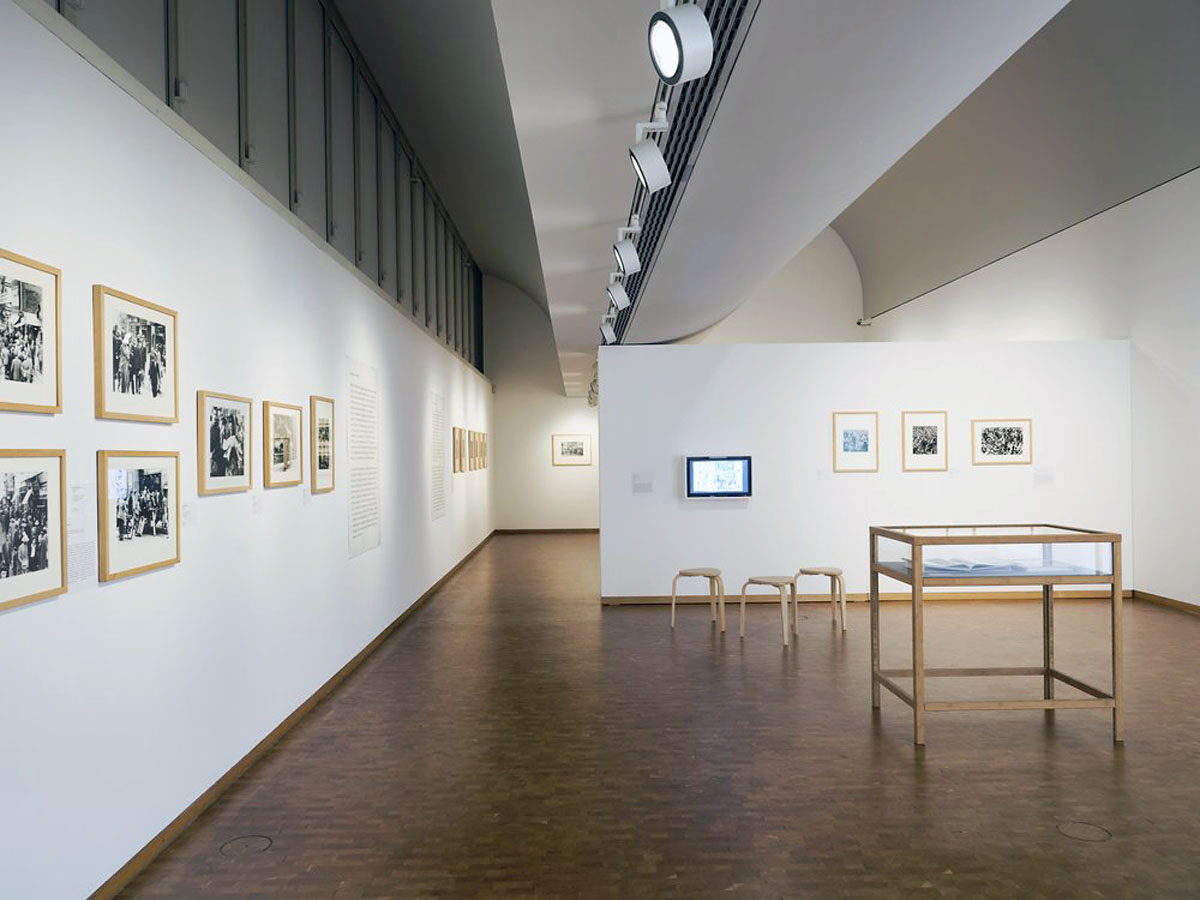
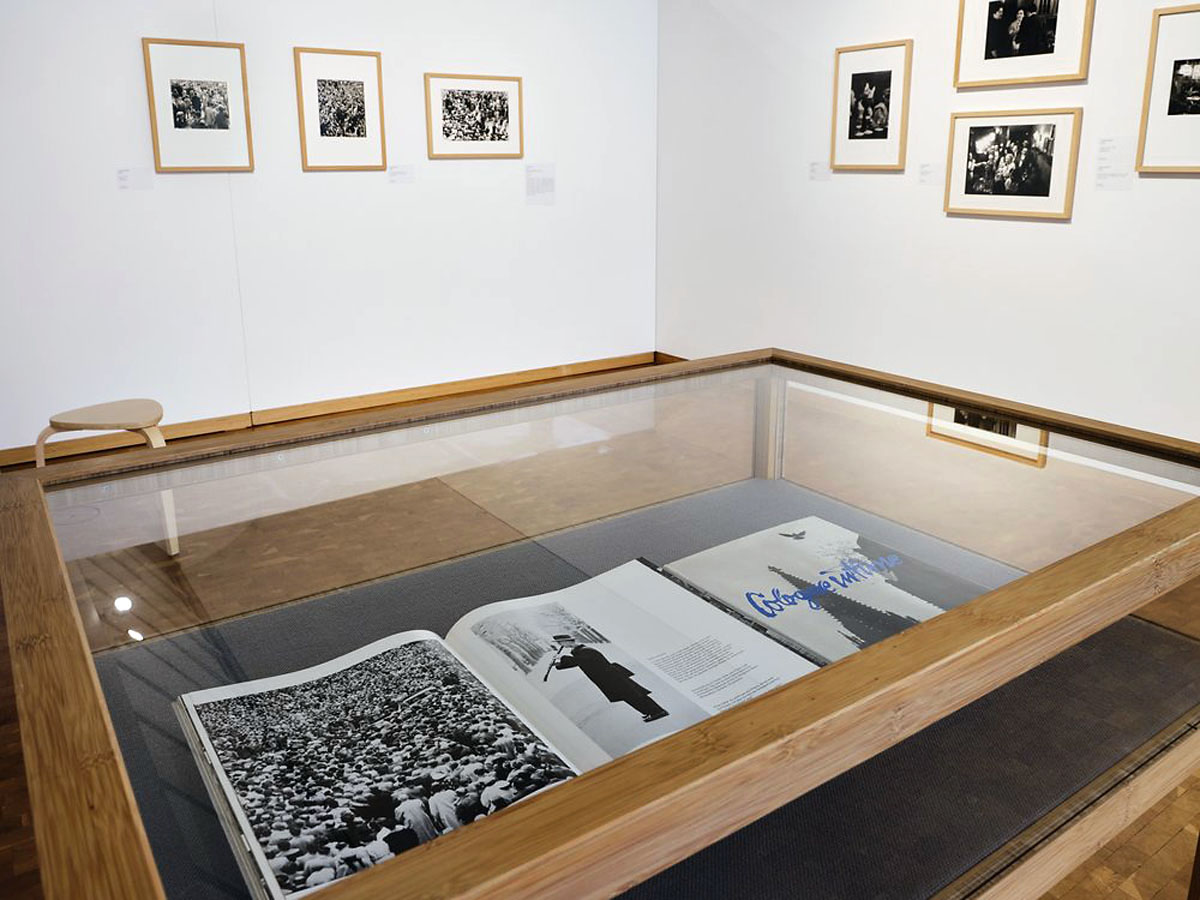


Installation view of the exhibition 'Chargesheimer', Museum Ludwig, Köln 27. 4. - 10.11.2024

Installation view of the exhibition 'Chargesheimer', Museum Ludwig, Köln 27. 4. - 10.11.2024

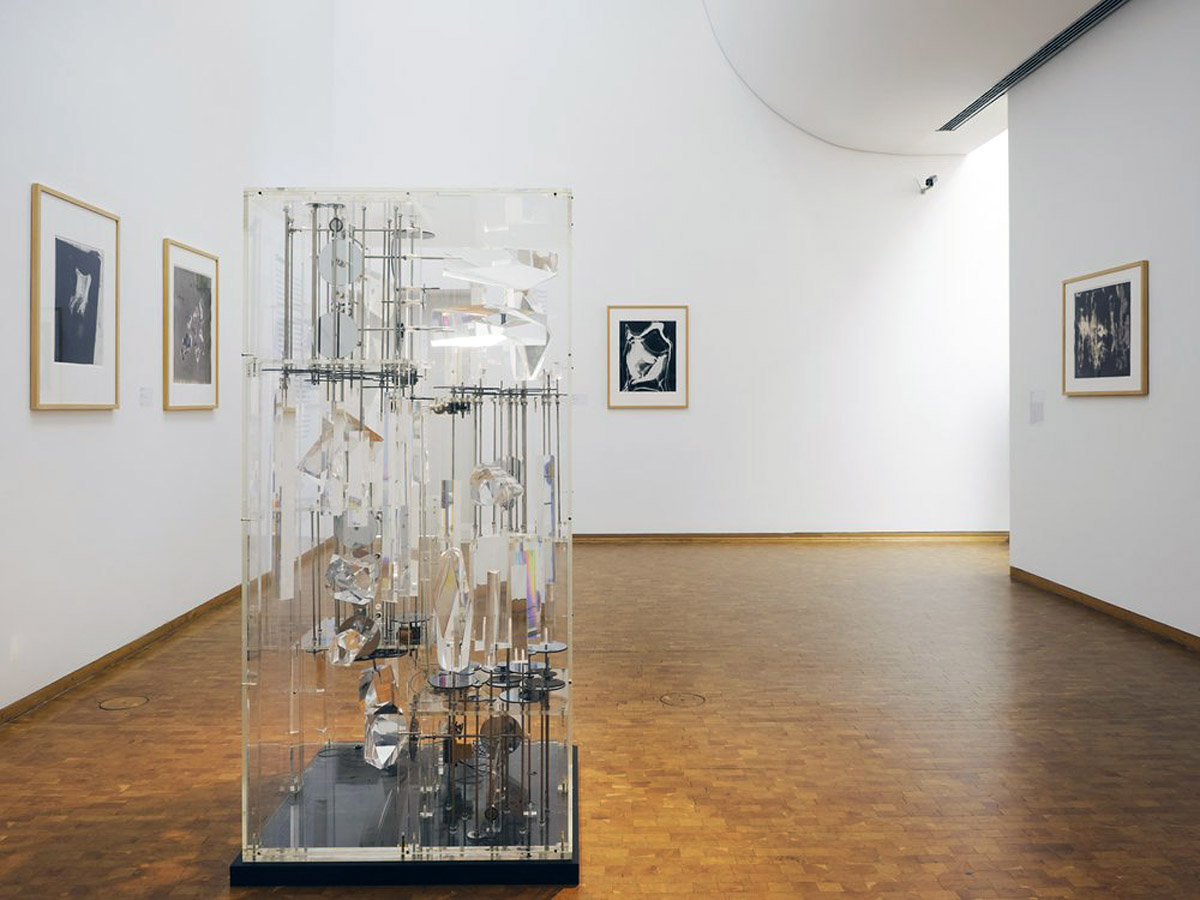
Installation view of the exhibition 'Chargesheimer', Museum Ludwig, Köln 27. 4. - 10.11.2024 showing Chargesheimer's 'Große Vitrine (Gebetsmühle)' (Large display case (prayer wheel)) Nd


Installation views of the exhibition Chargesheimer, Museum Ludwig, Köln 27. 4. – 10.11.2024 showing in the bottom image Chargesheimer’s Große Vitrine (Gebetsmühle) (Large display case (prayer wheel)) Nd
Photo: Rheinisches Bildarchiv Köln/Marc Weber


On May 19, 2024, Cologne pho­to­g­ra­pher Karl Heinz Hargesheimer, who was known as Chargesheimer (1924-1971), would have turned one hun­dred. To cele­brate the cen­te­nary of his birth, Museum Lud­wig will dis­play a se­lec­tion of around fif­ty of his works in the Pho­tog­ra­phy Room. Chargesheimer rose to fame with his pho­to books Cologne in­time and Un­ter Krah­nen­bäu­men, both of which fo­cus on ev­ery­day life in Cologne. The pre­sen­ta­tion in­cludes for­ty-three pic­tures tak­en within the con­text of th­ese two se­ries. Two videos allow vis­i­tors to ac­cess the con­tents of the pho­to books. In ad­di­tion, the presen­ta­tion in­cludes three of Chargesheimer’s lesser-known sculptures called Med­i­ta­tions­mühlen (Med­i­ta­tion Wheels) and six of his abstract photograph­ic ex­per­i­ments.

In 1957 Chargesheimer’s pho­to­graphs were pub­lished in Cologne in­time, a pho­to book or­ganised by Hans Sch­mitt-Rost, the then di­rec­tor of the Nachricht­e­namt, or news agen­cy, in Cologne. Chargesheimer was tasked with tak­ing rep­re­sen­ta­tive images of the re­con­struc­tion of the ci­ty, which had been re­duced to ruins in the war, as well as de­pict­ing the “typ­i­cal” residents of Cologne. The pho­to­graphs contribut­ed by Chargesheimer reflect his unu­su­al, di­rect view of ev­ery­day life. In his 1958 book, Un­ter Krah­nen­bäu­men, which he or­ganised him­self as an inde­pen­dent pro­ject, he jux­ta­posed sim­i­lar pho­to­graphs in stark­ly con­trast­ing se­ries of mo­tifs. This doc­u­men­ta­tion tells the un­var­nished truth while af­fec­tio­nate­ly ex­plor­ing the street in Cologne whose name is fea­tured in the book’s ti­tle. Chargesheimer shows life in the streets and in the bars of a live­ly Cologne neigh­bour­hood that was still in­tact. Ger­man writ­er Hein­rich Böll wrote in the fore­word to this publi­ca­tion, “Streets like this one are per­haps the on­ly places where peo­ple re­al­ly live.”

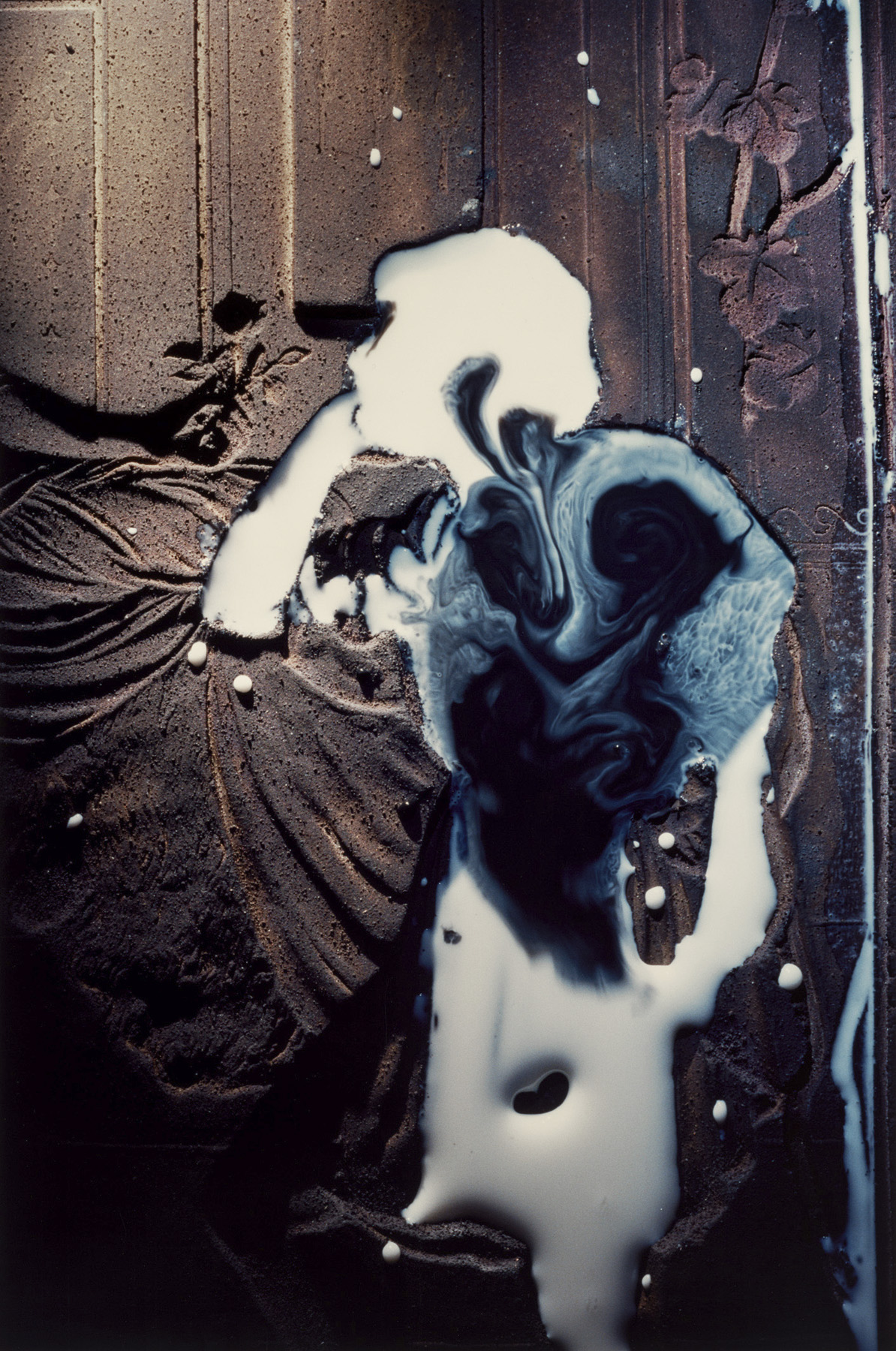
Chargesheimer pur­sued many in­ter­ests. Along­side his doc­u­men­tary studies, he in­vesti­gat­ed pho­tog­ra­phy as an im­age-pro­duc­ing medi­um. In the late 1940s, he be­gan ex­per­i­ment­ing with light graph­ics and pho­to­chem­i­cal process­es and cre­at­ing pho­to­graphs with­out a cam­era. Chargesheimer described his ex­per­i­ments with pho­to­graph­ic plates and neg­a­tives in a text ac­com­pany­ing his first ex­hi­bi­tion in Mi­lan in 1950: “Pan­n­ing, wip­ing, scrap­ing, cool­ing, burn­ing – ad­d­ing acids, bas­es, col­ours, and var­nish­es.” Th­ese ex­per­i­ments re­sult­ed in pain­ter­ly works in the style of Art In­formel that was pre­va­lent at the time.

In 1967 Chargesheimer be­gan cre­at­ing ki­net­ic works called Med­i­ta­tions­mühlen (Med­i­ta­tion Wheels) made of Plexi­glas. Three of th­ese works from the col­lec­tion of the Mu­se­um Lud­wig will be pre­sent­ed in the ex­hi­bi­tion for the first time in thir­ty years. Con­sist­ing of mul­ti­ple lev­els of crys­tal­line elements made of Plexi­glas, the dome-shaped con­struc­tions are put in­to motion through a com­plex sys­tem of gears. The be­wilder­ing va­ri­e­ty of light re­flex­es from Plexi­glas prisms cre­ates an unu­su­al con­trast to the pre­cise me­chan­ics of the gears. Chaos and con­trol seem to com­ple­ment one another here.

Chargesheimer

On May 19, 2024, the Cologne photographer Chargesheimer (1924-1971), born Karl Heinz Hargesheimer, would have celebrated his hundredth birthday. To mark the occasion, the Museum Ludwig is showing a selection of around fifty of his works. Chargesheimer rose to fame with his photobooks Cologne intime and Unter Krahnenbäumen, which are dedicated to the city of Cologne. In them, he casts a singular and incisive gaze on everyday events. These images convey the artist’s attentive and empathetic approach to photographing the day-to-day lives of people in the various neighbourhoods he documented.

Chargesheimer explored photography’s diverse possibilities. In addition to his documentary work, he utilised photography’s potential as a pictorial medium. In the late 1940s, he began experimenting with light graphics and photochemical processes to produce cameraless photographs. The resulting images are painterly and abstract. From 1967, Chargesheimer also created kinetic sculptures made of Plexiglas, which he called Meditation Wheels.

Press release from Museum Ludwig
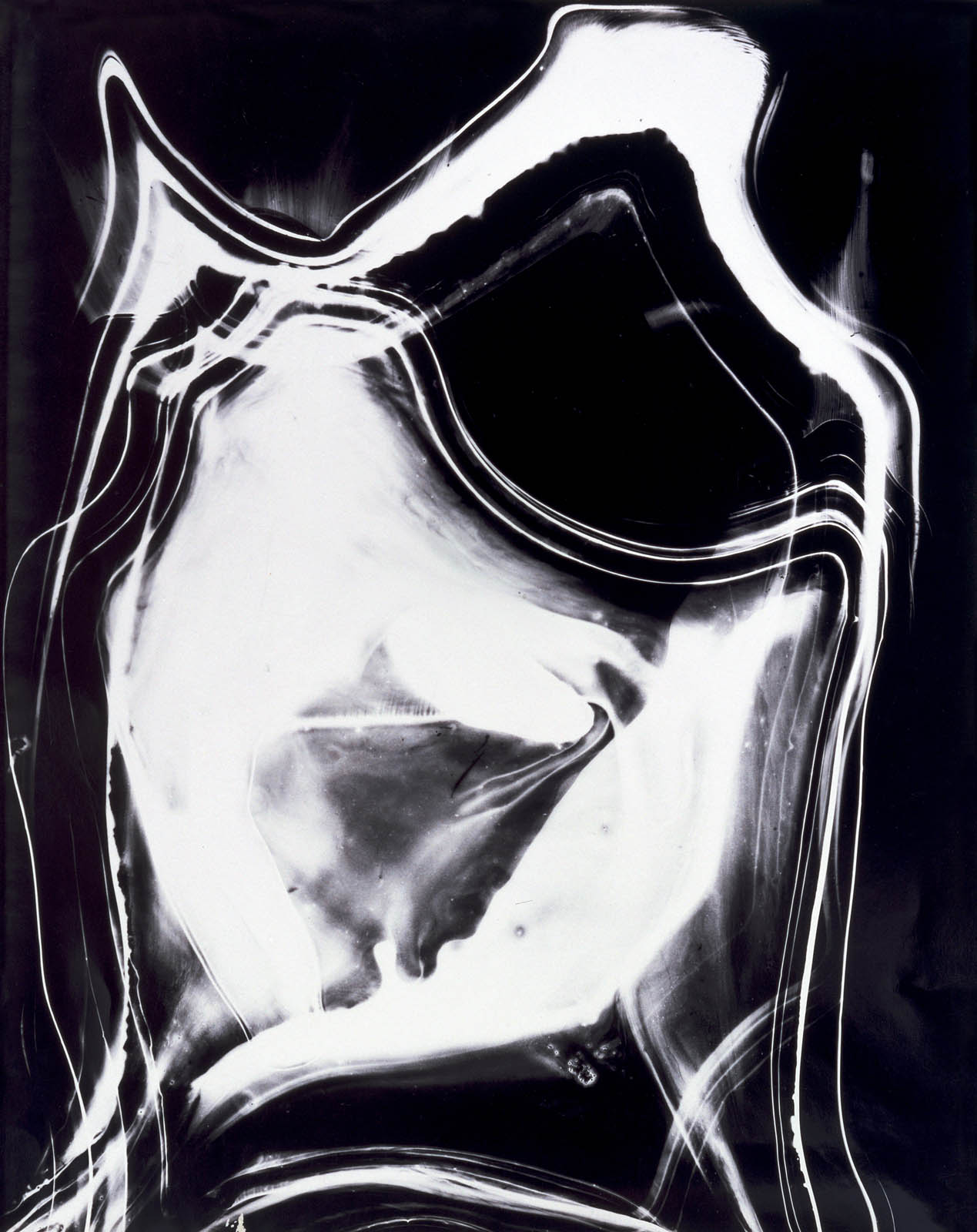
 

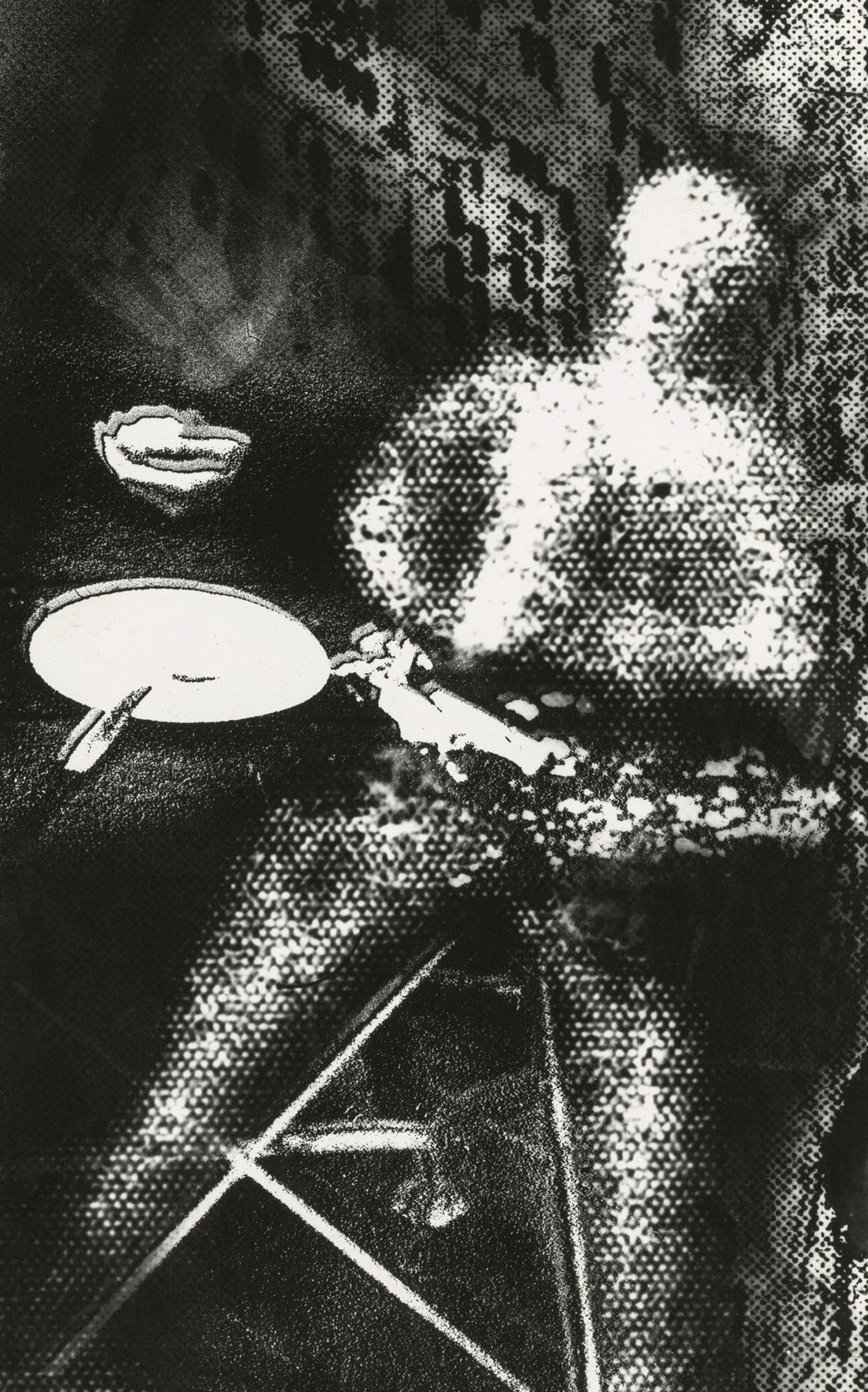
Chargesheimer (Carl-Heinz Hargesheimer, German 1924-1971) 'Formlose Mitte' (Shapeless Center) 1949 'Chargesheimer' at Museum Ludwig, Cologne, Germany


Chargesheimer (Carl-Heinz Hargesheimer, German 1924-1971)
Formlose Mitte (Shapeless Center)
1949
Gelatin silver paper, light graphics
59.6 x 47.7cm
Museum Ludwig, Cologne
Reproduction: Rheinisches Bildarchiv Köln
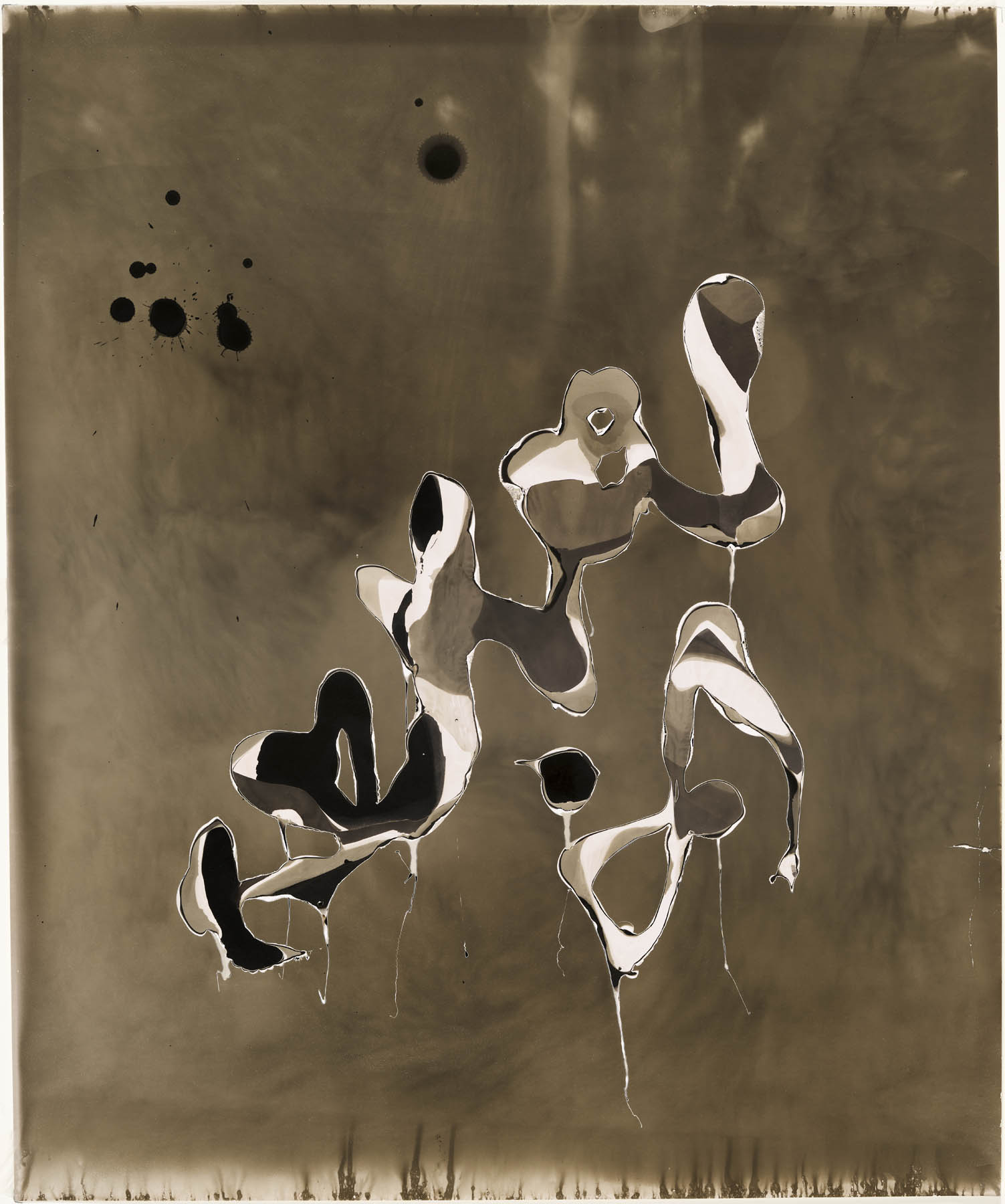
 

Chargesheimer (Carl-Heinz Hargesheimer, German 1924-1971) 'Untitled' Around 1950


Chargesheimer (Carl-Heinz Hargesheimer, German 1924-1971)
Untitled
Around 1950
Gelatin silver paper, light graphics, mixed media
59.8 x 49.7cm
Museum Ludwig, Cologne
Reproduction: Rheinisches Bildarchiv Köln


Chargesheimer (Karl-Heinz Hargesheimer, German 1924-1971) 'Untitled (girl scattering confetti)' c. 1956-1957 'Chargesheimer' at Museum Ludwig, Cologne, Germany


Chargesheimer (Karl-Heinz Hargesheimer, German 1924-1971)
Ohne Titel (Konfetti streuendes Mädchen)
Untitled (girl scattering confetti)
c. 1956-1957
Museum Ludwig, Cologne


Chargesheimer (Karl-Heinz Hargesheimer, German 1924-1971) 'Fußballplatz' (Football field) 1957 'Chargesheimer' at Museum Ludwig, Cologne, Germany


Chargesheimer (Karl-Heinz Hargesheimer, German 1924-1971)
Fußballplatz (Football field)
1957
From: Im Ruhrgebiet (In the Ruhr area)
Museum Ludwig, Cologne
Reproduction: Rheinisches Bildarchiv, Köln


Cologne intime, 1957

In the mid-1950s, Chargesheimer photographed different views of Cologne for his photobook Cologne intime. Hans Schmitt-Rost, then head of the municipal news agency in Cologne, had commissioned him to document the successful reconstruction of the city. At the same time, he was to capture images of “typical” local residents. Chargesheimer photographed streets with empty properties cleared of rubble and the prominent new buildings in the city centre. His photographs show crowds of people on the main shopping streets, at the 77th Catholic Convention in Deutz in 1956, and at the Federal Garden Show in 1957. Chargesheimer enlarged details to show particular individuals going about their day. He focused on their distinctiveness, the quality that made them stand out in the crowd.

Hans Schmitt-Rost (1901-1978), who designed the book, uses his evaluative comments to dictate how the photographs should be read. He headed the Cologne City Intelligence Office from 1945 to 1966. In this role, he played a key role in shaping Cologne’s self-portrayal as a city removed from contemporary history, whose actual history is rooted in the Middle Ages. He excluded the Nazi era or relativized it as something foreign to the people of Cologne.

Text from Museum Ludwig
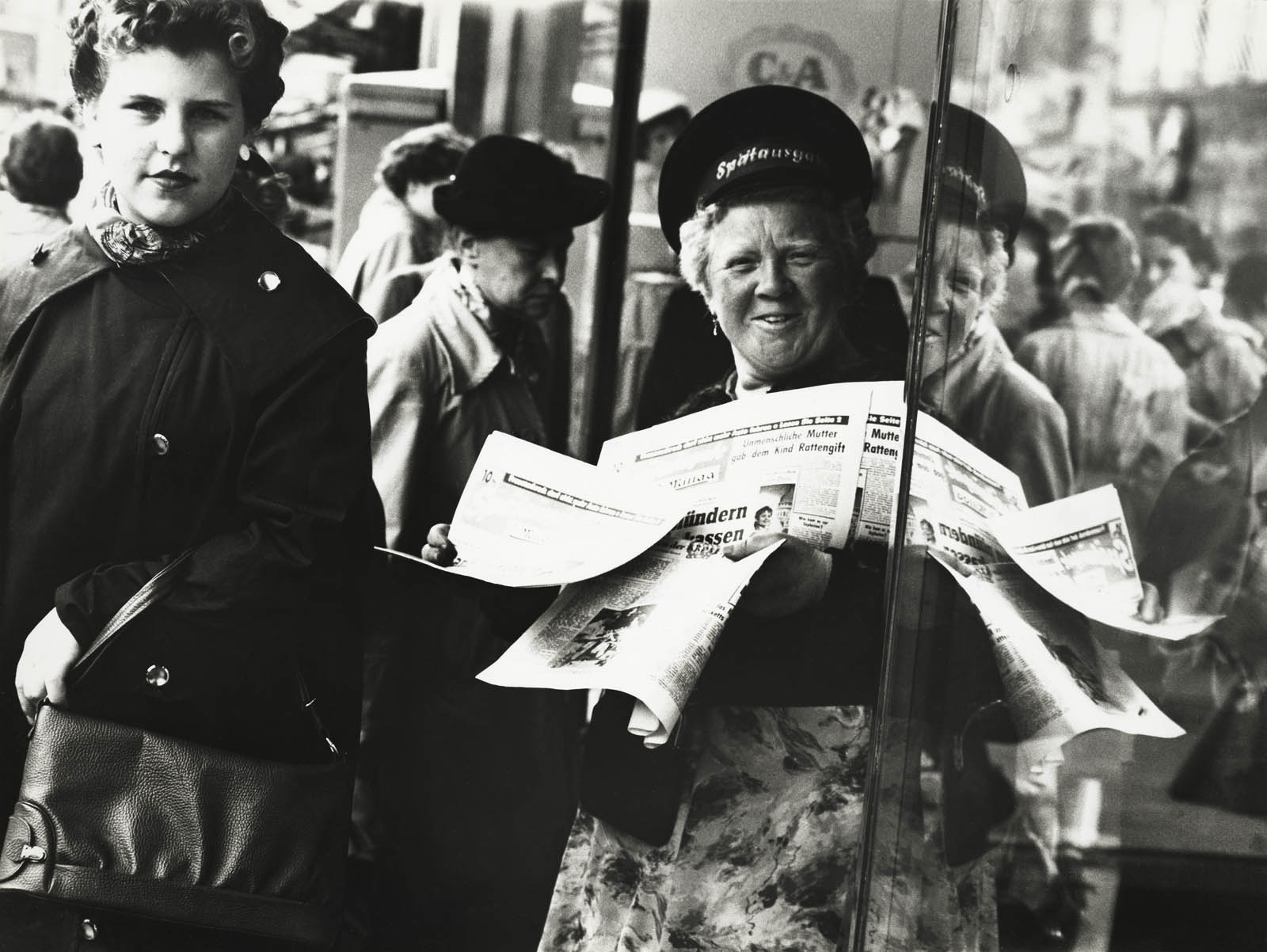
 

Chargesheimer (Carl-Heinz Hargesheimer, German 1924-1971) 'Schildergasse, Cologne' Before 1957 'Chargesheimer' at Museum Ludwig, Cologne, Germany


Chargesheimer (Carl-Heinz Hargesheimer, German 1924-1971)
Schildergasse, Cologne
Before 1957
Gelatin silver paper
29.8 x 39.7cm
Museum Ludwig, Cologne
Reproduction: Rheinisches Bildarchiv, Köln
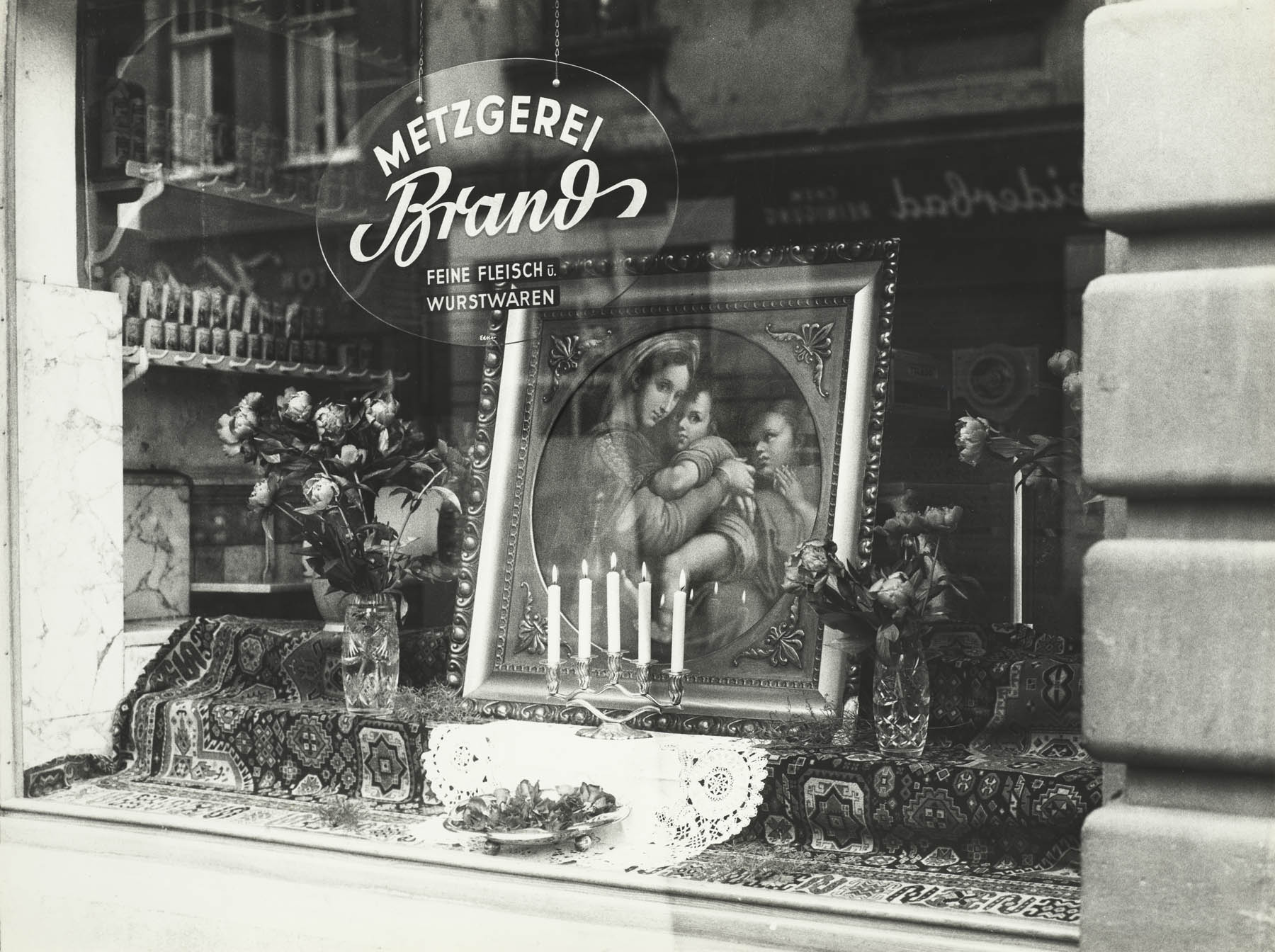
 

Chargesheimer (Carl-Heinz Hargesheimer, German 1924-1971) 'Cologne' Before 1957


Chargesheimer (Carl-Heinz Hargesheimer, German 1924-1971)
Cologne
Before 1957
Gelatin silver paper
29.9 x 39.7cm
Museum Ludwig, Cologne
Reproduction: Rheinisches Bildarchiv, Köln
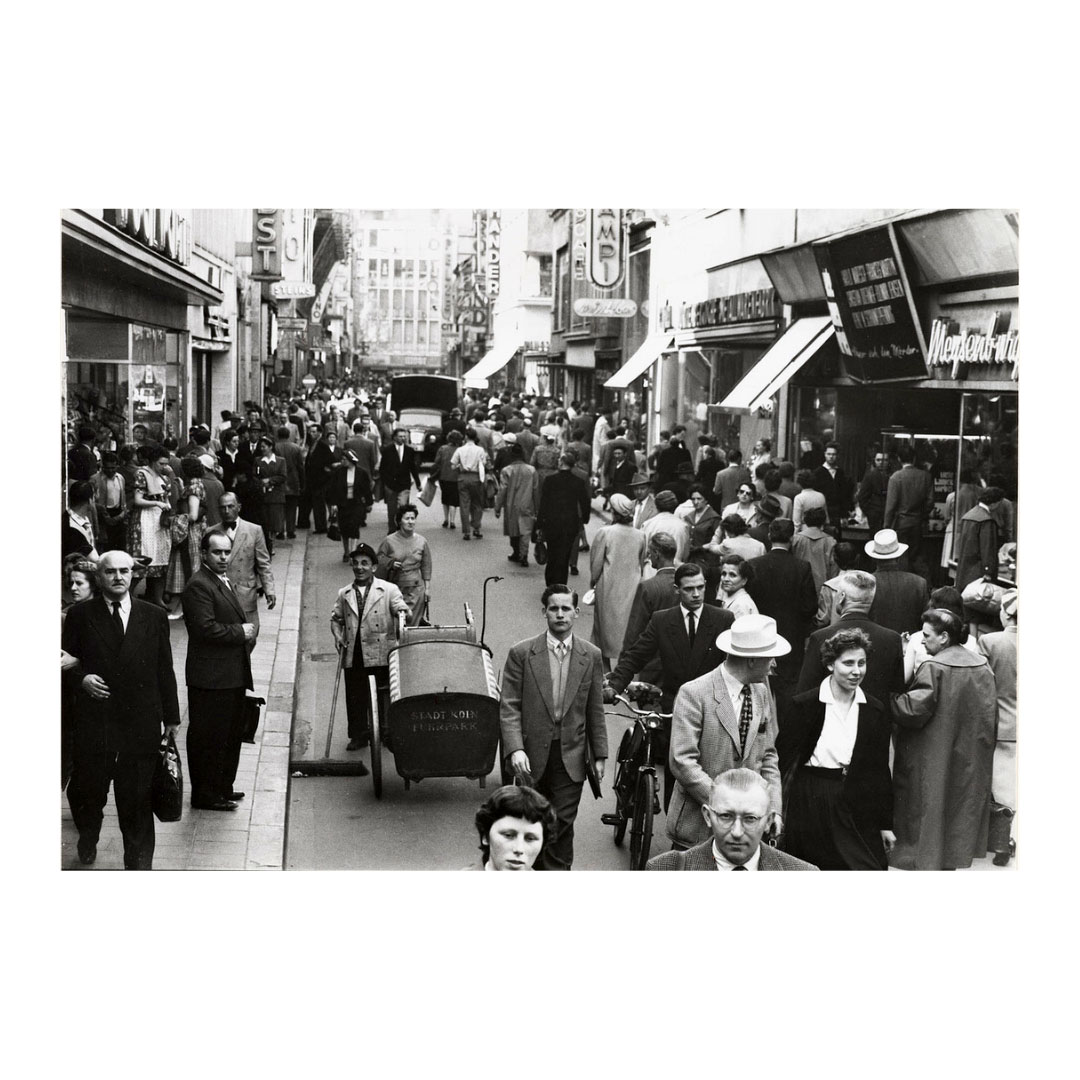
 

Chargesheimer (Carl-Heinz Hargesheimer, German 1924-1971) 'Hohe Straße, near Große Budengasse, Cologne' Before 1957


Chargesheimer (Carl-Heinz Hargesheimer, German 1924-1971)
Hohe Straße, near Große Budengasse, Cologne
Before 1957
Gelatin silver paper
Museum Ludwig, Cologne
Reproduction: Rheinisches Bildarchiv Köln


Chargesheimer captured Hohe Straße from a distance. But he wasn’t concerned with the distance to the action, because he highlighted individual people. They stand out in the crowd because they make eye contact with him or speak to him.

The Hohe Straße in Cologne is an important motif for the publication. The filled shop windows and the streams of passers-by represent the economic boom after the currency reform in 1948… The Hohe Straße was already an important shopping street at the end of the 19th century. The Tietz department store, built in 1895, was also famous. Its owner, Alfred Leonhard Tietz, was forced during the Nazi era to sell the department store chain to Commerzbank, Deutsche Bank and Dresdner Bank for well below market value. He was robbed of his assets and had to flee. The department store was renamed Westdeutsche Kaufhof AG and continued to operate under this name after 1945.

Text from Museum Ludwig
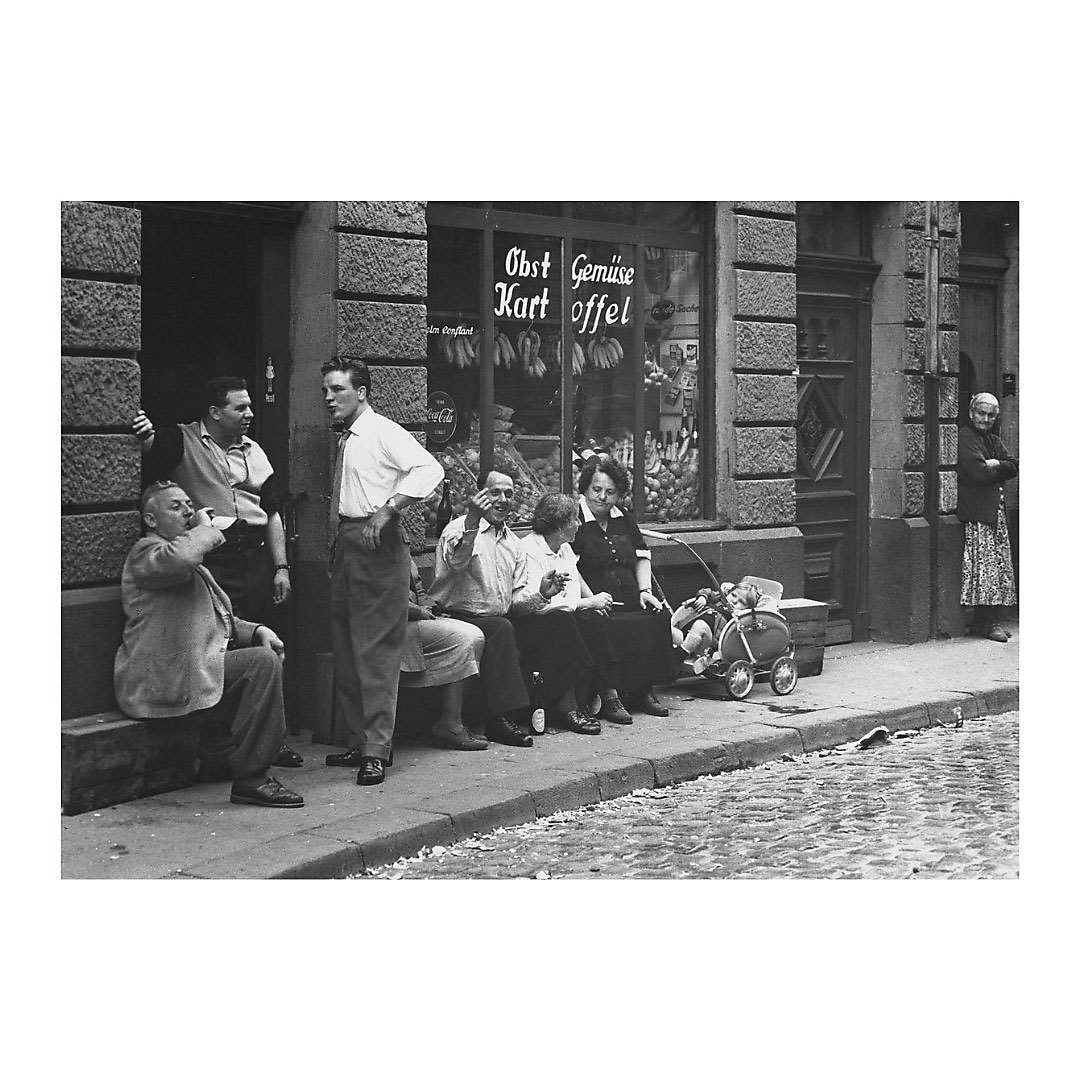
 

Chargesheimer (Carl-Heinz Hargesheimer, German 1924-1971) 'Kirmes Unter Krahnenbäumen' Before 1957


Chargesheimer (Carl-Heinz Hargesheimer, German 1924-1971)
Kirmes Unter Krahnenbäumen
Before 1957
Gelatin silver paper
26.3 x 39.8 cm
Museum Ludwig, Cologne
Reproduction: Rheinisches Bildarchiv Köln
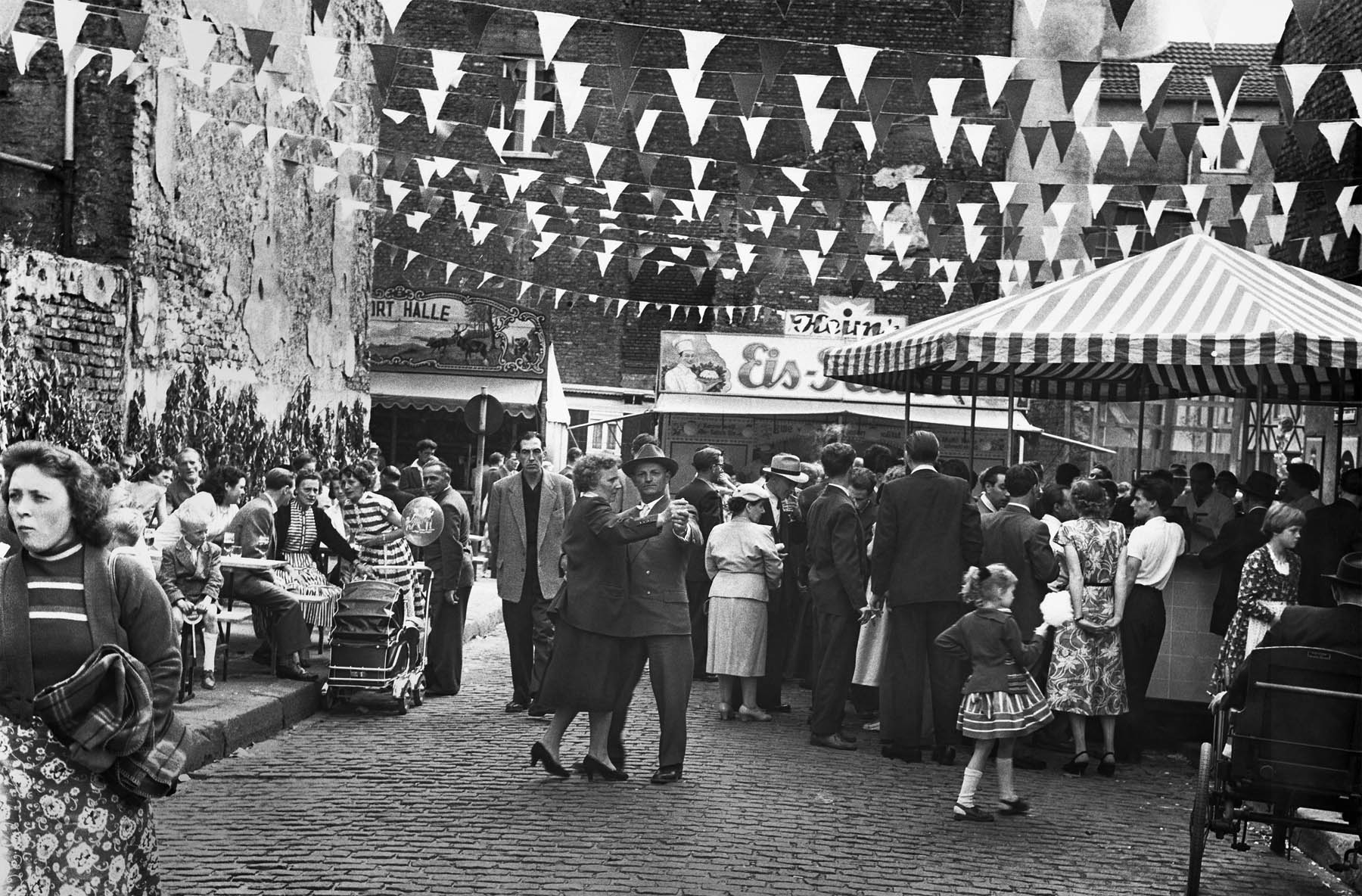
 

Chargesheimer (Carl-Heinz Hargesheimer, German 1924-1971) 'Kirmes Unter Krahnenbäumen' Around 1957


Chargesheimer (Carl-Heinz Hargesheimer, German 1924-1971)
Kirmes Unter Krahnenbäumen
Around 1957
Gelatin silver paper
26.3 x 39.8cm
Museum Ludwig, Cologne
Reproduction: Rheinisches Bildarchiv, Köln


Chargesheimer (Carl-Heinz Hargesheimer, German 1924-1971) 'Autobahnzubringer im Rechtsrheinischen' (Motorway feeder road on the right bank of the Rhine) Around 1957


Chargesheimer (Carl-Heinz Hargesheimer, German 1924-1971)
Autobahnzubringer im Rechtsrheinischen (Motorway feeder road on the right bank of the Rhine)
Around 1957
Gelatin silver paper
39.7 x 29.8cm
Museum Ludwig, Cologne
Reproduction: Rheinisches Bildarchiv Köln


Chargesheimer (Carl-Heinz Hargesheimer, German 1924-1971) 'Hinterhof, Cologne' Around 1957


Chargesheimer (Carl-Heinz Hargesheimer, German 1924-1971)
Hinterhof, Cologne
Around 1957
Gelatin silver paper
24.7 x 19.6cm
Museum Ludwig, Cologne
Reproduction: Rheinisches Bildarchiv Köln


Away from the rebuilt city centre, Chargesheimer photographed intimate neighbourhoods for the photo book Cologne, which were characterised by old buildings, small shops and ruined properties. He also photographed Cologne’s nightlife in bars, workers’ pubs and restaurants with prostitutes without making any judgments.
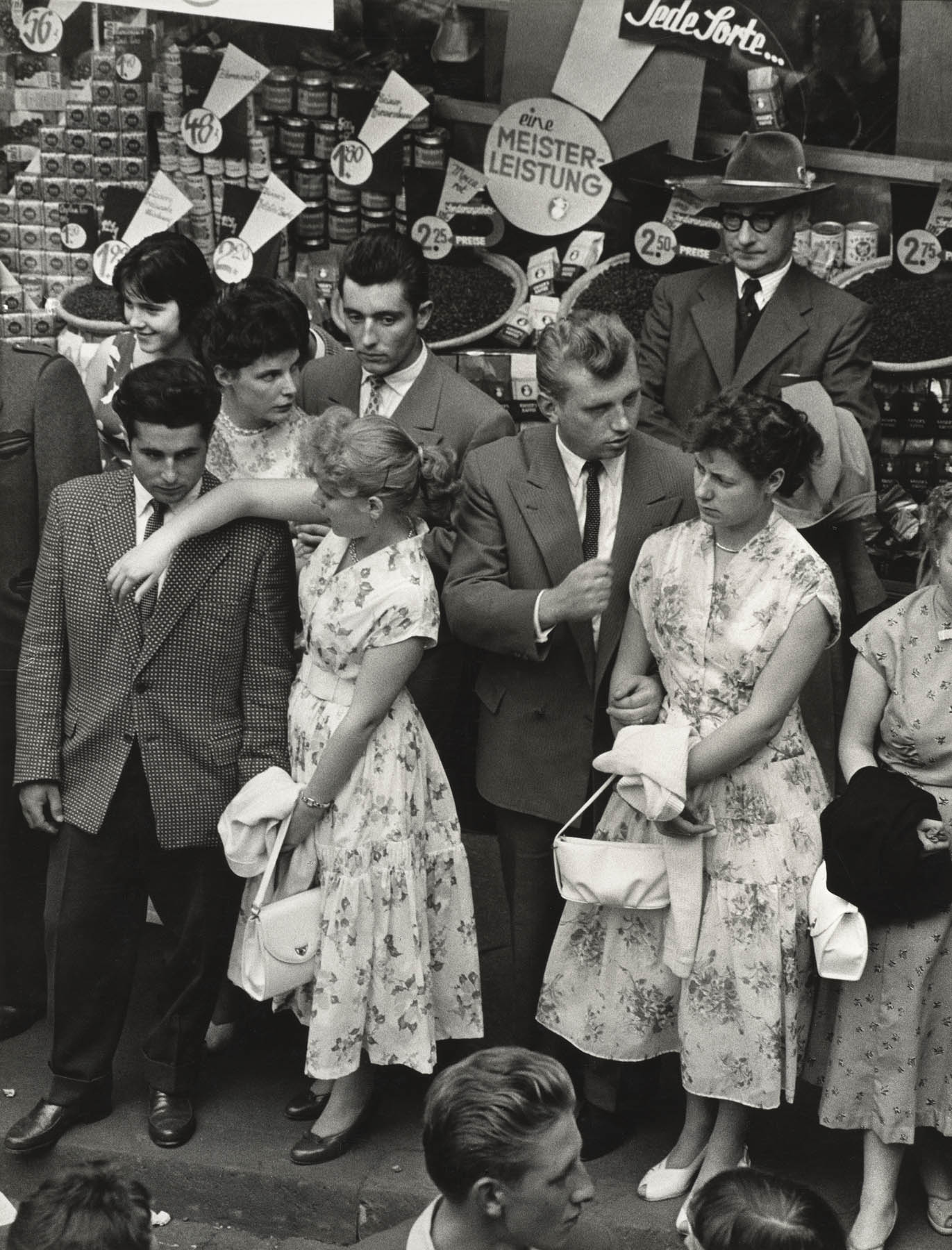
 

Chargesheimer (Carl-Heinz Hargesheimer, German 1924-1971) 'Cologne' Around 1957


Chargesheimer (Carl-Heinz Hargesheimer, German 1924-1971)
Cologne
Around 1957
Gelatin silver paper
30.4 x 23.3cm
Museum Ludwig, Cologne
Reproduction: Rheinisches Bildarchiv Köln


Chargesheimer (Carl-Heinz Hargesheimer, German 1924-1971) 'Cologne' 1957


Chargesheimer (Carl-Heinz Hargesheimer, German 1924-1971)
Cologne
1957
Gelatin silver paper
30.4 x 23.3cm
Museum Ludwig, Cologne
Reproduction: Rheinisches Bildarchiv Köln
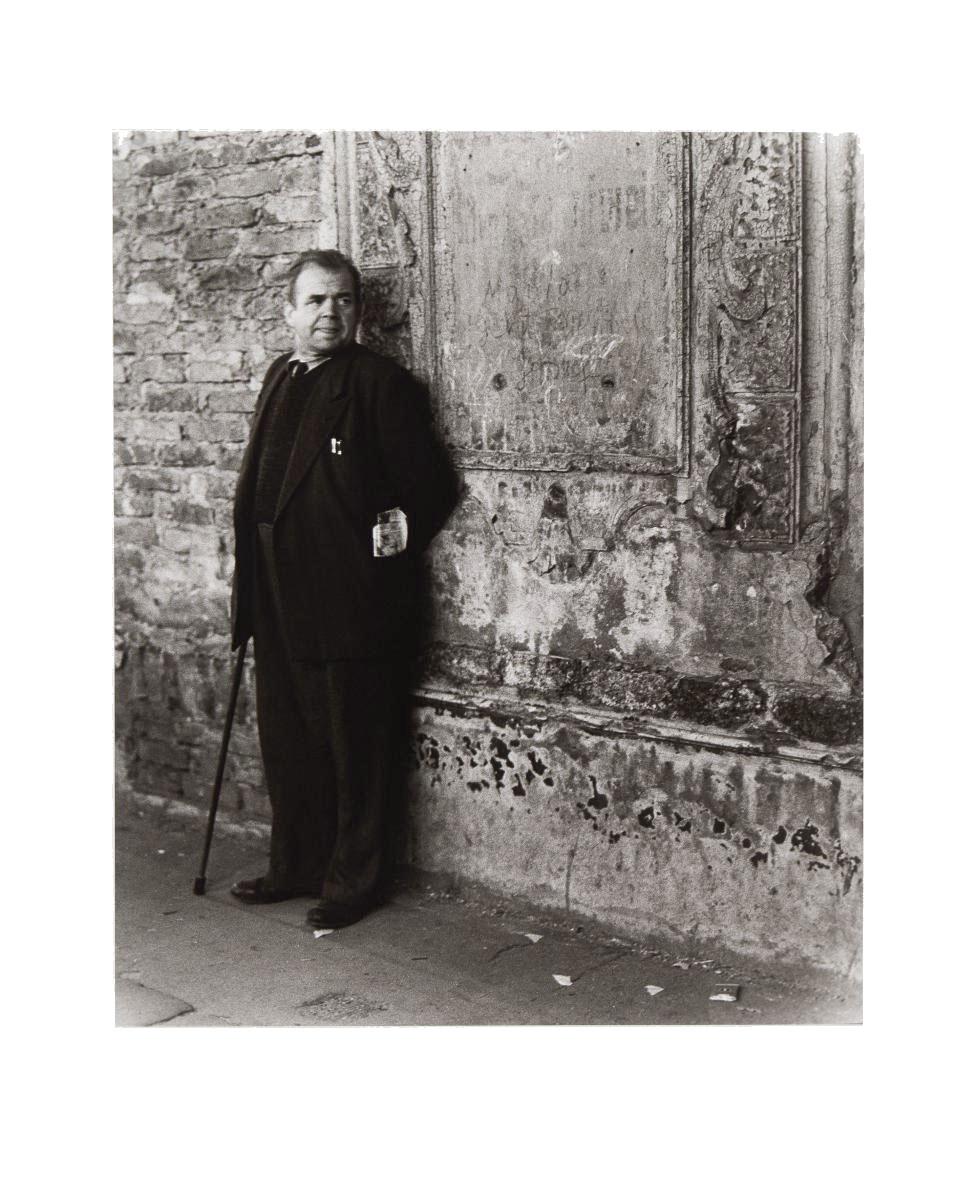
 

Chargesheimer (Carl-Heinz Hargesheimer, German 1924-1971) 'Unter Krahnenbäumen, Cologne' Before 1958


Chargesheimer (Carl-Heinz Hargesheimer, German 1924-1971)
Unter Krahnenbäumen, Cologne
Before 1958
Gelatin silver paper
Museum Ludwig, Cologne
Reproduction: Rheinisches Bildarchiv Köln


Unter Krahnenbäumen, 1958

A year after Cologne intime was published by Greven Verlag, they invited Chargesheimer to realise another photobook. This time, the selection and arrangement of the photographs were placed firmly in his hands. He dedicated the book to the small street of Unter Krahnenbäumen in Cologne. The opening pages present everyday life on the street, documenting people working or chatting with neighbours. These are followed by images of Carnival, which is celebrated on the street and in pubs until late into the night. Pages dedicated to children and the elderly mark a change in theme, while those devoted to the funfair or preparations for the Corpus Christi procession show a mix of generations. On the final pages, photographs of locals dancing and laughing on Unter Krahnenbäumen and inside its pubs reveal the year-round liveliness of the street.

Chargesheimer takes an interest in people and their lives. This is reflected in the long series of images of individual people and their situations. He photographs a boisterous woman in a top hat in a bar, a couple with a dog in an inn, people decorating the street with flowers and shredded paper for Corpus Christi. Chargesheimer’s careful selection and editing bring the photographs to life. You can immerse yourself in them like in a neo-realist film from the 1950s.

Text from Museum Ludwig
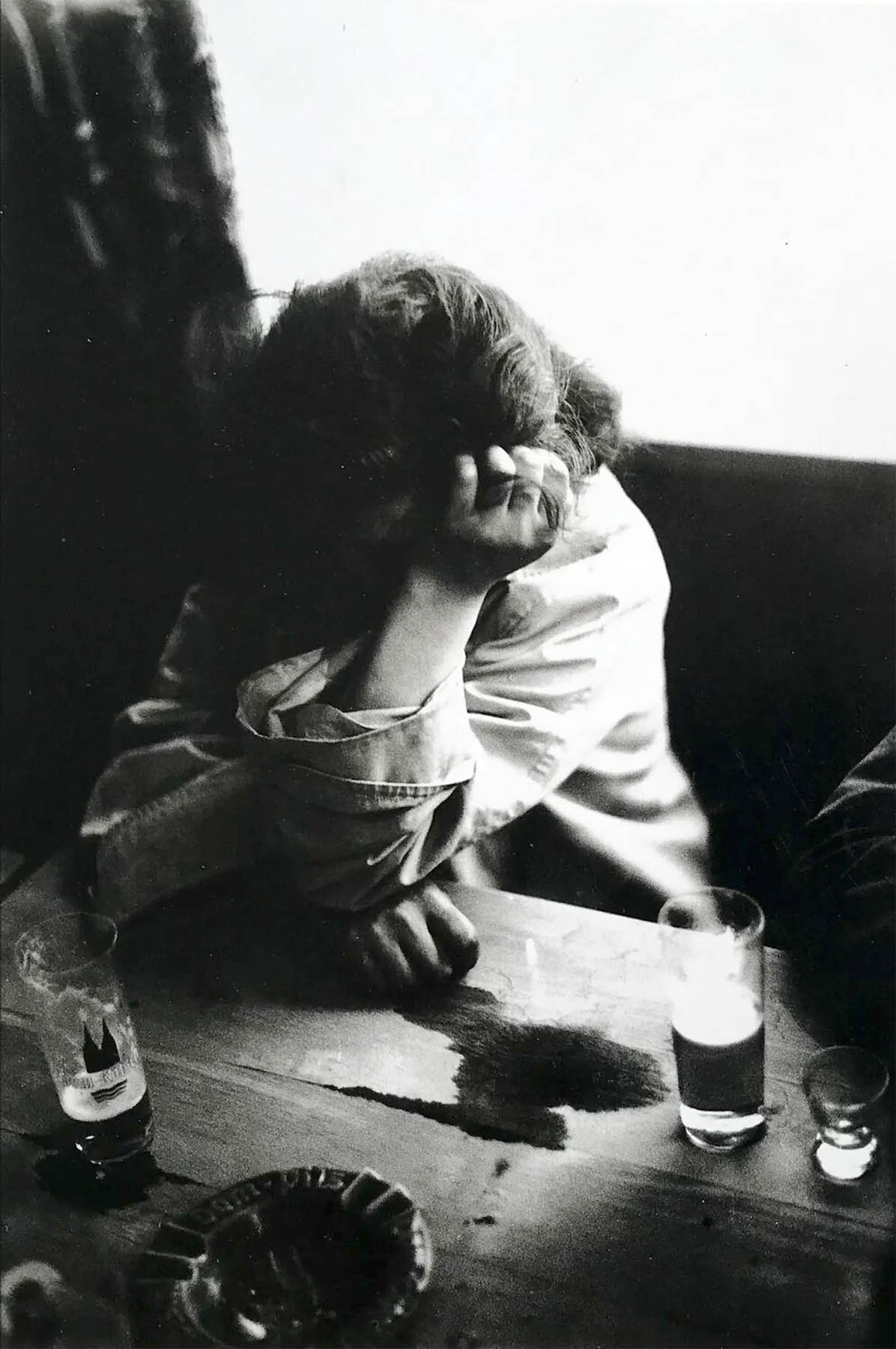
 

Chargesheimer (Carl-Heinz Hargesheimer, German 1924-1971) 'Unter Krahnenbäumen, Cologne' Before 1958


Chargesheimer (Carl-Heinz Hargesheimer, German 1924-1971)
Unter Krahnenbäumen, Cologne
Before 1958
Gelatin silver paper
Museum Ludwig, Cologne
Reproduction: Rheinisches Bildarchiv Köln
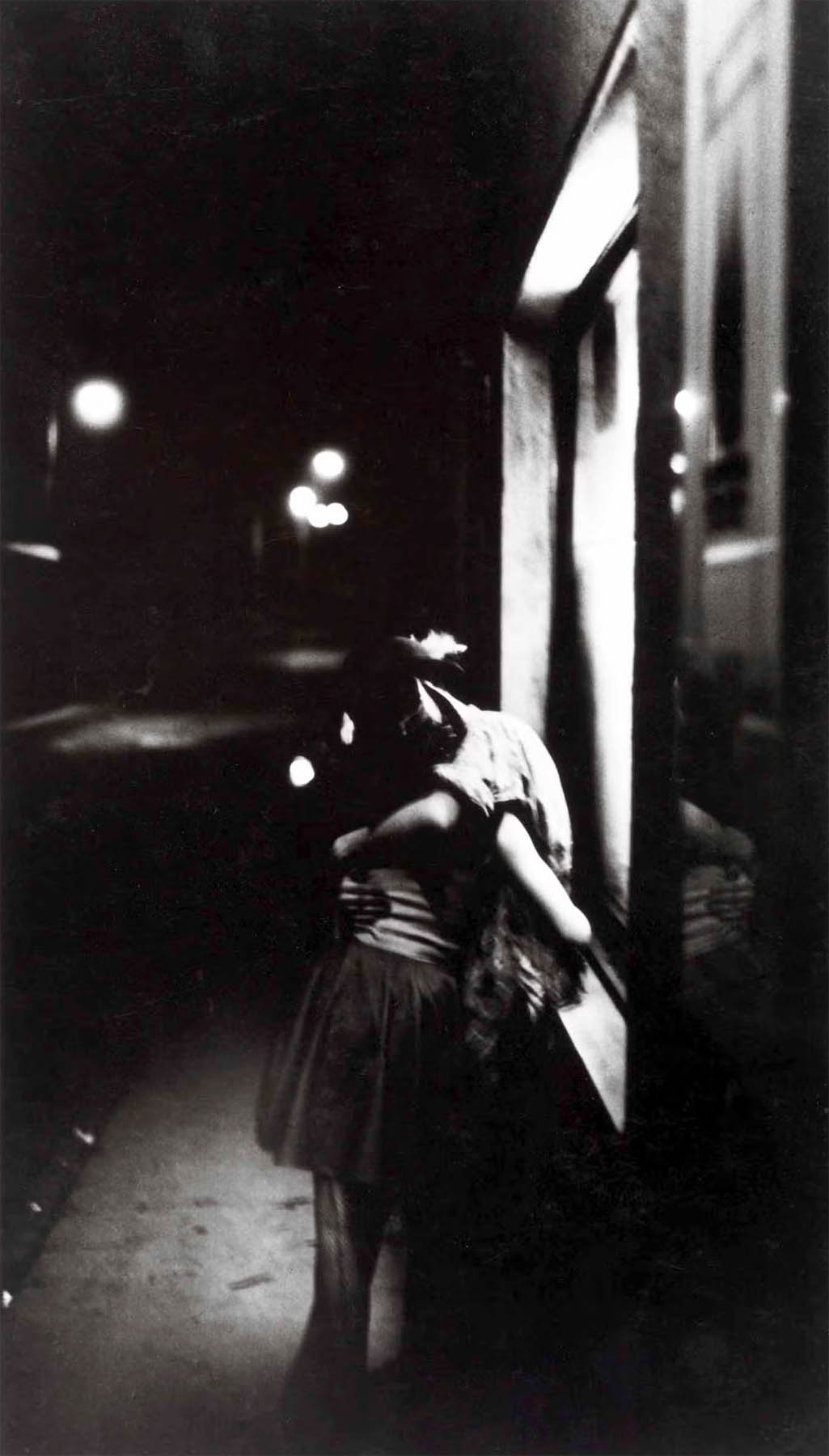
 

Chargesheimer (Carl-Heinz Hargesheimer, German 1924-1971) 'Unter Krahnenbäumen, Cologne' Before 1958


Chargesheimer (Carl-Heinz Hargesheimer, German 1924-1971)
Unter Krahnenbäumen, Cologne
Before 1958
Gelatin silver paper
Museum Ludwig, Cologne
Reproduction: Rheinisches Bildarchiv Köln


Chargesheimer (Carl-Heinz Hargesheimer, German 1924-1971) 'Unter Krahnenbäumen, Cologne' Around 1958


Chargesheimer (Carl-Heinz Hargesheimer, German 1924-1971)
Unter Krahnenbäumen, Cologne
Around 1958
Gelatin silver paper
24.7 x 21.3cm
Museum Ludwig, Cologne
Reproduction: Rheinisches Bildarchiv Köln


The Eigelsteinviertel was a lively and diverse neighbourhood in the 1920s. That changed under National Socialism, when the SA (Storm Division) and later the Gestapo (Secret State Police) persecuted communists. When the Nazis seized power, Jewish residents were expropriated, deported and murdered; Roma families living in Stavenhof, Unter Krahnenbäumen and on Gereonswall were deported to Auschwitz by the Cologne criminal police in the 1940s. After the war, the construction of the Nord-Süd-Fahrt marked a turning point in urban development. In 1957, the master plan for reconstruction came into force, which formed the basis of urban planning until the 1970s. He envisaged a 34-meter-wide lane for the north-south route across the district, which today also cuts through Unter Krahnenbäumen. The street had already been planned in this form during the National Socialist era. Even before the war began, the Nazi city administration had bought up land on both sides of the planned route.

Text from Museum Ludwig
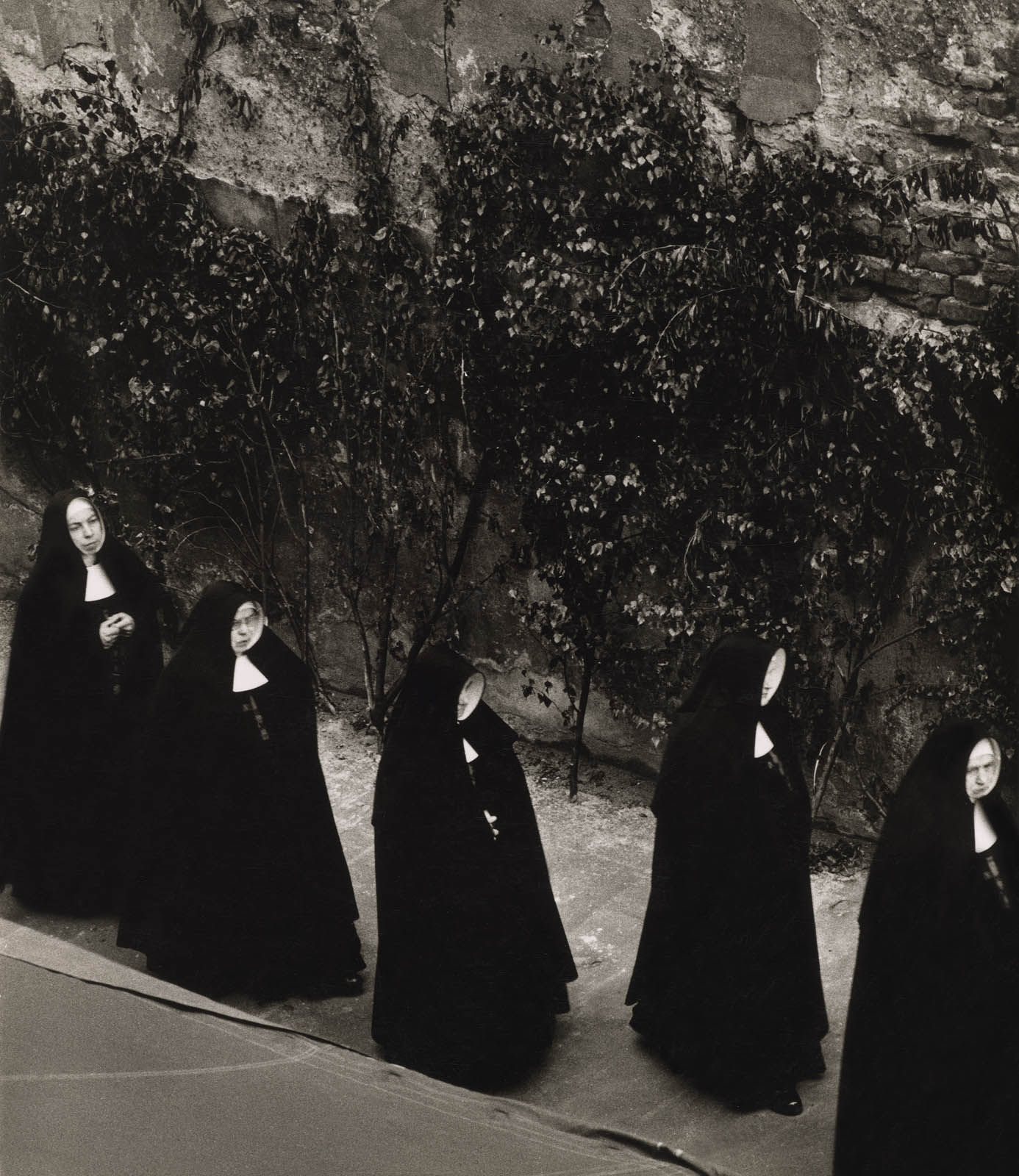
 

Chargesheimer (Carl-Heinz Hargesheimer, German 1924-1971) 'Unter Krahnenbäumen, Cologne' Around 1958


Chargesheimer (Carl-Heinz Hargesheimer, German 1924-1971)
Unter Krahnenbäumen, Cologne
Around 1958
Gelatin silver paper
24.8 x 21.3cm
Museum Ludwig, Cologne
Reproduction: Rheinisches Bildarchiv Köln
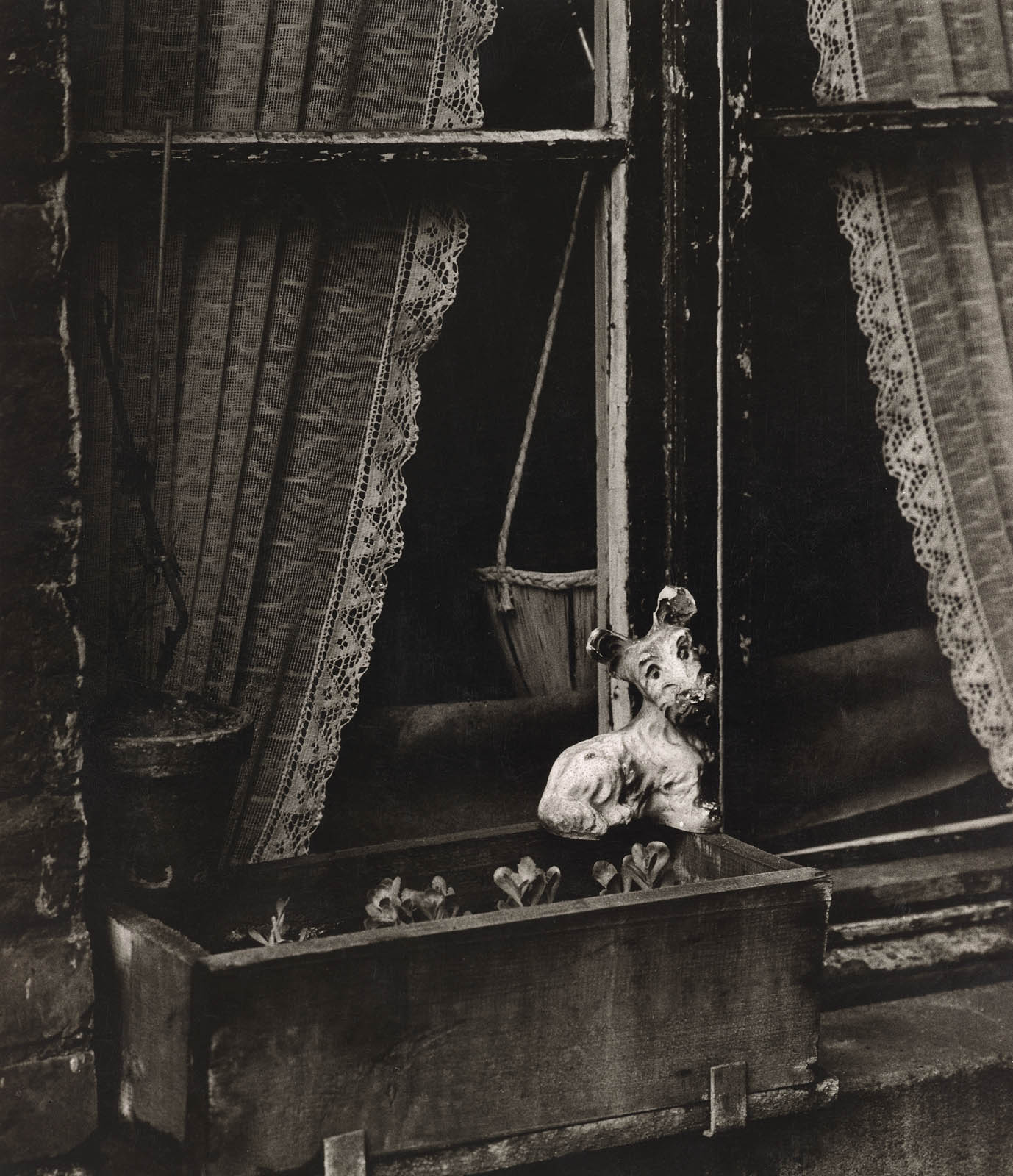
 

Chargesheimer (Carl-Heinz Hargesheimer, German 1924-1971) 'Unter Krahnenbäumen, Cologne' Around 1958


Chargesheimer (Carl-Heinz Hargesheimer, German 1924-1971)
Unter Krahnenbäumen, Cologne
Around 1958
Gelatin silver paper
24.9 x 21.3cm
Museum Ludwig, Cologne
Reproduction: Rheinisches Bildarchiv Köln
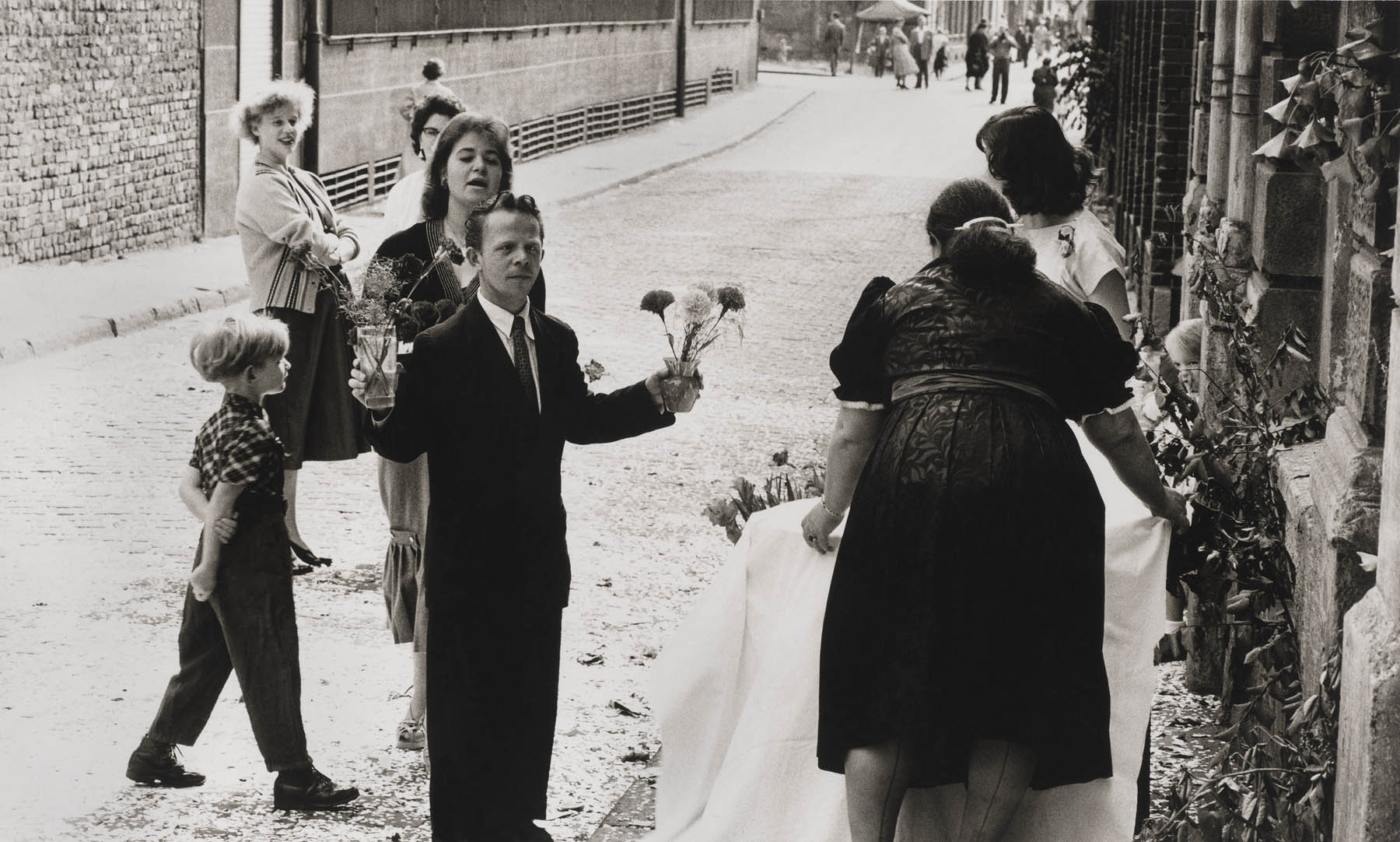
 

Chargesheimer (Carl-Heinz Hargesheimer, German 1924-1971) 'Unter Krahnenbäumen, Cologne' 1958


Chargesheimer (Carl-Heinz Hargesheimer, German 1924-1971)
Unter Krahnenbäumen, Cologne
1958
Gelatin silver paper
17.9 x 29.8cm
Museum Ludwig, Cologne
Reproduction: Rheinisches Bildarchiv Köln


Chargesheimer’s work with the unwieldy large format camera Linhof Super Technika meant that he spent a while in each location. He became part of the situation because the residents turned to him and started talking to him. Many of the photos were taken on the Catholic holiday of Corpus Christi. The residents decorated the street with green leaves, house altars and shredded paper for the procession.
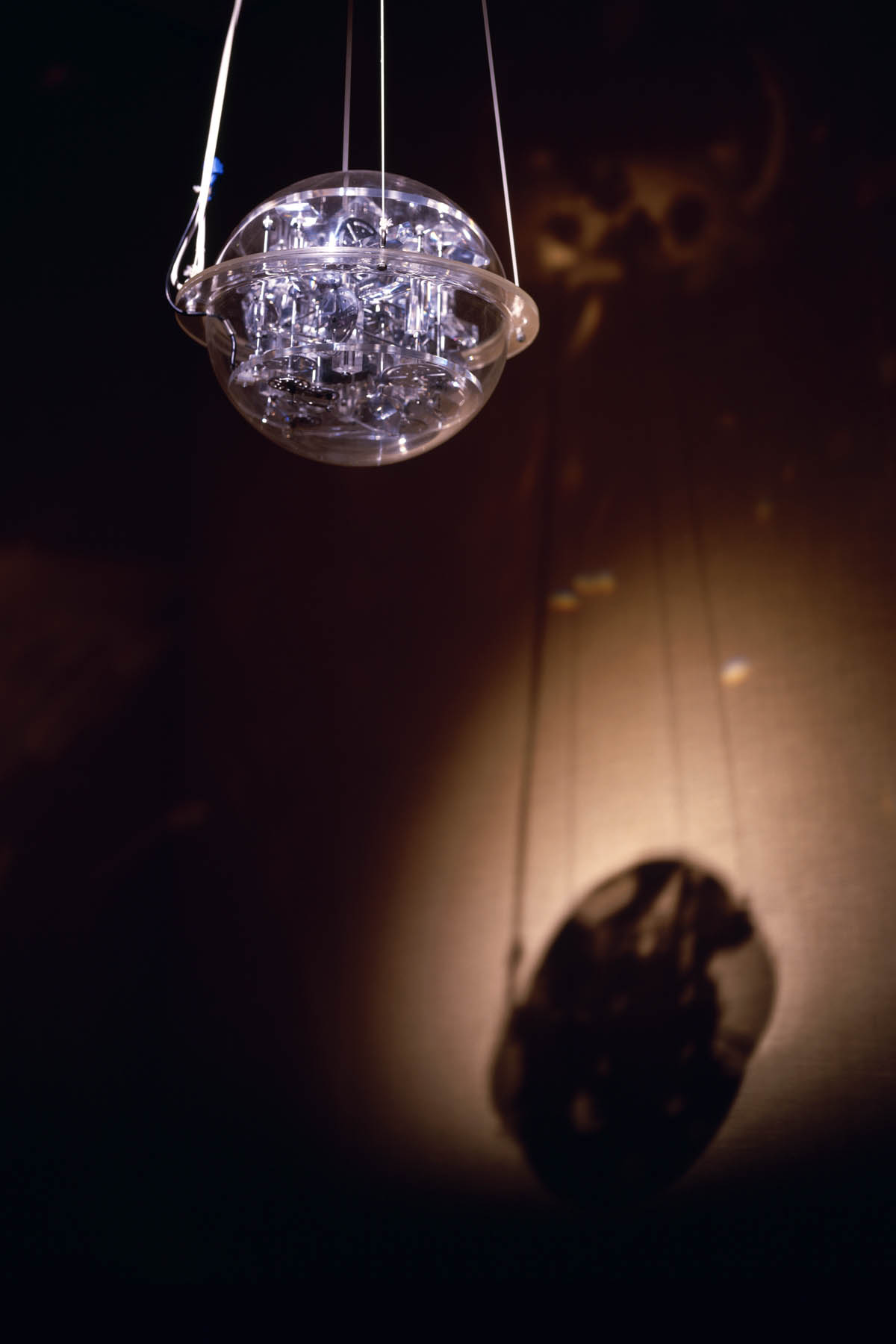
 

Chargesheimer (Carl-Heinz Hargesheimer, German 1924-1971) 'Kleine runde Meditationsmühle' (Small round meditation mill) 1968 /1969


Chargesheimer (Carl-Heinz Hargesheimer, German 1924-1971)
Kleine runde Meditationsmühle (Small round meditation mill)
1968 /1969
Acrylic, metal, machine part
Diameter: 34cm
Museum Ludwig, Cologne
Photo: Rheinisches Bildarchiv Köln
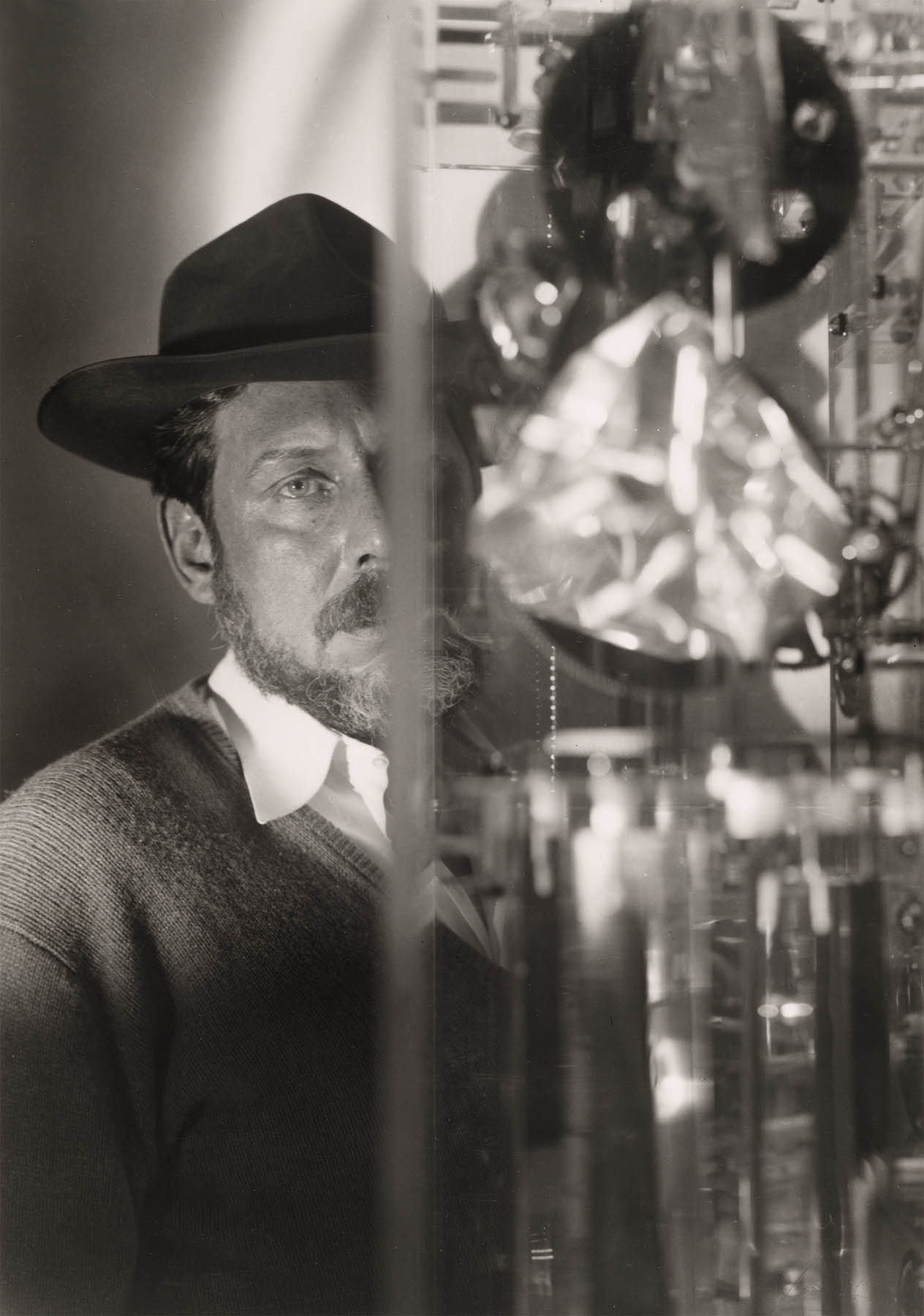
 

Gerd Sander (German, b. 1940) 'Portrait of Chargesheimer' 1969


Gerd Sander (German, b. 1940)
Portrait of Chargesheimer
1969
Gelatin silver paper
27 x 19cm
Museum Ludwig, Cologne
© Gerd Sander, courtesy of Galerie Julian Sander, Köln
Reproduction: Rheinisches Bildarchiv Köln


Museum Ludwig
Heinrich-Böll-Platz, 50667 Köln, Germany

Opening hours:
Tues­­day through Sun­­day: 10am – 6pm

Museum Ludwig website

LIKE ART BLART ON FACEBOOK

Back to top

Exhibition: ‘From Becher to Blume – Photographs from the Garnatz Collection and Die Photographische Sammlung/SK Stiftung Kultur in Dialogue’ at Die Photographische Sammlung/SK Stiftung Kultur, Cologne

Exhibition dates: 12th March – 8th August, 2021

Artists: Bernd and Hilla Becher, Boris Becker, Anna and Bernhard Blume, Chargesheimer, Jim Dine, Frank Dömer, Gina Lee Felber, Candida Höfer, Benjamin Katz, Jürgen Klauke, Astrid Klein, Werner Mantz, Augustina von Nagel, Floris Neusüss, Sigmar Polke, Arnulf Rainer, Albert Renger-Patzsch, Tata Ronkholz, Thomas Ruff, Hugo Schmölz, Wilhelm Schürmann, and Thomas Struth.


Werner Mantz (German, 1901-1983) 'Waldecker Str., Cologne-Buchforst (formerly Kalker Feld)' 1928 from the exhibition Exhibition: 'From Becher to Blume – Photographs from the Garnatz Collection and Die Photographische Sammlung/SK Stiftung Kultur in Dialogue' at Die Photographische Sammlung/SK Stiftung Kultur, Cologne, March - August, 2021


Werner Mantz (German, 1901-1983)
Waldecker Str., Köln-Buchforst (ehemals Kalker Feld)
Waldecker Str., Cologne-Buchforst (formerly Kalker Feld)
1928
© VG Bild-Kunst, Bonn 2020


A Kodak Brownie camera launched Werner Mantz‘s photographic career. As an adolescent, he photographed Cologne and the surrounding landscape and later studied photography at the Bavarian State Academy in Munich. He returned to Cologne, set up a studio and began a freelance career. Mantz soon distinguished himself as an architectural photographer, receiving numerous commissions. In 1932 he moved to Maastricht, in the Netherlands near the German border. He opened a second studio there and closed the Cologne studio in 1938. Mantz received public and private commissions throughout his career and retired in 1971.

Text from the Getty website [Online] Cited 19/03/2021


Werner Mantz‘s (German, 1901-1983) youthful passion for taking pictures inspired him to study photography at the Bayerische Lehr-und Versuchsanstalt in Munich in 1920-1921. After that he opened a portrait photography studio in Cologne and joined the artists group Kölner Progressive. Around 1926, encouraged by architect Wilhelm Ripahn, Mantz became one of the leading contemporary photographers of modern architecture in the Rhineland. He worked for architects such as Bruno Paul and Hans Schumacher and was under exclusive contract with the architects Ripahn & Grod. In 1932 he relocated to Maastricht in the Netherlands close to the German border. He opened a second studio there and closed the Cologne studio in 1938. In addition to his architectural work he devoted himself to photographing children.

Text from the Kicken Berlin website [Online] Cited 19/03/2021


The Renger-Patzsch is a cracker.

Further information about the Dusseldorf School artists and their successors can be found at ‘Photographs Become Pictures. The Becher Class’ at the Städel Museum, Frankfurt, April – August 2017.

Marcus


Many thankx to the Die Photographische Sammlung / SK Stiftung Kultur for allowing me to publish the photographs in the posting. Please click on the photographs for a larger version of the image.


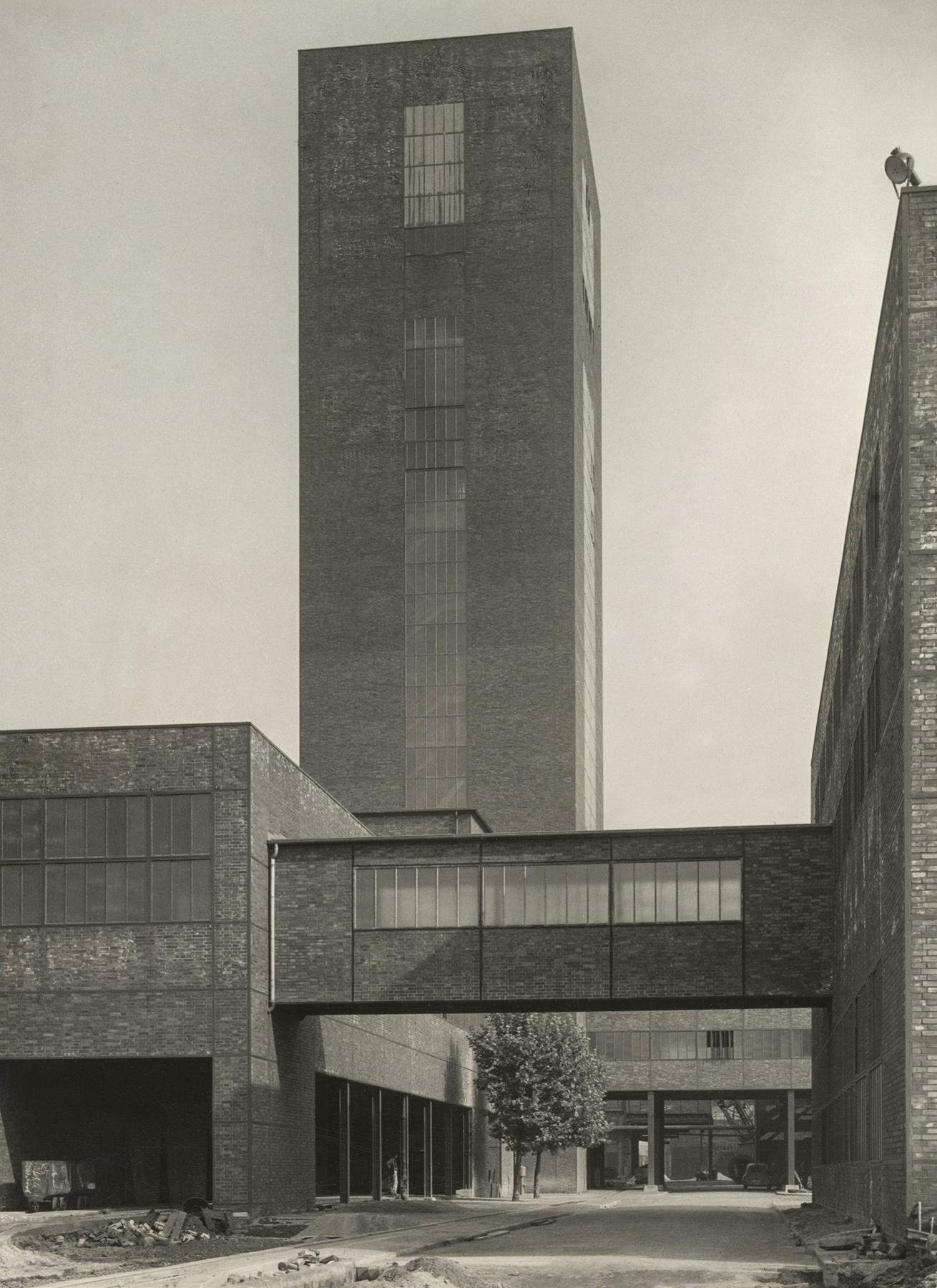
Albert Renger-Patzsch (German, 1897-1966) 'Untitled (Grimberg colliery, Bergkamen)' 1951-1952 from the exhibition Exhibition: 'From Becher to Blume – Photographs from the Garnatz Collection and Die Photographische Sammlung/SK Stiftung Kultur in Dialogue' at Die Photographische Sammlung/SK Stiftung Kultur, Cologne, March - August, 2021


Albert Renger-Patzsch (German, 1897-1966)
Ohne Titel (Zeche Grimberg, Bergkamen)
Untitled (Grimberg colliery, Bergkamen)
1951-1952
© 2020 Albert Renger-Patzsch / Archiv Ann und Jurgen Wilde, Zulpich / VG Bild-Kunst, Bonn


Tata Ronkholz (German, 1940-1977) 'Trinkhalle, Sankt-Franziskusstraße 107' 1977


Tata Ronkholz (German, 1940-1977)
Trinkhalle (Refreshment Stand), Sankt-Franziskusstraße 107
1977
© VAN HAM Art Estate: Tata Ronkholz


Along with Thomas Ruff, Candida Höfer, and Thomas Struth, Tata Ronkholz (German, 1940-1997) was among the first students of Bernd Becher at the Kunstakademie Düsseldorf. Ronkholz is perhaps best known for her most extensive series Trinkhallen: kiosks and small shops around the corner that are witnesses of social neighbourhoods and vernacular cultures. In her work, Tata Ronkholz shows elements of urban architecture, which due to their transient nature turn the photographs into valuable historical documents. Ronkholz found her characteristic subjects in Cologne, Düsseldorf, Bochum, and parts of the Rhineland. Together with Thomas Struth, Tata Ronkholz documented a part of the port of Düsseldorf between 1978 and 1980, shortly before it was torn down. Struth and Ronkholz created a unique historical document, which also received great recognition from the city of Düsseldorf. In 1979 Ronkholz took part in the seminal exhibition In Deutschland (In Germany) at the Rheinisches Landesmuseum in Bonn.

Text from the Kicken Berlin website [Online] Cited 19/03/2021


Cigarette and gumball machines are fixed to exterior walls. Advertising posters overlap. Beverages, magazines and sweets are visibly lined up behind glass. It is Tata Ronkholz’ serial presentation that enables the comparison of the kiosks and their study as a social phenomenon in urban contexts.

Kiosks are everyday meeting points and the setting for social life. At the same time their role fundamentally changed in the past decades. Ronkholz photographs kiosks as socially grown places. She positions them centrally in their architectural environment – people are absent. This is what the photos have in common with Becher-photographs. Like her teachers, Ronkholz is committed to the conservation and archiving of a changing urban culture.

More information about the work of Tata Ronkholz: ‘Photographs Become Pictures. The Becher Class’ at the Städel Museum, Frankfurt


Tata Ronkholz (German, 1940-1977) Thomas Struth (German, b. 1954) 'Rheinhafen, Düsseldorf' 1979-1980


Tata Ronkholz (German, 1940-1977)
Thomas Struth (German, b. 1954)
Rheinhafen, Düsseldorf
1979-1980
© VAN HAM Art Estate: Tata Ronkholz
© Thomas Struth


Tata Ronkholz was born in 1940 in Krefeld under the female name Roswitha Tolle. She studied architecture and interior design at the School of Applied Arts in Krefeld. Thereafter, she completed a one-year apprenticeship at the Schroer Furniture Store in Krefeld. She subsequently began work as a freelance product designer. Tata Ronkholz first encountered photography through her husband, Coco Ronkholz, who managed the production of a catalogue for Bernd Becher. In 1977, she enrolled in the State Art Academy in Düsseldorf and studied photography shortly thereafter with Prof. Becher. Along with Volker Döhne, Andreas Gursky, Candida Höfer, Axel Hütte, Thomas Ruff, and Thomas Struth, Ronkholz counts among Becher’s earliest (and later legendary) students at the Academy. In 1985, she gave up photography and worked for photography agency in Cologne from 1985-95 to support herself. In 1997, Ronkholz died at Burg Kendenich near Cologne. Her photographs of refreshment stands, of which few remain, were arguably her most substantial works. In 1978, she also began to collaborate with Thomas Struth on documenting the Rhine harbor. Ronkholz called her final group of photographs Schaufenster (Display Windows).

Text from the Van Ham Art Estate website [Online] Cited 19/03/2021


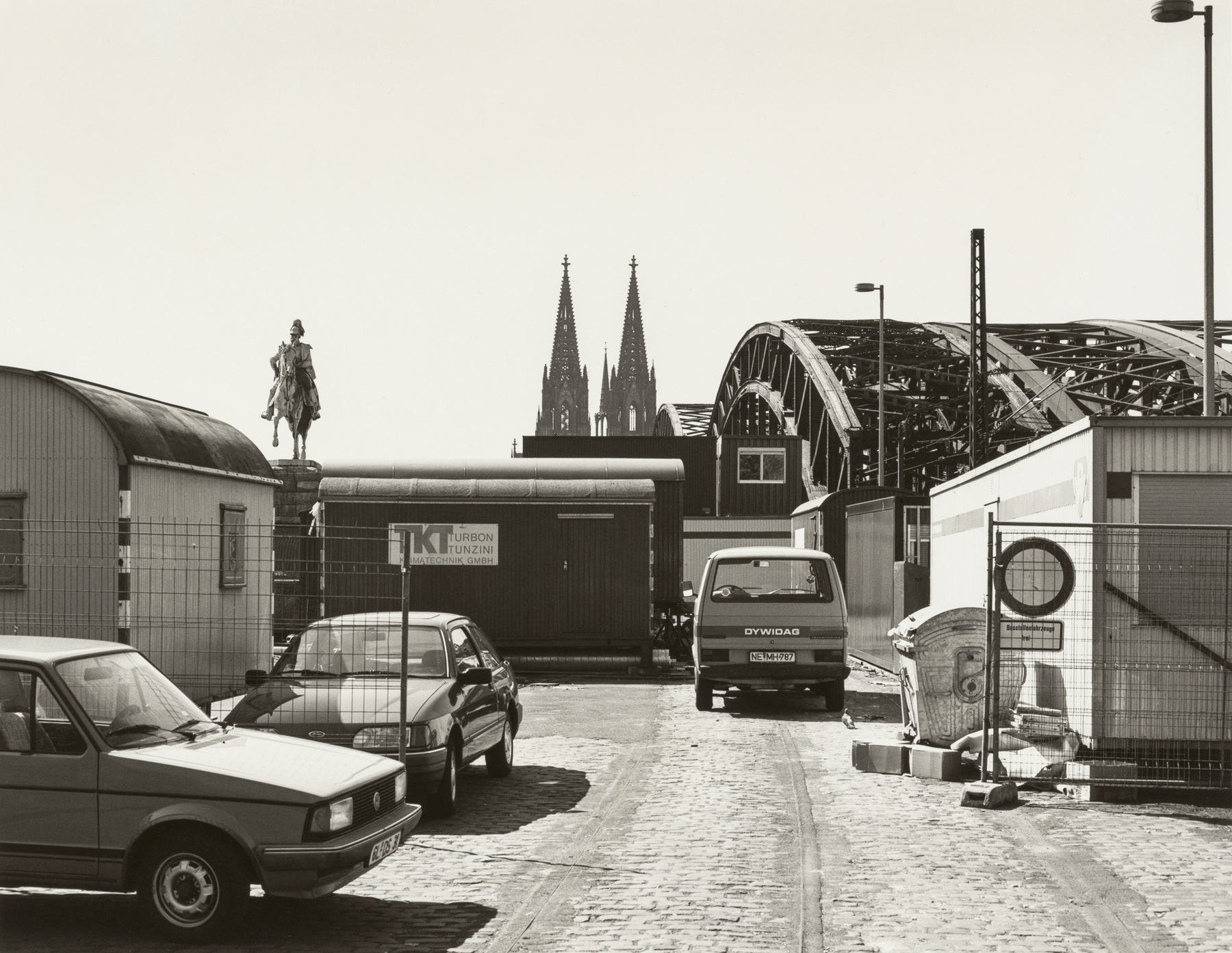
Wilhelm Schürmann (German, b. 1946) 'Untitled (construction trailer and view of Cologne Cathedral)' 1988


Wilhelm Schürmann (German, b. 1946)
Ohne Titel (Bauwagen und Blick auf Kölner Dom)
Untitled (construction trailer and view of Cologne Cathedral)
1988
© Wilhelm Schürmann


Bernd and Hilla Becher. 'Charleroi-Montigny, B' 1984


Bernd (German, 1931-2007) and Hilla (German, 1934-2015) Becher
Charleroi-Montigny, B
1984
© Estate Bernd & Hilla Becher, vertreten durch Max Becher, courtesy Die Photographische Sammlung / SK Stiftung Kultur – Bernd und Hilla Becher Archiv, Köln, 2020


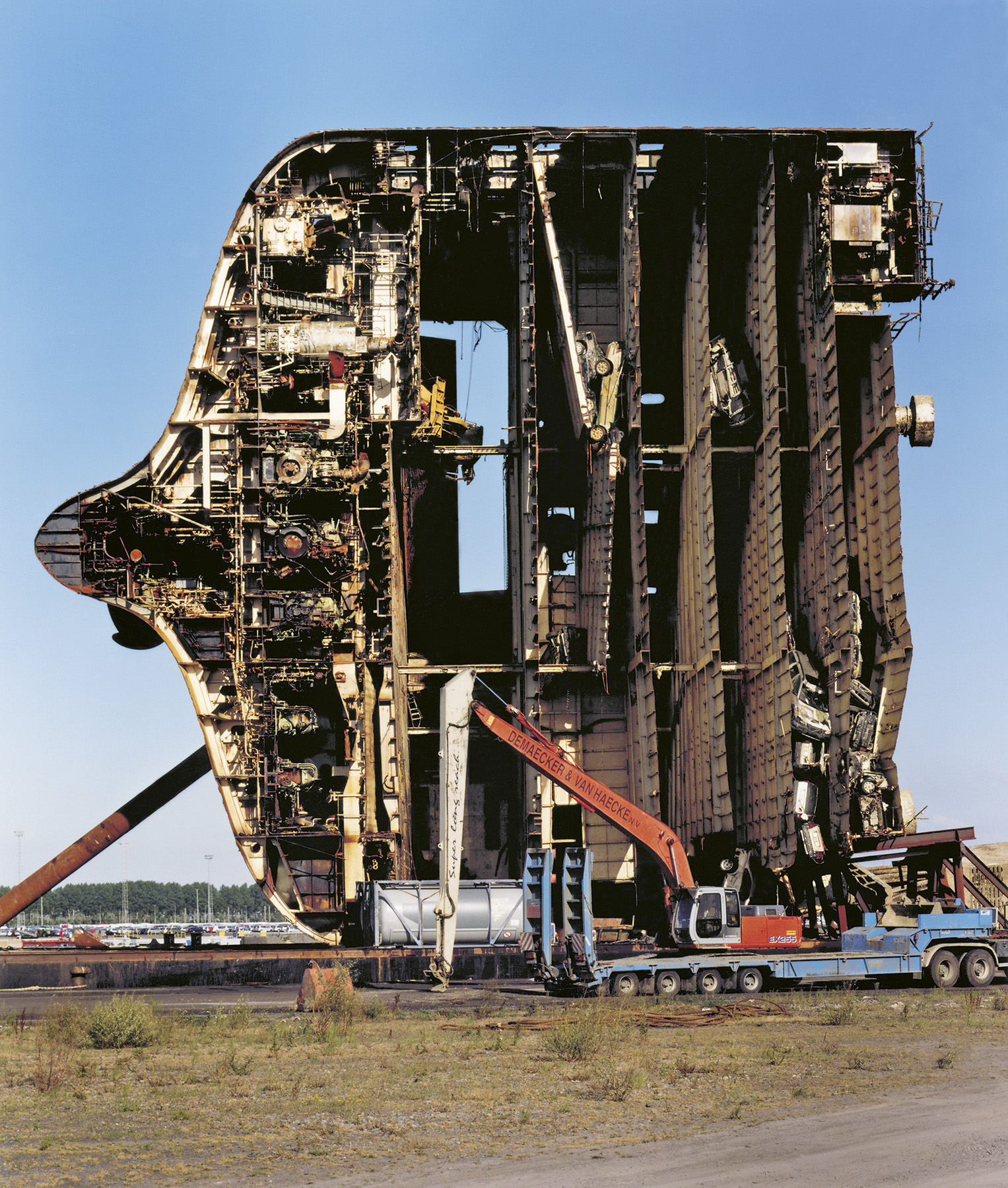
Boris Becker (German, b. 1961) 'Zeebrugge' 2003


Boris Becker (German, b. 1961)
Zeebrugge
2003
© VG Bild-Kunst, Bonn 2020


“The great charm of Boris Becker’s photographs is due to the fact that through the consequent isolation of his objects they appear mysterious and alienated which makes us curious to look closer with greater attention and to see things in a different way.”

Rupert Pfab, Exhibition catalogue: “Boris Becker”, published by Städtisches Museum Zwickau, 1995, p. 15.


Frank Dömer (German, b. 1961) 'Äbnet' 2002


Frank Dömer (German, b. 1961)
Äbnet
2002
© Frank Dömer


Anna and Bernhard Blume. 'Telekinetisch hysterische Szene' (Telekinetically hysterical scene) 1986-1987


Anna (German, 1936-2020) and Bernhard (German, 1937-2011) Blume
Telekinetisch hysterische Szene (Telekinetically hysterical scene)
1986-87
From the series Trautes Heim (Sweet home)
© VG Bild-Kunst, Bonn 2020


Anna and Bernhard Blume were a collaborative duo of German artists, best known for their large-scale, monochromatic photographs. Throughout their practice, they captured themselves dynamically engaging with Minimalist sculpture, resulting in humorous investigations into space, art history, and contemporary life. Anna was born Anna Helming in Bork, Germany and Bernhard was born in Dortmond, Germany, both in 1937. They went on to study at the Staatliche Kunstakademie in Düsseldorf from 1960 to 1965, where they met and were married in 1966. Notably, their work is entirely self-produced, from conceptualisation to finished product, with total mastery of technical components. “We paint with our camera,” Anna Blume explained, “and this painterly work continues in the lab, too.”

Anna and Bernhard Blume’s work has been widely acclaimed, resulting in such exhibitions as at the Museum Ludwig in Cologne in 2005, The Museum of Modern Art in New York in 1989, and documenta 6 in Kassel in 1977. Bernhard Blume died in Cologne, Germany on September 1, 2011. Anna Blume passed away on June 18, 2020 at the age of 84 after a long illness.

Text from the Artnet website [Online] Cited 19/03/2021


Jim Dine. 'Leaves Painted in the Eastern Part of the State' 2010


Jim Dine (American, b. 1935)
Leaves Painted in the Eastern Part of the State
2010
© VG Bild-Kunst, Bonn 2020


Candida Höfer. 'Kunsthalle Karlsruhe V' 1999


Candida Höfer (German, b. 1944)
Kunsthalle Karlsruhe V
1999
© VG Bild-Kunst, Bonn 2020


Thomas Struth (German, b. 1954) 'Rijksmuseum Amsterdam 1' 1990


Thomas Struth (German, b. 1954)
Rijksmuseum Amsterdam 1
1990
© Thomas Struth


The exhibition From Becher to Blume provides in-depth insights in particular into the influential photography of the 1980s and 90s, a period that produced a number of innovative bodies of work and concepts. A central role is played by the Rhineland, home to numerous artists, museums, and galleries. The collector couple Ute and Eberhard Garnatz were part of this extremely lively scene, and began as early as the 1970s to pursue their collecting activities with great dedication. In addition to amassing a large number of paintings, sculptures, and prints, they also built a distinctive and remarkably diverse collection of photographs, some of them dating back to the 1950s but for the most part produced during the 1980s to the 2000s. During that decade, photography was more and more becoming part of the fine arts cosmos. The medium resolutely carved out a place for itself with and alongside the traditional genres. And the collectors followed this development with an alert eye. Keeping pace with the times, they began to focus on artists who used the photographic image as basis for their work and for whom the camera was hence a matter-of-fact technical tool in their artistic practice. Some of these artists chose the documentary image as their springboard, while others were far less interested in the medium’s ability to faithfully reproduce reality and instead ventured into experimental realms. There were also those who attempted to confound the world of objects in their photos, or who staged or made use of the chemical nature of the photographic process to arrive at pictorial works in a more painterly idiom.

Showcasing the Garnatz Collection offers Die Photographische Sammlung / SK Stiftung Kultur the opportunity to arrange photographs from both collections in a productive dialogue. A common denominator can be found in particular in the works of Bernd and Hilla Becher, while photographers including Boris Becker, Candida Höfer, Thomas Ruff, and Thomas Struth are likewise represented in both collections. The exhibition furthermore places rare staged and experimental works in context. These are juxtaposed with other works that straddle the genres of photography and painting. As much as the medium of photography claims to reproduce reality, the range of possibilities it offers equally inspires artists to create works verging on the abstract or lyrical.

From Becher to Blume thus unfurls a broad and extremely varied spectrum of photographic approaches, which come together here in a refreshingly informal way to reveal their many contrasts and contradictions. On display are over 150 exhibits, including extensive serial works, by a total of 22 artists who have been instrumental in shaping recent German photography through their innovative contributions and continue to exert a major influence on the artistic medium.

A catalogue has been published by Snoeck Verlag to accompany the exhibition.

Press release from Die Photographische Sammlung/SK Stiftung Kultur


Chargesheimer (Karl-Heinz Hargesheimer) (German, 1924-1972) 'Untitled (girl scattering confetti)' c. 1956-1957


Chargesheimer (Karl-Heinz Hargesheimer) (German, 1924-1972)
Ohne Titel (Konfetti streuendes Mädchen)
Untitled (girl scattering confetti)
c. 1956-1957
© Museum Ludwig Köln


Chargesheimer (Karl Heinz Hargesheimer) belongs among the most outstanding artists of his generation – as photographer, sculptor, stage designer and director. The press called Chargesheimer a “restlessly proliferative creative spirit” and an artist “who loves to provoke.”

He was during his entire life an individual who never compromised. “Chargesheimer was insatiable, a person for whom nothing was ever enough, who consumed himself, a malcontent with an entirely crazy life (…). He made life for himself and his peers as difficult as possible.” (Georg Ramseger)

Chargesheimer began his career in 1947 as an independent photographer for various theaters in Germany. Towards the end of the 1940s he was in contact with the photographic group “fotoform.” In 1950 he participated in the “photo-kino” exhibition in Cologne and also in the legendary exhibitions of “Subjective Photography” in 1952 and 1954. At the core of Chargesheimer’s photographic oeuvre, alongside portraiture and experimental photography, stands his Street Photography, depictions of street life in Cologne and other cities of post-war Germany. These works were as a rule put by Chargesheimer into different series, and from 1957 to 1970 published in book form.

In 1958 he published concurrently two photography books, Unter Krahnenbäumen (the name of a tiny and notorious street behind the train station in Cologne) and Im Ruhrgebiet (In the Ruhr Valley), with texts from the Nobel Prizewinner for Literature Heinrich Böll. In these works Chargesheimer portrays the everyday life of ordinary people from a radical subjective perspective without a trace of sentimentality. In close succession are found all the basic human emotions and behaviours: love and sadness, cares and conflicts, reflectiveness and high spirits, the dignity of age and the exuberance of youth…

Text from the Priska Pasquer website [Online] Cited 19/03/2021


Floris Neusüss (German, 1937-2020) 'Neusüss leaves the shadows, Kassel' 1976


Floris Neusüss (German, 1937-2020)
Neusüss verlässt den Schatten, Kassel
Neusüss leaves the shadows, Kassel
1976
© Floris Neusüss


Floris Neusüss was born in Lennep, Germany, on 3 March 1937. He began as a painter the took up photography which he studied at the Wuppertal School of Arts and Crafts in North Rhine-Westphalia, before continuing at the Bavarian State Institute of Photography in Munich. He trained alongside photographer Heinz Hajek-Halke at the Berlin University of the Arts. In 1957, he began making photograms and photomontages.

His series Körperbilder (whole-body photograms) set him in the 1960s on a lifelong exploration of conceptual, technical and artistic possibilities of camera-less photography. From 1964 he has also experimented with chemical painting on photograms. Neusüss brought the photogram out of the darkroom and out of the studio to the objects recording motifs not with a camera but rather a folder with photo paper, on which he exposed subjects such as plants or windows, as in the photo series Dream Images. Continuing into the 1970s are his nudograms; silhouettes of nude figures; and also life-size portraits, including several using his friend and frequent collaborator, Robert Heinecken as the subject; and shadowy reproductions of museum sculptures, such as those of Greek statues from the Glypothek in Munich For Neusüss, the photographic medium was not an impression, but a contact image. According to this interpretation, the original object touched the image;

“It is true that the subject resting on the photo-sensitive paper presents its reverse side to be recorded, the side that is in shadow, the shadow cast by the object itself. This intimate physical connection inscribes into the paper, and this, if you are open to it, is the real fascination of photograms: the tension between the hidden and the revealed.”

Text from the Wikipedia website


Floris Neusüss is a contemporary experimental German photographer known for his use of camera-less photography (photograms). His most famous works are the Nudogramms from the late 1960s, in which he exposed a nude figure directly onto photographic paper “Photograms don’t show us what’s beyond the visible, but they give us a hint of it,” Neusüss has said. “It is true that the subject resting on the photo-sensitive paper presents its reverse side to be recorded, the side that is in shadow, the shadow cast by the object itself. This intimate physical connection inscribes into the paper, and this, if you are open to it, is the real fascination of photograms: the tension between the hidden and the revealed.” Born on March 3, 1937 in Remscheid Lennep, Germany, he studied at a number of schools throughout Germany before completing his education at the School of Art in Berlin, where he studied under the revered photographer Heinz Hajek-Halke. Graduating in 1960, Neusüss went on to teach at the Academy of Fine Arts in Kassel while beginning to experiment with photograms. The artist continues to live and work in Kassel, Germany. Today, his works are held in the collections of the Victoria and Albert Museum in London, the San Francisco Museum of Modern Art, and the Art Institute of Chicago, among others.

Text from the Artnet website [Online] Cited 19/03/2021


Arnulf Rainer (Austrian, b. 1929) 'Selbst mit Ei (Self with an egg)' c. 1969-1971


Arnulf Rainer (Austrian, b. 1929)
Selbst mit Ei (Self with an egg)
c. 1969-1971
© Arnulf Rainer


Arnulf Rainer (born 8 December 1929) is an Austrian painter noted for his abstract informal art.

Rainer was born in Baden, Austria. During his early years, Rainer was influenced by Surrealism. In 1950, he founded the Hundsgruppe (dog group) together with Ernst Fuchs, Arik Brauer, and Josef Mikl. After 1954, Rainer’s style evolved towards Destruction of Forms, with blackenings, overpaintings, and maskings of illustrations and photographs dominating his later work. He was close to the Vienna Actionism, featuring body art and painting under the influence of drugs. He painted extensively on the subject of Hiroshima such as it relates to the nuclear bombing of the Japanese city and the inherent political and physical fallout.

In 1978, he received the Grand Austrian State Prize. In the same year, and in 1980, he became the Austrian representative at the Venice Biennale. From 1981 to 1995, Rainer held a professorship at the Academy of Fine Arts in Vienna – the same place where he aborted his own studies after three days, unsatisfied.

Text from the Wikipedia website


Sigmar Polke (German, 1941-2010) 'Untitled (Oberkassel Bridge)' 1971-1983


Sigmar Polke (German, 1941-2010)
Ohne Titel (Oberkasseler Brücke)
Untitled (Oberkassel Bridge)
1971-83
© The Estate of Sigmar Polke, Cologne / VG Bild-Kunst, Bonn 2020


Sigmar Polke (13 February 1941 – 10 June 2010) was a German painter and photographer.

Polke experimented with a wide range of styles, subject matters and materials. In the 1970s, he concentrated on photography, returning to paint in the 1980s, when he produced abstract works created by chance through chemical reactions between paint and other products. In the last 20 years of his life, he produced paintings focused on historical events and perceptions of them…

Work

In 1963, Polke founded the painting movement “Kapitalistischer Realismus” (“Capitalist realism”) with Gerhard Richter and Konrad Fischer (alias Konrad Lueg as artist). It is an anti-style of art, appropriating the pictorial shorthand of advertising. This title also referred to the realist style of art known as “Socialist Realism”, then the official art doctrine of the Soviet Union and its satellites (from one which he had fled with his family), but it also commented upon the consumer-driven art “doctrine” of western capitalism. He also participated in “Demonstrative Ausstellung”, a store-front exhibition in Düsseldorf with Manfred Kuttner, Lueg, and Richter. Essentially a self-taught photographer, Polke spent the next three years painting, experimenting with filmmaking and performance art.

Photography

In 1966-1968, during his most conceptual period, Polke used a Rollei camera to capture ephemeral arrangements of objects in his home and studio.[6] In 1968, the year after he left the art academy, Polke published these images as a portfolio of 14 photographs of small sculptures he had made from odds and ends – buttons, balloons, a glove. From 1968 to 1971, he completed several films and took thousands of photographs, most of which he could not afford to print.

During the 1970s, Polke slowed his art production in favour of travel to Afghanistan, Brazil, France, Pakistan, and the U.S., where he shot photographs (using a handheld 35mm Leica camera) and film footage that he would incorporate in his subsequent works during the 1980s. In 1973 he visited the U.S. with artist James Lee Byars in search of the “other” America; the fruit of that journey was a series of manipulated images of homeless alcoholics living on New York’s Bowery. He produced an additional series of photographic suites based on his journeys to Paris (1971), Afghanistan and Pakistan (1974) and São Paulo (1975), often treating the original image as raw material to be manipulated in the dark room, or in the artist’s studio. Beginning with his 1971 Paris photographs printed using chemical staining to create works full of strange presences while under the influence of LSD, Polke exploited the photographic process as a means to alter “reality.” He combined both negatives and positives with images that had both vertical and horizontal orientations. The resulting collage-like compositions take advantage of under- and overexposure and negative and positive printing to create enigmatic narratives. With the negative in his enlarger, the artist developed large sheets selectively, pouring on photographic solutions and repeatedly creasing and folding the wet paper.

Completed in 1995 in collaboration with his later wife Augustina von Nagel, a suite of 35 prints entitled “Aachener Strasse” combine street photography with images from Polke’s paintings, developed using techniques of multiple exposures and multiple negatives.

Text from the Wikipedia website


Benjamin Katz (Belgium, b. 1939) 'Sigmar Polke in Düsseldorf' 1984


Benjamin Katz (Belgium, b. 1939)
Sigmar Polke in Düsseldorf
1984
© VG Bild-Kunst, Bonn 2020


More information about and images from the artist: ‘Benjamin Katz Berlin Havelhöhe, 1960/61’ at Museum Ludwig, Cologne


Astrid Klein (German, b. 1951) 'Zwischenbereich (Intermediate area)' 1986


Astrid Klein (German, b. 1951)
Zwischenbereich (Intermediate area)
1986
© Astrid Klein / Courtesy Sprüth Magers


Astrid Klein (b. 1951) is one of Germany’s most distinguished conceptual artists. Collage constitutes the main formal and artistic principal of her work. Her large-scale wall pieces often combine found images with her own text or quotes from philosophy, theory or science to illuminate suppressed aspects of the collective unconscious and to question conventional power structures and modes of representation. Her oeuvre – comprising photographic work but also neon and mirror sculptures, installations, painting and drawing – oscillates between poetry and criticism, skepticism and longing.

Photoworks

Klein began working with photography in 1978. Her early works were based on themes of human tragedy and often combined texts with images.

Klein produces photographic images on a large scale to make what she refers to as ‘photoworks’, distinguishing them from straightforward photographs. Starting with images drawn from newspapers and magazines, Klein transforms them with a variety of processing and printing techniques in the darkroom, often verging on abstraction. The resulting works question assumptions about photography as an accurate documentary medium.

Text from the Wikipedia website


Gina Lee Felber (German, b. 1957) 'Tacet (Silent)' 1988


Gina Lee Felber (German, b. 1957)
Tacet (Silent)
1988
© Gina Lee Felber


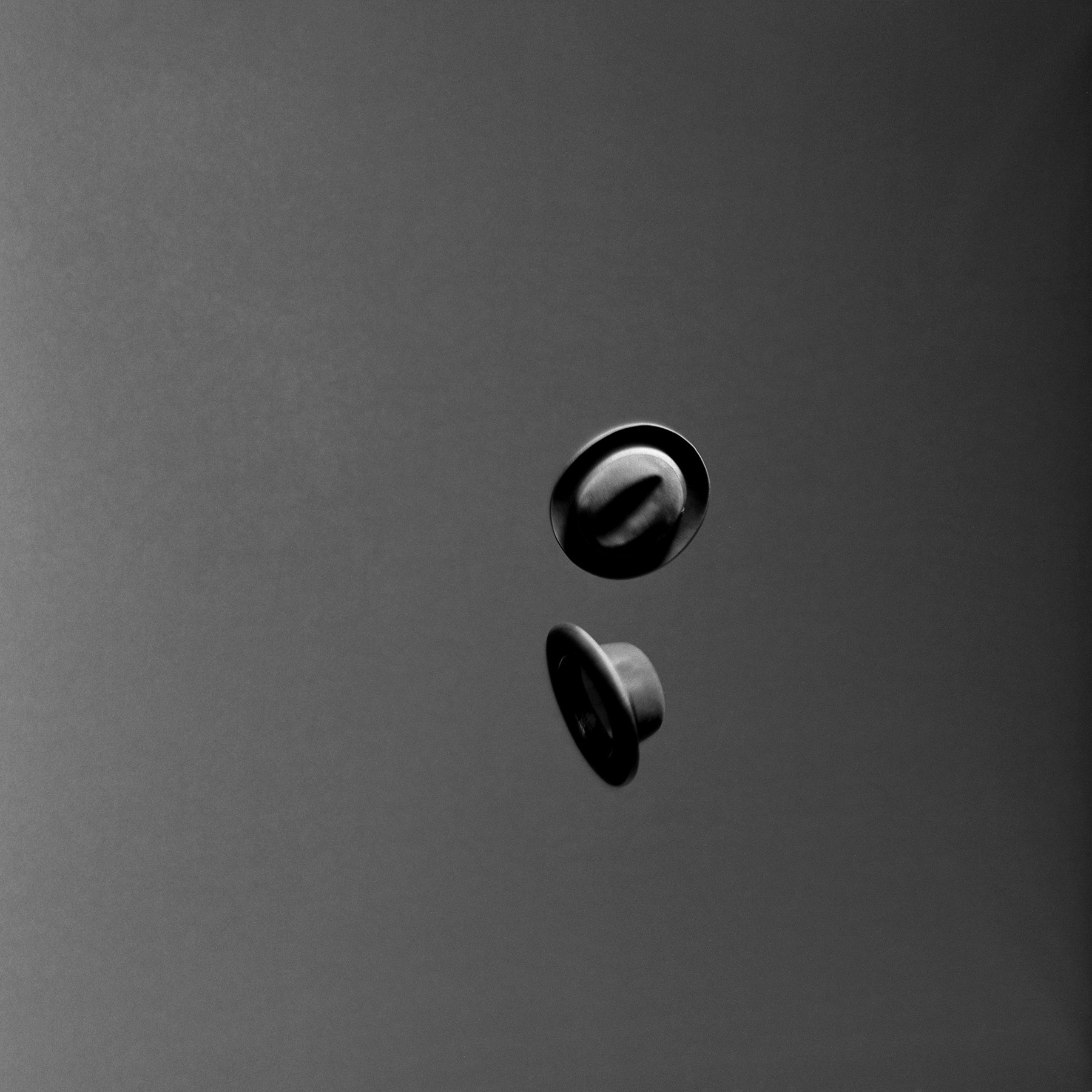
Jürgen Klauke (German, b. 1943) 'Untitled (Flying Hats)' 1990-1992


Jürgen Klauke (German, b. 1943)
Ohne Titel (Fliegende Hüte)
Untitled (Flying Hats)
1990-92
From the series Sonntagsneurosen (Sunday Neuroses)
© Jürgen Klauke


Jürgen Klauke (born 6 September 1943) is a German artist. Beginning in the 1960s, he used his own body as a subject of his photographs. He also experimented with minimalism and surrealism. The ZKM in Karlsruhe exhibits his work. Since 1968 he lives and works in Cologne.


Augustina von Nagel (German, b. 1952) 'Der Denker (The Thinker)' 1997


Augustina von Nagel (German, b. 1952)
Der Denker (The Thinker)
1997
© Augustina von Nagel


Married to Sigmar Polke.


Die Photographische Sammlung/SK Stiftung Kultur
Im Mediapark 7
50670 Cologne
Phone: 0049-(0)221-88895 300

Opening hours:
Open daily 14 – 19hrs
Closed Wednesdays

Die Photographische Sammlung/SK Stiftung Kultur website

LIKE ART BLART ON FACEBOOK

Back to top