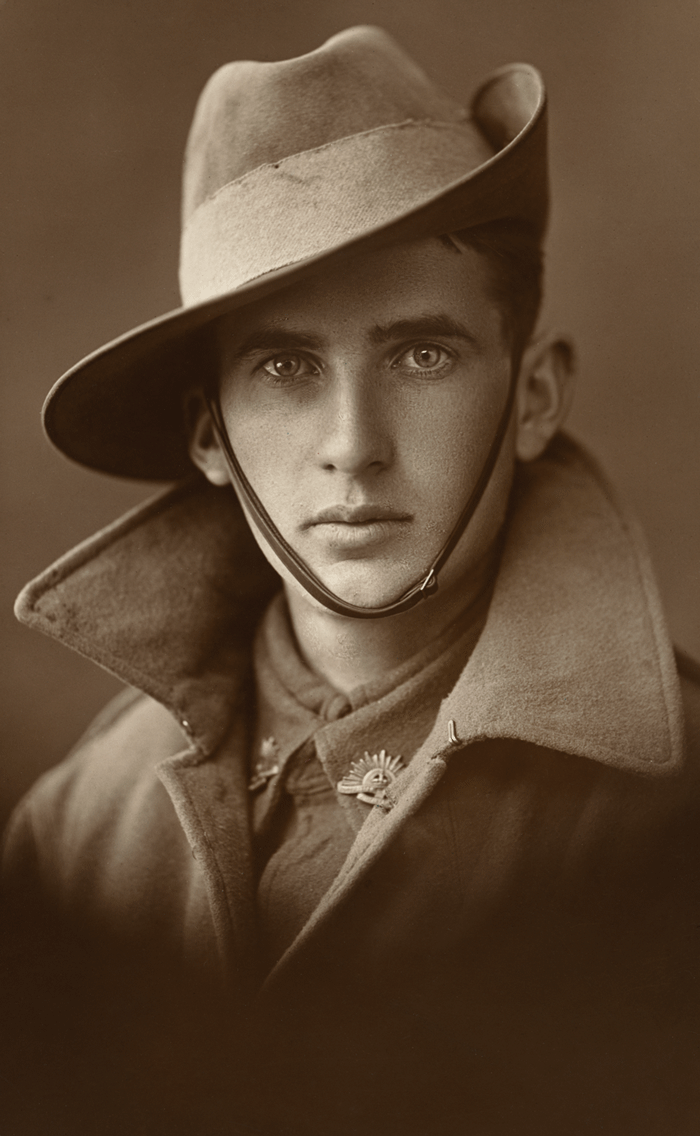
Stereographs: Rose Stereoscopic Views of Victorian Contingents leaving for the Boer War in South Africa, 1899-1900

October 2023

1st Victorian Contingent


George Rose (Australian, 1861-1942) (publisher, Windsor, Melbourne) 'The Victorian Continent' Melbourne, Victoria, 28th October 1899


Unknown photographer
George Rose (Australian, 1861-1942) (publisher, Windsor, Melbourne)
The Victorian Continent
Melbourne, Victoria, 28th October 1899
2 photographic prints on stereocard
9 x 18cm


A historical posting this week: stereographs of soldiers of the two Victorian Contingents leaving from Melbourne for the Boer War in South Africa, the first in October 1899 and the second contingent in January 1900.

I have digitally scanned and cleaned these stereographs (that is, two nearly identical photographs or photomechanical prints, paired to produce the illusion of a single three-dimensional image, usually when viewed through a stereoscope, usually mounted on card) that I borrowed from my friend Terence Hodgkinson. I have added bibliographic information where possible: a small history of Australia and the Boer War; enrolment and embarkation details of the contingents; photographs and details of both ships that the men departed on; and information on the Rose Stereograph Company and its founder.

These 3D stereographs really give you a feeling of what it would have been like to live in Australia in last year of the 19th century and the beginning of the 20th century: a society full of pomp and circumstance with banners and bunting, ceremony and marches supporting a militarised society, where Australia was still a colony and not yet a nation (Federation of Australia only occurred on 1 January 1901).

In the stereograph The Victorian Continent (Melbourne, Victoria, 28th October 1899, above) a crowd of spectators on Swanston Street, Melbourne (viewed from Flinders Street Station with people on the steps of St Paul’s Cathedral at back right) celebrates the departure for South Africa of the 1st Victorian Continent to the Boer War. Notice the flags of the United States of American, Japan, Scotland, United Kingdom and St. George (England) flying above the procession and the absence of the Australian flag (the current Australian flag was first flown on 3rd September 1901). Also note the girl at bottom right clinging onto the corrugated iron roof of wooden sheds where you can book tickets to the Moonee Valley Races and Port Melbourne.

In the series of three stereographs Victorian Continent, S.S. “Medic” Leaving the Pier (Melbourne, Victoria, 28th October 1899, below) we can observe the passage of time as the ship pulls away from the pier as the crowd of onlookers walks towards us, and in the two following stereographs Victorian Continent, S.S. “Medic” off to South Africa and The Victorian Continent, Last View of Boat (both Melbourne, Victoria, 28th October 1899, below) we note that the photographer on top of his high perch has swung his large plate camera through 180 degrees to photograph the crowd and stern of the ship as she passes from view. Again, in the series of stereographs of the departure of the 2nd Victorian contingent The Bushman’s Contingent. “Euryalus” Leaving Pier (Melbourne, Victoria, 13th January 1900, below) we an see how the photographer captures the ship as she slides past, closing in on the troops piled high on the deck to wave goodbye. With their layered geometric forms and serried ranks these are very modernist photographs for their time in Australia. Finally, note another photographer with his large format camera and tripod standing above the crowd at left in the stereograph 2nd Victorian Contingent. The Troops at the Pier (Melbourne, Victoria, 13th January 1900, below)

It’s been a lot of hard work but it’s great to have this record of Melbourne life online as large format jpg for as far as I can tell they are not available otherwise. If anyone needs high resolution scans of the images please get in touch, always happy to send them.

Dr Marcus Bunyan


Many thankx to my friend Terence Hodgkinson for allowing me to scan and publish his stereographs. Digital clean and colour balance by Marcus Bunyan. Please click on the photographs for a larger version of the image.


“It was national sentiment in Canada and Australia which demanded that they share in the dangers of empire as well as the benefits they had long known. Self-appreciation would no longer permit colonial peoples in such advanced areas to feel that they could make no significant contribution to the war in which Britain was engaged.”


Donald C. Gordon, The Dominion Partnership in Imperial Defense 1870-1914 (Baltimore, 1965), p. 152.


“South Australia was still a colony, and Australia not yet a nation, when the Boer War broke out in South Africa in 1899. The colonies of Australia each provided contingents. When the war was over the colonial contingents had been merged, reflecting Australia’s emergence as a nation. Its soldiers had already begun the process of forging a reputation for courage, initiative, and endurance, which would later be reinforced during the Great War.”


Adapted by Steve Larkins from original work by Will Clough as featured in “Tributes of Honour”. “Boer War (11 October 1899 to 30 May 1902),” on the Virtual War Memorial Australia website Nd [Online] 03/10/2023


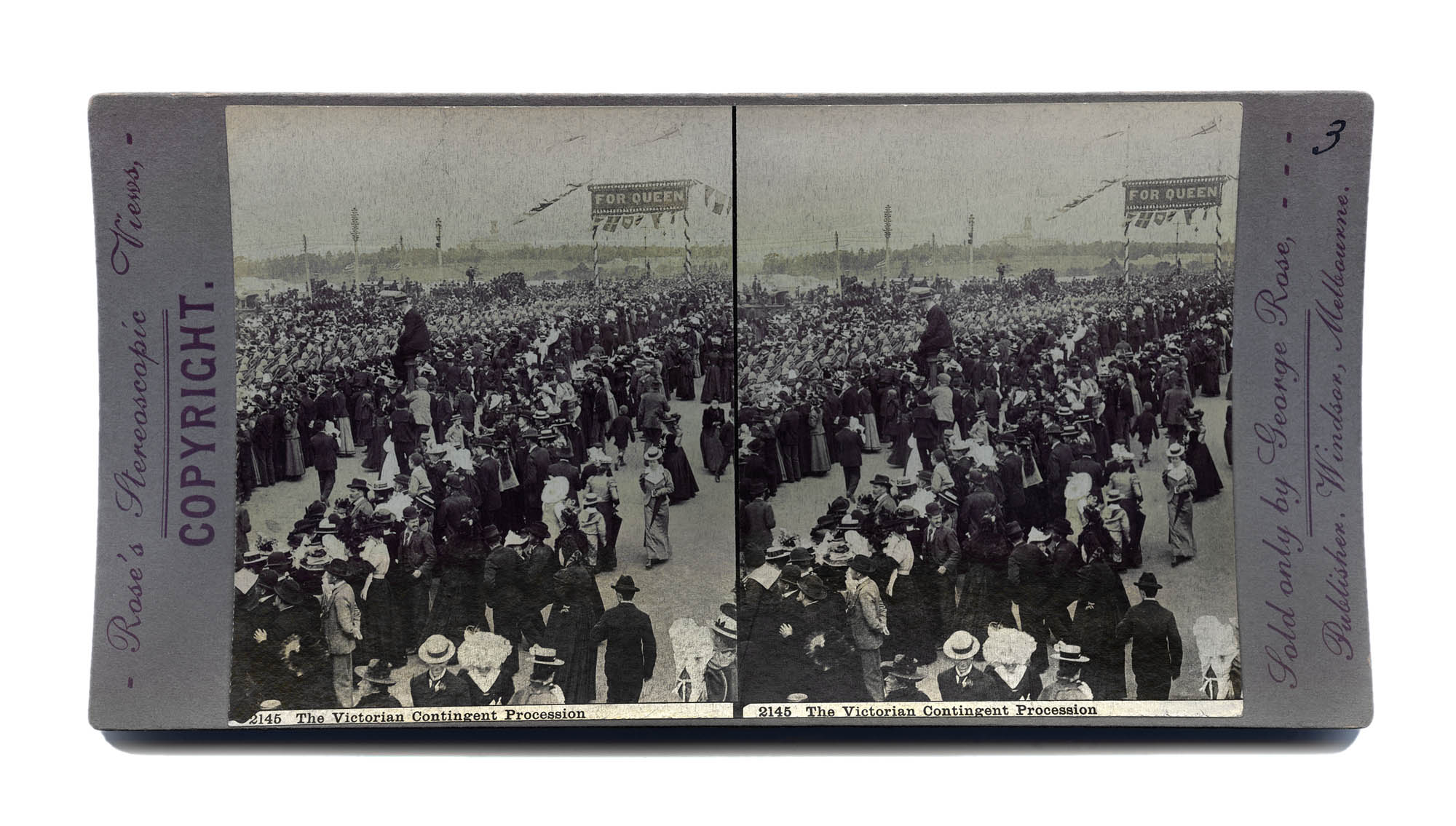
George Rose (Australian, 1861-1942) (publisher, Windsor, Melbourne) 'The Victorian Contingent Procession' Melbourne, Victoria, 28th October 1899


Unknown photographer
George Rose (Australian, 1861-1942) (publisher, Windsor, Melbourne)
The Victorian Contingent Procession
Melbourne, Victoria, 28th October 1899
2 photographic prints on stereocard
9 x 18cm


A crowd of spectators watching a parade of the 1st Victorian Contingent to the Boer War. The white helmets of the soldiers are visible as a line passing through the arch emblazoned with the words “For Queen”. The soldiers are on their way to embark on a ship bound for South Africa.
 

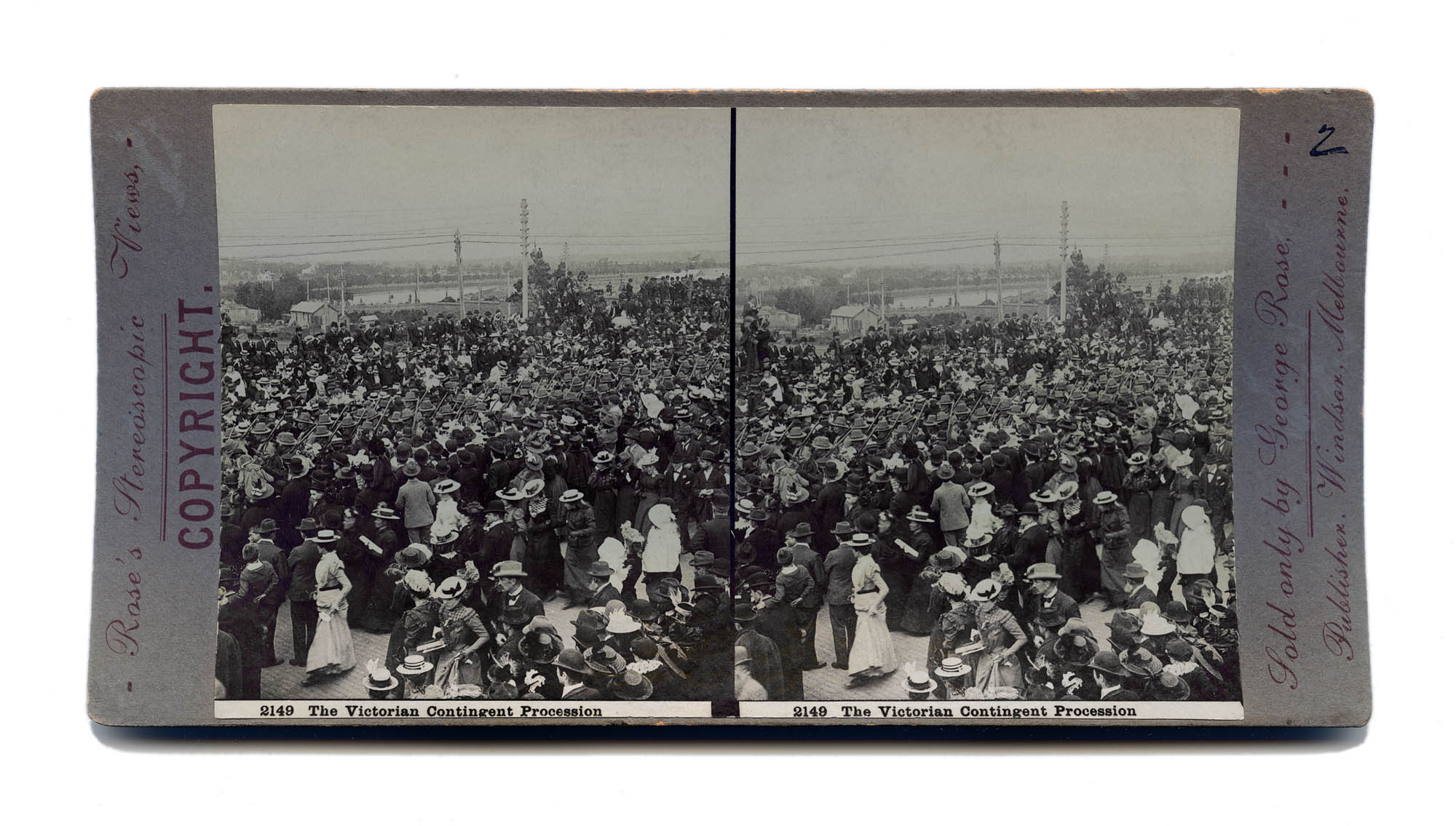
George Rose (Australian, 1861-1942) (publisher, Windsor, Melbourne) 'The Victorian Contingent Procession' Melbourne, Victoria, 28th October 1899


Unknown photographer
George Rose (Australian, 1861-1942) (publisher, Windsor, Melbourne)
The Victorian Contingent Procession
Melbourne, Victoria, 28th October 1899
2 photographic prints on stereocard
9 x 18cm
 

George Rose (Australian, 1861-1942) (publisher, Windsor, Melbourne) 'The Victorian Contingent Procession' Melbourne, Victoria, 28th October 1899


Unknown photographer
George Rose (Australian, 1861-1942) (publisher, Windsor, Melbourne)
The Victorian Contingent Procession
Melbourne, Victoria, 28th October 1899
2 photographic prints on stereocard
9 x 18cm


George Rose (Australian, 1861-1942) (publisher, Windsor, Melbourne) 'Victorian Continent Procession (Governor's Carriage)' Melbourne, Victoria, 28th October 1899


Unknown photographer
George Rose (Australian, 1861-1942) (publisher, Windsor, Melbourne)
Victorian Continent Procession (Governor’s Carriage)
Melbourne, Victoria, 28th October 1899
2 photographic prints on stereocard
9 x 18cm


The enrolment of Victorian volunteers for service in the Transvaal should war break out began on 20 September at Victoria Barracks. Members of all branches of the service were invited to register, as well as citizens with previous military training,22 and by 28 September 760 men of the defence forces and 280 civilians had volunteered.23 But after 3 October, when Victoria committed itself to sending 125 infantry and 125 mounted infantry, the call for recruits became more specific. By 12 October 260 mounted men from a volunteer regiment of 800, and 250 infantry men from a militia regiment of 1900, had given in their names. This was hardly an enthusiastic response to the call to arms, but worse was to follow. When called up for medical and military efficiency tests, only 128 mounted infantry men and 107 infantry men reported.24 The medical examination also produced a surprise: forty percent of the applicants failed to pass a test considered not strict. The failure rate among the Victorian Mounted Rifles might be explained by the fact that as a volunteer regiment its recruits were not subject to any medical examination; but the same excuse could not be made for the militia, and their failure rate was just as high.25 To complete the numbers in both the mounted and unmounted units, the authorities called on the Victorian Rangers,a volunteer infantry regiment; but still lacking five men for the infantry unit they gave the places to members of the permanent artillery!26 Victoria had set out to enlist preferably single men of twenty to forty years of age, and it is a further measure of recruiting difficulties that twenty-seven married men embarked for South Africa.27

It was common for press reporters to regard the Victorian contingent as being composed of bushmen, but that could not have been so for about eighty percent of the infantry were recruited from Melbourne, with the remainder coming from Castlemaine, Ballarat, and Bendigo. Only the mounted unit was filled from country areas. A summary of the occupations of the Victorian contingent shows a preponderance of townmen, with rural areas being represented by landowners rather than rural workers.

Selection of the officers for the contingent on grounds that ignored seniority was questioned in the Legislative Assembly, but defended by the premier who claimed that efficiency had been the criterion.29 An Age report regarded the officers, who had been selected from “numerous volunteers”, as “young, intelligent and enthusiastic”,30 but when one considers the favourable connections of several of them, another factor in their selection seems likely. A biographical summary of the officers is given below. It indicates possible sources of influence, but more importantly, it gives an idea of the type of leader who sailed with the first and the second contingents. All the Victorians were colonials and in personal and professional details they appeared fairly typical of Australian militia officers of the time.31

…

From existing sources, fragmentary though they may be at times, there emerges a reasonably clear picture of the men who were to lay the foundations of Australian military tradition. They were predominantly unmarried men, on an average in their mid-twenties. The average physique might have approximated a man five feet eight and a half inches in height, ten stone twelve pounds in weight, and thirty-five inches around the chest.47 This suggests a tallish, lithe soldier, and the suggestion is supported by numerous contemporary references to the Australians’ admirable physique. If members of infantry units, the contingenters were most likely to have come from the cities; if members of mounted infantry and cavalry units they would have come mainly from country towns and rural areas. They would have had a liking for the military life, a modicum of discipline, but only a limited knowledge of the science of war.

L.M. Field. The Forgotten War. Australian Involvement in the South African Conflict of 1899-1902. Master of Arts thesis, Australian National University, September 1973, pp. 55-56; 60-61.
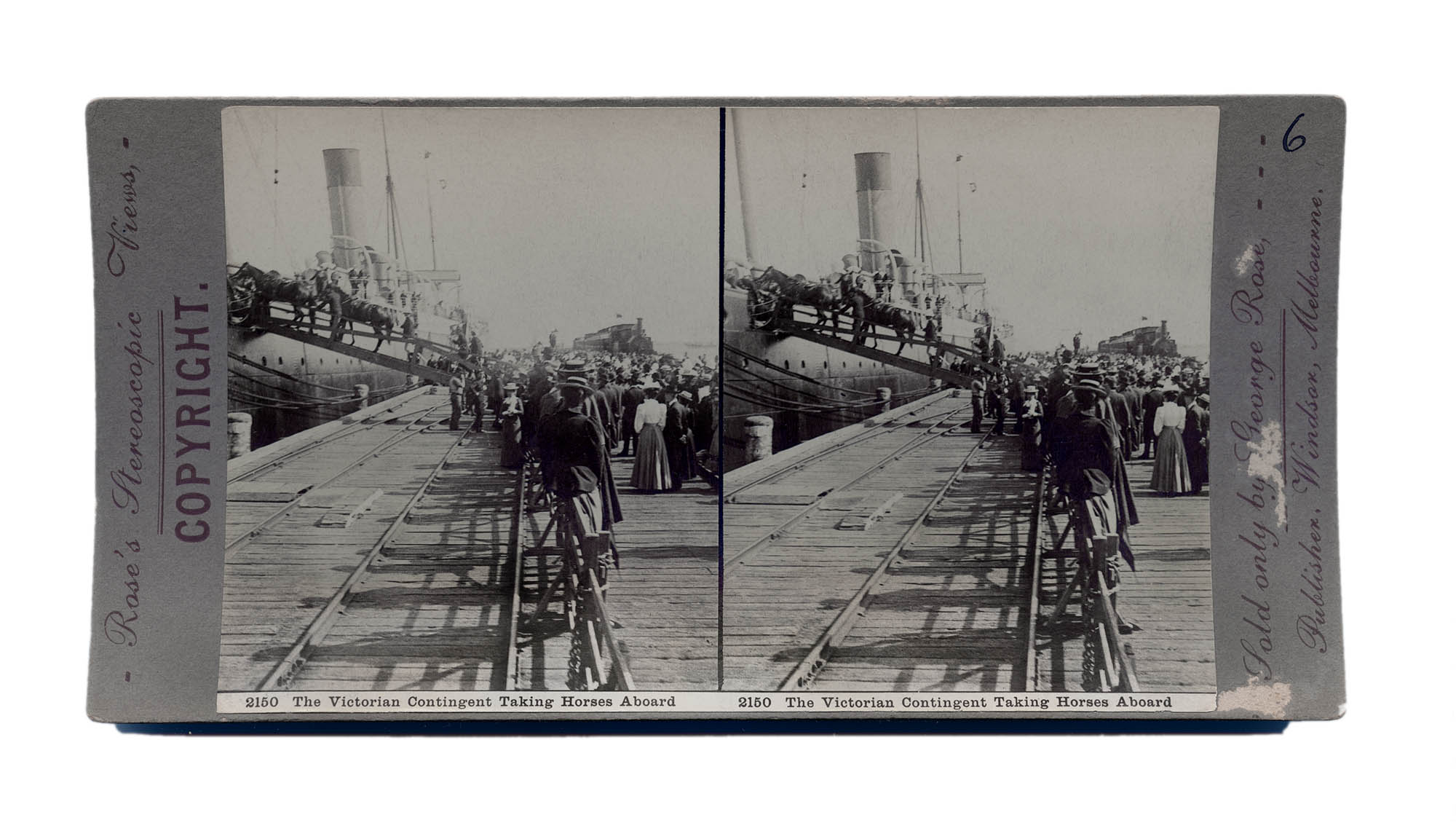
 

George Rose (Australian, 1861-1942) (publisher, Windsor, Melbourne) 'The Victorian Continent Taking Horses Abroad' Melbourne, Victoria, 28th October 1899


Unknown photographer
George Rose (Australian, 1861-1942) (publisher, Windsor, Melbourne)
The Victorian Continent Taking Horses Abroad
Melbourne, Victoria, 28th October 1899
2 photographic prints on stereocard
9 x 18cm
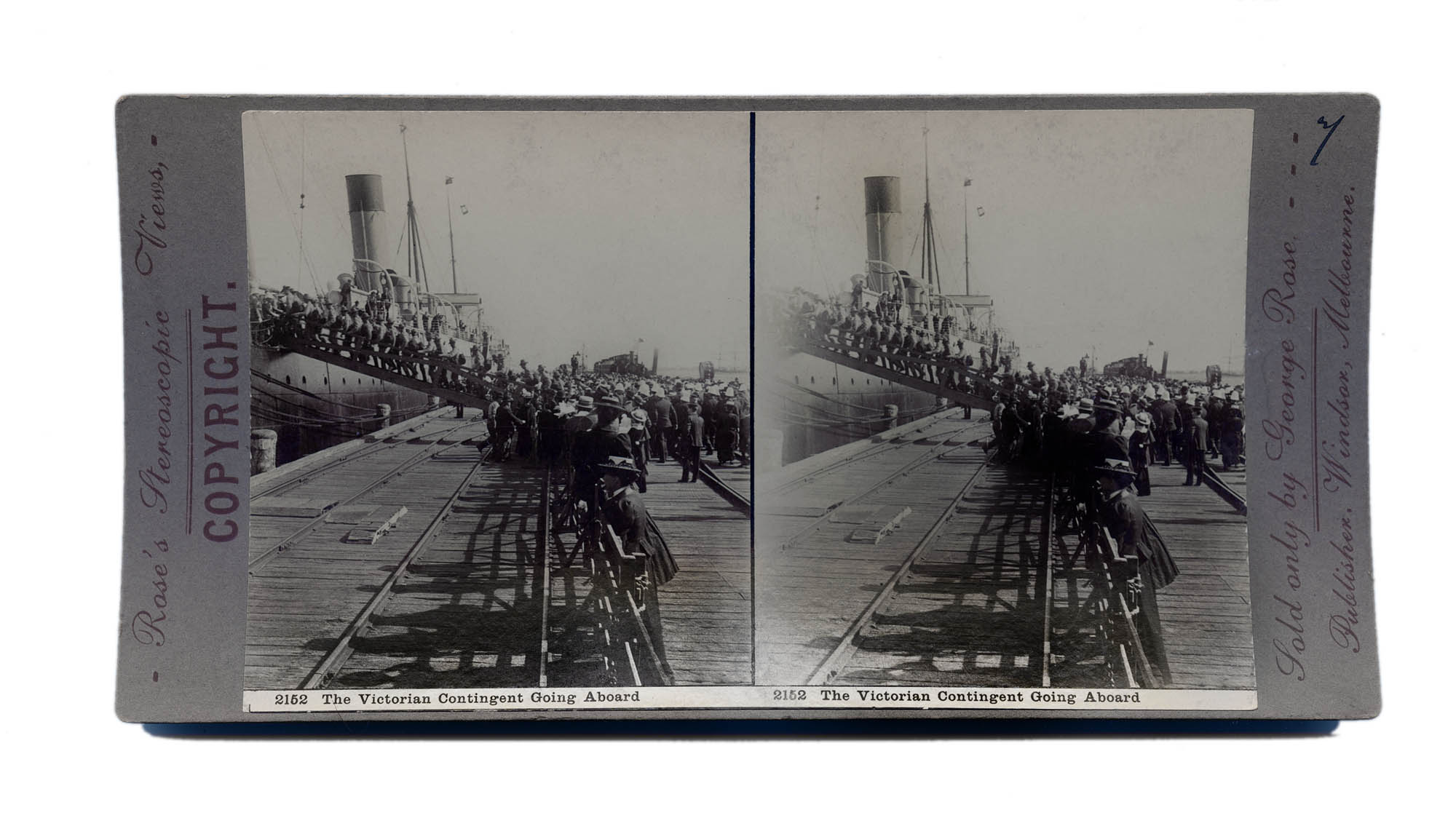
 

George Rose (Australian, 1861-1942) (publisher, Windsor, Melbourne) 'The Victorian Continent Going Aboard' Melbourne, Victoria, 28th October 1899


Unknown photographer
George Rose (Australian, 1861-1942) (publisher, Windsor, Melbourne)
The Victorian Continent Going Aboard 
Melbourne, Victoria, 28th October 1899
2 photographic prints on stereocard
9 x 18cm
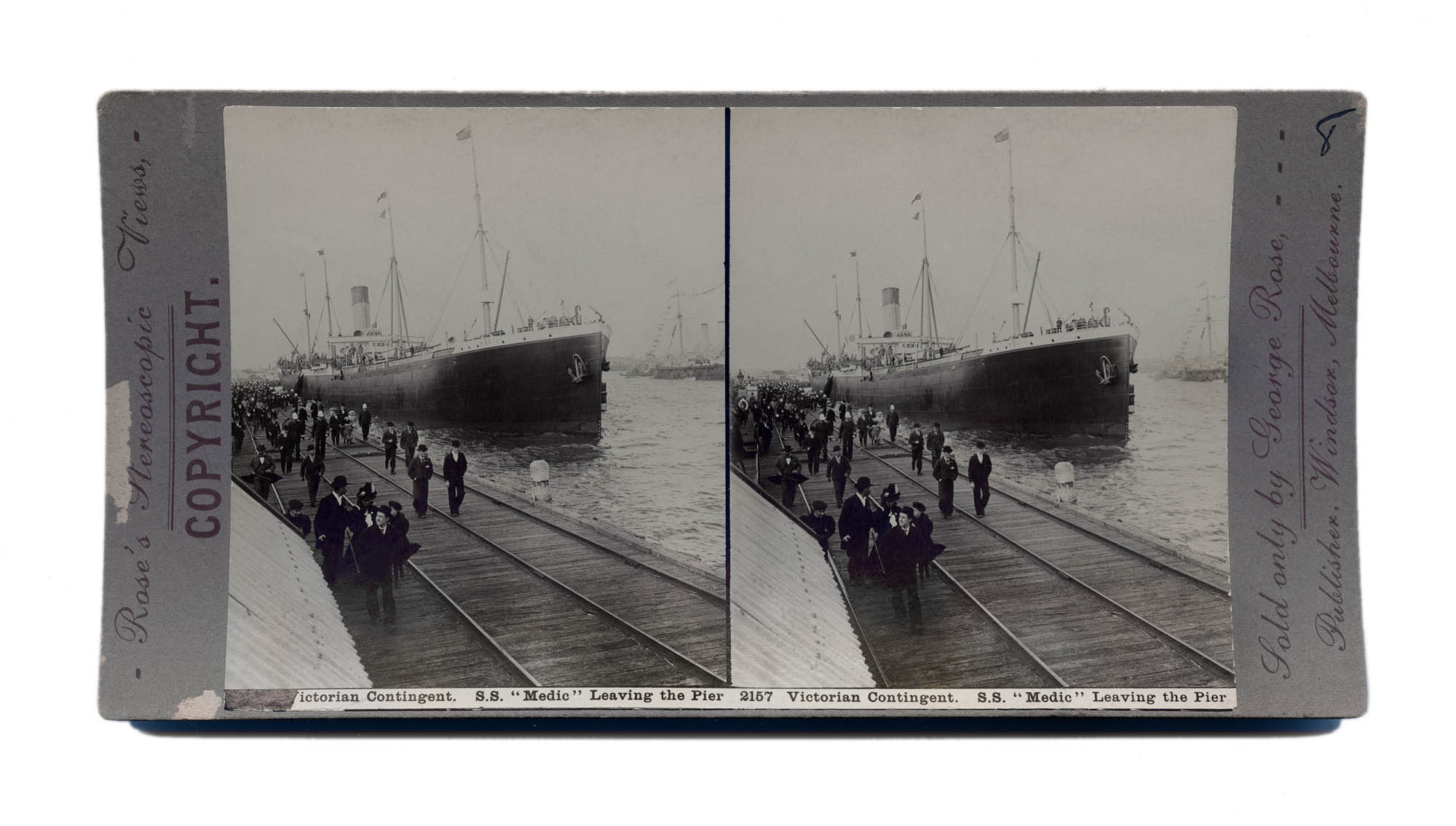
 

George Rose (Australian, 1861-1942) (publisher, Windsor, Melbourne) 'Victorian Continent, S.S. "Medic" Leaving the Pier' Melbourne, Victoria, 28th October 1899


Unknown photographer
George Rose (Australian, 1861-1942) (publisher, Windsor, Melbourne)
Victorian Continent, S.S. “Medic” Leaving the Pier
Melbourne, Victoria, 28th October 1899
2 photographic prints on stereocard
9 x 18cm


A crowd of onlookers walk down Railway Pier in Port Melbourne to farewell the Victorian Contingent aboard the S.S. Medic as it departs for the Boer War in South Africa.
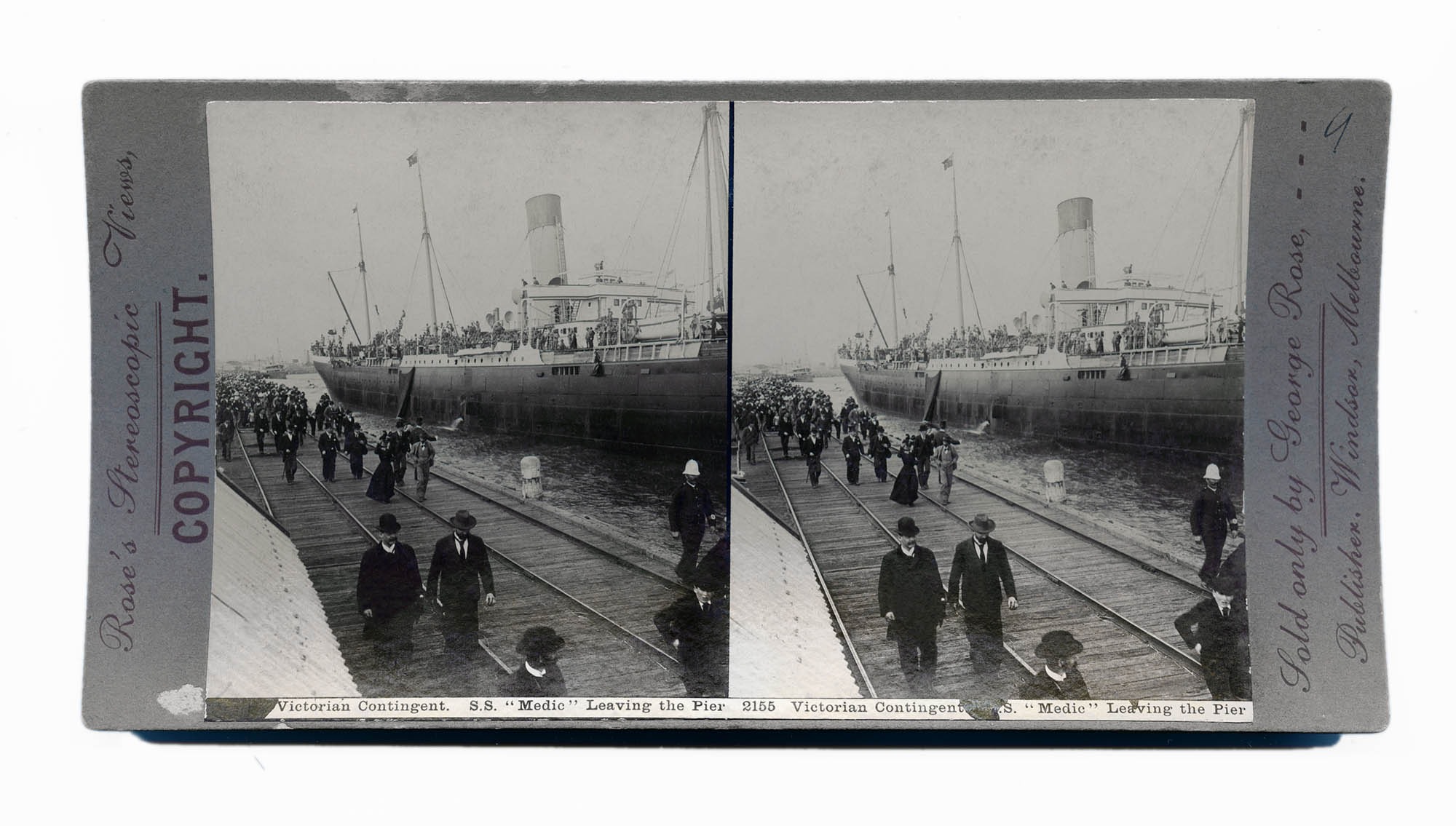
 

George Rose (Australian, 1861-1942) (publisher, Windsor, Melbourne) 'Victorian Continent, S.S. "Medic" Leaving the Pier' Melbourne, Victoria, 28th October 1899


Unknown photographer
George Rose (Australian, 1861-1942) (publisher, Windsor, Melbourne)
Victorian Continent, S.S. “Medic” Leaving the Pier
Melbourne, Victoria, 28th October 1899
2 photographic prints on stereocard
9 x 18cm


A crowd of onlookers walk down Railway Pier in Port Melbourne to farewell the Victorian Contingent aboard the S.S. Medic as it departs for the Boer War in South Africa.


George Rose (Australian, 1861-1942) (publisher, Windsor, Melbourne) 'Victorian Continent, S.S. "Medic" Leaving the Pier' Melbourne, Victoria, 28th October 1899


Unknown photographer
George Rose (Australian, 1861-1942) (publisher, Windsor, Melbourne)
Victorian Continent, S.S. “Medic” Leaving the Pier
Melbourne, Victoria, 28th October 1899
2 photographic prints on stereocard
9 x 18cm


A crowd of onlookers walk down Railway Pier in Port Melbourne to farewell the Victorian Contingent aboard the S.S. Medic as it departs for the Boer War in South Africa.


Unknown photographer. 'S.S. Medic leaving Sydney' Probably 1900s


Unknown photographer
S.S. Medic leaving Sydney
Probably 1900s
State Library of New South Wales
Public domain


S.S. Medic

SS Medic was a steamship built by Harland and Wolff in Belfast for the White Star Line which entered service in 1899. Medic was one of five Jubilee-class ocean liners (the others being the Afric, Persic, Runic and Suevic) built specifically to service the Liverpool – Cape Town – Sydney route. The ship’s name pertained to the ancient Persian region of Media and was pronounced Mee-dic.

Medic was the second Jubilee-class ship to be built for the Australia service. Like her sisters she was a single funnel liner, measuring just under 12,000 gross register tons (GRT), which had capacity for 320 passengers in third class on three decks, she also had substantial cargo capacity with seven cargo holds, most of them refrigerated for the transport of Australian meat.

After a long career with White Star, Medic was sold in 1928 and was converted into a whaling factory ship and renamed Hektoria, she remained in service in this role until being torpedoed and sunk during World War II in the Atlantic Ocean whilst sailing in a convoy in 1942. …

White Star Line career

Medic was launched at Belfast on 15 December 1898, but her completion was delayed until 6 July the following year, so that improvements that were being made to her earlier sister Afric could be incorporated into her construction.

Medic inaugurated White Star’s new Australia service with her maiden voyage, which started from Liverpool on 3 August 1899, she was then the largest ship ever to sail to Australia. Although Afric was the first ship built for the service, she did not make her first voyage to Australia until the following month. On board the maiden voyage was Charles Lightoller on his first assignment as fourth mate, he would later become the only senior officer to survive the sinking of the Titanic. Upon Medic‘s arrival in Australia she was greeted with a rapturous reception. Lightoller wrote:

“She was a show ship, the biggest that had ever been out there, and the people in Australia gave us the time of our lives. Everything and everywhere it was Medic


On her first return trip to the UK, Medic carried Australian troops to South Africa for the Boer War which had started in October 1899, and continued to carry troops to the conflict until it concluded in 1902. In October 1900, while Medic was anchored in Neutral Bay, Sydney Harbour, Charles Lightoller and some shipmates were involved in the “Fort Denison Incident”, a prank intended to fool locals into believing a Boer raiding party was attacking the city. The culprits were never apprehended but Lightoller confessed to his company’s superiors, after which he was transferred to the Atlantic route.

Text from the Wikipedia website


Allan C. Green (Australian, d. 1954) 'The steamship and White Star Liner Medic' Before 1940


Allan C. Green (Australian, d. 1954)
The steamship and White Star Liner Medic
Before 1940
State Library of Victoria, Allan C. Green collection of glass negatives
Public domain
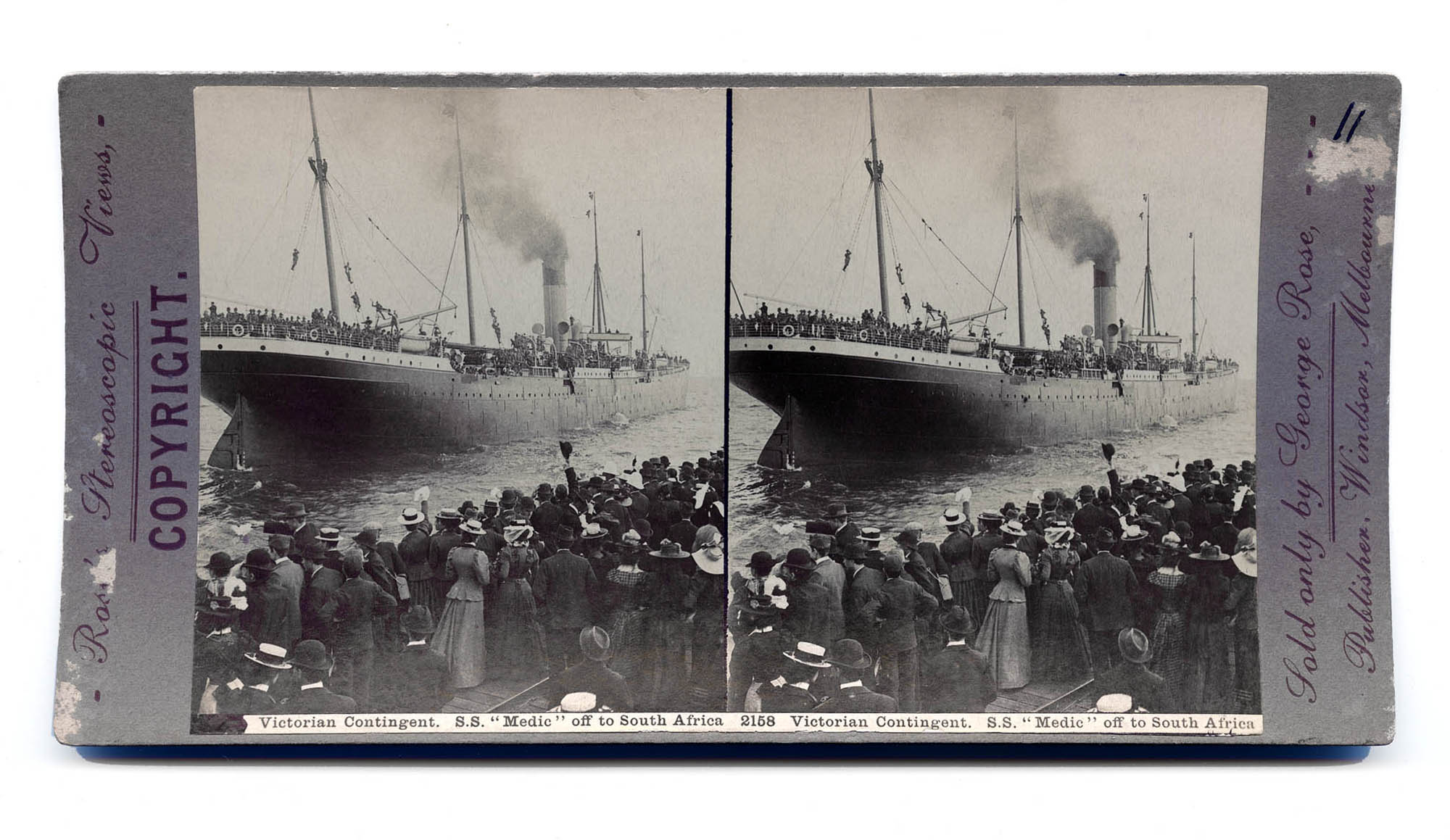
 

George Rose (Australian, 1861-1942) (publisher, Windsor, Melbourne) 'Victorian Continent, S.S. "Medic" off to South Africa' Melbourne, Victoria, 28th October 1899


Unknown photographer
George Rose (Australian, 1861-1942) (publisher, Windsor, Melbourne)
Victorian Continent, S.S. “Medic” off to South Africa
Melbourne, Victoria, 28th October 1899
2 photographic prints on stereocard
9 x 18cm


A crowd of onlookers on Railway Pier in Port Melbourne waves off the Victorian Contingent aboard the S.S. Medic as it departs for the Boer War in South Africa.


The Victorian government took additional steps to ensure the success of the Melbourne farewell by making available holiday excursion fares from all stations to the city. It also approved the issue of free rail passes to the immediate relatives of country members of the contingent.107

…

The Victorian contingent was given a taste of the morrow by the crowds who thronged inside and outside the Melbourne Town Hall for the mayor’s farewell. “For the first time in the history of Victoria the thrill of patriotism vibrated through the nerves of the people”, and their hearts were stirred by the colony’s first plunge into “the great deeps of international warfare”. After the ceremony, the troops headed a triumphal procession back to barracks, and as the men disappeared within the gates the huge crowd sang Soldiers of the Queen. 111

The thronged streets were lined by 2000 school cadets for the march the following day, Saturday 28 October, and the contingent had an escort of 4000 members of the defence forces. Included in the column, and basking in a glory they must have thought gone forever, were former Imperial soldiers, “ambling but proud old wrecks” who wore the medals of Crimea and the Mutiny.112 Lieutenant Tremearne, in writing of the occasion later, told of people, perfect strangers to him, rushing into the ranks with tear filled eyes and murmuring, “Good luck, old man”.113 Followed by a flotilla of smaller craft, the Medic, largest ship ever to enter an Australian port, sailed down the bay and turned to the open sea. Long after the cheering had died and the launches had turned back, Victoria continued to salute her first contingent with huge bonfires which blazed along miles of coastline.114

L.M. Field. The Forgotten War. Australian Involvement in the South African Conflict of 1899-1902. Master of Arts thesis, Australian National University, September 1973, pp. 74-76.


George Rose (Australian, 1861-1942) (publisher, Windsor, Melbourne) 'The Victorian Continent, Last View of Boat' Melbourne, Victoria, 28th October 1899


Unknown photographer
George Rose (Australian, 1861-1942) (publisher, Windsor, Melbourne)
The Victorian Continent, Last View of Boat
Melbourne, Victoria, 28th October 1899
2 photographic prints on stereocard
9 x 18cm


The Rose Stereograph Company

The publishing output of this long-lived firm (which operated from about 1880 until it went into liquidation in 2017) was phenomenal, and when the remains of what must have been a vast photographic archive went on sale in June 2021 with Lloyds Auctions…

According to a brief history by postcard collector Leo Fitzgerald, the Rose story began when Cornish sea captain William Rose came to the Victorian Ballarat gold fields from California and married Grace Ash at Ballarat in 1861. The couple’s son, George, was born in 1862 at the town of Clunes. He worked in his father’s shoe shop in Chapel Street, Prahran, between 1877 and 1880 (apparently producing his earliest photos from those premises) and began spending his Sundays selling photos to picnic parties in the Dandenong hills. Finding his niche in photography, he moved to a new address at Armadale and founded his own firm publishing stereographic views. Over the years he travelled to many countries and recorded numerous important historic events with his stereographic camera equipment, opening offices in Sydney, Wellington and London. His images from Korea have become especially celebrated in Korea, where they represent an extremely rare glimpse of the nation in 1904, before the onset of the destruction wrought by the wars of the 20th century. …

Collector and researcher Ron Blum, whose excellent books built on Leo Fitzgerald’s work, wrote that George’s son Walter took over the business sometime before 1931, selling it in that year to long-time employees Edward Gilbert and Herbert Cutts… George’s wife, Elizabeth, died in 1929, and both George’s sons died before him. With no longer any legal interest in the company he had founded, George kept on taking photographs for the old firm, travelling around Australia in a mobile darkroom and camping along the way. He worked almost until his death in 1942, aged 80… The Rose Stereographic Company continued under the stewardship of Herbert “Bert” Cutts, who brought his son Neil into the business in the 1950s.

Greg Ray. “The Rose Stereograph Company: a snapshot,” on the Photo Time Tunnel website July 16, 2021 [Online] Cited 23/09/2023


George Rose was born in Clunes, Victoria, in 1861. He did not follow his father into boot-making, but was interested in astronomy and natural history. He was unconventional, of rather eccentric and Bohemian character. After moving to Melbourne in 1876, George developed his skills as a photographer, especially in the stereoscopic field – what is known as 3D photography today. He founded the Rose Stereographic Company in 1880. In 1901 George recorded the celebrations for the visit of the Duke and Duchess of York, and in the following years travelled across Australia and over 35 countries taking three-dimensional photos. By 1907 his business employed six people – two males and four females; at its peak, staff numbered around 20. In 1913 the Rose Stereographic Company began manufacturing “real photo” postcards. George’s son Walter managed the company, allowing his father to concentrate on taking the photographs. In 1931 the business was sold to two long-time employees, Edward Gilbert and Herbert (Bert) Cutts. George Rose died of cancer in 1942, having outlived both his sons, but the business remained in the Cutts family for many years before it finally closed down in March 2017.

Information from the book George Rose – The Postcard Era by Ron Blum.


2nd Victorian Contingent
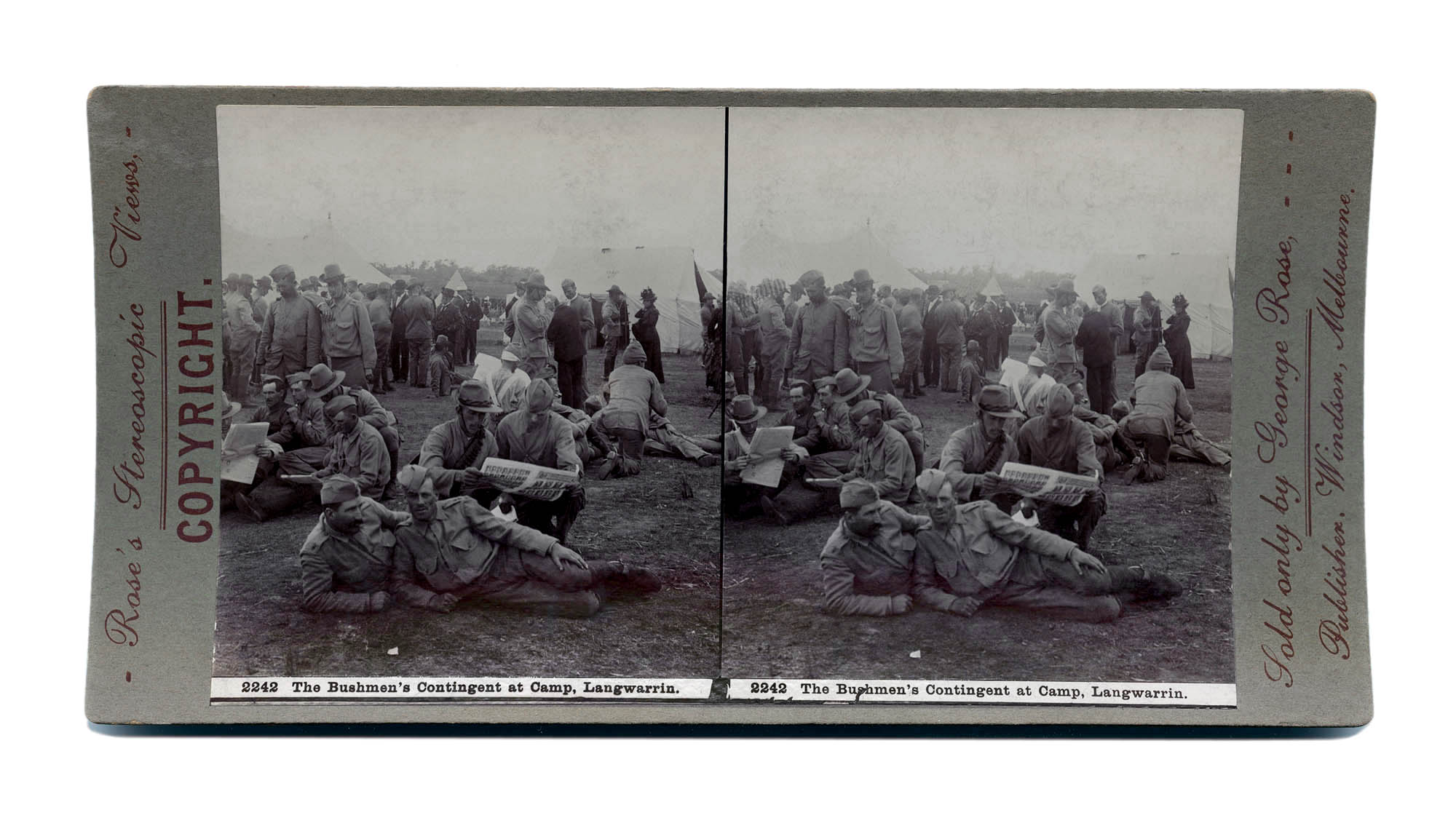
 

George Rose (Australian, 1861-1942) (publisher, Windsor, Melbourne) 'The Bushman's Contingent at Camp, Langwarrin' Melbourne, Victoria, 13th January 1900


Unknown photographer
George Rose (Australian, 1861-1942) (publisher, Windsor, Melbourne)
The Bushman’s Contingent at Camp, Langwarrin
Melbourne, Victoria, 13th January 1900
2 photographic prints on stereocard
9 x 18cm


George Rose (Australian, 1861-1942) (publisher, Windsor, Melbourne) 'The Bushman's Contingent at Langwarrin' Melbourne, Victoria, 13th January 1900


Unknown photographer
George Rose (Australian, 1861-1942) (publisher, Windsor, Melbourne)
The Bushman’s Contingent at Langwarrin
Melbourne, Victoria, 13th January 1900
2 photographic prints on stereocard
9 x 18cm


George Rose (Australian, 1861-1942) (publisher, Windsor, Melbourne) 'The Bushman's Contingent Lining up for Grub' Melbourne, Victoria, 13th January 1900


Unknown photographer
George Rose (Australian, 1861-1942) (publisher, Windsor, Melbourne)
The Bushman’s Contingent Lining up for Grub
Melbourne, Victoria, 13th January 1900
2 photographic prints on stereocard
9 x 18cm
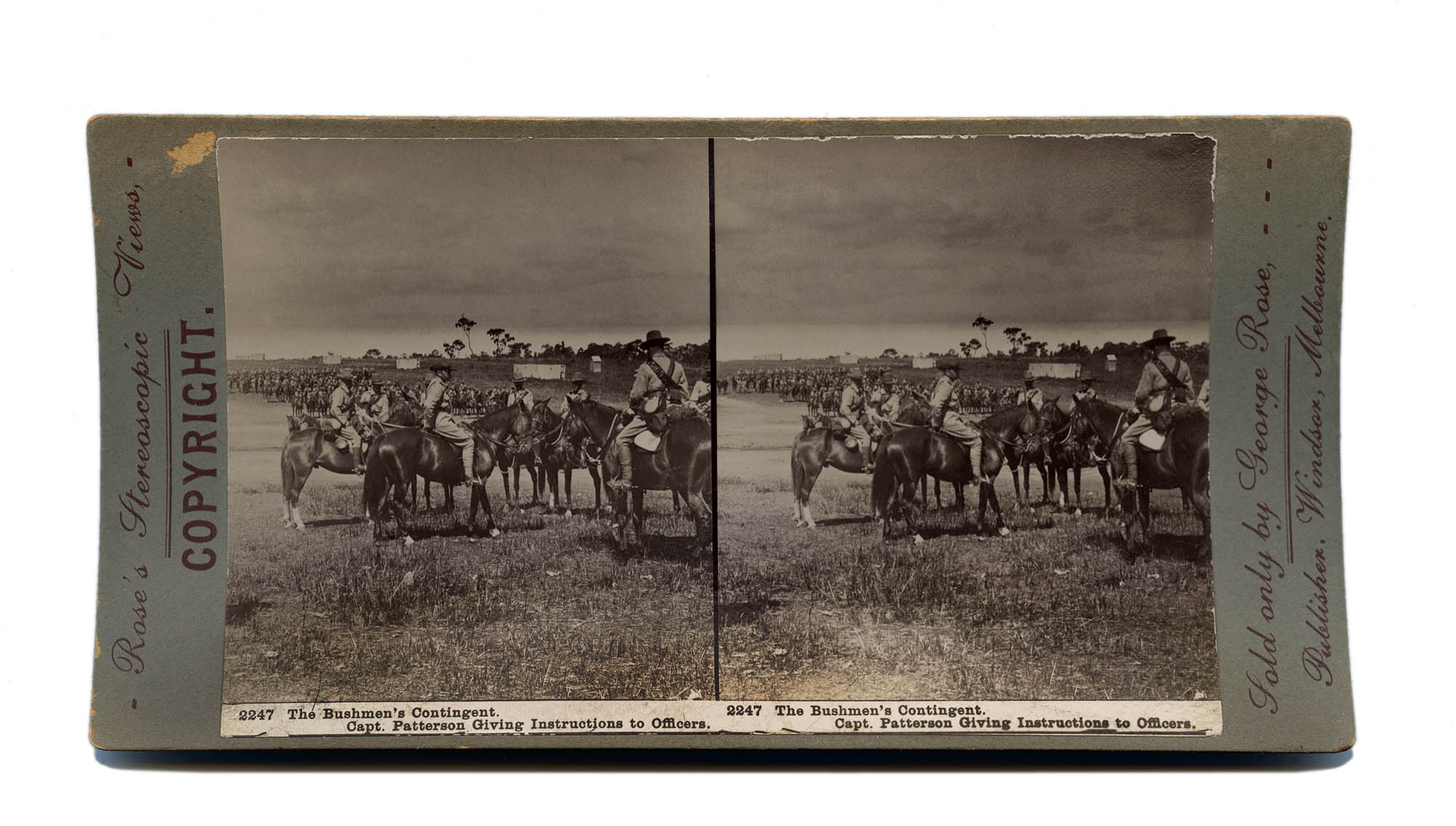
 

George Rose (Australian, 1861-1942) (publisher, Windsor, Melbourne) 'The Bushman's Contingent. Capt. Patterson Giving Instructions to Officers' Melbourne, Victoria, 13th January 1900


Unknown photographer
George Rose (Australian, 1861-1942) (publisher, Windsor, Melbourne)
The Bushman’s Contingent. Capt. Patterson Giving Instructions to Officers
Melbourne, Victoria, 13th January 1900
2 photographic prints on stereocard
9 x 18cm


George Rose (Australian, 1861-1942) (publisher, Windsor, Melbourne) 'The Bushman's Contingent. Group of Officers' Melbourne, Victoria, 13th January 1900


Unknown photographer
George Rose (Australian, 1861-1942) (publisher, Windsor, Melbourne)
The Bushman’s Contingent. Group of Officers
Melbourne, Victoria, 13th January 1900
2 photographic prints on stereocard
9 x 18cm


George Rose (Australian, 1861-1942) (publisher, Windsor, Melbourne) '2nd Victorian Contingent, at the Showgrounds' Melbourne, Victoria, 13th January 1900


Unknown photographer
George Rose (Australian, 1861-1942) (publisher, Windsor, Melbourne)
2nd Victorian Contingent, at the Showgrounds
Melbourne, Victoria, 13th January 1900
2 photographic prints on stereocard
9 x 18cm


George Rose (Australian, 1861-1942) (publisher, Windsor, Melbourne) '2nd Victorian Contingent. Procession (Scottish Regiment)' Melbourne, Victoria, 13th January 1900


Unknown photographer
George Rose (Australian, 1861-1942) (publisher, Windsor, Melbourne)
2nd Victorian Contingent. Procession (Scottish Regiment)
Melbourne, Victoria, 13th January 1900
2 photographic prints on stereocard
9 x 18cm


The Scottish Regiment parading down Collins Street (looking east), Melbourne. The building on the left appears to be the Colonial Mutual Life Building (demolished) and further along, the clock tower is the town hall and the spire is Scots Church. Interesting to note the American flag flying the building at left. I wonder why?
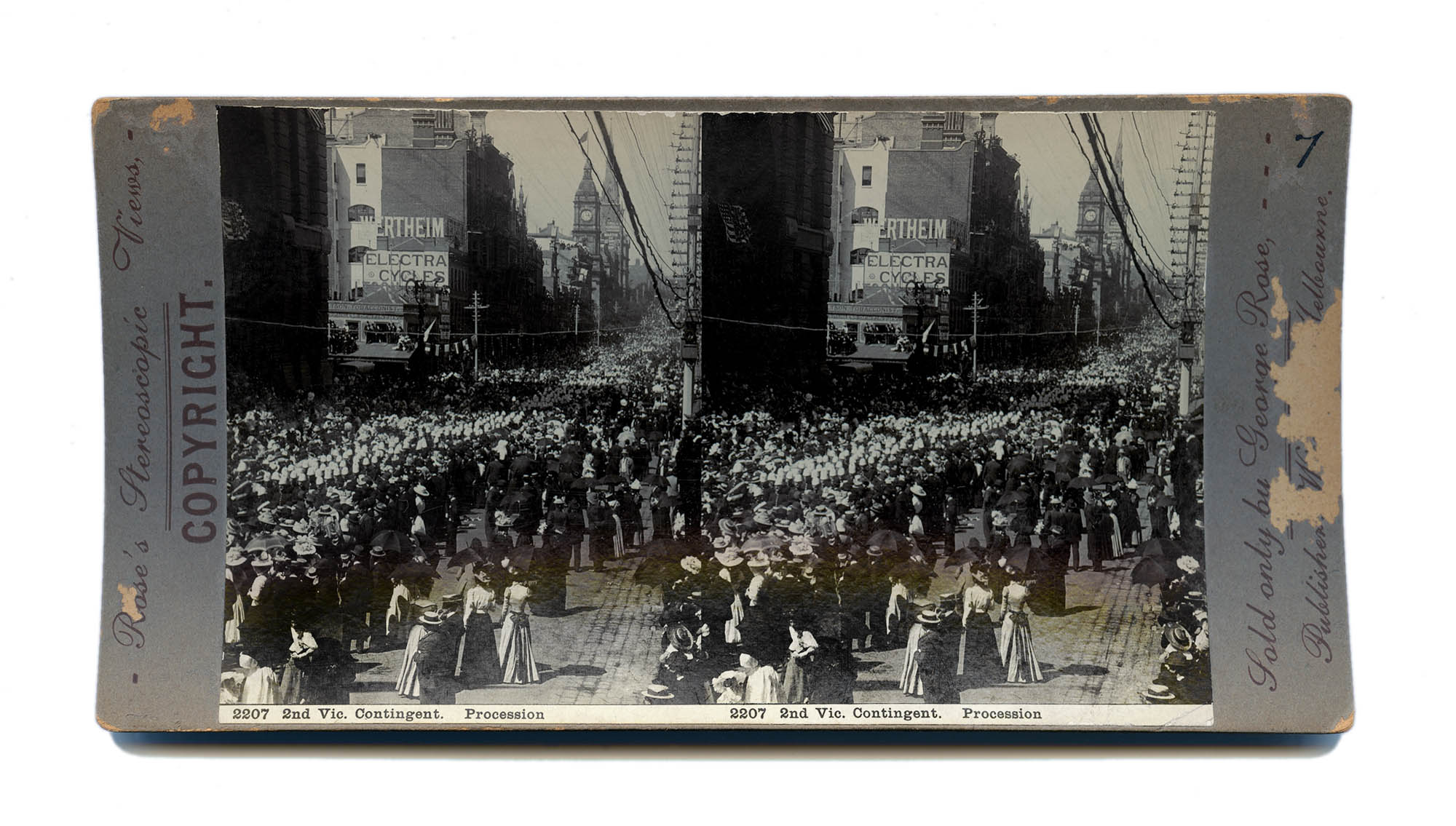
 

George Rose (Australian, 1861-1942) (publisher, Windsor, Melbourne) '2nd Victorian Contingent. Procession' Melbourne, Victoria, 13th January 1900


Unknown photographer
George Rose (Australian, 1861-1942) (publisher, Windsor, Melbourne)
2nd Victorian Contingent. Procession
Melbourne, Victoria, 13th January 1900
2 photographic prints on stereocard
9 x 18cm


The 2nd Victorian Contingent parading down Collins Street (looking east), Melbourne. The building on the left appears to be the Colonial Mutual Life Building (demolished) and further along, the clock tower is the town hall and the spire is Scots Church. Interesting to note the American flag flying the building at left. I wonder why?


George Rose (Australian, 1861-1942) (publisher, Windsor, Melbourne) '2nd Victorian Contingent. Horses alongside Boat' Melbourne, Victoria, 13th January 1900


Unknown photographer
George Rose (Australian, 1861-1942) (publisher, Windsor, Melbourne)
2nd Victorian Contingent. Horses alongside Boat
Melbourne, Victoria, 13th January 1900
2 photographic prints on stereocard
9 x 18cm


Departed Melbourne: SS Euryalus 13 January 1900.

Raised predominantly on the Mounted Rifle Regiment, formed by Lt-Col Tom Price in 1885, and Victorian Rangers, Militia including the battalions of the Infantry Brigade and some from the Royal Australian Artillery. Colonel Price was initially made CO of the Hanover Road Field Force, including one battalion of Lancashire Militia, two companies of Prince Albert’s Guards and Tasmanians. Price was the only Australian Colonial Officer placed in command of British units during the Boer War.

A seminal moment in the Boer War was the capture of Pretoria in 1900 by British commander, Lord Roberts. The Victorian 2nd (Mounted Rifles) Contingent was the first unit to enter the city. A large number of this unit were invalided back to Victoria, having experienced starvation and extreme exhaustion on some treks.

Strength: 265
Service period: Feb 1900 – Dec 1900.

Text from the Defending Victoria website


George Rose (Australian, 1861-1942) (publisher, Windsor, Melbourne) '2nd Victorian Contingent. Soldiers Taking Saddles Aboard' Melbourne, Victoria, 13th January 1900


Unknown photographer
George Rose (Australian, 1861-1942) (publisher, Windsor, Melbourne)
2nd Victorian Contingent. Soldiers Taking Saddles Aboard
Melbourne, Victoria, 13th January 1900
2 photographic prints on stereocard
9 x 18cm


George Rose (Australian, 1861-1942) (publisher, Windsor, Melbourne) '2nd Victorian Contingent. Horses Going Aboard' Melbourne, Victoria, 13th January 1900


Unknown photographer
George Rose (Australian, 1861-1942) (publisher, Windsor, Melbourne)
2nd Victorian Contingent. Horses Going Aboard
Melbourne, Victoria, 13th January 1900
2 photographic prints on stereocard
9 x 18cm


The horses of the 2nd Victorian Contingent to the Boer War about to be put aboard the steamship “Euryalus”, bound for South Africa. The 2nd Victorian Contingent consisted entirely of mounted rifles.


Unknown photographer. 'S.S. Euryalus' Between 1898 and 1913?


Unknown photographer
S.S. Euryalus
Between 1898 and 1913?
Albumen silver print
13.8 x 19.7cm
State Library of Victoria, R.J. French photographic collection of ships
Gift of Mr R. J. French 1979
Public domain


S.S. Euryalus

The steamer Euryalus returned from South Africa
last night, berthing at the Port Melbourne Town
Pier at about a quarter-past 9 o’clock. It was
thought that she, like the Moravian, might have
had some invalided Australian troops on board, but
there were not any, although the vessel brought a
number of saloon and steerage passengers. She had
an uneventful voyage. Durban was left on the 5th
inst., and normal weather was experienced until
the Euryalus reached lat. 41deg. S. and lon. 97deg.
E., where foggy conditions set in, and these continued
to lon. 109deg. E. She passed Cape Otway
at 11.30 a.m. yesterday, and entered Port Phillip
Heads at 5.30 p.m.

“S.S. EURYALUS.The Argus (Melbourne, Vic.: 1848-1957) 26 May 1900: p. 12. Web. 23 Sep 2023 http://nla.gov.au/nla.news-article9542431


Name: EURYALUS
Type: Passenger Cargo Ship
Launched: 08/06/1898
Completed: 08/1898
Builder: Palmers’ Shipbuilding & Iron Co Ltd
Yard: Jarrow
Yard Number: 732
Dimensions: 3570grt, 2286nrt, 360.0 x 45.7 x 24.1ft
Engines: T3cyl (27, 45.5 & 74 x 48ins), 458nhp
Engines by: Palmers’ Shipbuilding & Iron Co Ltd, Jarrow
Propulsion: 1 x Screw, 11.5knots
Construction: Steel

History

04/11/1898: A Currie & Co, Melbourne
1913: British India Steam Navigation Co Ltd, Glasgow
1913: Placed on the India to Australia service
1919: Accommodation increased to include 2441 x deck passengers
31/12/1923: Arrived for breaking up at La Spezia. Cost £6,500

Comments

1898: Completed at a price of £47,500
Accommodation for 22 x 1st and 24 x 2nd Class passengers


George Rose (Australian, 1861-1942) (publisher, Windsor, Melbourne) '2nd Victorian Contingent. Going Aboard the "Euryalus"' Melbourne, Victoria, 13th January 1900


Unknown photographer
George Rose (Australian, 1861-1942) (publisher, Windsor, Melbourne)
2nd Victorian Contingent. Going Aboard the “Euryalus”
Melbourne, Victoria, 13th January 1900
2 photographic prints on stereocard
9 x 18cm


George Rose (Australian, 1861-1942) (publisher, Windsor, Melbourne) '2nd Victorian Contingent. Going Aboard the "Euryalus"' Melbourne, Victoria, 13th January 1900


Unknown photographer
George Rose (Australian, 1861-1942) (publisher, Windsor, Melbourne)
2nd Victorian Contingent. Going Aboard the “Euryalus”
Melbourne, Victoria, 13th January 1900
2 photographic prints on stereocard
9 x 18cm


George Rose (Australian, 1861-1942) (publisher, Windsor, Melbourne) '2nd Victorian Contingent. Horses Going Aboard' Melbourne, Victoria, 13th January 1900


Unknown photographer
George Rose (Australian, 1861-1942) (publisher, Windsor, Melbourne)
2nd Victorian Contingent. Horses Going Aboard
Melbourne, Victoria, 13th January 1900
2 photographic prints on stereocard
9 x 18cm


Australia and the Boer War, 1899-1902

As part of the British Empire, the Australian colonies offered troops for the war in South Africa. Australians served in contingents raised by the six colonies or, from 1901, by the new Australian Commonwealth. For a variety of reasons many Australians also joined British or South African colonial units in South Africa: some were already in South Africa when the war broke out; others either made their own way to the Cape or joined local units after their enlistment in an Australian contingent ended. Recruiting was also done in Australia for units which already existed in South Africa, such as the Scottish Horse.

Australians served mostly in mounted units formed in each colony before despatch, or in South Africa itself. The Australian contribution took the form of five “waves”. The first were the contingents raised by the Australian colonies in response to the outbreak of war in 1899, which often drew heavily on the men in the militia of the colonial forces. The second were the “bushmen” contingents, which were recruited from more diverse sources and paid for by public subscription or the military philanthropy of wealthy individuals. The third were the “imperial bushmen” contingents, which were raised in ways similar to the preceding contingents, but paid for by the imperial government in London. Then were then the “draft contingents”, which were raised by the state governments after Federation on behalf of the new Commonwealth government, which was as yet unable to do so. Finally, after Federation, and close to the end of the war, the Australian Commonwealth Horse contingents were raised by the new Federal government. These contingents fought in both the British counter-offensive of 1900, which resulted in the capture of the Boer capitals, and in the long, weary guerrilla phases of the war which lasted until 1902. Colonial troops were valued for their ability to “shoot and ride”, and in many ways performed well in the open war on the veldt. There were significant problems, however, with the relatively poor training of Australian officers, with contingents generally arriving without having undergone much training and being sent on campaign immediately. These and other problems faced many of the hastily raised contingents sent from around the empire, however, and were by no means restricted to those from Australia…

The Australians at home initially supported the war, but became disenchanted as the conflict dragged on, especially as the effects on Boer civilians became known…

Conditions for both soldiers and horses were harsh. Without time to acclimatise to the severe environment and in an army with a greatly over-strained logistic system, the horses fared badly. Many died, not just in battle but of disease, while others succumbed to exhaustion and starvation on the long treks across the veld. Quarantine regulations in Australia ensured that even those which did survive could not return home. In the early stages of the war Australian soldier losses were so high through illness that components of the first and second contingents ceased to exist as viable units after a few months of service.

Extract of text from “Australia and the Boer War, 1899-1902” on the Australian War Memorial website Nd [Online] Cited 06/10/2023


George Rose (Australian, 1861-1942) (publisher, Windsor, Melbourne) 'The Bushman's Contingent. Horses Going Aboard' Melbourne, Victoria, 13th January 1900


Unknown photographer
George Rose (Australian, 1861-1942) (publisher, Windsor, Melbourne)
The Bushman’s Contingent. Horses Going Aboard
Melbourne, Victoria, 13th January 1900
2 photographic prints on stereocard
9 x 18cm


George Rose (Australian, 1861-1942) (publisher, Windsor, Melbourne) 'The Bushman's Contingent. "Euryalus" Leaving Pier' Melbourne, Victoria, 13th January 1900


Unknown photographer
George Rose (Australian, 1861-1942) (publisher, Windsor, Melbourne)
The Bushman’s Contingent. “Euryalus” Leaving Pier
Melbourne, Victoria, 13th January 1900
2 photographic prints on stereocard
9 x 18cm


George Rose (Australian, 1861-1942) (publisher, Windsor, Melbourne) 'The Bushman's Contingent, "Euryalus" Leaving Pier' Melbourne, Victoria, 13th January 1900


Unknown photographer
George Rose (Australian, 1861-1942) (publisher, Windsor, Melbourne)
The Bushman’s Contingent, “Euryalus” Leaving Pier
Melbourne, Victoria, 13th January 1900
2 photographic prints on stereocard
9 x 18cm


George Rose (Australian, 1861-1942) (publisher, Windsor, Melbourne) 'The Bushman's Contingent, "Good-bye, Lads."' Melbourne, Victoria, 13th January 1900


Unknown photographer
George Rose (Australian, 1861-1942) (publisher, Windsor, Melbourne)
The Bushman’s Contingent, “Good-bye, Lads.”
Melbourne, Victoria, 13th January 1900
2 photographic prints on stereocard
9 x 18cm


George Rose (Australian, 1861-1942) (publisher, Windsor, Melbourne) 'The Bushman's Contingent, "Good-bye, Lads."' Melbourne, Victoria, 13th January 1900


Unknown photographer
George Rose (Australian, 1861-1942) (publisher, Windsor, Melbourne)
The Bushman’s Contingent, “Good-bye, Lads.”
Melbourne, Victoria, 13th January 1900
2 photographic prints on stereocard
9 x 18cm


George Rose (Australian, 1861-1942) (publisher, Windsor, Melbourne) '2nd Victorian Contingent. Going Aboard the "Euryalus"' Melbourne, Victoria, 13th January 1900


Unknown photographer
George Rose (Australian, 1861-1942) (publisher, Windsor, Melbourne)
2nd Victorian Contingent. The Troops at the Pier
Melbourne, Victoria, 13th January 1900
2 photographic prints on stereocard
9 x 18cm


Soldiers and sailors lined up on the pier, at a farewell parade for the troops of the 2nd Victoria Contingent to the Boer War. The troops of the 2nd Victoria Contingent, all Mounted Rifles, are aboard the steamship “Euryalus”, which is about to depart for Cape Town, South Africa. Note the photographer with his large format camera on tripod at left.
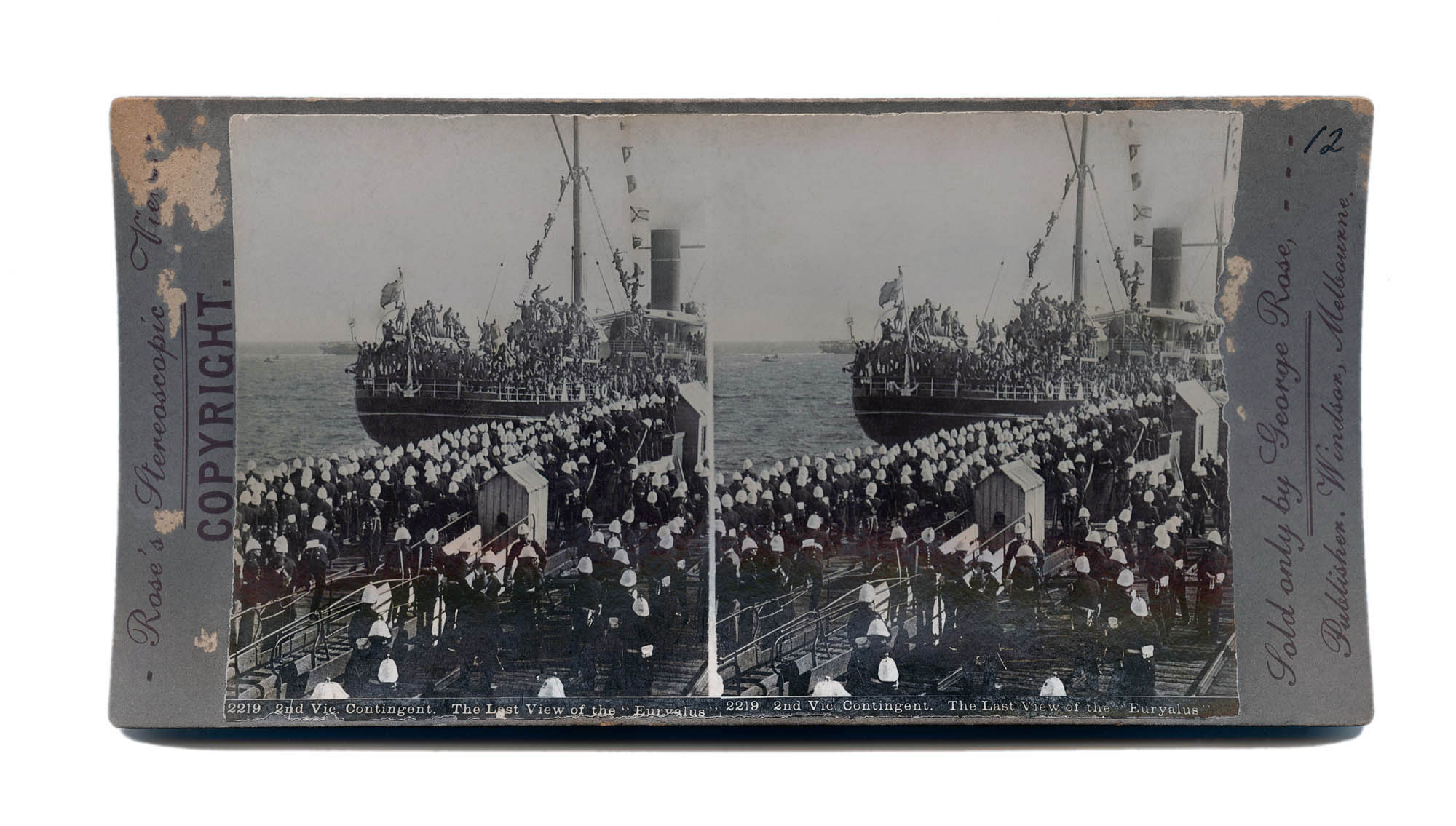
 

George Rose (Australian, 1861-1942) (publisher, Windsor, Melbourne) '2nd Victorian Contingent. The Last View of the "Euryalus"' Melbourne, Victoria, 13th January 1900


Unknown photographer
George Rose (Australian, 1861-1942) (publisher, Windsor, Melbourne)
2nd Victorian Contingent. The Last View of the “Euryalus”
Melbourne, Victoria, 13th January 1900
2 photographic prints on stereocard
9 x 18cm


LIKE ART BLART ON FACEBOOK

Back to top

Photographs: ‘Gunner Andrew Rumann embarkation for Singapore, August 1941’ and other WW2 Australian photographs

October 2020


Andrew Rumann (Australian, 1905-1974) 'Untitled [Departure from Circular Quay, Sydney for Fremantle and Singapore]' 1941


Andrew Rumann (Australian, 1905-1974)
Untitled [Departure from Circular Quay, Sydney for Fremantle and Singapore]
1941
Silver gelatin photograph
5.5 x 5.3cm


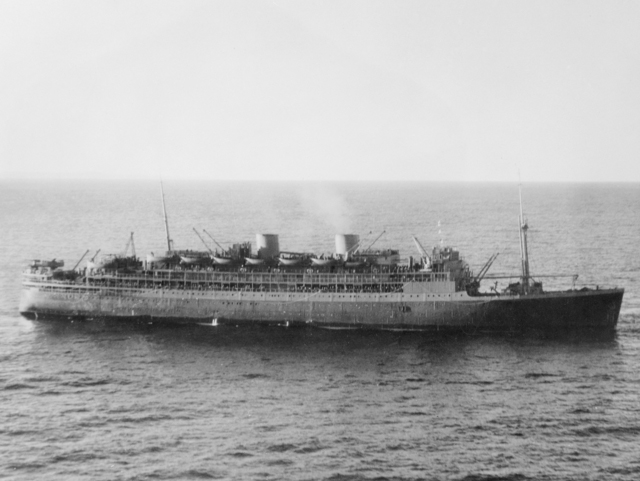
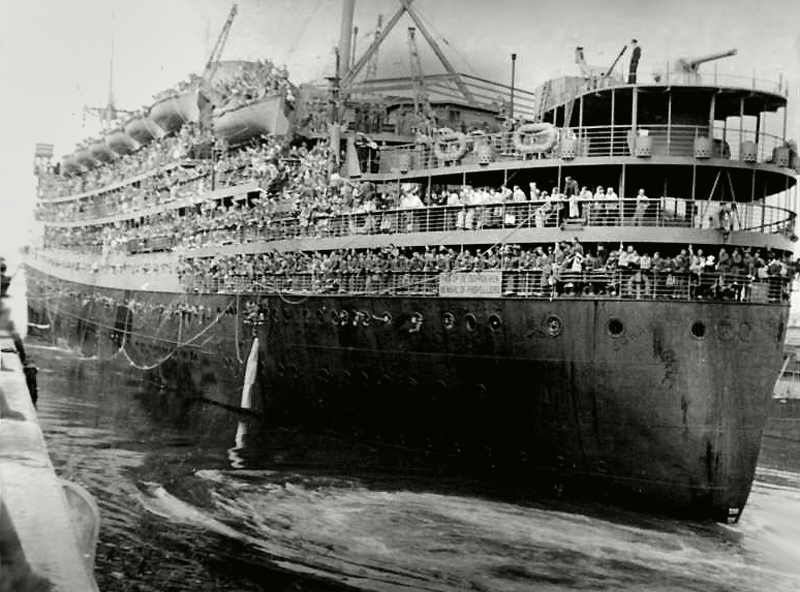
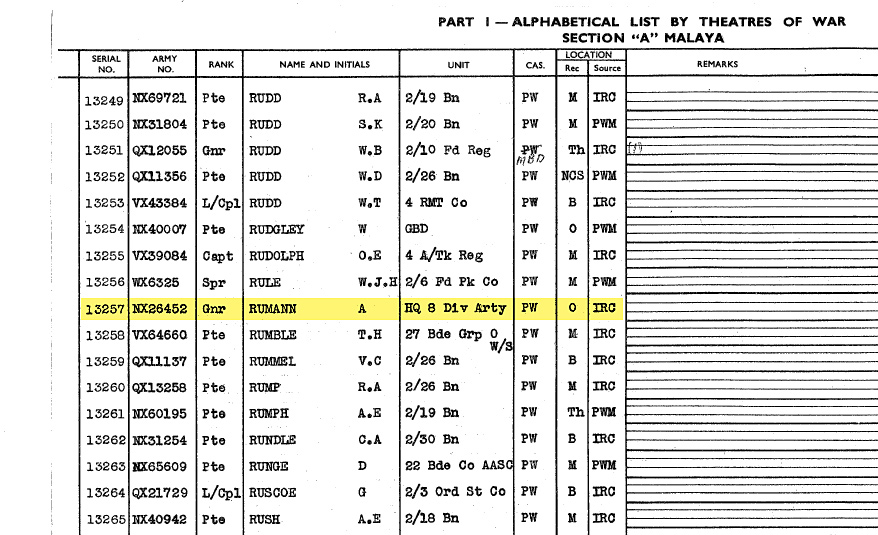
These photographs were given to me in an envelope titled “Gunner Andrew Rumann embarkation for Singapore, August 1941”. I have carefully digitally scanned and cleaned them. The attribution seems correct for the first group of photographs in the posting, Departure from Circular Quay, Sydney for Fremantle and Singapore, but not for the rest. I have located Rumann’s POW record and found several pictures of the ship he would have taken to travel to Singapore.

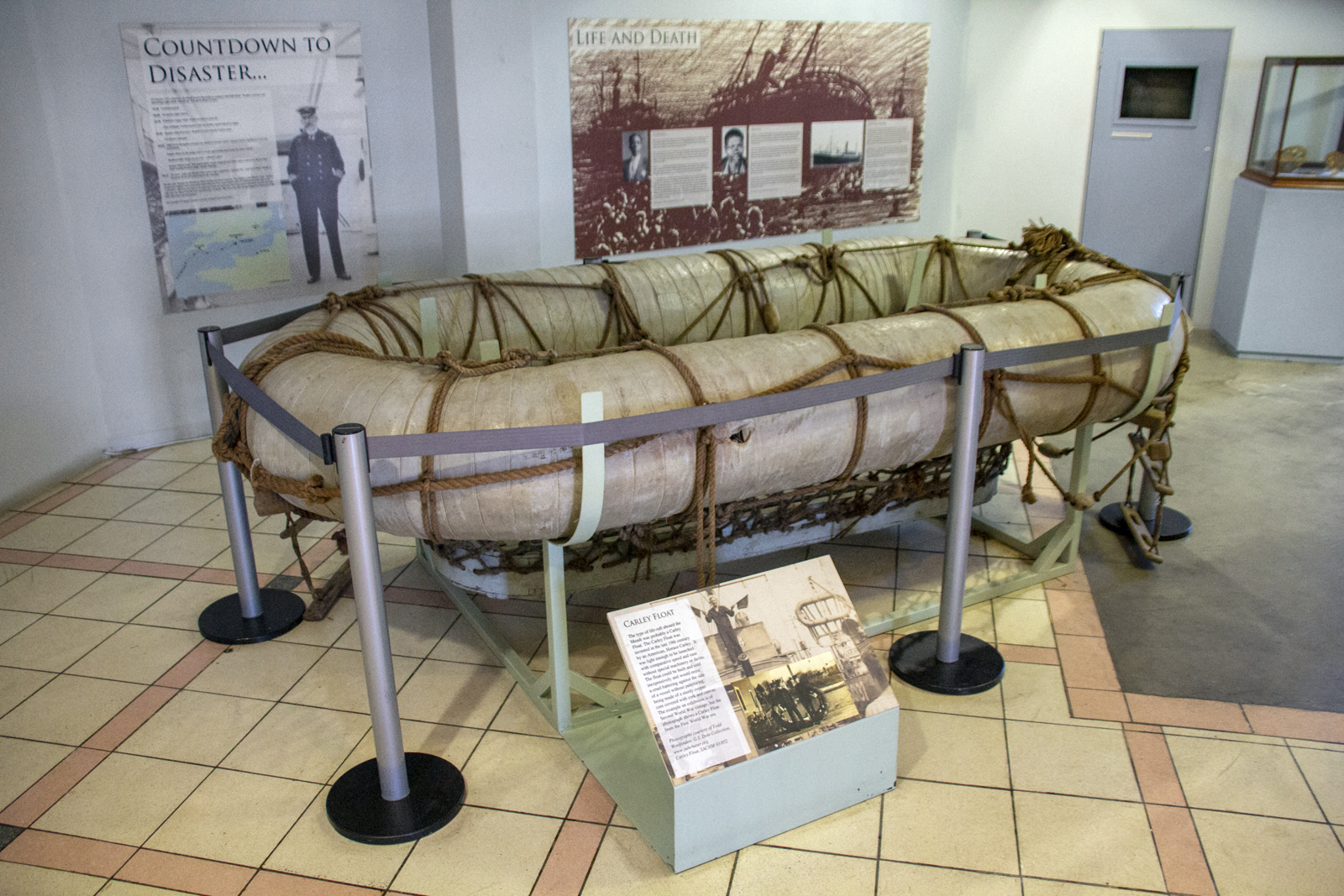
The other photographs in the posting show Australian armed services personnel (none are American), but there are several anomalies that enable me to say that these are later photographs. Four Australian women personnel stand in front of an American Red Cross sign, and the ARC (or Amcross) did not arrive in Australia until 1942. And in the photograph Transportation Corps US Army BKC*23, the men an women are standing on a US Army transportation barge, unlikely to have been in Australian waters before 1942. Behind them Carley floats hang from their tethers.

As always, what interests me most about these photographs are the details contained within: the casualness of the men waiting at Post Exchange No. 2, with their sandals, singlets and slough hats; the man caught mid-clamber, climbing up into the truck in Taking out the rubbish; the women in dark glasses and hat sheltering her eyes from the sun in BKC*23; the men peering out of the portholes in the same photograph, one with a fag in his mouth.

We can feel the heat emanating from these photographs (it must be summer). All the men are in shorts and topless. In photographs such as Transportation Corps US Army BKC*23 and Embarkation we can admire their lithe bodies, and observe the ubiquitous 1940s mop of curly hair with short back and sides. They were already athletic before departure, but imagine fighting in the stinking hot forests of Burma on Army rations, or ending up in a Japanese prisoner of war camp, with so little meat on the bone to start with. You would be a skeleton before long. Finally, there is one personal sign that you can make out in the crowd seeing off the troops to Singapore from Circular Quay in 1941. “Jim Carr” it reads. Did he survive the war? Who knows.

More than 15,000 Australian soldiers were captured at the fall of Singapore. Of these, more than 7000 would die as prisoners of war, some in transport ships on their way to Japan, sadly torpedoed by Allied submarines. Andrew Rumann survived his trip to Japan as a POW and returned to Australia after the war. He died in 1974 aged 68 years old.

Dr Marcus Bunyan


All photographs have been digitally scanned and cleaned by Marcus Bunyan. Please click on the photographs for a larger version of the image.


Gunner Andrew Rumann

Headquarters, Royal Australian Artillery, 8th Division, Australian Imperial Force (AIF)

Service Number – NX26452
Date of birth – 13 Sep 1905
Place of birth – Hungary
Place of enlistment – Paddington NSW
Next of Kin – Rumann, Rena

Malaya, captured at Singapore

Camp: Osaka, Japan

Andrew died in 1974 in Toor, Australia at 68 years old


In January 1941 a large component of the Australian Army’s recently raised 8th Division was posted to Malaya. An element of some 6000 men departed Sydney in the liner Queen Mary as part of Convoy US9 on 4 February 1941, arriving in Singapore two weeks later on 18 February. A further 5000 troops in Convoy US11B arrived at Keppel Harbour on 15 August 1941. Under the command of Major General Gordon Bennett, the force initially established its headquarters at Kuala Lumpur. Bennett had urged for specific territorial responsibility for his Division, and this resulted in an area which included Johore and Malacca, coming within his responsibility.

The Australian Army 8th Division in Malaya eventually reached about 15,000 men. An apt description of the commander, Major General Henry (Gordon) Bennett, found in a Veterans’ Affairs publication, (Moremon & Reid 2002) reads:

“A prominent citizen soldier, he had proven himself in World War I to be a fierce fighter and leader, but he was well known for his prickly temperament, argumentative nature and proneness to quarrel. His relations with senior British commanders and staff in Malaya were, at times, strained, as he grappled to maintain control of the Australian troops.”

Bennett’s independent spirit did not fit into the Allied command structure, however his Division generally acquitted themselves well against a seasoned enemy.

Walter Burroughs. “The Naval Evacuation of Singapore – February 1942,” on the Naval Historical Society of Australia website. June 2019 edition of the Naval Historical Review  [Online] Cited 04/09/2020.

Convoy US11B

Convoy US11B

Departed Sydney 29/7/1941 – Arrived Fremantle 6/8/1941
Departed Fremantle 8/8/1941 – Arrived Singapore 15/8/1941

Ships: Johan Van Oldenbarnevelt, Katoomba, HMAS Sydney, Marnix Van St. Aldegonde, HMAS Canberra, Sibajak.

In late July 1941 a convoy was organised to transport 8th Division troops to Singapore. The convoy included three Dutch passenger ships, and escort ships from the Royal Australian Navy.

Summary of Embarkation for Johan van Oldenbarnevelt (HMT FF)

The following troops embarked Johan Van Oldenbarnevelt at Woolloomooloo, Sydney on 29/7/1941 for the voyage to Singapore.

61524 – 8 Division Artillery

29 men arrived including 3 officers, 1 warrant officer, 3 sergeants, 22 corporals and privates.

(Source: Australian Army War Diary 1/15/14 – District Records Office Eastern Command May – July 1941)

Troopship 32 – Voyage 4

She [JVO] departed Sydney on July 17 and headed for Auckland New Zealand where she arrived on July 21 and departed again on the 22nd. She returned to Sydney arriving on July 25 and departed again on the 29th, sailing via Fremantle to Singapore arriving on August 15. End of Troop voyage 4.


Johan van Oldenbarnevelt on the way to Fremantle, 1/8/1941


Johan van Oldenbarnevelt on the way to Fremantle, 1/8/1941
Aerial Starboard side view of the Dutch liner Johan van Oldenbarnevelt transporting Australian troops to the Middle East as part of convoy US11B. Note the 4.7 pound gun and 12 pounder AA gun aft
1st August 1941
Australian War Memorial Naval Historical Collection
Public domain


Trooper Johan van Oldenbarnevelt is seen departing Wellington New Zealand during Troop Voyage 6 on September 15, 1941


Trooper Johan van Oldenbarnevelt is seen departing Wellington New Zealand during Troop Voyage 6 on September 15, 1941 – Note the guns up on the aft section!


Andrew Rumann (Australian, 1905-1974) 'Untitled [Departure from Circular Quay, Sydney for Fremantle and Singapore]' 1941


Andrew Rumann (Australian, 1905-1974)
Untitled [Departure from Circular Quay, Sydney for Fremantle and Singapore]
1941
Silver gelatin photograph
5.5 x 5.3cm


Circular Quay with the Sydney Harbour Trust building at left in the background. The spire is the CQ Fire Station No. 3.


Andrew Rumann (Australian, 1905-1974) 'Untitled [Departure from Circular Quay, Sydney for Fremantle and Singapore]' 1941


Andrew Rumann (Australian, 1905-1974)
Untitled [Departure from Circular Quay, Sydney for Fremantle and Singapore]
1941
Silver gelatin photograph
5.5 x 5.3cm


Andrew Rumann (Australian, 1905-1974) 'Untitled [Departure from Circular Quay, Sydney for Fremantle and Singapore]' 1941 (detail)


Andrew Rumann (Australian, 1905-1974)
Untitled [Departure from Circular Quay, Sydney for Fremantle and Singapore] (detail)
1941
Silver gelatin photograph
5.5 x 5.3cm


Gunner Andrew Rumann POW entry


NX26452 Gunner Andrew Rumann POW entry


Anonymous photographer (Australian) 'Untitled [Encampment]' 1942-45


Anonymous photographer (Australian)
Untitled [Encampment]
1942-1945
Silver gelatin photograph
5.5 x 5.3cm


Anonymous photographer (Australian) 'Untitled [Women standing in front of an American Red Cross sign]' 1942-45


Anonymous photographer (Australian)
Untitled [Women standing in front of an American Red Cross sign]
1942-1945
Silver gelatin photograph
5.5 x 5.3cm


The American Red Cross (ARC or Amcross) in Australia during WW2 became the largest hotel and restaurant chain in Australia at the time. Amcross was headed by Norman H. Davis with its headquarters in Sydney, NSW. …

Four American women led by Miss Helen Hall arrived in Australia in about late August 1942 to take charge of American Red Cross Service Personnel and to establish new American Red Cross centres and to extend existing centres. Miss Hall was the administrative assistant to the delegate in charge of American Red Cross Service Clubs and Leave Areas in Australia. The other three women were Miss Hannah More Frazer, who was appointed Director of the American Red Cross Service Club in Melbourne in about September 1942; Miss Florice Langley who opened an ARC Service Club in Cairns, in far north Queensland; and Mrs. Anita Woodworth who opened an ARC Service Club in Charters Towers in north Queensland.


Anonymous photographer (Australian) 'Untitled [Post Exchange No. 2]' 1942-45


Anonymous photographer (Australian)
Untitled [Post Exchange No. 2]
1942-1945
Silver gelatin photograph
5.5 x 5.3cm


Anonymous photographer (Australian) 'Untitled [Post Exchange No. 2]' 1942-45 (detail)


Anonymous photographer (Australian)
Untitled [Post Exchange No. 2] (detail)
1942-1945
Silver gelatin photograph
5.5 x 5.3cm


Anonymous photographer (Australian) 'Untitled [Taking out the rubbish]' 1942-45


Anonymous photographer (Australian)
Untitled [Taking out the rubbish]
1942-1945
Silver gelatin photograph
5.5 x 5.3cm


Anonymous photographer (Australian) 'Untitled [BKC*23]' 1942-45


Anonymous photographer (Australian)
Untitled [BKC*23]
1942-1945
Silver gelatin photograph
5.5 x 5.3cm


Anonymous photographer (Australian) 'Untitled [BKC*23]' 1942-45 (detail)


Anonymous photographer (Australian)
Untitled [BKC*23] (detail)
1942-1945
Silver gelatin photograph
5.5 x 5.3cm


Anonymous photographer (Australian) 'Untitled [Transportation Corps US Army BKC*23]' 1942-45


Anonymous photographer (Australian)
Untitled [Transportation Corps US Army BKC*23]
1942-1945
Silver gelatin photograph
5.5 x 5.3cm


Mike Peel. 'Carley float' 2018


Mike Peel
Carley float
2018
CC-BY-SA-4.0


Carley float

The Carley float (sometimes Carley raft) was a form of invertible liferaft designed by American inventor Horace Carley (1838-1918). Supplied mainly to warships, it saw widespread use in a number of navies during peacetime and both World Wars until superseded by more modern rigid or inflatable designs. Carley was awarded a patent in 1903 after establishing the Carley Life Float Company of Philadelphia. …

Simply by casting it over the side, the lightweight Carley float could be launched more rapidly than traditional rigid lifeboat designs, and without the need for specialised hoists. It could be mounted on any convenient surface and survive the battering against the ship’s sides during heavy seas. Unlike the rubber inflatable rafts of the period, it was relatively immune to compromise of its buoyant chambers. Seafarers in it were however completely exposed to the elements, and would suffer accordingly. An inquiry of 1946 reported that many sailors who had succeeded in getting to the safety of Carley floats had nevertheless succumbed to exposure before rescue could be made. The crew of the Canadian minesweeper HMCS Esquimalt, sunk offshore of Nova Scotia in April 1945, lost at least 16 to hypothermia during the six hours in which they awaited rescue. Few of the survivors could still walk.

Despite these shortcomings many seamen did owe their lives to the Carley float. Chinese sailor Poon Lim survived for a record 133 days adrift in the South Atlantic aboard a Carley float after his freighter SS Benlomond was sunk on 23 November 1942. He fashioned fishing gear from components of the raft. He was close to death when discovered off the coast of Brazil on 5 April 1943, but was able to walk ashore unaided.

Though its occupant did not survive, a shrapnel-ridden Carley float carried the body of an unknown man to land on Christmas Island in February 1942. The sun-bleached corpse had evidently spent a lengthy period at sea, though to this day it remains unknown from where the sailor had come. It has long been suspected that the body was that of a sailor from HMAS Sydney, which was lost with all hands under mysterious circumstances off the coast of Australia on 19 November 1941. A second Carley float, more confidently believed to be from Sydney, was recovered drifting 300 km off the Australian coast one week after the ship sank. It had been badly damaged by shellfire, but was empty. The float is now displayed at the HMAS Sydney exhibit of the Australian War Memorial, Canberra.

Text from the Wikipedia website


Anonymous photographer (Australian) 'Untitled [Transportation Corps US Army BKC*23]' 1942-45 (detail)


Anonymous photographer (Australian)
Untitled [Transportation Corps US Army BKC*23] (detail)
1942-1945
Silver gelatin photograph
5.5 x 5.3cm


Anonymous photographer (Australian) 'Untitled [Embarkation]' 1942-45


Anonymous photographer (Australian)
Untitled [Embarkation]
1942-1945
Silver gelatin photograph
5.5 x 5.3cm


Anonymous photographer (Australian) 'Untitled [Embarkation]' 1942-45 (detail)


Anonymous photographer (Australian)
Untitled [Embarkation] (detail)
1942-1945
Silver gelatin photograph
5.5 x 5.3cm


LIKE ART BLART ON FACEBOOK

Back to top

Exhibition: ‘Portraits of War: The Crown Studios Project’ at the State Library of New South Wales, Sydney

Exhibition dates: 28th June – 21st September 2014


Crown Street Studios 'Reginald Gardiner' c. 1918


Crown Street Studios
Reginald Gardiner
c. 1918
Date of Birth: 20.9.1898
Date of Enlistment: 17.5.1918
Trade or Calling: Book keeper
Born in or near what Town: Orange


Reginald Gardiner was born on the 21st of September 1898, and was recognised as a trade book keeper. Besides that, not much is known about him.


They were so young

for Australians

to die

under the Rising Sun


Marcus


Many thankx to the State Library of New South Wales for allowing me to publish the photographs in the posting. Please click on the photographs for a larger version of the image.


Crown Street Studios. 'Eric Hughes' c. 1918


Crown Street Studios
Eric Hughes
c. 1918
Date of Birth: 4.5.1900
Date of Enlistment: 5.8.1918
Trade or Calling: Labourer
Born in or near what Town: Newtown


Crown Street Studios. 'Alfred Duroux' c. 1918


Crown Street Studios
Alfred Duroux
c. 1918
Date of Birth: 11.8.1892
Date of Enlistment: 12.6.1918
Born in or near what Town: Cangai via Copmanhurst


Crown Street Studios. 'Jack Hodgson' Nd


Crown Street Studios
Jack Hodgson
Nd


Jack Hodgson was left blind after he was wounded in Gallipoli around 1915. He served in the 4th Battalion and is pictured here showing his service medals to his son.


Crown Street Studios. 'William Joseph Langworthy' c. 1918


Crown Street Studios
William Joseph Langworthy
c. 1918
Date of Birth: unknown
Date of Enlistment: 19.2.1918
Trade or Calling: Driver
Born in or near what Town: Canley Vale
Address prior to Enlistment: Prospect Rd Canley Vale


William Joseph Langworthy from Canley Vale returned to Australia on July 7, 1919. He served as a private in the 34th Battalion after enlisting on February 19, 1918.


For the first time in nearly a century an extraordinary and haunting collection of over 230 photographic portraits of WWI soldiers from NSW will go on show in a free exhibition at the State Library of NSW, from 28 June 2014. Produced as part of the Library’s WWI centenary program, Portraits of War: The Crown Studios Project reveals the fascinating story behind the creation of the portraits and delivers a moving experience that bears witness to the individual faces of Aussie soldiers who served their country and faced a hostile and deadly conflict far from home.

The pocket-sized images on show are drawn from the Library’s collection of some 1,600 portraits taken in 1918 – prior to the soldiers heading overseas – by Sydney’s largest photographic studio at the time, the Crown Street Studios, as part of an ambitious WWI collecting project. According to NSW State Librarian & Chief Executive, Alex Byrne: “When the project began it encountered a storm of newspaper criticism and monopoly accusations by Sydney photographers however, thanks to the tenacity and support of the Principal Librarian at the time, William Ifould, the project continued and he secured the portraits for future generations.”

The project was initiated through a generous proposal made by Sydney’s Crown Studio’s proprietor Mark Blow in 1918. Blow’s idea was to compile a portrait collection of all WWI soldiers from NSW by photographing the men in his studio or by asking relatives of soldiers to forward existing images for copying. The entire collection would be donated ‘free of charge’ to the Mitchell Library [now part of the State Library]. Ifould addressed the monopoly concerns by inviting all photographers to supply photo-portraits as long as they met the required size and quality conditions. Unfortunately, the project was never completed.

A damaging fire at the Studio in December 1918 hindered the collection process and while copies of the portraits were protected in a fireproof safe, the Studio did not re-open again until 1 July 1919. Exhibition curator Louise Tegart says “the information on the back of each print is just as compelling as the portraits themselves with personal details handwritten, including whether soldiers made it home or not.”

“The exhibition features a portrait of Sgt Gates, a Sydney-based plumber before enlisting in 1917 and who was killed in action in 1918, aged 24. His only brother, Private Frank Gates, was killed in action just the day before,” says MsTegart. “The portraits capture the faces of men of all ages set against different backgrounds and sadly, it could be the only photograph families had of their sons, brothers or uncles.”

Press release from The State Library of New South Wales


“They’re very intimate photographs,” says the exhibition’s curator, Louise Tegart. “What really strikes me is the diversity of the soldiers… You get a wide variety of ages, backgrounds, and religions.” The photos were taken by Mark Blow at Sydney’s Crown Street Studios from June 1918, after he approached the NSW Premier wanting to document the soldiers from across the state that were going off to war. His only condition in doing this was that the photos were kept at the Mitchell Library (now the NSW State Library).

“Photography had been around for probably 70 or 80 years at that stage, but not a lot of people could afford their own cameras,’ says Louise. “Going in and having your photo taken in a studio context was still a very special and quite expensive experience. “Another part of the project was if people couldn’t come in to the studio to have their photo taken, or if they’d been part of the war prior to 1918, family members sent in their photographs and had them copied.”

In December 1918, a fire ravaged the studios, bringing an end to the project. “It’s really only a small sample of what could’ve been a much larger project.”

Robert Virtue. “Release of war hero’s portrait triggers hunt for information,” on the ABC Central West NSW website, 25th June 2014 [Online] Cited 16/06/2021


Crown Street Studios. 'Claude James Hunt' c. 1918


Crown Street Studios
Claude James Hunt
c. 1918
Date of Birth: 8.3.1899
Date of Enlistment: 3.7.1918
Trade or Calling: Grazier
Born in or near what Town: Inverell
Address prior to Enlistment: “Como” Frazer St West Narrabri


Crown Street Studios. 'Roy Henderson Robertson' c. 1914-15


Crown Street Studios
Roy Henderson Robertson
c. 1914-15
Date of Birth: c. Feb 1899 at Scarborough NSW
School: Clifton NSW
Other military training: Compulsory cadets
Date of Enlistment: 14.6.1915 at Scarborough NSW
Trade or Calling: Grocer’s assistant
Born in or near what Town: Scarborough NSW
Address prior to Enlistment: Scarborough NSW


He was just a fresh-faced 16-year-old when he was killed fighting with Australian troops in Gallipoli on November 7, 1915. Roy Henderson Robertson, from Scarborough in NSW, enlisted with the Australian Imperial Force’s 20th Infantry Battalion just four months before he was killed. A portrait of the grocer’s assistant, who rests at Gallipoli’s Walker’s Ridge Cemetery, has been in a collection owned by the State Library of NSW for almost a century.


Crown Street Studios. 'Louis Robert Bromham' c. 1918


Crown Street Studios
Louis Robert Bromham
c. 1918
Date of Birth: 9.8.1899
Date of Enlistment: 2.2.1918
Trade or Calling: Schoolteacher
Born in or near what Town: Coolamon
Address prior to Enlistment: Tooyal Nth, Coolamon


Crown Street Studios. 'Roy Wilfred Williams' c. 1918


Crown Street Studios
Roy Wilfred Williams
c. 1918
Date of Birth: 18.3.1900
Date of Enlistment: 24.4.1918
Trade or Calling: Carter
Born in or near what Town: Lithgow
Address prior to Enlistment: Pottery Estate Lithgow


State Library of New South Wales
Macquarie Street, Sydney
NSW 2000 Australia
Phone: +61 2 9273 1414

Opening hours:
Monday – Friday 9am – 5pm
Saturday – Sunday 10am – 5pm

State Library of New South Wales website

LIKE ART BLART ON FACEBOOK

Back to top

Exhibition: ‘Home Front: Wartime Sydney 1939-45’ at the Museum of Sydney

Exhibition dates: 31st March – 9th September 2012


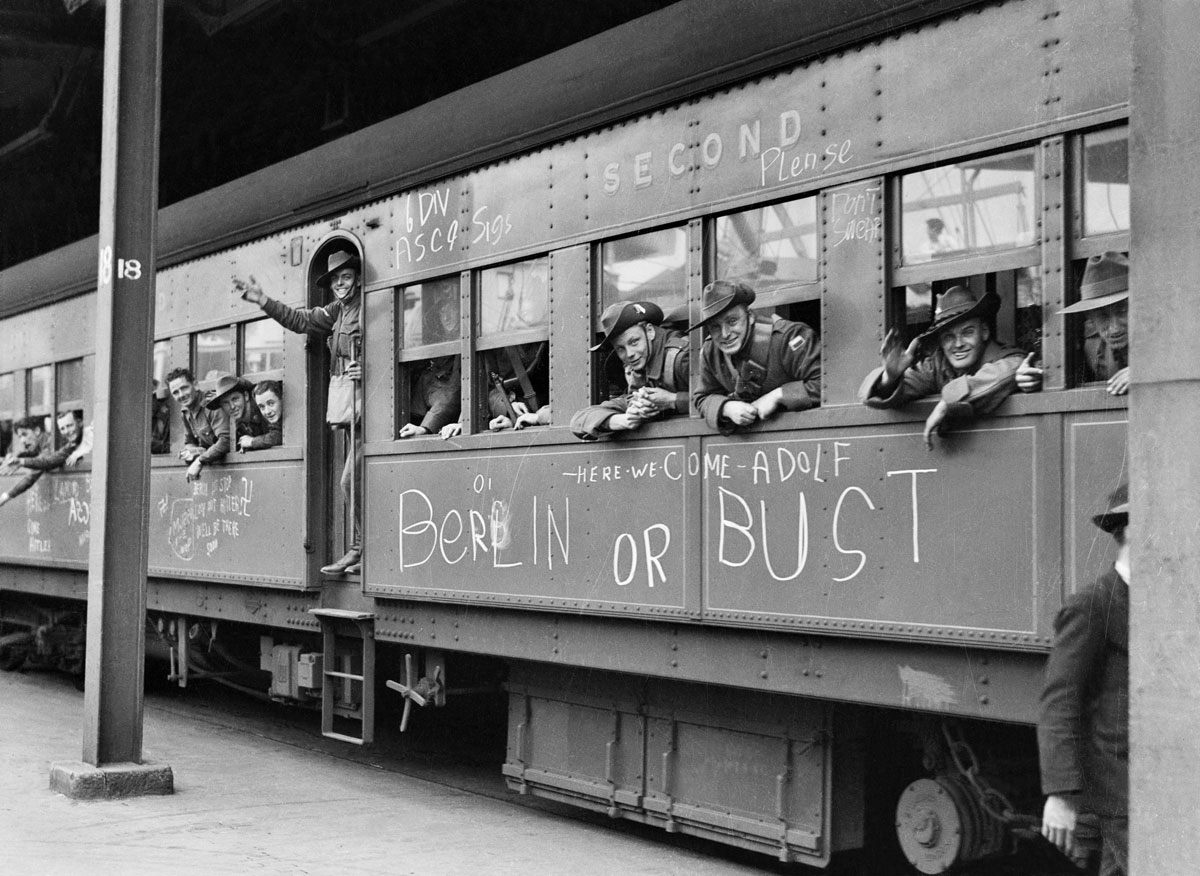
Sam Hood (Australian, 1872-1953) '6th division AIF troops waving from troop-train carriage, 13 September 1940' 1940


Sam Hood (Australian, 1872-1953)
6th division AIF troops waving from troop-train carriage, 13 September 1940
1940
© Australian War Memorial


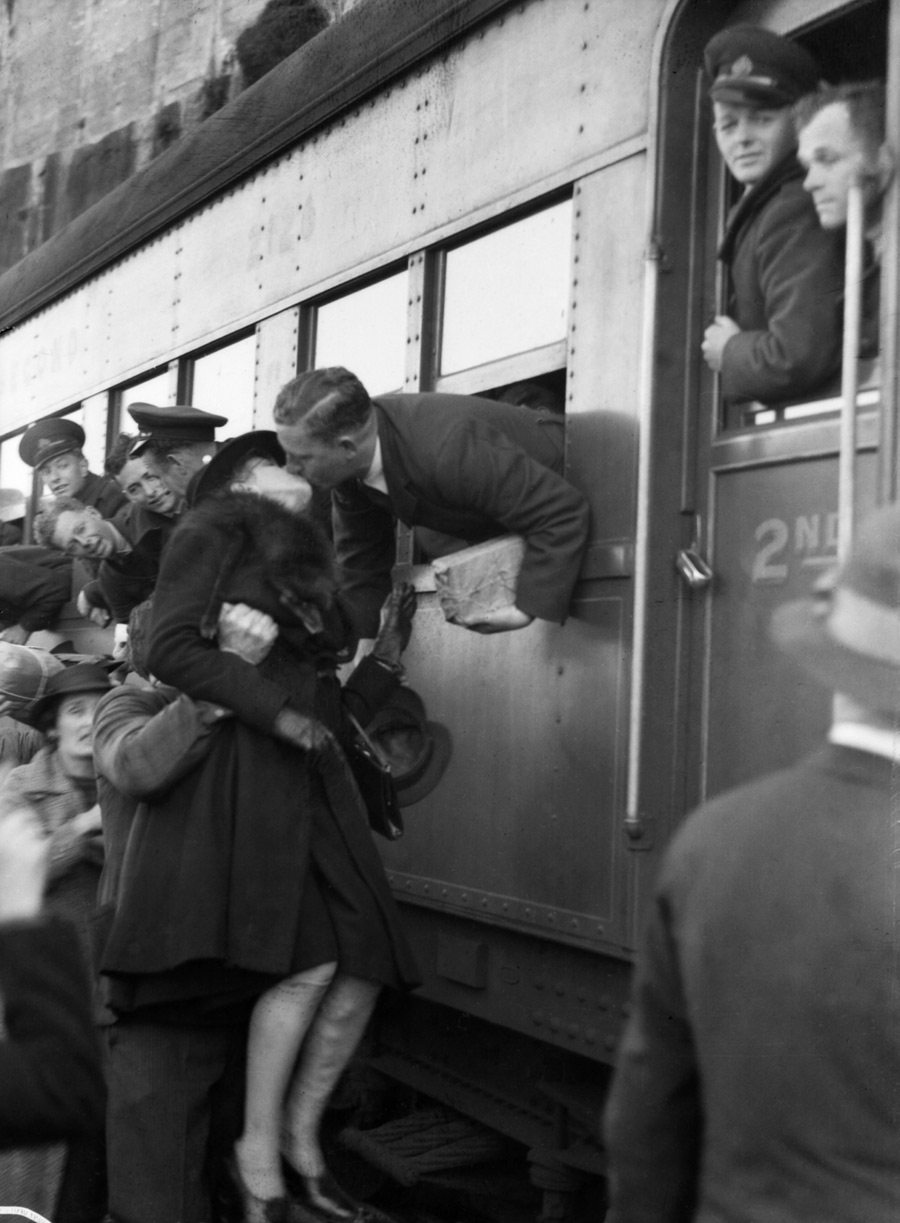
Some poignant photographs in this posting of young Australian men setting off to fight in the early stages of the Second World War. The message scrawled in chalk on the side of the train (below, at left) reads, “Berlin first stop. Look out Hitler, we’ll be there soon.” Little did they know it would be five long, hard years of fighting and countless deaths before that aphorism would come true. The 6th division AIF troops first fought in North Africa against the Italians at Tobruk and was then sent to Greece to fight the German advance. About 39 per cent of the Australian troops in Greece on 6 April 1941 were either killed, wounded or became prisoners of war. The division then fought in the Pacific War on the Kokoda Trail campaign in the New Guinea theatre until the end of the war.

I wonder how many of the men, smiling and leaning out of the train carriage or departing on a troop ship, returned to these shores?

The last photograph in the posting is so very eloquent it actually moved me to tears. The women being hoisted aloft to kiss her loved one last time – clutching her handbag, complete with rumpled, lumpy stockings. To the right (and this is what caught my eye), a man looks straight at the camera while another right next to him has this distant melancholy look on his face as though he is not actually there. A portent of things to come. Brave men, fighting in the only war that Australians have had to fight for their own freedom, not at the whim of a colonial power or overseas ally in some far of distant land. Brave men and women – we wouldn’t be here without them.

Dr Marcus Bunyan


Many thankx to the Museum of Sydney for allowing me to publish the photographs in the posting. Please click on the photographs for a larger version of the image.


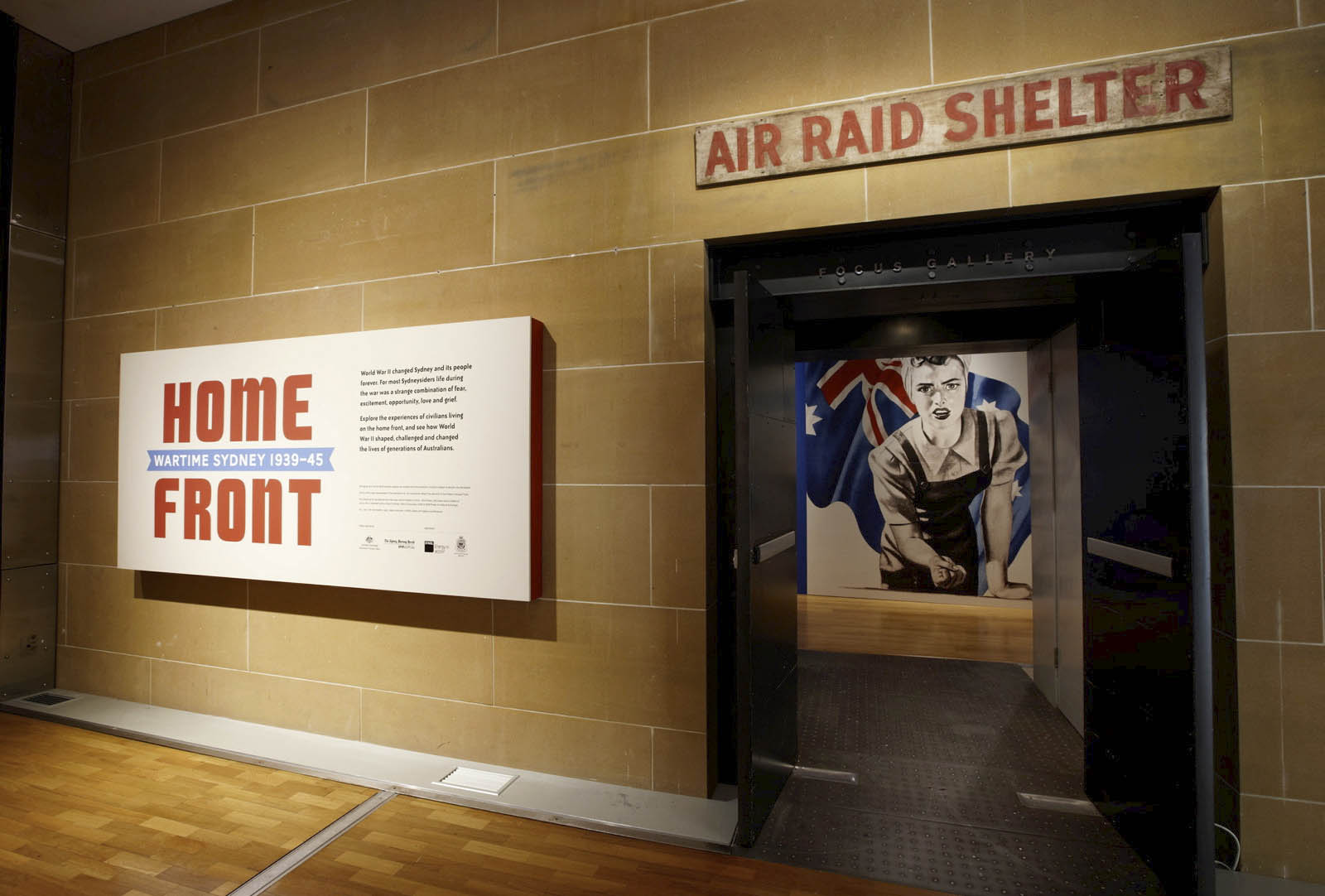
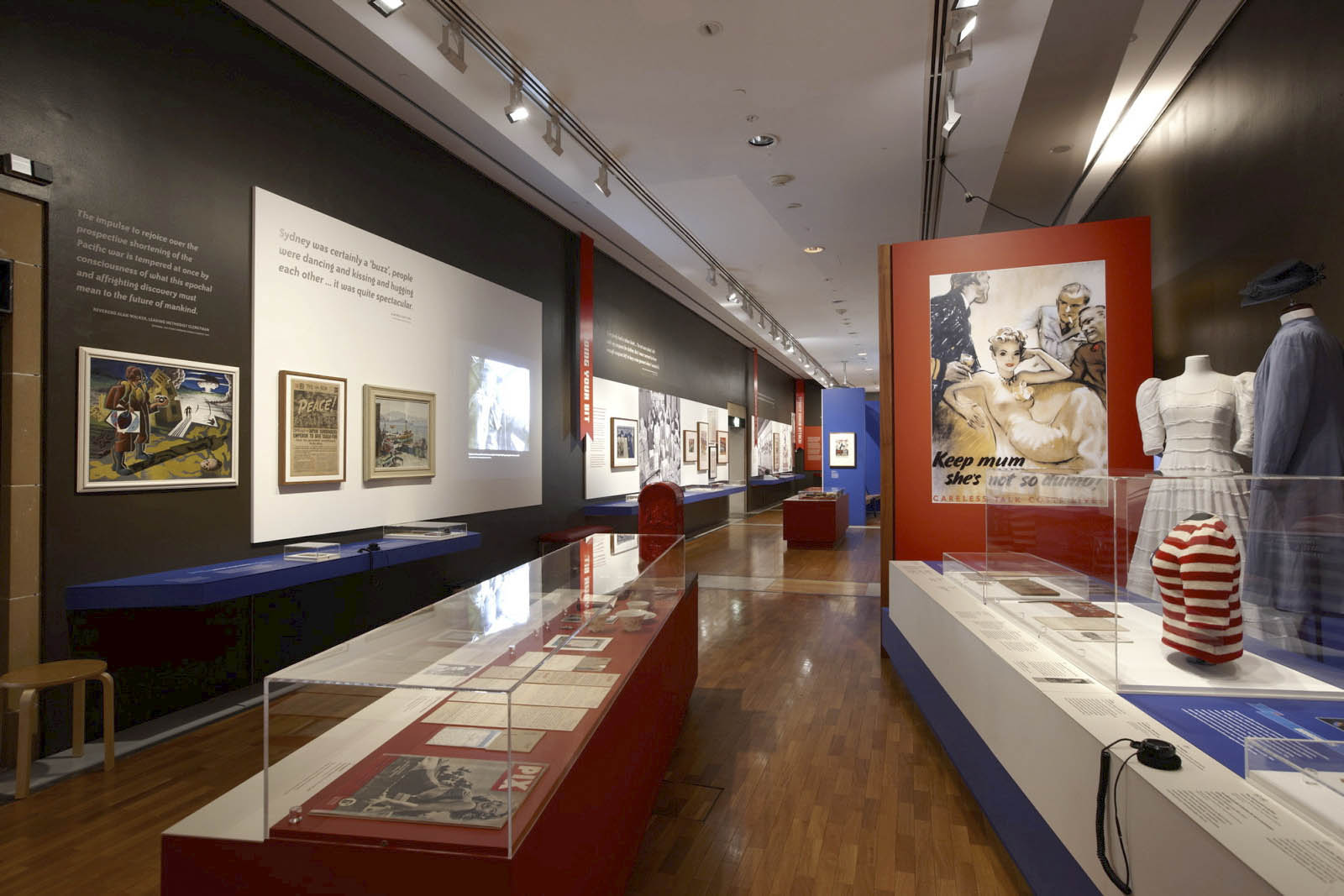
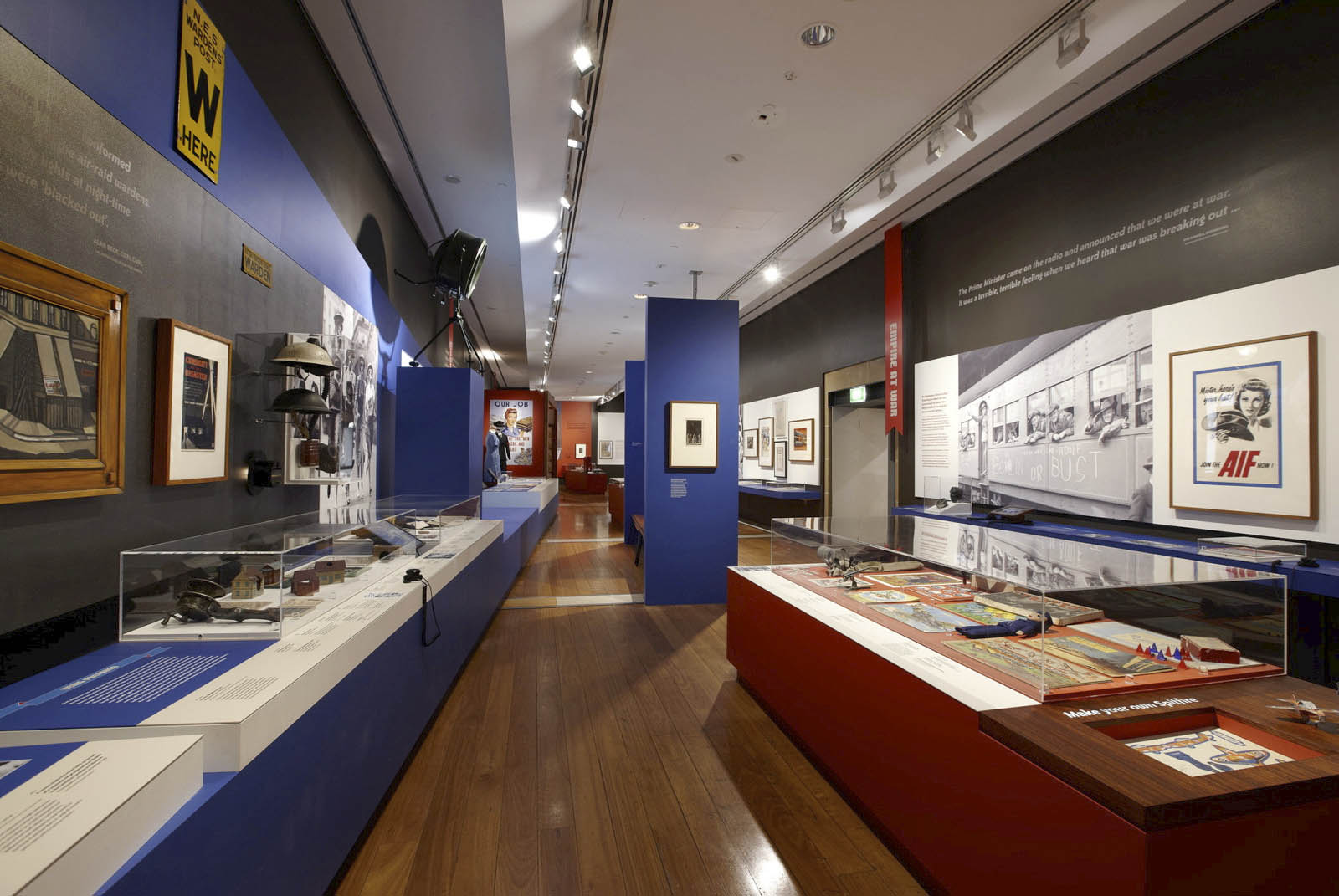
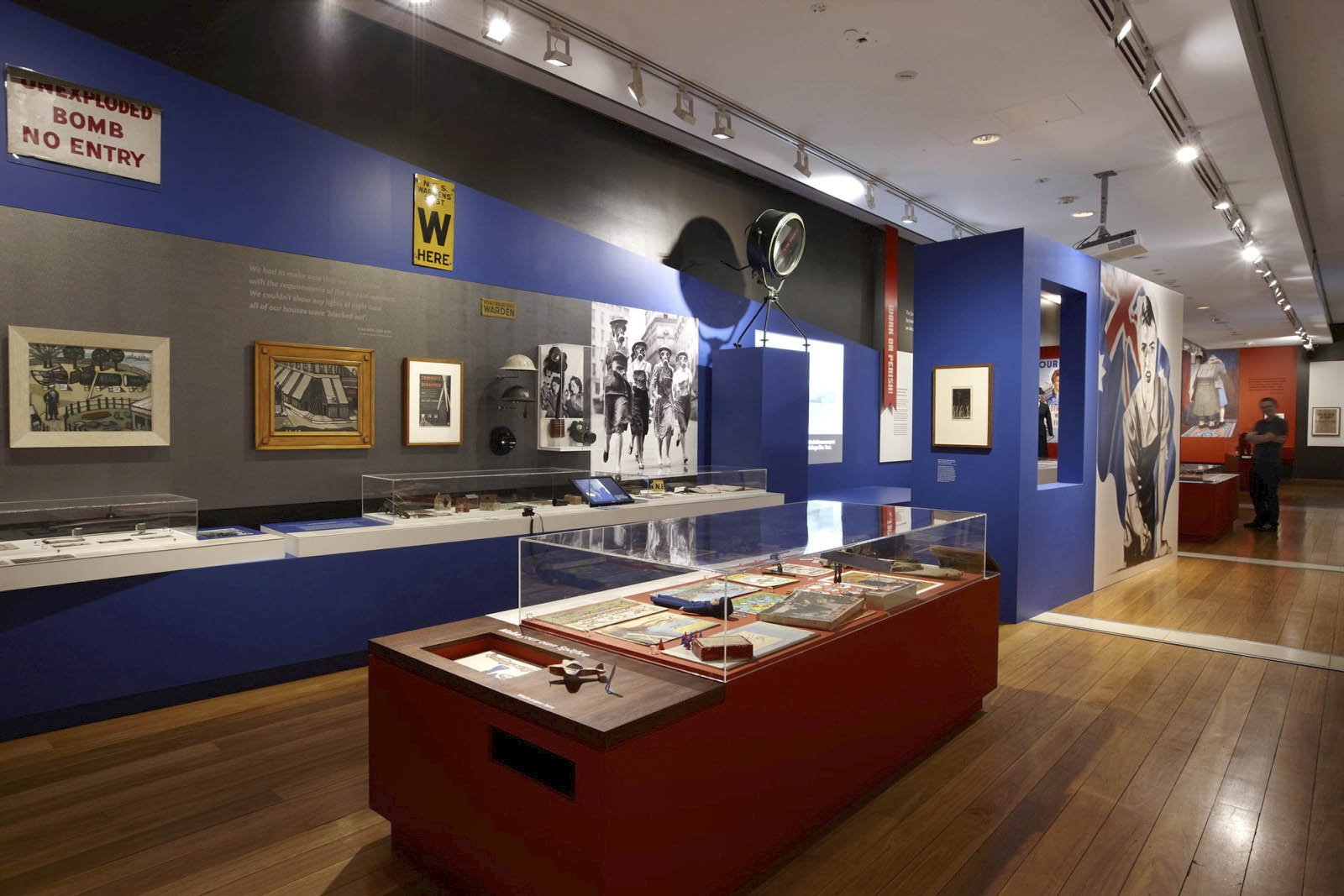
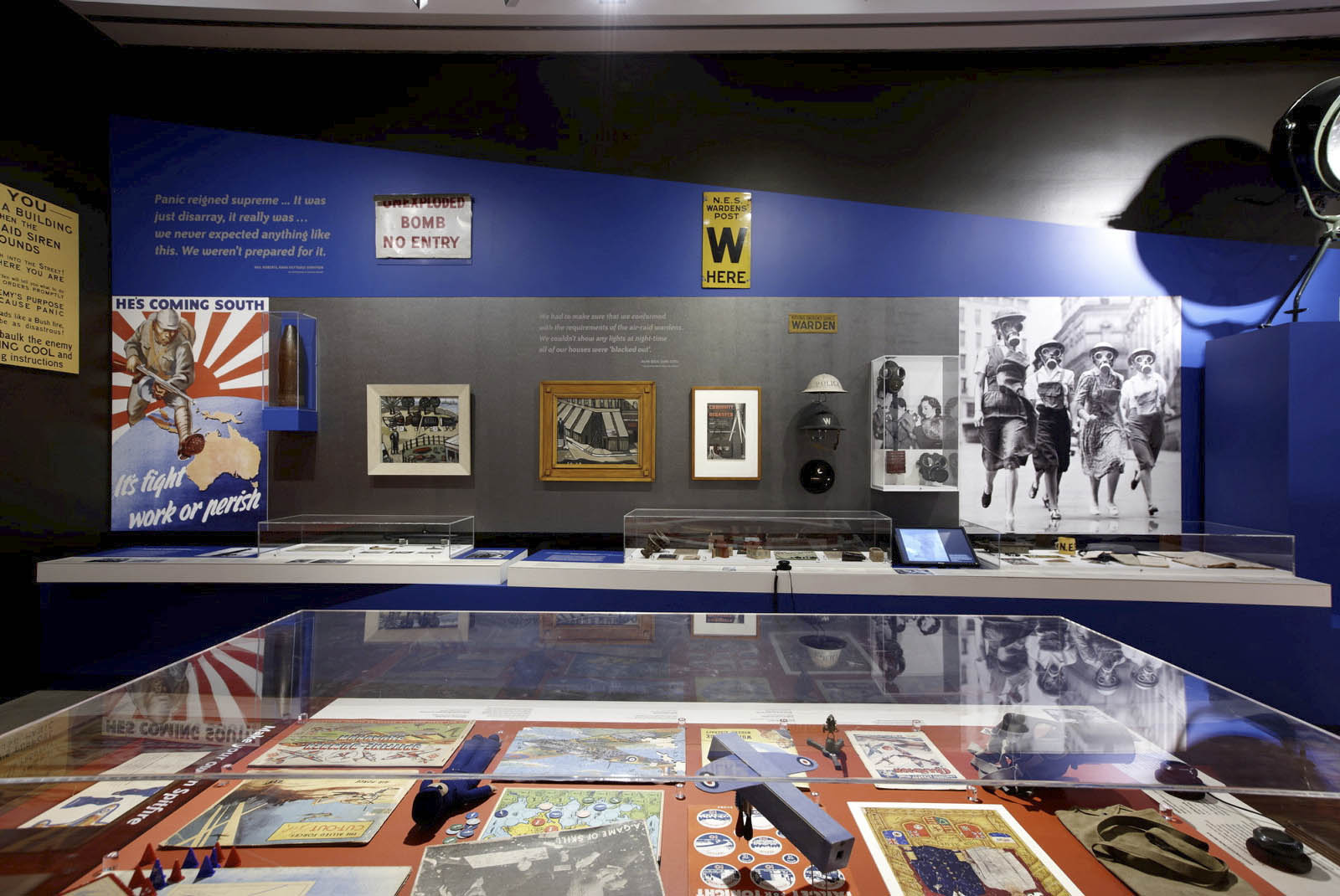
Installation view of the exhibition 'Home Front: Wartime Sydney 1939-45' at the Museum of Sydney 

Installation view of the exhibition 'Home Front: Wartime Sydney 1939-45' at the Museum of Sydney 

Installation view of the exhibition 'Home Front: Wartime Sydney 1939-45' at the Museum of Sydney 

Installation view of the exhibition 'Home Front: Wartime Sydney 1939-45' at the Museum of Sydney

Installation view of the exhibition 'Home Front: Wartime Sydney 1939-45' at the Museum of Sydney


Installation view of the exhibition Home Front: Wartime Sydney 1939-45 at the Museum of Sydney
Historic Houses Trust of NSW
Photos: Jenni Carter


Anonymous photographer. 'Troops of the 6th Division wave goodbye, Sydney 1940' 1940


Anonymous photographer
Troops of the 6th Division wave goodbye, Sydney 1940
1940
© Australian War Memorial


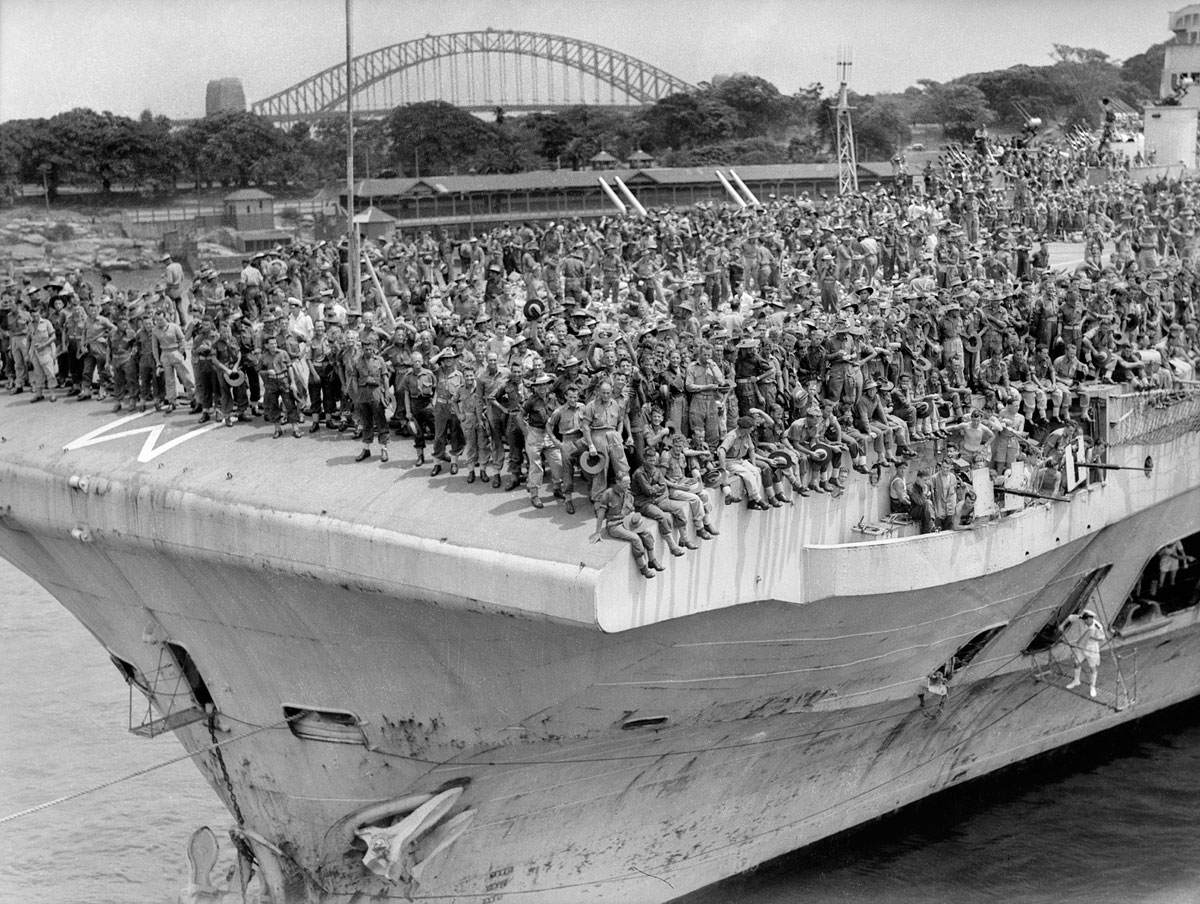
Anonymous photographer. 'Men of the 6th Division returning from Wewak crowd the deck of HMS Implacable, 18 Dec 1945' 1945


Anonymous photographer
Men of the 6th Division returning from Wewak crowd the deck of HMS Implacable, 18 Dec 1945
1945
© Australian War Memorial


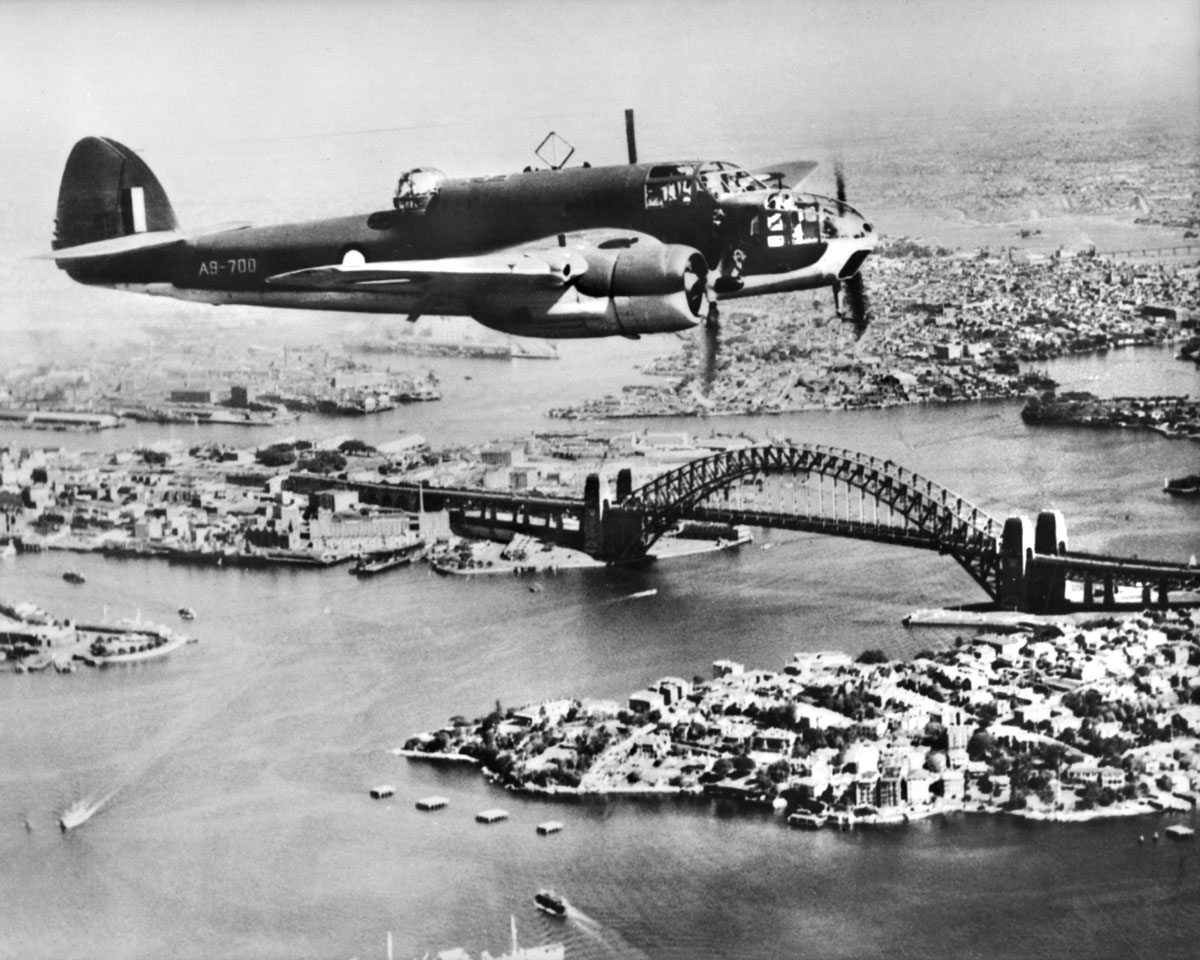
Anonymous photographer. 'An Australian built DAP Bristol Beaufort VIII aircraft, serial no A9-700, in flight over Sydney Harbour near the Bridge' c. 1944


Anonymous photographer
An Australian built DAP Bristol Beaufort VIII aircraft, serial no A9-700, in flight over Sydney Harbour near the Bridge
c. 1944
© Australian War Memorial


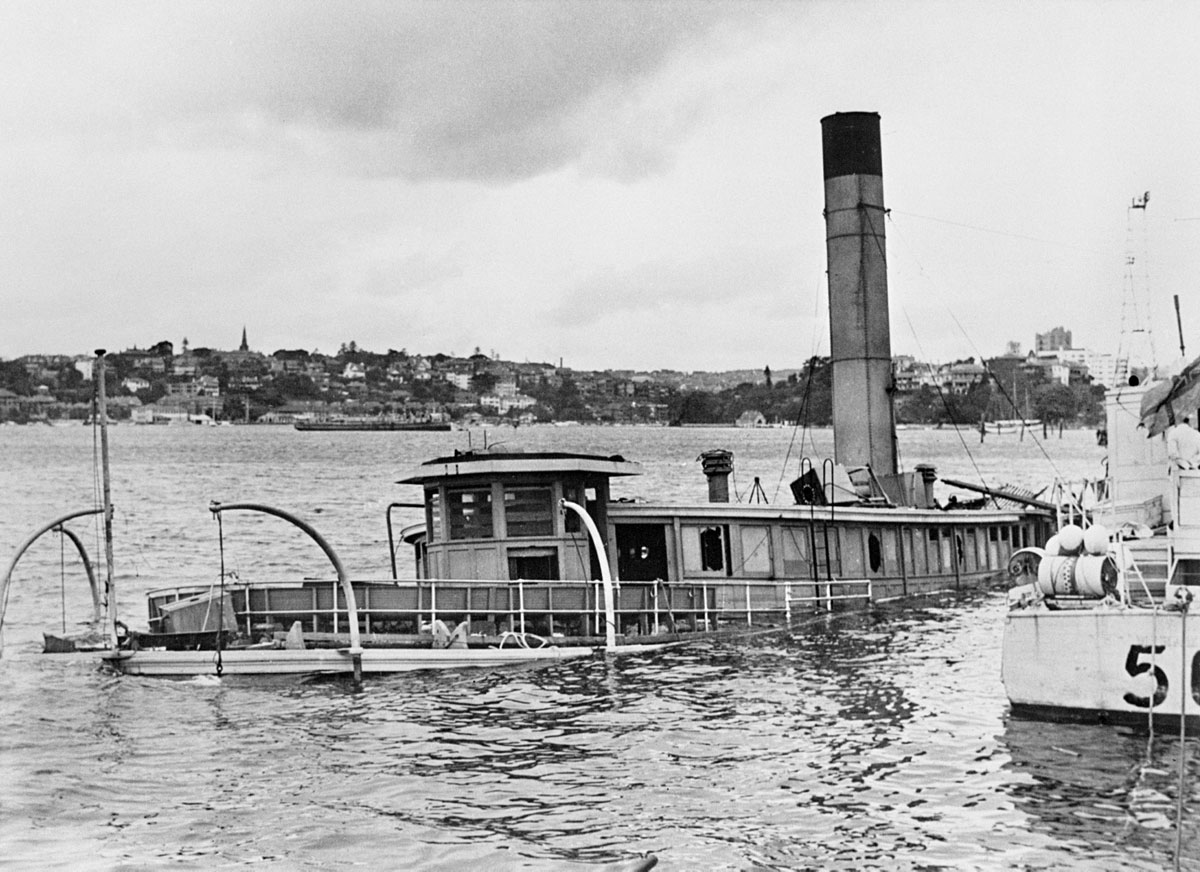
Anonymous photographer. 'Partly submerged RAN accommodation ship damaged during the unsuccessful Japanese midget submarine attack 1 June 1942' 1942


Anonymous photographer
Partly submerged RAN accommodation ship damaged during the unsuccessful Japanese midget submarine attack 1 June 1942
1942
© Australian War Memorial


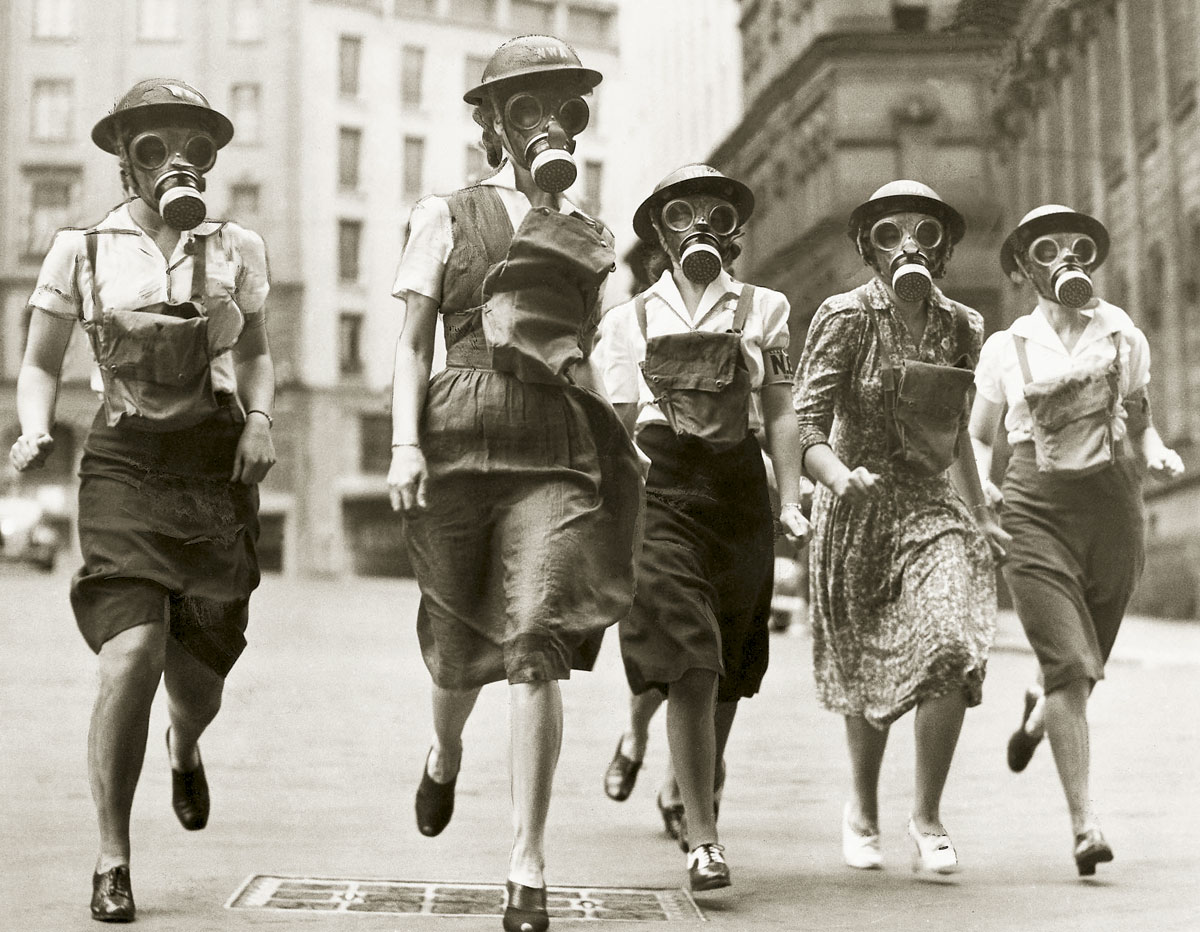
Anonymous photographer. 'Two women donning gas masks as part of an air raid drill' Nd


Anonymous photographer
Two women donning gas masks as part of an air raid drill
Nd
© Argus Newspaper Collection of Photographs, State Library of Victoria


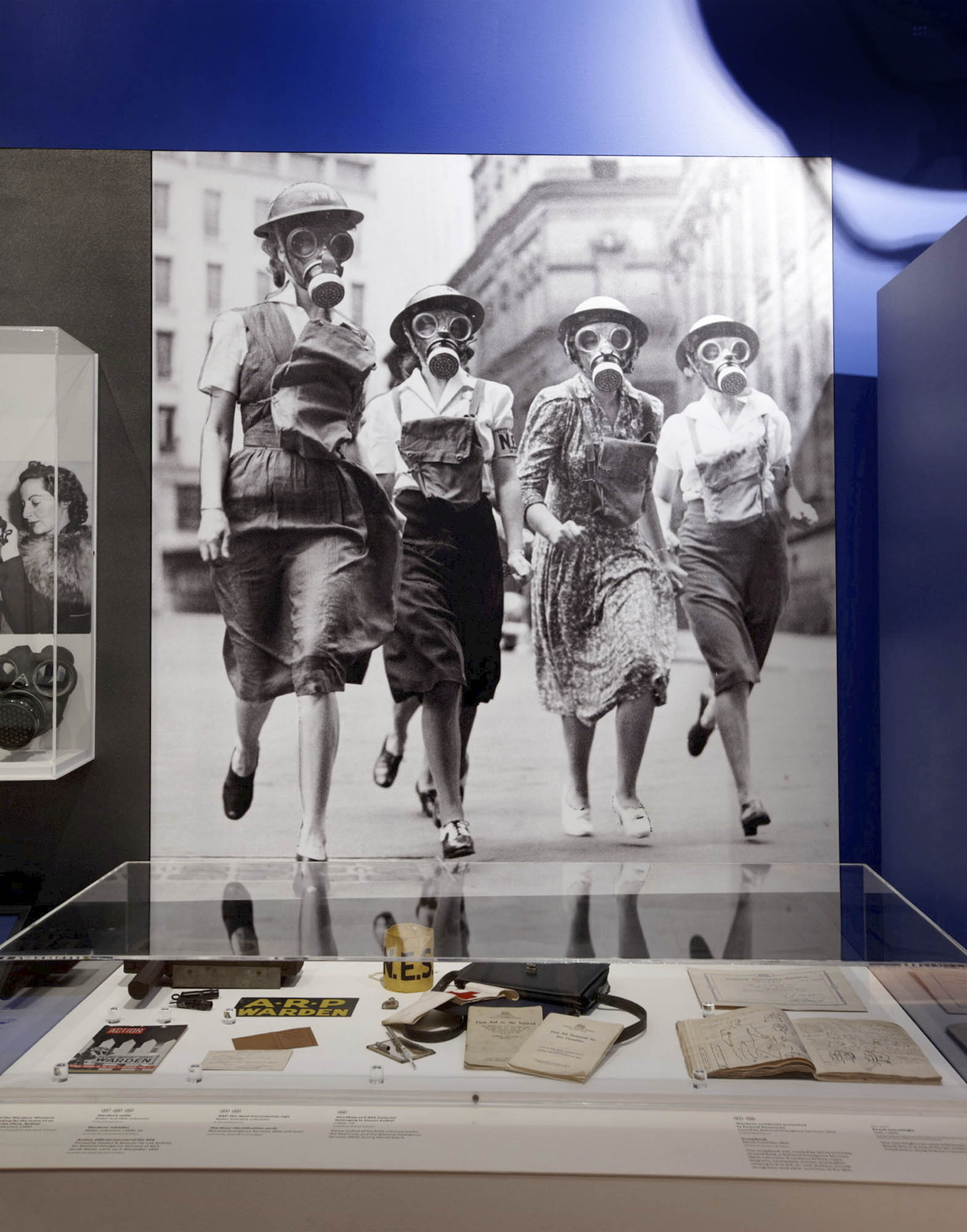
Installation view of the exhibition 'Home Front: Wartime Sydney 1939-45' at the Museum of Sydney showing at centre, a detail of 'Members of the Wardens' Women's Auxiliary making for the scene of an incident' (c. 1943) by an anonymous photographer


Installation view of the exhibition Home Front: Wartime Sydney 1939-45 at the Museum of Sydney showing at centre, a detail of Members of the Wardens’ Women’s Auxiliary making for the scene of an incident (c. 1943, below) by an anonymous photographer
Historic Houses Trust of NSW
Photo: Jenni Carter


Anonymous photographer. 'Members of the Wardens' Women's Auxiliary making for the scene of an incident' c. 1943


Anonymous photographer
Members of the Wardens’ Women’s Auxiliary making for the scene of an incident
c. 1943
© Argus Newspaper Collection of Photographs, State Library of Victoria


In May 1942 three Japanese midget submarines entered Sydney Harbour in an attempt to sink allied ships, bringing the once far away war to the shores of the harbourside city and shaking the country to its core. Coinciding with the 70th anniversary of the Japanese attack on Sydney Harbour, Home Front: Wartime Sydney 1939-45 a new exhibition opening 31 March at the Museum of Sydney, explores the experience of the women, men and children who rallied together to support the war effort from home.

Unprepared for another world war, Australians initially referred to the conflict as ‘the phoney war’, however it wasn’t long before propaganda posters were plastered around Sydney, censorship and food rationing became the norm, and tank traps and barbed wire replaced bronzed bodies on Sydney beaches. For six long years the world seemed to come to Sydney as soldiers, sailors and airmen from many nations called Sydney home, making wartime an exciting and thrilling period for some, while for others it was a long and lonely time interrupted by the occasional letter from a loved one serving overseas.

Almost 40,000 Australians lost their lives with the war leaving a lasting impact at home and transforming the lives of generations of Australians, in particular the lives of women, says Curator Annie Campbell. “As well as having to cope with war related anxieties and stress, many women were ‘manpowered’ to work in wartime industries such as ammunitions factories and aircraft construction. Everyone had to make sacrifices on the home front, however despite wartime shortages and rationing, women were expected and actively encouraged to look smart, which often involved some innovative thinking. One of my favourite objects in the exhibition is a wedding dress made out of parachute silk and mosquito net for a war bride, later worn by her sister and two girlfriends on their special days.

While the troops were busy on the battlefields, Sydneysiders prepared for the possibility of an enemy invasion on home soil. An anti-submarine boom net was installed across Sydney Harbour to keep out attacking forces, bomb shelters were constructed in Hyde Park and protective timbers were placed around landmark buildings. In 1942 blackout restrictions were introduced to limit the effectiveness of air raids, all Sydney lights were switched off and car, train and tram headlights were masked, giving the city a sinister feel. But it wasn’t all doom and gloom, large numbers of people were ready to have fun in Sydney and the Trocadero on George Street became a mecca for white American servicemen, while the Booker T Washington Club in Albion Street Surry Hills serviced the African-American GI’s,” says Campbell.

Highlights of the exhibition include the microphone used by Prime Minister Robert Menzies to announce that Australia was at war, remnants of the Japanese midget submarines that attacked Sydney, over 100 photographs and artworks depicting wartime Sydney, and a short documentary featuring historic footage. Over 200 wartime Sydney mementoes will also feature in the exhibition including propaganda posters, warden’s memorabilia, letters from soldiers serving overseas and a selection of wartime fashions.

Press release from the Museum of Sydney website


Anonymous photographer. 'Sydney kindergarten children wearing air raid headgear designed to muffle sounds and prevent them from biting tongues' Nd


Anonymous photographer
Sydney kindergarten children wearing air raid headgear designed to muffle sounds and prevent them from biting tongues
Nd
© Mitchell Library, State Library of NSW


Anonymous photographer. 'Eve Holliman, Hilda Jamieson and Vera Thurlow converting a car into an ambulance' Nd


Anonymous photographer
Eve Holliman, Hilda Jamieson and Vera Thurlow converting a car into an ambulance
Nd
© Argus Newspaper Collection of Photographs, State Library of Victoria


Anonymous photographer. 'Woman war worker' 1944


Anonymous photographer
Woman war worker
1944
© Mitchell Library, State Library of NSW


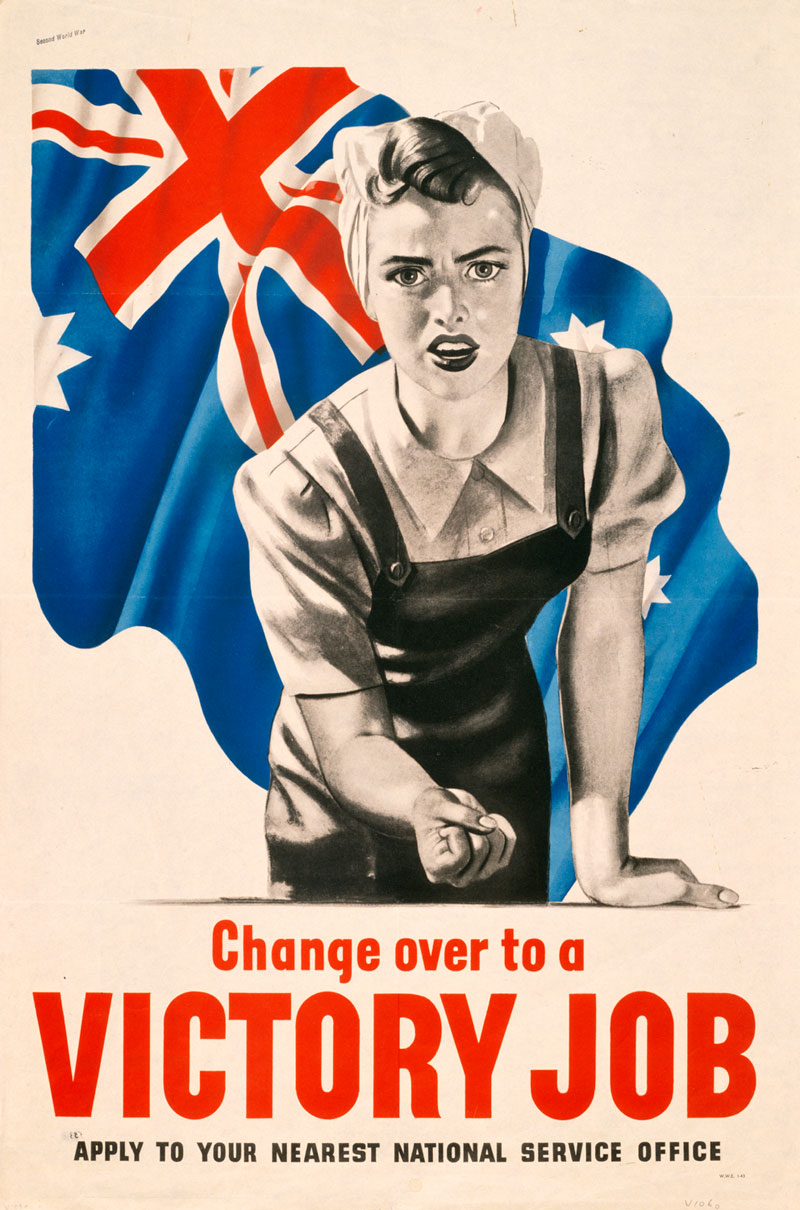
Anonymous designer and photographer. 'Change Over to a Victory Job propaganda poster' Nd


Anonymous designer and photographer
Change Over to a Victory Job propaganda poster
Nd
© Australian War Memorial


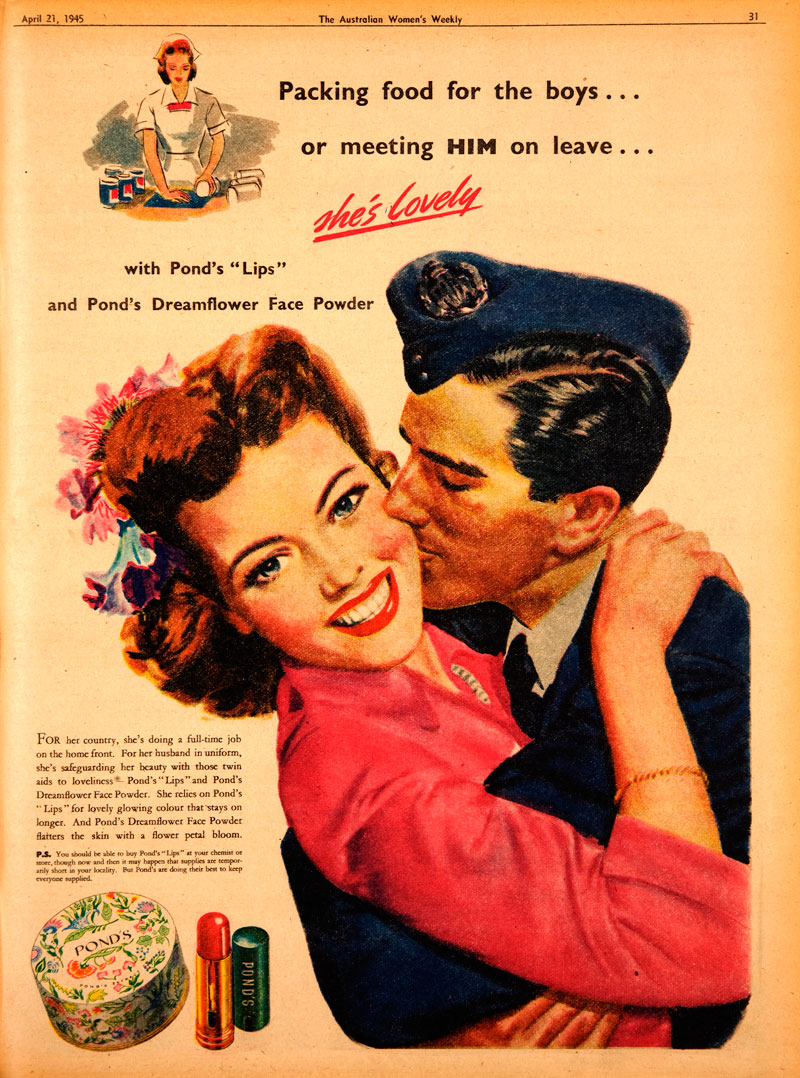
Anonymous designer and photographer. 'Advertisement for Ponds' 1945


Anonymous designer and photographer
Advertisement for Ponds
1945
© National Library of Australia


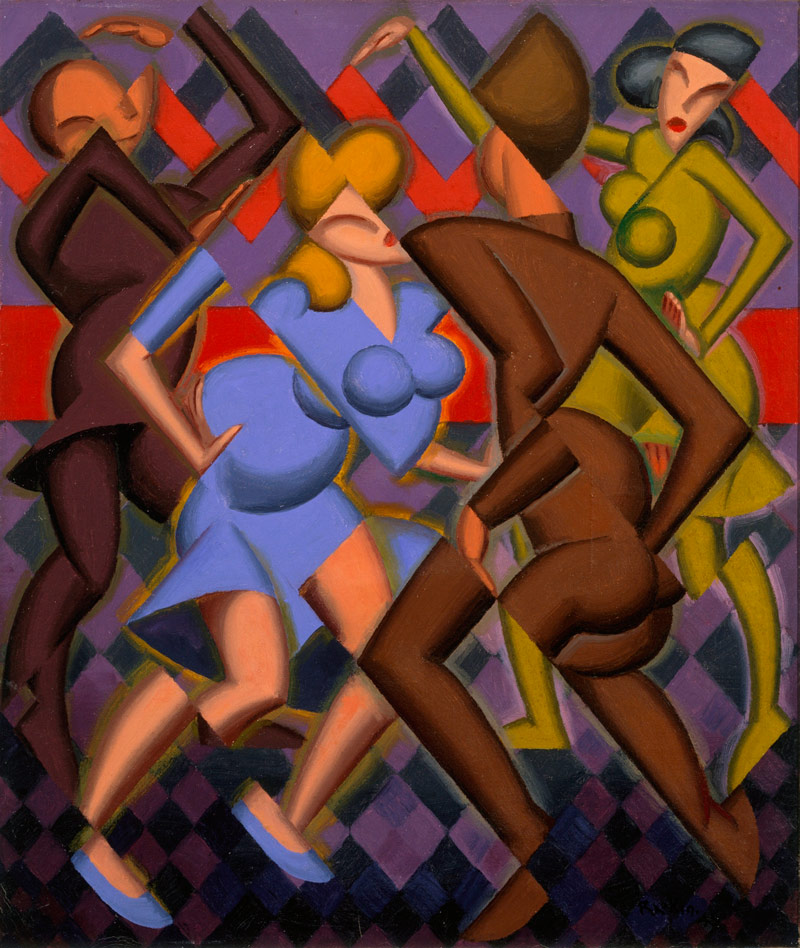
Weaver Hawkins (English, 1893-1977) 'Jitterbugs' 1945


Weaver Hawkins (English, 1893-1977)
Jitterbugs
1945
Oil on canvas, Art Gallery of New South Wales
© Estate of H F Weaver Hawkins
Photograph Jenni Carter


Sam Hood (Australian, 1872-1953) 'Sydney embarkation, 13 September 1940' 1940


Sam Hood (Australian, 1872-1953)
Sydney embarkation, 13 September 1940
1940
© Australian War Memorial


Sam Hood (Australian, 1872-1953) 'Sydney embarkation, 13 September 1940' 1940 (detail)


Sam Hood (Australian, 1872-1953)
Sydney embarkation, 13 September 1940 (detail)
1940
© Australian War Memorial


Museum of Sydney
Cnr Bridge and Phillip Streets
Sydney, NSW 2000
Phone: (02) 9251 5988

Opening hours:
Daily 10am – 5pm
Closed Good Friday and Christmas Day

Museum of Sydney website

LIKE ART BLART ON FACEBOOK

Back to top

Exhibition: ‘Icon & archive: photography & the World Wars’ at the Monash Gallery of Art, Melbourne

Exhibition dates: 16th April – 11th July, 2010


Many thankx to Mark Hislop and the Monash Gallery of Art for allowing me to reproduce the photographs in the posting. Please click on the photos for a larger version of the image.


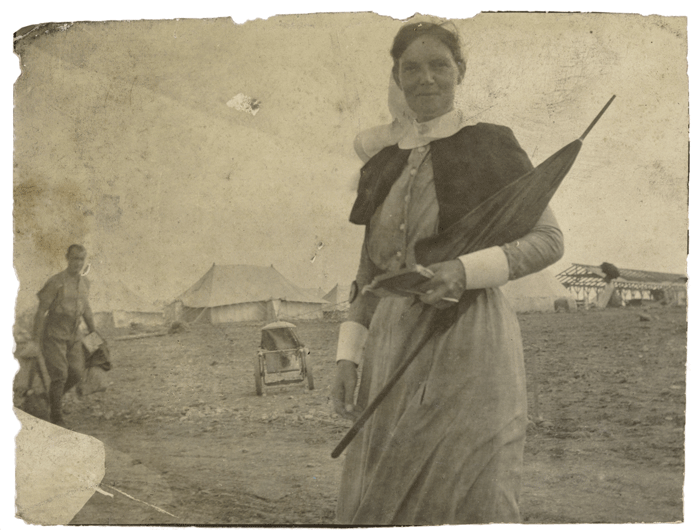
Photographer unknown. 'Matron Grace Wilson doing a round, Mudros' 1915 from the exhibition 'Icon & archive: photography & the World Wars' at the Monash Gallery of Art, Melbourne, April - July, 2010


Photographer unknown
Matron Grace Wilson doing a round, Mudros
1915
Gelatin silver print
Australian War Memorial


NOTHING could have prepared Grace Wilson for her first day at Turks Head Point on the drought-stricken island of Lemnos, where she was to run a field hospital for injured soldiers being shipped out from Gallipoli, 65km away.

“Things are just too awful for words… we found only a bare piece of ground with wounded men in pain, still in filthy, bloodstained clothes, lying amid stones and thistles,” she wrote in her diary.

Matron Wilson and her 40 nurses had arrived in the island’s Mudros harbour aboard the Dunluce Castle on August 2, 1915, to discover to their dismay there was no sign of the supply ship Ascot, which had been due there a week earlier with the tents, medical equipment, crates of tinned food and other essentials.

In a bizarre display of military pomp, a regimental piper led the women – wearing heavy, ankle-length dresses and petticoats – on a long march in searing summer heat to what would be their home for the most harrowing five months of their lives…”

Read the full article: Daryl Passmore. “Brisbane snubs unsung war heroine Matron Grace Wilson,” on The Sunday Mail (Qld) on The Courier Mail website April 21, 2013 [Online] Cited 15/10/2019


Norman Stuckey (Australian, 1914-1983) 'The Pimple, Shaggy Ridge, New Guinea' 1943 from the exhibition 'Icon & archive: photography & the World Wars' at the Monash Gallery of Art, Melbourne, April - July, 2010


Norman Bradford Stuckey (Australian, 1914-1983)
The Pimple, Shaggy Ridge, New Guinea
1943
Toned silver gelatin print
Australian War Memorial


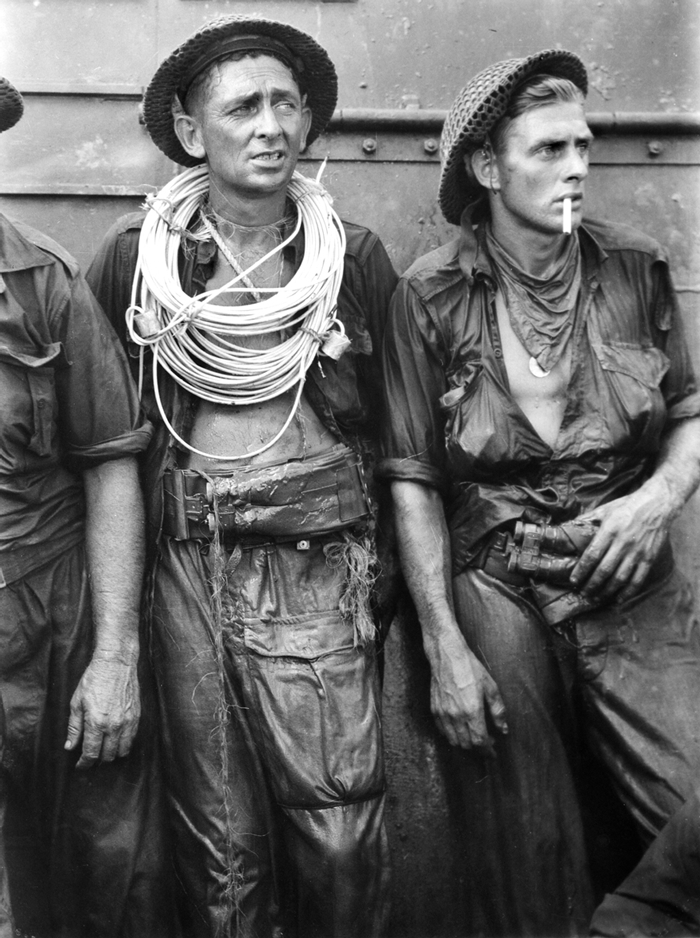
The Battle of the Shaggy Ridge was part of the Markham and Ramu Valley – Finisterre Range campaign, consisting of a number of actions fought by Australian and Japanese troops in Papua New Guinea in World War II. Following the Allied capture of Lae and Nadzab, the Australian 9th Division had been committed to a quick follow up action on the Huon Peninsula in an effort to cut off the withdrawing Japanese. Once the situation on the Huon Peninsula stabilised in late 1943, the 7th Division had pushed into the Markham and Ramu Valleys towards the Finisterre Range with a view to pushing north towards the coast around Bogadjim, where they would meet up with Allied forces advancing around the coast from the Huon Peninsula, before advancing towards Madang.

A series of minor engagements followed in the foothills of the Finisterre Range before the Australians came up against strong resistance centred around the Kankiryo Saddle and Shaggy Ridge, which consisted of several steep features, dotted with heavily defended rocky outcrops. After a preliminary assault on a forward position dubbed The Pimple in late December 1943, the Australians renewed their assault in mid-January 1944 and over the course of a fortnight eventually captured the Japanese positions on Shaggy Ridge and the Kankiryo Saddle, after launching a brigade-sized attack up three avenues of advance. In the aftermath, the Australians pursued the Japanese to the coast and subsequently took Madang, linking up with US and Australian forces.

Text from the Wikipedia website [Online] Cited 25/10/2019


Barbara Joan Isaacson (Australian, 1923-2017) 'Journalist Iris Dexter standing under the starboard engine of a Douglas C-47 aircraft' February - March 1943 from the exhibition 'Icon & archive: photography & the World Wars' at the Monash Gallery of Art, Melbourne, April - July, 2010


Barbara Joan Isaacson (Australian, 1923-2017)
Journalist Iris Dexter standing under the starboard engine of a Douglas C-47 aircraft
February-March 1943
Gelatin silver print 2008
Image courtesy of the AMW


Joan Barbara Isaacson was born into a dynamic and family. Her mother, Lynka Isaacson (also known as Caroline Isaacson), was the first female journalist to be employed by a metropolitan newspaper in Australia, and was a strong role model for her daughter. After the war Isaacson’s mother and brother set up the Southern Cross publishing business.

Isaacson attended the Melbourne Technical College, where she studied photography. When she was 18 years old she joined the Australian Women’s Army Service (AWAS). Working in the Army Public Relations section, she travelled the east coast taking documentary and recruitment propaganda photographs and meeting press journalists and photographers.

In 1943 Isaacson married Richard L. Beck, a graphic designer and photographer. During the period from 1946-1948 they set up their own photographic business in Melbourne, specialising in child portraiture. Isaacson took over the business c.1950 when her husband went back to working as a graphic designer, and continued to manage the studio until the birth of her third baby. After her departure from the photography business Isaacson was involved in a variety of other ventures and gave up her photography.

Text from the Australian Women’s Register website [Online] Cited 24/10/2019


Max Dupain (Australian, 1911-1992) 'The dozing soldier' 1943


Max Dupain (Australian, 1911-1992)
The dozing soldier (Tired Soldier in Train North Queensland)
1943
Gelatin silver print
Australian War Memorial


Photographs are an inseparable part of our memory of the First and Second World Wars. They help us remember events which many of us have no direct experience.

Monash Gallery of Art’s new special exhibition Icon & archive: photography and the World Wars draws on the Australian War Memorial’s vast photographic collection to consider the relationship of photography and war. This extraordinary exhibition opens to the public on Friday 16 April.

Direct from the Australian War Memorial, Icon & archive demonstrates the powerful role played by photography in the efforts of Australians to make sense of and remember the terrible events of the First and the Second World Wars.

“Visitors to MGA will see many ‘iconic’ photographs that have become lodged in our national memory,” said MGA Director and curator of the exhibition, Dr Shaune Lakin.

Icon & archive also presents previously unseen photographs to showcase the experiences of both service personnel and the families left behind during the wars. These photographs provide contemporary audiences with a remarkable picture of the effects of the World Wars on private, family and social life in Australia. In doing this, the exhibition will help members of our community better understand that experience and its relevance to contemporary Australia,” said Dr Lakin.

Icon & archive will play a significant role in the City of Monash’s Anzac Day commemorations, in this the 95th anniversary of the landing at Gallipoli. Icon & archive includes some of the most historically significant pictures from Gallipoli, as well as other important sites involving Australians during both the First and the Second World Wars.”

Press release from the Monash Gallery of Art website [Online] Cited 09/07/2022. No longer available online


Algemon Darge (Australian, 1878-1941) 'Private George Beamish Swanton with his wife Nellie and their young baby Joan' 1915


Algemon Darge (Australian, 1878-1941)
Private George Beamish Swanton with his wife Nellie and their young baby Joan
1915
Gelatin silver print
Australian War Memorial


Studio portrait of 1159 Private (Pte) George Beamish Swanton, Australian 24th Battalion, of Werribee, Victoria, with his wife Nellie and young baby, Joan Helen. Pte Swanton enlisted on 28 April 1915 and embarked on board HMAT Euripides on 8 May 1915. He died of wounds on 28 July 1916 at Pozieres, France. Pte Swanton had two brothers who were also killed in action; 222 Pte John (Jack) Swanton, 2nd Battalion, enlisted on 27 August 1914 and was killed in action at Gallipoli Peninsula on 2 May 1915; and 2760 Pte Henry Swanton, 29th Battalion, enlisted on 5 March 1916 and was killed in action at Pozieres, France on 2 November 1916.

This is one of a series of photographs taken by the Darge Photographic Company which had the concession to take photographs at the Broadmeadows and Seymour army camps during the First World War. In the 1930’s, the Australian War Memorial purchased the original glass negatives from Algernon Darge, along with the photographers’ notebooks. The notebooks contain brief details, usually a surname or unit name, for each negative. The names are transcribed as they appear in the notebooks.

Text from the Australian War Memorial website [Online] Cited 25/10/2019


Norman Bradford Stuckey (Australian, 1914-1983) 'Engineers exhausted after destroying obstacles, Tarakan' 1945


Norman Bradford Stuckey (Australian, 1914-1983)
Engineers exhausted after destroying obstacles, Tarakan
1945
Gelatin silver print
Australian War Memorial


The Battle of Tarakan was the first stage in the Borneo campaign of 1945. It began with an amphibious landing by Allied forces on 1 May, code-named Operation Oboe One; the Allied ground forces were drawn mainly from the Australian 26th Brigade, but included a small element of Netherlands East Indies personnel. The main objective of the landing was capture of the island’s airfield. While the battle ended with success for the Allied forces over the Japanese defenders, this victory is generally regarded as having not justified its costs. The airfield was so heavily damaged that it ultimately could not be repaired in time to make it operational for other phases of the Allied campaign in Borneo.

Text from the Wikipedia website [Online] Cited 25/10/2019


Asti Studios. 'Studio portrait of an unidentified First World War soldier in Australian service uniform' 1914-1918


Asti Studios
Studio portrait of an unidentified First World War soldier in Australian service uniform, including greatcoat and slouch hat
c. 1914-1918
New South Wales, Sydney
Toned silver gelatin print
Australian War Memorial


Monash Gallery of Art
860 Ferntree Gully Road, Wheelers Hill
Victoria 3150 Australia
Phone: + 61 3 8544 0500

Opening hours:
Tue – Fri: 10am – 5pm
Sat – Sun: 10am – 4pm
Mon/public holidays: closed

Monash Gallery of Art website

LIKE ART BLART ON FACEBOOK

Back to top