On Tuesday I visited Australian Galleries in Smith Street to view the Drought Photographs by Sidney Nolan. A wonderful experience. Thursday night was the opening of Manstyle at NGV Australia, Federation Square, the new exhibition that “explores the extremes of masculine style and some of the most influential ideas that have pervaded menswear over the past three centuries.” A lively opening with lots of milliners, designers and fashionistas but only a modicum of style from many of the men in attendance.
Friday saw a trip up Flinders Lane to visit Arc One Gallery (review of Navigating Widely by Vanila Netto), Craft Victoria and drop in and say hello to Mary Lou Jelbart, director of fortyfivedownstairs and view the extensive renovations to the office and storage areas. Always good to catch up with Mary Lou. Then onward, battling terrible traffic, to the opening of New11 at the Australian Centre for Contemporary Art (ACCA) where the work was a bit ‘thin’ with a couple of notable exceptions.
Saturday saw a drive to Albert Street, Richmond to catch up with the galleries there – mostly stable exhibitions. Wade Marynowsky’s The Hosts: A Masquerade Of Improvising Automatons at John Buckley Gallery were interesting for 10 minutes or so reminding me of evil, corseted, twirling, marionette Daleks. I then had a chat with the delightful Edwin at Sophie Gannon Gallery and saw the first stages of installation of the upcoming Daniela Federici exhibition that is part of L’Oréal Melbourne Fashion Festival. Looks to be an interesting show.
Dr Marcus Bunyan
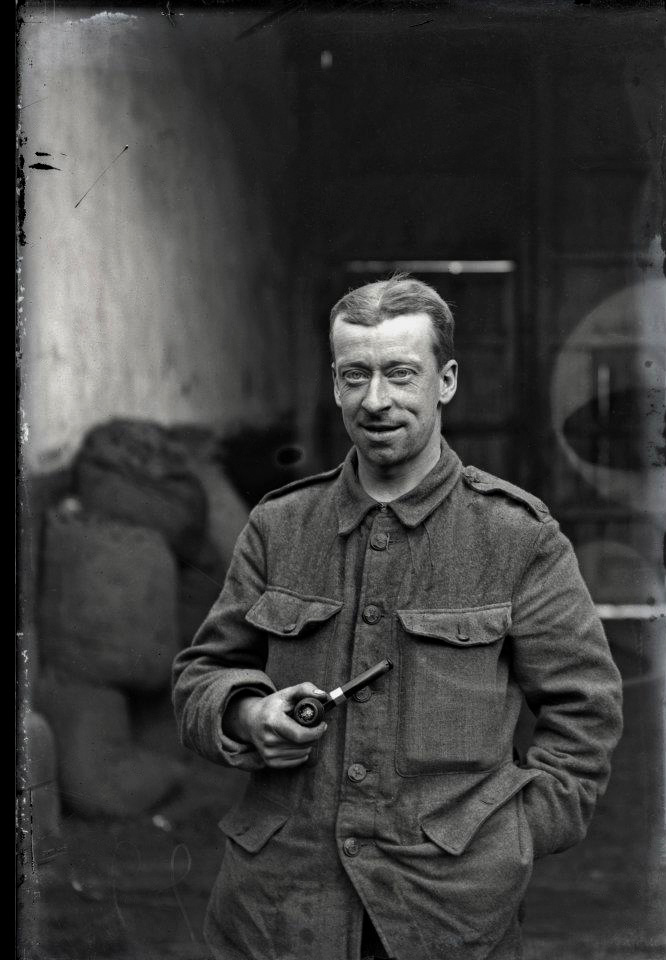
Antoinette or Louis Thuillier No title (unknown Australian soldier wearing sheepskin jerkin) c. 1916/17 Glass negative France
This image is published under fair dealing for the purposes of criticism or review (Commonwealth of Australia Consolidated Acts: Copyright Act 1968 – Sect 41)
This is a truly amazing story – finding these large format glass slides of First World War soldiers in an attic!
The original farmhouse has so much atmosphere. The photographs themselves are funny, poignant, informal, beautifully shot (the photographer, either Antoinette or Louis Thuillier, had a generous eye) and exhibit wonderful camaraderie
To actually find the original backdrop and be standing in the very place where these photographs were taken sends goose bumps up the spine just looking at the video. Imagine actually being there.
Look at the details – the hands, wedding rings, muddied boots, the children clasped by diggers with smokes in their hands, the props (chairs, motorbikes, guns, plant stands), sheepskin jerkins and the signs – We will soon, be, home, All that is left of them, France, 1916-1918.
They were so young, stoic, handsome. They stare out at you across time.
As Barthes and Sontag would say, these photographs haunt you.
View the video of the remarkable story from the link The Lost Diggers.
Look at hundreds of wonderful photographs from the links below:
Many thankx to Mark Hislop and the Monash Gallery of Art for allowing me to reproduce the photographs in the posting. Please click on the photos for a larger version of the image.
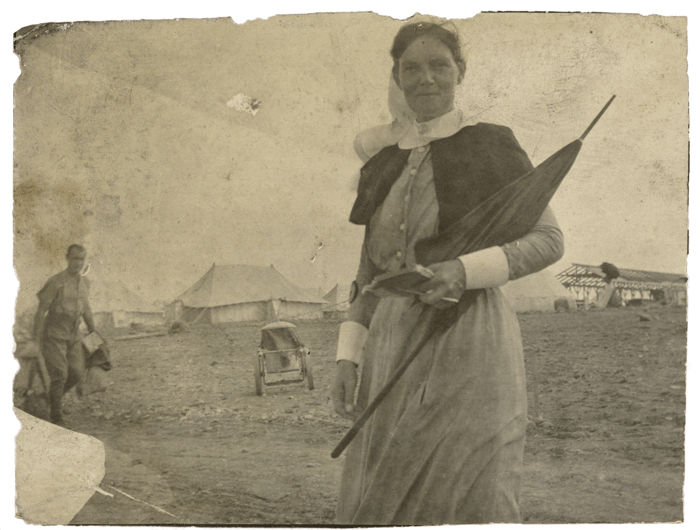
Photographer unknown Matron Grace Wilson doing a round, Mudros 1915 Gelatin silver print Australian War Memorial
NOTHING could have prepared Grace Wilson for her first day at Turks Head Point on the drought-stricken island of Lemnos, where she was to run a field hospital for injured soldiers being shipped out from Gallipoli, 65km away.
“Things are just too awful for words… we found only a bare piece of ground with wounded men in pain, still in filthy, bloodstained clothes, lying amid stones and thistles,” she wrote in her diary.
Matron Wilson and her 40 nurses had arrived in the island’s Mudros harbour aboard the Dunluce Castle on August 2, 1915, to discover to their dismay there was no sign of the supply ship Ascot, which had been due there a week earlier with the tents, medical equipment, crates of tinned food and other essentials.
In a bizarre display of military pomp, a regimental piper led the women – wearing heavy, ankle-length dresses and petticoats – on a long march in searing summer heat to what would be their home for the most harrowing five months of their lives…”
Norman Bradford Stuckey (Australian, 1914-1983) The Pimple, Shaggy Ridge, New Guinea 1943 Toned silver gelatin print Australian War Memorial
The Battle of the Shaggy Ridge was part of the Markham and Ramu Valley – Finisterre Range campaign, consisting of a number of actions fought by Australian and Japanese troops in Papua New Guinea in World War II. Following the Allied capture of Lae and Nadzab, the Australian 9th Division had been committed to a quick follow up action on the Huon Peninsula in an effort to cut off the withdrawing Japanese. Once the situation on the Huon Peninsula stabilised in late 1943, the 7th Division had pushed into the Markham and Ramu Valleys towards the Finisterre Range with a view to pushing north towards the coast around Bogadjim, where they would meet up with Allied forces advancing around the coast from the Huon Peninsula, before advancing towards Madang.
A series of minor engagements followed in the foothills of the Finisterre Range before the Australians came up against strong resistance centred around the Kankiryo Saddle and Shaggy Ridge, which consisted of several steep features, dotted with heavily defended rocky outcrops. After a preliminary assault on a forward position dubbed The Pimple in late December 1943, the Australians renewed their assault in mid-January 1944 and over the course of a fortnight eventually captured the Japanese positions on Shaggy Ridge and the Kankiryo Saddle, after launching a brigade-sized attack up three avenues of advance. In the aftermath, the Australians pursued the Japanese to the coast and subsequently took Madang, linking up with US and Australian forces.
Barbara Joan Isaacson (Australian, 1923-2017) Journalist Iris Dexter standing under the starboard engine of a Douglas C-47 aircraft February-March 1943 Gelatin silver print 2008 Image courtesy of the AMW
Joan Barbara Isaacson was born into a dynamic and family. Her mother, Lynka Isaacson (also known as Caroline Isaacson), was the first female journalist to be employed by a metropolitan newspaper in Australia, and was a strong role model for her daughter. After the war Isaacson’s mother and brother set up the Southern Cross publishing business.
Isaacson attended the Melbourne Technical College, where she studied photography. When she was 18 years old she joined the Australian Women’s Army Service (AWAS). Working in the Army Public Relations section, she travelled the east coast taking documentary and recruitment propaganda photographs and meeting press journalists and photographers.
In 1943 Isaacson married Richard L. Beck, a graphic designer and photographer. During the period from 1946-1948 they set up their own photographic business in Melbourne, specialising in child portraiture. Isaacson took over the business c.1950 when her husband went back to working as a graphic designer, and continued to manage the studio until the birth of her third baby. After her departure from the photography business Isaacson was involved in a variety of other ventures and gave up her photography.
Max Dupain (Australian, 1911-1992) The dozing soldier (Tired Soldier in Train North Queensland) 1943 Gelatin silver print Australian War Memorial
Photographs are an inseparable part of our memory of the First and Second World Wars. They help us remember events which many of us have no direct experience.
Monash Gallery of Art’s new special exhibition Icon & archive: photography and the World Wars draws on the Australian War Memorial’s vast photographic collection to consider the relationship of photography and war. This extraordinary exhibition opens to the public on Friday 16 April.
Direct from the Australian War Memorial, Icon & archive demonstrates the powerful role played by photography in the efforts of Australians to make sense of and remember the terrible events of the First and the Second World Wars.
“Visitors to MGA will see many ‘iconic’ photographs that have become lodged in our national memory,” said MGA Director and curator of the exhibition, Dr Shaune Lakin.
“Icon & archive also presents previously unseen photographs to showcase the experiences of both service personnel and the families left behind during the wars. These photographs provide contemporary audiences with a remarkable picture of the effects of the World Wars on private, family and social life in Australia. In doing this, the exhibition will help members of our community better understand that experience and its relevance to contemporary Australia,” said Dr Lakin.
Icon & archive will play a significant role in the City of Monash’s Anzac Day commemorations, in this the 95th anniversary of the landing at Gallipoli. Icon & archive includes some of the most historically significant pictures from Gallipoli, as well as other important sites involving Australians during both the First and the Second World Wars.”
Press release from the Monash Gallery of Art website [Online] Cited 09/07/2022. No longer available online
Algemon Darge (Australian, 1878-1941) Private George Beamish Swanton with his wife Nellie and their young baby Joan 1915 Gelatin silver print Australian War Memorial
Studio portrait of 1159 Private (Pte) George Beamish Swanton, Australian 24th Battalion, of Werribee, Victoria, with his wife Nellie and young baby, Joan Helen. Pte Swanton enlisted on 28 April 1915 and embarked on board HMAT Euripides on 8 May 1915. He died of wounds on 28 July 1916 at Pozieres, France. Pte Swanton had two brothers who were also killed in action; 222 Pte John (Jack) Swanton, 2nd Battalion, enlisted on 27 August 1914 and was killed in action at Gallipoli Peninsula on 2 May 1915; and 2760 Pte Henry Swanton, 29th Battalion, enlisted on 5 March 1916 and was killed in action at Pozieres, France on 2 November 1916.
This is one of a series of photographs taken by the Darge Photographic Company which had the concession to take photographs at the Broadmeadows and Seymour army camps during the First World War. In the 1930’s, the Australian War Memorial purchased the original glass negatives from Algernon Darge, along with the photographers’ notebooks. The notebooks contain brief details, usually a surname or unit name, for each negative. The names are transcribed as they appear in the notebooks.
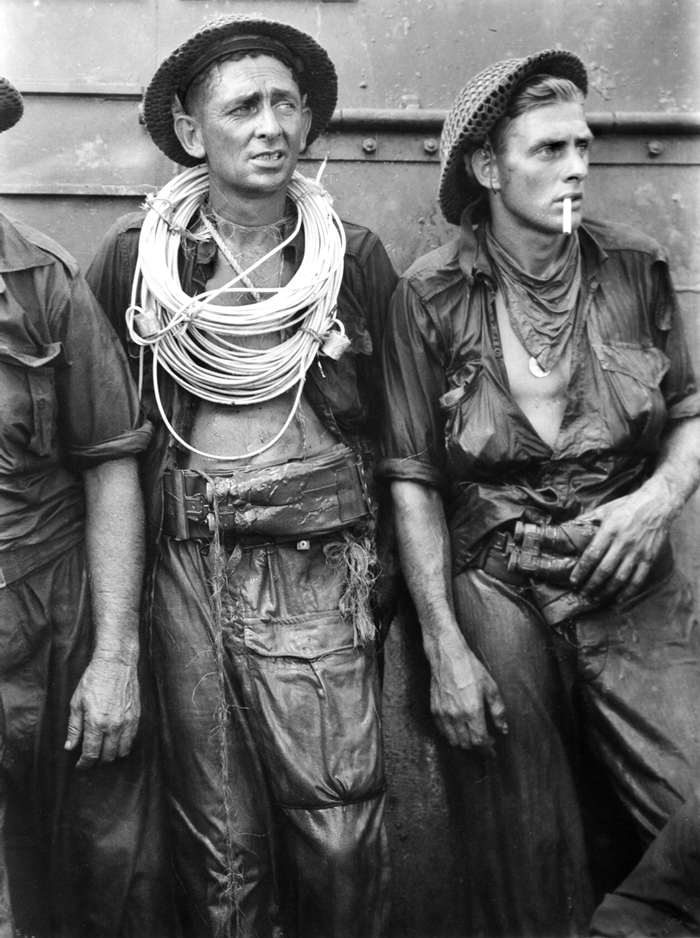
Norman Bradford Stuckey (Australian, 1914-1983) Engineers exhausted after destroying obstacles, Tarakan 1945 Gelatin silver print Australian War Memorial
The Battle of Tarakan was the first stage in the Borneo campaign of 1945. It began with an amphibious landing by Allied forces on 1 May, code-named Operation Oboe One; the Allied ground forces were drawn mainly from the Australian 26th Brigade, but included a small element of Netherlands East Indies personnel. The main objective of the landing was capture of the island’s airfield. While the battle ended with success for the Allied forces over the Japanese defenders, this victory is generally regarded as having not justified its costs. The airfield was so heavily damaged that it ultimately could not be repaired in time to make it operational for other phases of the Allied campaign in Borneo.
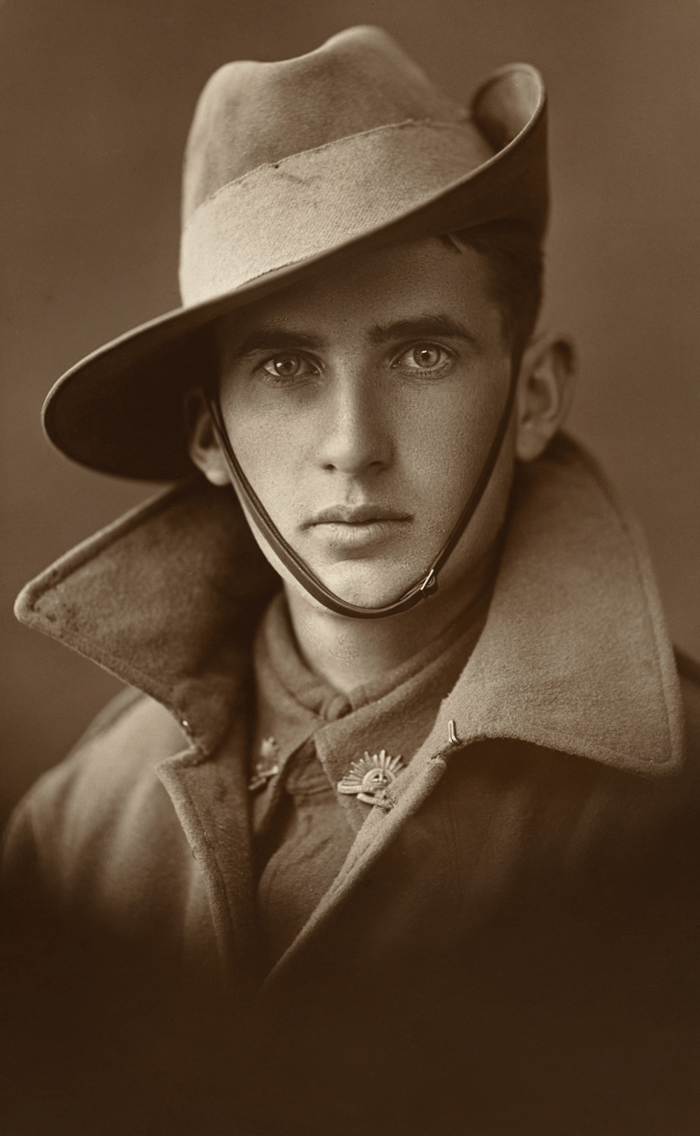
Asti Studios Studio portrait of an unidentified First World War soldier in Australian service uniform, including greatcoat and slouch hat c. 1914-1918 New South Wales, Sydney Toned silver gelatin print Australian War Memorial
Monash Gallery of Art 860 Ferntree Gully Road, Wheelers Hill Victoria 3150 Australia Phone: + 61 3 8544 0500




 Art Blart _ art and cultural memory archive
You must be logged in to post a comment.