The State of Victoria has some truly wonderful regional galleries. I hadn’t been to Castlemaine Art Gallery and Historical Museum for a few years and I had forgotten what an absolutely stunning gallery it is. Stylish art deco building, diffused natural light filling the expansive spaces of the wood floored galleries, displaying interesting art works from their collection. I particularly liked the Edward J Shearsby, Ethel Carrick, John Perceval and, my favourite, a most glorious Sydney Long Pastoral scene (1909, below).
To top off an inspirational visit, there was the most beautiful exhibition of small oil on canvas and oil on cedar panel paintings by the artist David Moore: Glimpses of Chewton. These works had me entranced. Comprised of three years work, these paintings are an exploration of the region by the artist who bought a house in the area with his partner. Moore set out to discover Chewton through driving the local roads and by doing small paintings of the views… not the big vista but the small glimpse. As I said to Moore in a recent telephone conversation, small vibrations of energy.
You can really feel that the artist has captured the frequency – and by that I mean the song line – and spiritual energy of the landscape. These are strong paintings with sensuous brush work yet they are quiet and still in their presence before you – sensitive and beautiful. I love the size of them, like small jewels, and they draw you in and hold you. The gridded hang is especially effective. For an artist to feel these vibrations of energy is one thing, for it then to be transferred into the art is an entirely, and difficult, other. The correspondence between Moore’s work and the Sydney Long Pastoral scene is quite delicious to contemplate. Apparently, these were supposed to be preparatory sketches for larger studio based work, which will eventuate over time, but once Moore had started on these “glimpses” he kept going, creating this body of work. I am so thankful that he did, and I am grateful that I visited the gallery to see them. They made my day.
Do yourself a favour, take a day trip to Castlemaine. It’s well worth the visit.
An exhibition of works painted in and around the town of Chewton, in North Central Victoria. Local artist David Moore is one of Australia’s foremost painters and was a recipient of the A.M.E Bale Residental Scholarship and the Norman Kaye award. He teaches painting in Melbourne, and is represented by Chrysalis Galleries in Melbourne.
About the Castlemaine Art Gallery and Historical Museum
Founded in 1913, the Castlemaine Art Gallery and Historical Museum has a unique collection of Australian art and fascinating historical artefacts reflecting the early history of the district. The beautiful art deco building, dating from 1931 with several extensions since then, is a work of art itself, with purpose-built galleries, lit largely by natural lighting.
The Gallery and Museum is fully accredited by Museums Australia. It is governed by private trustees and managed by a committee elected by subscribers. State and local government support is provided, and the Gallery has a strong tradition of support from benefactors, local families, artists and patrons.
Sydney Long (Australian, 1871-1955) Pastoral scene (installation view) 1909 Oil on cardboard Gift of Lady Mary Spencer 1949 Photos: Marcus Bunyan
Formerly known as Narrabeen landscape, this painting has been retitled due to uncertainty in its depiction of Narrabeen.
With paintings such as this, Long sought to produce works of the most imaginative kind from his surroundings. A panoramic vista, the artist focused on the patterns of light and shade over the landscape to create a sense of depth, leading the viewer’s eye to the blue hills in the background.
Sydney Long (Australian, 1871-1955) Pastoral scene (installation view detail) 1909 Oil on cardboard Gift of Lady Mary Spencer 1949 Photo: Marcus Bunyan
Edward J Shearsby (active c. 1900-1930 Melbourne) An Impression of Collins Street (installation view) c. 1910 Oil on board Estate of Barbara H Gordon 1999 Photo: Marcus Bunyan
The high viewpoint and bustling street are similar to Pissarro’s Boulevard Montmartre, morning, cloudy weather 1897 in the National Gallery of Victoria. Impressionism had an enormous influence on Australian artists from the late 19th century, mostly in the form of reproductions brought back by expatriate artists.
Edward J Shearsby (active c. 1900-1930 Melbourne) An Impression of Collins Street (installation view detail) c. 1910 Oil on board Estate of Barbara H Gordon 1999 Photo: Marcus Bunyan
Frederick McCubbin (Australian, 1855-1917) Golden sunlight (installation view) 1914 Oil on canvas Gift of Dame Nellie Melba 1923 Photo: Marcus Bunyan
Frederick McCubbin (Australian, 1855-1917) Golden sunlight (installation view detail) 1914 Oil on canvas Gift of Dame Nellie Melba 1923 Photo: Marcus Bunyan
The setting is below the artist’s family home on the Yarra River, South Yarra. Instead of the sight of the industrial stone crusher on the opposite bank, McCubbin has created an Arcadian fantasy of colour and light. Dame Nellie Melba possibly bought the work when she visited the McCubbin’s during an Australian tour. Melba’s father, David Mitchell, had an interest in a local Newstead mine and she visited the Gallery collection prior to donating.
The artist has used a ‘scumble’ technique: building up many layers of thinly applied paint giving a transparent effect. The composition was fist sketched in white and sienna, followed by pigment mixed on the palette and applied with a knife and brush handle to keep the colours pure. Later the work was rubbed with a pumice stone to give a smooth surface. Colours from different layers were allowed to show through. Highlights were applied over the top with paint straight from the tube.
E Phillips Fox (Australian, 1865-1915) On the Mediterranean Coast (installation view) c. 1911 Oil on canvas Presented 1935 Photo: Marcus Bunyan
Ethel Carrick (Australian, 1872-1952) Untitled (Royal Avenue, Versailles) (installation view) c. 1909 Oil on panel Gift of Major B R F MacNay 1978 Photo: Marcus Bunyan
Ethel Carrick (Australian, 1872-1952) Untitled (Royal Avenue, Versailles) (installation view detail) c. 1909 Oil on panel Gift of Major B R F MacNay 1978 Photo: Marcus Bunyan
Lina Bryans (Australian, 1909-2000) Plum Tree (installation view) 1947 Oil on composition board Purchased with funds from the Felix Cappy Bequest in his memory, 2014 Photo: Marcus Bunyan
Probably painted at Stanhope House, Eltham by the font gate near the cedar tree overlooking the old orchard on the property.
Lina Bryans (Australian, 1909-2000) Plum Tree (installation view detail) 1947 Oil on composition board Purchased with funds from the Felix Cappy Bequest in his memory, 2014 Photo: Marcus Bunyan
Lina Bryans (Australian, 1909-2000)
A modernist, Bryans was associated with Frater’s circle which included Ada May Plante and Isabel Hunter Tweddle. Her first works were painted early in 1937 and Basil Burdett selected her Backyards, South Yarra in 1938 for the Herald Exhibition of Outstanding Pictures of 1937. Her work was included in Burdett’s article in Studio (1938) and in the exhibition, Art of Australia 1788-1941, shown at MoMA (New York) in 1941. Bryans went to live in Darebin Bridge House, a converted coach-house at Darebin, in the late 1930s, joining Ada May Plante. Bryans subsequently purchased it using her inheritance, painted and decorated it distinctively and named it “The Pink Hotel”. It became an artists’ colony for Bryans, Plante, Frater, Ambrose Hallen and Ian Fairweather and other artists. It was a centre for a group of writers associated with the journal Meanjin, from whom Lina’s son Edward developed his interest in journalism.
In 1948 Bryans had her first solo exhibition. It included Nude (1945, NGV) and Portrait of Nina Christesen (1947), both painted at Darebin, which she sold later that year and moved to Harkaway, near Berwick. She took a few lessons from George Bell in 1948 and from Mary Cockburn Mercer in 1951. In 1953 she went to America, then to France where she studied for a few months at La Grande Chaumière and visited Mercer in the south of France. Back at Melbourne, she once more became prominent in the city’s artistic and cultural milieu.
Landscape painting was always important to Bryans and throughout the 1960s and 1970s, it became more dramatic and abstract. In 1965 she visited Central Australia and painted extremely colourful modernist paintings of the Australian bush. She was awarded the 1966 Crouch Prize for Embedded Rock (1964, BFAG). Her major work Landscape Quartet from her second solo exhibition, held at Georges Gallery in 1966, was purchased by the National Gallery of Victoria, which awarded her a retrospective in 1982, held at Banyule Gallery in 1982, which subsequently toured regional galleries in Victoria.
Nevertheless, as Forwood notes (2001), her portraits ‘best reveal her contribution to Australian art’, moreover, ‘her seventy-three portraits of friends engaged in the world of art and letters form a pictorial biography of Bryans herself’. Her well-known portrait of Australian writer Jean May Campbell, The Babe is Wise, (named after Campbell’s novel of the year before) was painted in 1940. It is held in the National Gallery of Victoria collection.
John Perceval (Australian, 1923-2000) Double Sunset (installation view) 1961 Oil on composition board Purchased 1962 Photo: Marcus Bunyan
John Perceval (Australian, 1923-2000) Double Sunset (installation view detail) 1961 Oil on composition board Purchased 1962 Photo: Marcus Bunyan
Charles Blackman (Australian, 1928-2018) Dream Image (installation view) 1963 Oil on canvas on composition board Purchased 1964 Photo: Marcus Bunyan
Charles Blackman (Australian, 1928-2018) Dream Image (installation view detail) 1963 Oil on canvas on composition board Purchased 1964 Photo: Marcus Bunyan
Two views of Castlemaine Art Gallery and Historical Museum with works in situ Photos: Marcus Bunyan
Clifton Pugh (Australian, 1924-1990) The Crab Catcher (installation view) 1958 Oil on composition board Purchased 1958 Photo: Marcus Bunyan
Robert Jacks (Australian, 1943-2014) Goddess (installation view) 1959-1960 Bronze Gift of the artist 2001 Photo: Marcus Bunyan
Clifford Last (Australian, 1918-1993) Family Group 1958 Limed Pine Gift of the Subscribers 1958 Photo: Marcus Bunyan
Castlemaine Art Gallery and Historical Museum 14 Lyttleton Street (PO Box 248) Castlemaine, Vic 3450 Australia Phone: (03) 5472 2292 Email:info@castlemainegallery.com
Exhibition dates: 24th July – 27th September, 2015
Curator: Wendy Garden
Hotham Street Ladies (est. Australia 2007) Dark tea (installation view) 2015 Royal icing, butter cream icing, fondant, food dye, found objects Dimensions variable Courtesy of the artists Photo: Marcus Bunyan
This is the best thematic group exhibition I have seen in Melbourne and surrounds this year.
Every piece in the exhibition is visually stimulating and intelligently constructed, all works combining to make an engaging exhibition. Nothing is superfluous, every work having something interesting to say, whether it is about the ceremony of tea drinking, colonisation, global warming, Stolen Generations or social mores. Congratulations must go to the curators and artists for their efforts.
Particular favourites where the Hotham Street Ladies Dark Tea (2015, below) made of royal icing, butter cream icing, fondant, food dye, and found objects; the many sculptural objects which form the backbone of the exhibition, especially the work of Sharon West and Penny Byrne; and the wonderful vintage photographs that are displayed in the foyer of the gallery.
Accompanying this exhibition is another excellent exhibition, Ways to draw: A selection from the permanent collection by Betty Churcher, on till 27th September as well. If you want a day out from Melbourne with lunch in Mornington, some seriously good art and a drive along the coast, you could do no better than visit the gallery in the next week. Highly recommended.
Hotham Street Ladies (est. Australia 2007) Dark tea (installation view details) 2015 Royal icing, butter cream icing, fondant, food dye, found objects Dimensions variable Courtesy of the artists Photos: Marcus Bunyan
Charles Blackman (Australian, 1928-2018) Feet beneath the table 1956 Tempera and oil on composition board 106.5 x 121.8cm National Gallery of Victoria, Melbourne Presented through the NGV Foundation by Barbara Blackman, Honorary Life Benefactor, 2005
Charles Blackman first encountered Lewis Caroll’s book, Alice in Wonderland, through a talking book for the blind which his wife, Barbara was listening to. Her developing blindness resulted in telescopic vision, spatial disorientation and a shrinking visual field. She was also pregnant with their first child and her distorted body image also had parallels with Alice’s experiences. By painting Alice at the Mad Hatter’s tea party Blackman could express his wife’s feeling of bewilderment and disorientation.
E. Phillips Fox (Australian, 1865-1915) The arbour 1910 Oil on canvas 190.5 x 230.7cm National Gallery of Victoria, Melbourne Felton Bequest 1916
Melbourne born E. Phillips Fox, described as ‘one of the greatest of Australia’s Impressionist painters and the most gifted of her colourists’1 went to Paris in 1887 to study at the Ecole des Beaux Arts where he encountered the work of the French Impressionists. He remained in Paris for several years but made frequent trips back to Melbourne to visit his family. The Arbour was painted in Paris in Fox’s garden but is based upon observations of family life in his brother’s garden in Malvern. The depiction of an elegant family taking tea al fresco is a study of refined gentility. The Arbour was exhibited at both the Royal Academy and the Paris Salon exhibitions and was regarded by Fox as the finest thing he had done.2 At the time the painting was much admired for its ‘subtle lights ad shadow’3 and his exemplary ‘use of delicate colour and refined harmonies.’4
1/ Courier Mail, 12 May 1949 2/ Sydney Morning Herald, 13 October 1913 3/ Sydney Morning Herald, 13 October 1913 4/ Le Courrier Australien, Sydney, 15 April 1949
Clare Humphries (Australian, b. 1973) Some things were out in the open 2007 Pigment print on Hahnemühle photo rag paper (ed. 3/5) 63 x 62cm Courtesy of the artist
Adam Hill (Blak Douglas) (Australian, b. 1970) Not everyone’s cup of tea 2009 Synthetic polymer paint on canvas 150 x 260cm National Gallery of Australia, Canberra Purchased 2009
Kendal Murray (Australian, b. 1958) Exceed speed, mislead, concede 2011 Mixed media assemblage 18 x 24 x 14cm Courtesy of the artist and Arthouse Gallery, Sydney
Penny Byrne (Australian, b. 1965) Tea for two in Tuvalu 2011 Vintage porcelain figurine, vintage, Action man accessories, vintage coral, glass fish, epoxy resin, epoxy putty, retouching medium, powder pigments 15 x 19cm Private Collection
Penny Byrne (Australian, b. 1965) Tea for two in Tuvalu (installation view) 2011 Vintage porcelain figurine, vintage, Action man accessories, vintage coral, glass fish, epoxy resin, epoxy putty, retouching medium, powder pigments 15 x 19cm Private Collection Photo: Marcus Bunyan
This piece was inspired by an underwater cabinet meeting held in 2009 by Maldives President Mohammed Nasheed in a campaign to raise awareness for activity on climate change. The thirty minute meeting was held six metres below sea level and was attended by eleven cabinet members calling upon all countries to cut their emissions to halt further temperature rises.
Polynesian island nation of Tuvalu, located in the Pacific Ocean midway between Hawaii and Australia, experienced a severe drought in 2011. A state of emergency was declared and rationing of fresh-water took place which restricted households on some of the islands to two buckets of fresh water per day. Tuvalu is also especially susceptible to changes in sea level and it is estimated that a sea level rise of 20 to 40 centimetres in the next 100 years could make Tuvalu uninhabitable.
Kate Bergin (Australian, b. 1968) The hunt for a room of one’s own 2012 Oil on canvas on board 75 x 101cm Private Collection
Kate Bergin draws upon Dutch and Flemish seventeenth century tradition of still life painting to comment on our attitudes to animals. Bergin stages the scene on a crumpled white tablecloth upon which a large fox, based on a taxidermy fox she bought on eBay, regally sits centre stage. Meticulously rendered native birds, including a honeyeater, finch and triller, are based on photographs of specimens from the Melbourne Museum Collection. They flit about unperturbed by the introduced predator. Teaspoons, representing the impulse for collecting, entangle the fox and bird. Together with a teapot and cup, precariously placed, they contribute to the overarching sense of impending chaos.
Both afternoon tea and the fox represent English upper class social mores and were introduced into the colonies following British settlement. The fox arrived in 1855, brought in for recreational hunting, and has been a major cause of native bird extinctions. Fox numbers are increasing in some areas further threatening the precarious balance between wild life and introduced species.
Sharon West (Australian, b. 1963) Two Koori Tribesmen receive a gift of afternoon tea from local colonists (installation photo) 2014 Mixed media assemblage 15 x 46 x 30cm Courtesy of the artist Photo: Marcus Bunyan
Heather Shimmen (Australian, b. 1957) Tip me up (installation view) 2005 Linocut on paper and organza (ed. 7/30) 56 x 76cm Courtesy of the artist and Australian Galleries, Melbourne and Sydney Photo: Marcus Bunyan
Trent Jansen (Australian, b. 1981) Briggs family tea service (installation view) 2011 Slip cast porcelain, bull kelp, wallaby pelt, copper and brass George (teapot) 22.5 x 20.5 x 13cm; Woretermoeteyenner (sugar bowl) 16 x 13.5 x 9cm; Dolly (milk jug) 12.5 x 12.5 x 8.5cm; John (teacup) 7 x 8.5 x 8cm; Eliza (teacup) 7.5 x 10.5 x 8cm; Mary (teacup) 10 x 9 x 6.5cm Courtesy of Broached Commissions, Melbourne Photo: Marcus Bunyan
The Briggs family tea service represents the marriage of George Briggs, a free settler, to Woretermoeteyenner of the Pairrebeenne people in Van Diemen’s Land and the four children they had together. Briggs arrived from Bedfordshire in 1791 and learned to speak the language of the local Pairrebeenne people, trading tea, flour and sugar fro kangaroo, wallaby and seal skins. It is understood that he became good friends with the leader of the Pairrebeenne people, Mannalargenna, and by 1810 he partnered his daughter Woretermoeteyenner. Their marriage meant she had to adapt to a way of life that merged her traditional cultural values with the ways of British settlers. The teapot and sugar bowl represent the parents while their first daughter, Doll Mountgarret Briggs is symbolised in the milk jug and the three cups each signify their other children John, Eliza and Mary.
The tea service is a hybrid design bringing together materials common to both cultures. To realise the set Jansen worked with Rod Bamford on the ceramic elements, Oliver Smith for the brass and copper and Vicki West, who uses the traditional methods of her Tasmanian Aboriginal ancestors, worked with the bull kelp components.
eX de Medici (Australian, b. 1959) Blue (Bower-Bauer) (installation view) 1998-2000 Watercolour over black pencil on paper 114.0 x 152.8cm National Gallery of Australia, Canberra Purchased 2004 Photo: Marcus Bunyan
eX de Medici (Australian, b. 1959) Blue (Bower-Bauer) (installation view detail) 1998-2000 Watercolour over black pencil on paper 114.0 x 152.8cm National Gallery of Australia, Canberra Purchased 2004 Photo: Marcus Bunyan
A turning point in eX de Medici’s career came in 1998 when she saw an exhibition of watercolours by Ferdinand Bauer comprising 2,000 rarely seen images of native flora and fauna made when Bauer was official artist on Matthew Flinder’s historic circumnavigation of Australia in 1801-1803. Previously working with tattoo imagery, Medici found the intricate works so compelling she decided to change course and ‘retrograde’ herself and explore watercolour as a medium.1
Referencing Australia’s Bower bird that adorns its nest with anything blue, Medici entangles the history of vanitas painting with commentary about the desire to seek permanence and affirmation in the accumulation of things. The broken willow pattern platter, upturned jugs and cups, amassed with so many other decorative and functional objects, are juxtaposed with skulls, fruit and flowers – symbols of mortality. A reaction to what she considered John Howard’s regressive politics at the time, the work ‘is a kind of a backhanded discussion about colonising our minds with retroactive ideas’.2
1/ Ted Gott. ‘eX deMedici an epic journey on a Lilliputian scale’ Art and Australia Vol. 40, No. 1, Spring 2002, p. 105 2/ eX deMedici in Paul Flynn. Artist Profile #5, March 2008, pp. 28-35.
Storm in a Teacup reflects upon tea drinking in Australia. Introduced by the British colonials, the afternoon tea party was an attempt to ‘civilise’ the land. Tea drinking became so popular in the colonies that by 1888 the amount of tea consumed per capita exceeded the amount consumed in England. Soon after, billy tea was to become an enduring symbol of the pioneering spirit, immortalised by Henry Lawson’s stories published under the title While the billy boils.
Beginning with elegant paintings of the afternoon tea table from E. Phillips Fox and Arthur Streeton, the exhibition goes on to explore the darker side of tea drinking and the social and environmental impacts of the humble cup of tea. Michael Cook’s Object (table), 2015, provides an alternative history to the narrative of colonialism while Sharon West and Adam Hill both use humour to subvert colonial understandings of the afternoon tea party as an occasion of refined gentility.
The humble cuppa has been around for thousands of years, but this exhibition explores how a popular beverage can impact on us culturally, socially, environmentally and politically. There is more to debate than just the proper way to make a cup of tea. Storm in a teacup explores far-reaching issues brewing from tea, including the imposition of one culture upon another – especially on the colonial frontier; the production of ceramics and the environmental impacts of porcelain and its production; gender stereotypes and socialisation through tea parties. The exhibition also reflects upon tea drinking ceremonies in Asia within a western Orientalist paradigm and tea drinking as an occasion for familial cohesiveness and disconnect.
Text from the Mornington Peninsula Regional Art Gallery
Mark James Daniel (Australian, 1867-1949) Verandah, “Harefield” – afternoon tea Feb 1900 Glass negative 8.5 x 11cm (quarter plate) Collection of the State Library of Victoria
Michael J Drew (Australian, 1873-1943) Group taking tea in a garden between 1890 and 1900 Glass negative 12.2 x 16.5cm (half plate) Collection of the State Library of Victoria
Rex Hazlewood (Australian, 1886-1968) [Men drinking billy tea] 1911-1927 Silver gelatin print Collection of the State Library of New South Wales
Anonymous photographer Afternoon tea at “Vivaleigh” 1917 Gelatin silver print 12 x 16cm Collection of the State Library of Victoria
James Fox Barnard (Australian, 1874-1945) Lawn, Arylie, Hobart c. 1900 Glass negative 8.5 x 11cm (quarter plate) Collection of the State Library of Victoria
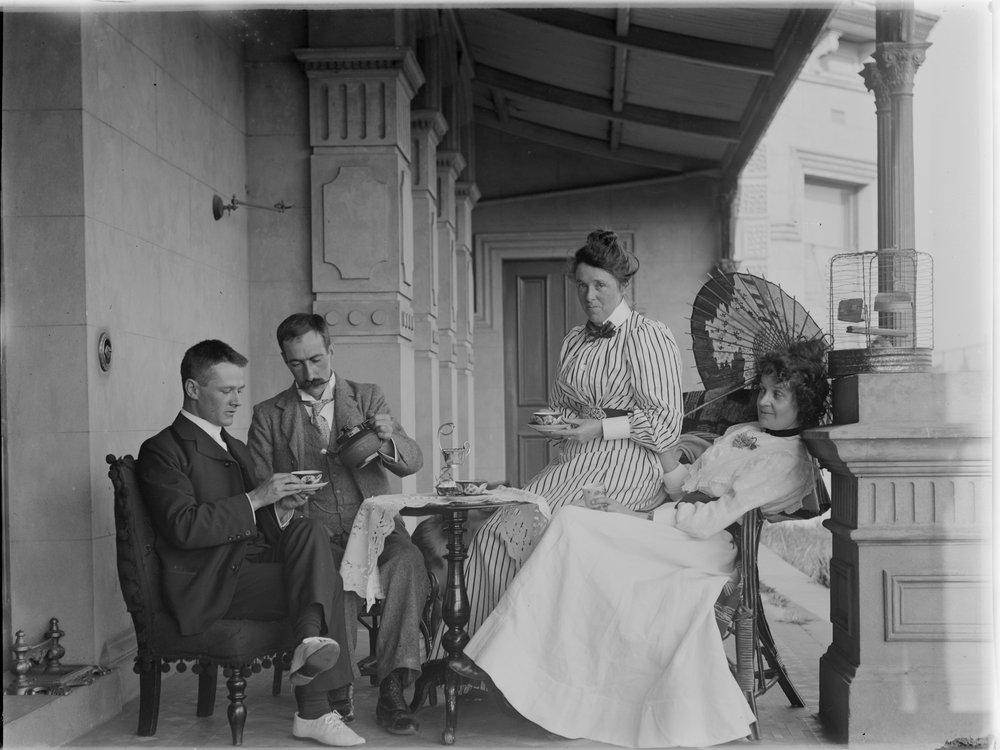
James Fox Barnard (Australian, 1874-1945) [Tea on the verandah] c. 1900 Glass negative 8.5 x 11cm (quarter plate) Collection of the State Library of Victoria
Installation photograph of the exhibition Storm in a Teacup at the Mornington Peninsula Regional Art Gallery Photos: Marcus Bunyan
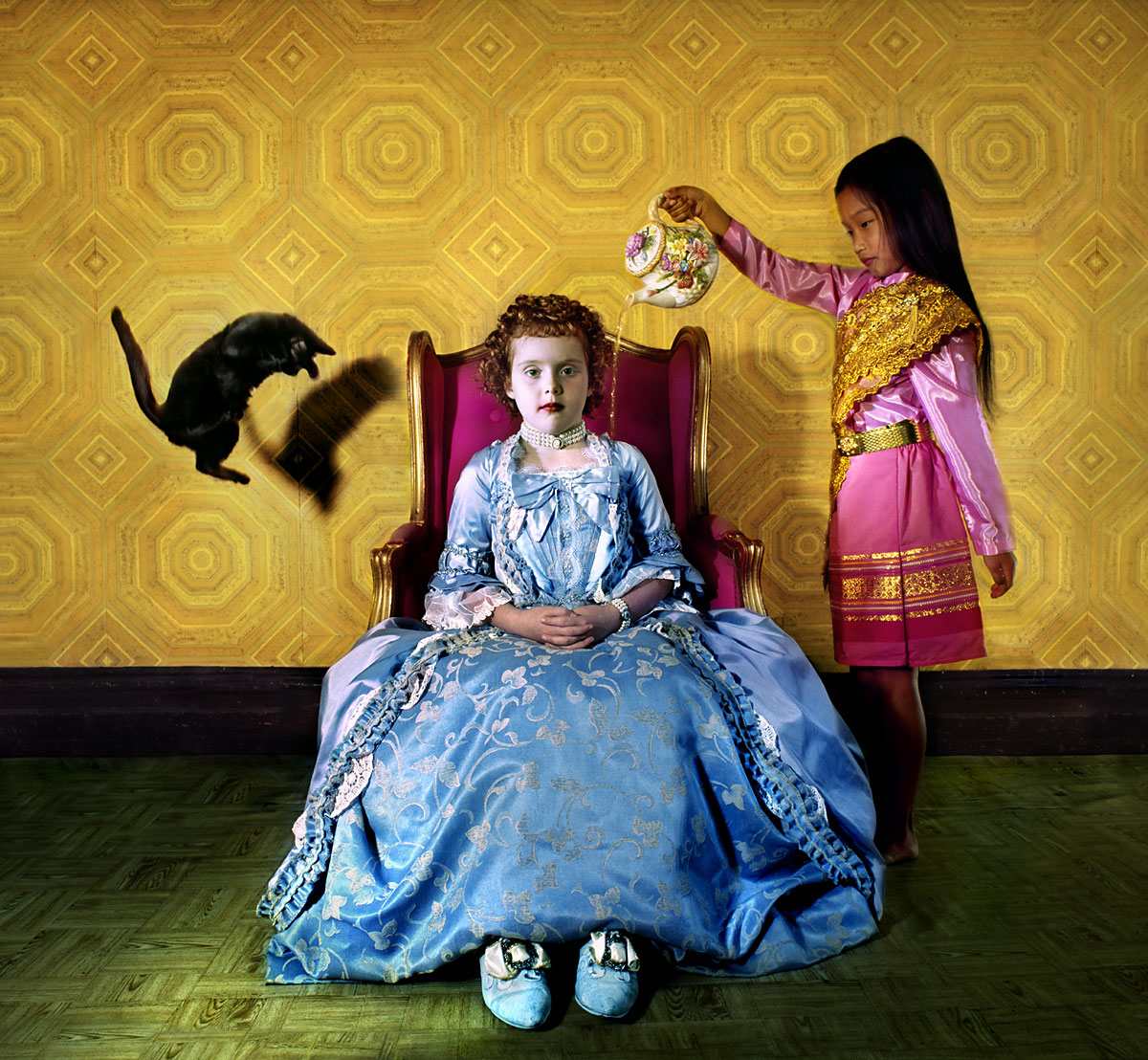
Tea is the medium of many a complex and commonplace rituals. Adopted in a variety of ceremonies and customs across the globe, its unique and symbolic place in our lives is subtle and powerful. Whether a quick cuppa around the kitchen table or a lavish display of refined gentility; from billy tea to Asian tea-drinking ceremonies, tea has played an important role in international trade but more curiously in facilitating social cohesiveness.
Comprising approximately 50 works including painting, photography, sculpture and installation Storm in a Teacup features artists such as Chares Blackman, John Perceval, Emma Minnie Boyd, E. Phillips Fox and contemporary artists Stephen Bowers, Danie Mellor, Penny Byrne, Rosalie Gasgoigne, Matthew Sleeth, eX de Medici, Anne Zahalka, Polixeni Papapetrou and a mad tea party installation by Hotham Street Ladies.
Tea is said to have first been invented in China around 2700 BC, with the earliest records of tea consumption dating to 1000BC. Initially consumed as a medicinal drink, it became widely popular as a common beverage and traded across Asia and Europe during the 16th century. It was King Charles II’s wife Catherine of Portugal who is said to have brought the tea habit to Great Britain. Indeed, the afternoon tea party first became fashionable in the seventeenth century following Queen Catherine de Braganza’s fondness for serving the beverage at Whitehall in London. It wasn’t until the 18th century that it became widely consumed with tea smuggling bringing the tipple to the masses and later influenced the Boston Tea Party.
Tea drinking became a demonstration of social aspirations and grew in popularity giving rise to a subtle orchestration of manners, dress and serving paraphernalia which created new forms of commodity consumption. In the colonies of New South Wales and Victoria afternoon tea parties were a lavish display of settler understandings of refined gentility that were an attempt to signal allegiance to the values of the home country and ground the displaced community in their originating culture. In this respect the afternoon tea party expressed collective understandings of British identity and was a means of domesticating and civilising the alien terrain of the colonies.
Press release from the Mornington Peninsula Regional Art Gallery
Clare Humphries (Australian, b. 1973) Family confection II (installation views) 2015 Sugar cubes stained with coffee and tea Dimensions variable Courtesy of the artist Photos: Marcus Bunyan
Giuseppe Romeo (Australian, b. 1958) Subjective landscape, ‘Of consequence rather than reason’ (installation views) 2015 Found discarded objects, bitumen, paint 80 x 100 x 60cm Courtesy of the artist Photos: Marcus Bunyan
Guiseppe Rome asks the simple question: ‘What are you going to do with it all?’
Romeo recalls the tea sets his mother and aunts possessed and the ‘good set’ kept for special occasions that were rarely used. In this work a silver platter is the support for a silver cake stand upon which a teapot, creamer, sugar bowl and various serving implements jostle with items required to clean up the mess. The bat, ball and stumps are a reference to playing cricket which ‘became an excuse for a big afternoon tea party in England’. A ribbon of wire holds it all together ‘like a dream from Alice in Wonderland when nothing is as it seems’, while a tinkling melody from a music box is a lullaby that sends us in to a contented sleep.
Romeo coats the sculpture in bitumen then paints it entirely in white. The effect is reminiscent of excavated items from an ancient ruin, as if we are peering upon the remains from a modern day Pompeii – artefacts that have been covered in lava and buried. This work alludes to the ways in which we deceive ourselves and ‘attempt to keep it all together through consumption but ultimately we can’t’.
Samantha Everton (Australian, b. 1971) Camellia 2009 From the series Vintage dolls 2009 Pigment print on rag paper (ed. AP2) 106 x 114cm Courtesy of the artist and Anthea Polson Art, Queensland
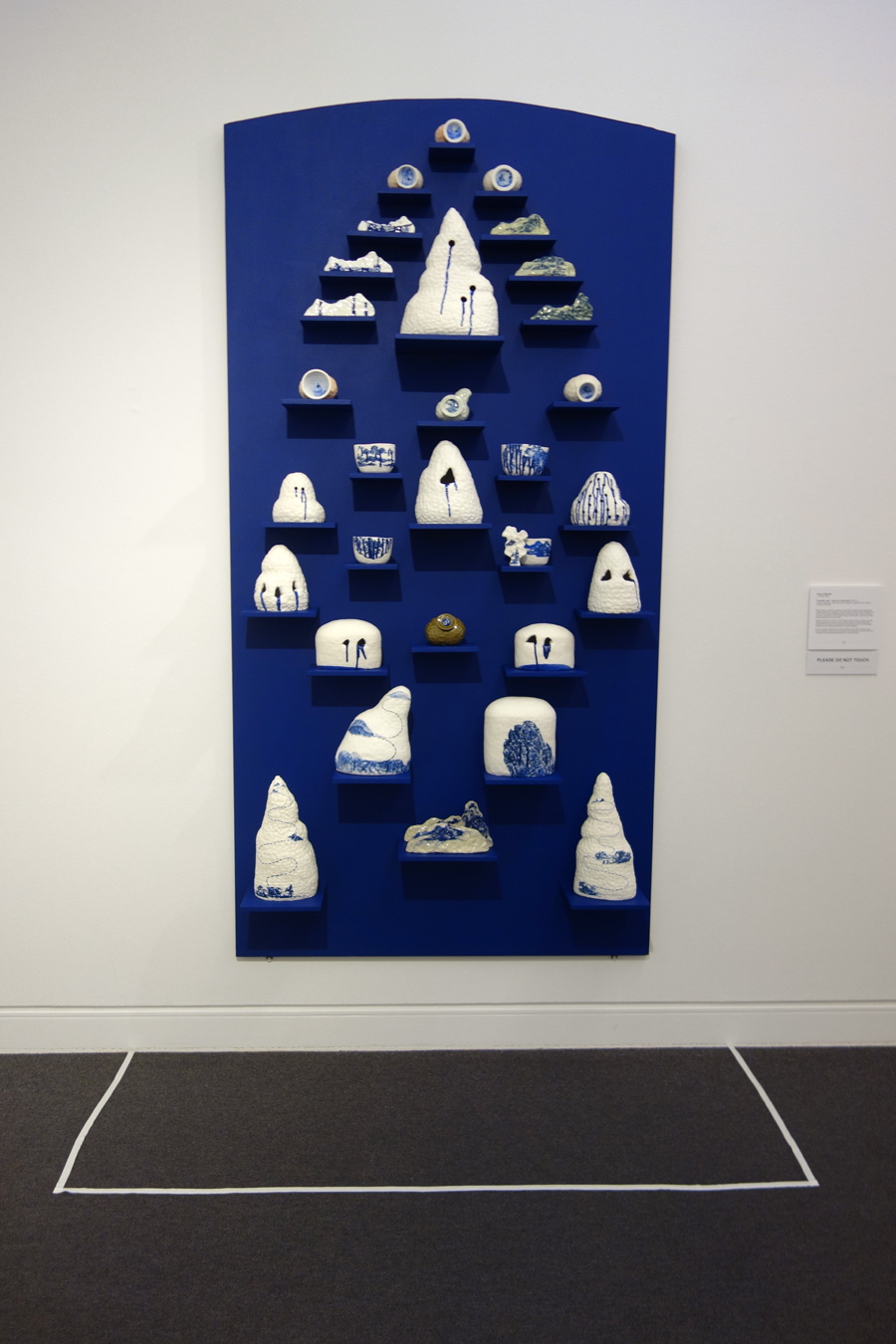
Robyn Phelan (Australian, b. 1965) Porcelain wall – ode to an obsession (installation view) 2010-2015 Porcelain, paper, clay, cobalt oxide, timber, pigment, Jingdezhen tissue transfer 240 x 122 x 42cm Courtesy of the artist Photo: Marcus Bunyan
Robyn Phelan (Australian, b. 1965) Porcelain wall – ode to an obsession (installation view detail) 2010-2015 Porcelain, paper, clay, cobalt oxide, timber, pigment, Jingdezhen tissue transfer 240 x 122 x 42cm Courtesy of the artist
Robyn Phelan undertook a residency at the Pottery Workshop and Experimental Sculptural Factory of Jingdezhen, Jiangxi Province in China in 2008. Jingdezhen is known as the porcelain capital because it has been the centre of China’s ceramic production, beginning in the fourteenth century Yuan Dynasty, where fine porcelain was first exported all over the world.
Deposits of kaolinite, a clay found at Mt Kaolin nearby which can sustain very high firing temperatures produced a superior white porcelain of increased strength and translucency. Items made from kaolinite were fired with cobalt landscape designs and were highly sought after by European collectors. Over the centuries, because of excessive mining, the mountain’s deposits have become depleted. Phelan’s work is a lament to the desecration of the mountain and a reminder of the potential destructiveness of consumer desire.
Penny Byrne (Australian, b. 1965) ‘Let’s forget about global warming’ said Alice ‘and have a cup of tea instead!’ (installation view) 2010 Vintage porcelain figurine, found toys, epoxy resin, epoxy putty, retouching medium, powder pigments 80 x 33cm Williams Sinclair Collection Photo: Marcus Bunyan
Penny Byrne (Australian, b. 1965) ‘Let’s forget about global warming’ said Alice ‘and have a cup of tea instead!’ (installation view detail) 2010 Vintage porcelain figurine, found toys, epoxy resin, epoxy putty, retouching medium, powder pigments 80 x 33cm Williams Sinclair Collection Photo: Marcus Bunyan
Penny Byrne’s reworked porcelain conversation piece was motivated by Republican Vice-Presidential nominee Sarah Palin’s cry to ‘drill, baby, drill’ during her campaign in 2008. A call for increase off-shore drilling of petroleum, including sites such as the Arctic National Wildlife Refuge, Palin claimed ‘that’s what we hear all across the country in our rallies because people are so hungry for those domestic sources of energy to be tapped into’.1
In Byrne’s piece the patriotic figures gorge themselves, blithely overindulging without care to the wastage. The new Disney production of Alice in Wonderland directed by Tim Burton had just been released and this led Byrne to reflect upon the Mad Hatter’s tea party in which tea was drunk all day because time stood still and was stuck at tea-time.
1/ Transcript: The Vice-Presidential Debate, 2 October 2008. Reprinted in the New York Times, 23 May 2012.
Sharon West (Australian, b. 1963) Joseph Banks’ tea party for a Botany Bay tribesman is ruined by flies and spiders 2014 Digital print on paper (ed. 2/5) 66 x 57cm (sheet) Courtesy of the artist Photo: Marcus Bunyan
Sharon West’s recreation of an afternoon tea party is set in the early days of first contact. Joseph Banks was the botanist who sailed with Captain Cook on the Endeavour on the first voyage of discovery which mapped the east coast of Australia between 1768 and 1771. While ashore he made an extensive collection of native flora and fauna which was sent back to natural history museums in England. Banks was also instrumental in the British government’s decision to colonise the New South Wales settlement.
Rosalie Gascoigne (b. New Zealand 1917; arr. Australia 1943; d. Canberra 1999) The tea party (installation view) 1980 Painted wood, celluloid, plastic, enamelled metal, feathers 83 x 35 x 20cm Private collection Photo: Marcus Bunyan
Rosalie Gascoigne (b. New Zealand 1917; arr. Australia 1943; d. Canberra 1999) The tea party (installation view detail) 1980 Painted wood, celluloid, plastic, enamelled metal, feathers 83 x 35 x 20cm Private collection Photo: Marcus Bunyan
Rosalie Gascoigne found the kewpie dolls amongst a large number of discarded things from an abandoned sideshow at the Bungendore dump in the summer of 1976. ‘I thought “Oh, those dollies, they’re having a … very joyful … picnic. They’re … in the paddock, they’ve got all these old things … they’ve sat down on the teapots and waved their wings around.”
For Gascoigne beauty existed in the most humble of objects and the wear and tear from use only added to the appeal. The enamel teapots were also found at various dumps and were a particular focus of her collecting.
‘I had a thing about enamelware because I see it as being elegant. People see the holes in it. I was collecting brown and white at the same time. To me it had a sort of elegance that a Dalmatian dog has, spotty, very elegant’.1
1/ Rosalie Gascoigne, excerpts from her correspondence, email communication with Martin Gascoigne, 13 March 2015
Julie Dowling (Australian, b. 1969) Badimaya people, Western Australia White with one 2003 Synthetic polymer paint and red ochre on canvas 121 x 100cm Collection of Jane Kleimeyer and Anthony Stuart
Julie Dowling’s painting is a poignant reminder of the Stolen Generations and the plight of many young girls, forcibly removed from their families, who were brought up in government institutions and trained to be domestic servant to white families. Girls were targeted because women were considered the ‘uplifters’ or ‘civilisers’ of their communities and as future mothers their education into the values of white society was deemed essential to enable successful assimilation. Girls in service were supposed to receive a wage but often this was retained by their employer and not passed on. Dowling points out it is also a history of Stolen wages.
Michael Cook (Australian, b. 1968) Bidjara people, south-west Queensland Object (table) 2015 Inkjet print on Hahnemühle cotton rag (ed. 2/4 + 2AP) 140 x 99cm Courtesy of the artist and THIS IS NO FANTASY + dianne tanzer gallery, Melbourne
Michael Cook’s photographic tableau ‘turns the table’ on racism. By depicting the body of a white woman as a functional object in service to others, Cook considers the dehumanisation and objectification of one race of people by another in the history of slavery.
The double portrait on the back wall is by Johann Zoffany from 1778, and features Dido Elizabeth Belle (1761-1804) who was born into slavery in the West Indies. The daughter of an African mother, her father was an English naval officer who left her to the care of his uncle, Lord William Murray, where she was raised as an equal with Murray’s niece. Murray was instrumental in outlawing slavery in the United Kingdom in 1772. In the painting Zoffany depicts the two women standing together, the niece affectionately reaching out to Belle. Hence Cook’s afternoon tea is also a reminder that prejudice and racial inequality can be surmounted.
Yenny Huber (b. Austria 1980; arr. Australia 2000) Room No. 14 2006 Digital print on aluminium panel (ed. 1/6) 27.2 x 27.2cm Warrnambool Art Gallery, Victoria
Underpinned by the belief that any one person is comprised of diverse, fragmentary and often illusory selves, Yenny Huber explores the various ego states that reside within. This photograph is a self portrait taken in a hotel room, but it is also an impersonation of an identity available to women. Tea-drinking was once described as ‘an infallible sign of an old maid’1 and in this work Huber offers us an image of a good Catholic girl, knees together, elbows in, sitting demurely on the couch sipping tea. It is an image of femininity constrained by the dictates of religion and outdated socially sanctioned ideals of respectable female behaviour.
1/ The Horsham Times, Victoria, 26 April 1898
Anne Zahalka (Australian, b. 1957) Saturday 5.18 pm 1995 1995 (printed 1997) Type C photograph (ed AP) 125 x 162cm Art Gallery of New South Wales, Sydney Gift of the artist, 2011 Donated through the Australian Government’s Cultural Gifts Program
Mornington Peninsula Regional Art Gallery Civic Reserve, Dunns Road, Mornington




![Rex Hazlewood (Australian, 1886-1968) '[Men drinking billy tea]' 1911-1927](https://artblart.com/wp-content/uploads/2015/09/hazelwood-billy-tea.jpg "Rex Hazlewood (Australian, 1886-1968) '[Men drinking billy tea]' 1911-1927")


![James Fox Barnard (Australian, 1874-1945) '[Tea on the verandah]' c. 1900](https://artblart.com/wp-content/uploads/2015/09/barnard-tea-verandah.jpg "James Fox Barnard (Australian, 1874-1945) '[Tea on the verandah]' c. 1900")




 Art Blart _ art and cultural memory archive
You must be logged in to post a comment.