Exhibition: ‘Hippolyte Bayard: A Persistent Pioneer’ at the J. Paul Getty Museum, Los Angeles

Exhibition dates: 9th April – 7th July 2024


Hippolyte Bayard (French, 1801-1887) William Henry Fox Talbot (English, 1800-1877) Samuel Buckle (British, 1808-1860) Nicolaas Henneman (British, 1813-1893) Reverend Calvert Jones (British, 1804-1877) David Kinnebrook (English, 1819-1865) M.H. Nevil Story-Maskelyne (British, 1823-1911) Unknown maker. 'Cover of Dessins photographiques sur Papier. Recueil No. 2. [The "Bayard Album"]' 1839-1855


Hippolyte Bayard (French, 1801-1887) William Henry Fox Talbot (English, 1800-1877) Samuel Buckle (British, 1808-1860) Nicolaas Henneman (British, 1813-1893) Reverend Calvert Jones (British, 1804-1877) David Kinnebrook (English, 1819-1865) M.H. Nevil Story-Maskelyne (British, 1823-1911) Unknown maker
Cover of Dessins photographiques sur Papier. Recueil No. 2. [The “Bayard Album”]
1839-1855
The J. Paul Getty Museum, Los Angeles
Public domain


Shock of the new

At the moment the archive is going through a veritable feast of wonderful exhibitions on 19th century photography, this exhibition at the Getty a companion to last week’s posting on the exhibition Nineteenth-Century Photography Now also at the J. Paul Getty Museum. What a delight!

This posting on the important photographer and inventor Hippolyte Bayard (French, 1801-1887) – one of the pioneers of photography who was finally acknowledged as such during his lifetime and received due recognition – offers the visitor the opportunity to view fragile photographs from the Getty’s treasured Bayard album, one of the first photographic albums ever created, before the leaves of the album are reassembled after restoration.

“The album includes 145 of Bayard’s experiments with different photographic processes on paper, primarily salted paper prints from paper negatives from about 1839 to the late 1840s… Bayard divided the album into four sections: still lifes, portraits, urban and rural landscapes, and an assortment of miscellaneous images. The inclusion of twenty-two photographs by British photographers, including William Henry Fox Talbot, provides evidence of Bayard’s interactions with his fellow pioneers across the English Channel. …

Inscriptions found on the Getty album pages and versos of its photographs support the theory that the artist himself – or someone with firsthand knowledge of the chemicals he used – compiled this volume. Thus, this treasure offers intriguing insights into Bayard’s practice, aesthetic choices, and strategies for presenting himself through the order and arrangement of the photographs.”1

The full album and layout can be viewed on the Getty’s website.

What I find delightful about this “album of experiments” – other than Bayard’s perceptive, inquisitive self-portraits and delicate, atmospheric cyanotype and salted paper print photograms – is the colour (including hand coloured), size and placement of the photographic prints on the pages of the album. Sometimes gridded, sometimes singular in grand isolation, sometimes asymmetrical with empty pages between images, the album seems to flow allow like a river… only for the viewer then to have to change orientation, as vertical images on one page are then abutted next to a page of images that need to be viewed in a horizontal format but turning the album through 90 degrees.

It’s as if the compiler of the album, probably Bayard himself, applied this prick of consciousness to the viewing of the album, to stop the viewer skimming over the images but forcing them to be attentive, to be aware, of the progression of the story that the artist was telling, to be aware of a certain “disposition” in the viewer in order to – a/ disrupt the tendency of something to act in a certain manner under given circumstances and b/ impinge on a person’s inherent quality of mind and character. To offer a new dispensation on reality.

In other words, the artist challenges the viewer as to how photographs are read and interpreted through changes to the perception and point of view said “reader”. I don’t think I have ever seen such an early photo book that proposes such a daring reorientation of consciousness as does this album.

New technologies, new aesthetics, new dispositions.

The shock of the new.

Dr Marcus Bunyan


1/ Carolyn Peter, J. Paul Getty Museum, Department of Photographs, 2024


Many thankx to the J. Paul Getty Museum for allowing me to publish the photographs in the posting. Please click on the photographs for a larger version of the image.


Parisian bureaucrat by day and tireless inventor after hours, Hippolyte Bayard (French, 1801-1887) was one of the most important, if lesser-known, pioneers of photography. During his thirty-year career, he invented the direct positive process and several other photographic techniques on paper. This exhibition presents an extraordinarily rare opportunity to view some of Bayard’s highly fragile photographs dating from the 1840s – the first decade of the new medium. The exhibition journeys back to the 19th century to unveil a collection of Bayard’s delicately crafted photographs, offering an extraordinarily rare glimpse into his unique processes, subjects, and persistent curiosity. He brought an artistic sensitivity into capturing the first staged self-portraits and set precedents for photography as we know it today. It highlights Getty’s treasured Bayard album, one of the first photographic albums ever created.

This exhibition is presented in English and Spanish.

Text from the J. Paul Getty Museum website


Hippolyte Bayard (French, 1801-1887) William Henry Fox Talbot (English, 1800-1877) Samuel Buckle (British, 1808-1860) Nicolaas Henneman (British, 1813-1893) Reverend Calvert Jones (British, 1804-1877) David Kinnebrook (English, 1819-1865) M.H. Nevil Story-Maskelyne (British, 1823-1911) Unknown maker. 'Title page of Dessins photographiques sur Papier. Recueil No. 2. [The "Bayard Album"] with Hippolyte Bayard 's [Self-Portrait in the Garden] June 1845' 1839-1855


Hippolyte Bayard (French, 1801-1887) William Henry Fox Talbot (English, 1800-1877) Samuel Buckle (British, 1808-1860) Nicolaas Henneman (British, 1813-1893) Reverend Calvert Jones (British, 1804-1877) David Kinnebrook (English, 1819-1865) M.H. Nevil Story-Maskelyne (British, 1823-1911) Unknown maker
Title page of Dessins photographiques sur Papier. Recueil No. 2. [The “Bayard Album”] with Hippolyte Bayard’s [Self-Portrait in the Garden] June 1845
1839-1855
The J. Paul Getty Museum, Los Angeles
Public domain

Text above the photograph: Bromure d’argent vapeurs de Mercure (Silver bromide Mercury vapors)


Hippolyte Bayard’s self-portrait at his garden gate [Self-Portrait in the Garden] introduces the contents of this 184-page album, one of the earliest photographic albums ever created…

Titled Dessins photographiques sur Papier. Receuil No. 2 [Photographic Drawings on Paper. Collection No. 2], the album includes 145 of Bayard’s experiments with different photographic processes on paper, primarily salted paper prints from paper negatives from about 1839 to the late 1840s. Twenty-two photographs by six of his British peers are also interspersed through the album. With its green-and-black marbled covers, it is similar in style to the other known album devoted to Bayard – Album d’essais [Album of Experiments] – owned by the Société française de photographie (SFP) in Paris. Inscriptions found on the Getty album pages and versos of its photographs support the theory that the artist himself – or someone with firsthand knowledge of the chemicals he used – compiled this volume. Thus, this treasure offers intriguing insights into Bayard’s practice, aesthetic choices, and strategies for presenting himself through the order and arrangement of the photographs.

Bayard divided the album into four sections: still lifes, portraits, urban and rural landscapes, and an assortment of miscellaneous images. The inclusion of twenty-two photographs by British photographers, including William Henry Fox Talbot, provides evidence of Bayard’s interactions with his fellow pioneers across the English Channel.

This album has passed through several owners over its 180-plus year life. While gaps still exist, we have traced much of its provenance, or history of ownership. Working back in time, the Getty Museum purchased the album in 1984 from the American collector Arnold Crane (1932-2014) as part of its foundational photography collection. Crane had acquired it in 1970 from Alain Brieux (1922-1985), a Parisian book dealer. By the early 1950s, the album was in the possession of the commune of Breteuil-sur-Noye, Bayard’s hometown, or its mayor, François Monnet (1890-1970). A member of Bayard’s extended family may have given or sold the album to Breteuil. Moving further back into the nineteenth century, Bayard’s family likely chose to keep the album at the time of his death in 1887. We believe that Bayard possessed the album from its creation until he passed away.

Over time different individuals have added inscriptions, numbering systems, correspondence, a biography, and a souvenir from a 1959-1960 exhibition on Bayard in Essen, Germany. At the top left corner of pages, an early inventory system notes the page number, the number of images on the page, and total number of photographs in the album up to that point. Numbers under each photograph represent a second system. At the bottom of the pages, Getty Museum staff and Crane each assigned an accession number to identify the album within their collections. Note that Getty numbers begin with “84.XO.968.” and Crane numbers with “A58.”.

With each change of hands, the album has adopted new meanings. It started as an artist’s notebook and portfolio. Upon Bayard’s death it became a family memento and then a symbol of a commune’s pride. Later in the twentieth century, it shifted from an antiquarian book dealer’s curious commodity to a collector’s treasure. Today it is a museum object valued for what it tells us about processes, subject matter, and sophisticated lines of communication between photographers during the earliest years of photography.

Carolyn Peter, J. Paul Getty Museum, Department of Photographs, 2024

For more information see:

~ Hellman, Karen and Carolyn Peter, eds. Hippolyte Bayard and the Invention of Photography. Los Angeles: J. Paul Getty Museum, 2024.
~ Peter, Carolyn. “The Many Lives of the Getty Bayard Album.” Getty Research Journal 15 (2022): 67-86.


Hippolyte Bayard (French, 1801-1887) William Henry Fox Talbot (English, 1800-1877) Samuel Buckle (British, 1808-1860) Nicolaas Henneman (British, 1813-1893) Reverend Calvert Jones (British, 1804-1877) David Kinnebrook (English, 1819-1865) M.H. Nevil Story-Maskelyne (British, 1823-1911) Unknown maker. 'Dessins photographiques sur Papier. Recueil No. 2. [The "Bayard Album"]' 1839-1855 showing at top left Hippolyte Bayard's '[Three Feathers]' about 1842-1843


Hippolyte Bayard (French, 1801-1887) William Henry Fox Talbot (English, 1800-1877) Samuel Buckle (British, 1808-1860) Nicolaas Henneman (British, 1813-1893) Reverend Calvert Jones (British, 1804-1877) David Kinnebrook (English, 1819-1865) M.H. Nevil Story-Maskelyne (British, 1823-1911) Unknown maker
Dessins photographiques sur Papier. Recueil No. 2. [The “Bayard Album”] showing at top left Hippolyte Bayard’s [Three Feathers] About 1842-1843 
1839-1855
The J. Paul Getty Museum, Los Angeles
Public domain


Hippolyte Bayard (French, 1801-1887) '[Three Feathers]' About 1842-1843


Hippolyte Bayard (French, 1801-1887)
[Three Feathers]
About 1842-1843
Part of Dessins photographiques sur Papier. Recueil No. 2. [The “Bayard Album”] 1839-1855
Cyanotype
13.8 x 11.1cm (5 7/16 x 4 3/8 in.)
The J. Paul Getty Museum, Los Angeles
Public domain


Hippolyte Bayard (French, 1801-1887) William Henry Fox Talbot (English, 1800-1877) Samuel Buckle (British, 1808-1860) Nicolaas Henneman (British, 1813-1893) Reverend Calvert Jones (British, 1804-1877) David Kinnebrook (English, 1819-1865) M.H. Nevil Story-Maskelyne (British, 1823-1911) Unknown maker. 'Dessins photographiques sur Papier. Recueil No. 2. [The "Bayard Album"]' 1839-1855 showing at top right, Hippolyte Bayard's 'Arrangement of Flowers' about 1839-1843


Hippolyte Bayard (French, 1801-1887) William Henry Fox Talbot (English, 1800-1877) Samuel Buckle (British, 1808-1860) Nicolaas Henneman (British, 1813-1893) Reverend Calvert Jones (British, 1804-1877) David Kinnebrook (English, 1819-1865) M.H. Nevil Story-Maskelyne (British, 1823-1911) Unknown maker
Dessins photographiques sur Papier. Recueil No. 2. [The “Bayard Album”] showing at top right, Hippolyte Bayard’s Arrangement of Flowers about 1839-1843
1839-1855
The J. Paul Getty Museum, Los Angeles
Public domain


Hippolyte Bayard (French, 1801-1887) 'Arrangement of Flowers' About 1839-1843


Hippolyte Bayard (French, 1801-1887)
Arrangement of Flowers
About 1839-1843
Part of Dessins photographiques sur Papier. Recueil No. 2. [The “Bayard Album”] 1839-1855
Salted paper print
17.5 × 21.3cm (6 7/8 × 8 3/8 in.)
The J. Paul Getty Museum, Los Angeles
Public domain


Hippolyte Bayard (French, 1801-1887) William Henry Fox Talbot (English, 1800-1877) Samuel Buckle (British, 1808-1860) Nicolaas Henneman (British, 1813-1893) Reverend Calvert Jones (British, 1804-1877) David Kinnebrook (English, 1819-1865) M.H. Nevil Story-Maskelyne (British, 1823-1911) Unknown maker. 'Dessins photographiques sur Papier. Recueil No. 2. [The "Bayard Album"] showing at bottom right, Hippolyte Bayard's [Portrait of a Man] 1843-1845' 1839-1855


Hippolyte Bayard (French, 1801-1887) William Henry Fox Talbot (English, 1800-1877) Samuel Buckle (British, 1808-1860) Nicolaas Henneman (British, 1813-1893) Reverend Calvert Jones (British, 1804-1877) David Kinnebrook (English, 1819-1865) M.H. Nevil Story-Maskelyne (British, 1823-1911) Unknown maker
Dessins photographiques sur Papier. Recueil No. 2. [The “Bayard Album”] showing at bottom right, Hippolyte Bayard’s [Portrait of a Man] 1843-1845
1839-1855
The J. Paul Getty Museum, Los Angeles
Public domain


Hippolyte Bayard (French, 1801-1887) '[Portrait of a Man]' 1843-1845


Hippolyte Bayard (French, 1801-1887)
[Portrait of a Man]
1843-1845
Part of Dessins photographiques sur Papier. Recueil No. 2. [The “Bayard Album”] 1839-1855
Salted paper print
Image: 15.3 × 11.6 cm (6 × 4 9/16 in.)
Sheet: 15.7 × 12 cm (6 3/16 × 4 3/4 in.)
The J. Paul Getty Museum, Los Angeles
Public domain


Hippolyte Bayard (French, 1801-1887) '[In Bayard's Studio]' About 1845


Hippolyte Bayard (French, 1801-1887)
[In Bayard’s Studio]
About 1845
Part of Dessins photographiques sur Papier. Recueil No. 2. [The “Bayard Album”] 1839-1855
Salted paper print
23.5 × 17.5cm (9 1/4 × 6 7/8 in.)
The J. Paul Getty Museum, Los Angeles
Public domain


Hippolyte Bayard is one of the earliest photographers to explore self-portraiture using a camera. The Getty Museum’s collection includes seven of Bayard’s self-portraits (see 84.XO.968.1, 84.XO.968.166, 84.XO.968.20).* While Bayard is not present in this image, it too can be considered a self-portrait of sorts as it offers the viewer a window onto his artistic world. The seemingly casual composition shows a make-shift photographic studio with wood doors leaning up against a brick wall to form the principal back wall. The floor is rough; it isn’t clear whether it is made of tile, wood, or simply dirt. Bayard featured the tools of his trade – glass bottles filled with chemicals, a beaker, a funnel, a dark canvas backdrop, and a light curtain or coverlet as well as some of his favourite subjects – three plaster casts and a porcelain vase. The Société française de photographie (SFP) collection in Paris has two versions of this image; one of them is hand-coloured. The overpainting with watercolour heightens the various patterns and adds colours that the photographic process was unable to capture.

Many of these same props can be found in a number of Bayard’s photographs. The vase with its elaborate floral design as well as the small figure with arms extended, the coverlet, backdrop, and bench are integral parts of Bayard’s most famous self-portrait, Le Noyé [The Drowned Man], now housed at the SFP.

*Four of the Getty’s Bayard self-portraits are part of a portfolio printed in 1965 by M. Gassmann and Son from Bayard’s original negatives that are housed in the SFP collection. (See: 84.XO.1166.1, 84.XO.1166.2, 84.XO.1166.8, and 84.XO.1166.25).

Carolyn Peter. J. Paul Getty Museum, Department of Photographs
2019


Hippolyte Bayard (French, 1801-1887) William Henry Fox Talbot (English, 1800-1877) Samuel Buckle (British, 1808-1860) Nicolaas Henneman (British, 1813-1893) Reverend Calvert Jones (British, 1804-1877) David Kinnebrook (English, 1819-1865) M.H. Nevil Story-Maskelyne (British, 1823-1911) Unknown maker. 'Dessins photographiques sur Papier. Recueil No. 2. [The "Bayard Album"] showing at bottom right, Hippolyte Bayard's [Galerie de la Madeleine with Scaffolding, Place de la Madeleine] 1843' 1839-1855


Hippolyte Bayard (French, 1801-1887) William Henry Fox Talbot (English, 1800-1877) Samuel Buckle (British, 1808-1860) Nicolaas Henneman (British, 1813-1893) Reverend Calvert Jones (British, 1804-1877) David Kinnebrook (English, 1819-1865) M.H. Nevil Story-Maskelyne (British, 1823-1911) Unknown maker
Dessins photographiques sur Papier. Recueil No. 2. [The “Bayard Album”] showing at bottom right, Hippolyte Bayard’s [Galerie de la Madeleine with Scaffolding, Place de la Madeleine] 1843
1839-1855
The J. Paul Getty Museum, Los Angeles
Public domain


Hippolyte Bayard (French, 1801-1887) '[Galerie de la Madeleine with Scaffolding, Place de la Madeleine]' 1843


Hippolyte Bayard (French, 1801-1887)
[Galerie de la Madeleine with Scaffolding, Place de la Madeleine]
1843
Part of Dessins photographiques sur Papier. Recueil No. 2. [The “Bayard Album”] 1839-1855
Salted paper print
Image: 16.5 × 22cm (6 1/2 × 8 11/16 in.)
Sheet: 16.8 × 22.3cm (6 5/8 × 8 3/4 in.)
The J. Paul Getty Museum, Los Angeles
Public domain


Hippolyte Bayard (French, 1801-1887) William Henry Fox Talbot (English, 1800-1877) Samuel Buckle (British, 1808-1860) Nicolaas Henneman (British, 1813-1893) Reverend Calvert Jones (British, 1804-1877) David Kinnebrook (English, 1819-1865) M.H. Nevil Story-Maskelyne (British, 1823-1911) Unknown maker. 'Dessins photographiques sur Papier. Recueil No. 2. [The "Bayard Album"] showing at top right, Hippolyte Bayard's [Rue des Batignolles] about 1845' 1839-1855


Hippolyte Bayard (French, 1801-1887) William Henry Fox Talbot (English, 1800-1877) Samuel Buckle (British, 1808-1860) Nicolaas Henneman (British, 1813-1893) Reverend Calvert Jones (British, 1804-1877) David Kinnebrook (English, 1819-1865) M.H. Nevil Story-Maskelyne (British, 1823-1911) Unknown maker
Dessins photographiques sur Papier. Recueil No. 2. [The “Bayard Album”] showing at top right, Hippolyte Bayard’s [Rue des Batignolles] about 1845
1839-1855
The J. Paul Getty Museum, Los Angeles
Public domain


Hippolyte Bayard (French, 1801-1887) '[Rue des Batignolles]' about 1845


Hippolyte Bayard (French, 1801-1887)
[Rue des Batignolles]
About 1845
Part of Dessins photographiques sur Papier. Recueil No. 2. [The “Bayard Album”] 1839-1855
Salted paper print
15.4 x 11 cm (6 1/16 x 4 5/16 in.)
The J. Paul Getty Museum, Los Angeles
Public domain


Hippolyte Bayard (French, 1801-1887) '[Bitch in profile]' about 1865


Hippolyte Bayard (French, 1801-1887)
[Bitch in profile]
About 1865
Part of Dessins photographiques sur Papier. Recueil No. 2. [The “Bayard Album”] 1839-1855
Albumen silver print
Mount: 10 x 6.1cm (3 15/16 x 2 3/8 in.)
J. Paul Getty Museum, Los Angeles
Public domain


Hippolyte Bayard (French, 1801-1887) '[Unidentified woman standing, leaning against a credenza]' about 1861


Hippolyte Bayard (French, 1801-1887)
[Unidentified woman standing, leaning against a credenza]
About 1861
Albumen silver print
Mount: 10.4 x 6.1 cm (4 1/8 * 2 3/8 in.)
The J. Paul Getty Museum, Los Angeles
Public domain


Hippolyte Bayard (French, 1801-1887) William Henry Fox Talbot (English, 1800-1877) Samuel Buckle (British, 1808-1860) Nicolaas Henneman (British, 1813-1893) Reverend Calvert Jones (British, 1804-1877) David Kinnebrook (English, 1819-1865) M.H. Nevil Story-Maskelyne (British, 1823-1911) Unknown maker. 'Dessins photographiques sur Papier. Recueil No. 2. [The "Bayard Album"]' 1839-1855


Hippolyte Bayard (French, 1801-1887) William Henry Fox Talbot (English, 1800-1877) Samuel Buckle (British, 1808-1860) Nicolaas Henneman (British, 1813-1893) Reverend Calvert Jones (British, 1804-1877) David Kinnebrook (English, 1819-1865) M.H. Nevil Story-Maskelyne (British, 1823-1911) Unknown maker
Dessins photographiques sur Papier. Recueil No. 2. [The “Bayard Album”]
1839-1855
The J. Paul Getty Museum, Los Angeles
Public domain


Hippolyte Bayard (French, 1801-1887) '[Two Men and a Girl in a Garden]' About 1847


Hippolyte Bayard (French, 1801-1887)
[Two Men and a Girl in a Garden]
About 1847
Part of Dessins photographiques sur Papier. Recueil No. 2. [The “Bayard Album”] 1839-1855
Albumenised salted paper print
12.9 x 15.6cm (5 1/16 x 6 1/8 in.)
The J. Paul Getty Museum, Los Angeles
Public domain


Hippolyte Bayard

Frenchman Hippolyte Bayard was one of the earliest experimenters in photography, though few will recognise his name today. While working as a civil servant in the Ministry of Finance in the late 1830s and early 1840s, he devoted much of his free time to inventing processes that captured and fixed images from nature on paper using a basic camera, chemicals, and light. The announcement of the inventions of his fellow countryman Louis-Jacques Mandé Daguerre’s daguerreotype on January 7, 1839, and Englishman William Henry Fox Talbot’s photogenic drawing soon after greatly diminished opportunities for recognition of Bayard’s contributions. He was most likely persuaded by François Arago, the head of the French Academy of Sciences, to keep quiet about his own distinct process until after the announcement of Daguerre’s process and subsequent celebration in August of 1839.

Bayard nonetheless continued his investigations and submitted letters detailing three photographic recipes to the Academy of Sciences. Though he exhibited examples of his work in what has been recognised as the first public exhibition of photography in July 1839 and presented his direct positive process at the Academy of Fine Arts in November of 1839, where it was lauded as an important tool for artists, he remained in the shadows of Daguerre and Talbot.

Bayard is best known today for his 1840 self-portrait as a drowned man, to which he added text protesting the lack of recognition for his invention. The humorous, yet biting text read:

The corpse of the gentleman you see here…. is that of Monsieur Bayard, inventor of the process that you have just seen…. As far as I know this ingenious and indefatigable experimenter has been occupied for about three years with perfecting his discovery…. The Government, who gave much to Monsieur Daguerre, has said it can do nothing for Monsieur Bayard, and the poor wretch has drowned himself. Oh! The precariousness of human affairs! …


In reality, of the three inventors, it was Bayard who actively continued to photograph the longest. He was a founding member in the 1850s of the Société héliographique and its successor, the Société française de photographie. He kept up with the latest developments in the world of photography and integrated new processes into his practice. He was one of only five photographers selected to be part of the Missions héliographiques in 1851, charged with the task of documenting France’s historic architecture for the Commission des Monuments historiques. He exhibited regularly in the universal expositions and, in the 1860s after his retirement from the Ministry of Finance, opened a photographic portrait studio in Paris with Charles Albert d’Arnoux, known as Bertall (1820-1882). During his lifetime, Bayard was described as the “Grandfather of Photography” by several commentators. The Légion d’honneur (still considered today the highest order of military and civil decoration in France) awarded him the first level of merit – Chevalier – in 1863. In the late 1860s he left Paris and moved to Nemours near his lifelong friend, the actor and painter Edmond Geffroy (1804-1895). Bayard died there in 1887.

Text from the J. Paul Getty Museum website


Hippolyte Bayard (French, 1801-1887) '[Self-Portrait in the Garden]' 1847


Hippolyte Bayard (French, 1801-1887)
[Self-Portrait in the Garden]
1847
Salted paper print
Image: 16.5 × 12.3cm (6 1/2 × 4 13/16 in.)
Sheet: 17.1 × 12.5cm (6 3/4 × 4 15/16 in.)
The J. Paul Getty Museum, Los Angeles
Public domain


By October 1840, a little over a year after several competing photographic processes had been made public, Hippolyte Bayard began staging elaborate self-portraits in his garden and other locations. His best known, Le Noyé [The Drowned Man], was made on October 18, 1840 (three variants are now part of the collection of the Société française de photographie in Paris).

The Getty Museum’s collection includes six other self-portraits by Bayard in addition to this 1847 Self-portrait in the Garden (See: 84.XO.968.1, 84.XO.968.166).* In five of the seven self-portraits, he placed himself in garden settings. This was, in part, a practical decision since natural light was required to make photographs at the time. However, his choice of setting also reflects his passion for plants. He came from a family of gardeners – his maternal grandfather worked in the extensive grounds of the abbey in Breteuil, the village where Bayard grew up. His father, a justice of the peace, was a passionate amateur gardener who grew peaches in an orchard attached to the family home. The garden(s) featured in Bayard’s self-portraits may indeed be part of the family property in Breteuil or his own home in Batignolles – an area that was just on the outskirts of Paris.

The setting becomes an integral aspect of these portraits; Bayard, the man, merges with his environment. In this particular image, he is surrounded by vegetation and is seated in a wooden chair whose arms and legs resemble vine branches. The lower portion of his legs merges into the darkened lower foreground as if he too is rooted in the earth and has sprouted from it. He shares the foreground with a tall leafy plant that bursts into blossoms at the top. The artist’s choice of clothing, including his cravat, brimmed cap, as well as his direct gaze, all combine to convey a sense of confidence.

Another image found mounted on a separate page in the same album in which this one appears offers a slightly more distant view of almost all the same elements. Bayard is no longer part of the composition, which instead features a watering can and an extra pot (See 84.XO.968.85). Perhaps this photograph was a study in preparation for this self-portrait.

*Four of the Getty’s Bayard self-portraits are part of a portfolio printed in 1965 by M. Gassmann and Son from Bayard’s original negatives that are housed in the SFP collection. (See: 84.XO.1166.1, 84.XO.1166.2, 84.XO.1166.8, and 84.XO.1166.25).

Carolyn Peter, J. Paul Getty Museum, Department of Photograph
2019


Hippolyte Bayard (French, 1801-1887) '[Self-Portrait in the Garden]' June 1845


Hippolyte Bayard (French, 1801-1887)
[Self-Portrait in the Garden]
June 1845
Hand-coloured
Salted paper print
12 1/4 × 9 13/16 in.
The J. Paul Getty Museum, Los Angeles
Public domain


The 19th-Century Selfie Pioneer

Before Instagram influencers, there was Hippolyte Bayard

More than 160 years before smartphones and selfie sticks allowed even the most inexperienced shutterbug to snap a photo of themselves, Hippolyte Bayard was turning his camera on himself.

The year was 1840. Several competing photographic processes had just been made public for the first time the year before, effectively introducing the medium of photography to the world. Bayard, a bureaucrat who worked at the Ministry of Finance in Paris and took pictures on weekends or his lunch hour, was one of the first photographers to practice the art of the self-portrait. Examples of these are on view in the new Getty Center exhibition Hippolyte Bayard: A Persistent Pioneer.

With himself as the subject, Bayard could experiment with new photographic processes, set a scene, and pose in front of the camera, creating images that represented his hobbies, frustrations, and achievements. Sound familiar?

“The earliest photographers wanted to capture people in photographs. Bayard was one of the first to actually succeed,” says Carolyn Peter, the exhibition’s co-curator. He also demonstrated that photography was a new art form. “The public was so taken by the realistic depictions of the world in photography, but he was saying that you can also make things up. You can stage things.”

Bayard in the Garden

Self-portraits were an appealing solution in those early days of photography largely because taking a picture required a long, labor-intensive process, explains Peter. Photographers had to set their cameras in front of their (motionless) subjects for anywhere between 20 minutes and three hours – a daunting ask for any human being – to expose the sensitised surface (metal, paper, or glass) to enough light to create the image.

“He probably didn’t want to subject others to this endurance test, but he still wanted to try and work on his photography techniques. Gradually, the amount of time it took to make a photo shortened, maybe down to around 10 minutes, and finally down to seconds,” Peter said.

In a series of self-portraits from the 1840s, Bayard posed himself in his or his family’s gardens, among plants and tools, emphasising his passion for horticulture. The outdoor setting was a necessity as it offered plenty of natural light. He adopted several different configurations of items and positions in each portrait. Notice how in one image (above left) he hid his feet behind greenery, as if he were planted in the earth.

“Today artists, along with the rest of us, still try a lot of different positions and poses with slight variations when we are making self-portraits,” Peter says.


Hippolyte Bayard (French, 1801-1887) '[Self-Portrait in the Garden]' About 1845-1849


Hippolyte Bayard (French, 1801-1887)
[Self-Portrait in the Garden]
About 1845-1849
Salted paper print
Image: 15.9 × 12.7 cm (6 1/4 × 5 in.)
Sheet: 16.3 × 13.1 cm (6 7/16 × 5 3/16 in.)
The J. Paul Getty Museum, Los Angeles
Public domain


Bayard as Dramatist

Perhaps Bayard’s best-known photo is his Drowned Man (1840), in which he slumps over, partially covered by a sheet, eyes closed, as if he had perished. Bayard created three versions of the image, changing the pose and props in each one, and eventually added this over-the-top lament to the back of the final version:

“The corpse of the gentleman that you see here… is that of M. Bayard, inventor of the process you have just seen…. To my knowledge, for about three years this ingenious and indefatigable researcher has been working to perfect his invention…. The Government, which has given so much to M. Daguerre, said it could do nothing for M. Bayard, and the unfortunate man drowned himself. Oh! The precariousness of human affairs!”


Clearly, Bayard had a few frustrations about his position in the photography world and about how little respect he felt he had been given in comparison to fellow photographer Louis Daguerre. This self-portrait allowed him to express his woes in a humorous and, yes, dramatic way, perhaps inspired by his connections to the theater.

“One of his very best friends from childhood on was Edmond Geffroy, a famous actor, so Bayard hung out with actors and theater people as well as fine artists and writers,” Peter says. “He had this connection to theatricality and theater. He attended a lot of plays. So I think that influenced him.”

A Special Effects Pioneer

In the 1860s, Bayard opened a portrait studio where customers could pay to have their pictures taken. Exposure times had been dramatically reduced, making it significantly easier for ordinary folks to sit for photographs. Bayard continued to experiment, using himself as a subject. Here he combined two negatives to make it look as though he is having a conversation with himself (or an imaginary identical twin?). This is 100 years before The Parent Trap was released!

“He’s just got this sense of humour and this desire to keep playing around,” says Peter.

A Self-Portrait of Pride

Bayard might have felt profoundly under acknowledged for his work in the 1840s, but it turns out he just needed to wait a little to get his due. In 1863 he was awarded the cross of the French Legion of Honor, a prestigious award bestowed in recognition of his contributions to photography. He took the portrait above while wearing the badge, showing off what must have been one of his proudest achievements. Bayard retired from photography soon after.

Bayard’s selfies are now more than 160 years old, but selfie-takers of today seem to be (unconsciously) following the same principles Bayard experimented with. He was one of the first to show that photography could represent not just the literal world but also how you wanted to present yourself. While selfies may appear to be a new phenomenon spawned by the reverse-camera button on smartphones, selfie aficionados should pay proper homage to Bayard for pioneering this art form.

“Today, selfies often include humour. Photographers invest a lot of strategic thought into how they want to present themselves. Selfies are performative and create something that isn’t fully realistic. Bayard was also conscious of the power of photography to visually imagine other worlds and invent different versions of himself.”

Erin Migdol. “The 19th-Century Selfie Pioneer,” on the J. Paul Getty Museum website Apr 09, 2024 [Online] Cited 12/04/2024


The J. Paul Getty Museum
1200 Getty Center Drive
Los Angeles, California 90049

Opening hours:
Daily 10am – 5pm

The J. Paul Getty Museum website

LIKE ART BLART ON FACEBOOK

Back to top

Exhibition: ‘Nineteenth-Century Photography Now’ at the J. Paul Getty Museum, Los Angeles

Exhibition dates: 9th April – 7th July, 2024

Curators: the exhibition is curated by Karen Hellman, former associate curator in the Department of Photographs. Carolyn Peter, assistant curator in the Department of Photographs, Getty Museum, served as organising curator with assistance from Claire L’Heureux, former Department of Photographs graduate intern and Antares Wells, curatorial assistant


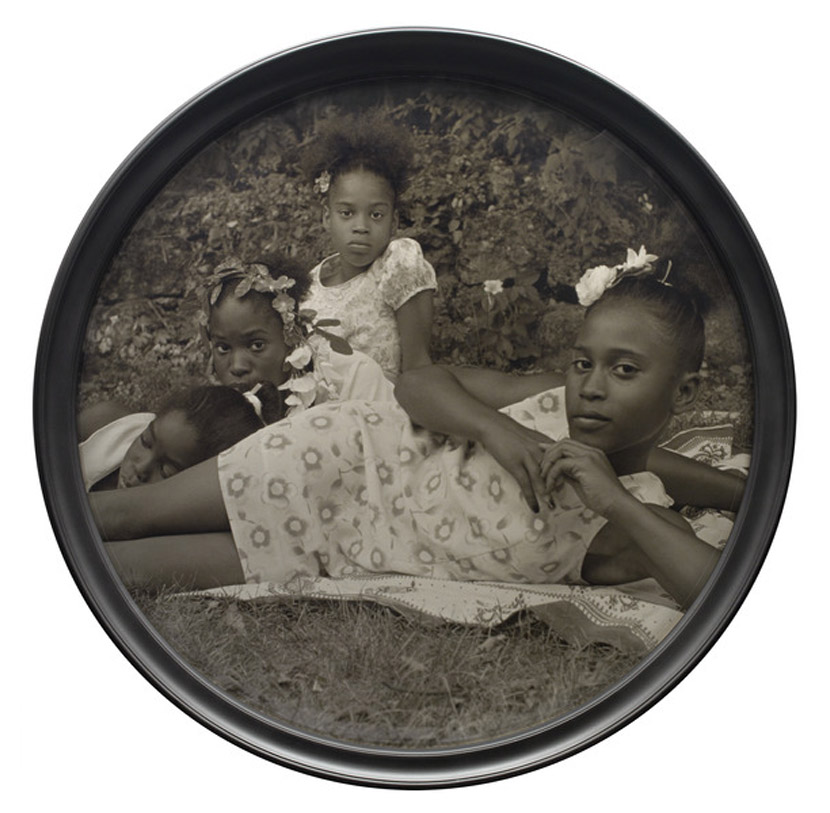
At left, Julia Margaret Cameron (British born India, 1815-1879) 'Florence after the Manner of the Old Masters' 1872; and at right, Carrie Mae Weems (American, b. 1953) 'After Manet' 2003


At left, Julia Margaret Cameron (British born India, 1815-1879) Florence after the Manner of the Old Masters 1872; and at right, Carrie Mae Weems (American, b. 1953) After Manet 2003

from the ‘Identity’ section of the exhibition


Magdalene Keaney, curator of the exhibition Francesca Woodman and Julia Margaret Cameron: Portraits to Dream In, observes that the exhibition “poses questions about how we might think in new ways about relationships between 19th and 20th century photographic practice…”

As does this exhibition:

~ Everything emerges from something. One must be “mindful of the origins and essence of photography.” (Moriyama)

~ History often repeats itself in different forms.

~ Memory often returns in fragmentary form.

~ The wisdom and spirit of the past speaks to the practitioners of the future.

Dr Marcus Bunyan


NB: Transubstantiation, an un/explainable change in form, substance, or appearance (from the Latin roots trans, “across or beyond,” and substania, “substance”)


Many thankx to the J. Paul Getty Museum for allowing me to publish the photographs in the website. Please click on the photographs  for a larger version of the image.


The earliest photographs – often associated with small, faded, sepia-toned images – may seem to belong to a bygone era, but many of the conventions established during photography’s earliest years persist today. Organised around five themes dating back to the medium’s beginnings, this exhibition explores nineteenth-century photographs through the work of twenty-one contemporary artists. These interchanges between the first decades of the medium and the most recent invite us to reimagine nineteenth-century photography while exploring its complexities.

Text from the J. Paul Getty Museum website


“Ms. Hellman, a former associate curator, inspired by her work with the Bayard materials, conceived “Nineteenth-Century Photography Now” as a way to access the influence that early photographers still have. The exhibition includes work from the past by 23 named and three anonymous photographers plus an additional 16 included in an album; there are 21 present-day artists. It is organised around five themes: Identity, Time, Spirit, Landscape and Circulation. The picture that serves as an introduction to the show is “Untitled ‘point de vue'” (1827) by Joseph Nicéphore Niépce, a faded heliograph on pewter, that Daido Moriyama keeps a reproduction in his studio; the wall text quotes him saying, “it serves as a gentle daily reminder to be mindful of the origins and essence of photography.” There are two photographs by Mr. Moriyama prompted by Niépce’s bit of primitive technology.”


William Meyers. “Photography’s Past and Present at the Getty Center,” on The Wall Street Journal website May 29, 2024 [Online] Cited 16/06/2024


Julia Margaret Cameron (British born India, 1815-1879) 'Florence after the Manner of the Old Masters' 1872


Julia Margaret Cameron (British born India, 1815-1879)
Florence after the Manner of the Old Masters
1872
Albumen silver print
Image: 34 × 25.6cm (13 3/8 × 10 1/16 in.)
Mount: 43.3 × 32.4cm (17 1/16 × 12 3/4 in.)
The J. Paul Getty Museum, Los Angeles


Portrait of Florence Fisher posing with a rose stem with the leaves attached. She holds the rose in place with one arm folded across her chest.


Carrie Mae Weems (American, b. 1953) 'After Manet' 2003


Carrie Mae Weems (American, b. 1953)
After Manet
2003
From the series May Days Long Forgotten
Chromogenic print
Object: 84.3cm (33 3/16 in.)
The J. Paul Getty Museum, Los Angeles
© Carrie Mae Weems


The black and white photograph – one from the nine-part series May Days Long Forgotten – depicts four African American girls in summer dresses, with garlands in their hair, reclining on a lawn. The piece is mounted in a circular frame prepared by the artist, and is number five of an edition of eight.


Joseph Nicéphore Niépce (French, 1765-1833) 'Untitled 'point de vue'' 1827


Joseph Nicéphore Niépce (French, 1765-1833)
Untitled ‘point de vue’
1827
Heliograph on pewter
16.7 x 20.3 x .15cm


The invention of photography was announced simultaneously in France and England in 1839, dazzling the public and sending waves of excitement around the world. These astonishing breakthroughs depended upon centuries of developments in chemistry, optics, and the visual arts, accelerating in the decades after 1790. The Niépce Heliograph was made in 1827, during this period of fervent experimentation. It is the earliest photograph produced with the aid of the camera obscura known to survive today.

Text from the Harry Ransom Center website


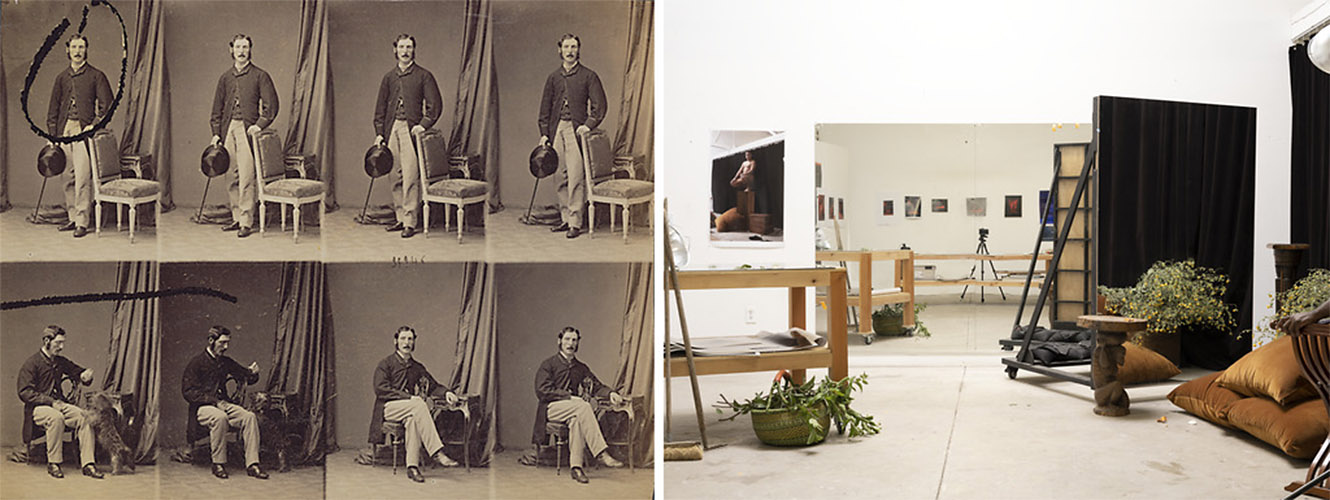
At left, André Adolphe-Eugène Disdéri (French, 1819-1889) 'Uncut Sheet of Cartes-de-Visite Portraits', 1860s; and at right, Paul Mpagi Sepuya (American, b. 1982) 'Daylight Studio with Garden Cuttings (_DSF0340)' 2022


At left, André Adolphe-Eugène Disdéri (French, 1819-1889) Uncut Sheet of Cartes-de-Visite Portraits, 1860s; and at right, Paul Mpagi Sepuya (American, b. 1982) Daylight Studio with Garden Cuttings (_DSF0340) 2022


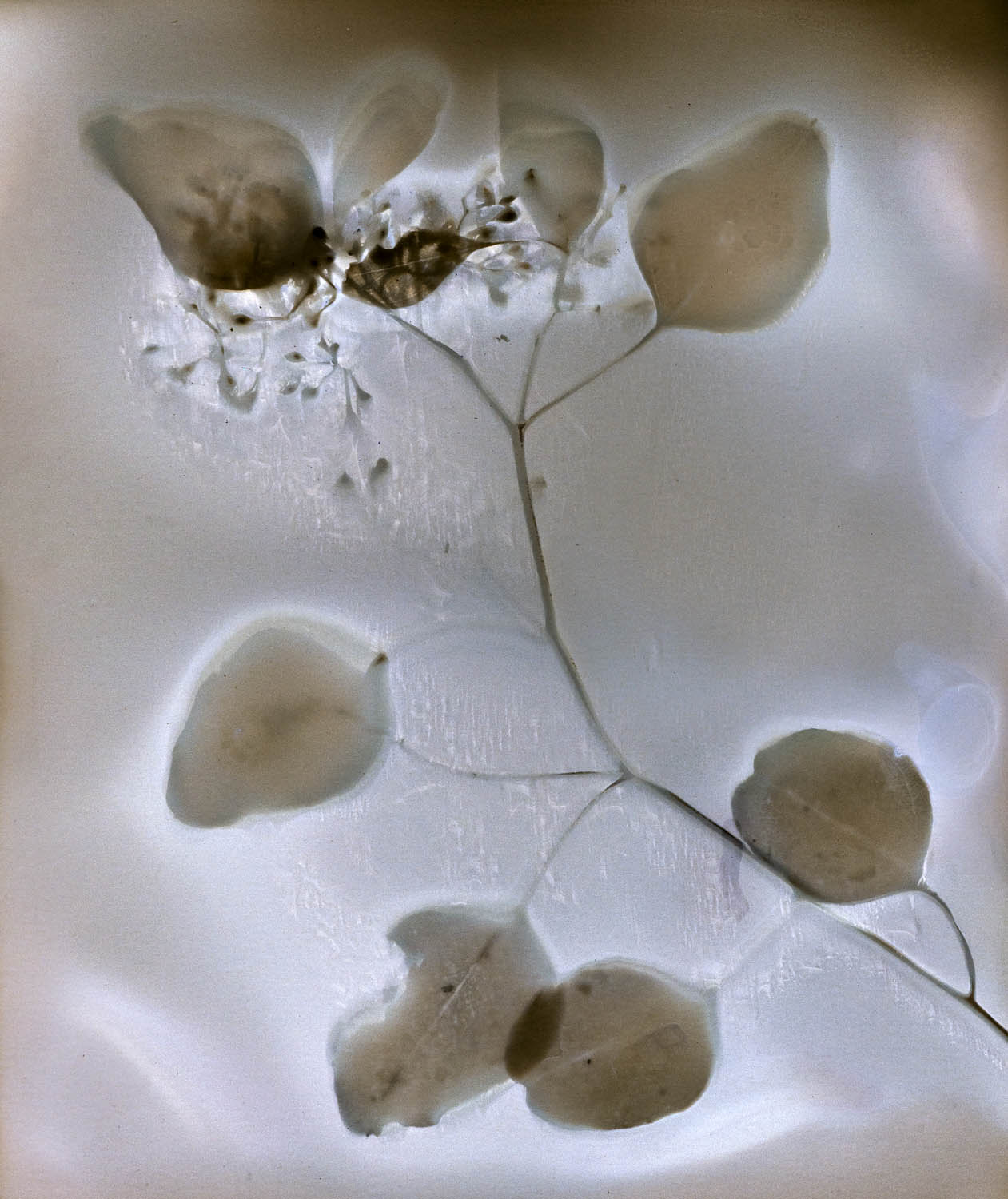
William Henry Fox Talbot (English, 1800-1877) '[A Stem of Delicate Leaves of an Umbrellifer]' probably 1843-1846


William Henry Fox Talbot (English, 1800-1877)
[A Stem of Delicate Leaves of an Umbrellifer]
probably 1843-1846
Photogenic drawing negative
Image: 18.1 × 22.1cm (7 1/8 × 8 11/16 in.)
The J. Paul Getty Museum, Los Angeles


The exceptional boldness of this image conveys a visual impression that at first may seem quite unlike other of William Henry Fox Talbot’s pictures. He made it with the same photogenic drawing process he used for much of his work by placing the stem of leaves directly on top of the prepared paper and then exposing to sunlight without the aid of a camera. Although the original plant was delicate, its sharply delineated white shadow on the rich dark brown background creates a graphic, two-tone effect. The same specimen was used in a slightly different orientation to make a negative that is preserved in one of the family albums formerly at the Fox Talbot Museum in Lacock and now at the British Library, London.

Other visually similar works in Talbot’s oeuvre help us to understand what we are seeing here. Some of them show the interior structure of the plant specimens he photographed, proving that the negatives at first had fuller details. Because the most vulnerable sections of the silver-based images are those that are light in tone, these areas will fade disproportionately faster than the darker parts. In this case, the lightest tones would have been in the interior spaces of the plant, and these at some point faded. It is unlikely that Talbot saw the same picture we see today, at least not when he first made it, but the boldness of the present state reminds us that changes over time can create as well as destroy.

Adapted from Larry Schaaf. William Henry Fox Talbot, In Focus: Photographs from the J. Paul Getty Museum (Los Angeles: Getty Publications, 2002), 68. © 2002 J. Paul Getty Trust


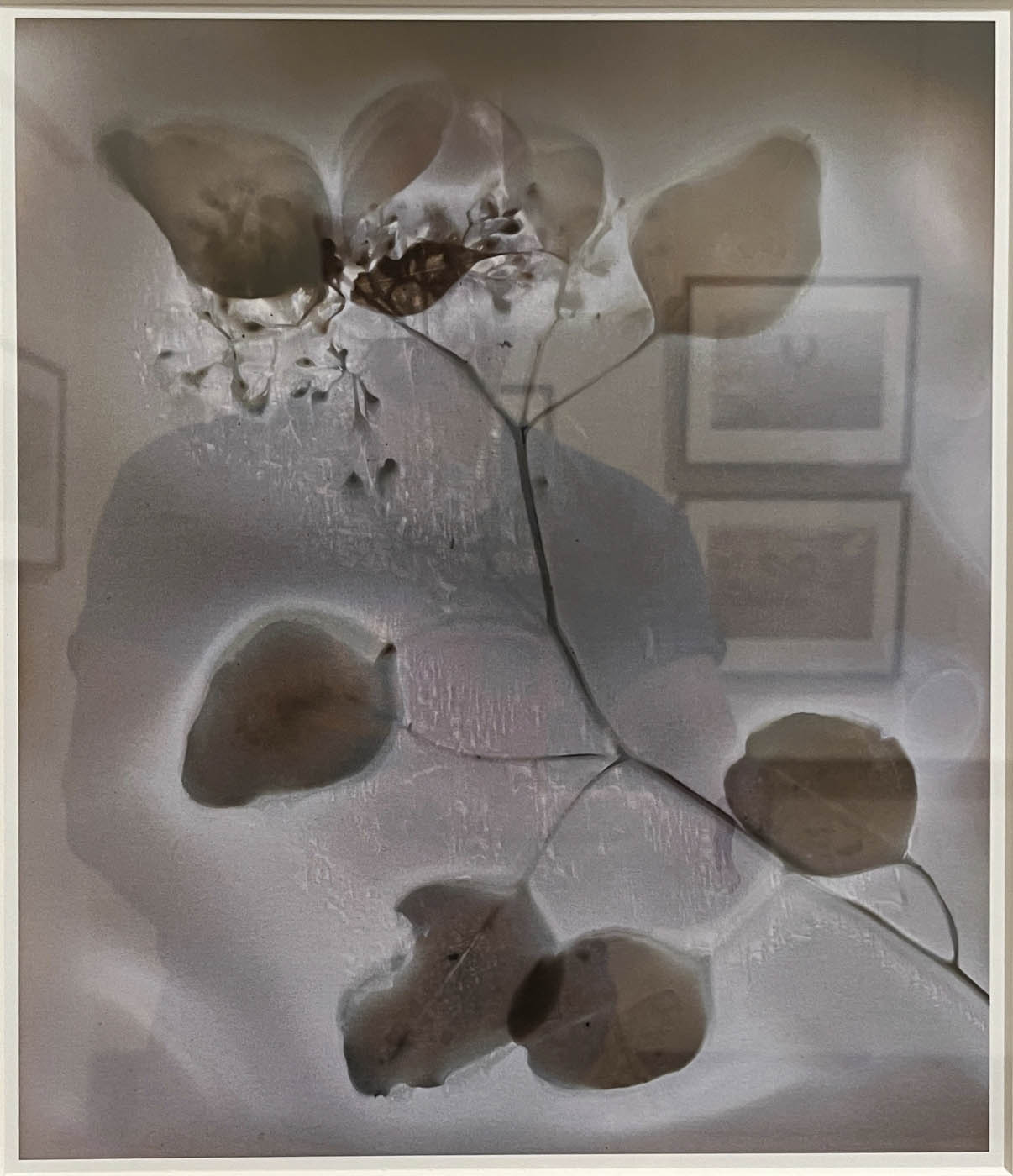
Hiroshi Sugimoto (Japanese, b. 1948) 'A Stem of Delicate Leaves of an Umbrellifer, circa 1843-1846' 2009


Hiroshi Sugimoto (Japanese, b. 1948)
A Stem of Delicate Leaves of an Umbrellifer, circa 1843-1846
2009
Toned gelatin silver print
Image: 93.7 × 74.9cm (36 7/8 × 29 1/2 in.)
The J. Paul Getty Museum, Los Angeles
Gift of the artist
© Hiroshi Sugimoto


“To look at Fox Talbot’s earliest experiments, the blurred and hazy images suffuse the excited anticipation of discovering how light could transfer the shape of things onto paper. … I decided to collect Fox Talbot’s earliest negatives, from a time in photographic history very likely before positive images existed, and print the photographs that not even he saw.”

~ Hiroshi Sugimoto (p. 349, in Hiroshi Sugimoto, Ostfildern-Ruit, 2005)


Hiroshi Sugimoto visited the Getty Museum in 2007 to study the earliest photographs in the collection. After photographing some of William Henry Fox Talbot’s photogenic drawing negatives, he produced large-scale prints and coloured them with toning agents to replicate the hues of the paper negatives. The scale of the enlarged prints reveals the fibers of the original paper, which create delicate patterns embedded in the images.


At left, Herbert Bell et al, '[Amateur World Tour Album, taken with early Kodak cameras, plus purchased travel photographs by various photographers]' (2 page spread); and at right, Stephanie Syjuco (American born Philippines, b. 1974) 'Herbaria' 2021 (detail)


At left, Herbert Bell et al, [Amateur World Tour Album, taken with early Kodak cameras, plus purchased travel photographs by various photographers] (2 page spread); and at right, Stephanie Syjuco (American born Philippines, b. 1974)
Herbaria 2021 (detail)


Herbert Bell (English, 1856-1946) Frederick Nutt Broderick (English, about 1854-1913) Gustave Hermans (Belgian, 1856-1934) Anthony Horner (English, 1853-1923) Michael Horner (English, 1843-1869) C. W. J. Johnson (American, 1833-1903) Léon & Lévy (French, active 1864-1913 or 1920) Léopold Louis Mercier (French, b. 1866) Neurdein Frères (French, founded 1860s, dissolved 1918) Louis Parnard (French, 1840-1893) Alfred Pettitt (English, 1820-1880) Francis Godolphin Osborne Stuart (British born Scotland, 1843-1923) Unknown maker Valentine & Sons (Scottish, founded 1851, dissolved 1910) L. P. Vallée (Canadian, 1837-1905) York and Son J. Kühn (French, active Paris, France 1885 - early 20th century) '[Amateur World Tour Album, taken with early Kodak cameras, plus purchased travel photographs by various photographers]' (2 page spread)


Herbert Bell (English, 1856-1946)
Frederick Nutt Broderick (English, about 1854-1913)
Gustave Hermans (Belgian, 1856-1934)
Anthony Horner (English, 1853-1923)
Michael Horner (English, 1843-1869)
C. W. J. Johnson (American, 1833-1903)
Léon & Lévy (French, active 1864-1913 or 1920)
Léopold Louis Mercier (French, b. 1866)
Neurdein Frères (French, founded 1860s, dissolved 1918)
Louis Parnard (French, 1840-1893)
Alfred Pettitt (English, 1820-1880)
Francis Godolphin Osborne Stuart (British born Scotland, 1843-1923)
Unknown maker
Valentine & Sons (Scottish, founded 1851, dissolved 1910)
L. P. Vallée (Canadian, 1837-1905)
York and Son
J. Kühn (French, active Paris, France 1885 – early 20th century)
[Amateur World Tour Album, taken with early Kodak cameras, plus purchased travel photographs by various photographers] (2 page spread)
Albumen silver print
Closed: 35.4 × 28 × 3.5cm (13 15/16 × 11 × 1 3/8 in.)
The J. Paul Getty Museum, Los Angeles
Google Arts & Culture website


Includes amateur photographs taken with early Kodak cameras, including the original Kodak or Kodak no. 1, and Kodak no. 2 cameras, as well as commercially produced images.


Stephanie Syjuco (American born Philippines, b. 1974) 'Herbaria' 2021 (detail)


Stephanie Syjuco (American born Philippines, b. 1974)
Herbaria (detail)
2021
From the series Pileups
Hand-assembled pigmented inkjet prints on Hahnemühle Baryta
Framed [Outer Dim]: 121.9 × 91.4cm (48 × 36 in.)
The J. Paul Getty Museum, Los Angeles
© Stephanie Syjuco


A collage composed of diverse naturalist archival sources, including photographs of bones, foliage, and crystal formations.


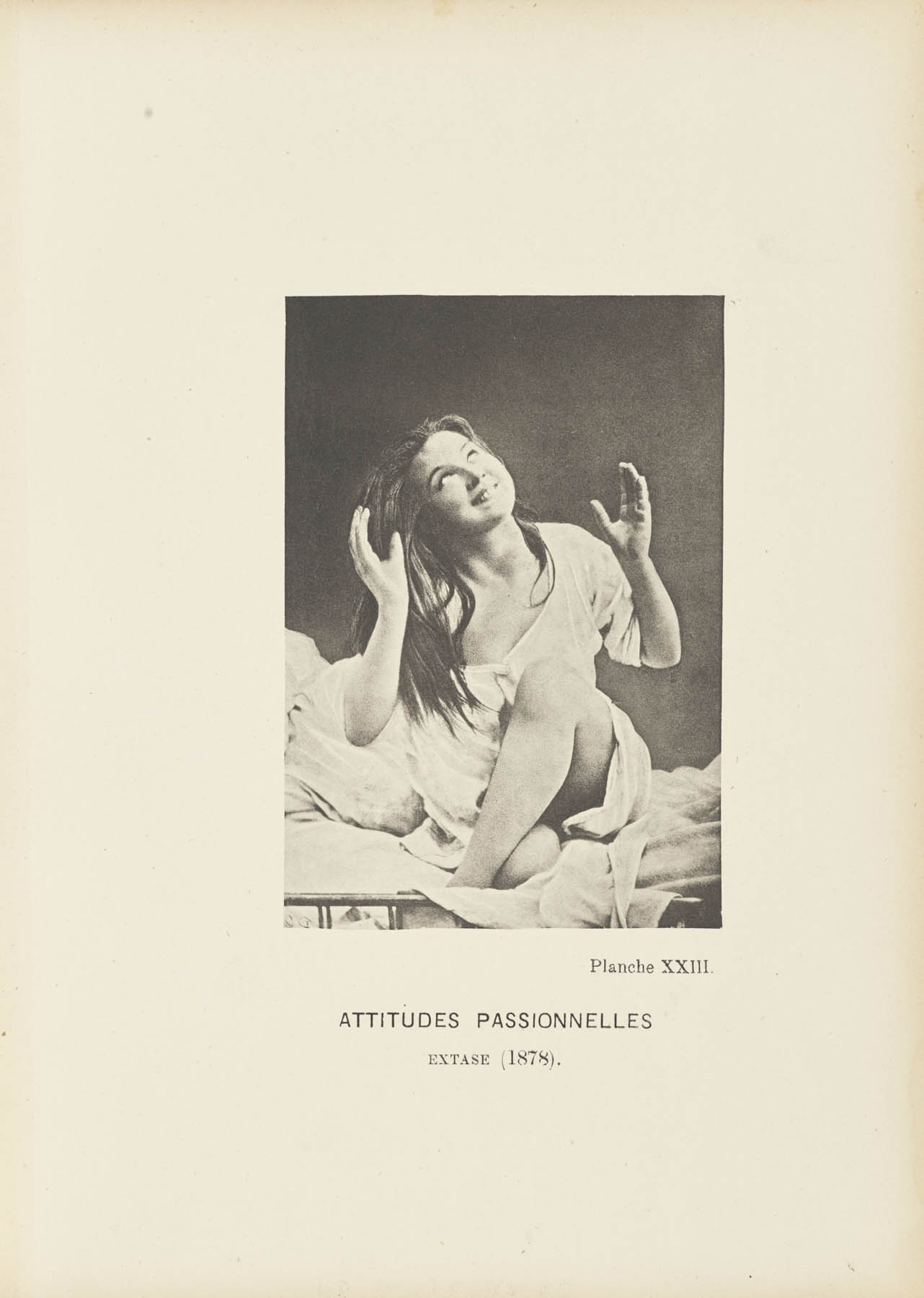
At left, Paul-Marie-Léon Regnard (French, 1850-1927) 'Passionate Ecstatic Position/Expression' 1878; and at right, Laura Larson (American, b. 1965) 'The Mind Is a Muscle' 2019


At left, Paul-Marie-Léon Regnard (French, 1850-1927) Passionate Ecstatic Position/Expression 1878; and at right, Laura Larson (American, b. 1965)
The Mind Is a Muscle 2019


Paul-Marie-Léon Regnard (French, 1850-1927) 'Passionate Ecstatic Position/Expression' 1878 Part of 'Iconographie Photographique de la Salpetriere' (Service de M. Charcot)


Paul-Marie-Léon Regnard (French, 1850-1927)
Passionate Ecstatic Position/Expression
1878
Part of Iconographie Photographique de la Salpetriere (Service de M. Charcot)
Photogravure
Image: 10.3 × 7.1cm (4 1/16 × 2 13/16 in.)
The J. Paul Getty Museum, Los Angeles


Laura Larson (American, b. 1965) 'The Mind Is a Muscle' 2019


Laura Larson (American, b. 1965)
The Mind Is a Muscle
2019
from the series City of Incurable Women
Inkjet print
The J. Paul Getty Museum, Los Angeles
Courtesy of and © Laura Larson


At first glance, photographs made in the 19th century may seem like faded relics of an increasingly distant and forgotten age, yet they persist in inspiring, challenging, and resonating with artists today.

Nineteenth-Century Photography Now, on view April 9 through July 7, 2024 at the Getty Center, offers new perspectives on early photography by looking through the lens of contemporary artists who respond directly to their historical themes and subject matter.

“This exhibition provides an opportunity to connect visitors with some of the earliest photographs in the Museum’s collection, now almost two centuries old, via the responses of contemporary makers,” says Timothy Potts, Maria Hummer-Tuttle and Robert Tuttle Director of the J. Paul Getty Museum. “The revelatory ability of early photography to capture images of the world around us still resonates with practitioners today, and bridges between past and present photography are as active and relevant as they have ever been.”

Organised around five themes, dating back to the medium’s beginnings, Identity, Time, Spirit, Landscape, and Circulation, this exhibition explores 19th-century photographs through the work of 21 contemporary artists. Reflecting the inventiveness of early practitioners as well as the more disturbing historical aspects of their era, these interchanges between the first decades of the medium and the most recent invite us to reimagine 19th century photography while exploring its complexities.

In their work, artists Daido Moriyama, Hanako Murakami, and Carrie Mae Weems look back to the invention of photography to convey a sense of how this revolutionary discovery changed people’s perceptions.

As is still the case today, the most popular subjects for the camera in the 19th century were people. In the galleries focused on Identity, Paul Mpagi Sepuya and Myra Greene respond to the complex history of photographic portraiture while Laura Larson, Stephanie Solinas, and Fiona Tan investigate the pseudosciences of the 19th century and how they reinforced stereotypes and identification systems that impact us today.

Photography and Time have been inextricably linked ever since early inventors struggled to permanently fix a fleeting moment on a sheet of paper. This section includes work by Lisa Oppenheim and Liz Deschenes exploring 19th-century photographers’ technical innovations and the ways in which the medium affects our perception of time.

The genre of Spirit photography emerged from the Victorian obsession with death in Europe and North America. Photographers exploited the ability to manipulate photographic images, employing multiple exposures and staged photography to create otherworldly scenes or to summon loved ones back from the dead. In this section, Khadija Saye and Lieko Shiga respond to the possibilities that spirit photography offers in rendering the unseen.

19th-century photographers went to great lengths to make images of remote Landscapes. Government-sponsored surveys and expeditionary programs employed the camera to justify the expansion and to record the resulting military conflicts. Mark Ruwedel, Michelle Stuart, and An-My Lê re-envision some of these same historical landscapes and offer up new ones that bring the past closer to our present.

By the middle of the 19th century, thousands of photographs were in Circulation worldwide, the result of photographers’ ability to reproduce the same image multiple times. Pictures of historical events, tourist destinations, and anthropological expeditions made the world seem more accessible, but with time and distance, they became disconnected from their original contexts. In this section, early photographs appear next to projects that make these historical absences present. Wendy Red Star, Stephanie Syjuco, Ken Gonzales-Day, and Andrea Chung recover what has been lost, calling out the residual effects of the 19th-century photograph on our present knowledge of global cultures and histories.

“Through the works of these visionary contemporary artists, 19th-century photography is not faded and dead but very much alive, an active material that enables us to rethink the medium and our relationship to it,” says Karen Hellman, curator of the exhibition.

Nineteenth-Century Photography Now is curated by Karen Hellman, former associate curator in the Department of Photographs. Carolyn Peter, assistant curator in the Department of Photographs, Getty Museum, served as organising curator with assistance from Claire L’Heureux, former Department of Photographs graduate intern and Antares Wells, curatorial assistant.

Related programming includes Who or What is Missing in Nineteenth-Century Photography?, a discussion featuring artists Laura Larson, Wendy Red Star, and Paul Mpagi Sepuya in a conversation about their artistic practices and how they are engaging with, and critiquing photography from the 19th century, and Art Break: The Precarious Nature of Photography, Society, and Life, June 6, 12pm. Artist Phil Chang talks with curator Carolyn Peter about his series “Unfixed” on view in Nineteenth-Century Photography Now and how an economic crisis and a pandemic inspired him to create photographs that will intentionally fade away to express the fragility of societal systems and life.

Press release from the J. Paul Getty Museum website


Introduction


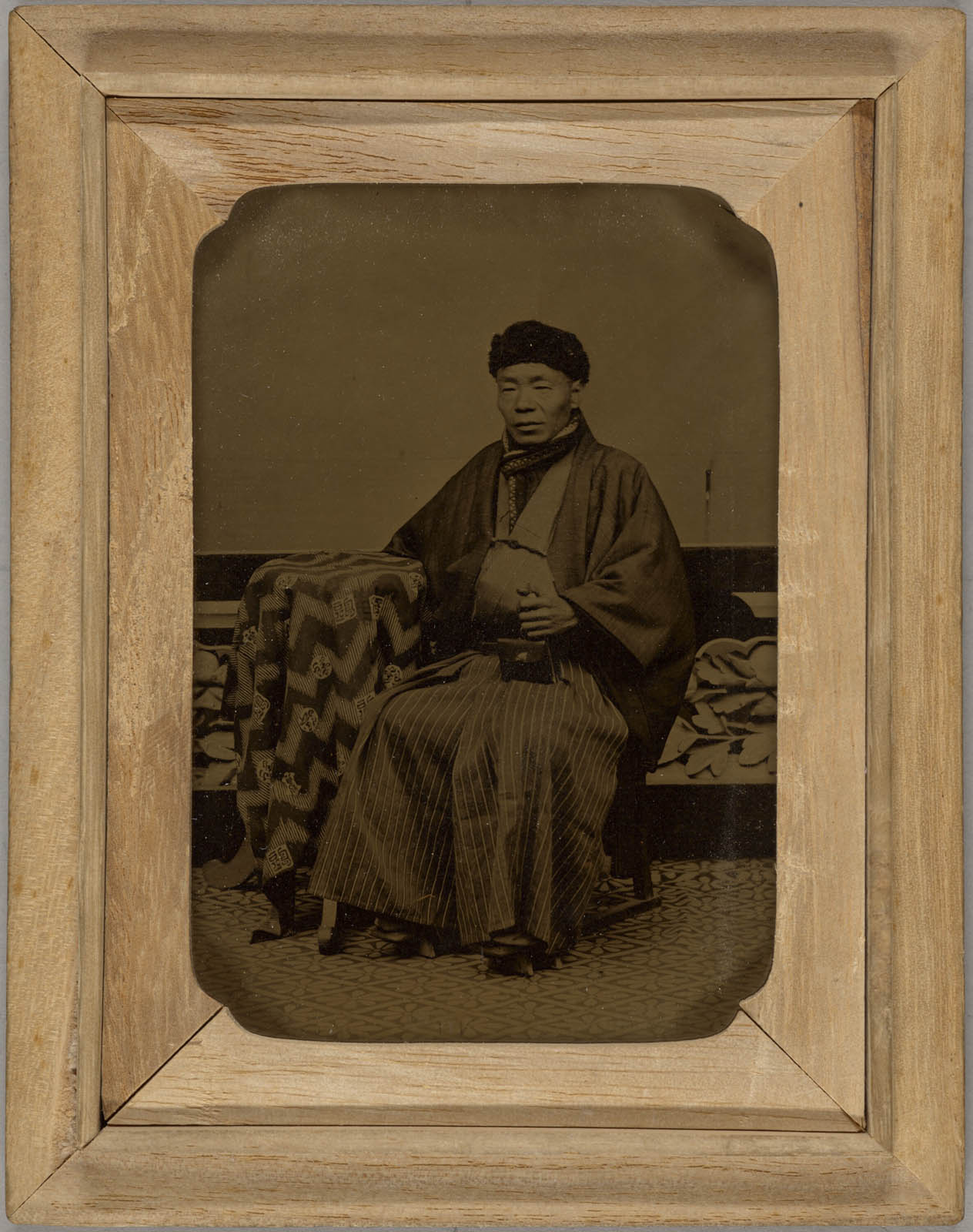
At left, Maker unknown. 'Kuroda Yasaburo, 50 Years Old' January 6, 1882; and at right, Myra Greene (American, b. 1975) 'Undertone #10' 2017-2018


At left, Maker unknown Kuroda Yasaburo, 50 Years Old January 6, 1882; and at right, Myra Greene (American, b. 1975) Undertone #10 2017-2018


Introduction

The earliest photographs – often associated with small, faded, sepia-toned images – may seem to belong to a bygone era, but many of the conventions established during photography’s earliest years persist today. Organised around five themes dating back to the medium’s beginnings, this exhibition explores nineteenth-century photographs through the work of twenty-one contemporary artists. Reflecting the inventiveness of early practitioners as well as the more disturbing historical aspects of their era, these interchanges between the first decades of the medium and the most recent invite us to reimagine nineteenth-century photography while exploring its complexities.


Maker unknown. 'Kuroda Yasaburo, 50 Years Old' January 6, 1882


Maker unknown
Kuroda Yasaburo, 50 Years Old
January 6, 1882
Ambrotype
Closed: 11.5 × 9 × 1cm (4 1/2 × 3 9/16 × 3/8 in.)
The J. Paul Getty Museum, Los Angeles
Gift of Virginia Heckert in memory of Gordon Baldwin


Myra Greene (American, b. 1975) 'Undertone #10' 2017-2018


Myra Greene (American, b. 1975)
Undertone #10
2017-2018
Ambrotype
The J. Paul Getty Museum, Los Angeles
© Myra Greene


__________________________________________

Identity


At left, Various makers. 'Pickpockets at the Universal Exposition of 1889' 1889; and at right, Fiona Tan (Indonesia, b. 1966) 'Marie Thiriot' 2021


At left, Various makers Pickpockets at the Universal Exposition of 1889 1889; and at right, Fiona Tan (Indonesia, b. 1966) Marie Thiriot 2021


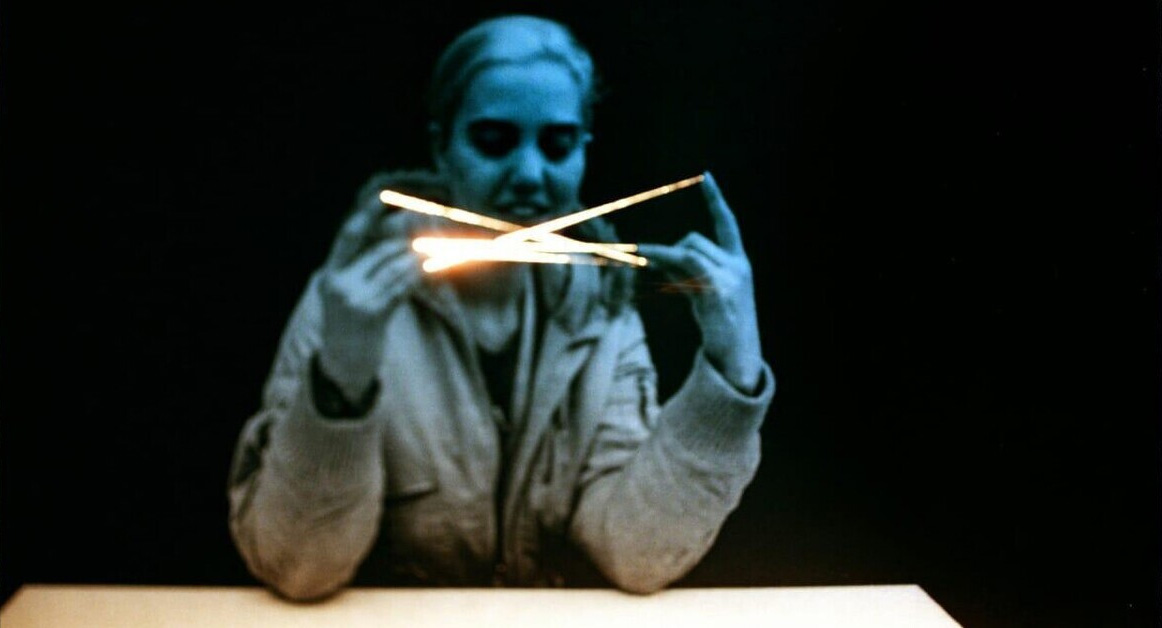
Fiona Tan (Indonesia, b. 1966) 'Marie Thiriot' 2021


Fiona Tan (Indonesia, b. 1966)
Marie Thiriot
2021
From the series Pickpockets
HD video installation, stereo, flat-screen monitor
Courtesy of the artist and Frith Street Gallery, London
© Fiona Tan
Photo: Frith Street Gallery CC


‘As an artist working almost entirely with time-based and lens-based media, time is one of my major tools … time is both tool with which to shape and chisel and material to fold, distort and configure.’

Fiona Tan (b. 1966, Pekanbaru) explores history and time and our place within them, working within the contested territory of representation. Deeply embedded in all of Tan’s works is her fascination with the mutability of identity, the deceptive nature of representation and the play of memory across time and space in a world increasingly shaped by global culture. She investigates how we represent ourselves and the mechanisms that determine how we interpret the representation of others. …

A testament to Tan’s passion for archives, her video installation Pickpockets (2020) stems from an album of photographs she came across when in residence at the Getty Research Center, Los Angeles. It contained early examples of mugshots taken of pickpockets apprehended at the World’s Fair in Paris in 1889. Fascinated by the subjects of these portraits, their names and countries of origin, and their unknown stories, she invited a group of writers to devise monologues from the point of view of these individuals, which were then performed and recorded by actors.

Anonymous. “Fiona Tan,” on the Frith Street Gallery website Nd [Online] Cited 29/04/2024


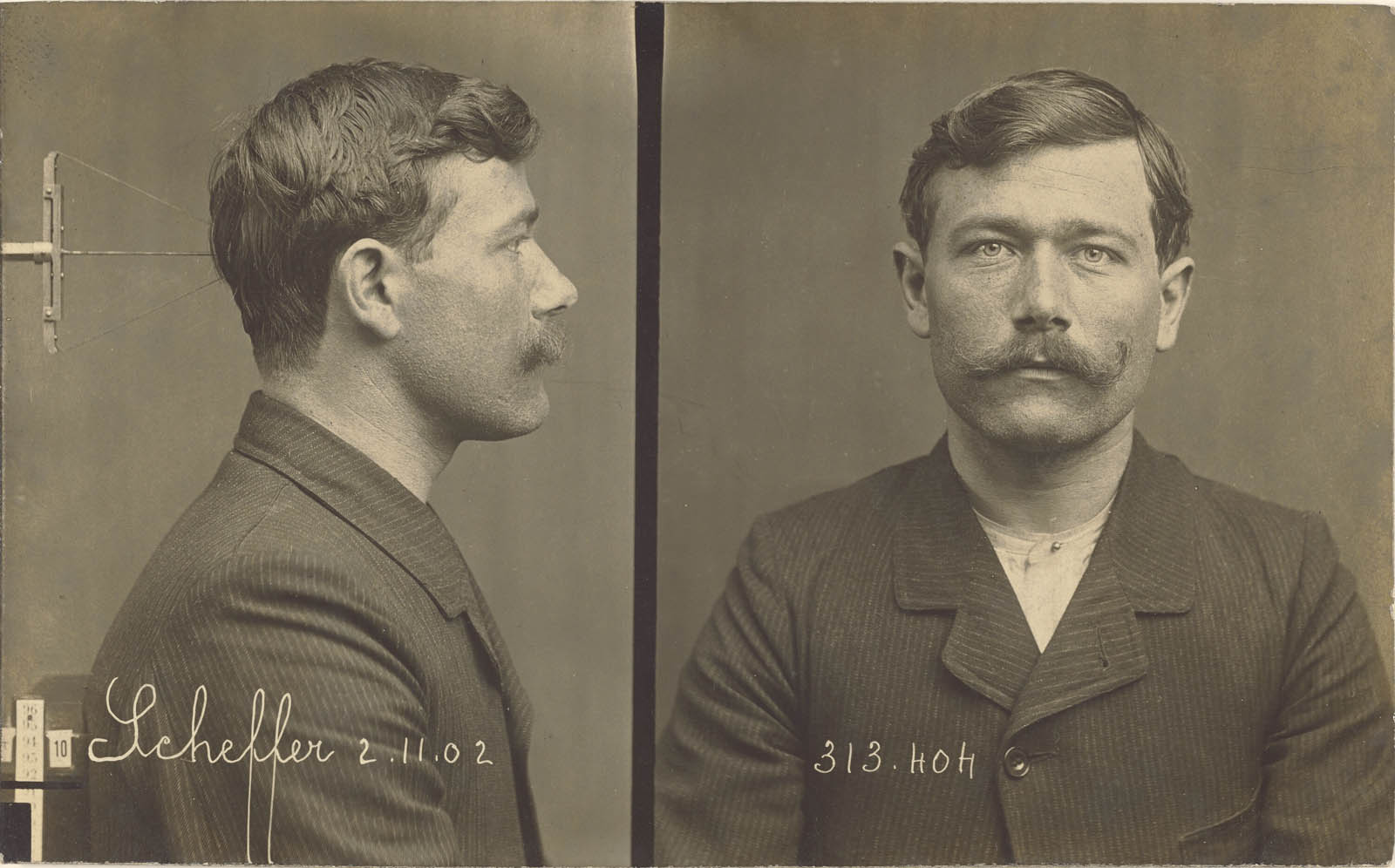
[The identity section] has “Affaire Alaux, Faubourg St. Honoré – L’Assassin” (Nov. 2, 1902), a print by Alphonse Bertillon, the inventor of the mug shot, showing the mustached villain full-face and in profile; it is accompanied by over 20 pictures of sites that played a significant role in Bertillon’s life taken in 2012 by Stéphanie Solinas employing a “crime scene” approach.

William Meyers. “Photography’s Past and Present at the Getty Center,” on The Wall Street Journal website May 29, 2024 [Online] Cited 16/06/2024


At left, Attributed to Alphonse Bertillon (French, 1853-1914) 'Affaire Alaux, Faubourg St. Honoré – L'Assassin' November 2, 1902; and at right, Stéphanie Solinas (French, b. 1978) 'Untitled (M. Bertillon) – Two Faces' 2012


At left, Attributed to Alphonse Bertillon (French, 1853-1914) Affaire Alaux, Faubourg St. Honoré – L’Assassin November 2, 1902; and at right, Stéphanie Solinas (French, b. 1978) Untitled (M. Bertillon) – Two Faces 2012


Identity

As is still the case today, the most popular subjects for the camera in the nineteenth century were people. Early commercial portrait photographers set up studios and established standards for posing and props, serving clients who eagerly shared these prized images with family and friends. Other portraits of the time, however, such as the mug shot and studies of female “hysterics,” reinforced questionable forms of objectification. Paul Mpagi Sepuya and Myra Greene respond to the complex history of photographic portraiture. Fiona Tan, Laura Larson, and Stéphanie Solinas investigate the nineteenth century pseudosciences that relied on the perceived accuracy of the new medium.


Attributed to Alphonse Bertillon (French, 1853-1914) 'Affaire Alaux, Faubourg St. Honoré – L'Assassin' November 2, 1902


Attributed to Alphonse Bertillon (French, 1853-1914)
Affaire Alaux, Faubourg St. Honoré – L’Assassin
November 2, 1902
Gelatin silver print
Image: 7.9 × 12.7cm (3 1/8 × 5 in.)
The J. Paul Getty Museum, Los Angeles


The mugshot of Henri-Léon Scheffer, the man who murdered Joseph Reibel.


CAUGHT BY A FINGER PRINT

A unique piece of detective work has been accomplished in Paris by a retiring scientist. A mysterious murder had been committed. The detectives arrested one wrong man dis charged him, and were preparing .to arrest another when to their chief came the quiet scientist, saying,

“The assassin’s name is Henri Léon Scheffor. Here is his photograph, his description and past record.” M. Cochefert, chief of the police hesitated. “My men know nothing of this person.” he said. “How shall we accuse him ?”

“Arrest him,” insisted the other, “and should he prove to innocent I will pay him 1,000 francs as an indemnity.”

“But what basis have you for your certainty of his guilt ?” asked M. Cochefert.

“Some finger prints he left on a piece of broken glass,” replied the man of science.

It was not necessary to pay the indemnity. He who was thus strangely accused was arrested and confessed his crime. The quiet man of science was M. Alphonse Bertillon, already celebrated as the founder and present chief of tho anthropometric service of tho Paris prefecture of police. Alphonse Bertillon has the gentle, weary smile of the over-worked and nervous student. He speaks mildly, moves softly, like one on his guard against strain and haste, until now and again, his thoughtful face will light up with enthusiasm as he lets himself go. Then his conversation becomes rapid and eloquent ; he runs through books and documents with ardour, pulls down boxes from high shelves, spreads out charts, explains them, performs experiments to illustrate his statements and darts back by a short cut to tho point where he had left off; tho whole man is transformed. Thus we heard the tale of the Accusing Finger Prints.

“A man named Joseph Reibel, porter to tho dentist Allaux, in his apartment and offices in the Rue du Faubourg Saint-Honore, was found choked to death and clumsily tied, lying in his master’s office,” began M. Bertillon. “The place had been looted hastily, closets and drawers being open and their contents tossed about. In particular a handsome cabinet holding a collection of coins was found with its glass door broken and its gold coins absent. There were- practically no clues to the identity of the assassin, the janitress at the street door, having a confused memory as to visitors, which set the detectives on more than one wrong scent. They arrested one man and the papers published his portrait. Then the newspapers at least began to suspect the innocent dentist himself.

“They had taken a flashlight photograph of the office,” continued M. Bertillon. “Looking at that photograph one day, I noticed two glittering little white marks on the edge of the broken glass of the coin cabinet. I asked my self what they could be. They might be defects in the printing ; but, on the other hand their situation suggested that they might be finger prints – and finger-prints are very much in my line ! The thought wore upon me until at last I jumped into a cab and drove to tho place. Examining the edge of the glass I found tho marks to be really finger-marks, and in spite of the thousand chances still in good condition.

“Being composed of tiny quantities of grease and dirt they made the glass slightly opaque, so that they came out bright by contrast in the photograph. Except when looked at in a favourable light they were practically invisible to the naked eye. There were marks of a right-hand thumb in one place and of the same thumb and four fingers in another. I had the two pieces of glass cut out with a diamond. I gave one to a policeman, instructing him to hold it just so, and saw him start off to my office with it in a cab. Then I gave tho other piece to a second policeman, with the same instructions, and started him off in a second cab, so that if an accident should happen to one of the pieces the other might be spared.

“In the workrooms of the anthropometric service I had the finger-marks immediately photographed. At first I admit I did not attach overmuch importance to them. They might be the prints of one of the detectives, or of the dentist Allaux – naturally solicitous of his broken cabinet – or even the finger-prints of M. Cochefert ! One by one I took their finger-prints for comparison. One by one I found that they did not at all correspond with those on the glass. This started me in earnest,” admitted M. Bertillon. “I began to ask myself, if among the thousands of criminals, swindlers and violent and suspicious characters photo-graphed, measured, and, finger-printed yearly by the anthropometric service the author of these finger-prints might not, at some time or other, himself have passed.” Here M. Bertillon called our attention to the thumb mark (“pouce”) of Scheffer, the assassin, Just below his full-face and profile photographs. Though small it was very distinct.

“Look at the central point of that thumb-print,” he exclaimed. “Look where the innermost loop moves up and over a single diagonal. Now jumping two loops from that interior diagonal, towards tho direct left you see a plain little fork in tho third loop. It is the exact reproduction of just such another in the thumb-mark on the broken glass ! Tho next thing was to arrest Scheffer though it took a little time to find him. Here, again, the information obtainable from his ‘fiche’ in the anthropometric service rendered service. It was seen that he had been a native of Aubervilliers (the Paris suburb and had worked in the government match factory. When arrested he confessed, at the same time trying to make out a case of extenuating circumstances. According to his story, Reibel planned that they should simulate a burglary of his master’s premises. They quarrelled over the division of the spoils and Scheffer says he thought he had merely choked his friend into un-consciousness and left him tied – according to original agreement. And all discovered through an accidental finger-print which the assassin had left as an index to the crime. “Science Siftings.”

Anonymous. “Caught by a Finger Print,” in the Balmain Observer and Western Suburbs Advertiser (NSW: 1884-1907), Sat 4 Mar 1905, Page 2 on the Trove website [Online] Cited 29/04/2024

__________________________________________

Time


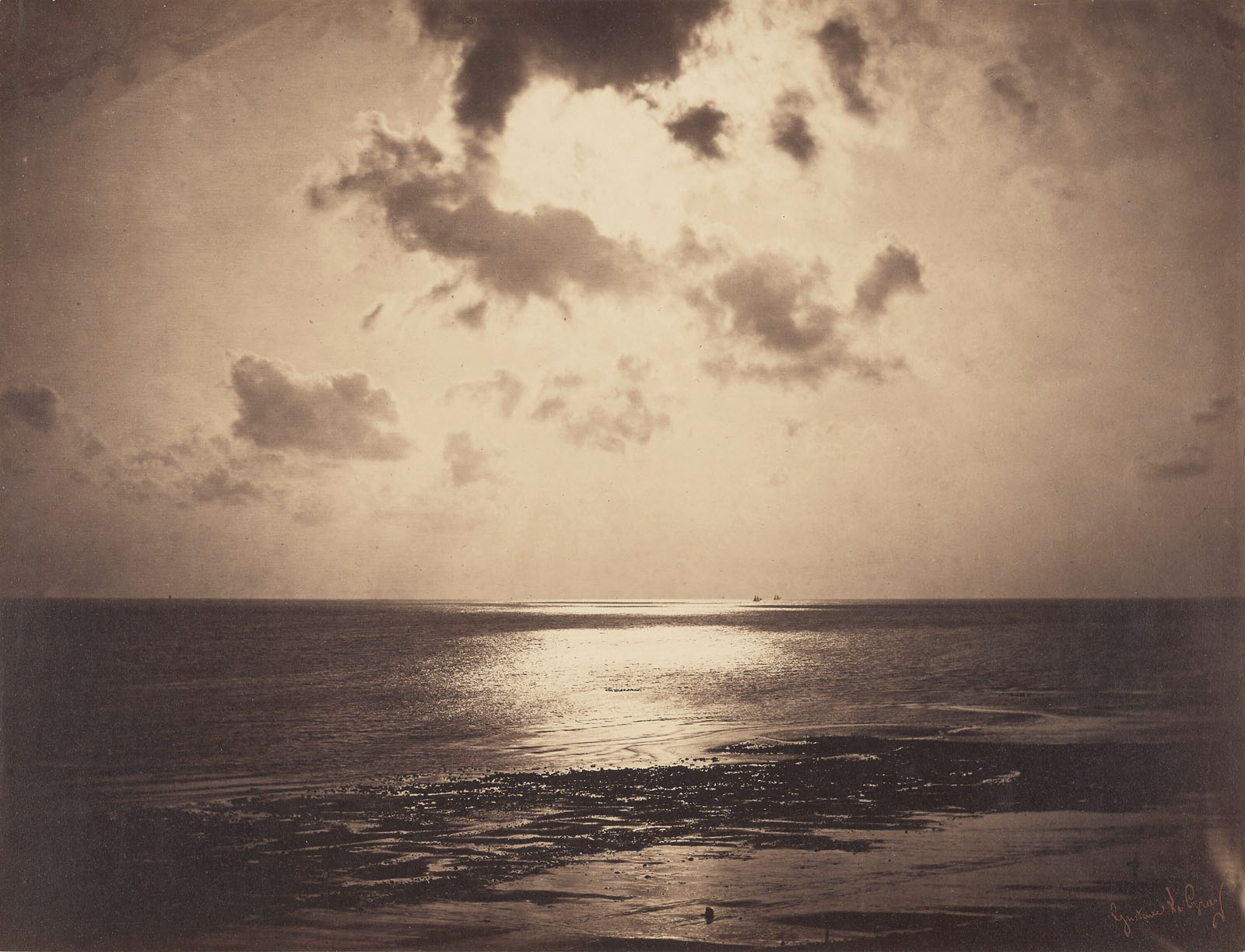
Gustave Le Gray (French, 1820-1884) 'An Effect of Sunlight – Ocean No. 23' 1857-1858


Gustave Le Gray (French, 1820-1884)
An Effect of Sunlight – Ocean No. 23
1857-1858
Albumen silver print from glass negatives
12 5/8 × 16 7/16 in.
The J. Paul Getty Museum, Los Angeles


Lisa Oppenheim (American, b. 1975) 'An Effect of Sunlight – Ocean No. 23 (1857/2019)' 2019


Lisa Oppenheim (American, b. 1975)
An Effect of Sunlight – Ocean No. 23 (1857/2019)
2019
Gelatin silver print, exposed to sunlight and toned with silver
Framed [Outer Dim]: 35.6 × 47.7 × 3.7cm (14 × 18 3/4 × 1 7/16 in.)
The J. Paul Getty Museum, Los Angeles
© Lisa Oppenheim


Time

Photography and time have been inextricably linked ever since early inventors such as William Henry Fox Talbot struggled to permanently fix a fleeting moment on a sheet of paper. The development of the camera coincided with new discoveries about how we perceive an instant in time or an object in motion, and people praised photography for its ability to “stop time” and record what the unaided eye could not see. Lisa Oppenheim and Liz Deschenes respond to nineteenth century photographers’ technical innovations and the ways in which the medium affects our perception of time. Phil Chang and Hiroshi Sugimoto address the fate of photographs across minutes or even centuries.


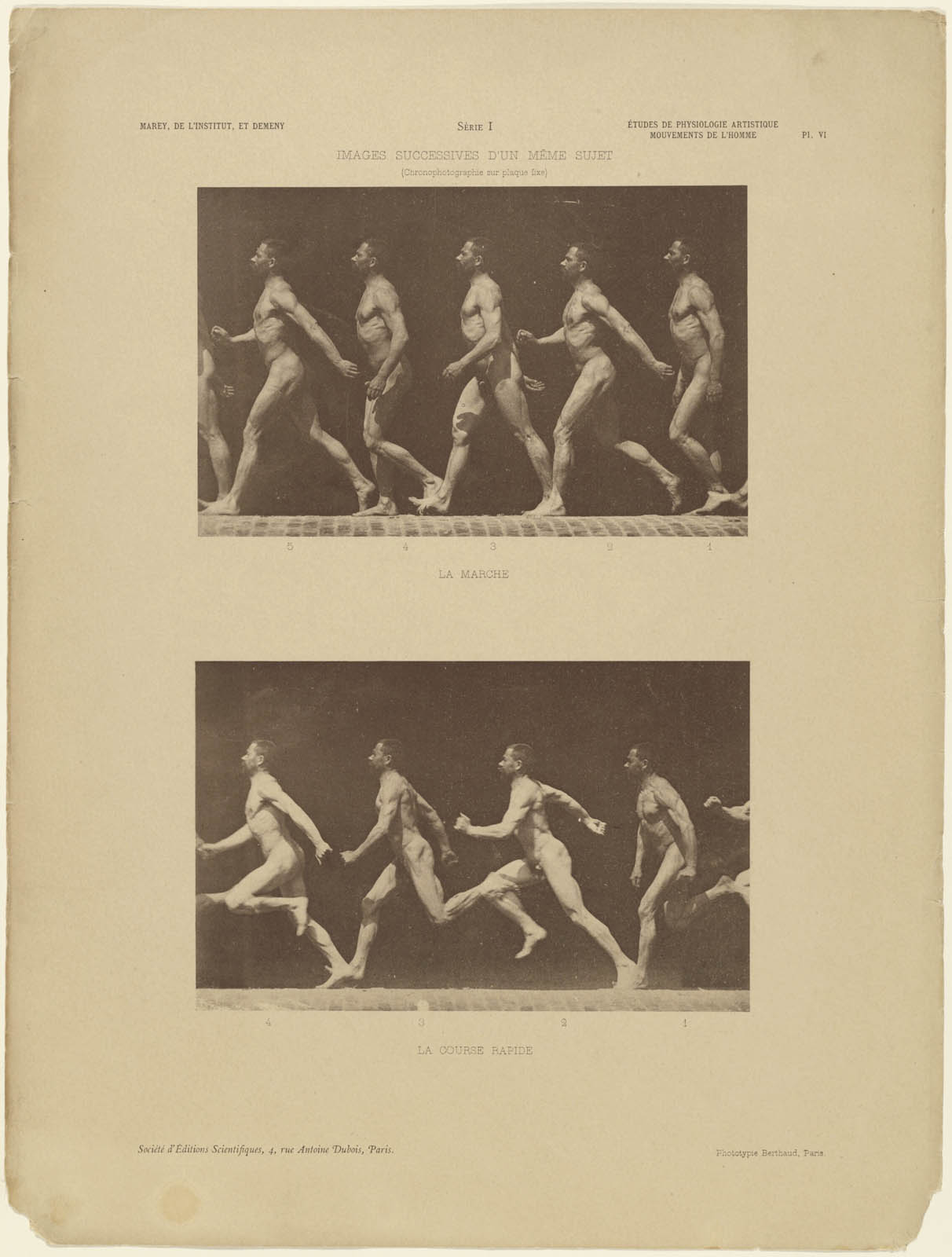
At left, Étienne-Jules Marey (French, 1830-1904) and Michel Berthaud (French, active 1860s-1880s) 'Walking/Running' (La Marche/La Course Rapide) about 1890, published 1893; and at right, Liz Deschenes (American, b. 1966) 'FPS (120)' 2018-2021


At left, Étienne-Jules Marey (French, 1830-1904) and Michel Berthaud (French, active 1860s-1880s) Walking/Running (La Marche/La Course Rapide) about 1890, published 1893; and at right, Liz Deschenes (American, b. 1966) FPS (120) 2018-2021


Étienne-Jules Marey (French, 1830-1904) and Michel Berthaud (French, active 1860s-1880s) 'Walking/Running' (La Marche/La Course Rapide) about 1890, published 1893


Étienne-Jules Marey (French, 1830-1904) and Michel Berthaud (French, active 1860s-1880s)
Walking/Running (La Marche/La Course Rapide)
about 1890, published 1893
Collotype
Image: 11.3 × 17.6cm (4 7/16 × 6 15/16 in.)
The J. Paul Getty Museum, Los Angeles

__________________________________________

Spirit


At left, William H. Mumler (American, 1832-1884) 'Mrs. Swan' 1869-1878; and at right, Khadija Saye (Gambian-British, b. 1992) 'Nak Bejjen' [Cow's Horn] 2017-2018


At left, William H. Mumler (American, 1832-1884) Mrs. Swan 1869-1878; and at right, Khadija Saye (Gambian-British, b. 1992) Nak Bejjen [Cow’s Horn] 2017-2018


Spirit

The genre of spirit photography – which used photographic tricks to insert ghostly figures among the living – emerged during the nineteenth century from the Victorian obsession with death, séances, and mediums in Europe and North America and from the losses of the Civil War in the United States. Photographers exploited the ability to manipulate photographic images, employing multiple exposures and staged photography to create otherworldly scenes or to summon loved ones back from the dead. Khadija Saye and Lieko Shiga respond to the possibilities that spirit photography offers in rendering the unseen.


William H. Mumler (American, 1832-1884) 'Mrs. Swan' 1869-1878


William H. Mumler (American, 1832-1884)
Mrs. Swan
1869-1878
Albumen silver print
Image: 8.9 × 5.7cm (3 1/2 × 2 1/4 in.)
The J. Paul Getty Museum, Los Angeles
Public domain


Khadija Saye (Gambian-British, b. 1992) 'Nak Bejjen' [Cow's Horn] 2017-2018


Khadija Saye (Gambian-British, b. 1992)
Nak Bejjen [Cow’s Horn]
2017-2018
From the series in this space we breathe
Silkscreen print
The J. Paul Getty Museum, Los Angeles
Purchased with funds provided by the Photographs Council
© Estate of Khadija Saye


At left, Unknown maker (American) '[Seated Woman with "Spirit" of a Young Man]' about 1865-1875; and at right, Lieko Shiga (Japanese, b. 1980) 'Talking with Me' 2005 From the series 'Lilly'


At left, Unknown maker (American) [Seated Woman with “Spirit” of a Young Man] about 1865-1875; and at right, Lieko Shiga (Japanese, b. 1980) Talking with Me 2005 From the series Lilly


Unknown maker (American) '[Seated Woman with "Spirit" of a Young Man]' about 1865-1875


Unknown maker (American)
[Seated Woman with “Spirit” of a Young Man]
about 1865-1875
Tintype
Image: 8.7 × 6.4cm (3 7/16 × 2 1/2 in.)
The J. Paul Getty Museum, Los Angeles


Lieko Shiga (Japanese, b. 1980) 'Talking with Me' 2005


Lieko Shiga (Japanese, b. 1980)
Talking with Me
2005
From the series Lilly


‘Lilly’ is a photographic essay that was initiated in 2005 when Lieko Shiga was living in London. During that period she produced a series of images of her neighbours that lived alongside her in a block of East London council flats, drawing techniques and inspiration from paranormal photographs that were popular in the early days of photography. Haunting, mysterious, playful and captured in an array of muted colours, the photographs [are] grouped around different subjects…

Publisher’s Description

__________________________________________

Landscape


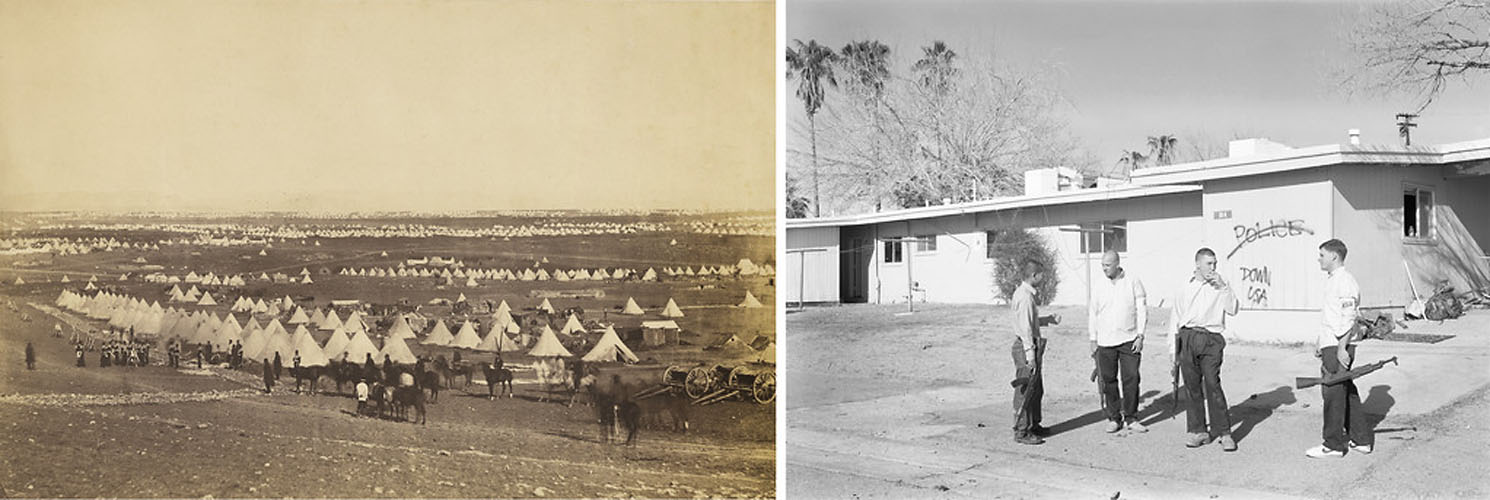
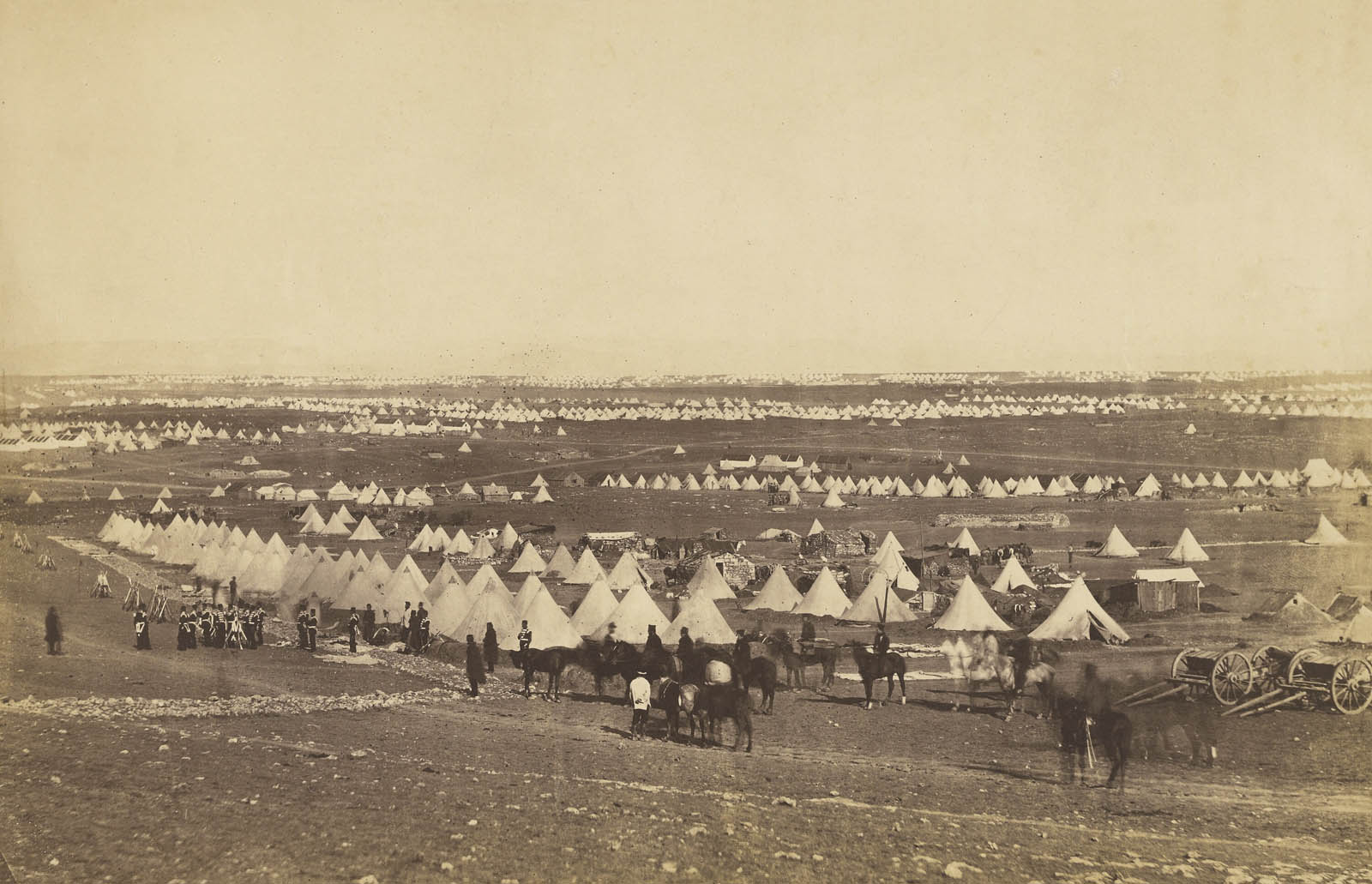
At left, Roger Fenton (English, 1819-1869) 'Plateau of Sebastopol II' 1855; and at right, An-My Lê (Vietnamese American, b. 1960) 'Security and Stabilization Operations, Iraqi Police' 2003-2004


At left, Roger Fenton (English, 1819-1869) Plateau of Sebastopol II 1855; and at right, An-My Lê (Vietnamese American, b. 1960) Security and Stabilization Operations, Iraqi Police 2003-2004


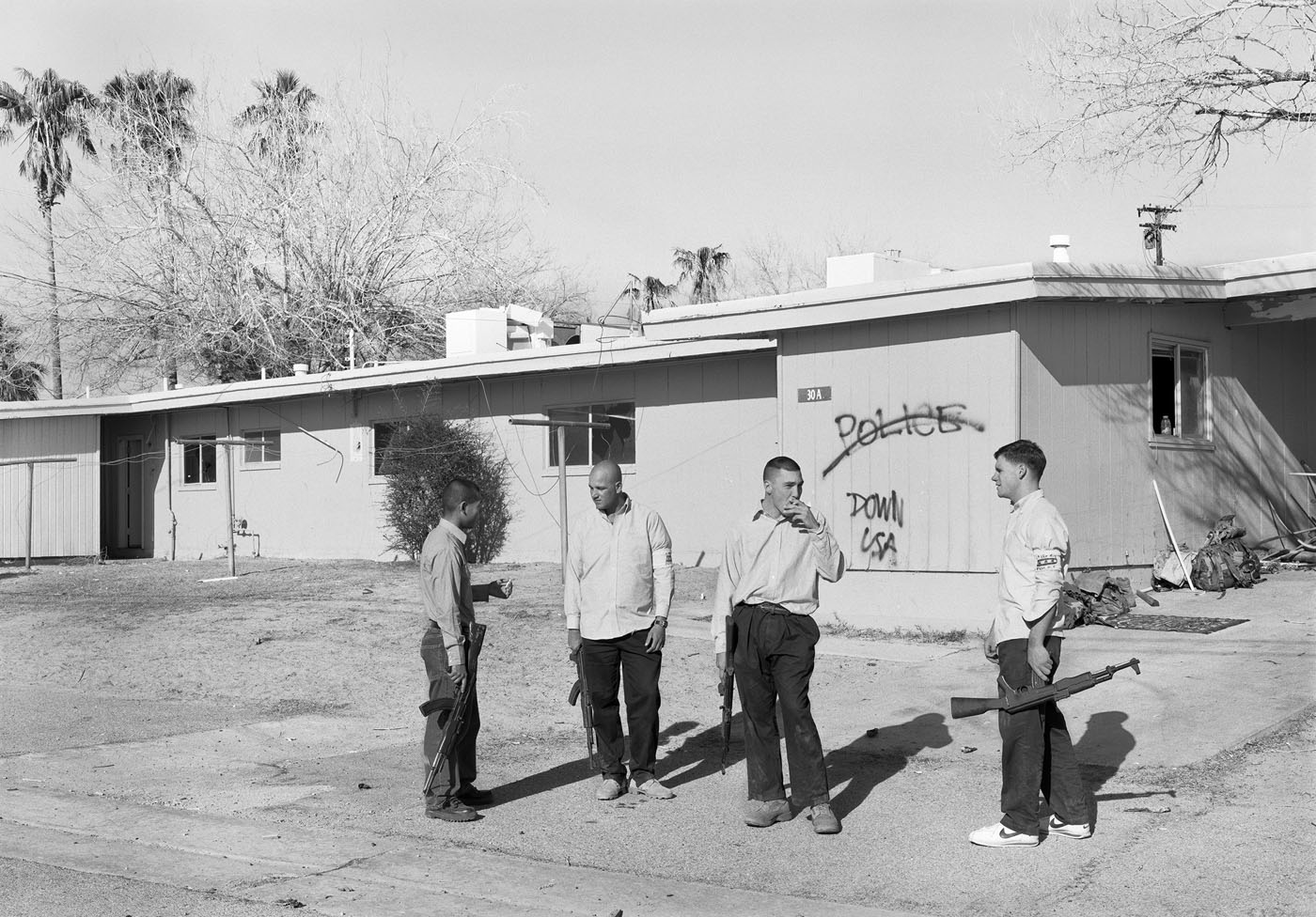
Roger Fenton (English, 1819-1869) 'Plateau of Sebastopol II' 1855


Roger Fenton (English, 1819-1869)
Plateau of Sebastopol II
1855
Albumen silver print
Image: 22.2 × 34.4cm (8 3/4 × 13 9/16 in.)
The J. Paul Getty Museum, Los Angeles
Public domain


An-My Lê (Vietnamese-American, b. 1960) 'Security and Stabilization Operations, Iraqi Police' 2003-2004


An-My Lê (Vietnamese American, b. 1960)
Security and Stabilization Operations, Iraqi Police
2003-2004
From the series 29 Palms
Gelatin silver print
The J. Paul Getty Museum, Los Angeles
Courtesy of the artist and Marian Goodman Gallery
© An-My Lê


Landscape

Nineteenth-century photographers went to great lengths to make images of remote landscapes, which required traveling with large format cameras, glass plates, and chemicals. Ideological forces drove many of these journeys, with the ultimate goal of imperial expansion through industrial development and war. Government sponsored surveys and expeditionary programs employed the camera to justify the expansion and to record the resulting military conflicts. Mark Ruwedel, Michelle Stuart, and An-My Lê re-envision some of these same historical landscapes and offer up new ones that bring the past closer to our present.


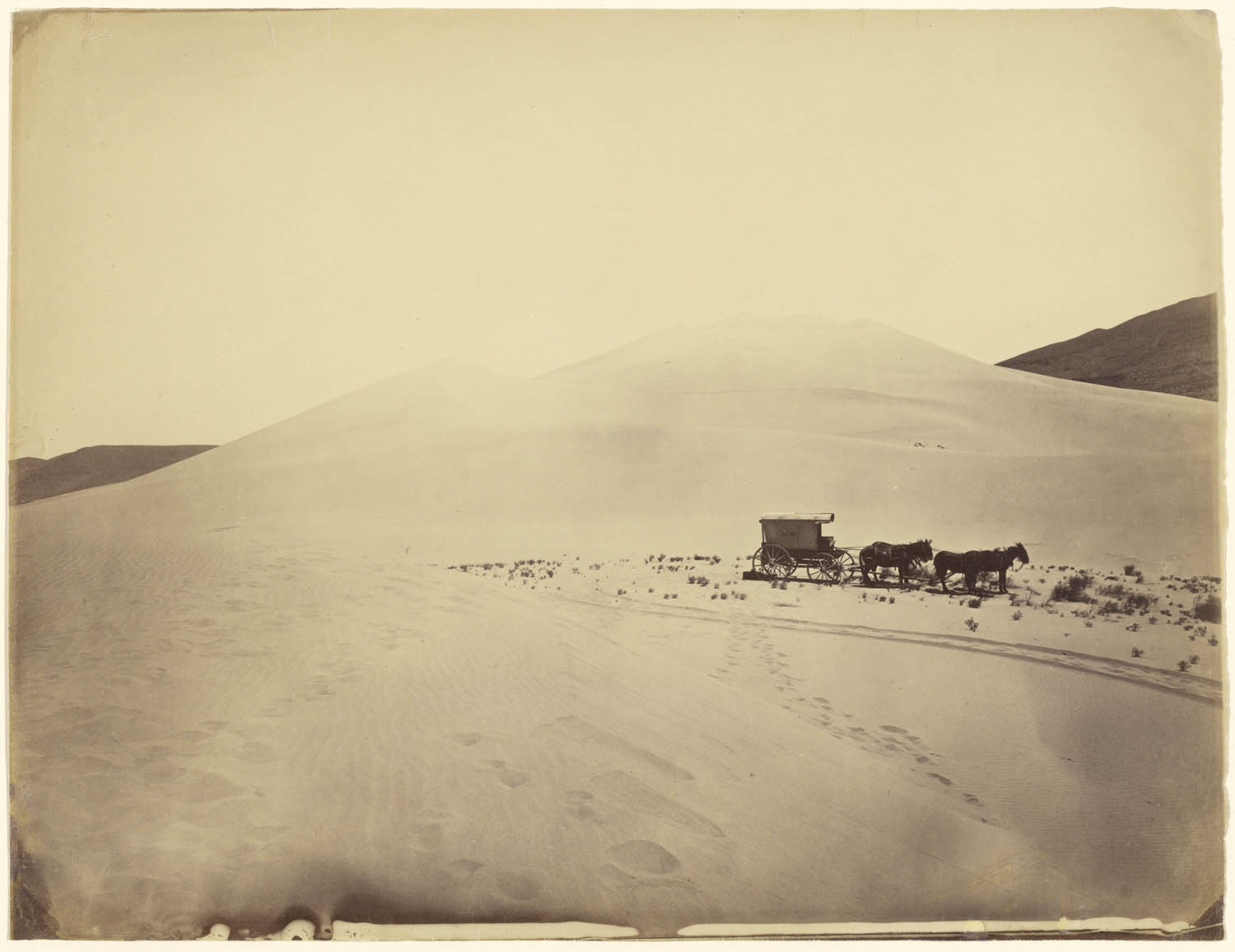
At left, Timothy O'Sullivan (American, about 1840-1882) 'Desert Sand Hills Near Sink of Carson, Nevada' 1867; and at right, Michelle Stuart (American, b. 1933) 'Timeless Land' 2021


At left, Timothy O’Sullivan (American, about 1840-1882) Desert Sand Hills Near Sink of Carson, Nevada 1867; and at right, Michelle Stuart (American, b. 1933) Timeless Land 2021


Timothy O'Sullivan (American, about 1840-1882) 'Desert Sand Hills Near Sink of Carson, Nevada' 1867


Timothy O’Sullivan (American, about 1840-1882)
Desert Sand Hills Near Sink of Carson, Nevada
1867
Albumen silver print
The J. Paul Getty Museum, Los Angeles
Public domain


Timothy O’Sullivan’s darkroom wagon, pulled by four mules, entered the frame at the right side of the photograph, reached the center of the image, and abruptly U-turned, heading back out of the frame. Footprints leading from the wagon toward the camera reveal the photographer’s path. Made at the Carson Sink in Nevada, this image of shifting sand dunes reveals the patterns of tracks recently reconfigured by the wind. The wagon’s striking presence in this otherwise barren scene dramatises the pioneering experience of exploration and discovery in the wide, uncharted landscapes of the American West.

O’Sullivan’s photographs from the 1867 Geological Exploration of the Fortieth Parallel expedition were intended to provide information for the purpose of expanding railroads and industry, yet they demonstrate his eye for poetic beauty.

Text from the J. Paul Getty Museum website


Michelle Stuart (American, b. 1933) 'Timeless Land' 2021


Michelle Stuart (American, b. 1933)
Timeless Land
2021
Ambrotypes
The J. Paul Getty Museum, Los Angeles
Purchased with funds provided by the Photographs Council
© Michelle Stuart


A.J. Russell (American, 1830-1902) 'Embankment No. 3 West of Granite Cannon [Wyoming]' April 1868


A.J. Russell (American, 1830-1902)
Embankment No. 3 West of Granite Cannon [Wyoming]
April 1868
Albumen silver print
Image: 21.9 × 29.4 cm (8 5/8 × 11 9/16 in.)
Mount: 34.1 × 43.1 cm (13 7/16 × 16 15/16 in.)
The J. Paul Getty Museum, Los Angeles


Mark Ruwedel (American/Canadian, b. 1954) 'Union Pacific #67 (after A.J. Russell)' 1996


Mark Ruwedel (American/Canadian, b. 1954)
Union Pacific #67 (after A.J. Russell)
1996
Gelatin silver print
Image: 18.9 × 23.9cm (7 7/16 × 9 7/16 in.)
The J. Paul Getty Museum, Los Angeles
© Mark Ruwedel


Mark Ruwedel’s statement in a wall text notes that “The legacy of nineteenth-century expeditionary photography was most important to me when working on my Westward series.” He cites Timothy O’Sullivan, Alexander Gardner and A.J. Russell. The Landscape section has a print by A.J. Russell, “Embankment No. 3 West of Granite Cannon. [Wyoming]” (April 1868), and seven pictures by Mr. Ruwedel: “Union Pacific #39 (After A.J. Russell)” and “Union Pacific #67 (After A.J. Russell)” (1994 and 1996, respectively) and five others with no specific acknowledgments but clearly influenced by his 19th-century mentors.

William Meyers. “Photography’s Past and Present at the Getty Center,” on The Wall Street Journal website May 29, 2024 [Online] Cited 16/06/2024


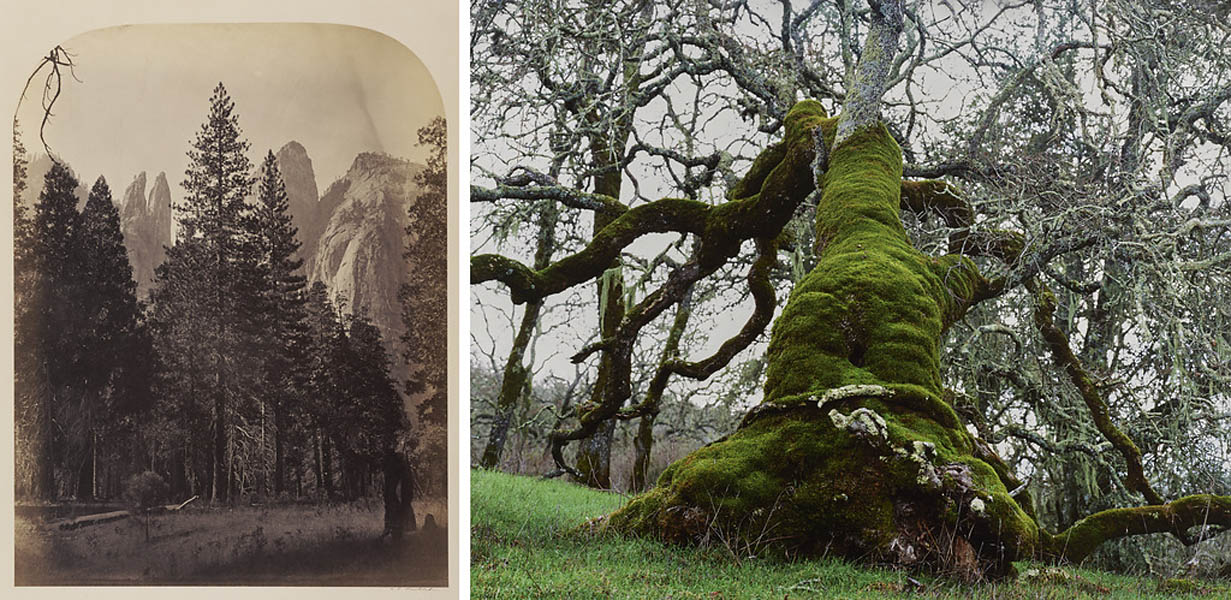
At left, Carleton Watkins (American, 1829-1916) 'Cathedral Spires – Yo Semite' 1861; and at right, Ken Gonzales-Day (American, b. 1964) 'At daylight the miserable man was carried to an oak…' Negative 2002; print 2021


At left, Carleton Watkins (American, 1829-1916) Cathedral Spires – Yo Semite 1861; and at right, Ken Gonzales-Day (American, b. 1964) At daylight the miserable man was carried to an oak… Negative 2002; print 2021


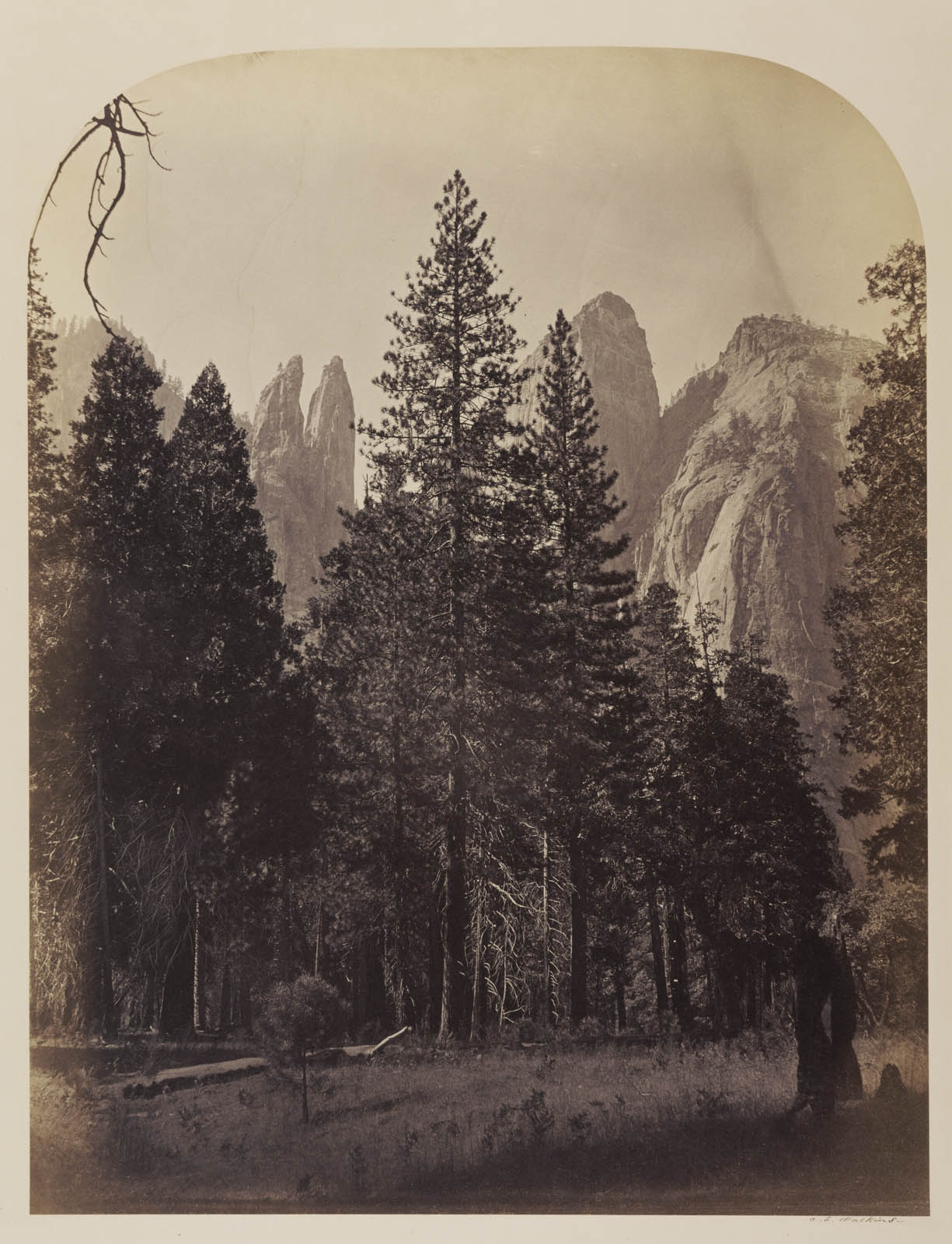
Carleton Watkins (American, 1829-1916) 'Cathedral Spires – Yo Semite' 1861


Carleton Watkins (American, 1829-1916)
Cathedral Spires – Yo Semite
1861
Albumen silver print
Image (Dome-Topped): 52.2 × 40.3cm (20 9/16 × 15 7/8 in.)
The J. Paul Getty Museum, Los Angeles


When Carleton Watkins photographed the remote Yosemite wilderness, America was not yet a century old. Conscious of their country’s lack of a national cultural identity, Americans adopted particularly dramatic geologic formations such as Cathedral Spires as their version of ancient ruins and soaring Gothic churches. The great pine tree in the foreground here became another form of this uniquely American history. Watkins’s images helped define America’s preference for landscape views depicting rugged wilderness and celebrating spectacular landforms on the grandest of scales.


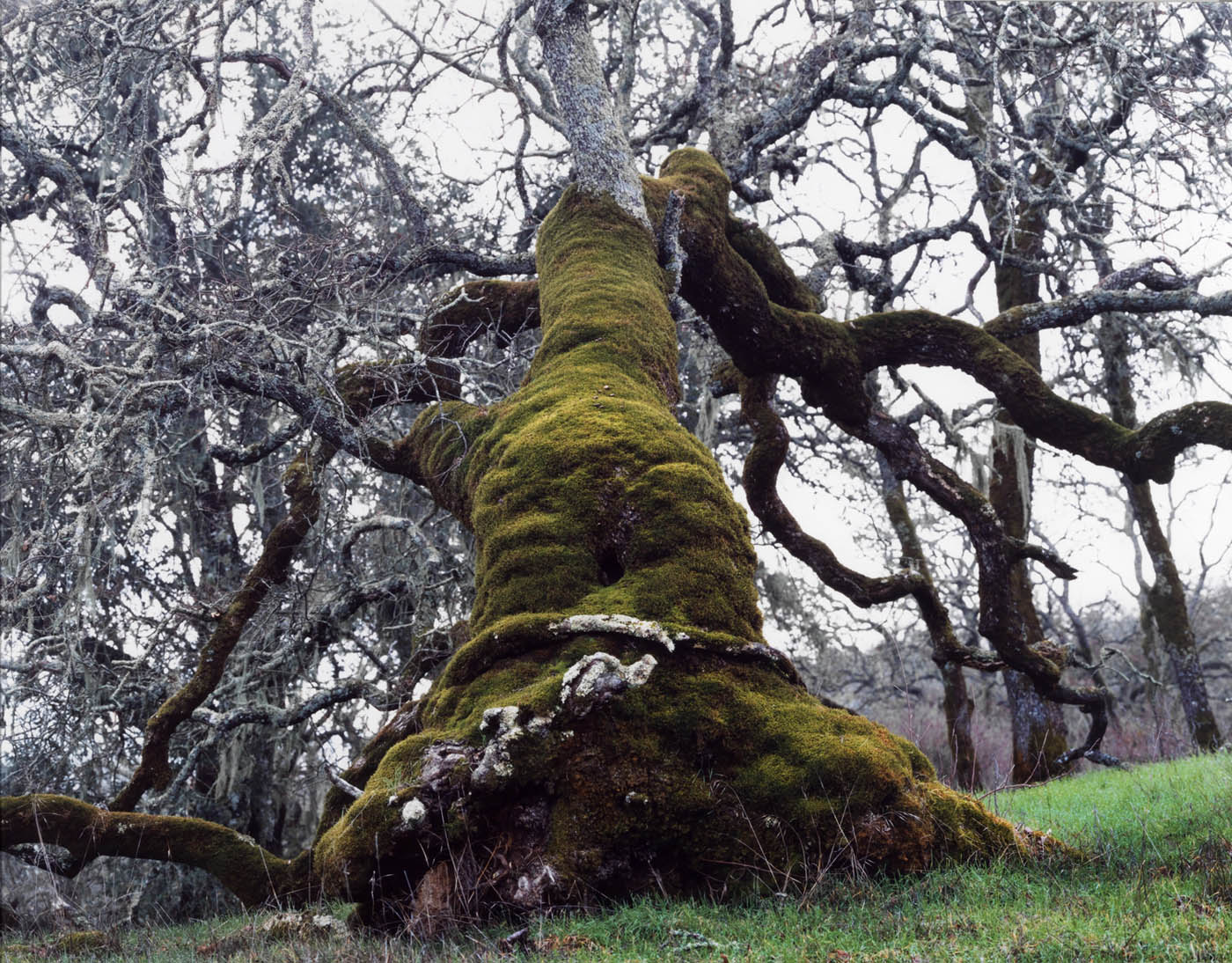
Ken Gonzales-Day (American, b. 1964) 'At daylight the miserable man was carried to an oak…' Negative 2002; print 2021


Ken Gonzales-Day (American, b. 1964)
At daylight the miserable man was carried to an oak…
Negative 2002; print 2021
From the series Searching for California’s Hang Trees
Pigment print
Image: 92.7 × 117.5cm (36 1/2 × 46 1/4 in.)
© Ken Gonzales-Day

This print: Smithsonian American Art Museum, Museum purchase through the Luisita L. and Franz H. Denghausen Endowment


Through meticulous research, Gonzales-Day documented approximately 350 lynching incidents that occurred in California between 1850 and 1935, most of which involved victims of Mexican descent. To create the series Searching for California Hang Trees, the artist visited many of these sites and captured the likeness of trees that may have borne witness to these events. Gonzales-Day’s landscapes unearth traces of this little-known history.

Our America: The Latino Presence in American Art, 2013

__________________________________________

Circulation


Charles M. Bell (American, 1848-1893) 'Manulitó, Chief of the Navajos' 1874


Charles M. Bell (American, 1848-1893)
Manulitó, Chief of the Navajos
1874
Albumen silver print
Image (Arched): 18.4 × 14.9cm (7 1/4 × 5 7/8 in.)
The J. Paul Getty Museum, Los Angeles
Public domain


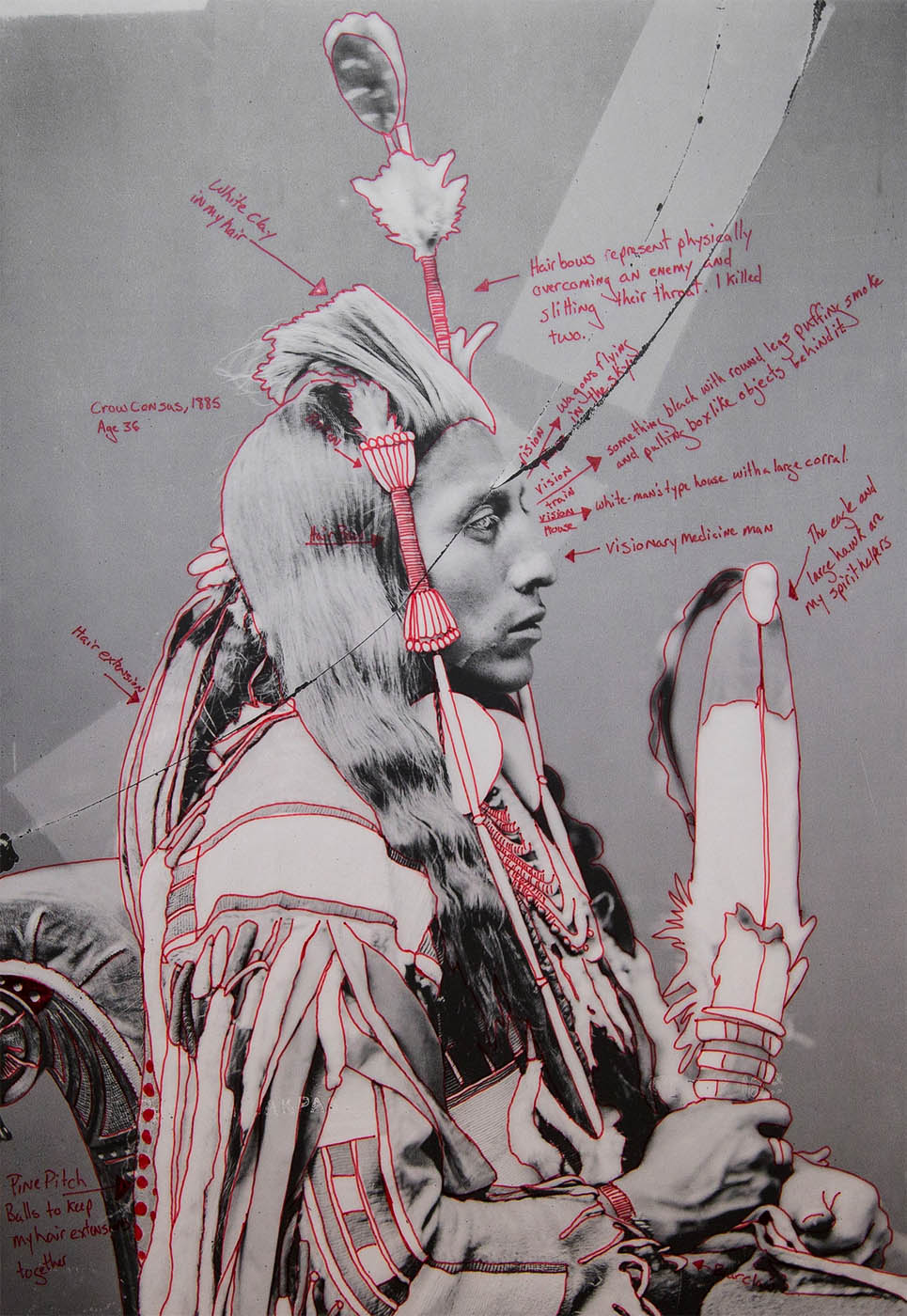
Wendy Red Star (American/Apsáalooke, b. 1981) 'Peelatchiwaaxpáash / Medicine Crow (Raven)' 2014


Wendy Red Star (American/Apsáalooke, b. 1981)
Peelatchiwaaxpáash / Medicine Crow (Raven)
2014
From the series Crow Peace Delegation
Inkjet print
Nasher Museum of Art at Duke University
Museum purchase with funds provided by Jennifer McCracken New and Jason G. New
© Wendy Red Star
Image courtesy of the Nasher Museum of Art


Artist-manipulated digitally reproduced photograph by C.M. (Charles Milton) Bell, National Anthropological Archives, Smithsonian Institution, 24 x 16 9/20 inches


Circulation

By the middle of the nineteenth century, thousands of photographs were in circulation worldwide, the result of photographers’ ability to reproduce the same image multiple times. Pictures of historical events, tourist destinations, and anthropological expeditions made the world seem more accessible, but with time and distance, they became disconnected from their original contexts. Many eventually ended up in archives (including at Getty). Early photographs appear next to projects that make these historical absences present. Wendy Red Star, Stephanie Syjuco, Ken Gonzales-Day, and Andrea Chung recover what has been lost, calling out the residual effects of the nineteenth-century photograph on our present knowledge of global cultures and histories.

Text from the J. Paul Getty Museum


At left, Anna Atkins (British, 1799-1871) possibly with Anne Dixon (British, 1799-1877) 'Ceylon/Fern' about 1854; and at right, Andrea Chung (American, b. 1978) 'Untitled' 2016


At left, Anna Atkins (British, 1799-1871) possibly with Anne Dixon (British, 1799-1877) Ceylon/Fern about 1854; and at right, Andrea Chung (American, b. 1978) Untitled 2016


Anna Atkins (British, 1799-1871) possibly with Anne Dixon (British, 1799-1877) 'Ceylon/Fern' about 1854


Anna Atkins (British, 1799-1871) possibly with Anne Dixon (British, 1799-1877)
Ceylon/Fern
about 1854
Cyanotype
Image: 34.8 × 24.7cm (13 11/16 × 9 3/4 in.)
Sheet: 48.3 × 37.5cm (19 × 14 3/4 in.)
The J. Paul Getty Museum, Los Angeles
Public domain


Cyanotypes of British and Foreign Flowering Plants

After completing the highly ambitious, decade-long project Photographs of Blue Algae: Cyanotype Impressions in the summer of 1853, Anna Atkins turned to new botanical subjects. She would eventually produce several unique presentation albums with cyanotypes of ferns and flowering plants. Atkins most likely collaborated on these albums with her dear friend, Anne Dixon. Dixon came to Halstead Place for an extended stay in the summer of 1852 to comfort Atkins who was deeply shaken by the death of her father and frequent scientific partner John George Children earlier that year. Photo historian Larry Schaaf suggests that it was during this stay or perhaps one the next summer that Dixon began assisting Atkins and creating her own cyanotypes. Thus, it becomes difficult to know whether surviving works from this time period were created by Atkins, Dixon, or both.1

These seven pieces in the J. Paul Getty Museum Collection (figs. 1-7) were extracted from an 1854 presentation album Cyanotypes of British and Foreign Flowering Plants given by Anna Atkins to Anne Dixon in 1854. The album remained intact until sometime around 1981, when it was broken up after being sold at auction.

Atkins and Dixon shared a deep interest in botany, a science that was considered well suited to women since it could be studied locally, even in one’s own garden. Serious “lady botanists” could join the Botanical Society in London, one of the first scientific organisations to admit women. Atkins joined in 1839. The two friends’ interest in botany is documented in a letter of 1851 from Children to Sir William Hooker in which he discussed the two women’s longtime plant collecting. Later, in a letter that Atkins wrote to Hooker in 1864, she extended an offer from Dixon to send him samples of any of the plants from her own collection.2

Carolyn Peter, J. Paul Getty Museum, Department of Photographs
2019
© J. Paul Getty Trust
Creative Commons Attribution 4.0 International License

1/ Larry Schaaf, Sun Gardens: Cyanotypes by Anna Atkins (New York: The New York Public Library, 2018), 77
2/ Ibid, 80


Andrea Chung (American, b. 1978) 'Untitled' 2016


Andrea Chung (American, b. 1978)
Untitled
2016
From the series Anthropocene
Cyanotypes
The J. Paul Getty Museum, Los Angeles
© Andrea Chung


Anna Atkins was a 19th-century botanist who documented plant specimens to make the world’s first photo book.

Today, artist Andrea Chung makes images of lionfish. Invasive to the Caribbean, they stand as a metaphor for the impact of colonisation in the region.

Text and photograph from the Getty Museum X web page


The J. Paul Getty Museum
1200 Getty Center Drive
Los Angeles, California 90049

Opening hours:
Daily 10am – 5pm

The J. Paul Getty Museum website

LIKE ART BLACK ON FACEBOOK

Back to top

Exhibition: ‘Francesca Woodman and Julia Margaret Cameron: Portraits to Dream In’ at the National Portrait Gallery, London

Exhibition dates: 21st March – 16th June 2024

Curator: Magdalene Keaney


Julia Margaret Cameron (British born India, 1815-1879) 'The Dream (Mary Hillier)' 1869
 

Julia Margaret Cameron (British born India, 1815-1879)
The Dream (Mary Hillier)
1869
Albumen silver print
Wilson Centre for Photography


Mary Ann Hilliar was born on the Isle of Wight, and as well as being Julia Margaret Cameron’s favourite model was employed by her as a house maid. She often poised in religious themed photos looking noble and melancholy. As well as modelling for Mrs Cameron she was painted by G F Watts.

She married Thomas Gilbert and had 8 children, descendants of whom still live on the Isle of Wight. Mary Ann lived to the age of 88, although in her later years she suffered badly from rheumatism and was almost blind due to cataracts. She is buried just a few feet away from the Tennyson grave.

Text from the National Portrait Gallery website


Otherworldy beings: the materialisations and transformations of Francesca Woodman and Julia Margaret Cameron

To pair these two artists together is curatorial inspiration from the gods!

In both artist’s work the notion of materialisation (the process of coming into being) and transformation is a powerful creative tool.

Cameron‘s photographs are exterior to the artist, outward facing creations which capture in the sitter an emanation of spirit. These ethereal creatures mainly based on biblical, mythological, or literary figures … these beautiful apparitions who seem to hover before us were, at the time, seen as radical photographs. Their striking presences and emotive sensibility create a psychological connection with the viewer, photographs imaged / imagined as if they were seen in a dream.

“Cameron’s portraits are famously a pictorialist stagecraft: a pantomime of Christian archetypes, Pre-Raphaelite aesthetics, and the influence of contemporary poets such as Shelley, Keats and Tennyson. What would be considered as potential subject matter for this nascent thirty-year-old medium was formative and cautious, and the conventions of beauty and gender, static” opines Stephen Frailey in an article commenting on the exhibition on the Aperture website (see below). Nothing could be further from the truth.

The artist envisions CHIMERICAL CREATURES. At the time of their production, Cameron’s shimmering portraits were seen as anything but cautious, they were seen as radical and ephemeral: a unique vision, different from everyone else: “directed light, soft focus, and long exposures that allowed the sitters’ slight movement to register in her pictures, instilling them with a sense of breath and life.”1 And, despite their soft focus, I believe that they are never “Pictorialist” photographs – they are “modern” photographs of a radical nature which may have later influenced the Pictorialist aesthetic. As I have commented before,

“She has, of course, been seen as a precursor to Pictorialism, but personally I do not get that feeling from her photographs, even though the artists are using many of the same techniques. Her work is based on the reality of seeing beauty, whereas the Pictorialists were trying to make photography into art by emulating the techniques of etching and painting. While the form of her images owes a lot to the history of classical sculpture and painting, to Romanticism and the Pre-Raphaelites, she thought her’s was already art of the highest order. She did not have to mask its content in order to imitate another medium. Others, such as the curator of the exhibition Marta Weiss, see her as a proto-modernist, precursor to the photographs of Stieglitz and Sander and I would agree. There is certainly a fundamental presence to JMC’s photographs, so that when you are looking at them, they tend to touch your soul, the eyes of some of the portraits burning right through you; while others, others have this ambiguity of meaning, of feeling, as if removed from the everyday life.”2

Contemporary commentators condemned Cameron’s photographs for sloppy craftsmanship (they were out of focus, the plates contained fingerprints, dust, debris, streak marks and swirls of collodion on her negatives). Others mocked her for claiming to have photographed a historical figure ‘from the life’. The kinds of images being made at the time did not interest Cameron. The artist would focus her lens until she thought the subject was beautiful “instead of screwing on the lens to the more definite focus which all other photographers insist upon.” (JMC) “Her photographic vision was a rejection of ‘mere conventional topographic photography – map-making and skeleton rendering of feature and form’ in favour of a less precise but more emotionally penetrating form of portraiture.”3

Woodman‘s photographs are interior to the artist, inward facing creations which capture her/self and the female form in space as a flux or metamorphosis of spirit.

“Francesca Woodman’s photographs explore issues of gender and self, looking at the representation of the body in relation to its surroundings. She puts herself in the frame most often, although these are not conventional self-portraits as she is either partially hidden, or concealed by slow exposures that blur her moving figure into a ghostly presence.”4

They promote in the attentive viewer a ghostly insistence that you could be her – in vulnerability, in presence, in fear of suffering, for our death. Who are we that is represented, what is our place in this lonely world, how do we interact with our shadow? They offer glimpses of another, dream-like world, the microcosm of a life focusing a lens on (her) infinite spirit.

“The artist is a CHIMERICAL CREATURE. Imaginary, visionary. Woodman’s transformations, her interior elements, become part of the wall or the house. She vanishes “from the room, out of the picture, at any given second.”5 A preoccupation with the body / her own body, and the dichotomy of subject-object, also adds multiple meanings and complexity to Woodman’s work. Her many angel images (and also images of umbrellas – Mary Poppins was released in 1964 when Woodman was growing up) suggest movement and the ability to fly, a fascination that found its ultimate expression when she jumped off a building in lower Manhattan at the age of 22.”6

Both Cameron, a woman taking photographs for just fifteen years within the first twenty five years of the birth of commercial photography, using rudimentary technology and chemicals – and Woodman, a woman taking photographs for just eight years, whose practice of staging her body and her face in interior spaces so influenced a later generation of female artists – have left an indelible mark on the history of photography and identity formation.

Working “at times when women were marginal in the history of art and photography” both women are now regarded as important artists, in the upper echelons of photographers who have ever lived. The unique quality of their work shines through, each materialising a distinctive handwriting  which could only ever be a Cameron or  a Woodman (the atmospheric radiance of the one and a sense of vulnerability in the other). In their photographs I feel the transformative potential of that vision (it rumbles through my body, it impinges on my consciousness). Their ability to see things not as others see them, away from the too-rough fingers of the world.

Oh how I would like to see this exhibition in the flesh, to observe the synergies and differences between both artist’s works, to listen to the conversations across time and space through centuries of art practice. I will just have to buy the catalogue instead, but that is no substitute  for physically standing in front of their “beautiful, subtle, intricate, and beguiling” prints.

To feel the vibrations of energy from these otherworldy beings…

Dr Marcus Bunyan


1/ Press release from the exhibition Julia Margaret Cameron at The Metropolitan Museum of Art, New York, August 2013 – January 2014

2/ Marcus Bunyan. “The road less travelled,” on the exhibition ‘Julia Margaret Cameron: from the Victoria and Albert Museum, London’ at the Art Gallery of New South Wales (AGNSW), Sydney on the Art Blart website 24th October 2015 [Online] Cited 11/06/2024

3/ Anonymous. “A Study of the Cenci,” on the V&A website Nd [Online] Cited 11/06/2024

4/ Text from the Scottish National Gallery of Modern Art website [Online] Cited 25/06/2009. No longer available online

5/ Anna Tellgren. Francesca Woodman: On Being an Angel (50kb pdf). 2015, p. 11

6/ Marcus Bunyan. “The artist as chimerical creature,” on the exhibition ‘Francesca Woodman. On Being an Angel’ at Moderna Museet, Stockholm on the Art Blart website 4th December 2015 [Online] Cited 11/06/2024

Other exhibitions on Julia Margaret Cameron and Francesca Woodman on Art Blart


Many thankx to the National Portrait Gallery for allowing me to publish the photographs in the posting. Please click on the photographs for a larger version of the image.


The Dream Keeper

Bring me all of your dreams,
You dreamers,
Bring me all of your
Heart melodies
That I may wrap them
In a blue cloud-cloth
Away from the too-rough fingers
Of the world


Langston Hughes


Major exhibition at the National Portrait Gallery to showcase rare vintage prints by two of art history’s most influential photographers – Francesca Woodman and Julia Margaret Cameron

More than 160 rare vintage prints will be exhibited as part of Francesca Woodman and Julia Margaret Cameron: Portraits to Dream In, as the two photographers – who worked 100 years apart – are presented in parallel for the first time.

The exhibition will present a thematic exploration of the photographic work produced throughout both artists’ entire careers, including their best known and less familiar work. Artist’s books by Francesca Woodman, which have never been exhibited in the UK, will be on display.


Julia Margaret Cameron. 'The Dream' 1869


Julia Margaret Cameron (British born India, 1815-1879)
The Dream
1869
Albumen print from wet collodion glass negative
Given by Alan S. Cole, 19 April 1913
© Victoria and Albert Museum, London


John Milton’s poem On his deceased Wife (about 1658) tells of a fleeting vision of his beloved returning to life in a dream.


L-R: 'The Dream (Mary Hillier)' by Julia Margaret Cameron, 1869; 'Untitled', 1979 by Francesca Woodman; 'Annie (My very first success in Photography)', by Julia Margaret Cameron, 1864; 'Self Portrait' at Thirteen by Francesca Woodman, 1972


L-R: The Dream (Mary Hillier) by Julia Margaret Cameron, 1869. Wilson Centre for Photography; Untitled, 1979 by Francesca Woodman. Courtesy Woodman Family Foundation © Woodman Family Foundation / DACS, London; Annie (My very first success in Photography), by Julia Margaret Cameron, 1864. The J. Paul Getty Museum, Los Angeles; Self Portrait at Thirteen by Francesca Woodman, 1972. Courtesy Woodman Family Foundation © Woodman Family Foundation / DACS, London


This spring, the National Portrait Gallery in London has staged an unexpected pairing of Francesca Woodman and Julia Margaret Cameron, whose bodies of photographic work were made a hundred years apart. The lushly titled Portraits to Dream In, the result of a thoughtful and imaginative curatorial inquiry, provides a compelling guide to their posthumous resemblances and describes a cultural arc of Romanticism from the mid-nineteenth-century to the turn of the twentieth, from luminous and pastoral to haunted and opaque. Both artists were engaged with the past, and the exhibition places them in a shared classicism of figuration and myth – a revelatory insight for Woodman. Both practiced photography for less than fifteen years. Both of their biographies often eclipse their critical reception. At times their congruence feels magnetic; at times their differences are as illuminating as their similarities.

The exhibition is organised by curator Magda Keaney in tidy themes that support affinities between the two women, among them “Angels and Otherworldly Beings,” “Mythology,” “Doubling,” and “Nature and Femininity.” Much of this is informative and, indeed, suggests a universal lexicon beyond this survey of dual sensibilities. Some of the rhymes are less plausible: a section entitled “Men” fails to persuade that Cameron’s depictions of eminent male political and cultural figures mirror Woodman’s male portraits. Unclothed men make rare appearances in Woodman’s photographs, where they do little to diminish the images as self-portraits. Festooned with a seashell, egg, pomegranate, or dead bird, the men serve as playful surrogates for the photographer herself.

Portraits to Dream In is an occasion to revel in the sumptuous texture of the photographic print, born from technologies decades apart. For both photographers, darkroom manipulation and tactility contribute to the pictures’ emotional mood, however diametric. For Cameron, the shallow depth of field and long shutter speed of the glass plate negative and wet collodion process renders a picture that flutters as if provisional, a vision subject to light glinting off an immaterial surface. They are as ethereal and transparent as Woodman’s are submersed in shadow; a moth bounding away from flame. One body of work, despite its soft patina, feels rooted in a sense of presence, the other by absence: fraught and confessional without evident disclosure.

Extract from Stephen Frailey. “An Unexpected Pairing of Francesca Woodman and Julia Margaret Cameron,” on the Aperture website May 16, 2024 [Online] Cited 03/06/2024


L-R: 'The Dream (Mary Hillier)' by Julia Margaret Cameron, 1869; 'Untitled', 1979 by Francesca Woodman


L-R: The Dream (Mary Hillier) by Julia Margaret Cameron, 1869. Wilson Centre for Photography; Untitled, 1979 by Francesca Woodman. Courtesy Woodman Family Foundation © Woodman Family Foundation / DACS, London


L-R: 'Annie (My very first success in Photography)', by Julia Margaret Cameron, 1864; 'Self Portrait at Thirteen' by Francesca Woodman, 1972


L-R: Annie (My very first success in Photography), by Julia Margaret Cameron, 1864. The J. Paul Getty Museum, Los Angeles; Self Portrait at Thirteen by Francesca Woodman, 1972. Courtesy Woodman Family Foundation © Woodman Family Foundation / DACS, London


Francesca Woodman (American, 1958-1981) 'Untitled' 1979


Francesca Woodman (American, 1958-1981)
Untitled
1979
Courtesy Woodman Family Foundation
© Woodman Family Foundation/DACS London


Julia Margaret Cameron (British born India, 1815-1879) 'Annie (My very first success in Photography)' 1864


Julia Margaret Cameron (British born India, 1815-1879)
Annie (My very first success in Photography)
1864
Albumen silver print
A photographic portrait of Annie Wilhemina Philpot (1857-1936)
The J. Paul Getty Museum, Los Angeles


A photographic portrait of Annie Wilhemina Philpot (1857-1936), taken by Julia Margaret Cameron (1815-1879) in 1864. This albumen print forms part of the Herschel Album, created by Cameron for her friend Sir John Herschel (1792-1871). Annie was the daughter of Rev. William Benamin Philpot, a poet and friend of Alfred Tennyson (1809-1892).

Julia Margaret Cameron is one of the most significant figures in nineteenth century photography. Born in Calcutta, she moved to Britain where she lived at Freshwater on the Isle of Wight. In 1863, aged forty-eight, she was given a camera by her daughter as a gift. From then on she took portraits of her family, friends and servants, as well as many eminent Victorians. Cameron was strongly influenced by classical art and many of her portraits are pictorial allegories based on religious or literary themes. In 1875 Cameron moved to Sri Lanka (Ceylon), where she died.

Text from the V&A website


Francesca Woodman (American, 1958-1981) 'Self Portrait at Thirteen' 1972


Francesca Woodman (American, 1958-1981)
Self Portrait at Thirteen
1972
Courtesy Woodman Family Foundation
© Woodman Family Foundation / DACS, London


L-R: 'Untitled', from the 'Caryatid' series by Francesca Woodman, 1980; 'House #3' by Francesca Woodman, 1976; 'Untitled' by Francesca Woodman, 1977-1978


L-R: Untitled, from the Caryatid series by Francesca Woodman, 1980. Courtesy Woodman Family Foundation © Woodman Family Foundation / DACS, London; House #3 by Francesca Woodman, 1976. Courtesy Woodman Family Foundation © Woodman Family Foundation / DACS, London; Untitled by Francesca Woodman, 1977-1978 Courtesy Woodman Family Foundation © Woodman Family Foundation / DACS, London


Francesca Woodman (American, 1958-1981) 'Untitled' 1980 From the 'Caryatid' series


Francesca Woodman (American, 1958-1981)
Untitled
1980
From the Caryatid series
Courtesy Woodman Family Foundation
© Woodman Family Foundation / DACS, London


Francesca Woodman (American, 1958-1981) 'House #3' 1976


Francesca Woodman (American, 1958-1981)
House #3
1976
Courtesy Woodman Family Foundation
© Woodman Family Foundation / DACS, London


Francesca Woodman (American, 1958-1981) 'Untitled' 1977-1978


Francesca Woodman (American, 1958-1981)
Untitled
1977-1978
Courtesy Woodman Family Foundation
© Woodman Family Foundation / DACS, London


From 21 March to 16 June 2024, the National Portrait Gallery will display a major retrospective exhibition of work by two of the most significant photographers in the history of the medium – Julia Margaret Cameron (1815-1879) and Francesca Woodman (1958-1981). Bringing their work together for the first time in an exhibition of this scale, it will showcase more than 160 rare vintage prints from galleries, museums and private collections, including 96 works by Woodman and 71 by Cameron, spanning the entire careers of both photographers – who worked 100 years apart.

Francesca Woodman and Julia Margaret Cameron: Portraits to Dream In will offer a new way to consider these two artists, by moving away from the biographical emphasis that has often been the focus of how their work is understood. The exhibition challenges this approach in its insistence on experiencing the physical print, taking the picture making of Woodman and Cameron as a starting point for consideration of their work. While neither artist aimed for technical perfection in their printing, for each it was a dynamic and essential aspect of their creative process used to explore and extend the possibilities of photographic image making.

After an extensive curatorial research period, works by Julia Margaret Cameron have been selected for loan from major museums internationally including the Getty, Los Angeles; the Metropolitan Museum, New York City; the Victoria and Albert Museum, London; the National Science and Media Museum, Bradford; the Ashmolean Museum, Oxford; and the National Portrait Gallery’s own Collection. Prints made by Francesca Woodman in her lifetime, nearly 20 of which have not been previously published or exhibited, have been loaned primarily from the Woodman Family Foundation in New York, who have collaborated closely on the making of the exhibition and accompanying publication, with further loans from Tate and the Rhode Island School of Design

The exhibition’s title, Portraits to Dream In, suggests that when seen side by side, both artists conjure a dream state within their work as part of their shared exploration of appearance, identity, the muse, gender and archetypes. The title of the exhibition comes from an observation made by Woodman that photographs could be ‘places for the viewer to dream in’. Both Woodman and Cameron produced work that was deeply rooted in mythology and storytelling and each made portraits of those close to them to represent these narratives. Further, both women explored portraiture beyond its ability to record appearance.

Following a thematic approach, visitors will experience the work of Woodman and Cameron moving forward and back in time between the nineteenth and twentieth century; and also within the relatively short span of years that each artist was active – neither worked for more than fifteen years. Themes on display will comprise: Declaring intentions & claiming space; Angels & Otherworldly Beings; Mythology; Doubling; Nature & femininity; Caryatids & the classical form; Men and Models & Muses.

Key works on display will include the first forays both artists made into the medium of photography, as they began to portray their unique perspectives and carve out distinctive styles. These include Cameron’s self-declared ‘first success’, a portrait of Annie Wilhemina Philpot in 1864, accompanied by Woodman’s ‘Self-portrait at thirteen’, taken during a summer holiday in Antella, Italy in 1972. Photographs depicting angelic and otherworldly figures will be presented in a dense constellation with pieces from Woodman’s evocative and often abstracted Angels series contrasted against Cameron’s more direct representations of cherubic beings and winged cupids. Not to be missed images by Francesca Woodman will include Polka Dots #5 and House #3 both made in 1976, seen alongside ethereal portraits of the British actress Ellen Terry made by Julia Margaret Cameron in 1864.

Other defining works by Woodman include Caryatid pieces from a major photographic project developed in the last year of her life in which she experimented with large scale diazotype prints, including depictions of herself and other models as caryatids – carved female figures which take the place of columns in ancient Greek temples. The exhibition will be the first to draw significant attention to Woodman’s portraits of men as well as exploring the importance of her ongoing photographs of friends. Providing additional insight into her practice, contact sheets and examples of Woodman’s artist’s books will be on display, exhibited in the UK for the first time.

The exhibition will include many of Julia Margaret Cameron’s most famous and much loved portraits, including those of her niece and favourite model, Julia Jackson, who would later be the mother to Bloomsbury artists Virginia Wolf and Vanessa Bell; her striking depiction of Alice Liddell as the goddess Pomona; her portraits of prominent Victorian men including John Frederick William Herschel who she captured as he posed dramatically in The Astronomer (1867); and her frequent muses, May Prinsep and Mary Ann Hillier.

“It is a great pleasure to bring together the work of Francesca Woodman and Julia Margaret Cameron for the first time in this innovative and imaginative exhibition at the National Portrait Gallery. Though, of course, Cameron could not have known Woodman, and Woodman did not explicitly reference Cameron, they shared thematic and formal interests uncovered through the exhibition. Paired in this way, we see their work – individually and together – in a new light; one that feels contemporary and timeless. We are immensely grateful to our lead curator Magdalene Keaney for conceptualising this exhibition with great expertise and for the team at the Woodman Family Foundation in New York who have been wonderfully collaborative partners.”

Dr. Nicholas Cullinan OBE
Director, National Portrait Gallery

“Both Francesca Woodman and Julia Margaret Cameron were utterly committed to the practice of photography and to their practice as artists without reservation. They both worked incredibly hard at times when women were marginal in the history of art and photography. I hope that visitors relish the physical experience of seeing such a large collection of prints that each artist made. They are beautiful, subtle, intricate, and beguiling. Then of course to come away knowing more about these two women artists who have defined the history of photography. I hope it poses questions about how we might think in new ways about relationships between 19th and 20th century photographic practice and what a portrait is and can be.”

Magdalene Keaney
Curator, Francesca Woodman and Julia Margaret Cameron: Portraits to Dream In

The exhibition will be accompanied by the publication, Francesca Woodman and Julia Margaret Cameron: Portraits to Dream In by curator Magdalene Keaney, which will include essays and contributions from the collections curator of the Woodman Family Foundation, Katarina Jerinic, and leading photography historian, Helen Ennis.

Press release from the National Portrait Gallery

All images National Portrait Gallery, London and © National Portrait Gallery, London unless otherwise stated


Julia Margaret Cameron (British born India, 1815-1879) 'I Wait (Rachel Gurney)' 1872


Julia Margaret Cameron (British born India, 1815-1879)
I Wait (Rachel Gurney)
1872
Albumen silver print
32.7 × 25.4cm (12 7/8 × 10 in.)
The J. Paul Getty Museum, Los Angeles


Francesca Woodman (American, 1958-1981) 'Untitled' 1977 From the 'Angels' series


Francesca Woodman (American, 1958-1981)
Untitled
1977
From the Angels series
Courtesy Woodman Family Foundation
© Woodman Family Foundation / DACS, London


Throughout her career, the young American photographer Francesca
Woodman revisited the theme of angels. In On Being an Angel (1976), she is
seen bending backward as light falls on her white body. A black umbrella is
in the distance. The following year she made a new version – an image with
a darker mood in which she shows her face. Woodman developed the angel
motif during a visit to Rome, where she photographed herself in a large,
abandoned building. In these images, she is wearing a white petticoat, but
her chest is bare. White pieces of cloth in the background are like wings. She
called these photographs From Angel series (1977) and From a series on
Angels (1977). There are also a number of pictures simply called Angels
(1977-1978), and among them is one where again she is bending backward, but this time in front of a graffitied wall. These angels are but a few examples of Francesca Woodman’s practice of staging her body and her face.

Anna Tellgren. Francesca Woodman: On Being an Angel (50kb pdf). 2015, p. 9


Julia Margaret Cameron (British born India, 1815-1879) 'Cherub and Seraph' 1866


Julia Margaret Cameron (British born India, 1815-1879)
Cherub and Seraph
1866
Albumen silver print
A photographic study of William Frederick ‘Freddy’ Gould (born 1861) and Elizabeth ‘Topsy’ Keown (born 1859)
National Science and Media Museum


A photographic study of William Frederick ‘Freddy’ Gould (born 1861) and Elizabeth ‘Topsy’ Keown (born 1859), taken by Julia Margaret Cameron (1815-1879) in 1866. This albumen print forms part of the Herschel Album, created by Cameron for her friend Sir John Herschel (1792-1871).


Julia Margaret Cameron (British born India, 1815-1879) 'Sadness (Ellen Terry)' 1864


Julia Margaret Cameron (British born India, 1815-1879)
Sadness (Ellen Terry)
1864
Albumen silver print
22.2 x 17.6cm (8 3/4 x 6 15/16 in.)
Albumen silver print
The J. Paul Getty Museum, Los Angeles


Dame Alice Ellen Terry GBE (27 February 1847 – 21 July 1928) was a leading English actress of the late 19th and early 20th centuries.

Born into a family of actors, Terry began performing as a child, acting in Shakespeare plays in London, and toured throughout the British provinces in her teens. At 16, she married the 46-year-old artist George Frederic Watts, but they separated within a year. She soon returned to the stage but began a relationship with the architect Edward William Godwin and retired from the stage for six years. She resumed acting in 1874 and was immediately acclaimed for her portrayal of roles in Shakespeare and other classics.

In 1878 she joined Henry Irving’s company as his leading lady, and for more than the next two decades she was considered the leading Shakespearean and comic actress in Britain. Two of her most famous roles were Portia in The Merchant of Venice and Beatrice in Much Ado About Nothing. She and Irving also toured with great success in America and Britain.

In 1903 Terry took over management of London’s Imperial Theatre, focusing on the plays of George Bernard Shaw and Henrik Ibsen. The venture was a financial failure, and Terry turned to touring and lecturing. She continued to find success on stage until 1920, while also appearing in films from 1916 to 1922. Her career lasted nearly seven decades.

Text from the Wikipedia website


Francesca Woodman (American, 1958-1981) 'Polka Dots #5' 1976


Francesca Woodman (American, 1958-1981)
Polka Dots #5
1976
Courtesy Woodman Family Foundation
© Woodman Family Foundation / DACS, London


Julia Margaret Cameron (British born India, 1815-1879) 'Julia Prinsep Stephen (née Jackson, formerly Mrs Duckworth)' 1867


Julia Margaret Cameron (British born India, 1815-1879)
Julia Prinsep Stephen (née Jackson, formerly Mrs Duckworth)
1867
Albumen silver print
National Portrait Gallery, London


Julia Prinsep Stephen (née Jackson; formerly Duckworth; 7 February 1846 – 5 May 1895) was an English Pre-Raphaelite model and philanthropist. She was the wife of the biographer Leslie Stephen and mother of Virginia Woolf and Vanessa Bell, members of the Bloomsbury Group.

Julia Prinsep Jackson was born in Calcutta to an Anglo-Indian family, and when she was two her mother and her two sisters moved back to England. She became the favourite model of her aunt, the celebrated photographer Julia Margaret Cameron, who made more than 50 portraits of her. Through another maternal aunt, she became a frequent visitor at Little Holland House, then home to an important literary and artistic circle, and came to the attention of a number of Pre-Raphaelite painters who portrayed her in their work.

Married to Herbert Duckworth, a barrister, in 1867 she was soon widowed with three infant children. Devastated, she turned to nursing, philanthropy and agnosticism, and found herself attracted to the writing and life of Leslie Stephen, with whom she shared a friend in Anny Thackeray, his sister-in-law.

After Leslie Stephen’s wife died in 1875 he became close friends with Julia and they married in 1878. Julia and Leslie Stephen had four further children, living at 22 Hyde Park Gate, South Kensington, together with his seven-year-old mentally disabled daughter, Laura Makepeace Stephen. Many of her seven children and their descendants became notable. In addition to her family duties and modelling, she wrote a book based on her nursing experiences, Notes from Sick Rooms, in 1883.

She also wrote children’s stories for her family, eventually published posthumously as Stories for Children and became involved in social justice advocacy. Julia Stephen had firm views on the role of women, namely that their work was of equal value to that of men, but in different spheres, and she opposed the suffrage movement for votes for women. The Stephens entertained many visitors at their London home and their summer residence at St Ives, Cornwall. Eventually the demands on her both at home and outside the home started to take their toll. Julia Stephen died at her home following an episode of rheumatic fever in 1895, at the age of 49, when her youngest child was only 11. The writer Virginia Woolf provides a number of insights into the domestic life of the Stephens in both her autobiographical and fictional work.

Text from the Wikipedia website


Julia Margaret Cameron (British born India, 1815-1879) 'The Astronomer (Sir John Frederick William Herschel)' 1867


Julia Margaret Cameron (British born India, 1815-1879)
The Astronomer (Sir John Frederick William Herschel)
1867
Albumen silver print
Courtesy of the RISD Museum, Providence, RI


Sir John Frederick William Herschel, 1st Baronet KH FRS (7 March 1792 – 11 May 1871) was an English polymath active as a mathematician, astronomer, chemist, inventor, and experimental photographer who invented the blueprint and did botanical work.

Herschel originated the use of the Julian day system in astronomy. He named seven moons of Saturn and four moons of Uranus – the seventh planet, discovered by his father Sir William Herschel. He made many contributions to the science of photography, and investigated colour blindness and the chemical power of ultraviolet rays. His Preliminary Discourse (1831), which advocated an inductive approach to scientific experiment and theory-building, was an important contribution to the philosophy of science. …

Photography

Herschel made numerous important contributions to photography. He made improvements in photographic processes, particularly in inventing the cyanotype process, which became known as blueprints, and variations, such as the chrysotype. In 1839, he made a photograph on glass, which still exists, and experimented with some colour reproduction, noting that rays of different parts of the spectrum tended to impart their own colour to a photographic paper. Herschel made experiments using photosensitive emulsions of vegetable juices, called phytotypes, also known as anthotypes, and published his discoveries in the Philosophical Transactions of the Royal Society of London in 1842. He collaborated in the early 1840s with Henry Collen, portrait painter to Queen Victoria. Herschel originally discovered the platinum process on the basis of the light sensitivity of platinum salts, later developed by William Willis.

Herschel coined the term photography in 1839. Herschel was also the first to apply the terms negative and positive to photography.

Herschel discovered sodium thiosulfate to be a solvent of silver halides in 1819, and informed Talbot and Daguerre of his discovery that this “hyposulphite of soda” (“hypo”) could be used as a photographic fixer, to “fix” pictures and make them permanent, after experimentally applying it thus in early 1839.

Herschel’s ground-breaking research on the subject was read at the Royal Society in London in March 1839 and January 1840.

Text from the Wikipedia website


Julia Margaret Cameron (British born India, 1815-1879) 'Pomona (Alice Liddell)' 1872


Julia Margaret Cameron (British born India, 1815-1879)
Pomona (Alice Liddell)
1872
Albumen silver print
The Metropolitan Museum of Art., New York
David Hunter McAlpin Fund, 1963


Pomona was the goddess of fruit trees, gardens, and orchards. Unlike many other Roman goddesses and gods, she does not have a Greek counterpart, though she is commonly associated with Demeter. She watches over and protects fruit trees and cares for their cultivation.

Symbolically, Pomona and her fruit garden represent abundance, nurture and the simple pleasure derived from nature. She is often depicted in a garden full of life, colour and opulence, with her milky soft flesh on display and a cornucopia of fruit and flowers on her lap.


Julia Margaret Cameron (British born India, 1815-1879) 'The Gardener's Daughter' 1867


Julia Margaret Cameron (British born India, 1815-1879)
The Gardener’s Daughter
1867
Albumen silver print
A photographic study of Mary Ryan (1848-1914)
National Science and Media Museum


A photographic study of Mary Ryan (1848-1914), taken by Julia Margaret Cameron (1815-1879) in 1867. This albumen print forms part of the Herschel Album, created by Cameron for her friend Sir John Herschel (1792-1871).

‘The Gardener’s Daughter’ was the title of a poem by Alfred Tennyson (1809-1892). Cameron’s photograph was inspired by the lines: ‘Gown’d in pure white, that fitted to the shape, Holding the bush, to fix it back, she stood.’


Julia Margaret Cameron (British born India, 1815-1879) 'Iago – study from an Italian' 1867


Julia Margaret Cameron (British born India, 1815-1879)
Iago – study from an Italian
1867
Albumen silver print
A photographic portrait of the artist’s model, Angelo Colarossi (born about 1839)
National Science and Media Museum


A photographic portrait of the artist’s model, Angelo Colarossi (born about 1839), taken by Julia Margaret Cameron (1815-1879) in 1867. The print forms part of the Herschel Album, created by Cameron for her friend Sir John Herschel (1792-1871).

This is the only existing print known of ‘Iago’. The negative may have been destroyed intentionally by Cameron, and it is believed that the print was taken for George Frederic Watts (1817-1904) to work from for a painting.

Iago was the villain of Shakespeare’s play ‘Othello’.


'Francesca Woodman and Julia Margaret Cameron: Portraits to Dream In' book front cover


Francesca Woodman and Julia Margaret Cameron: Portraits to Dream In book front cover


'Francesca Woodman and Julia Margaret Cameron: Portraits to Dream In' book back cover


Francesca Woodman and Julia Margaret Cameron: Portraits to Dream In book back cover


'Francesca Woodman and Julia Margaret Cameron: Portraits to Dream In' book


Francesca Woodman and Julia Margaret Cameron: Portraits to Dream In book p. 11


'Francesca Woodman and Julia Margaret Cameron: Portraits to Dream In' book


Francesca Woodman and Julia Margaret Cameron: Portraits to Dream In book back cover pp. 70-71


Francesca Woodman and Julia Margaret Cameron: Portraits to Dream In

Magdalene Keaney (Editor), Katarina Jerinic (Contributor), Helen Ennis (Contributor)

Hardcover – 26 June 2024


Francesca Woodman and Julia Margaret Cameron: Portraits to Dream In draws parallels between two of the most significant practitioners in the history of photography, presenting fresh research, rare vintage prints, and previously unseen archival works.

‘I feel that photographs can either document and record reality or they can offer images as an alternative to everyday life: places for the viewer to dream in.’
~ Francesca Woodman, 1980

Living and working over a century apart, Julia Margaret Cameron (1815-1879) and Francesca Woodman (1958-1981) experienced very different ways of making and understanding photographs. Francesca Woodman and Julia Margaret Cameron: Portraits to Dream In accompanies the exhibition of the same name opening at the National Portrait Gallery, London, in March 2024. Spanning the careers of both artists, the beautifully illustrated catalogue includes their best-known photographs as well as less familiar images. The exhibition works are arranged into eight thematic sections with feature essays, offering an accessible, engaging opportunity to consider both artists in a new light.

This publication presents the artists’ exploration of portraiture as a ‘dream space’. It makes new connections between their work, which pushed the boundaries of the photographic medium and experimented with ideas of beauty, symbolism, transformation and storytelling to produce some of art history’s most compelling and admired photographs.

National Portrait Gallery Publications
208 pages

Text from the Amazon Australia website


National Portrait Gallery
St Martin’s Place
London, WC2H 0HE

Opening hours:
Open daily: 10.30 – 18.00
Friday and Saturday: 10.30 – 21.00

National Portrait Gallery website

LIKE ART BLART ON FACEBOOK

Back to top

Review: ‘Julie Millowick: Surrounding’ at the Castlemaine Art Museum

Exhibition dates: 15th February – 16th June 2024

Curator: Jenny Long


Installation view of the exhibition 'Julie Millowick: Surrounding' at the Castlemaine Art Museum


Installation view of the exhibition Julie Millowick: Surrounding at the Castlemaine Art Museum
Photo: Marcus Bunyan


Down with Earth

This is a magnificent exhibition by Australian photographer Julie Millowick (b. 1948) which documents “the environmental legacy of gold mining around her home near Fryerstown in Central Victoria, capturing the beauty of this landscape in tumult and recovery.” (Wall text)

What I admire about the work in the exhibition (other than photographs that evidence the persistence of an inquiry into one subject, the result of 34 years of visual and intellectual exploration), is the way that the photographs envelop you in the gallery space. It’s as if the accumulation of images over decades creates a nurturing story which comforts you in the gallery space: that the landscape so desecrated will heal itself, will spring forth anew. The sustained investigation into the landscape around Fryerstown captured my soul.

The exhibition is beautifully constructed, rendered, seen, so very quiet yet so powerful. On every wall of the gallery there is an intimate story, told through remarkable photographs of the Australian bush that combine light and dark, near and far, low and high perspective (the raising and lowering of the horizon line) and the feeling of claustrophobia and expansiveness within the same environment: photographs of mullock heaps and mine sites with open sky and residual left-over soil or rock from the shaft excavation process. Shadows of trees obscure abandoned mine shafts which litter the landscape, traps for the unwary who go wandering, or is that wondering, through the bush. And through Millowick’s lens, this landscape is all about the wonder of the landscape and its rejuvenative potential.

In this unsettling place which continually transforms through drought and rain, human mining, erosion and regeneration we can observe in Millowick’s photographs the strength and transformative qualities of nature. It may seem strange (and probably is) but I argue that the Australian bush presented here is a heterotopic space (Foucault), a landscape outside the normality of the everyday (although any landscape with human intervention is not “natural” but always a constructed space), one that is somehow “other”: disturbing, intense, contradictory and transforming, a landscape which mirrors the outside world yet upsets that representation due to its un/settling, its mining and ecological past – creating a space which changes from day to day, month to month – growing, contracting, evidencing human interaction and touch, but then outgrowing human interference.

The spaces that the artist envisions in her beautiful micro / macro, order / chaos photographs picture something unusual: the imaginative wish for of a utopian world that could never exist in the first place and a dystopian, illusionary world in the process of healing itself (possibly), the very definition of a heterotopic space. As the characters in Fallout Season 1 observe, “Time is the apex predator” … and through time, nature will hopefully outlive all human beings to again become something belonging solely to the Earth, to again become something “natural” (existing in or derived from nature; not made or caused by humankind).

Millowick’s photographs also picture something else: photography as an exposition of the self. As the artist Ans Westra observes, photography should not be “solely controlled by the brain. Your personality, subconscious, flows through […] you have to allow it to come through […] for the outcome to be relevant.”1 Ultimately, she said, photography was “always an exposition of self.” Such is the energy with the photographs of this artist, also.

Through wonder, respect and the grounding of spirit in Earth, Millowick has sustained a bond and an understanding in her fascination with this subject, a sensitivity to subject nurtured over so many years which “invites viewers to appreciate them [the photographs] as a poetic connection to, and love for, the landscape” side by side with a conceptual thinking or intellectualisation about the land. In their containment of energy, in their penetrating into life and its things, these photographs contribute something to our life and history on this planet.

Robert Frank said, “It is important to see what is invisible to others.”

Minor White, in one of his Three canons said,

“Be still with yourself,
Until the object of your attention,
Affirms your presence”


Millowick has achieved both aims admirably. In some of the most insightful and poignant photographs of the Australian landscape I have ever seen, the artist has revealed not just aspects of the earth (ground) which are undergoing transformation but aspects of herself as she has journeyed through life, remaining true to her path as an artist, remaining true to documenting her journey with the land, remaining true to a legacy towards the planet, down with Earth.

I was very moved by these photographs.

Dr Marcus Bunyan


1/ Ans Westra quoted in Paul Moon. “An outsider on the inside: how Ans Westra created New Zealand’s ‘national photo album’,” on the Conversation website May 8, 2024 [Online] Cited 11/05/2024


All installation photographs by Marcus Bunyan. Please click on the photographs for a larger version of the image. All photographs © Marcus Bunyan and Julie Millowick


“The artist does not turn time into money, the artist turns time into energy, time into intensity, time into vision. The exchange that art offers is an exchange in kind; energy for energy, intensity for intensity, vision for vision… Can we afford to live imaginatively, contemplatively?”


Jeanette Winterson. Art Objects. London: Vintage, 1996, p. 139.


Wall text from the exhibition 'Julie Millowick: Surrounding' at the Castlemaine Art Museum


Wall text from the exhibition Julie Millowick: Surrounding at the Castlemaine Art Museum
Photo: Marcus Bunyan


Gallery One


Installation view of the exhibition 'Julie Millowick: Surrounding' at the Castlemaine Art Museum


Installation view of the exhibition Julie Millowick: Surrounding at the Castlemaine Art Museum
Photo: Marcus Bunyan


Installation view of the exhibition 'Julie Millowick: Surrounding' at the Castlemaine Art Museum


Installation view of the exhibition Julie Millowick: Surrounding at the Castlemaine Art Museum
Photo: Marcus Bunyan


Installation view of the exhibition 'Julie Millowick: Surrounding' at the Castlemaine Art Museum


Installation view of the exhibition Julie Millowick: Surrounding at the Castlemaine Art Museum showing at left, Perseverance Mine mullock heap, Fryerstown (2020); at top right, Mosquito Mine depleted mullock heap, Fryerstown (2020); and at bottom right, Duke of Cornwall Mine mulch heap, Fryerstown (2020)
Photo: Marcus Bunyan


Mullock and mine sites


Julie Millowick (Australian, b. 1948) 'Perseverance Mine mullock heap, Fryerstown' 2020


Julie Millowick (Australian, b. 1948)
Perseverance Mine mullock heap, Fryerstown
2020
Digital image, inkjet print on 100% cotton rag
open edition 2023
Photo: Marcus Bunyan


Julie Millowick (Australian, b. 1948) 'Duke of Cornwall Mine mulch heap, Fryerstown' 2020


Julie Millowick (Australian, b. 1948)
Duke of Cornwall Mine mulch heap, Fryerstown
2020
Digital image, inkjet print on 100% cotton rag
open edition 2023
Photo: Marcus Bunyan


Installation view of the exhibition 'Julie Millowick: Surrounding' at the Castlemaine Art Museum


Installation view of the exhibition Julie Millowick: Surrounding at the Castlemaine Art Museum showing from left to right, top to bottom, Ferrons Mine mullock heap, Fryerstown (2007); Ferrons Mine mullock heap, Fryerstown (2007); Exocarps cupressiformis (cherry ballart) in the foreground, Ferrons mullock heap in the background (2018); Mullock from New Era Mine, Fryerstown (2022); Ferrons Mine mullock heap with one of several surrounding shafts, Fryerstown (2018); Three fragments of goldrush-era glass bottle, Fryerstown (2019); New Era Mine mullock heaps, Fryerstown (2022); Abandoned mine shaft, Fryerstown (2022); Introduced invasive thistles, Fryerstown (2022); New Era Mine mullock heaps, Fryerstown (2022); New Era Mine mullock heaps, introduced get mullein in foreground, Fryerstown (2022); New Era Mine mullock heaps, introduced get mullein in foreground, Fryerstown (2022)
Photo: Marcus Bunyan


Julie Millowick (Australian, b. 1948) 'Ferrons Mine mullock heap, Fryerstown' 2007


Julie Millowick (Australian, b. 1948)
Ferrons Mine mullock heap, Fryerstown
2007
Digital image, inkjet print on 100% cotton rag
open edition 2023
Photo: Marcus Bunyan


Julie Millowick (Australian, b. 1948) 'Ferrons Mine mullock heap, Fryerstown' 2007


Julie Millowick (Australian, b. 1948)
Ferrons Mine mullock heap, Fryerstown
2007
Digital image, inkjet print on 100% cotton rag
open edition 2023
Photo: Marcus Bunyan


Julie Millowick (Australian, b. 1948) 'Exocarps cupressiformis (cherry ballart) in the foreground, Ferrons mullock heap in the background' 2018


Julie Millowick (Australian, b. 1948)
Exocarps cupressiformis (cherry ballart) in the foreground, Ferrons mullock heap in the background
2018
Digital image, inkjet print on 100% cotton rag
open edition 2023
Photo: Marcus Bunyan


Because of the conifer-like foliage, European settlers referred to Exocarps cupressiformis (cherry ballart) as a ‘bush Christmas tree’. First Nations people used the wood for spear throwers and Europeans used it for gunstocks.


Julie Millowick (Australian, b. 1948) 'Ferrons Mine mullock heap with one of several surrounding shafts, Fryerstown' 2018


Julie Millowick (Australian, b. 1948)
Ferrons Mine mullock heap with one of several surrounding shafts, Fryerstown
2018
Digital image, inkjet print on 100% cotton rag
open edition 2023
Photo: Marcus Bunyan


Julie Millowick (Australian, b. 1948) 'New Era Mine mullock heaps, Fryerstown' 2022


Julie Millowick (Australian, b. 1948)
New Era Mine mullock heaps, Fryerstown
2022
Digital image, inkjet print on 100% cotton rag
open edition 2023
Photo: Marcus Bunyan


Originally much larger, these mullock heaps have been substantially depleted by both private individuals and the former shire, who used the mullock for roadworks. New Era Mine, at a depth of 1100 feet (335.3 metres), was the deepest shaft in the local area.


Julie Millowick (Australian, b. 1948) 'Abandoned mine shaft, Fryerstown' 2022


Julie Millowick (Australian, b. 1948)
Abandoned mine shaft, Fryerstown
2022
Digital image, inkjet print on 100% cotton rag
open edition 2023
Photo: Marcus Bunyan


Abandoned mine shafts occur throughout the Central Victorian area. Discarded mine waste appears in the background of the photograph


Julie Millowick (Australian, b. 1948) 'Introduced invasive thistles, Fryerstown' 2022


Julie Millowick (Australian, b. 1948)
Introduced invasive thistles, Fryerstown
2022
Digitised gelatin silver lumen, inkjet print on 100% cotton rag
open edition 2023
Photo: Marcus Bunyan


Julie Millowick (Australian, b. 1948) 'New Era Mine mullock heaps, Fryerstown' 2022


Julie Millowick (Australian, b. 1948)
New Era Mine mullock heaps, Fryerstown
2022
Digital image, inkjet print on 100% cotton rag
open edition 2023
Photo: Marcus Bunyan


Installation view of the exhibition 'Julie Millowick: Surrounding' at the Castlemaine Art Museum

Installation view of the exhibition 'Julie Millowick: Surrounding' at the Castlemaine Art Museum

Installation view of the exhibition 'Julie Millowick: Surrounding' at the Castlemaine Art Museum


Installation views of the exhibition Julie Millowick: Surrounding at the Castlemaine Art Museum showing from left to right, top to bottom, Trees defoliated by the caterpillar (larval) stage of Cup Moth, Doratifera sp. Fryerstown (2013); Studio photograph of leaves damaged by the caterpillar (larval) stage of Cup Moth, Doratifera sp. Fryerstown (2013); Fallen leaves damaged by the caterpillar (larval) stage of Cup Moth, Doratifera sp. Fryerstown (2013); The quite shocking impact of searching for gold using hydraulic sluicing (early 1900s and 1930s), Golden Gully, Fryerstown (2022); The remains of a deeply sluiced gully, Golden Gully, Fryerstown (2022); Cassinia sifton (Coffee Bush) Fryerstown (2023); Forest, evening, Castlemaine Diggings National Heritage Park, Fryerstown (2022); Exocarpos cupressiformis (cherry ballarat), Castlemaine Diggings National Heritage Park, Fryerstown (2021); The secret cubby in the New Era Mine tailings sand, surrounded by introduced invasive blackberry, Golden Gully, Fryerstown (2016); Invasive blackberry grows along the track to the New Era Mind tailings, Fryerstown (2010); Gelatin silver paper exposed while lightly buried under introduced invasive blackberry plant, Fryerstown (2019); Cassinia sifton (Coffee Bush), Fryerstown (2023); Cassinia sifton (Coffee Bush), growing in the cyanide-contaminated tailings sand from the New Era Mine, Golden Gully, Fryerstown (2021); Acacia implexa (hickory wattle) foliage, Fryerstown (2023)
Photos: Marcus Bunyan


Castlemaine Diggings National Heritage Park

Damage by Cup Moth

During 2013m large areas if trees in Castlemaine Diggings National Heritage Park were defoliated by the caterpillar (larval) stage of Cup Moth, Doratifera sp. Fortunately, most trees eventually recovered. Environmentalist, entomologist and Fryerstown resident, John Landy (former Governor of Victoria 2001-2006 and the second many to break the four-minute mile) also shored Julie Millowick’s concern for the forest. John viewed Julie’s photo documentation and offered valuable information.


Julie Millowick (Australian, b. 1948) 'Trees defoliated by the caterpillar (larval) stage of Cup Moth, Doratifera sp., Fryerstown' 2013


Julie Millowick (Australian, b. 1948)
Trees defoliated by the caterpillar (larval) stage of Cup Moth, Doratifera sp., Fryerstown
2013
Digital image, inkjet print on 100% cotton rag
open edition 2023
Photo: Marcus Bunyan


Large areas of forest in the Castlemaine Diggings National Heritage Park were affected. Every day Julie Milowick witnessed the decline of the trees as the Cup Moth infestation became more widespread.


Tailings sands


Julie Millowick (Australian, b. 1948) 'The quite shocking impact of searching for gold using hydraulic sluicing (early 1900s and 1930s), Golden Gully, Fryerstown' 2022


Julie Millowick (Australian, b. 1948)
The quite shocking impact of searching for gold using hydraulic sluicing (early 1900s and 1930s), Golden Gully, Fryerstown
2022
Digital image, inkjet print on 100% cotton rag
open edition 2023
Photo: Marcus Bunyan


Julie Millowick (Australian, b. 1948) 'The remains of a deeply sluiced gully, Golden Gully, Fryerstown' 2022


Julie Millowick (Australian, b. 1948)
The remains of a deeply sluiced gully, Golden Gully, Fryerstown
2022
Digital image, inkjet print on 100% cotton rag
open edition 2023
Photo: Marcus Bunyan


Growing in the foreground and along the top of the cliff is Cassinia sifton (coffee bush)


Julie Millowick (Australian, b. 1948) 'Cassinia sifton (Coffee Bush), Fryerstown' 2023


Julie Millowick (Australian, b. 1948)
Cassinia sifton (Coffee Bush), Fryerstown
2023
Digitised gelatin silver lumen, inkjet print on 100% cotton rag
open edition 2023
Photo: Marcus Bunyan


Cassinia sifton also called the coffee bush, is a plant associated with regeneration and survival. Referred to as a pioneer plant, it is often the first growth to occur in disturbed, damaged and bare earth.


Julie Millowick (Australian, b. 1948) 'Forest, evening, Castlemaine Diggings National Heritage Park, Fryerstown' 2022


Julie Millowick (Australian, b. 1948)
Forest, evening, Castlemaine Diggings National Heritage Park, Fryerstown
2022
Digital image, inkjet print on 100% cotton rag
open edition 2023
Photo: Marcus Bunyan


Julie Millowick (Australian, b. 1948) 'Exocarpos cupressiformis (cherry ballarat), Castlemaine Diggings National Heritage Park, Fryerstown' 2021


Julie Millowick (Australian, b. 1948)
Exocarpos cupressiformis (cherry ballarat), Castlemaine Diggings National Heritage Park, Fryerstown
2021
Digital image, inkjet print on 100% cotton rag
open edition 2023
Photo: Marcus Bunyan


In spring the tree has tiny red berries that provided a valuable food source for Indigenous people.


Julie Millowick (Australian, b. 1948) 'The secret cubby in the New Era Mine tailings sand, surrounded by introduced invasive blackberry, Golden Gully, Fryerstown' 2016


Julie Millowick (Australian, b. 1948)
The secret cubby in the New Era Mine tailings sand, surrounded by introduced invasive blackberry, Golden Gully, Fryerstown
2016
Digital image, inkjet print on 100% cotton rag
open edition 2023
Photo: Marcus Bunyan


Julie Millowick (Australian, b. 1948) 'Gelatin silver paper exposed while lightly buried under introduced invasive blackberry plant, Fryerstown' 2019


Julie Millowick (Australian, b. 1948)
Gelatin silver paper exposed while lightly buried under introduced invasive blackberry plant, Fryerstown
2019
Digitised gelatin silver lumen, inkjet print on 100% cotton rag
open edition 2023
Photo: Marcus Bunyan


Julie Millowick (Australian, b. 1948) 'Cassinia sifton (Coffee Bush), Fryerstown' 2023


Julie Millowick (Australian, b. 1948)
Cassinia sifton (Coffee Bush), Fryerstown
2023
Digitised wet cyanotype, inkjet print on 100% cotton rag paper, open edition 2023
Photo: Marcus Bunyan


Because Cassinia sifton (coffee bush) is the fist plant to regrow in damaged land, it symbolises renewal.


Julie Millowick (Australian, b. 1948) 'Cassinia sifton (Coffee Bush), growing in the cyanide-contaminated tailings sand from the New Era Mine, Golden Gully, Fryerstown' 2021


Julie Millowick (Australian, b. 1948)
Cassinia sifton (Coffee Bush), growing in the cyanide-contaminated tailings sand from the New Era Mine, Golden Gully, Fryerstown
2021
Digital image, inkjet print on 100% cotton rag
open edition 2023
Photo: Marcus Bunyan


Julie Millowick (Australian, b. 1948) 'Acacia implexa (hickory wattle) foliage, Fryerstown' 2023


Julie Millowick (Australian, b. 1948)
Acacia implexa (hickory wattle) foliage, Fryerstown
2023
Digitised gelatin silver lumen, inkjet print on 100% cotton rag
open edition 2023
Photo: Marcus Bunyan


The beauty of Central Victoria’s landscape in tumult and recovery.

Julie Millowick is a localist, an artist who is deeply embedded in the place where she lives. Over many years, Millowick has documented the environmental legacy of gold mining around her home near Fryerstown in Central Victoria. This strangely poignant landscape has been turned upside down through violent extraction – but it remains resilient and in the process of recovery.

Surrounding exhibits a curated selection of Millowick’s work including a new series seen for the first time. Millowick’s photographs show us the devastating effects of mining, drought, flood and invasive plants, but also remind us of the interconnectedness that links all parts of this ecosystem including its human occupants. This is a terrain which the artist loves, and which she sees with acute perception. It is a landscape full of complexity, a region with a terrible past, but in its capacity for renewal is also a place that offers a spark of hope for the future.

Julie Millowick

Julie Millowick began her photographic career working in the darkroom of Athol Shmith, John Cato and Peter Barr. After completing her studies at Prahran College of Advanced Education, she worked as a press and public relations photographer, after which the direction of her commercial folio changed and she worked as a corporate industrial photographer. Julie achieved early recognition for her photojournalism when she exhibited at the National Gallery of Victoria and Australian Centre for Photography in 1977 in Australian New Work. She has exhibited and published regularly since then, with work held in major photography collections in Australia and internationally. In 1993 she exhibited work in the exhibition Intimate Lives with Sally Mann, Nan Goldin and Jaques Henri Lartigue at the International Fotofeis in Edinburgh, Scotland.

Text from the Castlemaine Art Museum website


Installation view of the exhibition 'Julie Millowick: Surrounding' at the Castlemaine Art Museum

Installation view of the exhibition 'Julie Millowick: Surrounding' at the Castlemaine Art Museum

Installation view of the exhibition 'Julie Millowick: Surrounding' at the Castlemaine Art Museum


Installation views of the exhibition Julie Millowick: Surrounding at the Castlemaine Art Museum showing from left to right, top to bottom, Dog shadow on the edge of an abandoned mine shaft, evening light, horse paddock, Fryerstown (2009); Cassini Sifton (coffee bush) with seeds, Fyerstown (2023); Abandoned mine shaft, horse paddock, Fyerstown (2009); Survivor tree, surrounded by uniform post-goldrush regrowth, horse paddock, Fyerstown (2023); Gelatin silver paper exposed while lightly buried under introduced invasive blackberry plant, Fyerstown (2019); Post-goldrush uniform regrowth trees in mist, horse paddock, Fryerstown (2014); Post-goldrush uniform regrowth trees in mist, horse paddock, Fryerstown (2014); Late evening, horse paddock, Fryerstown (2021); Late evening, horse paddock, Fryerstown (2021); Early morning light, horse paddock with washing line and feed bin, Fryerstown (2009); Tree with hay band, horse paddock, Fryerstown (2009); A beautiful little mare, hose paddock, Fryerstown (2009); A much-loved little mare, horse paddock, Fryerstown (2009); Christian McArdle on top of Ferrons mullock heap, horse paddock, Fryerstown (1989); Christian McArdle with Blue Dog on top of Ferrons mullock heap, Fryerstown (2023)


Horse Paddock


Julie Millowick (Australian, b. 1948) 'Dog shadow on the edge of an abandoned mine shaft, evening light, horse paddock, Fryerstown' 2009


Julie Millowick (Australian, b. 1948)
Dog shadow on the edge of an abandoned mine shaft, evening light, horse paddock, Fryerstown
2009
Digital image, inkjet print on 100% cotton rag
open edition 2023
Photo: Marcus Bunyan


Julie Millowick (Australian, b. 1948) 'Abandoned mine shaft, horse paddock, Fyerstown' 2009


Julie Millowick (Australian, b. 1948)
Abandoned mine shaft, horse paddock, Fyerstown
2009
Digital image, inkjet print on 100% cotton rag
open edition 2023
Photo: Marcus Bunyan


A small Cassinia soften (coffee bush) valiantly grows on the edge of an abandoned mine shaft.


Julie Millowick (Australian, b. 1948) 'Survivor tree, surrounded by uniform post-goldrush regrowth, horse paddock, Fyerstown' 2023


Julie Millowick (Australian, b. 1948)
Survivor tree, surrounded by uniform post-goldrush regrowth, horse paddock, Fyerstown
2023
Digital image, inkjet print on 100% cotton rag
open edition 2023
Photo: Marcus Bunyan


Julie Millowick (Australian, b. 1948) 'Gelatin silver paper exposed while lightly buried under introduced invasive blackberry plant, Fyerstown' 2019


Julie Millowick (Australian, b. 1948)
Gelatin silver paper exposed while lightly buried under introduced invasive blackberry plant, Fyerstown
2019
Digitised gelatin silver lumen, inkjet print on 100% cotton rag
open edition 2023
Photo: Marcus Bunyan


Julie Millowick (Australian, b. 1948) 'Post-goldrush uniform regrowth trees in mist, horse paddock, Fryerstown' 2014


Julie Millowick (Australian, b. 1948)
Post-goldrush uniform regrowth trees in mist, horse paddock, Fryerstown
2014
Digital image, inkjet print on 100% cotton rag
open edition 2023
Photo: Marcus Bunyan


Julie Millowick (Australian, b. 1948) 'Post-goldrush uniform regrowth trees in mist, horse paddock, Fryerstown' 2014


Julie Millowick (Australian, b. 1948)
Post-goldrush uniform regrowth trees in mist, horse paddock, Fryerstown
2014
Digital image, inkjet print on 100% cotton rag
open edition 2023
Photo: Marcus Bunyan


Julie Millowick (Australian, b. 1948) 'Late evening, horse paddock, Fryerstown' 2021


Julie Millowick (Australian, b. 1948)
Late evening, horse paddock, Fryerstown
2021
Digital image, inkjet print on 100% cotton rag
open edition 2023
Photo: Marcus Bunyan


Installation view of the exhibition 'Julie Millowick: Surrounding' at the Castlemaine Art Museum

Installation view of the exhibition 'Julie Millowick: Surrounding' at the Castlemaine Art Museum

Installation view of the exhibition 'Julie Millowick: Surrounding' at the Castlemaine Art Museum


Installation views of the exhibition Julie Millowick: Surrounding at the Castlemaine Art Museum showing from left to right, top to bottom, Ecological Thinning Trial, first week. Christian McArdle driving his 1967 Ford F100 truck into one of the ‘thinned’ areas, Fryerstown (2007); Ecological Thinning Trial, first week, Fryerstown (2007); Ecological Thinning Trial, three months later, Fryerstown (2007); Ecological Thinning Trial, two years later, Fryerstown (2009); Castlemaine Diggings National Heritage Park seven weeks after a DELWP (Department of Environment, Land, Water and Planning) planned burn, Fryerstown (2020); Castlemaine Diggings National Heritage Park thirteen weeks after a DELWP (Department of Environment, Land, Water and Planning) planned burn, Fryerstown (2020); Evening light, Castlemaine Diggings National Heritage Park, Fryerstown (2022); Quietly beautiful landscape in the Castlemaine Diggings National Heritage Park, Fryerstown (2013); Exocarpos cupressiformis (cherry ballart) with a kangaroo track running across the background and the abandoned Fyers Extension Water Race (channel) on the right-hand side, Fryerstown (2022); Ferrons Mine mullock heap in distant background of what is referred to as ‘worked over land’, Fryerstown (2020); Beautiful, rugged and challenging terrain of the Castlemaine Diggings National Heritage Park, Fryerstown (2014); Post-goldrush uniform regrowth of the forest is clearly evident in this image from (2014); Three Wildflowers, Castlemaine Diggings National Heritage Park, Fryerstown (2022); Wattle from the Castlemaine Diggings National Heritage Park, Fryerstown (2022); Exocarpos cupressiformis (cherry ballart), Fryerstown (2022); Acacia pycnantha (golden wattle), Castlemaine Diggings National Heritage Park, Fryerstown (2022); Exocarpos cupressiformis (cherry ballart), Castlemaine Diggings National Heritage Park, Fryerstown (2022); Exploring the multi-layered complexity of the forest using the technique of double exposure, Fryerstown (2008)
Photo: Marcus Bunyan


Castlemaine Diggings National Heritage Park

Ecological thinning

In April 2007 an Ecological Thinning Trial commenced in sections of the Castlemaine Diggings National Heritage Park. The trial has a duration of fifty years and aims to transform selected areas of the box ironbark forest from uniform post-goldrush regrowth to an environment supporting widely-spaced trees of different heights, age and canopy.


Julie Millowick (Australian, b. 1948) 'Ecological Thinning Trial, first week. Christian McArdle driving his 1967 Ford F100 truck into one of the 'thinned' areas, Fryerstown' 2007


Julie Millowick (Australian, b. 1948)
Ecological Thinning Trial, first week. Christian McArdle driving his 1967 Ford F100 truck into one of the ‘thinned’ areas, Fryerstown
2007
Digital image, inkjet print on 100% cotton rag
open edition 2023
Photo: Marcus Bunyan


Julie Millowick (Australian, b. 1948) 'Ecological Thinning Trial, Fryerstown' 2007-2009


Julie Millowick (Australian, b. 1948)
Ecological Thinning Trial, first week, Fryerstown
2007
Digital image, inkjet print on 100% cotton rag
open edition 2023

The uniform post-goldrush regrowth trees have been ‘thinned’, leaving a selected few to grow larger and provide a protective canopy and more diverse habitat.

Julie Millowick (Australian, b. 1948)
Ecological Thinning Trial, three months later, Fryerstown
2007
Digital image, inkjet print on 100% cotton rag
open edition 2023

‘Thinned’ trees in foreground remain on the ground while in the background (centre of image) others are stacked ready for removal. Uniform regrowth after the gold mining deforestation is evident in trees that remain standing. The 50-year trial hopes to return the forest of the Castlemaine Diggings National Heritage Park to a landscape of various sized trees, canopy and habitat.

Julie Millowick (Australian, b. 1948)
Ecological Thinning Trial, two years later, Fryerstown
2009
Digital image, inkjet print on 100% cotton rag
open edition 2023

The flowering local Hakea decrees (hake or ‘bushy needlewood’) is growing through stacked wood. Uniform regrowth trees can be seen in the background.

Photo: Marcus Bunyan


Julie Millowick (Australian, b. 1948) 'Castlemaine Diggings National Heritage Park seven weeks after a DELWP (Department of Environment, Land, Water and Planning) planned burn, Fryerstown' 2020


Julie Millowick (Australian, b. 1948)
Castlemaine Diggings National Heritage Park seven weeks after a DELWP (Department of Environment, Land, Water and Planning) planned burn, Fryerstown
2020
Digital image, inkjet print on 100% cotton rag
open edition 2023
Photo: Marcus Bunyan


Julie Millowick (Australian, b. 1948) 'Castlemaine Diggings National Heritage Park thirteen weeks after a DELWP (Department of Environment, Land, Water and Planning) planned burn, Fryerstown' 2020


Julie Millowick (Australian, b. 1948)
Castlemaine Diggings National Heritage Park thirteen weeks after a DELWP (Department of Environment, Land, Water and Planning) planned burn, Fryerstown
2020
Digital image, inkjet print on 100% cotton rag
open edition 2023
Photo: Marcus Bunyan


Julie Millowick (Australian, b. 1948) 'Evening light, Castlemaine Diggings National Heritage Park, Fryerstown' 2022


Julie Millowick (Australian, b. 1948)
Evening light, Castlemaine Diggings National Heritage Park, Fryerstown
2022
Digital image, inkjet print on 100% cotton rag
open edition 2023
Photo: Marcus Bunyan


The conifer-like foliage of Exocarpos cupressiformis (cherry ballart) in the foreground demonstrates why European settlers referred to it as a ‘bush Christmas tree’.


Julie Millowick (Australian, b. 1948) 'Quietly beautiful landscape in the Castlemaine Diggings National Heritage Park, Fryerstown' 2013


Julie Millowick (Australian, b. 1948)
Quietly beautiful landscape in the Castlemaine Diggings National Heritage Park, Fryerstown
2013
Digital image, inkjet print on 100% cotton rag
open edition 2023
Photo: Marcus Bunyan


Julie Millowick (Australian, b. 1948). 'Exocarpos cupressiformis (cherry ballast) with a kangaroo track running across the background and the abandoned Fyers Extension Water Race (channel) on the right-hand side, Fryerstown' (2022) and 'Ferrons Mine mullock heap in distant background of what is referred to as 'worked over land', Fryerstown' (2023)


Julie Millowick (Australian, b. 1948)
Exocarpos cupressiformis (cherry ballast) with a kangaroo track running across the background and the abandoned Fyers Extension Water Race (channel) on the right-hand side, Fryerstown
2022
Digital image, inkjet print on 100% cotton rag
open edition 2023

Julie Millowick (Australian, b. 1948)
Ferrons Mine mullock heap in distant background of what is referred to as ‘worked over land’, Fryerstown
2020
Digital image, inkjet print on 100% cotton rag
open edition 2023

Photo: Marcus Bunyan


Julie Millowick (Australian, b. 1948) 'Wattle from the Castlemaine Diggings National Heritage Park, Fryerstown' 2022


Julie Millowick (Australian, b. 1948)
Wattle from the Castlemaine Diggings National Heritage Park, Fryerstown
2022
Digitised gelatin silver lumen, inkjet print on 100% cotton rag
open edition 2023
Photo: Marcus Bunyan


Julie Millowick (Australian, b. 1948) 'Exocarpos cupressiformis (cherry ballart), Fryerstown' 2022


Julie Millowick (Australian, b. 1948)
Exocarpos cupressiformis (cherry ballart), Fryerstown
2022
Digital image, inkjet print on 100% cotton rag
open edition 2023

Julie Millowick specifically photographed Exocarpos cupressiformis (cherry ballart or ‘bush Christmas tree’) for several years. This is one of her favourite images.

Julie Millowick (Australian, b. 1948)
Acacia pycnantha (golden wattle), Castlemaine Diggings National Heritage Park, Fryerstown
2022
Digitised gelatin silver lumen, inkjet print on 100% cotton rag
open edition 2023

Julie Millowick (Australian, b. 1948)
Exocarpos cupressiformis (cherry ballart), Castlemaine Diggings National Heritage Park, Fryerstown (2022)
Digitised gelatin silver lumen, inkjet print on 100% cotton rag
open edition 2023

Photo: Marcus Bunyan


Julie Millowick (Australian, b. 1948) 'Exploring the multi-layered complexity of the forest using the technique of double exposure, Fryerstown' 2008


Julie Millowick (Australian, b. 1948)
Exploring the multi-layered complexity of the forest using the technique of double exposure, Fryerstown
2008
Digital image, inkjet print on 100% cotton rag
open edition 2023
Photo: Marcus Bunyan


Installation view of the exhibition 'Julie Millowick: Surrounding' at the Castlemaine Art Museum


Installation view of the exhibition Julie Millowick: Surrounding at the Castlemaine Art Museum showing from left to right, top to bottom, Jetty in mist, Fryerstown (2004); Early morning, reflected pink cloud, Crocodile Reservoir, Fryerstown (2001); Crocodile Reservoir, ice-covered reeds, Fryerstown (2007); Crocodile Reservoir, ice-covered reeds, Fryerstown (2007); Crocodile Reservoir, ice-covered jetty, Fryerstown (2005); Coffee bush, Crocodile Reservoir, Fryerstown (2007); Crocodile Reservoir, Fryerstown (2008); Crocodile Reservoir, Christian McArdle on the Crocodile Reservoir jetty with the dog called Black, Fryerstown (2008); Crocodile Reservoir, Fryerstown (2009); Crocodile Reservoir, Fryerstown (2010); Christian McArdle surveys flooded Golden Gully, Fryerstown (2010); Crocodile Reservoir, Fryerstown (2004); Crocodile Reservoir. Julie Millowick and her son Christian McArdle, Crocodile Reservoir, during the El Nino year of 2007 from the series Drought, Continuing Drought, Fryerstown (2007)
Photo: Marcus Bunyan


Crocodile Reservoir

Crocodile Reservoir was constructed in 1861 and supplied water to the Fryerstown area for both mining and domestic purposes. In 1877, via a series of water races (channels), it became part of the main Coliban channel system. Later, when Fryerstown was connection to McCay Reservoir, it became catchment only.

‘Croc Res’, as it is called by Fryerstown residents, is 650 metres from were Julie Millowick lives and was an integral part of person’s childhood.

The reservoir, like all other water catchments, was severely affected by the Australia-wide Millennium Drought, between 1999 and the spring of 2010. During that time Millowick photographed the impact of the drought across Victoria, South Australia and New South Wales. She included the 1860’s Crocodile Reservoir, Castlemaine Diggings National Heritage Park, as part of that documentation. The latter photographs, although local, were a microcosm of what was happening across Australia.

As the water level of Crocodile Reservoir fell earth was exposed to daylight for the first time since the 1860s. Immediately Cassinia soften (coffee bush) flourished.


Julie Millowick (Australian, b. 1948) 'Early morning, reflected pink cloud, Crocodile Reservoir, Fryerstown' 2001


Julie Millowick (Australian, b. 1948)
Early morning, reflected pink cloud, Crocodile Reservoir, Fryerstown
2001
Digital image, inkjet print on 100% cotton rag
open edition 2023
Photo: Marcus Bunyan


As the drought progressed and the water level fell, Fryerstown locals were astonished to see a small wooden jetty appear out of the receding water. It was in remarkably good condition and Julie Millowick immediately began to photograph it.


Julie Millowick (Australian, b. 1948) 'Crocodile Reservoir, ice-covered reeds, Fryerstown' 2007


Julie Millowick (Australian, b. 1948)
Crocodile Reservoir, ice-covered reeds, Fryerstown
2007
Digital image, inkjet print on 100% cotton rag
open edition 2023
Photo: Marcus Bunyan


At the Crocodile Gully inlet to the reservoir, the valuable habitat of the once thriving reeds had been lost. The trees indicate the pre-drought water level. Cassinia sifton (coffee bush) encroaches on the left hand side.


Julie Millowick (Australian, b. 1948) 'Crocodile Reservoir, ice-covered reeds, Fryerstown' 2007


Julie Millowick (Australian, b. 1948)
Crocodile Reservoir, ice-covered reeds, Fryerstown
2007
Digital image, inkjet print on 100% cotton rag
open edition 2023
Photo: Marcus Bunyan


Julie Millowick (Australian, b. 1948) 'Crocodile Reservoir, ice-covered jetty, Fryerstown' 2005


Julie Millowick (Australian, b. 1948)
Crocodile Reservoir, ice-covered jetty, Fryerstown
2005
Digital image, inkjet print on 100% cotton rag
open edition 2023
Photo: Marcus Bunyan


The newly-exposed dam wall of Crocodile Reservoir, adjacent to the jetty, was almost blocked by the uncontrolled growth of Cassinia sifton (coffee bush)


Minor White (American, 1908-1976) 'Vermont' 1971


Minor White (American, 1908–1976)
Vermont (dock in snow)
1971
Gelatin silver print


Julie Millowick (Australian, b. 1948) 'Coffee bush, Crocodile Reservoir, Fryerstown' 2007


Julie Millowick (Australian, b. 1948)
Coffee bush, Crocodile Reservoir, Fryerstown
2007
Digital image, inkjet print on 100% cotton rag
open edition 2023
Photo: Marcus Bunyan


Thriving seed-laden Cassinia sifton (coffee bush) can be seen here encroaching on the northern end of Crocodile Reservoir, where large areas of reeds, no longer partially submerged in water, had died.


Julie Millowick (Australian, b. 1948) 'Crocodile Reservoir, Fryerstown' 2008


Julie Millowick (Australian, b. 1948)
Crocodile Reservoir, Fryerstown
2008
Digital image, inkjet print on 100% cotton rag
open edition 2023
Photo: Marcus Bunyan


Damaged jetty and exposed infrastructure used for the release of water into the races (channels) is visible. The small amount of water in the reservoir and surrounding wet earth resulted from a violent storm that occurred mid-2007. It did not break the drought, but caused damage across Victoria.


Julie Millowick (Australian, b. 1948) 'Crocodile Reservoir, Christian McArdle on the Crocodile Reservoir jetty with the dog called Black, Fryerstown' 2008


Julie Millowick (Australian, b. 1948)
Crocodile Reservoir, Christian McArdle on the Crocodile Reservoir jetty with the dog called Black, Fryerstown
2008
Digital image, inkjet print on 100% cotton rag
open edition 2023
Photo: Marcus Bunyan


Julie Millowick (Australian, b. 1948) 'Crocodile Reservoir, Fryerstown' 2010


Julie Millowick (Australian, b. 1948)
Crocodile Reservoir, Fryerstown
2010
Digital image, inkjet print on 100% cotton rag
open edition 2023
Photo: Marcus Bunyan


In the spring of 2010 heavy drought-breaking rain fell throughout Victoria. The drought-weakened wall of the reservoir partially collapsed, and water flowed through the cavity into Golden Gully. Standing on the wall above the area of partial collapse looking down.


Julie Millowick (Australian, b. 1948) 'One of the numerous abandoned mine shafts in the Castlemaine Diggings National Heritage Park, Fryerstown' 2010


Julie Millowick (Australian, b. 1948)
One of the numerous abandoned mine shafts in the Castlemaine Diggings National Heritage Park, Fryerstown (installation view)
2010
inkjet print on 100% cotton rag
open edition 2023
Photo: Marcus Bunyan


Julie Millowick (Australian, b. 1948) 'One of the numerous abandoned mine shafts in the Castlemaine Diggings National Heritage Park, Fryerstown' 2010


Julie Millowick (Australian, b. 1948)
One of the numerous abandoned mine shafts in the Castlemaine Diggings National Heritage Park, Fryerstown
2010
inkjet print on 100% cotton rag
open edition 2023


Mine disturbances and uniform regrowth trees can be seen in the background.


Gallery Two


Installation view of the exhibition 'Julie Millowick: Surrounding' at the Castlemaine Art Museum

Installation view of the exhibition 'Julie Millowick: Surrounding' at the Castlemaine Art Museum

Installation view of the exhibition 'Julie Millowick: Surrounding' at the Castlemaine Art Museum

Installation view of the exhibition 'Julie Millowick: Surrounding' at the Castlemaine Art Museum


Installation views of the exhibition Julie Millowick: Surrounding at the Castlemaine Art Museum
Photos: Marcus Bunyan


Julie Millowick (Australian, b. 1948) 'Washing, horse paddock, Fryerstown' 1996 (installation view)


Julie Millowick (Australian, b. 1948)
Washing, horse paddock, Fryerstown (installation view)
1996
Digitised pinhole camera paper negative, inkjet print on 100% cotton rag
open edition 2023
Photo: Marcus Bunyan


Julie Millowick (Australian, b. 1948) 'Washing, horse paddock, Fryerstown' 1996 (installation view)


Julie Millowick (Australian, b. 1948)
Washing, horse paddock, Fryerstown (installation view)
1996
Digitised pinhole camera paper negative, inkjet print on 100% cotton rag
open edition 2023
Photo: Marcus Bunyan


Julie Millowick (Australian, b. 1948) 'Washing, horse paddock, Fryerstown' 1996


Julie Millowick (Australian, b. 1948)
Washing, horse paddock, Fryerstown
1996
Digitised pinhole camera paper negative, inkjet print on 100% cotton rag
open edition 2023


Julie Millowick (Australian, b. 1948) 'Washing, horse paddock, Fryerstown' 1996


Julie Millowick (Australian, b. 1948)
Washing, Horse Paddock, Fryerstown
1996
Digitised Pinhole Camera paper negative, inkjet print on 100% cotton rag
open edition 2023


Julie Millowick (Australian, b. 1948) 'Washing, horse paddock, Fryerstown' 2010 (installation view)


Julie Millowick (Australian, b. 1948)
Washing, horse paddock, Fryerstown (installation view)
2010
Digital image, inkjet print on 100% cotton rag
open edition 2023
Photo: Marcus Bunyan


Julie Millowick (Australian, b. 1948) 'Washing, horse paddock, Fryerstown' 2010


Julie Millowick (Australian, b. 1948)
Washing, horse paddock, Fryerstown
2010
Digital image, inkjet print on 100% cotton rag
open edition 2023


Julie Millowick (Australian, b. 1948) 'Washing, front verandah, Fryerstown' 2022 (installation view)


Julie Millowick (Australian, b. 1948)
Washing, front verandah, Fryerstown (installation view)
2022
Digital image, inkjet print on 100% cotton rag
open edition 2023
Photo: Marcus Bunyan


Julie Millowick (Australian, b. 1948) 'Washing, front verandah, Fryerstown' 2022


Julie Millowick (Australian, b. 1948)
Washing, front verandah, Fryerstown
2022
Digital image, inkjet print on 100% cotton rag
open edition 2023


Julie Millowick (Australian, b. 1948) 'Washing, horse paddock, Fryerstown. Corrupt card' 2012 (installation view)


Julie Millowick (Australian, b. 1948)
Washing, horse paddock, Fryerstown. Corrupt card (installation view)
2012
Digital image, inkjet print on 100% cotton rag
open edition 2023


Julie Millowick (Australian, b. 1948) 'Washing, horse paddock, Fryerstown' 2012 (installation view)


Julie Millowick (Australian, b. 1948)
Washing, horse paddock, Fryerstown (installation view)
2012
Digital image, inkjet print on 100% cotton rag
open edition 2023
Photo: Marcus Bunyan


Julie Millowick (Australian, b. 1948) 'Child's 19th century boot metal heel-band, found on property, Fryerstown' 2023 (installation view)


Julie Millowick (Australian, b. 1948)
Child’s 19th century boot metal heel-band, found on property, Fryerstown (installation view)
2023
Digital image, inkjet print on 100% cotton rag
open edition 2023
Photo: Marcus Bunyan


Julie Millowick (Australian, b. 1948) 'Child's 19th century boot metal heel-band, found on property, Fryerstown' 2023


Julie Millowick (Australian, b. 1948)
Child’s 19th century boot metal heel-band, found on property, Fryerstown
2023
Digital image, inkjet print on 100% cotton rag
open edition 2023


Julie Millowick (Australian, b. 1948) 'Tree foliage, patio, Fryerstown' 2022 (installation view)


Julie Millowick (Australian, b. 1948)
Tree foliage, patio, Fryerstown (installation view)
2022
Digitised gelatin silver lumen, inkjet print on 100% cotton rag
open edition 2023
Photo: Marcus Bunyan


Julie Millowick (Australian, b. 1948) 'Tree foliage, patio, Fryerstown' 2022 (installation view)


Julie Millowick (Australian, b. 1948)
Tree foliage, patio, Fryerstown (installation view)
2022
Digitised gelatin silver lumen, inkjet print on 100% cotton rag
open edition 2023
Photo: Marcus Bunyan


Julie Millowick (Australian, b. 1948) 'Tree foliage, patio, Fryerstown' 2022


Julie Millowick (Australian, b. 1948)
Tree foliage, patio, Fryerstown
2022
Digitised gelatin silver lumen, inkjet print on 100% cotton rag
open edition 2023


Julie Millowick (Australian, b. 1948) 'Introduced invasive cactus, horse paddock, Fryerstown' 2001 (installation view)


Julie Millowick (Australian, b. 1948)
Introduced invasive cactus, horse paddock, Fryerstown (installation view)
2001
Digitised 6-45 film negative, inkjet print on 100% cotton rag
open edition 2023
Photo: Marcus Bunyan

Julie Millowick (Australian, b. 1948)
Introduced invasive cactus, horse paddock, Fryerstown (installation view)
2001
Digitised 6-45 film negative, inkjet print on 100% cotton rag
open edition 2023
Photo: Marcus Bunyan


Julie Millowick (Australian, b. 1948) 'Introduced invasive cactus, horse paddock, Fryerstown' 2001


Julie Millowick (Australian, b. 1948)
Introduced invasive cactus, horse paddock, Fryerstown
2001
Digitised 6-45 film negative, inkjet print on 100% cotton rag
open edition 2023


Julie Millowick (Australian, b. 1948) 'Introduced invasive cactus, horse paddock, Fryerstown' 2001


Julie Millowick (Australian, b. 1948)
Introduced invasive cactus, horse paddock, Fryerstown
2001
Digitised 6-45 film negative, inkjet print on 100% cotton rag
open edition 2023


Julie Millowick (Australian, b. 1948) 'Original interior wall of 1862 miner’s cottage with introduced invasive blackberry, Fryerstown' 2023 (installation view)


Julie Millowick (Australian, b. 1948)
Original interior wall of 1862 miner’s cottage with introduced invasive blackberry, Fryerstown (installation view)
2023
Digital image, inkjet print on 100% cotton rag
open edition 2023
Photo: Marcus Bunyan


Julie Millowick (Australian, b. 1948) 'Day 39, lockdown, Chinese pistachio tree, Fryerstown' 2020 (installation view)


Julie Millowick (Australian, b. 1948)
Day 39, lockdown, Chinese pistachio tree, Fryerstown (installation view)
2020
Digital image, inkjet print on 100% cotton rag
open edition 2023
Photo: Marcus Bunyan


Julie Millowick (Australian, b. 1948) 'Day 39, lockdown, Chinese pistachio tree, Fryerstown' 2020


Julie Millowick (Australian, b. 1948)
Day 39, lockdown, Chinese pistachio tree, Fryerstown
2020
Digital image, inkjet print on 100% cotton rag
open edition 2023


Julie Millowick (Australian, b. 1948) 'Day 155 and Day 264, lockdown, Chinese pistachio tree, Fryerstown' 2021 (installation view)


Julie Millowick (Australian, b. 1948)
Day 155, lockdown, Chinese pistachio tree, Fryerstown (installation view)
2021
Digital image, inkjet print on 100% cotton rag
open edition 2023
Photo: Marcus Bunyan

Julie Millowick (Australian, b. 1948)
Day 264, lockdown, Chinese pistachio tree, Fryerstown (installation view)
2021
Digital image, inkjet print on 100% cotton rag
open edition 2023
Photo: Marcus Bunyan


Julie Millowick (Australian, b. 1948) 'Day 155, lockdown, Chinese pistachio tree, Fryerstown' 2021


Julie Millowick (Australian, b. 1948)
Day 155, lockdown, Chinese pistachio tree, Fryerstown
2021
Digital image, inkjet print on 100% cotton rag
open edition 2023


Julie Millowick (Australian, b. 1948) 'Day 264, lockdown, Chinese pistachio tree, Fryerstown' 2021


Julie Millowick (Australian, b. 1948)
Day 264, lockdown, Chinese pistachio tree, Fryerstown
2021
Digital image, inkjet print on 100% cotton rag
open edition 2023


Castlemaine Art Museum
14 Lyttleton Street, Castlemaine

Opening hours
Thursday – Saturday 11am – 4pm
Sunday 12pm – 4pm

Castlemaine Art Museum website

LIKE ART BLART ON FACEBOOK

Back to top