Simryn Gill (Singapore, b. 1959) Pearls 1999 Private collection
This is a strong survey exhibition of the work of Simryn Gill at Heide Museum of Modern Art. Like most survey exhibitions it suffers from a slightly piecemeal approach, dipping in and out of various bodies of work to try to make up a holistic whole. Conceptually this is not a problem as the thematic development of Gill’s work, her narrative arc if you like, is evident throughout. Visually this causes some work to seem isolated and left me wanting more connection between pieces and rooms as you walk around.
Highlights included May 2006 (2006), Pearls (1999 – ongoing), Untitled (interiors) 2008 and Throwback (2007).
In May 2006 (2006) 817 silver gelatin photographs are mounted in columns of images, each column making up one of 30 rolls of film, one shot every day of a month photographing the artist’s immediate neighbourhood in Marrickville, Sydney, in the month in which the film expiration date occurred. Each column has a different number of images and are mounted along the one of the largest walls in the Heide galleries, producing an effect almost like a DNA sequence. Abstract scenes of pathways, fences, cars in streets, broken gutters, planes flying houses, trees, people walking, abandoned telephone directories, Hills hoists, coffee shops, windows, rooftops and factories inhabit the frame of reference – the environment seeming to be abandoned both literally and metaphorically. Empty chairs move from picture to picture. No Parking here!
There are some great angles in these photographs a la Robert Frank The Americans with excellent use of short depth of field shooting across tabletops for example. Above all there is a sense of abandonment, desolation and isolation in the intersection of spaces. Even in strong sunlight there is a strange, haunting melancholy present – an innate understanding of the subconsciously known archetype of space and place, that sense of belonging – and an absolute recognition in the viewer of that.
In Pearls (1999 – ongoing, see photograph above) friends provide Gill with a book of personal value, which she then transforms into beads of paper and then strings them together as necklaces which she then returns to the owner as a gift. The colours, length and heaviness of the necklace depends on the book chosen – the reconstructed text lying like pearls of wisdom against the skin of the giver / receiver, the meaning of the book transformed through the process. What a beautiful gift to receive.
Untitled (interiors) (2008), my second favourite work of the day, features bronze sculptures cast from the empty spaces created by dry cracks in the ground found near Nyngan and Lake George, New South Wales. The sculptures present the cracks inverted so they become like miniature mountain ranges, the cracks in the earth filled and metamorphosing until they thrust into the air, the empty spaces of the earth uplifted, negative / positive spaces interchangeable. This is a simple but beautifully resolved work. Unfortunately I do not have any photographs to show you of these sculptures.
Other work includes My own private Angkor (2007, see photograph above), photographs taken at a housing estate in Port Dickson that is becoming overgrown and returning to the surrounding landscape that Gill has made into her own Angkor Wat in reverse, featuring the detritus of a vanquished, constructed environment; four black and white photographs from Forest (1996) featuring text on leaves; a glass case of curiosities like the Victorian cabinet of curiosities that includes a jar of plastic cowboys and indians, a bowl of Mindanao pearls, found and made spherical objects, cast tin and mango seeds (Some of my best friends suck mangoes, 1998) and different noses of cast tin (Bouquet 1994); Untitled (1998 – ongoing), a glass case full of found and blunt objects arranged like a seismograph recording, small at the ends and big in the centre featuring scissors, clubs, spoons, knives, bottle top openers, tweezers, letter openers and salad servers!; and Paper boats (2008, see photographs below), table and floor covered by paper boats made from the torn out pages of Encyclopedia Britannica 1968 with the invitation to “Please make boats” with no explanation as to how, exactly, to make them – human knowledge as text, detritus, object, place, manufacture and commission.
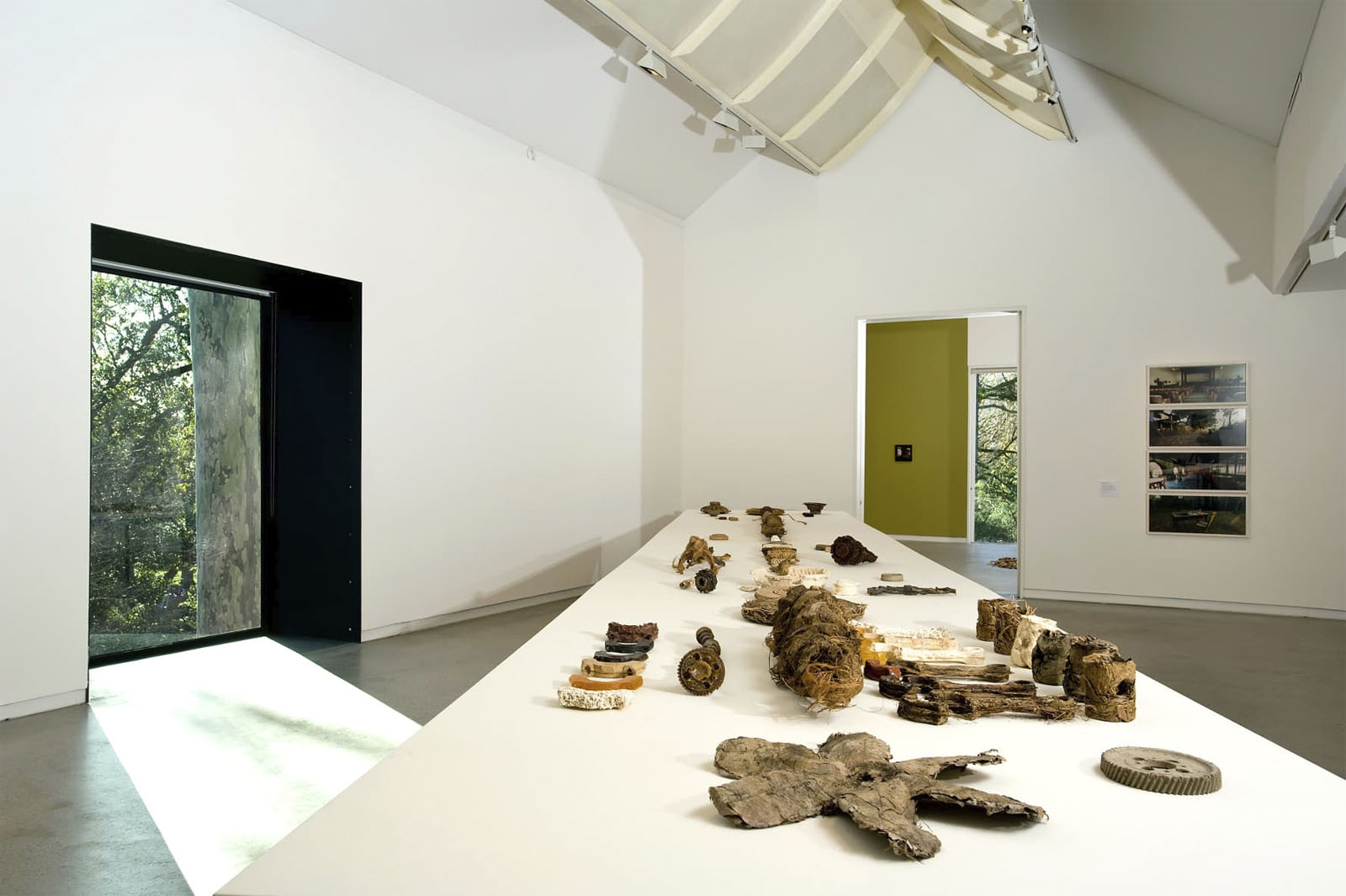
The absolute star of the exhibition is the installation Throwback (2007, see photographs below). The installation features the interior parts of a Tata truck (the engine and axles) recast in termite mound soils, river clay, laterite, sea shells, fruit skins, coconut bark, resin, and fibre laid on a huge dissecting table (much like the body in Rembrandt’s painting The Anatomy Lesson of Dr Tulp (1632)) – the layout of the engine and axles evoking the spine and interior skeleton of the body. Unfortunately I do not have an overview photograph of the whole work but parts of the work can be seen in the photographs below. The Tata truck spent its working life plying the roads of the forests of Malaysia:
“With the rise of China and India, a voracious market for scrap metal has developed, hastening the disappearance of particular objects, Gill recovers the modern forms of the truck parts by casting them in natural materials found near her studio in Port Dickson.” (Wall text from the exhibition)
. This is an outstanding work that left me stunned with it’s beauty and insightfulness. It literally took my breath away and for that reason alone a visit to this exhibition at Heide is well worth the journey.
Dr Marcus Bunyan
Many thankx to Jade Enge and the Heide Museum of Modern Art for allowing me to publish the photographs in the posting. Please click on the photographs for a larger version of the image.
“The work of Simryn Gill considers questions of place and history, and how they might intersect with personal and collection experience … Using objects, language and photographs, her work conveys a deep interest in material culture, and in the ways that meaning can transform and translate in different contexts. Through the reinterpretation or alteration of existing objects, the photographing of specific locations, and the forming of collections, Gill contemplates how ideas and meanings are communicated between people, objects and sites.”
Wall text from the exhibition
Simryn Gill (Singapore, b. 1959) Untitled 1999 Gouache on National Geographic magazine pages (1970s) Courtesy of the artist, BREENSPACE, Sydney and Tracy Williams Ltd, New York
Simryn Gill (Singapore, b. 1959) Untitled 1999 Gouache on National Geographic magazine pages (1970s) Courtesy of the artist, BREENSPACE, Sydney and Tracy Williams Ltd, New York
Simryn Gill (Singapore, b. 1959) My own private Angkor 2007 Courtesy of the artist, BREENSPACE, Sydney and Tracy Williams Ltd, New York
Installation view of the exhibition Simryn Gill: Gathering at Heide Museum of Modern Art, Melbourne showing the work Throwback 2007
Simryn Gill (Singapore, b. 1959) Throwback (detail) 2007 Interior parts of Tata truck, termite mound soil, river clay, laterite, seashells, fruit skins, leaves, bark and fibre, flowers, glue, resin, milk Buxton Collection Melbourne Courtesy of the artist
Simryn Gill (Singapore, b. 1959) Throwback (detail) 2007 Interior parts of Tata truck, termite mound soil, river clay, laterite, seashells, fruit skins, leaves, bark and fibre, flowers, glue, resin, milk Buxton Collection Melbourne Courtesy of the artist
This exhibition (22 April – 18 July) presents the work of leading Sydney-based Malaysian artist, Simryn Gill. Featuring objects, books, collections, photographs and text pieces from the last six years of Gill’s practice, it explores the artist’s pursuit of meaning through materials, forms and ways of working, such as collecting, reading, archiving, arranging, casting and photographing.
Described in 2009 in the New Yorker as ‘quietly dazzling’, Gill’s work is internationally recognised. She has been honoured with solo exhibitions at the Tate Modern, London and the Smithsonian Institution, Washington DC, both in 2006. Born in Singapore in 1959, Gill lives and works in Sydney and Port Dickson, Malaysia, and has participated in significant exhibitions internationally, including documenta 12 in Kassel, Germany (2007), the Singapore Biennale (2006), the Biennale of Sydney (2002 and 2008), the São Paulo Biennial (2004) and the Venice Biennale (1999).
An MCA touring exhibition curated by Russell Storer, it has been expanded by Heide to include the Australian premiere of Gill’s major work Throwback, originally produced for the documenta 12 exhibition in Kassel, Germany, in 2007. Throwback reworks the inner machinery of a 1985 Tata truck that plied the roads of Malaysia. With the economic rise of China and India, a voracious market for scrap metal has developed, hastening the disappearance of particular objects. Gill recovers the modern forms of truck parts by casting them in natural materials – found near her studio in Malaysia – including river mud, coconut husks, reconstituted termite mounds and fruit skins.
Gill has also produced a new work, an artist’s book reflecting on the gardens at Heide.
Gill’s practice considers how we might experience place as an intersection of personal and collective histories and geographies. Through the reinterpretation or alteration of existing objects, the photographing of specific locations, and the forming of collections, Gill contemplates how ideas and meanings are communicated between people, objects, and sites.
Several works in the exhibition invite audience participation. Paper Boats invites visitors to add their own unique paper boat to the installation by tearing pages from a 1968 Encyclopaedia Britannica and using the sheet to make an origami boat. Another work, Garland (2006) encourages us to hold, touch and rearrange objects collected by Gill on the beaches of Port Dickson, Malaysia, and the islands off Singapore – fragments reshaped by sea and sand that take on almost organic form.
A selection of books, sketches, collections and experimental pieces from the early 1990s to the present, some produced for exhibitions and others never intended as artworks will also be presented as part of the exhibition. Together they offer an insight into Gill’s artistic processes and her interest in art-making as an active engagement with the world.”
Press release from the Heide Museum of Modern Art website [Online] Cited 01/10/2010 no longer available online
Simryn Gill (Singapore, b. 1959) Paper boats 2008 Encyclopaedia Britannica (1968 edition) Courtesy of the artist and BREENSPACE, Sydney
Simryn Gill (Singapore, b. 1959) Paper boats (detail) 2008 Encyclopaedia Britannica (1968 edition) Courtesy of the artist and BREENSPACE, Sydney
Addendum: A Pencil for Your Thoughts
Heide pencil, the confounding pencil
I love to visit Heide, the elegant buildings, the art, the cafe, a stroll in the gardens looking at the sculpture. What I don’t like is being accosted by gallery attendants on my last three visits, twice on the last visit alone to review the Simryn Gill exhibition – accost being not too harsh a word for some of the approaches. The request: to not write in the gallery with a pen but to use a pencil (rushed to the scene of the crime post haste!)
I don’t like writing with a pencil, they go blunt and I can’t read my notes. I like writing with a pen. This is a ridiculous state of affairs, the only gallery in Melbourne that I know of that has such a ‘nanny state’ rule.
Do they think that I am going to:
a) spear the pen into the gallery wall b) attack the attendant with the pen (after this last visit the thought did cross my mind!) or c) scribble all over the art work like a child …
The more we are treated like children the more child-like we become.
“Put the pen on the ground … Step away from the pen.”
Heide Museum of Modern Art 7, Templestowe Road Bulleen, Victoria 3105
Opening hours: (Heide II and Heide III) Tuesday – Sunday 10.00am – 5.00pm
This is a strange survey exhibition of photographs by Malaysian-born Australian artist Simryn Gill at the Centre for Contemporary Photography, Melbourne – photographs that form distinctive bodies of work that support the artist’s other conversations in art but do not form the main backbone to her practice. Perhaps this is part of the problem and part of the beauty of the work. While the work investigates the concepts of presence and absence, space, place and identity and the cultural inhabitation of nature there is a feeling that this is the work of an artist not used to putting images together in a sequence or body of work, not connecting the dots between ideas and image. Intrinsically there is nothing wrong with the conceptual ideas behind the photographs or the individual photographs themselves. The photographs don’t strike one as particularly memorable and they fail to mark the mind of the viewer in their multitudinous framings of reality.
In the series Forest (1996-1998, see photograph above and below) a selective vision of nature is invaded by cultural texts, torn pages of books mimicking natural forms such as roots, flowers and variegated leaves. The ‘natural’ context is inhabited by the cultural con-text to form a double inhabitation – “this strange hybrid nature before the paper rots away, suggestive of how nature is culturally inscribed and the futility of this attempt at containment.”1
This is a nice idea but the photographs fail to hold the attention of the viewer mainly because of the inability of the viewer to read the text that has been grafted onto the natural forms. I literally needed more from the work to hang my hat on and this is how I felt about much of this work presented here. This feeling persists with another series Vegetation (1999, see photographs below). Mundane landscapes are inhabited by faceless human beings, their absence/presence marking the landscape while at the same time nature marks them. A good idea that needed to be pushed much further.
The main body of work in the exhibition is the series Dalam (2001, see photographs below), a 258 strong series of colour photographs presented in the gallery space in gridded formation (Dalam, in Malay, can mean ‘inside’, ‘interior’ or ‘deep’). Featuring a photographic record of the interior of numerous Malaysian homes these clinical yet someone hobby-like photographs record the minutiae of domestica – the intimacy of the interior balanced by a sense of isolation and loneliness through the absence of human presence. Here, “the living room may be seen here as a cultural and social mask for its inhabitants. It’s the space into which others are welcomed on our own terms and onto which we project a portrayal of ourselves.”3 Although the work asks us “to rethink our concepts of spaces and domesticity in relation to various aspects such as socio-cultural identities, history and memory,” as presented in the gallery space the viewer is initially overwhelmed by the number, colour and construction of the interiors.
Personally I found that in the mundanity / individuality of the repetition I soon lost interest in looking intimately at the work. The photographs lack a certain spark, a certain clarity of vision in the actual taking of the images. None of the wonderful angles and intelligence of camera positioning of Eugene Atget here and maybe this is the point – the stifling ‘personality’ and banality of human habitation echoed in the photographs – but I would have rather have looked at a single monumentally intimate, magical image by Candida Hofer than all of these photographs put together!
Unfortunately in this survey exhibition there is only one photograph from what I regard as Simryn Gill’s best body of work, A small town at the turn of the century (1999-2000, see photograph below). Perhaps this was an oversight as this series would seem to bind the others more holistically together. Photographs of this excellent series can be viewed on the Roslyn Oxley9 Gallery website and their presence in this exhibition would have certainly raised the bar in terms of the artist’s vision of nature, place and identity. The square colour format, the interior/exterior of the environments and naturalness of the photographs and their the fruitful bodies really have an eloquent power that most of the work at the Centre for Contemporary Photography seems to lack. Other than the last body of work, Inland (2009, see photograph below) that is.
In the smallest most intimate space at the CCP are some of the most intimate images of Australian place that you will ever see. Spread out on a table in small stacks of jewel-like black and white and Cibachrome images the viewer is asked to done white gloves (ah, the delicious irony of white hands on the Australian land!) to view the empty interiors, landscapes and (hands holding) rocks of the interior. These are beautifully seen and resolved images. The rocks are most poignant.
Gill digs beneath the surface of this thing called Australian-ness and exposes not the vast horizons, decorous landscapes or rugged people (as Naomi Cass states below) but small intimacies of space and place, identity and memory. In the ability to shuffle the deck of cards, to reorder the photographs to make their own narrative the viewer becomes as much the author of the story being told as the artist herself – an open-ended intertextual narrative guided by the artist that investigates the very root of what it is to be Australian on a personal level. I enjoyed this reordering, this subjective experience very much.
Dr Marcus Bunyan
Many thankx to the CCP for allowing me to publish the photographs in the posting. Please click on the photographs for a larger version of the image.
2/ Gill, Simryn. “May 2006,” in Off the Edge, Merdeka 50 years issue no. 33, September 2007, p. 83
3/ Day, Kate. “After Image: Photography at the Fruit Market Gallery,” on Culture 24 website. [Online] Cited 6th December 2009 no longer available online
“Both populating and haunting the patches of now feral vegetation evoking a sense of foreign/alien source that has been strained, even lost in the act of transplantation. It also parodies the fear of rampant occupation that historically imbues aspects of Australian to Northern neighbours.”10
In Rampant Gill photographed outbursts of introduced plant species in the Australian landscape such as bamboo and sugar cane, which now grow wild and uncontrolled in subtropical northern New South Wales. Again Gill incorporates performative elements, interacting with nature through ‘dressing’ the plants in garments such as lungis and sarongs which were worn by immigrant workers who harvested these crops. Gill explores of the connections between botany, geography and the idea of plants as ‘humanised’ entities – seen in these strange single or groups of ‘figures’ appearing displaced within the Australian landscape.
Text from the education resource for the exhibition Simryn Gill: Inland at the Centre for Contemporary Photography, Fitzroy [Online] Cited 12/05/2019
Upon close inspection, this series of large scale black and white photographs of lush tropical plants reveal strips of paper and fragments of text which are embedded into tree trunks, covering leaf surfaces, transforming into aerial mangrove roots, weaving their way up walls and mimicking banana flowers.
The artist states: “I decided I needed to echo my situation in my art activities, and started making small interventions in the very rare wild places around where we lived, like gardens of unoccupied houses, roadside growths of tapioca and yam”.7
Returning from Australia to Singapore with her family, Gill went into overgrown gardens and open spaces she was familiar with to construct these site interventions, armed with glue and a range of books – some given to her by friends, others sourced from garage sales – including the colonial texts of Charles Darwin’s The Origin of Species and Daniel Defoe’s Robinson Crusoe, and an Indonesian version of the Hindu tale Ramayana. These works were explorations by Gill into her personal sense of place and history, as an outsider in Singapore. Works in the same series were created in other similar environments in countries such as Malaysia. Although they originate from specific locations, they can be read as anywhere in the tropics.
The process of entering these ‘little bits of jungle’ to construct these works was referred to by Gill as her ‘guerrilla activities’,8 and were temporary site specific interventions which she sought to document.
Her friend and fashion photographer Nicholas Leong, chose the camera and film which required long exposure, suiting Gill’s requirements to create large, dense flat tonal images. Together they documented the works before the paper was to rot away and return nature. This introduced Gill to analogue photography and its slow processing, which she values and continues to use.
Text from the education resource for the exhibition Simryn Gill: Inland at the Centre for Contemporary Photography, Fitzroy [Online] Cited 12/05/2019
… In these works which were begun at a residency at Artpace in Texas, Gill begins the process of masking and disguising, of naturalising human figures into the landscape (in this case herself) through obscuring their heads with fruit and vegetation, that was to be so important in her later bodies of work such as A small town at the turn of the century.
Curator Sharmini Pereira has written: “In this series of photographs, her self-portrait dominates but only as a stream of disguises involving plants in various geographic locations; tumbleweed and aloe in Texas, mangrove and black boy in Australia, and bird’s nest fern in Singapore. The images bear an uncanny resemblance to a sequence of B-movie stills, where vengeful alien-plant-people threaten to over run the planet. Many Hollywood films have of course played out such narratives as a projection of Cold War anxieties fearful about the threat of Communist contamination. But if Vegetation represents the future through some fear located in the past, it does so through a mimetic representation of the present… Vegetation parodies the camera’s framing of today’s culture contact.
Beyond their still pathos, the enchanting appeal of these photographs lies in their somersaulting between the mythical moment of first contact and its reversal, which the mimetic moment of secondary contact ushers forth. The artist, “unrecognisable” in her jeans and desert boots and wearing her new plant hairstyle, lampoons the power of mimicry as a means of being both alien and indigenous at one and the same time. In as much as Vegetation offers us the chance to poke fun at the natives, it is also an image of the new 21st-century native – able to deliver the laughs rather than be controlled by them. It is here that we observe the breadth of relief that resides in the welcome opportunity to view imitation as a way of moving beyond the imitated…”
in “Simryn Gill – Selected Work”, AGNSW, 2002
Text from the Art Gallery of New South Wales website [Online] Cited 12/05/2019
“Nature becomes just another clichéd signifier of place and of localness, which one may adopt while passing through a ‘strange’ place, or migrating to a new place, or indeed as a cover for invasion.”9
In these small framed photographs, Gill is now the subject within the natural environment. The series was started in San Antonia, Texas in 1999 and was part of a two-month residency during which time she produced a new body of work. Gill was wondering if – in this mimicry of nature – she actually could ‘disappear into the landscape’. On field trips she collected a range of desert plant matter, including aloe and tumble weed and took this back to the studio to construct headdresses. Again, using Nicholas Leong as the photographer, Gill then went back to the location to shoot the series. She continued to work on the series in Singapore using the mangrove and in Australia, the grass tree occasionally referred to as a ‘black boy’. The series is closely related to A small town at the turn of the century in its playfulness and parody of ethnographic portraits.
Text from the education resource for the exhibition Simryn Gill: Inland at the Centre for Contemporary Photography, Fitzroy [Online] Cited 12/05/2019
Simryn Gill: Inland is a survey of photography and takes place in a photography gallery. It is important to declare at the outset, that while photography forms a significant and wondrous part of her practice, Simryn Gill does not consider herself a photographer; “For me, the taking of photographs is another tool in my bag of strategies, in that awkward pursuit of coherence we sometimes call art.”2 Simryn Gill: Inland embraces this conundrum as an entry point for considering Gill’s photography, and how photography might function more broadly as a way of engaging with the world.
Seven major series wind almost chronologically through the gallery – in this first survey of Gill’s photography – following a path, quite literally, from outside to inside, from found in nature to found in culture and back. Commencing with three series located outdoors, Forest (1996-1998), Rampant (1999) and Vegetation (1999), the survey moves to Gill’s sweeping interior series Dalam (2001). On the cusp of outside and inside is Power station (2004), which makes a curious and visceral analogy between the interior of her childhood home in Port Dickson, Malaysia and the interior of an adjacent power station. Like a medieval Book of Hours, the hand-sized concertina work Distance (2003-2009) is an attempt by Gill to convey the interior of her home in Marrickville, Sydney to someone residing outside Australia.
Gill’s most recent work Inland (2009), commissioned for this survey and photographed during a road trip from northern New South Wales to South Australia and across the bight to Western Australia, is at the heart of the exhibition. Gill’s only moving image work, Vessel (2004), commissioned for SBS Television, closes the exhibition’s journey with the almost imperceptible passage of a small fishing vessel across the horizon. To ground the exhibition, or perhaps to oversee our journey, one image is selected from Gill’s highly regarded series, A small town at the turn of the century (1999-2000).
Seeking an understanding of the politics of place informs her recent series. Inland confounds what is normally expected from photographs of Australia’s interior and eschews decorous landscapes, vast horizons or smiling rugged people, for modest interiors of homes. Indeed there are no people present, only the houses they have inhabited as evidence of their subjectivity.
Inland consists in piles of small jewel-like Cibachrome and black and white prints sitting on a table for viewers to peruse, heightening the provisional nature of its description, leaving open-ended the question of what can be known through photographic representation.
Naomi Cass, Exhibition Curator and Director Centre for Contemporary Photography
Dalam (Malay for ‘deep’, or ‘within’) is a suite of 260 photographic images, the result of Malaysian artist Simryn Gill’s sojourn across her home country over an eight-week period. She went up to the homes of complete strangers and asked to photograph their living spaces. Dalam is an expansive yet uncannily intimate survey of Malaysia at the turn of the century, a mélange of disparate ethnicities, religions, ideologies and allegiances. The title itself alludes to the depiction of interior spaces as signifiers of the individual lives that inhabit and activate them, but, even more importantly, it suggests an exploration of the social fabric of contemporary Malaysia. As the artist observes: “In conceiving the work I had wondered what the ‘inside’ of a place might look like. Do lots of people held together by geography add up to the idea of a nation or single unified group?” Dalam questions what historian Benedict Anderson famously dubbed “the imagined community”, or the various divergent structures that shape the modern nation-state.
Text from the Singapore Art Museum website [Online] Cited 12/05/2019
Dalam (Malay for deep; inside; interior), is a series of two hundred and sixty colour photographs arranged in grid formation on the gallery walls.
“Gill deliberately began Dalam with the intention to document the living rooms of residents of the Malay peninsula, and her focus in each photograph is to capture the sense of place conveyed by the living room of the occupants.”11
Accompanied by a close friend, Gill took these over an eight-week period as they travelled across the Malaysian Peninsula. In towns mainly outside the city regions she knocked on the doors of strangers and asked if she could enter their houses to photograph their living rooms. Surprisingly, almost everyone agreed, and the resulting series gives a fascinating insight into the character of the Malaysian Peninsula, made up of a broad mix of people from diverse cultural backgrounds. Gill was again exploring her conflicting experience of being both insider and outsider; raised in Malaysia but also having lived outside for a very long time.
Text from the education resource for the exhibition Simryn Gill: Inland at the Centre for Contemporary Photography, Fitzroy [Online] Cited 12/05/2019
How We Are in the World: The Photography of Simryn Gill
Simryn Gill: Inland is a survey of photography and takes place in a photography gallery. It is important to declare at the outset, that while photography forms a significant and wondrous part of her practice, Simryn Gill does not consider herself a photographer; “For me, the taking of photographs is another tool in my bag of strategies, in that awkward pursuit of coherence we sometimes call art”.1 Simryn Gill: Inland embraces this conundrum as an entry point for considering Gill’s photography, and how photography might function more broadly as a way of engaging with the world.
Seven major series wind almost chronologically through the gallery – in this first survey of Gill’s photography – following a path, quite literally, from outside to inside, from found in nature to found in culture and back. Commencing with three series located outdoors, Forest (1996-1998), Rampant (1999) and Vegetation (1999), the survey moves to Gill’s sweeping interior series Dalam (2001). On the cusp of outside and inside is Power station (2004), which makes a curious and visceral analogy between the interior of her childhood home in Port Dickson, Malaysia and the interior of an adjacent power station. Like a medieval Book of Hours, the hand-sized concertina work Distance (2003-2008) is an attempt by Gill to convey the interior of her home in Marrickville, Sydney to someone residing outside Australia. Gill’s most recent work Inland (2009), commissioned for this survey and photographed during a road trip from northern New South Wales to South Australia and across the bight to Western Australia, is at the heart of the exhibition. Gill’s only moving image work, Vessel (2004), screened on SBS Television, closes the exhibition’s journey with the almost imperceptible passage of a small fishing vessel across the horizon. To ground the exhibition, or perhaps to oversee our journey, one image is selected from Gill’s highly regarded series, A small town at the turn of the century (1999-2000).
Gill’s photography takes place within a broader practice that curator Russell Storer describes as “… subjecting found objects, books, local materials and sites – each of which carry specific meanings and histories – to a range of processes including photographing, collecting, erasing, casting, tearing, arranging, stitching, rubbing, wrapping and engraving”.2 Gill takes humble things in the world and shifts them; rearranges them with seemingly endless patience, craft and grace, to communicate something about how the object has come into being. This is not a matter of changing context to appreciate formal qualities as might a connoisseur, but rather a quest for understanding place.
Always evident in the found object is some kind of story that, as Gill gathers the item, is folded into the meaning of her work. The constituent parts of her installations – be they items found on the shore or collected from around her studios in Port Dickson or Sydney, or indeed a particular site Gill photographs – are gathered for their ability to evoke a history. Movement across the globe, of people and vegetation, both enforced and deliberate, if not the subject of her work is certainly a link. While not a unique story, resettlement is part of Gill’s individual and familial history. Her parents originally moved from India to Malaya prompted by the range of human predicaments, from political and economic upheaval, through to adventure and marriage. The displacement of objects echoes the journeys of people.
Naomi Cass Exhibition Curator and Director Centre for Contemporary Photography, extract from catalogue essay [Online] Cited 12/05/2019
A small town at the turn of the century 1999-2000 is a series of 40 type C photographs taken by Gill in the town the artist grew up in. The documentation of the people and place of ones past could be highly nostalgic. Added to this is the moment at which Gill chose to document – the turn of the 20th into the 21st century. Such references to time and memory, the past and the present are potent but Gill has covered each of her subjects’ heads with tropical fruit. Rather than being absurd or ironical the head coverings move the images away from being portraits and into the broader realm of context. The context however is not necessarily as revealing as the viewer might wish. There are numerous variations on dress, interiors, exteriors, pose, and accoutrements that suggest activities (whether work or play). While it is usually clear that the environment is tropical (because of the fruit and foliage) the images provoke a complex set of reactions to the possible messages. Faceless, Gill’s subjects are ciphers constructed by external objects, presented with affection.
Text from the Art Gallery of New South Wales website [Online] Cited 12/05/2019
Simryn Gill (Australian born Singapore, 1959) Distance 2003-2008 Artist book Installation views, Centre for Contemporary Photography
Distance (2003-2008)
Distance, an artist’s book of small colour photographs is produced as a hand-sized concertina work in an edition of just five. This beautiful work is “like a medieval Book of Hours”12 and is displayed in an elegant museum-like cabinet with a protective perspex covering. Distance was produced after many conversations Gill had with friends and family overseas and is an attempt to show them what her home is like. She took one hundred and thirty photographs, using a medium format camera, of everything in the interior of her home in Marrickville, Sydney; however the results seemed to fail in producing a truthful representation of her home, as Gill says, “the final result is almost like an incoherence, it’s too close, there is too much information”.13. Naomi Cass wrote with reference to this, ‘While Distance fails to communicate the gestalt of home, it is remarkable in its details and beauty’.14
Text from the education resource for the exhibition Simryn Gill: Inland at the Centre for Contemporary Photography, Fitzroy [Online] Cited 12/05/2019
Simryn Gill (Australian born Singapore, 1959) Inland 2009 Cibachrome and silver gelatin photographs Photographs (quantity variable) 13 x 13cm (each)
Inland (2009)
“Through an extraordinary ability to engage with strangers, Gill and her fellow traveller Mary Maguire photographed the living rooms of eighty homes ranging in geographical location, socio-economic and cultural background.”15
Inland (2009) is a new series, which was commissioned for this exhibition. Using the same process to produce Dalam, Gill photographed this series on a road trip; however this time in Australia, from northern New South Wales to South Australia and across the bight to Western Australia. The photographs include views of the horizon, skyscapes, interior still life compositions and close ups of stones collected by Gill during her travels. Inland is at the heart of the exhibition and the mode of presentation differs to all other series in the exhibition, as these precious handmade small scale colour and black and white images are assembled on a table in piles for the visitor to examine, with white gloves.
Text from the education resource for the exhibition Simryn Gill: Inland at the Centre for Contemporary Photography, Fitzroy [Online] Cited 12/05/2019
Centre for Contemporary Photography Level 2, Perry St Building Collingwood Yards, Collingwood Victoria 3066





 Art Blart _ art and cultural memory archive
You must be logged in to post a comment.