
Exhibition dates: 7th June – 25th September, 2016
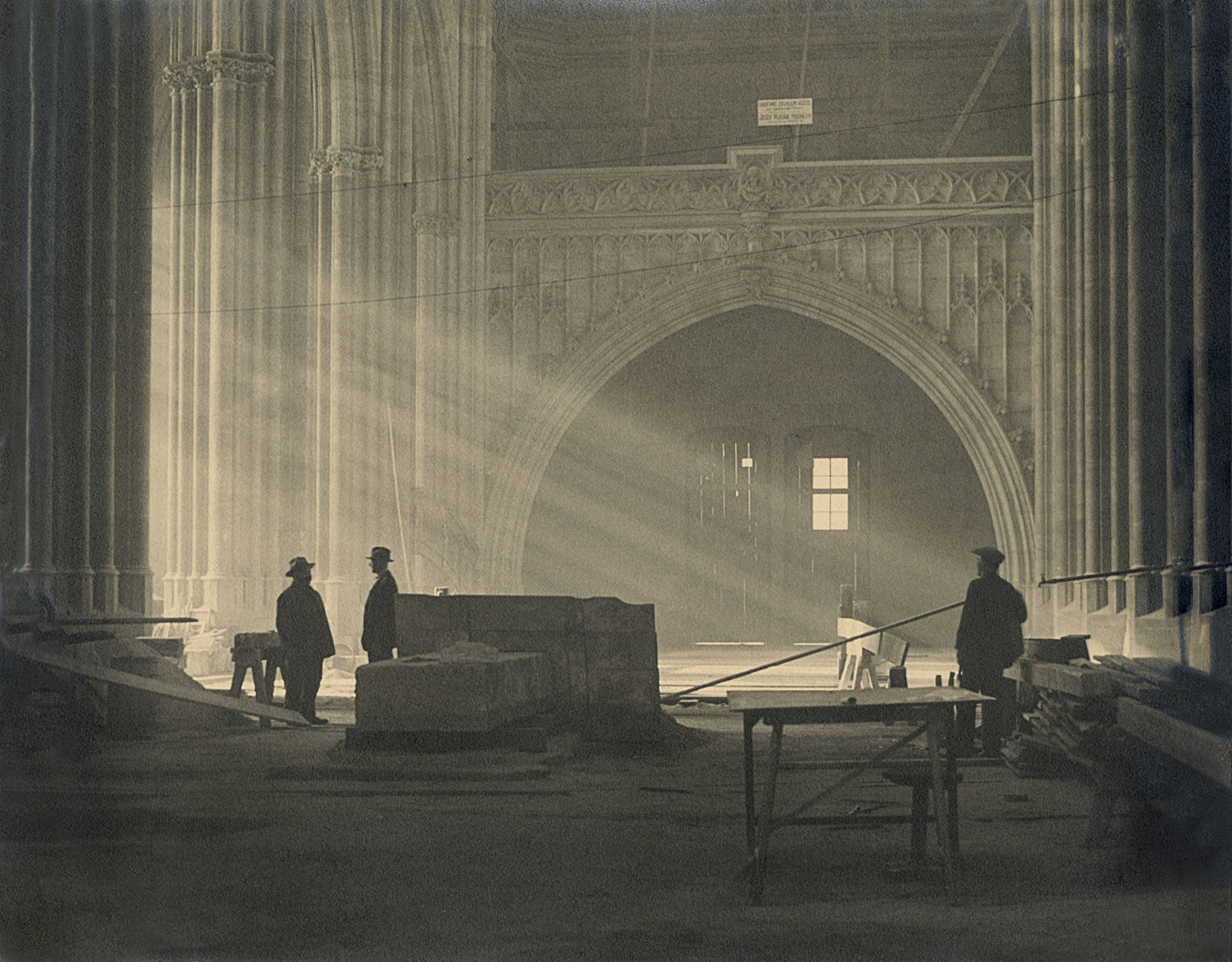
Josef Sudek (Czech, 1896-1976)
St. Vitus cathedral, Prague, Czech Republic
c. 1926
Silver gelatin print
A poetry of the everyday
Josef Sudek, a one-armed man lugging around a large format camera, is one of my top ten photographers of all time.
His photographs, sometimes surreal, always sensitive, have a profound sensibility that affect the soul. Melancholy and mysterious by turns, they investigate the inner life of objects which stand as metaphors for the inner life of the artist. A form of healing after his horrific injuries and the loss of his arm during the First World War, the photographs purportedly look outwards upon the world but are actually interior meditations on life, death and the nature of being. Light emerges from the darkness; understanding from tribulation; and Sudek, in Jungian terms, integrates his ego into his soul through the process of (photographic) individuation – whereby the personal and collective unconscious (his hurt and damage) are brought into consciousness (eg. by means of dreams, active imagination, or free association) to be assimilated into the whole personality. It is a completely natural process necessary for the integration of the psyche and, in Sudek’s life, was integral to his healing from the vicissitudes of war.
Using Pictorialism as the starting point for his exploration of the world, Sudek never abandons the creation of “atmosphere” in his photographs, even as the images become modernist, surrealist and offer a new way of seeing the world. Having myself photographed extensively at night, and from the interior of my flat, I can understand Sudek’s fascination with both locations: the quiet of night, the stillness, the clarity of vision and thought; the interior as exterior, the projection of interior thoughts onto an external surface reflected back into the camera lens. “Nature, architecture, streets and objects are magnified by his sensitivity and mastery of the effects of light, contrasting with the impenetrable cloak of darkness.” Except the cloak of darkness is not impenetrable, as light cannot exist without darkness.
Pace, his photographs are breath / taking. They are exhalations of the spirit.
Sudek’s ability to transcend the literal, his ability to transform the objectal quality of photography ranks him as one of the top photographers of all time. He synthesises a poetry of objects, a poetry of the everyday, and projects the folds of his mind onto the visual field (through “tears” of condensation on the window, through labyrinths of paper and glass, such as in Labyrinth on my table, 1967, below). As a form of self-actualisation – the desire to become everything that one is capable of becoming – Sudek’s photographs interrogate that chthonic darkness that lurks in the heart of everyone of us, our dark night of the soul.
In that process of discovery (who am I, what kind of human being am I, how can I heal myself), he finds redemption.
Dr Marcus Bunyan
Many thankx to Jeu de Paume for allowing me to publish the photographs in the posting. Please click on the photographs for a larger version of the image.
“I like to tell stories about the life of inanimate objects, to relate something mysterious: the seventh side of a dice. Everything around us, dead or alive, in the eyes of a crazy photographer mysteriously takes on many variations, so that a seemingly dead object comes to life through light or by its surroundings.”
Josef Sudek
Josef Sudek at Jeu de Paume
“The Intimate World of Josef Sudek”, exhibition at Jeu de Paume Paris, from 07 June 2016 until 25 September 2016
Entitled “The Intimate World of Josef Sudek”, this exhibition is the first of this scale to revisit the life and work of Josef Sudek (Kolin, 1896 – Prague, 1976) within its socio-geographical and historical context: Prague during the first half of the twentieth century, at a time when the Czech capital was a veritable hub of artistic activity.
The exhibition features a selection of 130 works spanning the totality of Sudek’s career, from 1920 to 1976, and allows the public to examine the extent to which his photography was a reflection of his personal relationship to the surrounding world. On display are works that are the result of Sudek’s photographic experiments carried out within the privacy of his own studio, images of the garden seen from his window, and photographs of adventures further afield. The artist enjoyed meandering through the streets of Prague and its surrounding suburbs, and made frequent excursions to the nearby countryside.
Sudek’s enduring fascination with light, and its absence, is at the root of some of the most haunting photographs of the twentieth century. Nature, architecture, streets and objects are magnified by his sensitivity and mastery of the effects of light, contrasting with the impenetrable cloak of darkness.
Text from the Jeu de Paume Vimeo website
On display are works that are the result of Sudek’s photographic experiments carried out within the privacy of his own studio, images of the garden seen from his window, and photographs of adventures further afield. The artist enjoyed meandering through the streets of Prague and its surrounding suburbs, and made frequent excursions to the nearby countryside. Sudek’s enduring fascination with light, and its absence, is at the root of some of the most haunting photographs of the twentieth century. Nature, architecture, streets and objects are magnified by his sensitivity and mastery of the effects of light, contrasting with the impenetrable cloak of darkness.
As a photographer, Sudek was particularly concerned with the quality of the photographic print, an essential component in terms of the expressive potential of an image. His mastery of the pigment printing process enabled him to produce highly atmospheric and evocative images, thereby reaping all of the reflective and descriptive power of the gelatin silver print. The exhibition presents work from Sudek’s early career, but also features photographs from a pivotal period of experimentation and innovation, beginning in the 1940s. Focusing on the technical and formal aspects of the medium of photography, Sudek created pigment prints, halftone prints, puridlos (photographs between two windows) and veteše (photographs inserted into old frames), techniques which allowed him to transform the objectal quality of photography.
The loss of his right arm during the First World War and the difficulties he now encountered in transporting his view camera did not dampen his passion for photography. Sudek’s studio window became an object of abiding fascination – rather like the surface of a canvas – reflecting moments of exquisite tenderness and hope when a flowering branch brushed against its pane, or of poignant melancholy when he observed the world beyond his window transformed by the playful infinity of mist. His room with a view allowed him to capture, on film, his love of Prague. His photographs demonstrate both a precision and a depth of feeling, fitting odes to the rich history and architectural complexity of the Czech capital.
Like many artists of his generation marked by their experience of war, Sudek expresses a particularly acute awareness of the dark and tormented aspects of human existence – feelings that would inspire some of his most melancholy and most moving pictures. A photograph taken at night, through the glass pane of his window, shows a city plunged into darkness during the Occupation of the Second World War, and communicates a sentiment of unspeakable despair – a dramatic illustration of Sudek’s technical ability to transcend the literal.
The first part of the exhibition features images that herald the photographer’s later work, showing his early landscapes, portraits of fellow patients at Invalidovna, the Prague hospice for war invalids like Sudek, his hesitant foray into modernism, and his interior shots of St. Vitus Cathedral. Through images that recount the narrative of his life, the viewer gains access to Sudek’s inner world, and an insight into his immediate environment, the views and objects he loved, his studio and garden. His endless walks in Prague found expression in the views of the city and its surroundings, as well as in photographs of its more sordid “suburbs”, a subject explored by other Prague artists. The eastern and northern areas of Bohemia, the Beskid Mountains and the Mionší forest were other destinations close to the photographer’s heart. The exhibition “The Intimate World of Josef Sudek” provides a fascinating panorama of the work of this unique artist.
Text from the Jeu de Paume website
Beginnings
Sudek’s first photographic prints – small and largely assembled in albums – were mainly views of the countryside taken along the Elbe River when he travelled from Prague to Kolín to visit his mother between 1916 and 1922.
Using processes such as gelatin silver and bromoil he showed a talent for printing his pictures in a style that favoured soft edges and broad swathes of tone. Here Sudek was not so much studying the effects of light as he was observing the conventions of Pictorialism, a photography movement that straddled the last decade of the nineteenth century and the first decades of the twentieth century, and was based on a strong Romantic ethos. Pictorialist photographers enhanced atmospheric effects with such processes as carbon and gum bichromate. Sudek began using the carbon process regularly and in a personally expressive manner in the late 1940s.
His Invalidovna and St. Vitus Cathedral series in Prague, begun in the first half of the 1920s, show him exploring interior spaces where light emphasises both the profane and the sacred. The play of bands of sunlight and darkness is a central feature of the composition and, indeed, of the life of the photograph.
![Josef Sudek (Czech, 1896-1976) 'Dimanche après-midi à l'île Kolín' [Sunday afternoon at Kolín island] c. 1922–1926](https://artblart.com/wp-content/uploads/2016/09/sudek-dimanche-aprc3a8s-midi-c3a0-l_c3aele-kolc3adn-vers-1922e280931926-web1.jpg "Josef Sudek (Czech, 1896-1976) 'Dimanche après-midi à l'île Kolín' [Sunday afternoon at Kolín island] c. 1922–1926")
Josef Sudek (Czech, 1896-1976)
Dimanche après-midi à l’île Kolín [Sunday afternoon at Kolín island]
c. 1922-1926
Gelatin silver print
28.4 × 28.7cm
Musée des beaux-arts du Canada, Ottawa. Achat, 2000
© Succession de Josef Sudek
“… [Sudek] referred to photography as meteorology to describe the significance of the atmosphere, and how a photographer must predict the right conditions for photographing and enlarging prints. His work became sharper with richer tones, and his compositions became more illusive. The foregrounds and backgrounds of his photographs, particularly in his “Window” series began to oscillate. These achievements were perhaps made more attainable by his focus on inanimate objects over which he had more control than living things. Most of his cityscapes became deserted, as he directed his camera at statues or replaced what would have been a living subject with such emulative sculptures.
In effect, Sudek’s substitution of the inanimate for the animate brought the objects he photographed to life in his mind. He called the enormous decaying trees in the woods of Bohemia “sleeping giants” and would take portraits of masks and statuary heads, transforming them into frozen, worn grotesqueries. His personification of objects is even more vivid in his studio photography, particularly after 1939, the oncoming of World War II and the Nazi occupation of Prague. As the city was oppressed by German troops, the artist retreated into his studio and insulated himself sentimentally with still lifes. To an interviewer, he explained, “I love the life of objects. When the children go to bed, the objects come to life. I like to tell stories about the life of inanimate objects.” He devoted endless hours to arranging and photographing the everyday – apples, eggs, bread, and shells – and special objects given to him by friends, such as feathers, spectacles, and watches, which he called “remembrances” of that person. A photograph from his series “Remembrances of Architect Rothmayer, Mr. Magician,” for example, portrays objects respectfully placed in a row on a desk, as if artifacts from an archeological site, from which the history of a life or character of a man could be divined.
“Everything around us, dead or alive, in the eyes of a crazy photographer mysteriously takes on many variations,” Sudek said, “so that a seemingly dead object comes to life through light or by its surroundings.” This statement is perhaps telling of Sudek’s relationship to death and life, as a result of the loss of his arm and the manner in which he suffered the loss. In the 1963 film, “Zit Svuj Zivot” (Living Your Life), a documentary portrait of Sudek by Evald Strom, we see a sensitive man describing his efforts to photograph the reality of the objects around him, not as if he were bringing the objects to life, but as if it was his purpose to represent the lives of objects as they truly are. Of the image of a vase of wildflowers, he says “This is a photograph of wildflowers, my attempt to photograph wildflowers,” and of an old lamp, “This is a celebrated lamp; it holds a lot of memories.””
Ashley Booth Klein, “Josef Sudek and The Life of Objects,” in Obelisk Vol. 2 Issue 1, Winter 2015 [Online] Cited 18/09/2016. No longer available online
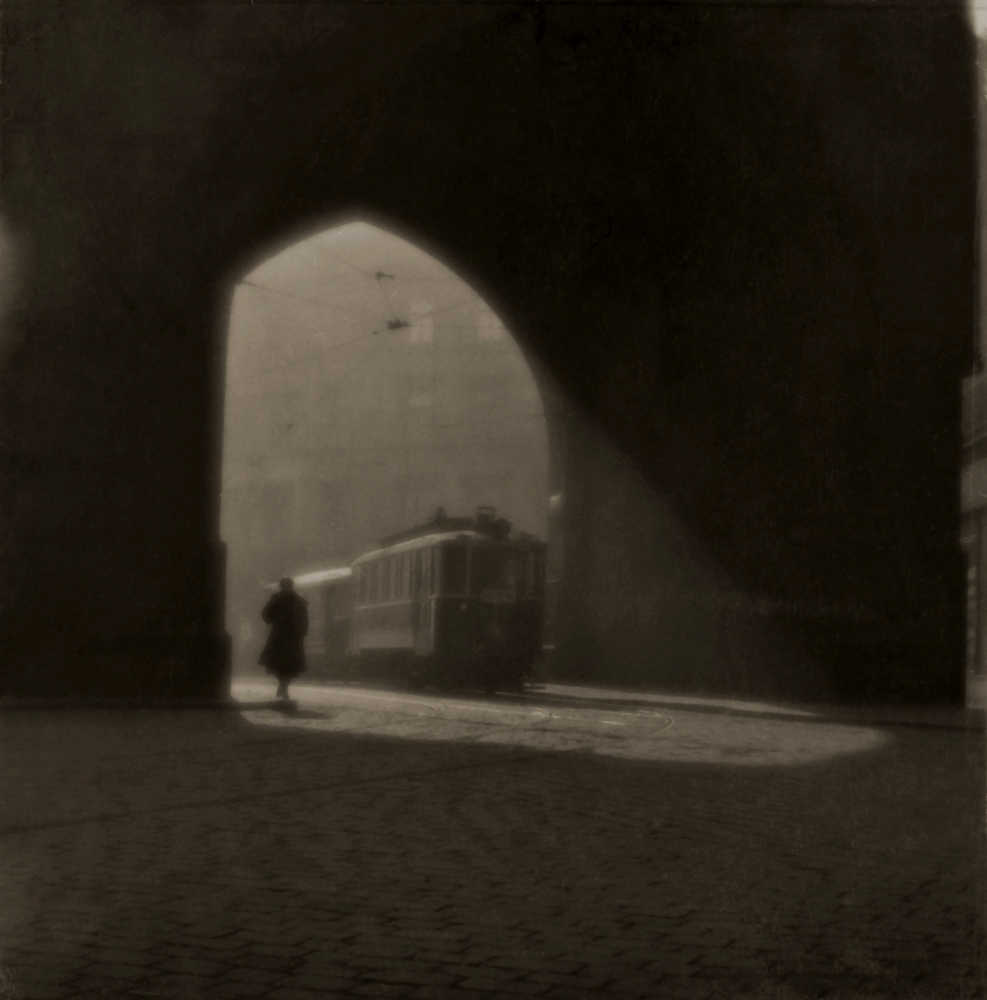
Josef Sudek (Czech, 1896-1976)
Rue de Prague
1924
Gelatin silver print
8.3 × 8.2cm
Musée des beaux-arts du Canada, Ottawa. Don anonyme, 2010
© Succession de Josef Sudek
![Josef Sudek (Czech, 1896-1976) 'Portrait de mon ami Funke' [Portrait of my friend Funke] 1924](https://artblart.com/wp-content/uploads/2016/09/sudek-portrait-de-mon-ami-funke-1924-web1.jpg "Josef Sudek (Czech, 1896-1976) 'Portrait de mon ami Funke' [Portrait of my friend Funke] 1924")
Josef Sudek (Czech, 1896-1976)
Portrait de mon ami Funke [Portrait of my friend Funke]
1924
Gelatin silver print
28.5 × 22.6cm
Musée des beaux-arts du Canada, Ottawa. Achat, 1985
© Succession de Josef Sudek
“Josef Sudek: The World at My Window” is the first exhibition in France since 1988 to cover Sudek’s entire career and spotlight the different phases of his work. Coming in the wake of several exhibitions at the Jeu de Paume devoted to Eastern European photographers of the early twentieth century, among them André Kertész and Francois Kollar, this one comprises some 130 vintage prints by the Czech artist. Bringing to bear a vision at once subjective and timeless, Sudek captures the ongoing changes in Prague’s natural world and landscapes.
His early profession as a bookbinder came to an abrupt halt when he was conscripted into the Austro-Hungarian army in Bohemia and sent to the Italian front. After the First World War he came back to Prague wounded; the loss of his right arm meant abandoning bookbinding, and he turned to photography. After revisiting the battlefield in Italy once more he returned, in despair, to Prague: “I found the place,” he recounted, “but my arm wasn’t there. Since then I’ve never gone anywhere. I didn’t find what I was looking for.”
A study grant enabled him to train at the state-run school of graphic arts in Prague, where he mixed with practitioners of Pictorialism, a photographic movement aiming at achieving colour and texture effects similar to those of painting. He started concentrating on architectural details, always waiting until the light was absolutely perfect. Little by little he gave up the Pictorialist ambiences of his views of St Vitus’s cathedral, opting for a pure, straightforward approach which the American photographer Alfred Stieglitz summed up as “maximum detail for maximum simplification”.
During the Second World War Sudek began photographing the window giving onto his garden, the result being the celebrated Window of My Studio series. He then shifted his focus to the accumulated jumble of objects in the studio, producing a further series titled Labyrinths. Light was an inexhaustible theme in his work, orchestrating the seasons, making the invisible visible and transporting us into another world. As if to escape the leaden context of the War and then of Communism, Sudek took refuge in music, especially that of his compatriot Leoš Janáček. A true music lover, he gradually built up a substantial collection of recordings which he played to his friends during improvised concerts in his studio.
The second half of his career saw Sudek abandon photography’s traditional subjects as he explored the outskirts of Prague with his black view camera on his shoulder. Known as “the poet of Prague”, he became an emblematic figure in the Czech capital. Discreet and solitary, he gradually withdrew from the city’s art scene, leaving his studio only to prowl the streets at night with his imagination as his guide.
Sudek’s photographs rarely include people; his focus was more on empty urban and rural spaces. Fascinated by the streets of Prague, the city’s deserted parks and public gardens, and the wooded Bohemian landscapes his mastery of light rendered sublime, he preferred the un-enlarged contact print as a means of preserving all the detail and authenticity of the places he roamed through. His work moved towards experiments with light. In photographs shot through with simplicity and sensitivity, Sudek foregrounds a kind of poetry of the everyday, using the interplay of light and shade to achieve a kind of fluctuation between interior and exterior.
Text from Jeu de Paume
![Josef Sudek (Czech, 1896-1976) 'La Fenêtre de mon atelier' [The window of my studio] c. 1940-1948](https://artblart.com/wp-content/uploads/2016/09/sudek-la-fenc3aatre-de-mon-atelier-vers-1940e280931948-web1.jpg "Josef Sudek (Czech, 1896-1976) 'La Fenêtre de mon atelier' [The window of my studio] c. 1940-1948")
Josef Sudek (Czech, 1896-1976)
La Fenêtre de mon atelier [The window of my studio]
c. 1940-1948
Gelatin silver print
17 × 11.2cm
Musée des beaux-arts du Canada, Ottawa. Don anonyme, 2010
© Succession de Josef Sudek
![Josef Sudek (Czech, 1896-1976) 'La Fenêtre de mon atelier' [The window of my studio] c. 1940–1954](https://artblart.com/wp-content/uploads/2016/09/josef-sudek-la-fenc3aatre-de-mon-atelier-vers-1940e280931954-web1.jpg "Josef Sudek (Czech, 1896-1976) 'La Fenêtre de mon atelier' [The window of my studio] c. 1940–1954")
Josef Sudek (Czech, 1896-1976)
La Fenêtre de mon atelier [The window of my studio]
c. 1940-1954
Gelatin silver print
22.9 × 16.8cm
Musée des beaux-arts du Canada, Ottawa. Don anonyme, 2010
© Succession de Josef Sudek
![Josef Sudek (Czech, 1896-1976) 'La Fenêtre de mon atelier' [The window of my studio] c. 1940-1950](https://artblart.com/wp-content/uploads/2016/09/josef-sudek-la-fenc3aatre-de-mon-atelier-vers-1940e280931950-web1.jpg "Josef Sudek (Czech, 1896-1976) 'La Fenêtre de mon atelier' [The window of my studio] c. 1940-1950")
Josef Sudek (Czech, 1896-1976)
La Fenêtre de mon atelier [The window of my studio]
c. 1940-1950
Gelatin silver print
28.1 × 22.9cm
Musée des beaux-arts du Canada, Ottawa. Don anonyme, 2010
© Succession de Josef Sudek
The world from my window
Sudek was not content with making single, unrelated images. He generally worked in projects or series, creating extended visual explorations of the phenomena and scenes he viewed – often from the closed window of his studio, which separated his private studio-home from the exterior world. In the series From My Window it was the endlessly varying states of transformation of droplets of water that he watched streaming down his windowpane. His images invite us to contemplate, with great fascination, the physical cycles of water and the phenomenon of rivulets coursing down a surface – like human tears. Reminding us even of [Paul] Verlaine’s “There is weeping in my heart like the rain upon the city…” Sometimes the melancholy mood of these images is leavened by a rose in a vase on the windowsill or tendrils of leaves announcing the arrival of spring.
There is weeping in my heart
like the rain falling on the town.
What is this languor
that pervades my heart?
Oh the patter of the rain
on the ground and the roofs!
For a heart growing weary
oh the song of the rain!
There is weeping without cause
in this disheartened heart.
What! No betrayal?
There’s no reason for this grief.
Truly the worst pain
is not knowing why,
without love or hatred,
my heart feels so much pain.
Paul Verlaine. “Il pleure dans mon coeur”
![Josef Sudek (Czech, 1896-1976) 'Quatre saisons: l'été' [Four seasons: summer] c. 1940-1954](https://artblart.com/wp-content/uploads/2016/09/josef-sudek-quatre-saisons-l_c3a9tc3a9-vers-1940e280931954-web1.jpg "Josef Sudek (Czech, 1896-1976) 'Quatre saisons: l'été' [Four seasons: summer] c. 1940-1954")
Josef Sudek (Czech, 1896-1976)
Quatre saisons: l’été [Four seasons: summer]
c. 1940-1954
From the series “La Fenêtre de mon atelier” [The window of my studio]
Gelatin silver print
22.6 × 17.1cm
Musée des beaux-arts du Canada, Ottawa. Don anonyme, 2010
© Succession de Josef Sudek
![Josef Sudek (Czech, 1896-1976) 'La Dernière Rose' [The Last Rose] 1956](https://artblart.com/wp-content/uploads/2016/09/sudek-la-dernic3a8re-rose-1956-web1.jpg "Josef Sudek (Czech, 1896-1976) 'La Dernière Rose' [The Last Rose] 1956")
Josef Sudek (Czech, 1896-1976)
La Dernière Rose [The Last Rose]
1956
Gelatin silver print
28.2 x 23.2cm
Musée des beaux-arts du Canada, Ottawa. Don anonyme, 2010
© Succession Josef Sudek
Night walks
Sudek’s preoccupation with darkness dates to the Nazi Occupation of Prague from March 1939 until the end of the war. Experiencing his city plunged into nights of enforced darkness Sudek explored the absence of light in his pictures. We know that this was more than a technical exercise, for he wrote “Memories” and “Restless Night” on the verso of one nocturnal photograph dated 1943.
The curfews imposed on citizens at the time made it unlikely that Sudek ventured out into the city after dark during wartime. Neither agile nor inconspicuous with his large-format camera slung over his increasingly hunched back, Sudek would have risked his life had he done so. The small courtyard of his studio on Ujezd street was hidden from the road, however, and one or two lights in neighbouring apartments served as beacons. Well after sundown he would photograph the syncopated play of blurs of light against the wall of impenetrable blackness.
The spirit of place
Sudek visited and photographed places that held either personal or spiritual significance for him: the landscape along the Elbe River, Invalidovna, St. Vitus Cathedral, his studio, Prague’s complex streets and open squares, the majestic Prague Castle, the city’s surrounds, and Frenštát pod Radhoštĕm where he spent summers with friends. Hukvaldy, home of Leoš Janaček, the composer whose music he loved, was a particularly favoured haunt. This was true also of the ancient Mionší Forest where he navigated his way through dense brush and forests by way of shortcuts that he created and playfully named. The Beskid Mountains also served as spiritual retreat. Although he was an urbanite in many respects, Sudek’s love of nature and sense of despair for its desecration is strongly expressed in Sad Landscapes, his series of images made in the Most region where industrialisation ravaged the countryside in the 1950s.
The life of objects
Sudek collected everything. Today he would be known as a hoarder. But his obsession served him well, for out of the chaos of his small studio and living spaces he carefully selected a variety of these objects to photograph. From delicate feathers to crumpled paper and tinfoil, multi-faceted drinking glasses, flowers, fruit, seashells, envelopes, flasks, frames, prisms, candelabras, string and shoe moulds, the subjects ranged from the mundane to the exotic. Once chosen, the set-up was lovingly composed – often in subtly changed configurations with other objects – and carefully lit before being memorialised in either pigment or gelatin silver prints.
![Josef Sudek (Czech, 1896-1976) 'Le Jardin Royal' [The Royal Garden] c. 1940-1946](https://artblart.com/wp-content/uploads/2016/09/sudek-le-jardin-royal-vers-1940e280931946-web1.jpg "Josef Sudek (Czech, 1896-1976) 'Le Jardin Royal' [The Royal Garden] c. 1940-1946")
Josef Sudek (Czech, 1896-1976)
Le Jardin Royal [The Royal Garden]
c. 1940-1946
Procédé pigmentaire au papier charbon [Carbon pigment on paper]
16.1 × 11.7cm
Musée des beaux-arts du Canada, Ottawa. Don anonyme, 2010
© Succession de Josef Sudek
![Josef Sudek (Czech, 1896-1976) 'Prague pendant la nuit' [Prague at night] 1950](https://artblart.com/wp-content/uploads/2016/09/sudek-prague-pendant-la-nuit-1950-web1.jpg "Josef Sudek (Czech, 1896-1976) 'Prague pendant la nuit' [Prague at night] 1950")
Josef Sudek (Czech, 1896-1976)
Prague pendant la nuit [Prague at night]
1950
Gelatin silver print
22.8 × 29cm
Musée des beaux-arts du Canada, Ottawa. Don anonyme, 2010
© Succession de Josef Sudek
![Josef Sudek (Czech, 1896-1976) 'Prague pendant la nuit' [Prague at night] c. 1950-1959](https://artblart.com/wp-content/uploads/2016/09/sudek-prague-pendant-la-nuit-vers-1950e280931959-web1.jpg "Josef Sudek (Czech, 1896-1976) 'Prague pendant la nuit' [Prague at night] c. 1950-1959")
Josef Sudek (Czech, 1896-1976)
Prague pendant la nuit [Prague at night]
c. 1950-1959
Gelatin silver print
12 × 16.7cm
Musée des beaux-arts du Canada, Ottawa. Don anonyme, 2010
© Succession de Josef Sudek
![Josef Sudek (Czech, 1896-1976) 'Prague pendant la nuit' [Prague at night] c. 1950-1959](https://artblart.com/wp-content/uploads/2016/09/josef-sudek-prague-pendant-la-nuit-vers-1950e280931959-web1.jpg "Josef Sudek (Czech, 1896-1976) 'Prague pendant la nuit' [Prague at night] c. 1950-1959")
Josef Sudek (Czech, 1896-1976)
Prague pendant la nuit [Prague at night]
c. 1950-1959
Gelatin silver print
12.2 × 17.3cm
Musée des beaux-arts du Canada, Ottawa. Don anonyme, 2010
© Succession de Josef Sudek
![Josef Sudek (Czech, 1896-1976) 'Le Jardin de Rothmayer' [The Rothmayer Garden] 1954-1959](https://artblart.com/wp-content/uploads/2016/09/sudek-le-jardin-de-rothmayer-1954e280931959-web1.jpg "Josef Sudek (Czech, 1896-1976) 'Le Jardin de Rothmayer' [The Rothmayer Garden] 1954-1959")
Josef Sudek (Czech, 1896-1976)
Le Jardin de Rothmayer [The Rothmayer Garden]
1954-1959
Gelatin silver print
16.9 × 22.9cm
Musée des beaux-arts du Canada, Ottawa. Don anonyme, 2010
© Succession de Josef Sudek
Entitled “The Intimate World of Josef Sudek”, this exhibition is the first of this scale to revisit the life and work of Josef Sudek (Kolín, 1896 – Prague, 1976) within its socio-geographical and historical context: Prague during the first half of the twentieth century, at a time when the Czech capital was a veritable hub of artistic activity. The exhibition features a selection of 130 works spanning the totality of Sudek’s career, from 1920 to 1976, and allows the public to examine the extent to which his photography was a reflection of his personal relationship to the surrounding world. On display are works that are the result of Sudek’s photographic experiments carried out within the privacy of his own studio, images of the garden seen from his window, and photographs of adventures further afield. The artist enjoyed meandering through the streets of Prague and its surrounding suburbs, and made frequent excursions to the nearby countryside. Sudek’s enduring fascination with light, and its absence, is at the root of some of the most haunting photographs of the twentieth century. Nature, architecture, streets and objects are magnified by his sensitivity and mastery of the effects of light, contrasting with the impenetrable cloak of darkness.
As a photographer, Sudek was particularly concerned with the quality of the photographic print, an essential component in terms of the expressive potential of an image. His mastery of the pigment printing process enabled him to produce highly atmospheric and evocative images, thereby reaping all of the reflective and descriptive power of the gelatin silver print.
The exhibition presents work from Sudek’s early career, but also features photographs from a pivotal period of experimentation and innovation, beginning in the 1940s. Focusing on the technical and formal aspects of the medium of photography, Sudek created pigment prints, halftone prints, puridlos (photographs between two windows) and veteše (photographs inserted into old frames), techniques which allowed him to transform the objectal quality of photography. The loss of his right arm during the First World War and the difficulties he now encountered in transporting his view camera did not dampen his passion for photography.
Sudek’s studio window became an object of abiding fascination – rather like the surface of a canvas – reflecting moments of exquisite tenderness and hope when a flowering branch brushed against its pane, or of poignant melancholy when he observed the world beyond his window transformed by the playful infinity of mist. His room with a view allowed him to capture, on film, his love of Prague. His photographs demonstrate both a precision and a depth of feeling, fitting odes to the rich history and architectural complexity of the Czech capital.
Like many artists of his generation marked by their experience of war, Sudek expresses a particularly acute awareness of the dark and tormented aspects of human existence – feelings that would inspire some of his most melancholy and most moving pictures. A photograph taken at night, through the glass pane of his window, shows a city plunged into darkness during the Occupation of the Second World War, and communicates a sentiment of unspeakable despair – a dramatic illustration of Sudek’s technical ability to transcend the literal.
Through images that recount the narrative of his life, the viewer gains access to Sudek’s inner world, and an insight into his immediate environment, the views and objects he loved, his studio and garden. His endless walks in Prague found expression in the views of the city and its surroundings, as well as in photographs of its more sordid “suburbs”, a subject explored by other Prague artists. The eastern and northern areas of Bohemia, the Beskid Mountains and the Mionší forest were other destinations close to the photographer’s heart.
Text from Jeu de Paume
New ways of seeing
Although more influenced by prevailing photographic conventions in the beginning, Sudek came to show an openness to experimenting with new ways of composing and printing his images. In the late 1920s, Sudek photographed objects designed by modernist Ladislav Sutnar, thus creating angled views of furniture with reflective surfaces and ceramics of pure form.
Sudek’s most successful foray into modernism is his experimentation with grotesque (surreal) subjects such as mannequins, decaying sculptures and the accoutrements of the architect Otto Rothmayer’s garden. There is little doubt that in the fragmented figurative sculptures Sudek was recalling some of the human devastation that he witnessed on the battlefields of the First World War.
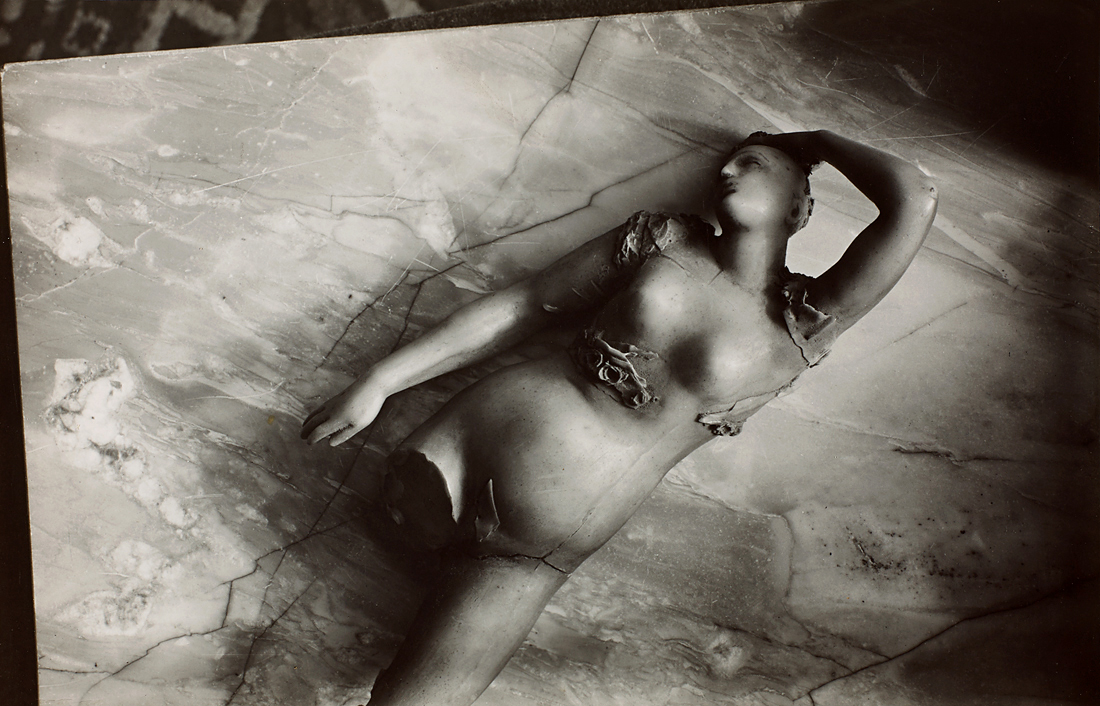
Josef Sudek (Czech, 1896-1976)
Statue
c. 1948-1964
Gelatin silver print
9 × 14cm
Musée des beaux-arts du Canada, Ottawa. Don anonyme, 2010
© Succession de Josef Sudek
![Josef Sudek (Czech, 1896-1976) 'Dans le jardin' [In the garden] 1954-1959](https://artblart.com/wp-content/uploads/2016/09/sudek-dans-le-jardin-1954e280931959-web1.jpg "Josef Sudek (Czech, 1896-1976) 'Dans le jardin' [In the garden] 1954-1959")
Josef Sudek (Czech, 1896-1976)
Dans le jardin [In the garden]
1954-1959
Gelatin silver print
17 × 23.3cm
Musée des beaux-arts du Canada, Ottawa. Don anonyme, 2010
© Succession de Josef Sudek
![Josef Sudek (Czech, 1896-1976) 'Labyrinthe sur ma table' [Labyrinth on my table] 1967](https://artblart.com/wp-content/uploads/2016/09/sudek-labyrinthe-sur-ma-table-1967-web1.jpg "Josef Sudek (Czech, 1896-1976) 'Labyrinthe sur ma table' [Labyrinth on my table] 1967")
Josef Sudek (Czech, 1896-1976)
Labyrinthe sur ma table [Labyrinth on my table]
1967
Gelatin silver print
39 × 22.9cm
Musée des beaux-arts du Canada, Ottawa. Don anonyme, 2010
© Succession de Josef Sudek
![Josef Sudek (Czech, 1896-1976) 'Labyrinthe de verre' [Glass Maze] around 1968-1972](https://artblart.com/wp-content/uploads/2016/09/sudek-labyrinthe-de-verre-vers-1968e280931972-web1.jpg "Josef Sudek (Czech, 1896-1976) 'Labyrinthe de verre' [Glass Maze] around 1968-1972")
Josef Sudek (Czech, 1896-1976)
Labyrinthe de verre [Glass Maze]
around 1968-1972
Gelatin silver print
39 × 22.9cm
Musée des beaux-arts du Canada, Ottawa. Don anonyme, 2010
© Succession de Josef Sudek
![Josef Sudek (Czech, 1896-1976) 'Sans titre (Nature morte sur le rebord de la fenêtre)' [Untitled (Still life on the windowsill)] 1951](https://artblart.com/wp-content/uploads/2016/09/josef-sudek-sans-titre-nature-morte-sur-le-rebord-de-la-fenc3aatre-1951-web1.jpg "Josef Sudek (Czech, 1896-1976) 'Sans titre (Nature morte sur le rebord de la fenêtre)' [Untitled (Still life on the windowsill)] 1951")
Josef Sudek (Czech, 1896-1976)
Sans titre (Nature morte sur le rebord de la fenêtre) [Untitled (Still life on the windowsill)]
1951
Montage par le photographe c. 1960.
Two silver gelatin prints, glass plate, lead
48.2 × 39.2cm
Musée des arts décoratifs, Prague.
© Succession de Josef Sudek
Jeu de Paume
1, Place de la Concorde
75008 Paris
métro Concorde
Phone: 01 47 03 12 50
Opening hours:
Tuesday: 11.00 – 21.00
Wednesday – Sunday: 11.00 – 19.00
Closed Monday
![Neo Rauch (German, b. 1960) 'Goldgrube' [Goldmine] 2007](https://artblart.com/wp-content/uploads/2014/07/22_neo_rauch_goldgrube-web.jpg "Neo Rauch (German, b. 1960) 'Goldgrube' [Goldmine] 2007")
![Rembrandt Harmenszoon van Rijn (Dutch, 1606-1669) 'Sogenannter Faust' [Allegedly Faust] c. 1651‑1653](https://artblart.com/wp-content/uploads/2014/07/12_rembrandt_sogenannter_faust-web.jpg "Rembrandt Harmenszoon van Rijn (Dutch, 1606-1669) 'Sogenannter Faust' [Allegedly Faust] c. 1651‑1653")
![Yves Klein (French, 1928-1962) 'Relief éponge bleu (RE 18)' (blue sponge relief [re 18]) 1960](https://artblart.com/wp-content/uploads/2014/07/16_klein_schwammrelief-web.jpg "Yves Klein (French, 1928-1962) 'Relief éponge bleu (RE 18)' (blue sponge relief [re 18]) 1960")
 Art Blart _ art and cultural memory archive
You must be logged in to post a comment.