Exhibition: ‘Thomas Demand’ at the National Gallery of Victoria, Melbourne

Exhibition dates: 30th November 2012 – 17th March 2013


Thomas Demand (German, b. 1964) 'Copyshop' 1999


Thomas Demand (German, b. 1964)
Copyshop
1999
C-Print / Perspex
183.5 × 300cm
Collection of John Kaldor, Sydney
Courtesy Taka Ishii Gallery, Sprüth Magers Berlin London, Esther Schipper, Berlin, Matthew Marks Gallery
© Thomas Demand, VG Bild-Kunst, Bonn / VISCOPY, Sydney


Sitting here in my non-air-conditioned flat trying to survive Melbourne’s autumn heatwave is no fun; my mind has turned to mush. So instead of trying to write an in depth review of this exhibition I shall just make some salient comments, for fear my sweat would literally buckle Demand’s meticulously constructed paper models before he could photograph them.

Demand is firstly a sculpture, constructing studio-sized models of photographs that reference “source material in the archive that already has some fateful resonance,” (Robert Nelson, The Age, 12th December 2012) such as the control room of the Fukushima nuclear reactor, the Geneva hotel bath tub where the German politician Uwe Barschel found a brutal death – personally my mind went to David E. Scherman’s photograph of Lee Miller in Hitler’s bathtub (see below); scenes of nature such as Clearing (2003, below) or Grotto (2006, below) that are hyperreal simulacra of natural phenomena; and modular environments and objects, such as Copyshop (1999), Space Simulator (2003) and Bullion (2003, all below) that strip away the relational intimacy between man and environment by the removal of all labelling and tactility of surface. Demand then photographs his denuded “models” before destroying them, the photograph then becoming the soul evidence of their intrinsic existence (much like the documentary evidence of photographs of Land Art). Demand’s visualisation of the environment is triple coded (photograph, model, photograph), a hybrid tri-articulation that produces new identities that release energies of multiplicity, irony and destabilisation.

Robert Nelson observes in The Age that Demand’s world is paper thin and because the eye detects the forgery, “the famous icon of unthinkable fortune [Bullion] – which might have played a part in some famous heist or the security of a national economy – is also a lie, a tinsel falsehood of no substance… All of Demand’s pictures have an empty or hollow character, which defies the earnest weight of their associations.” Dan Rule insightfully notes that, “By removing the image’s reference or index, only to so painstakingly recast it, he [Demand] begs us to look and look again. These resolutely “unreal” images demand that we consider reality with much greater care.” (Dan Rule, The Age, 19th January 2013). Christopher Allen in The Weekend Australian (2nd March, 2013) states that Demand’s huge final prints, hidden under a layer of Perspex, “adds another level of truth and illusion that preoccupies Demand as it must any serious photographer today. In this case, the photographs can claim to be, for what this is worth, absolutely and literally true in their recording of their subject; it is only the subject itself that is entirely illusory and fabricated.”

Interesting comments all. Demand’s recasting of the relationship between image and referent (image and the object being photographed) is critical to his practice, but I am unsure that all photographers have to be preoccupied with the relationship between truth and illusion as Allen states. As my recent review of the exhibition Confounding: Contemporary Photography noted not all photographs have to confound the relationship between truth and illusion in order to be art. “Collectively, it is the ideas contained within the images in this exhibition that unsettle the relationship between the photograph and the world in the mind of the viewer, not their confounding.” As in the Jeff Wall Photographs exhibition, there is not much emotion in any of these images and perhaps this is an outcome of the long pre-photographic production process.

Demand’s recordings, re-orderings of a constructed reality are fabrications of the highest calibre, amazing to witness at first hand (is that really a model, how does he do that with paper and lighting?!), and yet one is left with a feeling that the work needed something more to go beyond this illusion, some layering that takes the viewer beyond the surface of the image, beyond the understanding of image / model / reality. I look at the photographs, I understand the skill, the imbrication of the process – I think that is the word I want, meaning the covering with a design in which one element covers a part of another – the looking again at a fabricated (our!) reality but the photographs still leave me a little cold of heart, of empty and hollow character. Perhaps that is the point, however it doesn’t make me want to look at the photographs over weeks, months and years and let them reveal themselves to me. Like the paper on which they are printed they are a little paper thin.

Dr Marcus Bunyan


Many thankx to the National Gallery of Victoria for allowing me to publish the photographs in the posting. Please click on the photographs for a larger version of the image.
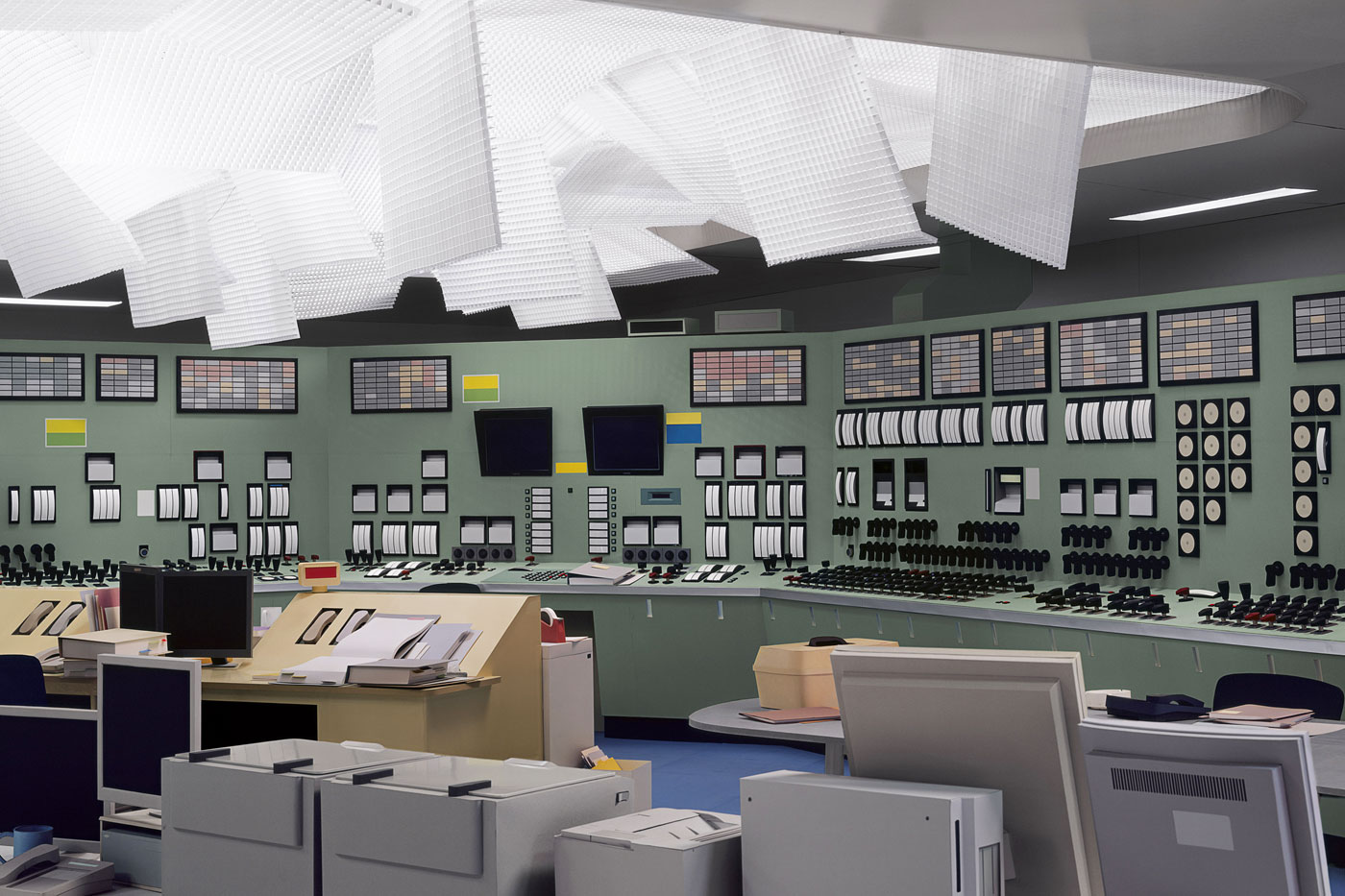


Thomas Demand (German, b. 1964) 'Kontrollraum / Control Room' 2011


Thomas Demand (German, b. 1964)
Kontrollraum / Control Room
2011
C-Print / Perspex
200 × 300cm
Courtesy Taka Ishii Gallery, Sprüth Magers Berlin London, Esther Schipper, Berlin, Matthew Marks Gallery
© Thomas Demand, VG Bild-Kunst, Bonn / VISCOPY, Sydney


Thomas Demand is regarded as one of the world’s leading contemporary artists whose work in photography and, most recently stop-animation films, is at the forefront of contemporary art. Demand initially worked as a sculptor who used photography to document his ephemeral creations. From 1993 his creative practice changed and, from then on, he made sculptures for the sole purpose of photographing them. Demand begins with an image, often taken from media sources and frequently dealing with traumatic or politically important events, and creates a life-size replica of the image using paper and cardboard. The effect of these uncanny reconstructions is to destabilise our understanding of the sites which we ‘know’ so well through reproduction. This exhibition features a selection of photographs and 35mm films as chosen by the artist.

Organised with The Museum of Contemporary Art, Tokyo

Text from the National Gallery of Victoria website


Thomas Demand (German, b. 1964) 'Labor / Laboratory' 2000


Thomas Demand (German, b. 1964)
Labor / Laboratory
2000
C-Print / Perspex
180 × 268cm
Courtesy Taka Ishii Gallery, Sprüth Magers Berlin London, Esther Schipper, Berlin, Matthew Marks Gallery
© Thomas Demand, VG Bild-Kunst, Bonn / VISCOPY, Sydney


Thomas Demand (German, b. 1964) 'Space Simulator' 2003


Thomas Demand (German, b. 1964)
Space Simulator
2003
C-Print / Perspex
300 × 429.4cm
Courtesy Taka Ishii Gallery, Sprüth Magers Berlin London, Esther Schipper, Berlin, Matthew Marks Gallery
© Thomas Demand, VG Bild-Kunst, Bonn / VISCOPY, Sydney


Thomas Demand (German, b. 1964) 'Lichtung / Clearing' 2003


Thomas Demand (German, b. 1964)
Lichtung / Clearing
2003
C-Print / Perspex
192 × 495cm
Courtesy Taka Ishii Gallery, Sprüth Magers Berlin London, Esther Schipper, Berlin, Matthew Marks Gallery
© Thomas Demand, VG Bild-Kunst, Bonn / VISCOPY, Sydney


Thomas Demand (German, b. 1964) 'Public housing' 2003


Thomas Demand (German, b. 1964)
Public housing
2003
C-Print / Perspex
Courtesy Taka Ishii Gallery, Sprüth Magers Berlin London, Esther Schipper, Berlin, Matthew Marks Gallery
© Thomas Demand, VG Bild-Kunst, Bonn / VISCOPY, Sydney


Public housing also shows the influence, in part, of Demand’s early photographic training. A member of the so-called Düsseldorf School (along with Thomas Ruff, Thomas Struth, Candida Hofer and Andreas Gursky), Demand was taught photography by Bernd and Hilla Becher. The Bechers had an austere approach, creating a vast archive of formally composed images of industrial structures. The rigour of this training is apparent in the objective approach Demand brings to his subjects. However, as Public housing demonstrates, from this starting point he creates work with a strange, disarming beauty in a style that is distinctly the artist’s own.

The origin for Public housing is the back of a Singapore $10 banknote which Demand recreates with great fidelity and in the characteristic pink tones of the original. The artist has expressed a fascination for currency that depicts modern architecture and has collected examples from many countries But, the meaning of his resulting image is somewhat ambiguous. It can be read either as a work that critiques modern housing estates with their often soulless and depressingly formulaic architecture or, in contrast, as an expression of national pride. It appears that the latter meaning was intended by the artist, who has written that Public housing ‘shows that the capital of finance in Asia also has a heart for the underprivileged’ (email to author).

Isobel Crombie, Senior Curator, Photography, National Gallery of Victoria (in 2011).

Isobel Crombie. “Thomas Demand Public housing,” 2011, published on the NGV website 2013 [Online] Cited 23/07/2024


Thomas Demand (German, b. 1964) 'Regen / Rain' (still) 2008


Thomas Demand (German, b. 1964)
Regen / Rain (still)
2008
35 mm colour film, sound, 4 min, looped
Courtesy Taka Ishii Gallery, Sprüth Magers Berlin London, Esther Schipper, Berlin, Matthew Marks Gallery
© Thomas Demand, VG Bild-Kunst, Bonn / VISCOPY, Sydney


One of the world’s most influential contemporary artists, Thomas Demand, will be the subject of a new exhibition announced by the National Gallery of Victoria. The exhibition will be the first major Australian survey of the artist’s work and will comprise large scale photographs and films never before shown in Australia.

NGV Director, Tony Ellwood said the addition of Thomas Demand to the NGV’s exhibition schedule is part of an exciting and ambitious summer program.

“When the opportunity came up to hold an exhibition of Thomas Demand’s work this summer, it was just too good to miss. Thomas Demand will be part of a great summer program at the NGV and has been timed to coincide with the Jeff Wall Photographs exhibition being held at NGV Australia.” …

Works in the exhibition will span the artist’s career from 1997 to 2012. Recent works presented in the exhibition include Control Room (2011, above), which depicts the Fukushima Daiichi nuclear power plant and Tribute (2011, below), a work based on images taken at the site of tragic mass panic at Europe’s biggest rave party.

Susan van Wyk, NGV Curator of Photography said Thomas Demand is widely regarded as one of the world’s leading contemporary artists.

“Thomas has a unique style in which he creates paper models of objects and scenes, often taken from media sources like flickr or newspaper reports. These intricate life size models are then photographed.

“The results are disquieting images that subvert our understanding of reality and fiction and draws attention to how we engage with the media and modern technologies,” said Ms Van Wyk.

Press release from the National Gallery of Victoria


Thomas Demand (German, b. 1964) 'Grotte / Grotto' (detail) 2006


Thomas Demand (German, b. 1964)
Grotte / Grotto (detail)
2006
C-Print / Perspex
Photograph: Marcus Bunyan

 

Thomas Demand (German, b. 1964) 'Bullion' 2003


Thomas Demand (German, b. 1964)
Bullion
2003
C-Print / Perspex
42 × 60cm
Courtesy Taka Ishii Gallery, Sprüth Magers Berlin London, Esther Schipper, Berlin, Matthew Marks Gallery
© Thomas Demand, VG Bild-Kunst, Bonn / VISCOPY, Sydney


Thomas Demand (German, b. 1964) 'Parlament / Parliament' 2009


Thomas Demand (German, b. 1964)
Parlament/Parliament
2009
C-Print / Perspex
Courtesy Taka Ishii Gallery, Sprüth Magers Berlin London, Esther Schipper, Berlin, Matthew Marks Gallery
© Thomas Demand, VG Bild-Kunst, Bonn / VISCOPY, Sydney


David E. Scherman (American, 1916-1997) 'Lee Miller in Hitler's bath, Hitler's apartment, Munich, Germany 1945' 1945


David E. Scherman (American, 1916-1997)
Lee Miller in Hitler’s bath, Hitler’s apartment, Munich, Germany 1945
1945
From Lee Miller: A Life by Carolyn Burke
© Lee Miller Archives


Thomas Demand (German, b. 1964) 'Badezimmer / Bathroom' 1997


Thomas Demand (German, b. 1964)
Badezimmer / Bathroom
1997
C-Print / Perspex
160 × 122cm
Courtesy Taka Ishii Gallery, Sprüth Magers Berlin London, Esther Schipper, Berlin, Matthew Marks Gallery
© Thomas Demand, VG Bild-Kunst, Bonn / VISCOPY, Sydney


When you look at the work of Thomas Demand, at some point you realise that what you are looking at cannot be real. As this becomes apparent you understand that you are looking at a paper simulation of the world.

Demand’s early studies, in the 1980s and early 90s, were in sculpture and he built his constructions out of paper and cardboard. At this time, photography was simply the tool the artist used to document his sculptural work. Around 1993, however, an important shift occurred in Demand’s practice. His meticulously constructed objects were no longer the final works. The photographs that had previously served as an efficient means of recording his ephemeral sculptures instead became Demand’s prime interest. From this point on his models existed, not to be seen as three-dimensional sculptures but, to be photographed in two-dimensions.

The act of building his sculptural subjects is a bit like the architectural process and involves drawings, plans, engineering, even quantity surveying. A finished work may contain hundreds of thousands of hand-cut and assembled paper elements. Another of the more extraordinary things about his constructions is their scale. Demand extrapolates and estimates dimensions of the elements in his source images and then reconstructs them at life-size. The environs Demand builds have an amazing fidelity.

In the process of making his photographs, Demand literally inhabits the structures he builds, walking in and around them. He does so not only to find the right position to photograph from, but also to establish a relationship with a place. Demand describes this act as unsettling, saying, ‘When I walk around them I feel a strange sense of destabilisation. You transpose yourself to a time and place in which you could never be’. The scale of his models enables him to physically relate to them as if to the original object or scene – a model bath is big enough to sit in and a forest clearing is large enough to enter and walk through. Demand’s working process therefore enables him to have physical encounters with things, places and times that exist elsewhere or in the past.

Susan van Wyk. “The Constructed Worlds of Thomas Demand,” on the NGV website 15 February 2013 [Online] Cited 23/07/2024


Thomas Demand (German, b. 1964) 'Tribute' 2011


Thomas Demand (German, b. 1964)
Tribute
2011
C-Print / Perspex
166 × 125cm
Courtesy Taka Ishii Gallery, Sprüth Magers Berlin London, Esther Schipper, Berlin, Matthew Marks Gallery
© Thomas Demand, VG Bild-Kunst, Bonn / VISCOPY, Sydney


The Solitude of the Picture

Jeff Wall & Thomas Demand: In Conversation

On the eve of opening their respective exhibitions, Jeff Wall and Thomas Demand in conversation about their work and process.


NGV International
180 St Kilda Road

Opening hours
Daily 10am – 5pm

National Gallery of Victoria website

LIKE ART BLART ON FACEBOOK

Back to top

Review: ‘Jeff Wall Photographs’ at The Ian Potter Centre: NGVA, National Gallery of Victoria, Melbourne

Exhibition dates: 30th November 2012 – 17th March 2013


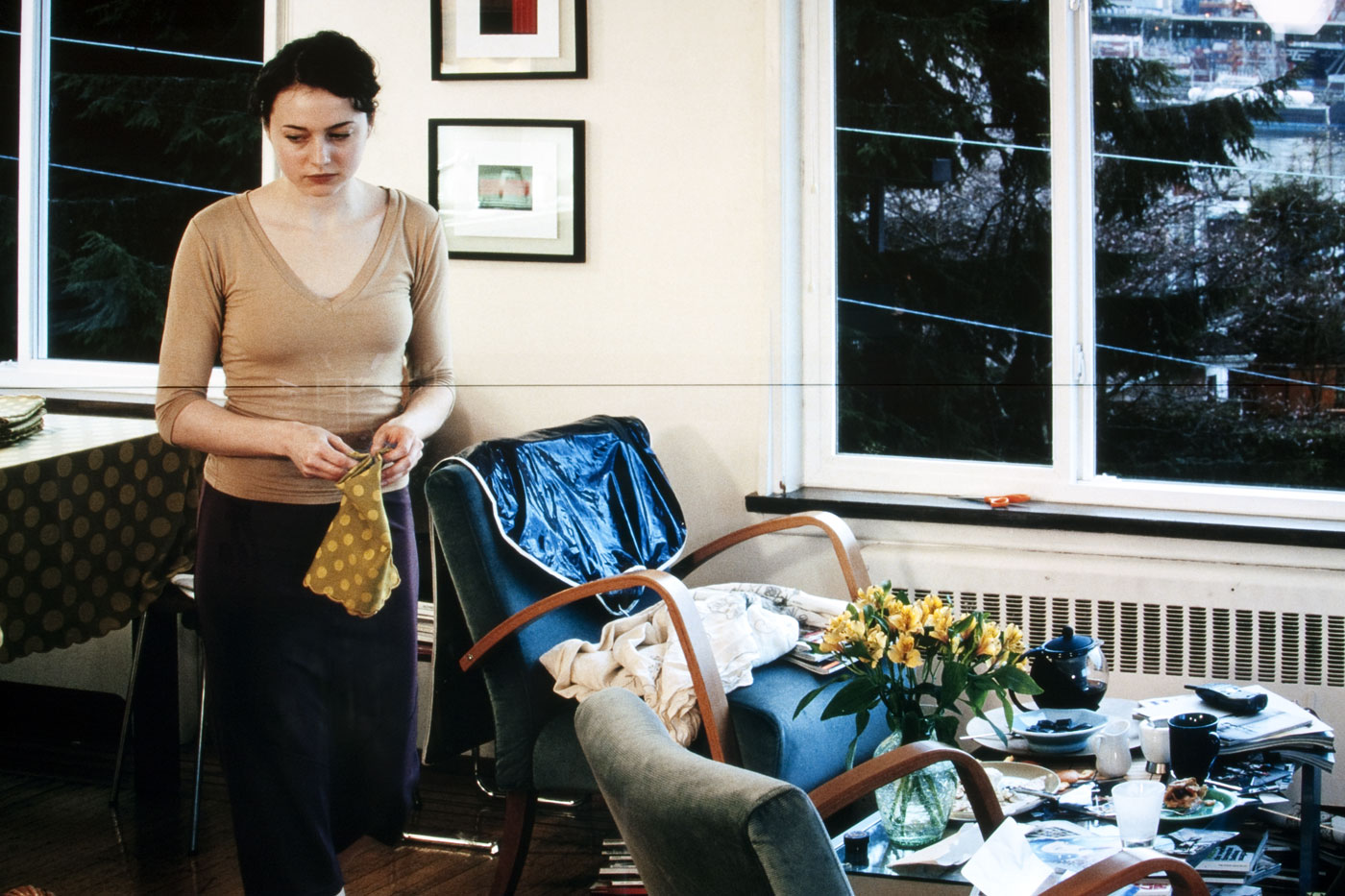
Jeff Wall. 'A view from an apartment' 2004-2005


Jeff Wall (Canadian, b. 1946)
A view from an apartment
2004-2005
Transparency in light box 1/2
167 x 244cm
Tate, London Purchased with assistance from the American Fund for the Tate Gallery and Tate Members, 2006
© Jeff Wall


“My work is a reconstruction and reconstruction is a philosophical activity. If I can create a drama that has philosophical meaning, that’s fine, or sometimes, it is not from meaning but a reconstruction of a feeling. It is best to capture in a photograph a feeling, an emotion, a look, a memory, a perception or a relationship.”


Jeff Wall


Stressed at the seams

The excruciating “conversation” between Jeff Wall and Thomas Demand in The Great Hall at the National Gallery of Victoria on November 28th 2012 seemed to run on interminably, yielding a couple of tiny gems but also a lot of leaden debate. I had higher hopes of the solo exhibition by Jeff Wall at NGV Australia. In some ways I was not disappointed, in other ways Wall’s calculating fields of existence certainly didn’t move my soul with any great conviction.

Initially, I was impressed perhaps even a little overwhelmed by the spacious hang, the placement of the mainly large, light box illuminated photographs and non light box photographs dotted amongst the galleries emphasising the inter-relationship between the images. The work in the exhibition includes large set-piece constructions, outdoor photographs of found environments, small, intimate conceptual works full of angles and colour and more recent ink jet print work. These “installations that happen to have photos in them” (Wall’s description) reflect the gigantism prevalent in much contemporary photography. In these large mise-en-scène you cannot fail to be impressed by the control the artist displays in the formal nature of their construction, the still-life tableaux representing the artist’s intention in a rather cold and remote way. As can be seen from the structural analysis of Polishing (1988) by Dr James McArdle and J.S.B. below, Wall is very clever in how he structures his shape-shifting photographs, how he seduces the eye into believing that everything is plausible within the formalist pictorial plane. But as McArdle observes,

“[His] formalism remains empty of connection to the subject, Wall denying any narrative representation… His distancing of the subject, his leaning on typecast (such as in the chicken plucking image) can be summed up in his method: staging, directing, controlling that sucks the real life out of the imagery and re-inflates it with bombast.”1

From his early, prissy double self-portrait to his laughing at, not with, the menial labourers in Dressing poultry (2007, below), the set-piece work does seem full of bombast (possessing a pompous and grandiloquent language; an obsolete material used for padding), but perhaps bombast is related to that standard postmodern language, irony. It certainly is a language where Wall denies any inherent narrative, where there is a “dis-identification of the figures in the pictures which becomes part of the aesthetic of the picture.”2 Wall says he is just depicting the figures, that they just become an effect of depiction (or representation, in other words). In this way Wall conditions our awareness of [this particular] space due only in part to their scale (McArdle). This grandiloquence, coupled with the luminance of the light box which creates the luminescence of the image, dazzles the eye but on closer inspection is a perhaps a psychological hall of mirrors. The shattering of this constructed illusion can be seen in the “seaminess” of the photographs. The media image of A view from an apartment (2004-2005, below) gives it away: all trace of the join that is present in most of Wall’s large transparencies has been removed, when compared to my detail photograph of the image in the actual exhibition. The join gives lie, line, to the truth that here are photographs that we can believe in. The illusion becomes stressed at the seams but again, perhaps this join is just a trope that Wall has developed to compliment his visual language. Certainly, there is no reason why such large transparencies could not be printed in one piece and at a million dollars a pop he could surely talk to the manufacturer.

Scholars have noted that the phrase ‘Emperor’s new clothes’ has become a standard metaphor for anything that smacks of pretentiousness, pomposity, social hypocrisy, or hollow ostentatiousness and this is the case here. These photographs are like the Emperor’s new clothes, so caught up are we in the brilliance of their display we fail to notice that there is not much going on in terms of the actual “life” of the image (other than subsuming the life of up to 70 digital images to make one still, cold image). Wall’s photographs as performance, his theatre of disruption where the artist seeks to upset the veneer of the ordinary to blur the boundaries between what is probable or improbable, are undone by their existential isolation. I felt little empathy for any of the people in Wall’s tableaux vivants or for their imagined, non-narrative realities as Wall would have it. Perhaps I wasn’t meant to or, to be kinder, perhaps this is the strategy.

There was one exception: Untangling (1994, below) which is a cracker of an image. All the psychological and existential meaning comes pouring out here: an underground cave (Jung’s cave archetype, symbol of the unconscious), the male sitters profound mood of introspection, the skein of tangled rope which may represent the source of the Gordian Knot, used as a metaphor for an intractable problem (disentangling an “impossible” knot) – although I prefer the analogy of the Ouroboros, the snake devouring its own tail which often represents self-reflexivity or cyclicality, especially in the sense of something constantly re-creating itself, the eternal return, which emphasises the relationship between a person’s mind and their experience of reality, how the psyche shapes the environment in which they act, and the untangling of consciousness.


While his work was cutting edge in the late 1980s-1990s, containing something in the work that brought him to notice, today it evidences a cultural and visual aesthetic that already seems completely outdated (the Pet Shop Boys on a bad hair day). Through staring at a constructed atemporal reality – like a man dreaming, caught in a no-time – Wall has created a form of look but don’t touch voyeurism, a slightly bombastic narcissism based on the photographers’ own power. But perhaps this is the point. Perhaps the qualities that I have criticised in the artist’s work are the very qualities the he is pursuing. Wall might want a don’t touch voyeurism for example – possibly deny it even exists or give it another name – so that the work interrogates some aspect of alienation without ever naming it. This can be seen in his construction of the photograph Polishing where he represents a mundane act in a cheap hotel room, raising the performance up to the altar of high art while hiding its anomalous philosophical and physical distortions.

I think Wall is a clever person wanting to be contradictory and clever.

To some people the qualities evidenced in Wall’s photographs can be seen to be quite admirable: today we shouldn’t (always) have to seek resolution or meaning. But when Wall says in the quote at the top of this posting that his work is a “reconstruction of a feeling” then I wonder where this feeling has gone, or whether it existed in the first place, for reconstruction is a very strange word to use with regard to feelings.

While the artist can control the uniqueness of a particular image seen from the point of view of production, intention and encounter3 what he cannot control is the interpretation of his images by the viewer. With this in mind (very apt) this is what I don’t get from these images: they lack for me is the quality of being lyrical, an artist’s expression of emotion in an imaginative and beautiful way. The stress seams present in his photographs, be they physical (the actual print) or psychological (photographs like Doorpusher or A view from an apartment) don’t allow me emotional access to the work. Aiming for an investigation into the existential nature of being and the philosophical reconstruction of a feeling, Wall ends up stressed at the seams (even un/seamed, un/scene, un/seen) and leaves me spatially and emotionally unmoved.

Dr Marcus Bunyan

See my installation photographs of the exhibition


1/ McArdle, James. Email to the author 22/01/2013

2/ Wall, Jeff and Crombie, Isobel. “Jeff Wall Photographs: Knife Throw,” video on the NGV website Cited 03/03/2013. No longer available online

3/ Howarth, Sophie. “Introduction,” in Singular Images: essays on Remarkable Photographs. New York: Aperture, 2006, p. 7


Many thankx to the National Gallery of Victoria for allowing me to publish the photographs in the posting. Please click on the photographs for a larger version of the image.


Jeff Wall (Canadian, b. 1946) 'A view from an apartment' 2004-2005 (detail)


Jeff Wall (Canadian, b. 1946)
A view from an apartment (detail)
2004-2005
Photo: Marcus Bunyan


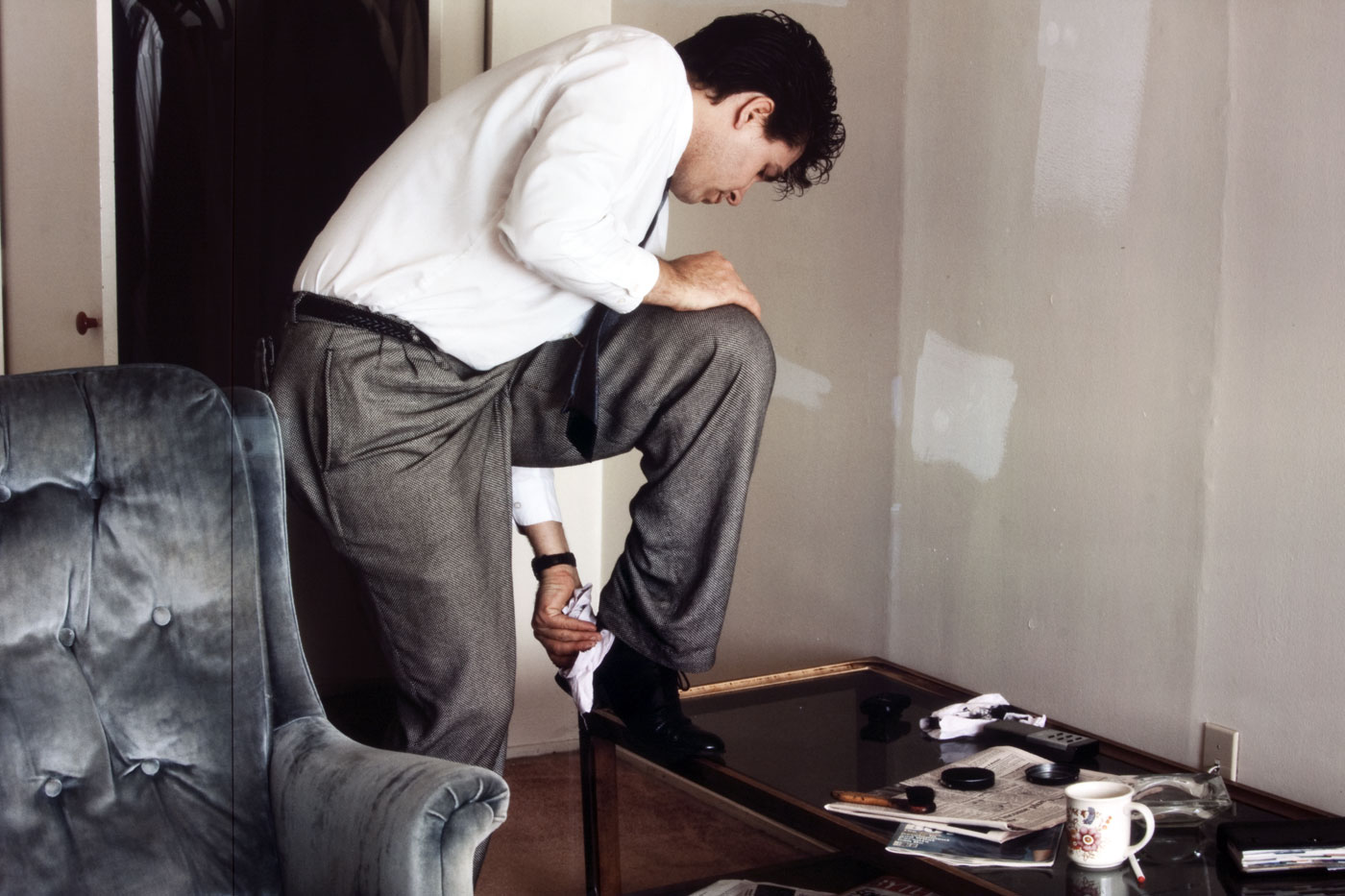
Jeff Wall (Canadian, b. 1946) 'Polishing' 1998


Jeff Wall (Canadian, b. 1946)
Polishing
1998
Transparency in light box, 1/2
162 x 207cm
State Art Collection, Art Gallery of Western Australia Purchased with assistance from the Art Gallery of Western Australia Foundation, 1999
© Jeff Wall


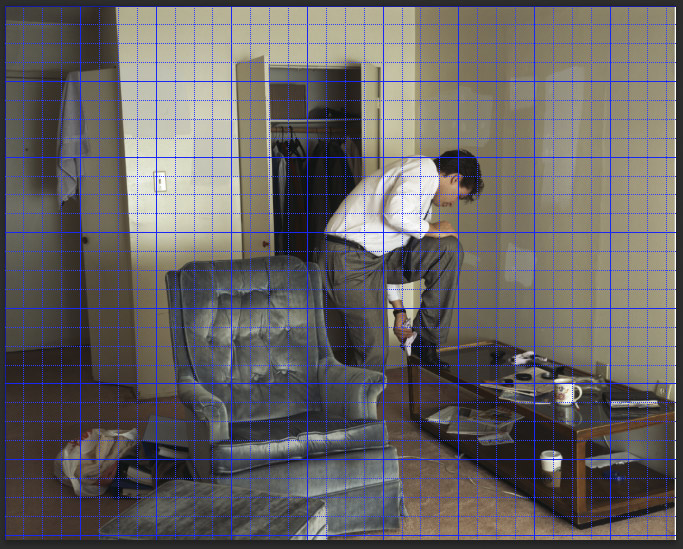
Jeff Wall 'Polishing' skewing

Image Dr James McArdle


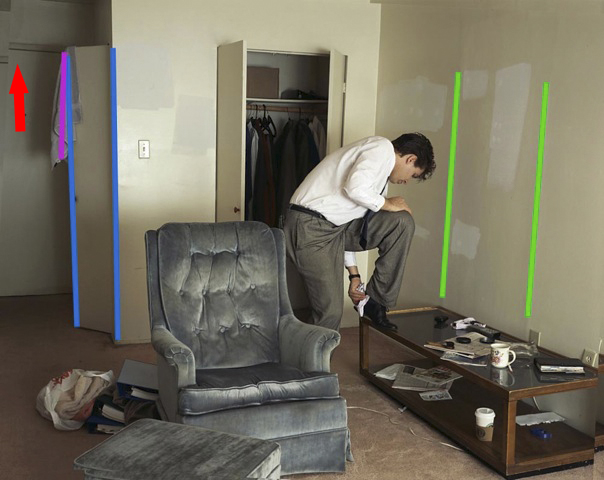
Jeff Wall 'Polishing' skewing

Image Ian Lobb


Many thankx to Dr James McArdle for the initial gridded image from the posting “Perspective blow up,” on his Camera/Eye blog (January 21st, 2013) where he argues that the skewing is all done with tilting and shifting of an 8 x 10 image view camera and the analysis by Ian Lobb in which he argues that the skewing is partially done through the architecture (the set), the camera and some Photoshop tweeking.


Structural analysis of Jeff Wall’s Polishing (1998)

“There is a perceptual discomfort in viewing this image on the wall that is not apparent in the desk-top experience of it. I’m referring to a weird skewing of the perspective of the room. Wall has tilted the monorail of his 8×10 camera down toward the corner of the room, making the left hand wall of the bathroom lean uncomfortably, more than does the patched join of the wall panels to the right. He has then shifted the lens left, thus positioning the one vertical (right behind the figure) to the right of centre. The bathroom door, draped with a towel, looks as if it is hanging off its hinges, at variance with the top of the entrance door which remains horizontal. Conventionally, an architectural photographer would square everything and Wall does that in Doorpusher which though shot from an extremely oblique angle employs a radical drop-front to correct the verticals.”

Dr James McArdle


“”Firstly, the floor is not straight in the image. You can see how in my edit, I have rotated the image a little to make the floor straight: (you can see how much by the break in the picture rail see red arrow). JW being tricky and skilled. Now the amount of lean in wall could almost be achieved just by a camera pointing down. No weird camera movements – this is almost familiar. But the door leans more than the wall! Next, note the degree of convergence in blue lines compared to green lines. Therefore the blue angle is emphasised – somehow. Note different hang of towel in magenta compared to blue – therefore edited ~ somehow!

The grid is good because as an initial observation it shows how much distortion we are viewing. But it makes it difficult to see that the floor is not level. When the floor is straightened the lean on the left wall is not as much as it seemed. Wait! Things do splay out when the camera is pointed down – so maybe there is no Photoshop in this at all? But there is – the angles have been emphasised a bit (I believe digitally) and there are puns in the angle of the towel (sloping at a different angle) and the buttons on the couch (not sloping out at all).

Lets play with this a bit more. So just tilt the camera to slope the floor and emphasise the lean by using the tilt to straighten the verticals on one side – and now make this a bit stronger in Photoshop. And by judicious use of the furniture placement the slope of the floor can be partly hidden. I can imagine Jeff Wall saying to a crowd that there is no Photoshop in this – it’s just camera placement (including a tilt in the whole camera) and without duplicating the scene I can’t be sure – but I think he has stressed in Photoshop some things that are already there. Digital enhancement.

Finally we can say that the formal qualities of this image are a play upon what has been initially offered by the camera. Initially: The walls are sloping! So is it just optics, or camera angle or Photoshop? It’s all three but not as much Photoshop as initially thought. The floor is not straight, the camera angle has been changed and there has been some digital emphasis.”

Ian Lobb (author of The Well Tempered View Camera)


Jeff Wall (Canadian, b. 1946) 'Double Self-Portrait' 1979


Jeff Wall (Canadian, b. 1946)
Double Self-Portrait
1979
Transparency in light box AP
172 x 229cm
Collection of the artist
© Jeff Wall


Jeff Wall (Canadian, b. 1946) 'Untangling' 1994, printed 2006


Jeff Wall (Canadian, b. 1946)
Untangling
1994, printed 2006
Transparency in light box, AP
189 x 223.5cm
National Gallery of Victoria, Melbourne Purchased NGV Foundation and with the assistance of NGV Contemporary, 2006
© Jeff Wall


Jeff Wall (Canadian, b. 1946) 'Dressing poultry' 2007


Jeff Wall (Canadian, b. 1946)
Dressing poultry
2007
Transparency in light box, 1/2
201.5 x 252cm
Cranford Collection, London
© Jeff Wall


Jeff Wall (Canadian, b. 1946) 'Adrian Walker, artist, drawing from a specimen in a laboratory in the Dept. of Anatomy at the University of British Columbia, Vancouver' 1992


Jeff Wall (Canadian, b. 1946)
Adrian Walker, artist, drawing from a specimen in a laboratory in the Dept. of Anatomy at the University of British Columbia, Vancouver
1992
Transparency in light box, AP
119 x 164cm
Collection of the artist
© Jeff Wall


Jeff Wall (Canadian, b. 1946) 'A sudden gust of wind (after Hokusai)' 1993


Jeff Wall (Canadian, b. 1946)
A sudden gust of wind (after Hokusai)
1993
Transparency in light box, unique state
229 x 377cm
Tate, London Purchased with the assistance from the Patrons of New Art through the Tate Gallery Foundation and from the National Art Collections Fund, 1995
© Jeff Wall


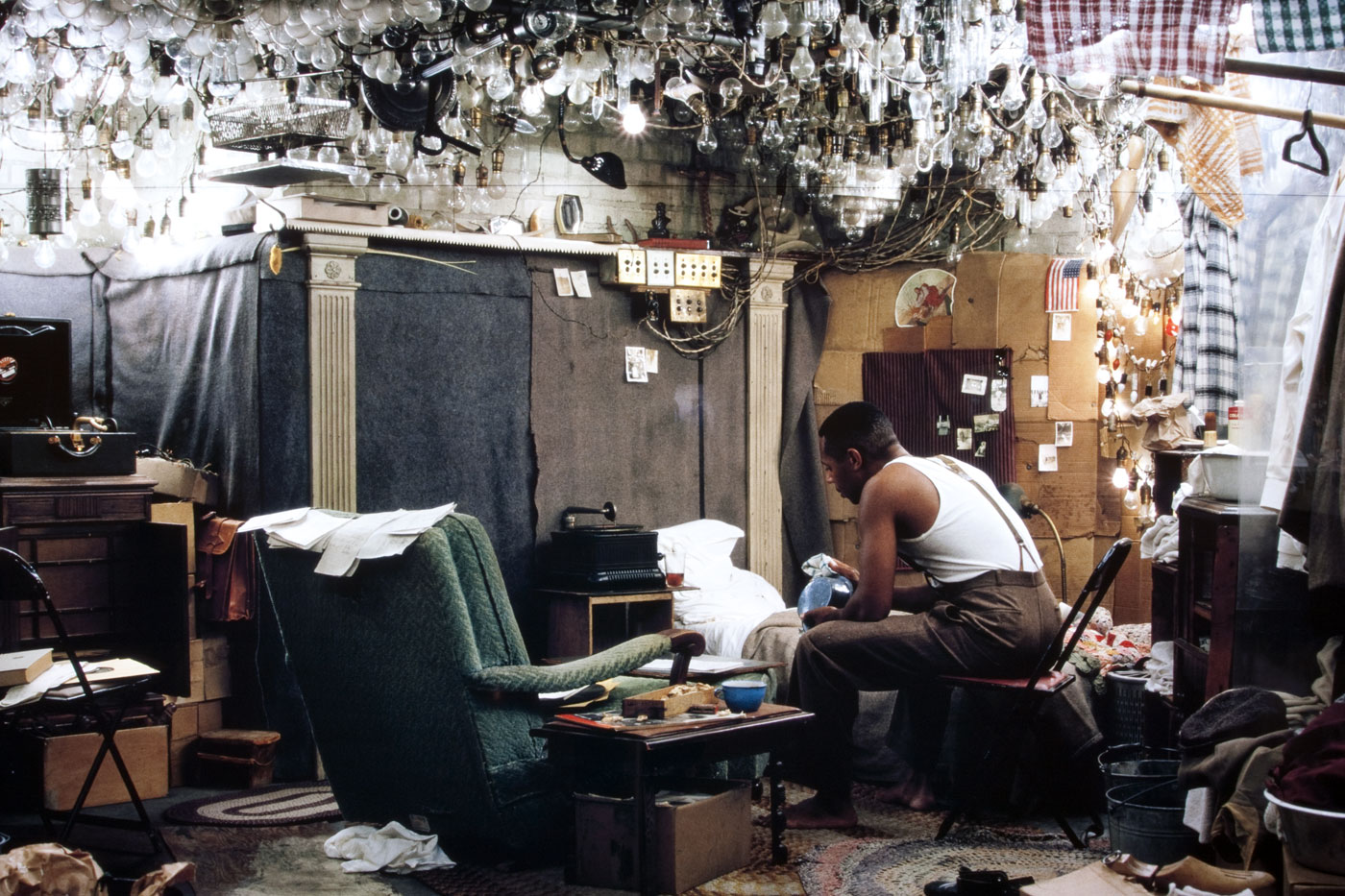
Jeff Wall (Canadian, b. 1946) 'After 'Invisible Man' by Ralph Ellison, the Prologue' 1999-2000


Jeff Wall (Canadian, b. 1946)
After ‘Invisible Man’ by Ralph Ellison, the Prologue
1999-2000
Transparency in light box, AP
174 x 250.5cm
Collection of the artist
© Jeff Wall


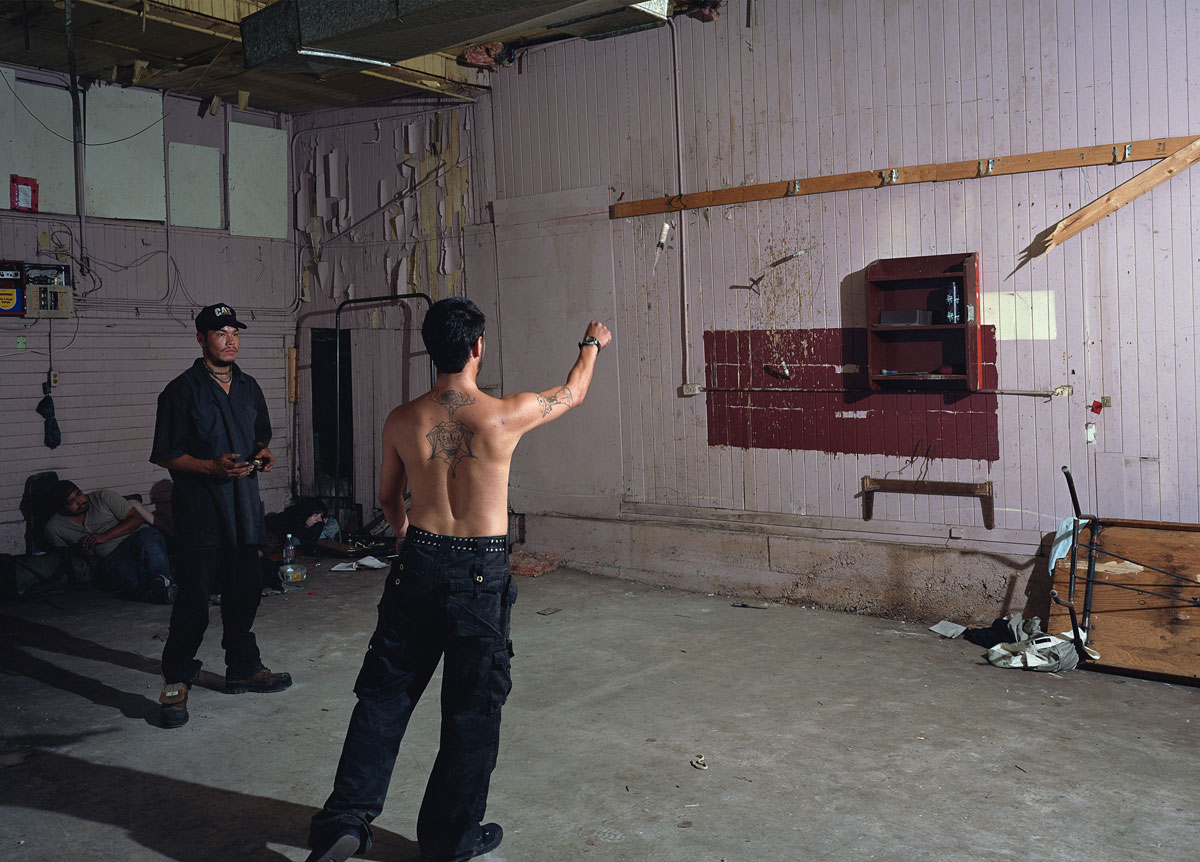
Jeff Wall (Canadian, b. 1946) 'Knife throw' 2008


Jeff Wall (Canadian, b. 1946)
Knife throw
2008
Colour photograph, AP
184 x 256cm
Collection of the artist
© Jeff Wall


Jeff Wall (Canadian, b. 1946) 'The Destroyed Room' 1978


Jeff Wall (Canadian, b. 1946)
The Destroyed Room
1978
Transparency in light box, AP
159 x 234cm
Collection of the artist
© Jeff Wall


Jeff Wall (Canadian, b. 1946) 'Clipped branches, East Cordova St., Vancouver' 1999


Jeff Wall (Canadian, b. 1946)
Clipped branches, East Cordova St., Vancouver
1999
Transparency in light box, AP
72 x 89cm
Collection of the artist
© Jeff Wall


Jeff Wall (Canadian, b. 1946) 'Diagonal Composition' 1993


Jeff Wall (Canadian, b. 1946)
Diagonal Composition
1993
Transparency in light box, AP
40 x 46cm
Collection of the artist
© Jeff Wall


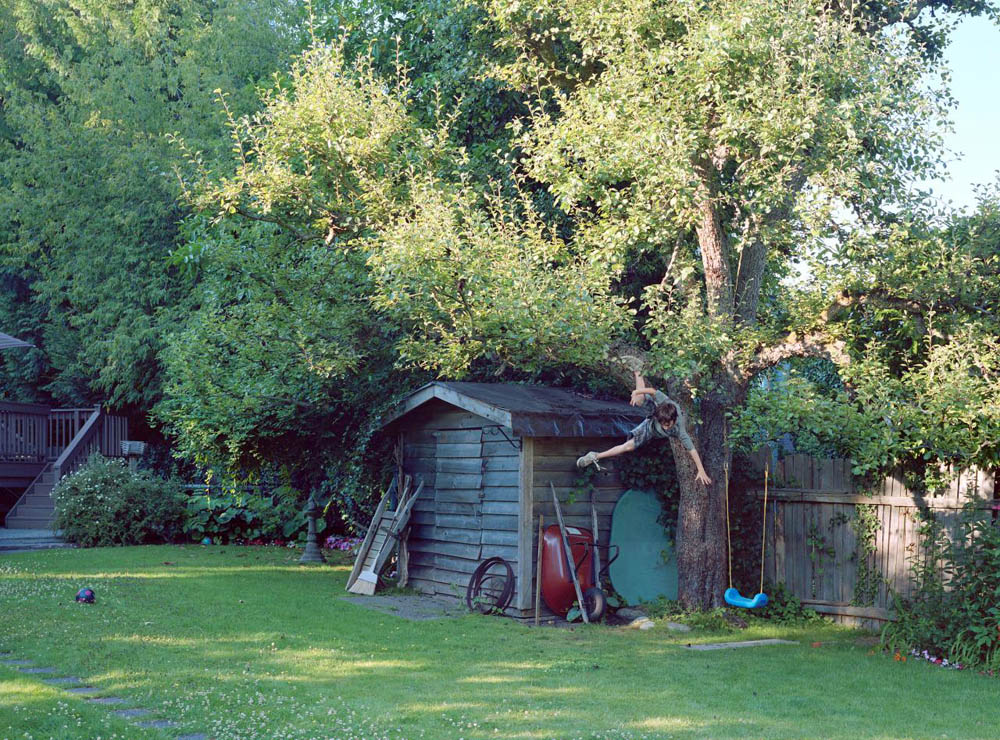
Jeff Wall (Canadian, b. 1946) 'Boy falls from tree' 2010


Jeff Wall (Canadian, b. 1946)
Boy falls from tree
2010
Colour photograph, AP
226 x 305.3cm
Collection of the artist
© Jeff Wall


The Ian Potter Centre: NGV Australia
Federation Square
Corner of Russell and 
Flinders Streets, Melbourne

Opening hours:
Daily 10am – 5pm
National Gallery of Victoria website

LIKE ART BLART ON FACEBOOK

Back to top

Exhibition: ‘Jeff Wall Photographs’ at The Ian Potter Centre: National Gallery of Victoria Australia, Melbourne

Exhibition dates: 30th November 2012 – 17th March 2013


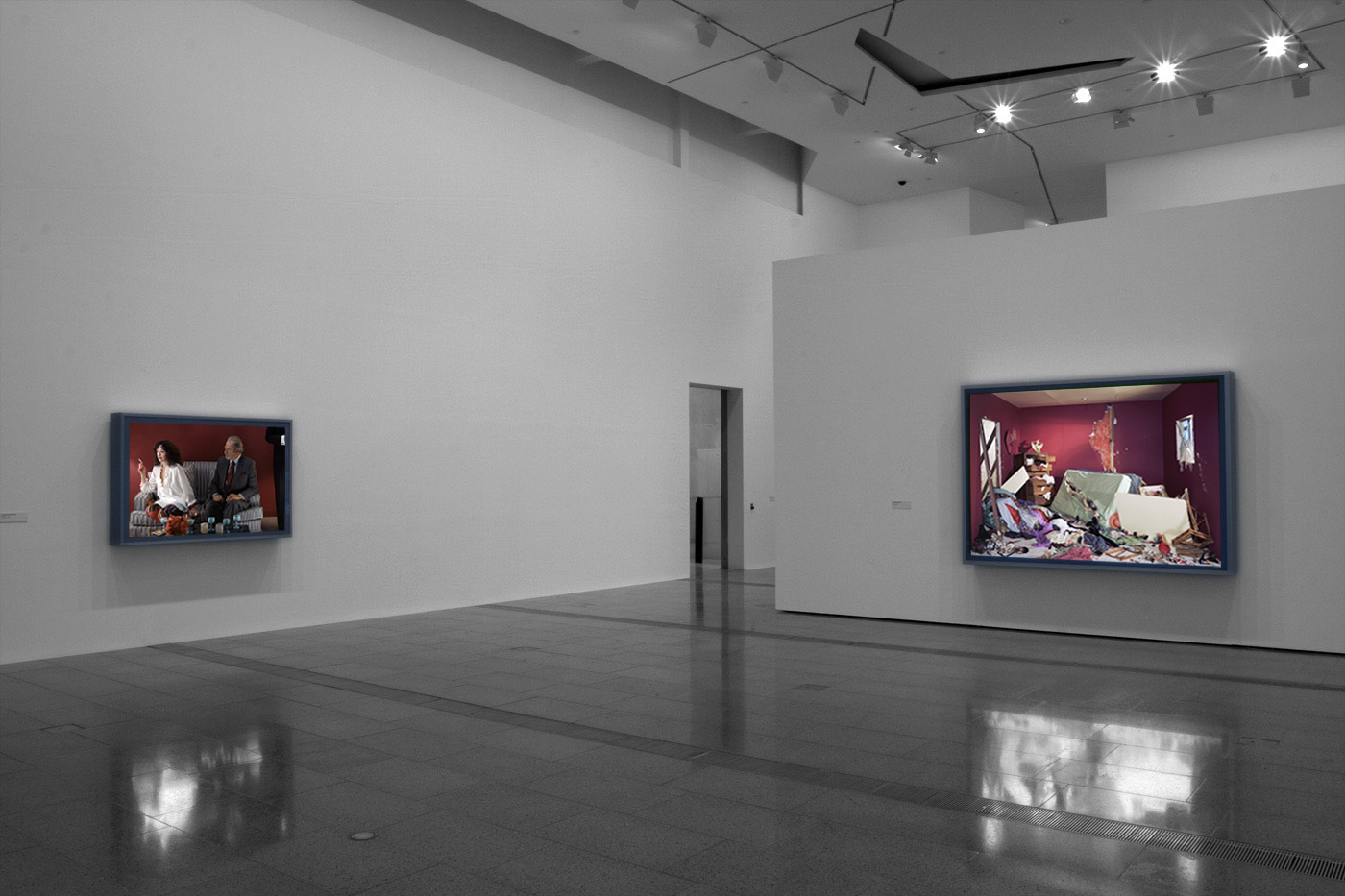
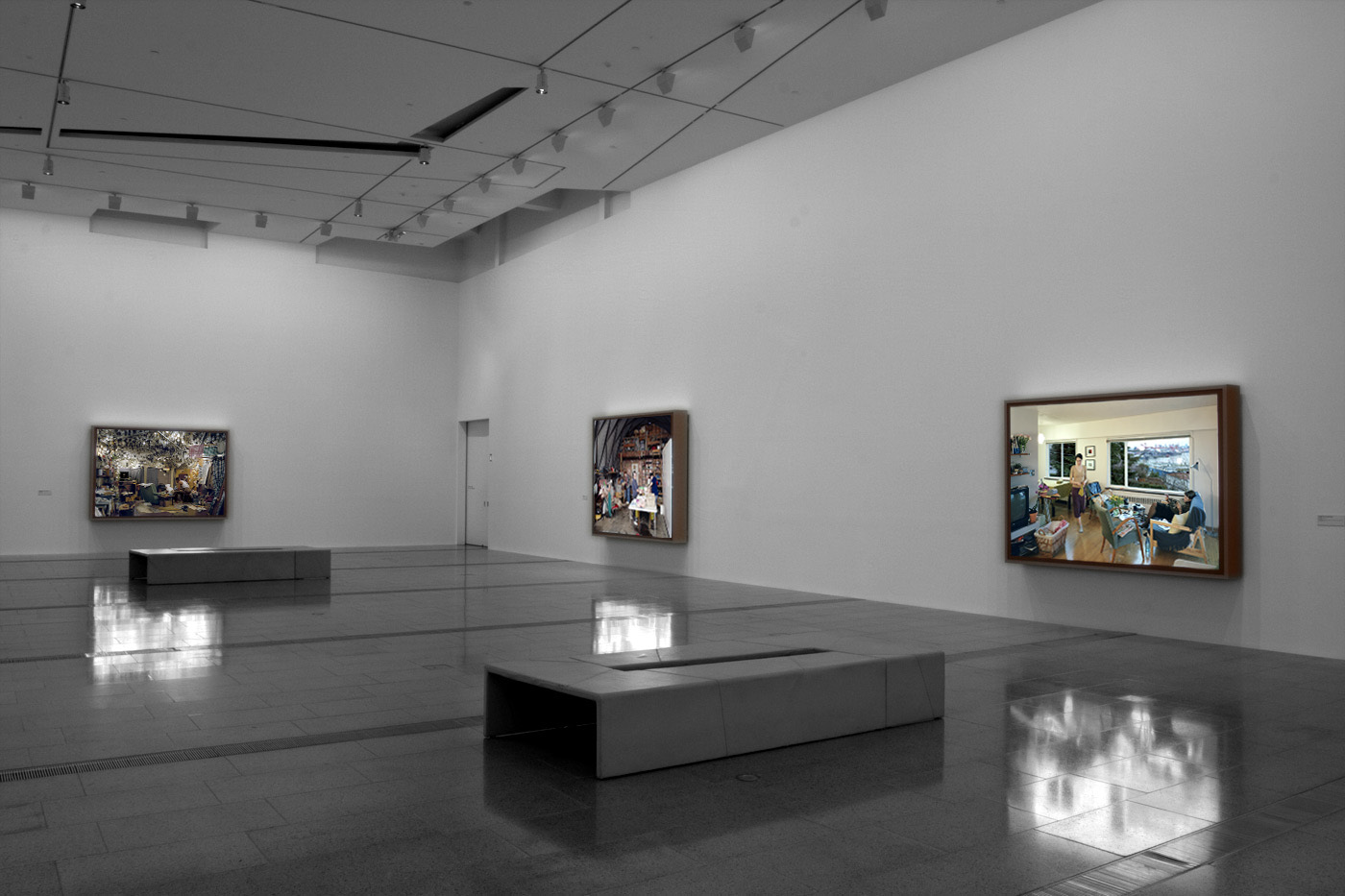
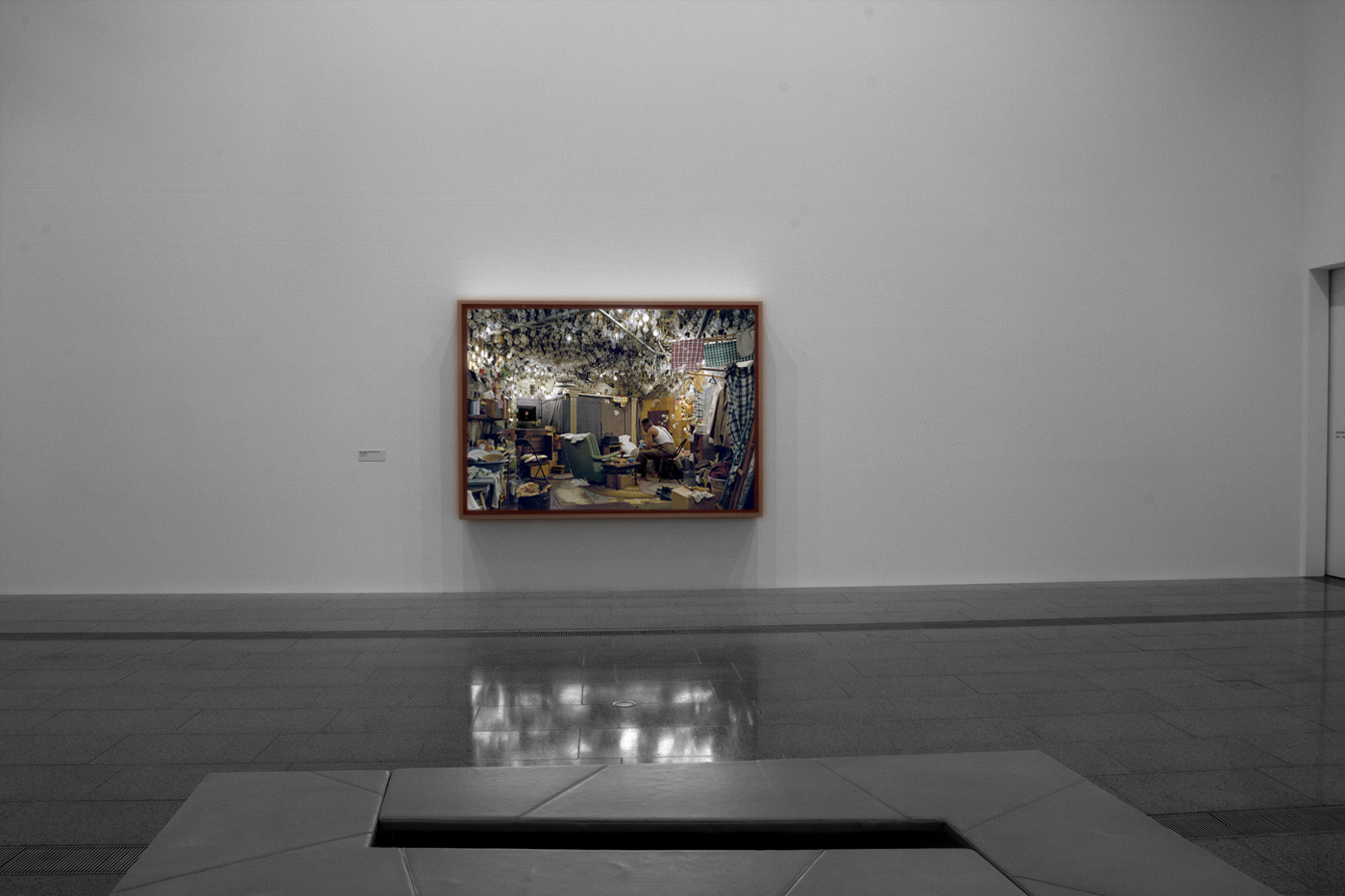
Installation view of 'Jeff Wall Photographs' at NGV Australia showing, at right, 'The Destroyed Room' 1978


Installation view of Jeff Wall Photographs at NGV Australia showing, at right, The Destroyed Room 1978
Photo: Marcus Bunyan


Installation shots of the new Jeff Wall exhibition at NGV Australia. Review to follow in due course.

Many thankx to Jemma Altmeier and all the media team at NGV for all their wonderful help and congratulations to the curators, Susan van Wyk and Dr Isobel Crombie, for their restrained yet contemporary installations and for getting the exhibitions to Melbourne. They look magnificent. Well done!

Dr Marcus Bunyan


Many thankx to the NGV for allowing me to publish the photographs in the posting. Please click on the photographs for a larger version of the image. All photographs © Marcus Bunyan © National Gallery of Victoria. May not be reproduced without permission.


Jeff Wall & Thomas Demand: In Conversation, National Gallery of Victoria


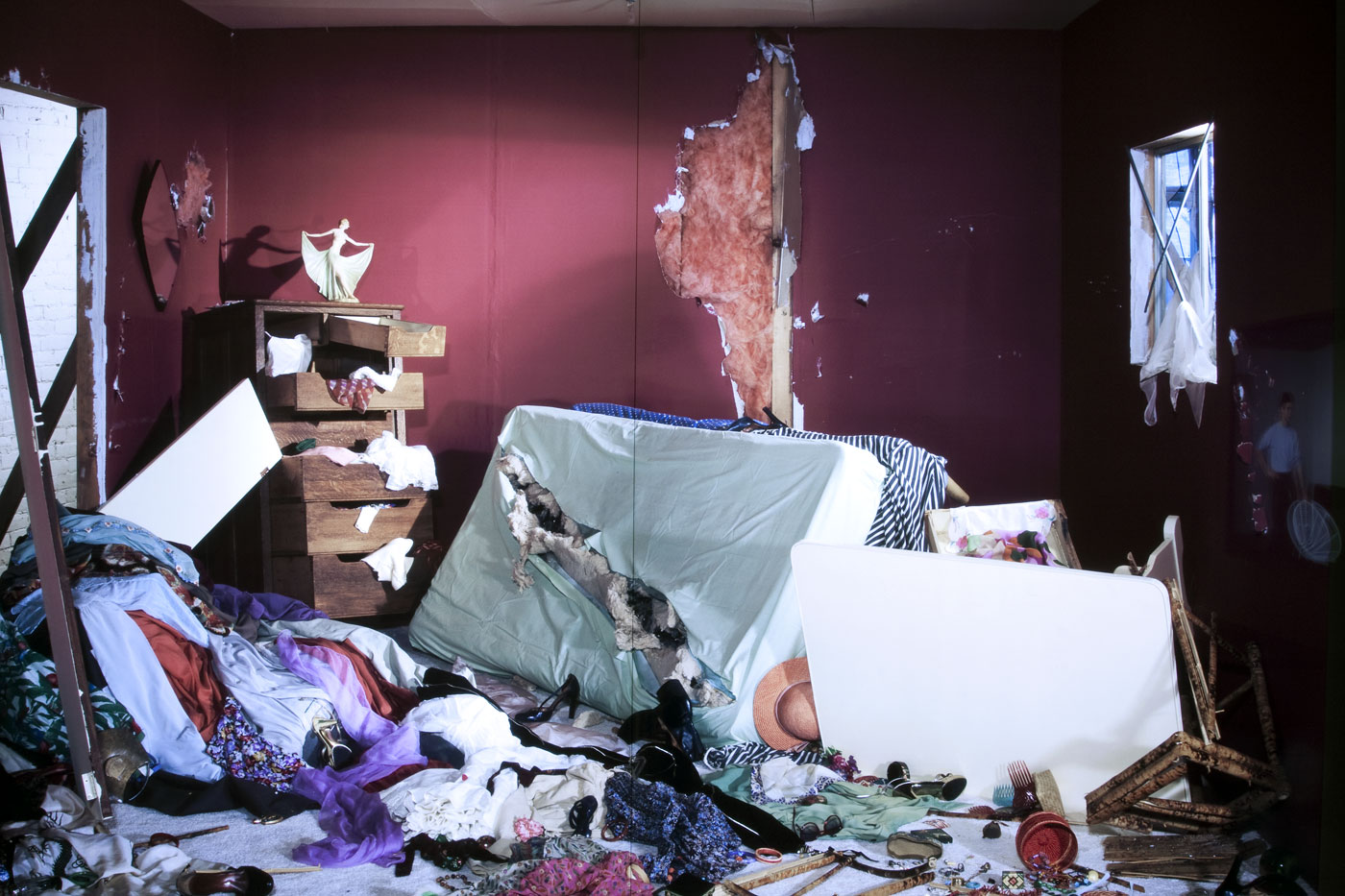
Jeff Wall (Canadian, b. 1946) 'The Destroyed Room' 1978 (detail)


Jeff Wall (Canadian, b. 1946)
The Destroyed Room (detail)
1978
Transparency in light box, AP
159.0 x 234.0cm
Collection of the artist
© Jeff Wall


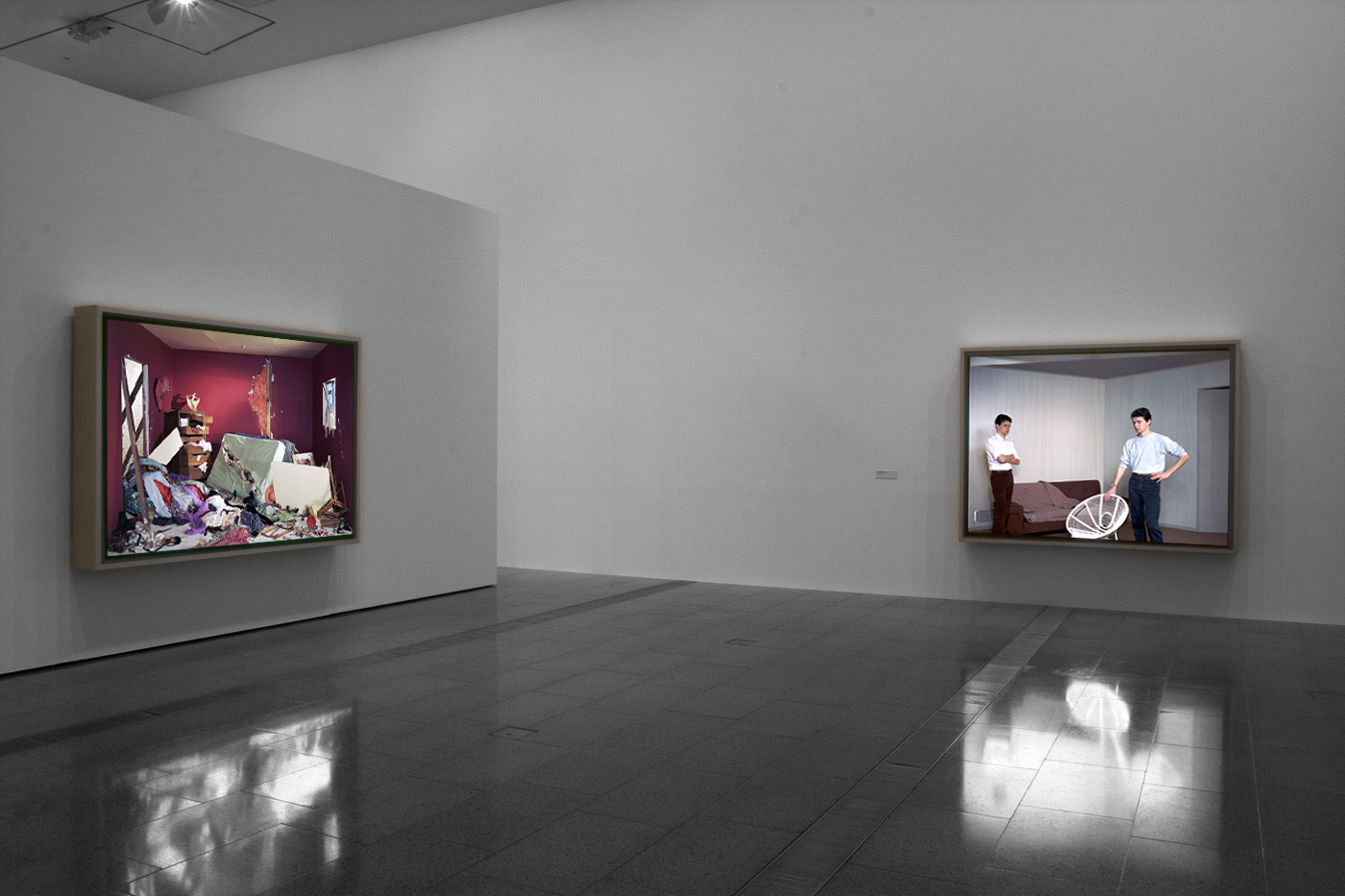
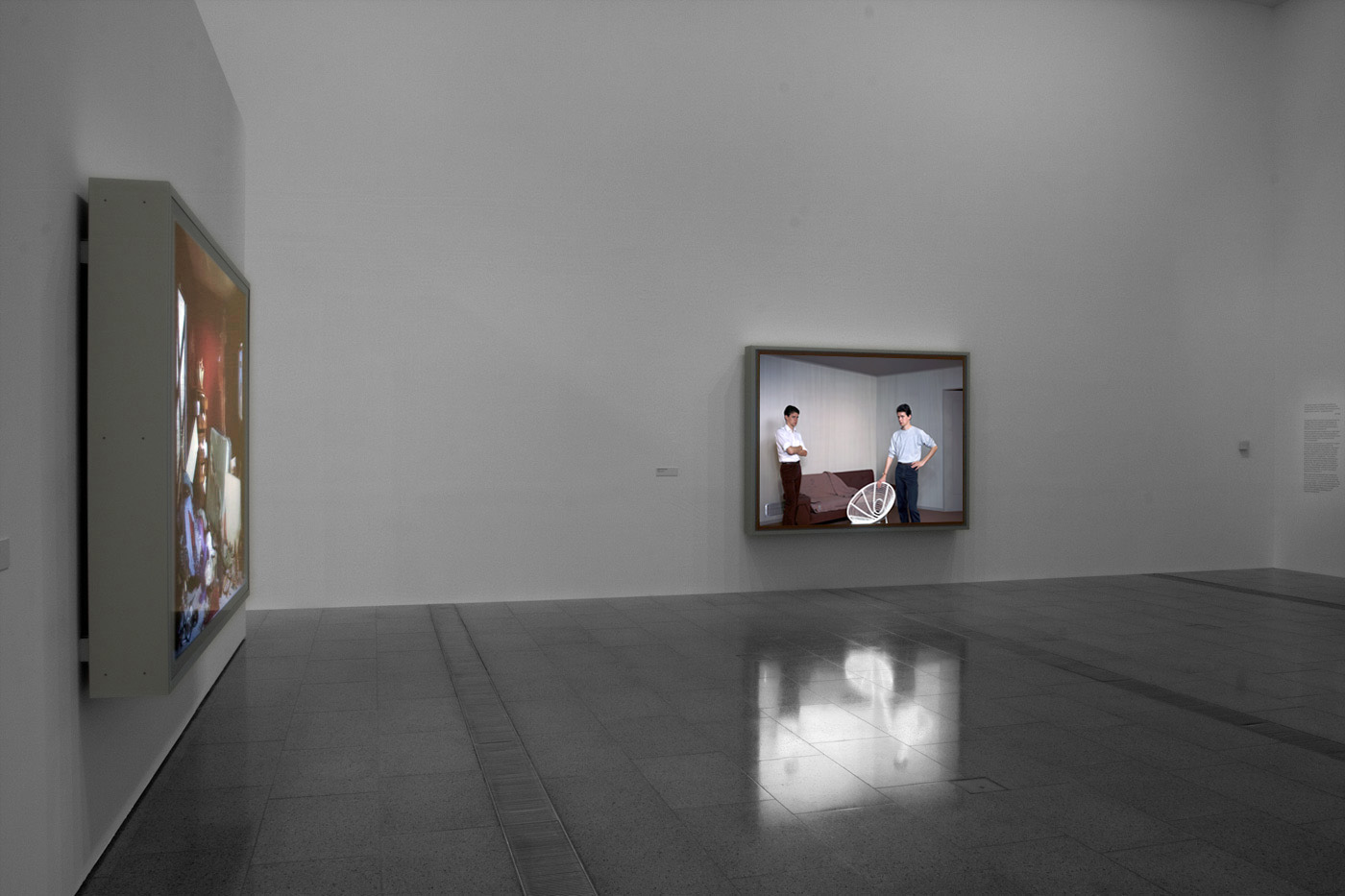
Installation view of 'Jeff Wall Photographs' at NGV Australia showing, at left, 'The Destroyed Room' 1978, and at right, 'Double Self-Portrait' 1979


Installation view of Jeff Wall Photographs at NGV Australia showing, at left, The Destroyed Room 1978, and at right, Double Self-Portrait 1979
Photo: Marcus Bunyan


Installation view of 'Jeff Wall Photographs' at NGV Australia showing, at right, 'Double Self-Portrait' 1979


Installation view of Jeff Wall Photographs at NGV Australia showing, at right, Double Self-Portrait 1979
Photo: Marcus Bunyan


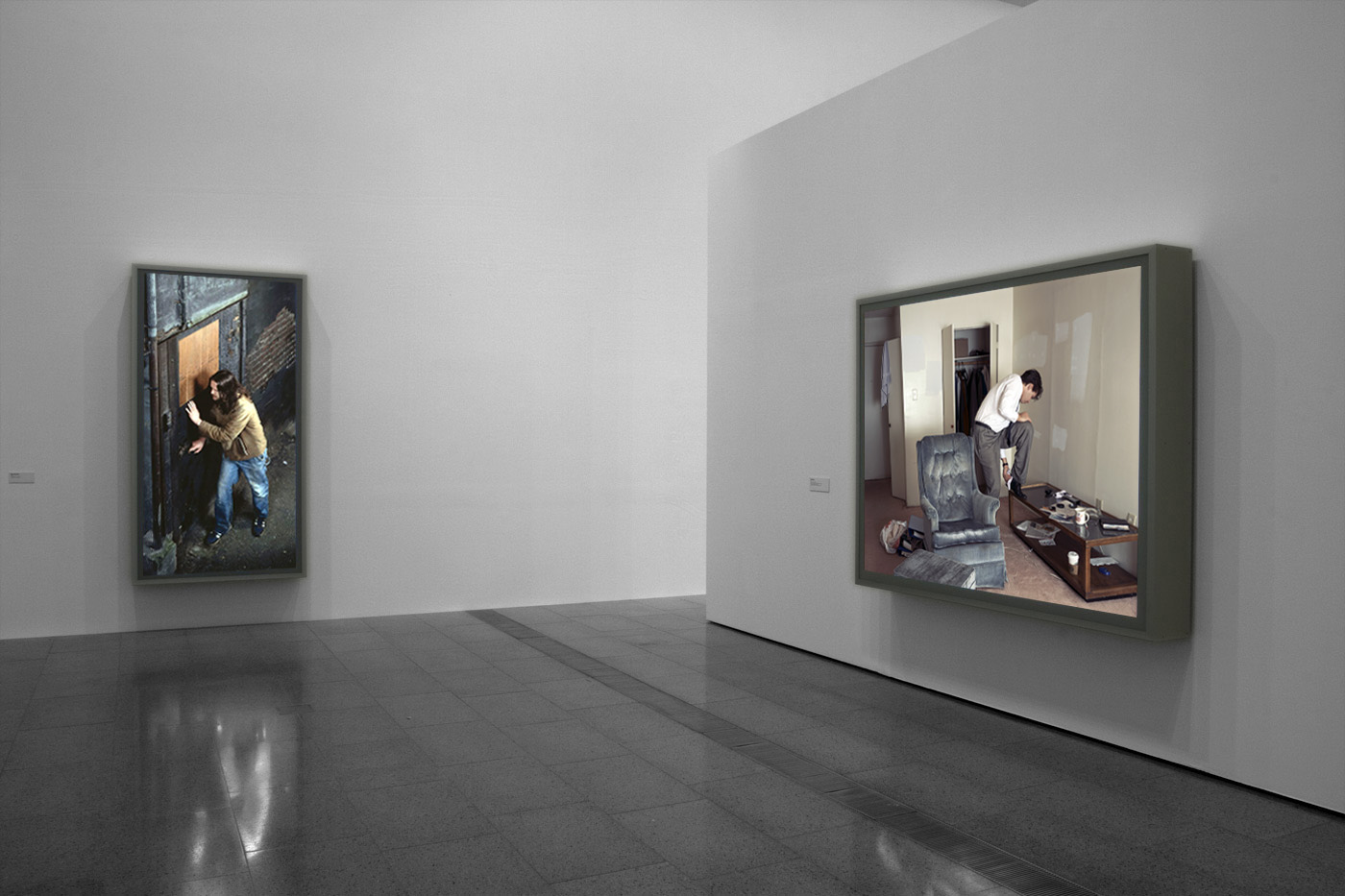
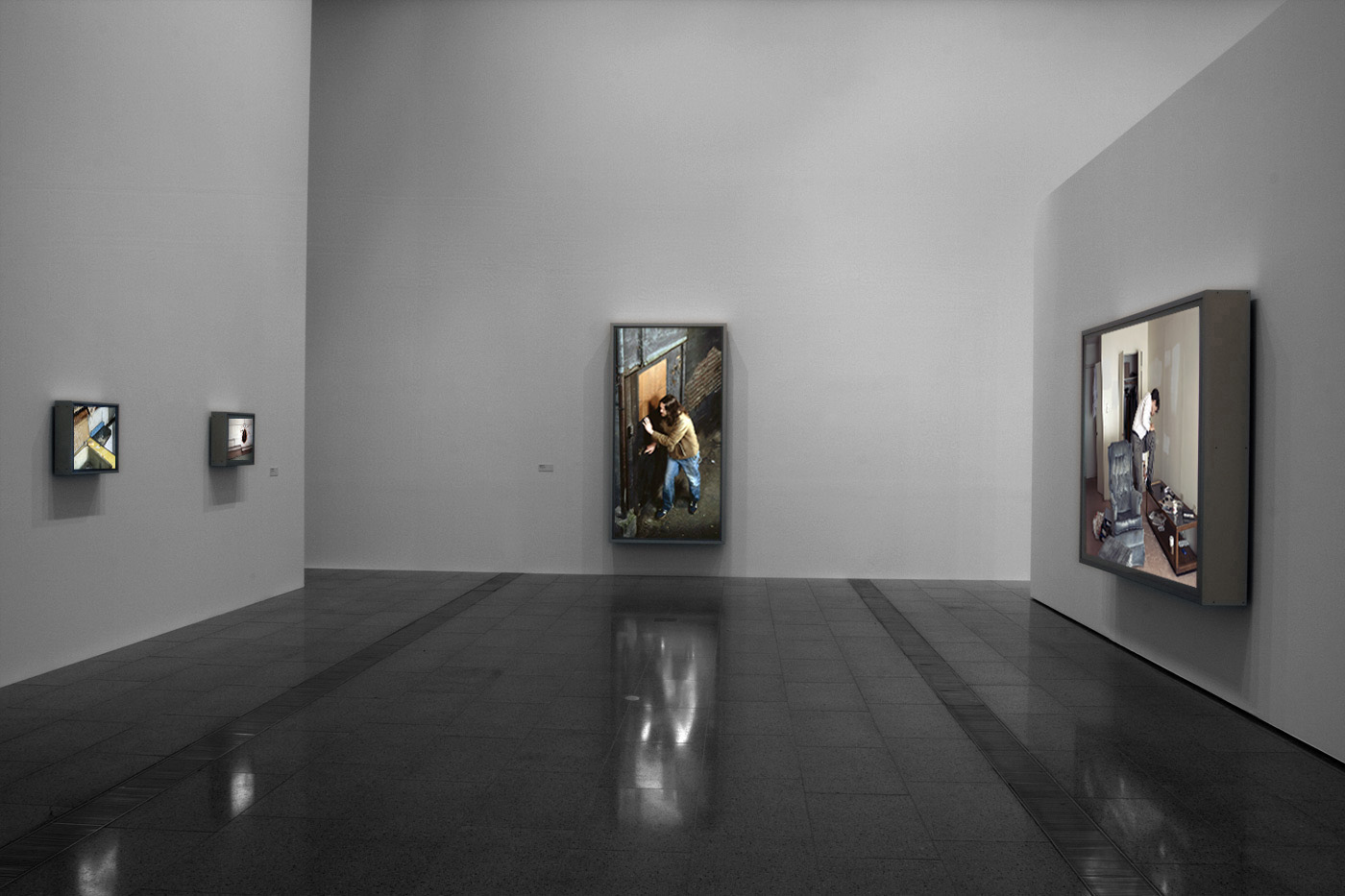
Installation view of 'Jeff Wall Photographs' at NGV Australia showing, at left, 'Doorpusher' 1984, and at right, 'Polishing' 1998


Installation view of Jeff Wall Photographs at NGV Australia showing, at left, Doorpusher 1984, and at right, Polishing 1998
Photo: Marcus Bunyan


Jeff Wall (Canadian, b. 1946) 'Polishing' 1998 (detail)


Jeff Wall (Canadian, b. 1946)
Polishing (detail)
1998
Transparency in light box, 1/2
162.0 x 207.0cm
State Art Collection, Art Gallery of Western Australia
Purchased with assistance from the Art Gallery of Western Australia Foundation, 1999
© Jeff Wall


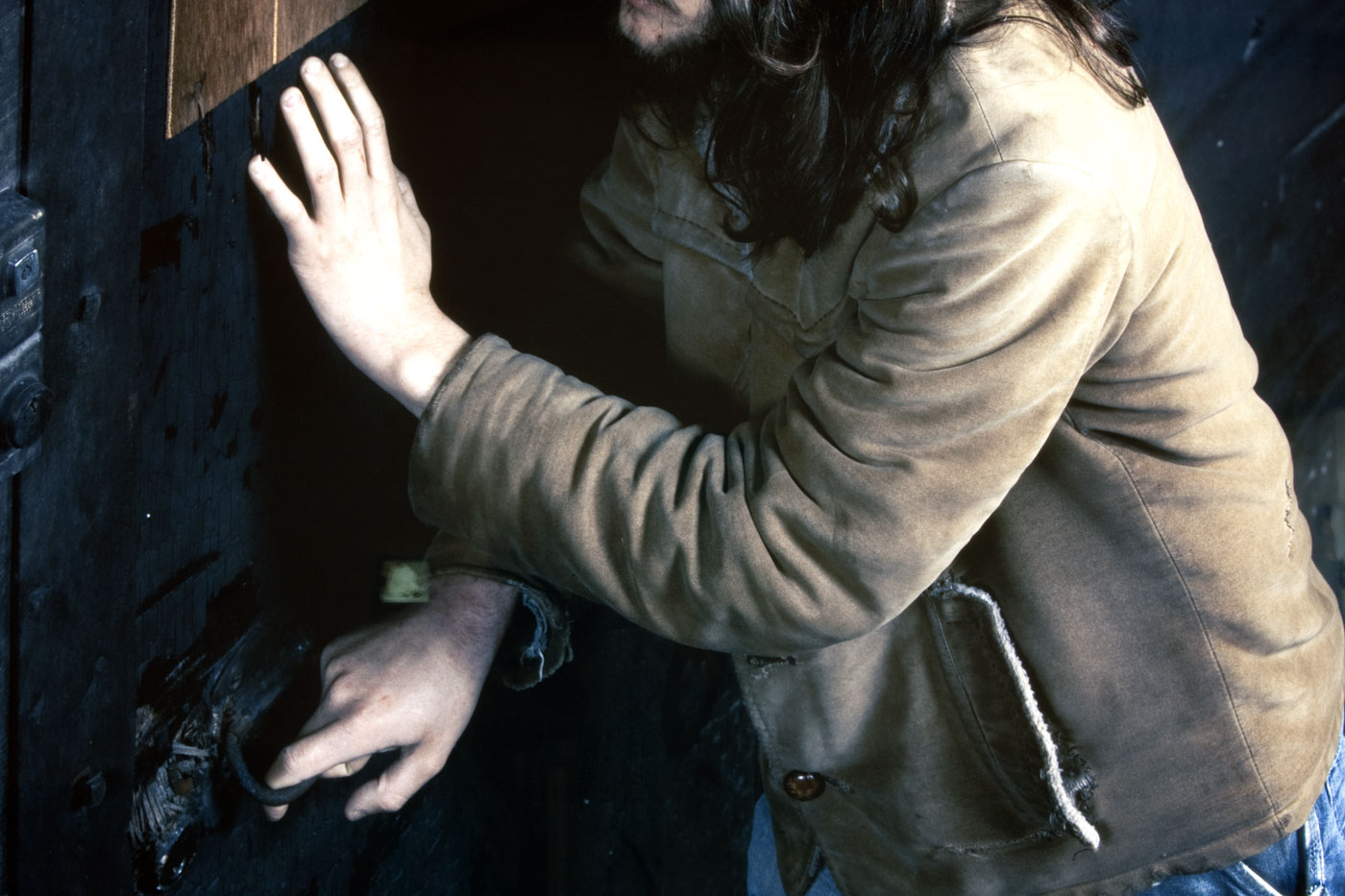
Jeff Wall (Canadian, b. 1946) 'Doorpusher' 1984 (detail)


Jeff Wall (Canadian, b. 1946)
Doorpusher
(detail)
1984
Transparency in lightbox
249 x 122cm
© Jeff Wall


Installation view of 'Jeff Wall Photographs' at NGV Australia showing, at centre, 'Doorpusher' 1984, and at right, 'Polishing' 1998


Installation view of Jeff Wall Photographs at NGV Australia showing, at centre, Doorpusher 1984, and at right, Polishing 1998
Photo: Marcus Bunyan


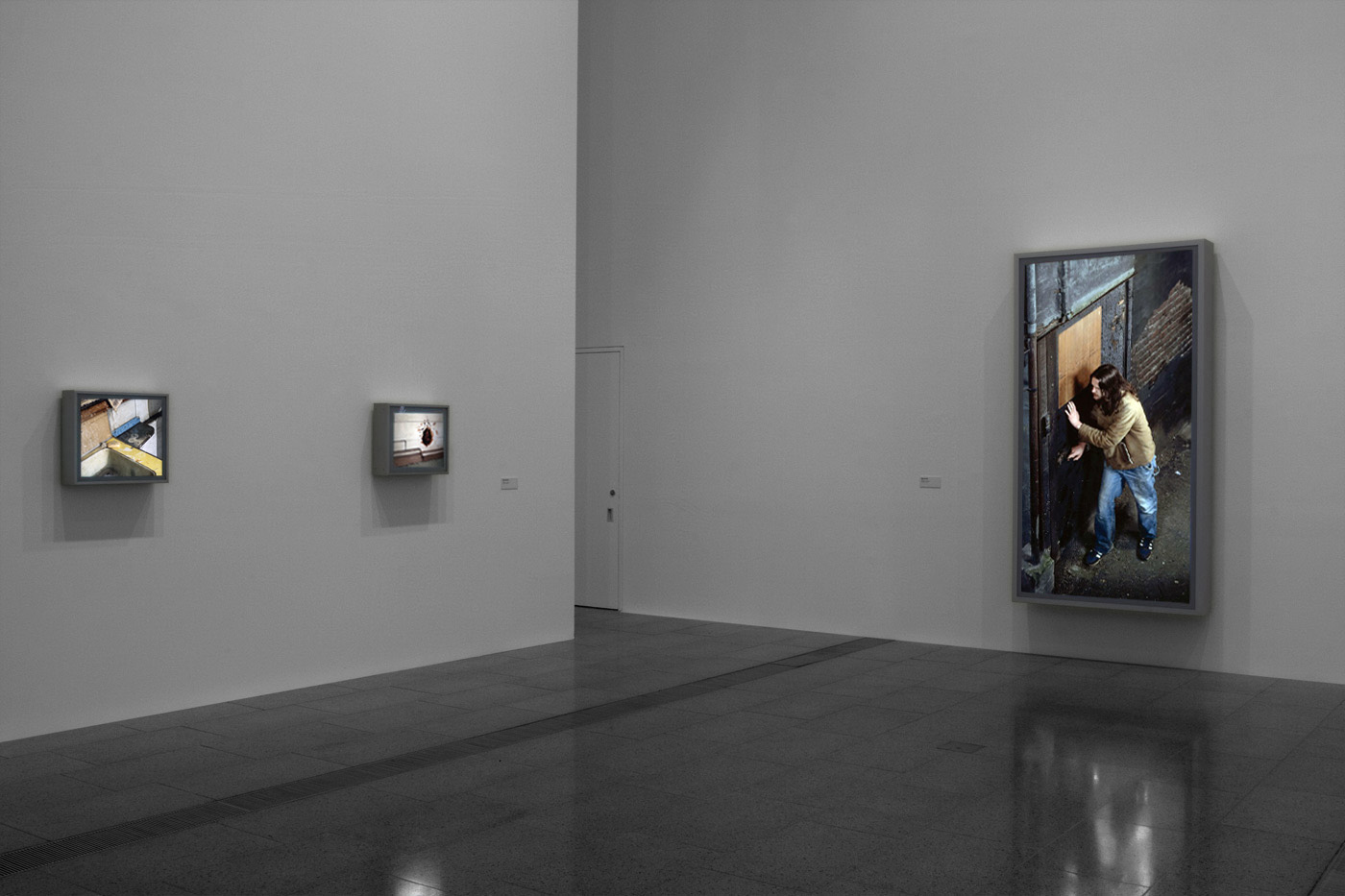
Installation view of 'Jeff Wall Photographs' at NGV Australia showing, at left, 'Diagonal Composition' 1993, and at right, 'Doorpusher' 1984


Installation view of Jeff Wall Photographs at NGV Australia showing, at left, Diagonal Composition 1993, and at right, Doorpusher 1984
Photo: Marcus Bunyan


Jeff Wall (Canadian, b. 1946) 'Diagonal Composition' 1993


Jeff Wall (Canadian, b. 1946)
Diagonal Composition
1993
Transparency in light box, AP
40 x 46cm
Collection of the artist
© Jeff Wall


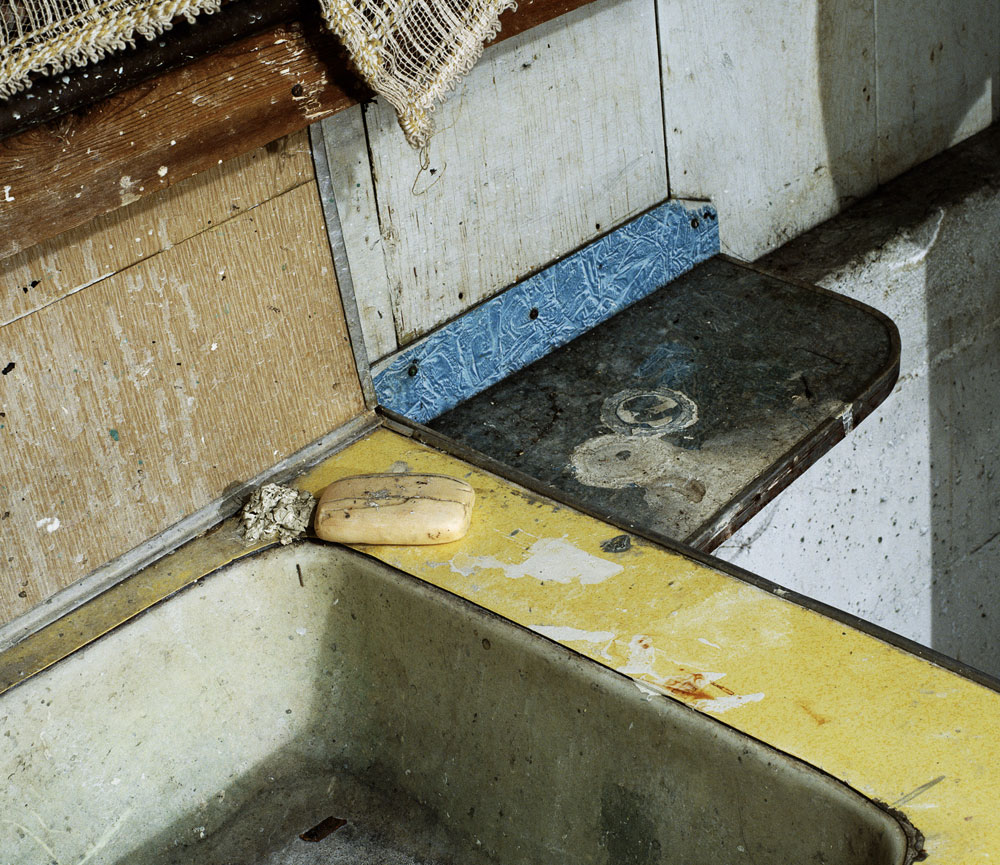
Jeff Wall (Canadian, b. 1946) 'Pipe Opening' 2002 (detail)


Jeff Wall (Canadian, b. 1946)
Pipe Opening (detail)
2002
Transparency in light box, AP
40 x 46cm
Collection of the artist
© Jeff Wall


Installation view of 'Jeff Wall Photographs' at NGV Australia showing, at right, 'A view from an apartment' 2004-2005


Installation view of Jeff Wall Photographs at NGV Australia showing, at right, A view from an apartment 2004-2005
Photo: Marcus Bunyan


Installation view of 'Jeff Wall Photographs' at NGV Australia showing 'After 'Invisible Man' by Ralph Ellison, the Prologue' 1999-2000


Installation view of Jeff Wall Photographs at NGV Australia showing After ‘Invisible Man’ by Ralph Ellison, the Prologue 1999-2000
Photo: Marcus Bunyan


Jeff Wall (Canadian, b. 1946) 'After 'Invisible Man' by Ralph Ellison, the Prologue' 1999-2000 (detail)


Jeff Wall (Canadian, b. 1946)
After ‘Invisible Man’ by Ralph Ellison, the Prologue (detail)
1999-2000
Transparency in light box, AP
174 x 250.5cm
Collection of the artist
© Jeff Wall


Jeff Wall (Canadian, b. 1946) 'A view from an apartment' 2004-05 (detail)


Jeff Wall (Canadian, b. 1946)
A view from an apartment (detail)
2004-2005
Transparency in light box, 1/2
167.0 x 244.0cm
Tate, London
Purchased with assistance from the American Fund for the Tate Gallery and Tate Members, 2006
© Jeff Wall


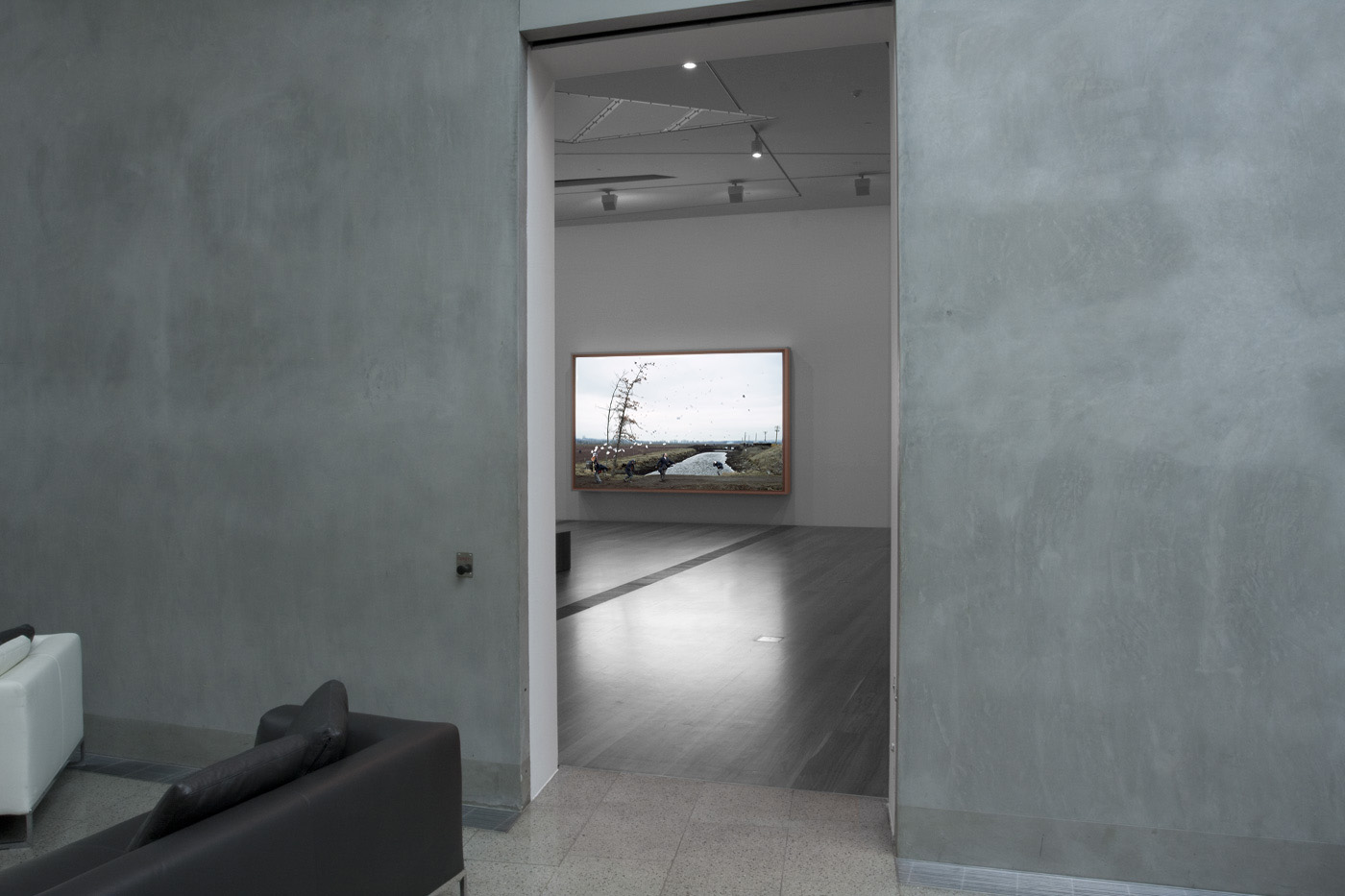
Installation view of 'Jeff Wall Photographs' at NGV Australia showing 'A sudden gust of wind (after Hokusai)' 1993


Installation view of Jeff Wall Photographs at NGV Australia showing A sudden gust of wind (after Hokusai) 1993
Photo: Marcus Bunyan


The Ian Potter Centre: NGV Australia
Federation Square
Corner of Russell and 
Flinders Streets, Melbourne

Opening hours:
Daily 10am – 5pm
National Gallery of Victoria website

LIKE ART BLART ON FACEBOOK

Back to top