
October 2023
1st Victorian Contingent

Unknown photographer
George Rose (Australian, 1861-1942) (publisher, Windsor, Melbourne)
The Victorian Continent
Melbourne, Victoria, 28th October 1899
2 photographic prints on stereocard
9 x 18cm
A historical posting this week: stereographs of soldiers of the two Victorian Contingents leaving from Melbourne for the Boer War in South Africa, the first in October 1899 and the second contingent in January 1900.
I have digitally scanned and cleaned these stereographs (that is, two nearly identical photographs or photomechanical prints, paired to produce the illusion of a single three-dimensional image, usually when viewed through a stereoscope, usually mounted on card) that I borrowed from my friend Terence Hodgkinson. I have added bibliographic information where possible: a small history of Australia and the Boer War; enrolment and embarkation details of the contingents; photographs and details of both ships that the men departed on; and information on the Rose Stereograph Company and its founder.
These 3D stereographs really give you a feeling of what it would have been like to live in Australia in last year of the 19th century and the beginning of the 20th century: a society full of pomp and circumstance with banners and bunting, ceremony and marches supporting a militarised society, where Australia was still a colony and not yet a nation (Federation of Australia only occurred on 1 January 1901).
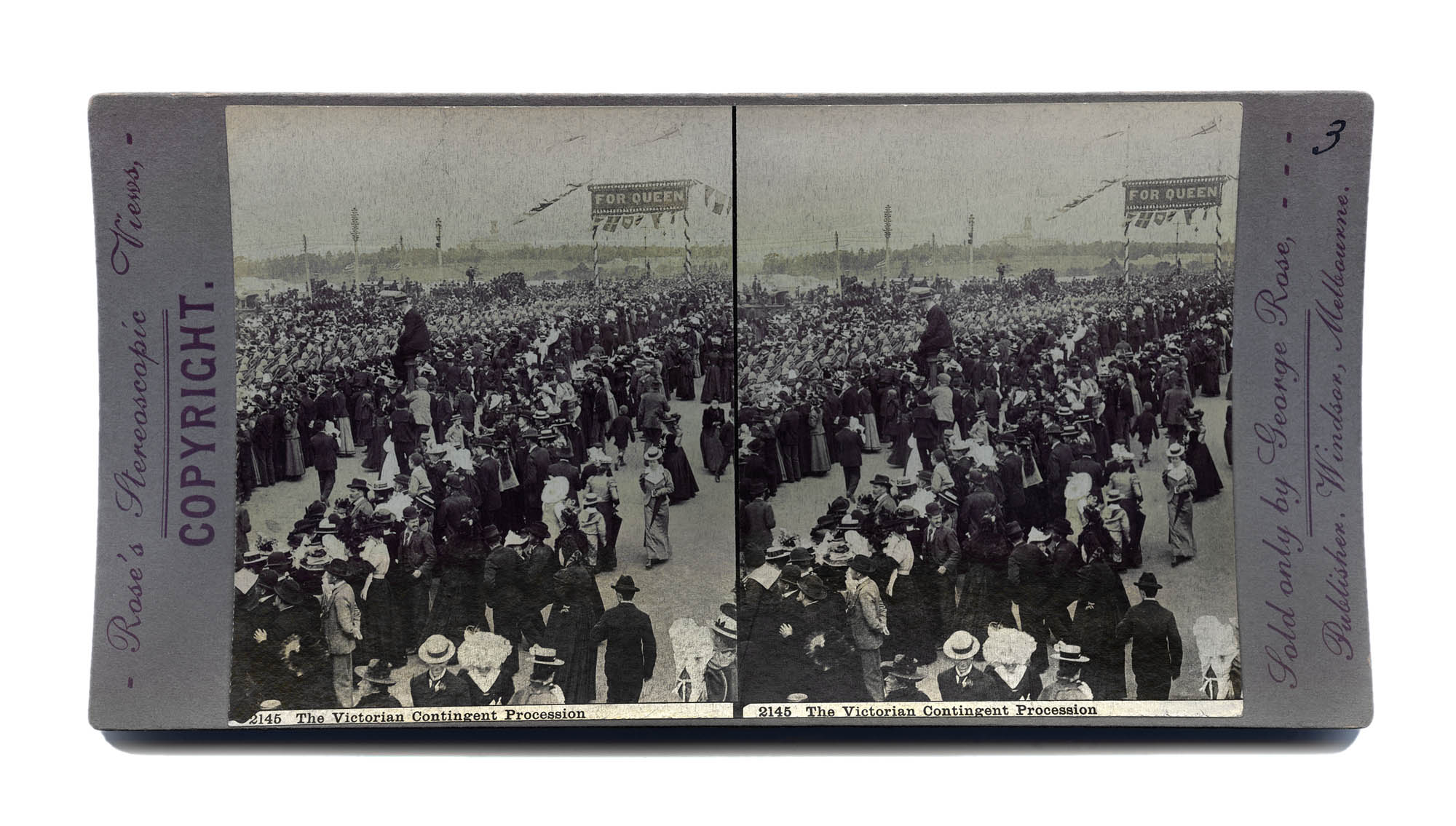
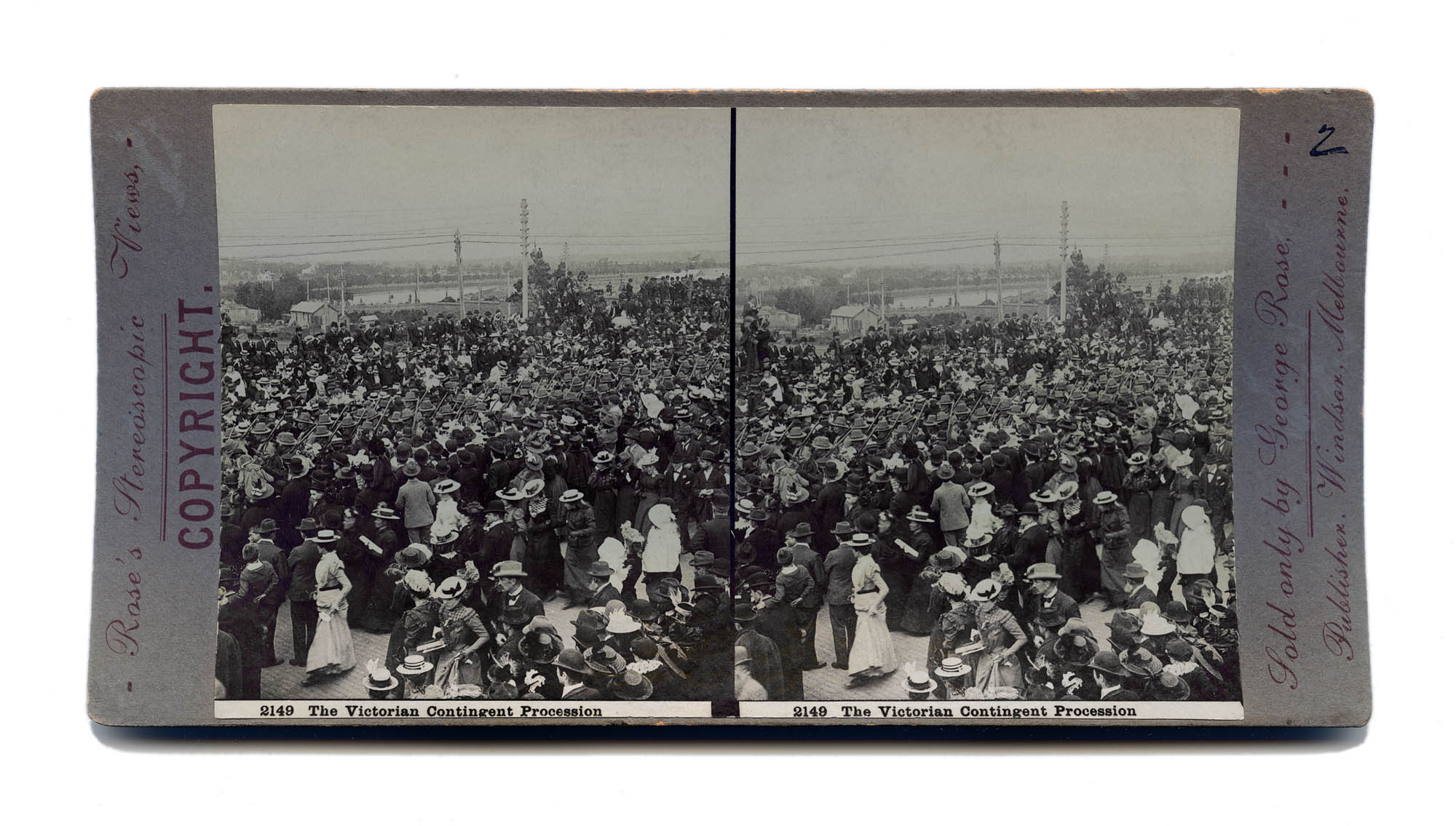
In the stereograph The Victorian Continent (Melbourne, Victoria, 28th October 1899, above) a crowd of spectators on Swanston Street, Melbourne (viewed from Flinders Street Station with people on the steps of St Paul’s Cathedral at back right) celebrates the departure for South Africa of the 1st Victorian Continent to the Boer War. Notice the flags of the United States of American, Japan, Scotland, United Kingdom and St. George (England) flying above the procession and the absence of the Australian flag (the current Australian flag was first flown on 3rd September 1901). Also note the girl at bottom right clinging onto the corrugated iron roof of wooden sheds where you can book tickets to the Moonee Valley Races and Port Melbourne.
In the series of three stereographs Victorian Continent, S.S. “Medic” Leaving the Pier (Melbourne, Victoria, 28th October 1899, below) we can observe the passage of time as the ship pulls away from the pier as the crowd of onlookers walks towards us, and in the two following stereographs Victorian Continent, S.S. “Medic” off to South Africa and The Victorian Continent, Last View of Boat (both Melbourne, Victoria, 28th October 1899, below) we note that the photographer on top of his high perch has swung his large plate camera through 180 degrees to photograph the crowd and stern of the ship as she passes from view. Again, in the series of stereographs of the departure of the 2nd Victorian contingent The Bushman’s Contingent. “Euryalus” Leaving Pier (Melbourne, Victoria, 13th January 1900, below) we an see how the photographer captures the ship as she slides past, closing in on the troops piled high on the deck to wave goodbye. With their layered geometric forms and serried ranks these are very modernist photographs for their time in Australia. Finally, note another photographer with his large format camera and tripod standing above the crowd at left in the stereograph 2nd Victorian Contingent. The Troops at the Pier (Melbourne, Victoria, 13th January 1900, below)
It’s been a lot of hard work but it’s great to have this record of Melbourne life online as large format jpg for as far as I can tell they are not available otherwise. If anyone needs high resolution scans of the images please get in touch, always happy to send them.
Dr Marcus Bunyan
Many thankx to my friend Terence Hodgkinson for allowing me to scan and publish his stereographs. Digital clean and colour balance by Marcus Bunyan. Please click on the photographs for a larger version of the image.
“It was national sentiment in Canada and Australia which demanded that they share in the dangers of empire as well as the benefits they had long known. Self-appreciation would no longer permit colonial peoples in such advanced areas to feel that they could make no significant contribution to the war in which Britain was engaged.”
Donald C. Gordon, The Dominion Partnership in Imperial Defense 1870-1914 (Baltimore, 1965), p. 152.
“South Australia was still a colony, and Australia not yet a nation, when the Boer War broke out in South Africa in 1899. The colonies of Australia each provided contingents. When the war was over the colonial contingents had been merged, reflecting Australia’s emergence as a nation. Its soldiers had already begun the process of forging a reputation for courage, initiative, and endurance, which would later be reinforced during the Great War.”
Adapted by Steve Larkins from original work by Will Clough as featured in “Tributes of Honour”. “Boer War (11 October 1899 to 30 May 1902),” on the Virtual War Memorial Australia website Nd [Online] 03/10/2023

Unknown photographer
George Rose (Australian, 1861-1942) (publisher, Windsor, Melbourne)
The Victorian Contingent Procession
Melbourne, Victoria, 28th October 1899
2 photographic prints on stereocard
9 x 18cm
A crowd of spectators watching a parade of the 1st Victorian Contingent to the Boer War. The white helmets of the soldiers are visible as a line passing through the arch emblazoned with the words “For Queen”. The soldiers are on their way to embark on a ship bound for South Africa.
Unknown photographer
George Rose (Australian, 1861-1942) (publisher, Windsor, Melbourne)
The Victorian Contingent Procession
Melbourne, Victoria, 28th October 1899
2 photographic prints on stereocard
9 x 18cm
Unknown photographer
George Rose (Australian, 1861-1942) (publisher, Windsor, Melbourne)
The Victorian Contingent Procession
Melbourne, Victoria, 28th October 1899
2 photographic prints on stereocard
9 x 18cm

Unknown photographer
George Rose (Australian, 1861-1942) (publisher, Windsor, Melbourne)
Victorian Continent Procession (Governor’s Carriage)
Melbourne, Victoria, 28th October 1899
2 photographic prints on stereocard
9 x 18cm
The enrolment of Victorian volunteers for service in the Transvaal should war break out began on 20 September at Victoria Barracks. Members of all branches of the service were invited to register, as well as citizens with previous military training,22 and by 28 September 760 men of the defence forces and 280 civilians had volunteered.23 But after 3 October, when Victoria committed itself to sending 125 infantry and 125 mounted infantry, the call for recruits became more specific. By 12 October 260 mounted men from a volunteer regiment of 800, and 250 infantry men from a militia regiment of 1900, had given in their names. This was hardly an enthusiastic response to the call to arms, but worse was to follow. When called up for medical and military efficiency tests, only 128 mounted infantry men and 107 infantry men reported.24 The medical examination also produced a surprise: forty percent of the applicants failed to pass a test considered not strict. The failure rate among the Victorian Mounted Rifles might be explained by the fact that as a volunteer regiment its recruits were not subject to any medical examination; but the same excuse could not be made for the militia, and their failure rate was just as high.25 To complete the numbers in both the mounted and unmounted units, the authorities called on the Victorian Rangers,a volunteer infantry regiment; but still lacking five men for the infantry unit they gave the places to members of the permanent artillery!26 Victoria had set out to enlist preferably single men of twenty to forty years of age, and it is a further measure of recruiting difficulties that twenty-seven married men embarked for South Africa.27
It was common for press reporters to regard the Victorian contingent as being composed of bushmen, but that could not have been so for about eighty percent of the infantry were recruited from Melbourne, with the remainder coming from Castlemaine, Ballarat, and Bendigo. Only the mounted unit was filled from country areas. A summary of the occupations of the Victorian contingent shows a preponderance of townmen, with rural areas being represented by landowners rather than rural workers.
Selection of the officers for the contingent on grounds that ignored seniority was questioned in the Legislative Assembly, but defended by the premier who claimed that efficiency had been the criterion.29 An Age report regarded the officers, who had been selected from “numerous volunteers”, as “young, intelligent and enthusiastic”,30 but when one considers the favourable connections of several of them, another factor in their selection seems likely. A biographical summary of the officers is given below. It indicates possible sources of influence, but more importantly, it gives an idea of the type of leader who sailed with the first and the second contingents. All the Victorians were colonials and in personal and professional details they appeared fairly typical of Australian militia officers of the time.31
…
From existing sources, fragmentary though they may be at times, there emerges a reasonably clear picture of the men who were to lay the foundations of Australian military tradition. They were predominantly unmarried men, on an average in their mid-twenties. The average physique might have approximated a man five feet eight and a half inches in height, ten stone twelve pounds in weight, and thirty-five inches around the chest.47 This suggests a tallish, lithe soldier, and the suggestion is supported by numerous contemporary references to the Australians’ admirable physique. If members of infantry units, the contingenters were most likely to have come from the cities; if members of mounted infantry and cavalry units they would have come mainly from country towns and rural areas. They would have had a liking for the military life, a modicum of discipline, but only a limited knowledge of the science of war.
L.M. Field. The Forgotten War. Australian Involvement in the South African Conflict of 1899-1902. Master of Arts thesis, Australian National University, September 1973, pp. 55-56; 60-61.
Unknown photographer
George Rose (Australian, 1861-1942) (publisher, Windsor, Melbourne)
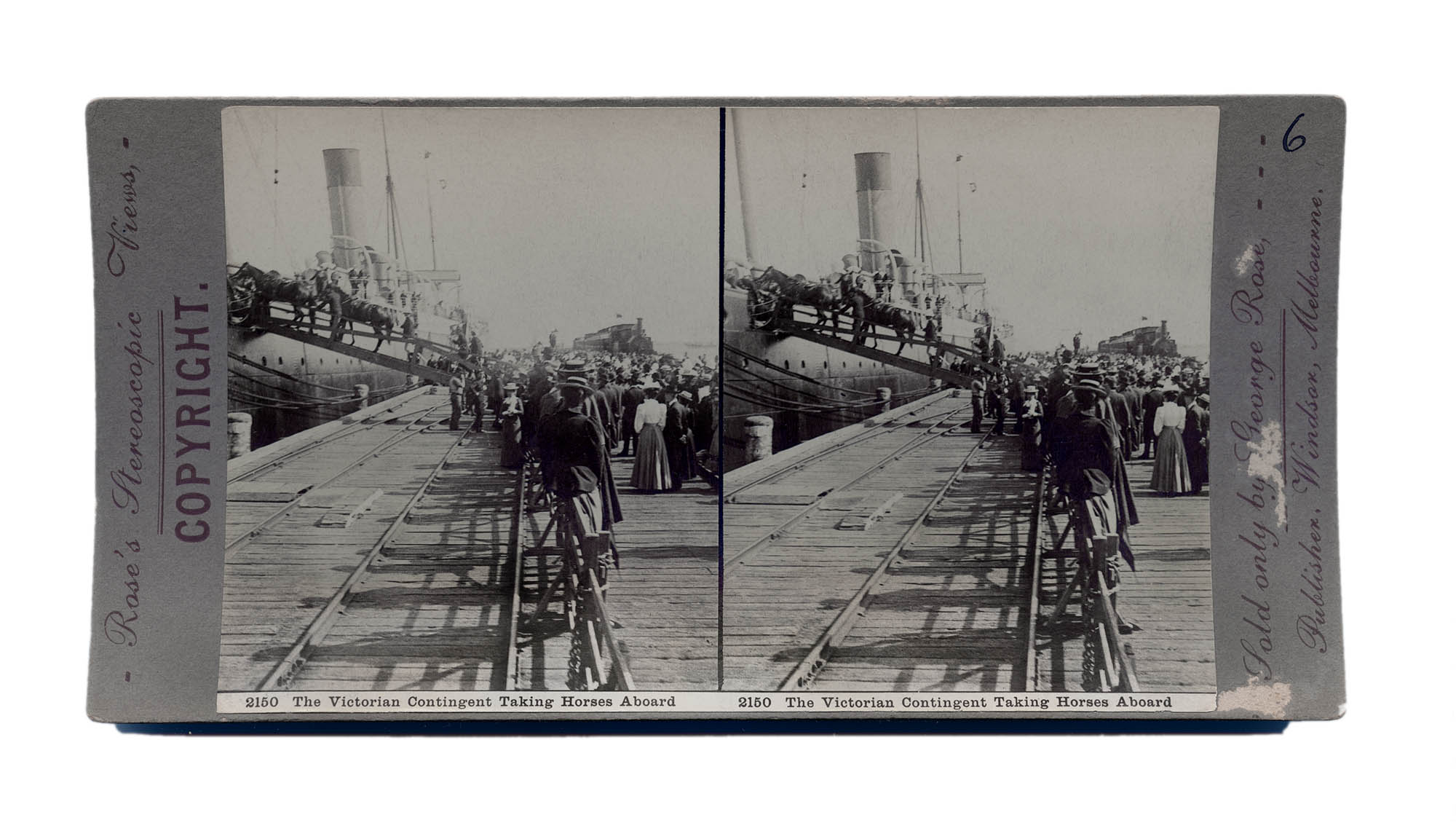
The Victorian Continent Taking Horses Abroad
Melbourne, Victoria, 28th October 1899
2 photographic prints on stereocard
9 x 18cm
Unknown photographer
George Rose (Australian, 1861-1942) (publisher, Windsor, Melbourne)
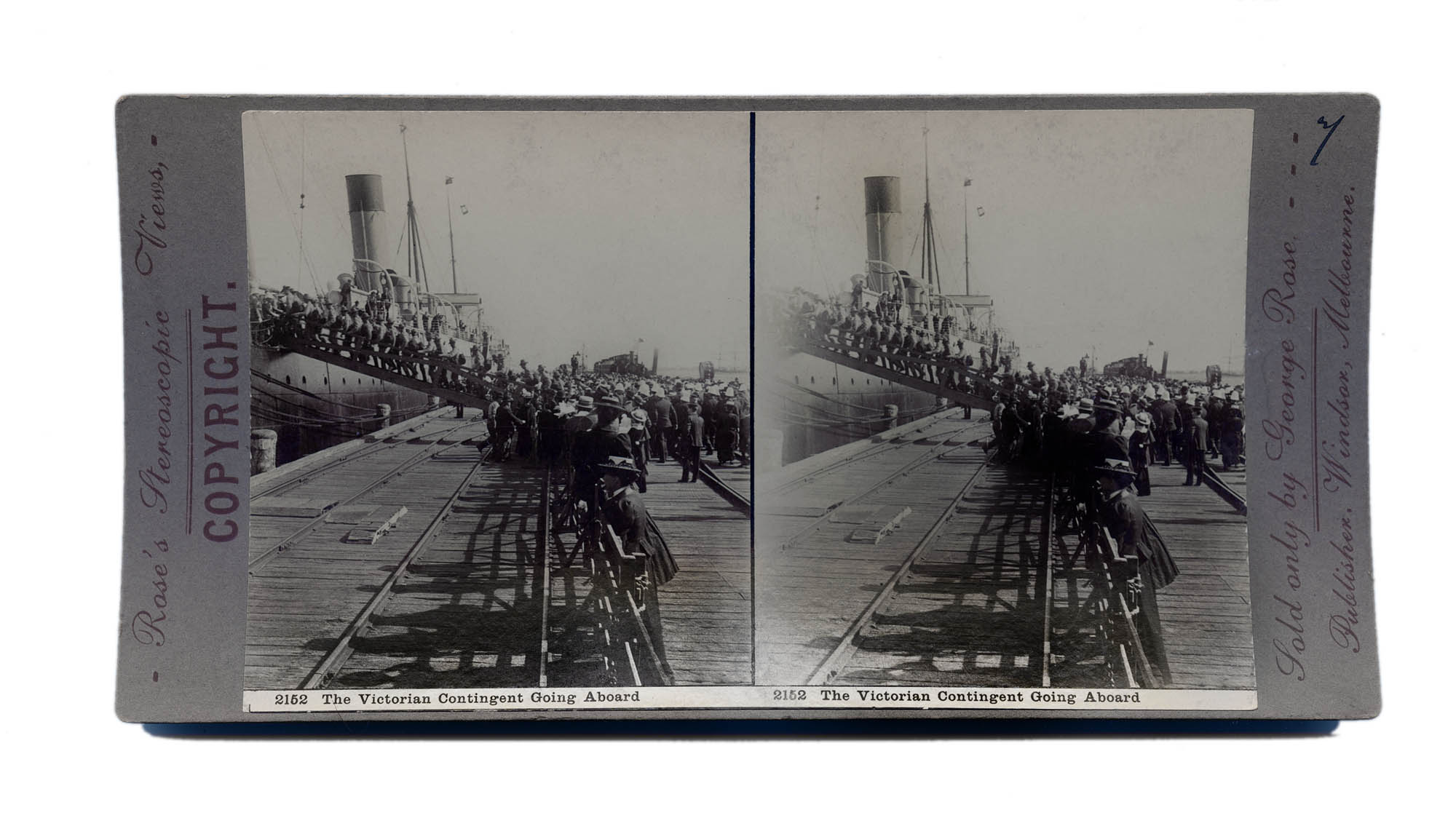
The Victorian Continent Going Aboard
Melbourne, Victoria, 28th October 1899
2 photographic prints on stereocard
9 x 18cm
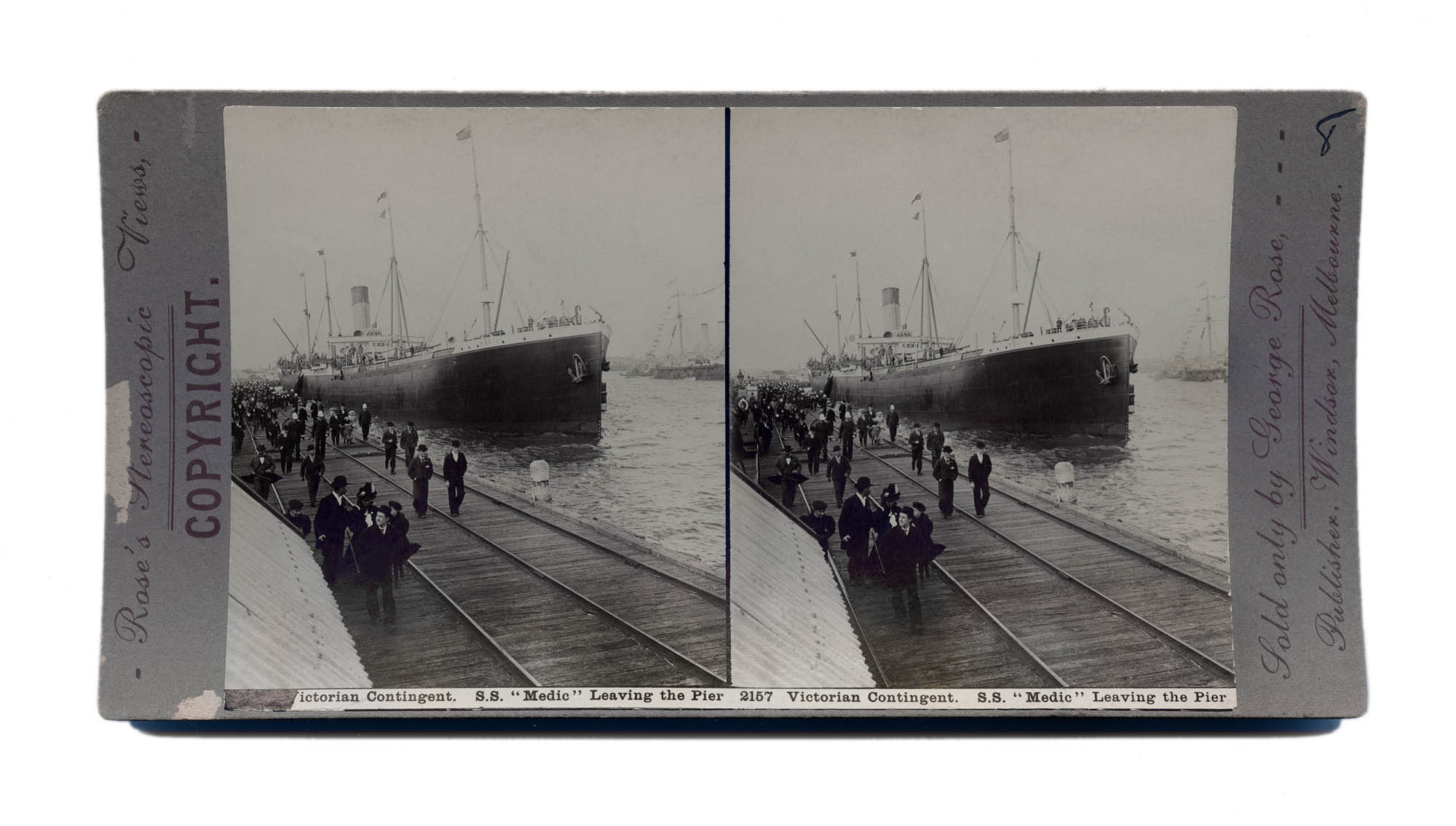
Unknown photographer
George Rose (Australian, 1861-1942) (publisher, Windsor, Melbourne)
Victorian Continent, S.S. “Medic” Leaving the Pier
Melbourne, Victoria, 28th October 1899
2 photographic prints on stereocard
9 x 18cm
A crowd of onlookers walk down Railway Pier in Port Melbourne to farewell the Victorian Contingent aboard the S.S. Medic as it departs for the Boer War in South Africa.
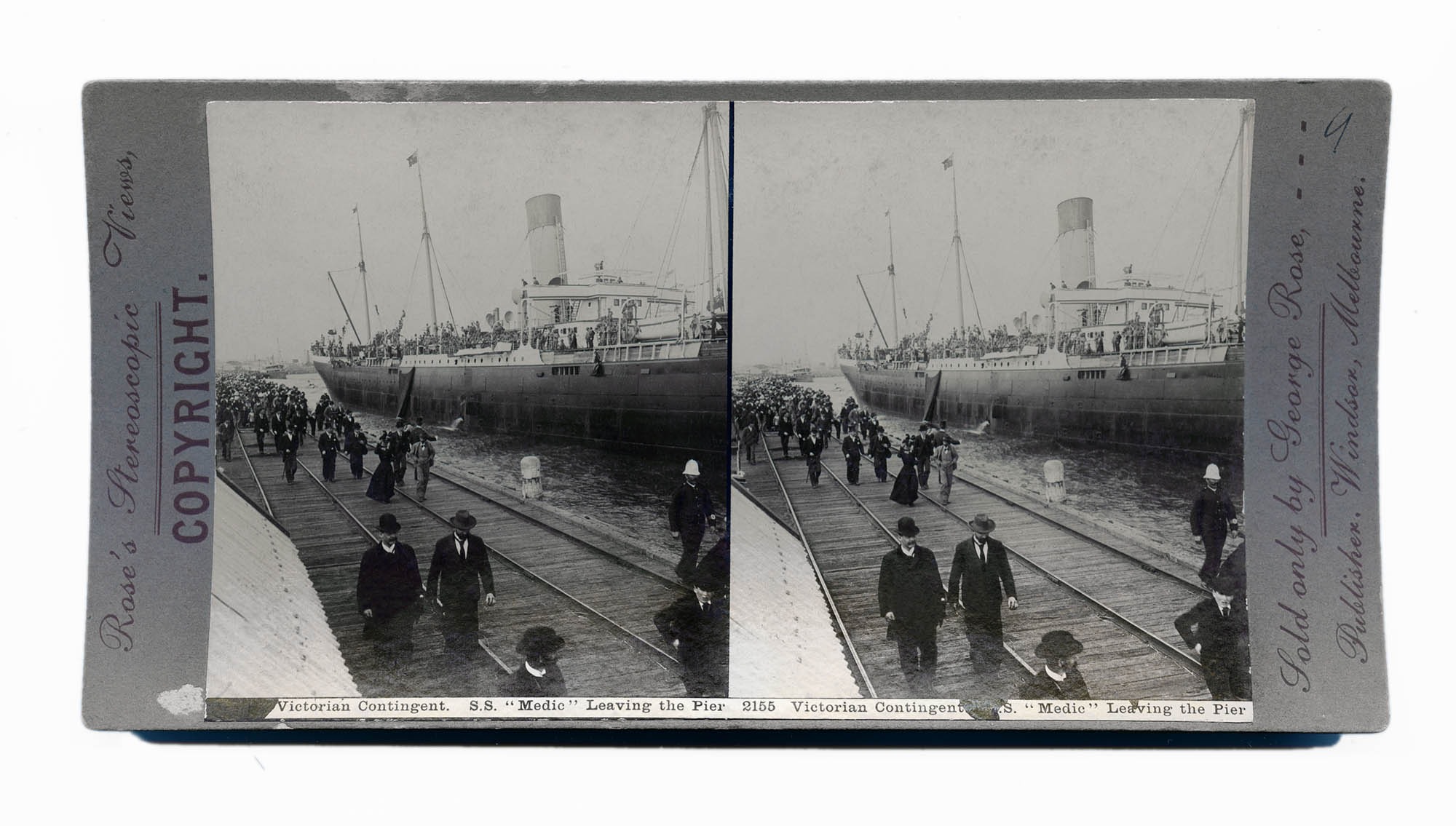
Unknown photographer
George Rose (Australian, 1861-1942) (publisher, Windsor, Melbourne)
Victorian Continent, S.S. “Medic” Leaving the Pier
Melbourne, Victoria, 28th October 1899
2 photographic prints on stereocard
9 x 18cm
A crowd of onlookers walk down Railway Pier in Port Melbourne to farewell the Victorian Contingent aboard the S.S. Medic as it departs for the Boer War in South Africa.

Unknown photographer
George Rose (Australian, 1861-1942) (publisher, Windsor, Melbourne)
Victorian Continent, S.S. “Medic” Leaving the Pier
Melbourne, Victoria, 28th October 1899
2 photographic prints on stereocard
9 x 18cm
A crowd of onlookers walk down Railway Pier in Port Melbourne to farewell the Victorian Contingent aboard the S.S. Medic as it departs for the Boer War in South Africa.

Unknown photographer
S.S. Medic leaving Sydney
Probably 1900s
State Library of New South Wales
Public domain
S.S. Medic
SS Medic was a steamship built by Harland and Wolff in Belfast for the White Star Line which entered service in 1899. Medic was one of five Jubilee-class ocean liners (the others being the Afric, Persic, Runic and Suevic) built specifically to service the Liverpool – Cape Town – Sydney route. The ship’s name pertained to the ancient Persian region of Media and was pronounced Mee-dic.
Medic was the second Jubilee-class ship to be built for the Australia service. Like her sisters she was a single funnel liner, measuring just under 12,000 gross register tons (GRT), which had capacity for 320 passengers in third class on three decks, she also had substantial cargo capacity with seven cargo holds, most of them refrigerated for the transport of Australian meat.
After a long career with White Star, Medic was sold in 1928 and was converted into a whaling factory ship and renamed Hektoria, she remained in service in this role until being torpedoed and sunk during World War II in the Atlantic Ocean whilst sailing in a convoy in 1942. …
White Star Line career
Medic was launched at Belfast on 15 December 1898, but her completion was delayed until 6 July the following year, so that improvements that were being made to her earlier sister Afric could be incorporated into her construction.
Medic inaugurated White Star’s new Australia service with her maiden voyage, which started from Liverpool on 3 August 1899, she was then the largest ship ever to sail to Australia. Although Afric was the first ship built for the service, she did not make her first voyage to Australia until the following month. On board the maiden voyage was Charles Lightoller on his first assignment as fourth mate, he would later become the only senior officer to survive the sinking of the Titanic. Upon Medic‘s arrival in Australia she was greeted with a rapturous reception. Lightoller wrote:
“She was a show ship, the biggest that had ever been out there, and the people in Australia gave us the time of our lives. Everything and everywhere it was Medic“
On her first return trip to the UK, Medic carried Australian troops to South Africa for the Boer War which had started in October 1899, and continued to carry troops to the conflict until it concluded in 1902. In October 1900, while Medic was anchored in Neutral Bay, Sydney Harbour, Charles Lightoller and some shipmates were involved in the “Fort Denison Incident”, a prank intended to fool locals into believing a Boer raiding party was attacking the city. The culprits were never apprehended but Lightoller confessed to his company’s superiors, after which he was transferred to the Atlantic route.
Text from the Wikipedia website

Allan C. Green (Australian, d. 1954)
The steamship and White Star Liner Medic
Before 1940
State Library of Victoria, Allan C. Green collection of glass negatives
Public domain
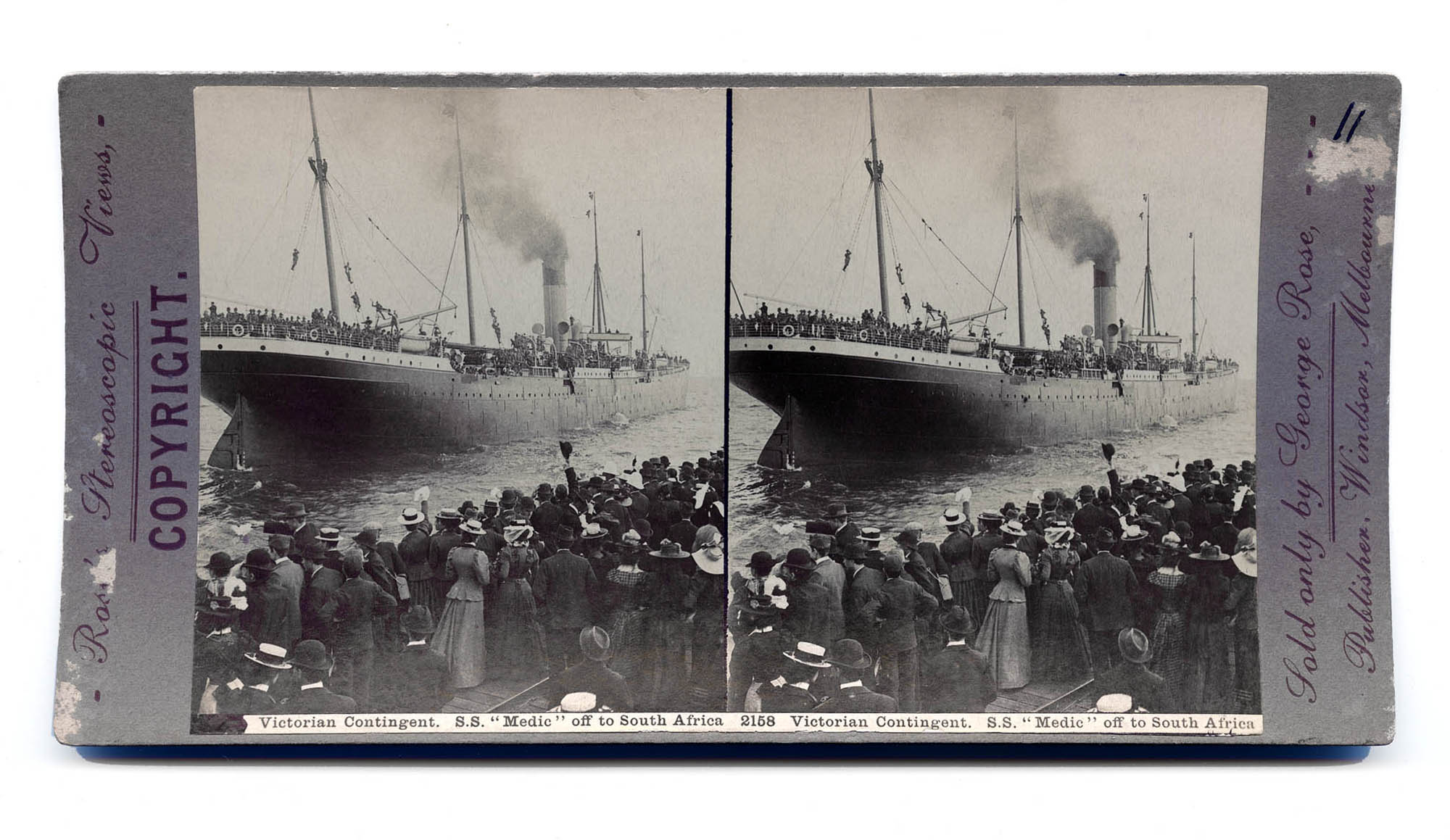
Unknown photographer
George Rose (Australian, 1861-1942) (publisher, Windsor, Melbourne)
Victorian Continent, S.S. “Medic” off to South Africa
Melbourne, Victoria, 28th October 1899
2 photographic prints on stereocard
9 x 18cm
A crowd of onlookers on Railway Pier in Port Melbourne waves off the Victorian Contingent aboard the S.S. Medic as it departs for the Boer War in South Africa.
The Victorian government took additional steps to ensure the success of the Melbourne farewell by making available holiday excursion fares from all stations to the city. It also approved the issue of free rail passes to the immediate relatives of country members of the contingent.107
…
The Victorian contingent was given a taste of the morrow by the crowds who thronged inside and outside the Melbourne Town Hall for the mayor’s farewell. “For the first time in the history of Victoria the thrill of patriotism vibrated through the nerves of the people”, and their hearts were stirred by the colony’s first plunge into “the great deeps of international warfare”. After the ceremony, the troops headed a triumphal procession back to barracks, and as the men disappeared within the gates the huge crowd sang Soldiers of the Queen. 111
The thronged streets were lined by 2000 school cadets for the march the following day, Saturday 28 October, and the contingent had an escort of 4000 members of the defence forces. Included in the column, and basking in a glory they must have thought gone forever, were former Imperial soldiers, “ambling but proud old wrecks” who wore the medals of Crimea and the Mutiny.112 Lieutenant Tremearne, in writing of the occasion later, told of people, perfect strangers to him, rushing into the ranks with tear filled eyes and murmuring, “Good luck, old man”.113 Followed by a flotilla of smaller craft, the Medic, largest ship ever to enter an Australian port, sailed down the bay and turned to the open sea. Long after the cheering had died and the launches had turned back, Victoria continued to salute her first contingent with huge bonfires which blazed along miles of coastline.114
L.M. Field. The Forgotten War. Australian Involvement in the South African Conflict of 1899-1902. Master of Arts thesis, Australian National University, September 1973, pp. 74-76.

Unknown photographer
George Rose (Australian, 1861-1942) (publisher, Windsor, Melbourne)
The Victorian Continent, Last View of Boat
Melbourne, Victoria, 28th October 1899
2 photographic prints on stereocard
9 x 18cm
The Rose Stereograph Company
The publishing output of this long-lived firm (which operated from about 1880 until it went into liquidation in 2017) was phenomenal, and when the remains of what must have been a vast photographic archive went on sale in June 2021 with Lloyds Auctions…
According to a brief history by postcard collector Leo Fitzgerald, the Rose story began when Cornish sea captain William Rose came to the Victorian Ballarat gold fields from California and married Grace Ash at Ballarat in 1861. The couple’s son, George, was born in 1862 at the town of Clunes. He worked in his father’s shoe shop in Chapel Street, Prahran, between 1877 and 1880 (apparently producing his earliest photos from those premises) and began spending his Sundays selling photos to picnic parties in the Dandenong hills. Finding his niche in photography, he moved to a new address at Armadale and founded his own firm publishing stereographic views. Over the years he travelled to many countries and recorded numerous important historic events with his stereographic camera equipment, opening offices in Sydney, Wellington and London. His images from Korea have become especially celebrated in Korea, where they represent an extremely rare glimpse of the nation in 1904, before the onset of the destruction wrought by the wars of the 20th century. …
Collector and researcher Ron Blum, whose excellent books built on Leo Fitzgerald’s work, wrote that George’s son Walter took over the business sometime before 1931, selling it in that year to long-time employees Edward Gilbert and Herbert Cutts… George’s wife, Elizabeth, died in 1929, and both George’s sons died before him. With no longer any legal interest in the company he had founded, George kept on taking photographs for the old firm, travelling around Australia in a mobile darkroom and camping along the way. He worked almost until his death in 1942, aged 80… The Rose Stereographic Company continued under the stewardship of Herbert “Bert” Cutts, who brought his son Neil into the business in the 1950s.
Greg Ray. “The Rose Stereograph Company: a snapshot,” on the Photo Time Tunnel website July 16, 2021 [Online] Cited 23/09/2023
George Rose was born in Clunes, Victoria, in 1861. He did not follow his father into boot-making, but was interested in astronomy and natural history. He was unconventional, of rather eccentric and Bohemian character. After moving to Melbourne in 1876, George developed his skills as a photographer, especially in the stereoscopic field – what is known as 3D photography today. He founded the Rose Stereographic Company in 1880. In 1901 George recorded the celebrations for the visit of the Duke and Duchess of York, and in the following years travelled across Australia and over 35 countries taking three-dimensional photos. By 1907 his business employed six people – two males and four females; at its peak, staff numbered around 20. In 1913 the Rose Stereographic Company began manufacturing “real photo” postcards. George’s son Walter managed the company, allowing his father to concentrate on taking the photographs. In 1931 the business was sold to two long-time employees, Edward Gilbert and Herbert (Bert) Cutts. George Rose died of cancer in 1942, having outlived both his sons, but the business remained in the Cutts family for many years before it finally closed down in March 2017.
Information from the book George Rose – The Postcard Era by Ron Blum.
2nd Victorian Contingent
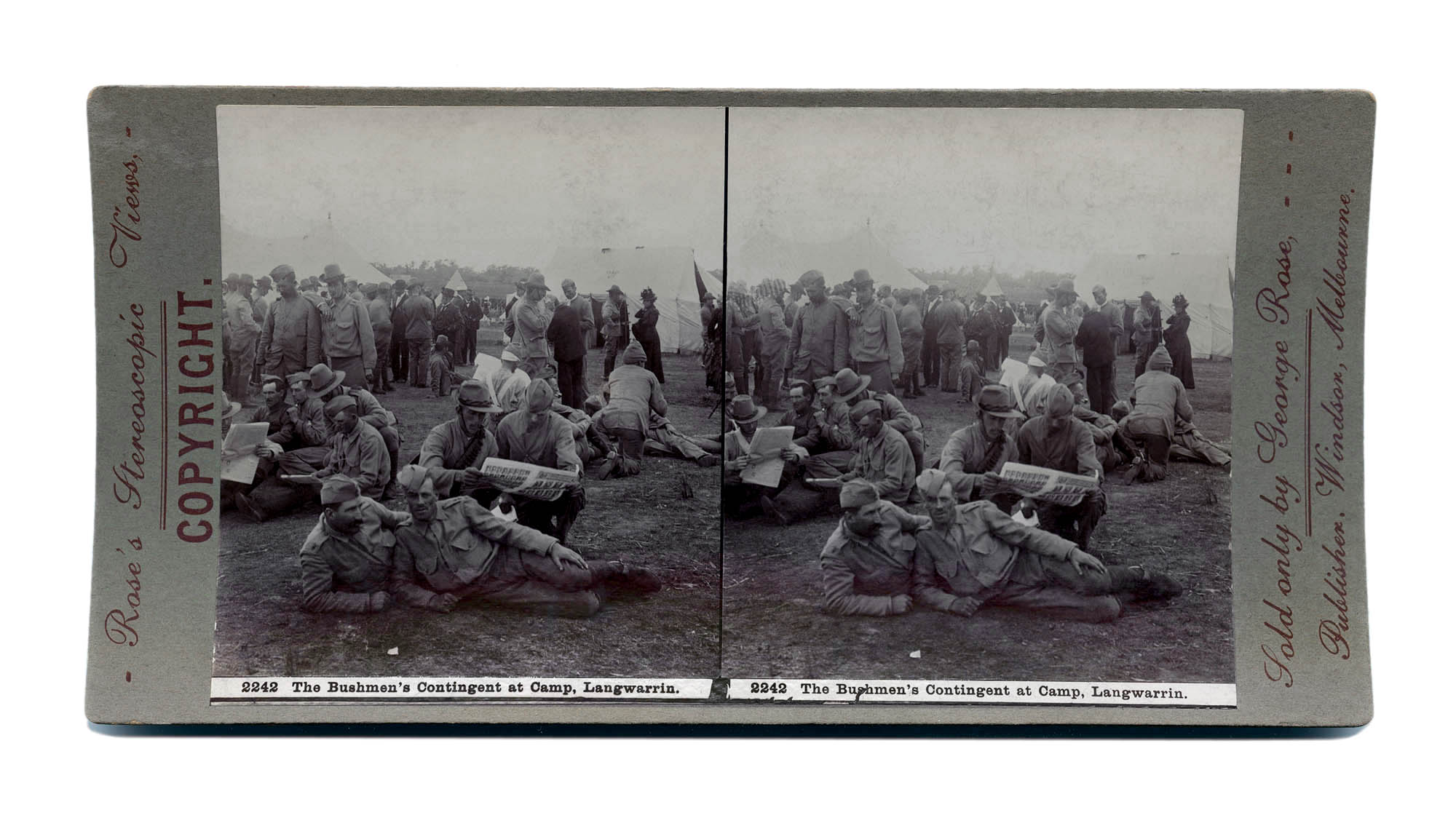
Unknown photographer
George Rose (Australian, 1861-1942) (publisher, Windsor, Melbourne)
The Bushman’s Contingent at Camp, Langwarrin
Melbourne, Victoria, 13th January 1900
2 photographic prints on stereocard
9 x 18cm

Unknown photographer
George Rose (Australian, 1861-1942) (publisher, Windsor, Melbourne)
The Bushman’s Contingent at Langwarrin
Melbourne, Victoria, 13th January 1900
2 photographic prints on stereocard
9 x 18cm

Unknown photographer
George Rose (Australian, 1861-1942) (publisher, Windsor, Melbourne)
The Bushman’s Contingent Lining up for Grub
Melbourne, Victoria, 13th January 1900
2 photographic prints on stereocard
9 x 18cm
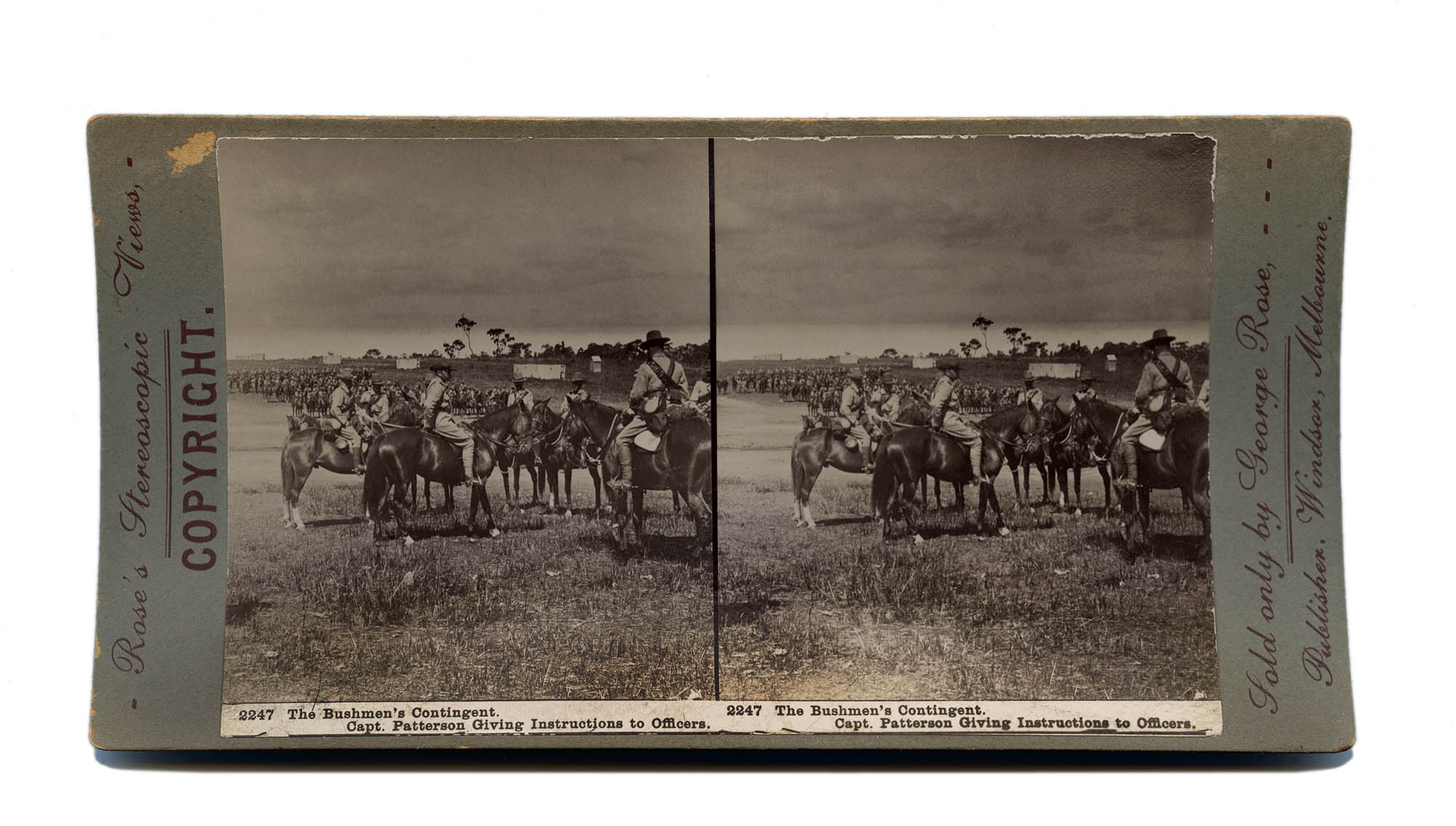
Unknown photographer
George Rose (Australian, 1861-1942) (publisher, Windsor, Melbourne)
The Bushman’s Contingent. Capt. Patterson Giving Instructions to Officers
Melbourne, Victoria, 13th January 1900
2 photographic prints on stereocard
9 x 18cm

Unknown photographer
George Rose (Australian, 1861-1942) (publisher, Windsor, Melbourne)
The Bushman’s Contingent. Group of Officers
Melbourne, Victoria, 13th January 1900
2 photographic prints on stereocard
9 x 18cm

Unknown photographer
George Rose (Australian, 1861-1942) (publisher, Windsor, Melbourne)
2nd Victorian Contingent, at the Showgrounds
Melbourne, Victoria, 13th January 1900
2 photographic prints on stereocard
9 x 18cm

Unknown photographer
George Rose (Australian, 1861-1942) (publisher, Windsor, Melbourne)
2nd Victorian Contingent. Procession (Scottish Regiment)
Melbourne, Victoria, 13th January 1900
2 photographic prints on stereocard
9 x 18cm
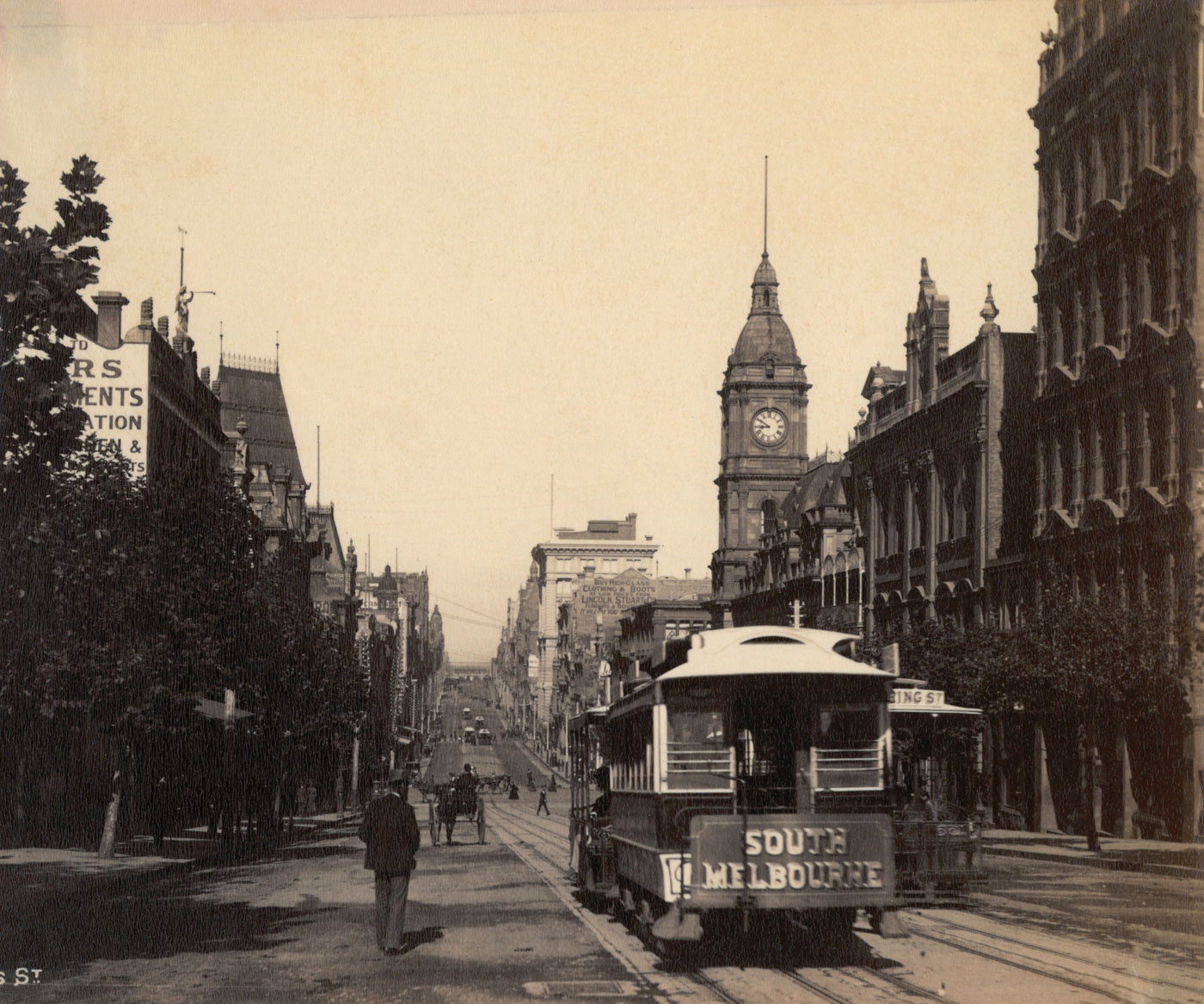
The Scottish Regiment parading down Collins Street (looking east), Melbourne. The building on the left appears to be the Colonial Mutual Life Building (demolished) and further along, the clock tower is the town hall and the spire is Scots Church. Interesting to note the American flag flying the building at left. I wonder why?
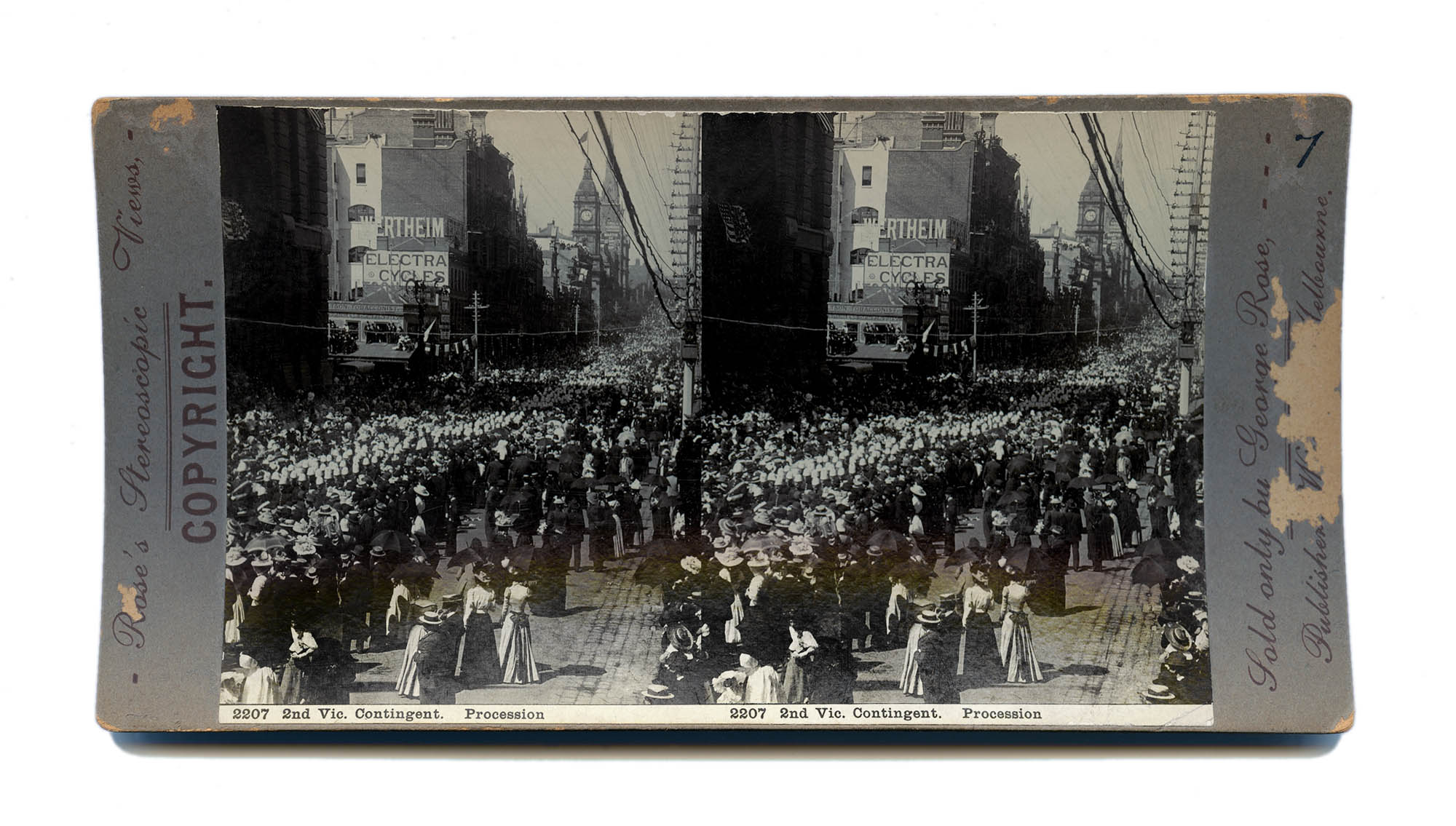
Unknown photographer
George Rose (Australian, 1861-1942) (publisher, Windsor, Melbourne)
2nd Victorian Contingent. Procession
Melbourne, Victoria, 13th January 1900
2 photographic prints on stereocard
9 x 18cm
The 2nd Victorian Contingent parading down Collins Street (looking east), Melbourne. The building on the left appears to be the Colonial Mutual Life Building (demolished) and further along, the clock tower is the town hall and the spire is Scots Church. Interesting to note the American flag flying the building at left. I wonder why?

Unknown photographer
George Rose (Australian, 1861-1942) (publisher, Windsor, Melbourne)
2nd Victorian Contingent. Horses alongside Boat
Melbourne, Victoria, 13th January 1900
2 photographic prints on stereocard
9 x 18cm
Departed Melbourne: SS Euryalus 13 January 1900.
Raised predominantly on the Mounted Rifle Regiment, formed by Lt-Col Tom Price in 1885, and Victorian Rangers, Militia including the battalions of the Infantry Brigade and some from the Royal Australian Artillery. Colonel Price was initially made CO of the Hanover Road Field Force, including one battalion of Lancashire Militia, two companies of Prince Albert’s Guards and Tasmanians. Price was the only Australian Colonial Officer placed in command of British units during the Boer War.
A seminal moment in the Boer War was the capture of Pretoria in 1900 by British commander, Lord Roberts. The Victorian 2nd (Mounted Rifles) Contingent was the first unit to enter the city. A large number of this unit were invalided back to Victoria, having experienced starvation and extreme exhaustion on some treks.
Strength: 265
Service period: Feb 1900 – Dec 1900.
Text from the Defending Victoria website

Unknown photographer
George Rose (Australian, 1861-1942) (publisher, Windsor, Melbourne)
2nd Victorian Contingent. Soldiers Taking Saddles Aboard
Melbourne, Victoria, 13th January 1900
2 photographic prints on stereocard
9 x 18cm

Unknown photographer
George Rose (Australian, 1861-1942) (publisher, Windsor, Melbourne)
2nd Victorian Contingent. Horses Going Aboard
Melbourne, Victoria, 13th January 1900
2 photographic prints on stereocard
9 x 18cm
The horses of the 2nd Victorian Contingent to the Boer War about to be put aboard the steamship “Euryalus”, bound for South Africa. The 2nd Victorian Contingent consisted entirely of mounted rifles.

Unknown photographer
S.S. Euryalus
Between 1898 and 1913?
Albumen silver print
13.8 x 19.7cm
State Library of Victoria, R.J. French photographic collection of ships
Gift of Mr R. J. French 1979
Public domain
S.S. Euryalus
The steamer Euryalus returned from South Africa
last night, berthing at the Port Melbourne Town
Pier at about a quarter-past 9 o’clock. It was
thought that she, like the Moravian, might have
had some invalided Australian troops on board, but
there were not any, although the vessel brought a
number of saloon and steerage passengers. She had
an uneventful voyage. Durban was left on the 5th
inst., and normal weather was experienced until
the Euryalus reached lat. 41deg. S. and lon. 97deg.
E., where foggy conditions set in, and these continued
to lon. 109deg. E. She passed Cape Otway
at 11.30 a.m. yesterday, and entered Port Phillip
Heads at 5.30 p.m.
“S.S. EURYALUS.” The Argus (Melbourne, Vic.: 1848-1957) 26 May 1900: p. 12. Web. 23 Sep 2023 http://nla.gov.au/nla.news-article9542431
Name: EURYALUS
Type: Passenger Cargo Ship
Launched: 08/06/1898
Completed: 08/1898
Builder: Palmers’ Shipbuilding & Iron Co Ltd
Yard: Jarrow
Yard Number: 732
Dimensions: 3570grt, 2286nrt, 360.0 x 45.7 x 24.1ft
Engines: T3cyl (27, 45.5 & 74 x 48ins), 458nhp
Engines by: Palmers’ Shipbuilding & Iron Co Ltd, Jarrow
Propulsion: 1 x Screw, 11.5knots
Construction: Steel
History
04/11/1898: A Currie & Co, Melbourne
1913: British India Steam Navigation Co Ltd, Glasgow
1913: Placed on the India to Australia service
1919: Accommodation increased to include 2441 x deck passengers
31/12/1923: Arrived for breaking up at La Spezia. Cost £6,500
Comments
1898: Completed at a price of £47,500
Accommodation for 22 x 1st and 24 x 2nd Class passengers

Unknown photographer
George Rose (Australian, 1861-1942) (publisher, Windsor, Melbourne)
2nd Victorian Contingent. Going Aboard the “Euryalus”
Melbourne, Victoria, 13th January 1900
2 photographic prints on stereocard
9 x 18cm

Unknown photographer
George Rose (Australian, 1861-1942) (publisher, Windsor, Melbourne)
2nd Victorian Contingent. Going Aboard the “Euryalus”
Melbourne, Victoria, 13th January 1900
2 photographic prints on stereocard
9 x 18cm

Unknown photographer
George Rose (Australian, 1861-1942) (publisher, Windsor, Melbourne)
2nd Victorian Contingent. Horses Going Aboard
Melbourne, Victoria, 13th January 1900
2 photographic prints on stereocard
9 x 18cm
Australia and the Boer War, 1899-1902
As part of the British Empire, the Australian colonies offered troops for the war in South Africa. Australians served in contingents raised by the six colonies or, from 1901, by the new Australian Commonwealth. For a variety of reasons many Australians also joined British or South African colonial units in South Africa: some were already in South Africa when the war broke out; others either made their own way to the Cape or joined local units after their enlistment in an Australian contingent ended. Recruiting was also done in Australia for units which already existed in South Africa, such as the Scottish Horse.
Australians served mostly in mounted units formed in each colony before despatch, or in South Africa itself. The Australian contribution took the form of five “waves”. The first were the contingents raised by the Australian colonies in response to the outbreak of war in 1899, which often drew heavily on the men in the militia of the colonial forces. The second were the “bushmen” contingents, which were recruited from more diverse sources and paid for by public subscription or the military philanthropy of wealthy individuals. The third were the “imperial bushmen” contingents, which were raised in ways similar to the preceding contingents, but paid for by the imperial government in London. Then were then the “draft contingents”, which were raised by the state governments after Federation on behalf of the new Commonwealth government, which was as yet unable to do so. Finally, after Federation, and close to the end of the war, the Australian Commonwealth Horse contingents were raised by the new Federal government. These contingents fought in both the British counter-offensive of 1900, which resulted in the capture of the Boer capitals, and in the long, weary guerrilla phases of the war which lasted until 1902. Colonial troops were valued for their ability to “shoot and ride”, and in many ways performed well in the open war on the veldt. There were significant problems, however, with the relatively poor training of Australian officers, with contingents generally arriving without having undergone much training and being sent on campaign immediately. These and other problems faced many of the hastily raised contingents sent from around the empire, however, and were by no means restricted to those from Australia…
The Australians at home initially supported the war, but became disenchanted as the conflict dragged on, especially as the effects on Boer civilians became known…
Conditions for both soldiers and horses were harsh. Without time to acclimatise to the severe environment and in an army with a greatly over-strained logistic system, the horses fared badly. Many died, not just in battle but of disease, while others succumbed to exhaustion and starvation on the long treks across the veld. Quarantine regulations in Australia ensured that even those which did survive could not return home. In the early stages of the war Australian soldier losses were so high through illness that components of the first and second contingents ceased to exist as viable units after a few months of service.
Extract of text from “Australia and the Boer War, 1899-1902” on the Australian War Memorial website Nd [Online] Cited 06/10/2023

Unknown photographer
George Rose (Australian, 1861-1942) (publisher, Windsor, Melbourne)
The Bushman’s Contingent. Horses Going Aboard
Melbourne, Victoria, 13th January 1900
2 photographic prints on stereocard
9 x 18cm

Unknown photographer
George Rose (Australian, 1861-1942) (publisher, Windsor, Melbourne)
The Bushman’s Contingent. “Euryalus” Leaving Pier
Melbourne, Victoria, 13th January 1900
2 photographic prints on stereocard
9 x 18cm

Unknown photographer
George Rose (Australian, 1861-1942) (publisher, Windsor, Melbourne)
The Bushman’s Contingent, “Euryalus” Leaving Pier
Melbourne, Victoria, 13th January 1900
2 photographic prints on stereocard
9 x 18cm

Unknown photographer
George Rose (Australian, 1861-1942) (publisher, Windsor, Melbourne)
The Bushman’s Contingent, “Good-bye, Lads.”
Melbourne, Victoria, 13th January 1900
2 photographic prints on stereocard
9 x 18cm

Unknown photographer
George Rose (Australian, 1861-1942) (publisher, Windsor, Melbourne)
The Bushman’s Contingent, “Good-bye, Lads.”
Melbourne, Victoria, 13th January 1900
2 photographic prints on stereocard
9 x 18cm

Unknown photographer
George Rose (Australian, 1861-1942) (publisher, Windsor, Melbourne)
2nd Victorian Contingent. The Troops at the Pier
Melbourne, Victoria, 13th January 1900
2 photographic prints on stereocard
9 x 18cm
Soldiers and sailors lined up on the pier, at a farewell parade for the troops of the 2nd Victoria Contingent to the Boer War. The troops of the 2nd Victoria Contingent, all Mounted Rifles, are aboard the steamship “Euryalus”, which is about to depart for Cape Town, South Africa. Note the photographer with his large format camera on tripod at left.
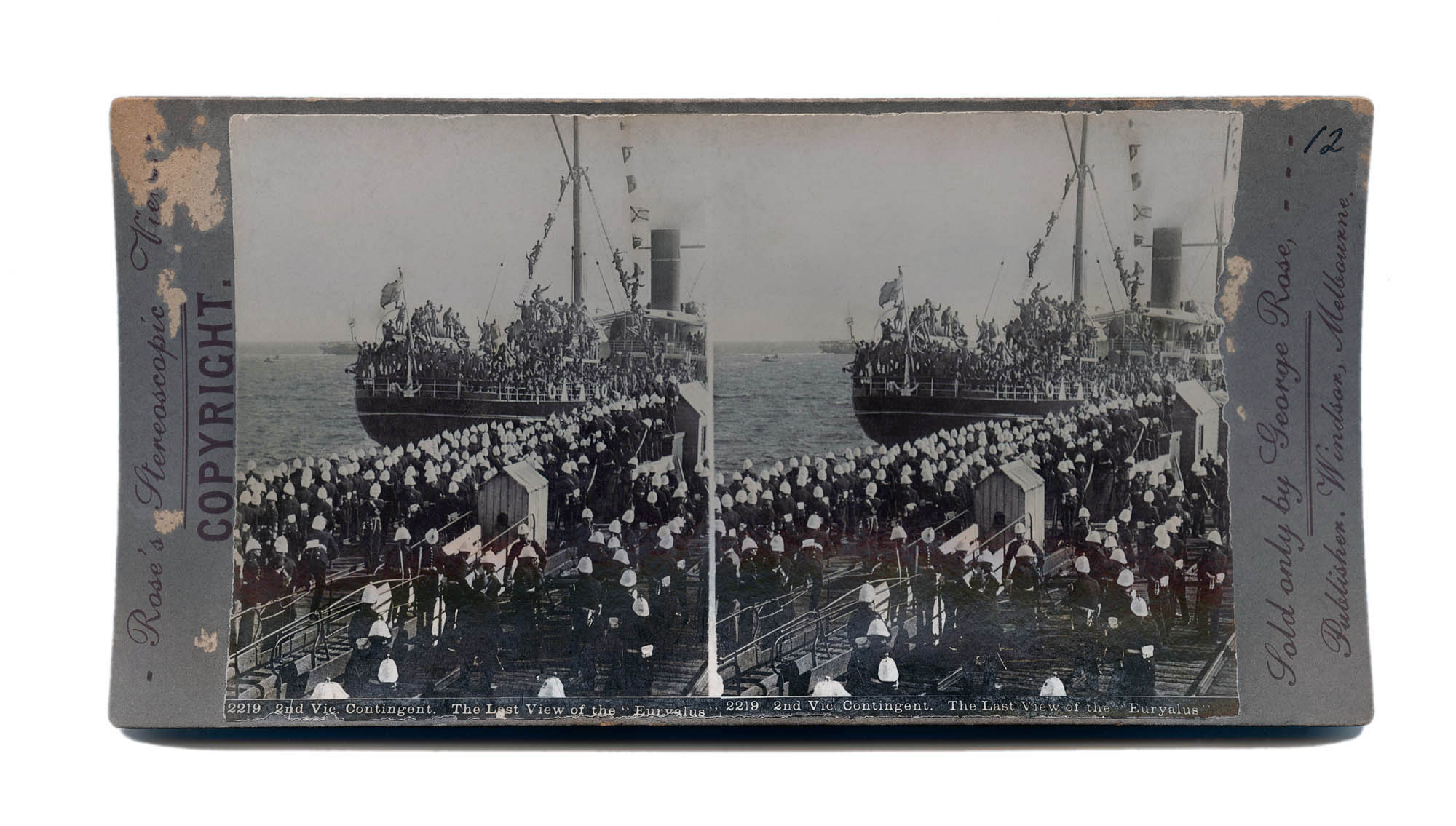
Unknown photographer
George Rose (Australian, 1861-1942) (publisher, Windsor, Melbourne)
2nd Victorian Contingent. The Last View of the “Euryalus”
Melbourne, Victoria, 13th January 1900
2 photographic prints on stereocard
9 x 18cm


 Art Blart _ art and cultural memory archive
You must be logged in to post a comment.