Exhibition: ‘The Art of the Automobile: Masterpieces of the Ralph Lauren Collection’ at The Arts Décoratifs Museum, Paris

Exhibition dates: 28th April – 28th August 2011


Many thankx to The Arts Décoratifs Museum for allowing me to publish the photographs in the posting. Please click on the images for a larger version of the image.


Mercedes Benz SSK “Count Trossi”, 1930


Mercedes Benz SSK “Count Trossi”
1930
Ralph Lauren collection
© Photo Michael Furman


The notion of line in a car echoes that of the perfectly harmonious line of trajectory. The design is never far from this line, even in those coachworks designed without drawing boards, of which some of the most marvellous examples are seen here. It is interesting to see that in the French language at least, cars have taken on board the concept of ligne (or “line”), a word with many meanings. Yet the term ligne, taken in the sense that it is used nowadays in reference to coachwork, is classified by French lexicographer Littré within the sphere of fine art, and defined by him as: “the general effect produced by the coming together and combination of different parties of either a natural object or a composition.” The natural development of language thus shows us the relationship between cars and fine art.


Excerpt from the catalog, Editions Les Arts Décoratifs, Paris 2011


In 1970, Les Arts Décoratifs presented a selection of competition cars, “Bolides Design.” To compile the exhibition, a special jury was assembled, featuring designers Joe Colombo, Roger Tallon and Pio Manzu, and the artists Jean-Paul Riopelle, Jean Tinguely and Victor Vasarely, as well as Robert Delpire and François Mathey. The jury chose the models with the idea of the car as a design object, a work of art, showing that “art and technique, each at their own level, are the expression of man and his relationship with design.”

The Ralph Lauren collection can be seen from the same perspective. Patiently assembled over several decades by the fashion designer in a quest for speed and performance, it includes some of the most extraordinary jewels in the crown of European automobile history, with beauty as its common denominator.

Within the collection are some of the most elegant and innovative cars in automotive history, from the “Blower” Bentley (1929), the Ferrari 250 GTO (1962), the famous Mercedes 300 SL (1955) and the unforgettable Jaguar “D type,” whose shark fin blazed a triumphant trail at Le Mans in 1955, 1956 and 1957. But the grand tourer, the Bugatti Atlantic (1938) of which only four models were produced, represents the ultimate in luxury while showcasing the evolution of styles and techniques on the road. Each of these exceptional vehicles was designed as a masterpiece blending technological innovation and boldness of style.

For its first presentation in Europe, the Ralph Lauren collection will be put on display by Jean-Michel Wilmotte, who has opted for an intimate visual approach as these vehicles stand out both for their overall design and detail, as well as for bodywork, chassis and engines.

The kinetic and sound of the vehicles will be reproduced by means of several films and recordings. A seminar on automobile design will also be held during the exhibition.

Press release from The Arts Décoratifs Museum website
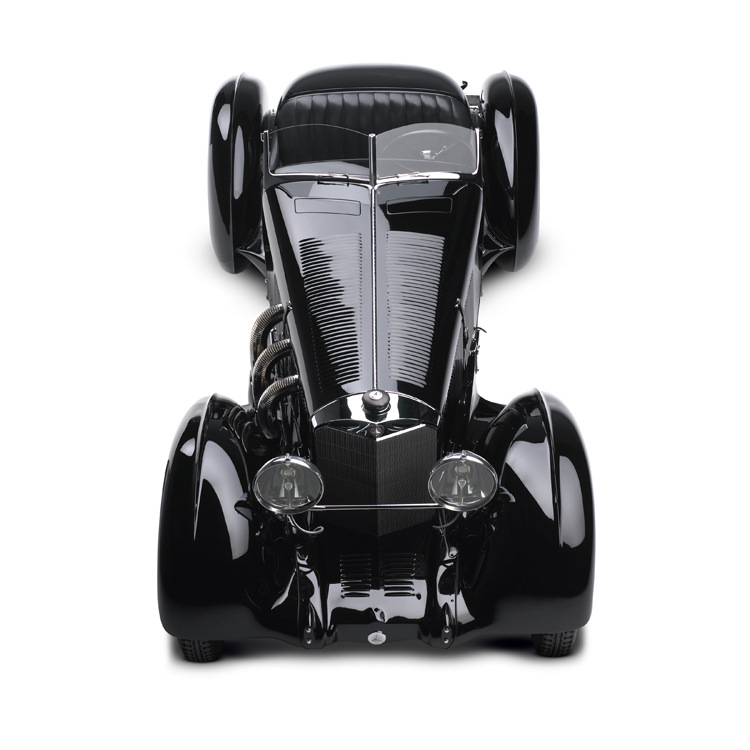
 

Mercedes Benz SSK “Count Trossi”, 1930


Mercedes Benz SSK “Count Trossi”
1930
Ralph Lauren collection
© Photo Michael Furman


Chassis number SSK 36038, currently owned by Ralph Lauren, remained unsold by the Mercedes-Benz factory in 1928, but was then sent out to Japan in 1930, before being brought back to Europe. This car was put together by the young British coach builder, Willy White, based on a design suggested by its aristocratic owner-cum-industrialist, Count Carlo Felice Trossi, himself a racing driver. The SSK, the archetypal Mercedes of the 1920s, built on a short chassis, is dominated by a colossal hood with a trio of exhaust pipes emerging from each side – a hood encompassing over half the car’s length with a radiator projecting out front as a windbreak. Its flamboyant rear end, dramatically tapered, adds a touch of civility to this extraordinary model, contrasting with the hieratic image of its front end. The supercharging gives the Mercedes SSK its fiery temperament, as well as the legendary noise of its seven litre straight 6 cylinder engine producing 300 CV and enabling a flat-out speed of 235kph!


Bugatti 57 SC Atlantic, 1938


Bugatti 57 SC Atlantic, 1938


Bugatti 57 SC Atlantic
1938
Collection Ralph Lauren
© Photo Michael Furman


According to Paul Bracq, “the Atlantic is a monument in the history of French coach building! More than any other car, it expresses a French-Italian look. An incredible sense of lightness is given off by this sculpture.” Powered by a straight 8 cylinder engine fitted with twin overhead camshafts and a compressor, this beauty is also incredibly fast, capable of reaching 200 kph. As the aluminium alloy used for the coachwork did not lend itself to shaping and soldering, Jean Bugatti was obliged to make the wings and roof in two parts and then assemble them with rivets. His talent lay precisely in the art of transforming this inconvenient technique into a stylistic advantage. Power and speed are suggested by the doors which are cut out of the roof and the ellipsoidal windows reminiscent of airplanes. Chassis number 57591 was the last of the four examples originally produced, a masterpiece embodying sport and luxury at their height – in short, the automobile exception.


Alfa Romeo 8C 2900 Mille Miglia, 1938


Alfa Romeo 8C 2900 Mille Miglia
1938
Collection Ralph Lauren
© Photo Michael Furman


This racing model fitted out with a straight 8 cylinder 2.9 litre engine with twin overhead camshafts supercharged by two compressors is equipped with fully independent suspension and a four speed rear transaxle. The whole thing is perfectly balanced, resulting in the most extraordinary roadholding. The hydraulic brakes are an additional bonus, enabling it to outclass its rivals at over 185 kph. The Turin factory called upon Carrozzeria Touring to design a small series of four two-seater roadsters intended to take part in the 1938 Mille Miglia, the first example of which is the car exhibited here. Driven by the Pintacuda-Mambelli team, the car came in an incredible second under the number 142. The tear drop shaped wings add the final touch to this extraordinary car which is considered to be one of the most prestigious pre-War Grand Touring Alfa Romeos.


Ferrari 375 Plus, 1954


Ferrari 375 Plus
1954
Collection Ralph Lauren
© Photo Michael Furman


The Ferrari known as the 375 Plus was an extrapolation of the Type 375 MM, a model powered by a V12 engine with three carburettors, a gearbox with four speeds plus reverse that increased its engine size to nearly 5 litres, giving it more power and enabling it to reach 340 CV, and attain 250 kph. Because Ferrari did not have its own design department, the 375 Plus, an absolute masterpiece, was created by highly qualified, talented artisans under the guidance of Pinin Farina, Ferrari’s official coach builder. Only five examples of the Type 375 Plus were made, including a spyder version which won the Le Mans 24 Hours in 1954. Ralph Lauren’s car, chassis number 0398 AM – the last of the series – left the factory in 1954 and had a relatively illustrious career in Argentina, often driven by Valiente.

 

Jaguar XKD, 1955


Jaguar XKD
1955
Collection Ralph Lauren
© Photo Michael Furman


In order to find a worthy successor to the brilliant Jaguar Type XKC, winner on two occasions of the Le Mans 24 Hours, the aeronautic aerodynamicist Malcolm Sayer came up with a non-conformist vehicle. The D-Type has a long hood with no radiator grille, opening away from the block and a slender, extremely graceful rear, easily recognisable thanks to the highly original fin that extends the driver’s head-rest, providing greater stability at high speeds. With the classic straight 6 cylinder 3.4 litre engine, the D-Type, built on a monocoque structure, also has disk brakes. The “long-nosed” version (only 10 examples of which left the factory, including Ralph Lauren’s 505/601) gained an additional 15 kph at maximum speed, pushing it to 260 kph. No other car from the 1950s embodies speed better than this Jaguar D, with three consecutive victories in the Le Mans 24 Hours between 1955 and 1957 and another at Nurburgring in 1956. It was the most successful racing car of its generation.


Jaguar XKSS, 1958


Jaguar XKSS
1958
Collection Ralph Lauren
© Photo Michael Furman


Following on from Jaguar’s magnificent victories in the 1955 and 1956 Le Mans 24 Hours, demand from its enthusiastic clients was such that the company decided to make a road version of the XKD (straight 6 cylinder 3.4 litre engine with a 250 CV output capable of propelling the car to nearly 250 kph) which was named the XKSS. Principally aimed at the American market, it differed from the racing model in having a windscreen, a convertible roof, bumpers and a more civilised interior, and the famous fin was removed. Only 16 examples were constructed between January and February 1957, and a further two examples of the D-Type were transformed by the factory in 1958. Ralph Lauren’s car is one of these, created from the XKD 533 in 1956. It participated in the Six Heures du Forez in 1957, driven by Monnoyeur and Dupuy, finishing 7th, behind a fleet of Jaguar Ds which took the three first places.


Ferrari 250 Testa Rossa, 1958


Ferrari 250 Testa Rossa
1958
Collection Ralph Lauren
© Photo Michael Furman


The 250 Testa Rossa (red head) owes its name to the red camshaft covers of its V12 3 litre engine. Made by Carrozzeria Scaglietti, adapted from a design by Pinin Farina introducing a torpedo shaped body, the car had a headrest that stuck out above the bodywork and integrated headlights behind protruding Plexiglas protection. The very particular line of this vehicle proved to be primarily functional, rather than aesthetic. Indeed, the originality of the pontoon fenders enabled the wheels to remain partially uncovered, to allow for a sufficient supply of cold air to the drum brakes. Equipped with a light body that allowed it to attain 270 kph, its 300 CV engine carried it to victory on numerous occasions, including in the Le Mans 24 Hours in 1958, 1960 and 1961. Ralph Lauren’s car is the 14th of 34 similar examples produced by Ferrari.
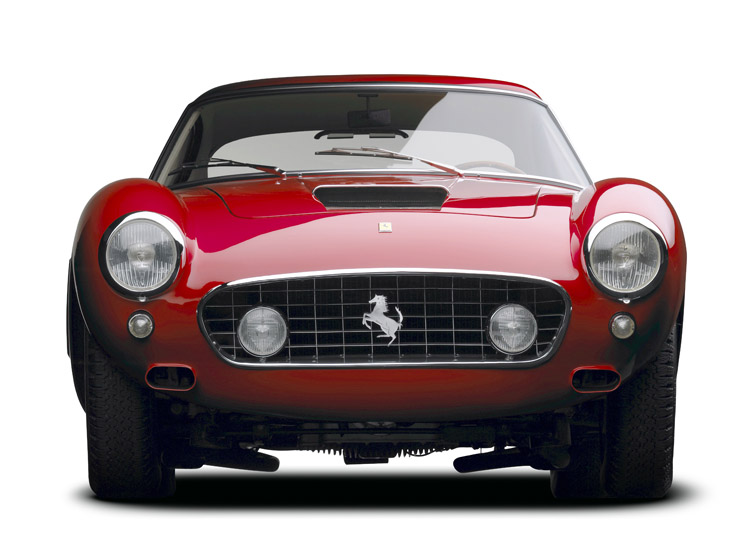
 

Ferrari 250 GT Berlinetta SWB, 1960


Ferrari 250 GT Berlinetta SWB
1960
Collection Ralph Lauren
© Photo Michael Furman


While the name 250 GT appeared in the Maranello catalog in 1955, the 1959 Paris Motor Show presented a short chassis Berlinetta version, with a wheelbase 20 cms shorter than other versions of the line – a thoroughbred equipped for the road, with aluminium coachwork designed by Pinin Farina and made in the Scaglietti workshops in Modena. Compared to the grand tourer version, intended for road use, the racing version was devoid of all luxury interior trimmings and bumpers, but equipped with disk brakes and a 280 CV engine that enabled this flagship model to masterfully dominate the legendary Tour de France automobile for three consecutive seasons (1960-1962) and the GT category of the Le Mans 24 Hours. Its sensual line, unequalled handling and performance (250kph), and list of victories, all combined to make the short chassis 250 GT Berlinetta one of Ferrari’s most popular models. Ralph Lauren’s car was the 31st example to leave the factory out of the 165 produced.


Ferrari 250 GTO, 1962


Ferrari 250 GTO
1962
Collection Ralph Lauren
© Photo Michael Furman


Designed in the utmost secrecy, the 250 GTO is considered by aficionados today to be the quintessential vintage Ferrari model, both technically and aesthetically, embodying one of the most famous and most expensive sports cars of all time. This Grand Tourer, of which only 39 examples were produced, clocked up an impressive list of victories, including the International Championship for GT Manufacturers in 1962, 1963 and 1964, thanks to its V12 300 CV engine situated up front, but also because of the lightness of its aluminium body, enabling it to attain 280 kph flat out! With its Scaglietti coachwork and its long hood, stocky cockpit and truncated rear, it symbolised the Grand Tourer par excellence. Ralph Lauren’s car was the 21st out of 36 Series I GTOs produced, and won many races driven by Pedro and Ricardo Rodriguez, Roger Penske, Augie Pabst and Richie Ginther.


The Arts Décoratifs Museum
107 rue de Rivoli
75001 Paris
Phone: +33 01 44 55 57 50

Open Tuesday to Sunday 11am – 6pm

The Arts Décoratifs Museum website

LIKE ART BLART ON FACEBOOK

Back to top

Exhibition: ‘Looking In: Robert Frank’s The Americans’ at The National Gallery of Art, Washington

Exhibition dates: National Gallery of Art, January 18 – April 26, 2009; San Francisco Museum of Modern Art, May 16 – August 23, 2009; Metropolitan Museum of Art, September 22 – December 27, 2009


Robert Frank (Swiss-American, 1924-2019) 'The Americans' New York: Grove Press 1959 front cover from the exhibition Exhibition: 'Looking In: Robert Frank's The Americans' at The National Gallery of Art, Washington, Jan - April, 2009

Robert Frank (Swiss-American, 1924-2019) 'The Americans' New York: Grove Press 1959 back cover from the exhibition Exhibition: 'Looking In: Robert Frank's The Americans' at The National Gallery of Art, Washington, Jan - April, 2009


Robert Frank (Swiss-American, 1924-2019)
The Americans
New York: Grove Press
1959


One of the seminal photography books of the twentieth century, Robert Frank’s The Americans changed photography forever, changed how America saw itself and became a cult classic. Like Eugene Atget’s positioning of the camera in an earlier generation Frank’s use of camera position is unique; his grainy and contrasty images add to his outsider vision of a bleak America; his sequencing of the images, like the cadences of the greatest music, masterful. One of the easiest things for an artist to do is to create one memorable image, perhaps even a group of 4 or 5 images that ‘hang’ together – but to create a narrative of 83 images that radically alter the landscape of both photography and country is, undoubtedly, a magnificent achievement.

The photographs in the posting appear by number order that they appear in the book.

Dr Marcus Bunyan


Many thankx to the National Gallery of Art for allowing me to publish the photographs in the posting. Please click on the photographs for a larger version of the image.


Robert Frank (Swiss-American, 1924-2019) The Americans 1 'Parade - Hoboken, New Jersey' 1955


Robert Frank (Swiss-American, 1924-2019)
The Americans 1
Parade – Hoboken, New Jersey
1955
Gelatin silver print
Image: 21.3 x 32.4cm (8 3/8 x 12 3/4 in.)
Private collection, San Francisco
Photograph © Robert Frank, from The Americans


Released at the height of the Cold War, The Americans was initially reviled, even decried as anti-American. Yet during the 1960s, many of the issues that Frank had addressed – racism, dissatisfaction with political leaders, skepticism about a rising consumer culture – erupted into the collective consciousness. The book came to be regarded as both prescient and revolutionary and soon was embraced with a cult-like following.

First published in France in 1958 and in the United States in 1959, Robert Frank’s The Americans is widely celebrated as the most important photography book since World War II. Including 83 photographs made largely in 1955 and 1956 while Frank (1924-2019) travelled around the United States, the book looked beneath the surface of American life to reveal a profound sense of alienation, angst, and loneliness. With these prophetic photographs, Frank redefined the icons of America, noting that cars, jukeboxes, gas stations, diners, and even the road itself were telling symbols of contemporary life. Frank’s style – seemingly loose, casual compositions, with often rough, blurred, out-of-focus foregrounds and tilted horizons – was just as controversial and influential as his subject matter. The exhibition celebrates the 50th anniversary of the book’s publication by presenting all 83 photographs from The Americans in the order established by the book, and by providing a detailed examination of the book’s roots in Frank’s earlier work, its construction, and its impact on his later art.

Anonymous text from The National Gallery of Art website [Online] Cited 06/03/2009. No longer available online


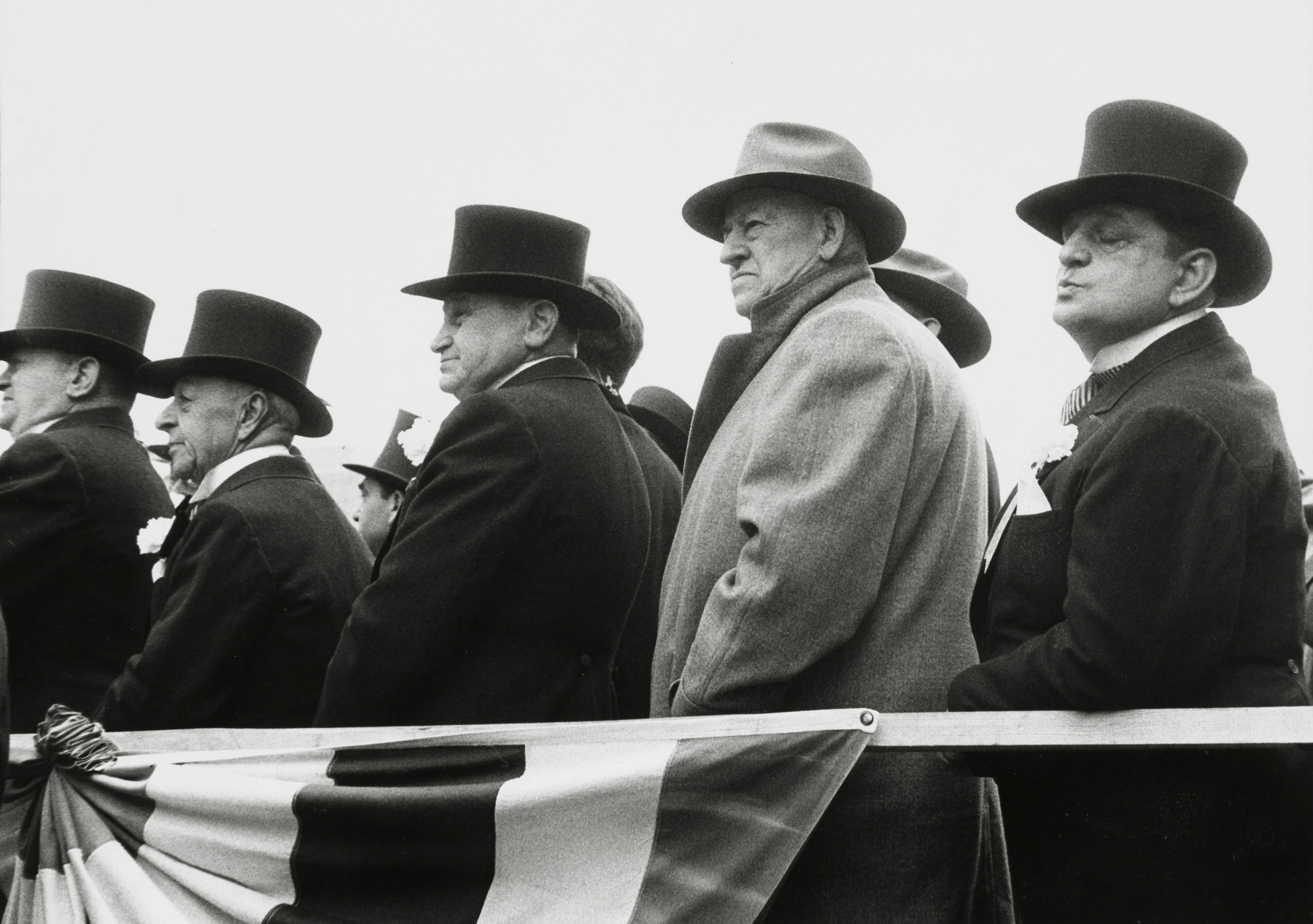
Robert Frank (Swiss-American, 1924-2019) The Americans 2 'City fathers – Hoboken, New Jersey' 1955


Robert Frank (Swiss-American, 1924-2019)
The Americans 2
City fathers – Hoboken, New Jersey
1955
Gelatin silver print
Image: 41.9 x 57.8cm (16 1/2 x 22 3/4 in.)
Susan and Peter MacGill
Photograph © Robert Frank, from The Americans


Robert Frank (Swiss-American, 1924-2019) The Americans 3. 'Political Rally - Chicago' 1956


Robert Frank (Swiss-American, 1924-2019)
The Americans 3
Political Rally – Chicago
1956
Gelatin silver print
Image and sheet: 57.8 x 39.4cm (22 3/4 x 15 1/2 in.)
Susan and Peter MacGill
Photograph © Robert Frank, from The Americans


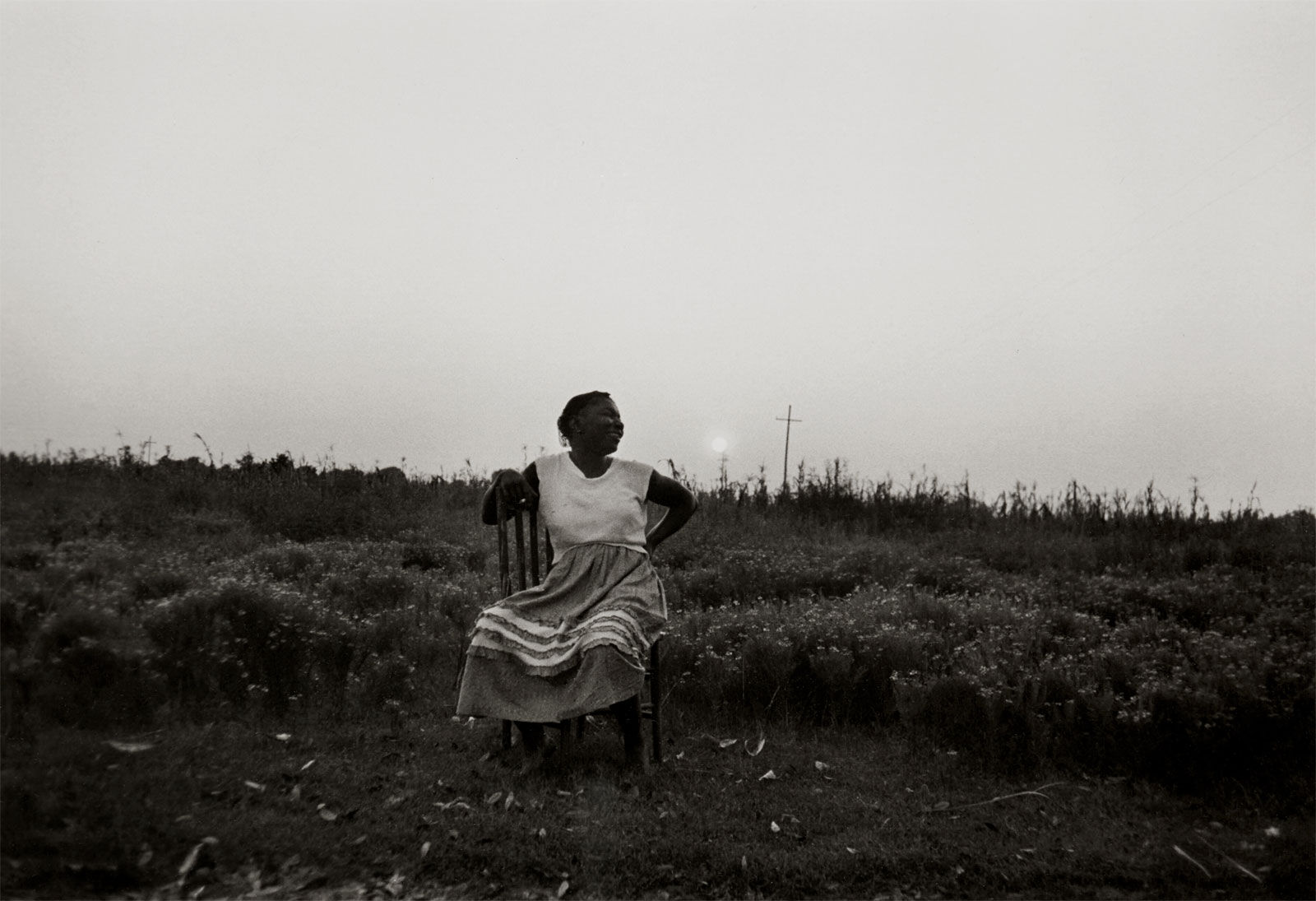
Robert Frank (Swiss-American, 1924-2019) The Americans 4 'Funeral, St. Helena, South Carolina' 1955-1956


Robert Frank (Swiss-American, 1924-2019)
The Americans 4
Funeral – St. Helena, South Carolina
1955
Gelatin silver print
Image and sheet: 39.7 x 58.1cm (15 5/8 x 22 7/8 in.)
Susan and Peter MacGill
Photograph © Robert Frank, from The Americans


“The photos revealed a bleaker, more dislocated view of America than Americans were used to (at least in photography). Frank’s “in-between moments” demonstrated that disequilibrium can seem more revealing, seeming to catch reality off-guard. In doing so the collection also announced to the world that photos with a completely objective reference / referent could be subjective, lyrical, reveal a state-of-mind. Looser framing, more forced or odd juxtapositions, “drive-by” photos and other elements offer a sense of the process that has produced the photos”

Lloyd Spencer on Discussing The Americans in Hardcore Street Photography

I couldn’t have put it better myself!


Robert Frank (Swiss-American, 1924-2019) The Americans 13 'Charleston, South Carolina' 1955


Robert Frank (Swiss-American, 1924-2019)
The Americans 13
Charleston, South Carolina
1955
Gelatin silver print
Image: 41.3 x 59.1cm (16 1/4 x 23 1/4 in.)
Susan and Peter MacGill
Photograph © Robert Frank, from The Americans


Robert Frank (Swiss-American, 1924-2019) The Americans 14 'Ranch Market, Hollywood' 1955-1956


Robert Frank (Swiss-American, 1924-2019)
The Americans 14
Ranch Market – Hollywood
1956
Gelatin silver print
Image: 31.4 x 48.3cm (12 3/8 x 19 in.)
Danielle and David Ganek
Photograph © Robert Frank, from The Americans


Robert Frank (Swiss-American, 1924-2019) The Americans 15 'Butte, Montana' 1956


Robert Frank (Swiss-American, 1924-2019)
The Americans 15
Butte, Montana
1956
Gelatin silver print
Overall: 20 x 30.2cm (7 7/8 x 11 7/8 in.)
The Museum of Modern Art, New York, Acquired through the generosity of the Young family in honour of Robert B. Menschel, 2003
Photograph © Robert Frank, from The Americans


Robert Frank (Swiss-American, 1924-2019) The Americans 18 'Trolley - New Orleans' 1955


Robert Frank (Swiss-American, 1924-2019)
The Americans 18
Trolley – New Orleans
1955
Gelatin silver print
Image: 40.6 x 57.8cm (16 x 22 3/4 in.)
Susan and Peter MacGill
Photograph © Robert Frank, from The Americans


Robert Frank (Swiss-American, 1924-2019) Contact sheets for 'The Americans'


Robert Frank (Swiss-American, 1924-2019)
Contact sheets for The Americans
Photograph © Robert Frank, from The Americans


“Frank’s contact sheets take us back to the moment he made the photographs for The Americans. They show us what he saw as he traveled around The United States and how he responded to it. These sheets are not carefully crafted objects; in his eagerness to see what he had captured, Frank did not bother to order his film strips numerically or even to orientate them all in the same direction.”


Robert Frank (Swiss-American, 1924-2019) Sequencing of 'The Americans' numbers 32-36


Robert Frank (Swiss-American, 1924-2019)
Sequencing of
The Americans numbers 32-36
Photograph © Robert Frank, from The Americans


“Almost halfway through the book Frank created a sequence united by the visual repetition of the car and the suggestion of its movement.”


Robert Frank (Swiss-American, 1924-2019) The Americans 32 'U.S. 91, Leaving Blackfoot, Idaho' 1956


Robert Frank (Swiss-American, 1924-2019)
The Americans 32
U.S. 91, Leaving Blackfoot, Idaho
1956
Gelatin silver print
Image: 28.9 x 42.2cm (11 3/8 x 16 5/8 in.)
Collection of Barbara and Eugene Schwartz
Photograph © Robert Frank, from The Americans


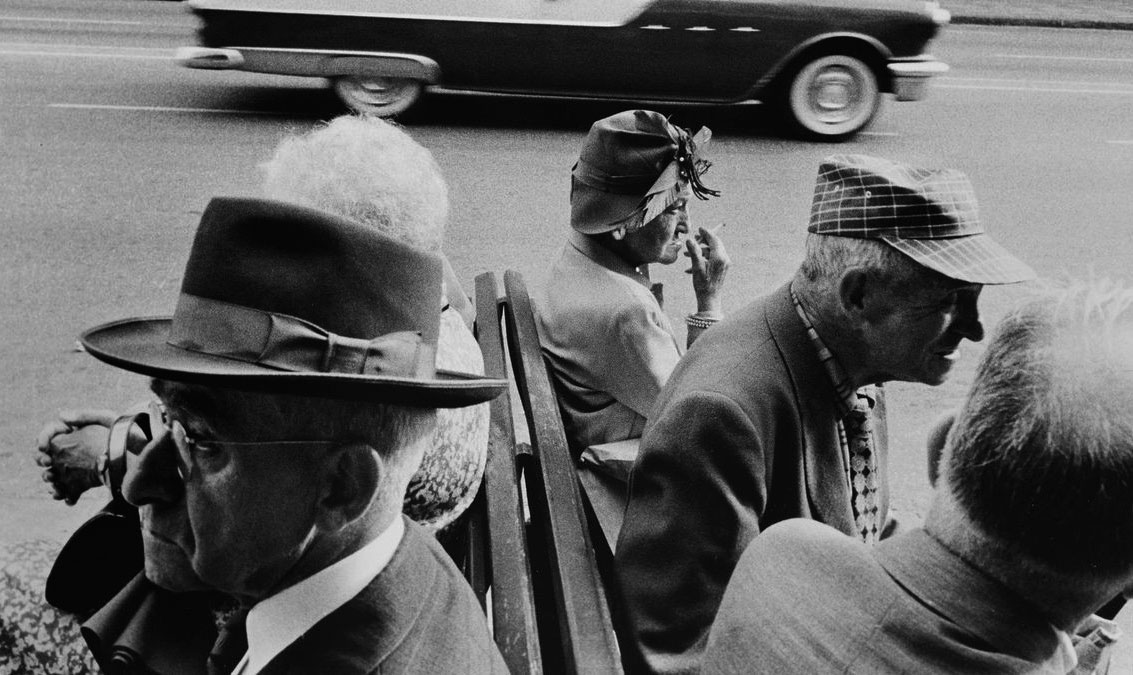
Robert Frank (Swiss-American, 1924-2019) The Americans 33 'St. Petersburg, Florida' 1955


Robert Frank (Swiss-American, 1924-2019)
The Americans 33
St. Petersburg, Florida
1955
Gelatin silver print
Sheet: 22.2 x 33.7cm (8 3/4 x 13 1/4 in.)
Collection of Barbara and Eugene Schwartz
Photograph © Robert Frank, from The Americans


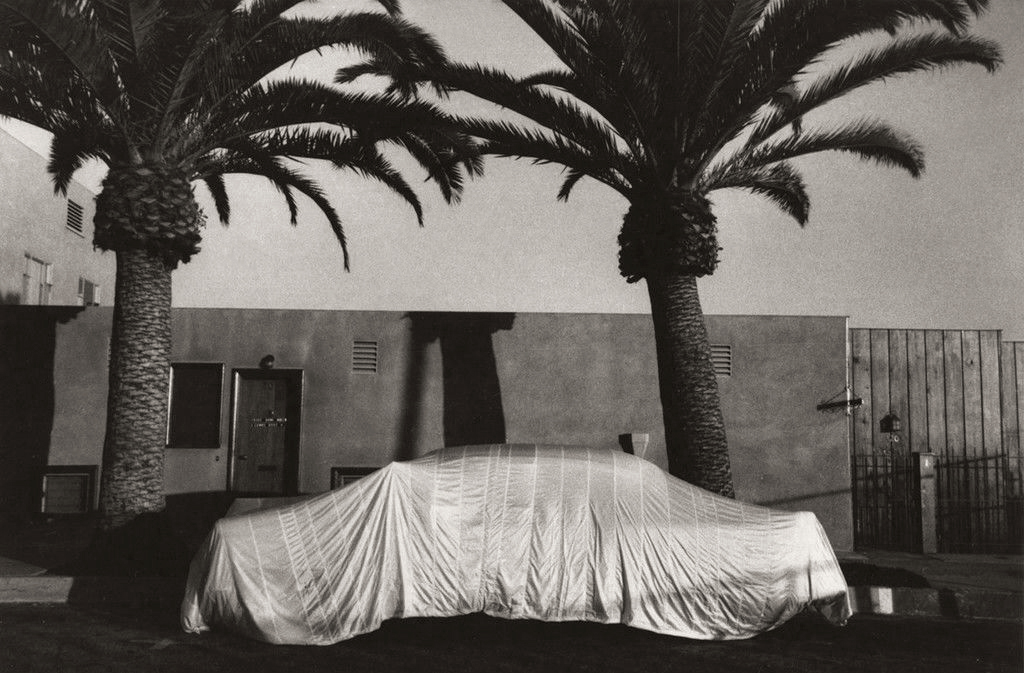
Robert Frank (Swiss-American, 1924-2019) The Americans 34 'Covered Car - Long Beach, California' 1956


Robert Frank (Swiss-American, 1924-2019)
The Americans 34
Covered Car – Long Beach, California
1956
Gelatin silver print
Image: 21.4 x 32.7cm (8 7/16 x 12 7/8 in.)
Lent by The Metropolitan Museum of Art, Gilman Collection, Purchase, Ann Tenenbaum and Thomas H. Lee Gift, 2005
Photograph © Robert Frank, from The Americans


Robert Frank (Swiss-American, 1924-2019) The Americans 35 'Car accident, US 66 between Winslow and Flagstaff, Arizona' 1955-1956


Robert Frank (Swiss-American, 1924-2019)
The Americans 35
Car accident, US 66 between Winslow and Flagstaff, Arizona
1955-1956
Gelatin silver print
Image: 31 x 47.5cm (12 3/16 x 18 11/16 in.)
Philadelphia Museum of Art, Promised gift of Susan and Peter MacGill in honour of Anne d’Harnoncourt
Photograph © Robert Frank, from The Americans


Robert Frank (Swiss-American, 1924-2019) The Americans 36 'U.S. 285, New Mexico' 1955


Robert Frank (Swiss-American, 1924-2019)
The Americans 36
U.S. 285, New Mexico
1955
Gelatin silver print
Image: 33.7 x 21.9cm (13 1/4 x 8 5/8 in.)
Mark Kelman, New York
Photograph © Robert Frank, from The Americans


Robert Frank (Swiss-American, 1924-2019) The Americans 37 'Bar, Detroit' 1955-1956


Robert Frank (Swiss-American, 1924-2019)
The Americans 37
Bar – Detroit
1955
Gelatin silver print
Overall: 39.4 x 57.8cm (15 1/2 x 22 3/4 in.)
Sherry and Alan Koppel
Photograph © Robert Frank, from The Americans


The 50th anniversary of a groundbreaking publication will be celebrated in the nation’s capital with the exhibition Looking In: Robert Frank’s The Americans, premiering January 18 through April 26, 2009, in the National Gallery of Art’s West Building ground floor galleries. In 1955 and 1956, the Swiss-born American photographer Robert Frank (b. 1924) traveled across the United States to photograph, as he wrote, “the kind of civilisation born here and spreading elsewhere.” The result of his journey was The Americans, a book that looked beneath the surface of American life to reveal a culture on the brink of massive social upheaval and one that changed the course of 20th-century photography.

First published in France in 1958 and in the United States in 1959, The Americans remains the single most important book of photographs published since World War II. The exhibition will examine both Frank’s process in creating the photographs and the book by presenting 150 photographs, including all of the images from The Americans, as well as 17 books, 15 manuscripts, and 28 contact sheets. In honour of the exhibition, Frank has created a film and participated in selecting and assembling three large collages. The exhibition will travel to the San Francisco Museum of Modern Art from May 17 through August 23, 2009, and The Metropolitan Museum of Art from September 22 through December 27, 2009.

The Americans is as powerful and provocative today as it was 50 years ago,” said Earl A. Powell III, director, National Gallery of Art. “We are immensely grateful to Robert Frank and his wife, June Leaf, for their enthusiastic participation and assistance in all aspects of this exhibition and its equally ambitious catalogue. We also wish to thank Robert Frank for his donation of archival material related to The Americans, in addition to gifts of his photographs and other exhibition prints to the National Gallery of Art in 1990, 1994, and 1996, all of which formed the foundation of the project.”

Press release from the National Gallery of Art


Robert Frank (Swiss-Americans, 1924-2019) The Americans 44 'Elevator - Miami Beach' 1955


Robert Frank (Swiss-Americans, 1924-2019)
The Americans 44
Elevator – Miami Beach
1955
Gelatin silver print
Image: 31.4 x 47.8cm (12 3/8 x 18 13/16 in.)
Philadelphia Museum of Art, Purchased with funds contributed by Dorothy Norman, 1969
Photograph © Robert Frank, from The Americans


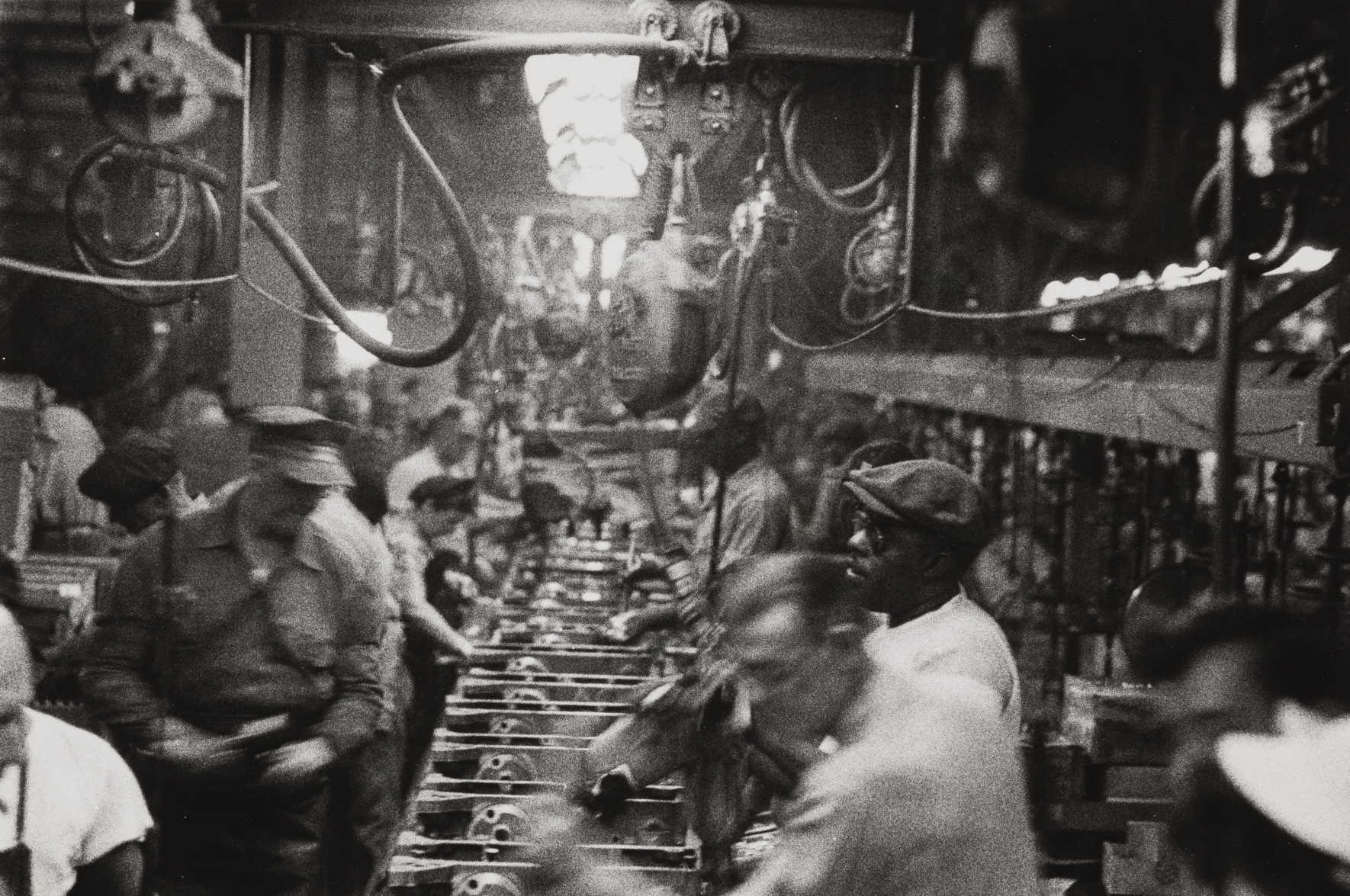
Robert Frank (Swiss-American, 1924-2019) The Americans 50 'Assembly line, Detroit' 1955-1956


Robert Frank (Swiss-American, 1924-2019)
The Americans 50
Assembly line – Detroit
1955
Gelatin silver print
21.4 x 32.1cm (8 7/16 x 12 5/8 in.)
The Museum of Modern Art, New York, Purchase, 1959
Photograph © Robert Frank, from The Americans


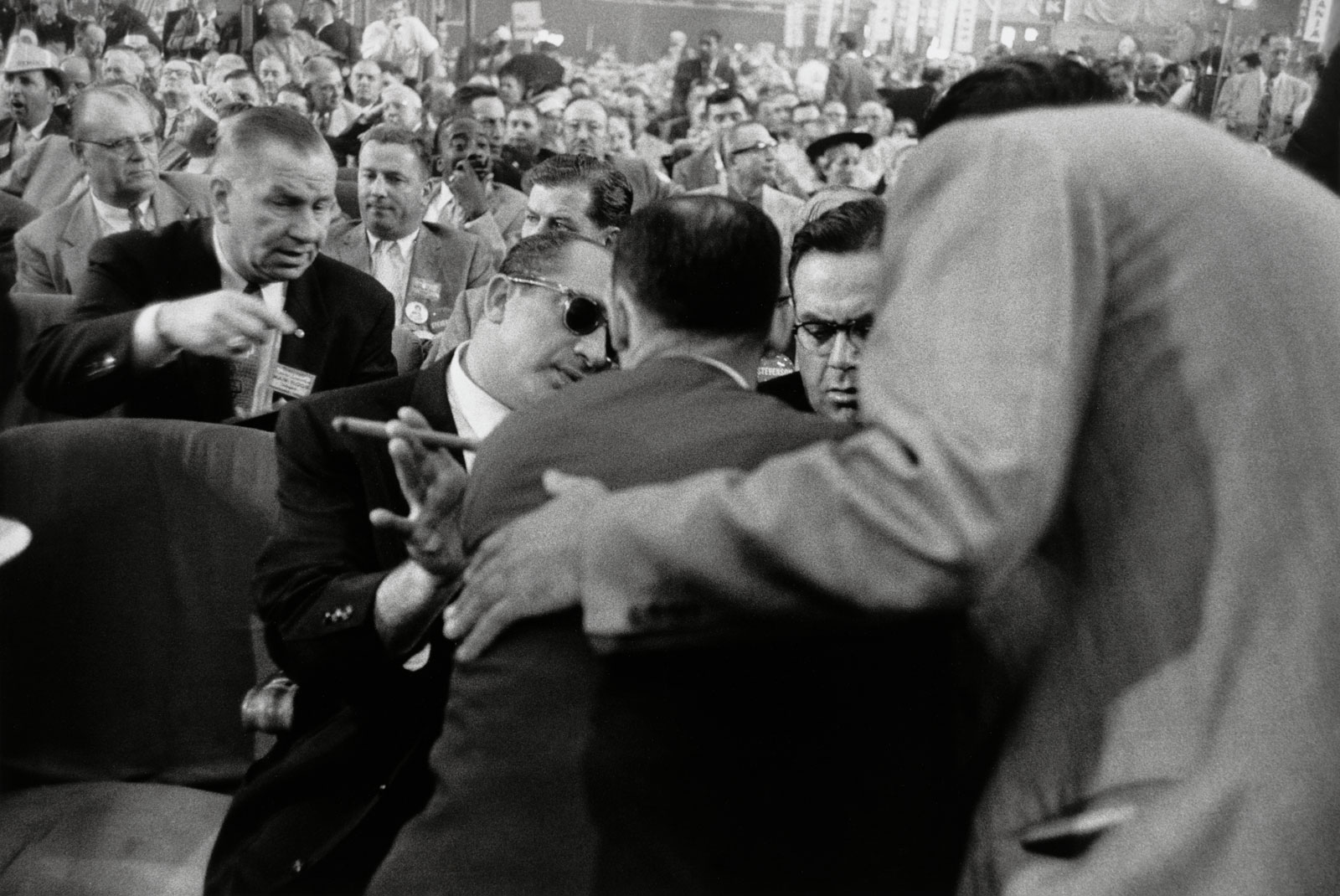
Robert Frank (Swiss-American, 1924-2019) The Americans 51 'Convention hall, Chicago' 1956


Robert Frank (Swiss-American, 1924-2019)
The Americans 51
Convention hall – Chicago
1956
Gelatin silver print
Image: 22.5 x 34.1cm (8 7/8 x 13 7/16 in.)
Addison Gallery of American Art, Phillips Academy, Andover, Museum Purchase
Photograph © Robert Frank, from The Americans


Robert Frank (Swiss-American, 1924-2019) The Americans 55 'Beaufort, South Carolina' 1955-1956


Robert Frank (Swiss-American, 1924-2019)
The Americans 55
Beaufort, South Carolina
1955
Gelatin silver print
Image and sheet: 31.1 x 47.6cm (12 1/4 x 18 3/4 in.)
Private collection
Photograph © Robert Frank, from The Americans


Robert Frank (Swiss-American, 1924-2019) The Americans 58 'Political rally – Chicago' 1956


Robert Frank (Swiss-American, 1924-2019)
The Americans 58
Political rally – Chicago
1956
Gelatin silver print
Image: 59.1 x 36.5cm (23 1/4 x 14 3/8 in.)
Betsy Karel
Photograph © Robert Frank, from The Americans


Robert Frank (Swiss-American, 1924-2019) The Americans 70 'Coffee shop, railway station – Indianapolis' 1956


Robert Frank (Swiss-American, 1924-2019)
The Americans 70
Coffee shop, railway station – Indianapolis
1956
Gelatin silver print
Overall (image): 22.9 x 34.6cm (9 x 13 5/8 in.)
The Museum of Modern Art, New York, Acquired through the generosity of Carol and David Appel, 2003
Photograph © Robert Frank, from The Americans


Robert Frank (Swiss, 1924-2019) The Americans 71 'Chattanooga, Tennessee' 1955


Robert Frank (Swiss, 1924-2019)
The Americans 71
Chattanooga, Tennessee
1955
Gelatin silver print
Image: 20.8 x 29.5cm (8 3/16 x 11 5/8 in.)
Private collection
Photograph © Robert Frank, from The Americans


“It’s hard to stress how different The Americans was. Over the course of those 83 pictures – shot from Detroit to San Francisco to Chattanooga, Tennessee – Frank captured the country in images that were intentionally unglamorous. On a technical level, he brazenly tossed out an adherence to traditional ideas of composition, framing, focus, and exposure.”

Sarah Greenough, Senior Curator of Photography at the National Gallery of Art in Washington


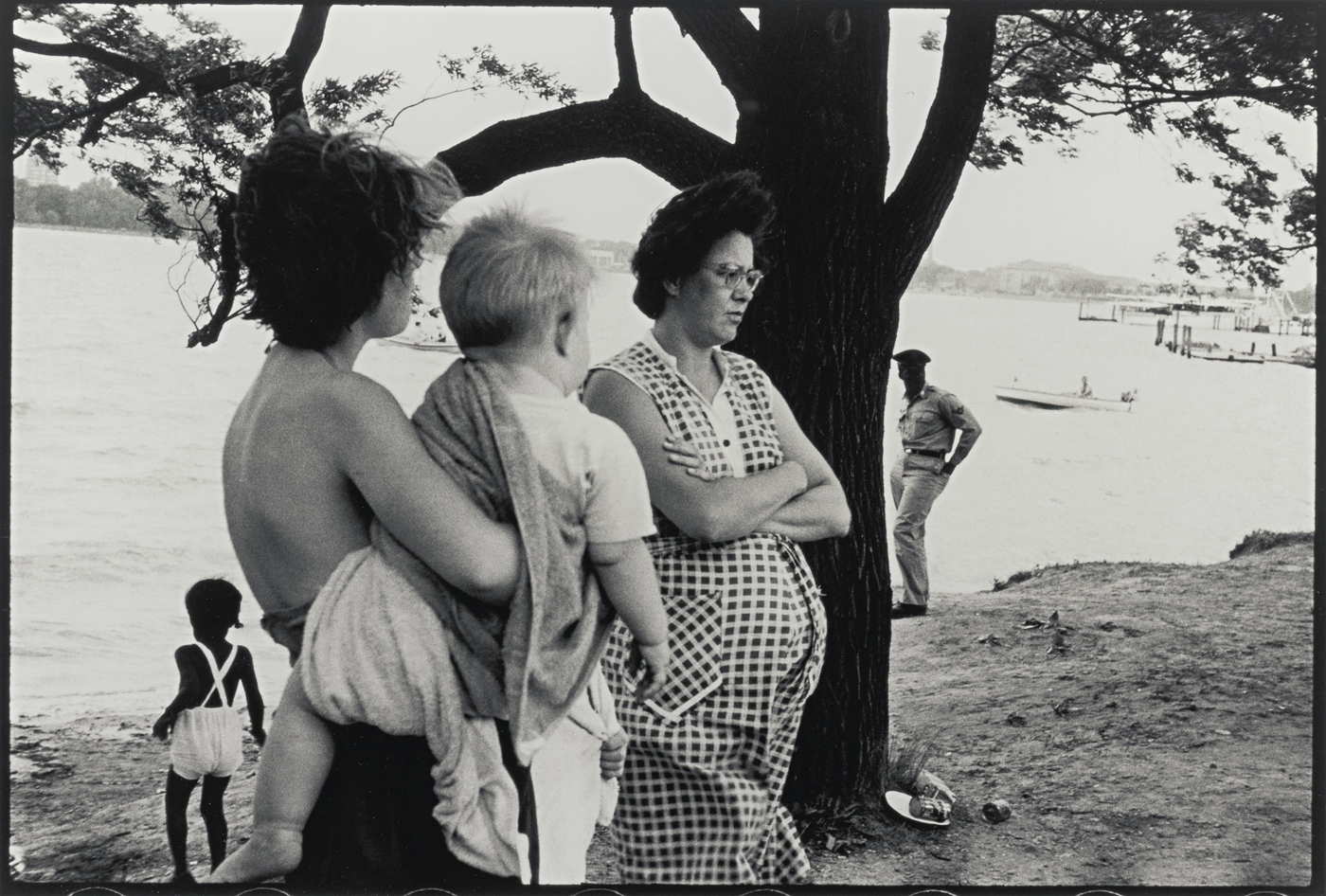
Robert Frank (Swiss-American, 1924-2019) The Americans 73 'Detroit - Belle Isle' 1955


Robert Frank (Swiss-American, 1924-2019)
The Americans 73
Belle Isle – Detroit
1955
Gelatin silver print
Sheet: 29.2 x 42.5cm (11 1/2 x 16 3/4 in.)
Collection of Barbara and Eugene Schwartz
Photograph © Robert Frank, from The Americans


Robert Frank (Swiss-American, 1924-2019) The Americans 81 'City Hall – Reno, Nevada' 1956


Robert Frank (Swiss-American, 1924-2019)
The Americans 81
City Hall – Reno, Nevada
1956
Gelatin silver print
Image: 20.3 x 32.4cm (8 x 12 3/4 in.)
Private collection
Photograph © Robert Frank, from The Americans


Robert Frank (Swiss-American, 1924-2019) The Americans 83 'US 90 on route to Del Rio, Texas' 1955-1956


Robert Frank (Swiss-American, 1924-2019)
The Americans 83
U.S. 90, en route to Del Rio, Texas
1955
Gelatin silver print
Image (and board): 47.6 x 31.1cm (18 3/4 x 12 1/4 in.)
Private collection, courtesy Hamiltons Gallery, London
Photograph © Robert Frank, from The Americans


National Gallery of Art
National Mall between 3rd and 7th Streets
Constitution Avenue NW, Washington

Opening hours:
Daily 10.00am – 5.00pm

National Gallery of Art website

LIKE ART BLART ON FACEBOOK

Back to top