Review: ‘Sweet Complicity’ by eX de Medici at Karen Woodbury Gallery, Richmond, Melbourne

Exhibition dates: 30th September – 24th October, 2009


eX de Medici (Australia, b. 1959) 'Tooth and claw' 2009 from the exhibition 'Sweet Complicity' by eX de Medici at Karen Woodbury Gallery, Richmond, Melbourne, Sept - Oct, 2009


eX de Medici (Australia, b. 1959)
Tooth and claw
2009
Pen, ink and mica on archival paper
114.0 x 521.0cm


Is it sinful to say that an Armalite rifle can be voluptuously seductive? Not in the hands of artist eX de Medici!

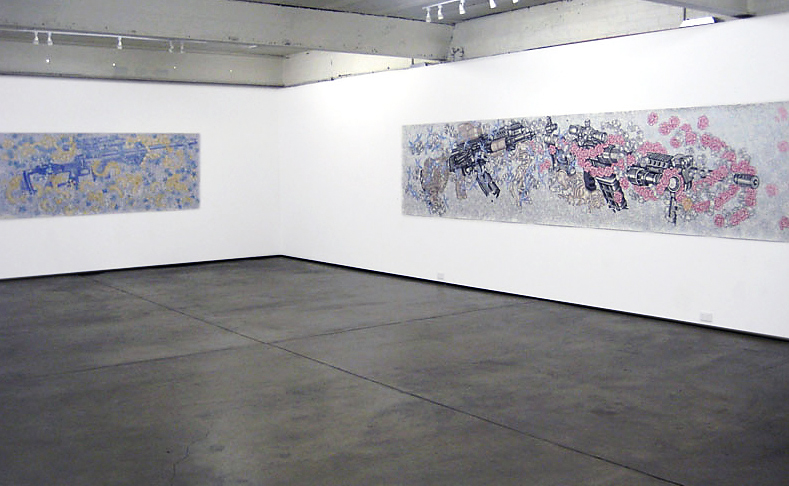
Taking a variety of contemporary military high-powered weapons (Armalite AR30 Tactical .308 Sniper, Modified AK 47, Blackwater AR15, Patriot Ordinance P45 .223 for example) eX de Medici’s armaments have a steely presence softened and consumed by multitudinous garlands of traditional tattoo ‘flash’ iconography (flowers, skulls, bows, stars, Chinese dragons, waves and swallows repeated in Escher-like patterns) and contorted skeletons. Using individual colour palettes for each of the three large pen, ink and mica on paper works in the exhibition, eX subverts the masculine symbology of gun culture and decomposes it within an ornamentation of deathly desire – new compositions in the dance of death: ‘U hurt me Baby, U Fkd me up gd, the hole tht u made (cross) me Ded …’

In other less skilled artist’s hands the subject matter could become cliched and trite but here de Medici balances the disparate elements in her compositions and brings the subject matter alive – sinuously jumping off the paper, entwining the viewer in their delicious ironies, all of us sweetly complicit in the terror war (send more meat, send more meat!), fighting tooth and nail to keep urban realities at arm’s length. The dark desires that these works contain possess an aesthetic beauty that swallows us up so that we, too, become ‘Barbarians All’. Highly recommended!

Dr Marcus Bunyan


Many thankx to Karen Woodbury Gallery for allowing me to publish the art work in the posting. Please click on some of the photographs for a larger version of the image.


eX de Medici (Australia, b. 1959) 'Tooth and Claw' 2009 (detail) from the exhibition 'Sweet Complicity' by eX de Medici at Karen Woodbury Gallery, Richmond, Melbourne, Sept - Oct, 2009


eX de Medici (Australia, b. 1959)
Tooth and claw (detail)
2009
Pen, ink and mica on archival paper
114.0 x 521.0cm


eX de Medici (Australia, b. 1959) 'Tooth and claw' 2009 (detail)

eX de Medici (Australia, b. 1959) 'Tooth and claw' 2009 (detail)


eX de Medici (Australia, b. 1959)
Tooth and claw (details)
2009
Pen, ink and mica on archival paper
114.0 x 521.0cm


Installation view of 'Sweet Complicity' by eX de Medici at Karen Woodbury Gallery, Melbourne showing at left, 'Send more meat' (2009) and at right, 'Tooth and claw' (2009)


Installation view of Sweet Complicity by eX de Medici at Karen Woodbury Gallery, Melbourne showing at left, Send more meat (2009) and at right, Tooth and claw (2009)
Photo: Marcus Bunyan


eX de Medici (Australia, b. 1959) 'Send more meat' 2009


eX de Medici (Australia, b. 1959)
Send more meat
2009
Pen, ink and mica on archival paper


eX de Medici (Australia, b. 1959) 'Send more meat' 2009 (detail)


eX de Medici (Australia, b. 1959)
Send more meat (detail)
2009
Pen, ink and mica on archival paper


Sweet complicity is eX de Medici’s first and much anticipated exhibition at Karen Woodbury Gallery. The exhibition will comprise of three monumental pen, ink and mica works on archival paper. These works examine recurring themes in her practice such as power, war, death and violence via a decorative feminine veneer and aesthetic.

The recurrent use of symbolism in the form of weapons, skulls and garlands in her work re-appear with the addition of Chinese imagery (Imperial golden dragons, China’s five-pointed star, and the use of chrysanthemums). These potent works display a latent interest in scientific illustration and allude to de Medici’s characteristic stylised tattoo motifs that stems from her work as a tattooist. The almost obsessive repetition of pattern and immense detailing display eX’s dedication to her practice through the strong mental and physical commitment required to complete such awe-inspiring artworks that seduce the viewer.

There is an unmistaken polemic tone in de Medici’s practice that cannot be ignored. Different cultures, identities, actions and consequences are represented and centred on objects of warfare, allowing for disguised and layered political and moral statements.

de Medici lives and produces much of her work in the nation’s capital Canberra. Streams of influences inform the work; Canberra’s political and physical agendas, research resourced from various national institutions such as the CSIRO Entomological and Taxonomy Division, the National Library of Australia and the Australian War Memorial. She has recently returned from the Solomon Islands where she was chosen as an official war artist.

Text from the Karen Woodbury Gallery website [Online] Cited 05/10/2009. No longer available online


The defining theme in eX de Medici’s paintings is a consistent interrogation of power. The notion of ‘the personal’ doesn’t interest the artist. Instead she investigates authority and dissent through paintings of guns, surveillance devices and gas masks.


eX de Medici (Australia, b. 1959) 'American Sex/Funky Beat Machine' 2009


eX de Medici (Australia, b. 1959)
American Sex/Funky Beat Machine
2009
Pen, ink and mica on archival paper
Diptych, 114.0 x 249.0cm


eX de Medici (Australia, b. 1959) 'American Sex/Funky Beat Machine' 2009 (detail)


eX de Medici (Australia, b. 1959)
American Sex/Funky Beat Machine (detail)
2009
Pen, ink and mica on archival paper
Diptych, 114.0 x 249.0cm


Karen Woodbury Gallery

This gallery is now closed.
LIKE ART BLART ON FACEBOOK

Back to top

Notes from a Conversation with Mari Funaki. Exhibition: ‘Mari Funaki, Works 1992-2009’ at Art Gallery of Western Australia, Perth

Exhibition dates: 27th June – 18th October, 2009


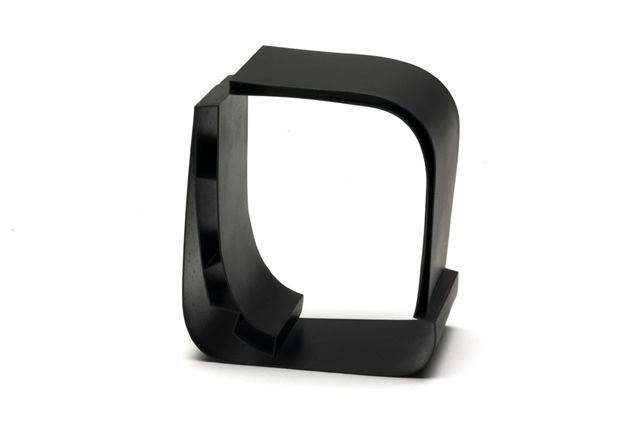
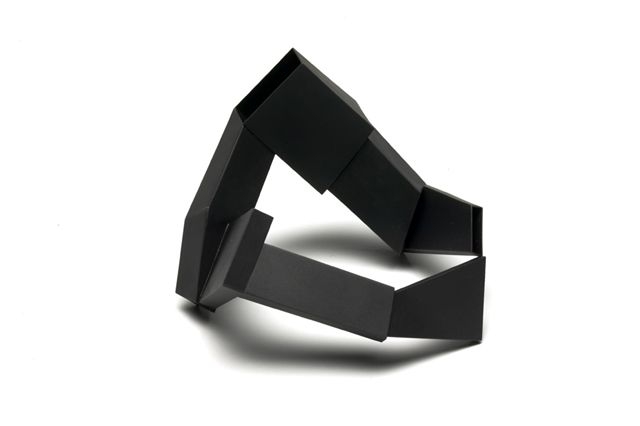
Mari Funaki (Australian, 1950-2010) 'Bracelet 1' from ‘Space between’ heat-coloured mild steel 2005-2006 from the exhibition 'Mari Funaki, Works 1992-2009' at Art Gallery of Western Australia, Perth. June - Oct, 2009


Mari Funaki (Australian, 1950-2010)
Bracelet 1 from Space between
2005-2006
Heat-coloured mild steel


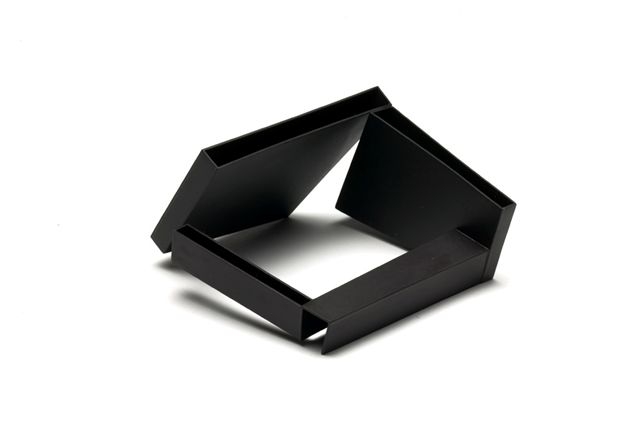
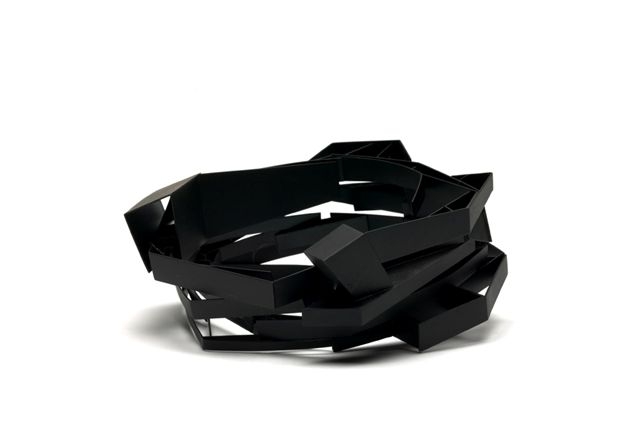
Mari Funaki (Australian, 1950-2010) 'Bracelet 2' from ‘Space between’ heat-coloured mild steel 2005-2006 from the exhibition 'Mari Funaki, Works 1992-2009' at Art Gallery of Western Australia, Perth. June - Oct, 2009


Mari Funaki (Australian, 1950-2010)
Bracelet 2 from Space between
2005-2006
Heat-coloured mild steel


Mari Funaki is one of Australia’s leading jewellers. This exhibition celebrates her considerable achievements between 1992 and the present day. Her first major show in a state gallery, it includes nearly fifty works and will be the first time Perth audiences have seen her work in such depth. Many of these are new works produced especially for this show.

The exhibition will focus on rings, containers and bracelets. These forms have been the core of her practice, the foundation of her intricate material experimentations. Her sheer intensity of focus has seen her hone these forms into objects of extreme power and beauty. Funaki’s is no simple beauty, however. It is sharp, complicated. There is always a sense of danger in her work, as the spindly legs of her insect-like containers support unlikely, unwieldy torsos, and as her rings and bracelets cultivate miniature monoliths that play with scale and weight in fascinating ways.

This exhibition will frame these unique objects in such a way as to acknowledge Funaki’s ability to work with space and matter to form entrancing works that adorn the imagination in the same they adorn the body.

Text from the Art Gallery of Western Australia website [Online] Cited 10/08/2009. No longer available online


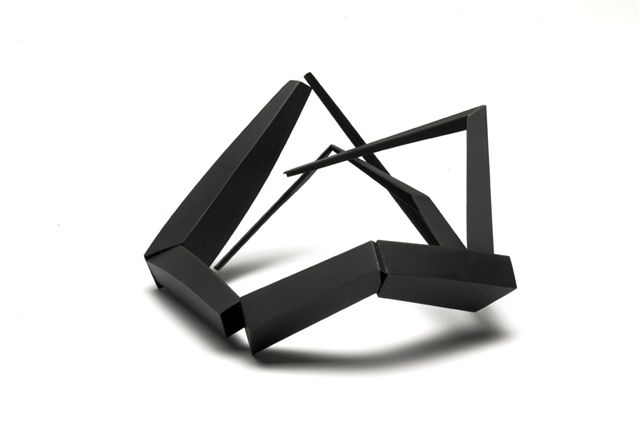
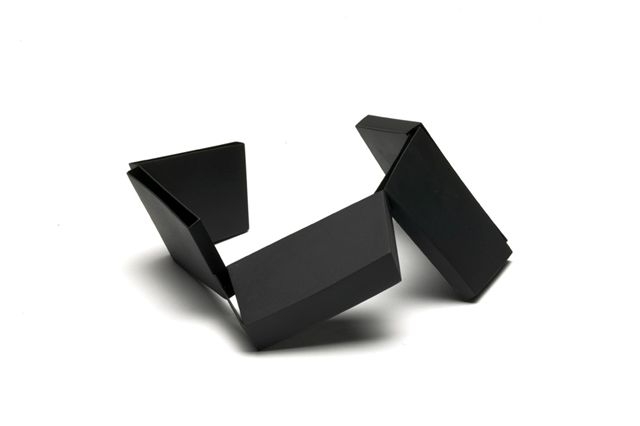
Mari Funaki (Australian, 1950-2010) 'Bracelet 3' from ‘Space between’ heat-coloured mild steel 2005-2006


Mari Funaki (Australian, 1950-2010)
Bracelet 3 from Space between
2005-2006
Heat-coloured mild steel


Mari Funaki (Australian, 1950-2010) 'Bracelet 4' from ‘Space between’ heat-coloured mild steel 2005-2006


Mari Funaki (Australian, 1950-2010)
Bracelet 4 from Space between
2005-2006
Heat-coloured mild steel


Notes from a Conversation with Mari Funaki, July 2006

Mari Funaki’s initial response comes from the environment – the response is part random, part constructed idea.

Funaki likes the ‘animated’ response from the viewer – allowing them to make their own associations with the work and their own meaning. The making of the work doesn’t emerge out of nothing but through the development of ideas over a long period of time.

Mari starts with a flat drawing – this approach comes from an Eastern perspective in the history of art making i.e. screens, woodcuts and scrolls. Initially when starting with the idea Mari is mentally thinking in two dimensions – then drawing out onto paper in two dimensions the ideas.

When actually making the work Mari then starts working and thinking in three dimensions – starting with a base piece of metal and working physically and intuitively around the object, to form a construction that evidences her feelings about what she wants to create. She likes the aesthetic beauty but uneasy aspect of a dead insect for example (like the Louise Bourgeois Maman spider outside the Guggenheim in Bilbao).

Now collaborating with architect Nonda Kotsalidis, Mari is working to produce her sculptural objects on a larger scale, up to 6 metres high. She needs the objects to have an emotional and physical impact on the viewer – both beautiful and threatening at one and the same time. How will her objects translate to a larger scale? Very well I think.

Funaki likes the physical distortion of space – and she likes telling a story to the viewer. She is working on a building where the facade is really strongly geometric and then she is embedding an emotion into the front of the building – constructing a narrative – constructing an emotional response with the viewer and establishing a relationship with the building. Here she is working from photographs of the space, her own recognition and remembrance of that space. She is having to work physically in 3D from the beginning for the first time, but still uses drawings to sketch out her ideas.

Several of Funaki’s pieces in the Cecily and Colin Rigg Contemporary Design Award (2006) at the NGV Federation Square were inspired by the work of Bernd and Hilla Becher. Their photographs of factories and gasworks, specifically the facades of such buildings (see image below), were the jumping off point for the development of the objects (the bracelets). Funaki takes the front of these buildings, a 3D structure ‘in reality’ but pictorially imaged on a 2D plane, and then twists and distorts their structure back into a 3D environment. The facades move up and around, as though a body is twisting around its own axis, pirouetting around an invisible central spine.

Each piece is created and then the next one is created in relation to the previous, or to each other. Each individual piece has its own character and relation to each other. They are never variations of the same piece with small differences – each is a separate but fully (in)formed entity.

Dr Marcus Bunyan


Bernd and Hiller Becher (German, 1931-2007 and 1934-2015) 'Water Towers' 1980


Bernd and Hiller Becher (German, 1931-2007 and 1934-2015)
Water Towers
1980
Gelatin silver prints


“Black. Sharp, shifting contours. Familiar and alien. Confident, expressive and agile, it is easy to take the existence of these works for granted – and it is hard enough to trace in one’s mind the physical evolution back through heat colouring, sandblasting, soldering, assembling and cutting, to unremarkable, thin sheets of mild steel – let alone comprehend their conception and resolution.

They inhabit space in a way that is difficult to describe – the edge between each object and the space that encloses it is shockingly sudden.

How can something human-made be so insanely artificial and natural at the same time? It must be no accident that I described them as articulate – ambiguous and wide ranging in the breadth of associations and allusions, they can tell you everything and nothing at the same time.”

Sally Marsland, 2006

Text from the Gallery Funaki website [Online] Cited 10/08/2009 no longer available online


Mari Funaki (Australian, 1950-2010) 'Bracelet 5' from ‘Space between’ heat-coloured mild steel 2005-2006


Mari Funaki (Australian, 1950-2010)
Bracelet 5 from Space between
2005-2006
Heat-coloured mild steel


Mari Funaki (Australian, 1950-2010) 'Bracelet 6' from ‘Space between’ heat-coloured mild steel 2005-2006


Mari Funaki (Australian, 1950-2010)
Bracelet 6 from Space between
2005-2006
Heat-coloured mild steel


Art Gallery of Western Australia
Perth Cultural Centre
Perth WA 6000

Opening hours:
Wednesday – Monday 10am – 5pm
Closed Tuesdays.

Art Gallery of Western Australia website

Gallery Funaki website

LIKE ART BLART ON FACEBOOK

Back to top