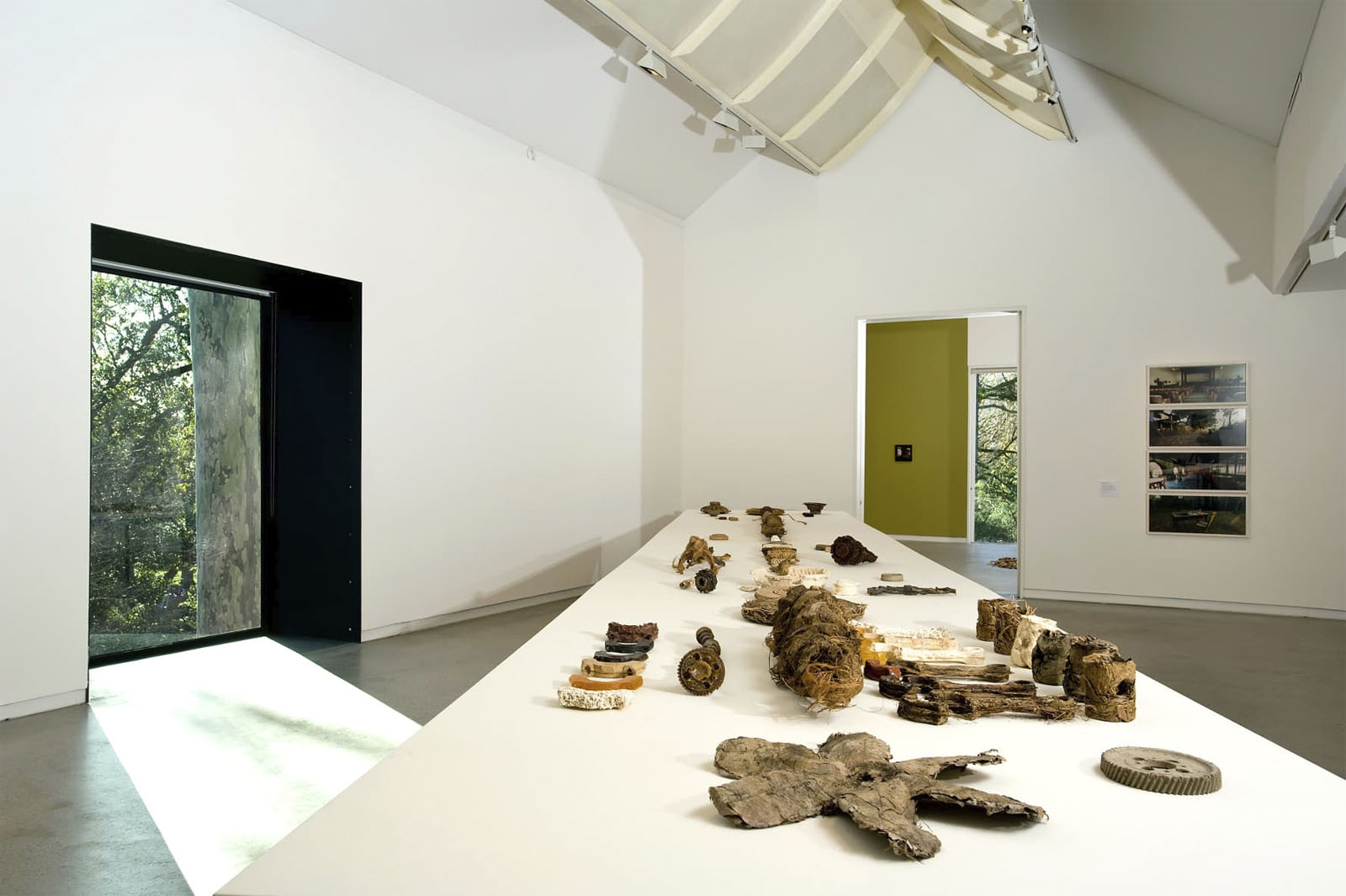
Exhibition: ‘Political Acts: Pioneers of Performance Art in Southeast Asia’ at the Arts Centre Melbourne

Exhibition dates: 11th February – 21st May 2017

Curator: Dr Steven Tonkin
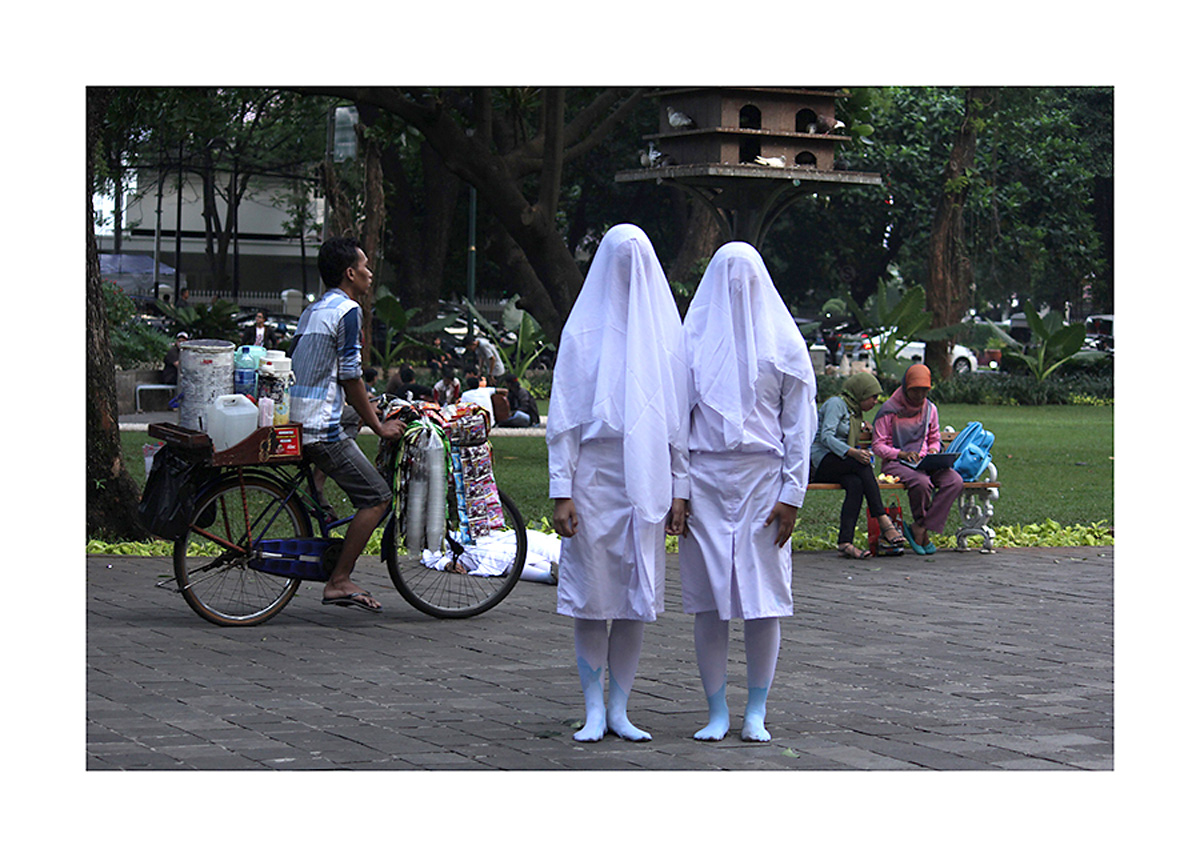
 

Melati SuryodarmoĀ (Surakarta, Central Java, Indonesia, b. 1969) 'Sweet Dreams Sweet' 2013 from the exhibition 'Political Acts: Pioneers of Performance Art in Southeast Asia' at the Arts Centre Melbourne, Feb - May, 2017


Melati Suryodarmo (Surakarta, Central Java, Indonesia, b. 1969)
Sweet Dreams Sweet
2013
Courtesy the artist


Just a quick comment on this exhibition as I’m not feeling very well with my ongoing hand issues.

This is one of the best exhibitions I have seen this year in Melbourne.

All of the works, whether video or photographic, are conceptually engaging, intellectually stimulating and visually powerful. I spent a couple of hours over two visits soaking in the narratives and mise-en-scĆØne of every performance. I was totally immersed in the stories the artists were telling. As with all good art, the works engage the viewer and challenge our point of view in the most profound and complex ways.

While the works may be “political” “acts” the performances act on the viewer at a deeper existential level: what are we doing to the world, our only planet, and the people that live on it. What is the cost of rampant capitalism and consumerism in social, political and environmental terms. Every single work in this exhibition is grounded in these concerns. Unlike a lot of contemporary art which is all about surface and as deep as a peanut, this conceptual art is based on the fundamental building blocks of humanity – our connection to earth and to one another – often expressed through aesthetically beautiful images manifested in the physical body.

Favourites are the mesmerising 12-hour performance of Melati Suryodarmo I’m a Ghost in My Own House (2012) where the artist’s “methodical grinding of charcoal briquettes to dust can be seen as a metaphor for the crushing of the human spirit by the pressures of life”; the powerful dancing and mechanical digger in Khvay Samnang’s Where is my Land? (2014); and the beautiful face pictures in Moe Satt’s F ‘n’ F (Face and Fingers) (2009). I could watch the latter over and over again, so archetypal and elemental does the androgynous face of the artist become.

But really, every piece in this exhibition is worthy of contemplation. Not to be missed.

Dr Marcus Bunyan


Please click on the photographs for a larger version of the image.


Performance art is one of the driving forces in contemporary art across Southeast Asia. It is an art form that acknowledges the cultural traditions of performance within the region, while also providing avant-garde artists with a creative means to critically explore social, political and environmental issues.

The exhibition Political Acts will present a selection of artists’ films, photographs and installations by some of the innovative pioneers of performance art in Southeast Asia.

Artists represented are Dadang Christanto (Indonesia/Australia), Lee Wen (Singapore), Liew Teck Leong (Malaysia), Khvay Samnang (Cambodia), Moe Satt (Myanmar), Melati Suryodarmo (Indonesia) and Tran Luong (Vietnam).


Melati Suryodarmo (Born 1969, Surakarta, Central Java, Indonesia)
I’m a Ghost in My Own House (extract)
2012
Single channel video installation
Duration: 30.30 mins

12-hour performance at Lawangwangi Foundation, Bandung, Indonesia, in 2012


Melati Suryodarmo‘s practice encompasses live art performances which are then presented through films, photography and installations. A film of her renowned 12-hour durational work of I’m a Ghost in My Own House (2012), is shown in this exhibition. In this work the artist’s methodical grinding of charcoal briquettes to dust can be seen as a metaphor for the crushing of the human spirit by the pressures of life.

The artist says that “talking about politics, society or psychology is meaningless unless it can be manifested in the physical body.” This is exemplified by Sweet Dreams Sweet, a group performance choreographed by Suryodarmo in Jakarta in 2013. It involved a group of 30 young female performers, all identically dressed to conceal their individuality. This work questions the impact of the political and cultural hegemony in Indonesian society.
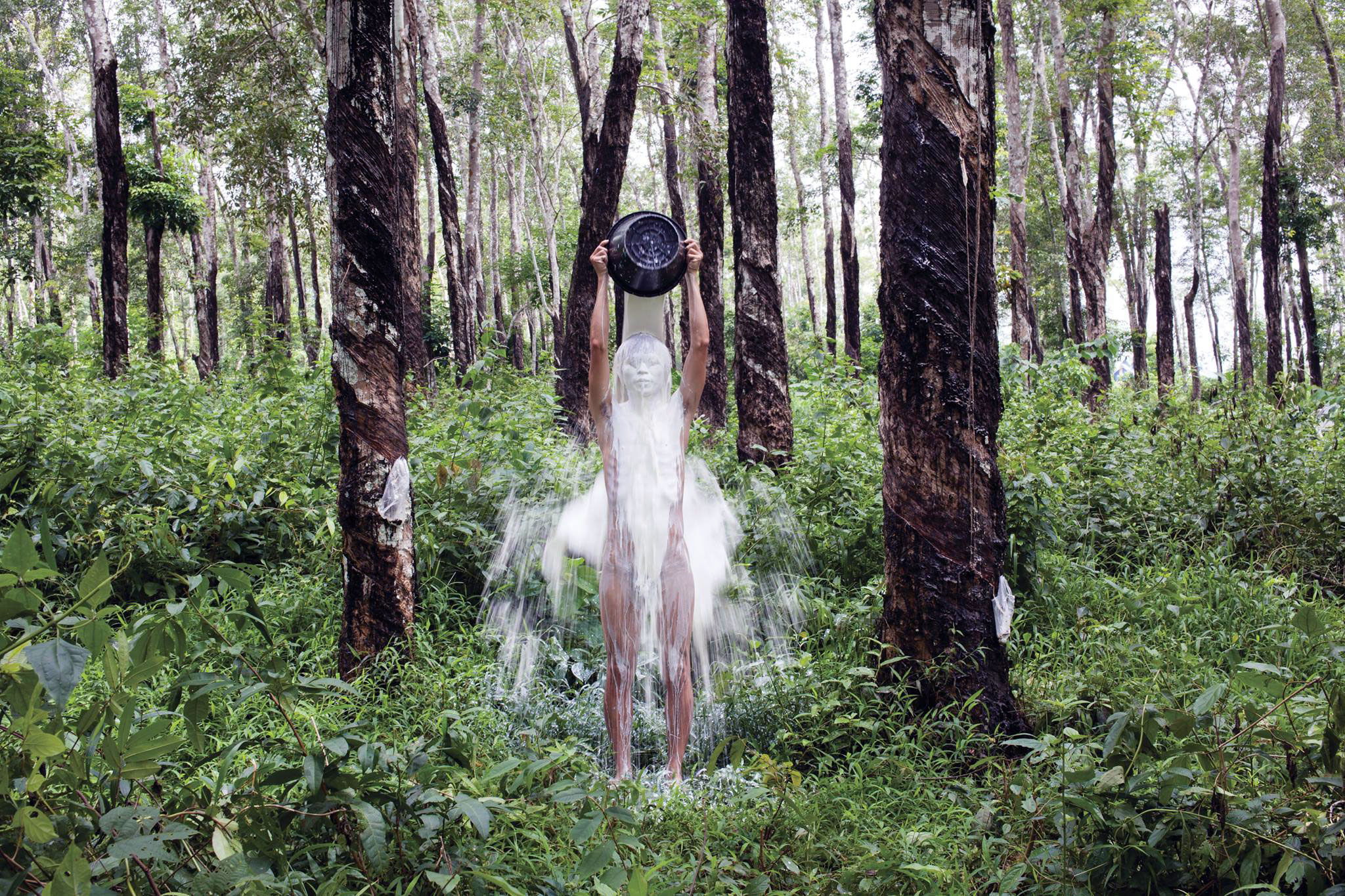
 

Khvay SamnangĀ (Cambodian, b. 1982) 'Rubber Man #3' 2014 from the exhibition 'Political Acts: Pioneers of Performance Art in Southeast Asia' at the Arts Centre Melbourne, Feb - May, 2017


Khvay Samnang (Cambodian, b. 1982)
Rubber Man #3
2014
Courtesy the artist and SA SA BASSAC, Phnom Penh


Since 2011 Khvay Samnang has used sand as a material for social and political commentary. In Where is my Land? (2014) he critiques the unstoppable momentum of urban development around Phnom Penh, which has resulted in the infilling of traditional lakes and the forced removal of local residents.

In his recent and widely celebrated Rubber Man series from 2014, Khvay poured pristine white rubber over his naked and partially obscured body. He draws attention to the devastating environmental impact of large-scale, foreign-owned rubber plantations on the once remote and previously pristine rainforests of northeast Cambodia.


Khvay Samnang (Cambodian, b. 1982)
Where is my Land? (extract)
2014
Single channel video installation
Duration: 13.30 mins
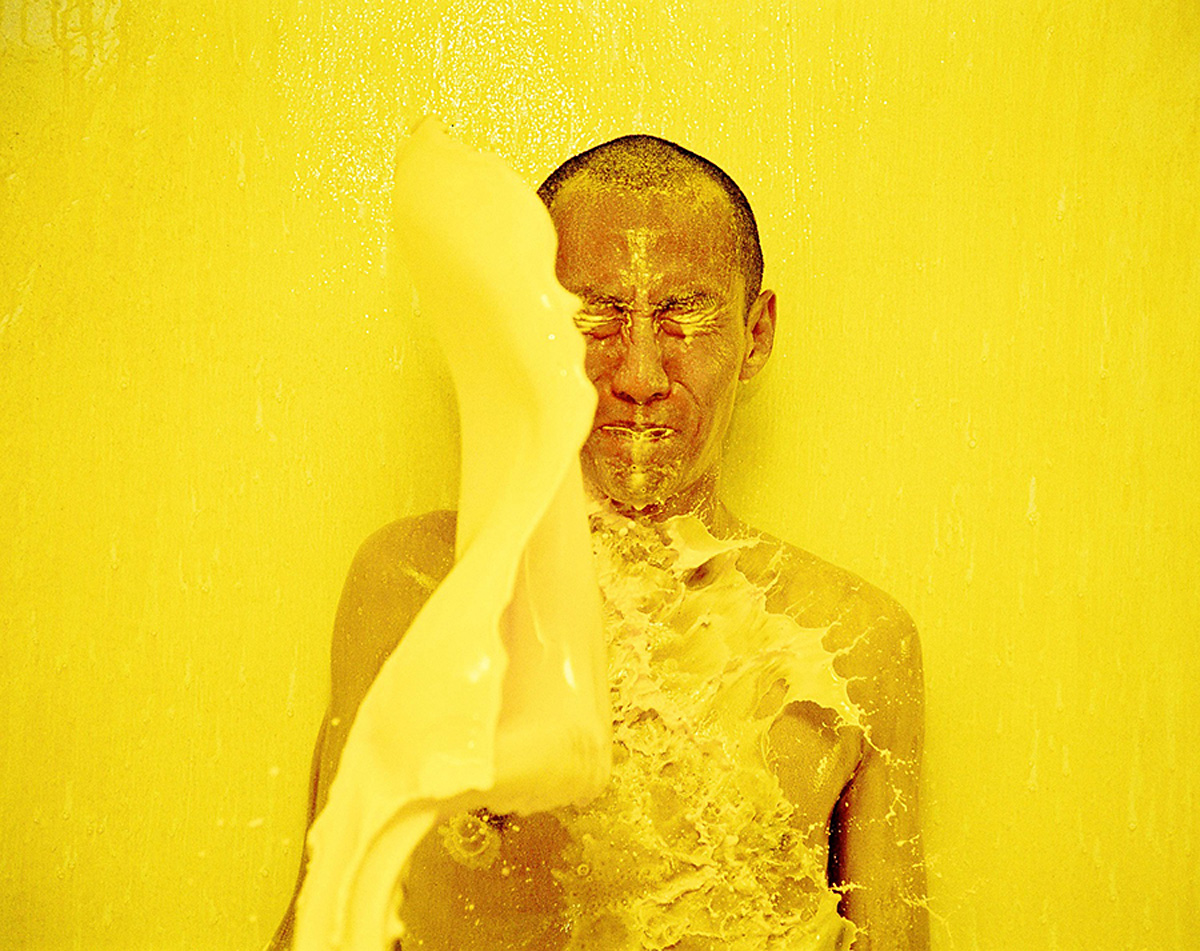
 

Lee Wen (Singapore, 1957-2019) 'Splash! #7' 2003


Lee Wen (Singapore, 1957-2019)
Splash! #7
2003
Courtesy the artist and iPreciation, Singapore


A driving force in contemporary art across Southeast Asia, performance art will be the focus of a new free exhibition at Arts Centre Melbourne in Political Acts: Pioneers of Performance Art in Southeast Asia, presented as part of the inaugural Asia TOPA: Asia-Pacific Triennial of Performing Arts in Gallery 1 from 11 February 2017…

“In the last decade performance art and performative practices have taken centre stage within the global contemporary art world,” says Curator, Dr Steven Tonkin. “The seven artists in Political Acts are ground-breaking practitioners of performance art. As individuals, they offer personal viewpoints on their respective national and regional cultures. As a collective, they illustrate interesting commonalities in artistic strategies and approaches.”

“Most importantly, these provocative contemporary artists highlight the major political, social, economic and environmental issues confronted and critiqued through performance art in Southeast Asia today.”

Dadang Christanto is an internationally acclaimed artist. Born in central Java in 1957, Christanto moved to Australia in 1999. He exhibits and performs regularly in both Australia and Indonesia and has spent his artistic life commemorating the victims of political violence and crimes against humanity.

Singaporean performance artist Lee Wen explores social identity and is best known for his Yellow Man performances. Painting his own body with bright yellow poster paint, he expresses an exaggerated symbol of his ethnic identity. He received the prestigious Cultural Medallion for his contribution to visual art in Singapore.

Born in Kuala Lumpur in 1970, Liew Teck Leong studied Fine Art at the Malaysian Institute of Art in the early 1990s, initially becoming an expressionist painter. In the 2000s his practice changed direction to incorporate installation, photography and public art performances, when he became an active member of the artists’ collective Rumah Air Panas / RAP Art Society.

Born in 1982, Khvay Samnang studied painting and graduated from the Royal University of Fine Arts, Phnom Penh, in 2006. He now works across performance, photography, video and installation. Khvay was one of the co-founders of the artists’ collective known as Stiev Selepak (or Art Rebels), and was involved in establishing the artist-run space Sa Sa Art Projects in Phnom Penh’s historic White Building. He is one of the leading Cambodian artists to have come to international attention over the last decade.

Born in Yangon in 1983, Moe Satt is one of the cohort of young artists who have begun to transform the contemporary art scene in Myanmar. Principally self taught, Moe Satt uses his body as the primary vehicle for his art, although his practice now also encompasses photography, film and installations. His artistic career mirrors the wider socio-political changes that have occurred in Myanmar over the last decade, from isolation under military rule to the current democratic reforms.

Born in 1969 in Surakarta (or Solo), Central Java, Indonesia, Melati Suryodarmo grew up in the creative environment provided by her father Suprapto, founder of Amerta – an exploratory free-form dance movement. Suryodarmo sees her art practice as opening the door to new perceptions, traversing traditional cultural and political boundaries ‘in an effort to find [one’s] identity’.

Born in Hanoi in 1960, Tran Luong trained as a painter at the Hanoi University of Fine Arts. He achieved recognition as a member of the ‘Gang of Five’, a group of artists whose works were a catalyst for contemporary art in Vietnam from the late 1980s. A widely respected multidisciplinary artist, curator and mentor for the next generation of contemporary Vietnamese artists, his collaborative approach to art-making involves local communities.

“The inaugural Asia TOPA: Asia-Pacific Triennial of Performing Arts is an artistic celebration of our relationship with contemporary Asia,” says Arts Centre Melbourne CEO, Claire Spencer. “Vital, fresh and always unpredictable, Asia TOPA offers a city-wide window onto the creative imaginations fuelling the many cultures of our region.”

“Cultural engagement is key to expressing who we are, where we have come from, and how we connect with each other across the Asia-Pacific region. The dazzling array of artists featured in Asia TOPA will provide new ways of understanding the deep connections that run between us all.”

Press release from the Arts Centre Melbourne
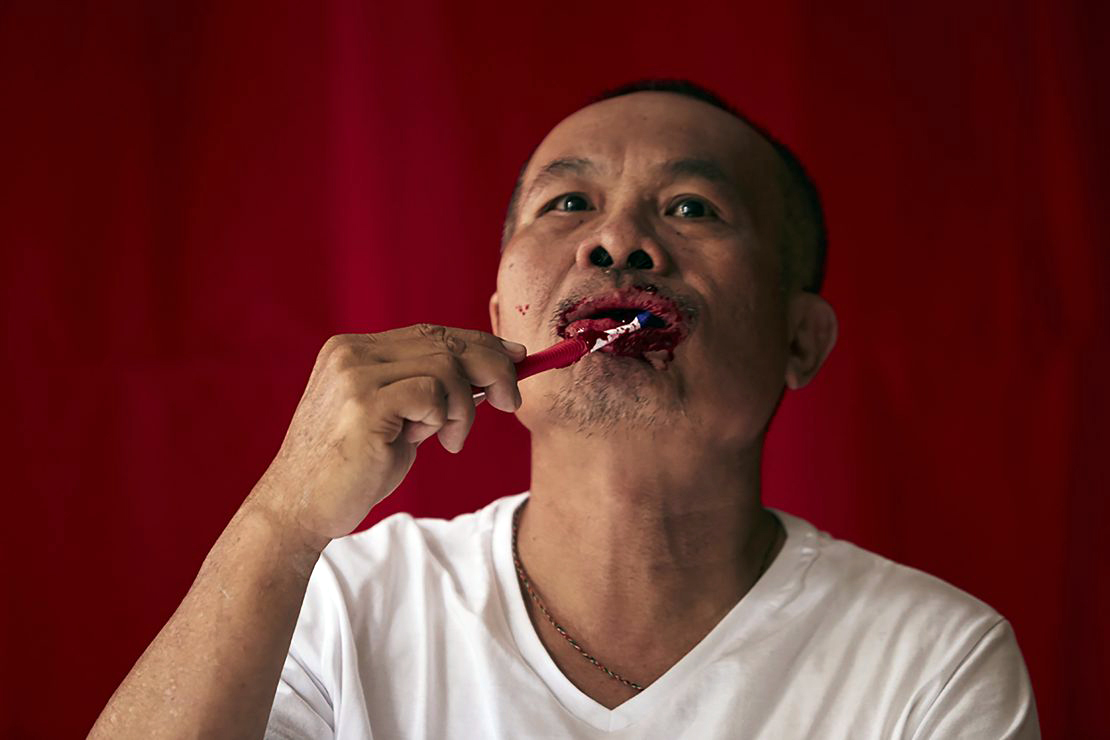
 

Dadang ChristantoĀ (Central Java, Indonesia, b. 1957) 'Tooth Brushing' 1979-2015-2017


Dadang Christanto (Central Java, Indonesia, b. 1957)
Tooth Brushing
1979-2015-2017
Courtesy the artist, Gallerysmith, and 4A Centre for Contemporary Asian Art


Dadang Christanto (Central Java, Indonesia, b. 1957)
Tooth Brushing (extract)
2017
Single channel video installation
Duration: 6.00 mins

Performance in Political Acts: Pioneers of Performance Art in Southeast Asia at the Arts Centre Melbourne on 10 February 2017


Moe Satt (Yangon, Myanmar, b. 1983)
F ‘n’ F (Face and Fingers) (extract)
2009
Single channel video
Duration: 12.00 mins


Moe Satt‘s early performance piece, F ‘n’ F (Face and Fingers) from 2008-2009, is simple in conception but complex in the multiple meanings that can be read into the choreographed combinations of hand and facial gestures. Among the artist’s favourites are a universal ‘Thumbs Up’ and the potent symbol of a ‘Gun’ pressed to his temples.

In his The Bicycle-Tyre-Rolling Event from Yangon the artist re-enacts a childhood game of racing discarded rubber bicycle tyres with friends. In this series of photographs the public places and monuments he rolls the tyre past present a performative narrative of his country’s history. For example, the beautiful vistas of Yangon’s two large man-made lakes belie their entwined histories of demonstrations and death.
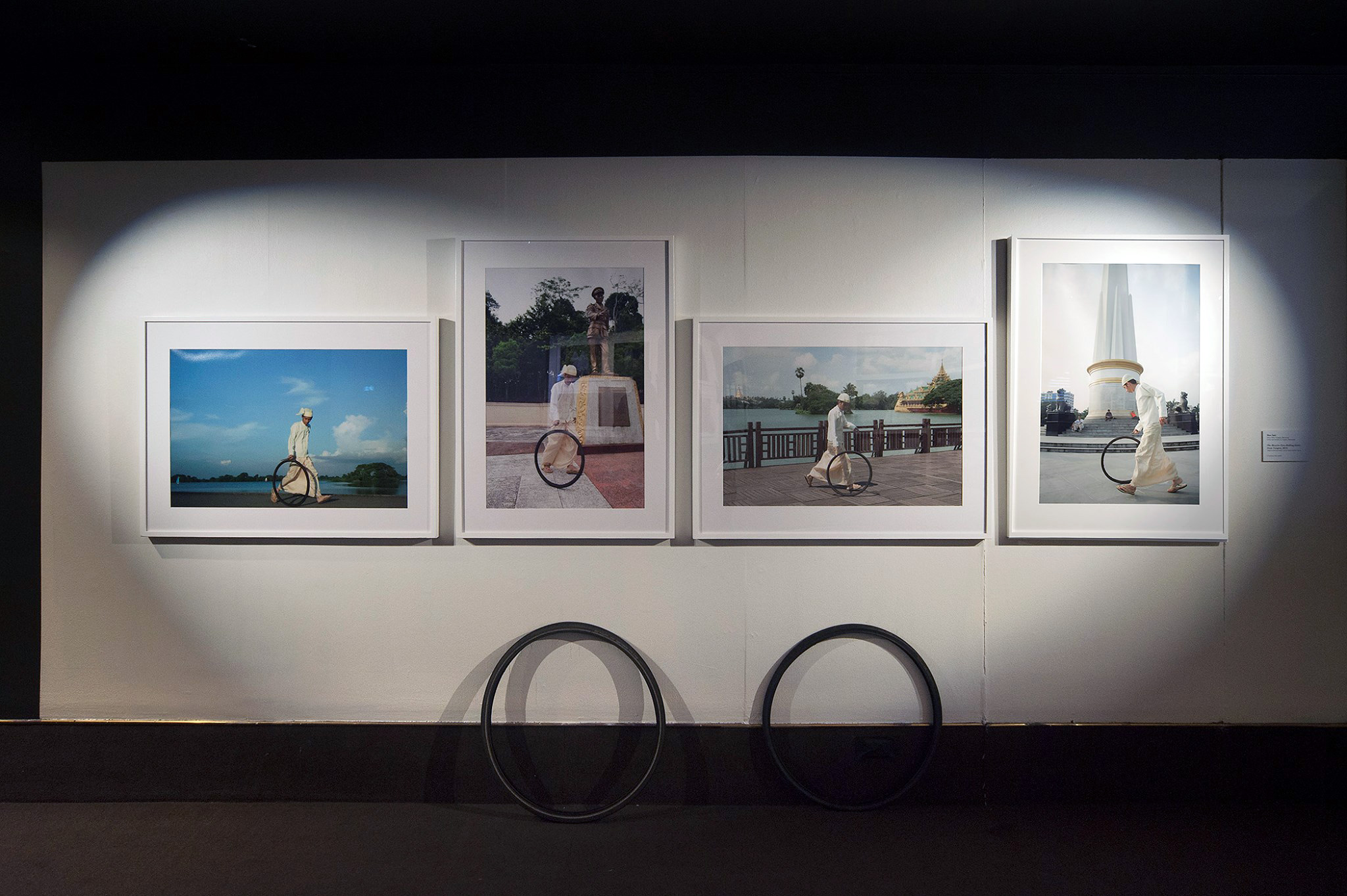
 

Installation view of Moe Satt's 'The Bicycle-Tyre-Rolling Event from Yangon' (2013)


Installation view of Moe Satt’s The Bicycle-Tyre-Rolling Event from Yangon (2013)
Photo: Marcus Bunyan


Tran Luong (Hanoi, Vietnam, b. 1960)
Steam Rice Man (extract)
2001
Single channel video
Duration: 5.00 mins

Performance at the Mao Khe Coal Mine, Quang Ninh Province, Vietnam in 2001


Tran Luong (Hanoi, Vietnam, b. 1960)
Lap Lòe (extract)
2012
Three channel video and sound installation
Duration: 5.00 mins


Tran Luong‘s collaborative approach to art-making often involves working with local communities, such as rural coal miners in northern Vietnam in 2001. During that time he created his early performance art work Steam Rice Man.

Tran Luong weaves his personal experiences with concerns for the wider socio-political situation in Vietnam. One influential moment was seeing his son arrive home from school wearing a red scarf around his neck. It reminded the artist of the communist red scarf he had to wear as a boy.

In Lap Lòe (or ‘flicker’), the three channel video installation in this exhibition, a red scarf has become aesthetically abstracted for the screen – blowing like a flag in the wind, snapping hypnotically and painfully across the artist’s body, and falling gracefully through the area. The red scarf is a powerful symbol for personal and collective memory.
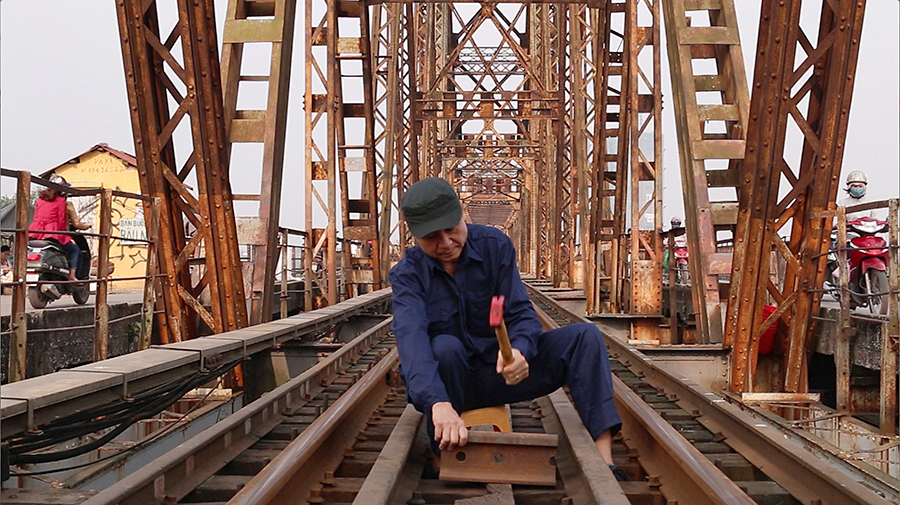
 

Tran LuongĀ (Hanoi, Vietnam, b. 1960) 'Coc Cach' 2013-2016


Tran Luong (Hanoi, Vietnam, b. 1960)
Coc Cach
2013-2016
Courtesy the artist
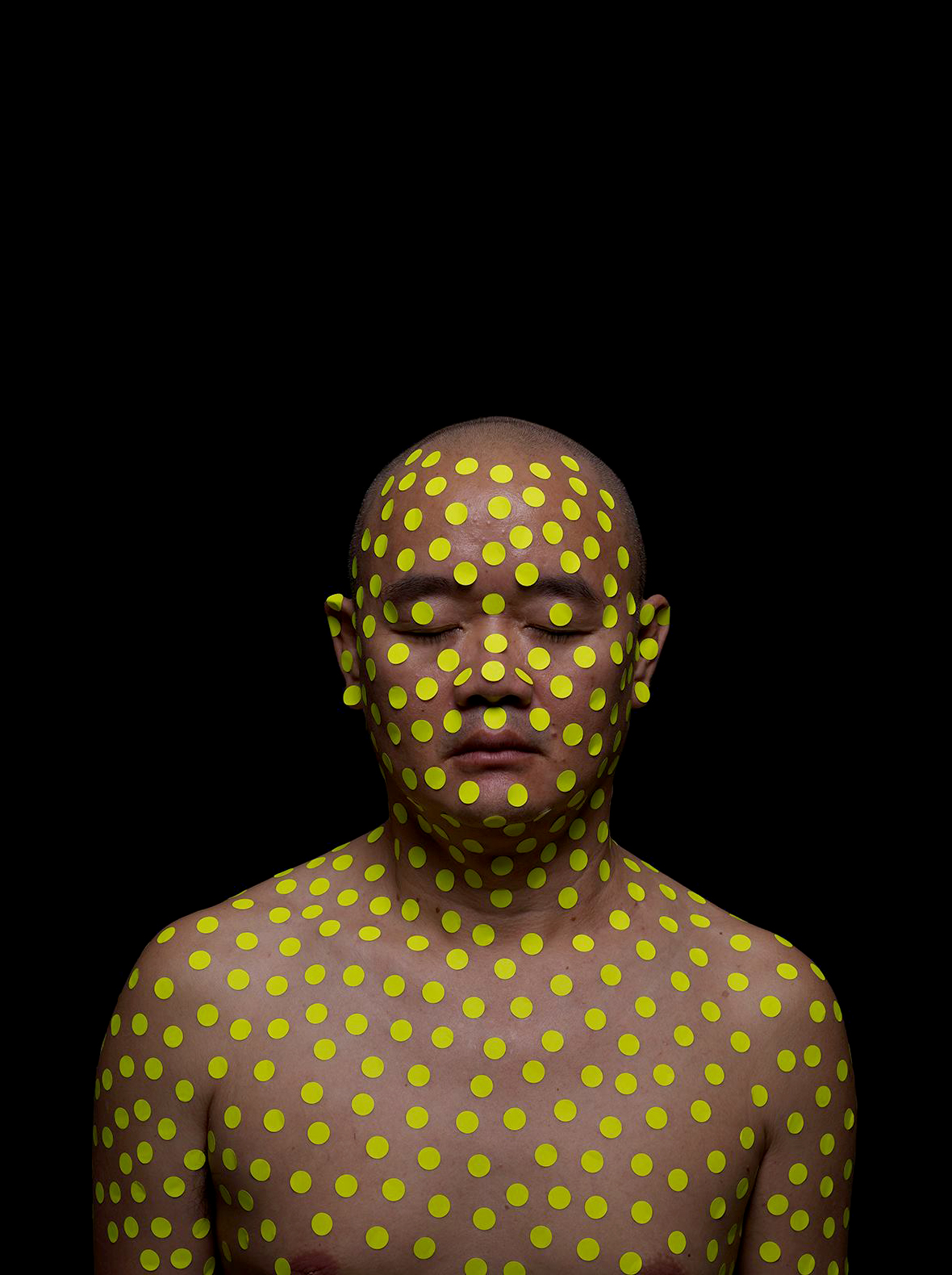
 

Liew Teck LeongĀ (Kuala Lumpur, Malaysia, b. 1970) 'Body+Dots+Politics (Yellow)' 2016


Liew Teck Leong (Kuala Lumpur, Malaysia, b. 1970)
Body+Dots+Politics (Yellow)
2016
Courtesy the artist


Arts Centre Melbourne
Gallery 1, Theatres Building
100 St Kilda Road, Melbourne VIC 3004

Arts Centre Melbourne website

LIKE ART BLART ON FACEBOOK

Back to top

Review: ‘Simryn Gill: Gathering’ at Heide Museum of Modern Art, Melbourne

Exhibition dates: 22 April – 18 July 2010


Simryn GillĀ (Singapore, b. 1959) 'Pearls' 1999 from the exhibition 'Simryn Gill: Gathering' at Heide Museum of Modern Art, Melbourne, April - July, 2010


Simryn Gill (Singapore, b. 1959)
Pearls
1999
Private collection


This is a strong survey exhibition of the work of Simryn Gill at Heide Museum of Modern Art. Like most survey exhibitions it suffers from a slightly piecemeal approach, dipping in and out of various bodies of work to try to make up a holistic whole. Conceptually this is not a problem as the thematic development of Gill’s work, her narrative arc if you like, is evident throughout. Visually this causes some work to seem isolated and left me wanting more connection between pieces and rooms as you walk around.

Highlights included May 2006 (2006), Pearls (1999 – ongoing), Untitled (interiors) 2008 and Throwback (2007).

In May 2006 (2006) 817 silver gelatin photographs are mounted in columns of images, each column making up one of 30 rolls of film, one shot every day of a month photographing the artist’s immediate neighbourhood in Marrickville, Sydney, in the month in which the film expiration date occurred. Each column has a different number of images and are mounted along the one of the largest walls in the Heide galleries, producing an effect almost like a DNA sequence. Abstract scenes of pathways, fences, cars in streets, broken gutters, planes flying houses, trees, people walking, abandoned telephone directories, Hills hoists, coffee shops, windows, rooftops and factories inhabit the frame of reference – the environment seeming to be abandoned both literally and metaphorically. Empty chairs move from picture to picture. No Parking here!

There are some great angles in these photographs a la Robert Frank The Americans with excellent use of short depth of field shooting across tabletops for example. Above all there is a sense of abandonment, desolation and isolation in the intersection of spaces. Even in strong sunlight there is a strange, haunting melancholy present – an innate understanding of the subconsciously known archetype of space and place, that sense of belonging – and an absolute recognition in the viewer of that.

In Pearls (1999 – ongoing, see photograph above) friends provide Gill with a book of personal value, which she then transforms into beads of paper and then strings them together as necklaces which she then returns to the owner as a gift. The colours, length and heaviness of the necklace depends on the book chosen – the reconstructed text lying like pearls of wisdom against the skin of the giver / receiver, the meaning of the book transformed through the process. What a beautiful gift to receive.

Untitled (interiors) (2008), my second favourite work of the day, features bronze sculptures cast from the empty spaces created by dry cracks in the ground found near Nyngan and Lake George, New South Wales. The sculptures present the cracks inverted so they become like miniature mountain ranges, the cracks in the earth filled and metamorphosing until they thrust into the air, the empty spaces of the earth uplifted, negative / positive spaces interchangeable. This is a simple but beautifully resolved work. Unfortunately I do not have any photographs to show you of these sculptures.

Other work includes My own private Angkor (2007, see photograph above), photographs taken at a housing estate in Port Dickson that is becoming overgrown and returning to the surrounding landscape that Gill has made into her own Angkor Wat in reverse, featuring the detritus of a vanquished, constructed environment; four black and white photographs from Forest (1996) featuring text on leaves; a glass case of curiosities like the Victorian cabinet of curiosities that includes a jar of plastic cowboys and indians, a bowl of Mindanao pearls, found and made spherical objects, cast tin and mango seeds (Some of my best friends suck mangoes, 1998) and different noses of cast tin (Bouquet 1994); Untitled (1998 – ongoing), a glass case full of found and blunt objects arranged like a seismograph recording, small at the ends and big in the centre featuring scissors, clubs, spoons, knives, bottle top openers, tweezers, letter openers and salad servers!; and Paper boats (2008, see photographs below), table and floor covered by paper boats made from the torn out pages of Encyclopedia Britannica 1968 with the invitation to “Please make boats” with no explanation as to how, exactly, to make them – human knowledge as text, detritus, object, place, manufacture and commission.

The absolute star of the exhibition is the installation Throwback (2007, see photographs below). The installation features the interior parts of a Tata truck (the engine and axles) recast in termite mound soils, river clay, laterite, sea shells, fruit skins, coconut bark, resin, and fibre laid on a huge dissecting table (much like the body in Rembrandt’s painting The Anatomy Lesson of Dr Tulp (1632)) – the layout of the engine and axles evoking the spine and interior skeleton of the body. Unfortunately I do not have an overview photograph of the whole work but parts of the work can be seen in the photographs below. The Tata truck spent its working life plying the roads of the forests of Malaysia:

“With the rise of China and India, a voracious market for scrap metal has developed, hastening the disappearance of particular objects, Gill recovers the modern forms of the truck parts by casting them in natural materials found near her studio in Port Dickson.” (Wall text from the exhibition)

.
This is an outstanding work that left me stunned with it’s beauty and insightfulness. It literally took my breath away and for that reason alone a visit to this exhibition at Heide is well worth the journey.

Dr Marcus Bunyan


Many thankx to Jade Enge and the Heide Museum of Modern Art for allowing me to publish the photographs in the posting. Please click on the photographs for a larger version of the image.


“The work of Simryn Gill considers questions of place and history, and how they might intersect with personal and collection experience … Using objects, language and photographs, her work conveys a deep interest in material culture, and in the ways that meaning can transform and translate in different contexts. Through the reinterpretation or alteration of existing objects, the photographing of specific locations, and the forming of collections, Gill contemplates how ideas and meanings are communicated between people, objects and sites.”


Wall text from the exhibition


Simryn GillĀ (Singapore, b. 1959) 'Untitled' 1999 from the exhibition 'Simryn Gill: Gathering' at Heide Museum of Modern Art, Melbourne, April - July, 2010


Simryn Gill (Singapore, b. 1959)
Untitled
1999
Gouache on National Geographic magazine pages (1970s)
Courtesy of the artist, BREENSPACE, Sydney and Tracy Williams Ltd, New York


Simryn GillĀ (Singapore, b. 1959) 'Untitled' 1999 from the exhibition 'Simryn Gill: Gathering' at Heide Museum of Modern Art, Melbourne, April - July, 2010


Simryn Gill (Singapore, b. 1959)
Untitled
1999
Gouache on National Geographic magazine pages (1970s)
Courtesy of the artist, BREENSPACE, Sydney and Tracy Williams Ltd, New York


Simryn GillĀ (Singapore, b. 1959) 'My own private Angkor' 2007


Simryn Gill (Singapore, b. 1959)
My own private Angkor
2007
Courtesy of the artist, BREENSPACE, Sydney and Tracy Williams Ltd, New York


Installation view of the exhibition 'Simryn Gill: Gathering' at Heide Museum of Modern Art, Melbourne showing the work 'Throwback' 2007


Installation view of the exhibition Simryn Gill: Gathering at Heide Museum of Modern Art, Melbourne showing the work Throwback 2007


Simryn GillĀ (Singapore, b. 1959) 'Throwback'Ā 2007 (detail)


Simryn Gill (Singapore, b. 1959)
Throwback (detail)
2007
Interior parts of Tata truck, termite mound soil, river clay, laterite, seashells, fruit skins, leaves, bark and fibre, flowers, glue, resin, milk
Buxton Collection Melbourne
Courtesy of the artist


Simryn GillĀ (Singapore, b. 1959) 'Throwback'Ā 2007 (detail)


Simryn Gill (Singapore, b. 1959)
Throwback (detail)
2007
Interior parts of Tata truck, termite mound soil, river clay, laterite, seashells, fruit skins, leaves, bark and fibre, flowers, glue, resin, milk
Buxton Collection Melbourne
Courtesy of the artist


This exhibition (22 April – 18 July) presents the work of leading Sydney-based Malaysian artist, Simryn Gill. Featuring objects, books, collections, photographs and text pieces from the last six years of Gill’s practice, it explores the artist’s pursuit of meaning through materials, forms and ways of working, such as collecting, reading, archiving, arranging, casting and photographing.

Described in 2009 in the New Yorker as ‘quietly dazzling’, Gill’s work is internationally recognised. She has been honoured with solo exhibitions at the Tate Modern, London and the Smithsonian Institution, Washington DC, both in 2006. Born in Singapore in 1959, Gill lives and works in Sydney and Port Dickson, Malaysia, and has participated in significant exhibitions internationally, including documenta 12 in Kassel, Germany (2007), the Singapore Biennale (2006), the Biennale of Sydney (2002 and 2008), the SĆ£o Paulo Biennial (2004) and the Venice Biennale (1999).

An MCA touring exhibition curated by Russell Storer, it has been expanded by Heide to include the Australian premiere of Gill’s major work Throwback, originally produced for the documenta 12 exhibition in Kassel, Germany, in 2007. Throwback reworks the inner machinery of a 1985 Tata truck that plied the roads of Malaysia. With the economic rise of China and India, a voracious market for scrap metal has developed, hastening the disappearance of particular objects. Gill recovers the modern forms of truck parts by casting them in natural materials – found near her studio in Malaysia – including river mud, coconut husks, reconstituted termite mounds and fruit skins.

Gill has also produced a new work, an artist’s book reflecting on the gardens at Heide.

Gill’s practice considers how we might experience place as an intersection of personal and collective histories and geographies. Through the reinterpretation or alteration of existing objects, the photographing of specific locations, and the forming of collections, Gill contemplates how ideas and meanings are communicated between people, objects, and sites.

Several works in the exhibition invite audience participation. Paper Boats invites visitors to add their own unique paper boat to the installation by tearing pages from a 1968 Encyclopaedia Britannica and using the sheet to make an origami boat. Another work, Garland (2006) encourages us to hold, touch and rearrange objects collected by Gill on the beaches of Port Dickson, Malaysia, and the islands off Singapore – fragments reshaped by sea and sand that take on almost organic form.

A selection of books, sketches, collections and experimental pieces from the early 1990s to the present, some produced for exhibitions and others never intended as artworks will also be presented as part of the exhibition. Together they offer an insight into Gill’s artistic processes and her interest in art-making as an active engagement with the world.”

Press release from the Heide Museum of Modern Art website [Online] Cited 01/10/2010 no longer available online


Simryn GillĀ (Singapore, b. 1959) 'Paper boats' 2008


Simryn Gill (Singapore, b. 1959)
Paper boats
2008
Encyclopaedia Britannica (1968 edition)
Courtesy of the artist and BREENSPACE, Sydney


Simryn GillĀ (Singapore, b. 1959) 'Paper boats' 2008 (detail)


Simryn Gill (Singapore, b. 1959)
Paper boats (detail)
2008
Encyclopaedia Britannica (1968 edition)
Courtesy of the artist and BREENSPACE, Sydney


Addendum: A Pencil for Your Thoughts


Heide pencil


Heide pencil, the confounding pencil

I love to visit Heide, the elegant buildings, the art, the cafe, a stroll in the gardens looking at the sculpture. What I don’t like is being accosted by gallery attendants on my last three visits, twice on the last visit alone to review the Simryn Gill exhibition – accost being not too harsh a word for some of the approaches. The request: to not write in the gallery with a pen but to use a pencil (rushed to the scene of the crime post haste!)

I don’t like writing with a pencil, they go blunt and I can’t read my notes. I like writing with a pen.
This is a ridiculous state of affairs, the only gallery in Melbourne that I know of that has such a ‘nanny state’ rule.

Do they think that I am going to:

a) spear the pen into the gallery wall
b) attack the attendant with the pen (after this last visit the thought did cross my mind!) or
c) scribble all over the art work like a child …

Ā 
The more we are treated like children the more child-like we become.

“Put the pen on the ground … Step away from the pen.”


Heide Museum of Modern Art
7, Templestowe Road
Bulleen, Victoria 3105

Opening hours:
(Heide II and Heide III)
Tuesday – Sunday 10.00am – 5.00pm

Heide Museum of Modern Art website

LIKE ART BLART ON FACEBOOK

Back to top